EP4459876A1 - Decoding device, control circuit, storage medium, and decoding method - Google Patents
Decoding device, control circuit, storage medium, and decoding method Download PDFInfo
- Publication number
- EP4459876A1 EP4459876A1 EP22921939.9A EP22921939A EP4459876A1 EP 4459876 A1 EP4459876 A1 EP 4459876A1 EP 22921939 A EP22921939 A EP 22921939A EP 4459876 A1 EP4459876 A1 EP 4459876A1
- Authority
- EP
- European Patent Office
- Prior art keywords
- likelihood
- likelihood calculation
- bit sequence
- unit
- decoded
- Prior art date
- Legal status (The legal status is an assumption and is not a legal conclusion. Google has not performed a legal analysis and makes no representation as to the accuracy of the status listed.)
- Granted
Links
Images




Classifications
-
- H—ELECTRICITY
- H03—ELECTRONIC CIRCUITRY
- H03M—CODING; DECODING; CODE CONVERSION IN GENERAL
- H03M13/00—Coding, decoding or code conversion, for error detection or error correction; Coding theory basic assumptions; Coding bounds; Error probability evaluation methods; Channel models; Simulation or testing of codes
- H03M13/37—Decoding methods or techniques, not specific to the particular type of coding provided for in groups H03M13/03 - H03M13/35
- H03M13/3723—Decoding methods or techniques, not specific to the particular type of coding provided for in groups H03M13/03 - H03M13/35 using means or methods for the initialisation of the decoder
-
- H—ELECTRICITY
- H03—ELECTRONIC CIRCUITRY
- H03M—CODING; DECODING; CODE CONVERSION IN GENERAL
- H03M13/00—Coding, decoding or code conversion, for error detection or error correction; Coding theory basic assumptions; Coding bounds; Error probability evaluation methods; Channel models; Simulation or testing of codes
- H03M13/03—Error detection or forward error correction by redundancy in data representation, i.e. code words containing more digits than the source words
- H03M13/05—Error detection or forward error correction by redundancy in data representation, i.e. code words containing more digits than the source words using block codes, i.e. a predetermined number of check bits joined to a predetermined number of information bits
- H03M13/11—Error detection or forward error correction by redundancy in data representation, i.e. code words containing more digits than the source words using block codes, i.e. a predetermined number of check bits joined to a predetermined number of information bits using multiple parity bits
- H03M13/1102—Codes on graphs and decoding on graphs, e.g. low-density parity check [LDPC] codes
- H03M13/1105—Decoding
- H03M13/1108—Hard decision decoding, e.g. bit flipping, modified or weighted bit flipping
-
- H—ELECTRICITY
- H03—ELECTRONIC CIRCUITRY
- H03M—CODING; DECODING; CODE CONVERSION IN GENERAL
- H03M13/00—Coding, decoding or code conversion, for error detection or error correction; Coding theory basic assumptions; Coding bounds; Error probability evaluation methods; Channel models; Simulation or testing of codes
- H03M13/03—Error detection or forward error correction by redundancy in data representation, i.e. code words containing more digits than the source words
- H03M13/05—Error detection or forward error correction by redundancy in data representation, i.e. code words containing more digits than the source words using block codes, i.e. a predetermined number of check bits joined to a predetermined number of information bits
- H03M13/11—Error detection or forward error correction by redundancy in data representation, i.e. code words containing more digits than the source words using block codes, i.e. a predetermined number of check bits joined to a predetermined number of information bits using multiple parity bits
- H03M13/1102—Codes on graphs and decoding on graphs, e.g. low-density parity check [LDPC] codes
- H03M13/1105—Decoding
- H03M13/1111—Soft-decision decoding, e.g. by means of message passing or belief propagation algorithms
-
- H—ELECTRICITY
- H03—ELECTRONIC CIRCUITRY
- H03M—CODING; DECODING; CODE CONVERSION IN GENERAL
- H03M13/00—Coding, decoding or code conversion, for error detection or error correction; Coding theory basic assumptions; Coding bounds; Error probability evaluation methods; Channel models; Simulation or testing of codes
- H03M13/03—Error detection or forward error correction by redundancy in data representation, i.e. code words containing more digits than the source words
- H03M13/05—Error detection or forward error correction by redundancy in data representation, i.e. code words containing more digits than the source words using block codes, i.e. a predetermined number of check bits joined to a predetermined number of information bits
- H03M13/11—Error detection or forward error correction by redundancy in data representation, i.e. code words containing more digits than the source words using block codes, i.e. a predetermined number of check bits joined to a predetermined number of information bits using multiple parity bits
- H03M13/1102—Codes on graphs and decoding on graphs, e.g. low-density parity check [LDPC] codes
- H03M13/1148—Structural properties of the code parity-check or generator matrix
- H03M13/116—Quasi-cyclic LDPC [QC-LDPC] codes, i.e. the parity-check matrix being composed of permutation or circulant sub-matrices
-
- H—ELECTRICITY
- H03—ELECTRONIC CIRCUITRY
- H03M—CODING; DECODING; CODE CONVERSION IN GENERAL
- H03M13/00—Coding, decoding or code conversion, for error detection or error correction; Coding theory basic assumptions; Coding bounds; Error probability evaluation methods; Channel models; Simulation or testing of codes
- H03M13/03—Error detection or forward error correction by redundancy in data representation, i.e. code words containing more digits than the source words
- H03M13/05—Error detection or forward error correction by redundancy in data representation, i.e. code words containing more digits than the source words using block codes, i.e. a predetermined number of check bits joined to a predetermined number of information bits
- H03M13/11—Error detection or forward error correction by redundancy in data representation, i.e. code words containing more digits than the source words using block codes, i.e. a predetermined number of check bits joined to a predetermined number of information bits using multiple parity bits
- H03M13/1102—Codes on graphs and decoding on graphs, e.g. low-density parity check [LDPC] codes
- H03M13/1191—Codes on graphs other than LDPC codes
-
- H—ELECTRICITY
- H03—ELECTRONIC CIRCUITRY
- H03M—CODING; DECODING; CODE CONVERSION IN GENERAL
- H03M13/00—Coding, decoding or code conversion, for error detection or error correction; Coding theory basic assumptions; Coding bounds; Error probability evaluation methods; Channel models; Simulation or testing of codes
- H03M13/03—Error detection or forward error correction by redundancy in data representation, i.e. code words containing more digits than the source words
- H03M13/05—Error detection or forward error correction by redundancy in data representation, i.e. code words containing more digits than the source words using block codes, i.e. a predetermined number of check bits joined to a predetermined number of information bits
- H03M13/13—Linear codes
- H03M13/15—Cyclic codes, i.e. cyclic shifts of codewords produce other codewords, e.g. codes defined by a generator polynomial, Bose-Chaudhuri-Hocquenghem [BCH] codes
- H03M13/151—Cyclic codes, i.e. cyclic shifts of codewords produce other codewords, e.g. codes defined by a generator polynomial, Bose-Chaudhuri-Hocquenghem [BCH] codes using error location or error correction polynomials
- H03M13/1515—Reed-Solomon codes
-
- H—ELECTRICITY
- H03—ELECTRONIC CIRCUITRY
- H03M—CODING; DECODING; CODE CONVERSION IN GENERAL
- H03M13/00—Coding, decoding or code conversion, for error detection or error correction; Coding theory basic assumptions; Coding bounds; Error probability evaluation methods; Channel models; Simulation or testing of codes
- H03M13/03—Error detection or forward error correction by redundancy in data representation, i.e. code words containing more digits than the source words
- H03M13/05—Error detection or forward error correction by redundancy in data representation, i.e. code words containing more digits than the source words using block codes, i.e. a predetermined number of check bits joined to a predetermined number of information bits
- H03M13/13—Linear codes
- H03M13/15—Cyclic codes, i.e. cyclic shifts of codewords produce other codewords, e.g. codes defined by a generator polynomial, Bose-Chaudhuri-Hocquenghem [BCH] codes
- H03M13/151—Cyclic codes, i.e. cyclic shifts of codewords produce other codewords, e.g. codes defined by a generator polynomial, Bose-Chaudhuri-Hocquenghem [BCH] codes using error location or error correction polynomials
- H03M13/152—Bose-Chaudhuri-Hocquenghem [BCH] codes
-
- H—ELECTRICITY
- H03—ELECTRONIC CIRCUITRY
- H03M—CODING; DECODING; CODE CONVERSION IN GENERAL
- H03M13/00—Coding, decoding or code conversion, for error detection or error correction; Coding theory basic assumptions; Coding bounds; Error probability evaluation methods; Channel models; Simulation or testing of codes
- H03M13/03—Error detection or forward error correction by redundancy in data representation, i.e. code words containing more digits than the source words
- H03M13/05—Error detection or forward error correction by redundancy in data representation, i.e. code words containing more digits than the source words using block codes, i.e. a predetermined number of check bits joined to a predetermined number of information bits
- H03M13/13—Linear codes
Definitions
- the present disclosure relates to a decoding device for decoding a quasi cyclic (QC)-polar code, a control circuit, a storage medium, and a decoding method.
- QC quasi cyclic
- the polar code is one form of error correction codes that can perform encoding and decoding processes with a low amount of calculation and can realize a characteristic of asymptotically approaching a Shannon limit on the basis of a concept of channel polarization.
- the polar code is a type of block code, and encoding is performed by repeating, for bits in a block, exclusive OR combinations and wiring change for changing a combination to be combined.
- the polar code has a code length of a power of 2, that is, 2 n when n is a positive integer, due to construction of the code.
- a successive cancellation decoding method in which decoding is sequentially performed bit by bit by using decoded bits in the middle of decoding and received likelihood information, a successive cancellation list decoding method in which a plurality of decoding candidates are stored and a likely candidate is finally employed as a decoding result, and the like are applied, but a longer code length results in a longer decoding process time.
- belief propagation (BP) decoding as an iterative decoding method used for decoding a low density parity check (LDPC) code and the like is also applicable as a polar code decoding method, but superior performance cannot be obtained as compared with the successive cancellation decoding method.
- a QC-polar code capable of preventing performance degradation due to BP decoding has been proposed with respect to the polar code.
- Patent Literature 1 discloses a rate matching technique for block encoding in which selection is made, depending on a target code length, between performing rate matching using puncturing, shortening, or the like, and performing an encoding process for different code lengths on a repetition basis.
- a rate matching technique for block encoding in which selection is made, depending on a target code length, between performing rate matching using puncturing, shortening, or the like, and performing an encoding process for different code lengths on a repetition basis.
- Patent Literature 1 clearly describes a polar code as an error correction code for performing an encoding process on a repetition basis.
- Patent Literature 1 Japanese Translation of PCT International Application Laid-open No. 2019-527978
- Patent Literature 1 it is disclosed that an efficient communication system and the like are provided by applying, depending on a target code length, rate matching using puncturing, shortening, or the like, or an encoding process for different code lengths on a repetition basis, but there is no disclosure of a specific configuration of a polar code decoding circuit in a case of assuming a plurality of code lengths.
- Each communication device constituting the communication system can support a plurality of code lengths by mounting dedicated decoding circuits corresponding to the plurality of code lengths in parallel.
- the number of decoding circuits for code lengths corresponding thereto increases accordingly. Therefore, in each communication device, an increase in a code length of a corresponding polar code results in more dedicated decoding circuits mounted in parallel and thus an increase in a circuit scale, which is a problem.
- the present disclosure has been made in view of the above, and an object thereof is to obtain a decoding device capable of performing decoding for a plurality of code lengths in decoding of a QC-polar code while preventing a circuit scale from increasing.
- a decoding device comprises: a likelihood initialization unit to perform an initialization process on a storage element for likelihood information to be used in likelihood calculation of an iterative decoding process on a basis of likelihood information to be input and a code length of a bit sequence to be decoded; a first likelihood calculation unit to execute M separate likelihood calculations corresponding to step 1 to step M where M is an integer of 2 or more, in likelihood calculation of the iterative decoding process; a second likelihood calculation unit to execute M separate likelihood calculations corresponding to step M+1 to step 2M in likelihood calculation of the iterative decoding process; a hard decision unit to make a hard decision on a result of likelihood calculation calculated by the second likelihood calculation unit and to generate a decoded bit sequence; a frozen bit removing unit to remove a frozen bit and a bit sequence based on a code length of the bit sequence to be decoded from the decoded bit sequence generated by the hard decision unit and to generate a decoded information
- the decoding device achieves an effect that it is possible to perform decoding for a plurality of code lengths in decoding of a QC-polar code while preventing a circuit scale from increasing.
- FIG. 1 is a block diagram illustrating an example configuration of a decoding device 100 according to a first embodiment.
- the decoding device 100 performs decoding by BP decoding based on a belief propagation method for a QC-polar code.
- the decoding device 100 includes a likelihood initialization unit 110, a first likelihood calculation unit 120, a second likelihood calculation unit 130, a hard decision unit 140, a frozen bit removing unit 150, and a control unit 160.
- the first likelihood calculation unit 120 includes a likelihood calculation unit 121-1 that performs likelihood calculation of step 1, a likelihood calculation unit 121-2 that performs likelihood calculation of step 2,..., a likelihood calculation unit 121-(M-1) that performs likelihood calculation of step M-1, and a likelihood calculation unit 121-M that performs likelihood calculation of step M. That is, the first likelihood calculation unit 120 performs M separate likelihood calculations corresponding to step 1 to step M.
- the second likelihood calculation unit 130 includes a likelihood calculation unit 131-(M+1) that performs likelihood calculation of step M+1, a likelihood calculation unit 131-(M+2) that performs likelihood calculation of step M+2,..., a likelihood calculation unit 131-(2M-1) that performs likelihood calculation of step 2M-1, and a likelihood calculation unit 131-2M that performs likelihood calculation of step 2M. That is, the second likelihood calculation unit 130 performs M separate likelihood calculations corresponding to step M+1 to step 2M.
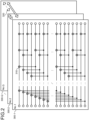
- FIG. 2 is a diagram illustrating a code construction of a QC-polar code to be decoded by the decoding device 100 according to the first embodiment.
- the code construction of the QC-polar code illustrated in FIG. 2 is a construction in which Q code constructions, specifically, code constructions of the polar code from a code construction 300-1 as a code construction No. 1 to a code construction 300-Q as a code construction No. Q, are mounted in parallel, and a code length of each code construction is N.
- Q code constructions specifically, code constructions of the polar code from a code construction 300-1 as a code construction No. 1 to a code construction 300-Q as a code construction No. Q
- encoding is performed while changing combinations of 2-bit exclusive OR processes by exclusive OR combinations 310.
- the QC-polar code becomes one code of a code length Q ⁇ N by having a construction in which each of the exclusive OR combinations 310 is connected to different one of parallel code constructions.
- an arrow 320 indicates an image of connection to a different parallel code construction.
- bit sequences having bits as many as the number of bits of a code length of the QC-polar code including information bits and frozen bits are input to open circles on a left side, an encoding process proceeds while iterating the exclusive OR combinations 310, and the bit sequences become code words of the QC-polar code in open circles on a right side.
- FIG. 3 is a diagram illustrating an example of a code construction having a code length of eight bits when a code length N of a polar code is equal to 4 and the number Q of parallel code constructions of the polar code is equal to 2 in the code construction of the QC-polar code illustrated in FIG. 2 .
- the connection to a different parallel code construction illustrated in FIG. 2 means that, in the code constructions illustrated in FIG. 3 in which the code length N is equal to 4 and the number Q of parallel code constructions is equal to 2, a target of the exclusive OR combination changes across different parallel code constructions as those in upper left and lower right portions.
- FIG. 4 is a schematic diagram illustrating a code construction when the code length N of the polar code is equal to 4 and the number of parallel code constructions of the polar code is Q in the code construction of the QC-polar code illustrated in FIG. 2 .
- the amounts of shift q(1,1), q(1,2), q(2,1), and q(2,2) indicate which of the parallel code constructions is to be connected, that is, a target to be connected.
- the QC-polar code in which the code length N is equal to 4 and the number Q of parallel code constructions is equal to 2 illustrated in FIG. 3 is described by using the schematic diagram of the code construction of FIG.
- the amount of shift of the target to be connected is not limited to 0 or 1, and for example, in a case where the number of parallel code constructions is Q, the amount of shift can be set to 0 to Q-1. By setting the amount of shift to 2 or more, it is possible to connect not only to adjacent parallel code constructions but also to all the parallel code constructions.
- the target to be connected can have different configurations depending on the code length N, the number of frozen bits, the number Q of parallel code constructions, and the like.
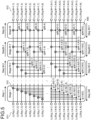
- FIG. 5 is a schematic diagram illustrating the code construction of the QC-polar code illustrated in FIG. 2 .
- FIG. 5 illustrates the QC-polar code in a case where the code length is N, the number of information bits is K, and the number of parallel code constructions is Q. Since the code length is N, the number of exclusive OR combinations denoted by M is log 2 (N). In addition, since the number of information bits is K, the number of frozen bits is N-K. As the QC-polar code, the code length is Q ⁇ N, and the number of information bits is Q ⁇ K. In FIG.
- the number of different amounts of shift q(m,n) 650 indicated by indexes m and n is M ⁇ (N/2), which is the same as the number of exclusive OR combinations 310.
- m is an index representing a stage and takes M values from 1 to M
- n is an index of the exclusive OR combination 310 of each stage and takes N/2 values from 1 to N/2.
- From step 1 to step M and from step M+1 to step 2M represent the order of steps of BP decoding of the QC-polar code, and correspond to likelihood calculations of the likelihood calculation units 121-1 to 121-M and the likelihood calculation units 131-(M+1) to 131-2M illustrated in FIG. 1 , respectively.
- likelihood calculations and updates of step 1 to step M on the left side to which the bit sequences including the information bits and the frozen bits are input are sequentially executed, and next, likelihood calculations and updates of step M+1 to step 2M on the right side from which the code words are output are sequentially executed.
- a process in which processes of the above likelihood calculations and updates are iterated for a set number of iterations is the BP decoding of the QC-polar code.
- Q ⁇ (M+1) ⁇ N likelihood values before and after each stage are updated for each of the likelihood updates in step 1 to step M and the likelihood updates in step M+1 to step 2M.
- likelihood information at the time of updating the likelihood in step 1 to step M is denoted by L2R(q,m,n)
- likelihood information at the time of updating the likelihood in step M+1 to step 2M is denoted by R2L(q,m,n).
- Likelihood information LLR(q,1,n) 611 and likelihood information LLR(q,M+1,n) 612 illustrated in FIG. 5 indicate likelihood information used in the decoding process, and indicate likelihood information at both ends of each update likelihood of a q-th parallel code construction.
- soft decision information such as a log likelihood ratio (LLR) can be used.
- LLR log likelihood ratio
- An operation of each component included in the decoding device 100 will be described below.
- the likelihood initialization unit 110 initializes a storage element for the likelihood information L2R(q,m,n) and a storage element for the likelihood information R2L(q,m,n) used in the likelihood update process illustrated in FIG. 5 by using the likelihood information LLR(q,m,n) such as received LLRs.
- the likelihood information LLR(q,M+1,n) 612 is a received LLR of the QC-polar code input to the decoding device 100 in the present embodiment.
- the likelihood initialization unit 110 initializes a storage element for the likelihood information, that is, a storage element for the likelihood information L2R(q,m,n) and a storage element for the likelihood information R2L(q,m,n) by using the likelihood information LLR(q,m,n) satisfying the relationship as described above.
- an initialization position such as a frozen bit position based on the code length Q ⁇ Nt of a decoding target on which the decoding process is performed is set by the control unit 160.
- the likelihood initialization unit 110 performs the initialization process on the storage elements for the likelihood information used in the likelihood calculations in iterative decoding processes on the basis of likelihood information to be input and the code length of the bit sequence to be decoded.
- the likelihood information to be input is, for example, a received LLR.
- the first likelihood calculation unit 120 and the second likelihood calculation unit 130 perform iterative decoding processes for BP decoding after the initialization by the likelihood initialization unit 110 is completed.
- the control unit 160 sets, for the likelihood calculation units 121-1 to 121-M of the first likelihood calculation unit 120 and the likelihood calculation units 131-(M+1) to 131-2M of the second likelihood calculation unit 130, the amount of shift q(m,n) 650 in each exclusive OR combination 310 depending on the code length Q ⁇ Nt of the decoding target.
- the likelihood calculation units 121-1 to 121-M and the likelihood calculation units 131-(M+1) to 131-2M execute the likelihood calculation process for the number of iterations.
- the control unit 160 controls likelihood calculation units that actually execute the likelihood calculation processes in the first likelihood calculation unit 120 and the second likelihood calculation unit 130, that is, likelihood calculation steps for executing the likelihood calculation processes.
- control unit 160 controls the likelihood calculation units that actually execute the likelihood calculation processes in the first likelihood calculation unit 120 and the second likelihood calculation unit 130, that is, likelihood calculation steps for executing the likelihood calculation processes.
- the likelihood calculation units 121-1 to 121-(M-Mt) of the first likelihood calculation unit 120 execute an initial likelihood calculation process with the use of initialized likelihood information output from the likelihood initialization unit 110 by the control of the control unit 160.
- the likelihood calculation units 121-(M-Mt+1) to 121-M of the first likelihood calculation unit 120 execute the likelihood calculation processes by the control of the control unit 160.
- the likelihood calculation units 131-(M+1) to 131-(M+Mt) of the second likelihood calculation unit 130 execute the likelihood calculation processes by the control of the control unit 160.
- the likelihood calculation units 121-(M-Mt+1) to 121-M of the first likelihood calculation unit 120 and the likelihood calculation units 131-(M+1) to 131-(M+Mt) of the second likelihood calculation unit 130 execute the likelihood calculation processes by the control of the control unit 160 until the iterative decoding process at a last time.
- the likelihood calculation units 121-(M-Mt+1) to 121-M of the first likelihood calculation unit 120 and the likelihood calculation units 131-(M+1) to 131-(M+Mt) of the second likelihood calculation unit 130 execute the likelihood calculation processes by the control of the control unit 160, and furthermore, the likelihood calculation units 131-(M+Mt+1) to 131-2M of the second likelihood calculation unit 130 execute a terminal likelihood calculation process by the control of the control unit 160. Consequently, the likelihood calculations of the QC-polar code as a decoding target having a code length of Q ⁇ Nt by the first likelihood calculation unit 120 and the second likelihood calculation unit 130 are completed.
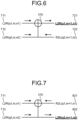
- FIG. 6 is a first diagram illustrating a likelihood relationship in an exclusive OR combination 310 in the schematic diagram illustrating the code construction of the QC-polar code illustrated in FIG. 5 .
- FIG. 7 is a second diagram illustrating the likelihood relationship in the exclusive OR combination 310 in the schematic diagram illustrating the code construction of the QC-polar code illustrated in FIG. 5 .
- FIG. 8 is a third diagram illustrating the likelihood relationship in the exclusive OR combination 310 in the schematic diagram illustrating the code construction of the QC-polar code illustrated in FIG. 5 .
- FIG. 6 is a first diagram illustrating a likelihood relationship in an exclusive OR combination 310 in the schematic diagram illustrating the code construction of the QC-polar code illustrated in FIG. 5 .
- FIG. 7 is a second diagram illustrating the likelihood relationship in the exclusive OR combination 310 in the schematic diagram illustrating the code construction of the QC-polar code illustrated in FIG. 5 .
- FIG. 8 is a third diagram illustrating the likelihood relationship in the exclusive OR combination 310 in the schematic diagram illustrating the
- FIGS. 9 is a fourth diagram illustrating the likelihood relationship in the exclusive OR combination 310 in the schematic diagram illustrating the code construction of the QC-polar code illustrated in FIG. 5 .
- FIGS. 6 and 7 are diagrams illustrating likelihood relationships in a case where likelihood calculations are performed from the left side to the right side in the schematic diagram illustrating the code construction of the QC-polar code illustrated in FIG. 5 , that is, in a case where likelihood calculations are performed in the order from step 1 to step M.
- FIGS. 8 and 9 are diagrams illustrating likelihood relationships in a case where likelihood calculations are performed from the right side to the left side in the schematic diagram illustrating the code construction of the QC-polar code illustrated in FIG. 5 , that is, in a case where likelihood calculations are performed in the order from step M+1 to step 2M.
- the likelihood information L2R(q,m,n) is likelihood information when performing likelihood calculations from the left side to the right side, and indicates input to stage m of a q-th parallel code construction and likelihood information of an n-th bit.
- likelihood information L2R(q,m+1,n) is likelihood information when performing likelihood calculations from the left side to the right side, and indicates output from stage m of the q-th parallel code construction and the likelihood information of the n-th bit.
- likelihood information R2L(q,m+1,n) is likelihood information when performing likelihood calculations from the right side to the left side, and indicates input to stage m of the q-th parallel code construction and the likelihood information of the n-th bit.
- the likelihood information R2L(q,m,n) is likelihood information when performing likelihood calculations from the right side to the left side, and indicates output from stage m of the q-th parallel code construction and the likelihood information of the n-th bit.
- FIG. 6 illustrates a likelihood relationship for likelihood calculation of likelihood information L2R(q1,m+1,n1)
- FIG. 7 illustrates a likelihood relationship for likelihood calculation of likelihood information L2R(q2,m+1,n2)
- FIG. 8 illustrates a likelihood relationship for likelihood calculation of likelihood information R2L(q1,m,n1)
- FIG. 9 illustrates a likelihood relationship for likelihood calculation of likelihood information R2L(q2,m,n2).
- a calculation formula of likelihood calculation of the likelihood relationship illustrated in FIG. 6 is expressed by formula (1)
- a calculation formula of likelihood calculation of the likelihood relationship illustrated in FIG. 7 is expressed by formula (2)
- a calculation formula of likelihood calculation of the likelihood relationship illustrated in FIG. 8 is expressed by formula (3)
- sign function is a function that outputs a code of likelihood information, and outputs 1 in a case of likelihood information ⁇ 0, and -1 in a case of likelihood information ⁇ 0.
- min function is a function that returns a small value of likelihood information, and returns a small value as an absolute value of two pieces of likelihood information to be input.
- a frozen bit position has a positive maximum likelihood value
- an information bit position has a value of 0
- likelihood information L2R(q,1,N/2+1) to likelihood information L2R(q,1,N) each have a positive maximum likelihood value
- likelihood information R2L(q,2,0) to likelihood information R2L(q,2,N) each have a value of 0.
- likelihood information L2R(q1,m,n1) 711 has a positive maximum likelihood value or a value of 0
- likelihood information L2R(q2,m,n2) 712 has a positive maximum likelihood value
- the likelihood information L2R (q,m,n) among those illustrated in FIGS. 6 and 7 , the likelihood information L2R(q1,m,n1) 711 and the likelihood information L2R(q2,m,n2) 712 each have a positive maximum likelihood value, the likelihood information R2L(q1,m+1,n1) 821 and the likelihood information R2L(q2,m+1,n2) 722 each have a value of 0, and both the likelihood information L2R(q1,m+1,n1) and the likelihood information L2R(q2,m+1,n2) have a positive maximum likelihood value.
- a positive maximum likelihood value is set to all of the likelihood information L2R(q1,m,n1) 711, the likelihood information L2R(q2,m,n2) 712, the likelihood information R2L(q1,m+1,n1) 821, and the likelihood information R2L(q2,m+1,n2) 722 in FIGS. 8 and 9 . Therefore, the likelihood of likelihood information R2L(q1,m,n1) 911 and that of likelihood information R2L(q2,m,n2) 1012 are calculated as positive maximum value likelihood.
- the likelihood information L2R(q2,m,n2) 712 has positive maximum value likelihood
- the likelihood information R2L(q1,m+1,n1) 821 is a result of iterative likelihood calculation processes
- the likelihood information R2L(q2,m+1,n2) 722 has a positive maximum likelihood value
- a relationship of the likelihood information R2L(q1,m,n1) the likelihood information R2L(q1,m+1,n1) is satisfied.
- the likelihood initialization unit 110 performs initialization
- the first likelihood calculation unit 120 and the second likelihood calculation unit 130 perform the initial likelihood calculation process, the iterative decoding processes, and the terminal likelihood calculation process, and thereby the decoding device 100 for a maximum code length of Q ⁇ N can perform the decoding process of a decoding target having a code length of Q ⁇ (N/2).
- the likelihood information L2R(q,1,n) is initialized as a positive maximum likelihood value, in step 1 to step M-Mt corresponding to the initial likelihood calculation process of the first likelihood calculation unit 120, a relationship is satisfied in which among those illustrated in FIGS.
- iterative execution of the likelihood calculation processes of stage M-Mt+1 to stage M that is, the likelihood calculation processes of step M-Mt+1 to step M+Mt of the first likelihood calculation unit 120 and the second likelihood calculation unit 130 corresponds to iterative decoding for the code length Q ⁇ Nt, and therefore, the initialization executed by the likelihood initialization unit 110 for the code length Q ⁇ Nt of the decoding target followed by the initial likelihood calculation process executed by the first likelihood calculation unit 120 is equivalent to initialization of the likelihood information for the iterative decoding processing circuit for the code length Q ⁇ Nt.
- the likelihood initialization unit 110 initializes the likelihood depending on the code length Q ⁇ Nt of the decoding target, and the control unit 160 controls the likelihood calculation steps of the first likelihood calculation unit 120 and the second likelihood calculation unit 130, that is, applies the initial likelihood calculation process, the iterative decoding processes, and the terminal likelihood calculation process, so that the decoding process for the code length Q ⁇ Nt can be performed by the decoding device 100 for a maximum code length of Q ⁇ N.
- the first likelihood calculation unit 120 executes M separate likelihood calculations corresponding to step 1 to step M in the likelihood calculations of the iterative decoding processes.
- the second likelihood calculation unit 130 executes M separate likelihood calculations corresponding to step M+1 to step 2M in the likelihood calculations of the iterative decoding processes.
- the first likelihood calculation unit 120 and the second likelihood calculation unit 130 iteratively execute likelihood calculations of one or more steps.
- the first likelihood calculation unit 120 performs, by the control of the control unit 160, the initial likelihood calculation process for executing M-Mt separate likelihood calculations corresponding to step 1 to step M-Mt, and the iterative decoding processes for iteratively executing Mt separate likelihood calculations corresponding to step M-Mt+1 to step M.
- the second likelihood calculation unit 130 performs, by the control of the control unit 160, the iterative decoding processes for iteratively executing Mt separate likelihood calculations corresponding to step M+1 to step M+Mt, and the terminal likelihood calculation process for executing M-Mt separate likelihood calculations corresponding to step M+Mt+1 to step 2M.
- the hard decision unit 140 makes the hard decision by using the likelihood information after completion of iterative likelihood calculations by the first likelihood calculation unit 120 and the second likelihood calculation unit 130.
- the frozen bit removing unit 150 generates, from the decoded bit sequence, a decoded information bit sequence having a length based on the code length of the bit sequence to be decoded. Consequently, the decoding process of the decoding target having a code length of Q ⁇ Nt by the decoding device 100 is completed.
- the control unit 160 controls likelihood calculations of the iterative decoding processes by the decoding device 100 on the basis of the code length of the bit sequence to be decoded. Specifically, the control unit 160 controls information to be used by the frozen bit removing unit 150 about a removal position of an unnecessary bit sequence based on the code length Q ⁇ Nt of the decoding target, and the like. The control unit 160 controls information on, for example, a frozen bit position based on the code length Q ⁇ Nt of the decoding target with respect to the likelihood initialization unit 110 and the frozen bit removing unit 150, and controls likelihood calculation steps of the first likelihood calculation unit 120 and the second likelihood calculation unit 130.
- the control unit 160 controls a position initialized by the likelihood initialization unit 110, the likelihood calculation steps by the first likelihood calculation unit 120 and the second likelihood calculation unit 130, and a position where a frozen bit is removed by the frozen bit removing unit 150.
- the control unit 160 changes the amount of shift q(m,n) 650 in each exclusive OR combination 310 in the likelihood calculations by the first likelihood calculation unit 120 and the second likelihood calculation unit 130.
- the likelihood initialization unit 110 initializes a storage element at the information bit position of the bit sequence to be decoded with a value of 0, and initializes a storage element at an intermediate value of the likelihood calculations by the first likelihood calculation unit 120 and the second likelihood calculation unit 130 with a value of 0.
- the likelihood initialization unit 110 initializes a storage element at the frozen bit position of the bit sequence to be decoded with a positive maximum likelihood value, and initializes a storage element corresponding to a code length as a difference between the maximum code length decodable by the decoding device 100 and the code length of the bit sequence to be decoded with a positive maximum likelihood value.
- the likelihood initialization unit 110 the first likelihood calculation unit 120, the second likelihood calculation unit 130, the hard decision unit 140, the frozen bit removing unit 150, and the control unit 160 are realized by a processing circuitry.
- the processing circuitry may be a processor that executes a program stored in a memory and the memory, or may be dedicated hardware.
- the processing circuitry is also referred to as a control circuit.
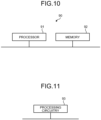
- FIG. 10 is a diagram illustrating an example configuration of a processing circuitry 90 in a case where a processing circuitry that realizes the decoding device 100 according to the first embodiment is realized by a processor 91 and a memory 92.
- the processing circuitry 90 illustrated in FIG. 10 is a control circuit, and includes the processor 91 and the memory 92.
- functions of the processing circuitry 90 are realized by software, firmware, or a combination of software and firmware.
- the software or the firmware is described as a program and stored in the memory 92.
- the processor 91 reads and executes the program stored in the memory 92, thereby realizing the functions.
- the processing circuitry 90 includes the memory 92 for storing a program with which a process of the decoding device 100 is executed as a result. It can also be said that this program is a program for causing the decoding device 100 to execute the functions realized by the processing circuitry 90.
- This program may be provided by a storage medium having the program stored therein, or may be provided by other means such as a communication medium.
- the above program is a program that causes the decoding device 100 to execute: an initialization step, performed by the likelihood initialization unit 110, of performing an initialization process of a storage element for likelihood information to be used in likelihood calculation of the iterative decoding process by using likelihood information to be input on the basis of control information from the control unit 160 based on the code length of the bit sequence to be decoded; an initial likelihood calculation process step, performed by the first likelihood calculation unit 120 capable of executing M separate likelihood calculations corresponding to step 1 to step M where M is an integer of 2 or more, of executing a likelihood calculation step other than a likelihood calculation step of a target of the iterative decoding process in the iterative decoding process at the first time; an iterative decoding process step, performed by the first likelihood calculation unit 120, and the second likelihood calculation unit 130 capable of executing M separate likelihood calculations corresponding to step M+1 to step 2M, of executing a likelihood calculation step of the target of the iterative decoding process for a number of iterations of the iter
- the processor 91 is, for example, a central processing unit (CPU), a processing device, an arithmetic device, a microprocessor, a microcomputer, or a digital signal processor (DSP).
- the memory 92 corresponds to, for example, a non-volatile or volatile semiconductor memory such as a random access memory (RAM), a read only memory (ROM), a flash memory, an erasable programmable ROM (EPROM), or an electrically EPROM (EEPROM (registered trademark)), a magnetic disk, a flexible disk, an optical disk, a compact disc, a mini disk, or a digital versatile disc (DVD).
- RAM random access memory
- ROM read only memory
- EPROM erasable programmable ROM
- EEPROM electrically EPROM
- FIG. 11 is a diagram illustrating an example of a processing circuitry 93 in a case where the processing circuitry that realizes the decoding device 100 according to the first embodiment is configured with dedicated hardware.
- the processing circuitry 93 illustrated in FIG. 11 corresponds to, for example, a single circuit, a composite circuit, a programmed processor, a parallel programmed processor, an application specific integrated circuit (ASIC), a field programmable gate array (FPGA), or a combination thereof.
- a part of the processing circuitry may be realized by dedicated hardware and another part thereof may be realized by software or firmware.
- the processing circuitry can realize each of the above-described functions by dedicated hardware, software, firmware, or a combination thereof.
- the decoding device 100 controls the likelihood calculation units that perform the initial likelihood calculation process, the iterative decoding processes, and the terminal likelihood calculation process depending on the code length Q ⁇ Nt of the decoding target. Consequently, the decoding device 100 can share the decoding circuit for the QC-polar code as a decoding target having a code length of Q ⁇ Nt, the code length being a power of 2 less than or equal to the maximum code length in the parallel code constructions, by utilizing an encoding law of the QC-polar code and features of an exclusive OR operation, and using the decoding circuit for the QC-polar code having a maximum code length of the parallel code constructions, which is assumed to be Q ⁇ N.
- the decoding device 100 can avoid mounting respective decoding circuits corresponding to a plurality of code lengths in parallel, and can prevent a circuit scale from increasing. Furthermore, with the use of the decoding circuit for the QC-polar code having the maximum code length, the decoding device 100 can shorten decoding delay caused by controlling a decoding process depending on a code length as compared with a case of using a rate conversion process such as puncturing or shortening. As described above, the decoding device 100 can perform decoding for a plurality of code lengths in decoding of the QC-polar code while preventing a circuit scale from increasing.
- FIG. 12 is a flowchart illustrating an operation of the decoding device 100 according to the second embodiment.
- "Loop" represents the number of iterations of the iterative decoding process. To do begin with, input of a signal which is a target of a decoding process to the decoding device 100 will be described.
- step S101 the control unit 160 sets an index l of Loop which is the number of iterations of the iterative decoding process to 1, and sets an index m representing the likelihood calculation step described in the first embodiment to 1.
- step S102 the likelihood initialization unit 110 initializes likelihood information for Nt, that is, initializes a storage element for likelihood information depending on the code length Q ⁇ Nt of the decoding target.
- step S103 the control unit 160 compares the code length Q ⁇ Nt of the decoding target with the maximum code length Q ⁇ N. Note that, in FIG. 12 , since the number Q of parallel code constructions is common, the comparison is expressed as a comparison between Nt and N. If the code length Q ⁇ Nt of the decoding target is the maximum code length Q ⁇ N, that is, in a case of step S103: Yes, the control unit 160 skips the processes of steps S104 to S106. If the code length Q ⁇ Nt of the decoding target is less than the maximum code length Q ⁇ N, that is, in a case of step S103: No, the control unit 160 applies the initial likelihood calculation process by the first likelihood calculation unit 120 as described in the first embodiment. First, the flowchart will be described regarding the case of step S103: No.
- step S104 the first likelihood calculation unit 120 performs the initial likelihood calculation process in the iterative decoding process at the first time.
- Step S104 illustrates the initial likelihood calculation process in the iterative decoding process at the first time in the first likelihood calculation unit 120, and illustrates an initial likelihood calculation step of performing the process on the basis of the code length Q ⁇ Nt of the decoding target. Specifically, in the first likelihood calculation unit 120, the likelihood calculation is performed first by the likelihood calculation unit 121-1 corresponding to step 1.
- steps S105 and S106 are processes in which the control unit 160 controls the likelihood calculation step for executing, among the likelihood calculations of the iterative decoding processes, the initial likelihood calculation process in the iterative decoding process at the first time by the first likelihood calculation unit 120.
- step S104 subsequent to step S106 next, the likelihood calculation unit 121-2 corresponding to step 2 of the first likelihood calculation unit 120 performs the likelihood calculation.
- Step S107 is a control process in which the control unit 160 controls an execution start position of the likelihood calculation step of the iterative decoding process.
- the code length of the decoding target is Q ⁇ Nt
- the likelihood calculations of the likelihood calculation unit 121-(M-Mt+1) to the likelihood calculation unit 121-M of the first likelihood calculation unit 120 and the likelihood calculation unit 131-(M+1) to the likelihood calculation unit 131-(M+Mt) of the second likelihood calculation unit 130 are executed for the number of times corresponding to Loop which is the number of iterations of the iterative decoding process.
- the process in which the control unit 160 designates a start position of the likelihood calculation step of the iterative decoding process is the process of step S107.
- step S108 in the likelihood calculation unit 121-(M-Mt+1) to the likelihood calculation unit 121-M of the first likelihood calculation unit 120 and the likelihood calculation unit 131-(M+1) to the likelihood calculation unit 131-(M+Mt) of the second likelihood calculation unit 130, one likelihood calculation unit executes the likelihood calculation depending on a value of the index m representing the likelihood calculation step. As described above, the likelihood calculation is performed first by the likelihood calculation unit 121-(M-Mt+1) corresponding to step M-Mt+1 of the first likelihood calculation unit 120.
- steps S109 and S110 are processes in which the control unit 160 selects the likelihood calculation step of the likelihood calculation of one iterative decoding process and designates an end position.
- step S108 subsequent to step S110 next, the likelihood calculation unit 121-(M-Mt+2) corresponding to step M-Mt+2 of the first likelihood calculation unit 120 performs the likelihood calculation.
- the processes of steps S111 and S112 are processes in which the control unit 160 controls the number of iterations of the likelihood calculation processes of the first likelihood calculation unit 120 and the second likelihood calculation unit 130, and the control unit 160 performs control so that the processes of steps S107 to S110 are iterated for the number of times corresponding to Loop.
- step S113 similarly to step S103, the control unit 160 compares the code length Q ⁇ Nt of the decoding target with the maximum code length Q ⁇ N. Note that, in FIG. 12 , since Q is common, the comparison is expressed as a comparison between Nt and N. If the code length Q ⁇ Nt of the decoding target is the maximum code length Q ⁇ N, that is, in a case of step S113: Yes, the control unit 160 skips the processes of steps S114 to S117. If the code length Q ⁇ Nt of the decoding target is less than the maximum code length Q ⁇ N, that is, in a case of step S113: No, the control unit 160 applies the terminal likelihood calculation process by the second likelihood calculation unit 130 as described in the first embodiment. First, the flowchart will be described for the case of step S113: No.
- Step S114 is a control process in which the control unit 160 controls an execution start position of the likelihood calculation step of the terminal likelihood calculation process only in the iterative decoding process at the last time.
- the likelihood calculation unit 131-(M+Mt+1) to the likelihood calculation unit 131-2M of the second likelihood calculation unit 130 execute the likelihood calculations in the process.
- step S115 the second likelihood calculation unit 130 performs the terminal likelihood calculation process in the iterative decoding process at the last time.
- Step S115 illustrates the terminal likelihood calculation process in the iterative decoding process at the last time in the second likelihood calculation unit 130, and illustrates a terminal likelihood calculation step of performing the process on the basis of the code length Q ⁇ Nt of the decoding target.
- the likelihood calculation is performed first by the likelihood calculation unit 131-(M+Mt+1) corresponding to step M+Mt+1.
- the processes of steps S116 and S117 are processes in which the control unit 160 controls the likelihood calculation step for executing, among the likelihood calculations of the iterative decoding processes, the terminal likelihood calculation process in the iterative decoding process at the last time by the second likelihood calculation unit 130.
- step S115 subsequent to step S117 next, the likelihood calculation unit 131-(M+Mt+2) corresponding to step M+Mt+2 of the second likelihood calculation unit 130 performs the likelihood calculation.
- the likelihood calculation unit 131-(M+Mt+1) to the likelihood calculation unit 131-2M of the second likelihood calculation unit 130 execute the likelihood calculations.
- step S118 the hard decision unit 140 makes a hard decision on a result of the likelihood calculation process output from the second likelihood calculation unit 130.
- the hard decision unit 140 generates and outputs a decoded bit sequence as a result of the hard decision.
- step S119 the frozen bit removing unit 150 removes unnecessary bit sequences other than the decoding information bit sequence, such as frozen bits, from the decoded bit sequence generated by the hard decision unit 140, and generates and outputs a decoded information bit sequence. Consequently, the decoding process of the decoding target having a code length of Q ⁇ Nt by the decoding device 100 is completed.
- step S103 Yes
- the decoding device 100 skips the initial likelihood calculation process which corresponds to the processes of steps S104 to S106.
- step S113 in the processes of steps S107 to S112, all of the likelihood calculation units 121-1 to 121-M of the first likelihood calculation unit 120 and the likelihood calculation units 131-(M+1) to 131-2M of the second likelihood calculation unit 130 execute the likelihood calculation for the number of times corresponding to Loop which is the number of iterations of the iterative decoding process, that is, perform the iterative decoding processes, and proceed to step Sill.
- the processes of steps S118 and S119 are as described above.
- the decoding device 100 for a maximum code length of Q ⁇ N can execute the decoding process even in a case where the code length Q ⁇ Nt of the decoding target is less than or equal to the maximum code length Q ⁇ N as illustrated in the flowchart of FIG. 12 .
- 100 decoding device 110 likelihood initialization unit; 120 first likelihood calculation unit; 121-1 to 121-M,131-(M+1) to 131-2M likelihood calculation unit; 130 second likelihood calculation unit; 140 hard decision unit; 150 frozen bit removing unit; 160 control unit.
Landscapes
- Physics & Mathematics (AREA)
- Probability & Statistics with Applications (AREA)
- Engineering & Computer Science (AREA)
- Theoretical Computer Science (AREA)
- Mathematical Physics (AREA)
- Algebra (AREA)
- General Physics & Mathematics (AREA)
- Pure & Applied Mathematics (AREA)
- Error Detection And Correction (AREA)
Abstract
Description
- The present disclosure relates to a decoding device for decoding a quasi cyclic (QC)-polar code, a control circuit, a storage medium, and a decoding method.
- When performing communication, an error correction technique is conventionally applied in general in order to cope with an error caused by noise or the like generated in a communication path. As one scheme of such an error correction technology, there is a polar code. The polar code is one form of error correction codes that can perform encoding and decoding processes with a low amount of calculation and can realize a characteristic of asymptotically approaching a Shannon limit on the basis of a concept of channel polarization. The polar code is a type of block code, and encoding is performed by repeating, for bits in a block, exclusive OR combinations and wiring change for changing a combination to be combined. The polar code has a code length of a power of 2, that is, 2n when n is a positive integer, due to construction of the code.
- As a polar code decoding method, a successive cancellation decoding method in which decoding is sequentially performed bit by bit by using decoded bits in the middle of decoding and received likelihood information, a successive cancellation list decoding method in which a plurality of decoding candidates are stored and a likely candidate is finally employed as a decoding result, and the like are applied, but a longer code length results in a longer decoding process time. In addition, belief propagation (BP) decoding as an iterative decoding method used for decoding a low density parity check (LDPC) code and the like is also applicable as a polar code decoding method, but superior performance cannot be obtained as compared with the successive cancellation decoding method. In recent years, a QC-polar code capable of preventing performance degradation due to BP decoding has been proposed with respect to the polar code.
-
Patent Literature 1 discloses a rate matching technique for block encoding in which selection is made, depending on a target code length, between performing rate matching using puncturing, shortening, or the like, and performing an encoding process for different code lengths on a repetition basis. By applying the technique ofPatent Literature 1, an efficient communication system and the like can be provided. In addition,Patent Literature 1 clearly describes a polar code as an error correction code for performing an encoding process on a repetition basis. - Patent Literature 1:
Japanese Translation of PCT International Application Laid-open No. 2019-527978 - In the technique described in
Patent Literature 1, it is disclosed that an efficient communication system and the like are provided by applying, depending on a target code length, rate matching using puncturing, shortening, or the like, or an encoding process for different code lengths on a repetition basis, but there is no disclosure of a specific configuration of a polar code decoding circuit in a case of assuming a plurality of code lengths. Each communication device constituting the communication system can support a plurality of code lengths by mounting dedicated decoding circuits corresponding to the plurality of code lengths in parallel. However, in a case where there are many combinations of code lengths assumed in the communication system, the number of decoding circuits for code lengths corresponding thereto increases accordingly. Therefore, in each communication device, an increase in a code length of a corresponding polar code results in more dedicated decoding circuits mounted in parallel and thus an increase in a circuit scale, which is a problem. - The present disclosure has been made in view of the above, and an object thereof is to obtain a decoding device capable of performing decoding for a plurality of code lengths in decoding of a QC-polar code while preventing a circuit scale from increasing.
- In order to solve the above-stated problems and achieve the object, a decoding device according to the present disclosure comprises: a likelihood initialization unit to perform an initialization process on a storage element for likelihood information to be used in likelihood calculation of an iterative decoding process on a basis of likelihood information to be input and a code length of a bit sequence to be decoded; a first likelihood calculation unit to execute M separate likelihood calculations corresponding to
step 1 to step M where M is an integer of 2 or more, in likelihood calculation of the iterative decoding process; a second likelihood calculation unit to execute M separate likelihood calculations corresponding to step M+1 tostep 2M in likelihood calculation of the iterative decoding process; a hard decision unit to make a hard decision on a result of likelihood calculation calculated by the second likelihood calculation unit and to generate a decoded bit sequence; a frozen bit removing unit to remove a frozen bit and a bit sequence based on a code length of the bit sequence to be decoded from the decoded bit sequence generated by the hard decision unit and to generate a decoded information bit sequence; and a control unit to control likelihood calculation of the iterative decoding process on a basis of a code length of the bit sequence to be decoded, wherein the first likelihood calculation unit and the second likelihood calculation unit iteratively execute likelihood calculations of one or more steps. - The decoding device according to the present disclosure achieves an effect that it is possible to perform decoding for a plurality of code lengths in decoding of a QC-polar code while preventing a circuit scale from increasing.
-
-
FIG. 1 is a block diagram illustrating an example configuration of a decoding device according to a first embodiment. -
FIG. 2 is a diagram illustrating a code construction of a QC-polar code to be decoded by the decoding device according to the first embodiment. -
FIG. 3 is a diagram illustrating an example of a code construction having a code length of eight bits when a code length N of a polar code is equal to 4 and the number Q of parallel code constructions of the polar code is equal to 2 in the code construction of the QC-polar code illustrated inFIG. 2 . -
FIG. 4 is a schematic diagram illustrating a code construction when the code length N of the polar code is equal to 4 and the number of parallel code constructions of the polar code is Q in the code construction of the QC-polar code illustrated inFIG. 2 . -
FIG. 5 is a schematic diagram illustrating the code construction of the QC-polar code illustrated inFIG. 2 . -
FIG. 6 is a first diagram illustrating a likelihood relationship in an exclusive OR combination in the schematic diagram illustrating the code construction of the QC-polar code illustrated inFIG. 5 . -
FIG. 7 is a second diagram illustrating the likelihood relationship in the exclusive OR combination in the schematic diagram illustrating the code construction of the QC-polar code illustrated inFIG. 5 . -
FIG. 8 is a third diagram illustrating the likelihood relationship in the exclusive OR combination in the schematic diagram illustrating the code construction of the QC-polar code illustrated inFIG. 5 . -
FIG. 9 is a fourth diagram illustrating the likelihood relationship in the exclusive OR combination in the schematic diagram illustrating the code construction of the QC-polar code illustrated inFIG. 5 . -
FIG. 10 is a diagram illustrating an example configuration of a processing circuitry in a case where a processing circuitry that realizes the decoding device according to the first embodiment is realized by a processor and a memory. -
FIG. 11 is a diagram illustrating an example of a processing circuitry in a case where the processing circuitry that realizes the decoding device according to the first embodiment is configured with dedicated hardware. -
FIG. 12 is a flowchart illustrating an operation of the decoding device according to a second embodiment. - Hereinafter, a decoding device, a control circuit, a storage medium, and a decoding method according to each embodiment of the present disclosure will be described in detail with reference to the drawings.
-
FIG. 1 is a block diagram illustrating an example configuration of adecoding device 100 according to a first embodiment. Thedecoding device 100 performs decoding by BP decoding based on a belief propagation method for a QC-polar code. Thedecoding device 100 includes a likelihood initialization unit 110, a firstlikelihood calculation unit 120, a secondlikelihood calculation unit 130, a hard decision unit 140, a frozenbit removing unit 150, and acontrol unit 160. - The first
likelihood calculation unit 120 includes a likelihood calculation unit 121-1 that performs likelihood calculation ofstep 1, a likelihood calculation unit 121-2 that performs likelihood calculation ofstep 2,..., a likelihood calculation unit 121-(M-1) that performs likelihood calculation of step M-1, and a likelihood calculation unit 121-M that performs likelihood calculation of step M. That is, the firstlikelihood calculation unit 120 performs M separate likelihood calculations corresponding tostep 1 to step M. In addition, the secondlikelihood calculation unit 130 includes a likelihood calculation unit 131-(M+1) that performs likelihood calculation of step M+1, a likelihood calculation unit 131-(M+2) that performs likelihood calculation of step M+2,..., a likelihood calculation unit 131-(2M-1) that performs likelihood calculation ofstep 2M-1, and a likelihood calculation unit 131-2M that performs likelihood calculation ofstep 2M. That is, the secondlikelihood calculation unit 130 performs M separate likelihood calculations corresponding to step M+1 tostep 2M. - Here, a code construction of a QC-polar code to be decoded by the
decoding device 100 will be described before describing an operation of thedecoding device 100. -
FIG. 2 is a diagram illustrating a code construction of a QC-polar code to be decoded by thedecoding device 100 according to the first embodiment. The code construction of the QC-polar code illustrated inFIG. 2 is a construction in which Q code constructions, specifically, code constructions of the polar code from a code construction 300-1 as a code construction No. 1 to a code construction 300-Q as a code construction No. Q, are mounted in parallel, and a code length of each code construction is N. Regarding the code construction of the QC-polar code, similarly to that of the polar code, encoding is performed while changing combinations of 2-bit exclusive OR processes byexclusive OR combinations 310. Furthermore, the QC-polar code becomes one code of a code length Q×N by having a construction in which each of the exclusive ORcombinations 310 is connected to different one of parallel code constructions. InFIG. 2 , anarrow 320 indicates an image of connection to a different parallel code construction. - The encoding of the QC-polar code will be described. In the QC-polar code illustrated in
FIG. 2 , bit sequences having bits as many as the number of bits of a code length of the QC-polar code including information bits and frozen bits are input to open circles on a left side, an encoding process proceeds while iterating theexclusive OR combinations 310, and the bit sequences become code words of the QC-polar code in open circles on a right side. -
FIG. 3 is a diagram illustrating an example of a code construction having a code length of eight bits when a code length N of a polar code is equal to 4 and the number Q of parallel code constructions of the polar code is equal to 2 in the code construction of the QC-polar code illustrated inFIG. 2 . The connection to a different parallel code construction illustrated inFIG. 2 means that, in the code constructions illustrated inFIG. 3 in which the code length N is equal to 4 and the number Q of parallel code constructions is equal to 2, a target of the exclusive OR combination changes across different parallel code constructions as those in upper left and lower right portions. -
FIG. 4 is a schematic diagram illustrating a code construction when the code length N of the polar code is equal to 4 and the number of parallel code constructions of the polar code is Q in the code construction of the QC-polar code illustrated inFIG. 2 . InFIG. 4 , the amounts of shift q(1,1), q(1,2), q(2,1), and q(2,2) indicate which of the parallel code constructions is to be connected, that is, a target to be connected. For example, when the QC-polar code in which the code length N is equal to 4 and the number Q of parallel code constructions is equal to 2 illustrated inFIG. 3 is described by using the schematic diagram of the code construction ofFIG. 4 , the following expressions can be made: the amount of shift q(1,1)=1, the amount of shift q(1,2)=0, the amount of shift q(2,1)=0, and the amount of shift q(2,2)=1. Note that the amount of shift of the target to be connected is not limited to 0 or 1, and for example, in a case where the number of parallel code constructions is Q, the amount of shift can be set to 0 to Q-1. By setting the amount of shift to 2 or more, it is possible to connect not only to adjacent parallel code constructions but also to all the parallel code constructions. The target to be connected can have different configurations depending on the code length N, the number of frozen bits, the number Q of parallel code constructions, and the like. -
FIG. 5 is a schematic diagram illustrating the code construction of the QC-polar code illustrated inFIG. 2 .FIG. 5 illustrates the QC-polar code in a case where the code length is N, the number of information bits is K, and the number of parallel code constructions is Q. Since the code length is N, the number of exclusive OR combinations denoted by M is log2(N). In addition, since the number of information bits is K, the number of frozen bits is N-K. As the QC-polar code, the code length is Q×N, and the number of information bits is Q×K. InFIG. 5 , the number of different amounts of shift q(m,n) 650 indicated by indexes m and n is M×(N/2), which is the same as the number of exclusive ORcombinations 310. Note that, in each amount of shift q(m,n) 650, m is an index representing a stage and takes M values from 1 to M, and n is an index of the exclusive ORcombination 310 of each stage and takes N/2 values from 1 to N/2.Stage 1 to stage M represent steps of the exclusive ORcombinations 310 classified into stages, and satisfy a relationship of M=log2(N) as described above. Fromstep 1 to step M and from step M+1 to step 2M represent the order of steps of BP decoding of the QC-polar code, and correspond to likelihood calculations of the likelihood calculation units 121-1 to 121-M and the likelihood calculation units 131-(M+1) to 131-2M illustrated inFIG. 1 , respectively. - In the BP decoding of the QC-polar code, when the encoding illustrated in
FIG. 5 is performed, likelihood calculations and updates ofstep 1 to step M on the left side to which the bit sequences including the information bits and the frozen bits are input are sequentially executed, and next, likelihood calculations and updates of step M+1 to step 2M on the right side from which the code words are output are sequentially executed. A process in which processes of the above likelihood calculations and updates are iterated for a set number of iterations is the BP decoding of the QC-polar code. In the likelihood calculation and update processes, Q×(M+1)×N likelihood values before and after each stage are updated for each of the likelihood updates instep 1 to step M and the likelihood updates in step M+1 to step 2M. - For the description below, likelihood information at the time of updating the likelihood in
step 1 to step M is denoted by L2R(q,m,n), and likelihood information at the time of updating the likelihood in step M+1 to step 2M is denoted by R2L(q,m,n). In the likelihood information L2R(q,m,n) and the likelihood information R2L(q,m,n), q=1 to Q, m=1 to (M+1), and n=1 to N. Likelihood information LLR(q,1,n) 611 and likelihood information LLR(q,M+1,n) 612 illustrated inFIG. 5 indicate likelihood information used in the decoding process, and indicate likelihood information at both ends of each update likelihood of a q-th parallel code construction. In the likelihood information LLR(q,1,n) 611 and the likelihood information LLR(q,M+1,n) 612, q=1 to Q and n=1 to N. Regarding the likelihood information described above, for example, soft decision information such as a log likelihood ratio (LLR) can be used. Note that there is likelihood information of LLR(q,m,n) between the stages, and here, q=1 to Q, m=2 to M, and n=1 to N. Hereinafter, the decoding process will be described while specifically assuming an LLR. - In the present embodiment, the
decoding device 100 illustrated inFIG. 1 is a decoding circuit for a maximum code length of Q×N, and is a decoding circuit capable of performing a decoding process on a QC-polar code having a code length of Q×Nt where Nt=2Mt, which is a power of 2 less than or equal to the code length N of the parallel code constructions. An operation of each component included in thedecoding device 100 will be described below. - The likelihood initialization unit 110 initializes a storage element for the likelihood information L2R(q,m,n) and a storage element for the likelihood information R2L(q,m,n) used in the likelihood update process illustrated in
FIG. 5 by using the likelihood information LLR(q,m,n) such as received LLRs. The likelihood information LLR(q,M+1,n) 612 is a received LLR of the QC-polar code input to thedecoding device 100 in the present embodiment. In a case where the code length of the parallel code constructions is Nt, the likelihood information LLR(q,M+1,n) 612 is a received LLR when q=1 to Q and n=1 to Nt, and the likelihood information LLR(q,M+1,n) 612 has a positive maximum likelihood value when q=1 to Q and n=Nt+1 to N. In the likelihood information LLR(q,1,n) 611, when n=1 to Nt for a QC-polar code of which parallel code constructions have the code length Nt, a frozen bit position has a positive maximum likelihood value, an information bit position has a value of 0, and when q=1 to Q and n=Nt+1 to N in the likelihood information LLR(q,1,n) 611, a positive maximum likelihood value is obtained. A relationship is satisfied in which the likelihood information LLR(q,m,n) between the stages, that is, the likelihood information LLR(q,m,n) when q=1 to Q, m=2 to M, and n=1 to N has a value of 0. - The likelihood initialization unit 110 initializes a storage element for the likelihood information, that is, a storage element for the likelihood information L2R(q,m,n) and a storage element for the likelihood information R2L(q,m,n) by using the likelihood information LLR(q,m,n) satisfying the relationship as described above. Note that, in the likelihood initialization unit 110, an initialization position such as a frozen bit position based on the code length Q×Nt of a decoding target on which the decoding process is performed is set by the
control unit 160. As described above, the likelihood initialization unit 110 performs the initialization process on the storage elements for the likelihood information used in the likelihood calculations in iterative decoding processes on the basis of likelihood information to be input and the code length of the bit sequence to be decoded. The likelihood information to be input is, for example, a received LLR. - The first
likelihood calculation unit 120 and the secondlikelihood calculation unit 130 perform iterative decoding processes for BP decoding after the initialization by the likelihood initialization unit 110 is completed. First, before the iterative decoding processes for BP decoding are started by the firstlikelihood calculation unit 120 and the secondlikelihood calculation unit 130, thecontrol unit 160 sets, for the likelihood calculation units 121-1 to 121-M of the firstlikelihood calculation unit 120 and the likelihood calculation units 131-(M+1) to 131-2M of the secondlikelihood calculation unit 130, the amount of shift q(m,n) 650 in each exclusive ORcombination 310 depending on the code length Q×Nt of the decoding target. Here, in a case of executing the decoding process of the QC-polar code as a decoding target having a maximum code length of Q×N, in the firstlikelihood calculation unit 120 and the secondlikelihood calculation unit 130, the likelihood calculation units 121-1 to 121-M and the likelihood calculation units 131-(M+1) to 131-2M execute the likelihood calculation process for the number of iterations. On the other hand, in a case of executing the decoding process of the QC-polar code as a decoding target having a code length of Q×Nt, thecontrol unit 160 controls likelihood calculation units that actually execute the likelihood calculation processes in the firstlikelihood calculation unit 120 and the secondlikelihood calculation unit 130, that is, likelihood calculation steps for executing the likelihood calculation processes. - For example, in a case where Nt=4 is assumed in the schematic diagram of the code construction of the QC-polar code illustrated in
FIG. 5 , portions in which q=1 to Q and n=1 to 4 and two stages of stage M-1 and stage M correspond to a code construction of a QC-polar code of Q×4. In addition, in a case where Nt=8 is assumed in the schematic diagram of the code construction of the QC-polar code illustrated inFIG. 5 , portions in which q=1 to Q and n=1 to 8 and three stages of stage M-2, stage M-1, and stage M correspond to a code construction of a QC-polar code of Q×8. To generalize, in a case where a code length of the parallel code constructions is denoted by Nt (≤N), with the use of Mt satisfying Mt=log2(Nt), portions in which q=1 to Q and n=1 to Nt and Mt stages of stage M-Mt+ 1 to stage M correspond to a code construction of a QC-polar code of Q×Nt. As described above, depending on the code length Q×Nt of the decoding target, thecontrol unit 160 controls the likelihood calculation units that actually execute the likelihood calculation processes in the firstlikelihood calculation unit 120 and the secondlikelihood calculation unit 130, that is, likelihood calculation steps for executing the likelihood calculation processes. - Operations of the first
likelihood calculation unit 120 and the secondlikelihood calculation unit 130 in the decoding process of the decoding target having a code length of Q×Nt will be described. In thedecoding device 100 of the present embodiment, in the iterative decoding process at a first time, the likelihood calculation units 121-1 to 121-(M-Mt) of the firstlikelihood calculation unit 120 execute an initial likelihood calculation process with the use of initialized likelihood information output from the likelihood initialization unit 110 by the control of thecontrol unit 160. Subsequently, as a likelihood calculation step of the iterative decoding process at the first time of the decoding target having a code length of Q×Nt, the likelihood calculation units 121-(M-Mt+1) to 121-M of the firstlikelihood calculation unit 120 execute the likelihood calculation processes by the control of thecontrol unit 160. In addition, as the likelihood calculation step of the iterative decoding process at the first time of the decoding target having a code length of Q×Nt, the likelihood calculation units 131-(M+1) to 131-(M+Mt) of the secondlikelihood calculation unit 130 execute the likelihood calculation processes by the control of thecontrol unit 160. - Thereafter, the likelihood calculation units 121-(M-Mt+1) to 121-M of the first
likelihood calculation unit 120 and the likelihood calculation units 131-(M+1) to 131-(M+Mt) of the secondlikelihood calculation unit 130 execute the likelihood calculation processes by the control of thecontrol unit 160 until the iterative decoding process at a last time. In the iterative decoding process at the last time, the likelihood calculation units 121-(M-Mt+1) to 121-M of the firstlikelihood calculation unit 120 and the likelihood calculation units 131-(M+1) to 131-(M+Mt) of the secondlikelihood calculation unit 130 execute the likelihood calculation processes by the control of thecontrol unit 160, and furthermore, the likelihood calculation units 131-(M+Mt+1) to 131-2M of the secondlikelihood calculation unit 130 execute a terminal likelihood calculation process by the control of thecontrol unit 160. Consequently, the likelihood calculations of the QC-polar code as a decoding target having a code length of Q×Nt by the firstlikelihood calculation unit 120 and the secondlikelihood calculation unit 130 are completed. - Here, a relationship between likelihood initialization by the likelihood initialization unit 110 and likelihood calculations by the first
likelihood calculation unit 120 and the secondlikelihood calculation unit 130 in a case of the decoding target having a code length of Q×Nt will be described.FIG. 6 is a first diagram illustrating a likelihood relationship in an exclusive ORcombination 310 in the schematic diagram illustrating the code construction of the QC-polar code illustrated inFIG. 5 .FIG. 7 is a second diagram illustrating the likelihood relationship in the exclusive ORcombination 310 in the schematic diagram illustrating the code construction of the QC-polar code illustrated inFIG. 5 .FIG. 8 is a third diagram illustrating the likelihood relationship in the exclusive ORcombination 310 in the schematic diagram illustrating the code construction of the QC-polar code illustrated inFIG. 5 .FIG. 9 is a fourth diagram illustrating the likelihood relationship in the exclusive ORcombination 310 in the schematic diagram illustrating the code construction of the QC-polar code illustrated inFIG. 5 .FIGS. 6 and 7 are diagrams illustrating likelihood relationships in a case where likelihood calculations are performed from the left side to the right side in the schematic diagram illustrating the code construction of the QC-polar code illustrated inFIG. 5 , that is, in a case where likelihood calculations are performed in the order fromstep 1 to step M.FIGS. 8 and 9 are diagrams illustrating likelihood relationships in a case where likelihood calculations are performed from the right side to the left side in the schematic diagram illustrating the code construction of the QC-polar code illustrated inFIG. 5 , that is, in a case where likelihood calculations are performed in the order from step M+1 to step 2M. - In
FIGS. 6 to 9 , the likelihood information L2R(q,m,n) is likelihood information when performing likelihood calculations from the left side to the right side, and indicates input to stage m of a q-th parallel code construction and likelihood information of an n-th bit. In addition, likelihood information L2R(q,m+1,n) is likelihood information when performing likelihood calculations from the left side to the right side, and indicates output from stage m of the q-th parallel code construction and the likelihood information of the n-th bit. Similarly, inFIGS. 6 to 9 , likelihood information R2L(q,m+1,n) is likelihood information when performing likelihood calculations from the right side to the left side, and indicates input to stage m of the q-th parallel code construction and the likelihood information of the n-th bit. In addition, the likelihood information R2L(q,m,n) is likelihood information when performing likelihood calculations from the right side to the left side, and indicates output from stage m of the q-th parallel code construction and the likelihood information of the n-th bit. -
FIG. 6 illustrates a likelihood relationship for likelihood calculation of likelihood information L2R(q1,m+1,n1),FIG. 7 illustrates a likelihood relationship for likelihood calculation of likelihood information L2R(q2,m+1,n2),FIG. 8 illustrates a likelihood relationship for likelihood calculation of likelihood information R2L(q1,m,n1), andFIG. 9 illustrates a likelihood relationship for likelihood calculation of likelihood information R2L(q2,m,n2). A calculation formula of likelihood calculation of the likelihood relationship illustrated inFIG. 6 is expressed by formula (1), a calculation formula of likelihood calculation of the likelihood relationship illustrated inFIG. 7 is expressed by formula (2), a calculation formula of likelihood calculation of the likelihood relationship illustrated inFIG. 8 is expressed by formula (3), and a calculation formula of likelihood calculation of the likelihood relationship illustrated inFIG. 9 is expressed by formula (4). In formulas (1) to (4), a function f in each formula is calculated by a relationship of formula (5).
Formula 1:
Formula 2:
Formula 3:
Formula 4:
Formula 5:
- In formula (5), sign function is a function that outputs a code of likelihood information, and
outputs 1 in a case of likelihood information≥0, and -1 in a case of likelihood information<0. In addition, in formula (5), min function is a function that returns a small value of likelihood information, and returns a small value as an absolute value of two pieces of likelihood information to be input. - When initialization is performed in the
decoding device 100 for a maximum code length of Q×N, in the case of the decoding target having a code length of Q×Nt, the likelihood initialization unit 110 performs initialization regarding the likelihood information LLR(q,1,n) 611 and the likelihood information LLR(q,M+1,n) 612 illustrated inFIG. 5 as the positive maximum likelihood value of the likelihood information in a range in which q=1 to Q and n=Nt+1 to N. - For example, in a case of Nt=N/2 and
step 1, regarding likelihood information L2R(q,1,1) to likelihood information L2R(q,1,N/2), a frozen bit position has a positive maximum likelihood value, an information bit position has a value of 0, likelihood information L2R(q,1,N/2+1) to likelihood information L2R(q,1,N) each have a positive maximum likelihood value, and likelihood information R2L(q,2,0) to likelihood information R2L(q,2,N) each have a value of 0. From the above, as a result of the likelihood calculations with formulas (1) and (2), the following relationship is satisfied: inFIGS. 6 and 7 , likelihood information L2R(q1,m,n1) 711 has a positive maximum likelihood value or a value of 0, likelihood information L2R(q2,m,n2) 712 has a positive maximum likelihood value, likelihood information R2L(q1,m+1,n1) 821 and likelihood information R2L(q2,m+1,n2) 722 each have a value of 0. Therefore, likelihood information L2R(q1,m+1,n1) 721=the likelihood information L2R(q1,m,n1) is satisfied, and likelihood information L2R(q2,m+1,n2) 822 has a positive maximum likelihood value. That is, in the case of Nt=N/2 andstep 1, a relationship of likelihood information L2R(q,2,n)=likelihood information L2R(q,1,n) is satisfied. - Note that, in a case of q=1 to Q, m=2 to M, and n=N/2+1 to N, the following relationship is satisfied in the likelihood information L2R (q,m,n): among those illustrated in
FIGS. 6 and 7 , the likelihood information L2R(q1,m,n1) 711 and the likelihood information L2R(q2,m,n2) 712 each have a positive maximum likelihood value, the likelihood information R2L(q1,m+1,n1) 821 and the likelihood information R2L(q2,m+1,n2) 722 each have a value of 0, and both the likelihood information L2R(q1,m+1,n1) and the likelihood information L2R(q2,m+1,n2) have a positive maximum likelihood value. Therefore, in the case of q=1 to Q, m=2 to M, and n=N/2+1 to N, all pieces of the likelihood information L2R(q,m,n) have a positive maximum likelihood value. In a case of Nt=N/2, sincestage 2 to stage M illustrated inFIG. 5 each have a code construction of N/2, the likelihood information L2R(q,2,n)=the likelihood information L2R(q,1,n) is satisfied in the likelihood calculation ofstep 1 ofstage 1, and thus, iterating the likelihood calculations ofstage 2 to stage M is equivalent to a decoding operation of the QC-polar code of Q×(N/2). - In addition, the likelihood calculation of the likelihood information R2L(q,m,n) in the case of q=1 to Q, m=2 to M, and n=N/2+1 to N will be described. For example, in a case of Nt=N/2 and step M+1, when q=1 to Q and n=N/2+1 to N, the likelihood information R2L(q,M+1,n) is initialized as a positive maximum likelihood value, and the likelihood of the likelihood information L2R(q,m,n) is also calculated as a positive maximum likelihood value by the previous likelihood calculation. From the above, as a result of the likelihood calculations with formulas (3) and (4), a positive maximum likelihood value is set to all of the likelihood information L2R(q1,m,n1) 711, the likelihood information L2R(q2,m,n2) 712, the likelihood information R2L(q1,m+1,n1) 821, and the likelihood information R2L(q2,m+1,n2) 722 in
FIGS. 8 and 9 . Therefore, the likelihood of likelihood information R2L(q1,m,n1) 911 and that of likelihood information R2L(q2,m,n2) 1012 are calculated as positive maximum value likelihood. - The same relationships as those described above apply to the likelihood calculations in step M+1 to step 2M-1, and the likelihood information R2L (q,m,n) in the case of q=1 to Q, m=2 to M, and n=N/2+1 to N is calculated as a positive maximum likelihood value. Until a terminal likelihood calculation process in the iterative decoding process at the last time, the likelihood calculation processes of
step 2 to step 2M-1 are iteratively executed. Instep 2M which is a terminal likelihood calculation process in the case of Nt=N/2 in the terminal likelihood calculation process in the iterative decoding process at the last time, by the likelihood calculation with formula (3), inFIG. 8 , the likelihood information L2R(q2,m,n2) 712 has positive maximum value likelihood, the likelihood information R2L(q1,m+1,n1) 821 is a result of iterative likelihood calculation processes, the likelihood information R2L(q2,m+1,n2) 722 has a positive maximum likelihood value, and a relationship of the likelihood information R2L(q1,m,n1)=the likelihood information R2L(q1,m+1,n1) is satisfied. Therefore, when q=1 to Q and n=1 to N/2, regarding the likelihood information R2L(q,2,n) to be a result of the likelihood calculation processes by the firstlikelihood calculation unit 120 and the secondlikelihood calculation unit 130 and the likelihood information R2L(q,1,n) which is a result of the terminal likelihood calculation process by the secondlikelihood calculation unit 130 in the case of Nt=N/2, a relationship of the likelihood information R2L(q,1,n)=the likelihood information R2L(q,2,n) is satisfied, and the result of the terminal likelihood calculation process output from the secondlikelihood calculation unit 130 is equivalent to the decoding result of the iterative decoding process in the case of Nt=N/2. - From the above, in the case of Nt=N/2, the likelihood initialization unit 110 performs initialization, and the first
likelihood calculation unit 120 and the secondlikelihood calculation unit 130 perform the initial likelihood calculation process, the iterative decoding processes, and the terminal likelihood calculation process, and thereby thedecoding device 100 for a maximum code length of Q×N can perform the decoding process of a decoding target having a code length of Q×(N/2). To generalize, in a case where the code length of the decoding target is Q×Nt, when q=1 to Q and n=Nt+1 to N, the likelihood information L2R(q,1,n) is initialized as a positive maximum likelihood value, instep 1 to step M-Mt corresponding to the initial likelihood calculation process of the firstlikelihood calculation unit 120, a relationship is satisfied in which among those illustrated inFIGS. 6 and 7 , the likelihood information L2R(q1,m,n1) 711 has a positive maximum likelihood value or a value of 0, the likelihood information L2R(q2,m,n2) 712 has a positive maximum likelihood value, the likelihood information R2L(q1,m+1,n1) 821 and the likelihood information R2L(q2,m+1,n2) 722 each have a value of 0, and thereby a relationship is maintained in which the likelihood information L2R(q1,m+1,n1)=the likelihood information L2R(q1,m,n1) is satisfied and the likelihood information L2R(q2,m+1,n2) has a positive maximum likelihood value. That is, a relationship of likelihood information L2R(q,M-Mt+1,n)=the likelihood information L2R(q,1,n) is satisfied. In the case where the code length of the decoding target is Q×Nt, iterative execution of the likelihood calculation processes of stage M-Mt+ 1 to stage M, that is, the likelihood calculation processes of step M-Mt+ 1 to step M+Mt of the firstlikelihood calculation unit 120 and the secondlikelihood calculation unit 130 corresponds to iterative decoding for the code length Q×Nt, and therefore, the initialization executed by the likelihood initialization unit 110 for the code length Q×Nt of the decoding target followed by the initial likelihood calculation process executed by the firstlikelihood calculation unit 120 is equivalent to initialization of the likelihood information for the iterative decoding processing circuit for the code length Q×Nt. - In addition, in the initial likelihood calculation process and the likelihood calculations at the time of iterative decoding of stage M-
Mt+ 1 to stage M, the likelihood of the likelihood information L2R(q,m,n) when q=1 to Q, m=1 to M, and n=Nt+1 to N is calculated as a positive maximum likelihood value, and the likelihood of the likelihood information R2L(q,m,n) when q=1 to Q, m=M-Mt+1, and n=Nt+1 to N is also calculated as a positive maximum likelihood value. Therefore, in the terminal likelihood calculation process for performing likelihood calculation of the likelihood information R2L(q,m,n) when q=1 to Q, m=1 to M-Mt, and n=1 to Nt, the likelihood information L2R(q2,m,n2) 712 and the likelihood information R2L(q2,m+1,n2) 722 illustrated inFIG. 8 each have a positive maximum likelihood value, and thereby the likelihood information R2L(q1,m,n1)=the likelihood information R2L(q1,m+1,n1) is satisfied, and when q=1 to Q and n=1 to Nt, a relationship of the likelihood information R2L(q,1,n)=likelihood information R2L(q,M-Mt+1,n) is satisfied. From the above, even when generalized, the likelihood initialization unit 110 initializes the likelihood depending on the code length Q×Nt of the decoding target, and thecontrol unit 160 controls the likelihood calculation steps of the firstlikelihood calculation unit 120 and the secondlikelihood calculation unit 130, that is, applies the initial likelihood calculation process, the iterative decoding processes, and the terminal likelihood calculation process, so that the decoding process for the code length Q×Nt can be performed by thedecoding device 100 for a maximum code length of Q×N. - As described above, when M is an integer of 2 or more, the first
likelihood calculation unit 120 executes M separate likelihood calculations corresponding to step 1 to step M in the likelihood calculations of the iterative decoding processes. The secondlikelihood calculation unit 130 executes M separate likelihood calculations corresponding to step M+1 to step 2M in the likelihood calculations of the iterative decoding processes. The firstlikelihood calculation unit 120 and the secondlikelihood calculation unit 130 iteratively execute likelihood calculations of one or more steps. In addition, when Mt is a positive integer less than or equal to M, the firstlikelihood calculation unit 120 performs, by the control of thecontrol unit 160, the initial likelihood calculation process for executing M-Mt separate likelihood calculations corresponding to step 1 to step M-Mt, and the iterative decoding processes for iteratively executing Mt separate likelihood calculations corresponding to step M-Mt+ 1 to step M. The secondlikelihood calculation unit 130 performs, by the control of thecontrol unit 160, the iterative decoding processes for iteratively executing Mt separate likelihood calculations corresponding to step M+1 to step M+Mt, and the terminal likelihood calculation process for executing M-Mt separate likelihood calculations corresponding to step M+Mt+1 to step 2M. - The hard decision unit 140 makes a hard decision on a result of the likelihood calculation calculated by the second
likelihood calculation unit 130, that is, the likelihood information R2L(q,1,n) which is a result of the likelihood calculation process when q=1 to Q and n=1 to N output from the secondlikelihood calculation unit 130, and generates a decoded bit sequence as a result of the hard decision. The hard decision unit 140 makes the hard decision by using the likelihood information after completion of iterative likelihood calculations by the firstlikelihood calculation unit 120 and the secondlikelihood calculation unit 130. - The frozen
bit removing unit 150 removes frozen bits and unnecessary bit sequences where n=Nt+1 to N from the decoded bit sequence generated by the hard decision unit 140, and generates and outputs a decoded information bit sequence to be output from thedecoding device 100 of the present embodiment. The unnecessary bit sequences where n=Nt+1 to N are bit sequences based on the code length of the bit sequence to be decoded. The frozenbit removing unit 150 generates, from the decoded bit sequence, a decoded information bit sequence having a length based on the code length of the bit sequence to be decoded. Consequently, the decoding process of the decoding target having a code length of Q×Nt by thedecoding device 100 is completed. - The
control unit 160 controls likelihood calculations of the iterative decoding processes by thedecoding device 100 on the basis of the code length of the bit sequence to be decoded. Specifically, thecontrol unit 160 controls information to be used by the frozenbit removing unit 150 about a removal position of an unnecessary bit sequence based on the code length Q×Nt of the decoding target, and the like. Thecontrol unit 160 controls information on, for example, a frozen bit position based on the code length Q×Nt of the decoding target with respect to the likelihood initialization unit 110 and the frozenbit removing unit 150, and controls likelihood calculation steps of the firstlikelihood calculation unit 120 and the secondlikelihood calculation unit 130. As described above, on the basis of the code length of the bit sequence to be decoded, thecontrol unit 160 controls a position initialized by the likelihood initialization unit 110, the likelihood calculation steps by the firstlikelihood calculation unit 120 and the secondlikelihood calculation unit 130, and a position where a frozen bit is removed by the frozenbit removing unit 150. In addition, on the basis of the code length of the bit sequence to be decoded, thecontrol unit 160 changes the amount of shift q(m,n) 650 in each exclusive ORcombination 310 in the likelihood calculations by the firstlikelihood calculation unit 120 and the secondlikelihood calculation unit 130. - By the control of the
control unit 160, the likelihood initialization unit 110 initializes a storage element at the information bit position of the bit sequence to be decoded with a value of 0, and initializes a storage element at an intermediate value of the likelihood calculations by the firstlikelihood calculation unit 120 and the secondlikelihood calculation unit 130 with a value of 0. In addition, by the control of thecontrol unit 160, the likelihood initialization unit 110 initializes a storage element at the frozen bit position of the bit sequence to be decoded with a positive maximum likelihood value, and initializes a storage element corresponding to a code length as a difference between the maximum code length decodable by thedecoding device 100 and the code length of the bit sequence to be decoded with a positive maximum likelihood value. - Next, a hardware configuration of the
decoding device 100 will be described. In thedecoding device 100, the likelihood initialization unit 110, the firstlikelihood calculation unit 120, the secondlikelihood calculation unit 130, the hard decision unit 140, the frozenbit removing unit 150, and thecontrol unit 160 are realized by a processing circuitry. The processing circuitry may be a processor that executes a program stored in a memory and the memory, or may be dedicated hardware. The processing circuitry is also referred to as a control circuit. -
FIG. 10 is a diagram illustrating an example configuration of aprocessing circuitry 90 in a case where a processing circuitry that realizes thedecoding device 100 according to the first embodiment is realized by aprocessor 91 and amemory 92. Theprocessing circuitry 90 illustrated inFIG. 10 is a control circuit, and includes theprocessor 91 and thememory 92. In a case where theprocessing circuitry 90 is constituted with theprocessor 91 and thememory 92, functions of theprocessing circuitry 90 are realized by software, firmware, or a combination of software and firmware. The software or the firmware is described as a program and stored in thememory 92. In theprocessing circuitry 90, theprocessor 91 reads and executes the program stored in thememory 92, thereby realizing the functions. That is, theprocessing circuitry 90 includes thememory 92 for storing a program with which a process of thedecoding device 100 is executed as a result. It can also be said that this program is a program for causing thedecoding device 100 to execute the functions realized by theprocessing circuitry 90. This program may be provided by a storage medium having the program stored therein, or may be provided by other means such as a communication medium. - It can also be said that the above program is a program that causes the decoding device 100 to execute: an initialization step, performed by the likelihood initialization unit 110, of performing an initialization process of a storage element for likelihood information to be used in likelihood calculation of the iterative decoding process by using likelihood information to be input on the basis of control information from the control unit 160 based on the code length of the bit sequence to be decoded; an initial likelihood calculation process step, performed by the first likelihood calculation unit 120 capable of executing M separate likelihood calculations corresponding to step 1 to step M where M is an integer of 2 or more, of executing a likelihood calculation step other than a likelihood calculation step of a target of the iterative decoding process in the iterative decoding process at the first time; an iterative decoding process step, performed by the first likelihood calculation unit 120, and the second likelihood calculation unit 130 capable of executing M separate likelihood calculations corresponding to step M+1 to step 2M, of executing a likelihood calculation step of the target of the iterative decoding process for a number of iterations of the iterative decoding process; a terminal likelihood calculation process step, performed by the second likelihood calculation unit 130, of executing a likelihood calculation step other than a likelihood calculation step of the target of the iterative decoding process in the iterative decoding process at the last time; a hard decision step, performed by the hard decision unit 140, of making a hard decision on a result of likelihood calculation obtained by execution of the iterative decoding process by the first likelihood calculation unit 120 and the second likelihood calculation unit 130, and generating a decoded bit sequence; and a removal step, performed by the frozen bit removing unit 150, of removing a frozen bit and a bit sequence based on a code length of the bit sequence to be decoded from the decoded bit sequence, and generating a decoded information bit sequence.
- Here, the
processor 91 is, for example, a central processing unit (CPU), a processing device, an arithmetic device, a microprocessor, a microcomputer, or a digital signal processor (DSP). Thememory 92 corresponds to, for example, a non-volatile or volatile semiconductor memory such as a random access memory (RAM), a read only memory (ROM), a flash memory, an erasable programmable ROM (EPROM), or an electrically EPROM (EEPROM (registered trademark)), a magnetic disk, a flexible disk, an optical disk, a compact disc, a mini disk, or a digital versatile disc (DVD). -
FIG. 11 is a diagram illustrating an example of aprocessing circuitry 93 in a case where the processing circuitry that realizes thedecoding device 100 according to the first embodiment is configured with dedicated hardware. Theprocessing circuitry 93 illustrated inFIG. 11 corresponds to, for example, a single circuit, a composite circuit, a programmed processor, a parallel programmed processor, an application specific integrated circuit (ASIC), a field programmable gate array (FPGA), or a combination thereof. A part of the processing circuitry may be realized by dedicated hardware and another part thereof may be realized by software or firmware. Thus, the processing circuitry can realize each of the above-described functions by dedicated hardware, software, firmware, or a combination thereof. - As described above, according to the present embodiment, the
decoding device 100 controls the likelihood calculation units that perform the initial likelihood calculation process, the iterative decoding processes, and the terminal likelihood calculation process depending on the code length Q×Nt of the decoding target. Consequently, thedecoding device 100 can share the decoding circuit for the QC-polar code as a decoding target having a code length of Q×Nt, the code length being a power of 2 less than or equal to the maximum code length in the parallel code constructions, by utilizing an encoding law of the QC-polar code and features of an exclusive OR operation, and using the decoding circuit for the QC-polar code having a maximum code length of the parallel code constructions, which is assumed to be Q×N. In addition, by sharing the decoding circuit, thedecoding device 100 can avoid mounting respective decoding circuits corresponding to a plurality of code lengths in parallel, and can prevent a circuit scale from increasing. Furthermore, with the use of the decoding circuit for the QC-polar code having the maximum code length, thedecoding device 100 can shorten decoding delay caused by controlling a decoding process depending on a code length as compared with a case of using a rate conversion process such as puncturing or shortening. As described above, thedecoding device 100 can perform decoding for a plurality of code lengths in decoding of the QC-polar code while preventing a circuit scale from increasing. - In a second embodiment, a decoding process for a QC-polar code performed by the
decoding device 100 will be described with reference to a flowchart.FIG. 12 is a flowchart illustrating an operation of thedecoding device 100 according to the second embodiment. The flowchart illustrated inFIG. 12 illustrates the decoding process by thedecoding device 100 for the QC-polar code having a maximum code length of Q×N where N=2M, performed for the decoding target having a code length of Q×Nt where Nt≤N and Nt=2Mt, as described in the first embodiment. Note that, in the flowchart illustrated inFIG. 12 , "Loop" represents the number of iterations of the iterative decoding process. To do begin with, input of a signal which is a target of a decoding process to thedecoding device 100 will be described. - In step S101, the
control unit 160 sets an index l of Loop which is the number of iterations of the iterative decoding process to 1, and sets an index m representing the likelihood calculation step described in the first embodiment to 1. - In step S102, the likelihood initialization unit 110 initializes likelihood information for Nt, that is, initializes a storage element for likelihood information depending on the code length Q×Nt of the decoding target.
- In step S103, the
control unit 160 compares the code length Q×Nt of the decoding target with the maximum code length Q×N. Note that, inFIG. 12 , since the number Q of parallel code constructions is common, the comparison is expressed as a comparison between Nt and N. If the code length Q×Nt of the decoding target is the maximum code length Q×N, that is, in a case of step S103: Yes, thecontrol unit 160 skips the processes of steps S104 to S106. If the code length Q×Nt of the decoding target is less than the maximum code length Q×N, that is, in a case of step S103: No, thecontrol unit 160 applies the initial likelihood calculation process by the firstlikelihood calculation unit 120 as described in the first embodiment. First, the flowchart will be described regarding the case of step S103: No. - In step S104, the first
likelihood calculation unit 120 performs the initial likelihood calculation process in the iterative decoding process at the first time. Step S104 illustrates the initial likelihood calculation process in the iterative decoding process at the first time in the firstlikelihood calculation unit 120, and illustrates an initial likelihood calculation step of performing the process on the basis of the code length Q×Nt of the decoding target. Specifically, in the firstlikelihood calculation unit 120, the likelihood calculation is performed first by the likelihood calculation unit 121-1 corresponding to step 1. - In step S105, the
control unit 160 compares the index m representing the likelihood calculation step with M-Mt. If m<M-Mt is satisfied (step S105: Yes), as step S106, thecontrol unit 160 adds 1 to the index m representing the likelihood calculation step, that is, m=m+1. The processes of steps S105 and S106 are processes in which thecontrol unit 160 controls the likelihood calculation step for executing, among the likelihood calculations of the iterative decoding processes, the initial likelihood calculation process in the iterative decoding process at the first time by the firstlikelihood calculation unit 120. In step S104 subsequent to step S106, next, the likelihood calculation unit 121-2 corresponding to step 2 of the firstlikelihood calculation unit 120 performs the likelihood calculation. As described above, by iterating the processes of steps S104 to S106, in the case where the code length of the decoding target is Q×Nt, the likelihood calculation unit 121-1 to the likelihood calculation unit 121-(M-Mt) of the firstlikelihood calculation unit 120 execute the likelihood calculations. When the likelihood calculations are executed up to the designated likelihood calculation step, in step S105, thecontrol unit 160 determines that m=M-Mt (step S105: No), and proceeds to the process of step S107 since the initial likelihood calculation process is completed. - In step S107, the
control unit 160 adds 1 to the index m representing the likelihood calculation step, that is, m=M-Mt+ 1. Step S107 is a control process in which thecontrol unit 160 controls an execution start position of the likelihood calculation step of the iterative decoding process. In the case where the code length of the decoding target is Q×Nt, the likelihood calculations of the likelihood calculation unit 121-(M-Mt+1) to the likelihood calculation unit 121-M of the firstlikelihood calculation unit 120 and the likelihood calculation unit 131-(M+1) to the likelihood calculation unit 131-(M+Mt) of the secondlikelihood calculation unit 130 are executed for the number of times corresponding to Loop which is the number of iterations of the iterative decoding process. The process in which thecontrol unit 160 designates a start position of the likelihood calculation step of the iterative decoding process is the process of step S107. - In step S108, in the likelihood calculation unit 121-(M-Mt+1) to the likelihood calculation unit 121-M of the first
likelihood calculation unit 120 and the likelihood calculation unit 131-(M+1) to the likelihood calculation unit 131-(M+Mt) of the secondlikelihood calculation unit 130, one likelihood calculation unit executes the likelihood calculation depending on a value of the index m representing the likelihood calculation step. As described above, the likelihood calculation is performed first by the likelihood calculation unit 121-(M-Mt+1) corresponding to step M-Mt+ 1 of the firstlikelihood calculation unit 120. - In step S109, the
control unit 160 compares the index m representing the likelihood calculation step with M+Mt. If m<M+Mt is satisfied (step S109: Yes), as step S110, thecontrol unit 160 adds 1 to the index m representing the likelihood calculation step, that is, m=m+1. The processes of steps S109 and S110 are processes in which thecontrol unit 160 selects the likelihood calculation step of the likelihood calculation of one iterative decoding process and designates an end position. In step S108 subsequent to step S110, next, the likelihood calculation unit 121-(M-Mt+2) corresponding to step M-Mt+ 2 of the firstlikelihood calculation unit 120 performs the likelihood calculation. As described above, by iterating the processes of steps S108 to S110, the likelihood calculation unit 121-(M-Mt+1) of the firstlikelihood calculation unit 120 to the likelihood calculation unit 131-(M+Mt) of the secondlikelihood calculation unit 130 execute the likelihood calculations. When the end position of the likelihood calculation step of the likelihood calculation of one iterative decoding process is reached, in step S109, thecontrol unit 160 determines that m=M+Mt (step S109: No), and proceeds to the process of step S111 since the likelihood calculation of one iterative decoding process is completed. - In step S111, the
control unit 160 compares the index l of Loop which is the number of iterations of the iterative decoding process with Loop which is the number of iterations of the iterative decoding process. If 1<Loop is satisfied (step S111: Yes), as step S112, thecontrol unit 160 adds 1 to the index l of Loop which is the number of iterations of the iterative decoding process, that is, l=l+1. The processes of steps S111 and S112 are processes in which thecontrol unit 160 controls the number of iterations of the likelihood calculation processes of the firstlikelihood calculation unit 120 and the secondlikelihood calculation unit 130, and thecontrol unit 160 performs control so that the processes of steps S107 to S110 are iterated for the number of times corresponding to Loop. When the iterative decoding process is completed for the number of times corresponding to Loop, in step S111, thecontrol unit 160 determines that l=Loop (step S111: No), and proceeds to the process of step S113. - In step S113, similarly to step S103, the
control unit 160 compares the code length Q×Nt of the decoding target with the maximum code length Q×N. Note that, inFIG. 12 , since Q is common, the comparison is expressed as a comparison between Nt and N. If the code length Q×Nt of the decoding target is the maximum code length Q×N, that is, in a case of step S113: Yes, thecontrol unit 160 skips the processes of steps S114 to S117. If the code length Q×Nt of the decoding target is less than the maximum code length Q×N, that is, in a case of step S113: No, thecontrol unit 160 applies the terminal likelihood calculation process by the secondlikelihood calculation unit 130 as described in the first embodiment. First, the flowchart will be described for the case of step S113: No. - In step S114, the
control unit 160 adds 1 to the index m representing the likelihood calculation step, that is, m=M+Mt+1. Step S114 is a control process in which thecontrol unit 160 controls an execution start position of the likelihood calculation step of the terminal likelihood calculation process only in the iterative decoding process at the last time. In the case where the code length of the decoding target is Q×Nt, the likelihood calculation unit 131-(M+Mt+1) to the likelihood calculation unit 131-2M of the secondlikelihood calculation unit 130 execute the likelihood calculations in the process. - In step S115, the second
likelihood calculation unit 130 performs the terminal likelihood calculation process in the iterative decoding process at the last time. Step S115 illustrates the terminal likelihood calculation process in the iterative decoding process at the last time in the secondlikelihood calculation unit 130, and illustrates a terminal likelihood calculation step of performing the process on the basis of the code length Q×Nt of the decoding target. Specifically, in the secondlikelihood calculation unit 130, the likelihood calculation is performed first by the likelihood calculation unit 131-(M+Mt+1) corresponding to step M+Mt+1. - In step S116, the
control unit 160 compares the index m representing the likelihood calculation step with 2M. If m<2M is satisfied (step S116: Yes), as step S117, thecontrol unit 160 adds 1 to the index m representing the likelihood calculation step, that is, m=m+1. The processes of steps S116 and S117 are processes in which thecontrol unit 160 controls the likelihood calculation step for executing, among the likelihood calculations of the iterative decoding processes, the terminal likelihood calculation process in the iterative decoding process at the last time by the secondlikelihood calculation unit 130. In step S115 subsequent to step S117, next, the likelihood calculation unit 131-(M+Mt+2) corresponding to step M+Mt+2 of the secondlikelihood calculation unit 130 performs the likelihood calculation. As described above, by iterating the processes of steps S115 to S117, in the case where the code length of the decoding target is Q×Nt, the likelihood calculation unit 131-(M+Mt+1) to the likelihood calculation unit 131-2M of the secondlikelihood calculation unit 130 execute the likelihood calculations. When the likelihood calculations are executed up to the designated likelihood calculation step, in step S116, thecontrol unit 160 determines that m=2M (step S116: No), and proceeds to the process of step S118 since the terminal likelihood calculation process is completed. - In step S118, the hard decision unit 140 makes a hard decision on a result of the likelihood calculation process output from the second
likelihood calculation unit 130. The hard decision unit 140 generates and outputs a decoded bit sequence as a result of the hard decision. - In step S119, the frozen
bit removing unit 150 removes unnecessary bit sequences other than the decoding information bit sequence, such as frozen bits, from the decoded bit sequence generated by the hard decision unit 140, and generates and outputs a decoded information bit sequence. Consequently, the decoding process of the decoding target having a code length of Q×Nt by thedecoding device 100 is completed. - Next, a case will be described where the code length Q×Nt of the decoding target is the same as the maximum code length Q×N supportable by the
decoding device 100, that is, Nt=N. Since the code length Q×Nt of the decoding target is the same as the maximum code length Q×N, that is, Nt=N is satisfied (step S103: Yes) after performing the processes of steps S101 and S102 as described above, thedecoding device 100 skips the initial likelihood calculation process which corresponds to the processes of steps S104 to S106. In thedecoding device 100, in the processes of steps S107 to S112, all of the likelihood calculation units 121-1 to 121-M of the firstlikelihood calculation unit 120 and the likelihood calculation units 131-(M+1) to 131-2M of the secondlikelihood calculation unit 130 execute the likelihood calculation for the number of times corresponding to Loop which is the number of iterations of the iterative decoding process, that is, perform the iterative decoding processes, and proceed to step Sill. Similarly to the process of step S103, since the code length Q×Nt of the decoding target is the same as the maximum code length Q×N, that is, Nt=N is satisfied (step S113: Yes), thedecoding device 100 skips the terminal likelihood calculation process which corresponds to the processes of steps S114 to S117. In thedecoding device 100, the processes of steps S118 and S119 are as described above. - As described above, the
decoding device 100 for a maximum code length of Q×N can execute the decoding process even in a case where the code length Q×Nt of the decoding target is less than or equal to the maximum code length Q×N as illustrated in the flowchart ofFIG. 12 . - The configurations described in the above embodiments are merely examples and can be combined with other known technology, the embodiments can be combined with each other, and part of the configurations can be omitted or modified without departing from the gist thereof.
- 100 decoding device; 110 likelihood initialization unit; 120 first likelihood calculation unit; 121-1 to 121-M,131-(M+1) to 131-2M likelihood calculation unit; 130 second likelihood calculation unit; 140 hard decision unit; 150 frozen bit removing unit; 160 control unit.
Claims (11)
- A decoding device comprising:a likelihood initialization unit to perform an initialization process on a storage element for likelihood information to be used in likelihood calculation of an iterative decoding process on a basis of likelihood information to be input and a code length of a bit sequence to be decoded;a first likelihood calculation unit to execute M separate likelihood calculations corresponding to step 1 to step M where M is an integer of 2 or more, in likelihood calculation of the iterative decoding process;a second likelihood calculation unit to execute M separate likelihood calculations corresponding to step M+1 to step 2M in likelihood calculation of the iterative decoding process;a hard decision unit to make a hard decision on a result of likelihood calculation calculated by the second likelihood calculation unit and to generate a decoded bit sequence;a frozen bit removing unit to remove a frozen bit and a bit sequence based on a code length of the bit sequence to be decoded from the decoded bit sequence generated by the hard decision unit and to generate a decoded information bit sequence; anda control unit to control likelihood calculation of the iterative decoding process on a basis of a code length of the bit sequence to be decoded, whereinthe first likelihood calculation unit and the second likelihood calculation unit iteratively execute likelihood calculations of one or more steps.
- The decoding device according to claim 1, wherein
by control of the control unit, the likelihood initialization unit initializes a storage element at an information bit position of the bit sequence with a value of 0, initializes a storage element at an intermediate value of likelihood calculations by the first likelihood calculation unit and the second likelihood calculation unit with a value of 0, initializes a storage element at a frozen bit position of the bit sequence with a positive maximum likelihood value, and initializes a storage element corresponding to a code length of a difference between a maximum code length decodable by the decoding device and a code length of the bit sequence with a positive maximum likelihood value. - The decoding device according to claim 1 or 2, whereinMt is a positive integer less than or equal to the M, andthe first likelihood calculation unit performs, by control of the control unit, an initial likelihood calculation process for executing M-Mt separate likelihood calculations corresponding to step 1 to step M-Mt, and an iterative decoding process for iteratively executing Mt separate likelihood calculations corresponding to step M-Mt+1 to step M.
- The decoding device according to any one of claims 1 to 3, whereinMt is a positive integer less than or equal to the M, andthe second likelihood calculation unit performs, by control of the control unit, an iterative decoding process for iteratively executing Mt separate likelihood calculations corresponding to step M+1 to step M+Mt, and a terminal likelihood calculation process for executing M-Mt separate likelihood calculations corresponding to step M+Mt+1 to step 2M.
- The decoding device according to any one of claims 1 to 4, wherein
the control unit changes an amount of shift in each exclusive OR combination in likelihood calculations of the first likelihood calculation unit and the second likelihood calculation unit on a basis of a code length of the bit sequence to be decoded. - The decoding device according to any one of claims 1 to 5, wherein
the hard decision unit makes a hard decision by using likelihood information after completion of iterative likelihood calculations by the first likelihood calculation unit and the second likelihood calculation unit. - The decoding device according to any one of claims 1 to 6, wherein
the frozen bit removing unit generates, from the decoded bit sequence, the decoded information bit sequence having a length based on a code length of the bit sequence to be decoded. - The decoding device according to any one of claims 1 to 7, wherein
on a basis of a code length of the bit sequence to be decoded, the control unit controls a position initialized by the likelihood initialization unit, likelihood calculation steps by the first likelihood calculation unit and the second likelihood calculation unit, and a position where a frozen bit is removed by the frozen bit removing unit. - A control circuit for controlling a decoding device, the control circuit causing the decoding device to:perform an initialization process of a storage element for likelihood information to be used in likelihood calculation of an iterative decoding process by using likelihood information to be input on a basis of control information based on a code length of a bit sequence to be decoded;execute a likelihood calculation step other than a likelihood calculation step of a target of the iterative decoding process in the iterative decoding process at a first time;execute a likelihood calculation step of the target of the iterative decoding process for a number of iterations of the iterative decoding process;execute a likelihood calculation step other than a likelihood calculation step of the target of the iterative decoding process in the iterative decoding process at a last time;make a hard decision on a result of likelihood calculation obtained by execution of the iterative decoding process, and generate a decoded bit sequence; andremove a frozen bit and a bit sequence based on a code length of the bit sequence to be decoded from the decoded bit sequence, and generate a decoded information bit sequence.
- A storage medium having stored therein a program for controlling a decoding device,
the program causing the decoding device to:perform an initialization process of a storage element for likelihood information to be used in likelihood calculation of an iterative decoding process by using likelihood information to be input on a basis of control information based on a code length of a bit sequence to be decoded;execute a likelihood calculation step other than a likelihood calculation step of a target of the iterative decoding process in the iterative decoding process at a first time;execute a likelihood calculation step of the target of the iterative decoding process for a number of iterations of the iterative decoding process;execute a likelihood calculation step other than a likelihood calculation step of the target of the iterative decoding process in the iterative decoding process at a last time;make a hard decision on a result of likelihood calculation obtained by execution of the iterative decoding process, and generate a decoded bit sequence; andremove a frozen bit and a bit sequence based on a code length of the bit sequence to be decoded from the decoded bit sequence, and generate a decoded information bit sequence. - A decoding method comprising:an initialization step, performed by a likelihood initialization unit, of performing an initialization process of a storage element for likelihood information to be used in likelihood calculation of an iterative decoding process by using likelihood information to be input on a basis of control information from a control unit based on a code length of a bit sequence to be decoded;an initial likelihood calculation process step, performed by a first likelihood calculation unit capable of executing M separate likelihood calculations corresponding to step 1 to step M where M is an integer of 2 or more, of executing a likelihood calculation step other than a likelihood calculation step of a target of the iterative decoding process in the iterative decoding process at a first time;an iterative decoding process step, performed by the first likelihood calculation unit, and a second likelihood calculation unit capable of executing M separate likelihood calculations corresponding to step M+1 to step 2M, of executing a likelihood calculation step of the target of the iterative decoding process for a number of iterations of the iterative decoding process;a terminal likelihood calculation process step, performed by the second likelihood calculation unit, of executing a likelihood calculation step other than a likelihood calculation step of the target of the iterative decoding process in the iterative decoding process at a last time;a hard decision step, performed by a hard decision unit, of making a hard decision on a result of likelihood calculation obtained by execution of the iterative decoding process by the first likelihood calculation unit and the second likelihood calculation unit, and generating a decoded bit sequence; anda removal step, performed by a frozen bit removing unit, of removing a frozen bit and a bit sequence based on a code length of the bit sequence to be decoded from the decoded bit sequence, and generating a decoded information bit sequence.
Applications Claiming Priority (1)
| Application Number | Priority Date | Filing Date | Title |
|---|---|---|---|
| PCT/JP2022/002404 WO2023139782A1 (en) | 2022-01-24 | 2022-01-24 | Decoding device, control circuit, storage medium, and decoding method |
Publications (3)
| Publication Number | Publication Date |
|---|---|
| EP4459876A1 true EP4459876A1 (en) | 2024-11-06 |
| EP4459876A4 EP4459876A4 (en) | 2025-02-12 |
| EP4459876B1 EP4459876B1 (en) | 2026-01-14 |
Family
ID=87348427
Family Applications (1)
| Application Number | Title | Priority Date | Filing Date |
|---|---|---|---|
| EP22921939.9A Active EP4459876B1 (en) | 2022-01-24 | 2022-01-24 | Decoding device |
Country Status (5)
| Country | Link |
|---|---|
| US (1) | US12531577B2 (en) |
| EP (1) | EP4459876B1 (en) |
| JP (1) | JP7523704B2 (en) |
| CN (1) | CN118541917A (en) |
| WO (1) | WO2023139782A1 (en) |
Family Cites Families (13)
| Publication number | Priority date | Publication date | Assignee | Title |
|---|---|---|---|---|
| JP5523120B2 (en) * | 2010-01-14 | 2014-06-18 | 三菱電機株式会社 | Error correction encoding method, error correction decoding method, error correction encoding device, and error correction decoding device |
| EP3624348B1 (en) * | 2013-01-11 | 2021-02-24 | Sun Patent Trust | Data processing method, precoding method, and communication device |
| KR101909549B1 (en) * | 2014-11-27 | 2018-10-18 | 후아웨이 테크놀러지 컴퍼니 리미티드 | Polar code rate matching method and apparatus, and wireless communications device |
| US9742440B2 (en) * | 2015-03-25 | 2017-08-22 | Samsung Electronics Co., Ltd | HARQ rate-compatible polar codes for wireless channels |
| WO2018027669A1 (en) | 2016-08-10 | 2018-02-15 | Qualcomm Incorporated | Rate matching for block encoder |
| US10312946B2 (en) * | 2017-02-06 | 2019-06-04 | Mitsubishi Electric Research Laboratories, Inc. | Soft-output decoding of codewords encoded with polar code |
| EP3376672B1 (en) * | 2017-03-13 | 2019-09-18 | Mitsubishi Electric R & D Centre Europe B.V. | Method for dynamically configuring a divide and conquer structure of a polar-code based encoder |
| US11695507B2 (en) * | 2017-03-24 | 2023-07-04 | Samsung Electronics Co., Ltd. | Apparatus and method for in multiple access in wireless communication |
| GB2563419B (en) * | 2017-06-15 | 2020-04-22 | Accelercomm Ltd | Polar decoder, communication unit, integrated circuit and method therefor |
| US10998922B2 (en) * | 2017-07-28 | 2021-05-04 | Mitsubishi Electric Research Laboratories, Inc. | Turbo product polar coding with hard decision cleaning |
| US11050519B2 (en) * | 2018-09-14 | 2021-06-29 | Idac Holdings, Inc. | Methods, apparatus, systems and procedures for hybrid automatic repeat requests (HARQs) using polar codes |
| DE112020006781T5 (en) * | 2020-04-28 | 2023-01-12 | Mitsubishi Electric Corporation | ENCODING CIRCUIT, DECODING CIRCUIT, CONTROL CIRCUIT, STORAGE MEDIUM AND DECODING METHOD |
| US11463114B2 (en) * | 2021-02-22 | 2022-10-04 | Mitsubishi Electric Research Laboratories, Inc. | Protograph quasi-cyclic polar codes and related low-density generator matrix family |
-
2022
- 2022-01-24 EP EP22921939.9A patent/EP4459876B1/en active Active
- 2022-01-24 WO PCT/JP2022/002404 patent/WO2023139782A1/en not_active Ceased
- 2022-01-24 JP JP2023570065A patent/JP7523704B2/en active Active
- 2022-01-24 CN CN202280088611.9A patent/CN118541917A/en active Pending
-
2024
- 2024-06-05 US US18/734,882 patent/US12531577B2/en active Active
Also Published As
| Publication number | Publication date |
|---|---|
| US20240333314A1 (en) | 2024-10-03 |
| EP4459876B1 (en) | 2026-01-14 |
| US12531577B2 (en) | 2026-01-20 |
| JPWO2023139782A1 (en) | 2023-07-27 |
| EP4459876A4 (en) | 2025-02-12 |
| CN118541917A (en) | 2024-08-23 |
| WO2023139782A1 (en) | 2023-07-27 |
| JP7523704B2 (en) | 2024-07-26 |
Similar Documents
| Publication | Publication Date | Title |
|---|---|---|
| US20150333775A1 (en) | Frozen-Bit Selection for a Polar Code Decoder | |
| JP3807484B2 (en) | Method and apparatus for decoding general purpose codes in probability dependence graphs | |
| US11888500B2 (en) | Encoding circuit, decoding circuit, and decoding method | |
| EP2234275A1 (en) | Encoder, decoder, encoding method, and decoding method | |
| JP4627317B2 (en) | Communication apparatus and decoding method | |
| CN103368583A (en) | Polar code decoding method and decoding device | |
| US20220294474A1 (en) | Methods and apparatuses for generating optimized ldpc codes | |
| US8347172B2 (en) | Method for decoding using dynamic scheduling scheme for low density parity check codes and apparatus thereof | |
| JP2008035527A (en) | Method and apparatus for low-density parity check decoding using hardware shared and serial sum-product architecture | |
| JP4651600B2 (en) | Check Node Update Method in Low Density Parity Check Decoder | |
| US11387849B2 (en) | Information decoder for polar codes | |
| US20210376862A1 (en) | Method for performing beliefs propagation, computer program product, non-transitory information storage medium, and polar code decoder | |
| EP4459876B1 (en) | Decoding device | |
| US20080263123A1 (en) | Method and system for determining a minimum number and a penultimate minimum number in a set of numbers | |
| CN111034057A (en) | Equipment and method for generating multi-core polarization code | |
| US8706792B1 (en) | Low-complexity q-ary LDPC decoder | |
| JP5385944B2 (en) | Decoder | |
| CN110892644A (en) | Construction of a polar code, in particular a multi-core polar code, based on a distance criterion and a reliability criterion | |
| Aqil et al. | Reliability Ratio Weighted Bit Flipping–Sum Product Algorithm for Regular LDPC Codes | |
| EP3576304A1 (en) | Decoding device | |
| JP5434454B2 (en) | Decryption device | |
| Khittiwitchayakul et al. | EXIT chart analysis of serial window decoding of SC-LDPC codes | |
| CN121356604A (en) | Sliding window hybrid list decoding method and apparatus for spatially coupled LDPC codes | |
| KR101218658B1 (en) | Encoing and decoding method using irregular repeat multiple state accumulate code | |
| WO2019042543A1 (en) | Decoding of low-density parity-check convolutional turbo codes |
Legal Events
| Date | Code | Title | Description |
|---|---|---|---|
| STAA | Information on the status of an ep patent application or granted ep patent |
Free format text: STATUS: THE INTERNATIONAL PUBLICATION HAS BEEN MADE |
|
| PUAI | Public reference made under article 153(3) epc to a published international application that has entered the european phase |
Free format text: ORIGINAL CODE: 0009012 |
|
| STAA | Information on the status of an ep patent application or granted ep patent |
Free format text: STATUS: REQUEST FOR EXAMINATION WAS MADE |
|
| 17P | Request for examination filed |
Effective date: 20240704 |
|
| AK | Designated contracting states |
Kind code of ref document: A1 Designated state(s): AL AT BE BG CH CY CZ DE DK EE ES FI FR GB GR HR HU IE IS IT LI LT LU LV MC MK MT NL NO PL PT RO RS SE SI SK SM TR |
|
| A4 | Supplementary search report drawn up and despatched |
Effective date: 20250114 |
|
| RIC1 | Information provided on ipc code assigned before grant |
Ipc: H03M 13/11 20060101ALI20250108BHEP Ipc: H04L 1/00 20060101ALI20250108BHEP Ipc: H03M 13/13 20060101AFI20250108BHEP |
|
| DAV | Request for validation of the european patent (deleted) | ||
| DAX | Request for extension of the european patent (deleted) | ||
| GRAP | Despatch of communication of intention to grant a patent |
Free format text: ORIGINAL CODE: EPIDOSNIGR1 |
|
| STAA | Information on the status of an ep patent application or granted ep patent |
Free format text: STATUS: GRANT OF PATENT IS INTENDED |
|
| RIC1 | Information provided on ipc code assigned before grant |
Ipc: H03M 13/13 20060101AFI20250905BHEP Ipc: H04L 1/00 20060101ALI20250905BHEP Ipc: H03M 13/11 20060101ALI20250905BHEP Ipc: H03M 13/15 20060101ALI20250905BHEP Ipc: H03M 13/37 20060101ALI20250905BHEP |
|
| INTG | Intention to grant announced |
Effective date: 20250923 |
|
| GRAS | Grant fee paid |
Free format text: ORIGINAL CODE: EPIDOSNIGR3 |
|
| GRAA | (expected) grant |
Free format text: ORIGINAL CODE: 0009210 |
|
| STAA | Information on the status of an ep patent application or granted ep patent |
Free format text: STATUS: THE PATENT HAS BEEN GRANTED |
|
| AK | Designated contracting states |
Kind code of ref document: B1 Designated state(s): AL AT BE BG CH CY CZ DE DK EE ES FI FR GB GR HR HU IE IS IT LI LT LU LV MC MK MT NL NO PL PT RO RS SE SI SK SM TR |
|
| REG | Reference to a national code |
Ref country code: CH Ref legal event code: F10 Free format text: ST27 STATUS EVENT CODE: U-0-0-F10-F00 (AS PROVIDED BY THE NATIONAL OFFICE) Effective date: 20260114 Ref country code: GB Ref legal event code: FG4D |
|
| REG | Reference to a national code |
Ref country code: DE Ref legal event code: R096 Ref document number: 602022028669 Country of ref document: DE |
|
| REG | Reference to a national code |
Ref country code: IE Ref legal event code: FG4D |
|
| PGFP | Annual fee paid to national office [announced via postgrant information from national office to epo] |
Ref country code: AT Payment date: 20260301 Year of fee payment: 5 |
|
| PGFP | Annual fee paid to national office [announced via postgrant information from national office to epo] |
Ref country code: FR Payment date: 20260225 Year of fee payment: 5 |