EP4459814A1 - Einfach austauschbare ladesteckdose und fahrzeug - Google Patents
Einfach austauschbare ladesteckdose und fahrzeug Download PDFInfo
- Publication number
- EP4459814A1 EP4459814A1 EP22914750.9A EP22914750A EP4459814A1 EP 4459814 A1 EP4459814 A1 EP 4459814A1 EP 22914750 A EP22914750 A EP 22914750A EP 4459814 A1 EP4459814 A1 EP 4459814A1
- Authority
- EP
- European Patent Office
- Prior art keywords
- charging socket
- cable
- charging
- flat cable
- conveniently replaceable
- Prior art date
- Legal status (The legal status is an assumption and is not a legal conclusion. Google has not performed a legal analysis and makes no representation as to the accuracy of the status listed.)
- Pending
Links
Images




Classifications
-
- B—PERFORMING OPERATIONS; TRANSPORTING
- B60—VEHICLES IN GENERAL
- B60L—PROPULSION OF ELECTRICALLY-PROPELLED VEHICLES; SUPPLYING ELECTRIC POWER FOR AUXILIARY EQUIPMENT OF ELECTRICALLY-PROPELLED VEHICLES; ELECTRODYNAMIC BRAKE SYSTEMS FOR VEHICLES IN GENERAL; MAGNETIC SUSPENSION OR LEVITATION FOR VEHICLES; MONITORING OPERATING VARIABLES OF ELECTRICALLY-PROPELLED VEHICLES; ELECTRIC SAFETY DEVICES FOR ELECTRICALLY-PROPELLED VEHICLES
- B60L53/00—Methods of charging batteries, specially adapted for electric vehicles; Charging stations or on-board charging equipment therefor; Exchange of energy storage elements in electric vehicles
- B60L53/10—Methods of charging batteries, specially adapted for electric vehicles; Charging stations or on-board charging equipment therefor; Exchange of energy storage elements in electric vehicles characterised by the energy transfer between the charging station and the vehicle
- B60L53/14—Conductive energy transfer
- B60L53/16—Connectors, e.g. plugs or sockets, specially adapted for charging electric vehicles
-
- B—PERFORMING OPERATIONS; TRANSPORTING
- B60—VEHICLES IN GENERAL
- B60L—PROPULSION OF ELECTRICALLY-PROPELLED VEHICLES; SUPPLYING ELECTRIC POWER FOR AUXILIARY EQUIPMENT OF ELECTRICALLY-PROPELLED VEHICLES; ELECTRODYNAMIC BRAKE SYSTEMS FOR VEHICLES IN GENERAL; MAGNETIC SUSPENSION OR LEVITATION FOR VEHICLES; MONITORING OPERATING VARIABLES OF ELECTRICALLY-PROPELLED VEHICLES; ELECTRIC SAFETY DEVICES FOR ELECTRICALLY-PROPELLED VEHICLES
- B60L3/00—Electric devices on electrically-propelled vehicles for safety purposes; Monitoring operating variables, e.g. speed, deceleration or energy consumption
- B60L3/0023—Detecting, eliminating, remedying or compensating for drive train abnormalities, e.g. failures within the drive train
- B60L3/0069—Detecting, eliminating, remedying or compensating for drive train abnormalities, e.g. failures within the drive train relating to the isolation, e.g. ground fault or leak current
-
- B—PERFORMING OPERATIONS; TRANSPORTING
- B60—VEHICLES IN GENERAL
- B60L—PROPULSION OF ELECTRICALLY-PROPELLED VEHICLES; SUPPLYING ELECTRIC POWER FOR AUXILIARY EQUIPMENT OF ELECTRICALLY-PROPELLED VEHICLES; ELECTRODYNAMIC BRAKE SYSTEMS FOR VEHICLES IN GENERAL; MAGNETIC SUSPENSION OR LEVITATION FOR VEHICLES; MONITORING OPERATING VARIABLES OF ELECTRICALLY-PROPELLED VEHICLES; ELECTRIC SAFETY DEVICES FOR ELECTRICALLY-PROPELLED VEHICLES
- B60L53/00—Methods of charging batteries, specially adapted for electric vehicles; Charging stations or on-board charging equipment therefor; Exchange of energy storage elements in electric vehicles
- B60L53/10—Methods of charging batteries, specially adapted for electric vehicles; Charging stations or on-board charging equipment therefor; Exchange of energy storage elements in electric vehicles characterised by the energy transfer between the charging station and the vehicle
- B60L53/11—DC charging controlled by the charging station, e.g. mode 4
-
- B—PERFORMING OPERATIONS; TRANSPORTING
- B60—VEHICLES IN GENERAL
- B60L—PROPULSION OF ELECTRICALLY-PROPELLED VEHICLES; SUPPLYING ELECTRIC POWER FOR AUXILIARY EQUIPMENT OF ELECTRICALLY-PROPELLED VEHICLES; ELECTRODYNAMIC BRAKE SYSTEMS FOR VEHICLES IN GENERAL; MAGNETIC SUSPENSION OR LEVITATION FOR VEHICLES; MONITORING OPERATING VARIABLES OF ELECTRICALLY-PROPELLED VEHICLES; ELECTRIC SAFETY DEVICES FOR ELECTRICALLY-PROPELLED VEHICLES
- B60L53/00—Methods of charging batteries, specially adapted for electric vehicles; Charging stations or on-board charging equipment therefor; Exchange of energy storage elements in electric vehicles
- B60L53/10—Methods of charging batteries, specially adapted for electric vehicles; Charging stations or on-board charging equipment therefor; Exchange of energy storage elements in electric vehicles characterised by the energy transfer between the charging station and the vehicle
- B60L53/14—Conductive energy transfer
-
- B—PERFORMING OPERATIONS; TRANSPORTING
- B60—VEHICLES IN GENERAL
- B60L—PROPULSION OF ELECTRICALLY-PROPELLED VEHICLES; SUPPLYING ELECTRIC POWER FOR AUXILIARY EQUIPMENT OF ELECTRICALLY-PROPELLED VEHICLES; ELECTRODYNAMIC BRAKE SYSTEMS FOR VEHICLES IN GENERAL; MAGNETIC SUSPENSION OR LEVITATION FOR VEHICLES; MONITORING OPERATING VARIABLES OF ELECTRICALLY-PROPELLED VEHICLES; ELECTRIC SAFETY DEVICES FOR ELECTRICALLY-PROPELLED VEHICLES
- B60L53/00—Methods of charging batteries, specially adapted for electric vehicles; Charging stations or on-board charging equipment therefor; Exchange of energy storage elements in electric vehicles
- B60L53/10—Methods of charging batteries, specially adapted for electric vehicles; Charging stations or on-board charging equipment therefor; Exchange of energy storage elements in electric vehicles characterised by the energy transfer between the charging station and the vehicle
- B60L53/14—Conductive energy transfer
- B60L53/18—Cables specially adapted for charging electric vehicles
-
- H—ELECTRICITY
- H01—ELECTRIC ELEMENTS
- H01R—ELECTRICALLY-CONDUCTIVE CONNECTIONS; STRUCTURAL ASSOCIATIONS OF A PLURALITY OF MUTUALLY-INSULATED ELECTRICAL CONNECTING ELEMENTS; COUPLING DEVICES; CURRENT COLLECTORS
- H01R11/00—Individual connecting elements providing two or more spaced connecting locations for conductive members which are, or may be, thereby interconnected, e.g. end pieces for wires or cables supported by the wire or cable and having means for facilitating electrical connection to some other wire, terminal, or conductive member, blocks of binding posts
- H01R11/01—Individual connecting elements providing two or more spaced connecting locations for conductive members which are, or may be, thereby interconnected, e.g. end pieces for wires or cables supported by the wire or cable and having means for facilitating electrical connection to some other wire, terminal, or conductive member, blocks of binding posts characterised by the form or arrangement of the conductive interconnection between the connecting locations
-
- H—ELECTRICITY
- H01—ELECTRIC ELEMENTS
- H01R—ELECTRICALLY-CONDUCTIVE CONNECTIONS; STRUCTURAL ASSOCIATIONS OF A PLURALITY OF MUTUALLY-INSULATED ELECTRICAL CONNECTING ELEMENTS; COUPLING DEVICES; CURRENT COLLECTORS
- H01R13/00—Details of coupling devices of the kinds covered by groups H01R12/70 or H01R24/00 - H01R33/00
- H01R13/02—Contact members
- H01R13/10—Sockets for co-operation with pins or blades
- H01R13/11—Resilient sockets
- H01R13/111—Resilient sockets co-operating with pins having a circular transverse section
-
- H—ELECTRICITY
- H01—ELECTRIC ELEMENTS
- H01R—ELECTRICALLY-CONDUCTIVE CONNECTIONS; STRUCTURAL ASSOCIATIONS OF A PLURALITY OF MUTUALLY-INSULATED ELECTRICAL CONNECTING ELEMENTS; COUPLING DEVICES; CURRENT COLLECTORS
- H01R4/00—Electrically-conductive connections between two or more conductive members in direct contact, i.e. touching one another; Means for effecting or maintaining such contact; Electrically-conductive connections having two or more spaced connecting locations for conductors and using contact members penetrating insulation
- H01R4/02—Soldered or welded connections
- H01R4/023—Soldered or welded connections between cables or wires and terminals
-
- H—ELECTRICITY
- H01—ELECTRIC ELEMENTS
- H01R—ELECTRICALLY-CONDUCTIVE CONNECTIONS; STRUCTURAL ASSOCIATIONS OF A PLURALITY OF MUTUALLY-INSULATED ELECTRICAL CONNECTING ELEMENTS; COUPLING DEVICES; CURRENT COLLECTORS
- H01R4/00—Electrically-conductive connections between two or more conductive members in direct contact, i.e. touching one another; Means for effecting or maintaining such contact; Electrically-conductive connections having two or more spaced connecting locations for conductors and using contact members penetrating insulation
- H01R4/10—Electrically-conductive connections between two or more conductive members in direct contact, i.e. touching one another; Means for effecting or maintaining such contact; Electrically-conductive connections having two or more spaced connecting locations for conductors and using contact members penetrating insulation effected solely by twisting, wrapping, bending, crimping, or other permanent deformation
- H01R4/18—Electrically-conductive connections between two or more conductive members in direct contact, i.e. touching one another; Means for effecting or maintaining such contact; Electrically-conductive connections having two or more spaced connecting locations for conductors and using contact members penetrating insulation effected solely by twisting, wrapping, bending, crimping, or other permanent deformation by crimping
- H01R4/182—Electrically-conductive connections between two or more conductive members in direct contact, i.e. touching one another; Means for effecting or maintaining such contact; Electrically-conductive connections having two or more spaced connecting locations for conductors and using contact members penetrating insulation effected solely by twisting, wrapping, bending, crimping, or other permanent deformation by crimping for flat conductive elements, e.g. flat cables
-
- H—ELECTRICITY
- H01—ELECTRIC ELEMENTS
- H01R—ELECTRICALLY-CONDUCTIVE CONNECTIONS; STRUCTURAL ASSOCIATIONS OF A PLURALITY OF MUTUALLY-INSULATED ELECTRICAL CONNECTING ELEMENTS; COUPLING DEVICES; CURRENT COLLECTORS
- H01R2201/00—Connectors or connections adapted for particular applications
- H01R2201/26—Connectors or connections adapted for particular applications for vehicles
-
- H—ELECTRICITY
- H01—ELECTRIC ELEMENTS
- H01R—ELECTRICALLY-CONDUCTIVE CONNECTIONS; STRUCTURAL ASSOCIATIONS OF A PLURALITY OF MUTUALLY-INSULATED ELECTRICAL CONNECTING ELEMENTS; COUPLING DEVICES; CURRENT COLLECTORS
- H01R4/00—Electrically-conductive connections between two or more conductive members in direct contact, i.e. touching one another; Means for effecting or maintaining such contact; Electrically-conductive connections having two or more spaced connecting locations for conductors and using contact members penetrating insulation
- H01R4/10—Electrically-conductive connections between two or more conductive members in direct contact, i.e. touching one another; Means for effecting or maintaining such contact; Electrically-conductive connections having two or more spaced connecting locations for conductors and using contact members penetrating insulation effected solely by twisting, wrapping, bending, crimping, or other permanent deformation
- H01R4/18—Electrically-conductive connections between two or more conductive members in direct contact, i.e. touching one another; Means for effecting or maintaining such contact; Electrically-conductive connections having two or more spaced connecting locations for conductors and using contact members penetrating insulation effected solely by twisting, wrapping, bending, crimping, or other permanent deformation by crimping
- H01R4/183—Electrically-conductive connections between two or more conductive members in direct contact, i.e. touching one another; Means for effecting or maintaining such contact; Electrically-conductive connections having two or more spaced connecting locations for conductors and using contact members penetrating insulation effected solely by twisting, wrapping, bending, crimping, or other permanent deformation by crimping for cylindrical elongated bodies, e.g. cables having circular cross-section
- H01R4/184—Electrically-conductive connections between two or more conductive members in direct contact, i.e. touching one another; Means for effecting or maintaining such contact; Electrically-conductive connections having two or more spaced connecting locations for conductors and using contact members penetrating insulation effected solely by twisting, wrapping, bending, crimping, or other permanent deformation by crimping for cylindrical elongated bodies, e.g. cables having circular cross-section comprising a U-shaped wire-receiving portion
-
- H—ELECTRICITY
- H01—ELECTRIC ELEMENTS
- H01R—ELECTRICALLY-CONDUCTIVE CONNECTIONS; STRUCTURAL ASSOCIATIONS OF A PLURALITY OF MUTUALLY-INSULATED ELECTRICAL CONNECTING ELEMENTS; COUPLING DEVICES; CURRENT COLLECTORS
- H01R4/00—Electrically-conductive connections between two or more conductive members in direct contact, i.e. touching one another; Means for effecting or maintaining such contact; Electrically-conductive connections having two or more spaced connecting locations for conductors and using contact members penetrating insulation
- H01R4/28—Clamped connections, spring connections
- H01R4/30—Clamped connections, spring connections utilising a screw or nut clamping member
- H01R4/34—Conductive members located under head of screw
-
- Y—GENERAL TAGGING OF NEW TECHNOLOGICAL DEVELOPMENTS; GENERAL TAGGING OF CROSS-SECTIONAL TECHNOLOGIES SPANNING OVER SEVERAL SECTIONS OF THE IPC; TECHNICAL SUBJECTS COVERED BY FORMER USPC CROSS-REFERENCE ART COLLECTIONS [XRACs] AND DIGESTS
- Y02—TECHNOLOGIES OR APPLICATIONS FOR MITIGATION OR ADAPTATION AGAINST CLIMATE CHANGE
- Y02T—CLIMATE CHANGE MITIGATION TECHNOLOGIES RELATED TO TRANSPORTATION
- Y02T90/00—Enabling technologies or technologies with a potential or indirect contribution to GHG emissions mitigation
- Y02T90/10—Technologies relating to charging of electric vehicles
- Y02T90/14—Plug-in electric vehicles
Definitions
- the present disclosure relates to the technical field of the manufacturing of new energy vehicles, and particularly to a replaceable charging socket and a vehicle.
- the charging socket in a charging system includes a device fixed to a vehicle body, a cable and a terminal, the charging socket is fixedly mounted on the vehicle, and the charging terminal is connected to the cable.
- the terminal and the charging cable are usually connected to each other by crimping or welding, and then integrally assembled on a main shell of the charging socket, thus the assembly is difficult, the heat dissipation performance is poor, which affect the safety of high-voltage charging.
- the present disclosure aims to provide a new technical solution that facilitates the replacement or maintenance of a charging socket of an electric vehicle.
- a conveniently replaceable charging socket including a charging socket body, a transition flat cable and a conductive cable.
- the charging socket body is provided therein with a charging terminal.
- the transition flat cable has one end connected to the charging terminal, and the other end detachably connected to the conductive cable.
- a vehicle including the conveniently replaceable charging socket described above.
- the charging socket body is detachably connected to a vehicle body of the vehicle, and the conductive cable is provided on the vehicle body.
- the present disclosure has the advantageous effects that when the charging socket is to be replaced, the charging socket body can be detached from the vehicle body just by separating the transition flat cable from the conductive cable, without the need to detach the conductive cable that has been fixed inside the vehicle body.
- the present disclosure can disconnect an electrified system during maintenance of the charging socket or before charging, thereby eliminating the risk of electric shock to maintenance personnel.
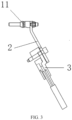
- the present disclosure discloses a conveniently replaceable charging socket, as illustrated in FIGS. 1 to 4 , including a charging socket body 1, a transition flat cable 2 and a conductive cable 3.
- the charging socket body 1 is provided therein with a charging terminal 11.
- the transition flat cable 2 has one end connected to the charging terminal 11, and the other end detachably connected to the conductive cable 3.
- the conductive cable 3 is directly connected to the charging terminal 11 in the charging socket body 1, while the conductive cable 3 is firmly fixed in the vehicle body.
- the movement of the conductive cable 3 is not a simply separation from the charging socket, but also requires dismantlement of a plurality of nodes, thus making the replacement of the charging socket a very cumbersome task, and excessive dismantling is also prone to causing a circuit damage.
- the traditional charging socket is likely to cause harm to the operation and maintenance personnel during the charging or maintenance process if a short circuit occurs or a short-circuit or a short-circuit or communication is caused for other reasons.
- the maintenance can be carried out after the transition flat cable 2 and the conductive cable 3 are conveniently disconnected from each other. Meanwhile, the conveniently replaceable charging socket according to the present disclosure can be replaced independently without the need to move the conductive cable 3.
- the charging socket body 1 can be detached from the vehicle body just by separating the transition flat cable 2 from the conductive cable 3, and after putting the new charging socket body 1, the transition flat cable 2 is connected to the charging terminal 11 and the conductive cable 3, respectively, to complete the mounting.
- the transition flat cable 2 and the charging terminal 11 are integrally formed to serve as a part of the charging socket body 1, thereby facilitating quick replacement and reducing connection points to reduce the resistance.
- the charging terminal 11 and the transition flat cable 2 are connected by means of crimping, welding, screwing or riveting.
- the crimping is a production process in which the connecting end and the transition flat cable 2 are assembled and then stamped into a whole by using a crimping machine.
- the resistance welding refers to a method of welding by passing strong current through a contact point between an electrode and a workpiece to generate heat by a contact resistance.
- the friction welding refers to a method of welding by using the heat generated by the friction between the contact surfaces of the workpieces as a heat source, to make the workpieces be plastically deformed under pressure.
- the ultrasonic welding is to transmit high-frequency vibration waves to surfaces of two to-be-welded objects, so that the surfaces of the two objects rub against each other under pressure to form a fuse molecular layer.
- the arc welding is to convert electric energy into heat energy and mechanical energy that are needed for welding by using electric arc as a heat source and using the physical phenomenon of air discharge, so as to connect metals.
- the arc welding mainly includes shielded metal arc welding, submerged arc welding and gas shielded welding, etc.
- the laser welding is an efficient and precise welding method that uses a laser beam with high energy density as a heat source.
- the electron beam welding method refers to a method of using accelerated and focused electron beam to bombard the welding surface that is placed in vacuum or non-vacuum, to melt the welded workpiece to achieve welding.
- the diffusion welding refers to a solid-state welding method that pressurizes the workpiece at high temperature without producing visible deformation and relative movement.
- the magnetic induction welding refers to that that two to-be-welded workpieces are instantaneously collided with each other at high speed under the action of a strong pulsed magnetic field, so that under the action of high pressure waves, the atoms of the two materials on the material surfaces of the two workpieces can meet within interatomic distance, thus forming a stable metallurgical bond at the interface.
- the magnetic induction welding is a type of solid-state cold welding that can weld conductive metals with similar or dissimilar properties.
- connection end of the charging terminal 11 is of flat shape, both the connection end and the transition flat cable 2 are provided with screw holes so as to be connected by a screw and a nut.
- connection end of the charging terminal 11 is cylindrical and has external threads as illustrated in FIG. 2 , the transition flat cable 2 has a hole and is sleeved at the connection end, and then they are tightened using a nut to complete the screwing.
- a rivet is allowed to penetrate fixing holes, which are provided at overlapping positions of the connecting end of the charging terminal 11 and the transition flat cable 2, and a penetrating end of the rivet is deformed to tighten the fixing holes, so that the connecting end is fixedly connected to the transition flat cable 2.
- the conductive cable 3 is a flat cable and connected to the transition flat cable 2 by a bolt, as illustrated in FIG. 3 .
- the conductive cable 3 and the transition flat cable 2 may be provided with screw holes and then connected by a bolt, which is more convenient for mounting or separation.
- the conductive cable 3 is a copper busbar or an aluminum busbar.
- the copper conductor is usually used for current conduction since copper has high electrical conductivity and good ductility.
- the material cost of using copper as a wire is higher and higher.
- aluminum is lighter, and its electrical conductivity is second only to copper, so that aluminum can partially replace copper in the field of electrical connections. Therefore, the copper busbar and the aluminum busbar can be selected as needed.
- the charging socket body 1 is a DC (Direct Current) charging socket body, and as illustrated in FIG. 4 , there are two charging terminals 11, i.e., a positive terminal 111 and a negative terminal 112, each of which is connected to one transition flat cable 2, and each of the transition flat cables 2 is detachably connected to one conductive cable 3 to form a complete DC charging socket.
- DC Direct Current
- the charging terminal 11 has a plating layer.
- the charging terminal 11 is a copper terminal or an aluminum terminal. Copper or aluminum, as an active metal, will undergo an oxidation reaction with oxygen and water during use, so one or more inactive metals are needed as a plating layer to prolong the service life of the terminal with a memory function.
- the plating layer may be provided on the charging terminal 11 by means of electroplating, electroless plating, magnetron sputtering or vacuum plating.
- the electroplating is a process of plating, on a surface of some metal, a thin layer of other metal or alloy using electrolysis principle.
- the chemical plating is a deposition process that produces a metal through a controllable oxidation-reduction reaction under a metal catalytic action.
- the magnetron sputtering is to use an interaction of a magnetic field and an electric field to make electrons move spirally near a target surface, thereby increasing the probability that electrons bombard argon to generate ions.
- the generated ions bombard the target surface under the action of the electric field so as to sputter a target material.
- the vacuum plating is to deposit various metal and non-metal films on the surface of a part by means of distillation or sputtering under a vacuum condition.
- a contact resistance between the transition flat cable 2 and the conductive cable 3 is less than 9 mS2.
- the contact resistance between the transition flat cable 2 and the conductive cable 3 is less than 1 mS2.
- the transition flat cable 2 and the conductive cable 3 need to conduct a large current. If the contact resistance between the transition flat cable 2 and the conductive cable 3 is greater than 9 mQ, a large temperature rise will occur at the contact position between the transition flat cable 2 and the conductive cable 3, and the temperature will be increasingly higher with the elapse of time. The excessive temperature might be transferred to the insulating layers of the transition flat cable 2 and the conductive cable 3, resulting in melting of the corresponding insulating layers. In severe cases, short circuit of the lines may be caused, resulting in damage to the connection structure, and even safety accidents such as burning. Meanwhile, when the contact resistance is too high, the electrical conductivity will also be affected. Therefore, the inventor sets the contact resistance between the transition flat cable 2 and the conductive cable 3 to be less than 9 mS2.
- the inventor selects the same conductive cables 3 and the same transition flat cables 2 with different contact resistances, to test the electrical conductivity and the temperature rise of the transition flat cables 2.
- the test on the electrical conductivity is to detect, after connecting and electrifying the transition flat cable 2 and the conductive cable 3, the electrical conductivity at the connection position of them.
- the electrical conductivity greater than 99% is an ideal value.
- the test on the temperature rise is to supply the same current, detect the temperatures of the transition flat cable 2 and the conductive cable 3 at the same position before the current supply and after the temperature is stable in a closed environment, and take a difference therebetween to obtain an absolute value.
- the temperature rise greater than 50 K is unqualified. The results are shown in Table 1.
- Table 1 Influence of different contact resistances between the transition flat cable 2 and the conductive cable 3 on the electrical conductivity and the temperature rise
- Different contact resistances between the transition flat cable 2 and the conductive cable 3 (m ⁇ ) 10 9 8 6 4 3 2 1 0.5 Temperature rise of at the connecting position of the transition flat cable 2 and the conductive cable 3 (k) 56 48 42 35 28 24 20 14 7 Electrical conductivity at the connecting position (%) 98.8 99.4 99.6 99.6 99.7 99.8 99.8 99.9 999
- the inventor sets the contact resistance between the transition flat cable 2 and the conductive cable 3 to be less than 9 mS2.
- the contact resistance between the transition flat cable 2 and the conductive cable 3 is less than 1 mQ
- the temperature rise at the connecting position of the transition flat cable 2 and the conductive cable 3 is small and does not exceed 20K, and the electrical conductivity reaches 99.9%, i.e., the electrical conduction effect is good. Therefore, the inventor prefers that the contact resistance between the transition flat cable 2 and the conductive cable 3 is less than 1 mS2.
- the transition flat cable 2 has at least one bent portion 21, as illustrated in FIG. 5 , and an included angle between two adjacent flat surfaces connected by the bent portion 21 is 45° to 180°.
- the bent portion 21 enables the transition flat cable to have different outlet directions.
- the conductive cable 3 cannot be mounted.
- the inventor carries out relevant tests, and selects the same charging socket bodies 1, the same conductive cables 3, and different transition flat cables 2 having bent portions 21 with different angles. Firstly, the transition flat cable 2 is connected to the charging socket body 1; and it is considered to be qualified if the conductive cable 3 is connected normally, otherwise it is considered to be unqualified. The results are shown in Table 2.
- Table 2 Influence of the bent portions with different included angles on whether the conductive cable can be mounted Included angle between two adjacent flat surfaces connected by the bent portion (°) 43 45 50 65 80 100 120 140 160 180 Whether the conductive cable can be mounted No Yes Yes Yes Yes Yes Yes Yes Yes Yes Yes Yes Yes Yes Yes Yes
- the included angle between two adjacent flat surfaces connected by the bent portion 21 is less than 45°, the conductive cable 3 cannot be mounted, which is unqualified.
- the included angle is greater than or equal to 45°, the conductive cable 3 can be mounted. Therefore, the inventor prefers that the included angle between two adjacent flat surfaces connected by the bent portion 21 is 45° to 180°.
- the transition flat cable 2 has at least one twisted portion 22, as illustrated in FIG. 6 , and an included angle between two adjacent flat surfaces connected by the twisted portion 22 is 0° to 90°. That is, the two flat surfaces of the transition flat cable 2 form a certain angle through the twisting of the twisted portion 22, and the angle may be any value as needed, so as to meet different assembly environments.
- the present disclosure further discloses a vehicle, including the conveniently replaceable charging socket described above.
- the charging socket body 1 is detachably connected to a vehicle body of the vehicle, and the conductive cable 3 is provided on the vehicle body.
- the charging socket is to be replaced, there is no need to move the conductive cable 3, and it is only needed to separate the transition flat cable 2 from the conductive cable 3, then remove the charging socket body 1, and after the maintenance or the replacement with the new charging socket body 1, connect the transition flat cable 2 with the conductive cable 3 again, thereby completing the replacement of the charging socket.
- the charging socket body 1 is to be maintained, it is only needed to disconnect the transition flat cable 2 and the conductive cable 3 to perform the maintenance under the condition of power off, thereby ensuring the safety of workers.
Landscapes
- Engineering & Computer Science (AREA)
- Power Engineering (AREA)
- Transportation (AREA)
- Mechanical Engineering (AREA)
- Life Sciences & Earth Sciences (AREA)
- Sustainable Development (AREA)
- Sustainable Energy (AREA)
- Electric Propulsion And Braking For Vehicles (AREA)
Applications Claiming Priority (2)
| Application Number | Priority Date | Filing Date | Title |
|---|---|---|---|
| CN202123414838.XU CN216698973U (zh) | 2021-12-30 | 2021-12-30 | 便于更换的充电座及汽车 |
| PCT/CN2022/142218 WO2023125496A1 (zh) | 2021-12-30 | 2022-12-27 | 便于更换的充电座及汽车 |
Publications (2)
| Publication Number | Publication Date |
|---|---|
| EP4459814A1 true EP4459814A1 (de) | 2024-11-06 |
| EP4459814A4 EP4459814A4 (de) | 2025-04-02 |
Family
ID=81816589
Family Applications (1)
| Application Number | Title | Priority Date | Filing Date |
|---|---|---|---|
| EP22914750.9A Pending EP4459814A4 (de) | 2021-12-30 | 2022-12-27 | Einfach austauschbare ladesteckdose und fahrzeug |
Country Status (5)
| Country | Link |
|---|---|
| US (1) | US20250332933A1 (de) |
| EP (1) | EP4459814A4 (de) |
| JP (1) | JP3249339U (de) |
| CN (1) | CN216698973U (de) |
| WO (1) | WO2023125496A1 (de) |
Families Citing this family (4)
| Publication number | Priority date | Publication date | Assignee | Title |
|---|---|---|---|---|
| CN216698973U (zh) * | 2021-12-30 | 2022-06-07 | 长春捷翼汽车零部件有限公司 | 便于更换的充电座及汽车 |
| CN219739372U (zh) * | 2023-03-27 | 2023-09-22 | 长春捷翼汽车科技股份有限公司 | 一种便于更换线缆的充电座 |
| FR3165362A1 (fr) * | 2024-07-31 | 2026-02-06 | Mecatraction | Dispositif de connexion électrique et procédé d’assemblage d’un tel dispositif de connexion électrique |
| CN118849847B (zh) * | 2024-09-23 | 2025-02-14 | 上海玖行能源科技有限公司 | 一种自动充电系统及方法 |
Family Cites Families (7)
| Publication number | Priority date | Publication date | Assignee | Title |
|---|---|---|---|---|
| CN107819223A (zh) * | 2017-11-10 | 2018-03-20 | 深圳巴斯巴科技发展有限公司 | 一种能快速维修的连接端子 |
| CN209071753U (zh) * | 2018-12-21 | 2019-07-05 | 上海汉翱新能源科技有限公司 | 一种新型电动汽车交流充电插座 |
| DE102020112332A1 (de) * | 2020-05-07 | 2021-11-11 | Phoenix Contact E-Mobility Gmbh | Ladedose für ein Elektrofahrzeug, elektrische Anschlussanordnung und Kraftfahrzeug |
| CN113745881A (zh) * | 2021-08-06 | 2021-12-03 | 长春捷翼汽车零部件有限公司 | 充电座及汽车 |
| CN113708172A (zh) * | 2021-08-26 | 2021-11-26 | 长春捷翼汽车零部件有限公司 | 一种电能传输转接机构、充电插座和机动车辆 |
| CN216251492U (zh) * | 2021-08-26 | 2022-04-08 | 长春捷翼汽车零部件有限公司 | 一种电能传输转接机构、充电插座和机动车辆 |
| CN216698973U (zh) * | 2021-12-30 | 2022-06-07 | 长春捷翼汽车零部件有限公司 | 便于更换的充电座及汽车 |
-
2021
- 2021-12-30 CN CN202123414838.XU patent/CN216698973U/zh active Active
-
2022
- 2022-12-27 US US18/725,728 patent/US20250332933A1/en active Pending
- 2022-12-27 WO PCT/CN2022/142218 patent/WO2023125496A1/zh not_active Ceased
- 2022-12-27 EP EP22914750.9A patent/EP4459814A4/de active Pending
- 2022-12-27 JP JP2024600103U patent/JP3249339U/ja active Active
Also Published As
| Publication number | Publication date |
|---|---|
| CN216698973U (zh) | 2022-06-07 |
| WO2023125496A1 (zh) | 2023-07-06 |
| US20250332933A1 (en) | 2025-10-30 |
| EP4459814A4 (de) | 2025-04-02 |
| JP3249339U (ja) | 2024-12-04 |
Similar Documents
| Publication | Publication Date | Title |
|---|---|---|
| EP4459814A1 (de) | Einfach austauschbare ladesteckdose und fahrzeug | |
| EP4395086B1 (de) | Übertragungsmechanismus zur stromübertragung, ladebuchse und kraftfahrzeug | |
| EP4398270A1 (de) | Elektrisches energieübertragungssystem für ein fahrzeug sowie ladevorrichtung und elektrofahrzeug | |
| US20250192458A1 (en) | Electric energy transmission assembly and vehicle | |
| US20110117420A1 (en) | Bus bar and battery module including the same | |
| CN107123867B (zh) | 一种铜端子与铝导线的接头及其磁感应焊接方法 | |
| WO2018223887A1 (zh) | 一种铜端子和铝导线的接头及其等离子焊接方法 | |
| US20250196673A1 (en) | Electric energy transmission connecting device and vehicle | |
| EP4443670A1 (de) | Fahrzeugladevorrichtung und herstellungsverfahren | |
| US20100203378A1 (en) | Device providing electrical connection between electrochemical cells | |
| EP4496153A1 (de) | Elektrische energieübertragungsanordnung und fahrzeug | |
| US20250260134A1 (en) | Busbar, battery pack, and electronic device | |
| CN215944316U (zh) | 一种用于车辆的电能传输系统、充电装置和电动车辆 | |
| CN113054295B (zh) | 盖板组件、电池、电池模组、动力电池包和电动汽车 | |
| CN107331826B (zh) | 动力电池组的连接方法以及运用该方法生产的电池组 | |
| EP4494918A1 (de) | Flexible verbindungsstruktur eines verbinders und fahrzeug | |
| HK1214885A1 (zh) | 改善电连接导电性的粉末与糊剂 | |
| CN217823277U (zh) | 一种用于电能传输的连接结构 | |
| WO2023174248A1 (zh) | 一种连接器总成及一种车辆 | |
| CN204946998U (zh) | 一种具有短路保护功能的电池组 | |
| EP4131671A1 (de) | Profilverbinder | |
| CN217691753U (zh) | 用于电能传输的连接结构 | |
| CN118287580A (zh) | 铜包铝复合型材料的制备方法、线圈组件和断路器 | |
| CN112736501A (zh) | 一种铜铝一体化线夹及其制备方法 |
Legal Events
| Date | Code | Title | Description |
|---|---|---|---|
| STAA | Information on the status of an ep patent application or granted ep patent |
Free format text: STATUS: THE INTERNATIONAL PUBLICATION HAS BEEN MADE |
|
| PUAI | Public reference made under article 153(3) epc to a published international application that has entered the european phase |
Free format text: ORIGINAL CODE: 0009012 |
|
| STAA | Information on the status of an ep patent application or granted ep patent |
Free format text: STATUS: REQUEST FOR EXAMINATION WAS MADE |
|
| 17P | Request for examination filed |
Effective date: 20240711 |
|
| AK | Designated contracting states |
Kind code of ref document: A1 Designated state(s): AL AT BE BG CH CY CZ DE DK EE ES FI FR GB GR HR HU IE IS IT LI LT LU LV MC ME MK MT NL NO PL PT RO RS SE SI SK SM TR |
|
| P01 | Opt-out of the competence of the unified patent court (upc) registered |
Free format text: CASE NUMBER: APP_62543/2024 Effective date: 20241123 |
|
| A4 | Supplementary search report drawn up and despatched |
Effective date: 20250304 |
|
| RIC1 | Information provided on ipc code assigned before grant |
Ipc: H01R 12/77 20110101ALI20250226BHEP Ipc: B60L 53/14 20190101ALI20250226BHEP Ipc: B60L 3/00 20190101ALI20250226BHEP Ipc: H01R 4/02 20060101ALI20250226BHEP Ipc: B60L 53/18 20190101ALI20250226BHEP Ipc: B60L 53/10 20190101ALI20250226BHEP Ipc: B60L 53/16 20190101ALI20250226BHEP Ipc: H01R 4/30 20060101ALI20250226BHEP Ipc: H01R 13/03 20060101ALI20250226BHEP Ipc: H01R 13/02 20060101ALI20250226BHEP Ipc: H01R 24/00 20110101AFI20250226BHEP |
|
| DAV | Request for validation of the european patent (deleted) | ||
| DAX | Request for extension of the european patent (deleted) | ||
| STAA | Information on the status of an ep patent application or granted ep patent |
Free format text: STATUS: EXAMINATION IS IN PROGRESS |
|
| 17Q | First examination report despatched |
Effective date: 20251126 |