EP4459730A1 - Verfahren zur herstellung eines polymerfestelektrolyts - Google Patents
Verfahren zur herstellung eines polymerfestelektrolyts Download PDFInfo
- Publication number
- EP4459730A1 EP4459730A1 EP23816375.2A EP23816375A EP4459730A1 EP 4459730 A1 EP4459730 A1 EP 4459730A1 EP 23816375 A EP23816375 A EP 23816375A EP 4459730 A1 EP4459730 A1 EP 4459730A1
- Authority
- EP
- European Patent Office
- Prior art keywords
- cross
- polymer
- solid electrolyte
- linkable functional
- functional group
- Prior art date
- Legal status (The legal status is an assumption and is not a legal conclusion. Google has not performed a legal analysis and makes no representation as to the accuracy of the status listed.)
- Pending
Links
Images

Classifications
-
- C—CHEMISTRY; METALLURGY
- C08—ORGANIC MACROMOLECULAR COMPOUNDS; THEIR PREPARATION OR CHEMICAL WORKING-UP; COMPOSITIONS BASED THEREON
- C08J—WORKING-UP; GENERAL PROCESSES OF COMPOUNDING; AFTER-TREATMENT NOT COVERED BY SUBCLASSES C08B, C08C, C08F, C08G or C08H
- C08J5/00—Manufacture of articles or shaped materials containing macromolecular substances
- C08J5/20—Manufacture of shaped structures of ion-exchange resins
- C08J5/22—Films, membranes or diaphragms
-
- C—CHEMISTRY; METALLURGY
- C08—ORGANIC MACROMOLECULAR COMPOUNDS; THEIR PREPARATION OR CHEMICAL WORKING-UP; COMPOSITIONS BASED THEREON
- C08J—WORKING-UP; GENERAL PROCESSES OF COMPOUNDING; AFTER-TREATMENT NOT COVERED BY SUBCLASSES C08B, C08C, C08F, C08G or C08H
- C08J5/00—Manufacture of articles or shaped materials containing macromolecular substances
- C08J5/20—Manufacture of shaped structures of ion-exchange resins
- C08J5/22—Films, membranes or diaphragms
- C08J5/2287—After-treatment
-
- H—ELECTRICITY
- H01—ELECTRIC ELEMENTS
- H01M—PROCESSES OR MEANS, e.g. BATTERIES, FOR THE DIRECT CONVERSION OF CHEMICAL ENERGY INTO ELECTRICAL ENERGY
- H01M10/00—Secondary cells; Manufacture thereof
- H01M10/05—Accumulators with non-aqueous electrolyte
- H01M10/056—Accumulators with non-aqueous electrolyte characterised by the materials used as electrolytes, e.g. mixed inorganic/organic electrolytes
- H01M10/0564—Accumulators with non-aqueous electrolyte characterised by the materials used as electrolytes, e.g. mixed inorganic/organic electrolytes the electrolyte being constituted of organic materials only
- H01M10/0565—Polymeric materials, e.g. gel-type or solid-type
-
- H—ELECTRICITY
- H01—ELECTRIC ELEMENTS
- H01M—PROCESSES OR MEANS, e.g. BATTERIES, FOR THE DIRECT CONVERSION OF CHEMICAL ENERGY INTO ELECTRICAL ENERGY
- H01M10/00—Secondary cells; Manufacture thereof
- H01M10/05—Accumulators with non-aqueous electrolyte
- H01M10/052—Li-accumulators
-
- H—ELECTRICITY
- H01—ELECTRIC ELEMENTS
- H01M—PROCESSES OR MEANS, e.g. BATTERIES, FOR THE DIRECT CONVERSION OF CHEMICAL ENERGY INTO ELECTRICAL ENERGY
- H01M2300/00—Electrolytes
- H01M2300/0017—Non-aqueous electrolytes
- H01M2300/0065—Solid electrolytes
- H01M2300/0082—Organic polymers
-
- H—ELECTRICITY
- H01—ELECTRIC ELEMENTS
- H01M—PROCESSES OR MEANS, e.g. BATTERIES, FOR THE DIRECT CONVERSION OF CHEMICAL ENERGY INTO ELECTRICAL ENERGY
- H01M2300/00—Electrolytes
- H01M2300/0085—Immobilising or gelification of electrolyte
-
- Y—GENERAL TAGGING OF NEW TECHNOLOGICAL DEVELOPMENTS; GENERAL TAGGING OF CROSS-SECTIONAL TECHNOLOGIES SPANNING OVER SEVERAL SECTIONS OF THE IPC; TECHNICAL SUBJECTS COVERED BY FORMER USPC CROSS-REFERENCE ART COLLECTIONS [XRACs] AND DIGESTS
- Y02—TECHNOLOGIES OR APPLICATIONS FOR MITIGATION OR ADAPTATION AGAINST CLIMATE CHANGE
- Y02E—REDUCTION OF GREENHOUSE GAS [GHG] EMISSIONS, RELATED TO ENERGY GENERATION, TRANSMISSION OR DISTRIBUTION
- Y02E60/00—Enabling technologies; Technologies with a potential or indirect contribution to GHG emissions mitigation
- Y02E60/10—Energy storage using batteries
Definitions
- the present invention relates to a method for preparing a polymer solid electrolyte.
- a lithium-ion battery using a liquid electrolyte has a structure in which the negative electrode and the positive electrode are partitioned by a separator, if the separator is damaged by deformation or external impact, a short circuit may occur, which may lead to dangers such as overheating or explosion. Therefore, it can be said that the development of a solid electrolyte that can secure safety in the field of the lithium-ion secondary batteries is a very important task.
- a lithium secondary battery using a solid electrolyte has advantages in that the safety of the battery is increased, and the leakage of the electrolyte solution can be prevented, thereby improving the reliability of the battery and making it easy to manufacture a thin battery.
- lithium metal can be used as a negative electrode, energy density can be improved, and accordingly, it is expected to be applied to high-capacity secondary batteries for electric vehicles, in addition to small secondary batteries, and is in the limelight as a next-generation battery.
- a polymer material made of an ion-conductive material or an inorganic material of an oxide or a sulfide having ion-conductive properties may be used for a polymer solid electrolyte, among solid electrolytes, and a material having a hybrid form in which a polymer material and an inorganic material are mixed has also been proposed.
- Such a conventional polymer solid electrolyte was prepared through a solution casting and a high-temperature drying process.
- the conventional preparation technology for the polymer solid electrolyte has limitations in that it is difficult to prepare the polymer solid electrolyte with improved ionic conductivity due to the high crystallinity of the crystalline polymer or semi-crystalline polymer.
- high crystallinity of a polymer hinders polymer chain mobility, lithium ion migration inside the polymer solid electrolyte is also limited, and thus it has been difficult to improve ionic conductivity of the polymer solid electrolyte.
- conventional polymer solid electrolytes can be prepared by forming a coating film using polyvinyl alcohol (PVA) containing a hydroxyl group, which is a cross-linkable functional group, as a polymer, and then performing a high-temperature drying process.
- PVA polyvinyl alcohol
- the PVA aqueous solution is applied on a substrate by solution casting to form a coating film, and dried at room temperature or high temperature to form a polymer solid electrolyte in the form of a PVA film.
- the high temperature may mean 80 °C or higher, which is the glass transition temperature (Tg) of PVA.
- Patent Document 1 Chinese Laid-open Patent Publication No. 112259788
- the present invention provides a method for preparing a polymer solid electrolyte, including the steps of:
- the present invention provides an all-solid-state battery including a polymer solid electrolyte prepared by the preparation method of the present invention.
- a method for preparing a polymer solid electrolyte according to the present invention is, due to a structure including a cross-linked structure formed by a cross-linkable functional group contained in a polymer and an amorphous polymer chain, capable of reducing crystallinity of the polymer, thereby improving ionic conductivity.
- brittleness, ductility and viscosity may be reduced due to the structural properties.
- the method for preparing a polymer solid electrolyte according to the present invention is capable of preparing a polymer solid electrolyte using a continuous process, and is capable of mass production.
- cross-linked structure refers to a structure comprising a three-dimensional frame formed by polymer chains and an internal space of the frame.
- the polymer chain may be formed by cross-linkages comprising cross-linkable functional groups contained in the polymer. Since the cross-linked structure has a three-dimensional shape and has a form in which polymer chains are entangled with each other, it can also be referred to as a three-dimensional network structure.
- the present invention relates to a method for preparing a polymer solid electrolyte, and the method for preparing a polymer solid electrolyte of the present invention includes the steps of:
- the step (1) is a step of preparing a solution for forming a polymer solid electrolyte including an aqueous polymer solution containing a cross-linkable functional group, and a lithium salt.
- the polymer having a cross-linkable functional group may be a polymer having a cross-linkable functional group capable of forming a cross-linked structure by forming (a) a cross-linkage between the cross-linkable functional groups, (b) a cross-linkage between the cross-linkable functional group and a solvent, and (c) a bond between the cross-linkable functional group and the lithium salt.
- bonds of (a), (b) and (c) will be described later in more detail.
- the cross-linkable functional group may include one or more selected from the group consisting of a hydroxyl group, a carboxyl group, and an amide group.
- the weight average molecular weight (Mw) of the polymer having the cross-linkable functional group may be 80,000 g/mol to 130,000 g/mol, and specifically, may be 80,000 g/mol or more, 83,000 g/mol or more or 85,000 g/mol or more, and 90,000 g/mol or less, 110,000 g/mol or less or 130,000 g/mol or less. If the weight average molecular weight (Mw) of the polymer having the cross-linkable functional group is less than 80,000 g/mol, the bond by the cross-linkable functional group may not be sufficiently formed to obtain a cross-linked structure.
- the weight average molecular weight (Mw) of the polymer having the cross-linkable functional group exceeds 130,000 g/mol, the entanglement of the polymer chain is increased in the aqueous polymer solution, and the penetration rate of the solvent into the polymer chain is decreased. Accordingly, gelation of the polymer is accelerated, and thus the solubility of the polymer is lowered and the bonding by the cross-linkable functional group cannot be performed smoothly, so the formation of a cross-linked structure may not be easy.
- the polymer including a cross-linkable functional group has the polymer and the solvent smoothly phase-separated in the polymer solution, and by the cross-linkable functional group included in the phase-separated polymer in the step of freezing the coating film of the step (4), a property of readily forming the bonds of (a), (b) and (c) may be obtained.
- the polymer having the cross-linkable functional group may include one or more selected from the group consisting of polyvinyl alcohol (PVA), gelatin, methyl cellulose, agar, dextran, poly(vinyl pyrrolidone), poly(ethylene oxide), poly(acrylamide), poly(acrylic acid) (PAA), starch-carboxymethyl cellulose, hyaluronic acid-methyl cellulose, chitosan, poly(N-isopropylacrylamide), and amino-terminated polyethylene glycol (amino-terminated PEG).
- PVA polyvinyl alcohol
- gelatin gelatin
- methyl cellulose agar
- dextran poly(vinyl pyrrolidone)
- PAA poly(acrylic acid)
- starch-carboxymethyl cellulose hyaluronic acid-methyl cellulose
- chitosan poly(N-isopropylacrylamide)
- amino-terminated polyethylene glycol amino-terminated PEG
- the polymer having a cross-linkable functional group may be polyvinyl alcohol
- the polyvinyl alcohol may be efficiently phase-separated from the solvent in the step of freezing the coating film of the step (4)
- the bonds of (a), (b) and (c) induced from the cross-linkable functional group of the polyvinyl alcohol phase-separated from the solvent may be advantageous in forming the cross-linked structure.
- the lithium salt is included in an inner space of the cross-linked structure in a dissociated state, and ionic conductivity of the polymer solid electrolyte may be improved.
- the lithium salt can form (c) the bond between the cross-linkable functional group and the lithium salt, thereby preventing the generation of crystallinity of the polymer solid electrolyte and promoting the formation of an amorphous polymer chain at the same time.
- the lithium salt may include one or more selected from the group consisting of LiNO 3 , LiOH, LiCl, LiBr, LiI, LiClO 4 , LiBF 4 , LiB 10 Cl 10 , LiPF 6 , LiCF 3 SO 3 , LiCF 3 CO 2 , LiAsF 6 , LiSbF 6 , LiAlCl 4 , CH 3 SO 3 Li, CF 3 SO 3 Li, LiSCN, LiC(CF 3 SO 2 ) 3 , (CF 3 SO 2 ) 2 NLi, and (FSO 2 ) 2 NLi.
- the molar ratio ([Li]/[G]) of the cross-linkable functional group ([G]) of the polymer having the cross-linkable functional group and lithium ([Li]) of the lithium salt contained in the polymer solid electrolyte may be exceeding 0.1 and less than 0.5, and specifically may be exceeding 0.1, 0.2 or more, or 0.3 or more, and may be 0.4 or less, or less than 0.5. If the molar ratio ([Li]/[G]) is 0.1 or less, as the content of the lithium salt is reduced, the ionic conductivity of the polymer solid electrolyte may be lowered.
- the molar ratio ([Li]/[G]) is 0.5 or more, the content of the polymer having the cross-linkable functional group is reduced, so that the bonds of (a), (b) and (c) may not be sufficiently formed, and accordingly crystallinity may be increased and ionic conductivity may be decreased.
- the cross-linkable functional group is a hydroxyl group (OH-)
- the [G] may be expressed as [OH] or [O].
- the solvent used when preparing the polymer solution may be a polar solvent, and for example, may be water.
- the polymer solution may be an aqueous polymer solution.
- the concentration of the polymer solution containing the cross-linkable functional group may be properly adjusted considering the extent of smoothly proceeding the coating process when applying the solution for forming the polymer solid electrolyte on a substrate film.
- the polymer having a cross-linkable functional group may be included in an amount of 5% by weight to 20% by weight, specifically, 5% by weight or more, 7% by weight or more or 9% by weight or more, and 13% by weight or less, 17% by weight or less or 20% by weight or less, based on the total weight of the polymer solution containing a cross-linkable functional group.
- the concentration of the polymer is too dilute and thus it may flow down when applied on the substrate film. If the polymer having the cross-linkable functional group is included in an amount exceeding 20%, it is difficult to dissolve the lithium salt at a desired concentration in the solution of the polymer, and it may be difficult to apply it in the form of a uniform thin film.
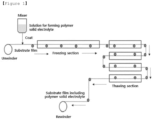
- the step (2) is a step of unwinding a substrate film using an unwinder and supplying the substrate film to a transfer path.
- the unwinder unwinds the substrate film wound in a roll shape and supplies the film to a predetermined transfer path, may unwind and supply the substrate film by its own drive, and may unwind and supply the substrate film by driving force of a rewinder winding the substrate film including the polymer solid electrolyte layer.
- the method for preparing a polymer solid electrolyte of the present invention may be a roll-to-roll process.
- the substrate film is not particularly limited as long as it is capable of acting as a support on which the solution for forming the polymer solid electrolyte is applied.
- the substrate film may be stainless steel (SS), a polyethylene terephthalate film, a polytetrafluoroethylene film, a polyethylene film, a polypropylene film, a polybutene film, a polybutadiene film, a vinyl chloride copolymer film, a polyurethane film, an ethylene-vinyl acetate film, an ethylenepropylene copolymer film, an ethylene-ethyl acrylate copolymer film, an ethylene-methyl acrylate copolymer film, or a polyimide film.
- the step (3) is a step of forming a coating film by applying the solution for forming the polymer solid electrolyte on the substrate film.
- the coating method in the present invention is not particularly limited as long as it is a method capable of applying the solution for forming the polymer solid electrolyte on the substrate film in a film form.
- the coating method may be bar coating, roll coating, spin coating, slit coating, die coating, blade coating, comma coating, slot die coating, lip coating, spray coating or solution casting.
- a solution casting method may be used. More specifically, the solution for forming the polymer solid electrolyte prepared in step (1) is put into a mixer, and then, the mixer is placed on the substrate film, so that the solution for forming a polymer solid electrolyte may be continuously casted on the substrate film supplied to a transfer path to form a coating film.
- the step (4) is a step of freezing the coating film by transferring the coating film-formed substrate film to a freezing section, and in step (4), a polymer solid electrolyte may be prepared.
- the polymer solid electrolyte of the present invention includes a cross-linked structure; and an amorphous polymer chain containing the cross-linkable functional group, and the cross-linked structure; and the amorphous polymer chain containing the cross-linkable functional group may be formed by freezing the coating film.
- the polymer solid electrolyte of the present invention includes the amorphous polymer chain and a lithium salt in an inner space formed in the cross-linked structure, and the lithium salt is included in a dissociated state.
- the cross-linked structure may be formed by some of the cross-linkable functional groups included in the polymer forming localized crystallites, and the localized crystallites acting as a cross-linkable junction point and forming a cross-linkage.
- the crystallite means a shape like a knot made by tangled threads, unlike a crystal structure formed by polymer chain folding.
- the cross-linked structure includes (a) a cross-linkage between the cross-linkable functional groups, (b) a cross-linkage between the cross-linkable functional group and a solvent, and (c) a bond between the cross-linkable functional group and the lithium salt.
- bonds of (a), (b) and (c) may be induced by the cross-linkable functional group to form the cross-linked structure.
- the cross-linkage between the cross-linkable functional groups may include a hydrogen bond between the cross-linkable functional groups, and for example, the hydrogen bond may be a hydrogen bond between OH - s.
- the cross-linked structure is formed only with (a) the cross-linkage between the cross-linkable functional groups, crystallinity occurs in the polymer solid electrolyte, and thus ionic conductivity may decrease.
- the cross-linked structure includes not only (a) the cross-linkage between the cross-linkable functional groups, but also (b) the cross-linkage between the cross-linkable functional group and a solvent and (c) the bond between the cross-linkable functional group and the lithium salt, and therefore, crystallinity of the polymer solid electrolyte may be prevented from occurring.
- the cross-linkage between the cross-linkable functional group and a solvent may include a hydrogen bond, and for example, the hydrogen bond may be a hydrogen bond between OH- and H + .
- H + may be derived from a water solvent.
- the cross-linkage between the cross-linkable functional group and a solvent may mean a hydrogen bond between some of the solvent remaining in the freezing process and the thawing process of the step (5) as describe later and the cross-linkable functional group.
- the cross-linkage between the cross-linkable functional group and a solvent hinders (a) the cross-linkage between the cross-linkable functional groups, so that the cross-linked structure is not formed only with (a) the cross-linkage between the cross-linkable functional groups, and therefore, an increase in the crystallinity of the polymer solid electrolyte may be prevented.
- the solvent may include water.
- the bond between the cross-linkable functional group and the lithium salt may include a bond by a Lewis acid-base interaction, and for example, the bond may be a bond between OH - and Li + .
- the bond between the cross-linkable functional group and the lithium salt interferes with (a) the cross-linkage between cross-linkable functional groups and (b) the cross-linkage between the cross-linkable functional group and the solvent, so that the cross-linked structure does not consist only of the cross-linkage between (a) the cross-linkable functional groups, and thus the generation of crystallinity of the polymer solid electrolyte can be prevented.
- the formation of amorphous polymer chains can be promoted. As the amorphous polymer chain is formed, the mobility of the polymer chain is improved, and thus the hopping effect of the lithium ion is increased, so that the ionic conductivity of the polymer solid electrolyte can be improved.
- the amorphous polymer may be formed in a freezing process as described later, and may refer to a polymer chain that does not form crystals by regular folding of the polymer chain and exists in a free behavior state. That is, the amorphous polymer chain may include a polymer having a cross-linkable functional group that does not form the bonds such as (a), (b) and (c).
- the polymer solid electrolyte Due to the cross-linked structure, the polymer solid electrolyte is not easily broken or destroyed and thus can play a role as a support for an electrolyte containing lithium ions stably.
- the polymer solid electrolyte since the polymer solid electrolyte exhibits elasticity, it can minimize brittleness, which is a property of being easily broken, and since the mobility of the polymer chain is excellent and the mobility of lithium ions inside the electrolyte is improved, the polymer solid electrolyte with improved ionic conductivity can be provided.
- the polymer and water included in the aqueous polymer solution containing the cross-linkable functional group used for forming the coating film may be phase separated.
- the phase separation may be induced since a hydrogen bond between the water molecules is stronger than a hydrogen bond between the cross-linkable functional group and the water molecule.
- the water molecules aggregated by the hydrogen bonds between the water molecules are present in an ice phase by the freezing of step (4).
- the number of the cross-linkable functional groups forming hydrogen bonds through an interaction with the water molecules significantly decreases.
- the polymer and water included in the aqueous polymer solution need to be phase separated first, and the phase separation may be induced by hydrogen bonds between the water molecules.
- a main target of the freezing step may be water molecules that induce phase separation.
- the target of the freezing step may be water molecules and the polymer.
- the inside of the coating film is divided into (i) a polymer-poor phase and (ii) a polymer-rich phase.
- the (i) polymer-poor phase is a portion containing water molecules aggregated by hydrogen bonds between water molecules and exists as an ice phase, which can also be referred to as a free water state.
- the (ii) polymer-rich phase is a portion containing a polymer phase separated from water.
- the phase-separated polymer is a polymer having a cross-linkable functional group that is free from interaction with water molecules, and is in a free state after phase separation, does not form crystals by regular folding, and exists in an amorphous state with relatively free behavior, which is called an amorphous polymer chain.
- cross-linkable functional groups included in the phase-separated polymer form a cross-linked structure including the (a), (b) and (c) bonds by localized crystallites acting as a cross-linkable junction point.
- the freezing of the coating film of the step (4) may be performed by appropriately selecting a condition sufficient to freeze the coating film.
- the freezing temperature may be performed at a temperature of -30°C to -10°C, and specifically, the freezing temperature may be -30°C or higher, -25°C or higher or -23°C or higher, and may be -18°C or lower, -15°C or lower or -10°C or lower. If the freezing temperature is less than -30°C, cracks may occur in the coating film. If the freezing temperature exceeds -10°C, formation of regions of amorphous polymer chains can be difficult because sufficient phase separation between the polymer and water is not achieved. In addition, the freezing may be performed in consideration of a sufficient freezing time within the range of 20 hours to 30 hours.
- the freezing section is located in a section where the coating film is formed on the substrate film, and the coating film-formed substrate film is transferred to a rewinder, and may be formed with a plurality of stages.
- a polymer solid electrolyte has been prepared through a high-temperature drying process in the art.
- polymer chain mobility is inhibited due to high crystallinity of a crystalline polymer or a semi-crystalline polymer, causing restrictions on the lithium-ion migration inside the polymer solid electrolyte, and low ionic conductivity has resulted.
- a freezing process is performed instead of a high-temperature drying process and a plasticizer is not used, which may induce (a) a cross-linkage between the cross-linkable functional groups, (b) a cross-linkage between the cross-linkable functional group and a solvent, and (c) a bond between the cross-linkable functional group and a lithium salt by the cross-linkable functional group included in the polymer, thereby preventing polymer crystallization.
- a plasticizer is not used, which may induce (a) a cross-linkage between the cross-linkable functional groups, (b) a cross-linkage between the cross-linkable functional group and a solvent, and (c) a bond between the cross-linkable functional group and a lithium salt by the cross-linkable functional group included in the polymer, thereby preventing polymer crystallization.
- the step (5) is a step of preparing a polymer solid electrolyte layer by transferring the frozen coating film-formed substrate film to a thawing section to thaw the frozen coating film.
- step (5) ice included in the (i) polymer-poor phase melts and evaporates, and accordingly, a polymer solid electrolyte with an increased free volume may be prepared.
- the thawing may be performed by properly selecting a condition under which the frozen coating film is thawed enough to be used as a polymer solid electrolyte.
- the thawing temperature may be 15°C to 35°C, or room temperature (25°C). If the thawing temperature is less than 15°C, moisture drying efficiency may be reduced after the thawing (ice melting). If the temperature exceeds 35°C, the coating film may shrink, resulting in wrinkles or warping.
- step (4) of freezing the coating film and step (5) of thawing the frozen coating film the bonds of (a), (b) and (c) are induced to form the cross-linked structure, and the amorphous polymer chain may be formed.
- steps (4) and (5) may be repeatedly performed, and the degree of forming of the cross-linked structure may be adjusted depending on the number of repetitions.
- the steps (4) and (5) are referred to as 1 cycle
- the step (4) of freezing the coating film and step (5) of thawing the frozen coating film may be performed in 1 cycle or more, 2 cycles or more, 3 cycles or more or 5 cycles or more.
- the upper limit of the cycle is not particularly limited, but may be 10 cycles or less, 13 cycles or less or 15 cycles or less.
- modulus and strength of the polymer solid electrolyte may increase.
- the coating film may be used as a polymer solid electrolyte.
- the thawing section is located in a section where the frozen coating film-formed substrate film is transferred to a rewinder, and may be formed with a plurality of stages.
- a step of loading the polymer solid electrolyte layer into a liquid electrolyte and drying may be further included.
- ionic conductivity of the polymer solid electrolyte may be further improved due to the liquid electrolyte.
- the liquid electrolyte may also be included in an inside space of the cross-linked structure.
- the liquid electrolyte may be a liquid electrolyte commonly used in the art, and the composition of the liquid electrolyte is not particularly limited as long as it is usable in a lithium secondary battery.
- the liquid electrolyte may include a lithium salt and a non-aqueous solvent.
- the lithium salt may be one of the lithium salts described above.
- the non-aqueous solvent may include one or more selected from the group consisting of propylene carbonate (PC), ethylene carbonate (EC), vinylene carbonate (VC), diethyl carbonate (DEC), dimethyl carbonate (DMC), methylethyl carbonate (MEC), ethylmethyl carbonate (EMC), tetrahydrofuran (THF), 2-methyltetrahydrofuran (2MeTHF), dioxolane (DOX), dimethoxyethane (DME), diethoxyethane (DEE), ⁇ -butyrolactone (GBL), acetonitrile (AN), and sulfolane.
- PC propylene carbonate
- EC ethylene carbonate
- VC vinylene carbonate
- DEC diethyl carbonate
- DMC dimethyl carbonate
- MEC methylethyl carbonate
- EMC ethylmethyl carbonate
- THF tetrahydrofuran
- DOX dim
- liquid electrolyte may be included in an amount of 1% by weight to 5% by weight based on the total weight of the polymer solid electrolyte.
- the liquid electrolyte content is 1% by weight or less, the effect of improving ionic conductivity may be insignificant, and when the content exceeds 5% by weight, stability may be reduced.
- the step (6) is a step of winding the substrate film including the polymer solid electrolyte layer using a rewinder for recovery.
- the rewinder may recover the substrate film including the polymer solid electrolyte by winding it in a roll shape, and may wind the substrate film including the polymer solid electrolyte layer by its own drive.
- the recovered substrate film including the polymer solid electrolyte layer may be used as it is, or, by further performing a step of separating the polymer solid electrolyte layer from the substrate film, the polymer solid electrolyte layer may be used in a free-standing film form.
- the free-standing film means a film capable of maintaining a film form by itself without a separate support, that is, without a substrate film, at room temperature and pressure.
- the polymer solid electrolyte of the present invention may minimize brittleness by exhibiting elasticity, and has properties as a support stably containing lithium ions, and therefore, may have a form suitable as a polymer solid electrolyte.
- the method for preparing a polymer solid electrolyte of the present invention is a roll-to-roll process, and is capable of continuous preparing, thereby enabling mass production.
- the polymer solid electrolyte may have ionic conductivity of 10 -4 S/cm or more.
- the polymer solid electrolyte Due to structural properties of including the cross-linked structure as described above, the polymer solid electrolyte has reduced crystallinity, and thereby has improved ionic conductivity. Accordingly, even though it is a solid electrolyte, equal or higher ionic conductivity is obtained compared to an existing liquid electrolyte, and performance of an all-solid-state battery may be improved.
- the present invention also relates to an all-solid-state battery including the polymer solid electrolyte, wherein the all-solid-state battery includes a negative electrode, a positive electrode, and a polymer solid electrolyte interposed between the negative electrode and the positive electrode, and the solid electrolyte has the above-described characteristics.
- the polymer solid electrolyte may be suitable as an electrolyte for an all-solid-state battery because physical cross-linkage is formed through the freezing and thawing processes, and thus crystallinity is lowered and ionic conductivity is improved accordingly.
- the positive electrode contained in the all-solid-state battery includes a positive electrode active material layer, and the positive electrode active material layer may be formed on one surface of the positive electrode current collector.
- the positive electrode active material layer includes a positive electrode active material, a binder, and a conductive material.
- the positive electrode active material may be contained in an amount of 40 to 80% by weight based on the total weight of the positive electrode active material layer.
- the content of the positive electrode active material may be 40% by weight or more or 50% by weight or more, and may be 70% by weight or less or 80% by weight or less. If the content of the positive electrode active material is less than 40% by weight, the connectivity between the wet positive electrode active material layer and the dry positive electrode active material layer may be insufficient. If the content of the positive electrode active material exceeds 80 % by weight, mass transfer resistance may be increased.
- the binder is a component that assists bonding between the positive electrode active material and the conductive material, and assists in bonding to the current collector.
- the binder may comprise one or more selected from the group consisting of styrene-butadiene rubber, acrylated styrene-butadiene rubber, acrylonitrile copolymer, acrylonitrile-butadiene rubber, nitrile butadiene rubber, acrylonitrile-styrene-butadiene copolymer, acrylic rubber, butyl rubber, fluorine rubber, polytetrafluoroethylene, polyethylene, polypropylene, ethylene/propylene copolymer, polybutadiene, polyethylene oxide, chlorosulfonated polyethylene, polyvinylpyrrolidone, polyvinylpyridine, polyvinyl alcohol, polyvinyl acetate, polyepichlorohydrin, polyphosphazene, polyacrylonitrile, polystyrene, late
- the binder may comprise one or more selected from the group consisting of styrene-butadiene rubber, polytetrafluoroethylene, carboxymethyl cellulose, polyacrylic acid, lithium polyacrylate, and polyvinylidene fluoride.
- the binder may be contained in an amount of 1% by weight to 30% by weight based on the total weight of the positive electrode active material layer, and specifically, the content of the binder may be 1% by weight or more or 3% by weight or more, and may be 15% by weight or less or 30% by weight or less. If the content of the binder is less than 1% by weight, the adhesive force between the positive electrode active material and the positive electrode current collector may be lowered. If the content of the binder exceeds 30% by weight, the adhesive force is improved, but the content of the positive electrode active material is reduced by that amount, and thus the capacity of the battery may be lowered.
- the conductive material is not particularly limited as long as it prevents side reactions in the internal environment of the all-solid-state battery and has excellent electrical conductivity without causing chemical changes in the battery.
- the conductive material may be typically graphite or conductive carbon, and for example, graphite such as natural graphite, artificial graphite; carbon black such as carbon black, acetylene black, Ketjen black, Denka black, thermal black, channel black, furnace black, lamp black, thermal black; carbon-based materials whose crystal structure is graphene or graphite; conductive fibers such as carbon fibers and metal fibers; carbon fluoride; metal powders such as aluminum powder and nickel powder; conductive whiskers such as zinc oxide and potassium titanate; conductive oxides such as titanium oxide; and conductive polymers such as polyphenylene derivatives may be used alone or in combination of two or more thereof as the conductive material, but is not necessarily limited thereto.
- the conductive material may be generally contained in an amount of 0.5% by weight to 30% by weight based on the total weight of the positive electrode active material layer. Specifically, the content of the conductive material may be 0.5% by weight or more or 1% by weight or more, and may be 20% by weight or less or 30% by weight or less. If the content of the conductive material is too small, i.e., less than 0.5 % by weight, it is difficult to expect an effect of improving electrical conductivity or the electrochemical properties of the battery may be deteriorated. If the content of the conductive material exceeds 30% by weight and thus is too large, the amount of the positive electrode active material may be relatively small, so that the capacity and energy density may be lowered.
- a method for incorporating the conductive material to the positive electrode is not particularly limited, and a conventional method known in the art, such as coating on the positive electrode active material, may be used.
- the positive electrode current collector supports the positive electrode active material layer, and serves to transfer electrons between the external conductive wire and the positive electrode active material layer.
- the positive electrode current collector is not particularly limited as long as it has high electrical conductivity without causing chemical changes in the all-solid-state battery.
- the positive electrode current collector copper, stainless steel, aluminum, nickel, titanium, palladium, sintered carbon; a copper or stainless steel surface-treated with carbon, nickel, silver, etc.; an aluminum-cadmium alloy, etc. may be used.
- the positive electrode current collector may have a fine irregularity structure on the surface of the positive electrode current collector or have a three-dimensional porous structure, in order to strengthen the bonding force with the positive electrode active material layer. Accordingly, the positive electrode current collector may comprise various forms such as a film, a sheet, a foil, a mesh, a net, a porous body, a foam, and a non-woven fabric.
- the positive electrode as described above may be prepared by the conventional method, and specifically, the positive electrode is manufactured by coating and drying a composition for forming the positive electrode active material layer prepared by mixing the positive electrode active material, the conductive material and the binder in an organic solvent, onto the positive electrode current collector, and optionally compression-molding it onto the current collector to improve the electrode density.
- the organic solvent it is preferable to use one that can uniformly disperse the positive electrode active material, the binder, and the conductive material and that evaporates easily. Specifically, acetonitrile, methanol, ethanol, tetrahydrofuran, water, isopropyl alcohol and the like are exemplified.
- the negative electrode comprised in the all-solid-state battery comprises a negative electrode active material layer, and the negative electrode active material layer may be formed on one surface of the negative electrode current collector.
- the negative electrode active material may be a material capable of reversibly intercalating or de-intercalating lithium ions (Li + ), a material capable of reacting with lithium ions to reversibly form a lithium-containing compound, lithium metal or a lithium alloy.
- the material capable of reversibly intercalating or de-intercalating lithium ions (Li + ) may be, for example, crystalline carbon, amorphous carbon or mixtures thereof.
- the material capable of reacting with the lithium ions (Li + ) to reversibly form a lithium-containing compound may be, for example, tin oxide, titanium nitrate, or silicon.
- the lithium alloy may be, for example, an alloy of lithium (Li) and the metal selected from the group consisting of sodium (Na), potassium (K), rubidium (Rb), cesium (Cs), francium (Fr), beryllium (Be), magnesium (Mg), calcium (Ca), strontium (Sr), barium (Ba), radium (Ra), aluminum (Al), and tin (Sn).
- Li lithium
- the metal selected from the group consisting of sodium (Na), potassium (K), rubidium (Rb), cesium (Cs), francium (Fr), beryllium (Be), magnesium (Mg), calcium (Ca), strontium (Sr), barium (Ba), radium (Ra), aluminum (Al), and tin (Sn).
- the negative electrode active material may be lithium metal, and specifically, may be in the form of a lithium metal thin film or lithium metal powder.
- the negative electrode active material may be contained in an amount of 40 to 80% by weight based on the total weight of the negative electrode active material layer. Specifically, the content of the negative electrode active material may be 40 % by weight or more or 50 % by weight or more, and may be 70 % by weight or less or 80 % by weight or less. If the content of the negative electrode active material is less than 40% by weight, the connectivity between the wet negative electrode active material layer and the dry negative electrode active material layer may be insufficient. If the content of the negative electrode active material exceeds 80 % by weight, mass transfer resistance may be increased.
- the binder is the same as described above for the positive electrode active material layer.
- the conductive material is the same as described above for the positive electrode active material layer.
- the negative electrode current collector is not particularly limited as long as it has conductivity without causing chemical change in the battery, and for example, the negative electrode current collector may be copper, stainless steel, aluminum, nickel, titanium, sintered carbon; copper or stainless steel surface-treated with carbon, nickel, titanium, silver, etc.; or aluminum-cadmium alloy.
- the negative electrode current collector may be used in various forms, such as a film having fine irregularity on its surface, a sheet, a foil, a net, a porous body, a foam, and a non-woven fabric, as in the positive electrode current collector.
- the manufacturing method of the negative electrode is not particularly limited, and may be manufactured by forming a negative electrode active material layer on a negative electrode current collector using a layer or film formation method commonly used in the art. For example, a method such as pressing, coating, or vapor deposition may be used. Also, a case where a thin film of a metal lithium is formed on a metal plate by initial charging after assembling the battery without a lithium thin film on the negative electrode current collector is also included in the negative electrode of the present invention.
- the present invention provides a battery module including the all-solid-state battery as a unit cell, a battery pack including the battery module, and a device comprising the battery pack as a power source.
- specific examples of the above device may include, but are not limited to, a power tool powered by an electric motor; electric cars including an electric vehicle (EV), a hybrid electric vehicle (HEV), a plug-in hybrid electric vehicle (PHEV), and the like; electric motorcycles including an electric bike (E-bike) and an electric scooter (E-scooter); an electric golf cart; and a power storage system.
- electric cars including an electric vehicle (EV), a hybrid electric vehicle (HEV), a plug-in hybrid electric vehicle (PHEV), and the like
- electric motorcycles including an electric bike (E-bike) and an electric scooter (E-scooter)
- E-scooter electric scooter
- an electric golf cart and a power storage system.
- polymer solid electrolytes were prepared depending on the polymer having a cross-linkable functional group, the molar ratio between the cross-linkable functional group and the lithium ion and the application of freezing/thawing processes, as described in the following Table 1.
- PVA (Mw: 89,000 g/mol; degree of hydrolysis: >99%) was mixed with water to prepare a 10 wt% aqueous PVA solution.
- LiTFSI was added, and the result was stirred to prepare a solution including PVA, which is a polymer having a cross-linkable functional group, and LiTFSI, which is a lithium salt.
- "OH" contained in the cross-linkable functional group of the PVA and "Li” included in the lithium salt were set to have a molar ratio ([Li]/[OH]) of 0.4.
- the solution was applied on SS foil, which is a substrate film, supplied to a transfer path by an unwinder using a solution casting method, and the result was transferred to a freezing section to be frozen for 24 hours at -20°C and transferred to a thawing section to be thawed at 25°C, and then a polymer solid electrolyte layer was prepared on the substrate film.
- the substrate film including the prepared polymer solid electrolyte layer was wound using a rewinder and recovered. After that, the substrate film was peeled off to obtain a polymer solid electrolyte in a free-standing film form.
- a polymer solid electrolyte was prepared in the same manner as in Example 1, except that PVA having a weight average molecular weight (Mw) of 85,000 g/mol was used.
- a polymer solid electrolyte was prepared in the same manner as in Example 1, except that PVA having a weight average molecular weight (Mw) of 100,000 g/mol was used.
- a polymer solid electrolyte was prepared in the same manner as in Example 1, except that "OH", which is the cross-linkable functional group of PVA, and "Li” of the lithium salt were set to have a molar ratio ([Li]/[OH]) of 0.1.
- a polymer solid electrolyte was prepared in the same manner as in Example 1, except that "OH", which is the cross-linkable functional group of PVA, and "Li” of the lithium salt were set to have a molar ratio ([Li]/[OH]) of 0.2.
- a polymer solid electrolyte was prepared in the same manner as in Example 1, except that "OH", which is the cross-linkable functional group of PVA, and "Li” of the lithium salt were set to have a molar ratio ([Li]/[OH]) of 0.3.
- a polymer solid electrolyte was prepared in the same manner as in Example 1, except that a solution including PVA, which is a polymer having a cross-linkable functional group, and LiTFSI, which is a lithium salt, was applied on SS foil, which is a substrate, and then dried at 80°C.
- PVA which is a polymer having a cross-linkable functional group
- LiTFSI which is a lithium salt
- a polymer solid electrolyte was prepared in the same manner as in Example 1, except that PEO, which is a polymer that does not have a cross-linkable functional group, was used instead of PVA.
- a polymer solid electrolyte was prepared in the same manner as in Comparative Example 1, except that a solution including PVA, which is a polymer having a cross-linkable functional group, and LiTFSI, which is a lithium salt, was applied on SS foil, which is a substrate, and then dried at room temperature (25°C).
- PVA which is a polymer having a cross-linkable functional group
- LiTFSI which is a lithium salt
- a polymer solid electrolyte was prepared in the same manner as in Example 1, except that a 35% aqueous poly (acrylic acid) (PAA) solution (Mw: 100,000 g/mol) was used instead of PVA.
- PAA acrylic acid
- a polymer solid electrolyte was prepared in the same manner as in Example 1, except that PVA having a weight average molecular weight (Mw) of 50,000 g/mol was used.
- a polymer solid electrolyte was prepared in the same manner as in Example 1, except that PVA having a weight average molecular weight (Mw) of 146,000 g/mol was used.
- a polymer solid electrolyte was prepared in the same manner as in Example 1, except that "OH” included in the cross-linkable functional group of PVA and "Li” of the lithium salt were set to have a molar ratio ([Li]/[OH]) of 0.5.
- a polymer solid electrolyte was prepared in the same manner as in Example 1, except that "OH” included in the cross-linkable functional group of PVA and "Li” of the lithium salt were employed to have a molar ratio ([Li]/[OH]) of 0.52.
- the polymer solid electrolyte was punched out in a circular shape with a size of 1.7671 cm 2 , and the punched polymer solid electrolyte was placed between two sheets of stainless steel (SS) to prepare a coin cell.
- SS stainless steel
- Equation 1 ⁇ i is the ionic conductivity (S/cm) of the polymer solid electrolyte, R is the resistance ( ⁇ ) of the polymer solid electrolyte measured by the electrochemical impedance spectrometer, L is the thickness ( ⁇ m) of the polymer solid electrolyte, and A means an area (cm 2 ) of the polymer solid electrolyte.
- a polymer solid electrolyte in a free-standing film form could be prepared by using PVA with a molecular weight in a proper range and a molar ratio ([Li]/[OH]) between the cross-linkable functional group and lithium of the lithium salt, and by applying the freezing and thawing processes (Example 1, Example 2, Example 3, Example 5 and Example 6).
- Comparative Example 4 is a case in which PAA was used as the polymer having a cross-linkable functional group, and since it was frozen during the freezing process after forming the coating film and became liquid again during the thawing process, a polymer solid electrolyte in a free-standing film shape was not able to be prepared.
- Example 4 a film having brittleness (brittle film) was prepared due to a small molar ratio ([Li]/[OH]) between the cross-linkable functional group and lithium, and it was confirmed that the brittle film had significantly low ionic conductivity compared to the free-standing film.
- a gel with high viscosity was prepared instead of a film due to a large molar ratio ([Li]/[OH]) between the cross-linkable functional group and lithium.
- the gel had high ionic conductivity, however, it was confirmed that a gel form, instead of a film, is not suitable as a polymer solid electrolyte.
- the gel form means a solid state having mechanical strength weak enough to be inseparable from the substrate or a liquid state having high viscosity, which is difficult to use as a polymer solid electrolyte.
- Comparative Example 8 a gel having the molar ratio ([Li]/[OH]) between the cross-linkable functional group and lithium being even higher than Example 1 and having high viscosity was prepared instead of a film.
- the gel had high ionic conductivity, however, it was confirmed that a gel form, instead of a film, was not suitable as a polymer solid electrolyte.
- Comparative Example 1 is an electrolyte prepared using a high-temperature drying process of 80°C, and an electrolyte in a gel form with high viscosity was prepared. A uniform coating film was unable to be formed on the substrate, and when forming the coating film, bubbles, agglomeration, bending and the like occurred.
- Comparative Example 2 an electrolyte was prepared using PEO that does not have a cross-linkable functional group, and was in a liquid state rather than a film form.
- Comparative Example 3 a polymer solid electrolyte was prepared using a room-temperature drying process, and it was seen that, due to the absence of a physical cross-linkage formed by the freezing and thawing processes, the polymer solid electrolyte had low mechanical strength and had low ionic conductivity as well.
- FIG. 2 is a graph illustrating a tendency of ionic conductivity of the electrolyte depending on the molar ratio ([Li]/[OH]) between the cross-linkable functional group and the lithium salt.
- ionic conductivity of the polymer solid electrolyte tends to increase as the molar ratio ([Li]/[OH], n Li /n PVA ) between lithium and the cross-linkable functional group increases in the electrolyte prepared using the freezing and thawing processes.
- Comparative Example 3 a polymer solid electrolyte is prepared using a room-temperature drying process, and it can be seen that ionic conductivity is significantly low.
- FIG. 3 is a photograph illustrating the electrolyte form depending on the molar ratio ([Li]/[OH]) between the cross-linkable functional group and lithium.
- Example 4 having a molar ratio ([Li]/[OH]) between the cross-linkable functional group and lithium of 0.1 has a brittle film form
- Comparative Example 7 having the molar ratio of 0.5 has a gel form with high viscosity
- Example 1 and Example 6 having the molar ratio of exceeding 0.1 and less than 0.5 has a film form, and prepared the polymer solid electrolyte.
- a polymer solid electrolyte was prepared in the same manner as in Example 1, except that the freezing and thawing processes were performed for 2 cycles.
- a polymer solid electrolyte was prepared in the same manner as in Example 1, except that the freezing and thawing processes were performed for 3 cycles.
- a polymer solid electrolyte was prepared in the same manner as in Example 1, except that the freezing and thawing processes were performed for 5 cycles.
- a polymer solid electrolyte was prepared in the same manner as in Example 1, except that the freezing and thawing processes were performed for 10 cycles.
- PVA (Mw: 89,000 g/mol; degree of hydrolysis: >99%) was mixed with water to prepare a 10wt% aqueous PVA solution, and the solution was applied on SS foil, and then dried at a high temperature (90°C, 3 hours) to prepare a PVA film.
- a PVA film was prepared in the same manner as in Comparative Example 9, except that boronic acid was added as a cross-linker.
- polymer solid electrolytes prepared by the freezing and thawing processes exhibited modulus above a certain level, and the degree of swelling was reduced as the number of cycles of freezing and thawing increased.
- the degree of swelling and mechanical properties of a polymer are greatly affected by the degree of cross-linking.
- the formation of cross-linking points serves to increase the internal resistance of the polymer chain, thereby causing an increase in resistance to swelling and mechanical strength.
- the formation of physical cross-links based on the freezing-thawing processes is affected by the number of repetitions of the freezing-thawing process.
- Example 1 showed that the degree of swelling was 50% or more of the total volume, as a result measured after 12 hours at room temperature, it was suitable for the physical properties required of a polymer solid electrolyte for an all-solid-state battery.
- the PVA film of Comparative Example 10 has a chemical cross-linked structure formed by the addition of boric acid which is a cross-linker, and it was found that it reduces the modulus compared to Comparative Example 9 where no cross-linked structure is formed.
- the PVA film of Comparative Example 10 has a reduced modulus compared to Comparative Example 9 because the crystallinity decreases and the flexibility of the polymer increases as a chemical cross-linked structure is formed.
- Examples 1 and 7 to 10 correspond to hydrogel-type PVA films based on a physical cross-linking formed using the freezing and thawing processes, unlike the preparation methods of Comparative Examples 9 and 10. This indicates a tendency for the modulus to increase as the cross-linkage increases.
- some of the cross-linkable functional groups contained in PVA form localized crystallites, and the localized crystallites act as a cross-linkable junction point to increase the modulus.
Landscapes
- Chemical & Material Sciences (AREA)
- Engineering & Computer Science (AREA)
- Manufacturing & Machinery (AREA)
- Chemical Kinetics & Catalysis (AREA)
- General Chemical & Material Sciences (AREA)
- Electrochemistry (AREA)
- Organic Chemistry (AREA)
- Polymers & Plastics (AREA)
- Medicinal Chemistry (AREA)
- Health & Medical Sciences (AREA)
- Materials Engineering (AREA)
- Physics & Mathematics (AREA)
- Condensed Matter Physics & Semiconductors (AREA)
- Dispersion Chemistry (AREA)
- General Physics & Mathematics (AREA)
- Inorganic Chemistry (AREA)
- Secondary Cells (AREA)
- Conductive Materials (AREA)
Applications Claiming Priority (2)
| Application Number | Priority Date | Filing Date | Title |
|---|---|---|---|
| KR20220066932 | 2022-05-31 | ||
| PCT/KR2023/007476 WO2023234715A1 (ko) | 2022-05-31 | 2023-05-31 | 고분자 고체 전해질 제조방법 |
Publications (2)
| Publication Number | Publication Date |
|---|---|
| EP4459730A1 true EP4459730A1 (de) | 2024-11-06 |
| EP4459730A4 EP4459730A4 (de) | 2025-09-03 |
Family
ID=89163298
Family Applications (1)
| Application Number | Title | Priority Date | Filing Date |
|---|---|---|---|
| EP23816375.2A Pending EP4459730A4 (de) | 2022-05-31 | 2023-05-31 | Verfahren zur herstellung eines polymerfestelektrolyts |
Country Status (3)
| Country | Link |
|---|---|
| EP (1) | EP4459730A4 (de) |
| KR (1) | KR20230166965A (de) |
| CN (1) | CN118511349A (de) |
Family Cites Families (1)
| Publication number | Priority date | Publication date | Assignee | Title |
|---|---|---|---|---|
| CN110581315B (zh) * | 2019-09-20 | 2021-04-23 | 河南理工大学 | 一种高强度碱性聚合物电解质的制备方法 |
-
2023
- 2023-05-31 KR KR1020230070122A patent/KR20230166965A/ko active Pending
- 2023-05-31 CN CN202380016268.1A patent/CN118511349A/zh active Pending
- 2023-05-31 EP EP23816375.2A patent/EP4459730A4/de active Pending
Also Published As
| Publication number | Publication date |
|---|---|
| CN118511349A (zh) | 2024-08-16 |
| EP4459730A4 (de) | 2025-09-03 |
| KR20230166965A (ko) | 2023-12-07 |
Similar Documents
| Publication | Publication Date | Title |
|---|---|---|
| EP4379886A1 (de) | Polymerfestelektrolyt und verfahren zur herstellung davon | |
| EP4456235A1 (de) | Zusammengesetzter festelektrolyt für lithiumsekundärbatterie und verfahren zur herstellung davon | |
| US20250167291A1 (en) | Composite solid electrolyte for lithium secondary battery and method for preparing same | |
| EP4366023A1 (de) | Polymerfestelektrolyt und herstellungsverfahren dafür | |
| EP4459730A1 (de) | Verfahren zur herstellung eines polymerfestelektrolyts | |
| US20250183369A1 (en) | Method for manufacturing polymer solid electrolyte | |
| EP4456241A1 (de) | Polymerfestelektrolyt und herstellungsverfahren dafür | |
| US20250132385A1 (en) | Polymer solid electrolyte and method for manufacturing same | |
| US20250158116A1 (en) | Polymer solid electrolyte and manufacturing method therefor | |
| EP4456237A1 (de) | Verfahren zur herstellung eines zusammengesetzten festelektrolyten | |
| EP4456242A1 (de) | Polymerfestelektrolyt und herstellungsverfahren dafür | |
| US20250183356A1 (en) | Method for manufacturing composite solid electrolyte | |
| EP4528875A1 (de) | Polymerfestelektrolyt und herstellungsverfahren dafür | |
| EP4366022A1 (de) | Festpolymerelektrolytlaminat und verfahren zur herstellung davon | |
| JP7777222B2 (ja) | 高分子固体電解質及びその製造方法 | |
| US20250167298A1 (en) | Polymeric solid electrolyte and all-solid-state battery comprising the same | |
| EP4432414A1 (de) | Festpolymerelektrolyt und verfahren zur herstellung davon | |
| US20260024808A1 (en) | Polymer solid electrolyte and preparation method thereof | |
| JP2025511517A (ja) | 高分子固体電解質及びこの製造方法 | |
| JP2024538555A (ja) | 高分子固体電解質積層体及びその製造方法 | |
| KR20250085653A (ko) | 고분자 고체 전해질막 및 이의 제조방법 |
Legal Events
| Date | Code | Title | Description |
|---|---|---|---|
| STAA | Information on the status of an ep patent application or granted ep patent |
Free format text: STATUS: THE INTERNATIONAL PUBLICATION HAS BEEN MADE |
|
| PUAI | Public reference made under article 153(3) epc to a published international application that has entered the european phase |
Free format text: ORIGINAL CODE: 0009012 |
|
| STAA | Information on the status of an ep patent application or granted ep patent |
Free format text: STATUS: REQUEST FOR EXAMINATION WAS MADE |
|
| 17P | Request for examination filed |
Effective date: 20240801 |
|
| AK | Designated contracting states |
Kind code of ref document: A1 Designated state(s): AL AT BE BG CH CY CZ DE DK EE ES FI FR GB GR HR HU IE IS IT LI LT LU LV MC ME MK MT NL NO PL PT RO RS SE SI SK SM TR |
|
| A4 | Supplementary search report drawn up and despatched |
Effective date: 20250730 |
|
| DAV | Request for validation of the european patent (deleted) | ||
| DAX | Request for extension of the european patent (deleted) | ||
| RIC1 | Information provided on ipc code assigned before grant |
Ipc: H01M 10/0565 20100101AFI20250725BHEP Ipc: H01M 10/0564 20100101ALI20250725BHEP Ipc: H01M 10/052 20100101ALI20250725BHEP Ipc: C08J 5/22 20060101ALI20250725BHEP |