EP4459722A1 - Secondary battery comprising both anode mixture prepared using anode aqueous binder in which cmc and sbr are added for improvement in adhesive strength and flexibility, and ceramic powder having magnetic bodies for improving safety - Google Patents
Secondary battery comprising both anode mixture prepared using anode aqueous binder in which cmc and sbr are added for improvement in adhesive strength and flexibility, and ceramic powder having magnetic bodies for improving safety Download PDFInfo
- Publication number
- EP4459722A1 EP4459722A1 EP24745331.9A EP24745331A EP4459722A1 EP 4459722 A1 EP4459722 A1 EP 4459722A1 EP 24745331 A EP24745331 A EP 24745331A EP 4459722 A1 EP4459722 A1 EP 4459722A1
- Authority
- EP
- European Patent Office
- Prior art keywords
- separator
- ceramic powder
- electrode current
- current collector
- secondary battery
- Prior art date
- Legal status (The legal status is an assumption and is not a legal conclusion. Google has not performed a legal analysis and makes no representation as to the accuracy of the status listed.)
- Pending
Links
Images


Classifications
-
- H—ELECTRICITY
- H01—ELECTRIC ELEMENTS
- H01M—PROCESSES OR MEANS, e.g. BATTERIES, FOR THE DIRECT CONVERSION OF CHEMICAL ENERGY INTO ELECTRICAL ENERGY
- H01M4/00—Electrodes
- H01M4/02—Electrodes composed of, or comprising, active material
- H01M4/62—Selection of inactive substances as ingredients for active masses, e.g. binders, fillers
- H01M4/628—Inhibitors, e.g. gassing inhibitors, corrosion inhibitors
-
- H—ELECTRICITY
- H01—ELECTRIC ELEMENTS
- H01M—PROCESSES OR MEANS, e.g. BATTERIES, FOR THE DIRECT CONVERSION OF CHEMICAL ENERGY INTO ELECTRICAL ENERGY
- H01M50/00—Constructional details or processes of manufacture of the non-active parts of electrochemical cells other than fuel cells, e.g. hybrid cells
- H01M50/40—Separators; Membranes; Diaphragms; Spacing elements inside cells
- H01M50/409—Separators, membranes or diaphragms characterised by the material
- H01M50/431—Inorganic material
- H01M50/434—Ceramics
-
- H—ELECTRICITY
- H01—ELECTRIC ELEMENTS
- H01M—PROCESSES OR MEANS, e.g. BATTERIES, FOR THE DIRECT CONVERSION OF CHEMICAL ENERGY INTO ELECTRICAL ENERGY
- H01M10/00—Secondary cells; Manufacture thereof
- H01M10/42—Methods or arrangements for servicing or maintenance of secondary cells or secondary half-cells
- H01M10/4235—Safety or regulating additives or arrangements in electrodes, separators or electrolyte
-
- H—ELECTRICITY
- H01—ELECTRIC ELEMENTS
- H01M—PROCESSES OR MEANS, e.g. BATTERIES, FOR THE DIRECT CONVERSION OF CHEMICAL ENERGY INTO ELECTRICAL ENERGY
- H01M4/00—Electrodes
- H01M4/02—Electrodes composed of, or comprising, active material
- H01M4/04—Processes of manufacture in general
- H01M4/0402—Methods of deposition of the material
- H01M4/0404—Methods of deposition of the material by coating on electrode collectors
-
- H—ELECTRICITY
- H01—ELECTRIC ELEMENTS
- H01M—PROCESSES OR MEANS, e.g. BATTERIES, FOR THE DIRECT CONVERSION OF CHEMICAL ENERGY INTO ELECTRICAL ENERGY
- H01M4/00—Electrodes
- H01M4/02—Electrodes composed of, or comprising, active material
- H01M4/13—Electrodes for accumulators with non-aqueous electrolyte, e.g. for lithium-accumulators; Processes of manufacture thereof
-
- H—ELECTRICITY
- H01—ELECTRIC ELEMENTS
- H01M—PROCESSES OR MEANS, e.g. BATTERIES, FOR THE DIRECT CONVERSION OF CHEMICAL ENERGY INTO ELECTRICAL ENERGY
- H01M4/00—Electrodes
- H01M4/02—Electrodes composed of, or comprising, active material
- H01M4/62—Selection of inactive substances as ingredients for active masses, e.g. binders, fillers
-
- H—ELECTRICITY
- H01—ELECTRIC ELEMENTS
- H01M—PROCESSES OR MEANS, e.g. BATTERIES, FOR THE DIRECT CONVERSION OF CHEMICAL ENERGY INTO ELECTRICAL ENERGY
- H01M4/00—Electrodes
- H01M4/02—Electrodes composed of, or comprising, active material
- H01M4/62—Selection of inactive substances as ingredients for active masses, e.g. binders, fillers
- H01M4/621—Binders
-
- H—ELECTRICITY
- H01—ELECTRIC ELEMENTS
- H01M—PROCESSES OR MEANS, e.g. BATTERIES, FOR THE DIRECT CONVERSION OF CHEMICAL ENERGY INTO ELECTRICAL ENERGY
- H01M4/00—Electrodes
- H01M4/02—Electrodes composed of, or comprising, active material
- H01M4/62—Selection of inactive substances as ingredients for active masses, e.g. binders, fillers
- H01M4/621—Binders
- H01M4/622—Binders being polymers
-
- H—ELECTRICITY
- H01—ELECTRIC ELEMENTS
- H01M—PROCESSES OR MEANS, e.g. BATTERIES, FOR THE DIRECT CONVERSION OF CHEMICAL ENERGY INTO ELECTRICAL ENERGY
- H01M50/00—Constructional details or processes of manufacture of the non-active parts of electrochemical cells other than fuel cells, e.g. hybrid cells
- H01M50/40—Separators; Membranes; Diaphragms; Spacing elements inside cells
- H01M50/409—Separators, membranes or diaphragms characterised by the material
- H01M50/443—Particulate material
-
- H—ELECTRICITY
- H01—ELECTRIC ELEMENTS
- H01M—PROCESSES OR MEANS, e.g. BATTERIES, FOR THE DIRECT CONVERSION OF CHEMICAL ENERGY INTO ELECTRICAL ENERGY
- H01M50/00—Constructional details or processes of manufacture of the non-active parts of electrochemical cells other than fuel cells, e.g. hybrid cells
- H01M50/40—Separators; Membranes; Diaphragms; Spacing elements inside cells
- H01M50/46—Separators, membranes or diaphragms characterised by their combination with electrodes
-
- H—ELECTRICITY
- H01—ELECTRIC ELEMENTS
- H01M—PROCESSES OR MEANS, e.g. BATTERIES, FOR THE DIRECT CONVERSION OF CHEMICAL ENERGY INTO ELECTRICAL ENERGY
- H01M4/00—Electrodes
- H01M4/02—Electrodes composed of, or comprising, active material
- H01M2004/026—Electrodes composed of, or comprising, active material characterised by the polarity
- H01M2004/027—Negative electrodes
-
- H—ELECTRICITY
- H01—ELECTRIC ELEMENTS
- H01M—PROCESSES OR MEANS, e.g. BATTERIES, FOR THE DIRECT CONVERSION OF CHEMICAL ENERGY INTO ELECTRICAL ENERGY
- H01M4/00—Electrodes
- H01M4/02—Electrodes composed of, or comprising, active material
- H01M4/13—Electrodes for accumulators with non-aqueous electrolyte, e.g. for lithium-accumulators; Processes of manufacture thereof
- H01M4/139—Processes of manufacture
-
- Y—GENERAL TAGGING OF NEW TECHNOLOGICAL DEVELOPMENTS; GENERAL TAGGING OF CROSS-SECTIONAL TECHNOLOGIES SPANNING OVER SEVERAL SECTIONS OF THE IPC; TECHNICAL SUBJECTS COVERED BY FORMER USPC CROSS-REFERENCE ART COLLECTIONS [XRACs] AND DIGESTS
- Y02—TECHNOLOGIES OR APPLICATIONS FOR MITIGATION OR ADAPTATION AGAINST CLIMATE CHANGE
- Y02E—REDUCTION OF GREENHOUSE GAS [GHG] EMISSIONS, RELATED TO ENERGY GENERATION, TRANSMISSION OR DISTRIBUTION
- Y02E60/00—Enabling technologies; Technologies with a potential or indirect contribution to GHG emissions mitigation
- Y02E60/10—Energy storage using batteries
Definitions
- the disclosure relates to a secondary battery having a positive electrode current collector and a negative electrode current collector.
- a lithium secondary battery using lithium (Li) ions during electrical charge and discharge has higher energy density and discharging voltage than other secondary batteries, and is thus widely applied to not only small portable devices such as a mobile phone but also large means of transportation such as an electric vehicle.
- an anode mixture containing an anode active material is applied to a negative electrode current collector, and metal crystals separated from the negative electrode current collector as the charge and the discharge are repeated are likely to grow up to irregular acicular dendrites.
- dendrites cause a problem of penetrating a separator, and lead to electrical short-circuits and explosions.
- the anode mixture contains a negative electrode aqueous binder that makes the anode active material be adhered to the negative electrode current collector.
- a negative electrode aqueous binder that makes the anode active material be adhered to the negative electrode current collector.
- lithium ions are intercalated into or deintercalated from the anode active material, thereby causing a problem of separation between the anode active material and the negative electrode current collector due to change in the volume of the anode active material. This separation reduces the charge/discharge capacity and shortens the lifespan.
- An aspect of the disclosure is to provide a secondary battery that can prevent a separator from being penetrated by a dendrite.
- Another aspect of the disclosure is to provide a secondary battery that can suppress separation between an anode active material and a negative electrode current collector even though charge and discharge are repeated.
- a secondary battery includes: a positive electrode current collector to which a cathode mixture containing a cathode active material is applied; a negative electrode current collector to which an anode mixture containing an anode active material is applied; a separator interposed between the positive electrode current collector and the negative electrode current collector, and having magnetism; and an accommodating layer provided between the negative electrode current collector and the separator, and accommodating ceramic powder including a magnetic material to move toward one side of the separator based on the magnetism of the separator.
- the ceramic powder having the magnetic material is arranged along the longitudinal direction of the separator as the accommodating layer moves close to the separator based on increase in the volume of the anode active material, thereby preventing dendrites from coming into contact with the separator. Therefore, the separator is prevented from being penetrated by the dendrites.
- the accommodating layer adheres to one side of the anode mixture in a gel state.
- the ceramic powder is improved in fluidity, thereby being easily aligned along the longitudinal direction of the separator, and allowing lithium ions to move easily in a discharge state.
- the accommodating layer includes pores formed on one side thereof and having a diameter smaller than the diameter of the ceramic powder and larger than the diameters of ions moving through an electrolyte.
- the ceramic powder is prevented from getting out of the accommodating layer, and the mobility of ions between the cathode and the anode is ensured.
- the ceramic powder has a polyhedral shape.
- the separator is more effectively prevented from being penetrated by the dendrites.
- the ceramic powder including the magnetic material is coated with a coating agent of a water-soluble resin. Thus, the magnetic material is prevented from getting out of the ceramic powder.
- a secondary battery capable of preventing a separator from being penetrated by a dendrite.
- a secondary battery capable of suppressing separation between an anode active material and a negative electrode current collector even though charge and discharge are repeated.
- FIG. 1 shows cross sections of a secondary battery 1 according to an embodiment of the disclosure
- FIG. 2 shows an example of a separator 30 and ceramic powder 60 of FIG. 1 .
- the secondary battery 1 includes electrode current collectors 10 and 20.
- the electrode current collectors 10 and 20 refer to portions where the movement of ions 3 occurs during an electrochemical reaction of an active material, and includes a positive electrode current collector 10 and a negative electrode current collector 20 according to the type of electrode.
- the positive electrode current collector 10 and the negative electrode current collector 20 are provided as plates or foils having a thickness of 300-500 ⁇ m, and made of a material having high conductivity without causing chemical change in the secondary battery 1.
- the positive electrode current collector 10 may be implemented with stainless steel, aluminum, nickel, titanium, calcined carbon, etc., or may be implemented with aluminum or stainless steel, the surface of which is treated with carbon, nickel, titanium, silver, etc.
- the negative electrode current collector 20 may be implemented with copper, stainless steel, aluminum, nickel, titanium, calcined carbon, etc., or may be implemented with copper or stainless steel, the surface of which is treated with carbon, nickel, titanium, silver, etc.
- the positive electrode current collector 10 and the negative electrode current collector 20 may be implemented as aluminum and copper, respectively.
- the lithium secondary battery is charged while ions 3 on a cathode side move to an anode side, and discharged while ions 3 on the anode side move to the cathode side.
- a cathode mixture 11 containing a cathode active material is applied to the positive electrode current collector 10.
- the cathode active material is lithium transition metal oxide and contains two or more transition metals.
- the cathode active material is implemented as a layered compound such as lithium cobalt oxide (LiCoO 2 ) and lithium nickel oxide (LiNiO 2 ) substituted with at least one transition metal, or implemented as lithium manganese oxide, lithium nickel cobalt manganese complex oxide, olivine-based lithium metal phosphate, etc. substituted with at least one transition metal, but is not limited thereto.
- An anode mixture 21 containing an anode active material is applied to the negative electrode current collector 20.
- the anode active material may be implemented as natural graphite, artificial graphite, expanded graphite, carbon fiber, non-graphitizable carbon, carbon black, carbon nanotubes, fullerene, activated carbon, or implemented as aluminum, silicon, silver, magnesium, manganese, phosphorus, lead, titanium or the like metal or compounds thereof, which can be alloyed with lithium, but is not limited thereto.
- the cathode mixture 11 and the anode mixture 21 contain conductive materials.
- the conductive material may further improve the conductivity of the electrode active materials (the cathode active material and the anode active material).
- the conductive material may be implemented as a material that has conductivity without causing chemical changes in the secondary battery 1.
- the conductive material includes, but not limited to, graphite such as natural graphite and artificial graphite; carbon black such as acetylene black, Ketjen black, channel black, furnace black, lamp black and summer black; conductive fiber such as carbon fiber and metal fiber; metal powders such as carbon fluoride, aluminum and nickel powders; conductive whisker such as zinc oxide and potassium titanate; conductive metal oxides such as titanium oxide; and conductive materials such as polyphenylene derivatives, but is not limited thereto.
- graphite such as natural graphite and artificial graphite
- carbon black such as acetylene black, Ketjen black, channel black, furnace black, lamp black and summer black
- conductive fiber such as carbon fiber and metal fiber
- metal powders such as carbon fluoride, aluminum and nickel powders
- conductive whisker such as zinc oxide and potassium titanate
- conductive metal oxides such as titanium oxide
- conductive materials such as polyphenylene derivatives, but is not limited thereto.
- the cathode mixture 11 and the anode mixture 21 include binders.
- the binder makes the electrode active material firmly combine with the conductive material, and makes the electrode active material firmly adhere to the electrode current collectors 10 and 20.
- the cathode binder is applied to the combination and adhesion of the cathode active material, and the anode binder is applied to the combination and adhesion of the anode active material.
- the cathode binder and anode binder may be implemented as aqueous binders such as polyvinylidene fluoride (PVdF), but are not limited thereto.
- the aqueous binder includes carboxymethyl cellulose (CMC), styrene-butadiene rubber (SBR), etc.
- CMC carboxymethyl cellulose
- SBR styrene-butadiene rubber
- the binder may be implemented as a silane coupling agent having the following chemical formula. R-(CH 2 ) n -Si-X m
- R is a group containing at least one reactive group capable of reacting with a polymer
- X is a hydrolysable group or an alcohol group
- m is an integer from 1 to 3
- n is an integer from 0 to 10.
- the secondary battery 1 includes the separator 30 interposed between the positive electrode current collector 10 and the negative electrode current collector 20.
- the separator 30 may be implemented as a thin film having multiple pores. The pore may have a diameter of 0.01 to 10 um, and a thickness of 5 to 300 um.
- the separator 30 may be implemented as an insulating thin film having high ion permeability and mechanical strength.
- the separator 30 may be implemented as a sheet, a non-woven fabric, or the like made of a chemical-resistant and hydrophobic olefin-based polymer such as polypropylene; glass fiber; polyethylene; etc.
- an electrolyte 40 described below is implemented as a solid electrolyte such as a polymer, the solid electrolyte may also serve as the separator 30.
- the separator 30 may have magnetism. By adding magnetic particles when manufacturing the separator 30, the separator 30 may have magnetism. Alternatively, after manufacturing the separator 30, the surface of the separator 30 may be coated with magnetic particles so that the separator 30 can have magnetism. In this case, only one surface of the separator 30 on the side of the negative electrode current collector 20 between both surfaces thereof may be coated with magnetic particles.
- the secondary battery 1 may include the electrolyte 40 filled between the positive electrode current collector 10 and the separator 30 and between the negative electrode current collector 20 and the separator 30.
- An aprotic organic solvent may be used as the electrolyte 40.
- the aprotic organic solvent includes, but not limited to, propylene carbonate, ethylene carbonate, butylene carbonate, dimethyl carbonate, diethyl carbonate, gamma-butylolactoneformamide, dimethylformamide, nitromethane, methyl formate, dioxorane derivatives, sulfolane, methyl sulfolane, propylene carbonate derivatives, tetrahydrofuran derivatives, ethyl propionate, etc.
- the electrolyte 40 may be implemented as an organic solid electrolyte, an inorganic solid electrolyte, etc.
- the secondary battery 1 may include a casing that accommodates or surrounds the electrode current collectors 10 and 20, the separator 30, and the electrolyte 40.
- the casing may be implemented as an aluminum laminate film.
- the aluminum laminate film may include a plastic layer of PET or nylon, an aluminum layer, and an adhesive layer.
- the secondary battery 1 includes an accommodating layer 50 provided between the negative electrode current collector 20 and the separator 30, and accommodating the ceramic powder 60 having a magnetic material 70 to move toward one side of the separator 30 based on the magnetism of the separator 30.
- the magnetic material 70 may adhere to the surface of the ceramic powder 60.
- the ceramic powder 60 has a porous structure so that the magnetic material 70 can adhere to the ceramic powder 60 by stirring the magnetic material 70 in the ceramic powder 60.
- the magnetic material 70 may adhere to the ceramic powder 60 after applying adhesive to the porous structure of the ceramic powder 60.
- the magnetic material 70 reacts to the magnetism of the separator 30 and causes the ceramic powder 60 to move toward one side of the separator 30.
- the particle-size distribution of the magnetic material 70 may range from 1 to 5 um. When the particle size is smaller than 1 um, the magnetic material 70 cannot exhibit sufficient magnetism and may have difficulty in reacting to the magnetism of the separator 30. When the particle size is larger than 5 um, the magnetic material 70 may have difficulty in adhering to the ceramic powder 60.
- the magnetic material 70 includes iron (Fe), nickel (Ni), cobalt (Co), etc. or oxides thereof. Alternatively, the magnetic material 70 may include a magnetic component.
- the ceramic powder 60 in the accommodating layer 50 moves based on the magnetism of the separator 30 and prevents dendrites 2 from penetrating the separator 30 when charging the secondary battery 1.
- one side of the anode mixture 21 is at P1 in a discharge state. Even in the discharge state, a small number of ions 3 may be accommodated in the anode active material of the anode mixture 21. In the discharge state, one side of the accommodating layer 50 is at Q1.
- the accommodating layer 50 is spaced apart from the separator 30, and thus the magnetism of the separator 30 may not reach the magnetic material 70 of the ceramic powder 60 accommodated in the accommodating layer 50, or may be so small that the ceramic powder 60 cannot be moved.
- the ceramic powder 60 in the discharge state may accumulate on the lower side of the accommodating layer 50 in the Y-axis direction by its own weight.
- the magnetic material 70 of the ceramic powder 60 in the accommodating layer 50 reacts to the magnetism of the separator 30, and the ceramic powder 60 moves towards separator 30.
- the ceramic powder 60 may be arranged or aligned along one side of the accommodating layer 50.
- the dendrites protrude from the anode mixture and move in the X-axis direction to thereby penetrate the separator, particularly in the charge state where the anode mixture approaches the separator.
- the separator When the separator is penetrated by the dendrites, it may cause short-circuits and explosions.
- the ceramic powder 60 when the ceramic powder 60 is arranged or aligned along one side of the accommodating layer 50 in the charged state as in this embodiment, the ceramic powder 60 prevents the dendrites 2 protruding from the anode mixture 21 from reaching or coming into contact with the separator 30. Therefore, the short-circuit and the explosion caused as the dendrites 2 penetrate the separator 30 are prevented in advance, thereby providing the secondary battery 1 improved in safety.
- the accommodating layer 50 may be provided in a gel state.
- the fluidity of the ceramic powder 60 within the accommodating layer 50 is lowered, and thus the ceramic powder 60 may not be arranged along one side of the separator 30 even in an environment where the magnetism of the separator 30 is applied in the charge state.
- the accommodating layer 50 when the accommodating layer 50 is provided in the gel state as in this embodiment, the fluidity of the ceramic powder 60 is ensured within the accommodating layer 50, and thus the ceramic powder 60 may be easily arranged along one side of the separator 30 in the charge state.
- the accommodating layer 50 in the gel state may be implemented as LiTiO 3 (LLTO), Li 1+x Al x Ti 2-x (PO 4 ) 3 (LATP), Li 1+x Ti 2-x Al x Si y (PO 4 ) 3-y , Li7La3Zr2O12(LLZO), Li 1+x Al x Ge 2-x (PO 4 ) 3 (LAGP), LiAl x Zr 2-x (PO 4 ) 3 , LiTi x Zr 2-x (PO 4 ) 3 , etc., but is not limited thereto.
- the accommodating layer 50 may be implemented as a component different from that of the separator 30 and may not be mixed with the separator 30.
- the viscosity of the accommodating layer 50 may be lower than or equal to 10 cP (centi poise). When the viscosity of the accommodating layer 50 is higher than 10 cP, the fluidity of the ceramic powder 60 may be lowered.
- the accommodating layer 50 may adhere to one side of the anode mixture 21.
- the volume of the anode mixture 21 changes as ions 3 are deintercalated from the anode active material, and thus one side of the anode mixture 21 moves from P2 to P1.
- one side of the accommodating layer 50 also easily moves from Q2 to Q1 in conjunction with the movement of the anode mixture 21.
- the ceramic powder 60 When the ceramic powder 60 is arranged or aligned along one side of the separator 30, the ceramic powder 60 may interfere with the movement of ions 3 during the discharge. However, the ceramic powder 60 accumulates on the lower side of the accommodating layer 50 as one side of the accommodating layer 50 moves from Q2 to Q1, thereby facilitating the movement of ions 3.
- a pore having a diameter smaller than the diameter of the ceramic powder 60 and larger than the diameter of the ions 3 moving through the electrolyte 40 may be formed on one side of the accommodating layer 50.
- the diameter of the pore formed on one side of the accommodating layer 50 is smaller than the diameter of the ceramic powder 60, the ceramic powder 60 is prevented from getting out of the accommodating layer 50 toward the electrolyte 40. Because the diameter of the pore is larger than the diameter of the ions 3, the ions 3 can smoothly move during the charge and the discharge.
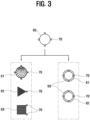
- FIG. 3 shows an example of the shape of the ceramic powder 60 of FIG. 1 and coating agents for the ceramic powder 60.
- the ceramic powder 60 may have a polyhedral shape.
- the ceramic powder 60 may be provided as a polyhedron, such as ceramic powder 61 having a circular cross-section, ceramic powder 62 having a triangular cross-section, and ceramic powder 63 having a square cross-section.
- the magnetic material 70 adheres to the polyhedral ceramic powder 61 and 62 so that the surface of the polyhedral ceramic powder 61 and 62 can face the -X axis direction in the charge state.
- an area for blocking the dendrites 2 is enlarged, thereby more easily preventing the dendrites 2 from penetrating the separator 30.
- the ceramic powder 60 may be coated with a coating agent 81 of a water-soluble resin.
- the coating agent 81 of the water-soluble resin may include water-soluble urethane, water-soluble acrylic, water-soluble ethylene vinylacetate copolymer (EVA), etc.
- the water-soluble acrylic may be used by copolymerizing methacrylate resin, styrene, acrylic acid, methacrylic acid, and glycidyl methacrylate, but is not limited thereto.
- the coating agent 81 of the water-soluble resin prevents the magnetic material 70 adhering to the ceramic powder 60 from being separated from the ceramic powder 60 or makes the magnetic material 70 incompletely adhering to the ceramic powder 60 solidarily adhere to the ceramic powder 60.
- the ceramic powder 60 having the magnetic material 70 and a coating agent aqueous solution may be stirred by a stirrer so that the coating agent 81 can be uniformly formed on the surface of the ceramic powder 60.
- a drying process or a curing process may be added to expose the coating agent 81 to room temperature for a predetermined period of time so that the coating agent 81 can be firmly coated on the surface of the ceramic powder 60.
- a coating agent 82 may have magnetism.
- the coating agent 82 may contain iron, nickel, cobalt, etc. or oxides thereof.
- the components of the coating agent 82 may be the same as or different from the magnetic material 70.
- the coating agent 82 not only prevents the magnetic material 70 from being separated from the ceramic powder 60, but also reacts together with the magnetic material 70 to the magnetism of the separator 30, thereby assisting the ceramic powder 60 in moving more quickly along one side of the accommodating layer 50.
Landscapes
- Chemical & Material Sciences (AREA)
- Chemical Kinetics & Catalysis (AREA)
- Electrochemistry (AREA)
- General Chemical & Material Sciences (AREA)
- Engineering & Computer Science (AREA)
- Manufacturing & Machinery (AREA)
- Materials Engineering (AREA)
- Ceramic Engineering (AREA)
- Inorganic Chemistry (AREA)
- Secondary Cells (AREA)
- Cell Separators (AREA)
- Battery Electrode And Active Subsutance (AREA)
Abstract
Description
- The disclosure relates to a secondary battery having a positive electrode current collector and a negative electrode current collector.
- A lithium secondary battery using lithium (Li) ions during electrical charge and discharge has higher energy density and discharging voltage than other secondary batteries, and is thus widely applied to not only small portable devices such as a mobile phone but also large means of transportation such as an electric vehicle.
- In the lithium secondary battery, an anode mixture containing an anode active material is applied to a negative electrode current collector, and metal crystals separated from the negative electrode current collector as the charge and the discharge are repeated are likely to grow up to irregular acicular dendrites. Such dendrites cause a problem of penetrating a separator, and lead to electrical short-circuits and explosions.
- Meanwhile, the anode mixture contains a negative electrode aqueous binder that makes the anode active material be adhered to the negative electrode current collector. During the charge and the discharge, lithium ions are intercalated into or deintercalated from the anode active material, thereby causing a problem of separation between the anode active material and the negative electrode current collector due to change in the volume of the anode active material. This separation reduces the charge/discharge capacity and shortens the lifespan.
- An aspect of the disclosure is to provide a secondary battery that can prevent a separator from being penetrated by a dendrite.
- Another aspect of the disclosure is to provide a secondary battery that can suppress separation between an anode active material and a negative electrode current collector even though charge and discharge are repeated.
- According to an embodiment of the disclosure, a secondary battery includes: a positive electrode current collector to which a cathode mixture containing a cathode active material is applied; a negative electrode current collector to which an anode mixture containing an anode active material is applied; a separator interposed between the positive electrode current collector and the negative electrode current collector, and having magnetism; and an accommodating layer provided between the negative electrode current collector and the separator, and accommodating ceramic powder including a magnetic material to move toward one side of the separator based on the magnetism of the separator.
- Thus, the ceramic powder having the magnetic material is arranged along the longitudinal direction of the separator as the accommodating layer moves close to the separator based on increase in the volume of the anode active material, thereby preventing dendrites from coming into contact with the separator. Therefore, the separator is prevented from being penetrated by the dendrites.
- The accommodating layer adheres to one side of the anode mixture in a gel state. Thus, the ceramic powder is improved in fluidity, thereby being easily aligned along the longitudinal direction of the separator, and allowing lithium ions to move easily in a discharge state.
- The accommodating layer includes pores formed on one side thereof and having a diameter smaller than the diameter of the ceramic powder and larger than the diameters of ions moving through an electrolyte. Thus, the ceramic powder is prevented from getting out of the accommodating layer, and the mobility of ions between the cathode and the anode is ensured.
- The ceramic powder has a polyhedral shape. Thus, the separator is more effectively prevented from being penetrated by the dendrites.
- The ceramic powder including the magnetic material is coated with a coating agent of a water-soluble resin. Thus, the magnetic material is prevented from getting out of the ceramic powder.
- According to the disclosure, there is provided a secondary battery capable of preventing a separator from being penetrated by a dendrite.
- Further, according to the disclosure, there is provided a secondary battery capable of suppressing separation between an anode active material and a negative electrode current collector even though charge and discharge are repeated.
-
-
FIG. 1 shows cross sections of a secondary battery according to an embodiment of the disclosure. -
FIG. 2 shows an example of a separator and ceramic powder ofFIG. 1 . -
FIG. 3 shows an example of the shape of the ceramic powder ofFIG. 1 and coating agents for the ceramic powder. - Hereinafter, exemplary embodiments will be described in detail with reference to accompanying drawings. The exemplary embodiments are to make description detailed enough for a person having ordinary knowledge in the art, to which the disclosure pertains, to easily implement the disclosure, but are not intended to limit the technical spirit and scope of the disclosure.
-
FIG. 1 shows cross sections of asecondary battery 1 according to an embodiment of the disclosure, andFIG. 2 shows an example of aseparator 30 andceramic powder 60 ofFIG. 1 . - Below, the structure of the
secondary battery 1 according to an embodiment of the disclosure will be described in detail with reference toFIGS. 1 and2 . - According to this embodiment, the
secondary battery 1 includes electrodecurrent collectors electrode current collectors ions 3 occurs during an electrochemical reaction of an active material, and includes a positiveelectrode current collector 10 and a negative electrodecurrent collector 20 according to the type of electrode. - The positive electrode
current collector 10 and the negative electrodecurrent collector 20 are provided as plates or foils having a thickness of 300-500 µm, and made of a material having high conductivity without causing chemical change in thesecondary battery 1. - The positive electrode
current collector 10 may be implemented with stainless steel, aluminum, nickel, titanium, calcined carbon, etc., or may be implemented with aluminum or stainless steel, the surface of which is treated with carbon, nickel, titanium, silver, etc. The negative electrodecurrent collector 20 may be implemented with copper, stainless steel, aluminum, nickel, titanium, calcined carbon, etc., or may be implemented with copper or stainless steel, the surface of which is treated with carbon, nickel, titanium, silver, etc. - When the
secondary battery 1 is implemented as a lithium secondary battery, the positive electrodecurrent collector 10 and the negative electrodecurrent collector 20 may be implemented as aluminum and copper, respectively. The lithium secondary battery is charged whileions 3 on a cathode side move to an anode side, and discharged whileions 3 on the anode side move to the cathode side. - A
cathode mixture 11 containing a cathode active material is applied to the positive electrodecurrent collector 10. The cathode active material is lithium transition metal oxide and contains two or more transition metals. For example, the cathode active material is implemented as a layered compound such as lithium cobalt oxide (LiCoO2) and lithium nickel oxide (LiNiO2) substituted with at least one transition metal, or implemented as lithium manganese oxide, lithium nickel cobalt manganese complex oxide, olivine-based lithium metal phosphate, etc. substituted with at least one transition metal, but is not limited thereto. - An
anode mixture 21 containing an anode active material is applied to the negative electrodecurrent collector 20. The anode active material may be implemented as natural graphite, artificial graphite, expanded graphite, carbon fiber, non-graphitizable carbon, carbon black, carbon nanotubes, fullerene, activated carbon, or implemented as aluminum, silicon, silver, magnesium, manganese, phosphorus, lead, titanium or the like metal or compounds thereof, which can be alloyed with lithium, but is not limited thereto. - The
cathode mixture 11 and theanode mixture 21 contain conductive materials. The conductive material may further improve the conductivity of the electrode active materials (the cathode active material and the anode active material). The conductive material may be implemented as a material that has conductivity without causing chemical changes in thesecondary battery 1. For example, the conductive material includes, but not limited to, graphite such as natural graphite and artificial graphite; carbon black such as acetylene black, Ketjen black, channel black, furnace black, lamp black and summer black; conductive fiber such as carbon fiber and metal fiber; metal powders such as carbon fluoride, aluminum and nickel powders; conductive whisker such as zinc oxide and potassium titanate; conductive metal oxides such as titanium oxide; and conductive materials such as polyphenylene derivatives, but is not limited thereto. - The
cathode mixture 11 and theanode mixture 21 include binders. The binder makes the electrode active material firmly combine with the conductive material, and makes the electrode active material firmly adhere to theelectrode current collectors - The cathode binder and anode binder may be implemented as aqueous binders such as polyvinylidene fluoride (PVdF), but are not limited thereto. For example, the aqueous binder includes carboxymethyl cellulose (CMC), styrene-butadiene rubber (SBR), etc. Using CMC and SBR improves the adhesion and fluidity of the aqueous binder for the
electrode current collectors secondary battery 1 by reducing binder content to be used. - According to various embodiments, the binder may be implemented as a silane coupling agent having the following chemical formula.
R-(CH2)n-Si-Xm
- Where, R is a group containing at least one reactive group capable of reacting with a polymer, X is a hydrolysable group or an alcohol group, m is an integer from 1 to 3, and n is an integer from 0 to 10. In this way, the binder containing the silane coupling agent ensures that the electrode active material adheres more firmly to the
electrode current collectors - The
secondary battery 1 includes theseparator 30 interposed between the positive electrodecurrent collector 10 and the negative electrodecurrent collector 20. Theseparator 30 may be implemented as a thin film having multiple pores. The pore may have a diameter of 0.01 to 10 um, and a thickness of 5 to 300 um. Theseparator 30 may be implemented as an insulating thin film having high ion permeability and mechanical strength. For example, theseparator 30 may be implemented as a sheet, a non-woven fabric, or the like made of a chemical-resistant and hydrophobic olefin-based polymer such as polypropylene; glass fiber; polyethylene; etc. When anelectrolyte 40 described below is implemented as a solid electrolyte such as a polymer, the solid electrolyte may also serve as theseparator 30. - According to various embodiments, the
separator 30 may have magnetism. By adding magnetic particles when manufacturing theseparator 30, theseparator 30 may have magnetism. Alternatively, after manufacturing theseparator 30, the surface of theseparator 30 may be coated with magnetic particles so that theseparator 30 can have magnetism. In this case, only one surface of theseparator 30 on the side of the negative electrodecurrent collector 20 between both surfaces thereof may be coated with magnetic particles. - According to various embodiments, the
secondary battery 1 may include theelectrolyte 40 filled between the positive electrodecurrent collector 10 and theseparator 30 and between the negative electrodecurrent collector 20 and theseparator 30. An aprotic organic solvent may be used as theelectrolyte 40. The aprotic organic solvent includes, but not limited to, propylene carbonate, ethylene carbonate, butylene carbonate, dimethyl carbonate, diethyl carbonate, gamma-butylolactoneformamide, dimethylformamide, nitromethane, methyl formate, dioxorane derivatives, sulfolane, methyl sulfolane, propylene carbonate derivatives, tetrahydrofuran derivatives, ethyl propionate, etc. However, as described above, theelectrolyte 40 may be implemented as an organic solid electrolyte, an inorganic solid electrolyte, etc. - According to various embodiments, the
secondary battery 1 may include a casing that accommodates or surrounds the electrodecurrent collectors separator 30, and theelectrolyte 40. The casing may be implemented as an aluminum laminate film. The aluminum laminate film may include a plastic layer of PET or nylon, an aluminum layer, and an adhesive layer. - According to an embodiment, the
secondary battery 1 includes anaccommodating layer 50 provided between the negative electrodecurrent collector 20 and theseparator 30, and accommodating theceramic powder 60 having amagnetic material 70 to move toward one side of theseparator 30 based on the magnetism of theseparator 30. - The
magnetic material 70 may adhere to the surface of theceramic powder 60. Theceramic powder 60 has a porous structure so that themagnetic material 70 can adhere to theceramic powder 60 by stirring themagnetic material 70 in theceramic powder 60. To improve the adhesion of themagnetic material 70, themagnetic material 70 may adhere to theceramic powder 60 after applying adhesive to the porous structure of theceramic powder 60. - The
magnetic material 70 reacts to the magnetism of theseparator 30 and causes theceramic powder 60 to move toward one side of theseparator 30. The particle-size distribution of themagnetic material 70 may range from 1 to 5 um. When the particle size is smaller than 1 um, themagnetic material 70 cannot exhibit sufficient magnetism and may have difficulty in reacting to the magnetism of theseparator 30. When the particle size is larger than 5 um, themagnetic material 70 may have difficulty in adhering to theceramic powder 60. - The
magnetic material 70 includes iron (Fe), nickel (Ni), cobalt (Co), etc. or oxides thereof. Alternatively, themagnetic material 70 may include a magnetic component. - Below, it will be described in detail that the
ceramic powder 60 in theaccommodating layer 50 moves based on the magnetism of theseparator 30 and preventsdendrites 2 from penetrating theseparator 30 when charging thesecondary battery 1. - For convenience of description, it will be assumed that one side of the
anode mixture 21 is at P1 in a discharge state. Even in the discharge state, a small number ofions 3 may be accommodated in the anode active material of theanode mixture 21. In the discharge state, one side of theaccommodating layer 50 is at Q1. - In the discharge state, the
accommodating layer 50 is spaced apart from theseparator 30, and thus the magnetism of theseparator 30 may not reach themagnetic material 70 of theceramic powder 60 accommodated in theaccommodating layer 50, or may be so small that theceramic powder 60 cannot be moved. For example, theceramic powder 60 in the discharge state may accumulate on the lower side of theaccommodating layer 50 in the Y-axis direction by its own weight. - When the charge proceeds from the discharged state, a large number of
ions 3 are accommodated in the anode active material, causing a volume change in theanode mixture 21 so that one side of theanode mixture 21 can move to P2, and one side of theaccommodating layer 50 can move to Q2. - When the
accommodating layer 50 approaches theseparator 30 in the charge state, themagnetic material 70 of theceramic powder 60 in theaccommodating layer 50 reacts to the magnetism of theseparator 30, and theceramic powder 60 moves towardsseparator 30. For example, theceramic powder 60 may be arranged or aligned along one side of theaccommodating layer 50. - According to the related art, when metal crystals separated from the negative electrode current collector grow up to acicular dendrites, the dendrites protrude from the anode mixture and move in the X-axis direction to thereby penetrate the separator, particularly in the charge state where the anode mixture approaches the separator. When the separator is penetrated by the dendrites, it may cause short-circuits and explosions.
- Accordingly, when the
ceramic powder 60 is arranged or aligned along one side of theaccommodating layer 50 in the charged state as in this embodiment, theceramic powder 60 prevents thedendrites 2 protruding from theanode mixture 21 from reaching or coming into contact with theseparator 30. Therefore, the short-circuit and the explosion caused as thedendrites 2 penetrate theseparator 30 are prevented in advance, thereby providing thesecondary battery 1 improved in safety. - According to various embodiments, the
accommodating layer 50 may be provided in a gel state. When theaccommodating layer 50 is provided in a solid state, the fluidity of theceramic powder 60 within theaccommodating layer 50 is lowered, and thus theceramic powder 60 may not be arranged along one side of theseparator 30 even in an environment where the magnetism of theseparator 30 is applied in the charge state. - On the other hand, when the
accommodating layer 50 is provided in the gel state as in this embodiment, the fluidity of theceramic powder 60 is ensured within theaccommodating layer 50, and thus theceramic powder 60 may be easily arranged along one side of theseparator 30 in the charge state. - According to various embodiments, the
accommodating layer 50 in the gel state may be implemented as LiTiO3(LLTO), Li1+xAlxTi2-x(PO4)3(LATP), Li1+xTi2-xAlxSiy(PO4)3-y, Li7La3Zr2O12(LLZO), Li1+xAlxGe2-x(PO4)3(LAGP), LiAlxZr2-x(PO4)3, LiTixZr2-x(PO4)3, etc., but is not limited thereto. Theaccommodating layer 50 may be implemented as a component different from that of theseparator 30 and may not be mixed with theseparator 30. - The viscosity of the
accommodating layer 50 may be lower than or equal to 10 cP (centi poise). When the viscosity of theaccommodating layer 50 is higher than 10 cP, the fluidity of theceramic powder 60 may be lowered. - According to various embodiments, the
accommodating layer 50 may adhere to one side of theanode mixture 21. During the discharge, the volume of theanode mixture 21 changes asions 3 are deintercalated from the anode active material, and thus one side of theanode mixture 21 moves from P2 to P1. When theaccommodating layer 50 adheres to one side of theanode mixture 21 as in this embodiment, one side of theaccommodating layer 50 also easily moves from Q2 to Q1 in conjunction with the movement of theanode mixture 21. - When the
ceramic powder 60 is arranged or aligned along one side of theseparator 30, theceramic powder 60 may interfere with the movement ofions 3 during the discharge. However, theceramic powder 60 accumulates on the lower side of theaccommodating layer 50 as one side of theaccommodating layer 50 moves from Q2 to Q1, thereby facilitating the movement ofions 3. - According to various embodiments, a pore having a diameter smaller than the diameter of the
ceramic powder 60 and larger than the diameter of theions 3 moving through theelectrolyte 40 may be formed on one side of theaccommodating layer 50. - Because the diameter of the pore formed on one side of the
accommodating layer 50 is smaller than the diameter of theceramic powder 60, theceramic powder 60 is prevented from getting out of theaccommodating layer 50 toward theelectrolyte 40. Because the diameter of the pore is larger than the diameter of theions 3, theions 3 can smoothly move during the charge and the discharge. -
FIG. 3 shows an example of the shape of theceramic powder 60 ofFIG. 1 and coating agents for theceramic powder 60. - As shown in
FIG. 3 , theceramic powder 60 may have a polyhedral shape. For example, theceramic powder 60 may be provided as a polyhedron, such asceramic powder 61 having a circular cross-section,ceramic powder 62 having a triangular cross-section, andceramic powder 63 having a square cross-section. In particular, when theceramic powder 60 is provided as the polyhedralceramic powder magnetic material 70 adheres to the polyhedralceramic powder ceramic powder dendrites 2 is enlarged, thereby more easily preventing thedendrites 2 from penetrating theseparator 30. - According to various embodiments, the
ceramic powder 60 may be coated with acoating agent 81 of a water-soluble resin. Thecoating agent 81 of the water-soluble resin may include water-soluble urethane, water-soluble acrylic, water-soluble ethylene vinylacetate copolymer (EVA), etc. The water-soluble acrylic may be used by copolymerizing methacrylate resin, styrene, acrylic acid, methacrylic acid, and glycidyl methacrylate, but is not limited thereto. Thecoating agent 81 of the water-soluble resin prevents themagnetic material 70 adhering to theceramic powder 60 from being separated from theceramic powder 60 or makes themagnetic material 70 incompletely adhering to theceramic powder 60 solidarily adhere to theceramic powder 60. - According to various embodiments, the
ceramic powder 60 having themagnetic material 70 and a coating agent aqueous solution may be stirred by a stirrer so that thecoating agent 81 can be uniformly formed on the surface of theceramic powder 60. After the coating process, a drying process or a curing process may be added to expose thecoating agent 81 to room temperature for a predetermined period of time so that thecoating agent 81 can be firmly coated on the surface of theceramic powder 60. - According to various embodiments, a
coating agent 82 may have magnetism. In other words, thecoating agent 82 may contain iron, nickel, cobalt, etc. or oxides thereof. The components of thecoating agent 82 may be the same as or different from themagnetic material 70. Thecoating agent 82 not only prevents themagnetic material 70 from being separated from theceramic powder 60, but also reacts together with themagnetic material 70 to the magnetism of theseparator 30, thereby assisting theceramic powder 60 in moving more quickly along one side of theaccommodating layer 50. - Although a few exemplary embodiments of the disclosure have been described in detail, various changes may be made in these exemplary embodiments without departing from the scope defined in the appended claims.
Claims (5)
- A secondary battery comprising:a positive electrode current collector to which a cathode mixture containing a cathode active material is applied;a negative electrode current collector to which an anode mixture containing an anode active material is applied;a separator interposed between the positive electrode current collector and the negative electrode current collector, and having magnetism; andan accommodating layer provided between the negative electrode current collector and the separator, and accommodating ceramic powder comprising a magnetic material to move toward one side of the separator based on the magnetism of the separator.
- The secondary battery of claim 1, wherein the accommodating layer adheres to one side of the anode mixture in a gel state.
- The secondary battery of claim 1, wherein the accommodating layer comprises pores formed on one side thereof and having a diameter smaller than the diameter of the ceramic powder and larger than the diameters of ions moving through an electrolyte.
- The secondary battery of claim 1, wherein the ceramic powder has a polyhedral shape.
- The secondary battery of claim 1, wherein the ceramic powder comprising the magnetic material is coated with a coating agent of a water-soluble resin.
Applications Claiming Priority (3)
| Application Number | Priority Date | Filing Date | Title |
|---|---|---|---|
| KR20220176483 | 2022-12-16 | ||
| KR1020230009664A KR102824376B1 (en) | 2022-12-16 | 2023-01-25 | Secondary battery comprising ceramic powder having magnetic material for improving safety |
| PCT/KR2024/000554 WO2024158158A1 (en) | 2022-12-16 | 2024-01-11 | Secondary battery comprising both anode mixture prepared using anode aqueous binder in which cmc and sbr are added for improvement in adhesive strength and flexibility, and ceramic powder having magnetic bodies for improving safety |
Publications (2)
| Publication Number | Publication Date |
|---|---|
| EP4459722A1 true EP4459722A1 (en) | 2024-11-06 |
| EP4459722A4 EP4459722A4 (en) | 2025-07-16 |
Family
ID=91710880
Family Applications (1)
| Application Number | Title | Priority Date | Filing Date |
|---|---|---|---|
| EP24745331.9A Pending EP4459722A4 (en) | 2022-12-16 | 2024-01-11 | Secondary battery with anode mixture containing CMC and SBR and ceramic powder |
Country Status (4)
| Country | Link |
|---|---|
| US (1) | US20240379966A1 (en) |
| EP (1) | EP4459722A4 (en) |
| KR (1) | KR102824376B1 (en) |
| WO (1) | WO2024158158A1 (en) |
Family Cites Families (6)
| Publication number | Priority date | Publication date | Assignee | Title |
|---|---|---|---|---|
| JP2001313025A (en) | 2000-04-28 | 2001-11-09 | Mitsubishi Electric Corp | Battery |
| KR20120126630A (en) * | 2011-05-12 | 2012-11-21 | 삼성전기주식회사 | Energy storage apparatus and method for preparing the same |
| DE102013224251A1 (en) * | 2013-11-27 | 2015-05-28 | Robert Bosch Gmbh | Method for reducing dendritic metal deposition on an electrode and lithium-ion accumulator making use of this method |
| US20210273295A1 (en) * | 2018-06-08 | 2021-09-02 | Asahi Kasei Kabushiki Kaisha | Multilayer Separator |
| JP2020155252A (en) * | 2019-03-19 | 2020-09-24 | 三洋化成工業株式会社 | Separator repairing agent for nonaqueous lithium ion secondary battery, and lithium ion secondary battery including the same |
| KR102600364B1 (en) * | 2021-02-23 | 2023-11-09 | 재단법인대구경북과학기술원 | Convection Induction Type Electrolyte for Secondary Battery and the Secondary Battery Including the Same |
-
2023
- 2023-01-25 KR KR1020230009664A patent/KR102824376B1/en active Active
-
2024
- 2024-01-11 WO PCT/KR2024/000554 patent/WO2024158158A1/en not_active Ceased
- 2024-01-11 EP EP24745331.9A patent/EP4459722A4/en active Pending
- 2024-07-23 US US18/781,273 patent/US20240379966A1/en active Pending
Also Published As
| Publication number | Publication date |
|---|---|
| WO2024158158A1 (en) | 2024-08-02 |
| KR102824376B1 (en) | 2025-06-26 |
| EP4459722A4 (en) | 2025-07-16 |
| KR20240094950A (en) | 2024-06-25 |
| US20240379966A1 (en) | 2024-11-14 |
Similar Documents
| Publication | Publication Date | Title |
|---|---|---|
| JP6755736B2 (en) | Electrode active material slurry, its manufacturing method, and an all-solid-state secondary battery containing the electrode active material slurry. | |
| KR101725723B1 (en) | Cathode for lithium-sulfur battery and method of preparing the same | |
| CN104067417B (en) | Electrode for secondary battery, secondary battery including same, and cable-type secondary battery | |
| KR101584881B1 (en) | Cathode active material for lithium-sulfur battery and method of preparing the same | |
| KR102722956B1 (en) | Anode for secondary battery and Secondary battery including the same | |
| US20030157409A1 (en) | Polymer lithium battery with ionic electrolyte | |
| KR20210007483A (en) | Electrolyte for lithium secondary battery and lithium secondary battery comprising the same | |
| JP2021517729A (en) | Lithium electrode and lithium secondary battery containing it | |
| JP2004055493A (en) | Positive electrode and battery provided with the same | |
| KR20150120795A (en) | Negative electrode composition, and negative electrode and lithium battery containing the same | |
| CN110832673A (en) | Separator including coating layer of lithium-containing composite, lithium secondary battery including the same, and method for manufacturing the secondary battery | |
| CN113451586A (en) | Electrode plate of secondary battery, secondary battery and preparation method of secondary battery | |
| CN110911685B (en) | Composition for negative electrode, and protective film, negative electrode and device comprising same | |
| KR20180043183A (en) | Lithium secondary battery | |
| KR101613285B1 (en) | Composite electrode comprising different electrode active material and electrode assembly | |
| KR20180066694A (en) | Cathode composite with high power performance and all solid lithium secondary battery comprising the same | |
| EP1151490A1 (en) | Secondary lithium battery | |
| CN114730962A (en) | Electrochemical device and electric equipment | |
| US20230178716A1 (en) | Anode current collector including double coating layer and all-solid-state battery including same | |
| EP4459722A1 (en) | Secondary battery comprising both anode mixture prepared using anode aqueous binder in which cmc and sbr are added for improvement in adhesive strength and flexibility, and ceramic powder having magnetic bodies for improving safety | |
| JPH11126600A (en) | Lithium ion secondary battery | |
| KR20220147855A (en) | Negative electrode for all-solid secondary battery and all-solid secondary battery comprising the same | |
| EP3033795B1 (en) | Lithium sulfur cell and preparation method | |
| CN215644574U (en) | Electrode plate of secondary battery and secondary battery | |
| KR20170050507A (en) | Secondary battery |
Legal Events
| Date | Code | Title | Description |
|---|---|---|---|
| STAA | Information on the status of an ep patent application or granted ep patent |
Free format text: STATUS: UNKNOWN |
|
| STAA | Information on the status of an ep patent application or granted ep patent |
Free format text: STATUS: THE INTERNATIONAL PUBLICATION HAS BEEN MADE |
|
| PUAI | Public reference made under article 153(3) epc to a published international application that has entered the european phase |
Free format text: ORIGINAL CODE: 0009012 |
|
| STAA | Information on the status of an ep patent application or granted ep patent |
Free format text: STATUS: REQUEST FOR EXAMINATION WAS MADE |
|
| 17P | Request for examination filed |
Effective date: 20240729 |
|
| AK | Designated contracting states |
Kind code of ref document: A1 Designated state(s): AL AT BE BG CH CY CZ DE DK EE ES FI FR GB GR HR HU IE IS IT LI LT LU LV MC ME MK MT NL NO PL PT RO RS SE SI SK SM TR |
|
| A4 | Supplementary search report drawn up and despatched |
Effective date: 20250613 |
|
| RIC1 | Information provided on ipc code assigned before grant |
Ipc: H01M 4/62 20060101AFI20250606BHEP Ipc: H01M 4/04 20060101ALI20250606BHEP Ipc: H01M 4/139 20100101ALI20250606BHEP Ipc: H01M 4/02 20060101ALI20250606BHEP Ipc: H01M 10/42 20060101ALI20250606BHEP Ipc: H01M 50/434 20210101ALI20250606BHEP |
|
| GRAP | Despatch of communication of intention to grant a patent |
Free format text: ORIGINAL CODE: EPIDOSNIGR1 |
|
| STAA | Information on the status of an ep patent application or granted ep patent |
Free format text: STATUS: GRANT OF PATENT IS INTENDED |
|
| DAV | Request for validation of the european patent (deleted) | ||
| DAX | Request for extension of the european patent (deleted) |