EP4459700A1 - Wiederaufladbare lithiumbatterie - Google Patents
Wiederaufladbare lithiumbatterie Download PDFInfo
- Publication number
- EP4459700A1 EP4459700A1 EP24161585.5A EP24161585A EP4459700A1 EP 4459700 A1 EP4459700 A1 EP 4459700A1 EP 24161585 A EP24161585 A EP 24161585A EP 4459700 A1 EP4459700 A1 EP 4459700A1
- Authority
- EP
- European Patent Office
- Prior art keywords
- active material
- rechargeable lithium
- lithium battery
- negative active
- discharge
- Prior art date
- Legal status (The legal status is an assumption and is not a legal conclusion. Google has not performed a legal analysis and makes no representation as to the accuracy of the status listed.)
- Pending
Links
Images



Classifications
-
- H—ELECTRICITY
- H01—ELECTRIC ELEMENTS
- H01M—PROCESSES OR MEANS, e.g. BATTERIES, FOR THE DIRECT CONVERSION OF CHEMICAL ENERGY INTO ELECTRICAL ENERGY
- H01M10/00—Secondary cells; Manufacture thereof
- H01M10/05—Accumulators with non-aqueous electrolyte
- H01M10/052—Li-accumulators
-
- H—ELECTRICITY
- H01—ELECTRIC ELEMENTS
- H01M—PROCESSES OR MEANS, e.g. BATTERIES, FOR THE DIRECT CONVERSION OF CHEMICAL ENERGY INTO ELECTRICAL ENERGY
- H01M4/00—Electrodes
- H01M4/02—Electrodes composed of, or comprising, active material
- H01M4/13—Electrodes for accumulators with non-aqueous electrolyte, e.g. for lithium-accumulators; Processes of manufacture thereof
- H01M4/133—Electrodes based on carbonaceous material, e.g. graphite-intercalation compounds or CFx
-
- H—ELECTRICITY
- H01—ELECTRIC ELEMENTS
- H01M—PROCESSES OR MEANS, e.g. BATTERIES, FOR THE DIRECT CONVERSION OF CHEMICAL ENERGY INTO ELECTRICAL ENERGY
- H01M4/00—Electrodes
- H01M4/02—Electrodes composed of, or comprising, active material
- H01M4/36—Selection of substances as active materials, active masses, active liquids
- H01M4/362—Composites
- H01M4/366—Composites as layered products
-
- H—ELECTRICITY
- H01—ELECTRIC ELEMENTS
- H01M—PROCESSES OR MEANS, e.g. BATTERIES, FOR THE DIRECT CONVERSION OF CHEMICAL ENERGY INTO ELECTRICAL ENERGY
- H01M10/00—Secondary cells; Manufacture thereof
- H01M10/05—Accumulators with non-aqueous electrolyte
- H01M10/056—Accumulators with non-aqueous electrolyte characterised by the materials used as electrolytes, e.g. mixed inorganic/organic electrolytes
- H01M10/0564—Accumulators with non-aqueous electrolyte characterised by the materials used as electrolytes, e.g. mixed inorganic/organic electrolytes the electrolyte being constituted of organic materials only
- H01M10/0566—Liquid materials
- H01M10/0568—Liquid materials characterised by the solutes
-
- H—ELECTRICITY
- H01—ELECTRIC ELEMENTS
- H01M—PROCESSES OR MEANS, e.g. BATTERIES, FOR THE DIRECT CONVERSION OF CHEMICAL ENERGY INTO ELECTRICAL ENERGY
- H01M10/00—Secondary cells; Manufacture thereof
- H01M10/05—Accumulators with non-aqueous electrolyte
- H01M10/056—Accumulators with non-aqueous electrolyte characterised by the materials used as electrolytes, e.g. mixed inorganic/organic electrolytes
- H01M10/0564—Accumulators with non-aqueous electrolyte characterised by the materials used as electrolytes, e.g. mixed inorganic/organic electrolytes the electrolyte being constituted of organic materials only
- H01M10/0566—Liquid materials
- H01M10/0569—Liquid materials characterised by the solvents
-
- H—ELECTRICITY
- H01—ELECTRIC ELEMENTS
- H01M—PROCESSES OR MEANS, e.g. BATTERIES, FOR THE DIRECT CONVERSION OF CHEMICAL ENERGY INTO ELECTRICAL ENERGY
- H01M10/00—Secondary cells; Manufacture thereof
- H01M10/05—Accumulators with non-aqueous electrolyte
- H01M10/058—Construction or manufacture
-
- H—ELECTRICITY
- H01—ELECTRIC ELEMENTS
- H01M—PROCESSES OR MEANS, e.g. BATTERIES, FOR THE DIRECT CONVERSION OF CHEMICAL ENERGY INTO ELECTRICAL ENERGY
- H01M10/00—Secondary cells; Manufacture thereof
- H01M10/05—Accumulators with non-aqueous electrolyte
- H01M10/058—Construction or manufacture
- H01M10/0587—Construction or manufacture of accumulators having only wound construction elements, i.e. wound positive electrodes, wound negative electrodes and wound separators
-
- H—ELECTRICITY
- H01—ELECTRIC ELEMENTS
- H01M—PROCESSES OR MEANS, e.g. BATTERIES, FOR THE DIRECT CONVERSION OF CHEMICAL ENERGY INTO ELECTRICAL ENERGY
- H01M10/00—Secondary cells; Manufacture thereof
- H01M10/42—Methods or arrangements for servicing or maintenance of secondary cells or secondary half-cells
- H01M10/44—Methods for charging or discharging
- H01M10/446—Initial charging measures
-
- H—ELECTRICITY
- H01—ELECTRIC ELEMENTS
- H01M—PROCESSES OR MEANS, e.g. BATTERIES, FOR THE DIRECT CONVERSION OF CHEMICAL ENERGY INTO ELECTRICAL ENERGY
- H01M4/00—Electrodes
- H01M4/02—Electrodes composed of, or comprising, active material
- H01M4/04—Processes of manufacture in general
- H01M4/0438—Processes of manufacture in general by electrochemical processing
- H01M4/044—Activating, forming or electrochemical attack of the supporting material
- H01M4/0445—Forming after manufacture of the electrode, e.g. first charge, cycling
- H01M4/0447—Forming after manufacture of the electrode, e.g. first charge, cycling of complete cells or cells stacks
-
- H—ELECTRICITY
- H01—ELECTRIC ELEMENTS
- H01M—PROCESSES OR MEANS, e.g. BATTERIES, FOR THE DIRECT CONVERSION OF CHEMICAL ENERGY INTO ELECTRICAL ENERGY
- H01M4/00—Electrodes
- H01M4/02—Electrodes composed of, or comprising, active material
- H01M4/13—Electrodes for accumulators with non-aqueous electrolyte, e.g. for lithium-accumulators; Processes of manufacture thereof
-
- H—ELECTRICITY
- H01—ELECTRIC ELEMENTS
- H01M—PROCESSES OR MEANS, e.g. BATTERIES, FOR THE DIRECT CONVERSION OF CHEMICAL ENERGY INTO ELECTRICAL ENERGY
- H01M4/00—Electrodes
- H01M4/02—Electrodes composed of, or comprising, active material
- H01M4/13—Electrodes for accumulators with non-aqueous electrolyte, e.g. for lithium-accumulators; Processes of manufacture thereof
- H01M4/134—Electrodes based on metals, Si or alloys
-
- H—ELECTRICITY
- H01—ELECTRIC ELEMENTS
- H01M—PROCESSES OR MEANS, e.g. BATTERIES, FOR THE DIRECT CONVERSION OF CHEMICAL ENERGY INTO ELECTRICAL ENERGY
- H01M4/00—Electrodes
- H01M4/02—Electrodes composed of, or comprising, active material
- H01M4/36—Selection of substances as active materials, active masses, active liquids
- H01M4/38—Selection of substances as active materials, active masses, active liquids of elements or alloys
- H01M4/386—Silicon or alloys based on silicon
-
- H—ELECTRICITY
- H01—ELECTRIC ELEMENTS
- H01M—PROCESSES OR MEANS, e.g. BATTERIES, FOR THE DIRECT CONVERSION OF CHEMICAL ENERGY INTO ELECTRICAL ENERGY
- H01M4/00—Electrodes
- H01M4/02—Electrodes composed of, or comprising, active material
- H01M4/36—Selection of substances as active materials, active masses, active liquids
- H01M4/48—Selection of substances as active materials, active masses, active liquids of inorganic oxides or hydroxides
- H01M4/50—Selection of substances as active materials, active masses, active liquids of inorganic oxides or hydroxides of manganese
- H01M4/505—Selection of substances as active materials, active masses, active liquids of inorganic oxides or hydroxides of manganese of mixed oxides or hydroxides containing manganese for inserting or intercalating light metals, e.g. LiMn2O4 or LiMn2OxFy
-
- H—ELECTRICITY
- H01—ELECTRIC ELEMENTS
- H01M—PROCESSES OR MEANS, e.g. BATTERIES, FOR THE DIRECT CONVERSION OF CHEMICAL ENERGY INTO ELECTRICAL ENERGY
- H01M4/00—Electrodes
- H01M4/02—Electrodes composed of, or comprising, active material
- H01M4/36—Selection of substances as active materials, active masses, active liquids
- H01M4/48—Selection of substances as active materials, active masses, active liquids of inorganic oxides or hydroxides
- H01M4/52—Selection of substances as active materials, active masses, active liquids of inorganic oxides or hydroxides of nickel, cobalt or iron
- H01M4/525—Selection of substances as active materials, active masses, active liquids of inorganic oxides or hydroxides of nickel, cobalt or iron of mixed oxides or hydroxides containing iron, cobalt or nickel for inserting or intercalating light metals, e.g. LiNiO2, LiCoO2 or LiCoOxFy
-
- H—ELECTRICITY
- H01—ELECTRIC ELEMENTS
- H01M—PROCESSES OR MEANS, e.g. BATTERIES, FOR THE DIRECT CONVERSION OF CHEMICAL ENERGY INTO ELECTRICAL ENERGY
- H01M4/00—Electrodes
- H01M4/02—Electrodes composed of, or comprising, active material
- H01M4/36—Selection of substances as active materials, active masses, active liquids
- H01M4/58—Selection of substances as active materials, active masses, active liquids of inorganic compounds other than oxides or hydroxides, e.g. sulfides, selenides, tellurides, halogenides or LiCoFy; of polyanionic structures, e.g. phosphates, silicates or borates
- H01M4/583—Carbonaceous material, e.g. graphite-intercalation compounds or CFx
-
- H—ELECTRICITY
- H01—ELECTRIC ELEMENTS
- H01M—PROCESSES OR MEANS, e.g. BATTERIES, FOR THE DIRECT CONVERSION OF CHEMICAL ENERGY INTO ELECTRICAL ENERGY
- H01M4/00—Electrodes
- H01M4/02—Electrodes composed of, or comprising, active material
- H01M4/36—Selection of substances as active materials, active masses, active liquids
- H01M4/58—Selection of substances as active materials, active masses, active liquids of inorganic compounds other than oxides or hydroxides, e.g. sulfides, selenides, tellurides, halogenides or LiCoFy; of polyanionic structures, e.g. phosphates, silicates or borates
- H01M4/583—Carbonaceous material, e.g. graphite-intercalation compounds or CFx
- H01M4/587—Carbonaceous material, e.g. graphite-intercalation compounds or CFx for inserting or intercalating light metals
-
- H—ELECTRICITY
- H01—ELECTRIC ELEMENTS
- H01M—PROCESSES OR MEANS, e.g. BATTERIES, FOR THE DIRECT CONVERSION OF CHEMICAL ENERGY INTO ELECTRICAL ENERGY
- H01M4/00—Electrodes
- H01M4/02—Electrodes composed of, or comprising, active material
- H01M4/62—Selection of inactive substances as ingredients for active masses, e.g. binders, fillers
-
- H—ELECTRICITY
- H01—ELECTRIC ELEMENTS
- H01M—PROCESSES OR MEANS, e.g. BATTERIES, FOR THE DIRECT CONVERSION OF CHEMICAL ENERGY INTO ELECTRICAL ENERGY
- H01M10/00—Secondary cells; Manufacture thereof
- H01M10/05—Accumulators with non-aqueous electrolyte
- H01M10/052—Li-accumulators
- H01M10/0525—Rocking-chair batteries, i.e. batteries with lithium insertion or intercalation in both electrodes; Lithium-ion batteries
-
- H—ELECTRICITY
- H01—ELECTRIC ELEMENTS
- H01M—PROCESSES OR MEANS, e.g. BATTERIES, FOR THE DIRECT CONVERSION OF CHEMICAL ENERGY INTO ELECTRICAL ENERGY
- H01M4/00—Electrodes
- H01M4/02—Electrodes composed of, or comprising, active material
- H01M2004/021—Physical characteristics, e.g. porosity, surface area
-
- H—ELECTRICITY
- H01—ELECTRIC ELEMENTS
- H01M—PROCESSES OR MEANS, e.g. BATTERIES, FOR THE DIRECT CONVERSION OF CHEMICAL ENERGY INTO ELECTRICAL ENERGY
- H01M4/00—Electrodes
- H01M4/02—Electrodes composed of, or comprising, active material
- H01M2004/026—Electrodes composed of, or comprising, active material characterised by the polarity
- H01M2004/027—Negative electrodes
-
- H—ELECTRICITY
- H01—ELECTRIC ELEMENTS
- H01M—PROCESSES OR MEANS, e.g. BATTERIES, FOR THE DIRECT CONVERSION OF CHEMICAL ENERGY INTO ELECTRICAL ENERGY
- H01M4/00—Electrodes
- H01M4/02—Electrodes composed of, or comprising, active material
- H01M2004/026—Electrodes composed of, or comprising, active material characterised by the polarity
- H01M2004/028—Positive electrodes
-
- H—ELECTRICITY
- H01—ELECTRIC ELEMENTS
- H01M—PROCESSES OR MEANS, e.g. BATTERIES, FOR THE DIRECT CONVERSION OF CHEMICAL ENERGY INTO ELECTRICAL ENERGY
- H01M2300/00—Electrolytes
- H01M2300/0017—Non-aqueous electrolytes
- H01M2300/0025—Organic electrolyte
- H01M2300/0028—Organic electrolyte characterised by the solvent
- H01M2300/0037—Mixture of solvents
- H01M2300/0042—Four or more solvents
-
- Y—GENERAL TAGGING OF NEW TECHNOLOGICAL DEVELOPMENTS; GENERAL TAGGING OF CROSS-SECTIONAL TECHNOLOGIES SPANNING OVER SEVERAL SECTIONS OF THE IPC; TECHNICAL SUBJECTS COVERED BY FORMER USPC CROSS-REFERENCE ART COLLECTIONS [XRACs] AND DIGESTS
- Y02—TECHNOLOGIES OR APPLICATIONS FOR MITIGATION OR ADAPTATION AGAINST CLIMATE CHANGE
- Y02E—REDUCTION OF GREENHOUSE GAS [GHG] EMISSIONS, RELATED TO ENERGY GENERATION, TRANSMISSION OR DISTRIBUTION
- Y02E60/00—Enabling technologies; Technologies with a potential or indirect contribution to GHG emissions mitigation
- Y02E60/10—Energy storage using batteries
Definitions
- One or more embodiments of the present disclosure relate to a rechargeable lithium battery.
- One or more aspects of embodiments of the present disclosure are directed toward a rechargeable lithium battery exhibiting excellent or suitable low temperature performances.
- a rechargeable lithium battery includes a negative electrode including a current collector (e.g., a negative electrode current collector), a negative active material layer on the current collector, and lithium dendrites on a surface of the negative active material layer and having an average size (e.g., an average length) of about 5 ⁇ m or less and a rod-like shape; a positive electrode; and a non-aqueous electrolyte.
- a current collector e.g., a negative electrode current collector
- a negative active material layer on the current collector e.g., lithium dendrites on a surface of the negative active material layer and having an average size (e.g., an average length) of about 5 ⁇ m or less and a rod-like shape
- a positive electrode e.g., a positive electrode
- a non-aqueous electrolyte e.g., a non-aqueous electrolyte
- the rechargeable lithium battery may be obtained by performing a formation charge and discharge.
- the formation charge and discharge may be performed at least twice by charging at a room temperature and discharging at a subzero temperature.
- the room temperature charge may be performed at about 10 °C to about 30 °C.
- the discharge may be performed at less than about 0 °C and more than about -20 °C.
- the formation charge and discharge may be performed by discharging at a subzero temperature and charging at a room temperature for two to five cycles.
- lithium dendrites may have an average size of about 1 ⁇ m to about 5 ⁇ m.
- the rechargeable lithium battery according to one or more embodiments may exhibit excellent or suitable low temperature characteristics.
- the term "combination thereof' may include a mixture, a laminate, a complex, a copolymer, an alloy, a blend, and a reactant of constituents.
- the term "layer” may include a shape totally formed on the entire surface or a shape on partial surface of an element, when viewed from a plane view.
- "at least one of a, b, or c", “at least one of a, b, and/or c", “at least one selected from a, b, and c", “at least one selected from among a to c", etc. may indicate only a, only b, only c, both (e.g., simultaneously) a and b, both (e.g., simultaneously) a and c, both (e.g., simultaneously) b and c, all of a, b, and c, or variations thereof.
- copolymerization refers to a block copolymerization, a random copolymerization, a graft copolymerization, or an alternating copolymerization
- copolymer refers to a block copolymer, a random copolymer, a graft copolymer, or an alternating copolymer.
- a particle diameter or size may be an average particle diameter.
- Such a particle diameter indicates an average particle diameter or size (D50) where a cumulative volume is about 50 volume% in a particle size distribution.
- the particle size (D50) may be measured by a method well suitable (known) to those skilled in the art, for example, by a particle size analyzer, or by a transmission electron microscopic image, or a scanning electron microscopic image.
- a dynamic light-scattering measurement device is utilized to perform a data analysis, and the number of particles is counted for each particle size range, and from this, the average particle diameter (D50) value may be easily obtained through a calculation.
- diameter or size indicates a particle diameter or an average particle diameter
- the “diameter” or “size” indicates a major axis length or an average major axis length.
- a rechargeable lithium battery includes: a negative electrode including a current collector (e.g., a negative electrode current collector), a negative active material layer on the current collector, and lithium dendrites on a surface of the negative active material layer and having an average size (e.g., an average length) of about 5 ⁇ m or less and a rod-like shape; a positive electrode; and a non-aqueous electrolyte.
- a current collector e.g., a negative electrode current collector
- a negative active material layer on the current collector e.g., lithium dendrites on a surface of the negative active material layer and having an average size (e.g., an average length) of about 5 ⁇ m or less and a rod-like shape
- a positive electrode e.g., a positive electrode
- a non-aqueous electrolyte e.g., aqueous electrolyte
- the average size of lithium dendrite may be measured from the average value of the length of dendrite identified in the SEM image for the negative active material layer of the negative electrode.
- lithium dendrites are not formed in the negative electrode.
- lithium dendrites for example, small-sized lithium dendrites with a size of about 5 ⁇ m or less, are formed by adjusting the condition of the formation charging and discharging.
- the interface resistance of the rechargeable lithium battery may be reduced, which renders to enhance lithium ion transfer and promote better initial performance, for example, if (e.g., when) the rechargeable lithium battery operates at low temperatures, thereby improving low temperature characteristics of the battery.
- the ability of impregnating in electrolyte may also be improved.
- the lithium dendrites may have an average size of about 5 ⁇ m or less, about 1 ⁇ m to about 5 ⁇ m, or about 1 ⁇ m to about 3 ⁇ m. If (e.g., when) the average size of lithium dendrites is more than about 5 ⁇ m, the size of lithium dendrites is too large, which may cause undesired side reactions so that the battery performances such as safety or cycle-life characteristics may be severely deteriorated.
- the formation charge and discharge may be suitably performed by discharging the rechargeable lithium battery at a subzero temperature and charging at a room temperature, twice or more.
- the charge and the discharge may be performed twice to five times.
- the room temperature charge may be performed at about 10 °C to about 30 °C.
- the discharge may be performed at more than about -20 °C and less than 0 °C.
- the negative active material of the negative electrode does not sufficiently activate, which results in a remaining negative active material which does not participate in the charging reaction, and thus, lithium dendrites are not formed, and the effects for improving low temperature characteristics due to the formation of the small-sized lithium dendrites may be not expected.
- charging performed at a low temperature of a subzero temperature and discharging performed at a room temperature decrease the fluidity of reversible lithium, thereby forming no lithium dendrites, and thus, the effects for improving low temperature characteristics due to the formation of the small-sized lithium dendrites may be not expected. Even if (e.g., when) both charging and discharging are performed at low temperatures of subzero temperature, the fluidity of reversible lithium may be decreased during charging, which cause to form no lithium dendrites, and thus, the effects for improving low temperature characteristics due to the formation of the small-sized lithium dendrites may be not expected.
- the effect of improving the low temperature characteristic due to small-sized lithium dendrites being positioned on the surface of the negative active material layer may be realized only when formation charging and discharging including discharging at a subzero temperature and charging at a room temperature is carried out for twice or more.
- the charging may be performed under a condition of about 0.2 C to about 2 C, about 4.2 V to about 4.7 V, a cut-off of about 0.01 C to about 0.1 C and the discharging may be performed under a condition of about 0.1 C to about 0.5 C and a cut-off of about 2.5 V to about 3.5 V.
- the negative electrode may include a negative active material layer including a negative active material and a current collector supporting the negative active material layer.
- the negative active material may include (e.g., be) a carbon-based negative active material, a silicon-based negative active material, or a combination thereof. According to one or more embodiments, the negative active material may be the silicon-based negative active material.
- the carbon-based negative active material may be (e.g., include) crystalline carbon, amorphous carbon, or a combination thereof.
- the crystalline carbon may be unspecified shaped (e.g., irregularly shaped), sheet, flake, spherical, or fiber shaped natural graphite or artificial graphite.
- the amorphous carbon may be soft carbon, hard carbon, mesophase pitch carbide, sintered cokes, or one or more combinations thereof.
- the silicon-based negative active material may be Si, a Si-C composite, SiO x (0 ⁇ x ⁇ 2), Si-Q alloy (wherein Q is an element selected from an alkali metal, an alkaline-earth metal, a Group 13 element, a Group 14 element, a Group 15 element, a Group 16 element, a transition metal, a rare earth element, and one or more combinations thereof, and not Si), or one or more combinations thereof, or at least one (e.g., one or more) of these materials may be mixed with SiO 2 .
- the element Q may be selected from magnesium (Mg), calcium (Ca), strontium (Sr), barium (Ba), radium (Ra), scandium (Sc), yttrium (Y), titanium (Ti), zirconium (Zr), hafnium (Hf), rutherfordium (Rf), vanadium (V), niobium (Nb), tantalum (Ta), dubnium (Db), chromium (Cr), molybdenum (Mo), tungsten (W), seaborgium (Sg), technetium (Tc), rhenium (Re), bohrium (Bh), iron (Fe), lead (Pb), ruthenium (Ru), osmium (Os), hassium (Hs), rhodium (Rh), iridium (Ir), palladium (Pd), platinum (Pt), copper (Cu), silver (Ag), gold (Au), zinc (Zn), cadmium (Cd), boron
- the silicon-based negative active material may be a Si-C composite.
- the Si-C composite may be (e.g., include) silicon particles and amorphous carbon coated on the surface of the silicon particles.
- the silicon-carbon composite may include secondary particles in which silicon primary particles are agglomerated, and an amorphous carbon coating layer on (e.g., positioned on) a surface of the secondary particle.
- the amorphous carbon may be (positioned) between the silicon primary particles, for example, so that the silicon primary particles may be coated with the amorphous carbon.
- the silicon-carbon composite (e.g., the Si-C composite) may also include a core in which silicon particles are distributed in an amorphous carbon matrix and an amorphous carbon coating layer coated on a surface of the core.
- the secondary particle is positioned at the center of the Si-C composite, so it may be referred to as a core or a center part of the Si-C composite.
- the amorphous carbon coating layer may be referred to as an outer part or a shell of the Si-C composite.
- the silicon particle may be nano silicon particles.
- the nano silicon particles may have a particle diameter (e.g., average particle diameter) of about 10 nm to about 1,000 nm, or according to one or more embodiments, may have a particle diameter (e.g., average particle diameter) of about 20 nm to about 900 nm, about 20 nm to about 800 nm, about 20 nm to about 500 nm, about 20 nm to about 300 nm, or about 20 nm to about 150 nm. If (e.g., when) the average particle diameter of the silicon particles is within the range, the extreme volume expansion caused during charge and discharge may be suppressed or reduced, and a breakage of the conductive path due to crushing of particle may be prevented or reduced.
- a mixing ratio of the nano silicon particles to amorphous carbon may be a weight ratio of about 1:99 to about 60:40.
- the secondary particle or the core may further include crystalline carbon.
- the Si-C composite may include secondary particles in (each) which silicon primary particles and crystalline carbon are agglomerated and an amorphous carbon coating layer on the surface(s) of the secondary particle(s) (e.g., on a surface of each of the secondary particles).
- an amount of the amorphous carbon may be about 30 wt% to about 70 wt% based on the total 100 wt% of the Si-C composite and an amount of the crystalline carbon may be about 1 wt% to about 20 wt% based on the total 100 wt% of the Si-C composite.
- An amount of the silicon particles may be about 20 wt% to about 70 wt% based on the total 100 wt% of the Si-C composite, or according to some embodiments, may be about 30 wt% to about 60 wt%.
- the particle diameter of the Si-C composite may be appropriately adjusted, and it is not limited thereto.
- a thickness may be suitably adjusted, for example, may be about 5 nm to about 100 nm.
- the Si-C composite may be included as a first negative active material, and crystalline carbon may be included as a second negative active material.
- a mixing ratio of the first negative active material to the second negative active material may be about 1:99 to about 50:50.
- the negative active material may include the first negative active material and the second negative active material at a weight ratio of about 5:95 to about 20:80.
- the negative active material layer may include a binder, and may further include a conductive material.
- An amount of the binder may be about 1 wt% to about 5 wt% based on the total 100 wt% of the negative active material layer.
- An amount of the conductive material may be about 1 wt% to about 5 wt% based on the total 100 wt% of the negative active material layer.
- the binder improves binding properties of negative active material particles with one another and with the current collector.
- the binder may be a non-aqueous binder, an aqueous binder, or a combination thereof.
- the non-aqueous binder may be an ethylene propylene copolymer, polyacrylonitrile, polystyrene, polyvinylchloride, carboxylated polyvinylchloride, polyvinyl fluoride, polyurethane, polytetrafluoroethylene, polyvinylidene fluoride, polyethylene, polypropylene, polyamide imide, polyimide, or one or more combinations thereof.
- the aqueous binder may be a styrene-butadiene rubber, an acrylated styrene-butadiene rubber (ABR), an acrylonitrile-butadiene rubber, an acrylic rubber, a butyl rubber, a fluorine rubber, an ethylene oxide-containing polymer, polyvinyl pyrrolidone, polypropylene, polyepichlorohydrin, polyphosphazene, an ethylene propylene diene copolymer, polyvinyl pyridine, chlorosulfonated polyethylene, latex, a polyester resin, an acrylic resin, a phenol resin, an epoxy resin, polyvinyl alcohol, or one or more combinations thereof.
- ABR acrylated styrene-butadiene rubber
- ABR acrylated styrene-butadiene rubber
- an acrylonitrile-butadiene rubber an acrylic rubber, a butyl rubber, a fluorine rubber, an
- a cellulose-based compound may be further utilized to provide viscosity as a thickener.
- the cellulose-based compound includes one or more of carboxymethyl cellulose, hydroxypropylmethyl cellulose, methyl cellulose, or alkali metal salts thereof.
- the alkali metal may be Na, K, or Li.
- the thickener may be included in an amount of about 0.1 parts by weight to about 3 parts by weight based on 100 parts by weight of the negative active material.
- the conductive material may be included to provide electrode conductivity, and any electrically conductive material may be utilized as a conductive material unless it causes a chemical change.
- the conductive material may be a carbon-based material such as natural graphite, artificial graphite, carbon black, acetylene black, ketjen black, a carbon fiber, and/or the like; a metal-based material of a metal powder or a metal fiber including copper, nickel, aluminium, silver, and/or the like; a conductive polymer such as a polyphenylene derivative; or one or more mixtures (and/or combinations) thereof.
- the current collector may include one selected from a copper foil, a nickel foil, a stainless steel foil, a titanium foil, a nickel foam, a copper foam, a polymer substrate coated with a conductive metal, and one or more combinations thereof, but embodiments of the present disclosure are not limited thereto.
- the positive electrode may include a current collector (e.g., a positive electrode current collector) and a positive active material layer including a positive active material formed on the current collector.
- a current collector e.g., a positive electrode current collector
- a positive active material layer including a positive active material formed on the current collector.
- the positive active material may include one or more lithiated intercalation compounds that reversibly intercalate and deintercalate lithium ions.
- one or more composite oxides of a metal selected from cobalt, manganese, nickel, and one or more combinations thereof, and lithium may be utilized.
- the compounds represented by one or more of the following chemical formulae may be utilized.
- Li a A 1-b X b D 1 2 (0.90 ⁇ a ⁇ 1.8, 0 ⁇ b ⁇ 0.5); Li a A 1-b X b O 2-c1 D 1 c1 (0.90 ⁇ a ⁇ 1.8, 0 ⁇ b ⁇ 0.5, 0 ⁇ c1 ⁇ 0.05); Li a E 1-b X b O 2-c1 D 1 c1 (0.90 ⁇ a ⁇ 1.8, 0 ⁇ b ⁇ 0.5, 0 ⁇ C1 ⁇ 0.05); Li a E 2-b X b O 4-c1 D 1 c1 (0.90 ⁇ a ⁇ 1.8, 0 ⁇ b ⁇ 0.5, 0 ⁇ c1 ⁇ 0.05); Li a Ni 1-b-c Co b X c D 1 ⁇ (0.90 ⁇ a ⁇ 1.8, 0 ⁇ b ⁇ 0.5, 0 ⁇ c ⁇ 0.5, 0 ⁇ 2); Li a Ni 1-b-c Co b X c O 2- ⁇ T ⁇ (0.90 ⁇ a ⁇ 1.8, 0 ⁇ b ⁇ 0.5, 0 ⁇ c ⁇ 0.5, 0 ⁇ 2); Li a Ni 1-b
- A may be selected from Ni, Co, Mn, and one or more combinations thereof;
- X may be selected from Al, Ni, Co, Mn, Cr, Fe, Mg, Sr, V, a rare earth element, and one or more combinations thereof;
- D' may be selected from O, F, S, P, and one or more combinations thereof;
- E may be selected from Co, Mn, and a combination thereof;
- T may be selected from F, S, P, and one or more combinations thereof;
- G may be selected from Al, Cr, Mn, Fe, Mg, La, Ce, Sr, V, and one or more combinations thereof;
- Q may be selected from Ti, Mo, Mn, and one or more combinations thereof;
- Z may be selected from Cr, V, Fe, Sc, Y, and one or more combinations thereof;
- J may be selected from V, Cr, Mn, Co, Ni, Cu, and one or more combinations thereof;
- L 1 may be selected from Mn, Al, and a combination thereof.
- the compounds, described above may have a coating layer on the surface thereof, or may be mixed with another compound having a coating layer.
- the coating layer may include at least one coating element compound selected from the group consisting of an oxide of a coating element, a hydroxide of a coating element, an oxyhydroxide of a coating element, an oxycarbonate of a coating element, and a hydroxyl carbonate of a coating element.
- the coating element compound for the coating layer may be amorphous or crystalline.
- the coating element included in the coating layer may include Mg, Al, Co, K, Na, Ca, Si, Ti, V, Sn, Ge, Ga, B, As, Zr, or one or more mixtures thereof.
- the coating layer may be disposed in a method having no adverse influence on properties of the positive active material by utilizing these elements in the compound, and, for example, the method may include any coating method such as spray coating, dipping, and/or the like, but is not illustrated in more detail because it is well-suitable (known) in the related field.
- an amount of the positive active material may be about 90 wt% to about 98 wt% based on the total weight of the positive active material layer.
- the positive active material layer may further include a binder and a conductive material.
- the binder and the conductive material may be included in an amount of about 1 wt% to about 5 wt%, separately based on the total amount of the positive active material layer.
- the binder improves binding properties of positive active material particles with one another and with the current collector (e.g., positive electrode current collector).
- the binder may be polyvinyl alcohol, carboxymethyl cellulose, hydroxypropyl cellulose, diacetyl cellulose, polyvinylchloride, carboxylated polyvinylchloride, polyvinyl fluoride, an ethylene oxide-containing polymer, polyvinyl pyrrolidone, polyurethane, polytetrafluoroethylene, polyvinylidene fluoride, polyethylene, polypropylene, a styrene-butadiene rubber, and an acrylated styrene-butadiene rubber.
- the conductive material may be included to provide electrode conductivity, and any electrically conductive material may be utilized as a conductive material unless it causes a chemical change.
- Non-limiting examples of the conductive material may include a carbon-based material such as natural graphite, artificial graphite, carbon black, acetylene black, ketjen black, a carbon fiber and/or the like; a metal-based material of a metal powder or a metal fiber including copper, nickel, aluminium, silver, and/or the like; a conductive polymer such as a polyphenylene derivative; or one or more mixtures thereof.
- the current collector may include Al, but embodiments of the present disclosure are not limited thereto.
- the electrolyte may include a non-aqueous organic solvent and a lithium salt.
- the non-aqueous organic solvent serves as a medium for transmitting ions taking part in the electrochemical reaction of a battery.
- the non-aqueous organic solvent may include a carbonate-based, ester-based, ether-based, ketone-based, alcohol-based, or aprotic solvent, or a mixture thereof.
- the carbonate-based solvent may include dimethyl carbonate (DMC), diethyl carbonate (DEC), dipropyl carbonate (DPC), methylpropyl carbonate (MPC), ethylpropyl carbonate (EPC), methylethyl carbonate (MEC), ethylene carbonate (EC), propylene carbonate (PC), butylene carbonate (BC), and/or the like.
- the ester-based solvent may include methyl acetate, ethyl acetate, n-propyl acetate, dimethyl acetate, methyl propionate, ethyl propionate, propyl propionate, decanolide, mevalonolactone, caprolactone, and/or the like.
- the ether-based solvent may be dibutyl ether, tetraglyme, diglyme, dimethoxyethane, 2-methyltetrahydrofuran, 2,5-dimethyltetrahydrofuran, tetrahydrofuran, and/or the like.
- the ketone-based solvent may include cyclohexanone, and/or the like.
- the alcohol-based solvent may include ethyl alcohol, isopropyl alcohol, and/or the like, and non-limiting examples of the aprotic solvent may include nitriles such as R-CN (where R is a C2 to C20 linear, branched, or cyclic hydrocarbon, and may include a double bond, an aromatic ring, or an ether bond), amides such as dimethylformamide, dioxolanes such as 1,3-dioxolane, 1,4-dioxolane, sulfolanes, and/or the like.
- R-CN where R is a C2 to C20 linear, branched, or cyclic hydrocarbon, and may include a double bond, an aromatic ring, or an ether bond
- amides such as dimethylformamide
- dioxolanes such as 1,3-dioxolane, 1,4-dioxolane, sulfolanes, and/or the like.
- the non-aqueous organic solvent may be utilized alone or in a mixture. If (e.g., when) the non-aqueous organic solvent is utilized in a mixture, a mixture ratio may be controlled or selected in accordance with a desirable battery performance, and it may be well suitable to those skilled in the related art.
- the carbonate-based solvent may include a mixture of a cyclic carbonate and a linear carbonate.
- the cyclic carbonate and linear carbonate are mixed together in a volume ratio of about 1:1 to about 1:9, and when the mixture is utilized as a non-aqueous organic solvent of the electrolyte, it may have enhanced performance.
- the non-aqueous organic solvent may further include an aromatic hydrocarbon-based solvent as well as the carbonate-based solvent.
- the carbonate-based solvent and aromatic hydrocarbon-based solvent may be mixed together in a volume ratio of about 1:1 to about 30:1.
- the aromatic hydrocarbon-based organic solvent may be an aromatic hydrocarbon-based compound represented by Chemical Formula 1.
- R 1 to R 6 may each independently be the same or different and may each independently be selected from hydrogen, a halogen, a C1 to C10 alkyl group, a haloalkyl group (e.g., a C1 to C10 haloalkyl group), and one or more combinations thereof.
- Non-limiting examples of the aromatic hydrocarbon-based organic solvent may be selected from among benzene, fluorobenzene, 1,2-difluorobenzene, 1,3-difluorobenzene, 1,4-difluorobenzene, 1,2,3-trifluorobenzene, 1,2,4-trifluorobenzene, chlorobenzene, 1,2-dichlorobenzene, 1,3-dichlorobenzene, 1,4-dichlorobenzene, 1,2,3-trichlorobenzene, 1,2,4-trichlorobenzene, iodobenzene, 1,2-diiodobenzene, 1,3-diiodobenzene, 1,4-diiodobenzene, 1,2,3-triiodobenzene, 1,2,4-triiodobenzene, toluene, fluorotoluene, 2,3-difluorotoluene, 2,
- the electrolyte may further include vinylethyl carbonate, vinylene carbonate, and/or an ethylene carbonate-based compound represented by Chemical Formula 2 as an additive for improving cycle life.
- R 7 and R 8 may each independently be the same or different and may each be independently hydrogen, a halogen, a cyano group (CN), a nitro group (NO 2 ), or a C1 to C5 fluoroalkyl group, provided that at least one of R 7 or R 8 is a halogen, a cyano group (CN), a nitro group (NO 2 ), or a C1 to C5 fluoroalkyl group, and R 7 and R 8 are not concurrently (e.g., simultaneously) hydrogens.
- Non-limiting examples of the ethylene carbonate-based compound may be difluoroethylene carbonate, chloroethylene carbonate, dichloroethylene carbonate, bromoethylene carbonate, dibromoethylene carbonate, nitroethylene carbonate, cyanoethylene carbonate, fluoroethylene carbonate, and/or the like.
- An amount of the additive for improving the cycle-life characteristics may be utilized within an appropriate or suitable range.
- the lithium salt dissolved in a non-aqueous organic solvent supplies a battery with lithium ions, enables a basic operation of the rechargeable lithium battery, and improves transportation of the lithium ions between the positive electrode and the negative electrode.
- the lithium salt may include at least one or two supporting salt selected from among LiPF 6 , LiBF 4 , LiSbF 6 , LiAsF 6 , LiN(SO 2 C 2 F 5 ) 2 , Li(CF 3 SO 2 ) 2 N, LiN(SO 3 C 2 F 5 ) 2 , Li(FSO 2 ) 2 N (lithium bis(fluorosulfonyl)imide: LiFSI), LiC 4 F 9 SO 3 , LiClO 4 , LiAlO 2 , LiAlCl 4 , LiPO 2 F 2 , LiN(C x F 2x+1 SO 2 )(C y F 2y+1 SO 2 ), wherein x and y are each a natural number, for example, an integer of 1 to 20,
- a concentration of the lithium salt may be in a range of about 0.1 M to about 2.0 M. If (e.g., when) the lithium salt is included at the above concentration range, the electrolyte may have excellent or suitable performance and lithium ion mobility due to optimal or suitable electrolyte conductivity and viscosity.
- a separator may be disposed between the positive electrode and the negative electrode depending on a type or kind of the rechargeable lithium battery.
- the separator may utilize polyethylene, polypropylene, polyvinylidene fluoride, or multi-layers thereof having two or more layers and may be a mixed multilayer such as a polyethylene/polypropylene double-layered separator, a polyethylene/polypropylene/polyethylene triple-layered separator, a polypropylene/polyethylene/polypropylene triple-layered separator, and/or the like.
- FIG. 1 is an exploded perspective view of a rechargeable lithium battery according to one or more embodiments.
- the rechargeable lithium battery according to some embodiments is illustrated as a prismatic battery but is not limited thereto and may include variously-shaped batteries such as a cylindrical battery, a pouch battery, and/or the like.
- a rechargeable lithium battery 100 may include an electrode assembly 40 manufactured by winding a separator 30 disposed between a positive electrode 10 and a negative electrode 20 and a case 50 housing the electrode assembly 40.
- An electrolyte may be impregnated in the positive electrode 10, the negative electrode 20, and the separator 30.
- the negative active material layer slurry was coated on a Cu foil current collector, dried and pressurized to prepare a negative active material layer, thereby producing a negative electrode.
- the positive active material layer slurry was coated on an Al foil current collector, dried, and pressurized to prepare a positive active material layer, thereby producing a positive electrode.
- a rechargeable lithium cell Utilizing the negative electrode, the positive electrode, and an electrolyte, a rechargeable lithium cell was fabricated.
- the electrolyte prepared by dissolving 1 M LiPF 6 in a mixed solvent of ethylene carbonate and dimethyl carbonate (3:7 volume ratio) was utilized.
- the fabricated rechargeable lithium cell underwent two cycles of a formation charge and discharge, charged at 25 °C and discharged at -10 °C twice.
- the conditions of charge and discharge were the following conditions:
- a procedure was carried out in substantially the same procedure as in Example 1, except that charging at 25 °C and discharging at -10 °C were performed once.
- a formation charge and discharge was subjected by the same procedure as in Example 1, except that a fabricated rechargeable lithium cell was subjected to a formation charge and discharge of charged at 25 °C and discharged at -20 °C, and then charged at 25 °C and discharged at -10 °C.
- a formation charge and discharge was subjected by the same procedure as in Example 1, except that a fabricated rechargeable lithium cell was subjected to a formation charge and discharge of charged at 25 °C and discharged at 0 °C, and then charged at 25 °C and discharged at -10 °C.
- a formation charge and discharge was subjected by the same procedure as in Example 1, except that a fabricated rechargeable lithium cell was subjected to a formation charge and discharge of charged at 25 °C and discharged at 10 °C, and then charged at 25 °C and discharged at -10 °C.
- a formation charge and discharge was subjected by the same procedure as in Example 1, except that a fabricated rechargeable lithium cell was subjected to a formation charge and discharge of charged at 25 °C and discharged at 25 °C, and then charged at 25 °C and discharged at -10 °C.
- a formation charge and discharge was subjected by the same procedure as in Example 1, except that a fabricated rechargeable lithium cell was subjected to a formation charge and discharge of charged at 25 °C and discharged at 45 °C, and then charged at 25 °C and discharged at -10 °C.
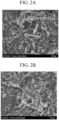
- Example 1 After formation charging and discharging each of the rechargeable lithium cells of Example 1 and Comparative Example 1, the negative electrode was separated. The SEM images were taken for each of the negative electrodes. The results are shown in FIG. 2A, FIG. 2B , FIG. 3A and FIG. 3B , respectively.
- FIG. 2A, FIG. 2B , FIG. 3A, and FIG. 3B are SEM images showing measurements at two points on the surface of the negative electrode.
- the negative electrode of the formation charged and discharged cell according to Example 1 included the formed rod-type or kind lithium dendrites (see, e.g., the arrow pointing to the lithium dendrite rod) with an average size (length) of approximately (about) 5 ⁇ m or less.
- lithium dendrites were not formed on the negative electrode of the formation charged and discharged cell according to Comparative Example 1.
- the negative electrodes were separated from the formation charged and discharged cells of Example 1 and Comparative Examples 1 to 6 and the amount of electrolyte impregnation in these electrodes was each measured.
- the electrolyte impregnation amount was determined as the amount of P (phosphorus), after measuring amounts of the salts (e.g., lithium salts) distributed in the negative electrode utilizing the ⁇ -XRF (X-ray fluorescence spectrometry) method.
- the measured P amounts are shown as an electrolyte impregnation amount in Table 1.
- a top indicates to an upper (a surface contacted to a separator) of the separated negative electrode and a bottom indicates to a bottom (a surface contacted to a current collector) of the separated negative electrode.
- Example 1 As shown in Table 1, the electrolyte impregnation amount of Example 1 exhibited higher than that of Comparative Example 1
- Example 1 and Comparative Examples 1 to 6 impedances were each measured at -10 °C, 0 °C and 25 °C, respectively, utilizing a signal of 3 mV in a frequency range of 10 kHz to 1 mHz, as an EIS (electrochemical impedance spectroscopy).
- EIS electrochemical impedance spectroscopy
- the rechargeable lithium cell of Example 1 exhibited lower interface resistance at a low temperature of 0 °C or less than Comparative Example 1.
- Example 1 Regarding the rechargeable lithium cells subjected to the formation charge and discharge of Example 1 and Comparative Examples 1 to 6, the activation energy was each obtained by utilizing resistances measured at -10 °C, 0 °C and 25 °C and an Arrhenius plot. The results are shown in Table 3. Table 3 Activation energy (kJ/mol) Comparative Example 1 39.4 Example 1 37.3
- Example 1 As shown in Table 3, the activation energy value of Example 1 was lower than that of Comparative Example 1, so that charge and discharge reaction of Example 1 will proceed quickly with low activation energy. It may be expected from the results that charge and discharge reaction will occur quickly at low temperatures for Example 1.
- AC resistance was each measured within the range of frequency of 10 kHz to 30 mHz utilizing an EIS measurement device of VMP3 available from Biologics Science instruments.
- the measured resistance refers to the charge transfer resistance of a cell thin layer, and may be a resistance of a thin layer generated via the reaction between the electrolyte and interface/ side product.
- Table 4 the results of Example 1 and Comparative Example 1 are shown in Table 4.
- the rechargeable lithium cells subjected to the formation charge and discharge according to Example 1 and Comparative Examples 1 to 6 were each charged and discharged at 1.5 C charge/ 0.2 C discharge once at 25 °C, and discharge capacity when the cell voltage reached to 3.4 V and discharge capacity when the cell voltage reached to 3.0 V were measured.
- the rechargeable lithium cells subjected to the formation charge and discharge according to Example 1 and Comparative Examples 1 to 6 were each discharged at 0.2 C and at -10 °C once and this procedure was repeated twice. A discharge capacity was measured when the cell voltage reached to 3.4 V.
- the rechargeable lithium cell of Example 1 which was subjected to the formation charge and discharge, had lower transfer resistance, i.e., interface resistance compared to Comparative Example 1.
- the low temperature and high voltage discharge capacity of the rechargeable lithium cell according to Example 1 which was subjected to the formation charge and discharge was improved compared to each of Comparative Examples 1 and 3 to 6.
- Comparative Example 2 discharging was carried out at the extremely low temperature of -20 °C, as a result, excessive lithium was deposited as shown in FIG. 4 which was an image showing the negative electrode disassembled after charging and discharging, making it unusable as a battery. In Comparative Example 2, it is believed that the high capacity at 3.4 V is due to the deposited lithium exhibiting capacity.
- the terms “substantially,” “about,” or similar terms are used as terms of approximation and not as terms of degree, and are intended to account for the inherent deviations in measured or calculated values that would be recognized by those of ordinary skill in the art.
- “About” as used herein is inclusive of the stated value and means within an acceptable range of deviation for the particular value as determined by one of ordinary skill in the art, considering the measurement in question and the error associated with measurement of the particular quantity (i.e., the limitations of the measurement system). For example, “about” may mean within one or more standard deviations, or within ⁇ 30%, 20%, 10%, 5% of the stated value.
- any numerical range recited herein is intended to include all sub-ranges of the same numerical precision subsumed within the recited range.
- a range of "1.0 to 10.0" is intended to include all subranges between (and including) the recited minimum value of 1.0 and the recited maximum value of 10.0, that is, having a minimum value equal to or greater than 1.0 and a maximum value equal to or less than 10.0, such as, for example, 2.4 to 7.6.
- Any maximum numerical limitation recited herein is intended to include all lower numerical limitations subsumed therein and any minimum numerical limitation recited in this specification is intended to include all higher numerical limitations subsumed therein.
- a battery management system (BMS) device and/or any other relevant devices or components according to embodiments of the present disclosure described herein may be implemented utilizing any suitable hardware, firmware (e.g., an application-specific integrated circuit), software, or a combination of software, firmware, and hardware.
- the various components of the device may be formed on one integrated circuit (IC) chip or on separate IC chips.
- the various components of the device may be implemented on a flexible printed circuit film, a tape carrier package (TCP), a printed circuit board (PCB), or formed on one substrate.
- the various components of the device may be a process or thread, running on one or more processors, in one or more computing devices, executing computer program instructions and interacting with other system components for performing the various functionalities described herein.
- the computer program instructions are stored in a memory which may be implemented in a computing device using a standard memory device, such as, for example, a random access memory (RAM).
- the computer program instructions may also be stored in other non-transitory computer readable media such as, for example, a CD-ROM, flash drive, or the like.
- a person of skill in the art should recognize that the functionality of various computing devices may be combined or integrated into a single computing device, or the functionality of a particular computing device may be distributed across one or more other computing devices without departing from the scope of the present disclosure.
Landscapes
- Chemical & Material Sciences (AREA)
- Chemical Kinetics & Catalysis (AREA)
- Electrochemistry (AREA)
- General Chemical & Material Sciences (AREA)
- Engineering & Computer Science (AREA)
- Manufacturing & Machinery (AREA)
- Inorganic Chemistry (AREA)
- Materials Engineering (AREA)
- Condensed Matter Physics & Semiconductors (AREA)
- General Physics & Mathematics (AREA)
- Physics & Mathematics (AREA)
- Composite Materials (AREA)
- Secondary Cells (AREA)
Applications Claiming Priority (1)
| Application Number | Priority Date | Filing Date | Title |
|---|---|---|---|
| KR1020230057971A KR102938570B1 (ko) | 2023-05-03 | 2023-05-03 | 리튬 이차 전지용 음극 및 이를 포함하는 리튬 이차 전지 |
Publications (1)
| Publication Number | Publication Date |
|---|---|
| EP4459700A1 true EP4459700A1 (de) | 2024-11-06 |
Family
ID=90362388
Family Applications (1)
| Application Number | Title | Priority Date | Filing Date |
|---|---|---|---|
| EP24161585.5A Pending EP4459700A1 (de) | 2023-05-03 | 2024-03-05 | Wiederaufladbare lithiumbatterie |
Country Status (4)
| Country | Link |
|---|---|
| US (1) | US20240372079A1 (de) |
| EP (1) | EP4459700A1 (de) |
| KR (1) | KR102938570B1 (de) |
| CN (1) | CN118899506A (de) |
Citations (1)
| Publication number | Priority date | Publication date | Assignee | Title |
|---|---|---|---|---|
| US20210126320A1 (en) * | 2018-06-19 | 2021-04-29 | University Of Washington | Battery separator with lithium-ion conductor coating |
-
2023
- 2023-05-03 KR KR1020230057971A patent/KR102938570B1/ko active Active
- 2023-10-25 US US18/494,628 patent/US20240372079A1/en active Pending
-
2024
- 2024-03-05 EP EP24161585.5A patent/EP4459700A1/de active Pending
- 2024-03-12 CN CN202410278979.2A patent/CN118899506A/zh active Pending
Patent Citations (1)
| Publication number | Priority date | Publication date | Assignee | Title |
|---|---|---|---|---|
| US20210126320A1 (en) * | 2018-06-19 | 2021-04-29 | University Of Washington | Battery separator with lithium-ion conductor coating |
Non-Patent Citations (3)
| Title |
|---|
| ECKER MADELEINE ET AL: "Influence of operational condition on lithium plating for commercial lithium-ion batteries - Electrochemical experiments and post-mortem-analysis", APPLIED ENERGY, vol. 206, 11 September 2017 (2017-09-11), pages 934 - 946, XP085256525, ISSN: 0306-2619, DOI: 10.1016/J.APENERGY.2017.08.034 * |
| ZHANG GUANGXU ET AL: "Lithium plating on the anode for lithium-ion batteries during long-term low temperature cycling", JOURNAL OF POWER SOURCES, ELSEVIER, AMSTERDAM, NL, vol. 484, 6 December 2020 (2020-12-06), XP086424260, ISSN: 0378-7753, [retrieved on 20201206], DOI: 10.1016/J.JPOWSOUR.2020.229312 * |
| ZHENG YONG ET AL: "Influence of charge rate on the cycling degradation of LiFePO4/mesocarbon microbead batteries under low temperature", IONICS, KIEL, DE, vol. 23, no. 8, 28 February 2017 (2017-02-28), pages 1967 - 1978, XP036286453, ISSN: 0947-7047, [retrieved on 20170228], DOI: 10.1007/S11581-017-2032-Y * |
Also Published As
| Publication number | Publication date |
|---|---|
| US20240372079A1 (en) | 2024-11-07 |
| CN118899506A (zh) | 2024-11-05 |
| KR20240160954A (ko) | 2024-11-12 |
| KR102938570B1 (ko) | 2026-03-11 |
Similar Documents
| Publication | Publication Date | Title |
|---|---|---|
| US12237496B2 (en) | Negative electrode for lithium secondary battery and lithium secondary battery comprising same | |
| EP3961759B1 (de) | Anode für lithiumsekundärbatterie und lithiumsekundärbatterie damit | |
| EP3930046B1 (de) | Negative elektrode für eine wiederaufladbare lithiumbatterie und wiederaufladbare lithiumbatterie damit | |
| EP4002518A1 (de) | Negative elektrode für eine wiederaufladbare lithiumbatterie und wiederaufladbare lithiumbatterie damit | |
| US20230231179A1 (en) | Negative electrode for rechargeable lithium battery and rechargeable lithium battery including same | |
| US20230253553A1 (en) | Negative electrode for rechargeable lithium battery and rechargeable lithium battery including same | |
| US20130288114A1 (en) | Positive active material for rechargeable lithium battery and rechargeable lithium battery | |
| US10454099B2 (en) | Positive active material for rechargeable lithiuim battery and rechargeable lithium battery including same | |
| US9105906B2 (en) | Separator for rechargeable lithium battery and rechargeable lithium battery including same | |
| US20240372096A1 (en) | Anode for lithium secondary battery and lithium secondary battery comprising same | |
| EP4459700A1 (de) | Wiederaufladbare lithiumbatterie | |
| US10090563B2 (en) | Rechargeable lithium battery and method of preparing same | |
| EP4492486A2 (de) | Positivelektrode für eine wiederaufladbare lithiumbatterie und wiederaufladbare lithiumbatterie damit | |
| EP4535450A1 (de) | Negative elektrode für eine wiederaufladbare lithiumbatterie und wiederaufladbare lithiumbatterie damit | |
| EP4535451A1 (de) | Negative elektrode für eine wiederaufladbare lithiumbatterie und wiederaufladbare lithiumbatterie damit | |
| US20250006894A1 (en) | Electrode for rechargeable lithium battery and rechargeable lithium battery including same | |
| US20240282925A1 (en) | Negative electrode and rechargeable lithium battery including same | |
| EP4492487A1 (de) | Negative elektrode für eine wiederaufladbare lithiumbatterie und wiederaufladbare lithiumbatterie | |
| EP4510219A1 (de) | Negative elektrode für eine wiederaufladbare lithiumbatterie und wiederaufladbare lithiumbatterie damit | |
| US20230207817A1 (en) | Negative electrode for rechargeable lithium battery and rechargeable lithium battery including same | |
| US20240372093A1 (en) | Positive electrode for rechargeable lithium battery and rechargeable lithium battery including same | |
| EP4358180A1 (de) | Negative elektrode für eine wiederaufladbare lithiumbatterie und wiederaufladbare lithiumbatterie damit | |
| EP4475221A1 (de) | Negative elektrode für eine wiederaufladbare lithiumbatterie und wiederaufladbare lithiumbatterie damit | |
| US20250140785A1 (en) | Negative electrode for rechargeable lithium battery and rechargeable lithium battery including same | |
| US20240347730A1 (en) | Negative active material and rechargeable lithium battery including same |
Legal Events
| Date | Code | Title | Description |
|---|---|---|---|
| PUAI | Public reference made under article 153(3) epc to a published international application that has entered the european phase |
Free format text: ORIGINAL CODE: 0009012 |
|
| STAA | Information on the status of an ep patent application or granted ep patent |
Free format text: STATUS: REQUEST FOR EXAMINATION WAS MADE |
|
| 17P | Request for examination filed |
Effective date: 20240305 |
|
| AK | Designated contracting states |
Kind code of ref document: A1 Designated state(s): AL AT BE BG CH CY CZ DE DK EE ES FI FR GB GR HR HU IE IS IT LI LT LU LV MC ME MK MT NL NO PL PT RO RS SE SI SK SM TR |