EP4458902A1 - Resin composition, and prepreg and use thereof - Google Patents
Resin composition, and prepreg and use thereof Download PDFInfo
- Publication number
- EP4458902A1 EP4458902A1 EP22915034.7A EP22915034A EP4458902A1 EP 4458902 A1 EP4458902 A1 EP 4458902A1 EP 22915034 A EP22915034 A EP 22915034A EP 4458902 A1 EP4458902 A1 EP 4458902A1
- Authority
- EP
- European Patent Office
- Prior art keywords
- resin
- bismaleimide
- benzoxazine
- modified
- resin composition
- Prior art date
- Legal status (The legal status is an assumption and is not a legal conclusion. Google has not performed a legal analysis and makes no representation as to the accuracy of the status listed.)
- Pending
Links
Classifications
-
- C—CHEMISTRY; METALLURGY
- C08—ORGANIC MACROMOLECULAR COMPOUNDS; THEIR PREPARATION OR CHEMICAL WORKING-UP; COMPOSITIONS BASED THEREON
- C08J—WORKING-UP; GENERAL PROCESSES OF COMPOUNDING; AFTER-TREATMENT NOT COVERED BY SUBCLASSES C08B, C08C, C08F, C08G or C08H
- C08J5/00—Manufacture of articles or shaped materials containing macromolecular substances
- C08J5/24—Impregnating materials with prepolymers which can be polymerised in situ, e.g. manufacture of prepregs
-
- B—PERFORMING OPERATIONS; TRANSPORTING
- B32—LAYERED PRODUCTS
- B32B—LAYERED PRODUCTS, i.e. PRODUCTS BUILT-UP OF STRATA OF FLAT OR NON-FLAT, e.g. CELLULAR OR HONEYCOMB, FORM
- B32B15/00—Layered products comprising a layer of metal
- B32B15/14—Layered products comprising a layer of metal next to a fibrous or filamentary layer
-
- B—PERFORMING OPERATIONS; TRANSPORTING
- B32—LAYERED PRODUCTS
- B32B—LAYERED PRODUCTS, i.e. PRODUCTS BUILT-UP OF STRATA OF FLAT OR NON-FLAT, e.g. CELLULAR OR HONEYCOMB, FORM
- B32B15/00—Layered products comprising a layer of metal
- B32B15/20—Layered products comprising a layer of metal comprising aluminium or copper
-
- B—PERFORMING OPERATIONS; TRANSPORTING
- B32—LAYERED PRODUCTS
- B32B—LAYERED PRODUCTS, i.e. PRODUCTS BUILT-UP OF STRATA OF FLAT OR NON-FLAT, e.g. CELLULAR OR HONEYCOMB, FORM
- B32B5/00—Layered products characterised by the non- homogeneity or physical structure, i.e. comprising a fibrous, filamentary, particulate or foam layer; Layered products characterised by having a layer differing constitutionally or physically in different parts
- B32B5/02—Layered products characterised by the non- homogeneity or physical structure, i.e. comprising a fibrous, filamentary, particulate or foam layer; Layered products characterised by having a layer differing constitutionally or physically in different parts characterised by structural features of a fibrous or filamentary layer
-
- B—PERFORMING OPERATIONS; TRANSPORTING
- B32—LAYERED PRODUCTS
- B32B—LAYERED PRODUCTS, i.e. PRODUCTS BUILT-UP OF STRATA OF FLAT OR NON-FLAT, e.g. CELLULAR OR HONEYCOMB, FORM
- B32B5/00—Layered products characterised by the non- homogeneity or physical structure, i.e. comprising a fibrous, filamentary, particulate or foam layer; Layered products characterised by having a layer differing constitutionally or physically in different parts
- B32B5/22—Layered products characterised by the non- homogeneity or physical structure, i.e. comprising a fibrous, filamentary, particulate or foam layer; Layered products characterised by having a layer differing constitutionally or physically in different parts characterised by the presence of two or more layers which are next to each other and are fibrous, filamentary, formed of particles or foamed
- B32B5/24—Layered products characterised by the non- homogeneity or physical structure, i.e. comprising a fibrous, filamentary, particulate or foam layer; Layered products characterised by having a layer differing constitutionally or physically in different parts characterised by the presence of two or more layers which are next to each other and are fibrous, filamentary, formed of particles or foamed one layer being a fibrous or filamentary layer
- B32B5/26—Layered products characterised by the non- homogeneity or physical structure, i.e. comprising a fibrous, filamentary, particulate or foam layer; Layered products characterised by having a layer differing constitutionally or physically in different parts characterised by the presence of two or more layers which are next to each other and are fibrous, filamentary, formed of particles or foamed one layer being a fibrous or filamentary layer another layer next to it also being fibrous or filamentary
-
- C—CHEMISTRY; METALLURGY
- C08—ORGANIC MACROMOLECULAR COMPOUNDS; THEIR PREPARATION OR CHEMICAL WORKING-UP; COMPOSITIONS BASED THEREON
- C08J—WORKING-UP; GENERAL PROCESSES OF COMPOUNDING; AFTER-TREATMENT NOT COVERED BY SUBCLASSES C08B, C08C, C08F, C08G or C08H
- C08J5/00—Manufacture of articles or shaped materials containing macromolecular substances
- C08J5/24—Impregnating materials with prepolymers which can be polymerised in situ, e.g. manufacture of prepregs
- C08J5/241—Impregnating materials with prepolymers which can be polymerised in situ, e.g. manufacture of prepregs using inorganic fibres
- C08J5/244—Impregnating materials with prepolymers which can be polymerised in situ, e.g. manufacture of prepregs using inorganic fibres using glass fibres
-
- C—CHEMISTRY; METALLURGY
- C08—ORGANIC MACROMOLECULAR COMPOUNDS; THEIR PREPARATION OR CHEMICAL WORKING-UP; COMPOSITIONS BASED THEREON
- C08J—WORKING-UP; GENERAL PROCESSES OF COMPOUNDING; AFTER-TREATMENT NOT COVERED BY SUBCLASSES C08B, C08C, C08F, C08G or C08H
- C08J5/00—Manufacture of articles or shaped materials containing macromolecular substances
- C08J5/24—Impregnating materials with prepolymers which can be polymerised in situ, e.g. manufacture of prepregs
- C08J5/249—Impregnating materials with prepolymers which can be polymerised in situ, e.g. manufacture of prepregs characterised by the additives used in the prepolymer mixture
-
- C—CHEMISTRY; METALLURGY
- C08—ORGANIC MACROMOLECULAR COMPOUNDS; THEIR PREPARATION OR CHEMICAL WORKING-UP; COMPOSITIONS BASED THEREON
- C08K—Use of inorganic or non-macromolecular organic substances as compounding ingredients
- C08K3/00—Use of inorganic substances as compounding ingredients
- C08K3/34—Silicon-containing compounds
- C08K3/36—Silica
-
- C—CHEMISTRY; METALLURGY
- C08—ORGANIC MACROMOLECULAR COMPOUNDS; THEIR PREPARATION OR CHEMICAL WORKING-UP; COMPOSITIONS BASED THEREON
- C08K—Use of inorganic or non-macromolecular organic substances as compounding ingredients
- C08K5/00—Use of organic ingredients
- C08K5/49—Phosphorus-containing compounds
- C08K5/51—Phosphorus bound to oxygen
-
- C—CHEMISTRY; METALLURGY
- C08—ORGANIC MACROMOLECULAR COMPOUNDS; THEIR PREPARATION OR CHEMICAL WORKING-UP; COMPOSITIONS BASED THEREON
- C08K—Use of inorganic or non-macromolecular organic substances as compounding ingredients
- C08K9/00—Use of pretreated ingredients
- C08K9/04—Ingredients treated with organic substances
-
- C—CHEMISTRY; METALLURGY
- C08—ORGANIC MACROMOLECULAR COMPOUNDS; THEIR PREPARATION OR CHEMICAL WORKING-UP; COMPOSITIONS BASED THEREON
- C08L—COMPOSITIONS OF MACROMOLECULAR COMPOUNDS
- C08L61/00—Compositions of condensation polymers of aldehydes or ketones; Compositions of derivatives of such polymers
- C08L61/34—Condensation polymers of aldehydes or ketones with monomers covered by at least two of the groups C08L61/04, C08L61/18 and C08L61/20
-
- C—CHEMISTRY; METALLURGY
- C08—ORGANIC MACROMOLECULAR COMPOUNDS; THEIR PREPARATION OR CHEMICAL WORKING-UP; COMPOSITIONS BASED THEREON
- C08L—COMPOSITIONS OF MACROMOLECULAR COMPOUNDS
- C08L63/00—Compositions of epoxy resins; Compositions of derivatives of epoxy resins
- C08L63/10—Epoxy resins modified by unsaturated compounds
-
- C—CHEMISTRY; METALLURGY
- C08—ORGANIC MACROMOLECULAR COMPOUNDS; THEIR PREPARATION OR CHEMICAL WORKING-UP; COMPOSITIONS BASED THEREON
- C08L—COMPOSITIONS OF MACROMOLECULAR COMPOUNDS
- C08L79/00—Compositions of macromolecular compounds obtained by reactions forming in the main chain of the macromolecule a linkage containing nitrogen with or without oxygen or carbon only, not provided for in groups C08L61/00 - C08L77/00
- C08L79/04—Polycondensates having nitrogen-containing heterocyclic rings in the main chain; Polyhydrazides; Polyamide acids or similar polyimide precursors
- C08L79/08—Polyimides; Polyester-imides; Polyamide-imides; Polyamide acids or similar polyimide precursors
- C08L79/085—Unsaturated polyimide precursors
-
- H—ELECTRICITY
- H05—ELECTRIC TECHNIQUES NOT OTHERWISE PROVIDED FOR
- H05K—PRINTED CIRCUITS; CASINGS OR CONSTRUCTIONAL DETAILS OF ELECTRIC APPARATUS; MANUFACTURE OF ASSEMBLAGES OF ELECTRICAL COMPONENTS
- H05K1/00—Printed circuits
- H05K1/02—Details
- H05K1/03—Use of materials for the substrate
-
- H—ELECTRICITY
- H05—ELECTRIC TECHNIQUES NOT OTHERWISE PROVIDED FOR
- H05K—PRINTED CIRCUITS; CASINGS OR CONSTRUCTIONAL DETAILS OF ELECTRIC APPARATUS; MANUFACTURE OF ASSEMBLAGES OF ELECTRICAL COMPONENTS
- H05K1/00—Printed circuits
- H05K1/02—Details
- H05K1/03—Use of materials for the substrate
- H05K1/0313—Organic insulating material
- H05K1/0353—Organic insulating material consisting of two or more materials, e.g. two or more polymers, polymer + filler, + reinforcement
-
- H—ELECTRICITY
- H05—ELECTRIC TECHNIQUES NOT OTHERWISE PROVIDED FOR
- H05K—PRINTED CIRCUITS; CASINGS OR CONSTRUCTIONAL DETAILS OF ELECTRIC APPARATUS; MANUFACTURE OF ASSEMBLAGES OF ELECTRICAL COMPONENTS
- H05K1/00—Printed circuits
- H05K1/02—Details
- H05K1/03—Use of materials for the substrate
- H05K1/0313—Organic insulating material
- H05K1/0353—Organic insulating material consisting of two or more materials, e.g. two or more polymers, polymer + filler, + reinforcement
- H05K1/0373—Organic insulating material consisting of two or more materials, e.g. two or more polymers, polymer + filler, + reinforcement containing additives, e.g. fillers
-
- B—PERFORMING OPERATIONS; TRANSPORTING
- B32—LAYERED PRODUCTS
- B32B—LAYERED PRODUCTS, i.e. PRODUCTS BUILT-UP OF STRATA OF FLAT OR NON-FLAT, e.g. CELLULAR OR HONEYCOMB, FORM
- B32B2260/00—Layered product comprising an impregnated, embedded, or bonded layer wherein the layer comprises an impregnation, embedding, or binder material
- B32B2260/02—Composition of the impregnated, bonded or embedded layer
- B32B2260/021—Fibrous or filamentary layer
- B32B2260/023—Two or more layers
-
- B—PERFORMING OPERATIONS; TRANSPORTING
- B32—LAYERED PRODUCTS
- B32B—LAYERED PRODUCTS, i.e. PRODUCTS BUILT-UP OF STRATA OF FLAT OR NON-FLAT, e.g. CELLULAR OR HONEYCOMB, FORM
- B32B2260/00—Layered product comprising an impregnated, embedded, or bonded layer wherein the layer comprises an impregnation, embedding, or binder material
- B32B2260/04—Impregnation, embedding, or binder material
- B32B2260/046—Synthetic resin
-
- B—PERFORMING OPERATIONS; TRANSPORTING
- B32—LAYERED PRODUCTS
- B32B—LAYERED PRODUCTS, i.e. PRODUCTS BUILT-UP OF STRATA OF FLAT OR NON-FLAT, e.g. CELLULAR OR HONEYCOMB, FORM
- B32B2262/00—Composition or structural features of fibres which form a fibrous or filamentary layer or are present as additives
- B32B2262/10—Inorganic fibres
- B32B2262/101—Glass fibres
-
- B—PERFORMING OPERATIONS; TRANSPORTING
- B32—LAYERED PRODUCTS
- B32B—LAYERED PRODUCTS, i.e. PRODUCTS BUILT-UP OF STRATA OF FLAT OR NON-FLAT, e.g. CELLULAR OR HONEYCOMB, FORM
- B32B2307/00—Properties of the layers or laminate
- B32B2307/20—Properties of the layers or laminate having particular electrical or magnetic properties, e.g. piezoelectric
-
- B—PERFORMING OPERATIONS; TRANSPORTING
- B32—LAYERED PRODUCTS
- B32B—LAYERED PRODUCTS, i.e. PRODUCTS BUILT-UP OF STRATA OF FLAT OR NON-FLAT, e.g. CELLULAR OR HONEYCOMB, FORM
- B32B2457/00—Electrical equipment
- B32B2457/08—PCBs, i.e. printed circuit boards
-
- C—CHEMISTRY; METALLURGY
- C08—ORGANIC MACROMOLECULAR COMPOUNDS; THEIR PREPARATION OR CHEMICAL WORKING-UP; COMPOSITIONS BASED THEREON
- C08L—COMPOSITIONS OF MACROMOLECULAR COMPOUNDS
- C08L2205/00—Polymer mixtures characterised by other features
- C08L2205/04—Polymer mixtures characterised by other features containing interpenetrating networks
Definitions
- the present application relates to the field of polymer materials, particularly to a resin composition, a prepreg, and use thereof.
- a main objective of the present application is to provide a resin composition with a low dielectric constant, a low dielectric loss, and a low linear thermal expansion coefficient, as well as a prepreg and use thereof.
- the present application provides a resin composition including following components: a modified epoxy resin 50 to 150 parts by weight; a modified benzoxazine resin 40 to 120 parts by weight; a bismaleimide resin 20 to 100 parts by weight; an initiator 0.1 to 15 parts by weight; and an inorganic filler 150 to 550 parts by weight;
- the bismaleimide resin is selected from 4,4'-diphenylmethane bismaleimide, N-2,6-dimethylphenylmaleimide, N-(2,3-dimethylphenyl)maleimide, N-phenylmaleimide, 1,6-bismaleimidohexane, N,N-(4-methyl-1,3-phenylene)bismaleimide, 3,3'-dimethyl-5,5'-diethyl-4,4'-diphenylmethane bismaleimide, bisphenol A diphenyl ether bismaleimide, N'-m-phenylene bismaleimide, diphenylmethane maleimide, biphenyl-type bismaleimide resin, polyphenylmethane maleimide, bis(3-ethyl-5-methyl-4-maleimidophenyl)methane, and combinations thereof.
- the base benzoxazine resin in the modified benzoxazine resin is selected from BPA-type benzoxazine, BPF-type benzoxazine, ODA-type benzoxazine, BPS-type benzoxazine, and combinations thereof.
- M is 3 to 8
- N is 5 to 15
- the number average molecular weight of the modified epoxy resin is 1000 to 4000.
- the initiator is selected from di(tert-butylperoxyisopropyl)benzene, dicumyl peroxide, 2,5-dimethyl-2,5-di(tert-butylperoxy)hexane, di-tert-butyl peroxide, 2,5-dimethyl-2,5-di(tert-butylperoxy)-3-hexyne, benzoyl peroxide, chloranil, 2,4,6-tri-tert-butylphenol, tert-butylperoxy isopropyl monocarbonate, azobisisobutyronitrile, and combinations thereof.
- the inorganic filler is selected from silicon dioxide, aluminum oxide, titanium oxide, mica, aluminum hydroxide, magnesium hydroxide, talc, aluminum borate, barium sulfate, calcium carbonate, and combinations thereof.
- the resin composition also includes a halogen-free flame retardant in an amount of 20 to 80 parts by weight.
- the halogen-free flame retardant is selected from the compounds represented by structural formulas (2-1) to (2-4), and combinations thereof:
- the present application further provides a prepreg including a substrate and a resin material loaded on the substrate, wherein the resin material is the above-described resin composition.
- the present application provides use of the prepreg in preparation of a laminate, a copper clad laminate, or a wiring board.
- the polybutadiene-modified epoxy resin and the bismaleimide resin can together form an interpenetrating polymer network.
- the polybutadiene-modified epoxy resin reacts with the bismaleimide resin and the polybutadiene-modified epoxy resin reacts with the double bond structure-modified benzoxazine.
- the bismaleimide resin enhances the heat resistance, rigidity, and strength of the polybutadiene-modified epoxy resin; the polybutadiene-modified epoxy resin improves the dielectric performance of the bismaleimide resin; and the bismaleimide resin and the double bond structure-modified benzoxazine together form a bismaleimide-benzoxazine structure, that addresses the issue of high linear thermal expansion coefficient of the bismaleimide resin. This results in a resin composition with a low dielectric constant, a low dielectric loss, and a low linear thermal expansion coefficient.
- first and second are merely used for descriptive purposes, and should not be construed as indicating or implying relative importance or implying the quantity or order of the described technical features. Therefore, the features modified by “first” or “second” may explicitly or implicitly include at least one of the features.
- a plurality of means at least two, such as two, three, etc., unless otherwise expressly and specifically defined.
- “some” means at least one, such as one, two, etc., unless otherwise expressly and specifically defined.
- ranges disclosed herein are considered as being continuous and includes the minimum and maximum values of the range, as well as each value between the minimum and maximum values. Further, when the range is for integers, each integer between the minimum and maximum values of the range is included. In addition, when multiple ranges are provided to describe features or characteristics, the ranges can be combined. In other words, unless otherwise specified, all ranges disclosed herein shall be understood to include any and all sub-ranges included therein.
- the present application provides a resin composition including following components: a modified epoxy resin 50 to 150 parts by weight; a modified benzoxazine resin 40 to 120 parts by weight; a bismaleimide resin 20 to 100 parts by weight; an initiator 0.1 to 15 parts by weight; and an inorganic filler 150 to 550 parts by weight;
- M is 3 to 8
- N is 5 to 15
- the number average molecular weight of the modified epoxy resin is 1000 to 4000.
- values of the number average molecular weight are obtained by conventional molecular weight measurement methods, which can include, but are not limited to, values measured using gel permeation chromatography (GPC).
- the bismaleimide resin is selected from 4,4'-diphenylmethane bismaleimide, N-2,6-dimethylphenylmaleimide, N-(2,3-dimethylphenyl)maleimide, N-phenylmaleimide, 1,6-bismaleimidohexane, N,N-(4-methyl-1,3-phenylene)bismaleimide, 3,3'-dimethyl-5,5'-diethyl-4,4'-diphenylmethane bismaleimide, bisphenol A diphenyl ether bismaleimide, N'-m-phenylene bismaleimide, diphenylmethane maleimide, biphenyl-type bismaleimide resin, polyphenylmethane maleimide, bis(3-ethyl-5-methyl-4-maleimidophenyl)methane, and combinations thereof.
- the bismaleimide resin can be selected from biphenyl-type bismaleimide resin, polyphenylmethane maleimide, bis(3-ethyl-5-methyl-4-maleimidophenyl)methane, and combinations thereof.
- the bismaleimide resin can be selected from the bismaleimide resins with trade names of BMI-70, BMI-80, BMI-1000, BMI-1000H, BMI-1100, BMI-1100H, BMI-2000, BMI-2300, BMI-3000, BMI-3000H, BMI-4000H, BMI-5000, BMI-5100, BMI-7000, BMI-7000H, etc., produced by Daiwakasei Industry Co., Ltd.
- the bismaleimide resin is BMI-2300 with the structural formula of the bismaleimide resin is BMI-5100 with the structural formula of the bismaleimide resin is MIR-3000 produced by Nippon Kayaku Co., Ltd. with the structural formula of
- the base benzoxazine resin in the modified benzoxazine resin is selected from BPA-type benzoxazine, BPF-type benzoxazine, ODA-type benzoxazine, BPS-type benzoxazine, and combinations thereof.
- the modified benzoxazine resin is a BPA-type benzoxazine resin modified with an allyl group, the structural formula of which can be, but is not limited to:
- the initiator is selected from di(tert-butylperoxyisopropyl)benzene, dicumyl peroxide, 2,5-dimethyl-2,5-di(tert-butylperoxy)hexane, di-tert-butyl peroxide, 2,5-dimethyl-2,5-di(tert-butylperoxy)-3-hexyne, benzoyl peroxide, chloranil, 2,4,6-tri-tert-butylphenol, tert-butylperoxy isopropyl monocarbonate, azobisisobutyronitrile, and combinations thereof.
- the resin composition further includes a halogen-free flame retardant in an amount of 20 to 80 parts by weight.
- the halogen-free flame retardant is selected from the compounds represented by structural formulas (2-1) to (2-4), and combinations thereof:
- the halogen-free flame retardant is the flame retardant of structural formula (2-1).
- the inorganic filler is selected from silicon dioxide, aluminum oxide, titanium oxide, mica, aluminum hydroxide, magnesium hydroxide, talc, aluminum borate, barium sulfate, calcium carbonate, and combinations thereof.
- the shape of the inorganic filler can be, but is not limited to, spheres, fibers, chips, granules, flakes, or needles.
- the polybutadiene-modified epoxy resin and the bismaleimide resin can together form an interpenetrating polymer network.
- the polybutadiene-modified epoxy resin reacts with the bismaleimide resin and the polybutadiene-modified epoxy resin reacts with the double bond structure-modified benzoxazine.
- the bismaleimide resin enhances the heat resistance, rigidity, and strength of the polybutadiene-modified epoxy resin; the polybutadiene-modified epoxy resin improves the dielectric performance of the bismaleimide resin; and the bismaleimide resin and the double bond structure-modified benzoxazine together form a bismaleimide-benzoxazine structure, that addresses the issue of high linear thermal expansion coefficient of the bismaleimide resin. This results in a resin composition with a low dielectric constant, a low dielectric loss, and a low linear thermal expansion coefficient.
- the resin composition includes following components: a modified epoxy resin 80 to 120 parts by weight; a modified benzoxazine resin 40 to 110 parts by weight; a bismaleimide resin 30 to 70 parts by weight; an initiator 0.1 to 5 parts by weight; a flame retardant 40 to 70 parts by weight; and an inorganic filler 150 to 450 parts by weight.
- the method for preparing the above-described resin composition includes following steps S10 to S20.
- this step is to thoroughly mix the bismaleimide resin with the solvent, which can involve heating at a temperature ranged from 40°C to 80°C.
- the solvent is selected from methanol, ethanol, ethylene glycol monomethyl ether, acetone, butanone, methyl isobutyl ketone, cyclohexanone, toluene, xylene, 2-methoxyethyl acetate, 2-ethoxyethyl acetate, 2-ethoxyethyl acrylate, ethyl acetate, dimethylformamide, dimethylacetamide, propylene glycol methyl ether, and combinations thereof.
- the solvent is acetone.
- the present application further provides a prepreg including a substrate and a resin material loaded on the substrate, wherein the resin material is the above-described resin composition.
- the resin composition can be loaded onto the substrate and heated to a semi-cured state to obtain the prepreg.
- the method for loading the resin composition onto the substrate can include, but is not limited to, impregnation, rolling, molding, coating, rod coating, spraying, or combinations thereof.
- the loading step can be repeated multiple times as needed. Additionally, various thermosetting resin compositions with different components and solid contents can be used in the repeated loading to obtain a desired final composition and resin content.
- the heating conditions involve heating at a temperature of 80°C to 200°C for 1 minute to 20 minutes to obtain a semi-cured pre-impregnated material, i.e., a prepreg.
- the heating conditions includes a heating temperature of 110°C to 190°C and a heating time of 2 minutes to 10 minutes.
- the substrate is selected from glass fibers, carbon fibers, silicon carbide fibers, asbestos fibers, nylon, polyethylene fibers, aramid fibers, polyimide fibers, polyester fibers, cotton fibers, and combinations thereof.
- the substrate is glass fiber cloth.
- the type of the glass fiber cloth can be, but is not limited to, E, NE, D, S, or T type, which can produce a laminate with excellent mechanical strength. More preferably, the glass fiber cloth has undergone flattening treatment. The flattening treatment can be performed by continuously applying appropriate pressure onto the glass fiber cloth with pressure rollers to compress the yarns into flatness.
- the present application further provides use of the prepreg in preparation of a laminate, a copper clad laminate, or a wiring board.
- the method for preparing the laminate includes a step of laminating at least one above-described prepreg.
- the parameters of the laminating process are: hot pressing at a temperature of 170°C to 250°C, a pressure of 10 kgf/cm 2 to 30 kgf/cm 2 , and a vacuum degree of less than 2 kPa for 60 minutes to 120 minutes.
- one or both sides of multiple prepregs i.e., a stack
- the thickness of the copper foil is ranged from 3 ⁇ m to 70 ⁇ m.
- the laminate has a low dielectric constant, a low dielectric loss, and a low linear thermal expansion coefficient, and can be widely used in semiconductor packaging.
- the modified benzoxazine resins are: 5031, allyl-type benzoxazine, manufactured by Kolon Industries Inc.; CB6900, double bond-modified benzoxazine, manufactured by Coryes Polymer; CB3170, BPA-type benzoxazine, manufactured by Coryes Polymer.
- the bismaleimide resins are: BMI-2300, polyphenylmethane maleimide, manufactured by Daiwa Kasei (Japan); BMI-5100, bis(3-ethyl-5-methyl-4-maleimidophenyl)methane, manufactured by Daiwa Kasei (Japan); MIR-3000, biphenyl-type bismaleimide, manufactured by Nippon Kayaku.
- the inorganic filler is SC2300-SVJ, double-bond treated spherical silicon dioxide, manufactured by Admatechs Co., Ltd.
- the initiator is PERBUTYL P, 1,3-bis(t-butylperoxyisopropyl)benzene, manufactured by NOF Corporation.
- the preparation method of the resin compositions in the examples and comparative examples is as follows:
- the bismaleimide resin was mixed with acetone as a solvent.
- the premixture was heated to 60°C and stirred thoroughly to dissolve the bismaleimide resin completely in acetone, yielding an acetone solution with a solid content of 40% by mass.
- the modified epoxy resin and the modified benzoxazine resin were added according to the proportions, and stirred for 2 hours to ensure complete dissolution.
- the halogen-free flame retardant, the inorganic filler, the initiator, and an appropriate amount of acetone were added, and the mixture was thoroughly dispersed by ball milling to obtain the resin composition.
- the preparation method of the prepregs loaded with the resin compositions in the examples and comparative examples was as follows:
- the glass fiber cloths which were the 2116 cloths produced by Grace Fabric Technology Co., Ltd., were separately impregnated with the resin compositions prepared in the examples or comparative examples, and heated at 160°C for about 3 minutes for drying, thereby obtaining the prepregs.
- the solid content of the resin compositions can be adjusted to obtain the prepregs with a solid content of 50% by mass.
- the preparation method of the copper clad laminate was as follows:
- the performances of the copper clad laminates in the examples and comparative examples are as follows: Characteristics of copper clad laminate Example 1 2 3 4 5 6 7 8 Peeling strength (1b/in) 1oz copper foil 8.0 7.0 8.5 8.0 7.8 7.5 7.5 8.5 Elastic modulus (GPa) 30 29 30 29 25 30 29 30 DMA (°C) 3°C/min 200 220 240 240 265 265 265 250 Heat resistance test 288°C tin immersion Pass Pass Pass Pass Pass Pass Pass Pass Pass Thermal expansion coefficient in X/Y axes (ppm/°C) Before Tg 8 8 11 11 11 9.5 10.5 12 Thermal expansion coefficient in Z axis (ppm/°C) After Tg 160 160 200 200 200 150 150 160 CTE in Z axis 50°C-260°C 1.8% 2.0% 1.8% 2.1% 2.0% 1.5% 1.5% 1.6% Flame retardant level 94UL V0 V0 V0 V0 V0 V0 V0 V0 Dk 10GHz 4.10 4.10 4.15 4.20 3.95 4.
- This resin composition contains polybutadiene-modified epoxy resin, double bond-modified benzoxazine resin, bismaleimide resin, and bis-DPO-type phosphorus-containing flame retardant.
- the phosphorus-containing flame retardants in the resin compositions can react with the resins, resulting in a decreased Tg and deterioration of the electrical performance of the cured product.
- the proportion of the bis-DPO-type phosphorus-containing flame retardant in the resin composition is insufficient, leading to the flame retardant level of the cured product only meeting 94UL-V1.
- the proportion of the filler in the resin composition is insufficient, resulting in a lower elastic modulus of the cured product.
- BMI-2300 has the smallest XY linear thermal expansion coefficient.
- the copper-clad laminate prepared using the resin composition of Example 6 can achieve a Tg of 265°C, a peeling strength of 7.5 lb/in, a Df of 0.0070 at 10 GHz, an elastic modulus of 30 GPa, and an XY linear thermal expansion coefficient of 9.5 ppm/°C.
Landscapes
- Chemical & Material Sciences (AREA)
- Health & Medical Sciences (AREA)
- Chemical Kinetics & Catalysis (AREA)
- Medicinal Chemistry (AREA)
- Polymers & Plastics (AREA)
- Organic Chemistry (AREA)
- Engineering & Computer Science (AREA)
- Materials Engineering (AREA)
- Manufacturing & Machinery (AREA)
- Microelectronics & Electronic Packaging (AREA)
- Inorganic Chemistry (AREA)
- Compositions Of Macromolecular Compounds (AREA)
- Reinforced Plastic Materials (AREA)
- Laminated Bodies (AREA)
Abstract
Description
- The present application relates to the field of polymer materials, particularly to a resin composition, a prepreg, and use thereof.
- The continuous development of miniaturization and multi-functionality, and increasing operation speeds of electronic products require improvement in integration of chips and advancement in chip packaging technology. This imposes higher requirements on the performance of substrate materials carrying semiconductor components, particularly on various properties such as dielectric properties of the substrate materials.
- Traditional resin materials used in substrates incorporate cyanate esters to reduce dielectric performance, which however often results in decreased resistance to moisture and heat as well as increased linear thermal expansion coefficients. Due to the significant difference in thermal expansion coefficients between semiconductor components and substrates, the substrates can easily bow and warp at elevated temperature conditions due to the discrepancy in thermal expansion coefficients, leading to serious issues such as loose bonding between the semiconductor components and the substrates, as well as between the substrates and the printed circuit boards.
- In view of this, a main objective of the present application is to provide a resin composition with a low dielectric constant, a low dielectric loss, and a low linear thermal expansion coefficient, as well as a prepreg and use thereof.
- The present application provides a resin composition including following components:
a modified epoxy resin 50 to 150 parts by weight; a modified benzoxazine resin 40 to 120 parts by weight; a bismaleimide resin 20 to 100 parts by weight; an initiator 0.1 to 15 parts by weight; and an inorganic filler 150 to 550 parts by weight; - wherein the modified epoxy resin is represented by structural formula (1-1):

- M and N are both positive integers and M+N is ranged from 15 to 50, and the number average molecular weight of the modified epoxy resin is ranged from 1000 to 10000;
- the modified benzoxazine resin is a base benzoxazine resin with a terminal group modified with a double bond structure.
- In an embodiment, the bismaleimide resin is selected from 4,4'-diphenylmethane bismaleimide, N-2,6-dimethylphenylmaleimide, N-(2,3-dimethylphenyl)maleimide, N-phenylmaleimide, 1,6-bismaleimidohexane, N,N-(4-methyl-1,3-phenylene)bismaleimide, 3,3'-dimethyl-5,5'-diethyl-4,4'-diphenylmethane bismaleimide, bisphenol A diphenyl ether bismaleimide, N'-m-phenylene bismaleimide, diphenylmethane maleimide, biphenyl-type bismaleimide resin, polyphenylmethane maleimide, bis(3-ethyl-5-methyl-4-maleimidophenyl)methane, and combinations thereof.
- In an embodiment, the base benzoxazine resin in the modified benzoxazine resin is selected from BPA-type benzoxazine, BPF-type benzoxazine, ODA-type benzoxazine, BPS-type benzoxazine, and combinations thereof.
- In an embodiment, in the structure of the modified epoxy resin, M is 3 to 8, N is 5 to 15, and the number average molecular weight of the modified epoxy resin is 1000 to 4000.
- In an embodiment, the initiator is selected from di(tert-butylperoxyisopropyl)benzene, dicumyl peroxide, 2,5-dimethyl-2,5-di(tert-butylperoxy)hexane, di-tert-butyl peroxide, 2,5-dimethyl-2,5-di(tert-butylperoxy)-3-hexyne, benzoyl peroxide, chloranil, 2,4,6-tri-tert-butylphenol, tert-butylperoxy isopropyl monocarbonate, azobisisobutyronitrile, and combinations thereof.
- In an embodiment, the inorganic filler is selected from silicon dioxide, aluminum oxide, titanium oxide, mica, aluminum hydroxide, magnesium hydroxide, talc, aluminum borate, barium sulfate, calcium carbonate, and combinations thereof.
- In an embodiment, the resin composition also includes a halogen-free flame retardant in an amount of 20 to 80 parts by weight.
- In an embodiment, the halogen-free flame retardant is selected from the compounds represented by structural formulas (2-1) to (2-4), and combinations thereof:


- The present application further provides a prepreg including a substrate and a resin material loaded on the substrate, wherein the resin material is the above-described resin composition.
- Furthermore, the present application provides use of the prepreg in preparation of a laminate, a copper clad laminate, or a wiring board.
- In the above-described resin composition, the polybutadiene-modified epoxy resin and the bismaleimide resin can together form an interpenetrating polymer network. In the presence of the initiator, the polybutadiene-modified epoxy resin reacts with the bismaleimide resin and the polybutadiene-modified epoxy resin reacts with the double bond structure-modified benzoxazine. The interactions occur among the three resins: the bismaleimide resin enhances the heat resistance, rigidity, and strength of the polybutadiene-modified epoxy resin; the polybutadiene-modified epoxy resin improves the dielectric performance of the bismaleimide resin; and the bismaleimide resin and the double bond structure-modified benzoxazine together form a bismaleimide-benzoxazine structure, that addresses the issue of high linear thermal expansion coefficient of the bismaleimide resin. This results in a resin composition with a low dielectric constant, a low dielectric loss, and a low linear thermal expansion coefficient.
- The present application can be implemented in many different forms and therefore is not limited to the embodiments described herein. On the contrary, the purpose of providing these embodiments is to make the understanding of the present application more thorough and comprehensive. These embodiments are for illustration rather than limitation of the present application. Furthermore, reference numbers and/or letters may be repeated in different embodiments of the present application. This repetition is for the purpose of simplicity and clarity, and does not itself indicate a relationship between the various embodiments and/or configurations being discussed.
- In addition, the terms "first" and "second" are merely used for descriptive purposes, and should not be construed as indicating or implying relative importance or implying the quantity or order of the described technical features. Therefore, the features modified by "first" or "second" may explicitly or implicitly include at least one of the features. In the description of the present application, "a plurality of" means at least two, such as two, three, etc., unless otherwise expressly and specifically defined. In the description of the present application, "some" means at least one, such as one, two, etc., unless otherwise expressly and specifically defined.
- The terms "preferably", "more preferably", etc., used in the present application refer to in some circumstances, certain advantageous effects may be provided in certain embodiments of the present application. However, in the same or other circumstances, other embodiments may also be preferable. Furthermore, the description of one or more preferred embodiments does not imply that other embodiments are not available, nor is it intended to exclude other embodiments from the scope of the present application.
- When a numerical range is disclosed herein, the range is considered as being continuous and includes the minimum and maximum values of the range, as well as each value between the minimum and maximum values. Further, when the range is for integers, each integer between the minimum and maximum values of the range is included. In addition, when multiple ranges are provided to describe features or characteristics, the ranges can be combined. In other words, unless otherwise specified, all ranges disclosed herein shall be understood to include any and all sub-ranges included therein.
- Unless otherwise defined, all technical and scientific terms used herein have the same meaning as commonly understood by those skilled in the art to which the present application belongs. The terms used in the specification of the present application are for the purpose of describing exemplary embodiments only and are not intended to limit the present application. The term "and/or" as used herein refers to any and all combinations of one or more items recited.
- The present application provides a resin composition including following components:
a modified epoxy resin 50 to 150 parts by weight; a modified benzoxazine resin 40 to 120 parts by weight; a bismaleimide resin 20 to 100 parts by weight; an initiator 0.1 to 15 parts by weight; and an inorganic filler 150 to 550 parts by weight; - wherein the modified epoxy resin is represented by structural formula (1-1):

- the modified benzoxazine resin is a base benzoxazine resin with a terminal group modified with a double bond structure.
- In a specific embodiment, in the structure of the modified epoxy resin, M is 3 to 8, N is 5 to 15, and the number average molecular weight of the modified epoxy resin is 1000 to 4000.
- It can be understood that values of the number average molecular weight are obtained by conventional molecular weight measurement methods, which can include, but are not limited to, values measured using gel permeation chromatography (GPC).
- In a specific embodiment, the bismaleimide resin is selected from 4,4'-diphenylmethane bismaleimide, N-2,6-dimethylphenylmaleimide, N-(2,3-dimethylphenyl)maleimide, N-phenylmaleimide, 1,6-bismaleimidohexane, N,N-(4-methyl-1,3-phenylene)bismaleimide, 3,3'-dimethyl-5,5'-diethyl-4,4'-diphenylmethane bismaleimide, bisphenol A diphenyl ether bismaleimide, N'-m-phenylene bismaleimide, diphenylmethane maleimide, biphenyl-type bismaleimide resin, polyphenylmethane maleimide, bis(3-ethyl-5-methyl-4-maleimidophenyl)methane, and combinations thereof.
- Further, the bismaleimide resin can be selected from biphenyl-type bismaleimide resin, polyphenylmethane maleimide, bis(3-ethyl-5-methyl-4-maleimidophenyl)methane, and combinations thereof.
- Specifically, the bismaleimide resin can be selected from the bismaleimide resins with trade names of BMI-70, BMI-80, BMI-1000, BMI-1000H, BMI-1100, BMI-1100H, BMI-2000, BMI-2300, BMI-3000, BMI-3000H, BMI-4000H, BMI-5000, BMI-5100, BMI-7000, BMI-7000H, etc., produced by Daiwakasei Industry Co., Ltd.
- Preferably, the bismaleimide resin is BMI-2300 with the structural formula of


- In a specific embodiment, the base benzoxazine resin in the modified benzoxazine resin is selected from BPA-type benzoxazine, BPF-type benzoxazine, ODA-type benzoxazine, BPS-type benzoxazine, and combinations thereof.
- Preferably, the modified benzoxazine resin is a BPA-type benzoxazine resin modified with an allyl group, the structural formula of which can be, but is not limited to:

- In a specific embodiment, the initiator is selected from di(tert-butylperoxyisopropyl)benzene, dicumyl peroxide, 2,5-dimethyl-2,5-di(tert-butylperoxy)hexane, di-tert-butyl peroxide, 2,5-dimethyl-2,5-di(tert-butylperoxy)-3-hexyne, benzoyl peroxide, chloranil, 2,4,6-tri-tert-butylphenol, tert-butylperoxy isopropyl monocarbonate, azobisisobutyronitrile, and combinations thereof.
- In a specific embodiment, the resin composition further includes a halogen-free flame retardant in an amount of 20 to 80 parts by weight.
- In a specific embodiment, the halogen-free flame retardant is selected from the compounds represented by structural formulas (2-1) to (2-4), and combinations thereof:

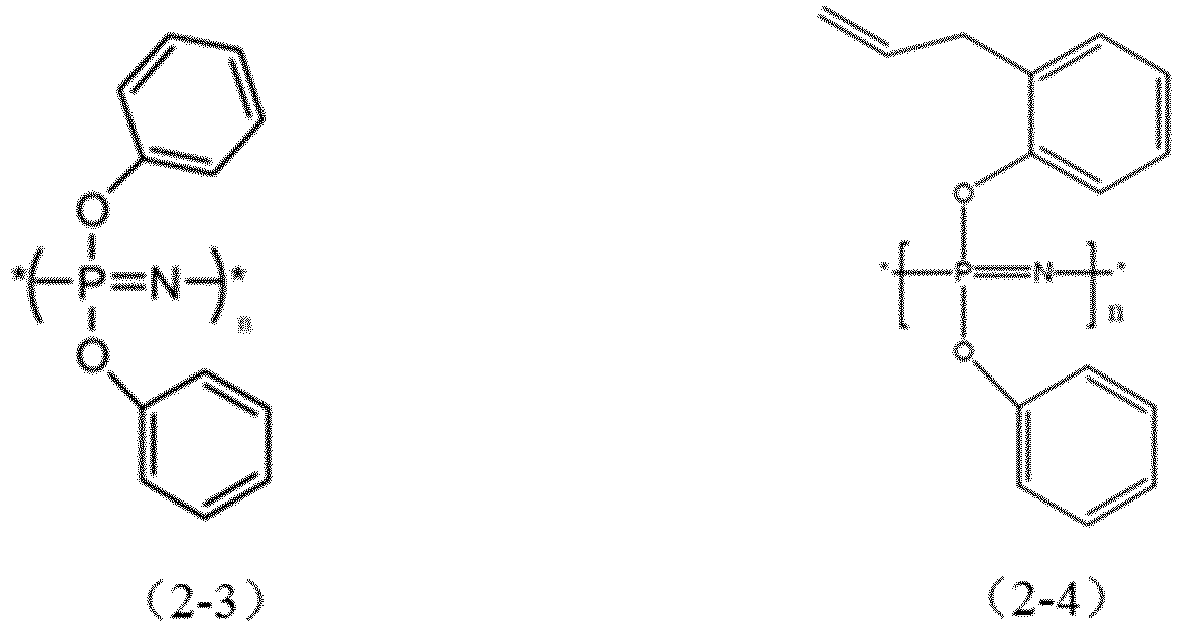
- Preferably, the halogen-free flame retardant is the flame retardant of structural formula (2-1).
- In a specific embodiment, the inorganic filler is selected from silicon dioxide, aluminum oxide, titanium oxide, mica, aluminum hydroxide, magnesium hydroxide, talc, aluminum borate, barium sulfate, calcium carbonate, and combinations thereof.
- It can be understood that the shape of the inorganic filler can be, but is not limited to, spheres, fibers, chips, granules, flakes, or needles.
- In the above-described resin composition, the polybutadiene-modified epoxy resin and the bismaleimide resin can together form an interpenetrating polymer network. In the presence of the initiator, the polybutadiene-modified epoxy resin reacts with the bismaleimide resin and the polybutadiene-modified epoxy resin reacts with the double bond structure-modified benzoxazine. The interactions occur among the three resins: the bismaleimide resin enhances the heat resistance, rigidity, and strength of the polybutadiene-modified epoxy resin; the polybutadiene-modified epoxy resin improves the dielectric performance of the bismaleimide resin; and the bismaleimide resin and the double bond structure-modified benzoxazine together form a bismaleimide-benzoxazine structure, that addresses the issue of high linear thermal expansion coefficient of the bismaleimide resin. This results in a resin composition with a low dielectric constant, a low dielectric loss, and a low linear thermal expansion coefficient.
- Preferably, the resin composition includes following components:
a modified epoxy resin 80 to 120 parts by weight; a modified benzoxazine resin 40 to 110 parts by weight; a bismaleimide resin 30 to 70 parts by weight; an initiator 0.1 to 5 parts by weight; a flame retardant 40 to 70 parts by weight; and an inorganic filler 150 to 450 parts by weight. - It can be understood that the method for preparing the above-described resin composition includes following steps S10 to S20.
- S10, mixing the bismaleimide resin with a solvent to prepare a premixture.
- It can be understood that this step is to thoroughly mix the bismaleimide resin with the solvent, which can involve heating at a temperature ranged from 40°C to 80°C.
- S20, adding the modified epoxy resin, the modified benzoxazine resin, the halogen-free flame retardant, the inorganic filler, the initiator, and a solvent to the premixture.
- Furthermore, the solvent is selected from methanol, ethanol, ethylene glycol monomethyl ether, acetone, butanone, methyl isobutyl ketone, cyclohexanone, toluene, xylene, 2-methoxyethyl acetate, 2-ethoxyethyl acetate, 2-ethoxyethyl acrylate, ethyl acetate, dimethylformamide, dimethylacetamide, propylene glycol methyl ether, and combinations thereof.
- Preferably, the solvent is acetone.
- The present application further provides a prepreg including a substrate and a resin material loaded on the substrate, wherein the resin material is the above-described resin composition.
- The resin composition can be loaded onto the substrate and heated to a semi-cured state to obtain the prepreg. It can be understood that the method for loading the resin composition onto the substrate can include, but is not limited to, impregnation, rolling, molding, coating, rod coating, spraying, or combinations thereof.
- The loading step can be repeated multiple times as needed. Additionally, various thermosetting resin compositions with different components and solid contents can be used in the repeated loading to obtain a desired final composition and resin content.
- It can be understood that the heating conditions involve heating at a temperature of 80°C to 200°C for 1 minute to 20 minutes to obtain a semi-cured pre-impregnated material, i.e., a prepreg.
- Preferably, the heating conditions includes a heating temperature of 110°C to 190°C and a heating time of 2 minutes to 10 minutes.
- In a specific embodiment, the substrate is selected from glass fibers, carbon fibers, silicon carbide fibers, asbestos fibers, nylon, polyethylene fibers, aramid fibers, polyimide fibers, polyester fibers, cotton fibers, and combinations thereof.
- Preferably, the substrate is glass fiber cloth. The type of the glass fiber cloth can be, but is not limited to, E, NE, D, S, or T type, which can produce a laminate with excellent mechanical strength. More preferably, the glass fiber cloth has undergone flattening treatment. The flattening treatment can be performed by continuously applying appropriate pressure onto the glass fiber cloth with pressure rollers to compress the yarns into flatness.
- Furthermore, the present application further provides use of the prepreg in preparation of a laminate, a copper clad laminate, or a wiring board.
- The method for preparing the laminate includes a step of laminating at least one above-described prepreg.
- Furthermore, the parameters of the laminating process are: hot pressing at a temperature of 170°C to 250°C, a pressure of 10 kgf/cm2 to 30 kgf/cm2, and a vacuum degree of less than 2 kPa for 60 minutes to 120 minutes.
- It should be particularly noted that during the laminating process, one or both sides of multiple prepregs, i.e., a stack, can be covered with a copper foil, and then laminated to obtain a copper clad laminate.
- The thickness of the copper foil is ranged from 3µm to 70µm.
- It can be understood that the laminate has a low dielectric constant, a low dielectric loss, and a low linear thermal expansion coefficient, and can be widely used in semiconductor packaging.
- The following provides specific examples to further elaborate the resin composition and the preparation method thereof of the present application. In the specific examples below, unless otherwise specified, all raw materials are commercially available.
- The modified epoxy resins are: JP-100, butadiene-modified epoxy resin, Mn=1300, manufactured by Nippon Soda Co., Ltd.; JP-200, butadiene-modified epoxy resin, Mn=2200, manufactured by Nippon Soda Co., Ltd.; PB4700, butadiene-modified epoxy resin, Mn=3100, manufactured by Daicel Corporation; 901, BPA-type epoxy resin, Mn=1100, manufactured by Hongchang Electronics Co., Ltd.
- The modified benzoxazine resins are: 5031, allyl-type benzoxazine, manufactured by Kolon Industries Inc.; CB6900, double bond-modified benzoxazine, manufactured by Coryes Polymer; CB3170, BPA-type benzoxazine, manufactured by Coryes Polymer.
- The bismaleimide resins are: BMI-2300, polyphenylmethane maleimide, manufactured by Daiwa Kasei (Japan); BMI-5100, bis(3-ethyl-5-methyl-4-maleimidophenyl)methane, manufactured by Daiwa Kasei (Japan); MIR-3000, biphenyl-type bismaleimide, manufactured by Nippon Kayaku.
- The halogen-free flame retardants are: GU304, bis-DPO-type phosphorus-containing flame retardant, manufactured by Coryes Polymer, the melting point is 320°C, the phosphorus content (P%) = 12%, the molecular formula is

- The inorganic filler is SC2300-SVJ, double-bond treated spherical silicon dioxide, manufactured by Admatechs Co., Ltd.
- The initiator is PERBUTYL P, 1,3-bis(t-butylperoxyisopropyl)benzene, manufactured by NOF Corporation.
- The formulations of the resin compositions in the examples and comparative examples are as follows:
Component Model Example 1 Example 2 Example 3 Example 4 Modified epoxy resin butadiene-modified epoxy resin, Mn=1300 JP-100 100 butadiene-modified epoxy resin, Mn=2200 JP-200 100 100 butadiene-modified epoxy resin, Mn=3100 PB4700 100 Modified benzoxazine resin allyl-type benzoxazine 5031 50 double bond-modified benzoxazine CB6900 100 50 50 Bismaleimide resin polyphenylmethane maleimide BMI-2300 50 50 50 50 bis(3-ethyl-5-methyl-4-maleimidophenyl)meth ane BMI-5100 biphenyl-type bismaleimide resin MIR-3000 Halogen-free flame retardant bis-DPO-type phosphorus-containing flame retardant GU304 60 50 50 50 resorcinol bis (2.6-dixylenyl phosphate) PX-200 phosphazene compound SPB-100 allyl-modified phosphazene compound SPV-100 Inorganic filler double-bond treated spherical silicon dioxide SC2300-SVJ 400 400 400 400 Initiator 1,3-bis(t-butylperoxyiso propyl)benzene PERBUTYL P 0.5 0.5 0.5 0.5 Composition Model Example 5 Example 6 Example 7 Example 8 Modified epoxy resin butadiene-modified epoxy resin, Mn=1300 JP-100 butadiene-modified epoxy resin, Mn=2200 JP-200 100 100 100 100 butadiene-modified epoxy resin, Mn=3100 PB4700 Modified benzoxazine resin allyl-type benzoxazine 5031 double bond-modified benzoxazine CB6900 50 50 50 50 Bismaleimide resin polyphenylmethane maleimide BMI-2300 50 50 bis(3-ethyl-5-methyl-4-maleimidophenyl)meth ane BMI-5100 50 biphenyl-type bismaleimide resin MIR-3000 50 Halogen-free flame retardant bis-DPO-type phosphorus-containing flame retardant GU304 50 50 50 50 resorcinol bis (2.6-dixylenyl phosphate) PX-200 phosphazene compound SPB-100 allyl-modified phosphazene compound SPV-100 Inorganic filler double-bond treated spherical silicon dioxide SC2300-SVJ 200 400 400 400 Initiator 1,3-bis(t-butylperoxyiso propyl)benzene PERBUTYL P 0.5 0.5 0.5 0.5 Component Model Comparative Example 1 2 3 4 Modified epoxy resin butadiene-modified epoxy resin, Mn=1300 JP-100 butadiene-modified epoxy resin, Mn=2200 JP-200 100 100 100 100 butadiene-modified epoxy resin, Mn=3100 PB4700 BPA-type epoxy resin 901 Modified benzoxazine resin allyl-type benzoxazine 5031 double bond-modified benzoxazine CB6900 50 50 50 50 BPA-type benzoxazine CB3170 Bismaleimide resin polyphenylmethane maleimide BMI-2300 50 50 50 50 bis(3-ethyl-5-methyl-4-maleimidophenyl)meth ane BMI-5100 biphenyl-type bismaleimide resin MIR-3000 Halogen-free flame retardant bis-DPO-type phosphorus-containing flame retardant GU304 20 resorcinol bis (2.6-dixylenyl phosphate) PX-200 66 phosphazene compound SPB-100 46 allyl-modified phosphazene compound SPV-100 54 Inorganic filler double-bond treated spherical silicon dioxide SC2300-SVJ 400 400 400 400 Initiator 1,3-bis(t-butylperoxyiso propyl)benzene PERBUTYL P 0.5 0.5 0.5 0.5 Component Model Comparative Example 5 6 7 8 9 Modified epoxy resin butadiene-modified epoxy resin, Mn=1300 JP-100 butadiene-modified epoxy resin, Mn=2200 JP-200 100 100 100 100 butadiene-modified epoxy resin, Mn=3100 PB4700 BPA-type epoxy resin 901 100 Modified benzoxazine resin allyl-type benzoxazine 5031 double bond-modified benzoxazine CB6900 50 BPA-type benzoxazine CB3170 50 Bismaleimide resin polyphenylmethane maleimide BMI-2300 100 50 50 bis(3-ethyl-5-methyl-4-maleimidophenyl)meth ane BMI-5100 100 biphenyl-type bismaleimide resin MIR-3000 100 Halogen-free flame retardant bis-DPO-type phosphorus-containing flame retardant GU304 50 50 50 50 50 resorcinol bis (2.6-dixylenyl phosphate) PX-200 phosphazene compound SPB-100 allyl-modified phosphazene compound SPV-100 Inorganic filler double-bond treated spherical silicon dioxide SC2300-SVJ 400 400 400 400 400 Initiator 1,3-bis(t-butylperoxyiso propyl)benzene PERBUTYL P 0.5 0.5 0.5 0.5 0.5 - The preparation method of the resin compositions in the examples and comparative examples is as follows:
- Firstly, the bismaleimide resin was mixed with acetone as a solvent. The premixture was heated to 60°C and stirred thoroughly to dissolve the bismaleimide resin completely in acetone, yielding an acetone solution with a solid content of 40% by mass. Then, the modified epoxy resin and the modified benzoxazine resin were added according to the proportions, and stirred for 2 hours to ensure complete dissolution. Finally, the halogen-free flame retardant, the inorganic filler, the initiator, and an appropriate amount of acetone were added, and the mixture was thoroughly dispersed by ball milling to obtain the resin composition.
- The preparation method of the prepregs loaded with the resin compositions in the examples and comparative examples was as follows:
- The glass fiber cloths, which were the 2116 cloths produced by Grace Fabric Technology Co., Ltd., were separately impregnated with the resin compositions prepared in the examples or comparative examples, and heated at 160°C for about 3 minutes for drying, thereby obtaining the prepregs. The solid content of the resin compositions can be adjusted to obtain the prepregs with a solid content of 50% by mass.
- The preparation method of the copper clad laminate was as follows:
- Eight prepregs corresponding to each example or comparative example were stacked with 35µm copper foil placed on both sides. The stack was then heated and pressed at a temperature of 220°C and a pressure of 25 kgf/cm2 for 2 hours, thereby obtaining a copper clad laminate with a thickness of about 0.9mm.
-
- 1. Peeling strength was determined according to IPC-TM-650 2.4.8 by using a universal tensile machine.
- 2. Glass-transition temperature (Tg): Tg was measured using a dynamic mechanical analyzer (DMA) (DMA850 manufactured by TA Instruments) at a heating rate of 3°C/min according to the standard methods IPC-TM-650 2.4.25C and 24C published by the Institute for Interconnecting and Packaging Electronic Circuits (IPC).
- 3. Measurement of dielectric constant and dielectric loss: Dielectric constant (Dk) and dissipation factor (Df) were measured using a network analyzer (Agilent, model E5071C) at a working frequency of 10 gigahertz (GHz) following the IPC-TM-650 2.5.5.13 standard.
- 4. 288°C solder tin resistance test: The test sample, which had undergone pressure cooker testing (PCT) for 2 hours, was immersed into 288°C solder tin for 6 minutes, and whether the test sample delaminated was recorded.
- 5. Thermal expansion coefficient testing and expansion rate in X/Y/Z axes: The coefficient of thermal expansion and expansion rate in X/Y/Z axes of the test sample were measured using a thermal expansion analyzer (TA Instruments, model TA Q800), the testing temperature is 50°C to 260°C, and the heating rate is 10°C/min.
- 6. Flame retardant testing: the self-extinguishing time of the test sample after combustion was tested using a Bunsen burner, methane gas, and a stopwatch, according to the UL-94 standard, and the test sample was rated based on the self-extinguishing time.
- 7. Elastic modulus: The elastic modulus was tested using a universal tensile machine according to the GB/T 22315-2008 standard.
- The performances of the copper clad laminates in the examples and comparative examples are as follows:
Characteristics of copper clad laminate Example 1 2 3 4 5 6 7 8 Peeling strength (1b/in) 1oz copper foil 8.0 7.0 8.5 8.0 7.8 7.5 7.5 8.5 Elastic modulus (GPa) 30 29 30 29 25 30 29 30 DMA (°C) 3°C/min 200 220 240 240 265 265 265 250 Heat resistance test 288°C tin immersion Pass Pass Pass Pass Pass Pass Pass Pass Thermal expansion coefficient in X/Y axes (ppm/°C) Before Tg 8 8 11 11 11 9.5 10.5 12 Thermal expansion coefficient in Z axis (ppm/°C) After Tg 160 160 200 200 200 150 150 160 CTE in Z axis 50°C-260°C 1.8% 2.0% 1.8% 2.1% 2.0% 1.5% 1.5% 1.6% Flame retardant level 94UL V0 V0 V0 V0 V0 V0 V0 V0 Dk 10GHz 4.10 4.10 4.15 4.20 3.95 4.05 4.05 4.00 Df 0.0070 0.0070 0.0080 0.0100 0.0070 0.0070 0.0070 0.0065 Characteristics of copper clad laminate Comparative Example 1 2 3 4 5 6 7 8 9 Peeling strength (1b/in) 1oz copper foil 7.5 7.5 8.0 7.6 6.0 6.0 9.0 10.0 8.0 Elastic modulus (GPa) 28 28 29 30 29 28 30 31 29 DMA (°C) 3°C/min 180 200 220 265 300 300 260 180 225 Heat resistance test 288°C tin immersion Pass Pass Pass Pass Pass Pass Pass Pass Pass Thermal expansion coefficient in X/Y axes (ppm/°C) Before Tg 9.5 9.5 9.5 9.5 12 13 14 14.5 11.5 Thermal expansion coefficient in Z axis (ppm/°C) After Tg 220 220 210 150 150 150 160 180 180 CTE in Z axis 50°C-260°C 2.8% 2.3% 2.1% 1.5% 1.2% 1.2% 1.6% 2.9% 2.2% Flame retardant level 94UL V0 V0 V0 V1 V0 V0 V0 V-0 V-0 Dk 10GHz 4.05 4.05 4.05 4.05 4.10 4.10 4.00 4.15 4.10 Df 0.0065 0.0095 0.0075 0.0070 0.0075 0.0075 0.0060 0.0110 0.0090 - It can be seen from the performances of the copper clad laminates in the examples and comparative examples that a halogen-free cured product with a high glass transition temperature, a high flexural modulus, an excellent dielectric performance, and a low XY linear thermal expansion coefficient can be obtained using the resin composition in Example 6. This resin composition contains polybutadiene-modified epoxy resin, double bond-modified benzoxazine resin, bismaleimide resin, and bis-DPO-type phosphorus-containing flame retardant.
- In Comparative Examples 1, 2, and 3, the phosphorus-containing flame retardants in the resin compositions can react with the resins, resulting in a decreased Tg and deterioration of the electrical performance of the cured product. In Comparative Example 4, the proportion of the bis-DPO-type phosphorus-containing flame retardant in the resin composition is insufficient, leading to the flame retardant level of the cured product only meeting 94UL-V1. In Example 5, the proportion of the filler in the resin composition is insufficient, resulting in a lower elastic modulus of the cured product. In the bismaleimide resins in the resin compositions of Examples 6, 7, and 8, BMI-2300 has the smallest XY linear thermal expansion coefficient. The copper-clad laminate prepared using the resin composition of Example 6 can achieve a Tg of 265°C, a peeling strength of 7.5 lb/in, a Df of 0.0070 at 10 GHz, an elastic modulus of 30 GPa, and an XY linear thermal expansion coefficient of 9.5 ppm/°C.
- The technical features of the above-mentioned embodiments can be combined arbitrarily. In order to make the description concise, not all possible combinations of the technical features are described in the embodiments. However, as long as there is no contradiction in the combination of these technical features, the combinations should be considered as in the scope of the present application.
- The above-described embodiments are only several implementations of the present application, and the descriptions are relatively specific and detailed, but they should not be construed as limiting the scope of the present application. It should be understood by those of ordinary skill in the art that various modifications and improvements can be made without departing from the concept of the present application, and all fall within the protection scope of the present application. It should be understood that the technical solutions obtained by those of ordinary skill in the art through logical analysis, reasoning, or limited experimentation based on the technical solutions provided in the present application are within the protection scope of the claims appended to the present application. Therefore, the patent protection of the present application shall be defined by the appended claims, and the specification can be used to interpret the contents of the claims.
Claims (10)
- A resin composition comprising following components:
a modified epoxy resin 50 to 150 parts by weight; a modified benzoxazine resin 40 to 120 parts by weight; a bismaleimide resin 20 to 100 parts by weight; an initiator 0.1 to 15 parts by weight; and an inorganic filler 150 to 550 parts by weight; wherein the modified epoxy resin is represented by structural formula (1-1): M and N are both positive integers and M+N is ranged from 15 to 50, and a number average molecular weight of the modified epoxy resin is ranged from 1000 to 10000; andthe modified benzoxazine resin is a base benzoxazine resin with a terminal group modified with a double bond structure.
 - The resin composition according to claim 1, wherein the bismaleimide resin is selected from the group consisting of 4,4'-diphenylmethane bismaleimide, N-2,6-dimethylphenylmaleimide, N-(2,3-dimethylphenyl)maleimide, N-phenylmaleimide, 1,6-bismaleimidohexane, N,N-(4-methyl-1,3-phenylene)bismaleimide, 3,3'-dimethyl-5,5'-diethyl-4,4'-diphenylmethane bismaleimide, bisphenol A diphenyl ether bismaleimide, N'-m-phenylene bismaleimide, diphenylmethane maleimide, biphenyl-type bismaleimide resin, polyphenylmethane maleimide, bis(3-ethyl-5-methyl-4-maleimidophenyl)methane, and combinations thereof.
- The resin composition according to claim 1, wherein the base benzoxazine resin in the modified benzoxazine resin is selected from the group consisting of BPA-type benzoxazine, BPF-type benzoxazine, ODA-type benzoxazine, BPS-type benzoxazine, and combinations thereof.
- The resin composition according to claim 1, wherein in the structure of the modified epoxy resin, M is 3 to 8, N is 5 to 15, and the number average molecular weight of the modified epoxy resin is 1000 to 4000.
- The resin composition according to claim 1, wherein the initiator is selected from the group consisting of di(tert-butylperoxyisopropyl)benzene, dicumyl peroxide, 2,5-dimethyl-2,5-di(tert-butylperoxy)hexane, di-tert-butyl peroxide, 2,5-dimethyl-2,5-di(tert-butylperoxy)-3-hexyne, benzoyl peroxide, chloranil, 2,4,6-tri-tert-butylphenol, tert-butylperoxy isopropyl monocarbonate, azobisisobutyronitrile, and combinations thereof.
- The resin composition according to claim 1, wherein the inorganic filler is selected from the group consisting of silicon dioxide, aluminum oxide, titanium oxide, mica, aluminum hydroxide, magnesium hydroxide, talc, aluminum borate, barium sulfate, calcium carbonate, and combinations thereof.
- The resin composition according to any one of claims 1 to 6, further comprising a halogen-free flame retardant in an amount of 20 to 80 parts by weight.
- The resin composition according to claim 7, wherein the halogen-free flame retardant is selected from the group consisting of compounds represented by structural formulas (2-1) to (2-4), and combinations thereof:


- A prepreg comprising a substrate and a resin material loaded on the substrate, wherein the resin material is the resin composition according to any one of claims 1 to 8.
- Use of the prepreg according to claim 9, in preparation of a laminate, a copper clad laminate, or a wiring board.
Applications Claiming Priority (2)
| Application Number | Priority Date | Filing Date | Title |
|---|---|---|---|
| CN202111676353.XA CN114133704A (en) | 2021-12-31 | 2021-12-31 | Resin composition, prepreg and application |
| PCT/CN2022/143316 WO2023125784A1 (en) | 2021-12-31 | 2022-12-29 | Resin composition, and prepreg and use thereof |
Publications (2)
| Publication Number | Publication Date |
|---|---|
| EP4458902A1 true EP4458902A1 (en) | 2024-11-06 |
| EP4458902A4 EP4458902A4 (en) | 2025-04-23 |
Family
ID=80381519
Family Applications (1)
| Application Number | Title | Priority Date | Filing Date |
|---|---|---|---|
| EP22915034.7A Pending EP4458902A4 (en) | 2021-12-31 | 2022-12-29 | RESIN COMPOSITION AND PREPREG AND USE THEREOF |
Country Status (5)
| Country | Link |
|---|---|
| EP (1) | EP4458902A4 (en) |
| JP (1) | JP7769806B2 (en) |
| KR (1) | KR20240123844A (en) |
| CN (1) | CN114133704A (en) |
| WO (1) | WO2023125784A1 (en) |
Families Citing this family (4)
| Publication number | Priority date | Publication date | Assignee | Title |
|---|---|---|---|---|
| CN114133704A (en) * | 2021-12-31 | 2022-03-04 | 广东盈骅新材料科技有限公司 | Resin composition, prepreg and application |
| CN116041936B (en) * | 2022-12-22 | 2025-04-04 | 广东盈骅新材料科技有限公司 | Resin composition, prepreg and application thereof |
| CN115948022B (en) * | 2022-12-23 | 2025-10-10 | 浙江华正新材料股份有限公司 | Prepregs, circuit substrates and printed circuit boards |
| CN116948395B (en) * | 2023-07-20 | 2025-03-04 | 苏州生益科技有限公司 | Resin composition and use thereof |
Family Cites Families (10)
| Publication number | Priority date | Publication date | Assignee | Title |
|---|---|---|---|---|
| CN102504532B (en) * | 2011-10-18 | 2013-09-18 | 广东生益科技股份有限公司 | Halogen-free low dielectric resin composition and prepreg and copper clad laminate made of same |
| KR101582430B1 (en) * | 2011-10-18 | 2016-01-04 | 셍기 테크놀로지 코. 엘티디. | Halogen-free low-dielectric resin composition, and prepreg and copper foil laminate made by using same |
| CN103834168B (en) * | 2014-02-25 | 2016-09-07 | 广东生益科技股份有限公司 | A kind of halogen-free flame resistance resin composite |
| JP6589623B2 (en) * | 2015-12-24 | 2019-10-16 | 日立化成株式会社 | Thermosetting resin composition, prepreg, copper-clad laminate and printed wiring board |
| JPWO2017170643A1 (en) * | 2016-03-31 | 2019-02-07 | 住友ベークライト株式会社 | Thermosetting resin composition, resin film with carrier, prepreg, metal-clad laminate, resin substrate, printed wiring board, and semiconductor device |
| JP6866575B2 (en) * | 2016-05-25 | 2021-04-28 | 昭和電工マテリアルズ株式会社 | Thermosetting resin composition, and prepregs, copper-clad laminates, and printed wiring boards using the same. |
| CN109825081B (en) * | 2019-01-30 | 2021-06-04 | 广东生益科技股份有限公司 | Thermosetting resin composition, prepreg containing thermosetting resin composition, metal foil-clad laminate and printed circuit board |
| JP7294834B2 (en) * | 2019-03-15 | 2023-06-20 | 太陽ホールディングス株式会社 | Curable compositions, dry films, cured products, laminates and electronic components |
| CN113121999B (en) * | 2019-12-31 | 2023-04-07 | 广东生益科技股份有限公司 | Resin composition, and prepreg, laminated board and printed circuit board using same |
| CN114133704A (en) * | 2021-12-31 | 2022-03-04 | 广东盈骅新材料科技有限公司 | Resin composition, prepreg and application |
-
2021
- 2021-12-31 CN CN202111676353.XA patent/CN114133704A/en active Pending
-
2022
- 2022-12-29 WO PCT/CN2022/143316 patent/WO2023125784A1/en not_active Ceased
- 2022-12-29 EP EP22915034.7A patent/EP4458902A4/en active Pending
- 2022-12-29 JP JP2024539006A patent/JP7769806B2/en active Active
- 2022-12-29 KR KR1020247025757A patent/KR20240123844A/en active Pending
Also Published As
| Publication number | Publication date |
|---|---|
| EP4458902A4 (en) | 2025-04-23 |
| WO2023125784A1 (en) | 2023-07-06 |
| KR20240123844A (en) | 2024-08-14 |
| CN114133704A (en) | 2022-03-04 |
| JP2025504305A (en) | 2025-02-12 |
| JP7769806B2 (en) | 2025-11-13 |
Similar Documents
| Publication | Publication Date | Title |
|---|---|---|
| JP7769806B2 (en) | Resin composition and prepreg, use | |
| US11015052B2 (en) | Halogen-free low dielectric resin composition, and prepreg, metal-clad laminate, and printed circuit board prepared using the same | |
| CN102304264B (en) | High-frequency copper foil substrate and composite material used thereby | |
| US20230331957A1 (en) | Resin composition, prepreg, film provided with resin, metal foil provided with resin, metal-clad laminate, and wiring board | |
| CN116003687B (en) | Maleimide resin prepolymer, preparation method thereof, resin composition and application | |
| CN114316567B (en) | Resin compositions and prepregs, applications | |
| EP4458907A1 (en) | Resin composition, and preparation method therefor and application thereof | |
| US20230323104A1 (en) | Resin composition, prepreg, film provided with resin, metal foil provided with resin, metal-clad laminate, and wiring board | |
| US10994516B2 (en) | Resin composition, and pre-preg, metal-clad laminate and printed circuit board prepared using the same | |
| WO2022004583A1 (en) | Isocyanate-modified polyimide resin, resin composition and cured product of same | |
| JP7836816B2 (en) | Resin compositions, varnishes, laminates, printed circuit boards, and molded products | |
| TWI618097B (en) | Low dielectric material | |
| JP2012197361A (en) | Resin composition, resin varnish, prepreg, metal-clad laminate, and printed wiring board | |
| CN116948395B (en) | Resin composition and use thereof | |
| JP2025073321A (en) | Thermosetting maleimide resin composition | |
| JP2000026553A (en) | Curing composition | |
| JP2847868B2 (en) | Method for producing flame-retardant polyaminobismaleimide resin laminate | |
| CN115960438B (en) | Resin composition, prepreg and application thereof in laminate, copper clad laminate and wiring board | |
| CN113185751A (en) | Halogen-free silicon flame-retardant vinyl resin, preparation method thereof and application thereof in copper-clad plate | |
| JP7710267B2 (en) | Resin composition, adhesive film, laminated substrate, electronic component, and semiconductor device | |
| CN116041936B (en) | Resin composition, prepreg and application thereof | |
| TWI922640B (en) | Resin composition, prepreg, resin-coated film, resin-coated metal foil, metal-clad laminate and wiring board | |
| TWI823569B (en) | Resin film | |
| CN119735915A (en) | Resin composition, prepreg, laminate, copper clad laminate, wiring board | |
| TWI798505B (en) | Low dielectric resin composition, prepreg, and copper clad laminate |
Legal Events
| Date | Code | Title | Description |
|---|---|---|---|
| STAA | Information on the status of an ep patent application or granted ep patent |
Free format text: STATUS: THE INTERNATIONAL PUBLICATION HAS BEEN MADE |
|
| PUAI | Public reference made under article 153(3) epc to a published international application that has entered the european phase |
Free format text: ORIGINAL CODE: 0009012 |
|
| STAA | Information on the status of an ep patent application or granted ep patent |
Free format text: STATUS: REQUEST FOR EXAMINATION WAS MADE |
|
| 17P | Request for examination filed |
Effective date: 20240704 |
|
| AK | Designated contracting states |
Kind code of ref document: A1 Designated state(s): AL AT BE BG CH CY CZ DE DK EE ES FI FR GB GR HR HU IE IS IT LI LT LU LV MC ME MK MT NL NO PL PT RO RS SE SI SK SM TR |
|
| DAV | Request for validation of the european patent (deleted) | ||
| DAX | Request for extension of the european patent (deleted) | ||
| A4 | Supplementary search report drawn up and despatched |
Effective date: 20250321 |
|
| RIC1 | Information provided on ipc code assigned before grant |
Ipc: H05K 1/03 20060101ALI20250317BHEP Ipc: C08L 79/08 20060101ALI20250317BHEP Ipc: C08J 5/24 20060101ALI20250317BHEP Ipc: C08L 63/10 20060101AFI20250317BHEP |