EP4458680A1 - Doppelbarriere-durchführung - Google Patents
Doppelbarriere-durchführung Download PDFInfo
- Publication number
- EP4458680A1 EP4458680A1 EP23171875.0A EP23171875A EP4458680A1 EP 4458680 A1 EP4458680 A1 EP 4458680A1 EP 23171875 A EP23171875 A EP 23171875A EP 4458680 A1 EP4458680 A1 EP 4458680A1
- Authority
- EP
- European Patent Office
- Prior art keywords
- feedthrough
- storing unit
- fluid
- enclosure
- supply
- Prior art date
- Legal status (The legal status is an assumption and is not a legal conclusion. Google has not performed a legal analysis and makes no representation as to the accuracy of the status listed.)
- Pending
Links
Images


Classifications
-
- B—PERFORMING OPERATIONS; TRANSPORTING
- B64—AIRCRAFT; AVIATION; COSMONAUTICS
- B64D—EQUIPMENT FOR FITTING IN OR TO AIRCRAFT; FLIGHT SUITS; PARACHUTES; ARRANGEMENT OR MOUNTING OF POWER PLANTS OR PROPULSION TRANSMISSIONS IN AIRCRAFT
- B64D37/00—Arrangements in connection with fuel supply for power plant
- B64D37/005—Accessories not provided for in the groups B64D37/02 - B64D37/28
-
- B—PERFORMING OPERATIONS; TRANSPORTING
- B64—AIRCRAFT; AVIATION; COSMONAUTICS
- B64D—EQUIPMENT FOR FITTING IN OR TO AIRCRAFT; FLIGHT SUITS; PARACHUTES; ARRANGEMENT OR MOUNTING OF POWER PLANTS OR PROPULSION TRANSMISSIONS IN AIRCRAFT
- B64D37/00—Arrangements in connection with fuel supply for power plant
- B64D37/32—Safety measures not otherwise provided for, e.g. preventing explosive conditions
-
- F—MECHANICAL ENGINEERING; LIGHTING; HEATING; WEAPONS; BLASTING
- F17—STORING OR DISTRIBUTING GASES OR LIQUIDS
- F17C—VESSELS FOR CONTAINING OR STORING COMPRESSED, LIQUEFIED OR SOLIDIFIED GASES; FIXED-CAPACITY GAS-HOLDERS; FILLING VESSELS WITH, OR DISCHARGING FROM VESSELS, COMPRESSED, LIQUEFIED, OR SOLIDIFIED GASES
- F17C13/00—Details of vessels or of the filling or discharging of vessels
- F17C13/12—Arrangements or mounting of devices for preventing or minimising the effect of explosion ; Other safety measures
-
- B—PERFORMING OPERATIONS; TRANSPORTING
- B60—VEHICLES IN GENERAL
- B60K—ARRANGEMENT OR MOUNTING OF PROPULSION UNITS OR OF TRANSMISSIONS IN VEHICLES; ARRANGEMENT OR MOUNTING OF PLURAL DIVERSE PRIME-MOVERS IN VEHICLES; AUXILIARY DRIVES FOR VEHICLES; INSTRUMENTATION OR DASHBOARDS FOR VEHICLES; ARRANGEMENTS IN CONNECTION WITH COOLING, AIR INTAKE, GAS EXHAUST OR FUEL SUPPLY OF PROPULSION UNITS IN VEHICLES
- B60K15/00—Arrangement in connection with fuel supply of combustion engines or other fuel consuming energy converters, e.g. fuel cells; Mounting or construction of fuel tanks
- B60K15/03—Fuel tanks
-
- B—PERFORMING OPERATIONS; TRANSPORTING
- B60—VEHICLES IN GENERAL
- B60K—ARRANGEMENT OR MOUNTING OF PROPULSION UNITS OR OF TRANSMISSIONS IN VEHICLES; ARRANGEMENT OR MOUNTING OF PLURAL DIVERSE PRIME-MOVERS IN VEHICLES; AUXILIARY DRIVES FOR VEHICLES; INSTRUMENTATION OR DASHBOARDS FOR VEHICLES; ARRANGEMENTS IN CONNECTION WITH COOLING, AIR INTAKE, GAS EXHAUST OR FUEL SUPPLY OF PROPULSION UNITS IN VEHICLES
- B60K15/00—Arrangement in connection with fuel supply of combustion engines or other fuel consuming energy converters, e.g. fuel cells; Mounting or construction of fuel tanks
- B60K15/03—Fuel tanks
- B60K15/035—Fuel tanks characterised by venting means
- B60K15/03504—Fuel tanks characterised by venting means adapted to avoid loss of fuel or fuel vapour, e.g. with vapour recovery systems
-
- B—PERFORMING OPERATIONS; TRANSPORTING
- B60—VEHICLES IN GENERAL
- B60K—ARRANGEMENT OR MOUNTING OF PROPULSION UNITS OR OF TRANSMISSIONS IN VEHICLES; ARRANGEMENT OR MOUNTING OF PLURAL DIVERSE PRIME-MOVERS IN VEHICLES; AUXILIARY DRIVES FOR VEHICLES; INSTRUMENTATION OR DASHBOARDS FOR VEHICLES; ARRANGEMENTS IN CONNECTION WITH COOLING, AIR INTAKE, GAS EXHAUST OR FUEL SUPPLY OF PROPULSION UNITS IN VEHICLES
- B60K15/00—Arrangement in connection with fuel supply of combustion engines or other fuel consuming energy converters, e.g. fuel cells; Mounting or construction of fuel tanks
- B60K15/03—Fuel tanks
- B60K2015/03328—Arrangements or special measures related to fuel tanks or fuel handling
- B60K2015/03381—Arrangements or special measures related to fuel tanks or fuel handling for preventing explosions
Definitions
- the present invention relates to providing a passing of supply lines of a storing unit onboard a vehicle; more specifically, the inventions relates to a connection device, to a connection arrangement, to a supply system, to an aircraft comprising the supply system and to a method for clearing leaked fluid from a supply system.
- Storing units such as fuel tanks onboard a vehicle like an aircraft may be equipped with sensing device or other components which may require a wiring or other supply line connection from inside the storing unit to the outside of the storing unit.
- a sealing barrier may be provided through which the supply lines pass.
- the barrier, and the supply lines passing through need to fulfil high-pressure sealing criteria.
- the barrier, and the supply lines passing through need to show a high leak-tightness.
- additional complex measures like ventilation of storage areas may be needed in case of leakage.
- a connection device for passing supply lines from a storing unit to an environment of the storing unit.
- the device comprises a retainer volume encapsulated by an enclosure, a first feedthrough and a second feedthrough.
- the first feedthrough is arranged attached to the enclosure and is configured to sealingly pass supply lines from an inner lumen of the storing unit to the retainer volume.
- the second feedthrough is arranged attached to the enclosure and is configured to sealingly pass the supply lines from the retainer volume to the environment of the storing unit.
- the first feedthrough, the second feedthrough and the enclosure are configured to be leak-tight for a fluid stored in the storing unit.
- the retainer volume is configured to capture fluid leaking through the first feedthrough and to prevent leaked fluid to reach the environment of the storing unit.
- a secondary barrier is presented by the connection device that will prevent explosive atmosphere creation outside the storage unit e.g. in case of a leakage of the first barrier, i.e. the first feedthrough.
- the capturing in the retainer volume and thus avoiding the mixture with environmental air prevents that an explosive atmosphere is provided.
- the retainer volume is configured to provide an inert fluid.
- the inert fluid is configured to mix with the leaked fluid to yield a non-explosive fluid mixture.
- the enclosure is configured to be connected to a sensor for detecting if leaked fluid is present inside the retainer volume.
- the enclosure is configured to be connected to a valve arrangement configured to vent the retainer volume.
- connection arrangement for passing supply lines from a storing unit.
- the arrangement comprises at least one supply line conduit, at least one supply line and a connection device according to one of the previous examples.
- the at least one supply line conduit is configured to be connected to a storing unit and to guide the at least one supply line from the inner lumen of the storing unit to the connection device.
- the at least one supply line extends within the at least one supply line conduit through the first feedthrough into the retainer volume and from the retainer volume through the second feedthrough to the environment.
- a supply system comprising a storing unit storing a fluid in an inner lumen and a connection arrangement according to one of the previous examples.
- the connection arrangement is connected to the inner lumen of the storing unit via the first feedthrough.
- the connection arrangement is configured to pass the supply lines from the inner lumen of the storing unit to the environment of the storing unit without leaked fluid from the storing unit.
- an aircraft comprising a propulsion system, an airframe, a fuel storage space and a supply system according to the previous example.
- the airframe is attached to the aircraft and the propulsion system is attached to the airframe and both are configured to levitate and/or accelerate the aircraft on a mission.
- the supply system is configured to be located in the fuel storage space and stores fuel inside the aircraft.
- the supply system is configured to supply the propulsion system with fuel on the mission.
- the supply system is configured to supply other systems used during operation of the aircraft, such as a power supply for aviation systems or onboard entertainment.
- a method for clearing leaked fluid from a supply system comprises the following steps:
- a connection device, or a cable supply is connected to a tank storing a fuel.
- the supply is connected via its first entry to the tank.
- the first entry is forming a first b blockage between the fuel and an environment of the tank.
- the supply acts as retention basin and the fuel streams into the supply.
- a second entry of the supply closes the retention basin and forms a second blockage and the fuel does not contact or mix with the environment of the tank.
- connection device presents a first barrier plus a secondary barrier that will prevent explosive atmosphere creation and an enclosed volume between the two barriers. It also allows a detection of first barrier failure and activates safety switches and safely vent the mixture.
- an enclosure forms a secondary diffusion barrier around an access point to a storing unit. Sites that are used to surveil a storing unit are thus provided with an improved safety for operation the storing unit.
- Fig. 1 schematically shows a cross-section of a general example of a connection device 10 for passing supply lines 12 from a storing unit 14 to an environment 16 of the storing unit 14.
- the connection device 10 comprises a retainer volume 18 encapsulated by an enclosure 20, a first feedthrough 22 and a second feedthrough 24.
- the first feedthrough 22 is arranged attached to the enclosure 20 and is configured to sealingly pass supply lines 12 from an inner lumen 26 of the storing unit 14 to the retainer volume 18.
- the second feedthrough 24 is arranged attached to the enclosure 20 and is configured to sealingly pass the supply lines 12 from the retainer volume 18 to an environment 16 of the storing unit 14.
- the first feedthrough 22, the second feedthrough 24 and the enclosure 20 are configured to be leak-tight (arrows 28 for a fluid 30 stored in the storing unit 14.
- the retainer volume 18 is configured to capture fluid leaking through the first feedthrough 22 and to prevent the leaked fluid 32 to reach the environment 16 of the storing unit 14.
- connection device 10 It is noted that the supply lines 12 and the storing unit 14 as well as the environment 16 are shown for better explanation. In an option, they are not part of the connection device 10 itself.
- connection device refers to a connector, a transition or an adapter for guiding the supply lines out of a storing unit, respectively into a storing unit.
- passing refers to any word describing a transit between two separate spaces.
- supply line refers to a cable, a conduit, a pipe, a wire, a waveguide, or a tube.
- the supply line 12 of Fig. 1 is an object that is capable of transporting energetical, structural or material differences between two separate spaces, volumes or phases in a predefined direction.
- storing unit refers to a tank, a vessel, a container, a cistern or a basin.
- the storing unit 14 of Fig. 1 can also be a tube or a pipe or a piping system.
- the storing unit 14 also can be referred to as storage unit.
- the storing unit 14 is configured to store and transport a volume.
- the storing unit 14 possesses an encased volume, an inner lumen 26 respectively, that is capable of storing the volume.
- the storing unit 14 is configured to separate and isolate the volume from the outer surroundings of the storing unit 14 in Fig. 1 .
- the storing unit 14 is configured to supply the stored volume to a given purpose, not shown in detail in Fig. 1 .
- the storing unit 14 is configured to be an integral part of the machinery or a structural part of a vehicle, such as an aircraft or a car, not further shown in Fig. 1 .
- the term "environment” refers to the surrounding of the storing unit 14 in its closer periphery or proximity.
- the term environment 16 refers to the surroundings of the storing unit 14 inside the vehicle, such as the internal environment 16 of the vehicle, whereas the outside of the vehicle can be referred to as external environment 16.
- the environment 16 refers to the inside spacing of the vehicle that bears the storing unit 14.
- the term "enclosure” refers to a chamber, an envelope, a compartment, a room, a balloon, a void, a bubble, or a box according to several options of Fig. 1 .
- the enclosure 20 can also be referred to as retainer.
- the enclosure 20 can be made from any material that is configured to be gas leak-tight and pressure-proven, e.g. a metal.
- connection of the enclosure 20 to the feedthroughs is configured to be gas leak-tight, e.g. for hydrogen gas.
- the position of the feedthroughs can be added to any point of the surface of the enclosure 20 of Fig. 1 .
- the enclosure 20 is thermally insulated.
- the retainer volume 18 is configured to be expendable.
- encapsulated refers to isolating or separating a volume from another volume or dividing volumes, without providing any contact between the volumes.
- retainer volume refers to any space or lumen that is capable of taking up a volume or a fluid 30.
- the retainer volume 18 can also be referred to as retention basin, buffer volume or basin.
- the pressure in the retainer volume 18 is lower than in the storing unit 14.
- feedthrough refers to a clearance hole, a through boring, a via hole or a cable bushing that is able to conduct a supply line 12 between to separate volumes, such that the separated volumes do not contact each other.
- sealingly pass refers to the afore mentioned way of passing, guiding, leading, transiting, traversing or conducting a supply line 12 through the feedthrough.
- sealingly passing implies that a fluid on one side of the feedthrough cannot creep or permeate along the interface between the boring and the supply line 12 in the feedthrough to arrive at the other side of the feedthrough in Fig. 1 .
- the supply lines 12 are sealed in the feedthrough with the feedthrough to form a unity impermeable to any fluid 30.
- the feedthrough becomes a physical barrier except for the supply lines 12.
- sealingly passing the supply lines 12 through the feedthrough is realized by clamping the supply lines 12 tightly together by the feedthrough, such that no other volume than the supply lines 12 can pass the feedthrough.
- This volume also includes the substances conducted by the supply lines 12.
- sealingly passing the supply lines 12 through the feedthrough can be realized by fusing an insulation of the supply lines 12 or fusing the supply lines 12 with the feedthrough.
- the supply lines themselves pass and reach through a physical barrier.
- sealingly passing the supply lines 12 through the feedthrough can be realized by providing supply line connectors on both sides of the feedthrough, the feedthrough being a physical barrier without any cable boring.
- the supply line connectors are connected in the feedthrough, enclosed in a leak-tight matrix and provide signal transmission between the supply lines 12 connected to the supply line connectors on either side of the feedthrough.
- the supply line connectors are referred to as pins.
- the supply line connectors pass and reach through a physical barrier, but not the supply lines themselves.
- the feedthroughs sealingly passing a supply line 12 provide a barrier against hydrogen gas.
- a feedthrough is provided by contactless connection of two supplies through a separating object.
- the feedthroughs are configured to sustain and withstand cryogenic temperatures.
- the feedthroughs are configured to be resistant against temperature-induced movement.
- the feedthrough acts as a cable boring with a gasket or tightening for the cable.
- inner lumen can also be referred to as inside, interior, or cavity.
- leak refers to a channel, a fracture, a bore, a recess in an object that permits exchange of two environments separated by the object.
- leaking refers to the exchange of the two environments, either in the direction of one of the environments or between both environments. The leaks are not depicted in Fig. 1 .
- leak-tight refers to a condition, e.g., of a form fit bounding between to objects or the object itself, separating two environments.
- the condition minimizes the contact of the outside and the inside of the bounding with the separated environments.
- fluid refers to e.g. a liquid or a gas that continuously deforms, i.e., flows, under an applied shear stress, or external force.
- the fluid 30 stored in the storing unit 14 of Fig. 1 can also be referred to as fuel.
- the fluid 30 can be any substance carrying a form of energy, i.e. a fuel.
- the storing unit 14 is configured to store a fuel.
- the storing unit 14 is configured to store hydrogen in liquid and gaseous form.
- the storing unit 14 is configured to store hydrogen containing substances.
- the storing unit 14 is configured to store cryogenic fluid or fluid under high pressure.
- the storing unit 14 comprises an inner tank and an outer tank, not shown in Fig. 1 .
- the inner tank is configured to store the liquid and the outer tank is configured to insulate the inner tank from the environment 16.
- the connection device of Fig. 1 uses two feedthroughs.
- An example for the feedthroughs are the so-called ATEX feedthroughs (French: ATmosph Guatemala Explosives ) .
- the connection with two feedthroughs is designed as such that the first ATEX feedthrough is connected (via the retainer volume) to the second ATEX feedthrough which in turn is connected to the data acquisition center.
- the first feedthrough 22 acts as a barrier between the hydrogen filled storage unit, e.g., a pipe and the enclosure, e.g. a box, or chamber, filled with, e.g. inert gas, i.e. an inert gas box.
- inert gas i.e. an inert gas box.
- the leaking hydrogen will mix with inert gas, e.g. helium, and the creation of an explosive mixture is avoided.
- an inert fluid e.g. another inert gas
- the inert gas can be chosen according to the temperature, or expected temperature range, of the leaking gas such as leaking hydrogen at the first feedthrough. If the temperature of the leaking gas is low, the inert gas is provided such that it preferably stays in its gaseous state to better mix with the leaking gas.
- Helium can be used, e.g. for hydrogen leakage, since helium does not liquify at the expected LH2 temperatures.
- LH2 liquid hydrogen
- an inert gas with a lower boiling point than hydrogen is chosen, to ensure proper mixing of the inert gas with the leaking gas to yield a non-explosive gas mixture.
- a preheated inert gas is mixed with the leaking gas.
- the second feedthrough 24 acts as a barrier between the inert gas filled box and the ambient environment.
- the first barrier will serve as a means of protection of air, e.g. oxygen going in the hydrogen pipe and from creation of an explosive mixture.
- connection device is a double barrier electrical feedthrough connection to a liquid hydrogen inner tank. It can be used to safely connect sensors placed inside the inner tank to electrical source or data acquisition systems in the ambient environment, i.e. outside the inner tank. It presents a secondary barrier that will prevent explosive atmosphere creation. It also allows a detection of first barrier failure and activate safety switches and safely vent the mixture.
- Fig. 2 schematically shows a more detailed cross-section of an example of a connection device 10.
- the retainer volume 18 of Fig. 2 is configured to provide an inert fluid 34.
- the inert fluid 34 is configured to mix with the leaked fluid 32 to yield a non-explosive fluid mixture 36.
- inert can be referred to as unreactive.
- the environment 16 of the storing unit 14 in Fig. 2 comprises fluids that react vigorously with the fluid 30 from the storing unit 14 under sudden release of energy, causing explosions.
- the inert fluid 34 in the enclosure 20 prevents fluids from the environment 16 to enter the enclosure 20 and prevents fluid 30 from the storing unit 14 to enter the enclosure 20.
- the inert fluid 34 prevents fluids from the environment 16 to mix with fluids 30 from the storing unit 14.
- the inert fluid 34 mixes with fluid 30 from the storing unit 14 in the enclosure 20 and the fluid mix, e.g. the non-explosive fluid mixture 36 in Fig. 2 is thereafter removed from the enclosure 20.
- the fluid of the environment 16 is the atmosphere and the atmosphere comprises oxygen.
- the inert fluid 34 hampers the oxygen of the atmosphere to react with the fluid 30 from the storing unit 14, i.e. hydrogen, to prevent explosions.
- the inert gas in the enclosure 20 of Fig. 2 can be regarded as protective gas insulation.
- the protective gas insulation hampers the diffusion of fluid into the environment 16 of the storing unit 14.
- the inert fluid 34 is provided inside the retainer volume 18 and the inert gas is configured to mix with the leaked fluid 32 to yield a non-explosive fluid mixture 36 in Fig. 2 .
- the inert fluid 34 is a protection gas.
- the gas comprises one of the group of: nitrogen, helium, argon, krypton.
- the inert fluid 34 is in a liquid state or is a liquid substance at standard conditions.
- the inert fluid 34 is a liquid or a solid substance capable of adsorbing or reacting with the fluid 30 from the storing unit 14 in Fig. 2 .
- the retainer volume 18 or the enclosure 20 are configured with devices or a certain shape to maximize the mixing of the inert fluid 34 and the leaked fluid 32, not shown in Fig. 2 .
- the pressure of the fluid in the storing unit 14 is higher, than the pressure of the inert fluid 34 in the retainer volume 18.
- the pressure of the inert fluid 34 in the enclosure 20 is lower than atmospheric pressure.
- the enclosure 20 is configured to be suppliable by an external source of inert fluid 34.
- connection device 10 can be regarded as inert gas-protected feedthrough.
- continuously permeating fluid from the feedthrough at the storing unit 14 can be removed safely by an inert fluid 34 without creating an explosive atmosphere.
- the amount of continuously permeating fluid from the feedthrough at the storing unit 14 can be kept below the explosive levels.
- the enclosure is configured to be connected to a sensor 38 for detecting if leaked fluid 32 is present inside the retainer volume 18.
- the senor 38 is a hydrogen sensor.
- the sensor 38 is an oxygen sensor.
- the enclosure is configured to connect more than one sensor 38, i.e. configured to connect a hydrogen sensor and a oxygen sensor.
- hydrogen and oxygen sensors are provided, which are connected to the enclosure, i.e., the inert gas box.
- the inert gas boxes are welded on the storage unit, e.g. pipes, at the bottom.
- the sensors will declare an alarm and e.g. a safety procedure on an aircraft, related to this situation will be followed. For example, tank filling will be stopped, and hydrogen safe extraction can be provided once the airplane is on ground before maintenance on the malfunctioning feedthrough.
- the mixture of hydrogen and nitrogen can be safely evacuated through the valves which are equipped with non return valves, preventing back flow of air in case of valve spurious opening.
- valve arrangement 50 of Fig. 2 is an automatic valve arrangement and connected to a controlling unit.
- the sensor 38 is configured to generate a signal that can be transmitted to the controlling unit of the valve arrangement in order to operate the valve arrangement.
- the enclosure comprises a connection 40 for sealingly attaching a supply line conduit 42 guiding the supply lines 12 from the storing unit 14 to the connection device 10.
- the first feedthrough 22 is provided at an end 44 of the supply line conduit.
- the first feedthrough 22 provides a barrier 46 between an inner volume 48 of the supply line conduit 42 and the retainer volume 18.
- the enclosure of the connection device 10 in Fig. 2 also encloses the connection of the first feedthrough 22 to the storing unit 14, such that leaked fluid 32, that permeates through the connection of the first feedthrough 22 and the storing unit 14 is taken up by the enclosure.
- At least one of the first feedthrough 22 and the second feedthrough 24 is an ATEX feedthrough.
- the feedthroughs are configured that they prevent the contact between a fluid 30 and their supply lines 12.
- the feedthroughs isolate the supply lines 12 from the fluid 30.
- Spectite (trademark) feedthroughs are deployed.
- the enclosure is configured to be connected to a valve arrangement 50 configured to vent the retainer volume 18.
- an automatic valve arrangement is connected to the enclosure.
- the automatic valve arrangement is configured to be operated remotely.
- valve arrangement 50 is connected with its exhaust pipe to the external environment 16 of the aircraft, which is not shown in Fig. 2 .
- valve arrangement 50 is configured to be connected to a controller unit and the venting of the retainer volume 18 can be automatized or made dependent on other parameters of the system the controller unit is connected to.
- the enclosure is configured to be connected to a valve arrangement that prevents a flow-back (arrow 52 in Fig. 2 ) of an environmental fluid 54 into the retainer volume 18.
- valve arrangement that prevents a flow-back of an environmental fluid 54 is configured to prevent oxygen from entering the enclosure through the valve arrangement 54.
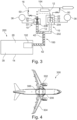
- Fig. 3 schematically shows a cross-section of an example of a connection arrangement 100 for passing supply lines 12 from a storing unit 14.
- the connection arrangement 100 comprises at least one supply line conduit 42, at least one supply line 12 and an example of the connection device 10 according to one of the previous examples.
- the at least one supply line conduit 42 is configured to be connected to the storing unit 14 and to guide the at least one supply line 12 from the inner lumen 26 of the storing unit 14 to the connection device 10.
- the at least one supply line 12 extends within the at least one supply line conduit 42 through the first feedthrough 22 into the retainer volume 18 and from the retainer volume 18 through the second feedthrough 24 to the environment 16.
- the storing unit 14 comprises an inner and an outer tank, not shown in Fig. 3 for reasons of simplicity.
- the connection device 10 is located at the outer tank and a connection between the inner tank and the connection device 10 is provided by the supply line conduit 42 that traverses the outer tank.
- connection device 10 is connected to the supply line conduit 42 by welding.
- the supply lines 12 are provided as at least one of the group of cables for transmitting electrical signals, cables for transmitting electrical power, optical guides for transmitting optical signals, thermal guides for transmitting thermal signals and pipes for transporting substances between an inner lumen 26 of the storing unit 14 and the environment 16.
- the supply lines 12 are leak-tight and configured to prevent leaking of the fluid 30 inside the supply lines 12 and along the supply lines 12, such that the supply lines 12 prevent the transport of the leaked fluid 32 along the supply lines 12, not shown in Fig. 3 .
- the supply lines are configured for transmitting electrical signals and electrical power as well.
- the optical guides are glass fibers.
- the thermal guides are thermo-couples.
- the pipes conduct inert fluid 34 into the storing unit 14 to clean the storing unit 14 from the stored fluid, also not shown in Fig. 3 .
- connection arrangement 100 further comprises an inner unit 102 and an outer unit 104.
- the inner unit 102 is connected to the at least one supply line 12.
- the outer unit 104 is also connected to the at least one supply line 12.
- the inner unit 102 comprises at least one of the group of: sensing unit and heating element.
- the outer unit comprises at least one of the group of: data acquisition unit and electrical power source.
- the outer unit is configured to retrieve signals from and/ or supply power to the inner unit in the inner lumen of the storing unit.
- data acquisition unit can also be referred to as “data acquisition center”.
- the inner unit 102 is a sensing element configured to provide sensing within the storing unit.
- the outer unit 104 is a data acquisition unit configured to receive and process the sensed data.
- the inner unit 102 is a heating element configured to provide heating to a part of the fluid stored in the storing unit.
- the outer unit 104 is an electrical power source to supply the heating source with electric energy.
- the inner unit 102 comprises a sensing element as well as a heating element.
- the outer unit 104 comprises a data acquisition unit as well as an electrical power source.
- a double barrier feedthrough system for LH2 vessels e.g. the storing unit 14 in Fig. 3 , with electrical sensors inside is provided. Sensors placed inside the inner tank of the LH2 vessels are connected to the acquisition and control systems placed outside in the ambient environment 16.
- the aim of the connection device 10 is to connect sensors or a heating element inside a liquid hydrogen tank, e.g. the storing unit 14 in Fig. 3 , to a data acquisition and control system, or for example an electrical power source, while preventing the creation of an explosive atmosphere in case of failure of one barrier.
- Fig. 3 also schematically shows a cross-section of a supply system 200.
- the supply system 200 comprises a storing unit 14 storing a fluid 30 in an inner lumen 26 and an example of the connection arrangement 100 according to one of the previous examples and options.
- the connection arrangement 100 is connected to the inner lumen 26 of the storing unit 14 via the first feedthrough 22.
- the connection arrangement 100 is configured to pass the supply lines 12 from the inner lumen 26 of the storing unit 14 to the environment 16 of the storing unit 14 without leaked fluid 32 from the storing unit 14.
- the storing unit 14 stores hydrogen in liquid or fluid state.
- the inner lumen 26 of the storing unit 14 comprises coaxial cables 202.
- a transition 204 is provided between the coaxial cables 202 and the supply lines 12 of the supply system 200.
- the transition 204 is configured to transmit signals of the coaxial cable 202 to the supply lines 12.
- the transition 204 is configured such that the signals of the coaxial cable 202 pass the first feedthrough 22 by the supply lines 12.
- the supply system 200 comprising the coaxial cables 202 represents a second type of connection in Fig. 3 . It possesses a first connection between a sensor inside the tank, for example a capacitive gauge, to a non-ATEX connector, which is connected to a first ATEX feedthrough, the latter being directly connected to a second ATEX feedthrough which in turn is connected to the data acquisition center.
- the retainer volume is provided between the first and the second ATEX connector.
- the main difference between the first type, shown at the left side of Fig. 3 and second type, shown at the right side of Fig. 3 is the fact that the second type needs to be first connected to a non-ATEX connector in order to be connected to an ATEX feedthrough, because the cables may comprise coaxial cables 202 or triaxial cables.
- the same protection applies to the second type as in that the first feedthrough 22 acts as a barrier between the hydrogen filled pipe, i.e. the supply line conduit 42, and an inert gas filled box (chamber), i.e. the enclosure.
- the leaking hydrogen will only mix with inert gas, e.g. nitrogen, and won't be able to create an explosive mixture.
- the second feedthrough 24 acts as a barrier between the inert gas filled box and the ambient environment.
- the first barrier will serve as a means of protection of air, e.g. oxygen, going in the hydrogen pipe and from creation of explosive mixture.
- the transition is a multipin feedthrough and the supply lines comprise the pins of the multipin feedthrough.
- At least one of the first feedthrough 22 and the second feedthrough 24 is a multipin feedthrough.
- the coaxial cable is insulated with respect to fluid leaking into the dielectric material of the coaxial cable.
- coaxial cables 202 can be used in surveillance of the storing unit 14.
- more delicate measurements of the storing unit 14 in Fig. 3 can be executed.
- a part of the inner lumen 26 of the storing tank forms the supply line conduit 42 with a distal end opening 206.
- the supply line conduit 42 is configured to enclose the supply lines 12.
- the connection device 10 is configured to connect to the distal end opening 206 and pass the supply lines 12 from the inner lumen 26 of the storing tank via the supply line conduit 42 to the environment 16 of the supply system 200.
- the supply line conduit 42 is insulated from cryogenic temperatures of the inner tank by the outer tank, not shown in Fig. 3 .
- the distal end opening 206 is in a distance to the inner tank that transfer of the cryogenic temperatures of the inner tank to the connection device 10 is mitigated.
- the supply line conduit 42 is configured to insulate the supply system 200 from the temperatures of the fluid 30.
- the supply line conduit 42 is enclosed by an insulation of an outer tank, not shown in Fig. 3 .
- connection device 10 is not exposed to the temperature gradient at the storing unit 14.
- Fig. 4 schematically shows an example of an aircraft 300 comprising an example of the supply system 200.
- the aircraft 300 comprises a propulsion system 302, an airframe 304, a fuel storage space 306 and a supply system 200 according to one of previous examples and options.
- the airframe 304 is attached to the aircraft 300 and the propulsion system 302 is attached to the airframe 304 and both are configured to levitate and/or accelerate the aircraft 300 on a mission.
- the supply system 200 is configured to be located in the fuel storage space 306 and stores fuel inside the aircraft 300 and the supply system 200 is configured to supply the propulsion system 302 with fuel on the mission.
- the propulsion system 302 is based on hydrogen as propellant.
- the fuel storage space is configured to store hydrogen tanks, respectively storage units storing hydrogen.
- Fig. 5 shows basic steps of an example of a method 400 for clearing leaked fluid 32 from a supply system 200.
- the method 400 comprises the following steps:
- connection device 10 In an example of the method, not shown in Fig. 5 , a leaking site of a fuel system is retrofitted with the connection device 10.
Landscapes
- Engineering & Computer Science (AREA)
- Aviation & Aerospace Engineering (AREA)
- Mechanical Engineering (AREA)
- General Engineering & Computer Science (AREA)
- Filling Or Discharging Of Gas Storage Vessels (AREA)
Priority Applications (1)
| Application Number | Priority Date | Filing Date | Title |
|---|---|---|---|
| EP23171875.0A EP4458680A1 (de) | 2023-05-05 | 2023-05-05 | Doppelbarriere-durchführung |
Applications Claiming Priority (1)
| Application Number | Priority Date | Filing Date | Title |
|---|---|---|---|
| EP23171875.0A EP4458680A1 (de) | 2023-05-05 | 2023-05-05 | Doppelbarriere-durchführung |
Publications (1)
| Publication Number | Publication Date |
|---|---|
| EP4458680A1 true EP4458680A1 (de) | 2024-11-06 |
Family
ID=86330159
Family Applications (1)
| Application Number | Title | Priority Date | Filing Date |
|---|---|---|---|
| EP23171875.0A Pending EP4458680A1 (de) | 2023-05-05 | 2023-05-05 | Doppelbarriere-durchführung |
Country Status (1)
| Country | Link |
|---|---|
| EP (1) | EP4458680A1 (de) |
Citations (7)
| Publication number | Priority date | Publication date | Assignee | Title |
|---|---|---|---|---|
| DE102010015401A1 (de) * | 2010-04-19 | 2011-10-20 | Linde Aktiengesellschaft | Speichervorrichtung |
| CN207433266U (zh) * | 2017-11-09 | 2018-06-01 | 浙江汇润电气有限公司 | 导线、插线接头组件以及燃油箱 |
| CN112576929A (zh) * | 2020-11-29 | 2021-03-30 | 沪东重机有限公司 | 一种压力容器的电缆穿舱密封装置 |
| CN114060719A (zh) * | 2021-11-15 | 2022-02-18 | 皖西学院 | 一种氢能大巴车氢气泄露检测装置 |
| CN114962988A (zh) * | 2022-06-07 | 2022-08-30 | 深圳康纳未来机器人有限公司 | 一种可检测氢气泄露的氢气加注设备 |
| WO2022234176A1 (en) * | 2021-05-07 | 2022-11-10 | Wärtsilä Finland Oy | Fuel storage and supply system, method of operating such a system and marine vessel |
| EP4129827A1 (de) * | 2021-08-03 | 2023-02-08 | Airbus (S.A.S.) | Luftfahrzeug mit mindestens einer vorrichtung zur wasserstoffversorgung sowie mindestens einem dichten behälter, in dem mindestens ein ausrüstungsteil der vorrichtung zur wasserstoffversorgung positioniert ist |
-
2023
- 2023-05-05 EP EP23171875.0A patent/EP4458680A1/de active Pending
Patent Citations (7)
| Publication number | Priority date | Publication date | Assignee | Title |
|---|---|---|---|---|
| DE102010015401A1 (de) * | 2010-04-19 | 2011-10-20 | Linde Aktiengesellschaft | Speichervorrichtung |
| CN207433266U (zh) * | 2017-11-09 | 2018-06-01 | 浙江汇润电气有限公司 | 导线、插线接头组件以及燃油箱 |
| CN112576929A (zh) * | 2020-11-29 | 2021-03-30 | 沪东重机有限公司 | 一种压力容器的电缆穿舱密封装置 |
| WO2022234176A1 (en) * | 2021-05-07 | 2022-11-10 | Wärtsilä Finland Oy | Fuel storage and supply system, method of operating such a system and marine vessel |
| EP4129827A1 (de) * | 2021-08-03 | 2023-02-08 | Airbus (S.A.S.) | Luftfahrzeug mit mindestens einer vorrichtung zur wasserstoffversorgung sowie mindestens einem dichten behälter, in dem mindestens ein ausrüstungsteil der vorrichtung zur wasserstoffversorgung positioniert ist |
| CN114060719A (zh) * | 2021-11-15 | 2022-02-18 | 皖西学院 | 一种氢能大巴车氢气泄露检测装置 |
| CN114962988A (zh) * | 2022-06-07 | 2022-08-30 | 深圳康纳未来机器人有限公司 | 一种可检测氢气泄露的氢气加注设备 |
Similar Documents
| Publication | Publication Date | Title |
|---|---|---|
| US12031686B2 (en) | Device and method for storing and supplying fluid fuel | |
| US11286055B2 (en) | System and method for the transfer of cryogenic fluids | |
| EP2972189B1 (de) | Gasleitungssondenadapter zum anschliessen einer vakuumummantelung | |
| CN100550452C (zh) | 超导设备的低温装置 | |
| US8403000B2 (en) | Assembly and system for tank filling, withdrawal and pressure management of a cryogenic liquid | |
| CN106170657A (zh) | 安装在浮体结构内的密封隔热容器 | |
| US6374618B1 (en) | Cryogenic fluid supply from supercritical storage system | |
| EP2505982A2 (de) | Leitungsschutzsystem und -verfahren | |
| KR20230037028A (ko) | 열 압력 완화 장치(tprd), 가스 압력 축적기, tprd를 포함하는 가스 압력 축적기 시스템, 및 열 과도 압력 보호를 위한 방법 | |
| KR20180138214A (ko) | 액체 수소를 갖는 수소 충전 스테이션 | |
| EP4458680A1 (de) | Doppelbarriere-durchführung | |
| US20090025400A1 (en) | Device and Method for Protecting a Cryogenic Tank and Tank Comprising Such a Device | |
| WO2008085005A1 (en) | Tank for holding a cryogenic liquid and a conduit assembly, and a system for effecting flow control and pressure management of a cryogenic liquid held in the tank | |
| WO2015181617A1 (en) | Automatic fire extinguishing system and method for at least one large storage tank containing a flammable liquid | |
| CN111386395B (zh) | 移动式容器-罐模块 | |
| RU2737960C1 (ru) | Система криогенного хранения и подачи реагентов для энергетической установки с электрохимическими генераторами | |
| CN114008376B (zh) | 用于运输和/或储存液态气体的罐 | |
| CN117588679A (zh) | 用于将喷杆配装在罐上的方法 | |
| CN118850340A (zh) | 包括至少一个氢供应装置的飞行器 | |
| US7836754B1 (en) | Cryogenic feed-through test rig | |
| US20250075860A1 (en) | Storage tank arrangement | |
| CN116265802A (zh) | 用于贮存液化气体的包括罐和穹顶状结构的设施 | |
| CN116045098A (zh) | 低温管线两部分之间包括双密封屏障、流体膨胀室和检测室中流体存在的检测器的连接组件 | |
| EP4650639A1 (de) | Fluidanordnung | |
| Bain | NASA space program experience in hydrogen transportation and handling |
Legal Events
| Date | Code | Title | Description |
|---|---|---|---|
| PUAI | Public reference made under article 153(3) epc to a published international application that has entered the european phase |
Free format text: ORIGINAL CODE: 0009012 |
|
| STAA | Information on the status of an ep patent application or granted ep patent |
Free format text: STATUS: THE APPLICATION HAS BEEN PUBLISHED |
|
| AK | Designated contracting states |
Kind code of ref document: A1 Designated state(s): AL AT BE BG CH CY CZ DE DK EE ES FI FR GB GR HR HU IE IS IT LI LT LU LV MC ME MK MT NL NO PL PT RO RS SE SI SK SM TR |
|
| STAA | Information on the status of an ep patent application or granted ep patent |
Free format text: STATUS: REQUEST FOR EXAMINATION WAS MADE |
|
| 17P | Request for examination filed |
Effective date: 20250425 |
|
| GRAP | Despatch of communication of intention to grant a patent |
Free format text: ORIGINAL CODE: EPIDOSNIGR1 |
|
| STAA | Information on the status of an ep patent application or granted ep patent |
Free format text: STATUS: GRANT OF PATENT IS INTENDED |
|
| RIC1 | Information provided on ipc code assigned before grant |
Ipc: B64D 37/00 20060101AFI20251013BHEP Ipc: B64D 37/32 20060101ALI20251013BHEP Ipc: B60K 15/035 20060101ALI20251013BHEP Ipc: F17C 13/12 20060101ALI20251013BHEP Ipc: H01B 17/30 20060101ALI20251013BHEP Ipc: B60K 15/03 20060101ALN20251013BHEP |
|
| RIC1 | Information provided on ipc code assigned before grant |
Ipc: B64D 37/00 20060101AFI20251022BHEP Ipc: B64D 37/32 20060101ALI20251022BHEP Ipc: B60K 15/035 20060101ALI20251022BHEP Ipc: F17C 13/12 20060101ALI20251022BHEP Ipc: H01B 17/30 20060101ALI20251022BHEP Ipc: B60K 15/03 20060101ALN20251022BHEP |
|
| INTG | Intention to grant announced |
Effective date: 20251103 |