EP4458539A2 - Procédé de fabrication d'un matériau composite - Google Patents
Procédé de fabrication d'un matériau composite Download PDFInfo
- Publication number
- EP4458539A2 EP4458539A2 EP24157277.5A EP24157277A EP4458539A2 EP 4458539 A2 EP4458539 A2 EP 4458539A2 EP 24157277 A EP24157277 A EP 24157277A EP 4458539 A2 EP4458539 A2 EP 4458539A2
- Authority
- EP
- European Patent Office
- Prior art keywords
- composite material
- mixture
- matrix material
- content
- base material
- Prior art date
- Legal status (The legal status is an assumption and is not a legal conclusion. Google has not performed a legal analysis and makes no representation as to the accuracy of the status listed.)
- Granted
Links
Images
Classifications
-
- B—PERFORMING OPERATIONS; TRANSPORTING
- B27—WORKING OR PRESERVING WOOD OR SIMILAR MATERIAL; NAILING OR STAPLING MACHINES IN GENERAL
- B27D—WORKING VENEER OR PLYWOOD
- B27D1/00—Joining wood veneer with any material; Forming articles thereby; Preparatory processing of surfaces to be joined, e.g. scoring
- B27D1/04—Joining wood veneer with any material; Forming articles thereby; Preparatory processing of surfaces to be joined, e.g. scoring to produce plywood or articles made therefrom; Plywood sheets
-
- B—PERFORMING OPERATIONS; TRANSPORTING
- B27—WORKING OR PRESERVING WOOD OR SIMILAR MATERIAL; NAILING OR STAPLING MACHINES IN GENERAL
- B27D—WORKING VENEER OR PLYWOOD
- B27D3/00—Veneer presses; Press plates; Plywood presses
- B27D3/02—Veneer presses; Press plates; Plywood presses with a plurality of press plates, i.e. multi- platen hot presses
-
- B—PERFORMING OPERATIONS; TRANSPORTING
- B27—WORKING OR PRESERVING WOOD OR SIMILAR MATERIAL; NAILING OR STAPLING MACHINES IN GENERAL
- B27N—MANUFACTURE BY DRY PROCESSES OF ARTICLES, WITH OR WITHOUT ORGANIC BINDING AGENTS, MADE FROM PARTICLES OR FIBRES CONSISTING OF WOOD OR OTHER LIGNOCELLULOSIC OR LIKE ORGANIC MATERIAL
- B27N3/00—Manufacture of substantially flat articles, e.g. boards, from particles or fibres
- B27N3/002—Manufacture of substantially flat articles, e.g. boards, from particles or fibres characterised by the type of binder
-
- B—PERFORMING OPERATIONS; TRANSPORTING
- B27—WORKING OR PRESERVING WOOD OR SIMILAR MATERIAL; NAILING OR STAPLING MACHINES IN GENERAL
- B27N—MANUFACTURE BY DRY PROCESSES OF ARTICLES, WITH OR WITHOUT ORGANIC BINDING AGENTS, MADE FROM PARTICLES OR FIBRES CONSISTING OF WOOD OR OTHER LIGNOCELLULOSIC OR LIKE ORGANIC MATERIAL
- B27N3/00—Manufacture of substantially flat articles, e.g. boards, from particles or fibres
- B27N3/02—Manufacture of substantially flat articles, e.g. boards, from particles or fibres from particles
-
- B—PERFORMING OPERATIONS; TRANSPORTING
- B27—WORKING OR PRESERVING WOOD OR SIMILAR MATERIAL; NAILING OR STAPLING MACHINES IN GENERAL
- B27N—MANUFACTURE BY DRY PROCESSES OF ARTICLES, WITH OR WITHOUT ORGANIC BINDING AGENTS, MADE FROM PARTICLES OR FIBRES CONSISTING OF WOOD OR OTHER LIGNOCELLULOSIC OR LIKE ORGANIC MATERIAL
- B27N3/00—Manufacture of substantially flat articles, e.g. boards, from particles or fibres
- B27N3/08—Moulding or pressing
- B27N3/18—Auxiliary operations, e.g. preheating, humidifying, cutting-off
-
- B—PERFORMING OPERATIONS; TRANSPORTING
- B27—WORKING OR PRESERVING WOOD OR SIMILAR MATERIAL; NAILING OR STAPLING MACHINES IN GENERAL
- B27N—MANUFACTURE BY DRY PROCESSES OF ARTICLES, WITH OR WITHOUT ORGANIC BINDING AGENTS, MADE FROM PARTICLES OR FIBRES CONSISTING OF WOOD OR OTHER LIGNOCELLULOSIC OR LIKE ORGANIC MATERIAL
- B27N7/00—After-treatment, e.g. reducing swelling or shrinkage, surfacing; Protecting the edges of boards against access of humidity
- B27N7/005—Coating boards, e.g. with a finishing or decorating layer
-
- C—CHEMISTRY; METALLURGY
- C08—ORGANIC MACROMOLECULAR COMPOUNDS; THEIR PREPARATION OR CHEMICAL WORKING-UP; COMPOSITIONS BASED THEREON
- C08L—COMPOSITIONS OF MACROMOLECULAR COMPOUNDS
- C08L97/00—Compositions of lignin-containing materials
- C08L97/005—Lignin
-
- C—CHEMISTRY; METALLURGY
- C08—ORGANIC MACROMOLECULAR COMPOUNDS; THEIR PREPARATION OR CHEMICAL WORKING-UP; COMPOSITIONS BASED THEREON
- C08L—COMPOSITIONS OF MACROMOLECULAR COMPOUNDS
- C08L97/00—Compositions of lignin-containing materials
- C08L97/02—Lignocellulosic material, e.g. wood, straw or bagasse
-
- B—PERFORMING OPERATIONS; TRANSPORTING
- B27—WORKING OR PRESERVING WOOD OR SIMILAR MATERIAL; NAILING OR STAPLING MACHINES IN GENERAL
- B27N—MANUFACTURE BY DRY PROCESSES OF ARTICLES, WITH OR WITHOUT ORGANIC BINDING AGENTS, MADE FROM PARTICLES OR FIBRES CONSISTING OF WOOD OR OTHER LIGNOCELLULOSIC OR LIKE ORGANIC MATERIAL
- B27N1/00—Pretreatment of moulding material
- B27N1/02—Mixing the material with binding agent
-
- B—PERFORMING OPERATIONS; TRANSPORTING
- B27—WORKING OR PRESERVING WOOD OR SIMILAR MATERIAL; NAILING OR STAPLING MACHINES IN GENERAL
- B27N—MANUFACTURE BY DRY PROCESSES OF ARTICLES, WITH OR WITHOUT ORGANIC BINDING AGENTS, MADE FROM PARTICLES OR FIBRES CONSISTING OF WOOD OR OTHER LIGNOCELLULOSIC OR LIKE ORGANIC MATERIAL
- B27N3/00—Manufacture of substantially flat articles, e.g. boards, from particles or fibres
- B27N3/08—Moulding or pressing
-
- B—PERFORMING OPERATIONS; TRANSPORTING
- B27—WORKING OR PRESERVING WOOD OR SIMILAR MATERIAL; NAILING OR STAPLING MACHINES IN GENERAL
- B27N—MANUFACTURE BY DRY PROCESSES OF ARTICLES, WITH OR WITHOUT ORGANIC BINDING AGENTS, MADE FROM PARTICLES OR FIBRES CONSISTING OF WOOD OR OTHER LIGNOCELLULOSIC OR LIKE ORGANIC MATERIAL
- B27N7/00—After-treatment, e.g. reducing swelling or shrinkage, surfacing; Protecting the edges of boards against access of humidity
-
- B—PERFORMING OPERATIONS; TRANSPORTING
- B27—WORKING OR PRESERVING WOOD OR SIMILAR MATERIAL; NAILING OR STAPLING MACHINES IN GENERAL
- B27N—MANUFACTURE BY DRY PROCESSES OF ARTICLES, WITH OR WITHOUT ORGANIC BINDING AGENTS, MADE FROM PARTICLES OR FIBRES CONSISTING OF WOOD OR OTHER LIGNOCELLULOSIC OR LIKE ORGANIC MATERIAL
- B27N9/00—Arrangements for fireproofing
-
- C—CHEMISTRY; METALLURGY
- C08—ORGANIC MACROMOLECULAR COMPOUNDS; THEIR PREPARATION OR CHEMICAL WORKING-UP; COMPOSITIONS BASED THEREON
- C08L—COMPOSITIONS OF MACROMOLECULAR COMPOUNDS
- C08L2201/00—Properties
- C08L2201/06—Biodegradable
Definitions
- the present invention relates to a method for producing a composite material and to a composite material as such.
- Wood-containing composite materials are known in various designs in the state of the art and are used in various fields of technology. In most cases, finely divided wood particles (fibers, chips or the like) are processed with a binding agent to form a solid composite material.
- binding agents used are materials based on fossil raw materials with a high water content of at least 30%.
- composite materials with bio-based additives such as lignin are also known, processing here also typically takes place in the liquid state, which on the one hand requires the removal of the water with a correspondingly high energy input and on the other hand causes wood-physical swelling with the resulting technological disadvantages, which often have to be compensated for by additional process steps.
- the ecological balance and sustainability of materials based on wood or lignocellulose is therefore significantly worsened by the use of binding agents based on fossil raw materials.
- Panel materials such as those used for parquet flooring structures, must have a variety of mechanical and physical properties.
- the benchmark for panel-shaped parquet supports is high-density fiberboard (HDF) made using binding agents made from fossil raw materials, which, due to their properties, can also be equipped with filigree milling and click system profiles in the edge areas.
- HDF high-density fiberboard
- WPC wood-plastic composites
- An object of the present invention can be seen in achieving at least one of these goals.
- an object can be seen in providing a completely bio-based composite material based on lignocellulose, which has a high content of lignocellulose or wood and which can be produced using as little energy as possible.
- the object is achieved in particular by a process in which a lignocellulose-containing base material is mixed with a matrix material and then pressed.
- the base material is in particular present as dust, while the matrix material can be in particular present as powder, whereby the average particle size of base material and matrix material can be a maximum of 500 ⁇ m.
- the content of lignocellulosic base material can be greater than or equal to 60% by weight of the total mass of the mixture and the composite material produced from it can have densities of less than 800 kg/m 3 , which distinguishes it from wood-plastic composites, which, as already mentioned, can typically have a significantly higher matrix material content, but in any case have a higher density.
- the matrix material content can therefore be less than or equal to 40% by weight, but it can also be less than or equal to 20% by weight or less than or equal to 10% by weight.
- the mixture obtained is preferably pressed and heated until the core temperature of the pressed part has reached or exceeded the softening point of the matrix material.
- the softening point refers in particular to the Vicat softening temperature determined according to DIN EN ISO 306.
- the present inventors assume that heating the pressed part at least up to the softening point in combination with the pressing and the intimate mixing of the dust and powder components enables a particularly good bond between the two components in order to form a dimensionally stable and mechanically highly stressable composite material.
- the matrix material powder can therefore preferably have an average particle size of less than 100 ⁇ m, more preferably less than 50 ⁇ m or less than 20 ⁇ m.
- the average particle size refers in particular to the median value, i.e. the 0.5 quartile, of the particle size distribution.
- Polyhydroxyalkanoates or lignin are used as preferred matrix materials.
- polyhydroxyalkanoates polyhydroxybutyrate or a mixture of polyhydroxybutyrate and polyhydroxyvalerate with a maximum of 2% by weight of polyhydroxyvalerate is preferred.
- Kraft lignin is preferred as lignin.
- the base material is preferably dust from coniferous wood species, especially spruce wood.
- the water content of the starting materials used is preferably particularly low.
- the water content of the base material is typically less than 20% by weight based on the total mass of the base material, in particular less than 12% by weight.
- the water content of the matrix material is typically less than 10% by weight based on the total mass of the matrix material.
- the water content of the matrix material it should be noted that this can depend on the matrix material used, with a polyhydroxyalkanoate typically having a water content of less than 3% by weight, in particular less than 0.4% by weight, and lignin typically having a water content of less than 10% by weight, in particular less than 6% by weight.
- the mixture of base material and matrix material may optionally contain one or more additives, which may be selected from one or more of the following substance classes, for example: pigment, flame retardant, hydrophobic agent, odorizer.
- the additive can be added to the mixture when the base material and matrix material are mixed.
- the weight ratio between base material and additive can be set as follows: base material to pigment 5:1 to 100:1; base material to flame retardant 5:1 to 1000:1; base material to hydrophobic agent 10:1 to 1000:1; base material to odorizing agent 10:1 to 1000:1.
- the additive is optionally added to the mixture in powder form, in particular with an average particle size of no more than 100 ⁇ m.
- the base material can be wood dust that comes directly from a wood processing machine.
- a fractionation device can be provided that carries out fractionation in a known manner.
- the fractionation device can be a screening device or a cyclone separator.
- the direct use of wood dust is advantageous because no energy has to be expended for further crushing of the wood material.
- a suitable high-performance mixer is, for example, a vertical ribbon mixer.
- Pressing is carried out in particular in a warm or hot press that has heated press plates.
- the temperature to be reached in the core of the pressed material must be adapted to the softening point of the respective matrix material, but it is typically above 120°C, in particular between 140°C and 200°C. Pressing can also be carried out using continuous pressing. as are typically used in the production of other wood-based panels.
- the process may include further processing steps after pressing, for example post-machining or further forming of the composite material produced.
- Lamination or other surface bonding with another material can also be used to form a layered material.
- the other material can be, for example, a real wood veneer that is applied to one side of the composite material. This can be used to form panel materials that are used as parquet material or as furniture construction material.
- the present invention also relates to a composite material as such.
- the process features give the composite material a special property profile.
- the invention therefore also relates to a composite material that is obtainable using a method according to the invention.
- the composite material may have one or more of the following properties: density between 500 and 1,200 kg/m 3 ; transverse tensile strength between 0.3 and 2.5 MPa; thickness swelling in water for 24 hours between 3% and 30%; increased resistance to fungal attack.
- Increased resistance to fungal attack can mean in particular that no fungal attack occurs after 4 weeks of storage at a relative humidity of over 90%.
- Storage can be carried out in particular in accordance with or based on ⁇ NORM B 6010, Section 4.22.
- No fungal attack or “free of fungal attack” can mean in particular that no fungal attack can be detected by visual determination in accordance with or based on EN ISO 846, Section 9.1.
- the composite material can be bonded with conventional wood adhesives, for example with adhesives based on polyurethane, polyvinyl acetate, emulsion polymer isocyanate, thermosetting or thermoplastic adhesive systems.
- the composite material can be coated with films or liquid systems, such as resin films, varnishes, oils or waxes.
- the invention preferably relates to a method for producing a composite material, in particular in the form of a plate.
- the method preferably comprises the following steps: (a) providing a lignocellulose-containing base material, in particular in the form of dust, with an average particle size of at most 500 ⁇ m and a thermoplastic matrix material, in particular in the form of powder, with an average particle size of at most 500 ⁇ m, preferably of at most 100 ⁇ m, (b) mixing base material, matrix material and optionally at least one further additive, wherein the content of base material based on the total mass of the mixture is at least 60% by weight and wherein the content of matrix material based on the total mass of the mixture is at most 40% by weight, (c) pressing the mixture obtained in step (b) in a hot press at least until the core temperature of the composite material has reached the softening point of the matrix material.
- the water content of the mixture obtained in step (b) before pressing in step (c) is at most 20 wt. %, in particular at most 10 wt. %, of the total mass of the mixture.
- the content of matrix material shall be at least 5% by weight based on the total mass of the mixture.
- the basic material is wood dust from softwood, in particular spruce.
- the matrix material is a polyhydroxyalkanoate, lignin, in particular kraft lignin, or a mixture thereof.
- the matrix material is polyhydroxybutyrate
- the matrix material is a mixture of polyhydroxybutyrate and polyhydroxyvalerate, the mixture containing a maximum of 2% by weight of polyhydroxyvalerate.
- the pressing of the mixture is carried out until the core temperature of the composite material is at least 120°C, in particular until the core temperature is between 140°C and 200°C.
- the additive is selected from one or more of the following: pigment, flame retardant, hydrophobic agent, odorizing agent.
- the composite material is to be subjected to a processing step after pressing, such as laminating, coating, sawing, grinding, milling or drilling.
- the composite material is bonded to a wood veneer layer after pressing to form a parquet material.
- the invention also relates to a composite material, in particular produced by a process according to the invention, comprising a lignocellulose-containing base material with an average particle size of at most 500 ⁇ m, a thermoplastic matrix material and optionally at least one further additive.
- the content of base material based on the total mass of the mixture is at least 60 wt.% and the content of matrix material based on the total mass of the mixture is at most 40 wt.%.
- the composite material shall have a density of between 500 and 1200 kg/ m3 .
- the composite material is intended to have a transverse tensile strength of between 0.3 and 2.5 MPa.
- the composite material is intended to exhibit a thickness swell in water over 24 hours of between 3.0% and 30%.
- the composite material is free from fungal attack after 4 weeks of storage at more than 90% relative humidity, whereby the test during storage is carried out in accordance with ⁇ NORM B 6010, section 4.22, and a visual determination of the fungal attack is carried out in accordance with EN ISO 846, section 9.1.
- the composite material is intended to be a parquet material comprising a wood layer and a base layer containing the base material and the matrix material.
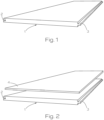
- the figures show the following components: composite material 1, milling recess 2, milling profile 3, cover lamella 4.
- Spruce wood dust from an industrial grinding plant was fractionated using a cyclone separator to provide wood dust with a median particle size of about 350 ⁇ m.
- the wood dust had a moisture content of about 9 wt.% and was subsequently used as a base material in a process according to the invention.
- Polyhydroxybutyrate with a median particle size of about 7 ⁇ m and a moisture content of about 0.4% was used as matrix material in a process according to the invention as purchased from the manufacturer.
- the resulting mixture was then pressed in a hot press to form a sheet material with dimensions of 250 mm x 1000 mm x 10 mm.
- the pressing continued until the core temperature of the pressed part reached around 180°C. This temperature is significantly higher than the softening point of the matrix material used.
- a compact composite material with the following properties was obtained: density about 650 kg/m 3 ; transverse tensile strength about 1 MPa; thickness swelling about 5% over 24 hours in water; no mold growth after 10 days of storage in 90% relative humidity.
- the composite material has an improved property profile compared to typical HDF materials, especially with regard to thickness swelling and mold growth.
- the composite material was further bonded to a layer of real wood cover slats and a tongue-and-groove system was formed by milling on opposite edges so that the material produced in this way could be used as a parquet flooring material.
- Fig. 1 shows axonometric representation of Fig. 1 shown schematically.
- Fig. 2 shows a view with cover lamella 4.
- the second embodiment was carried out analogously to the first embodiment, with the difference that a kraft lignin powder with a median particle size of about 25 ⁇ m and a moisture content of about 6 wt.% in a weight proportion of about 40% was used as the matrix material. All other parameters and process steps were identical to the first embodiment.
- the resulting composite material had only a slightly different property profile compared to the first embodiment.
Landscapes
- Life Sciences & Earth Sciences (AREA)
- Engineering & Computer Science (AREA)
- Wood Science & Technology (AREA)
- Forests & Forestry (AREA)
- Manufacturing & Machinery (AREA)
- Chemical & Material Sciences (AREA)
- Mechanical Engineering (AREA)
- Materials Engineering (AREA)
- Health & Medical Sciences (AREA)
- Chemical Kinetics & Catalysis (AREA)
- Medicinal Chemistry (AREA)
- Polymers & Plastics (AREA)
- Organic Chemistry (AREA)
- Dry Formation Of Fiberboard And The Like (AREA)
- Casting Or Compression Moulding Of Plastics Or The Like (AREA)
Applications Claiming Priority (1)
| Application Number | Priority Date | Filing Date | Title |
|---|---|---|---|
| ATA50112/2023A AT526970B1 (de) | 2023-02-20 | 2023-02-20 | Verfahren zur Herstellung eines Verbundwerkstoffs |
Publications (3)
| Publication Number | Publication Date |
|---|---|
| EP4458539A2 true EP4458539A2 (fr) | 2024-11-06 |
| EP4458539A3 EP4458539A3 (fr) | 2025-03-19 |
| EP4458539B1 EP4458539B1 (fr) | 2026-03-25 |
Family
ID=89940868
Family Applications (1)
| Application Number | Title | Priority Date | Filing Date |
|---|---|---|---|
| EP24157277.5A Active EP4458539B1 (fr) | 2023-02-20 | 2024-02-13 | Procédé de fabrication d'un matériau composite |
Country Status (2)
| Country | Link |
|---|---|
| EP (1) | EP4458539B1 (fr) |
| AT (1) | AT526970B1 (fr) |
Family Cites Families (8)
| Publication number | Priority date | Publication date | Assignee | Title |
|---|---|---|---|---|
| AU8662891A (en) * | 1990-10-23 | 1992-05-20 | Atomic Energy Of Canada Limited | Process for the preparation of cellulosic fibre-reinforced thermoplastic composite materials |
| PT1877192E (pt) * | 2005-03-24 | 2013-01-28 | Xyleco Inc | Método de produção de materiais fibrosos |
| PL2125947T3 (pl) * | 2007-02-23 | 2019-06-28 | Basf Se | Materiały kompozytowe i sposób ich wytwarzania |
| JP2008255280A (ja) * | 2007-04-06 | 2008-10-23 | Nippon Esuko Kk | 木質系複合材料およびその製造方法 |
| AR099210A1 (es) * | 2014-01-28 | 2016-07-06 | Georgia Pacific Chemicals Llc | Adhesivos de lignina |
| DE102014214686A1 (de) * | 2014-07-25 | 2016-01-28 | Homag Holzbearbeitungssysteme Gmbh | Vergüten einer Werkstückfläche |
| BR112021026212A2 (pt) * | 2019-07-16 | 2022-07-05 | Flooring Ind Ltd Sarl | Placa e painel de piso à base dessa placa |
| JP7732190B2 (ja) * | 2021-02-04 | 2025-09-02 | Toppanホールディングス株式会社 | 木質基材、化粧材及びその製造方法 |
-
2023
- 2023-02-20 AT ATA50112/2023A patent/AT526970B1/de active
-
2024
- 2024-02-13 EP EP24157277.5A patent/EP4458539B1/fr active Active
Also Published As
| Publication number | Publication date |
|---|---|
| EP4458539B1 (fr) | 2026-03-25 |
| EP4458539A3 (fr) | 2025-03-19 |
| AT526970A1 (de) | 2024-09-15 |
| AT526970B1 (de) | 2025-01-15 |
Similar Documents
| Publication | Publication Date | Title |
|---|---|---|
| EP3938158B1 (fr) | Matériau sous forme de plaque et son procédé de fabrication | |
| EP3725481B1 (fr) | Matériau sous forme de plaque et son procédé de fabrication | |
| DE69730412T2 (de) | Verfahren zur Herstellung von Celluloseverbundwerkstoffen | |
| EP2974841B1 (fr) | Procede de fabrication d'un panneau de fibres | |
| AT526970B1 (de) | Verfahren zur Herstellung eines Verbundwerkstoffs | |
| EP2355965B1 (fr) | Composition et procédé de fabrication d'un panneau de bois ou d'un panneau de fibres de bois | |
| EP2551081A1 (fr) | Élément de moulage et son procédé de fabrication | |
| EP1780243B2 (fr) | Composition de liant pour matériaux à base de bois | |
| EP3268190B1 (fr) | Procédé de fabrication d'un matériau à base de particules de bois et durcisseur employé dans ledit matériau pour aminoplaste | |
| EP3733367B1 (fr) | Matériaux dérivés du bois et compositions de liant | |
| EP4219105B1 (fr) | Procédé de fabrication d'un panneau de fibres | |
| DE102017010363B3 (de) | Poröses Trägersystem zur Reduktion der Formaldehydemission in einem Holzwerkstoff | |
| EP2078599B1 (fr) | Plaque de serrage | |
| EP4241950B1 (fr) | Procédé de fabrication d'un panneau de particules de bois, ainsi que panneau de particules de bois | |
| WO2023143963A1 (fr) | Procédé de fabrication d'un panneau de fibres | |
| EP3290172B1 (fr) | Utilisation de la colle thermofusible pour la réduction des émissions de composés organiques volatiles provenant de matériaux dérivés du bois | |
| EP4581089A2 (fr) | Procédé de fabrication d'un panneau en matériau dérivé du bois pourvu d'un agent ignifuge | |
| DE1283536B (de) | Herstellen von Formteilen | |
| AT526772A4 (de) | Holzfaserplatte und Verfahren zur Herstellung einer Holzfaserplatte | |
| WO2022038109A1 (fr) | Formulation d'adhésif pour la fabrication de corps moulés en matière à mouler par compression | |
| WO2022038110A1 (fr) | Formulation adhésive pour la production de corps moulés de matériau comprimé | |
| EP1547763A1 (fr) | Matériaux en bois électroconducteur et procédé de préparation | |
| DE2401282A1 (de) | Verfahren zur herstellung einer matte aus lignocellulosefasern |
Legal Events
| Date | Code | Title | Description |
|---|---|---|---|
| PUAI | Public reference made under article 153(3) epc to a published international application that has entered the european phase |
Free format text: ORIGINAL CODE: 0009012 |
|
| STAA | Information on the status of an ep patent application or granted ep patent |
Free format text: STATUS: THE APPLICATION HAS BEEN PUBLISHED |
|
| AK | Designated contracting states |
Kind code of ref document: A2 Designated state(s): AL AT BE BG CH CY CZ DE DK EE ES FI FR GB GR HR HU IE IS IT LI LT LU LV MC ME MK MT NL NO PL PT RO RS SE SI SK SM TR |
|
| PUAL | Search report despatched |
Free format text: ORIGINAL CODE: 0009013 |
|
| AK | Designated contracting states |
Kind code of ref document: A3 Designated state(s): AL AT BE BG CH CY CZ DE DK EE ES FI FR GB GR HR HU IE IS IT LI LT LU LV MC ME MK MT NL NO PL PT RO RS SE SI SK SM TR |
|
| RIC1 | Information provided on ipc code assigned before grant |
Ipc: B27N 9/00 20060101ALN20250211BHEP Ipc: B27D 1/00 20060101ALN20250211BHEP Ipc: B27N 3/08 20060101ALN20250211BHEP Ipc: B27N 1/02 20060101ALN20250211BHEP Ipc: C08L 67/04 20060101ALI20250211BHEP Ipc: B27N 3/18 20060101ALI20250211BHEP Ipc: B27N 7/00 20060101ALI20250211BHEP Ipc: B27N 3/02 20060101ALI20250211BHEP Ipc: B27N 3/00 20060101AFI20250211BHEP |
|
| STAA | Information on the status of an ep patent application or granted ep patent |
Free format text: STATUS: REQUEST FOR EXAMINATION WAS MADE |
|
| 17P | Request for examination filed |
Effective date: 20250915 |
|
| GRAP | Despatch of communication of intention to grant a patent |
Free format text: ORIGINAL CODE: EPIDOSNIGR1 |
|
| STAA | Information on the status of an ep patent application or granted ep patent |
Free format text: STATUS: GRANT OF PATENT IS INTENDED |
|
| RIC1 | Information provided on ipc code assigned before grant |
Ipc: B27N 3/00 20060101AFI20251112BHEP Ipc: B27N 3/02 20060101ALI20251112BHEP Ipc: B27N 7/00 20060101ALI20251112BHEP Ipc: B27N 3/18 20060101ALI20251112BHEP Ipc: C08L 67/04 20060101ALI20251112BHEP Ipc: B27N 1/02 20060101ALN20251112BHEP Ipc: B27N 3/08 20060101ALN20251112BHEP Ipc: B27D 1/00 20060101ALN20251112BHEP Ipc: B27N 9/00 20060101ALN20251112BHEP |
|
| INTG | Intention to grant announced |
Effective date: 20251128 |
|
| GRAS | Grant fee paid |
Free format text: ORIGINAL CODE: EPIDOSNIGR3 |
|
| GRAA | (expected) grant |
Free format text: ORIGINAL CODE: 0009210 |
|
| STAA | Information on the status of an ep patent application or granted ep patent |
Free format text: STATUS: THE PATENT HAS BEEN GRANTED |
|
| AK | Designated contracting states |
Kind code of ref document: B1 Designated state(s): AL AT BE BG CH CY CZ DE DK EE ES FI FR GB GR HR HU IE IS IT LI LT LU LV MC ME MK MT NL NO PL PT RO RS SE SI SK SM TR |
|
| REG | Reference to a national code |
Ref country code: CH Ref legal event code: F10 Free format text: ST27 STATUS EVENT CODE: U-0-0-F10-F00 (AS PROVIDED BY THE NATIONAL OFFICE) Effective date: 20260325 Ref country code: GB Ref legal event code: FG4D Free format text: NOT ENGLISH |
|
| REG | Reference to a national code |
Ref country code: DE Ref legal event code: R096 Ref document number: 502024000908 Country of ref document: DE |
|
| REG | Reference to a national code |
Ref country code: IE Ref legal event code: FG4D Free format text: LANGUAGE OF EP DOCUMENT: GERMAN |