EP4458539A2 - Verfahren zur herstellung eines verbundwerkstoffs - Google Patents
Verfahren zur herstellung eines verbundwerkstoffs Download PDFInfo
- Publication number
- EP4458539A2 EP4458539A2 EP24157277.5A EP24157277A EP4458539A2 EP 4458539 A2 EP4458539 A2 EP 4458539A2 EP 24157277 A EP24157277 A EP 24157277A EP 4458539 A2 EP4458539 A2 EP 4458539A2
- Authority
- EP
- European Patent Office
- Prior art keywords
- composite material
- mixture
- matrix material
- content
- base material
- Prior art date
- Legal status (The legal status is an assumption and is not a legal conclusion. Google has not performed a legal analysis and makes no representation as to the accuracy of the status listed.)
- Granted
Links
Images
Classifications
-
- B—PERFORMING OPERATIONS; TRANSPORTING
- B27—WORKING OR PRESERVING WOOD OR SIMILAR MATERIAL; NAILING OR STAPLING MACHINES IN GENERAL
- B27D—WORKING VENEER OR PLYWOOD
- B27D1/00—Joining wood veneer with any material; Forming articles thereby; Preparatory processing of surfaces to be joined, e.g. scoring
- B27D1/04—Joining wood veneer with any material; Forming articles thereby; Preparatory processing of surfaces to be joined, e.g. scoring to produce plywood or articles made therefrom; Plywood sheets
-
- B—PERFORMING OPERATIONS; TRANSPORTING
- B27—WORKING OR PRESERVING WOOD OR SIMILAR MATERIAL; NAILING OR STAPLING MACHINES IN GENERAL
- B27D—WORKING VENEER OR PLYWOOD
- B27D3/00—Veneer presses; Press plates; Plywood presses
- B27D3/02—Veneer presses; Press plates; Plywood presses with a plurality of press plates, i.e. multi- platen hot presses
-
- B—PERFORMING OPERATIONS; TRANSPORTING
- B27—WORKING OR PRESERVING WOOD OR SIMILAR MATERIAL; NAILING OR STAPLING MACHINES IN GENERAL
- B27N—MANUFACTURE BY DRY PROCESSES OF ARTICLES, WITH OR WITHOUT ORGANIC BINDING AGENTS, MADE FROM PARTICLES OR FIBRES CONSISTING OF WOOD OR OTHER LIGNOCELLULOSIC OR LIKE ORGANIC MATERIAL
- B27N3/00—Manufacture of substantially flat articles, e.g. boards, from particles or fibres
- B27N3/002—Manufacture of substantially flat articles, e.g. boards, from particles or fibres characterised by the type of binder
-
- B—PERFORMING OPERATIONS; TRANSPORTING
- B27—WORKING OR PRESERVING WOOD OR SIMILAR MATERIAL; NAILING OR STAPLING MACHINES IN GENERAL
- B27N—MANUFACTURE BY DRY PROCESSES OF ARTICLES, WITH OR WITHOUT ORGANIC BINDING AGENTS, MADE FROM PARTICLES OR FIBRES CONSISTING OF WOOD OR OTHER LIGNOCELLULOSIC OR LIKE ORGANIC MATERIAL
- B27N3/00—Manufacture of substantially flat articles, e.g. boards, from particles or fibres
- B27N3/02—Manufacture of substantially flat articles, e.g. boards, from particles or fibres from particles
-
- B—PERFORMING OPERATIONS; TRANSPORTING
- B27—WORKING OR PRESERVING WOOD OR SIMILAR MATERIAL; NAILING OR STAPLING MACHINES IN GENERAL
- B27N—MANUFACTURE BY DRY PROCESSES OF ARTICLES, WITH OR WITHOUT ORGANIC BINDING AGENTS, MADE FROM PARTICLES OR FIBRES CONSISTING OF WOOD OR OTHER LIGNOCELLULOSIC OR LIKE ORGANIC MATERIAL
- B27N3/00—Manufacture of substantially flat articles, e.g. boards, from particles or fibres
- B27N3/08—Moulding or pressing
- B27N3/18—Auxiliary operations, e.g. preheating, humidifying, cutting-off
-
- B—PERFORMING OPERATIONS; TRANSPORTING
- B27—WORKING OR PRESERVING WOOD OR SIMILAR MATERIAL; NAILING OR STAPLING MACHINES IN GENERAL
- B27N—MANUFACTURE BY DRY PROCESSES OF ARTICLES, WITH OR WITHOUT ORGANIC BINDING AGENTS, MADE FROM PARTICLES OR FIBRES CONSISTING OF WOOD OR OTHER LIGNOCELLULOSIC OR LIKE ORGANIC MATERIAL
- B27N7/00—After-treatment, e.g. reducing swelling or shrinkage, surfacing; Protecting the edges of boards against access of humidity
- B27N7/005—Coating boards, e.g. with a finishing or decorating layer
-
- C—CHEMISTRY; METALLURGY
- C08—ORGANIC MACROMOLECULAR COMPOUNDS; THEIR PREPARATION OR CHEMICAL WORKING-UP; COMPOSITIONS BASED THEREON
- C08L—COMPOSITIONS OF MACROMOLECULAR COMPOUNDS
- C08L97/00—Compositions of lignin-containing materials
- C08L97/005—Lignin
-
- C—CHEMISTRY; METALLURGY
- C08—ORGANIC MACROMOLECULAR COMPOUNDS; THEIR PREPARATION OR CHEMICAL WORKING-UP; COMPOSITIONS BASED THEREON
- C08L—COMPOSITIONS OF MACROMOLECULAR COMPOUNDS
- C08L97/00—Compositions of lignin-containing materials
- C08L97/02—Lignocellulosic material, e.g. wood, straw or bagasse
-
- B—PERFORMING OPERATIONS; TRANSPORTING
- B27—WORKING OR PRESERVING WOOD OR SIMILAR MATERIAL; NAILING OR STAPLING MACHINES IN GENERAL
- B27N—MANUFACTURE BY DRY PROCESSES OF ARTICLES, WITH OR WITHOUT ORGANIC BINDING AGENTS, MADE FROM PARTICLES OR FIBRES CONSISTING OF WOOD OR OTHER LIGNOCELLULOSIC OR LIKE ORGANIC MATERIAL
- B27N1/00—Pretreatment of moulding material
- B27N1/02—Mixing the material with binding agent
-
- B—PERFORMING OPERATIONS; TRANSPORTING
- B27—WORKING OR PRESERVING WOOD OR SIMILAR MATERIAL; NAILING OR STAPLING MACHINES IN GENERAL
- B27N—MANUFACTURE BY DRY PROCESSES OF ARTICLES, WITH OR WITHOUT ORGANIC BINDING AGENTS, MADE FROM PARTICLES OR FIBRES CONSISTING OF WOOD OR OTHER LIGNOCELLULOSIC OR LIKE ORGANIC MATERIAL
- B27N3/00—Manufacture of substantially flat articles, e.g. boards, from particles or fibres
- B27N3/08—Moulding or pressing
-
- B—PERFORMING OPERATIONS; TRANSPORTING
- B27—WORKING OR PRESERVING WOOD OR SIMILAR MATERIAL; NAILING OR STAPLING MACHINES IN GENERAL
- B27N—MANUFACTURE BY DRY PROCESSES OF ARTICLES, WITH OR WITHOUT ORGANIC BINDING AGENTS, MADE FROM PARTICLES OR FIBRES CONSISTING OF WOOD OR OTHER LIGNOCELLULOSIC OR LIKE ORGANIC MATERIAL
- B27N7/00—After-treatment, e.g. reducing swelling or shrinkage, surfacing; Protecting the edges of boards against access of humidity
-
- B—PERFORMING OPERATIONS; TRANSPORTING
- B27—WORKING OR PRESERVING WOOD OR SIMILAR MATERIAL; NAILING OR STAPLING MACHINES IN GENERAL
- B27N—MANUFACTURE BY DRY PROCESSES OF ARTICLES, WITH OR WITHOUT ORGANIC BINDING AGENTS, MADE FROM PARTICLES OR FIBRES CONSISTING OF WOOD OR OTHER LIGNOCELLULOSIC OR LIKE ORGANIC MATERIAL
- B27N9/00—Arrangements for fireproofing
-
- C—CHEMISTRY; METALLURGY
- C08—ORGANIC MACROMOLECULAR COMPOUNDS; THEIR PREPARATION OR CHEMICAL WORKING-UP; COMPOSITIONS BASED THEREON
- C08L—COMPOSITIONS OF MACROMOLECULAR COMPOUNDS
- C08L2201/00—Properties
- C08L2201/06—Biodegradable
Definitions
- the present invention relates to a method for producing a composite material and to a composite material as such.
- Wood-containing composite materials are known in various designs in the state of the art and are used in various fields of technology. In most cases, finely divided wood particles (fibers, chips or the like) are processed with a binding agent to form a solid composite material.
- binding agents used are materials based on fossil raw materials with a high water content of at least 30%.
- composite materials with bio-based additives such as lignin are also known, processing here also typically takes place in the liquid state, which on the one hand requires the removal of the water with a correspondingly high energy input and on the other hand causes wood-physical swelling with the resulting technological disadvantages, which often have to be compensated for by additional process steps.
- the ecological balance and sustainability of materials based on wood or lignocellulose is therefore significantly worsened by the use of binding agents based on fossil raw materials.
- Panel materials such as those used for parquet flooring structures, must have a variety of mechanical and physical properties.
- the benchmark for panel-shaped parquet supports is high-density fiberboard (HDF) made using binding agents made from fossil raw materials, which, due to their properties, can also be equipped with filigree milling and click system profiles in the edge areas.
- HDF high-density fiberboard
- WPC wood-plastic composites
- An object of the present invention can be seen in achieving at least one of these goals.
- an object can be seen in providing a completely bio-based composite material based on lignocellulose, which has a high content of lignocellulose or wood and which can be produced using as little energy as possible.
- the object is achieved in particular by a process in which a lignocellulose-containing base material is mixed with a matrix material and then pressed.
- the base material is in particular present as dust, while the matrix material can be in particular present as powder, whereby the average particle size of base material and matrix material can be a maximum of 500 ⁇ m.
- the content of lignocellulosic base material can be greater than or equal to 60% by weight of the total mass of the mixture and the composite material produced from it can have densities of less than 800 kg/m 3 , which distinguishes it from wood-plastic composites, which, as already mentioned, can typically have a significantly higher matrix material content, but in any case have a higher density.
- the matrix material content can therefore be less than or equal to 40% by weight, but it can also be less than or equal to 20% by weight or less than or equal to 10% by weight.
- the mixture obtained is preferably pressed and heated until the core temperature of the pressed part has reached or exceeded the softening point of the matrix material.
- the softening point refers in particular to the Vicat softening temperature determined according to DIN EN ISO 306.
- the present inventors assume that heating the pressed part at least up to the softening point in combination with the pressing and the intimate mixing of the dust and powder components enables a particularly good bond between the two components in order to form a dimensionally stable and mechanically highly stressable composite material.
- the matrix material powder can therefore preferably have an average particle size of less than 100 ⁇ m, more preferably less than 50 ⁇ m or less than 20 ⁇ m.
- the average particle size refers in particular to the median value, i.e. the 0.5 quartile, of the particle size distribution.
- Polyhydroxyalkanoates or lignin are used as preferred matrix materials.
- polyhydroxyalkanoates polyhydroxybutyrate or a mixture of polyhydroxybutyrate and polyhydroxyvalerate with a maximum of 2% by weight of polyhydroxyvalerate is preferred.
- Kraft lignin is preferred as lignin.
- the base material is preferably dust from coniferous wood species, especially spruce wood.
- the water content of the starting materials used is preferably particularly low.
- the water content of the base material is typically less than 20% by weight based on the total mass of the base material, in particular less than 12% by weight.
- the water content of the matrix material is typically less than 10% by weight based on the total mass of the matrix material.
- the water content of the matrix material it should be noted that this can depend on the matrix material used, with a polyhydroxyalkanoate typically having a water content of less than 3% by weight, in particular less than 0.4% by weight, and lignin typically having a water content of less than 10% by weight, in particular less than 6% by weight.
- the mixture of base material and matrix material may optionally contain one or more additives, which may be selected from one or more of the following substance classes, for example: pigment, flame retardant, hydrophobic agent, odorizer.
- the additive can be added to the mixture when the base material and matrix material are mixed.
- the weight ratio between base material and additive can be set as follows: base material to pigment 5:1 to 100:1; base material to flame retardant 5:1 to 1000:1; base material to hydrophobic agent 10:1 to 1000:1; base material to odorizing agent 10:1 to 1000:1.
- the additive is optionally added to the mixture in powder form, in particular with an average particle size of no more than 100 ⁇ m.
- the base material can be wood dust that comes directly from a wood processing machine.
- a fractionation device can be provided that carries out fractionation in a known manner.
- the fractionation device can be a screening device or a cyclone separator.
- the direct use of wood dust is advantageous because no energy has to be expended for further crushing of the wood material.
- a suitable high-performance mixer is, for example, a vertical ribbon mixer.
- Pressing is carried out in particular in a warm or hot press that has heated press plates.
- the temperature to be reached in the core of the pressed material must be adapted to the softening point of the respective matrix material, but it is typically above 120°C, in particular between 140°C and 200°C. Pressing can also be carried out using continuous pressing. as are typically used in the production of other wood-based panels.
- the process may include further processing steps after pressing, for example post-machining or further forming of the composite material produced.
- Lamination or other surface bonding with another material can also be used to form a layered material.
- the other material can be, for example, a real wood veneer that is applied to one side of the composite material. This can be used to form panel materials that are used as parquet material or as furniture construction material.
- the present invention also relates to a composite material as such.
- the process features give the composite material a special property profile.
- the invention therefore also relates to a composite material that is obtainable using a method according to the invention.
- the composite material may have one or more of the following properties: density between 500 and 1,200 kg/m 3 ; transverse tensile strength between 0.3 and 2.5 MPa; thickness swelling in water for 24 hours between 3% and 30%; increased resistance to fungal attack.
- Increased resistance to fungal attack can mean in particular that no fungal attack occurs after 4 weeks of storage at a relative humidity of over 90%.
- Storage can be carried out in particular in accordance with or based on ⁇ NORM B 6010, Section 4.22.
- No fungal attack or “free of fungal attack” can mean in particular that no fungal attack can be detected by visual determination in accordance with or based on EN ISO 846, Section 9.1.
- the composite material can be bonded with conventional wood adhesives, for example with adhesives based on polyurethane, polyvinyl acetate, emulsion polymer isocyanate, thermosetting or thermoplastic adhesive systems.
- the composite material can be coated with films or liquid systems, such as resin films, varnishes, oils or waxes.
- the invention preferably relates to a method for producing a composite material, in particular in the form of a plate.
- the method preferably comprises the following steps: (a) providing a lignocellulose-containing base material, in particular in the form of dust, with an average particle size of at most 500 ⁇ m and a thermoplastic matrix material, in particular in the form of powder, with an average particle size of at most 500 ⁇ m, preferably of at most 100 ⁇ m, (b) mixing base material, matrix material and optionally at least one further additive, wherein the content of base material based on the total mass of the mixture is at least 60% by weight and wherein the content of matrix material based on the total mass of the mixture is at most 40% by weight, (c) pressing the mixture obtained in step (b) in a hot press at least until the core temperature of the composite material has reached the softening point of the matrix material.
- the water content of the mixture obtained in step (b) before pressing in step (c) is at most 20 wt. %, in particular at most 10 wt. %, of the total mass of the mixture.
- the content of matrix material shall be at least 5% by weight based on the total mass of the mixture.
- the basic material is wood dust from softwood, in particular spruce.
- the matrix material is a polyhydroxyalkanoate, lignin, in particular kraft lignin, or a mixture thereof.
- the matrix material is polyhydroxybutyrate
- the matrix material is a mixture of polyhydroxybutyrate and polyhydroxyvalerate, the mixture containing a maximum of 2% by weight of polyhydroxyvalerate.
- the pressing of the mixture is carried out until the core temperature of the composite material is at least 120°C, in particular until the core temperature is between 140°C and 200°C.
- the additive is selected from one or more of the following: pigment, flame retardant, hydrophobic agent, odorizing agent.
- the composite material is to be subjected to a processing step after pressing, such as laminating, coating, sawing, grinding, milling or drilling.
- the composite material is bonded to a wood veneer layer after pressing to form a parquet material.
- the invention also relates to a composite material, in particular produced by a process according to the invention, comprising a lignocellulose-containing base material with an average particle size of at most 500 ⁇ m, a thermoplastic matrix material and optionally at least one further additive.
- the content of base material based on the total mass of the mixture is at least 60 wt.% and the content of matrix material based on the total mass of the mixture is at most 40 wt.%.
- the composite material shall have a density of between 500 and 1200 kg/ m3 .
- the composite material is intended to have a transverse tensile strength of between 0.3 and 2.5 MPa.
- the composite material is intended to exhibit a thickness swell in water over 24 hours of between 3.0% and 30%.
- the composite material is free from fungal attack after 4 weeks of storage at more than 90% relative humidity, whereby the test during storage is carried out in accordance with ⁇ NORM B 6010, section 4.22, and a visual determination of the fungal attack is carried out in accordance with EN ISO 846, section 9.1.
- the composite material is intended to be a parquet material comprising a wood layer and a base layer containing the base material and the matrix material.
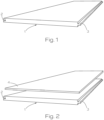
- the figures show the following components: composite material 1, milling recess 2, milling profile 3, cover lamella 4.
- Spruce wood dust from an industrial grinding plant was fractionated using a cyclone separator to provide wood dust with a median particle size of about 350 ⁇ m.
- the wood dust had a moisture content of about 9 wt.% and was subsequently used as a base material in a process according to the invention.
- Polyhydroxybutyrate with a median particle size of about 7 ⁇ m and a moisture content of about 0.4% was used as matrix material in a process according to the invention as purchased from the manufacturer.
- the resulting mixture was then pressed in a hot press to form a sheet material with dimensions of 250 mm x 1000 mm x 10 mm.
- the pressing continued until the core temperature of the pressed part reached around 180°C. This temperature is significantly higher than the softening point of the matrix material used.
- a compact composite material with the following properties was obtained: density about 650 kg/m 3 ; transverse tensile strength about 1 MPa; thickness swelling about 5% over 24 hours in water; no mold growth after 10 days of storage in 90% relative humidity.
- the composite material has an improved property profile compared to typical HDF materials, especially with regard to thickness swelling and mold growth.
- the composite material was further bonded to a layer of real wood cover slats and a tongue-and-groove system was formed by milling on opposite edges so that the material produced in this way could be used as a parquet flooring material.
- Fig. 1 shows axonometric representation of Fig. 1 shown schematically.
- Fig. 2 shows a view with cover lamella 4.
- the second embodiment was carried out analogously to the first embodiment, with the difference that a kraft lignin powder with a median particle size of about 25 ⁇ m and a moisture content of about 6 wt.% in a weight proportion of about 40% was used as the matrix material. All other parameters and process steps were identical to the first embodiment.
- the resulting composite material had only a slightly different property profile compared to the first embodiment.
Landscapes
- Life Sciences & Earth Sciences (AREA)
- Engineering & Computer Science (AREA)
- Wood Science & Technology (AREA)
- Forests & Forestry (AREA)
- Manufacturing & Machinery (AREA)
- Chemical & Material Sciences (AREA)
- Mechanical Engineering (AREA)
- Materials Engineering (AREA)
- Health & Medical Sciences (AREA)
- Chemical Kinetics & Catalysis (AREA)
- Medicinal Chemistry (AREA)
- Polymers & Plastics (AREA)
- Organic Chemistry (AREA)
- Dry Formation Of Fiberboard And The Like (AREA)
- Casting Or Compression Moulding Of Plastics Or The Like (AREA)
Abstract
Description
- Die vorliegende Erfindung betrifft ein Verfahren zur Herstellung eines Verbundwerkstoffs sowie einen Verbundwerkstoff als solchen.
- Holzhaltige Verbundwerkstoffe sind im Stand der Technik in unterschiedlichen Ausführungen bekannt und ihr Einsatz findet in verschiedenen Gebieten der Technik statt. Dabei werden meist feinteilige Holzpartikel (Fasern, Späne oder dergleichen) mit einem Bindemittel zu einem festen Verbundwerkstoff verarbeitet.
- Ein besonderer Nachteil einer Vielzahl dieser Werkstoffe ist, dass als Bindemittel auf fossilen Rohstoffen basierende Materialien mit einem hohen Wasseranteil von zumindest 30% zum Einsatz kommen. Zwar sind auch Verbundwerkstoffe mit biobasierten Additiven wie beispielsweise Lignin bekannt, jedoch findet auch hier typischerweise eine Verarbeitung im flüssigen Zustand statt, was zum einen die Entfernung des Wassers mit entsprechend hohem Energieeintrag erforderlich macht und zum anderen holzphysikalische Quellungen mit den daraus resultierenden technologischen Nachteilen verursacht, die oftmals durch zusätzliche Prozessschritte wieder ausgeglichen werden müssen. Die Ökobilanz und die Nachhaltigkeit von Werkstoffen auf Holz- bzw. Lignocellulosebasis wird durch den Einsatz von auf fossilen Rohstoffen basierenden Bindemitteln also deutlich verschlechtert.
- Plattenwerkstoffe, wie sie beispielsweise für Parkettfußboden-Aufbauten verwendet werden, müssen eine Vielzahl an mechanischen und physikalischen Eigenschaften aufweisen. Als Benchmark für plattenförmige Parkettträger gelten mittels aus fossilen Rohstoffen erzeugte Bindemittel hergestellte hochverdichtete Faserplatten (HDF), welche aufgrund ihrer Eigenschaften auch in den Randbereichen mit filigranen Fräsungen und Klicksystem-Profilen ausgestattet werden können.
- Erwähnenswert sind in diesem Zusammenhang auch sogenannte Holz-Kunststoff-Verbunde (Wood-Plastic-Composite, WPC), die jedoch einen hohen Kunststoffgehalt aufweisen, was deren Herstellung kosten- und energieintensiv macht. Typischerweise sind WPC aus biobasierten Kunststoffen nicht erhältlich. WPC weisen auch mit höheren Holzanteilen durch ihre Herstellungstechnologie mittels Extrudern sehr hohe Materialdichten auf und werden daher insbesondere für die gewünschten Einsatzzwecke im Bereich der Parkettwerkstoffe durch diese material- und dichtebedingten Eigenschaften nicht eingesetzt.
- Es wäre daher wünschenswert, die oben genannte Nachteile des Standes der Technik zu überwinden und einen Verbundwerkstoff zu schaffen, der ohne Verwendung von auf fossilen Rohstoffen basierenden Materialien und ohne Wasserzugabe mit der daraus zwingend nachfolgenden Trocknung in den Prozessschritten hergestellt werden kann und dennoch eine ausreichende mechanische Stabilität, insbesondere für nachträgliche Bearbeitungsschritte, aufweist und gleichzeitig eine ausgezeichnete Ökobilanz besitzt.
- Eine Aufgabe der vorliegenden Erfindung kann darin gesehen werden, zumindest eines dieser Ziele zu erreichen. Insbesondere kann eine Aufgabe darin gesehen werden, ein vollständig biobasiertes Verbundmaterial auf Basis von Lignocellulose bereitzustellen, das einen hohen Gehalt an Lignocellulose bzw. Holz aufweist und das unter möglichst wenig Energieeintrag herstellbar ist.
- Die Aufgabe wird insbesondere durch ein Verfahren gelöst, bei dem ein lignocellulosehaltiges Grundmaterial mit einem Matrixmaterial vermischt und anschließend verpresst wird. Das Grundmaterial liegt dabei insbesondere als Staub vor, während das Matrixmaterial insbesondere als Pulver vorliegen kann, wobei die durchschnittliche Partikelgröße von Grundmaterial und Matrixmaterial höchstens 500 µm betragen kann.
- Überraschend wurde im Rahmen der vorliegenden Erfindung herausgefunden, dass eine geringe Partikelgröße von Grundmaterial und Matrixmaterial in Kombination mit einer feinteiligen Vermischung der beiden Komponenten die Herstellung eines plattenförmigen Verbundwerkstoffs ermöglicht, der in seinem Eigenschaftsprofil mit jenem von bekannten Verbundwerkstoffen vergleichbar ist und sich daher in vielen Einsatzgebieten als adäquater Ersatz eignet.
- Insbesondere kann der Gehalt an lignocellulosischem Grundmaterial größer gleich 60 Gew.-% an der Gesamtmasse der Mischung betragen und der daraus produzierte Verbundwerkstoff kann Dichten von unter 800kg/m3 aufweisen, wodurch eine Abgrenzung zu Holz-Kunststoff-Verbunden erfolgt, die wie bereits erwähnt, typischerweise einen deutlich höheren Matrixmaterialgehalt aufweisen können, in jedem Fall aber eine höhere Dichte haben. In dem erfindungsgemäßen Verbundwerkstoff kann der Matrixmaterialgehalt also bei kleiner gleich 40 Gew.-% liegen, er kann jedoch auch kleiner gleich 20 Gew.-% oder kleiner gleich 10 Gew.-% sein.
- In dem erfindungsgemäßen Verfahren wird die erhaltene Mischung bevorzugt verpresst und dabei so lange erhitzt, bis die Kerntemperatur des Presslings den Erweichungspunkt des Matrixmaterials erreicht oder überschritten hat. Dabei bezeichnet der Erweichungspunkt insbesondere die Vicat-Erweichungstemperatur bestimmt nach DIN EN ISO 306.
- Ohne an diese Theorie gebunden zu sein, gehen die vorliegenden Erfinder davon aus, dass die Erwärmung des Presslings zumindest bis auf den Erweichungspunkt in Kombination mit der Verpressung und der innigen Vermischung der Staub- und Pulverkomponente eine besonders gute Verbindung der beiden Komponenten ermöglicht, um einen formstabilen und mechanisch stark beanspruchbaren Verbundwerkstoff zu bilden.
- In bestimmten Ausführungsformen bieten kleinere Partikelgrößen von Grundmaterial und Matrixmaterial bessere Eigenschaften, jedoch kann sich eine zu starke Zerkleinerung wieder negativ auf die Energiebilanz des Verfahrens auswirken, ohne die Eigenschaften des Verbundwerkstoffs wesentlich zu verbessern. Das Matrixmaterial-Pulver kann daher bevorzugt eine durchschnittliche Partikelgröße aufweisen, die unter 100 µm, weiter bevorzugt unter 50 µm oder unter 20 µm liegt.
- Die durchschnittliche Partikelgröße bezeichnet in diesem Zusammenhang insbesondere den Medianwert, also das 0,5-Quartil, der Partikelgrößenverteilung.
- Als bevorzugte Matrixmaterialien werden Polyhydroxyalkanoate oder Lignin eingesetzt. Von den Polyhydroxyalkanoate ist Polyhydroxybutyrat oder eine Mischung aus Polyhydroxybutyrat und Polyhydroxyvalerat mit höchstens 2 Gew.-% Polyhydroxyvalerat bevorzugt. Als Lignin ist Kraftlignin bevorzugt.
- Das Grundmaterial ist bevorzugt Staub aus Nadelholzarten, insbesondere aus Fichtenholz.
- Der Mischung aus Grundmaterial und Matrixmaterial muss keine zusätzliche Flüssigkeit, insbesondere Wasser, zugesetzt werden, um einen festen Verbundwerkstoff zu bilden. Um möglichst wenig oder überhaupt keine Energie für die Verdampfung von Flüssigkeit aufwenden zu müssen, ist der Wassergehalt der eingesetzten Ausgangsmaterialien bevorzugt besonders niedrig. So liegt der Wassergehalt des Grundmaterials typischerweise bei weniger als 20 Gew.-% bezogen auf die Gesamtmasse des Grundmaterials, insbesondere bei weniger als 12 Gew.-%. Der Wassergehalt des Matrixmaterials liegt typischerweise bei weniger als 10 Gew.-% bezogen auf die Gesamtmasse des Matrixmaterials. In Hinblick auf den Wassergehalt des Matrixmaterials ist anzumerken, dass dieser vom eingesetzten Matrixmaterial abhängig sein kann, wobei ein Polyhydroxyalkanoat typischerweise einen Wassergehalt von unter 3 Gew.-%, insbesondere von unter 0,4 Gew.-% und Lignin typischerweise einen Wassergehalt von unter 10 Gew.-%, insbesondere von unter 6 Gew.-% aufweisen kann.
- Die Mischung aus Grundmaterial und Matrixmaterial kann gegebenenfalls noch ein oder mehrere Additive enthalten, die beispielsweise aus einem oder mehreren der folgenden Stoffklassen ausgewählt sein können: Pigment, Flammschutzmittel, Hydrophobierungsmittel, Odorisierungsmittel. Das Additiv kann der Mischung beim Vermischen von Grundmaterial und Matrixmaterial zugesetzt werden
- In speziellen Ausführungsformen kann das Gewichtsverhältnis zwischen Grundmaterial und Additiv und wie folgt eingestellt werden: Grundmaterial zu Pigment 5:1 bis 100:1; Grundmaterial zu Flammschutzmittel 5:1 bis 1000:1; Grundmaterial zu Hydrophobierungsmittel 10:1 bis 1000:1; Grundmaterial zu Odorisierungsmittel 10:1 bis 1000:1.
- Das Additiv wird der Mischung gegebenenfalls auch aus Pulver, also insbesondere mit einer durchschnittlichen Partikelgröße von höchstens 100 µm, zugegeben.
- Das Grundmaterial kann Holzstaub sein, der direkt von einer Holzverarbeitungsmaschine stammt. Um die gewünschte Partikelgrößenverteilung zu erreichen kann eine Fraktionierungsvorrichtung vorgesehen sein, die in bekannter Weise eine Fraktionierung durchführt. Es kann sich bei der Fraktionierungsvorrichtung und eine Siebvorrichtung oder einen Zyklonabscheider handeln. Die direkte Verwendung von Holzstaub ist vorteilhaft, da keine Energie für die weitere Zerkleinerung des Holzmaterials aufgewendet werden muss.
- Das Vermischen von Grundmaterial, Matrixmaterial und dem optionalen Additiv erfolgt gegebenenfalls in einem Hochleistungsmischer, um eine gute Homogenisierung der Komponenten vor dem Verpressen zu ermöglichen. Ein geeigneter Hochleistungsmischer ist beispielsweise ein vertikaler Bandmischer.
- Das Verpressen wird insbesondere in einer Warm- oder Heißpresse durchgeführt, die beheizte Pressplatten aufweist. Die im Kern des verpressten Materials zu erreichende Temperatur ist wie bereits erwähnt an den Erweichungspunkt des jeweiligen Matrixmaterials anzupassen, jedoch liegt sie typischerweise über 120°C, insbesondere zwischen 140°C und 200°C. Das Verpressen kann auch mittels Endlospressen erfolgen, wie sie typischerweise bei der Herstellung von anderen Holzwerkstoffplatten eingesetzt werden.
- In dem Verfahren können nach dem Verpressen noch weitere Verarbeitungsschritte vorgesehen sein, beispielsweise eine spanende Nachbearbeitung oder ein weiteres Umformen des hergestellten Verbundwerkstoffs.
- Es kann auch eine Laminierung oder ein anderweitiges flächiges Verbinden mit einem weiteren Werkstoff erfolgen, sodass ein Schichtwerkstoff gebildet wird. Bei dem weiteren Werkstoff kann es sich beispielsweise um ein Echtholzfurnier handeln, das auf eine Seite des Verbundwerkstoffs aufgebracht wird. So können Plattenbaustoffe gebildet werden, die als Parkettmaterial oder als Möbelbau-Material Anwendung finden.
- Durch Anwendung des erfindungsgemäßen Verfahrens kann ein Verbundwerkstoff hergestellt werden, der besondere Eigenschaften aufweist. Daher betrifft die vorliegende Erfindung auch einen Verbundwerkstoff als solchen. Insbesondere ist anzumerken, dass die Verfahrensmerkmale dem Verbundwerkstoff ein besonderes Eigenschaftsprofil verleihen. Die Erfindung betrifft daher auch einen Verbundwerkstoff der über ein erfindungsgemäßes Verfahren erhältlich ist.
- Der Verbundwerkstoff kann eine oder mehrere der folgenden Eigenschaften aufweisen: Dichte zwischen 500 und 1.200 kg/m3; Querzugfestigkeit zwischen 0,3 und 2,5 MPa; Dickenquellung 24 h in Wasser zwischen 3% und 30%; erhöhte Resistenz gegen Pilzbefall.
- Eine erhöhte Resistenz gegen Pilzbefall kann insbesondere bedeuten, dass nach 4-wöchiger Lagerung bei einer relativen Luftfeuchte von über 90% kein Pilzbefall auftritt. Die Lagerung kann insbesondere in Anlehnung an bzw. gemäß ÖNORM B 6010, Abschnitt 4.22 erfolgen. "Kein Pilzbefall" oder "pilzbefallfrei" kann insbesondere bedeuten, dass durch visuelle Bestimmung in Anlehnung an bzw. gemäß EN ISO 846, Abschnitt 9.1 kein Pilzbefall festgestellt werden kann.
- Der Verbundwerkstoff kann mit konventionellen Holzklebstoffen verklebt werden, beispielsweise mit Klebstoffen auf Basis von Polyurethan, Polyvinylacetat, Emulsionspolymer-Isocyanat, duro- oder thermoplastischen Klebesystemen.
- Der Verbundwerkstoff kann mit Folien oder flüssigen Systemen beschichtet werden, beispielsweise mit Harzfolien, Lacken, Ölen oder Wachsen.
- Die Erfindung betrifft bevorzugt ein Verfahren zur Herstellung eines insbesondere plattenförmigen Verbundwerkstoffs. Das Verfahren umfasst bevorzugt die folgenden Schritte: (a) Bereitstellen eines lignocellulosehaltigen, insbesondere als Staub vorliegenden, Grundmaterials mit einer durchschnittlichen Partikelgröße von höchstens 500 µm sowie eines thermoplastischen, insbesondere als Pulver vorliegenden, Matrixmaterials mit einer durchschnittlichen Partikelgröße von höchstens 500 µm, bevorzugt von höchstens 100 µm, (b) Mischen von Grundmaterial, Matrixmaterial und gegebenenfalls zumindest eines weiteren Additivs, wobei der Gehalt an Grundmaterial bezogen auf die Gesamtmasse der Mischung wenigstens 60 Gew.-% beträgt und wobei der Gehalt an Matrixmaterial bezogen auf die Gesamtmasse der Mischung höchstens 40 Gew.-% beträgt, (c) Verpressen der in Schritt (b) erhaltenen Mischung in einer Warmpresse zumindest bis die Kerntemperatur des Verbundwerkstoffs den Erweichungspunkt des Matrixmaterials erreicht hat.
- Gegebenenfalls ist vorgesehen, dass der Wassergehalt der in Schritt (b) erhaltenen Mischung vor dem Verpressen in Schritt (c) höchstens 20 Gew.-%, insbesondere höchstens 10 Gew.-%, an der Gesamtmasse der Mischung beträgt.
- Gegebenenfalls ist vorgesehen, dass der Gehalt an Matrixmaterial bezogen auf die Gesamtmasse der Mischung wenigstens 5 Gew.-% beträgt.
- Gegebenenfalls ist vorgesehen, dass das Grundmaterial Holzstaub aus Nadelholz, insbesondere aus Fichtenholz, ist.
- Gegebenenfalls ist vorgesehen, dass das Matrixmaterial ein Polyhydroxyalkanoat, Lignin, insbesondere Kraftlignin, oder eine Mischung daraus ist.
- Gegebenenfalls ist vorgesehen, dass das Matrixmaterial Polyhydroxybutyrat ist,
Gegebenenfalls ist vorgesehen, dass das Matrixmaterial eine Mischung aus Polyhydroxybutyrat und Polyhydroxyvalerat ist, wobei in der Mischung höchstens 2 Gew.-% Polyhydroxyvalerat enthalten sind. - Gegebenenfalls ist vorgesehen, dass das Verpressen der Mischung durchgeführt wird, bis die Kerntemperatur des Verbundwerkstoffs wenigstens 120°C beträgt, insbesondere bis die Kerntemperatur zwischen 140°C und 200°C beträgt.
- Gegebenenfalls ist vorgesehen, dass das Additiv aus einem oder mehreren der folgenden ausgewählt ist: Pigment, Flammschutzmittel, Hydrophobierungsmittel, Odorisierungsmittel.
- Gegebenenfalls ist vorgesehen, dass der Verbundwerkstoff nach dem Verpressen einem Bearbeitungsschritt unterzogen wird, beispielsweise Laminieren, Beschichten, Sägen, Schleifen, Fräsen, Bohren.
- Gegebenenfalls ist vorgesehen, dass der Verbundwerkstoff nach dem Verpressen zur Bildung eines Parkettmaterials flächig mit einer Holzfurnierschicht verbunden wird.
- Bevorzugt betrifft die Erfindung auch einen Verbundwerkstoff, insbesondere hergestellt aus einem erfindungsgemäßen Verfahren, umfassend ein lignocellulosehaltiges Grundmaterial mit einer durchschnittlichen Partikelgröße von höchstens 500 µm, ein thermoplastisches Matrixmaterial sowie gegebenenfalls zumindest ein weiteres Additiv.
- Bevorzugt ist vorgesehen, dass der Gehalt an Grundmaterial bezogen auf die Gesamtmasse der Mischung wenigstens 60 Gew.-% beträgt, und dass der Gehalt an Matrixmaterial bezogen auf die Gesamtmasse der Mischung höchstens 40 Gew.-% beträgt.
- Gegebenenfalls ist vorgesehen, dass der Verbundwerkstoff eine Dichte zwischen 500 und 1200 kg/m3 aufweist.
- Gegebenenfalls ist vorgesehen, dass der Verbundwerkstoff eine Querzugfestigkeit von zwischen 0,3 und 2,5 MPa aufweist.
- Gegebenenfalls ist vorgesehen, dass der Verbundwerkstoff eine Dickenquellung in Wasser über 24 Stunden von zwischen 3,0% und 30% aufweist.
- Gegebenenfalls ist vorgesehen, dass der Verbundwerkstoff bei 4-wöchiger Lagerung bei über 90% relativer Luftfeuchte pilzbefallfrei ist, wobei die Versuchsdurchführung bei der Lagerung in Anlehnung an ÖNORM B 6010, Abschnitt 4.22 erfolgt, und wobei eine visuelle Bestimmung des Pilzbefalls in Anlehnung an EN ISO 846, Abschnitt 9.1 erfolgt.
- Gegebenenfalls ist vorgesehen, dass der Verbundwerkstoff ein Parkettmaterial ist, das eine Holzschicht sowie eine das Grundmaterial und das Matrixmaterial enthaltende Basisschicht umfasst.
- Weitere Merkmale der Erfindung ergeben sich aus den Patentansprüchen, den Figuren und der nachfolgenden Beschreibung der Ausführungsbeispiele. Die Ausführungsbeispiele dienen lediglich der Veranschaulichung vorteilhafter Aspekte der vorliegenden Erfindung und sollen den durch die Patentansprüche definierten Schutzbereich nicht einschränken.
- Es zeigen:
-
Fig. 1 eine schematische Darstellung eines Verbundwerkstoffs gemäß einem Ausführungsbeispiel der vorliegenden Erfindung; und -
Fig. 2 eine schematische Darstellung eines Verbundwerkstoffs gemäß einem weiteren Ausführungsbeispiel der vorliegenden Erfindung. - Sofern nicht anders bezeichnet zeigen die Figuren folgende Komponenten: Verbundwerkstoff 1, Einfräsung 2, Fräsprofil 3, Decklamelle 4.
- Holzstaub aus Fichtenholz aus einer industriellen Schleifanlage wurde mittels eines Zyklonabscheiders fraktioniert, um einen Holzstaub mit einer medianen Partikelgröße von etwa 350 µm bereitzustellen. Der Holzstaub wies einen Feuchtegehalt von etwa 9 Gew.-% auf und wurde in weiterer Folge als Grundmaterial in einem erfindungsgemäßen Verfahren eingesetzt.
- Polyhydroxybutyrat mit einer medianen Partikelgröße von etwa 7 µm und einem Feuchtegehalt von etwa 0,4% wurde wie vom Hersteller bezogen als Matrixmaterial in einem erfindungsgemäßen Verfahren eingesetzt.
- Etwa 80 Gew.-% des Grundmaterials und etwa 20 Gew.-% des Matrixmaterials wurden in einem Hochleistungsmixer mit Doppelflügel bei etwa 30.000 U/min und einer Leistung von etwa 2 PS/I homogenisiert.
- Die erhaltene Mischung wurde anschließend in einer Heizpresse zu einem Plattenwerkstoff mit einer Dimension von 250 mm x 1000 mm x 10 mm verpresst. Es wurde so lange gepresst, bis eine Kerntemperatur des Presslings von etwa 180°C erreicht war. Diese Temperatur liegt deutlich über dem Erweichungspunkt des eingesetzten Matrixmaterials.
- Nach dem Verpressen wurde ein kompakter Verbundwerkstoff mit den folgenden Eigenschaften erhalten: Dichte etwa 650 kg/m3; Querzugfestigkeit etwa 1 MPa; Dickenquellung etwa 5% über 24 h in Wasser; kein Schimmelbefall bei 10-tägiger Lagerung in 90% relativer Luftfeuchte. Der Verbundwerkstoff weist im Vergleich zu typischen HDF-Materialien ein verbessertes Eigenschaftsprofil auf, insbesondere in Hinblick auf Dickenquellung und Schimmelpilzbefall.
- Der Verbundwerkstoff wurde weiters flächig mit einer Schicht aus Echtholz-Decklamellen verklebt und es wurde durch Fräsen an gegenüberliegenden Kanten ein Nut-und-Feder-System gebildet, sodass das derart hergestellte Material als Fußboden-Parkettwerkstoff eingesetzt werden konnte.
- Der erhaltene Verbundwerkstoff 1 mit seiner nutförmigen Einfräsung 2 sowie dem Fräsprofil 3, jedoch ohne Decklamellen ist in der axonometrischen Darstellung von
Fig. 1 schematisch gezeigt.Fig. 2 zeigt eine Ansicht mit Decklamelle 4. - Das zweite Ausführungsbeispiel wurde analog zum ersten Ausführungsbeispiel ausgeführt, mit dem Unterschied, dass als Matrixmaterial ein Kraftlignin-Pulver mit einer medianen Partikelgröße von etwa 25 µm und einem Feuchtegehalt von etwa 6 Gew.-% in einem Gewichtsanteil von etwa 40% eingesetzt wurde. Alle anderen Parameter und Verfahrensschritte waren im Vergleich zum ersten Ausführungsbeispiel ident.
- Der erhaltene Verbundwerkstoff hatte ein im Vergleich zum ersten Ausführungsbeispiel nur unwesentlich anderes Eigenschaftsprofil.
Claims (16)
- Verfahren zur Herstellung eines insbesondere plattenförmigen Verbundwerkstoffs umfassend die folgenden Schritte:a. Bereitstellen eines lignocellulosehaltigen, insbesondere als Staub vorliegenden, Grundmaterials mit einer durchschnittlichen Partikelgröße von höchstens 500 µm sowie eines thermoplastischen, insbesondere als Pulver vorliegenden, Matrixmaterials mit einer durchschnittlichen Partikelgröße von höchstens 500 µm, bevorzugt von höchstens 100 µm,b. Mischen von Grundmaterial, Matrixmaterial und gegebenenfalls zumindest eines weiteren Additivs, wobei der Gehalt an Grundmaterial bezogen auf die Gesamtmasse der Mischung wenigstens 60 Gew.-% beträgt und wobei der Gehalt an Matrixmaterial bezogen auf die Gesamtmasse der Mischung höchstens 40 Gew.-% beträgt,c. Verpressen der in Schritt (b) erhaltenen Mischung in einer Warmpresse zumindest bis die Kerntemperatur des Verbundwerkstoffs den Erweichungspunkt des Matrixmaterials erreicht hat.
- Verfahren nach Anspruch 1, dadurch gekennzeichnet, dass der Wassergehalt der in Schritt (b) erhaltenen Mischung vor dem Verpressen in Schritt (c) höchstens 20 Gew.-%, insbesondere höchstens 10 Gew.-%, an der Gesamtmasse der Mischung beträgt.
- Verfahren nach Anspruch 1 oder 2, dadurch gekennzeichnet, dass der Gehalt an Matrixmaterial bezogen auf die Gesamtmasse der Mischung wenigstens 5 Gew.-% beträgt.
- Verfahren nach einem der Ansprüche 1 bis 3, dadurch gekennzeichnet, dass das Grundmaterial Holzstaub aus Nadelholz, insbesondere aus Fichtenholz, ist.
- Verfahren nach einem der Ansprüche 1 bis 4, dadurch gekennzeichnet, dass das Matrixmaterial ein Polyhydroxyalkanoat, Lignin, insbesondere Kraftlignin, oder eine Mischung daraus ist.
- Verfahren nach Anspruch 5, dadurch gekennzeichnet,- dass das Matrixmaterial Polyhydroxybutyrat ist,- oder dass das Matrixmaterial eine Mischung aus Polyhydroxybutyrat und Polyhydroxyvalerat ist, wobei in der Mischung höchstens 2 Gew.-% Polyhydroxyvalerat enthalten sind.
- Verfahren nach einem der Ansprüche 1 bis 6, dadurch gekennzeichnet, dass das Verpressen der Mischung durchgeführt wird, bis die Kerntemperatur des Verbundwerkstoffs wenigstens 120°C beträgt, insbesondere bis die Kerntemperatur zwischen 140°C und 200°C beträgt.
- Verfahren nach einem der Ansprüche 1 bis 7, dadurch gekennzeichnet, dass das Additiv aus einem oder mehreren der folgenden ausgewählt ist: Pigment, Flammschutzmittel, Hydrophobierungsmittel, Odorisierungsmittel.
- Verfahren nach einem der Ansprüche 1 bis 8, dadurch gekennzeichnet, dass der Verbundwerkstoff nach dem Verpressen einem Bearbeitungsschritt unterzogen wird, beispielsweise Laminieren, Beschichten, Sägen, Schleifen, Fräsen, Bohren.
- Verfahren nach einem der Ansprüche 1 bis 9, dadurch gekennzeichnet, dass der Verbundwerkstoff nach dem Verpressen zur Bildung eines Parkettmaterials flächig mit einer Holzfurnierschicht verbunden wird.
- Verbundwerkstoff insbesondere hergestellt aus einem Verfahren nach einem der Ansprüche 1 bis 10, umfassend ein lignocellulosehaltiges Grundmaterial mit einer durchschnittlichen Partikelgröße von höchstens 500 µm, ein thermoplastisches Matrixmaterial sowie gegebenenfalls zumindest ein weiteres Additiv, dadurch gekennzeichnet, dass der Gehalt an Grundmaterial bezogen auf die Gesamtmasse der Mischung wenigstens 60 Gew.-% beträgt, und dass der Gehalt an Matrixmaterial bezogen auf die Gesamtmasse der Mischung höchstens 40 Gew.-% beträgt.
- Verbundwerkstoff nach Anspruch 11, dadurch gekennzeichnet, dass der Verbundwerkstoff eine Dichte zwischen 500 und 1200 kg/m3 aufweist.
- Verbundwerkstoff nach Anspruch 11 oder 12, dadurch gekennzeichnet, dass der Verbundwerkstoff eine Querzugfestigkeit von zwischen 0,3 und 2,5 MPa aufweist.
- Verbundwerkstoff nach einem der Ansprüche 11 bis 13, dadurch gekennzeichnet, dass der Verbundwerkstoff eine Dickenquellung in Wasser über 24 Stunden von zwischen 3,0% und 30% aufweist.
- Verbundwerkstoff nach einem der Ansprüche 11 bis 14, dadurch gekennzeichnet, dass der Verbundwerkstoff bei 4-wöchiger Lagerung bei über 90% relativer Luftfeuchte pilzbefallfrei ist, wobei die Versuchsdurchführung bei der Lagerung in Anlehnung an ÖNORM B 6010, Abschnitt 4.22 erfolgt, und wobei eine visuelle Bestimmung des Pilzbefalls in Anlehnung an EN ISO 846, Abschnitt 9.1 erfolgt.
- Verbundwerkstoff nach einem der Ansprüche 11 bis 15, dadurch gekennzeichnet, dass der Verbundwerkstoff ein Parkettmaterial ist, das eine Holzschicht sowie eine das Grundmaterial und das Matrixmaterial enthaltende Basisschicht umfasst.
Applications Claiming Priority (1)
| Application Number | Priority Date | Filing Date | Title |
|---|---|---|---|
| ATA50112/2023A AT526970B1 (de) | 2023-02-20 | 2023-02-20 | Verfahren zur Herstellung eines Verbundwerkstoffs |
Publications (4)
| Publication Number | Publication Date |
|---|---|
| EP4458539A2 true EP4458539A2 (de) | 2024-11-06 |
| EP4458539A3 EP4458539A3 (de) | 2025-03-19 |
| EP4458539C0 EP4458539C0 (de) | 2026-03-25 |
| EP4458539B1 EP4458539B1 (de) | 2026-03-25 |
Family
ID=89940868
Family Applications (1)
| Application Number | Title | Priority Date | Filing Date |
|---|---|---|---|
| EP24157277.5A Active EP4458539B1 (de) | 2023-02-20 | 2024-02-13 | Verfahren zur herstellung eines verbundwerkstoffs |
Country Status (2)
| Country | Link |
|---|---|
| EP (1) | EP4458539B1 (de) |
| AT (1) | AT526970B1 (de) |
Family Cites Families (8)
| Publication number | Priority date | Publication date | Assignee | Title |
|---|---|---|---|---|
| WO1992007022A1 (en) * | 1990-10-23 | 1992-04-30 | Atomic Energy Of Canada Limited | Process for the preparation of cellulosic fibre-reinforced thermoplastic composite materials |
| KR101172524B1 (ko) * | 2005-03-24 | 2012-08-13 | 질레코 인코포레이티드 | 섬유 재료 및 복합체 |
| WO2008101937A2 (de) * | 2007-02-23 | 2008-08-28 | Basf Se | Verbundwerkstoffe und verfahren zu ihrer herstellung |
| JP2008255280A (ja) * | 2007-04-06 | 2008-10-23 | Nippon Esuko Kk | 木質系複合材料およびその製造方法 |
| US9617452B2 (en) * | 2014-01-28 | 2017-04-11 | Georgia-Pacific Chemicals Llc | Lignin adhesive |
| DE102014214686A1 (de) * | 2014-07-25 | 2016-01-28 | Homag Holzbearbeitungssysteme Gmbh | Vergüten einer Werkstückfläche |
| US12276117B2 (en) * | 2019-07-16 | 2025-04-15 | Unilin Bv | Board and floor panel based on such board |
| JP7732190B2 (ja) * | 2021-02-04 | 2025-09-02 | Toppanホールディングス株式会社 | 木質基材、化粧材及びその製造方法 |
-
2023
- 2023-02-20 AT ATA50112/2023A patent/AT526970B1/de active
-
2024
- 2024-02-13 EP EP24157277.5A patent/EP4458539B1/de active Active
Also Published As
| Publication number | Publication date |
|---|---|
| EP4458539C0 (de) | 2026-03-25 |
| AT526970A1 (de) | 2024-09-15 |
| EP4458539B1 (de) | 2026-03-25 |
| AT526970B1 (de) | 2025-01-15 |
| EP4458539A3 (de) | 2025-03-19 |
Similar Documents
| Publication | Publication Date | Title |
|---|---|---|
| EP3938158B1 (de) | Plattenförmiger werkstoff und verfahren zu dessen herstellung | |
| EP0647693B1 (de) | Streckmittel für Holzwerkstoff-Bindemittel und Verfahren zu seiner Herstellung | |
| EP3725481B1 (de) | Plattenförmiger werkstoff und verfahren zu dessen herstellung | |
| DE69730412T2 (de) | Verfahren zur Herstellung von Celluloseverbundwerkstoffen | |
| EP2974841B1 (de) | Verfahren zur herstellung einer faserplatte | |
| AT526970B1 (de) | Verfahren zur Herstellung eines Verbundwerkstoffs | |
| EP2355965B1 (de) | Zusammensetzung und verfahren zur herstellung einer holz- oder holzfaserplatte | |
| EP2551081A1 (de) | Formteil und Verfahren zu dessen Herstellung | |
| EP1780243B2 (de) | Bindemittelzusammensetzung für holzwerkstoffe | |
| EP3268190B1 (de) | Verfahren zur herstellung eines holzspanwerkstoffs und darin verwendete härter für aminoplaste | |
| EP3733367B1 (de) | Holzwerkstoffe und bindemittelzusammensetzungen | |
| EP4219105B1 (de) | Verfahren zum herstellen einer faserplatte | |
| DE102017010363B3 (de) | Poröses Trägersystem zur Reduktion der Formaldehydemission in einem Holzwerkstoff | |
| EP2078599B1 (de) | Spanplatte | |
| EP4241950B1 (de) | Verfahren zur herstellung einer spanplatte sowie spanplatte | |
| WO2023143963A1 (de) | Verfahren zum herstellen einer faserplatte | |
| EP3290172B1 (de) | Verwendung von schmelzklebstoffen zur reduzierung der emission von flüchtigen organischen verbindungen aus holzwerkstoffen | |
| WO2024046878A2 (de) | Verfahren zur herstellung einer mit einem flammenschutzmittel versehenen holzwerkstoffplatte | |
| DE1283536B (de) | Herstellen von Formteilen | |
| AT526772A4 (de) | Holzfaserplatte und Verfahren zur Herstellung einer Holzfaserplatte | |
| WO2022038109A1 (de) | Klebstoffformulierung zur herstellung von pressstoff-formkörpern | |
| WO2022038110A1 (de) | Klebstoffformulierung zur herstellung von pressstoff-formkörpern | |
| EP1547763A1 (de) | Leitfähiger Holzwerkstoffbauteil sowie Verfahren zu dessen Herstellung | |
| DE2401282A1 (de) | Verfahren zur herstellung einer matte aus lignocellulosefasern |
Legal Events
| Date | Code | Title | Description |
|---|---|---|---|
| PUAI | Public reference made under article 153(3) epc to a published international application that has entered the european phase |
Free format text: ORIGINAL CODE: 0009012 |
|
| STAA | Information on the status of an ep patent application or granted ep patent |
Free format text: STATUS: THE APPLICATION HAS BEEN PUBLISHED |
|
| AK | Designated contracting states |
Kind code of ref document: A2 Designated state(s): AL AT BE BG CH CY CZ DE DK EE ES FI FR GB GR HR HU IE IS IT LI LT LU LV MC ME MK MT NL NO PL PT RO RS SE SI SK SM TR |
|
| PUAL | Search report despatched |
Free format text: ORIGINAL CODE: 0009013 |
|
| AK | Designated contracting states |
Kind code of ref document: A3 Designated state(s): AL AT BE BG CH CY CZ DE DK EE ES FI FR GB GR HR HU IE IS IT LI LT LU LV MC ME MK MT NL NO PL PT RO RS SE SI SK SM TR |
|
| RIC1 | Information provided on ipc code assigned before grant |
Ipc: B27N 9/00 20060101ALN20250211BHEP Ipc: B27D 1/00 20060101ALN20250211BHEP Ipc: B27N 3/08 20060101ALN20250211BHEP Ipc: B27N 1/02 20060101ALN20250211BHEP Ipc: C08L 67/04 20060101ALI20250211BHEP Ipc: B27N 3/18 20060101ALI20250211BHEP Ipc: B27N 7/00 20060101ALI20250211BHEP Ipc: B27N 3/02 20060101ALI20250211BHEP Ipc: B27N 3/00 20060101AFI20250211BHEP |
|
| STAA | Information on the status of an ep patent application or granted ep patent |
Free format text: STATUS: REQUEST FOR EXAMINATION WAS MADE |
|
| 17P | Request for examination filed |
Effective date: 20250915 |
|
| GRAP | Despatch of communication of intention to grant a patent |
Free format text: ORIGINAL CODE: EPIDOSNIGR1 |
|
| STAA | Information on the status of an ep patent application or granted ep patent |
Free format text: STATUS: GRANT OF PATENT IS INTENDED |
|
| RIC1 | Information provided on ipc code assigned before grant |
Ipc: B27N 3/00 20060101AFI20251112BHEP Ipc: B27N 3/02 20060101ALI20251112BHEP Ipc: B27N 7/00 20060101ALI20251112BHEP Ipc: B27N 3/18 20060101ALI20251112BHEP Ipc: C08L 67/04 20060101ALI20251112BHEP Ipc: B27N 1/02 20060101ALN20251112BHEP Ipc: B27N 3/08 20060101ALN20251112BHEP Ipc: B27D 1/00 20060101ALN20251112BHEP Ipc: B27N 9/00 20060101ALN20251112BHEP |
|
| INTG | Intention to grant announced |
Effective date: 20251128 |
|
| GRAS | Grant fee paid |
Free format text: ORIGINAL CODE: EPIDOSNIGR3 |
|
| GRAA | (expected) grant |
Free format text: ORIGINAL CODE: 0009210 |
|
| STAA | Information on the status of an ep patent application or granted ep patent |
Free format text: STATUS: THE PATENT HAS BEEN GRANTED |
|
| AK | Designated contracting states |
Kind code of ref document: B1 Designated state(s): AL AT BE BG CH CY CZ DE DK EE ES FI FR GB GR HR HU IE IS IT LI LT LU LV MC ME MK MT NL NO PL PT RO RS SE SI SK SM TR |
|
| REG | Reference to a national code |
Ref country code: CH Ref legal event code: F10 Free format text: ST27 STATUS EVENT CODE: U-0-0-F10-F00 (AS PROVIDED BY THE NATIONAL OFFICE) Effective date: 20260325 Ref country code: GB Ref legal event code: FG4D Free format text: NOT ENGLISH |
|
| REG | Reference to a national code |
Ref country code: DE Ref legal event code: R096 Ref document number: 502024000908 Country of ref document: DE |
|
| REG | Reference to a national code |
Ref country code: IE Ref legal event code: FG4D Free format text: LANGUAGE OF EP DOCUMENT: GERMAN |
|
| U01 | Request for unitary effect filed |
Effective date: 20260417 |
|
| U07 | Unitary effect registered |
Designated state(s): AT BE BG DE DK EE FI FR IT LT LU LV MT NL PT RO SE SI Effective date: 20260428 |
|
| PG25 | Lapsed in a contracting state [announced via postgrant information from national office to epo] |
Ref country code: RS Free format text: LAPSE BECAUSE OF FAILURE TO SUBMIT A TRANSLATION OF THE DESCRIPTION OR TO PAY THE FEE WITHIN THE PRESCRIBED TIME-LIMIT Effective date: 20260625 |
|
| PG25 | Lapsed in a contracting state [announced via postgrant information from national office to epo] |
Ref country code: GR Free format text: LAPSE BECAUSE OF FAILURE TO SUBMIT A TRANSLATION OF THE DESCRIPTION OR TO PAY THE FEE WITHIN THE PRESCRIBED TIME-LIMIT Effective date: 20260626 |
|
| PG25 | Lapsed in a contracting state [announced via postgrant information from national office to epo] |
Ref country code: NO Free format text: LAPSE BECAUSE OF FAILURE TO SUBMIT A TRANSLATION OF THE DESCRIPTION OR TO PAY THE FEE WITHIN THE PRESCRIBED TIME-LIMIT Effective date: 20260625 |
|
| PG25 | Lapsed in a contracting state [announced via postgrant information from national office to epo] |
Ref country code: HR Free format text: LAPSE BECAUSE OF FAILURE TO SUBMIT A TRANSLATION OF THE DESCRIPTION OR TO PAY THE FEE WITHIN THE PRESCRIBED TIME-LIMIT Effective date: 20260325 |