EP4458200A2 - Recycling of a shoe - Google Patents
Recycling of a shoe Download PDFInfo
- Publication number
- EP4458200A2 EP4458200A2 EP24201654.1A EP24201654A EP4458200A2 EP 4458200 A2 EP4458200 A2 EP 4458200A2 EP 24201654 A EP24201654 A EP 24201654A EP 4458200 A2 EP4458200 A2 EP 4458200A2
- Authority
- EP
- European Patent Office
- Prior art keywords
- shoe
- melt
- particles
- new
- extruding
- Prior art date
- Legal status (The legal status is an assumption and is not a legal conclusion. Google has not performed a legal analysis and makes no representation as to the accuracy of the status listed.)
- Pending
Links
- 238000004064 recycling Methods 0.000 title claims abstract description 28
- 239000000463 material Substances 0.000 claims abstract description 104
- 238000000034 method Methods 0.000 claims abstract description 83
- 239000002245 particle Substances 0.000 claims abstract description 59
- 239000000155 melt Substances 0.000 claims abstract description 29
- 238000003801 milling Methods 0.000 claims abstract description 12
- 238000002156 mixing Methods 0.000 claims abstract description 5
- 239000013067 intermediate product Substances 0.000 claims description 24
- 238000004519 manufacturing process Methods 0.000 claims description 19
- 239000004433 Thermoplastic polyurethane Substances 0.000 claims description 18
- 230000002787 reinforcement Effects 0.000 claims description 18
- 229920002803 thermoplastic polyurethane Polymers 0.000 claims description 18
- 239000004744 fabric Substances 0.000 claims description 16
- 238000012545 processing Methods 0.000 claims description 15
- 229920001169 thermoplastic Polymers 0.000 claims description 13
- 239000000203 mixture Substances 0.000 claims description 12
- 239000008188 pellet Substances 0.000 claims description 12
- 239000004416 thermosoftening plastic Substances 0.000 claims description 12
- 239000000654 additive Substances 0.000 claims description 11
- 238000010276 construction Methods 0.000 claims description 10
- 238000001125 extrusion Methods 0.000 claims description 9
- 238000007664 blowing Methods 0.000 claims description 8
- 239000004750 melt-blown nonwoven Substances 0.000 claims description 7
- 238000007873 sieving Methods 0.000 claims description 6
- 239000012948 isocyanate Substances 0.000 claims description 5
- 150000002513 isocyanates Chemical class 0.000 claims description 5
- 230000000996 additive effect Effects 0.000 claims description 4
- 239000002131 composite material Substances 0.000 claims description 4
- 150000002118 epoxides Chemical class 0.000 claims description 4
- 239000004952 Polyamide Substances 0.000 claims description 2
- 230000001588 bifunctional effect Effects 0.000 claims description 2
- 229920002647 polyamide Polymers 0.000 claims description 2
- 239000010410 layer Substances 0.000 description 21
- 239000010408 film Substances 0.000 description 19
- 238000005520 cutting process Methods 0.000 description 16
- 239000004745 nonwoven fabric Substances 0.000 description 15
- 239000000758 substrate Substances 0.000 description 13
- 239000000126 substance Substances 0.000 description 10
- 238000010438 heat treatment Methods 0.000 description 7
- 239000007788 liquid Substances 0.000 description 7
- 239000000843 powder Substances 0.000 description 7
- 239000000853 adhesive Substances 0.000 description 6
- 230000001070 adhesive effect Effects 0.000 description 6
- 238000009958 sewing Methods 0.000 description 6
- 239000002699 waste material Substances 0.000 description 5
- 239000011248 coating agent Substances 0.000 description 4
- 238000000576 coating method Methods 0.000 description 4
- 210000002683 foot Anatomy 0.000 description 4
- 238000012805 post-processing Methods 0.000 description 4
- 239000002994 raw material Substances 0.000 description 4
- 230000009286 beneficial effect Effects 0.000 description 3
- 239000008240 homogeneous mixture Substances 0.000 description 3
- 230000002045 lasting effect Effects 0.000 description 3
- 238000002844 melting Methods 0.000 description 3
- 230000008018 melting Effects 0.000 description 3
- 239000004753 textile Substances 0.000 description 3
- 238000004140 cleaning Methods 0.000 description 2
- 230000006835 compression Effects 0.000 description 2
- 238000007906 compression Methods 0.000 description 2
- 238000011109 contamination Methods 0.000 description 2
- 230000002950 deficient Effects 0.000 description 2
- 230000001419 dependent effect Effects 0.000 description 2
- 229920001971 elastomer Polymers 0.000 description 2
- 239000011888 foil Substances 0.000 description 2
- 239000012535 impurity Substances 0.000 description 2
- 238000001746 injection moulding Methods 0.000 description 2
- 229920000728 polyester Polymers 0.000 description 2
- 239000000047 product Substances 0.000 description 2
- 239000005060 rubber Substances 0.000 description 2
- 239000002356 single layer Substances 0.000 description 2
- 239000002689 soil Substances 0.000 description 2
- 238000009987 spinning Methods 0.000 description 2
- 229920003002 synthetic resin Polymers 0.000 description 2
- 239000000057 synthetic resin Substances 0.000 description 2
- 239000004970 Chain extender Substances 0.000 description 1
- 239000004594 Masterbatch (MB) Substances 0.000 description 1
- 238000000071 blow moulding Methods 0.000 description 1
- 230000003247 decreasing effect Effects 0.000 description 1
- 230000006866 deterioration Effects 0.000 description 1
- 239000000835 fiber Substances 0.000 description 1
- -1 gaseous Substances 0.000 description 1
- 230000008642 heat stress Effects 0.000 description 1
- 238000010309 melting process Methods 0.000 description 1
- 210000000452 mid-foot Anatomy 0.000 description 1
- 238000000465 moulding Methods 0.000 description 1
- 229920003023 plastic Polymers 0.000 description 1
- 239000004033 plastic Substances 0.000 description 1
- 229920000642 polymer Polymers 0.000 description 1
- 239000002861 polymer material Substances 0.000 description 1
- 229920000098 polyolefin Polymers 0.000 description 1
- 239000010817 post-consumer waste Substances 0.000 description 1
- 229920005989 resin Polymers 0.000 description 1
- 239000011347 resin Substances 0.000 description 1
- 239000007787 solid Substances 0.000 description 1
- 230000008646 thermal stress Effects 0.000 description 1
- 229920002725 thermoplastic elastomer Polymers 0.000 description 1
- 239000012815 thermoplastic material Substances 0.000 description 1
Images

Classifications
-
- B—PERFORMING OPERATIONS; TRANSPORTING
- B29—WORKING OF PLASTICS; WORKING OF SUBSTANCES IN A PLASTIC STATE IN GENERAL
- B29B—PREPARATION OR PRETREATMENT OF THE MATERIAL TO BE SHAPED; MAKING GRANULES OR PREFORMS; RECOVERY OF PLASTICS OR OTHER CONSTITUENTS OF WASTE MATERIAL CONTAINING PLASTICS
- B29B17/00—Recovery of plastics or other constituents of waste material containing plastics
- B29B17/0026—Recovery of plastics or other constituents of waste material containing plastics by agglomeration or compacting
- B29B17/0036—Recovery of plastics or other constituents of waste material containing plastics by agglomeration or compacting of large particles, e.g. beads, granules, pellets, flakes, slices
-
- A—HUMAN NECESSITIES
- A43—FOOTWEAR
- A43B—CHARACTERISTIC FEATURES OF FOOTWEAR; PARTS OF FOOTWEAR
- A43B1/00—Footwear characterised by the material
- A43B1/0063—Footwear characterised by the material made at least partially of material that can be recycled
-
- B—PERFORMING OPERATIONS; TRANSPORTING
- B29—WORKING OF PLASTICS; WORKING OF SUBSTANCES IN A PLASTIC STATE IN GENERAL
- B29B—PREPARATION OR PRETREATMENT OF THE MATERIAL TO BE SHAPED; MAKING GRANULES OR PREFORMS; RECOVERY OF PLASTICS OR OTHER CONSTITUENTS OF WASTE MATERIAL CONTAINING PLASTICS
- B29B11/00—Making preforms
- B29B11/06—Making preforms by moulding the material
- B29B11/10—Extrusion moulding
-
- B—PERFORMING OPERATIONS; TRANSPORTING
- B29—WORKING OF PLASTICS; WORKING OF SUBSTANCES IN A PLASTIC STATE IN GENERAL
- B29B—PREPARATION OR PRETREATMENT OF THE MATERIAL TO BE SHAPED; MAKING GRANULES OR PREFORMS; RECOVERY OF PLASTICS OR OTHER CONSTITUENTS OF WASTE MATERIAL CONTAINING PLASTICS
- B29B17/00—Recovery of plastics or other constituents of waste material containing plastics
- B29B17/04—Disintegrating plastics, e.g. by milling
- B29B17/0412—Disintegrating plastics, e.g. by milling to large particles, e.g. beads, granules, flakes, slices
-
- D—TEXTILES; PAPER
- D04—BRAIDING; LACE-MAKING; KNITTING; TRIMMINGS; NON-WOVEN FABRICS
- D04H—MAKING TEXTILE FABRICS, e.g. FROM FIBRES OR FILAMENTARY MATERIAL; FABRICS MADE BY SUCH PROCESSES OR APPARATUS, e.g. FELTS, NON-WOVEN FABRICS; COTTON-WOOL; WADDING ; NON-WOVEN FABRICS FROM STAPLE FIBRES, FILAMENTS OR YARNS, BONDED WITH AT LEAST ONE WEB-LIKE MATERIAL DURING THEIR CONSOLIDATION
- D04H1/00—Non-woven fabrics formed wholly or mainly of staple fibres or like relatively short fibres
- D04H1/70—Non-woven fabrics formed wholly or mainly of staple fibres or like relatively short fibres characterised by the method of forming fleeces or layers, e.g. reorientation of fibres
- D04H1/72—Non-woven fabrics formed wholly or mainly of staple fibres or like relatively short fibres characterised by the method of forming fleeces or layers, e.g. reorientation of fibres the fibres being randomly arranged
- D04H1/724—Non-woven fabrics formed wholly or mainly of staple fibres or like relatively short fibres characterised by the method of forming fleeces or layers, e.g. reorientation of fibres the fibres being randomly arranged forming webs during fibre formation, e.g. flash-spinning
-
- D—TEXTILES; PAPER
- D04—BRAIDING; LACE-MAKING; KNITTING; TRIMMINGS; NON-WOVEN FABRICS
- D04H—MAKING TEXTILE FABRICS, e.g. FROM FIBRES OR FILAMENTARY MATERIAL; FABRICS MADE BY SUCH PROCESSES OR APPARATUS, e.g. FELTS, NON-WOVEN FABRICS; COTTON-WOOL; WADDING ; NON-WOVEN FABRICS FROM STAPLE FIBRES, FILAMENTS OR YARNS, BONDED WITH AT LEAST ONE WEB-LIKE MATERIAL DURING THEIR CONSOLIDATION
- D04H3/00—Non-woven fabrics formed wholly or mainly of yarns or like filamentary material of substantial length
- D04H3/02—Non-woven fabrics formed wholly or mainly of yarns or like filamentary material of substantial length characterised by the method of forming fleeces or layers, e.g. reorientation of yarns or filaments
- D04H3/03—Non-woven fabrics formed wholly or mainly of yarns or like filamentary material of substantial length characterised by the method of forming fleeces or layers, e.g. reorientation of yarns or filaments at random
- D04H3/033—Non-woven fabrics formed wholly or mainly of yarns or like filamentary material of substantial length characterised by the method of forming fleeces or layers, e.g. reorientation of yarns or filaments at random reorientation immediately after yarn or filament formation
-
- B—PERFORMING OPERATIONS; TRANSPORTING
- B29—WORKING OF PLASTICS; WORKING OF SUBSTANCES IN A PLASTIC STATE IN GENERAL
- B29B—PREPARATION OR PRETREATMENT OF THE MATERIAL TO BE SHAPED; MAKING GRANULES OR PREFORMS; RECOVERY OF PLASTICS OR OTHER CONSTITUENTS OF WASTE MATERIAL CONTAINING PLASTICS
- B29B17/00—Recovery of plastics or other constituents of waste material containing plastics
- B29B17/04—Disintegrating plastics, e.g. by milling
- B29B2017/042—Mixing disintegrated particles or powders with other materials, e.g. with virgin materials
-
- B—PERFORMING OPERATIONS; TRANSPORTING
- B29—WORKING OF PLASTICS; WORKING OF SUBSTANCES IN A PLASTIC STATE IN GENERAL
- B29B—PREPARATION OR PRETREATMENT OF THE MATERIAL TO BE SHAPED; MAKING GRANULES OR PREFORMS; RECOVERY OF PLASTICS OR OTHER CONSTITUENTS OF WASTE MATERIAL CONTAINING PLASTICS
- B29B17/00—Recovery of plastics or other constituents of waste material containing plastics
- B29B17/04—Disintegrating plastics, e.g. by milling
- B29B2017/0424—Specific disintegrating techniques; devices therefor
- B29B2017/0476—Cutting or tearing members, e.g. spiked or toothed cylinders or intermeshing rollers
-
- B—PERFORMING OPERATIONS; TRANSPORTING
- B29—WORKING OF PLASTICS; WORKING OF SUBSTANCES IN A PLASTIC STATE IN GENERAL
- B29K—INDEXING SCHEME ASSOCIATED WITH SUBCLASSES B29B, B29C OR B29D, RELATING TO MOULDING MATERIALS OR TO MATERIALS FOR MOULDS, REINFORCEMENTS, FILLERS OR PREFORMED PARTS, e.g. INSERTS
- B29K2075/00—Use of PU, i.e. polyureas or polyurethanes or derivatives thereof, as moulding material
-
- B—PERFORMING OPERATIONS; TRANSPORTING
- B29—WORKING OF PLASTICS; WORKING OF SUBSTANCES IN A PLASTIC STATE IN GENERAL
- B29K—INDEXING SCHEME ASSOCIATED WITH SUBCLASSES B29B, B29C OR B29D, RELATING TO MOULDING MATERIALS OR TO MATERIALS FOR MOULDS, REINFORCEMENTS, FILLERS OR PREFORMED PARTS, e.g. INSERTS
- B29K2077/00—Use of PA, i.e. polyamides, e.g. polyesteramides or derivatives thereof, as moulding material
-
- B—PERFORMING OPERATIONS; TRANSPORTING
- B29—WORKING OF PLASTICS; WORKING OF SUBSTANCES IN A PLASTIC STATE IN GENERAL
- B29K—INDEXING SCHEME ASSOCIATED WITH SUBCLASSES B29B, B29C OR B29D, RELATING TO MOULDING MATERIALS OR TO MATERIALS FOR MOULDS, REINFORCEMENTS, FILLERS OR PREFORMED PARTS, e.g. INSERTS
- B29K2105/00—Condition, form or state of moulded material or of the material to be shaped
- B29K2105/26—Scrap or recycled material
-
- B—PERFORMING OPERATIONS; TRANSPORTING
- B29—WORKING OF PLASTICS; WORKING OF SUBSTANCES IN A PLASTIC STATE IN GENERAL
- B29L—INDEXING SCHEME ASSOCIATED WITH SUBCLASS B29C, RELATING TO PARTICULAR ARTICLES
- B29L2031/00—Other particular articles
- B29L2031/48—Wearing apparel
- B29L2031/50—Footwear, e.g. shoes or parts thereof
-
- Y—GENERAL TAGGING OF NEW TECHNOLOGICAL DEVELOPMENTS; GENERAL TAGGING OF CROSS-SECTIONAL TECHNOLOGIES SPANNING OVER SEVERAL SECTIONS OF THE IPC; TECHNICAL SUBJECTS COVERED BY FORMER USPC CROSS-REFERENCE ART COLLECTIONS [XRACs] AND DIGESTS
- Y02—TECHNOLOGIES OR APPLICATIONS FOR MITIGATION OR ADAPTATION AGAINST CLIMATE CHANGE
- Y02W—CLIMATE CHANGE MITIGATION TECHNOLOGIES RELATED TO WASTEWATER TREATMENT OR WASTE MANAGEMENT
- Y02W30/00—Technologies for solid waste management
- Y02W30/50—Reuse, recycling or recovery technologies
- Y02W30/52—Mechanical processing of waste for the recovery of materials, e.g. crushing, shredding, separation or disassembly
-
- Y—GENERAL TAGGING OF NEW TECHNOLOGICAL DEVELOPMENTS; GENERAL TAGGING OF CROSS-SECTIONAL TECHNOLOGIES SPANNING OVER SEVERAL SECTIONS OF THE IPC; TECHNICAL SUBJECTS COVERED BY FORMER USPC CROSS-REFERENCE ART COLLECTIONS [XRACs] AND DIGESTS
- Y02—TECHNOLOGIES OR APPLICATIONS FOR MITIGATION OR ADAPTATION AGAINST CLIMATE CHANGE
- Y02W—CLIMATE CHANGE MITIGATION TECHNOLOGIES RELATED TO WASTEWATER TREATMENT OR WASTE MANAGEMENT
- Y02W30/00—Technologies for solid waste management
- Y02W30/50—Reuse, recycling or recovery technologies
- Y02W30/62—Plastics recycling; Rubber recycling
Definitions
- the present invention relates to a method of recycling a shoe, a shoe comprising a material obtained by the recycling method and an apparatus for recycling a shoe.
- EP 3 081 109 B1 of applicant discloses a shoe, in particular a sports shoe, which comprises an upper, wherein a majority by weight of the upper is made from a thermoplastic base material, and a sole, wherein a majority by weight of the sole is made from the same thermoplastic base material.
- Document JP 2002 283473 A relates to a used injection-moulded boot in which a boot main body and a lining are integrated.
- the boot is cleaned, crushed, segregated, and pelletized.
- the boot main body is a synthetic resin layer injection-moulded by using a boot material
- the lining is a backing cloth laminated integrally on the inner surface of the synthetic resin layer of the boot main body.
- Document US 2010/102468 A1 relates to a method for manufacturing an environment-friendly composite material using polyolefin particles and powder rubber that are made from reclaimed plastic and reclaimed rubber as a raw material.
- Document JP 2006 192723 A relates to manufacturing an injection-molded boot which has an inner cover and a shoe sole, wherein at least a lower portion of the inner cover to be bonded to a sole is made from polyester type fiber.
- a sole material made of a polyester thermoplastic elastomer, is injection-molded on a bottom surface of the lower portion of the inner cover to integrate the shoe sole and the inner cover.
- the shoes with which the injection-molding shoes are manufactured were collected/recovered, washed in the state as they were, ground, extrusion molded, pelletized, and regenerated resin is manufactured.
- a typical shoe comprises multiple components serving different functions such as cushioning and support for the sole, a comfortable fit to the foot for the upper, reliable stability for eyelets for laces, etc.
- the respective material properties are usually achieved by involving different densities.
- recycling such a plurality of different material densities in a way that the result of the recycling process can be used not only for new products with less stringent requirements on the material quality but again for the manufacture of new shoes is still a challenge.
- the present invention provides a method for recycling a shoe.
- the shoe comprises various components made from the same material class with varying densities. In fact, all of the shoe may be provided from the same material class.
- the method comprises milling the shoe to obtain a plurality of particles, the particles having different material densities; mixing the particles; applying heat to the mixed particles to obtain a melt of molten particles and extruding the melt.
- the application of heat to obtain the melt of molten particles can be achieved e.g. by respective heating means.
- Such heating means can be provided as a separate module to an extrusion device.
- the application of heat to obtain the melt of molten particles can be achieved in the extruding step.
- the particles may be conveyed e.g. from a hopper to at least one nozzle of an extrusion device.
- an extrusion device can comprise a conveyor screw which conveys and compresses the particles. This compression may lead to a melting of the particles while they are conveyed to the at least one nozzle.
- the claimed invention therefore provides a method to obtain a melt of molten particles which may be used as a raw material for the manufacture of a new shoe. Due to the melting of the particles, the materials of different densities are essentially homogeneously mixed, which allows to provide either directly new high-quality shoe components from the mixture or intermediate products such as pellets, which can then at a later stage be used for the manufacture of shoe components in the same way as new material pellets or the like.
- the method of recycling a shoe further comprises the step of applying heat and pressure to the shoe, in particular prior to the milling.
- the shoe especially a TPU textile of the shoe, is heated and pressed before the milling of the shoe.
- Said pre-heating and pre-compression help to avoid that the milled or shredded shoe materials, especially the milled textile, gets too fluffy and can afterwards not fed into a hopper of an extruder.
- the method of recycling a shoe further comprises the step of adding new material to the mixed particles and / or the melt.
- the new material may be unrecycled material of the same material class as the shoe.
- the new material may also be from a different material class e.g. a chemical optimizer.
- a chemical optimizer e.g. a material class
- Such additives may help to further improve the quality and physical and chemical properties of future shoe components made from the recycled material.
- the additive may be a reactive system, in particular a bi-functional isocyanate, a trifunctional isocyanate, a bifunctional epoxide or a multifunctional epoxide.
- additives may be added to the mixed particles.
- Such additives may be reactive systems, in particular one of the reactive systems listed above.
- additives in particular a bi-functional isocyanate as a masterbatch at 1-4 weight-%, has proven to lead to improved tensile strength and stiffness, reaching or even exceeding virgin material properties.
- recycled material and virgin TPU of distinct Shore hardness
- the single material class comprises a thermoplastic polymer, in particular thermoplastic polyurethane, TPU, or polyamide.
- the majority of weight of the shoe may be made from the same material class, in particular wherein at least 70%, preferably at least 80%, more preferably at least 90%, and most preferably at least 95% of the weight of the shoe are made from the same material class.
- the method of recycling a shoe further comprises the step of sieving the mix of milled particles and / or the melt.
- possible contaminations like e.g. dirt or soil originating from the used shoe to be recycled may be filtered out to result in an intermediate product essentially free from impurities.
- the step of extruding may comprise extruding an intermediate product, in particular pellets, for further thermoplastic processing.
- the present invention may allow to produce an intermediate product, which may be stored for a period of time or transported to a different location.
- the stored pellets can then be used in standard thermoplastic production techniques such as injection molding, blow molding etc.
- the handling of the recycled material does not or not significantly differ from the handling of a corresponding new raw thermoplastic material for shoe manufacture.
- the intermediate product in particular the pellets, are further processed in a melt-blowing process to manufacture a melt-blown non-woven fabric of a new shoe.
- the intermediate product in particular the pellets, may be used as a base material to produce the melt-blown non-woven fabric.
- the intermediate product may be heated and extruded.
- the extrusion may be executed using a plurality of fine nozzles to produce filaments from the single material class.
- the melt may be extruded through a dye comprising a plurality of fine nozzles such that the melt exits the nozzles in the form of filaments with diameters in the range of micrometers or even nanometers.
- the filaments are TPU filaments.
- the TPU can comprise various grades (e.g. 1164D, 1180A).
- the filaments can be blown by a gas stream, e.g. an air stream, onto a substrate to form a non-woven fabric.
- the substrate may be planar shaped or three-dimensional shaped, e.g. in the form of a last for producing an upper of a shoe.
- the substrate also may be a conveyor belt or a substrate layer on such a conveyor belt.
- the non-woven fabric component may be a reinforcement component.
- the non-woven fabric component may be a toe box, an internal cage element, an external cage element, or a tongue element (implemented as a single non-woven fabric layer or combined with a different fabric layer).
- the non-woven fabric layer may form a lasting board or at least a part of it.
- the step of extruding comprises extruding an intermediate product adapted for the manufacture of a new shoe without further thermoplastic processing.
- This embodiment of the present invention may allow to produce an intermediate product of a new shoe, which in particular may be a film component, which may be cut and stitched into a desired element of a new shoe.
- an intermediate product of a new shoe which in particular may be a film component, which may be cut and stitched into a desired element of a new shoe.
- extruding an intermediate product in form of a film component extruding an intermediate product in a melt-blowing process to manufacture a melt-blown non-woven fabric is also applicable.
- extruding an intermediate product in a melt-blowing process to manufacture a melt-blown non-woven fabric is also applicable.
- the various advantages and processing options provided above when using an intermediate product in form of pellets as source material for the melt-blowing process also apply when extruding the intermediate product directly in a melt-blowing process.
- the method of recycling a shoe further comprises the step of producing a new shoe or a component for a new shoe using the extruded melt.
- the component can comprise a single layer or a composite construction.
- the component may consist of a film, a non-woven, a knit, a woven, a mesh or a combination thereof.
- Various single layers of the composite construction of the component can be directly joint by heat, through a mechanical or chemical intertangling process, by an additional adhesive in liquid, film or powder shape or a sewing process.
- the component may comprise a reinforcement element, in particular a toe box, a medial quarter panel, a lateral quarter panel, a tongue, a collar or a heel area.
- the reinforcement element can be arranged internally or externally on the shoe.
- the internal surface of a shoe is the surface, adapted to be in contact with a wearers foot.
- reinforcement element as well as individual layers thereof can be joint for example by heat, through a mechanical or chemical intertangling process or by an additional adhesive in liquid, film or powder shape or a sewing process.
- the component may comprise a lining.
- the lining can be used in either a full upper construction or one or more partial areas of the upper.
- the lining can increase a wearing comfort, a thermophysiological properties of the shoe or can be used to cover and/or cushion other elements, in particular uncomfortable elements, of the shoe.
- the lining as well as individual layers thereof can be joint for example by heat, through a mechanical or chemical intertangling process or by an additional adhesive in liquid, film or powder shape or a sewing process.
- the component may comprise a strobel board.
- the strobel board can be manufactured by coating a fabric with one or multiple layers of a film in either an inline or a multi-step process.
- the strobel board as well as individual layers thereof can be joint for example by heat, through a mechanical or chemical intertangling process or by an additional adhesive in liquid, film or powder shape or a sewing process.
- the component may comprise sockliner.
- the sockliner can be used to cover a strobel board for increased wearing comfort.
- the sockliner as well as individual layers thereof can be joint for example by heat, through a mechanical or chemical intertangling process or by an additional adhesive in liquid, film or powder shape or a sewing process.
- the component may comprise a padding and/or cushioning element.
- the padding and/or cushioning element can be used for example in a collar, a heel or a tongue area of the shoe.
- the padding and/or cushioning element may comprise a pocket-construction comprising a filling fused between two or multiple layers of a film or foil material.
- the pocket material may comprise a recycled film or foil material, in particular recycled TPU.
- the filling may comprise shredded or milled material.
- the padding and/or cushioning element as well as individual layers can be joint for example by heat, through a mechanical or chemical intertangling process or by an additional adhesive in liquid, film or powder shape or a sewing process.
- the step of producing may comprise a plurality of extrusion steps with different processing parameters.
- the extrusion may be executed using a fine nozzle to directly produce a yarn from the single material class, which could be further processed e.g. woven or knitted, into an upper of the recycled shoe.
- extruding the melt may be executed using a plurality of fine nozzles to directly produce filaments from the single material class, which could be further processed, e.g. in a melt blowing process, to form a melt-blown non-woven fabric of a new shoe.
- the melt may be extruded through a dye comprising a plurality of fine nozzles such that the melt exits the nozzles in the form of filaments with diameters in the range of micrometers or even nanometers.
- the filaments are TPU filaments.
- the TPU can comprise various grades (e.g. 1164D, 1180A).
- the filaments can be blown by a gas stream, e.g. an air stream, onto a substrate to form a non-woven fabric.
- the substrate may be planar shaped or three-dimensional shaped, e.g. in the form of a last for producing an upper of a shoe.
- the substrate also may be a conveyor belt or a substrate layer on such a conveyor belt.
- the non-woven fabric component may be a reinforcement component.
- the non-woven fabric component may be a toe box, an internal cage element, an external cage element, or a tongue element (implemented as a single non-woven fabric layer or combined with a different fabric layer).
- the non-woven fabric layer may form a lasting board or at least a part of it.
- the present invention relates to a shoe comprising a material obtained by a recycling method of any of the above-mentioned embodiments.
- the apparatus comprises various components made from the same material class with varying densities.
- the apparatus comprises means to perform a method of any of the above-mentioned embodiment.
- the apparatus comprises means for milling the shoe to obtain a plurality of particles, the particles having different material densities, means for mixing the particles, means for applying heat to the mixed particles to obtain a melt of molten particles and means for extruding the melt.
- the apparatus further comprises means for sieving the mix of milled particles and / or the melt, in particular a sieve.
- the apparatus further comprises means for heating the shoe prior to its milling and means for compressing the shoe prior to its milling. By pre-heating and pre-compressing, it can be avoided that the milled or shredded shoe materials, especially the milled textile, gets too fluffy and can afterwards not fed into a hopper of an extruder.
- the apparatus can comprise a dye comprising a plurality of fine nozzles.
- the means for extruding can comprise such a dye which enables that extruding the melt may be executed using the plurality of fine nozzles to directly produce filaments from the single material class, which could be further processed, e.g. in a melt blowing process, to form a melt-blown non-woven fabric of a new shoe.
- the melt may exit the nozzles in the form of filaments with diameters in the range of micrometers or even nanometers.
- the filaments are TPU filaments.
- the TPU can comprise various grades (e.g. 1164D, 1180A).
- the apparatus may further comprise means for generating gas stream, e.g.
- the substrate may be planar shaped or three-dimensional shaped, e.g. in the form of a last for producing an upper of a shoe.
- the substrate also may be a conveyor belt or a substrate layer on such a conveyor belt.
- the non-woven fabric component may be a reinforcement component.
- the non-woven fabric component may be a toe box, an internal cage element, an external cage element, or a tongue element (implemented as a single non-woven fabric layer or combined with a different fabric layer).
- the non-woven fabric layer may form a lasting board or at least a part of it.
- the means for extruding may comprise means for extruding an intermediate product, in particular pellets, for further thermoplastic processing.
- the means for extruding of an intermediate product comprises means for cutting the extruded melt.
- post-processing waste can come from various manufacturing processes along the material supply chain, such as scrap or defective material from e.g. yarn spinning, extruding, cutting or assembly processes.
- the post-processing waste is then processed in the same way as the post-consumer waste prior, during and after the recycling process.
- exemplary embodiments of the present invention are described in more detail with reference to a recycling process of a shoe which comprises for the most part materials of the same material class. While specific feature combinations are described in the following with respect to the exemplary embodiments of the present invention, it is to be understood that the disclosure is not limited to such embodiments. In particular, not all features have to be present for realizing the invention, and the embodiments may be modified by combining certain features of one embodiment with one or more features of another embodiment. Moreover, while embodiments of the present invention are illustrated in the following with respect to a recycling process of a shoe, it should be appreciated that the same process can also be used to recycle different pieces of apparel, comprising for the most part the same material class with different material densities.
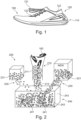
- Figure 1 depicts an illustration of a shoe 100 as disclosed in EP 3 081 109 B1 .
- the shoe 100 which may in particular be a sports shoe, comprises an upper 120, wherein a majority by weight of the upper 120 is made from a thermoplastic base material. Further, the shoe comprises a sole 110, wherein a majority by weight of the sole 110 is made from the same thermoplastic base material.
- the entire shoe 100 may be recycled according to an embodiment of the present invention.
- Figure 2 schematically depicts an illustration of parts 200 of a recycling process of the present invention.
- the process 200 contains the process step 210 of milling an old shoe 100 by using e.g. rotating cutting units 211 or any other suitable device to obtain a plurality of particles 212.
- the particles 212 may have different material densities.
- the milled particles 212 may be collected in a container 243, which may be equipped with one or multiple mixing units such as impellers 241 to generate a more or less homogenous mixture 242 of the particles 212.
- the process 200 may further comprise a step of adding 220 new material, wherein the new and unrecycled material 221 is from the same material class as the majority of materials of the old shoe 100. Adding some unrecycled material 221 from the same material class may further improve the quality of the mixture 242 leading to the same or almost the same properties as if only new material was used.
- the new material 221 may be also added 220 into the container 243 and mixed in a step 240 with the milled particles 212 of the old shoe 100 to produce a mixture of particles 242.
- the process 200 may also include the step of adding 230 new material, wherein the new material 231 is from a different material class e.g. a chemical optimizer.
- a chemical optimizer e.g. chain extenders
- chain extenders may help to further improve the quality, i.e. the physical and chemical properties, of future shoe components made from the recycled material.
- the chain length of the polymers may be increased to affect the stability of any future component made from the recycled material.
- Such additives 231 may also be added into the container 243 and thoroughly mixed 240 with the milled particles 212.
- all three different particles namely: milled particles 212 of recycled shoe material with different densities, new and unrecycled particles 221 and new particles from a different material class 231 may be mixed 240 in the container 243 to obtain a homogenous mixture 242 thereof.
- the aggregate of some or even all the different particles may be liquid, gaseous, solid or in any other possible state.
- the resulting mixed particles 242 may be transferred (not shown) into another container to be either stored, shipped to a different building, factory, company or some other place.
- the mixed particles 242 may be directly further processed in a recycling process 300 as shown in figure 3 .
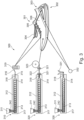
- Figure 3 schematically depicts an illustration of parts 300 of a recycling process of the present invention, which may be a continuation of the process 200 illustrated in figure 2 .
- the homogenous mixture of particles 242 may be transferred into a hopper 311, which may direct the mixture of particles 242 into an extruder 317.
- the extruder may comprise a heating system 312 to melt the particles and a screw conveyor 313 to transport the mixture and / or melt of particles through the extruder 317.
- the extruder 317 may further contain a sieve 314 located in an embodiment at the end part of the extruder, at which the mixture of particles should at least be partly or completely melted. By sieving the milled particles and / or the melt, possible contaminations like e.g.
- the intermediate product 318 may be further processed in various ways, three of which are also schematically depicted in figure 3 .
- the melted intermediate product 318 may be extruded through a fine nozzle 315 to produce a yarn 316.
- the yarn 316 may be rolled onto a yarn bobbin 319 or be directly used for further processing of e.g. a fabric 306 of an upper 303, laces 304 or seams 305 of the new shoe 301.
- the melted intermediate product 318 may be extruded as a film component 322 using one or more pressure roller 321.
- the film component 322 may be stored on a roll 323 or may be directly used for further processing of e.g. the manufacture of a component of an upper 303 of the new shoe 301.
- the further processing may be performed without additional thermoplastic treatment of the film component 322, which keeps the level of thermal stress of the material of the film component 322 as low as possible to ensure a high-quality recycled product.
- the melted intermediate product 318 may be cut into small pellets 332 or the like using a cutting disc, shears 331 or any other possible cutting device.
- the pellets 332 may be stored in a container or bag (not shown) to be either shipped to a different building, factory, company or some other place or be directly used for further processing of e.g. a sole 302 of the new shoe 301 using standard thermoplastic production techniques.
- the three different embodiments of processing the melted intermediate product 318 shown in Fig. 3 are only exemplary. This should not limit the scope of the present invention. Furthermore, the splitting of the recycling process into two different parts 200 and 300 is only for facilitating the description of the present invention. In some embodiments, the two processing parts 200, 300 may be completely merged into one process implemented by a single device.
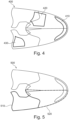
- Figure 4 depicts a schematic illustration of a cutting pattern 400 for a shoe upper.
- the cutting pattern comprises marked areas 410, 420, 430, in which an arrangement of a reinforcement element manufactured from recycled material in accordance with the present invention may be beneficial.
- the reinforcement element may for example be used in a toe box 410, a medial and/or lateral quarter panel 420, a tongue (not marked in Figure 4 ), a collar area (not marked in Figure 4 ) or a heel area 430 of the shoe upper to increase stability of the upper construction, however different areas are also possible.
- the reinforcement element may increase a wearing comfort for a wearer.
- Figure 5 depicts a schematic illustration of a cutting patter 500 for a shoe upper.
- the cutting pattern comprises marked areas 510, 520, in which an arrangement of a lining manufactured from recycled material in accordance with the present invention may be beneficial.
- the lining can be either used in partial areas of an upper construction, such as a rear foot area 510 or a front foot area 520 or in the full upper construction (not shown in Figure 5 ).
- the lining may increase wearing comfort, thermophysiological properties of the shoe.
- the lining may also be used to cover hard and/or uncomfortable areas on the upper construction.
- Figure 6 depicts an illustration of a shoe 600 in accordance with the present invention.
- the shoe 600 comprises an upper 601 and a sole 602.
- the upper 601 comprises a further embodiment of a reinforcement element manufactured from recycled material in accordance with the present invention, which can be arranged on an external or internal surface of the shoe upper.
- the reinforcement element may also be arranged between various layers of the upper 601.
- the reinforcement element may comprise a heel support 610 and/or a midfoot support 620, however reinforcement of different areas is also possible.
- the reinforcement element may be manufactured by a molding process to pre-shape or directly fuse the reinforcement element onto the upper 601.
- Figure 7 depicts a schematic illustration of a strobel board 700 in top view 700-a and a side view 700-b.
- the strobel board 700 is produced out of recycled material in accordance with the present invention by coating a fabric 720 with one or multiple layers of film, in particular a TPU fabric 720 and a TPU coating 710.
- the coating may be an in line or multi-step process.
- the fabric 720 can hereby consist of a non-woven, a knit, a woven or a mesh or any combination of those materials.
- a sockliner manufactured from recycled material in accordance with the present invention can be used to cover the strobel board and increase the wearing comfort.
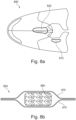
- Figure 8a depicts a schematic illustration of a cutting pattern 800 for a shoe upper.
- the cutting pattern 800 comprises marked areas 810, 820, in which an arrangement of a padding and/or cushioning element 850 manufactured from recycled material in accordance with the present invention may be beneficial.
- the padding and/or cushioning element 850 can for example be used in a collar 810, a heel area (not shown in Figure 8a ) or a tongue 820 area, however different areas are also possible.
- the recycled material may comprise particles of shredded or milled shoes, components of shredded or milled shoes and/or post-processing waste.
- the post-processing waste can come from various manufacturing processes along the material supply chain, such as scrap or defective material from yarn spinning, extruding, cutting or assembly processes.
- Figure 8b depicts a schematic illustration of a padding and/or cushioning element 850 in a side view.
- the cutting and/or padding element 850 comprises a pocket format, in which shredded or milled particles 860 of recycled material are fused between two or more layers 870 of a film component of recycled material.
- the film component 870 and the shredded or milled particles 860 comprise TPU.
Landscapes
- Engineering & Computer Science (AREA)
- Mechanical Engineering (AREA)
- Environmental & Geological Engineering (AREA)
- Textile Engineering (AREA)
- Processing And Handling Of Plastics And Other Materials For Molding In General (AREA)
- Footwear And Its Accessory, Manufacturing Method And Apparatuses (AREA)
- Extrusion Moulding Of Plastics Or The Like (AREA)
- Glanulating (AREA)
- Separation, Recovery Or Treatment Of Waste Materials Containing Plastics (AREA)
Abstract
Description
- The present invention relates to a method of recycling a shoe, a shoe comprising a material obtained by the recycling method and an apparatus for recycling a shoe.
- Recycling of conventional shoes is a complicated and expensive endeavor, which is therefore most of the time omitted. Thus, old shoes typically end up either in a landfill site or they are incinerated. This results in a loss of valuable raw material and natural resources and furthermore in growing piles of garbage. The reason for the complicated recycling process is mostly based on having up to 40 different types of materials almost inseparably glued or stitched together in the production of a conventional shoe.
- To address this issue,
EP 3 081 109 B1 of applicant discloses a shoe, in particular a sports shoe, which comprises an upper, wherein a majority by weight of the upper is made from a thermoplastic base material, and a sole, wherein a majority by weight of the sole is made from the same thermoplastic base material. By providing a shoe with a sole and an upper which - by majority or even entirely - consist of the same base material, the shoe may be easier recycled. - Document
JP 2002 283473 A - Document
US 2010/102468 A1 relates to a method for manufacturing an environment-friendly composite material using polyolefin particles and powder rubber that are made from reclaimed plastic and reclaimed rubber as a raw material. - Document
JP 2006 192723 A - Document
WO 2019/175151 A1 relates to a method of producing thermoplastic polyurethane from recycled raw materials. - However, recycling such a shoe containing mostly one material or one material class still entails significant difficulties. A typical shoe comprises multiple components serving different functions such as cushioning and support for the sole, a comfortable fit to the foot for the upper, reliable stability for eyelets for laces, etc. In case of a shoe consisting partly or fully of the same material class, the respective material properties are usually achieved by involving different densities. However, recycling such a plurality of different material densities in a way that the result of the recycling process can be used not only for new products with less stringent requirements on the material quality but again for the manufacture of new shoes is still a challenge.
- It is therefore the problem underlying the present invention to provide a recycling method and apparatus as well as a recycled shoe which at least partly overcome the above outlined disadvantages of the prior art.
- The above-mentioned problem is at least partly solved by the subject matter of the independent claims. Exemplary embodiments of the invention are defined in the dependent claims.
- In an embodiment, the present invention provides a method for recycling a shoe. The shoe comprises various components made from the same material class with varying densities. In fact, all of the shoe may be provided from the same material class. The method comprises milling the shoe to obtain a plurality of particles, the particles having different material densities; mixing the particles; applying heat to the mixed particles to obtain a melt of molten particles and extruding the melt. The application of heat to obtain the melt of molten particles can be achieved e.g. by respective heating means. Such heating means can be provided as a separate module to an extrusion device. Alternatively, or additionally, the application of heat to obtain the melt of molten particles can be achieved in the extruding step. In this embodiment, the particles may be conveyed e.g. from a hopper to at least one nozzle of an extrusion device. Such an extrusion device can comprise a conveyor screw which conveys and compresses the particles. This compression may lead to a melting of the particles while they are conveyed to the at least one nozzle.
- The claimed invention therefore provides a method to obtain a melt of molten particles which may be used as a raw material for the manufacture of a new shoe. Due to the melting of the particles, the materials of different densities are essentially homogeneously mixed, which allows to provide either directly new high-quality shoe components from the mixture or intermediate products such as pellets, which can then at a later stage be used for the manufacture of shoe components in the same way as new material pellets or the like.
- In an embodiment of the invention, the method of recycling a shoe further comprises the step of applying heat and pressure to the shoe, in particular prior to the milling.
- In this manner, the shoe, especially a TPU textile of the shoe, is heated and pressed before the milling of the shoe. Said pre-heating and pre-compression help to avoid that the milled or shredded shoe materials, especially the milled textile, gets too fluffy and can afterwards not fed into a hopper of an extruder.
- In some embodiments of the present invention, the method of recycling a shoe further comprises the step of adding new material to the mixed particles and / or the melt. The new material may be unrecycled material of the same material class as the shoe.
- In this manner, by adding some unrecycled material from the same material class the quality of the mixture is further enhanced leading to the same or almost the same properties as if only new material was used.
- Alternatively, or in addition, the new material may also be from a different material class e.g. a chemical optimizer. Such additives may help to further improve the quality and physical and chemical properties of future shoe components made from the recycled material.
- The additive may be a reactive system, in particular a bi-functional isocyanate, a trifunctional isocyanate, a bifunctional epoxide or a multifunctional epoxide.
- Due to the mechanical forces and heat with milling/shredding, melting and extruding, polymer materials like TPU tend to degrade their molecular structure, resulting in shorter macromolecular chains (= decrease in molecular weight). This in turn will lead to a deterioration of resulting properties, like decreased strength, stiffness, hardness and ductility (e.g. elongation at break). In order to get the molecular weight back up to a level required to achieve suitable application properties, additives may be added to the mixed particles. Such additives may be reactive systems, in particular one of the reactive systems listed above. Adding such additives, in particular a bi-functional isocyanate as a masterbatch at 1-4 weight-%, has proven to lead to improved tensile strength and stiffness, reaching or even exceeding virgin material properties. By choosing a distinct relation of additive, recycled material and virgin TPU (of distinct Shore hardness), properties of the melt and extrudate can be tailored to the application needs. Aforesaid additives especially enable multiple recycling loops.
- In some embodiments the single material class comprises a thermoplastic polymer, in particular thermoplastic polyurethane, TPU, or polyamide. The majority of weight of the shoe may be made from the same material class, in particular wherein at least 70%, preferably at least 80%, more preferably at least 90%, and most preferably at least 95% of the weight of the shoe are made from the same material class.
- In some embodiments of the present invention, the method of recycling a shoe further comprises the step of sieving the mix of milled particles and / or the melt. By sieving the mix of milled particles and / or the melt, possible contaminations like e.g. dirt or soil originating from the used shoe to be recycled may be filtered out to result in an intermediate product essentially free from impurities.
- Further, the step of extruding may comprise extruding an intermediate product, in particular pellets, for further thermoplastic processing. In this manner, the present invention may allow to produce an intermediate product, which may be stored for a period of time or transported to a different location. The stored pellets can then be used in standard thermoplastic production techniques such as injection molding, blow molding etc. In other words, the handling of the recycled material does not or not significantly differ from the handling of a corresponding new raw thermoplastic material for shoe manufacture.
- In one embodiment, the intermediate product, in particular the pellets, are further processed in a melt-blowing process to manufacture a melt-blown non-woven fabric of a new shoe. In this context, the intermediate product, in particular the pellets, may be used as a base material to produce the melt-blown non-woven fabric. For example, the intermediate product may be heated and extruded. The extrusion may be executed using a plurality of fine nozzles to produce filaments from the single material class. In this context, the melt may be extruded through a dye comprising a plurality of fine nozzles such that the melt exits the nozzles in the form of filaments with diameters in the range of micrometers or even nanometers. In an embodiment, the filaments are TPU filaments. The TPU can comprise various grades (e.g. 1164D, 1180A). The filaments can be blown by a gas stream, e.g. an air stream, onto a substrate to form a non-woven fabric. The substrate may be planar shaped or three-dimensional shaped, e.g. in the form of a last for producing an upper of a shoe. The substrate also may be a conveyor belt or a substrate layer on such a conveyor belt. The non-woven fabric component may be a reinforcement component. The non-woven fabric component may be a toe box, an internal cage element, an external cage element, or a tongue element (implemented as a single non-woven fabric layer or combined with a different fabric layer). In yet another embodiment, the non-woven fabric layer may form a lasting board or at least a part of it.
- Furthermore, in another embodiment, the step of extruding comprises extruding an intermediate product adapted for the manufacture of a new shoe without further thermoplastic processing.
- This embodiment of the present invention may allow to produce an intermediate product of a new shoe, which in particular may be a film component, which may be cut and stitched into a desired element of a new shoe. By directly producing such an intermediate product, multiple heat stress due to a further melting process may be omitted. This leads to components for a new shoe of high quality even though originating mostly or even entirely from a recycled shoe.
- Alternatively, to extruding an intermediate product in form of a film component, extruding an intermediate product in a melt-blowing process to manufacture a melt-blown non-woven fabric is also applicable. In this manner, the various advantages and processing options provided above when using an intermediate product in form of pellets as source material for the melt-blowing process also apply when extruding the intermediate product directly in a melt-blowing process.
- In some embodiments of the present invention, the method of recycling a shoe further comprises the step of producing a new shoe or a component for a new shoe using the extruded melt. The component can comprise a single layer or a composite construction. The component may consist of a film, a non-woven, a knit, a woven, a mesh or a combination thereof. Various single layers of the composite construction of the component can be directly joint by heat, through a mechanical or chemical intertangling process, by an additional adhesive in liquid, film or powder shape or a sewing process.
- In an embodiment, the component may comprise a reinforcement element, in particular a toe box, a medial quarter panel, a lateral quarter panel, a tongue, a collar or a heel area. The reinforcement element can be arranged internally or externally on the shoe. The internal surface of a shoe is the surface, adapted to be in contact with a wearers foot. reinforcement element as well as individual layers thereof can be joint for example by heat, through a mechanical or chemical intertangling process or by an additional adhesive in liquid, film or powder shape or a sewing process.
- In another embodiment, the component may comprise a lining. The lining can be used in either a full upper construction or one or more partial areas of the upper. The lining can increase a wearing comfort, a thermophysiological properties of the shoe or can be used to cover and/or cushion other elements, in particular uncomfortable elements, of the shoe. The lining as well as individual layers thereof can be joint for example by heat, through a mechanical or chemical intertangling process or by an additional adhesive in liquid, film or powder shape or a sewing process.
- In a further embodiment, the component may comprise a strobel board. The strobel board can be manufactured by coating a fabric with one or multiple layers of a film in either an inline or a multi-step process. The strobel board as well as individual layers thereof can be joint for example by heat, through a mechanical or chemical intertangling process or by an additional adhesive in liquid, film or powder shape or a sewing process.
- In yet a further embodiment, the component may comprise sockliner. The sockliner can be used to cover a strobel board for increased wearing comfort. The sockliner as well as individual layers thereof can be joint for example by heat, through a mechanical or chemical intertangling process or by an additional adhesive in liquid, film or powder shape or a sewing process.
- In another embodiment, the component may comprise a padding and/or cushioning element. The padding and/or cushioning element can be used for example in a collar, a heel or a tongue area of the shoe. The padding and/or cushioning element may comprise a pocket-construction comprising a filling fused between two or multiple layers of a film or foil material. In this respect, the pocket material may comprise a recycled film or foil material, in particular recycled TPU. The filling may comprise shredded or milled material. The padding and/or cushioning element as well as individual layers can be joint for example by heat, through a mechanical or chemical intertangling process or by an additional adhesive in liquid, film or powder shape or a sewing process.
- The step of producing may comprise a plurality of extrusion steps with different processing parameters.
- The different processing parameters allow to optimize certain components of the shoe. For example, the extrusion may be executed using a fine nozzle to directly produce a yarn from the single material class, which could be further processed e.g. woven or knitted, into an upper of the recycled shoe. Alternatively, extruding the melt may be executed using a plurality of fine nozzles to directly produce filaments from the single material class, which could be further processed, e.g. in a melt blowing process, to form a melt-blown non-woven fabric of a new shoe. The melt may be extruded through a dye comprising a plurality of fine nozzles such that the melt exits the nozzles in the form of filaments with diameters in the range of micrometers or even nanometers. In an embodiment, the filaments are TPU filaments. The TPU can comprise various grades (e.g. 1164D, 1180A). The filaments can be blown by a gas stream, e.g. an air stream, onto a substrate to form a non-woven fabric. The substrate may be planar shaped or three-dimensional shaped, e.g. in the form of a last for producing an upper of a shoe. The substrate also may be a conveyor belt or a substrate layer on such a conveyor belt. The non-woven fabric component may be a reinforcement component. The non-woven fabric component may be a toe box, an internal cage element, an external cage element, or a tongue element (implemented as a single non-woven fabric layer or combined with a different fabric layer). In yet another embodiment, the non-woven fabric layer may form a lasting board or at least a part of it.
- According to another aspect, the present invention relates to a shoe comprising a material obtained by a recycling method of any of the above-mentioned embodiments.
- Another aspect of the present invention relates to an apparatus adapted to recycle a shoe. The shoe comprises various components made from the same material class with varying densities. The apparatus comprises means to perform a method of any of the above-mentioned embodiment. In particular, the apparatus comprises means for milling the shoe to obtain a plurality of particles, the particles having different material densities, means for mixing the particles, means for applying heat to the mixed particles to obtain a melt of molten particles and means for extruding the melt. In some embodiments, the apparatus further comprises means for sieving the mix of milled particles and / or the melt, in particular a sieve.
- In another embodiment, the apparatus further comprises means for heating the shoe prior to its milling and means for compressing the shoe prior to its milling. By pre-heating and pre-compressing, it can be avoided that the milled or shredded shoe materials, especially the milled textile, gets too fluffy and can afterwards not fed into a hopper of an extruder.
- Furthermore, the apparatus can comprise a dye comprising a plurality of fine nozzles. Especially, the means for extruding can comprise such a dye which enables that extruding the melt may be executed using the plurality of fine nozzles to directly produce filaments from the single material class, which could be further processed, e.g. in a melt blowing process, to form a melt-blown non-woven fabric of a new shoe. The melt may exit the nozzles in the form of filaments with diameters in the range of micrometers or even nanometers. In an embodiment, the filaments are TPU filaments. The TPU can comprise various grades (e.g. 1164D, 1180A). The apparatus may further comprise means for generating gas stream, e.g. an air stream and a substrate. The extruded filaments can be blown by the gas stream onto the substrate to form a non-woven fabric. The substrate may be planar shaped or three-dimensional shaped, e.g. in the form of a last for producing an upper of a shoe. The substrate also may be a conveyor belt or a substrate layer on such a conveyor belt. The non-woven fabric component may be a reinforcement component. The non-woven fabric component may be a toe box, an internal cage element, an external cage element, or a tongue element (implemented as a single non-woven fabric layer or combined with a different fabric layer). In yet another embodiment, the non-woven fabric layer may form a lasting board or at least a part of it.
- The means for extruding may comprise means for extruding an intermediate product, in particular pellets, for further thermoplastic processing. In another embodiment the means for extruding of an intermediate product comprises means for cutting the extruded melt. Thus, it may be possible to directly cut the extruded melt into a desired size of e.g. the pellets, during the process of extrusion of the melt.
- It may be noted that additionally, to the usage of post-consumer material by milling and extruding worn shoes, the usage of post-processing waste is possible. This waste can come from various manufacturing processes along the material supply chain, such as scrap or defective material from e.g. yarn spinning, extruding, cutting or assembly processes. The post-processing waste is then processed in the same way as the post-consumer waste prior, during and after the recycling process.
- Further aspects of the present invention are defined in the dependent claims.
- Aspects of the present invention are described in more detail in the following by reference to the accompanying figures. These figures show:
- Fig. 1
- a schematic illustration of an embodiment of a shoe, comprising for the most part materials of the same material class;
- Fig. 2
- a schematic illustration of a first part of a recycling process of a shoe, which results in a plurality of mixed particles;
- Fig. 3
- a schematic illustration of a second part of a recycling process of a shoe, which results in different base components used to manufacture a new shoe;
- Fig. 4
- a schematic illustration of an embodiment of a cutting patter for a shoe upper, comprising marked areas for reinforcement elements;
- Fig. 5
- a schematic illustration of an embodiment of a cutting patter for a shoe upper, comprising marked areas for a lining;
- Fig. 6
- a schematic illustration of an embodiment of a shoe, comprising marked areas for reinforcement elements;
- Fig. 7
- a schematic illustration of an embodiment of a strobel board;
- Fig. 8a
- a schematic illustration of an embodiment of a cutting patter for a shoe upper, comprising marked areas for padding and/or cushioning elements; and
- Fig. 8b
- a schematic illustration of a pocket-construction for a padding and/or cushioning element.
- In the following, exemplary embodiments of the present invention are described in more detail with reference to a recycling process of a shoe which comprises for the most part materials of the same material class. While specific feature combinations are described in the following with respect to the exemplary embodiments of the present invention, it is to be understood that the disclosure is not limited to such embodiments. In particular, not all features have to be present for realizing the invention, and the embodiments may be modified by combining certain features of one embodiment with one or more features of another embodiment. Moreover, while embodiments of the present invention are illustrated in the following with respect to a recycling process of a shoe, it should be appreciated that the same process can also be used to recycle different pieces of apparel, comprising for the most part the same material class with different material densities.
-
Figure 1 depicts an illustration of ashoe 100 as disclosed inEP 3 081 109 B1 . Theshoe 100, which may in particular be a sports shoe, comprises an upper 120, wherein a majority by weight of the upper 120 is made from a thermoplastic base material. Further, the shoe comprises a sole 110, wherein a majority by weight of the sole 110 is made from the same thermoplastic base material. By providing shoes with a sole 110 and an upper 120 which - by majority or even entirely - consist of the same base material, theentire shoe 100 may be recycled according to an embodiment of the present invention. -
Figure 2 schematically depicts an illustration ofparts 200 of a recycling process of the present invention. In an embodiment theprocess 200 contains theprocess step 210 of milling anold shoe 100 by using e.g. rotating cuttingunits 211 or any other suitable device to obtain a plurality ofparticles 212. Theparticles 212 may have different material densities. The milledparticles 212 may be collected in acontainer 243, which may be equipped with one or multiple mixing units such asimpellers 241 to generate a more or lesshomogenous mixture 242 of theparticles 212. In addition, there may be heating means, in order to heat the mixture 242 (not shown inFig. 2 ). - The
process 200 may further comprise a step of adding 220 new material, wherein the new andunrecycled material 221 is from the same material class as the majority of materials of theold shoe 100. Adding someunrecycled material 221 from the same material class may further improve the quality of themixture 242 leading to the same or almost the same properties as if only new material was used. Thenew material 221 may be also added 220 into thecontainer 243 and mixed in astep 240 with the milledparticles 212 of theold shoe 100 to produce a mixture ofparticles 242. - Alternatively, or in addition, the
process 200 may also include the step of adding 230 new material, wherein thenew material 231 is from a different material class e.g. a chemical optimizer. Such additives, for example chain extenders, may help to further improve the quality, i.e. the physical and chemical properties, of future shoe components made from the recycled material. For example, the chain length of the polymers may be increased to affect the stability of any future component made from the recycled material. -
Such additives 231 may also be added into thecontainer 243 and thoroughly mixed 240 with the milledparticles 212. In some embodiments all three different particles, namely: milledparticles 212 of recycled shoe material with different densities, new andunrecycled particles 221 and new particles from adifferent material class 231 may be mixed 240 in thecontainer 243 to obtain ahomogenous mixture 242 thereof. The aggregate of some or even all the different particles may be liquid, gaseous, solid or in any other possible state. - In some embodiments the resulting
mixed particles 242 may be transferred (not shown) into another container to be either stored, shipped to a different building, factory, company or some other place. In another embodiment themixed particles 242 may be directly further processed in arecycling process 300 as shown infigure 3 . -
Figure 3 schematically depicts an illustration ofparts 300 of a recycling process of the present invention, which may be a continuation of theprocess 200 illustrated infigure 2 . In an embodiment the homogenous mixture ofparticles 242 may be transferred into ahopper 311, which may direct the mixture ofparticles 242 into anextruder 317. The extruder may comprise aheating system 312 to melt the particles and ascrew conveyor 313 to transport the mixture and / or melt of particles through theextruder 317. Theextruder 317 may further contain asieve 314 located in an embodiment at the end part of the extruder, at which the mixture of particles should at least be partly or completely melted. By sieving the milled particles and / or the melt, possible contaminations like e.g. dirt or soil originating from theold shoe 100 to be recycled, may be filtered out to result in anintermediate product 318 essentially free from impurities. Such a sieving process may allow to omit a separate costly cleaning procedure of theold shoe 100. Exchanging and / or cleaning of thesieve 314 may be conducted on a regular basis using fully automated processes or may be done manually (not shown infigure 3 ). - The
intermediate product 318 may be further processed in various ways, three of which are also schematically depicted infigure 3 . In the first embodiment, shown asprocess 310, the meltedintermediate product 318 may be extruded through afine nozzle 315 to produce ayarn 316. Theyarn 316 may be rolled onto ayarn bobbin 319 or be directly used for further processing of e.g. afabric 306 of an upper 303,laces 304 orseams 305 of thenew shoe 301. - In the second embodiment, shown as
process 320, the meltedintermediate product 318 may be extruded as afilm component 322 using one ormore pressure roller 321. Thefilm component 322 may be stored on aroll 323 or may be directly used for further processing of e.g. the manufacture of a component of an upper 303 of thenew shoe 301. The further processing may be performed without additional thermoplastic treatment of thefilm component 322, which keeps the level of thermal stress of the material of thefilm component 322 as low as possible to ensure a high-quality recycled product. - In a third embodiment, shown as
process 330, the meltedintermediate product 318 may be cut intosmall pellets 332 or the like using a cutting disc, shears 331 or any other possible cutting device. Thepellets 332 may be stored in a container or bag (not shown) to be either shipped to a different building, factory, company or some other place or be directly used for further processing of e.g. a sole 302 of thenew shoe 301 using standard thermoplastic production techniques. - The three different embodiments of processing the melted
intermediate product 318 shown inFig. 3 are only exemplary. This should not limit the scope of the present invention. Furthermore, the splitting of the recycling process into twodifferent parts parts -
Figure 4 depicts a schematic illustration of acutting pattern 400 for a shoe upper. The cutting pattern comprises markedareas toe box 410, a medial and/orlateral quarter panel 420, a tongue (not marked inFigure 4 ), a collar area (not marked inFigure 4 ) or aheel area 430 of the shoe upper to increase stability of the upper construction, however different areas are also possible. Furthermore, the reinforcement element may increase a wearing comfort for a wearer. -
Figure 5 depicts a schematic illustration of acutting patter 500 for a shoe upper. The cutting pattern comprises markedareas rear foot area 510 or afront foot area 520 or in the full upper construction (not shown inFigure 5 ). The lining may increase wearing comfort, thermophysiological properties of the shoe. Furthermore, the lining may also be used to cover hard and/or uncomfortable areas on the upper construction. -
Figure 6 depicts an illustration of ashoe 600 in accordance with the present invention. Theshoe 600 comprises an upper 601 and a sole 602. The upper 601 comprises a further embodiment of a reinforcement element manufactured from recycled material in accordance with the present invention, which can be arranged on an external or internal surface of the shoe upper. The reinforcement element may also be arranged between various layers of the upper 601. Furthermore, the reinforcement element may comprise aheel support 610 and/or amidfoot support 620, however reinforcement of different areas is also possible. The reinforcement element may be manufactured by a molding process to pre-shape or directly fuse the reinforcement element onto the upper 601. -
Figure 7 depicts a schematic illustration of astrobel board 700 in top view 700-a and a side view 700-b. Thestrobel board 700 is produced out of recycled material in accordance with the present invention by coating afabric 720 with one or multiple layers of film, in particular aTPU fabric 720 and aTPU coating 710. The coating may be an in line or multi-step process. Thefabric 720 can hereby consist of a non-woven, a knit, a woven or a mesh or any combination of those materials. A sockliner manufactured from recycled material in accordance with the present invention can be used to cover the strobel board and increase the wearing comfort. -
Figure 8a depicts a schematic illustration of acutting pattern 800 for a shoe upper. Thecutting pattern 800 comprises markedareas cushioning element 850 manufactured from recycled material in accordance with the present invention may be beneficial. The padding and/orcushioning element 850 can for example be used in acollar 810, a heel area (not shown inFigure 8a ) or atongue 820 area, however different areas are also possible. The recycled material may comprise particles of shredded or milled shoes, components of shredded or milled shoes and/or post-processing waste. The post-processing waste can come from various manufacturing processes along the material supply chain, such as scrap or defective material from yarn spinning, extruding, cutting or assembly processes. -
Figure 8b depicts a schematic illustration of a padding and/orcushioning element 850 in a side view. The cutting and/orpadding element 850 comprises a pocket format, in which shredded or milledparticles 860 of recycled material are fused between two ormore layers 870 of a film component of recycled material. Preferably thefilm component 870 and the shredded or milledparticles 860 comprise TPU.
Claims (15)
- A method for recycling a shoe (100), having a majority of weight made from a same material class, the shoe (100) comprising various components made from the same material class with varying densities, the material class being thermoplastic polyurethane, TPU, or polyamide, the method comprising:a. milling (210) the shoe (100) to obtain a plurality of particles (212), the particles (212) having different material densities;b. mixing (240) the particles;c. applying heat (312) to the mixed particles (242) to obtain a melt of molten particles; andd. extruding (317) the melt.
- Method according to claim 1, further comprising the step of applying heat and pressure to the shoe prior to the milling (210).
- Method according to claim 1 or 2 further comprising the step of adding (220, 230) new material to the mixed particles (242) and / or the melt.
- Method according to claim 3, wherein the new material (221) is unrecycled material of the same material class as the shoe (100).
- Method according to claim 3 or 4, wherein the new material (231) is from a different material class.
- Method according to claim 5, wherein the new material is an additive, wherein the additive is a reactive system, in particular a bi-functional isocyanate, a trifunctional isocyanate, a bifunctional epoxide or a multifunctional epoxide.
- Method according to any of the preceding claims 1 to 6, wherein at least 70%, preferably at least 80%, more preferable at least 90%, and most preferably at least 95% of the weight of the shoe (100) are made from the same material class.
- Method according to any of the preceding claims 1 to 7, wherein the step of extruding (317) comprises extruding an intermediate product (318), in particular pellets (332), for further thermoplastic processing, in particular in a melt-blowing process to manufacture a melt-blown non-woven fabric.
- Method according to any of the preceding claims 1 to 8, wherein the step of extruding (317) comprises extruding an intermediate product (318) adapted for the manufacture of a new shoe (301) without further thermoplastic processing, in particular in a melt-blowing process to manufacture a melt-blown non-woven fabric.
- Method according to any of the preceding claims 1 to 9, further comprising the step of producing a new shoe (301) using the extruded melt.
- Method according to any of the preceding claims 1 to 10, further comprising the step of producing a component for a new shoe using the extruded melt.
- Method according to claim 11, wherein the component for the new shoe comprises a padding and/or cushioning element (850), a sockliner, a strobel board, a lining, and/or a reinforcement element.
- Method according to claim 11 or 12, wherein the component comprises a composite construction.
- Method according to any of the preceding claims 10 to 13, wherein the step of producing comprises a plurality of extrusion steps (310, 320, 330) with different processing parameters.
- Method of any of the preceding claims 1 to 14, further comprising the step of sieving (314) the mix of milled particles and / or the melt.
Applications Claiming Priority (3)
| Application Number | Priority Date | Filing Date | Title |
|---|---|---|---|
| DE102019204579.0A DE102019204579B4 (en) | 2019-04-01 | 2019-04-01 | Recycling a shoe |
| EP20717595.1A EP3946871B1 (en) | 2019-04-01 | 2020-04-01 | Recycling of a shoe |
| PCT/EP2020/059285 WO2020201370A1 (en) | 2019-04-01 | 2020-04-01 | Recycling of a shoe |
Related Parent Applications (1)
| Application Number | Title | Priority Date | Filing Date |
|---|---|---|---|
| EP20717595.1A Division EP3946871B1 (en) | 2019-04-01 | 2020-04-01 | Recycling of a shoe |
Publications (2)
| Publication Number | Publication Date |
|---|---|
| EP4458200A2 true EP4458200A2 (en) | 2024-11-06 |
| EP4458200A3 EP4458200A3 (en) | 2025-01-29 |
Family
ID=70224346
Family Applications (2)
| Application Number | Title | Priority Date | Filing Date |
|---|---|---|---|
| EP24201654.1A Pending EP4458200A3 (en) | 2019-04-01 | 2020-04-01 | Recycling of a shoe |
| EP20717595.1A Active EP3946871B1 (en) | 2019-04-01 | 2020-04-01 | Recycling of a shoe |
Family Applications After (1)
| Application Number | Title | Priority Date | Filing Date |
|---|---|---|---|
| EP20717595.1A Active EP3946871B1 (en) | 2019-04-01 | 2020-04-01 | Recycling of a shoe |
Country Status (5)
| Country | Link |
|---|---|
| US (2) | US12263619B2 (en) |
| EP (2) | EP4458200A3 (en) |
| CN (1) | CN113646151A (en) |
| DE (1) | DE102019204579B4 (en) |
| WO (1) | WO2020201370A1 (en) |
Families Citing this family (16)
| Publication number | Priority date | Publication date | Assignee | Title |
|---|---|---|---|---|
| US9930928B2 (en) | 2013-02-13 | 2018-04-03 | Adidas Ag | Sole for a shoe |
| DE102016209046B4 (en) | 2016-05-24 | 2019-08-08 | Adidas Ag | METHOD FOR THE PRODUCTION OF A SHOE SOLE, SHOE SOLE, SHOE AND PREPARED TPU ITEMS |
| IT202000027161A1 (en) | 2020-11-12 | 2022-05-12 | Sciarada Ind Conciaria S P A | METHOD OF SEPARATING COMPONENTS OF A PRODUCT AT THE END OF LIFE OR PART OF IT |
| CN113386284A (en) * | 2021-06-30 | 2021-09-14 | 茂泰(福建)鞋材有限公司 | Batch disassembling device for cutting waste shoe material soles |
| IT202200010562A1 (en) | 2022-05-23 | 2023-11-23 | Giorgio Macor | Method and apparatus for disassembling a shoe |
| FR3137258B1 (en) | 2022-07-04 | 2024-11-08 | Arkema France | Sports shoes with improved recycling |
| FR3140739B1 (en) * | 2022-10-12 | 2025-03-21 | Decathlon Sa | Method of manufacturing at least part of an item of footwear, for example a shoe, a sandal, a boot, etc., and in particular an item of footwear for practicing a sport. |
| FR3141467A1 (en) | 2022-10-28 | 2024-05-03 | Arkema France | Recyclable single-material objects comprising at least two elements |
| FR3141468A1 (en) * | 2022-10-28 | 2024-05-03 | Arkema France | Recyclable single-material objects comprising at least two elements |
| FR3141469A1 (en) | 2022-10-28 | 2024-05-03 | Arkema France | Recyclable single-material objects comprising at least two elements |
| US20240173911A1 (en) * | 2022-11-29 | 2024-05-30 | Massachusetts Institute Of Technology | Systems and methods for manufacturing curbside-recyclable products from mono-materials polyethylene fabrics with polyethylene three-dimensionally printed features |
| FR3144816A1 (en) | 2023-01-11 | 2024-07-12 | Arkema France | RECYCLABLE MONOMATERIAL OBJECTS AND THEIR RECYCLING |
| FR3147487A1 (en) * | 2023-04-06 | 2024-10-11 | Decathlon | Footwear, particularly for practicing a sport. |
| CN116494524A (en) * | 2023-06-06 | 2023-07-28 | 香港理工大学 | A method of recycling thermoplastic polyurethane film to produce fused deposition 3D printing wire |
| FR3154933A1 (en) | 2023-11-02 | 2025-05-09 | Salomon S.A.S. | Capsule containing crushed items |
| CN117719100B (en) * | 2024-01-19 | 2024-11-05 | 浙江省长三角循环经济技术研究院 | A process for disassembling old sports shoes |
Citations (5)
| Publication number | Priority date | Publication date | Assignee | Title |
|---|---|---|---|---|
| JP2002283473A (en) | 2001-03-26 | 2002-10-03 | Achilles Corp | Method for recycling injection-molded boot |
| JP2006192723A (en) | 2005-01-14 | 2006-07-27 | Asahi Corp | Reusable injection-molded shoes and method for manufacturing the shoes |
| US20100102468A1 (en) | 2008-10-27 | 2010-04-29 | Hsin-Min Chen | Method for manufacturing an environment-friendly composite material |
| EP3081109B1 (en) | 2015-04-16 | 2019-01-09 | adidas AG | Sports shoe |
| WO2019175151A1 (en) | 2018-03-13 | 2019-09-19 | Basf Se | Thermoplastic polyurethane from recycled raw materials |
Family Cites Families (397)
| Publication number | Priority date | Publication date | Assignee | Title |
|---|---|---|---|---|
| US2131756A (en) | 1933-10-06 | 1938-10-04 | Fred T Roberts | Rubber ball |
| US2968106A (en) | 1958-10-01 | 1961-01-17 | Fred W Mears Heel Company Inc | Lightweight heels |
| US3186013A (en) | 1962-07-09 | 1965-06-01 | Genesco Inc | Method of making shoe soles |
| DE1729358A1 (en) | 1967-10-20 | 1972-04-20 | Stuebbe Gmbh Maschf | Method and device for injection molding multilayer soles made of elastomers onto shoe shafts |
| US3586003A (en) | 1969-04-28 | 1971-06-22 | Walter C Baker | Means for supporting a flat foot |
| IT1077768B (en) | 1977-04-08 | 1985-05-04 | Nordica Di Franco | SHOE STRUCTURE PARTICULARLY FOR SPORTS ACTIVITIES IN GENERAL AND FOR TRAINING |
| USRE33066E (en) | 1980-05-06 | 1989-09-26 | Avia Group International, Inc. | Shoe sole construction |
| US4481727A (en) | 1980-05-06 | 1984-11-13 | Pensa, Inc. | Shoe sole construction |
| US4364189A (en) | 1980-12-05 | 1982-12-21 | Bates Barry T | Running shoe with differential cushioning |
| US4413431A (en) | 1982-06-11 | 1983-11-08 | Puma-Sportschuhfabriken Rudolf Dassler Kg | Athletic shoe upper construction |
| DE3231971A1 (en) | 1982-08-27 | 1984-03-15 | Helmut 6780 Pirmasens Schaefer | INSOLE FOR SHOES AND METHOD FOR THE PRODUCTION THEREOF |
| DE3233792A1 (en) | 1982-09-11 | 1984-03-15 | Puma-Sportschuhfabriken Rudolf Dassler Kg, 8522 Herzogenaurach | SPORTSHOE FOR LIGHTWEIGHT |
| EP0367297A2 (en) | 1984-05-18 | 1990-05-09 | The Stride Rite Corporation | Slip-resistant sole |
| US4658515A (en) | 1985-02-05 | 1987-04-21 | Oatman Donald S | Heat insulating insert for footwear |
| US4642911A (en) | 1985-02-28 | 1987-02-17 | Talarico Ii Louis C | Dual-compression forefoot compensated footwear |
| US4667423A (en) | 1985-05-28 | 1987-05-26 | Autry Industries, Inc. | Resilient composite midsole and method of making |
| US4624062A (en) | 1985-06-17 | 1986-11-25 | Autry Industries, Inc. | Sole with cushioning and braking spiroidal contact surfaces |
| DE3605662C1 (en) | 1986-02-21 | 1987-06-25 | Dauscher H S3 Sport-Schuh-Service | Method for prodn. of damping and cushion body |
| FR2595552B1 (en) | 1986-03-14 | 1988-09-23 | Salomon Sa | SHOE INSOLE |
| FR2598293B1 (en) | 1986-05-09 | 1988-09-09 | Salomon Sa | GOLF SHOE |
| US5025573A (en) | 1986-06-04 | 1991-06-25 | Comfort Products, Inc. | Multi-density shoe sole |
| FR2617685A1 (en) | 1987-07-09 | 1989-01-13 | Lemenn Corine | ARTICLE OF FOOTWEAR COMPRISING TWO SEPARATE ELEMENTS |
| US5283963A (en) | 1987-10-08 | 1994-02-08 | Moisey Lerner | Sole for transferring stresses from ground to foot |
| USD296262S (en) | 1987-10-19 | 1988-06-21 | Reebok International Ltd. | Element of a shoe upper |
| USD302898S (en) | 1987-10-22 | 1989-08-22 | L.A. Gear, Inc. | Shoe upper |
| DE3802607A1 (en) | 1987-12-17 | 1989-06-29 | Adidas Sportschuhe | OUTSOLE FOR SPORTSHOES |
| DE3802035A1 (en) | 1988-01-25 | 1989-08-10 | Reichenecker Hans Storopack | DAMPING OR UPHOLSTERY BODY FOR USE IN SHOES |
| US4922631A (en) | 1988-02-08 | 1990-05-08 | Adidas Sportschuhfabriken Adi Dassier Stiftung & Co. Kg | Shoe bottom for sports shoes |
| JP2681093B2 (en) | 1988-04-27 | 1997-11-19 | 株式会社シーゲル | Sole sole repulsion mechanism |
| US4980445A (en) | 1989-01-17 | 1990-12-25 | The Dow Chemical Company | Thermoplastic polyurethanes |
| USD329731S (en) | 1990-08-29 | 1992-09-29 | Adcock Bob E | Sandal |
| US5381607A (en) | 1991-06-26 | 1995-01-17 | Tretorn Ab | Stabilized honeycomb shoe sole, particularly for athletic shoes |
| USD333556S (en) | 1991-07-11 | 1993-03-02 | L. A. Gear, Inc. | Shoe outsole |
| US6237251B1 (en) | 1991-08-21 | 2001-05-29 | Reebok International Ltd. | Athletic shoe construction |
| US5319866A (en) | 1991-08-21 | 1994-06-14 | Reebok International Ltd. | Composite arch member |
| USD340797S (en) | 1992-03-19 | 1993-11-02 | The Keds Corporation | Shoe sole bottom |
| US5617650A (en) | 1992-10-23 | 1997-04-08 | Grim; Tracy E. | Vacuum formed conformable shoe |
| DE4236081A1 (en) | 1992-10-26 | 1994-04-28 | Ph Kurtz Eisenhammer Kg | Process for producing molded articles from foamed plastic and mold for carrying out this process |
| JP2533785Y2 (en) | 1992-12-01 | 1997-04-23 | みのる化成株式会社 | Insulated hollow article filled with foam beads |
| USD350222S (en) | 1992-12-03 | 1994-09-06 | Asics Corporation | Sports shoe |
| WO1994013164A1 (en) | 1992-12-10 | 1994-06-23 | Nike International Ltd. | Bonding of rubber to plastic in footwear |
| US5308420A (en) | 1993-02-22 | 1994-05-03 | Yang Kuo Nan | EVA insole manufacturing process |
| DE4307648A1 (en) | 1993-03-11 | 1994-09-15 | Basf Ag | Foams based on thermoplastic polyurethanes as well as expandable, particulate, thermoplastic polyurethanes, particularly suitable for the production of foam molded articles |
| US5421874A (en) | 1993-06-22 | 1995-06-06 | Genesis Composites, L.C. | Composite microsphere and lubricant mixture |
| USD356438S (en) | 1993-06-24 | 1995-03-21 | The Keds Corporation | Shoe sole |
| JP3275462B2 (en) | 1993-07-14 | 2002-04-15 | 株式会社日立製作所 | Recycling system and recycling method |
| USD350016S (en) | 1993-09-01 | 1994-08-30 | Nike, Inc. | Element of a shoe sole |
| US6266897B1 (en) | 1994-10-21 | 2001-07-31 | Adidas International B.V. | Ground-contacting systems having 3D deformation elements for use in footwear |
| JPH08323890A (en) | 1995-03-31 | 1996-12-10 | Toray Ind Inc | Cloth core material and method for manufacturing the same |
| US5987783A (en) | 1995-06-05 | 1999-11-23 | Acushnet Company | Golf shoe having spike socket spine system |
| CA2178282A1 (en) | 1995-06-07 | 1996-12-08 | Robert M. Lyden | Footwear with differential cushioning regions |
| US5692319A (en) | 1995-06-07 | 1997-12-02 | Nike, Inc. | Article of footwear with 360° wrap fit closure system |
| US5918383A (en) | 1995-10-16 | 1999-07-06 | Fila U.S.A., Inc. | Sports shoe having an elastic insert |
| US5743027A (en) | 1995-11-29 | 1998-04-28 | Barma; Tarachand S. | Rubber footwear and method of making same |
| JP2768403B2 (en) | 1995-11-30 | 1998-06-25 | オカモト株式会社 | Shoes and manufacturing method thereof |
| USD375619S (en) | 1995-12-07 | 1996-11-19 | Nike, Inc. | Element of a shoe sole |
| US5729917A (en) | 1996-01-04 | 1998-03-24 | Hyde Athletic Industries, Inc. | Combination midsole stabilizer and enhancer |
| GB9607302D0 (en) | 1996-04-09 | 1996-06-12 | British United Shoe Machinery | Shoe material |
| US5996252A (en) | 1996-05-10 | 1999-12-07 | Cougar; Daniel D. | Safety shoe with high-traction replaceable sole |
| USD390349S (en) | 1996-10-11 | 1998-02-10 | Asics Corporation | Shoe sole |
| USD389991S (en) | 1996-10-18 | 1998-02-03 | Vans, Inc. | Shoe sole sidewall |
| JPH10128305A (en) | 1996-11-01 | 1998-05-19 | Mitsuo Nibu | Waste separation and collection method |
| USD395337S (en) | 1996-11-06 | 1998-06-23 | Nike, Inc. | Element of a shoe sole |
| JPH10152575A (en) | 1996-11-22 | 1998-06-09 | Achilles Corp | Method for foaming thermoplastic resin |
| DE19652690A1 (en) | 1996-12-18 | 1998-06-25 | Happich Gmbh Gebr | Moulding with foam cushion, e.g. arm rest |
| USD413010S (en) | 1997-02-26 | 1999-08-24 | Betula Schuh Gmbh | Sandal with clasp |
| USD393340S (en) | 1997-06-24 | 1998-04-14 | Nike, Inc. | Element of a shoe sole |
| DE29718491U1 (en) | 1997-10-17 | 1997-12-18 | Brenner, Ferdinand, 89407 Dillingen | Shoe sole |
| USD408618S (en) | 1997-11-12 | 1999-04-27 | Bbc International Ltd. | Shoe element |
| US6108943A (en) | 1998-01-30 | 2000-08-29 | Nike, Inc. | Article of footwear having medial and lateral sides with differing characteristics |
| USD422400S (en) | 1998-08-05 | 2000-04-11 | Revatex, Inc. | Skateboard shoe |
| DE19953147B4 (en) | 1998-11-05 | 2017-02-09 | Asics Corp. | Shock absorber structure for shoe soles |
| US6014821A (en) | 1998-12-16 | 2000-01-18 | Union Looper Co., Ltd. | Seashore sandal |
| US6029376A (en) | 1998-12-23 | 2000-02-29 | Nike, Inc. | Article of footwear |
| DE60000314T2 (en) | 1999-01-26 | 2003-05-22 | Huntsman International Llc, Salt Lake City | FOAMED THERMOPLASTIC POLYURETHANE |
| TW445138B (en) | 1999-02-04 | 2001-07-11 | An Shun Environmental Technolo | Method of producing environmentally friendly shoe sole material |
| USD414920S (en) | 1999-02-05 | 1999-10-12 | Elan-Polo, Inc. | Shoe outsole |
| USD415610S (en) | 1999-02-05 | 1999-10-26 | Elan-Polo, Inc. | Shoe outsole |
| USD415876S (en) | 1999-02-05 | 1999-11-02 | Elan-Polo, Inc. | Shoe outsole |
| USD423199S (en) | 1999-02-05 | 2000-04-25 | Elan-Polo, Inc. | Shoe outsole |
| USD431346S (en) | 1999-04-06 | 2000-10-03 | Betulah Shuh GmbH | Sandal with clasp |
| JP2001001364A (en) | 1999-06-21 | 2001-01-09 | Canon Inc | Resin molding |
| DE19950121C1 (en) | 1999-10-18 | 2000-11-30 | Adidas Int Bv | Sports shoe sole has lateral and medial damping elements attached to carrier plate via L-shaped spring elements |
| DE10010182B4 (en) | 2000-03-02 | 2010-01-14 | Adidas International Marketing B.V. | Use of viscous plastic compositions, in particular for the production of shoe sols |
| GB2364017A (en) | 2000-06-27 | 2002-01-16 | Texon Uk Ltd | Laminar material suitable for use in the manufacture of shoes |
| EP1174458A1 (en) | 2000-07-20 | 2002-01-23 | Huntsman International Llc | Foamed thermoplastic polyurethanes |
| EP1174459A1 (en) | 2000-07-20 | 2002-01-23 | Huntsman International Llc | Foamed thermoplastic polyurethanes |
| WO2001089336A1 (en) | 2000-10-13 | 2001-11-29 | Juan Redin Gorraiz | Process for manufacturing a shoe and shoe manufactured using said process |
| WO2002032986A1 (en) | 2000-10-18 | 2002-04-25 | Mitsui Chemicals, Inc. | Foam of thermoplastic urethane elastomer composition and process for producing the foam |
| JP4612212B2 (en) | 2001-03-16 | 2011-01-12 | 株式会社アシックス | Spike shoes sole |
| JP4880129B2 (en) | 2001-04-03 | 2012-02-22 | アキレス株式会社 | Injection molding boots recycling method |
| USD460852S1 (en) | 2001-04-12 | 2002-07-30 | Candie's, Inc. | Bean bag shoe lower |
| JP2002361749A (en) | 2001-06-07 | 2002-12-18 | Kouyaku:Kk | Breathable waterproof rubber molding |
| CN2511160Y (en) | 2001-08-23 | 2002-09-18 | 林光获 | Improved structure of sole |
| US6782640B2 (en) | 2001-09-12 | 2004-08-31 | Craig D. Westin | Custom conformable device |
| US6925734B1 (en) | 2001-09-18 | 2005-08-09 | Reebok International Ltd. | Shoe with an arch support |
| USD554848S1 (en) | 2001-09-27 | 2007-11-13 | Jezign, Llc | Illuminated shoe lower |
| US6802353B2 (en) | 2001-10-10 | 2004-10-12 | The Procter & Gamble Company | Apparatus for recycling waste from an absorbent article processing line |
| JP4001266B2 (en) | 2001-11-08 | 2007-10-31 | アキレス株式会社 | Manufacturing method of foamed resin boots |
| JP2003145610A (en) | 2001-11-12 | 2003-05-20 | Kanegafuchi Chem Ind Co Ltd | Extrusion molding method of polyamide resin |
| US6874257B2 (en) | 2002-01-14 | 2005-04-05 | Acushnet Company | Shoes including heel cushion |
| US6708426B2 (en) | 2002-01-14 | 2004-03-23 | Acushnet Company | Torsion management outsoles and shoes including such outsoles |
| US7143529B2 (en) | 2002-01-14 | 2006-12-05 | Acushnet Company | Torsion management outsoles and shoes including such outsoles |
| EP1484146B1 (en) | 2002-02-12 | 2010-05-12 | Sony Corporation | Recycle system for used plastics |
| US6790391B2 (en) | 2002-03-07 | 2004-09-14 | Nike International, Ltd. | Composition for clear gas barrier laminates |
| TW592941B (en) | 2002-04-22 | 2004-06-21 | Jeng-Shian Ji | Method for producing an integral foam shoe body |
| US6796056B2 (en) | 2002-05-09 | 2004-09-28 | Nike, Inc. | Footwear sole component with a single sealed chamber |
| TWM249503U (en) | 2002-05-13 | 2004-11-11 | Guang-Sheng Pan | Casual shoes with embossed configuration and pattern |
| US20040087230A1 (en) | 2002-08-05 | 2004-05-06 | Martin Wildeman | Shoe manufacturing and recycling system |
| DE10244435B4 (en) | 2002-09-24 | 2006-02-16 | Adidas International Marketing B.V. | Sliding element and shoe sole |
| DE10244433B4 (en) | 2002-09-24 | 2005-12-15 | Adidas International Marketing B.V. | Sliding element and shoe sole |
| DE10255092B4 (en) | 2002-11-26 | 2010-11-11 | Molten Corp. | Method for producing parts of a ball |
| US6910288B2 (en) | 2002-12-18 | 2005-06-28 | Nike, Inc. | Footwear incorporating a textile with fusible filaments and fibers |
| US20040138318A1 (en) | 2003-01-09 | 2004-07-15 | Mcclelland Alan Nigel Robert | Foamed thermoplastic polyurethanes |
| US6957504B2 (en) | 2003-01-17 | 2005-10-25 | Sculpted Footwear Llc | Footwear with surrounding ornamentation |
| US6775930B2 (en) | 2003-01-28 | 2004-08-17 | Rofu Design | Key hole midsole |
| US6948263B2 (en) | 2003-03-18 | 2005-09-27 | Columbia Insurance Company | Shoe having a multilayered insole |
| USD490222S1 (en) | 2003-04-15 | 2004-05-25 | Global Brand Marketing Inc. | Footwear outsole |
| BR0301136A (en) | 2003-04-25 | 2003-12-23 | Calcados Azaleia S A | Sport shoes with shock absorber system |
| USD492099S1 (en) | 2003-05-14 | 2004-06-29 | Columbia Insurance Company | Outsole |
| DE10326138A1 (en) | 2003-06-06 | 2004-12-23 | Basf Ag | Process for the production of expandable thermoplastic elastomers |
| US7073277B2 (en) | 2003-06-26 | 2006-07-11 | Taylor Made Golf Company, Inc. | Shoe having an inner sole incorporating microspheres |
| USD490230S1 (en) | 2003-07-11 | 2004-05-25 | Nike, Inc. | Portion of a shoe |
| CN100528023C (en) | 2003-07-17 | 2009-08-19 | 红翼鞋业公司 | Integral spine structure for footwear |
| US7597946B2 (en) | 2003-08-29 | 2009-10-06 | Nike, Inc. | Gel reduction in blends of thermoplastic polyurethane and hydroxyl functional polymers |
| DE10340539A1 (en) | 2003-09-01 | 2005-03-24 | Basf Ag | Process for the preparation of expanded thermoplastic elastomers |
| DE10342857A1 (en) | 2003-09-15 | 2005-04-21 | Basf Ag | Expandable thermoplastic polyurethane blends |
| USD498901S1 (en) | 2003-10-08 | 2004-11-30 | John Hawker | Shoe |
| WO2005038706A2 (en) | 2003-10-14 | 2005-04-28 | Amfit, Inc. | Method to capture and support a 3-d contour |
| US7207125B2 (en) | 2003-11-26 | 2007-04-24 | Saucony, Inc. | Grid midsole insert |
| CH696682A5 (en) | 2003-12-09 | 2007-09-28 | Lange Int Sa | resistant and recyclable athletic shoe. |
| KR100482427B1 (en) | 2003-12-19 | 2005-04-14 | 박장원 | Crosslinked foam which has inner-cavity structure, and process of forming thereof |
| US7086179B2 (en) | 2003-12-23 | 2006-08-08 | Nike, Inc. | Article of footwear having a fluid-filled bladder with a reinforcing structure |
| DE102004001204A1 (en) | 2004-01-06 | 2005-09-08 | Basf Ag | Method of making shoes |
| US20050150132A1 (en) | 2004-01-14 | 2005-07-14 | Gail Iannacone | Footwear with expanded thermoplastic beads in the footbed |
| JP2005218543A (en) | 2004-02-04 | 2005-08-18 | Mizuno Corp | Sole structure of shoes |
| TWM255667U (en) | 2004-04-28 | 2005-01-21 | Taiwan Paiho Ltd | Inner sole assembly for slipper or sandal |
| US7484318B2 (en) | 2004-06-15 | 2009-02-03 | Kenneth Cole Productions (Lic), Inc. | Therapeutic shoe sole design, method for manufacturing the same, and products constructed therefrom |
| US20060026863A1 (en) | 2004-08-05 | 2006-02-09 | Dong-Long Liu | Shoe shole and method for making the same |
| CN101128303A (en) | 2004-08-12 | 2008-02-20 | 太平洋战略咨询有限公司 | Methods of Forming Composite Materials |
| US8082684B2 (en) | 2004-08-18 | 2011-12-27 | Fox Head, Inc. | Footwear with bridged decoupling |
| WO2006027805A1 (en) | 2004-09-08 | 2006-03-16 | Elachem S.R.L. | Composition and process for the realization of low density expanded products |
| WO2006034807A1 (en) | 2004-09-27 | 2006-04-06 | Gazzoni Ecologia S.P.A. | Ecological shoe |
| USD562538S1 (en) | 2004-10-18 | 2008-02-26 | Tod's S.P.A. | Footwear sole |
| DK176311B1 (en) | 2004-11-08 | 2007-07-23 | Ecco Sko As | Shoes and method of making shoes |
| USD517302S1 (en) | 2004-11-16 | 2006-03-21 | Wolverine World Wide, Inc. | Footwear upper |
| KR20070083892A (en) | 2004-11-16 | 2007-08-24 | 제이에스알 가부시끼가이샤 | Manufacturing method of crosslinked foamed molded article |
| US8192828B2 (en) | 2004-12-06 | 2012-06-05 | Nike, Inc. | Material formed of multiple links and method of forming same |
| CN1332623C (en) | 2004-12-13 | 2007-08-22 | 林忠信 | Preparation method of double-layer foam sole |
| US20060130363A1 (en) | 2004-12-17 | 2006-06-22 | Michael Hottinger | Shoe sole with a loose fill comfort support system |
| CN2796454Y (en) | 2004-12-17 | 2006-07-19 | 长宇机械实业有限公司 | insole |
| DE102004063803A1 (en) | 2004-12-30 | 2006-07-13 | Michael Dr. Polus | Damping material, method for making the material and device for damping mechanical movements |
| JP2006192750A (en) | 2005-01-14 | 2006-07-27 | Du Pont Toray Co Ltd | Injection molded shoes and recycled resin composition made by recycling the same |
| US7475497B2 (en) | 2005-01-18 | 2009-01-13 | Nike, Inc. | Article of footwear with a perforated midsole |
| ITRN20050006A1 (en) | 2005-02-22 | 2006-08-23 | Goldenplast Spa | GRANULAR MIXTURE OF POLYURETHANE-BASED THERMOPLASTIC MATERIALS FOR THE FORMATION OF LIGHT, EXPANDED AND SPECIAL SHOES, FOOTWEAR |
| ITTV20050084A1 (en) | 2005-06-15 | 2006-12-16 | Asolo Spa | FOOTWEAR WITH BREATHABLE SOLE. |
| ITTO20050427A1 (en) | 2005-06-16 | 2006-12-17 | Diadora Invicta S P A | FOOTWEAR WITH ADJUSTABLE STABILIZATION SYSTEM, PARTICULARLY FOR THE CONTROL OF PRONATION AND / OR SUPINATION |
| USD586090S1 (en) | 2005-07-27 | 2009-02-10 | American Sporting Goods Corporation | Footwear sole |
| US8168026B1 (en) | 2005-08-04 | 2012-05-01 | Hasbro, Inc. | Elastomeric ball and method of manufacturing same |
| US20080244932A1 (en) | 2005-09-23 | 2008-10-09 | The Stride Rite Corporation | Article of Footwear |
| CN2888936Y (en) | 2005-10-13 | 2007-04-18 | 李锡宏 | A hollow ventilating shoe sole |
| DE102005050411A1 (en) | 2005-10-19 | 2007-04-26 | Basf Ag | Shoe soles based on foamed thermoplastic polyurethane (TPU) |
| WO2007046277A1 (en) | 2005-10-20 | 2007-04-26 | Asics Corporation | Sole with reinforcement structure |
| US20100222442A1 (en) | 2006-01-18 | 2010-09-02 | Basf Se | Foams based on thermoplastic polyurethanes |
| US7474206B2 (en) | 2006-02-06 | 2009-01-06 | Global Trek Xploration Corp. | Footwear with embedded tracking device and method of manufacture |
| US7650707B2 (en) | 2006-02-24 | 2010-01-26 | Nike, Inc. | Flexible and/or laterally stable foot-support structures and products containing such support structures |
| JP4886774B2 (en) | 2006-04-21 | 2012-02-29 | 株式会社アシックス | Sole with reinforced structure and sole with shock absorbing structure |
| US7673397B2 (en) | 2006-05-04 | 2010-03-09 | Nike, Inc. | Article of footwear with support assembly having plate and indentations formed therein |
| ES2359167T3 (en) | 2006-05-09 | 2011-05-19 | Basf Se | PROCEDURE FOR FILLING CAVES WITH SPONGE MATERIAL PARTICLES. |
| FR2901160B1 (en) | 2006-05-22 | 2008-08-29 | Claude Lambert | PROCESS FOR RECYCLING MATERIALS FROM USED OBJECTS |
| US7870681B2 (en) | 2006-05-25 | 2011-01-18 | Nike, Inc. | Article of footwear having an upper with thread structural elements |
| US7757410B2 (en) | 2006-06-05 | 2010-07-20 | Nike, Inc. | Impact-attenuation members with lateral and shear force stability and products containing such members |
| US8276294B2 (en) | 2006-06-20 | 2012-10-02 | Geox S.P.A. | Vapor-permeable element to be used in composing soles for shoes, sole provided with such vapor-permeable element, and shoe provided with such sole |
| US20070295451A1 (en) | 2006-06-22 | 2007-12-27 | Wolverine World Wide,Inc. | Footwear sole construction |
| USD560883S1 (en) | 2006-06-29 | 2008-02-05 | Columbia Insurance Company | Outsole for a shoe |
| USD561433S1 (en) | 2006-06-29 | 2008-02-12 | Columbia Insurance Company | Outsole for a shoe |
| USD571085S1 (en) | 2006-06-30 | 2008-06-17 | Columbia Insurance Company | Outsole for a shoe |
| TW200804073A (en) | 2006-07-04 | 2008-01-16 | guo-liang Hong | Manufacturing process for mixed camouflage shoe and product thereof |
| JP4153002B2 (en) | 2006-08-30 | 2008-09-17 | 美津濃株式会社 | Middle foot structure of shoe sole assembly |
| US9089185B2 (en) | 2006-10-20 | 2015-07-28 | Asics Corporation | Structure of front foot portion of shoe sole |
| USD561438S1 (en) | 2006-11-09 | 2008-02-12 | Wolverine World Wide, Inc. | Footwear sole |
| USD561986S1 (en) | 2006-11-09 | 2008-02-19 | Wolverine World Wide, Inc. | Footwear sole |
| USD572441S1 (en) | 2006-11-20 | 2008-07-08 | Geox S.P.A. | Footwear |
| CN101190049A (en) | 2006-11-30 | 2008-06-04 | 刘辉 | Health care shoes |
| US8256141B2 (en) | 2006-12-13 | 2012-09-04 | Reebok International Limited | Article of footwear having an adjustable ride |
| KR100877872B1 (en) | 2007-01-09 | 2009-01-13 | 한길성 | Resin Resin Manufacturing Method Using Resin Scrap |
| CN101583656B (en) | 2007-01-16 | 2012-09-05 | 巴斯夫欧洲公司 | Hybrid systems consisting of foamed thermoplastic elastomers and polyurethanes |
| US7966748B2 (en) | 2007-04-16 | 2011-06-28 | Earl J. & Kimberly Votolato, Trustees Of The Votolato Living Trust | Elastic overshoe with sandwiched sole pads |
| US20090119023A1 (en) | 2007-05-02 | 2009-05-07 | Nike, Inc. | Product Ecological and/or Environmental Rating System and Method |
| US7941941B2 (en) | 2007-07-13 | 2011-05-17 | Nike, Inc. | Article of footwear incorporating foam-filled elements and methods for manufacturing the foam-filled elements |
| US20090025260A1 (en) | 2007-07-27 | 2009-01-29 | Wolverine World Wide, Inc. | Sole component for an article of footwear and method for making same |
| USD594187S1 (en) | 2007-09-07 | 2009-06-16 | Lacoste Alligator S.A. | Footwear |
| WO2009042599A1 (en) | 2007-09-25 | 2009-04-02 | Aetrex Worldwide, Inc. | Articles prepared using recycled materials and methods of preparation thereof |
| CN101903165A (en) | 2007-09-28 | 2010-12-01 | 布伦德斯通澳大利亚有限公司 | a kind of shoe |
| US8490297B2 (en) | 2007-10-11 | 2013-07-23 | Ginger Guerra | Integrated, cumulative-force-mitigating apparatus, system, and method for substantially-inclined shoes |
| USD587884S1 (en) | 2007-10-24 | 2009-03-10 | Ecco Sko A/S | Shoe upper |
| TW200917985A (en) | 2007-10-29 | 2009-05-01 | Han-Jing Wu | Environment-protecting shoes sole material made from recycled shoe |
| AT505621B1 (en) * | 2007-11-07 | 2009-03-15 | Chemiefaser Lenzing Ag | METHODS FOR PRODUCING A WATER-IRRADIZED PRODUCT CONTAINING CELLULOSIC FIBERS |
| USD572462S1 (en) | 2007-11-09 | 2008-07-08 | Nike, Inc. | Portion of a shoe midsole |
| US20100325921A1 (en) | 2008-01-03 | 2010-12-30 | Han-Ching Wu | Environmental-protection shoe sole made of complete recycled shoes |
| US20100005602A1 (en) | 2008-01-03 | 2010-01-14 | Han-Ching Wu | Method for manufacturing environmental protection insole |
| WO2009095935A1 (en) | 2008-01-28 | 2009-08-06 | Soles.Com S.R.L. | Method for manufacturing shoe soles with composite structure and such shoe soles |
| WO2009106075A1 (en) | 2008-02-27 | 2009-09-03 | Ecco Sko A/S | Midsole for a running shoe |
| EP2110037A1 (en) | 2008-04-16 | 2009-10-21 | Cheng-Hsian Chi | Method and mold for making a shoe |
| DE202008017725U1 (en) | 2008-04-25 | 2010-05-12 | Vaude Gmbh & Co. Kg | Shoe or stiffening element for backpacks |
| USD596384S1 (en) | 2008-05-20 | 2009-07-21 | Wolverine World Wide, Inc. | Footwear sole |
| US8205357B2 (en) | 2008-05-29 | 2012-06-26 | K-Swiss, Inc. | Interchangeable midsole system |
| US8676541B2 (en) | 2008-06-13 | 2014-03-18 | Nike, Inc. | Footwear having sensor system |
| CN201223028Y (en) | 2008-06-24 | 2009-04-22 | 上海师范大学附属第二外国语学校 | Shoe with changeable sole |
| FR2932963B1 (en) | 2008-06-25 | 2010-08-27 | Salomon Sa | IMPROVED SHOE SHOE |
| USD611232S1 (en) | 2008-07-21 | 2010-03-09 | Tod's S.P.A. | Shoe |
| WO2010010010A1 (en) | 2008-07-25 | 2010-01-28 | Basf Se | Thermoplastic polymer blends based on thermoplastic polyurethane and styrene polymer, foams produced therefrom and associated manufacturing methods |
| US9049901B2 (en) | 2008-09-26 | 2015-06-09 | Nike, Inc. | Systems and methods for utilizing phylon biscuits to produce a regionalized-firmness midsole |
| US20100098797A1 (en) | 2008-10-16 | 2010-04-22 | Davis Carrie L | Mold assembly for midsole and method of manufaturing same |
| JP5157020B2 (en) | 2008-10-27 | 2013-03-06 | 株式会社アシックス | Shoe sole suitable for suppressing pronation |
| USD616183S1 (en) | 2008-10-30 | 2010-05-25 | Aetrex Worldwide, Inc. | Portion of a shoe upper |
| USD633286S1 (en) | 2008-10-30 | 2011-03-01 | Aetrex Worldwide, Inc. | Portion of a shoe |
| USD633287S1 (en) | 2008-10-30 | 2011-03-01 | Aetrex Worldwide, Inc. | Portion of a shoe |
| US8186081B2 (en) | 2008-11-17 | 2012-05-29 | Adidas International Marketing B.V. | Torsion control devices and related articles of footwear |
| US8490299B2 (en) | 2008-12-18 | 2013-07-23 | Nike, Inc. | Article of footwear having an upper incorporating a knitted component |
| FR2940019B1 (en) | 2008-12-22 | 2011-03-25 | Salomon Sas | IMPROVED SHOE SHOE |
| DE202008017042U1 (en) | 2008-12-31 | 2009-03-19 | Erlenbach Gmbh | Shaping tool for the production of foamed moldings from plastic particles with partially covered surface |
| DE102009004386A1 (en) | 2009-01-12 | 2010-07-15 | Fagerdala Capital Ab | Method and device for producing molded parts from particle foams |
| USD601333S1 (en) | 2009-01-27 | 2009-10-06 | Columbia Insurance Company | Outsole for a shoe |
| US20100199406A1 (en) | 2009-02-06 | 2010-08-12 | Nike, Inc. | Thermoplastic Non-Woven Textile Elements |
| US20100199520A1 (en) | 2009-02-06 | 2010-08-12 | Nike, Inc. | Textured Thermoplastic Non-Woven Elements |
| ES1069973Y (en) | 2009-03-24 | 2009-10-02 | Alvarez Francisco Aguilar | PROTECTIVE SOCKS |
| US20100242309A1 (en) | 2009-03-26 | 2010-09-30 | Mccann Carol U | Shoe sole with embedded gemstones |
| US20100263240A1 (en) | 2009-04-16 | 2010-10-21 | Brown Shoe Company, Inc. | Shoe sole and method |
| USD617540S1 (en) | 2009-04-16 | 2010-06-15 | Columbia Insurance Company | Shoe |
| USD606733S1 (en) | 2009-04-16 | 2009-12-29 | Columbia Insurance Company | Shoe |
| USD607190S1 (en) | 2009-04-16 | 2010-01-05 | Columbia Insurance Company | Shoe |
| ES2436627T3 (en) | 2009-05-11 | 2014-01-03 | Basf Se | Hybrid foam |
| ES2523243T3 (en) | 2009-05-13 | 2014-11-24 | Geox S.P.A. | Middle sole structure, in particular for shoes, including shoes with a steam permeable sole, designed for use in sports activities |
| US8545743B2 (en) | 2009-05-15 | 2013-10-01 | Nike, Inc. | Method of manufacturing an article of footwear with multiple hardnesses |
| PL2435231T3 (en) | 2009-05-26 | 2014-07-31 | Basf Se | Water as a propellant for polyurethanes |
| USD644827S1 (en) | 2009-06-04 | 2011-09-13 | Columbia Sportswear North America, Inc. | Shoe outsole |
| DE202010015777U1 (en) | 2009-06-12 | 2011-01-27 | Pirelli & C. S.P.A. | shoe |
| US8438757B2 (en) | 2009-06-23 | 2013-05-14 | Mark Costin Roser | Human locomotion assisting shoe |
| WO2012109612A2 (en) | 2011-02-11 | 2012-08-16 | Code Footwear, Llc | Reconfigurable apparel manufacture and business processes |
| US8246881B2 (en) | 2009-09-02 | 2012-08-21 | Nike, Inc. | Method of manufacturing sole assembly for article of footwear |
| US8307572B2 (en) | 2009-09-21 | 2012-11-13 | Nike, Inc. | Protective boot |
| US20110067272A1 (en) | 2009-09-23 | 2011-03-24 | Wen-Shan Lin | Ventilative pu midsole or sole pad |
| USD618891S1 (en) | 2009-10-08 | 2010-07-06 | Columbia Insurance Company | Shoe |
| USD631646S1 (en) | 2009-10-22 | 2011-02-01 | Joya Schuhe AG | Shoe sole |
| KR101142527B1 (en) | 2009-11-05 | 2012-05-07 | 한국전기연구원 | self-generating shoes |
| USD634918S1 (en) | 2009-11-19 | 2011-03-29 | Ektio, LLC | Sneaker |
| US8479412B2 (en) | 2009-12-03 | 2013-07-09 | Nike, Inc. | Tethered fluid-filled chambers |
| DE102009054617B4 (en) | 2009-12-14 | 2018-05-30 | Adidas Ag | shoe |
| USD636156S1 (en) | 2009-12-24 | 2011-04-19 | Tod's S.P.A. | Shoe |
| BR112012017449B8 (en) | 2010-01-14 | 2019-11-12 | Basf Se | processes for producing expandable pellet material and moldable foam moldings, expandable pellet material, use of expandable pellet material, polymer blend, and foam |
| FR2958835B3 (en) | 2010-04-16 | 2012-05-04 | Fujian Putian Sports Goods Co Ltd | FOOTBALL SHOE |
| US20110252668A1 (en) | 2010-04-16 | 2011-10-20 | Wenbiao Chen | Soccer shoe |
| ES2578710T5 (en) | 2010-04-27 | 2022-06-08 | Basf Se | Expandable polyamide granules |
| USD655488S1 (en) | 2010-05-13 | 2012-03-13 | Columbia Sportswear North America, Inc. | Footwear |
| CA2800346A1 (en) | 2010-05-18 | 2011-11-24 | Montrail Corporation | Multiple response property footwear |
| ES1073997Y (en) | 2010-06-07 | 2011-06-09 | Pirelli & C Spa | Shoe |
| US20110302805A1 (en) | 2010-06-11 | 2011-12-15 | Vito Robert A | Adjustable and interchangebale insole and arch support system |
| US20120005920A1 (en) | 2010-07-06 | 2012-01-12 | American Sporting Goods Corporation | Shoe sole structure and assembly |
| USD641142S1 (en) | 2010-07-14 | 2011-07-12 | ZuZu LLC | Sandal |
| US20120047770A1 (en) | 2010-08-31 | 2012-03-01 | Wolverine World Wide, Inc. | Adjustable footwear sole construction and related methods of use |
| PL2425731T3 (en) | 2010-09-03 | 2015-01-30 | Mille Sas | Safety shoe cover |
| US20120144702A1 (en) | 2010-09-08 | 2012-06-14 | Han-Ching Wu | Shoe sole made of recycled shoes |
| EP2446768A2 (en) | 2010-10-05 | 2012-05-02 | Jione Frs Corporation | Midsole for a shoe |
| DE102010049277A1 (en) | 2010-10-22 | 2012-04-26 | Han-Ching Wu | Shoe sole material for e.g. shoe, in house, has base material obtained such that metal fittings are removed from entire shoes, which are deodorized by superheated steam and hot air and homogenized by mixing |
| DE202010008893U1 (en) | 2010-10-25 | 2010-12-16 | Erlenbach Gmbh | Device for producing a particle foam molding |
| USD648105S1 (en) | 2010-10-28 | 2011-11-08 | Davmar, Inc. | Footwear |
| USD680726S1 (en) | 2010-11-16 | 2013-04-30 | Propet Global Limited | Shoe outsole |
| PT2640760E (en) | 2010-11-16 | 2015-10-05 | Basf Se | Novel damping element in shoe soles |
| USD645649S1 (en) | 2010-11-23 | 2011-09-27 | Columbia Insurance Company | Shoe |
| DE102010052783B4 (en) | 2010-11-30 | 2013-04-04 | Puma SE | Method of making a shoe and shoe |
| US9573331B2 (en) | 2010-12-10 | 2017-02-21 | Converse Inc. | Thermoplastic polyurethane infused mesh |
| JP5727210B2 (en) | 2010-12-15 | 2015-06-03 | 株式会社ジェイエスピー | Method for producing polyolefin resin expanded particle molded body, and polyolefin resin expanded resin molded body |
| CN102578759B (en) | 2011-01-13 | 2015-11-25 | Sr控股有限公司 | Article of footwear |
| USD636569S1 (en) | 2011-01-14 | 2011-04-26 | Nike, Inc. | Shoe |
| USD636571S1 (en) | 2011-02-02 | 2011-04-26 | Nike, Inc. | Shoe outsole |
| KR101896204B1 (en) | 2011-02-17 | 2018-09-07 | 나이키 이노베이트 씨.브이. | Footwear having sensor system |
| KR101556048B1 (en) | 2011-03-18 | 2015-09-25 | 컬럼비아 스포츠웨어 노스 아메리카, 인크. | Highstability multidensity midsole |
| US9185947B2 (en) | 2011-03-18 | 2015-11-17 | Nike, Inc. | Forming portion of an article from fabrication scrap, and products thereof |
| US8945449B2 (en) | 2011-04-21 | 2015-02-03 | Nike, Inc. | Method for making a cleated plate |
| US20130312284A1 (en) | 2011-05-27 | 2013-11-28 | Nike, Inc. | Article of Footwear Having Welded Upper |
| USD695501S1 (en) | 2011-07-08 | 2013-12-17 | Ben Melech Yehudah | Shoe sole with animal paws |
| DE102011108744B4 (en) | 2011-07-28 | 2014-03-13 | Puma SE | Method for producing a sole or a sole part of a shoe |
| USD659364S1 (en) | 2011-07-28 | 2012-05-15 | C. & J. Clark International Limited | Shoe sole |
| BRMU9102933U2 (en) | 2011-08-17 | 2017-05-30 | Luciano Woll Da Silva | thermoplastic laminate from polyurethane-based synthetic laminate waste compound for use in insoles, breastplates and buttocks |
| CN102950671A (en) | 2011-08-22 | 2013-03-06 | 缪传云 | Production of slippers from waste and old PVC (polyvinyl chloride) plastics |
| USD650159S1 (en) | 2011-08-25 | 2011-12-13 | Nike, Inc. | Shoe outsole |
| CN202233324U (en) | 2011-09-02 | 2012-05-30 | 三六一度(中国)有限公司 | Sport sole with lizard-claw-like stable structure |
| DE202012005735U1 (en) | 2011-11-18 | 2012-07-05 | Scott Usa, Inc. | Bicycle shoe with exoskeleton |
| DE102012202866A1 (en) | 2012-02-24 | 2013-08-29 | Adidas Ag | Material for shoe upper |
| US20130260104A1 (en) | 2012-04-03 | 2013-10-03 | Nike, Inc. | Yarns, Threads, And Textiles Incorporating A Thermoplastic Polymer Material |
| US20130255103A1 (en) | 2012-04-03 | 2013-10-03 | Nike, Inc. | Apparel And Other Products Incorporating A Thermoplastic Polymer Material |
| US20130269215A1 (en) | 2012-04-11 | 2013-10-17 | Marie Smirman | Skate boot with flexble midfoot section |
| DE102012206094B4 (en) | 2012-04-13 | 2019-12-05 | Adidas Ag | Soles for sports footwear, shoes and method of making a shoe sole |
| DE102012206062B4 (en) | 2012-04-13 | 2019-09-12 | Adidas Ag | SHOE UPPER PART |
| PL3578597T3 (en) | 2012-04-13 | 2021-09-13 | Basf Se | Method for the production of expanded granules |
| US9328229B2 (en) | 2012-05-09 | 2016-05-03 | Ticona Llc | Polymer composition and articles for use in low temperature environments that are wear resistant |
| JP5465814B1 (en) | 2012-05-10 | 2014-04-09 | 株式会社アシックス | Sole with outsole and midsole |
| CN202635746U (en) | 2012-05-30 | 2013-01-02 | 德尔惠(中国)有限公司 | Improved stable sports shoe |
| EP2671633A1 (en) | 2012-06-06 | 2013-12-11 | Basf Se | Method for transporting foamed thermoplastic polymer particles |
| EP2682427A1 (en) | 2012-07-06 | 2014-01-08 | Basf Se | Polyurethane-based expandable polymer particle |
| US8961844B2 (en) | 2012-07-10 | 2015-02-24 | Nike, Inc. | Bead foam compression molding method for low density product |
| US9629415B2 (en) | 2012-07-24 | 2017-04-25 | Nike, Inc. | Sole structure for an article of footwear |
| US10945485B2 (en) | 2012-08-03 | 2021-03-16 | Heeling Sports Limited | Heeling apparatus |
| KR102096984B1 (en) | 2012-08-09 | 2020-04-03 | 바스프 에스이 | Combination foam |
| CN202907958U (en) | 2012-08-28 | 2013-05-01 | 杭州舒奈尔天然纤维科技有限公司 | Shoe sole with high resilience and buffering performances |
| US9074061B2 (en) | 2012-09-06 | 2015-07-07 | Nike, Inc. | EVA recycling method |
| US20140075787A1 (en) | 2012-09-18 | 2014-03-20 | Juan Cartagena | Detachable sole for athletic shoe |
| US9456658B2 (en) | 2012-09-20 | 2016-10-04 | Nike, Inc. | Sole structures and articles of footwear having plate moderated fluid-filled bladders and/or foam type impact force attenuation members |
| EP2716153A1 (en) | 2012-10-02 | 2014-04-09 | Basf Se | Stall floor lining made from expanded thermoplastic polyurethane particle foam |
| US9861160B2 (en) | 2012-11-30 | 2018-01-09 | Nike, Inc. | Article of footwear incorporating a knitted component |
| USD680725S1 (en) | 2012-11-30 | 2013-04-30 | Nike, Inc. | Shoe outsole |
| USD683116S1 (en) | 2012-11-30 | 2013-05-28 | Nike, Inc. | Lace holder for an article of footwear |
| US10279581B2 (en) | 2012-12-19 | 2019-05-07 | New Balance Athletics, Inc. | Footwear with traction elements |
| US9132430B2 (en) | 2013-01-17 | 2015-09-15 | Nike, Inc. | System and method for processing multiple polymer component articles for recycling |
| BR102013002759A2 (en) | 2013-02-04 | 2015-10-13 | Taurino Souza Nicory Neto | tennis recycling process and resulting product |
| US20140215851A1 (en) | 2013-02-07 | 2014-08-07 | Suzanne M. Solsona | Footwear with flexible outer sole attached to water resistant textile upper |
| US9144956B2 (en) | 2013-02-12 | 2015-09-29 | Nike, Inc. | Bead foam compression molding method with in situ steam generation for low density product |
| DE102013202291C5 (en) | 2013-02-13 | 2026-01-15 | Adidas Ag | Cushioning element for sportswear and shoes with such a cushioning element |
| US9930928B2 (en) | 2013-02-13 | 2018-04-03 | Adidas Ag | Sole for a shoe |
| DE102013202353B4 (en) | 2013-02-13 | 2020-02-20 | Adidas Ag | Sole for a shoe |
| US9610746B2 (en) | 2013-02-13 | 2017-04-04 | Adidas Ag | Methods for manufacturing cushioning elements for sports apparel |
| DE102013002519B4 (en) | 2013-02-13 | 2016-08-18 | Adidas Ag | Production method for damping elements for sportswear |
| DE102013202306B4 (en) | 2013-02-13 | 2014-12-18 | Adidas Ag | Sole for a shoe |
| USD698137S1 (en) | 2013-02-14 | 2014-01-28 | Innovative Comfort, LLC | Insole for footwear |
| US10085516B2 (en) | 2013-02-26 | 2018-10-02 | Nike, Inc. | Article of footwear with reinforced elastic upper |
| KR102176586B1 (en) | 2013-02-27 | 2020-11-09 | 삼성전자주식회사 | Balancing apparatus for balancing cells included in battery, and battery module |
| ES2684020T3 (en) | 2013-03-20 | 2018-10-01 | Basf Se | Polyurethane based polymer composition |
| US10499706B2 (en) | 2013-03-22 | 2019-12-10 | Reebok International Limited | Molded footwear upper and method of making same |
| USD776410S1 (en) | 2013-04-12 | 2017-01-17 | Adidas Ag | Shoe |
| USD740003S1 (en) | 2013-04-12 | 2015-10-06 | Adidas Ag | Shoe |
| DE102013207163B4 (en) | 2013-04-19 | 2022-09-22 | Adidas Ag | shoe upper |
| DE102013207156B4 (en) | 2013-04-19 | 2025-12-24 | Adidas Ag | shoe, especially a sports shoe |
| DE102013207155B4 (en) | 2013-04-19 | 2020-04-23 | Adidas Ag | Shoe upper |
| USD693553S1 (en) | 2013-04-26 | 2013-11-19 | Columbia Insurance Company | Outsole for a shoe |
| DE102013208170B4 (en) | 2013-05-03 | 2019-10-24 | Adidas Ag | Sole for a shoe and shoe with such a sole |
| WO2014198779A1 (en) * | 2013-06-13 | 2014-12-18 | Basf Se | Method for producing expanded granulate |
| US20140373392A1 (en) | 2013-06-24 | 2014-12-25 | Joseph Robert Cullen | Noise reducing footwear |
| US10863794B2 (en) | 2013-06-25 | 2020-12-15 | Nike, Inc. | Article of footwear having multiple braided structures |
| CN104290217A (en) | 2013-07-18 | 2015-01-21 | 杨钟 | Waste polyester polyurethane sole recycling method |
| DE102013012625A1 (en) | 2013-07-30 | 2015-02-05 | Malz Polytec Gmbh & Co. Kg | Process for the preparation of recycled thermoplastic polyurethane |
| USD721478S1 (en) | 2013-08-14 | 2015-01-27 | Msd Consumer Care, Inc. | Insole |
| US9833039B2 (en) | 2013-09-27 | 2017-12-05 | Nike, Inc. | Uppers and sole structures for articles of footwear |
| CN105793337B (en) | 2013-10-09 | 2018-12-14 | 巴斯夫欧洲公司 | The method for preparing the polyester form particle of expansion |
| WO2015052267A1 (en) | 2013-10-11 | 2015-04-16 | Basf Se | Injector for filling a molding tool, and method for producing molded parts from foamed polymer particles |
| TWI656153B (en) | 2013-10-11 | 2019-04-11 | 巴斯夫歐洲公司 | Manufacture of expanded thermoplastic elastomer beads |
| TWI667285B (en) | 2013-10-18 | 2019-08-01 | 德商巴斯夫歐洲公司 | Production of expanded thermoplastic elastomer |
| US20160289409A1 (en) | 2013-11-20 | 2016-10-06 | Basf Se | Self sealable thermoplastic polyurethane foamed articles and method for forming same |
| US9723890B2 (en) | 2013-11-22 | 2017-08-08 | Nike, Inc. | Article of footwear incorporating a knitted component with body and heel portions |
| USD707934S1 (en) | 2013-11-30 | 2014-07-01 | Nike, Inc. | Shoe outsole |
| USD739129S1 (en) | 2014-01-10 | 2015-09-22 | Crocs, Inc. | Footbed |
| USD739131S1 (en) | 2014-01-10 | 2015-09-22 | Crocs, Inc. | Footwear sole |
| US8997529B1 (en) | 2014-02-03 | 2015-04-07 | Nike, Inc. | Article of footwear including a monofilament knit element with peripheral knit portions |
| DE102014202432B4 (en) | 2014-02-11 | 2017-07-27 | Adidas Ag | Improved football boot |
| KR101423025B1 (en) | 2014-04-29 | 2014-07-29 | 주식회사 동진레저 | Midsole reducing the load on the knee |
| CN203828180U (en) | 2014-04-30 | 2014-09-17 | 蔡志阳 | Breathable water-proof shoe sole |
| US9713357B2 (en) | 2014-07-15 | 2017-07-25 | Taylor Made Golf Company, Inc. | Asymmetric shoes |
| US9737114B2 (en) | 2014-08-06 | 2017-08-22 | Nike, Inc. | Articles of footwear with upper incorporating chamber element |
| DE102014215897B4 (en) | 2014-08-11 | 2016-12-22 | Adidas Ag | adistar boost |
| DE102014216115B4 (en) | 2014-08-13 | 2022-03-31 | Adidas Ag | 3D elements cast together |
| DE102014216992A1 (en) | 2014-08-26 | 2016-03-03 | Adidas Ag | Expanded polymer pellets |
| US9747781B2 (en) | 2014-09-26 | 2017-08-29 | Intel Corporation | Shoe-based wearable interaction system |
| DE102014220087B4 (en) | 2014-10-02 | 2016-05-12 | Adidas Ag | Flat knitted shoe top for sports shoes |
| DE102015202013B4 (en) | 2015-02-05 | 2019-05-09 | Adidas Ag | Process for producing a plastic molding, plastic molding and shoe |
| DE102015204151B4 (en) | 2015-03-09 | 2025-12-24 | Adidas Ag | Ball, especially football, and method for manufacturing a ball |
| JP6679363B2 (en) | 2015-03-23 | 2020-04-15 | アディダス アーゲー | Soles and shoes |
| DE102015206486B4 (en) | 2015-04-10 | 2023-06-01 | Adidas Ag | Shoe, in particular sports shoe, and method for manufacturing the same |
| DE102015209795B4 (en) | 2015-05-28 | 2024-03-21 | Adidas Ag | Ball and process for its production |
| TW201704339A (en) * | 2015-07-16 | 2017-02-01 | 日勝化工股份有限公司 | Thermoplastic polyurethane composite material composition, thermoplastic polyurethane composite material and manufacturing method thereof, shoe material and wearable apparatus |
| USD783264S1 (en) | 2015-09-15 | 2017-04-11 | Adidas Ag | Shoe |
| DE102016209045B4 (en) | 2016-05-24 | 2022-05-25 | Adidas Ag | METHOD AND DEVICE FOR AUTOMATICALLY MANUFACTURING SHOE SOLES, SOLES AND SHOES |
| DE102016209046B4 (en) | 2016-05-24 | 2019-08-08 | Adidas Ag | METHOD FOR THE PRODUCTION OF A SHOE SOLE, SHOE SOLE, SHOE AND PREPARED TPU ITEMS |
| DE102016209044B4 (en) | 2016-05-24 | 2019-08-29 | Adidas Ag | Sole form for making a sole and arranging a variety of sole forms |
| DE102016208998B4 (en) | 2016-05-24 | 2019-08-22 | Adidas Ag | Method and system for the automatic production of shoes and shoe |
| USD840136S1 (en) | 2016-08-03 | 2019-02-12 | Adidas Ag | Shoe midsole |
| USD840137S1 (en) | 2016-08-03 | 2019-02-12 | Adidas Ag | Shoe midsole |
| USD852475S1 (en) | 2016-08-17 | 2019-07-02 | Adidas Ag | Shoe |
| JP1582717S (en) | 2016-09-02 | 2017-07-31 | ||
| US10618223B2 (en) * | 2016-09-12 | 2020-04-14 | Sabic Global Technologies B.V. | Sacrificial high heat support materials for additive manufacturing processes |
| US12127629B2 (en) | 2016-10-21 | 2024-10-29 | Columbia Insurance Company | Vamp construction and method of constructing the same |
| BR102016025941B8 (en) | 2016-11-07 | 2023-01-31 | Christian Thomas Pesquisa E Desenvolvimento Ltda Me | PROCESS OF PREPARATION AND ENCAPSULATION OF USED FOOTWEAR WASTE OBTAINED THROUGH REVERSE LOGISTICS FOR THEIR SUBSEQUENT INJECTION INTO NEW PRODUCTS |
| DE102016223980B4 (en) | 2016-12-01 | 2022-09-22 | Adidas Ag | Process for the production of a plastic molding |
| USD851889S1 (en) | 2017-02-21 | 2019-06-25 | Adidas Ag | Shoe |
| USD855297S1 (en) | 2017-02-21 | 2019-08-06 | Adidas Ag | Shoe |
| DE102017205830B4 (en) | 2017-04-05 | 2020-09-24 | Adidas Ag | Process for the aftertreatment of a large number of individual expanded particles for the production of at least a part of a cast sports article, sports article and sports shoe |
| US10982067B2 (en) | 2017-05-10 | 2021-04-20 | Nike, Inc. | Foam ionomer compositions and uses thereof |
| USD882928S1 (en) | 2017-09-20 | 2020-05-05 | Adidas Ag | Shoe upper |
| JP1617832S (en) | 2017-09-21 | 2018-11-12 | ||
| USD899061S1 (en) | 2017-10-05 | 2020-10-20 | Adidas Ag | Shoe |
| EP3727828A1 (en) | 2017-12-20 | 2020-10-28 | Basf Se | New flexible polyurethane foams |
| US10743608B2 (en) | 2017-12-28 | 2020-08-18 | Under Armour, Inc. | Fiber reinforced plate for articles of footwear and methods of making |
| GB201810898D0 (en) | 2018-07-03 | 2018-08-15 | Milspeed Ltd | Recycled plastics material |
| CN109111550A (en) | 2018-07-11 | 2019-01-01 | 合肥远科服装设计有限公司 | A kind of preparation method of sole reclaiming rubber powder |
| JP1660386S (en) | 2018-12-03 | 2020-06-01 | ||
| USD928479S1 (en) | 2019-03-19 | 2021-08-24 | Adidas Ag | Footwear midsole |
| DE102020201462A1 (en) | 2020-02-06 | 2021-08-12 | Benecke-Kaliko Aktiengesellschaft | Process for the recycling of fabrics |
| EP3922665B1 (en) | 2020-06-11 | 2024-04-24 | Kleiderly UG (haftungsbeschränkt) | Method for processing textile waste into recycled plastic granule |
-
2019
- 2019-04-01 DE DE102019204579.0A patent/DE102019204579B4/en active Active
-
2020
- 2020-04-01 CN CN202080025564.4A patent/CN113646151A/en active Pending
- 2020-04-01 WO PCT/EP2020/059285 patent/WO2020201370A1/en not_active Ceased
- 2020-04-01 US US17/599,751 patent/US12263619B2/en active Active
- 2020-04-01 EP EP24201654.1A patent/EP4458200A3/en active Pending
- 2020-04-01 EP EP20717595.1A patent/EP3946871B1/en active Active
-
2025
- 2025-01-17 US US19/029,694 patent/US20250162203A1/en active Pending
Patent Citations (5)
| Publication number | Priority date | Publication date | Assignee | Title |
|---|---|---|---|---|
| JP2002283473A (en) | 2001-03-26 | 2002-10-03 | Achilles Corp | Method for recycling injection-molded boot |
| JP2006192723A (en) | 2005-01-14 | 2006-07-27 | Asahi Corp | Reusable injection-molded shoes and method for manufacturing the shoes |
| US20100102468A1 (en) | 2008-10-27 | 2010-04-29 | Hsin-Min Chen | Method for manufacturing an environment-friendly composite material |
| EP3081109B1 (en) | 2015-04-16 | 2019-01-09 | adidas AG | Sports shoe |
| WO2019175151A1 (en) | 2018-03-13 | 2019-09-19 | Basf Se | Thermoplastic polyurethane from recycled raw materials |
Also Published As
| Publication number | Publication date |
|---|---|
| WO2020201370A1 (en) | 2020-10-08 |
| EP3946871C0 (en) | 2024-09-25 |
| DE102019204579B4 (en) | 2022-10-06 |
| US20250162203A1 (en) | 2025-05-22 |
| DE102019204579A1 (en) | 2020-10-01 |
| EP3946871A1 (en) | 2022-02-09 |
| EP4458200A3 (en) | 2025-01-29 |
| US12263619B2 (en) | 2025-04-01 |
| US20220143873A1 (en) | 2022-05-12 |
| CN113646151A (en) | 2021-11-12 |
| EP3946871B1 (en) | 2024-09-25 |
Similar Documents
| Publication | Publication Date | Title |
|---|---|---|
| EP3946871B1 (en) | Recycling of a shoe | |
| EP3081109B1 (en) | Sports shoe | |
| EP4294228B1 (en) | Article of footwear comprising reusable waste and surplus materials | |
| CN103547178A (en) | Parts forming articles from manufacturing scrap and products thereof | |
| EP4103007B1 (en) | Article of footwear and method of manufacture | |
| US20040087230A1 (en) | Shoe manufacturing and recycling system | |
| US9801431B2 (en) | Regrind polyurethane with glycol or polyol additive | |
| US20030171049A1 (en) | Laminar material, method of making same and shoe insoles including said laminar materials | |
| PL204194B1 (en) | Laminar materials suitable for use in the manufacture of shoes, method of making same and shoe stiffener materials including said laminar materials | |
| JP4674797B2 (en) | Reusable injection-molded shoes and method for manufacturing the shoes | |
| CN118338804A (en) | Article of footwear, in particular for sports | |
| US20230294331A1 (en) | A granular infill material and a process for producing the granular infill material | |
| US20240208113A1 (en) | Process for obtaining an article formed from a thermoplastic matric and a filler of textile material | |
| WO2026106517A1 (en) | Recyclable safety shoe and associated methods for manufacture and recycling | |
| US20230354947A1 (en) | Article including recycled thermoplastic material | |
| US20240326300A1 (en) | Method for obtaining an article formed of a thermoplastic matrix with two melting temperatures |
Legal Events
| Date | Code | Title | Description |
|---|---|---|---|
| PUAI | Public reference made under article 153(3) epc to a published international application that has entered the european phase |
Free format text: ORIGINAL CODE: 0009012 |
|
| STAA | Information on the status of an ep patent application or granted ep patent |
Free format text: STATUS: REQUEST FOR EXAMINATION WAS MADE |
|
| 17P | Request for examination filed |
Effective date: 20240920 |
|
| AC | Divisional application: reference to earlier application |
Ref document number: 3946871 Country of ref document: EP Kind code of ref document: P |
|
| AK | Designated contracting states |
Kind code of ref document: A2 Designated state(s): AL AT BE BG CH CY CZ DE DK EE ES FI FR GB GR HR HU IE IS IT LI LT LU LV MC MK MT NL NO PL PT RO RS SE SI SK SM TR |
|
| REG | Reference to a national code |
Ref country code: DE Ref legal event code: R079 Free format text: PREVIOUS MAIN CLASS: A43B0001000000 Ipc: B29B0017000000 |
|
| PUAL | Search report despatched |
Free format text: ORIGINAL CODE: 0009013 |
|
| AK | Designated contracting states |
Kind code of ref document: A3 Designated state(s): AL AT BE BG CH CY CZ DE DK EE ES FI FR GB GR HR HU IE IS IT LI LT LU LV MC MK MT NL NO PL PT RO RS SE SI SK SM TR |
|
| RIC1 | Information provided on ipc code assigned before grant |
Ipc: B29L 31/50 20060101ALN20241220BHEP Ipc: A43B 1/00 20060101ALI20241220BHEP Ipc: B29B 17/04 20060101ALI20241220BHEP Ipc: B29B 17/00 20060101AFI20241220BHEP |