EP4457500B1 - Photoacoustic spectroscopy sensor for trace gas detection and method for trace gas detection - Google Patents
Photoacoustic spectroscopy sensor for trace gas detection and method for trace gas detection Download PDFInfo
- Publication number
- EP4457500B1 EP4457500B1 EP22844526.8A EP22844526A EP4457500B1 EP 4457500 B1 EP4457500 B1 EP 4457500B1 EP 22844526 A EP22844526 A EP 22844526A EP 4457500 B1 EP4457500 B1 EP 4457500B1
- Authority
- EP
- European Patent Office
- Prior art keywords
- transducer
- interferometer
- signal
- chamber
- arm
- Prior art date
- Legal status (The legal status is an assumption and is not a legal conclusion. Google has not performed a legal analysis and makes no representation as to the accuracy of the status listed.)
- Active
Links
Images




Classifications
-
- G—PHYSICS
- G01—MEASURING; TESTING
- G01N—INVESTIGATING OR ANALYSING MATERIALS BY DETERMINING THEIR CHEMICAL OR PHYSICAL PROPERTIES
- G01N21/00—Investigating or analysing materials by the use of optical means, i.e. using sub-millimetre waves, infrared, visible or ultraviolet light
- G01N21/17—Systems in which incident light is modified in accordance with the properties of the material investigated
- G01N21/1702—Systems in which incident light is modified in accordance with the properties of the material investigated with opto-acoustic detection, e.g. for gases or analysing solids
-
- G—PHYSICS
- G01—MEASURING; TESTING
- G01N—INVESTIGATING OR ANALYSING MATERIALS BY DETERMINING THEIR CHEMICAL OR PHYSICAL PROPERTIES
- G01N21/00—Investigating or analysing materials by the use of optical means, i.e. using sub-millimetre waves, infrared, visible or ultraviolet light
- G01N21/17—Systems in which incident light is modified in accordance with the properties of the material investigated
- G01N21/25—Colour; Spectral properties, i.e. comparison of effect of material on the light at two or more different wavelengths or wavelength bands
- G01N21/27—Colour; Spectral properties, i.e. comparison of effect of material on the light at two or more different wavelengths or wavelength bands using photo-electric detection ; circuits for computing concentration
- G01N21/274—Calibration, base line adjustment, drift correction
-
- G—PHYSICS
- G01—MEASURING; TESTING
- G01N—INVESTIGATING OR ANALYSING MATERIALS BY DETERMINING THEIR CHEMICAL OR PHYSICAL PROPERTIES
- G01N29/00—Investigating or analysing materials by the use of ultrasonic, sonic or infrasonic waves; Visualisation of the interior of objects by transmitting ultrasonic or sonic waves through the object
- G01N29/02—Analysing fluids
-
- G—PHYSICS
- G01—MEASURING; TESTING
- G01N—INVESTIGATING OR ANALYSING MATERIALS BY DETERMINING THEIR CHEMICAL OR PHYSICAL PROPERTIES
- G01N29/00—Investigating or analysing materials by the use of ultrasonic, sonic or infrasonic waves; Visualisation of the interior of objects by transmitting ultrasonic or sonic waves through the object
- G01N29/22—Details, e.g. general constructional or apparatus details
- G01N29/24—Probes
- G01N29/2418—Probes using optoacoustic interaction with the material, e.g. laser radiation, photoacoustics
-
- G—PHYSICS
- G01—MEASURING; TESTING
- G01N—INVESTIGATING OR ANALYSING MATERIALS BY DETERMINING THEIR CHEMICAL OR PHYSICAL PROPERTIES
- G01N29/00—Investigating or analysing materials by the use of ultrasonic, sonic or infrasonic waves; Visualisation of the interior of objects by transmitting ultrasonic or sonic waves through the object
- G01N29/22—Details, e.g. general constructional or apparatus details
- G01N29/24—Probes
- G01N29/2418—Probes using optoacoustic interaction with the material, e.g. laser radiation, photoacoustics
- G01N29/2425—Probes using optoacoustic interaction with the material, e.g. laser radiation, photoacoustics optoacoustic fluid cells therefor
-
- G—PHYSICS
- G01—MEASURING; TESTING
- G01N—INVESTIGATING OR ANALYSING MATERIALS BY DETERMINING THEIR CHEMICAL OR PHYSICAL PROPERTIES
- G01N21/00—Investigating or analysing materials by the use of optical means, i.e. using sub-millimetre waves, infrared, visible or ultraviolet light
- G01N21/17—Systems in which incident light is modified in accordance with the properties of the material investigated
- G01N21/1702—Systems in which incident light is modified in accordance with the properties of the material investigated with opto-acoustic detection, e.g. for gases or analysing solids
- G01N2021/1704—Systems in which incident light is modified in accordance with the properties of the material investigated with opto-acoustic detection, e.g. for gases or analysing solids in gases
-
- G—PHYSICS
- G01—MEASURING; TESTING
- G01N—INVESTIGATING OR ANALYSING MATERIALS BY DETERMINING THEIR CHEMICAL OR PHYSICAL PROPERTIES
- G01N2201/00—Features of devices classified in G01N21/00
- G01N2201/06—Illumination; Optics
- G01N2201/061—Sources
- G01N2201/06113—Coherent sources; lasers
-
- G—PHYSICS
- G01—MEASURING; TESTING
- G01N—INVESTIGATING OR ANALYSING MATERIALS BY DETERMINING THEIR CHEMICAL OR PHYSICAL PROPERTIES
- G01N2291/00—Indexing codes associated with group G01N29/00
- G01N2291/02—Indexing codes associated with the analysed material
- G01N2291/021—Gases
-
- G—PHYSICS
- G01—MEASURING; TESTING
- G01N—INVESTIGATING OR ANALYSING MATERIALS BY DETERMINING THEIR CHEMICAL OR PHYSICAL PROPERTIES
- G01N2291/00—Indexing codes associated with group G01N29/00
- G01N2291/02—Indexing codes associated with the analysed material
- G01N2291/028—Material parameters
- G01N2291/02809—Concentration of a compound, e.g. measured by a surface mass change
Definitions
- the present invention relates to a photoacoustic sensor to detect traces of selected molecular species in a gas. Furthermore, the invention relates to a method to detect traces of a gas using a photoacoustic phenomenon.
- Modern photo-acoustic spectroscopic (PAS) techniques such as cantilever-enhanced photo-acoustic spectroscopy (CEPAS), quartz-enhanced photo-acoustic spectroscopy (QEPAS) and variants of cavity-enhanced photo-acoustic spectroscopy are also techniques known in the art which can achieve high sensitivities.
- CEPAS cantilever-enhanced photo-acoustic spectroscopy
- QEPAS quartz-enhanced photo-acoustic spectroscopy
- variants of cavity-enhanced photo-acoustic spectroscopy are also techniques known in the art which can achieve high sensitivities.
- QEPAS quartz-enhanced photo-acoustic spectroscopy
- variants of cavity-enhanced photo-acoustic spectroscopy are also techniques known in the art which can achieve high sensitivities.
- the CEPAS sensors developed so far present an almost unique design of the cantiveler (rectangular shape) and of the detection scheme, using a standard interferometric reading.
- the variants on which research groups have worked concern the design of the acoustic cell and the cantilever support.
- These sensors are commercialized by the Finnish company GASERA, and some aspects of the sensors are described for example in US 7,738,116 B2 and US 9,170,379 B2 .
- Michelson interferometeric optophone An example of a Michelson interferometeric optophone is described in the document CHU J H ET AL: "Michelson interferometric detection for optoacoustic spectroscopy", OPTICS COMMUNICATIONS, ELSEVIER, AMSTERDAM, NL, vol. 89, no. 2-4, 1 May 1992 (1992-05-01), pages 135-139 .
- the present invention relates to a photoacoustic sensor and a method to detect gas traces that achieve a relatively high sensitivity.
- the sensor and the method of the invention allows solving - at least partially - some of the instability problems over time (drifts) of the sensor.
- the sensor and the method of the invention allow averaging the signal obtained by the measurements over longer timescales, improving sensitivity and avoiding systematic effects in the determination of the concentration of the trace species in the gas sample.
- the invention relates to a photoacoustic sensor for spectroscopic gas detection, comprising:
- the invention relates to a method to detect a gas concentration by means of a photoacoustic phenomenon, the method comprising:
- a different device able to control the interferometer optical path can be substituted to the actuators, e.g. a liquid crystal or electro-optic element or any device able to change the phase of the radiation.
- the second detector adapted to detect the other of the two orthogonally polarized beam exiting the interferometer and to emit a corresponding second interference signal represents a differential detection scheme, centered on the zero, that is obtained when the two beams have perfectly orthogonal polarization. Any unbalance in polarization gives a nonzero signal.
- the feedback look is made of an electronic circuit taking the difference signal, comparing it to a desired fixed value, and producing an error signal to be sent to the actuator.
- the step of "defining a working point value of the difference signal" provides for setting the working point value to zero.
- the senor and the method are used to detect the gas concentration in the gas chamber.
- a gas called gas sample
- gas sample is located in the gas chamber, normally containing different molecular species, and the purpose of the invention is to measure the concentration of one or more target molecules eventually present in the gas sample in traces. Therefore with “measuring the gas concentration", measuring a specific (target) molecular species among the species present in the gas sample is meant.
- some gaseous promoters e.g. water vapor
- the gas chamber defines an air-tight enclosure. It can be made of any material suitable in the art.
- the gas chamber can be used in flow or in static gas conditions.
- a first laser source called excitation laser source
- the first laser source is adapted to emit a first laser beam.
- the first laser source emits a first laser beam.
- the first laser beam is in the infrared (IR) range.
- the wavelength of the IR beam is selected so that it resonates with roto-vibrational molecular transitions.
- the infrared beam is an electromagnetic beam having a wavelength in the range 700 nm (frequency 430 THz) - 1 mm (300 GHz).
- any other wavelength that is resonant with rotational, vibrational, electronic transitions, alone or in combination and exploiting overtones, can be used, if radiation absorption is sufficiently intense to generate detectable acoustic waves.
- the first laser source may be located inside the gas chamber, or it may be external to the same. If the first laser source is located outside the gas chamber, a window is preferably present in the gas chamber, which is substantially transparent for the first laser beam, so that this laser beam can pass through the window and reach the inner part of the chamber.
- the wavelength of the first laser beam is so selected that it can interact with the target molecules present in the gas of the gas sample.
- the wavelength is selected in a way that it excites a molecular transition in the molecules of the gas to be analysed inside the gas chamber.
- the first laser beam is thus selected so that it is resonant with a selected molecular transition of the gas, the concentration of which is to be measured.
- the first laser beam is a modulated laser beam.
- the first laser is (frequency or amplitude) modulated at a frequency f, so that it excites the transition, and the subsequent molecular relaxation produces an acoustic wave.
- the infrared laser beam absorbed by the gas to be analysed, generates heat waves, which result in pressure fluctuations within the gas chamber, substantially forming pressure waves in the chamber. This process is a very well known phenomenon and therefore no further detailed in the following.
- the pressure inside the chamber is comprised between 1 mbar and atmospheric pressure, more preferably above 10 mbar.
- a transducer is located in the gas chamber.
- the transducer may be connected to a substrate.
- the substrate may be a silicon wafer.
- the substrate may be internal or external to the gas chamber.
- the transducer extends into the gas chamber, that is, it is subject to the pressure wave which develops due to the excitation laser beam.
- the substrate is then connected, for example by means of a support, to the gas chamber.
- the reflective element defines a triangular surface, a rectangular surface or a squared surface.
- the reflective element defines a regular polygonal surface or an irregular polygonal surface.
- the reflective element defines a circular surface or an oval surface.
- the second type of transducer refers to a transducer whose main component comprises a first suspension structure between the reflective element and the substrate.
- the reflective element may be described as a central element (triangular, rectangular, regular or irregular polygons - side numbers between 3 and 20 - circles). Differently from the membranes, however, the reflective element is connected to the substrate asymmetrically.
- the transducer can oscillate therefore "anchored on one side". Also in this case multiple connections may be present between the reflective element and the first suspension structure.
- the number of connections is preferably comprised between 1 and 20.
- the connections between the reflective element and the first suspension structure correspond to the connections between the reflective element and the elongated elements of the first suspension structure.
- the third type of transducer refers to a transducer whose main component comprises a first suspension structure between the reflective element and the substrate.
- the first suspension structure has a spiral like shape.
- the spiral is formed by a plurality of elements connected to each other in series (that is, one after the other).
- the reflective element is connected to the spiral and forms a central element of the transducer.
- the central element can have any shape, the same shape detailed when it comes to the membrane.
- the first suspension structure is a composition of bar-like elements with a relative angle between 15 and 179 degrees.
- the first suspension structure creates "loops" around the central element.
- the frequency of the oscillations of the transducer depends on the modulation frequency of the first laser, the laser that excites the gas molecular transition.
- the amplitude of the oscillations depend on many factors, including the power of the exciting laser, the modulation depth of the first laser, the gas pressure, the target molecule concentration, the cross section of the selected molecular transition, the presence of gas promoters or interfering molecules. Due to the fact that all these parameters are known, with the exception of the concentration of the target molecules in the gas, the amplitude of the oscillations of the transducer is measured and from it the concentration is derived.
- the transducer comprises, at least partially, a reflective portion.
- the reflective portion is reflective for electromagnetic radiation with the features described below.
- the transducer can be, for example, at least partly, coated by a reflective material or be formed, at least partly, by a reflective material.
- Coating materials depend on He-Ne laser (or equivalent) wavelength, transducer material and gas sample. Possible materials are for example one or more of gold, aluminum, silver, dielectric multilayers, polymers and metal oxides.
- Interferometry makes use of the principle of superposition to combine waves in a way that will cause the result of their combination to have some meaningful property that provides information on the original state of the waves and on the path/length travelled. This works because when two waves with the same frequency combine, the resulting intensity pattern is determined by the phase difference between the two waves-waves that are in phase will undergo constructive interference while waves that are out of phase will undergo destructive interference. Waves which are not completely in phase nor completely out of phase will have an intermediate intensity pattern, which can be used to determine their relative phase difference.
- the beam (electromagnetic radiation) emitted by the excitation laser and the beam emitted by the second laser are substantially perpendicular to each other.
- the two back-reflected beams of electromagnetic radiation interfere and form an interference pattern.
- the interference pattern, or interference fringes give information about the difference in optical path lengths between the two arms of the interferometer.
- the back-reflected beams travelling in the interferometer can be split in two at the output of the interferometer.
- the split may be performed, for example, by the second beam splitter.
- the second beam splitter can be a polarization beam splitter. If the second beam splitter is not a polarization beam splitter per se, further polarizers may be present in the interferometer, so that the two beams divided by the second beam splitter have mutually orthogonal polarization. In both cases, the second beam splitter is called "polarization beam splitter", i.e. both in case in which it is in itself a polarization beam splitter or in case polarizers are added.
- the direction of the polarization axis is arbitrary, but the two split beams are preferably orthogonally polarized. The two split beams are then impinging onto the first and the second detector, part of the sensor of the invention.
- both beams are focused into the two detectors D1 and D2.
- E 7 ⁇ E A 2 1 1 e ⁇ A ⁇ i ⁇ t + E B 2 1 ⁇ 1 e ⁇ B ⁇ i ⁇ t
- the two components of the vector represent the field components along the horizontal and the vertical axes.
- E A and E B are the amplitudes of the back-reflected beams coming from the transducer and the optical path changer element paths (e.g. A being the first arm and B the second arm of the interferometer), respectively, with phases ⁇ A and ⁇ B .
- the harmonic displacement u(t) of the transducer has an amplitude S proportional to the gas concentration, according to Eq. (1).
- a demodulation may be performed.
- a lock-in amplifier may be used to demodulate the detector signal at the reference frequency f. This operation can be done on the D1 (or D2) signals.
- the oscillations of the transducer can be measured.
- the excitation laser is operated at a given current and temperature so that the frequency of the laser light matches the molecular transition.
- the modulation of the excitation laser beam operates as follows. A modulation at the frequency f is added to the driving current of the first laser and, in addition, a slow triangular ramp (with a frequency much slower than f) is added to the current in order to scan the excitation laser optical frequency across the molecular transition.
- Such wave hits the transducer and induces a modulated displacement at the frequency f and with an amplitude proportional to the amplitude of the pressure wave.
- the modulation frequency is so selected that f matches the resonance frequency of the transducer, or one of the higher-order resonances.
- the modulation frequency could be out of the mechanical resonance.
- the transducer displacement is measured via the Michelson interferometer, described above.
- a specific working point is set, in other words a value for ⁇ A - ⁇ B is set, as well as the power level impinging onto the detectors.
- the conditions according to eq. (4) are set. In this way, any displacement of the transducer is measured with the highest sensitivity of the interferometer, corresponding to the maximum slope of the sinusoidal signal. This is true for the two signal outputs at the first and second detectors D1 and D2, according to eq.(5).
- a measurement is made with known gases, to calibrate the sensor of the invention.
- the sensor is calibrated by using gas samples with certified concentration of the target molecules: for a given concentration of the gas sample, the amplitude of the measured interferometric signal is recorded and associated to the known concentration. This procedure is repeated for different gas concentrations and a one-to-one function is set between the measured interferometric signal and the gas concentration. This function allows retrieving any unknown concentration (of the same molecule) provided that the sensor operating conditions are the same of those set during the calibration.
- the chamber 2 further comprises a transducer 6, for example a MEMS-structure.
- the transducer 6 is in contact with the gas 3 so that the pressure wave created by the excitation laser beam 5 can hit the transducer itself.
- the transducer 6 is attached to a wall 2a of the chamber via a pedestal 7.
- the transducer 6 is located in the chamber 2 at a distance from the excitation laser beam 5 which maximizes the effect of the pressure wave on the transducer.
- the pressure wave generated by the excitation laser beam moves the transducer 6. Modulating the excitation laser beam 5 as detailed above, the pressure wave at the resonant frequency of the transducer 6 can be created.
- the transducer is put into oscillation by the pressure wave at a frequency equal to the resonant frequency of the transducer 6 or a lower harmonic of the resonant frequency.
- One surface of the transducer 6 is coated by a reflective coating, so that the coated surface can act as a mirror.
- the coating material and thickness are determined in order to resist in the gas ambient and maximize the reflectance at the readout laser wavelength.
- the transducer 6 comprises a main component 6c.
- the main component 6c comprises a reflective element 6d with at least a reflective portion forming a mirror of the interferometer.
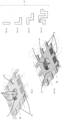
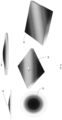
- the transducer 6 can have any shape. Some possible shapes are depicted in figures 5 - 8 .
- a first example of transducer is a rectangular MEMS 6a.
- the rectangular MEMS may be connected to the chamber 2, such as to wall 2a, in a single location 9 (see figure 6 ) or the same structure 6a can be connected to the wall 2a in more locations, such as 2 locations 9a, 9b of figure 5 . Any number of locations can be considered as well.
- a circular MEMS 6b is used as the transducer 6.
- the circular MEMS 6b may be connected to the chamber 2, such as to wall 2a, in a single location 9 (see figure 8 ) or the same structure 6b can be connected to the wall 2a in more locations, such as 2 locations 9a, 9b of figure 7 . Any number of locations can be considered as well.
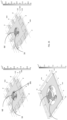
- Figures 9 and 10 refer only to the circular MEMS 6b, however the same principle can be applied to any shape of the transducer 6.
- the reflective element 6d of the transducer 6 may be connected directly to the chamber or a "stage" can be interposed in between.
- the sensor 1 may further comprise a damping and insulation structure 15 positioned between the main component 6c and the chamber 2. That is, the connection between the chamber 2 and the main component 6c is made via a damping and insulation structure 15.
- the role of the damping and insulation structure is to isolate the mechanical mode resonant at a given frequency in the transducer 6 from the external acoustic noise, which may degrade the signal by increasing the background noise and by creating locking issues (see below in the description of the interferometric detection method).
- the main component 6c is "isolated" by using a multi-stage structure (in Figs. 9 and 10 , single-stage transducers 6 are represented for simplicity).
- the damping and insulation structure 15 can be circular or polygonal symmetry (for example rectangular). The geometrical shape of the damping and insulating structure 15 may depend on the geometry of the main component 6c and from the manufacturing process.
- the damping and insulation structure 15 has a mass much bigger than the mass of the main component 6c.
- the damping and insulation structure connects the chamber to the main component 6c.
- the main component 6c is not otherwise connected to the chamber, that is, the main component 6c is connected to the chamber only via the damping and insulating structure 15.
- a large mass isolates the main component 6c, filtering out the low frequency noise.
- Various geometries for the suspension structures are possible (see point c below).
- the overall structure transducer + damping and insulation structure 15 has several mechanical modes, including at least one in which only the main component 6c moves. The frequency of this mode is far from the fundamental mode of the global structure. For this reason, it is possible to obtain a good mechanical insulation and to work with a good signal-to-noise ratio for the interferometer.
- the damping and insulation structure 15 surrounds the main component 6c.
- the connections between the damping and insulation structure 15 and the transducer are made via one or more first suspension structure, all named 16 in the figures.
- the first suspension structure is a special type of connection between the reflective element 6d and the chamber or the reflective element 6d and the damping and insulation structure 15.
- the first suspension structure comprises elongated elements (named also as suspensions) that reduce the length of the outer perimeter of the reflective element 6d in connection to the damping and insulation structure 15.
- Second suspension structure 18, similar to the first suspension structure 16, may also be present, to connect the damping and insulation structure 15 to the chamber 2.
- the suspension structures 16, 18 can have four different embodiments, depicted in figures 11 - 14 . In the following, only the first suspension structure is indicated in the figures, but the same shape applies also to the second suspension structure 18 as well.
- a beam shaped suspension 16 is shown. The suspension is substantially rod-like and it extends along a single direction for a given length.
- a L-shaped suspension 16 is shown. The suspension extends in a first direction for a first given length, then it makes a 90° turn and it extends for a second given length along a second direction.
- a Z-shaped suspension is shown.
- the suspension extends in a first direction for a first given length, then it makes a turn ⁇ 90° and it extends for a second given length along a second direction, it makes a second turn ⁇ 90° and it extends for a third length along a third direction, preferably parallel to the first direction.
- FIG 14 an S-shaped suspension is shown.
- the senor 1 comprises an interferometer 11 (visible in figures 2 and 3 ) and a second laser 10, called a reading laser.
- the interferometer 11 is used, together with the second laser 10, to detect the oscillation of the transducer 6 by interferometry.
- the second laser 10 is preferably a low power laser, for example a HeNe laser or a diode laser.
- the interferometer 11 is for example a Michelson type specifically designed to have balanced detection through laser beam polarization control.
- the detailed diagram of the interferometer is shown in the Figs. 2 and 3 .
- the interferometer 11 comprises a first polarizer 22. After being emitted, the second laser beam 12 impinges on the first polarizer 22, which acts as a filter for the initial polarization of the laser beam, so that the second laser beam 12 exiting the first polarizer has linear polarization, for example vertical.
- the beam exiting the first polarizer and detected in point P1 is linearly polarized.
- the movable mirror 19 is mounted on a moving stage (not shown) that enables its movements in the longitudinal direction with respect to the second split second beam (in this way it is possible to adjust the length of the second arm 14).
- the movements are actuated by the actuator 20, for example a piezoelectric transducer.
- the piezoelectric transducer allows fine movements (micrometric or sub-micrometric) of the movable mirror 19. In this way, the optical path defined by the second arm 14 can be varied.
- the sensor 1 further comprises an electronic board 40.
- the first and second detectors 30, 31 are mounted on the electronic board 40.
- the detectors 30, 31 emit signals that can be extracted and acquired.
- the signals of interest are the following: the signal from each detector (first and second detector) and the difference signal called D2-D1. The latter is the direct subtraction of the two photocurrents from the first and second detector 30, 31.
- the sensor 1 includes therefore a detection system 60 shown in figure 2 .
- the detection system 60 includes a digital acquisition system 61, for example an oscilloscope, to which the signal from one of the two detectors 30, 31 is sent to check the alignment; the signal from the other detector is sent to a lock-in amplifier 62 that demodulates it.
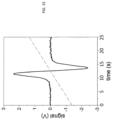
- the lock-in amplifier 62 gives at the output either the first-derivative (1 f demodulation) or the second-derivative (2f demodulation) signal of the molecular absorption of interest of the gas 3. This is the signal that is used in the spectroscopic analysis of the gas concentration.
- An example of such a demodulated signal is for example given in figure 15 .
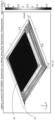
- Figure 23 shows further embodiments of the transducer 6, wherein the main component 6c comprises a first suspension structure 16 between the reflective element 6d and the chamber.
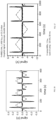
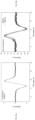
- Fig. 25a shows an acquisition in resonance (frequency modulation equal to the first cantilever resonance) meanwhile Fig. 25b shows an acquisition out of resonance, wherein:
- Fig. 26a shows an acquisition in resonance (frequency modulation equal to the third cantilever resonance) meanwhile Fig. 26b shows an acquisition out of resonance, wherein:
- the laser is scanned around the transition of N 2 O at 4526.86 nm (2209.523 cm -1 ) in a cell containing the gas sample at a fixed pressure (13 mbar in this case) for the whole time duration of the measurement.
- a rectangular silicon cantilever with size 2mm x 4mm and 10 ⁇ m depth has been used, and the third-order mechanical resonance has been chosen.
- the Locking point of the Michelson (differential signal) is set at zero.
- a gas sample on N 2 O (200 ppm concentration) in dry N2 has been used for the test.
- the second laser probing the Michelson interferometer is a HeNe laser emitting at 633 nm wavelength.
- the signal-to-noise ratio over a single acquisition of the graph in fig. 18 is 40, to be compared of the signal-to-noise ratio equal to 180 for a single acquisition of the graph of fig. 19 .
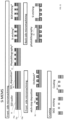
- the surface 70a is made up of Si and the surface 70b is made up of 3C-SiC.
- the surface 70b is etched through a mask prepared via photolithography using a suitable photoresist 72 to give the desired shape to the SiC layer.
- the Si surface 70a is etched through a mask 73.
- the remaining portions of the silicon carbide 70b are then covered by a reflective coating 74 so that the transducer 6 has a reflective surface.
- a silicon on insulator (SOI) wafer (75) has two surfaces: 75a is made up of a thin silicon device layer on a buried SiO 2 layer (75c); 70 b is a several hundred-micron thick silicon handle substrate.
- a SiO 2 layer 76 is deposited on top of the surface 75a.
- the SiO 2 layer 76, the surface 75a and the buried SiO 2 layer 75c are etched through a suitable photoresist mask layer 77.
- a conformal SiO 2 layer 78 is deposited to cover the surface and the vertical walls of the device layer 75a, and the top surface of the handle substrate 75b. The layer in the groves / on the top on the handle surface is 78a.
Landscapes
- Physics & Mathematics (AREA)
- Health & Medical Sciences (AREA)
- Life Sciences & Earth Sciences (AREA)
- Chemical & Material Sciences (AREA)
- Analytical Chemistry (AREA)
- Biochemistry (AREA)
- General Health & Medical Sciences (AREA)
- General Physics & Mathematics (AREA)
- Immunology (AREA)
- Pathology (AREA)
- Optics & Photonics (AREA)
- Engineering & Computer Science (AREA)
- Mathematical Physics (AREA)
- Theoretical Computer Science (AREA)
- Spectroscopy & Molecular Physics (AREA)
- Acoustics & Sound (AREA)
- Investigating Or Analysing Materials By Optical Means (AREA)
- Investigating Or Analyzing Materials By The Use Of Ultrasonic Waves (AREA)
Description
- The present invention relates to a photoacoustic sensor to detect traces of selected molecular species in a gas. Furthermore, the invention relates to a method to detect traces of a gas using a photoacoustic phenomenon.
- In molecular trace gas analysis, researchers are constantly pushing towards more sensitive, affordable and robust instruments as required by the industry and the scientific community. For example, the SCAR technique has been developed, described in
WO 2017/055606 A1 , which achieves few parts per quadrillion-ppq (10-15) record sensitivities. However, such accurate measurements are possible at the expense of a relatively high cost, a limited portability and highly sophisticated components. Modern photo-acoustic spectroscopic (PAS) techniques, such as cantilever-enhanced photo-acoustic spectroscopy (CEPAS), quartz-enhanced photo-acoustic spectroscopy (QEPAS) and variants of cavity-enhanced photo-acoustic spectroscopy are also techniques known in the art which can achieve high sensitivities. For example, for the standard QEPAS sensor sensitivity of 50 parts per trillion-ppt (10-12) on SF6 has been obtained, as described in V. Spagnolo, P. Patimisco, S. Borri, G. Scamarcio, B. E. Bernacki, and J. Kriesel, Opt. Lett. 37, 4461 (2012) with cost-effective elements, non-critical optical alignment, and possibility of fabricating very compact systems. Furthermore, this technique is suitable for several implementations, which can improve its performance. Commercial sensors are available, as produced by companies like Thorlabs. - The CEPAS sensors developed so far present an almost unique design of the cantiveler (rectangular shape) and of the detection scheme, using a standard interferometric reading. The variants on which research groups have worked concern the design of the acoustic cell and the cantilever support. These sensors are commercialized by the Finnish company GASERA, and some aspects of the sensors are described for example in
US 7,738,116 B2 andUS 9,170,379 B2 - Recently, a CEPAS sensor has demonstrated sub-ppt detection on HF in T. Tomberg, M. Vainio, T. Hieta and L. Halonen, Sci. Rep. 8, 1848 (2018), though obtained with the use of a very complex high power optical source (Optical Parametric Oscillator). However, this result demonstrates the high potential of both the CEPAS technique and its possible implementations.
- An example of a Michelson interferometeric optophone is described in the document CHU J H ET AL: "Michelson interferometric detection for optoacoustic spectroscopy", OPTICS COMMUNICATIONS, ELSEVIER, AMSTERDAM, NL, vol. 89, no. 2-4, 1 May 1992 (1992-05-01), pages 135-139.
- The present invention relates to a photoacoustic sensor and a method to detect gas traces that achieve a relatively high sensitivity. In particular, the sensor and the method of the invention allows solving - at least partially - some of the instability problems over time (drifts) of the sensor. Furthermore, the sensor and the method of the invention allow averaging the signal obtained by the measurements over longer timescales, improving sensitivity and avoiding systematic effects in the determination of the concentration of the trace species in the gas sample.
- According to a first aspect, the invention relates to a photoacoustic sensor for spectroscopic gas detection, comprising:
- A chamber adapted to contain the gas to be analysed;
- An excitation laser source adapted to emit a frequency- or amplitude-modulated laser beam, which is absorbed by the gas present in the chamber and creating a pressure wave;
- A transducer, the transducer being located inside the chamber, and being adapted to be put into oscillations by the pressure wave, the transducer having a reflective portion;
- An interferometer having a first and a second arm and an output, with the first arm ending in the transducer, and the second arm including an optical path changer element and an actuator connected to the optical path changer element to change the optical path defined by the second arm of the interferometer;
- A first polarizing beam splitter;
- A second laser source for interferometer reading, adapted to emit a second laser beam impinging onto the first polarizing beam splitter, the first polarizing beam splitter being adapted to split the second laser beam in the first and the second arm of the interferometer, so that the split beam travelling in the first arm is back-reflected by the reflective portion of the transducer, and the split beam travelling in the second arm is back-reflected by the optical path changer element, so that the resulting back-reflected split beams interfere in the interferometer;
- A second polarizing beam splitter adapted to split the interfering light at the output of the interferometer in two beams which are orthogonally polarized;
- A first detector adapted to detect one of the two orthogonally polarized beam exiting the interferometer and to emit a corresponding first interference signal;
- A second detector adapted to detect the other of the two orthogonally polarized beam exiting the interferometer and to emit a corresponding second interference signal;
- An electronic circuit configured to obtain a difference signal, the difference signal being function of the difference between the signal generated by the first detector and the signal generated by the second detector;
- A feedback loop adapted to command the movements of the actuator in order to change the optical path of the second arm, so that the difference signal is kept equal to a desired constant value during the gas concentration measurements.
- According to a different aspect, the invention relates to a method to detect a gas concentration by means of a photoacoustic phenomenon, the method comprising:
- Providing a chamber where a gas is located, the concentration of which is to be measured;
- Providing a transducer in the chamber, the transducer comprising a reflective portion;
- Generating a pressure wave in the chamber by means of a modulated excitation laser beam directed into the chamber, according to the photo-acoustic phenomenon, the pressure wave putting the transducer in oscillation;
- Impinging with a second laser beam onto the reflective portion of the transducer;
- providing an interferometer, having a first arm terminating into the transducer and a second arm terminating into an optical path changer element adapted to vary the path length of the second arm;
- Directing a second laser beam towards the interferometer, the second laser beam forming a first back-reflected beam when reflected by the transducer and a second back reflected beam when reflected by the optical path changer element;
- Creating an interference between the first and the second back-reflected beams;
- Splitting the interfering back-reflected beams in a first and a second interference beam;
- Polarizing the first and/or the second interference beam so that their polarization axes are mutually perpendicular;
- Detecting the first interference beam and the second interference beam generating a first and a second signal;
- generating a difference signal function of the difference between the first signal and the second signal;
- Defining a working point value of the difference signal;
- Adapting the optical path length of the second arm actuating the actuator so that the difference signal is kept equal to the working point value during the gas concentration measurement.
- According to an embodiment of the invention, a different device able to control the interferometer optical path can be substituted to the actuators, e.g. a liquid crystal or electro-optic element or any device able to change the phase of the radiation.
- It should be noted that the feature of "the second detector adapted to detect the other of the two orthogonally polarized beam exiting the interferometer and to emit a corresponding second interference signal" represents a differential detection scheme, centered on the zero, that is obtained when the two beams have perfectly orthogonal polarization. Any unbalance in polarization gives a nonzero signal.
- According to an embodiment of the invention, the feedback look is made of an electronic circuit taking the difference signal, comparing it to a desired fixed value, and producing an error signal to be sent to the actuator.
- According to an embodiment of the invention, the step of "defining a working point value of the difference signal" provides for setting the working point value to zero.
- In the invention, the sensor and the method are used to detect the gas concentration in the gas chamber. A gas, called gas sample, is located in the gas chamber, normally containing different molecular species, and the purpose of the invention is to measure the concentration of one or more target molecules eventually present in the gas sample in traces. Therefore with "measuring the gas concentration", measuring a specific (target) molecular species among the species present in the gas sample is meant. In addition, some gaseous promoters (e.g. water vapor) may be added, in a known concentration, to the gas sample to be analyzed, in order to enhance the photoacoustic effect.
- The gas chamber defines an air-tight enclosure. It can be made of any material suitable in the art. The gas chamber can be used in flow or in static gas conditions.
- Furthermore, a first laser source, called excitation laser source, is provided. The first laser source is adapted to emit a first laser beam. Preferably, the first laser source emits a first laser beam. Preferably, the first laser beam is in the infrared (IR) range. The wavelength of the IR beam is selected so that it resonates with roto-vibrational molecular transitions. The infrared beam is an electromagnetic beam having a wavelength in the range 700 nm (frequency 430 THz) - 1 mm (300 GHz). However, any other wavelength, that is resonant with rotational, vibrational, electronic transitions, alone or in combination and exploiting overtones, can be used, if radiation absorption is sufficiently intense to generate detectable acoustic waves.
- The first laser source may be located inside the gas chamber, or it may be external to the same. If the first laser source is located outside the gas chamber, a window is preferably present in the gas chamber, which is substantially transparent for the first laser beam, so that this laser beam can pass through the window and reach the inner part of the chamber.
- The wavelength of the first laser beam is so selected that it can interact with the target molecules present in the gas of the gas sample. In particular, the wavelength is selected in a way that it excites a molecular transition in the molecules of the gas to be analysed inside the gas chamber. The first laser beam is thus selected so that it is resonant with a selected molecular transition of the gas, the concentration of which is to be measured. Furthermore, the first laser beam is a modulated laser beam. The first laser is (frequency or amplitude) modulated at a frequency f, so that it excites the transition, and the subsequent molecular relaxation produces an acoustic wave.
- The infrared laser beam, absorbed by the gas to be analysed, generates heat waves, which result in pressure fluctuations within the gas chamber, substantially forming pressure waves in the chamber. This process is a very well known phenomenon and therefore no further detailed in the following.
- Preferably, the pressure inside the chamber is comprised between 1 mbar and atmospheric pressure, more preferably above 10 mbar.
- Furthermore, in the gas chamber a transducer is located. The transducer may be connected to a substrate. The substrate may be a silicon wafer. The substrate may be internal or external to the gas chamber. The transducer extends into the gas chamber, that is, it is subject to the pressure wave which develops due to the excitation laser beam. The substrate is then connected, for example by means of a support, to the gas chamber.
- According to the invention, the transducer comprises a main component which is adapted to be put into oscillations by a pressure wave. The main component comprises a reflective element with at least a reflective portion forming a mirror of the interferometer.
- Preferably, the reflective element defines a triangular surface, a rectangular surface or a squared surface.
- Preferably, the reflective element defines a regular polygonal surface or an irregular polygonal surface.
- Preferably, the reflective element defines a circular surface or an oval surface.
- Preferably, the reflective element is thin compared to the substrate, i.e. the reflective element has a maximum thickness of tens of microns whereas the substrate has a maximum thickness of hundreds of microns.
- According to an embodiment of the invention, the reflective element is directly connected (i.e. without other elements) to the chamber, in particular to the substrate. In this case, the main component may be considered as a self-supporting member.
- Preferably, the main component, in particular the reflective element, is a membrane or an equivalent structure.
- According to another embodiment of the invention, the main component comprises a first suspension structure between the reflective element and the chamber, in particular the substrate. The first suspension structure is made of one or more elongated elements having two opposite longitudinal ends connected to the reflective element and the chamber (in particular the substrate), respectively. Therefore, the reflective element is connected to the chamber (in particular to the substrate) via the first suspension structure. The first suspension structure supports the reflective element and allows the main component to oscillate. In should be noted that at least one of the number, size and shape of elongated elements of the first suspension structure determines the mechanical resonance spectrum of the main component. For instance, the elongated element of the first suspension structure may have shape of one of beam, arc, L, S, Z and spiral or combination thereof.
- Preferably first suspension structure is arranged so that it have no optical function for the photoacoustic sensor.
- In addition to the first suspension structure, the transducer may comprise a damping and insulation structure between the first suspension structure and the chamber, in particular the substrate. In this case, a longitudinal end of each elongated element of the first suspension structure is connected to the main component and the other one of each elongated element is connected to damping and insulation structure. Therefore, the main component is connected to the chamber (in particular to the substrate) via the damping and insulation structure. It should be noted that a purpose of the damping and insulation structure is to filter the ambient noise during the use of the photoacoustic sensor.
- Preferably, the damping and insulation structure at least partially surrounds the main component. The damping and insulation structure can surround the main component in a symmetrical or asymmetrical way.
- Preferably, the mass of the damping and insulation structure is ten times greater than the mass of the main component.
- Preferably, the mass and/or size and/or shape of the damping and insulation structure allows to filter out selected frequency components. Moreover, the mechanical modes of the damping and insulation structure do not overlap the modes of the main component nor the working frequency of the photoacoustic sensor (if different).
- Preferably, the damping and insulation structure is arranged so that it has no optical function for the photoacoustic sensor.
- In addition to the damping and insulation structure, the transducer may comprise a second suspension structure between the damping and insulation structure and the chamber, in particular the substrate. The second suspension structure is made of one or more elongated elements having two opposite longitudinal ends connected to the damping and insulation structure and the chamber (in particular the substrate), respectively. Therefore, the main member is connected to the damping and insulation structure, the latter being connected to the chamber (in particular to the substrate) via the second suspension structure. The second suspension structure supports the damping and insulation structure.
- Preferably, the second suspension structure is designed in such a way that the transmission of mechanical frequencies interfering with the working mode of the main component are minimized. For instance, the elongated element of the second suspension structure may have shape of one of beam, arc, L, S, Z and spiral or combination thereof.
- Preferably, the second suspension structure is arranged so that they have no optical function for the photoacoustic sensor.
- According to another embodiment of the invention, the main component lacks of the first suspension structure and the reflective element is directly connected to the damping and insulation structure which is connected to the chamber, in particular to the substrate. In this case, the transducer may also comprise the second suspension structure so that the damping and insulation structure is connected to the chamber (in particular to the substrate) via the second suspension structure.
- The transducer is preferably a microelectromechanical system (MEMS) transducer. MEMS are also referred to as micromachines or microsystem technology (MST). MEMS transducers preferably range in size from 10 µm to a couple of centimeters. With "size", the maximum dimension of the MEMS is meant.
- As mentioned, the transducer may be attached to a substrate. The attachment may be a single-point attachment, that is, there is a single connection between the substrate and the MEMS transducer, or multiple-points attachments, where there are multiple connections. The number of connections may be chosen depending on the geometry of the transducer.
- Preferably, the transducer has a geometry such that two of its dimensions are much bigger than its third dimension. That is, generally the thickness of the transducer is much smaller than its length or width.
- Preferably, three main types of transducer may be considered.
- The first type of transducer refers to a transducer whose reflective element is a membrane. The membrane performs a movement similar to the movement of a drum. This is achieved due to a connection between the membrane and the substrate which is symmetrical to an axis. In other words, the membrane has a symmetry axis and the connections between the membrane and the support are symmetric with respect to this axis. This means that a membrane always includes at least two connections between itself and the substrate. The membrane may define a triangular surface, a rectangular or squared surface, it may define a regular or an irregular polygonal surface (preferably, the regular or irregular polygon has a number of sides comprised between 3 and 20), it may define a circular or an oval surface. The thickness of the membrane is preferably comprised between 30 nm and 50 micrometres. Preferably, the thickness depends on the material in which the membrane is formed. The maximum lateral dimension is preferably comprised between 100 micrometres and 2 cm.
- With maximum transverse dimension, the maximum dimension of the side of a rectangle circumscribed to the membrane is meant.
- Preferred membranes geometries and materials are listed in TABLE 1.
TABLE 1 Material Further details Thickness Maximum transverse dimension Frequencies of oscillation Silicon polysilicon, crystalline silicon (crystal directions: 100, 110,111) 200 nm- 30 micron 100 micron - 15 mm 10 Hz- 500 kHz Silicon nitride Stoichiometric or Non-stoichiometric compound 10 nm-2 micron 100 micron - 10 mm 100 Hz- 1 MHz Silicon oxide Stoichiometric or Non-stoichiometric compound 50 nm-2 micron 100 micron - 10 mm 350 Hz- 250 kHz Multilayer SiO2+Si3N4 Stoichiometric or Non-stoichiometric compound 10 nm-2 micron 100 micron - 10 mm 250 Hz- 350 kHz SiC - 3C 10 nm-10 micron 100 micron - 10 mm 350 Hz- 250 kHz SU8 50 nm-30 micron 100 micron - 10 mm 250 Hz- 200 kHz Indium Tin Oxide (ITO) 10 nm-500 nm 100 micron - 10 mm 250 Hz- 150 kHz - The second type of transducer refers to a transducer whose main component comprises a first suspension structure between the reflective element and the substrate. In this case, the reflective element may be described as a central element (triangular, rectangular, regular or irregular polygons - side numbers between 3 and 20 - circles). Differently from the membranes, however, the reflective element is connected to the substrate asymmetrically. The transducer can oscillate therefore "anchored on one side". Also in this case multiple connections may be present between the reflective element and the first suspension structure. The number of connections is preferably comprised between 1 and 20. In particular, the connections between the reflective element and the first suspension structure correspond to the connections between the reflective element and the elongated elements of the first suspension structure.
- The shape of the elongated elements of the first suspension structure may be of 4 types:
- right rectangular beams, in this case it is therefore said that there is a single element forming the elongated element;
- L- shape (composition of two perpendicular elements);
- Z - shape (composition of three elements perpendicular to two by two);
- S - shape (composition of at least two z-shape elongated elements).
- Preferred geometries and materials of the elongated elements are listed in TABLE 2.
TABLE 2 Material Further details Thickness Maximum transverse dimension Number of elongated elements Maximum convex hull dimension of an elongated element Oscillation frequencies Silicon polysilicon, crystalline silicon (crystal directions: 100, 110,111) 200 nm-30 micron 100 micron - 15 mm 1-20 100 micron - 10 mm 10 Hz- 900 kHz SiC - 3C 10 nm-2 micron 100 micron - 10 mm 1-20 100 micron - 10 mm 350 Hz- 250 kHz SU8 50 nm-30 micron 100 micron - 10 mm 1-20 100 micron - 10 mm 250 Hz- 150 kHz SU8+Si/Si3N4/SiO2 Silicon, silicon oxide, silcion nitride 50 nm-20 micron 100 micron - 10 mm 1-20 100 micron - 10 mm 400 Hz- 750 kHz - The third type of transducer refers to a transducer whose main component comprises a first suspension structure between the reflective element and the substrate. Different from the second type-transducer, the first suspension structure has a spiral like shape. The spiral is formed by a plurality of elements connected to each other in series (that is, one after the other). The reflective element is connected to the spiral and forms a central element of the transducer. The central element can have any shape, the same shape detailed when it comes to the membrane.
- In this case, the first suspension structure is a composition of bar-like elements with a relative angle between 15 and 179 degrees. The first suspension structure creates "loops" around the central element.
- Preferred first suspension structure geometries and materials are listed in TABLE 3.
TABLE 3 Material Further details Thickness Maximum transverse dimension Number of elements Number of loops Oscillation frequencies Silicon polysilicon, crystalline silicon (crystal directions: 100, 110,111) 200 nm- 30 micron 100 micron - 15 mm 1-20 0.05-3 10 Hz- 500 kHz SiC - 3C 10 nm-2 micron 100 micron - 10 mm 1-20 0.05-3 350 Hz- 250 kHz SU8 50 nm-30 micron 100 micron - 10 mm 1-20 0.05-3 250 Hz- 150 kHz SU8+Si/Si3N4/SiO2 Silicon, silicon oxide, silcion nitride 50 nm-20 micron 100 micron - 10 mm 1-20 0.05-3 400 Hz- 400 kHz - The pressure wave caused by the excitation of the molecular transition and propagating in the chamber forces the transducer to oscillate. The transducer is thus put into motion by the propagating pressure wave in the chamber. The motions are oscillations.
- The frequency of the oscillations of the transducer depends on the modulation frequency of the first laser, the laser that excites the gas molecular transition. The amplitude of the oscillations depend on many factors, including the power of the exciting laser, the modulation depth of the first laser, the gas pressure, the target molecule concentration, the cross section of the selected molecular transition, the presence of gas promoters or interfering molecules. Due to the fact that all these parameters are known, with the exception of the concentration of the target molecules in the gas, the amplitude of the oscillations of the transducer is measured and from it the concentration is derived.
- The amplitude of the photoacoustic wave is given by


- The acoustic wave forces the transducer to oscillate, at the same frequency f and with and amplitude which is proportional to S. The acoustic wave can eventually excite also higher-order resonances. The amplitude of the acoustic wave carries the information about the concentration of the target molecules. This information is transferred to the transducer, specifically to its oscillation amplitude, and can be detected interferometrically.
- In order to measure such amplitude, the transducer comprises, at least partially, a reflective portion. The reflective portion is reflective for electromagnetic radiation with the features described below. The transducer can be, for example, at least partly, coated by a reflective material or be formed, at least partly, by a reflective material.
- Coating materials depend on He-Ne laser (or equivalent) wavelength, transducer material and gas sample. Possible materials are for example one or more of gold, aluminum, silver, dielectric multilayers, polymers and metal oxides.
- In order to measure the oscillations of the transducer, an interferometer is provided. The interferometer is part of the sensor. Thanks to the reflecting surface, the transducer forms one of the mirrors of the interferometer.
- Interferometry makes use of the principle of superposition to combine waves in a way that will cause the result of their combination to have some meaningful property that provides information on the original state of the waves and on the path/length travelled. This works because when two waves with the same frequency combine, the resulting intensity pattern is determined by the phase difference between the two waves-waves that are in phase will undergo constructive interference while waves that are out of phase will undergo destructive interference. Waves which are not completely in phase nor completely out of phase will have an intermediate intensity pattern, which can be used to determine their relative phase difference.
- In order to obtain interferometric data, a second laser source is provided, called also "reading" laser. This second laser source is adapted to emit a beam of coherent electromagnetic radiation. Usually the reading laser emits in the visible region, which makes alignment of the interferometer easy and where good-quality and cost-effective optical and electronic components are available. One of the common choices for the second laser source is a He-Ne laser, emitting at 633 nm wavelength, due to its good stability, good mode profile, robustness and good quality over price ratio. When compact dimensions are important, visible diode lasers may be preferred
- The second laser source may be located outside the chamber. If the second laser source is located outside the chamber, the chamber includes a window transparent to the electromagnetic radiation emitted by the second laser source so that the electromagnetic radiation emitted by the second laser source can enter the chamber. Preferably, the transducer defines a first and a second surface, one opposite to the other. Preferably, the second laser beam impinges onto the first or the second surface of the transducer perpendicularly.
- Preferably, inside the chamber, the beam (electromagnetic radiation) emitted by the excitation laser and the beam emitted by the second laser are substantially perpendicular to each other.
- The electromagnetic radiation emitted by the second laser source is split in two split beams. This split can be performed for example by a first beam splitter. Each split beam is directed into one of the two different arms of the interferometer, each arm defining an optical path for the electromagnetic radiation. The first arm of the interferometer includes the transducer, where the electromagnetic radiation is back- reflected inside the first arm. The second arm terminates with an optical path changer element, where the split beam is back-reflected into the second arm. The beams of electromagnetic radiation from the two arms are recombined in a standard manner known in the art as interferometer.
- The optical path changer, better detailed below, is for example a movable reflecting surface or a device able to control the interferometer optical path can be substituted to the actuators, e.g. a liquid crystal or electro-optic element or any device able to change the phase of the second laser radiation. In this way, the optical path defined by the second arm of the interferometer may be changed. The change is operated via an actuator. The actuator is adapted to operate on the optical path changer element and force the latter to change the optical path defined by the second arm.
- The interferometer is designed to get balanced detection, that is, the intensity of the beam exiting the first and the second arm is the same.
- The interferometer used is preferably a Michelson interferometer, mounted in a balanced arrangement which ensures the best signal-to-noise ratio possible for a given laser power. Alternatively, a Mach-Zender type interferometer can be used as well.
- The proposed balanced arrangement is realized via polarization control of the second laser beam. The second laser radiation has preferably a linear polarization. Alternatively, in order to obtain a linear polarization, proper phase-retarder plates and polarizers are located downstream the second laser to obtain a linearly polarized radiation. Instead of linearly polarized light, perfectly circular polarization can be used as well as the second laser radiation beam. A first polarizing beam splitter divides the second laser beam into two parts, with orthogonal polarizations, each part travelling along one of the two arms of the interferometer. The same first polarizing beam splitter is used to recombine the radiation from the two arms of the interferometer. Another (second) polarizing beam splitter divides the recombined radiation in two parts, again with orthogonal polarizations, each part impinging on one of the two detectors.
- As known, the two back-reflected beams of electromagnetic radiation interfere and form an interference pattern. The interference pattern, or interference fringes, give information about the difference in optical path lengths between the two arms of the interferometer.
- Due to the oscillations of the transducer, the optical path defined by the first arm of the interferometer changes in length. Therefore, an analysis of the interference fringes can be used to determine the amplitude of the oscillations of the transducer and then, in turn, it is possible to obtain the concentration of the gas to be analysed inside the chamber.
- The fringes caused by the interference between the electromagnetic radiation traveling in the first arm and in the second arm of the interferometer can be detected by a suitable detector, such as a photodetector known in the field. The detector preferably has a sufficiently high bandwidth to detect the oscillation frequency of the transducer. Further, preferably, the detector performs the detection, with the lowest possible background noise. Preferably, the detector has a bandwidth larger than the oscillation frequency working point.
- The back-reflected beams travelling in the interferometer (and interfering) can be split in two at the output of the interferometer. The split may be performed, for example, by the second beam splitter. The second beam splitter can be a polarization beam splitter. If the second beam splitter is not a polarization beam splitter per se, further polarizers may be present in the interferometer, so that the two beams divided by the second beam splitter have mutually orthogonal polarization. In both cases, the second beam splitter is called "polarization beam splitter", i.e. both in case in which it is in itself a polarization beam splitter or in case polarizers are added. The direction of the polarization axis is arbitrary, but the two split beams are preferably orthogonally polarized. The two split beams are then impinging onto the first and the second detector, part of the sensor of the invention.
- Calling D1 and D2 the detectors, both beams are focused into the two detectors D1 and D2. Assuming plane waves, the electric field of the interfering back-reflected laser beams before the second beam splitter can be written using Jones formalism:

polarizing beam splitter 

- The detector D1 detects the field intensity:

- Similarly, the horizontal polarization components at the exit of the beam splitter can be calculated by multiplying the Jones-matrix representing the
polarizing beam splitter 


- Therefore, the fringes of interference between the back-reflected beams that carry the information on the oscillations of the transducer can be analyzed either studying a signal emitted by the first detector, signal function the detected beam of equation (2), or a signal emitted by the second detector, signal function of the detected beam of equation (3).
- If it is assumed that, at rest conditions, i.e. when there is no transducer displacement, the two arms of the interferometer are set so that

- Assuming that the oscillation of the transducer is a harmonic signal u(t) = Ssin(2πf · t), oscillating at the laser modulation frequency f, the two outputs of the detectors D1 and D2 give an oscillating signal proportional to u(t) with a fixed background equal to the total field
intensity 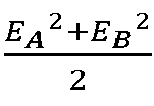

- The harmonic displacement u(t) of the transducer has an amplitude S proportional to the gas concentration, according to Eq. (1). In order to retrieve the value of the oscillation amplitude S, a demodulation may be performed. For example, a lock-in amplifier may be used to demodulate the detector signal at the reference frequency f. This operation can be done on the D1 (or D2) signals. Thus, analyzing the signal detected by the first or the second detector, the oscillations of the transducer can be measured.
- The above sensor operates according to the method of the invention.
- Preferably, the excitation laser is operated at a given current and temperature so that the frequency of the laser light matches the molecular transition. The modulation of the excitation laser beam operates as follows. A modulation at the frequency f is added to the driving current of the first laser and, in addition, a slow triangular ramp (with a frequency much slower than f) is added to the current in order to scan the excitation laser optical frequency across the molecular transition.
- As the excitation laser optical frequency enters in resonance with the molecular transition of the gas of interest, a molecular excitation modulated at the frequency f is induced, followed by the molecular non-radiative relaxation, which produces the modulated pressure wave in the gas sample.
- Such wave hits the transducer and induces a modulated displacement at the frequency f and with an amplitude proportional to the amplitude of the pressure wave.
- Preferably, the modulation frequency is so selected that f matches the resonance frequency of the transducer, or one of the higher-order resonances.
- Anyway, the modulation frequency could be out of the mechanical resonance.
- The transducer displacement is measured via the Michelson interferometer, described above.
- Preferably, a specific working point is set, in other words a value for φA - φB is set, as well as the power level impinging onto the detectors. For example, the conditions according to eq. (4) are set. In this way, any displacement of the transducer is measured with the highest sensitivity of the interferometer, corresponding to the maximum slope of the sinusoidal signal. This is true for the two signal outputs at the first and second detectors D1 and D2, according to eq.(5).
- Preferably, the signal output from the first detector, D1, or the second one, D2, is demodulated by a lock-in amplifier around the modulation frequency f to retrieve the amplitude of the cantilever oscillation. The lock-in amplifier filters the signals coming from the first or the second detector (and/or their difference signal) with a bandwidth set by the lock-in parameters, and demodulates it at the frequency f, thus extracting only the signal amplitude modulated at the frequency f, averaged with a time constant τ. Vibrations of the transducer at frequencies sufficiently outside the set bandwidth are filtered out and do not contribute to the noise of the final measurement. In this way, on one side, the background noise contributions affecting the signal are largely suppressed and, on the other side, a measurable DC signal proportional to the amplitude of the transducer oscillation is obtained.
- Preferably, before performing the measurement with an unknown gas, a measurement is made with known gases, to calibrate the sensor of the invention. The sensor is calibrated by using gas samples with certified concentration of the target molecules: for a given concentration of the gas sample, the amplitude of the measured interferometric signal is recorded and associated to the known concentration. This procedure is repeated for different gas concentrations and a one-to-one function is set between the measured interferometric signal and the gas concentration. This function allows retrieving any unknown concentration (of the same molecule) provided that the sensor operating conditions are the same of those set during the calibration.
- Given this configuration, the measured signal demodulated by the lock-in amplifier is affected by several noise contributions which may decrease the final signal-to-noise ratio of the single acquisition and/or affect the repeatability of the measurements, thus decreasing the final sensitivity. These noise contributions are mainly related to instabilities of the interferometer and to environmental noise, and may include:
- slow drifts of the relative length of the two arms, not due to the transducer displacement. This produces a deviation from the selected working point, such as the condition set by eq. (4), making the interferometer exiting the optimal maximum-slope operating condition. This produces slow variations in time of the amplitude of the interferometric signal, invalidating the sensor calibration and affecting both the single acquisition (if the drift time is comparable with the slow ramp spanning the excitation laser frequency and the lock-in time constant τ) and the repeated acquisitions (because repeated acquisitions occur at different operating points of the interferometer). As a consequence, the single acquisition may be distorted, repeated acquisitions produce different measured amplitudes and, finally, the calibration is no more valid;
- fast mechanical/acoustical noise inducing vibrations of the interferometer components. This noise produces fast variations of the length of the two arms, makes the working point of the interferometer to rapidly change and thus introduces noise in the measured interferometric signal.
- These noise contributions are not filtered out by the lock-in amplifier, because they induce variations in the amplitude of the signal u(t) = S sin(2πf · t) oscillating at f (in other terms they affect the S value) and directly translate into amplitude noise in the measured spectra. This decreases the final detection sensitivity.
- According to the invention, in order to overcome this problem, a differential detection scheme, centered on the working point (which is preferably the zero) is applied. This differential detection scheme is obtained because the two beams have perfectly orthogonal polarization when the transducer is not moving.
- Any unbalance in polarization gives a nonzero signal, as better detailed below. .An electronic locking loop which fixes the interferometer operating point to a desired working point such as, for example, the condition set by Eq. (4), is considered. This is made by using a differential signal ID as reference, as detailed below.
- The sensor includes a circuit board or any other suitable circuitry which is adapted to create a signal which is equal to the difference of the signals obtained by the two detectors detecting the two different interfering back-reflected beams outlined above. Thus, the difference signal is the signal generated by subtracting the value of one signal detected by the first detector from the value of the other signal detected by the second detector. For example, still assuming planar waves, the differential component ID = I2 - I 1 is thus given by:

- The difference signal, therefore, is an oscillating function and depends on the difference of the phases φA - φB.
- Any displacement of the transducer u(t) produces an unbalancing of the signals and a non-null value for ID :

- Where it has been considered that eq. (4) applies. It is to be understood that the use of equation (4) is one of the possible choices; indeed, any value of the phase difference can be selected.
- If the displacement is small enough compared to λ, the previous equation can be approximated with:
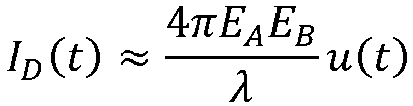
- Where, as detailed above, u(t) = Ssin(2πf · t).
- In practice, in a more intuitive view, the interferometer translates a displacement of the transducer into a measurable amplitude signal, while the slope of the sinusoidal interferometric signal sets the value of the displacement-to-amplitude conversion factor. By setting the two arms in the condition of Eq.(4), this conversion factor is set at its maximum value (i.e. maximum slope of the sinusoidal signal) and the measured amplitude is maximized.
- According to the invention, it is desired to keep fixed the working point of the interferometer, that is, it is desired to satisfy eq. (4), where the difference of the two signals coming from the first and the second detectors remains equal to zero. This working point (which means, the value of the difference between the two currents) is kept fixed during the measurement of gas concentration, while the transducer is oscillating. As said, Eq. (4) is just one possible choice for setting the working point and other choices are possible. To this purpose, the optical path changer element comes into play. In order to keep the working point fixed, then the optical path defined by the second arm of the interferometer needs to change. The optical path is for example changed operating on the actuator which in turn operates on the optical path changer element. For example, if the optical path changer element is a movable reflecting element, the latter is displaced. This induces a variation of the optical path of the second arm of the interferometer. In order to "lock" the value of the difference signal ID to the desired value, therefore, the actuator is used, which changes the optical path defined by the second arm of the interferometer. The actuator may be, for example, a piezoelectric element which physically displaces the movable reflecting element. The locking point is fixed at the zero value of ID, and this value is maintained by acting on the movable reflecting element, thus adjusting the corresponding path length. This locking can be performed for example by using a proportional-integral-derivative controller (PID controller), which defines a locking bandwidth. This solution has several advantages:
- It cancels out the noise contributions within the locking bandwidth, thus reducing the noise floor;
- It cancels out the slow drifts of the working point, thus solving the problem of measurements repeatability over time and calibration.
- When the frequency of the transducer (i.e. the modulation frequency of the infrared laser) is much higher than the locking bandwidth, the locking circuit is unable to "correct" the phase variations induced by the transducer oscillations. This means that the locking circuit does not perturb the signal due to gas absorption, which can be retrieved by analyzing one of the two detectors outputs (D1 or D2), and only maintains the interferometer stable over time in the optimal conditions. Therefore, in a first embodiment of the invention, the desired spectroscopic information are obtained from the signal emitted by the first detector or the second detector in response to the detection of the first or the second interference beam. In this embodiment, therefore, the D2-D1 signal is used for the locking circuit and the D1 (or D2) output is sent to the lock-in amplifier for the spectroscopic analysis. In order to achieve this condition, instead of using the fundamental transducer resonance frequency (if too low), one of the higher resonant modes can be used. A further advantage of using a high-f resonant mode is the lower contribution from ambient noise at higher frequencies, which increases the final signal-to-noise ratio.
- In a second embodiment, a different signal is used to obtain spectroscopic information. The first embodiment described above applies when the locking bandwidth is much smaller than the modulation frequency f, which can be achieved for example by using a higher resonant mode of the transducer. Alternatively, another option is using a locking bandwidth larger than the modulation frequency. This may happen, for example, when a low-f resonant mode, e.g. the fundamental one, is used. This option may be particularly advantageous when the ambient noise is low, and does not affect too much the measurement. An advantage of using a low-frequency mode is that usually it is stronger than higher-order modes, so the oscillation amplitude of the transducer is larger. In this case, the locking bandwidth may be of the same order of magnitude or even higher than the modulation frequency. It means that the locking circuit not only maintains the interferometer working point at the zero value of D2-D1, but also "corrects" the oscillation of the cantilever. As a consequence, the signal from D1 or D2 is suppressed by the locking loop (partially or totally, depending on the parameters of the locking circuit). In this case, instead of using the D1 (or D2) signal for the spectroscopic analysis, it is convenient to use the error signal sent to the actuator connected to the optical path changer element. Assuming that the locking circuit is strong and fast enough to completely cancel out the interference signal, it means that the locking loop is fast enough to follow the transducer oscillations and it acts on the actuator to correct the phase variations induced by the transducer oscillations. As a consequence, the D1 (or D2) signals are kept to a constant value, usually zero, and they cannot be used for the spectroscopic analysis. Nonetheless, the spectroscopic information is not lost, because it is now transferred to the signal moving the actuator acting on the optical path changer element (for example displacing the movable reflecting element): this signal, which is for example the error signal of the PID, now contains the contributions from the external noise and slow drifts of the interferometer plus the contribution from the transducer. The latter is the only contribution oscillating at f, and thus can be easily separated from the "noise" contributions. In this case, the error signal is split in two parts: one is sent to the PID circuit for the locking loop, the other is sent to the lock-in amplifier for the demodulation. The demodulated signal from the lock-in amplifier reproduces the oscillation amplitude of the transducer and can be used for the spectroscopic analysis. Also in this case the locking circuit improves the signal-to-noise ratio of the measurement because it removes the slow drifts and maintains the interferometer working point to the optimal condition.
- The interference fringes reaching the detector may be further processed, for example a demodulation can take place. Preferably, a Fourier Transform of the signal obtained from the detector is performed. From the Fourier Transform analysis, information on the gas concentration can be obtained.
- Preferably, the transducer is realized in one of such materials: Silicon, SiO2, Si3N4, SiC and polymers including their amorphous or crystalline forms or in non-stoichiometric forms. The material constituting the transducer is deposited on a silicon wafer substrate. The transducer can be coated by a metal, a metal oxide or a dielectric multilayer.
- These materials allow the use of the transducer also in "harsh" environment.
- Preferably, the sensor includes a damping and insulation structure located between the chamber and the transducer, the transducer being connected to the chamber only via the damping and insulation structure. In order to isolate the mechanical mode resonant at a given frequency from the external acoustic noise, which may degrade the signal by increasing the background noise and by creating locking issues, a damping and insulating structure is provided. The structure is interposed between the transducer and the chamber. The structure surrounds the transducer or, alternatively, holds it at least from one side. Preferably, the mass of this structure is much bigger than the mass of the transducer.
- Preferably, the desired constant value is equal to zero.
- Preferably, the working point of the interferometer, that is, the value of ID, which is set and "locked" is the value written in equation (4). In this way, it maintains the working point at the maximum slope of the interferometric signal, thus maximizing the conversion factor.
- Preferably, wherein the dimension of the transducer ranges between 10 µm and 2 cm.
- Said dimension is defined as the segment having the maximum length and connecting two different points of the transducer.
- Sizes are directly linked to the frequency resonances of the transducer. The resonances are tailored depending on application/environment/target molecules.
- Preferably, the method comprises the step of putting the transducer into oscillation at a frequency equal to the resonance frequency of the transducer or to a higher-order resonance.
- The transducer has a mechanical resonant frequency and higher-order resonances. Preferably, either the resonance frequency or a higher-order resonance are selected due to the fact that large oscillations are obtained. Larger oscillations are easier to detect and with a higher signal-to-noise ratio.
- Preferably, the method comprises the step of obtaining the gas concentration from the step of detecting the first interference beam or from the step of detecting the second interference beam if the frequency of the movements of the optical path changer element is much slower than the modulation frequency of the excitation laser.
- Alternatively, preferably the method comprises the step of obtaining the gas concentration by:
- Operating the actuator so as to change the optical path length of the second arm so that the difference signal is kept equal to the working point value;
- obtaining the gas concentration by demodulating the error signal.
- The invention will be now better described with non-limiting reference to the appended drawings, where:
-
Fig. 1 shows a schematic representation of a sensor for the measurement of a gas concentration according to the invention; -
Fig. 2 is a more detailed representation of the sensor offigure 1 ; -
Fig. 3 is another more detailed representation of the sensor offigure 1 and2 ; -
Fig. 4 is a schematic representation of the polarization of the signal travelling in the sensor offigure 3 ; -
Figs. 5 - 8 are perspective views of four different embodiments of a transducer included in the sensor offigures 1- 3 ; -
Figs. 9 and 10 are a top view and a perspective view of an additional embodiment of a transducer included in the sensor offigures 1- 3 ; -
Figs. 11 - 14 show top view of different embodiments of a detail offigures 9 and 10 ; -
Figs. 15 shows a graph which is the result of a measurement performed with the sensors offigure 1 - 3 ; -
Figs. 16 and 17 are graphs showing a comparison between a measurement (fig. 16 ) performed not according to the invention and a measurement (fig. 17 ) performed according to the invention; -
Figs. 18 and 19 are graphs showing a comparison between a further measurement (fig. 18 ) performed not according to the invention and a further measurement (fig. 19 ) performed according to the invention; -
Fig. 20 shows a series of steps of the method of forming a transducer in heteroepitaxial 3C-SiC according to the invention; -
Fig. 21 shows a series of steps of the method of forming a transducer in silicon according to the invention; -
Figs. 22 ,23 and24 show different embodiments of a transducer included in the photoacoustic sensor according to the invention, -
Figs. 25a, 25b ,26a and 26b refer to spectroscopic acquisitions of a N2O line. - With initial reference to
figure 1 , a sensor for gas realized according to an embodiment of the invention is schematically depicted and globally indicated with 1. - The
sensor 1 is used to measure the concentration of the selected gas. Preferably, therefore, usingsensor 1, the concentration of the selected molecular species can be measured and the composition of the gaseous sample analyzed. - The
sensor 1 includes achamber 2 where thegas 3 to be measured is located. Thechamber 2 may work in static conditions or under a constant flow regime. In the first case, the chamber is filled with the gas of interest, at the desired pressure, and sealed or closed with a valve, in other word it is gas-impermeable for thegas 3 of interest. In the second case, a constant flux of the gas of interest is maintained in the chamber for all the time duration of the measurement. Thegas 3 of interest is depicted as moving balls infigure 1 . - The
sensor 1 further includes afirst laser 4, called excitation laser. The laser may be for example an Infrared laser ("IR Laser" infigure 2 ), and must emit a radiation resonant, in frequency, with the desired transition of the target molecule. This excitation laser is adapted to produce an excitation laser beam, depicted with anarrow 5 infigure 1 and2 , which enters in thechamber 2 and interacts with thegas 3. The excitation laser beam can be modulated in frequency and/or amplitude. - The
excitation laser beam 5 interacts with one (or more, when tuned in frequency) gas molecular species in thechamber 2, which absorb part of the light and re-emit the energy in form of collisional energy to the other gas molecules in the chamber. This creates a pressure wave propagating in thegas sample 3. The absorption, and the consequent generation of the pressure wave, can be modulated over time by modulating the interaction between theexcitation laser beam 5 and thegas 3. Therefore, as above mentioned, theexcitation laser 4 is adapted to generate alaser beam 5 which can be modulated in frequency or amplitude. - The
chamber 2 further comprises atransducer 6, for example a MEMS-structure. Thetransducer 6 is in contact with thegas 3 so that the pressure wave created by theexcitation laser beam 5 can hit the transducer itself. In the depicted embodiment, thetransducer 6 is attached to awall 2a of the chamber via apedestal 7. Preferably, thetransducer 6 is located in thechamber 2 at a distance from theexcitation laser beam 5 which maximizes the effect of the pressure wave on the transducer. The pressure wave generated by the excitation laser beam moves thetransducer 6. Modulating theexcitation laser beam 5 as detailed above, the pressure wave at the resonant frequency of thetransducer 6 can be created. Preferably, therefore, the transducer is put into oscillation by the pressure wave at a frequency equal to the resonant frequency of thetransducer 6 or a lower harmonic of the resonant frequency. - One surface of the
transducer 6 is coated by a reflective coating, so that the coated surface can act as a mirror. The coating material and thickness are determined in order to resist in the gas ambient and maximize the reflectance at the readout laser wavelength. - The
transducer 6 comprises a main component 6c. The main component 6c comprises areflective element 6d with at least a reflective portion forming a mirror of the interferometer. - The
transducer 6 can have any shape. Some possible shapes are depicted infigures 5 - 8 . A first example of transducer is a rectangular MEMS 6a. The rectangular MEMS may be connected to thechamber 2, such as towall 2a, in a single location 9 (seefigure 6 ) or the same structure 6a can be connected to thewall 2a in more locations, such as 2locations figure 5 . Any number of locations can be considered as well. In the example offigures 7 and 8 , acircular MEMS 6b is used as thetransducer 6. As in the case of the rectangular MEMS 6a, thecircular MEMS 6b may be connected to thechamber 2, such as towall 2a, in a single location 9 (seefigure 8 ) or thesame structure 6b can be connected to thewall 2a in more locations, such as 2locations figure 7 . Any number of locations can be considered as well. - Furthermore, the
transducer 6, regardless of its shape, can be connected to thechamber 2 in multiple stages, as depicted infigures 9 and 10. Figures 9 and 10 refer only to thecircular MEMS 6b, however the same principle can be applied to any shape of thetransducer 6. In other words, thereflective element 6d of thetransducer 6 may be connected directly to the chamber or a "stage" can be interposed in between. For example, thesensor 1 may further comprise a damping andinsulation structure 15 positioned between the main component 6c and thechamber 2. That is, the connection between thechamber 2 and the main component 6c is made via a damping andinsulation structure 15. The role of the damping and insulation structure is to isolate the mechanical mode resonant at a given frequency in thetransducer 6 from the external acoustic noise, which may degrade the signal by increasing the background noise and by creating locking issues (see below in the description of the interferometric detection method). Essentially, the main component 6c is "isolated" by using a multi-stage structure (inFigs. 9 and 10 , single-stage transducers 6 are represented for simplicity). The damping andinsulation structure 15 can be circular or polygonal symmetry (for example rectangular). The geometrical shape of the damping and insulatingstructure 15 may depend on the geometry of the main component 6c and from the manufacturing process. The damping andinsulation structure 15 has a mass much bigger than the mass of the main component 6c. The damping and insulation structure connects the chamber to the main component 6c. The main component 6c is not otherwise connected to the chamber, that is, the main component 6c is connected to the chamber only via the damping and insulatingstructure 15. In principle, a large mass (with respect to the main component 6c and the supporting structures detailed below) isolates the main component 6c, filtering out the low frequency noise. Various geometries for the suspension structures are possible (see point c below). In this way, the overall structure transducer + damping andinsulation structure 15 has several mechanical modes, including at least one in which only the main component 6c moves. The frequency of this mode is far from the fundamental mode of the global structure. For this reason, it is possible to obtain a good mechanical insulation and to work with a good signal-to-noise ratio for the interferometer. - Preferably, the damping and
insulation structure 15 surrounds the main component 6c. - Preferably, the connections between the damping and
insulation structure 15 and the transducer are made via one or more first suspension structure, all named 16 in the figures. The first suspension structure is a special type of connection between thereflective element 6d and the chamber or thereflective element 6d and the damping andinsulation structure 15. The first suspension structure comprises elongated elements (named also as suspensions) that reduce the length of the outer perimeter of thereflective element 6d in connection to the damping andinsulation structure 15. -
Second suspension structure 18, similar to thefirst suspension structure 16, may also be present, to connect the damping andinsulation structure 15 to thechamber 2. - The
suspension structures figures 11 - 14 . In the following, only the first suspension structure is indicated in the figures, but the same shape applies also to thesecond suspension structure 18 as well. Infigure 11 , a beam shapedsuspension 16 is shown. The suspension is substantially rod-like and it extends along a single direction for a given length. Infigure 12 , a L-shapedsuspension 16 is shown. The suspension extends in a first direction for a first given length, then it makes a 90° turn and it extends for a second given length along a second direction. Infigure 13 , a Z-shaped suspension is shown. The suspension extends in a first direction for a first given length, then it makes a turn < 90° and it extends for a second given length along a second direction, it makes a second turn < 90° and it extends for a third length along a third direction, preferably parallel to the first direction. Infigure 14 , an S-shaped suspension is shown. - A combination of the above shapes can be used as well to form a
suspension - The choice of the suspension structure shape depends on the torsional rigidity of the
transducer 6. Further, the choice of the suspension structure shape depends on the type of movement performed by thetransducer 6. Further, the choice of the suspension structure shape depends on the operative frequency of the transducer. - In case of transducers having a relatively complex geometry, structures of similar dimensions could be resonant at quite different frequencies with different displacements, in particular with different kind of displacements. It is possible to have transducers having substantially the same dimension (where the dimension is meant as the maximum dimension of the transducer, as above defined) but very different resonance frequency. The range of achievable resonance frequencies spans from hundreds of Hz to few MHz. This is obtained by choosing the number of anchoring points where to connect the
reflective element 6d to the damping andinsulation structure 15 via thesuspenders 16. It also depends on the number of anchoring points where to connect the damping andinsulation structure 15 to thechamber 2 via thesuspenders 18. It also depends on the shape of the suspenders. - Furthermore, the
sensor 1 comprises an interferometer 11 (visible infigures 2 and3 ) and asecond laser 10, called a reading laser. Theinterferometer 11 is used, together with thesecond laser 10, to detect the oscillation of thetransducer 6 by interferometry. Thesecond laser 10 is preferably a low power laser, for example a HeNe laser or a diode laser. Theinterferometer 11 is for example a Michelson type specifically designed to have balanced detection through laser beam polarization control. - The detailed diagram of the interferometer is shown in the
Figs. 2 and3 . - The
second laser 10 is configured to emit a second "reading"laser beam 12, depicted with arrows infigures 1 - 3 . Furthermore, theinterferometer 11 comprises afirst arm 13 and asecond arm 14, having equal length (with reference tofigure 3 the first arm goes from P2 - MEMS - P2 and the second arm is P2 - M2 - P2). Thefirst arm 13 ends with theMEMS transducer 6. The latter, as written above, has a reflective coating and acts as a partially reflecting mirror. Thesecond arm 14 includes amovable mirror 19 and anactuator 20. Thefirst arm 14 ends on the movingmirror 19 mounted on theactuator 16, for example a piezoelectric crystal. - The
interferometer 11 comprises afirst polarizer 22. After being emitted, thesecond laser beam 12 impinges on thefirst polarizer 22, which acts as a filter for the initial polarization of the laser beam, so that thesecond laser beam 12 exiting the first polarizer has linear polarization, for example vertical. Thus, with reference tofigures 3 and 4 , the beam exiting the first polarizer and detected in point P1 is linearly polarized. - The
interferometer 11 comprises afirst waveplate 23, and afirst beam splitter 24, amovable mirror 19, anactuator 20 moving themirror 19. The second beam exiting thefirst polarizer 22 and impinging on thewaveplate 23 rotates its polarization (23 is preferably a quarter-wave plate). Thus, a measurement of the second beam in point P2 would result in a linearly polarized state forming an angle with the vertical direction. Theinterferometer 11 then comprises afirst beam splitter 24, which splits the linearly polarizedsecond beam 12 into a first and a second splitsecond beam second beam 50 is directed towards thetransducer 6 and the second splitsecond beam 51 is directed towards themovable mirror 19. - The
movable mirror 19 is mounted on a moving stage (not shown) that enables its movements in the longitudinal direction with respect to the second split second beam (in this way it is possible to adjust the length of the second arm 14). The movements are actuated by theactuator 20, for example a piezoelectric transducer. The piezoelectric transducer allows fine movements (micrometric or sub-micrometric) of themovable mirror 19. In this way, the optical path defined by thesecond arm 14 can be varied. - Following now the first split
second beam 50, it impinges on thetransducer 6. A suitable optic (not visible in the drawings) may be located in front of thetransducer 6 to focalize the first splitsecond beam 50 onto thetransducer 6. - After the
first beam splitter 24, the first split second beam is horizontally polarized, as for example detectable in point P3A, as visible infigures 3 and 4 . In its path towards thetransducer 6, the first splitsecond beam 50 impinges on a second waveplate 25 (quarter-wave plate), which rotates its polarization again. It then impinges onto thetransducer 6 and it forms a back-reflected first split second beam 50'. - The back-reflected first split second beam 50' returns back along the
first arm 13 of theinterferometer 11 and goes again through thesecond waveplate 25, so that its polarization is rotated again (see point P5A infigures 3 and 4 ). When it reaches thefirst beam splitter 24, back-reflected first split second beam 50' does not return towards the second laser, but it continues along the interferometer. - The second portion of the
second beam 51 travels through thesecond arm 14 of theinterferometer 11. After thefirst beam splitter 24, the second split second beam is vertically polarized, as for example detectable in point P3B, as visible infigures 3 and 4 . In its path towards themovable mirror 19, the second splitsecond beam 51 impinges on a third waveplate 26 (quarter-wave plate), which rotates its polarization again (see point P4B). It then impinges onto afurther mirror 27 and finally onto themovable mirror 19, where it forms a back-reflected second split second beam 50'. - The back-reflected second split second beam 51' returns back along the
second arm 14 of theinterferometer 11 and goes again through thethird waveplate 26, so that its polarization is rotated again (see point P5B infigures 3 and 4 ). When it reaches thefirst beam splitter 24, the back-reflected second split second beam 51' does not return towards the second laser, but it continues along the interferometer. - The
waveplates transducer 6 and the back-reflected second split second beam 51' that is reflected by themovable mirror 19 returns to thefirst beam splitter 24 with linear polarization, rotated by 90°. - At this point, the
first beam splitter 24 recombines the back-reflected first split second beam 50' and the back-reflected second split second beam 51' from the twoarms fourth waveplate 28, which rotates its polarization. The recombined beam impinges on asecond beam splitter 29, so that the second beam splitter divides the recombined beam into two parts, with equal intensity. The first part is calledfirst interference beam 52 and the second part is calledsecond interference beam 53. The polarization of the twobeams - The
interferometer 11 comprises a first and asecond detector second detector Mirrors 32, 33 may be used to direct thebeams detectors - The
sensor 1 further comprises anelectronic board 40. The first andsecond detectors electronic board 40. - The
detectors second detector - The analysis is as follows. The signals from the first and
second detector single arms interferometer 11, both during the alignment phase and during the spectroscopic measurement. The difference signal (D2-D1), in perfectly balanced conditions, is a zero background signal and can be used both for recording the spectroscopic absorption lines and as reference signal for electronic locking, as detailed below. - The
sensor 1 includes therefore adetection system 60 shown infigure 2 . Thedetection system 60 includes a digital acquisition system 61, for example an oscilloscope, to which the signal from one of the twodetectors amplifier 62 that demodulates it. The lock-inamplifier 62 gives at the output either the first-derivative (1f demodulation) or the second-derivative (2f demodulation) signal of the molecular absorption of interest of thegas 3. This is the signal that is used in the spectroscopic analysis of the gas concentration. An example of such a demodulated signal is for example given infigure 15 . - The difference signal D2-D1 is used to stabilize the
interferometer 11 by means of a locking circuit. The elements of the locking circuit are: a Proportional-Integral-Differential gain circuit (PID) 63, and avoltage controller 64 for thepiezoelectric actuator 20. The locking circuit drives the piezoelectric 20 acting on themovable mirror 19 and adjusts the optical path of the second splitsecond beam 51 and the back reflected second split second beam 51', in order to have, on thedetectors - A preferred embodiment sets the working point at half the fringe. This condition corresponds to the maximum linearity and maximum dynamic response of the interferometer and allows for effective detection of oscillations of the transducer 6: any variation occurs with respect to the point of maximum slope of the signal (point of maximum slope of the sinusoidal interference signal). The locking enables the stabilization of the interferometer in the optimal response condition and, at the same time, corrects the slow drifts (due to temperature fluctuations, for example) which would lead to a progressive misalignment over time. It is therefore an ideal system for maintaining stable optimal working conditions, thus enabling applications in the field or requiring long acquisition times (for a higher detection sensitivity). The locking parameters are optimized at the chosen working point (resonance frequency and mechanical resonance modes) in order to obtain the maximum signal to noise ratio taking advantages from the lower background and from a minor sensitivity to the acoustic and environmental noise.
-
Figure 22 shows different embodiments of thetransducer 6, wherein thereflective element 6d is a membrane directly connected to the chamber, i.e. without a first suspension structure. -
Figure 23 shows further embodiments of thetransducer 6, wherein the main component 6c comprises afirst suspension structure 16 between thereflective element 6d and the chamber. -
Figure 24 shows an example of embodiment of thetransducer 6, wherein thefirst suspension structure 16 has the shape of a spiral and connects thereflective element 6d to the chamber. -
Figures 25a and 25b refer to a spectroscopic acquisition of a N2O line. - In particular,
Fig. 25a shows an acquisition in resonance (frequency modulation equal to the first cantilever resonance) meanwhileFig. 25b shows an acquisition out of resonance, wherein: - Gas conditions: N2O 200 ppm in N2
- P=20 mbar
- Integration time: 30 ms
-
Figures 26a and 26b refer to a spectroscopic a further acquisition of a N2O line. - In particular,
Fig. 26a shows an acquisition in resonance (frequency modulation equal to the third cantilever resonance) meanwhileFig. 26b shows an acquisition out of resonance, wherein: - Gas conditions: N2O 200 ppm in N2
- P=20 mbar
- Integration time: 30 ms
- The following gas has been studied.
- QCL operating at 4526 nm tunable in the range 4520 - 4530 nm . The laser is scanned around the transition of N2O at 4526.86 nm (2209.523 cm-1) in a cell containing the gas sample at a fixed pressure (13 mbar in this case) for the whole time duration of the measurement. For these measurements, a rectangular silicon cantilever with size 2mm x 4mm and 10 µm depth has been used, and the third-order mechanical resonance has been chosen. The Locking point of the Michelson (differential signal) is set at zero. A gas sample on N2O (200 ppm concentration) in dry N2 has been used for the test. The second laser probing the Michelson interferometer is a HeNe laser emitting at 633 nm wavelength.
- Example of repeated measurements in standard unlocked (
figure 16 ) and locked (figure 17 ) conditions are reported. The dashed lines represent the triangular ramp spanning the laser frequency of the excitation laser beam over the molecular transition of the gas of interest. This comparison shows the benefit of the locking condition in terms of stability of the signal amplitude over repeated measurements. The strong variation of the signal amplitude over repeated acquisitions in standard unlocked operation (fig.16 ), which also invalidates the calibration, is corrected by the locking condition (fig.17 ). - QCL operating in the same conditions as in example 1. The cell is closed at a gas pressure of 15 mbar. For these measurements, too, the third-order mechanical resonance has been chosen. The locking point of the Michelson is, again, set to zero (differential signal).
- Demonstrative comparison between repeated measurements in standard unlocked (
Fig. 18 ) and locked (Fig. 19 ) conditions. The signal-to-noise ratio over a single acquisition of the graph infig. 18 is 40, to be compared of the signal-to-noise ratio equal to 180 for a single acquisition of the graph offig. 19 . - The
transducer 6 may be realized in the 3C-polytype of silicon carbide heteroepitaxially grown on a silicon wafer by using the method offigure 20 . - An heteroepitaxial layer of 3C-
SiC 71 grown on awafer 70 of silicon that has twosurfaces surface 70a is made up of Si and thesurface 70b is made up of 3C-SiC. Thesurface 70b is etched through a mask prepared via photolithography using asuitable photoresist 72 to give the desired shape to the SiC layer. TheSi surface 70a is etched through amask 73. The remaining portions of thesilicon carbide 70b are then covered by areflective coating 74 so that thetransducer 6 has a reflective surface. - The
SiC 70b surface can be etched in a plasma of CHF3 and O2; thesilicon surface 70a can be anisotropically etched via dry etching using the standard silicon etching chemistry (e.g. fluorine- and chlorine-based gas mixtures); silicon can be anisotropically etched via wet etching, e.g. TMAH, KOH, NaOH solutions. - The steps marked with a star are not performed in the fabrication of a membrane.
- A silicon on insulator (SOI) wafer (75) has two surfaces: 75a is made up of a thin silicon device layer on a buried SiO2 layer (75c); 70 b is a several hundred-micron thick silicon handle substrate. A SiO2 layer 76 is deposited on top of the
surface 75a. The SiO2 layer 76, thesurface 75a and the buried SiO2 layer 75c are etched through a suitable photoresist mask layer 77. A conformal SiO2 layer 78 is deposited to cover the surface and the vertical walls of thedevice layer 75a, and the top surface of thehandle substrate 75b. The layer in the groves / on the top on the handle surface is 78a. A dry etching is performed in order to remove the layer from 78a. The remaining SiO2 is the etch stop for the etching of the handle substrate from theback side 75b. Thehandle 75b is etched via photolithography through asuitable photoresist 79. The remainingetch stop layer 78 and buried SiO2 layer 75c are wet etched. TheMEMS surface 75a is coated by a suitable metal layer. - The
silicon layer Si handle 75c can be either etched via wet etching in TMAH, KOH or NaOH. TheSiO - The steps marked with a star are not performed in the fabrication of a membrane.
Claims (11)
- A photoacoustic sensor (1) for spectroscopic gas detection, comprising:- A chamber (2) adapted to contain the gas (3) to be analysed;- An excitation laser (4) source adapted to emit a modulated laser beam (5), which is absorbed by the gas present in the chamber and creating a pressure wave;- A transducer (6), the transducer being located inside the chamber, and being adapted to be put into oscillations by the pressure wave, the transducer having a reflective portion;- An interferometer (11) having a first and a second arm and an output, with the first arm (13) ending in the transducer, and the second arm (14) including an optical path changer element and an actuator (20) connected to the optical path changer element to change the optical path defined by the second arm of the interferometer;- A first polarizing beam splitter (24);- A second laser source (10) for interferometer reading, adapted to emit a second laser beam (12) impinging onto the first polarizing beam splitter, the first polarizing beam splitter being adapted to split the second laser beam in the first and the second arm of the interferometer, so that the split beam (50) travelling in the first arm is back-reflected by the reflective portion of the transducer, and the split beam (51) travelling in the second arm is back-reflected by the optical path changer element, so that the resulting back-reflected split beams (50',51') interfere in the interferometer;- A second polarizing beam splitter (29) adapted to split the interfering light at the output of the interferometer in two beams (52,53) which are orthogonally polarized;- A first detector (30) adapted to detect one of the two orthogonally polarized beam exiting the interferometer and to emit a corresponding first interference signal;- A second detector (31) adapted to detect the other of the two orthogonally polarized beam exiting the interferometer and to emit a corresponding second interference signal;- An electronic circuit configured to obtain a difference signal (D2-D1), the difference signal being function of the difference between the interference signal emitted by the first detector and the interference signal emitted by the second detector;- A feedback loop adapted to command the movements of the actuator in order to change the optical path of the second arm, so that the difference signal is kept equal to a desired constant value during the gas concentration measurements.
- The sensor according to claim 1, wherein the transducer (6) is realized in one of Silicon, SiC, SiO2, Si3N4, including their amorphous or crystalline forms or in non-stoichiometric forms, and polymers. The transducer can be coated by a metal, a metal oxide, or a dielectric multilayer.
- The sensor according to claim 1 or 2, wherein the transducer comprises a main component (6c) having a reflective element (6d) with at least the reflective portion, and a damping and insulation structure (15) located between the chamber (2) and the main component (6c), the main component being connected to the chamber only via the damping and insulation structure.
- The sensor according to one or more of the preceding claims, wherein the desired constant value is equal to zero.
- The sensor according to one or more of the preceding claims, wherein the dimension of the transducer ranges from 10 µm to 2 cm.
- A method to detect a gas concentration by means of a photoacoustic phenomenon, the method comprising:- Providing a chamber (2) where a gas (3) is located, the concentration of which is to be measured;- Providing a transducer (6) in the chamber, the transducer comprising a reflective portion;- Generating a pressure wave in the chamber by means of a modulated excitation laser beam (5) directed into the chamber, according to the photo-acoustic phenomenon, the pressure wave putting the transducer in oscillation;- Impinging with a second laser beam (12) onto the reflective portion of the transducer;- providing an interferometer (11), having a first arm (13) terminating into the transducer and a second arm (14) terminating into an optical path changer element adapted to vary the path length of the second arm;- Directing a second laser beam towards the interferometer, the second laser beam forming a first back-reflected beam (50') when reflected by the transducer and a second back reflected beam (51') when reflected by the optical path changer element;- Creating an interference between the first and the second back-reflected beams;- Splitting the interfering back-reflected beams in a first and a second interference beam (52, 53);- Polarizing the first and/or the second interference beam so that their polarization axes are mutually perpendicular;- Detecting the first interference beam (52) and the second interference beam (53) generating a first and a second signal;- generating a difference signal (D2-D1) function of the difference between the first signal and the second signal;- Defining a working point value of the difference signal;- Adapting the optical path length of the second arm by actuating the actuator so that the difference signal is kept equal to the working point value during the gas concentration measurement.
- The method according to claim 6, comprising the step of putting the transducer (6) into oscillation at a frequency equal to the resonance frequency of the transducer or to a higher-order resonance.
- The method according to claim 6, comprising the step of putting the transducer (6) into oscillation at a frequency out of any resonance frequencies of the transducer.
- The method according to one or more of claims 6 - 8, comprising the step of obtaining the gas concentration from the step of detecting the first interference beam (52) or from the step of detecting the second interference beam (53) if the frequency of the movements of the optical path changer element is much slower than modulation frequency of the excitation laser (4).
- The method according to one or more of claims 6 - 8, comprising the step of:- Sending a signal to the optical path changer element so that the difference signal (D2-D1) is kept equal to the working point value;- obtaining the gas concentration from the signal sent to the optical path changer element if the frequency of the movements of the optical path changer element is of the same order of magnitude of the modulation frequency of the excitation laser (4).
- The method according to one or more of claims 6 - 10, wherein the step of impinging with a modulated excitation laser beam (5) comprises:- Operating an excitation laser (4) at a given current and temperature,- Adding a fast modulation at the given frequency to the driving current and,- Adding a slow modulation, with a frequency much slower than the given frequency, to the current in order to scan the excitation laser optical frequency across the molecular transition.
Applications Claiming Priority (2)
| Application Number | Priority Date | Filing Date | Title |
|---|---|---|---|
| IT102021000033143A IT202100033143A1 (en) | 2021-12-30 | 2021-12-30 | Photoacoustic spectroscopy sensor for trace gas detection and method for trace gas detection |
| PCT/EP2022/087976 WO2023126455A1 (en) | 2021-12-30 | 2022-12-28 | Photoacoustic spectroscopy sensor for trace gas detection and method for trace gas detection |
Publications (3)
| Publication Number | Publication Date |
|---|---|
| EP4457500A1 EP4457500A1 (en) | 2024-11-06 |
| EP4457500B1 true EP4457500B1 (en) | 2025-07-02 |
| EP4457500C0 EP4457500C0 (en) | 2025-07-02 |
Family
ID=80933740
Family Applications (1)
| Application Number | Title | Priority Date | Filing Date |
|---|---|---|---|
| EP22844526.8A Active EP4457500B1 (en) | 2021-12-30 | 2022-12-28 | Photoacoustic spectroscopy sensor for trace gas detection and method for trace gas detection |
Country Status (4)
| Country | Link |
|---|---|
| US (1) | US20250060306A1 (en) |
| EP (1) | EP4457500B1 (en) |
| IT (1) | IT202100033143A1 (en) |
| WO (1) | WO2023126455A1 (en) |
Families Citing this family (1)
| Publication number | Priority date | Publication date | Assignee | Title |
|---|---|---|---|---|
| FR3162508A1 (en) | 2024-05-22 | 2025-11-28 | Centralesupelec | SYSTEM FOR MEASURING PHOTO-INDUCED DEFORMATION OF A SAMPLE |
Family Cites Families (5)
| Publication number | Priority date | Publication date | Assignee | Title |
|---|---|---|---|---|
| CA1287388C (en) * | 1988-04-29 | 1991-08-06 | Jean-Pierre Monchalin | Broadband optical detection of transient motion from a scattering surface |
| FI116859B (en) | 2002-09-30 | 2006-03-15 | Noveltech Solutions Ltd | Photoacoustic detector |
| FI20105187A0 (en) | 2010-02-25 | 2010-02-25 | Gasera Ltd | Mobile mirror support structure, method to reduce mobile mirror tilt and interferometer |
| GB2492841A (en) * | 2011-07-15 | 2013-01-16 | Secr Defence | Laser photoacoustic spectroscopy using a plurality of tuneable lasers |
| EP3356798B1 (en) | 2015-09-30 | 2019-09-04 | CNR - Consiglio Nazionale Delle Ricerche | Method for measuring the concentration of trace gases by scar spectroscopy |
-
2021
- 2021-12-30 IT IT102021000033143A patent/IT202100033143A1/en unknown
-
2022
- 2022-12-28 US US18/723,954 patent/US20250060306A1/en active Pending
- 2022-12-28 WO PCT/EP2022/087976 patent/WO2023126455A1/en not_active Ceased
- 2022-12-28 EP EP22844526.8A patent/EP4457500B1/en active Active
Also Published As
| Publication number | Publication date |
|---|---|
| EP4457500A1 (en) | 2024-11-06 |
| WO2023126455A1 (en) | 2023-07-06 |
| IT202100033143A1 (en) | 2023-06-30 |
| EP4457500C0 (en) | 2025-07-02 |
| US20250060306A1 (en) | 2025-02-20 |
Similar Documents
| Publication | Publication Date | Title |
|---|---|---|
| Zheng et al. | Quartz-enhanced photoacoustic spectroscopy employing pilot line manufactured custom tuning forks | |
| RU2716146C1 (en) | Photothermal interferometric device and corresponding method | |
| Yin et al. | Cantilever-enhanced photoacoustic spectroscopy for gas sensing: A comparison of different displacement detection methods | |
| Pan et al. | Miniaturized and highly-sensitive fiber-optic photoacoustic gas sensor based on an integrated tuning fork by mechanical processing with dual-prong differential measurement | |
| EP3710811B1 (en) | Method to measure the refractive index of a sample using surface plasmon polaritons | |
| Li et al. | Miniature optical fiber photoacoustic spectroscopy gas sensor based on a 3D micro-printed planar-spiral spring optomechanical resonator | |
| CN112098737A (en) | Method and device for measuring microwave electric field intensity | |
| Pelini et al. | New silicon-based micro-electro-mechanical systems for photo-acoustic trace-gas detection | |
| Ye et al. | Ultrastable optical frequency reference at 1.064/spl mu/m using a C/sub 2/HD molecular overtone transition | |
| US12625068B2 (en) | Optical device, spectroscopic device, and spectroscopic method | |
| Breguet et al. | Photoacoustic detection of trace gases with an optical microphone | |
| US20260016337A1 (en) | Optical Device And Spectroscopy Apparatus | |
| Pinto et al. | Wavelength modulated diode probe laser for an interferometric cavity-assisted photothermal spectroscopy gas sensor | |
| JP2018502289A (en) | Spectroscopic apparatus and spectral method | |
| Lv et al. | Application of piezoelectric transducers in photoacoustic spectroscopy for trace gas analysis | |
| US20250060306A1 (en) | Photoacoustic spectroscopy sensor for trace gas detection and method for trace gas detection | |
| US4836675A (en) | Apparatus and method for detecting rotation rate and direction of rotation and providing cavity length control in multioscillator ring laser gyroscopes | |
| US6747742B1 (en) | Microspectrometer based on a tunable fabry-perot interferometer and microsphere cavities | |
| Jiang et al. | Membraneless optical microphone based photoacoustic spectroscopy for trace gas detection | |
| Tortschanoff et al. | Improved MOEMS-based ultra-rapid Fourier transform infrared spectrometer | |
| Yu et al. | A new resonant photoacoustic technique for measuring very low optical absorption in crystals and glasses | |
| Baures et al. | Measurements of optical absorption at 1.06 μm in low-loss materials | |
| Wang et al. | Doubly resonant photoacoustic spectroscopy: Ultra-high sensitivity meets ultra-wide dynamic range | |
| Patimisco et al. | Comparison between interferometric and piezoelectric readout of tuning fork vibrations in quartz-enhanced photoacoustic spectroscopy | |
| Hahtela et al. | Position measurement of a cavity mirror using polarization spectroscopy |
Legal Events
| Date | Code | Title | Description |
|---|---|---|---|
| STAA | Information on the status of an ep patent application or granted ep patent |
Free format text: STATUS: UNKNOWN |
|
| STAA | Information on the status of an ep patent application or granted ep patent |
Free format text: STATUS: THE INTERNATIONAL PUBLICATION HAS BEEN MADE |
|
| PUAI | Public reference made under article 153(3) epc to a published international application that has entered the european phase |
Free format text: ORIGINAL CODE: 0009012 |
|
| STAA | Information on the status of an ep patent application or granted ep patent |
Free format text: STATUS: REQUEST FOR EXAMINATION WAS MADE |
|
| 17P | Request for examination filed |
Effective date: 20240716 |
|
| AK | Designated contracting states |
Kind code of ref document: A1 Designated state(s): AL AT BE BG CH CY CZ DE DK EE ES FI FR GB GR HR HU IE IS IT LI LT LU LV MC ME MK MT NL NO PL PT RO RS SE SI SK SM TR |
|
| GRAP | Despatch of communication of intention to grant a patent |
Free format text: ORIGINAL CODE: EPIDOSNIGR1 |
|
| STAA | Information on the status of an ep patent application or granted ep patent |
Free format text: STATUS: GRANT OF PATENT IS INTENDED |
|
| RIC1 | Information provided on ipc code assigned before grant |
Ipc: G01N 29/02 20060101ALI20250107BHEP Ipc: G01N 29/24 20060101ALI20250107BHEP Ipc: G01N 21/27 20060101ALI20250107BHEP Ipc: G01N 21/17 20060101AFI20250107BHEP |
|
| INTG | Intention to grant announced |
Effective date: 20250122 |
|
| DAV | Request for validation of the european patent (deleted) | ||
| DAX | Request for extension of the european patent (deleted) | ||
| GRAS | Grant fee paid |
Free format text: ORIGINAL CODE: EPIDOSNIGR3 |
|
| GRAA | (expected) grant |
Free format text: ORIGINAL CODE: 0009210 |
|
| STAA | Information on the status of an ep patent application or granted ep patent |
Free format text: STATUS: THE PATENT HAS BEEN GRANTED |
|
| AK | Designated contracting states |
Kind code of ref document: B1 Designated state(s): AL AT BE BG CH CY CZ DE DK EE ES FI FR GB GR HR HU IE IS IT LI LT LU LV MC ME MK MT NL NO PL PT RO RS SE SI SK SM TR |
|
| REG | Reference to a national code |
Ref country code: GB Ref legal event code: FG4D |
|
| REG | Reference to a national code |
Ref country code: CH Ref legal event code: EP |
|
| REG | Reference to a national code |
Ref country code: DE Ref legal event code: R096 Ref document number: 602022017093 Country of ref document: DE |
|
| REG | Reference to a national code |
Ref country code: IE Ref legal event code: FG4D |
|
| U01 | Request for unitary effect filed |
Effective date: 20250725 |
|
| U07 | Unitary effect registered |
Designated state(s): AT BE BG DE DK EE FI FR IT LT LU LV MT NL PT RO SE SI Effective date: 20250801 |
|
| U20 | Renewal fee for the european patent with unitary effect paid |
Year of fee payment: 4 Effective date: 20251204 |
|
| PG25 | Lapsed in a contracting state [announced via postgrant information from national office to epo] |
Ref country code: IS Free format text: LAPSE BECAUSE OF FAILURE TO SUBMIT A TRANSLATION OF THE DESCRIPTION OR TO PAY THE FEE WITHIN THE PRESCRIBED TIME-LIMIT Effective date: 20251102 |
|
| PG25 | Lapsed in a contracting state [announced via postgrant information from national office to epo] |
Ref country code: NO Free format text: LAPSE BECAUSE OF FAILURE TO SUBMIT A TRANSLATION OF THE DESCRIPTION OR TO PAY THE FEE WITHIN THE PRESCRIBED TIME-LIMIT Effective date: 20251002 |
|
| PG25 | Lapsed in a contracting state [announced via postgrant information from national office to epo] |
Ref country code: HR Free format text: LAPSE BECAUSE OF FAILURE TO SUBMIT A TRANSLATION OF THE DESCRIPTION OR TO PAY THE FEE WITHIN THE PRESCRIBED TIME-LIMIT Effective date: 20250702 |
|
| PG25 | Lapsed in a contracting state [announced via postgrant information from national office to epo] |
Ref country code: GR Free format text: LAPSE BECAUSE OF FAILURE TO SUBMIT A TRANSLATION OF THE DESCRIPTION OR TO PAY THE FEE WITHIN THE PRESCRIBED TIME-LIMIT Effective date: 20251003 |
|
| PG25 | Lapsed in a contracting state [announced via postgrant information from national office to epo] |
Ref country code: CZ Free format text: LAPSE BECAUSE OF FAILURE TO SUBMIT A TRANSLATION OF THE DESCRIPTION OR TO PAY THE FEE WITHIN THE PRESCRIBED TIME-LIMIT Effective date: 20250702 |
|
| PG25 | Lapsed in a contracting state [announced via postgrant information from national office to epo] |
Ref country code: PL Free format text: LAPSE BECAUSE OF FAILURE TO SUBMIT A TRANSLATION OF THE DESCRIPTION OR TO PAY THE FEE WITHIN THE PRESCRIBED TIME-LIMIT Effective date: 20250702 |
|
| PG25 | Lapsed in a contracting state [announced via postgrant information from national office to epo] |
Ref country code: RS Free format text: LAPSE BECAUSE OF FAILURE TO SUBMIT A TRANSLATION OF THE DESCRIPTION OR TO PAY THE FEE WITHIN THE PRESCRIBED TIME-LIMIT Effective date: 20251002 |
|
| PG25 | Lapsed in a contracting state [announced via postgrant information from national office to epo] |
Ref country code: ES Free format text: LAPSE BECAUSE OF FAILURE TO SUBMIT A TRANSLATION OF THE DESCRIPTION OR TO PAY THE FEE WITHIN THE PRESCRIBED TIME-LIMIT Effective date: 20250702 |
|
| PG25 | Lapsed in a contracting state [announced via postgrant information from national office to epo] |
Ref country code: SM Free format text: LAPSE BECAUSE OF FAILURE TO SUBMIT A TRANSLATION OF THE DESCRIPTION OR TO PAY THE FEE WITHIN THE PRESCRIBED TIME-LIMIT Effective date: 20250702 |
|
| PG25 | Lapsed in a contracting state [announced via postgrant information from national office to epo] |
Ref country code: SK Free format text: LAPSE BECAUSE OF FAILURE TO SUBMIT A TRANSLATION OF THE DESCRIPTION OR TO PAY THE FEE WITHIN THE PRESCRIBED TIME-LIMIT Effective date: 20250702 |
|
| PLBE | No opposition filed within time limit |
Free format text: ORIGINAL CODE: 0009261 |
|
| STAA | Information on the status of an ep patent application or granted ep patent |
Free format text: STATUS: NO OPPOSITION FILED WITHIN TIME LIMIT |