EP4456045A1 - Mensch-maschine-interaktionssystem und interaktionsstrategie - Google Patents
Mensch-maschine-interaktionssystem und interaktionsstrategie Download PDFInfo
- Publication number
- EP4456045A1 EP4456045A1 EP23169782.2A EP23169782A EP4456045A1 EP 4456045 A1 EP4456045 A1 EP 4456045A1 EP 23169782 A EP23169782 A EP 23169782A EP 4456045 A1 EP4456045 A1 EP 4456045A1
- Authority
- EP
- European Patent Office
- Prior art keywords
- human
- hmi
- hmi system
- state vector
- driver
- Prior art date
- Legal status (The legal status is an assumption and is not a legal conclusion. Google has not performed a legal analysis and makes no representation as to the accuracy of the status listed.)
- Pending
Links
Images


Classifications
-
- G—PHYSICS
- G09—EDUCATION; CRYPTOGRAPHY; DISPLAY; ADVERTISING; SEALS
- G09B—EDUCATIONAL OR DEMONSTRATION APPLIANCES; APPLIANCES FOR TEACHING, OR COMMUNICATING WITH, THE BLIND, DEAF OR MUTE; MODELS; PLANETARIA; GLOBES; MAPS; DIAGRAMS
- G09B9/00—Simulators for teaching or training purposes
- G09B9/02—Simulators for teaching or training purposes for teaching control of vehicles or other craft
- G09B9/04—Simulators for teaching or training purposes for teaching control of vehicles or other craft for teaching control of land vehicles
-
- B—PERFORMING OPERATIONS; TRANSPORTING
- B60—VEHICLES IN GENERAL
- B60W—CONJOINT CONTROL OF VEHICLE SUB-UNITS OF DIFFERENT TYPE OR DIFFERENT FUNCTION; CONTROL SYSTEMS SPECIALLY ADAPTED FOR HYBRID VEHICLES; ROAD VEHICLE DRIVE CONTROL SYSTEMS FOR PURPOSES NOT RELATED TO THE CONTROL OF A PARTICULAR SUB-UNIT
- B60W50/00—Details of control systems for road vehicle drive control not related to the control of a particular sub-unit, e.g. process diagnostic or vehicle driver interfaces
- B60W2050/0001—Details of the control system
- B60W2050/0019—Control system elements or transfer functions
- B60W2050/0028—Mathematical models, e.g. for simulation
- B60W2050/0029—Mathematical model of the driver
Definitions
- the invention relates to a computer-implemented method for simulating human behavior in the context of interactions between a human and an HMI system, a method for training, testing or validating a machine learning system for an HMI system and an HMI system, and can be used in the field of assisted or automated driving.
- Driver monitoring systems can be used to assess the awareness of a driver of a vehicle. Some of these systems rely on sensor data representing the interaction of the driver with the region. As an example, the frequency and amplitude of steering actions can be monitored by evaluating steering wheel angle sensor information.
- US 8742936 B2 shows a method and a control unit for detecting when the driver of a motor vehicle becomes inattentive. In order to be able to reliably draw conclusions about the presence of inattentiveness of the driver, it is proposed to observe not only a steering inactivity phase but also a steering action which follows the steering inactivity phase.
- a detected implementation of the steering inactivity phase and of the steering action are logically combined with one another, and the result of this logic combination is then used as a measure of the severity of the inattentiveness of the driver.
- the measure of the severity of the inattentiveness of the driver depends on at least one driver-specific parameter which is determined during the execution of the method.
- the inattentiveness of the driver can also be detected during the time interval in which the at least one driver-specific parameter is determined.
- Advanced driver monitoring systems like e.g., DE 102006019112 A1 , are deploying in-vehicle camera systems which are imaging the driver and evaluating for example gaze direction of the driver.
- Such information can be used to issue an alert to the driver in case the driver monitoring system detects that the driver is not sufficiently aware or appears to be tired.
- DE 102009006976 B4 discloses a driver assistance system which outputs information to the driver on the traffic situation in the surroundings and provides assistance, by vehicle components, in order for the driver to handle a current traffic situation, wherein the subjective perception of the driving by the driver is detected and analysed.
- Such an assessment could be executed through a machine learning system.
- training data needs to be generated representing various conditions of the driver, vehicle systems and traffic conditions.
- a starting point for creating the solution is based on the following considerations: Simulating human behavior for developing and testing autonomous driving functions is well discussed for driving style adaptations, but only limited available for Human-Machine Interaction (HMI) systems. In the following, important contributions are summarized.
- HMI Human-Machine Interaction
- a system and method for providing adaptive trust calibration in driving automation which measures the trust of a driver in the automation of the vehicle.
- a POMDP Partially Observable Markov Decision Process
- the hidden variables in the POMDP are workload and trust.
- the transparency controller is configured to change/adapt cues. Note that there is no simulation and the POMDP is learned from prerecorded data.
- US10540456B2 shows a method for assessing the controllability of a vehicle.
- a simulation is used to predict the controllability of vehicle by a driver.
- a driver is modelled by reaction time based on driver capabilities (e.g., inexperienced driver).
- driver models can be used, e.g., as described in DE 102017214542 A1 for the verification of advanced driver assistance systems.
- Driver models are created using distributions from a reference dataset to model the behavior of a driver with respect to the parameters included in that reference dataset. The focus is on driving style behavior adaptation.
- US 2022204020 A1 shows an approach toward simulation of driver behavior in driving automation.
- the approach consists of learning driver behavior from a dataset by training a generative model. This generative model can then be used to simulate driver style behavior.
- Computerized means for assessing driver actions performance in response to simulated driving situations can be realized by interactive driving simulations. Examples are shown in US 11164479 B1 , and US 2009181349 A1 . Particularly, in US11164479B1 a virtual reality approach was adapted for both the autonomous vehicle and environment simulation for level transitions. It modeled both automated driving system and human driver to monitor the driving environment and control the autonomous vehicle. The simulated data is only used to evaluate the performance of the user in case of situational recovery and for obtaining driving competency. There is also a theory to model the perception and cognition of humans with respect to the induced workload by different activities, which is called "Multiple Resource Theory" presented by C.D.
- the relevant prior art is clearly separated either on the HMI applications or simulation of environment and vehicles driving behavior.
- the HMI application includes driving monitoring, their actions, and behaviors, whereas simulation of external situations and vehicle, the trajectories, weather and driving conditions are handled separately. Below we mention some of the gaps in the prior art on this topic.
- Current systems lack suitable driver state detection systems and interaction strategies for effective communication between vehicle and user. Which can not only help in estimating the drivers' performance but also in the assessment of safety criticality of driving.
- a first aspect concerns a computer-implemented method for simulating human behavior in the context of interactions between a human and an HMI system based on a model of human behavior.
- the HMI system outputs cues to the human and the human's reaction is detected by sensors of the HMI system.
- the model of human behavior comprises:
- the reaction of the human can be described as a transition from a current physiological state to an updated physiological state of the human.
- a physiological state may comprise head position and orientation, open eyes or closed eyes, position and orientation of the hands of the human, etc.
- a gaze direction of the human may be determined from the physiological state as well as information whether hand(s) of the driver are holding a steering wheel of a vehicle.
- the state vector may comprise the physiological state vector.
- a cue may correspond to a signal, a stimulation, a prompt or any other action of the HMI system which is perceptible to the human and can induce a reaction of the human.
- the HMI system may comprise an HMI agent, the HMI agent controlling input data processing and cue generation.
- the HMI system may be denominated an HMI agent.
- the HMI agent may comprise a machine learning system or other type of artificial intelligence-based system.
- the state vector comprises numerical information on at least one out of the group of: the physiological state of the human, a state of the HMI system and a state of the environment of the human and/or the HMI system.
- a level of performance of the human is calculated by a performance layer which takes into account a mental workload information.
- the mental workload information can be determined based on the state vector by using a multiple resource model layer.
- the state vector comprises at least one of the following:
- the physiological layer uses the current physiological state vector t (time t) as an input and outputs an updated physiological state vector t+1 (one step later than time t).
- a second aspect of the invention concern using the computer-implemented method for simulation to generate synthetic training or testing or validation data comprising associated tuples of input cue and input state vector and the related output state vector.
- the output state vector may correspond to the output (updated) physiological state vector as any other state vector elements regularly remain unchanged.
- a third aspect concerns a method for training a machine learning system to be deployed in an HMI system for optimizing the communication from the HMI system to the human by using training data comprising the generated synthetic training data.
- the method comprises the steps:
- a suitable driver state detection system and interaction strategies for effective communication between the vehicle and the driver are enabled.
- Alternative or complimentary tasks comprise:
- One possibility to train the machine learning system comprises the use of training input data (input state vector and output state vector corresponding to the desired physiological response of the human) and associated target interaction (optimal cue to be generated by the HMI system) are provided.
- training input data input state vector and output state vector corresponding to the desired physiological response of the human
- target interaction optical cue to be generated by the HMI system
- cues are generated from the training input.
- the goal of the training is to ensure that the generated cues are as similar as possible to the training target interactions (optimal cues) without overfitting.
- the remaining deviations between the generated cues and the optimal cues are determined. The smaller these deviations are, the higher becomes the calculated reward.
- via backpropagation parameters of the machine learning system can be adapted depending on the calculated reward. This is repeated until a predetermined reward has been obtained or until signs of overfitting occur.
- a fourth aspect concerns a method for testing or validating a trained machine learning system using synthetic test or validation data.
- synthetic input cue and input state vector are used as input for the trained machine learning system and the state vector output from the machine learning system is compared to the output state vector of the tuple of the test or validation data.
- a threshold can be defined and as long as the difference between the state vector output from the machine learning system to the output state vector of the test or validation data is not exceeding the threshold, the test or validation is successful.
- a fifth aspect concerns an HMI system comprising a cue generating device, at least one sensor device and a trained machine learning system.
- the cue generating device is configured to generate and output visual, auditory and/or tactile cues to the human.
- the at least one sensor is configured to detect a reaction of the human.
- the machine learning system has been trained or tested or validated.
- a sixth aspect concerns a vehicle comprising an HMI system where the human is the driver of the vehicle.
- the vehicle is configured to operate in different levels of automation.
- the strategy of the HMI system comprises monitoring/assessing whether the physiological state of the driver is compliant to the current level of automation.
- a further aspect concerns a computer program comprising instructions which, when the program is executed by a computer, cause the computer to infer the trained, tested or validated machine learning system.
- a computer may comprise a programmable hardware device which can in particular be embedded, e.g., a microcontroller or-processor, a CPU, a GPU, a tensor processing unit (TPU), a digital signal processor (DSP), an ASIC (application specific integrated circuit), an FPGA (field programmable gate array) or the like.
- a programmable hardware device which can in particular be embedded, e.g., a microcontroller or-processor, a CPU, a GPU, a tensor processing unit (TPU), a digital signal processor (DSP), an ASIC (application specific integrated circuit), an FPGA (field programmable gate array) or the like.
- a further aspect concerns a computer-readable data carrier having stored thereon the computer program.
- Another aspect concerns a data carrier signal carrying the computer program.
- a simulation called Model-Based Simulation is proposed that can simulate human behavior in three different levels: perception, cognition and physiological.
- it is capable to also model the influence of cues (e.g., a displayed warning symbol) to a human driver.
- cues e.g., a displayed warning symbol
- the simulation also evaluates if a driver or occupant is in a level-compliant state (e.g., not reading a book when having the task to monitor the automated vehicle) given a set of configurable rules.
- the simulation models also statistical behavior so that it captures different behaviors and "randomness" in human behavior. All parameters are obtained by literature values, assumptions or through own studies. In the following we introduce the application and then explaining the simulation method/tool in detail.
- the following target application is proposed:
- the rights and obligations of the driver in different SAE levels are often not transparent and difficult to understand. This is especially true for the "Partial Automation” (L2) and “Conditional Automation” (L3) levels, as well as when frequently switching between different levels and different driving contexts, such as when driving through a city on a country road.
- the driver must continuously monitor vehicle behavior and be able to take over vehicle control as quickly as possible in safety-critical situations. This conflicts with the human ability to maintain monotonous tasks over a longer period of time.
- a high level of responsibility lies with the driver, since intervention becomes necessary especially in such complex situations in which the automation system is no longer able to perform vehicle control independently.
- embodiments of the invention can be used to measure the trust of a driver in the automation of the vehicle.
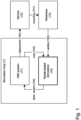
- Fig. 1 shows an embodiment representing a general concept.
- a model-based simulation (10) simulates human behavior based on models and assumptions. It outputs a state and a reward (103).
- the state can contain driver information (e.g., gaze, pose or activity), vehicle information (e.g., current SAE level, planed route, steering wheel angle) or environmental information (e.g., scene complexity, nearby objects).
- the reward tells the HMI Agent (11) how "good” the activated cues (104) were to reach a specified goal.
- the goal of an exemplary embodiment is to keep a driver in a level-compliant state. Different goals like e.g., reducing motion sickness can also be accomplished by alternative or enhanced embodiments.
- the cues (104) are interaction strategies like e.g., displaying an icon on a display, modifying interior lighting, or starting a speech interaction.
- the HMI agent (11) can be trained to find optimal interaction strategies for a dedicated goal. Once an HMI agent (11) is trained, it can be deployed (100) into a vehicle (12).
- the model-based simulation implements human-behavior processing, test data generation and visualization of the result.
- Fig. 2 shows a detailed schematic flowchart on how the data is processed by the MBS (10). It has three main layers, which is a perception layer (21), a cognition layer (22) and a physiological layer (23). Apart from that, a multiple resource model layer (25) and a performance layer (26) are estimating the mental workload (MWL 250) impacting the performance (260) as input to the cognition layer (22). Further inputs to the perception layer (21) are comprising states (203), cues (104) and additional factors 204 such as trust in the automated system. States (203) are also input to the multiple resource model layer (25).
- the perception layer (21) provides as input to the cognition layer (22) the information whether and to which extend the cues (104) have been perceived (210). Additional input to the cognition layer (22) may comprise the age and additional characteristics (202) of the human as well as information on the complexity of the traffic situation (280).
- the traffic scenario (28) that is the basis for the complexity of the traffic situation (280) can be obtained from a test generator (27).
- the complexity of the traffic situation (280) also serves as one input to the physiological layer (23).
- the cognition layer (22) provides information on whether and to which extend a cognition process (220) is done as input to the physiological layer.
- the actual physiological state vector t (231) represents the actual physiological state of the human, e.g., head orientation and hand(s) pose.
- the physiological layer outputs an updated physiological state vector t +1 (232).
- the reward (209) will be calculated by a reward calculation module (29).
- the reward function takes the physiological state vector t (231) as input as well as the last output of the HMI agent (cues) and then implements a custom function that describes the goal of the HMI agent.
- a set of rules can be defined for each SAE layer, which driver activities are (not) allowed: while driving in SAE level 2 requires the driver to not take off the hands from the steering wheel longer than a maximum time, this is not required in SAE level 3 as long as the automated driving features are engaged.
- the driver is not allowed to sleep while the automated driving features are engaged in SAE level 3, however. In case of a takeover request because the automated driving features will be disengaged, the driver must be attentive, start to look at the road ahead and take back the hands to the steering wheel.
- the calculated reward is then used for the training process of HMI agent as part of the loss function.
- the reward is used to tell the HMI agent if it took the right or wrong action according to the specified goal.
- the perception layer (21) is responsible for the detection, recognition, and perception of cues (104).
- the idea is to group cues (104) by type, like visual, auditory and tactile cues. Each one is processed independently.
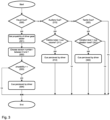
- Fig. 3 shows a flow chart on how the cues (104) are processed by the perception layer (21) of the MBS (10).
- the received cue is visual (300), auditory (310) or tactile (320), which are also called perception channels. There can be also more channels.
- the cue is visual (300)
- the probability that the driver is looking at the sector where the cue is visualized (301) is obtained.
- a random number r between 0 and 1 is drawn from a uniform distribution (302). If the probability is greater than the random number r (303) then the state that the driver perceived the cue is set to true (304). Otherwise, the driver has not perceived the cue in this simulation step.
- the cue is auditory (310)
- it is tested, if the current cabin noise is less than the cue volume by calculating a signal to noise ratio (311). If the test is true, then the state that the driver has perceived the cue (312) is set to true, otherwise false.
- the cue is tactile (320), then it is tested, if the current vibration level of the vehicle (12) is less than the vibration strength of the cue (321). If this is true, then the state that the driver has perceived the cue (323) is set to true, otherwise false.
- a visual cue (300) is assumed to be detected by a driver if the driver gazes the defined sector, where the cue is depicted.
- each visual cue (300) can be configured by the information about sectors in the vehicle (12) and the probability with which the cue can be recognized by the driver.
- the probability of the cue-sector is very high and neighboring sectors with falling probability. There are some additional factors, which eventually reduce the probability of recognizing a cue, which can be trust of the driver in the automation.
- An auditory cue (310) is recognized by the driver if the cue volume-level is higher than in the volume in the vehicle (e.g., radio or construction noise) (311).
- the recognition can again be modelled by probabilities in dependency of the absolute distance between the auditory cue and the vehicle volume.
- a tactile cue (320) is handled like the auditory cue based on the vibration strength of the cue vs. the vibration level in the vehicle (321).
- the output contains the information on if any cue (104) was perceived (recognized) and whether the perceived cue type is visual, auditory or tactile.
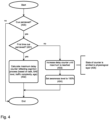
- FIG. 4 a flowchart of the cognition layer (22) is depicted.
- Step 400 answers the question whether a cue has been perceived. If not the cognition layer is finished (END).
- step 401 asks whether it is the first time that the cue is perceived.
- step 402 the maximum delay counter is calculated by reflecting the cognition process. This takes into account the task, e.g., the SAE level, the traffic situation complexity (280) and the age or further additional characteristics (202) of the human.
- Step 403. If the answer to decision step 401 is no, a delay counter is increased until a maximum number is reached in Step 403. The current state of this delay counter is emitted to the physiological layer in step 405. In a subsequent step 404 of the cognition layer, the awareness level is set to 100%.
- the cognition layer (22) calculates an awareness level of the perceived cue. This level determines the probability if a driver is reacting to a cue.
- the maximum length of the awareness process can be calculated by using a normal distribution depending on the executed secondary task, traffic complexity, performance based on MWL (mental workload), automation level (e.g., SAE level) and additional factors like driver-age or fatigue-level. Then over time the awareness level is increased until the maximum length of the awareness-processes is reached resulting in a 100% awareness.
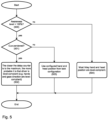
- Fig. 5 shows an embodiment of the physiological layer (23).
- the physiological layer (23) computes the body state of a driver, e.g., the head_orientation and hand(s)-position depending on executed secondary task and/or recognized cues.
- Step 500 answers the question whether the awareness level is lower than 100%. In case of full awareness, the physiological layer is finished (END) after concluding in step 504 that hand and head positions are most likely level-compliant. If the awareness level is lower than 100% step 501 asks whether the cue has been perceived.
- step 502 an estimation is made which outputs a probability whether the driver is currently level-compliant. Thereby it is assumed that the closer the delay counter is to the maximum, the more probable the level compliance of the driver is (e.g., hands and gaze direction are level-compliant).
- step 503 the configured (default) hand and head position from a task configuration are used (step 503).
- the head-orientation and hand(s)-position are with high probability according to executed task.
- the default head_orientation and hand(s)-position are defined in the task configuration.
- the MBS (10) can be configured for each task. In case that the driver is not level-compliant, and a cue was recognized and additionally the driver is aware of the cue, then the head-orientation and hand(s)-position change to the level-compliant position. This transition is most likely the closer the higher the awareness is.
- Fig. 6 shows a flow chart of the calculation of the mental workload (MWL 250).
- the MWL calculation is performed in the multiple resource model layer (25).
- step 601 the MWL is increased based on external factors like cabin noise, vibration or traffic situation complexity.
- step 602 the MWL is assigned to the different channels (e.g., visual) according to the Multiple Resource Theory. This step concludes the MWL calculation (END).
- the MWL calculation is based on the multiple resource theory, where each channel (e.g., visual, auditory or tactile) can be occupied by tasks (e.g., reading a book occupies the visual channel).
- each channel e.g., visual, auditory or tactile
- tasks e.g., reading a book occupies the visual channel.
- the perception of cues increases the occupancy of a channel, and it might also be the case that a cue is most likely not perceived when the respective channel is occupied. Based on the occupancy of all channels, the MWL is calculated. Additionally, factors like traffic complexity, can increase or decrease the MWL.
- a performance level is computed that influences the awareness calculation of the cognition layer.
- the performance level does not have an influence, when a medium MWL is present and will reduce the awareness level when the MWL is low (driver is bored) or high (driver is overwhelmed).
- the MWL baseline-values can be configured via the task configuration and cue configuration.
- the defined MWL value is only the expected value, while during simulation the concrete MWL values are drawn from a normal distribution with the mean of the expected value.
- the traffic scenario controls the traffic complexity (having an impact on MWL and awareness level), which can be configured by parameters like street type, number of traffic participants or weather conditions.
- the goal is that a driver is in a level-compliant state. Therefore, for each SAE level a set of rules can be defined that determine if a driver is level compliant or not based on the current states. In the model-based simulation, the rules are used to determine if a driver is level-compliant or not and that is outputted for e.g., an HMI system.
Landscapes
- Engineering & Computer Science (AREA)
- Theoretical Computer Science (AREA)
- Aviation & Aerospace Engineering (AREA)
- Business, Economics & Management (AREA)
- Physics & Mathematics (AREA)
- Educational Administration (AREA)
- Educational Technology (AREA)
- General Physics & Mathematics (AREA)
- Traffic Control Systems (AREA)
Priority Applications (1)
| Application Number | Priority Date | Filing Date | Title |
|---|---|---|---|
| EP23169782.2A EP4456045A1 (de) | 2023-04-25 | 2023-04-25 | Mensch-maschine-interaktionssystem und interaktionsstrategie |
Applications Claiming Priority (1)
| Application Number | Priority Date | Filing Date | Title |
|---|---|---|---|
| EP23169782.2A EP4456045A1 (de) | 2023-04-25 | 2023-04-25 | Mensch-maschine-interaktionssystem und interaktionsstrategie |
Publications (1)
| Publication Number | Publication Date |
|---|---|
| EP4456045A1 true EP4456045A1 (de) | 2024-10-30 |
Family
ID=86226715
Family Applications (1)
| Application Number | Title | Priority Date | Filing Date |
|---|---|---|---|
| EP23169782.2A Pending EP4456045A1 (de) | 2023-04-25 | 2023-04-25 | Mensch-maschine-interaktionssystem und interaktionsstrategie |
Country Status (1)
| Country | Link |
|---|---|
| EP (1) | EP4456045A1 (de) |
Cited By (2)
| Publication number | Priority date | Publication date | Assignee | Title |
|---|---|---|---|---|
| CN119885846A (zh) * | 2024-12-17 | 2025-04-25 | 北京航空航天大学 | 一种考虑透明度影响的人智交互过程安全性评估方法 |
| CN121180247A (zh) * | 2025-11-24 | 2025-12-23 | 吉林大学 | 一种考虑驾驶员疲劳状态的自动驾驶退出判断方法 |
Citations (9)
| Publication number | Priority date | Publication date | Assignee | Title |
|---|---|---|---|---|
| DE102006019112A1 (de) | 2006-04-25 | 2007-10-31 | Siemens Ag | Fahrzeug |
| US20090181349A1 (en) | 2008-01-10 | 2009-07-16 | Richard Harkness | Driver Training System |
| US8742936B2 (en) | 2005-06-09 | 2014-06-03 | Daimler Ag | Method and control device for recognising inattentiveness according to at least one parameter which is specific to a driver |
| DE102017214542A1 (de) | 2017-08-21 | 2019-02-21 | Bayerische Motoren Werke Aktiengesellschaft | Verfahren, Vorrichtung, Computerprogramm und Computerprogrammprodukt zur Verifikation eines Fahrerassistenzsystems |
| US10540456B2 (en) | 2012-12-12 | 2020-01-21 | Avl List Gmbh | Method for assessing the controllability of a vehicle |
| DE102009006976B4 (de) | 2008-01-31 | 2021-02-04 | Continental Teves Ag & Co. Ohg | Fahrerassistenzsystem |
| US20210078608A1 (en) | 2019-09-13 | 2021-03-18 | Honda Motor Co., Ltd. | System and method for providing adaptive trust calibration in driving automation |
| US11164479B1 (en) | 2019-02-28 | 2021-11-02 | State Farm Mutual Automobile Insurance Company | Systems and methods for virtual reality based driver situational awareness recovery training |
| US20220204020A1 (en) | 2020-12-31 | 2022-06-30 | Honda Motor Co., Ltd. | Toward simulation of driver behavior in driving automation |
-
2023
- 2023-04-25 EP EP23169782.2A patent/EP4456045A1/de active Pending
Patent Citations (9)
| Publication number | Priority date | Publication date | Assignee | Title |
|---|---|---|---|---|
| US8742936B2 (en) | 2005-06-09 | 2014-06-03 | Daimler Ag | Method and control device for recognising inattentiveness according to at least one parameter which is specific to a driver |
| DE102006019112A1 (de) | 2006-04-25 | 2007-10-31 | Siemens Ag | Fahrzeug |
| US20090181349A1 (en) | 2008-01-10 | 2009-07-16 | Richard Harkness | Driver Training System |
| DE102009006976B4 (de) | 2008-01-31 | 2021-02-04 | Continental Teves Ag & Co. Ohg | Fahrerassistenzsystem |
| US10540456B2 (en) | 2012-12-12 | 2020-01-21 | Avl List Gmbh | Method for assessing the controllability of a vehicle |
| DE102017214542A1 (de) | 2017-08-21 | 2019-02-21 | Bayerische Motoren Werke Aktiengesellschaft | Verfahren, Vorrichtung, Computerprogramm und Computerprogrammprodukt zur Verifikation eines Fahrerassistenzsystems |
| US11164479B1 (en) | 2019-02-28 | 2021-11-02 | State Farm Mutual Automobile Insurance Company | Systems and methods for virtual reality based driver situational awareness recovery training |
| US20210078608A1 (en) | 2019-09-13 | 2021-03-18 | Honda Motor Co., Ltd. | System and method for providing adaptive trust calibration in driving automation |
| US20220204020A1 (en) | 2020-12-31 | 2022-06-30 | Honda Motor Co., Ltd. | Toward simulation of driver behavior in driving automation |
Non-Patent Citations (4)
| Title |
|---|
| C.D. WICKENS: "Multiple resources and mental workload", HUMAN FACTORS, vol. 50, no. 3, 2008, pages 449 - 455 |
| DARGAHI NOBARI KHAZAR ET AL: "Modeling driver-vehicle interaction in automated driving", FORSCHUNG IM INGENIEURWESEN: ENGINEERING RESEARCH, SPRINGER-VERLAG, BERLIN, DE, vol. 86, no. 1, 24 January 2022 (2022-01-24), pages 65 - 79, XP037692504, ISSN: 0015-7899, [retrieved on 20220124], DOI: 10.1007/S10010-021-00576-6 * |
| HONG CHEOK JUN ET AL: "System configuration of Human-in-the-loop Simulation for Level 3 Autonomous Vehicle using IPG CarMaker", 2021 IEEE INTERNATIONAL CONFERENCE ON INTERNET OF THINGS AND INTELLIGENCE SYSTEMS (IOTAIS), IEEE, 23 November 2021 (2021-11-23), pages 215 - 221, XP034040589, DOI: 10.1109/IOTAIS53735.2021.9628587 * |
| WIKIPEDIA: "Synthetic data", 30 March 2023 (2023-03-30), pages 1 - 5, XP093089248, Retrieved from the Internet <URL:https://en.wikipedia.org/w/index.php?title=Synthetic_data&oldid=1147368174> [retrieved on 20231006] * |
Cited By (3)
| Publication number | Priority date | Publication date | Assignee | Title |
|---|---|---|---|---|
| CN119885846A (zh) * | 2024-12-17 | 2025-04-25 | 北京航空航天大学 | 一种考虑透明度影响的人智交互过程安全性评估方法 |
| CN121180247A (zh) * | 2025-11-24 | 2025-12-23 | 吉林大学 | 一种考虑驾驶员疲劳状态的自动驾驶退出判断方法 |
| CN121180247B (zh) * | 2025-11-24 | 2026-01-27 | 吉林大学 | 一种考虑驾驶员疲劳状态的自动驾驶退出判断方法 |
Similar Documents
| Publication | Publication Date | Title |
|---|---|---|
| US9165280B2 (en) | Predictive user modeling in user interface design | |
| US10053113B2 (en) | Dynamic output notification management for vehicle occupant | |
| US7805223B2 (en) | Dialogue system | |
| Hu et al. | The challenges of driving mode switching in automated vehicles: A review | |
| US20190111933A1 (en) | Method for producing control data for rule-based driver assistance | |
| Wortelen et al. | Dynamic simulation and prediction of drivers’ attention distribution | |
| EP4456045A1 (de) | Mensch-maschine-interaktionssystem und interaktionsstrategie | |
| US20190337532A1 (en) | Autonomous vehicle providing driver education | |
| KR20060080317A (ko) | 감성기반을 갖는 자동차용 소프트웨어 로봇 | |
| US20240112562A1 (en) | Systems and methods for increasing the safety of voice conversations between drivers and remote parties | |
| JP7820079B2 (ja) | 車両制御を引き継ぐことの推奨を車両運転者に対して出力する車両及び方法 | |
| US20170243518A1 (en) | Information Presentation Apparatus and Method, and Computer Program Product | |
| EP3755596B1 (de) | Auf kognitiven zuständen basierende stimuli | |
| CN117642321A (zh) | 自动驾驶汽车接管紧迫度判别方法和警示方法及系统 | |
| CN116323283A (zh) | 用于控制向车辆的乘员提供建议信息的方法、装置、计算机程序和计算机可读的存储介质 | |
| Chen et al. | Automotive interaction design | |
| Barisic et al. | Driver model for take-over-request in autonomous vehicles | |
| KR20200083901A (ko) | 자율주행차의 제어권 전환 hmi 평가 장치, 방법 및 저장 매체 | |
| Yang et al. | Affective interaction with a companion robot in an interactive driving assistant system | |
| CN110525443A (zh) | 用于在移动设备中识别车辆的驾驶员的疲劳的方法和装置 | |
| EP2759895A2 (de) | System und Verfahren zur automatischen und dynamischen Veränderung der Rückkopplung an einem Operator durch ein automatisiertes System | |
| EP4299399B1 (de) | Verfahren zur übergabe der kontrolle eines fahrzeugs, datenverarbeitungsvorrichtung und autonomes fahrsystem | |
| Tekkesinoglu et al. | Investigating Factors Influencing Takeover Performance in Conditionally Automated Driving: The Role of Uncertainty Communication | |
| Mbelekani et al. | User Experience and Behavioural Adaptation Based on Repeated Usage of Vehicle Automation: Online Survey | |
| EP4711224A1 (de) | Fahrzeug, vorrichtung, datenträger, computerprogramm, neuronales netzwerk und verfahren für eine mensch-maschine-schnittstelle |
Legal Events
| Date | Code | Title | Description |
|---|---|---|---|
| PUAI | Public reference made under article 153(3) epc to a published international application that has entered the european phase |
Free format text: ORIGINAL CODE: 0009012 |
|
| STAA | Information on the status of an ep patent application or granted ep patent |
Free format text: STATUS: THE APPLICATION HAS BEEN PUBLISHED |
|
| AK | Designated contracting states |
Kind code of ref document: A1 Designated state(s): AL AT BE BG CH CY CZ DE DK EE ES FI FR GB GR HR HU IE IS IT LI LT LU LV MC ME MK MT NL NO PL PT RO RS SE SI SK SM TR |
|
| STAA | Information on the status of an ep patent application or granted ep patent |
Free format text: STATUS: REQUEST FOR EXAMINATION WAS MADE |
|
| 17P | Request for examination filed |
Effective date: 20250430 |
|
| RAP3 | Party data changed (applicant data changed or rights of an application transferred) |
Owner name: AUMOVIO GERMANY GMBH |