EP4456034A1 - Rider assistance system, data structure, and control method - Google Patents
Rider assistance system, data structure, and control method Download PDFInfo
- Publication number
- EP4456034A1 EP4456034A1 EP22830942.3A EP22830942A EP4456034A1 EP 4456034 A1 EP4456034 A1 EP 4456034A1 EP 22830942 A EP22830942 A EP 22830942A EP 4456034 A1 EP4456034 A1 EP 4456034A1
- Authority
- EP
- European Patent Office
- Prior art keywords
- information
- rider
- straddle
- assistance system
- travel
- Prior art date
- Legal status (The legal status is an assumption and is not a legal conclusion. Google has not performed a legal analysis and makes no representation as to the accuracy of the status listed.)
- Pending
Links
Images




Classifications
-
- G—PHYSICS
- G08—SIGNALLING
- G08G—TRAFFIC CONTROL SYSTEMS
- G08G1/00—Traffic control systems for road vehicles
- G08G1/01—Detecting movement of traffic to be counted or controlled
- G08G1/0104—Measuring and analyzing of parameters relative to traffic conditions
- G08G1/0108—Measuring and analyzing of parameters relative to traffic conditions based on the source of data
- G08G1/0112—Measuring and analyzing of parameters relative to traffic conditions based on the source of data from the vehicle, e.g. floating car data [FCD]
-
- B—PERFORMING OPERATIONS; TRANSPORTING
- B62—LAND VEHICLES FOR TRAVELLING OTHERWISE THAN ON RAILS
- B62J—CYCLE SADDLES OR SEATS; AUXILIARY DEVICES OR ACCESSORIES SPECIALLY ADAPTED TO CYCLES AND NOT OTHERWISE PROVIDED FOR, e.g. ARTICLE CARRIERS OR CYCLE PROTECTORS
- B62J50/00—Arrangements specially adapted for use on cycles not provided for in main groups B62J1/00 - B62J45/00
- B62J50/20—Information-providing devices
- B62J50/21—Information-providing devices intended to provide information to rider or passenger
- B62J50/22—Information-providing devices intended to provide information to rider or passenger electronic, e.g. displays
-
- B—PERFORMING OPERATIONS; TRANSPORTING
- B62—LAND VEHICLES FOR TRAVELLING OTHERWISE THAN ON RAILS
- B62J—CYCLE SADDLES OR SEATS; AUXILIARY DEVICES OR ACCESSORIES SPECIALLY ADAPTED TO CYCLES AND NOT OTHERWISE PROVIDED FOR, e.g. ARTICLE CARRIERS OR CYCLE PROTECTORS
- B62J45/00—Electrical equipment arrangements specially adapted for use as accessories on cycles, not otherwise provided for
- B62J45/20—Cycle computers as cycle accessories
-
- G—PHYSICS
- G08—SIGNALLING
- G08G—TRAFFIC CONTROL SYSTEMS
- G08G1/00—Traffic control systems for road vehicles
- G08G1/01—Detecting movement of traffic to be counted or controlled
- G08G1/0104—Measuring and analyzing of parameters relative to traffic conditions
- G08G1/0125—Traffic data processing
- G08G1/0129—Traffic data processing for creating historical data or processing based on historical data
-
- G—PHYSICS
- G08—SIGNALLING
- G08G—TRAFFIC CONTROL SYSTEMS
- G08G1/00—Traffic control systems for road vehicles
- G08G1/01—Detecting movement of traffic to be counted or controlled
- G08G1/0104—Measuring and analyzing of parameters relative to traffic conditions
- G08G1/0137—Measuring and analyzing of parameters relative to traffic conditions for specific applications
- G08G1/0141—Measuring and analyzing of parameters relative to traffic conditions for specific applications for traffic information dissemination
-
- G—PHYSICS
- G08—SIGNALLING
- G08G—TRAFFIC CONTROL SYSTEMS
- G08G1/00—Traffic control systems for road vehicles
- G08G1/09—Arrangements for giving variable traffic instructions
- G08G1/0962—Arrangements for giving variable traffic instructions having an indicator mounted inside the vehicle, e.g. giving voice messages
-
- G—PHYSICS
- G08—SIGNALLING
- G08G—TRAFFIC CONTROL SYSTEMS
- G08G1/00—Traffic control systems for road vehicles
- G08G1/09—Arrangements for giving variable traffic instructions
- G08G1/0962—Arrangements for giving variable traffic instructions having an indicator mounted inside the vehicle, e.g. giving voice messages
- G08G1/0967—Systems involving transmission of highway information, e.g. weather, speed limits
- G08G1/096708—Systems involving transmission of highway information, e.g. weather, speed limits where the received information might be used to generate an automatic action on the vehicle control
- G08G1/096716—Systems involving transmission of highway information, e.g. weather, speed limits where the received information might be used to generate an automatic action on the vehicle control where the received information does not generate an automatic action on the vehicle control
-
- G—PHYSICS
- G08—SIGNALLING
- G08G—TRAFFIC CONTROL SYSTEMS
- G08G1/00—Traffic control systems for road vehicles
- G08G1/09—Arrangements for giving variable traffic instructions
- G08G1/0962—Arrangements for giving variable traffic instructions having an indicator mounted inside the vehicle, e.g. giving voice messages
- G08G1/0967—Systems involving transmission of highway information, e.g. weather, speed limits
- G08G1/096733—Systems involving transmission of highway information, e.g. weather, speed limits where a selection of the information might take place
- G08G1/096741—Systems involving transmission of highway information, e.g. weather, speed limits where a selection of the information might take place where the source of the transmitted information selects which information to transmit to each vehicle
-
- G—PHYSICS
- G08—SIGNALLING
- G08G—TRAFFIC CONTROL SYSTEMS
- G08G1/00—Traffic control systems for road vehicles
- G08G1/09—Arrangements for giving variable traffic instructions
- G08G1/0962—Arrangements for giving variable traffic instructions having an indicator mounted inside the vehicle, e.g. giving voice messages
- G08G1/0967—Systems involving transmission of highway information, e.g. weather, speed limits
- G08G1/096766—Systems involving transmission of highway information, e.g. weather, speed limits where the system is characterised by the origin of the information transmission
- G08G1/096775—Systems involving transmission of highway information, e.g. weather, speed limits where the system is characterised by the origin of the information transmission where the origin of the information is a central station
Definitions
- the present disclosure relates to a rider-assistance system, a data structure, and a control method capable of improving safety of a straddle-type vehicle.
- a driver-assistance system is disclosed in PTL 1.
- the driver-assistance system warns the rider of the motorcycle that the motorcycle inappropriately approaches an obstacle on the basis of information detected by a sensor device that detects the obstacle present in a travel direction or substantially in the travel direction.
- posture of the straddle-type vehicle tends to become unstable, and it is desired to improve safety of the straddle-type vehicle.
- the safety of the straddle-type vehicle is desired during turning travel thereof on a curved road due to a reason that a degree of freedom of a travel path is high, and the like.
- the present invention has been made with the above-described problem as the background and therefore obtains a rider-assistance system, a data structure, and a control method capable of improving safety of a straddle-type vehicle.
- a rider-assistance system is a rider-assistance system that assists with driving by a rider of a straddle-type vehicle, includes an execution section that executes rider-assistance operation to assist with driving by the rider, and further includes a generation section that generates travel guide information on a curved road by subjecting a data set to statistical processing, the data set including turning travel information of each of plural straddle-type vehicles on the curved road acquired for each of the vehicles. Before the straddle-type vehicle enters the curved road, the execution section executes the rider-assistance operation on the basis of the travel guide information that is generated by the generation section.
- a data structure according to the present invention is a data structure used in a rider-assistance system that assists with driving by a rider of a straddle-type vehicle, and includes turning travel information of each of plural straddle-type vehicles on a curved road acquired for each of the vehicles.
- the turning travel information is associated with newness/oldness degree information of the turning travel information.
- a control method is a control method for a rider-assistance system that assists with driving by a rider of a straddle-type vehicle, and includes: executing rider-assistance operation to assist with driving by the rider by an execution section of the rider-assistance system; and generating travel guide information on a curved road by a generation section of the rider-assistance system by subjecting a data set, which includes turning travel information of each of plural straddle-type vehicles on the curved road acquired by each of the vehicles, to statistical processing.
- the execution section executes the rider-assistance operation on the basis of the travel guide information that is generated by the generation section.
- the execution section of the rider-assistance system executes the rider-assistance operation to assist with driving by the rider. Furthermore, the generation section of the rider-assistance system generates the travel guide information on the curved road by subjecting the data set, which includes the turning travel information of each of the plural straddle-type vehicles on the curved road acquired by each of the vehicles, to the statistical processing. Before the straddle-type vehicle enters the curved road, the execution section executes the rider-assistance operation on the basis of the travel guide information that is generated by the generation section.
- the straddle-type vehicle can make the turning travel on the curved road by using the turning travel information, which is acquired by each of the plural straddle-type vehicles.
- the turning travel information which is acquired by each of the plural straddle-type vehicles.
- a straddle-type vehicle included in the rider-assistance system is a two-wheeled motorcycle (see a straddle-type vehicle 10 in Fig. 1 ).
- the straddle-type vehicle included in the rider-assistance system according to the present invention may be a straddle-type vehicle other than the two-wheeled motorcycle.
- the straddle-type vehicle means a vehicle that a rider straddles.
- Examples of the straddle-type vehicle are motorcycles (a two-wheeled motor vehicle and a three-wheeled motor vehicle) and a pedal-driven vehicle.
- the motorcycles include a vehicle having an engine as a power source, a vehicle having an electric motor as a power source, and the like.
- the motorcycles are a motorbike, a scooter, and an electric scooter.
- the pedal-driven vehicle means a vehicle capable of traveling forward on a road by a depression force applied to pedals by the rider.
- Examples of the pedal-driven vehicle are a normal pedal-driven vehicle, an electrically-assisted pedal-driven vehicle, and an electric pedal-driven vehicle.
- the rider-assistance system, the data structure, and the control method according to the present invention are not limited to a case with such a configuration, such operation, and the like.
- Fig. 1 is a schematic view illustrating an outline configuration of the rider-assistance system 1.
- the rider-assistance system 1 includes the straddle-type vehicle 10 and a server 20 that are mutually communicable wirelessly via a wireless communication network N1.
- the straddle-type vehicle 10 is a two-wheeled motorcycle that corresponds to an example of the straddle-type vehicle according to the present invention.
- Fig. 1 illustrates the single straddle-type vehicle 10 to facilitate understanding. However, in reality, the plural straddle-type vehicles 10 can communicate with the server 20 via the communication network N1.
- the straddle-type vehicle 10 includes a display section 11, a navigation system 12, an inertial measurement unit (IMU) 13, a front-wheel rotational frequency sensor 14, a rear-wheel rotational frequency sensor 15, and a controller (ECU) 16.
- IMU inertial measurement unit
- ECU controller
- the display section 11 has a display function of visually displaying information.
- Examples of the display section 11 are a liquid-crystal display and a lamp.
- the display section 11 is provided to a trunk of the straddle-type vehicle 10, for example.
- the arrangement of the display section 11 in relation to a vehicle body is not particularly limited.
- the navigation system 12 is a system that guides the rider along a route from a current location of the straddle-type vehicle 10 to a destination desired by the rider.
- the navigation system 12 displays various types of information on route guidance (for example, the current location of the straddle-type vehicle 10, a travel route as a guidance target, a location of the destination, a distance on the travel route from the current location of the straddle-type vehicle 10 to the destination, a time required to arrive at the destination, and the like).
- the navigation system 12 can acquire location information of the straddle-type vehicle 10 on the basis of information that is sent from the Global Positioning System (GPS) satellite.
- GPS Global Positioning System
- the inertial measurement unit 13 includes a three-axis gyroscope sensor and a three-directional acceleration sensor, and detects a posture of the straddle-type vehicle 10.
- the inertial measurement unit 13 is provided to the trunk of the straddle-type vehicle 10, for example. More specifically, the inertial measurement unit 13 detects a body lean angle of the straddle-type vehicle 10 and outputs a detection result.
- the inertial measurement unit 13 may detect another physical quantity that can substantially be converted to the body lean angle of the straddle-type vehicle 10.
- the body lean angle corresponds to an angle representing an inclination in a rolling direction of the body (more specifically, the trunk) of the straddle-type vehicle 10 with respect to an upper vertical direction.
- the front-wheel rotational frequency sensor 14 is a wheel rotational frequency sensor that detects a rotational frequency of a front wheel (for example, a rotational frequency of the front wheel per unit time [rpm], a travel distance of the front wheel per unit time [km/h], or the like), and outputs a detection result.
- the front-wheel rotational frequency sensor 14 may detect another physical quantity that can substantially be converted to the rotational frequency of the front wheel.
- the front-wheel rotational frequency sensor 14 is provided to the front wheel.
- the rear-wheel rotational frequency sensor 15 is a wheel rotational frequency sensor that detects a rotational frequency of a rear wheel (for example, the rotational frequency of the rear wheel per unit time [rpm], a travel distance of the rear wheel per unit time [km/h], or the like), and outputs a detection result.
- the rear-wheel rotational frequency sensor 15 may detect another physical quantity that can substantially be converted to the rotational frequency of the rear wheel.
- the rear-wheel rotational frequency sensor 15 is provided to the rear wheel.
- the controller 16 controls operation of each of the devices in the straddle-type vehicle 10.
- the controller 16 is partially or entirely constructed of a microcomputer, a microprocessor unit, or the like.
- the controller 16 may partially or entirely be constructed of one whose firmware and the like can be updated, or may partially or entirely be a program module or the like that is executed by a command from a CPU or the like, for example.
- the controller 16 may be provided as one unit or may be divided into plural units, for example.
- Fig. 2 is a block diagram illustrating an exemplary functional configuration of a controller 16.
- the controller 16 includes a communication section 16a and an execution section 16b, for example.
- the controller 16 can acquire information from the navigation system 12, the inertial measurement unit 13, the front-wheel rotational frequency sensor 14, and the rear-wheel rotational frequency sensor 15, and can output a control command to the display section 11.
- the acquisition of the information can include extraction, generation, and the like of the information.
- the communication section 16a communicates with the server 20 via the communication network N1.
- the execution section 16b executes rider-assistance operation.
- the rider-assistance operation is operation to assist with driving by the rider, and can include various types of the operation.
- the execution section 16b executes, as the rider-assistance operation, notification operation to notify the rider of the various types of the information.
- the notification operation for example, the rider is notified of the information by display that is provided by the display section 11.
- the server 20 in Fig. 1 collects and manages the information from the plural straddle-type vehicles 10, and sends the information used for the rider-assistance operation (more specifically, travel guide information, which will be described below) to each of the straddle-type vehicles 10.
- the server 20 is partially or entirely constructed of a microcomputer, a microprocessor unit, or the like.
- the server 20 may partially or entirely be constructed of one whose firmware and the like can be updated, or may partially or entirely be a program module or the like that is executed by a command from a CPU or the like, for example.
- the server 20 may be provided as one unit or may be divided into plural units, for example.
- Fig. 3 is a block diagram illustrating an exemplary functional configuration of the server 20.
- the server 20 includes a communication section 21, a generation section 22, and a storage section 23, for example.
- the communication section 21 communicates with each of the straddle-type vehicles 10 via the communication network N1. More specifically, the communication section 21 communicates with the controller 16 of each of the straddle-type vehicles 10.
- the generation section 22 generates the travel guide information of a curved road on the basis of the information that is collected from the plural straddle-type vehicles 10.
- the travel guide information is information that guides the straddle-type vehicle 10 at the time when the straddle-type vehicle 10 turns on the curved road.
- examples of the travel guide information are a standard (for example, average) swept path at the time when the plural straddle-type vehicles 10 turn on the curved road, a standard (for example, average) vehicle speed, and the standard (for example,) body lean angle. A detailed description on the travel guide information will be made below.
- the storage section 23 stores the various types of the information.
- the storage section 23 stores the information that is received by the communication section 21.
- the generation section 22 generates the travel guide information on the basis of the information that is stored by the storage section 23. More specifically, the storage section 23 stores a data set that includes turning travel information of each of the plural straddle-type vehicles 10 on the curved road, and the turning travel information is acquired by each of the vehicles.
- the turning travel information can include various types of information on turning travel on the curved road (for example, information on the swept path in the turning travel, information on the speed in the turning travel, information on the body lean angle in the turning travel, and the like).
- the generation section 22 generates the travel guide information by subjecting the above data set to statistical processing. A detailed description on the data set will be made below.
- the controller 16 of the straddle-type vehicle 10 and the server 20 communicate with each other, and safety is thereby improved by the rider-assistance operation.
- a description will sequentially be made on processing executed by the controller 16 of the straddle-type vehicle 10 and processing executed by the server 20.
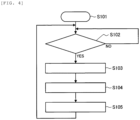
- Fig. 4 is a flowchart illustrating an example of a processing procedure that is executed by the controller 16. Step S101 in Fig. 4 corresponds to initiation of a control flow illustrated in Fig. 4 .
- step S102 the controller 16 determines whether the curved road (for example, the curved road that is continuously connected to a travel road on which the straddle-type vehicle 10 travels and that is located in front of the travel road) has been detected in front of the straddle-type vehicle 10.
- the curved road for example, the curved road that is continuously connected to a travel road on which the straddle-type vehicle 10 travels and that is located in front of the travel road
- Fig. 5 is a schematic view illustrating a situation where the straddle-type vehicle 10 enters a curved road R2 from a straight road R1.
- the curved road R2 is continuously connected to the straight road R1, on which the straddle-type vehicle 10 travels, and is located in front of the straight road R1.
- the controller 16 can detect the curved road R2 in front of the straddle-type vehicle 10 when the straddle-type vehicle 10 travels on the straight road R1.
- the controller 16 can detect the curved road R2 on the basis of the information (for example, map information and the location information of the straddle-type vehicle 10) that is acquired from the navigation system 12.
- the controller 16 may detect the curved road R2 on the basis of an output result of the surrounding environment sensor.
- Surrounding environment information that is detected by the surrounding environment sensor may be information on a distance to or an orientation of a target object that is located around the straddle-type vehicle 10 (for example, a relative location, a relative distance, a relative speed, relative acceleration, or the like), or may be a characteristic of the target object that is located around the straddle-type vehicle 10 (for example, a type of the target object, a shape of the target object itself, a mark on the target object, or the like).
- Examples of the surrounding environment sensor are a radar, a Lidar sensor, an ultrasonic sensor, and a camera.
- step S102 If the curved road has not been detected in front of the straddle-type vehicle 10 (step S102/NO), the processing in step S102 is repeated. On the other hand, if the curved road R2 has been detected in front of the straddle-type vehicle 10 (step S102/YES), the processing proceeds to step S103.
- step S103 the communication section 16a of the controller 16 sends, to the server 20, a sending request that is a command to request the server 20 to send the travel guide information.
- the server 20 generates the travel guide information and sends the generated travel guide information to the controller 16.
- step S104 the communication section 16a of the controller 16 receives the travel guide information.
- the communication section 16a receives, as the travel guide information, the information on the standard swept path (for example, a trajectory T1 illustrated in Fig. 5 ) at the time when the plural straddle-type vehicles 10 turn on the curved road R2.
- the travel guide information can include the various types of the information other than the information on the swept path.
- step S105 the execution section 16b of the controller 16 executes, as the rider-assistance operation, the notification operation to notify the rider of the travel guide information, and the processing returns to step S102.
- the rider-assistance operation the notification operation to notify the rider of the travel guide information.
- Fig. 6 is a flowchart illustrating an example of a processing procedure that is executed by the server 20. Step S201 in Fig. 6 corresponds to initiation of the control flow illustrated in Fig. 6 .
- step S202 the server 20 determines whether the communication section 21 has received the sending request for the travel guide information, which has been sent from the communication section 16a of the controller 16 in step S103 in the control flow illustrated in Fig. 4 described above.
- step S202 If it is determined that the communication section 21 has not received the sending request for the travel guide information (step S202/NO), the processing in step S202 is repeated. On the other hand, if it is determined that the communication section 21 has received the sending request for the travel guide information (step S202/YES), the processing proceeds to step S203.
- step S203 the generation section 22 of the server 20 generates the travel guide information.
- the generation section 22 generates the travel guide information by subjecting the data set, which includes the turning travel information of each of the plural straddle-type vehicles 10 on the curved road R2 acquired by each of the vehicles, to the statistical processing.
- Fig. 7 is a schematic table illustrating an outline configuration of a data set D1.
- the data set D1 has a data structure in a data table format in which information in columns are associated with each other in each row.
- the data set D1 may have the structure in the format other than the data table format.
- the information in each of the rows in the data set D1 corresponds to the information that is acquired by the respective straddle-type vehicle 10. That is, the information in the one row in the data set D1 corresponds to the information that is acquired by the single straddle-type vehicle 10 for the single turning travel.
- the information in a column Al in the data set D1 is the turning travel information.
- the turning travel information is the information that is acquired by each of the straddle-type vehicles 10 when the respective straddle-type vehicle 10 turns on the curved road R2.
- Each of the straddle-type vehicles 10 sends the acquired turning travel information to the server 20.
- the turning travel information may be sent to the server 20 as needed, for example.
- the turning travel information may be sent to the server 20 after the travel of the straddle-type vehicle 10 is terminated (for example, when an engine is stopped).
- the server 20 incorporates and stores the received turning travel information into the data set D1.
- the column A1 is divided into a column B1, a column B2, and a column B3.
- the information in the column B1 is the information on the swept path of the turning travel information.
- the information on the swept path is acquired on the basis of the location information that is acquired from the navigation system 12, for example.
- the information in the column B2 is the information on the vehicle speed of the turning travel information.
- the information on the vehicle speed is acquired on the basis of the output results of the front-wheel rotational frequency sensor 14 and the rear-wheel rotational frequency sensor 15, for example.
- the information in the column B3 is the information on the body lean angle of the turning travel information. In each of the straddle-type vehicles 10, the information on the body lean angle is acquired on the basis of the output result of the inertial measurement unit 13, for example.
- Information in each of a column C1, a column C2, and a column C3 in the data set D1 is a parameter that is associated with the turning travel information.
- each of the straddle-type vehicles 10 acquires the parameter, which is associated with the turning travel information, in addition to the turning travel information.
- each of the straddle-type vehicles 10 also sends, to the server 20, the parameter, which is associated with the turning travel information, in addition to the acquired turning travel information.
- the server 20 associates the received parameter with the turning travel information, and incorporates and stores the parameter into the data set D1.
- the information in the column C1 is newness/oldness degree information of the turning travel information.
- the newness/oldness degree information is information on a degree of newness of the associated turning travel information.
- the newness/oldness degree information is information on a date and time at which the associated turning travel information is acquired. That is, the newness/oldness degree information is information on the degree of newness/oldness of the turning travel information, or information used to determine the degree of newness/oldness of the turning travel information.
- the information in the column C2 is environment information.
- the environmental information is information on external environment of the straddle-type vehicle 10.
- the environment information can include road surface information, weather information, seasonal information, time of day information, brightness information, temperature information, humidity information, and the like.
- road surface information are information on a crack of the road surface, information on a dent of the road surface, and information on an obstacle (for example, a tree branch, a leaf, or the like) on the road surface.
- time of day information is information on whether current time is morning, noon, evening, or night.
- brightness information is information on brightness around of the straddle-type vehicle 10.
- the Information in the column C3 is the vehicle information.
- the vehicle information is information on the straddle-type vehicle 10 itself.
- the vehicle information can include model information, displacement information, occupant state information, baggage information, and the like.
- the occupant state information is information on a state of an occupant riding in the straddle-type vehicle 10. Examples of the occupant state information are information on the number of the occupants and information on weight of the occupants.
- the baggage information is information on baggage carried on the straddle-type vehicle 10. Examples of the baggage information are information on presence or absence of the baggage, information on the number of pieces of baggage, and information on weight of the baggage.
- the generation section 22 generates the travel guide information by subjecting the data set D1 to the statistical processing.
- the generation section 22 executes the statistical processing by using the parameter that is associated with the turning travel information.
- the statistical processing, to which the data set D1 is subjected include processing (hereinafter also referred to as extraction processing) to extract the turning travel information from the data set D1 on the basis of the parameter, for example.
- the generation section 22 extracts the turning travel information that is associated with the parameter in the data set D1, and the parameter is associated with the straddle-type vehicle 10 as the sending source of the sending request for the travel guide information.
- the generation section 22 extracts the turning travel information that is associated with the newness/oldness degree information in the data set D1, and the newness/oldness degree information is associated with a time point at which the straddle-type vehicle 10 as the sending source of the sending request sends the sending request for the travel guide information.
- the generation section 22 extracts the turning travel information (the information in the column A1) in the row in which the newness/oldness degree information is included in the column C1, and the newness/oldness degree information indicates that the turning travel information is acquired in a specified period from the time point at which the straddle-type vehicle 10 as the sending source of the sending request sends the sending request for the travel guide information as a start point.
- the generation section 22 extracts the turning travel information that is associated with the environment information in the data set D1, and the environment information matches the environment information that is associated with the straddle-type vehicle 10 as the sending source of the sending request. For example, in the case where the weather information that is associated with the straddle-type vehicle 10 as the sending source of the sending request is information on a sunny day, the generation section 22 extracts the turning travel information (the information in the column A1) in the row in which the information on the sunny day is included in the column C2.
- the generation section 22 extracts the turning travel information that is associated with the vehicle information in the data set D1, and the vehicle information matches the vehicle information that is associated with the straddle-type vehicle 10 as the sending source of the sending request. For example, the generation section 22 extracts the turning travel information (the information in the column A1) in the row in which the model information on the same model as a model of the straddle-type vehicle 10 as the sending source of the sending request is included in the column C3.
- step S203 the generation section 22 generates, as the travel guide information, an average value of the turning travel information (the information in the column A1) that is extracted from the data set D1 by the extraction processing, for example.
- the average value of the information in the column B1, which is extracted by the above extraction processing corresponds to the average swept path at the time when the plural straddle-type vehicles 10 turn on the curved road R2.
- the average value of the information in the column B2, which is extracted by the above extraction processing corresponds to the average vehicle speed at the time when the plural straddle-type vehicles 10 turn on the curved road R2.
- the average value of the information in the column B3, which is extracted by the above extraction processing corresponds to the average body lean angle at the time when the plural straddle-type vehicles 10 turn on the curved road R2.
- the turning travel information may be extracted on the basis of only one of the newness/oldness degree information (the information in the column C1), the environment information (the information in the column C2), and the vehicle information (the information in the column C3), the turning travel information may be extracted on the basis of two of the newness/oldness degree information (the information in the column C1), the environment information (the information in the column C2), and the vehicle information (the information in the column C3), or the turning travel information may be extracted on the basis of all of the newness/oldness degree information (the information in the column C1), the environment information (the information in the column C2), and the vehicle information (the information in the column C3).
- the statistical processing, to which the data set D1 is subjected may include processing (hereinafter also referred to as weighting processing) to weight the data set D1 on the basis of the parameter.
- the generation section 22 calculates a weighting average such that weight of the turning travel information, which is associated with, in the data set D1, the parameter associated with the straddle-type vehicle 10 as the sending source of the sending request for the travel guide information, is heavier than weight of the other turning travel information.
- the generation section 22 weights the turning travel information (the information in the column A1), which is extracted from the data set D1 by the extraction processing, on the basis of the newness/oldness degree information (the information in the column C1).
- the generation section 22 calculates a weighting average by increasing weight of the turning travel information (the information in the column A1) in the row in which the newness/oldness degree information is included in the column C1, and the newness/oldness degree information indicates that the turning travel information is acquired in the specified period from the time point at which the straddle-type vehicle 10 as the sending source of the sending request sends the sending request for the travel guide information as the start point.
- the generation section 22 weights the turning travel information (the information in the column A1), which is extracted from the data set D1 by the extraction processing, on the basis of the environment information (the information in the column C2).
- the generation section 22 calculates the weighting average by increasing the weight of the turning travel information (the information in the column A1) in the row in which the information on the sunny day is included in the column C2.
- the generation section 22 weights the turning travel information (the information in the column A1), which is extracted from the data set D1 by the extraction processing, on the basis of the vehicle information (the information in the column C3).
- the generation section 22 calculates the weighting average by increasing the weight of the turning travel information (the information in the column A1) in the row in which the model information on the same model as the model of the straddle-type vehicle 10 as the sending source of the sending request is included in the column C3.
- the weighting average of the turning travel information (the information in the column A1), which is extracted from the data set D1 by the extraction processing.
- the weighting average of the column B1 which is acquired by executing the weighting processing after the extraction processing, corresponds to the standard swept path at the time when the plural straddle-type vehicles 10 turn on the curved road R2.
- the weighting average of the column B2, which is acquired by executing the weighting processing after the extraction processing, corresponds to the standard vehicle speed at the time when the plural straddle-type vehicles 10 turn on the curved road R2.
- the weighting average of the column B3, which is acquired by executing the weighting processing after the extraction processing corresponds to the standard body lean angle at the time when the plural straddle-type vehicles 10 turn on the curved road R2.
- the travel guide information is generated by executing the extraction processing without executing the weighting processing (more specifically, the example in which the average value of the turning travel information extracted by the extraction processing is generated as the travel guide information) and the example in which the travel guide information is generated by executing the weighting processing in addition to the extraction processing (more specifically, the example in which the weighting average of the turning travel information acquired by the weighting processing is generated as the travel guide information).
- the travel guide information may be generated by executing the weighting processing without executing the extraction processing.
- step S204 the communication section 21 of the server 20 sends the travel guide information, which is generated in step S203, to the controller 16, and the processing returns to step S202.
- the execution section 16b of the controller 16 executes, as the rider-assistance operation, the notification operation to notify the rider of the travel guide information.
- the execution section 16b causes the display section 11 to display the standard (for example, average) swept path at the time when the plural straddle-type vehicles 10 turn on the curved road R2.
- the execution section 16b causes the display section 11 to display an image in which a line indicating the standard swept path is superimposed on an object indicating the curved road R2.
- the execution section 16b causes the display section 11 to display the standard (for example, average) vehicle speed at the time when the plural straddle-type vehicles 10 turn on the curved road R2.
- the execution section 16b causes the display section 11 to display an image in which a number indicating the standard vehicle speed is superimposed on the object indicating the curve road R2.
- the execution section 16b causes the display section 11 to display the standard (for example, average) body lean angle at the time when the plural straddle-type vehicles 10 turn on the curved road R2.
- the execution section 16b causes the display section 11 to display an image in which a number indicating the standard body lean angle is superimposed on the object indicating the curved road R2.
- the execution section 16b may further notify of information other than the information described above.
- the execution section 16b may cause the display section 11 to display an image in which an object indicating the obstacle, a white line, a joint of the road, or the like is further superimposed on the object indicating the curved road R2.
- the generation section 22 generates the travel guide information by subjecting the data set D1, which includes the turning travel information of the plural straddle-type vehicles 10 on the curved road R2 acquired by each of the vehicles, to the statistical processing. Then, the execution section 16b executes the rider-assistance operation on the basis of the travel guide information generated by the generation section 22. In this way, the straddle-type vehicle 10 can turn on the curved road R2 by using the turning travel information, which is acquired by each of the plural straddle-type vehicles 10. Thus, it is possible to improve the safety during the turning travel on the curved road R2. Therefore, it is possible to improve the safety of the straddle-type vehicle 10.
- the execution section 16b only needs to execute the rider-assistance operation on the basis of the travel guide information, and operation other than the above notification operation is executed as the rider-assistance operation.
- the execution section 16b may execute, as the rider-assistance operation, operation to turn on or blink the lamp.
- the processing that is executed by the controller 16 in the above example may partially be executed by the server 20, or the processing that is executed by the server 20 in the above example may partially be executed by the controller 16.
- the processing that is executed by the generation section 22 of the server 20 may be executed by the controller 16.
- the server 20 sends the data set D1 to the controller 16, and the controller 16 generates the travel guide information on the basis of the received data set D1.
- the controller 16 may additionally execute processing other than the processing illustrated in Fig. 4 .
- the controller 16 may determine whether the information such as the map information and the location information of the straddle-type vehicle 10 can be acquired successfully from the navigation system 12. If it is determined that the information cannot be acquired successfully from the navigation system 12, the controller 16 may notify the rider of the result of this determination.
- the controller 16 may determine whether the communication with the server 20 can be established normally. If it is determined that the communication with the server 20 cannot be established normally, the controller 16 may notify the rider of the result of this determination.
- the controller 16 may determine whether the travel guide information has been received successfully from the server 20. If it is determined that the travel guide information has not been received successfully from the server 20, the controller 16 may notify the rider of the result of this determination.
- the generation section 22 In the rider-assistance system 1, the generation section 22 generates the travel guide information by subjecting the data set D1, which includes the turning travel information of each of the plural straddle-type vehicles 10 on the curved road R2 acquired by each of the vehicles, to the statistical processing. Then, the execution section 16b executes the rider-assistance operation on the basis of the travel guide information generated by the generation section 22. In this way, the straddle-type vehicle 10 can turn on the curved road R2 by using the turning travel information, which is acquired by each of the plural straddle-type vehicles 10. Thus, it is possible to improve the safety during the turning travel on the curved road R2. Therefore, it is possible to improve the safety of the straddle-type vehicle 10.
- the statistical processing includes processing to extract the turning travel information on the basis of the parameter from the data set D1.
- the travel guide information that is suited for the straddle-type vehicle 10 as the sending source of the sending request for the travel guide information. Therefore, it is possible to appropriately improve the safety of the straddle-type vehicle 10 during the turning travel on the curved road R2.
- the statistical processing includes processing to weight the data set D1 on the basis of the parameter.
- the travel guide information that is suited for the straddle-type vehicle 10 as the sending source of the sending request for the travel guide information. Therefore, it is possible to appropriately improve the safety of the straddle-type vehicle 10 during the turning travel on the curved road R2.
- the parameter includes the newness/oldness degree information of the turning travel information.
- the travel guide information that is suited for the straddle-type vehicle 10 as the sending source of the sending request on the basis of the time point at which the straddle-type vehicle 10 as the sending source of the sending request sends the sending request for the travel guide information. Therefore, it is possible to further appropriately improve the safety of the straddle-type vehicle 10 during the turning travel on the curved road R2.
- the parameter includes the environment information.
- the travel guide information that is suited for the straddle-type vehicle 10 as the sending source of the sending request on the basis of the environment information that is associated with the straddle-type vehicle 10 as the sending source of the sending request. Therefore, it is possible to further appropriately improve the safety of the straddle-type vehicle 10 during the turning travel on the curved road R2.
- the parameter includes the vehicle information.
- the travel guide information that is suited for the straddle-type vehicle 10 as the sending source of the sending request on the basis of the vehicle information that is associated with the straddle-type vehicle 10 as the sending source of the sending request. Therefore, it is possible to further appropriately improve the safety of the straddle-type vehicle 10 during the turning travel on the curved road R2.
- the travel guide information includes the information on the swept path.
- the execution section 16b can execute the rider-assistance operation on the basis of the information on the swept path that serves as the guide at the time when the straddle-type vehicle 10 as the sending source of the sending request turns on the curved road R2 (for example, the information on the standard swept path at the time when the plural straddle-type vehicles 10 turn on the curved road R2). Therefore, it is possible to appropriately improve the safety of the straddle-type vehicle 10 during the turning travel on the curved road R2.
- the travel guide information includes the information on the vehicle speed.
- the execution section 16b can execute the rider-assistance operation on the basis of the information on the vehicle speed that serves as the guide at the time when the straddle-type vehicle 10 as the sending source of the sending request turns on the curved road R2 (for example, the information on the standard vehicle speed at the time when the plural straddle-type vehicles 10 turn on the curved road R2). Therefore, it is possible to appropriately improve the safety of the straddle-type vehicle 10 during the turning travel on the curved road R2.
- the travel guide information includes the information on the body lean angle.
- the execution section 16b can execute the rider-assistance operation on the basis of the information on the body lean angle that serves as the guide at the time when the straddle-type vehicle 10 as the sending source of the sending request turns on the curved road R2 (for example, the information on the standard body lean angle at the time when the plural straddle-type vehicles 10 turn on the curved road R2). Therefore, it is possible to appropriately improve the safety of the straddle-type vehicle 10 during the turning travel on the curved road R2.
- the rider-assistance operation is operation to notify the rider of the travel guide information.
- the rider of the information such as the information on the swept path, the information on the vehicle speed, or the information on the body lean angle, that serves as the guide at the time when the straddle-type vehicle 10 as the sending source of the sending request turns on the curved road R2. Therefore, it is possible to appropriately improve the safety of the straddle-type vehicle 10 during the turning travel on the curved road R2.
- the data structure (in the above example, the data set D1) used in the rider-assistance system 1 that assists with driving by the rider of the straddle-type vehicle 10 includes the turning travel information of each of the plural straddle-type vehicles 10 on the curved road R2 acquired by each of the vehicles, and the turning travel information is associated with the newness/oldness degree information of the turning travel information.
- the straddle-type vehicle 10 can turn on the curved road R2 by using the turning travel information, which is acquired by each of the plural straddle-type vehicles 10.
- the turning travel information is associated with at least one of the environment information and the vehicle information in the data structure (in the above example, the data set D1).
- the data structure in the above example, the data set D1.
- the present invention is not limited to the embodiment that has been described. For example, only a part of the embodiment may be implemented.
Landscapes
- Physics & Mathematics (AREA)
- General Physics & Mathematics (AREA)
- Chemical & Material Sciences (AREA)
- Analytical Chemistry (AREA)
- Life Sciences & Earth Sciences (AREA)
- Atmospheric Sciences (AREA)
- Engineering & Computer Science (AREA)
- Mechanical Engineering (AREA)
- Traffic Control Systems (AREA)
Applications Claiming Priority (2)
| Application Number | Priority Date | Filing Date | Title |
|---|---|---|---|
| JP2021209162 | 2021-12-23 | ||
| PCT/IB2022/061588 WO2023119024A1 (ja) | 2021-12-23 | 2022-11-30 | ライダー支援システム、データ構造及び制御方法 |
Publications (1)
| Publication Number | Publication Date |
|---|---|
| EP4456034A1 true EP4456034A1 (en) | 2024-10-30 |
Family
ID=84688375
Family Applications (1)
| Application Number | Title | Priority Date | Filing Date |
|---|---|---|---|
| EP22830942.3A Pending EP4456034A1 (en) | 2021-12-23 | 2022-11-30 | Rider assistance system, data structure, and control method |
Country Status (4)
| Country | Link |
|---|---|
| US (1) | US20260001611A1 (https=) |
| EP (1) | EP4456034A1 (https=) |
| JP (1) | JP7719881B2 (https=) |
| WO (1) | WO2023119024A1 (https=) |
Cited By (1)
| Publication number | Priority date | Publication date | Assignee | Title |
|---|---|---|---|---|
| US20250050961A1 (en) * | 2021-12-23 | 2025-02-13 | Robert Bosch Gmbh | Controller and control method for lean vehicle |
Citations (5)
| Publication number | Priority date | Publication date | Assignee | Title |
|---|---|---|---|---|
| EP1679673A1 (en) * | 2003-10-20 | 2006-07-12 | Yamaha Hatsudoki Kabushiki Kaisha | Travel information accumulating method and system for motorcycle |
| JP2015194939A (ja) * | 2014-03-31 | 2015-11-05 | 富士通株式会社 | 通知プログラム、条件設定プログラム、通知方法、車載装置、及び情報処理装置 |
| EP3185231A1 (en) * | 2014-08-21 | 2017-06-28 | Yamaha Hatsudoki Kabushiki Kaisha | Driving assist method, driving assist device, and driving assist system |
| US20170247042A1 (en) * | 2014-12-11 | 2017-08-31 | Bayerische Motoren Werke Aktiengesellschaft | Method for Assisting a Driver of a Single-Track Motor Vehicle in Order to Drive Through a Bend Safely |
| WO2020100334A1 (ja) * | 2018-11-15 | 2020-05-22 | ヤマハ発動機株式会社 | 鞍乗型車両走行データ処理装置、鞍乗型車両走行データ処理方法および鞍乗型車両走行データ処理プログラム |
Family Cites Families (2)
| Publication number | Priority date | Publication date | Assignee | Title |
|---|---|---|---|---|
| EP3048025A1 (en) | 2015-01-20 | 2016-07-27 | Harman Becker Automotive Systems GmbH | Driver information system for two-wheelers |
| EP4250269A3 (en) | 2018-06-13 | 2023-10-18 | Ride Vision Ltd. | A rider assistance system and method |
-
2022
- 2022-11-30 EP EP22830942.3A patent/EP4456034A1/en active Pending
- 2022-11-30 US US18/722,980 patent/US20260001611A1/en active Pending
- 2022-11-30 JP JP2023568644A patent/JP7719881B2/ja active Active
- 2022-11-30 WO PCT/IB2022/061588 patent/WO2023119024A1/ja not_active Ceased
Patent Citations (5)
| Publication number | Priority date | Publication date | Assignee | Title |
|---|---|---|---|---|
| EP1679673A1 (en) * | 2003-10-20 | 2006-07-12 | Yamaha Hatsudoki Kabushiki Kaisha | Travel information accumulating method and system for motorcycle |
| JP2015194939A (ja) * | 2014-03-31 | 2015-11-05 | 富士通株式会社 | 通知プログラム、条件設定プログラム、通知方法、車載装置、及び情報処理装置 |
| EP3185231A1 (en) * | 2014-08-21 | 2017-06-28 | Yamaha Hatsudoki Kabushiki Kaisha | Driving assist method, driving assist device, and driving assist system |
| US20170247042A1 (en) * | 2014-12-11 | 2017-08-31 | Bayerische Motoren Werke Aktiengesellschaft | Method for Assisting a Driver of a Single-Track Motor Vehicle in Order to Drive Through a Bend Safely |
| WO2020100334A1 (ja) * | 2018-11-15 | 2020-05-22 | ヤマハ発動機株式会社 | 鞍乗型車両走行データ処理装置、鞍乗型車両走行データ処理方法および鞍乗型車両走行データ処理プログラム |
Non-Patent Citations (1)
| Title |
|---|
| See also references of WO2023119024A1 * |
Cited By (2)
| Publication number | Priority date | Publication date | Assignee | Title |
|---|---|---|---|---|
| US20250050961A1 (en) * | 2021-12-23 | 2025-02-13 | Robert Bosch Gmbh | Controller and control method for lean vehicle |
| US12589740B2 (en) * | 2021-12-23 | 2026-03-31 | Robert Bosch Gmbh | Controller and control method for lean vehicle |
Also Published As
| Publication number | Publication date |
|---|---|
| JPWO2023119024A1 (https=) | 2023-06-29 |
| US20260001611A1 (en) | 2026-01-01 |
| JP7719881B2 (ja) | 2025-08-06 |
| WO2023119024A1 (ja) | 2023-06-29 |
Similar Documents
| Publication | Publication Date | Title |
|---|---|---|
| JP7285673B2 (ja) | 鞍乗り型車両の姿勢制御装置 | |
| CN113631470A (zh) | 跨骑型车辆的驾驶支援装置 | |
| JP7253422B2 (ja) | 鞍乗り型車両の自動制御装置 | |
| CN113631471B (zh) | 跨骑型车辆的驾驶支援装置 | |
| CN113631440A (zh) | 跨骑型车辆的驾驶支援装置 | |
| EP4071021B1 (en) | Rider assistance system and control method for rider assistance system | |
| JP7450034B2 (ja) | ライダー支援システムの制御装置、ライダー支援システム、及び、ライダー支援システムの制御方法 | |
| US20220185275A1 (en) | Controller and control method for controlling operation of motorcycle | |
| CN110356503A (zh) | 人力驱动车的控制装置 | |
| JP2024088122A (ja) | 車両制御装置、車両制御方法、およびプログラム | |
| EP4456034A1 (en) | Rider assistance system, data structure, and control method | |
| JP2023175515A (ja) | 制御装置及び制御方法 | |
| EP4331933A1 (en) | Control device and control method | |
| US12358504B2 (en) | Controller and control method for controlling operation of motorcycle | |
| EP4647283A1 (en) | Control device and control method | |
| EP4269203B1 (en) | Control device and control method for rider assistance system | |
| EP4488137A2 (en) | Controller and control method | |
| US12332075B2 (en) | Travel route generation system, travel route generation program, and travel route generation method | |
| EP4703225A1 (en) | Control device and control method | |
| EP4549988A1 (en) | Information processing device, information processing system, and information processing method | |
| EP4597471A1 (en) | Control device and control method | |
| EP4596356A1 (en) | Control device and control method | |
| JP2024097274A (ja) | 制御装置及び制御方法 | |
| CN121752488A (zh) | 控制装置及控制方法 | |
| JP2023093988A (ja) | 制御装置、ライダー支援システム及び制御方法 |
Legal Events
| Date | Code | Title | Description |
|---|---|---|---|
| STAA | Information on the status of an ep patent application or granted ep patent |
Free format text: STATUS: UNKNOWN |
|
| STAA | Information on the status of an ep patent application or granted ep patent |
Free format text: STATUS: THE INTERNATIONAL PUBLICATION HAS BEEN MADE |
|
| PUAI | Public reference made under article 153(3) epc to a published international application that has entered the european phase |
Free format text: ORIGINAL CODE: 0009012 |
|
| STAA | Information on the status of an ep patent application or granted ep patent |
Free format text: STATUS: REQUEST FOR EXAMINATION WAS MADE |
|
| 17P | Request for examination filed |
Effective date: 20240723 |
|
| AK | Designated contracting states |
Kind code of ref document: A1 Designated state(s): AL AT BE BG CH CY CZ DE DK EE ES FI FR GB GR HR HU IE IS IT LI LT LU LV MC ME MK MT NL NO PL PT RO RS SE SI SK SM TR |
|
| DAV | Request for validation of the european patent (deleted) | ||
| DAX | Request for extension of the european patent (deleted) | ||
| STAA | Information on the status of an ep patent application or granted ep patent |
Free format text: STATUS: EXAMINATION IS IN PROGRESS |
|
| 17Q | First examination report despatched |
Effective date: 20251006 |