EP4455877A1 - Adaptiver scheduler zur lastverteilung von unvorhersehbaren, zeit-kritischen anfragen auf eine geteilte ressource - Google Patents
Adaptiver scheduler zur lastverteilung von unvorhersehbaren, zeit-kritischen anfragen auf eine geteilte ressource Download PDFInfo
- Publication number
- EP4455877A1 EP4455877A1 EP23212335.6A EP23212335A EP4455877A1 EP 4455877 A1 EP4455877 A1 EP 4455877A1 EP 23212335 A EP23212335 A EP 23212335A EP 4455877 A1 EP4455877 A1 EP 4455877A1
- Authority
- EP
- European Patent Office
- Prior art keywords
- resource allocation
- user
- time
- resource
- request
- Prior art date
- Legal status (The legal status is an assumption and is not a legal conclusion. Google has not performed a legal analysis and makes no representation as to the accuracy of the status listed.)
- Pending
Links
Images

Classifications
-
- G—PHYSICS
- G06—COMPUTING OR CALCULATING; COUNTING
- G06F—ELECTRIC DIGITAL DATA PROCESSING
- G06F9/00—Arrangements for program control, e.g. control units
- G06F9/06—Arrangements for program control, e.g. control units using stored programs, i.e. using an internal store of processing equipment to receive or retain programs
- G06F9/46—Multiprogramming arrangements
- G06F9/50—Allocation of resources, e.g. of the central processing unit [CPU]
- G06F9/5005—Allocation of resources, e.g. of the central processing unit [CPU] to service a request
- G06F9/5027—Allocation of resources, e.g. of the central processing unit [CPU] to service a request the resource being a machine, e.g. CPUs, Servers, Terminals
- G06F9/5038—Allocation of resources, e.g. of the central processing unit [CPU] to service a request the resource being a machine, e.g. CPUs, Servers, Terminals considering the execution order of a plurality of tasks, e.g. taking priority or time dependency constraints into consideration
-
- G—PHYSICS
- G06—COMPUTING OR CALCULATING; COUNTING
- G06F—ELECTRIC DIGITAL DATA PROCESSING
- G06F9/00—Arrangements for program control, e.g. control units
- G06F9/06—Arrangements for program control, e.g. control units using stored programs, i.e. using an internal store of processing equipment to receive or retain programs
- G06F9/46—Multiprogramming arrangements
- G06F9/50—Allocation of resources, e.g. of the central processing unit [CPU]
- G06F9/5083—Techniques for rebalancing the load in a distributed system
-
- G—PHYSICS
- G06—COMPUTING OR CALCULATING; COUNTING
- G06F—ELECTRIC DIGITAL DATA PROCESSING
- G06F2209/00—Indexing scheme relating to G06F9/00
- G06F2209/50—Indexing scheme relating to G06F9/50
- G06F2209/5021—Priority
-
- G—PHYSICS
- G06—COMPUTING OR CALCULATING; COUNTING
- G06F—ELECTRIC DIGITAL DATA PROCESSING
- G06F2209/00—Indexing scheme relating to G06F9/00
- G06F2209/50—Indexing scheme relating to G06F9/50
- G06F2209/5022—Workload threshold
-
- G—PHYSICS
- G06—COMPUTING OR CALCULATING; COUNTING
- G06F—ELECTRIC DIGITAL DATA PROCESSING
- G06F9/00—Arrangements for program control, e.g. control units
- G06F9/06—Arrangements for program control, e.g. control units using stored programs, i.e. using an internal store of processing equipment to receive or retain programs
- G06F9/46—Multiprogramming arrangements
- G06F9/48—Program initiating; Program switching, e.g. by interrupt
- G06F9/4806—Task transfer initiation or dispatching
- G06F9/4843—Task transfer initiation or dispatching by program, e.g. task dispatcher, supervisor, operating system
- G06F9/4881—Scheduling strategies for dispatcher, e.g. round robin, multi-level priority queues
- G06F9/4887—Scheduling strategies for dispatcher, e.g. round robin, multi-level priority queues involving deadlines, e.g. rate based, periodic
Definitions
- a radio system includes a radio and corresponding antenna; the radio dictates what energy is emitted or received from the antenna.
- radios may be software-defined and send digital signals to an antenna that then converts that signal to an analog signal and pushes it out of the actual physical antenna.
- RF radio-frequency
- embodiments of the inventive concepts disclosed herein are directed to a resource allocation system that receives user requests for system resources over time.
- the system records factors such as number of resource requests, total usage time, etc., and preempts earlier requests in favor of later requests based on those factors.
- the resource allocation system tracks metrics in real-time and establishes dynamic preemption thresholds based on usage over time.
- preemption thresholds may be specific to individual users.
- inventive concepts are not limited in their application to the arrangement of the components or steps or methodologies set forth in the following description or illustrated in the drawings.
- inventive concepts disclosed herein may be practiced without these specific details.
- well-known features may not be described in detail to avoid unnecessarily complicating the instant disclosure.
- inventive concepts disclosed herein are capable of other embodiments or of being practiced or carried out in various ways. Also, it is to be understood that the phraseology and terminology employed herein is for the purpose of description and should not be regarded as limiting.
- a letter following a reference numeral is intended to reference an embodiment of a feature or element that may be similar, but not necessarily identical, to a previously described element or feature bearing the same reference numeral (e.g., 1, 1a, 1b).
- reference numeral e.g. 1, 1a, 1b
- Such shorthand notations are used for purposes of convenience only, and should not be construed to limit the inventive concepts disclosed herein in any way unless expressly stated to the contrary.
- any reference to "one embodiment,” or “some embodiments” means that a particular element, feature, structure, or characteristic described in connection with the embodiment is included in at least one embodiment of the inventive concepts disclosed herein.
- the appearances of the phrase “in at least one embodiment” in the specification does not necessarily refer to the same embodiment.
- Embodiments of the inventive concepts disclosed may include one or more of the features expressly described or inherently present herein, or any combination or sub-combination of two or more such features.
- embodiments of the inventive concepts disclosed herein are directed to a resource allocation system that receives user requests for system resources over time.
- the system records factors such as number of resource requests, total usage time, etc., and preempts earlier requests in favor of later requests based on those factors.
- the resource allocation system tracks metrics in real-time and establishes dynamic preemption thresholds based on usage over time. Preemption thresholds may be specific to individual users.
- FIG. 1 a block diagram view of a system according to an exemplary embodiment is shown.
- the system includes a processor 100 and memory 102 storing processor executable code to configure the processor 100.
- the processor 100 receives resource request from each of a plurality of users 104, 106 (such as avionics systems) to utilize a shared resource such as an antenna 108 or radio system.
- the processor 100 records aspects of each resource request and stores those aspects in a data storage device 110. Aspects of each resource request may include the number of access requests from the requesting user 104, 106 over a period of time, the proportion of successful requests from the requesting user 104, 106 over a period of time, the amount of time (duration) a resource is allocated to a user 104, 106 over a period of time, a regularity of access requests from the requesting user 104, 106 over a period of time, and the like.
- the processor 100 when resource access requests collide (separate users 104, 106 request access to an asset for the same time) the processor 100 applies a function or machine learning algorithm to decide if the first access request should be preempted. Preemption allows a later access request to take priority over an earlier access request by cancelling a prior allocation to the earlier user 104, 106.
- a disparity in access requests and the time such access is actually required by a user 104, 106 may be a disparity in access requests and the time such access is actually required by a user 104, 106.
- some users 104, 106 may request to schedule future access windows when data transmission / reception actually needs to happen.
- Such time gap between the request to schedule and the actual access time may be a function of the regularity of the requesting user 104, 106.
- a radar system may request regular access times based on a desired refresh rate of a radar image. The radar system can schedule access to the antenna 108 well in advance, and therefore would always be the first access request for a given time period.
- a slight delay to a radar imaging cycle would have a slight or negligible impact on system performance.
- a second user 104, 106 operating just-in-time or in response to some unpredictable event may periodically request access to the antenna 108, and always or almost always be the second requester for a given time period.
- the preemption determination (either via a function or machine learning algorithm) may include a metric defined by the disparity between request time and execution time of each request with regularly requested accesses having a relatively wide disparity between request time and access time being disfavored.
- the preemption determination receives metrics or aspects associated with the users 104, 106, recorded over time, and determines if an earlier requesting user 104, 106 should be preempted to impose some balance between the users 104, 106 with respect to accessing the requested resources (such as the antenna 108).
- the act of preemption may itself be recorded as a metric for future determinations.
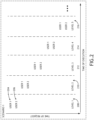
- FIG. 2 a graph of user resource requests according to an exemplary embodiment is shown.
- two users 204, 206 send similar requests to a resource manager at various times 208, 210, 212, 214, 216. Because the request from the first user 204 arrives first, it will always be allocated the resource. Later, when the request from the second user 206 arrives, a collision occurs. It is important to note that requests from the first user 204 are independent and asynchronous, so although is this scenario a second user request always follows a user request, the resource manager cannot predict that a second user request is eminent, and denying a first user request would risk dead time in the resource schedule.
- the resource manager may record various metrics about the users 204, 206 and their respective access requests and actual resource utilization.
- the resource manager may allocate the resource to the first user 204 and subsequently whether to preempt that allocation to the first user 204 and replace it with an allocation to the second user 206.
- the resource manager may then also attempt to reschedule the first user request.
- the resource manager may record the act of preemption as a metric in future determinations.
- the determination may utilize real-time statistics that describe the utilization of the resources and the distribution of the resources to the users 204, 206. Such statistics may be reset periodically so that the resource manager can optimize performance under a highly dynamic environment. Alternatively, or in addition, the age of various datapoints may be a metric in the determination such that old datapoints effectively roll-off over time.
- the statistics collected will provide the basis for an objective state (i.e., the proportion of requests that have been successfully executed to those that have been requested overall) and a user state (i.e., the proportion of a user's requests that have been successfully executed to those that have been requested overall be that user204, 206).
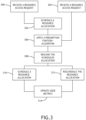
- a resource manager receives 300 a first access request for a managed resource and schedules 302 an allocation for that resource to the first user. Subsequently, but before the first user actually uses the resource, the resource manager receives 304 a second access request for the managed resource to allocate the resource at the same time as the first allocation.
- the resource manager applies 306 a preemption algorithm to determine if the first allocation should be preempted in favor of the second requested allocation to facilitate a usage balance between multiple users.
- the preemption algorithm may record each incidence of a user request and each incidence of a user allocation.
- the resource manager may rescind 308 the first allocation and schedule 310 the second.
- the resource manager may sample a random variable to determine if the first allocation should be rescinded 308. In any event, the resource manager may update 314 the recorded metrics (i.e. increment recorded allocation numbers).
- the resource manager may determine if subsequent time window is available for the first user and reschedule 312 the allocation for the first user.
- the resource manager may communicate preemptions and rescheduling to the first user.
- the resource manager may compare total requests and allocations for the resource to requests and allocations for a specific user. If a specific user has worse request to allocation metrics than the total for all users, the resource manager may reduce the preemption threshold for that user. Conversely, the preemption threshold may be increased is specific user metrics are better. It may be appreciated that the preemption threshold may be specific for each user.
Landscapes
- Engineering & Computer Science (AREA)
- Software Systems (AREA)
- Theoretical Computer Science (AREA)
- Physics & Mathematics (AREA)
- General Engineering & Computer Science (AREA)
- General Physics & Mathematics (AREA)
- Mobile Radio Communication Systems (AREA)
Applications Claiming Priority (1)
| Application Number | Priority Date | Filing Date | Title |
|---|---|---|---|
| US18/140,257 US20240362070A1 (en) | 2023-04-27 | 2023-04-27 | Adaptive scheduler for load balancing of unpredictable, time-sensitive requests for a shared resource |
Publications (1)
| Publication Number | Publication Date |
|---|---|
| EP4455877A1 true EP4455877A1 (de) | 2024-10-30 |
Family
ID=88975837
Family Applications (1)
| Application Number | Title | Priority Date | Filing Date |
|---|---|---|---|
| EP23212335.6A Pending EP4455877A1 (de) | 2023-04-27 | 2023-11-27 | Adaptiver scheduler zur lastverteilung von unvorhersehbaren, zeit-kritischen anfragen auf eine geteilte ressource |
Country Status (2)
| Country | Link |
|---|---|
| US (1) | US20240362070A1 (de) |
| EP (1) | EP4455877A1 (de) |
Citations (3)
| Publication number | Priority date | Publication date | Assignee | Title |
|---|---|---|---|---|
| US7480913B2 (en) * | 2003-09-09 | 2009-01-20 | International Business Machines Corporation | Method, apparatus, and program for scheduling resources in a penalty-based environment |
| US20140379883A1 (en) * | 2013-06-21 | 2014-12-25 | Microsoft Corporation | Network mode conflict resolution |
| US10792813B1 (en) * | 2018-04-26 | 2020-10-06 | X Development Llc | Managing robot resources |
Family Cites Families (16)
| Publication number | Priority date | Publication date | Assignee | Title |
|---|---|---|---|---|
| US7092693B2 (en) * | 2003-08-29 | 2006-08-15 | Sony Corporation | Ultra-wide band wireless / power-line communication system for delivering audio/video content |
| US20050076339A1 (en) * | 2003-10-03 | 2005-04-07 | Nortel Networks Limited | Method and apparatus for automated negotiation for resources on a switched underlay network |
| US20050076336A1 (en) * | 2003-10-03 | 2005-04-07 | Nortel Networks Limited | Method and apparatus for scheduling resources on a switched underlay network |
| US8484656B2 (en) * | 2007-03-12 | 2013-07-09 | Citrix Systems, Inc. | Systems and methods for providing global server load balancing of heterogeneous devices |
| US8897268B2 (en) * | 2008-03-11 | 2014-11-25 | Intel Corporation | Apparatus and method adapted for directional bandwidth reservation with fixed announcement slot in wireless networks |
| US8879479B2 (en) * | 2009-01-27 | 2014-11-04 | Motorola Solutions, Inc. | Reactive scheduling methods and apparatus to enable peer-to-peer communication links in a wireless OFDMA system |
| US8984523B2 (en) * | 2009-05-26 | 2015-03-17 | Telefonaktiebolaget L M Ericsson (Publ) | Method for executing sequential code on the scalable processor at increased frequency while switching off the non-scalable processor core of a multicore chip |
| US8495648B1 (en) * | 2011-02-28 | 2013-07-23 | Amazon Technologies, Inc. | Managing allocation of computing capacity |
| US10104683B2 (en) * | 2015-02-06 | 2018-10-16 | Qualcomm Incorporated | Parallel low latency awareness |
| KR102032363B1 (ko) * | 2015-03-17 | 2019-10-16 | 한국전자통신연구원 | Tdm-pon에서의 저지연 패킷 전송을 위한 onu, 그의 동작 방법 및 onu 제어 장치 |
| US10353745B1 (en) * | 2015-03-27 | 2019-07-16 | Amazon Technologies, Inc. | Assessing performance of disparate computing environments |
| US11297641B2 (en) * | 2018-12-13 | 2022-04-05 | Qualcomm Incorporated | Scheduling of periodic traffic due to a missed transmission opportunity in unlicensed spectrum |
| WO2021081452A1 (en) * | 2019-10-23 | 2021-04-29 | Carolina Cloud Exchange Inc. | Quantifying usage of disparate computing resources as a single unit of measure |
| CN115190604A (zh) * | 2021-04-02 | 2022-10-14 | 北京三星通信技术研究有限公司 | 一种旁路资源确定方法 |
| US12010677B2 (en) * | 2021-07-09 | 2024-06-11 | Qualcomm Incorporated | Cancellation of sidelink data channel |
| US11972302B1 (en) * | 2022-12-30 | 2024-04-30 | Intuit Inc. | User-aware request processing in application services |
-
2023
- 2023-04-27 US US18/140,257 patent/US20240362070A1/en active Pending
- 2023-11-27 EP EP23212335.6A patent/EP4455877A1/de active Pending
Patent Citations (3)
| Publication number | Priority date | Publication date | Assignee | Title |
|---|---|---|---|---|
| US7480913B2 (en) * | 2003-09-09 | 2009-01-20 | International Business Machines Corporation | Method, apparatus, and program for scheduling resources in a penalty-based environment |
| US20140379883A1 (en) * | 2013-06-21 | 2014-12-25 | Microsoft Corporation | Network mode conflict resolution |
| US10792813B1 (en) * | 2018-04-26 | 2020-10-06 | X Development Llc | Managing robot resources |
Also Published As
| Publication number | Publication date |
|---|---|
| US20240362070A1 (en) | 2024-10-31 |
Similar Documents
| Publication | Publication Date | Title |
|---|---|---|
| US11977784B2 (en) | Dynamic resources allocation method and system for guaranteeing tail latency SLO of latency-sensitive application | |
| US11582166B2 (en) | Systems and methods for provision of a guaranteed batch | |
| JP3585755B2 (ja) | タイムシェアリングシステムにおける非通信プロセス間のプライオリティに基づく負荷分散 | |
| KR102307166B1 (ko) | 광범위하게 분산된 무선 네트워크에서 용량을 적응적으로 추적하고 할당하기 위한 시스템 및 방법 | |
| US6842428B2 (en) | Method for allocating communication network resources using adaptive demand prediction | |
| CN107229511B (zh) | 集群任务均衡调度方法、装置、存储介质及电子设备 | |
| US20110211478A1 (en) | Cellular Communication System, Apparatus and Method for Management of Backhaul Resources | |
| CN112996116A (zh) | 一种保障电力时延敏感业务质量的资源分配方法及系统 | |
| US20060019662A1 (en) | Methods and apparatus for transmission scheduling in wireless networks | |
| CN117667324A (zh) | 用于处理任务的方法、装置、设备和存储介质 | |
| US20070104132A1 (en) | Techniques capable of providing efficient scheduling of packet data traffic in wireless data networks | |
| EP4455877A1 (de) | Adaptiver scheduler zur lastverteilung von unvorhersehbaren, zeit-kritischen anfragen auf eine geteilte ressource | |
| Valentin et al. | Extending generalized processor sharing for multi-operator scheduling in cellular networks | |
| Zahaf et al. | Migrate when necessary: toward partitioned reclaiming for soft real-time tasks | |
| US10853138B2 (en) | Scheduling resource usage | |
| KR100471746B1 (ko) | 연성 실시간 태스크 스케줄링 방법 및 그 기록매체 | |
| CN110996398A (zh) | 一种无线网络资源调度方法及装置 | |
| JP6253446B2 (ja) | 無線基地局装置、無線移動局装置および無線通信方法 | |
| US20260129001A1 (en) | Dynamic allocation of dedicated network bandwidth for user | |
| US20250324431A1 (en) | Method and base station for allocating wireless resources | |
| KR102434985B1 (ko) | Ran 공유 환경상에서의 자원 할당 방법 및 장치 | |
| Tadrous et al. | Proactive resource allocation in cognitive networks | |
| Nogueira et al. | Shared resources and precedence constraints with capacity sharing and stealing | |
| Riaz et al. | Predictive Dynamic Scheduling for Deterministic Communications in Beyond 5G | |
| Kim et al. | Adaptive online bandwidth allocation and reservation for QoS sensitive multimedia networks |
Legal Events
| Date | Code | Title | Description |
|---|---|---|---|
| PUAI | Public reference made under article 153(3) epc to a published international application that has entered the european phase |
Free format text: ORIGINAL CODE: 0009012 |
|
| STAA | Information on the status of an ep patent application or granted ep patent |
Free format text: STATUS: THE APPLICATION HAS BEEN PUBLISHED |
|
| AK | Designated contracting states |
Kind code of ref document: A1 Designated state(s): AL AT BE BG CH CY CZ DE DK EE ES FI FR GB GR HR HU IE IS IT LI LT LU LV MC ME MK MT NL NO PL PT RO RS SE SI SK SM TR |
|
| STAA | Information on the status of an ep patent application or granted ep patent |
Free format text: STATUS: REQUEST FOR EXAMINATION WAS MADE |
|
| 17P | Request for examination filed |
Effective date: 20250428 |