EP4455357A1 - Plated steel sheet having excellent plating adhesion and corrosion resistance after hot press forming, preparation method for plated steel sheet, and hot pressed forming member - Google Patents
Plated steel sheet having excellent plating adhesion and corrosion resistance after hot press forming, preparation method for plated steel sheet, and hot pressed forming member Download PDFInfo
- Publication number
- EP4455357A1 EP4455357A1 EP22911874.0A EP22911874A EP4455357A1 EP 4455357 A1 EP4455357 A1 EP 4455357A1 EP 22911874 A EP22911874 A EP 22911874A EP 4455357 A1 EP4455357 A1 EP 4455357A1
- Authority
- EP
- European Patent Office
- Prior art keywords
- steel sheet
- plating layer
- less
- hot press
- plated steel
- Prior art date
- Legal status (The legal status is an assumption and is not a legal conclusion. Google has not performed a legal analysis and makes no representation as to the accuracy of the status listed.)
- Pending
Links
Images


Classifications
-
- C—CHEMISTRY; METALLURGY
- C22—METALLURGY; FERROUS OR NON-FERROUS ALLOYS; TREATMENT OF ALLOYS OR NON-FERROUS METALS
- C22C—ALLOYS
- C22C38/00—Ferrous alloys, e.g. steel alloys
- C22C38/04—Ferrous alloys, e.g. steel alloys containing manganese
-
- C—CHEMISTRY; METALLURGY
- C21—METALLURGY OF IRON
- C21D—MODIFYING THE PHYSICAL STRUCTURE OF FERROUS METALS; GENERAL DEVICES FOR HEAT TREATMENT OF FERROUS OR NON-FERROUS METALS OR ALLOYS; MAKING METAL MALLEABLE, e.g. BY DECARBURISATION OR TEMPERING
- C21D1/00—General methods or devices for heat treatment, e.g. annealing, hardening, quenching or tempering
- C21D1/62—Quenching devices
- C21D1/673—Quenching devices for die quenching
-
- C—CHEMISTRY; METALLURGY
- C21—METALLURGY OF IRON
- C21D—MODIFYING THE PHYSICAL STRUCTURE OF FERROUS METALS; GENERAL DEVICES FOR HEAT TREATMENT OF FERROUS OR NON-FERROUS METALS OR ALLOYS; MAKING METAL MALLEABLE, e.g. BY DECARBURISATION OR TEMPERING
- C21D8/00—Modifying the physical properties of ferrous metals or ferrous alloys by deformation combined with, or followed by, heat treatment
- C21D8/02—Modifying the physical properties of ferrous metals or ferrous alloys by deformation combined with, or followed by, heat treatment during manufacturing of plates or strips
-
- C—CHEMISTRY; METALLURGY
- C21—METALLURGY OF IRON
- C21D—MODIFYING THE PHYSICAL STRUCTURE OF FERROUS METALS; GENERAL DEVICES FOR HEAT TREATMENT OF FERROUS OR NON-FERROUS METALS OR ALLOYS; MAKING METAL MALLEABLE, e.g. BY DECARBURISATION OR TEMPERING
- C21D9/00—Heat treatment, e.g. annealing, hardening, quenching or tempering, adapted for particular articles; Furnaces therefor
- C21D9/46—Heat treatment, e.g. annealing, hardening, quenching or tempering, adapted for particular articles; Furnaces therefor for sheet metals
-
- C—CHEMISTRY; METALLURGY
- C22—METALLURGY; FERROUS OR NON-FERROUS ALLOYS; TREATMENT OF ALLOYS OR NON-FERROUS METALS
- C22C—ALLOYS
- C22C21/00—Alloys based on aluminium
-
- C—CHEMISTRY; METALLURGY
- C22—METALLURGY; FERROUS OR NON-FERROUS ALLOYS; TREATMENT OF ALLOYS OR NON-FERROUS METALS
- C22C—ALLOYS
- C22C38/00—Ferrous alloys, e.g. steel alloys
- C22C38/02—Ferrous alloys, e.g. steel alloys containing silicon
-
- C—CHEMISTRY; METALLURGY
- C22—METALLURGY; FERROUS OR NON-FERROUS ALLOYS; TREATMENT OF ALLOYS OR NON-FERROUS METALS
- C22C—ALLOYS
- C22C38/00—Ferrous alloys, e.g. steel alloys
- C22C38/06—Ferrous alloys, e.g. steel alloys containing aluminium
-
- C—CHEMISTRY; METALLURGY
- C22—METALLURGY; FERROUS OR NON-FERROUS ALLOYS; TREATMENT OF ALLOYS OR NON-FERROUS METALS
- C22C—ALLOYS
- C22C38/00—Ferrous alloys, e.g. steel alloys
- C22C38/18—Ferrous alloys, e.g. steel alloys containing chromium
- C22C38/28—Ferrous alloys, e.g. steel alloys containing chromium with titanium or zirconium
-
- C—CHEMISTRY; METALLURGY
- C22—METALLURGY; FERROUS OR NON-FERROUS ALLOYS; TREATMENT OF ALLOYS OR NON-FERROUS METALS
- C22C—ALLOYS
- C22C38/00—Ferrous alloys, e.g. steel alloys
- C22C38/18—Ferrous alloys, e.g. steel alloys containing chromium
- C22C38/32—Ferrous alloys, e.g. steel alloys containing chromium with boron
-
- C—CHEMISTRY; METALLURGY
- C23—COATING METALLIC MATERIAL; COATING MATERIAL WITH METALLIC MATERIAL; CHEMICAL SURFACE TREATMENT; DIFFUSION TREATMENT OF METALLIC MATERIAL; COATING BY VACUUM EVAPORATION, BY SPUTTERING, BY ION IMPLANTATION OR BY CHEMICAL VAPOUR DEPOSITION, IN GENERAL; INHIBITING CORROSION OF METALLIC MATERIAL OR INCRUSTATION IN GENERAL
- C23C—COATING METALLIC MATERIAL; COATING MATERIAL WITH METALLIC MATERIAL; SURFACE TREATMENT OF METALLIC MATERIAL BY DIFFUSION INTO THE SURFACE, BY CHEMICAL CONVERSION OR SUBSTITUTION; COATING BY VACUUM EVAPORATION, BY SPUTTERING, BY ION IMPLANTATION OR BY CHEMICAL VAPOUR DEPOSITION, IN GENERAL
- C23C2/00—Hot-dipping or immersion processes for applying the coating material in the molten state without affecting the shape; Apparatus therefor
- C23C2/02—Pretreatment of the material to be coated, e.g. for coating on selected surface areas
-
- C—CHEMISTRY; METALLURGY
- C23—COATING METALLIC MATERIAL; COATING MATERIAL WITH METALLIC MATERIAL; CHEMICAL SURFACE TREATMENT; DIFFUSION TREATMENT OF METALLIC MATERIAL; COATING BY VACUUM EVAPORATION, BY SPUTTERING, BY ION IMPLANTATION OR BY CHEMICAL VAPOUR DEPOSITION, IN GENERAL; INHIBITING CORROSION OF METALLIC MATERIAL OR INCRUSTATION IN GENERAL
- C23C—COATING METALLIC MATERIAL; COATING MATERIAL WITH METALLIC MATERIAL; SURFACE TREATMENT OF METALLIC MATERIAL BY DIFFUSION INTO THE SURFACE, BY CHEMICAL CONVERSION OR SUBSTITUTION; COATING BY VACUUM EVAPORATION, BY SPUTTERING, BY ION IMPLANTATION OR BY CHEMICAL VAPOUR DEPOSITION, IN GENERAL
- C23C2/00—Hot-dipping or immersion processes for applying the coating material in the molten state without affecting the shape; Apparatus therefor
- C23C2/04—Hot-dipping or immersion processes for applying the coating material in the molten state without affecting the shape; Apparatus therefor characterised by the coating material
- C23C2/12—Aluminium or alloys based thereon
-
- C—CHEMISTRY; METALLURGY
- C23—COATING METALLIC MATERIAL; COATING MATERIAL WITH METALLIC MATERIAL; CHEMICAL SURFACE TREATMENT; DIFFUSION TREATMENT OF METALLIC MATERIAL; COATING BY VACUUM EVAPORATION, BY SPUTTERING, BY ION IMPLANTATION OR BY CHEMICAL VAPOUR DEPOSITION, IN GENERAL; INHIBITING CORROSION OF METALLIC MATERIAL OR INCRUSTATION IN GENERAL
- C23C—COATING METALLIC MATERIAL; COATING MATERIAL WITH METALLIC MATERIAL; SURFACE TREATMENT OF METALLIC MATERIAL BY DIFFUSION INTO THE SURFACE, BY CHEMICAL CONVERSION OR SUBSTITUTION; COATING BY VACUUM EVAPORATION, BY SPUTTERING, BY ION IMPLANTATION OR BY CHEMICAL VAPOUR DEPOSITION, IN GENERAL
- C23C2/00—Hot-dipping or immersion processes for applying the coating material in the molten state without affecting the shape; Apparatus therefor
- C23C2/14—Removing excess of molten coatings; Controlling or regulating the coating thickness
- C23C2/16—Removing excess of molten coatings; Controlling or regulating the coating thickness using fluids under pressure, e.g. air knives
- C23C2/18—Removing excess of molten coatings from elongated material
- C23C2/20—Strips; Plates
-
- C—CHEMISTRY; METALLURGY
- C23—COATING METALLIC MATERIAL; COATING MATERIAL WITH METALLIC MATERIAL; CHEMICAL SURFACE TREATMENT; DIFFUSION TREATMENT OF METALLIC MATERIAL; COATING BY VACUUM EVAPORATION, BY SPUTTERING, BY ION IMPLANTATION OR BY CHEMICAL VAPOUR DEPOSITION, IN GENERAL; INHIBITING CORROSION OF METALLIC MATERIAL OR INCRUSTATION IN GENERAL
- C23C—COATING METALLIC MATERIAL; COATING MATERIAL WITH METALLIC MATERIAL; SURFACE TREATMENT OF METALLIC MATERIAL BY DIFFUSION INTO THE SURFACE, BY CHEMICAL CONVERSION OR SUBSTITUTION; COATING BY VACUUM EVAPORATION, BY SPUTTERING, BY ION IMPLANTATION OR BY CHEMICAL VAPOUR DEPOSITION, IN GENERAL
- C23C2/00—Hot-dipping or immersion processes for applying the coating material in the molten state without affecting the shape; Apparatus therefor
- C23C2/26—After-treatment
-
- C—CHEMISTRY; METALLURGY
- C23—COATING METALLIC MATERIAL; COATING MATERIAL WITH METALLIC MATERIAL; CHEMICAL SURFACE TREATMENT; DIFFUSION TREATMENT OF METALLIC MATERIAL; COATING BY VACUUM EVAPORATION, BY SPUTTERING, BY ION IMPLANTATION OR BY CHEMICAL VAPOUR DEPOSITION, IN GENERAL; INHIBITING CORROSION OF METALLIC MATERIAL OR INCRUSTATION IN GENERAL
- C23C—COATING METALLIC MATERIAL; COATING MATERIAL WITH METALLIC MATERIAL; SURFACE TREATMENT OF METALLIC MATERIAL BY DIFFUSION INTO THE SURFACE, BY CHEMICAL CONVERSION OR SUBSTITUTION; COATING BY VACUUM EVAPORATION, BY SPUTTERING, BY ION IMPLANTATION OR BY CHEMICAL VAPOUR DEPOSITION, IN GENERAL
- C23C2/00—Hot-dipping or immersion processes for applying the coating material in the molten state without affecting the shape; Apparatus therefor
- C23C2/26—After-treatment
- C23C2/28—Thermal after-treatment, e.g. treatment in oil bath
-
- C—CHEMISTRY; METALLURGY
- C23—COATING METALLIC MATERIAL; COATING MATERIAL WITH METALLIC MATERIAL; CHEMICAL SURFACE TREATMENT; DIFFUSION TREATMENT OF METALLIC MATERIAL; COATING BY VACUUM EVAPORATION, BY SPUTTERING, BY ION IMPLANTATION OR BY CHEMICAL VAPOUR DEPOSITION, IN GENERAL; INHIBITING CORROSION OF METALLIC MATERIAL OR INCRUSTATION IN GENERAL
- C23C—COATING METALLIC MATERIAL; COATING MATERIAL WITH METALLIC MATERIAL; SURFACE TREATMENT OF METALLIC MATERIAL BY DIFFUSION INTO THE SURFACE, BY CHEMICAL CONVERSION OR SUBSTITUTION; COATING BY VACUUM EVAPORATION, BY SPUTTERING, BY ION IMPLANTATION OR BY CHEMICAL VAPOUR DEPOSITION, IN GENERAL
- C23C2/00—Hot-dipping or immersion processes for applying the coating material in the molten state without affecting the shape; Apparatus therefor
- C23C2/34—Hot-dipping or immersion processes for applying the coating material in the molten state without affecting the shape; Apparatus therefor characterised by the shape of the material to be treated
- C23C2/36—Elongated material
- C23C2/40—Plates; Strips
-
- C—CHEMISTRY; METALLURGY
- C23—COATING METALLIC MATERIAL; COATING MATERIAL WITH METALLIC MATERIAL; CHEMICAL SURFACE TREATMENT; DIFFUSION TREATMENT OF METALLIC MATERIAL; COATING BY VACUUM EVAPORATION, BY SPUTTERING, BY ION IMPLANTATION OR BY CHEMICAL VAPOUR DEPOSITION, IN GENERAL; INHIBITING CORROSION OF METALLIC MATERIAL OR INCRUSTATION IN GENERAL
- C23C—COATING METALLIC MATERIAL; COATING MATERIAL WITH METALLIC MATERIAL; SURFACE TREATMENT OF METALLIC MATERIAL BY DIFFUSION INTO THE SURFACE, BY CHEMICAL CONVERSION OR SUBSTITUTION; COATING BY VACUUM EVAPORATION, BY SPUTTERING, BY ION IMPLANTATION OR BY CHEMICAL VAPOUR DEPOSITION, IN GENERAL
- C23C28/00—Coating for obtaining at least two superposed coatings either by methods not provided for in a single one of groups C23C2/00 - C23C26/00 or by combinations of methods provided for in subclasses C23C and C25C or C25D
-
- C—CHEMISTRY; METALLURGY
- C23—COATING METALLIC MATERIAL; COATING MATERIAL WITH METALLIC MATERIAL; CHEMICAL SURFACE TREATMENT; DIFFUSION TREATMENT OF METALLIC MATERIAL; COATING BY VACUUM EVAPORATION, BY SPUTTERING, BY ION IMPLANTATION OR BY CHEMICAL VAPOUR DEPOSITION, IN GENERAL; INHIBITING CORROSION OF METALLIC MATERIAL OR INCRUSTATION IN GENERAL
- C23C—COATING METALLIC MATERIAL; COATING MATERIAL WITH METALLIC MATERIAL; SURFACE TREATMENT OF METALLIC MATERIAL BY DIFFUSION INTO THE SURFACE, BY CHEMICAL CONVERSION OR SUBSTITUTION; COATING BY VACUUM EVAPORATION, BY SPUTTERING, BY ION IMPLANTATION OR BY CHEMICAL VAPOUR DEPOSITION, IN GENERAL
- C23C28/00—Coating for obtaining at least two superposed coatings either by methods not provided for in a single one of groups C23C2/00 - C23C26/00 or by combinations of methods provided for in subclasses C23C and C25C or C25D
- C23C28/02—Coating for obtaining at least two superposed coatings either by methods not provided for in a single one of groups C23C2/00 - C23C26/00 or by combinations of methods provided for in subclasses C23C and C25C or C25D only coatings only including layers of metallic material
-
- C—CHEMISTRY; METALLURGY
- C23—COATING METALLIC MATERIAL; COATING MATERIAL WITH METALLIC MATERIAL; CHEMICAL SURFACE TREATMENT; DIFFUSION TREATMENT OF METALLIC MATERIAL; COATING BY VACUUM EVAPORATION, BY SPUTTERING, BY ION IMPLANTATION OR BY CHEMICAL VAPOUR DEPOSITION, IN GENERAL; INHIBITING CORROSION OF METALLIC MATERIAL OR INCRUSTATION IN GENERAL
- C23C—COATING METALLIC MATERIAL; COATING MATERIAL WITH METALLIC MATERIAL; SURFACE TREATMENT OF METALLIC MATERIAL BY DIFFUSION INTO THE SURFACE, BY CHEMICAL CONVERSION OR SUBSTITUTION; COATING BY VACUUM EVAPORATION, BY SPUTTERING, BY ION IMPLANTATION OR BY CHEMICAL VAPOUR DEPOSITION, IN GENERAL
- C23C28/00—Coating for obtaining at least two superposed coatings either by methods not provided for in a single one of groups C23C2/00 - C23C26/00 or by combinations of methods provided for in subclasses C23C and C25C or C25D
- C23C28/02—Coating for obtaining at least two superposed coatings either by methods not provided for in a single one of groups C23C2/00 - C23C26/00 or by combinations of methods provided for in subclasses C23C and C25C or C25D only coatings only including layers of metallic material
- C23C28/023—Coating for obtaining at least two superposed coatings either by methods not provided for in a single one of groups C23C2/00 - C23C26/00 or by combinations of methods provided for in subclasses C23C and C25C or C25D only coatings only including layers of metallic material only coatings of metal elements only
-
- C—CHEMISTRY; METALLURGY
- C23—COATING METALLIC MATERIAL; COATING MATERIAL WITH METALLIC MATERIAL; CHEMICAL SURFACE TREATMENT; DIFFUSION TREATMENT OF METALLIC MATERIAL; COATING BY VACUUM EVAPORATION, BY SPUTTERING, BY ION IMPLANTATION OR BY CHEMICAL VAPOUR DEPOSITION, IN GENERAL; INHIBITING CORROSION OF METALLIC MATERIAL OR INCRUSTATION IN GENERAL
- C23C—COATING METALLIC MATERIAL; COATING MATERIAL WITH METALLIC MATERIAL; SURFACE TREATMENT OF METALLIC MATERIAL BY DIFFUSION INTO THE SURFACE, BY CHEMICAL CONVERSION OR SUBSTITUTION; COATING BY VACUUM EVAPORATION, BY SPUTTERING, BY ION IMPLANTATION OR BY CHEMICAL VAPOUR DEPOSITION, IN GENERAL
- C23C28/00—Coating for obtaining at least two superposed coatings either by methods not provided for in a single one of groups C23C2/00 - C23C26/00 or by combinations of methods provided for in subclasses C23C and C25C or C25D
- C23C28/04—Coating for obtaining at least two superposed coatings either by methods not provided for in a single one of groups C23C2/00 - C23C26/00 or by combinations of methods provided for in subclasses C23C and C25C or C25D only coatings of inorganic non-metallic material
-
- C—CHEMISTRY; METALLURGY
- C23—COATING METALLIC MATERIAL; COATING MATERIAL WITH METALLIC MATERIAL; CHEMICAL SURFACE TREATMENT; DIFFUSION TREATMENT OF METALLIC MATERIAL; COATING BY VACUUM EVAPORATION, BY SPUTTERING, BY ION IMPLANTATION OR BY CHEMICAL VAPOUR DEPOSITION, IN GENERAL; INHIBITING CORROSION OF METALLIC MATERIAL OR INCRUSTATION IN GENERAL
- C23C—COATING METALLIC MATERIAL; COATING MATERIAL WITH METALLIC MATERIAL; SURFACE TREATMENT OF METALLIC MATERIAL BY DIFFUSION INTO THE SURFACE, BY CHEMICAL CONVERSION OR SUBSTITUTION; COATING BY VACUUM EVAPORATION, BY SPUTTERING, BY ION IMPLANTATION OR BY CHEMICAL VAPOUR DEPOSITION, IN GENERAL
- C23C28/00—Coating for obtaining at least two superposed coatings either by methods not provided for in a single one of groups C23C2/00 - C23C26/00 or by combinations of methods provided for in subclasses C23C and C25C or C25D
- C23C28/30—Coatings combining at least one metallic layer and at least one inorganic non-metallic layer
- C23C28/34—Coatings combining at least one metallic layer and at least one inorganic non-metallic layer including at least one inorganic non-metallic material layer, e.g. metal carbide, nitride, boride, silicide layer and their mixtures, enamels, phosphates and sulphates
- C23C28/345—Coatings combining at least one metallic layer and at least one inorganic non-metallic layer including at least one inorganic non-metallic material layer, e.g. metal carbide, nitride, boride, silicide layer and their mixtures, enamels, phosphates and sulphates with at least one oxide layer
-
- C—CHEMISTRY; METALLURGY
- C23—COATING METALLIC MATERIAL; COATING MATERIAL WITH METALLIC MATERIAL; CHEMICAL SURFACE TREATMENT; DIFFUSION TREATMENT OF METALLIC MATERIAL; COATING BY VACUUM EVAPORATION, BY SPUTTERING, BY ION IMPLANTATION OR BY CHEMICAL VAPOUR DEPOSITION, IN GENERAL; INHIBITING CORROSION OF METALLIC MATERIAL OR INCRUSTATION IN GENERAL
- C23C—COATING METALLIC MATERIAL; COATING MATERIAL WITH METALLIC MATERIAL; SURFACE TREATMENT OF METALLIC MATERIAL BY DIFFUSION INTO THE SURFACE, BY CHEMICAL CONVERSION OR SUBSTITUTION; COATING BY VACUUM EVAPORATION, BY SPUTTERING, BY ION IMPLANTATION OR BY CHEMICAL VAPOUR DEPOSITION, IN GENERAL
- C23C28/00—Coating for obtaining at least two superposed coatings either by methods not provided for in a single one of groups C23C2/00 - C23C26/00 or by combinations of methods provided for in subclasses C23C and C25C or C25D
- C23C28/40—Coatings including alternating layers following a pattern, a periodic or defined repetition
- C23C28/44—Coatings including alternating layers following a pattern, a periodic or defined repetition characterized by a measurable physical property of the alternating layer or system, e.g. thickness, density, hardness
-
- C—CHEMISTRY; METALLURGY
- C23—COATING METALLIC MATERIAL; COATING MATERIAL WITH METALLIC MATERIAL; CHEMICAL SURFACE TREATMENT; DIFFUSION TREATMENT OF METALLIC MATERIAL; COATING BY VACUUM EVAPORATION, BY SPUTTERING, BY ION IMPLANTATION OR BY CHEMICAL VAPOUR DEPOSITION, IN GENERAL; INHIBITING CORROSION OF METALLIC MATERIAL OR INCRUSTATION IN GENERAL
- C23C—COATING METALLIC MATERIAL; COATING MATERIAL WITH METALLIC MATERIAL; SURFACE TREATMENT OF METALLIC MATERIAL BY DIFFUSION INTO THE SURFACE, BY CHEMICAL CONVERSION OR SUBSTITUTION; COATING BY VACUUM EVAPORATION, BY SPUTTERING, BY ION IMPLANTATION OR BY CHEMICAL VAPOUR DEPOSITION, IN GENERAL
- C23C30/00—Coating with metallic material characterised only by the composition of the metallic material, i.e. not characterised by the coating process
Definitions
- the present disclosure relates to a plated steel sheet for hot press forming, a preparation method for the plated steel sheet, and a hot press formed member.
- the hot press forming method is a method to increase the strength of a final product by processing a steel sheet at a high temperature that is good for processing and then rapidly cooling the steel sheet to a low temperature to form a low-temperature structure such as martensite in the steel sheet.
- a low-temperature structure such as martensite in the steel sheet.
- Patent Document 1 has been proposed as a way to solve this problem.
- an aluminum-plated steel plate is used in a process of heating and rapid cooling after hot press forming or room temperature forming (simplified 'post heat treatment'), and because the aluminum plating layer exists on a surface of the steel sheet, the steel sheet is not oxidized during heating.
- Patent Document 1 U.S. Patent No. 6,296,805
- An aspect of the present disclosure is to provide a plated steel sheet for hot press forming that may improve paint adhesion of a hot press formed member as well as secure corrosion resistance, and a preparation method of the plated steel sheet.
- Another aspect of the present disclosure is to provide a hot press formed member having excellent paint adhesion and corrosion resistance.
- a plated steel sheet for hot press forming comprising: a base steel sheet; and a plating layer comprising an Al-Fe alloy formed on the base steel sheet, wherein the sum of contents of Al and Fe in the plating layer is 80% or more by weight, an average content of Fe in the plating layer is 20% or more by weight, and a product of Ra and RPc on the surface of the plating layer is 60 to 150 ⁇ m/cm, where Ra represents arithmetic mean roughness and a unit thereof is ⁇ m, and RPc represents the number of peaks per unit length and a unit thereof is /cm.
- a plated steel sheet for hot press forming comprising: a base steel sheet; and a plating layer comprising an Al-Fe alloy formed on the base steel sheet, wherein the sum of contents Al and Fe in the plating layer is 80% or more by weight, the average content of Fe in the plating layer is 20% or more by weight, and a number of cracks existing in each region obtained by dividing a field of view obtained when a surface of the plating layer is observed with a scanning electron microscope at a magnification of 100 times, into 10 horizontal and vertical sections, is 10 to 200 per 1 mm 2 , and a ratio of an area occupied by an indentation portion on the surface of the plating layer is 5 to 50%, wherein the indentation portion refers to a region having a brightness of 70% or more as compared to the highest brightness measured in a region observed with an optical microscope at a magnification of 100 times.
- a hot press formed member comprising: a base steel sheet; and a plating layer comprising an Al-Fe alloy formed on the base steel sheet, wherein the sum of contents of Al and Fe in the plating layer is 70% or more by weight, an content of Fe in the plating layer is 30% or more by weight, and a product of Ra and RPc on a surface of the plating layer is 60 to 150 ⁇ m/cm, where Ra represents arithmetic mean roughness and a unit thereof is ⁇ m, and RPc represents the number of peaks per unit length and a unit thereof is /cm.
- a hot press formed member comprising: a base steel sheet; and a plating layer comprising an Al-Fe alloy formed on the base steel sheet, wherein the sum of contents of Al and Fe in the plating layer is 70% or more by weight, an average content of Fe in the plating layer is 30% or more by weight, and a number of cracks existing in each region obtained by dividing a field of view obtained when a surface of the plating layer is observed with a scanning electron microscope at a magnification of 100 times, into 10 horizontal and vertical sections, is 15 to 220 per 1 mm 2 , and a ratio of an area occupied by an indentation portion on the surface of the plating layer is 5 to 50%, wherein the indentation portion refers to a region having a brightness of 70% or more as compared to the highest brightness measured in a region observed with an optical microscope at a magnification of 100 times.
- a plated steel sheet of the present disclosure controls Ra and RPc on a surface to an appropriate level, sufficient paint adhesion of a member may be ensured even if a large increase in roughness does not occur during a hot press forming process.
- a term "comprising" used in the present specification concretely indicates specific properties, regions, integer numbers, steps, operations, elements, and/or components, and is not to exclude presence or addition of other specific properties, regions, integer numbers, steps, operations, elements, components, and/or a group thereof.
- a steel sheet is in a coil or sheet state and has not yet been processed into a specific shape
- a member denotes that it is processed into a shape other than a sheet by a forming process.
- a plating layer described in the present disclosure denotes a layer of a metal, an alloy, or an intermetallic compound formed in contact with a base steel sheet.
- the content is based on weight unless otherwise specified.
- a ratio of a crystal or a structure is based on an area unless otherwise expressed, and a gas content is based on volume unless otherwise expressed.
- an aluminum plating layer may be melted depending on a heating rate, which may cause problems such as contamination of facilities. Furthermore, in the case of a member having high strength, there may be a problem of delayed hydrogen destruction, in which trapped hydrogen is accumulated in a base steel plate, leading to destruction of components.
- a method of using a steel sheet on which an aluminum-iron alloy plating layer is formed, for hot press forming, after forming an aluminum-iron alloy layer on the steel sheet by heating an aluminum-plated steel sheet before heating in a case in which a plating layer is alloyed in a relatively low temperature range before heating for hot press forming, even if the plating layer is heated at a relatively high speed, aluminum is already alloyed, and accordingly, even if the plating layer is heated at a temperature higher than a melting point of aluminum, it may be possible to prevent a problem caused by melting of aluminum.
- a plated steel sheet alloyed in advance may have an alloy layer having a structure in which hydrogen is easily discharged on a surface thereof, thereby reducing the likelihood of delayed hydrogen destruction.
- a phosphate treatment may be applied, and after applying the phosphate treatment, the roughness of a surface of the steel sheet after phosphate treatment increases, thereby increasing the adhesion between the steel sheet and the paint.
- the plated steel sheet with an aluminum-iron plating layer formed on the surface thereof is subject to hot press forming, there may be a problem in that it may be difficult to increase the surface roughness of a member any more.
- the plating layer formed on a surface of a press forming member is formed by an alloying reaction of aluminum and iron and is relatively chemically stable. Since the surface of the hot press formed member is chemically stable as described above, even if a phosphate treatment is applied, it may be difficult to improve the roughness any more.
- an aluminum alloy plating layer does not have excellent sacrificial corrosion protection as compared to a zinc-based plating layer, and when the steel plate is exposed due to cracks, there may be a problem that corrosion may occur along with blisters.
- the adhesion of paint may be improved, thus improving corrosion resistance after painting when the roughness (Ra) of a surface is increased.
- the present inventors have confirmed through research that not only increasing the surface roughness, but also increasing a value of a product of the number of peaks per unit length (RPc) and the roughness (Ra ⁇ RPc) is effective in improving the paint adhesion and the corrosion resistance.
- the present inventors have found that while examining the paintability of a hot press formed member manufactured using so-called an aluminum-iron alloy plated steel sheet that were already alloyed before hot press forming, as described above, in the case of the alloy plated steel sheet, because a significant amount of iron had already diffused into the plating layer, an increase in surface roughness (Ra) and the number of peaks per unit length (RPc) due to additional iron diffusion is not significant, and accordingly, an increase in a Ra ⁇ RPc value by increasing the roughness (Ra) or the number of peaks per unit length (RPc) of the plated steel sheet before hot press forming is effective in increasing the Ra ⁇ RPc value of a hot press formed member.
- Ra ⁇ RPc on a surface of a plating layer of a plated steel sheet in consideration of a surface Ra ⁇ RPc of a member obtained by hot press forming may be 60 ⁇ m/cm or more.
- Ra has a unit of um as an arithmetic mean roughness
- RPc has a unit of a reciprocal number (/cm) of cm as a peak count.
- a lower limit of the Ra ⁇ RPc may be set to 60 ⁇ m/cm. In some cases, the lower limit of the Ra ⁇ RPc may be set to 70 ⁇ m/cm.
- an upper limit of the Ra XRPc may be set to 150 ⁇ m/cm, and in some cases, the upper limit of the Ra ⁇ RPc may be set to 140 ⁇ m/cm.
- a plated steel sheet according to another example of the present disclosure may appropriately adjust the number of cracks formed on a surface thereof and an area ratio of an indentation portion, thereby improving the paint adhesion and corrosion resistance of a member obtained by a subsequent hot press forming process.
- the plated steel sheet according to an embodiment of the present disclosure has 10 to 200 cracks per 1 mm 2 of a surface area of a plating layer, and a ratio of an area occupied by the indentation portion on the surface of the plating layer may be 5 to 50%.
- the cracks may serve as a fixing portion in which a plating layer is anchored on a surface of a hot press formed member, and thus, in an embodiment of the present disclosure, 10 or more cracks may be present per 1 mm 2 unit area of the plating layer, and in some cases, 15 or more cracks may be present.
- the number of cracks is measured by converting the number of cracks observed within 100 regions obtained by dividing a field of view of a microscope (magnification: 100 times) into 10 horizontal and vertical sections, into that observed in an observation area of 1 mm 2 .
- a microscope may be a ZEISS SUPRA 55VP model scanning electron microscope.
- the number of cracks may be provided by the number of regions in which the cracks are observed. When a plurality of cracks are observed in one region, the number of cracks may be equal to that number.
- This is a concept that considers the total length of cracks within the observation area, which is because the total length of the cracks affects a fixing effect of a plating layer.
- an aluminum-based plated steel sheet does not have a corrosion protection function, and accordingly, when cracks are present, corrosion may occur through the cracks. Accordingly, because the excessive number of cracks may impair the corrosion resistance of the steel sheet, an upper limit of the number of cracks per 1 mm 2 calculated by the above-described method may be limited to 200, and in some cases, the upper limit may be limited to 180.
- a large amount of indentation portions may be formed in the surface of the plating layer in order to increase a contact region of the plating layer.
- Ra and RPc on the surface of the plating layer may increase, and thus, in an embodiment of the present disclosure, a ratio of the indentation portion on the surface of the plating layer may be 5% or more, and in some cases, the ratio thereof may be 8% or more.
- the indentation portion may denote a region having a brightness of 70% or more as compared to the highest brightness measured in a region observed with an optical microscope at a magnification of 100 times.
- the present disclosure is not necessarily limited thereto, but in an embodiment of the present disclosure, as a result of observing a surface image at a magnification of 100 times with a Leica DM6000M model optical microscope, the brightness of a color may be divided into 256 sections using Clemex Vision PE software, and then, a portion of the brightness or higher corresponding to the 70% value of the highest brightness value may be specified as an indentation portion to obtain an area ratio thereof.
- an upper limit of the ratio of the indentation portion may be set to 50%, or may be set to 45%.
- the indentation portion may be formed by skin pass rolling, but the present disclosure is not limited thereto.
- the present disclosure targets an alloy plated steel sheet of aluminum and iron, the sum of contents of Al and Fe needs to be 80% or more by weight. An upper limit of the sum of contents of these elements does not need to be specifically determined, and a plating layer consisting only of 100% Al and Fe may also be targeted by the present disclosure.
- an embodiment of the present disclosure targets a sufficiently alloyed plated steel sheet, so that an average content of Fe has a value of 20% or more by weight.
- an average content of Fe has a value of 20% or more by weight.
- the content of Fe in the plating layer is less than 20%, this may not be greatly helpful in solving problems such as melting or hydrogen embrittlement of an aluminum plating layer during heating, so that the present disclosure targets an Al-Fe alloy plated steel sheet comprising 20% or more of Fe by weight.
- the content of Fe may be 30% or more, or 40% or more.
- the upper limit of the content of Fe may be set to 90%, and in some cases, the upper limit may be set to 80% or less.
- the average content of Fe denotes an average of the content of Fe in an entire plating layer, and there may be various measurement methods for measuring the content, but in an embodiment, provided is a Glow Discharge Emission Spectrometry (GDS) method in which after integrating an content curve of Fe according to a depth (thickness) that appears when analyzing from a surface of a plating layer to an interface of a steel sheet, a value obtained by dividing the integrated content curve of Fe by a thickness of a plating layer (i.e., a distance from a surface to an interface of a steel sheet) may be used.
- GDS Glow Discharge Emission Spectrometry
- a point at which content curves of Al and Fe intersect from a GDS result, that is, contents of the two elements becomes the same, may be defined as an interface between the plating layer and the steel plate.
- the plating layer may further comprise general elements comprised in the plating layer in addition to the above-described Al and Fe.
- these elements comprise one or two or more selected from Mg, Zn, Mn, Cr, Mo, Si, and Ti, which may be comprised in the plating layer in an content of 20 wt% or less in total.
- the content of Fe in a surface portion of an aluminum iron alloy plated steel sheet for hot press forming may be 50% or more compared to the average content of Fe in the plating layer. That is, the content of Fe in the surface may be set to be 50% or more, as compared to the average content of Fe in the plating layer, thus obtaining a plated steel sheet sufficiently alloyed to the surface of the plating layer.
- the content of Fe in the surface may be 150 or more by weight.
- the surface portion may denote a point at a depth of 1 um from an outermost surface.
- the content of Fe of the surface portion may be measured through EDS surface analysis at a portion enlarged 100 times by a scanning electron microscope.
- the steel plate of the present disclosure is a steel plate for hot press forming, and a composition thereof is not particularly limited if it is used for hot press forming.
- the steel plate may comprise, by weight% (hereinafter, it is necessary to note that the composition of the steel sheet and the plating layer of the present disclosure is based on weight unless otherwise expressed), C: 0.01 to 0.5%, Si: 2.0% or less (excluding 0%), Mn: 0.1 to 4.0%, P: 0.05% or less, S: 0.02% or less, Al: 0.001 to 1% or less, Cr: 5.0% or less (excluding 0%), N: 0.02% or less, Ti: 0.1% or less (excluding 0%), B: 0.0001 to 0.01%, a balance of Fe, and inevitable impurity elements may be formed.
- the C is an essential element to increase the strength of a heat-treated member and may be added in an appropriate amount. That is, in order to ensure sufficient strength of the heat-treated member, C may be added in a content of 0.01% or more. In an example embodiment, a lower limit of the content of C may be 0.05%. However, if the content is significantly high, the strength of a hot rolled material will be significantly high when cold rolling the hot rolled material, which may significantly deteriorate the cold rolling performance and greatly reduce the spot weldability, so that C may be added in a content of 0.5% or less to ensure sufficient cold rolling and the spot weldability. Additionally, the content of C may be limited to 0.45% or less and 0.4% or less.
- Si 2.0% or less (excluding 0%)
- the Si not only must be added as a deoxidizer in steelmaking, but also may suppress the formation of carbides, which most significantly affects the strength of a hot press formed member, and in hot press forming, Si may be added to steel to secure retained austenite by enriching carbon with a martensite lath grain boundary after generating martensite.
- an upper limit of the content of Si may be set at 2% (excluding 0%).
- the content of Si may be limited to 1.5% or less.
- a lower limit of the content of Si may be set to be 0.01%.
- the Mn may be added in an content of 0.1% or more so as to not only secure a solid solution strengthening effect but also lower a critical cooling rate to secure martensite in a hot press formed member. Furthermore, in order to ensure workability of a hot press forming process, reduce manufacturing costs, and improve spot weldability by maintaining the strength of a steel plate appropriately, the content of the Mn may be set to be 4% or less, and in an embodiment of the present disclosure, the content may be 3.5% or less, or 2.5% or less.
- the P is present as an impurity element in steel, and it may be advantageous to have as small a content as possible. Accordingly, in an embodiment of the present disclosure, the P may be included in an content of 0.05% or less. In another embodiment of the present disclosure, the P may be limited to the content of 0.03% or less. Since the P is an impurity element which may be more advantageous as the content decreases, there is no need to specifically set an upper limit on the content. However, excessively lowering the P content may increase manufacturing costs, and accordingly, in consideration of the manufacturing costs, a lower limit thereof may be set to 0.001%.
- a maximum content thereof is set to 0.02% (preferably 0.01% or less). Additionally, when a minimum content is less than 0.0001%, manufacturing costs may increase, and accordingly, in an embodiment of the present disclosure, a lower limit of the content may be set to 0.0001%.
- the Al, along with Si, may increase the cleanliness of steel by acting as a deoxidizer in steelmaking, and thus, the Al may be added in an content of 0.001% or more. Furthermore, in order to prevent an Ac3 temperature from significantly increasing and to enable heating required during hot press forming within an appropriate temperature range, the content of Al may be set to 1% or less.
- the Cr improves the hardenability of steel to improve the strength of a hot press formed member, and needs thus to be added.
- a lower limit of the content of Cr may be set at 0.001%.
- an upper limit of the content of Cr may be set to 5.0%.
- the N is an element included as an impurity in steel, and in order to reduce the sensitivity to crack generation during continuous casting of slabs and secure impact characteristics, a lower content is more advantageous, and therefore, the N may be included in an content of 0.02% or less. There is a need to specifically set a lower limit, but considering an increase in manufacturing costs, the lower limit of the content of N may be set to 0.001% or more in an embodiment.
- the Ti may contribute to improving hardenability by B by reacting with nitrogen. Furthermore, by forming fine precipitates, it may be effective in improving the strength of a hot press formed member and improving impact toughness by refining crystal grains, and thus, the Ti may be added in a content of 0.1% or less (excluding 0%). In order to more reliably obtain the above-described effect, in an embodiment of the present disclosure, a lower limit of the content of Ti may be set to 0.0005%.
- the B is an element that may not only improve hardenability even by an addition of a small content thereof, but may also suppress the embrittlement of a hot press formed member due to grain boundary segregation of P and/or S by segregating at prior austenite grain boundaries. Accordingly, the B may be added in a content of 0.0001% or more. However, when the content thereof exceeds 0.01%, an effect thereof is saturated, and hot rolling causes brittleness, and accordingly, an upper limit may be set to 0.01%, and in an embodiment, the content of the B may be set to 0.005% or less.
- the steel sheet may further comprise one or two or more elements selected from Nb: 0.1% or less, Mo: 0.5% or less, Ni: 1% or less, Cu: 1% or less, and V: 0.5% or less.
- the Nb may be added to steel because the Nb is effective in improving a steel sheet of a heat-treated member by forming fine precipitates, and stabilizing retained austenite and improving impact toughness by grain refinement. However, when an added amount exceeds 0.1%, not only is an effect thereof saturated, but excessive addition of ferroalloy may lead to increased costs. In an embodiment of the present disclosure, the Nb may be added in an amount of 0.001% or more.
- the Mo is an element that can improve hardenability and secure strength and grain refinement through precipitation strengthening effects. However, when the amount is added excessively, weldability may deteriorate, and in consideration thereof, the Mo may be added in a content of 0.5% or less. In an embodiment of the present disclosure, upon adding Mo, a lower limit of an addition amount may be set to 0.001%.
- the Ni is an element that improves strength by forming fine precipitates. However, when a content thereof exceeds 1.0%, the costs thereof increase excessively, and accordingly, an upper limit thereof may be set at 1%. In an embodiment of the present disclosure, the content of Ni added may be 0.005% or more to ensure the above-described effects.
- Cu is an element that improves strength by forming fine precipitates, similarly to Ni.
- a content thereof exceeds 1.0%, the costs thereof increase excessively, and accordingly, an upper limit thereof is set to 1%.
- a content of Cu added may be 0.005% or more.
- V is effective in improving a steel sheet of a heat-treated member by forming fine precipitates, and stabilizing retained austenite and improving impact toughness by grain refinement, and may thus be added to steel.
- an addition amount thereof exceeds 0.5% not only will the effect be saturated, but excessive addition of ferroalloy may result in increased costs.
- V may be added in a content of 0.001% or more to ensure the effect of adding the above-described V.
- the balance other than the above-mentioned components comprises iron and inevitable impurity elements, and is not particularly limited as long as it is a component that can be comprised in a steel sheet for hot forming.
- the steel sheet may be prepared by performing a step of obtaining an aluminum-iron (Al-Fe) alloy plated steel sheet in which an aluminum-iron alloy plating layer is formed on a base steel sheet; and performing skin pass rolling on the aluminum-iron (Al-Fe) alloy plated steel sheet.
- the aluminum-iron alloy plated steel sheet may be obtained in a process comprising a step of obtaining an aluminum plated steel sheet plated with aluminum or an aluminum alloy; and a step of heating and alloying the aluminum-plated steel sheet.
- any aluminum-plated steel sheet may be used as long as it is industrially referred to as aluminum-based material, and in an embodiment of the present disclosure, an Al content of 70% or more by weight may be used.
- an Al content of 70% or more by weight may be used as the remaining elements other than Al in the plating layer.
- one or two or more components selected from Si, Mg, Zn, Mn, Cr, Mo, Ti, and Fe, which may be commonly added to the aluminum-based plating layer, and/or other impurity elements may be used.
- Si may be included in an amount of 0.01 to 20%.
- the Si content included in the plating bath in the present disclosure may be limited to 0.01 to 20%.
- One or two or more elements selected from Mg, Zn, Mn, Cr, Mo, and Ti may be included in the plating layer in a content of 20 wt% or less as a sum of the contents.
- the above-described aluminum-based plating layer may be formed by a molten aluminum plating method in which a hot-rolled or cold-rolled and annealed heat-treated steel sheet is immersed in a molten aluminum plating bath.
- a plating amount during aluminum plating may be 10 to 100 g/m 2 based on one surface.
- the plating amount may be limited to 10 to 100 g/m 2 based on one side.
- the plating amount during the aluminum plating may be 20 to 90 g/m 2 based on one side.
- the step of heating and alloying the aluminum-plated steel sheet may be performed by online heating in a state in which the steel sheet is directly connected to a line for plating the steel sheet with aluminum or an aluminum alloy, and the plated steel sheet is running.
- a heating temperature range during the alloying may be 670 to 900°C, and a maintaining time may be 1 to 20 seconds.
- a heating temperature range may be 680 to 880°C, and a maintaining time may be 1 to 10 seconds.
- the step of heating and alloying the aluminum-plated steel sheet above may be performed by batch annealing of heating a coiled plated steel sheet in a box-type annealing furnace.
- a coil cooled to room temperature after aluminum plating may be heated for 0.1 to 100 hours at a temperature in the range of 600 to 800°C in a batch annealing furnace having hydrogen or hydrogen and nitrogen atmosphere below a dew point temperature -10°C, thus performing an alloyed heat treatment (in the present disclosure, a maximum temperature at which a furnace atmospheric temperature reaches within the temperature range is referred to as a heating temperature).
- the maintaining time denotes the time until cooling starts after the atmospheric temperature reaches a target temperature.
- the skin pass roll pressing may be performed under a condition that an SPMI represented by the following relational expression 1 is 5000 to 8500.
- SPMI P ⁇ Ra roll ⁇ RPc roll
- P denotes depression force (unit: ton) during skin pass rolling
- Ra roll denotes arithmetic average roughness (unit: um) on a surface of a skin pass rolling roll
- RPc roll denotes the number of peaks (unit: /cm) per unit length of the skin pass rolling roll.
- the unit of SPMI is ⁇ ton ⁇ m/cm.
- the SPMI is a condition that can control a surface condition of a steel plate designed by the present inventors, and the Ra and RPc of the steel sheet surface are affected by the rolling force applied by the roll as well as the Ra and RPc of a roll surface, and as a result of quantitative analysis of influence thereof, it was found through the result of study that a relationship expressed by the relational expression 1 above was represented.
- a value of the SPMI needs to be 5000 or more, and in some cases, the value of the SPMI may be limited to 5500 or more.
- the value of the SPMI value is excessively high, because the corrosion resistance of the member obtained after hot press forming may decrease, the value thereof may be limited to 8500 or less, and in some cases, the value thereof may be limited to 8000 or less.
- a hot press formed member according to an aspect of the present disclosure will be described.
- a preparation method of a hot press formed member is performed in a process of forming simultaneously with rapid cooling after heating and maintaining the steel sheet to a temperature above the austenitic temperature, and there is no particular limitation in the present disclosure.
- a hot press formed member comprises a base steel plate and a plating layer comprising an Al-Fe alloy formed on the base steel plate, and may achieve both paint adhesion and corrosion resistance by adjusting the product of the Ra and the RPc on a surface of the plating layer.
- Ra ⁇ RPc of the surface of the plating layer of a member obtained by hot press forming may be 60um/cm or more.
- Ra is arithmetic mean roughness and has an unit of ⁇ m
- RPc is a peak count and has an unit of a reciprocal of cm (/cm). If the Ra ⁇ RPc is not sufficient, it may be difficult to expect sufficient paint adhesion, and accordingly, a lower limit of the Ra ⁇ RPc may be set to be 60 ⁇ m/cm. In some cases, the lower limit of the Ra ⁇ RPc may be set to 70 ⁇ m/cm.
- an upper limit of the Ra ⁇ RPc may be set to 150 ⁇ m/cm, and in some cases, the upper limit of the Ra ⁇ RPc may be set to 140 ⁇ m/cm.
- a hot press formed member may appropriately adjust the number of cracks formed on the surface of the Al-Fe alloy plating layer and an area ratio of an indentation portion, thereby improving the paint adhesion and corrosion resistance of the member obtained through the subsequent hot press forming process.
- the plated steel sheet according to an embodiment of the present disclosure has 15 to 220 cracks per 1 mm 2 of a surface area of a plated layer, and a ratio of an area occupied by the indentation portion on the surface of the plating layer may be 5 to 50%.
- the crack may serve as a fixing portion in which a plating layer is anchored on a surface of the hot press formed member, and thus, in an embodiment of the present disclosure, 15 or more cracks may be present per 1 mm 2 unit area of the plating layer, and in some cases, 20 or more cracks may be present.
- the number of cracks is measured by converting the number of cracks observed within 100 regions obtained by dividing a field of view of a microscope (magnification: 100 times) into 10 horizontal and vertical sections, into that observed in an observation area of 1 mm 2 .
- a microscope may be a ZEISS SUPRA 55VP model scanning electron microscope.
- the number of cracks may be provided by the number of regions in which the cracks are observed. When a plurality of cracks are observed in one region, the number of cracks may be equal to that number.
- This is a concept that considers the total length of the cracks within the observation area, which is because the total length of the cracks affects a fixing effect of a plating layer.
- an aluminum-based plated steel sheet member
- an upper limit of the number of cracks per 1 mm 2 can be limited to 220, and in some cases, the upper limit can be limited to 200.
- a large amount of indentation portions may be formed on the surface of the plating layer of the steel sheet in order to increase a contact area of the plating layer, and the indentation may remain on the member and may improve paint adhesion.
- the indentation portion When the indentation portion is present, Ra and RPc on the surface of the plating layer may increase, and to this end, in an embodiment of the present disclosure, a ratio of the indentation portion on the surface of the plating layer may be 5% or more, and in some cases, the ratio thereof may be more than 8%.
- the brightness of a color may be divided into 256 sections using Clemex Vision PE software, and then, a portion of the brightness or higher corresponding to the 70% value of the highest brightness value was specified as the indentation portion to obtain an area ratio thereof.
- an upper limit of the ratio of the indentation portion may be set to be 50%, and may also be set to be 45%.
- an aluminum-iron (Al-Fe) alloy plating layer may comprise a total of 70% or more of Al and Fe by weight. Since the plating layer may be formed using only these elements, there is no need to specifically set an upper limit on the sum of the contents thereof, and it may be possible for the total amount of these elements to be 100%.
- Fe in the plating layer may diffuse into the plating layer during hot press forming, it may be included in an amount of 30% or more by weight. When the amount of Fe in the plating layer is less than 30%, this may not be greatly helpful in solving problems such as hydrogen embrittlement during storage, and accordingly, in the present disclosure, Fe may be included in a content of 30% or more by weight in the plating layer of the member, and in some cases, the amount of Fe may be 35% or more, and may be 40% or more.
- an upper limit of Fe content there is no particular limit to an upper limit of Fe content, but in consideration of the content of Fe in the plating layer of a typical hot press formed member, an upper limit of the content of Fe may be set to 90%, and in some cases, the upper limit may be set to 80% or less.
- the average content of Fe refers to an average of the amounts of in the entire plating layer, and there may be various measurement methods thereof, but in an embodiment, provided is a Glow Discharge Emission Spectrometry (GDS) method in which after integrating an content curve of Fe according to a depth (thickness) that appears when analyzing from a surface of a plating layer to an interface of a steel sheet, a value obtained by dividing the integrated content curve of Fe by a thickness of a plating layer may be used.
- GDS Glow Discharge Emission Spectrometry
- a point in which content curves of Al and Fe intersect from a GDS result, that is, contents of the two elements becomes the same, may be defined as an interface between the plating layer and the steel plate.
- the plating layer of the hot press formed member may further comprise general elements included in the plating layer in addition to the above-described Al and Fe.
- these elements comprise one or two or more selected from Mg, Zn, Mn, Cr, Mo, Si, and Ti, which may be comprised in the plating layer in a content of 20 wt% or less in total.
- the base steel plate of the hot press formed member of the present disclosure may have various structures depending on strength.
- the base steel plate may have a microstructure comprising 5 to 50% martensite by area and a balance of one or two or more phases selected from ferrite, pearlite, bainite, and austenite
- the base steel plate may have a microstructure comprising 90% or more of martensite by area and a balance of one or two or more phases selected from ferrite, pearlite, bainite, and austenite
- the base steel plate may have a microstructure comprising 95% or more of martensite by area and a balance of one or two or more phases selected from ferrite, pearlite, bainite, and austenite.
- a cold rolled steel sheet for hot press forming having a composition of Table 1 below was prepared.
- the base steel sheet was annealed and heat-treated by a conventional method, and was then subjected to molten aluminum plating.
- a plating bath was set to substantially have a composition comprising 9.5% Si and a balance of Al by wt%, and a temperature of the plating bath was set to 660°C. After plating, an amount of plating attachment was adjusted to 40 g/m 2 based on one side using an air knife.
- alloying was performed by online or batch annealing for each invention example and comparative example to obtain an Al-Fe plated steel sheet.
- Online alloying was performed by reheating the steel sheet to 720°C and then maintaining the steel sheet for 5 seconds and cooling the same to room temperature, and alloying by the batch annealing was performed by maintaining the coil in a batch annealing furnace at 650°C for 10 hours.
- a roll with surface roughness (Ra) and a peak counter (RPc) illustrated in Table 2 was used to perform skin pass rolling on the plated steel sheet by means of roll separation force illustrated in Table 2, thus adjusting a condition of a surface of an alloyed plating layer of the steel sheet.
- a sum of the contents of Al and Fe in an alloy plating layer obtained by each alloying method and skin pass rolling and a content of Fe were 90% and 43%, respectively, from which no difference between embodiments was particularly confirmed. Additionally, in all invention examples and comparative examples, the content of Fe in the surface of the plating layer was 77% of an average content of Fe in the plating layer, from which no significant difference appeared. In this case, the surface of the plating layer denotes a point having a depth of 1 um from an outermost surface of the plating layer.
- hot press forming and rapid cooling were performed to obtain a hot press formed member. It was confirmed that an internal structure of the obtained hot press formed member was comprised of substantially 100% martensite, and the strength thereof was 1500 MPa. However, the structure and strength of the steel may be changed as necessary, and a person skilled in the art will have no difficulty in preparing a member with a desired structure and strength by changing preparation conditions, including a composition or cooling conditions of the steel.
- the surface roughness (Ra), the peak count (RPc), the number of cracks per unit area, and a ratio of indentation portions of the skin-pass rolled plated steel sheet and hot press formed member were measured.
- the surface roughness and peak count were calculated by measuring five areas according to the JIS B 0601 (2013) standard and averaging values thereof.
- the number of cracks was measured by converting the total number of cracks observed within respective 100 regions obtained by dividing a field of view of a microscope (magnification: 100 times) into 10 horizontal and vertical sections, into that observed in an observation area of 1 mm 2 .
- a ZEISS SUPRA 55VP model scanning electron microscope was used for the measurement, and an average value of the measurements for five areas was obtained and used for analysis.
- the brightness of a color may be divided into 256 sections using Clemex Vision PE software, and then, a portion of the brightness or higher corresponding to the 70% value of the highest brightness value was specified as the indentation portion to obtain an area ratio thereof.
- the area ratio was also an average value of the observation result in five points.
- the members obtained according to the GMW14829 method was subjected to painting, grid scratches were formed at 1mm intervals, and the rating was determined through tape peeling evaluation. If the rating is 1 or less, it can be considered good.
- a phosphate treatment and painting were performed on the member according to the GMW14872 standard, and then, a crosscut was made thereon, and a cyclic correction test was performed 52 times in a brine atmosphere, and a blister width was measured. In this embodiment, it was determined that the width of 2 mm or less was good.
- Table 1 Element C Si Mn P S Al Cr N Ti B Content (wt%) 0.21 0.25 1.1 0.011 0.003 0.025 0.2 0.005 0.025 0.0025 Table 2: Division Alloying Method Ra (um) RPc(/cm) roll separation force (ton) SPMI Comparativ e Example 1 Online 1 200 400 4000 Comparativ e Example 2 Batch Annealing 1 200 500 4472 Comparativ e Example 3 Online 1 200 600 4899 Inventive Example 1 Batch Annealing 4 90 200 5091 Inventive Example 2 Batch Annealing 4 90 300 6235 Inventive Example 3 Online 4 90 400 7200 Inventive Example 4 Batch Annealing 4 90 500 8050 Inventive Example 5 Online 8 50 200 5657 Inventive Online 8 50 300 6928 Example 6 Inventive Example 7 Batch Annealing 8 50 400 8000 Comparativ e Example 4 Batch Annealing 8 50 500 8944 Comparativ e Example 5 Online 8 50 600 9798 Comparativ e Example 6 Batch Annealing 8 50 700 10583 Table 3: Division Ra
- Comparative Examples 1 to 3 show a case in which the SPMI was less than 5000 during the skin pass rolling, and as a result thereof, Ra ⁇ RPc on the surface of an alloyed plated steel sheet was not sufficiently secured, or the ratio of indentation portion and the number of cracks were not sufficiently formed.
- a hot press formed member obtained by hot press forming such a steel sheet also had low Ra ⁇ RPc or insufficient number of cracks or ratio of indentation portion. In this case, due to the lack of an anchoring effect, it may be difficult for the plating layer to firmly bind to a member surface, and as a result, it was confirmed that the paint adhesion gratings were all 2 or more, which was not good.
- Comparative Examples 4 to 6 show a case in which the value of the SPMI was excessively high.
- Ra ⁇ RPc of the plating layer, the ratio of the indentation portion, and the number of cracks may be sufficient to secure the paint adhesion of the member, but with an occurrence of damage to the plating layer, the corrosion resistance of the member was deteriorated as shown in Table 4. That is, when the plating layer is damaged, corrosion may occur due to an exposure of the base steel sheet to a damaged gap of an aluminum alloy-based plating layer that does not provide corrosion resistance performance of a sacrificial anode method, and as a result, a width of a blister, an indicator of corrosion resistance, may be greater than an allowable limit.
- FIG. 1 a plated steel sheet (a) prepared according to Comparative Example 1 and a plated steel sheet (b) prepared according to Invention Example 2 are shown.
- irregularities in the surface are not sufficient, whereas in the plated steel sheet prepared according to Inventive Example 2, irregularities are sufficiently formed on a surface thereof, so that a surface of a member manufactured by hot press forming may be suitable for fixing the plating layer.
- FIG. 2 surfaces of steel plates prepared according to Comparative Example 1 and Invention Example 2 were observed with a 100 magnification microscope (DM6000M), and were processed using Clemex Vision PE software, and then, a result of displaying 70% or more of a region (indentation portion) of the highest brightness in white was shown.
- Inventive Example 2 in which skin pass rolling was performed by controlling SPMI to an appropriate range according to the present disclosure may enable a much higher indentation portion to be formed as compared to Comparative Example 1 in which skin pass rolling was performed under a low SPMI condition.
- a graph of FIG. 3 shows a relationship between a SPMI value and the number of cracks.
- the SPMI value has a value between 5000 to 8000 ⁇ Ton ⁇ m/cm, the number of cracks may be maintained within an appropriate range.
Landscapes
- Chemical & Material Sciences (AREA)
- Engineering & Computer Science (AREA)
- Materials Engineering (AREA)
- Mechanical Engineering (AREA)
- Metallurgy (AREA)
- Organic Chemistry (AREA)
- Chemical Kinetics & Catalysis (AREA)
- Thermal Sciences (AREA)
- Physics & Mathematics (AREA)
- Inorganic Chemistry (AREA)
- Crystallography & Structural Chemistry (AREA)
- Oil, Petroleum & Natural Gas (AREA)
- Coating With Molten Metal (AREA)
- Heat Treatment Of Articles (AREA)
- Heat Treatment Of Sheet Steel (AREA)
Abstract
Description
- The present disclosure relates to a plated steel sheet for hot press forming, a preparation method for the plated steel sheet, and a hot press formed member.
- Recently, due to the depletion of petroleum energy resources and high interest in the environment, regulations on improving fuel efficiency of a vehicle are increasing day by day. A decrease in a thickness of a steel sheet used as a method of improving fuel efficiency of a vehicle in terms of materials may be proposed, but when the thickness thereof is decreased, problems in the safety of the vehicle may be caused, and accordingly, strength improvement of the steel sheet must be supported.
- For this reason, there has been continuous demand for a high-strength steel sheet, and various types of steel sheets have been developed. However, since these steel sheets themselves have high strength, there may be a problem that formability thereof may be poor. In other words, a product of strength and elongation always tends to have a constant value for each grade of steel sheet, and thus, when the strength of the steel sheet increases, there may be a problem that the elongation, an indicator of formability, may reduce.
- In order to solve this problem, a hot press forming method has been proposed. The hot press forming method is a method to increase the strength of a final product by processing a steel sheet at a high temperature that is good for processing and then rapidly cooling the steel sheet to a low temperature to form a low-temperature structure such as martensite in the steel sheet. In this case, there is an advantage in that the problem of formability may be minimized when manufacturing a member having high strength.
- However, for the hot press forming method, since a steel plate is heated to a high temperature, there may be a problem that a surface of the steel plate is oxidized, and thus a process of removing an oxide from a surface of the steel plate must be added after press forming.
Patent Document 1 has been proposed as a way to solve this problem. InPatent Document 1, an aluminum-plated steel plate is used in a process of heating and rapid cooling after hot press forming or room temperature forming (simplified 'post heat treatment'), and because the aluminum plating layer exists on a surface of the steel sheet, the steel sheet is not oxidized during heating. - (Patent Document 1)
U.S. Patent No. 6,296,805 - An aspect of the present disclosure is to provide a plated steel sheet for hot press forming that may improve paint adhesion of a hot press formed member as well as secure corrosion resistance, and a preparation method of the plated steel sheet.
- Another aspect of the present disclosure is to provide a hot press formed member having excellent paint adhesion and corrosion resistance.
- The object of the present disclosure is not limited to the above-described scope. Those skilled in the art to which the present disclosure pertains will have no difficulty in understanding the additional object of the present disclosure from the overall matters described herein.
- According to an aspect of the present disclosure, provided is a plated steel sheet for hot press forming, comprising: a base steel sheet; and a plating layer comprising an Al-Fe alloy formed on the base steel sheet, wherein the sum of contents of Al and Fe in the plating layer is 80% or more by weight, an average content of Fe in the plating layer is 20% or more by weight, and a product of Ra and RPc on the surface of the plating layer is 60 to 150 µm/cm,
where Ra represents arithmetic mean roughness and a unit thereof is µm, and RPc represents the number of peaks per unit length and a unit thereof is /cm. - According to another aspect of the present disclosure, provided is a plated steel sheet for hot press forming, comprising: a base steel sheet; and a plating layer comprising an Al-Fe alloy formed on the base steel sheet, wherein the the sum of contents Al and Fe in the plating layer is 80% or more by weight, the average content of Fe in the plating layer is 20% or more by weight, and a number of cracks existing in each region obtained by dividing a field of view obtained when a surface of the plating layer is observed with a scanning electron microscope at a magnification of 100 times, into 10 horizontal and vertical sections, is 10 to 200 per 1 mm2, and a ratio of an area occupied by an indentation portion on the surface of the plating layer is 5 to 50%,
wherein the indentation portion refers to a region having a brightness of 70% or more as compared to the highest brightness measured in a region observed with an optical microscope at a magnification of 100 times. - According to another aspect of the present disclosure, provided is a preparation method for a plated steel sheet for hot press forming, comprising: obtaining an Al-Fe alloy plated steel sheet in which a plating layer comprising an Al-Fe alloy is formed on a base steel sheet; and performing skin pass rolling on the Al-Fe alloy plated steel sheet under a condition that an SPMI expressed by the following
relational equation 1 is 5000 to 8500,

where the P refers to depression force (unit: ton) during the skin pass rolling, the Raroll refers to arithmetic average roughness (unit: um) on a surface of a skin pass rolling roll, and the RPcroll refers to the number of peaks (unit: /cm) per unit length of the skin pass rolling roll, and also, a unit of the SPMI is √ton· µm/cm. - According to another aspect of the present disclosure, provided is a hot press formed member, comprising: a base steel sheet; and a plating layer comprising an Al-Fe alloy formed on the base steel sheet, wherein the sum of contents of Al and Fe in the plating layer is 70% or more by weight, an content of Fe in the plating layer is 30% or more by weight, and a product of Ra and RPc on a surface of the plating layer is 60 to 150 µm/cm,
where Ra represents arithmetic mean roughness and a unit thereof is µm, and RPc represents the number of peaks per unit length and a unit thereof is /cm. - According to another aspect of the present disclosure, provided is a hot press formed member, comprising: a base steel sheet; and a plating layer comprising an Al-Fe alloy formed on the base steel sheet, wherein the sum of contents of Al and Fe in the plating layer is 70% or more by weight, an average content of Fe in the plating layer is 30% or more by weight, and a number of cracks existing in each region obtained by dividing a field of view obtained when a surface of the plating layer is observed with a scanning electron microscope at a magnification of 100 times, into 10 horizontal and vertical sections, is 15 to 220 per 1 mm2, and a ratio of an area occupied by an indentation portion on the surface of the plating layer is 5 to 50%,
wherein the indentation portion refers to a region having a brightness of 70% or more as compared to the highest brightness measured in a region observed with an optical microscope at a magnification of 100 times. - According to an aspect of the present disclosure,
- As described above, because a plated steel sheet of the present disclosure controls Ra and RPc on a surface to an appropriate level, sufficient paint adhesion of a member may be ensured even if a large increase in roughness does not occur during a hot press forming process.
-
-
FIG. 1 is an image of a surface of an aluminum-iron-based plated steel sheet prepared in Comparative Example 1A and Inventive Example 2B, observed using a scanning electron microscope (SEM). -
FIG. 2 is an image obtained by image-treating a surface of an aluminum-iron-based plated steel sheet prepared in Comparative Example 1A and Inventive Example 2B with an optical microscope. -
FIG. 3 is a graph illustrating the relationship of the number of cracks generated on a surface of an aluminum-iron-based plated steel sheet according to a skin pass rolling condition. - Terminologies used herein are to mention only a specific exemplary embodiment, and do not limit the present disclosure. Singular forms used herein include plural forms as long as phrases do not clearly indicate an opposite meaning.
- A term "comprising" used in the present specification concretely indicates specific properties, regions, integer numbers, steps, operations, elements, and/or components, and is not to exclude presence or addition of other specific properties, regions, integer numbers, steps, operations, elements, components, and/or a group thereof.
- Unless otherwise defined, all terms (including technical and scientific terms) used herein have the same meaning as commonly understood by one of ordinary skill in the art. It will be further understood that terms, such as those defined in commonly used dictionaries, should be interpreted as having a meaning that is consistent with their meaning in the context of the relevant art and the present disclosure, and will not be interpreted in an idealized or overly formal sense unless expressly so defined herein.
- Furthermore, in the present disclosure, a steel sheet is in a coil or sheet state and has not yet been processed into a specific shape, and a member denotes that it is processed into a shape other than a sheet by a forming process. Furthermore, a plating layer described in the present disclosure denotes a layer of a metal, an alloy, or an intermetallic compound formed in contact with a base steel sheet.
- It may be important to note that when expressing the content of each element in the present disclosure, the content is based on weight unless otherwise specified. In addition, a ratio of a crystal or a structure is based on an area unless otherwise expressed, and a gas content is based on volume unless otherwise expressed.
- Hereinafter, the present disclosure will be described in detail.
- As described above, when heating an aluminum plated steel sheet for hot press forming, an aluminum plating layer may be melted depending on a heating rate, which may cause problems such as contamination of facilities. Furthermore, in the case of a member having high strength, there may be a problem of delayed hydrogen destruction, in which trapped hydrogen is accumulated in a base steel plate, leading to destruction of components.
- As one manner to solve this problem, there may be a method of using a steel sheet on which an aluminum-iron alloy plating layer is formed, for hot press forming, after forming an aluminum-iron alloy layer on the steel sheet by heating an aluminum-plated steel sheet before heating. In other words, in a case in which a plating layer is alloyed in a relatively low temperature range before heating for hot press forming, even if the plating layer is heated at a relatively high speed, aluminum is already alloyed, and accordingly, even if the plating layer is heated at a temperature higher than a melting point of aluminum, it may be possible to prevent a problem caused by melting of aluminum. Furthermore, a plated steel sheet alloyed in advance may have an alloy layer having a structure in which hydrogen is easily discharged on a surface thereof, thereby reducing the likelihood of delayed hydrogen destruction.
- On the other hand, when painting is performed on a general plated steel sheet, because no anchor to fix a plating layer is present, there may be a problem that the adhesion between the paint and the surface of the steel sheet is insufficient. Accordingly, in order to solve this problem, a phosphate treatment may be applied, and after applying the phosphate treatment, the roughness of a surface of the steel sheet after phosphate treatment increases, thereby increasing the adhesion between the steel sheet and the paint.
- However, when the plated steel sheet with an aluminum-iron plating layer formed on the surface thereof is subject to hot press forming, there may be a problem in that it may be difficult to increase the surface roughness of a member any more. The plating layer formed on a surface of a press forming member is formed by an alloying reaction of aluminum and iron and is relatively chemically stable. Since the surface of the hot press formed member is chemically stable as described above, even if a phosphate treatment is applied, it may be difficult to improve the roughness any more. However, in the case of hot press forming by heating a conventional aluminum-plated steel sheet, because the roughness of the surface increases during heating of an aluminum plated steel sheet, sufficient illuminance may be secured without the phosphate treatment, so that there may be no major problem in the paint adhesion.
- On the other hand, in the case of an aluminum-iron alloy plated steel sheet in which an aluminum-iron alloy layer is formed by performing an alloying process in advance, during heating for subsequent hot press forming, an increase in roughness is not large. Accordingly, although the roughness partially increases during a pre-alloying heat treatment process, the increase in roughness during the subsequent hot press forming process is not large, and thus, the surface roughness of the member obtained by performing hot press forming the aluminum-iron alloy plated steel sheet is insufficient as compared to surface roughness of a member obtained by hot press forming an aluminum plated steel sheet immediately without an alloying heat treatment, resulting in a problem that the paint adhesion may not be sufficient.
- Furthermore, an aluminum alloy plating layer does not have excellent sacrificial corrosion protection as compared to a zinc-based plating layer, and when the steel plate is exposed due to cracks, there may be a problem that corrosion may occur along with blisters.
- Usually, it was generally conceived that the adhesion of paint may be improved, thus improving corrosion resistance after painting when the roughness (Ra) of a surface is increased. However, the present inventors have confirmed through research that not only increasing the surface roughness, but also increasing a value of a product of the number of peaks per unit length (RPc) and the roughness (Ra×RPc) is effective in improving the paint adhesion and the corrosion resistance.
- Furthermore, the present inventors have found that while examining the paintability of a hot press formed member manufactured using so-called an aluminum-iron alloy plated steel sheet that were already alloyed before hot press forming, as described above, in the case of the alloy plated steel sheet, because a significant amount of iron had already diffused into the plating layer, an increase in surface roughness (Ra) and the number of peaks per unit length (RPc) due to additional iron diffusion is not significant, and accordingly, an increase in a Ra × RPc value by increasing the roughness (Ra) or the number of peaks per unit length (RPc) of the plated steel sheet before hot press forming is effective in increasing the Ra × RPc value of a hot press formed member.
- Accordingly, in an embodiment of the present disclosure, in order to secure high paint adhesion, Ra×RPc on a surface of a plating layer of a plated steel sheet in consideration of a surface Ra×RPc of a member obtained by hot press forming may be 60 µm/cm or more. In the equation, Ra has a unit of um as an arithmetic mean roughness, and RPc has a unit of a reciprocal number (/cm) of cm as a peak count. When the Ra×RPc is not sufficient, it may be difficult to expect sufficient paint adhesion, a lower limit of the Ra×RPc may be set to 60 µm/cm. In some cases, the lower limit of the Ra×RPc may be set to 70 µm/cm. The higher the value of Ra×RPc, the more advantageous it is to improve paint adhesion, but when the value is significantly high, excessive cracks may be introduced on the surface of the plating layer during a processing process to increase Ra and RPc, which may reduce corrosion resistance, and accordingly, in an embodiment of the present disclosure, an upper limit of the Ra XRPc may be set to 150 µm/cm, and in some cases, the upper limit of the Ra×RPc may be set to 140 µm/cm.
- Furthermore, a plated steel sheet according to another example of the present disclosure may appropriately adjust the number of cracks formed on a surface thereof and an area ratio of an indentation portion, thereby improving the paint adhesion and corrosion resistance of a member obtained by a subsequent hot press forming process. To this end, the plated steel sheet according to an embodiment of the present disclosure has 10 to 200 cracks per 1 mm2 of a surface area of a plating layer, and a ratio of an area occupied by the indentation portion on the surface of the plating layer may be 5 to 50%.
- The cracks may serve as a fixing portion in which a plating layer is anchored on a surface of a hot press formed member, and thus, in an embodiment of the present disclosure, 10 or more cracks may be present per 1 mm2 unit area of the plating layer, and in some cases, 15 or more cracks may be present. The number of cracks is measured by converting the number of cracks observed within 100 regions obtained by dividing a field of view of a microscope (magnification: 100 times) into 10 horizontal and vertical sections, into that observed in an observation area of 1 mm2. In an embodiment of the present disclosure, a microscope may be a ZEISS SUPRA 55VP model scanning electron microscope. In this case, even if there is a single crack, when a plurality of regions to be observed are present, the number of cracks may be provided by the number of regions in which the cracks are observed. When a plurality of cracks are observed in one region, the number of cracks may be equal to that number. This is a concept that considers the total length of cracks within the observation area, which is because the total length of the cracks affects a fixing effect of a plating layer. However, unlike a zinc-based plated steel sheet, an aluminum-based plated steel sheet does not have a corrosion protection function, and accordingly, when cracks are present, corrosion may occur through the cracks. Accordingly, because the excessive number of cracks may impair the corrosion resistance of the steel sheet, an upper limit of the number of cracks per 1 mm2 calculated by the above-described method may be limited to 200, and in some cases, the upper limit may be limited to 180.
- Furthermore, in an embodiment of the present disclosure, a large amount of indentation portions may be formed in the surface of the plating layer in order to increase a contact region of the plating layer. When the indentation portion is present, Ra and RPc on the surface of the plating layer may increase, and thus, in an embodiment of the present disclosure, a ratio of the indentation portion on the surface of the plating layer may be 5% or more, and in some cases, the ratio thereof may be 8% or more. In an embodiment of the present disclosure, the indentation portion may denote a region having a brightness of 70% or more as compared to the highest brightness measured in a region observed with an optical microscope at a magnification of 100 times. Furthermore, the present disclosure is not necessarily limited thereto, but in an embodiment of the present disclosure, as a result of observing a surface image at a magnification of 100 times with a Leica DM6000M model optical microscope, the brightness of a color may be divided into 256 sections using Clemex Vision PE software, and then, a portion of the brightness or higher corresponding to the 70% value of the highest brightness value may be specified as an indentation portion to obtain an area ratio thereof. When the ratio of the indentation portion is significantly high, surface cracks may increase due to an excessive load applied to the steel sheet to form the indentation portion, and thus, an upper limit of the ratio of the indentation portion may be set to 50%, or may be set to 45%. In an embodiment of the present disclosure, the indentation portion may be formed by skin pass rolling, but the present disclosure is not limited thereto.
- Furthermore, since the present disclosure targets an alloy plated steel sheet of aluminum and iron, the sum of contents of Al and Fe needs to be 80% or more by weight. An upper limit of the sum of contents of these elements does not need to be specifically determined, and a plating layer consisting only of 100% Al and Fe may also be targeted by the present disclosure.
- Furthermore, an embodiment of the present disclosure targets a sufficiently alloyed plated steel sheet, so that an average content of Fe has a value of 20% or more by weight. When the content of Fe in the plating layer is less than 20%, this may not be greatly helpful in solving problems such as melting or hydrogen embrittlement of an aluminum plating layer during heating, so that the present disclosure targets an Al-Fe alloy plated steel sheet comprising 20% or more of Fe by weight. In some cases, the content of Fe may be 30% or more, or 40% or more.
- There is no particular limit on an upper limit of the content of Fe, but in consideration of the content of Fe in a conventional alloy plated steel sheet, the upper limit of the content of Fe may be set to 90%, and in some cases, the upper limit may be set to 80% or less. Here, the average content of Fe denotes an average of the content of Fe in an entire plating layer, and there may be various measurement methods for measuring the content, but in an embodiment, provided is a Glow Discharge Emission Spectrometry (GDS) method in which after integrating an content curve of Fe according to a depth (thickness) that appears when analyzing from a surface of a plating layer to an interface of a steel sheet, a value obtained by dividing the integrated content curve of Fe by a thickness of a plating layer (i.e., a distance from a surface to an interface of a steel sheet) may be used. There may be various criteria for determining the interface between the plating layer and the steel sheet, but in an embodiment, a point at which content curves of Al and Fe intersect from a GDS result, that is, contents of the two elements becomes the same, may be defined as an interface between the plating layer and the steel plate.
- According to an embodiment of the present disclosure, the plating layer may further comprise general elements comprised in the plating layer in addition to the above-described Al and Fe. Examples of these elements comprise one or two or more selected from Mg, Zn, Mn, Cr, Mo, Si, and Ti, which may be comprised in the plating layer in an content of 20 wt% or less in total.
- Furthermore, according to an example of the present disclosure, the content of Fe in a surface portion of an aluminum iron alloy plated steel sheet for hot press forming may be 50% or more compared to the average content of Fe in the plating layer. That is, the content of Fe in the surface may be set to be 50% or more, as compared to the average content of Fe in the plating layer, thus obtaining a plated steel sheet sufficiently alloyed to the surface of the plating layer. In an embodiment of the present disclosure, the content of Fe in the surface may be 150 or more by weight. In an embodiment of the present disclosure, the surface portion may denote a point at a depth of 1 um from an outermost surface. Furthermore, in an embodiment of the present disclosure, the content of Fe of the surface portion may be measured through EDS surface analysis at a portion enlarged 100 times by a scanning electron microscope.
- The steel plate of the present disclosure is a steel plate for hot press forming, and a composition thereof is not particularly limited if it is used for hot press forming. However, according to an aspect of the present disclosure, the steel plate may comprise, by weight% (hereinafter, it is necessary to note that the composition of the steel sheet and the plating layer of the present disclosure is based on weight unless otherwise expressed), C: 0.01 to 0.5%, Si: 2.0% or less (excluding 0%), Mn: 0.1 to 4.0%, P: 0.05% or less, S: 0.02% or less, Al: 0.001 to 1% or less, Cr: 5.0% or less (excluding 0%), N: 0.02% or less, Ti: 0.1% or less (excluding 0%), B: 0.0001 to 0.01%, a balance of Fe, and inevitable impurity elements may be formed.
- The C is an essential element to increase the strength of a heat-treated member and may be added in an appropriate amount. That is, in order to ensure sufficient strength of the heat-treated member, C may be added in a content of 0.01% or more. In an example embodiment, a lower limit of the content of C may be 0.05%. However, if the content is significantly high, the strength of a hot rolled material will be significantly high when cold rolling the hot rolled material, which may significantly deteriorate the cold rolling performance and greatly reduce the spot weldability, so that C may be added in a content of 0.5% or less to ensure sufficient cold rolling and the spot weldability. Additionally, the content of C may be limited to 0.45% or less and 0.4% or less.
- The Si not only must be added as a deoxidizer in steelmaking, but also may suppress the formation of carbides, which most significantly affects the strength of a hot press formed member, and in hot press forming, Si may be added to steel to secure retained austenite by enriching carbon with a martensite lath grain boundary after generating martensite. However, when performing aluminum plating on a steel sheet, in order to ensure sufficient plating properties, an upper limit of the content of Si may be set at 2% (excluding 0%). In an embodiment of the present disclosure, the content of Si may be limited to 1.5% or less. Additionally, in another embodiment of the present disclosure, a lower limit of the content of Si may be set to be 0.01%.
- The Mn may be added in an content of 0.1% or more so as to not only secure a solid solution strengthening effect but also lower a critical cooling rate to secure martensite in a hot press formed member. Furthermore, in order to ensure workability of a hot press forming process, reduce manufacturing costs, and improve spot weldability by maintaining the strength of a steel plate appropriately, the content of the Mn may be set to be 4% or less, and in an embodiment of the present disclosure, the content may be 3.5% or less, or 2.5% or less.
- The P is present as an impurity element in steel, and it may be advantageous to have as small a content as possible. Accordingly, in an embodiment of the present disclosure, the P may be included in an content of 0.05% or less. In another embodiment of the present disclosure, the P may be limited to the content of 0.03% or less. Since the P is an impurity element which may be more advantageous as the content decreases, there is no need to specifically set an upper limit on the content. However, excessively lowering the P content may increase manufacturing costs, and accordingly, in consideration of the manufacturing costs, a lower limit thereof may be set to 0.001%.
- Since the S is an impurity element in steel and an element that impairs the ductility, impact properties, and weldability of a member, a maximum content thereof is set to 0.02% (preferably 0.01% or less). Additionally, when a minimum content is less than 0.0001%, manufacturing costs may increase, and accordingly, in an embodiment of the present disclosure, a lower limit of the content may be set to 0.0001%.
- The Al, along with Si, may increase the cleanliness of steel by acting as a deoxidizer in steelmaking, and thus, the Al may be added in an content of 0.001% or more. Furthermore, in order to prevent an Ac3 temperature from significantly increasing and to enable heating required during hot press forming within an appropriate temperature range, the content of Al may be set to 1% or less.
- The Cr improves the hardenability of steel to improve the strength of a hot press formed member, and needs thus to be added. In some cases, a lower limit of the content of Cr may be set at 0.001%. However, if the content thereof exceeds 5.0%, not only is it difficult to expect any further increase in effectiveness, but costs may also increase, and accordingly, an upper limit of the content of Cr may be set to 5.0%.
- The N is an element included as an impurity in steel, and in order to reduce the sensitivity to crack generation during continuous casting of slabs and secure impact characteristics, a lower content is more advantageous, and therefore, the N may be included in an content of 0.02% or less. There is a need to specifically set a lower limit, but considering an increase in manufacturing costs, the lower limit of the content of N may be set to 0.001% or more in an embodiment.
- The Ti may contribute to improving hardenability by B by reacting with nitrogen. Furthermore, by forming fine precipitates, it may be effective in improving the strength of a hot press formed member and improving impact toughness by refining crystal grains, and thus, the Ti may be added in a content of 0.1% or less (excluding 0%). In order to more reliably obtain the above-described effect, in an embodiment of the present disclosure, a lower limit of the content of Ti may be set to 0.0005%.
- The B is an element that may not only improve hardenability even by an addition of a small content thereof, but may also suppress the embrittlement of a hot press formed member due to grain boundary segregation of P and/or S by segregating at prior austenite grain boundaries. Accordingly, the B may be added in a content of 0.0001% or more. However, when the content thereof exceeds 0.01%, an effect thereof is saturated, and hot rolling causes brittleness, and accordingly, an upper limit may be set to 0.01%, and in an embodiment, the content of the B may be set to 0.005% or less.
- In an embodiment of the present disclosure, if necessary, the steel sheet may further comprise one or two or more elements selected from Nb: 0.1% or less, Mo: 0.5% or less, Ni: 1% or less, Cu: 1% or less, and V: 0.5% or less.
- The Nb may be added to steel because the Nb is effective in improving a steel sheet of a heat-treated member by forming fine precipitates, and stabilizing retained austenite and improving impact toughness by grain refinement. However, when an added amount exceeds 0.1%, not only is an effect thereof saturated, but excessive addition of ferroalloy may lead to increased costs. In an embodiment of the present disclosure, the Nb may be added in an amount of 0.001% or more.
- The Mo is an element that can improve hardenability and secure strength and grain refinement through precipitation strengthening effects. However, when the amount is added excessively, weldability may deteriorate, and in consideration thereof, the Mo may be added in a content of 0.5% or less. In an embodiment of the present disclosure, upon adding Mo, a lower limit of an addition amount may be set to 0.001%.
- The Ni is an element that improves strength by forming fine precipitates. However, when a content thereof exceeds 1.0%, the costs thereof increase excessively, and accordingly, an upper limit thereof may be set at 1%. In an embodiment of the present disclosure, the content of Ni added may be 0.005% or more to ensure the above-described effects.
- Cu is an element that improves strength by forming fine precipitates, similarly to Ni. However, when a content thereof exceeds 1.0%, the costs thereof increase excessively, and accordingly, an upper limit thereof is set to 1%. In order to reliably obtain the above-mentioned effect, a content of Cu added may be 0.005% or more.
- V is effective in improving a steel sheet of a heat-treated member by forming fine precipitates, and stabilizing retained austenite and improving impact toughness by grain refinement, and may thus be added to steel. However, when an addition amount thereof exceeds 0.5%, not only will the effect be saturated, but excessive addition of ferroalloy may result in increased costs. In an embodiment of the present disclosure, V may be added in a content of 0.001% or more to ensure the effect of adding the above-described V.
- The balance other than the above-mentioned components comprises iron and inevitable impurity elements, and is not particularly limited as long as it is a component that can be comprised in a steel sheet for hot forming.
- Hereinafter, an embodiment of a preparation method of a steel sheet for hot press forming according to an aspect of the present disclosure will be described as follows. However, the preparation method of the steel sheet for hot press forming described below is only an example and does not necessarily mean that a steel sheet for hot press forming of the present disclosure must be prepared by this manufacturing method, and it is important to note that there is no problem in using any preparation method to implement each embodiment of the present disclosure as long as it satisfies the claims of the present disclosure.
- According to an embodiment of the present disclosure, the steel sheet may be prepared by performing a step of obtaining an aluminum-iron (Al-Fe) alloy plated steel sheet in which an aluminum-iron alloy plating layer is formed on a base steel sheet; and performing skin pass rolling on the aluminum-iron (Al-Fe) alloy plated steel sheet.
- In an embodiment of the present disclosure, the aluminum-iron alloy plated steel sheet may be obtained in a process comprising a step of obtaining an aluminum plated steel sheet plated with aluminum or an aluminum alloy; and a step of heating and alloying the aluminum-plated steel sheet.
- In this case, any aluminum-plated steel sheet may be used as long as it is industrially referred to as aluminum-based material, and in an embodiment of the present disclosure, an Al content of 70% or more by weight may be used. As the remaining elements other than Al in the plating layer, one or two or more components selected from Si, Mg, Zn, Mn, Cr, Mo, Ti, and Fe, which may be commonly added to the aluminum-based plating layer, and/or other impurity elements may be used. Thereamong, Si may be included in an amount of 0.01 to 20%. In order to control the amount of Si to 0.01% or less, a high purity raw material is required, which may significantly increase manufacturing costs thereof, and when the content exceeds 20%, it may be difficult to maintain facilities due to an increase in a melting temperature of a plating bath, and it may be difficult to obtain a sufficient alloying due to a decrease in the alloying rate. Accordingly, the Si content included in the plating bath in the present disclosure may be limited to 0.01 to 20%. One or two or more elements selected from Mg, Zn, Mn, Cr, Mo, and Ti may be included in the plating layer in a content of 20 wt% or less as a sum of the contents.
- The above-described aluminum-based plating layer may be formed by a molten aluminum plating method in which a hot-rolled or cold-rolled and annealed heat-treated steel sheet is immersed in a molten aluminum plating bath.
- In an embodiment of the present disclosure, a plating amount during aluminum plating may be 10 to 100 g/m2 based on one surface. When the plating amount is less than 10 g/m2, the corrosion resistance decreases, but when the plating amount exceeds 100 g/m2, the weldability decreases. Accordingly, in the present disclosure, the plating amount may be limited to 10 to 100 g/m2 based on one side. Meanwhile, in another embodiment of the present disclosure, the plating amount during the aluminum plating may be 20 to 90 g/m2 based on one side.
- Furthermore, in an embodiment of the present disclosure, the step of heating and alloying the aluminum-plated steel sheet may be performed by online heating in a state in which the steel sheet is directly connected to a line for plating the steel sheet with aluminum or an aluminum alloy, and the plated steel sheet is running. In an embodiment of the present disclosure, a heating temperature range during the alloying may be 670 to 900°C, and a maintaining time may be 1 to 20 seconds. In addition, in another embodiment of the present disclosure, a heating temperature range may be 680 to 880°C, and a maintaining time may be 1 to 10 seconds.
- In another embodiment of the present disclosure, the step of heating and alloying the aluminum-plated steel sheet above may be performed by batch annealing of heating a coiled plated steel sheet in a box-type annealing furnace. In this case, a coil cooled to room temperature after aluminum plating may be heated for 0.1 to 100 hours at a temperature in the range of 600 to 800°C in a batch annealing furnace having hydrogen or hydrogen and nitrogen atmosphere below a dew point temperature -10°C, thus performing an alloyed heat treatment (in the present disclosure, a maximum temperature at which a furnace atmospheric temperature reaches within the temperature range is referred to as a heating temperature).
- In each embodiment, the maintaining time denotes the time until cooling starts after the atmospheric temperature reaches a target temperature.
- In an embodiment of the present disclosure, the skin pass roll pressing may be performed under a condition that an SPMI represented by the following
relational expression 1 is 5000 to 8500.

- Here, P denotes depression force (unit: ton) during skin pass rolling, Raroll denotes arithmetic average roughness (unit: um) on a surface of a skin pass rolling roll, and RPcroll denotes the number of peaks (unit: /cm) per unit length of the skin pass rolling roll. Furthermore, the unit of SPMI is √ton·µm/cm.
- In other words, the SPMI is a condition that can control a surface condition of a steel plate designed by the present inventors, and the Ra and RPc of the steel sheet surface are affected by the rolling force applied by the roll as well as the Ra and RPc of a roll surface, and as a result of quantitative analysis of influence thereof, it was found through the result of study that a relationship expressed by the
relational expression 1 above was represented. In order to ensure that a product of the Ra and the RPc on the surface of the steel plate has a sufficient value, a value of the SPMI needs to be 5000 or more, and in some cases, the value of the SPMI may be limited to 5500 or more. However, when the value of the SPMI value is excessively high, because the corrosion resistance of the member obtained after hot press forming may decrease, the value thereof may be limited to 8500 or less, and in some cases, the value thereof may be limited to 8000 or less. - Hereinafter, a hot press formed member according to an aspect of the present disclosure will be described. However, as is widely known, a preparation method of a hot press formed member is performed in a process of forming simultaneously with rapid cooling after heating and maintaining the steel sheet to a temperature above the austenitic temperature, and there is no particular limitation in the present disclosure.
- A hot press formed member according to one aspect of the present disclosure comprises a base steel plate and a plating layer comprising an Al-Fe alloy formed on the base steel plate, and may achieve both paint adhesion and corrosion resistance by adjusting the product of the Ra and the RPc on a surface of the plating layer.
- In an embodiment of the present disclosure, in order to ensure high paint adhesion, Ra × RPc of the surface of the plating layer of a member obtained by hot press forming may be 60um/cm or more. In the equation, Ra is arithmetic mean roughness and has an unit of µm, and RPc is a peak count and has an unit of a reciprocal of cm (/cm). If the Ra×RPc is not sufficient, it may be difficult to expect sufficient paint adhesion, and accordingly, a lower limit of the Ra×RPc may be set to be 60 µm/cm. In some cases, the lower limit of the Ra×RPc may be set to 70 µm/cm. In order to improve paint adhesion, the higher the value of Ra × RPc, the more advantageous it is, but when the value is excessively high, according to an embodiment of the present disclosure, excessive cracks may be introduced into the surface of the plating layer during the processing of a plated steel sheet to increase the Ra and RPc of the member, thereby reducing corrosion resistance. Accordingly, in an embodiment of the present disclosure, an upper limit of the Ra × RPc may be set to 150 µm/cm, and in some cases, the upper limit of the Ra × RPc may be set to 140 µm/cm.
- Furthermore, a hot press formed member according to another embodiment of the present disclosure may appropriately adjust the number of cracks formed on the surface of the Al-Fe alloy plating layer and an area ratio of an indentation portion, thereby improving the paint adhesion and corrosion resistance of the member obtained through the subsequent hot press forming process. To this end, the plated steel sheet according to an embodiment of the present disclosure has 15 to 220 cracks per 1 mm2 of a surface area of a plated layer, and a ratio of an area occupied by the indentation portion on the surface of the plating layer may be 5 to 50%.
- The crack may serve as a fixing portion in which a plating layer is anchored on a surface of the hot press formed member, and thus, in an embodiment of the present disclosure, 15 or more cracks may be present per 1 mm2 unit area of the plating layer, and in some cases, 20 or more cracks may be present. The number of cracks is measured by converting the number of cracks observed within 100 regions obtained by dividing a field of view of a microscope (magnification: 100 times) into 10 horizontal and vertical sections, into that observed in an observation area of 1 mm2. In an embodiment of the disclosure, a microscope may be a ZEISS SUPRA 55VP model scanning electron microscope. In this case, even if there is a single crack, when a plurality of regions to be observed are present, the number of cracks may be provided by the number of regions in which the cracks are observed. When a plurality of cracks are observed in one region, the number of cracks may be equal to that number. This is a concept that considers the total length of the cracks within the observation area, which is because the total length of the cracks affects a fixing effect of a plating layer. However, unlike a zinc-plated steel sheet, an aluminum-based plated steel sheet (member) does not have a sacrificial corrosion protection function, and accordingly, when cracks are present, corrosion may occur through the cracks. Accordingly, because the excessive number of cracks may impair the corrosion resistance of the member, an upper limit of the number of cracks per 1 mm2 can be limited to 220, and in some cases, the upper limit can be limited to 200.
- Furthermore, in an embodiment of the present disclosure, a large amount of indentation portions may be formed on the surface of the plating layer of the steel sheet in order to increase a contact area of the plating layer, and the indentation may remain on the member and may improve paint adhesion. When the indentation portion is present, Ra and RPc on the surface of the plating layer may increase, and to this end, in an embodiment of the present disclosure, a ratio of the indentation portion on the surface of the plating layer may be 5% or more, and in some cases, the ratio thereof may be more than 8%. Although the present disclosure is not necessarily limited thereto, in an embodiment of the present disclosure, as a result of observing a surface image at a magnification of 100 times with a Leica DM6000M model optical microscope, the brightness of a color may be divided into 256 sections using Clemex Vision PE software, and then, a portion of the brightness or higher corresponding to the 70% value of the highest brightness value was specified as the indentation portion to obtain an area ratio thereof. When the ratio of the indentation portion is significantly high, surface cracks may increase due to an excessive load applied to the plating layer to form the indentation portion, and thus, an upper limit of the ratio of the indentation portion may be set to be 50%, and may also be set to be 45%.
- According to an embodiment of the present disclosure, an aluminum-iron (Al-Fe) alloy plating layer may comprise a total of 70% or more of Al and Fe by weight. Since the plating layer may be formed using only these elements, there is no need to specifically set an upper limit on the sum of the contents thereof, and it may be possible for the total amount of these elements to be 100%.
- Because Fe in the plating layer may diffuse into the plating layer during hot press forming, it may be included in an amount of 30% or more by weight. When the amount of Fe in the plating layer is less than 30%, this may not be greatly helpful in solving problems such as hydrogen embrittlement during storage, and accordingly, in the present disclosure, Fe may be included in a content of 30% or more by weight in the plating layer of the member, and in some cases, the amount of Fe may be 35% or more, and may be 40% or more.
- There is no particular limit to an upper limit of Fe content, but in consideration of the content of Fe in the plating layer of a typical hot press formed member, an upper limit of the content of Fe may be set to 90%, and in some cases, the upper limit may be set to 80% or less. Here, the average content of Fe refers to an average of the amounts of in the entire plating layer, and there may be various measurement methods thereof, but in an embodiment, provided is a Glow Discharge Emission Spectrometry (GDS) method in which after integrating an content curve of Fe according to a depth (thickness) that appears when analyzing from a surface of a plating layer to an interface of a steel sheet, a value obtained by dividing the integrated content curve of Fe by a thickness of a plating layer may be used. There may be various criteria for determining the interface between the plating layer and the steel sheet, but in an embodiment, a point in which content curves of Al and Fe intersect from a GDS result, that is, contents of the two elements becomes the same, may be defined as an interface between the plating layer and the steel plate.
- According to an embodiment of the present disclosure, the plating layer of the hot press formed member may further comprise general elements included in the plating layer in addition to the above-described Al and Fe. Examples of these elements comprise one or two or more selected from Mg, Zn, Mn, Cr, Mo, Si, and Ti, which may be comprised in the plating layer in a content of 20 wt% or less in total.
- The base steel plate of the hot press formed member of the present disclosure may have various structures depending on strength. When tensile strength thereof is 400 to 800MPa, the base steel plate may have a microstructure comprising 5 to 50% martensite by area and a balance of one or two or more phases selected from ferrite, pearlite, bainite, and austenite, when the tensile strength thereof is 800 to 1300MPa, the base steel plate may have a microstructure comprising 90% or more of martensite by area and a balance of one or two or more phases selected from ferrite, pearlite, bainite, and austenite, and when the tensile strength thereof is 1300 MPa or more, the base steel plate may have a microstructure comprising 95% or more of martensite by area and a balance of one or two or more phases selected from ferrite, pearlite, bainite, and austenite.
- Hereinafter, the present disclosure will be described in more detail through embodiments. However, it is necessary to note that the following embodiments are intended to illustrate and embody the present disclosure and are not intended to limit the scope of the present disclosure. This is because the scope of the present disclosure is determined by the matters described in the claims and matters able to be reasonably inferred therefrom.
- As a base steel sheet, a cold rolled steel sheet for hot press forming having a composition of Table 1 below was prepared. The base steel sheet was annealed and heat-treated by a conventional method, and was then subjected to molten aluminum plating. A plating bath was set to substantially have a composition comprising 9.5% Si and a balance of Al by wt%, and a temperature of the plating bath was set to 660°C. After plating, an amount of plating attachment was adjusted to 40 g/m2 based on one side using an air knife.
- Then, alloying was performed by online or batch annealing for each invention example and comparative example to obtain an Al-Fe plated steel sheet. Online alloying was performed by reheating the steel sheet to 720°C and then maintaining the steel sheet for 5 seconds and cooling the same to room temperature, and alloying by the batch annealing was performed by maintaining the coil in a batch annealing furnace at 650°C for 10 hours.
- After alloying, a roll with surface roughness (Ra) and a peak counter (RPc) illustrated in Table 2 was used to perform skin pass rolling on the plated steel sheet by means of roll separation force illustrated in Table 2, thus adjusting a condition of a surface of an alloyed plating layer of the steel sheet.
- In all invention examples and comparative examples, a sum of the contents of Al and Fe in an alloy plating layer obtained by each alloying method and skin pass rolling and a content of Fe were 90% and 43%, respectively, from which no difference between embodiments was particularly confirmed. Additionally, in all invention examples and comparative examples, the content of Fe in the surface of the plating layer was 77% of an average content of Fe in the plating layer, from which no significant difference appeared. In this case, the surface of the plating layer denotes a point having a depth of 1 um from an outermost surface of the plating layer.
- After heating the steel sheet at 930°C for 6 minutes in an atmospheric atmosphere for the skin pass rolled plated steel sheet, hot press forming and rapid cooling were performed to obtain a hot press formed member. It was confirmed that an internal structure of the obtained hot press formed member was comprised of substantially 100% martensite, and the strength thereof was 1500 MPa. However, the structure and strength of the steel may be changed as necessary, and a person skilled in the art will have no difficulty in preparing a member with a desired structure and strength by changing preparation conditions, including a composition or cooling conditions of the steel.
- Furthermore, in the hot press formed member obtained by all invention examples and comparative examples, a sum of the contents of Al and Fe in the alloy plating layer and an content of Fe are 83% and 44%, respectively, from which no difference between embodiments was particularly confirmed.
- The surface roughness (Ra), the peak count (RPc), the number of cracks per unit area, and a ratio of indentation portions of the skin-pass rolled plated steel sheet and hot press formed member were measured. The surface roughness and peak count were calculated by measuring five areas according to the JIS B 0601 (2013) standard and averaging values thereof. The number of cracks was measured by converting the total number of cracks observed within respective 100 regions obtained by dividing a field of view of a microscope (magnification: 100 times) into 10 horizontal and vertical sections, into that observed in an observation area of 1 mm2. A ZEISS SUPRA 55VP model scanning electron microscope was used for the measurement, and an average value of the measurements for five areas was obtained and used for analysis. In addition, for the ratio of the indentation portion, as a result of observing a surface image at a magnification of 100 times with a Leica DM6000M model optical microscope, the brightness of a color may be divided into 256 sections using Clemex Vision PE software, and then, a portion of the brightness or higher corresponding to the 70% value of the highest brightness value was specified as the indentation portion to obtain an area ratio thereof. The area ratio was also an average value of the observation result in five points. Among the measurement results, those for plated steel sheets ware shown in Table 3, and those for hot press formed members were shown in Table 4.
- In addition, the paint adhesion and corrosion resistance of the obtained hot press formed member were evaluated by the following method, and the results were shown in Table 4.
- First of all, for the paint adhesion rating, the members obtained according to the GMW14829 method was subjected to painting, grid scratches were formed at 1mm intervals, and the rating was determined through tape peeling evaluation. If the rating is 1 or less, it can be considered good.
- For the corrosion resistance, a phosphate treatment and painting were performed on the member according to the GMW14872 standard, and then, a crosscut was made thereon, and a cyclic correction test was performed 52 times in a brine atmosphere, and a blister width was measured. In this embodiment, it was determined that the width of 2 mm or less was good.
Table 1: Element C Si Mn P S Al Cr N Ti B Content (wt%) 0.21 0.25 1.1 0.011 0.003 0.025 0.2 0.005 0.025 0.0025 Table 2: Division Alloying Method Ra (um) RPc(/cm) roll separation force (ton) SPMI Comparativ e Example 1 Online 1 200 400 4000 Comparativ e Example 2 Batch Annealing 1 200 500 4472 Comparativ e Example 3 Online 1 200 600 4899 Inventive Example 1 Batch Annealing 4 90 200 5091 Inventive Example 2 Batch Annealing 4 90 300 6235 Inventive Example 3 Online 4 90 400 7200 Inventive Example 4 Batch Annealing 4 90 500 8050 Inventive Example 5 Online 8 50 200 5657 Inventive Online 8 50 300 6928 Example 6 Inventive Example 7 Batch Annealing 8 50 400 8000 Comparativ e Example 4 Batch Annealing 8 50 500 8944 Comparativ e Example 5 Online 8 50 600 9798 Comparativ e Example 6 Batch Annealing 8 50 700 10583 Table 3: Division Ra (µm) RPc (/cm) Ra×RPc (µm/cm) Number of Cracks (number/mm2) Ratio of Indentation Portion (area%) Comparativ e Example 1 0.22 175 38.5 6.1 1 Comparativ e Example 2 0.25 164 41.0 7.3 2 Comparativ e Example 3 0.27 165 44.6 9.4 4 Inventive 0.8 76 60.8 15.8 6 Example 1 Inventive Example 2 1.2 88 105.6 89.5 20 Inventive Example 3 1.6 75 120.0 93.6 33 Inventive Example 4 1.9 70 133.0 145.4 45 Inventive Example 5 2.4 41 98.4 62.3 16 Inventive Example 6 3.1 43 133.3 120.4 32 Inventive Example 7 3.5 40 140.0 181.2 48 Comparativ e Example 4 3.7 49 181.3 215.9 53 Comparativ e Example 5 3.8 48 182.4 257.6 61 Comparativ e Example 6 4 47 188.0 274.1 69 Table 4: Division Ra (µm) RPc(/cm) Ra×RPc (µm/cm) Number of Cracks (number/ mm2) Ratio of Indentati on Portion (area%) Rating of Paint adhesio n Blister Width (mm) Comparativ e Example 1 0.25 172 43.0 7.5 1 2 4.1 Comparativ e Example 2 0.26 160 41.6 9.4 3 3 4.3 Comparativ e Example 3 0.28 163 45.6 12.6 4 2 4.2 Inventive Example 1 0.82 75 61.5 16.2 7 0 0.8 Inventive Example 2 1.3 84 109.2 93.4 21 0 0.7 Inventive Example 3 1.7 73 124.1 98.4 32 0 0.6 Inventive Example 4 2 68 136.0 155.1 46 0 0.5 Inventive 2.5 40 100.0 70.4 17 0 0.7 Example 5 Inventive Example 6 3.2 42 134.4 148.3 33 0 0.5 Inventive Example 7 3.6 38 136.8 218.1 47 0 1.2 Comparativ e Example 4 3.8 46 174.8 235 54 0 4.5 Comparativ e Example 5 3.9 45 175.5 271.5 60 0 4.7 Comparativ e Example 6 4.2 45 189.0 278.1 68 0 4.9 - Comparative Examples 1 to 3 show a case in which the SPMI was less than 5000 during the skin pass rolling, and as a result thereof, Ra×RPc on the surface of an alloyed plated steel sheet was not sufficiently secured, or the ratio of indentation portion and the number of cracks were not sufficiently formed. A hot press formed member obtained by hot press forming such a steel sheet also had low Ra×RPc or insufficient number of cracks or ratio of indentation portion. In this case, due to the lack of an anchoring effect, it may be difficult for the plating layer to firmly bind to a member surface, and as a result, it was confirmed that the paint adhesion gratings were all 2 or more, which was not good. On the other hand, Comparative Examples 4 to 6 show a case in which the value of the SPMI was excessively high. In this case, Ra×RPc of the plating layer, the ratio of the indentation portion, and the number of cracks may be sufficient to secure the paint adhesion of the member, but with an occurrence of damage to the plating layer, the corrosion resistance of the member was deteriorated as shown in Table 4. That is, when the plating layer is damaged, corrosion may occur due to an exposure of the base steel sheet to a damaged gap of an aluminum alloy-based plating layer that does not provide corrosion resistance performance of a sacrificial anode method, and as a result, a width of a blister, an indicator of corrosion resistance, may be greater than an allowable limit.
- On the other hand, Inventive Examples 1 to 7, which meet the conditions of the present disclosure, were able to secure the surface properties of the plated steel sheet by appropriately controlling the skin pass rolling conditions, thereby simultaneously securing the paint adhesion and corrosion resistance of a finally obtained member.
- In
FIG. 1 , a plated steel sheet (a) prepared according to Comparative Example 1 and a plated steel sheet (b) prepared according to Invention Example 2 are shown. As may be seen in the drawings, in the plated steel sheet prepared according to Comparative Example 1, irregularities in the surface are not sufficient, whereas in the plated steel sheet prepared according to Inventive Example 2, irregularities are sufficiently formed on a surface thereof, so that a surface of a member manufactured by hot press forming may be suitable for fixing the plating layer. - In
FIG. 2 , surfaces of steel plates prepared according to Comparative Example 1 and Invention Example 2 were observed with a 100 magnification microscope (DM6000M), and were processed using Clemex Vision PE software, and then, a result of displaying 70% or more of a region (indentation portion) of the highest brightness in white was shown. As can be seen from the drawing, Inventive Example 2 in which skin pass rolling was performed by controlling SPMI to an appropriate range according to the present disclosure may enable a much higher indentation portion to be formed as compared to Comparative Example 1 in which skin pass rolling was performed under a low SPMI condition. - A graph of
FIG. 3 shows a relationship between a SPMI value and the number of cracks. In the drawing, it may be seen that when the SPMI value has a value between 5000 to 8000 √Ton·µm/cm, the number of cracks may be maintained within an appropriate range. - Therefore, it was possible to confirm the advantageous effect of the present disclosure.
Claims (23)
- A plated steel sheet for hot press forming, comprising:a base steel sheet; anda plating layer comprising an Al-Fe alloy formed on the base steel sheet,wherein the sum of contents of Al and Fe in the plating layer is 80% or more by weight,an average content of Fe in the plating layer is 20% or more by weight, anda product of Ra and RPc on the surface of the plating layer is 60 to 150 µm/cm,where Ra represents arithmetic mean roughness and a unit thereof is µm, and RPc represents the number of peaks per unit length and a unit thereof is /cm.
- A plated steel sheet for hot press forming, comprising:a base steel sheet; anda plating layer comprising an Al-Fe alloy formed on the base steel sheet,wherein the sum of contents of Al and Fe in the plating layer is 80% or more by weight,the average content of Fe in the plating layer is 20% or more by weight, anda number of cracks existing in each region obtained by dividing a field of view obtained when a surface of the plating layer is observed with a scanning electron microscope at a magnification of 100 times, into 10 horizontal and vertical sections, is 10 to 200 per 1 mm2, anda ratio of an area occupied by an indentation portion on the surface of the plating layer is 5 to 50%,wherein the indentation portion refers to a region having a brightness of 70% or more as compared to the highest brightness measured in a region observed with an optical microscope at a magnification of 100 times.
- The plated steel sheet for hot press forming of claim 1, wherein an content of Fe in a surface portion of the plating layer is 50% or more as compared to an average content of Fe in the plating layer,
wherein the content of Fe of the surface portion is a value measured through an EDS surface analysis at a site enlarged 100 times by a scanning electron microscope (SEM), and the average content of Fe refers to a value obtained by integrating an content curve of Fe from a surface layer obtained through a GDS analysis to a depth at which Fe and Al contents intersect, and then dividing the integrated content curve of Fe by a distance from the surface layer to the depth at which the Fe and Al contents intersect. - The plated steel sheet for hot press forming of claim 3, wherein a content of Fe on the surface portion of the plating layer is 15% or more by weight.
- The plated steel sheet for hot press forming of claim 2, wherein a content of Fe in the surface portion of the plating layer is 50% or more as compared to an average content of Fe in the plating layer,
wherein the content of Fe of the surface portion is a value measured through an EDS surface analysis at a site enlarged 100 times by a scanning electron microscope (SEM), and the average content of Fe refers to a value obtained by integrating an content curve of Fe from a surface layer obtained through a GDS analysis to a depth at which Fe and Al contents intersect, and then dividing the integrated content curve of Fe by a distance from the surface layer to the depth at which the Fe and Al contents intersect. - The plated steel sheet for hot press forming of claim 5, wherein the content of Fe on the surface portion of the plating layer is 15% or more by weight.
- The plated steel sheet for hot press forming of one of claims 1 to 6, wherein the average content of Fe in the plating layer is 90% or less.
- The plated steel sheet for hot press forming of one of claims 1 to 6, wherein the plating layer comprises 20 wt% or less in the sum of contents of one or two or more elements selected from Mg, Zn, Mn, Cr, Mo, Si and Ti.
- The plated steel sheet for hot press forming of one of claims 1 to 6, wherein the composition of the base steel sheet comprises, by weight, C: 0.01 to 0.5% Si: 2.0% or less (excluding 0%), Mn: 0.1 to 4.0%, P: 0.05% or less, S: 0.02% or less, Al: 0.001 to 1%, Cr: 5.0% (excluding 0%), N: 0.02% or less, Ti: 0.1% or less (excluding 0%), B: 0.0001 to 0.01%, and a balance of Fe, and inevitable impurity elements.
- The plated steel sheet for hot press forming of claim 9, wherein the composition of the base steel sheet further comprises one or more elements selected from Nb: 0.1% or less, Mo: 0.5% or less, Ni: 1% or less, Cu: 1% or less, and V: 0.5% or less.
- A manufacturing method for a plated steel sheet for hot press forming, comprising:obtaining an Al-Fe alloy plated steel sheet in which a plating layer comprising an Al-Fe alloy is formed on a base steel sheet; andperforming skin pass rolling on the Al-Fe alloy plated steel sheet under a condition that an SPMI expressed by the following relational equation 1 is 5000 to 8500,
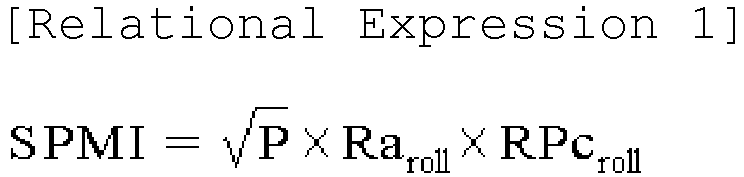 where the P refers to depression force (unit: ton) during the skin pass rolling, the Raroll refers to arithmetic average roughness (unit: um) on a surface of a skin pass rolling roll, and the RPCroll refers to the number of peaks (unit: /cm) per unit length of the skin pass rolling roll, and also, a unit of the SPMI is √ton · µm/cm.
 - The manufacturing method for a plated steel sheet for hot press forming of claim 11, wherein the Al-Fe alloy plated steel sheet is obtained by a process comprising a step of obtaining an aluminum-plated steel sheet plated with aluminum or an aluminum alloy; and a step of heating and alloying the aluminum plated steel sheet.
- The manufacturing method for a plated steel sheet for hot press forming of claim 12, wherein the step of heating and alloying the aluminum plated steel sheet is performed by online heating in a state in which a steel sheet is directly connected to a line for plating aluminum or an aluminum alloy, and the plated steel sheet is running.
- The manufacturing method for a plated steel sheet for hot press forming of claim 12, wherein the step of heating and alloying the aluminum plated steel sheet is performed by batch annealing for heating a coiled plated steel sheet in a box-type annealing furnace.
- The manufacturing method for a plated steel sheet for hot press forming of one of claims 11 to 14, wherein the composition of the base steel sheet comprises, by weight, C: 0.01 to 0.5%, Si: 2.0% or less (excluding 0%), Mn: 0.1 to 4.0%, P: 0.05% or less, S: 0.02% or less, Al: 0.001 to 1%, Cr: 5.0% or less (excluding 0%), N: 0.02% or less, Ti: 0.1% or less (excluding 0%), B: 0.0001 to 0.01%, a balance of Fe, and inevitable impurity elements.
- The manufacturing method for a plated steel sheet for hot press forming of claim 15, wherein the composition of the base steel sheet further comprises one or more elements selected from Nb: 0.1% or less, Mo: 0.5% or less, Ni: 1% or less, Cu: 1% or less, and V: 0.5% or less.
- A hot press formed member, comprising:a base steel sheet; anda plating layer comprising an Al-Fe alloy formed on the base steel sheet,wherein the sum of contents of Al and Fe in the plating layer is 70% or more by weight,an content of Fe in the plating layer is 30% or more by weight, anda product of Ra and RPc on a surface of the plating layer is 60 to 150 µm/cm,where Ra represents arithmetic mean roughness and a unit thereof is µm, and RPc represents the number of peaks per unit length and a unit thereof is /cm.
- A hot press formed member, comprising:a base steel sheet; anda plating layer comprising an Al-Fe alloy formed on the base steel sheet,wherein the sum of contents of Al and Fe in the plating layer is 70% or more by weight,an average content of Fe in the plating layer is 30% or more by weight, anda number of cracks existing in each region obtained by dividing a field of view obtained when a surface of the plating layer is observed with a scanning electron microscope at a magnification of 100 times, into 10 horizontal and vertical sections, is 15 to 220 per 1 mm2, anda ratio of an area occupied by an indentation portion on the surface of the plating layer is 5 to 50%,wherein the indentation portion refers to a region having a brightness of 70% or more as compared to the highest brightness measured in a region observed with an optical microscope at a magnification of 100 times.
- The hot press formed member of claim 17 or 18, wherein the composition of the base steel sheet comprises, by weight, C: 0.01 to 0.5%, Si: 2.0% or less (excluding 0%), Mn: 0.1 to 4.0%, P: 0.05% or less, S: 0.02% or less, Al: 0.001 to 1%, Cr: 5.0% or less (excluding 0%), N: 0.02% or less, Ti: 0.1% or less (excluding 0%), B: 0.0001 to 0.01%, and a balance of Fe and inevitable impurity elements.
- The hot press formed member of claim 19, wherein the composition of the base steel sheet further comprises one or more elements selected from Nb: 0.1% or less, Mo: 0.5% or less, Ni: 1% or less, Cu: 1% or less, and V: 0.5% or less.
- The hot press formed member of claim 17 or claim 18, wherein the base steel sheet has a microstructure comprising, by area, 5 to 50% martensite and a balance of one or more phases selected from ferrite, pearlite, bainite, and austenite, and has a tensile strength of 400 to 800 MPa.
- The hot press formed member of claim 17 or claim 18, wherein the base steel sheet has a microstructure comprising, by area, at least 90% martensite and a balance of one or more phases selected from ferrite, pearlite, bainite, and austenite, and has a tensile strength of 800 to 1,300 MPa.
- The hot press formed member of claim 17 or claim 18, wherein the base steel sheet has a microstructure comprising, by area, at least 95% martensite and a balance of one or more phases selected from ferrite, pearlite, bainite, and austenite, and has a tensile strength of 1300 MPa or more.
Applications Claiming Priority (2)
| Application Number | Priority Date | Filing Date | Title |
|---|---|---|---|
| KR1020210185822A KR20230096381A (en) | 2021-12-23 | 2021-12-23 | A plated steel sheet having superior paint adhesion and corrosion resistance after hot press forming, a method for producing the same and a hot press formed member |
| PCT/KR2022/020870 WO2023121241A1 (en) | 2021-12-23 | 2022-12-20 | Plated steel sheet having excellent plating adhesion and corrosion resistance after hot press forming, preparation method for plated steel sheet, and hot pressed forming member |
Publications (2)
| Publication Number | Publication Date |
|---|---|
| EP4455357A1 true EP4455357A1 (en) | 2024-10-30 |
| EP4455357A4 EP4455357A4 (en) | 2025-03-19 |
Family
ID=86903050
Family Applications (1)
| Application Number | Title | Priority Date | Filing Date |
|---|---|---|---|
| EP22911874.0A Pending EP4455357A4 (en) | 2021-12-23 | 2022-12-20 | Plated steel sheet having excellent plating adhesion and corrosion resistance after hot press forming, preparation method for plated steel sheet, and hot pressed forming member |
Country Status (7)
| Country | Link |
|---|---|
| US (1) | US20240401173A1 (en) |
| EP (1) | EP4455357A4 (en) |
| JP (2) | JP7769101B2 (en) |
| KR (1) | KR20230096381A (en) |
| CN (1) | CN118434904A (en) |
| MX (1) | MX2024002161A (en) |
| WO (1) | WO2023121241A1 (en) |
Families Citing this family (1)
| Publication number | Priority date | Publication date | Assignee | Title |
|---|---|---|---|---|
| WO2025095753A1 (en) * | 2023-10-30 | 2025-05-08 | 주식회사 포스코 | Plated steel sheet for hot press forming, hot press-formed member, hot press-formed parts, manufacturing methods therefor, forming device, forming method, battery case bracket, and battery pack module |
Family Cites Families (9)
| Publication number | Priority date | Publication date | Assignee | Title |
|---|---|---|---|---|
| FR2780984B1 (en) | 1998-07-09 | 2001-06-22 | Lorraine Laminage | COATED HOT AND COLD STEEL SHEET HAVING VERY HIGH RESISTANCE AFTER HEAT TREATMENT |
| JP4510320B2 (en) * | 2001-04-19 | 2010-07-21 | 新日本製鐵株式会社 | Hot-dip aluminized steel sheet with excellent corrosion resistance after processing and manufacturing method thereof |
| JP5463906B2 (en) * | 2009-12-28 | 2014-04-09 | 新日鐵住金株式会社 | Steel sheet for hot stamping and manufacturing method thereof |
| KR20130110532A (en) * | 2012-03-29 | 2013-10-10 | 현대제철 주식회사 | Method for producing galvanized steel sheet and galvanized steel sheet produced using the same |
| KR101677390B1 (en) * | 2015-09-23 | 2016-11-18 | 주식회사 포스코 | Method for manufacturing coated steel sheet having excellent surface quality and press moldability and coated steel sheet produced using the same |
| KR102010084B1 (en) * | 2017-12-26 | 2019-08-12 | 주식회사 포스코 | Steel sheet plated with fe-al alloy having improved resistance against hydrogen delayed fracture, manufacturing method thereof and hot press formed part manufactured therefrom |
| US11549167B2 (en) * | 2018-11-30 | 2023-01-10 | Posco | Steel sheet plated with Al—Fe alloy for hot press forming having excellent corrosion resistance and heat resistance, hot press formed part, and manufacturing method therefor |
| KR20200076467A (en) * | 2018-12-19 | 2020-06-29 | 주식회사 포스코 | Skin pass roll for hot dip aluminum coated steel sheet having excellent surface appearance and image clarity after painting, method of manufacturing hot dip aluminum coated steel sheet using skin pass roll and hot dip aluminum coated steel sheet |
| CN112877592B (en) * | 2019-11-29 | 2022-06-28 | 宝山钢铁股份有限公司 | Thermoformed part with excellent paint film adhesion and method of making the same |
-
2021
- 2021-12-23 KR KR1020210185822A patent/KR20230096381A/en active Pending
-
2022
- 2022-12-20 EP EP22911874.0A patent/EP4455357A4/en active Pending
- 2022-12-20 CN CN202280085070.4A patent/CN118434904A/en active Pending
- 2022-12-20 WO PCT/KR2022/020870 patent/WO2023121241A1/en not_active Ceased
- 2022-12-20 JP JP2024510486A patent/JP7769101B2/en active Active
- 2022-12-20 US US18/691,253 patent/US20240401173A1/en active Pending
- 2022-12-20 MX MX2024002161A patent/MX2024002161A/en unknown
-
2025
- 2025-10-30 JP JP2025183268A patent/JP2026021448A/en active Pending
Also Published As
| Publication number | Publication date |
|---|---|
| JP2026021448A (en) | 2026-02-10 |
| JP7769101B2 (en) | 2025-11-12 |
| CN118434904A (en) | 2024-08-02 |
| WO2023121241A1 (en) | 2023-06-29 |
| MX2024002161A (en) | 2024-03-08 |
| KR20230096381A (en) | 2023-06-30 |
| US20240401173A1 (en) | 2024-12-05 |
| EP4455357A4 (en) | 2025-03-19 |
| JP2024534815A (en) | 2024-09-26 |
Similar Documents
| Publication | Publication Date | Title |
|---|---|---|
| EP3632586B1 (en) | Steel sheet for hot press formed member having excellent plating adhesion, and method for manufacturing same | |
| EP3757243B1 (en) | High-strength galvanized steel sheet, high strength member, and method for manufacturing the same | |
| EP3396010B1 (en) | Aluminum-iron alloy-coated steel sheet for hot press forming, having excellent hydrogen delayed fracture resistance, peeling resistance and weldability, hot-formed member using same and methods of manufacturing thereof | |
| US20260098317A1 (en) | Plated steel sheet for hot press forming having excellent impact properties after hot press forming, hot press formed member, and manufacturing methods thereof | |
| EP3050989B1 (en) | High-strength steel sheet and method for producing same | |
| EP3467135B1 (en) | Thin steel sheet, and production method therefor | |
| US20030047258A1 (en) | High tensile cold-rolled steel sheet excellent in ductility and in strain aging hardening properties, and method for producing the same | |
| KR102010084B1 (en) | Steel sheet plated with fe-al alloy having improved resistance against hydrogen delayed fracture, manufacturing method thereof and hot press formed part manufactured therefrom | |
| KR102180811B1 (en) | A hot press formed part having excellent resistance against hydrogen embrittlement, and manufacturing method thereof | |
| EP3919645A1 (en) | Hot-pressed member, cold-rolled steel sheet for hot-pressed member, and methods respectively for producing these products | |
| KR102544887B1 (en) | High-strength hot-dip galvanized steel sheet and manufacturing method thereof | |
| WO2015079699A1 (en) | Bake-hardened hot-dip galvanized steel sheet | |
| EP3981891B1 (en) | High strength steel sheet, high strength member, and methods for manufacturing the same | |
| KR20220087870A (en) | High strength hot-dip galvanized steel sheet having exceelent coatability and method of manufacturing the same | |
| EP3266894B1 (en) | High-strength steel sheet and method for producing same | |
| JP7311808B2 (en) | Steel plate and its manufacturing method | |
| EP4464803A1 (en) | Steel sheet, member and methods for producing these | |
| JP2026021448A (en) | Plated steel sheet exhibiting excellent paint adhesion and corrosion resistance after hot press forming, method for manufacturing plated steel sheet, and hot press formed member | |
| EP2740813A1 (en) | Hot-dip galvanized steel sheet and production method therefor | |
| JP7311069B1 (en) | Steel plate and member, and manufacturing method thereof | |
| JP3698049B2 (en) | Alloy hot-dip galvanized steel sheet | |
| US20240011119A1 (en) | High strength hot-dip galvanized steel sheet having excellent plating adhesion and weldability and method of manufacturing same | |
| KR102451003B1 (en) | High strength hot-dip galvanized steel sheet having exceelent coating adhesion and spot weldability and method of manufacturing the same | |
| EP4407060A1 (en) | High-strength cold-rolled steel sheet having excellent surface quality and low material variation, and method for manufacturing same |
Legal Events
| Date | Code | Title | Description |
|---|---|---|---|
| STAA | Information on the status of an ep patent application or granted ep patent |
Free format text: STATUS: THE INTERNATIONAL PUBLICATION HAS BEEN MADE |
|
| PUAI | Public reference made under article 153(3) epc to a published international application that has entered the european phase |
Free format text: ORIGINAL CODE: 0009012 |
|
| STAA | Information on the status of an ep patent application or granted ep patent |
Free format text: STATUS: REQUEST FOR EXAMINATION WAS MADE |
|
| 17P | Request for examination filed |
Effective date: 20240327 |
|
| AK | Designated contracting states |
Kind code of ref document: A1 Designated state(s): AL AT BE BG CH CY CZ DE DK EE ES FI FR GB GR HR HU IE IS IT LI LT LU LV MC ME MK MT NL NO PL PT RO RS SE SI SK SM TR |
|
| A4 | Supplementary search report drawn up and despatched |
Effective date: 20250218 |
|
| RIC1 | Information provided on ipc code assigned before grant |
Ipc: C21D 9/46 20060101ALI20250212BHEP Ipc: C21D 1/673 20060101ALI20250212BHEP Ipc: C23C 28/02 20060101ALI20250212BHEP Ipc: C23C 2/02 20060101ALI20250212BHEP Ipc: C21D 8/02 20060101ALI20250212BHEP Ipc: C22C 21/00 20060101ALI20250212BHEP Ipc: C23C 28/00 20060101ALI20250212BHEP Ipc: C23C 2/26 20060101ALI20250212BHEP Ipc: C23C 2/40 20060101ALI20250212BHEP Ipc: C23C 2/12 20060101AFI20250212BHEP |
|
| DAV | Request for validation of the european patent (deleted) | ||
| DAX | Request for extension of the european patent (deleted) |