EP4455095A1 - Layered platinate, layered platinic acid, platinic acid nanosheet, platinum nanosheet and production method thereof - Google Patents
Layered platinate, layered platinic acid, platinic acid nanosheet, platinum nanosheet and production method thereof Download PDFInfo
- Publication number
- EP4455095A1 EP4455095A1 EP22910512.7A EP22910512A EP4455095A1 EP 4455095 A1 EP4455095 A1 EP 4455095A1 EP 22910512 A EP22910512 A EP 22910512A EP 4455095 A1 EP4455095 A1 EP 4455095A1
- Authority
- EP
- European Patent Office
- Prior art keywords
- layered
- nanosheet
- platinic acid
- platinum
- platinate
- Prior art date
- Legal status (The legal status is an assumption and is not a legal conclusion. Google has not performed a legal analysis and makes no representation as to the accuracy of the status listed.)
- Pending
Links
Images


Classifications
-
- B—PERFORMING OPERATIONS; TRANSPORTING
- B01—PHYSICAL OR CHEMICAL PROCESSES OR APPARATUS IN GENERAL
- B01J—CHEMICAL OR PHYSICAL PROCESSES, e.g. CATALYSIS OR COLLOID CHEMISTRY; THEIR RELEVANT APPARATUS
- B01J35/00—Catalysts, in general, characterised by their form or physical properties
- B01J35/40—Catalysts, in general, characterised by their form or physical properties characterised by dimensions, e.g. grain size
- B01J35/45—Nanoparticles
-
- B—PERFORMING OPERATIONS; TRANSPORTING
- B01—PHYSICAL OR CHEMICAL PROCESSES OR APPARATUS IN GENERAL
- B01J—CHEMICAL OR PHYSICAL PROCESSES, e.g. CATALYSIS OR COLLOID CHEMISTRY; THEIR RELEVANT APPARATUS
- B01J21/00—Catalysts comprising the elements, oxides, or hydroxides of magnesium, boron, aluminium, carbon, silicon, titanium, zirconium, or hafnium
- B01J21/18—Carbon
-
- B—PERFORMING OPERATIONS; TRANSPORTING
- B01—PHYSICAL OR CHEMICAL PROCESSES OR APPARATUS IN GENERAL
- B01J—CHEMICAL OR PHYSICAL PROCESSES, e.g. CATALYSIS OR COLLOID CHEMISTRY; THEIR RELEVANT APPARATUS
- B01J23/00—Catalysts comprising metals or metal oxides or hydroxides, not provided for in group B01J21/00
- B01J23/38—Catalysts comprising metals or metal oxides or hydroxides, not provided for in group B01J21/00 of noble metals
- B01J23/40—Catalysts comprising metals or metal oxides or hydroxides, not provided for in group B01J21/00 of noble metals of the platinum group metals
- B01J23/42—Platinum
-
- B—PERFORMING OPERATIONS; TRANSPORTING
- B01—PHYSICAL OR CHEMICAL PROCESSES OR APPARATUS IN GENERAL
- B01J—CHEMICAL OR PHYSICAL PROCESSES, e.g. CATALYSIS OR COLLOID CHEMISTRY; THEIR RELEVANT APPARATUS
- B01J23/00—Catalysts comprising metals or metal oxides or hydroxides, not provided for in group B01J21/00
- B01J23/38—Catalysts comprising metals or metal oxides or hydroxides, not provided for in group B01J21/00 of noble metals
- B01J23/54—Catalysts comprising metals or metal oxides or hydroxides, not provided for in group B01J21/00 of noble metals combined with metals, oxides or hydroxides provided for in groups B01J23/02 - B01J23/36
- B01J23/56—Platinum group metals
- B01J23/58—Platinum group metals with alkali- or alkaline earth metals
-
- B—PERFORMING OPERATIONS; TRANSPORTING
- B01—PHYSICAL OR CHEMICAL PROCESSES OR APPARATUS IN GENERAL
- B01J—CHEMICAL OR PHYSICAL PROCESSES, e.g. CATALYSIS OR COLLOID CHEMISTRY; THEIR RELEVANT APPARATUS
- B01J35/00—Catalysts, in general, characterised by their form or physical properties
- B01J35/20—Catalysts, in general, characterised by their form or physical properties characterised by their non-solid state
- B01J35/23—Catalysts, in general, characterised by their form or physical properties characterised by their non-solid state in a colloidal state
-
- B—PERFORMING OPERATIONS; TRANSPORTING
- B01—PHYSICAL OR CHEMICAL PROCESSES OR APPARATUS IN GENERAL
- B01J—CHEMICAL OR PHYSICAL PROCESSES, e.g. CATALYSIS OR COLLOID CHEMISTRY; THEIR RELEVANT APPARATUS
- B01J35/00—Catalysts, in general, characterised by their form or physical properties
- B01J35/30—Catalysts, in general, characterised by their form or physical properties characterised by their physical properties
-
- B—PERFORMING OPERATIONS; TRANSPORTING
- B01—PHYSICAL OR CHEMICAL PROCESSES OR APPARATUS IN GENERAL
- B01J—CHEMICAL OR PHYSICAL PROCESSES, e.g. CATALYSIS OR COLLOID CHEMISTRY; THEIR RELEVANT APPARATUS
- B01J35/00—Catalysts, in general, characterised by their form or physical properties
- B01J35/30—Catalysts, in general, characterised by their form or physical properties characterised by their physical properties
- B01J35/33—Electric or magnetic properties
-
- B—PERFORMING OPERATIONS; TRANSPORTING
- B01—PHYSICAL OR CHEMICAL PROCESSES OR APPARATUS IN GENERAL
- B01J—CHEMICAL OR PHYSICAL PROCESSES, e.g. CATALYSIS OR COLLOID CHEMISTRY; THEIR RELEVANT APPARATUS
- B01J35/00—Catalysts, in general, characterised by their form or physical properties
- B01J35/30—Catalysts, in general, characterised by their form or physical properties characterised by their physical properties
- B01J35/391—Physical properties of the active metal ingredient
- B01J35/395—Thickness of the active catalytic layer
-
- B—PERFORMING OPERATIONS; TRANSPORTING
- B01—PHYSICAL OR CHEMICAL PROCESSES OR APPARATUS IN GENERAL
- B01J—CHEMICAL OR PHYSICAL PROCESSES, e.g. CATALYSIS OR COLLOID CHEMISTRY; THEIR RELEVANT APPARATUS
- B01J37/00—Processes, in general, for preparing catalysts; Processes, in general, for activation of catalysts
- B01J37/16—Reducing
-
- B—PERFORMING OPERATIONS; TRANSPORTING
- B01—PHYSICAL OR CHEMICAL PROCESSES OR APPARATUS IN GENERAL
- B01J—CHEMICAL OR PHYSICAL PROCESSES, e.g. CATALYSIS OR COLLOID CHEMISTRY; THEIR RELEVANT APPARATUS
- B01J37/00—Processes, in general, for preparing catalysts; Processes, in general, for activation of catalysts
- B01J37/16—Reducing
- B01J37/18—Reducing with gases containing free hydrogen
-
- C—CHEMISTRY; METALLURGY
- C01—INORGANIC CHEMISTRY
- C01G—COMPOUNDS CONTAINING METALS NOT COVERED BY SUBCLASSES C01D OR C01F
- C01G55/00—Compounds of ruthenium, rhodium, palladium, osmium, iridium, or platinum
-
- H—ELECTRICITY
- H01—ELECTRIC ELEMENTS
- H01M—PROCESSES OR MEANS, e.g. BATTERIES, FOR THE DIRECT CONVERSION OF CHEMICAL ENERGY INTO ELECTRICAL ENERGY
- H01M4/00—Electrodes
- H01M4/86—Inert electrodes with catalytic activity, e.g. for fuel cells
- H01M4/90—Selection of catalytic material
- H01M4/92—Metals of platinum group
-
- B—PERFORMING OPERATIONS; TRANSPORTING
- B01—PHYSICAL OR CHEMICAL PROCESSES OR APPARATUS IN GENERAL
- B01J—CHEMICAL OR PHYSICAL PROCESSES, e.g. CATALYSIS OR COLLOID CHEMISTRY; THEIR RELEVANT APPARATUS
- B01J2235/00—Indexing scheme associated with group B01J35/00, related to the analysis techniques used to determine the catalysts form or properties
- B01J2235/30—Scanning electron microscopy; Transmission electron microscopy
-
- B—PERFORMING OPERATIONS; TRANSPORTING
- B82—NANOTECHNOLOGY
- B82Y—SPECIFIC USES OR APPLICATIONS OF NANOSTRUCTURES; MEASUREMENT OR ANALYSIS OF NANOSTRUCTURES; MANUFACTURE OR TREATMENT OF NANOSTRUCTURES
- B82Y30/00—Nanotechnology for materials or surface science, e.g. nanocomposites
-
- B—PERFORMING OPERATIONS; TRANSPORTING
- B82—NANOTECHNOLOGY
- B82Y—SPECIFIC USES OR APPLICATIONS OF NANOSTRUCTURES; MEASUREMENT OR ANALYSIS OF NANOSTRUCTURES; MANUFACTURE OR TREATMENT OF NANOSTRUCTURES
- B82Y40/00—Manufacture or treatment of nanostructures
-
- C—CHEMISTRY; METALLURGY
- C01—INORGANIC CHEMISTRY
- C01P—INDEXING SCHEME RELATING TO STRUCTURAL AND PHYSICAL ASPECTS OF SOLID INORGANIC COMPOUNDS
- C01P2002/00—Crystal-structural characteristics
- C01P2002/70—Crystal-structural characteristics defined by measured X-ray, neutron or electron diffraction data
- C01P2002/72—Crystal-structural characteristics defined by measured X-ray, neutron or electron diffraction data by d-values or two theta-values, e.g. as X-ray diagram
-
- C—CHEMISTRY; METALLURGY
- C01—INORGANIC CHEMISTRY
- C01P—INDEXING SCHEME RELATING TO STRUCTURAL AND PHYSICAL ASPECTS OF SOLID INORGANIC COMPOUNDS
- C01P2004/00—Particle morphology
- C01P2004/20—Particle morphology extending in two dimensions, e.g. plate-like
- C01P2004/24—Nanoplates, i.e. plate-like particles with a thickness from 1-100 nanometer
Definitions
- the present invention relates to a layered platinate, a layered platinic acid, a platinic acid nanosheet, a platinum nanosheet, and a manufacturing method thereof.
- Platinum having excellent catalytic properties, plays an important role in various applications such as electrocatalysts, exhaust gas catalysts, and chemical synthesis catalysts.
- electrocatalysts for solid polymer-type fuel cells
- Platinum is used as an electrocatalyst for fuel cells because of its high catalytic activity in hydrogen oxidation and oxygen reduction reactions.
- platinum is a precious metal, which increases the cost of fuel cells.
- an approach that reduces platinum usage is effective, and an increase in a platinum utilization rate is required.
- Practical fuel cells use electrocatalysts with platinum nanoparticles having a diameter of about 3 nm supported on porous carbon. The nanoparticles have a large specific surface area and exhibit high catalytic activity. However, the utilization efficiency is low, about 40%.
- nanosheets are two-dimensional plate crystals with a thickness of several nanometers and a horizontal size on the order of micrometers, and thus have a large specific surface area and can be expected to have high catalytic properties as compared with those of nanoparticles.
- platinum utilization rate is an extremely high 100%.
- Non-Patent Document 1 a method of synthesizing platinum nanosheets using potassium tetrachloride and hexamethylenetetramine as starting materials is reported in Non-Patent Document 1, for example.
- the starting materials are mixed in a liquid phase to obtain a layered compound, the layered compound is exfoliated to obtain a platinic acid nanosheet, and then the platinic acid nanosheet is electrochemically reduced to obtain a platinum nanosheet having a thickness of approximately 1.0 nm.
- Non-Patent Document 1 A. Funatsu et al., Chem. Commun., 50, 8503-8506 (2014 )
- the platinum nanosheet described above is thick and regarded as constituted by a plurality of atomic layers, and is problematic in that the utilization rate of platinum is lower than that of nanoparticles.
- a monoatomic-layer ruthenium nanosheet having a thickness of about 0.6 nm can be obtained by synthesizing layered ruthenate and layered ruthenic acid by a solid phase reaction of ruthenium oxide and alkali metal carbonate, exfoliating the synthesized product to synthesize a ruthenium oxide nanosheet, and performing reduction treatment in a hydrogen flow (Patent Documents 1, 2). It is expected that, by applying this synthesis method to platinum, it is possible to obtain a platinum nanosheet.
- the present invention has been made to solve the above-described problems, and an object thereof is to focus on platinum used as an electrocatalyst for fuel cells, a catalyst for purifying exhaust gas, a catalyst for synthesizing chemical products, and the like and provide a layered platinate, a layered platinic acid, a platinic acid nanosheet, a platinum nanosheet, and a manufacturing method thereof that are used for fabricating a platinum nanosheet.
- a layered platinate, a layered platinic acid, and a platinic acid nanosheet that are used for fabricating a platinum nanosheet.
- Platinum is used as an electrocatalyst for fuel cells, a catalyst for purifying exhaust gas, a catalyst for synthesizing chemical products, and the like, and thus the platinum nanosheet obtained can be expected to have a wide range of applications.
- a layered platinate according to the present invention includes M x Pt y O z ⁇ nH 2 O (where M is a monovalent metal), the M x Pt y O z ⁇ nH 2 O being layered.
- M is desirably an alkali metal, and examples include Li, Na, K, Rb, Cs, and the like.
- x and y allow preparation based on the blending amounts of platinic acid and an alkali metal compound.
- the layered platinate is formed by (1) pulverizing an alkali metal compound and then mixing the compound with platinic acid (mixing step), (2) molding the obtained mixture into tablets (molding step), (3) firing the tablets a first time (first firing step), (4) pulverizing and mixing the tablets after the firing (pulverizing and mixing step), (5) molding the tablets again (molding step), (6) firing the tablets a second time (second firing step), and (7) cleaning the fired product until neutral (cleaning step).
- the layered platinate can be obtained.
- the alkali metal compound used in the pulverizing and mixing step of (1) is not particularly limited, but examples include potassium carbonate.
- the first firing step of (3) may be heat treatment in air or in an oxygen atmosphere or flow, within a range of 400°C to 800°C for 1 to 12 hours (preferably one to three hours).
- the second firing step of (6) may also be heat treatment in air or in an oxygen atmosphere or flow, within a range of 400°C to 800°C for 1 to 12 hours (preferably one to three hours).
- the layered platinic acid can be obtained by treating the layered platinate obtained in an acidic solution. Treatment in the acidic solution is performed by immersion in an acidic solution ofHCl, for example, for about one to five days.
- the layered platinic acid obtained includes H x Pt y O z ⁇ nH 2 O, the H x Pt y O z ⁇ nH 2 O being layered.
- the platinic acid nanosheet according to the present invention has a thickness of 1 nm or less (preferably less than 1 nm).
- a platinic acid nanosheet dispersed solution (yellowish brown) can be obtained by causing an alkylammonium to react with the layered platinic acid obtained above to form an alkylammonium - layered platinic acid intercalation compound, and subsequently shaking the alkylammonium - layered platinic acid intercalation compound.
- a monolayer film of a platinic acid nanosheet can be obtained on a substrate by a mutual adsorption method using the obtained platinic acid nanosheet dispersed solution.
- the alkylammonium tetrabutylammonium or the like
- the substrate include an Si substrate, a quartz substrate, and the like.
- the formation of the platinic acid nanosheet monolayer film on the substrate include immersing the substrate in the platinic acid nanosheet dispersed solution, or dripping the platinic acid nanosheet dispersed solution onto the substrate, coating a monolayer film, or the like. In this way, a platinic acid nanosheet can be coated in a monolayer on the substrate.
- the platinum nanosheet according to the present invention has a thickness of 0.6 nm or less.
- the platinum nanosheet can be obtained by performing heat treatment (reduction treatment) for about 30 minutes to two hours in a hydrogen atmosphere or a hydrogen flow at a low temperature of 50 to 200°C (preferably 50 to 150°C).
- the platinum nanosheet is manufactured by forming platinic acid into a layered platinate, forming the layered platinate obtained into a layered platinic acid, forming the layered platinic acid into a platinic acid nanosheet dispersed solution obtained by dispersing a platinic acid nanosheet, which is a platinic acid sheet having a thickness of 1 nm or less in a solvent, forming a platinic acid nanosheet monolayer film on a substrate by a mutual adsorption method using the platinic acid nanosheet dispersed solution, and reduction-treating the platinic acid nanosheet monolayer film in a hydrogen environment or a hydrogen flow. In this way, the platinum nanosheet can be manufactured.
- potassium carbonate K 2 CO 3
- platinic acid PtO 2
- the mixing ratio PtO 2 :K 2 CO 3
- the mixture extracted from the glove box was pressed at 1.5 tons for 10 minutes and molded into tablets.
- the molded tablets were fired at 800°C for one hour in air (first firing).
- the tablets were returned to the glove box again and, after pulverizing and mixing, pressed at 1.5 tons for 10 minutes to mold the tablets, and the molded tablets were fired at 800°C for one hour in air (second firing).
- decantation was performed in ultrapure water until neutral. In this way, the layered platinate was obtained.
- This layered platinate was placed in a 1M HCl solution and left for three days to obtain a layered platinic acid.
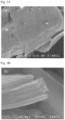
- Fig. 1 shows the electron microscope images of (a) the layered platinate and (b) the layered platinic acid obtained. From the observed images, a clear layered structure could be found in both the layered platinate and the layered platinic acid.
- a platinic acid nanosheet was fabricated from the layered platinic acid.
- TSAOH tetrabutylammonium hydroxide
- the mixture was subjected to shaking at 120 rpm for seven days.
- a platinic acid nanosheet dispersed solution was obtained.
- This platinic acid nanosheet dispersed solution was yellow in color.
- the platinic acid nanosheet dispersed solution obtained in Example 2 was used to form a film on a substrate of the platinic acid nanosheet by the alternate adsorption laminating method.
- a Si substrate to be coated by the platinic acid nanosheet was immersed in a 10-mass% poly(diallyldimethylammonium chloride) (PDDA) solution and cleaned in ultrapure water, and then immersed in the platinic acid nanosheet dispersed solution. In this way, an Si substrate monolayer-coated with a platinic acid nanosheet was obtained.
- PDDA poly(diallyldimethylammonium chloride)
- Fig. 4 is an atomic force microscope (AFM) image of the platinic acid nanosheet taken with an AFM (Bruker, Digital Instruments Nanoscope IIIa). A thickness of the platinic acid nanosheet was measured, and the result was 0.9 nm ⁇ 0.1 nm.
- Fig. 5 is a transmission electron microscope (TEM) image showing a pattern of the platinic acid nanosheet. This TEM image was taken after dripping the platinic acid nanosheet dispersed solution onto an observation grid, and then drying at 60°C throughout the night.
- AFM atomic force microscope
- Fig. 5 shows the X-ray diffraction pattern after the reduction treatment, and no pattern caused by high-order reflections observed in the nanosheet laminate was seen. On the other hand, a pattern attributable to Pt (111) was seen.
- Fig. 6 is an AFM image of the Si substrate coated with the platinic acid nanosheet obtained in Example 3, and the substrate heat-treated at 100°C for one hour in a hydrogen flow. A thickness of the nanosheet after heat treatment was 0.6 nm ⁇ 0.1 nm. The above results show that the platinic acid nanosheet was reduced by heat treatment and topotactically converted into a platinum nanosheet.
- Pt(ns)/C platinum nanosheet supported on carbon
- PtO 2 (ns)/C platinum nanosheet supported on carbon
- Fig. 7 is a transmission electron microscope image of the 10-mass% Pt(ns)/C obtained in this case. As can be seen from Fig. 7 , the two-dimensional form was maintained without aggregation even after reduction.
- ECSA electrochemical surface area
- a glassy carbon (GC) electrode was polished to smoothen the surface of the GC electrode.
- the GC electrode was then cleaned by ultrasonic cleaning in ultrapure water and ethanol.
- 75-vol% 2-propanol solution and 5-mass% Nafion (trademark) solution were added to the Pt(ns)/C catalyst and the Pt(ns)/C catalyst was dispersed in 75-vol% 2-propanol solution by mechanical and ultrasonic agitation. This was used as a catalyst dispersed liquid, and the catalyst dispersed liquid was dripped onto the GC electrode. After the dripping, the GC electrode was dried in air. Subsequently, vacuum drying was performed at 60°C and a sample electrode was fabricated.
- ECSA electrochemical surface area
- Pt(ns)/C was 415 A/(g-Pt), two times that of the Pt nanoparticle/C ratio.
- the durability of the cathode catalyst was evaluated based on the ECSA decreasing rate.
- Fig. 8 is a plot of the ECSA decreasing rate after standardization using the initial ECSA for various catalysts.
- Pt(ns)/C was higher ECSA retention than that of the conventionally known Pt nanoparticles (average diameter: 3 nm)/carbon carriers. This result showed the high durability of Pt(ns)/C.
Landscapes
- Chemical & Material Sciences (AREA)
- Organic Chemistry (AREA)
- Engineering & Computer Science (AREA)
- Materials Engineering (AREA)
- Chemical Kinetics & Catalysis (AREA)
- Inorganic Chemistry (AREA)
- Electrochemistry (AREA)
- General Chemical & Material Sciences (AREA)
- Catalysts (AREA)
Abstract
Description
- The present invention relates to a layered platinate, a layered platinic acid, a platinic acid nanosheet, a platinum nanosheet, and a manufacturing method thereof.
- Platinum, having excellent catalytic properties, plays an important role in various applications such as electrocatalysts, exhaust gas catalysts, and chemical synthesis catalysts. As an example, the application of platinum to electrocatalysts for solid polymer-type fuel cells will be described. Platinum is used as an electrocatalyst for fuel cells because of its high catalytic activity in hydrogen oxidation and oxygen reduction reactions. However, platinum is a precious metal, which increases the cost of fuel cells. To solve this problem, an approach that reduces platinum usage is effective, and an increase in a platinum utilization rate is required. Practical fuel cells use electrocatalysts with platinum nanoparticles having a diameter of about 3 nm supported on porous carbon. The nanoparticles have a large specific surface area and exhibit high catalytic activity. However, the utilization efficiency is low, about 40%.
- Various forms of platinum-based electrocatalysts have been developed. Among them, nanosheets are two-dimensional plate crystals with a thickness of several nanometers and a horizontal size on the order of micrometers, and thus have a large specific surface area and can be expected to have high catalytic properties as compared with those of nanoparticles. In particular, in nanosheets with monoatomic or diatomic layers, all atoms are exposed on a surface and the platinum utilization rate is an extremely high 100%. Successful realization of the application of such nanosheets to catalysts can lead to expectations of excellent catalytic properties as an alternative to nanoparticles.
- As for nanosheets, a method of synthesizing platinum nanosheets using potassium tetrachloride and hexamethylenetetramine as starting materials is reported in Non-Patent
Document 1, for example. According to this synthesis method, the starting materials are mixed in a liquid phase to obtain a layered compound, the layered compound is exfoliated to obtain a platinic acid nanosheet, and then the platinic acid nanosheet is electrochemically reduced to obtain a platinum nanosheet having a thickness of approximately 1.0 nm. - Non-Patent Document 1: A. Funatsu et al., Chem. Commun., 50, 8503-8506 (2014)
-
- Patent Document 1:
Japanese Laid-Open Patent Application Publication No. 2007-11248 - Patent Document 2:
Japanese Laid-Open Patent Application Publication No. 2009-136787 - However, the platinum nanosheet described above is thick and regarded as constituted by a plurality of atomic layers, and is problematic in that the utilization rate of platinum is lower than that of nanoparticles.
- The present inventors have reported that a monoatomic-layer ruthenium nanosheet having a thickness of about 0.6 nm can be obtained by synthesizing layered ruthenate and layered ruthenic acid by a solid phase reaction of ruthenium oxide and alkali metal carbonate, exfoliating the synthesized product to synthesize a ruthenium oxide nanosheet, and performing reduction treatment in a hydrogen flow (
Patent Documents 1, 2). It is expected that, by applying this synthesis method to platinum, it is possible to obtain a platinum nanosheet. - The present invention has been made to solve the above-described problems, and an object thereof is to focus on platinum used as an electrocatalyst for fuel cells, a catalyst for purifying exhaust gas, a catalyst for synthesizing chemical products, and the like and provide a layered platinate, a layered platinic acid, a platinic acid nanosheet, a platinum nanosheet, and a manufacturing method thereof that are used for fabricating a platinum nanosheet.
-
- (1) A layered platinate according to the present invention comprises MxPtyOz·nH2O (where M is a monovalent metal), the MxPtyOz·nH2O being layered.
In the layered platinate according to the present invention, the M is potassium and diffraction peaks are at 2θ diffraction angles of 13° and 26°. - (2) A layered platinic acid according to the present invention comprises HxPtyOz·nH2O, the HxPtyOz·nH2O being layered.
- (3) A platinic acid nanosheet according to the present invention comprises a thickness of 1 nm or less.
- (4) A platinum nanosheet according to the present invention comprises a thickness of 0.6 nm or less.
- (5) A manufacturing method of a platinum nanosheet according to the present invention comprises forming platinic acid into a layered platinate, forming the layered platinate obtained into a layered platinic acid, forming the layered platinic acid into a platinic acid nanosheet dispersed solution obtained by dispersing a platinic acid nanosheet, which is a platinic acid sheet having a thickness of 1 nm or less in a solvent, forming a platinic acid nanosheet monolayer film on a substrate by a mutual adsorption method using the platinic acid nanosheet dispersed solution, and reduction-treating the platinic acid nanosheet monolayer film in a hydrogen environment to manufacture a platinum nanosheet having a thickness of 0.6 nm or less.
- According to the present invention, it is possible to provide a layered platinate, a layered platinic acid, and a platinic acid nanosheet that are used for fabricating a platinum nanosheet. Platinum is used as an electrocatalyst for fuel cells, a catalyst for purifying exhaust gas, a catalyst for synthesizing chemical products, and the like, and thus the platinum nanosheet obtained can be expected to have a wide range of applications. Further, according to the present invention, it is possible to provide a platinum nanosheet of a monoatomic layer having a high platinum utilization rate, and a manufacturing method thereof.
-
-
Fig. 1 shows electron microscope images of (a) layered platinic acid potassium and (b) layered platinic acid. -
Fig. 2 shows an X-ray diffraction pattern of layered platinic acid potassium. -
Fig. 3 shows an X-ray diffraction pattern of a sample obtained by dripping a platinic acid nanosheet dispersed solution several times onto a glass plate. -
Fig. 4 is an AFM image of a platinic acid nanosheet. -
Fig. 5 shows an X-ray diffraction pattern after reduction treatment of the platinic acid nanosheet. -
Fig. 6 is an AFM image after the reduction treatment of the platinic acid nanosheet. -
Fig. 7 is a transmission electron microscope image of a platinum nanosheet supported on carbon. -
Fig. 8 is a plot of an ESCA decreasing rate after standardization using the initial ESCA for various catalysts. - The following describes in detail a layered platinate, a layered platinic acid, a platinic acid nanosheet, a platinum nanosheet, and a manufacturing method of the platinum nanosheet according to the present invention. The present invention, however, is not limited to the following description, within the range included in the technical scope thereof.
- A layered platinate according to the present invention includes MxPtyOz·nH2O (where M is a monovalent metal), the MxPtyOz·nH2O being layered. M is desirably an alkali metal, and examples include Li, Na, K, Rb, Cs, and the like. Further, x and y allow preparation based on the blending amounts of platinic acid and an alkali metal compound.
- The layered platinate is formed by (1) pulverizing an alkali metal compound and then mixing the compound with platinic acid (mixing step), (2) molding the obtained mixture into tablets (molding step), (3) firing the tablets a first time (first firing step), (4) pulverizing and mixing the tablets after the firing (pulverizing and mixing step), (5) molding the tablets again (molding step), (6) firing the tablets a second time (second firing step), and (7) cleaning the fired product until neutral (cleaning step). In this way, the layered platinate can be obtained.
- The alkali metal compound used in the pulverizing and mixing step of (1) is not particularly limited, but examples include potassium carbonate. The mixing ratio of platinic acid to the alkali metal compound is not particularly limited, but can be set to, for example, platinic acid : alkali metal compound = about 1 : 0.5 to 1 : 5. The first firing step of (3) may be heat treatment in air or in an oxygen atmosphere or flow, within a range of 400°C to 800°C for 1 to 12 hours (preferably one to three hours). The second firing step of (6) may also be heat treatment in air or in an oxygen atmosphere or flow, within a range of 400°C to 800°C for 1 to 12 hours (preferably one to three hours).
- The layered platinic acid can be obtained by treating the layered platinate obtained in an acidic solution. Treatment in the acidic solution is performed by immersion in an acidic solution ofHCl, for example, for about one to five days. The layered platinic acid obtained includes HxPtyOz·nH2O, the HxPtyOz·nH2O being layered.
- The platinic acid nanosheet according to the present invention has a thickness of 1 nm or less (preferably less than 1 nm). A platinic acid nanosheet dispersed solution (yellowish brown) can be obtained by causing an alkylammonium to react with the layered platinic acid obtained above to form an alkylammonium - layered platinic acid intercalation compound, and subsequently shaking the alkylammonium - layered platinic acid intercalation compound. A monolayer film of a platinic acid nanosheet can be obtained on a substrate by a mutual adsorption method using the obtained platinic acid nanosheet dispersed solution. It should be noted that, as the alkylammonium, tetrabutylammonium or the like, for example, can be preferably used. Examples of the substrate include an Si substrate, a quartz substrate, and the like. Examples of the formation of the platinic acid nanosheet monolayer film on the substrate include immersing the substrate in the platinic acid nanosheet dispersed solution, or dripping the platinic acid nanosheet dispersed solution onto the substrate, coating a monolayer film, or the like. In this way, a platinic acid nanosheet can be coated in a monolayer on the substrate.
- The platinum nanosheet according to the present invention has a thickness of 0.6 nm or less. After the platinic acid nanosheet obtained above is coated in a monolayer on the substrate, the platinum nanosheet can be obtained by performing heat treatment (reduction treatment) for about 30 minutes to two hours in a hydrogen atmosphere or a hydrogen flow at a low temperature of 50 to 200°C (preferably 50 to 150°C).
- The platinum nanosheet is manufactured by forming platinic acid into a layered platinate, forming the layered platinate obtained into a layered platinic acid, forming the layered platinic acid into a platinic acid nanosheet dispersed solution obtained by dispersing a platinic acid nanosheet, which is a platinic acid sheet having a thickness of 1 nm or less in a solvent, forming a platinic acid nanosheet monolayer film on a substrate by a mutual adsorption method using the platinic acid nanosheet dispersed solution, and reduction-treating the platinic acid nanosheet monolayer film in a hydrogen environment or a hydrogen flow. In this way, the platinum nanosheet can be manufactured.
- The present invention will now be described in further detail by way of examples.
- First, in a glove box with an atmosphere replaced with nitrogen, potassium carbonate (K2CO3) was pulverized and then blended with platinic acid (PtO2) and mixed for 30 minutes. The mixing ratio (PtO2:K2CO3) was set to 1: 1. The mixture extracted from the glove box was pressed at 1.5 tons for 10 minutes and molded into tablets. Next, the molded tablets were fired at 800°C for one hour in air (first firing). After firing, the tablets were returned to the glove box again and, after pulverizing and mixing, pressed at 1.5 tons for 10 minutes to mold the tablets, and the molded tablets were fired at 800°C for one hour in air (second firing). Next, decantation was performed in ultrapure water until neutral. In this way, the layered platinate was obtained. This layered platinate was placed in a 1M HCl solution and left for three days to obtain a layered platinic acid.
-
Fig. 1 shows the electron microscope images of (a) the layered platinate and (b) the layered platinic acid obtained. From the observed images, a clear layered structure could be found in both the layered platinate and the layered platinic acid.Fig. 2 shows an X-ray diffraction pattern of the layered platinate (X-ray source: CuK α rays). In the case of the layered platinate, crystalline peaks appeared at d = 0.71 nm and 0.36 nm. - A platinic acid nanosheet was fabricated from the layered platinic acid. Using the layered platinic acid obtained in Example 1, a mixed solution of a 10% tetrabutylammonium hydroxide (TBAOH) solution and ultrapure water, 0.6 mL and 25.4 mL, respectively, was added. Subsequently, the mixture was subjected to shaking at 120 rpm for seven days. In this way, a platinic acid nanosheet dispersed solution was obtained. This platinic acid nanosheet dispersed solution was yellow in color.
Fig. 3 shows an X-ray diffraction pattern of a sample obtained by dripping the platinic acid nanosheet dispersed solution several times onto a glass plate. Peaks caused by high-order reflections were seen at d = 1.71 nm, 0.82 nm, 0.55 nm, and 0.41 nm. This is a typical X-ray diffraction pattern observed in a nanosheet laminate. - The platinic acid nanosheet dispersed solution obtained in Example 2 was used to form a film on a substrate of the platinic acid nanosheet by the alternate adsorption laminating method. First, a Si substrate to be coated by the platinic acid nanosheet was immersed in a 10-mass% poly(diallyldimethylammonium chloride) (PDDA) solution and cleaned in ultrapure water, and then immersed in the platinic acid nanosheet dispersed solution. In this way, an Si substrate monolayer-coated with a platinic acid nanosheet was obtained.
-
Fig. 4 is an atomic force microscope (AFM) image of the platinic acid nanosheet taken with an AFM (Bruker, Digital Instruments Nanoscope IIIa). A thickness of the platinic acid nanosheet was measured, and the result was 0.9 nm ± 0.1 nm.Fig. 5 is a transmission electron microscope (TEM) image showing a pattern of the platinic acid nanosheet. This TEM image was taken after dripping the platinic acid nanosheet dispersed solution onto an observation grid, and then drying at 60°C throughout the night. - The glass plate with several drops of platinic acid nanosheet dispersed solution obtained in Example 2 was heat-treated at 100°C for one hour in a flow of hydrogen.
Fig. 5 shows the X-ray diffraction pattern after the reduction treatment, and no pattern caused by high-order reflections observed in the nanosheet laminate was seen. On the other hand, a pattern attributable to Pt (111) was seen.Fig. 6 is an AFM image of the Si substrate coated with the platinic acid nanosheet obtained in Example 3, and the substrate heat-treated at 100°C for one hour in a hydrogen flow. A thickness of the nanosheet after heat treatment was 0.6 nm ± 0.1 nm. The above results show that the platinic acid nanosheet was reduced by heat treatment and topotactically converted into a platinum nanosheet. - Pt(ns)/C (platinum nanosheet supported on carbon) was prepared using the platinic acid nanosheet dispersed solution obtained in Example 2. First, ultrapure water was added to produce 1 g/L of Ketjen black (KB), and the KB was dispersed in ultrapure water by mechanical and ultrasonic agitation to obtain a KB dispersed liquid. The platinic acid nanosheet dispersed solution obtained in Example 2 was adjusted to produce a 20-mass% platinic acid nanosheet (PtO2(ns)) relative to the KB by being dripped drop by drop into the KB dispersed liquid. Subsequently, mechanical and ultrasonic agitation was performed to cause support of the PtO2(ns) on the KB and precipitate the product. Subsequently, the supernatant was removed and ultrapure water was added. This operation was repeated until the supernatant became neutral, and the TBAOH was removed. Subsequently, vacuum drying was performed at 60°C for six hours. The obtained PtO2(ns)/C was placed on an alumina board and fired at a flow rate of 100 mL/min at 100°C for two hours in an H2 flow in a tube furnace. The PtO2(ns) was reduced by this firing to obtain 10-mass% Pt(ns)/C.
Fig. 7 is a transmission electron microscope image of the 10-mass% Pt(ns)/C obtained in this case. As can be seen fromFig. 7 , the two-dimensional form was maintained without aggregation even after reduction. - Next, the electrochemical surface area (ECSA) of Pt(ns)/C was evaluated. First, a glassy carbon (GC) electrode was polished to smoothen the surface of the GC electrode. The GC electrode was then cleaned by ultrasonic cleaning in ultrapure water and ethanol. After the polishing and cleaning, 75-vol% 2-propanol solution and 5-mass% Nafion (trademark) solution were added to the Pt(ns)/C catalyst and the Pt(ns)/C catalyst was dispersed in 75-vol% 2-propanol solution by mechanical and ultrasonic agitation. This was used as a catalyst dispersed liquid, and the catalyst dispersed liquid was dripped onto the GC electrode. After the dripping, the GC electrode was dried in air. Subsequently, vacuum drying was performed at 60°C and a sample electrode was fabricated.
- An electrochemical surface area (ECSA) was evaluated using the sample electrode described above from a cyclic voltammogram. The ECSA was calculated from an amount of electricity in a hydrogen adsorbing region of the cyclic voltammogram. The ECSA of Pt(ns)/C was 124 m2/(g-Pt). It should be noted that the ECSA of conventionally known Pt nanoparticles (average diameter: 3 nm) / carbon carriers was 79 m2/(g-Pt), and thus an increase in ECSA of about 2x was confirmed.
- With regard to oxidation-reduction reaction (ORR) activity, Pt(ns)/C was 415 A/(g-Pt), two times that of the Pt nanoparticle/C ratio. The durability of the cathode catalyst was evaluated based on the ECSA decreasing rate.
Fig. 8 is a plot of the ECSA decreasing rate after standardization using the initial ECSA for various catalysts. Pt(ns)/C was higher ECSA retention than that of the conventionally known Pt nanoparticles (average diameter: 3 nm)/carbon carriers. This result showed the high durability of Pt(ns)/C.
Claims (6)
- A layered platinate comprising:MxPtyOz·nH2O (where M is a monovalent metal), whereinthe MxPtyOz·nH2O is layered.
- The layered platinate according to claim 1, wherein
the M is potassium, and diffraction peaks are at 2θ diffraction angles of 13° and 26°. - A layered platinic acid comprising:HxPtyOz·nfhO, whereinthe HxPtyOz·nH2O is layered.
- A platinic acid nanosheet comprising:
a thickness of 1 nm or less. - A platinum nanosheet comprising:
a thickness of 0.6 nm or less. - A manufacturing method of a platinum nanosheet, the manufacturing method comprising:forming platinic acid into a layered platinate;forming the layered platinate obtained into a layered platinic acid;forming the layered platinic acid into a platinic acid nanosheet dispersed solution obtained by dispersing a platinic acid nanosheet, which is a platinic acid sheet having a thickness of 1 nm or less in a solvent;forming a platinic acid nanosheet monolayer film on a substrate by a mutual adsorption method using the platinic acid nanosheet dispersed solution; andheat-treating the platinic acid nanosheet monolayer film in a hydrogen environment to manufacture a platinum nanosheet having a thickness of 0.6 nm or less.
Applications Claiming Priority (2)
| Application Number | Priority Date | Filing Date | Title |
|---|---|---|---|
| JP2021207235 | 2021-12-21 | ||
| PCT/JP2022/036927 WO2023119786A1 (en) | 2021-12-21 | 2022-10-03 | Layered platinate, layered platinic acid, platinic acid nanosheet, platinum nanosheet and production method thereof |
Publications (2)
| Publication Number | Publication Date |
|---|---|
| EP4455095A1 true EP4455095A1 (en) | 2024-10-30 |
| EP4455095A4 EP4455095A4 (en) | 2025-10-01 |
Family
ID=86901899
Family Applications (1)
| Application Number | Title | Priority Date | Filing Date |
|---|---|---|---|
| EP22910512.7A Pending EP4455095A4 (en) | 2021-12-21 | 2022-10-03 | Layered platinum, layered platinum acid, platinum acid nanofilm, platinum nanofilm and manufacturing processes therefor |
Country Status (5)
| Country | Link |
|---|---|
| EP (1) | EP4455095A4 (en) |
| JP (1) | JPWO2023119786A1 (en) |
| KR (1) | KR20240127334A (en) |
| CN (1) | CN118317923A (en) |
| WO (1) | WO2023119786A1 (en) |
Families Citing this family (2)
| Publication number | Priority date | Publication date | Assignee | Title |
|---|---|---|---|---|
| US12404593B2 (en) * | 2022-06-30 | 2025-09-02 | Industry-Academic Cooperation Foundation, Yonsei University | Method for manufacturing two-dimensional nanosheets |
| WO2025258652A1 (en) * | 2024-06-14 | 2025-12-18 | 国立大学法人信州大学 | Layered platinum cobaltic acid salt, layered platinum cobaltic acid, platinum cobaltic acid nanosheet, platinum cobalt nanosheet, and production methods thereof |
Family Cites Families (13)
| Publication number | Priority date | Publication date | Assignee | Title |
|---|---|---|---|---|
| JPS5617141B2 (en) * | 1972-11-14 | 1981-04-21 | ||
| JPH1074519A (en) * | 1996-09-02 | 1998-03-17 | Nippon Telegr & Teleph Corp <Ntt> | Alkali metal secondary battery |
| JP3347278B2 (en) * | 1997-10-08 | 2002-11-20 | ユシロ化学工業株式会社 | Flame retardant lubricating oil composition, cutting fluid and cutting method using the same |
| JP2007011248A (en) | 2005-05-31 | 2007-01-18 | Victor Co Of Japan Ltd | Projection type display apparatus |
| JP5070483B2 (en) | 2007-01-22 | 2012-11-14 | 国立大学法人信州大学 | Ruthenic acid nanosheet and method for producing the same |
| JP2009136787A (en) | 2007-12-06 | 2009-06-25 | Honda Motor Co Ltd | Manufacturing method of oxidation catalyst device for exhaust gas purification |
| JP5582464B2 (en) | 2009-06-08 | 2014-09-03 | 国立大学法人信州大学 | Method for producing metal nanosheet, and metal nanosheet |
| JP5999478B2 (en) * | 2012-05-30 | 2016-09-28 | 国立研究開発法人産業技術総合研究所 | Method and apparatus for recovering precious metal via composite oxide |
| JP2016054065A (en) * | 2014-09-03 | 2016-04-14 | 日産自動車株式会社 | Electrocatalyst production method |
| JP6441834B2 (en) * | 2016-01-19 | 2018-12-19 | 国立大学法人信州大学 | Core-shell structured nanosheet, electrode catalyst, and method for producing fuel cell electrode catalyst |
| CN109046329B (en) * | 2018-07-04 | 2020-11-20 | 江苏大学 | A kind of preparation method of atomic level two-dimensional platinum oxide quantum dots |
| CN111111658B (en) * | 2020-01-20 | 2021-07-23 | 山东大学 | A single-atom Pt-supported tungsten oxide monolayer nanosheet catalyst with ultra-high catalytic activity and its preparation method and application |
| KR102241757B1 (en) * | 2021-02-01 | 2021-04-16 | 황연익 | Manufacturing method for platinum composite catalyst |
-
2022
- 2022-10-03 CN CN202280078699.6A patent/CN118317923A/en active Pending
- 2022-10-03 JP JP2023569074A patent/JPWO2023119786A1/ja active Pending
- 2022-10-03 EP EP22910512.7A patent/EP4455095A4/en active Pending
- 2022-10-03 WO PCT/JP2022/036927 patent/WO2023119786A1/en not_active Ceased
- 2022-10-03 KR KR1020247016525A patent/KR20240127334A/en active Pending
Also Published As
| Publication number | Publication date |
|---|---|
| EP4455095A4 (en) | 2025-10-01 |
| WO2023119786A1 (en) | 2023-06-29 |
| JPWO2023119786A1 (en) | 2023-06-29 |
| KR20240127334A (en) | 2024-08-22 |
| CN118317923A (en) | 2024-07-09 |
Similar Documents
| Publication | Publication Date | Title |
|---|---|---|
| Funatsu et al. | Synthesis of monolayer platinum nanosheets | |
| Lakhan et al. | Recent progress on nickel-and iron-based metallic organic frameworks for oxygen evolution reaction: a review | |
| US20120122019A1 (en) | Conducting Metal Oxide and Metal Nitride Nanoparticles | |
| Calì et al. | Exsolution of catalytically active iridium nanoparticles from strontium titanate | |
| Yuan et al. | Designing and regulating catalysts for enhanced oxygen evolution in acid electrolytes | |
| Wang et al. | Suppression of carbon monoxide poisoning in proton exchange membrane fuel cells via gold nanoparticle/titania ultrathin film heterogeneous catalysts | |
| KR20140004372A (en) | Metal-graphene-layered metal oxide porous nanocomposites, preparation method thereof, and electrode catalyst comprising the same | |
| CN108472631A (en) | Nuclear-shell structure type nanometer sheet | |
| CN103747874B (en) | Tabular catalyst product and its method of manufacture | |
| Fu et al. | 3D robust carbon aerogels immobilized with Pd3Pb nanoparticles for oxygen reduction catalysis | |
| Chisaka et al. | Active site formation for oxygen reduction reaction on carbon-support-free titanium oxynitride with boosted activity in acidic media | |
| McGuire et al. | Yttrium-based double perovskite nanorods for electrocatalysis | |
| Ji et al. | Thermal processes of volatile RuO2 in nanocrystalline Al2O3 matrixes involving γ→ α phase transformation | |
| Meku et al. | Concentration gradient Pd-Ir-Ni/C electrocatalyst with enhanced activity and methanol tolerance for oxygen reduction reaction in acidic medium | |
| Fan et al. | Fabrication of SiO 2 incorporated ordered mesoporous TiO 2 composite films as functional Pt supports for photo-electrocatalytic methanol oxidation | |
| WO2023119786A1 (en) | Layered platinate, layered platinic acid, platinic acid nanosheet, platinum nanosheet and production method thereof | |
| Di Mari et al. | Low-cost, high-yield zinc oxide-based nanostars for alkaline overall water splitting | |
| Wu et al. | Effect of Ni and Fe Doping Levels on the Nano Core–Shell Structure La2Ni2–x Fe x O6@ CeO2 Double Perovskite Type Composite Catalysts for Dry Reforming of Methane Performance | |
| Mei et al. | Fabrication of amorphous subnanometric palladium nanostructures on metallic transition metal dichalcogenides for efficient hydrogen evolution reaction | |
| Xie et al. | Bifunctional mixed-valence ruthenium heterostructure for robust electrocatalytic water splitting in acid media | |
| Kang et al. | A trinary support of Ni/NiO/C to immobilize Ir nanoclusters for alkaline hydrogen oxidation | |
| Song et al. | MOF-derived materials for extremely efficient electrocatalysis | |
| CN120129568A (en) | Preparation method of NiMo-MoO3-X porous nanorods and cathode catalyst for water electrolysis containing the prepared NiMo-MoO3-X porous nanorods | |
| JP7509359B2 (en) | Nickel oxide catalyst film, its manufacturing method and its use | |
| US20250207275A1 (en) | Catalysts embedded with metal nanoclusters and manufacturing method thereof |
Legal Events
| Date | Code | Title | Description |
|---|---|---|---|
| STAA | Information on the status of an ep patent application or granted ep patent |
Free format text: STATUS: THE INTERNATIONAL PUBLICATION HAS BEEN MADE |
|
| PUAI | Public reference made under article 153(3) epc to a published international application that has entered the european phase |
Free format text: ORIGINAL CODE: 0009012 |
|
| STAA | Information on the status of an ep patent application or granted ep patent |
Free format text: STATUS: REQUEST FOR EXAMINATION WAS MADE |
|
| 17P | Request for examination filed |
Effective date: 20240523 |
|
| AK | Designated contracting states |
Kind code of ref document: A1 Designated state(s): AL AT BE BG CH CY CZ DE DK EE ES FI FR GB GR HR HU IE IS IT LI LT LU LV MC ME MK MT NL NO PL PT RO RS SE SI SK SM TR |
|
| DAV | Request for validation of the european patent (deleted) | ||
| DAX | Request for extension of the european patent (deleted) | ||
| REG | Reference to a national code |
Ref country code: DE Ref legal event code: R079 Free format text: PREVIOUS MAIN CLASS: C01G0055000000 Ipc: B01J0023420000 |
|
| A4 | Supplementary search report drawn up and despatched |
Effective date: 20250901 |
|
| RIC1 | Information provided on ipc code assigned before grant |
Ipc: B01J 23/42 20060101AFI20250826BHEP Ipc: H01M 4/92 20060101ALI20250826BHEP Ipc: B01J 35/45 20240101ALI20250826BHEP Ipc: C01G 55/00 20060101ALI20250826BHEP Ipc: B01J 23/58 20060101ALI20250826BHEP Ipc: B01J 35/33 20240101ALI20250826BHEP Ipc: B01J 37/18 20060101ALI20250826BHEP Ipc: B01J 35/30 20240101ALI20250826BHEP Ipc: B82Y 30/00 20110101ALN20250826BHEP Ipc: B82Y 40/00 20110101ALN20250826BHEP |
|
| RAP1 | Party data changed (applicant data changed or rights of an application transferred) |
Owner name: SHINSHU UNIVERSITY |