EP4454784A1 - Verfahren zur herstellung eines zylinderblocks aus aluminiumlegierung - Google Patents
Verfahren zur herstellung eines zylinderblocks aus aluminiumlegierung Download PDFInfo
- Publication number
- EP4454784A1 EP4454784A1 EP24171586.1A EP24171586A EP4454784A1 EP 4454784 A1 EP4454784 A1 EP 4454784A1 EP 24171586 A EP24171586 A EP 24171586A EP 4454784 A1 EP4454784 A1 EP 4454784A1
- Authority
- EP
- European Patent Office
- Prior art keywords
- mass
- melt
- content ratio
- recycled material
- cylinder block
- Prior art date
- Legal status (The legal status is an assumption and is not a legal conclusion. Google has not performed a legal analysis and makes no representation as to the accuracy of the status listed.)
- Pending
Links
Images




Classifications
-
- B—PERFORMING OPERATIONS; TRANSPORTING
- B22—CASTING; POWDER METALLURGY
- B22D—CASTING OF METALS; CASTING OF OTHER SUBSTANCES BY THE SAME PROCESSES OR DEVICES
- B22D21/00—Casting non-ferrous metals or metallic compounds so far as their metallurgical properties are of importance for the casting procedure; Selection of compositions therefor
- B22D21/002—Castings of light metals
- B22D21/007—Castings of light metals with low melting point, e.g. Al 659 degrees C, Mg 650 degrees C
-
- B—PERFORMING OPERATIONS; TRANSPORTING
- B22—CASTING; POWDER METALLURGY
- B22D—CASTING OF METALS; CASTING OF OTHER SUBSTANCES BY THE SAME PROCESSES OR DEVICES
- B22D15/00—Casting using a mould or core of which a part significant to the process is of high thermal conductivity, e.g. chill casting; Moulds or accessories specially adapted therefor
- B22D15/02—Casting using a mould or core of which a part significant to the process is of high thermal conductivity, e.g. chill casting; Moulds or accessories specially adapted therefor of cylinders, pistons, bearing shells or like thin-walled objects
-
- B—PERFORMING OPERATIONS; TRANSPORTING
- B22—CASTING; POWDER METALLURGY
- B22D—CASTING OF METALS; CASTING OF OTHER SUBSTANCES BY THE SAME PROCESSES OR DEVICES
- B22D21/00—Casting non-ferrous metals or metallic compounds so far as their metallurgical properties are of importance for the casting procedure; Selection of compositions therefor
- B22D21/02—Casting exceedingly oxidisable non-ferrous metals, e.g. in inert atmosphere
- B22D21/04—Casting aluminium or magnesium
-
- C—CHEMISTRY; METALLURGY
- C22—METALLURGY; FERROUS OR NON-FERROUS ALLOYS; TREATMENT OF ALLOYS OR NON-FERROUS METALS
- C22C—ALLOYS
- C22C1/00—Making non-ferrous alloys
- C22C1/02—Making non-ferrous alloys by melting
- C22C1/026—Alloys based on aluminium
-
- C—CHEMISTRY; METALLURGY
- C22—METALLURGY; FERROUS OR NON-FERROUS ALLOYS; TREATMENT OF ALLOYS OR NON-FERROUS METALS
- C22C—ALLOYS
- C22C21/00—Alloys based on aluminium
- C22C21/02—Alloys based on aluminium with silicon as the next major constituent
-
- C—CHEMISTRY; METALLURGY
- C22—METALLURGY; FERROUS OR NON-FERROUS ALLOYS; TREATMENT OF ALLOYS OR NON-FERROUS METALS
- C22F—CHANGING THE PHYSICAL STRUCTURE OF NON-FERROUS METALS AND NON-FERROUS ALLOYS
- C22F1/00—Changing the physical structure of non-ferrous metals or alloys by heat treatment or by hot or cold working
- C22F1/04—Changing the physical structure of non-ferrous metals or alloys by heat treatment or by hot or cold working of aluminium or alloys based thereon
- C22F1/043—Changing the physical structure of non-ferrous metals or alloys by heat treatment or by hot or cold working of aluminium or alloys based thereon of alloys with silicon as the next major constituent
-
- Y—GENERAL TAGGING OF NEW TECHNOLOGICAL DEVELOPMENTS; GENERAL TAGGING OF CROSS-SECTIONAL TECHNOLOGIES SPANNING OVER SEVERAL SECTIONS OF THE IPC; TECHNICAL SUBJECTS COVERED BY FORMER USPC CROSS-REFERENCE ART COLLECTIONS [XRACs] AND DIGESTS
- Y02—TECHNOLOGIES OR APPLICATIONS FOR MITIGATION OR ADAPTATION AGAINST CLIMATE CHANGE
- Y02P—CLIMATE CHANGE MITIGATION TECHNOLOGIES IN THE PRODUCTION OR PROCESSING OF GOODS
- Y02P10/00—Technologies related to metal processing
- Y02P10/20—Recycling
Definitions
- the present invention relates to a method for producing an aluminum-alloy cylinder block, and more particularly to a method for producing a cylinder block that is made of an aluminum-silicon alloy having a hypereutectic composition.
- Embodiments of the present invention have been made in view of the above problems, and an objective thereof is to suppress deteriorations in the seizure resistance of an aluminum-alloy cylinder block that is produced by using a recycled material.
- the present specification discloses methods for producing an aluminum-alloy cylinder block as recited in the following Items.
- a method for producing an aluminum-alloy cylinder block comprising:
- a production method includes step B of obtaining a melt by using a recycled material of an aluminum alloy containing not less than 12 mass% and not more than 20 mass% of Si (i.e., an aluminum-silicon alloy having a hypereutectic composition) as at least a portion of a raw material, such that the melt obtained in step B has an Ni content ratio of not more than 0.1 mass%. Because this suppresses generation of an intermetallic compound that contains Ni within the produced cylinder block, deteriorations in the seizure resistance of the cylinder block are suppressed.
- the melt obtained in step B has a Zn content ratio of not more than 0.3 mass%.
- step A Providing a recycled material having an Ni content ratio of not more than 0.1 mass% at step A makes it easy for the melt obtained in step B to have an Ni content ratio of not more than 0.1 mass%.
- the melt obtained in step B has an Ni content ratio less than 0.05 mass%.
- the melt may have a Cu content ratio of not less than 3.0 mass% and not more than 5.0 mass%, for example.
- step B comprises:
- Step B may include step b1 of obtaining a primary melt by melting at least the recycled material and step b2 of subjecting the primary melt to a component analysis. This allows for determining whether the Ni content ratio in the primary melt is not more than 0.1 mass%, thereby making it easier to keep the Ni content ratio in the finally-obtained melt under control at step B.
- step B further comprises: step b3 of, when the primary melt has an Ni content ratio greater than 0.1 mass%, diluting the primary melt with a virgin material of an aluminum alloy having an Ni content ratio less than 0.1 mass%.
- Step B may further include step b3 of, when the primary melt has an Ni content ratio greater than 0.1 mass%, diluting the primary melt with a virgin material of an aluminum alloy having an Ni content ratio less than 0.1 mass%. Performing such step b3 will allow the finally-obtained melt in step B to have a lower Ni content ratio; therefore, even if the primary melt has an Ni content ratio greater than 0.1 mass%, the Ni content ratio in the finally-obtained melt can be not more than 0.1 mass%.
- deteriorations in the seizure resistance of an aluminum-alloy cylinder block that is produced by using a recycled material can be suppressed.
- a cylinder block 100 shown in FIG. 1 may be produced.
- the cylinder block 100 is made of an aluminum alloy which contains Si, or more specifically, an aluminum-silicon alloy having a hypereutectic composition.
- the cylinder block 100 includes: a wall portion (referred to as a "cylinder bore wall”) 103 defining a cylinder bore 102 ; and a wall portion (referred to as a "cylinder block outer wall”) 104 that surrounds the cylinder bore wall 103 to define an outline of the cylinder block 100. Between the cylinder bore wall 103 and the cylinder block outer wall 104 , a water jacket 105 for retaining a coolant is provided.
- FIG. 2 is a plan view schematically showing the slide surface 101.
- the cylinder block 100 includes a plurality of silicon crystal grains 1 and 2 and an intermetallic compound 4 on the slide surface 101. These silicon crystal grains 1 and 2 and the intermetallic compound 4 are present, in a dispersed manner, in a matrix (alloy base metal) 3 of solid solution which contains aluminum.
- the silicon crystal grains which are the first to crystallize out when a melt of an aluminum-silicon alloy having a hypereutectic composition is cooled are referred to as "primary-crystal silicon grains".
- the silicon crystal grains which then crystallize out are referred to as "eutectic silicon grains”.
- the relatively large silicon crystal grains 1 are the primary-crystal silicon grains.
- the relatively small silicon crystal grains 2 present between the primary-crystal silicon grains are the eutectic silicon grains.
- the intermetallic compound 4 includes matter that crystallizes when the melt is cooled and matter that forms through a heat treatment.
- the cylinder block 100 can have excellent abrasion resistance.
- the inventor has conducted studies concerning the use of a recycled material in producing a cylinder block that is made of an aluminum-silicon alloy having a hypereutectic composition to find that using a recycled material may result in a reduced seizure resistance of the cylinder block. Through further studies, the inventor has found that seizure is ascribable to an intermetallic compound that contains Ni (nickel). The claimed invention is based on this finding by the inventor.
- FIG. 3 is a flowchart of the production method according to an embodiment of the present invention.
- a recycled material of an aluminum alloy containing Si is provided (step S1 ).
- This aluminum alloy is an aluminum-silicon alloy having a hypereutectic composition, with an Si content ratio of, specifically, not less than 12 mass% and not more than 20 mass% (more preferably, not less than 16 mass% and not more than 18 mass%).
- a melt is formed (step S2 ).
- the melt obtained in step S2 has an Ni content ratio which is not more than a predetermined value, specifically, not more than 0.1 mass%.
- the melt formation is carried out by melting the raw material through heating in a melting furnace.
- the recycled material may exclusively be used (i.e., all of the raw material may be the recycled material), or a combination of the recycled material and a virgin material may be used. Exclusive use of the recycled material as the raw material can further promote utilization of the recycled material.
- step S3 die casting is performed by using the resultant melt (step S3 ).
- the melt is cooled within a die at a high speed and a high pressure to form a molding.
- the neighborhood of the slide surface is cooled at a large cooling rate (e.g., not less than 4°C/sec and not more than 400°C/sec), whereby a molding is obtained which includes silicon crystal grains that contribute to abrasion resistance near its surface.
- This step S3 can be performed by using, for example, a casting apparatus which is disclosed in Patent Document 1.
- a T5 treatment is a treatment in which the molding is rapidly cooled (with water or the like) immediately after being taken out of the die, and thereafter subjected to artificial aging at a predetermined temperature for a predetermined period of time to obtain improved mechanical properties and dimensional stability, followed by air cooling.
- a T6 treatment is a treatment in which the molding is subjected to a solution treatment at a predetermined temperature for a predetermined period after being taken out of the die, then cooled with water, and thereafter subjected to artificial aging at a predetermined temperature for a predetermined period of time, followed by air cooling.
- a T7 treatment is a treatment for causing a stronger degree of aging than in the T6 treatment; although the T7 treatment can ensure better dimensional stability than does the T6 treatment, the resultant hardness will be lower than that obtained from the T6 treatment.
- predetermined machining is performed for the molding (step S5 ). Specifically, a surface abutting with a cylinder head and a surface abutting with a crankcase are subjected to grinding or the like.
- step S6 the inner surface of the portion of the molding to become the cylinder bore wall (i.e., the surface to become the slide surface) is subjected to a process for forming the slide surface (step S6 ), e.g., a fine boring process, a honing process, etching, etc.
- a process for forming the slide surface e.g., a fine boring process, a honing process, etching, etc.
- the production method includes step S2 of obtaining a melt by using a recycled material of an aluminum alloy containing not less than 12 mass% and not more than 20 mass% of Si as at least a portion of the raw material.
- the melt obtained in this step S2 has an Ni content ratio of not more than 0.1 mass%.
- seizure is ascribable to an intermetallic compound that contains Ni. Because the melt has an Ni content ratio of not more than 0.1 mass%, generation of an intermetallic compound that contains Ni within the produced cylinder block is suppressed, whereby deteriorations in the seizure resistance of the cylinder block are suppressed.
- the melt obtained in step S2 has a Zn (zinc) content ratio of not more than 0.3 mass%. Influences of Zn on seizure will be described later.
- a recycled material having an Ni content ratio of not more than 0.1 mass% may be provided, thereby making it easy for the melt obtained in step S2 to have an Ni content ratio of not more than 0.1 mass%.
- the melt obtained in step S2 has an Ni content ratio less than 0.05 mass%. Because the melt has an Ni content ratio less than 0.05 mass%, deteriorations in seizure resistance can be better suppressed.
- the melt may have a Cu content ratio of not less than 3.0 mass% and not more than 5.0 mass%, for example.
- a cylinder block of Prototype Example 1 was produced by using a virgin material having a chemical composition shown in Table 1, and a cylinder block of Prototype Example 2 was produced by using a recycled material having a chemical composition shown in Table 1.
- Table 1 virgin material recycled material chemical composition [mass% ] Si 17 17 Cu 3.0 - 5.0 3.0 - 5.0 Fe 0.5 - 1.1 0.5 - 1.1 Mg 0.2 - 0.6 0.2 - 0.6 Zn ⁇ 0.03 ⁇ 1.0 Mn ⁇ 0.03 ⁇ 0.5 Ni ⁇ 0.03 ⁇ 0.5 Sn ⁇ 0.03 ⁇ 0.1 P 0.01 - 0.02 0.01 - 0.02 others ⁇ 0.03 ⁇ 0.03
- Prototype Examples 1 and 2 were subjected to a reciprocal sliding test (SRV test) to evaluate their seizure characteristics.
- the test conditions were as shown below, and five evaluations were made for each of Prototype Examples 1 and 2.
- FIG. 4 The evaluation results of seizure characteristics are shown in FIG. 4 .
- an " ⁇ " symbolizes occurrence of seizure.
- Prototype Example 2 For Prototype Examples 1 and 2, the aforementioned SRV test was stopped immediately before the occurrence of seizure, and the surface of the sliding counterpart was observed. While Prototype Example 1 showed hardly any deposit on the sliding counterpart, Prototype Example 2 had some deposit on the sliding counterpart.
- the deposit in Prototype Example 2 was subjected to a component analysis ("chemical composition of deposit"), as shown in Table 2. Regarding the chemical composition of the deposit and the chemical composition of the recycled material (as the raw material for Prototype Example 2), the amounts of other elements were calculated against the amount of Al being defined as 100, as shown in Table 3.
- thermodynamic calculation software product name: Thermo-Calc
- Thermo-Calc thermodynamic calculation software
- FIG. 5 shows calculation results of the proportion of the liquid phase in the virgin material and the recycled material. It can be seen from FIG. 5 that the melting characteristics differ between the virgin material and the recycled material. Specifically, at relatively low temperatures, the proportion of the liquid phase is higher in the virgin material than in the recycled material; at 530 to 540°C, however, the trends in the proportion of the liquid phase are reversed. At 540 to 560°C, the proportion of the liquid phase is 5 to 10% higher in the recycled material than in the virgin material. It is presumably because of such difference in melting characteristics that the time until the occurrence of seizure was shorter in the aforementioned Prototype Example 2.
- FIG. 6 shows calculation results of the composition of the liquid phase in the recycled material.
- FIG. 6 shows amounts of Al, Cu, Zn, Mn, Ni, and Sn against a total amount of 1.0 kg. It is deduced from FIG. 6 that the reversal of the trends in the proportion of the liquid phase at 530 to 540°C is ascribable to the melting of Ni (i.e., melting of the intermetallic compound that contains Ni). It also appears that melting of Zn has some contribution as well.
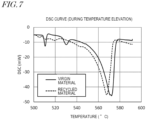
- FIG. 7 shows DSC curves during temperature elevation.
- the virgin material and the recycled material have different melting characteristics.
- the differing melting characteristics are ascribable to the presence or absence of a generated AlCuNi compound, and such differing melting characteristics are presumably the cause for the differing seizure characteristics.
- the melt obtained in step S2 has an Ni content ratio of not more than 0.1 mass%, generation of an AlCuNi compound in the produced cylinder block is suppressed, whereby deteriorations in the seizure resistance of the cylinder block are suppressed. From the standpoint of suppressing deteriorations in seizure resistance, it is more preferable that the melt obtained in step S2 has an Ni content ratio less than 0.05 mass%.
- melt obtained in step S2 has a Zn content ratio of not more than 0.3 mass%.
- FIG. 8 shows results of using thermodynamic calculation software (product name: Thermo-Calc) to calculate the proportion of the liquid phase in a recycled material having a composition shown in Table 5 (with an Ni content ratio of 0.1 mass% and a Zn content ratio of 0.3 mass%), near the melting point (specifically, 500 to 600°C).
- FIG. 8 also shows calculation results for the virgin material and the recycled material of the compositions shown in Table 4.
- Step S2 of obtaining a melt may include steps S21 , S22 and S23 as shown in FIG. 9 .
- step S21 first, at least the recycled material is melted to obtain a primary melt (step S21 ).
- the recycled material only the recycled material may be used (i.e., all of the raw material may be the recycled material), or the recycled material and a virgin material may be used in combination.
- the primary melt is subjected to a component analysis (step S22 ).
- a component analysis various known methods can be used, e.g., emission spectroscopy.
- the primary melt When the primary melt has an Ni content ratio greater than 0.1 mass%, the primary melt is diluted with a virgin material of an aluminum alloy having an Ni content ratio less than 0.1 mass% (step S23 ). This results in the finally-obtained melt having an Ni content ratio of not more than 0.1 mass%.
- the primary melt When the primary melt has an Ni content ratio of not more than 0.1 mass%, the primary melt will straightforwardly be the final melt. Note that step S23 may be followed by a component analysis of the diluted melt.
- step S2 may include step S21 of obtaining a primary melt and step S22 of subjecting the primary melt to a component analysis. This allows for determining whether the Ni content ratio in the primary melt is not more than 0.1 mass%, thereby making it easier to keep the Ni content ratio in the finally-obtained melt under control at step S2.
- step S2 may further include step S23 of, when the primary melt has an Ni content ratio greater than 0.1 mass%, diluting the primary melt with a virgin material having an Ni content ratio less than 0.1 mass%. Performing such step S23 will allow the finally-obtained melt in step S2 to have a lower Ni content ratio; therefore, even if the primary melt has an Ni content ratio greater than 0.1 mass%, the Ni content ratio in the finally-obtained melt can be not more than 0.1 mass%.
- the Si content ratio and the Ni content ratio in the melt obtained in step S2 are not less than 12 mass% and not more than 20 mass% (preferably, not less than 16 mass% and not more than 18 mass%) and not more than 0.1 mass% (preferably less than 0.05 mass%), respectively.
- the melt obtained in step S2 has a Zn content ratio of not more than 0.3 mass%.
- the melt obtained in step S2 may suitably have an exemplary composition as shown in Table 6.
- a cylinder block that is produced by the production method according to an embodiment of the present invention is suitably used for an internal combustion engine of various types of transportation apparatuses such as motorcycles, for example.
Landscapes
- Chemical & Material Sciences (AREA)
- Engineering & Computer Science (AREA)
- Mechanical Engineering (AREA)
- Materials Engineering (AREA)
- Metallurgy (AREA)
- Organic Chemistry (AREA)
- Physics & Mathematics (AREA)
- Thermal Sciences (AREA)
- Crystallography & Structural Chemistry (AREA)
- Cylinder Crankcases Of Internal Combustion Engines (AREA)
- Physical Vapour Deposition (AREA)
Applications Claiming Priority (1)
| Application Number | Priority Date | Filing Date | Title |
|---|---|---|---|
| JP2023073324A JP2024158265A (ja) | 2023-04-27 | 2023-04-27 | アルミニウム合金製シリンダブロックの製造方法 |
Publications (1)
| Publication Number | Publication Date |
|---|---|
| EP4454784A1 true EP4454784A1 (de) | 2024-10-30 |
Family
ID=90826280
Family Applications (1)
| Application Number | Title | Priority Date | Filing Date |
|---|---|---|---|
| EP24171586.1A Pending EP4454784A1 (de) | 2023-04-27 | 2024-04-22 | Verfahren zur herstellung eines zylinderblocks aus aluminiumlegierung |
Country Status (3)
| Country | Link |
|---|---|
| EP (1) | EP4454784A1 (de) |
| JP (1) | JP2024158265A (de) |
| TW (1) | TWI902221B (de) |
Citations (6)
| Publication number | Priority date | Publication date | Assignee | Title |
|---|---|---|---|---|
| US5290373A (en) * | 1993-04-23 | 1994-03-01 | Brunswick Corporation | Evaporable foam casting system utilizing an aluminum-silicon alloy containing a high magnesium content |
| US5845560A (en) * | 1993-06-21 | 1998-12-08 | Kabushiki Kaisha Toyoda Jidoshokki Seisakusho | Swash-plate type compressor with an abrasion resistant projecting portion on the cylinder block |
| JP2001214228A (ja) * | 2000-01-28 | 2001-08-07 | Nippon Light Metal Co Ltd | 気密性及び耐摩耗性に優れたダイカスト製シリンダブロック及びその製造方法 |
| WO2004002658A1 (ja) | 2002-06-26 | 2004-01-08 | Yamaha Hatsudoki Kabushiki Kaisha | アルミニウム合金の真空ダイカスト鋳造方法及び鋳造装置並びにアルミニウム合金製品 |
| US20080163846A1 (en) * | 2004-02-27 | 2008-07-10 | Yamaha Hatsudoki Kabushiki Kaisha | Engine component part and method for producing the same |
| EP2097634A1 (de) * | 2006-12-28 | 2009-09-09 | Yamaha Hatsudoki Kabushiki Kaisha | Verbrennungsmotorkomponente und herstellungsverfahren dafür |
Family Cites Families (2)
| Publication number | Priority date | Publication date | Assignee | Title |
|---|---|---|---|---|
| US6715458B1 (en) * | 2000-08-03 | 2004-04-06 | General Motors Corporation | Engine block crankshaft bearings |
| US20160250683A1 (en) * | 2015-02-26 | 2016-09-01 | GM Global Technology Operations LLC | Secondary cast aluminum alloy for structural applications |
-
2023
- 2023-04-27 JP JP2023073324A patent/JP2024158265A/ja active Pending
-
2024
- 2024-04-15 TW TW113113915A patent/TWI902221B/zh active
- 2024-04-22 EP EP24171586.1A patent/EP4454784A1/de active Pending
Patent Citations (6)
| Publication number | Priority date | Publication date | Assignee | Title |
|---|---|---|---|---|
| US5290373A (en) * | 1993-04-23 | 1994-03-01 | Brunswick Corporation | Evaporable foam casting system utilizing an aluminum-silicon alloy containing a high magnesium content |
| US5845560A (en) * | 1993-06-21 | 1998-12-08 | Kabushiki Kaisha Toyoda Jidoshokki Seisakusho | Swash-plate type compressor with an abrasion resistant projecting portion on the cylinder block |
| JP2001214228A (ja) * | 2000-01-28 | 2001-08-07 | Nippon Light Metal Co Ltd | 気密性及び耐摩耗性に優れたダイカスト製シリンダブロック及びその製造方法 |
| WO2004002658A1 (ja) | 2002-06-26 | 2004-01-08 | Yamaha Hatsudoki Kabushiki Kaisha | アルミニウム合金の真空ダイカスト鋳造方法及び鋳造装置並びにアルミニウム合金製品 |
| US20080163846A1 (en) * | 2004-02-27 | 2008-07-10 | Yamaha Hatsudoki Kabushiki Kaisha | Engine component part and method for producing the same |
| EP2097634A1 (de) * | 2006-12-28 | 2009-09-09 | Yamaha Hatsudoki Kabushiki Kaisha | Verbrennungsmotorkomponente und herstellungsverfahren dafür |
Also Published As
| Publication number | Publication date |
|---|---|
| JP2024158265A (ja) | 2024-11-08 |
| TW202444484A (zh) | 2024-11-16 |
| TWI902221B (zh) | 2025-10-21 |
Similar Documents
| Publication | Publication Date | Title |
|---|---|---|
| US4834941A (en) | Heat-resisting high-strength Al-alloy and method for manufacturing a structural member made of the same alloy | |
| US4853179A (en) | Method of manufacturing heat resistant, high-strength structural members of sintered aluminum alloy | |
| US20110240178A1 (en) | Al-Mg-Si ALUMINUM ALLOY EXTRUDED PRODUCT EXHIBITING EXCELLENT FATIGUE STRENGTH AND IMPACT FRACTURE RESISTANCE | |
| KR101756016B1 (ko) | 다이캐스팅용 알루미늄 합금 및 이를 이용하여 제조한 알루미늄 합금의 열처리 방법 | |
| US20180340243A1 (en) | Aluminum alloy material | |
| US7892482B2 (en) | Material on the basis of an aluminum alloy, method for its production, as well as use therefor | |
| JP2738999B2 (ja) | 高耐摩耗性アルミニウム青銅鋳造合金、該合金を用いた摺動部材 | |
| WO2015060459A1 (ja) | マグネシウム合金及びその製造方法 | |
| US5494540A (en) | Abrasion-resistant aluminum alloy and method of preparing the same | |
| EP3170594B1 (de) | Aluminiumlegierungspulver zum warmschmieden einer gleitkomponente, herstellungsverfahren dafür, aluminiumlegierungsschmiedeprodukt für gleitkomponente und verfahren zur herstellung davon | |
| CN111349827B (zh) | 压缩机滑动部件用铝合金、压缩机滑动部件锻造品及其制造方法 | |
| KR102546211B1 (ko) | 알루미늄 합금 | |
| US20020088509A1 (en) | Recrystallization-hardenable aluminum cast alloy and component | |
| JPS60208443A (ja) | アルミニウム合金材 | |
| US6706126B2 (en) | Aluminum alloy for sliding bearing and its production method | |
| KR102489980B1 (ko) | 알루미늄 합금 | |
| EP0892075B1 (de) | Verfahren zur Herstellung einer Kolbe aus einer Aluminium-Legierung | |
| JPH07197165A (ja) | 高耐磨耗性快削アルミニウム合金とその製造方法 | |
| DE102012018934A1 (de) | Verfahren zur Herstellung eines Halbzeugs aus einer Aluminium-Eisen-Legierung sowie nach dem Verfahren erhältliche Halbzeuge | |
| US6395109B1 (en) | Bar product, cylinder rods, hydraulic cylinders, and method for manufacturing | |
| TWI902221B (zh) | 鋁合金製汽缸體之製造方法 | |
| JPH0457738B2 (de) | ||
| US6902324B2 (en) | Crankshaft bearing shell | |
| US6899844B2 (en) | Production method of aluminum alloy for sliding bearing | |
| JPS63183144A (ja) | チタン合金製冷間鍛造部品およびその製法 |
Legal Events
| Date | Code | Title | Description |
|---|---|---|---|
| PUAI | Public reference made under article 153(3) epc to a published international application that has entered the european phase |
Free format text: ORIGINAL CODE: 0009012 |
|
| STAA | Information on the status of an ep patent application or granted ep patent |
Free format text: STATUS: REQUEST FOR EXAMINATION WAS MADE |
|
| 17P | Request for examination filed |
Effective date: 20240422 |
|
| AK | Designated contracting states |
Kind code of ref document: A1 Designated state(s): AL AT BE BG CH CY CZ DE DK EE ES FI FR GB GR HR HU IE IS IT LI LT LU LV MC ME MK MT NL NO PL PT RO RS SE SI SK SM TR |
|
| P01 | Opt-out of the competence of the unified patent court (upc) registered |
Free format text: CASE NUMBER: APP_64549/2024 Effective date: 20241205 |
|
| STAA | Information on the status of an ep patent application or granted ep patent |
Free format text: STATUS: EXAMINATION IS IN PROGRESS |
|
| REG | Reference to a national code |
Ref country code: DE Ref legal event code: R079 Free format text: PREVIOUS MAIN CLASS: B22D0017000000 Ipc: B22D0021000000 |
|
| 17Q | First examination report despatched |
Effective date: 20251218 |
|
| GRAP | Despatch of communication of intention to grant a patent |
Free format text: ORIGINAL CODE: EPIDOSNIGR1 |
|
| STAA | Information on the status of an ep patent application or granted ep patent |
Free format text: STATUS: GRANT OF PATENT IS INTENDED |
|
| RIC1 | Information provided on ipc code assigned before grant |
Ipc: B22D 21/00 20060101AFI20260119BHEP Ipc: B22D 21/04 20060101ALI20260119BHEP Ipc: C22C 1/02 20060101ALI20260119BHEP Ipc: C22C 21/02 20060101ALI20260119BHEP Ipc: B22D 15/02 20060101ALI20260119BHEP Ipc: C22F 1/043 20060101ALI20260119BHEP |
|
| INTG | Intention to grant announced |
Effective date: 20260209 |
|
| GRAS | Grant fee paid |
Free format text: ORIGINAL CODE: EPIDOSNIGR3 |
|
| GRAA | (expected) grant |
Free format text: ORIGINAL CODE: 0009210 |
|
| STAA | Information on the status of an ep patent application or granted ep patent |
Free format text: STATUS: THE PATENT HAS BEEN GRANTED |