EP4454508A1 - Garment with holding arrangement - Google Patents
Garment with holding arrangement Download PDFInfo
- Publication number
- EP4454508A1 EP4454508A1 EP24172147.1A EP24172147A EP4454508A1 EP 4454508 A1 EP4454508 A1 EP 4454508A1 EP 24172147 A EP24172147 A EP 24172147A EP 4454508 A1 EP4454508 A1 EP 4454508A1
- Authority
- EP
- European Patent Office
- Prior art keywords
- garment
- holding arrangement
- body portion
- wearer
- Prior art date
- Legal status (The legal status is an assumption and is not a legal conclusion. Google has not performed a legal analysis and makes no representation as to the accuracy of the status listed.)
- Pending
Links
Images


Classifications
-
- A—HUMAN NECESSITIES
- A41—WEARING APPAREL
- A41D—OUTERWEAR; PROTECTIVE GARMENTS; ACCESSORIES
- A41D27/00—Details of garments or of their making
- A41D27/20—Pockets; Making or setting-in pockets
- A41D27/207—Pockets; Making or setting-in pockets with drop-proof features
-
- A—HUMAN NECESSITIES
- A45—HAND OR TRAVELLING ARTICLES
- A45F—TRAVELLING OR CAMP EQUIPMENT: SACKS OR PACKS CARRIED ON THE BODY
- A45F5/00—Holders or carriers for hand articles; Holders or carriers for use while travelling or camping
- A45F5/02—Fastening articles to the garment
- A45F5/022—Fastening articles to the garment within pockets
Definitions
- the present invention relates to a garment having a pocket with elastic bands disposed within the pocket, wherein the elastic bands are configured for holding other garments, phones, or the like.
- garments are typically provided with pockets that allow the wearer to place objects into them.
- Conventional pockets often have zippers that enable them to be closed such that the objects are allowed to be securely placed within the pocket.
- document US 11,224,258 B2 attempted to improve the above configurations.
- This document relates to a garment or article of clothing made of a resilient / elastomeric material that includes a waist portion, a first leg portion, and a second leg portion.
- the waist portion further includes a pocket on the rear of the garment.
- the pocket is defined by a backing panel, a first flap, and a second flap.
- the first flap is at least partially disposed over the second flap to secure contents between the backing panel and the second panel, and thus, within the pocket.
- the waist portion is stretched, the tensile forces imparted onto the waist portion by the resilient / elastomeric material causes the first flap to overlie the second flap at least partially.
- the present invention to provide an improved garment that overcomes the deficiencies of the prior art least partially. It should be possible for the wearer to handle the garment in a simplified fashion. Further, the garment should provide for convenience to the wearer, so as to assist in any daily athletic activity and / or working routine, or the like. The durability and longevity of the garment should also be increased.
- the objects are solved by a garment, in particular a sportswear, such as a running pants, tight, leggings, or a garment for an upper body part, such as a shirt, or bra, the garment comprising: optionally a body portion, configured to be arranged around a body part of a wearer, when the garment is worn; a holding arrangement configured for holding an object; at least one pocket, preferably arranged on the body portion, configured to be in a closed state, when an object is not held by the holding arrangement; wherein the holding arrangement is disposed within the pocket.
- a sportswear such as a running pants, tight, leggings, or a garment for an upper body part, such as a shirt, or bra
- the garment comprising: optionally a body portion, configured to be arranged around a body part of a wearer, when the garment is worn; a holding arrangement configured for holding an object; at least one pocket, preferably arranged on the body portion, configured to be in a closed state, when an object is not held by the holding arrangement
- the body portion may be a waist portion, as described elsewhere herein. As understood by the skilled person, similar features and advantages mentioned with respect to the waist portion may apply to the body portion and vice versa.
- the garment facilitates user comfort and increases flexibility to the wearer of the garment.
- the pocket and the holding arrangement enables that the wearer can easily dispose an object into the holding arrangement and / or the pocket for holding the object.
- the wearer may take off another garment, such as a shirt and dispose it in the pocket and / or in the holding arrangement. This ensures that the shirt is substantially firmly held. Further, the wearer may continue his or her athletic activity without having to hold the shirt in his or her hand(s). Thereby, user convenience is enhanced. Further, flexibility is increased, as this procedure can be performed repeatedly and at any desired time.
- the combination of the pocket and the holding arrangement provides an extra benefit for securely and firmly holding any object. Further, this allows that the holding arrangement is substantially protected from environmental impacts such as dirt, dust, rain, or the like. Thereby, longevity of the holding arrangement and /or the garment is increased.
- the holding arrangement facilitates that also objects can be held that are larger than the pocket.
- the volume encompassed by the object does not limit any holding capacity of the garment described herein.
- Pockets known in the prior art are limited in their holding capacity by way of the pocket's size. Thus, such pockets need to be increased in case larger objects need to be held. This disadvantage can be overcome by the holding arrangement disposed within the pocket as proposed herein.
- a further advantage is that the holding arrangement provides a bounce reduction and less localized pressure peaks on the skin of the wearer.
- the pressure distribution of the garment to the skin of the wearer may be evenly distributed by the garment of the present disclosure. This adds to the comfort of the wearer.
- the "body portion" of the garment may be understood as being in proximity to the body of a wearer when the garment is worn during ordinary use.
- the body portion may be a portion for an upper body part and/or a lower body part of the wearer.
- the body portion of the garment may substantially surround the wearer in a horizontally manner.
- the "waist portion" of the garment may be understood as being in proximity to a wearer's waist when the garment is worn during ordinary use.
- the waist portion of the garment may substantially surround the wearer in proximity to the wearer's waist.
- the "holding arrangement” could be any means suitable for holding the object as described herein. As detailed elsewhere herein, the holding arrangement may be implemented by (an) elongate band(s), in particular elongate bands comprising or substantially consisting of elastic material.
- the term "for holding" an object may be understood such that the object can be held in a substantially fixed, secure, tight, and / or firm manner (even when reference is made herein to only one of these adjectives to describe how the object is held, it is understood that all of these could be encompassed). It may be possible that the object is substantially secured thereby, such that a person in the environment to the wearer cannot easily grab the object in order to steal it or the like. In particular, natural impacts occurring during a daily routine and / or athletic activity of the wearer may not impair that the object is held in a substantially fixed manner. For instance, if the wearer is running, jumping, sitting, standing, hiking, climbing or the like, the object could still be held in a substantially fixed manner. Thereby, the user is less distracted as he or she does not need to care about losing the object when held by the holding arrangement.
- the object could be any object including but not limited to one or more further garment(s), such as a top, a shirt, one or more headgear(s), one or more towel(s), one or more phone(s), or the like.
- the object could be other garments that are rather small, for instance too small to tie around the waist of the wearer but too big to put into a conventional pocket. This allows to free up the hands of the wearer such that the wearer can focus his or her attention to the athletic activity.
- the at least one " pocket" may be implemented by various embodiments. It is noted that the garment can comprise a plurality of such and / or similar pockets. For instance, the garment may comprise two, three, four, five, six or even more of such pockets.
- the pockets may be arranged at any portion of the garment, preferably the pocket is arranged on the body portion. The latter has the advantage that the wearer may easily get in contact with the pocket, e.g. to store an object in the pocket.
- the garment may comprise two pockets, one being arranged in the front of the body portion of the garment and the other being arranged on the back of the body portion of the garment.
- the garment may comprise two pockets, one being arranged on one side of the body portion of the garment and the other being arranged on the opposing side of the body portion of the garment.
- the pocket(s) are encompassed by the present disclosure. It is reiterated that any examples described herein with reference to the body portion may likewise be applicable to the waist portion and vice versa.
- the pocket is in a "closed state" when an object is not held by the holding arrangement.
- a closed state means that the interior of the pocket may not be seen from the outside. Further, a closed state may have the benefit of hindering and / or at least impairing that dirt, dust, particles, or the like can easily enter the pocket.
- the closed state may simply be changed to an opened state (as described elsewhere herein in greater detail) by the wearer.
- the definition of a "closed state, when an object is not held by the holding arrangement” encompasses that the pocket is also configured to be in a closed state when the object is held by the holding arrangement. For instance, this may be the case for rather small objects, such as small shirts, tops, towels, phones, or the like.
- the pocket is in a closed state only when the object is not held by the holding arrangement and the pocket is not in a closed state (e.g., in an opened state) when the object is held by the holding arrangement. It is understood that this may depend on the size ratios of the object, the pocket, and / or the holding arrangement.
- the garment may particularly be a sportswear but is not limited thereto. For sportswear, it was found that the advantages of the garment described herein are even more pronounced.
- the garment may be a garment for an upper body part.
- the garment may be a bra. It was found beneficial for wearers storing an object, such as a phone, a key as well as a towel or the like in their bra whilst performing a workout. This offers a more secure hold while the wearer can perform any kind of movements and/or activities. As the holding arrangement is disposed within the pocket, this allows for a cleaner visual on the outer part of the bra. Thereby, substantially no means for holding an object are visible to the outer side, which is appreciated by the wearer.
- the garment referred to herein may have various fields of applications and use cases, including but not limited to athletic activities. Whenever reference is made herein to "athletic activities”, this is to be understood such that it encompasses one or more and / or any combination of at least the following non-exhaustive list: athletic exercises, running, hiking, climbing, walking, cycling, yoga, soccer, tennis, doing a workout.
- the body portion is a waist portion configured to be arranged around a waist of a wearer, when the garment is worn.
- the pocket is arranged on a back side of the body portion.
- the front side may thus be free of a pocket, such that the wearer can focus on his or her athletic activity without being visually distracted by the object in front of his or her view.
- the pocket is arranged on the back side of the body portion, the user may not get unintentionally in contact with the object. Also this increases user convenience.
- the pocket is arranged substantially centrally on the back side of the body portion.
- the pocket may be accessed by substantially the same distance when approaching the pocket by a wearer's hand from any one of the two sides of the hips of the wearer. Accordingly, storing an object in the holding arrangement disposed within the pocket can be performed in a more flexible and predictive manner by the wearer. The wearer does not have to keep in mind whether the pocket is arranged more to the left or more to the right side of the body portion as seen from the central position of the body portion.
- the holding arrangement is disposed within the pocket, such that the holding arrangement is substantially hidden by the pocket when the pocket is in a closed state.
- the pocket may be implemented by a surface and / or a panel, which substantially covers the holding arrangement. It may not be ruled out that, depending on the materials used, the holding arrangement could cause the fabric of the pocket to protrude by way of the space encompassed of the holding arrangement. In some cases, such protrusion could be seen from the outside when closely looking at the pocket. However, usually, this is not the case.
- the garment provides the benefit of having the holding arrangement while the visual appearance of a flat and even outer surface can be maintained. This provides for an improved garment. Furthermore, this contributes to the protection of the interior of the pocket from environmental impacts such as dust, particles, or rain.
- the holding arrangement comprises at least one elongate band arranged longitudinally along the garment, configured to receive an object from a substantially transverse direction along the body portion.
- the "elongate" band means that the band has one dimension in one direction which may be distinctly larger than the dimension in the substantially perpendicular direction.
- the longitudinal arrangement means that the band goes along the direction from the waist to the lower end of one leg of the garment if the garment is a pant, a pair of trousers or the like. If the garment is a garment for an upper body part, such as a shirt or a bra, the longitudinal arrangement means that the band goes along the elongate axis of the upper body part of the wearer.
- the substantially transverse direction means that it is substantially perpendicular to the longitudinal direction.
- This embodiment has the advantage that the object can be received easily when the wearer performs a natural movement of his or her arm. Furthermore, this arrangement of the band provides a resilient force against the gravitational force naturally acting on the object due to gravitational acceleration when the object is received in the elongate band. Thus, the object can be held quite firmly.
- the holding arrangement When the object is received by the holding arrangement, this can be understood such that the holding arrangement holds the object within the meaning of the present disclosure.
- the elongate band is coupled to the pocket at two opposing ends of the elongate band.
- the elongate band may be coupled to the pocket by any suitable means including but not limited to adhesive means, bonding means, seams, or the like. If the elongate band is coupled to the pocket by a seam, this may comprise stitching including, but not limited to flatlock stitching, overlock stitching, blind stitching, or the like.
- the seam may also comprise a bartack stitch seam, which may ensure a strong hold. The bartack stitch may prevent unravelling of the seam.
- Coupling at two opposing ends of the elongate band provides an increased free-flow area between the ends for receiving the object. Accordingly, also objects with rather bulky fabric may be received without the need to provide unduly large elongate bands. This may save material, which makes the manufacturing more cost effective.
- the holding arrangement comprises a plurality of separate elongate bands, preferably two separate elongate bands, wherein the elongate bands are spaced apart along a circumferential direction of the body portion by a distance of 1 to 20 cm, preferably of 2 to 18 cm, more preferably of 4 to 16 cm, more preferably of 6 to 14 cm, more preferably of 8 to 12 cm, most preferably of 9 to 11 cm.
- the distance of the elongate bands being spaced apart, it is understood that this distance usually refers to two neighboring elongate bands.
- the first elongate band could be spaced by any one of the distances disclosed herein, e.g., 4 cm to the second elongate band.
- the second elongate band could be spaced by any one of the distances disclosed herein, e.g., 8 cm to the third elongate band.
- the three elongate bands may be arranged in one row in the following order: first, second, third elongate band.
- the holding arrangement is configured to lie substantially flat with the body portion, when the holding arrangement is not holding an object.
- the garment has a commonly accepted outer appearance when the holding arrangement is not holding an object.
- the pocket is in a closed state (when the wearer is not (actively or purposely) pulling on the pocket).
- the holding arrangement is not particularly eye-catching or striking. This may be highly appreciated for the wearer and / or for persons in the environment of the wearer.
- this can have a benefit when the wearer takes on the garment, as grabbing the garment may not be adversely affected. For instance, the wearer may not get in touch and / or in trouble with any holding arrangement when he or she is in the process of taking on the garment.
- the holding arrangement is disposed substantially centrally within the pocket.
- This further facilitates an even and symmetrical pressure distribution of the garment to the skin of the wearer. Localized pressure peaks on unwanted body parts can thus be overcome. Moreover, this has benefits for handling the garment, e.g., when taking on and / or taking off the garment, the user may more easily realize the location of the holding arrangement with respect the pocket and / or the overall garment.
- the holding arrangement comprises or substantially consists of elastomeric material.
- the holding arrangement may comprise or substantially consist of a blend of a plurality of suitable materials including elastomeric material.
- the pocket has a first flap arranged on an upper region of the body portion and a second flap arranged on a lower region of the body portion.
- the first flap and / or the second flap may have any suitable shape, including but not limited to a triangular, a rectangular, a trapezoidal shape, and shapes that are composed of any one of these. These shapes may have rounded corners and / or rounded or bent edges.
- the lower region of the body portion may be arranged closer to a lower end of the garment along the longitudinal direction of the garment compared to the upper region of the body portion.
- the distance between the upper region and the lower region of the pocket could be any distance but should be suitable such that an object can be received within the holding arrangement disposed in the pocket.
- the first flap and the second flap are configured to overlap at least partially, preferably when the pocket is in a closed state.
- the pocket is substantially protected from being exposed to environmental impacts such as dirt, dust, particles, or rain. Accordingly, the holding arrangement is even further protected, which enhances its longevity and increases the number of cycles of usage.
- the pocket may protect the object from being exposed to environmental impacts in such an example.
- the first flap and the second flap overlap in the longitudinal direction of the garment by at least 10%, preferably at least 20%, more preferably at least 30%, more preferably at least 40%, more preferably at least 50%, more preferably at least 60%, more preferably at least 70%, more preferably at least 80%, more preferably at least 90%, more preferably at least 95% of the longitudinal length of the first flap or the second flap.
- the longitudinal length is measured in the longitudinal direction of the garment (e.g. from the body portion to a lower end of the garment, such as one end of one leg).
- This overlapping may facilitate that the holding arrangement can be substantially hidden and / or protected.
- the overlap has the benefit of providing a substantially flat outer surface, such that handling of the garment is simplified.
- a larger overlap enhances the above-mentioned advantageous effects.
- a smaller overlap reduces the amount of fabric used to manufacture the garment. Thus, an optimum balance should be struck as proposed according to the present disclosure.
- the pocket comprises a closing member, such as a zipper and / or a hook-and-loop fastener, configured to couple the first flap and the second flap.
- a closing member such as a zipper and / or a hook-and-loop fastener
- first flap and the second flap can be removably fixed to one another in a substantially tight manner. This aids in ensuring that the closed state of the pocket can be substantially maintained even under severe impacts. For instance, the first flap and the second flap may thus be fixed together even if the wearer performs intensive athletic activities such as jumping, or the like.
- the pocket is configured to lie substantially flat with the body portion, when the pocket is in a closed state.
- this pocket and / or the holding arrangement may not be eye-catching and / or distracting. Further, this also enhances handling of the garment as described elsewhere herein.
- the pocket extends along a circumferential direction of the body portion between two seams.
- the circumferential direction may be substantially similar or may even be the same as the transverse direction along the body portion in which an object can be received.
- the pocket substantially abuts the two seams.
- the pocket contacts the two seams.
- a first end of the pocket substantially contacts the first seam of the two seams
- a second end of the pocket substantially contacts the second seam of the two seams.
- the pocket is configured to be in an opened state, when the object is held by the holding arrangement.
- the opened state means for instance, that air can easily enter the pocket.
- the opened state means for instance, that one can see the object held by the holding arrangement and / or that one can see the holding arrangement from the outside.
- the pocket could be opened in a manner that the two flaps are overlapping in the longitudinal direction but are spaced apart horizontally in their overlapping region. This could be the case when an object is held that causes one flap to bulge further to the outside than the other flap.
- the elongate bands of the holding arrangement have a width along a circumferential direction of the body portion of 2 to 20 mm, preferably 4 to 18 mm, more preferably 6 to 16 mm, more preferably 8 to 14 mm, most preferably 10 to 12 mm.
- widths of the elongate bands of the holding arrangement facilitate to hold the object more securely. Accordingly heavier objects can be easily received and held. This may be useful in case the wearer sweats during his or her athletic activity and takes off the (rather heavy) shirt for holding it with the aid of the holding arrangement.
- the widths of the elongate bands of the holding arrangement may not need to be too large. In particular, smaller widths save fabric material of the garment. Thus, an optimal balance should be struck as proposed herein.
- the elongate bands of the holding arrangement have a length along a longitudinal direction of the garment of 2 to 20 cm, preferably 4 to 18 cm, more preferably 6 to 16 cm, more preferably 8 to 14 cm, most preferably 10 to 12 cm.
- the lengths of the elongate bands of the holding arrangement facilitate that the bands can be more easily pulled away from the remaining fabric of the garment. This improves receiving the object.
- the lengths of the elongate bands of the holding arrangement may not need to be too large. In particular, smaller lengths save fabric material of the garment and may be beneficial as they are less prone to wear out. Thus an optimal balance should be struck as proposed herein.
- the garment is a running pants, tight or leggings.
- the object is one or more further garment(s), such as a top, a shirt, or a glove, one or more headgear(s), one or more towel(s), one or more phone(s), or the like.
- the holding arrangement is configured for holding these objects.
- the garment has a circumferential direction along the body portion and a longitudinal direction, which is substantially perpendicularly with respect to the circumferential direction.
- the circumferential direction along the body portion may also be referred to as a direction in a horizontal plane.
- the longitudinal direction may also be referred to as a direction in a vertical plane.
- the longitudinal direction may also be understood as the direction along the length and / or height of the garment. For instance, in case of pants, trousers, or the like, the longitudinal direction may be directed from the body portion to a lower end of the garment, such as a one leg of the garment.
- Substantially perpendicularly is to be understood in that the two directions, i.e., the circumferential and the longitudinal directions, form an angle of about 80° to 100°, preferably about 85° to 95°, more preferably about 90°. It is noted that manufacturing tolerances could be included such that the angles can slightly deviate from the ones mentioned in here.
- Fig. 1 illustrates an exemplary garment 100, in particular a sportswear, according to an embodiment of the present disclosure in which the pocket 40 is brought into an opened state by a person.
- the garment 100 has a pocket 40 that can have a first flap 20 and a second flap 30.
- the second flap 30 of the pocket 40 is pulled to the bottom to bring the pocket 40 into an opened state and no object is held in the holding arrangement 10.
- this state is for illustration only to contribute to an understanding of the present disclosure.
- the depicted state may usually not occur during ordinary use of the garment for a prolonged time period and / or as a stable state. As an example, the depicted state may occur when a person is about to pick an object in order to bring it into the holding arrangement 10.
- the garment 100 can be a running pants, tight or leggings.
- the garment 100 can be worn by any kind of person, including but not limited to persons conducting an athletic activity.
- the garment 100 may optionally comprise a body portion 50, configured to be arranged around a body part of a wearer.
- the body portion 50 may be a waist portion 50, which is configured to be arranged around a waist of a wearer, when the garment 100 is worn.
- the garment 100 further comprises a holding arrangement 10 configured for holding an object.
- the garment 100 comprises at least one pocket 40, preferably arranged on the body portion, more preferably on the waist portion 50, configured to be in a closed state, when an object is not held by the holding arrangement 10.
- the holding arrangement 10 is disposed within the pocket 40.
- the pocket 40 is arranged on a back side of the waist portion 50. Further, the pocket 40 is arranged substantially centrally on the back side of the waist portion 50. Further still, the holding arrangement 10 is disposed within the pocket 40, such that the holding arrangement 10 is substantially hidden by the pocket 40 when the pocket 40 is in a closed state.
- the lower flap 30 is not pulled down in the longitudinal direction (indicated as L in Fig. 1 ) of the garment 100. In such a case, the holding arrangement 10 would be hidden substantially in its entirety. It can be seen in Fig. 1 , that the holding arrangement 10 is at least partially hidden, as the pocket 40 at least partially covers the holding arrangement 10 at lower and upper ends of the holding arrangement 10.
- the holding arrangement 10 comprises two elongate bands 10a, 10b arranged longitudinally along the garment 100.
- the two elongate bands 10a, 10b are configured to receive an object 60 (as best seen in Fig. 2 ) from a substantially transverse direction C along the waist portion 50 of the garment 100.
- the elongate bands 10a, 10b are coupled to the pocket 40 at two opposing ends of each of the two elongate bands 10a, 10b. As shown in this figure, the elongate bands 10a, 10b are coupled to the pocket 40 by a seam (indicated by 11a and 11b in Fig. 3 ).
- the seam comprises stitching, which includes but is not limited to flatlock stitching, overlock stitching, blind stitching, bartack stitching. This ensures a strong hold between the two elongate bands 10a, 10b and the pocket 40.
- the bartack stitch is a condensed zigzag seam used for reinforcement or anchoring of textile or fabrics.
- a bartack stitch could be a straight single-needle seam (or actually 3-4 stitches), that prevents a main seam from unravelling. This may be established by pulling back a few stitches once the main seam is complete.
- said coupling may alternatively (or additionally) be performed by other means than stitching, including but not limited to adhesives, bonding, or the like.
- the elongate bands 10a, 10b are spaced apart along a circumferential direction (indicated as C in Fig. 1 ) of the waist portion 50 by a distance of 1 to 20 cm, preferably of 2 to 18 cm, more preferably of 4 to 16 cm, more preferably of 6 to 14 cm, more preferably of 8 to 12 cm, most preferably of 9 to 11 cm.
- the holding arrangement 10 is configured to lie substantially flat with the waist portion 50, when the holding arrangement 10 is not holding an object 60, as shown in this figure. In particular, substantially no wrinkles or the like occur, which could distort the visual appearance of the garment 100.
- the holding arrangement 10 is disposed substantially centrally within the pocket 40.
- the distance of the left band 10a to the left end 41 of the pocket 40 may be substantially similar to the distance of the right band 10b to a right end 42 of the pocket 40.
- the pocket 40 has a first flap 20 arranged on an upper region of the waist portion 50 and a second flap 30 arranged on a lower region of the waist portion 50.
- the first flap 20 and the second flap 30 are configured to overlap at least partially, when the pocket 40 is in a closed state. It can be seen in this figure, that some portions of the first flap 20 and the second flap 30 also overlap when the lower flap 30 is pulled in the downward direction along the longitudinal direction L. In particular, the portions of the pocket 40 in proximity of the left end 41 and the right end 42 of the pocket 40 have an overlap region in this configuration.
- the first flap 20 and the second flap 30 overlap in the longitudinal direction L of the garment 100 by at least 10%, preferably at least 20%, more preferably at least 30%, more preferably at least 40%, more preferably at least 50%, more preferably at least 60%, more preferably at least 70%, more preferably at least 80%, more preferably at least 90%, more preferably at least 95% of the longitudinal length of the first flap 20 or the second flap 30.
- the longitudinal length of the first flap 20 is indicated as L1 in Fig. 1 .
- the pocket 40 is configured to lie substantially flat with the waist portion 50, when the pocket 40 is in a closed state.
- some wrinkles appear which are caused by pulling the lower flap 30 in the downward direction along the longitudinal direction L of the garment 100.
- wrinkles appear in the lower flap 30 in this figure.
- the depicted wrinkles are usually not present during ordinary use of the garment 100, for instance when the pocket is in a closed state.
- the pocket 40 extends along a circumferential direction C of the waist portion 50 between two seams.
- the pocket 40 substantially abuts the two seams. This can be best seen in Figs. 1 and 2 , in which the left end 41 of the pocket 40 substantially contacts a seam or is defined by said seam on the left-hand side. Further the right end 42 of the pocket 40 substantially contacts a seam or is defined by said seam on the right-hand side.
- Fig. 2 illustrates an exemplary garment 100, in particular a sportswear, according to an embodiment of the present disclosure in which an object 60 is held by the holding arrangement 10 and the pocket 40 is in an opened state.
- the exemplary garment 100 shown in Fig. 2 is similar to the one shown in Fig. 1 . Thus, a detailed description of the features is skipped in the following for brevity but is considered to be comprised by way of the description of Fig. 1 .
- the object 60 can be any kind of object 60, for instance one or more further garment(s), such as a top, a shirt, or a glove, one or more headgear(s), one or more towel(s), one or more phone(s), or the like.
- the object 60 is received within the holding arrangement 10 and thereby held by the holding arrangement 10. Some portions of the object 60 are protruding through the holding arrangement 10 and are hanging down to the right and the left side of the holding arrangement 10. It is shown that the pocket 40 is configured to be in an opened state, when the object 60 is held by the holding arrangement 10. In this opened state depicted in Fig. 2 , one can see the holding arrangement 10 from outside. Some parts of the pocket 40, in particular the upper flap 20 of the pocket 40 still covers portions of the object 60, which serves as a protection from environmental impacts such as dust, dirt, particles, rain or the like. Further, the upper flap 20 also partially covers the holding arrangement 10, which increases protection thereof.
- Fig. 2 further indicates an area close to a lower end 101 (the end may extend further as depicted in Fig. 2 ) of the garment 100, and an upper end 102 of the garment 100.
- the lower end 101 and the upper end 102 of the garment are spaced apart along the longitudinal direction L.
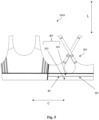
- Fig. 3 illustrates a detailed view of an exemplary garment 100, in particular a sportswear, according to an embodiment of the present disclosure in which the pocket 40 is brought into an opened state by a person.
- the exemplary garment 100 shown in Fig. 3 is similar to the ones shown in Figs. 1 and 2 . Thus, a detailed description of the features is skipped in the following for brevity but is considered to be comprised by way of the description of Figs. 1 and 2 .
- the upper flap 20 of the pocket 40 is stretched by employing one or more fingers of a single hand of a person whilst at the same time the lower flap 30 is stretched with one or more fingers of the same hand of the same person. This illustrates that the pocket 40 may be easily opened to facilitate receiving an object 60 into the holding arrangement 10.
- the two elongate bands 10a, 10b are coupled to the pocket 40 at two opposing ends of each of the two elongate bands 10a, 10b by way of a seam 11a, 11b, respectively.
- This seam could be any seam as described herein.
- the two elongate bands 10a, 10b could be coupled to the pocket 40 by means of adhesives, bonding, or the like.
- Fig. 4 shows an exemplary garment 100, in particular a sportswear, namely a bra 100, according to an embodiment of the present disclosure in which the pocket 40 is brought into an opened state by a person.
- Fig. 5 shows the embodiment of Fig. 4 in a closed state.
- Figs. 4 and 5 show the bra 100 from an outer side.
- the holding arrangement 10 is disposed in the pocket 40, comprising an upper flap 20 and a lower flap 30.
- the body portion 50 may be a waistband of the bra 100.
- the pocket 40 is arranged on the waistband of the bra 100.
- the holding arrangement 10 is arranged on the waistband of the bra 100.
- the pocket 40 is arranged on a back side of the waistband.
- a plurality of different configurations are encompassed in the present disclosure.
- the pocket 40 may be arranged on a bottom band of the bra 100.
- the pocket 40 may be arranged on a back side of the bottom band of the bra 100.
- the pocket 40 may be arranged at any location covering 360 degrees of the waistband or bottom band of the bra 100. Moreover, the pocket 40 could be applied to the upper side body of the bra 100, upper back body and/or upper front body of the bra 100. It is understood that any of these pockets 40 comprise the holding arrangement 10 described elsewhere herein in greater detail.
- the width (along the circumferential direction C) of the pocket 40 may be about 8-12 cm, for instance about 10 cm, but it is not limited to this width.
- the holding arrangement 10 comprises at least one elongate band 10a, 10b arranged longitudinally along the garment 100, configured to receive an object 60 (not shown in Figs. 4 and 5 ) from a substantially transverse direction along the body portion 50.
- the number of bands 10a, 10b inside the pocket 40 is not limited to one or two bands 10a, 10b but could be many bands, additionally or alternatively having different angles with respect to one another within the pocket 40.
- the bands 10a, 10b offer elasticity substantially in a longitudinal direction L to provide a more secure storage for objects.
- substantially no bands 10a, 10b are visible from outside when the pocket 40 is closed, leading to a cleaner visual on the outer part of the garment 100.
- the holding arrangement 10 comprises or substantially consists of elastomeric material.
- elastomeric material may be a polyurethane copolymer, such as a polyester-polyurethane copolymer, which is used to form spandex, lycra, or elastane. It is understood that the holding arrangement 10 could also comprise a blend of one or more materials.
- the garment 100 may comprise any suitable textile material known in the art.
- the textile material may comprise fibers, such as a network of natural and / or synthetic fibers. The material may be in its natural or processed or even finished form.
- the textile material may comprise knitted, woven, or non-woven material.
- the pocket 40 can comprise a closing member, such as a zipper and / or a hook-and-loop fastener, configured to couple the first flap 20 and the second flap 30 of the pocket 40.
- a closing member such as a zipper and / or a hook-and-loop fastener
- the elongate bands 10a, 10b of the holding arrangement 10 can have a width along a circumferential direction C of the waist portion 50 of 2 to 20 mm, preferably 4 to 18 mm, more preferably 6 to 16 mm, more preferably 8 to 14 mm, most preferably 10 to 12 mm.
- the elongate bands 10a, 10b of the holding arrangement 10 have a length along a longitudinal direction L of the garment 100 of 2 to 20 cm, preferably 4 to 18 cm, more preferably 6 to 16 cm, more preferably 8 to 14 cm, most preferably 10 to 12 cm.
- the lengths of the elongate bands 10a, 10b of the holding arrangement 10 may substantially correspond to the length of the pocket 40 and / or the length of the first flap 20 and the second flap 30 of the pocket 40 along the longitudinal direction.
- first flap 20 is considered to be the upper flap 20 and the second flap 30 is considered to be the lower flap 30.
- This naming is not to be construed limiting but solely serves the purpose to illustrate the present disclosure.
Landscapes
- Engineering & Computer Science (AREA)
- Textile Engineering (AREA)
- Details Of Garments (AREA)
Abstract
Description
- The present invention relates to a garment having a pocket with elastic bands disposed within the pocket, wherein the elastic bands are configured for holding other garments, phones, or the like.
- Consumers participating in athletic activities such as running, hiking, climbing or the like often need to store objects somewhere, for instance other garments, towels, phones, or the like. For this purpose, garments are typically provided with pockets that allow the wearer to place objects into them. Conventional pockets often have zippers that enable them to be closed such that the objects are allowed to be securely placed within the pocket.
- However, such pockets often lead to uncomfortable situations, as the pockets may increase a pressure on the skin of the wearer. This can impair the athletic activity performed by the wearer.
- In this context, document
US 11,224,258 B2 - While the above document claimed improvement over the known prior art thus far, the proposed solution of said document still has some deficiencies when it comes to holding an object securely in the pocket. Thus, there is still room for improvement.
- In view of the foregoing, it can be concluded that the existing garments still lack to provide for improved consumer demands to a sufficient degree, e.g., in terms of holding an object and increasing the comfort to the wearer. In particular and although the prior art attempted to improve the convenience of users wearing garments, there still pertains a gap to reach optimum results.
- Against this background, it is an object of the present invention to provide an improved garment that overcomes the deficiencies of the prior art least partially. It should be possible for the wearer to handle the garment in a simplified fashion. Further, the garment should provide for convenience to the wearer, so as to assist in any daily athletic activity and / or working routine, or the like. The durability and longevity of the garment should also be increased.
- The above-mentioned objects are at least partially achieved by the subject-matter of the independent claims. Preferred embodiments are subject of the dependent claims, and other suitable aspects of the present invention are described through the overall disclosure of the present application.
- In one aspect, the objects are solved by a garment, in particular a sportswear, such as a running pants, tight, leggings, or a garment for an upper body part, such as a shirt, or bra, the garment comprising: optionally a body portion, configured to be arranged around a body part of a wearer, when the garment is worn; a holding arrangement configured for holding an object; at least one pocket, preferably arranged on the body portion, configured to be in a closed state, when an object is not held by the holding arrangement; wherein the holding arrangement is disposed within the pocket.
- In some examples, the body portion may be a waist portion, as described elsewhere herein. As understood by the skilled person, similar features and advantages mentioned with respect to the waist portion may apply to the body portion and vice versa.
- In this manner, the garment facilitates user comfort and increases flexibility to the wearer of the garment. In particular, the pocket and the holding arrangement enables that the wearer can easily dispose an object into the holding arrangement and / or the pocket for holding the object. As an example, the wearer may take off another garment, such as a shirt and dispose it in the pocket and / or in the holding arrangement. This ensures that the shirt is substantially firmly held. Further, the wearer may continue his or her athletic activity without having to hold the shirt in his or her hand(s). Thereby, user convenience is enhanced. Further, flexibility is increased, as this procedure can be performed repeatedly and at any desired time.
- It was found that the combination of the pocket and the holding arrangement provides an extra benefit for securely and firmly holding any object. Further, this allows that the holding arrangement is substantially protected from environmental impacts such as dirt, dust, rain, or the like. Thereby, longevity of the holding arrangement and /or the garment is increased.
- Further, the holding arrangement facilitates that also objects can be held that are larger than the pocket. In particular, the volume encompassed by the object does not limit any holding capacity of the garment described herein. Pockets known in the prior art are limited in their holding capacity by way of the pocket's size. Thus, such pockets need to be increased in case larger objects need to be held. This disadvantage can be overcome by the holding arrangement disposed within the pocket as proposed herein.
- A further advantage is that the holding arrangement provides a bounce reduction and less localized pressure peaks on the skin of the wearer. In particular, the pressure distribution of the garment to the skin of the wearer may be evenly distributed by the garment of the present disclosure. This adds to the comfort of the wearer.
- The "body portion" of the garment may be understood as being in proximity to the body of a wearer when the garment is worn during ordinary use. The body portion may be a portion for an upper body part and/or a lower body part of the wearer. In one example, the body portion of the garment may substantially surround the wearer in a horizontally manner.
- The "waist portion" of the garment may be understood as being in proximity to a wearer's waist when the garment is worn during ordinary use. In one example, the waist portion of the garment may substantially surround the wearer in proximity to the wearer's waist.
- The "holding arrangement" could be any means suitable for holding the object as described herein. As detailed elsewhere herein, the holding arrangement may be implemented by (an) elongate band(s), in particular elongate bands comprising or substantially consisting of elastic material.
- The term "for holding" an object may be understood such that the object can be held in a substantially fixed, secure, tight, and / or firm manner (even when reference is made herein to only one of these adjectives to describe how the object is held, it is understood that all of these could be encompassed). It may be possible that the object is substantially secured thereby, such that a person in the environment to the wearer cannot easily grab the object in order to steal it or the like. In particular, natural impacts occurring during a daily routine and / or athletic activity of the wearer may not impair that the object is held in a substantially fixed manner. For instance, if the wearer is running, jumping, sitting, standing, hiking, climbing or the like, the object could still be held in a substantially fixed manner. Thereby, the user is less distracted as he or she does not need to care about losing the object when held by the holding arrangement.
- The object could be any object including but not limited to one or more further garment(s), such as a top, a shirt, one or more headgear(s), one or more towel(s), one or more phone(s), or the like. In particular, the object could be other garments that are rather small, for instance too small to tie around the waist of the wearer but too big to put into a conventional pocket. This allows to free up the hands of the wearer such that the wearer can focus his or her attention to the athletic activity.
- The at least one "pocket" may be implemented by various embodiments. It is noted that the garment can comprise a plurality of such and / or similar pockets. For instance, the garment may comprise two, three, four, five, six or even more of such pockets. The pockets may be arranged at any portion of the garment, preferably the pocket is arranged on the body portion. The latter has the advantage that the wearer may easily get in contact with the pocket, e.g. to store an object in the pocket.
- In one particular example, the garment may comprise two pockets, one being arranged in the front of the body portion of the garment and the other being arranged on the back of the body portion of the garment. In a further example, the garment may comprise two pockets, one being arranged on one side of the body portion of the garment and the other being arranged on the opposing side of the body portion of the garment. Various different configurations and arrangements of the pocket(s) are encompassed by the present disclosure. It is reiterated that any examples described herein with reference to the body portion may likewise be applicable to the waist portion and vice versa.
- The pocket is in a "closed state" when an object is not held by the holding arrangement. A closed state means that the interior of the pocket may not be seen from the outside. Further, a closed state may have the benefit of hindering and / or at least impairing that dirt, dust, particles, or the like can easily enter the pocket. The closed state may simply be changed to an opened state (as described elsewhere herein in greater detail) by the wearer. The definition of a "closed state, when an object is not held by the holding arrangement" encompasses that the pocket is also configured to be in a closed state when the object is held by the holding arrangement. For instance, this may be the case for rather small objects, such as small shirts, tops, towels, phones, or the like. In case of rather large objects, which may mostly be used by the wearer, the pocket is in a closed state only when the object is not held by the holding arrangement and the pocket is not in a closed state (e.g., in an opened state) when the object is held by the holding arrangement. It is understood that this may depend on the size ratios of the object, the pocket, and / or the holding arrangement.
- The garment may particularly be a sportswear but is not limited thereto. For sportswear, it was found that the advantages of the garment described herein are even more pronounced.
- The garment may be a garment for an upper body part. As a particular example, the garment may be a bra. It was found beneficial for wearers storing an object, such as a phone, a key as well as a towel or the like in their bra whilst performing a workout. This offers a more secure hold while the wearer can perform any kind of movements and/or activities. As the holding arrangement is disposed within the pocket, this allows for a cleaner visual on the outer part of the bra. Thereby, substantially no means for holding an object are visible to the outer side, which is appreciated by the wearer.
- The garment referred to herein may have various fields of applications and use cases, including but not limited to athletic activities. Whenever reference is made herein to "athletic activities", this is to be understood such that it encompasses one or more and / or any combination of at least the following non-exhaustive list: athletic exercises, running, hiking, climbing, walking, cycling, yoga, soccer, tennis, doing a workout.
- In a preferred embodiment of the garment of the present disclosure, the body portion is a waist portion configured to be arranged around a waist of a wearer, when the garment is worn. Optionally, the pocket is arranged on a back side of the body portion.
- This allows to store an object in such a manner that it does not impair and / or distract the wearer in performing an athletic activity. In particular, the front side may thus be free of a pocket, such that the wearer can focus on his or her athletic activity without being visually distracted by the object in front of his or her view. Further, when the pocket is arranged on the back side of the body portion, the user may not get unintentionally in contact with the object. Also this increases user convenience.
- According to a further preferred embodiment of the garment of the present disclosure, the pocket is arranged substantially centrally on the back side of the body portion.
- This aids in distribution the pressure evenly to the skin of the wearer, which increases user acceptance. Further, the pocket may be accessed by substantially the same distance when approaching the pocket by a wearer's hand from any one of the two sides of the hips of the wearer. Accordingly, storing an object in the holding arrangement disposed within the pocket can be performed in a more flexible and predictive manner by the wearer. The wearer does not have to keep in mind whether the pocket is arranged more to the left or more to the right side of the body portion as seen from the central position of the body portion.
- In a preferred embodiment of the garment according to the present disclosure, the holding arrangement is disposed within the pocket, such that the holding arrangement is substantially hidden by the pocket when the pocket is in a closed state.
- Being "hidden" is understood such that during ordinary use, one cannot easily see the holding arrangement. For instance, the pocket may be implemented by a surface and / or a panel, which substantially covers the holding arrangement. It may not be ruled out that, depending on the materials used, the holding arrangement could cause the fabric of the pocket to protrude by way of the space encompassed of the holding arrangement. In some cases, such protrusion could be seen from the outside when closely looking at the pocket. However, usually, this is not the case.
- This has the advantage that a substantially flat and even outer surface of the garment can be provided. This allows the wearer's natural body shapes to be replicated without interference. Accordingly, other persons that are in the environment of the wearer may not get the impression that the garment of the wearer is equipped with holding arrangements. Thus, the garment provides the benefit of having the holding arrangement while the visual appearance of a flat and even outer surface can be maintained. This provides for an improved garment. Furthermore, this contributes to the protection of the interior of the pocket from environmental impacts such as dust, particles, or rain.
- According to a further preferred embodiment of the garment of the present disclosure, the holding arrangement comprises at least one elongate band arranged longitudinally along the garment, configured to receive an object from a substantially transverse direction along the body portion.
- The "elongate" band means that the band has one dimension in one direction which may be distinctly larger than the dimension in the substantially perpendicular direction.
- The longitudinal arrangement means that the band goes along the direction from the waist to the lower end of one leg of the garment if the garment is a pant, a pair of trousers or the like. If the garment is a garment for an upper body part, such as a shirt or a bra, the longitudinal arrangement means that the band goes along the elongate axis of the upper body part of the wearer. The substantially transverse direction means that it is substantially perpendicular to the longitudinal direction.
- This embodiment has the advantage that the object can be received easily when the wearer performs a natural movement of his or her arm. Furthermore, this arrangement of the band provides a resilient force against the gravitational force naturally acting on the object due to gravitational acceleration when the object is received in the elongate band. Thus, the object can be held quite firmly.
- When the object is received by the holding arrangement, this can be understood such that the holding arrangement holds the object within the meaning of the present disclosure.
- In a preferred embodiment of the garment according to the present disclosure, the elongate band is coupled to the pocket at two opposing ends of the elongate band.
- The elongate band may be coupled to the pocket by any suitable means including but not limited to adhesive means, bonding means, seams, or the like. If the elongate band is coupled to the pocket by a seam, this may comprise stitching including, but not limited to flatlock stitching, overlock stitching, blind stitching, or the like. The seam may also comprise a bartack stitch seam, which may ensure a strong hold. The bartack stitch may prevent unravelling of the seam.
- Coupling at two opposing ends of the elongate band provides an increased free-flow area between the ends for receiving the object. Accordingly, also objects with rather bulky fabric may be received without the need to provide unduly large elongate bands. This may save material, which makes the manufacturing more cost effective.
- According to a further preferred embodiment of the garment of the present disclosure, the holding arrangement comprises a plurality of separate elongate bands, preferably two separate elongate bands, wherein the elongate bands are spaced apart along a circumferential direction of the body portion by a distance of 1 to 20 cm, preferably of 2 to 18 cm, more preferably of 4 to 16 cm, more preferably of 6 to 14 cm, more preferably of 8 to 12 cm, most preferably of 9 to 11 cm.
- This has the advantage that the object can be held even tighter within the holding arrangement. Further, objects having a larger weight may be held more easily. In addition, this increases redundancy as impairments, such as a failure of one elongate band may be easily overcome by the presence of one or more of the remaining elongate bands. Further, the wearer is equipped with a greater flexibility as it is possible to use one or more elongate bands for a first object and one or more different elongate bands for a second object.
- When reference is made herein to the distance of the elongate bands being spaced apart, it is understood that this distance usually refers to two neighboring elongate bands. For instance, in case of three elongate bands the first elongate band could be spaced by any one of the distances disclosed herein, e.g., 4 cm to the second elongate band. The second elongate band could be spaced by any one of the distances disclosed herein, e.g., 8 cm to the third elongate band. In the foregoing example, the three elongate bands may be arranged in one row in the following order: first, second, third elongate band.
- It is understood that any lower end of a disclosed range may be combined with any upper end of a disclosed range to form a new range.
- In a preferred embodiment of the garment according to the present disclosure, the holding arrangement is configured to lie substantially flat with the body portion, when the holding arrangement is not holding an object.
- This has the advantage that the garment has a commonly accepted outer appearance when the holding arrangement is not holding an object. In such a case, the pocket is in a closed state (when the wearer is not (actively or purposely) pulling on the pocket). This has the advantage that the holding arrangement is not particularly eye-catching or striking. This may be highly appreciated for the wearer and / or for persons in the environment of the wearer.
- In addition, this can have a benefit when the wearer takes on the garment, as grabbing the garment may not be adversely affected. For instance, the wearer may not get in touch and / or in trouble with any holding arrangement when he or she is in the process of taking on the garment.
- According to a further preferred embodiment of the garment of the present disclosure, the holding arrangement is disposed substantially centrally within the pocket.
- This further facilitates an even and symmetrical pressure distribution of the garment to the skin of the wearer. Localized pressure peaks on unwanted body parts can thus be overcome. Moreover, this has benefits for handling the garment, e.g., when taking on and / or taking off the garment, the user may more easily realize the location of the holding arrangement with respect the pocket and / or the overall garment.
- According to a preferred embodiment of the garment of the present disclosure, the holding arrangement comprises or substantially consists of elastomeric material.
- This ensures that an object can be firmly held by the holding arrangement, whilst the holding arrangement can be easily pulled by a wearer for receiving the object in the holding arrangement. In particular, this allows the holding arrangement to be stretched and / or to be deformed and to provide a resilient force in the opposite direction of stretching and / or deforming. The holding arrangement may comprise or substantially consist of a blend of a plurality of suitable materials including elastomeric material.
- In a further preferred embodiment of the garment according to the present disclosure, the pocket has a first flap arranged on an upper region of the body portion and a second flap arranged on a lower region of the body portion.
- The first flap and / or the second flap may have any suitable shape, including but not limited to a triangular, a rectangular, a trapezoidal shape, and shapes that are composed of any one of these. These shapes may have rounded corners and / or rounded or bent edges.
- The lower region of the body portion may be arranged closer to a lower end of the garment along the longitudinal direction of the garment compared to the upper region of the body portion. The distance between the upper region and the lower region of the pocket could be any distance but should be suitable such that an object can be received within the holding arrangement disposed in the pocket.
- In a preferred embodiment of the garment of the present disclosure, the first flap and the second flap are configured to overlap at least partially, preferably when the pocket is in a closed state.
- This has the advantage that the interior of the pocket is substantially protected from being exposed to environmental impacts such as dirt, dust, particles, or rain. Accordingly, the holding arrangement is even further protected, which enhances its longevity and increases the number of cycles of usage. Moreover, in one example, there maybe a rather small object having dimensions such that the pocket is in a closed state while the object is held by the holding arrangement. In such an example, the object can be held even more securely as the first flap and the second flap may provide for additional holding. In addition, the pocket may protect the object from being exposed to environmental impacts in such an example.
- In a further preferred embodiment of the garment of the present disclosure, the first flap and the second flap overlap in the longitudinal direction of the garment by at least 10%, preferably at least 20%, more preferably at least 30%, more preferably at least 40%, more preferably at least 50%, more preferably at least 60%, more preferably at least 70%, more preferably at least 80%, more preferably at least 90%, more preferably at least 95% of the longitudinal length of the first flap or the second flap.
- The longitudinal length is measured in the longitudinal direction of the garment (e.g. from the body portion to a lower end of the garment, such as one end of one leg). This overlapping may facilitate that the holding arrangement can be substantially hidden and / or protected. Further, the overlap has the benefit of providing a substantially flat outer surface, such that handling of the garment is simplified. A larger overlap enhances the above-mentioned advantageous effects. A smaller overlap reduces the amount of fabric used to manufacture the garment. Thus, an optimum balance should be struck as proposed according to the present disclosure.
- In a preferred embodiment of the garment of the present disclosure, the pocket comprises a closing member, such as a zipper and / or a hook-and-loop fastener, configured to couple the first flap and the second flap.
- This facilitates that the first flap and the second flap can be removably fixed to one another in a substantially tight manner. This aids in ensuring that the closed state of the pocket can be substantially maintained even under severe impacts. For instance, the first flap and the second flap may thus be fixed together even if the wearer performs intensive athletic activities such as jumping, or the like.
- In a further preferred embodiment of the garment of the present disclosure, the pocket is configured to lie substantially flat with the body portion, when the pocket is in a closed state.
- This has the benefit that the garment, whilst providing the benefits of having such a pocket and / or such a holding arrangement, this pocket and / or the holding arrangement may not be eye-catching and / or distracting. Further, this also enhances handling of the garment as described elsewhere herein.
- In a preferred embodiment of the garment of the present disclosure, the pocket extends along a circumferential direction of the body portion between two seams.
- This may simplify the manufacturing process of the pocket. Moreover, this creates an improved haptic impression as the seams can indicate the beginning and / or ending of the pocket along the circumferential direction of the body portion.
- The circumferential direction may be substantially similar or may even be the same as the transverse direction along the body portion in which an object can be received.
- In a further preferred embodiment of the garment of the present disclosure, the pocket substantially abuts the two seams.
- This could mean that the pocket contacts the two seams. In particular a first end of the pocket substantially contacts the first seam of the two seams, and a second end of the pocket substantially contacts the second seam of the two seams.
- In a preferred embodiment of the garment of the present disclosure, the pocket is configured to be in an opened state, when the object is held by the holding arrangement.
- This has the advantage that the pocket can be easily deformed so as to adapt to any shape that is dictated by the presence of the object held by the holding arrangement. The opened state means for instance, that air can easily enter the pocket. The opened state means for instance, that one can see the object held by the holding arrangement and / or that one can see the holding arrangement from the outside.
- Yet, it does not necessarily have to be the case that one can see the object held by the holding arrangement and / or that one can see the holding arrangement from the outside in the opened state: For instance, the pocket could be opened in a manner that the two flaps are overlapping in the longitudinal direction but are spaced apart horizontally in their overlapping region. This could be the case when an object is held that causes one flap to bulge further to the outside than the other flap.
- In a further preferred embodiment of the garment of the present disclosure, the elongate bands of the holding arrangement have a width along a circumferential direction of the body portion of 2 to 20 mm, preferably 4 to 18 mm, more preferably 6 to 16 mm, more preferably 8 to 14 mm, most preferably 10 to 12 mm.
- Larger widths of the elongate bands of the holding arrangement facilitate to hold the object more securely. Accordingly heavier objects can be easily received and held. This may be useful in case the wearer sweats during his or her athletic activity and takes off the (rather heavy) shirt for holding it with the aid of the holding arrangement. On the other hand, the widths of the elongate bands of the holding arrangement may not need to be too large. In particular, smaller widths save fabric material of the garment. Thus, an optimal balance should be struck as proposed herein.
- In a preferred embodiment of the garment of the present disclosure, the elongate bands of the holding arrangement have a length along a longitudinal direction of the garment of 2 to 20 cm, preferably 4 to 18 cm, more preferably 6 to 16 cm, more preferably 8 to 14 cm, most preferably 10 to 12 cm.
- Larger lengths of the elongate bands of the holding arrangement facilitate that the bands can be more easily pulled away from the remaining fabric of the garment. This improves receiving the object. On the other hand, the lengths of the elongate bands of the holding arrangement may not need to be too large. In particular, smaller lengths save fabric material of the garment and may be beneficial as they are less prone to wear out. Thus an optimal balance should be struck as proposed herein.
- In a further preferred embodiment of the garment of the present disclosure, the garment is a running pants, tight or leggings.
- It was found that the advantages of the garment described herein are even more pronounced when the garment is one for use during athletic activity.
- In a preferred embodiment of the garment of the present disclosure, the object is one or more further garment(s), such as a top, a shirt, or a glove, one or more headgear(s), one or more towel(s), one or more phone(s), or the like.
- These objects are quite common in the field of sportswear and often need to be properly stored during athletic activity. Thus, it is of advantage that the holding arrangement is configured for holding these objects.
- It is noted that when reference is made to directions in the context of the garment as described in the present disclosure, the garment has a circumferential direction along the body portion and a longitudinal direction, which is substantially perpendicularly with respect to the circumferential direction. During ordinary use of the garment, the circumferential direction along the body portion may also be referred to as a direction in a horizontal plane. During ordinary use of the garment, the longitudinal direction may also be referred to as a direction in a vertical plane. The longitudinal direction may also be understood as the direction along the length and / or height of the garment. For instance, in case of pants, trousers, or the like, the longitudinal direction may be directed from the body portion to a lower end of the garment, such as a one leg of the garment.
- Substantially perpendicularly is to be understood in that the two directions, i.e., the circumferential and the longitudinal directions, form an angle of about 80° to 100°, preferably about 85° to 95°, more preferably about 90°. It is noted that manufacturing tolerances could be included such that the angles can slightly deviate from the ones mentioned in here.
- In the following, the invention will be described in more detail with reference to the following figures:
-
Fig. 1 : shows an exemplary garment, in particular a sportswear, according to an embodiment of the present disclosure in which the pocket is brought into an opened state by a person. -
Fig. 2 : shows an exemplary garment, in particular a sportswear, according to an embodiment of the present disclosure in which an object is held by the holding arrangement and the pocket is in an opened state. -
Fig. 3 : shows a detailed view of an exemplary garment, in particular a sportswear, according to an embodiment of the present disclosure in which the pocket is brought into an opened state by a person. -
Fig. 4 : shows an exemplary garment, in particular a sportswear, namely a bra, according to an embodiment of the present disclosure in which the pocket is brought into an opened state by a person. -
Fig. 5 : shows the embodiment ofFig. 4 in a closed state. - In the following only some possible embodiments of the invention are described in detail. However, the present invention is not limited to these and a multitude of other embodiments are applicable without departing from the scope of the invention. The presented embodiments can be modified in a number of ways and combined with each other whenever compatible and certain features may be omitted in so far as they appear dispensable. In particular, the disclosed embodiments may be modified by combining certain features of one embodiment with one or more features of another embodiment.
- It is to be understood that not all features of the described aspects / embodiments have to be present for realizing the technical advantages provided by the present disclosure, which is defined by the subject-matter of the claims. The disclosed aspects / embodiments may be modified by combining certain features of one aspect / embodiment with one or more features of another aspect / embodiment. Specifically, the skilled person will understand that features, and / or functional elements of one aspect / embodiment can be combined with technically compatible features, and / or functional elements of any other aspect / embodiment of the present disclosure given that the resulting combination falls within the definition of the present disclosure.
- While the embodiments below are described primarily with reference to a garment, the skilled person will recognize that the disclosure according to the invention can equally be applied in a plurality of different technical fields and / or use cases.
- Throughout the present figures and specification, the same reference numerals refer to the same elements. For the sake of clarity and conciseness, certain aspects of components or steps of certain embodiments are presented without undue detail where such detail would be apparent to those skilled in the art in light of the teachings herein and / or where such detail would obfuscate an understanding of more pertinent aspects of the embodiments.
- The terms "one end", "the other end", "outer side", "upper", "above", "inner side", "under", "below", "horizontal", "coaxial", "central", "end" "part", "length", "outer end" etc., which indicate the orientation or positional relationship, are based on the orientation or positional relationship shown in the drawings.
- The terms "upper", "above", "below", "under" and the like as used in the present invention to indicate a relative position in space are used for the purpose of facilitating explanation to describe a garment, element, part, object and / or feature shown in the drawings relative to the relationship of another garment, element, part, object and / or feature.
-
Fig. 1 illustrates anexemplary garment 100, in particular a sportswear, according to an embodiment of the present disclosure in which thepocket 40 is brought into an opened state by a person. As described below, thegarment 100 has apocket 40 that can have afirst flap 20 and asecond flap 30. In this figure, thesecond flap 30 of thepocket 40 is pulled to the bottom to bring thepocket 40 into an opened state and no object is held in the holdingarrangement 10. It is emphasized that this state is for illustration only to contribute to an understanding of the present disclosure. The depicted state may usually not occur during ordinary use of the garment for a prolonged time period and / or as a stable state. As an example, the depicted state may occur when a person is about to pick an object in order to bring it into the holdingarrangement 10. - The
garment 100 can be a running pants, tight or leggings. Thegarment 100 can be worn by any kind of person, including but not limited to persons conducting an athletic activity. - The
garment 100 may optionally comprise abody portion 50, configured to be arranged around a body part of a wearer. Thebody portion 50 may be awaist portion 50, which is configured to be arranged around a waist of a wearer, when thegarment 100 is worn. Thegarment 100 further comprises a holdingarrangement 10 configured for holding an object. Moreover, thegarment 100 comprises at least onepocket 40, preferably arranged on the body portion, more preferably on thewaist portion 50, configured to be in a closed state, when an object is not held by the holdingarrangement 10. The holdingarrangement 10 is disposed within thepocket 40. - The
pocket 40 is arranged on a back side of thewaist portion 50. Further, thepocket 40 is arranged substantially centrally on the back side of thewaist portion 50. Further still, the holdingarrangement 10 is disposed within thepocket 40, such that the holdingarrangement 10 is substantially hidden by thepocket 40 when thepocket 40 is in a closed state. This can best be understood by imagining that thelower flap 30 is not pulled down in the longitudinal direction (indicated as L inFig. 1 ) of thegarment 100. In such a case, the holdingarrangement 10 would be hidden substantially in its entirety. It can be seen inFig. 1 , that the holdingarrangement 10 is at least partially hidden, as thepocket 40 at least partially covers the holdingarrangement 10 at lower and upper ends of the holdingarrangement 10. - As can be further gathered from
Fig. 1 , the holdingarrangement 10 comprises twoelongate bands garment 100. The twoelongate bands Fig. 2 ) from a substantially transverse direction C along thewaist portion 50 of thegarment 100. - The
elongate bands pocket 40 at two opposing ends of each of the twoelongate bands elongate bands pocket 40 by a seam (indicated by 11a and 11b inFig. 3 ). The seam comprises stitching, which includes but is not limited to flatlock stitching, overlock stitching, blind stitching, bartack stitching. This ensures a strong hold between the twoelongate bands pocket 40. The bartack stitch is a condensed zigzag seam used for reinforcement or anchoring of textile or fabrics. For instance, a bartack stitch could be a straight single-needle seam (or actually 3-4 stitches), that prevents a main seam from unravelling. This may be established by pulling back a few stitches once the main seam is complete. However, next to the coupling by means of a seam, said coupling may alternatively (or additionally) be performed by other means than stitching, including but not limited to adhesives, bonding, or the like. - The
elongate bands Fig. 1 ) of thewaist portion 50 by a distance of 1 to 20 cm, preferably of 2 to 18 cm, more preferably of 4 to 16 cm, more preferably of 6 to 14 cm, more preferably of 8 to 12 cm, most preferably of 9 to 11 cm. - The holding
arrangement 10 is configured to lie substantially flat with thewaist portion 50, when the holdingarrangement 10 is not holding anobject 60, as shown in this figure. In particular, substantially no wrinkles or the like occur, which could distort the visual appearance of thegarment 100. - Further, it can be seen that the holding
arrangement 10 is disposed substantially centrally within thepocket 40. In particular, the distance of theleft band 10a to theleft end 41 of thepocket 40 may be substantially similar to the distance of theright band 10b to aright end 42 of thepocket 40. - The
pocket 40 has afirst flap 20 arranged on an upper region of thewaist portion 50 and asecond flap 30 arranged on a lower region of thewaist portion 50. Thefirst flap 20 and thesecond flap 30 are configured to overlap at least partially, when thepocket 40 is in a closed state. It can be seen in this figure, that some portions of thefirst flap 20 and thesecond flap 30 also overlap when thelower flap 30 is pulled in the downward direction along the longitudinal direction L. In particular, the portions of thepocket 40 in proximity of theleft end 41 and theright end 42 of thepocket 40 have an overlap region in this configuration. - The
first flap 20 and thesecond flap 30 overlap in the longitudinal direction L of thegarment 100 by at least 10%, preferably at least 20%, more preferably at least 30%, more preferably at least 40%, more preferably at least 50%, more preferably at least 60%, more preferably at least 70%, more preferably at least 80%, more preferably at least 90%, more preferably at least 95% of the longitudinal length of thefirst flap 20 or thesecond flap 30. The longitudinal length of thefirst flap 20 is indicated as L1 inFig. 1 . - The
pocket 40 is configured to lie substantially flat with thewaist portion 50, when thepocket 40 is in a closed state. In this figure, some wrinkles appear which are caused by pulling thelower flap 30 in the downward direction along the longitudinal direction L of thegarment 100. In particular, wrinkles appear in thelower flap 30 in this figure. The depicted wrinkles are usually not present during ordinary use of thegarment 100, for instance when the pocket is in a closed state. - The
pocket 40 extends along a circumferential direction C of thewaist portion 50 between two seams. Thepocket 40 substantially abuts the two seams. This can be best seen inFigs. 1 and2 , in which theleft end 41 of thepocket 40 substantially contacts a seam or is defined by said seam on the left-hand side. Further theright end 42 of thepocket 40 substantially contacts a seam or is defined by said seam on the right-hand side. -
Fig. 2 illustrates anexemplary garment 100, in particular a sportswear, according to an embodiment of the present disclosure in which anobject 60 is held by the holdingarrangement 10 and thepocket 40 is in an opened state. - The
exemplary garment 100 shown inFig. 2 is similar to the one shown inFig. 1 . Thus, a detailed description of the features is skipped in the following for brevity but is considered to be comprised by way of the description ofFig. 1 . Theobject 60 can be any kind ofobject 60, for instance one or more further garment(s), such as a top, a shirt, or a glove, one or more headgear(s), one or more towel(s), one or more phone(s), or the like. - It can be seen that the
object 60 is received within the holdingarrangement 10 and thereby held by the holdingarrangement 10. Some portions of theobject 60 are protruding through the holdingarrangement 10 and are hanging down to the right and the left side of the holdingarrangement 10. It is shown that thepocket 40 is configured to be in an opened state, when theobject 60 is held by the holdingarrangement 10. In this opened state depicted inFig. 2 , one can see the holdingarrangement 10 from outside. Some parts of thepocket 40, in particular theupper flap 20 of thepocket 40 still covers portions of theobject 60, which serves as a protection from environmental impacts such as dust, dirt, particles, rain or the like. Further, theupper flap 20 also partially covers the holdingarrangement 10, which increases protection thereof. -
Fig. 2 further indicates an area close to a lower end 101 (the end may extend further as depicted inFig. 2 ) of thegarment 100, and anupper end 102 of thegarment 100. Thelower end 101 and theupper end 102 of the garment are spaced apart along the longitudinal direction L. -
Fig. 3 illustrates a detailed view of anexemplary garment 100, in particular a sportswear, according to an embodiment of the present disclosure in which thepocket 40 is brought into an opened state by a person. - The
exemplary garment 100 shown inFig. 3 is similar to the ones shown inFigs. 1 and2 . Thus, a detailed description of the features is skipped in the following for brevity but is considered to be comprised by way of the description ofFigs. 1 and2 . Theupper flap 20 of thepocket 40 is stretched by employing one or more fingers of a single hand of a person whilst at the same time thelower flap 30 is stretched with one or more fingers of the same hand of the same person. This illustrates that thepocket 40 may be easily opened to facilitate receiving anobject 60 into the holdingarrangement 10. - As can be further seen in
Fig. 3 , the twoelongate bands pocket 40 at two opposing ends of each of the twoelongate bands seam elongate bands pocket 40 by means of adhesives, bonding, or the like. -
Fig. 4 shows anexemplary garment 100, in particular a sportswear, namely abra 100, according to an embodiment of the present disclosure in which thepocket 40 is brought into an opened state by a person.Fig. 5 shows the embodiment ofFig. 4 in a closed state. - As understood, the general concept of the holding
arrangement 10 and thepocket 40 can be applied tovarious garments 100. Hence, generally all features and advantages described with reference to the garment ofFigs. 1 to 3 are also applicable to the embodiments of thegarment 100 inFigs. 4 and5 . Thus, a detailed description of the features is skipped in the following for brevity but is considered to be comprised by way of the description ofFigs. 1 to 3 .Figs. 4 and5 show thebra 100 from an outer side. The holdingarrangement 10 is disposed in thepocket 40, comprising anupper flap 20 and alower flap 30. - As can be seen from
Figs. 4 and5 , thebody portion 50 may be a waistband of thebra 100. Thereby, thepocket 40 is arranged on the waistband of thebra 100. Accordingly, also the holdingarrangement 10 is arranged on the waistband of thebra 100. In particular, thepocket 40 is arranged on a back side of the waistband. However, a plurality of different configurations are encompassed in the present disclosure. For instance, thepocket 40 may be arranged on a bottom band of thebra 100. In particular, thepocket 40 may be arranged on a back side of the bottom band of thebra 100. - In general, the
pocket 40 may be arranged at any location covering 360 degrees of the waistband or bottom band of thebra 100. Moreover, thepocket 40 could be applied to the upper side body of thebra 100, upper back body and/or upper front body of thebra 100. It is understood that any of thesepockets 40 comprise the holdingarrangement 10 described elsewhere herein in greater detail. - The width (along the circumferential direction C) of the
pocket 40 may be about 8-12 cm, for instance about 10 cm, but it is not limited to this width. - The holding
arrangement 10 comprises at least oneelongate band garment 100, configured to receive an object 60 (not shown inFigs. 4 and5 ) from a substantially transverse direction along thebody portion 50. - The number of
bands pocket 40 is not limited to one or twobands pocket 40. - The
bands - As best seen in
Fig. 5 , substantially nobands pocket 40 is closed, leading to a cleaner visual on the outer part of thegarment 100. - In all of the foregoing embodiments, the holding
arrangement 10 comprises or substantially consists of elastomeric material. A suitable example of an elastomeric material may be a polyurethane copolymer, such as a polyester-polyurethane copolymer, which is used to form spandex, lycra, or elastane. It is understood that the holdingarrangement 10 could also comprise a blend of one or more materials. Thegarment 100 may comprise any suitable textile material known in the art. The textile material may comprise fibers, such as a network of natural and / or synthetic fibers. The material may be in its natural or processed or even finished form. The textile material may comprise knitted, woven, or non-woven material. - Further, in all embodiments, the
pocket 40 can comprise a closing member, such as a zipper and / or a hook-and-loop fastener, configured to couple thefirst flap 20 and thesecond flap 30 of thepocket 40. - In all of the above embodiments, the
elongate bands arrangement 10 can have a width along a circumferential direction C of thewaist portion 50 of 2 to 20 mm, preferably 4 to 18 mm, more preferably 6 to 16 mm, more preferably 8 to 14 mm, most preferably 10 to 12 mm. - Further, the
elongate bands arrangement 10 have a length along a longitudinal direction L of thegarment 100 of 2 to 20 cm, preferably 4 to 18 cm, more preferably 6 to 16 cm, more preferably 8 to 14 cm, most preferably 10 to 12 cm. In one example, the lengths of theelongate bands arrangement 10 may substantially correspond to the length of thepocket 40 and / or the length of thefirst flap 20 and thesecond flap 30 of thepocket 40 along the longitudinal direction. - In all of the above embodiment, the
first flap 20 is considered to be theupper flap 20 and thesecond flap 30 is considered to be thelower flap 30. This naming is not to be construed limiting but solely serves the purpose to illustrate the present disclosure. - It is noted that the above embodiments and / or examples may be combined with further aspects as described herein and details of the embodiments and / or examples may also be omitted, as will be understood by the skilled person. The scope of protection is determined by the claims and is not limited by the embodiments and / or examples disclosed in the above figures.
- In the following, further examples of the present disclosure are listed:
- 1. A garment (100), in particular a sportswear, such as a running pants, tight or leggings, the garment (100) comprising:
- a waist portion (50) configured to be arranged around a waist of a wearer, when the garment is worn;
- a holding arrangement (10) configured for holding an object (60);
- at least one pocket (40), preferably arranged on the waist portion (50), configured to be in a closed state, when an object (60) is not held by the holding arrangement (10);
- wherein the holding arrangement (10) is disposed within the pocket (40).
- 2. The garment (100) according to the preceding example, wherein the pocket (40) is arranged on a back side of the waist portion (50).
- 3. The garment (100) according to any one of the preceding claims, wherein the pocket (40) is arranged substantially centrally on the back side of the waist portion (50).
- 4. The garment (100) according to any one of the preceding examples, wherein the holding arrangement (10) is disposed within the pocket (40), such that the holding arrangement (10) is substantially hidden by the pocket (40) when the pocket (40) is in a closed state.
- 5. The garment (100) according to any one of the preceding examples, wherein the holding arrangement (10) comprises at least one elongate band (10a, 10b) arranged longitudinally along the garment (100), configured to receive an object (60) from a substantially transverse direction along the waist portion (50).
- 6. The garment (100) according to the preceding example, wherein the elongate band is coupled to the pocket (40) at two opposing ends of the elongate band.
- 7. The garment (100) according to any one of examples 5 or 6, wherein the holding arrangement (10) comprises a plurality of separate elongate bands (10a, 10b), preferably two separate elongate bands (10a, 10b), wherein the elongate bands (10a, 10b) are spaced apart along a circumferential direction of the waist portion (50) by a distance of 1 to 20 cm, preferably of 2 to 18 cm, more preferably of 4 to 16 cm, more preferably of 6 to 14 cm, more preferably of 8 to 12 cm, most preferably of 9 to 11 cm.
- 8. The garment (100) according to any one of the preceding examples, wherein the holding arrangement (10) is configured to lie substantially flat with the waist portion (50), when the holding arrangement (10) is not holding an object (60).
- 9. The garment (100) according to any one of the preceding examples, wherein the holding arrangement (10) is disposed substantially centrally within the pocket (40).
- 10. The garment (100) according to any one of the preceding examples, wherein the holding arrangement (10) comprises or substantially consists of elastomeric material.
- 11. The garment (100) according to any one of the preceding examples, wherein the pocket (40) has a first flap (20) arranged on an upper region of the waist portion (50) and a second flap (30) arranged on a lower region of the waist portion (50).
- 12. The garment (100) according to the preceding example, wherein the first flap (20) and the second flap (30) are configured to at least partially overlap, when the pocket (40) is in a closed state.
- 13. The garment (100) according to the preceding example, wherein the first flap (20) and the second flap (30) overlap in the longitudinal direction of the garment (100) by at least 10%, preferably at least 20%, more preferably at least 30%, more preferably at least 40%, more preferably at least 50%, more preferably at least 60%, more preferably at least 70%, more preferably at least 80%, more preferably at least 90%, more preferably at least 95% of the longitudinal length of the first flap (20) or the second flap (30).
- 14. The garment (100) according to any one of examples 11 to 13, wherein the pocket (40) comprises a closing member, such as a zipper and/or a hook-and-loop fastener, configured to couple the first flap (20) and the second flap (30).
- 15. The garment (100) according to any one of the preceding examples, wherein the pocket (40) is configured to lie substantially flat with the waist portion (50), when the pocket (40) is in a closed state.
- 16. The garment (100) according to any one of the preceding examples, wherein the pocket (40) extends along a circumferential direction of the waist portion (50) between two seams.
- 17. The garment (100) according to the preceding example, wherein the pocket (40) substantially abuts the two seams.
- 18. The garment (100) according to any one of the preceding examples, wherein the pocket (40) is configured to be in an opened state, when the object (60) is held by the holding arrangement (10).
- 19. The garment (100) according to any one of the preceding examples if dependent on example 5, wherein the elongate bands (10a, 10b) of the holding arrangement (10) have a width along a circumferential direction of the waist portion (50) of 2 to 20 mm, preferably 4 to 18 mm, more preferably 6 to 16 mm, more preferably 8 to 14 mm, most preferably 10 to 12 mm.
- 20. The garment (100) according to any one of the preceding examples if dependent on example 5, wherein the elongate bands (10a, 10b) of the holding arrangement (10) have a length along a longitudinal direction of the garment (100) of 2 to 20 cm, preferably 4 to 18 cm, more preferably 6 to 16 cm, more preferably 8 to 14 cm, most preferably 10 to 12 cm.
- 21. The garment (100) according to any one of the preceding examples, wherein the garment (100) is a running pants, tight or leggings.
- 22. The garment (100) according to any one of the preceding examples, wherein the object (60) is one or more further garment(s), such as a top or a glove, one or more headgear(s), one or more towel(s), one or more phone(s), or the like.
-
- 10
- holding arrangement
- 10a
- elongate band
- 10b
- elongate band
- 11a
- seam for coupling
elongate band 10a to the pocket - 11b
- seam for coupling
elongate band 10b to the pocket - 20
- first flap
- 30
- second flap
- 40
- 41
- left end of the pocket
- 42
- right end of the pocket
- 50
- body portion
- 60
- object (e.g., further garment)
- 100
- garment
- 101
- lower end of the garment
- 102
- upper end of the garment
- C
- circumferential direction / transverse direction
- L
- longitudinal direction
- L1
- Longitudinal length of the first flap
Claims (15)
- A garment (100), in particular a sportswear, such as a running pants, tight, leggings, or a garment (100) for an upper body part, such as a shirt, or bra, the garment (100) comprising:optionally a body portion (50), configured to be arranged around a body part of a wearer, when the garment is worn;a holding arrangement (10) configured for holding an object (60);at least one pocket (40), preferably arranged on the body portion (50), configured to be in a closed state, when an object (60) is not held by the holding arrangement (10);wherein the holding arrangement (10) is disposed within the pocket (40).
- The garment (100) according to the preceding claim, wherein the body portion (50) is a waist portion (50) configured to be arranged around a waist of a wearer, when the garment is worn,
wherein the pocket (40) is preferably arranged on a back side of the body portion (50). - The garment (100) according to any one of the preceding claims, wherein the pocket (40) is arranged substantially centrally on the back side of the body portion (50).
- The garment (100) according to any one of the preceding claims, wherein the holding arrangement (10) is disposed within the pocket (40), such that the holding arrangement (10) is substantially hidden by the pocket (40) when the pocket (40) is in a closed state.
- The garment (100) according to any one of the preceding claims, wherein the holding arrangement (10) comprises at least one elongate band (10a, 10b) arranged longitudinally along the garment (100), configured to receive an object (60) from a substantially transverse direction along the body portion(50).
- The garment (100) according to claim 5, wherein the holding arrangement (10) comprises a plurality of separate elongate bands (10a, 10b), preferably two separate elongate bands (10a, 10b), wherein the elongate bands (10a, 10b) are spaced apart along a circumferential direction of the body portion (50) by a distance of 1 to 20 cm, preferably of 2 to 18 cm, more preferably of 4 to 16 cm, more preferably of 6 to 14 cm, more preferably of 8 to 12 cm, most preferably of 9 to 11 cm.
- The garment (100) according to any one of the preceding claims, wherein the holding arrangement (10) is configured to lie substantially flat with the body portion (50), when the holding arrangement (10) is not holding an object (60).
- The garment (100) according to any one of the preceding claims, wherein the pocket (40) has a first flap (20) arranged on an upper region of the body portion (50) and a second flap (30) arranged on a lower region of the body portion (50).
- The garment (100) according to any one of the preceding claims, wherein the pocket (40) is configured to lie substantially flat with the body portion (50), when the pocket (40) is in a closed state.
- The garment (100) according to any one of the preceding claims, wherein the pocket (40) extends along a circumferential direction of the body portion (50) between two seams.
- The garment (100) according to any one of the preceding claims, wherein the pocket (40) is configured to be in an opened state, when the object (60) is held by the holding arrangement (10).
- The garment (100) according to any one of the preceding claims if dependent on claim 5, wherein the elongate bands (10a, 10b) of the holding arrangement (10) have a width along a circumferential direction of the body portion (50) of 2 to 20 mm, preferably 4 to 18 mm, more preferably 6 to 16 mm, more preferably 8 to 14 mm, most preferably 10 to 12 mm.
- The garment (100) according to any one of the preceding claims, wherein the garment (100) is a running pants, tight, a leggings, or a garment (100) for an upper body part, such as a shirt, or bra.
- The garment (100) according to any one of the preceding claims, wherein the garment is a garment for an upper body part, wherein the pocket (40) is arranged on the body portion on an upper side of the garment, on an upper back side of the garment, or on an upper front side of the garment.
- The garment (100) according to the preceding claim, wherein the garment is a bra, wherein the body portion (50) is a waistband of the bra,wherein the pocket (40) is preferably arranged on a back side of the body portion (50), preferably a backside of the waistband of the bra;wherein, optionally, the body portion (50) is configured to go substantially horizontally around the body part of the wearer, wherein the body part is preferably an upper body part of the wearer.
Applications Claiming Priority (1)
| Application Number | Priority Date | Filing Date | Title |
|---|---|---|---|
| DE102023203824.2A DE102023203824A1 (en) | 2023-04-25 | 2023-04-25 | garment with holding arrangement |
Publications (1)
| Publication Number | Publication Date |
|---|---|
| EP4454508A1 true EP4454508A1 (en) | 2024-10-30 |
Family
ID=90880395
Family Applications (1)
| Application Number | Title | Priority Date | Filing Date |
|---|---|---|---|
| EP24172147.1A Pending EP4454508A1 (en) | 2023-04-25 | 2024-04-24 | Garment with holding arrangement |
Country Status (2)
| Country | Link |
|---|---|
| EP (1) | EP4454508A1 (en) |
| DE (1) | DE102023203824A1 (en) |
Citations (5)
| Publication number | Priority date | Publication date | Assignee | Title |
|---|---|---|---|---|
| US1786879A (en) * | 1929-11-13 | 1930-12-30 | Vineberg Louis | Safety pocket |
| WO2013163399A1 (en) * | 2012-04-25 | 2013-10-31 | Joeybra, Inc. | Pocket bra |
| US20140259297A1 (en) * | 2013-03-15 | 2014-09-18 | New Balance Athletic Shoe, Inc. | Pocket, and Means for Manufacturing Same |
| US9060555B1 (en) * | 2013-01-15 | 2015-06-23 | Bryan Scott Harris | Clothing with retention structure in pocket |
| US20170238634A1 (en) * | 2016-02-22 | 2017-08-24 | Under Armour, Inc. | Garment with tension closure pocket |
Family Cites Families (3)
| Publication number | Priority date | Publication date | Assignee | Title |
|---|---|---|---|---|
| US1692200A (en) * | 1928-11-20 | Watch-look attachment for pockets | ||
| US1273419A (en) * | 1918-01-29 | 1918-07-23 | James Stewart | Securing means for watches, keys, and the like upon the person of the owner. |
| US4334326A (en) * | 1980-10-08 | 1982-06-15 | Mallow Thomas T | Key holder |
-
2023
- 2023-04-25 DE DE102023203824.2A patent/DE102023203824A1/en active Pending
-
2024
- 2024-04-24 EP EP24172147.1A patent/EP4454508A1/en active Pending
Patent Citations (6)
| Publication number | Priority date | Publication date | Assignee | Title |
|---|---|---|---|---|
| US1786879A (en) * | 1929-11-13 | 1930-12-30 | Vineberg Louis | Safety pocket |
| WO2013163399A1 (en) * | 2012-04-25 | 2013-10-31 | Joeybra, Inc. | Pocket bra |
| US9060555B1 (en) * | 2013-01-15 | 2015-06-23 | Bryan Scott Harris | Clothing with retention structure in pocket |
| US20140259297A1 (en) * | 2013-03-15 | 2014-09-18 | New Balance Athletic Shoe, Inc. | Pocket, and Means for Manufacturing Same |
| US20170238634A1 (en) * | 2016-02-22 | 2017-08-24 | Under Armour, Inc. | Garment with tension closure pocket |
| US11224258B2 (en) | 2016-02-22 | 2022-01-18 | Under Armour, Inc. | Garment with tension closure pocket |
Also Published As
| Publication number | Publication date |
|---|---|
| DE102023203824A1 (en) | 2024-10-31 |
Similar Documents
| Publication | Publication Date | Title |
|---|---|---|
| US11925223B2 (en) | Garment with tension closure pocket | |
| EP3278682B1 (en) | Garment with waistband pocket | |
| US20230371630A1 (en) | Sportswear garment with seamless multi-tiered compression waistband | |
| US8312568B2 (en) | Three-in-two pocket system | |
| US12342883B2 (en) | Garment with waistband pocket | |
| US7926123B2 (en) | Fly pocket pants | |
| US20010002493A1 (en) | Tailored garment with integral support unit | |
| US20130091619A1 (en) | Athletic shorts | |
| US9532618B2 (en) | Pocket, and means for manufacturing same | |
| EP2750538A1 (en) | Bodyband pouch | |
| US20210037896A1 (en) | Activewear and methods of use and manufacture thereof | |
| US20220408865A1 (en) | Double Layer Compression Fabric Garment with A Storge Compartment | |
| WO2014039777A1 (en) | Apparel pouch assembly | |
| CN115697118B (en) | Textile articles with a thread-through area | |
| US20230270184A1 (en) | Activewear and methods of use and manufacture thereof | |
| US20100077530A1 (en) | Detachable travel pocket | |
| KR101287463B1 (en) | Pocket and clothes including the same | |
| JP7837293B2 (en) | clothing | |
| JP3236767U (en) | Worn items | |
| CN220654806U (en) | Coat (Cb) | |
| CN214509493U (en) | Novel casual trousers convenient to arrange and meeting multiple requirements | |
| US20240057699A1 (en) | Accessory protection device | |
| KR102529411B1 (en) | Funtional innerwear bottoms and waistband thereof | |
| JP6538254B1 (en) | Waist telescopic bottoms | |
| JP2000282307A (en) | Guard plate-including clothing |
Legal Events
| Date | Code | Title | Description |
|---|---|---|---|
| PUAI | Public reference made under article 153(3) epc to a published international application that has entered the european phase |
Free format text: ORIGINAL CODE: 0009012 |
|
| STAA | Information on the status of an ep patent application or granted ep patent |
Free format text: STATUS: REQUEST FOR EXAMINATION WAS MADE |
|
| 17P | Request for examination filed |
Effective date: 20240424 |
|
| AK | Designated contracting states |
Kind code of ref document: A1 Designated state(s): AL AT BE BG CH CY CZ DE DK EE ES FI FR GB GR HR HU IE IS IT LI LT LU LV MC ME MK MT NL NO PL PT RO RS SE SI SK SM TR |
|
| RIN1 | Information on inventor provided before grant (corrected) |
Inventor name: MORRIS, JILL CAROLINE Inventor name: LEE, JENNIFER E. |
|
| RIN1 | Information on inventor provided before grant (corrected) |
Inventor name: MORRIS, JILL CAROLINE Inventor name: LEE, JENNIFER E. |
|
| STAA | Information on the status of an ep patent application or granted ep patent |
Free format text: STATUS: EXAMINATION IS IN PROGRESS |
|
| 17Q | First examination report despatched |
Effective date: 20250730 |