EP4451501A1 - Baustellenaudiovorrichtung mit mehrquellen-stromversorgungs- und mehrport-usb-schnittstelle - Google Patents
Baustellenaudiovorrichtung mit mehrquellen-stromversorgungs- und mehrport-usb-schnittstelle Download PDFInfo
- Publication number
- EP4451501A1 EP4451501A1 EP23169758.2A EP23169758A EP4451501A1 EP 4451501 A1 EP4451501 A1 EP 4451501A1 EP 23169758 A EP23169758 A EP 23169758A EP 4451501 A1 EP4451501 A1 EP 4451501A1
- Authority
- EP
- European Patent Office
- Prior art keywords
- power
- usb
- port
- battery pack
- jobsite
- Prior art date
- Legal status (The legal status is an assumption and is not a legal conclusion. Google has not performed a legal analysis and makes no representation as to the accuracy of the status listed.)
- Pending
Links
Images

Classifications
-
- G—PHYSICS
- G06—COMPUTING OR CALCULATING; COUNTING
- G06F—ELECTRIC DIGITAL DATA PROCESSING
- G06F1/00—Details not covered by groups G06F3/00 - G06F13/00 and G06F21/00
- G06F1/26—Power supply means, e.g. regulation thereof
- G06F1/266—Arrangements to supply power to external peripherals either directly from the computer or under computer control, e.g. supply of power through the communication port, computer controlled power-strips
-
- H—ELECTRICITY
- H02—GENERATION; CONVERSION OR DISTRIBUTION OF ELECTRIC POWER
- H02J—ELECTRIC POWER NETWORKS; CIRCUIT ARRANGEMENTS OR SYSTEMS FOR SUPPLYING OR DISTRIBUTING ELECTRIC POWER; SYSTEMS FOR STORING ELECTRIC ENERGY
- H02J7/00—Circuit arrangements for charging or discharging batteries or for supplying loads from batteries
- H02J7/865—Battery or charger load switching, e.g. concurrent charging and load supply
-
- G—PHYSICS
- G06—COMPUTING OR CALCULATING; COUNTING
- G06F—ELECTRIC DIGITAL DATA PROCESSING
- G06F13/00—Interconnection of, or transfer of information or other signals between, memories, input/output devices or central processing units
- G06F13/38—Information transfer, e.g. on bus
- G06F13/42—Bus transfer protocol, e.g. handshake; Synchronisation
- G06F13/4282—Bus transfer protocol, e.g. handshake; Synchronisation on a serial bus, e.g. I2C bus, SPI bus
-
- H—ELECTRICITY
- H02—GENERATION; CONVERSION OR DISTRIBUTION OF ELECTRIC POWER
- H02J—ELECTRIC POWER NETWORKS; CIRCUIT ARRANGEMENTS OR SYSTEMS FOR SUPPLYING OR DISTRIBUTING ELECTRIC POWER; SYSTEMS FOR STORING ELECTRIC ENERGY
- H02J7/00—Circuit arrangements for charging or discharging batteries or for supplying loads from batteries
- H02J7/90—Regulation of charging or discharging current or voltage
-
- H—ELECTRICITY
- H02—GENERATION; CONVERSION OR DISTRIBUTION OF ELECTRIC POWER
- H02M—APPARATUS FOR CONVERSION BETWEEN AC AND AC, BETWEEN AC AND DC, OR BETWEEN DC AND DC, AND FOR USE WITH MAINS OR SIMILAR POWER SUPPLY SYSTEMS; CONVERSION OF DC OR AC INPUT POWER INTO SURGE OUTPUT POWER; CONTROL OR REGULATION THEREOF
- H02M3/00—Conversion of DC power input into DC power output
- H02M3/02—Conversion of DC power input into DC power output without intermediate conversion into AC
- H02M3/04—Conversion of DC power input into DC power output without intermediate conversion into AC by static converters
- H02M3/10—Conversion of DC power input into DC power output without intermediate conversion into AC by static converters using discharge tubes with control electrode or semiconductor devices with control electrode
- H02M3/145—Conversion of DC power input into DC power output without intermediate conversion into AC by static converters using discharge tubes with control electrode or semiconductor devices with control electrode using devices of a triode or transistor type requiring continuous application of a control signal
- H02M3/155—Conversion of DC power input into DC power output without intermediate conversion into AC by static converters using discharge tubes with control electrode or semiconductor devices with control electrode using devices of a triode or transistor type requiring continuous application of a control signal using semiconductor devices only
- H02M3/156—Conversion of DC power input into DC power output without intermediate conversion into AC by static converters using discharge tubes with control electrode or semiconductor devices with control electrode using devices of a triode or transistor type requiring continuous application of a control signal using semiconductor devices only with automatic control of output voltage or current, e.g. switching regulators
- H02M3/158—Conversion of DC power input into DC power output without intermediate conversion into AC by static converters using discharge tubes with control electrode or semiconductor devices with control electrode using devices of a triode or transistor type requiring continuous application of a control signal using semiconductor devices only with automatic control of output voltage or current, e.g. switching regulators including plural semiconductor devices as final control devices for a single load
- H02M3/1582—Buck-boost converters
-
- G—PHYSICS
- G06—COMPUTING OR CALCULATING; COUNTING
- G06F—ELECTRIC DIGITAL DATA PROCESSING
- G06F2213/00—Indexing scheme relating to interconnection of, or transfer of information or other signals between, memories, input/output devices or central processing units
- G06F2213/0042—Universal serial bus [USB]
-
- H—ELECTRICITY
- H04—ELECTRIC COMMUNICATION TECHNIQUE
- H04R—LOUDSPEAKERS, MICROPHONES, GRAMOPHONE PICK-UPS OR LIKE ACOUSTIC ELECTROMECHANICAL TRANSDUCERS; ELECTRIC HEARING AIDS; PUBLIC ADDRESS SYSTEMS
- H04R2201/00—Details of transducers, loudspeakers or microphones covered by H04R1/00 but not provided for in any of its subgroups
- H04R2201/02—Details casings, cabinets or mounting therein for transducers covered by H04R1/02 but not provided for in any of its subgroups
- H04R2201/028—Structural combinations of loudspeakers with built-in power amplifiers, e.g. in the same acoustic enclosure
-
- H—ELECTRICITY
- H04—ELECTRIC COMMUNICATION TECHNIQUE
- H04R—LOUDSPEAKERS, MICROPHONES, GRAMOPHONE PICK-UPS OR LIKE ACOUSTIC ELECTROMECHANICAL TRANSDUCERS; ELECTRIC HEARING AIDS; PUBLIC ADDRESS SYSTEMS
- H04R2420/00—Details of connection covered by H04R, not provided for in its groups
- H04R2420/07—Applications of wireless loudspeakers or wireless microphones
-
- H—ELECTRICITY
- H04—ELECTRIC COMMUNICATION TECHNIQUE
- H04R—LOUDSPEAKERS, MICROPHONES, GRAMOPHONE PICK-UPS OR LIKE ACOUSTIC ELECTROMECHANICAL TRANSDUCERS; ELECTRIC HEARING AIDS; PUBLIC ADDRESS SYSTEMS
- H04R2420/00—Details of connection covered by H04R, not provided for in its groups
- H04R2420/09—Applications of special connectors, e.g. USB, XLR, in loudspeakers, microphones or headphones
Definitions
- the present invention relates to technology field of jobsite audio device, and more particularly, a jobsite audio device with multi-source power and multi-port USB interface.
- Jobsite or worksite audio device is typically any kind of conventional audio device that can be brought to worksite or construction site where workers can listen to music, sports, talk shows and the like.
- Audio devices that output audio signals such as radio, mp3, compact disc players, and the like, use a power supply to provide power for an audio circuit capable of outputting audio signals.
- Some audio devices connect to an AC power supply.
- Other audio devices use a battery pack to power an audio circuit. That means, there are two types of power sources available for jobsite audio devices, one is AC-DC power source, and the other is DC power source such as power tool battery pack, which is frequently available on jobsites.
- a battery charger will be built in, which can only use one-way AC-DC charger to charge the battery pack.
- the battery pack can only supply power to the audio device, or deliver power to an external device through additional USB C or USB A ports in a unidirectional power delivery path.
- USB C charging/discharging devices will become the mainstream power supply of 3C equipments, jobsite audio devices should also be included, which can offer fast charging functionality.
- the present invention intends to incorporate the jobsite audio device with the USB C charging/discharging device to offer more diversified and easily controlled power supply that built in the jobsite audio device. Therefore, the market opportunities of jobsite audio devices can be further expanded.
- the charging circuit includes a buck/boost converter electrical coupled to a power delivery dual role port controller (PD DRP controller), the buck/boost converter coupled to the main controller and the battery pack, and the PD DRP controller coupled to bidirectional power delivery USB C port of the multi-port USB interface.
- PD DRP controller power delivery dual role port controller
- the buck/boost converter coupled to the main controller and the battery pack
- the PD DRP controller coupled to bidirectional power delivery USB C port of the multi-port USB interface.
- the multi-port USB interface further includes a USB A port and the USB A port is powered by an USB A power unit.
- the AC-DC power source provides DC power to power the audio module including the main controller and the PD DRP controller, and the buck/boost converter is activated by the main controller to charge the battery pack.
- the USB C AC adapter communicates with the PD DRP controller to activate the buck/boost converter to charge the battery pack by delivering power of the USB C AC adapter to the battery pack.
- the AC-DC power source provides DC power to power the audio module including the main controller and the PD DRP controller, and the buck/boost converter is activated by the main controller to block power from the DC power to enter into the bidirectional power delivery USB C port, power from the USB C AC adapter has priority to charge the battery pack.
- the battery provides DC power to power the audio module including the main controller and the PD DRP controller
- the PD DRP controller communicates with the external device, activates the buck/boost converter and communicates with the main controller to control power of the battery pack charging the external device.
- the AC-DC power source in the case that the AC-DC power source is used to charge an external device coupled to the bidirectional power delivery USB C port, the AC-DC power source provides DC power to power the audio module including the main controller and the PD DRP controller, the PD DRP controller communicates with the main controller and PD DRP controller communicates with the external device, the buck/boost converter is activated by PD DRP controller to convert the DC power of the AC-DC power source into suitable voltage and then delivered to charge the external device.
- the bidirectional power delivery USB C port further includes an abnormal overvoltage protection device disposed at downstream facing port of the bidirectional power delivery USB C port to detect abnormal potential.
- the bidirectional power delivery USB C port further includes a reverse potential difference potential module disposed at downstream facing port of the bidirectional power delivery USB C port to protect current from flowing reversely.
- a jobsite audio device with multi-source power and multi-port USB interface which includes an AC-DC power source, a battery pack, a multi-port USB interface, including one bidirectional power delivery USB C port, one unidirectional power delivery USB C port and one USB A port, a charging circuit coupled to the AC-DC power source, the battery pack and the multi-port USB interface to provide power delivery paths, an audio module powered by the AC-DC power source or the battery pack to generate audio signals, and, a main controller coupled to the charging circuit and the audio module, wherein the main controller monitors power consumption of the audio module and charging process of the charging circuit to automatically adjust charging power.
- the charging circuit includes a buck/boost converter electrical coupled to a power delivery dual role port controller (PD DRP controller), the buck/boost converter coupled to the main controller and the battery pack, and the PD DRP controller coupled to bidirectional power delivery USB C port of the multi-port USB interface.
- PD DRP controller power delivery dual role port controller
- the buck/boost converter coupled to the main controller and the battery pack
- the PD DRP controller coupled to bidirectional power delivery USB C port of the multi-port USB interface.
- the unidirectional power delivery USB C port and one USB A port are integrated with a DCP and buck converter.
- the AC-DC power source provides DC power to power the audio module including the main controller and the PD DRP controller, and the buck/boost converter is activated by the main controller to charge the battery pack.
- the USB C AC adapter communicates with the PD DRP controller to activate the buck/boost converter to charge the battery pack by delivering power of the USB C AC adapter to the battery pack.
- the AC-DC power source provides DC power to power the audio module including the main controller and the PD DRP controller, and the buck/boost converter is activated by the main controller to block power from the DC power to enter into the bidirectional power delivery USB C port, power from the USB C AC adapter has priority to charge the battery pack.
- the battery provides DC power to power the audio module including the main controller and the PD DRP controller
- the PD DRP controller communicates with the external device, activates the buck/boost converter and communicates with the main controller to control power of the battery pack charging the external device.
- the AC-DC power source in the case that the AC-DC power source is used to charge an external device coupled to the bidirectional power delivery USB C port, the AC-DC power source provides DC power to power the audio module including the main controller and the PD DRP controller, the PD DRP controller communicates with the main controller and PD DRP controller communicates with the external device, the buck/boost converter is activated by PD DRP controller to convert the DC power of the AC-DC power source into suitable voltage and then delivered to charge the external device.
- the bidirectional power delivery USB C port further includes an abnormal overvoltage protection device disposed at downstream facing port of the bidirectional power delivery USB C port to detect abnormal potential.
- the bidirectional power delivery USB C port further includes a reverse potential difference potential module disposed at downstream facing port of the bidirectional power delivery USB C port to protect current from flowing reversely.
- the purpose of the present invention is to propose novel jobsite audio device, which can be integrated with USB C PD fast charging functionality, enabling that the power supply of the jobsite audio device can be utilized as regular PD adapter for charging/discharging power to various 3C products, for example various electronic products, therefore maximizes its business opportunities.
- the technical problems to be solved by the present invention include: (a) improving the issue that the AC-DC power of conventional jobsite audio devices can only offer unidirectional power charging path; (b) improving the issue that the USB C port of conventional jobsite audio devices can only offer discharging functionality from the internal battery pack to external device rather than provide charging functionality from external device to the internal battery pack; (c) improving the ability that conventional jobsite audio devices can only provide one type power delivery, such as from an AC-DC power source or an AC-DC adapter, or two types of power delivery, for example delivery power from an AC-DC power source or an AC-DC adapter to the internal battery pack, or delivery power from the DC internal battery pack; (d) preventing mistakenly plugging USB C PD 3.1 adapter into USB C PD 3.0/2.0 devices and cause device damage; (e) improving power consumption of jobsite audio devices in standby mode; (f) preventing reverse potential caused by charging the external coupled device via the USB C interface of the jobsite audio devices to damage the jobsite audio device.
- Conventional audio devices usually include AC to DC power conversion equipment and a built-in battery pack charger circuit that can charge and discharge battery packs of external power tool, which is a well-known technology.
- the power provided by the built-in battery pack charger is a fixed power output design, which does not vary with the type of input power or the power consumption of the audio devices or the power provided by external devices. That means the power provided by the built-in battery pack doesn't automatically change the charging power of the battery pack or the power supplied to external devices.
- the jobsite audio device proposed in the present invention is not only an audio device and a charger battery packs, but also a USB C PD two-way power transfer device.
- the PD transfer device is designed to be a power supply system of audio device utilized the PD (power supply) specification of USB C 3.0 for multidirectional power transmission application.
- This proposed audio device uses its own audio master system controller (AMSC) and communications between the AMSC and PD controller to control a set of special buck/boost converter and multiple sets of switches to jointly establish the conversion and transmission of the multi-source/multi-voltage/multi-power charging/discharging power of the whole power system.
- AMSC audio master system controller
- the buck/boost converter is both a charger for the audio battery pack and a bi-directional transfer device for USB PD 3.0, capable of delivering up to 100 W of power in both directions.
- the built-in buck/boost converter of the audio device is bi-directionally controlled, and it has the properties of a charger. For example: when used as a USB C PD transfer device, it can accept power supply devices up to 100 W from a traditional type C interface.
- the use of the power transfer device as a tool, which can discharge the rechargeable/dischargeable battery pack and supply power to various external devices through the type C port for charging up to 100W, and in addition it can output up to 5V, 0-3A with maximum 15 power through its type A port.
- This proposed built-in transfer device for jobsite audio device utilizes the power delivery (PD) or USB PD standard.
- the PD standard allows devices to draw up to 100W through their type-C ports (bidirectional power flow) and in different voltage and current profiles, these products allow voltages of 5, 9, 12, 15 and 20V and currents up to 5A.
- the PD standard uses PD contracts to establish the relationship between a PD device (in this case a power transfer device) and connected devices. This contract is an agreement between two PD devices connected via USB type-C cable.
- the power supply (source) must establish and maintain an agreed-upon voltage within +/-4% while powering up to the agreed maximum current and (2) the receiver (sink) can source any amount of current from 0A all the way up to the agree-upon maximum value. The current must not exceed the maximum value for more than a few milliseconds.
- This proposed built-in USB C PD 3.0 dual role port (DRP) transfer device for jobsite audio devices is a PD contract for power supplies/power providers to agree to supply power to their partner devices.
- a PD customer/load/sink is a device in a PD contract that agrees to accept power from its partner device.
- a PD dual role port (DRP) device is one that can be a "source” or a "sink” depending on what is connected and its internal state.
- This built-in transfer device with PD controller circuit is a PD DRP device.
- the proposed built-in transfer device (or PD charger) of this jobsite audio device can provide cordless delivery of USB C source streaming limited only by the available battery pack of power tool, with a choice of longer-run or shorter-run battery pack to customize the user experience, and the pack size, larger or smaller as needed, is ergonomic preferred.
- the built-in AC-DC power supply of the audio device can charge the battery pack or supply power to external devices, or the USB C AC adapter can charge the battery pack, or the battery pack supplies power to external devices through the same set of buck/boost converter to convert and transmit its power in two-way communication.
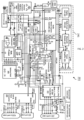
- FIG. 1 the relationship between the built-in transfer device (or charger/discharger converter) and the external rechargeable/dischargeable battery pack of the jobsite audio device, where the coupling between them is connected with a built-in battery pack terminal block as the interface of power transmission.
- This proposed jobsite audio device contains an USB C port, which can provide two-way power delivery:
- FIG. 1 shows a circuit block diagram of a jobsite audio device 101 according to one embodiment of the present invention. The following descriptions uses the block diagram shown in FIG. 1 to describe the operating states of various charging and power supply circuits.
- the first route enters through diode D5 to start the 5V DC-DC converter to step down and supply 5V_BUS power to the USB A power unit (USB A PWR Unit) 109 and supply 3V3 LDO1 (low-dropout regular) to reduce/stabilize the voltage and then supply to the main audio system.
- the audio master system controller (hereinafter referred to as "main controller") 111 controls 3V3_PA_EN/ADC_EN to make switches Q1, Q2, Q3, Q5, and Q12 closed-circuit.
- switch Q22 When a device is inserted into the USB A Port 113, switch Q22 will be closed-circuit grounded and then the TypeA_SNS pin will notify the main controller 111 to enable TypeA_EN and then make switch Q21 closed and at the same time enable the USB A power unit 109 to output 5V to VBUS_A and USB A port 113.
- 3V3L_SW starts to supply power to VDD pin of the PD DRP controller 115.
- switch Q10 When the USB C Port 1 (first USB C port) 117 has no power, switch Q10 is opened and not grounded, so the ACIN Pin of the buck/boost converter 119 is pulled high.
- the PD DRP controller 115 utilizes I2C3 to communicate with the buck/boost converter 119 and to control the PGATE pin making switch Q11 closed, the AC_Sink pin float, switch Q13 opened and switch Q12 closed.
- the second route of 24Vdc power therefore flows from diode D3 to switch Q11 and then flows into diode D13 to supply power to the PD DRP controller 115, the VBUS of the buck/boost converter 119, the VBUS_C _MON pin and the CHG_EN pin of the main controller 111 to close switches Q14 and Q9 causing the PSTOP pin to pull high to activate the buck/boost converter 119.
- the VBAT_SNS pin of the main controller 111 starts to detect the potential of the battery pack 103 and determine the number of cells, and the AC_SNS pin is used to distinguish whether the power supply is a high-potential 24Vdc or a low-potential power supply of battery pack 103.
- the main controller 111 starts to communicate with the PD DRP controller 115 through UART2, because the charging priority is controlled by the main controller 111 when the USB C port 1 (first USB C port) 117 is not plugged in with external device, and the PD DRP controller 115 starts to keep switches Q15 and Q16 opened through the VBUS_P_CTRL and VBUS_C_CTRL 2 pins, the buck/boost converter 119 detects the voltage of the battery's cell components through the VBATS pin, and the 24Vdc power starts to charge the battery pack 103 by converting the required voltage/current that is transmitted through the VBAT pin of the buck/boost converter 119.
- the main controller 111 controls the startup of the buck/boost converter 119 through I2C3 to start various charging procedures.
- the main controller 111 also provides battery potential to the VBAT_SNS Pin for detection through Q5 closed circuit. If the total potential of the battery pack 103 falls below the set reference potential, the main controller 111 will request the buck/boost converter 119 to charge the battery pack 103 through I2C3. Conversely, if the total potential of the battery pack 103 is greater than the set high level, to avoid overcharging, the system will stop charging immediately.
- switch Q22 When there is a device plugged into the USB A port 113, switch Q22 is grounded to notify the main controller 111 through the TypeA_SNS pin, and then the TypeA_EN pin of the main controller 111 controls the EN pin of the USB A power unit 109, allowing 5V_BUS power to enter the USB A power unit 109 to provide power outputted from the 5V DC-DC converter to the coupled device, which can provide 5V, 0-2.4A current.
- Other charging modes of battery pack 103 and charging protection OVP/OTP/UVP technologies are well known and will not be detailed here.
- total power needed including charging power of the battery pack 103 for five serial-connected cells with 20V and current limit 3A (equal to 60W) plus the charging power of USB A (maximum 15W) is 75W, which is less than the AC-DC 24Vdc power supply (assumed to be 100W), if USB A is not powered, the battery pack can charge up to 100W.
- the main controller 111 will be automatically pulled low by the Auto_Shutdown Pin, so that switch Q31 of the power trigger control switching module (PWR Trigger Ctrl. SW module) 107 is opened (OFF) to turn off both 24Vdc and VBATT power supplies.
- PWR Trigger Ctrl. SW module power trigger control switching module
- the first route enters through diode D4 to power the battery pack 103
- the second route enters through diode D6 to start the 5V DC-DC converter to step down and supply 5V_BUS power to the USB A power unit 109 and supply 3V3 LDO1 (first low-dropout regulator) to reduce/stabilize the voltage and then supply to the main audio system.
- the operations of the main controller 111 are the same as described in case I(a) and not repeated here.
- the third route enters through diode D9 to power amplifier 121, and the fourth route enters through diode D10 to make switch Q6 in closed state (ON) and then through 5V_BUS to 3V3 LDO2 (second low-dropout regulator) to reduce power to 3.3V for supplying power to display unit 123, radio front end 125, Bluetooth module 127 and power amplifier 121.
- the main controller 111 will immediately control the buck/boost converter 119 through I2C3 to reduce the charging power by half or less.
- the power reduction with respect to 24 Vdc can be varied with appropriate design changes.
- the aforementioned display unit 123, radio front end 125, Bluetooth module 127 and power amplifier 121 together with the speaker coupled to the power amplifier 121 can be realized as an audio module 141, which can be powered by the AC-DC power source 105 or the battery pack 103 and controlled by the main controller 111.
- the main controller 111 will start timing, for example, after 10 minutes, the Auto_OFF pin of the main controller 111 will automatically pull low to trigger the power trigger control switching module 107 making switch Q32 opened to turn off the total power of the audio system, therefore reducing power consumption of 24Vdc and battery pack 103.
- the USB C port 1 117 is a bi-directional power delivery USB C port.
- the USB C AC power adapter communicates with the PD DRP controller 115 through the CC1/CC2/DP/DM pins. If the two parties agree to communicate, the PD DRP controller 115 activates the VBUS_P_CTRL pin making switch Q15 closed, the VBUS_C_CTRL pin making switch Q16 opened, the CHG_EN pin making switches Q14 and Q9 closed to enable PSTOP pin pulling high to activate the buck/boost converter 119, utilizing UART2 to communicate with the main controller 111 and I2C3 to control the buck/boost converter 119 letting the AC_Sink pin floating to make switch Q13 opened and switch Q12 closed, when VBUS_C has power and enters the gate of switch Q10 making Q10 ground and forcing the ACIN pin pulled low to let PGATE pin to open switch Q11 for preventing the current of the battery pack 103 from flowing reversely through diode D3 to VBUS_C line.
- Power of the USB C adapter passes through VBUS_C pin and then flows from switch Q15 to the VBUS_C_MON pin of the PD DRP controller 115 and the VBUS pin of the buck/boost converter 119.
- the charging current starts to flow through switches Q9 and Q12 and couples into the battery pack 103 through the battery terminal for charging.
- the distribution of the charging power of the battery pack 103 needs to be appropriately designed according to the power that the USB C AC adapter and the battery pack can provide. For example, total power needed including needed charging power of the battery pack 103 for five serial-connected cells with 20V and current limit 5A is equal to 100W, which is less than or equal to the power of the USB C adapter (assumed to be 100W).
- the power supply of USB A is provided by the battery pack 103, the battery pack can charge up to 100W.
- the UART2, I2C3, TypeA_SNS and other operation pins of the main controller 111 detects no feedback signal for 5 minutes, and the main controller 111 will automatically pull low from the Auto_Shutdown pin to enable the power trigger control switching module making switch Q31 opened (OFF) to turn off the 12 ⁇ 20V battery power supply to reduce standby power consumption.
- the USB C AC power adapter communicates with the PD DRP controller 115 through the CC1/CC2/DP/DM pins. If the two parties agree to communicate, the PD DRP controller 115 activates the VBUS_P_CTRL pin making switch Q15 closed, the VBUS_C_CTRL pin making switch Q16 opened, the CHG_EN pin making switches Q14 and Q9 closed to enable PSTOP pin pulling high to activate the buck/boost converter 119, utilizing UART2 to communicate with the main controller 111 and I2C3 to control the buck/boost converter 119 letting the AC_Sink pin floating to make switch Q13 opened and switch Q12 closed. Second power route flows into the power amplifier 121 through diode D9.
- Third power route flows into diode D10 and activates 5V_BUS by making switch Q6 closed to enable the 3V3 LDO2 to supply 3.3V power to display unit 123, radio front end 125, Bluetooth module127 and the power amplifier 121.
- USB C power enters to the gate of switch Q10 making Q10 ground and forcing the ACIN pin pulled low to let PGATE pin to open switch Q11 for preventing the current of the battery pack 103 from flowing reversely through diode D4 to VBUS_C line.
- Power of the USB C adapter from VBUS_C starts to flow into the VBUS_C MON pin of the PD DRP controller 115 and VBUS pin of the buck/boost converter 119 via switch Q15 and then charges the battery pack 103 through switches Q9 and Q12 coupled into the battery pack 103.
- the distribution of the charging power of the battery pack 103 needs to be appropriately designed according to the amount of power that the USB C AC adapter and the battery pack 103 can provide. For example, total power needed including needed charging power of the battery pack 103 for five serial-connected cells with 20V and current limit 5A is equal to 100W, which is less than or equal to the power of the USB C AC adapter (assumed to be 100W). In this charging state, the power supply of USB A is provided by the battery pack, the battery pack can charge up to 100W.
- the UART2, I2C3, TypeA_SNS and other operation pins of the main controller 111 detects no feedback signal for 10 minutes, and the main controller 111 will automatically pull low from the Auto_Shutdown pin to enable the power trigger control switching module making switch Q32 opened (OFF) to turn off the 12 ⁇ 20V battery power supply to reduce standby power consumption.
- the PD DRP controller 115 activates the VBUS_P_CTRL pin making switch Q15 closed, the VBUS_C_CTRL pin making switch Q16 opened, and communicates with the main controller 111 through UART2.
- the main controller 111 uses the USBCHG/ACSINK pin to close switch Q17 and to make switches Q11 and Q4 opened.
- the CHG_EN pin of the main controller 111 makes switch Q14 closed to activate the buck/boost converter 119, and then switch Q9 is closed.
- the buck/boost converter 119 utilizes the AC_SINK pin float to make switch Q13 opened and switch Q12 is closed.
- switch Q11 is opened, diode D3 has no current, switch Q15 is closed, VBUS_C enters gate of switch Q10 to forced Q10 ground, and ACIN pin of the buck/boost converter 119 is forced to ground, enabling that PGATE pin of the buck/boost converter 119 make switch Q11 opened to block current of 24Vdc from flowing into VBUS_C of the PD DRP controller 115.
- the AC adapter must have the priority to charge the battery pack 103.
- the distribution of the charging power of the battery pack 103 needs to be appropriately designed according to the power that the adapter and the battery pack can provide. For example, total power needed including needed charging power of the battery pack for five serial-connected cells with 20V and current limit 5A is equal to 100W, which is less than or equal to the power of the USB C adapter (assumed to be 100W). In this charging state, the power supply of USB A and 5V system can be neglected. In this situation, the battery pack can charge up to 100W.
- the UART2, I2C3, TypeA_SNS and other operation pins of the main controller 111 detects no feedback signal for 5 minutes, and the main controller 111 will automatically pull low from the Auto_Shutdown pin to enable the power trigger control switching module 107 making switch Q31 opened (OFF) to turn off the 24Vdc/12 ⁇ 20V battery power supply to reduce standby power consumption.
- the second route enters to 5V DC-DC converter through diode D6 to step down and supply 5V_BUS power to the USB A power unit 109 and supply 3V3 LDO1 to reduce/stabilize the voltage and then supply to the main audio system, and the operations of the main controller 111 are the same as described in case I(a) and not repeated here.
- the third route enters to the power amplifier 121 through diode D9, and the fourth route enters D10 making switch Q6 closed and then enters 3V3 LDO2 from 5V_BUS to supply power to the display unit 123, the radio pre-stage 125, Bluetooth module 127, and power amplifier 121 of the 3.3V digital system.
- the current of the USB C AC adapter from VBUS_C enters switch Q15 and then flows to the VBUS_C_MON pin the PD DRP controller 115 and the VBUS pin of the buck/boost converter 119. At the same time, switch Q10 is closed to force Q11 to be opened, Q9 to be closed, and Q12 to be closed. Power of the USB C AC adapter from VBUS_C changes the voltage from the buck/boost converter 119, after that, the current is output from the VBAT pin of the buck/boost converter 119 and coupled to the battery terminal to start charging the battery pack 103.
- the 24Vdc power supply does not need to share the rest of the power to charge the battery pack 103 because there is a USB C AC adapter plugged in the USB C port 1 117.
- the main controller 111 will not control the buck/boost converter 119 through I2C3 and the control of the buck/booster 119 is handed over to the PD DRP controller 115 to proceed the battery charging. For example, total power needed to charge the battery pack 103 for five serial-connected cells with 20V and current limit 5A(equal to 100W), which is less than or equal to power of the USB C AC adapter can supply (assumed to be 100W).
- the 24Vdc power only needs to be supplied to the power amplifier 121, system power (negligible) and USB A
- the total power consumption of power amplifier (assumed to be 20W) plus USB A (15W) is 35W, which is way more less than the power of 24Vdc power supply can supply (100W).
- the main controller 111 of the radio system will start timing, for example, after 10 minutes, the Auto_OFF pin of the main controller 111 will automatically pull low to trigger the power trigger control switching module 107 making switch Q32 opened to turn off the total power of the audio system to reduce the standby power loss of the 24Vdc power, the USB C AC adapter and the battery pack 103.
- the main controller 111 controls 3V3_PA_EN/ADC_EN to make switches Q1, Q2, Q3, Q5, and Q12 closed-circuit and makes the 3V3 LDO powering the PD DRP controller 115.
- the PD DRP controller 115 communicates with the external coupled device through CC1/CC2/DP/DM pins of the USB C port 117.
- the PD DRP controller 115 activates the VBUS_P_CTRL pin making switch Q15 closed, the VBUS_C_CTRL pin making switch Q16 opened, the CHG_EN pin making switches Q14 and Q9 closed to enable PSTOP pin pulling high to activate the buck/boost converter 119, utilizing UART2 to communicate with the main controller 111 and I2C3 to control the buck/boost converter 119 letting the AC_Sink pin to make switch Q12 closed.
- the main controller 111 utilizes USBCHG/ACSINK pin making switch Q17 closed to force switch Q11 opened, Q4 closed.
- the second route of the power of the battery pack (12 ⁇ 20Vdc) passes diode D3 and flows into diode D11, switches Q4 and Q9, then flows into the VBAT pin of the buck/booster converter 119.
- the buck/booster converter 119 utilizes the AC_Sink pin to make switch Q13 closed to ground to make switch Q12 opened circuit for preventing the current of the battery pack 103 from flowing reversely through switch Q12 to switch Q4.
- the buck/boost converter 119 converts the power of the battery pack 103 fed via VBAT pin into voltage, and then outputs the voltage from VBUS pin to VBUS_C_MON pin of the PD DRP controller 115 to monitor the potential.
- the PD DRP controller 115 monitors the charging status of the buck/boost converter 119 through I2C3, and then the output voltage from the VBUS pin passes switch Q16 and VBUS_C+ to charge the external device coupled to the USB C port 117.
- the USB A power unit 109 uses DP/DM pins to communicate with the external device, and after confirming the agreement, it starts to supply power to the external device. If the external device coupled to the USB A port 113 is fully charged, unplug it (no other power consumption state).
- the Auto_Shutdown pin of the main controller 111 will be automatically pulled low to trigger power trigger control switching module 107 to open switch Q31 and cut off the power supply from the battery pack 103, so that the automatic triggered switch can completely cut off the current of the battery pack 103 to prevent standby power loss.
- the PD DRP controller 115 will send a sleep signal from UART2 to notify the main controller 111.
- the Auto_Shutdown pin of the main controller 111 will automatically be pulled low after 5 minutes, so that the power trigger control switching module 107 makes switch Q31 opened (OFF) and the power supply of the battery pack 103 will be cut off. If the battery pack 103 uses USB C Port 1 117 alone to supply power to external device, it can provide a maximum power of 100W depending on the capacity of the battery pack. If the USB A port 113 is used together, the USB C Port 1 117 can only provide a maximum power of 60W. The total power supply needs to be reduced and is depended on the design.
- the Cell UVP module will connect the power trigger control switching module 107 to pull low through diode D12 to turn off the switches Q31 and Q32 together for protecting the battery pack 103 from over-discharge. To restart the charging, just plug in the AC power and press the CHG/DISCHG ON/OFF key for a short time.
- the second route enters to diode D11, switches Q4 and Q9 to the VBAT pin of the buck/booster converter 119 through diode D4.
- the aforementioned two routes are in the same operation mode as described in case IV(a)
- the third route is supplied to the power amplifier 121 through diode D9
- the fourth route is passed through diode D10 to enable switch Q6 closed circuit and then 5V_BUS enters the 3V3 LDO2 to drop voltage to 3.3V for supplying power to digital system, such as display unit 123, radio front end 125, Bluetooth module 127, and power amplifier 121.
- the main controller 111 will immediately control the buck/boost converter 119 through I2C3 to reduce the charging power by half or less, and how much the device charging power that needs to be reduced can be designed based on the power that the battery pack 103 can provide. For example, total power consumption of power amplifier (assumed to be 20W) plus USB C 1 power supply up to 60W and USB A maximum 15W together with system power supply (negligible) are equal to 95W, which is less than the power of the battery pack power (assumed to be 100W). If the power amplifier 121 and USB A are not in use, the maximum charging power of the external device can reach 100W.
- the main controller 111 will start timing. For example, after 10 minutes, the Auto_OFF pin of the main controller 111 will automatically pull low to trigger the power trigger control switching module 107 making switch Q32 opened and turn off the total power of the audio system to reduce the standby power consumption of the battery pack 103.
- the Cell UVP module will connect the power trigger control switching module 107 to pull low through diode D12 to turn off the switches Q31 and Q32 for protecting the battery pack 103 from over-discharge. To restart the charging, just plug in the AC power and press the CHG/DISCHG ON/OFF key for a short time.
- the AC-DC power supply 105 is used to charge the external device coupled to the USB C port 1 117.
- the PD DRP controller 115 communicates with the main controller 111 through UART2. If there is an external device plugged into the USB C port 1 117 at this time and requires power supply, the PD DRP controller 115 communicates with the external device through C1/CC2/DP/DM pins of the USB C port 1 117. The external device start to do link protocol communication, if both parties agree the protocol, the PD DRP controller enables 115 VBUS_P_CTRL pin to make switch Q15 opened, VBUS_C_CTRL pin to make switch Q16 closed, CHG_EN pin to make switches Q14 and Q9 closed, letting PSTOP pin to pull high to activate the buck/boost converter 119.
- the buck/boost converter 119 communicates with the main controller 111 through UART2, while the AC_SNS pin of the main controller 111 detects that there is 24Vdc input, UART2 notifies the PD DRP controller utilizing I2C3 to control the AC_Sink pin of the buck/boost converter 119 floating, so that the switch Q13 is closed circuit and the switch Q12 is open circuit for preventing the current of the VBATT from flowing reversely through switches Q4 and Q9 via the battery terminals.
- the buck/boost converter 119 converses the 24Vdc fed into the VBAT into suitable voltage and then outputs it from the VBUS Pin through the VBUS_C_MON pin of the PD DRP controller 115 to monitor the potential.
- the PD DRP controller 115 monitors the buck/boost converter 119 through I2C3 and then the power flows through switch Q16 and VBUS_C+ to charge the external device connected to USBC Port 1 117.
- the PD DRP controller 115 will send a sleep signal and UART2 will notify the main controller 111.
- the main controller 111 will start timing, if there is no other power consumption, the Auto_Shutdown pin will automatically pull low after 5 minutes, so that the power trigger control switching module 107 make switch Q31 opened (OFF) and the 24Vdc power supply will be cut off. If 24Vdc is used to supply power to USB C Port alone, the power provided can reach up to 100W. If USB A Port 113 is also used, the total power of USB C Port 1 117 to supply power to external devices must be reduced for design consideration. In this situation, power consumption for USB C device (maximum 60W) plus USB A (maximum 15W), which is 75W and is less than 24Vdc power supply (assume to be 100W).
- the PD DRP controller 115 When the external device connected to the USB C port 1 117 is fully charged and the buck/boost converter 119 of the system is turned off, if the device is not unplugged after 1 minute, the PD DRP controller 115 will send a sleep signal and the UART2 will notify the main controller 111.
- the main controller 111 starts timing, if there is no other power consumption mode, the Auto_OFF pin will automatically pull low after 10 minutes, so that the power trigger control switching module makes switch Q32 opened (OFF) and the power supply 24Vdc is cut off to avoid standby power consumption.
- USB C when charging internal or external battery pack from USB C Port 117, future USB C will apply newer PD 3.1 adapters and device products with high voltage specifications, and will share the USB C port with PD 3.0/2.0 and PD 3.1 EPR.
- their working voltage is as high as 28V/36V/48V, which is much higher than that of PD 3.0/2.0.
- the components used in the current electronic products or generally, the withstand voltage of semiconductors can only support up to the range of 22V ⁇ 30V.
- the communication interface CC1/CC2 take misjudgments or the internal PD controller has a design bug, there may be a problem. It is possible to deliver potential higher than the PD 3.0/2.0 device can withstand and cause that the device be damaged at the moment of charging. Therefore, an abnormal overvoltage protection device should be placed at downstream facing port (DFP) of the USB C port 117.
- DFP downstream facing port
- This protection module is suitable for electronic products with USB C ports such as NB, Smartphone, TV, i-Pad, Audio, PC, TV, Monitor, HUB, Power Bank, etc.
- the reverse current may cause a voltage drop on the MOSFET Q16 switch disposed between VBUS_C+ and VBU_C, when the voltage drop is greater than 0.02V (threshold voltage) or there is a short circuit at the back end of VBUS_C, the reverse potential difference protection module 131 has reverse voltage drop, i.e., voltage of negative pin ( - ) > positive pin (+).
- RVP pin of the reverse potential difference protection module 131 uses diode D17 to immediately pull low the switch Q19 making it opened circuit to let the upstream facing port (UFP) of the power supply terminal opened, and at the same time uses diode D15 to force the PSTOP pin pulling low of the buck/boost converter 119 to stop charging immediately for preventing the current from flowing reversely, i.e. flowing from the VBUS_C+ port to the power supply terminal VBUS_C.
- the RVP pin is also connected to the Sink_Abnormal pin of the main controller 111 to notify warning by showing an abnormality message on the display unit or lighting on the LED warning lights.
- FIG. 2 the relationship between the built-in transfer device (or charger/discharger converter) and the external rechargeable/dischargeable battery pack of the jobsite audio device, where the coupling between them is connected with a built-in battery pack terminal block as the interface of power transmission.
- This proposed jobsite audio device contains two USB C ports, USB C port 1 and USC port 2, and one USB A port, where the USB C port 1 can provide two-way power delivery:
- FIG. 2 shows a circuit block diagram of a jobsite audio device 201 according to one embodiment of the present invention. The following descriptions uses the block diagram shown in FIG. 2 to describe the operating states of various charging and power supply circuits.
- USB C port 2 217a and USB A port 213 have equipments plugged in, equipments (or devices) communicate with DCP and buck converter 209 through CC1/CC2/DP/DM and DP/DM terminals, the USB C port 2 (second USB C port) 217a can reach a maximum of 65W (when used alone), if the USB A port 213 is also used together, the USB C port 2 (second USB C port) 217a can only provide 45W while USB A port 213 can reach up to 18W.
- DCP and buck converter 209 uses UART3 to communicate with the main controller 211, and the amount of output power that can be delivered to the connected devices depends on the power supply status.
- the UART2, I2C3, UART3 and other operation pins of the main controller 211 detect no feedback signals, no usage or operations.
- the main controller 211 will be automatically pulled low turn by the Auto_Shutdown pin, so that switch Q31 of the power trigger control switching module 207 is opened (OFF) to turn off both the 24Vdc and VBATT power supply.
- power switch is in ON state and CHG/DISCHG in OFF state.
- switch Q32 is ON to form closed circuit followed by providing 5V_BUS power to the DCP and buck converter 209 integrated with USB C port 2 (second USB C port) 217a and USB A port 213 and providing 3V3 LDO1 power to the main controller 211 of the audio device.
- the operations of the main controller 211 are the same as described in case I(a) regarding to FIG. 1 and will not be repeated here.
- USB C port 2 (second USB C port) 217a and USB A port 213 have equipments plugged in, equipments (or devices) communicate with DCP and buck converter 209 through CC1/CC2/DP/DM and DP/DM terminals
- the USB C port 2 217a can reach a maximum of 65W (when used alone), if the USB A port 213 is also used together, the USB C port 2 217a can only provide 45W while USB A port 213 can reach up to 18W.
- DCP and buck converter 209 uses UART3 to communicate with the main controller 211, and the amount of output power that can be delivered to the connected devices depends on the power supply status.
- total power needed including power amplifier 221 of the audio device (20W), charging power of the battery pack 203 for five serial-connected cells with 20V and current limit 3A (equal to 60W), USB A (maximum 3.6A 18W) and USB C Port 2 (45W), which has total power consumption 143W, is less than AC-DC 24Vdc power supply (assuming to be 150W). If the USB C 2 (second USB C port) 217a and USB A port 213 are not provided power, the battery pack 203 can charge up to 100W.
- USB C port 1 first second USB C port
- USB C port 2 217a USB C port 2 217a
- USB A port 213 USB A port 213
- the main controller 211 will start timing. For example, after 10 minutes, the main controller 211 of the audio device 201 will be automatically pulled low turn by the Auto_Shutdown pin, so that switch Q31 of the power trigger control switching module 207 is opened (OFF) to turn off both the 24Vdc and battery power supply.
- the aforementioned display unit 223, radio front end 225, Bluetooth module 227 and power amplifier 221 together with the speaker coupled to the power amplifier 221 can be realized as an audio module 241, which can be powered by the AC-DC power source 205 or the battery pack 203 and controlled by the main controller 211.
- the USB C 2 (second USB C port) 217a is a unidirectional PD USB C port.
- USB A power unit 109 is replaced by a DCP and buck converter 209 integrated with USB C port 2 (second USB C port) 217a and USB A port 213.
- USB C port 2 (second USB C port) 217a and USB A port 213 have devices plugged in, devices communicate with DCP and buck converter 209 through CC1/CC2/DP/DM and DP/DM terminals.
- USB C port 2 (second USB C port) 217a can reach a maximum of 65W (when used alone), if USB A port 213 is used together, USB C port 2 (second USB C port) 217a can only provide 45W, while USB A port 213 can provide up to 18W.
- DCP and buck converter 209 uses UART3 to communicate with the main controller 211 of the audio device, and the amount of output power that can be delivered to the connected devices depends on the power supply status. As above conditions, total power needed including charging power of the battery pack 203 for five serial-connected cells with 20V and current limit 5A (equal to 100W), which has total power consumption less than or equal to the power supplied by the USB C PD AC adapter (assuming to be 100W).
- USB A port 213 and USB C port 2 (second USB C port) 217a is responsible for the battery pack (maximum 65W), which is not included in the total charging power of the USB C PD AC adapter, and the charging power of the USB C PD AC adapter to the rechargeable battery pack can reach up to 100W.
- the UART2, I2C3, UART3 and other operation pins of the main controller 211 detect no feedback signals, no usage, or operations.
- the main controller 211 will be automatically pulled low by the Auto_Shutdown pin, so that switch Q31 of the power trigger control switching module 207 is opened (OFF) to turn off the 12 ⁇ 20V battery power source.
- USB A power unit 109 is replaced by a DCP and buck converter 209 integrated with USB C port 2 (second USB C port) 217a and USB A port 213.
- USB C port 2 (second USB C port) 217a and USB A port 213 When both USB C port 2 (second USB C port) 217a and USB A port 213 have devices plugged in, devices communicate with DCP and buck converter 209 through CC1/CC2/DP/DM and DP/DM terminals.
- USB C port 2 (second USB C port) 217a can reach a maximum of 65W (when used alone), if USB A port 213 is used together, USB C port 2 (second USB C port) 217a can only provide 45W, while USB A port 213 can provide up to 18W.
- DCP and buck converter 209 uses UART3 to communicate with the main controller 211 of the audio device, and the amount of output power that can be delivered to the connected devices depends on the power supply status.
- total power needed including charging power of the battery pack for five serial-connected cells with 20V and current limit 5A (equal to 100W), which has total power consumption less than or equal to the power supplied by the USB C PD AC adapter (assuming to be 100W).
- the power consumption of USB A port 213, USB C port 2 (second USB C port) 217a, and power amplifier 221 is supplied by the battery pack 203 and is not included in the total power consumption of the charging circuit.
- the battery pack 203 can charge up to 100W.
- the UART2, I2C3, UART3 and other operation pins of the main controller 211 detect no feedback signals, no usage or operations.
- the main controller 211 will be automatically pulled low by the Auto_shutdown pin, so that switch Q32 of the power trigger control switching module 207 is opened to turn off the battery power source.
- the total power of the USB C power supply includes charging power of the battery pack 203 for five serial-connected cells with 20V and current 5A (equal to 100W), which is less than the power supplied by the USB C AC adapter (assuming to be 100W), in this state the power consumption of USB A port 213 and USB C port 2 (second USB C port) 217a is supplied by the battery pack 203 and not included in the total power supply of the charging circuit, the charging power of the battery pack 203 is up to 100W.
- the UART2, I2C3, UART3 and other operation pins of the main controller 211 detect no feedback signals, no usage, or operations.
- the main controller 211 will be automatically pulled low by the Auto_shutdown pin, so that switch Q32 of the power trigger control switching module 207 is opened to turn off the battery power source.
- USB C port 1 first USB C port 217 can provide a maximum power of 100W.
- USB C Port 2 can reach a maximum of 65W (when used alone). If USB A port is used together, USB C port 2 can only provide 45W, while USB A port can provide up to 18W.
- DCP and buck converter 209 uses UART3 to communicate with the main controller 211 to adjust output power to the device, how much power need to be adjust depends on the current battery supply status.
- USB C Port 1 213 is provided power
- USB C Port 2 (second USB C port) 217a will not provide power.
- USB C port 1 (first USB C port) 217 can charge the device up to 60W
- USB A port 213 can charge the device up to 18W
- system power supply is negligible
- USB C port 2 (second USB C port) 217a does not provide power when the battery pack 203 is powered. Therefore, total power consumption is 78W, which is less than battery pack power (assuming to be 100W).
- USB C port 1 first USB C port
- USB C port 2 second USB C port 217a
- the main controller's Auto_Shutdown pin will automatically pull low to make switch Q31 of the power trigger control switching module 217 opened circuit to cut off the power supply VBATT, so that the automatic trigger control switch can completely cut off the current of the battery pack to prevent standby loss.
- USB C port 1 first USB C port
- the buck/boost converter 219 of the system is turned off
- the PD DRP controller 215 will send a sleep signal and UART2 will notify the main controller 211. After that, the main controller 211 will start timing. If there is no other power consumption, the Auto_Shutdown pin of the main controller 211 will automatically pull low after 5 minutes, so that the switch Q31 of the power trigger control switching module 207 will be opened and the power supply VBATT will be cut off.
- USB C port 1 (first USB C port) 217 is used alone to supply power to external device, it can provide power up to 100W depending on the capacity of the battery pack.
- USB A port 213 and USB C Port 2 (second USB C port) 217a are also used together, the total power of USB C port 1 (first USB C port) 217 to supply power to external devices must be reduced. If the voltage of the battery pack 203 is detected to be too low by the Cell UVP module during discharge or after being placed for a period of time, the Cell UVP module will connect power trigger control switching module 207 to pull low switches Q31 and Q32 making them OFF through diode D12 for protecting the battery pack 203 from over-discharge. To restart the charging, just plug in the AC power and press the CHG/DISCHG ON/OFF key for a short time to charge the battery pack 203.
- total power consumption of power amplifier (assumed to be 20W) 221 plus USB C 1 power supply up to 60W and USB A maximum 18W together with system power supply (negligible) are equal to 98W, which is less than the power of the battery pack power (assumed to be 100W). If the power amplifier 221, USB A port 213 and USB C port 2 (second USB C port) 217a are not in use, the maximum charging power of the external device can reach 100W.
- USB C port 1 217 If the external device is fully charged as described above but is still not unplug from USB C port 1 217, USB C port 2 (second USB C port) 217a and USB A port 213, if there is no power supply from USB A in non-radio mode, no music playing in Bluetooth mode, no signal input from AUX terminal, etc., after a period of time, the main controller 211 will start timing. For example, after 10 minutes, the Auto_OFF pin of the main controller 211 will automatically pull low to trigger the power trigger control switching module 207 making switch Q32 opened and turn off the total power of the audio system to reduce the standby power consumption of the battery pack 203.
- the Cell UVP module will connect the power trigger control switching module 207 through diode D12 to pull low switches Q31 and Q32 making them OFF for protecting the battery pack 203 from over-discharge. To restart the charging, just plug in the AC power and press the CHG/DISCHG ON/OFF key for a short time.
- the AC-DC power supply 205 is used to charge the external device coupled to the USB C port.
- the PD DRP controller 215 will send a sleep signal and UART2 will notify the main controller 211. After that, the main controller 211 will start timing, if there is no other power consumption, the Auto_Shutdown pin will automatically pull low after 5 minutes, so that the power trigger control switching module 207 make switch Q31 opened (OFF) and the 24Vdc power supply will be cut off. If 24Vdc is used to supply power to USB C Port alone, the power provided can reach up to 100W. If USB A port 213 and USB C port 2 217a are also used, the total power of USB C Port 1 (first USB C port) 217 to supply power to external devices must be reduced for design consideration.
- the PD DRP controller 215 When the external device connected to the USB C port 1 (first USB C port) 217 is fully charged and the buck/boost converter 219 of the system is turned off, if the device is not unplugged after 1 minute, the PD DRP controller 215 will send a sleep signal and the UART2 will notify the main controller 211.
- the main controller 211 starts timing, if there is no other power consumption mode, the Auto_OFF pin will automatically pull low after 10 minutes, so that the power trigger control switching module 207 makes switch Q32 opened (OFF) and the power supply 24Vdc is cut off to avoid standby power consumption.
- USB C Port 1 first USB C port 217 alone
- the maximum power can be 100W.
- USB A port 213 and USB C Port 2 217a are also used, the total power of USB C port 1 (first USB C port) 217 to power external devices must be reduced. Total power consumption includes the USB C port 1 (up to 60W), USB port A (up to 18W), USB C port 2 (45W), power amplifier (assumed to be 20W) and system power supply (negligible), which is 143W and is less than 24Vdc power supply (assumed to be 150W) can provide.
- USB C port 1 When USB C port 2 (second USB C port) is not in use, USB C port 1 (first USB C port) can provide a maximum power of 100W. If the battery pack 203 is inserted and used simultaneously with 24Vdc to power USB C Port 1 (first USB C port) 217, when USB A Port 213 and USB C Port 2 (second USB C port) 217a are also used, total power consumption includes USB C Port 1 (max 100W), USB A port (max 18W), USB C port 2 (45W), power amplifier (assumed to be 20W ) and system power supply (negligible), which is 183 W and is less than 24Vdc power supply (assumed to be 150W) together with battery pack (assumed to be 100W) can supply.
- the PD DRP controller 215 When the USB C Port 1 (first USB C port) 217 is fully charged and the buck/boost converter 219 of the system is turned off, for example, if it has not been unplugged after 1 minute, the PD DRP controller 215 will send a sleep signal, which will be notified by the main controller 211 through UART2.
- the main controller 211 starts timing and if there is no other power consumption mode, after 5 minutes, the Auto_Shutdown pin of the main controller 211 will automatically pull low, so that the switch Q31 of the power trigger control switching module 207 will be opened and the 24Vdc power supply will be cut off.
Landscapes
- Engineering & Computer Science (AREA)
- Theoretical Computer Science (AREA)
- General Engineering & Computer Science (AREA)
- Power Engineering (AREA)
- Physics & Mathematics (AREA)
- General Physics & Mathematics (AREA)
- Computer Hardware Design (AREA)
- Charge And Discharge Circuits For Batteries Or The Like (AREA)
Applications Claiming Priority (1)
| Application Number | Priority Date | Filing Date | Title |
|---|---|---|---|
| US18/136,856 US12554304B2 (en) | 2023-04-19 | 2023-04-19 | Jobsite audio device with multi-source power and multi-port USB interface |
Publications (1)
| Publication Number | Publication Date |
|---|---|
| EP4451501A1 true EP4451501A1 (de) | 2024-10-23 |
Family
ID=86226789
Family Applications (1)
| Application Number | Title | Priority Date | Filing Date |
|---|---|---|---|
| EP23169758.2A Pending EP4451501A1 (de) | 2023-04-19 | 2023-04-25 | Baustellenaudiovorrichtung mit mehrquellen-stromversorgungs- und mehrport-usb-schnittstelle |
Country Status (2)
| Country | Link |
|---|---|
| US (1) | US12554304B2 (de) |
| EP (1) | EP4451501A1 (de) |
Citations (3)
| Publication number | Priority date | Publication date | Assignee | Title |
|---|---|---|---|---|
| US20180375358A1 (en) * | 2017-06-23 | 2018-12-27 | Dell Products L.P. | High efficiency power storage adapter |
| US20220006247A1 (en) * | 2014-06-24 | 2022-01-06 | Chou Hsien Tsai | Reversible dual-position electric connector |
| CN218734917U (zh) * | 2022-09-16 | 2023-03-24 | 深圳市瀚可科技有限公司 | 一种基于混合供电的大功率音箱 |
Family Cites Families (3)
| Publication number | Priority date | Publication date | Assignee | Title |
|---|---|---|---|---|
| US10184624B2 (en) * | 2007-05-31 | 2019-01-22 | Tseng-Lu Chien | Multiple functions LED night light |
| US9377835B2 (en) * | 2013-06-17 | 2016-06-28 | Avago Technologies General Ip (Singapore) Pte. Ltd. | System and method for providing dynamic charge current based on maximum card power |
| CN113794252B (zh) * | 2020-10-29 | 2024-11-12 | 威锋电子股份有限公司 | 多端口电力供应装置及其操作方法 |
-
2023
- 2023-04-19 US US18/136,856 patent/US12554304B2/en active Active
- 2023-04-25 EP EP23169758.2A patent/EP4451501A1/de active Pending
Patent Citations (3)
| Publication number | Priority date | Publication date | Assignee | Title |
|---|---|---|---|---|
| US20220006247A1 (en) * | 2014-06-24 | 2022-01-06 | Chou Hsien Tsai | Reversible dual-position electric connector |
| US20180375358A1 (en) * | 2017-06-23 | 2018-12-27 | Dell Products L.P. | High efficiency power storage adapter |
| CN218734917U (zh) * | 2022-09-16 | 2023-03-24 | 深圳市瀚可科技有限公司 | 一种基于混合供电的大功率音箱 |
Also Published As
| Publication number | Publication date |
|---|---|
| US20240353906A1 (en) | 2024-10-24 |
| US12554304B2 (en) | 2026-02-17 |
Similar Documents
| Publication | Publication Date | Title |
|---|---|---|
| US9864421B2 (en) | Hub having complex power converters | |
| US9465393B2 (en) | Power management circuit and method thereof | |
| US9997939B2 (en) | Hub | |
| EP2507678B1 (de) | Stromrichter mit verringertem stromverbrauch beim wechsel zwischen ruhe- und normalem modus während des ladevorgangs | |
| US8368252B2 (en) | High- and low-power power supply with standby power saving features | |
| US8107243B2 (en) | Portable multi-device power supply, battery charger, and docking system | |
| AU2004213885B2 (en) | Circuit and method of operation for an electrical power supply | |
| US8536840B2 (en) | Bidirectional power converters | |
| CN1751426B (zh) | 对充电电池进行充电并向便携式设备供电的电路和方法 | |
| EP3462565B1 (de) | Aufladbare vorrichtung und ladeverfahren | |
| CN111917148A (zh) | 用于双电池应用的降压-升压电池充电器 | |
| WO2021185307A1 (zh) | 直流电源 | |
| CN104393629A (zh) | 一种数字示波表的智能电源管理电路 | |
| EP4451501A1 (de) | Baustellenaudiovorrichtung mit mehrquellen-stromversorgungs- und mehrport-usb-schnittstelle | |
| CN210867228U (zh) | 应用于高电池电压音响的自动充放电检测电路 | |
| CN223713603U (zh) | 多接口usb电路及充电器 | |
| CN217824357U (zh) | 充电接口电路和充电装置 | |
| EP4614759A1 (de) | Ladevorrichtung und betriebsverfahren dafür | |
| KR101477239B1 (ko) | 출력단 단락 시 고장을 예방하는 보조 배터리 장치 | |
| CN111106633A (zh) | 移动电源以及移动电源的充电方法 | |
| WO2025227309A1 (zh) | 供电系统和电子设备 | |
| CA2562214A1 (en) | Circuit and method of operation for an electrical power supply |
Legal Events
| Date | Code | Title | Description |
|---|---|---|---|
| PUAI | Public reference made under article 153(3) epc to a published international application that has entered the european phase |
Free format text: ORIGINAL CODE: 0009012 |
|
| STAA | Information on the status of an ep patent application or granted ep patent |
Free format text: STATUS: REQUEST FOR EXAMINATION WAS MADE |
|
| 17P | Request for examination filed |
Effective date: 20230425 |
|
| AK | Designated contracting states |
Kind code of ref document: A1 Designated state(s): AL AT BE BG CH CY CZ DE DK EE ES FI FR GB GR HR HU IE IS IT LI LT LU LV MC ME MK MT NL NO PL PT RO RS SE SI SK SM TR |