EP4451098A1 - Bildverarbeitungsverfahren und -vorrichtung, elektronische vorrichtung und lesbares speichermedium - Google Patents
Bildverarbeitungsverfahren und -vorrichtung, elektronische vorrichtung und lesbares speichermedium Download PDFInfo
- Publication number
- EP4451098A1 EP4451098A1 EP22914414.2A EP22914414A EP4451098A1 EP 4451098 A1 EP4451098 A1 EP 4451098A1 EP 22914414 A EP22914414 A EP 22914414A EP 4451098 A1 EP4451098 A1 EP 4451098A1
- Authority
- EP
- European Patent Office
- Prior art keywords
- color
- image
- channel
- target
- input
- Prior art date
- Legal status (The legal status is an assumption and is not a legal conclusion. Google has not performed a legal analysis and makes no representation as to the accuracy of the status listed.)
- Pending
Links
Images


Classifications
-
- G—PHYSICS
- G06—COMPUTING OR CALCULATING; COUNTING
- G06T—IMAGE DATA PROCESSING OR GENERATION, IN GENERAL
- G06T11/00—Two-dimensional [2D] image generation
- G06T11/60—Creating or editing images; Combining images with text
-
- G—PHYSICS
- G06—COMPUTING OR CALCULATING; COUNTING
- G06F—ELECTRIC DIGITAL DATA PROCESSING
- G06F3/00—Input arrangements for transferring data to be processed into a form capable of being handled by the computer; Output arrangements for transferring data from processing unit to output unit, e.g. interface arrangements
- G06F3/01—Input arrangements or combined input and output arrangements for interaction between user and computer
- G06F3/048—Interaction techniques based on graphical user interfaces [GUI]
- G06F3/0481—Interaction techniques based on graphical user interfaces [GUI] based on specific properties of the displayed interaction object or a metaphor-based environment, e.g. interaction with desktop elements like windows or icons, or assisted by a cursor's changing behaviour or appearance
-
- G—PHYSICS
- G06—COMPUTING OR CALCULATING; COUNTING
- G06F—ELECTRIC DIGITAL DATA PROCESSING
- G06F3/00—Input arrangements for transferring data to be processed into a form capable of being handled by the computer; Output arrangements for transferring data from processing unit to output unit, e.g. interface arrangements
- G06F3/01—Input arrangements or combined input and output arrangements for interaction between user and computer
- G06F3/048—Interaction techniques based on graphical user interfaces [GUI]
- G06F3/0484—Interaction techniques based on graphical user interfaces [GUI] for the control of specific functions or operations, e.g. selecting or manipulating an object, an image or a displayed text element, setting a parameter value or selecting a range
- G06F3/04845—Interaction techniques based on graphical user interfaces [GUI] for the control of specific functions or operations, e.g. selecting or manipulating an object, an image or a displayed text element, setting a parameter value or selecting a range for image manipulation, e.g. dragging, rotation, expansion or change of colour
-
- G—PHYSICS
- G06—COMPUTING OR CALCULATING; COUNTING
- G06F—ELECTRIC DIGITAL DATA PROCESSING
- G06F3/00—Input arrangements for transferring data to be processed into a form capable of being handled by the computer; Output arrangements for transferring data from processing unit to output unit, e.g. interface arrangements
- G06F3/01—Input arrangements or combined input and output arrangements for interaction between user and computer
- G06F3/048—Interaction techniques based on graphical user interfaces [GUI]
- G06F3/0484—Interaction techniques based on graphical user interfaces [GUI] for the control of specific functions or operations, e.g. selecting or manipulating an object, an image or a displayed text element, setting a parameter value or selecting a range
- G06F3/04847—Interaction techniques to control parameter settings, e.g. interaction with sliders or dials
-
- G—PHYSICS
- G06—COMPUTING OR CALCULATING; COUNTING
- G06T—IMAGE DATA PROCESSING OR GENERATION, IN GENERAL
- G06T11/00—Two-dimensional [2D] image generation
- G06T11/10—Texturing; Colouring; Generation of textures or colours
-
- G—PHYSICS
- G06—COMPUTING OR CALCULATING; COUNTING
- G06T—IMAGE DATA PROCESSING OR GENERATION, IN GENERAL
- G06T7/00—Image analysis
- G06T7/90—Determination of colour characteristics
-
- G—PHYSICS
- G06—COMPUTING OR CALCULATING; COUNTING
- G06V—IMAGE OR VIDEO RECOGNITION OR UNDERSTANDING
- G06V10/00—Arrangements for image or video recognition or understanding
- G06V10/40—Extraction of image or video features
- G06V10/56—Extraction of image or video features relating to colour
-
- G—PHYSICS
- G06—COMPUTING OR CALCULATING; COUNTING
- G06V—IMAGE OR VIDEO RECOGNITION OR UNDERSTANDING
- G06V10/00—Arrangements for image or video recognition or understanding
- G06V10/40—Extraction of image or video features
- G06V10/60—Extraction of image or video features relating to illumination properties, e.g. using a reflectance or lighting model
-
- H—ELECTRICITY
- H04—ELECTRIC COMMUNICATION TECHNIQUE
- H04N—PICTORIAL COMMUNICATION, e.g. TELEVISION
- H04N23/00—Cameras or camera modules comprising electronic image sensors; Control thereof
- H04N23/60—Control of cameras or camera modules
- H04N23/63—Control of cameras or camera modules by using electronic viewfinders
- H04N23/631—Graphical user interfaces [GUI] specially adapted for controlling image capture or setting capture parameters
- H04N23/632—Graphical user interfaces [GUI] specially adapted for controlling image capture or setting capture parameters for displaying or modifying preview images prior to image capturing, e.g. variety of image resolutions or capturing parameters
-
- H—ELECTRICITY
- H04—ELECTRIC COMMUNICATION TECHNIQUE
- H04N—PICTORIAL COMMUNICATION, e.g. TELEVISION
- H04N9/00—Details of colour television systems
- H04N9/64—Circuits for processing colour signals
- H04N9/73—Colour balance circuits, e.g. white balance circuits or colour temperature control
-
- G—PHYSICS
- G06—COMPUTING OR CALCULATING; COUNTING
- G06T—IMAGE DATA PROCESSING OR GENERATION, IN GENERAL
- G06T2207/00—Indexing scheme for image analysis or image enhancement
- G06T2207/10—Image acquisition modality
- G06T2207/10024—Color image
Definitions
- This application pertains to the field of image processing technologies, and specifically relates to an image processing method and apparatus, an electronic device, and a readable storage medium.
- the user can use an image editing function or professional retouching software in the electronic device to make input on multiple parameter controls on an image editing screen, so as to trigger the electronic device to adjust multiple parameters of an image, implementing image processing to obtain an image that satisfy users.
- the user does not fully understand image parameters, and the user needs multiple inputs to trigger the electronic device to adjust the multiple parameters of the image; therefore, the image processing process may be relatively complicated.
- Embodiments of the application aim to provide an image processing method and apparatus, an electronic device, and a readable storage medium, which can resolve the problem that an image processing process is relatively complicated.
- an embodiment of this application provides an image processing method.
- the method includes: displaying a first image and a target control; receiving a first input to the target control by a user; and in response to the first input, adjusting the first image to a target effect corresponding to the first input; where the target control is used for adjusting color or light shadow.
- an embodiment of this application provides an image processing apparatus.
- the apparatus includes: a display module, a receiving module, and an adjusting module.
- the display module is configured to display a first image and a target control;
- the receiving module is configured to receive a first input to the target control by a user;
- the adjusting module is configured to, in response to the first input received by the receiving module, adjust the first image to a target effect corresponding to the first input; where the target control is used for adjusting color or light shadow.
- an embodiment of this application provides an electronic device, where the electronic device includes a processor, a memory, and a program or instructions stored in the memory and executable on the processor, and when the program or the instructions are executed by the processor, steps of the method according to the first aspect are implemented.
- an embodiment of this application provides a readable storage medium, where a program or instructions are stored in the readable storage medium, and when the program or the instructions are executed by a processor, steps of the method according to the first aspect are implemented.
- an embodiment of this application provides a chip, where the chip includes a processor and a communication interface, the communication interface is coupled to the processor, and the processor is configured to run a program or instructions to implement the method according to the first aspect.
- an embodiment of this application provides a computer program product, where the program product is stored in a storage medium, and the program product is executed by at least one processor to implement the method according to the first aspect.
- the first image and the target control can be displayed, and the first input to the target control by the user is received; and in response to the first input, the first image is adjusted to the target effect corresponding to the first input; where the target control is used for adjusting color or light shadow.
- the electronic device can adjust the displayed image to an effect corresponding to the input. That is, when the electronic device performs processing on the image, the color or light shadow effect of the image can be adjusted through only one input by the user, thereby simplifying the image processing process.
- first and second are intended to distinguish between similar objects but do not necessarily indicate a specific order or sequence. It should be understood that the data used in this way is interchangeable in appropriate circumstances so that the embodiments of this application can be implemented in other orders than the order illustrated or described herein, and “first” and “second” are usually for distinguishing same-type objects but not limiting the number of objects, for example, there may be one or more first objects.
- first and second are usually for distinguishing same-type objects but not limiting the number of objects, for example, there may be one or more first objects.
- “and/or” in this specification and claims indicates at least one of connected objects, and the symbol “/" generally indicates that the associated objects are in an "or” relationship.
- the embodiments of this application provide an image processing method, which can provide users with processing functions with accurate recognition of main and auxiliary color, controllable adjustment effects, and wonderful processed images based on the underlying functions such as color recognition and channel search, thus lowering a threshold for users to process images and simplifying the image processing process.
- the image processing method provided in the embodiments of this application can be applied to scenes of image processing.
- an electronic device displays an image 1 (for example, a first image in this embodiment of this application) and a control a for adjusting color or light shadow (for example, a target control in this embodiment of this application)
- the electronic device can adjust the image 1 to an effect corresponding to the input (for example, a target effect in this embodiment of this application). That is, when the electronic device processes the image 1, a color or light shadow effect of the image 1 can be adjusted through only one input of the user, thereby simplifying the image processing process.
- FIG. 1 is a flowchart of an image processing method according to an embodiment of this application.
- the image processing method provided in this embodiment of this application may include the following steps 101 to 103.
- Step 101 An electronic device displays a first image and a target control.
- the electronic device can display the first image and the target control on any possible screen such as a shooting preview screen, a shooting screen, or an image browsing screen.
- the shooting preview screen may be a screen for displaying a shooting preview image in a camera application, and the electronic device can display the shooting preview screen after the user triggers and selects the camera application.
- the shooting screen may be a screen for displaying a shooting image in the camera application, and the electronic device can display the shooting screen after the user triggers the camera application to shoot.
- the image browsing screen may be a screen for displaying an image in an album application
- the electronic device can display the image browsing screen after the user triggers and selects an image in the album application.
- the first image may be any one image stored in the electronic device, or may be an image obtained in real time by the electronic device in the shooting preview screen.
- the target control may be provided in any region in the foregoing screen, and may be a control with any possible shape, which may be specifically determined according to actual use requirements. This is not limited in this embodiment of this application.
- Step 102 The electronic device receives a first input to the target control by a user.
- the first input may be any possible input such as a floating input or a touch input, which may be specifically determined according to actual use requirements. This is not limited in this embodiment of this application.
- the first input being a touch input on the target control by the user
- the first input may be any possible touch input, such as a tap input, a touch-and-hold input, or a hard-press input, on the target control by the user.
- Step 103 In response to the first input, the electronic device adjusts the first image to a target effect corresponding to the first input.
- the target control may be used for adjusting color or light shadow.
- each position of the target control may correspond to a different color parameter or a light and shadow parameter
- the electronic device can adjust the color parameter or light and shadow parameter of the first image based on an end position of the first input, so as to adjust the first image to the target effect corresponding to the first input.
- the color parameter may include saturation, or saturation and brightness, and any one of the following: contrast and dark angle; contrast and natural saturation; and contrast, natural saturation, and color temperature.
- the light and shadow parameter may include an exposure parameter, a highlight parameter, and a shadow parameter.
- the electronic device displays an image 21 (that is, the first image) and a color adjustment control 22 (that is, the target control) on an image browsing screen 20. If the electronic device receives a tap input (that is, the first input) on the color adjustment control 22 by the user, the electronic device may adjust a color parameter of the image 21 based on an end position 23 of the input on the color adjustment control 22, so that the image 21 can be adjusted to a color effect (that is, the target effect) corresponding to the input.
- a tap input that is, the first input
- the electronic device may adjust a color parameter of the image 21 based on an end position 23 of the input on the color adjustment control 22, so that the image 21 can be adjusted to a color effect (that is, the target effect) corresponding to the input.
- the user can trigger the electronic device on the shooting preview screen to adjust the first image to the target effect corresponding to the first input, and then trigger the electronic device on the shooting screen or the image browsing screen to continue to adjust the after-adjustment first image. That is, the electronic device can adjust the color or light shadow of the first image during pre-shooting and post-shooting, and the parameter adjusted during pre-shooting can continue to be adjusted during post-shooting.
- the electronic device can adjust a displayed image to an effect corresponding to the input. That is, when the electronic device performs processing on the image, the color or light shadow effect of the image can be adjusted through only one input by the user, thereby simplifying the image processing process.
- the target control is used for adjusting color.
- the image processing method provided in this embodiment of this application may further include the following step 104.
- Step 104 The electronic device obtains a type of the first image.
- the first image may be an image including a face image (that is, a first type described below) or an image not including a face image (that is, a second type described below).
- the electronic device can obtain the type of the first image by comparing the first image with trained face models in the electronic device.
- the electronic device can adjust, based on the type of the first image, the first image to the target effect corresponding to the first input through one possible implementation or another possible implementation described below.
- step 103 may be specifically implemented by step 103a described below.
- Step 103a In response to the first input, the electronic device adjusts, in a first manner, the first image to a first effect corresponding to the first input, in a case that the first image is of a first type.
- the first effect is the foregoing target effect in a case that the first image is of the first type.
- step 103a may be specifically implemented by step 103a1 to step 103a3 described below.
- Step 103a1 In response to the first input, the electronic device determines a preset channel of the first image in a case that the first image is of the first type.
- the preset channel may be a color channel corresponding to the face image in the first image.
- Step 103a2 The electronic device adjusts a first color of the preset channel to a first target color value corresponding to the first input.
- the first color may be saturation, or saturation and brightness in the foregoing color parameter.
- the first target color value may be saturation, or saturation and brightness corresponding to the preset channel in saturation, or saturation and brightness corresponding to the end position of the first input to the target control.
- the preset channel may include a first channel, a second channel, and a third channel.
- the foregoing step 103a2 may be specifically implemented by at least one of the following step A, step B, and step C.
- Step A The electronic device adjusts the first color of the first channel to a first sub-color value corresponding to the first channel in the first target color value.
- the first channel may be a red channel
- the electronic device may adjust saturation, or saturation and brightness of the red channel to saturation, or saturation and brightness corresponding to the red channel in the first target color value.
- Step B The electronic device adjusts the first color of the second channel to a second sub-color value corresponding to the second channel in the first target color value.
- Step C The electronic device adjusts the first color of the third channel to a third sub-color value corresponding to the third channel in the first target color value.
- the third channel may be a yellow channel
- the electronic device may adjust saturation, or saturation and brightness of the yellow channel to saturation, or saturation and brightness corresponding to the yellow channel in the first target color value.
- the target control may include a first sub-control and a second sub-control that are connected.
- the target control is a bar control in an X-axis direction and the target control includes a position range of [-100,100]
- the first sub-control may be a sub-control with a position range of [-100,0] in the target control
- the second sub-control may be a sub-control with a position range of [0,100] in the target control.
- the foregoing step 103a2 can be specifically implemented through the foregoing step A, the first color is saturation; and the electronic device may also adjust saturation and brightness of other channels than the first channel, the second channel, and the third channel to saturation and brightness corresponding to the first input; or if the end position of the first input is on the second sub-control, the foregoing step 103a2 can be specifically implemented through the foregoing steps A, B, and C, and the first color is saturation and brightness.
- adjusting the color of the channel by the electronic device is actually adjusting the tint of the color corresponding to the channel by the electronic device.
- the electronic device can adjust, based on the first input, the first color of at least one channel in the preset channel to the corresponding color value, thereby improving flexibility of image processing.
- Step 103a3 The electronic device adjusts a second color of the first image to a second target color value corresponding to the first input.
- the first effect may be indicated by the first target color value and the second target color value.
- the second color may be contrast and dark angle, or contrast and natural saturation.
- the second target color value may be contrast and dark angle, or contrast and natural saturation corresponding to an end position of the first input to the target control.
- the electronic device adjusts the first color of the first image to the first target color value and the second color of the first image to the second target color value, so that the first image obtained through adjustment of the color parameter can be displayed with the first effect, that is, the first target color value and the second target color value can indicate the first effect.
- the electronic device can directly determine the preset channel of the first image in a case that the first image is of the first type (that is, including a face image), and adjust the first color of the preset channel and the second color of the first image to the color values corresponding to the first input, the processing effect of the face image in the first image can be ensured, improving atmosphere of the first image.
- the first image is of the first type (that is, including a face image)
- the processing effect of the face image in the first image can be ensured, improving atmosphere of the first image.
- step 103 may be specifically implemented by step 103b described below.
- Step 103b In response to the first input, the electronic device adjusts, in a second manner, the first image to a second effect corresponding to the first input, in a case that the first image is of a second type.
- the second effect is the target effect in a case that the first image is of the second type.
- the electronic device can adjust, in the second manner, the first image to the second effect corresponding to the first input through the following way 1 and/or way 2.
- step 103b may be specifically implemented by step 103b 1 to step 103b4 described below.
- Step 103b1 In response to the first input, the electronic device determines a main color channel, an auxiliary color channel, and a variegated color channel of the first image in a case that the first image is of the second type.
- step 103b1 may be specifically implemented by step D, step E, step F, and step G described below.
- Step D In response to the first input, the electronic device determines a main color and an auxiliary color of the first image in a case that the first image is of the second type.
- step D may be specifically implemented by step D1 to step D3 described below.
- Step D1 In response to the first input, the electronic device determines a color with a largest sum of saturation and brightness in the colors of the first image as the main color in a case that the first image is of the second type.
- the electronic device can read the saturation and brightness of the colors in the first image, and sort sums of saturation and brightness of colors other than black, white, and gray colors (that is, saturation is less than 20 and brightness is greater than 20) in the first image, so as to determine the color with the largest sum of saturation and brightness as the main color of the first image.
- Step D2 The electronic device determines at least one color region in the first image based on the main color and the color wheel.
- the color wheel may be a visible long-strip color sequence connected end to end on a color spectrum, so that the red color is connected to the purple color at the other end, and the color wheel may include 12-24 different colors.
- the electronic device can divide the color wheel into a plurality of unit color channels on average, and the number of unit color channels divided by the electronic device may be a default value set by the system or may be set according to actual use requirements of the user.
- each color region may correspond to one color, and the included angle between a position of a color corresponding to each color region in the color wheel and a first position is greater than or equal to a preset angle.
- the first position is a position of the main color in the color wheel.
- the electronic device can determine at least one angle range in the color wheel based on at least one preset angle, set a priority of the at least one angle range, and determine at least one color region in the first image based on the priority.
- Step D3 The electronic device determines a color corresponding to a color region with a largest area in the at least one color region as the auxiliary color.
- the color region with the largest area may be a color region with the largest number of pixels.
- the electronic device can determine that there is no auxiliary color in the first image.
- the electronic device determines an angle range A with an included angle equal to 180 degrees (a preset angle) relative to the position 0 and a 15-degree margin, determines an angle range B with an included angle greater than or equal to 150 degrees (a preset angle) relative to the position 0 and a 15-degree margin, and determines an angle range C with an included angle greater than or equal to 60 degrees (a preset angle) relative to the position 0 and a 15-degree margin; and a priority sequence is the angle range A, the angle range B, and the angle range C.
- the electronic device can determine the color 1' as the auxiliary color of the first image; if no color corresponding to the color region in the first image is in the angle range A, positions of color 2' corresponding to a color region 2 and color 3' corresponding to a color region 3 in the color wheel in the first image are in the angle range B, and an area of the color region 2 is larger than an area of the color region 3, the electronic device may determine the color 2' as the auxiliary color of the first image; or if no color corresponding to the color region in the first image is in the angle range A and the angle range B, positions of color 4' corresponding to a color region 4 and color 5' corresponding to a color region 5 in the color wheel in the first image are in the angle range C, and an area of the color region 5 is larger than an area of the color region 4, the electronic device can determine the color 5' as the auxiliary color of the first image
- the electronic device can determine the color with the largest sum of saturation and brightness of colors in the first image as the main color of the first image, and can determine the auxiliary color of the first image based on the main color and the color wheel, the electronic device can accurately obtain the main color and the auxiliary color of the first image, thereby improving accuracy of image processing.
- Step E The electronic device determines all unit color channels corresponding to a first preset angle range in the color wheel as main color channels.
- the center of the first preset angle range coincides with the first position of the main color in the color wheel.
- the first preset angle range may be a default value set by the system or may be set according to actual use requirements of the user.
- all the unit color channels corresponding to the first preset angle range may be all unit color channels having coincidence angles with the first preset angle range in the color wheel.
- Step F The electronic device determines all unit color channels corresponding to a second preset angle range in the color wheel as auxiliary color channels.
- the center of the second preset angle range coincides with a second position of the auxiliary color in the color wheel.
- the second preset angle range may be a default value set by the system or may be set according to actual use requirements of the user.
- the second preset angle and the first preset angle may be the same or different.
- all the unit color channels corresponding to the second preset angle range may be all unit color channels having coincidence angles with the second preset angle range in the color wheel.
- Step G The electronic device determines an unit color channel other than the main color channel and the auxiliary color channel in the color wheel as the variegated color channel.
- the variegated color channel is a unit color channel other than the main color channel in the color wheel.
- the electronic device can determine the main color and the auxiliary color of the first image in a case that the first image is of the second type, so as to further determine the main color channel, the auxiliary color channel, and the variegated color channel, further improving accuracy of image processing.
- the image processing method provided in this embodiment of this application can also be applied to other scenes.
- the electronic device can determine a main color and an auxiliary color of desktop wallpaper by using the image processing method provided in this embodiment of this application, and then color icons of applications on the desktop in a targeted manner, so as to make the display effect more harmonious.
- Step 103b2 The electronic device adjusts a third color of a target channel to a third target color value corresponding to the first input.
- the target channel may be a main color channel or a variegated color channel.
- the third color may be saturation and brightness in the foregoing color parameter.
- the third target color value may be saturation and brightness corresponding to the target channel in saturation and brightness corresponding to the end position of the first input to the target control, that is, different target channels may correspond to different saturation and brightness.
- Step 103b3 The electronic device adjusts a third color of the auxiliary color channel to a fourth target color value corresponding to the first input.
- the fourth target color value may be saturation and brightness corresponding to the auxiliary color channel in the saturation and brightness corresponding to the end position of the first input to the target control.
- the main color channel or the auxiliary color channel may include at least two unit color channels in the color wheel, and the electronic device may determine coincidence angles of the at least two unit color channels with the target angle range to obtain at least two coincidence angles in one-to-one correspondence to the at least two unit color channels.
- the target angle range is a first preset angle range; and for the auxiliary color channel, the target angle range is a second preset angle range.
- the electronic device can adjust, based on at least one adjustment ratio, third colors of the at least two unit color channels included therein.
- Each adjustment ratio may be a ratio of one coincidence angle to a largest angle in the at least two coincidence angles.
- the electronic device when adjusting, based on the at least one adjustment ratio, the third colors of the at least two unit color channels included in the main color channel or the auxiliary color channel, can adjust a third color of a unit color channel corresponding to a largest coincidence angle in the at least two unit color channels to a target color value corresponding to the first input, and adjust a third color of each of the other unit color channels in the at least two unit color channels based on a corresponding adjustment ratio. It can be understood that if the main color channel or the auxiliary color channel includes two unit color channels, and two coincidence angles corresponding to the two unit color channels are equal, the electronic device can adjust third colors of the two unit color channels to the target color value corresponding to the first input.
- the electronic device can adjust a third color of the same unit color channel to a maximum value of the third target color value and the fourth target color value.
- the electronic device can divide the color wheel into eight unit color channels (that is, a unit color channel 41 to a unit color channel 48) on average. Assuming that the main color channel includes a unit color channel 41 and a unit color channel 42 (that is, at least two unit color channels) and the first preset angle range is a, the electronic device may determine a coincidence angle b between the unit color channel 41 and a, and a coincidence angle c between the unit color channel 42 and a, where b ⁇ c.
- the electronic device can adjust a third color of the unit color channel 42 to the third target color value, and adjust a third color of the unit color channel 41 based on an adjustment ratio of b/c. For example, the electronic device adjusts saturation of the unit color channel 42 to saturation A (that is, the third target color value), and adjusts saturation of the unit color channel 41 to A x (b/c) based on the adjustment ratio of b/c. In this way, the electronic device can adjust the third colors of the two unit color channels included in the main color channel in proportion, so as to improve accuracy of image processing and further ensure that a processed image has a better display effect.
- Step 103b4 The electronic device adjusts a fourth color of the first image to a fifth target color value corresponding to the first input.
- the second effect may be indicated by the third target color value, the fourth target color value, and the fifth target color value.
- the fourth color can be contrast and dark angle, or contrast and natural saturation.
- the fifth target color value may be contrast and dark angle, or contrast and natural saturation corresponding to the end position of the first input to the target control.
- the electronic device adjusts the third color of the first image to the fourth target color value and the fourth color of the first image to the fifth target color value; therefore, the first image obtained through adjustment of the color parameter can be displayed with the second effect, that is, the fourth target color value and the fifth target color value can indicate the second effect.
- the electronic device can determine the main color channel, the auxiliary color channel, and the variegated color channel of the first image in a case that the first image is of the second type (that is, not including the face image), and adjust the third color of each channel and the fourth color of the first image to the color values corresponding to the first input, thereby further improving accuracy of image processing and ensuring the display effect of the processed image.
- step 103b may be specifically implemented by step 103b5 and step 103b6 described below.
- Step 103b5 The electronic device determines a target color temperature adjustment amount corresponding to a target hue range in two color temperature adjustment amounts corresponding to the first input.
- the target hue range is a hue range in which a hue of the main color of the first image is located.
- the target hue range may be a warm hue range or a cool hue range
- the warm hue range may be [0,80] and [330,360]
- the cool hue range may be (80,330).
- the first input may correspond to a first color temperature adjustment amount and a second color temperature adjustment amount
- the first color temperature adjustment amount corresponds to a warm hue range
- the second color temperature adjustment amount corresponds to a cool hue range
- Step 103b6 The electronic device adjusts a color temperature of the first image based on the target color temperature adjustment amount.
- the second effect may be indicated by an after-adjustment color temperature of the first image.
- the electronic device can determine the target color temperature adjustment amount as the first color temperature adjustment amount, and adjust the color temperature of the first image based on the first color temperature adjustment amount. For example, if an original color temperature of the first image is 50 and the first color temperature adjustment amount is increased by 20, the after-adjustment color temperature of the first image is 70. If the hue range in which the hue of the main color of the first image is located is a cool hue range, the electronic device can determine that the target color temperature adjustment amount is the second color temperature adjustment amount, and adjust the color temperature of the first image based on the second color temperature adjustment amount. For example, if the original color temperature of the first image is 50 and the second color temperature adjustment amount is decreased by 20, the after-adjustment color temperature of the first image is 30.
- the electronic device can adjust the color temperature of the first image based on the target color temperature adjustment amount, so that the first image obtained through adjustment of the color temperature can be displayed with the second effect, that is, the after-adjustment color temperature of the first image can indicate the second effect.
- the electronic device can adjust the color temperature of the first image based on the target color temperature adjustment amount corresponding to the target hue range in the two color temperature adjustment amounts corresponding to the first input, thereby ensuring accuracy of the color temperature of the processed image.
- the electronic device can adjust, based on the obtained type of the first image, the first image to the effect corresponding to the first input in different manners, thereby improving flexibility of image processing.
- the execution subject may be an image processing apparatus.
- the image processing method being performed by the image processing apparatus is used as an example to describe the image processing apparatus provided in the embodiments of this application.
- the image processing apparatus 50 may include a display module 51, a receiving module 52, and an adjusting module 53.
- the display module 51 may be configured to display a first image and a target control.
- the receiving module 52 may be configured to receive a first input to the target control by a user.
- the adjusting module 53 is configured to, in response to the first input received by the receiving module 52, adjust the first image to a target effect corresponding to the first input; where the target control is used for adjusting color or light shadow.
- the target control may be used for adjusting color
- the image processing apparatus 50 may further include an obtaining module.
- the obtaining module may be further configured to: obtain a type of the first image before the adjusting module 53 adjusts the first image to the target effect corresponding to the first input.
- the adjusting module 53 may be specifically configured to: in a case that the first image is of a first type, adjust, in a first manner, the first image to a first effect corresponding to the first input.
- the adjusting module 53 may be specifically configured to: in a case that the first image of is a second type, adjust, in a second manner, the first image to a second effect corresponding to the first input.
- the image processing apparatus 50 may further include a determining module.
- the determining module may be configured to: determine a preset channel of the first image.
- the adjusting module 53 may be specifically configured to: adjust a first color of the preset channel to a first target color value corresponding to the first input.
- the adjusting module 53 may be specifically configured to: adjust a second color of the first image to a second target color value corresponding to the first input. The first effect may be indicated by the first target color value and the second target color value.
- the preset channel includes a first channel, a second channel, and a third channel.
- the adjusting module 53 may be specifically configured to adjust at least one of the following: adjusting the first color of the first channel to a first sub-color value corresponding to the first channel in the first target color value; adjusting the first color of the second channel to a second sub-color value corresponding to the second channel in the first target color value; and adjusting the first color of the third channel to a third sub-color value corresponding to the third channel in the first target color value.
- the determining module may be specifically configured to: determine a main color channel, an auxiliary color channel, and a variegated color channel of the first image.
- the adjusting module 53 may be specifically configured to: adjust a third color of a target channel to a third target color value corresponding to the first input, where the target channel is the main color channel or the variegated color channel.
- the adjusting module 53 may be specifically configured to: adjust a third color of the auxiliary color channel to a fourth target color value corresponding to the first input.
- the adjusting module 53 may be specifically configured to: adjust a fourth color of the first image to a fifth target color value corresponding to the first input.
- the second effect may be indicated by the third target color value, the fourth target color value, and the fifth target color value.
- the determining module may be specifically configured to: determine a target color temperature adjustment amount corresponding to a target hue range in two color temperature adjustment amounts corresponding to the first input, where the target hue range is a hue range in which a hue of a main color of the first image is located.
- the adjusting module 53 may be specifically configured to: adjust a color temperature of the first image based on the target color temperature adjustment amount. The second effect is indicated by an after-adjustment color temperature of the first image.
- the determining module may be specifically configured to: determine a main color and an auxiliary color of the first image.
- the determining module may be specifically configured to: determine all unit color channels corresponding to a first preset angle range in a color wheel as the main color channel, where a center of the first preset angle range coincides with a first position of the main color in the color wheel.
- the determining module may be specifically configured to: determine all unit color channels corresponding to a second preset angle range in the color wheel as the auxiliary color channel, where a center of the second preset angle range coincides with a second position of the auxiliary color in the color wheel.
- the determining module may be specifically configured to: determine an unit color channel other than the main color channel and the auxiliary color channel in the color wheel as the variegated color channel.
- the determining module may be specifically configured to: determine a color with a largest sum of saturation and brightness in colors of the first image as the main color.
- the determining module may be specifically configured to: determine at least one color region in the first image based on the main color and the color wheel, where each color region corresponds to one color, and an included angle between a position of the color corresponding to each color region in the color wheel and the first position is greater than or equal to a preset angle.
- the determining module may be specifically configured to: determine a color corresponding to a color region with a largest area in the at least one color region as the auxiliary color.
- the image processing apparatus based on an input on a control for adjusting color or light shadow by the user, the image processing apparatus can adjust a displayed image to an effect corresponding to the input. That is, when the image processing apparatus performs processing on the image, the color or light shadow effect of the image can be adjusted through only one input by the user, thereby simplifying the image processing process.
- the image processing apparatus in this embodiment of this application may be an electronic device, or may be a component in the electronic device, such as an integrated circuit or a chip.
- the electronic device may be a terminal or other devices than the terminal.
- the electronic device may be a mobile phone, a tablet computer, a notebook computer, a palmtop computer, an in-vehicle electronic device, a mobile Internet device (Mobile Internet Device, MID), an augmented reality (augmented reality, AR)/virtual reality (virtual reality, VR) device, a robot, a wearable device, an ultra-mobile personal computer (ultra-mobile personal computer, UMPC), a netbook, a personal digital assistant (personal digital assistant, PDA), or the like; or may be a server, a network-attached storage (Network Attached Storage, NAS), a personal computer (personal computer, PC), a television (television, TV), a teller machine, a self-service machine, or the like. This is not specifically limited in the embodiments of this application
- the image processing apparatus in this embodiment of this application may be an apparatus with an operating system.
- the operating system may be an Android (Android) operating system, an iOS operating system, or other possible operating systems, and is not specifically limited in the embodiments of this application.
- the image processing apparatus provided in this embodiment of this application is capable of implementing the processes that are implemented by the method embodiments in FIG. 1 to FIG. 4 . To avoid repetition, details are not described herein again.
- an embodiment of this application further provides an electronic device 600, including a processor 601, a memory 602, and a program or instructions stored in the memory 602 and executable on the processor 601.
- an electronic device 600 including a processor 601, a memory 602, and a program or instructions stored in the memory 602 and executable on the processor 601.
- the program or the instructions are executed by the processor 601
- the processes of the foregoing embodiments of the image processing method are implemented, with the same technical effects achieved. To avoid repetition, details are not described herein again.
- the electronic device in this embodiment of this application includes the aforementioned mobile electronic device and non-mobile electronic device.
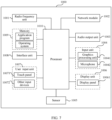
- FIG. 7 is a schematic diagram of a hardware structure of an electronic device according to an embodiment of this application.
- the electronic device 1000 includes but is not limited to components such as a radio frequency unit 1001, a network module 1002, an audio output unit 1003, an input unit 1004, a sensor 1005, a display unit 1006, a user input unit 1007, an interface unit 1008, a memory 1009, and a processor 1010.
- the electronic device 1000 may further include a power supply (for example, a battery) supplying power to all components, and the power supply may be logically connected to the processor 1010 through a power management system. In this way, functions such as charge management, discharge management, and power consumption management are implemented by using the power management system.
- a power supply for example, a battery
- functions such as charge management, discharge management, and power consumption management are implemented by using the power management system.
- the structure of the electronic device shown in FIG. 7 does not constitute any limitation on the electronic device.
- the electronic device may include more or fewer components than shown in the figure, or a combination of some components, or the components disposed differently. Details are not repeated herein.
- the display unit 1006 may be configured to display a first image and a target control.
- the user input unit 1007 may be configured to receive a first input to the target control by a user.
- the processor 1010 may be configured to: in response to the first input received by the user input unit 1007, adjust the first image to a target effect corresponding to the first input; where the target control is used for adjusting color or light shadow.
- the target control may be used for adjusting color.
- the processor 1010 may be further configured to: obtain a type of the first image before adjusting the first image to the target effect corresponding to the first input.
- the processor 1010 may be further configured to: in a case that the first image is of a first type, adjust, in a first manner, the first image to a first effect corresponding to the first input.
- the processor 1010 may be further configured to: in a case that the first image is of a second type, adjust, in a second manner, the first image to a second effect corresponding to the first input.
- the processor 1010 may be further configured to: determine a preset channel of the first image.
- the processor 1010 may be specifically configured to: adjust a first color of the preset channel to a first target color value corresponding to the first input.
- the processor 1010 may be specifically configured to: adjust a second color of the first image to a second target color value corresponding to the first input.
- the first effect may be indicated by the first target color value and the second target color value.
- the preset channel includes a first channel, a second channel, and a third channel.
- the processor 1010 may be specifically configured to adjust at least one of the following: adjusting the first color of the first channel to a first sub-color value corresponding to the first channel in the first target color value; adjusting the first color of the second channel to a second sub-color value corresponding to the second channel in the first target color value; and adjusting the first color of the third channel to a third sub-color value corresponding to the third channel in the first target color value.
- the processor 1010 may be specifically configured to: determine a main color channel, an auxiliary color channel, and a variegated color channel of the first image.
- the processor 1010 may be specifically configured to: adjust a third color of a target channel to a third target color value corresponding to the first input, where the target channel is the main color channel or the variegated color channel.
- the processor 1010 may be specifically configured to: adjust a third color of the auxiliary color channel to a fourth target color value corresponding to the first input.
- the processor 1010 may be specifically configured to: adjust a fourth color of the first image to a fifth target color value corresponding to the first input.
- the second effect may be indicated by the third target color value, the fourth target color value, and the fifth target color value.
- the processor 1010 may be specifically configured to: determine a target color temperature adjustment amount corresponding to a target hue range in two color temperature adjustment amounts corresponding to the first input, where the target hue range is a hue range in which a hue of a main color of the first image is located.
- the processor 1010 may be specifically configured to: adjust a color temperature of the first image based on the target color temperature adjustment amount. The second effect is indicated by an after-adjustment color temperature of the first image.
- the processor 1010 may be specifically configured to: determine a main color and an auxiliary color of the first image.
- the processor 1010 may be specifically configured to: determine all unit color channels corresponding to a first preset angle range in a color wheel as the main color channel, where a center of the first preset angle range coincides with a first position of the main color in the color wheel.
- the processor 1010 may be specifically configured to: determine all unit color channels corresponding to a second preset angle range in the color wheel as the auxiliary color channel, where a center of the second preset angle range coincides with a second position of the auxiliary color in the color wheel.
- the processor 1010 may be specifically configured to: determine an unit color channel other than the main color channel and the auxiliary color channel in the color wheel as the variegated color channel.
- the processor 1010 may be specifically configured to: determine a color with a largest sum of saturation and brightness in colors of the first image as the main color.
- the processor 1010 may be specifically configured to: determine at least one color region in the first image based on the main color and the color wheel, where each color region corresponds to one color, and an included angle between a position of the color corresponding to each color region in the color wheel and the first position is greater than or equal to a preset angle.
- the processor 1010 may be specifically configured to: determine a color corresponding to a color region with a largest area in the at least one color region as the auxiliary color.
- the electronic device based on an input on a control for adjusting color or light shadow by the user, the electronic device can adjust a displayed image to an effect corresponding to an input. That is, when the electronic device performs processing on the image, the color or light shadow effect of the image can be adjusted through only one input by the user, thereby simplifying the image processing process.
- the input unit 1004 may include a graphics processing unit (Graphics Processing Unit, GPU) 10041 and a microphone 10042.
- the graphics processing unit 10041 processes image data of a still picture or video obtained by an image capture apparatus (such as a camera) in a video capture mode or an image capture mode.
- the display unit 1006 may include a display panel 10061, and the display panel 10061 may be configured in a form of a liquid crystal display, an organic light-emitting diode, and the like.
- the user input unit 1007 may include at least one of a touch panel 10071 and other input devices 10072.
- the touch panel 10071 is also referred to as a touchscreen.
- the touch panel 10071 may include two parts: a touch detection apparatus and a touch controller.
- the other input devices 10072 may include but are not limited to a physical keyboard, a function key (such as a volume control key or a power on/off key), a trackball, a mouse, a joystick, and the like. Details are not described herein.
- the memory 1009 may be configured to store software programs and various data.
- the memory 1009 may include a first storage area for storing a program or instructions and a second storage area for storing data.
- the first storage area may store an operating system, an application program or instruction required by at least one function (for example, a sound playback function or an image playback function), and the like.
- the memory 1009 may include a volatile memory or a non-volatile memory, or the memory 1009 may include both a volatile memory and a non-volatile memory.
- the non-volatile memory may be a read-only memory (Read-Only Memory, ROM), a programmable read only memory (Programmable ROM, PROM), an erasable programmable read-only memory (Erasable PROM, EPROM), and an electrically erasable programmable read-only memory (Electrically EPROM, EEPROM), or flash memory.
- ROM Read-Only Memory
- PROM programmable read only memory
- Erasable PROM Erasable PROM
- EPROM erasable programmable read-only memory
- Electrically erasable programmable read-only memory Electrically erasable programmable read-only memory
- the volatile memory can be a random access memory (Random Access Memory, RAM), a static random access memory (Static RAM, SRAM), a dynamic random access memory (Dynamic RAM, DRAM), a synchronous dynamic random access memory (Synchronous DRAM, SDRAM), a double data rate synchronous dynamic random access memory (Double Data Rate SDRAM, DDRSDRAM), an enhanced synchronous dynamic random access memory (Enhanced SDRAM, ESDRAM), a synchlink dynamic random access memory (Synch link DRAM, SLDRAM), and a direct rambus random access memory (Direct Rambus RAM, DRRAM).
- RAM Random Access Memory
- SRAM static random access memory
- DRAM dynamic random access memory
- DRAM synchronous dynamic random access memory
- SDRAM double data rate synchronous dynamic random access memory
- Enhanced SDRAM, ESDRAM enhanced synchronous dynamic random access memory
- Synch link DRAM, SLDRAM synchlink dynamic random access memory
- Direct Rambus RAM Direct Rambus RAM
- the processor 1010 may include one or more processing units.
- an application processor and a modem processor may be integrated in the processor 1010.
- the application processor primarily processes operations involving an operating system, user interfaces, application programs, and the like.
- the modem processor primarily processes radio communication signals, for example, being a baseband processor. It can be understood that the modem processor may alternatively be not integrated in the processor 1010.
- An embodiment of this application further provides a readable storage medium, where a program or an instruction is stored in the readable storage medium.
- a program or an instruction is stored in the readable storage medium.
- the processor is a processor in the electronic device described in the foregoing embodiments.
- the readable storage medium includes a computer-readable storage medium, for example, a computer read only memory ROM, a random access memory RAM, a magnetic disk, or an optical disc.
- An embodiment of this application further provides a chip, where the chip includes a processor and a communication interface.
- the communication interface is coupled to the processor, and the processor is configured to run a program or an instruction to implement the processes of the foregoing embodiment of the image processing method, with the same technical effects achieved. To avoid repetition, details are not described herein again.
- the chip mentioned in the embodiments of this application may also be referred to as a system-level chip, a system chip, a chip system, a system-on-chip, or the like.
- An embodiment of this application provides a computer program product, where the program product is stored in a storage medium, and the program product is executed by at least one processor to implement the processes of the foregoing image processing method embodiments, with the same technical effects achieved. To avoid repetition, details are not repeated herein.
- the computer software product is stored in a storage medium (such as a ROM/RAM, a magnetic disk, or an optical disc), and includes several instructions for instructing a terminal (which may be a mobile phone, a computer, a server, a network device, or the like) to perform the methods described in the embodiments of this application.
- a storage medium such as a ROM/RAM, a magnetic disk, or an optical disc
Landscapes
- Engineering & Computer Science (AREA)
- Theoretical Computer Science (AREA)
- Physics & Mathematics (AREA)
- General Physics & Mathematics (AREA)
- General Engineering & Computer Science (AREA)
- Multimedia (AREA)
- Human Computer Interaction (AREA)
- Signal Processing (AREA)
- Computer Vision & Pattern Recognition (AREA)
- Software Systems (AREA)
- Image Processing (AREA)
Applications Claiming Priority (2)
| Application Number | Priority Date | Filing Date | Title |
|---|---|---|---|
| CN202111639868.2A CN114327166B (zh) | 2021-12-29 | 2021-12-29 | 图像处理方法、装置、电子设备及可读存储介质 |
| PCT/CN2022/140408 WO2023125160A1 (zh) | 2021-12-29 | 2022-12-20 | 图像处理方法、装置、电子设备及可读存储介质 |
Publications (2)
| Publication Number | Publication Date |
|---|---|
| EP4451098A1 true EP4451098A1 (de) | 2024-10-23 |
| EP4451098A4 EP4451098A4 (de) | 2025-02-26 |
Family
ID=81016681
Family Applications (1)
| Application Number | Title | Priority Date | Filing Date |
|---|---|---|---|
| EP22914414.2A Pending EP4451098A4 (de) | 2021-12-29 | 2022-12-20 | Bildverarbeitungsverfahren und -vorrichtung, elektronische vorrichtung und lesbares speichermedium |
Country Status (4)
| Country | Link |
|---|---|
| US (1) | US20240346726A1 (de) |
| EP (1) | EP4451098A4 (de) |
| CN (1) | CN114327166B (de) |
| WO (1) | WO2023125160A1 (de) |
Families Citing this family (3)
| Publication number | Priority date | Publication date | Assignee | Title |
|---|---|---|---|---|
| CN114327166B (zh) * | 2021-12-29 | 2025-02-07 | 维沃移动通信有限公司 | 图像处理方法、装置、电子设备及可读存储介质 |
| CN115984128B (zh) * | 2022-12-14 | 2026-02-03 | 集睿致远(厦门)科技有限公司 | 一种图像色相调整方法、装置、计算设备及存储介质 |
| CN120186461A (zh) * | 2025-03-04 | 2025-06-20 | 华为技术有限公司 | 一种图像获取方法及电子设备 |
Family Cites Families (14)
| Publication number | Priority date | Publication date | Assignee | Title |
|---|---|---|---|---|
| JP4684595B2 (ja) * | 2004-08-05 | 2011-05-18 | ソニー株式会社 | 画像表示装置 |
| US20060053374A1 (en) * | 2004-09-07 | 2006-03-09 | Adobe Systems Incorporated | Localization of activity with respect to digital data |
| EP2114065B1 (de) * | 2008-05-02 | 2017-08-23 | Nintendo Co., Ltd. | Farbumwandlungsvorrichtung, Bildgebungsvorrichtung, Speichermedium, das das Farbumwandlungsprogramm speichert und Speichermedium, das das Bildgebungsprogramm speichert |
| US20110141321A1 (en) * | 2009-12-16 | 2011-06-16 | General Instrument Corporation | Method and apparatus for transforming a lens-distorted image to a perspective image in bayer space |
| US8675009B2 (en) * | 2010-07-20 | 2014-03-18 | Apple Inc. | Keying an image in three dimensions |
| US9299168B2 (en) * | 2012-03-06 | 2016-03-29 | Apple Inc. | Context aware user interface for image editing |
| CN109427036B (zh) * | 2017-08-22 | 2022-09-30 | 北京搜狗科技发展有限公司 | 皮肤颜色的处理方法和装置 |
| CN110865856B (zh) * | 2018-08-27 | 2022-04-22 | 华为技术有限公司 | 一种界面元素颜色显示方法及装置 |
| CN109191403A (zh) * | 2018-09-07 | 2019-01-11 | Oppo广东移动通信有限公司 | 图像处理方法和装置、电子设备、计算机可读存储介质 |
| CN109447958B (zh) * | 2018-10-17 | 2023-04-14 | 腾讯科技(深圳)有限公司 | 图像处理方法、装置、存储介质及计算机设备 |
| CN111885298B (zh) * | 2020-06-19 | 2022-05-17 | 维沃移动通信有限公司 | 图像处理方法及装置 |
| CN111654635A (zh) * | 2020-06-30 | 2020-09-11 | 维沃移动通信有限公司 | 拍摄参数调节方法、装置及电子设备 |
| CN112269522A (zh) * | 2020-10-27 | 2021-01-26 | 维沃移动通信(杭州)有限公司 | 图像处理方法、装置、电子设备和可读存储介质 |
| CN114327166B (zh) * | 2021-12-29 | 2025-02-07 | 维沃移动通信有限公司 | 图像处理方法、装置、电子设备及可读存储介质 |
-
2021
- 2021-12-29 CN CN202111639868.2A patent/CN114327166B/zh active Active
-
2022
- 2022-12-20 EP EP22914414.2A patent/EP4451098A4/de active Pending
- 2022-12-20 WO PCT/CN2022/140408 patent/WO2023125160A1/zh not_active Ceased
-
2024
- 2024-06-25 US US18/753,347 patent/US20240346726A1/en active Pending
Also Published As
| Publication number | Publication date |
|---|---|
| US20240346726A1 (en) | 2024-10-17 |
| EP4451098A4 (de) | 2025-02-26 |
| CN114327166B (zh) | 2025-02-07 |
| CN114327166A (zh) | 2022-04-12 |
| WO2023125160A1 (zh) | 2023-07-06 |
Similar Documents
| Publication | Publication Date | Title |
|---|---|---|
| EP4451098A1 (de) | Bildverarbeitungsverfahren und -vorrichtung, elektronische vorrichtung und lesbares speichermedium | |
| CN111654635A (zh) | 拍摄参数调节方法、装置及电子设备 | |
| US20210343070A1 (en) | Method, apparatus and electronic device for processing image | |
| US10847073B2 (en) | Image display optimization method and apparatus | |
| US20080317376A1 (en) | Automatic image correction providing multiple user-selectable options | |
| US12501149B2 (en) | Image shooting method and apparatus, electronic device, and readable storage medium | |
| US20210176392A1 (en) | Image shooting method and device, terminal, and storage medium | |
| CN111901519B (zh) | 屏幕补光方法、装置及电子设备 | |
| CN112637515B (zh) | 拍摄方法、装置和电子设备 | |
| WO2023045857A1 (zh) | 图像处理方法、装置、电子设备及存储介质 | |
| US20240273909A1 (en) | Camera shooting parameter adjustment method and apparatus, and electronic device | |
| WO2023088183A1 (zh) | 图像显示方法、装置及电子设备 | |
| KR102215607B1 (ko) | 어두운 이미지의 밝기를 개선하기 위한 보정 처리가 가능한 전자 장치 및 그 동작 방법 | |
| CN114242023A (zh) | 显示屏亮度调节方法、显示屏亮度调节装置和电子设备 | |
| CN114758054A (zh) | 光斑添加方法、装置、设备及存储介质 | |
| CN112541955A (zh) | 图像处理方法、装置及设备 | |
| EP2284800A1 (de) | Verfahren und System zum Erzeugen eines Bildes | |
| CN112269522A (zh) | 图像处理方法、装置、电子设备和可读存储介质 | |
| CN112419218B (zh) | 图像处理方法、装置及电子设备 | |
| US11232616B2 (en) | Methods and systems for performing editing operations on media | |
| US20050219259A1 (en) | Color correction of images while maintaining constant luminance | |
| CN115514860A (zh) | 动态帧率补偿方法、图像处理电路和电子设备 | |
| CN112312021B (zh) | 拍摄参数调整方法及装置 | |
| CN115589526A (zh) | 拍摄方法及装置 | |
| CN115797160A (zh) | 图像的生成方法及其装置 |
Legal Events
| Date | Code | Title | Description |
|---|---|---|---|
| STAA | Information on the status of an ep patent application or granted ep patent |
Free format text: STATUS: THE INTERNATIONAL PUBLICATION HAS BEEN MADE |
|
| PUAI | Public reference made under article 153(3) epc to a published international application that has entered the european phase |
Free format text: ORIGINAL CODE: 0009012 |
|
| STAA | Information on the status of an ep patent application or granted ep patent |
Free format text: STATUS: REQUEST FOR EXAMINATION WAS MADE |
|
| 17P | Request for examination filed |
Effective date: 20240715 |
|
| AK | Designated contracting states |
Kind code of ref document: A1 Designated state(s): AL AT BE BG CH CY CZ DE DK EE ES FI FR GB GR HR HU IE IS IT LI LT LU LV MC ME MK MT NL NO PL PT RO RS SE SI SK SM TR |
|
| A4 | Supplementary search report drawn up and despatched |
Effective date: 20250124 |
|
| RIC1 | Information provided on ipc code assigned before grant |
Ipc: H04N 23/63 20230101ALI20250120BHEP Ipc: H04N 9/73 20230101ALI20250120BHEP Ipc: G06T 11/60 20060101ALI20250120BHEP Ipc: G06T 11/00 20060101ALI20250120BHEP Ipc: G06T 7/90 20170101ALI20250120BHEP Ipc: G06F 3/04847 20220101ALI20250120BHEP Ipc: G06F 3/04845 20220101ALI20250120BHEP Ipc: G06F 3/0481 20220101AFI20250120BHEP |
|
| DAV | Request for validation of the european patent (deleted) | ||
| DAX | Request for extension of the european patent (deleted) |