EP4450100A1 - Mécanisme pour un dispositif d'administration automatique de médicament - Google Patents
Mécanisme pour un dispositif d'administration automatique de médicament Download PDFInfo
- Publication number
- EP4450100A1 EP4450100A1 EP23168610.6A EP23168610A EP4450100A1 EP 4450100 A1 EP4450100 A1 EP 4450100A1 EP 23168610 A EP23168610 A EP 23168610A EP 4450100 A1 EP4450100 A1 EP 4450100A1
- Authority
- EP
- European Patent Office
- Prior art keywords
- dose
- housing
- respect
- button
- stop
- Prior art date
- Legal status (The legal status is an assumption and is not a legal conclusion. Google has not performed a legal analysis and makes no representation as to the accuracy of the status listed.)
- Withdrawn
Links
Images








Classifications
-
- A—HUMAN NECESSITIES
- A61—MEDICAL OR VETERINARY SCIENCE; HYGIENE
- A61M—DEVICES FOR INTRODUCING MEDIA INTO, OR ONTO, THE BODY; DEVICES FOR TRANSDUCING BODY MEDIA OR FOR TAKING MEDIA FROM THE BODY; DEVICES FOR PRODUCING OR ENDING SLEEP OR STUPOR
- A61M5/00—Devices for bringing media into the body in a subcutaneous, intra-vascular or intramuscular way; Accessories therefor, e.g. filling or cleaning devices, arm rests
- A61M5/178—Syringes
- A61M5/31—Details
- A61M5/315—Pistons; Piston-rods; Guiding, blocking or restricting the movement of the rod or piston; Appliances on the rod for facilitating dosing ; Dosing mechanisms
- A61M5/31533—Dosing mechanisms, i.e. setting a dose
- A61M5/31545—Setting modes for dosing
- A61M5/31548—Mechanically operated dose setting member
- A61M5/3155—Mechanically operated dose setting member by rotational movement of dose setting member, e.g. during setting or filling of a syringe
- A61M5/31551—Mechanically operated dose setting member by rotational movement of dose setting member, e.g. during setting or filling of a syringe including axial movement of dose setting member
-
- A—HUMAN NECESSITIES
- A61—MEDICAL OR VETERINARY SCIENCE; HYGIENE
- A61M—DEVICES FOR INTRODUCING MEDIA INTO, OR ONTO, THE BODY; DEVICES FOR TRANSDUCING BODY MEDIA OR FOR TAKING MEDIA FROM THE BODY; DEVICES FOR PRODUCING OR ENDING SLEEP OR STUPOR
- A61M5/00—Devices for bringing media into the body in a subcutaneous, intra-vascular or intramuscular way; Accessories therefor, e.g. filling or cleaning devices, arm rests
- A61M5/178—Syringes
- A61M5/20—Automatic syringes, e.g. with automatically actuated piston rod, with automatic needle injection, filling automatically
- A61M5/2033—Spring-loaded one-shot injectors with or without automatic needle insertion
-
- A—HUMAN NECESSITIES
- A61—MEDICAL OR VETERINARY SCIENCE; HYGIENE
- A61M—DEVICES FOR INTRODUCING MEDIA INTO, OR ONTO, THE BODY; DEVICES FOR TRANSDUCING BODY MEDIA OR FOR TAKING MEDIA FROM THE BODY; DEVICES FOR PRODUCING OR ENDING SLEEP OR STUPOR
- A61M5/00—Devices for bringing media into the body in a subcutaneous, intra-vascular or intramuscular way; Accessories therefor, e.g. filling or cleaning devices, arm rests
- A61M5/178—Syringes
- A61M5/31—Details
- A61M5/315—Pistons; Piston-rods; Guiding, blocking or restricting the movement of the rod or piston; Appliances on the rod for facilitating dosing ; Dosing mechanisms
- A61M5/31501—Means for blocking or restricting the movement of the rod or piston
-
- A—HUMAN NECESSITIES
- A61—MEDICAL OR VETERINARY SCIENCE; HYGIENE
- A61M—DEVICES FOR INTRODUCING MEDIA INTO, OR ONTO, THE BODY; DEVICES FOR TRANSDUCING BODY MEDIA OR FOR TAKING MEDIA FROM THE BODY; DEVICES FOR PRODUCING OR ENDING SLEEP OR STUPOR
- A61M5/00—Devices for bringing media into the body in a subcutaneous, intra-vascular or intramuscular way; Accessories therefor, e.g. filling or cleaning devices, arm rests
- A61M5/178—Syringes
- A61M5/31—Details
- A61M5/315—Pistons; Piston-rods; Guiding, blocking or restricting the movement of the rod or piston; Appliances on the rod for facilitating dosing ; Dosing mechanisms
- A61M5/31525—Dosing
- A61M5/31528—Dosing by means of rotational movements, e.g. screw-thread mechanisms
-
- A—HUMAN NECESSITIES
- A61—MEDICAL OR VETERINARY SCIENCE; HYGIENE
- A61M—DEVICES FOR INTRODUCING MEDIA INTO, OR ONTO, THE BODY; DEVICES FOR TRANSDUCING BODY MEDIA OR FOR TAKING MEDIA FROM THE BODY; DEVICES FOR PRODUCING OR ENDING SLEEP OR STUPOR
- A61M5/00—Devices for bringing media into the body in a subcutaneous, intra-vascular or intramuscular way; Accessories therefor, e.g. filling or cleaning devices, arm rests
- A61M5/178—Syringes
- A61M5/31—Details
- A61M5/315—Pistons; Piston-rods; Guiding, blocking or restricting the movement of the rod or piston; Appliances on the rod for facilitating dosing ; Dosing mechanisms
- A61M5/31533—Dosing mechanisms, i.e. setting a dose
- A61M5/31535—Means improving security or handling thereof, e.g. blocking means, means preventing insufficient dosing, means allowing correction of overset dose
- A61M5/31541—Means preventing setting of a dose beyond the amount remaining in the cartridge
-
- A—HUMAN NECESSITIES
- A61—MEDICAL OR VETERINARY SCIENCE; HYGIENE
- A61M—DEVICES FOR INTRODUCING MEDIA INTO, OR ONTO, THE BODY; DEVICES FOR TRANSDUCING BODY MEDIA OR FOR TAKING MEDIA FROM THE BODY; DEVICES FOR PRODUCING OR ENDING SLEEP OR STUPOR
- A61M5/00—Devices for bringing media into the body in a subcutaneous, intra-vascular or intramuscular way; Accessories therefor, e.g. filling or cleaning devices, arm rests
- A61M5/178—Syringes
- A61M5/31—Details
- A61M5/315—Pistons; Piston-rods; Guiding, blocking or restricting the movement of the rod or piston; Appliances on the rod for facilitating dosing ; Dosing mechanisms
- A61M5/31533—Dosing mechanisms, i.e. setting a dose
- A61M5/31545—Setting modes for dosing
- A61M5/31548—Mechanically operated dose setting member
- A61M5/31561—Mechanically operated dose setting member using freely adjustable volume steps
-
- A—HUMAN NECESSITIES
- A61—MEDICAL OR VETERINARY SCIENCE; HYGIENE
- A61M—DEVICES FOR INTRODUCING MEDIA INTO, OR ONTO, THE BODY; DEVICES FOR TRANSDUCING BODY MEDIA OR FOR TAKING MEDIA FROM THE BODY; DEVICES FOR PRODUCING OR ENDING SLEEP OR STUPOR
- A61M5/00—Devices for bringing media into the body in a subcutaneous, intra-vascular or intramuscular way; Accessories therefor, e.g. filling or cleaning devices, arm rests
- A61M5/178—Syringes
- A61M5/31—Details
- A61M5/315—Pistons; Piston-rods; Guiding, blocking or restricting the movement of the rod or piston; Appliances on the rod for facilitating dosing ; Dosing mechanisms
- A61M5/31565—Administration mechanisms, i.e. constructional features, modes of administering a dose
- A61M5/31576—Constructional features; Drive mechanisms or modes for piston rods
- A61M5/31578—Constructional features; Drive mechanisms or modes for piston rods the piston rod being moved by the axial movement of a component directly in contact with it
- A61M5/3158—Constructional features; Drive mechanisms or modes for piston rods the piston rod being moved by the axial movement of a component directly in contact with it the component being manually operated or triggered by an axially moving actuator operated by user, e.g. an axially movable injection button
Definitions
- the present disclosure relates to a mechanism for an automatic medicament delivery device and a medicament delivery device having the mechanism.
- Medicament delivery devices such as injection devices, are used to deliver a liquid medicament to a patient.
- Such medicament delivery devices usually comprise a medicament container holding the medicament and a mechanism configured to expel a predefined dose of medicament from that container.
- the medicament container usually comprises a movable plunger, which plunger seals the medicament container and which plunger is moved in a proximal direction towards the injection site to expel the medicament from the container.
- the mechanism usually comprises a piston rod that acts on the plunger by moving the plunger in the proximal direction. The dose to be delivered then is defined by the axial movement of the piston rod and the plunger within the medicament container.
- the force to cause axial movement of the plunger is entirely provided by an energy storage of the mechanism and the dose of medicament is automatically delivered once a user has triggered the mechanism for dose delivery.
- such mechanisms comprise a release element, such as a button, that is actuated by a user to trigger dose delivery.
- Some types of automatic medicament delivery devices provide a dose setting functionality that prepares the device for automatic injection by storing energy in the energy storage and by defining the amount of medicament to be delivered during dose delivery. Such devices thereby may be configured as fixed dose devices that allow only a single dose or amount of medicament to be set, or they may be configured as variable dose devices that allow a user to select from a multitude of predefined doses, such as from two or more predefined doses.
- Document WO 2020/015980 A1 describes, inter alia, an automatic medicament delivery device that has a knob provided at a distal end of the device, which knob is configured for dose setting and for triggering dose delivery.
- a user of the device rotates the knob. This causes the knob to move distally away from the housing of the device by a distance that is proportional to the set dose.
- rotation of the knob strains a torsion spring provided within the device.
- the user pushes the knob in the proximal direction. This causes the spring to relax and to thereby drive dose delivery. During dose delivery, the knob moves back towards the housing by the distance it previously had been traveled away from the housing during dose setting.
- the device described in document WO 2020/015980 A1 thus comprises movable components, such as the knob, that are accessible to a user of the device and that have to move during dose delivery. This entails the risk that a user may interfere with these components during dose delivery and thereby may disturb medicament delivery.
- the device described in document WO 2020/015980 A1 comprises a single actuation member in the form of the knob that is used for both dose setting and for initiating automatic dose delivery. This may complicate the use of the device since the user has to avoid to inadvertently trigger dose delivery by pushing the knob when trying to change the dose setting.
- the present disclosure provides a mechanism for an automatic medicament delivery device and a medicament delivery device. Embodiments are given in the dependent claims, the description and the drawings.
- the present disclosure is directed at a mechanism for an automatic medicament delivery device comprising a housing; a dose setting element; a button; a piston rod that is rotationally fixed and axially movable with respect to the housing; a nut; and a spring.
- the dose setting element is configured to be gripped by a user of the device to set a dose to be delivered by rotation of the dose setting element with respect to the housing when the mechanism is in a dose setting state, wherein the rotation of the dose setting element stores energy in the spring.
- the rotation of the dose setting element causes the nut to move by a dose distance in a proximal direction with respect to the piston rod, the dose distance being proportional to the dose.
- the mechanism further is configured to switch from the dose setting state into a dose delivery state upon moving the button, for example in an axial direction, with respect to the housing.
- a transfer into the dose delivery state couples the spring to the nut to cause automatic movement of the nut in a proximal direction by releasing the energy stored during dose setting.
- the piston rod thereby is configured to move together with the nut by the dose distance in the proximal direction to deliver the dose when the mechanism is in the dose delivery state.
- the dose setting element and the button are movable with respect to each other.
- the dose setting element and the button being movable with respect to each other allows to clearly separate the rotation of the dose setting element for setting the dose during dose setting from the movement of the button to transfer the mechanism to the dose delivery state.
- the button may be configured to axially move with respect to the dose setting element upon transfer from the dose setting state to the dose delivery state.
- the button is axially movable with respect to the dose setting element and the button is rotationally fixed with respect to the dose setting element.
- the dose setting element is axially fixed with respect to the housing during dose setting and during dose delivery.
- the mechanism further comprises a dosing member, wherein the dosing member is configured to rotate with respect to the housing during dose setting and to rotate with respect to the housing during dose delivery and wherein a rotational position of the dosing member defines the dose.
- the dosing member comprises a first part and a second part, wherein the first part is axially movable and rotationally fixed with respect to the second part.
- the first part comprises one of a dose stop and a counter element of a dose definition mechanism and/or the second part comprises a label to visually indicate setting of the dose.
- the mechanism comprises a dose definition mechanism, wherein the dose definition mechanism acts between the dose setting element and the housing during dose setting.
- the dose definition mechanism has at least one dose stop and a counter element, wherein the counter element is configured to rotate with respect to the dose stop when the dose setting element rotates during dose setting and wherein the counter element is configured to engage the dose stop when the dose has been set.
- One of the dose stop and the counter element is axially fixed to the button and the other one of the dose stop and the counter element is axially fixed to the housing.
- the one of the dose stop and the counter element is located radially inward from the other one of the dose stop and the counter element.
- the one of the dose stop and the counter element is rotationally movable with respect to the housing.
- the other one of the dose stop and the counter element may be rotationally fixed with respect to the housing.
- the one of the dose stop and the counter element is rotationally fixed with respect to the housing.
- the other one of the dose stop and the counter element may be rotationally movable with respect to the housing.
- the one of the dose stop and the counter element is fixed to a dose selector, wherein the dose selector is axially movable and rotationally fixed to the housing and wherein the dose selector is completely located in an interior of the mechanism.
- the dose selector may be completely surrounded by other members of the mechanism.
- the mechanism further comprises a clutch, wherein the clutch rotationally locks the nut to the piston rod during dose delivery and rotationally releases the nut from the piston rod during dose setting and wherein the clutch has a first engaging part that is rotationally fixed to the housing and a second engaging part that is rotationally fixed to the button. The first engaging part is axially fixed to the housing.
- the mechanism comprises a further clutch, wherein the further clutch rotationally locks the dose setting element to one end of the spring during dose setting and decouples the dose setting element from the one end of the spring during dose delivery.
- the further clutch has a further first engaging part and a further second engaging part, wherein the further first engaging part is configured to move into engagement with the further second engaging part to rotationally lock the dose setting element to the one end of the spring.
- One of the further first engaging part and the further second engaging part is rotationally and axially fixed to the dose setting element and rotationally and axially movable with respect to the button.
- the further clutch is located within the dosing member.
- the dose setting element may be configured to remain axially stationary with respect to the housing when the dose is being delivered.
- the mechanism for an automatic medicament delivery device then provides a dose setting element that is not required to axially move during dose delivery and therefore reduces the risk of a user of the device interfering with components that move during automatic medicament delivery. This provides a user-friendly and safe mechanism.
- the dose setting element may however be axially movable with respect to the housing.
- the dose setting element may be configured to axially move upon triggering automatic injection and/or upon interrupting automatic injection.
- delivery of the dose may already start while the dose setting element is still moved into its fully triggered position and/or delivery of the dose may still last while the dose setting element is starting to move away from the fully triggered position to interrupt automatic injection.
- the dose setting element being configured to remain axially stationary with respect to the housing when the piston rod moves in the proximal direction to deliver the dose thus encompasses that the dose setting element is configured to remain axially stationary with respect to the housing during at least a part of the movement of the piston rod in the proximal direction during dose delivery.
- the mechanism having a nut that is moved with respect to the piston rod in a distal direction during dose setting and moves with the piston rod in the proximal direction during dose delivery provides a mechanically simple and compact actuation arrangement for the piston rod.
- the dose setting element may comprise a gripping surface that is configured to be gripped by the user.
- the gripping surface may be an outer surface of the dose setting element.
- the gripping surface may be configured as a structured surface to enhance friction upon gripping the dose setting element.
- the gripping surface may comprise grooves and/or ridges.
- the dose setting element may comprise a cylindrical shape.
- the gripping surface may be an outer cylindrical surface and/or an outer circumferential surface of the dose setting element.
- the dose setting element may be configured to be rotated around a longitudinal axis of the mechanism during dose setting.
- the mechanism may be configured to provide a force from the spring during dose delivery that is sufficient to automatically deliver the set dose. Such a mechanism does not rely on a force that is provided by a user of the mechanism to advance the piston rod.
- the mechanism may be configured to prevent a force exerted by a user onto the button during dose delivery from being transferred to the piston rod.
- the spring may be indirectly coupled to the nut in the dose delivery state, for example by one or more intermediate members. These intermediate members may be configured to convert a torque provided by the spring to axial movement of the nut.
- the intermediate member or one of the intermediate members may be configured to axially push upon the nut during dose delivery.
- the intermediate member may be formed by a driver of the mechanism.
- the housing may form an outer housing or outer enclosure of the mechanism. It may comprise a single component or several components that are permanently fixed to each other.
- the housing may surround at least parts of the mechanism.
- the housing may have an elongated shape that extends along the longitudinal axis. It may have a generally cylindrical shape.
- the piston rod may also extend along the longitudinal axis.
- the mechanism may comprise a dose definition mechanism that allows a user of the device to set at least one dose of medicament for delivery.
- the dose definition mechanism may be configured to allow only a single predetermined dose to be set.
- the dose definition mechanism may also be configured to allow a multitude of differing predetermined doses to be set by the user, such as two or more differing doses.
- the mechanism may be configured as a single-use mechanism that allows to set a dose only once and subsequently prevents a user from setting and delivering further doses.
- the mechanism may also be configured as a multi-use mechanism that allows to repeatedly set doses for delivery.
- the housing may be configured to connect to a medicament container that contains the medicament to be delivered.
- the housing may have a connector that allows attachment of a separate container holder comprising the medicament container to the housing.
- the connector may be, for example, configured as a form fit, such as a snap-fit connector or a threaded connector, or as an adhesive bond, such as a welded or glued connection.
- the housing may also connect to the medicament container by comprising a container holder that is integrally formed with housing sections that comprise other components of the mechanism, such as a piston rod guide.
- the dose delivery mechanism may comprise a bearing that is configured to directly contact the plunger of the attached medicament container.
- the bearing may be located at the piston rod. Thereby, it may be integrally formed with the piston rod. Alternatively, it may be configured as a separate component, like a disc, that is located in between the piston rod and the plunger.
- the bearing may be attached to the piston rod.
- the mechanism may be configured as a disposable mechanism that is disposed of after ejecting a last dose from the medicament container attached to the mechanism.
- the mechanism may also be configured as a reusable mechanism that allows attachment of a new medicament container after having ejected a last dose from a previous container.
- the dose setting element and the button may form elements of an actuation unit of the mechanism.
- the dose setting element and the button may be placed next to each other.
- the dose setting element and the button may be located at a distal end of the mechanism.
- the button may terminate the mechanism at its distal end.
- the button may be axially movable with respect to the housing.
- the button thereby may be biased in a distal direction with respect to the housing.
- the mechanism may comprise a biasing element, such as a spring, for example a compression spring, that biases the button in the distal direction with respect to the housing.
- the dose setting element and the button are fixed with respect to each other during dose setting and dose delivery.
- This provides a simple and compact construction of the button and the dose setting element.
- the button and the dose setting element may be integrally formed.
- the button and the dose setting element may be configured as separate components that are fixed to each other, either directly or via one or more intermediate components.
- the dose setting element and the button are movable with respect to each other. This allows to clearly separate the rotation of the dose setting element for setting the dose during dose setting from the movement of the button to transfer the mechanism to the dose delivery state.
- the button may be configured to axially move with respect to the dose setting element upon transfer from the dose setting state to the dose delivery state.
- the button is axially movable with respect to the dose setting element and rotationally fixed with respect to the dose setting element.
- the button may be configured to follow the rotation of the dose setting element during dose setting and at the same time it may be configured to axially move with respect to the dose setting element to transfer the mechanism into the dose delivery state. Following the rotation of the dose setting element during dose setting facilitates setting of the dose, for example with embodiments in which the dose setting element and the button are placed next to each other.
- the dose setting element is rotationally fixed with respect to the housing when the dose is being delivered.
- the mechanism may, for example, comprise a clutch that rotationally fixes the dose setting element to the housing during dose delivery and rotationally releases the dose setting element from the housing during dose setting.
- the clutch may, for example, be configured to close upon movement of the button, such as upon axial movement of the button.
- the dose setting element is axially fixed with respect to the housing during dose setting and during dose delivery. This provides a user-friendly design since such a dose setting element has a reduced number of motional degrees of freedom.
- the button is configured to remain axially stationary with respect to the housing when the piston rod moves in the proximal direction to deliver the dose. This reduces the risk of a user of the device interfering with components that move during automatic medicament delivery and provides a user-friendly and safe mechanism.
- Delivery of the medicament may not require axial movement of the button after having transferred the mechanism to the dose delivery state. Furthermore, delivery of the dose may already start while the button is still moved into its fully triggered position and/or delivery of the dose may still last while the button is starting to move back from its fully triggered position, for example to interrupt automatic injection.
- the button being configured to remain axially stationary with respect to the housing when the piston rod moves in the proximal direction to deliver the dose thus encompasses that the button is configured to remain axially stationary with respect to the housing during at least a part of the movement of the piston rod in the proximal direction during dose delivery.
- the mechanism further comprises a dosing member, wherein the dosing member is configured to rotate with respect to the housing during dose setting and to rotate with respect to the housing during dose delivery and wherein the dosing member is configured to remain axially stationary with respect to the housing during dose delivery.
- a dosing member that is axially fixed during dose delivery provides for a compact construction of the mechanism.
- the dosing member may comprise a dose sleeve that at least partially encloses the piston rod and/or the nut.
- the dosing member comprises a first part and a second part, wherein the first part is axially movable and rotationally fixed with respect to the second part. This allows to axially fix the first part and the second part to different components of the mechanism that are axially movable with respect to each other.
- the first part and the second part are configured to both remain axially stationary with respect to the housing during dose delivery so that the dosing member as a whole remains axially stationary during dose delivery.
- One of the first part and the second part may be configured to move axially with respect to the housing upon transfer of the mechanism between the dose setting state and the dose delivery state.
- the first part and the second part may be configured to move axially with respect to each other upon transfer of the mechanism between the dose setting state and the dose delivery state.
- the first part is axially fixed with respect to the button and/or the second part is axially fixed with respect to the housing.
- the first part may be a coupling member that couples the dosing member to the dose setting element during dose setting. Additionally or alternatively, the first part may be a carrier that comprises elements of a dose definition mechanism, such as one of a dose stop or a counter element for engagement with a dose stop.
- the second part may be the dose sleeve.
- a rotational position of the dosing member defines a dose to be delivered in the dose delivery state.
- each rotational position of the dosing member may uniquely define a dose to be delivered.
- the dosing members then may be configured to perform less than a full rotation during dose setting.
- the rotational position may be defined with respect to the housing of the mechanism.
- a rotational position of the dosing member defines a dose to be delivered in the dose delivery state and the first part comprises one of a dose stop and a counter element of a dose definition mechanism.
- the dose definition mechanism than may act between the dosing member and the housing of the mechanism.
- the dosing member is configured to remain axially stationary with respect to the housing while storing the energy in the spring during dose setting.
- Such a dosing member provides for a compact construction of the mechanism.
- the dosing member is coupled between the spring and the dose setting element during dose setting to transfer energy from the dose setting element to the spring.
- the dosing member may be rotationally fixed with respect to the dose setting element during dose setting. A torque that is supplied by a user to the dose setting element during dose setting may be transferred to the spring via the dosing member.
- the dosing member comprises a label to visually indicate setting of the dose.
- the label then rotates with respect to the housing during dose setting and dose delivery. This allows to reset the indication of a set dose during dose delivery.
- the label may be configured to be visible from an outside of the housing when the dose has been set.
- the label may be visible within a window provided in the housing.
- the label may be provided at a component of the dosing member that is axially fixed with respect to the housing, such as at the dose sleeve.
- the dose setting element is configured to remain axially stationary with respect to the dosing member during dose delivery. Additionally or alternatively, the dose setting element may be configured to remain axially stationary with respect to the dosing member during dose setting.
- the mechanism further comprises a blocker, wherein the blocker acts between the button and the housing and wherein the blocker blocks the button from moving axially with respect to the housing in the distal direction.
- a blocker may prevent detachment of the button from the housing.
- the blocker may be configured to prevent axial movement of the dose setting element in the distal direction with respect to the housing.
- the blocker acts between the dosing member and the housing. This fixes the button and/or the dose setting element via the dosing member to the housing.
- the blocker may directly act between the housing and the dosing member so that the dosing member engages with the housing via the blocker.
- the blocker may also act via one or more intermediate members between the housing and the dosing member.
- the blocker is provided at one of the housing and the dosing member and engages with the other one of the housing and the dosing member. This provides for a blocker that directly acts between the housing and the dosing member.
- the blocker may be fixed to the one of the housing and the dosing member.
- the blocker is configured as an axial stop. This precisely defines a limit for the axial position of the button and/or the dose setting element in the distal direction.
- an axial stop may comprise two blocking surfaces that move towards each other along the longitudinal axis of the mechanism and engage with each other to stop further axial movement.
- the blocking surfaces may be orientated parallel to each other.
- Each blocking surface may be orientated essentially perpendicular, such as perpendicular, to the longitudinal axis of the mechanism and essentially parallel, such as parallel, to a radial plane that is orientated perpendicular to the longitudinal axis.
- each blocking surface may be tilted with respect to the radial plane. Such tilting may provide an undercut. The undercut may be configured to press the blocking surfaces against each other upon mutual engagement.
- the blocker is configured as a one-way blocker and the blocker allows relative axial movement between the housing and a counter member in a first direction and blocks relative axial movement between the housing and the counter member in a second direction opposite to the first direction. This facilitates assembly of the mechanism since the housing and the counter member may be moved with respect to each other in the first direction during assembly and the housing and the counter member may be restrained with respect to each other in the second direction after assembly.
- the blocker may allow axial movement of the counter member with respect to the housing in the proximal direction and block axial movement of the counter member with respect to the housing in the distal direction. This allows to insert the counter member into the housing from the distal end of the housing during assembly.
- the blocker is configured as a flexible element that is configured to snap into a blocking position upon assembly of the counter member to the housing. This provides for a simple assembly of the mechanism.
- the blocker may be configured to deflect during assembly of the counter member to the housing and to snap into the blocking position when the counter member has been positioned with respect to the housing.
- the blocker may be fixed to one of the housing and the counter member during assembly.
- the blocker may be configured as a separate element that is configured to be attached and/or fixed to one of the housing and the counter member after assembly of the counter member to the housing.
- the blocker may, for example, be configured to become attached and/or fixed to the one of the housing and the counter member by a form-fit, such as a threaded connection or a snap fit.
- the blocker may be configured to be fixed and/or attached to the housing during assembly.
- the counter member is part of the dosing member. This allows to fix and/or attach the blocker to the housing during assembly.
- the counter member is part of the housing. This allows to fix and/or attach the blocker to the counter member.
- the mechanism comprises a stop to limit proximal movement of the button during dose delivery. This precisely defines the position of the button after transfer of the mechanism to the dose delivery state.
- the button may be configured to interact with the stop, either directly or via one or more intermediate members.
- the stop may limit proximal movement of the button with respect to the housing.
- the stop may comprise a first stop part and a second stop part.
- the first stop part and the second stop part may be configured to move towards each other during proximal movement of the button and to engage with each other to limit further proximal movement of the button during dose delivery. Furthermore, the first stop part and the second stop part may be configured to move away from each other upon distal movement of the button.
- the dosing member is coupled in between the stop and the housing.
- the stop then limits proximal movement of the button with respect to the dosing member.
- the dosing member may limit proximal movement of the button with respect to the housing.
- the dosing member may be axially fixed with respect to the housing.
- a proximal force exerted on the button during dose delivery may be transferred to the housing only via components that are static during dose delivery.
- the stop is provided at the housing, such as an inside surface of the housing. This allows to absorb a proximal force exerted on the button directly at the housing and to thus direct this force away from components that move during dose delivery. This may reduce friction within the mechanism.
- the stop acts between the housing and a housing connector that is axially fixed to the button.
- the first stop part may be fixed to the housing and the second stop part may be fixed to the housing connector.
- the housing and the housing connector may engage with each other via the stop.
- the button may be rotationally movable with respect to the housing connector.
- the housing connector may be configured, for example, as a dose selector of the mechanism.
- the stop may be act between the dose setting element and the button.
- the button may be axially movable with respect to the dose setting element.
- the dose setting element may be axially restrained, such as axially fixed, with respect to the housing.
- the first stop part then may be fixed to the dose setting element and the second stop part may be fixed to the button.
- the stop is configured as an axial stop. This precisely defines a limit for the axial position of the button in the distal direction.
- the axial stop may be configured as it is disclosed in connection with the axial stop of the blocker above.
- the mechanism further comprises a retainer to prevent detachment of the button and/or the dose setting element from the housing, wherein the retainer comprises a first retainer element and a second retainer element, wherein the first retainer element and the second retainer element are configured to engage with each other to prevent the detachment of the button and/or the dose setting element from the housing.
- the retainer acts between, on the one hand, the dosing member and, on the other hand, the button and/or the dose setting element.
- the retainer may act via the dosing member between, on the one hand, the housing and, on the other hand, the button and/or the dose setting element.
- the dose setting element is axially fixed with respect to the housing, wherein the retainer is configured to prevent detachment of the button from the housing and wherein the retainer acts between the dose setting element and the button.
- the first retainer element and the second retainer element are configured to move away from each other to allow axial movement of the button and/or the dose setting element with respect to the housing in the proximal direction.
- the retainer is configured as an axial stop. This allows to securely fix the button and/or the dose setting element to the housing.
- the axial stop may be configured as it is disclosed above in connection with the axial stop of the blocker.
- the mechanism further comprises a driver, wherein the driver is coupled between the spring and the nut to transfer the energy stored in the spring to the nut when the mechanism is in the dose delivery state. Furthermore, the driver is configured to move in the distal direction when the mechanism is in the dose setting state and to move in the proximal direction when the mechanism is in the dose delivery state.
- the driver may be configured to engage with the knob to transfer the energy stored in the spring in the dose delivery state.
- the driver may be configured to axially push onto the nut.
- the spring is coupled between the driver and the housing.
- the spring then may be strained by moving the driver, for example by rotationally moving the driver during dose setting.
- the spring may release by moving the driver, for example by rotationally moving the driver with respect to the housing.
- the driver then may transfer the energy stored in the spring during dose setting to the nut and the piston rod.
- the spring may be directly coupled to the driver and/or directly coupled to the housing. This provides for a compact construction of the mechanism.
- the driver is rotationally driven by the spring during dose delivery.
- the driver then may be configured to convert rotational movement into axial movement, for example via a threaded connection.
- the driver is coupled between the spring and the dose setting element during dose setting to transfer the energy from the dose setting element to the spring.
- the driver then is configured to couple the spring to the mechanism both during dose setting and dose delivery.
- the driver may be permanently coupled to one end of the spring both during dose setting and dose delivery.
- the driver is rotationally fixed with respect to the nut when the mechanism is in the dose setting state and rotationally movable with respect to the nut when the mechanism is in the dose delivery state.
- the driver rotating together with the nut allows to simultaneously move the nut and the driver in the axial direction, for example via respective threaded connections to the housing. Rotationally decoupling the nut from the driver during dose delivery then may allow to axially lock the nut to the piston rod.
- the driver is rotationally fixed with respect to the dose setting element when the mechanism is in the dose setting state and rotationally movable with respect to the dose setting element when the mechanism is in the dose delivery state. This decouples the dose setting element from the driver during dose delivery so that the dose setting element may be rotationally stationary during dose delivery.
- the driver is rotationally movable with respect to the housing during dose setting and dose delivery.
- the driver then may rotationally couple the spring to other movable parts of the mechanism both during dose setting and dose delivery.
- the mechanism comprises a drive thread that couples the driver to the housing, wherein the drive thread converts a torque provided by the spring into axial movement of the driver.
- the driver may threadedly engage the housing via the drive thread.
- the driver is coupled between the nut and the dosing member, wherein, for example, the driver engages with the dosing member. Engagement with the dosing member may, for example, rotationally fix the driver to the dosing member.
- the driver is rotationally fixed and/or axially movable with respect to the dosing member.
- the driver may be connected to the dosing member by a rotation lock, such as a splined connection.
- the driver may directly engage the dosing member. It may, for example, directly engage with the second part of the dosing member that is axially fixed with respect to the housing, such as with the dose sleeve.
- the mechanism further comprises a dose definition mechanism, wherein the dose definition mechanism acts between the dose setting element and the housing during dose setting.
- the dose definition mechanism thereby has at least one dose stop and a counter element, wherein the counter element is configured to rotate with respect to the dose stop when the dose setting element rotates during dose setting and wherein the counter element is configured to engage the dose stop when the dose has been set.
- the dose definition mechanism may define the rotational positions of the dose setting element with respect to the housing that correspond to settable doses. For each settable dose, the dose definition mechanism may comprise a separate dose stop.
- the counter element may be configured as a flexible element that snaps over the dose stop upon setting the dose.
- the counter element may be configured as a flexible protrusion at a component of the mechanism.
- the counter element may, for example, be integrally formed with the component of the mechanism it is fixed to.
- engagement of the counter element with the dose stop prevents the spring from releasing the energy stored upon rotation of the dose setting element.
- the dose definition mechanism thereby may provide a latching function that keeps the spring in a tensioned state until the dose is delivered by transferring the mechanism from the dose setting state to the dose delivery state.
- the counter element is configured to disengage from the dose stop upon transfer of the mechanism from the dose setting state into the dose delivery state. This prevents the dose definition mechanism from interfering with the delivery of the set dose. Furthermore, it may allow the spring to release the energy stored upon rotation during dose setting. With embodiments having more than a single dose stop, the counter element may be configured to disengage from all dose stops upon transfer of the mechanism into the dose delivery state. This may allow the counter element to rotate back to its initial position during dose delivery without interfering with the dose stops. The initial position may correspond to a zero dose position in which no dose has been set.
- the counter element may be configured to disengage from the dose stop by axially moving with respect to the dose stop.
- one of the dose stop and the counter element such as the dose stop, is rotationally fixed with respect to the housing.
- the one of the dose stop and the counter element then may be axially movable with respect to the dose setting element.
- the one of the dose stop and the counter element such as the dose stop
- the one of the dose stop and the counter element is axially fixed with respect to the button. This allows to move the one of the dose stop and the counter element together with the button upon transfer of the mechanism from the dose setting state into the dose delivery state.
- the one of the dose stop and the counter element than may disengage from the other one of the dose stop and the counter element by this movement.
- the one of the dose stop and the counter element may be linearly guided at the housing.
- the one of the dose stop and the counter element is axially fixed with respect to the housing.
- the other one of the dose stop and the counter element than may be axially movable with respect to the housing, for example by axially moving the button.
- the one of the dose stop and the counter element is fixed to an outer housing part of the mechanism.
- the outer housing part may be fixed to a connection for coupling a medicament container to the mechanism.
- the outer housing part may also be movable with respect to the connection, such as axially movable.
- the outer housing part may be a housing connector, such as the housing connector that engages with the housing via the stop upon relative axial movement between the housing in the housing connector.
- the dose definition mechanism may also act between the dosing member and the housing. It then may define rotational positions of the dosing member with respect to the housing that correspond to settable doses.
- the other one of the dose stop and the counter element is rotationally fixed with respect to the dosing member.
- the other one of the dose stop and the counter element may be permanently rotationally fixed with respect to the dosing member.
- the other one of the dose stop and the counter element may additionally be axially fixed to the dosing member, such as to the first part of the dosing member that is movable with respect to the housing.
- the other one of the dose stop and the counter element may be axially fixed to the housing.
- the other one of the dose stop and the counter element may be provided at an embodiment of the dosing member that comprises a single part that is axially fixed to the housing.
- the other one of the dose stop and the counter element is axially movable with respect to the button.
- the one of the dose stop and the counter element, such as the dose stop then may be axially fixed with respect to the button. This allows to disengage the dose stop from the counter element by moving the button with respect to the housing.
- the other one of the dose stop and the counter element such as the counter element
- the other one of the dose stop and the counter element may be fixed to the first part of the dosing member.
- the other one of the dose stop and the counter element may be formed at the dosing member, such as at the first part of the dosing member.
- the other one of the dose stop and the counter element is axially fixed with respect to the button.
- the one of the dose stop and the counter element, such as the dose stop then may be axially movable with respect to the button. This allows to disengage the dose stop from the counter element by moving the button with respect to the housing.
- the mechanism comprises a blocking mechanism having a first element and a second element, wherein the first element engages the second element upon release of the button during dose delivery to prevent a transfer of the mechanism from the dose delivery state to the dose setting state. This keeps up dose delivery even if a user releases the button during dose delivery.
- the blocking mechanism may block distal movement of the button against a biasing force biasing the button in the distal direction.
- the blocking mechanism may be configured to disengage the first element from the second element at a zero dose position at which a set dose has been fully delivered. This allows the mechanism to return to the dose setting state so that a subsequent dose can be set after having completed a previous medicament delivery.
- the first element rotates with respect to the second element in a first direction during dose setting and rotates in a second direction opposite the first direction during dose delivery.
- Relative movement between the first and second element may bring the first and second element in relative positions that prevent mutual engagement at the end of dose delivery and/or when a dose has been set.
- the first element is configured as a circumferential rib that longitudinally extends around an axis of the housing and the second element is configured as a stop or counter element that travels along the circumferential rib during dose delivery.
- the second element passes the first element upon release of the button at the end of dose delivery.
- the second element may pass through an opening within the first element.
- the second element may rotate into alignment with the opening at the end of dose delivery.
- the second element passes the first element upon transfer of the mechanism from the dose setting state into the dose delivery state.
- the second element may pass through an opening within the first element.
- the second element may rotate into alignment with the opening when a dose has been set.
- the second element passes through an opening within the first element upon transfer of the mechanism from the dose setting state into the dose delivery state. Such an opening prevents blocking and thus allows axial movement of the button to initiate dose delivery.
- the first element comprises a recessed section at the opening, wherein the second element engages with the recessed section upon release of the button after having passed through the opening during transferring the mechanism from the dose setting state into the dose delivery state and wherein engagement of the second element with the recessed section prevents transition of the mechanism back into the dose setting state.
- the recessed section may form a one-way passage for the second element that allows movement of the second element with respect to the first element in a first direction and blocks movement in a second direction opposite the first direction.
- the first element may comprises several openings. At each opening, a recessed section may be formed. This prevents passage of the second element through the openings in the dose delivery state.
- the second element may pass along at least one of the openings, such as along a multitude of the openings, during dose delivery.
- the recessed sections then prevent a transition of the mechanism into the dose setting state at the respective openings.
- the recessed sections may have chamfered edges that deflect the second element during passage in the first direction. The recessed sections then may still interfere with the second element upon movement in the second direction opposite the first direction.
- the second element may engage the chamfered edges at a shallow angle when moving in the first direction. Furthermore, the second element may engage the recessed section at a steep angle that is larger than the shallow angle when moving in the second direction.
- the member of the mechanism that comprises the first element of the blocking mechanism and the one of the dose stop and the counter element may, for example, be a dose selector of the mechanism.
- the further member of the mechanism that comprises the second element of the blocking mechanism and the other one of the dose stop and the counter element may, for example, be a carrier that is rotationally movable with respect to the dose selector.
- the carrier may, for example, be a part of the dosing member.
- the dose selector may at least partly the located within an outer housing of the mechanism.
- the dose selector may be configured to protrude from the outer housing. With other embodiments, the dose selector may be entirely located within the outer housing.
- one of the first element and second element of the blocking mechanism and one of the dose stop and the counter element are formed by a single element.
- the second element of the blocking mechanism and the counter element of the dose definition mechanism may be formed by the single element. This facilitates alignment of the components of the blocking mechanism with respect to the components of the dose definition mechanism.
- the single element may be a flexible element that is configured to snap over the dose stop upon rotation with respect to the dose stop. Furthermore, the single element may be configured to snap over the recessed section provided in the first element of the blocking mechanism.
- the mechanism comprises a maximum dose mechanism that restrains further rotation of the dose setting element upon dialing past a maximum dose setting, wherein the maximum dose mechanism comprises a maximum dose stop and a blocking part and wherein the blocking part is configured to engage the maximum dose stop upon dialing past the maximum dose setting.
- the maximum dose stop may also absorb a torque provided by a user and direct the torque to the housing of the mechanism.
- the blocking part may engage the maximum dose stop right at the maximum dose setting. With other embodiments, the blocking part may only engage the maximum dose stop after having dialed past the maximum dose setting by a predefined amount.
- the blocking part may be configured as a hard stop that is rigidly connected, such as integrally formed, with a component of the mechanism.
- the maximum dose stop may be configured as such a hard stop.
- the maximum dose stop and the blocking part are configured to rotate with respect to each other during dose setting.
- one of the maximum dose stop and the blocking part such as the maximum dose stop
- the other one of the maximum dose stop and the blocking part such as the blocking part
- the other one of the maximum dose stop and the blocking part may be rotationally movable with respect to the dose setting element during dose delivery.
- the maximum dose stop is configured as a radial stop and the blocking part is configured to rotate against the maximum dose stop upon dialing past the maximum dose.
- a radial stop provides a well-defined rotational position in which the blocking part and the maximum dose stop get into engagement.
- the maximum dose stop and the blocking part may comprise engagement surfaces that engage with each other.
- the engagement surfaces may be orientated essentially perpendicular, such as perpendicular, to a circumferential direction around the longitudinal axis of the mechanism.
- one of the maximum dose stop and the blocking part such as the maximum dose stop, is rotationally fixed with respect to the housing.
- the one of the maximum dose stop and the blocking part may be permanently rotationally fixed with respect to the housing, both during dose setting and dose delivery.
- the one of the maximum dose stop and the blocking part is fixed to an outer housing part of the mechanism.
- the outer housing part may, for example, be configured as a housing connector that is located between the dose setting element and the housing of the device. Additionally or alternatively, the outer housing part may be configured as the dose selector.
- the other one of the maximum dose stop and the blocking part such as the blocking part
- the other one of the maximum dose stop and the blocking part then rotates with respect to the housing during both dose setting and dose delivery. This allows to reset the maximum dose mechanism during dose delivery.
- rotationally fixing the one of the maximum dose stop and the blocking part to the dosing member precisely defines a maximum dose position in which the maximum dose stop and the blocking part engage with each other.
- the other one of the maximum dose stop and the blocking part is fixed to a coupling member that rotationally couples the dosing member to the dose setting element during dose setting.
- one of the dose stop and the counter element, such as the dose stop, and one of the maximum dose stop and the blocking part, such as the maximum dose stop are fixed to the same member of the mechanism. This allows to precisely define the relative positions of the components of the dose definition mechanism with respect to the components of the maximum dose mechanism.
- the member of the mechanism may, for example, be the dose selector.
- the other one of the dose stop and the counter element, such as the counter element, and the other one of the maximum dose stop and the blocking part, such as the blocking part are fixed to the same further member of the mechanism.
- the further member may, for example, be the carrier that is rotationally movable with respect to the dose selector.
- the mechanism comprises a zero dose mechanism that prevents further axial movement of the nut at the end of dose delivery, wherein the zero dose mechanism comprises a zero dose stop and a further blocking part and wherein the further blocking part is configured to engage the zero dose stop at the end of dose delivery.
- the further blocking part may be configured as a hard stop that is rigidly connected, such as integrally formed, with a component of the mechanism.
- the zero dose stop may be configured as such a hard stop.
- the zero dose stop and the further blocking part are configured to rotate with respect to each other during dose delivery.
- one of the zero dose stop and the further blocking part, such as the zero dose stop may be rotationally fixed with respect to the housing during dose setting and the other one of the zero dose stop and the further blocking part, such as the further blocking part, may be rotationally fixed with respect to the dose setting element during dose setting.
- the other one of the zero dose stop and the further blocking part may be rotationally movable with respect to the dose setting element during dose delivery.
- the zero dose stop is configured as a radial stop and the further blocking part is configured to rotate against the zero dose stop at the end of dose delivery.
- a radial stop provides a well-defined rotational position in which the further blocking part and the zero dose stop become engaged with each other.
- the zero dose stop and the further blocking part may comprise engagement surfaces that engage with each other.
- the engagement surfaces may be orientated essentially perpendicular, such as perpendicular, to a circumferential direction around the longitudinal axis of the mechanism.
- one of the zero dose stop and the further blocking part such as the zero dose stop, is rotationally fixed with respect to the housing.
- the one of the zero dose stop and the further blocking part may be permanently rotationally fixed with respect to the housing, both during dose setting and dose delivery.
- the one of the zero dose stop and the further blocking part is fixed to an outer housing part of the mechanism.
- the outer housing part may, for example, be configured as a housing connector that is located between the dose setting element and the housing of the device. Additionally or alternatively, the outer housing part may be configured as the dose selector.
- the other one of the zero dose stop and the further blocking part is rotationally fixed with respect to the dosing member.
- the other one of the zero dose stop and the further blocking part then rotates with respect to the housing during both dose setting and dose delivery. This allows to reset the zero dose mechanism during dose setting.
- rotationally fixing the one of the zero dose stop and the further blocking part to the dosing member precisely defines a zero dose position in which the zero dose stop and the further blocking part engage with each other.
- the other one of the zero dose stop and the further blocking part is fixed to a coupling member that rotationally couples the dosing member to the dose setting member during dose setting.
- one of the dose stop and the counter element, such as the dose stop, and one of the zero dose stop and the further blocking part, such as the zero dose stop are fixed to the same member of the mechanism. This allows to precisely define the relative positions of the components of the dose definition mechanism with respect to the components of the zero dose mechanism.
- the member of the mechanism may, for example, be the dose selector.
- the other one of the dose stop and the counter element, such as the counter element, and the other one of the zero dose stop and the further blocking part, such as the further blocking part are fixed to the same further member of the mechanism.
- the further member may, for example, be the carrier that is rotationally movable with respect to the dose selector.
- one of the maximum dose stop and the blocking part of the maximum dose mechanism and one of the zero dose stop and the further blocking part of the zero dose mechanism are fixed to the same member of the mechanism.
- the other one of the maximum dose stop and the blocking part of the maximum dose mechanism and the other one of the zero dose stop and the further blocking part of the zero dose mechanism are fixed to the same further member of the mechanism. This provides for a precise alignment between the components of the maximum dose mechanism and the components of the zero dose mechanism.
- the maximum dose stop and/or the minimum dose stop may be integrally formed with the member they are fixed to.
- the blocking part and/or the further blocking part may be integrally formed with the member they are fixed to.
- the blocking part of the maximum dose mechanism forms the further blocking part of the minimum dose mechanism. This allows to precisely define the distance between the maximum dose position and the zero dose position.
- the mechanism comprises a break for stopping movement of the nut upon release of the button during dose delivery. This provides a possibility for the user to interrupt dose delivery by releasing the button.
- the break may be configured to disengage when the user again actuates the button.
- the break may comprise a first break part and a second break part that engages the first break part upon release of the button during dose delivery.
- the first break part may axially engage the second break part by moving along a longitudinal axis of the mechanism with respect to the second break part.
- the first break part may be biased towards the second break part, for example by a spring.
- the first break part rotates with respect to the second break part in a first direction during dose setting and rotates in a second direction opposite the first direction during dose delivery. This allows to reset the brake parts during dose setting. Furthermore, the first break part may be prevented from engaging with the second break part at predefined rotational positions, such as at an end of dose position.
- the first break part is configured as a circumferential rib that longitudinally extends around an axis of the housing and the second break part is configured as a stop or counter element that travels along the circumferential rib during dose delivery.
- the second break part frictionally locks to the first break part upon release of the button during dose delivery.
- the first break part then may travel along the second break part and it may be pushed against the second break part upon release of the button during dose delivery.
- the mechanism may be configured to counter the force provided by the spring during dose delivery by the friction between the first break part and the second break part.
- the first break part comprises a plurality of grooves, wherein the second break part is configured to engage with at least one of the grooves upon release of the button during dose delivery.
- the first element of the blocking mechanism forms the first break part of the break and/or the second element of the blocking mechanism forms the second break part of the break. This provides a compact configuration of the blocking mechanism and the break.
- the mechanism may comprise a clutch having a first engaging part and a second engaging part, wherein the clutch is closed during one of dose setting and dose delivery and opened during the other one of dose setting and dose delivery.
- the clutch is in the opened state when the first engaging part and the second engaging part do not engage with each other and the clutch is in the closed state when the first engaging part and the second engaging part engage with each other.
- the mechanism comprises a clutch, wherein the clutch rotationally locks the nut to the piston rod during dose delivery and rotationally releases the nut from the piston rod during dose setting.
- the clutch may force simultaneous proximal movement of the nut together with the piston rod.
- the clutch may rotationally lock a thread that couples the nut to the piston rod.
- the clutch may lock the nut to the piston rod in a closed state and rotationally release the nut from the piston rod in an opened state.
- the clutch may comprise a first engaging part and a second engaging part and the first and second engaging parts may be configured to engage with each other to rotationally lock the nut to the piston rod.
- the first engaging part and the second engaging part may be configured to become disengaged from each other by relative axial movement with respect to each other.
- the clutch may be configured to be transferred from the opened state into the closed state upon movement of the button and transfer of the mechanism from the dose setting state to the dose delivery state.
- One of the first engaging part and the second engaging part, such as the second engaging part may be axially fixed with respect to the button and the other one of the first engaging part and the second engaging part, such as the first engaging part, may be axially fixed with respect to the housing. Additionally or alternatively, the first engaging part may be axially fixed with respect to the dosing member.
- the first engaging part is rotationally fixed to the housing and the second engaging part is rotationally fixed to the nut.
- the second engaging part may be rotationally fixed to the button and/or the dose setting element.
- the clutch rotationally fixes the nut to the piston rod during dose delivery via the housing and, for example, via the dose setting element and/or the button.
- the clutch acts between the button and the housing and/or between the dose setting element and the housing.
- the button is rotationally coupled, such as permanently rotationally coupled, to one of the first engaging part and the second engaging part.
- the button may constitute the one of the first engaging part and the second engaging part.
- the mechanism comprises a further clutch, wherein the further clutch rotationally locks the dose setting element to one end of the spring during dose setting and decouples the dose setting element from the one end of the spring during dose delivery.
- the further clutch has a further first engaging part and a further second engaging part, wherein the further first engaging part is configured to move into engagement with the further second engaging part to rotationally lock the dose setting element to the one end of the spring.
- the further clutch allows to tension the spring during dose setting and at the same time prevents the dose setting element from rotating during dose delivery when the spring relaxes again.
- the further clutch may be transferred from a closed state, in which the further first engaging part engages with the further second engaging part, into an opened state, in which the further first engaging part is disengaged from the further second engaging part, by movement of the button.
- the movement of the button may be the movement that transfers the mechanism from the dose setting state into the dose delivery state.
- one of the further first engaging part and the further second engaging part is rotationally and axially fixed to the dose setting element. This allows to open and close the further clutch by relative movement of the dose setting element with respect to the other one of the further first engaging part and the further second engaging part.
- the one of the further first engaging part and the further second engaging part is rotationally and axially fixed to the button.
- the dose setting element then may be at least rotationally fixed to the button.
- the dose setting element and the button may be rotationally fixed and axially movable with respect to each other. This allows to axially fix the dose setting element with respect to the other one of the further first engaging part and the further second engaging part.
- the dose setting element and the other one of the further first engaging part and the further second engaging part may be axially fixed with respect to the housing.
- the dose setting element may be coupled to the further clutch via the button.
- the dose setting element and the button may be rotationally fixed with respect to each other. Furthermore, they may be rotationally fixed to one of the further first and second engaging parts, such as rotationally fixed to the further second engaging part.
- the further clutch acts between the dosing member and the dose setting element.
- the dosing member then may rotationally couple the dose setting element to the one end of the spring.
- one of the further first engaging part and the further second engaging part is rotationally fixed to the dosing member. Additionally or alternatively, the one of the further first engaging part and the further second engaging part may be axially fixed to the dosing member.
- the further clutch is located within the dosing member.
- the further clutch may be located within the dose sleeve or dosing element of the dosing member.
- the clutch comprises the first engaging part that engages the second engaging part to rotationally fix the nut to the piston rod during dose delivery, wherein the second engaging part of the clutch forms the further first engaging part of the further clutch.
- the nut may be rotationally fixed with respect to the button and/or the dose setting element.
- the nut may be rotationally fixed and axially movable with respect to the button and/or the dose setting element. It may be coupled to the button and/or the dose setting element by a rotation lock.
- the rotation lock may be formed by the nut and one of the button and the dose setting element, such as the button.
- the nut is threadedly connected to the piston rod, such as threadedly engaged with the piston rod.
- the nut may be rotationally movable with respect to the piston rod when the mechanism is in the dose setting state and the nut may be rotationally fixed with respect to the piston rod when the mechanism is in the dose delivery state. Rotation of the nut with respect to the piston rod during dose setting then may lead to axial movement due to the threaded connection between the nut and the piston rod. By rotationally locking the nut to the piston rod during dose delivery, the threaded connection between the nut and the piston rod is blocked and the nut and the piston rod may become axially fixed with respect to each other.
- the nut may be turned by the dose setting element during dose setting and may perform an axial movement due to the threaded connection to the piston rod.
- the rotation of the nut may cause the nut to translate axially in a distal direction along the thread located on the piston rod during dose setting and to translate in the proximal direction during dose cancellation.
- Axial movement of the nut with respect to the piston rod then may define the axial movement of the piston rod during dose delivery and thus the amount of medicament expelled during dose delivery.
- the spring is configured as a torsion spring.
- the present disclosure is also directed at a medicament delivery device having a mechanism according to the present disclosure and a medicament container attached to the mechanism.
- the medicament container comprises a plunger and a bearing located at the piston rod is configured to engage with the plunger for dose delivery.
- the medicament delivery device may be configured as an injection device, such as a pen injection device.
- the medicament container may be configured to receive a cannula at its proximal end to deliver the medicament through the cannula.
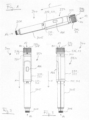
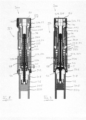
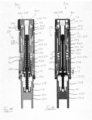
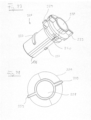
- Figs. 1 to 3 depict a medicament delivery device 300 according to the present disclosure.
- the medicament delivery device 300 is configured as a pen-type injection device suited to deliver a dose of medicament by injection through the skin of a patient.
- the medicament delivery device 300 has a generally cylindrical shape that extends from a distal end 12 facing away from the injection site to a proximal end 14 that is located at the injection site.
- a proximal direction 1 points towards the injection site, that is from the distal end 12 to the proximal end 14.
- a distal direction is orientated opposite the proximal direction 1 and points from the proximal end 14 to the distal end 12.
- the medicament delivery device 300 comprises a first mechanism 354 for setting the dose of medicament to be delivered to the injection site and for delivering the set dose.
- a container holder 305 that is configured to receive a medicament container with the medicament to be delivered is connected to the proximal end of the first mechanism 354.
- a needle connector 306 is located at the proximal end of the container holder 305 for connecting a cannula to the medicament delivery device 300.
- the needle connector 306 is configured as a form-fit connector. It is exemplarily configured as a threaded connector, it may also be configured as a bayonet lock, a Luer lock or the like.
- the first mechanism 354 is configured as an automatic mechanism that automatically delivers a set dose after a user has triggered dose delivery.
- a force that is sufficient to deliver the set dose thereby is provided by a spring of the mechanism so that it is not necessary for a user of the device to provide a force that drives the injection.
- the first mechanism 354 comprises an actuation unit 316 for setting the dose and for triggering injection of the set dose.
- the actuation unit 316 comprises a dose setting element 22 and a button 318.
- the dose setting element 22 has a cylindrical outer surface that is configured to be gripped by a user of the medicament delivery device 300 to set the dose to be delivered by rotating the dose setting element 22 around the longitudinal axis of the first mechanism 354. Thereby, the rotation in one circumferential direction increases the set dose and rotation in the opposite circumferential direction decreases the set dose.
- the set dose is indicated in a window 166 that is formed within a housing 332 of the first mechanism 354.
- the button 318 is configured as a push button. It has an end surface 80 that is orientated generally perpendicular, such as perpendicular, to the longitudinal axis and that is located at the distal end 12 of the first mechanism 354.
- the button 318 is configured to be pushed by the user of the device in the proximal direction 1 to transfer the first mechanism 354 from a dose setting state into a dose delivery state. The user thereby pushes upon the end surface 80 of the button 318. Proximal movement of the button 318 initiates automatic dose delivery.
- the dose setting element 22 and the button 318 of the actuation unit 316 are rigidly connected with each other so that they are axially and rotationally fixed to each other. Therefore, proximal movement of the button 318 to also leads to proximal movement of the dose setting element 22 and rotation of the dose setting element 22 also leads to a rotation of the button 318.
- the first mechanism 354 comprises a housing connector that is located in between the actuation unit 316 and the housing 332 and forms an outer housing component.
- the housing connector is exemplarily configured as a dose selector 360.
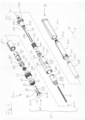
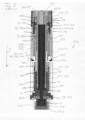
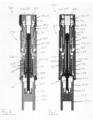
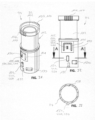
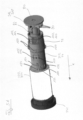
- Fig. 4 shows an exploded view of the medicament delivery device 300 and Fig. 5 shows a cross-sectional cut through the medicament delivery device 300 parallel to the longitudinal axis, whereby the first mechanism 354 is in the dose setting state.
- the housing 332 comprises an outer housing 333 that is rigidly connected to a piston rod guide 342.
- the outer housing 333 is configured as a hollow generally cylindrical member. It thereby has the shape of a sleeve.
- the outer housing 333 is axially and rotationally fixed with respect to the piston rod guide 342 by a connector 375.
- the outer housing 333 and the piston rod guide 342 thereby form a single functional component of the medicament delivery device 300.
- the connector 375 is located at a proximal end of the outer housing 333. It exemplarily is configured as a snap-fit connector that irreversibly snaps the outer housing 333 to the piston rod guide 342. With other embodiments, the connector may also be configured as another form-fit connector, such as a screwed connection. It may also be configured as an adhesive bond, such as a glued connection.
- the connector 375 engages with an outer body 387 of the piston rod guide 342.
- the outer body 387 is configured as a ring-shaped part of the piston rod guide 342 and located at the proximal end of the piston rod guide 342.
- the connector 375 engages a distal side of the outer body 387.
- the container holder 305 has a generally cylindrical hollow shape and receives the medicament container 348 in its interior. It is coupled to the housing 332 by a connector 307 that is located at the distal end of the container holder 305.
- the connector 307 engages with the piston rod guide 342 at the proximal side of the outer body 387 of the piston rod guide 342.
- the connector 307 is configured as a form-fit connector, namely as a snap-fit connector. With other embodiments, the connector 307 may also be configured as another form-fit connector, such as a screwed connection, or as an adhesive bond.
- the medicament container 348 At a needle end 349 of the medicament container 348, which needle and 349 is located at the proximal end of the medicament container 348, the medicament container 348 comprises a septum that seals the interior of the medicament container 348.
- the septum is configured to be pierced by a double-ended cannula upon mounting the cannula onto the needle connector 306 of the container holder 305.
- the medicament delivery device 300 is configured as a disposable device that is disposed of after delivery of a last dose from the medicament container 348.
- the container holder 305 is non-releasably connected to the housing 332 by the connector 307.
- the container holder 305 then may not be removed from the housing 332 without breaking the first mechanism 354 and/or the container holder 305.
- the medicament delivery device 300 may also be configured as a reusable device that allows to attach a new medicament container 348 after having delivered a last dose from the medicament container 348 attached to the first mechanism 354.
- the connector 307 may be configured as a releasable connector, such as a screwed connection or a bayonet lock.
- the medicament delivery device 300 comprises a cap 301 that is configured to be releasably attachable to the proximal end 14 of the medicament delivery device 300 to cover the container holder 305 and the needle connector 306.
- the first mechanism 354 comprises a piston rod 44.
- the piston rod 44 protrudes from the first mechanism 354 at its proximal end. It thereby protrudes through the piston rod guide 342.
- a bearing 46 is located that pushes upon a movable plunger 350 (see Fig. 5 ) that seals the medicament container 348 towards its distal end.
- the piston rod 44 is rotationally fixed with respect to the piston rod guide 342 and the outer body 333.
- the piston rod 44 has an outer thread that engages with an inner thread of a nut 38.
- the nut 38 is configured as a hollow generally cylindrical member that is disposed around the piston rod 44.
- the first mechanism 354 exemplary comprises a splined connection between the nut 38 and a cylindrical proximal part of the button 316.
- a distal portion of the nut 38 is received within the button 316.
- the splined connection comprises longitudinal grooves 106 at one of the nut 38 and the button 316 and corresponding longitudinal ridges that engage with the grooves 106 and that are provided at the other one of the nut 38 and the body 316.
- the longitudinal grooves 106 are provided at an outer surface of the nut 38 and the longitudinal ridges are provided on an inner surface of the button 316.
- the button 316 is rigidly connected to the dose setting element 22 by an intermediate member 20.
- the intermediate member 20 is located within the cylindrical portion of the dose setting element 22 and is rotationally and axially fixed to both the dose setting element 22 and the button 316.
- the first mechanism 354 further comprises a driver 336 that has a generally cylindrical hollow body and that is disposed around the nut 38.
- the driver 336 is threadedly connected to the housing 323, namely to the piston rod guide 342, via a drive thread 337. It engages the piston rod guide 342 via the drive thread 337.
- the drive thread 337 is formed between a distal inner body 388 of the housing 332 and the driver 336.
- the inner body 388 forms a distal portion of the piston rod guide 342 that is located distally from the outer body 387.
- An inner thread of the drive thread 337 is formed at an inside surface of the inner body 388 and an outer thread of the drive thread 337 is formed on an outside surface of the body of the driver 336.
- the first mechanism 354 further comprises a dosing member 323 having a carrier 24 that forms a first part of the dosing member 323 and a dosing element 334 that forms a second part of the dosing member 323.
- the carrier 24 forms a coupling member that rotationally couples the dosing member 323 to the dose setting element 22 during dose setting.
- the dosing element 334 and the carrier 24 are rigidly connected with each other so that they are axially and rotationally fixed with respect to each other.
- the dosing element 334 and the carrier 24 are configured as two separate parts that are joined together.
- the dosing element 334 and the carrier 24 may also be configured as a single materially uniform element.
- the dosing member 323 is held axially fixed and rotationally movable within the housing 332. Both the dosing element 334 and the carrier 24 are configured as generally cylindrical hollow members. The dosing element 334 is located in the proximal direction 1 with respect to the carrier 24.
- the dosing element 334 forms a dose sleeve.
- the dosing element 334 surrounds the piston rod 44 and the nut 38. Furthermore, it surrounds the inner body 388 of the housing 332 and the driver 336.
- the driver 336 is rotationally movable and axially fixed with respect to the dosing member 323 and connected to the dosing member 323 by a connector 339. It thereby directly engages with the dosing member 323, namely with the dosing element 334 of the dosing member 323.
- the connector 339 is configured as a rotation lock. It is exemplarily a splined connection and comprises a longitudinal ridge that engages with a corresponding longitudinal groove. With the present embodiment, the longitudinal ridge is exemplarily formed at an outside surface of the driver 336 and the dosing member 323 comprises the corresponding longitudinal groove on an inside surface, namely on an inside surface of the dosing element 334. With other embodiments, the connector 339 may also rotationally fix the driver 336 to the dosing member 323 in other ways.
- a spring 40 is coupled between the driver 336 and the housing 332.
- the spring 40 thereby is directly coupled between the driver 336 and the housing 332.
- a first end 461 of the spring 40 is attached to the driver 336 and a second end 462 of the spring 40 is attached to the housing 332.
- the spring 40 surrounds the inner body 388 of the housing 332.
- the dose selector 360 is configured as a hollow generally cylindrical member. It surrounds the dosing member 323, namely the carrier 24 of the dosing member 323. Furthermore, the dose selector 360 is located inside the housing 332 and protrudes from the distal end of the housing 332.
- the dose selector 360 is connected axially fixed and rotationally movable to the actuation unit 318. A distal end of the dose selector 360 thereby engages with a proximal end of the cylindrical body of the dose setting element 22.
- the dose selector 360 further is rotationally fixed and axially movable with respect to the housing 332.
- a rotation lock 152 between the dose selector 360 and the housing 332 is configured as a splined connection.
- the splined connection comprises longitudinal ridges that engage with corresponding longitudinal grooves.
- the splined connection comprises longitudinal grooves formed at an inside surface of the housing 332 and corresponding longitudinal ridges that are formed at an outside surface of the dose selector 360.
- the rotation lock 152 may also be configured in other ways.
- the ridges may be provided at the housing 332 and the grooves may be provided at the dose selector 360.
- a connector 26 is disposed around the dosing member 323, namely around the carrier 24.
- the connector 26 is axially fixed and rotationally movable with respect to the dosing member 323. It is disposed around a coupling section 112 of the carrier 24.
- the coupling section 112 is located at an outside surface of the dosing member 323 and is recessed with respect to the outer surface.
- the connector 26 is axially fixed with respect to the dosing member 323 by abutting against both longitudinal ends of the recessed section 112.
- the connector 26 is rotationally fixed with respect to the housing 332. It is thereby rotationally fixed to the housing 332 via the dose selector 360.
- a rotation lock 150 between the connector 26 and the dose selector 360 rotationally fixes the connector 26 to the dose selector 360 while allowing axial movement.
- the rotation lock 150 is exemplarily configured as a splined connection having a longitudinal rib provided at an outside surface of the connector 26 and a corresponding longitudinal groove provided at an inside surface of the dose selector 360.
- the rotation lock 150 may be configured in different ways, for example the groove may be provided at the connector 26 and the rib may be provided at the dose selector 360.
- the proximal portion of the button 318 protrudes into the distal portion of the dosing member 323, as can be seen from Fig. 5 .
- the button 318 thereby protrudes into the carrier 24 of the dosing member 323.
- the button 318 is biased with respect to the housing 332 and the dosing member 323 by a biasing member 250 that is exemplarily configured as a compression spring.
- the biasing member 250 is located between the dosing member 323 and the button 318. Since, with the present embodiment, the button 318 is axially fixed with respect to the dose setting element 22 and the dose selector 360, the biasing member 250 also biases the dose setting element 22 and the dose selector 360 in the distal direction.
- a retainer 97 prevents detachment of the button 318 and the dose setting element 22 from the housing in the distal direction.
- the retainer 97 acts between the button 318 and the dosing member 323. It restrains distal movement of the button 318 and the dose setting element 22 with respect to the housing 332 but allows for distal movement.
- the retainer 97 has a first retainer element 98a that engages with a second retainer element 102 to block distal movement of the button 318 and the dose setting element 22.
- the first retainer element 98a is exemplarily provided at the button 318, namely at an outside surface of the proximal portion of the button 318.
- the second retainer element 102 is exemplarily provided at the dosing member 323.
- the first retainer element 98a is configured as a protrusion located at the outside surface of the button 318 and the second retainer element 102 is configured as a radially inwardly extending ledge.
- the biasing member 250 biases the button 318 in the distal direction towards the second retainer element 102. Movement of the button 318 in the proximal direction 1 is possible against the force provided by the biasing member 250 and disengages the first retainer element 98a from the second retainer element 102.
- the first mechanism 354 comprises a clutch 113 that acts between the nut 38 and the piston rod 44 and that is exemplarily formed between the dose setting element 22 and the connector 26.
- the first mechanism 354 additionally comprises a further clutch 107 that acts between, on the one hand, the dose setting element 22 and, on the other hand the dosing member 323 and the driver 336.
- the further clutch 107 is exemplarily formed between the dose setting element 22 and the dosing member 323.
- Fig. 6 depicts a first cross-sectional cut through the medicament delivery device 300 in a first cut plane and Fig. 7 shows a corresponding second cross-sectional cut through the medicament delivery device 300 in a second cut plane perpendicular to the first cut plane, whereby the medicament delivery device 300 is in a dose setting state prior to setting a dose.
- the button 318 and the dose setting element 22 are in their distal position with respect to the dosing member 323.
- the dose setting element 22 is rotationally fixed to the dosing member 323 via the further clutch 107, which is in its closed state.
- the clutch 113 is in its opened state so that the nut 38 and the dose setting element 22 are rotationally movable with respect to the piston rod 44 and the housing 332.
- the dosing member 323 rotates due to the closed further clutch 107 between the dose setting element 22 and the dosing member 323. Rotation of the dosing member 323 also forces a corresponding rotation of the driver 336, which is therefore moving axially relative to the piston rod guide 342 due to its threaded connection to the piston rod guide 342 via the drive thread 337.
- the driver 336 moves in the distal direction away from the piston rod guide 342, and when decreasing the set dose, the driver 336 moves in the proximal direction 1 towards the piston rod guide 342.
- Rotation of the driver 336 during dose setting stores energy in the spring 40.
- the spring 40 is thereby strained and the energy stored in the spring 40 is increased when increasing the set dose.
- the spring 40 is relaxed and the energy stored in the spring 40 is decreased.
- the spring 40 may be pretensioned so that it biases the driver 336 in the proximal direction 1.
- a pitch of the thread of the piston rod 44 and a pitch of the drive thread 337 are adapted so that the nut 38 and the driver 337 essentially move the same axial distance upon rotation.
- a nominal pitch of the drive thread 337 is slightly higher than a nominal pitch of the thread between the piston rod 44 and the nut 38 to prevent mutual blocking of the nut 38 and driver 336 irrespective of manufacturing tolerances.
- the minimum tolerable pitch of the drive thread 337 is larger than the minimum tolerable pitch of the thread between the nut 38 and the piston rod 44.
- the dosing member 323 rotates with respect to the dose selector 360.
- the first mechanism 354 has a dose definition mechanism 115 that acts between the dosing member 323 and the housing 332.
- the dose definition mechanism 115 defines distinct relative rotational positions of the dosing member 323 with respect to the housing 332 that correspond to doses settable by the first mechanism 354.
- the dose definition mechanism 115 rotationally locks the dosing member 323 with respect to the housing 332 against the force provided by the spring 40. This allows a user of the first mechanism 354 to release the dose setting element 22 without decreasing the set dose.
- the dose definition mechanism 115 allows the dosing member 323 to freely rotate back to the next lower settable dose. This prevents unintentional setting of intermediate doses.
- the dosing member 323 comprises a label 168 that is provided at an outer surface of the dosing member 323 and that is visible through the window 166 in the housing 332 when a dose has been set.
- the label 168 thereby indicates that the dose has been set, for example it may indicate the amount of dose that has been set.
- the dosing member 323 comprises a corresponding label 168 at its outer surface.
- Fig. 8 depicts a first cross-sectional cut through the medicament delivery device 300 in the first cut plane and Fig. 9 shows a corresponding second cross-sectional cut through the medicament delivery device 300 in the second cut plane, whereby the first mechanism 354 is in the dose setting state after the setting the dose.
- the nut 38 has been moved by a dose distance 3 in the distal direction away from the proximal end 14 of the first mechanism 354.
- the driver 336 has likewise traveled a corresponding distance in the distal direction.
- the user moves the button 318 in the proximal direction 1.
- the dose setting element 22 and the dose selector 360 are moved into the proximal direction 1 with respect to the housing 332 and the dosing member 323.
- the first mechanism 354 is transferred from its dose setting state into a dose delivery state.
- Fig. 10 shows a first cross-sectional cut through the medicament delivery device 300 in the first cut plane
- Fig. 11 shows a corresponding second cross-sectional cut through the medicament delivery device 300 in the second cut plane, whereby the first mechanism 354 is in the dose delivery state prior to delivery of the set dose.
- the closing of the clutch 113 between the dose setting element 22 and the connector 26 rotationally fixes the nut 38 to the housing 332 via the button 318, the dose setting element 22, the connector 26 and the dose selector 360. Since the piston rod 44 is rotationally fixed with respect to the housing 332, the closing of the clutch 113 also rotationally fixes the nut 38 to the piston rod 44. Closing of the clutch 113 also prevents rotation of the dose setting element 22 and the button 318 with respect to the housing 332. The opening of the further clutch 107 rotationally decouples the dose setting element 22 from the dosing member 323 and the driver 336.
- the transfer of the first mechanism 354 from the dose setting state into the dose delivery state by moving the button 318 in the proximal direction 1 also disengages the dose definition mechanism 115 so that the dosing member 323 is no longer prevented from rotating with respect to the housing 332 at the rotational positions that correspond to settable doses.
- disengagement of the dose definition mechanism 115 thus allows the driver 336 to freely rotate with respect to the housing 332, whereby the driver 337 is driven by the spring 40.
- This rotation screws the driver 336 in the proximal direction 1 into the piston rod guide 342 and therefore also moves the driver 336 axially in the proximal direction 1.
- the driver 336 Upon proximal movement, the driver 336 abuts the nut 38 via an axial stop 194. This axially locks the driver 336 to the nut 38 so that the driver 336 and the nut 38 move together in the proximal direction 1.
- the axial stop 194 is provided at a proximal end of the nut 38. It is exemplarily configured as an annular ring that radially protrudes from the nut 38. When moving proximally with respect to the nut 38, the driver 336 engages with the axial stop 194 at its proximal end.
- the nut 38 Due to closure of the clutch 113, the nut 38 is rotationally fixed to the piston rod 44 and the housing 332 via the button 318, the dose setting element 22, the connector 24 and the dose selector 360. This locks the drive thread 337 so that the nut 38 and the piston rod 44 are axially fixed with respect to each other. Axial advancement of the nut 38 then causes a corresponding axial advancement of the piston rod 44. As a consequence, the spring 40 automatically drives the driver 337, the nut 38 and the piston rod 44 in the proximal direction 1 to deliver the set dose.
- Fig. 12 depicts a first cross-sectional cut through the medicament delivery device 300 in the first cut plane and Fig. 13 shows a corresponding second cross-sectional cut through the medicament delivery device 300 in the second cut plane, whereby the first mechanism 354 is in the dose delivery state after delivery of the set dose.
- the piston 44 and the bearing 46 located at the proximal end of the piston rod 44 have been moved by the dose distance 3 in the proximal direction 1. This has also pushed the plunger 350 by the dose distance 3 in the proximal direction 1, thereby expelling an amount of medicament that corresponds to the volume covered by the dose distance 3.
- the dosing member 323 is axially held within the housing 332 by a blocker 430 that acts between the button 318 and the housing 332 and blocks the button 318 from moving axially with respect to the housing 332 in the distal direction 1.
- the blocker 430 acts between the housing 332 and the dosing member 323.
- the blocker 430 blocks distal movement of the dosing member 323 with respect to the housing 332. It is axially and rotationally fixed with respect to the housing 332 and rotatably engages with the dosing member 323, namely with the dosing element 334.
- the blocker 430 engages with a distal end surface of the dosing member 323.
- the blocker 430 may also engage with other parts of the dosing member 323.
- the dosing member 323, namely the dosing element 333 forms a counter member of the blocker 430.
- the blocker 430 is directly located at the outer housing 333 of the housing 332 and protrudes from the inside surface of the outer housing 333. With other embodiments, the blocker 430 may also be located at an additional housing component that is at least axially fixed to the outer housing 333. For example, the additional housing component may be axially and rotationally fixed to the outer housing 333.
- a connection between the additional housing component and the outer housing 333 may, for example, be configured as a form-fit connection, such as a snap-fit connection or a threaded connection.
- the connection may be configured to assemble the additional housing component to the outer housing 333 after placing the dosing member 323 inside the outer housing 333.
- the connection may be configured to allow assembly of the additional housing component to the outer housing 333 from the distal end of the outer housing 333.
- the blocker 430 is configured as a one-way blocker that allows passage of the dosing member 323 in the proximal direction 1 but blocks passage of the dosing member 323 in the distal direction.
- the blocker 430 forms a flexible element that bends away from the dosing member 323 upon passage in the proximal direction 1 and interferes with the dosing member 323 upon passage in the distal direction. After passage of the dosing member 323, the blocker 430 snaps into a blocking position that blocks distal movement of the dosing member 323.
- the first mechanism 354 may comprise additional blockers 430.
- the additional blockers 430 may be distributed around the circumference of the housing 332.
- the blocker 430 may also be configured as a rigid element. The blocker 430 then may be fixed to the housing 332 after having placed at least parts of the dosing member 323, such as the dosing element 333, within the housing 323.
- the blocker 430 may also be fixed to the dosing member 323.
- the blocker 430 then may interfere with features, such as protrusions or grooves, provided at the housing 332, such as at the inside surface of the housing 332.
- Movement of the dosing member 323 in the proximal direction 1 is restrained by the housing 332, namely by the piston rod guide 342.
- the dosing member 323 thereby abuts a distal facing surface of the proximal outer body 387 of the piston rod guide 342.
- the blocker 430 may only be configured to restrain or block movement of the dosing member 323 in the distal direction. Movement of the button 318 and/or the dose setting element 22 then may be restrained or blocked by other mechanisms.
- the first mechanism 354 comprises a stop 373 that limits proximal movement of the button 318 during dose delivery.
- the stop 373 is axially fixed to the housing 332. It interferes with a component that is axially fixed with respect to the button 318.
- the stop 373 interferes with a housing connector that is formed by the dose selector 360.
- the axially fixed component formed by the dose selector 360 abuts the stop 373, thus preventing further proximal movement of the button 318.
- the housing 332 forms a first stop part of the stop 373 and the dose selector 360 forms a second stop part of the stop 373.
- the stop 373 is located at the proximal end of one of the grooves of the rotation lock 152 formed at the inside surface of the dose selector 360.
- the stop 373 may be formed by a proximal end of the one of the grooves.
- the stop 373 is directly located at the of the outer housing 333, exemplarily it is integrally formed with the outer housing 333.
- the outer housing 333 may also be located at a separate component that is at least axially fixed, such as axially and rotationally fixed, to the outer housing 333.
- the separate component may also comprise the blocker 430.
- the first mechanism 354 may comprise additional stops 373.
- the stops 373 may be distributed circumferentially around the longitudinal axis of the first mechanism 354.
- a stop that limits proximal movement of the button 318 during dose delivery may also act between the button 318 and the dosing member 323.
- a stop 374 is also indicated in Fig. 5 . It is configured as a radial protrusion that is located at the outside surface of the proximal part of the button 318. The protrusion thereby circumferentially surrounds the proximal part of the button 318.
- the stop 374 abuts against the radially inwardly protruding ring at the distal end of the dosing member 323 that also forms the second retainer element 102. This is also visible in Figs. 10 to 13 .
- the second retainer element 102 and the counter element of the stop 374 may be formed as separate features.
- the first mechanism 354 may only feature either the stops 373 or the stops 374.
- the button 318 is the last component that is added to the first mechanism 354 during assembly.
- the first mechanism 354 comprises a priming mechanism that allows to adjust the axial position of the piston rod 44 and the bearing 46 with respect to the housing 332 in a preassembled state of the first mechanism 354.
- the button 318 has been inserted into the dosing member 323 but not been pushed fully in the proximal direction 1 to engage with the intermediate member 20 to become axially and rotationally fixed to the dose setting element 22.
- a further first retainer element 98b that is located proximally from the first retainer element 98a engages with the second retainer element 102.
- the button 318 then is axially restrained in the distal direction with respect to the housing 332 and can rotationally move with respect to the dose setting element 22. This allows to rotate the nut 38 by rotating the button 318 and to thereby axially move the piston rod 44 due to the threaded connection between the nut 38 and the piston rod 44. Details of this priming mechanism are described in application US 17/981231 , which is incorporated by reference in its entirety.
- Fig. 14 shows a perspective view of the outer housing 333 of the first mechanism 354 from a distal end
- Fig. 15 shows a perspective view of the outer housing 333 from a proximal end.
- the grooves of the rotation lock 154 are formed.
- three of the connectors 375 are protruding from the proximal end of the outer housing 333.
- Fig. 16 shows a perspective view of the piston rod guide 342 of the first mechanism 354 from a distal end
- Fig. 17 shows a perspective view of the piston rod guide 342 from a proximal end.
- an inner thread 172 of the drive thread 337 is formed at the inside surface of the inner body 388.
- a spring connector 386 is formed that fixes the second end 462 of the spring 40 to the piston rod guide 342.
- the spring connector 386 is exemplarily formed as an opening within the outer surface of the inner body 388 and the second end 462 of the spring 40 is bent to engage with this opening.
- a housing connector 382 is formed at the distal side of the outer body 387 of the piston rod guide 342.
- the housing connector 382 is configured as several recesses in which corresponding snap hooks of the connector 375 formed at the proximal end of the outer housing 333 engage upon assembly of the outer housing 333 to the piston rod guide 342.
- the piston rod 44 is guided within an opening 186 of the piston rod guide 342, which is visible in Fig. 17 .
- the opening 186 is formed as an out of round axial opening that corresponds to an out of round cross-section of the piston rod 44. Therefore, the piston rod 44 is axially movable relative to the piston rod guide 342, but cannot rotate relative to the piston rod guide 342.
- a container connector 384 is located next to the opening 186.
- the container connector 384 is formed by openings that receive corresponding snap-fit hooks of the connector 307 that are formed at the distal end of the container holder 305.
- Fig. 18 shows a perspective view of the piston rod 44 of the first mechanism 354.
- the piston rod 44 On its outer surface, the piston rod 44 has an outer thread 190 that forms part of the threaded connection 189 between the piston rod 44 and the nut 38.
- the piston rod comprises two opposing flattened sections 191 that provide the out-of-round cross-section of the piston rod 44 that corresponds to the out-of-round cross-section of the opening 186 of the piston rod guide 342. These out-of-round cross-sections rotationally lock the piston 44 to the piston rod guide 342 while allowing axial relative movement.
- the piston rod 44 At its proximal end, the piston rod 44 comprises a proximal connector 198 that engages with the bearing 46 to hold the bearing 46 at the piston rod 44. At its distal end, the piston rod 44 comprises a stop 199 that is configured as a thickened and non-threaded section of the piston rod 44.
- Fig. 19 shows a perspective view of the bearing 46 of the first mechanism 354
- Fig. 20 shows a top view of the bearing 46
- Fig. 21 shows a section view of the bearing 46 along a line A-A shown in Fig. 20
- the bearing 46 comprises a bearing connector 200 that is configured as a central opening.
- the bearing connector 200 features angled side surfaces that snap over the proximal connector 198 of the piston rod 44 when the proximal connector 198 is inserted into the central opening 200.
- Figs. 22 to 26 depict the nut 38 of the first mechanism 354.
- the nut 38 On an inner surface of a central opening 39, the nut 38 comprises an inner thread 192 of the threaded connection 189 between the piston rod 44 and the nut 38.
- the inner thread 192 is thereby located at the proximal end of the nut 38.
- the piston rod 44 and the nut 38 can move relative to each other in a compulsory guided combined axial and rotational movement.
- the nut 38 features the axial stop 194 that is formed as an annular protrusion.
- the axial stop 194 is located in a proximal end section of the nut 38.
- the axial stop 194 abuts a front surface 196 of the driver 336 during dose delivery.
- the axial stop 194 is formed as protrusions extending distally from the annular protrusion. This reduces the contact area between the driver 376 and the nut 38.
- a bearing element such as a ball bearing and/or a glide disc made of low-friction material, may be arranged between the axial stop 194 and the front surface 196 of the driver 336.
- the first mechanism 354 comprises a last dose mechanism that prevents dialling a dose that is larger than a remaining amount of medicament within the medicament container 348.
- the last dose mechanism is formed by the stop 199 at the distal end of the piston rod 44 and an axial stop 193 provided on the inside surface of the opening 39 of the nut 38.
- the piston rod 44 Upon repeatedly setting and delivering a dose, the piston rod 44 successively moves in the proximal direction 1 with respect to the nut 38. This successively reduces a distance between the stop 199 provided at the piston rod 44 and the axial stop 198 provided on the inside surface of the nut 38 after each dose delivery.
- the distance between the stop 199 and the axial stop 198 Prior to delivering a first dose from the medicament container, the distance between the stop 199 and the axial stop 198 has an initial value. The initial value is adapted to reduce upon repeated delivery of set doses by an amount that prevents further distal movement of the nut with respect to the piston rod 44 if a user sets a dose that is larger than a remaining amount of medicament within the medicament container 348.
- Fig. 27 shows a perspective view of the driver 336 of the first mechanism 354 and Fig. 28 shows a top view of the driver 336.
- the driver 336 has an opening 338 that receives the nut 38.
- the opening 338 is configured as a central axial opening.
- the driver 336 comprises a spring connector 340 that is configured to connect to the first end 461 of the spring 40.
- the driver 336 comprises the connector 339 in its distal end section.
- the connector 339 comprises two radially outwardly directed ribs that engage with the dosing element 334 of the dosing member 323.
- Fig. 29 shows a perspective view of the dosing element 334 of the dosing member 332 of the first mechanism 354 from the distal end and Fig. 30 shows a perspective view of the dosing element 334 from the proximal end.
- the dosing element 334 On an outer surface 421, the dosing element 334 has the label 168 that indicates setting of one of the settable doses.
- the dosing element 334 On an inner surface 422, the dosing element 334 comprises longitudinal grooves of the connector 339 that connects rotationally fixed and axially movable to the driver 336. The longitudinal grooves engage with the outwardly directed ribs provided on the outside surface of the driver 336.
- Figs. 31 to 33 depict the carrier 24 of the dosing member 323 of the first mechanism 354.
- the carrier 24 comprises axial and rotational fixation means to axially and rotationally fix the carrier 24 to the dosing element 334.
- the axial and rotational fixation means are provided at a proximal end of the carrier 24. They are configured as a radially extending opening 130 and an axially extending slot 132.
- the dosing element 334 has an axially extending rib 134 that is configured to engage with the slot 132 of the carrier 24 to rotationally lock the dosing element 334 to the carrier 24. Furthermore, the dosing element 334 has a protrusion 136 with a chamfered surface 136a that engages with the opening 130 of the carrier 24. While the opening 130 and the protrusion 136 form the axial fixation means, the slot 132 and the rib 134 form the rotational fixation means. Due to the axial and rotational fixation means, the carrier 24 and the dosing element 334 can be connected to each other in one defined relative rotational position.
- an axially extending rib 138 is formed on an inner circumferential surface of the carrier 24 (cf. Fig. 33 ) that engages with an axially extending groove 140 (cf. Fig. 29 ) on an outer circumferential surface of the dosing element.
- the carrier 24 On its outer surface, the carrier 24 forms an axial section with a reduced circumference that forms the coupling section 112 for the connector 26.
- the carrier 24 further comprises a counter element 116 of the dose definition mechanism 115 that defines the rotational positions of the dosing member 323 that correspond to settable doses.
- the counter element 116 is located on an outer surface of the carrier 24. It is exemplarily configured as an axially extending radial projection. Furthermore, the counter element 116 forms an axially extending rib.
- the counter element 116 may have a symmetrical cross section in a radial plane perpendicular to the longitudinal axis of the first mechanism 354 or an asymmetrical cross section.
- the counter element 116 is resiliently fixed to the carrier 24. It is configured to deflect in the radial direction. With the present embodiment, the counter element 116 is located on an elastically deformable section 120 of the carrier 24.
- the elastically deformable section 120 is formed by an axially extending arm partially surrounded by a cut-out 121. The elastically deformable section 120 bends inwardly when the counter element 116 passes a dose stop.
- the carrier 24 further comprises a blocking part 124.
- the blocking part 124 radially extends from the outer surface of the carrier 24.
- the blocking part 124 is configured as a hard stop. It is formed by an axially extending rib that extends along the longitudinal axis of the first mechanism 354.
- the blocking part 124 is axially distanced from the counter element 116. Furthermore, it is rotationally and axially aligned with the counter element 116.
- a further first engaging part 110 of the further clutch 107 is located at the carrier 24.
- the further first engaging part 110 is configured as radially projecting teeth at the outer surface of the carrier 24. It is located at a distal end of the carrier 24.
- the radially projecting teeth thereby only cover sections of the circumference of the outer surface of the carrier 24, whereby the sections are separated by sections having no teeth.
- the teeth may also cover the complete circumference of the outer surface of the carrier 24.
- Figs. 34 to 37 depict the connector 26 of the first mechanism 354.
- the connector 26 is configured as a hollow generally cylindrical member. It has a longitudinal cut that extends along the entire length of the connector 26.
- the connector 26 has an open cross section along its entire longitudinal length. This allows to clip the connector over the coupling section 112 of the carrier 24 during assembly of the first mechanism 354.
- the connector 26 is axially fixedly connected to the carrier 24 in both directions due to the connector 26 having a length in the axial direction that corresponds to a length in the axial direction of the reduced circumference of the coupling section 112. At the same time, the connector 26 is rotatable relative to the carrier 24.
- the connector 26 comprises a first engaging part 114 of the clutch 113.
- the first engaging part 114 is configured as radially extending teeth that are located on an outer surface of the connector 26.
- the teeth of the first engaging part 114 of the clutch 113 only cover sections of the circumference of the connector 26, which sections are separated by sections that have no teeth. With other embodiments, the teeth may also cover the complete circumference of the outer surface of the connector 26.
- the first engaging part 114 is located at a distal end of the connector 26. At a proximal end, the connector 26 comprises the longitudinal ribs of the rotation lock 150.
- Figs. 38 to 41 depict the dose setting element 22 of the first mechanism 354.
- the dose setting element 22 is configured as a generally cylindrical element that longitudinally extends along the longitudinal axis of the first mechanism 354. Furthermore, it is configured as a hollow member.
- the dose setting element 22 comprises a second engaging part 108 of the clutch 113.
- the second engaging part 108 is configured as radially extending teeth that are disposed around a circumference of a cylindrical surface of the dose setting element 22.
- the second engaging part 108 thereby is located at an inside surface of the dose setting element 22.
- the teeth radially extend inwardly from the inside surface.
- the dose setting element 22 also comprises a further second engaging part of the further clutch 107.
- the further second engaging part is thereby formed by the second engaging part 108 of the clutch 113.
- the dose setting element 22 On its outer surface, the dose setting element 22 comprises a gripping surface 21 and a radially protruding rib 76 that extends in the axial direction.
- the rib 76 forms an anti-rolling feature that prevents the first mechanism 354 from rolling when being put on a flat surface.
- Figs. 42 to 45 depict the intermediate member 20 of the first mechanism 354 and Figs. 46 to 50 depict the button 318 of the first mechanism 354.
- the button 318 has the distal end surface 80 to apply a force to the button 318 to inject a set dose.
- the button 318 comprises axial fixation means 82 to axially attach the button 318 to the intermediate member 20 which is axially fixed to the dose setting element 22.
- the axial fixation means 82 comprise two elastically deformable hooks 82 which engage with a circumferentially extending rib 84 on the intermediate member 20.
- the intermediate member 20 also comprises axial fixation means 86 in the form of elastically deformable bendable hooks that engage with an undercut 88 formed in the dose setting element 22.
- the button 318, the intermediate member 20 and the dose setting element 22 are permanently axially fixed to each other in an assembled state of the first mechanism 354.
- the button 318 may also be axially fixed with respect to the dose setting element 22 by other means.
- the button 318 may directly engage with the dose setting element 22 without the intermediate member 20.
- the button 318 also has rotation fixation means 90 in the form of radially extending ribs.
- the ribs 90 are form-fittingly engaged with rotation fixation means 92 of the intermediate member 20, whereby the rotation fixation means 92 are exemplarily formed as teeth arranged on an inner circumferential surface of the intermediate member 20.
- the rotation fixation means 90, 92 rotationally fix the button 318 to the intermediate member 20.
- the rotation fixation means 92 of the intermediate member 20 form a toothed part 93 of the intermediate member 20 and the ribs 90 form an engaging part of the button 318.
- the intermediate member 20 comprises rotation fixation means 94 in the form of axially extending recesses that define side surfaces of the elastically deformable bendable hooks 86 and that engage with rotation fixation means 96 in the form of axially extending ribs on the inner circumferential surface of the dose setting element 22.
- the button 318, the intermediate member 20 and the dose setting element 22 are rigidly connected with each other and form the actuation unit 316 of the mechanism 354.
- the button 318 further has a cylindrical portion 18a.
- the cylindrical portion 18a is configured as a hollow member. It also forms the proximal part of the button 318.
- the cylindrical portion 18a is integrally formed with a distal part of the button 318 that forms the distal end surface 80.
- the part forming the end surface 80 and the cylindrical portion 18a may be configured as separate elements that are rigidly connected to each other and axially and rotationally fixed with respect to each other.
- the first retainer element 98a of the retainer 97 is located on the cylindrical portion 18a. Furthermore, the cylindrical portion 18a also comprises the further first retainer element 98b.
- the button 318 comprises an axially extending rib 104 on its inner circumferential surface.
- the axially extending rib 104 engages in the axially extending groove 106 of the nut 38 to form a rotation lock 103. Due to the rotation lock 103, the button 318 and the nut 38 can move axially relative to each other but are rotationally fixed to each other.
- Fig. 51 depicts a subassembly of the first mechanism 354 that comprises the piston rod guide 342, the dosing member 323, the connector 26 and the button 318.
- the first engaging part 114 of the clutch 113 and the further first engaging part 110 of the further clutch 107 are located next to each other. Thereby, the first engaging part 114 is located proximally from the further first engaging part 110.
- the actuation unit 316 with the button 318 and the dose setting element 22 is in its distal position.
- the further second engaging part 108 of the dose setting element 22 engages with the further first engaging part 110 of the further clutch 107 to rotationally fix the dose setting element 22 to the dosing member 323.
- the actuation unit 316 and the button 318 move proximally. This disengages the further first and second engaging parts 108, 110 of the further clutch 107 and engages the first engaging part 108 and the second engaging part 114 of the clutch 113. This rotationally fixes the dose setting element 22 carrying the first engaging part 108 to the connector 26 carrying the second engaging part. As a consequence, the nut 38 is rotationally fixed with respect to the piston rod 44.
- Fig. 52 depicts a perspective view of a first embodiment of the dose selector 360 of the first mechanism 354 from a distal end and Fig. 53 depicts a perspective view of the first embodiment of the dose selector 360 from a proximal end.
- the dose selector 360 comprises axial fixation means 142 in the form of circumferentially extending projections on an inner surface 361 of a distal section of the dose selector 360.
- the dose selector 360 is axially fixed to the dose setting element 22 by inserting the distal section with the axial fixation means 142 into a circumferentially extending intake 144 of the dose setting element 22.
- the dose setting element 22 has axial fixation means 146 in the form of circumferentially extending protrusions on an outer circumferential surface which get engaged with the axial fixation means 142 of the dose selector 360 to form an axial connection that allows relative rotational movement between the dose selector 360 and the dose setting element 22.
- rotation fixation means 148 in the form of axially extending grooves are located on the inner surface 361 of the dose selector 360.
- the rotation fixation means 148 form part of the rotation lock 150 between the dose selector 360 and the connector 26.
- the grooves of the rotation fixation means 148 thereby engage with the protrusions of the rotation lock 150 formed on the outer surface of the connector 26.
- the rotation lock 150 allows axial movement between the dose selector 28 and the connector 26.
- the dose selector 360 further comprises the axially extending ribs of the rotation lock 152 formed on an outer circumferential surface of the dose selector 360.
- the ribs of the rotation lock 152 engage with the corresponding grooves formed on the inner circumferential surface of the housing 332.
- the rotation lock 152 thereby is configured to define one single possible rotational alignment that allows insertion of the dose selector 360 into the housing 322.
- the dose selector 360 comprises a dose stop 118 of the dose definition mechanism 115 on the inner surface 361.
- the dose stop 118 is configured as a radial protrusion that extends from the inner surface 361.
- the dose definition mechanism 115 comprises a further dose stop 119 that is configured as it is disclosed for the dose stop 118.
- the dose stop 118 and the further dose stop 119 are located at the same axial position on the dose selector 360. They are spaced from each other in the circumferential direction. With other embodiments, the dose selector 360 may only comprise a single dose stop 118.
- the circumferential positions of the individual dose stops 118, 119 relative to the housing 332 define individual relative rotational positions of the dosing member 323 and the driver 336 with respect to the housing 332 that correspond to settable doses.
- the dose stop 118 of the dose definition mechanism 115 and the counter element 116 provided at the carrier 24 are axially aligned with each other along the longitudinal axis of the first mechanism 354.
- the counter element 116 then engages with the individual dose stops 118, 119 upon rotating past the individual dose stops 118, 119. While passing over one of the dose stops 118, 119, the counter element 116 deflects radially inward and snaps over the respective dose stop 118, 119.
- the first mechanism 354 further comprises a zero dose mechanism 450 that defines a zero dose position of the dosing member 323, in which no dose is set.
- the zero dose position also corresponds to the rotational position of the dosing member 323 with respect to the housing 332 that the dosing member 323 takes at the end of dose delivery.
- the zero dose mechanism 450 comprises a zero dose stop 126 that is located on the inside surface 361 of the dose selector 360.
- the zero dose stop 126 is formed by a longitudinal edge that radially protrudes inwardly from the inner surface 361.
- the zero dose stop 126 is configured to engage with the blocking part 124 formed on the outer surface of the carrier 24. When reaching the zero dose position, the blocking part 124 rotationally abuts the zero dose stop 126. This prevents further rotational movement of the dosing member 323 with respect to the housing 332.
- An angular distance between the zero dose stop 126 and the individual dose stops 118, 119 defines the amount of medicament of the individual doses corresponding to the respective dose stop 118, 119.
- Dialing of intermediate doses in between the individual dose stops 118, 119 is prevented by the spring 40 that is provided between the piston rod guide 342 and the driver 336. Since the spring 40 is loaded when increasing the set dose, it causes the dosing member 323 to rotate back to the last set dose in cases where the dose setting element 22 is released while the counter element 116 on the carrier 24 is positioned in between two dose stops 118, 119.
- the dose selector 360 further comprises a maximum dose stop 128 of a maximum dose mechanism 440.
- the maximum dose stop 128 is also located on the inside surface 361 of the dose selector 360. It is formed by a longitudinal edge that radially protrudes inwardly from the inner surface 361. Like the zero dose stop 126, the maximum dose stop 128 is configured as a hard stop.
- the maximum dose mechanism 440 further comprises the blocking part 124 that is configured to engage with the maximum dose stop 128 after dialing past a maximum dose setting, which is given by the further dose stop 119 with the embodiment shown in Fig-ures 52 and 53 .
- the blocking part 124 of the carrier 24 is configured to abut the maximum dose stop 128 upon rotation of the dosing member 323 into a rotational position that corresponds to or exceeds a maximum settable dose and thereby prevents further rotation of the dosing member 323.
- the maximum dose stop 128 and the zero dose stop 126 are configured as opposing side surfaces of a step located on the inner surface 361 of the dose selector 360.
- the first mechanism 354 further comprises a blocking mechanism 400 that prevents a transfer of the first mechanism 354 from the dose delivery state to the dose setting state during dose delivery.
- the blocking mechanism 400 comprises a first element 156 that is located at the dose selector 360 and a second element that is formed by the counter element 116 of the carrier 24.
- the first element is configured as a rib 156 that longitudinally extends around the longitudinal axis of the first mechanism 354. It is located on the inside surface 361 of the dose selector 360. Furthermore, it is located adjacent to the dose stops 118, 119 on a distal side from the dose stops 118, 119.
- Fig. 54 shows a longitudinal cut through the dose selector 360 and the carrier 24 of the dosing member 323 in a plane parallel to a longitudinal axis of the first mechanism 354 in the dose setting state.
- Fig. 55 shows a longitudinal cut through the dose selector 360 and the carrier 24 of the dosing member 323 in the plane parallel to a longitudinal axis of the first mechanism 354 in the dose delivery state.
- the counter element 116 is located in the proximal direction 1 from the rib 156.
- the dose selector 360 is moved in the proximal direction 1 with respect to the dosing member 323. This moves the counter element 116 in the distal direction to the opposite side of the rib 156.
- the counter element 116 located at opposing sides of the rib 156 in the dose delivery state and in the dose setting state.
- the rib 156 is configured to allow axial movement of the counter element 116 past the rib 156 upon transfer of the first mechanism 354 from the dose setting state to the dose delivery state and to block axial movement of the counter element 116 past the circumferential rib 156 during dose delivery.
- the rib 156 exemplarily comprises openings 158 located at the dose stops 118, 119 that allow to pass the counter element 116 from one side of the rib 156 to the opposite side of the rib 156. Thereby, the counter element 116 passes through the openings 158.
- the rib 156 comprises recessed sections 362 that are formed at the openings 158.
- the recessed sections 362 radially extend inwardly on the inside surface 361 by a distance that is less than a radial extent of the rib 156.
- the counter element 116 is configured to snap over the recessed section 362 when transferring the first mechanism 354 from the dose setting state into the dose delivery state and to interfere with the recessed sections 362 upon release of the button 318 in the dose delivery state. This then blocks the counter element 116 from moving back towards the dose stops 118, 119
- the recessed sections 362 each comprise a chamfer 364 that faces towards the counter element 116 in the dose setting state.
- the counter element 116 comprises a corresponding chamfer 117.
- the chamfers 117, 364 glide along each other and thus facilitates deflection of the counter element 116 in the radial direction.
- Corresponding end surfaces of the rib 156 and the counter element 116 that are located opposite the chamfers 117, 364 in the axial direction are orientated perpendicular to the longitudinal axis and thus do not feature a chamfer.
- the counter element 116 then becomes blocked by the rib 156 when moving in the proximal direction 1.
- the end surfaces of the rib 156 and the counter element 116 that engage upon blocking movement of the counter element 116 in the proximal direction 1 respect to the dose selector 360 may also be angled to deflect the counter element 116 radially outwards. This further prevents disengagement of the counter element 116 from the rib 156 upon release of the button 318 during dose delivery.
- the rib 156 and the counter element 116 may only comprise a single one of the chamfers 117, 364 or none of the chamfers 116, 364.
- the circumferential rib 156 may also comprise none of the openings 158 located adjacent to the dose stops 118, 119.
- a deflection of the counter element 116 upon transfer of the first mechanism 354 from the dose setting state into the dose delivery state may only be caused by one or both of the chamfers 117, 364.
- the rib 156 At the zero dose position, the rib 156 comprises an opening 158 that does not feature a recessed section 362. This allows the counter element 116 to pass the rib 156 in the axial direction and thus allows the first mechanism 354 to transfer from the dose delivery state into the dose setting state. With embodiments, that are configured as single-use mechanisms and that only allow to set and deliver a dose once, the rib 156 may also comprise no opening 158 at the zero dose position. This prevents a return to the dose setting state after a user has set and delivered the first dose with the first mechanism 354.
- Alternative embodiments of a single-use device may also comprise coupling means that acts between the button 318 and the dosing member 323 and that axially lock the button 318 to the dosing member 323 after proximal movement of the button 318 to transfer the first mechanism 354 from the dose setting state into the dose delivery state.
- Such coupling means are, inter alia, described in application US 17/981231 .
- the axial movement of the counter element 116 with respect to the dose stops 118, 119 upon transfer of the first mechanism 354 from the dose setting state into the dose delivery state also disengages the counter element 116 from the dose stops 118, 119.
- the dosing member 323 is allowed to freely rotate back to the zero dose position and the set dose is automatically delivered by the force stored in the spring 40.
- the first mechanism 354 also comprises a break 390 that is configured to stop movement of the nut 38 and the piston rod 44 upon release of the apartment 318 during dose delivery.
- the brake 390 comprises a first break part that is formed by the rib 156 and a second break part that is formed by the counter element 116.
- the counter element 116 rotates around the rib 156 back to the zero dose position. If the button 318 is released during dose delivery, the biasing element 250 biases the rib 156 provided at the dose selector 360 towards the counter element 116 of the carrier 24. This pushes an engaging section 392 of the counter element 116 against a break surface 366 of the rib 156. The engaging section 392 is thereby formed by the proximal end face of the counter element 116 and the break surface 366 is formed by the distal end surface of the rib 156.
- the rib 156 comprises a plurality of grooves 367 that are formed on the break surface 366.
- the counter element 116 engages with one of the grooves 367. This locks the dosing member 323 to the dose selector 360 by a form fit.
- the rib 156 may not comprise the grooves 367.
- the dosing member 323 may then lock to the dose selector 360 by a friction-lock.
- first mechanism 354 may not comprise the brakes 390. With these embodiments, automatic injection will continue after release of the button 318 during dose delivery.
- Fig. 56 shows a radial cut perpendicular to the longitudinal axis through the dose selector 360 with the dose stops 118, 119 and the carrier 24 of the dosing member 323.
- the first mechanism 354 thereby is in the dose setting state with the dosing member 323 in the zero dose position.
- the blocking part 126 then abuts the zero dose stop 126.
- the dose stops 118, 119 have chamfered side surfaces 122 and 123.
- the dose stops 118, 119 have an asymmetrical cross section in the radial plane perpendicular to the longitudinal axis of the first mechanism 354.
- first side surfaces 122 that get in contact with the counter element 116 when the set dose is increased have a smaller pitch than second side surfaces 123 that get in contact with the counter element 116 when the dose is decreased.
- the second side surfaces 123 then also generate a higher counter force than the first side surfaces 122. This helps to prevent the dosing member 323 to rotate back to the zero dose position due to the torque of the spring 40.
- the first side surface 122 and the second side surface 123 may be symmetric and may have pitches that are equal to each other.
- the embodiment of the dose selector 360 shown in Figures 52 to 66 is a first embodiment of the dose selector 360.
- Fig. 57 shows a bottom view of a second embodiment of the dose selector 360 from a proximal end.
- the dose selector 360 only comprises a single dose stop 118.
- the rib 156 does not feature a recessed section 362 at the opening 158 formed at the dose stop 118.
- the maximum dose stop 128 is located directly next to the dose stop 118.
- the first side surface 122 and the second side surface 123 are symmetric and have pitches that are equal to each other.
- Fig. 58 shows a bottom view of a third embodiment of the dose selector 360 from a proximal end.
- the dose selector 360 comprises four dose stops 118, 119.
- the dose stops 118 are configured as asymmetric dose stops with first side surfaces 122 that have a smaller angle than second side surfaces 123.
- the dose selector 360 does not feature an opening 158 at the zero dose position next to the zero dose stop 126. This prevents a transfer of the first mechanism 354 from the dose delivery state back to the dose setting state at the end of dose delivery.
- the first mechanism 354 then is configured as a single-use mechanism.
- Fig. 59 shows a top view of the first embodiment of the dose selector 360 from a distal end.
- the first mechanism comprises a feedback mechanism 410 that indicates an end of dose delivery.
- the feedback mechanism 410 thereby is configured to give an audible and/or tactile feedback to a user of the device.
- the feedback mechanism 410 comprises the counter element 116 and a feedback element 368. At the end of injection, the counter element 116 passes over the feedback element 368 and becomes deflected radially inwards. Upon disengagement from the feedback element 368, the counter element 116 relaxes radially outwards and produces an audible and/or sensible click.
- the feedback element 368 is located next to the zero dose stop 126. It is configured as a ramp having a shallow side surface facing away from the zero dose stop and a steep side surface facing towards the zero dose stop. Upon returning to the zero dose position, the counter element 116 gets gradually deflected when it travels over the shallow side surface. Subsequently, the counter element 116 rapidly passes over the steep side surface and thereby produces the audible and/or tactile feedback.
- the dose setting element 22 and the button 318 of the actuation unit 316 are rigidly connected to each other and axially and rotationally fixed with respect to each other.
- the dose setting element 22 and the button 318 may also be movable with respect to each other.
- the rib 156 may also be engaged by the blocking part 124 of the carrier 24. The rib 156 then may be distanced from the dose stops 118, 119 towards the proximal direction. With these embodiments, the openings 158 do not comprise the recessed sections 362.
- Fig. 60 shows a section view of a second mechanism 610 for an automatic medicament delivery device according to the present disclosure in a dose setting state prior to setting a dose.
- the second mechanism 610 is configured as it is disclosed for the first mechanism 354 and vice versa.
- the button 318 is axially movable with respect to the dose setting element 22. Furthermore, the button 318 is rotationally fixed to the dose setting element 22.
- An axial lock 510 acts between the button 318 and the dose setting element 22 and rotationally locks the button 318 to the dose setting element 22 while allowing relative axial movement.
- the axial lock 510 may be configured as a splined connection having interacting longitudinal ridges and grooves.
- the axial lock 510 may be formed at the dose setting element 22 and the button 318.
- the axial lock 510 may be formed at one or more intermediate members located in between the button 318 and the dose setting element 22.
- the dose setting element 22 is axially fixed to the housing 332 of the second mechanism 610. Furthermore, the dose setting element 22 is rotationally movable with respect to the housing 332.
- the dose setting element 22 is connected to the housing 332 by an axial lock 535 that prevents relative rotational movement and allows relative axial movement between the dose setting element 22 and the housing 332.
- the axial lock 535 may be located at a distal end of the housing 332. Additionally or alternatively, the axial lock 535 may be located at a proximal end of the dose setting element 22.
- the axial lock 535 may exemplarily be configured as a snap-fit connection.
- the axial lock 535 may be configured as it is described for the axial lock having the axial fixation means 142, 146 between the dose setting element 22 and the dose selector 360 of the first mechanism 354.
- the carrier 24 of the dosing member 323 is rotationally fixed and axially movable with respect to the dosing element 334 of the dosing member 323.
- a rotation lock 520 acts between the carrier 24 and the dosing element 334 and rotationally fixes the carrier 24 to the dosing element 334.
- the rotation lock 520 may be configured as a splined connection having longitudinal ridges and corresponding longitudinal grooves engaging with the longitudinal ridges. With other embodiments, the rotation lock 520 may also be configured as matching out-of-round cross-sections of two lock elements of the rotation lock 520 that engage with each other.
- the rotation lock 520 may be formed by the carrier 24 and the dosing element 334. With alternative embodiments, the rotation lock 520 may formed by one or more intermediate members coupled between the carrier 24 and the dosing element 334.
- the dosing element 334 of the second mechanism 610 is rotationally movable and axially fixed with respect to the housing 332.
- the blocker 430 thereby axially restraints the dosing element 334 in the distal direction, as it is disclosed in connection with the first mechanism 354.
- the carrier 24 of the dosing member 323 is axially fixed and rotationally movable with respect to the button 318.
- An axial lock 530 acts between the carrier 24 and the button 318 and prevents relative axial movement while allowing relative rotational movement.
- the axial lock 530 may be formed by the carrier 24 and the button 318.
- the axial lock 530 may be formed by one or more intermediate members coupled between the carrier 24 and the button 318. For example, one of these intermediate members may be axially and/or rotationally fixed to the button 318.
- the axial lock 530 is exemplarily formed by two radially extending portions of the button 318 that are axially spaced from each other to form an axially confined section and that receive the carrier 24 in the axially confined section.
- the button 318 comprises a generally cylindrical proximal part that is configured as a hollow cylinder.
- the carrier 24 is thereby disposed around an outer surface, namely around an outer circumferential surface, of the cylindrical proximal part.
- the cylindrical proximal part may be integrally formed with a distal part of the button 318 that comprises the end surface 80.
- the cylindrical proximal part may be formed as a member separate from the distal part and the cylindrical proximal part and the distal part may be configured to be joined axially and rotationally fixed to each other during assembly.
- the distal part and the proximal part may be configured to be joined to each other after the carrier 24 has been disposed around one of the distal part and the proximal part.
- the button 318 receives the nut 38 axially movable and rotationally fixed within the proximal part, as it is described for the cylindrical portion 18a of the button 318 of the first mechanism 354.
- the second mechanism 610 comprises a dose selector 540 that is axially and rotationally fixed with respect to the housing 332. As far as no further differences are disclosed, the dose selector 540 is configured as it is disclosed for the dose selector 360 of the first mechanism 354.
- the dose selector 540 is exemplarily integrally formed with the housing 332. With other embodiments, the dose selector 540 may also be configured as a separate component that is rotationally and axially fixed to the housing 332 during assembly of the second mechanism 610.
- the rib 156 that forms parts of the brake 390 and the blocking mechanism 400 is located in the proximal direction from the counter element 116.
- the interaction between the counter element 116 and the components 118, 119, 156, 362, 367, 368 located at the inside surface 361 of the dose selector 540 and the relative movements of the counter element 116 with respect to said components occur in the same manner as described in connection with the first mechanism 354, but with the axial directions of movement reversed.
- the clutch 113 that rotationally fixes the nut 38 to the piston rod 44 during dose delivery acts between the button 318 and the housing 332.
- a first engaging part 561 of the clutch 113 is axially and rotationally fixed to the housing 332. It may be integrally formed with the housing 332 or attached to the housing 332 as a separate part.
- a second engaging part 562 of the clutch 113 is axially and rotationally fixed to the button 318. It may be integrally formed with the button 318 or attached to the button 318 as a separate part.
- the first engaging part 561 and the second engaging part 562 are disengaged from each other in the dose setting state depicted in Fig. 60 .
- the further clutch 107 that rotationally fixes the dose setting element 22 to the dosing member 323 during dose setting acts between the dose setting element 22 and the carrier 24, as it is disclosed for the clutch 107 of the first mechanism 354.
- the dose setting element 22 thereby exemplarily comprises a further second engaging part 566 of the further clutch 107 and the carrier 24 exemplarily comprises a further first engaging part 565 of the further clutch 107.
- the further first and second engaging parts of the further clutch 107 of the second mechanism 610 may be configured as radially extending longitudinal teeth.
- the further first engaging part 565 may be integrally formed with the carrier 24 or it may be attached to the carrier 24 as an axially and rotationally fixed separate part.
- the further second engaging part 566 may be integrally formed with the dose setting element 22 or it may be attached to the dose setting element 22 is an axially and rotationally fixed separate part.
- the further first engaging part 565 engages with the further second engaging part 566 and the further clutch 107 is in its closed state rotationally locking the dose setting element 22 to the dosing member 323 and the driver 336.
- rotation of the dose setting element 22 is transferred to the nut 38 via the rotational lock 510 and the button 318. Furthermore, rotation of the dose setting element 22 is transferred to the driver 336 and the spring 40 via the closed further clutch 107, the carrier 24, the rotational lock 520 and the dosing element 334.
- the stop 373 that limits proximal movement of the button 318 during dose delivery acts between the dose setting element 22 and the bottom 318. It thereby directly acts between the dose setting element 22 and the button 318 and the dose setting element 22 forms a first stop part and the button 318 forms a second stop part of the stop 373.
- the stop 373 is exemplarily located at the dose setting element 22 and is configured to engage with the button upon proximal movement of the button 318.
- the stop 373 may also act directly between the button 318 and the housing 332 or it may act between the button 318 and the dosing element 334.
- Fig. 61 shows the section view of the second mechanism 610 in the dose setting state after setting a dose by rotating the dose setting element 22 with respect to the housing 332.
- Both the clutch 38 and the driver 336 have moved in the distal direction, whereby rotation of the driver 336 has strained the spring 40 storing energy in the spring 40.
- the clutch 38 has moved by the dose distance 3.
- Fig. 62 shows the section view of the second mechanism 610 in the dose delivery state prior to delivering the set dose.
- the button 318 has being moved in the proximal direction 1 until the stop 373 limits further proximal movement. The button 318 then engages with the stop 373.
- Proximal movement of the button 318 has also moved the carrier 24 in the proximal direction 1.
- the further first engaging part 565 of the further clutch 107 has disengaged from the further second engaging part 566 due to relative axial movement with respect to each other.
- the dosing member 323 then is free to rotate with respect to the housing 332.
- Axial movement of the button 318 has additionally closed the clutch 113 so that the first engaging part 561 engages with the second engaging part 562. This rotationally locks the button 318 to the housing 332 and thus also the nut 38 to the piston rod 44.
- the counter element 116 has been moved from the distal side of the rib 156 to the proximal side of the rib 156.
- the rib 156 comprises the break surface 366 that interacts with the counter element 116 upon release of the button 318 during dose delivery.
- the dose stops 118, 119 are located at the distal side of the rib 156, while the feedback element 368 is located at the proximal side of the rib 156.
- break surface 366 and the dose stops 118, 119 are located at opposing sides from the rib 156 in the longitudinal direction.
- Fig. 63 shows the section view of the second mechanism 610 in the dose delivery state after delivering the set dose.
- the driver 336 and the nut 38 have moved by the dose distance 3 in the proximal direction 1.
- the piston rod 44 is also moved in the proximal direction 1 by the dose distance 3.
- Rotation of the driver 336 during dose delivery has rotated the carrier 24 back to its zero dose position, whereby a torque is transferred to the carrier 24 via the dosing element 334 and the rotation lock 520.
- the second mechanism 610 may comprise a biasing member that biases the button 318 in the distal direction with respect to the housing 332.
- Fig. 64 depicts a third mechanism 620 for an automatic medicament delivery device according to the present disclosure in a dose setting state prior to setting a dose and Fig. 65 depicts the third mechanism 620 in a dose delivery state after delivering a dose.
- the third mechanism 620 is configured as it is disclosed for the second mechanism 610 and vice versa.
- the stop 373 of the second mechanism 610 is located at an inside surface of the dose setting element 22
- the stop 373 of the third mechanism 620 is located at a distal end of the dose setting element 22. It is exemplarily formed by the distal end surface of the dose setting element 22.
- the button 318 is configured to abut the stop 373 with a radial protrusion that is directed radially outwards and located at a distal end of the button 318.
- the third mechanism 620 also comprises a retainer 96 that prevents detachment of the button 318 from the housing 332.
- the retainer 96 acts between the dosing member 323 and the button 318, namely between the dosing element 334 and the button 318.
- a first retainer element 621 is fixed to the button 318 and a second retainer element 622 of the retainer 97 is fixed to the dosing member 323, namely to the dosing element 334.
- the first retainer element 621 is exemplarily located at the proximal end of the button 318 and the second retainer element 622 is exemplarily located at the distal end of the dosing element 334.
- the stop 373 of the third mechanism 620 may also be configured like the stop 373 of the second mechanism 610.
- Fig. 66 depicts a section view of a fourth mechanism 630 for an automatic medicament delivery device according to the present disclosure in a dose setting state prior to setting a dose and Fig. 67 depicts the section view of the fourth mechanism 630 in a dose delivery state after delivering a set dose.
- the fourth mechanism 630 is configured as it is disclosed for the third mechanism 620 and vice versa.
- the further clutch 107 that rotationally locks the dose setting element 22 to the dosing member 323 is coupled to the dose setting element 22 via the button 318.
- the further clutch 107 is exemplarily formed between the dosing member 323 and the button 318.
- the further first engaging part 565 is fixed to the dosing member 323 and the further second engaging part 566 is fixed to the button 318.
- the further first engaging part 565 is fixed to the dosing element 334.
- the further second engaging part 566 is exemplarily located at a proximal end of the button 318.
- the further clutch 107 is located within the dosing member 323, namely within the dosing element 334.
- a force exerted by the user upon rotation of the dose setting element 22 during dose setting is transferred via the rotation lock 510, the button 318 and the further clutch 107 to the dosing member 323 and the driver 336.
- An axial distance that is travelled by the button 318 upon transfer of the fourth mechanism 630 from the dose setting state to the dose delivery state is reduced compared to the second and third mechanisms 610, 620.
- Fig. 68 depicts a section view of a fifth mechanism 640 for an automatic medicament delivery device according to the present disclosure in a dose setting state prior to setting a dose and Fig. 69 depicts the section view of the fifth mechanism 640 in a dose delivery state after delivering a set dose.
- the fifth mechanism 640 is configured as it is disclosed for the fourth mechanism 630 and vice versa.
- the fifth mechanism 640 comprises a dose selector 550 that is axially movable and rotationally fixed with respect to the housing 332.
- the dose selector 550 thereby is coupled to the housing 332 by a rotation lock 554 that prevents relative rotation and allows axial movement between the dose selector 550 in the housing 332.
- the rotation lock 554 may be configured as a splined connection, for example analogously to the rotation lock 152 between the dose selector 360 and the housing 332 of the first mechanism 354.
- the dose selector 550 is configured as it is disclosed for the dose selector 360 of the first mechanism 354 and vice versa.
- the dose selector 550 is axially fixed and rotationally movable with respect to the button 318 and coupled to the button 318 via an axial lock 552.
- the axial lock 552 is formed between the dose selector 550 and the button 318. With alternative embodiments, the axial lock 552 may also be formed at one or more intermediate members.
- the dose selector 550 may be configured to follow the axial movement of the button 318. With some embodiments, the dose selector 550 then may only abut against the button 318, for example in a distal direction.
- the dose selector 550 additionally may be biased in the distal direction, for example by a biasing element that acts between the dose selector 550 in the housing 332 or between the dosing member 332 and the dose selector 550.
- the biasing element may, for example, be located within the dose selector 550. It may, for example, be configured as a compression spring. When moving the button 318 in the proximal direction 1, it will push against the dose selector 550 and move it against the biasing force directed in the distal direction.
- the carrier 24 of the dosing member 323 is axially and rotationally fixed to the dosing element 334.
- the carrier 24 and the dosing element 334 of the fifth mechanism 640 may be configured as it is disclosed for the carrier 24 and the dosing element 334 of the first mechanism 354.
- the layout of the elements on the inside surface of the dose selector 550 of the fifth mechanism 640 may correspond to the layout of the elements on the inside surface of the dose selector 360 of the first mechanism 354.
- the stop 373 may also act between the dose selector 550 and the housing 332, as it is described for the stop 373 of the first mechanism 354.
- the further clutch 107 of the fifth mechanism 640 may also be configured like the further clutch 107 of the second and third mechanisms 610, 620.
- Fig. 70 shows a detailed section view of a distal portion of a sixth mechanism 650 according to the present disclosure. As far as no differences are disclosed, the sixth mechanism 650 is configured as it is disclosed for the first mechanism 354.
- the dose setting element 22 is axially fixed to the housing 332 and the button 318 is axially movable with respect to the dose setting element 22.
- the outer housing 333 of the housing 332 is extended in the distal direction up to the dose setting element 22.
- the dose setting element 22 is connected to the housing 332 by an axial lock 510 that axially fixes the dose setting element 22 to the housing 332 while allowing relative rotational movement between the dose setting element 22 and the housing 332.
- the axial lock 510 may be configured as it is disclosed for the axial lock 510 of the second mechanism 610.
- the axial lock 510 is configured as it is disclosed for the axial fixation means 142, 146 between the dose setting element 22 and the dose selector 360 of the first mechanism 354.
- the dose setting element 22 comprises the axial fixation means 142 that are exemplarily configured as circumferentially extending projections on the dose setting element 22. The circumferentially extending projections thereby extend radially outwards from an outer cylindrical surface of the dose setting element 22.
- the housing 332 comprises the axial fixation means 146 that are configured as circumferentially extending protrusions. The protrusions extend radially inward and are located on an inner cylindrical surface of the housing 332.
- the protrusions 146 may also be located at an outer surface of the housing 332, for example at the most outward outer surface of the housing 332. They then may project radially outwards.
- the projections 142 may also be located on an inner cylindrical surface of the dose setting element 22. The projections 142 then may project radially inwards.
- the button 318 extends axially out of the dose setting element 22 in the distal direction. It aspires in the distal direction by the biasing member 250.
- the button 318 is connected to the dose setting element 22 by a rotation lock 510.
- the rotation lock 510 prevents relative rotation and allows relative axial movement between the dose setting element 22 and the button 318.
- the rotation lock 510 may be configured as it is disclosed for the rotation lock 510 of the second and third mechanisms 610, 620.
- the dose selector 360 is axially fixed and rotationally movable with respect to the button 318. It is connected to the button 318 by an axial lock 552.
- the axial lock 552 is exemplarily formed at the dose selector 360 and the button 318. It comprises circumferential protrusions 653 that are located on an outer surface of the button 318 and extend radially outward. Furthermore, the axial lock 552 comprises circumferential projections 654 that are located on an inner surface of the dose selector 360 and that extend radially inward.
- the circumferential protrusions 653 and the projections 654 engaged with each other to prevent distal axial movement of the button 318 with respect to the dose selector 360. They are configured to snap over each other upon assembly of the mechanism 650.
- the circumferential projections 654 may be configured as it is disclosed for the circumferential projections 142 of the dose selector 360 of the first mechanism 354 and vice versa.
- the circumferential projections 654 may be configured as it is disclosed for the circumferential projections 146 of the dose setting element 22 of the first mechanism 354.
- the axial lock 552 may be configured as it is disclosed for the axial lock 552 of the fifth mechanism 640.
- the dose selector 360 of the sixth mechanism 650 is completely located in an interior of the sixths mechanism 650. The dose selector 360 then is not accessible from an outside of the sixths mechanism 650.
- the clutch 113 that rotationally fixes the nut 38 to the piston rod 44 during dose delivery is located between the button 318 and the connector 26.
- a first engaging part 114 of the clutch 113 is axially and rotationally fixed to the housing 332. Furthermore, it is axially and rotationally fixed to the dosing member 323 and to the connector 26.
- the first engaging part 114 is formed at the connector 26, as it is disclosed for the first mechanism 354.
- a second engaging part 651 of the clutch 113 is axially and rotationally fixed to the button 318. It is exemplarily formed at the button 318. With other embodiments, it may be formed at an intermediate member that is axially and rotationally fixed to the button 18.
- the first engaging part 114 and the second engaging part 651 may be configured as it is disclosed for the first engaging part 114 and the second engaging part 108 of the clutch 113 of the first mechanism 354.
- the further clutch 107 that fixes one end of the spring 40 to the dose setting element 22 during dose setting and that decouples said end from the dose setting element 22 during dose delivery is coupled to the dose setting element 22 via the button 318.
- the further clutch 107 is exemplarily formed between the button 318 and the dosing member 323, namely between the button 318 and the carrier 24 of the dosing member 323.
- the further first engaging part 110 of the further clutch 107 is rotationally and axially fixed to the dosing member 323. It may be configured as it is disclosed for the further first engaging part 110 of the further clutch 107 of the first mechanism 354.
- the further second engaging part of the further clutch 107 is axially and rotationally fixed to the button 318. With the embodiment shown in Fig. 70 , the further second engaging part of the further clutch 107 is formed by the further second engaging part 651 of the clutch 113.
- the further second engaging part of the further port 107 may be configured as it is disclosed for the further second engaging part 108 of the further clutch 107 of the first mechanism 354.
- the embodiment of the sixth mechanism 650 shown in Fig. 70 comprises the stop 374 that limits proximal movement of the button 318, as it is described in connection with the first mechanism 351.
- the stop 374 interacts with the housing 332 via the dosing member 323.
- the sixth mechanism 615 may also comprise an embodiment of the stop that interacts with the housing 332 via the dose setting element 22.
- This stop may be configured as it is disclosed for any of the stops 373 of the second, third, fourth and fifth mechanism 610, 620, 630, 640.
- a first stop part of the axial stop may be formed by a distal surface of the dose setting element 22.
- the distal surface may be located at the distal end of the dose setting element 22 or it may be located within the dose setting element 22 and may be distanced from the distal end of the dose setting element 22.
- a second stop part may be formed by a proximal surface of the button 318.
Landscapes
- Health & Medical Sciences (AREA)
- Vascular Medicine (AREA)
- Engineering & Computer Science (AREA)
- Anesthesiology (AREA)
- Biomedical Technology (AREA)
- Heart & Thoracic Surgery (AREA)
- Hematology (AREA)
- Life Sciences & Earth Sciences (AREA)
- Animal Behavior & Ethology (AREA)
- General Health & Medical Sciences (AREA)
- Public Health (AREA)
- Veterinary Medicine (AREA)
- Infusion, Injection, And Reservoir Apparatuses (AREA)
Priority Applications (5)
| Application Number | Priority Date | Filing Date | Title |
|---|---|---|---|
| EP23168610.6A EP4450100A1 (fr) | 2023-04-18 | 2023-04-18 | Mécanisme pour un dispositif d'administration automatique de médicament |
| CN202480004476.4A CN120091842A (zh) | 2023-04-17 | 2024-04-17 | 用于自动药剂输送设备的机构 |
| EP24718254.6A EP4698253A1 (fr) | 2023-04-17 | 2024-04-17 | Mécanisme pour un dispositif d'administration de médicament automatique |
| PCT/EP2024/060354 WO2024218114A1 (fr) | 2023-04-17 | 2024-04-17 | Mécanisme pour un dispositif d'administration de médicament automatique |
| JP2024574027A JP2026513492A (ja) | 2023-04-17 | 2024-04-17 | 自動医薬投与デバイスのための機構 |
Applications Claiming Priority (1)
| Application Number | Priority Date | Filing Date | Title |
|---|---|---|---|
| EP23168610.6A EP4450100A1 (fr) | 2023-04-18 | 2023-04-18 | Mécanisme pour un dispositif d'administration automatique de médicament |
Publications (1)
| Publication Number | Publication Date |
|---|---|
| EP4450100A1 true EP4450100A1 (fr) | 2024-10-23 |
Family
ID=86096062
Family Applications (1)
| Application Number | Title | Priority Date | Filing Date |
|---|---|---|---|
| EP23168610.6A Withdrawn EP4450100A1 (fr) | 2023-04-17 | 2023-04-18 | Mécanisme pour un dispositif d'administration automatique de médicament |
Country Status (1)
| Country | Link |
|---|---|
| EP (1) | EP4450100A1 (fr) |
Citations (7)
| Publication number | Priority date | Publication date | Assignee | Title |
|---|---|---|---|---|
| US1798123A (en) | 1929-07-22 | 1931-03-24 | James M Murray | Pump piston |
| US20150202369A1 (en) * | 2012-08-20 | 2015-07-23 | Novo Nordisk A/S | Spring-Loaded Injection Device with an Injection Button |
| EP2812054B1 (fr) * | 2012-02-10 | 2016-06-22 | Haselmeier AG | Dispositif d'injection |
| US20170043098A1 (en) * | 2006-09-15 | 2017-02-16 | Tecpharma Licensing Ag | Injection device comprising an improved delivery element |
| US20180071460A1 (en) * | 2014-10-09 | 2018-03-15 | Sanofi | Resettable Drug Delivery Device |
| EP2244768B1 (fr) * | 2008-01-23 | 2019-04-03 | Novo Nordisk A/S | Dispositif d'injection pour injecter des doses prédéterminées d'un médicament |
| WO2020015980A1 (fr) | 2018-07-17 | 2020-01-23 | Haselmeier Ag | Dispositif d'injection à sureté intégrée d'interruption de dose |
-
2023
- 2023-04-18 EP EP23168610.6A patent/EP4450100A1/fr not_active Withdrawn
Patent Citations (7)
| Publication number | Priority date | Publication date | Assignee | Title |
|---|---|---|---|---|
| US1798123A (en) | 1929-07-22 | 1931-03-24 | James M Murray | Pump piston |
| US20170043098A1 (en) * | 2006-09-15 | 2017-02-16 | Tecpharma Licensing Ag | Injection device comprising an improved delivery element |
| EP2244768B1 (fr) * | 2008-01-23 | 2019-04-03 | Novo Nordisk A/S | Dispositif d'injection pour injecter des doses prédéterminées d'un médicament |
| EP2812054B1 (fr) * | 2012-02-10 | 2016-06-22 | Haselmeier AG | Dispositif d'injection |
| US20150202369A1 (en) * | 2012-08-20 | 2015-07-23 | Novo Nordisk A/S | Spring-Loaded Injection Device with an Injection Button |
| US20180071460A1 (en) * | 2014-10-09 | 2018-03-15 | Sanofi | Resettable Drug Delivery Device |
| WO2020015980A1 (fr) | 2018-07-17 | 2020-01-23 | Haselmeier Ag | Dispositif d'injection à sureté intégrée d'interruption de dose |
Similar Documents
| Publication | Publication Date | Title |
|---|---|---|
| EP2482895B1 (fr) | Ensemble pour dispositif d'administration de medicaments | |
| KR101676150B1 (ko) | 약물 전달 장치 | |
| JP4799627B2 (ja) | プライミング用に回転し、且つ、注射機能用に引いて/押す薬物投薬装置 | |
| EP2688616B1 (fr) | Dispositif d'administration de médicament | |
| EP2750739B1 (fr) | Dispositif d'administration de médicament présentant un état initial bloqué, un état intermédiaire amorcé et un état d'administration de médicament | |
| JP6371834B2 (ja) | 動かされるカートリッジホルダおよびピストンロッド結合具を有する前方装填式の薬剤送達装置 | |
| JP6382956B2 (ja) | 動的な軸方向ストッパ特徴を有する前方装填式の薬剤送達装置 | |
| JP2016533220A (ja) | 改善された投与量リセット機構を有する薬物送達デバイス | |
| JP6316945B2 (ja) | ピストンロッド結合具を有する薬剤送達装置 | |
| JP2016537058A (ja) | 前面装填機能を有する薬物送達デバイス | |
| US11872379B2 (en) | Drug delivery device | |
| EP4450098A1 (fr) | Mécanisme pour un dispositif d'administration automatique de médicament | |
| JP2024513481A (ja) | 釣り合い重りを有する薬物送達デバイス | |
| EP4470582A1 (fr) | Mécanisme pour un dispositif d'administration automatique de médicament | |
| EP4698253A1 (fr) | Mécanisme pour un dispositif d'administration de médicament automatique | |
| WO2024094583A1 (fr) | Mécanisme de distribution de dose | |
| WO2023209134A1 (fr) | Mécanisme de distribution de dose | |
| US20250288745A1 (en) | Dose delivery mechanism | |
| EP4472704A1 (fr) | Mécanisme de distribution de dose | |
| AU2024389733A1 (en) | Fixed dose drug delivery device with rotational controller | |
| HK1173989B (en) | Assembly for a drug delivery device |
Legal Events
| Date | Code | Title | Description |
|---|---|---|---|
| PUAI | Public reference made under article 153(3) epc to a published international application that has entered the european phase |
Free format text: ORIGINAL CODE: 0009012 |
|
| STAA | Information on the status of an ep patent application or granted ep patent |
Free format text: STATUS: THE APPLICATION HAS BEEN PUBLISHED |
|
| AK | Designated contracting states |
Kind code of ref document: A1 Designated state(s): AL AT BE BG CH CY CZ DE DK EE ES FI FR GB GR HR HU IE IS IT LI LT LU LV MC ME MK MT NL NO PL PT RO RS SE SI SK SM TR |
|
| STAA | Information on the status of an ep patent application or granted ep patent |
Free format text: STATUS: THE APPLICATION IS DEEMED TO BE WITHDRAWN |
|
| 18D | Application deemed to be withdrawn |
Effective date: 20250424 |