EP4447601A2 - Kommunikation zwischen einem endgerät und einem drahtlosnetzwerkknoten - Google Patents
Kommunikation zwischen einem endgerät und einem drahtlosnetzwerkknoten Download PDFInfo
- Publication number
- EP4447601A2 EP4447601A2 EP24197192.8A EP24197192A EP4447601A2 EP 4447601 A2 EP4447601 A2 EP 4447601A2 EP 24197192 A EP24197192 A EP 24197192A EP 4447601 A2 EP4447601 A2 EP 4447601A2
- Authority
- EP
- European Patent Office
- Prior art keywords
- uplink
- response
- downlink
- connection request
- downlink response
- Prior art date
- Legal status (The legal status is an assumption and is not a legal conclusion. Google has not performed a legal analysis and makes no representation as to the accuracy of the status listed.)
- Granted
Links
Images


Classifications
-
- H—ELECTRICITY
- H04—ELECTRIC COMMUNICATION TECHNIQUE
- H04W—WIRELESS COMMUNICATION NETWORKS
- H04W74/00—Wireless channel access
- H04W74/08—Non-scheduled access, e.g. ALOHA
- H04W74/0833—Random access procedures, e.g. with 4-step access
- H04W74/0841—Random access procedures, e.g. with 4-step access with collision treatment
-
- H—ELECTRICITY
- H04—ELECTRIC COMMUNICATION TECHNIQUE
- H04W—WIRELESS COMMUNICATION NETWORKS
- H04W72/00—Local resource management
- H04W72/20—Control channels or signalling for resource management
- H04W72/21—Control channels or signalling for resource management in the uplink direction of a wireless link, i.e. towards the network
-
- H—ELECTRICITY
- H04—ELECTRIC COMMUNICATION TECHNIQUE
- H04L—TRANSMISSION OF DIGITAL INFORMATION, e.g. TELEGRAPHIC COMMUNICATION
- H04L1/00—Arrangements for detecting or preventing errors in the information received
- H04L1/12—Arrangements for detecting or preventing errors in the information received by using return channel
- H04L1/16—Arrangements for detecting or preventing errors in the information received by using return channel in which the return channel carries supervisory signals, e.g. repetition request signals
- H04L1/18—Automatic repetition systems, e.g. Van Duuren systems
- H04L1/1867—Arrangements specially adapted for the transmitter end
- H04L1/1896—ARQ related signaling
-
- H—ELECTRICITY
- H04—ELECTRIC COMMUNICATION TECHNIQUE
- H04W—WIRELESS COMMUNICATION NETWORKS
- H04W72/00—Local resource management
- H04W72/20—Control channels or signalling for resource management
- H04W72/23—Control channels or signalling for resource management in the downlink direction of a wireless link, i.e. towards a terminal
-
- H—ELECTRICITY
- H04—ELECTRIC COMMUNICATION TECHNIQUE
- H04W—WIRELESS COMMUNICATION NETWORKS
- H04W74/00—Wireless channel access
- H04W74/002—Transmission of channel access control information
- H04W74/006—Transmission of channel access control information in the downlink, i.e. towards the terminal
-
- H—ELECTRICITY
- H04—ELECTRIC COMMUNICATION TECHNIQUE
- H04W—WIRELESS COMMUNICATION NETWORKS
- H04W74/00—Wireless channel access
- H04W74/08—Non-scheduled access, e.g. ALOHA
- H04W74/0833—Random access procedures, e.g. with 4-step access
-
- H—ELECTRICITY
- H04—ELECTRIC COMMUNICATION TECHNIQUE
- H04W—WIRELESS COMMUNICATION NETWORKS
- H04W74/00—Wireless channel access
- H04W74/08—Non-scheduled access, e.g. ALOHA
- H04W74/0833—Random access procedures, e.g. with 4-step access
- H04W74/0838—Random access procedures, e.g. with 4-step access using contention-free random access [CFRA]
Definitions
- Embodiments of the present disclosure relate to communicating between a terminal and a wireless network node.
- a wireless network comprises a plurality of network nodes including terminal nodes and access nodes.
- the terminal nodes and access nodes communicate with each other wirelessly.
- a method of communicating between a terminal and a wireless network node comprising, at the terminal: checking validity of a timing advance; and if the timing advance is valid, causing sending of an uplink connection request within a preconfigured uplink resource.
- the method comprises: receiving broadcast network allocation of preconfigured uplink resources for transmission of an uplink connection request.
- the preconfigured uplink resources for transmission of an uplink connection request are configured in the same timing and periodicity as RACH resources used for sending a Random Access Preamble.
- the method comprises: selecting one of the preconfigured uplink resources and using the selected preconfigured uplink resource to send the uplink connection request.
- the method comprises: listening to the common search space configured for Random Access Response to receive a downlink response, in response to the uplink connection request.
- the downlink response contains a downlink grant for sending a downlink message and also an uplink grant for an acknowledgement.
- the downlink response is combined in a Random Access Response along with a response for the Random Access Preamble, where the downlink response is differentiated with its own identifier.
- downlink control information sent on the common search space indicates a separate resource for sending a downlink response.
- an apparatus comprises means for performing one or more of the methods.
- an apparatus comprising:
- the apparatus is configured as mobile equipment or configured as user equipment.
- a method of communicating between a terminal and a wireless network node comprising, at the wireless network node:
- an apparatus for example an eNB, comprises means for performing or means for causing performance of the method.
- an apparatus comprising:
- the apparatus is configured as a base station or part of a base station.
- a broadcast information element for preconfiguring multiple uplink resources comprising one or more data structures configured to: define multiple preconfigured uplink resources that have:
- a method of communicating between a terminal and a wireless network node comprising, at the terminal: receiving configuration on a preconfigured uplink access (PUA) region, wherein the PUA region comprises multiple PUA resources;
- PUA uplink access
- FIG 1 illustrates an example of a network 100 comprising a plurality of network nodes including terminal nodes 110, access nodes 120 and one or more core nodes 130.
- the terminal nodes 110 and access nodes 120 communicate with each other.
- the one or more core nodes 130 communicate with the access nodes 120.
- the one or more core nodes 130 may, in some examples, communicate with each other.
- the one or more access nodes 120 may, in some examples, communicate with each other.
- the network 100 may be a cellular network comprising a plurality of cells 122 each served by an access node 120.
- the interface between the terminal nodes 110 and an access node 120 defining a cell 122 is a wireless interface 124.
- the access node 120 is a cellular radio transceiver.
- the terminal nodes 110 are cellular radio transceivers.
- the cellular network 100 is a third generation Partnership Project (3GPP) network in which the terminal nodes 110 are user equipment (UE) and the access nodes 120 are base stations.
- 3GPP third generation Partnership Project
- the network 100 is an Evolved Universal Terrestrial Radio Access network (E-UTRAN).
- the E-UTRAN consists of E-UTRAN NodeBs (eNBs) 120, providing the E-UTRA user plane and control plane (RRC) protocol terminations towards the UE 110.
- the eNBs 120 are interconnected with each other by means of an X2 interface 126.
- the eNBs are also connected by means of the S1 interface 128 to the Mobility Management Entity (MME) 130.
- MME Mobility Management Entity
- MTC machine type communications
- IoT Internet of Things
- a UE 110 may transmit to network 130 to enable the network to classify the UE 110 for latency requirements, data bandwidth requirements and mobility requirements.
- a Physical Layer Enhancements for Machine Type Communications (eMTC) protocol may use a reduced bandwidth of 1.4MHz.
- eMTC Machine Type Communications
- a narrowband internet of things (NB-loT) protocol uses a reduced bandwidth of 200kHz. The expected mobility of a UE 110 performing the NB-loT protocol is very low. For NB-loT protocol there is no handover in the connected state 132.
- UEs 110 can be operating at different coverage enhancement levels. This means, that in the same cell 122, different UEs 110 may be using the same logical channels but the characteristics (narrowband resources, repetitions, etc) of the corresponding physical channels can be very different between UEs 110 operating at different coverage enhancement levels.
- FIG 2 illustrates an example of different modes 130, 132 of a UE 110 and transitions 131, 133 between the modes 130, 132.
- the connected mode 132 is a mode that enables communication between the UE 110 and the network 100 at higher layers, for example to enable the communication of application data or higher layer signaling.
- the Random Access procedure is used to transition 131 from the idle mode 130 to the connected mode.
- a transition 133 from the connected mode 132 to the idle mode 130 may, for example, occur on release of the connection or radio link failure.
- the idle mode 130 corresponds to RRC_IDLE and the connected mode corresponds to RRC_CONNECTED.
- the transition 131 corresponds to RRC Connection Establishment, RRC Connection Re-establishment or Early Data Transmission (EDT).
- the transition 133 corresponds to RRC Connection RELEASE (also Radio Link Failure).
- terminal node 110 In the following a terminal node 110 will be referred to as a terminal 110.
- a terminal 110 is a device that terminates the cell side of the radio link. It is a device allowing access to network services.
- the terminal 110 may be a mobile terminal.
- the terminal may be user equipment or mobile equipment.
- User equipment is mobile equipment plus a subscriber identity module (SIM).
- SIM subscriber identity module
- a base station 120 is a network element in radio access network responsible for radio transmission and reception in one or more cells to or from terminals 110.
- the base station 120 is the network termination of the radio link.
- the base station operates as a NodeB.
- FIG 3 illustrates an example of a contention based random access procedure 200.
- An example of a contention based random access procedure is described at section 10.1.5 of 3GPP TS 36.300 (2018, Rel 15).
- the contention based random access procedure is a common procedure for FDD and TDD.
- the contention based random access procedure can for example be used for initial access from RRC_IDLE. This may be performed for RRC Connection Establishment, RRC Connection Re-establishment or Early data Transmission (EDT) or other reasons.
- the contention based random access procedure 200 starts when the terminal node 110 sends to the access node 120 an uplink initiation message (Msg1) 202.
- This is the Random Access Preamble in 3GPP TS 36.300 (2018, Rel 15). It is sent in the logical Random Access Channel (RACH) and, physically, in the Physical Random Access Channel (PRACH).
- RACH logical Random Access Channel
- PRACH Physical Random Access Channel
- the access node 120 responds to receiving an uplink initiation message (Msg1) 202 by sending a downlink response (Msg2) 204 from the access node 120 to the terminal node 110.
- the downlink response 204 includes an initial uplink grant.
- the downlink response 204 is the Random Access Response in 3GPP TS 36.300 (2018, Rel 15).
- the Random Access Response additionally includes timing alignment information used to determine timing advance. It is addressed to RA-RNTI on PDCCH.
- the Random Access RNTI (RA-RNTI) unambiguously identifies which time-frequency resource was utilized by the terminal node 110 to transmit the Random Access Preamble 202.
- the terminal node 110 uses the timing advance to advance/delay its timings of transmissions to the access node 120 so as to compensate for propagation delay between the terminal node 110 and the access node 120.
- the terminal node 110 responds to receiving the downlink response (Msg2) 204 from the access node 120 by sending an uplink connection request (Msg3) 206 from the terminal node 110 to the access node 120.
- the uplink connection request 206 can comprise an identifier of the terminal node 110.
- the uplink connection request 206 is the Scheduled Transmission in 3GPP TS 36.300 (2018, Rel 15).
- the identifier of the terminal node 110 is the UE identifier.
- the Scheduled Transmission 206 is sent according to the initial uplink grant provided in the Random Access Response 204.
- the Scheduled Transmission can include a RRC Connection Request, a RRC Connection Re-establishment Request or, if early data transmission (EDT) is enabled a RRC EarlyDataRequest.
- the access node 120 responds to receiving the uplink connection request 206 by sending a downlink response (Msg4) 208 from the access node 120 to the terminal node 110.
- the downlink response 208 to uplink connection request includes identifier of the terminal node 110 received in the uplink connection request 206.
- the downlink response 208 to uplink connection request is the Contention Resolution in 3GPP TS 36.300 (2018, Rel 15).
- 3GPP Rel-15 e.g. 3GPP TS 36.300 s7.3
- sending of small data during the Random Access Procedure 200 without establishing the RRC connection is introduced.
- This feature is known as early data transmission (EDT).
- EDT early data transmission
- the data transmission happens in the early steps of the Random Access procedure 200.
- the terminal node 110 wants to send a data packet (up to 1000 bits) then it sends a special uplink initiation message 202 (a special Random Access Preamble).
- the access node 120 detects this special uplink initiation message 202, it knows that the terminal node 110 requests small data transmission.
- the access node 120 sends downlink response 204
- the terminal node 110 sends the data directly in the uplink connection request 206 (Scheduled Transmission). On reception of a downlink response 208 to uplink connection request (Contention Resolution) acknowledging the reception of the data, the terminal node 110 returns to idle (RRC_IDLE) 130.
- the terminal node (UE) 110 needs to restart the Random Access Procedure starting from the Random Access Preamble 202 transmission.
- NPDCCH/MPDCCH/PDSCH/PUSCH transmission would usually require a large number of repetitions, therefore restarting RA procedure 200 may not always be optimal as this would cause more UE power consumption and control-plane latency.
- the procedure is improved by using common preconfigured uplink resources.
- This use of the common preconfigured uplink resources obviates the need to perform the Random Access procedure from the start (transmitting the uplink initiation message 202), instead it can be performed from the uplink connection request 206.
- the uplink connection request 206 is sent within a preconfigured uplink resource.
- the preconfigured uplink resource is different to the initial uplink grant normally used to send the uplink connection request (as described above).
- the preconfigured uplink resources are preconfigured by the access node 120.
- the access node 120 allocates a set of uplink resources for uplink transmission.
- the preconfigured uplink resources are fixed and pre-allocated by the network. They have a fixed location in time. They have a fixed duration in time. They have a fixed frequency.
- the preconfigured uplink resources may be defined by uplink subframes and frequency resources.
- the multiple available preconfigured uplink resources have distinct allocations of the same bandwidth (frequency) with a common timing schedule.
- the preconfigured uplink resources can be allocated to each UE individually as dedicated resources. This is called dedicated PUR.
- the preconfigured uplink resources can be allocated commonly for multiple terminals 110. In this case it is called shared PUR or common PUR. In this case the resources are shared across multiple users.
- the access to the preconfigured uplink resources can be contention based or contention free.
- the configuration information is sent via broadcast (system information) signaling to all terminals 110.
- the preconfigured uplink resources are configured for transmission of small data without connection establishment.
- the terminal 110 using these resources for transmission does not have a RRC connection and any dedicated identifiers. Any terminal 110 in idle mode can use the preconfigured uplink resources if the resource configurations are known.
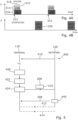
- FIG 4A illustrates multiple preconfigured uplink resources 310 that have a common fixed time schedule 312 that is time aligned with a schedule for sending uplink initiation messages 202 of a random access procedure 200.
- the preconfigured uplink resources 310 for transmission of an uplink connection request are configured in the same timing and periodicity as RACH Resources used for sending a Random Access Preamble.
- the set of multiple preconfigured uplink resources 310 are allocated to a frequency range 314 different to the frequency range 316 used for sending uplink initiation messages 202 of a random access procedure 200.
- the set of multiple preconfigured uplink resources 310, the PUA region, is frequency divided to provide each separate preconfigured uplink resource 310.
- Each preconfigured uplink resource 310 in the set of multiple preconfigured uplink resources 310 has the same size 318 (e.g. transport block size) corresponding to the uplink connection request 204 of the random access procedure 200.
- the size may be 88 bits.
- multiple preconfigured uplink resources 310 are configured at the same starting time 312 of the PRACH window for sending uplink initiation messages 202 but are separated in frequency from the uplink initiation messages 202.
- the access node 120 preconfigures the uplink resources by sending broadcast system information defining the preconfigured uplink resources 310.
- This system information received at the mobile node 110, is a broadcast network allocation of preconfigured uplink resources for transmission of an uplink connection request.
- This broadcast system information can be sent as a broadcast information element for preconfiguring multiple uplink resources.
- the broadcast information element comprises one or more data structures, for example fields, configured to define multiple preconfigured uplink resources 310 that have:
- the terminal 110 sends, at block 424, the uplink connection request 206 via a preconfigured uplink access resource 310.
- the timing advance will need to be valid.
- the terminal 110 is configured to check validity of a timing advance before causing the sending of the uplink connection request 206 within the preconfigured uplink resource 310.
- the timing advance becomes invalid if a validity timer expires in idle state.
- Other criteria can be used to invalidate the timing advance, for example, changes in received signal strength measurement, changes in serving cell id, movement of the terminal 110 beyond a threshold distance (e.g. 500m).
- the terminal 120 sends, at block 424, an uplink connection request 206 within a preconfigured uplink resource 310.
- the uplink connection request 206 can, in at least some examples, comprise an identifier of the terminal 110.
- the preconfigured uplink resource 310 used to send the uplink connection request 206 can, in at least some examples, be different to the initial uplink grant 316 provided previously by a downlink response 204 of a random access procedure 200.
- the preconfigured uplink resource 310 used for sending the uplink connection request 206 is not scheduled by the downlink response 204 (although scheduling will depend upon a timing advance supplied).
- the preconfigured uplink resource 310 has a fixed, pre-allocated timing schedule that is independent of the uplink grant and is time aligned with a time schedule for sending uplink initiation messages 202.
- One of preconfigured uplink resources 310 is selected and the selected preconfigured uplink resource 310 is used to send the uplink connection request 206.
- the preconfigured uplink resource 310 can be randomly selected by the terminal 110 from the set of multiple available preconfigured uplink resources 310.
- a trigger causes the terminal to start the process for sending an uplink connection request 206 within a preconfigured uplink resource 310.
- the terminal can, for example, send an uplink connection request 206 within a preconfigured uplink resource 310 in the following scenarios:
- the terminal 110 responds to receipt of a downlink response 204 comprising an initial uplink grant by sending an uplink connection request 206, comprising an identifier of the terminal 110, using the initial uplink grant.
- the terminal 110 sends the uplink connection request 206, comprising the identifier of the terminal 110, within the preconfigured uplink resource 310 which is different to the initial uplink grant.
- the access node 120 In response to receiving the uplink connection request 206 within a preconfigured uplink resource 310 the access node 120 sends, at block 440, a downlink response 208.
- the downlink response 208 is a response to the uplink connection request 206 within the preconfigured uplink resource 310. This continues the random access procedure 200.
- the uplink connection request 206 may be used for connection establishment, connection re-establishment or early data transmission.
- the downlink response 204 to the uplink initiation message 202 and the downlink response 208 to the uplink connection request 206 within the preconfigured uplink resource 310 can occupy a common resource space 330 monitored by the terminal 110.
- the monitored common resource space 330 comprises common timing and a common frequency space.
- the downlink responses 204, 208 are both transmitted in a Physical Downlink Control Channel.
- the terminal 110 listens to the same common search space 330 configured for Random Access Response 204 to get a downlink response 208, in response to the uplink connection request 206.
- a one-step process may be used for delivery of the downlink contention resolution response.
- the downlink response 208 to the uplink connection request 206 within the preconfigured uplink resource provides a downlink contention resolution response, for example, comprising the received identifier of the terminal.
- the downlink response 208 to the uplink connection request 206 within the preconfigured uplink resource 310 allocates directly or indirectly a future resource 412 for providing a downlink contention resolution response comprising the received identifier of the terminal.
- the downlink response 208 to the uplink connection request 206 within the preconfigured uplink resource 310 provides a time schedule to receive a downlink contention resolution response comprising the received identifier of the terminal.
- the downlink response 208 to the uplink connection request 206 within the preconfigured uplink resource can provide a downlink response 204 to the uplink initiation message defining a time schedule for receiving a downlink contention resolution response comprising the received identifier of the terminal.
- the mobile node 110 receives a downlink contention resolution response comprising the received identifier of the terminal.
- the common search space (RNTI) 330 configured for Random Access Response is used for enabling receipt, directly 208 or indirectly 412, the downlink contention response.
- Downlink control information (DCI) sent to the terminal 110 via the common search space 330 schedules two separate transport blocks. A first one is allocated for the downlink Random Access Response 202 and the second is used for the downlink response 208.
- the downlink response 208 contains a downlink grant for sending 412 the downlink contention response.
- the downlink control information sent on the common search space 330 indicates a separate resource for sending a downlink response 208.
- the downlink response 208 can be the downlink contention response or can be used to schedule the downlink contention response.
- a downlink response message 204 is modified to include information elements as the downlink response 208 in addition to the Random Access Response.
- the information elements (downlink response 208) include a downlink grant to send a downlink message 412 and an uplink grant for an acknowledgement 414 in reply.
- the information element also includes an identifier to identify the predetermined uplink resource 310 used to send the uplink connection request 206.
- the downlink message 412 can be the downlink contention response or can be used to schedule the downlink contention response.
- the information elements (downlink response 208) includes the downlink contention response.
- Fig 6A illustrates an example of a controller 500.
- Implementation of a controller 500 may be as controller circuitry.
- the controller 500 may be implemented in hardware alone, have certain aspects in software including firmware alone or can be a combination of hardware and software (including firmware).
- controller 500 may be implemented using instructions that enable hardware functionality, for example, by using executable instructions of a computer program 506 in a general-purpose or special-purpose processor 502 that may be stored on a computer readable storage medium (disk, memory etc) to be executed by such a processor 502.
- a general-purpose or special-purpose processor 502 may be stored on a computer readable storage medium (disk, memory etc) to be executed by such a processor 502.
- the processor 502 is configured to read from and write to the memory 504.
- the processor 502 may also comprise an output interface via which data and/or commands are output by the processor 502 and an input interface via which data and/or commands are input to the processor 502.
- the memory 504 stores a computer program 506 comprising computer program instructions (computer program code) that controls the operation of the apparatus 110, 120 when loaded into the processor 502.
- the computer program instructions, of the computer program 506, provide the logic and routines that enables the apparatus to perform the methods illustrated in Figs 5 .
- the processor 502 by reading the memory 504 is able to load and execute the computer program 506.
- the apparatus 110 therefore comprises:
- the apparatus 120 therefore comprises:
- the computer program 506 may arrive at the apparatus 110, 120 via any suitable delivery mechanism 510.
- the delivery mechanism 510 may be, for example, a machine readable medium, a computer-readable medium, a non-transitory computer-readable storage medium, a computer program product, a memory device, a record medium such as a Compact Disc Read-Only Memory (CD-ROM) or a Digital Versatile Disc (DVD) or a solid state memory, an article of manufacture that comprises or tangibly embodies the computer program 506.
- the delivery mechanism may be a signal configured to reliably transfer the computer program 506.
- the apparatus 110, 120 may propagate or transmit the computer program 506 as a computer data signal.
- the computer program instructions may be comprised in a computer program, a non-transitory computer readable medium, a computer program product, a machine readable medium. In some but not necessarily all examples, the computer program instructions may be distributed over more than one computer program.
- memory 504 is illustrated as a single component/circuitry it may be implemented as one or more separate components/circuitry some or all of which may be integrated/removable and/or may provide permanent/semi-permanent/ dynamic/cached storage.
- processor 502 is illustrated as a single component/circuitry it may be implemented as one or more separate components/circuitry some or all of which may be integrated/removable.
- the processor 502 may be a single core or multi-core processor.
- references to ⁇ computer-readable storage medium', 'computer program product', 'tangibly embodied computer program' etc. or a 'controller', 'computer', 'processor' etc. should be understood to encompass not only computers having different architectures such as single /multi- processor architectures and sequential (Von Neumann)/parallel architectures but also specialized circuits such as field-programmable gate arrays (FPGA), application specific circuits (ASIC), signal processing devices and other processing circuitry.
- References to computer program, instructions, code etc. should be understood to encompass software for a programmable processor or firmware such as, for example, the programmable content of a hardware device whether instructions for a processor, or configuration settings for a fixed-function device, gate array or programmable logic device etc.
- circuitry may refer to one or more or all of the following:
- circuitry also covers an implementation of merely a hardware circuit or processor and its (or their) accompanying software and/or firmware.
- circuitry also covers, for example and if applicable to the particular claim element, a baseband integrated circuit for a mobile device or a similar integrated circuit in a server, a cellular network device, or other computing or network device.
- the blocks illustrated in the Figs 5 may represent steps in a method and/or sections of code in the computer program 506.
- the illustration of a particular order to the blocks does not necessarily imply that there is a required or preferred order for the blocks and the order and arrangement of the block may be varied. Furthermore, it may be possible for some blocks to be omitted.
- the apparatus 110 is configured to communicate data from the apparatus 110 with or without local storage of the data in a memory 504 at the apparatus 110 and with or without local processing of the data by circuitry or processors at the apparatus 110.
- the data may be stored in processed or unprocessed format remotely at one or more devices.
- the data may be stored in the Cloud.
- the data may be processed remotely at one or more devices.
- the data may be partially processed locally and partially processed remotely at one or more devices.
- the data may be communicated to the remote devices wirelessly via short range radio communications such as Wi-Fi or Bluetooth, for example, or over long range cellular radio links.
- the apparatus may comprise a communications interface such as, for example, a radio transceiver for communication of data.
- the apparatus 110 may be part of the Internet of Things forming part of a larger, distributed network.
- the processing of the data may be for the purpose of health monitoring, data aggregation, patient monitoring, vital signs monitoring or other purposes.
- the processing of the data may involve artificial intelligence or machine learning algorithms.
- the data may, for example, be used as learning input to train a machine learning network or may be used as a query input to a machine learning network, which provides a response.
- the machine learning network may for example use linear regression, logistic regression, vector support machines or an acyclic machine learning network such as a single or multi hidden layer neural network.
- the processing of the data may produce an output.
- the output may be communicated to the apparatus 110 where it may produce an output sensible to the subject such as an audio output, visual output or haptic output.
- the above described examples find application as enabling components of: automotive systems; telecommunication systems; electronic systems including consumer electronic products; distributed computing systems; media systems for generating or rendering media content including audio, visual and audio visual content and mixed, mediated, virtual and/or augmented reality; personal systems including personal health systems or personal fitness systems; navigation systems; user interfaces also known as human machine interfaces; networks including cellular, non-cellular, and optical networks; ad-hoc networks; the internet; the internet of things; virtualized networks; and related software and services.
- a property of the instance can be a property of only that instance or a property of the class or a property of a sub-class of the class that includes some but not all of the instances in the class. It is therefore implicitly disclosed that a feature described with reference to one example but not with reference to another example, can where possible be used in that other example as part of a working combination but does not necessarily have to be used in that other example.
- 'a' or ⁇ the' is used in this document with an inclusive not an exclusive meaning. That is any reference to X comprising a/the Y indicates that X may comprise only one Y or may comprise more than one Y unless the context clearly indicates the contrary. If it is intended to use 'a' or ⁇ the' with an exclusive meaning then it will be made clear in the context. In some circumstances the use of 'at least one' or 'one or more' may be used to emphasis an inclusive meaning but the absence of these terms should not be taken to infer and exclusive meaning.
- the presence of a feature (or combination of features) in a claim is a reference to that feature or (combination of features) itself and also to features that achieve substantially the same technical effect (equivalent features).
- the equivalent features include, for example, features that are variants and achieve substantially the same result in substantially the same way.
- the equivalent features include, for example, features that perform substantially the same function, in substantially the same way to achieve substantially the same result.
Landscapes
- Engineering & Computer Science (AREA)
- Computer Networks & Wireless Communication (AREA)
- Signal Processing (AREA)
- Mobile Radio Communication Systems (AREA)
- Small-Scale Networks (AREA)
Priority Applications (1)
| Application Number | Priority Date | Filing Date | Title |
|---|---|---|---|
| EP24197192.8A EP4447601B1 (de) | 2019-01-04 | 2019-01-04 | Kommunikation zwischen einem endgerät und einem drahtlosnetzwerkknoten |
Applications Claiming Priority (3)
| Application Number | Priority Date | Filing Date | Title |
|---|---|---|---|
| EP19906648.1A EP3874850B1 (de) | 2019-01-04 | 2019-01-04 | Kommunikation zwischen einem endgerät und einem drahtlosnetzwerkknoten |
| EP24197192.8A EP4447601B1 (de) | 2019-01-04 | 2019-01-04 | Kommunikation zwischen einem endgerät und einem drahtlosnetzwerkknoten |
| PCT/CN2019/070337 WO2020140248A1 (en) | 2019-01-04 | 2019-01-04 | Communicating between a terminal and a wireless network node |
Related Parent Applications (2)
| Application Number | Title | Priority Date | Filing Date |
|---|---|---|---|
| EP19906648.1A Division EP3874850B1 (de) | 2019-01-04 | 2019-01-04 | Kommunikation zwischen einem endgerät und einem drahtlosnetzwerkknoten |
| EP19906648.1A Division-Into EP3874850B1 (de) | 2019-01-04 | 2019-01-04 | Kommunikation zwischen einem endgerät und einem drahtlosnetzwerkknoten |
Publications (4)
| Publication Number | Publication Date |
|---|---|
| EP4447601A2 true EP4447601A2 (de) | 2024-10-16 |
| EP4447601A3 EP4447601A3 (de) | 2024-12-11 |
| EP4447601C0 EP4447601C0 (de) | 2026-01-28 |
| EP4447601B1 EP4447601B1 (de) | 2026-01-28 |
Family
ID=71406659
Family Applications (2)
| Application Number | Title | Priority Date | Filing Date |
|---|---|---|---|
| EP24197192.8A Active EP4447601B1 (de) | 2019-01-04 | 2019-01-04 | Kommunikation zwischen einem endgerät und einem drahtlosnetzwerkknoten |
| EP19906648.1A Active EP3874850B1 (de) | 2019-01-04 | 2019-01-04 | Kommunikation zwischen einem endgerät und einem drahtlosnetzwerkknoten |
Family Applications After (1)
| Application Number | Title | Priority Date | Filing Date |
|---|---|---|---|
| EP19906648.1A Active EP3874850B1 (de) | 2019-01-04 | 2019-01-04 | Kommunikation zwischen einem endgerät und einem drahtlosnetzwerkknoten |
Country Status (4)
| Country | Link |
|---|---|
| US (1) | US12028909B2 (de) |
| EP (2) | EP4447601B1 (de) |
| CN (1) | CN113228766B (de) |
| WO (1) | WO2020140248A1 (de) |
Families Citing this family (8)
| Publication number | Priority date | Publication date | Assignee | Title |
|---|---|---|---|---|
| WO2020164817A1 (en) * | 2019-02-12 | 2020-08-20 | Sony Corporation | Timing advance validation |
| US12082149B2 (en) * | 2019-02-14 | 2024-09-03 | Ntt Docomo, Inc. | User equipment and communication method |
| EP3914020B1 (de) * | 2019-02-15 | 2025-05-21 | Huawei Technologies Co., Ltd. | Überwachungsverfahren und -vorrichtung |
| JP7540636B2 (ja) * | 2019-02-27 | 2024-08-27 | 株式会社Nttドコモ | 端末、通信システム及び通信方法 |
| KR102820273B1 (ko) * | 2019-07-08 | 2025-06-12 | 텔레폰악티에볼라겟엘엠에릭슨(펍) | 무선 통신 네트워크에서 사전 구성된 업링크 자원을 사용하기 위한 방법 및 장치 |
| WO2022164297A1 (ko) * | 2021-01-29 | 2022-08-04 | 엘지전자 주식회사 | 무선 통신 시스템에서 상향링크 송수신 방법 및 장치 |
| US20250008563A1 (en) * | 2021-08-04 | 2025-01-02 | Telefonaktiebolaget Lm Ericsson (Publ) | Random access partitioning and random access report |
| CN116195327B (zh) * | 2021-09-26 | 2025-10-10 | 北京小米移动软件有限公司 | 一种随机接入方法、随机接入装置及存储介质 |
Family Cites Families (16)
| Publication number | Priority date | Publication date | Assignee | Title |
|---|---|---|---|---|
| WO2013010576A1 (en) * | 2011-07-18 | 2013-01-24 | Nokia Siemens Networks Oy | Determination of the timing advance group |
| EP2810509B1 (de) | 2012-01-31 | 2019-09-25 | Nokia Technologies Oy | Verfahren und vorrichtung zur konservierung physikalischer uplink-steuerkanalressourcen |
| CN104919883A (zh) | 2012-10-19 | 2015-09-16 | 美国博通公司 | 随机接入过程及相关装置 |
| RU2684758C2 (ru) * | 2014-03-25 | 2019-04-12 | Телефонактиеболагет Лм Эрикссон (Пабл) | Система и способ физического произвольного доступа на основе лепестка диаграммы направленности |
| EP3157294B1 (de) | 2014-06-10 | 2019-08-07 | LG Electronics Inc. | Verfahren zur steuerung des zeitvorlaufs zur direktkommunikation zwischen endgeräten in einem drahtloskommunikationssystem und vorrichtung dafür |
| CN108476539B (zh) * | 2016-01-29 | 2022-08-19 | 成均馆大学校产学协力团 | 在物联网环境中考虑覆盖等级和子载波间隔配置和/或多频配置的随机接入方法 |
| CN107155221B (zh) | 2016-03-03 | 2020-11-17 | 华为技术有限公司 | 应用于超级小区的通信方法和装置 |
| WO2018034602A1 (en) | 2016-08-17 | 2018-02-22 | Telefonaktiebolaget Lm Ericsson (Publ) | Paging providing uplink resource allocation |
| KR102286816B1 (ko) * | 2017-03-17 | 2021-08-06 | 한국전자통신연구원 | 기지국 및 기지국의 동작 방법 |
| WO2018174577A1 (ko) * | 2017-03-22 | 2018-09-27 | 엘지전자 주식회사 | 랜덤 접속 과정을 수행하는 방법 및 이를 위한 장치 |
| CN110612769B (zh) * | 2017-05-04 | 2023-08-25 | Lg电子株式会社 | 执行随机接入过程的方法及其装置 |
| KR102309120B1 (ko) * | 2017-05-11 | 2021-10-06 | 삼성전자 주식회사 | 단말 및 기지국 간의 연결 설정 방법 및 장치 |
| KR20200029580A (ko) * | 2017-08-09 | 2020-03-18 | 엘지전자 주식회사 | 랜덤 접속 과정을 수행하는 방법 및 이를 위한 장치 |
| US11147112B2 (en) * | 2018-03-09 | 2021-10-12 | Qualcomm Incorporated | EV2X mode 3 operation based on eNB tunneling |
| TWI700016B (zh) * | 2018-03-31 | 2020-07-21 | 財團法人資訊工業策進會 | 基地台、使用者設備與提早資料傳輸方法 |
| US11196524B2 (en) * | 2018-07-18 | 2021-12-07 | Qualcomm Incorporated | Multi-beam CSI feedback |
-
2019
- 2019-01-04 CN CN201980085511.9A patent/CN113228766B/zh active Active
- 2019-01-04 EP EP24197192.8A patent/EP4447601B1/de active Active
- 2019-01-04 EP EP19906648.1A patent/EP3874850B1/de active Active
- 2019-01-04 WO PCT/CN2019/070337 patent/WO2020140248A1/en not_active Ceased
- 2019-01-04 US US17/299,737 patent/US12028909B2/en active Active
Non-Patent Citations (1)
| Title |
|---|
| 3GPP TS 36.300, 2018 |
Also Published As
| Publication number | Publication date |
|---|---|
| EP4447601A3 (de) | 2024-12-11 |
| US12028909B2 (en) | 2024-07-02 |
| EP3874850A4 (de) | 2022-06-22 |
| EP3874850B1 (de) | 2024-10-09 |
| CN113228766B (zh) | 2024-07-02 |
| CN113228766A (zh) | 2021-08-06 |
| EP4447601C0 (de) | 2026-01-28 |
| EP4447601B1 (de) | 2026-01-28 |
| WO2020140248A1 (en) | 2020-07-09 |
| US20220022265A1 (en) | 2022-01-20 |
| EP3874850A1 (de) | 2021-09-08 |
Similar Documents
| Publication | Publication Date | Title |
|---|---|---|
| US12028909B2 (en) | Communicating between a terminal and a wireless network node | |
| US10779329B2 (en) | Random access response transmission method and device | |
| US11006348B2 (en) | System information transmission method, user equipment, network side device, system and storage medium | |
| JP2021508961A (ja) | 無線通信システムで帯域幅部分非活性タイマーをハンドリングする方法及び装置 | |
| CN110945957A (zh) | 执行随机接入过程的方法和装置 | |
| KR20230135677A (ko) | 무선 통신 시스템에서 스몰 데이터 전송을 처리하기 위한 방법 및 장치 | |
| TWI745866B (zh) | 終端與無線網路節點之間的通訊技術 | |
| CN113973395A (zh) | 随机接入方法、配置方法及相关设备 | |
| CN113767677B (zh) | 非许可频带中的随机接入消息重传 | |
| JP2022549266A (ja) | ランダムアクセスプロシージャのための方法および装置 | |
| WO2017084236A1 (zh) | 随机接入的方法及装置 | |
| US11533760B2 (en) | Method and device for communicating with a selected transport block size | |
| CN110856267B (zh) | 一种通信方法及设备 | |
| JP2025013806A (ja) | ランダムアクセス手順における競合解決 | |
| CN113498212B (zh) | 随机接入方法、终端及网络侧设备 | |
| CA3211344A1 (en) | Method and apparatus for drx operation for multicast and broadcast services | |
| WO2023169580A1 (zh) | 数据传输方法及装置、存储介质、终端设备、网络设备 | |
| EP4444011A1 (de) | Sps-aktivierungsanforderung für mbs-multicast in rrc_inaktiv | |
| WO2024152994A1 (zh) | 随机接入处理方法、装置、终端及网络侧设备 | |
| HK40110916A (en) | Communicating between a terminal and a wireless network node | |
| WO2025171622A1 (en) | Ssb-less mode | |
| CN114503771A (zh) | 在随机接入过程中监控窗口的终止 | |
| WO2024077639A1 (en) | Hybrid automatic request (harq) feedback | |
| US20260089799A1 (en) | Methods and apparatuses for a pdcch monitoring enhancement mechanism for xr traffic | |
| WO2026046561A1 (en) | Random access procedure |
Legal Events
| Date | Code | Title | Description |
|---|---|---|---|
| PUAI | Public reference made under article 153(3) epc to a published international application that has entered the european phase |
Free format text: ORIGINAL CODE: 0009012 |
|
| STAA | Information on the status of an ep patent application or granted ep patent |
Free format text: STATUS: THE APPLICATION HAS BEEN PUBLISHED |
|
| AC | Divisional application: reference to earlier application |
Ref document number: 3874850 Country of ref document: EP Kind code of ref document: P |
|
| AK | Designated contracting states |
Kind code of ref document: A2 Designated state(s): AL AT BE BG CH CY CZ DE DK EE ES FI FR GB GR HR HU IE IS IT LI LT LU LV MC MK MT NL NO PL PT RO RS SE SI SK SM TR |
|
| REG | Reference to a national code |
Ref legal event code: R079 Ref country code: DE Ref legal event code: R079 Ref document number: 602019081085 Country of ref document: DE Free format text: PREVIOUS MAIN CLASS: H04W0074080000 Ipc: H04W0072000000 |
|
| PUAL | Search report despatched |
Free format text: ORIGINAL CODE: 0009013 |
|
| AK | Designated contracting states |
Kind code of ref document: A3 Designated state(s): AL AT BE BG CH CY CZ DE DK EE ES FI FR GB GR HR HU IE IS IT LI LT LU LV MC MK MT NL NO PL PT RO RS SE SI SK SM TR |
|
| RIC1 | Information provided on ipc code assigned before grant |
Ipc: H04W 74/08 20240101ALI20241106BHEP Ipc: H04W 72/04 20230101ALI20241106BHEP Ipc: H04W 72/00 20230101AFI20241106BHEP |
|
| REG | Reference to a national code |
Ref country code: HK Ref legal event code: DE Ref document number: 40110916 Country of ref document: HK |
|
| STAA | Information on the status of an ep patent application or granted ep patent |
Free format text: STATUS: REQUEST FOR EXAMINATION WAS MADE |
|
| 17P | Request for examination filed |
Effective date: 20250520 |
|
| GRAP | Despatch of communication of intention to grant a patent |
Free format text: ORIGINAL CODE: EPIDOSNIGR1 |
|
| STAA | Information on the status of an ep patent application or granted ep patent |
Free format text: STATUS: GRANT OF PATENT IS INTENDED |
|
| RIC1 | Information provided on ipc code assigned before grant |
Ipc: H04W 72/00 20230101AFI20250704BHEP Ipc: H04W 72/04 20230101ALI20250704BHEP Ipc: H04W 74/08 20240101ALI20250704BHEP |
|
| INTG | Intention to grant announced |
Effective date: 20250812 |
|
| GRAS | Grant fee paid |
Free format text: ORIGINAL CODE: EPIDOSNIGR3 |
|
| GRAA | (expected) grant |
Free format text: ORIGINAL CODE: 0009210 |
|
| STAA | Information on the status of an ep patent application or granted ep patent |
Free format text: STATUS: THE PATENT HAS BEEN GRANTED |
|
| AC | Divisional application: reference to earlier application |
Ref document number: 3874850 Country of ref document: EP Kind code of ref document: P |
|
| AK | Designated contracting states |
Kind code of ref document: B1 Designated state(s): AL AT BE BG CH CY CZ DE DK EE ES FI FR GB GR HR HU IE IS IT LI LT LU LV MC MK MT NL NO PL PT RO RS SE SI SK SM TR |
|
| REG | Reference to a national code |
Ref country code: CH Ref legal event code: F10 Free format text: ST27 STATUS EVENT CODE: U-0-0-F10-F00 (AS PROVIDED BY THE NATIONAL OFFICE) Effective date: 20260128 Ref country code: GB Ref legal event code: FG4D |
|
| REG | Reference to a national code |
Ref country code: DE Ref legal event code: R096 Ref document number: 602019081085 Country of ref document: DE |
|
| REG | Reference to a national code |
Ref country code: IE Ref legal event code: FG4D |
|
| U01 | Request for unitary effect filed |
Effective date: 20260202 |
|
| U07 | Unitary effect registered |
Designated state(s): AT BE BG DE DK EE FI FR IT LT LU LV MT NL PT RO SE SI Effective date: 20260206 |