EP4447331B1 - Verfahren und system zur kommunikation in einem kommunikationsnetzwerk mit knoten mit funk- und cpl-kommunikationsmitteln und knoten mit ausschliesslichen funkkommunikationsvorrichtungen - Google Patents
Verfahren und system zur kommunikation in einem kommunikationsnetzwerk mit knoten mit funk- und cpl-kommunikationsmitteln und knoten mit ausschliesslichen funkkommunikationsvorrichtungen Download PDFInfo
- Publication number
- EP4447331B1 EP4447331B1 EP24169363.9A EP24169363A EP4447331B1 EP 4447331 B1 EP4447331 B1 EP 4447331B1 EP 24169363 A EP24169363 A EP 24169363A EP 4447331 B1 EP4447331 B1 EP 4447331B1
- Authority
- EP
- European Patent Office
- Prior art keywords
- radio
- communication means
- node
- nodes
- plc
- Prior art date
- Legal status (The legal status is an assumption and is not a legal conclusion. Google has not performed a legal analysis and makes no representation as to the accuracy of the status listed.)
- Active
Links
Images


Classifications
-
- H—ELECTRICITY
- H04—ELECTRIC COMMUNICATION TECHNIQUE
- H04W—WIRELESS COMMUNICATION NETWORKS
- H04W40/00—Communication routing or communication path finding
- H04W40/02—Communication route or path selection, e.g. power-based or shortest path routing
- H04W40/22—Communication route or path selection, e.g. power-based or shortest path routing using selective relaying for reaching a BTS [Base Transceiver Station] or an access point
-
- H—ELECTRICITY
- H04—ELECTRIC COMMUNICATION TECHNIQUE
- H04B—TRANSMISSION
- H04B3/00—Line transmission systems
- H04B3/54—Systems for transmission via power distribution lines
- H04B3/546—Combination of signalling, telemetering, protection
-
- H—ELECTRICITY
- H04—ELECTRIC COMMUNICATION TECHNIQUE
- H04W—WIRELESS COMMUNICATION NETWORKS
- H04W52/00—Power management, e.g. Transmission Power Control [TPC] or power classes
- H04W52/02—Power saving arrangements
-
- H—ELECTRICITY
- H04—ELECTRIC COMMUNICATION TECHNIQUE
- H04B—TRANSMISSION
- H04B3/00—Line transmission systems
- H04B3/54—Systems for transmission via power distribution lines
-
- H—ELECTRICITY
- H04—ELECTRIC COMMUNICATION TECHNIQUE
- H04B—TRANSMISSION
- H04B3/00—Line transmission systems
- H04B3/54—Systems for transmission via power distribution lines
- H04B3/544—Setting up communications; Call and signalling arrangements
-
- H—ELECTRICITY
- H04—ELECTRIC COMMUNICATION TECHNIQUE
- H04L—TRANSMISSION OF DIGITAL INFORMATION, e.g. TELEGRAPHIC COMMUNICATION
- H04L69/00—Network arrangements, protocols or services independent of the application payload and not provided for in the other groups of this subclass
- H04L69/26—Special purpose or proprietary protocols or architectures
-
- H—ELECTRICITY
- H04—ELECTRIC COMMUNICATION TECHNIQUE
- H04Q—SELECTING
- H04Q9/00—Arrangements in telecontrol or telemetry systems for selectively calling a substation from a main station, in which substation desired apparatus is selected for applying a control signal thereto or for obtaining measured values therefrom
-
- H—ELECTRICITY
- H04—ELECTRIC COMMUNICATION TECHNIQUE
- H04W—WIRELESS COMMUNICATION NETWORKS
- H04W40/00—Communication routing or communication path finding
- H04W40/02—Communication route or path selection, e.g. power-based or shortest path routing
-
- H—ELECTRICITY
- H04—ELECTRIC COMMUNICATION TECHNIQUE
- H04B—TRANSMISSION
- H04B2203/00—Indexing scheme relating to line transmission systems
- H04B2203/54—Aspects of powerline communications not already covered by H04B3/54 and its subgroups
- H04B2203/5429—Applications for powerline communications
- H04B2203/5433—Remote metering
-
- H—ELECTRICITY
- H04—ELECTRIC COMMUNICATION TECHNIQUE
- H04Q—SELECTING
- H04Q2209/00—Arrangements in telecontrol or telemetry systems
- H04Q2209/30—Arrangements in telecontrol or telemetry systems using a wired architecture
-
- H—ELECTRICITY
- H04—ELECTRIC COMMUNICATION TECHNIQUE
- H04Q—SELECTING
- H04Q2209/00—Arrangements in telecontrol or telemetry systems
- H04Q2209/40—Arrangements in telecontrol or telemetry systems using a wireless architecture
-
- H—ELECTRICITY
- H04—ELECTRIC COMMUNICATION TECHNIQUE
- H04Q—SELECTING
- H04Q2209/00—Arrangements in telecontrol or telemetry systems
- H04Q2209/60—Arrangements in telecontrol or telemetry systems for transmitting utility meters data, i.e. transmission of data from the reader of the utility meter
Definitions
- the present invention relates to a method and a system for communication in a communication network comprising nodes provided with radio and PLC communication means and nodes provided only with radio communication means.
- Powerline communications are developing, particularly in the context of AMM (Automated Meter Management) power supply networks.
- Communication networks are thus implemented in power supply networks for the automated collection by a base node (also called a “data concentrator") of the network, from nodes such as smart electricity meters, of energy consumption reading data that said smart electricity meters are respectively responsible for monitoring.
- an RF (acronym for radio frequency) radio channel may be used instead of one of the said PLC frequency bands as defined in the standard entitled Narrowband OFDM PLC specifications for G3 PLC networks of March 2022.
- Wireless M-Bus Wireless Meter Bus
- G3-PLC/RF hybrid protocol for example: the G3-PLC/RF hybrid protocol, the PRIME/RF hybrid protocol, the Wi-SUN protocol, etc.
- the patent application US 2019/296797 discloses a system that includes a PLC communications network with a reactive routing protocol.
- nodes equipped with only radio communication means are able to communicate with nodes equipped with radio and PLC communication means without the latter using a communication protocol other than that used by the nodes equipped with radio and PLC communication means in the communication network.
- the electrical energy consumption of nodes with only radio communication means becomes compatible with nodes operating on battery power.
- the data concentrator is configured to collect, from the nodes equipped with radio and PLC communication means, data from energy consumption readings of electrical installations that said nodes are respectively responsible for monitoring and the nodes equipped with only radio communication means are intelligent fluid meters.
- a particular embodiment also relates to a computer program product. It comprises instructions for implementing, by a device, the method according to one of the preceding embodiments, when said program is executed by a processor of the device.
- a particular embodiment also relates to a storage medium. It stores a computer program comprising instructions for implementing, by a node device, the method according to one of the preceding embodiments, when said program is executed by a processor of the node device.
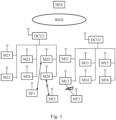
- FIG. 1 illustrates an example of a communications network in one embodiment.
- the communication network comprises a HES head-end system which is connected via a communication network to a plurality of data concentrators, here two in the Fig. 1 DCU1 and DCU2.
- the data concentrator DCU1 is connected to a plurality of nodes equipped with radio and PLC communication means denoted M11 to M16 and the data concentrator DCU2 is connected to a plurality of nodes equipped with radio and PLC communication means denoted M21 to M26.
- the role of the HES head-end system(s) is to automatically acquire data from the meters, avoiding any human intervention, and to monitor the parameters acquired from the nodes.
- the HES head-end system manages connectivity and schedules data collection from the metering infrastructure, including nodes and communication.
- the nodes equipped with radio and PLC communication means M11 to M16 and M21 to M26 are for example smart electricity meters and can communicate with the different nodes equipped with radio and PLC communication means CPL and with the DCU1 and DCU2 data concentrators through their PLC or RF communication interfaces.
- Nodes with radio and PLC communication means implement the specification for hybrid PLC and RF networks (e.g. G3-PLC hybrid or PRIME hybrid) or RF-only networks (e.g. Wi-SUN for Wireless Smart Utility Network).
- hybrid PLC and RF networks e.g. G3-PLC hybrid or PRIME hybrid
- RF-only networks e.g. Wi-SUN for Wireless Smart Utility Network
- nodes NF1, NF2 and NF3, hereinafter called leaf nodes are inserted into the communication network.
- the leaf nodes are capable of communicating only via their radio interface with the nodes equipped with radio and PLC communication means M11 to M16 and M21 to M26 and partly implement the specification for hybrid PLC and RF networks such as, for example, G3-PLC hybrid or PRIME hybrid or RF-only networks (such as, for example, Wi-SUN.
- Leaf nodes NF1, NF2 and NF3 are for example smart fluid meters.
- the leaf nodes NF1, NF2 and NF3 are able to automatically authenticate themselves to the network and acquire the network identifiers (the shortened MAC address, the network identifier and the security key) necessary to establish a secure two-way communication with an authentication agent.
- Leaf nodes NF1, NF2, and NF3 are able to establish a route using unicast messages to a node to which it is authenticated.
- the leaf nodes NF1 NF2 and NF3 are able to select and attach to a node equipped with radio and PLC communication means called parent node which is in charge of storing the messages received from the or each leaf node to be sent on demand to the data concentrator and the head-end system.
- the leaf node NF1 is attached and associated with the node equipped with radio and CPL communication means M25
- the leaf node NF2 is attached to the node equipped with radio and CPL communication means M26 but is not associated with it
- the leaf node NF3 is attached and associated with the node equipped with radio and CPL communication means M12 but loses the communication link with the node equipped with radio and CPL communication means M12.
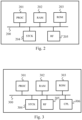
- FIG. 2 schematically illustrates the architecture of a node equipped only with radio communication means according to one embodiment.
- the nodes NF1, NF2 and NF3 comprise, connected by a communication bus 200: a processor or CPU (“Central Processing Unit” in English) 201; a RAM (“Random Access Memory” in English) 202; a ROM (“Read Only Memory” in English) 203; a storage unit such as a hard disk (or a storage media reader, such as an SD (“Secure Digital” in English) card reader) 204; an RF radio communication interface 205 allowing the node to communicate with at least one parent node.
- a processor or CPU Central Processing Unit” in English
- RAM Random Access Memory
- ROM Read Only Memory
- storage unit such as a hard disk (or a storage media reader, such as an SD (“Secure Digital” in English) card reader)
- an RF radio communication interface 205 allowing the node to communicate with at least one parent node.
- the processor 201 is capable of executing instructions loaded into the RAM 202 from the ROM 203, an external memory (not shown), a storage medium (such as an SD card), or a communications network. When the node is powered on, the processor 201 is capable of reading instructions from the RAM 202 and executing them. These instructions form a computer program causing the processor 201 to implement all or part of the method described in relation to the Figs. 4 , 5 And 7 .
- the process described below in relation to the Figs. 4 , 5 And 7 can be implemented in software by executing a set of instructions by a programmable machine, for example a DSP (Digital Signal Processor) or a microcontroller, or be implemented in hardware by a machine or a dedicated component, for example an FPGA (Field-Programmable Gate Array) or an ASIC (Application-Specific Integrated Circuit).
- a programmable machine for example a DSP (Digital Signal Processor) or a microcontroller
- FPGA Field-Programmable Gate Array
- ASIC Application-Specific Integrated Circuit
- a node equipped only with radio communication means can include all the software allowing the implementation of the protocol of the specification for hybrid PLC and RF networks such as for example G3-PLC hybrid or PRIME hybrid or RF-only networks such as for example Wi-SUN.
- a predetermined information indicates to the node equipped only with radio communication means that only part of the protocol must be implemented.
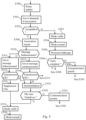
- Fig. 3 schematically illustrates the architecture of a node equipped with radio and PLC communication means according to one embodiment.
- the nodes M11 to M16, M21 to M26 comprise, connected by a communication bus 300: a processor or CPU (“Central Processing Unit” in English) 301; a RAM (“Random Access Memory” in English) 302; a ROM (“Read Only Memory” in English) 303; a storage unit such as a hard disk (or a storage media reader, such as an SD (“Secure Digital” in English) card reader) 304; an RF radio communication interface 305 allowing the node to communicate with at least one leaf node, the nodes equipped with radio and PLC communication means and the data concentrator to which they are connected and a PLC communication interface 305 allowing the node to communicate with the nodes equipped with radio and PLC communication means and the data concentrator to which they are connected.
- a communication bus 300 a processor or CPU (“Central Processing Unit” in English) 301; a RAM (“Random Access Memory” in English) 302; a ROM (“Read Only Memory” in English) 303; a storage unit such as a
- the processor 301 is capable of executing instructions loaded into the RAM 202 from the ROM 303, an external memory (not shown), a storage medium (such as an SD card), or a communications network. When the node is powered on, the processor 301 is capable of reading instructions from the RAM 302 and executing them. These instructions form a computer program causing the processor 301 to implement all or part of the method described in relation to the Fig. 6 .
- FIG.4 illustrates an example of an authentication and route creation process performed by a leaf node according to one embodiment.
- the leaf node checks whether a list of nodes that can be a parent is empty.
- the list of nodes is obtained by performing a neighborhood discovery operation and collecting all the responses sent by the nodes equipped with neighboring radio and PLC communication means.
- the leaf node selects a node equipped with radio and PLC communication means from the list. For example, the leaf node selects the node equipped with radio and PLC communication means for which the received signal has the best link quality indicator and sends an authentication request message to the selected node.
- the selected node When the selected node receives the message, it forwards the request to the data concentrator, which forwards it to the HES head-end system, which authenticates the node or not.
- the response including an identification key, is forwarded to the leaf node via the data concentrator and the selected node.
- the leaf node checks whether the authentication was accepted.
- step E406 If yes, the leaf node proceeds to step E404.
- the leaf node checks whether a maximum number of authentication attempts has been reached.
- the leaf node goes to step E405 and goes for a predetermined duration into a so-called standby mode in which only the fluid consumption measurement is carried out and in which the radio communication means are deactivated.
- step E406 the leaf node transitions to the authenticated state and becomes eligible to establish a route to the selected node and transfers to the selected node a request to create a route between the leaf node and the selected node.
- the leaf node stores the identifier of the selected node.
- the selected node If the selected node accepts the creation of the route, the selected node updates a routing table and informs the head-end system via the data concentrator.
- step E407 the leaf node checks whether the route creation request has been accepted. If so, the leaf node proceeds to step E408, and the communication link is thus created in step E408.
- FIG.5 illustrates an example of an association method performed by a node having only radio communication means according to one embodiment.
- step E500 the route has been established in accordance with the algorithm as described with reference to Fig. 4 .
- the leaf node orders the transfer of a message to the node with which the route was created, requesting association.
- step E502 the leaf node checks whether the association request has been accepted. If so, the leaf node proceeds to step E509, if not, the leaf node proceeds to step E503.
- step E503 the leaf node enters the sleep mode as described with reference to step E405 of the Fig. 4 .
- the leaf node moves to step E505 in a so-called normal mode in which the radio interface is activated.
- step E505 the leaf node performs a process of scanning or discovering the neighborhood and collecting all the responses sent by the nodes equipped with neighboring radio and PLC communication means.
- step E506 the leaf node checks whether a node other than the node that refused the association is detected following the scan.
- step E508 executes the algorithm as described with reference to the Fig. 4 to authenticate through the node other than the node that refused the association and create a route to the node other than the node that refused the association.
- step E506 If not, the leaf node proceeds from step E506 to step E400.
- step E509 the leaf node is then associated with the network. Acceptance of the association also includes information indicating whether the leaf node must send a unidirectional or bidirectional message.
- step E510 the leaf node checks whether a bidirectional message should be sent. If so, the leaf node proceeds to step E511. If not, the leaf node proceeds to step E517.
- the leaf node receives a request type message from the node with which it is associated and in response sends it a new message.
- the node to which the leaf node is associated sends an acknowledgment message if the message sent by the leaf node is successfully received.
- step E512 the leaf node checks whether the acknowledgment message has been received. If so, the leaf node proceeds to step E513. If not, the leaf node proceeds to step E519.
- step E513 the leaf node removes the received request type message from a queue and goes to step E515 to put itself in a sleep mode for a predetermined duration.
- the leaf node passes to step E516 in a so-called normal mode in which the radio interface is activated.
- step E517 the leaf node sends a message to the node with which it is associated and in response, the node with which the leaf node is associated sends an acknowledgment message in the event of successful receipt of the message sent by the leaf node.
- step E518 the leaf node checks whether the acknowledgment message has been received. If so, the leaf node proceeds to step E515. If not, the leaf node proceeds to step E519.
- the leaf node increments a variable representing the number of retransmissions carried out for the message.
- the leaf node checks whether the variable incremented at step E519 is equal to a maximum number of attempts to send the message.
- step E52 If yes, the leaf node proceeds to step E521. If no, the leaf node proceeds to step E515.
- step E521 the leaf node determines that communication with the node with which it is associated is interrupted and returns to step E503.
- FIG. 6 illustrates an example of an association method performed by a node provided with radio and PLC communication means according to one embodiment.
- step E600 the node equipped with radio and PLC communication means receives from a leaf node with which a route has been created, an association request message as described in step E501 of the Fig. 5 .
- step E601 the node equipped with radio and PLC communication means checks whether the number of leaf nodes associated with it is equal to a maximum number of leaf nodes associated with it.
- the node equipped with radio and PLC communication means sends in step E604 a message rejecting the association. If not, the node equipped with radio and PLC communication means orders in step E602 the transfer of a message accepting the association and informs the head-end system HES of the association in step E603.
- Fig.7 illustrates an example of a message processing method performed by a node having only radio communication means according to one embodiment.
- step E700 the node equipped only with radio communication means or leaf node checks whether a broadcast message is received. If so, the leaf node proceeds to step E701 and does not process the received message.
- step E702 the leaf node checks whether a message comprising an authentication request is received. If so, the leaf node proceeds to step E703 and does not process the received message.
- steps E700 and E702 can be reversed.
- verifying the receipt of a message including an authentication request is not conditional on the non-receipt of a broadcast message and verifying the receipt of a broadcast message is not conditional on verifying the receipt of a message including an authentication request.
Landscapes
- Engineering & Computer Science (AREA)
- Computer Networks & Wireless Communication (AREA)
- Signal Processing (AREA)
- Power Engineering (AREA)
- Computing Systems (AREA)
- Computer Security & Cryptography (AREA)
- Mobile Radio Communication Systems (AREA)
- Small-Scale Networks (AREA)
Claims (9)
- Kommunikationsverfahren in einem Kommunikationsnetzwerk, das Knoten, die über Funk- und PLC-Kommunikationsmittel verfügen, umfasst, wobei ein Datenkonzentrator und die Knoten, die über Funk- und PLC-Kommunikationsmittel verfügen, ein Mesh-Kommunikationsnetzwerk bilden, wobei die Knoten Knoten, die über Funk- und PLC-Kommunikationsmittel verfügen, umfassen, die die Rolle einer Zwischenstation spielen, um die Reichweite der Kommunikationen in dem Mesh-Kommunikationsnetzwerk zu erhöhen, wobei die Knoten, die über Funk- und PLC-Kommunikationsmittel verfügen, mit Hilfe eines vorgegebenen Kommunikationsprotokolls kommunizieren, übertragene Nachrichten verarbeiten und Authentifizierungsanfragen anderer Knoten verarbeiten, dadurch gekennzeichnet, dass das System ferner Knoten, die ausschließlich über Funkkommunikationsmittel verfügen, umfasst, die dazu fähig sind, teilweise gemäß demselben Protokoll, das auch von den Knoten, die über Funk- und PLC-Kommunikationsmittel verfügen, verwendet wird, zu kommunizieren, und dass das Verfahren die folgenden Schritte umfasst, die durch jeden Knoten, der ausschließlich über Funkkommunikationsmittel verfügt, ausgeführt werden:- Empfangen (E700) von übertragenen Nachrichten,- Nichtverarbeiten (E701) der übertragenen Nachrichten,- Empfangen (E702) von Assoziierungsanfragenachrichten,- Nichtverarbeiten (E703) der Assoziierungsanfragenachrichten.
- Verfahren nach Anspruch 1, dadurch gekennzeichnet, dass, wenn ein Knoten, der ausschließlich über Funkkommunikationsmittel verfügt, in das Kommunikationsnetzwerk eingebracht wird, der Knoten, der ausschließlich über Funkkommunikationsmittel verfügt:- einen Knoten, der über Funk- und PLC-Kommunikationsmittel verfügt, auswählt,- eine Nachricht an den ausgewählten Knoten sendet, um den Knoten, der ausschließlich über Funkkommunikationsmittel verfügt, in dem Kommunikationsnetzwerk zu authentifizieren,- in einen Betriebsmodus übergeht, in dem die Funkkommunikationsmittel während einer vorgegebenen Dauer deaktiviert sind, wenn die Authentifizierung nicht erfolgreich war,- eine Nachricht an den ausgewählten Knoten sendet, um eine Verbindung zu dem ausgewählten Knoten herzustellen, wenn die Authentifizierung erfolgreich war,- in einen Betriebsmodus übergeht, in dem die Funkkommunikationsmittel während einer vorgegebenen Dauer deaktiviert sind, wenn die Verbindungsherstellung nicht erfolgreich war.
- Verfahren nach Anspruch 2, dadurch gekennzeichnet, dass, wenn die Herstellung der Verbindung erfolgreich war, der Knoten, der ausschließlich über Funkkommunikationsmittel verfügt:- eine Nachricht an den ausgewählten Knoten sendet, um den Knoten, der ausschließlich über Funkkommunikationsmittel verfügt, mit dem ausgewählten Knoten zu assoziieren,- eine Nachricht an den Knoten, mit dem er assoziiert ist, sendet, wenn die Assoziierung erfolgreich war,- in den Betriebsmodus übergeht, in dem die Funkkommunikationsmittel während einer vorgegebenen Dauer deaktiviert sind, wenn die Nachricht durch den Knoten, mit dem er assoziiert ist, empfangen wurde.
- Verfahren nach Anspruch 3, dadurch gekennzeichnet, dass, wenn die Herstellung der Verbindung erfolgreich war, der Knoten, der ausschließlich über Funkkommunikationsmittel verfügt:- in den Betriebsmodus übergeht, in dem die Funkkommunikationsmittel während einer vorgegebenen Dauer deaktiviert sind, wenn die Assoziierung nicht erfolgreich war.
- Verfahren nach Anspruch 4, dadurch gekennzeichnet, dass der Knoten nach Ablauf der vorgegebenen Dauer in einen Modus übergeht, in dem die Funkkommunikationsmittel erneut aktiviert sind, und der Knoten:- einen Knoten, der über Funk- und PLC-Kommunikationsmittel verfügt, sucht, der sich von dem Knoten, mit dem die Assoziierung nicht erfolgreich war, unterscheidet.
- Kommunikationssystem in einem Kommunikationsnetzwerk, das Knoten, die über Funk- und PLC-Kommunikationsmittel verfügen, umfasst, wobei ein Datenkonzentrator und die Knoten, die über Funk- und PLC-Kommunikationsmittel verfügen, ein Mesh-Kommunikationsnetzwerk bilden, wobei die Knoten Knoten, die über Funk- und PLC-Kommunikationsmittel verfügen, umfassen, die die Rolle einer Zwischenstation spielen, um die Reichweite der Kommunikationen in dem Mesh-Kommunikationsnetzwerk zu erhöhen, wobei die Knoten, die über Funk- und PLC-Kommunikationsmittel verfügen, mit Hilfe eines vorgegebenen Kommunikationsprotokolls kommunizieren, übertragene Nachrichten verarbeiten und Authentifizierungsanfragen anderer Knoten verarbeiten, dadurch gekennzeichnet, dass das System ferner Knoten, die ausschließlich über Funkkommunikationsmittel verfügen, umfasst, die dazu fähig sind, teilweise gemäß demselben Protokoll, das auch von den Knoten, die über Funk- und PLC-Kommunikationsmittel verfügen, verwendet wird, zu kommunizieren, und dass die Knoten, die ausschließlich über Funkkommunikationsmittel verfügen, Folgendes umfassen:- Mittel zum Empfangen von übertragenen Nachrichten,- Mittel zum Nichtverarbeiten der übertragenen Nachrichten,- Mittel zum Empfangen von Assoziierungsanfragenachrichten,- Mittel zum Nichtverarbeiten der Assoziierungsanfragenachrichten.
- System nach Anspruch 6, dadurch gekennzeichnet, dass der Datenkonzentrator dazu konfiguriert ist, von den Knoten, die über Funk- und PLC-Kommunikationsmittel verfügen, Messdaten über den Energieverbrauch von elektrischen Anlagen, zu deren Überwachung die Knoten jeweils eingesetzt sind, zu sammeln, und die Knoten, die ausschließlich über Funkkommunikationsmittel verfügen, intelligente Durchflussmesser sind.
- Computerprogrammprodukt, dadurch gekennzeichnet, dass es Anweisungen zur Umsetzung, durch eine Ausrüstung, des Verfahrens nach einem der Ansprüche 1 bis 5 beinhaltet, wenn das Programm durch einen Prozessor eines Knotens ausgeführt wird.
- Speicherträger, dadurch gekennzeichnet, dass er ein Computerprogramm speichert, das Anweisungen zur Umsetzung, durch eine Ausrüstung, des Verfahrens nach einem der Ansprüche 1 bis 5 beinhaltet, wenn das Programm durch einen Prozessor eines Knotens ausgeführt wird.
Applications Claiming Priority (1)
| Application Number | Priority Date | Filing Date | Title |
|---|---|---|---|
| FR2303758A FR3140722A1 (fr) | 2023-04-14 | 2023-04-14 | Procede et systeme de communication dans un reseau de communication comportant des nœuds dotes de moyens de communication radio et cpl et des nœuds dotes uniquement de moyens de communication radio |
Publications (2)
| Publication Number | Publication Date |
|---|---|
| EP4447331A1 EP4447331A1 (de) | 2024-10-16 |
| EP4447331B1 true EP4447331B1 (de) | 2025-03-26 |
Family
ID=87036578
Family Applications (1)
| Application Number | Title | Priority Date | Filing Date |
|---|---|---|---|
| EP24169363.9A Active EP4447331B1 (de) | 2023-04-14 | 2024-04-10 | Verfahren und system zur kommunikation in einem kommunikationsnetzwerk mit knoten mit funk- und cpl-kommunikationsmitteln und knoten mit ausschliesslichen funkkommunikationsvorrichtungen |
Country Status (4)
| Country | Link |
|---|---|
| US (1) | US20240349180A1 (de) |
| EP (1) | EP4447331B1 (de) |
| CN (1) | CN118804200A (de) |
| FR (1) | FR3140722A1 (de) |
Family Cites Families (9)
| Publication number | Priority date | Publication date | Assignee | Title |
|---|---|---|---|---|
| CN102752040B (zh) * | 2012-06-21 | 2014-12-24 | 四川启明星蜀达电气有限公司 | 一种基于无线与电力线载波的混合组网与通信的方法 |
| FR3059503B1 (fr) * | 2016-11-30 | 2019-05-17 | Sagemcom Energy & Telecom Sas | Compteur electrique comportant une interface par courants porteurs en ligne et au moins une interface radio frequence |
| CN110300039B (zh) * | 2018-03-23 | 2020-12-15 | 华为技术有限公司 | 用于混合组网的入网方法、代理协调设备和站点设备 |
| US11128554B1 (en) * | 2019-02-01 | 2021-09-21 | Cisco Technology, Inc. | Increasing throughput for multi-PHY networks |
| CN112583688B (zh) * | 2019-09-30 | 2023-08-22 | 华为技术有限公司 | 混合网络的通信方法和设备 |
| CN111200858B (zh) * | 2020-01-02 | 2022-03-22 | 珠海中慧微电子有限公司 | 基于宽带载波和窄带无线的双模混合网络的组网方法 |
| CN111739275B (zh) * | 2020-06-22 | 2021-05-07 | 杭州万高科技股份有限公司 | 双模通信的控制方法、控制装置、控制设备及存储介质 |
| FR3126578B1 (fr) * | 2021-08-26 | 2023-07-14 | Sagemcom Energy & Telecom Sas | Procede de regulation destine a resorber un engorgement d’un reseau maille de communication par courants porteurs en ligne et radio |
| CN115766569A (zh) * | 2022-11-17 | 2023-03-07 | 深圳友讯达科技股份有限公司 | 双模网络路由的建立方法、维护方法及双模网络系统 |
-
2023
- 2023-04-14 FR FR2303758A patent/FR3140722A1/fr not_active Ceased
-
2024
- 2024-03-25 US US18/615,865 patent/US20240349180A1/en active Pending
- 2024-04-09 CN CN202410420222.2A patent/CN118804200A/zh active Pending
- 2024-04-10 EP EP24169363.9A patent/EP4447331B1/de active Active
Also Published As
| Publication number | Publication date |
|---|---|
| FR3140722A1 (fr) | 2024-04-12 |
| CN118804200A (zh) | 2024-10-18 |
| EP4447331A1 (de) | 2024-10-16 |
| US20240349180A1 (en) | 2024-10-17 |
Similar Documents
| Publication | Publication Date | Title |
|---|---|---|
| EP3777102B1 (de) | Datenübertragung von einer verwaltungseinheit zu einem intelligenten stromzähler | |
| FR3045181A1 (fr) | Procede de transfert d'une nouvelle version d'un logiciel a au moins un compteur electrique via un reseau de communication | |
| WO2008037916A1 (fr) | Procede pour evaluer la fiabilite d'une route dans un reseau cooperatif | |
| EP3809796B1 (de) | Standby- und reaktivierungsverfahren für zumindest teile eines drahtlosen kommunikationsnetzes und eines sammelknotens des netzes | |
| EP3745808B1 (de) | Verfahren und vorrichtung zum einbau eines netzknotens in ein heimnetzwerk | |
| EP4447331B1 (de) | Verfahren und system zur kommunikation in einem kommunikationsnetzwerk mit knoten mit funk- und cpl-kommunikationsmitteln und knoten mit ausschliesslichen funkkommunikationsvorrichtungen | |
| WO2019166440A1 (fr) | Procédé de transmission par un compteur électrique intelligent d'un message représentatif d'une détection d'une rupture d'une alimentation électrique | |
| WO2015044598A1 (fr) | Gestion améliorée des connexions réseau | |
| EP3797547B1 (de) | Verfahren zur verwaltung einer verbindung in einem verteilten drahtlosen netzwerk | |
| EP3934114B1 (de) | Regulierungsverfahren zur entlastung von staus in einem maschennetz zur kommunikation über eine trägerfrequenzanlage | |
| EP4142244B1 (de) | Regulierungsverfahren zur behebung einer überlastung in einem maschenkommunikationsnetz über leitungsgebundene und funkübertragene trägerströme | |
| EP3734984A1 (de) | Verfahren zum ablesen von fluidzählern | |
| EP4199369B1 (de) | Verfahren und vorrichtung zur meldung einer elektrischen unterbrechung | |
| EP3675463A1 (de) | Identifizierungsverfahren eines verbundenen objekts in einer netzinfrastruktur | |
| EP4142171B1 (de) | Übertragungsverfahren und knotenvorrichtung für die implementierung dieses verfahrens | |
| EP4142170B1 (de) | Verfahren und vorrichtung zur übertragung einer nachricht | |
| FR3091100A1 (fr) | Procédé D’IDENTIFICATION DE nœud DE COMMUNICATION | |
| EP4716232A1 (de) | Kommunikationsverfahren in einem automatisierten intelligenten zählerverwaltungssystem | |
| EP3389232A1 (de) | Verfahren zur konfiguration von nachrichtenverbreitung | |
| EP4568212A1 (de) | Verfahren und vorrichtung zur verwaltung der aktualisierung eines endgerätes in einem telekommunikationsnetz. | |
| EP4668715A1 (de) | Verfahren zur konfiguration eines kommunikationsprotokolls einer knotenvorrichtung | |
| WO2025119690A1 (fr) | Procédé de gestion de l'acheminement de messages dans un réseau maillé | |
| EP4184936A1 (de) | Verfahren zur wiederverbindung eines intelligenten stromzählers und intelligenter stromzähler, der dieses verfahren umsetzt | |
| FR3093880A1 (fr) | compteur basique déporté pour gestion automatisée de comptage d’un service de distribution électrique | |
| EP3122006A1 (de) | Verfahren zur auswahl einer elternknoten-vorrichtung in einem baumförmigen kommunikationsnetz |
Legal Events
| Date | Code | Title | Description |
|---|---|---|---|
| STAA | Information on the status of an ep patent application or granted ep patent |
Free format text: STATUS: EXAMINATION IS IN PROGRESS |
|
| PUAI | Public reference made under article 153(3) epc to a published international application that has entered the european phase |
Free format text: ORIGINAL CODE: 0009012 |
|
| 17P | Request for examination filed |
Effective date: 20240410 |
|
| AK | Designated contracting states |
Kind code of ref document: A1 Designated state(s): AL AT BE BG CH CY CZ DE DK EE ES FI FR GB GR HR HU IE IS IT LI LT LU LV MC ME MK MT NL NO PL PT RO RS SE SI SK SM TR |
|
| GRAP | Despatch of communication of intention to grant a patent |
Free format text: ORIGINAL CODE: EPIDOSNIGR1 |
|
| STAA | Information on the status of an ep patent application or granted ep patent |
Free format text: STATUS: GRANT OF PATENT IS INTENDED |
|
| INTG | Intention to grant announced |
Effective date: 20241112 |
|
| RBV | Designated contracting states (corrected) |
Designated state(s): AL AT BE BG CH CY CZ DE DK EE ES FI FR GB GR HR HU IE IS IT LI LT LU LV MC ME MK MT NL NO PL PT RO RS SE SI SK SM TR |
|
| GRAS | Grant fee paid |
Free format text: ORIGINAL CODE: EPIDOSNIGR3 |
|
| GRAA | (expected) grant |
Free format text: ORIGINAL CODE: 0009210 |
|
| STAA | Information on the status of an ep patent application or granted ep patent |
Free format text: STATUS: THE PATENT HAS BEEN GRANTED |
|
| AK | Designated contracting states |
Kind code of ref document: B1 Designated state(s): AL AT BE BG CH CY CZ DE DK EE ES FI FR GB GR HR HU IE IS IT LI LT LU LV MC ME MK MT NL NO PL PT RO RS SE SI SK SM TR |
|
| REG | Reference to a national code |
Ref country code: GB Ref legal event code: FG4D Free format text: NOT ENGLISH |
|
| REG | Reference to a national code |
Ref country code: CH Ref legal event code: EP |
|
| REG | Reference to a national code |
Ref country code: DE Ref legal event code: R096 Ref document number: 602024000036 Country of ref document: DE |
|
| REG | Reference to a national code |
Ref country code: IE Ref legal event code: FG4D Free format text: LANGUAGE OF EP DOCUMENT: FRENCH |
|
| PG25 | Lapsed in a contracting state [announced via postgrant information from national office to epo] |
Ref country code: RS Free format text: LAPSE BECAUSE OF FAILURE TO SUBMIT A TRANSLATION OF THE DESCRIPTION OR TO PAY THE FEE WITHIN THE PRESCRIBED TIME-LIMIT Effective date: 20250626 |
|
| PG25 | Lapsed in a contracting state [announced via postgrant information from national office to epo] |
Ref country code: FI Free format text: LAPSE BECAUSE OF FAILURE TO SUBMIT A TRANSLATION OF THE DESCRIPTION OR TO PAY THE FEE WITHIN THE PRESCRIBED TIME-LIMIT Effective date: 20250326 |
|
| REG | Reference to a national code |
Ref country code: LT Ref legal event code: MG9D |
|
| PG25 | Lapsed in a contracting state [announced via postgrant information from national office to epo] |
Ref country code: NO Free format text: LAPSE BECAUSE OF FAILURE TO SUBMIT A TRANSLATION OF THE DESCRIPTION OR TO PAY THE FEE WITHIN THE PRESCRIBED TIME-LIMIT Effective date: 20250626 |
|
| PG25 | Lapsed in a contracting state [announced via postgrant information from national office to epo] |
Ref country code: HR Free format text: LAPSE BECAUSE OF FAILURE TO SUBMIT A TRANSLATION OF THE DESCRIPTION OR TO PAY THE FEE WITHIN THE PRESCRIBED TIME-LIMIT Effective date: 20250326 |
|
| PG25 | Lapsed in a contracting state [announced via postgrant information from national office to epo] |
Ref country code: LV Free format text: LAPSE BECAUSE OF FAILURE TO SUBMIT A TRANSLATION OF THE DESCRIPTION OR TO PAY THE FEE WITHIN THE PRESCRIBED TIME-LIMIT Effective date: 20250326 |
|
| PG25 | Lapsed in a contracting state [announced via postgrant information from national office to epo] |
Ref country code: BG Free format text: LAPSE BECAUSE OF FAILURE TO SUBMIT A TRANSLATION OF THE DESCRIPTION OR TO PAY THE FEE WITHIN THE PRESCRIBED TIME-LIMIT Effective date: 20250326 Ref country code: GR Free format text: LAPSE BECAUSE OF FAILURE TO SUBMIT A TRANSLATION OF THE DESCRIPTION OR TO PAY THE FEE WITHIN THE PRESCRIBED TIME-LIMIT Effective date: 20250627 |
|
| REG | Reference to a national code |
Ref country code: NL Ref legal event code: MP Effective date: 20250326 |
|
| PG25 | Lapsed in a contracting state [announced via postgrant information from national office to epo] |
Ref country code: NL Free format text: LAPSE BECAUSE OF FAILURE TO SUBMIT A TRANSLATION OF THE DESCRIPTION OR TO PAY THE FEE WITHIN THE PRESCRIBED TIME-LIMIT Effective date: 20250326 |
|
| PG25 | Lapsed in a contracting state [announced via postgrant information from national office to epo] |
Ref country code: SE Free format text: LAPSE BECAUSE OF FAILURE TO SUBMIT A TRANSLATION OF THE DESCRIPTION OR TO PAY THE FEE WITHIN THE PRESCRIBED TIME-LIMIT Effective date: 20250326 |
|
| REG | Reference to a national code |
Ref country code: AT Ref legal event code: MK05 Ref document number: 1779997 Country of ref document: AT Kind code of ref document: T Effective date: 20250326 |
|
| PG25 | Lapsed in a contracting state [announced via postgrant information from national office to epo] |
Ref country code: SM Free format text: LAPSE BECAUSE OF FAILURE TO SUBMIT A TRANSLATION OF THE DESCRIPTION OR TO PAY THE FEE WITHIN THE PRESCRIBED TIME-LIMIT Effective date: 20250326 |
|
| PG25 | Lapsed in a contracting state [announced via postgrant information from national office to epo] |
Ref country code: ES Free format text: LAPSE BECAUSE OF FAILURE TO SUBMIT A TRANSLATION OF THE DESCRIPTION OR TO PAY THE FEE WITHIN THE PRESCRIBED TIME-LIMIT Effective date: 20250326 Ref country code: PT Free format text: LAPSE BECAUSE OF FAILURE TO SUBMIT A TRANSLATION OF THE DESCRIPTION OR TO PAY THE FEE WITHIN THE PRESCRIBED TIME-LIMIT Effective date: 20250728 |
|
| PG25 | Lapsed in a contracting state [announced via postgrant information from national office to epo] |
Ref country code: IT Free format text: LAPSE BECAUSE OF FAILURE TO SUBMIT A TRANSLATION OF THE DESCRIPTION OR TO PAY THE FEE WITHIN THE PRESCRIBED TIME-LIMIT Effective date: 20250326 Ref country code: PL Free format text: LAPSE BECAUSE OF FAILURE TO SUBMIT A TRANSLATION OF THE DESCRIPTION OR TO PAY THE FEE WITHIN THE PRESCRIBED TIME-LIMIT Effective date: 20250326 |
|
| PG25 | Lapsed in a contracting state [announced via postgrant information from national office to epo] |
Ref country code: AT Free format text: LAPSE BECAUSE OF FAILURE TO SUBMIT A TRANSLATION OF THE DESCRIPTION OR TO PAY THE FEE WITHIN THE PRESCRIBED TIME-LIMIT Effective date: 20250326 |
|
| PG25 | Lapsed in a contracting state [announced via postgrant information from national office to epo] |
Ref country code: EE Free format text: LAPSE BECAUSE OF FAILURE TO SUBMIT A TRANSLATION OF THE DESCRIPTION OR TO PAY THE FEE WITHIN THE PRESCRIBED TIME-LIMIT Effective date: 20250326 |
|
| PG25 | Lapsed in a contracting state [announced via postgrant information from national office to epo] |
Ref country code: SK Free format text: LAPSE BECAUSE OF FAILURE TO SUBMIT A TRANSLATION OF THE DESCRIPTION OR TO PAY THE FEE WITHIN THE PRESCRIBED TIME-LIMIT Effective date: 20250326 |
|
| PG25 | Lapsed in a contracting state [announced via postgrant information from national office to epo] |
Ref country code: IS Free format text: LAPSE BECAUSE OF FAILURE TO SUBMIT A TRANSLATION OF THE DESCRIPTION OR TO PAY THE FEE WITHIN THE PRESCRIBED TIME-LIMIT Effective date: 20250726 |
|
| PG25 | Lapsed in a contracting state [announced via postgrant information from national office to epo] |
Ref country code: MC Free format text: LAPSE BECAUSE OF FAILURE TO SUBMIT A TRANSLATION OF THE DESCRIPTION OR TO PAY THE FEE WITHIN THE PRESCRIBED TIME-LIMIT Effective date: 20250326 |
|
| REG | Reference to a national code |
Ref country code: DE Ref legal event code: R097 Ref document number: 602024000036 Country of ref document: DE |
|
| PG25 | Lapsed in a contracting state [announced via postgrant information from national office to epo] |
Ref country code: DK Free format text: LAPSE BECAUSE OF FAILURE TO SUBMIT A TRANSLATION OF THE DESCRIPTION OR TO PAY THE FEE WITHIN THE PRESCRIBED TIME-LIMIT Effective date: 20250326 |
|
| PG25 | Lapsed in a contracting state [announced via postgrant information from national office to epo] |
Ref country code: CZ Free format text: LAPSE BECAUSE OF FAILURE TO SUBMIT A TRANSLATION OF THE DESCRIPTION OR TO PAY THE FEE WITHIN THE PRESCRIBED TIME-LIMIT Effective date: 20250326 |
|
| PLBE | No opposition filed within time limit |
Free format text: ORIGINAL CODE: 0009261 |
|
| STAA | Information on the status of an ep patent application or granted ep patent |
Free format text: STATUS: NO OPPOSITION FILED WITHIN TIME LIMIT |
|
| REG | Reference to a national code |
Ref country code: CH Ref legal event code: L10 Free format text: ST27 STATUS EVENT CODE: U-0-0-L10-L00 (AS PROVIDED BY THE NATIONAL OFFICE) Effective date: 20260211 |
|
| 26N | No opposition filed |
Effective date: 20260105 |
|
| PGFP | Annual fee paid to national office [announced via postgrant information from national office to epo] |
Ref country code: FR Payment date: 20260319 Year of fee payment: 3 |