EP4446752A1 - Beschleunigungsmesssysteme (mems) mit mikroelektrischen/mechanischen systemen - Google Patents
Beschleunigungsmesssysteme (mems) mit mikroelektrischen/mechanischen systemen Download PDFInfo
- Publication number
- EP4446752A1 EP4446752A1 EP24169716.8A EP24169716A EP4446752A1 EP 4446752 A1 EP4446752 A1 EP 4446752A1 EP 24169716 A EP24169716 A EP 24169716A EP 4446752 A1 EP4446752 A1 EP 4446752A1
- Authority
- EP
- European Patent Office
- Prior art keywords
- signal
- proof
- transducer
- acceleration
- mass
- Prior art date
- Legal status (The legal status is an assumption and is not a legal conclusion. Google has not performed a legal analysis and makes no representation as to the accuracy of the status listed.)
- Pending
Links
Images







Classifications
-
- G—PHYSICS
- G01—MEASURING; TESTING
- G01P—MEASURING LINEAR OR ANGULAR SPEED, ACCELERATION, DECELERATION, OR SHOCK; INDICATING PRESENCE, ABSENCE, OR DIRECTION, OF MOVEMENT
- G01P15/00—Measuring acceleration; Measuring deceleration; Measuring shock, i.e. sudden change of acceleration
- G01P15/02—Measuring acceleration; Measuring deceleration; Measuring shock, i.e. sudden change of acceleration by making use of inertia forces using solid seismic masses
- G01P15/08—Measuring acceleration; Measuring deceleration; Measuring shock, i.e. sudden change of acceleration by making use of inertia forces using solid seismic masses with conversion into electric or magnetic values
- G01P15/13—Measuring acceleration; Measuring deceleration; Measuring shock, i.e. sudden change of acceleration by making use of inertia forces using solid seismic masses with conversion into electric or magnetic values by measuring the force required to restore a proofmass subjected to inertial forces to a null position
- G01P15/131—Measuring acceleration; Measuring deceleration; Measuring shock, i.e. sudden change of acceleration by making use of inertia forces using solid seismic masses with conversion into electric or magnetic values by measuring the force required to restore a proofmass subjected to inertial forces to a null position with electrostatic counterbalancing means
-
- G—PHYSICS
- G01—MEASURING; TESTING
- G01P—MEASURING LINEAR OR ANGULAR SPEED, ACCELERATION, DECELERATION, OR SHOCK; INDICATING PRESENCE, ABSENCE, OR DIRECTION, OF MOVEMENT
- G01P1/00—Details of instruments
- G01P1/006—Details of instruments used for thermal compensation
-
- G—PHYSICS
- G01—MEASURING; TESTING
- G01P—MEASURING LINEAR OR ANGULAR SPEED, ACCELERATION, DECELERATION, OR SHOCK; INDICATING PRESENCE, ABSENCE, OR DIRECTION, OF MOVEMENT
- G01P15/00—Measuring acceleration; Measuring deceleration; Measuring shock, i.e. sudden change of acceleration
- G01P15/02—Measuring acceleration; Measuring deceleration; Measuring shock, i.e. sudden change of acceleration by making use of inertia forces using solid seismic masses
- G01P15/08—Measuring acceleration; Measuring deceleration; Measuring shock, i.e. sudden change of acceleration by making use of inertia forces using solid seismic masses with conversion into electric or magnetic values
- G01P15/125—Measuring acceleration; Measuring deceleration; Measuring shock, i.e. sudden change of acceleration by making use of inertia forces using solid seismic masses with conversion into electric or magnetic values by capacitive pick-up
-
- G—PHYSICS
- G01—MEASURING; TESTING
- G01P—MEASURING LINEAR OR ANGULAR SPEED, ACCELERATION, DECELERATION, OR SHOCK; INDICATING PRESENCE, ABSENCE, OR DIRECTION, OF MOVEMENT
- G01P21/00—Testing or calibrating of apparatus or devices covered by the preceding groups
-
- G—PHYSICS
- G01—MEASURING; TESTING
- G01P—MEASURING LINEAR OR ANGULAR SPEED, ACCELERATION, DECELERATION, OR SHOCK; INDICATING PRESENCE, ABSENCE, OR DIRECTION, OF MOVEMENT
- G01P15/00—Measuring acceleration; Measuring deceleration; Measuring shock, i.e. sudden change of acceleration
- G01P15/02—Measuring acceleration; Measuring deceleration; Measuring shock, i.e. sudden change of acceleration by making use of inertia forces using solid seismic masses
- G01P15/08—Measuring acceleration; Measuring deceleration; Measuring shock, i.e. sudden change of acceleration by making use of inertia forces using solid seismic masses with conversion into electric or magnetic values
- G01P2015/0805—Measuring acceleration; Measuring deceleration; Measuring shock, i.e. sudden change of acceleration by making use of inertia forces using solid seismic masses with conversion into electric or magnetic values being provided with a particular type of spring-mass-system for defining the displacement of a seismic mass due to an external acceleration
-
- G—PHYSICS
- G01—MEASURING; TESTING
- G01P—MEASURING LINEAR OR ANGULAR SPEED, ACCELERATION, DECELERATION, OR SHOCK; INDICATING PRESENCE, ABSENCE, OR DIRECTION, OF MOVEMENT
- G01P15/00—Measuring acceleration; Measuring deceleration; Measuring shock, i.e. sudden change of acceleration
- G01P15/02—Measuring acceleration; Measuring deceleration; Measuring shock, i.e. sudden change of acceleration by making use of inertia forces using solid seismic masses
- G01P15/08—Measuring acceleration; Measuring deceleration; Measuring shock, i.e. sudden change of acceleration by making use of inertia forces using solid seismic masses with conversion into electric or magnetic values
- G01P2015/0805—Measuring acceleration; Measuring deceleration; Measuring shock, i.e. sudden change of acceleration by making use of inertia forces using solid seismic masses with conversion into electric or magnetic values being provided with a particular type of spring-mass-system for defining the displacement of a seismic mass due to an external acceleration
- G01P2015/0808—Measuring acceleration; Measuring deceleration; Measuring shock, i.e. sudden change of acceleration by making use of inertia forces using solid seismic masses with conversion into electric or magnetic values being provided with a particular type of spring-mass-system for defining the displacement of a seismic mass due to an external acceleration for defining in-plane movement of the mass, i.e. movement of the mass in the plane of the substrate
- G01P2015/0811—Measuring acceleration; Measuring deceleration; Measuring shock, i.e. sudden change of acceleration by making use of inertia forces using solid seismic masses with conversion into electric or magnetic values being provided with a particular type of spring-mass-system for defining the displacement of a seismic mass due to an external acceleration for defining in-plane movement of the mass, i.e. movement of the mass in the plane of the substrate for one single degree of freedom of movement of the mass
- G01P2015/0814—Measuring acceleration; Measuring deceleration; Measuring shock, i.e. sudden change of acceleration by making use of inertia forces using solid seismic masses with conversion into electric or magnetic values being provided with a particular type of spring-mass-system for defining the displacement of a seismic mass due to an external acceleration for defining in-plane movement of the mass, i.e. movement of the mass in the plane of the substrate for one single degree of freedom of movement of the mass for translational movement of the mass, e.g. shuttle type
Definitions
- This disclosure relates to Micro-Electrical-Mechanical-Systems (MEMS) accelerometer systems.
- MEMS Micro-Electrical-Mechanical-Systems
- the input acceleration displaces a proof-mass and varies the distance of the formed capacitor plates, and hence the overall capacitance.
- the above capacitance variation is transduced to an electrical voltage by a displacement transducer (e.g., a pick-off transducer) which can then be used by a control system in order to excite a drive force transducer to apply an appropriate electrical force (and acceleration) to balance the proof-mass into a desired zero position.
- the purpose of the accelerometer device is to sense the input acceleration and output an accurate estimate of the input acceleration which may either be used by another system, recorded, transmitted or displayed as required.
- a Micro-Electrical-Mechanical-Systems (MEMS) accelerometer system includes a proof-mass device having a proof-mass configured to move from an initial position in response to an input acceleration, a transducer operatively connected to the proof-mass device to output a transducer signal correlating to movement and/or position of the proof-mass, and a driver is configured to drive the proof-mass.
- MEMS Micro-Electrical-Mechanical-Systems
- a controller actively controls the driver to actively drive the proof-mass toward an initial position, and actively adjusts the drive signal based on a temperature signal (T) indicative of given temperature, a transducer voltage signal (Vref) indicative of a transducer voltage reference, and the transducer signal to actively generate a corrected drive signal and delivers the corrected drive signal to the driver to actively control the driver.
- T temperature signal
- Vref transducer voltage signal
- the controller may utilize a robust loop-shaping stabilization operation to produce both an unfiltered estimate of the input acceleration and an uncorrected drive signal to stabilize the proof mass.
- the controller processes the unfiltered estimate of the input acceleration with a low pass filter (LPF) and a digital scale factor (DSF) to provide additional noise reduction and scaling to output an estimated acceleration of the input acceleration.
- LPF low pass filter
- DSF digital scale factor
- the controller is configured to deterministically estimate the input acceleration based on the transducer signal, and is configured to output an estimated input acceleration signal indicative of the estimated the input acceleration.
- the controller determines the estimated input acceleration without implementing a passive observer.
- the controller comprises a robust loop-shaping stabilization module configured receive the transducer signal, and based thereon to generate a nominal digital PWM voltage signal indicative of a non-filtered estimation of the input acceleration; and a digital pulse-width modulation (DPWM) correction module configured to receive the temperature signal and the transducer voltage reference, and based thereon to generate a DPWM correction signal indicative of a real-time estimate of the small gap displacement in the proof-mass, wherein the controller generates the corrected drive signal based on the nominal digital PWM voltage signal and the DPWM correction signal.
- DPWM digital pulse-width modulation
- the controller combines the nominal digital PWM voltage signal with the DPWM correction signal to generate the corrected drive signal.
- the digital pulse-width modulation (DPWM) correction module includes a bias acceleration thermal model and a driver model of the driver, and inputs the given temperature and the transducer voltage reference to the bias acceleration thermal model and the driver model so as to generate the DPWM correction signal.
- system further comprises a low-pass filter in signal communication with the robust loop-shaping stabilization module, the low-pass filter configured to filter noise from the nominal digital PWM voltage signal to generate a filtered digital PWM voltage signal and produce the additional noise filtering; and a digital scale factor (DSF) module in signal communication with the low-pass filter, the DSF module configured to apply a gain to the filtered digital PWM voltage signal so as to generate the estimated input acceleration signal.
- DSF digital scale factor
- the gain multiplies the filtered digital PWM voltage signal to produce the scaling which scales the estimated input acceleration signal so as to reduce an error between the filtered digital PWM voltage signal and the input acceleration.
- a method of controlling a MEMS accelerometer system comprises applying an acceleration to a proof-mass device having a proof-mass and moving the proof-mass device from an initial position in response to the acceleration.
- the method further comprises outputting from a transducer operatively connected to the proof-mass device a transducer signal which correlates to one or both of a movement and a position of the proof-mass, and driving the prof-mass using a driver operatively connected to the proof-mass device.
- the method further comprises delivering the transducer signal to a controller and actively controlling, by the controller, the driver to actively drive the proof-mass toward an initial position based at least in part on transducer signal.
- the method further comprises actively adjusting, by the controller, the drive signal based on a temperature signal (T) indicative of a given temperature, a transducer voltage signal (Vref) indicative of a transducer voltage reference, and the transducer signal.
- the method further comprises actively generating a corrected drive signal in response to adjusting the drive signal, and delivering the corrected drive signal to the driver to actively control the driver.
- the method may further comprise utilizing, by the controller, a robust loop-shaping stabilization operation to produce both an unfiltered estimate of the acceleration and an uncorrected drive signal to stabilize the proof mass.
- the method further comprises processing, by the controller, the estimate of the acceleration with a low pass filter (LPF) and a digital scale factor (DSF) to provide additional noise reduction and scaling to output an estimated acceleration estimate of the acceleration.
- LPF low pass filter
- DSF digital scale factor
- the method further deterministically estimates, by the controller, the acceleration based on the transducer signal, outputting, by the controller, an estimated acceleration signal indicative of the estimated the acceleration.
- the method comprises determining, by the controller, the estimated acceleration without implementing a passive observer.
- the robust loop-shaping stabilization operation further comprises delivering the transducer signal to a robust loop-shaping stabilization module; generating a nominal digital PWM voltage signal indicative of a non-filtered estimation of the acceleration based on the transducer signal; delivering, to a digital pulse-width modulation (DPWM) correction module, the temperature signal and the transducer voltage reference; generating DPWM correction signal a DPWM correction signal indicative of a real-time estimate of the small gap displacement in the proof-mass based on the temperature signal and the transducer voltage reference; generating, by the controller, the corrected drive signal based on the nominal digital PWM voltage signal and the DPWM correction signal.
- DPWM digital pulse-width modulation
- the method comprises combining, by the controller, the nominal digital PWM voltage signal with the DPWM correction signal to generate the corrected drive signal.
- generating the DPWM correction signal further comprises: delivering the given temperature and the transducer voltage reference to the digital pulse- DPWM correction module; applying, by the DPWM correction module, a temperature value indicated by the temperature signal to a bias acceleration thermal model; applying, by the DPWM correction module, the transducer voltage reference to a driver model; and generating the DPWM correction signal based on outputs from the bias acceleration thermal model and the driver model.
- outputting the estimated acceleration further includes: filtering noise from the nominal digital PWM voltage signal to generate a filtered digital PWM voltage signal to generate a filtered digital PWM voltage signal and produce the additional noise filtering; and applying by a digital scale factor (DSF) module, a gain to the filtered digital PWM voltage signal so as to generate the estimated acceleration signal.
- DSF digital scale factor
- applying the gain includes multiplying a gain value to the filtered digital PWM voltage signal to produce the scaling which scales the estimated acceleration signal so as to reduce an error between the filtered digital PWM voltage signal and the acceleration.
- a traditional MEMS accelerometer system typically includes a controller that generates an output estimating that accelerating signal that is to be sensed when the system rests in steady state.
- the output of the controller is indicative of an estimation of the specific acceleration acting on the device.
- the controller is designed to operate on the displacement of the proof-mass (a mass-spring damper system), as sensed by the pick-off transducer, and generate a drive command signal to the force amplifier that will restore and maintain the proof-mass at it's centered (zero displacement) location.
- the acceleration acting on the Proof-Mass due to the force amplifier exactly balances the specific acceleration acting on the system and is therefore a good estimate of the input acceleration.
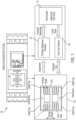
- the MEMS accelerometer system 100 can be implemented in various types of avionic systems or aircrafts.
- the MEMS accelerometer system 100 can include a proof-mass device 101 having a proof-mass 101a configured to move from an initial position in response to an input acceleration.
- the proof-mass device 101 can be an interdigitated capacitance arrangement (e.g., having metallic interdigitated members, a portion of which are connected to the proof-mass 101a to move relative to another portion of digits).
- the system 100 can include a transducer 103 (e.g., a pick-off transducer) operatively connected to the proof-mass device 101 to output a transducer signal correlating to a movement and/or position of the proof-mass 101a.
- the transducer signal can be an indication of capacitance, and thus, can be correlated to position of the proof-mass, for example.
- the system 100 can include a driver 105 (e.g., a drive force transducer) operatively connected to the proof-mass device 101 and configured to drive the proof-mass.
- the driver 105 can be configured to electro mechanically drive the proof-mass back toward the initial position, for example.
- the system 100 can include a controller 111 operatively connected to the driver 105 to control the driver 105.
- the controller 111 can be operatively connected to the transducer 103 to receive the transducer signal and output a drive signal to the driver 105 to drive the proof-mass 101a toward an initial position.
- an avionics system can include a MEMS accelerometer system.
- the MEMS accelerometer system can be any suitable accelerometer system disclosed herein, e.g., system 100 as described above.
- a proof-mass may need to be driven back into an original position or the device may no longer function because the proof-mass will hit a stop.
- the controller calculates where the mass is, then calculates energy needed to push mass back electromechanically to its zero/initial position.
- the controller output can be a better read of acceleration as the transducer output can include noise, etc. There are both transients, then there is bias in the steady state in traditional system.
- FIG. 1 The general architecture of a single axis very high precision (VHP) MEMS-A accelerometer capacitance device is shown in Fig. 1 .
- external applied input acceleration displaces the Proof-Mass and varies the distant of the formed capacitors plates and hence the overall capacitance.
- the above capacitance variation is transduced to an electrical voltage by a displacement transducer (Pick-Off) which is then used by a control system in order to excite the Drive Force Transducer to apply an appropriate electrical Force (i.e., and acceleration) and balance the Proof-Mass into a desired zero position.
- Pick-Off displacement transducer
- the input acceleration signal that is to be sensed can be estimated by the controller's output when the system rests in steady state.
- the controller can be designed to operate on the displacement of the Proof-Mass (Mass-Spring Damper System), as sensed by the Pick-Off Transducer, and generate a drive command signal to the Force Amplifier that will restore and maintain the Proof-Mass at its centered (zero displacement) location.
- the acceleration acting on the Proof-Mass due to the Force Amplifier exactly balances the specific acceleration acting on the system and is therefore a good estimate of the input acceleration.
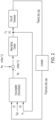
- the controller's output is not a good estimate of the input acceleration, and an error in the estimate of the acceleration is created as illustrated in Fig. 3 , which shows the bias acceleration problem.
- the MEMS formed capacitor plates material can deform, and, hence the overall capacitance can change which results in an additional temperature attributed bias errors in the estimated acceleration.
- the traditional MEMS controllers are agnostic to such temperature effects and incapable of resolving temperature related bias acceleration estimation errors.
- the type of control scheme as shown in Fig. 3 can be referred to as the legacy system, and such the legacy controller is not an optimal observer of the input acceleration.
- the input acceleration to the observer enters the system as a disturbance, and so the actual goal of the accelerometer device is to observe the disturbance of the system.
- traditional controller solutions only satisfy the observation goal when in steady state, and in fact the controller loop gain designs must conform to the usual trade-offs between performance response of the Proof-Mass and disturbance rejection.
- the traditional architecture of the legacy controller is not designed to account for endogenous system uncertainty (parameter variations with temperature, system nonlinearities) and high frequency noise.
- the traditional legacy controller solution only satisfies the observation goal when in steady state, and in fact the controller loop gain designs must conform to the usual trade-offs between performance response of the Proof-Mass and disturbance rejection.
- Various non-limiting embodiments of the present disclosure overcome the shortcomings of the traditional controller solutions described above by providing a MEMS accelerometer system that implements a robust controller (RC) configured to achieves design specifications in the frequency domain and mitigates bias to improve the operation of MEMS accelerometer devices toward tactical grade and beyond.
- the RC can be implemented either in hardware via analogue electronics and/or an embedded software-controlled device, and can be described and implemented in closed analytical form with deterministic mathematical equations.
- one or more non-limiting embodiments of the present disclosure replaces the traditional legacy controller with the RC, which is configured to operate according to a closed-loop Proof-Mass feedback control.
- the RC operates without a robust observer, but yet can achieve excellent system design specifications with lower system complexity than the prior art cited above.
- the RC design according to various non-limiting embodiments of the present disclosure offers the flexibility of a reducing the model order and complexity, thereby allowing the controller to implement the algorithms in the same hardware/firmware footprint of currently available MEMS system.
- one or more non-limiting embodiments provides an RC designed according to a systematic standard architecture which is well-defined, computer automated, and repeatable so that the design and system implementation are compliant with standard system verification and certification processes.
- the gains of the RC are designed optimally under a rigorous Loop-Shaping framework in the frequency domain which automatically address MEMS accelerometer dynamic, steady state response and noise rejection specifications.
- the control signals are further capable of compensating for endogenous bias caused by MEMS Proof-mass material deformations due to temperature variations.
- the RC described according to one or more non-limiting embodiments herein can more accurately track and provide estimates of the input acceleration acting on the system, thereby reducing the estimation bias during transient motion of the proof-mass, and improving rejection of system noise.
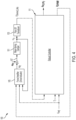
- the MEMS accelerometer system 100 includes a proof-mass device 101, a driver 105 (e.g., a drive force transducer), a transducer 103, and a robust controller (RC) 111.
- a driver 105 e.g., a drive force transducer
- RC robust controller
- the proof-mass device 101 has a proof-mass configured to move from an initial position in response to an input acceleration.
- the avionics systems or aircraft can realize an acceleration (i.e., an input acceleration), which in turn is applied to the proof-mass device 101.
- the proof-mass device 101 can be an interdigitated capacitance arrangement (e.g., having metallic interdigitated members, a portion of which are connected to the proof-mass to move relative to another portion of digits).
- the driver 105 is operatively connected to the proof-mass device 101 and is configured to drive the proof-mass 101. According to a non-limiting embodiment, the driver 105 outputs a signal (adt), which is applied to an external acceleration (aint) to generate a drive signal 107 that is configured to electro mechanically drive the proof-mass 101 back toward the initial position, for example.
- adt a signal applied to an external acceleration (aint) to generate a drive signal 107 that is configured to electro mechanically drive the proof-mass 101 back toward the initial position, for example.
- the transducer 103 (e.g., a pick-off transducer) is operatively connected to the proof-mass device 101 to output a transducer signal correlating to a movement and/or position of the proof-mass.
- the transducer signal can be an indication of capacitance, and thus, can be correlated to position of the proof-mass, for example.
- the RC 111 is an active dynamic component to the MEMS accelerometer system 100 in the sense that it actuates the driver 105 (e.g., drive force transducer).
- the RC 111 is in signal communication with the transducer 103 (e.g., pick-off transducer) and the driver 105 (e.g., force amplifier drive actuator) to establish closed-loop proof-mass feedback control.
- the transducer 103 e.g., pick-off transducer
- the driver 105 e.g., force amplifier drive actuator
- the RC 111 receives as inputs: 1) the transduced displacement (VDemod_lsb) from the pick-off transducer 103, 2) the temperature signal (Tt) (e.g., from a MEMS-A available temperature sensor), and 3) the voltage reference of transducers (Vref).
- the RC 111 outputs: 1) the unfiltered digital PWM signal (VDPW _M), which is driving the driver 105 (e.g., drive force transducer) and 2) an estimate of the acceleration input (âinLPFt).
- the controller is programmed with internal fixed controller parameters. These controller parameters ( ⁇ ) include, but are not limited to, gain parameters of the RC controller (i.e. parameters of numerator and denominator of the controllers transfer function K(s), and F-gains in the LPF transfer function equations.
- the RC 111 includes a robust loop-shaping stabilization module 202, a digital pulse-width modulation (DPWM) correction module 200, a low-pass filter (LPF) 204, a digital scale factor (DSF) module 206, and a summer 208.
- DPWM digital pulse-width modulation
- LPF low-pass filter
- DSF digital scale factor
- the DPWM correction module 200 receives as inputs the temperature signal (T) and the transducer voltage reference (Vref). According to a non-limiting embodiment, the DPWM correction module 200 utilizes one or more bias acceleration thermal models, derived offline for the particular device, along with one or more models of the driver 105, the transducer 103 and/or the proof-mass 101. According to a non-limiting embodiments, models of the driver 105, transducer 103 and/or the proof-mass 101 can include nonlinear mathematical models of the electronic firmware and/or software that assemble the transducers and second order mechanical motion dynamical models for the proof-mass mechanical equation.
- the DPWM correction module 200 Based on the above information at a given temperature indicated by the input temperature (T), the DPWM correction module 200 computes a real-time estimate of the small gap displacement in the Proof-Mass 101. Accordingly, the DPWM correction signal (VDPW_M_CORRECTION) is actively adjusted to compensate for drifts attributed to the above small gap variation due to temperature variations.
- the DPWM correction module 200 can be implemented in code for online application.
- the DPWM correction module 200 can utilize a mathematical formula or model representing the nonlinear model of the transducer 103 (e.g., drive force transducer) and a mathematical formula or model of the Proof-Mass 101 to compute the small gap displacement and the temperature measurement capable. Based on the small gap displacement, the DPWM module 200 can perform the required DPWM correction.
- a mathematical formula or model representing the nonlinear model of the transducer 103 e.g., drive force transducer
- the DPWM module 200 can perform the required DPWM correction.
- the robust loop-shaping stabilization module 202 receives as an input the transduced displacement (VDemod_lsb), and based thereon generates a nominal digital PWM voltage signal of the controller (VDPW_M_CONTROLLER), which can serve as an estimate of the input acceleration.
- the robust loop-shaping stabilization module 202 can be designed offline and in the continuous frequency domain using various Laplace transfer function of the open loop system from the unfiltered DPWM input to the driver (e.g., drive force transducer) to the transduced displacement voltage (VDemod_lsb) output from the pick-off transducer 103.
- the resulting design of the robust loop-shaping stabilization module 202 is a Laplace transfer function, which can be implemented in online code as a discrete time state space system.
- the LPF 204 is in signal communication with the robust loop-shaping stabilization module 202 to receive as an input the nominal digital PWM voltage signal (VDPW_M_CONTROLLER).
- the LPF 204 operates to eliminate undesired high order harmonic content and noise from the acceleration estimate signal (VDPW_M_CONTROLLER).
- the LPF 204 is implemented as a 6th-order nonlinear low-pass filter.
- the LPF 204 can include two 2nd order Butterworth low-pass filters and a 2nd order nonlinear exponential low-pass lifter filter connected in series.
- the design parameter in continuous time domain is the filter cut-off frequencies in the Butterworth filters and the exponential rate parameter in the nonlinear filter above.
- the LPF 204 is designed offline and the values of the above filters' coefficients are set in the online code.
- the design parameter L above is a tuning parameter, set to values between 0 and 1, with which the design can trade between steady state noise attenuation and speed of dynamic transient response.
- the DSF 206 is in signal communication with the LPF 204 and applies a gain to the filtered digital PWM voltage signal (VDPW_M_CONTROLLER).
- VDPW_M_CONTROLLER the filtered digital PWM voltage signal
- the gain multiplies the filtered digital PWM voltage signal (VDPW_M_CONTROLLER) to accurately scale the final estimate of the input acceleration. Accordingly, the error between the final estimate of the input acceleration and the actual input acceleration applied to the proof-mass can be reduced.
- the gain is a fixed value selected for a specific device or application.
- the summer 208 combines the DPWM correction signal (VDPW_M_CORRECTION) output from the DPWM correction module 200 with the nominal digital PWM voltage signal of the controller (VDPW_M_CONTROLLER) output from the robust loop-shaping stabilization module 202 to generate the digital PWM voltage signal (VDPW _M).
- VDPW_M signal includes a correction which incorporates an adaptive component to the RC architecture that compensates for variations in temperature.
- the RC 111 can actively adjust the VDPW_M signal based on the Tt, Vref, and the controller (VDPW_M_CONTROLLER) to actively correct the VDPW_M signal, which is then utilized as a feedback signal that can actively drive the driver 105.
- the robust loop-shaping stabilization module 202 can be designed offline according the robust stabilization method, and can utilize an open-loop Laplace transfer function (G(s)) which is based on the unfiltered DPWM input signal that is delivered to the driver 105 to drive the transducer 103 and generate the output Demod lsb signal.
- G(s) open-loop Laplace transfer function
- the designed closed-loop system can be simulated (e.g., with sampled data) (e.g., using a discrete controller), based on nonlinear validated simulation models.
- the pre-filter (W1(s)) and the post-filter (W2(s)) can be adjusted, and the closed-loop system retested until the desired results are achieved. If required, the order (e.g., trade-off optimality vs complexity) of the designed controller (e.g., the robust loop-shaping stabilization module 202) can be reduced using a state-of-the-art rigorous model order reduction method such as, for example, a balance truncation method.
- a state-of-the-art rigorous model order reduction method such as, for example, a balance truncation method.
- a robust stabilization method can be employed, which takes into account effects of unknown additive system dynamics and uncertainty (e.g. modelling uncertainty and/or additional dynamics) that can potentially reduce the stability margins of the closed-loop system.
- a design objective can include maximizing the Allowed Coprime Plant Uncertainty Margin (ACPUM) under which the system preserves its stability.
- Gp(s) can be viewed as Gs(s) + Undertain/Unknown Dynamics, and the term
- the above process and design can be facilitated using a programming language and numeric computing environment such as, for example, MATLAB, where W1(s), W2(s), and ⁇ r>1, which implements a suboptimal controller that satisfies a relatively reduced ACPUM by a factor of yr.
- W1(s), W2(s), and ⁇ r>1 which implements a suboptimal controller that satisfies a relatively reduced ACPUM by a factor of yr.
- the optimal controller can be implemented.
- Tuning ⁇ r>1 may assist in practical implemented to reduce the controller gains without sacrificing the closed loop frequency response requirements and achieving adequate time response performance.
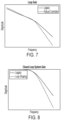
- Figs. 7 and 8 are graphs depicting the frequency response shaping of a MEMS accelerometer system 100 following the design process described above according to a non-limiting embodiment of the present disclosure.
- the Loop-Gain of the legacy controller is reshaped so that the MEMS accelerometer system 100 can satisfy a systems frequency response requirements and design specifications, namely: have better amplification in low frequencies spectrum, better attenuation in the high frequencies and preserve the same bandwidth (cut-off frequency point).
- the closed-loop control system of the MEMS accelerometer will possess the frequency response shown in Fig. 8 , where it is shown that the system retains the design frequency characteristics in Fig. 7 in under closed-loop control action, under which acceleration estimation is feasible and operational stability is guaranteed.
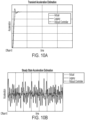
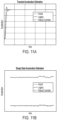
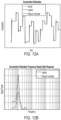
- Figures 9-13D show the simulated performance of the Robust Controller (RC) compared to the performance of a Legacy design MEMS accelerometer.
- RC Robust Controller
- the data has been normalized to show relative improvements of the RC with respect to a legacy design while avoiding any revelations of technical data either actual or predicted.
- the RC was tuned to satisfy both dynamic speed response and noise reduction in the MEMS accelerometer.
- the RC was re-tuned to provide increased noise rejection with some minimal reduction in response time.
- a major advantage of the architecture is that the RC LPF can be tuned via the single parameter L to achieve desired output performance bandwidth vs disturbance rejection specifications for the MEMS accelerometer.
- the order of the controller has been further reduced to illustrate options in the design where minimum complexity system is desirable to the expense of minor reduction in dynamic transient response of the system.
- the transient and steady state responses of the acceleration estimates are compared to a constant acceleration input with no noise and no temperature bias. Both estimates are affected by the delays inherent in the reading of the pick-off transducer, but the RC estimate is more accurate with no overshoot. In addition, the average steady state error of RC is much smaller than that of the Legacy's. In steady state the RC clearly results in lower amplitude oscillations across the entire frequency spectrum. This RC capability is as well verified by the frequency response power spectrum, shown in Figures 10A-10D , where evidently the RC significantly mitigates steady state oscillations in steady state over legacy system.
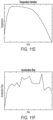
- Figures 11A-11D show the transient and steady state responses of the accelerator estimates to a constant acceleration input as previously, but under the presence of acceleration bias due to temperature variations as shown in the last row of plots in Figures 11E-11F .
- the presence of nonlinear random hardware electronic noise in the op-amp output of the Pick-Off transducer is considered. This noise adds uncertainty at ⁇ 20% of the nominal OP-AMP output.
- both estimates are affected by the delays inherent in the reading of the pick-off transducer.
- the transient response is similar to the no noise, no bias cases where the RC estimate is more accurate and with no overshoot in comparison to the Legacy design.
- Figures 12A -12F show the response of the acceleration estimates to a series of multiple changing acceleration input levels, under the presence of electronic noise and delays inherent in the reading of the pick-off transducer.
- thermal variation and bias is present to the system as shown in the last row of graphs in Figures 12A -12F.
- the transient response in this case is like all previous cases where the RC estimate is more accurate and with minimal overshoot in comparison to the Legacy design.
- the steady state oscillations which in this case are affected as well by electronic noise, they are better mitigated by the RC as it is shown by the power spectrum graph in steady state.
- the noticeable improvement in this test case is the deterioration of the Legacy system performance because of very large overshoots (spikes) occurring at several changes in the acceleration levels as shown in Figures 12A -12F.
- the RC design however compensates for such oscillations and preserves its dynamical characteristics over variable operational envelopes and regimes.
- the RC results minimum estimation error in contrast with Legacy which results in a biased acceleration estimate as in previous cases.
- Figures 13A-13D show the response of the acceleration to a constant acceleration input, under the presence of electronic noise and delays inherent in the reading of the pick-off transducer. No thermal variation and bias are considered in this test as the intent here is to demonstrate design flexibility for trading steady-state accuracy vs dynamic speed response and thus capability of boosting the device's accuracy according to different specification grades.
- Figures 13A-13D show the Legacy, a nominal design of RC as in the previous presented cases and a retuned RC design, where the RC parameter L is increased by 7% from its nominal setup. From the plots in Figures 13A-13D it is apparent that steady state oscillations and noise can be further mitigated to result substantially smaller steady state errors, but to the expense of a slower but non-oscillatory transient system response. Obviously as it is illustrated herein, the proposed invention offers the capability of transforming the same MEMS device to different grade specifications, e.g., the same device can operate as very high performance (VHP) optimized for either speed or response or accuracy of steady state.
- VHP very high performance
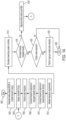
- a flow diagram illustrates a method of designing a robust loop-shaping stabilization module 202 according to a non-limiting embodiment of the present disclosure.
- the method begins at operation 1400, and at operation 1402, a newly-shaped MEMS-A transfer function (Gs(s)) is generated.
- Generating the newly-shaped MEMS-A transfer function (Gs(s)) can include a pre-filter having a pre-filter transfer function (W1(s)) and a post-filter having a post-filter transfer function (W2(s)).
- Ks(s) is a controller design based on the newly-shaped transfer function Gs(s).
- a robust stabilization method is used to design a controller Ks(s).
- an order reduction can be optionally performed on the designed controller (Kc(s)) to produce a low-complexity controller.
- the frequency requirements of the robust loop-shaping stabilization module 202 are validated.
- the closed-loop system implementing the discrete (e.g., sampled data) controller is simulated on non-linear validated simulation models.
- a determination is made as to whether the simulation results satisfy (e.g., equal or substantially equal) targeted results.
- the pre-filter (W1(s)) and/or the post-filter (W2(s)) are adjusted at operation 1418, and the method returns to operation 1402 to update the design of the controller (Kc(s)).
- the method can determine whether a further order reduction of the designed controller (Kc(s)) is necessary at operation 1420. When a further order reduction is not required, the method ends at operation 1422. When further order reduction is required, however, the method proceeds to operation 1424, a rigorous model order reduction operation is applied to the designed controller (Kc(s)), and the method ends at operation 1422.
- various non-limiting embodiments of the present disclosure provides a MEMS accelerometer system, which implements a robust controller that improves the estimation of specific acceleration acting upon the Proof-Mass device.
- the RC facilitates the improvement of dynamic (transient) system performance over legacy products, with mitigated oscillations in steady state over legacy system.
- the RC also increases the robustness to real time variations in system operational envelops and system thermal conditions, while also reducing bias errors due to temperature variation and improving noise attenuation in the MEMS accelerometer system.
- the RC also allows for flexibility to tune the same device for operation at different MEMS accelerometer specification grades.
- the RC facilitates an active MEMS accelerometer system rather than a traditional passive observer-based system by actively actuating a driver (e.g., drive force transducer) to actively control the MEMS proof-mass position.
- a driver e.g., drive force transducer
- the RC replaces legacy controllers in a traditional MEMS Accelerometer Systems and can operate without a robust observer while still achieving improved system design specifications with lower system complexity.
- the RC implements a novel mixed differential-algebraic deterministic architecture which includes linear and nonlinear components capable of processing real-time input signals from the proof-mass position transduced voltage signal and the MEMS-A temperature sensor signal. Accordingly, the RC can generate the actuation signal for the drive force transducer to balance (control) the proof-mass position.
- the RC implements a novel nonlinear output filter architecture component, which can be utilized to output a measurement for the current acceleration of the device.
- the RC can be implemented in hardware electronics or as a system embedded software code and can designed to function at different fixed sampling rates.
- the RC minimizes bias errors attributed to MEMS-A proof-mass material geometric deformations due to thermal variations and helps achieve VHP performance towards tactical ranges accuracy.
- the RC substantially minimizes system redundant oscillations at steady state performance further over Legacy and robust observers;
- the RC minimizes the impact of general system model uncertainty and (i.e., of any stochastic) and signal noise (i.e., of any stochastic);
- the RC enables design flexibility with tradeoffs of complexity vs dynamic system speed response to keep the dynamical system states order minimal.
- the RC enables tunable flexibility to set the same device at different MEMS accelerometer grades specifications.
- the RC is implementable using the same hardware/firmware IMU parts of prior Legacy systems.
- the RC is robust to various MEMS-A operating (acceleration patterns and amplitudes) and environmental conditions (temperature variations).
- the RC implements a systematic design standard work which is well-defined, computer automated, and repeatable so that the design and system implementation are compliant with standard system verification and certification processes.
- the RC performs a specific per MEMS-A device calibration process for tuning appropriately the mathematical models and algorithm of the controller.
- Embodiments can include any suitable computer hardware and/or software module(s) to perform any suitable function (e.g., as disclosed herein).
- aspects of the present disclosure may be embodied as a system, method or computer program product. Accordingly, aspects of this disclosure may take the form of an entirely hardware embodiment, an entirely software embodiment (including firmware, resident software, micro-code, etc.), or an embodiment combining software and hardware aspects, all possibilities of which can be referred to herein as a "circuit,” “module,” or “system.”
- a “circuit,” “module,” or “system” can include one or more portions of one or more separate physical hardware and/or software components that can together perform the disclosed function of the "circuit,” “module,” or “system”, or a “circuit,” “module,” or “system” can be a single self-contained unit (e.g., of hardware and/or software).
- aspects of this disclosure may take the form of a computer program product embodied in one or more computer readable medium(s) having computer readable program code embodied thereon.
- the computer readable medium may be a computer readable signal medium or a computer readable storage medium.
- a computer readable storage medium may be, for example, but not limited to, an electronic, magnetic, optical, electromagnetic, infrared, or semiconductor system, apparatus, or device, or any suitable combination of the foregoing.
- a computer readable storage medium may be any tangible medium that can contain, or store a program for use by or in connection with an instruction execution system, apparatus, or device.
- a computer readable signal medium may include a propagated data signal with computer readable program code embodied therein, for example, in baseband or as part of a carrier wave. Such a propagated signal may take any of a variety of forms, including, but not limited to, electro-magnetic, optical, or any suitable combination thereof.
- a computer readable signal medium may be any computer readable medium that is not a computer readable storage medium and that can communicate, propagate, or transport a program for use by or in connection with an instruction execution system, apparatus, or device.
- Program code embodied on a computer readable medium may be transmitted using any appropriate medium, including but not limited to wireless, wireline, optical fiber cable, RF, etc., or any suitable combination of the foregoing.
- Computer program code for carrying out operations for aspects of this disclosure may be written in any combination of one or more programming languages, including an object oriented programming language such as Java, Smalltalk, C++, HDL, VHDL or the like and conventional procedural programming languages, such as the "C" programming language or similar programming languages.
- the program code may execute entirely on the user's computer, partly on the user's computer, as a stand-alone software package, partly on the user's computer and partly on a remote computer or entirely on the remote computer or server.
- the remote computer may be connected to the user's computer through any type of network, including a local area network (LAN) or a wide area network (WAN), or the connection may be made to an external computer (for example, through the Internet using an Internet Service Provider).
- LAN local area network
- WAN wide area network
- Internet Service Provider for example, AT&T, MCI, Sprint, EarthLink, MSN, GTE, etc.
- These computer program instructions may also be stored in a computer readable medium that can direct a computer, other programmable data processing apparatus, or other devices to function in a particular manner, such that the instructions stored in the computer readable medium produce an article of manufacture including instructions which implement the function/act specified in the flowchart and/or block diagram block or blocks.
- the computer program instructions may also be loaded onto a computer, other programmable data processing apparatus, or other devices to cause a series of operational steps to be performed on the computer, other programmable apparatus or other devices to produce a computer implemented process such that the instructions which execute on the computer or other programmable apparatus provide processes for implementing the functions/acts specified herein.
- any numerical values disclosed herein can be exact values or can be values within a range. Further, any terms of approximation (e.g., “about”, “approximately”, “around”) used in this disclosure can mean the stated value within a range. For example, in certain embodiments, the range can be within (plus or minus) 20%, or within 10%, or within 5%, or within 2%, or within any other suitable percentage or number as appreciated by those having ordinary skill in the art (e.g., for known tolerance limits or error ranges).
- a reference to "A and/or B", when used in conjunction with open-ended language such as “comprising” can refer, in one embodiment, to A only (optionally including elements other than B); in another embodiment, to B only (optionally including elements other than A); in yet another embodiment, to both A and B (optionally including other elements); etc.
Landscapes
- Physics & Mathematics (AREA)
- General Physics & Mathematics (AREA)
- Pressure Sensors (AREA)
Applications Claiming Priority (1)
| Application Number | Priority Date | Filing Date | Title |
|---|---|---|---|
| US18/298,444 US12510556B2 (en) | 2023-04-11 | 2023-04-11 | Micro-electrical-mechanical-systems (MEMS) accelerometer systems |
Publications (1)
| Publication Number | Publication Date |
|---|---|
| EP4446752A1 true EP4446752A1 (de) | 2024-10-16 |
Family
ID=90720942
Family Applications (1)
| Application Number | Title | Priority Date | Filing Date |
|---|---|---|---|
| EP24169716.8A Pending EP4446752A1 (de) | 2023-04-11 | 2024-04-11 | Beschleunigungsmesssysteme (mems) mit mikroelektrischen/mechanischen systemen |
Country Status (2)
| Country | Link |
|---|---|
| US (1) | US12510556B2 (de) |
| EP (1) | EP4446752A1 (de) |
Citations (3)
| Publication number | Priority date | Publication date | Assignee | Title |
|---|---|---|---|---|
| US5600066A (en) * | 1993-01-19 | 1997-02-04 | Sextant Avionique | Capacitive accelerometer with a circuit for correcting stray capacitance perturbations |
| US20070028689A1 (en) * | 2005-07-25 | 2007-02-08 | Nebojsa Vrcelj | Digital accelerometer |
| EP4339621A1 (de) * | 2022-09-16 | 2024-03-20 | Simmonds Precision Products, Inc. | Mems-beschleunigungsmesssysteme |
Family Cites Families (20)
| Publication number | Priority date | Publication date | Assignee | Title |
|---|---|---|---|---|
| GB8723339D0 (en) * | 1987-10-05 | 1987-11-11 | Kellett M A | Transducer control circuits |
| US20040194327A1 (en) | 2003-04-04 | 2004-10-07 | Bryan Eric F. | Sensing steering axis inclination and camber with an accelerometer |
| ATE470866T1 (de) | 2004-02-27 | 2010-06-15 | Atlantic Inertial Systems Ltd | Beschleunigungsmesser |
| US7386395B1 (en) | 2005-01-18 | 2008-06-10 | Honeywell International Inc. | Systems and methods for shock compensation utilizing an adaptive control technique algorithm |
| US8086328B2 (en) | 2008-08-29 | 2011-12-27 | Honeywell International Inc. | Systems and methods for vibration rectification error reduction in closed-loop accelerometer systems |
| GB0900747D0 (en) | 2009-01-16 | 2009-03-04 | Isis Innovation | Mechanical oscillator |
| WO2010119046A2 (en) | 2009-04-14 | 2010-10-21 | Atlantic Inertial Systems Limited | Accelerometer control systems |
| US9274136B2 (en) | 2013-01-28 | 2016-03-01 | The Regents Of The University Of California | Multi-axis chip-scale MEMS inertial measurement unit (IMU) based on frequency modulation |
| GB2527595A (en) | 2014-06-27 | 2015-12-30 | Atlantic Inertial Systems Ltd | Accelerometers |
| US10247554B2 (en) | 2014-09-24 | 2019-04-02 | The Regents Of The University Of California | Fully balanced micro-machined inertial sensor |
| US9927458B2 (en) | 2015-05-29 | 2018-03-27 | Massachusetts Institute Of Technology | Apparatus and methods for photonic integrated resonant accelerometer |
| GB201514319D0 (en) | 2015-08-12 | 2015-09-23 | Atlantic Inertial Systems Ltd | Accelerometers |
| GB2547415A (en) | 2016-02-09 | 2017-08-23 | Atlantic Inertial Systems Ltd | Inertial sensors |
| GB2555804B (en) | 2016-11-09 | 2022-02-02 | Atlantic Inertial Systems Ltd | Accelerometer control |
| US10816568B2 (en) | 2017-12-26 | 2020-10-27 | Physical Logic Ltd. | Closed loop accelerometer |
| GB2570714B (en) | 2018-02-05 | 2022-03-02 | Atlantic Inertial Systems Ltd | Accelerometers |
| GB2576569B (en) | 2018-08-24 | 2022-10-19 | Atlantic Inertial Systems Ltd | Inertial navigation system |
| US11493534B1 (en) | 2019-01-04 | 2022-11-08 | Hrl Laboratories, Llc | Continuous online self-calibrating resonant FM microelectromechanical systems (MEMS) accelerometer |
| GB2593132A (en) | 2019-11-01 | 2021-09-22 | Atlantic Inertial Systems Ltd | Methods for closed loop operation of capacitive accelerometers |
| US11619492B2 (en) | 2021-06-10 | 2023-04-04 | Invensense, Inc. | Sensor linearization based upon correction of static and frequency-dependent non-linearities |
-
2023
- 2023-04-11 US US18/298,444 patent/US12510556B2/en active Active
-
2024
- 2024-04-11 EP EP24169716.8A patent/EP4446752A1/de active Pending
Patent Citations (3)
| Publication number | Priority date | Publication date | Assignee | Title |
|---|---|---|---|---|
| US5600066A (en) * | 1993-01-19 | 1997-02-04 | Sextant Avionique | Capacitive accelerometer with a circuit for correcting stray capacitance perturbations |
| US20070028689A1 (en) * | 2005-07-25 | 2007-02-08 | Nebojsa Vrcelj | Digital accelerometer |
| EP4339621A1 (de) * | 2022-09-16 | 2024-03-20 | Simmonds Precision Products, Inc. | Mems-beschleunigungsmesssysteme |
Also Published As
| Publication number | Publication date |
|---|---|
| US12510556B2 (en) | 2025-12-30 |
| US20240345124A1 (en) | 2024-10-17 |
Similar Documents
| Publication | Publication Date | Title |
|---|---|---|
| KR900005546B1 (ko) | 적응프로세스 제어장치 | |
| Boiko | Discontinuous control systems | |
| US8406905B2 (en) | Scaling and parameterizing a controller | |
| CN101546173B (zh) | 用于对系统进行控制的装置及方法 | |
| EP3076261A1 (de) | Maschinensteuerungsvorrichtung und verstärkungsbestimmungsverfahren zur reibungskompensation | |
| EP4339621B1 (de) | Mems-beschleunigungsmesssysteme | |
| Dodds | Feedback control | |
| US11314211B2 (en) | Method and device for optimizing performance of a servo control of a mechatronic system based on effective static and dynamic margins | |
| Kokunko et al. | Cascade synthesis of differentiators with piecewise linear correction signals | |
| Sira-Ramírez et al. | Active disturbance rejection control of nonlinear SISO Lagrangian systems via endogenous injections and exogenous feedback for trajectory tracking: H. Sira-Ramírez et al. | |
| Yang et al. | Experimental investigation of shaping disturbance observer design for motion control of precision mechatronic stages with resonances | |
| EP4446752A1 (de) | Beschleunigungsmesssysteme (mems) mit mikroelektrischen/mechanischen systemen | |
| CN117008474A (zh) | 一种提高压电定位平台性能的控制方法和系统 | |
| CN101943889A (zh) | 使电气传动系统调节器自动启动和/或运行的方法及装置 | |
| EP3432101A1 (de) | Steuerungsvorrichtung, verfahren zur steuerung der steuerungsvorrichtung, informationsverarbeitungsprogramm und aufzeichnungsmedium | |
| JP4329438B2 (ja) | 電動機制御装置 | |
| Achnib et al. | Anticipative robust design applied to a water level control system | |
| Arpacı et al. | Fractional model reference adaptive PIλDμ control | |
| Sharifi et al. | Linear-time-varying feedforward control for position-dependent flexible structures | |
| Dodds | State estimation | |
| CN119836566A (zh) | 试验系统、试验系统的控制方法 | |
| Eielsen et al. | Experimental comparison of online parameter identification schemes for a nanopositioning stage with variable mass | |
| Van de Putte et al. | Model-Based Control of a Novel Outrunner Reaction Wheel for CubeSats and SmallSats | |
| JPH10161706A (ja) | 単純適応制御装置 | |
| CN112327636A (zh) | 一种基于预设轨迹的预定性能控制方法 |
Legal Events
| Date | Code | Title | Description |
|---|---|---|---|
| PUAI | Public reference made under article 153(3) epc to a published international application that has entered the european phase |
Free format text: ORIGINAL CODE: 0009012 |
|
| STAA | Information on the status of an ep patent application or granted ep patent |
Free format text: STATUS: THE APPLICATION HAS BEEN PUBLISHED |
|
| AK | Designated contracting states |
Kind code of ref document: A1 Designated state(s): AL AT BE BG CH CY CZ DE DK EE ES FI FR GB GR HR HU IE IS IT LI LT LU LV MC ME MK MT NL NO PL PT RO RS SE SI SK SM TR |
|
| STAA | Information on the status of an ep patent application or granted ep patent |
Free format text: STATUS: REQUEST FOR EXAMINATION WAS MADE |
|
| 17P | Request for examination filed |
Effective date: 20250416 |