EP4446199A1 - Adjustable harness system - Google Patents
Adjustable harness system Download PDFInfo
- Publication number
- EP4446199A1 EP4446199A1 EP24167415.9A EP24167415A EP4446199A1 EP 4446199 A1 EP4446199 A1 EP 4446199A1 EP 24167415 A EP24167415 A EP 24167415A EP 4446199 A1 EP4446199 A1 EP 4446199A1
- Authority
- EP
- European Patent Office
- Prior art keywords
- strap
- stroller
- protrusions
- slide
- harness system
- Prior art date
- Legal status (The legal status is an assumption and is not a legal conclusion. Google has not performed a legal analysis and makes no representation as to the accuracy of the status listed.)
- Pending
Links
Images


Classifications
-
- B—PERFORMING OPERATIONS; TRANSPORTING
- B62—LAND VEHICLES FOR TRAVELLING OTHERWISE THAN ON RAILS
- B62B—HAND-PROPELLED VEHICLES, e.g. HAND CARTS OR PERAMBULATORS; SLEDGES
- B62B9/00—Accessories or details specially adapted for children's carriages or perambulators
- B62B9/24—Safety guards for children, e.g. harness
-
- B—PERFORMING OPERATIONS; TRANSPORTING
- B60—VEHICLES IN GENERAL
- B60N—SEATS SPECIALLY ADAPTED FOR VEHICLES; VEHICLE PASSENGER ACCOMMODATION NOT OTHERWISE PROVIDED FOR
- B60N2/00—Seats specially adapted for vehicles; Arrangement or mounting of seats in vehicles
- B60N2/24—Seats specially adapted for vehicles; Arrangement or mounting of seats in vehicles for particular purposes or particular vehicles
- B60N2/26—Seats specially adapted for vehicles; Arrangement or mounting of seats in vehicles for particular purposes or particular vehicles for children
- B60N2/28—Seats readily mountable on, and dismountable from, existing seats or other parts of the vehicle
- B60N2/2803—Adaptations for seat belts
- B60N2/2812—Adaptations for seat belts for securing the child to the child seat
Definitions
- the present disclosure is generally in the field of harness systems, and more particularly related to harness systems for strollers.
- Strollers often include a harness that is used to secure a child within a seat of the stroller.
- Conventional harnesses may include multiple straps that are affixed to the stroller seat. A child may be provided in the seat, the straps may be provided around the child, and the straps may be inserted into a buckle to secure the child within the seat.
- the harness may also include a slide that is configured to slide along the strap to adjust the tightness of the harness to further secure the child.
- the thickness of a strap is typically less than the thickness of the apertures in the slides through which the strap is inserted. This results in limited resistance being provided to the slide by the strap as a user moves the slide up and down the strap, which allows for the child to easily move the slide downwards and adjust the tightness of the harness.
- the present disclosure describes harness system for a stroller, the harness system.
- the harness system comprises a first strap affixed to the stroller, the first strap comprising one or more protrusions.
- the harness system also comprises a slide provided on the first strap, wherein the one or more protrusions provide a resistance against movement of the slide across the one or more protrusions.
- the present disclosure describes a stroller.
- the stroller comprises a harness system.
- the harness system comprises a first strap affixed to the stroller, the first strap comprising one or more protrusions.
- the harness system also comprises a slide provided on the first strap, wherein the one or more protrusions provide a resistance against movement of the slide across the one or more protrusions.
- the present disclosure describes A strap for a harness system of a stroller.
- the strap comprises one or more protrusions provided along the strap at designed intervals, wherein the strap is affixed to the stroller, wherein the one or more protrusions provide a resistance against movement of a slide of the harness system across the one or more protrusions, wherein the strap is provided through the slide.
- Strollers may include a harness system (which may also be referred to simply as a "harness” herein as well) that may be used to secure a child within a seat of the stroller.
- the harness system may include multiple straps that are provided around the arms and/or shoulders of the child.
- the straps may include an adjustable mechanism, such as a slide attached to each individual strap. The slide may be moved up or down the strap to adjust the tightness of the straps (and the harness) against the child.
- the straps are configured such that the slide that is used to adjust the tightness of the harness may easily be moved up and down the strap without significant resistance.
- the child may be able to move the slide to loosen the straps. This may result in the child being less secure within the stroller.
- the present disclosure describes an adjustable harness system for a stroller.
- the harness described herein includes one or more protrusions provided at various intervals on the straps (e.g., raised portions of the surface of the straps).
- the one or more protrusions provide resistance against the movement of the slide at the locations of the protrusions. In this manner, the slide may be moved up and down with little resistance along the portions of the strap between the protrusions. However, additional force may be required to move the slide across a protrusion.
- the protrusions serve to limit the ability of the child to loosen or otherwise adjust the tightness of the harness after the child has been secured within the stroller.
- the straps may comprise a webbing material and the protrusions may be formed as a part of the webbing.
- additional material may be provided in the webbing at the intervals associated with the protrusions such that the webbing is raised at those intervals.
- the protrusions may alternatively include elements that are added to the webbing.
- a material may be stitched to the exterior of the webbing forming the straps.
- a material may also be permanently or removably adhered to the straps in any other suitable manner as well.
- the straps may also comprise any other type of flexible or deformable material as well.
- the intervals at which the protrusions are provided on the straps may be pre-determined based on standard height locations associated with stroller harness systems. That is, different geographical regions may be associated with standard harness height positions. The location of the protrusions may be selected according to these height positions to provide a visual indication to a user as to where the standard height positions are located. The location of the protrusions may vary depending on the region. For example, the location of the protrusions on a harness used within the United States may differ than the location of the protrusions on a harness used within Europe. In embodiments, a harness may also include multiple different sets of protrusions that may correspond to standard heights for different geographical regions. The protrusions associated with the different regions may be indicated in any number of suitable manners.
- the protrusions associated with one region may be provided in one color and the protrusions associated with another region may be provided in another color.
- the locations of the protrusions along the strap may not necessarily correspond to standard heights, but may also be provided at any other intervals along the strap as well.
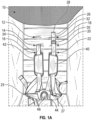
- FIGS. 1A is a front view of a stroller 10 including an adjustable harness system. Particularly, the figure shows a comparison between a strap 24 that may be used with a conventional harness system of a stroller 10 and a strap 26 that may instead be used with the harness system described herein. The comparison illustrates differences between the strap 24 associated with the conventional harness system and the strap 26 associated with the harness system described herein.
- a complete harness system may include multiple straps similar to the strap 26 rather than including strap 24 and strap 26 as shown in the figure.
- a conventional harness system includes one or more straps, such as strap 24 for example.
- a conventional harness system may also include a second strap similar to strap 24 in place of the strap 26 shown in the figure (reference hereinafter to strap 24 may also refer to a second type of similar strap).
- the strap 24 may be placed around the shoulders and/or arms of a child provided in the stroller 10.
- the strap 24 may also include an adjustable pad 42 that provides a cushion between the strap 24 and the child to provide additional comfort to the child when the strap 24 is secured against the child.
- the strap 24 may be secured to the stroller 10 as well. Additional straps, such as straps 25 and 27 may be provided over the hips and/or legs of the child to further secure the child within the stroller 10.
- any of the straps 24, 25, and 27 may be inserted into a buckle 44, such that the straps 24, 25, and 27 may form the completed harness system and the child may be secured within the stroller 10.
- the buckle 44 may include a button 46 that may be pressed to allow the straps 24, 25, and 27 to be disengaged from the buckle 44 to allow the child to be removed from the stroller 10.
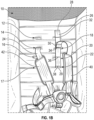
- the strap 26 is affixed to the stroller 10 (shown in further detail in FIG. 1B and 3A ).
- the strap 26 may be affixed to the stroller 10 at a first end 28 and a second end 29.
- the strap 26 may be affixed to the stroller 10 in any suitable manner.
- the first end 28 and the second end 29 may be stitched into the material of the stroller 10.
- a slide 30 is provided on the strap 26 that is configured to be moved up and down the strap 26 by a user (for example, a parent securing a child within the stroller 10). That is, the strap 26 may be fed through one or more apertures of the slide (as shown in FIG. 3A ). Also provided within the slide 30 (for example, one of the apertures of the slid 30) is a separate harness strap 33. While the strap 26 is affixed to the stroller 10, the harness strap 33 is configured to be provided within the buckle 44 to complete the harness system to secure a child within the stroller 10. Thus, the harness strap 33 is removably secured at one end within the buckle 44 and at another end through the slide 30 that is also attached to the strap 26 (which is affixed to the stroller 10).
- the strap 26 also includes one or more protrusions.
- FIG. 1A shows a first protrusion 32 provided on the strap 26. Any other number of protrusions may also exist on the strap 26 at various intervals.
- FIG. 1B shows four protrusions provided on the strap 26 (first protrusion 32, second protrusion 34, third protrusion 36, and fourth protrusion 38) at various intervals along the strap 26.
- the protrusions 32, 34, 36, and 38 comprise raised portions of the strap 26.
- the strap 26 may be a webbing material and the protrusions 32, 34, 36, and 38 may be additional material provided at the locations of the protrusions 32, 34, 36, and 38 that form raised portions of the surface of the strap 26 at those locations.
- the strap 26 and/or protrusions 32, 34, 36, and 38 may also comprise any other material.
- the protrusions 32, 34, 36, and 38 may also be provided in any other size and/or shape, and may extend outwards from either side of the strap 26 (as shown in FIG. 3A ) by any distance.
- the protrusions 32, 34, 36, and 38 provide resistance against the movement of the slide 30 at the locations of the protrusions 32, 34, 36, and 38. Given that the protrusions 32, 34, 36, and 38 are raised from the surface of the strap 26, a user may be required to provide additional force to continue to move the slide 30 across the protrusions 32, 34, 36, and 38 than may be required to move the slide within the portions of the strap 26 in between the various protrusions 32, 34, 36, and 38. Providing this additional resistance at various intervals along the strap 26 may mitigate the likelihood that a child that is secured within the stroller using the harness is able to freely move the slide 26 to significantly adjust the tightness of the harness.
- the protrusions 32, 34, 36, and 38 are illustrated as being stitching formed on the strap 26. However, the protrusions may also be formed in any other manner. For example, the protrusions 32, 34, 36, and 38 may be formed by providing additional material on the straps 26 at the various intervals. The protrusions 32, 34, 36, and 38 may also be formed by removably or permanently affixing a separate element onto the strap 26. For example, a material may be adhered to the strap 26 at the various intervals at which it is desired for the protrusions 32, 34, 36, and 38 to exist.
- the protrusions 32, 34, 36, and 38 are provided at various intervals along the strap 26.
- the location of the protrusions 32, 34, 36, and 38 may correspond to standard height locations for the harness. In this manner, the intervals at which the protrusions 32, 34, 36, 38 are provided on the straps may provide height indicators.
- the distances between the protrusions 32, 34, 36, and 38 may be equivalent. However, in other instances, some or all of the distances between the protrusions 32, 34, 36, 38 may be different. That is, different geographical regions may be associated with standard harness height positions.
- the location of the protrusions 32, 34, 36, 38 may provide an indication of locations of standard height locations associated with a harness of a stroller 10 for the particular geographical region.
- the location of the protrusions 32, 34, 36, 38 may vary depending on the region.
- FIG. 1A shows that the protrusions 32, 34, 36, 38 are located at heights of button holes 18, 20, 22, 23 etc.
- the button holes 18, 20, 22, 23 etc. may not necessarily be included on the stroller 10 (the same applies to any button holes shown in any of the figures).
- the protrusions 32, 34, 36, and 38 may also be provided in a color that allows for the protrusions 32, 34, 36, and 38 to be easily identified and distinguished from the remainder of the material comprising the strap 26.
- the strap 26 may be a black color and the protrusions 32, 34, 36, and 38 may be provided in an orange color (however, any other colors may also be used). This allows for a user to more easily identify the standard height locations that the protrusions 32, 34, 36, and 38 indicate along the strap 26.
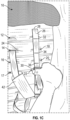
- FIG. 2 is a partial view of a portion of a strap 26 of the adjustable harness system of FIGS. 1A-1C . Particularly, FIG. 2 shows that the second end 29 of the strap 26 is affixed to the stroller 10. FIG. 2 also shows one of the protrusions 38.
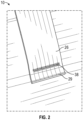
- FIG. 3A is a side view of a strap 26 of the adjustable harness system of FIGS. 1A-1C .
- FIG. 3B is a front view of a strap 26 of the adjustable harness system of FIGS. 1A-1C .
- the strap 26 is shown as being affixed to the stroller 10 at the first end 28 and the second end 29.
- the strap 26 may comprise a webbing material and the webbing may be affixed to a front and/or back surface of the stroller at the first end 28 and the second end 29.
- the strap 26 may also be removably affixed to the stroller 10 as well through any suitable mechanism.
- the strap 26 is shown as being provided through apertures (for example, apertures 46 and 48) in the slide 30. Also provided through one of the apertures in the slide 30 is a harness strap 33. While the strap 26 is affixed to the stroller 30, the harness strap 33 is a portion of the harness that is connected to the buckle 44 as shown in FIG. 1A . As the slide 30 is moved up the strap 26, the tightness of the harness strap 33 is increased as an end 31 of the harness strap 33 moves further away from the buckle.
- apertures for example, apertures 46 and 48
- the side view also shows the protrusions 32, 34, 36, and 38.
- the protrusions 32, 34, 36, and 38 are shown as extending outwards from the front side 50 and the back side 52 of the strap 26. Extending the protrusions 32, 34, 36, and 38 outwards from both sides of the strap 26 provides further resistance to the movement of the slide 30 across the protrusions 32, 34, 36, and 38. As the slide moves across a given protrusion, the additional material that the protrusion provides on top of the strap 26 may also need to travel through the an aperture 46 or 48 of the slide 30.
- the protrusions 32, 34, 36, and 38 may be sized such that the combination of the strap 26 and a protrusion is equal to or greater than the size of the apertures 46 and 48.
- the protrusions 32, 34, 36, and 38 may comprise a flexible or deformable material. Thus, a user may need to apply further force to allow the protrusion 32, 34, 36, and 38 to fit through the aperture 46 or 48.
- the protrusions 32, 34, 36, and 38 may also only be provided on the front side 50 or the back side 52 of the strap 26 as well.
- the distance to which the protrusions 32, 34, 36, and 38 extend outwards from the strap 26 may vary depending on the amount of resistance against the movement of the slide 30 that is desired. For example, extending the protrusions 32, 34, 36, and 38 outwards a greater distance from the strap 26 may provide additional resistance.
- FIG. 2 illustrates that the protrusions 32, 34, 36, and 38 all extend from the strap 26 equal distances, some of the protrusions 32, 34, 36, and 38 may extend outwards from the strap 26 to different distances as well.
- FIG. 3C is a side view of another strap 26 of the adjustable harness system of FIGS. 1A-1C .
- FIGS. 3D-3E show a front view of another strap 26 of the adjustable harness system of FIGS. 1A-1C .
- FIGS. 3C-3E illustrate another mechanism by which the strap 26 may be secured to the stroller 10.
- an aperture 50 may be provided through a surface of the stroller 10 and the strap 26 may be provided through the aperture 50.
- the strap 26 may be secured to the stroller 10 by providing an anchoring element 52 behind the surface of the stroller 10 on which the aperture 50 is provided.
- the anchoring element 52 is sized such that the anchoring element 52 may not fit through the aperture 50 or may not easily fit through the aperture 50.
- FIG. 3D shows the strap 26 with the anchoring element 52 provided in the aperture 50 and secured within the stroller 10.
- FIG. 3E shows the strap 26 with the anchoring element 52 removed from the aperture 50.
- FIGS. 3C-3E merely provide one additional example of a manner by which the strap 26 may be secured to the stroller 10. The strap 26 may also be secured to the stroller 10 in any other suitable manner.
- conditional language such as, among others, “can,” “could,” “might,” or “may,” unless specifically stated otherwise, or otherwise understood within the context as used, is generally intended to convey that certain implementations could include, while other implementations do not include, certain features, elements, and/or operations. Thus, such conditional language generally is not intended to imply that features, elements, and/or operations are in any way required for one or more implementations or that one or more implementations necessarily include logic for deciding, with or without user input or prompting, whether these features, elements, and/or operations are included or are to be performed in any particular implementation.
Landscapes
- Engineering & Computer Science (AREA)
- Health & Medical Sciences (AREA)
- Transportation (AREA)
- Mechanical Engineering (AREA)
- Public Health (AREA)
- Chemical & Material Sciences (AREA)
- Combustion & Propulsion (AREA)
- Child & Adolescent Psychology (AREA)
- General Health & Medical Sciences (AREA)
- Aviation & Aerospace Engineering (AREA)
- Carriages For Children, Sleds, And Other Hand-Operated Vehicles (AREA)
- Seats For Vehicles (AREA)
Abstract
Description
- This application claims priority to and benefit of
U.S. provisional patent application no. 63/494,327 filed April 5, 2023 - The present disclosure is generally in the field of harness systems, and more particularly related to harness systems for strollers.
- Strollers often include a harness that is used to secure a child within a seat of the stroller. Conventional harnesses may include multiple straps that are affixed to the stroller seat. A child may be provided in the seat, the straps may be provided around the child, and the straps may be inserted into a buckle to secure the child within the seat. The harness may also include a slide that is configured to slide along the strap to adjust the tightness of the harness to further secure the child. However, the thickness of a strap is typically less than the thickness of the apertures in the slides through which the strap is inserted. This results in limited resistance being provided to the slide by the strap as a user moves the slide up and down the strap, which allows for the child to easily move the slide downwards and adjust the tightness of the harness.
- In embodiments, the present disclosure describes harness system for a stroller, the harness system. The harness system comprises a first strap affixed to the stroller, the first strap comprising one or more protrusions. The harness system also comprises a slide provided on the first strap, wherein the one or more protrusions provide a resistance against movement of the slide across the one or more protrusions.
- In embodiments, the present disclosure describes a stroller. The stroller comprises a harness system. The harness system comprises a first strap affixed to the stroller, the first strap comprising one or more protrusions. The harness system also comprises a slide provided on the first strap, wherein the one or more protrusions provide a resistance against movement of the slide across the one or more protrusions.
- In embodiments, the present disclosure describes A strap for a harness system of a stroller. The strap comprises one or more protrusions provided along the strap at designed intervals, wherein the strap is affixed to the stroller, wherein the one or more protrusions provide a resistance against movement of a slide of the harness system across the one or more protrusions, wherein the strap is provided through the slide.
- The detailed description is set forth with reference to the accompanying drawings. The use of the same reference numerals may indicate similar or identical items. Various embodiments may utilize elements and/or components other than those illustrated in the drawings, and some elements and/or components may not be present in various embodiments. Elements and/or components in the figures are not necessarily drawn to scale. Throughout this disclosure, depending on the context, singular and plural terminology may be used interchangeably.
-
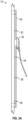
FIGS. 1A-1C are front views of a stroller including an adjustable harness system. -
FIG. 2 is a partial view of a portion of a strap of the adjustable harness system ofFIGS. 1A-1C . -
FIG. 3A is a side view of a strap of the adjustable harness system ofFIGS. 1A-1C . -
FIG. 3B is a front view of a strap of the adjustable harness system ofFIGS. 1A-1C . -
FIG. 3C is side view of another strap of the adjustable harness system ofFIGS. 1A-1C . -
FIGS. 3D-3E are a front view of another strap of the adjustable harness system ofFIGS. 1A-1C . - The present disclosure provides a more detailed and specific description with reference to the accompanying drawings. The drawings and specific descriptions of the drawings, as well as any specific or other embodiments discussed, are intended to be read in conjunction with the entirety of this disclosure.
- Example embodiments will now be described more fully hereinafter with reference to the accompanying drawings, in which example embodiments are shown. The concepts disclosed herein may, however, be embodied in many different forms and should not be construed as limited to the example embodiments set forth herein; rather, these embodiments are provided so that this disclosure will be thorough and complete, and will fully convey the scope of the concepts to those skilled in the art. Like numbers refer to like, but not necessarily the same or identical elements throughout.
- Strollers may include a harness system (which may also be referred to simply as a "harness" herein as well) that may be used to secure a child within a seat of the stroller. The harness system may include multiple straps that are provided around the arms and/or shoulders of the child. The straps may include an adjustable mechanism, such as a slide attached to each individual strap. The slide may be moved up or down the strap to adjust the tightness of the straps (and the harness) against the child.
- Conventionally, the straps are configured such that the slide that is used to adjust the tightness of the harness may easily be moved up and down the strap without significant resistance. Thus, even after a child is provided within the stroller using the harness, and the harness is tightened to secure the child within the seat, the child may be able to move the slide to loosen the straps. This may result in the child being less secure within the stroller.
- In embodiments, the present disclosure describes an adjustable harness system for a stroller. In contrast with conventional harnesses, the harness described herein includes one or more protrusions provided at various intervals on the straps (e.g., raised portions of the surface of the straps). The one or more protrusions provide resistance against the movement of the slide at the locations of the protrusions. In this manner, the slide may be moved up and down with little resistance along the portions of the strap between the protrusions. However, additional force may be required to move the slide across a protrusion. Thus, the protrusions serve to limit the ability of the child to loosen or otherwise adjust the tightness of the harness after the child has been secured within the stroller.
- In embodiments, the straps may comprise a webbing material and the protrusions may be formed as a part of the webbing. For example, additional material may be provided in the webbing at the intervals associated with the protrusions such that the webbing is raised at those intervals. The protrusions may alternatively include elements that are added to the webbing. For example, a material may be stitched to the exterior of the webbing forming the straps. A material may also be permanently or removably adhered to the straps in any other suitable manner as well. The straps may also comprise any other type of flexible or deformable material as well.
- The intervals at which the protrusions are provided on the straps may be pre-determined based on standard height locations associated with stroller harness systems. That is, different geographical regions may be associated with standard harness height positions. The location of the protrusions may be selected according to these height positions to provide a visual indication to a user as to where the standard height positions are located. The location of the protrusions may vary depending on the region. For example, the location of the protrusions on a harness used within the United States may differ than the location of the protrusions on a harness used within Europe. In embodiments, a harness may also include multiple different sets of protrusions that may correspond to standard heights for different geographical regions. The protrusions associated with the different regions may be indicated in any number of suitable manners. For example, the protrusions associated with one region may be provided in one color and the protrusions associated with another region may be provided in another color. In other embodiments, the locations of the protrusions along the strap may not necessarily correspond to standard heights, but may also be provided at any other intervals along the strap as well.
-
FIGS. 1A is a front view of astroller 10 including an adjustable harness system. Particularly, the figure shows a comparison between astrap 24 that may be used with a conventional harness system of astroller 10 and astrap 26 that may instead be used with the harness system described herein. The comparison illustrates differences between thestrap 24 associated with the conventional harness system and thestrap 26 associated with the harness system described herein. A complete harness system may include multiple straps similar to thestrap 26 rather than includingstrap 24 andstrap 26 as shown in the figure. - A conventional harness system includes one or more straps, such as
strap 24 for example. A conventional harness system may also include a second strap similar tostrap 24 in place of thestrap 26 shown in the figure (reference hereinafter to strap 24 may also refer to a second type of similar strap). Thestrap 24 may be placed around the shoulders and/or arms of a child provided in thestroller 10. Thestrap 24 may also include anadjustable pad 42 that provides a cushion between thestrap 24 and the child to provide additional comfort to the child when thestrap 24 is secured against the child. Thestrap 24 may be secured to thestroller 10 as well. Additional straps, such asstraps stroller 10. - Any of the
straps buckle 44, such that thestraps stroller 10. Thebuckle 44 may include abutton 46 that may be pressed to allow thestraps buckle 44 to allow the child to be removed from thestroller 10. - Turning to the harness system describes herein, the
strap 26 is affixed to the stroller 10 (shown in further detail inFIG. 1B and3A ). For example, as shown inFIG. 1B , thestrap 26 may be affixed to thestroller 10 at afirst end 28 and asecond end 29. Thestrap 26 may be affixed to thestroller 10 in any suitable manner. For example, thefirst end 28 and thesecond end 29 may be stitched into the material of thestroller 10. - In embodiments, a
slide 30 is provided on thestrap 26 that is configured to be moved up and down thestrap 26 by a user (for example, a parent securing a child within the stroller 10). That is, thestrap 26 may be fed through one or more apertures of the slide (as shown inFIG. 3A ). Also provided within the slide 30 (for example, one of the apertures of the slid 30) is aseparate harness strap 33. While thestrap 26 is affixed to thestroller 10, theharness strap 33 is configured to be provided within thebuckle 44 to complete the harness system to secure a child within thestroller 10. Thus, theharness strap 33 is removably secured at one end within thebuckle 44 and at another end through theslide 30 that is also attached to the strap 26 (which is affixed to the stroller 10). - In contrast with the
strap 24 of the conventional harness, thestrap 26 also includes one or more protrusions. For example,FIG. 1A shows afirst protrusion 32 provided on thestrap 26. Any other number of protrusions may also exist on thestrap 26 at various intervals. For example,FIG. 1B shows four protrusions provided on the strap 26 (first protrusion 32,second protrusion 34,third protrusion 36, and fourth protrusion 38) at various intervals along thestrap 26. Theprotrusions strap 26. For example, thestrap 26 may be a webbing material and theprotrusions protrusions strap 26 at those locations. Thestrap 26 and/orprotrusions protrusions FIG. 3A ) by any distance. - The
protrusions slide 30 at the locations of theprotrusions protrusions strap 26, a user may be required to provide additional force to continue to move theslide 30 across theprotrusions strap 26 in between thevarious protrusions strap 26 may mitigate the likelihood that a child that is secured within the stroller using the harness is able to freely move theslide 26 to significantly adjust the tightness of the harness. - The
protrusions strap 26. However, the protrusions may also be formed in any other manner. For example, theprotrusions straps 26 at the various intervals. Theprotrusions strap 26. For example, a material may be adhered to thestrap 26 at the various intervals at which it is desired for theprotrusions - The
protrusions strap 26. In embodiments, the location of theprotrusions protrusions protrusions protrusions protrusions stroller 10 for the particular geographical region. The location of theprotrusions -
FIG. 1A shows that theprotrusions - The
protrusions protrusions strap 26. For example, thestrap 26 may be a black color and theprotrusions protrusions strap 26. -
FIG. 2 is a partial view of a portion of astrap 26 of the adjustable harness system ofFIGS. 1A-1C . Particularly,FIG. 2 shows that thesecond end 29 of thestrap 26 is affixed to thestroller 10.FIG. 2 also shows one of theprotrusions 38. -
FIG. 3A is a side view of astrap 26 of the adjustable harness system ofFIGS. 1A-1C .FIG. 3B is a front view of astrap 26 of the adjustable harness system ofFIGS. 1A-1C . - The
strap 26 is shown as being affixed to thestroller 10 at thefirst end 28 and thesecond end 29. In embodiments, thestrap 26 may comprise a webbing material and the webbing may be affixed to a front and/or back surface of the stroller at thefirst end 28 and thesecond end 29. In embodiments, thestrap 26 may also be removably affixed to thestroller 10 as well through any suitable mechanism. - The
strap 26 is shown as being provided through apertures (for example,apertures 46 and 48) in theslide 30. Also provided through one of the apertures in theslide 30 is aharness strap 33. While thestrap 26 is affixed to thestroller 30, theharness strap 33 is a portion of the harness that is connected to thebuckle 44 as shown inFIG. 1A . As theslide 30 is moved up thestrap 26, the tightness of theharness strap 33 is increased as an end 31 of theharness strap 33 moves further away from the buckle. - The side view also shows the
protrusions protrusions front side 50 and theback side 52 of thestrap 26. Extending theprotrusions strap 26 provides further resistance to the movement of theslide 30 across theprotrusions strap 26 may also need to travel through the anaperture 46 or 48 of theslide 30. Theprotrusions strap 26 and a protrusion is equal to or greater than the size of theapertures 46 and 48. Theprotrusions protrusion aperture 46 or 48. Theprotrusions front side 50 or theback side 52 of thestrap 26 as well. - In embodiments, the distance to which the
protrusions strap 26 may vary depending on the amount of resistance against the movement of theslide 30 that is desired. For example, extending theprotrusions strap 26 may provide additional resistance. Furthermore, althoughFIG. 2 illustrates that theprotrusions strap 26 equal distances, some of theprotrusions strap 26 to different distances as well. -
FIG. 3C is a side view of anotherstrap 26 of the adjustable harness system ofFIGS. 1A-1C .FIGS. 3D-3E show a front view of anotherstrap 26 of the adjustable harness system ofFIGS. 1A-1C .FIGS. 3C-3E illustrate another mechanism by which thestrap 26 may be secured to thestroller 10. Particularly, as shown in the side view ofFIG. 3C , anaperture 50 may be provided through a surface of thestroller 10 and thestrap 26 may be provided through theaperture 50. Thestrap 26 may be secured to thestroller 10 by providing an anchoringelement 52 behind the surface of thestroller 10 on which theaperture 50 is provided. The anchoringelement 52 is sized such that the anchoringelement 52 may not fit through theaperture 50 or may not easily fit through theaperture 50. In this manner, a child who is secured within thestroller 10 may not be able to easily remove thestrap 26 from the stroller 10 (or may not be able to remove thestrap 26 from thestroller 10 at all).FIG. 3D shows thestrap 26 with the anchoringelement 52 provided in theaperture 50 and secured within thestroller 10.FIG. 3E shows thestrap 26 with the anchoringelement 52 removed from theaperture 50.FIGS. 3C-3E merely provide one additional example of a manner by which thestrap 26 may be secured to thestroller 10. Thestrap 26 may also be secured to thestroller 10 in any other suitable manner. - Though the disclosed examples include particular arrangements of a number of parts, components, features, and aspects, the disclosure is not limited to only those examples or arrangements shown. Any one or more of the parts, components, features, and aspects of the disclosure may be employed alone or in other arrangements of any two or more of the same.
- Although certain product features, functions, components, and parts have been described herein in accordance with the teachings of the present disclosure, the scope of coverage of this patent is not limited thereto. On the contrary, this patent covers all embodiments of the teachings of the disclosure that fairly fall within the scope of permissible equivalents.
- Unless otherwise noted, the terms used herein are to be understood according to conventional usage by those of ordinary skill in the relevant art. In addition to the definitions of terms provided below, it is to be understood that as used in the specification and in the claims, "a" or "an" may mean one or more, depending upon the context in which it is used.
- Throughout this application, the term "include," "include(s)" or "including" means "including but not limited to." Note that certain embodiments may be described relating to a single glass, but the corresponding description should be read to include embodiments of two or more glasses. Different features, variations, and multiple different embodiments are shown and described herein with various details. What has been described in this application at times in terms of specific embodiments is done for illustrative purposes only and without the intent to limit or suggest that what has been conceived is only one particular embodiment or specific embodiments. It is to be understood that this disclosure is not limited to any single specific embodiments or enumerated variations. Many modifications, variations and other embodiments will come to mind of those skilled in the art, and which are intended to be and are in fact covered by this disclosure. It is indeed intended that the scope of this disclosure should be determined by a proper legal interpretation and construction of the disclosure, including equivalents, as understood by those of skill in the art relying upon the complete disclosure present at the time of filing.
- Conditional language, such as, among others, "can," "could," "might," or "may," unless specifically stated otherwise, or otherwise understood within the context as used, is generally intended to convey that certain implementations could include, while other implementations do not include, certain features, elements, and/or operations. Thus, such conditional language generally is not intended to imply that features, elements, and/or operations are in any way required for one or more implementations or that one or more implementations necessarily include logic for deciding, with or without user input or prompting, whether these features, elements, and/or operations are included or are to be performed in any particular implementation.
- What has been described herein in the present specification and drawings includes examples of systems, apparatuses, methods, devices, and/or techniques. It is, of course, not possible to describe every conceivable combination of components and/or methods for purposes of describing the various elements of the disclosure, but it may be recognized that many further combinations and permutations of the disclosed elements are possible. Accordingly, it may be apparent that various modifications may be made to the disclosure without departing from the scope thereof. In addition, or as an alternative, other embodiments of the disclosure may be apparent from consideration of the specification and annexed drawings, and practice of the disclosure as presented herein. It is intended that the examples put forth in the specification and annexed drawings be considered, in all respects, as illustrative and not limiting. Although specific terms are employed herein, they are used in a generic and descriptive sense only and not for purposes of limitation.
Claims (15)
- A harness system for a stroller, the harness system comprising:a first strap affixed to the stroller, the first strap comprising one or more raised portions; anda slide provided on the first strap, wherein the one or more raised portions provide a resistance against movement of the slide across the one or more raised portions.
- The harness system of claim 1, wherein the one or more raised portions are provided along the first strap at designed intervals.
- The harness system of claim 1 or claim 2, wherein the one or more raised portions comprise stitching into the first strap.
- The harness system of any preceding claim, wherein the one or more raised portions are separate from the first strap and are disposed on the first strap.
- The harness system of any preceding claim, wherein the one or more raised portions comprise a different color than the first strap.
- The harness system of any preceding claim, further comprising:
a second strap provided through the slide, wherein the second strap is configured to be inserted into a buckle of the harness system. - The harness system of claim 6, wherein the second strap is configured to increase or decrease in tightness as the slide is moved along the first strap.
- The harness system of any preceding claim, wherein the first strap is affixed to the stroller at a first end of the first strap and a second end of the first strap.
- The harness system of any preceding claim, wherein the one or more raised portions extend outwards from a front side of the first strap and a back side of the first strap.
- A stroller comprising:
a harness system, the harness system comprising:a first strap affixed to the stroller, the first strap comprising one or more raised portions; anda slide provided on the first strap, wherein the one or more raised portions provide a resistance against movement of the slide across the one or more raised portions. - The stroller of claim 10, wherein the one or more raised portions are provided along the first strap at designed intervals, and optionally wherein the one or more raised portions comprise stitching into the first strap.
- The stroller of claim 10 or claim 11, wherein the one or more raised portions are separate from the first strap and are disposed on the first strap.
- The stroller of any of claims 10 to 12, wherein the one or more raised portions comprise a different color than the first strap.
- The stroller of any of claims 10 to 13, further comprising:
a second strap provided through the slide, wherein the second strap is configured to be inserted into a buckle of the harness system. - The stroller of claim 14, wherein the second strap is configured to increase or decrease in tightness as the slide is moved along the first strap, optionally wherein the first strap is affixed to the stroller at a first end of the first strap and a second end of the first strap, optionally wherein the one or more raised portions extend outwards from a front side of the first strap and a back side of the first strap, optionally the strap comprising one or more raised portions provided along the strap at designed intervals, wherein the strap is affixed to the stroller, wherein the one or more raised portions provide a resistance against movement of a slide of the harness system across the one or more raised portions, wherein the strap is provided through the slide, optionally wherein the one or more raised portions comprise stitching into the strap or the one or more raised portions are separate from the strap and are disposed on the strap.
Applications Claiming Priority (1)
| Application Number | Priority Date | Filing Date | Title |
|---|---|---|---|
| US202363494327P | 2023-04-05 | 2023-04-05 |
Publications (1)
| Publication Number | Publication Date |
|---|---|
| EP4446199A1 true EP4446199A1 (en) | 2024-10-16 |
Family
ID=90717616
Family Applications (1)
| Application Number | Title | Priority Date | Filing Date |
|---|---|---|---|
| EP24167415.9A Pending EP4446199A1 (en) | 2023-04-05 | 2024-03-28 | Adjustable harness system |
Country Status (3)
| Country | Link |
|---|---|
| US (1) | US20240336292A1 (en) |
| EP (1) | EP4446199A1 (en) |
| CN (1) | CN118770344A (en) |
Citations (4)
| Publication number | Priority date | Publication date | Assignee | Title |
|---|---|---|---|---|
| US4223917A (en) * | 1978-02-09 | 1980-09-23 | Toyota Jidosha Kogyo Kabushiki Kaisha | Seatbelt system |
| DE10337018A1 (en) * | 2003-08-12 | 2005-03-10 | Volkswagen Ag | Stop element for tongue-shaped insertion part of seat belt, made of metal wire for compact size |
| DE102007058278A1 (en) * | 2007-12-04 | 2009-06-10 | Trw Automotive Gmbh | Seat e.g. child seat, belt system for use in motor vehicle, has reader arranged on transponder, and recognizing pre-determined influence of transponder or presence and absence of transponder that is coupled to component of system |
| EP2634038A1 (en) * | 2012-03-01 | 2013-09-04 | Britax Römer Kindersicherheit GmbH | Adjustable lap strap system |
Family Cites Families (9)
| Publication number | Priority date | Publication date | Assignee | Title |
|---|---|---|---|---|
| US6237999B1 (en) * | 1999-08-24 | 2001-05-29 | Donald A. Hobson | Child car seat |
| NO20023255A (en) * | 2002-07-04 | 2003-12-08 | Torgersen Hans & Soenn | Seat belt tensioning device |
| US8622478B2 (en) * | 2011-01-05 | 2014-01-07 | Graco Children's Products Inc. | Child car seat with adjustable harness system |
| WO2013184007A1 (en) * | 2012-06-07 | 2013-12-12 | Phil And Teds Design Limited | Child harness |
| CN214524029U (en) * | 2021-01-07 | 2021-10-29 | 明门瑞士股份有限公司 | Shoulder strap assembly and stroller |
| CN214823556U (en) * | 2021-02-18 | 2021-11-23 | 明门瑞士股份有限公司 | Infant carrier |
| US11498460B1 (en) * | 2021-05-06 | 2022-11-15 | E.V.S Ltd. | Child carrier restraint |
| CN116001901B (en) * | 2021-10-22 | 2025-09-02 | 明门瑞士股份有限公司 | Head protection device and child carrier |
| TW202426289A (en) * | 2022-12-27 | 2024-07-01 | 瑞士商明門瑞士股份有限公司 | Head protection devide and carrier |
-
2024
- 2024-03-28 EP EP24167415.9A patent/EP4446199A1/en active Pending
- 2024-03-29 US US18/621,748 patent/US20240336292A1/en active Pending
- 2024-04-03 CN CN202410402614.6A patent/CN118770344A/en active Pending
Patent Citations (4)
| Publication number | Priority date | Publication date | Assignee | Title |
|---|---|---|---|---|
| US4223917A (en) * | 1978-02-09 | 1980-09-23 | Toyota Jidosha Kogyo Kabushiki Kaisha | Seatbelt system |
| DE10337018A1 (en) * | 2003-08-12 | 2005-03-10 | Volkswagen Ag | Stop element for tongue-shaped insertion part of seat belt, made of metal wire for compact size |
| DE102007058278A1 (en) * | 2007-12-04 | 2009-06-10 | Trw Automotive Gmbh | Seat e.g. child seat, belt system for use in motor vehicle, has reader arranged on transponder, and recognizing pre-determined influence of transponder or presence and absence of transponder that is coupled to component of system |
| EP2634038A1 (en) * | 2012-03-01 | 2013-09-04 | Britax Römer Kindersicherheit GmbH | Adjustable lap strap system |
Also Published As
| Publication number | Publication date |
|---|---|
| CN118770344A (en) | 2024-10-15 |
| US20240336292A1 (en) | 2024-10-10 |
Similar Documents
| Publication | Publication Date | Title |
|---|---|---|
| EP2328440B1 (en) | Infant carrying device | |
| US7770976B2 (en) | Multi-functional auxiliary headrest | |
| US8863316B2 (en) | Horseback riding training glove | |
| USD611751S1 (en) | Temporary car seat cover for a bench seat | |
| TWI531493B (en) | Children with seats | |
| US9010856B2 (en) | Automobile bench seat cover | |
| US20140070579A1 (en) | Fastening tape for seat pad and seat pad having the sam | |
| US9049946B1 (en) | Infant covering blanket adapted for use with infant supporting apparatuses | |
| EP3210487A1 (en) | Hook-and-loop fastener member and seat using same | |
| KR20130002781U (en) | Lens fixing apparatus of goggles | |
| US20100148552A1 (en) | Cushion for aircraft ejection seat | |
| WO2010058035A1 (en) | A safety belt buckle and assembly for a vehicle child seat | |
| US8689374B2 (en) | Bed clip system | |
| US10596929B2 (en) | Child restraint system including harness and adjustment mechanism | |
| US20240336292A1 (en) | Adjustable harness system | |
| US9460693B2 (en) | Guitar strap | |
| US7726736B1 (en) | Car seat reminder system | |
| US20120284972A1 (en) | Belt Buckle Accessory | |
| US20050120454A1 (en) | Kneepad having a sling strap system | |
| US10668890B2 (en) | Automobile seat restraint system and method | |
| US10772439B2 (en) | Safety harness with adjustable separation mechanism | |
| US10492469B2 (en) | Closure system for the front end of a horse rug | |
| US11827320B2 (en) | Flotation vest with repositionable collar member | |
| US9095225B2 (en) | Infant changing board | |
| KR102154612B1 (en) | Adjustable restraint system |
Legal Events
| Date | Code | Title | Description |
|---|---|---|---|
| PUAI | Public reference made under article 153(3) epc to a published international application that has entered the european phase |
Free format text: ORIGINAL CODE: 0009012 |
|
| STAA | Information on the status of an ep patent application or granted ep patent |
Free format text: STATUS: THE APPLICATION HAS BEEN PUBLISHED |
|
| AK | Designated contracting states |
Kind code of ref document: A1 Designated state(s): AL AT BE BG CH CY CZ DE DK EE ES FI FR GB GR HR HU IE IS IT LI LT LU LV MC ME MK MT NL NO PL PT RO RS SE SI SK SM TR |
|
| STAA | Information on the status of an ep patent application or granted ep patent |
Free format text: STATUS: REQUEST FOR EXAMINATION WAS MADE |
|
| 17P | Request for examination filed |
Effective date: 20250415 |
|
| GRAP | Despatch of communication of intention to grant a patent |
Free format text: ORIGINAL CODE: EPIDOSNIGR1 |
|
| STAA | Information on the status of an ep patent application or granted ep patent |
Free format text: STATUS: GRANT OF PATENT IS INTENDED |
|
| INTG | Intention to grant announced |
Effective date: 20260306 |
|
| RAP1 | Party data changed (applicant data changed or rights of an application transferred) |
Owner name: BABY JOGGER II, LLC |