EP4445922A2 - Bioresorbierbarer verband mit struktureller stütze - Google Patents
Bioresorbierbarer verband mit struktureller stütze Download PDFInfo
- Publication number
- EP4445922A2 EP4445922A2 EP24197262.9A EP24197262A EP4445922A2 EP 4445922 A2 EP4445922 A2 EP 4445922A2 EP 24197262 A EP24197262 A EP 24197262A EP 4445922 A2 EP4445922 A2 EP 4445922A2
- Authority
- EP
- European Patent Office
- Prior art keywords
- dressing
- contact layer
- scaffold
- tissue site
- bioresorbable material
- Prior art date
- Legal status (The legal status is an assumption and is not a legal conclusion. Google has not performed a legal analysis and makes no representation as to the accuracy of the status listed.)
- Withdrawn
Links
Images


Classifications
-
- A—HUMAN NECESSITIES
- A61—MEDICAL OR VETERINARY SCIENCE; HYGIENE
- A61L—METHODS OR APPARATUS FOR STERILISING MATERIALS OR OBJECTS IN GENERAL; DISINFECTION, STERILISATION OR DEODORISATION OF AIR; CHEMICAL ASPECTS OF BANDAGES, DRESSINGS, ABSORBENT PADS OR SURGICAL ARTICLES; MATERIALS FOR BANDAGES, DRESSINGS, ABSORBENT PADS OR SURGICAL ARTICLES
- A61L15/00—Chemical aspects of, or use of materials for, bandages, dressings or absorbent pads
- A61L15/16—Bandages, dressings or absorbent pads for physiological fluids such as urine or blood, e.g. sanitary towels, tampons
- A61L15/42—Use of materials characterised by their function or physical properties
- A61L15/64—Use of materials characterised by their function or physical properties specially adapted to be resorbable inside the body
-
- A—HUMAN NECESSITIES
- A61—MEDICAL OR VETERINARY SCIENCE; HYGIENE
- A61F—FILTERS IMPLANTABLE INTO BLOOD VESSELS; PROSTHESES; DEVICES PROVIDING PATENCY TO, OR PREVENTING COLLAPSING OF, TUBULAR STRUCTURES OF THE BODY, e.g. STENTS; ORTHOPAEDIC, NURSING OR CONTRACEPTIVE DEVICES; FOMENTATION; TREATMENT OR PROTECTION OF EYES OR EARS; BANDAGES, DRESSINGS OR ABSORBENT PADS; FIRST-AID KITS
- A61F13/00—Bandages or dressings; Absorbent pads
- A61F13/01—Non-adhesive bandages or dressings
- A61F13/01008—Non-adhesive bandages or dressings characterised by the material
- A61F13/01012—Non-adhesive bandages or dressings characterised by the material being made of natural material, e.g. cellulose-, protein-, collagen-based
-
- A—HUMAN NECESSITIES
- A61—MEDICAL OR VETERINARY SCIENCE; HYGIENE
- A61F—FILTERS IMPLANTABLE INTO BLOOD VESSELS; PROSTHESES; DEVICES PROVIDING PATENCY TO, OR PREVENTING COLLAPSING OF, TUBULAR STRUCTURES OF THE BODY, e.g. STENTS; ORTHOPAEDIC, NURSING OR CONTRACEPTIVE DEVICES; FOMENTATION; TREATMENT OR PROTECTION OF EYES OR EARS; BANDAGES, DRESSINGS OR ABSORBENT PADS; FIRST-AID KITS
- A61F13/00—Bandages or dressings; Absorbent pads
- A61F13/00051—Accessories for dressings
- A61F13/00063—Accessories for dressings comprising medicaments or additives, e.g. odor control, PH control, debriding, antimicrobic
-
- A—HUMAN NECESSITIES
- A61—MEDICAL OR VETERINARY SCIENCE; HYGIENE
- A61F—FILTERS IMPLANTABLE INTO BLOOD VESSELS; PROSTHESES; DEVICES PROVIDING PATENCY TO, OR PREVENTING COLLAPSING OF, TUBULAR STRUCTURES OF THE BODY, e.g. STENTS; ORTHOPAEDIC, NURSING OR CONTRACEPTIVE DEVICES; FOMENTATION; TREATMENT OR PROTECTION OF EYES OR EARS; BANDAGES, DRESSINGS OR ABSORBENT PADS; FIRST-AID KITS
- A61F13/00—Bandages or dressings; Absorbent pads
- A61F13/01—Non-adhesive bandages or dressings
- A61F13/01021—Non-adhesive bandages or dressings characterised by the structure of the dressing
- A61F13/01029—Non-adhesive bandages or dressings characterised by the structure of the dressing made of multiple layers
-
- A—HUMAN NECESSITIES
- A61—MEDICAL OR VETERINARY SCIENCE; HYGIENE
- A61F—FILTERS IMPLANTABLE INTO BLOOD VESSELS; PROSTHESES; DEVICES PROVIDING PATENCY TO, OR PREVENTING COLLAPSING OF, TUBULAR STRUCTURES OF THE BODY, e.g. STENTS; ORTHOPAEDIC, NURSING OR CONTRACEPTIVE DEVICES; FOMENTATION; TREATMENT OR PROTECTION OF EYES OR EARS; BANDAGES, DRESSINGS OR ABSORBENT PADS; FIRST-AID KITS
- A61F13/00—Bandages or dressings; Absorbent pads
- A61F13/05—Bandages or dressings; Absorbent pads specially adapted for use with sub-pressure or over-pressure therapy, wound drainage or wound irrigation, e.g. for use with negative-pressure wound therapy [NPWT]
-
- A—HUMAN NECESSITIES
- A61—MEDICAL OR VETERINARY SCIENCE; HYGIENE
- A61L—METHODS OR APPARATUS FOR STERILISING MATERIALS OR OBJECTS IN GENERAL; DISINFECTION, STERILISATION OR DEODORISATION OF AIR; CHEMICAL ASPECTS OF BANDAGES, DRESSINGS, ABSORBENT PADS OR SURGICAL ARTICLES; MATERIALS FOR BANDAGES, DRESSINGS, ABSORBENT PADS OR SURGICAL ARTICLES
- A61L15/00—Chemical aspects of, or use of materials for, bandages, dressings or absorbent pads
- A61L15/16—Bandages, dressings or absorbent pads for physiological fluids such as urine or blood, e.g. sanitary towels, tampons
- A61L15/22—Bandages, dressings or absorbent pads for physiological fluids such as urine or blood, e.g. sanitary towels, tampons containing macromolecular materials
- A61L15/28—Polysaccharides or their derivatives
-
- A—HUMAN NECESSITIES
- A61—MEDICAL OR VETERINARY SCIENCE; HYGIENE
- A61L—METHODS OR APPARATUS FOR STERILISING MATERIALS OR OBJECTS IN GENERAL; DISINFECTION, STERILISATION OR DEODORISATION OF AIR; CHEMICAL ASPECTS OF BANDAGES, DRESSINGS, ABSORBENT PADS OR SURGICAL ARTICLES; MATERIALS FOR BANDAGES, DRESSINGS, ABSORBENT PADS OR SURGICAL ARTICLES
- A61L15/00—Chemical aspects of, or use of materials for, bandages, dressings or absorbent pads
- A61L15/16—Bandages, dressings or absorbent pads for physiological fluids such as urine or blood, e.g. sanitary towels, tampons
- A61L15/22—Bandages, dressings or absorbent pads for physiological fluids such as urine or blood, e.g. sanitary towels, tampons containing macromolecular materials
- A61L15/32—Proteins, polypeptides; Degradation products or derivatives thereof, e.g. albumin, collagen, fibrin, gelatin
- A61L15/325—Collagen
-
- A—HUMAN NECESSITIES
- A61—MEDICAL OR VETERINARY SCIENCE; HYGIENE
- A61L—METHODS OR APPARATUS FOR STERILISING MATERIALS OR OBJECTS IN GENERAL; DISINFECTION, STERILISATION OR DEODORISATION OF AIR; CHEMICAL ASPECTS OF BANDAGES, DRESSINGS, ABSORBENT PADS OR SURGICAL ARTICLES; MATERIALS FOR BANDAGES, DRESSINGS, ABSORBENT PADS OR SURGICAL ARTICLES
- A61L15/00—Chemical aspects of, or use of materials for, bandages, dressings or absorbent pads
- A61L15/16—Bandages, dressings or absorbent pads for physiological fluids such as urine or blood, e.g. sanitary towels, tampons
- A61L15/42—Use of materials characterised by their function or physical properties
- A61L15/425—Porous materials, e.g. foams or sponges
-
- A—HUMAN NECESSITIES
- A61—MEDICAL OR VETERINARY SCIENCE; HYGIENE
- A61F—FILTERS IMPLANTABLE INTO BLOOD VESSELS; PROSTHESES; DEVICES PROVIDING PATENCY TO, OR PREVENTING COLLAPSING OF, TUBULAR STRUCTURES OF THE BODY, e.g. STENTS; ORTHOPAEDIC, NURSING OR CONTRACEPTIVE DEVICES; FOMENTATION; TREATMENT OR PROTECTION OF EYES OR EARS; BANDAGES, DRESSINGS OR ABSORBENT PADS; FIRST-AID KITS
- A61F13/00—Bandages or dressings; Absorbent pads
- A61F2013/00361—Plasters
- A61F2013/00544—Plasters form or structure
- A61F2013/00604—Multilayer
- A61F2013/00608—Multilayer with reinforcing layers
Definitions
- This application provides technology generally related to treatment of a tissue site and, more particularly, but without limitation, to dressings for application to a tissue site, to systems including such dressings, and to methods related to the same.
- dressings A wide variety of materials and devices, generally characterized as “dressings,” are generally known in the art for use in treating an injury or other disruption of tissue. Such wounds may be the result of trauma, surgery, or disease, and may affect skin or other tissues. In general, dressings may control bleeding, absorb wound exudate, ease pain, assist in debriding the wound, protect wound tissue from infection, or otherwise promote healing and protect the wound from further damage.
- Some dressings may protect tissue from, or even assist in the treatment of, infections associated with wounds. Infections can delay wound healing and, if untreated, can result in tissue loss, systemic infections, septic shock and death. While the benefits of dressings are widely accepted, improvements to dressings may benefit healthcare providers and patients.
- Dressings and methods for using a dressing are set forth in the appended claims.
- Illustrative embodiments are also provided to enable a person skilled in the art to make and use the claimed subject matter.
- a dressing may comprise a contact layer and a scaffold configured to structurally support the contact layer.
- the contact layer may exhibit protease-modulating activity and may comprise a bioresorbable material, for example, collagen and oxidized regenerated cellulose.
- a method for providing therapy to a tissue site may comprise positioning a dressing adjacent to the tissue site.
- the dressing may comprise a contact layer and a scaffold configured to structurally support the contact layer.
- the contact layer may exhibit protease-modulating activity and may comprise a bioresorbable material, for example, collagen and oxidized regenerated cellulose.
- the present technology provides dressings, various layers thereof, and therapy systems including such dressings and/or layers, as well as methods including any embodiment disclosed herein of such dressings, various layers thereof, and/or therapy systems.
- the dressings of the present technology may be configured to provide therapy to a tissue site.
- a range includes each individual member.
- a group having 1-3 atoms refers to groups having 1, 2, or 3 atoms.
- a group having 1-5 atoms refers to groups having 1, 2, 3, 4, or 5 atoms, and so forth.
- tissue site refers to a wound, defect, or other treatment target located on or within tissue, including but not limited to, bone tissue, adipose tissue, muscle tissue, neural tissue, dermal tissue, vascular tissue, connective tissue, cartilage, tendons, or ligaments.
- a wound may include chronic, acute, traumatic, subacute, and dehisced wounds, partial-thickness burns, ulcers (such as diabetic, pressure, or venous insufficiency ulcers), flaps, grafts, or a combination of any two or more thereof.
- tissue site also refers to areas of any tissue that are not necessarily wounded or defective, but are instead areas in which it may be desirable to add or promote the growth of additional tissue.
- the term "effective amount" refers to a quantity sufficient to achieve a desired therapeutic effect, e.g., an amount which results in the decrease in a wound described herein or one or more signs or symptoms associated with a wound described herein.
- the amount of a composition administered to the subject will vary depending on the composition, the degree, type, and severity of the wound and on the characteristics of the individual.
- the compositions can also be administered in combination with one or more additional therapeutic compounds.
- the therapeutic compositions may be administered to a subject having one or more wounds.
- the terms “individual”, “patient”, or “subject” can be an individual organism, a vertebrate, a mammal, or a human. In some embodiments, the individual, patient or subject is a human.
- Treating includes: (i) inhibiting a wound of a subject, i.e., arresting its development; (ii) relieving a wound of a subject, i.e., causing regression of the wound; (iii) slowing progression of a wound of a subject; and/or (iv) inhibiting, relieving, and/or slowing progression of one or more symptoms of a wound of a subject.
- Such treatment means that the symptoms associated with the wound are, e.g., alleviated, reduced, cured, or placed in a state of remission.
- the various modes of treatment of wounds as described herein are intended to include total as well as less than total treatment wherein some biologically or medically relevant result is achieved.
- the treatment may be a continuous prolonged treatment for e.g., a chronic wound, or a single, or few time administrations for treatment of e.g., an acute wound.
- the present technology provides a dressing that includes a contact layer and a scaffold configured to structurally support the contact layer.
- the contact layer includes a bioresorbable material as well as a first surface configured to contact a tissue site in a subject.
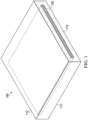
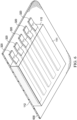
- FIG. 1 provides an illustrative illustration of a dressing 100 that includes a contact layer 110 and a scaffold 120. While not illustrated in FIG. 1 , the dressing may include one or more layers in addition to the contact layer (described further herein). In any embodiment herein, the contact layer, the scaffold, or both may be configured to contact a portion of the tissue site, substantially all of the tissue site, or the tissue site in its entirety.
- the dressing or a portion of the dressing may partially or completely fill the wound, and/or may be placed over the wound.
- Dressing of the present technology may take many forms, and may have many sizes, shapes, and/or thicknesses depending on a variety of factors, such as the type of treatment being implemented or the nature and/or size of a tissue site.
- the size and shape of the contact layer, the scaffold, or both may be adapted to the contours of deep and irregular shaped tissue sites and/or may be configured so as to be adaptable to a given shape or contour.
- any one or more surfaces of the dressing may include projections and/or an uneven, course, or jagged profile configured to induce strains and stresses on the tissue site effective to promote granulation at the tissue site.
- the contact layer may be generally configured to exhibit biological activity, such as protease-modulating activity, under physiological conditions, such as when the first surface is contacted with the tissue site.
- the bioresorbable material of the contact layer may be configured in the form a film, a foam, a fibrous substrate, and/or other physical structure of the contact layer.
- the bioresorbable material may include an oxidized cellulose, such as an oxidized regenerated cellulose (ORC).
- Oxidized cellulose may be produced by the oxidation of cellulose, for example with dinitrogen tetroxide. Not wishing to be bound by theory, it is believed that, the oxidation of cellulose converts primary alcohol groups on the saccharide residues to carboxylic acid group, forming uronic acid residues within the cellulose chain. The oxidation may not proceed with complete selectivity, and as a result hydroxyl groups on carbons 2 and 3 may be converted to the keto form.
- ORC oxidized regenerated cellulose
- ketone units yield an alkali labile link, which at a pH of about 7 or higher may initiate the decomposition of the polymer via formation of a lactone and sugar ring cleavage.
- alkali labile link which at a pH of about 7 or higher may initiate the decomposition of the polymer via formation of a lactone and sugar ring cleavage.
- oxidized cellulose is biodegradable and bioabsorbable under physiological conditions.
- the oxidized cellulose may be ORC prepared by oxidation of a regenerated cellulose, such as rayon.
- ORC may be manufactured, for example, by the process described in U.S. Patent No. 3,122,479, issued February 24, 1964 , which is incorporated herein by reference in its entirety. ORC is available with varying degrees of oxidation and hence rates of degradation. Additionally or alternatively, in some embodiments, the ORC may be in the form of water-soluble low molecular weight fragments obtained by alkali hydrolysis of ORC.
- the ORC may be included in one or more physical forms, such as particles, fibers, sheets, sponges, or fabrics (such as woven fabrics, non-woven fabrics, and/or knitted fabrics).
- the bioresorbable material may include ORC in the form of particles, such as fiber particles or powder particles, for example dispersed in the contact layer.
- the bioresorbable material of any embodiment herein may include ORC fibers where a volume fraction of at least 80% of the ORC fibers have lengths in the range from about 5 ⁇ m to about 50 mm.
- a volume fraction of at least 80% of the ORC fibers may have lengths in the range from about 5 ⁇ m to about 1000 ⁇ m, such as from about 250 ⁇ m to about 450 ⁇ m; thus, the volume fraction of at least 80% of the ORC fibers included in any embodiment herein may have lengths of about 5 ⁇ m, about 6 ⁇ m, about 7 ⁇ m, about 8 ⁇ m, about 9 ⁇ m, about 10 ⁇ m, about 11 ⁇ m, about 12 ⁇ m, about 13 ⁇ m, about 14 ⁇ m, about 15 ⁇ m, about 16 ⁇ m, about 17 ⁇ m, about 18 ⁇ m, about 19 ⁇ m, about 20 ⁇ m, about 22 ⁇ m, about 24 ⁇ m, about 26 ⁇ m, about 28 ⁇ m, about 30 ⁇ m, about 32 ⁇ m, about 34 ⁇ m, about 36 ⁇ m, about 38 ⁇ m, about 40 ⁇ m, about 42 ⁇ m, about 44 ⁇ m, about 46
- the volume fraction of at least 80% of ORC the fibers have lengths in the range from about 25 mm to about 50 mm; thus, the volume fraction of at least 80% of the ORC fibers have lengths of about 25 mm, about 26 mm, about 27 mm, about 28 mm, about 29 mm, about 30 mm, about 31 mm, about 32 mm, about 33 mm, about 34 mm, about 35 mm, about 36 mm, about 37 mm, about 38 mm, about 39 mm, about 40 mm, about 41 mm, about 42 mm, about 43 mm, about 44 mm, about 45 mm, about 46 mm, about 47 mm, about 48 mm, about 49 mm, about 50 mm, or any range including and/or in between any two of the preceding values. Desired volume fraction distributions may be achieved, for example, by milling an ORC cloth followed by sieving the milled powder to remove fibers outside the desired range.
- the bioresorbable material may include ORC in an of about 10% to about 80% by weight of the contact layer (e.g ., from about 30% to about 60% by weight of the contact layer; from about 40% to about 50% by weight of the contact layer.
- the bioresorbable material may include ORC in an amount by weight of the contact layer of about 10%, about 11%, about 12%, about 13%, about 14%, about 15%, about 16%, about 17%, about 18%, about 19%, about 20%, about 22%, about 24%, about 26%, about 28%, about 30%, about 32%, about 34%, about 36%, about 38%, about 40%, about 42%, about 44%, about 46%, about 48%, about 50%, about 52%, about 54%, about 56%, about 58%, about 60%, about 62%, about 64%, about 66%, about 68%, about 70%, about 72%, about 74%, about 76%, about 78%, about 80%, or any range including and/or in between any two of the preceding values.
- the bioresorbable material may include a structural protein.
- suitable structural proteins include, but are not limited to, fibronectin, fibrin, laminin, elastin, collagen, gelatins, and mixtures thereof.
- the bioresorbable material may include collagen.
- the collagen may be obtained from any natural source.
- the collagen may be Type I, II or III collagen, or may also be chemically modified collagen, for example, an atelocollagen obtained by removing the immunogenic telopeptides from natural collagen.
- the collagen may also include solubilized collagen or soluble collagen fragments.
- the collagen may have a weight-average molecular weight from about 5,000 to about 100,000.
- the bioresorbable material may include collagen with a weight-average molecular weight of about 5,000, about 6,000, about 7,000, about 8,000, about 9,000, about 10,000, about 11,000, about 12,000, about 13,000, about 14,000, about 15,000, about 16,000, about 17,000, about 18,000, about 19,000, about 20,000, about 22,000, about 24,000, about 26,000, about 28,000, about 30,000, about 32,000, about 34,000, about 36,000, about 38,000, about 40,000, about 42,000, about 44,000, about 46,000, about 48,000, about 50,000, about 52,000, about 54,000, about 56,000, about 58,000, about 60,000, about 62,000, about 64,000, about 66,000, about 68,000, about 70,000, about 72,000, about 74,000, about 76,000, about 78,000, about 80,000, about 82,000, about 84,000, about 86,000, about 88,000, about 90,000, about 92,000, about 94,000, about 96,000, about 98,000, about 100,000, or any range including
- the collagen may be obtained from bovine corium that has been rendered largely free of non-collagenous components.
- non-collagenous components include fat, non-collagenous proteins, polysaccharides, and other carbohydrates, as described in U.S. Patent No. 4,614,794, issued September 30, 1986 and U.S. Patent No. 4,320,201, issued March 16, 1982 , each of which is incorporated by reference herein.
- the bioresorbable material may include a structural protein in an amount of about 20% to about 90% by weight of the contact layer (e.g., from about 40% to about 70% by weight of the contact layer; about 50% to about 60% by weight of the contact layer).
- the bioresorbable material may include collagen in an amount of about 20% to about 90% by weight of the contact layer; thus, the bioresorbable material may include collagen in an amount by weight of the contact layer of about 20%, about 22%, about 24%, about 26%, about 28%, about 30%, about 32%, about 34%, about 36%, about 38%, about 40%, about 42%, about 44%, about 46%, about 48%, about 50%, about 52%, about 54%, about 56%, about 58%, about 60%, about 62%, about 64%, about 66%, about 68%, about 70%, about 72%, about 74%, about 76%, about 78%, about 80%, about 82%, about 84%, about 86%, about 88%, about 90%, or any range including and/or in between any two of the preceding values.
- the bioresorbable material may include both ORC and collagen.
- the bioresorbable material may include ORC from about 40% to about 50% by weight of the contact layer ( e.g., about 45% by weight of the contact layer) , and may include collagen from about 50% to about 60% by weight of the contact layer ( e.g ., about 55% by weight of the contact layer..
- the bioresorbable material may include ORC in an amount by weight of the contact layer of about 40%, about 41%, about 42%, about 43% t, about 44%, about 45%, about 46%, about 47%, about 48%, about 49%, about 50%, or any range including and/or in between any two of the preceding values, and may include collagen in an amount by weight of the contact layer of about 50%, about 51%, about 52%, about 53%, about 54%, about 55%, about 56%, about 57%, about 58%, about 59%, about 60%, or any range including and/or in between any two of the preceding values.
- the bioresorbable material may further include one or more of a preservative, a stabilizing agent, a hydrogel, a gelling agent, a plasticizer, a matrix strengthening material, a dyestuff, or an active ingredient where each, when present, may be present in a safe and effective amount.
- a "safe and effective" amount of a material used herein refers to an amount that is sufficient to impart a desired effect without undue adverse side effects (such as toxicity, irritation, or allergic response), commensurate with a reasonable benefit/risk ratio when used in the manner of this technology.
- the specific safe and effective amount of a particular material may vary with such factors as the type and quantity of other materials in the composition, the intended use, and the physical condition of the subject to whom the biologically-active compositions are given, and the form in which the biologically-active compositions are employed.
- Gelling agents for inclusion in the bioresorbable material include, for example, a hydrophilic polysaccharide.
- hydrophilic polysaccharides include, but are not limited to, an alginate, chitosan, chitin, a guar gum, pectin, a starch derivative, a cellulose derivative (such as hydroxyethyl cellulose, hydroxylpropyl cellulose, and/or hydroxypropylmethyl cellulose), a glycosaminoglycan, a galactomannan, a chondroitin salt (such as chondroitin sulfate), a heparin salt (such as heparin sulfate), hyaluronic acid, a salt of hyaluronic acid, a hyaluronate, or mixtures of any two or more thereof.
- the bioresorbable material may include carboxymethyl cellulose ("CMC") to modify the rheological, absorbency, and/or other characteristics of the bioresorbable material and/or the contact layer 110.
- CMC carboxymethyl cellulose
- the CMC may be derived from cellulose and modified such that carboxymethyl groups are bonded to hydroxyl groups in the glucopyranose monomers that make up the cellulose.
- the CMC may be in a salt form (e.g., sodium carboxymethyl cellulose).
- CMC is commercially available as Walocel TM (sold by The Dow Chemical Company) and Cekol ® (sold by CP Kelco). When present in the bioresorbable material, the CMC may be present at any amount appropriate to result in the desired characteristics for the bioresorbable material.
- the bioresorbable material may include a strengthening material which can improve the handling characteristics of the substrate.
- a strengthening material can decrease a substrate's susceptibility to tearing.
- Non-gelling cellulose fibers are an example of a strengthening material, where such "non-gelling" cellulose fibers may be substantially water-insoluble and may be produced from cellulose that has not been chemically modified to increase water solubility (as contrasted from carboxymethyl cellulose or other cellulose ethers).
- Non-gelling cellulose fibers are commercially available (e.g., Tencel ® fibers sold by Lenzing AG).
- the non-gelling cellulose fibers may be processed from a commercially-available continuous length, by cutting into lengths that are about 0.5 cm to about 5 cm, in length.
- the bioresorbable material may include non-gelling cellulose fibers with a length of about 0.5 cm, about 0.6 cm, about 0.7 cm, about 0.8 cm, about 0.9 cm, about 1 cm, about 1.1 cm, about 1.2 cm, about 1.3 cm, about 1.4 cm, about 1.5 cm, about 1.6 cm, about 1.7 cm, about 1.8 cm, about 1.9 cm, about 2 cm, about 2.1 cm, about 2.2 cm, about 2.3 cm, about 2.4 cm, about 2.5 cm, about 2.6 cm, about 2.7 cm, about 2.8 cm, about 2.9 cm, about 3 cm, about 3.1 cm, about 3.2 cm, about 3.3 cm, about 3.4 cm, about 3.5 cm, about 3.6 cm, about 3.7 cm, about 3.8 cm, about 3.9 cm, about 4 cm, about 4.1 cm, about 4.2 cm, about
- the bioresorbable material may include one or more active ingredients.
- active ingredients may, for example, aid in wound healing.
- active ingredients include, but are not limited to, a non-steroidal anti-inflammatory drug, acetaminophen, a steroid, an antibiotic, an antiseptic (e.g., silver and/or chlorhexidine), and a growth factor (e.g., a platelet derived growth factor (PDGF), a fibroblast growth factor (FGF), an epidermal growth factor (EGF)).
- a non-steroidal anti-inflammatory drug e.g., acetaminophen, a steroid, an antibiotic, an antiseptic (e.g., silver and/or chlorhexidine), and a growth factor (e.g., a platelet derived growth factor (PDGF), a fibroblast growth factor (FGF), an epidermal growth factor (EGF)).
- PDGF platelet derived growth factor
- FGF fibroblast growth factor
- the one or more active ingredients may be present at a an amount of about 0.1% to about 10% by weight of the contact layer; thus, the bioresorbable material may include one or more active ingredients in an amount by weight of the contact layer of about 0.1%, about 0.2%, about 0.3%, about 0.4%, about 0.5%, about 0.6%, about 0.7%, about 0.8%, about 0.9%, about 1%, about 1.1%, about 1.2%, about 1.3%, about 1.4%, about 1.5%, about 1.6%, about 1.7%, about 1.8%, about 1.9%, about 2%, about 2.2%, about 2.4%, about 2.6%, about 2.8%, about 3%, about 3.2%, about 3.4%, about 3.6%, about 3.8%, about 4%, about 4.2%, about 4.4%, about 4.6%, about 4.8% about 5%, about 5.2%, about 5.4%, about 5.6%, about 5.8%, about 6%, about 6.2%, about 6.4%, about 6.6%, about 6.8%, about 7%, about 7.2%, about 7.4%, about 7.6%, about 7.8%, about
- the bioresorbable material may include an antimicrobial agent, an antiseptic, or both.
- antimicrobial agents include, but are not limited to, a tetracycline, a penicillin, a terramycin, an erythromycin, bacitracin, neomycin, polymycin B, mupirocin, clindamycin, or a combination of any two or more thereof.
- antiseptics include, but are not limited to silver, polyhexanide (polyhexamethylene biguanide or PHMB), chlorhexidine, povidone iodine, triclosan, sucralfate, quaternary ammonium salts, or a combination of any two or more thereof.
- the bioresorbable material may include silver, which may be in metallic form, in ionic form (e.g., a silver salt), or both.
- the bioresorbable material may include a complex of silver and ORC (a "Silver/ORC complex").
- a complex is an intimate mixture at the molecular level, for example, with ionic or covalent bonding between the silver and the ORC.
- the Silver/ORC complex may include a salt formed between the ORC and Ag + , but it may also include silver clusters and/or colloidal silver metal (for example, produced by exposure of the complex to light).
- the Silver/ORC complex may be made by treating ORC with a solution of a silver salt, where he silver salt may be the salt of silver with a weak acid.
- a silver salt may be the salt of silver with a weak acid.
- Silver/ORC complexes useful herein, and methods of producing such complexes are described in U.S. Patent No. 8,461,410, issued June 11, 2013 , incorporated by reference herein. Similar processes are described in U.S. Patent No. 5,134,229, issued July 28, 1992 , each of which is incorporated by reference herein.
- the Silver/ORC Complex may be present from about 1% to about 2% by weight of the contact layer.
- the bioresorbable material may include a dyestuff.
- the dyestuff may be light-absorbing in the visible region 400-700 nm.
- such dyestuffs may be operable to photochemically trap generated free radicals that could otherwise react with the silver in the present compositions, acting as photochemical desensitizers (an "antioxidant dyestuff').
- antioxidant dyestuffs include, but are not limited to, aniline dyes, acridine dyes, thionine dyes, bis-naphthalene dyes, thiazine dyes, azo dyes, anthraquinone dyes, gentian violet, aniline blue, methylene blue, crystal-violet, acriflavine, 9-aminoacridine, acridine yellow, acridine orange, proflavin, quinacrine, brilliant green, trypan blue, trypan red, malachite green, azacrine, methyl violet, methyl orange, methyl yellow, ethyl violet, acid orange, acid yellow, acid blue, acid red, thioflavin, alphazurine, indigo blue, methylene green, or a combination of any two or more thereof.
- the dyestuff e.g., an antioxidant dyestuff
- the dyestuff may be included in the bioresorbable material in an amount of about 0.05% to about 5% by weight of the contact layer (e.g., about 0.2% to about 2% by weight of the contact layer).
- the contact layer may be biodegradable and/or exhibit biodegradability.
- biodegradable and “biodegradability” may refer to a characteristic of a material to at least partially break down upon exposure to physiological fluids or processes.
- the contact layer may disintegrate, degrade, and/or dissolve when contacted with an aqueous medium, such as water, blood, or wound exudate from a tissue site. Biodegradability may result from a chemical process, a physical process and/or condition, or a combination of any two or more thereof.
- the contact layer may be configured to exhibit a particular proportion of disintegration, degradation, and/or dissolution (hereafter collectively referred to as "broken down") within a particular time period.
- the contact layer 110 may be configured such that about 90% by weight, about 91% by weight, about 92% by weight, about 93% by weight, about 94% by weight, about 95% by weight, about 96% by weight, about 97% by weight, about 98% by weight, about 99% by weight, or about 100% by weight of the contact layer (or any range including and/or in between any two of these values) may be broken down within a time period of about 24 hours, about 26 hours, about 28 hours, about 30 hours, about 32 hours, about 34 hours, about 36 hours, about 38 hours, about 40 hours, about 42 hours, about 44 hours, about 46 hours, about 48 hours, about 2 days, about 3 days, about 4 days, about 5 days, about 6 days, about 7 days, or any range including and/or in between any two of these values, from introduction into a physiological environment or when
- the contact layer may be configured to modulate protease activity.
- contact with wound fluid such as wound exudate, may cause the contact layer to break down into products that may have the effect of modulating protease activity.
- Modulating protease activity may include inhibiting protease activity.
- the disintegration, degradation, and/or dissolution products of collagen and/or ORC may be effective to inhibit the activity of destructive enzymes such as neutrophil elastase and matrix metalloproteinase (MMP).
- MMP matrix metalloproteinase
- the contact layer may be configured to be effective to inhibit protease activity such that protease activity is decreased to less than about 75% of the protease activity that would be present if uninhibited, or to less than about 50%, more particularly, to less than about 40%, or to less than about 30%, more particularly, to less than about 20%, or to less than about 10%, more particularly, to less than about 5%, or to less than about 1% of the protease activity than would be present if uninhibited.
- the contact layer may include water in an amount by weight of the contact layer of about 10% or less.
- the contact layer may include water in an amount by weight of the contact layer of about 10%, about 9%, about 8%, about 7%, about 6%, about 5%, about 4%, about 3%, about 2%, about 1%, or any range including and/or in between any two of the preceding values.
- the contact layer 110 may be freeze-dried.
- the contact layer may be in a form that includes a film, a sheet, a foam (such as an open-cell foam), a fibrous substrate (such as a woven and/or non-woven mesh), or a combination of any two or more thereof.
- the contact layer (110) may include a generally flat structure having two opposite-facing planar surfaces and a depth or thickness orthogonal to the planar surfaces.
- the contact layer (110) may include a first surface (111), which may be configured to face a tissue site, and a second surface (112), which may be configured to face away from a tissue site.
- the first surface may have a surface area from about 1 cm 2 to about 400 cm 2 , from about 2 cm 2 to about 200 cm 2 , or from about 4 cm 2 to about 100 cm 2 .
- the first surface of the contact layer may have a surface area of about 1 cm 2 , about 2 cm 2 , about 3 cm 2 , about 4 cm 2 , about 5 cm 2 , about 6 cm 2 , about 7 cm 2 , about 8 cm 2 , about 9 cm 2 , about 10 cm 2 , about 11 cm 2 , about 12 cm 2 , about 13 cm 2 , about 14 cm 2 , about 15 cm 2 , about 16 cm 2 , about 17 cm 2 , about 18 cm 2 , about 19 cm 2 , about 20 cm 2 , about 22 cm 2 , about 24 cm 2 , about 26 cm 2 , about 28 cm 2 , about 30 cm 2 , about 32 cm 2 , about 34 cm 2 , about 36 cm 2 , about 38 cm 2 , about 40 cm 2 , about 42 cm 2 , about 44 cm 2 ,
- first surface and the second surface may (independently of each other) have any suitable shape, examples of which include but are not limited to, triangles, squares, rectangles, ellipses, circles, ovals, and various polygons having four, five, six, seven, eight, or more sides. It will be understood that the shape and area of the various surfaces may be customized to the location and type of tissue onto which the dressing may be applied. Similarly, the various physical properties and parameters associated with the contact layer, such as tensile strength, may be varied according to a prescribed therapy.
- the scaffold of the dressing is configured to structurally support the contact layer.
- the scaffold may be configured to retain the contact layer in a particular, desired conformation.
- the scaffold may be configured to limit the movement of the contact layer, such as to limit flexure, folding, bending, twisting, stretching, or a combination of any two or more thereof.
- the scaffold may be configured to maintain the contact layer in a flat or substantially flat conformation.
- the scaffold may be configured to allow the contact layer to experience or undergo not more than a desired degree of flexure, bending, or stretching - for example, the scaffold may allow the contact layer to flex, bend, or stretch to such a degree as necessary to be conformed to one or more surfaces of a tissue site, such as a wound, while keeping the contact layer from folding or doubling over.
- the scaffold may include a suitable, biocompatible material.
- biocompatible and “biocompatibility” may refer to a characteristic of a material to be suitable for use with living tissue.
- a biocompatible material may be characterized as substantially non-toxic, as substantially non-injurious, as not eliciting a substantial impairment of biological tissue function, as not eliciting a substantial immunological response, or combinations thereof.
- it may be the biocompatible material is not a bioresorbable material.
- the biocompatible material of the scaffold may be configured to be non-adherent or minimally-adherent with respect to the tissue site. For example, the biocompatible material may exhibit relatively little tendency to adhere or stick to proximate tissue.
- Exemplary biocompatible materials of the scaffold include, but are not limited to, viscose, cotton, rayon, nylon, silk, silicon, a thermoplastic material, a cellulose, a cellulosic derivative, an alginate, as well as a combination of any two or more thereof.
- the scaffold may include a bioresorbable material.
- the bioresorbable material of the scaffold may be configured to be less degradable than the bioresorbable material of the contact layer - for example, the scaffold may be configured to disintegrate, degrade, and/or dissolve more slowly than the contact layer.
- a suitable material for use as the bioresorbable material of the scaffold include, but are not limited to, oxidized cellulose, ORC, or a combination thereof.
- the scaffold may be in a form that includes a film, a sheet, a fibrous substrate (such as a knitted or woven sheet or non-woven mesh), a plurality of strips (such as filaments, rods, and/or ribbons), or a combination of any two or more thereof.
- the scaffold may include one or more pores or apertures. Such pores and/or apertures may be configured to provide a pathway of fluid communication through the scaffold. The size and distribution of the pores or apertures may be varied according to the needs a particular therapy.
- the scaffold 120 may be embedded within or encapsulated by the contact layer.
- the scaffold 120 may be included as a sheet or layer embedded within the contact layer 110.
- the scaffold 120 embedded within the contact layer 110 may include one or more pores or apertures as discussed above.
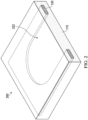
- FIG. 2 illustrates another example, where the dressing 100 may include scaffold 120 as a sheet or layer having a border portion and defining an open central area 222.
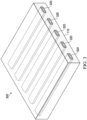
- FIG. 3 illustrates yet another example, where the scaffold 120 includes a plurality of strips 320.
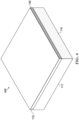
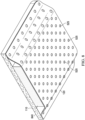
- the scaffold may be disposed adjacent to one or more surfaces of the contact layer, such as the first surface, the second surface, or both, and as further illustrated in the exemplary, non-limiting representations provided in FIGs. 4 and 5 .
- the scaffold 120 is disposed adjacent to second surface 112 ( e.g., a back surface) of contact layer 110.
- the scaffold 120 is in the form of a sheet or layer and includes a plurality of apertures 525, and where first surface 111 may be configured as a tissue-facing surface of contact layer 110.
- the dressing may include one or more additional layers.
- the one or more additional layers may be configured to perform any of a variety of functions including, for example, adherence of the dressing to a tissue site or to surrounding tissues, increasing structural rigidity of the dressing, protection from moisture or other materials in the external environment, protection of a wound surface, delivery of one or more actives or other materials to the wound surface, or a combination of any two or more thereof.
- the one or more additional layers may be conformable to a wound surface and/or to the surrounding tissues.
- the one or more additional layers may be configured to be capable of bending such that the surfaces of the dressing facing a wound may be in substantial contact with the wound and/or the surrounding tissues.
- FIG. 6 is a non-limiting example of a dressing including one or more additional layers, where an additional layer is provided via cover 630 positioned over contact layer 110 adjacent to second surface 112.
- the one or more additional layers may generally be configured to provide a bacterial barrier and/or protection from physical trauma.
- the one or more additional layers may be constructed from a material that can reduce evaporative losses and provide a fluid seal between two components or two environments, such as between a therapeutic environment and a local external environment - for example, an elastomeric film or membrane that can provide a seal at a tissue site for a given therapy - and may have a high moisture-vapor transmission rate (MVTR) (e.g., a MVTR of at least 300 g/m2 per twenty-four hours).
- MVTR moisture-vapor transmission rate
- the one or more additional layers may be formed from a suitable polymer.
- cover 630 of FIG. 6 may include a polymer drape, such as a polyurethane film, that may be permeable to water vapor but generally impermeable to liquid.
- the polymer drape may have a thickness in the range of about 25 microns to about 50 microns; thus, the polymer drape may have a thickness of about 25 microns, about 26 microns, about 27 microns, about 28 microns, about 29 microns, about 30 microns, about 31 microns, about 32 microns, about 33 microns, about 34 microns, about 35 microns, about 36 microns, about 37 microns, about 38 microns, about 39 microns, about 40 microns, about 41 microns, about 42 microns, about 43 microns, about 44 microns, about 45 microns, about 46 microns, about 47 microns, about 48 microns, about 49 microns, about 50 microns, or any range including and/or in between any two of the preceding values.
- the one or more additional layers may be configured to be attached to an attachment surface, such as undamaged epidermis, a gasket, or another cover, for example, via an attachment device.
- the one or more additional layers e.g., cover 630 of FIG. 6
- the attachment device may take any suitable form, such as a medically-acceptable, pressure-sensitive adhesive that extends about a periphery, a portion, or an entire sealing member. For example, some or all of cover 630 of FIG.
- an attachment device may include a double-sided tape, a paste, a hydrocolloid, a hydrogel, a silicone gel, or an organogel.
- the dressing may further include a secondary layer.
- the secondary layer may be positioned adjacent to the contact layer.
- FIG. 8 provides an example where secondary layer 840 is positioned adjacent to contact layer 110 and the dressing 100 includes scaffold 120 having a plurality of apertures 525. While not illustrated in FIG. 8 , the secondary layer may include fluid pathways interconnected so as to improve distribution or collection of fluids.
- the secondary layer may be a porous foam material having a plurality of interconnected cells or pores, for example, a cellular foam, an open-cell foam, a reticulated foam, a porous tissue collections, other porous materials such as gauze or felted mat generally including pores, edges, and/or walls adapted to form interconnected fluid pathways ( e.g., channels), as well as a combination of any two or more thereof.
- a porous foam material having a plurality of interconnected cells or pores, for example, a cellular foam, an open-cell foam, a reticulated foam, a porous tissue collections, other porous materials such as gauze or felted mat generally including pores, edges, and/or walls adapted to form interconnected fluid pathways (e.g., channels), as well as a combination of any two or more thereof.
- the secondary layer may include a porous foam (including pores) with an average pore diameter of about 400 microns to about 600 microns; thus, the porous foam may include an average pore diameter of about 400 microns, about 420 microns, about 440 microns, about 460 microns, about 480 microns, about 500 microns, about 520 microns, about 540 microns, about 560 microns, about 580 microns, about 600 microns, or any range including and/or in between any two of the preceding values.
- the secondary layer may include an open-cell foam, such as reticulated polyurethane foam.
- the secondary layer may exhibit an absorbency of at least 3 g saline/g, (such as at least 5 g saline/g,) and may exhibit an absorbency of about 8 to about 20 g saline/g.
- the secondary layer may exhibit an absorbency of about 3 g saline/g, about 4 g saline/g, about 5 g saline/g, about 6 g saline/g, about 7 g saline/g, about 8 g saline/g, about 9 g saline/g, about 10 g saline/g, about 11 g saline/g, about 12 g saline/g, about 13 g saline/g, about 14 g saline/g, about 15 g saline/g, about 16 g saline/g, about 17 g saline/g, about 18 g saline/g, about 19 g saline/g, about 20 g saline/g, or any range including and/or in between any two of the preceding values.
- the secondary layer may be hydrophilic where the secondary layer may also absorb (e.g., wick) fluid away from the contact layer such as by capillary flow or other wicking mechanisms.
- hydrophilic foam is a polyvinyl alcohol, open-cell foam as well as foams made from polyether.
- Other foams that may exhibit hydrophilic characteristics include hydrophobic foams that have been treated or coated to provide hydrophilicity.
- the scaffold (120) may be attached to the cover (630), the secondary layer (840), or both.
- the scaffold (120) may be attached to the cover (630) and/or the secondary layer (840) to provide additional structural support to the contact layer (110).
- the cover (630) and/or the secondary layer (840) may provide structural support to the contact layer (110) indirectly via the scaffold (120).
- FIG. 7 in particular illustrates dressing 100 that includes scaffold 120 having a plurality of apertures 525 and disposed adjacent to first surface 111 of contact layer 110.
- Scaffold 120 may be attached to cover 630 such that scaffold 120 and cover 630 cooperatively retain contact layer 110 in a desired conformation, for example, within a pocket substantially defined by scaffold 120 and cover 630.
- the cover (630) may impart structural support, via the scaffold (e.g., plurality of strips 320), to the contact layer in addition to structural support imparted to the contact layer (110) by the scaffold.
- the present technology also provides a therapy method, where the therapy method includes positioning a dressing of any embodiment herein of the present technology with respect to the tissue site.
- the dressing may be positioned proximate to a wound.
- the contact layer and the scaffold may be placed within, over, on, or otherwise proximate to the tissue site.
- the cover may be placed over the contact layer and the scaffold and the cover sealed to an attachment surface near the tissue site.
- the cover may be sealed to undamaged epidermis peripheral to a tissue site.
- the contact layer and scaffold may be positioned first and, after the contact layer scaffold have been positioned, the cover may be positioned.
- the dressing may be preassembled, for example, such that the contact layer, the scaffold, and the cover are positioned with respect to each other prior to placement proximate the tissue site.
- the various components of the dressing may be positioned with respect to the tissue site sequentially or, alternatively, may be positioned with respect to each other and then positioned with respect to the tissue site.
- the cover may provide a sealed therapeutic environment including the contact layer and the scaffold and proximate to a tissue site, substantially isolated from the external environment.
- the dressing of any embodiment described herein may be employed in therapy where a tissue site is treated with reduced pressure.
- Treatment of tissue with reduced pressure may be commonly referred to as “negative-pressure therapy,” but is also known by other names, including “negative-pressure wound therapy,” “reduced-pressure therapy,” “vacuum therapy,” “vacuum-assisted closure,” and “topical negative-pressure,” for example.
- Negative-pressure therapy may provide a number of benefits, including migration of epithelial and subcutaneous tissues, improved blood flow, and micro-deformation of tissue at a wound site. Together, these benefits may increase development of granulation tissue and reduce healing times.
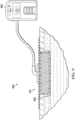
- FIG. 9 illustrates a system (900) for negative-pressure therapy in a simplified schematic.
- the system may be configured to provide negative-pressure to a tissue site in accordance with this specification.
- the system may generally include a negative-pressure supply, and may include (or be configured to be coupled to) a distribution component.
- a distribution component may refer to any complementary or ancillary component configured to be fluidly coupled to a negative-pressure supply in a fluid path between a negative-pressure supply and a tissue site.
- dressing 100 is an example of a distribution component fluidly coupled to negative-pressure source 904 such that negative pressure may be applied to a tissue site via dressing 100.
- the dressing may be configured to distribute negative pressure.
- the contact layer 110 and/or the scaffold 120 may include or be configured as a manifold.
- a "manifold" in this context generally includes any composition or structure providing a plurality of pathways configured to collect or distribute fluid across a tissue site under pressure.
- a manifold may be configured to receive negative pressure from a negative-pressure source and to distribute negative pressure through multiple apertures (e.g., pores), which may have the effect of collecting fluid and drawing the fluid toward the negative-pressure source. More particularly, as illustrated by FIG.
- the dressing (100) may be configured to receive negative pressure from a negative-pressure source (904) and to distribute the negative pressure to a tissue site, which may have the effect of collecting fluid from a sealed space provided by a cover (such as cover 630).
- the negative-pressure source may draw fluid from a tissue site through the dressing.
- the fluid path(s) may be reversed or a secondary fluid path may be provided to facilitate movement of fluid across a tissue site.
- the fluid pathways of a manifold may be interconnected to improve distribution or collection of fluids.
- a manifold may be a porous foam material having a plurality of interconnected cells or pores.
- open-cell foams such as reticulated foams generally include pores, edges, and/or walls that may form interconnected fluid pathways such as, channels.
- the fluid mechanics associated with using a negative-pressure source to reduce pressure in another component or location, such as within a sealed therapeutic environment, can be mathematically complex.
- the basic principles of fluid mechanics applicable to negative-pressure therapy are generally well-known to those skilled in the art.
- the process of reducing pressure may be described generally and illustratively herein as "delivering,” “distributing,” or “generating” negative pressure, for example.
- a fluid such as wound fluid (for example, wound exudates and other fluids) flow toward lower pressure along a fluid path.
- downstream typically implies something in a fluid path relatively closer to a source of negative pressure or further away from a source of positive pressure.
- upstream implies something relatively further away from a source of negative pressure or closer to a source of positive pressure. This orientation is generally presumed for purposes of describing various features and components herein.
- the fluid path may also be reversed in some applications (such as by substituting a positive-pressure source for a negative-pressure source) and this descriptive convention should not be construed as a limiting convention.
- Negative pressure may generally refer to a pressure less than a local ambient pressure, such as the ambient pressure in a local environment external to a sealed therapeutic environment provided by the dressing 100.
- the local ambient pressure may also be the atmospheric pressure proximate to or about a tissue site.
- the pressure may be less than a hydrostatic pressure associated with the tissue at the tissue site. While the amount and nature of negative pressure applied to a tissue site may vary according to therapeutic requirements, the pressure is generally a low vacuum, also commonly referred to as a rough vacuum, between -5 mm Hg (-667 Pa) and -500 mm Hg (-66.7 kPa), gauge pressure. Common therapeutic ranges are between 50 mm Hg (-6.7 kPa) and -300 mm Hg (-39.9 kPa), gauge pressure.
- a negative-pressure supply (such as negative-pressure source 904 of FIG. 9 ), may be a reservoir of air at a negative pressure, or may be a manual or electrically-powered device that can reduce the pressure in a sealed volume, such as a vacuum pump, a suction pump, a wall suction port available at many healthcare facilities, or a micro-pump, for example.
- a negative-pressure supply may be housed within or used in conjunction with other components, such as sensors, processing units, alarm indicators, memory, databases, software, display devices, or user interfaces that further facilitate therapy.
- a negative-pressure source (e.g., negative-pressure source 904 of FIG. 9 ) may be combined with a controller and other components into a therapy unit.
- a negative-pressure supply may also have one or more supply ports configured to facilitate coupling and de-coupling of the negative-pressure supply to one or more distribution components.
- components may be fluidly coupled to each other to provide a path for transferring fluids (i.e., liquid and/or gas) between the components.
- components may be fluidly coupled through a fluid conductor, such as a tube.
- a fluid conductor is intended to broadly include a tube, pipe, hose, conduit, or other structure with one or more lumina or open passages adapted to convey a fluid between two ends thereof.
- a fluid conductor may be an elongated, cylindrical structure with some flexibility, but the geometry and rigidity may vary.
- the negative-pressure source may be operatively coupled to the dressing via a dressing interface.
- dressing 100 may be coupled to negative-pressure source 904 via a dressing interface such that dressing 100 receives negative pressure from negative-pressure source 904.
- the therapy method may include positioning the contact layer, the scaffold, and the cover proximate to a tissue site.
- the therapy method may further include sealing the cover to tissue surrounding the tissue site to form a sealed space.
- the cover may be placed over the contact layer and/or scaffold and sealed to an attachment surface near the tissue site, for example, to undamaged epidermis peripheral to a tissue site.
- the therapy method in any embodiment herein may further include fluidly coupling a negative-pressure source to the sealed space and operating the negative-pressure source to generate a negative pressure in the sealed space.
- the negative-pressure source may be coupled to the dressing such that the negative-pressure source may be used to reduce the pressure in the sealed space.
- negative pressure applied across the tissue site, for example, via the dressing may be effective to induce macrostrain and microstrain at the tissue site, as well as remove exudates and other fluids from the tissue site.
- the present technology provides provide significant advantages, including modulating enzyme activity.
- Enzymes such as proteases, may be destructive or detrimental to wound healing, particularly when an over-abundance of such proteases are present at a tissue site.
- the contact layer of the present technology may advantageously modulate protease activity. For example, if the contact layer is used in a therapy, wound fluid may come into contact with the contact layer. Upon contact between the wound fluid and the contact layer, the contact layer may degrade and, as the contact layer degrades, can modulate protease activity.
- ORC within a contact layer may be effective to modulate the activity of destructive enzymes such as elastase and matrix metalloproteinase (MMP) and neutrophil elastase.
- MMP matrix metalloproteinase
- the contact layer and the dressing may modulate the activity of such enzymes, which may be beneficial to wound healing.
- a contact layer e.g., a collagen/ORC dressing, such as the PROMOGRAM TM Matrix Wound Dressing and the PROMOGRAN PRISMA TM Matrix, commercially available from Acelity, Inc. in San Antonio, Texas
- the contact layer may be hydrated prior to application with a sterile saline solution, and the scaffolds of the dressings of the present technology may impart additional structural rigidity to the dressing, for example, to the contact layer such that the disclosed dressings better retain shape.
- the dressing of the present technology may provide an improved tissue interface, for example, if employed in a negative-pressure therapy.
- a contact layer such as the contact layer may be disposed between a wound bed and a secondary layer, such as an open-cell foam or other manifold. Upon the application of negative pressure, some portion of the contact layer may be drawn into the secondary layer and away from the wound bed.
- a scaffold such as the scaffold may be effective to reduce the amount of the contact layer drawn away from the wound bed and yield improved contact between the contact layer and the wound bed.
Landscapes
- Health & Medical Sciences (AREA)
- Public Health (AREA)
- Engineering & Computer Science (AREA)
- Veterinary Medicine (AREA)
- Life Sciences & Earth Sciences (AREA)
- Animal Behavior & Ethology (AREA)
- General Health & Medical Sciences (AREA)
- Chemical & Material Sciences (AREA)
- Vascular Medicine (AREA)
- Heart & Thoracic Surgery (AREA)
- Biomedical Technology (AREA)
- Hematology (AREA)
- Materials Engineering (AREA)
- Epidemiology (AREA)
- Medicinal Chemistry (AREA)
- Dispersion Chemistry (AREA)
- Materials For Medical Uses (AREA)
Applications Claiming Priority (3)
| Application Number | Priority Date | Filing Date | Title |
|---|---|---|---|
| US201762539418P | 2017-07-31 | 2017-07-31 | |
| EP18753518.2A EP3661469B1 (de) | 2017-07-31 | 2018-07-30 | Bioresorbierbarer verband mit struktureller stütze |
| PCT/US2018/044442 WO2019027933A1 (en) | 2017-07-31 | 2018-07-30 | BIOREABORBABLE DRESSING WITH STRUCTURAL SUPPORT |
Related Parent Applications (1)
| Application Number | Title | Priority Date | Filing Date |
|---|---|---|---|
| EP18753518.2A Division EP3661469B1 (de) | 2017-07-31 | 2018-07-30 | Bioresorbierbarer verband mit struktureller stütze |
Publications (2)
| Publication Number | Publication Date |
|---|---|
| EP4445922A2 true EP4445922A2 (de) | 2024-10-16 |
| EP4445922A3 EP4445922A3 (de) | 2024-12-04 |
Family
ID=63174413
Family Applications (2)
| Application Number | Title | Priority Date | Filing Date |
|---|---|---|---|
| EP18753518.2A Active EP3661469B1 (de) | 2017-07-31 | 2018-07-30 | Bioresorbierbarer verband mit struktureller stütze |
| EP24197262.9A Withdrawn EP4445922A3 (de) | 2017-07-31 | 2018-07-30 | Bioresorbierbarer verband mit struktureller stütze |
Family Applications Before (1)
| Application Number | Title | Priority Date | Filing Date |
|---|---|---|---|
| EP18753518.2A Active EP3661469B1 (de) | 2017-07-31 | 2018-07-30 | Bioresorbierbarer verband mit struktureller stütze |
Country Status (3)
| Country | Link |
|---|---|
| US (1) | US11717592B2 (de) |
| EP (2) | EP3661469B1 (de) |
| WO (1) | WO2019027933A1 (de) |
Families Citing this family (22)
| Publication number | Priority date | Publication date | Assignee | Title |
|---|---|---|---|---|
| GB0808376D0 (en) | 2008-05-08 | 2008-06-18 | Bristol Myers Squibb Co | Wound dressing |
| GB0817796D0 (en) | 2008-09-29 | 2008-11-05 | Convatec Inc | wound dressing |
| GB201020236D0 (en) | 2010-11-30 | 2011-01-12 | Convatec Technologies Inc | A composition for detecting biofilms on viable tissues |
| ES2940916T3 (es) | 2010-12-08 | 2023-05-12 | Convatec Technologies Inc | Sistema para eliminar exudados del sitio de una herida |
| CA2819549C (en) | 2010-12-08 | 2019-09-10 | Convatec Technologies Inc. | Wound exudate system accessory |
| EP2648793B1 (de) | 2010-12-08 | 2020-03-11 | ConvaTec Technologies Inc. | Integriertes system zum testen von wundflüssigkeit |
| GB201115182D0 (en) | 2011-09-02 | 2011-10-19 | Trio Healthcare Ltd | Skin contact material |
| GB2497406A (en) | 2011-11-29 | 2013-06-12 | Webtec Converting Llc | Dressing with a perforated binder layer |
| EP2935688A2 (de) | 2012-12-20 | 2015-10-28 | ConvaTec Technologies Inc. | Verarbeitung von chemisch modifizierten cellulosefasern |
| GB2543544A (en) | 2015-10-21 | 2017-04-26 | Brightwake Ltd | Wound dressing |
| BR112018070248B1 (pt) | 2016-03-30 | 2023-03-28 | Synovo Gmbh | Curativo para detecção de infecções microbianas em feridas |
| CA3019445A1 (en) | 2016-03-30 | 2017-12-14 | Synovo Gmbh | Detecting microbial infection in wounds |
| GB201608099D0 (en) | 2016-05-09 | 2016-06-22 | Convatec Technologies Inc | Negative pressure wound dressing |
| AU2017292881B2 (en) | 2016-07-08 | 2022-03-17 | Convatec Technologies Inc. | Flexible negative pressure system |
| CA3030151A1 (en) | 2016-07-08 | 2018-01-11 | Convatec Technologies Inc. | Fluid collection apparatus |
| TW201805035A (zh) | 2016-07-08 | 2018-02-16 | 美商康瓦鐵克科技股份有限公司 | 流體流動感測 |
| WO2019097288A1 (en) | 2017-11-16 | 2019-05-23 | Convatec Limited | Fluid collection apparatus |
| CN113939321A (zh) | 2019-06-03 | 2022-01-14 | 康沃特克有限公司 | 破坏和控制病原体的方法和装置 |
| WO2020261187A1 (en) * | 2019-06-28 | 2020-12-30 | Systagenix Wound Management, Limited | Multi-layered biopolymer film dressing to combat wound biofilm |
| US11331221B2 (en) | 2019-12-27 | 2022-05-17 | Convatec Limited | Negative pressure wound dressing |
| US11771819B2 (en) | 2019-12-27 | 2023-10-03 | Convatec Limited | Low profile filter devices suitable for use in negative pressure wound therapy systems |
| EP4188294B1 (de) * | 2020-07-30 | 2025-06-18 | Solventum Intellectual Properties Company | Bioresorbierbarer verband für unterdrucktherapie |
Citations (5)
| Publication number | Priority date | Publication date | Assignee | Title |
|---|---|---|---|---|
| US3122479A (en) | 1957-11-14 | 1964-02-25 | David F Smith | Hemostatic surgical dressings |
| US4320201A (en) | 1979-10-27 | 1982-03-16 | Firma Carl Freudenberg | Method for making collagen sponge for medical and cosmetic uses |
| US4614794A (en) | 1983-10-04 | 1986-09-30 | Johnson & Johnson | Protein/polysaccharide complexes |
| US5134229A (en) | 1990-01-12 | 1992-07-28 | Johnson & Johnson Medical, Inc. | Process for preparing a neutralized oxidized cellulose product and its method of use |
| US8461410B2 (en) | 2002-09-11 | 2013-06-11 | Ethicon, Inc. | Wound dressing materials comprising complexes of anionic polysaccharides with silver |
Family Cites Families (140)
| Publication number | Priority date | Publication date | Assignee | Title |
|---|---|---|---|---|
| US1355846A (en) | 1920-02-06 | 1920-10-19 | David A Rannells | Medical appliance |
| US1701207A (en) * | 1927-05-16 | 1929-02-05 | Johnson & Johnson | Filmated surgical gauze |
| US2547758A (en) | 1949-01-05 | 1951-04-03 | Wilmer B Keeling | Instrument for treating the male urethra |
| US2632443A (en) | 1949-04-18 | 1953-03-24 | Eleanor P Lesher | Surgical dressing |
| GB692578A (en) | 1949-09-13 | 1953-06-10 | Minnesota Mining & Mfg | Improvements in or relating to drape sheets for surgical use |
| US2682873A (en) | 1952-07-30 | 1954-07-06 | Johnson & Johnson | General purpose protective dressing |
| NL189176B (nl) | 1956-07-13 | 1900-01-01 | Hisamitsu Pharmaceutical Co | Pleister op basis van een synthetische rubber. |
| US2969057A (en) | 1957-11-04 | 1961-01-24 | Brady Co W H | Nematodic swab |
| US3066672A (en) | 1960-09-27 | 1962-12-04 | Jr William H Crosby | Method and apparatus for serial sampling of intestinal juice |
| US3367332A (en) | 1965-08-27 | 1968-02-06 | Gen Electric | Product and process for establishing a sterile area of skin |
| US3520300A (en) | 1967-03-15 | 1970-07-14 | Amp Inc | Surgical sponge and suction device |
| US3568675A (en) | 1968-08-30 | 1971-03-09 | Clyde B Harvey | Fistula and penetrating wound dressing |
| US3682180A (en) | 1970-06-08 | 1972-08-08 | Coilform Co Inc | Drain clip for surgical drain |
| BE789293Q (fr) | 1970-12-07 | 1973-01-15 | Parke Davis & Co | Pansement medico-chirugical pour brulures et lesions analogues |
| US3826254A (en) | 1973-02-26 | 1974-07-30 | Verco Ind | Needle or catheter retaining appliance |
| DE2527706A1 (de) | 1975-06-21 | 1976-12-30 | Hanfried Dr Med Weigand | Einrichtung zum einleiten von kontrastmittel in einen kuenstlichen darmausgang |
| DE2640413C3 (de) | 1976-09-08 | 1980-03-27 | Richard Wolf Gmbh, 7134 Knittlingen | Katheter-Überwachungsgerät |
| NL7710909A (nl) | 1976-10-08 | 1978-04-11 | Smith & Nephew | Samengestelde hechtstrook. |
| GB1562244A (en) | 1976-11-11 | 1980-03-05 | Lock P M | Wound dressing materials |
| US4080970A (en) | 1976-11-17 | 1978-03-28 | Miller Thomas J | Post-operative combination dressing and internal drain tube with external shield and tube connector |
| US4139004A (en) | 1977-02-17 | 1979-02-13 | Gonzalez Jr Harry | Bandage apparatus for treating burns |
| US4184510A (en) | 1977-03-15 | 1980-01-22 | Fibra-Sonics, Inc. | Valued device for controlling vacuum in surgery |
| US4165748A (en) | 1977-11-07 | 1979-08-28 | Johnson Melissa C | Catheter tube holder |
| US4245637A (en) | 1978-07-10 | 1981-01-20 | Nichols Robert L | Shutoff valve sleeve |
| SE414994B (sv) | 1978-11-28 | 1980-09-01 | Landstingens Inkopscentral | Venkateterforband |
| GB2047543B (en) | 1978-12-06 | 1983-04-20 | Svedman Paul | Device for treating tissues for example skin |
| US4266545A (en) | 1979-04-06 | 1981-05-12 | Moss James P | Portable suction device for collecting fluids from a closed wound |
| US4284079A (en) | 1979-06-28 | 1981-08-18 | Adair Edwin Lloyd | Method for applying a male incontinence device |
| US4261363A (en) | 1979-11-09 | 1981-04-14 | C. R. Bard, Inc. | Retention clips for body fluid drains |
| US4569348A (en) | 1980-02-22 | 1986-02-11 | Velcro Usa Inc. | Catheter tube holder strap |
| EP0035583B1 (de) | 1980-03-11 | 1985-08-14 | Schmid, Eduard, Dr.Dr.med. | Hauttransplantations-Druckverband |
| US4297995A (en) | 1980-06-03 | 1981-11-03 | Key Pharmaceuticals, Inc. | Bandage containing attachment post |
| US4333468A (en) | 1980-08-18 | 1982-06-08 | Geist Robert W | Mesentery tube holder apparatus |
| US4465485A (en) | 1981-03-06 | 1984-08-14 | Becton, Dickinson And Company | Suction canister with unitary shut-off valve and filter features |
| US4392853A (en) | 1981-03-16 | 1983-07-12 | Rudolph Muto | Sterile assembly for protecting and fastening an indwelling device |
| US4373519A (en) | 1981-06-26 | 1983-02-15 | Minnesota Mining And Manufacturing Company | Composite wound dressing |
| US4392858A (en) | 1981-07-16 | 1983-07-12 | Sherwood Medical Company | Wound drainage device |
| US4419097A (en) | 1981-07-31 | 1983-12-06 | Rexar Industries, Inc. | Attachment for catheter tube |
| AU550575B2 (en) | 1981-08-07 | 1986-03-27 | Richard Christian Wright | Wound drainage device |
| SE429197B (sv) | 1981-10-14 | 1983-08-22 | Frese Nielsen | Anordning for behandling av sar |
| DE3146266A1 (de) | 1981-11-21 | 1983-06-01 | B. Braun Melsungen Ag, 3508 Melsungen | Kombinierte vorrichtung fuer eine medizinische saugdrainage |
| US4551139A (en) | 1982-02-08 | 1985-11-05 | Marion Laboratories, Inc. | Method and apparatus for burn wound treatment |
| US4475909A (en) | 1982-05-06 | 1984-10-09 | Eisenberg Melvin I | Male urinary device and method for applying the device |
| EP0100148B1 (de) | 1982-07-06 | 1986-01-08 | Dow Corning Limited | Medizinischer chirurgischer Wundverband und Verfahren zu seiner Herstellung |
| NZ206837A (en) | 1983-01-27 | 1986-08-08 | Johnson & Johnson Prod Inc | Thin film adhesive dressing:backing material in three sections |
| US4548202A (en) | 1983-06-20 | 1985-10-22 | Ethicon, Inc. | Mesh tissue fasteners |
| US4540412A (en) | 1983-07-14 | 1985-09-10 | The Kendall Company | Device for moist heat therapy |
| US4543100A (en) | 1983-11-01 | 1985-09-24 | Brodsky Stuart A | Catheter and drain tube retainer |
| US4525374A (en) | 1984-02-27 | 1985-06-25 | Manresa, Inc. | Treating hydrophobic filters to render them hydrophilic |
| CA1286177C (en) | 1984-05-03 | 1991-07-16 | Smith And Nephew Associated Companies Plc | Adhesive wound dressing |
| US4897081A (en) | 1984-05-25 | 1990-01-30 | Thermedics Inc. | Percutaneous access device |
| US5215522A (en) | 1984-07-23 | 1993-06-01 | Ballard Medical Products | Single use medical aspirating device and method |
| GB8419745D0 (en) | 1984-08-02 | 1984-09-05 | Smith & Nephew Ass | Wound dressing |
| US4872450A (en) | 1984-08-17 | 1989-10-10 | Austad Eric D | Wound dressing and method of forming same |
| US4826494A (en) | 1984-11-09 | 1989-05-02 | Stryker Corporation | Vacuum wound drainage system |
| US4655754A (en) | 1984-11-09 | 1987-04-07 | Stryker Corporation | Vacuum wound drainage system and lipids baffle therefor |
| US4605399A (en) | 1984-12-04 | 1986-08-12 | Complex, Inc. | Transdermal infusion device |
| US5037397A (en) | 1985-05-03 | 1991-08-06 | Medical Distributors, Inc. | Universal clamp |
| US4640688A (en) | 1985-08-23 | 1987-02-03 | Mentor Corporation | Urine collection catheter |
| US4710165A (en) | 1985-09-16 | 1987-12-01 | Mcneil Charles B | Wearable, variable rate suction/collection device |
| US4758220A (en) | 1985-09-26 | 1988-07-19 | Alcon Laboratories, Inc. | Surgical cassette proximity sensing and latching apparatus |
| US4733659A (en) | 1986-01-17 | 1988-03-29 | Seton Company | Foam bandage |
| EP0256060A1 (de) | 1986-01-31 | 1988-02-24 | OSMOND, Roger L. W. | Absaugungssystem für wund-, magen- und darmdrainage |
| US4838883A (en) | 1986-03-07 | 1989-06-13 | Nissho Corporation | Urine-collecting device |
| JPS62281965A (ja) | 1986-05-29 | 1987-12-07 | テルモ株式会社 | カテ−テルおよびカテ−テル用固定部材 |
| GB8621884D0 (en) | 1986-09-11 | 1986-10-15 | Bard Ltd | Catheter applicator |
| GB2195255B (en) | 1986-09-30 | 1991-05-01 | Vacutec Uk Limited | Apparatus for vacuum treatment of an epidermal surface |
| US4743232A (en) | 1986-10-06 | 1988-05-10 | The Clinipad Corporation | Package assembly for plastic film bandage |
| DE3634569A1 (de) | 1986-10-10 | 1988-04-21 | Sachse Hans E | Kondomkatheter, ein harnroehrenkatheter zur verhinderung von aufsteigenden infektionen |
| EP0265906B1 (de) * | 1986-10-31 | 1995-04-19 | Nippon Zeon Co., Ltd. | Wundverband |
| JPS63135179A (ja) | 1986-11-26 | 1988-06-07 | 立花 俊郎 | 薬物の経皮投与具 |
| GB8628564D0 (en) | 1986-11-28 | 1987-01-07 | Smiths Industries Plc | Anti-foaming agent suction apparatus |
| GB8706116D0 (en) | 1987-03-14 | 1987-04-15 | Smith & Nephew Ass | Adhesive dressings |
| US4787888A (en) | 1987-06-01 | 1988-11-29 | University Of Connecticut | Disposable piezoelectric polymer bandage for percutaneous delivery of drugs and method for such percutaneous delivery (a) |
| US4863449A (en) | 1987-07-06 | 1989-09-05 | Hollister Incorporated | Adhesive-lined elastic condom cathether |
| JP2637782B2 (ja) * | 1987-08-12 | 1997-08-06 | エチコン・インコーポレーテツド | 再吸収可能な外科用網およびそれから製造された人工器官 |
| US5176663A (en) | 1987-12-02 | 1993-01-05 | Pal Svedman | Dressing having pad with compressibility limiting elements |
| US4906240A (en) | 1988-02-01 | 1990-03-06 | Matrix Medica, Inc. | Adhesive-faced porous absorbent sheet and method of making same |
| US4985019A (en) | 1988-03-11 | 1991-01-15 | Michelson Gary K | X-ray marker |
| GB8812803D0 (en) | 1988-05-28 | 1988-06-29 | Smiths Industries Plc | Medico-surgical containers |
| US4919654A (en) | 1988-08-03 | 1990-04-24 | Kalt Medical Corporation | IV clamp with membrane |
| US5000741A (en) | 1988-08-22 | 1991-03-19 | Kalt Medical Corporation | Transparent tracheostomy tube dressing |
| JPH02270874A (ja) | 1989-01-16 | 1990-11-05 | Roussel Uclaf | アザビシクロ化合物及びそれらの塩、それらの製造方法、それらを含有する製薬組成物並びにそれらの薬剤としての使用 |
| GB8906100D0 (en) | 1989-03-16 | 1989-04-26 | Smith & Nephew | Laminates |
| US5100396A (en) | 1989-04-03 | 1992-03-31 | Zamierowski David S | Fluidic connection system and method |
| US5261893A (en) | 1989-04-03 | 1993-11-16 | Zamierowski David S | Fastening system and method |
| US4969880A (en) | 1989-04-03 | 1990-11-13 | Zamierowski David S | Wound dressing and treatment method |
| US5527293A (en) | 1989-04-03 | 1996-06-18 | Kinetic Concepts, Inc. | Fastening system and method |
| US5358494A (en) | 1989-07-11 | 1994-10-25 | Svedman Paul | Irrigation dressing |
| JP2719671B2 (ja) | 1989-07-11 | 1998-02-25 | 日本ゼオン株式会社 | 創傷被覆材 |
| US5232453A (en) | 1989-07-14 | 1993-08-03 | E. R. Squibb & Sons, Inc. | Catheter holder |
| GB2235877A (en) | 1989-09-18 | 1991-03-20 | Antonio Talluri | Closed wound suction apparatus |
| JPH03176064A (ja) | 1989-12-05 | 1991-07-31 | Hoechst Japan Ltd | 創面被覆材 |
| US5134994A (en) | 1990-02-12 | 1992-08-04 | Say Sam L | Field aspirator in a soft pack with externally mounted container |
| US5092858A (en) | 1990-03-20 | 1992-03-03 | Becton, Dickinson And Company | Liquid gelling agent distributor device |
| US5149331A (en) | 1991-05-03 | 1992-09-22 | Ariel Ferdman | Method and device for wound closure |
| US5278100A (en) | 1991-11-08 | 1994-01-11 | Micron Technology, Inc. | Chemical vapor deposition technique for depositing titanium silicide on semiconductor wafers |
| US5645081A (en) | 1991-11-14 | 1997-07-08 | Wake Forest University | Method of treating tissue damage and apparatus for same |
| US5636643A (en) | 1991-11-14 | 1997-06-10 | Wake Forest University | Wound treatment employing reduced pressure |
| AU3242693A (en) | 1991-12-06 | 1993-06-28 | Kensey Nash Corporation | Pads, methods of making, and methods of use for wound dressing, surgical reinforcement and hemostasis promotion |
| US5279550A (en) | 1991-12-19 | 1994-01-18 | Gish Biomedical, Inc. | Orthopedic autotransfusion system |
| US5167613A (en) | 1992-03-23 | 1992-12-01 | The Kendall Company | Composite vented wound dressing |
| FR2690617B1 (fr) | 1992-04-29 | 1994-06-24 | Cbh Textile | Pansement adhesif transparent. |
| DE4306478A1 (de) | 1993-03-02 | 1994-09-08 | Wolfgang Dr Wagner | Drainagevorrichtung, insbesondere Pleuradrainagevorrichtung, und Drainageverfahren |
| US5342376A (en) | 1993-05-03 | 1994-08-30 | Dermagraphics, Inc. | Inserting device for a barbed tissue connector |
| US6241747B1 (en) | 1993-05-03 | 2001-06-05 | Quill Medical, Inc. | Barbed Bodily tissue connector |
| US5344415A (en) | 1993-06-15 | 1994-09-06 | Deroyal Industries, Inc. | Sterile system for dressing vascular access site |
| US5437651A (en) | 1993-09-01 | 1995-08-01 | Research Medical, Inc. | Medical suction apparatus |
| US5549584A (en) | 1994-02-14 | 1996-08-27 | The Kendall Company | Apparatus for removing fluid from a wound |
| US5556375A (en) | 1994-06-16 | 1996-09-17 | Hercules Incorporated | Wound dressing having a fenestrated base layer |
| US5607388A (en) | 1994-06-16 | 1997-03-04 | Hercules Incorporated | Multi-purpose wound dressing |
| US5664270A (en) | 1994-07-19 | 1997-09-09 | Kinetic Concepts, Inc. | Patient interface system |
| EP0777504B1 (de) | 1994-08-22 | 1998-10-21 | Kinetic Concepts, Inc. | Wunddrainagevorrichtung |
| DE29504378U1 (de) | 1995-03-15 | 1995-09-14 | MTG Medizinisch, technische Gerätebau GmbH, 66299 Friedrichsthal | Elektronisch geregelte Niedervakuumpumpe für die Thorax- und Wunddrainage |
| GB9523253D0 (en) | 1995-11-14 | 1996-01-17 | Mediscus Prod Ltd | Portable wound treatment apparatus |
| GB2314842B (en) * | 1996-06-28 | 2001-01-17 | Johnson & Johnson Medical | Collagen-oxidized regenerated cellulose complexes |
| GB2321191B (en) * | 1997-01-17 | 2000-09-27 | Johnson & Johnson Medical | Peptides for use in wound treatment |
| US6135116A (en) | 1997-07-28 | 2000-10-24 | Kci Licensing, Inc. | Therapeutic method for treating ulcers |
| AU755496B2 (en) | 1997-09-12 | 2002-12-12 | Kci Licensing, Inc. | Surgical drape and suction head for wound treatment |
| GB9719520D0 (en) | 1997-09-12 | 1997-11-19 | Kci Medical Ltd | Surgical drape and suction heads for wound treatment |
| US6071267A (en) | 1998-02-06 | 2000-06-06 | Kinetic Concepts, Inc. | Medical patient fluid management interface system and method |
| US6488643B1 (en) | 1998-10-08 | 2002-12-03 | Kci Licensing, Inc. | Wound healing foot wrap |
| US6287316B1 (en) | 1999-03-26 | 2001-09-11 | Ethicon, Inc. | Knitted surgical mesh |
| US6856821B2 (en) | 2000-05-26 | 2005-02-15 | Kci Licensing, Inc. | System for combined transcutaneous blood gas monitoring and vacuum assisted wound closure |
| US7799004B2 (en) | 2001-03-05 | 2010-09-21 | Kci Licensing, Inc. | Negative pressure wound treatment apparatus and infection identification system and method |
| US6991643B2 (en) | 2000-12-20 | 2006-01-31 | Usgi Medical Inc. | Multi-barbed device for retaining tissue in apposition and methods of use |
| TR200401397T4 (tr) | 2000-02-24 | 2004-07-21 | Venetec International, Inc. | Evrensel kateter takma sistemi. |
| GB2370508B (en) * | 2000-12-28 | 2004-07-07 | Johnson & Johnson Medical Ltd | Dressings for extended wear |
| US7041868B2 (en) | 2000-12-29 | 2006-05-09 | Kimberly-Clark Worldwide, Inc. | Bioabsorbable wound dressing |
| US6540705B2 (en) | 2001-02-22 | 2003-04-01 | Core Products International, Inc. | Ankle brace providing upper and lower ankle adjustment |
| US20040106344A1 (en) * | 2002-06-28 | 2004-06-03 | Looney Dwayne Lee | Hemostatic wound dressings containing proteinaceous polymers |
| GB0409292D0 (en) * | 2004-04-27 | 2004-06-02 | Smith & Nephew | Apparatus with ultrasound |
| GB2415382A (en) | 2004-06-21 | 2005-12-28 | Johnson & Johnson Medical Ltd | Wound dressings for vacuum therapy |
| GB2433029A (en) * | 2005-12-09 | 2007-06-13 | Ethicon Inc | Wound dressings comprising oxidized cellulose and human recombinant collagen |
| US8486033B2 (en) | 2007-07-18 | 2013-07-16 | Marine Polymer Technologies, Inc. | Application of polymeric materials to screens to facilitate hemostasis and wound healing |
| EP2219572A4 (de) * | 2007-12-06 | 2014-05-28 | Nanosys Inc | Resorbierbare nanoverstärkte hämostatische strukturen und verbandsmaterialien |
| US8834902B2 (en) * | 2012-03-09 | 2014-09-16 | Q3 Medical Devices Limited | Biodegradable supporting device |
| US9796769B2 (en) * | 2012-09-28 | 2017-10-24 | Ension Inc. | Methods of making bioactive collagen medical scaffolds such as for wound care dressings, hernia repair prosthetics, and surgical incision closure members |
| ES2924235T3 (es) * | 2013-04-12 | 2022-10-05 | Mo Sci Corp | Andamiajes de vidrio bioactivo y método de fabricación |
| WO2018035063A1 (en) * | 2016-08-16 | 2018-02-22 | Kci Usa, Inc. | Collagen/orc dressing encapsulated within a bioresorbable envelope |
-
2018
- 2018-07-30 EP EP18753518.2A patent/EP3661469B1/de active Active
- 2018-07-30 WO PCT/US2018/044442 patent/WO2019027933A1/en not_active Ceased
- 2018-07-30 EP EP24197262.9A patent/EP4445922A3/de not_active Withdrawn
- 2018-07-30 US US16/625,514 patent/US11717592B2/en active Active
Patent Citations (5)
| Publication number | Priority date | Publication date | Assignee | Title |
|---|---|---|---|---|
| US3122479A (en) | 1957-11-14 | 1964-02-25 | David F Smith | Hemostatic surgical dressings |
| US4320201A (en) | 1979-10-27 | 1982-03-16 | Firma Carl Freudenberg | Method for making collagen sponge for medical and cosmetic uses |
| US4614794A (en) | 1983-10-04 | 1986-09-30 | Johnson & Johnson | Protein/polysaccharide complexes |
| US5134229A (en) | 1990-01-12 | 1992-07-28 | Johnson & Johnson Medical, Inc. | Process for preparing a neutralized oxidized cellulose product and its method of use |
| US8461410B2 (en) | 2002-09-11 | 2013-06-11 | Ethicon, Inc. | Wound dressing materials comprising complexes of anionic polysaccharides with silver |
Also Published As
| Publication number | Publication date |
|---|---|
| EP3661469A1 (de) | 2020-06-10 |
| WO2019027933A1 (en) | 2019-02-07 |
| EP4445922A3 (de) | 2024-12-04 |
| US11717592B2 (en) | 2023-08-08 |
| US20210402049A1 (en) | 2021-12-30 |
| EP3661469B1 (de) | 2024-09-04 |
Similar Documents
| Publication | Publication Date | Title |
|---|---|---|
| EP3661469B1 (de) | Bioresorbierbarer verband mit struktureller stütze | |
| US11877910B2 (en) | Nutrient-enriched dressing | |
| US12324728B2 (en) | Manifolding apparatus or dressing exhibiting low tissue ingrowth and negative-pressure treatment method | |
| US11771599B2 (en) | Extended wear-time dressing | |
| EP3630031B1 (de) | Elastisch verformbare wundverbände | |
| US20200155361A1 (en) | Extensible dressings | |
| US20200197227A1 (en) | Post-operative surgical wound dressing | |
| US20220142820A1 (en) | Antimicrobial dressing, dressing components, and methods | |
| EP3641714A1 (de) | Wundverband mit sättigungsindikator | |
| US20210361820A1 (en) | Antimicrobial composition, dressing, dressing components, and method | |
| US12491122B2 (en) | Extended wear-time dressing | |
| EP4188294B1 (de) | Bioresorbierbarer verband für unterdrucktherapie |
Legal Events
| Date | Code | Title | Description |
|---|---|---|---|
| PUAI | Public reference made under article 153(3) epc to a published international application that has entered the european phase |
Free format text: ORIGINAL CODE: 0009012 |
|
| STAA | Information on the status of an ep patent application or granted ep patent |
Free format text: STATUS: THE APPLICATION HAS BEEN PUBLISHED |
|
| AC | Divisional application: reference to earlier application |
Ref document number: 3661469 Country of ref document: EP Kind code of ref document: P |
|
| AK | Designated contracting states |
Kind code of ref document: A2 Designated state(s): AL AT BE BG CH CY CZ DE DK EE ES FI FR GB GR HR HU IE IS IT LI LT LU LV MC MK MT NL NO PL PT RO RS SE SI SK SM TR |
|
| REG | Reference to a national code |
Ref country code: DE Ref legal event code: R079 Free format text: PREVIOUS MAIN CLASS: A61L0015320000 Ipc: A61F0013000000 |
|
| PUAL | Search report despatched |
Free format text: ORIGINAL CODE: 0009013 |
|
| AK | Designated contracting states |
Kind code of ref document: A3 Designated state(s): AL AT BE BG CH CY CZ DE DK EE ES FI FR GB GR HR HU IE IS IT LI LT LU LV MC MK MT NL NO PL PT RO RS SE SI SK SM TR |
|
| RIC1 | Information provided on ipc code assigned before grant |
Ipc: A61L 15/32 20060101ALI20241031BHEP Ipc: A61F 13/00 20240101AFI20241031BHEP |
|
| STAA | Information on the status of an ep patent application or granted ep patent |
Free format text: STATUS: THE APPLICATION IS DEEMED TO BE WITHDRAWN |
|
| 18D | Application deemed to be withdrawn |
Effective date: 20250605 |