EP4445865A2 - Zahnimplantatsystem - Google Patents
Zahnimplantatsystem Download PDFInfo
- Publication number
- EP4445865A2 EP4445865A2 EP24197114.2A EP24197114A EP4445865A2 EP 4445865 A2 EP4445865 A2 EP 4445865A2 EP 24197114 A EP24197114 A EP 24197114A EP 4445865 A2 EP4445865 A2 EP 4445865A2
- Authority
- EP
- European Patent Office
- Prior art keywords
- interference
- dental
- screw
- dental component
- component
- Prior art date
- Legal status (The legal status is an assumption and is not a legal conclusion. Google has not performed a legal analysis and makes no representation as to the accuracy of the status listed.)
- Pending
Links
Images











Classifications
-
- A—HUMAN NECESSITIES
- A61—MEDICAL OR VETERINARY SCIENCE; HYGIENE
- A61C—DENTISTRY; APPARATUS OR METHODS FOR ORAL OR DENTAL HYGIENE
- A61C8/00—Means to be fixed to the jaw-bone for consolidating natural teeth or for fixing dental prostheses thereon; Dental implants; Implanting tools
- A61C8/0048—Connecting the upper structure to the implant, e.g. bridging bars
- A61C8/005—Connecting devices for joining an upper structure with an implant member, e.g. spacers
- A61C8/0068—Connecting devices for joining an upper structure with an implant member, e.g. spacers with an additional screw
-
- A—HUMAN NECESSITIES
- A61—MEDICAL OR VETERINARY SCIENCE; HYGIENE
- A61C—DENTISTRY; APPARATUS OR METHODS FOR ORAL OR DENTAL HYGIENE
- A61C8/00—Means to be fixed to the jaw-bone for consolidating natural teeth or for fixing dental prostheses thereon; Dental implants; Implanting tools
- A61C8/0018—Means to be fixed to the jaw-bone for consolidating natural teeth or for fixing dental prostheses thereon; Dental implants; Implanting tools characterised by the shape
- A61C8/0022—Self-screwing
-
- A—HUMAN NECESSITIES
- A61—MEDICAL OR VETERINARY SCIENCE; HYGIENE
- A61C—DENTISTRY; APPARATUS OR METHODS FOR ORAL OR DENTAL HYGIENE
- A61C8/00—Means to be fixed to the jaw-bone for consolidating natural teeth or for fixing dental prostheses thereon; Dental implants; Implanting tools
- A61C8/0048—Connecting the upper structure to the implant, e.g. bridging bars
- A61C8/005—Connecting devices for joining an upper structure with an implant member, e.g. spacers
- A61C8/0066—Connecting devices for joining an upper structure with an implant member, e.g. spacers with positioning means
-
- A—HUMAN NECESSITIES
- A61—MEDICAL OR VETERINARY SCIENCE; HYGIENE
- A61C—DENTISTRY; APPARATUS OR METHODS FOR ORAL OR DENTAL HYGIENE
- A61C8/00—Means to be fixed to the jaw-bone for consolidating natural teeth or for fixing dental prostheses thereon; Dental implants; Implanting tools
- A61C8/0048—Connecting the upper structure to the implant, e.g. bridging bars
- A61C8/005—Connecting devices for joining an upper structure with an implant member, e.g. spacers
- A61C8/0074—Connecting devices for joining an upper structure with an implant member, e.g. spacers with external threads
Definitions
- the present subject matter pertains generally to the field of dental implants and dental components.
- the subject matter disclosed herein can also be applied to other orthopedic applications such as spinal pedicel screws, bone screws used in trauma applications or other bone screws consisting of a three-piece assembly (bone screw, adapting head, fastening screw). More particularly, but not by way of limitation, the subject matter pertains to coupling and decoupling an interface between a dental implant and a dental component.
- a dental implant can be used in an oral treatment procedure to restore appearance or function of a removed tooth.
- a dental implant can mimic a root of a natural tooth that is replaced.
- a surgeon can replace the natural tooth with a prosthetic tooth that is mounted on a coronal portion of an abutment, which in turn, is attached to the dental implant on an apical portion.
- the surgeon can insert the dental implant into a dental bone cavity.
- a successful dental implant procedure generally requires more than bone affixation or osseointegration.
- Implant success can also require maintenance of the cortical bone at the coronal crest of the implant and maintenance of soft tissue structures in the implant region. The health of tissues in this region contributes to the aesthetic appearance of a full restoration. Maintenance of healthy tissue in the implant region can also lead to the creation of a tissue seal that hinders the propagation of infection along the implant body.
- ectodermal tissue serves to protect against intrusion of bacteria and other foreign materials.
- An ectodermal tissue seal that protects the alveolar bone is known as the biologic width.
- the biologic width is a tissue ring and its position is dependent on the geometry and surgical placement of the dental implant.
- a micro-gap generally exists between the implant and the dental component. There is evidence to suggest that the position of the micro-gap has an effect on the position of the biologic width, and therefore on the height of the crestal alveolar bone.
- a conical connection might use interfacing shallow angle tapers on the abutment and the implant to shift the micro-gap. This connection can create a sealed interface that discourages penetration of bacteria or other foreign substances into a screw thread and other internal features of an implant body.
- the conical connection between the dental implant and the dental component can provide various benefits.
- the conical connection provides an interference fit (e.g., friction fit) between the dental implant and the dental component. That is, a conical taper on the dental implant is configured to mate with a conical taper on the dental component to provide the interference fit. While the interference fit can securely maintain the dental component, as well as provide the benefits discussed herein, removal of the dental component, if needed, can be difficult and can require additional tools.
- the dental component e.g., abutment
- the dental health practitioner exerts force to remove the component.
- cyclic compression on the components caused by chewing, these can adhere to each other, making it harder for them to be removed, thus causing discomfort or even injury to the patient.
- the present inventors have recognized, among other things, that being able to release the interference fit between the dental component and the dental implant without having to introduce a new tool or increasing the removal torque would provide various benefits.
- the present invention discloses dental component/implant connection systems that include an interference fit between the dental component and the dental implant that can be separated without the use of additional tools.
- the dental components of the present invention can be coupled to the dental implant via a screw.
- the screw can be used to apply a force to the abutment in the pop-out direction to release the friction fit connection between the dental component and the dental implant.
- the present invention defines a dental implant system including a prosthetic assembly and a dental implant.
- the prosthetic assembly can include a dental component and a retention screw, where the dental component is configured to be coupled to the dental implant via the screw.
- the dental component and the screw are designed to allow relative rotation and limit relative longitudinal motion between the dental component and the retention screw.
- the dental component and the retention screw each have interference elements that are configured to engage when a removal torque is applied to the screw. When the interference elements engage each other, a portion of the removal torque is converted into a linear force that is exerted on the dental component, in a removal direction, thereby separating the dental component from the dental implant.
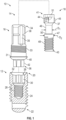
- FIG. 1 is an exploded view of a dental implant system 10 according to an example of the present disclosure.
- the dental implant system 10 can include a dental implant 12 (also herein "implant 12") and a prosthetic assembly 14.
- the prosthetic assembly 14 can include a dental component 16 and a retention screw 18 (also herein "screw 18").
- the implant 12 is configured to be screwed into the bone of a patient and the dental component 16 is configured to be connected to the implant 12.
- the dental component 16 can be inserted into the dental implant 12 and the screw 18 extends through the dental component 16 and couples with the dental implant 12 to couple the dental component 16 to the dental implant 12.
- the implant 12 can extend from a proximal end 20 to a distal end 22.
- the implant 12 can include at least one thread 24 for screwing the implant 12 into the bone of a patient.
- An interior bore 26 extends distally from the proximal end 20 toward the distal end 22.
- the interior bore 20 can include a threaded portion 28, an anti-rotation chamber 30, and a dental component engagement portion 32.
- the dental component 16 can extend from a proximal end 34 to a distal end 36.
- the dental component 16 can include a post 38, an implant engagement surface 40, an anti-rotation portion 42, and a bore 52 extending therethrough (see FIGS. 3A-D ).
- the anti-rotation portion 42 of the dental component 16 is received within the anti-rotation chamber 30 of the implant 12 to rotationally lock the dental component 16 to the implant 12.
- the anti-rotation chamber 30 and the anti-rotation portion 30 have corresponding anti-rotation geometry.
- the anti-rotation geometry can be of any form, but generally can be in the form of, e.g., but not limited to, a hexagon, a taper, channel, etc.
- the post 38 can extend from a shoulder 31 and include anti-rotation grooves 35 and a plurality of grooves 33.
- the anti-rotation grooves 35 extend longitudinally from the proximal end 34 toward the distal end 36 and the plurality of grooves 33 extend circumferentially around the post 38.
- One or more of the grooves 33 can extend partially or entirely around the circumference of the post 38. While shown as positioned distal to the anti-rotation grooves 35, in one example, the plurality of grooves 33 can intersect the anti-rotation grooves 35.
- a distal portion of the mating component can abut the shoulder 31 and corresponding nubs of a bore of the mating component can be received within the anti-rotation grooves 35 to prevent rotational of the mating component relative to the dental component 12.
- the plurality of grooves 33 can receive coupling material to help adhere the mating component to the dental component 16.
- a post could have protrusions that would be received within a corresponding groove along the bore of the mating component.
- the protrusions along the post would interfere with the shoulder 31.
- a width of the shoulder 31 measured from the post to an edge of the shoulder 31 can be maximized.
- protrusions extending from a post that width along the protrusions is reduced.
- the anti-rotation grooves 35 of the present invention prevent rotation between the mating component and the dental component 16 while maintaining a constant width along the shoulder 31.
- the screw 18 extends from a proximal end 41 to a distal end 43.
- the screw 18 can include a head 44, a shaft 46, an engagement portion 47, and a threaded portion 48.
- the engagement portion 47 can be part of the threaded portion 48 and include threads or can be separate from the threaded portion 48 and not include threads. Additionally, the engagement portion 47 can have a diameter D2 that is the same or different from a maximum diameter of the threaded portion 48.
- the shaft 46 has a diameter D1 that is less than the diameter D2 of the engagement portion 47 such that an interference shoulder 50 is formed. While shown as a flat surface perpendicular to a longitudinal axis, the interference shoulder 50 can be angled from the longitudinal axis, be curved, or have other geometries.
- the head 44 can include a bore 51 that is configured to receive a tool, e.g., a driver.
- the bore 51 has a non-rotational geometry that can couple with a tool such that rotational force applied to the tool is translated to the screw 18.
- the head 44 can include one or more lobes 45. In the example shown, the head 44 has three lobes 45.
- the screw 18 can include a transition surface 37 that can be curved, flat, or tapered that transitions from the head 44 to the shaft 46.
- the dental component engagement surface 40 contacts the corresponding inner wall (i.e., the dental implant engagement surface 32) to form a seal throughout the periphery of the dental component 16.
- the seal can prevent migration of bacterial as well as increase resistance to lateral forces.
- a Morse cone also known as a 'Morse Taper'
- the interference fit formed from a Morse Taper is difficult to break and forces necessary to break the seal can likely cause damage to, e.g., the implant and the patient.
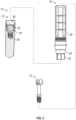
- FIG. 2 illustrates another dental implant system 10' where the dental implant engagement surface 32' and the dental component engagement surface 40' are different from the dental implant system 10 in FIG. 1 .
- the length and angle of the tapered surfaces are different and illustrate a Morse taper.
- other configurations are contemplated.
- dental implant system 10 After a patient has the dental implant system 10 installed, during chewing dental component 16 can be cyclically compressed against the implant 12 where it is installed. With each compression cycle, micro-deformations in the components or even gradual compression on the seal between the dental implant engagement surface 40 of the dental component 16 and the dental component engagement surface 32 of the implant 12 causes them to adhere to each other, so that a dental health practitioner will have great difficulty in separating them without damaging the components or injuring the patient.
- the dental implant system 10 of the present invention includes elements, which, on the one hand, allows relative rotation between the dental component 16 and the retention screw 18, and, on the other hand, limits the longitudinal motion therebetween so that, when the screw 18 receives a removal torque, the interference shoulder 50 eventually engages into an interference ledge 64 of an interference wall 62 (see FIGS. 3A-D ), converting and transmitting part of the removal torque which is applied to the screw 18, into a force in the removal direction of the dental component 16.
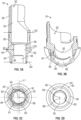
- FIGS. 3A-D illustrate various view of the dental component 16 according to one example.
- FIG. 3A illustrates a partial cross-sectional view of the dental component 16
- FIG. 3B illustrates a perspective view of a partial cross-sectional view of the dental component 16
- FIG. 3C illustrates a bottom-up view of the dental component 16
- FIG. 3D illustrates a top-down view of the dental component 16.
- the dental component 16 (also herein “component 16") can have a bore 52 extending through the dental component 16.
- the bore 52 can include a screw head portion 54, an interference portion 56, and an engagement portion 58.
- the screw head portion 54 can terminate at a shoulder 60 that is configured to abut the transition surface 37 of the screw 18, when fully seated.
- the interference portion 56 can comprise an offset passage relative to the head portion 54 and/or the engagement portion 58.
- the interference portion 56 can be defined at least partially by an interference wall 62 extends from the shoulder 60 along less than the full circumference of the shoulder 60.
- the interference wall 62 extends from a proximal surface 63 to distal surface 61 defining an interference ledge 64.
- the interference ledge 64 is positioned proximal from the distal end 36 of the dental component 16. As discussed herein, the interference ledge 64 is configured to abut the interference shoulder 50 when a removal torque is applied to the screw 18 to pop-off (i.e., decouple) the dental component 16 from the dental implant 12.
- the interference ledge 64 can have a crescent shape due to offset with the interference wall 62, interference portion 56 and head portion 54. While shown as a flat surface perpendicular to a longitudinal axis, the interference ledge 64 can be angled from the longitudinal axis, be curved, or have other geometries.
- the proximal surface 63 can be positioned along the same plane as the shoulder 60. In another example, the proximal surface 63 can taper from the shoulder 60. As seen in FIGS. 3C and 3D , the interference wall 62 defines a central axis 66.
- the screw head portion 54 and the engagement portion 58 have a central axis 65, which is offset from a central axis 66 of the interference wall 62.
- the central axis 65 of the screw head portion 54 and the engagement portion 58 align with and can also be referred to as a central axis of the dental component 16.
- a diameter D3 of the interference wall 62 is less than a diameter D4 of the engagement portion 58. Further, a diameter D2 of the screw head portion 54 is greater than the diameter D3 of the interference wall 62 and the diameter D4 of the engagement portion 58. As discussed herein, the interference ledge 64 is configured to engage the interference shoulder 50 when removal torque is applied to the screw 18 and the screw 18 moves in a proximal direction.
- FIGS. 4A and 4B illustrate the dental implant system 10 according to one example.
- the screw 18 is inserted through the dental component 16.
- the screw 18 is inserted through the dental component 16.
- the center axis 70 of the screw 18 is aligned with the interference portion center axis 66, which is offset from the center axis 65 of the dental component 16.
- the screw 18 can be inserted into the dental implant 10.
- the threads 48 engage the threaded portion 28 of the dental implant
- the central axis 70 of the screw 18 is aligned with the dental component central axis 65.
- FIG. 4B illustrates the dental component 16 fully seated on the dental implant 12.
- Lobes 45 on the head 44 of the screw 18 can assist the user when removing the prosthetic assembly 14 from the dental implant 12.
- the lobes 45 can provide support as a removal torque is applied to the screw 18.
- one or more lobes 45 can be used. In one example, two lobes 45 are used. In another example, three lobes 45 can be equidistantly positioned around the head 44 of the screw 18.
- FIGS. 5A and 5B illustrate close-up views of section A in FIG. 4B .
- FIG. 5A illustrates the dental component 16 fully seated on the dental implant 12. When fully seated, the interference ledge 64 and the interference shoulder 50 are longitudinally spaced apart by a length L1.
- FIG. 5B illustrates the dental component 16 after removal torque has been applied to the screw 18.
- the screw 18 moves in a proximal direction "D".
- the interference shoulder 50 of the screw 18 eventually abuts the interference ledge 64 of the dental component 16.
- the length L1 between the interference ledge 64 and the interference shoulder 50 is less in FIG. 5B , after removal torque has been applied, compared to the length L1 in FIG. 5A .
- the screw 18 transmits part of the removal torque to the dental component 16, in the form of a force in the proximal direction "D", which is the direction of the that the dental component 16 will "pop-out".
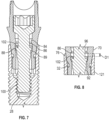
- FIGS. 6-8 illustrate another example of a dental implant system 68, in accordance with an example of the present disclosure.
- FIG. 6 is an exploded view of a dental implant system 68 according to an example of the present disclosure.
- FIG. 7 is the dental implant system 68 in FIG. 6 assembled.
- FIG. 8 is a close-up of a portion of the assembled dental implant system 68.
- the dental implant system 68 can include a dental implant 12' and a prosthetic assembly 69.
- the prosthetic assembly 69 can include a dental component 70 and a retention screw 92 (also herein "screw 92").
- the implant 12' is configured to be screwed into the bone of a patient and the dental component 70 is configured to be connected to the implant 12'. Similar to the dental implant system 10, the screw 92 can be used to separate the dental component 70 from the dental implant 12', when a removal force is applied to the screw 92.
- the dental component 70 can extend from a proximal end 81 to a distal end 82.
- the dental component 70 can include a post 72, an emergence profile 74, an implant engagement surface 76, an anti-rotation portion 78, and a bore 80 extending therethrough.
- the anti-rotation portion 78 of the dental component 70 is received within the anti-rotation chamber 30 of the implant 12' to rotationally lock the dental component 70 to the implant 12'.
- the bore 80 includes a screw head portion 82, an interference portion 83, and a distal portion 90.
- An interference ridge 84 extends inward toward a longitudinal axis of the dental component 70.
- the interference ridge 84 extends distally and tapers toward the longitudinal axis.
- the interference ridge 84 defines an interference shoulder 86.
- the interference shoulder 86 is adjacent to the interference chamber 88.
- the interference chamber 88 extends from the interference shoulder 86 to a support surface 89.
- the screw 92 extends from a proximal end 96 to a distal end 97.
- the screw 92 can include a head 94, a shaft 96, a plurality of flexible interference fingers 98, and a threaded portion 100.
- the plurality of flexible interference fingers 98 (also referred to herein as "fingers 98") can be positioned between the threaded portion 100 and the shaft 96.
- the fingers 98 define an interference surface 102.
- the interference surface 102 is configured to engage the interference shoulder 86 during separation of the dental component 70 and the dental implant 12'.
- the fingers 98 have an uncompressed and compressed state. At the uncompressed state, a diameter of the plurality of fingers 98 is greater than a diameter of the shaft 96. Additionally, the diameter of the fingers 98 at the uncompressed state is greater than a minimum diameter of the interference ridge 84.
- the pliable fingers 98 bend inward to a compressed state to allow the screw 92 to pass through the dental components 70 internal diameter. That is, the pliable fingers 98 are compressed as they pass the interference ridge 84. Once the pliable fingers 98 pass the interference ridge 84, the pliable fingers 98 transition back to the uncompressed state where the diameter of the pliable fingers 98 is greater than the diameter of the interference ridge 84. As seen in FIG. 7 and 8 , the pliable fingers 98 are positioned within the interference chamber 88. A surface of the fingers 98 can engage the support surface 89 of the dental component 70.
- a removal torque is applied to the screw 92, as discussed herein.
- the interference surface 102 of the pliable fingers 98 push up on the interference shoulder 86 to overcome the friction fit of the dental component 70 with the dental implant 12'.
- the screw 92 cannot be removed from the dental component 70.
- FIGS. 9-14 illustrate another example of a dental implant system, in accordance with an example of the present disclosure.
- FIG. 9 is side view of a dental component 120 according to an example of the present disclosure.
- FIG. 10 is a perspective view of a distal portion of the dental component 120 in FIG. 9.
- FIG. 11 illustrates a perspective cross-sectional view of the dental component 120.
- FIG. 12A and 12B illustrate a retention screw 150 according to an example of the present disclosure.
- FIG. 13 illustrates an assembled view of the dental component 120 and the retention screw 150.
- FIG. 14 illustrates a cross-sectional view of the assembled dental implant system 127 including the dental implant 12', the dental component 120, and the retention screw 150. Similar to the dental implant systems 10 and 68, the screw 150 can be used to separate the dental component 120 from the dental implant 12', when a removal force is applied to the screw 150.
- the dental component 120 can extend from a proximal end 121 to a distal end 123.
- the distal end 123 defines an interference surface 125.
- the dental component 120 can include a post 122, an emergence profile 124, an implant engagement surface 126, and channels 128, and a bore 130 extending therethrough.
- the bore 130 includes a screw head portion 134 and an interference portion 136.
- the interference portion 136 includes one or more channels 128 extending along the interference portion 136. That is, the one or more channels 128 extend from a shoulder 132 to the interference surface 125.
- the interference surface 125 includes a spiral relief 131.
- the spiral relief 131 includes a tapered curved surface extending from a first edge 146 of a channel 130.
- the dental component 120 includes three channels 128 and the spiral relief 131 extends from a first edge 146 of a first channel 128 to a second edge 144 of a second channel 130.
- a thickness of the interference surface 125 increases for the first edge 146 to the second edge 144. That is, each channel 128 includes a first edge 146 (from which the spiral relief 131 is the thinnest) and a second edge 144 (where a spiral relief 131 is the thickest).
- the screw 150 extends from a proximal end 151 to a distal end 152.
- the screw 150 can include a head 153, a shaft 154, one or more protrusions 156, and a threaded portion 158.
- the plurality of protrusions 156 extend radially from the shaft 154 and are positioned adjacent to the threaded portion 158.
- the protrusions 156 on the screw 150 allow the screw to be assembled/disassembled with the dental component 120 at a limited window of relative axial rotation.
- the one or more protrusions 156 can align with the one or more channels 128. Any number of protrusions 156 and channels 128 can be used as long as they equal each other.
- the protrusions 156 are aligned with the channels 128 and the screw 150 is advanced until the screw head 153 contacts the shoulder 132. As seen in FIG. 13 , the distal end of the screw 150 can extend beyond the interference surface 125 of the dental component 120 such that that the protrusions 156 also extend beyond the interference surface 125.
- the screw 150 can engage the threads of the implant 12'.
- a removal force can be applied to the screw 150, as discussed herein, and the screw can rotate counterclockwise.
- the spiral reliefs 131 on the interference surface 125 "catch" the protrusions 156 on the screw 150 and prevent the protrusions 156 from entering the channels 128.
- the spiral reliefs 131 mitigate the screw 150 from disassembling from the dental component 120 while the protrusions 156 are pushing on the interference surface 125 to overcome the friction fit of the dental component 120 to the implant 12'.
- the screw 150 can be removed from the dental component 120, if needed.
- FIGS. 15-17 illustrate another example of a dental implant system 160, in accordance with an example of the present disclosure.
- FIG. 15 is an assembled view of the dental implant system 160.
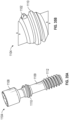
- FIG. 16 is a perspective view of a retention screw 182.
- FIG. 17 illustrates cross-sectional view along a portion of the retention screw 182. Similar to the dental implant systems 10, 68, and 127, the screw 182 can be used to separate the dental component 164 from the dental implant 12', when a removal force is applied to the screw 182.
- the dental component 164 can extend from a proximal end 161 to a distal end 162.
- the dental component 164 can include a post 163, an emergence profile 166, an implant engagement surface 168, an anti-rotation portion 170, and a bore 172 extending therethrough.
- the bore 172 includes a screw head portion 174 and an interference portion 176.
- the interference portion 176 includes a projection 178 extending toward a longitudinal axis of the dental component 164.
- the projection 178 defines an interference ledge 180.
- a shape of the projection 178 corresponds to a shape of a threaded portion 190 and an interference rim 188 of the retention screw 182.
- the screw 182 extends from a proximal end 183 to a distal end 185.
- the screw 182 can include a head 184, a shaft 186, an interference rim 188, and a threaded portion 190.
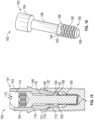
- the interference rim 188 can define an interference shoulder 194 that is configured to contact the interference ledge 180 during removal of the dental component 164 from the implant 12'.
- the interference rim 188 and the threaded portion 190 include at least one groove 192 (or flat) extending from the interference ledge 180 to a distal surface 189 of the screw 182.
- FIG. 17 illustrates a cross-section view along the interference rim 188.
- a center C1 of one groove 192 is offset from a center C2 of another groove 192.
- the center C2 of the second groove 192 can be offset by an angle Al.
- A1 can be about 10 degrees.
- the interference ridge 178 has a shape that matches the shape of the interference ridge 187 and threaded portion 190.
- FIG. 17A illustrates a cross-section view along the interference rim 188' formed by broaching the screw 182' rather than milling as is the case with the example of screw 182 in FIG. 17 .
- the corresponding shape of the interference ridge 178 with the interference rim 188 and threaded portion 190 allows the screw to be assembled/disassembled with the dental component 164 at a limited window of relative axial rotation.
- the screw 182 can be aligned with the interference ridge 178 to allow the threaded portion 190 and the interference rim 188 to pass.
- the dental component 164 can be coupled to the implant via the screw 182. Any number of grooves 192 as long as the interference ridge 178 has a corresponding shape including the same number of protrusions.
- the shape of the interference rim 188 and threaded portion 190 are aligned with the corresponding shape of the interference ridge 178 and the screw 150 is advanced through the dental component 164 until the interference rim 188 has cleared the interference ridge 178. Then, the dental component 164 and the screw 182 can be coupled to the implant 12'.
- the screw 182 can engage the threads of the implant 12'.
- a removal force can be applied to the screw 182, as discussed herein, and the screw 182 can rotate counterclockwise.
- the interference shoulder 194 can engage the interference ledge 180 and push up (proximally) on the dental component 164 to overcome the friction fit of the dental component 164 to the implant 12'.
- the screw 182 can be removed from the dental component 120, if needed.
- FIGS. 18A-C illustrate another example of a dental implant system 200, in accordance with an example of the present disclosure.
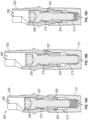
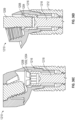
- FIG. 18A is a partial cross-section view of an assembled dental component 202 and screw 204 being inserted into a dental implant 12'.
- FIG. 18B is a partial cross-section of the dental component 202 fully seated on the dental implant 12'.
- FIG. 18C is a partial cross-section of removing the dental component 202 from the dental implant 12'.
- the dental component 202 can have all the features described herein with dental components, however, the dental component 202 includes a bore 206 that has a threaded interference portion 207.
- the screw 204 includes a head 208, a shaft 209, a coronal threaded portion 210 and an apical threaded portion 212.
- the apical threaded portion 212 includes a right-handed thread that engages the implant 12'.
- the coronal threaded portion 210 includes a left-handed thread with a major diameter that is greater than a major diameter of the apical threaded portion 212.
- the coronal thread portion 210 retains the screw 204 within the dental component 202 with the dental component's 202 corresponding left-handed internal thread along the threaded interference portion 207. That is, when left-rotation is applied to the screw 204, the coronal thread portion 210 engages the left-handed internal thread of the threaded interference portion 207 and advances the screw 204 through the threaded interference portion 207. To couple the dental component 202 to the implant 12', right-rotation is applied to the screw 204 to advance the apical threaded portion 212 within the threaded portions of the implant 12'.
- left-rotation can be applied to the screw 204 to reverse the apical threaded portion 212 from the threads of the implant 12'.
- the coronal threaded portion 210 does not engage the threaded interference portion 207. Therefore, the screw 204 pushes the dental component up (proximally/coronally) to overcome the friction fit.
- the screw 204 can be removed from the dental component 202, if needed.
- FIGS. 19A-C illustrate another example of a dental implant system 300, in accordance with an example of the present disclosure.
- FIGS. 19A-C are partial cross-section views of assembling a screw 304 to a dental component 302.
- the dental component 302 can include a bore 306 that has a shoulder 308 to contact a head of the screw 304 when fully seated.
- the bore 306 can include a threaded interference portion 310 that includes a coronal thread 312 having a left-handed thread and an apical thread 314 having right-handed thread.
- the screw 204 can include a shaft 316 having a coronal thread 318 having a left-handed thread and an apical thread 320 having a right-handed thread.
- a right-rotational force applied to the screw advances the apical thread 320 through the apical thread 314 of the threaded interference portion 310.
- a left-rotational force applied to the screw 304 advances the coronal thread 318 through the threaded interference portion 310.
- FIGS. 19C illustrates removing the dental component 302 from the dental implant 12'.
- the apical thread 320 will move coronally with respect to the dental implant 12'.
- the coronal thread 318 does not engage the threaded interference portion 310. Therefore, the screw 304 pushes the dental component 302 up (proximally/coronally) to overcome the friction fit.
- the screw 304 can be removed from the dental component 302, if needed.
- FIGS. 20-21B illustrate another dental implant system 400, in accordance with an example of the present disclosure.
- FIG. 20 is a partial cross-section view a dental implant and a screw, in accordance with an example of the present disclosure.
- FIG. 21A is a partial cross-section view of a dental implant system including the dental implant and the screw in FIG. 20 as well as a dental component, in accordance with an example of the present disclosure.
- FIG. 21B is a partial cross-section view of the dental implant system shown in FIG. 21A while removing the dental component from the dental implant, in accordance with an example of the present disclosure.
- the screw 402 is coupled to the implant 12' first.
- the screw 402 includes a coronal threaded portion 404, a shaft 405, and an apical threaded portion 408.
- the coronal threaded portion 404 has a left-handed thread and the apical threaded portion 408 has a right-handed thread.
- the apical threaded portion 408 engages the threads of the dental implant 12'.
- the dental component 410 is placed onto the screw 402 to assemble the dental component 410 to the implant 12'.
- the dental component 410 includes a bore 411 having a threaded portion 412. Rotating the screw 402 clockwise (right-handed rotation) draws the dental component 410 and the implant together.
- the screw 402 can be rotated counterclockwise (left-handed rotation) such that apical threaded portion 408 will move coronally with respect to the implant 12'. Since the coronal threaded portion 404 will not move relative to the threaded portion 412 of the dental component 410, the dental component 410 and the dental implant 12' will be pushed apart. After the dental component 410 is separated from the implant 12', the screw 402 can be removed from the dental component 302, if needed.
- FIGS. 22-24 illustrate another dental implant system 500, in accordance with an example of the present disclosure.
- FIG. 22 is a partial cross-section of the assembled dental implant system 500.
- the dental implant system 500 can include a dental implant 12', a dental component 502, and a screw 504.
- the dental component 502 extends from a proximal end 501 to a distal end 503 having an interference surface 520.
- the dental component 502 can include a bore having a shoulder 508.
- the screw 504 can include a head 505, a shaft 507, a threaded portion 510, and an interference groove 512 positioned between the shaft 507 and the threaded portion 510.
- the shoulder 508 of the dental component 502 can engage a surface 511 of the screw 504.
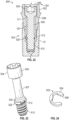
- the interference groove 512 is configured to receive a flexible c-clip 522 that clips over the interference groove 512, as shown in FIG. 23 .
- the flexible c-clip 522 has an interference surface 524 (e.g., top surface) and a bottom surface 526 opposite the interference surface 524.
- the screw 504 is inserted through the dental component 502 and then the c-clip is attached to the interference groove 512, while the interference groove 512 extends beyond the distal end 503 of the dental component 502.
- the dental component 502 can be coupled to the dental implant 12' via screw 504, while the c-clip 522 is attached to the screw 504. Once assembled, the screw 504 will be retained within the dental component 502 since the outer diameter of the c-clip is larger than the through hole of the dental component 502.
- the interference surface 524 will push on the interference surface 520 of the dental component 502 to overcome the friction such that the dental component is separated from the dental implant 12'.
- the c-clip 522 can be disassembled form the screw allowing the screw 504 to be disassembled from the dental component 502.
- FIGS. 25-27B illustrate another dental implant system 600, in accordance with an example of the present disclosure.
- FIG. 25 is a partial cross-section of the assembled dental implant system 600.
- the dental implant system 600 can include a dental implant 12', a dental component 602, and a screw 606.
- the dental component 602 extends from a proximal end 601 to a distal end 603 having an interference surface 610.
- the dental component 602 can include a bore 604 having a shoulder 607 to engage a surface of the screw 606.
- the bore 604 can include an interference chamber 608.
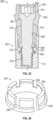
- the screw 606 can include a head 614, a shaft 616, a threaded portion 618, and an interference protrusion 620 and a groove 621. Similar to the example shown in FIGS. 22-24 , the screw 606 is inserted through the dental component 602 first. After the screw 606 is inserted through the dental component 602, an interference ring 630 can be coupled to the screw 606.
- FIG. 26 illustrates a perspective view of the interference ring 630. As shown, the interference ring 630 is a split ring having a base 632 and a plurality of flexible fingers 634 extending coronally from the base 632. The base 632 defines an interference surface 636 that can engage the interference surface 610 during removal.
- a protrusion 635 of the plurality of fingers 634 engage with the groove 621, as the interference ring attaches to the interference protrusion 620.
- FIG. 27A illustrates a fully seated dental component 602 within a dental implant 12'.
- a diameter of the interference chamber 608 is such that the plurality of fingers 634 can be received within the interference chamber 608 and that the interference surface 636 of the interference ring 630 can contact the interference surface 610 when the dental component 602 is removed, as shown in FIG. 27B . That is, when a removal force is applied to the screw 606, the screw 606 can move coronally with respect to the implant 12' and the dental component 602 until the interference surfaces 610, 636 engage each other such that the friction fit will be overcome and the dental component 602 can be removed from the implant 12'.
- FIG. 28A-28F show a process whereby the dental implant system 10 previously shown in FIGS. 1-5B is assembled and disassembled.
- FIG. 28A shows the screw 18 installed down into the dental component 16 first. The screw 18 is inserted off axis to get past the internal dental component 16 separation feature (ledge created by the offset hole).
- FIG. 28B shows the screw 18 further inserted down and threaded into the implant 12.
- FIG. 28C shows the screw 18 fully inserted down and threaded into the implant 12. Once the screw 18 is fully installed as in FIG. 28C , the screw 18 will shift back to the center axis. The implant 12 and the screw 18 and the dental component 16 can then be brought to another implant (not shown) to be fully seated using the threads on the implant 12.
- 28D-28F show disassembly/removal of the process.
- the screw 18 can be rotated such as counter clockwise. Since the screw 18 is now on the center axis (rather than off axis) the screw 18 will engage the overhang created by the offset hole in the dental component 16 and separate the dental implant system 10. In particular, the screw 18 when turned will force the dental component 16 out of the implant 12 as shown in FIG. 28E . This separates the dental component 16 from the implant 12.
- the screw 18 can be removed as shown in FIG. 28F by realignment of the axis.
- the screw 18 can have lobes to help stabilize screw during removal to optimize the interaction between the screw 18 and dental component 16.
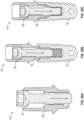
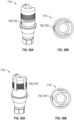
- FIGS. 29A and 29B show an example of the dental component 716 that includes a projection 700.
- This projection 700 can comprise an anti-rotation feature 702 for engagement with a mating component (e.g., prosthetic tooth, driver, instrument or the like).
- a mating component e.g., prosthetic tooth, driver, instrument or the like.
- FIGS. 30A and 30B show another example of the dental component 716' that includes a plurality of grooves 704'.
- the plurality of grooves 704' can comprise an anti-rotation feature 702 for engagement with a mating component (e.g., prosthetic tooth, driver, instrument or the like).
- a mating component e.g., prosthetic tooth, driver, instrument or the like.
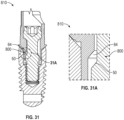
- FIGS. 31 and 31A show an example of the dental implant system 810 with a similar construction as the dental implant system 10 discussed previously in regard to FIGS. 1-5B .
- the interference ledge 64 and the interference shoulder 50 of the prior example of FIGS. 1-5B has been modified to be angled thus providing for an angled separation feature 800 including an angled ledge 64 and a corresponding angled shoulder 50.
- FIGS. 32 and 32A show another example of the example of the dental implant system 810' with a similar construction as the dental implant system 10 discussed previously in regard to FIGS. 1-5B .
- the interference ledge 64 and the interference shoulder 50 of the prior example of FIGS. 1-5B has been modified to be angled (in an opposing manner to that of FIGS. 31 and 31A ) thus providing for an angled separation feature 800' including an angled ledge 64 and a corresponding angled shoulder 50.
- FIG. 33 and 33A show a screw 918 of similar construction to that of screw 18 previously described in FIGS. 1-5B but in includes two lobes 945 rather than three lobes.
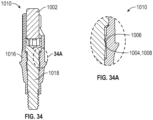
- FIGS. 34 and 34A show a system 1010 including a dental component 1016, screw 1018 and press tool 1002.
- the screw 1018 and the dental component 1016 can include a press-fit engagement 1004 as shown in FIG. 34A using a first feature 1006 and a second feature 1008.
- the first feature 1006 can be a ledge similar to those as previously described.
- the second feature can be a shoulder similar to those previously described.
- other snap fit arrangement such as those using engagement, friction-fit or other mechanisms as known in the art are also contemplated.
- FIGS. 35A and 35B show a screw 1104 similar to the screw 204 previously shown in FIGS. 18A-18C .
- the screw 1104 includes a head 1108, a shaft 1109, a coronal threaded portion 1110 and an apical threaded portion 1112.
- the apical threaded portion 1112 includes a right-handed thread that engages the implant (not shown but reference implant 12').
- the coronal threaded portion 1110 includes a left-handed thread with a major diameter that is greater than a major diameter of the apical threaded portion 1112.
- the screw 1104 differs from the screw 204 in that the screw includes a notched first thread 1102 on the coronal threaded portion 1110. This notched first thread 1102 can removes thin thread start that rolls over during removal.
- FIG. 36-36D show a process whereby a dental implant system 1210 is assembled and disassembled.
- FIG. 36A shows the screw 1218 used in isolation showing the head 1202 thereof having formable tabs 1204. This head 1202 can be formed with the tabs 1204 pushed outwards as further discussed herein.
- FIG. 36 shows the screw 1218 installed down into the dental component 1216 first. The screw 1218 at the head 1202 can then be engaged by a tool 1206 such as a pin to deform the tabs 1204 outward as shown in FIG. 36B . The tabs 1204 can then engage one or more features 1208 of the dental component 1216 to lock the screw 1218 in place ( FIG. 36C).
- FIG. 36D shows disassembly/removal of the process.
- the screw 1218 can be rotated such as counter clockwise by a screw driver 1209 or other suitable tool. Since the screw 1218 is deformed at the tabs 1204 to engage with the one or more features 1208, the screw 1218 will engage the one or more features 1208 of the dental component 1216 and separate the dental implant system 10. In particular, the screw 1218 when turned will force the dental component 1216 out of the implant 1212 as shown in FIG. 36D . This separates the dental component 1216 from the implant 1212.
Landscapes
- Health & Medical Sciences (AREA)
- Oral & Maxillofacial Surgery (AREA)
- Orthopedic Medicine & Surgery (AREA)
- Dentistry (AREA)
- Epidemiology (AREA)
- Life Sciences & Earth Sciences (AREA)
- Animal Behavior & Ethology (AREA)
- General Health & Medical Sciences (AREA)
- Public Health (AREA)
- Veterinary Medicine (AREA)
- Dental Prosthetics (AREA)
Applications Claiming Priority (2)
| Application Number | Priority Date | Filing Date | Title |
|---|---|---|---|
| US202163152519P | 2021-02-23 | 2021-02-23 | |
| EP22158346.1A EP4046590B1 (de) | 2021-02-23 | 2022-02-23 | Zahnimplantatsystem |
Related Parent Applications (1)
| Application Number | Title | Priority Date | Filing Date |
|---|---|---|---|
| EP22158346.1A Division EP4046590B1 (de) | 2021-02-23 | 2022-02-23 | Zahnimplantatsystem |
Publications (2)
| Publication Number | Publication Date |
|---|---|
| EP4445865A2 true EP4445865A2 (de) | 2024-10-16 |
| EP4445865A3 EP4445865A3 (de) | 2025-04-16 |
Family
ID=80448823
Family Applications (2)
| Application Number | Title | Priority Date | Filing Date |
|---|---|---|---|
| EP22158346.1A Active EP4046590B1 (de) | 2021-02-23 | 2022-02-23 | Zahnimplantatsystem |
| EP24197114.2A Pending EP4445865A3 (de) | 2021-02-23 | 2022-02-23 | Zahnimplantatsystem |
Family Applications Before (1)
| Application Number | Title | Priority Date | Filing Date |
|---|---|---|---|
| EP22158346.1A Active EP4046590B1 (de) | 2021-02-23 | 2022-02-23 | Zahnimplantatsystem |
Country Status (2)
| Country | Link |
|---|---|
| US (2) | US12257127B2 (de) |
| EP (2) | EP4046590B1 (de) |
Families Citing this family (2)
| Publication number | Priority date | Publication date | Assignee | Title |
|---|---|---|---|---|
| USD1099321S1 (en) * | 2023-09-13 | 2025-10-21 | Schuthink Llc | Topographical dental abutment |
| US20250228652A1 (en) * | 2024-01-13 | 2025-07-17 | Mayank R. Adatia | Dental Bar Implant and Overdenture and Process for Using. |
Family Cites Families (14)
| Publication number | Priority date | Publication date | Assignee | Title |
|---|---|---|---|---|
| US5302126A (en) * | 1992-03-19 | 1994-04-12 | Park Dental Research Corp. | Dental implant with adjustable post |
| FR2747031B1 (fr) * | 1996-04-09 | 1998-05-22 | Serf Sa | Implant dentaire pour la realisation d'une implantation en un temps chirurgical |
| GB0327822D0 (en) | 2003-12-01 | 2003-12-31 | Materialise Nv | Method for manufacturing a prosthesis made prior to implant placement |
| DE502006007669D1 (de) | 2006-10-19 | 2010-09-23 | Elringklinger Ag | Kombination aus einer schraube, einer unterlegscheibe und einer hülse sowie verfahren zum herstellen einer solchen kombination |
| WO2008157138A2 (en) * | 2007-06-14 | 2008-12-24 | Southern Implants, Inc. | Dental implant for asymmetrical abutment mounting |
| SE538150C2 (sv) * | 2012-07-11 | 2016-03-22 | Heraeus Kulzer Nordic Ab | En skruvkanalsriktande anordning för en dental superstrukturoch metoder för att tillverka en dental superstruktur |
| US20160151127A1 (en) * | 2014-12-01 | 2016-06-02 | Evollution Ip Holdings, Inc. | Dental implant screw and installation tools with offset drive angle |
| FR3033490B1 (fr) * | 2015-03-09 | 2017-04-14 | Global D | Ensemble prothetique dentaire, systeme ancillaire et procede de montage/demontage d'un pilier sur un implant dentaire. |
| BR102016010184B1 (pt) | 2016-05-05 | 2020-10-27 | Jjgc Indústria E Comércio De Materiais Dentários S.A. | conjunto protético e processo para produção do mesmo |
| WO2019101996A1 (en) | 2017-11-27 | 2019-05-31 | Nobel Biocare Services Ag | Dental fitting attachable to a dental component and dental assembly comprising a dental fitting and a dental component |
| KR102177377B1 (ko) * | 2018-05-31 | 2020-11-11 | 장희지 | 치과용 임플란트 |
| DE102019001715A1 (de) | 2019-03-12 | 2020-09-17 | Bruno Spindler | Montageschnittstelle zwischen einer Suprakonstruktion und einem Implantatkörper |
| DE102019205354A1 (de) | 2019-04-12 | 2020-10-15 | Mahle International Gmbh | Befestigungsvorrichtung, ein Bauteil mit der Befestigungsvorrichtung und Verfahren zum Vormontieren der Befestigungsvorrichtung |
| FR3102354B1 (fr) | 2019-10-23 | 2022-10-21 | Creadent Montauban | Pilier de cicatrisation de la gencive autour d’un implant pour la pose d’une dent prothétique. |
-
2022
- 2022-02-21 US US17/676,497 patent/US12257127B2/en active Active
- 2022-02-23 EP EP22158346.1A patent/EP4046590B1/de active Active
- 2022-02-23 EP EP24197114.2A patent/EP4445865A3/de active Pending
-
2024
- 2024-08-21 US US18/810,802 patent/US20250049540A1/en active Pending
Also Published As
| Publication number | Publication date |
|---|---|
| US20250049540A1 (en) | 2025-02-13 |
| US12257127B2 (en) | 2025-03-25 |
| EP4046590C0 (de) | 2024-09-11 |
| EP4046590B1 (de) | 2024-09-11 |
| EP4445865A3 (de) | 2025-04-16 |
| EP4046590A1 (de) | 2022-08-24 |
| US20220265396A1 (en) | 2022-08-25 |
Similar Documents
| Publication | Publication Date | Title |
|---|---|---|
| US20250049540A1 (en) | Dental implant system | |
| AU2019203708B2 (en) | Dental implant with improved prosthetic interface | |
| RU2687575C1 (ru) | Зубной имплантат, инструмент для вставки зубного имплантата и комбинация зубного имплантата и инструмента для вставки | |
| US20220054235A1 (en) | Dental implant with indexing surfaces having a friction-reducing coating | |
| US11123160B2 (en) | Set of components for dental prosthetic restoration | |
| EP2514390B1 (de) | Satz aus Zahnelementen | |
| JP6272827B2 (ja) | 歯科用インプラント・セット | |
| US20130164708A1 (en) | Connecting screw for a dental implant | |
| AU2014306747A1 (en) | Polyaxial locking mechanism | |
| WO2008157137A1 (en) | Dental implant system for use with coaxially non-aligned prosthesis | |
| AU2009270538A1 (en) | Improved fixture of two-piece dental implant | |
| EP2696799B1 (de) | Fixierung | |
| AU2016247221A1 (en) | Semi-constrained bone screw and insertion instrument | |
| WO2013186765A1 (en) | Modular dental implant | |
| JP2005503887A (ja) | インプラント | |
| US20250318910A1 (en) | Dental implant with improved thread design |
Legal Events
| Date | Code | Title | Description |
|---|---|---|---|
| PUAI | Public reference made under article 153(3) epc to a published international application that has entered the european phase |
Free format text: ORIGINAL CODE: 0009012 |
|
| STAA | Information on the status of an ep patent application or granted ep patent |
Free format text: STATUS: THE APPLICATION HAS BEEN PUBLISHED |
|
| AC | Divisional application: reference to earlier application |
Ref document number: 4046590 Country of ref document: EP Kind code of ref document: P |
|
| AK | Designated contracting states |
Kind code of ref document: A2 Designated state(s): AL AT BE BG CH CY CZ DE DK EE ES FI FR GB GR HR HU IE IS IT LI LT LU LV MC MK MT NL NO PL PT RO RS SE SI SK SM TR |
|
| PUAL | Search report despatched |
Free format text: ORIGINAL CODE: 0009013 |
|
| AK | Designated contracting states |
Kind code of ref document: A3 Designated state(s): AL AT BE BG CH CY CZ DE DK EE ES FI FR GB GR HR HU IE IS IT LI LT LU LV MC MK MT NL NO PL PT RO RS SE SI SK SM TR |
|
| RIC1 | Information provided on ipc code assigned before grant |
Ipc: A61C 8/00 20060101AFI20250313BHEP |
|
| STAA | Information on the status of an ep patent application or granted ep patent |
Free format text: STATUS: REQUEST FOR EXAMINATION WAS MADE |
|
| 17P | Request for examination filed |
Effective date: 20251016 |