EP4444005A1 - Rsu-vorrichtungssteuerungsverfahren, server und speichermedium - Google Patents
Rsu-vorrichtungssteuerungsverfahren, server und speichermedium Download PDFInfo
- Publication number
- EP4444005A1 EP4444005A1 EP22913536.3A EP22913536A EP4444005A1 EP 4444005 A1 EP4444005 A1 EP 4444005A1 EP 22913536 A EP22913536 A EP 22913536A EP 4444005 A1 EP4444005 A1 EP 4444005A1
- Authority
- EP
- European Patent Office
- Prior art keywords
- rsu
- rsu device
- state
- devices
- coverage range
- Prior art date
- Legal status (The legal status is an assumption and is not a legal conclusion. Google has not performed a legal analysis and makes no representation as to the accuracy of the status listed.)
- Pending
Links
Images


Classifications
-
- H—ELECTRICITY
- H04—ELECTRIC COMMUNICATION TECHNIQUE
- H04W—WIRELESS COMMUNICATION NETWORKS
- H04W4/00—Services specially adapted for wireless communication networks; Facilities therefor
- H04W4/02—Services making use of location information
- H04W4/021—Services related to particular areas, e.g. point of interest [POI] services, venue services or geofences
-
- H—ELECTRICITY
- H04—ELECTRIC COMMUNICATION TECHNIQUE
- H04W—WIRELESS COMMUNICATION NETWORKS
- H04W28/00—Network traffic management; Network resource management
- H04W28/16—Central resource management; Negotiation of resources or communication parameters, e.g. negotiating bandwidth or QoS [Quality of Service]
- H04W28/18—Negotiating wireless communication parameters
-
- H—ELECTRICITY
- H04—ELECTRIC COMMUNICATION TECHNIQUE
- H04L—TRANSMISSION OF DIGITAL INFORMATION, e.g. TELEGRAPHIC COMMUNICATION
- H04L67/00—Network arrangements or protocols for supporting network services or applications
- H04L67/01—Protocols
- H04L67/12—Protocols specially adapted for proprietary or special-purpose networking environments, e.g. medical networks, sensor networks, networks in vehicles or remote metering networks
-
- H—ELECTRICITY
- H04—ELECTRIC COMMUNICATION TECHNIQUE
- H04W—WIRELESS COMMUNICATION NETWORKS
- H04W28/00—Network traffic management; Network resource management
- H04W28/02—Traffic management, e.g. flow control or congestion control
- H04W28/0226—Traffic management, e.g. flow control or congestion control based on location or mobility
-
- H—ELECTRICITY
- H04—ELECTRIC COMMUNICATION TECHNIQUE
- H04W—WIRELESS COMMUNICATION NETWORKS
- H04W28/00—Network traffic management; Network resource management
- H04W28/02—Traffic management, e.g. flow control or congestion control
- H04W28/08—Load balancing or load distribution
-
- H—ELECTRICITY
- H04—ELECTRIC COMMUNICATION TECHNIQUE
- H04W—WIRELESS COMMUNICATION NETWORKS
- H04W4/00—Services specially adapted for wireless communication networks; Facilities therefor
- H04W4/30—Services specially adapted for particular environments, situations or purposes
- H04W4/40—Services specially adapted for particular environments, situations or purposes for vehicles, e.g. vehicle-to-pedestrians [V2P]
-
- H—ELECTRICITY
- H04—ELECTRIC COMMUNICATION TECHNIQUE
- H04W—WIRELESS COMMUNICATION NETWORKS
- H04W72/00—Local resource management
- H04W72/04—Wireless resource allocation
-
- H—ELECTRICITY
- H04—ELECTRIC COMMUNICATION TECHNIQUE
- H04W—WIRELESS COMMUNICATION NETWORKS
- H04W76/00—Connection management
- H04W76/10—Connection setup
- H04W76/14—Direct-mode setup
-
- Y—GENERAL TAGGING OF NEW TECHNOLOGICAL DEVELOPMENTS; GENERAL TAGGING OF CROSS-SECTIONAL TECHNOLOGIES SPANNING OVER SEVERAL SECTIONS OF THE IPC; TECHNICAL SUBJECTS COVERED BY FORMER USPC CROSS-REFERENCE ART COLLECTIONS [XRACs] AND DIGESTS
- Y02—TECHNOLOGIES OR APPLICATIONS FOR MITIGATION OR ADAPTATION AGAINST CLIMATE CHANGE
- Y02D—CLIMATE CHANGE MITIGATION TECHNOLOGIES IN INFORMATION AND COMMUNICATION TECHNOLOGIES [ICT], I.E. INFORMATION AND COMMUNICATION TECHNOLOGIES AIMING AT THE REDUCTION OF THEIR OWN ENERGY USE
- Y02D30/00—Reducing energy consumption in communication networks
- Y02D30/70—Reducing energy consumption in communication networks in wireless communication networks
Definitions
- the present disclosure relates to the field of Vehicle-to-Everything, and in particular, to an RSU (Road Side Unit) device control method, a server, and a storage medium.
- RSU Raad Side Unit
- the RSU device has a limited signal coverage range.
- a larger coverage range is set, more OBU devices are allowed to be accessed in unit area, which correspondingly results in large power consumption and high load of the RSU device, and causes hidden dangers to quality of service; and when a smaller coverage range is set, a smaller number of OBU devices are allowed to be accessed in the unit area, so that the RSU device can provide more reliable services, but once the RSU device has a fault such as an off-line fault, a signal blind spot may appear along a whole road, and requests from the OBUs in such spot cannot be responded to in time, which may seriously influence the stability of the communication between the RSU device and the OBU devices.
- a major objective of the present disclosure is to provide an RSU device control method, a server, and a storage medium for at least solving the following problems: when the RSU device is in an off-line state, the OBU device is in a signal blind spot and a request from the OBU device cannot be responded to in time; and when the RSU device is in a high-load state, there are hidden dangers to quality of service, so as to ensure the stability of the communication between the RSU device and the OBU.
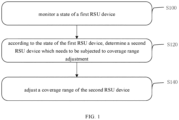
- an RSU device control method including: monitoring a state of a first RSU device; according to the state of the first RSU device, determining a second RSU device which needs to be subjected to coverage range adjustment; and adjusting a coverage range of the second RSU device.
- An embodiment of the present disclosure further provides a server, including a processor and a memory; and the processor is configured to execute one or more computer programs stored in the memory to implement operations of the RSU device control method described herein.
- first and second are merely used to refer to the RSU devices and have no other meaning.
- the “first RSU device” and the “second RSU device” may refer to a same RSU device or different RSU devices.
- an RSU device control method As shown in FIG. 1 , the method may include: operation S 100, monitoring a state of a first RSU device.
- monitoring the state of the first RSU device may include monitoring off-line time of the first RSU device or a current device access quantity of the first RSU device, so as to determine whether the state of the first RSU device is an off-line state or a high-load state.
- various methods may be adopted to monitor whether the state of the first RSU device is the off-line state, and include, but are not limited to, monitoring the off-line time of the first RSU device, and marking the state of the first RSU device as the off-line state when the off-line time of the first RSU device exceeds a preset threshold, or when a device access quantity of the first RSU device is not read within a preset time range, or when a preset message is not received from the first RSU device within a preset time range, with the preset message including, but not limited to, a response message or a heartbeat message.
- the device access quantity of the first RSU device is recorded when the off-line time of the first RSU device does not exceed the preset threshold, or when the device access quantity of the first RSU device is read within the preset time range, or when the preset message is received from the first RSU device within the preset time range, with the preset message including, but not limited to, the response message or the heartbeat message.
- the device access quantity of the first RSU device exceeds a preset threshold
- the state of the first RSU device is marked as the high-load state.
- the marking operation may be dynamically updated. Certainly, the marking operation is not necessarily an actual marking action, as long as the state of the first RSU device can be accurately monitored.
- monitoring the state of the first RSU device refers to monitoring a state of the first RSU device in which the first RSU device fails to provide an effective high-quality service in time, so as to achieve effective control of the first RSU device and/or other RSU devices to improve the quality of service of the RSU devices. Therefore, the state is not limited to the aforesaid off-line or high-load state, and may be any other applicable state in which high-quality services cannot be provided, such as a power-off state or a network disconnection state.
- the RSU device control method further includes operation S120: operation S 120, according to the state of the first RSU device, determining a second RSU device which needs to be subjected to coverage range adjustment.
- the state of the first RSU device is obtained through accurate monitoring, and the second RSU device which needs to be subjected to coverage range adjustment is effectively and clearly determined based on the state of the RSU device, thereby achieving accurate and effective control, and ensuring that the RSU device can provide effective services with high reliability, stability and quality.
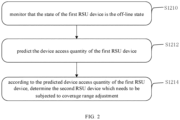
- determining the second RSU device which needs to be subjected to coverage range adjustment may include, but is not limited to, the following operations:
- the preset range may be set according to a location of the first RSU device or according to a certain region (a preset region where the first RSU device is located) that is convenient for unified management. That is, the preset range is not necessarily in a fixed or regular shape, and may be set according to actual situations.
- predicting the device access quantity of the first RSU device may be performed according to historical access quantities of the first RSU device, and the historical access quantities may be counted according to seasons, peak hours, or other associated data. Certainly, predicting the device access quantity of the first RSU device may be also performed through dynamic intelligent prediction by a corresponding deep learning algorithm.
- predicting the device access quantity of the first RSU device may be performed with the following method: reading the number of vehicles M1 t within a coverage range corresponding to the first RSU device at a moment t in a normal state, an average value M2 t of device access quantities of neighboring RSU devices with respect to the first RSU device at the moment t, and the device access quantity M t of the first RSU device at the moment t; calculating an average value M of device access quantities of the first RSU device based on M t ; calculating a first deviation degree of M1 t , relative to M and a second deviation degree of M2 t relative to M ; and establishing a prediction equation using the first deviation degree and the second deviation degree to predict the device access quantity of the first RSU device.
- the method for predicting the device access quantity of the first RSU device may include the following operations.
- Operation One when the state of the first RSU device is the normal state, the following information is recorded at certain intervals, with the normal state referring to that the state of the first RSU device is neither the off-line state nor the high-load state.
- a statistical range is determined by taking the location of the first RSU device as a center and the coverage range of the first RSU device as a radius, and the number of all vehicles within the statistical range is counted according to location information of OBUs within the statistical range and is recorded as M1 t .
- the OBU device access quantities of the neighboring RSU devices with respect to the first RSU device are acquired and are averaged to obtain an average value, and the average value is recorded M2 t .
- Operation Two when the state of the first RSU device is the off-line state, the recorded information is taken out. It is assumed that the historical records of n moments are recorded in total.
- an average value M of the data sequences generated at operation (3) by the first RSU device in the normal state is calculated.
- both M1 and M2 may be taken as estimated values of M, and estimated deviation degrees of the two estimated values with respect to M are respectively calculated, that is, calculating a variance ⁇ 1 2 of M1 relative to M and a variance ⁇ 2 2 of M2 relative to M.
- the OBU device access quantity of the first RSU device in the off-line state is predicated.
- the OBU device access quantity of the first RSU device in the off-line state is predicted according to M1 and M2.
- the device access quantity of the first RSU device may be predicted by the prediction relational expression.
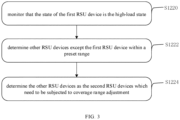
- determining the second RSU device which needs to be subjected to coverage range adjustment may include, but is not limited to, the following operations:
- the other RSU devices except the first RSU device within the preset range may be some other RSU devices except the first RSU device within the preset range, or all other RSU devices except the first RSU device within the preset range.
- determining the other RSU devices as the second RSU devices which need to be subjected to coverage range adjustment may be determining some other RSU devices except the first RSU device within the preset range as the second RSU devices which need to be subjected to coverage range adjustment, or determining all other RSU devices except the first RSU device within the preset range as the second RSU devices which need to be subjected to coverage range adjustment.
- Some other RSU devices except the first RSU device within the preset range refer to such devices within the preset range that, taking a location of the first RSU device as a center, distances from the devices to the location of the first RSU device meet a requirement of a preset distance threshold.
- the preset range may be set according to the location of the first RSU device or according to a certain region (a preset region where the first RSU device is located) that is convenient for unified management. That is, the preset range is not necessarily in a fixed or regular shape, and may be set according to actual situations.
- FIG. 4 What is illustrated by FIG. 4 is an example of a deployment scheme of RSU devices, and is also an example of the preset range in the embodiment of the present disclosure. It should be noted that a shape of an intersection shown in FIG. 4 is an ideal shape for convenience of illustration, and roads may be crooked in practical applications, but the roads can be easily and approximately embodied in the form described in the embodiment of the present disclosure.
- a central device E is the first RSU device
- other devices A, B, C, D, F, G, H, I are the neighboring RSU devices
- the central device E and the devices A, B, C, D, F, G, H, I serve as all the RSU devices within the preset range as described in the embodiment of the present disclosure.
- the state of the first RSU device is the off-line state and the predicted device access quantity of the first RSU device is greater than the preset threshold
- all other RSU devices except the first RSU device within the preset range are determined as the second RSU devices which need to be subjected to coverage range adjustment. Exemplarily, as shown in FIG.
- the central device E is taken as the first RSU device, and in a case where the state of the central device E is the off-line state and the predicted device access quantity of the central device E is greater than the preset threshold, all the other RSU devices except the central device E within the preset range are determined as the second RSU devices which need to be subjected to coverage range adjustment, that is, the devices A, B, C, D, F, G, H, I shown in FIG. 4 are determined as the second RSU devices which need to be subjected to coverage range adjustment.
- some other RSU devices except the first RSU device within the preset range are determined as the second RSU devices which need to be subjected to coverage range adjustment.
- Some other RSU devices except the first RSU device within the preset range refer to such devices within the preset range that, taking the location of the first RSU device as the center, the distances from the devices to the location of the first RSU device meet the requirement of the preset distance threshold. As shown in FIG.
- some other RSU devices except the central device E within the preset range are determined as the second RSU devices which need to be subjected to coverage range adjustment, that is, taking the location of the central device E as a center, such devices within the preset range that the distances from the devices to the location of the central device E meet the requirement of the preset distance threshold are determined as some other RSU devices except the first RSU device within the preset range.
- the devices having the distances to the location of the central device E meeting the requirement of the preset distance threshold may be the devices B, D, F, I.
- determining the second RSU device which needs to be subjected to coverage range adjustment may include: in the case where the state of the first RSU device is the high-load state, determining some other RSU device except the first RSU device within the preset range as the second RSU devices which need to be subjected to coverage range adjustment, with some other RSU devices except the first RSU device within the preset range referring to such devices within the preset range that, taking the location of the first RSU device as the center, the distances from the devices to the location of the first RSU device meet the requirement of the preset distance threshold. As shown in FIG.
- some other RSU devices except the central device E within the preset range are determined as the second RSU devices which need to be subjected to coverage range adjustment, that is, taking the location of the central device E as a center, such devices within the preset range that the distances from the devices to the location of the central device E meet the requirement of the preset distance threshold are determined as some other RSU devices except the first RSU device within the preset range.
- the devices having the distances to the location of the central device E meeting the requirement of the preset distance threshold may be the devices B, D, F, I.
- the RSU device control method further includes operation S140: operation S140, adjusting a coverage range of the second RSU device.
- adjusting the coverage range of the second RSU device may be performed according to actual needs. For example, the coverage range of the second RSU device is adjusted to a maximum coverage range or increased to a certain proportion, or the coverage range of the first RSU device is reduced to a certain proportion.
- a signal coverage range of an RSU device is related to transmission power.
- each RSU device used is measured in advance, a coverage range obtained in the presence of a highest power output is a maximum coverage range, and a coverage range corresponding to a preset proportion (for example, 80%) of maximum output power may be taken as a normal coverage range. Therefore, adjusting the coverage range may be implemented by adjusting the transmission power of the RSU device.
- adjusting the coverage range of the second RSU device in a case where the first RSU device is in the off-line state may be performed for allowing the adjusted coverage range of the second RSU device to cover a part or all of the original coverage range of the first RSU device, so as to ensure that the RSU devices can provide high-quality services, and further reduce service blind spots.
- the coverage range of the second RSU device in the case where the first RSU device is in the off-line state, the coverage range of the second RSU device is typically increased by the adjustment.
- the number of the adjusted second RSU device may be one or more than one; and the coverage range of each second RSU device may be adjusted by a same value or by a different value.
- the coverage ranges of all the determined second RSU devices are adjusted to the maximum coverage ranges, or the coverage range of an RSU device having a distance to the first RSU device smaller than a first preset value is adjusted to the maximum coverage range and the coverage range of an RSU device having a distance to the first RSU device smaller than a second preset value is adjusted to a preset multiple of the original coverage range. That is, a final adjustment policy is to ensure that the second RSU devices can cover the coverage range of the first RSU device as much as possible and areas of overlapping regions between the second RSU devices are not larger than a preset area.
- adjusting the coverage range of the second RSU device may be performed for allowing the device access quantity of the first RSU device after the adjustment is within a preset normal value range, so as to enable loads of the first RSU device and the second RSU devices within the preset range to reach a balanced state.
- the second RSU devices determined may include the first RSU device.
- the operation S 104 may further include reading a state of the second RSU device, and determining the second RSU device which is in a normal state as a target RSU device which needs to be subjected to coverage range adjustment; and adjusting a coverage range of the target RSU device which is in the normal state.
- the second RSU device which is in the normal state may refer to the second RSU device which is not in the off-line state, or the high-load state, or other states in which it is inconvenient or impossible to adjust the coverage range (e.g., a disconnection state, a network disconnection state, and a state in which the device access quantity is greater than a preset value).
- a connection handover criterion is a relative signal strength criterion with a hysteresis margin as shown in FIG. 5 .
- RSSI Received Signal Strength Indication
- a policy similar to soft handover is adopted as a control policy, but the adopted soft handover is different from a handover mode involving base stations.
- the soft handover involving the base stations is a handover between different base stations at a same frequency, and a same data stream is transmitted in two links, thereby ensuring no interruption of communication.
- the present disclosure relates to a part in vehicle-road collaboration in the Vehicle-to-Everything, and the adjustment to the coverage range of the RSU device relates to two communication modes in the Vehicle-to-Everything.
- One is a communication mode between the RSU device and a cloud platform: an online state of the RSU device is monitored by a cloud end using the Message Queuing Telemetry Transport (MQTT) protocol.
- MQTT Message Queuing Telemetry Transport
- the other is a communication mode between the RSU device and the OBU of the vehicle: a PC5 interface (a direct communication interface) is adopted between the OBU of the vehicle and the RSU device for direct communication.
- the PC5 interface is adopted for the connection between the OBU and the RSU device, and the connection is direct connection between the OBU and the RSU device, with no need to use a base station as an intermediary.
- the OBU of the vehicle first uses a new channel to establish connection with the new RSU device and then interrupts the connection with the original RSU device, which avoids an influence of a no-connection period on the whole intelligent transportation communication, with the no-connection period appearing due to the connection being slow or the failed connection when the OBU of the vehicle establishes the new connection.
- an RSU device control apparatus which may be run as software on an RSU device or in a server, or in any other suitable device of the Vehicle-to-Everything.
- the RSU device control apparatus may include a plurality of modules/units for implementing the above embodiments and implementations.
- the RSU device control apparatus may be one or more programs that are stored on a memory and executable by a processor to implement at least one operation of the RSU device control method according to the above embodiments.
- the term "module/unit” refers to a combination of software and/or hardware capable of performing a predetermined function.
- FIG. 7 is a schematic structural diagram of an RSU device control apparatus according to an embodiment of the present disclosure.
- An RSU device control apparatus 10 may operate in an RSU device.
- the RSU device control apparatus 10 operates in a first RSU device to determine a second RSU device through monitoring of a state of the first RSU device, and communicate with the second RSU device in a corresponding communication mode to control coverage range adjustment; or the RSU device control apparatus 10 operates in a second RSU device to determine other second RSU devices which need to be subjected to coverage range adjustment through reading of a state of a neighboring first RSU device which is in communication connection (wireless or wired connection) with the second RSU device, and communicate with the first RSU device or the other second RSU devices in a corresponding communication mode to control coverage range adjustment.
- the RSU device control apparatus may operate in a server, and monitors, with a monitoring module 100, the state of the first RSU device and/or a state of a second RSU device.
- the RSU device control apparatus further includes a determination module 102 configured to determine a second RSU device or a target RSU device which needs to be subjected to coverage range adjustment, and an adjustment module 104 configured to adjust a coverage range of the second RSU device or the target RSU device.
- FIG. 7 is merely for illustration and is not intended to limit the structure of the RSU device control apparatus 10.
- the RSU device control apparatus 10 may include more or fewer components than those shown in FIG. 7 , or may be configured in a way different from that shown in FIG. 7 .
- the RSU device control apparatus 10 further includes a processor 11 (one or more processors 11 may be provided, and merely one processor 11 is shown), and a memory 12 (one or more memories 12 may be provided, and merely one memory 12 is shown).
- the processor 11 and the memory 12 may be connected to and communicate with each other via a universal bus (not marked by a reference numeral).
- the processor 11 may include, but is not limited to, a processing device such as a microprocessor (e.g., a microcontroller unit (MCU)) or a programmable logic device (e.g., a field programmable gate array (FPGA)).
- the memory 12 may be configured to store computer programs, such as software programs and modules of application software.
- the memory 12 may be configured to store a computer program corresponding to the service configuration management method provided in the embodiments of the present disclosure. By running the computer programs stored in the memory 12, the processor 11 performs various functional applications and data processing, that is, implementing the above method.
- the memory 12 may include a high-speed random access memory, and may also include a non-volatile memory, such as one or more magnetic storage devices, flash memories, or other non-volatile solid-state memories.
- the memory 12 may further include a memory remotely arranged relative to the processor 11, and the remote memory may be connected to the apparatus 10 via a network.
- the examples of the network include, but are not limited to, the Internet, an intranet, a local area network, a mobile communication network, the combinations thereof, and any type of suitable network.
- a computer-readable storage medium which may be configured to store one or more computer programs, and the stored one or more computer programs are executable by a processor to implement at least one operation of the RSU device control method according to the above embodiments.
- a server including a processor configured to run a program, and a memory.
- the program implements the aforesaid method when being run, or the operations of the aforesaid method are performed when the program is run.
- An embodiment of the present disclosure further provides a computer program product (a computer program or software), including a computer-readable device having the above computer program stored therein.
- the computer-readable device may include the above computer-readable storage medium.
- the computer program product may be distributed on a computer-readable medium and executable by a computing device to implement at least one operation of the RSU device control method according to the above embodiments.
- the RSU device control method provided in the embodiments of the present disclosure solves the following problems: when the RSU device is in the off-line state, the OBU device is in a signal blind spot and a request from the OBU device cannot be responded to in time; and when the RSU device is in the high-load state, there are hidden dangers to quality of service.
- the RSU device control method can ensure the stability of the communication between the RSU device and the OBU.
- the present disclosure includes and relates to devices for performing one or more operations described in the present disclosure.
- Those devices may be specially designed and manufactured for desired purposes, or may include known devices in general purpose computers.
- Those devices have computer programs stored therein, and the computer programs are selectively activated or reconfigured.
- Those computer programs may be stored in a device (e.g., a computer) readable medium or in any type of medium suitable to store electronic instructions and respectively coupled to buses.
- the computer readable medium includes, but is not limited to, any type of disk (including a floppy disk, a hard disk, an optical disc, a Compact Disc Read-Only Memory (CD-ROM), and a magneto-optical disk), a Read-Only Memory (ROM), a Random Access Memory (RAM), an Erasable Programmable Read-Only Memory (EPROM), an Electrically Erasable Programmable Read-Only Memory (EEPROM), a flash memory, a magnetic card or a light card. That is, the readable medium includes any medium that stores or transmits information in a form readable by a device (e.g., a computer).
- a device e.g., a computer
- the functional modules/units in all or some of the operations, the systems and the devices in the methods disclosed above may be implemented as software (which may be implemented as computer program codes executable by a computing device), firmware, hardware, or suitable combinations thereof. If implemented as hardware, the division between the functional modules/units described above is not necessarily corresponding to the division of physical components; for example, one physical component may have a plurality of functions, or one function or operation may be performed through cooperation of several physical components. Some or all of the physical components may be implemented as software executed by a processor, such as a central processing unit, a digital signal processor or a microprocessor, or may be implemented as hardware, or may be implemented as an integrated circuit, such as an application specific integrated circuit.
- a processor such as a central processing unit, a digital signal processor or a microprocessor
- each block of the structural diagrams and/or block diagrams and/or flowcharts and combinations of the blocks of the structural diagrams and/or block diagrams and/or flowcharts can be implemented by computer program instructions.
- the computer program instructions may be provided for a general purpose computer, a special purpose computer, or a processor for other programmable data processing methods, so as to implement the solutions specified in one or more blocks of the structural diagrams and/or block diagrams and/or flowcharts with the computers or the processor for the other programmable data processing methods.
Landscapes
- Engineering & Computer Science (AREA)
- Computer Networks & Wireless Communication (AREA)
- Signal Processing (AREA)
- Quality & Reliability (AREA)
- Health & Medical Sciences (AREA)
- Computing Systems (AREA)
- General Health & Medical Sciences (AREA)
- Medical Informatics (AREA)
- Mobile Radio Communication Systems (AREA)
- Traffic Control Systems (AREA)
Applications Claiming Priority (2)
| Application Number | Priority Date | Filing Date | Title |
|---|---|---|---|
| CN202111645242.2A CN116419153A (zh) | 2021-12-29 | 2021-12-29 | 一种rsu设备控制方法、服务器及存储介质 |
| PCT/CN2022/119671 WO2023124271A1 (zh) | 2021-12-29 | 2022-09-19 | 一种rsu设备控制方法、服务器及存储介质 |
Publications (2)
| Publication Number | Publication Date |
|---|---|
| EP4444005A1 true EP4444005A1 (de) | 2024-10-09 |
| EP4444005A4 EP4444005A4 (de) | 2025-11-26 |
Family
ID=86997425
Family Applications (1)
| Application Number | Title | Priority Date | Filing Date |
|---|---|---|---|
| EP22913536.3A Pending EP4444005A4 (de) | 2021-12-29 | 2022-09-19 | Rsu-vorrichtungssteuerungsverfahren, server und speichermedium |
Country Status (4)
| Country | Link |
|---|---|
| US (1) | US20250056325A1 (de) |
| EP (1) | EP4444005A4 (de) |
| CN (1) | CN116419153A (de) |
| WO (1) | WO2023124271A1 (de) |
Families Citing this family (2)
| Publication number | Priority date | Publication date | Assignee | Title |
|---|---|---|---|---|
| CN116744319B (zh) * | 2023-08-09 | 2023-11-24 | 西南交通大学 | 一种路侧单元部署方法、装置、设备及可读存储介质 |
| CN118921682B (zh) * | 2024-10-09 | 2024-12-31 | 四川经开智行交通科技有限公司 | 一种车路协同网络链路信号确定方法 |
Family Cites Families (10)
| Publication number | Priority date | Publication date | Assignee | Title |
|---|---|---|---|---|
| US20080219520A1 (en) * | 2007-03-06 | 2008-09-11 | Atmel Corporation | Sensor monitoring |
| US10460616B2 (en) * | 2012-11-27 | 2019-10-29 | Active Learning Solutions Holdings Limited | Method and system for active learning |
| US8971845B2 (en) * | 2013-02-26 | 2015-03-03 | Cisco Technology, Inc. | Systems, methods and media for location reporting at a charging area level granularity |
| CN107409402B (zh) * | 2015-03-11 | 2021-06-08 | 诺基亚技术有限公司 | 用于车辆通信智能无线电接入区的方法、装置、系统和计算机程序 |
| CN109219060B (zh) * | 2017-07-06 | 2022-09-02 | 大唐移动通信设备有限公司 | 一种小区覆盖范围调整方法及装置 |
| CN109803313B (zh) * | 2017-11-17 | 2020-10-30 | 电信科学技术研究院 | 一种拥塞控制方法、终端及计算机可读存储介质 |
| US20190297526A1 (en) * | 2018-03-21 | 2019-09-26 | Ford Global Technologies, Llc | Mitigating channel congestion in inter vehicle communication |
| WO2020050440A1 (ko) * | 2018-09-07 | 2020-03-12 | 엘지전자 주식회사 | V2x 통신을 위한 방법 및 장치 |
| US12206550B2 (en) * | 2018-12-04 | 2025-01-21 | Viakoo, Inc. | Systems and methods of remotely updating a multitude of IP connected devices |
| JP2021005801A (ja) * | 2019-06-26 | 2021-01-14 | パナソニックIpマネジメント株式会社 | 路側装置および通信輻輳制御方法 |
-
2021
- 2021-12-29 CN CN202111645242.2A patent/CN116419153A/zh active Pending
-
2022
- 2022-09-19 EP EP22913536.3A patent/EP4444005A4/de active Pending
- 2022-09-19 WO PCT/CN2022/119671 patent/WO2023124271A1/zh not_active Ceased
- 2022-09-19 US US18/720,631 patent/US20250056325A1/en active Pending
Also Published As
| Publication number | Publication date |
|---|---|
| CN116419153A (zh) | 2023-07-11 |
| US20250056325A1 (en) | 2025-02-13 |
| WO2023124271A1 (zh) | 2023-07-06 |
| EP4444005A4 (de) | 2025-11-26 |
Similar Documents
| Publication | Publication Date | Title |
|---|---|---|
| EP4444005A1 (de) | Rsu-vorrichtungssteuerungsverfahren, server und speichermedium | |
| CN112203255B (zh) | 车载单元的控制方法和系统、存储介质及电子装置 | |
| US10921805B2 (en) | Vehicle control method, apparatus, and system | |
| EP4576865A1 (de) | Verfahren und vorrichtung zur dynamischen lastvorhersage, basisstation und speichermedium | |
| US10708926B2 (en) | Base station clustering method, base station control method, and apparatus | |
| US12375564B2 (en) | Communication method, vehicle-to-everything platform, on-board unit and storage medium | |
| US12115986B2 (en) | Vehicle speed control method, apparatus and device | |
| CN109474911B (zh) | 一种车载终端与路侧设备通信的方法、装置和系统 | |
| EP3629495A1 (de) | Netzwerkzugangsverfahren | |
| US7848277B2 (en) | Power management methods and systems | |
| CN116132449B (zh) | 算力调度方法、装置、电子设备及存储介质 | |
| EP3343985A1 (de) | Versorgungsnetzwerk mit verknüpfungsverwaltung | |
| US7804395B2 (en) | Mobile radio communication system | |
| CN119383704A (zh) | 基站节能策略的调整方法、装置及非易失性存储介质 | |
| CN116827941A (zh) | 一种边缘计算迁移方法及系统 | |
| US20210331675A1 (en) | Method of and system for transmitting a basic safety message from a vehicle | |
| CN115314873B (zh) | 一种低功耗的蓝牙传输方法及设备 | |
| WO2023210147A1 (ja) | 異物検知システム及び車両 | |
| JP2014212372A (ja) | 無線通信システム、管理サーバ、及び、無線通信端末 | |
| US12275325B2 (en) | Offline management for cloud-based dynamic load management | |
| US20160133061A1 (en) | Anomaly Detection For Road User Charging Systems | |
| KR20020030893A (ko) | 무선통신을 이용한 열차자동제어시스템 및 그 제어방법 | |
| Jiang et al. | Design and Implementation of Vehicle Collaborative Control System under Intelligent Connected Environment for New Energy Vehicles | |
| CN116208912B (zh) | 一种基于电子围栏的车辆定位方法及定位装置 | |
| KR20260008516A (ko) | 버스정보안내기의 주기-가변형 데이터 전송방법 및 장치 |
Legal Events
| Date | Code | Title | Description |
|---|---|---|---|
| STAA | Information on the status of an ep patent application or granted ep patent |
Free format text: STATUS: THE INTERNATIONAL PUBLICATION HAS BEEN MADE |
|
| PUAI | Public reference made under article 153(3) epc to a published international application that has entered the european phase |
Free format text: ORIGINAL CODE: 0009012 |
|
| STAA | Information on the status of an ep patent application or granted ep patent |
Free format text: STATUS: REQUEST FOR EXAMINATION WAS MADE |
|
| 17P | Request for examination filed |
Effective date: 20240703 |
|
| AK | Designated contracting states |
Kind code of ref document: A1 Designated state(s): AL AT BE BG CH CY CZ DE DK EE ES FI FR GB GR HR HU IE IS IT LI LT LU LV MC MK MT NL NO PL PT RO RS SE SI SK SM TR |
|
| DAV | Request for validation of the european patent (deleted) | ||
| DAX | Request for extension of the european patent (deleted) | ||
| A4 | Supplementary search report drawn up and despatched |
Effective date: 20251024 |
|
| RIC1 | Information provided on ipc code assigned before grant |
Ipc: H04W 72/04 20230101AFI20251020BHEP Ipc: H04L 67/12 20220101ALI20251020BHEP Ipc: H04W 4/40 20180101ALI20251020BHEP Ipc: H04W 76/14 20180101ALI20251020BHEP Ipc: H04W 4/021 20180101ALI20251020BHEP |