EP4443239A2 - Chemically amplified positive resist composition and resist pattern forming process - Google Patents
Chemically amplified positive resist composition and resist pattern forming process Download PDFInfo
- Publication number
- EP4443239A2 EP4443239A2 EP24165949.9A EP24165949A EP4443239A2 EP 4443239 A2 EP4443239 A2 EP 4443239A2 EP 24165949 A EP24165949 A EP 24165949A EP 4443239 A2 EP4443239 A2 EP 4443239A2
- Authority
- EP
- European Patent Office
- Prior art keywords
- group
- saturated
- repeat units
- bond
- formula
- Prior art date
- Legal status (The legal status is an assumption and is not a legal conclusion. Google has not performed a legal analysis and makes no representation as to the accuracy of the status listed.)
- Pending
Links
Classifications
-
- G—PHYSICS
- G03—PHOTOGRAPHY; CINEMATOGRAPHY; ANALOGOUS TECHNIQUES USING WAVES OTHER THAN OPTICAL WAVES; ELECTROGRAPHY; HOLOGRAPHY
- G03F—PHOTOMECHANICAL PRODUCTION OF TEXTURED OR PATTERNED SURFACES, e.g. FOR PRINTING, FOR PROCESSING OF SEMICONDUCTOR DEVICES; MATERIALS THEREFOR; ORIGINALS THEREFOR; APPARATUS SPECIALLY ADAPTED THEREFOR
- G03F7/00—Photomechanical, e.g. photolithographic, production of textured or patterned surfaces, e.g. printing surfaces; Materials therefor, e.g. comprising photoresists; Apparatus specially adapted therefor
- G03F7/004—Photosensitive materials
- G03F7/039—Macromolecular compounds which are photodegradable, e.g. positive electron resists
- G03F7/0392—Macromolecular compounds which are photodegradable, e.g. positive electron resists the macromolecular compound being present in a chemically amplified positive photoresist composition
-
- G—PHYSICS
- G03—PHOTOGRAPHY; CINEMATOGRAPHY; ANALOGOUS TECHNIQUES USING WAVES OTHER THAN OPTICAL WAVES; ELECTROGRAPHY; HOLOGRAPHY
- G03F—PHOTOMECHANICAL PRODUCTION OF TEXTURED OR PATTERNED SURFACES, e.g. FOR PRINTING, FOR PROCESSING OF SEMICONDUCTOR DEVICES; MATERIALS THEREFOR; ORIGINALS THEREFOR; APPARATUS SPECIALLY ADAPTED THEREFOR
- G03F7/00—Photomechanical, e.g. photolithographic, production of textured or patterned surfaces, e.g. printing surfaces; Materials therefor, e.g. comprising photoresists; Apparatus specially adapted therefor
-
- G—PHYSICS
- G03—PHOTOGRAPHY; CINEMATOGRAPHY; ANALOGOUS TECHNIQUES USING WAVES OTHER THAN OPTICAL WAVES; ELECTROGRAPHY; HOLOGRAPHY
- G03F—PHOTOMECHANICAL PRODUCTION OF TEXTURED OR PATTERNED SURFACES, e.g. FOR PRINTING, FOR PROCESSING OF SEMICONDUCTOR DEVICES; MATERIALS THEREFOR; ORIGINALS THEREFOR; APPARATUS SPECIALLY ADAPTED THEREFOR
- G03F1/00—Originals for photomechanical production of textured or patterned surfaces, e.g., masks, photo-masks, reticles; Mask blanks or pellicles therefor; Containers specially adapted therefor; Preparation thereof
- G03F1/22—Masks or mask blanks for imaging by radiation of 100nm or shorter wavelength, e.g. X-ray masks, extreme ultraviolet [EUV] masks; Preparation thereof
-
- G—PHYSICS
- G03—PHOTOGRAPHY; CINEMATOGRAPHY; ANALOGOUS TECHNIQUES USING WAVES OTHER THAN OPTICAL WAVES; ELECTROGRAPHY; HOLOGRAPHY
- G03F—PHOTOMECHANICAL PRODUCTION OF TEXTURED OR PATTERNED SURFACES, e.g. FOR PRINTING, FOR PROCESSING OF SEMICONDUCTOR DEVICES; MATERIALS THEREFOR; ORIGINALS THEREFOR; APPARATUS SPECIALLY ADAPTED THEREFOR
- G03F7/00—Photomechanical, e.g. photolithographic, production of textured or patterned surfaces, e.g. printing surfaces; Materials therefor, e.g. comprising photoresists; Apparatus specially adapted therefor
- G03F7/004—Photosensitive materials
-
- G—PHYSICS
- G03—PHOTOGRAPHY; CINEMATOGRAPHY; ANALOGOUS TECHNIQUES USING WAVES OTHER THAN OPTICAL WAVES; ELECTROGRAPHY; HOLOGRAPHY
- G03F—PHOTOMECHANICAL PRODUCTION OF TEXTURED OR PATTERNED SURFACES, e.g. FOR PRINTING, FOR PROCESSING OF SEMICONDUCTOR DEVICES; MATERIALS THEREFOR; ORIGINALS THEREFOR; APPARATUS SPECIALLY ADAPTED THEREFOR
- G03F7/00—Photomechanical, e.g. photolithographic, production of textured or patterned surfaces, e.g. printing surfaces; Materials therefor, e.g. comprising photoresists; Apparatus specially adapted therefor
- G03F7/004—Photosensitive materials
- G03F7/0045—Photosensitive materials with organic non-macromolecular light-sensitive compounds not otherwise provided for, e.g. dissolution inhibitors
-
- G—PHYSICS
- G03—PHOTOGRAPHY; CINEMATOGRAPHY; ANALOGOUS TECHNIQUES USING WAVES OTHER THAN OPTICAL WAVES; ELECTROGRAPHY; HOLOGRAPHY
- G03F—PHOTOMECHANICAL PRODUCTION OF TEXTURED OR PATTERNED SURFACES, e.g. FOR PRINTING, FOR PROCESSING OF SEMICONDUCTOR DEVICES; MATERIALS THEREFOR; ORIGINALS THEREFOR; APPARATUS SPECIALLY ADAPTED THEREFOR
- G03F7/00—Photomechanical, e.g. photolithographic, production of textured or patterned surfaces, e.g. printing surfaces; Materials therefor, e.g. comprising photoresists; Apparatus specially adapted therefor
- G03F7/004—Photosensitive materials
- G03F7/039—Macromolecular compounds which are photodegradable, e.g. positive electron resists
-
- G—PHYSICS
- G03—PHOTOGRAPHY; CINEMATOGRAPHY; ANALOGOUS TECHNIQUES USING WAVES OTHER THAN OPTICAL WAVES; ELECTROGRAPHY; HOLOGRAPHY
- G03F—PHOTOMECHANICAL PRODUCTION OF TEXTURED OR PATTERNED SURFACES, e.g. FOR PRINTING, FOR PROCESSING OF SEMICONDUCTOR DEVICES; MATERIALS THEREFOR; ORIGINALS THEREFOR; APPARATUS SPECIALLY ADAPTED THEREFOR
- G03F7/00—Photomechanical, e.g. photolithographic, production of textured or patterned surfaces, e.g. printing surfaces; Materials therefor, e.g. comprising photoresists; Apparatus specially adapted therefor
- G03F7/004—Photosensitive materials
- G03F7/039—Macromolecular compounds which are photodegradable, e.g. positive electron resists
- G03F7/0392—Macromolecular compounds which are photodegradable, e.g. positive electron resists the macromolecular compound being present in a chemically amplified positive photoresist composition
- G03F7/0395—Macromolecular compounds which are photodegradable, e.g. positive electron resists the macromolecular compound being present in a chemically amplified positive photoresist composition the macromolecular compound having a backbone with alicyclic moieties
-
- G—PHYSICS
- G03—PHOTOGRAPHY; CINEMATOGRAPHY; ANALOGOUS TECHNIQUES USING WAVES OTHER THAN OPTICAL WAVES; ELECTROGRAPHY; HOLOGRAPHY
- G03F—PHOTOMECHANICAL PRODUCTION OF TEXTURED OR PATTERNED SURFACES, e.g. FOR PRINTING, FOR PROCESSING OF SEMICONDUCTOR DEVICES; MATERIALS THEREFOR; ORIGINALS THEREFOR; APPARATUS SPECIALLY ADAPTED THEREFOR
- G03F7/00—Photomechanical, e.g. photolithographic, production of textured or patterned surfaces, e.g. printing surfaces; Materials therefor, e.g. comprising photoresists; Apparatus specially adapted therefor
- G03F7/004—Photosensitive materials
- G03F7/039—Macromolecular compounds which are photodegradable, e.g. positive electron resists
- G03F7/0392—Macromolecular compounds which are photodegradable, e.g. positive electron resists the macromolecular compound being present in a chemically amplified positive photoresist composition
- G03F7/0397—Macromolecular compounds which are photodegradable, e.g. positive electron resists the macromolecular compound being present in a chemically amplified positive photoresist composition the macromolecular compound having an alicyclic moiety in a side chain
-
- G—PHYSICS
- G03—PHOTOGRAPHY; CINEMATOGRAPHY; ANALOGOUS TECHNIQUES USING WAVES OTHER THAN OPTICAL WAVES; ELECTROGRAPHY; HOLOGRAPHY
- G03F—PHOTOMECHANICAL PRODUCTION OF TEXTURED OR PATTERNED SURFACES, e.g. FOR PRINTING, FOR PROCESSING OF SEMICONDUCTOR DEVICES; MATERIALS THEREFOR; ORIGINALS THEREFOR; APPARATUS SPECIALLY ADAPTED THEREFOR
- G03F7/00—Photomechanical, e.g. photolithographic, production of textured or patterned surfaces, e.g. printing surfaces; Materials therefor, e.g. comprising photoresists; Apparatus specially adapted therefor
- G03F7/20—Exposure; Apparatus therefor
-
- G—PHYSICS
- G03—PHOTOGRAPHY; CINEMATOGRAPHY; ANALOGOUS TECHNIQUES USING WAVES OTHER THAN OPTICAL WAVES; ELECTROGRAPHY; HOLOGRAPHY
- G03F—PHOTOMECHANICAL PRODUCTION OF TEXTURED OR PATTERNED SURFACES, e.g. FOR PRINTING, FOR PROCESSING OF SEMICONDUCTOR DEVICES; MATERIALS THEREFOR; ORIGINALS THEREFOR; APPARATUS SPECIALLY ADAPTED THEREFOR
- G03F7/00—Photomechanical, e.g. photolithographic, production of textured or patterned surfaces, e.g. printing surfaces; Materials therefor, e.g. comprising photoresists; Apparatus specially adapted therefor
- G03F7/20—Exposure; Apparatus therefor
- G03F7/2002—Exposure; Apparatus therefor with visible light or UV light, through an original having an opaque pattern on a transparent support, e.g. film printing, projection printing; by reflection of visible or UV light from an original such as a printed image
- G03F7/2004—Exposure; Apparatus therefor with visible light or UV light, through an original having an opaque pattern on a transparent support, e.g. film printing, projection printing; by reflection of visible or UV light from an original such as a printed image characterised by the use of a particular light source, e.g. fluorescent lamps or deep UV light
-
- G—PHYSICS
- G03—PHOTOGRAPHY; CINEMATOGRAPHY; ANALOGOUS TECHNIQUES USING WAVES OTHER THAN OPTICAL WAVES; ELECTROGRAPHY; HOLOGRAPHY
- G03F—PHOTOMECHANICAL PRODUCTION OF TEXTURED OR PATTERNED SURFACES, e.g. FOR PRINTING, FOR PROCESSING OF SEMICONDUCTOR DEVICES; MATERIALS THEREFOR; ORIGINALS THEREFOR; APPARATUS SPECIALLY ADAPTED THEREFOR
- G03F7/00—Photomechanical, e.g. photolithographic, production of textured or patterned surfaces, e.g. printing surfaces; Materials therefor, e.g. comprising photoresists; Apparatus specially adapted therefor
- G03F7/26—Processing photosensitive materials; Apparatus therefor
- G03F7/30—Imagewise removal using liquid means
Definitions
- This invention relates to a chemically amplified positive resist composition and a resist pattern forming process using the same.
- Acid-catalyzed chemically amplified resist compositions are most often used in forming resist patterns with a feature size of 0.2 ⁇ m or less.
- High-energy radiation such as UV, deep-UV or EB is used as the light source for exposure of these resist compositions.
- EB lithography is utilized as the ultra-fine microfabrication technique, it is also indispensable in processing photomask blanks to form photomasks for use in semiconductor device fabrication.
- Polymers comprising a major proportion of aromatic structure having an acidic side chain, for example, polyhydroxystyrene are useful in resist materials for the KrF excimer laser lithography. These polymers are not used in resist materials for the ArF excimer laser lithography because they exhibit strong absorption at a wavelength of around 200 nm. These polymers, however, are expected to form useful resist materials for the EB and EUV lithography for forming patterns of smaller size than the processing limit of ArF excimer laser because they offer high etching resistance.
- a base polymer in positive resist compositions for EB and EUV lithography is a polymer having an acidic functional group on phenol side chain masked with an acid-decomposable protective group (acid labile group).
- an acid-decomposable protective group (acid labile group)
- the acid-decomposable protective group is deprotected by the catalysis of an acid generated from a photoacid generator so that the polymer may turn soluble in alkaline developer.
- Typical of the acid-decomposable protective group are tertiary alkyl, tert-butoxycarbonyl, and acetal groups.
- protective groups requiring a relatively low level of activation energy for deprotection such as acetal groups offers the advantage that a resist film having a high sensitivity is obtainable.
- LER line edge roughness
- CDU critical dimension uniformity
- Some photomask blanks have a surface material that can have an impact on the pattern profile of the overlying chemically amplified resist film, for example, a layer of a chromium compound, typically chromium oxide deposited on a photomask substrate.
- a layer of a chromium compound typically chromium oxide deposited on a photomask substrate.
- a chromium compound typically chromium oxide deposited on a photomask substrate.
- the multibeam mask writing (MBMW) process is used in the processing of mask blanks to achieve further miniaturization.
- the resist used in the MBMW process is a lowsensitivity resist (or high-dose region) which is advantageous in roughness while a spotlight is brought to the optimization of the resist composition in the high-dose region.
- Patent Documents 1 and 2 describe photoacid generators capable of generating bulky acids like benzenesulfonic acid upon exposure, for thereby controlling acid diffusion and reducing roughness. Since these acid generators are still insufficient to control acid diffusion, it is desired to have an acid generator with more controlled diffusion.
- Patent Document 3 proposes to control acid diffusion in a resist composition by binding an acid generator capable of generating a sulfonic acid upon light exposure to a base polymer. This approach of controlling acid diffusion by binding repeat units capable of generating acid upon exposure to a base polymer is effective in forming a pattern with reduced LER. However, a problem arises with respect to the solubility in organic solvent of the base polymer having bound therein repeat units capable of generating acid upon exposure, depending on the structure and proportion of the repeat units.
- Patent Document 4 describes a resist composition comprising a polymer comprising repeat units having an acetal group and a sulfonium salt capable of generating an acid having a high acid strength such as fluoroalkanesulfonic acid.
- the composition forms a pattern with noticeable LER. This is because the acid strength of fluoroalkanesulfonic acid is too high for the deprotection of the acetal group requiring a relatively low level of activation energy for deprotection. Even if acid diffusion is controlled, deprotection reaction can be promoted in the unexposed region by a minor amount of acid that has diffused thereto.
- Patent Document 5 describes that the addition of triphenylsulfonium acetate ensures to form a satisfactory resist pattern without T-top profile, a difference in line width between isolated and grouped patterns, and standing waves.
- Patent Document 6 describes the addition of ammonium salts of sulfonic acids or carboxylic acids for achieving improvements in sensitivity, resolution and exposure margin.
- Patent Document 7 describes that a resist composition for KrF or EB lithography comprising a PAG capable of generating a fluorinated carboxylic acid is improved in resolution and process latitudes such as exposure margin and depth of focus. These compositions are used in the KrF, EB and F 2 lithography processes.
- Patent Document 8 describes a positive photosensitive composition for ArF lithography comprising a carboxylic acid onium salt.
- This system is based on the mechanism that a salt exchange occurs between a weak acid onium salt and a strong acid (sulfonic acid) generated by a PAG upon exposure, to form a weak acid and a strong acid onium salt. That is, the strong acid (sulfonic acid) having high acidity is replaced by a weak acid (carboxylic acid), thereby suppressing acid-catalyzed decomposition reaction of acid labile group and reducing or controlling the distance of acid diffusion.
- the onium salt apparently functions as a quencher.
- Patent Document 9 describes to use a sulfonium salt of carboxylic acid containing a nitrogen-bearing heterocycle as a quencher. No precise study has been made on its application to resist compositions with a low sensitivity of at least 50 ⁇ C (or high-dose region).
- An object of the invention is to provide a chemically amplified positive resist composition which exhibits a high resolution during pattern formation and forms a pattern with improved LER, fidelity and dose margin, and a resist pattern forming process using the resist composition.
- the inventors have found that when an onium salt having a conjugated acid anion which is decomposed into carbon dioxide and an organic compound having no more than 12 carbon atoms is added to a resist composition as a quencher, the resist composition exhibits a high resolution during pattern formation and forms a pattern of satisfactory profile with improved LER, fidelity and dose margin.
- the invention provides a chemically amplified positive resist composition and resist pattern forming process, as defined below.
- the chemically amplified positive resist composition has the advantage that the onium salt having formula (A1) acts to effectively control the acid diffusion upon exposure for pattern formation.
- the resist composition When the resist composition is applied to form a resist film which is processed to form a pattern, the resist composition exhibits a very high resolution and a pattern with reduced LER, good fidelity and improved dose margin is available.
- repeat units having formula (B1) when a resist film is formed on a substrate, the film has tight adhesion to the substrate as well as high solubility in alkaline developer.
- the resist pattern forming process using the resist composition is successful in forming a pattern with high resolution, reduced LER, good fidelity, and improved dose margin.
- the process is advantageously applicable to the miniaturization technology, especially EUV and EB lithography.
- One embodiment of the invention is a chemically amplified positive resist composition
- a quencher in the form of an onium salt having a conjugated acid anion which is decomposed under the action of acid and heat into carbon dioxide and an organic compound having no more than 12 carbon atoms and (B) a base polymer containing a specific polymer.
- the quencher as component (A) is an onium salt having the formula (A1).
- X is a single bond, -O- or -S-, preferably a single bond or -O-, most preferably -O-.
- R 1 and R 2 are each independently hydrogen or a C 1 -C 10 hydrocarbyl group.
- the hydrocarbyl group may be saturated or unsaturated and straight, branched or cyclic.
- Examples thereof include C 1 -C 10 alkyl groups such as methyl, ethyl, n-propyl, isopropyl, n-butyl, and tert-butyl; C 3 -C 10 cyclic saturated hydrocarbyl groups such as cyclopropyl, cyclopentyl, cyclohexyl, cyclopropylmethyl, 4-methylcyclohexyl, cyclohexylmethyl, norbornyl, and adamantyl; C 2 -C 10 alkenyl groups such as vinyl, allyl, propenyl, butenyl and hexenyl; C 3 -C 10 cyclic unsaturated hydrocarbyl groups such as cyclohexenyl; C 6 -C 10 aryl groups such as phenyl and naphthyl; C 7 -C 10 aralkyl groups such as benzyl, 1-phenylethyl and 2-phenylethyl; and
- R 1 and R 2 each are hydrogen or a C 1 -C 6 saturated hydrocarbyl group, or R 1 and R 2 bond together to form a C 3 -C 8 saturated ring with the carbon atom to which they are attached. More preferably, R 1 and R 2 each are hydrogen or a C 1 -C 4 saturated hydrocarbyl group, or R 1 and R 2 bond together to form a C 3 -C 6 saturated ring with the carbon atom to which they are attached.
- R 3 is hydrogen or a C 1 -C 10 hydrocarbyl group when X is a single bond or -S-, and hydrogen, a C 1 -C 10 hydrocarbyl group other than an acid labile group, or an acid labile group when X is -O-.
- the hydrocarbyl group may be saturated or unsaturated and straight, branched or cyclic.
- Examples thereof include C 1 -C 10 alkyl groups such as methyl, ethyl, n-propyl, isopropyl, n-butyl, and tert-butyl; C 3 -C 10 cyclic saturated hydrocarbyl groups such as cyclopropyl, cyclopentyl, cyclohexyl, cyclopropylmethyl, 4-methylcyclohexyl, cyclohexylmethyl, norbornyl, and adamantyl; C 2 -C 10 alkenyl groups such as vinyl, allyl, propenyl, butenyl and hexenyl; C 3 -C 10 cyclic unsaturated hydrocarbyl groups such as cyclohexenyl; C 6 -C 10 aryl groups such as phenyl and naphthyl; C 7 -C 10 aralkyl groups such as benzyl, 1-phenylethyl and 2-phenylethyl; and
- halogen such as fluorine, chlorine, bromine or iodine
- R 1 and R 3 may bond together to form a ring with the atoms to which they are attached and intervenient atoms.
- the ring is a cycloalkylketone when X is a single bond, a lactone ring when X is -O-, and a thiolactone ring when X is -S-.
- the ring is preferably a 3 to 8-membered ring, more preferably a 5 to 7-membered ring.
- R 1 to R 3 is up to 10 when R 3 is other than the acid labile group.
- the acid labile group R 3 preferably has the formula (AL-1) or (AL-2).
- R 4 , R 5 and R 6 are each independently a C 1 -C 12 hydrocarbyl group. Some constituent -CH 2 - in the hydrocarbyl group may be replaced by -O- or -S-. When the hydrocarbyl group contains an aromatic ring, some or all of the hydrogen atoms on the aromatic ring may be substituted by halogen, cyano, nitro, optionally halogenated C 1 -C 4 alkyl moiety, or optionally halogenated C 1 -C 4 alkoxy moiety.
- the subscript n1 is 0 or 1, and the asterisk (*) designates a point of attachment to the adjacent -O-.
- the C 1 -C 12 hydrocarbyl group represented by R 4 , R 5 and R 6 may be saturated or unsaturated and straight, branched or cyclic. Examples thereof include C 1 -C 12 alkyl groups such as methyl, ethyl, n-propyl, isopropyl, n-butyl, sec-butyl, tert-butyl, n-pentyl, tert-pentyl, n-hexyl, n-octyl, 2-ethylhexyl, n-nonyl, n-decyl, n-undecyl, and n-dodecyl; C 3 -C 12 cyclic saturated hydrocarbyl groups such as cyclopentyl, cyclohexyl, cyclopentylmethyl, cyclopentylethyl, cyclopentylbutyl, cyclohexylmethyl, cyclohexy
- R 4 , R 5 and R 6 may bond together to form a ring.
- examples of the thus formed ring include cyclopropane, cyclobutane, cyclopentane, cyclohexane, cycloheptane, cyclooctane, norbornane, adamantane, tricyclo[5.2.1.0 2,6 ]decane, and tetracyclo[6.2.1.1 3,6 .0 2,7 ]dodecane rings.
- Some constituent -CH 2 - in the ring may be replaced by -O- or -S-.
- X a is -O- or -S-.
- R 7 and R 8 are each independently hydrogen or a C 1 -C 10 hydrocarbyl group.
- the C 1 -C 10 hydrocarbyl group represented by R 7 and R 8 may be saturated or unsaturated and straight, branched or cyclic, and examples thereof are as exemplified above for the C 1 -C 10 hydrocarbyl group represented by R 1 and R 2 .
- R 9 is a C 1 -C 20 hydrocarbyl group. Some constituent -CH 2 - in the hydrocarbyl group may be replaced by -O- or -S-.
- the hydrocarbyl group may be saturated or unsaturated and straight, branched or cyclic.
- Examples thereof include C 1 -C 20 alkyl groups such as methyl, ethyl, n-propyl, isopropyl, n-butyl, isobutyl, sec-butyl, tert-butyl, n-pentyl, n-hexyl, n-octyl, n-nonyl, n-decyl, undecyl, dodecyl, tridecyl, tetradecyl, pentadecyl, heptadecyl, octadecyl, nonadecyl and icosyl; C 3 -C 20 cyclic saturated hydrocarbyl groups such as cyclopropyl, cyclopentyl, cyclohexyl, cyclopropylmethyl, 4-methylcyclohexyl, cyclohexylmethyl, norbornyl, norbornylmethyl, adamantyl, a
- R 8 and R 9 may bond together to form a C 3 -C 20 heterocycle with the carbon atom and X a to which they are attached. Some constituent -CH 2 - in the heterocycle may be replaced by -O- or -S-.
- the subscript n2 is 0 or 1 and * designates a point of attachment to the adjacent -O-.
- Examples of the acid labile group having formula (AL-1) are shown below, but not limited thereto.
- * designates a point of attachment to the adjacent -O-.
- Examples of the acid labile group having formula (AL-2) are shown below, but not limited thereto.
- * designates a point of attachment to the adjacent -O-.
- R 3 is preferably hydrogen, a C 1 -C 4 alkyl group, C 1-4 halogenated alkyl group, or C 3 -C 6 cyclic saturated hydrocarbyl group, and more preferably hydrogen, a C 1 -C 3 alkyl group, C 1 -C 3 halogenated alkyl group, or C 3 -C 6 cyclic saturated hydrocarbyl group.
- R 3 is preferably hydrogen, a C 1 -C 4 alkyl group other than an acid labile group, a C 1 -C 4 halogenated alkyl group other than an acid labile group, or an acid labile group having formula (AL-1) or (AL-2), and more preferably hydrogen, a C 1 -C 3 hydrocarbyl group other than an acid labile group, a C 1 -C 3 halogenated alkyl group other than an acid labile group, or an acid labile group having formula (AL-1) or (AL-2).
- Z + is an onium cation, preferably a sulfonium cation having the formula (cation-1), an iodonium cation having the formula (cation-2) or an ammonium cation having the formula (cation-3).
- R c1 to R c9 are each independently halogen or a C 1 -C 30 hydrocarbyl group which may contain a heteroatom. Suitable halogen atoms include fluorine, chlorine, bromine, and iodine.
- the hydrocarbyl group may be saturated or unsaturated and straight, branched or cyclic.
- Examples thereof include C 1 -C 30 alkyl groups such as methyl, ethyl, n-propyl, isopropyl, n-butyl, isobutyl, sec-butyl, and tert-butyl; C 3 -C 30 cyclic saturated hydrocarbyl groups such as cyclopropyl, cyclopentyl, cyclohexyl, cyclopropylmethyl, 4-methylcyclohexyl, cyclohexylmethyl, norbornyl, and adamantyl; C 2 -C 30 alkenyl groups such as vinyl, allyl, propenyl, butenyl, and hexenyl; C 3 -C 30 cyclic unsaturated hydrocarbyl groups such as cyclohexenyl; C 6 -C 30 aryl groups such as phenyl, naphthyl and thienyl; C 7 -C 30 aralkyl groups such as benzy
- aryl groups are preferred.
- R c1 and R c2 may bond together to form a ring with the sulfur atom to which they are attached.
- Examples of the sulfonium cation having formula (cation-1) wherein R 11 and R 12 form a ring are shown below.
- ammonium cation having formula (cation-3) are shown below, but not limited thereto.
- inventive onium salt include arbitrary combinations of the anion with the cation, both as exemplified above.
- the onium salt having formula (A1) may be synthesized, for example, according to the following scheme. Although reference is now made to the synthesis of onium salt (A1') wherein X is oxygen, the synthesis method is not limited thereto.
- R 1 to R 3 and Z + are as defined above, Et stands for ethyl, M + is a metal cation, and X - is an anion.
- a starting alcohol (SM-A) is esterified by reacting it with an acid chloride (SM-B).
- the starting alcohol (SM-A) is dissolved in a solvent such as tetrahydrofuran (THF) or acetonitrile, to which the acid chloride (SM-B) is added dropwise in the presence of a base such as pyridine or 2,6-lutidine.
- the reaction may be promoted by heating if necessary. While it is desirable in view of yield to monitor the reaction by gas chromatography (GC) or silica gel thin layer chromatography (TLC) until the reaction is complete, the reaction time is typically about 2 to 24 hours.
- the intermediate (In-A) may be collected from the reaction mixture by standard aqueous work-up. If necessary, the intermediate is purified by a standard technique such as distillation, chromatography or recrystallization.
- the intermediate (In-A) is subjected to alkaline hydrolysis using a metal hydroxide: M-OH, to synthesize an intermediate (In-B).
- the intermediate (In-A) is dissolved in a solvent such as THF or acetonitrile, to which an aqueous solution of metal hydroxide: M-OH is added dropwise for alkaline hydrolysis.
- metal hydroxide used herein include sodium hydroxide, potassium hydroxide, and lithium hydroxide.
- the reaction may be promoted by heating if necessary. While it is desirable in view of yield to monitor the reaction by silica gel TLC until the reaction is complete, the reaction time is typically about 2 to 24 hours.
- the intermediate (In-B) may be collected from the reaction mixture by standard aqueous work-up. If necessary, the intermediate is purified by a standard technique such as chromatography or recrystallization.
- the final step is a salt exchange between the intermediate (In-B) and an onium salt: Z + X - to synthesize an onium salt (A1').
- X - is a hydrogencarbonate ion, chloride ion or bromide ion because the exchange reaction runs quantitatively.
- the third step of ion exchange may be readily carried out by any well-known procedure, for example, with reference to JP-A 2007-145797 .
- Another exemplary method of synthesizing the onium salt having formula (A1) is an ion exchange between a carboxylic acid having the anion in formula (A1) and an onium salt of a weaker acid than the carboxylic acid. Typical of the weaker acid than the carboxylic acid is carbonic acid.
- An alternative route of synthesis is an ion exchange between a sodium salt of a carboxylic acid having the anion in formula (A1) and a sulfonium chloride.
- the onium salt having formula (A1) functions as a quite effective quencher when applied to chemically amplified positive resist compositions.
- the onium salt of the structure defined herein functions as a quencher through the mechanism that it effectively traps the strong acid generated by the acid generator and converts to a 1,3-dicarboxylic acid monoester or 1,3-keto carboxylic acid structure.
- the onium salt of formula (A1) wherein R 3 forms an acid labile group with the adjacent oxygen atom the acid labile group is eliminated as a result of reaction with a strong acid whereby the resist film is improved in sensitivity, and a 1,3-dicarboxylic acid (e.g., malonic acid) structure forms.
- the 1,3-dicarboxylic acid monoester, 1,3-keto carboxylic acid and 1,3-dicarboxylic acid undergo thermal decarbonation reaction during the subsequent step of PEB whereby they are decomposed into carbon dioxide and a corresponding acetic acid derivative or ketone derivative, which volatilize off the resist film.
- the carboxylic acid having a high affinity to the alkaline developer has been eliminated. This prevents the resist film from being swollen.
- the problem of resist pattern collapse which has been unsolved during formation of small-size patterns is overcome. Accordingly, the onium salt of formula (A1) is best suited for application in chemically amplified positive resist compositions.
- the quencher (A) in the form of the onium salt having formula (A1) is preferably used in an amount of 0.1 to 20 parts by weight, more preferably 1 to 15 parts by weight per 80 parts by weight of the base polymer (B) described below.
- An amount of the onium salt having formula (A1) in the range ensures a satisfactory quenching function, eliminating the risk of lowering sensitivity or leaving foreign particles due to shortage of solubility.
- the onium salt having formula (A1) may be used alone or in admixture of two or more.
- the resist composition also comprises (B) a base polymer.
- the base polymer contains a polymer which is decomposed under the action of acid to increase its solubility in alkaline developer, the polymer comprising repeat units having the formula (B1), which are also referred to as repeat units B1.
- a1 is 0 or 1.
- the subscript a2 is an integer of 0 to 2.
- the subscript a3 is an integer satisfying 0 ⁇ a3 ⁇ 5+2(a2)-a4, and a4 is an integer of 1 to 3.
- a3 is an integer of 0 to 3
- a4 is an integer of 1 to 3.
- R A is hydrogen, fluorine, methyl or trifluoromethyl.
- R 11 is halogen, an optionally halogenated C 1 -C 6 saturated hydrocarbyl group, optionally halogenated C 1 -C 6 saturated hydrocarbyloxy group, or optionally halogenated C 2 -C 8 saturated hydrocarbylcarbonyloxy group.
- the saturated hydrocarbyl group and saturated hydrocarbyl moiety in the saturated hydrocarbyloxy group and saturated hydrocarbylcarbonyloxy group may be straight, branched or cyclic, and examples thereof include alkyl groups such as methyl, ethyl, n-propyl, isopropyl, butyl, pentyl, hexyl, and structural isomers thereof, cycloalkyl groups such as cyclopropyl, cyclobutyl, cyclopentyl and cyclohexyl, and combinations thereof.
- a carbon count within the upper limit ensures good solubility in alkaline developer.
- a plurality of R 11 may be identical or different when a3 is 2 or more.
- a 1 is a single bond or C 1 -C 10 saturated hydrocarbylene group in which some constituent -CH 2 - may be replaced by -O-.
- the saturated hydrocarbylene group may be straight, branched or cyclic and examples thereof include C 1 -C 10 alkanediyl groups such as methylene, ethane-1,2-diyl, propane-1,3-diyl, butane-1,4-diyl, pentane-1,5-diyl, hexane-1,6-diyl, and structural isomers thereof; C 3 -C 10 cyclic saturated hydrocarbylene groups such as cyclopropanediyl, cyclobutanediyl, cyclopentanediyl, and cyclohexanediyl; and combinations thereof.
- the ether bond may be incorporated at any position excluding the position between the ⁇ -carbon and ⁇ -carbon relative to the ester oxygen.
- the atom that bonds with the main chain becomes an ethereal oxygen
- a second ether bond may be incorporated at any position excluding the position between the ⁇ -carbon and ⁇ -carbon relative to that ethereal oxygen.
- Saturated hydrocarbylene groups having no more than 10 carbon atoms are desirable because of a sufficient solubility in alkaline developer.
- R A and a4 are as defined above.
- R A is as defined above.
- the content of repeat units B1 is preferably 10 to 95 mol%, more preferably 40 to 90 mol% of the overall repeat units of the polymer.
- the polymer further contains repeat units having formula (B3) and/or repeat units having formula (B4), which provide the polymer with higher etch resistance, the repeat units having a phenolic hydroxy group as a substituent, the total content of repeat units B1 and repeat units B3 and/or B4 is preferably in the range.
- the repeat units B1 may be used alone or in admixture of two or more.
- the polymer further contains repeat units B2 having an acidic functional group protected with an acid labile group (i.e., repeat units protected with an acid labile group and adapted to turn alkali soluble under the action of acid).
- the acid labile group (or protective group) in the repeat unit undergoes deprotection reaction under the action of acid, the polymer turns more soluble in alkaline developer.
- Typical of the repeat unit B2 is a unit having the formula (B2-1), also referred to as repeat unit B2-1.
- b1 is 0 or 1.
- the subscript b2 is an integer of 0 to 2.
- the subscript b3 is an integer meeting 0 ⁇ b3 ⁇ 5+2(b2)-b4.
- the subscript b4 is an integer of 1 to 3, and b5 is 0 or 1.
- R A is hydrogen, fluorine, methyl or trifluoromethyl.
- R 12 is halogen, an optionally halogenated C 1 -C 6 saturated hydrocarbyl group, optionally halogenated C 1 -C 6 saturated hydrocarbyloxy group, or optionally halogenated C 2 -C 8 saturated hydrocarbylcarbonyloxy group.
- the saturated hydrocarbyl group and saturated hydrocarbyl moiety in the saturated hydrocarbyloxy group and saturated hydrocarbylcarbonyloxy group may be straight, branched or cyclic, and examples thereof include alkyl groups such as methyl, ethyl, n-propyl, isopropyl, butyl, pentyl, hexyl, and structural isomers thereof, cycloalkyl groups such as cyclopropyl, cyclobutyl, cyclopentyl and cyclohexyl, and combinations thereof.
- a carbon count within the upper limit ensures good solubility in alkaline developer.
- a plurality of R 12 may be identical or different when b3 is 2 or more.
- a 2 is a single bond or a C 1 -C 10 saturated hydrocarbylene group in which some constituent -CH 2 - may be replaced by -O-.
- the saturated hydrocarbylene group may be straight, branched or cyclic and examples thereof include C 1 -C 10 alkanediyl groups such as methylene, ethane-1,2-diyl, propane-1,3-diyl, butane-1,4-diyl, pentane-1,5-diyl, hexane-1,6-diyl, and structural isomers thereof; C 3 -C 10 cyclic saturated hydrocarbylene groups such as cyclopropanediyl, cyclobutanediyl, cyclopentanediyl, and cyclohexanediyl; and combinations thereof.
- the ether bond may be incorporated at any position excluding the position between the ⁇ -carbon and ⁇ -carbon relative to the ester oxygen.
- the atom that bonds with the main chain becomes an ethereal oxygen
- a second ether bond may be incorporated at any position excluding the position between the ⁇ -carbon and ⁇ -carbon relative to that ethereal oxygen.
- Saturated hydrocarbylene groups having no more than 10 carbon atoms are desirable because of a sufficient solubility in alkaline developer.
- the acid labile group used herein is not particularly limited as long as it is commonly used in a number of well-known chemically amplified resist compositions and eliminated under the action of acid to release an acidic group.
- Examples of the acid labile group are as exemplified above for the acid labile group represented by R 1 in formula (A1).
- Another acid labile group which can be used herein is a phenolic hydroxy group whose hydrogen is substituted by -CH 2 COO-(tertiary saturated hydrocarbyl group).
- the tertiary saturated hydrocarbyl group may be the same as the foregoing tertiary saturated hydrocarbyl group used for the protection of a phenolic hydroxy group.
- repeat unit B2 is a repeat unit having the following formula (B2-2), referred to as repeat unit B2-2.
- the repeat unit B2-2 which enables to increase the dissolution rate in the exposed region is a useful choice of the acid labile group-containing unit which affords satisfactory performance against line width variations during develop loading.
- c1 is an integer of 0 to 2
- c2 is an integer of 0 to 2
- c3 is an integer of 0 to 5
- c4 is an integer of 0 to 2.
- R A is hydrogen, fluorine, methyl or trifluoromethyl.
- R 13 and R 14 are each independently a C 1 -C 10 hydrocarbyl group which may contain a heteroatom. R 13 and R 14 may bond together to form a ring with the carbon atom to which they are attached.
- R 15 is each independently fluorine, C 1 -C 5 fluorinated alkyl group or C 1 -C 5 fluorinated alkoxy group.
- R 16 is each independently a C 1 -C 10 hydrocarbyl group which may contain a heteroatom.
- a 31 is a C 1 -C 20 aliphatic hydrocarbylene group which may contain hydroxy, ether bond, ester bond or lactone ring, or a phenylene or naphthylene group, and * is a point of attachment to the carbon atom in the backbone.
- R A is as defined above.
- repeat units B2 The content of repeat units B2 is preferably 5 to 50 mol% based on the overall repeat units of the polymer.
- Each of repeat units B2 may be of one type or a mixture of two or more types.
- the polymer further comprises repeat units of at least one type selected from units having the formulae (B3), (B4) and (B5). These repeat units are simply referred to as repeat units B3, B4 and B5, respectively.
- d and e are each independently an integer of 0 to 4.
- R 21 and R 22 are each independently hydroxy, halogen, an optionally halogenated C 1 -C 8 saturated hydrocarbyl group, optionally halogenated C 1 -C 8 saturated hydrocarbyloxy group, or optionally halogenated C 2 -C 8 saturated hydrocarbylcarbonyloxy group.
- the saturated hydrocarbyl group, saturated hydrocarbyloxy group and saturated hydrocarbylcarbonyloxy group may be straight, branched or cyclic.
- d is 2 or more, a plurality of groups R 21 may be identical or different.
- e is 2 or more, a plurality of groups R 22 may be identical or different.
- f1 is 0 or 1.
- R A is hydrogen, fluorine, methyl or trifluoromethyl.
- R 23 is a C 1 -C 20 saturated hydrocarbyl group, C 1 -C 20 saturated hydrocarbyloxy group, C 2 -C 20 saturated hydrocarbylcarbonyloxy group, C 2 -C 20 saturated hydrocarbyloxyhydrocarbyl group, C 2 -C 20 saturated hydrocarbylthiohydrocarbyl group, halogen atom, nitro group, cyano group, C 1 -C 20 saturated hydrocarbylsulfinyl group, or C 1 -C 20 saturated hydrocarbylsulfonyl group.
- the saturated hydrocarbyl group, saturated hydrocarbyloxy group, saturated hydrocarbylcarbonyloxy group, saturated hydrocarbyloxyhydrocarbyl group, saturated hydrocarbylthiohydrocarbyl group, saturated hydrocarbylsulfinyl group and saturated hydrocarbylsulfonyl group may be straight, branched or cyclic.
- f3 is 2 or more, a plurality of groups R 23 may be identical or different.
- R 23 is preferably selected from halogen atoms such as chlorine, bromine and iodine; saturated hydrocarbyl groups such as methyl, ethyl, propyl, butyl, pentyl, hexyl, cyclopentyl, cyclohexyl, and structural isomers thereof; and saturated hydrocarbyloxy groups such as methoxy, ethoxy, propoxy, butoxy, pentyloxy, hexyloxy, cyclopentyloxy, cyclohexyloxy, and structural isomers of their hydrocarbon moiety. Inter alia, methoxy and ethoxy are most useful.
- the saturated hydrocarbylcarbonyloxy group may be readily introduced into a polymer even after polymerization, by a chemical modification method and is advantageously utilized for fine adjustment of the solubility of the polymer in alkaline developer.
- Examples of the saturated hydrocarbylcarbonyloxy group include methylcarbonyloxy, ethylcarbonyloxy, propylcarbonyloxy, butylcarbonyloxy, pentylcarbonyloxy, hexylcarbonyloxy, cyclopentylcarbonyloxy, cyclohexylcarbonyloxy, benzoyloxy, and structural isomers of their hydrocarbon moiety.
- the carbon count is equal to or less than 20
- an appropriate effect of controlling or adjusting (typically reducing) the solubility of the polymer in alkaline developer is obtainable, and the generation of scum or development defects may be suppressed.
- substituent groups such substituent groups as chlorine, bromine, iodine, methyl, ethyl and methoxy are useful because the corresponding monomers may be readily prepared.
- a 4 is a single bond or C 1 -C 10 saturated hydrocarbylene group in which some constituent -CH 2 - may be replaced by -O-.
- the saturated hydrocarbylene group may be straight, branched or cyclic.
- Examples thereof include C 1 -C 10 alkanediyl groups such as methylene, ethane-1,2-diyl, propane-1,3-diyl, butane-1,4-diyl, pentane-1,5-diyl, hexane-1,6-diyl, and structural isomers thereof; C 3 -C 10 cyclic saturated hydrocarbylene groups such as cyclopropanediyl, cyclobutanediyl, cyclopentanediyl, and cyclohexanediyl; and combinations thereof.
- C 1 -C 10 alkanediyl groups such as methylene, ethane-1,2-diyl, propane-1,3-diyl, butane-1,4-diyl, pentane-1,5-diyl, hexane-1,6-diyl, and structural isomers thereof
- the ether bond may be incorporated at any position excluding the position between the ⁇ - and ⁇ -carbons relative to the ester oxygen.
- the atom bonding to the backbone becomes an ether oxygen atom
- a second ether bond may be incorporated at any position excluding the position between the ⁇ - and ⁇ -carbons relative to the ether oxygen.
- Saturated hydrocarbylene groups having no more than 10 carbon atoms are desirable because of a sufficient solubility in alkaline developer.
- R A is as defined above.
- repeat units of at least one type selected from repeat units B3 to B5 are incorporated, better performance is obtained because not only the aromatic ring possesses etch resistance, but the cyclic structure incorporated into the main chain also exerts the effect of improving etch resistance and resistance to EB irradiation during pattern inspection step.
- the content of repeat units B3 to B5 is preferably at least 5 mol% based on the overall repeat units of the polymer for obtaining the effect of improving etch resistance. Also, the content of repeat units B3 to B5 is preferably up to 35 mol%, more preferably up to 30 mol% based on the overall repeat units of the polymer. When the relevant units are free of functional groups or have a functional group other than hydroxy, their content of up to 35 mol% is preferred because the risk of forming development defects is eliminated. Each of the repeat units B3 to B5 may be of one type or a combination of plural types.
- the polymer comprise repeat units B1, repeat units B2, and repeat units of at least one type selected from repeat units B3 to B5, because both etch resistance and high resolution are achievable.
- the total content of these repeat units is preferably at least 60 mol%, more preferably at least 70 mol%, even more preferably at least 80 mol% based on the overall repeat units of the polymer.
- the polymer further comprises repeat units of at least one type selected from repeat units having the formula (B6), repeat units having the formula (B7), repeat units having the formula (B8), repeat units having the formula (B9), repeat units having the formula (B10), repeat units having the formula (B11), repeat units having the formula (B12), and repeat units having the formula (B13), shown below.
- these repeat units are also referred to as repeat units B6 to B13.
- the repeat units B6 to B13 are effective for suppressing acid diffusion and forming patterns with improved resolution and reduced LER.
- R B is each independently hydrogen or methyl.
- the asterisk (*) is a point of attachment to the carbon atom in the backbone and the double asterisk (**) is a point of attachment to the oxygen atom in the formula.
- Y 4 is a single bond or a C 1 -C 30 hydrocarbylene group which may contain a heteroatom.
- the subscripts g1 and g2 are each independently 0 or 1. When Y 4 is a single bond, g1 and g2 are 0.
- Xa - is a non-nucleophilic counter ion, examples of which include those described in JP-A 2010-113209 and JP-A 2007-145797 .
- Y 21 is a C 1 -C 20 hydrocarbylene group which may contain a heteroatom, examples of which are shown below, but not limited thereto.
- R HF is hydrogen or trifluoromethyl.
- R HF is hydrogen
- examples of the repeat units B7 and B11 wherein R HF is hydrogen include those described in JP-A 2010-116550 .
- Examples of the repeat units B7 and B11 wherein R HF is trifluoromethyl include those described in JP-A 2010-077404 .
- Examples of the repeat units B8 and B12 include those described in JP-A 2012-246265 and JP-A 2012-246426 .
- R 31 to R 48 are each independently halogen or a C 1 -C 20 hydrocarbyl group which may contain a heteroatom.
- the hydrocarbyl group may be saturated or unsaturated and straight, branched or cyclic.
- Examples of the halogen and hydrocarbyl group are as exemplified above for the halogen and hydrocarbyl groups represented by R c1 to R c9 in formulae (cation-1) to (cation-3).
- a pair of R 31 and R 32 may bond together to form a ring with the sulfur atom to which they are attached.
- R 33 and R 34 , R 36 and R 37 , or R 39 and R 40 may bond together to form a ring with the sulfur atom to which they are attached.
- Examples of the ring are as exemplified for the ring that R c1 and R c2 in formula (cation-1), taken together, form with the sulfur atom to which they are attached.
- Examples of the sulfonium cation in repeat units B7 to B9 are as exemplified for the sulfonium cation having formula (cation-1).
- Examples of the iodonium cation in repeat units B11 to B13 are as exemplified for the iodonium cation having formula (cation-2).
- the repeat units B6 to B13 are capable of generating an acid upon receipt of high-energy radiation.
- the binding of these units into a polymer enables appropriate control of acid diffusion and formation of a pattern with reduced LER and improved CDU. Since the acidgenerating unit is bound to a polymer, the phenomenon that acid volatilizes from the exposed region and re-deposits on the unexposed region during bake in vacuum is suppressed. This is effective for improving LER and CDU and for suppressing unwanted deprotection reaction in the unexposed region for thereby reducing pattern defects.
- repeat units B6 to B13 When the polymer contains repeat units B6 to B13, their content is preferably 0.5 to 30 mol% based on the overall repeat units of the polymer.
- Each of repeat units B6 to B13 may be of one type or a combination of plural types.
- the base polymer (B) may be a mixture of a polymer comprising repeat units B1 and repeat units of at least one type selected from repeat units B6 to B13, and a polymer comprising repeat units B 1, but free of repeat units B6 to B13.
- the content of the polymer free of repeat units B6 to B13 is preferably 2 to 5,000 parts by weight, more preferably 10 to 1,000 parts by weight per 100 parts by weight of the polymer containing repeat units B6 to B13.
- the polymer may further comprise (meth)acrylate units protected with an acid labile group or (meth)acrylate units having an adhesive group such as lactone structure or hydroxy group other than phenolic hydroxy as commonly used in the art. These repeat units are effective for fine adjustment of properties of a resist film, but not essential.
- Examples of the (meth)acrylate unit having an adhesive group include repeat units having the following formulae (B14) to (B16), which are also referred to as repeat units B14 to B16. While these units do not exhibit acidity, they may be used as auxiliary units for providing adhesion to substrates or adjusting solubility.
- R A is each independently hydrogen, fluorine, methyl or trifluoromethyl.
- R 51 is -O- or methylene.
- R 52 is hydrogen or hydroxy.
- R 53 is a C 1 -C 4 saturated hydrocarbyl group, and k is an integer of 0 to 3.
- repeat units B14 to B16 When repeat units B14 to B16 are included, their content is preferably 0 to 30 mol%, more preferably 0 to 20 mol% based on the overall repeat units of the polymer. Each of repeat units B14 to B16 may be of one type or a combination of plural types.
- the polymer may be synthesized by combining suitable monomers optionally protected with a protective group, copolymerizing them in the standard way, and effecting deprotection reaction if necessary.
- the copolymerization reaction is preferably radical or anionic polymerization though not limited thereto.
- JP-A 2004-115630 for example.
- the polymer should preferably have a Mw of 1,000 to 50,000, and more preferably 2,000 to 20,000.
- a Mw of at least 1,000 eliminates the risk that pattern features are rounded at their top, inviting degradations of resolution, LER and CDU.
- a Mw of up to 50,000 eliminates the risk that LER and CDU are degraded when a pattern with a line width of up to 100 nm is formed.
- Mw is measured by GPC versus polystyrene standards using tetrahydrofuran (THF) or dimethylformamide (DMF) solvent.
- the polymer preferably has a narrow molecular weight distribution or dispersity (Mw/Mn) of 1.0 to 2.0, more preferably 1.0 to 1.8.
- Mw/Mn molecular weight distribution or dispersity
- the chemically amplified positive resist composition may further comprise a photoacid generator (PAG).
- PAG photoacid generator
- the PAG used herein may be any compound capable of generating an acid upon exposure to high-energy radiation. Suitable PAGs include sulfonium salts, iodonium salts, sulfonyldiazomethane, N-sulfonyloxyimide, and oxime-O-sulfonate acid generators.
- Suitable PAGs include nonafluorobutane sulfonate, partially fluorinated sulfonates described in JP-A 2012-189977 , paragraphs [0247]-[0251], partially fluorinated sulfonates described in JP-A 2013-101271 , paragraphs [0261]-[0265], and those described in JP-A 2008-111103 , paragraphs [0122]-[0142] and JP-A 2010-215608 , paragraphs [0080]-[0081].
- arylsulfonate and alkanesulfonate type PAGs are preferred because they generate acids having an appropriate strength to deprotect the acid labile group in repeat unit B2.
- the PAG In order to obtain the effect of improving LER and CDU when the PAG is combined with the quencher (A), the PAG generates an acid having a pKa value of preferably -3.0 or larger, more preferably -3.0 to 2.0, even more preferably -2.0 to 1.5.
- the preferred PAGs are salt compounds having a sulfonium anion of the structure shown below.
- Preferred examples of the cation that pairs with the anion include examples of the sulfonium cation having formula (cation-1) and examples of the iodonium cation having formula (cation-2).
- the amount of the PAG (C) used is preferably 1 to 30 parts, more preferably 2 to 20 parts by weight per 80 parts by weight of the base polymer (B).
- the PAG (C) may be omitted when the base polymer contains repeat units B6 to B13, that is, in case of polymer-bound acid generator.
- the PAG may be used alone or in admixture.
- the weight ratio (C)/(A) of the PAG to the quencher is preferably less than 6/1, more preferably less than 511, even more preferably less than 4/1. As long as the weight ratio of the PAG to the quencher is in the range, the resist composition is able to fully suppress acid diffusion, leading to improved resolution and dimensional uniformity.
- the chemically amplified positive resist composition may further comprise a fluorinated polymer for the purposes of enhancing contrast, preventing chemical flare of acid upon exposure to high-energy radiation, preventing mixing of acid from an anti-charging film in the step of coating an anti-charging film-forming material on a resist film, and suppressing unexpected unnecessary pattern degradation.
- the fluorinated polymer contains repeat units of at least one type selected from repeat units having the formula (D1), repeat units having the formula (D2), repeat units having the formula (D3), and repeat units having the formula (D4), and may contain repeat units of at least one type selected from repeat units having the formula (D5) and repeat units having the formula (D6).
- repeat units having formulae (D1), (D2), (D3), (D4), (D5), and (D6) are also referred to as repeat units D1, D2, D3, D4, D5, and D6, respectively, hereinafter. Since the fluorinated polymer also has a surface active function, it can prevent insoluble residues from re-depositing onto the substrate during the development step and is thus effective for preventing development defects.
- x is an integer of 1 to 3
- y is an integer satisfying: 0 ⁇ y ⁇ 5+2z-x
- z is 0 or 1
- h is an integer of 1 to 3.
- R C is each independently hydrogen, fluorine, methyl or trifluoromethyl.
- R D is each independently hydrogen or methyl.
- R 101 , R 102 , R 104 and R 105 are each independently hydrogen or a C 1 -C 10 saturated hydrocarbyl group.
- R 103 , R 106 , R 107 and R 108 are each independently hydrogen, a C 1 -C 15 hydrocarbyl group or fluorinated hydrocarbyl group, or an acid labile group, with the proviso that an ether bond or carbonyl moiety may intervene in a carbon-carbon bond in the hydrocarbyl groups or fluorinated hydrocarbyl groups represented by R 103 , R 106 , R 107 and R 108 .
- R 109 is hydrogen or a C 1 -C 5 straight or branched hydrocarbyl group in which a heteroatom-containing moiety may intervene in a carbon-carbon bond.
- R 110 is a C 1 -C 5 straight or branched hydrocarbyl group in which a heteroatom-containing moiety may intervene in a carbon-carbon bond.
- R 111 is a C 1 -C 20 saturated hydrocarbyl group in which at least one hydrogen is substituted by fluorine and some constituent -CH 2 - may be replaced by an ester bond or ether bond.
- Z 1 is a C 1 -C 20 (h+1)-valent hydrocarbon group or C 1 -C 20 (h+1)-valent fluorinated hydrocarbon group.
- the C 1 -C 10 saturated hydrocarbyl group represented by R 101 , R 102 , R 104 and R 105 may be straight, branched or cyclic and examples thereof include C 1 -C 10 alkyl groups such as methyl, ethyl, n-propyl, isopropyl, n-butyl, isobutyl, sec-butyl, tert-butyl, n-pentyl, n-hexyl, n-heptyl, n-octyl, n-nonyl, and n-decyl, and C 3 -C 10 cyclic saturated hydrocarbyl groups such as cyclopropyl, cyclobutyl, cyclopentyl, cyclohexyl, adamantyl, and norbornyl.
- C 1 -C 6 saturated hydrocarbyl groups are preferred.
- the C 1 -C 15 hydrocarbyl group represented by R 103 , R 106 , R 107 and R 108 may be straight, branched or cyclic and examples thereof include C 1 -C 15 alkyl, C 2 -C 15 alkenyl and C 2 -C 15 alkynyl groups, with the alkyl groups being preferred.
- Suitable alkyl groups include methyl, ethyl, n-propyl, isopropyl, n-butyl, isobutyl, sec-butyl, n-pentyl, n-hexyl, n-heptyl, n-octyl, n-nonyl, n-decyl, n-undecyl, n-dodecyl, n-tridecyl, n-tetradecyl and n-pentadecyl.
- the fluorinated hydrocarbyl groups correspond to the foregoing hydrocarbyl groups in which some or all carbon-bonded hydrogen atoms are substituted by fluorine atoms.
- examples of the C 1 -C 20 (h+1)-valent hydrocarbon group Z 1 include the foregoing C 1 -C 20 alkyl groups and C 3 -C 20 cyclic saturated hydrocarbyl groups, with h number of hydrogen atoms being eliminated.
- examples of the C 1 -C 20 (h+1)-valent fluorinated hydrocarbon group Z 1 include the foregoing (h+1)-valent hydrocarbon groups in which at least one hydrogen atom is substituted by fluorine.
- repeat units D1 to D4 are given below, but not limited thereto.
- R C is as defined above.
- examples of the C 1 -C 5 hydrocarbyl groups R 109 and R 110 include alkyl, alkenyl and alkynyl groups, with the alkyl groups being preferred.
- Suitable alkyl groups include methyl, ethyl, n-propyl, isopropyl, n-butyl, isobutyl, sec-butyl, and n-pentyl.
- a moiety containing a heteroatom such as oxygen, sulfur or nitrogen may intervene in a carbon-carbon bond.
- -OR 109 is preferably a hydrophilic group.
- R 109 is preferably hydrogen or a C 1 -C 5 alkyl group in which oxygen intervenes in a carbon-carbon bond.
- R D is methyl.
- the inclusion of carbonyl in Z 2 enhances the ability to trap the acid originating from the anti-charging film.
- a polymer wherein R D is methyl is a robust polymer having a high glass transition temperature (Tg) which is effective for suppressing acid diffusion. As a result, the resist film is improved in stability with time, and neither resolution nor pattern profile is degraded.
- R D is as defined above.
- the C 1 -C 10 saturated hydrocarbylene group Z 3 may be straight, branched or cyclic and examples thereof include methanediyl, ethane-1,1-diyl, ethane-1,2-diyl, propane-1,1-diyl, propane-1,2-diyl, propane-1,3-diyl, propane-2,2-diyl, butane-1,1-diyl, butane-1,2-diyl, butane-1,3-diyl, butane-2,3-diyl, butane-1,4-diyl, and 1,1-dimethylethane-1,2-diyl.
- the C 1 -C 20 saturated hydrocarbyl group having at least one hydrogen substituted by fluorine, represented by R 111 may be straight, branched or cyclic and examples thereof include C 1 -C 20 alkyl groups and C 3 -C 20 cyclic saturated hydrocarbyl groups in which at least one hydrogen is substituted by fluorine.
- R D is as defined above.
- the content of repeat units D1 to D4 is preferably 15 to 95 mol%, more preferably 20 to 85 mol% based on the overall repeat units of the fluorinated polymer.
- the content of repeat unit D5 and/or D6 is preferably 5 to 85 mol%, more preferably 15 to 80 mol% based on the overall repeat units of the fluorinated polymer.
- Each of repeat units D1 to D6 may be used alone or in admixture.
- the fluorinated polymer may comprise additional repeat units as well as the repeat units D1 to D6. Suitable additional repeat units include those described in USP 9,091,918 ( JP-A 2014-177407 , paragraphs [0046]-[0078]). When the fluorinated polymer comprises additional repeat units, their content is preferably up to 50 mol% based on the overall repeat units.
- the fluorinated polymer may be synthesized by combining suitable monomers optionally protected with a protective group, copolymerizing them in the standard way, and effecting deprotection reaction if necessary.
- the copolymerization reaction is preferably radical or anionic polymerization though not limited thereto.
- JP-A 2004-115630 for the polymerization reaction, reference may be made to JP-A 2004-115630 .
- the fluorinated polymer should preferably have a Mw of 2,000 to 50,000, and more preferably 3,000 to 20,000.
- a fluorinated polymer with a Mw of less than 2,000 may help acid diffusion, degrading resolution and detracting from age stability.
- a polymer with too high Mw may have a reduced solubility in solvent, with a risk of leaving coating defects.
- the fluorinated polymer preferably has a dispersity (Mw/Mn) of 1.0 to 2.2, more preferably 1.0 to 1.7.
- the fluorinated polymer (D) is preferably used in an amount of 0.01 to 30 parts by weight, more preferably 0.1 to 20 parts by weight, even more preferably 0.5 to 10 parts by weight per 80 parts by weight of the base polymer (B).
- the fluorinated polymer may be used alone or in admixture.
- the chemically amplified positive resist composition may further comprise an organic solvent as component (E).
- the organic solvent used herein is not particularly limited as long as the components are soluble therein. Examples of the organic solvent are described in JP-A 2008-111103 , paragraphs [0144] to [0145] ( USP 7,537,880 ).
- exemplary solvents include ketones such as cyclohexanone, cyclopentanone, methyl-2-n-pentyl ketone and 2-heptanone; alcohols such as 3-methoxybutanol, 3-methyl-3-methoxybutanol, 1-methoxy-2-propanol, 1-ethoxy-2-propanol, and diacetone alcohol; ethers such as propylene glycol monomethyl ether (PGME), ethylene glycol monomethyl ether, propylene glycol monoethyl ether, ethylene glycol monoethyl ether, propylene glycol dimethyl ether, and diethylene glycol dimethyl ether; esters such as propylene glycol monomethyl ether acetate (PGMEA), propylene glycol monoethyl ether acetate, ethyl lactate (EL), ethyl pyruvate, butyl acetate, methyl 3-methoxypropionate, ethyl 3-ethoxyprop
- a high boiling alcohol solvent such as diethylene glycol, propylene glycol, glycerol, 1,4-butanediol or 1,3-butanediol may be added to accelerate deprotection reaction of acetal.
- the organic solvent (E) is preferably used in an amount of 200 to 10,000 parts, more preferably 400 to 5,000 parts by weight per 80 parts by weight of the base polymer (B).
- the organic solvent may be used alone or in admixture.
- a basic compound may be added as the quencher other than component (A) for the purpose of correcting a pattern profile or the like.
- the basic compound is effective for controlling acid diffusion. Even when the resist film is applied to a substrate having an outermost surface layer made of a material containing chromium, tantalum or silicon, the basic compound is effective for minimizing the influence of the acid generated in the resist film on the substrate.
- Numerous basic compounds are known useful including primary, secondary, and tertiary aliphatic amines, mixed amines, aromatic amines, heterocyclic amines, nitrogen-containing compounds with carboxy group, nitrogen-containing compounds with sulfonyl group, nitrogen-containing compounds with hydroxy group, nitrogen-containing compounds with hydroxyphenyl group, alcoholic nitrogen-containing compounds, amide derivatives, imide derivatives, carbamate derivatives, and ammonium salts. Examples are described in Patent Document 9, for example, and any such compounds are useful.
- tris[2-(methoxymethoxy)ethyl]amine tris[2-(methoxymethoxy)ethyl]amine-N-oxide, dibutylaminobenzoic acid, morpholine derivatives and imidazole derivatives.
- the basic compound (F) is preferably added in an amount of 0 to 10 parts, and more preferably 0 to 5 parts by weight per 80 parts by weight of the base polymer (B).
- the basic compounds may be used alone or in admixture.
- the positive resist composition may contain any conventional surfactants for facilitating to coat the composition to the substrate.
- a number of surfactants are known in the art as described in JP-A 2004-115630 , and any suitable one may be chosen therefrom.
- the amount of the surfactant (F) added is preferably 0 to 5 parts by weight per 80 parts by weight of the base polymer (B).
- the surfactant may be used alone or in admixture.
- Another embodiment of the invention is a resist pattern forming process comprising the steps of applying the chemically amplified positive resist composition defined above onto a substrate to form a resist film thereon, exposing the resist film patternwise to high-energy radiation, and developing the exposed resist film in an alkaline developer to form a resist pattern.
- the substrate used herein may be selected from, for example, substrates for IC fabrication, e.g., Si, SiO, SiO 2 , SiN, SiON, TiN, WSi, BPSG, SOG, and organic antireflective coating, and substrates for mask circuit fabrication, e.g., Cr, CrO, CrON, MoSi 2 , Si, SiO, SiO 2 , SiON, SiONC, CoTa, NiTa, TaBN, and SnO 2 .
- substrates for IC fabrication e.g., Si, SiO, SiO 2 , SiN, SiON, TiN, WSi, BPSG, SOG, and organic antireflective coating
- substrates for mask circuit fabrication e.g., Cr, CrO, CrON, MoSi 2 , Si, SiO, SiO 2 , SiON, SiONC, CoTa, NiTa, TaBN, and SnO 2 .
- the resist composition is applied onto a substrate by a suitable coating technique such as spin coating.
- the coating is prebaked on a hotplate preferably at a temperature of 60 to 150°C for 1 to 20 minutes, more preferably at 80 to 140°C for 1 to 10 minutes to form a resist film of 0.03 to 2 ⁇ m thick.
- the resist film is exposed patternwise to high-energy radiation such as UV, deep-UV, excimer laser (KrF, ArF), EUV, x-ray, ⁇ -ray, synchrotron radiation or EB.
- high-energy radiation such as UV, deep-UV, excimer laser (KrF, ArF), EUV, x-ray, ⁇ -ray, synchrotron radiation or EB.
- the resist composition of the invention is especially effective in the EUV or EB lithography.
- the resist film is exposed through a mask having a desired pattern, preferably in a dose of 1 to 500 mJ/cm 2 , more preferably 10 to 400 mJ/cm 2 .
- a pattern may be written directly in a dose of preferably 1 to 500 ⁇ C/cm 2 , more preferably 10 to 400 ⁇ C/cm 2 .
- the exposure may be performed by conventional lithography whereas the immersion lithography of holding a liquid, typically water between the mask and the resist film may be employed if desired.
- a protective film which is insoluble in water may be used.
- the resist film is then baked (PEB) on a hotplate preferably at 60 to 150°C for 1 to 20 minutes, more preferably at 80 to 140°C for 1 to 10 minutes.
- the resist film is developed with a developer in the form of an aqueous base solution, for example, 0.1 to 5 wt%, preferably 2 to 3 wt% aqueous solution of tetramethylammonium hydroxide (TMAH) preferably for 0.1 to 3 minutes, more preferably 0.5 to 2 minutes by conventional techniques such as dip, puddle and spray techniques.
- a developer in the form of an aqueous base solution, for example, 0.1 to 5 wt%, preferably 2 to 3 wt% aqueous solution of tetramethylammonium hydroxide (TMAH) preferably for 0.1 to 3 minutes, more preferably 0.5 to 2 minutes by conventional techniques such as dip, puddle and spray techniques.
- TMAH tetramethylammonium hydroxide
- the resist composition is effectively applicable to a substrate, specifically a substrate having a surface layer of material to which a resist film is less adherent and which is likely to invite pattern stripping or pattern collapse, and particularly a substrate having sputter deposited on its outermost surface metallic chromium or a chromium compound containing at least one light element selected from oxygen, nitrogen and carbon or a substrate having an outermost surface layer of SiO, SiO x , or a tantalum compound, molybdenum compound, cobalt compound, nickel compound, tungsten compound or tin compound.
- the substrate to which the positive resist composition is applied is most typically a photomask blank which may be either of transmission or reflection type.
- the mask blank of transmission type is typically a photomask blank having a light-shielding film of chromium-based material. It may be either a photomask blank for binary masks or a photomask blank for phase shift masks.
- the light-shielding film may include an antireflection layer of chromium-based material and a light-shielding layer.
- the antireflection layer on the surface layer side is entirely composed of a chromium-based material.
- only a surface side portion of the antireflection layer on the surface layer side is composed of a chromium-based material and the remaining portion is composed of a silicon compound-based material which may contain a transition metal.
- the phase shift mask-forming photomask blank it may include a phase shift film and a chromium-based light-shielding film thereon.
- Photomask blanks having an outermost layer of chromium base material are well known as described in JP-A 2008-026500 and JP-A 2007-302873 and the references cited therein. Although the detail description is omitted herein, the following layer construction may be employed when a light-shielding film including an antireflective layer and a light-shielding layer is composed of chromium base materials.
- a light-shielding film including an antireflective layer and a light-shielding layer is composed of chromium base materials
- layers may be stacked in the order of an antireflective layer and a light-shielding layer from the outer surface side, or layers may be stacked in the order of an antireflective layer, a light-shielding layer, and an antireflective layer from the outer surface side.
- Each of the antireflective layer and the light-shielding layer may be composed of multiple sub-layers. When the sub-layers have different compositions, the composition may be graded discontinuously or continuously from sub-layer to sub-layer.
- the chromium base material used herein may be metallic chromium or a material consisting of metallic chromium and a light element such as oxygen, nitrogen or carbon.
- Examples used herein include metallic chromium, chromium oxide, chromium nitride, chromium carbide, chromium oxynitride, chromium oxycarbide, chromium nitride carbide, and chromium oxide nitride carbide.
- the mask blank of reflection type includes a substrate, a multilayer reflective film formed on one major surface (front surface) of the substrate, for example, a multilayer reflective film of reflecting exposure radiation such as EUV radiation, and an absorber film formed on the multilayer reflective film, for example, an absorber film of absorbing exposure radiation such as EUV radiation to reduce reflectivity.
- a reflection type mask (reflection type mask blank for EUV lithography) having an absorber pattern (patterned absorber film) formed by patterning the absorber film is produced.
- the EUV radiation used in the EUV lithography has a wavelength of 13 to 14 nm, typically about 13.5 nm.
- the multilayer reflective film is preferably formed contiguous to one major surface of a substrate.
- An underlay film may be disposed between the substrate and the multilayer reflective film as long as the benefits of the invention are not lost.
- the absorber film may be formed contiguous to the multilayer reflective film while a protective film (protective film for the multilayer reflective film) may be disposed between the multilayer reflective film and the absorber film, preferably contiguous to the multilayer reflective film, more preferably contiguous to the multilayer reflective film and the absorber film.
- the protective film is used for protecting the multilayer reflective film in a cleaning, tailoring or otherwise processing step.
- the protective film has an additional function of protecting the multilayer reflective film or preventing the multilayer reflective film from oxidation during the step of patterning the absorber film by etching.
- an electroconductive film which is used for electrostatic chucking of the reflection type mask to an exposure tool, may be disposed below the other major surface (back side surface) which is opposed to the one major surface of the substrate, preferably contiguous to the other major surface.
- a substrate has one major surface which is a front or upper side surface and another major surface which is a back or lower side surface.
- the terms "front and back" sides or “upper and lower” sides are used for the sake of convenience.
- One or another major surface may be either of the two major surfaces (film-bearing surfaces) of a substrate, and in this sense, front and back or upper and lower are exchangeable.
- the multilayer reflective film may be formed by any of the methods of JP-A 2021-139970 and the references cited therein.
- the resist pattern forming process is successful in forming patterns having a high resolution, reduced LER, fidelity and improved dose margin because the resist composition is effective for controlling acid diffusion at the substrate interface.
- pbw is parts by weight.
- the compositional ratio is a molar ratio and Mw is determined by GPC versus polystyrene standards using THF or DMF solvent.
- Chemically amplified positive resist compositions (R-1 to R-40, CR-1 to CR-8) were prepared by dissolving selected components in an organic solvent in accordance with the formulation shown in Tables 1 to 3, and filtering the solution through a UPE filter and/or nylon filter with a pore size of 10 nm, 5 nm, 3 nm or 1 nm.
- the organic solvent was a mixture of 900 pbw of PGMEA, 1,800 pbw of EL, and 1,800 pbw of PGME.
- quenchers Q-1 to Q-8 comparative quenchers cQ-1 to cQ-3, polymers A-1 to A-14, polymers P-1 to P-5, acid generators PAG-A to PAG-D, and fluorinated polymers FP-1 to FP-5 are identified below.
- each of the positive resist compositions (R-1 to R-40 and CR-1 to CR-8) was spin coated onto a mask blank of 152 mm squares having the outermost surface in the form of a silicon oxide film, which had been vapor primed with hexamethyldisilazane (HMDS), and prebaked on a hotplate at 110°C for 600 seconds to form a resist film of 80 nm thick.
- the thickness of the resist film was measured by an optical film thickness measurement system Nanospec (Nanometrics Inc.). Measurement was made at 81 points in the plane of the blank substrate excluding a peripheral band extending 10 mm inward from the blank periphery, and an average film thickness and a film thickness range were computed therefrom.
- the resist film was exposed to EB using an EB writer system EBM-5000Plus (NuFlare Technology Inc., accelerating voltage 50 kV), then baked (PEB) at 120°C for 600 seconds, and developed in a 2.38 wt% TMAH aqueous solution, thereby yielding a positive pattern.
- EBM-5000Plus NuFlare Technology Inc., accelerating voltage 50 kV
- the resist pattern was evaluated as follows.
- the patterned mask blank was observed under a top-down scanning electron microscope (TDSEM).
- the optimum dose (Eop) was defined as the exposure dose ( ⁇ C/cm 2 ) which provided a 1:1 resolution at the top and bottom of a 200-nm 1:1 line-and-space (LS) pattern.
- the resolution (or maximum resolution) was defined as the minimum line width of a LS pattern that could be resolved at the optimum dose.
- the 200-nm LS pattern printed by exposure at the optimum dose (Eop) was observed under SEM. For each of the edges of 32 lines of the LS pattern, edge detection was carried out at 80 points, from which a 3-fold value (3 ⁇ ) of the standard deviation ( ⁇ ) or variation was determined and reported as LER (nm).
- LER LER
- a resist pattern having a very high resolution, reduced LER and improved dose margin can be formed.
- the resist pattern forming process using the positive resist composition is useful in photolithography for the fabrication of semiconductor devices and the processing of photomask blanks of transmission or reflection type.
- the invention can be illustrated by the following items:
Landscapes
- Physics & Mathematics (AREA)
- Spectroscopy & Molecular Physics (AREA)
- General Physics & Mathematics (AREA)
- Materials For Photolithography (AREA)
- Addition Polymer Or Copolymer, Post-Treatments, Or Chemical Modifications (AREA)
- Exposure And Positioning Against Photoresist Photosensitive Materials (AREA)
- Organic Low-Molecular-Weight Compounds And Preparation Thereof (AREA)
Abstract
Description
- This invention relates to a chemically amplified positive resist composition and a resist pattern forming process using the same.
- To meet the recent demand for higher integration density and operating speed of LSIs, the effort to reduce the pattern rule is in rapid progress. Acid-catalyzed chemically amplified resist compositions are most often used in forming resist patterns with a feature size of 0.2 µm or less. High-energy radiation such as UV, deep-UV or EB is used as the light source for exposure of these resist compositions. In particular, while EB lithography is utilized as the ultra-fine microfabrication technique, it is also indispensable in processing photomask blanks to form photomasks for use in semiconductor device fabrication.
- Polymers comprising a major proportion of aromatic structure having an acidic side chain, for example, polyhydroxystyrene are useful in resist materials for the KrF excimer laser lithography. These polymers are not used in resist materials for the ArF excimer laser lithography because they exhibit strong absorption at a wavelength of around 200 nm. These polymers, however, are expected to form useful resist materials for the EB and EUV lithography for forming patterns of smaller size than the processing limit of ArF excimer laser because they offer high etching resistance.
- Often used as the base polymer in positive resist compositions for EB and EUV lithography is a polymer having an acidic functional group on phenol side chain masked with an acid-decomposable protective group (acid labile group). Upon exposure to high-energy radiation, the acid-decomposable protective group is deprotected by the catalysis of an acid generated from a photoacid generator so that the polymer may turn soluble in alkaline developer.
- Typical of the acid-decomposable protective group are tertiary alkyl, tert-butoxycarbonyl, and acetal groups. The use of protective groups requiring a relatively low level of activation energy for deprotection such as acetal groups offers the advantage that a resist film having a high sensitivity is obtainable. However, if the diffusion of generated acid is not fully controlled, deprotection reaction can occur even in the unexposed region of the resist film, giving rise to problems like a lowering of line edge roughness (LER) and degradation of critical dimension uniformity (CDU) of pattern line width.
- One of the important applications of chemically amplified resist material resides in processing of photomask blanks. Some photomask blanks have a surface material that can have an impact on the pattern profile of the overlying chemically amplified resist film, for example, a layer of a chromium compound, typically chromium oxide deposited on a photomask substrate. For high resolution and profile retention after etching, it is one important performance factor to maintain the profile of a resist film pattern rectangular independent of the type of substrate. In recent years, the multibeam mask writing (MBMW) process is used in the processing of mask blanks to achieve further miniaturization. The resist used in the MBMW process is a lowsensitivity resist (or high-dose region) which is advantageous in roughness while a spotlight is brought to the optimization of the resist composition in the high-dose region.
- Attempts were made to ameliorate resist sensitivity and pattern profile in a controlled way by properly selecting and combining components used in resist compositions and adjusting processing conditions. One outstanding problem is the diffusion of acid. Since acid diffusion has a significant impact on the sensitivity and resolution of a chemically amplified resist composition, many studies are made on the acid diffusion problem.
- Patent Documents 1 and 2 describe photoacid generators capable of generating bulky acids like benzenesulfonic acid upon exposure, for thereby controlling acid diffusion and reducing roughness. Since these acid generators are still insufficient to control acid diffusion, it is desired to have an acid generator with more controlled diffusion.
- Patent Document 3 proposes to control acid diffusion in a resist composition by binding an acid generator capable of generating a sulfonic acid upon light exposure to a base polymer. This approach of controlling acid diffusion by binding repeat units capable of generating acid upon exposure to a base polymer is effective in forming a pattern with reduced LER. However, a problem arises with respect to the solubility in organic solvent of the base polymer having bound therein repeat units capable of generating acid upon exposure, depending on the structure and proportion of the repeat units.
- Patent Document 4 describes a resist composition comprising a polymer comprising repeat units having an acetal group and a sulfonium salt capable of generating an acid having a high acid strength such as fluoroalkanesulfonic acid. The composition forms a pattern with noticeable LER. This is because the acid strength of fluoroalkanesulfonic acid is too high for the deprotection of the acetal group requiring a relatively low level of activation energy for deprotection. Even if acid diffusion is controlled, deprotection reaction can be promoted in the unexposed region by a minor amount of acid that has diffused thereto. The same problem arises with sulfonium salts capable of generating benzenesulfonic acids as described in Patent Documents 1 and 2. It is thus desired to have an acid generator capable of generating an acid having an appropriate strength to deprotect the acetal group.
- While the aforementioned methodology of generating a bulky acid is effective for suppressing acid diffusion, the methodology of tailoring a quencher (also known as acid diffusion inhibitor) is also considered effective. The quencher is, in fact, essential for controlling acid diffusion and improving resist performance. Studies have been made on the quencher while amines and weak acid onium salts have been generally used. The weak acid onium salts are exemplified in several patent documents. For example, Patent Document 5 describes that the addition of triphenylsulfonium acetate ensures to form a satisfactory resist pattern without T-top profile, a difference in line width between isolated and grouped patterns, and standing waves. Patent Document 6 describes the addition of ammonium salts of sulfonic acids or carboxylic acids for achieving improvements in sensitivity, resolution and exposure margin. Also, Patent Document 7 describes that a resist composition for KrF or EB lithography comprising a PAG capable of generating a fluorinated carboxylic acid is improved in resolution and process latitudes such as exposure margin and depth of focus. These compositions are used in the KrF, EB and F2 lithography processes.
- Patent Document 8 describes a positive photosensitive composition for ArF lithography comprising a carboxylic acid onium salt. This system is based on the mechanism that a salt exchange occurs between a weak acid onium salt and a strong acid (sulfonic acid) generated by a PAG upon exposure, to form a weak acid and a strong acid onium salt. That is, the strong acid (sulfonic acid) having high acidity is replaced by a weak acid (carboxylic acid), thereby suppressing acid-catalyzed decomposition reaction of acid labile group and reducing or controlling the distance of acid diffusion. The onium salt apparently functions as a quencher.
- Patent Document 9 describes to use a sulfonium salt of carboxylic acid containing a nitrogen-bearing heterocycle as a quencher. No precise study has been made on its application to resist compositions with a low sensitivity of at least 50 µC (or high-dose region).
- When patterns are formed using resist compositions comprising carboxylic acid onium salts or fluorocarboxylic acid onium salts as mentioned above, the levels of LER and resolution thus achieved are insufficient for the requirement of the recent technology where miniaturization is more advanced. It is desirable to have a quencher capable of reducing LER and improving resolution, pattern fidelity and dose margin.
-
- Patent Document 1:
JP-A 2009-053518 - Patent Document 2:
JP-A 2010-100604 - Patent Document 3:
JP-A 2011-022564 - Patent Document 4:
JP 5083528 - Patent Document 5:
JP 3955384 USP 6479210 ) - Patent Document 6:
JP-A H11-327143 - Patent Document 7:
JP 4231622 USP 6485883 ) - Patent Document 8:
JP 4226803 USP 6492091 ) - Patent Document 9:
JP 6512049 US 2017075218 ) - An object of the invention is to provide a chemically amplified positive resist composition which exhibits a high resolution during pattern formation and forms a pattern with improved LER, fidelity and dose margin, and a resist pattern forming process using the resist composition.
- The inventors have found that when an onium salt having a conjugated acid anion which is decomposed into carbon dioxide and an organic compound having no more than 12 carbon atoms is added to a resist composition as a quencher, the resist composition exhibits a high resolution during pattern formation and forms a pattern of satisfactory profile with improved LER, fidelity and dose margin.
- Accordingly, the invention provides a chemically amplified positive resist composition and resist pattern forming process, as defined below.
- 1. A chemically amplified positive resist composition comprising (A) a quencher in the form of an onium salt having the formula (A1) and (B) a base polymer containing a polymer which is decomposed under the action of acid to increase its solubility in alkaline developer, the polymer comprising repeat units having the formula (B1),

- wherein X is a single bond, -O- or -S-,
- R1 and R2 are each independently hydrogen or a C1-C10 hydrocarbyl group in which some constituent -CH2- may be replaced by -O- or -C(=O)-, R1 and R2 may bond together to form a ring with the carbon atom to which they are attached,
- R3 is hydrogen or a C1-C10 hydrocarbyl group when X is a single bond or -S-, and hydrogen, a C1-C10 hydrocarbyl group other than an acid labile group, or an acid labile group when X is -O-, some or all of the hydrogen atoms in the hydrocarbyl group may be substituted by halogen, some constituent -CH2- in the hydrocarbyl group may be replaced by -O- or - C(=O)-, R1 and R3 may bond together to form a ring with the atoms to which they are attached and intervenient atoms, with the proviso that the number of carbon atoms in R1 to R3 is up to 10 when R3 is other than the acid labile group, and
- Z+ is an onium cation,

- wherein a1 is 0 or 1, a2 is an integer of 0 to 2, a3 is an integer satisfying 0 ≤ a3 ≤ 5+2(a2)-a4, a4 is an integer of 1 to 3,
- RA is hydrogen, fluorine, methyl or trifluoromethyl,
- R11 is halogen, an optionally halogenated C1-C6 saturated hydrocarbyl group, optionally halogenated C1-C6 saturated hydrocarbyloxy group, or optionally halogenated C2-C8 saturated hydrocarbylcarbonyloxy group, and
- A1 is a single bond or C1-C10 saturated hydrocarbylene group in which some constituent - CH2- may be replaced by -O-.
- wherein X is a single bond, -O- or -S-,
- 2. The positive resist composition of 1 wherein X is -O-.
- 3. The positive resist composition of 2 wherein R3 is an acid labile group.
- 4. The positive resist composition of any one of 1 to 3 wherein the acid labile group has the formula (AL-1) or (AL-2):

- R4, R5 and R6 are each independently a C1-C12 hydrocarbyl group in which some constituent -CH2- may be replaced by -O- or -S-, and when the hydrocarbyl group contains an aromatic ring, some or all of the hydrogen atoms in the aromatic ring may be substituted by halogen, cyano, nitro, optionally halogenated C1-C4 alkyl group or optionally halogenated C1-C4 alkoxy group, any two of R4, R5 and R6 may bond together to form a ring, some constituent - CH2- in the ring may be replaced by -O- or -S-,
- R7 and R8 are each independently hydrogen or a C1-C10 hydrocarbyl group, R9 is a C1-C20 hydrocarbyl group, some constituent -CH2- in the hydrocarbyl group may be replaced by -O- or - S-, R8 and R9 may bond together to form a C3-C20 heterocyclic group with the carbon atom and Xa to which they are attached, some constituent -CH2- in the heterocyclic group may be replaced by -O- or -S-,
- n1 and n2 are each independently 0 or 1,
- * designates a point of attachment to the adjacent -O-.
- 5. The positive resist composition of any one of 1 to 4 wherein Z+ is an onium cation having the formula (cation-1), (cation-2) or (cation-3):

- 6. The positive resist composition of any one of 1 to 5 wherein the polymer further comprises repeat units having the formula (B2-1):

- RA is hydrogen, fluorine, methyl or trifluoromethyl,
- R12 is halogen, an optionally halogenated C1-C6 saturated hydrocarbyl group, optionally halogenated C1-C6 saturated hydrocarbyloxy group, or optionally halogenated C2-C8 saturated hydrocarbylcarbonyloxy group,
- A2 is a single bond or C1-C10 saturated hydrocarbylene group in which any constituent - CH2- may be replaced by -O-,
- X is an acid labile group when b4 is 1, and X is hydrogen or an acid labile group, at least one being an acid labile group, when b4 is 2 or 3.
- 7. The positive resist composition of any one of 1 to 6 wherein the polymer further comprises repeat units having the formula (B2-2):

- RA is hydrogen, fluorine, methyl or trifluoromethyl,
- R13 and R14 are each independently a C1-C10 hydrocarbyl group which may contain a heteroatom, R13 and R14 may bond together to form a ring with the carbon atom to which they are attached,
- R15 is each independently fluorine, C1-C5 fluorinated alkyl group or C1-C5 fluorinated alkoxy group,
- R16 is each independently a C1-C10 hydrocarbyl group which may contain a heteroatom,
- A3 is a single bond, phenylene group, naphthylene group, or *-C(=O)-O-A31-, A31 is a C1-C20 aliphatic hydrocarbylene group which may contain hydroxy, ether bond, ester bond or lactone ring, or a phenylene or naphthylene group, and
- * designates a point of attachment to the carbon atom in the backbone.
- 8. The positive resist composition of any one of 1 to 7 wherein the polymer further comprises repeat units of at least one type selected from repeat units having the formula (B3), repeat units having the formula (B4), and repeat units having the formula (B5):

- RA is hydrogen, fluorine, methyl or trifluoromethyl,
- R21 and R22 are each independently hydroxy, halogen, an optionally halogenated C1-C8 saturated hydrocarbyl group, optionally halogenated C1-C8 saturated hydrocarbyloxy group, or optionally halogenated C2-C8 saturated hydrocarbylcarbonyloxy group,
- R23 is a C1-C20 saturated hydrocarbyl group, C1-C20 saturated hydrocarbyloxy group, C2-C20 saturated hydrocarbylcarbonyloxy group, C2-C20 saturated hydrocarbyloxyhydrocarbyl group, C2-C20 saturated hydrocarbylthiohydrocarbyl group, halogen, nitro group, cyano group, C1-C20 saturated hydrocarbylsulfinyl group, or C1-C20 saturated hydrocarbylsulfonyl group, and
- A4 is a single bond or C1-C10 saturated hydrocarbylene group in which any constituent - CH2- may be replaced by -O-.
- 9. The positive resist composition of any one of 1 to 8 wherein the polymer further comprises repeat units of at least one type selected from repeat units having the formulae (B6) to (B 13):


- Y1 is a single bond, a C1-C6 aliphatic hydrocarbylene group, phenylene group, naphthylene group or C7-C18 group obtained by combining the foregoing, *-O-Y11-, *-C(=O)-O-Y11-, or *-C(=O)-NH-Y11-, Y11 is a C1-C6 aliphatic hydrocarbylene group, phenylene group, naphthylene group or C7-C18 group obtained by combining the foregoing, which may contain a carbonyl moiety, ester bond, ether bond or hydroxy moiety,
- Y2 is a single bond or **-Y21-C(=O)-O-, Y21 is a C1-C20 hydrocarbylene group which may contain a heteroatom,
- Y3 is a single bond, methylene, ethylene, phenylene, fluorinated phenylene, trifluoromethyl-substituted phenylene, *-O-Y31-, *-C(=O)-O-Y31-, or *-C(=O)-NH-Y31-, Y31 is a C1-C6 aliphatic hydrocarbylene group, phenylene group, fluorinated phenylene group, trifluoromethyl-substituted phenylene group, or C7-C20 group obtained by combining the foregoing, which may contain a carbonyl moiety, ester bond, ether bond or hydroxy moiety,
- * designates a point of attachment to the carbon atom in the backbone, ** designates a point of attachment to the oxygen atom in the formula,
- Y4 is a single bond or C1-C30 hydrocarbylene group which may contain a heteroatom,
- g1 and g2 are each independently 0 or 1, g1 and g2 are 0 when Y4 is a single bond,
- R31 to R48 are each independently halogen or a C1-C20 hydrocarbyl group which may contain a heteroatom, R31 and R32 may bond together to form a ring with the sulfur atom to which they are attached, R33 and R34, R36 and R37, or R39 and R40 may bond together to form a ring with the sulfur atom to which they are attached,
- RHF is hydrogen or trifluoromethyl, and
- Xa- is a non-nucleophilic counter ion.
- 10. The positive resist composition of any one of 1 to 9 wherein repeat units having an aromatic ring structure account for at least 60 mol% of the overall repeat units of the polymer in the base polymer.
- 11. The positive resist composition of any one of 1 to 10, further comprising (C) a photoacid generator.
- 12. The positive resist composition of 11 wherein the photoacid generator has an anion having an acid strength (pKa) of -3.0 or larger.
- 13. The positive resist composition of 11 or 12 wherein the photoacid generator (C) and the quencher (A) are present in a weight ratio of less than 6/1.
- 14. The positive resist composition of any one of 1 to 13, further comprising (D) a fluorinated polymer comprising repeat units of at least one type selected from repeat units having the formula (D1), repeat units having the formula (D2), repeat units having the formula (D3) and repeat units having the formula (D4) and optionally repeat units of at least one type selected from repeat units having the formula (D5) and repeat units having the formula (D6):


- RC is each independently hydrogen, fluorine, methyl or trifluoromethyl,
- RD is each independently hydrogen or methyl,
- R101, R102, R104 and R105 are each independently hydrogen or a C1-C10 saturated hydrocarbyl group,
- R103, R106, R107 and R108 are each independently hydrogen, a C1-C15 hydrocarbyl group, C1-C15 fluorinated hydrocarbyl group, or acid labile group, and when R103, R106, R107 and R108 each are a hydrocarbyl or fluorinated hydrocarbyl group, an ether bond or carbonyl moiety may intervene in a carbon-carbon bond,
- R109 is hydrogen or a C1-C5 straight or branched hydrocarbyl group in which a heteroatom-containing moiety may intervene in a carbon-carbon bond,
- R110 is a C1-C5 straight or branched hydrocarbyl group in which a heteroatom-containing moiety may intervene in a carbon-carbon bond,
- R111 is a C1-C20 saturated hydrocarbyl group in which at least one hydrogen is substituted by fluorine, and in which some constituent -CH2- may be replaced by an ester bond or ether bond,
- Z1 is a C1-C20 (h+1)-valent hydrocarbon group or C1-C20 (h+1)-valent fluorinated hydrocarbon group,
- Z2 is a single bond, *-C(=O)-O- or *-C(=O)-NH-, * designates a point of attachment to the carbon atom in the backbone,
- Z3 is a single bond, -O-, *-C(=O)=O-Z31-Z32- or *-C(=O)-NH-Z31-Z32-, Z31 is a single bond or C1-C10 saturated hydrocarbylene group, Z32 is a single bond, ester bond, ether bond, or sulfonamide bond, and * designates a point of attachment to the carbon atom in the backbone.
- 15. The positive resist composition of any one of 1 to , further comprising (E) an organic solvent.
- 16. A resist pattern forming process comprising the steps of:
- applying the chemically amplified positive resist composition of any one of 1 to 15 onto a substrate to form a resist film thereon,
- exposing the resist film patternwise to high-energy radiation, and
- developing the exposed resist film in an alkaline developer.
- 17. The process of claim 16 wherein the high-energy radiation is EUV or EB.
- 18. The process of claim 16 wherein the substrate has the outermost surface of a material containing at least one element selected from chromium, silicon, tantalum, molybdenum, cobalt, nickel, tungsten, and tin.
- 19. The process of 16 or 17 wherein the substrate is a mask blank of transmission or reflection type.
- 20. A mask blank of transmission or reflection type which is coated with the chemically amplified positive resist composition of any one of 1 to 15.
- The chemically amplified positive resist composition has the advantage that the onium salt having formula (A1) acts to effectively control the acid diffusion upon exposure for pattern formation. When the resist composition is applied to form a resist film which is processed to form a pattern, the resist composition exhibits a very high resolution and a pattern with reduced LER, good fidelity and improved dose margin is available. By virtue of repeat units having formula (B1), when a resist film is formed on a substrate, the film has tight adhesion to the substrate as well as high solubility in alkaline developer.
- The resist pattern forming process using the resist composition is successful in forming a pattern with high resolution, reduced LER, good fidelity, and improved dose margin. The process is advantageously applicable to the miniaturization technology, especially EUV and EB lithography.
- As used herein, the singular forms "a," "an" and "the" include plural referents unless the context clearly dictates otherwise. "Optional" or "optionally" means that the subsequently described event or circumstances may or may not occur, and that description includes instances where the event or circumstance occurs and instances where it does not. The notation (Cn-Cm) means a group containing from n to m carbon atoms per group. In chemical formulae, the broken line (---) and asterisk (*) each denote a point of attachment or valence bond. The terms "group" and "moiety" are interchangeable.
- The abbreviations and acronyms have the following meaning.
- PAG: photoacid generator
- Mw: weight average molecular weight
- Mn: number average molecular weight
- Mw/Mn: molecular weight distribution or dispersity
- GPC: gel permeation chromatography
- PEB: post-exposure baking
- LER: line edge roughness
- CDU: critical dimension uniformity
- It is understood that for some structures represented by chemical formulae, there can exist enantiomers and diastereomers because of the presence of asymmetric carbon atoms. In such a case, a single formula collectively represents all such isomers. The isomers may be used alone or in admixture.
- One embodiment of the invention is a chemically amplified positive resist composition comprising (A) a quencher in the form of an onium salt having a conjugated acid anion which is decomposed under the action of acid and heat into carbon dioxide and an organic compound having no more than 12 carbon atoms and (B) a base polymer containing a specific polymer.
- The quencher as component (A) is an onium salt having the formula (A1).

- In formula (A1), X is a single bond, -O- or -S-, preferably a single bond or -O-, most preferably -O-.
- In formula (A1), R1 and R2 are each independently hydrogen or a C1-C10 hydrocarbyl group. In the hydrocarbyl group, some constituent -CH2- may be replaced by -O- or -C(=O)-. The hydrocarbyl group may be saturated or unsaturated and straight, branched or cyclic. Examples thereof include C1-C10 alkyl groups such as methyl, ethyl, n-propyl, isopropyl, n-butyl, and tert-butyl; C3-C10 cyclic saturated hydrocarbyl groups such as cyclopropyl, cyclopentyl, cyclohexyl, cyclopropylmethyl, 4-methylcyclohexyl, cyclohexylmethyl, norbornyl, and adamantyl; C2-C10 alkenyl groups such as vinyl, allyl, propenyl, butenyl and hexenyl; C3-C10 cyclic unsaturated hydrocarbyl groups such as cyclohexenyl; C6-C10 aryl groups such as phenyl and naphthyl; C7-C10 aralkyl groups such as benzyl, 1-phenylethyl and 2-phenylethyl; and combinations thereof. In the hydrocarbyl group, some constituent -CH2- may be replaced by - O- or -C(=O)-.
- Also, R1 and R2 may bond together to form a ring with the carbon atom to which they are attached. Rings of 3 to 10 carbon atoms are preferred, and saturated rings of 3 to 10 carbon atoms are more preferred. Preferred examples of the ring include cyclopropane, cyclobutane, cyclopentane, cyclohexane, norbornane, and adamantane rings. In the ring, some constituent - CH2- may be replaced by -O- or -C(=O)-.
- Preferably, R1 and R2 each are hydrogen or a C1-C6 saturated hydrocarbyl group, or R1 and R2 bond together to form a C3-C8 saturated ring with the carbon atom to which they are attached. More preferably, R1 and R2 each are hydrogen or a C1-C4 saturated hydrocarbyl group, or R1 and R2 bond together to form a C3-C6 saturated ring with the carbon atom to which they are attached.
- In formula (A1), R3 is hydrogen or a C1-C10 hydrocarbyl group when X is a single bond or -S-, and hydrogen, a C1-C10 hydrocarbyl group other than an acid labile group, or an acid labile group when X is -O-. The hydrocarbyl group may be saturated or unsaturated and straight, branched or cyclic. Examples thereof include C1-C10 alkyl groups such as methyl, ethyl, n-propyl, isopropyl, n-butyl, and tert-butyl; C3-C10 cyclic saturated hydrocarbyl groups such as cyclopropyl, cyclopentyl, cyclohexyl, cyclopropylmethyl, 4-methylcyclohexyl, cyclohexylmethyl, norbornyl, and adamantyl; C2-C10 alkenyl groups such as vinyl, allyl, propenyl, butenyl and hexenyl; C3-C10 cyclic unsaturated hydrocarbyl groups such as cyclohexenyl; C6-C10 aryl groups such as phenyl and naphthyl; C7-C10 aralkyl groups such as benzyl, 1-phenylethyl and 2-phenylethyl; and combinations thereof. In the hydrocarbyl group, some or all of the hydrogen atoms may be substituted by halogen such as fluorine, chlorine, bromine or iodine, and some constituent -CH2- may be replaced by -O- or -C(=O)-.
- Also, R1 and R3 may bond together to form a ring with the atoms to which they are attached and intervenient atoms. The ring is a cycloalkylketone when X is a single bond, a lactone ring when X is -O-, and a thiolactone ring when X is -S-. The ring is preferably a 3 to 8-membered ring, more preferably a 5 to 7-membered ring. In the ring, some or all of the hydrogen atoms may be substituted by halogen, and some constituent -CH2- may be replaced by -O- or -C(=O)-.
- It is noted that the number of carbon atoms in R1 to R3 is up to 10 when R3 is other than the acid labile group.
- The acid labile group R3 preferably has the formula (AL-1) or (AL-2).

- In formula (AL-1), R4, R5 and R6 are each independently a C1-C12 hydrocarbyl group. Some constituent -CH2- in the hydrocarbyl group may be replaced by -O- or -S-. When the hydrocarbyl group contains an aromatic ring, some or all of the hydrogen atoms on the aromatic ring may be substituted by halogen, cyano, nitro, optionally halogenated C1-C4 alkyl moiety, or optionally halogenated C1-C4 alkoxy moiety. The subscript n1 is 0 or 1, and the asterisk (*) designates a point of attachment to the adjacent -O-.
- The C1-C12 hydrocarbyl group represented by R4, R5 and R6 may be saturated or unsaturated and straight, branched or cyclic. Examples thereof include C1-C12 alkyl groups such as methyl, ethyl, n-propyl, isopropyl, n-butyl, sec-butyl, tert-butyl, n-pentyl, tert-pentyl, n-hexyl, n-octyl, 2-ethylhexyl, n-nonyl, n-decyl, n-undecyl, and n-dodecyl; C3-C12 cyclic saturated hydrocarbyl groups such as cyclopentyl, cyclohexyl, cyclopentylmethyl, cyclopentylethyl, cyclopentylbutyl, cyclohexylmethyl, cyclohexylethyl, cyclohexylbutyl, norbornyl, norbornylmethyl, adamantyl, adamantylmethyl, tricyclo[5.2.1.02,6]decyl, and tetracyclo[6.2.1.13,6.02.7]dodecyl; C2-C12 alkenyl groups such as vinyl, allyl, propenyl, butenyl, pentenyl and hexenyl; C2-C12 alkynyl groups such as ethynyl, propynyl, butynyl, pentynyl and hexynyl; C3-C12 cyclic unsaturated aliphatic hydrocarbyl groups such as cyclopentenyl and cyclohexenyl; C6-C12 aryl groups such as phenyl, naphthyl and indanyl; C7-C12 aralkyl groups such as benzyl, 1-phenylethyl and 2-phenylethyl, and combinations thereof.
- Any two of R4, R5 and R6 may bond together to form a ring. Examples of the thus formed ring include cyclopropane, cyclobutane, cyclopentane, cyclohexane, cycloheptane, cyclooctane, norbornane, adamantane, tricyclo[5.2.1.02,6]decane, and tetracyclo[6.2.1.13,6.02,7]dodecane rings. Some constituent -CH2- in the ring may be replaced by -O- or -S-.
- In formula (AL-2), Xa is -O- or -S-. R7 and R8 are each independently hydrogen or a C1-C10 hydrocarbyl group. The C1-C10 hydrocarbyl group represented by R7 and R8 may be saturated or unsaturated and straight, branched or cyclic, and examples thereof are as exemplified above for the C1-C10 hydrocarbyl group represented by R1 and R2.
- In formula (AL-2), R9 is a C1-C20 hydrocarbyl group. Some constituent -CH2- in the hydrocarbyl group may be replaced by -O- or -S-. The hydrocarbyl group may be saturated or unsaturated and straight, branched or cyclic. Examples thereof include C1-C20 alkyl groups such as methyl, ethyl, n-propyl, isopropyl, n-butyl, isobutyl, sec-butyl, tert-butyl, n-pentyl, n-hexyl, n-octyl, n-nonyl, n-decyl, undecyl, dodecyl, tridecyl, tetradecyl, pentadecyl, heptadecyl, octadecyl, nonadecyl and icosyl; C3-C20 cyclic saturated hydrocarbyl groups such as cyclopropyl, cyclopentyl, cyclohexyl, cyclopropylmethyl, 4-methylcyclohexyl, cyclohexylmethyl, norbornyl, norbornylmethyl, adamantyl, adamantylmethyl, tricyclo[5.2.1.02,6]decyl, and tetracyclo[6.2.1.13,6.02,7]dodecyl; C2-C20 alkenyl groups such as vinyl, propenyl, butenyl, pentenyl and hexenyl; C2-C20 alkynyl groups such as ethynyl, propynyl, butynyl, pentynyl and hexynyl; C3-C20 cyclic unsaturated aliphatic hydrocarbyl groups such as cyclopentenyl, cyclohexenyl and norbornenyl; C6-C20 aryl groups such as phenyl, methylphenyl, ethylphenyl, n-propylphenyl, isopropylphenyl, n-butylphenyl, isobutylphenyl, sec-butylphenyl, tertbutylphenyl, naphthyl, methylnaphthyl, ethylnaphthyl, n-propylnaphthyl, isopropylnaphthyl, n-butylnaphthyl, isobutylnaphthyl, sec-butylnaphthyl, and tert-butylnaphthyl; C7-C20 aralkyl groups such as benzyl and phenethyl, and combinations thereof. Also, R8 and R9 may bond together to form a C3-C20 heterocycle with the carbon atom and Xa to which they are attached. Some constituent -CH2- in the heterocycle may be replaced by -O- or -S-. The subscript n2 is 0 or 1 and * designates a point of attachment to the adjacent -O-.
- Examples of the acid labile group having formula (AL-1) are shown below, but not limited thereto. Herein, * designates a point of attachment to the adjacent -O-.


- Examples of the acid labile group having formula (AL-2) are shown below, but not limited thereto. Herein, * designates a point of attachment to the adjacent -O-.





- When X is a single bond or -S-, R3 is preferably hydrogen, a C1-C4 alkyl group, C1-4 halogenated alkyl group, or C3-C6 cyclic saturated hydrocarbyl group, and more preferably hydrogen, a C1-C3 alkyl group, C1-C3 halogenated alkyl group, or C3-C6 cyclic saturated hydrocarbyl group. When X is -O-, R3 is preferably hydrogen, a C1-C4 alkyl group other than an acid labile group, a C1-C4 halogenated alkyl group other than an acid labile group, or an acid labile group having formula (AL-1) or (AL-2), and more preferably hydrogen, a C1-C3 hydrocarbyl group other than an acid labile group, a C1-C3 halogenated alkyl group other than an acid labile group, or an acid labile group having formula (AL-1) or (AL-2).
- Preferred examples of the anion in the onium salt having formula (A1) are shown below, but not limited thereto.


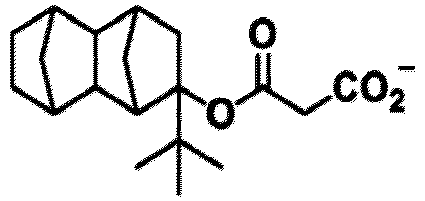





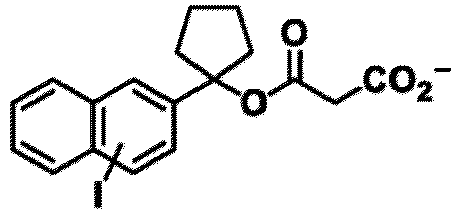

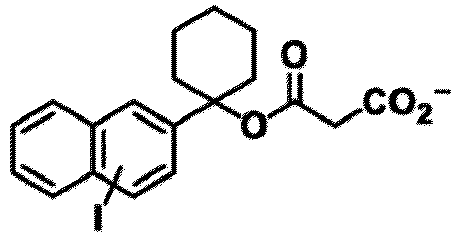











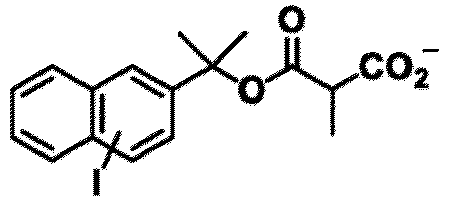


























- In formula (1), Z+ is an onium cation, preferably a sulfonium cation having the formula (cation-1), an iodonium cation having the formula (cation-2) or an ammonium cation having the formula (cation-3).

- In formulae (cation-1) to (cation-3), Rc1 to Rc9 are each independently halogen or a C1-C30 hydrocarbyl group which may contain a heteroatom. Suitable halogen atoms include fluorine, chlorine, bromine, and iodine. The hydrocarbyl group may be saturated or unsaturated and straight, branched or cyclic. Examples thereof include C1-C30 alkyl groups such as methyl, ethyl, n-propyl, isopropyl, n-butyl, isobutyl, sec-butyl, and tert-butyl; C3-C30 cyclic saturated hydrocarbyl groups such as cyclopropyl, cyclopentyl, cyclohexyl, cyclopropylmethyl, 4-methylcyclohexyl, cyclohexylmethyl, norbornyl, and adamantyl; C2-C30 alkenyl groups such as vinyl, allyl, propenyl, butenyl, and hexenyl; C3-C30 cyclic unsaturated hydrocarbyl groups such as cyclohexenyl; C6-C30 aryl groups such as phenyl, naphthyl and thienyl; C7-C30 aralkyl groups such as benzyl, 1-phenylethyl and 2-phenylethyl, and combinations thereof. Inter alia, aryl groups are preferred. In the hydrocarbyl group, some or all of the hydrogen atoms may be substituted by a moiety containing a heteroatom such as oxygen, sulfur, nitrogen or halogen and some constituent -CH2- may be replaced by a moiety containing a heteroatom such as oxygen, sulfur or nitrogen, so that the group may contain a hydroxy, cyano, fluorine, chlorine, bromine, iodine, carbonyl, ether bond, ester bond, sulfonic ester bond, carbonate bond, lactone ring, sultone ring, carboxylic anhydride (-C(=O)-O-C(=O)-), or haloalkyl moiety.
- Also, Rc1 and Rc2 may bond together to form a ring with the sulfur atom to which they are attached. Examples of the sulfonium cation having formula (cation-1) wherein R11 and R12 form a ring are shown below.


- Herein the broken line designates a point of attachment to Rc3.
- Examples of the sulfonium cation having formula (cation-1) are shown below, but not limited thereto.


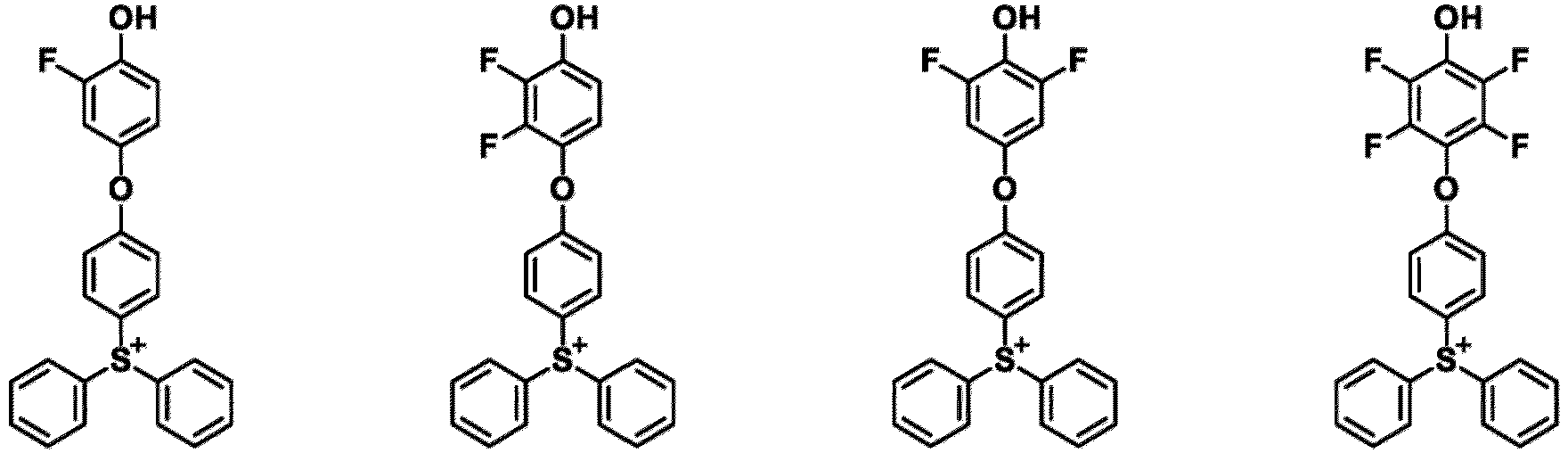


- Examples of the iodonium cation having formula (cation-2) are shown below, but not limited thereto.


- Examples of the ammonium cation having formula (cation-3) are shown below, but not limited thereto.


- Specific structures of the inventive onium salt include arbitrary combinations of the anion with the cation, both as exemplified above.
- The onium salt having formula (A1) may be synthesized, for example, according to the following scheme. Although reference is now made to the synthesis of onium salt (A1') wherein X is oxygen, the synthesis method is not limited thereto.

- Herein, R1 to R3 and Z+ are as defined above, Et stands for ethyl, M+ is a metal cation, and X- is an anion.
- First, a starting alcohol (SM-A) is esterified by reacting it with an acid chloride (SM-B). The starting alcohol (SM-A) is dissolved in a solvent such as tetrahydrofuran (THF) or acetonitrile, to which the acid chloride (SM-B) is added dropwise in the presence of a base such as pyridine or 2,6-lutidine. The reaction may be promoted by heating if necessary. While it is desirable in view of yield to monitor the reaction by gas chromatography (GC) or silica gel thin layer chromatography (TLC) until the reaction is complete, the reaction time is typically about 2 to 24 hours. The intermediate (In-A) may be collected from the reaction mixture by standard aqueous work-up. If necessary, the intermediate is purified by a standard technique such as distillation, chromatography or recrystallization.
- Next, the intermediate (In-A) is subjected to alkaline hydrolysis using a metal hydroxide: M-OH, to synthesize an intermediate (In-B). The intermediate (In-A) is dissolved in a solvent such as THF or acetonitrile, to which an aqueous solution of metal hydroxide: M-OH is added dropwise for alkaline hydrolysis. Examples of the metal hydroxide used herein include sodium hydroxide, potassium hydroxide, and lithium hydroxide. The reaction may be promoted by heating if necessary. While it is desirable in view of yield to monitor the reaction by silica gel TLC until the reaction is complete, the reaction time is typically about 2 to 24 hours. The intermediate (In-B) may be collected from the reaction mixture by standard aqueous work-up. If necessary, the intermediate is purified by a standard technique such as chromatography or recrystallization.
- The final step is a salt exchange between the intermediate (In-B) and an onium salt: Z+X- to synthesize an onium salt (A1'). Preferably X- is a hydrogencarbonate ion, chloride ion or bromide ion because the exchange reaction runs quantitatively.
- In the above-illustrated scheme, the third step of ion exchange may be readily carried out by any well-known procedure, for example, with reference to
JP-A 2007-145797 - It is noted that the preparation method according to the above scheme is merely exemplary and the method of preparing the inventive onium salt is not limited thereto.
- Another exemplary method of synthesizing the onium salt having formula (A1) is an ion exchange between a carboxylic acid having the anion in formula (A1) and an onium salt of a weaker acid than the carboxylic acid. Typical of the weaker acid than the carboxylic acid is carbonic acid. An alternative route of synthesis is an ion exchange between a sodium salt of a carboxylic acid having the anion in formula (A1) and a sulfonium chloride.
- The onium salt having formula (A1) functions as a quite effective quencher when applied to chemically amplified positive resist compositions.
- The onium salt of the structure defined herein functions as a quencher through the mechanism that it effectively traps the strong acid generated by the acid generator and converts to a 1,3-dicarboxylic acid monoester or 1,3-keto carboxylic acid structure. In the onium salt of formula (A1) wherein R3 forms an acid labile group with the adjacent oxygen atom, the acid labile group is eliminated as a result of reaction with a strong acid whereby the resist film is improved in sensitivity, and a 1,3-dicarboxylic acid (e.g., malonic acid) structure forms. The 1,3-dicarboxylic acid monoester, 1,3-keto carboxylic acid and 1,3-dicarboxylic acid undergo thermal decarbonation reaction during the subsequent step of PEB whereby they are decomposed into carbon dioxide and a corresponding acetic acid derivative or ketone derivative, which volatilize off the resist film. In the subsequent development step in alkaline developer, the carboxylic acid having a high affinity to the alkaline developer has been eliminated. This prevents the resist film from being swollen. The problem of resist pattern collapse which has been unsolved during formation of small-size patterns is overcome. Accordingly, the onium salt of formula (A1) is best suited for application in chemically amplified positive resist compositions.
- In the resist composition, the quencher (A) in the form of the onium salt having formula (A1) is preferably used in an amount of 0.1 to 20 parts by weight, more preferably 1 to 15 parts by weight per 80 parts by weight of the base polymer (B) described below. An amount of the onium salt having formula (A1) in the range ensures a satisfactory quenching function, eliminating the risk of lowering sensitivity or leaving foreign particles due to shortage of solubility. The onium salt having formula (A1) may be used alone or in admixture of two or more.
- The resist composition also comprises (B) a base polymer. The base polymer contains a polymer which is decomposed under the action of acid to increase its solubility in alkaline developer, the polymer comprising repeat units having the formula (B1), which are also referred to as repeat units B1.

- In formula (B1), a1 is 0 or 1. The subscript a2 is an integer of 0 to 2. The structure represents a benzene skeleton when a2=0, a naphthalene skeleton when a2=1, and an anthracene skeleton when a2=2. The subscript a3 is an integer satisfying 0 ≤ a3 ≤ 5+2(a2)-a4, and a4 is an integer of 1 to 3. In case of a2=0, preferably a3 is an integer of 0 to 3, and a4 is an integer of 1 to 3. In case of a2=1 or 2, preferably a3 is an integer of 0 to 4, and a4 is an integer of 1 to 3.
- In formula (B1), RA is hydrogen, fluorine, methyl or trifluoromethyl.
- In formula (B1), R11 is halogen, an optionally halogenated C1-C6 saturated hydrocarbyl group, optionally halogenated C1-C6 saturated hydrocarbyloxy group, or optionally halogenated C2-C8 saturated hydrocarbylcarbonyloxy group. The saturated hydrocarbyl group and saturated hydrocarbyl moiety in the saturated hydrocarbyloxy group and saturated hydrocarbylcarbonyloxy group may be straight, branched or cyclic, and examples thereof include alkyl groups such as methyl, ethyl, n-propyl, isopropyl, butyl, pentyl, hexyl, and structural isomers thereof, cycloalkyl groups such as cyclopropyl, cyclobutyl, cyclopentyl and cyclohexyl, and combinations thereof. A carbon count within the upper limit ensures good solubility in alkaline developer. A plurality of R11 may be identical or different when a3 is 2 or more.
- In formula (B1), A1 is a single bond or C1-C10 saturated hydrocarbylene group in which some constituent -CH2- may be replaced by -O-. The saturated hydrocarbylene group may be straight, branched or cyclic and examples thereof include C1-C10 alkanediyl groups such as methylene, ethane-1,2-diyl, propane-1,3-diyl, butane-1,4-diyl, pentane-1,5-diyl, hexane-1,6-diyl, and structural isomers thereof; C3-C10 cyclic saturated hydrocarbylene groups such as cyclopropanediyl, cyclobutanediyl, cyclopentanediyl, and cyclohexanediyl; and combinations thereof. For the saturated hydrocarbylene group containing an ether bond, in case of a1=1 in formula (B1), the ether bond may be incorporated at any position excluding the position between the α-carbon and β-carbon relative to the ester oxygen. In case of a1=0, the atom that bonds with the main chain becomes an ethereal oxygen, and a second ether bond may be incorporated at any position excluding the position between the α-carbon and β-carbon relative to that ethereal oxygen. Saturated hydrocarbylene groups having no more than 10 carbon atoms are desirable because of a sufficient solubility in alkaline developer.
- Preferred examples of the repeat units B1 wherein a1=0 and A1 is a single bond (meaning that the aromatic ring is directly bonded to the main chain of the polymer), that is, repeat units free of a linker: -C(=O)-O-A1- include units derived from 3-hydroxystyrene, 4-hydroxystyrene, 5-hydroxy-2-vinylnaphthalene, and 6-hydroxy-2-vinylnaphthalene. Repeat units having the formula (B1-1) are especially preferred.

- Preferred examples of the repeat units B1 wherein a1=1, that is, having a linker: - C(=O)-O-A1- are shown below, but not limited thereto. Herein RA is as defined above.


- The content of repeat units B1 is preferably 10 to 95 mol%, more preferably 40 to 90 mol% of the overall repeat units of the polymer. When the polymer further contains repeat units having formula (B3) and/or repeat units having formula (B4), which provide the polymer with higher etch resistance, the repeat units having a phenolic hydroxy group as a substituent, the total content of repeat units B1 and repeat units B3 and/or B4 is preferably in the range. The repeat units B1 may be used alone or in admixture of two or more.
- In a preferred embodiment, the polymer further contains repeat units B2 having an acidic functional group protected with an acid labile group (i.e., repeat units protected with an acid labile group and adapted to turn alkali soluble under the action of acid). In this embodiment wherein the acid labile group (or protective group) in the repeat unit undergoes deprotection reaction under the action of acid, the polymer turns more soluble in alkaline developer.
- Typical of the repeat unit B2 is a unit having the formula (B2-1), also referred to as repeat unit B2-1.

- In formula (B2-1), b1 is 0 or 1. The subscript b2 is an integer of 0 to 2. The structure represents a benzene skeleton when b2=0, a naphthalene skeleton when b2=1, and an anthracene skeleton when b2=2. The subscript b3 is an integer meeting 0 ≤ b3 ≤ 5+2(b2)-b4. The subscript b4 is an integer of 1 to 3, and b5 is 0 or 1. When b2=0, preferably b3 is an integer of 0 to 3 and b4 is an integer of 1 to 3. When b2=1 or 2, preferably b3 is an integer of 0 to 4 and b4 is an integer of 1 to 3.
- In formula (B2-1), RA is hydrogen, fluorine, methyl or trifluoromethyl.
- In formula (B2-1), R12 is halogen, an optionally halogenated C1-C6 saturated hydrocarbyl group, optionally halogenated C1-C6 saturated hydrocarbyloxy group, or optionally halogenated C2-C8 saturated hydrocarbylcarbonyloxy group. The saturated hydrocarbyl group and saturated hydrocarbyl moiety in the saturated hydrocarbyloxy group and saturated hydrocarbylcarbonyloxy group may be straight, branched or cyclic, and examples thereof include alkyl groups such as methyl, ethyl, n-propyl, isopropyl, butyl, pentyl, hexyl, and structural isomers thereof, cycloalkyl groups such as cyclopropyl, cyclobutyl, cyclopentyl and cyclohexyl, and combinations thereof. A carbon count within the upper limit ensures good solubility in alkaline developer. A plurality of R12 may be identical or different when b3 is 2 or more.
- In formula (B2-1), A2 is a single bond or a C1-C10 saturated hydrocarbylene group in which some constituent -CH2- may be replaced by -O-. The saturated hydrocarbylene group may be straight, branched or cyclic and examples thereof include C1-C10 alkanediyl groups such as methylene, ethane-1,2-diyl, propane-1,3-diyl, butane-1,4-diyl, pentane-1,5-diyl, hexane-1,6-diyl, and structural isomers thereof; C3-C10 cyclic saturated hydrocarbylene groups such as cyclopropanediyl, cyclobutanediyl, cyclopentanediyl, and cyclohexanediyl; and combinations thereof. For the saturated hydrocarbylene group containing an ether bond, in case of b1=1 in formula (B2-1), the ether bond may be incorporated at any position excluding the position between the α-carbon and β-carbon relative to the ester oxygen. In case of b1=0, the atom that bonds with the main chain becomes an ethereal oxygen, and a second ether bond may be incorporated at any position excluding the position between the α-carbon and β-carbon relative to that ethereal oxygen. Saturated hydrocarbylene groups having no more than 10 carbon atoms are desirable because of a sufficient solubility in alkaline developer.
- In formula (B2-1), X is an acid labile group when b4=1, and hydrogen or an acid labile group, at least one X being an acid labile group, when b4=2 or 3. That is, repeat units B2-1 have phenolic hydroxy groups bonded to an aromatic ring, at least one of which is protected with an acid labile group, or repeat units B2-1 have a carboxy group bonded to an aromatic ring, which is protected with an acid labile group. The acid labile group used herein is not particularly limited as long as it is commonly used in a number of well-known chemically amplified resist compositions and eliminated under the action of acid to release an acidic group. Examples of the acid labile group are as exemplified above for the acid labile group represented by R1 in formula (A1). Another acid labile group which can be used herein is a phenolic hydroxy group whose hydrogen is substituted by -CH2COO-(tertiary saturated hydrocarbyl group). The tertiary saturated hydrocarbyl group may be the same as the foregoing tertiary saturated hydrocarbyl group used for the protection of a phenolic hydroxy group.
- Another example of repeat unit B2 is a repeat unit having the following formula (B2-2), referred to as repeat unit B2-2. The repeat unit B2-2 which enables to increase the dissolution rate in the exposed region is a useful choice of the acid labile group-containing unit which affords satisfactory performance against line width variations during develop loading.
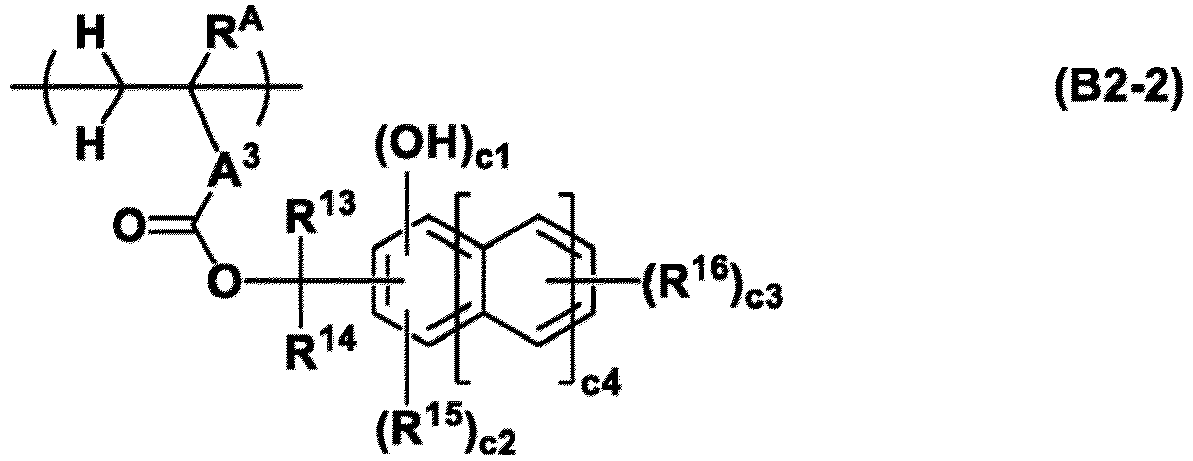
- In formula (B2-2), c1 is an integer of 0 to 2, c2 is an integer of 0 to 2, c3 is an integer of 0 to 5, and c4 is an integer of 0 to 2.
- In formula (B2-2), RA is hydrogen, fluorine, methyl or trifluoromethyl.
- In formula (B2-2), R13 and R14 are each independently a C1-C10 hydrocarbyl group which may contain a heteroatom. R13 and R14 may bond together to form a ring with the carbon atom to which they are attached.
- In formula (B2-2), R15 is each independently fluorine, C1-C5 fluorinated alkyl group or C1-C5 fluorinated alkoxy group.
- In formula (B2-2), R16 is each independently a C1-C10 hydrocarbyl group which may contain a heteroatom.
- In formula (B2-2), A3 is a single bond, phenylene group, naphthylene group, or *-C(=O)-O-A31-. A31 is a C1-C20 aliphatic hydrocarbylene group which may contain hydroxy, ether bond, ester bond or lactone ring, or a phenylene or naphthylene group, and * is a point of attachment to the carbon atom in the backbone.
- Preferred examples of the repeat unit B2-2 are shown below, but not limited thereto. Herein RA is as defined above.


- The content of repeat units B2 is preferably 5 to 50 mol% based on the overall repeat units of the polymer. Each of repeat units B2 may be of one type or a mixture of two or more types.
- In a preferred embodiment, the polymer further comprises repeat units of at least one type selected from units having the formulae (B3), (B4) and (B5). These repeat units are simply referred to as repeat units B3, B4 and B5, respectively.

- In formulae (B3) and (B4), d and e are each independently an integer of 0 to 4.
- In formulae (B3) and (B4), R21 and R22 are each independently hydroxy, halogen, an optionally halogenated C1-C8 saturated hydrocarbyl group, optionally halogenated C1-C8 saturated hydrocarbyloxy group, or optionally halogenated C2-C8 saturated hydrocarbylcarbonyloxy group. The saturated hydrocarbyl group, saturated hydrocarbyloxy group and saturated hydrocarbylcarbonyloxy group may be straight, branched or cyclic. When d is 2 or more, a plurality of groups R21 may be identical or different. When e is 2 or more, a plurality of groups R22 may be identical or different.
- In formula (B5), f1 is 0 or 1. The subscript f2 is an integer of 0 to 2, and the corresponding structure represents a benzene skeleton when f2=0, a naphthalene skeleton when f2=1, and an anthracene skeleton when f2=2. The subscript f3 is an integer of 0 to 5. In case of f2=0, preferably f3 is an integer of 0 to 3. In case of f2=1 or 2, preferably f3 is an integer of 0 to 4.
- In formula (B5), RA is hydrogen, fluorine, methyl or trifluoromethyl.
- In formula (B5), R23 is a C1-C20 saturated hydrocarbyl group, C1-C20 saturated hydrocarbyloxy group, C2-C20 saturated hydrocarbylcarbonyloxy group, C2-C20 saturated hydrocarbyloxyhydrocarbyl group, C2-C20 saturated hydrocarbylthiohydrocarbyl group, halogen atom, nitro group, cyano group, C1-C20 saturated hydrocarbylsulfinyl group, or C1-C20 saturated hydrocarbylsulfonyl group. The saturated hydrocarbyl group, saturated hydrocarbyloxy group, saturated hydrocarbylcarbonyloxy group, saturated hydrocarbyloxyhydrocarbyl group, saturated hydrocarbylthiohydrocarbyl group, saturated hydrocarbylsulfinyl group and saturated hydrocarbylsulfonyl group may be straight, branched or cyclic. When f3 is 2 or more, a plurality of groups R23 may be identical or different.
- R23 is preferably selected from halogen atoms such as chlorine, bromine and iodine; saturated hydrocarbyl groups such as methyl, ethyl, propyl, butyl, pentyl, hexyl, cyclopentyl, cyclohexyl, and structural isomers thereof; and saturated hydrocarbyloxy groups such as methoxy, ethoxy, propoxy, butoxy, pentyloxy, hexyloxy, cyclopentyloxy, cyclohexyloxy, and structural isomers of their hydrocarbon moiety. Inter alia, methoxy and ethoxy are most useful.
- The saturated hydrocarbylcarbonyloxy group may be readily introduced into a polymer even after polymerization, by a chemical modification method and is advantageously utilized for fine adjustment of the solubility of the polymer in alkaline developer. Examples of the saturated hydrocarbylcarbonyloxy group include methylcarbonyloxy, ethylcarbonyloxy, propylcarbonyloxy, butylcarbonyloxy, pentylcarbonyloxy, hexylcarbonyloxy, cyclopentylcarbonyloxy, cyclohexylcarbonyloxy, benzoyloxy, and structural isomers of their hydrocarbon moiety. As long as the carbon count is equal to or less than 20, an appropriate effect of controlling or adjusting (typically reducing) the solubility of the polymer in alkaline developer is obtainable, and the generation of scum or development defects may be suppressed.
- Of the foregoing preferred substituent groups, such substituent groups as chlorine, bromine, iodine, methyl, ethyl and methoxy are useful because the corresponding monomers may be readily prepared.
- In formula (B5), A4 is a single bond or C1-C10 saturated hydrocarbylene group in which some constituent -CH2- may be replaced by -O-. The saturated hydrocarbylene group may be straight, branched or cyclic. Examples thereof include C1-C10 alkanediyl groups such as methylene, ethane-1,2-diyl, propane-1,3-diyl, butane-1,4-diyl, pentane-1,5-diyl, hexane-1,6-diyl, and structural isomers thereof; C3-C10 cyclic saturated hydrocarbylene groups such as cyclopropanediyl, cyclobutanediyl, cyclopentanediyl, and cyclohexanediyl; and combinations thereof. For the saturated hydrocarbylene group containing an ether bond, in case of f1=1 in formula (B5), the ether bond may be incorporated at any position excluding the position between the α- and β-carbons relative to the ester oxygen. In case of f1=0, the atom bonding to the backbone becomes an ether oxygen atom, and a second ether bond may be incorporated at any position excluding the position between the α- and β-carbons relative to the ether oxygen. Saturated hydrocarbylene groups having no more than 10 carbon atoms are desirable because of a sufficient solubility in alkaline developer.
- Preferred examples of the repeat units B5 wherein f1 is 0 and A4 is a single bond (meaning that the aromatic ring is directly bonded to the main chain of the polymer), that is, repeat units free of the linker: -C(=O)-O-A4- include units derived from styrene, 4-chlorostyrene, 4-bromostyrene, 4-methylstyrene, 4-methoxystyrene, 4-acetoxystyrene, 2-hydroxypropylstyrene, 2-vinylnaphthalene, and 3-vinylnaphthalene.
- Preferred examples of the repeat units B5 wherein f1 is 1, that is, having the linker: - C(=O)-O-A4- are shown below, but not limited thereto. RA is as defined above.
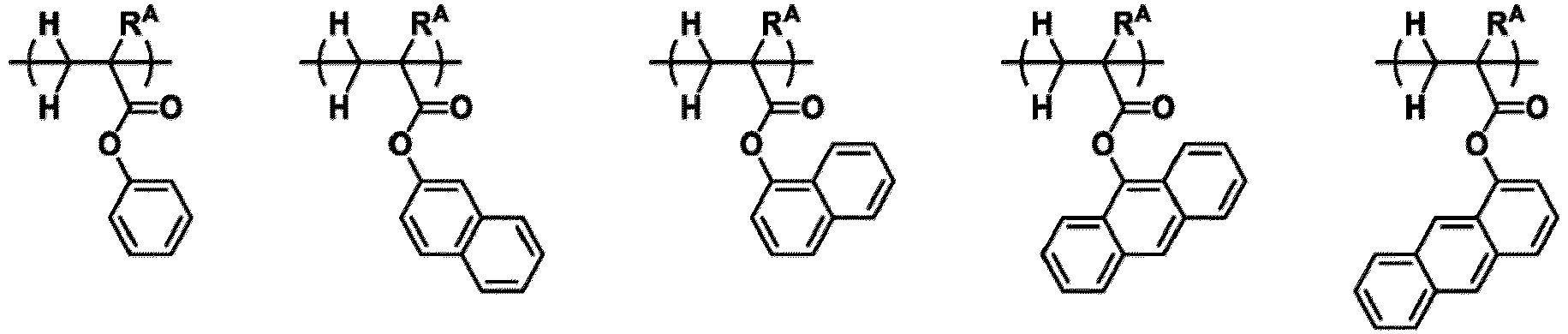


- When repeat units of at least one type selected from repeat units B3 to B5 are incorporated, better performance is obtained because not only the aromatic ring possesses etch resistance, but the cyclic structure incorporated into the main chain also exerts the effect of improving etch resistance and resistance to EB irradiation during pattern inspection step.
- The content of repeat units B3 to B5 is preferably at least 5 mol% based on the overall repeat units of the polymer for obtaining the effect of improving etch resistance. Also, the content of repeat units B3 to B5 is preferably up to 35 mol%, more preferably up to 30 mol% based on the overall repeat units of the polymer. When the relevant units are free of functional groups or have a functional group other than hydroxy, their content of up to 35 mol% is preferred because the risk of forming development defects is eliminated. Each of the repeat units B3 to B5 may be of one type or a combination of plural types.
- It is preferred that the polymer comprise repeat units B1, repeat units B2, and repeat units of at least one type selected from repeat units B3 to B5, because both etch resistance and high resolution are achievable. The total content of these repeat units is preferably at least 60 mol%, more preferably at least 70 mol%, even more preferably at least 80 mol% based on the overall repeat units of the polymer.
- In another preferred embodiment, the polymer further comprises repeat units of at least one type selected from repeat units having the formula (B6), repeat units having the formula (B7), repeat units having the formula (B8), repeat units having the formula (B9), repeat units having the formula (B10), repeat units having the formula (B11), repeat units having the formula (B12), and repeat units having the formula (B13), shown below. Notably these repeat units are also referred to as repeat units B6 to B13. The repeat units B6 to B13 are effective for suppressing acid diffusion and forming patterns with improved resolution and reduced LER.
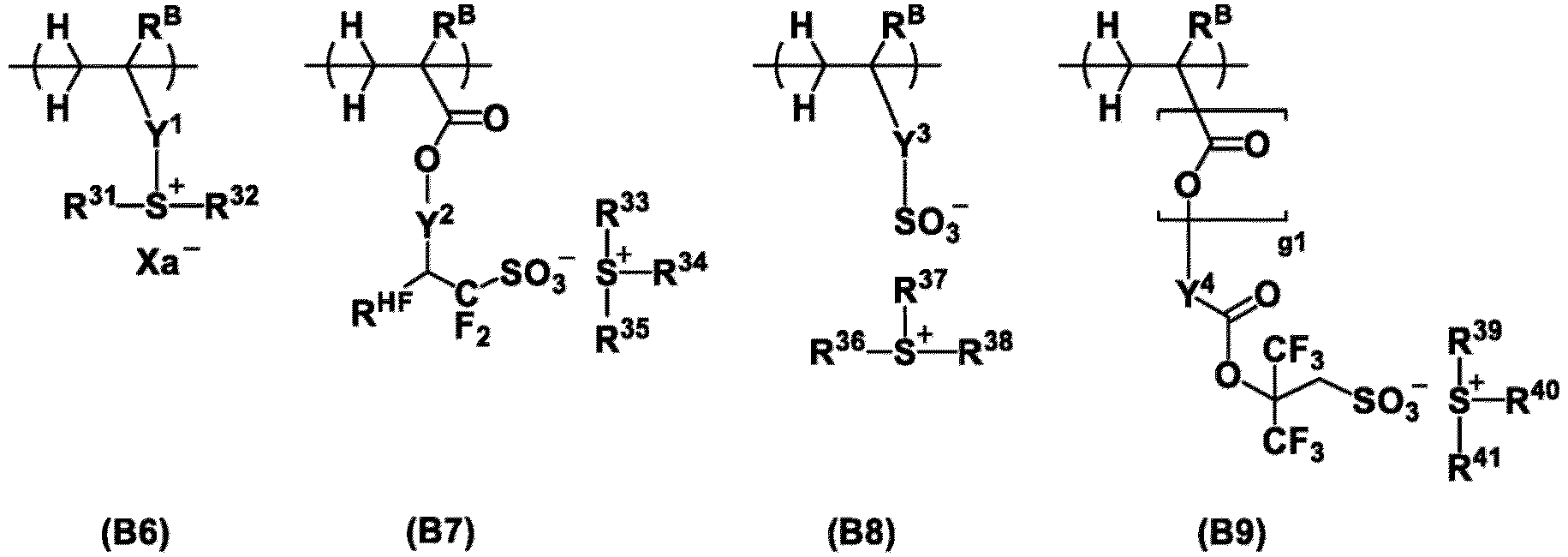

- In formulae (B6) to (B13), RB is each independently hydrogen or methyl. Y1 is a single bond, a C1-C6 aliphatic hydrocarbylene group, phenylene group, naphthylene group, or C7-C18 group obtained by combining the foregoing, *-O-Y11-, *-C(=O)-O-Y11-, or *-C(=O)-NH-Y11-, wherein Y11 is a C1-C6 aliphatic hydrocarbylene group, phenylene group, naphthylene group, or C7-C18 group obtained by combining the foregoing, which may contain a carbonyl moiety, ester bond, ether bond or hydroxy moiety. Y2 is a single bond or **-Z21-C(=O)-O-, wherein Y21 is a C1-C20 hydrocarbylene group which may contain a heteroatom. Y3 is a single bond, methylene, ethylene, phenylene, fluorinated phenylene, trifluoromethyl-substituted phenylene group, *-O-Y31-, *-C(=O)-O-Y31-, or *-C(=O)-NH-Y31-, wherein Y31 is a C1-C6 aliphatic hydrocarbylene group, phenylene group, fluorinated phenylene group, trifluoromethyl-substituted phenylene group, or C7-C20 group obtained by combining the foregoing, which may contain a carbonyl moiety, ester bond, ether bond or hydroxy moiety. The asterisk (*) is a point of attachment to the carbon atom in the backbone and the double asterisk (**) is a point of attachment to the oxygen atom in the formula. Y4 is a single bond or a C1-C30 hydrocarbylene group which may contain a heteroatom. The subscripts g1 and g2 are each independently 0 or 1. When Y4 is a single bond, g1 and g2 are 0.
- In formulae (B6) and (B10), Xa- is a non-nucleophilic counter ion, examples of which include those described in
JP-A 2010-113209 JP-A 2007-145797 - In formulae (B7) and (B11) wherein Y2 is -Y21-C(=O)-O-, Y21 is a C1-C20 hydrocarbylene group which may contain a heteroatom, examples of which are shown below, but not limited thereto.



- In formulae (B7) and (B11), RHF is hydrogen or trifluoromethyl. Examples of the repeat units B7 and B11 wherein RHF is hydrogen include those described in
JP-A 2010-116550 JP-A 2010-077404 JP-A 2012-246265 JP-A 2012-246426 - Preferred examples of the anion in the monomers from which repeat units B9 and B 13 are derived are shown below, but not limited thereto.





- In formulae (B6) to (B13), R31 to R48 are each independently halogen or a C1-C20 hydrocarbyl group which may contain a heteroatom. The hydrocarbyl group may be saturated or unsaturated and straight, branched or cyclic. Examples of the halogen and hydrocarbyl group are as exemplified above for the halogen and hydrocarbyl groups represented by Rc1 to Rc9 in formulae (cation-1) to (cation-3). In the hydrocarbyl group, some or all of the hydrogen atoms may be substituted by a moiety containing a heteroatom such as oxygen, sulfur, nitrogen or halogen, and some constituent -CH2- may be replaced by a moiety containing a heteroatom such as oxygen, sulfur or nitrogen, so that the group may contain a hydroxy moiety, fluorine, chlorine, bromine, iodine, cyano moiety, nitro moiety, carbonyl moiety, ether bond, ester bond, sulfonic ester bond, carbonate bond, lactone ring, sultone ring, carboxylic anhydride (-C(=O)-O-C(=O)-) or haloalkyl moiety.
- A pair of R31 and R32 may bond together to form a ring with the sulfur atom to which they are attached. Also, R33 and R34, R36 and R37, or R39 and R40 may bond together to form a ring with the sulfur atom to which they are attached. Examples of the ring are as exemplified for the ring that Rc1 and Rc2 in formula (cation-1), taken together, form with the sulfur atom to which they are attached.
- Examples of the sulfonium cation in repeat units B7 to B9 are as exemplified for the sulfonium cation having formula (cation-1). Examples of the iodonium cation in repeat units B11 to B13 are as exemplified for the iodonium cation having formula (cation-2).
- The repeat units B6 to B13 are capable of generating an acid upon receipt of high-energy radiation. The binding of these units into a polymer enables appropriate control of acid diffusion and formation of a pattern with reduced LER and improved CDU. Since the acidgenerating unit is bound to a polymer, the phenomenon that acid volatilizes from the exposed region and re-deposits on the unexposed region during bake in vacuum is suppressed. This is effective for improving LER and CDU and for suppressing unwanted deprotection reaction in the unexposed region for thereby reducing pattern defects.
- When the polymer contains repeat units B6 to B13, their content is preferably 0.5 to 30 mol% based on the overall repeat units of the polymer. Each of repeat units B6 to B13 may be of one type or a combination of plural types.
- The base polymer (B) may be a mixture of a polymer comprising repeat units B1 and repeat units of at least one type selected from repeat units B6 to B13, and a polymer comprising repeat units B 1, but free of repeat units B6 to B13. In the mixture, the content of the polymer free of repeat units B6 to B13 is preferably 2 to 5,000 parts by weight, more preferably 10 to 1,000 parts by weight per 100 parts by weight of the polymer containing repeat units B6 to B13.
- The polymer may further comprise (meth)acrylate units protected with an acid labile group or (meth)acrylate units having an adhesive group such as lactone structure or hydroxy group other than phenolic hydroxy as commonly used in the art. These repeat units are effective for fine adjustment of properties of a resist film, but not essential.
- Examples of the (meth)acrylate unit having an adhesive group include repeat units having the following formulae (B14) to (B16), which are also referred to as repeat units B14 to B16. While these units do not exhibit acidity, they may be used as auxiliary units for providing adhesion to substrates or adjusting solubility.
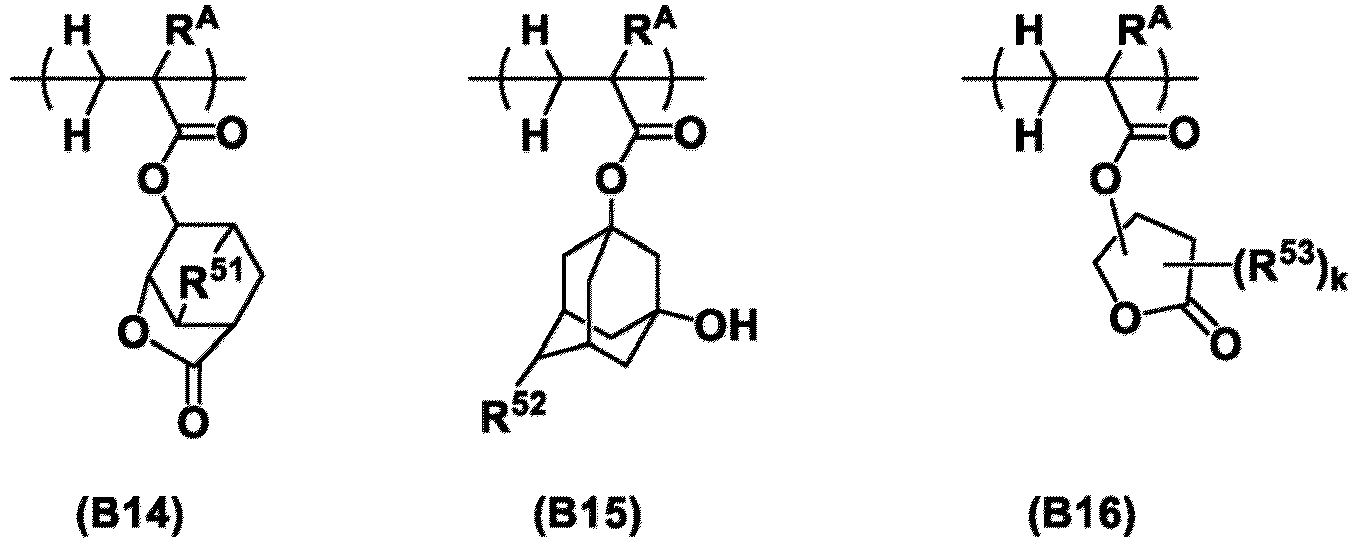
- In formulae (B14) to (B16), RA is each independently hydrogen, fluorine, methyl or trifluoromethyl. R51 is -O- or methylene. R52 is hydrogen or hydroxy. R53 is a C1-C4 saturated hydrocarbyl group, and k is an integer of 0 to 3.
- When repeat units B14 to B16 are included, their content is preferably 0 to 30 mol%, more preferably 0 to 20 mol% based on the overall repeat units of the polymer. Each of repeat units B14 to B16 may be of one type or a combination of plural types.
- The polymer may be synthesized by combining suitable monomers optionally protected with a protective group, copolymerizing them in the standard way, and effecting deprotection reaction if necessary. The copolymerization reaction is preferably radical or anionic polymerization though not limited thereto. For the polymerization reaction, reference may be made to
JP-A 2004-115630 - The polymer should preferably have a Mw of 1,000 to 50,000, and more preferably 2,000 to 20,000. A Mw of at least 1,000 eliminates the risk that pattern features are rounded at their top, inviting degradations of resolution, LER and CDU. A Mw of up to 50,000 eliminates the risk that LER and CDU are degraded when a pattern with a line width of up to 100 nm is formed. As used herein, Mw is measured by GPC versus polystyrene standards using tetrahydrofuran (THF) or dimethylformamide (DMF) solvent.
- The polymer preferably has a narrow molecular weight distribution or dispersity (Mw/Mn) of 1.0 to 2.0, more preferably 1.0 to 1.8. A polymer with such a narrow dispersity eliminates the risk that foreign particles are left on the pattern after development and the pattern profile is aggravated.
- The chemically amplified positive resist composition may further comprise a photoacid generator (PAG). The PAG used herein may be any compound capable of generating an acid upon exposure to high-energy radiation. Suitable PAGs include sulfonium salts, iodonium salts, sulfonyldiazomethane, N-sulfonyloxyimide, and oxime-O-sulfonate acid generators.
- Suitable PAGs include nonafluorobutane sulfonate, partially fluorinated sulfonates described in
JP-A 2012-189977 JP-A 2013-101271 JP-A 2008-111103 JP-A 2010-215608 - In order to obtain the effect of improving LER and CDU when the PAG is combined with the quencher (A), the PAG generates an acid having a pKa value of preferably -3.0 or larger, more preferably -3.0 to 2.0, even more preferably -2.0 to 1.5.
- The preferred PAGs are salt compounds having a sulfonium anion of the structure shown below.


- Preferred examples of the cation that pairs with the anion include examples of the sulfonium cation having formula (cation-1) and examples of the iodonium cation having formula (cation-2).
- When the resist composition contains the PAG (C), the amount of the PAG (C) used is preferably 1 to 30 parts, more preferably 2 to 20 parts by weight per 80 parts by weight of the base polymer (B). The PAG (C) may be omitted when the base polymer contains repeat units B6 to B13, that is, in case of polymer-bound acid generator. The PAG may be used alone or in admixture.
- When the chemically amplified positive resist composition contains both the quencher (A) and the PAG (C), the weight ratio (C)/(A) of the PAG to the quencher is preferably less than 6/1, more preferably less than 511, even more preferably less than 4/1. As long as the weight ratio of the PAG to the quencher is in the range, the resist composition is able to fully suppress acid diffusion, leading to improved resolution and dimensional uniformity.
- The chemically amplified positive resist composition may further comprise a fluorinated polymer for the purposes of enhancing contrast, preventing chemical flare of acid upon exposure to high-energy radiation, preventing mixing of acid from an anti-charging film in the step of coating an anti-charging film-forming material on a resist film, and suppressing unexpected unnecessary pattern degradation. The fluorinated polymer contains repeat units of at least one type selected from repeat units having the formula (D1), repeat units having the formula (D2), repeat units having the formula (D3), and repeat units having the formula (D4), and may contain repeat units of at least one type selected from repeat units having the formula (D5) and repeat units having the formula (D6). It is noted that repeat units having formulae (D1), (D2), (D3), (D4), (D5), and (D6) are also referred to as repeat units D1, D2, D3, D4, D5, and D6, respectively, hereinafter. Since the fluorinated polymer also has a surface active function, it can prevent insoluble residues from re-depositing onto the substrate during the development step and is thus effective for preventing development defects.


- In formulae (D1) to (D6), x is an integer of 1 to 3, y is an integer satisfying: 0 ≤ y ≤ 5+2z-x, z is 0 or 1, and h is an integer of 1 to 3. RC is each independently hydrogen, fluorine, methyl or trifluoromethyl. RD is each independently hydrogen or methyl. R101, R102, R104 and R105 are each independently hydrogen or a C1-C10 saturated hydrocarbyl group. R103, R106, R107 and R108 are each independently hydrogen, a C1-C15 hydrocarbyl group or fluorinated hydrocarbyl group, or an acid labile group, with the proviso that an ether bond or carbonyl moiety may intervene in a carbon-carbon bond in the hydrocarbyl groups or fluorinated hydrocarbyl groups represented by R103, R106, R107 and R108. R109 is hydrogen or a C1-C5 straight or branched hydrocarbyl group in which a heteroatom-containing moiety may intervene in a carbon-carbon bond. R110 is a C1-C5 straight or branched hydrocarbyl group in which a heteroatom-containing moiety may intervene in a carbon-carbon bond. R111 is a C1-C20 saturated hydrocarbyl group in which at least one hydrogen is substituted by fluorine and some constituent -CH2- may be replaced by an ester bond or ether bond. Z1 is a C1-C20 (h+1)-valent hydrocarbon group or C1-C20 (h+1)-valent fluorinated hydrocarbon group. Z2 is a single bond, *-C(=O)-O- or *-C(=O)-NH- wherein * designates a point of attachment to the carbon atom in the backbone. Z3 is a single bond, -O-, *-C(=O)-O-Z31-Z32- or *-C(=O)-NH-Z31-Z32-, wherein Z31 is a single bond or a C1-C10 saturated hydrocarbylene group, Z32 is a single bond, ester bond, ether bond or sulfonamide bond, and * designates a point of attachment to the carbon atom in the backbone.
- In formulae (D1) and (D2), the C1-C10 saturated hydrocarbyl group represented by R101, R102, R104 and R105 may be straight, branched or cyclic and examples thereof include C1-C10 alkyl groups such as methyl, ethyl, n-propyl, isopropyl, n-butyl, isobutyl, sec-butyl, tert-butyl, n-pentyl, n-hexyl, n-heptyl, n-octyl, n-nonyl, and n-decyl, and C3-C10 cyclic saturated hydrocarbyl groups such as cyclopropyl, cyclobutyl, cyclopentyl, cyclohexyl, adamantyl, and norbornyl. Inter alia, C1-C6 saturated hydrocarbyl groups are preferred.
- In formulae (D1) to (D4), the C1-C15 hydrocarbyl group represented by R103, R106, R107 and R108 may be straight, branched or cyclic and examples thereof include C1-C15 alkyl, C2-C15 alkenyl and C2-C15 alkynyl groups, with the alkyl groups being preferred. Suitable alkyl groups include methyl, ethyl, n-propyl, isopropyl, n-butyl, isobutyl, sec-butyl, n-pentyl, n-hexyl, n-heptyl, n-octyl, n-nonyl, n-decyl, n-undecyl, n-dodecyl, n-tridecyl, n-tetradecyl and n-pentadecyl. The fluorinated hydrocarbyl groups correspond to the foregoing hydrocarbyl groups in which some or all carbon-bonded hydrogen atoms are substituted by fluorine atoms.
- In formula (D4), examples of the C1-C20 (h+1)-valent hydrocarbon group Z1 include the foregoing C1-C20 alkyl groups and C3-C20 cyclic saturated hydrocarbyl groups, with h number of hydrogen atoms being eliminated. Examples of the C1-C20 (h+1)-valent fluorinated hydrocarbon group Z1 include the foregoing (h+1)-valent hydrocarbon groups in which at least one hydrogen atom is substituted by fluorine.
- Examples of the repeat units D1 to D4 are given below, but not limited thereto. Herein RC is as defined above.


- In formula (D5), examples of the C1-C5 hydrocarbyl groups R109 and R110 include alkyl, alkenyl and alkynyl groups, with the alkyl groups being preferred. Suitable alkyl groups include methyl, ethyl, n-propyl, isopropyl, n-butyl, isobutyl, sec-butyl, and n-pentyl. In these groups, a moiety containing a heteroatom such as oxygen, sulfur or nitrogen may intervene in a carbon-carbon bond.
- In formula (D5), -OR109 is preferably a hydrophilic group. In this case, R109 is preferably hydrogen or a C1-C5 alkyl group in which oxygen intervenes in a carbon-carbon bond.
- In formula (D5), Z2 is preferably *-C(=O)-O- or *-C(=O)-NH-. Also preferably RD is methyl. The inclusion of carbonyl in Z2 enhances the ability to trap the acid originating from the anti-charging film. A polymer wherein RD is methyl is a robust polymer having a high glass transition temperature (Tg) which is effective for suppressing acid diffusion. As a result, the resist film is improved in stability with time, and neither resolution nor pattern profile is degraded.
- Examples of the repeat unit D5 are given below, but not limited thereto. Herein RD is as defined above.


- In formula (D6), the C1-C10 saturated hydrocarbylene group Z3 may be straight, branched or cyclic and examples thereof include methanediyl, ethane-1,1-diyl, ethane-1,2-diyl, propane-1,1-diyl, propane-1,2-diyl, propane-1,3-diyl, propane-2,2-diyl, butane-1,1-diyl, butane-1,2-diyl, butane-1,3-diyl, butane-2,3-diyl, butane-1,4-diyl, and 1,1-dimethylethane-1,2-diyl.
- The C1-C20 saturated hydrocarbyl group having at least one hydrogen substituted by fluorine, represented by R111, may be straight, branched or cyclic and examples thereof include C1-C20 alkyl groups and C3-C20 cyclic saturated hydrocarbyl groups in which at least one hydrogen is substituted by fluorine.
- Examples of the repeat unit D6 are given below, but not limited thereto. Herein RD is as defined above.


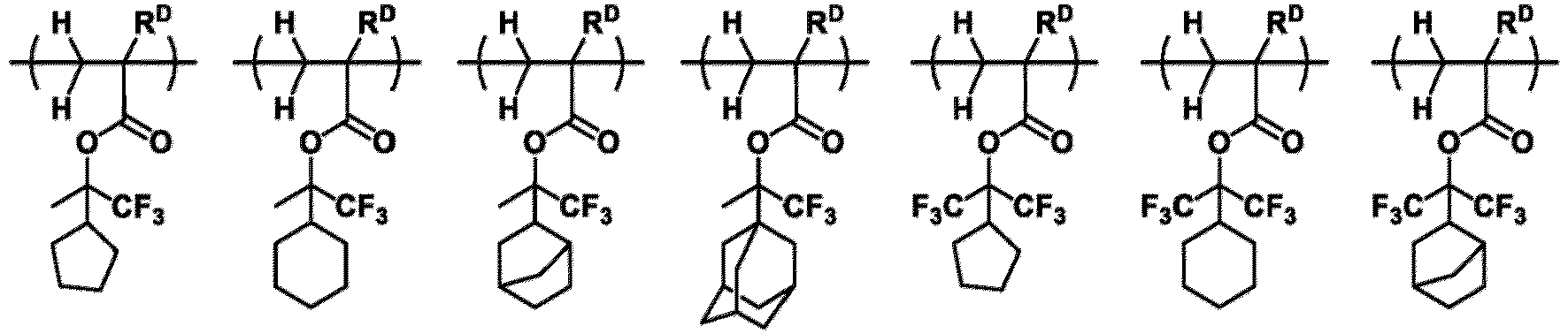
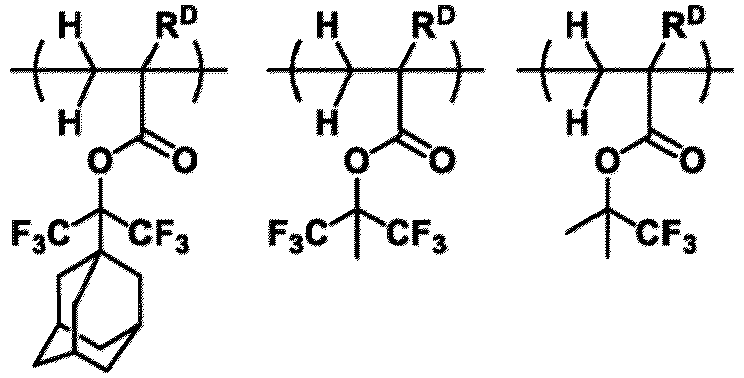
- The content of repeat units D1 to D4 is preferably 15 to 95 mol%, more preferably 20 to 85 mol% based on the overall repeat units of the fluorinated polymer. The content of repeat unit D5 and/or D6 is preferably 5 to 85 mol%, more preferably 15 to 80 mol% based on the overall repeat units of the fluorinated polymer. Each of repeat units D1 to D6 may be used alone or in admixture.
- The fluorinated polymer may comprise additional repeat units as well as the repeat units D1 to D6. Suitable additional repeat units include those described in
USP 9,091,918 JP-A 2014-177407 - The fluorinated polymer may be synthesized by combining suitable monomers optionally protected with a protective group, copolymerizing them in the standard way, and effecting deprotection reaction if necessary. The copolymerization reaction is preferably radical or anionic polymerization though not limited thereto. For the polymerization reaction, reference may be made to
JP-A 2004-115630 - The fluorinated polymer should preferably have a Mw of 2,000 to 50,000, and more preferably 3,000 to 20,000. A fluorinated polymer with a Mw of less than 2,000 may help acid diffusion, degrading resolution and detracting from age stability. A polymer with too high Mw may have a reduced solubility in solvent, with a risk of leaving coating defects. The fluorinated polymer preferably has a dispersity (Mw/Mn) of 1.0 to 2.2, more preferably 1.0 to 1.7.
- In the resist composition, the fluorinated polymer (D) is preferably used in an amount of 0.01 to 30 parts by weight, more preferably 0.1 to 20 parts by weight, even more preferably 0.5 to 10 parts by weight per 80 parts by weight of the base polymer (B). The fluorinated polymer may be used alone or in admixture.
- The chemically amplified positive resist composition may further comprise an organic solvent as component (E). The organic solvent used herein is not particularly limited as long as the components are soluble therein. Examples of the organic solvent are described in
JP-A 2008-111103 USP 7,537,880 ). Specifically, exemplary solvents include ketones such as cyclohexanone, cyclopentanone, methyl-2-n-pentyl ketone and 2-heptanone; alcohols such as 3-methoxybutanol, 3-methyl-3-methoxybutanol, 1-methoxy-2-propanol, 1-ethoxy-2-propanol, and diacetone alcohol; ethers such as propylene glycol monomethyl ether (PGME), ethylene glycol monomethyl ether, propylene glycol monoethyl ether, ethylene glycol monoethyl ether, propylene glycol dimethyl ether, and diethylene glycol dimethyl ether; esters such as propylene glycol monomethyl ether acetate (PGMEA), propylene glycol monoethyl ether acetate, ethyl lactate (EL), ethyl pyruvate, butyl acetate, methyl 3-methoxypropionate, ethyl 3-ethoxypropionate, t-butyl acetate, t-butyl propionate, and propylene glycol mono-t-butyl ether acetate; and lactones such as γ-butyrolactone (GBL), and mixtures thereof. Where an acid labile group of acetal form is used, a high boiling alcohol solvent such as diethylene glycol, propylene glycol, glycerol, 1,4-butanediol or 1,3-butanediol may be added to accelerate deprotection reaction of acetal. - Of the above organic solvents, it is recommended to use 1-ethoxy-2-propanol, PGMEA, PGME, cyclohexanone, EL, GBL, and mixtures thereof.
- In the positive resist composition, the organic solvent (E) is preferably used in an amount of 200 to 10,000 parts, more preferably 400 to 5,000 parts by weight per 80 parts by weight of the base polymer (B). The organic solvent may be used alone or in admixture.
- In the positive resist composition, (F) a basic compound may be added as the quencher other than component (A) for the purpose of correcting a pattern profile or the like. The basic compound is effective for controlling acid diffusion. Even when the resist film is applied to a substrate having an outermost surface layer made of a material containing chromium, tantalum or silicon, the basic compound is effective for minimizing the influence of the acid generated in the resist film on the substrate.
- Numerous basic compounds are known useful including primary, secondary, and tertiary aliphatic amines, mixed amines, aromatic amines, heterocyclic amines, nitrogen-containing compounds with carboxy group, nitrogen-containing compounds with sulfonyl group, nitrogen-containing compounds with hydroxy group, nitrogen-containing compounds with hydroxyphenyl group, alcoholic nitrogen-containing compounds, amide derivatives, imide derivatives, carbamate derivatives, and ammonium salts. Examples are described in Patent Document 9, for example, and any such compounds are useful. Of the foregoing basic compounds, preferred are tris[2-(methoxymethoxy)ethyl]amine, tris[2-(methoxymethoxy)ethyl]amine-N-oxide, dibutylaminobenzoic acid, morpholine derivatives and imidazole derivatives.
- In the positive resist composition, the basic compound (F) is preferably added in an amount of 0 to 10 parts, and more preferably 0 to 5 parts by weight per 80 parts by weight of the base polymer (B). The basic compounds may be used alone or in admixture.
- The positive resist composition may contain any conventional surfactants for facilitating to coat the composition to the substrate. A number of surfactants are known in the art as described in
JP-A 2004-115630 - Another embodiment of the invention is a resist pattern forming process comprising the steps of applying the chemically amplified positive resist composition defined above onto a substrate to form a resist film thereon, exposing the resist film patternwise to high-energy radiation, and developing the exposed resist film in an alkaline developer to form a resist pattern.
- The substrate used herein may be selected from, for example, substrates for IC fabrication, e.g., Si, SiO, SiO2, SiN, SiON, TiN, WSi, BPSG, SOG, and organic antireflective coating, and substrates for mask circuit fabrication, e.g., Cr, CrO, CrON, MoSi2, Si, SiO, SiO2, SiON, SiONC, CoTa, NiTa, TaBN, and SnO2.
- First the resist composition is applied onto a substrate by a suitable coating technique such as spin coating. The coating is prebaked on a hotplate preferably at a temperature of 60 to 150°C for 1 to 20 minutes, more preferably at 80 to 140°C for 1 to 10 minutes to form a resist film of 0.03 to 2 µm thick.
- Then the resist film is exposed patternwise to high-energy radiation such as UV, deep-UV, excimer laser (KrF, ArF), EUV, x-ray, γ-ray, synchrotron radiation or EB. The resist composition of the invention is especially effective in the EUV or EB lithography.
- On use of UV, deep-UV, EUV, excimer laser, x-ray, γ-ray or synchrotron radiation as the high-energy radiation, the resist film is exposed through a mask having a desired pattern, preferably in a dose of 1 to 500 mJ/cm2, more preferably 10 to 400 mJ/cm2. On use of EB, a pattern may be written directly in a dose of preferably 1 to 500 µC/cm2, more preferably 10 to 400 µC/cm2.
- The exposure may be performed by conventional lithography whereas the immersion lithography of holding a liquid, typically water between the mask and the resist film may be employed if desired. In the immersion lithography, a protective film which is insoluble in water may be used.
- The resist film is then baked (PEB) on a hotplate preferably at 60 to 150°C for 1 to 20 minutes, more preferably at 80 to 140°C for 1 to 10 minutes.
- Thereafter, the resist film is developed with a developer in the form of an aqueous base solution, for example, 0.1 to 5 wt%, preferably 2 to 3 wt% aqueous solution of tetramethylammonium hydroxide (TMAH) preferably for 0.1 to 3 minutes, more preferably 0.5 to 2 minutes by conventional techniques such as dip, puddle and spray techniques. In this way, a desired resist pattern is formed on the substrate.
- From the positive resist composition, a pattern with a high resolution and reduced LER can be formed. The resist composition is effectively applicable to a substrate, specifically a substrate having a surface layer of material to which a resist film is less adherent and which is likely to invite pattern stripping or pattern collapse, and particularly a substrate having sputter deposited on its outermost surface metallic chromium or a chromium compound containing at least one light element selected from oxygen, nitrogen and carbon or a substrate having an outermost surface layer of SiO, SiOx, or a tantalum compound, molybdenum compound, cobalt compound, nickel compound, tungsten compound or tin compound. The substrate to which the positive resist composition is applied is most typically a photomask blank which may be either of transmission or reflection type.
- The mask blank of transmission type is typically a photomask blank having a light-shielding film of chromium-based material. It may be either a photomask blank for binary masks or a photomask blank for phase shift masks. In the case of the binary mask-forming photomask blank, the light-shielding film may include an antireflection layer of chromium-based material and a light-shielding layer. In one example, the antireflection layer on the surface layer side is entirely composed of a chromium-based material. In an alternative example, only a surface side portion of the antireflection layer on the surface layer side is composed of a chromium-based material and the remaining portion is composed of a silicon compound-based material which may contain a transition metal. In the case of the phase shift mask-forming photomask blank, it may include a phase shift film and a chromium-based light-shielding film thereon.
- Photomask blanks having an outermost layer of chromium base material are well known as described in
JP-A 2008-026500 JP-A 2007-302873 - In the example where a light-shielding film including an antireflective layer and a light-shielding layer is composed of chromium base materials, layers may be stacked in the order of an antireflective layer and a light-shielding layer from the outer surface side, or layers may be stacked in the order of an antireflective layer, a light-shielding layer, and an antireflective layer from the outer surface side. Each of the antireflective layer and the light-shielding layer may be composed of multiple sub-layers. When the sub-layers have different compositions, the composition may be graded discontinuously or continuously from sub-layer to sub-layer. The chromium base material used herein may be metallic chromium or a material consisting of metallic chromium and a light element such as oxygen, nitrogen or carbon. Examples used herein include metallic chromium, chromium oxide, chromium nitride, chromium carbide, chromium oxynitride, chromium oxycarbide, chromium nitride carbide, and chromium oxide nitride carbide.
- The mask blank of reflection type includes a substrate, a multilayer reflective film formed on one major surface (front surface) of the substrate, for example, a multilayer reflective film of reflecting exposure radiation such as EUV radiation, and an absorber film formed on the multilayer reflective film, for example, an absorber film of absorbing exposure radiation such as EUV radiation to reduce reflectivity. From the reflection type mask blank (reflection type mask blank for EUV lithography), a reflection type mask (reflection type mask for EUV lithography) having an absorber pattern (patterned absorber film) formed by patterning the absorber film is produced. The EUV radiation used in the EUV lithography has a wavelength of 13 to 14 nm, typically about 13.5 nm.
- The multilayer reflective film is preferably formed contiguous to one major surface of a substrate. An underlay film may be disposed between the substrate and the multilayer reflective film as long as the benefits of the invention are not lost. The absorber film may be formed contiguous to the multilayer reflective film while a protective film (protective film for the multilayer reflective film) may be disposed between the multilayer reflective film and the absorber film, preferably contiguous to the multilayer reflective film, more preferably contiguous to the multilayer reflective film and the absorber film. The protective film is used for protecting the multilayer reflective film in a cleaning, tailoring or otherwise processing step. Also preferably, the protective film has an additional function of protecting the multilayer reflective film or preventing the multilayer reflective film from oxidation during the step of patterning the absorber film by etching. Besides, an electroconductive film, which is used for electrostatic chucking of the reflection type mask to an exposure tool, may be disposed below the other major surface (back side surface) which is opposed to the one major surface of the substrate, preferably contiguous to the other major surface. It is provided herein that a substrate has one major surface which is a front or upper side surface and another major surface which is a back or lower side surface. The terms "front and back" sides or "upper and lower" sides are used for the sake of convenience. One or another major surface may be either of the two major surfaces (film-bearing surfaces) of a substrate, and in this sense, front and back or upper and lower are exchangeable. Specifically, the multilayer reflective film may be formed by any of the methods of
JP-A 2021-139970 - Even on a substrate (typically mask blank) whose outermost surface is made of a material tending to affect resist pattern profile such as a chromium or silicon-containing material, the resist pattern forming process is successful in forming patterns having a high resolution, reduced LER, fidelity and improved dose margin because the resist composition is effective for controlling acid diffusion at the substrate interface.
- Examples of the invention are given below by way of illustration and not by way of limitation. The abbreviation "pbw" is parts by weight. For copolymers, the compositional ratio is a molar ratio and Mw is determined by GPC versus polystyrene standards using THF or DMF solvent.
- Chemically amplified positive resist compositions (R-1 to R-40, CR-1 to CR-8) were prepared by dissolving selected components in an organic solvent in accordance with the formulation shown in Tables 1 to 3, and filtering the solution through a UPE filter and/or nylon filter with a pore size of 10 nm, 5 nm, 3 nm or 1 nm. The organic solvent was a mixture of 900 pbw of PGMEA, 1,800 pbw of EL, and 1,800 pbw of PGME.


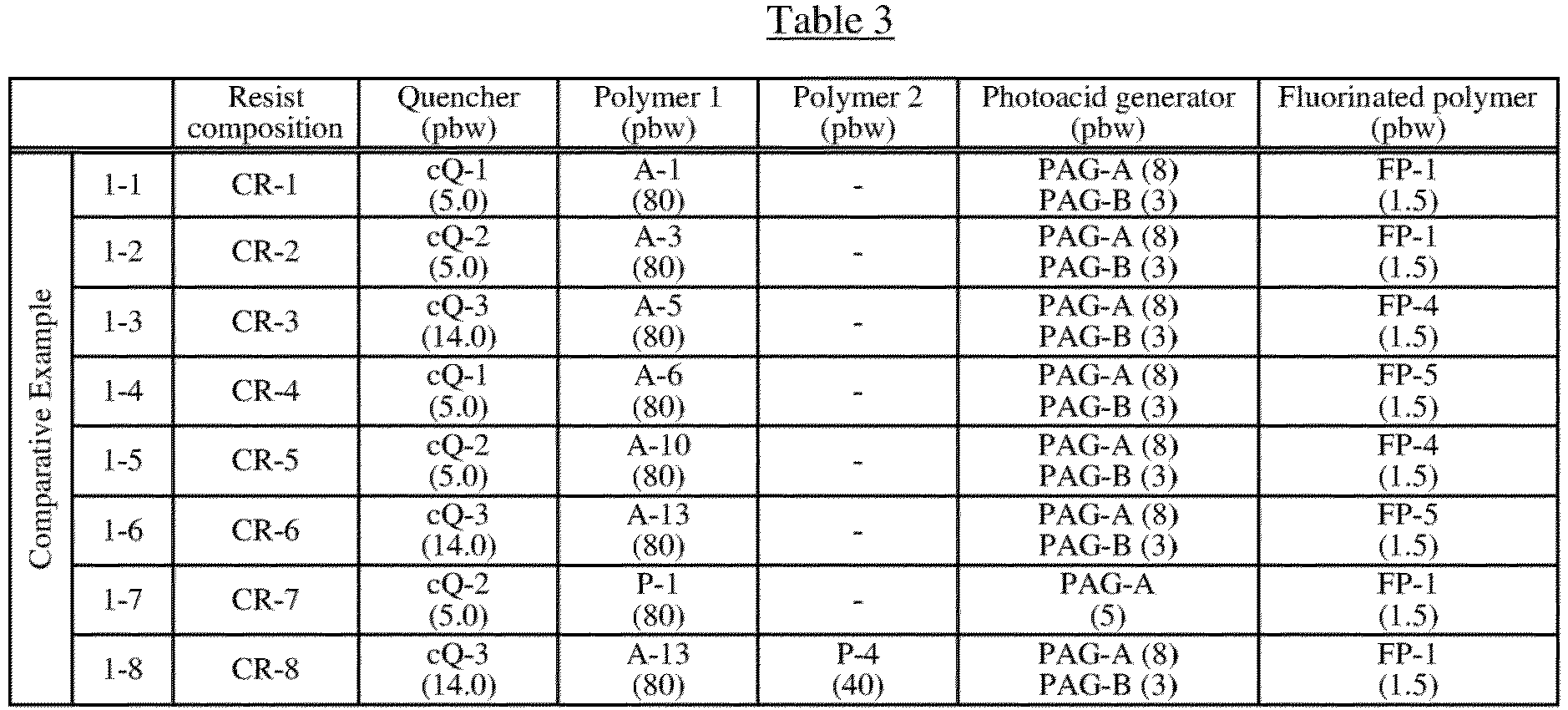
- In Tables 1 to 3, quenchers Q-1 to Q-8, comparative quenchers cQ-1 to cQ-3, polymers A-1 to A-14, polymers P-1 to P-5, acid generators PAG-A to PAG-D, and fluorinated polymers FP-1 to FP-5 are identified below.


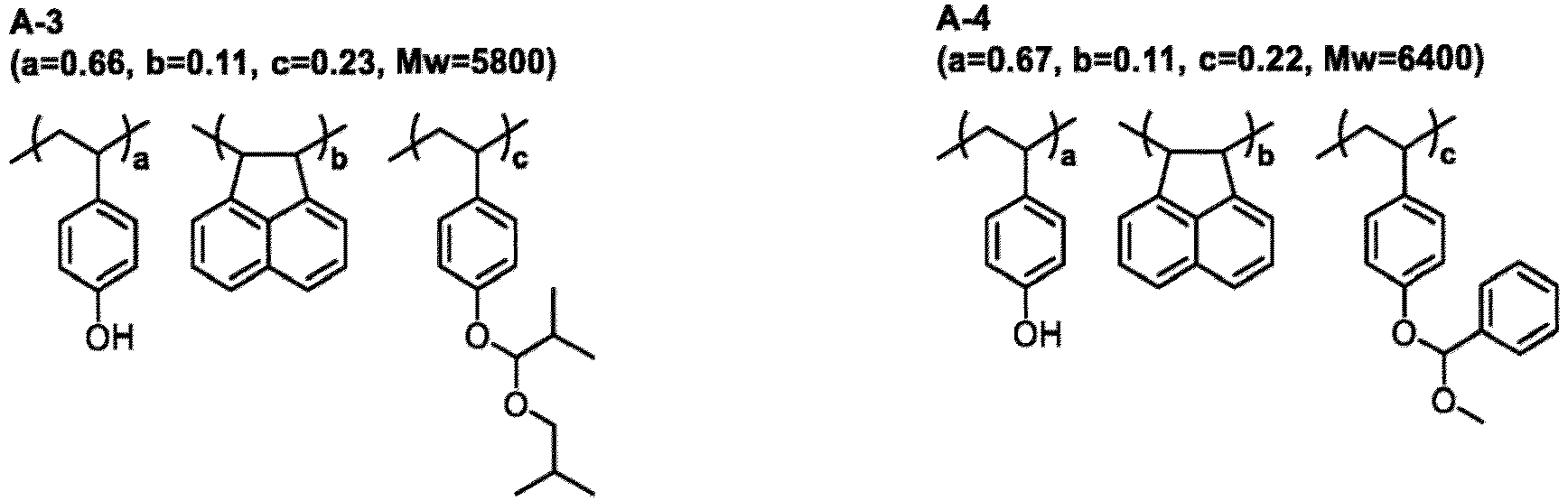


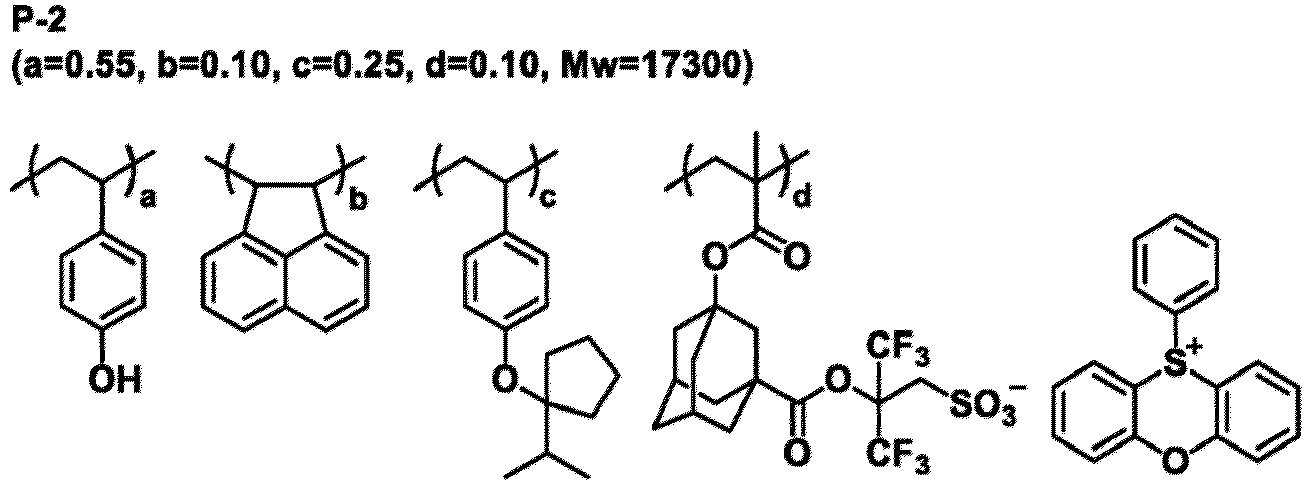


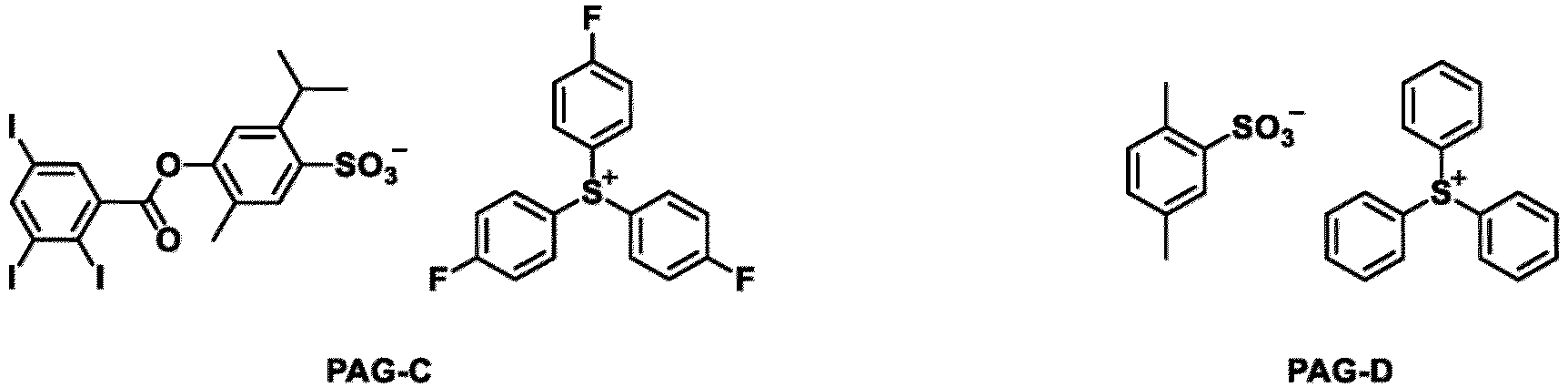


- Using a coater/developer system ACT-M (Tokyo Electron Ltd.), each of the positive resist compositions (R-1 to R-40 and CR-1 to CR-8) was spin coated onto a mask blank of 152 mm squares having the outermost surface in the form of a silicon oxide film, which had been vapor primed with hexamethyldisilazane (HMDS), and prebaked on a hotplate at 110°C for 600 seconds to form a resist film of 80 nm thick. The thickness of the resist film was measured by an optical film thickness measurement system Nanospec (Nanometrics Inc.). Measurement was made at 81 points in the plane of the blank substrate excluding a peripheral band extending 10 mm inward from the blank periphery, and an average film thickness and a film thickness range were computed therefrom.
- The resist film was exposed to EB using an EB writer system EBM-5000Plus (NuFlare Technology Inc., accelerating voltage 50 kV), then baked (PEB) at 120°C for 600 seconds, and developed in a 2.38 wt% TMAH aqueous solution, thereby yielding a positive pattern.
- The resist pattern was evaluated as follows. The patterned mask blank was observed under a top-down scanning electron microscope (TDSEM). The optimum dose (Eop) was defined as the exposure dose (µC/cm2) which provided a 1:1 resolution at the top and bottom of a 200-nm 1:1 line-and-space (LS) pattern. The resolution (or maximum resolution) was defined as the minimum line width of a LS pattern that could be resolved at the optimum dose. The 200-nm LS pattern printed by exposure at the optimum dose (Eop) was observed under SEM. For each of the edges of 32 lines of the LS pattern, edge detection was carried out at 80 points, from which a 3-fold value (3σ) of the standard deviation (σ) or variation was determined and reported as LER (nm). A change of CD per µC relative to the exposure dose providing 1:1 resolution was determined from the dose curve. The results are shown in Tables 4 to 6.


- All the chemically amplified positive resist compositions (R-1 to R-40) within the scope of the invention show satisfactory resolution and acceptable values of LER and dose margin because the onium salt having formula (A1) exerts an acid diffusion-suppressing effect, as compared with the comparative resist compositions (CR-1 to CR-8).
- Using the chemically amplified positive resist composition within the scope of the invention, a resist pattern having a very high resolution, reduced LER and improved dose margin can be formed. The resist pattern forming process using the positive resist composition is useful in photolithography for the fabrication of semiconductor devices and the processing of photomask blanks of transmission or reflection type.
- The invention can be illustrated by the following items:
- 1. A chemically amplified positive resist composition comprising (A) a quencher in the form of an onium salt having the formula (A1) and (B) a base polymer containing a polymer which is decomposed under the action of acid to increase its solubility in alkaline developer, the polymer comprising repeat units having the formula (B1),

- wherein X is a single bond, -O- or -S-,
- R1 and R2 are each independently hydrogen or a C1-C10 hydrocarbyl group in which some constituent -CH2- may be replaced by -O- or -C(=O)-, R1 and R2 may bond together to form a ring with the carbon atom to which they are attached,
- R3 is hydrogen or a C1-C10 hydrocarbyl group when X is a single bond or -S-, and hydrogen, a C1-C10 hydrocarbyl group other than an acid labile group, or an acid labile group when X is -O-, some or all of the hydrogen atoms in the hydrocarbyl group may be substituted by halogen, some constituent -CH2- in the hydrocarbyl group may be replaced by -O- or - C(=O)-, R1 and R3 may bond together to form a ring with the atoms to which they are attached and intervenient atoms, with the proviso that the number of carbon atoms in R1 to R3 is up to 10 when R3 is other than the acid labile group, and
- Z+ is an onium cation,

- wherein a1 is 0 or 1, a2 is an integer of 0 to 2, a3 is an integer satisfying 0 ≤ a3 ≤ 5+2(a2)-a4, a4 is an integer of 1 to 3,
- RA is hydrogen, fluorine, methyl or trifluoromethyl,
- R11 is halogen, an optionally halogenated C1-C6 saturated hydrocarbyl group, optionally halogenated C1-C6 saturated hydrocarbyloxy group, or optionally halogenated C2-C8 saturated hydrocarbylcarbonyloxy group, and
- A1 is a single bond or C1-C10 saturated hydrocarbylene group in which some constituent - CH2- may be replaced by -O-.
- wherein X is a single bond, -O- or -S-,
- 2. The positive resist composition of item 1 wherein X is -O-.
- 3. The positive resist composition of item 1 or 2 wherein R3 is an acid labile group.
- 4. The positive resist composition of any one of items 1 to 3 wherein the acid labile group has the formula (AL-1) or (AL-2):

- R4, R5 and R6 are each independently a C1-C12 hydrocarbyl group in which some constituent -CH2- may be replaced by -O- or -S-, and when the hydrocarbyl group contains an aromatic ring, some or all of the hydrogen atoms in the aromatic ring may be substituted by halogen, cyano, nitro, optionally halogenated C1-C4 alkyl group or optionally halogenated C1-C4 alkoxy group, any two of R4, R5 and R6 may bond together to form a ring, some constituent - CH2- in the ring may be replaced by -O- or -S-,
- R7 and R8 are each independently hydrogen or a C1-C10 hydrocarbyl group, R9 is a C1-C20 hydrocarbyl group, some constituent -CH2- in the hydrocarbyl group may be replaced by -O- or - S-, R8 and R9 may bond together to form a C3-C20 heterocyclic group with the carbon atom and Xa to which they are attached, some constituent -CH2- in the heterocyclic group may be replaced by -O- or -S-,
- n1 and n2 are each independently 0 or 1,
- * designates a point of attachment to the adjacent -O-.
- 5. The positive resist composition of any one of items 1 to 4 wherein Z+ is an onium cation having the formula (cation-1), (cation-2) or (cation-3):

- 6. The positive resist composition of any one of items 1 to 5 wherein the polymer further comprises repeat units having the formula (B2-1):

- RA is hydrogen, fluorine, methyl or trifluoromethyl,
- R12 is halogen, an optionally halogenated C1-C6 saturated hydrocarbyl group, optionally halogenated C1-C6 saturated hydrocarbyloxy group, or optionally halogenated C2-C8 saturated hydrocarbylcarbonyloxy group,
- A2 is a single bond or C1-C10 saturated hydrocarbylene group in which any constituent - CH2- may be replaced by -O-,
- X is an acid labile group when b4 is 1, and X is hydrogen or an acid labile group, at least one being an acid labile group, when b4 is 2 or 3.
- 7. The positive resist composition of any one of items 1 to 6 wherein the polymer further comprises repeat units having the formula (B2-2):

- RA is hydrogen, fluorine, methyl or trifluoromethyl,
- R13 and R14 are each independently a C1-C10 hydrocarbyl group which may contain a heteroatom, R13 and R14 may bond together to form a ring with the carbon atom to which they are attached,
- R15 is each independently fluorine, C1-C5 fluorinated alkyl group or C1-C5 fluorinated alkoxy group,
- R16 is each independently a C1-C10 hydrocarbyl group which may contain a heteroatom,
- A3 is a single bond, phenylene group, naphthylene group, or *-C(=O)-O-A31-, A31 is a C1-C20 aliphatic hydrocarbylene group which may contain hydroxy, ether bond, ester bond or lactone ring, or a phenylene or naphthylene group, and
- * designates a point of attachment to the carbon atom in the backbone.
- 8. The positive resist composition of any one of items 1 to 7 wherein the polymer further comprises repeat units of at least one type selected from repeat units having the formula (B3), repeat units having the formula (B4), and repeat units having the formula (B5):

- RA is hydrogen, fluorine, methyl or trifluoromethyl,
- R21 and R22 are each independently hydroxy, halogen, an optionally halogenated C1-C8 saturated hydrocarbyl group, optionally halogenated C1-C8 saturated hydrocarbyloxy group, or optionally halogenated C2-C8 saturated hydrocarbylcarbonyloxy group,
- R23 is a C1-C20 saturated hydrocarbyl group, C1-C20 saturated hydrocarbyloxy group, C2-C20 saturated hydrocarbylcarbonyloxy group, C2-C20 saturated hydrocarbyloxyhydrocarbyl group, C2-C20 saturated hydrocarbylthiohydrocarbyl group, halogen, nitro group, cyano group, C1-C20 saturated hydrocarbylsulfinyl group, or C1-C20 saturated hydrocarbylsulfonyl group, and
- A4 is a single bond or C1-C10 saturated hydrocarbylene group in which any constituent - CH2- may be replaced by -O-.
- 9. The positive resist composition of any one of items 1 to 8 wherein the polymer further comprises repeat units of at least one type selected from repeat units having the formulae (B6) to (B 13):


- Y1 is a single bond, a C1-C6 aliphatic hydrocarbylene group, phenylene group, naphthylene group or C7-C18 group obtained by combining the foregoing, *-O-Y11-, *-C(=O)-O-Y11-, or *-C(=O)-NH-Y11-, Y11 is a C1-C6 aliphatic hydrocarbylene group, phenylene group, naphthylene group or C7-C18 group obtained by combining the foregoing, which may contain a carbonyl moiety, ester bond, ether bond or hydroxy moiety,
- Y2 is a single bond or **-Y21-C(=O)-O-, Y21 is a C1-C20 hydrocarbylene group which may contain a heteroatom,
- Y3 is a single bond, methylene, ethylene, phenylene, fluorinated phenylene, trifluoromethyl-substituted phenylene, *-O-Y31-, *-C(=O)-O-Y31-, or *-C(=O)-NH-Y31-, Y31 is a C1-C6 aliphatic hydrocarbylene group, phenylene group, fluorinated phenylene group, trifluoromethyl-substituted phenylene group, or C7-C20 group obtained by combining the foregoing, which may contain a carbonyl moiety, ester bond, ether bond or hydroxy moiety,
- * designates a point of attachment to the carbon atom in the backbone, ** designates a point of attachment to the oxygen atom in the formula,
- Y4 is a single bond or C1-C30 hydrocarbylene group which may contain a heteroatom,
- g1 and g2 are each independently 0 or 1, g1 and g2 are 0 when Y4 is a single bond,
- R31 to R48 are each independently halogen or a C1-C20 hydrocarbyl group which may contain a heteroatom, R31 and R32 may bond together to form a ring with the sulfur atom to which they are attached, R33 and R34, R36 and R37, or R39 and R40 may bond together to form a ring with the sulfur atom to which they are attached,
- R111 is hydrogen or trifluoromethyl, and
- Xa- is a non-nucleophilic counter ion.
- 10. The positive resist composition of any one of items 1 to 9 wherein repeat units having an aromatic ring structure account for at least 60 mol% of the overall repeat units of the polymer in the base polymer.
- 11. The positive resist composition of any one of items 1 to 10, further comprising (C) a photoacid generator.
- 12. The positive resist composition of item 11 wherein the photoacid generator has an anion having an acid strength (pKa) of -3.0 or larger.
- 13. The positive resist composition of item 11 or 12 wherein the photoacid generator (C) and the quencher (A) are present in a weight ratio of less than 6/1.
- 14. The positive resist composition of any one of items 1 to 13, further comprising (D) a fluorinated polymer comprising repeat units of at least one type selected from repeat units having the formula (D1), repeat units having the formula (D2), repeat units having the formula (D3) and repeat units having the formula (D4) and optionally repeat units of at least one type selected from repeat units having the formula (D5) and repeat units having the formula (D6):


- RC is each independently hydrogen, fluorine, methyl or trifluoromethyl,
- RD is each independently hydrogen or methyl,
- R101, R102, R104 and R105 are each independently hydrogen or a C1-C10 saturated hydrocarbyl group,
- R103, R106, R107 and R108 are each independently hydrogen, a C1-C15 hydrocarbyl group, C1-C15 fluorinated hydrocarbyl group, or acid labile group, and when R103, R106, R107 and R108 each are a hydrocarbyl or fluorinated hydrocarbyl group, an ether bond or carbonyl moiety may intervene in a carbon-carbon bond,
- R109 is hydrogen or a C1-C5 straight or branched hydrocarbyl group in which a heteroatom-containing moiety may intervene in a carbon-carbon bond,
- R110 is a C1-C5 straight or branched hydrocarbyl group in which a heteroatom-containing moiety may intervene in a carbon-carbon bond,
- R111 is a C1-C20 saturated hydrocarbyl group in which at least one hydrogen is substituted by fluorine, and in which some constituent -CH2- may be replaced by an ester bond or ether bond,
- Z1 is a C1-C20 (h+1)-valent hydrocarbon group or C1-C20 (h+1)-valent fluorinated hydrocarbon group,
- Z2 is a single bond, *-C(=O)-O- or *-C(=O)-NH-, * designates a point of attachment to the carbon atom in the backbone,
- Z3 is a single bond, -O-, *-C(=O)=O-Z31-Z32- or *-C(=O)-NH-Z31-Z32-, Z31 is a single bond or C1-C10 saturated hydrocarbylene group, Z32 is a single bond, ester bond, ether bond, or sulfonamide bond, and * designates a point of attachment to the carbon atom in the backbone.
- 15. The positive resist composition of any one of items 1 to 14, further comprising (E) an organic solvent.
- 16. A resist pattern forming process comprising the steps of:
- applying the chemically amplified positive resist composition of any one of items 1 to 15 onto a substrate to form a resist film thereon,
- exposing the resist film patternwise to high-energy radiation, and
- developing the exposed resist film in an alkaline developer.
- 17. The process of item 16 wherein the high-energy radiation is EUV or EB.
- 18. The process of item 16 wherein the substrate has the outermost surface of a material containing at least one element selected from chromium, silicon, tantalum, molybdenum, cobalt, nickel, tungsten, and tin.
- 19. The process of item 16 or 17 wherein the substrate is a mask blank of transmission or reflection type.
- 20. A mask blank of transmission or reflection type which is coated with the chemically amplified positive resist composition of any one of items 1 to 15.
Claims (15)
- A chemically amplified positive resist composition comprising (A) a quencher in the form of an onium salt having the formula (A1) and (B) a base polymer containing a polymer which is decomposed under the action of acid to increase its solubility in alkaline developer, the polymer comprising repeat units having the formula (B1),
 wherein X is a single bond, -O- or -S-,R1 and R2 are each independently hydrogen or a C1-C10 hydrocarbyl group in which some constituent -CH2- may be replaced by -O- or -C(=O)-, R1 and R2 may bond together to form a ring with the carbon atom to which they are attached,R3 is hydrogen or a C1-C10 hydrocarbyl group when X is a single bond or -S-, and hydrogen, a C1-C10 hydrocarbyl group other than an acid labile group, or an acid labile group when X is -O-, some or all of the hydrogen atoms in the hydrocarbyl group may be substituted by halogen, some constituent -CH2- in the hydrocarbyl group may be replaced by -O- or - C(=O)-, R1 and R3 may bond together to form a ring with the atoms to which they are attached and intervenient atoms, with the proviso that the number of carbon atoms in R1 to R3 is up to 10 when R3 is other than the acid labile group, andZ+ is an onium cation,
 wherein a1 is 0 or 1, a2 is an integer of 0 to 2, a3 is an integer satisfying 0 ≤ a3 ≤ 5+2(a2)-a4, a4 is an integer of 1 to 3,RA is hydrogen, fluorine, methyl or trifluoromethyl,R11 is halogen, an optionally halogenated C1-C6 saturated hydrocarbyl group, optionally halogenated C1-C6 saturated hydrocarbyloxy group, or optionally halogenated C2-C8 saturated hydrocarbylcarbonyloxy group, andA1 is a single bond or C1-C10 saturated hydrocarbylene group in which some constituent - CH2- may be replaced by -O-.
 - The positive resist composition of claim 1 wherein X is -O-.
- The positive resist composition of claim 2 wherein R3 is an acid labile group having the formula (AL-1) or (AL-2):
 R4, R5 and R6 are each independently a C1-C12 hydrocarbyl group in which some constituent -CH2- may be replaced by -O- or -S-, and when the hydrocarbyl group contains an aromatic ring, some or all of the hydrogen atoms in the aromatic ring may be substituted by halogen, cyano, nitro, optionally halogenated C1-C4 alkyl group or optionally halogenated C1-C4 alkoxy group, any two of R4, R5 and R6 may bond together to form a ring, some constituent - CH2- in the ring may be replaced by -O- or -S-,R7 and R8 are each independently hydrogen or a C1-C10 hydrocarbyl group, R9 is a C1-C20 hydrocarbyl group, some constituent -CH2- in the hydrocarbyl group may be replaced by -O- or - S-, R8 and R9 may bond together to form a C3-C20 heterocyclic group with the carbon atom and Xa to which they are attached, some constituent -CH2- in the heterocyclic group may be replaced by -O- or -S-,n1 and n2 are each independently 0 or 1,* designates a point of attachment to the adjacent -O-.
 - The positive resist composition of any one of claims 1 to 3 wherein Z+ is an onium cation having the formula (cation-1), (cation-2) or (cation-3):

- The positive resist composition of any one of claims 1 to 4 wherein the polymer further comprises repeat units having the formula (B2-1) or (B2-2):
 wherein b1 is 0 or 1, b2 is an integer of 0 to 2, b3 is an integer satisfying 0 ≤ b3 ≤ 5+2(b2)-b4, b4 is an integer of 1 to 3, b5 is 0 or 1,RA is hydrogen, fluorine, methyl or trifluoromethyl,R12 is halogen, an optionally halogenated C1-C6 saturated hydrocarbyl group, optionally halogenated C1-C6 saturated hydrocarbyloxy group, or optionally halogenated C2-C8 saturated hydrocarbylcarbonyloxy group,A2 is a single bond or C1-C10 saturated hydrocarbylene group in which any constituent - CH2- may be replaced by -O-,X is an acid labile group when b4 is 1, and X is hydrogen or an acid labile group, at least one being an acid labile group, when b4 is 2 or 3,
 wherein c1 is an integer of 0 to 2, c2 is an integer of 0 to 2, c3 is an integer of 0 to 5, c4 is an integer of 0 to 2,RA is hydrogen, fluorine, methyl or trifluoromethyl,R13 and R14 are each independently a C1-C10 hydrocarbyl group which may contain a heteroatom, R13 and R14 may bond together to form a ring with the carbon atom to which they are attached,R15 is each independently fluorine, C1-C5 fluorinated alkyl group or C1-C5 fluorinated alkoxy group,R16 is each independently a C1-C10 hydrocarbyl group which may contain a heteroatom,A3 is a single bond, phenylene group, naphthylene group, or *-C(=O)-O-A31-, A31 is a C1-C20 aliphatic hydrocarbylene group which may contain hydroxy, ether bond, ester bond or lactone ring, or a phenylene or naphthylene group, and* designates a point of attachment to the carbon atom in the backbone.
 - The positive resist composition of any one of claims 1 to 5 wherein the polymer further comprises repeat units of at least one type selected from repeat units having the formula (B3), repeat units having the formula (B4), and repeat units having the formula (B5):
 RA is hydrogen, fluorine, methyl or trifluoromethyl,R21 and R22 are each independently hydroxy, halogen, an optionally halogenated C1-C8 saturated hydrocarbyl group, optionally halogenated C1-C8 saturated hydrocarbyloxy group, or optionally halogenated C2-C8 saturated hydrocarbylcarbonyloxy group,R23 is a C1-C20 saturated hydrocarbyl group, C1-C20 saturated hydrocarbyloxy group, C2-C20 saturated hydrocarbylcarbonyloxy group, C2-C20 saturated hydrocarbyloxyhydrocarbyl group, C2-C20 saturated hydrocarbylthiohydrocarbyl group, halogen, nitro group, cyano group, C1-C20 saturated hydrocarbylsulfinyl group, or C1-C20 saturated hydrocarbylsulfonyl group, andA4 is a single bond or C1-C10 saturated hydrocarbylene group in which any constituent - CH2- may be replaced by -O-.
 - The positive resist composition of any one of claims 1 to 6 wherein the polymer further comprises repeat units of at least one type selected from repeat units having the formulae (B6) to (B 13):

 Y1 is a single bond, a C1-C6 aliphatic hydrocarbylene group, phenylene group, naphthylene group or C7-C18 group obtained by combining the foregoing, *-O-Yll-, *-C(=O)-O-Y11-, or *-C(=O)-NH-Y11-, Y11 is a C1-C6 aliphatic hydrocarbylene group, phenylene group, naphthylene group or C7-C18 group obtained by combining the foregoing, which may contain a carbonyl moiety, ester bond, ether bond or hydroxy moiety,Y2 is a single bond or **-Y21-C(=O)-O-, Y21 is a C1-C20 hydrocarbylene group which may contain a heteroatom,Y3 is a single bond, methylene, ethylene, phenylene, fluorinated phenylene, trifluoromethyl-substituted phenylene, *-O-Y31-, *-C(=O)-O-Y31-, or *-C(=O)-NH-Y31-, Y31 is a C1-C6 aliphatic hydrocarbylene group, phenylene group, fluorinated phenylene group, trifluoromethyl-substituted phenylene group, or C7-C20 group obtained by combining the foregoing, which may contain a carbonyl moiety, ester bond, ether bond or hydroxy moiety,* designates a point of attachment to the carbon atom in the backbone, ** designates a point of attachment to the oxygen atom in the formula,Y4 is a single bond or C1-C30 hydrocarbylene group which may contain a heteroatom,g1 and g2 are each independently 0 or 1, g1 and g2 are 0 when Y4 is a single bond,R31 to R48 are each independently halogen or a C1-C20 hydrocarbyl group which may contain a heteroatom, R31 and R32 may bond together to form a ring with the sulfur atom to which they are attached, R33 and R34, R36 and R37, or R39 and R40 may bond together to form a ring with the sulfur atom to which they are attached,R111 is hydrogen or trifluoromethyl, andXa- is a non-nucleophilic counter ion.
 - The positive resist composition of any one of claims 1 to 7, further comprising (C) a photoacid generator.
- The positive resist composition of any one of claims 1 to 8, further comprising (D) a fluorinated polymer comprising repeat units of at least one type selected from repeat units having the formula (D1), repeat units having the formula (D2), repeat units having the formula (D3) and repeat units having the formula (D4) and optionally repeat units of at least one type selected from repeat units having the formula (D5) and repeat units having the formula (D6):

 RC is each independently hydrogen, fluorine, methyl or trifluoromethyl,RD is each independently hydrogen or methyl,R101, R102, R104 and R105 are each independently hydrogen or a C1-C10 saturated hydrocarbyl group,R103, R106, R107 and R108 are each independently hydrogen, a C1-C15 hydrocarbyl group, C1-C15 fluorinated hydrocarbyl group, or acid labile group, and when R103, R106, R107 and R108 each are a hydrocarbyl or fluorinated hydrocarbyl group, an ether bond or carbonyl moiety may intervene in a carbon-carbon bond,R109 is hydrogen or a C1-C5 straight or branched hydrocarbyl group in which a heteroatom-containing moiety may intervene in a carbon-carbon bond,R110 is a C1-C5 straight or branched hydrocarbyl group in which a heteroatom-containing moiety may intervene in a carbon-carbon bond,R111 is a C1-C20 saturated hydrocarbyl group in which at least one hydrogen is substituted by fluorine, and in which some constituent -CH2- may be replaced by an ester bond or ether bond,Z1 is a C1-C20 (h+1)-valent hydrocarbon group or C1-C20 (h+1)-valent fluorinated hydrocarbon group,Z2 is a single bond, *-C(=O)-O- or *-C(=O)-NH-, * designates a point of attachment to the carbon atom in the backbone,Z3 is a single bond, -O-, *-C(=O)=O-Z31-Z32- or *-C(=O)-NH-Z31-Z32-, Z31 is a single bond or C1-C10 saturated hydrocarbylene group, Z32 is a single bond, ester bond, ether bond, or sulfonamide bond, and * designates a point of attachment to the carbon atom in the backbone.
 - The positive resist composition of any one of claims 1 to 9, further comprising (E) an organic solvent.
- A resist pattern forming process comprising the steps of:applying the chemically amplified positive resist composition of any one of claims 1 to 10 onto a substrate to form a resist film thereon,exposing the resist film patternwise to high-energy radiation, anddeveloping the exposed resist film in an alkaline developer.
- The process of claim 11 wherein the high-energy radiation is EUV or EB.
- The process of claim 11 wherein the substrate has the outermost surface of a material containing at least one element selected from chromium, silicon, tantalum, molybdenum, cobalt, nickel, tungsten, and tin.
- The process of claim 11 or 12 wherein the substrate is a mask blank of transmission or reflection type.
- A mask blank of transmission or reflection type which is coated with the chemically amplified positive resist composition of any one of claims 1 to 10.
Applications Claiming Priority (1)
| Application Number | Priority Date | Filing Date | Title |
|---|---|---|---|
| JP2023056957A JP7838509B2 (en) | 2023-03-31 | 2023-03-31 | Chemically amplified positive-type resist composition and method for forming a resist pattern |
Publications (2)
| Publication Number | Publication Date |
|---|---|
| EP4443239A2 true EP4443239A2 (en) | 2024-10-09 |
| EP4443239A3 EP4443239A3 (en) | 2024-10-23 |
Family
ID=90571824
Family Applications (1)
| Application Number | Title | Priority Date | Filing Date |
|---|---|---|---|
| EP24165949.9A Pending EP4443239A3 (en) | 2023-03-31 | 2024-03-25 | Chemically amplified positive resist composition and resist pattern forming process |
Country Status (6)
| Country | Link |
|---|---|
| US (1) | US20240337939A1 (en) |
| EP (1) | EP4443239A3 (en) |
| JP (1) | JP7838509B2 (en) |
| KR (1) | KR102940076B1 (en) |
| CN (1) | CN118732398A (en) |
| TW (1) | TWI892543B (en) |
Citations (27)
| Publication number | Priority date | Publication date | Assignee | Title |
|---|---|---|---|---|
| JPH11327143A (en) | 1998-05-13 | 1999-11-26 | Fujitsu Ltd | Method of forming resist and resist pattern |
| US6479210B2 (en) | 1998-04-08 | 2002-11-12 | Clariant Finance (Bvi) Limited | Chemically amplified resist composition |
| US6485883B2 (en) | 2000-01-27 | 2002-11-26 | Fuji Photo Film Co., Ltd. | Positive photoresist composition |
| US6492091B2 (en) | 2000-08-08 | 2002-12-10 | Fuji Photo Film Co., Ltd. | Positive photosensitive composition |
| JP2004115630A (en) | 2002-09-25 | 2004-04-15 | Shin Etsu Chem Co Ltd | Polymer compound, positive resist material and pattern forming method using the same |
| JP2007145797A (en) | 2005-04-06 | 2007-06-14 | Shin Etsu Chem Co Ltd | Novel sulfonate and derivative thereof, photoacid generator, resist material and pattern forming method using the same |
| JP2007302873A (en) | 2006-04-11 | 2007-11-22 | Shin Etsu Chem Co Ltd | Silicon-containing film forming composition, silicon-containing film, silicon-containing film-forming substrate, and pattern forming method using the same |
| JP2008026500A (en) | 2006-07-20 | 2008-02-07 | Dainippon Printing Co Ltd | Photomask blank with high dry etching resistant polymer layer added and method of manufacturing photomask using the same |
| JP2008111103A (en) | 2006-10-04 | 2008-05-15 | Shin Etsu Chem Co Ltd | Polymer compound, resist material, and pattern forming method |
| JP4226803B2 (en) | 2000-08-08 | 2009-02-18 | 富士フイルム株式会社 | Positive photosensitive composition |
| JP4231622B2 (en) | 2000-01-27 | 2009-03-04 | 富士フイルム株式会社 | Positive resist composition |
| JP2009053518A (en) | 2007-08-28 | 2009-03-12 | Fujifilm Corp | Resist composition for electron beam, X-ray or EUV and pattern forming method using the resist composition |
| US7537880B2 (en) | 2006-10-04 | 2009-05-26 | Shin-Etsu Chemical Co., Ltd. | Polymer, resist composition, and patterning process |
| JP2010077404A (en) | 2008-08-28 | 2010-04-08 | Shin-Etsu Chemical Co Ltd | Sulfonium salt having polymerizable anion and high molecular compound, resist material, and method for forming pattern |
| JP2010100604A (en) | 2008-09-26 | 2010-05-06 | Fujifilm Corp | Actinic ray-sensitive or radiation-sensitive resin composition and pattern-forming method using the composition |
| JP2010113209A (en) | 2008-11-07 | 2010-05-20 | Shin-Etsu Chemical Co Ltd | Resist lower-layer composition containing thermal acid generator, resist lower layer film-formed substrate, and patterning process |
| JP2010116550A (en) | 2008-10-17 | 2010-05-27 | Shin-Etsu Chemical Co Ltd | Polymerizable anion-containing sulfonium salt and polymer, resist composition, and patterning process |
| JP2010215608A (en) | 2009-02-19 | 2010-09-30 | Shin-Etsu Chemical Co Ltd | New sulfonate and derivative thereof, photo acid-generating agent and resist material using the same and method for forming pattern |
| JP2011022564A (en) | 2009-06-16 | 2011-02-03 | Shin-Etsu Chemical Co Ltd | Chemically amplified positive photoresist material and resist pattern forming process |
| JP2012189977A (en) | 2010-07-28 | 2012-10-04 | Sumitomo Chemical Co Ltd | Resist composition and manufacturing method of resist pattern |
| JP5083528B2 (en) | 2006-09-28 | 2012-11-28 | 信越化学工業株式会社 | Novel photoacid generator, resist material and pattern forming method using the same |
| JP2012246426A (en) | 2011-05-30 | 2012-12-13 | Shin-Etsu Chemical Co Ltd | Polymer, chemically amplified resist material, and patterning method using the chemically amplified resist material |
| JP2012246265A (en) | 2011-05-30 | 2012-12-13 | Shin-Etsu Chemical Co Ltd | Sulfonium salt, polymer, chemically amplified resist composition using the polymer, and resist pattern forming process |
| JP2013101271A (en) | 2011-11-09 | 2013-05-23 | Fujifilm Corp | Method for forming pattern, actinic ray-sensitive or radiation-sensitive resin composition, actinic ray-sensitive or radiation-sensitive film, method for manufacturing electronic device, and electronic device |
| JP2014177407A (en) | 2013-03-13 | 2014-09-25 | Shin Etsu Chem Co Ltd | Sulfonium salt, polymeric compound, resist material, and pattern forming method |
| US20170075218A1 (en) | 2015-09-15 | 2017-03-16 | Shin-Etsu Chemical Co., Ltd. | Resist composition and patterning process |
| JP2021139970A (en) | 2020-03-03 | 2021-09-16 | 信越化学工業株式会社 | Reflection type mask blank production method, and reflection type mask blank |
Family Cites Families (8)
| Publication number | Priority date | Publication date | Assignee | Title |
|---|---|---|---|---|
| JPS5083528U (en) | 1973-11-15 | 1975-07-17 | ||
| WO2014188762A1 (en) | 2013-05-24 | 2014-11-27 | Jsr株式会社 | Radiation-sensitive resin composition, resist pattern forming method, acid diffusion control agent, compound and method for producing compound |
| JP6725849B2 (en) * | 2016-01-25 | 2020-07-22 | Jsr株式会社 | Radiation-sensitive resin composition and method for forming resist pattern |
| US10416558B2 (en) * | 2016-08-05 | 2019-09-17 | Shin-Etsu Chemical Co., Ltd. | Positive resist composition, resist pattern forming process, and photomask blank |
| JP6848767B2 (en) | 2016-09-27 | 2021-03-24 | 信越化学工業株式会社 | Resist material and pattern formation method |
| JP7067271B2 (en) * | 2018-05-25 | 2022-05-16 | 信越化学工業株式会社 | Onium salt, chemically amplified positive resist composition and resist pattern forming method |
| JP7644050B2 (en) | 2021-06-10 | 2025-03-11 | 信越化学工業株式会社 | Positive resist material and pattern forming method |
| JP7760962B2 (en) * | 2022-06-14 | 2025-10-28 | 信越化学工業株式会社 | Onium salt, resist composition, and pattern forming method |
-
2023
- 2023-03-31 JP JP2023056957A patent/JP7838509B2/en active Active
-
2024
- 2024-03-11 US US18/601,039 patent/US20240337939A1/en active Pending
- 2024-03-25 EP EP24165949.9A patent/EP4443239A3/en active Pending
- 2024-03-28 KR KR1020240042258A patent/KR102940076B1/en active Active
- 2024-03-28 TW TW113111599A patent/TWI892543B/en active
- 2024-03-29 CN CN202410371776.8A patent/CN118732398A/en active Pending
Patent Citations (30)
| Publication number | Priority date | Publication date | Assignee | Title |
|---|---|---|---|---|
| US6479210B2 (en) | 1998-04-08 | 2002-11-12 | Clariant Finance (Bvi) Limited | Chemically amplified resist composition |
| JP3955384B2 (en) | 1998-04-08 | 2007-08-08 | Azエレクトロニックマテリアルズ株式会社 | Chemically amplified resist composition |
| JPH11327143A (en) | 1998-05-13 | 1999-11-26 | Fujitsu Ltd | Method of forming resist and resist pattern |
| JP4231622B2 (en) | 2000-01-27 | 2009-03-04 | 富士フイルム株式会社 | Positive resist composition |
| US6485883B2 (en) | 2000-01-27 | 2002-11-26 | Fuji Photo Film Co., Ltd. | Positive photoresist composition |
| US6492091B2 (en) | 2000-08-08 | 2002-12-10 | Fuji Photo Film Co., Ltd. | Positive photosensitive composition |
| JP4226803B2 (en) | 2000-08-08 | 2009-02-18 | 富士フイルム株式会社 | Positive photosensitive composition |
| JP2004115630A (en) | 2002-09-25 | 2004-04-15 | Shin Etsu Chem Co Ltd | Polymer compound, positive resist material and pattern forming method using the same |
| JP2007145797A (en) | 2005-04-06 | 2007-06-14 | Shin Etsu Chem Co Ltd | Novel sulfonate and derivative thereof, photoacid generator, resist material and pattern forming method using the same |
| JP2007302873A (en) | 2006-04-11 | 2007-11-22 | Shin Etsu Chem Co Ltd | Silicon-containing film forming composition, silicon-containing film, silicon-containing film-forming substrate, and pattern forming method using the same |
| JP2008026500A (en) | 2006-07-20 | 2008-02-07 | Dainippon Printing Co Ltd | Photomask blank with high dry etching resistant polymer layer added and method of manufacturing photomask using the same |
| JP5083528B2 (en) | 2006-09-28 | 2012-11-28 | 信越化学工業株式会社 | Novel photoacid generator, resist material and pattern forming method using the same |
| JP2008111103A (en) | 2006-10-04 | 2008-05-15 | Shin Etsu Chem Co Ltd | Polymer compound, resist material, and pattern forming method |
| US7537880B2 (en) | 2006-10-04 | 2009-05-26 | Shin-Etsu Chemical Co., Ltd. | Polymer, resist composition, and patterning process |
| JP2009053518A (en) | 2007-08-28 | 2009-03-12 | Fujifilm Corp | Resist composition for electron beam, X-ray or EUV and pattern forming method using the resist composition |
| JP2010077404A (en) | 2008-08-28 | 2010-04-08 | Shin-Etsu Chemical Co Ltd | Sulfonium salt having polymerizable anion and high molecular compound, resist material, and method for forming pattern |
| JP2010100604A (en) | 2008-09-26 | 2010-05-06 | Fujifilm Corp | Actinic ray-sensitive or radiation-sensitive resin composition and pattern-forming method using the composition |
| JP2010116550A (en) | 2008-10-17 | 2010-05-27 | Shin-Etsu Chemical Co Ltd | Polymerizable anion-containing sulfonium salt and polymer, resist composition, and patterning process |
| JP2010113209A (en) | 2008-11-07 | 2010-05-20 | Shin-Etsu Chemical Co Ltd | Resist lower-layer composition containing thermal acid generator, resist lower layer film-formed substrate, and patterning process |
| JP2010215608A (en) | 2009-02-19 | 2010-09-30 | Shin-Etsu Chemical Co Ltd | New sulfonate and derivative thereof, photo acid-generating agent and resist material using the same and method for forming pattern |
| JP2011022564A (en) | 2009-06-16 | 2011-02-03 | Shin-Etsu Chemical Co Ltd | Chemically amplified positive photoresist material and resist pattern forming process |
| JP2012189977A (en) | 2010-07-28 | 2012-10-04 | Sumitomo Chemical Co Ltd | Resist composition and manufacturing method of resist pattern |
| JP2012246426A (en) | 2011-05-30 | 2012-12-13 | Shin-Etsu Chemical Co Ltd | Polymer, chemically amplified resist material, and patterning method using the chemically amplified resist material |
| JP2012246265A (en) | 2011-05-30 | 2012-12-13 | Shin-Etsu Chemical Co Ltd | Sulfonium salt, polymer, chemically amplified resist composition using the polymer, and resist pattern forming process |
| JP2013101271A (en) | 2011-11-09 | 2013-05-23 | Fujifilm Corp | Method for forming pattern, actinic ray-sensitive or radiation-sensitive resin composition, actinic ray-sensitive or radiation-sensitive film, method for manufacturing electronic device, and electronic device |
| JP2014177407A (en) | 2013-03-13 | 2014-09-25 | Shin Etsu Chem Co Ltd | Sulfonium salt, polymeric compound, resist material, and pattern forming method |
| US9091918B2 (en) | 2013-03-13 | 2015-07-28 | Shin-Etsu Chemical Co., Ltd. | Sulfonium salt, polymer, resist composition, and patterning process |
| US20170075218A1 (en) | 2015-09-15 | 2017-03-16 | Shin-Etsu Chemical Co., Ltd. | Resist composition and patterning process |
| JP6512049B2 (en) | 2015-09-15 | 2019-05-15 | 信越化学工業株式会社 | Resist material and pattern formation method |
| JP2021139970A (en) | 2020-03-03 | 2021-09-16 | 信越化学工業株式会社 | Reflection type mask blank production method, and reflection type mask blank |
Also Published As
| Publication number | Publication date |
|---|---|
| JP7838509B2 (en) | 2026-04-01 |
| CN118732398A (en) | 2024-10-01 |
| KR20240147573A (en) | 2024-10-08 |
| JP2024144822A (en) | 2024-10-15 |
| US20240337939A1 (en) | 2024-10-10 |
| TWI892543B (en) | 2025-08-01 |
| EP4443239A3 (en) | 2024-10-23 |
| KR102940076B1 (en) | 2026-03-19 |
| TW202444770A (en) | 2024-11-16 |
Similar Documents
| Publication | Publication Date | Title |
|---|---|---|
| CN110531580B (en) | Chemically amplified negative resist composition and resist pattern forming method | |
| EP3279734B1 (en) | Positive resist composition, resist pattern forming process, and photomask blank | |
| EP3644122B1 (en) | Negative resist composition and resist pattern forming process | |
| EP3343291B1 (en) | Chemically amplified positive resist composition and resist pattern forming process | |
| KR102856711B1 (en) | Chemically amplified positive resist composition and resist pattern forming process | |
| US12164231B2 (en) | Chemically amplified positive resist composition and resist pattern forming process | |
| KR102824420B1 (en) | Chemically amplified positive resist composition and resist pattern forming process | |
| KR102944897B1 (en) | Chemically amplified negative resist composition and resist pattern forming process | |
| KR102852862B1 (en) | Chemically amplified negative resist composition and resist pattern forming process | |
| TWI863313B (en) | Chemically amplified positive resist composition and resist pattern forming process | |
| EP4468080A1 (en) | Chemically amplified negative resist composition and resist pattern forming process | |
| JP7838509B2 (en) | Chemically amplified positive-type resist composition and method for forming a resist pattern | |
| KR102826114B1 (en) | Chemically amplified positive resist composition and resist pattern forming process | |
| EP4270108A1 (en) | Chemically amplified positive resist composition and resist pattern forming process | |
| EP4465131A1 (en) | Chemically amplified negative resist composition and resist pattern forming process |
Legal Events
| Date | Code | Title | Description |
|---|---|---|---|
| PUAI | Public reference made under article 153(3) epc to a published international application that has entered the european phase |
Free format text: ORIGINAL CODE: 0009012 |
|
| STAA | Information on the status of an ep patent application or granted ep patent |
Free format text: STATUS: THE APPLICATION HAS BEEN PUBLISHED |
|
| PUAL | Search report despatched |
Free format text: ORIGINAL CODE: 0009013 |
|
| AK | Designated contracting states |
Kind code of ref document: A2 Designated state(s): AL AT BE BG CH CY CZ DE DK EE ES FI FR GB GR HR HU IE IS IT LI LT LU LV MC ME MK MT NL NO PL PT RO RS SE SI SK SM TR |
|
| AK | Designated contracting states |
Kind code of ref document: A3 Designated state(s): AL AT BE BG CH CY CZ DE DK EE ES FI FR GB GR HR HU IE IS IT LI LT LU LV MC ME MK MT NL NO PL PT RO RS SE SI SK SM TR |
|
| RIC1 | Information provided on ipc code assigned before grant |
Ipc: G03F 7/039 20060101ALI20240916BHEP Ipc: G03F 7/004 20060101AFI20240916BHEP |
|
| STAA | Information on the status of an ep patent application or granted ep patent |
Free format text: STATUS: REQUEST FOR EXAMINATION WAS MADE |
|
| 17P | Request for examination filed |
Effective date: 20250325 |