EP4443133A1 - Buried pipe water leakage incident rate predicting device, buried pipe water leakage incident rate predicting method, and program - Google Patents
Buried pipe water leakage incident rate predicting device, buried pipe water leakage incident rate predicting method, and program Download PDFInfo
- Publication number
- EP4443133A1 EP4443133A1 EP22901134.1A EP22901134A EP4443133A1 EP 4443133 A1 EP4443133 A1 EP 4443133A1 EP 22901134 A EP22901134 A EP 22901134A EP 4443133 A1 EP4443133 A1 EP 4443133A1
- Authority
- EP
- European Patent Office
- Prior art keywords
- probability
- piping
- accidents
- water
- leakage
- Prior art date
- Legal status (The legal status is an assumption and is not a legal conclusion. Google has not performed a legal analysis and makes no representation as to the accuracy of the status listed.)
- Pending
Links
Images










Classifications
-
- G—PHYSICS
- G01—MEASURING; TESTING
- G01N—INVESTIGATING OR ANALYSING MATERIALS BY DETERMINING THEIR CHEMICAL OR PHYSICAL PROPERTIES
- G01N17/00—Investigating resistance of materials to the weather, to corrosion, or to light
- G01N17/006—Investigating resistance of materials to the weather, to corrosion, or to light of metals
-
- G—PHYSICS
- G06—COMPUTING OR CALCULATING; COUNTING
- G06F—ELECTRIC DIGITAL DATA PROCESSING
- G06F30/00—Computer-aided design [CAD]
- G06F30/20—Design optimisation, verification or simulation
- G06F30/28—Design optimisation, verification or simulation using fluid dynamics, e.g. using Navier-Stokes equations or computational fluid dynamics [CFD]
-
- G—PHYSICS
- G01—MEASURING; TESTING
- G01M—TESTING STATIC OR DYNAMIC BALANCE OF MACHINES OR STRUCTURES; TESTING OF STRUCTURES OR APPARATUS, NOT OTHERWISE PROVIDED FOR
- G01M3/00—Investigating fluid-tightness of structures
-
- G—PHYSICS
- G06—COMPUTING OR CALCULATING; COUNTING
- G06F—ELECTRIC DIGITAL DATA PROCESSING
- G06F30/00—Computer-aided design [CAD]
- G06F30/20—Design optimisation, verification or simulation
-
- G—PHYSICS
- G06—COMPUTING OR CALCULATING; COUNTING
- G06F—ELECTRIC DIGITAL DATA PROCESSING
- G06F2111/00—Details relating to CAD techniques
- G06F2111/08—Probabilistic or stochastic CAD
-
- G—PHYSICS
- G06—COMPUTING OR CALCULATING; COUNTING
- G06F—ELECTRIC DIGITAL DATA PROCESSING
- G06F2111/00—Details relating to CAD techniques
- G06F2111/10—Numerical modelling
-
- G—PHYSICS
- G06—COMPUTING OR CALCULATING; COUNTING
- G06F—ELECTRIC DIGITAL DATA PROCESSING
- G06F2113/00—Details relating to the application field
- G06F2113/14—Pipes
-
- G—PHYSICS
- G06—COMPUTING OR CALCULATING; COUNTING
- G06F—ELECTRIC DIGITAL DATA PROCESSING
- G06F2119/00—Details relating to the type or aim of the analysis or the optimisation
- G06F2119/02—Reliability analysis or reliability optimisation; Failure analysis, e.g. worst case scenario performance, failure mode and effects analysis [FMEA]
-
- G—PHYSICS
- G06—COMPUTING OR CALCULATING; COUNTING
- G06F—ELECTRIC DIGITAL DATA PROCESSING
- G06F2119/00—Details relating to the type or aim of the analysis or the optimisation
- G06F2119/04—Ageing analysis or optimisation against ageing
Definitions
- the present disclosure relates to a buried piping probability-of-water-leakage-accidents prediction apparatus, a buried piping probability-of-water-leakage-accidents prediction method, and a program.
- Piping such as water piping is buried in the ground.
- the piping is cast iron piping or ductile piping, for example. Piping corrodes while the piping is used for a long period of time.
- Japanese Patent Laying-Open No. 2007-107882 discloses a piping corrosion prediction method.
- An object of the present disclosure is to provide a buried piping probability-of-water-leakage-accidents prediction apparatus, a buried piping probability-of-water-leakage-accidents prediction method, and a program that are capable of more accurately predicting a probability of water leakage accidents of buried piping for an arbitrary burial period of time.
- a buried piping probability-of-water-leakage-accidents prediction apparatus of the present disclosure includes: an exceedance-probability-of-pipe-wall-thickness calculation unit; and a probability-of-water-leakage-accidents calculation unit.
- the exceedance-probability-of-pipe-wall-thickness calculation unit calculates an exceedance probability of pipe wall thickness of buried piping by inputting a burial environment, a burial period of time and a pipe wall thickness of the buried piping to an exceedance-probability-of-pipe-wall-thickness prediction model.
- the probability-of-water-leakage-accidents calculation unit calculates a probability of water leakage accidents of the buried piping using the exceedance probability of pipe wall thickness of the buried piping and a conversion coefficient.
- the exceedance-probability-of-pipe-wall-thickness prediction model is generated in accordance with a burial environment of piping and a pipe wall thickness of the piping, and provides an exceedance probability of pipe wall thickness of the piping that continuously changes with a continuous change in a burial period of time of the piping.
- the conversion coefficient is a coefficient that converts the exceedance probability of pipe wall thickness of the piping or a first index that can be calculated from the exceedance probability of pipe wall thickness of the piping into a probability of water leakage accidents of the piping or a second index that can calculate the probability of water leakage accidents of the piping.
- a buried piping probability-of-water-leakage-accidents prediction method of the present disclosure includes: a step of calculating an exceedance probability of pipe wall thickness of buried piping by inputting a burial environment, a burial period of time and a pipe wall thickness of the buried piping to an exceedance-probability-of-pipe-wall-thickness prediction model; and a step of calculating a probability of water leakage accidents of the buried piping using the exceedance probability of pipe wall thickness of the buried piping and a conversion coefficient.
- the exceedance-probability-of-pipe-wall-thickness prediction model is generated in accordance with a burial environment of piping and a pipe wall thickness of the piping, and provides an exceedance probability of pipe wall thickness of the piping that continuously changes with a continuous change in a burial period of time of the piping.
- the conversion coefficient is a coefficient that converts the exceedance probability of pipe wall thickness of the piping or a first index that can be calculated from the exceedance probability of pipe wall thickness of the piping into a probability of water leakage accidents of the piping or a second index that can calculate the probability of water leakage accidents of the piping.
- a program of the present disclosure causes a processor to execute each step of the buried piping probability-of-water-leakage-accidents prediction method of the present disclosure.
- the buried piping probability-of-water-leakage-accidents prediction apparatus According to the buried piping probability-of-water-leakage-accidents prediction apparatus, the buried piping probability-of-water-leakage-accidents prediction method, and the program of the present disclosure, it is possible to more accurately predict a probability of water leakage accidents of buried piping.
- Buried piping probability-of-water-leakage-accidents prediction system 1 includes a buried piping probability-of-water-leakage-accidents prediction model generation apparatus 2 and a buried piping probability-of-water-leakage-accidents prediction apparatus 3.
- buried piping probability-of-water-leakage-accidents prediction model generation apparatus 2 generates a buried piping probability-of-water-leakage-accidents prediction model 6 from reference piping data 20 (see Fig. 4 ).
- Buried piping probability-of-water-leakage-accidents prediction model generation apparatus 2 transmits buried piping probability-of-water-leakage-accidents prediction model 6 to buried piping probability-of-water-leakage-accidents prediction apparatus 3.
- Buried piping probability-of-water-leakage-accidents prediction model 6 includes, for example, an exceedance-probability-of-pipe-wall-thickness prediction model 21 (see Figs. 5 and 6 ) and a conversion coefficient 23 (see Fig. 7 ).
- Buried piping probability-of-water-leakage-accidents prediction model generation apparatus 2 includes an input device 201, a processor 202, a memory 203, a display 204, a network controller 206, a storage medium drive 207, and a storage 210.
- Input device 201 accepts various types of input operations.
- Input device 201 is, for example, a keyboard, a mouse or a touch panel.
- Display 204 displays information required for processing in buried piping probability-of-water-leakage-accidents prediction model generation apparatus 2, and the like.
- Display 204 is, for example, a liquid crystal display (LCD) or an organic electroluminescence (EL) display.
- LCD liquid crystal display
- EL organic electroluminescence
- processor 202 By executing a below-described program, processor 202 performs processing required to realize the function of buried piping probability-of-water-leakage-accidents prediction model generation apparatus 2.
- Processor 202 is implemented, for example, by a central processing unit (CPU), a graphics processing unit (GPU) or the like.
- Memory 203 provides a storage area that temporarily stores a program code, a work memory or the like when processor 202 executes the below-described program.
- Memory 203 is, for example, a volatile memory device such as a dynamic random access memory (DRAM) or a static random access memory (SRAM).
- DRAM dynamic random access memory
- SRAM static random access memory
- Network controller 206 receives and transmits a program or data to and from an arbitrary apparatus including buried piping probability-of-water-leakage-accidents prediction apparatus 3 through a communication network 4 (see Fig. 1 ). For example, network controller 206 transmits buried piping probability-of-water-leakage-accidents prediction model 6 to buried piping probability-of-water-leakage-accidents prediction apparatus 3 through communication network 4.
- Network controller 206 is in conformity with an arbitrary communication scheme such as, for example, Ethernet (registered trademark), a wireless local area network (LAN) or Bluetooth (registered trademark).
- Storage medium drive 207 is a device that reads out a program or data stored in a storage medium 208. Furthermore, storage medium drive 207 may be a device that writes a program or data to storage medium 208.
- Storage medium 208 is a non-transitory storage medium and stores the program or data in a non-volatile manner.
- Storage medium 208 is, for example, an optical storage medium such as an optical disk (e.g., a CD-ROM or a DVD-ROM), a semiconductor storage medium such as a flash memory or a universal serial bus (USB) memory, a magnetic storage medium such as a hard disk, a flexible disk (FD) or a storage tape, or a magneto-optical storage medium such as a magneto-optical (MO) disk.
- an optical storage medium such as an optical disk (e.g., a CD-ROM or a DVD-ROM)
- a semiconductor storage medium such as a flash memory or a universal serial bus (USB) memory
- a magnetic storage medium
- Storage 210 stores reference piping data 20 (see Fig. 4 ), buried piping probability-of-water-leakage-accidents prediction model 6 (see Fig. 3 ), the program executed in processor 202, and the like.
- This program includes a buried piping probability-of-water-leakage-accidents prediction model generation program 26 (see Fig. 3 ).
- Buried piping probability-of-water-leakage-accidents prediction model generation program 26 is a program for generating buried piping probability-of-water-leakage-accidents prediction model 6 from reference piping data 20.
- Storage 210 is, for example, a non-volatile memory device such as a hard disk or an SSD.
- the program for realizing the function of buried piping probability-of-water-leakage-accidents prediction model generation apparatus 2 may be stored in non-transitory storage medium 208 and distributed, and be installed in storage 210.
- the program for realizing the function of buried piping probability-of-water-leakage-accidents prediction model generation apparatus 2 may be downloaded to buried piping probability-of-water-leakage-accidents prediction model generation apparatus 2 through the Internet or an intranet.
- buried piping probability-of-water-leakage-accidents prediction model generation apparatus 2 by executing the program by a general-purpose computer (processor 202) is described in the present embodiment, the present disclosure is not limited thereto. All or some of the function of buried piping probability-of-water-leakage-accidents prediction model generation apparatus 2 may be realized by using an integrated circuit such as an application specific integrated circuit (ASIC) or a field-programmable gate array (FPGA).
- ASIC application specific integrated circuit
- FPGA field-programmable gate array
- Storage unit 10 is implemented, for example, by at least one of storage 210 (see Fig. 2 ) or storage medium 208 (see Fig. 2 ).
- storage unit 10 includes a reference piping data storage unit 11, a buried piping probability-of-water-leakage-accidents prediction model storage unit 12, a corrosion lag time storage unit 13, and a program storage unit 14.
- reference piping data 20 (see Fig. 4 ) is stored in reference piping data storage unit 11.
- Reference piping data 20 is examination data of a plurality of pieces of reference piping acquired by performing exploratory excavation of a plurality of pieces of reference piping in a plurality of places.
- the reference piping is, for example, water piping.
- the reference piping is buried in the ground.
- Reference piping data 20 includes, for example, examination data of pieces of reference piping at about 5000 points all over Japan.
- Reference piping data 20 may be provided from a customer or may be acquired by examining a region specified by the customer by a user of buried piping probability-of-water-leakage-accidents prediction system 1 or buried piping probability-of-water-leakage-accidents prediction model generation apparatus 2.
- reference piping data 20 includes a pipeline ID, a burial environment, a burial period of time T ref , a reference corrosion depth, a material, a nominal pipe wall thickness, a pipeline length, and the number of water leakage accidents per unit time (e.g., 5 years) of the reference piping.
- the pipeline ID, the burial environment, burial period of time T ref , the reference corrosion depth, the nominal pipe wall thickness, the pipeline length, and the number of water leakage accidents per unit time are associated with each other.
- Burial period of time T ref is a period of time for which the reference piping is buried.
- the reference corrosion depth is a corrosion depth of the reference piping.
- Ductile piping or cast iron piping can be exemplified as the material of the piping.
- the nominal pipe wall thickness of the piping is a standard pipe wall thickness of the piping.
- the pipeline length is a length of the piping specified by the pipeline ID.
- the number of water leakage accidents per unit time is the number of water leakage accidents that occur in the piping per unit time.
- the burial environment is a type of soil in which the piping is buried.
- the burial environment is classified into four burial environments A, B, C, and D, depending on a type of soil and a soil resistivity.
- Burial environment A is a soil type having a soil resistivity of less than 1500 ⁇ •cm.
- Burial environment B is an argilliferous soil type having a soil resistivity of equal to or more than 1500 ⁇ •cm.
- Burial environment C is a silty soil type having a soil resistivity of equal to or more than 1500 ⁇ •cm.
- Burial environment D is a sandy soil type having a soil resistivity of equal to or more than 1500 ⁇ •cm.
- the inventors of the present disclosure have classified the burial environment of the piping into four burial environments A, B, C, and D.
- the first reason is that the inventors of the present disclosure have found that there is a statistically meaningful difference in a relationship between the corrosion depth of the piping and four burial environments A to D.
- the second reason is that the number of reference piping data 20 having four burial environments A to D accounts for the majority (80% or more) of the total number of collected reference piping data 20 and generating buried piping probability-of-water-leakage-accidents prediction model 6 for each of four burial environments A to D is found to be useful.
- buried piping probability-of-water-leakage-accidents prediction model 6 is stored in buried piping probability-of-water-leakage-accidents prediction model storage unit 12.
- Buried piping probability-of-water-leakage-accidents prediction model 6 includes exceedance-probability-of-pipe-wall-thickness prediction model 21 ( Figs. 5 and 6 ) and conversion coefficient 23 ( Fig. 7 ).
- Exceedance-probability-of-pipe-wall-thickness prediction model 21 is generated in accordance with the burial environment and the nominal pipe wall thickness of the piping.
- the exceedance probability of pipe wall thickness is a probability of the corrosion depth of the piping exceeding the nominal pipe wall thickness of the piping.
- Exceedance-probability-of-pipe-wall-thickness prediction model 21 provides the exceedance probability of pipe wall thickness of the piping that continuously changes with a continuous change in the burial period of time of the piping.
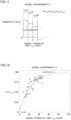
- Exceedance-probability-of-pipe-wall-thickness prediction model 21 is a model that predicts the exceedance probability of pipe wall thickness in an arbitrary burial period of time of the piping within a predetermined range (e.g., a range from 0 year to 70 years).
- Data of exceedance-probability-of-pipe-wall-thickness prediction model 21 includes the burial environment, the nominal pipe wall thickness and exceedance-probability-of-pipe-wall-thickness prediction model 21.
- the burial environment, the nominal pipe wall thickness and exceedance-probability-of-pipe-wall-thickness prediction model 21 are associated with each other.
- Fig. 6 shows four exceedance-probability-of-pipe-wall-thickness prediction models as an example of exceedance-probability-of-pipe-wall-thickness prediction model 21.
- Fig. 6 shows the exceedance-probability-of-pipe-wall-thickness prediction model for piping having a nominal pipe wall thickness of 7.5 mm and buried in burial environment A
- conversion coefficient 23 of the present embodiment is a coefficient that converts the exceedance probability of pipe wall thickness into a probability of water leakage accidents.
- a plurality of conversion coefficients 23 may be stored in buried piping probability-of-water-leakage-accidents prediction model storage unit 12, depending on the material of the piping.
- the plurality of conversion coefficients 23 include, for example, a conversion coefficient p for ductile piping, and a conversion coefficient q for cast iron piping.
- a probability Q(t L ) of a lag time of corrosion (see Fig. 13 ), a cumulative relative frequency of a lag time t L of corrosion (see Fig. 14 ), and data of lag time t L of corrosion (see Fig. 16 ) are stored in corrosion lag time storage unit 13.
- the program (e.g., buried piping probability-of-water-leakage-accidents prediction model generation program 26) for realizing the function of buried piping probability-of-water-leakage-accidents prediction model generation apparatus 2 is stored in program storage unit 14.
- buried piping probability-of-water-leakage-accidents prediction model generation unit 16 is implemented by executing buried piping probability-of-water-leakage-accidents prediction model generation program 26 stored in program storage unit 14 by processor 202 (see Fig. 2 ).
- Buried piping probability-of-water-leakage-accidents prediction model generation unit 16 generates buried piping probability-of-water-leakage-accidents prediction model 6 (see Fig. 3 ) from reference piping data 20 (see Fig. 4 ).
- Buried piping probability-of-water-leakage-accidents prediction model generation unit 16 includes an exceedance-probability-of-pipe-wall-thickness prediction model generation unit 17 and a conversion coefficient calculation unit 18.
- Exceedance-probability-of-pipe-wall-thickness prediction model generation unit 17 shown in Fig. 3 generates exceedance-probability-of-pipe-wall-thickness prediction model 21 (see Figs. 5 and 6 ) from reference piping data 20 (see Fig. 4 ).
- exceedance-probability-of-pipe-wall-thickness prediction model generation unit 17 generates exceedance-probability-of-pipe-wall-thickness prediction model 21 from reference piping data 20 will be described with reference to Figs. 8 to 22 .
- Fig. 8 shows reference piping data 20 of burial environment D, which is a part of reference piping data 20 (see Fig. 4 ). It can be understood that reference piping data 20 includes a large number of data with a reference corrosion depth of 0 mm and there is great variation in the data. Therefore, it is difficult to construct buried piping probability-of-water-leakage-accidents prediction model 6 capable of accurately predicting the probability of water leakage accidents of the buried piping by directly using reference piping data 20.
- reference piping data 20 includes a large number of data with a reference corrosion depth of 0 mm and there is great variation in the data due to a coating film formed on an outer surface of the piping. In other words, the corrosion of the piping starts for the first time after the corrosion passes through the coating film.
- the inventors of the present disclosure have conceived that reference piping data 20 includes a large number of data with a reference corrosion depth of 0 mm because there is time from when the piping is buried to when the piping starts corroding (hereinafter referred to as "lag time t L of corrosion").
- Lag time t L of corrosion depends mainly on the burial environment of the piping and a thickness and a material of the coating film. It is conceived that lag time t L of corrosion depending on the burial environment of the piping and the thickness and the material of the coating film is statistically related to the burial environment, the burial period of time and the corrosion depth of the piping. Thus, the inventors of the present disclosure have conceived to modify reference piping data 20 using lag time t L of corrosion (see Fig. 16 ) corresponding to the burial environment, the burial period of time and the corrosion depth of the piping, which is estimated by a statistical method, thereby generating modified reference piping data (see Fig. 17 ), and generate exceedance-probability-of-pipe-wall-thickness prediction model 21 (see Figs. 5 and 6 ) based on the modified reference piping data.
- lag time t L of corrosion depending on the burial environment of the piping and the thickness and the material of the coating film is statistically related to the burial environment, the burial period of
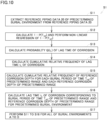
- exceedance-probability-of-pipe-wall-thickness prediction model generation unit 17 calculates lag time t L of corrosion corresponding to the burial environment, the burial period of time and the reference corrosion depth from reference piping data 20 (see Fig. 4 ) (step S1).
- step S1 One example of step S1 will be described with reference to Fig. 10 .
- exceedance-probability-of-pipe-wall-thickness prediction model generation unit 17 extracts, from reference piping data 20 (see Fig. 4 ) stored in reference piping data storage unit 11 (see Fig. 3 ), reference piping data 20 of a predetermined burial environment (e.g., burial environment D) selected from burial environments A, B, C, and D (step S11).
- a predetermined burial environment e.g., burial environment D
- exceedance-probability-of-pipe-wall-thickness prediction model generation unit 17 calculates, for reference piping data 20 extracted in step S11, a rate 1 - P(T ref ) (see Fig. 12 ) of the number of data with the reference corrosion depth that is more than 0 mm for each burial period of time T ref , and performs non-linear regression of 1 - P(T ref ) (step S12).
- P(T ref ) is a rate of the number of data with the reference corrosion depth of 0 mm for each burial period of time T ref of a predetermined range (e.g., 1 year).
- exceedance-probability-of-pipe-wall-thickness prediction model generation unit 17 counts a total number of data n all (T ref ) for each burial period of time T ref of the predetermined range and the number of data n 0 (T ref ) with the reference corrosion depth of 0 mm for each burial period of time T ref of the predetermined range.
- Exceedance-probability-of-pipe-wall-thickness prediction model generation unit 17 calculates rate P(T ref ) of n 0 (T ref ) to n all (T ref ). P(T ref ) is given by n 0 (T ref )/n all (T ref ). Exceedance-probability-of-pipe-wall-thickness prediction model generation unit 17 calculates 1 - P(T ref ).
- 1 - P(T ref ) asymptotically approaches 1 from zero in a non-linear manner as burial period of time T ref increases. Therefore, 1 - P(T ref ) is regressed with use of a non-linear regression model.
- the non-linear regression model include an exponential distribution model, a fractional function model or the like.
- One example of the exponential distribution model is an exponential distribution model expressed by Expression (1).
- ⁇ is a coefficient determined by regression.
- the fractional function model is a linear fractional function model expressed by Expression (2).
- ⁇ and ⁇ are coefficients determined by regression.
- exceedance-probability-of-pipe-wall-thickness prediction model generation unit 17 calculates coefficient ⁇ by performing non-linear regression of 1 - P(T ref ) by the exponential distribution model expressed by Expression (1) below with use of a least squares method and the like.
- the change rate of 1 - P(T ref ), in other words, a differential value of 1 - P(T ref ) is a rate of the reference piping that starts corroding in burial period of time T ref out of the reference piping buried in the burial environment selected in step S11.
- the rate of the reference piping that starts corroding in burial period of time T ref is a rate of the reference piping of which lag time t L of corrosion is burial period of time T ref out of the reference piping buried in the burial environment selected in step S11.
- the differential value of 1 - P(T ref ) is probability Q(T ref ) of the lag time of corrosion in the burial environment selected in step S11.
- Probability Q(T ref ) of the lag time of corrosion in the burial environment selected in step S11 is a probability of lag time t L of corrosion being burial period of time T ref out of lag time t L of corrosion of all of the pieces of reference piping buried in the burial environment selected in step S11.
- exceedance-probability-of-pipe-wall-thickness prediction model generation unit 17 calculates probability Q(t L ) of the lag time of corrosion (see Fig. 13 ).
- Exceedance-probability-of-pipe-wall-thickness prediction model generation unit 17 outputs probability Q(t L ) of the lag time of corrosion to corrosion lag time storage unit 13 (see Fig. 3 ).
- Probability Q(t L ) of the lag time of corrosion is stored in corrosion lag time storage unit 13.
- exceedance-probability-of-pipe-wall-thickness prediction model generation unit 17 calculates a cumulative relative frequency of lag time t L of corrosion (see Fig. 14 ) from probability Q(t L ) of the lag time of corrosion (step S14).
- the cumulative relative frequency of lag time t L of corrosion of n years is a cumulative sum of a relative frequency of lag time t L of corrosion of which lag time t L of corrosion is n years or more and is given by a sum of probability Q(t L ) of the lag time of corrosion of which lag time t L of corrosion is n years or more.
- Exceedance-probability-of-pipe-wall-thickness prediction model generation unit 17 outputs the cumulative relative frequency of lag time t L of corrosion to corrosion lag time storage unit 13. The cumulative relative frequency of lag time t L of corrosion is stored in corrosion lag time storage unit 13.
- Exceedance-probability-of-pipe-wall-thickness prediction model generation unit 17 calculates a cumulative relative frequency of the reference corrosion depth (see Fig. 14 ) for each burial period of time T ref of a predetermined range and each reference corrosion depth of a predetermined range from reference piping data 20 relating to the burial environment selected in step S11 (step S15).
- the cumulative relative frequency of the reference corrosion depth of the predetermined range is a cumulative sum of a relative frequency of a reference corrosion depth of the predetermined range or less.
- exceedance-probability-of-pipe-wall-thickness prediction model generation unit 17 acquires a plurality of data groups by sorting reference piping data 20 extracted in step S11 for each burial period of time T ref of the predetermined range (step S15a).
- Exceedance-probability-of-pipe-wall-thickness prediction model generation unit 17 acquires a plurality of data groups by sorting reference piping data 20 relating to the burial environment selected in step S11 for each burial period of time T ref of 5 years, for example.
- the plurality of data groups include a data group having burial period of time T ref that is 15 years or more and less than 20 years, for example (see Fig. 14 ).
- Exceedance-probability-of-pipe-wall-thickness prediction model generation unit 17 calculates a cumulative relative frequency of a reference corrosion depth for each reference corrosion depth of a predetermined range for one of the plurality of data groups (step S15b).
- the cumulative relative frequency of the reference corrosion depth of the predetermined range is the rate of the number of data having a reference corrosion depth of the predetermined range or less out of one of the plurality of data groups.
- Exceedance-probability-of-pipe-wall-thickness prediction model generation unit 17 calculates the rate of the number of data having a reference corrosion depth of the predetermined range or less out of one of the plurality of data groups as the cumulative relative frequency of the reference corrosion depth of the predetermined range.
- exceedance-probability-of-pipe-wall-thickness prediction model generation unit 17 calculates a cumulative relative frequency of a reference corrosion depth for each reference corrosion depth of 0.5 mm for a data group having burial period of time T ref that is 15 years or more and less than 20 years.
- a cumulative relative frequency of the reference corrosion depth that is 1.0 mm or more and less than 1.5 mm in a data group having burial period of time T ref that is 15 years or more and less than 20 years is the rate of the number of data having a reference corrosion depth that is 0 mm or more and less than 1.5 mm out of the data group.
- the cumulative relative frequency of the reference corrosion depth that is 1.0 mm or more and less than 1.5 mm in a data group having burial period of time T ref that is 15 years or more and less than 20 years is calculated as the rate of a sum of the number of data having the reference corrosion depth that is 0 mm or more and less than 0.5 mm, the number of data having the reference corrosion depth that is 0.5 mm or more and less than 1.0 mm, and the number of data having the reference corrosion depth that is 1.0 mm or more and less than 1.5 mm in the data group with respect to the total number of data in the data group.
- Exceedance-probability-of-pipe-wall-thickness prediction model generation unit 17 performs step S15b for all of the plurality of data groups (step S15c).
- the cumulative relative frequency of the reference corrosion depth is calculated for each burial period of time T ref of the predetermined range (e.g., 5 years) and each reference corrosion depth of the predetermined range (e.g., 0.5 mm) regarding the burial environment selected in step S11.
- exceedance-probability-of-pipe-wall-thickness prediction model generation unit 17 calculates lag time t L of corrosion corresponding to burial period of time T ref of the predetermined range and the reference corrosion depth of the predetermined range from the cumulative relative frequency of lag time t L of corrosion calculated in step S14 and the cumulative relative frequency of the reference corrosion depth calculated in step S15 for the predetermined burial environment selected in step S11 (step S16).
- exceedance-probability-of-pipe-wall-thickness prediction model generation unit 17 calculates lag time t L (e.g., 17.5 years) of corrosion with which the cumulative relative frequency of lag time t L of corrosion becomes equal to a cumulative relative frequency of a reference corrosion depth of a predetermined range (e.g., a corrosion depth that is 0.0 mm or more and less than 0.5 mm) in burial period of time T ref of a predetermined range (e.g., 15 years or more and less than 20 years) as lag time t L (e.g., 17.5 years) of corrosion corresponding to burial period of time T ref of the predetermined range (e.g., 15 years or more and less than 20 years) and the reference corrosion depth of the predetermined range (e.g., a corrosion depth that is 0.0 mm or more and less than 0.5 mm).
- lag time t L e.g., 17.5 years
- exceedance-probability-of-pipe-wall-thickness prediction model generation unit 17 performs steps S11 to S16 for all of burial environments A to D (step S17). As a result, exceedance-probability-of-pipe-wall-thickness prediction model generation unit 17 calculates lag time t L of corrosion corresponding to the burial environment, burial period of time T ref and the reference corrosion depth from reference piping data 20 (see Fig. 4 ).
- exceedance-probability-of-pipe-wall-thickness prediction model generation unit 17 generates lag-time-of-corrosion data 27 including the burial environment, burial period of time T ref , the reference corrosion depth, and lag time t L of corrosion.
- lag-time-of-corrosion data 27 the burial environment, burial period of time T ref , the reference corrosion depth, and lag time t L of corrosion are associated with each other.
- Exceedance-probability-of-pipe-wall-thickness prediction model generation unit 17 outputs lag-time-of-corrosion data 27 to corrosion lag time storage unit 13 (see Fig. 3 ).
- Lag-time-of-corrosion data 27 is stored in corrosion lag time storage unit 13.
- exceedance-probability-of-pipe-wall-thickness prediction model generation unit 17 acquires modified reference piping data (see Fig. 17 ) corresponding to the burial environment (step S2).
- the modified reference piping data includes the burial environment, a modified burial period of time and the reference corrosion depth.
- exceedance-probability-of-pipe-wall-thickness prediction model generation unit 17 reads out the burial environment, burial period of time T ref , the reference corrosion depth, and lag time t L of corrosion from lag-time-of-corrosion data 27 (see Fig. 16 ) stored in corrosion lag time storage unit 13 (see Fig. 3 ).
- Exceedance-probability-of-pipe-wall-thickness prediction model generation unit 17 calculates the modified burial period of time by subtracting lag time t L of corrosion (see
- Fig. 16 corresponding to the burial environment, burial period of time T ref and the reference corrosion depth from burial period of time T ref in reference piping data 20 (see Figs. 4 and 8 ). As a result, the modified reference piping data is acquired.
- the modified reference piping data (see Fig. 17 ) is obtained by moving each of points in reference piping data 20 (see Fig. 4 ) in the left direction by lag time t L of corrosion corresponding to each of the points. It can be understood that the modified reference piping data is reduced in the variation in data as compared to reference piping data 20 (see Fig. 8 ).
- Exceedance-probability-of-pipe-wall-thickness prediction model generation unit 17 outputs the modified reference piping data to reference piping data storage unit 11 (see Fig. 3 ).
- the modified reference piping data is stored in reference piping data storage unit 11.
- exceedance-probability-of-pipe-wall-thickness prediction model generation unit 17 generates an exceedance-probability-of-corrosion-depth prediction model (see Fig. 18 ) corresponding to the burial environment and the burial period of time of the predetermined range (step S3).
- the exceedance probability of corrosion depth is a probability of the corrosion depth of the piping exceeding the predetermined depth.
- the exceedance-probability-of-corrosion-depth prediction model is a model that predicts the exceedance probability of corrosion depth in a predetermined burial environment and a burial period of time of a predetermined range.
- step S3 of generating the exceedance-probability-of-corrosion-depth prediction model will be described with reference to Fig. 19 .
- exceedance-probability-of-pipe-wall-thickness prediction model generation unit 17 extracts, from the modified reference piping data (see Fig. 17 ) stored in reference piping data storage unit 11 (see Fig. 3 ), reference piping data 20 of a predetermined burial environment (e.g., burial environment D) selected from burial environments A, B, C, and D (step S31).
- a predetermined burial environment e.g., burial environment D
- exceedance-probability-of-pipe-wall-thickness prediction model generation unit 17 acquires a basic regression line that regresses the modified reference piping data (step S32).
- the basic regression line is acquired by regressing the modified reference piping data by an exponential model expressed by Expression (3).
- y jt k
- y represents the reference corrosion depth of the reference piping
- j and k represent coefficients
- t represents the modified burial period of time of the reference piping.
- a basic regression line is acquired by regressing log-log data of the modified reference piping data by Expression (4) with use of a least squares method (see Fig. 20 ).
- some of the modified reference piping data diverges from the basic regression line. The reason thereof is presumed to be due to (i) a variation in the corrosion rate of reference piping under a predetermined burial environment and (ii) a distribution of lag time t L of corrosion under a predetermined burial environment.
- exceedance-probability-of-pipe-wall-thickness prediction model generation unit 17 generates a corrosion depth exceedance prediction model corresponding to the burial environment and the burial period of time of the predetermined range based on the basic regression line, the variation in the corrosion rate, and the distribution of lag time t L of corrosion (step S33).
- the corrosion depth exceedance prediction model is generated, considering that the basic regression line has a certain distribution for each of the corrosion rate and lag time t L of corrosion (e.g., the basic regression line is distributed at a certain probability density for each of the corrosion rate and lag time t L of corrosion).
- the variation in the corrosion rate is mainly reflected in the distribution of the basic regression line due to the variation in the reference corrosion depth in the modified reference piping data.
- the distribution of the basic regression line is reflected in the distribution of coefficients j and k in Expression (3) or Expression (4).
- the distribution of the basic regression line due to the variation in the reference corrosion depth in the modified reference piping data may be expressed by the probability density function of the distribution of the basic regression line due to the variation in the reference corrosion depth in the modified reference piping data, for example.
- Exceedance-probability-of-pipe-wall-thickness prediction model generation unit 17 calculates, for each of log-log data of the modified reference piping data, a shift amount of log-log data of the modified reference piping data from the basic regression line and calculates a standard deviation ⁇ of the shift amount.
- the standard deviation of the probability density function is considered to be equal to calculated standard deviation ⁇ .
- An integrated value of the probability density function across all of the shift amounts from the basic regression line is equal to 1 and is a normal distribution of standard deviation ⁇ of the probability density function, and hence exceedance-probability-of-pipe-wall-thickness prediction model generation unit 17 can calculate the probability density function of the distribution of the basic regression line.
- Exceedance-probability-of-pipe-wall-thickness prediction model generation unit 17 integrates the probability density function of the distribution of the basic regression line from a shift amount of a negative infinity to a predetermined shift amount, to thereby calculate the cumulative distribution function of the distribution of the basic regression line in the predetermined shift amount.
- the basic regression line is a regression line in which a value (cumulative probability density) of the cumulative distribution function of the distribution of the basic regression line is 50 percentile and is referred to as a 50-percentile regression line.
- a regression line in which a value (cumulative probability density) of the cumulative distribution function of the distribution of the basic regression line is p percentile is referred to as a p-percentile regression line.
- Exceedance-probability-of-pipe-wall-thickness prediction model generation unit 17 acquires a plurality of percentile regression lines from the basic regression line and the cumulative distribution function of the distribution of the basic regression line.
- the plurality of percentile regression lines include a 5-percentile regression line, a 6.25-percentile regression line, a 12.5-percentile regression line, an 18.75-percentile regression line, a 25-percentile regression line, a 31.25-percentile regression line, a 37.5-percentile regression line, a 43.75-percentile regression line, a 50-percentile regression line, a 56.25-percentile regression line, a 62.5-percentile regression line, a 68.75-percentile regression line, a 75-percentile regression line, an 81.25-percentile regression line, an 87.5-percentile regression line, a 93.75-percentile regression line, and a 95-percentile regression line, for example.
- Exceedance-probability-of-pipe-wall-thickness prediction model generation unit 17 calculates coefficients j and k (see Items (B) and (C) in Fig. 23 ) of each of the percentile regression lines and a value (probability density) of the probability density function of each of the percentile regression lines (see Item (D) in Fig. 23 ) from the percentile regression lines and the probability density function of the distribution of the basic regression line.
- Exceedance-probability-of-pipe-wall-thickness prediction model generation unit 17 converts the modified burial period of time of each of the percentile regression lines into the burial period of time of the piping based on the distribution of lag time t L of corrosion.
- exceedance-probability-of-pipe-wall-thickness prediction model generation unit 17 sets a predetermined depth (e.g., 0 mm or 1.0 mm) (see Item (E) in Fig. 23 ).
- Exceedance-probability-of-pipe-wall-thickness prediction model generation unit 17 calculates, for each of the percentile regression lines, a modified burial period of time (Item (F) in Fig. 23 ) when the corrosion depth of the piping is the predetermined depth.
- Exceedance-probability-of-pipe-wall-thickness prediction model generation unit 17 calculates the modified burial period of time corresponding to the predetermined depth by substituting the predetermined depth into reference corrosion depth y in Expression (3) or Expression (4) defining each of the percentile regression lines.
- the modified burial periods of time (see Item (F) in Fig. 23 ) from each of the percentile regression lines correspond to various burial periods of time of the piping.
- the distribution of lag time t L of corrosion may be expressed as a probability of the modified burial period of time corresponding to the burial period of time of the piping, for example.
- exceedance-probability-of-pipe-wall-thickness prediction model generation unit 17 calculates the probability of the modified burial period of time corresponding to the burial period of time of the piping.
- Exceedance-probability-of-pipe-wall-thickness prediction model generation unit 17 sets lag time t L of corrosion (see Item (G) in Fig. 23 ) of a predetermined period of time (e.g., 1 year, 2 years), for example.
- Exceedance-probability-of-pipe-wall-thickness prediction model generation unit 17 calculates a sum of the modified burial period of time (see Item (F) in Fig. 23 ) and lag time t L of corrosion as the burial period of time of the piping (see Item (H) in Fig. 23 ).
- the probability of the modified burial period of time corresponding to the burial period of time of the piping is given by probability Q(t L ) of lag time t L of corrosion (see Fig. 13 ) of the predetermined period of time.
- Exceedance-probability-of-pipe-wall-thickness prediction model generation unit 17 sets probability Q(t L ) of the lag time of corrosion (see Fig. 13 ) stored in corrosion lag time storage unit 13 (see Fig. 3 ) to be the probability of the modified burial period of time corresponding to the burial period of time of the piping (see Item (I) in Fig. 23 ).
- Exceedance-probability-of-pipe-wall-thickness prediction model generation unit 17 calculates a product of the probability density of the percentile regression line (see Item (D) in Fig. 23 ) and the probability of the modified burial period of time corresponding to the burial period of time of the piping, i.e., probability Q(t L ) of the lag time of corrosion (see Item (I) in Fig. 23 ) as a probability index (see Item (J) in Fig. 23 ).
- This product is proportional to an existence probability of a percentile regression line having lag time t L of corrosion and can be considered to be a probability index of a percentile regression line having lag time t L of corrosion.
- Exceedance-probability-of-pipe-wall-thickness prediction model generation unit 17 calculates a sum of the probability index (see Item (J) in Fig. 23 ) as a corrosion depth reaching probability index for each corrosion depth (see Item (E) in Fig. 23 ) and each burial period of time of a predetermined range (see Item (H) in Fig. 23 ).
- the corrosion depth reaching probability index is an index of a probability of reaching a predetermined corrosion depth in a burial period of time of a predetermined range.
- exceedance-probability-of-pipe-wall-thickness prediction model generation unit 17 calculates a corrosion depth reaching probability by normalizing the corrosion depth reaching probability index such that a sum total of the corrosion depth reaching probability index across all corrosion depths becomes 1 in the burial period of time of the predetermined range.
- the corrosion depth reaching probability is a probability of reaching a predetermined corrosion depth in a burial period of time of a predetermined range.
- exceedance-probability-of-pipe-wall-thickness prediction model generation unit 17 generates data indicating a relationship among the burial period of time of the predetermined range, the corrosion depth and the corrosion depth reaching probability (see Fig. 24 ) for the burial environment selected in step S31.
- the corrosion depth reaching probability can be considered to be an exceedance probability of corrosion depth that is a probability of the corrosion depth exceeding a predetermined depth (e.g., 1.0 mm) in a burial period of time of a predetermined range.
- exceedance-probability-of-pipe-wall-thickness prediction model generation unit 17 generates a relationship among the corrosion depth of the piping, the burial period of time of the piping of the predetermined range and the exceedance probability of corrosion depth (see the data of the exceedance probability of corrosion depth in Fig. 18 ) for the burial environment selected in step S31, based on the data shown in Fig. 24 .
- Exceedance-probability-of-pipe-wall-thickness prediction model generation unit 17 generates the exceedance-probability-of-corrosion-depth prediction model corresponding to the burial environment selected in step S31 and the burial period of time of the predetermined range by regressing the relationship among the corrosion depth of the piping, the burial period of time of the piping of the predetermined range and the exceedance probability of corrosion depth (see the data of the exceedance probability of corrosion depth in Fig. 18 ).
- the exceedance probability of corrosion depth is a probability of a first event out of the first event and a second event occurring.
- the first event is an event where the corrosion depth exceeds a predetermined depth in a burial period of time of a predetermined range
- the second event is an event where the corrosion depth does not exceed the predetermined depth in the burial period of time of the predetermined range. Therefore, non-linear regression of the exceedance probability of corrosion depth may be performed by a cumulative distribution function of binomial distribution.
- exceedance-probability-of-pipe-wall-thickness prediction model generation unit 17 calculates coefficients a and b by performing non-linear regression of the relationship among the corrosion depth, the burial period of time of the predetermined range and the exceedance probability of corrosion depth with Expression (5) below that is one of the cumulative distribution functions of the binomial distribution.
- R 100 ⁇ exp a + bx / 1 + exp a + bx
- R represents the exceedance probability of corrosion depth (%)
- a and b represent coefficients determined by regression
- x represents the corrosion depth
- exceedance-probability-of-pipe-wall-thickness prediction model generation unit 17 performs steps S31 to S33 for all of burial environments A to D (step S34). As a result, exceedance-probability-of-pipe-wall-thickness prediction model generation unit 17 generates the exceedance-probability-of-corrosion-depth prediction model (see Fig. 18 ) corresponding to the burial environment and the burial period of time of the predetermined range from reference piping data 20.
- the exceedance-probability-of-corrosion-depth prediction model generated in step S3 includes Expression (5), for example.
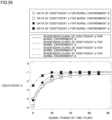
- step S3 coefficients a and b defining the exceedance-probability-of-corrosion-depth prediction model are determined for the burial environment and the burial period of time of the predetermined range (see data of coefficient a in Fig. 25 and data of coefficient b in Fig. 26 ).
- exceedance-probability-of-pipe-wall-thickness prediction model generation unit 17 generates the exceedance-probability-of-corrosion-depth prediction model corresponding to the burial environment and the arbitrary burial period of time (step S4). Specifically, as shown in Figs. 25 and 26 , in step S4, exceedance-probability-of-pipe-wall-thickness prediction model generation unit 17 determines coefficients a and b for the burial environment of the piping and the arbitrary burial period of time of the piping by regressing coefficients a and b for the arbitrary burial period of time of the piping. As a result, the exceedance-probability-of-corrosion-depth prediction model corresponding to the burial environment and the arbitrary burial period of time is generated.
- Coefficient a may be regressed by a linear model expressed by Expression (6) below, as shown in Fig. 25 , for example.
- a c ⁇ t + d
- t represents the burial period of time
- c and d represent coefficients determined by regression.
- Coefficient b may be regressed by an asymptotic model expressed by Expression (7) below, as shown in Fig. 26 , for example.
- b e ⁇ f ⁇ exp ⁇ g ⁇ t
- t represents the burial period of time
- e, f and g represent coefficients determined by regression.
- the exceedance-probability-of-corrosion-depth prediction model generated in step S4 includes Expression (5), Expression (6) and Expression (7), for example.
- coefficients a and b defining the exceedance-probability-of-corrosion-depth prediction model are determined for the burial environment and the arbitrary burial period of time (see a regression line of coefficient a in Fig. 25 and a regression curve of coefficient b in Fig. 26 ).
- exceedance-probability-of-pipe-wall-thickness prediction model generation unit 17 generates exceedance-probability-of-pipe-wall-thickness prediction model 21 (see Fig. 6 ) corresponding to the burial environment and the nominal pipe wall thickness (step S5).
- exceedance-probability-of-pipe-wall-thickness prediction model 21 see Fig. 6
- step S5 the nominal pipe wall thickness
- exceedance-probability-of-pipe-wall-thickness prediction model generation unit 17 generates exceedance-probability-of-pipe-wall-thickness prediction model 21 corresponding to the burial environment and the nominal pipe wall thickness by inputting the burial environment, the burial period of time and the nominal pipe wall thickness to the exceedance-probability-of-corrosion-depth prediction model generated in step S4.
- exceedance-probability-of-pipe-wall-thickness prediction model generation unit 17 acquires coefficients a and b for the burial environment and the burial period of time by inputting this burial environment and this burial period of time to Expression (6) and Expression (7) of the exceedance-probability-of-corrosion-depth prediction model acquired in step S4.
- Exceedance-probability-of-pipe-wall-thickness prediction model generation unit 17 calculates the exceedance probability of corrosion depth of Expression (5) as the exceedance probability of pipe wall thickness by inputting coefficients a and b and the nominal pipe wall thickness as the corrosion depth to Expression (5) of the exceedance-probability-of-corrosion-depth prediction model acquired in step S4.
- exceedance-probability-of-pipe-wall-thickness prediction model generation unit 17 generates exceedance-probability-of-pipe-wall-thickness prediction model 21 (see Fig. 6 ) corresponding to the burial environment and the nominal pipe wall thickness.
- Exceedance-probability-of-pipe-wall-thickness prediction model generation unit 17 outputs exceedance-probability-of-pipe-wall-thickness prediction model 21 (see Fig. 6 ) to buried piping probability-of-water-leakage-accidents prediction model storage unit 12 (see Fig. 3 ).
- Exceedance-probability-of-pipe-wall-thickness prediction model 21 is stored in buried piping probability-of-water-leakage-accidents prediction model storage unit 12.
- Conversion coefficient calculation unit 18 calculates conversion coefficient 23 (see Fig. 7 ) based on reference piping data 20 (see Fig. 4 ) and the exceedance probability of pipe wall thickness acquired from exceedance-probability-of-pipe-wall-thickness prediction model 21 (see Figs. 5 and 6 ).
- conversion coefficient 23 is a coefficient that converts the exceedance probability of pipe wall thickness of the piping into the probability of water leakage accidents of the piping.
- conversion coefficient calculation unit 18 selects reference piping data 20 of a specific material from reference piping data 20 (see Fig. 4 ) stored in reference piping data storage unit 11 (see Fig. 3 ) (step S61). For example, conversion coefficient calculation unit 18 selects reference piping data 20 of ductile piping from reference piping data 20.
- conversion coefficient calculation unit 18 calculates the exceedance probability of pipe wall thickness for each pipeline ID for reference piping data 20 selected in step S61 (step S62). Specifically, conversion coefficient calculation unit 18 reads out the burial environment, burial period of time T ref and the nominal pipe wall thickness of the reference piping having the specific material selected in S61 from reference piping data 20 (see Fig. 4 ) stored in reference piping data storage unit 11 (see Fig. 3 ). Conversion coefficient calculation unit 18 selects the exceedance-probability-of-pipe-wall-thickness model (see Figs. 5 and 6 ) corresponding to the burial environment and the nominal pipe wall thickness of the reference piping. Conversion coefficient calculation unit 18 calculates the exceedance probability of pipe wall thickness for each pipeline ID by inputting burial period of time T ref of the reference piping to the selected exceedance-probability-of-pipe-wall-thickness model.
- conversion coefficient calculation unit 18 calculates the probability of water leakage accidents for each exceedance probability of pipe wall thickness of the predetermined range (step S63).
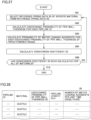
- conversion coefficient calculation unit 18 generates, for the reference piping having the specific material selected in step S61, reference piping data for conversion coefficient calculation 28 (see Fig. 28 ) from the pipeline ID, burial period of time T ref , the pipeline length, and the number of water leakage accidents per unit time (e.g., 5 years) in reference piping data 20 (see Fig. 4 ) stored in reference piping data storage unit 11 (see Fig. 3 ) and the exceedance probability of pipe wall thickness calculated for each pipeline ID in S62.
- Reference piping data for conversion coefficient calculation 28 includes the pipeline ID, the exceedance probability of pipe wall thickness, the pipeline length, and the number of water leakage accidents per unit time (e.g., 1 year).
- the pipeline ID, the exceedance probability of pipe wall thickness, burial period of time T ref , the pipeline length, and the number of water leakage accidents per unit time are associated with each other.
- conversion coefficient calculation unit 18 reads out the number of water leakage accidents per unit time in reference piping data 20 from reference piping data storage unit 11 (see Fig. 3 ) and converts the number of water leakage accidents per unit time in reference piping data 20 into the number of water leakage accidents per unit time in reference piping data for conversion coefficient calculation 28.
- conversion coefficient calculation unit 18 reads out the number of water leakage accidents per unit time in reference piping data 20 from reference piping data storage unit 11 and sets the number of water leakage accidents per unit time in reference piping data 20 to be the number of water leakage accidents per unit time in reference piping data for conversion coefficient calculation 28.
- Reference piping data for conversion coefficient calculation 28 may further include the specific material selected in step S61.
- Conversion coefficient calculation unit 18 divides reference piping data for conversion coefficient calculation 28 (see Fig. 28 ) into groups for each predetermined range of the exceedance probability of pipe wall thickness.
- the predetermined range of the exceedance probability of pipe wall thickness is, for example, equal to or larger than a range of the exceedance probability of pipe wall thickness of 1.5% and equal to or smaller than a range of the exceedance probability of pipe wall thickness of 4.0%. Therefore, each group has the sufficient number of data and the number of data of a relationship between the exceedance probability of pipe wall thickness and the probability of water leakage accidents, which is required to perform regression in step S64 described below, may be provided.
- Conversion coefficient 23 can be calculated with a higher degree of accuracy.
- conversion coefficient calculation unit 18 may divide reference piping data for conversion coefficient calculation 28 into groups for each range of the exceedance probability of pipe wall thickness of 2.5% for an example in which the specific material selected in step S61 is ductile (see Figs. 29 and 30 ). Conversion coefficient calculation unit 18 may divide reference piping data for conversion coefficient calculation 28 into groups for each range of the exceedance probability of pipe wall thickness of 2.5% for an example in which the specific material selected in step S61 is cast iron (see Figs. 31 and 32 ).
- Conversion coefficient calculation unit 18 calculates the probability of water leakage accidents for each group. Specifically, conversion coefficient calculation unit 18 calculates a sum of the number of water leakage accidents per unit time of the pipelines included in each group as the number of water leakage accidents per unit time of each group. Conversion coefficient calculation unit 18 calculates a sum of the pipeline length as the pipeline length of each group for each group. Conversion coefficient calculation unit 18 calculates the probability of water leakage accidents of each group by dividing the number of water leakage accidents per unit time of each group by the pipeline length of each group. As a result, conversion coefficient calculation unit 18 acquires data of the relationship between the exceedance probability of pipe wall thickness and the probability of water leakage accidents (see the black points in Figs. 29 and 31 ).
- Conversion coefficient calculation unit 18 calculates conversion coefficient 23 for the specific material selected in S61 from the data of the relationship between the exceedance probability of pipe wall thickness and the probability of water leakage accidents (step S64).
- the unit of the exceedance probability of pipe wall thickness is percent and is a value that is not dependent on the pipeline length.
- the probability of water leakage accidents is also a value that is not dependent on the pipeline length, because the probability of water leakage accidents is normalized by the pipeline length. Therefore, it is conceived that the exceedance probability of pipe wall thickness is proportional to the probability of water leakage accidents.
- conversion coefficient calculation unit 18 calculates, as conversion coefficient 23, a proportionality coefficient acquired by performing linear regression of the data of the relationship between the exceedance probability of pipe wall thickness and the probability of water leakage accidents, for example.
- a slope p of a regression line in Fig. 29 represents conversion coefficient 23 for ductile piping.
- a slope q of a regression line in Fig. 31 represents conversion coefficient 23 for cast iron piping.
- conversion coefficient 23 may be calculated with a higher degree of accuracy by performing linear regression of the data of the relationship between the exceedance probability of pipe wall thickness and the probability of water leakage accidents for the exceedance probability of pipe wall thickness that is a predetermined value or less.
- a range of the exceedance probability of pipe wall thickness in which this linear regression is performed may be 20.0% or less, 17.5% or less, 15.0% or less (see Figs. 29 and 31 ), 12.5% or less, or 10.0% or less, for example.
- conversion coefficient calculation unit 18 determines whether conversion coefficient 23 has been calculated for all of the materials included in reference piping data 20 (see Fig. 4 ) stored in reference piping data storage unit 11 (see Fig. 3 ) (step S69). When conversion coefficient 23 has not been calculated for all of the materials, the process returns to S61 and conversion coefficient calculation unit 18 selects reference piping data 20 of a specific material for which conversion coefficient 23 has not yet been calculated and performs S62 to S64 again. When conversion coefficient 23 has been calculated for all of the materials, the calculation of conversion coefficient 23 ends. Conversion coefficient calculation unit 18 outputs the calculated conversion coefficient 23 to buried piping probability-of-water-leakage-accidents prediction model storage unit 12 (see Fig. 3 ). Conversion coefficient 23 is stored in buried piping probability-of-water-leakage-accidents prediction model storage unit 12.
- buried piping probability-of-water-leakage-accidents prediction model generation apparatus 2 transmits buried piping probability-of-water-leakage-accidents prediction model 6 (exceedance-probability-of-pipe-wall-thickness prediction model 21 and conversion coefficient 23) to buried piping probability-of-water-leakage-accidents prediction apparatus 3.
- buried piping probability-of-water-leakage-accidents prediction apparatus 3 receives buried piping probability-of-water-leakage-accidents prediction model 6 from buried piping probability-of-water-leakage-accidents prediction model generation apparatus 2. Buried piping probability-of-water-leakage-accidents prediction apparatus 3 calculates a probability of water leakage accidents of buried piping (see Figs. 41 and 42 ) using buried piping probability-of-water-leakage-accidents prediction model 6.
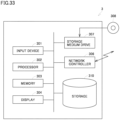
- Buried piping probability-of-water-leakage-accidents prediction apparatus 3 includes an input device 301, a processor 302, a memory 303, a display 304, a network controller 306, a storage medium drive 307, and a storage 310.
- Input device 301 accepts various types of input operations.
- Input device 301 is, for example, a keyboard, a mouse or a touch panel.
- Display 304 displays information required for processing in buried piping probability-of-water-leakage-accidents prediction apparatus 3, and the like.
- Display 304 displays a probability-of-water-leakage-accidents prediction result 60 described below (see Fig. 41 or 42 ), for example.
- Display 304 is, for example, a liquid crystal display (LCD) or an organic electroluminescence (EL) display.
- processor 302 By executing a below-described program, processor 302 performs processing required to realize the function of buried piping probability-of-water-leakage-accidents prediction apparatus 3.
- Processor 302 is implemented, for example, by a CPU, a GPU or the like.
- Memory 303 provides a storage area that temporarily stores a program code, a work memory or the like when processor 302 executes the program.
- Memory 303 is, for example, a volatile memory device such as a DRAM or an SRAM.
- Network controller 306 receives and transmits a program or data to and from an arbitrary apparatus including buried piping probability-of-water-leakage-accidents prediction model generation apparatus 2 through communication network 4 (see Fig. 1 ).
- network controller 306 receives buried piping probability-of-water-leakage-accidents prediction model 6 from buried piping probability-of-water-leakage-accidents prediction model generation apparatus 2 through communication network 4.
- Network controller 306 is in conformity with an arbitrary communication scheme such as, for example, Ethernet (registered trademark), a wireless LAN or Bluetooth (registered trademark).
- Storage medium drive 307 is a device that reads out a program or data stored in a storage medium 308. Furthermore, storage medium drive 307 may be a device that writes a program or data to storage medium 308.
- Storage medium 308 is a non-transitory storage medium and stores the program or data in a non-volatile manner.
- Storage medium 308 is, for example, an optical storage medium such as an optical disk (e.g., a CD-ROM or a DVD-ROM), a semiconductor storage medium such as a flash memory or a USB memory, a magnetic storage medium such as a hard disk, an FD or a storage tape, or a magneto-optical storage medium such as an MO disk.
- Storage 310 stores buried piping data 40 (see Figs. 34 to 36 ), preprocessed buried piping data 46 (see Fig. 40 ), buried piping probability-of-water-leakage-accidents prediction model 6 (see Fig. 34 ), the program executed in processor 302, and the like.
- This program includes a buried piping probability-of-water-leakage-accidents prediction program 48 (see Fig. 34 ).
- Buried piping probability-of-water-leakage-accidents prediction program 48 is a program for calculating the probability of water leakage accidents of the buried piping from buried piping data 40.
- Storage 310 is, for example, a non-volatile memory device such as a hard disk or an SSD.
- the program for realizing the function of buried piping probability-of-water-leakage-accidents prediction apparatus 3 may be stored in non-transitory storage medium 308 and distributed, and be installed in storage 310.
- the program for realizing the function of buried piping probability-of-water-leakage-accidents prediction apparatus 3 may be downloaded to buried piping probability-of-water-leakage-accidents prediction apparatus 3 through the Internet or an intranet.
- the present disclosure is not limited thereto. All or some of the function of buried piping probability-of-water-leakage-accidents prediction apparatus 3 may be realized by using an integrated circuit such as an ASIC or an FPGA.
- Buried piping probability-of-water-leakage-accidents prediction apparatus 3 includes a storage unit 30, a buried piping data acceptance unit 50, a buried piping data preprocessing unit 51, an exceedance-probability-of-pipe-wall-thickness calculation unit 52, a probability-of-water-leakage-accidents calculation unit 54, and a probability-of-water-leakage-accidents prediction result output unit 57.
- Storage unit 30 is implemented by at least one of storage 310 (see Fig. 33 ) or storage medium 308 (see Fig. 33 ).
- storage unit 30 includes a buried piping data storage unit 31, a nominal pipe wall thickness database unit 32, a burial environment map storage unit 33, a preprocessed buried piping data storage unit 34, a buried piping probability-of-water-leakage-accidents prediction model storage unit 36, a probability-of-water-leakage-accidents storage unit 37, and a program storage unit 38.
- buried piping data 40 data of the buried piping (hereinafter referred to as "buried piping data 40") accepted from the customer is stored in buried piping data storage unit 31.
- the buried piping is, for example, water piping.
- the buried piping is buried in the ground.
- Buried piping data 40 includes a pipeline map 41 (see Fig. 35 ) and buried piping attribute data 42 (see Fig. 36 ), for example.
- buried piping attribute data 42 includes a pipeline ID, an installation (burial) year, a nominal diameter, a type of joint, a type of the pipe wall thickness, a pipeline length, and a material of the buried piping.
- the pipeline ID, the installation (burial) year, the nominal diameter, the type of joint, the type of the pipe wall thickness, the pipeline length, and the material are associated with each other.
- the installation (burial) year of the buried piping is a year in which the buried piping is installed (buried).
- An A-type, a K-type, a T-type, an NS-type, or the like can be exemplified as the type of joint.
- Grade 1, grade 2, grade 3, or the like can be exemplified as the type of the pipe wall thickness.
- the pipeline length is a length of the piping specified by the pipeline ID.
- Ductile or cast iron can be exemplified as the material of the buried piping.
- nominal pipe wall thickness data 43 (see Fig. 37 ) including the installation year, the nominal diameter, the type of joint, the type of the pipe wall thickness, and the nominal pipe wall thickness of the piping is stored in nominal pipe wall thickness database unit 32.
- nominal pipe wall thickness data 43 the installation year, the nominal diameter, the type of joint, the type of the pipe wall thickness, and the nominal pipe wall thickness of the piping are associated with each other.
- the nominal pipe wall thickness of the piping is a standard pipe wall thickness of the piping.
- a burial environment map 44 (see Fig. 38 ) is stored in burial environment map storage unit 33.
- Burial environment map 44 is a map indicating the positions of burial environments A, B, C, and D described above.
- Burial environment map 44 may be generated from, for example, a generally available geological information map (not shown) and ground-burial environment correspondence data 45 (see Fig. 39 ).
- the geological information map is, for example, a land classification survey provided by a public organization or the like such as the Ministry of Land, Infrastructure, Transport and Tourism.
- geological information such as geological features and topography of the ground surface is shown on a map.
- the inventors of the present disclosure have found that regarding corrosion of the buried piping, there is a statistical correlation between burial environments A, B, C, and D of the buried piping and the geological information.
- ground-burial environment correspondence data 45 indicating the correspondence relationship between burial environments A, B, C, and D and the geological information.
- Burial environment map 44 is generated by applying ground-burial environment correspondence data 45 to the geological information map.
- preprocessed buried piping data 46 (see Fig. 40 ) is stored in preprocessed buried piping data storage unit 34.
- Buried piping probability-of-water-leakage-accidents prediction model 6 is stored in buried piping probability-of-water-leakage-accidents prediction model storage unit 36.
- Buried piping probability-of-water-leakage-accidents prediction apparatus 3 receives buried piping probability-of-water-leakage-accidents prediction model 6 from buried piping probability-of-water-leakage-accidents prediction model generation apparatus 2.
- Buried piping probability-of-water-leakage-accidents prediction model 6 includes, for example, exceedance-probability-of-pipe-wall-thickness prediction model 21 (see Figs. 5 and 6 ) and conversion coefficient 23 (see Fig. 7 ).
- probability-of-water-leakage-accidents storage unit 37 stores the probability of water leakage accidents of the buried piping calculated by probability-of-water-leakage-accidents calculation unit 54 (see Fig. 34 ). As shown in Fig. 41 , the probability of water leakage accidents of the buried piping is stored in probability-of-water-leakage-accidents storage unit 37 in association with the pipeline ID of the buried piping.
- a program (e.g., buried piping probability-of-water-leakage-accidents prediction program 48) for realizing the function of buried piping probability-of-water-leakage-accidents prediction apparatus 3 is stored in program storage unit 38.
- buried piping data acceptance unit 50 accepts buried piping data 40 (see Figs. 34 to 36 ) from the customer.
- Buried piping data 40 is stored in buried piping data storage unit 31.
- Buried piping data 40 may be stored in storage medium 308 (see Fig. 33 ) provided from the customer.
- Buried piping data 40 may be stored in storage 310 (see Fig. 33 ) in advance.
- Preprocessed buried piping data 46 includes, for example, a pipeline ID, a burial environment, a burial period of time T, a nominal pipe wall thickness, and a material of the buried piping.
- the burial environment is a type of soil in which the buried piping is buried. As described above, the burial environment is classified into four burial environments A, B, C, and D, depending on a type of soil and a soil resistivity.
- the burial period of time T is a period of time in which the buried piping is buried.
- burial period of time T is a difference between the current year (the year in which the prediction of the probability of water leakage accidents of the buried piping is executed) and the installation year of the buried piping (see Fig. 36 ) stored in buried piping data storage unit 31 (see Fig. 34 ).
- burial period of time T is a difference between the future year and the installation year of the buried piping (see Fig. 36 ) stored in buried piping data storage unit 31 (see Fig. 34 ).
- exceedance-probability-of-pipe-wall-thickness calculation unit 52 calculates the exceedance probability of pipe wall thickness of the buried piping for each pipeline ID. Specifically, exceedance-probability-of-pipe-wall-thickness calculation unit 52 calculates the exceedance probability of pipe wall thickness of the buried piping by inputting the burial environment, the burial period of time and the nominal pipe wall thickness of the buried piping to exceedance-probability-of-pipe-wall-thickness prediction model 21 stored in buried piping probability-of-water-leakage-accidents prediction model storage unit 36 (see Fig. 34 ).
- probability-of-water-leakage-accidents calculation unit 54 calculates the probability of water leakage accidents of the buried piping for each pipeline ID from preprocessed buried piping data 46.
- the probability of water leakage accidents of the buried piping is the number of water leakage accidents of the buried piping per unit time (e.g., 1 year) and per unit distance (e.g., 1 km).
- Probability-of-water-leakage-accidents calculation unit 54 includes a conversion coefficient selection unit 55.
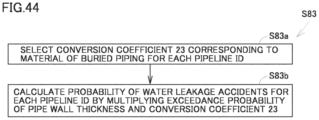
- conversion coefficient selection unit 55 selects conversion coefficient 23 corresponding to the material of the buried piping from conversion coefficient 23 (see Fig. 7 ) stored in buried piping probability-of-water-leakage-accidents prediction model storage unit 36 (see Fig. 34 ).
- Probability-of-water-leakage-accidents prediction result output unit 57 outputs probability-of-water-leakage-accidents prediction result 60 of the buried piping to at least one of display 304, storage medium 308 or storage 310 shown in Fig. 33 .
- probability-of-water-leakage-accidents prediction result 60 may be a probability-of-water-leakage-accidents prediction table 61 (see Fig. 41 ), or may be a probability-of-water-leakage-accidents prediction map 62 (see Fig. 42 ).
- probability-of-water-leakage-accidents prediction table 61 the pipeline ID and the probability of water leakage accidents of the buried piping are associated with each other.
- Probability-of-water-leakage-accidents prediction map 62 is generated by probability-of-water-leakage-accidents prediction result output unit 57 from the probability of water leakage accidents of the buried piping ( Fig. 41 ) associated with the pipeline ID and pipeline map 41 (see Fig. 35 ) including the pipeline ID and the position of the buried piping.
- a buried piping probability-of-water-leakage-accidents prediction method of the present embodiment will be described with reference to Figs. 43 and 44 .
- buried piping data preprocessing unit 51 generates preprocessed buried piping data 46 (see Fig. 40 ) from buried piping data 40 (see Figs. 34 to 36 ) stored in buried piping data storage unit 31 (see Fig. 34 ) (step S81).
- buried piping data preprocessing unit 51 calculates burial period of time T of the buried piping for each pipeline ID. For example, when the prediction result of the probability of water leakage accidents of the buried piping in the current year (the year in which the prediction of the probability of water leakage accidents of the buried piping is executed), buried piping data preprocessing unit 51 calculates, as burial period of time T of the buried piping (see Fig. 40 ), a difference between the current year stored in storage unit 30 and the installation year of the buried piping (see Fig. 36 ) stored in buried piping data storage unit 31 (see Fig. 34 ).
- buried piping data preprocessing unit 51 calculates, as burial period of time T of the buried piping (see Fig. 40 ), a difference between the future year accepted by input device 301 (see Fig. 33 ) and stored in storage unit 30 and the installation year of the buried piping (see Fig. 36 ) stored in buried piping data storage unit 31 (see Fig. 34 ).
- Buried piping data preprocessing unit 51 acquires the nominal pipe wall thickness of the buried piping for each pipeline ID from the installation (burial) year, the nominal diameter, the type of joint, and the type of the pipe wall thickness (see Fig. 36 ) stored in buried piping data storage unit 31 (see Fig. 34 ) and nominal pipe wall thickness data 43 (see Fig. 37 ) stored in nominal pipe wall thickness database unit 32 (see Fig. 34 ).
- Buried piping data preprocessing unit 51 acquires the burial environment of the buried piping for each pipeline ID from pipeline map 41 (see Fig. 35 ) stored in buried piping data storage unit 31 (see Fig. 34 ) and burial environment map 44 (see Fig. 38 ) stored in burial environment map storage unit 33. Buried piping data preprocessing unit 51 acquires the material from buried piping data 40 shown in Fig. 34 (see Figs. 34 to 36 ). As a result, buried piping data preprocessing unit 51 generates preprocessed buried piping data 46 (see Fig. 40 ) from buried piping data 40.
- Buried piping data preprocessing unit 51 outputs preprocessed buried piping data 46 to preprocessed buried piping data storage unit 34 (see Fig. 34 ). Preprocessed buried piping data 46 is stored in preprocessed buried piping data storage unit 34.
- exceedance-probability-of-pipe-wall-thickness calculation unit 52 calculates the exceedance probability of pipe wall thickness of the buried piping for each pipeline ID (step S82). Specifically, exceedance-probability-of-pipe-wall-thickness calculation unit 52 reads out the pipeline ID, the burial environment, burial period of time T, and the nominal pipe wall thickness from preprocessed buried piping data 46 ( Fig. 40 ) stored in preprocessed buried piping data storage unit 34.
- Exceedance-probability-of-pipe-wall-thickness calculation unit 52 selects exceedance-probability-of-pipe-wall-thickness prediction model 21 corresponding to the read-out burial environment and nominal pipe wall thickness, of exceedance-probability-of-pipe-wall-thickness prediction model 21 stored in buried piping probability-of-water-leakage-accidents prediction model storage unit 36 (see Fig. 34 ).
- Exceedance-probability-of-pipe-wall-thickness calculation unit 52 calculates the exceedance probability of pipe wall thickness of the buried piping for each pipeline ID by inputting burial period of time T of the buried piping to selected exceedance-probability-of-pipe-wall-thickness prediction model 21.
- probability-of-water-leakage-accidents calculation unit 54 calculates the probability of water leakage accidents of the buried piping for each pipeline ID (step S83). Specifically, referring to Fig. 44 , probability-of-water-leakage-accidents calculation unit 54 reads out the pipeline ID and the material of the buried piping from preprocessed buried piping data 46 ( Fig. 40 ) stored in preprocessed buried piping data storage unit 34 (see Fig. 34 ). Conversion coefficient selection unit 55 selects conversion coefficient 23 corresponding to the material of the buried piping from conversion coefficient 23 (see Fig.
- Probability-of-water-leakage-accidents calculation unit 54 calculates the probability of water leakage accidents of the buried piping for each pipeline ID by multiplying the exceedance probability of pipe wall thickness of the buried piping calculated in step S82 and conversion coefficient 23 selected in step S83a (step S83b).
- Probability-of-water-leakage-accidents calculation unit 54 outputs the probability of water leakage accidents of the buried piping calculated in step S83b to probability-of-water-leakage-accidents storage unit 37 (see Fig. 34 ). As shown in Fig. 41 , the probability of water leakage accidents of the buried piping is stored in probability-of-water-leakage-accidents storage unit 37 in association with the pipeline ID.
- probability-of-water-leakage-accidents prediction result output unit 57 outputs probability-of-water-leakage-accidents prediction result 60 to at least one of display 304, storage medium 308 or storage 310 shown in Fig. 33 (step S84).
- probability-of-water-leakage-accidents prediction result 60 may be probability-of-water-leakage-accidents prediction table 61 (see Fig. 41 ), or may be probability-of-water-leakage-accidents prediction map 62 (see Fig. 42 ).
- Buried piping probability-of-water-leakage-accidents prediction program 48 causes processor 302 (see Fig. 33 ) to execute the buried piping probability-of-water-leakage-accidents prediction method of the present embodiment.
- the program that causes processor 302 to execute the buried piping probability-of-water-leakage-accidents prediction method of the present embodiment is recorded on a computer-readable recording medium (a non-transitory computer-readable recording medium, e.g., storage medium 308) of the present embodiment.
- Buried piping probability-of-water-leakage-accidents prediction apparatus 3 of the present embodiment includes exceedance-probability-of-pipe-wall-thickness calculation unit 52 and probability-of-water-leakage-accidents calculation unit 54.
- Exceedance-probability-of-pipe-wall-thickness calculation unit 52 calculates an exceedance probability of pipe wall thickness of buried piping by inputting a burial environment, a burial period of time and a pipe wall thickness (e.g., a nominal pipe wall thickness) of the buried piping to exceedance-probability-of-pipe-wall-thickness prediction model 21.
- Probability-of-water-leakage-accidents calculation unit 54 calculates a probability of water leakage accidents of the buried piping using the exceedance probability of pipe wall thickness of the buried piping and conversion coefficient 23.
- Exceedance-probability-of-pipe-wall-thickness prediction model 21 is generated in accordance with a burial environment of piping and a pipe wall thickness (e.g., a nominal pipe wall thickness) of the piping, and provides an exceedance probability of pipe wall thickness of the piping that continuously changes with a continuous change in a burial period of time of the piping.
- the exceedance probability of pipe wall thickness of the piping is a probability of a corrosion depth of the piping exceeding the pipe wall thickness (e.g., the nominal pipe wall thickness) of the piping.
- the exceedance probability of pipe wall thickness of the buried piping is a probability of a corrosion depth of the buried piping exceeding the pipe wall thickness (e.g., the nominal pipe wall thickness) of the buried piping.
- Conversion coefficient 23 is a coefficient that converts the exceedance probability of pipe wall thickness of the piping or a first index that can be calculated from the exceedance probability of pipe wall thickness of the piping into a probability of water leakage accidents of the piping or a second index that can calculate the probability of water leakage accidents of the piping.
- the probability of water leakage accidents of the piping is the number of water leakage accidents of the piping per unit time and per unit distance.
- the probability of water leakage accidents of the buried piping is the number of water leakage accidents of the buried piping per unit time and per unit distance.
- probability-of-water-leakage-accidents calculation unit 54 includes conversion coefficient selection unit 55 that selects conversion coefficient 23 corresponding to a material of the buried piping.
- buried piping probability-of-water-leakage-accidents prediction apparatus 3 of the present embodiment it is possible to more accurately predict the probability of water leakage accidents of the buried piping for an arbitrary burial period of time in accordance with the material of the buried piping.
- conversion coefficient 23 is a coefficient that converts the exceedance probability of pipe wall thickness of the piping into the probability of water leakage accidents of the piping.
- Probability-of-water-leakage-accidents calculation unit 54 calculates the probability of water leakage accidents of the buried piping by multiplying the exceedance probability of pipe wall thickness of the buried piping and conversion coefficient 23.
- the probability of water leakage accidents of the buried piping can be calculated more simply.
- a process of calculation of the probability of water leakage accidents of the buried piping is clear and the customer reliability for the probability of water leakage accidents of the buried piping calculated by buried piping probability-of-water-leakage-accidents prediction apparatus 3 of the present embodiment can be enhanced.
- the buried piping probability-of-water-leakage-accidents prediction method of the present embodiment includes: a step of calculating an exceedance probability of pipe wall thickness of buried piping by inputting a burial environment, a burial period of time and a pipe wall thickness (e.g., a nominal pipe wall thickness) of the buried piping to exceedance-probability-of-pipe-wall-thickness prediction model 21 (step S82); and a step of calculating a probability of water leakage accidents of the buried piping using the exceedance probability of pipe wall thickness of the buried piping and conversion coefficient 23 (step S83).
- a pipe wall thickness e.g., a nominal pipe wall thickness
- Exceedance-probability-of-pipe-wall-thickness prediction model 21 is generated in accordance with a burial environment of piping and a pipe wall thickness (e.g., a nominal pipe wall thickness) of the piping, and provides an exceedance probability of pipe wall thickness of the piping that continuously changes with a continuous change in a burial period of time of the piping.
- the exceedance probability of pipe wall thickness of the piping is a probability of a corrosion depth of the piping exceeding the pipe wall thickness (e.g., the nominal pipe wall thickness) of the piping.
- the exceedance probability of pipe wall thickness of the buried piping is a probability of a corrosion depth of the buried piping exceeding the pipe wall thickness (e.g., the nominal pipe wall thickness) of the buried piping.
- Conversion coefficient 23 is a coefficient that converts the exceedance probability of pipe wall thickness of the piping into a probability of water leakage accidents of the piping.
- the probability of water leakage accidents of the piping is the number of water leakage accidents of the piping per unit time and per unit distance.
- the probability of water leakage accidents of the buried piping is the number of water leakage accidents of the buried piping per unit time and per unit distance.
- the buried piping probability-of-water-leakage-accidents prediction method of the present embodiment it is possible to more accurately predict the probability of water leakage accidents of the buried piping for an arbitrary burial period of time.
- the step of calculating the probability of water leakage accidents of the buried piping includes a step of selecting conversion coefficient 23 corresponding to a material of the buried piping (step S83a).
- the buried piping probability-of-water-leakage-accidents prediction method of the present embodiment it is possible to more accurately predict the probability of water leakage accidents of the buried piping for an arbitrary burial period of time in accordance with the material of the buried piping.
- conversion coefficient 23 is a coefficient that converts the exceedance probability of pipe wall thickness of the piping into the probability of water leakage accidents of the piping.
- the step of calculating the probability of water leakage accidents of the buried piping is a step of calculating the probability of water leakage accidents of the buried piping by multiplying the exceedance probability of pipe wall thickness of the buried piping and conversion coefficient 23.
- the probability of water leakage accidents of the buried piping can be more simply calculated from the exceedance probability of pipe wall thickness of the buried piping.
- a process of calculation of the probability of water leakage accidents of the buried piping is clear and the customer reliability for the probability of water leakage accidents of the buried piping calculated by buried piping probability-of-water-leakage-accidents prediction apparatus 3 of the present embodiment can be enhanced.
- the program (buried piping probability-of-water-leakage-accidents prediction program 48) of the present embodiment causes processor 302 to execute each step of the buried piping probability-of-water-leakage-accidents prediction method of the present embodiment.
- the program (buried piping probability-of-water-leakage-accidents prediction program 48) of the present embodiment it is possible to more accurately predict the probability of water leakage accidents of the buried piping for an arbitrary burial period of time.
- Buried piping probability-of-water-leakage-accidents prediction system 1 and a buried piping probability-of-water-leakage-accidents prediction method of a second embodiment will be described with reference to Figs. 1 to 7 , 33 to 42 and 45 to 51 .
- Buried piping probability-of-water-leakage-accidents prediction system 1 of the present embodiment is different from buried piping probability-of-water-leakage-accidents prediction system 1 of the first embodiment mainly in terms of the following two points.
- the present embodiment is different from the first embodiment in terms of the method for calculating conversion coefficient 23 (see Fig. 45 ) in conversion coefficient calculation unit 18 (see Fig. 3 ) of buried piping probability-of-water-leakage-accidents prediction model generation apparatus 2.
- the present embodiment is different from the first embodiment in terms of preprocessed buried piping data 46 (see Fig. 51 ) generated by buried piping data preprocessing unit 51 (see Fig.
- the buried piping probability-of-water-leakage-accidents prediction method of the present embodiment is different from the buried piping probability-of-water-leakage-accidents prediction method of the first embodiment in terms of the method for calculating the probability of water leakage accidents (see Fig. 52 ) in probability-of-water-leakage-accidents calculation unit 54 (see Fig. 34 ).
- conversion coefficient calculation unit 18 calculates conversion coefficient 23 (see Fig. 7 ) that converts the first index that can be calculated from the exceedance probability of pipe wall thickness of the piping into the probability of water leakage accidents of the piping or the second index that can calculate the probability of water leakage accidents of the piping.
- the first index is, for example, a number-of-water-leakage-accidents evaluation index of the piping.
- the number-of-water-leakage-accidents evaluation index of the piping is given by a product of the exceedance probability of pipe wall thickness of the piping and the pipeline length of the piping.
- the second index is, for example, the number of water leakage accidents of the piping per unit time (e.g., 1 year).
- the probability of water leakage accidents of the piping can be calculated by dividing the number of water leakage accidents of the piping per unit time by the pipeline length of the piping.
- Conversion coefficient 23 of the present embodiment is, for example, a coefficient that converts the number-of-water-leakage-accidents evaluation index of the piping into the number of water leakage accidents of the piping per unit time.
- the second index may be an index proportional to the first index.
- conversion coefficient calculation unit 18 of the present embodiment calculates conversion coefficient 23.
- steps S61 and S62 of the present embodiment are the same as steps S61 and S62 of the first embodiment (see Fig. 27 ).
- conversion coefficient calculation unit 18 calculates the number-of-water-leakage-accidents evaluation index for each pipeline ID (step S66). Specifically, conversion coefficient calculation unit 18 reads out the pipeline ID and the pipeline length from reference piping data 20 (see Fig. 4 ) stored in reference piping data storage unit 11 (see Fig. 3 ). Conversion coefficient calculation unit 18 calculates the number-of-water-leakage-accidents evaluation index for each pipeline ID by multiplying the exceedance probability of pipe wall thickness calculated in step S62 and the pipeline length.
- conversion coefficient calculation unit 18 calculates the number-of-water-leakage-accidents evaluation index and the number of water leakage accidents per unit time for each burial environment (step S67).
- conversion coefficient calculation unit 18 generates reference piping data for conversion coefficient calculation 66 (see Fig. 46 ) for the reference piping having the specific material selected in step S61 from the pipeline ID, the burial environment and the number of water leakage accidents per unit time (e.g., 5 years) in reference piping data 20 (see Fig. 4 ) stored in reference piping data storage unit 11 (see Fig. 3 ) and the number-of-water-leakage-accidents evaluation index calculated in S66.
- Reference piping data for conversion coefficient calculation 66 includes the pipeline ID, the burial environment, the number-of-water-leakage-accidents evaluation index, and the number of water leakage accidents per unit time (e.g., 1 year).
- the pipeline ID, the burial environment, the number-of-water-leakage-accidents evaluation index, and the number of water leakage accidents per unit time are associated with each other.
- conversion coefficient calculation unit 18 reads out the number of water leakage accidents per unit time in reference piping data 20 from reference piping data storage unit 11 (see Fig. 3 ) and converts the number of water leakage accidents per unit time in reference piping data 20 into the number of water leakage accidents per unit time in reference piping data for conversion coefficient calculation 66.
- conversion coefficient calculation unit 18 reads out the number of water leakage accidents per unit time in reference piping data 20 from reference piping data storage unit 11 and sets the number of water leakage accidents per unit time in reference piping data 20 to be the number of water leakage accidents per unit time in reference piping data for conversion coefficient calculation 66.
- Reference piping data for conversion coefficient calculation 66 may further include the specific material selected in step S61, the exceedance probability of pipe wall thickness calculated in step S62, and the pipeline length in reference piping data 20 (see Fig. 4 ).
- Conversion coefficient calculation unit 18 divides reference piping data for conversion coefficient calculation 66 (see Fig. 46 ) into groups for each burial environment. Conversion coefficient calculation unit 18 divides reference piping data for conversion coefficient calculation 66 into a group of burial environment A, a group of burial environment B, a group of burial environment C, and a group of burial environment D.
- Conversion coefficient calculation unit 18 calculates the number-of-water-leakage-accidents evaluation index and the number of water leakage accidents per unit time for each group. Conversion coefficient calculation unit 18 calculates a sum of the number-of-water-leakage-accidents evaluation index of the pipelines included in each group as the number-of-water-leakage-accidents evaluation index of each group. Conversion coefficient calculation unit 18 calculates a sum of the number of water leakage accidents per unit time of the pipelines included in each group as the number of water leakage accidents per unit time of each group. As a result, conversion coefficient calculation unit 18 acquires data (see the points in Figs. 47 and 49 ) of a relationship between the number-of-water-leakage-accidents evaluation index and the number of water leakage accidents per unit time.
- conversion coefficient calculation unit 18 calculates conversion coefficient 23 for the specific material selected in S61 from the data (see the points in Figs. 47 and 49 ) of the relationship between the number-of-water-leakage-accidents evaluation index and the number of water leakage accidents per unit time (step S68).
- the number-of-water-leakage-accidents evaluation index of the piping is proportional to the pipeline length of the piping.
- the number of water leakage accidents of the piping per unit time is also proportional to the pipeline length of the piping. Therefore, the number-of-water-leakage-accidents evaluation index is considered to be an index proportional to the number of water leakage accidents per unit time.
- conversion coefficient calculation unit 18 calculates, as conversion coefficient 23, a proportionality coefficient acquired by performing linear regression of the data (see the points in Figs. 47 and 49 ) of the relationship between the number-of-water-leakage-accidents evaluation index and the number of water leakage accidents per unit time, for example.
- a slope p of a regression line in Fig. 47 represents conversion coefficient 23 for ductile piping.
- a slope q of a regression line in Fig. 49 represents conversion coefficient 23 for cast iron piping.
- the pipeline length in each group is sufficiently long.
- a reason for this is that the number of data of reference piping data 20 included in each group is sufficiently large. Therefore, the reliability of the data (see the points in Figs. 47 and 49 ) of the relationship between the number-of-water-leakage-accidents evaluation index and the number of water leakage accidents per unit time is high and conversion coefficient 23 can be calculated with a higher degree of accuracy.
- step S69 of the present embodiment is the same as step S69 of the first embodiment.
- Conversion coefficient calculation unit 18 outputs calculated conversion coefficient 23 to buried piping probability-of-water-leakage-accidents prediction model storage unit 36 (see Fig. 3 ).
- Conversion coefficient 23 is stored in buried piping probability-of-water-leakage-accidents prediction model storage unit 36.
- Buried piping probability-of-water-leakage-accidents prediction model generation apparatus 2 transmits buried piping probability-of-water-leakage-accidents prediction model 6 (see Fig. 3 ) including exceedance-probability-of-pipe-wall-thickness prediction model 21 (see Figs. 5 and 6 ) and conversion coefficient 23 (see Fig. 7 ) to buried piping probability-of-water-leakage-accidents prediction apparatus 3 (see Fig. 1 ). Buried piping probability-of-water-leakage-accidents prediction apparatus 3 receives buried piping probability-of-water-leakage-accidents prediction model 6 (see Fig.
- Buried piping probability-of-water-leakage-accidents prediction model 6 is stored in buried piping probability-of-water-leakage-accidents prediction model storage unit 36 (see Fig. 34 ) of buried piping probability-of-water-leakage-accidents prediction apparatus 3.
- Preprocessed buried piping data 46 generated by buried piping data preprocessing unit 51 of the present embodiment further includes the pipeline length of the buried piping, in addition to the pipeline ID, the burial environment, burial period of time T, the nominal pipe wall thickness, and the material of the buried piping included in preprocessed buried piping data 46 (see Fig. 40 ) generated by buried piping data preprocessing unit 51 of the first embodiment.
- Buried piping data preprocessing unit 51 reads out the pipeline length (see Fig. 36 ) stored in buried piping data storage unit 31 (see Fig. 34 ) and includes the pipeline length in preprocessed buried piping data 46.
- the buried piping probability-of-water-leakage-accidents prediction method of the present embodiment will be described with reference to Figs. 43 and 52 .
- the buried piping probability-of-water-leakage-accidents prediction method of the present embodiment is similar to the buried piping probability-of-water-leakage-accidents prediction method of the first embodiment, the buried piping probability-of-water-leakage-accidents prediction method of the present embodiment is different from the buried piping probability-of-water-leakage-accidents prediction method of the first embodiment in terms of the following points.
- step S81 of the present embodiment buried piping data preprocessing unit 51 generates preprocessed buried piping data 46 (see Fig. 51 ) from buried piping data 40 (see Figs. 34 to 36 ) stored in buried piping data storage unit 31 (see Fig. 34 ).
- step S81 of the present embodiment is similar to step S81 of the first embodiment, buried piping data preprocessing unit 51 further acquires the pipeline length of the buried piping (see Fig. 36 ) from buried piping data 40 stored in buried piping data storage unit 31 (see Fig. 34 ) in the present embodiment.
- step S82 of the present embodiment is similar to step S82 of the first embodiment, step S82 of the present embodiment is different from step S82 of the first embodiment in that probability-of-water-leakage-accidents calculation unit 54 reads out the pipeline ID, the burial environment, burial period of time T, and the nominal pipe wall thickness of the buried piping from preprocessed buried piping data 46 (see Fig. 51 ) stored in preprocessed buried piping data storage unit 34.
- probability-of-water-leakage-accidents calculation unit 54 calculates the probability of water leakage accidents of the buried piping for each pipeline ID (step S83).
- probability-of-water-leakage-accidents calculation unit 54 calculates the number-of-water-leakage-accidents evaluation index of the buried piping for each pipeline ID (step S83c). Probability-of-water-leakage-accidents calculation unit 54 reads out the pipeline ID, the material and the pipeline length of the buried piping from preprocessed buried piping data 46 (see Fig. 51 ) stored in preprocessed buried piping data storage unit 34 (see Fig. 3 ).
- Probability-of-water-leakage-accidents calculation unit 54 calculates the number-of-water-leakage-accidents evaluation index of the buried piping for each pipeline ID by multiplying the exceedance probability of pipe wall thickness of the buried piping calculated in step S82 and the pipeline length of the buried piping.
- Conversion coefficient selection unit 55 selects conversion coefficient 23 corresponding to the material of the buried piping for each pipeline ID from conversion coefficient 23 (see Fig. 7 ) stored in buried piping probability-of-water-leakage-accidents prediction model storage unit 36 (see Fig. 34 ) (step S83d).
- Probability-of-water-leakage-accidents calculation unit 54 calculates the number of water leakage accidents of the buried piping per unit time (e.g., 1 year) for each pipeline ID by multiplying the number-of-water-leakage-accidents evaluation index of the buried piping calculated in step S83d and conversion coefficient 23 selected in step S83d (step S83e).
- Probability-of-water-leakage-accidents calculation unit 54 calculates the probability of water leakage accidents of the buried piping for each pipeline ID by dividing the number of water leakage accidents of the buried piping per unit time by the pipeline length of the buried piping (step S83f).
- Probability-of-water-leakage-accidents calculation unit 54 outputs the probability of water leakage accidents of the buried piping calculated in step S83f to probability-of-water-leakage-accidents storage unit 37 (see Fig. 34 ). As shown in Fig. 41 , the probability of water leakage accidents of the buried piping is stored in probability-of-water-leakage-accidents storage unit 37 in association with the pipeline ID.
- the program of the present embodiment causes processor 302 (see Fig. 33 ) to execute the buried piping probability-of-water-leakage-accidents prediction method of the present embodiment.
- the program that causes processor 302 to execute the buried piping probability-of-water-leakage-accidents prediction method of the present embodiment is recorded on a computer-readable recording medium (a non-transitory computer-readable recording medium, e.g., storage medium 308) of the present embodiment.
- Buried piping probability-of-water-leakage-accidents prediction apparatus 3, the buried piping probability-of-water-leakage-accidents prediction method and the program of the present embodiment provide the following effects similar to those of buried piping probability-of-water-leakage-accidents prediction apparatus 3, the buried piping probability-of-water-leakage-accidents prediction method and the program of the first embodiment.
- Buried piping probability-of-water-leakage-accidents prediction apparatus 3 of the present embodiment includes exceedance-probability-of-pipe-wall-thickness calculation unit 52 and probability-of-water-leakage-accidents calculation unit 54.
- Exceedance-probability-of-pipe-wall-thickness calculation unit 52 calculates an exceedance probability of pipe wall thickness of buried piping by inputting a burial environment, a burial period of time and a pipe wall thickness (e.g., a nominal pipe wall thickness) of the buried piping to exceedance-probability-of-pipe-wall-thickness prediction model 21.
- Probability-of-water-leakage-accidents calculation unit 54 calculates a probability of water leakage accidents of the buried piping using the exceedance probability of pipe wall thickness of the buried piping and conversion coefficient 23.
- Exceedance-probability-of-pipe-wall-thickness prediction model 21 is generated in accordance with a burial environment of piping and a pipe wall thickness (e.g., a nominal pipe wall thickness) of the piping, and provides an exceedance probability of pipe wall thickness of the piping that continuously changes with a continuous change in a burial period of time of the piping.
- the exceedance probability of pipe wall thickness of the piping is a probability of a corrosion depth of the piping exceeding the pipe wall thickness (e.g., the nominal pipe wall thickness) of the piping.
- the exceedance probability of pipe wall thickness of the buried piping is a probability of a corrosion depth of the buried piping exceeding the pipe wall thickness (e.g., the nominal pipe wall thickness) of the buried piping.
- Conversion coefficient 23 is a coefficient that converts a first index that can be calculated from the exceedance probability of pipe wall thickness of the piping into a second index that can calculate the probability of water leakage accidents of the piping.
- the probability of water leakage accidents of the piping is the number of water leakage accidents of the piping per unit time and per unit distance.
- the probability of water leakage accidents of the buried piping is the number of water leakage accidents of the buried piping per unit time and per unit distance.
- probability-of-water-leakage-accidents calculation unit 54 includes conversion coefficient selection unit 55 that selects conversion coefficient 23 corresponding to a material of the buried piping.
- buried piping probability-of-water-leakage-accidents prediction apparatus 3 of the present embodiment it is possible to more accurately predict the probability of water leakage accidents of the buried piping for an arbitrary burial period of time in accordance with the material of the buried piping.
- the conversion coefficient is a coefficient that converts the first index into the second index.
- the first index is the number-of-water-leakage-accidents evaluation index of the piping and the second index is the number of water leakage accidents of the piping per unit time.
- Probability-of-water-leakage-accidents calculation unit 54 calculates the number-of-water-leakage-accidents evaluation index of the buried piping by multiplying the exceedance probability of pipe wall thickness of the buried piping and the pipeline length of the buried piping, calculates the number of water leakage accidents of the buried piping per the unit time by multiplying the number-of-water-leakage-accidents evaluation index of the buried piping and conversion coefficient 23, and calculates the probability of water leakage accidents of the buried piping by dividing the number of water leakage accidents of the buried piping per the unit time by the pipeline length of the buried piping.
- conversion coefficient 23 can be more simply calculated from reference piping data 20.
- the buried piping probability-of-water-leakage-accidents prediction method of the present embodiment includes: a step of calculating an exceedance probability of pipe wall thickness of buried piping by inputting a burial environment, a burial period of time and a pipe wall thickness (e.g., a nominal pipe wall thickness) of the buried piping to exceedance-probability-of-pipe-wall-thickness prediction model 21 (step S82); and a step of calculating a probability of water leakage accidents of the buried piping using the exceedance probability of pipe wall thickness of the buried piping and conversion coefficient 23 (step S83).
- a pipe wall thickness e.g., a nominal pipe wall thickness
- Exceedance-probability-of-pipe-wall-thickness prediction model 21 is generated in accordance with a burial environment of piping and a pipe wall thickness (e.g., a nominal pipe wall thickness) of the piping, and provides an exceedance probability of pipe wall thickness of the piping that continuously changes with a continuous change in a burial period of time of the piping.
- the exceedance probability of pipe wall thickness of the piping is a probability of a corrosion depth of the piping exceeding the pipe wall thickness (e.g., the nominal pipe wall thickness) of the piping.
- the exceedance probability of pipe wall thickness of the buried piping is a probability of a corrosion depth of the buried piping exceeding the pipe wall thickness (e.g., the nominal pipe wall thickness) of the buried piping.
- Conversion coefficient 23 is a coefficient that converts a first index that can be calculated from the exceedance probability of pipe wall thickness of the piping into a second index that can calculate a probability of water leakage accidents of the piping.
- the probability of water leakage accidents of the piping is the number of water leakage accidents of the piping per unit time and per unit distance.
- the probability of water leakage accidents of the buried piping is the number of water leakage accidents of the buried piping per unit time and per unit distance.
- the buried piping probability-of-water-leakage-accidents prediction method of the present embodiment it is possible to more accurately predict the probability of water leakage accidents of the buried piping for an arbitrary burial period of time.
- the step of calculating the probability of water leakage accidents of the buried piping includes a step of selecting conversion coefficient 23 corresponding to a material of the buried piping (step S83d).
- the buried piping probability-of-water-leakage-accidents prediction method of the present embodiment it is possible to more accurately predict the probability of water leakage accidents of the buried piping for an arbitrary burial period of time in accordance with the material of the buried piping.
- the conversion coefficient is a coefficient that converts the first index into the second index.
- the first index is a number-of-water-leakage-accidents evaluation index of the piping and the second index is the number of water leakage accidents of the piping per unit time.
- the step of calculating the probability of water leakage accidents of the buried piping includes a step of calculating the number-of-water-leakage-accidents evaluation index of the buried piping by multiplying the exceedance probability of pipe wall thickness of the buried piping and the pipeline length of the buried piping (step S83c), a step of calculating the number of water leakage accidents of the buried piping per unit time by multiplying the number-of-water-leakage-accidents evaluation index of the buried piping and conversion coefficient 23 (step S83e), and a step of calculating the probability of water leakage accidents of the buried piping by dividing the number of water leakage accidents of the buried piping per unit time by the pipeline length of the buried piping (step S83f).
- conversion coefficient 23 can be more simply calculated from reference piping data 20.
- the program (buried piping probability-of-water-leakage-accidents prediction program 48 (see Fig. 34 )) of the present embodiment causes processor 302 to execute each step of the buried piping probability-of-water-leakage-accidents prediction method of the present embodiment.
- the program (buried piping probability-of-water-leakage-accidents prediction program 48) of the present embodiment it is possible to more accurately predict the probability of water leakage accidents of the buried piping for an arbitrary burial period of time.
- Conversion coefficient 23 may be a coefficient that converts the exceedance probability of pipe wall thickness of the piping into the second index that can calculate the probability of water leakage accidents of the piping. Conversion coefficient 23 may be a coefficient that converts the first index that can be calculated from the exceedance probability of pipe wall thickness of the piping into the probability of water leakage accidents of the piping.
- Exceedance-probability-of-pipe-wall-thickness prediction model 21 may be generated in a different way.
- exceedance-probability-of-pipe-wall-thickness prediction model 21 may be generated from the basic regression line without considering the distribution of the basic regression line.
Landscapes
- Engineering & Computer Science (AREA)
- Physics & Mathematics (AREA)
- General Physics & Mathematics (AREA)
- Theoretical Computer Science (AREA)
- Computer Hardware Design (AREA)
- Evolutionary Computation (AREA)
- Geometry (AREA)
- General Engineering & Computer Science (AREA)
- Life Sciences & Earth Sciences (AREA)
- Pure & Applied Mathematics (AREA)
- Fluid Mechanics (AREA)
- Mathematical Analysis (AREA)
- Mathematical Optimization (AREA)
- Mathematical Physics (AREA)
- Computing Systems (AREA)
- Algebra (AREA)
- Health & Medical Sciences (AREA)
- Biochemistry (AREA)
- Environmental & Geological Engineering (AREA)
- Environmental Sciences (AREA)
- Biodiversity & Conservation Biology (AREA)
- Chemical & Material Sciences (AREA)
- Analytical Chemistry (AREA)
- Ecology (AREA)
- General Health & Medical Sciences (AREA)
- Immunology (AREA)
- Pathology (AREA)
- Management, Administration, Business Operations System, And Electronic Commerce (AREA)
- Examining Or Testing Airtightness (AREA)
- Testing Resistance To Weather, Investigating Materials By Mechanical Methods (AREA)
- Pipeline Systems (AREA)
Abstract
Description
- The present disclosure relates to a buried piping probability-of-water-leakage-accidents prediction apparatus, a buried piping probability-of-water-leakage-accidents prediction method, and a program.
- Piping such as water piping is buried in the ground. The piping is cast iron piping or ductile piping, for example. Piping corrodes while the piping is used for a long period of time.
Japanese Patent Laying-Open No. 2007-107882 - PTL 1:
Japanese Patent Laying-Open No. 2007-107882 - An object of the present disclosure is to provide a buried piping probability-of-water-leakage-accidents prediction apparatus, a buried piping probability-of-water-leakage-accidents prediction method, and a program that are capable of more accurately predicting a probability of water leakage accidents of buried piping for an arbitrary burial period of time.
- A buried piping probability-of-water-leakage-accidents prediction apparatus of the present disclosure includes: an exceedance-probability-of-pipe-wall-thickness calculation unit; and a probability-of-water-leakage-accidents calculation unit. The exceedance-probability-of-pipe-wall-thickness calculation unit calculates an exceedance probability of pipe wall thickness of buried piping by inputting a burial environment, a burial period of time and a pipe wall thickness of the buried piping to an exceedance-probability-of-pipe-wall-thickness prediction model. The probability-of-water-leakage-accidents calculation unit calculates a probability of water leakage accidents of the buried piping using the exceedance probability of pipe wall thickness of the buried piping and a conversion coefficient. The exceedance-probability-of-pipe-wall-thickness prediction model is generated in accordance with a burial environment of piping and a pipe wall thickness of the piping, and provides an exceedance probability of pipe wall thickness of the piping that continuously changes with a continuous change in a burial period of time of the piping. The conversion coefficient is a coefficient that converts the exceedance probability of pipe wall thickness of the piping or a first index that can be calculated from the exceedance probability of pipe wall thickness of the piping into a probability of water leakage accidents of the piping or a second index that can calculate the probability of water leakage accidents of the piping.
- A buried piping probability-of-water-leakage-accidents prediction method of the present disclosure includes: a step of calculating an exceedance probability of pipe wall thickness of buried piping by inputting a burial environment, a burial period of time and a pipe wall thickness of the buried piping to an exceedance-probability-of-pipe-wall-thickness prediction model; and a step of calculating a probability of water leakage accidents of the buried piping using the exceedance probability of pipe wall thickness of the buried piping and a conversion coefficient. The exceedance-probability-of-pipe-wall-thickness prediction model is generated in accordance with a burial environment of piping and a pipe wall thickness of the piping, and provides an exceedance probability of pipe wall thickness of the piping that continuously changes with a continuous change in a burial period of time of the piping. The conversion coefficient is a coefficient that converts the exceedance probability of pipe wall thickness of the piping or a first index that can be calculated from the exceedance probability of pipe wall thickness of the piping into a probability of water leakage accidents of the piping or a second index that can calculate the probability of water leakage accidents of the piping.
- A program of the present disclosure causes a processor to execute each step of the buried piping probability-of-water-leakage-accidents prediction method of the present disclosure.
- According to the buried piping probability-of-water-leakage-accidents prediction apparatus, the buried piping probability-of-water-leakage-accidents prediction method, and the program of the present disclosure, it is possible to more accurately predict a probability of water leakage accidents of buried piping.
-
-
Fig. 1 is a diagram showing a schematic configuration of a buried piping probability-of-water-leakage-accidents prediction system of a first embodiment and a second embodiment. -
Fig. 2 is a schematic diagram showing a hardware configuration of a buried piping probability-of-water-leakage-accidents prediction model generation apparatus of the first embodiment and the second embodiment. -
Fig. 3 is a block diagram describing a functional configuration of the buried piping probability-of-water-leakage-accidents prediction model generation apparatus of the first embodiment and the second embodiment. -
Fig. 4 is a diagram showing an example of a data structure of reference piping data. -
Fig. 5 is a diagram showing an example of a data structure of an exceedance-probability-of-pipe-wall-thickness prediction model of the first embodiment and the second embodiment. -
Fig. 6 is a diagram showing an example of the exceedance-probability-of-pipe-wall-thickness prediction model of the first embodiment and the second embodiment. -
Fig. 7 is a diagram showing an example of a data structure of a conversion coefficient of the first embodiment and the second embodiment. -
Fig. 8 is a diagram showing an example of a part of the reference piping data. -
Fig. 9 is a diagram showing a flowchart of a method for generating the exceedance-probability-of-pipe-wall-thickness prediction model of the first embodiment. -
Fig. 10 is a diagram showing a flowchart of a method for calculating the lag time of corrosion. -
Fig. 11 is a diagram showing a histogram representing the distribution of the number of the reference piping data with respect to a burial period of time of reference piping. -
Fig. 12 is a diagram showing 1 - P(Tref). -
Fig. 13 is a diagram showing a probability Q(tL) of lag time of corrosion. -
Fig. 14 is a diagram showing a cumulative relative frequency of lag time of corrosion and a cumulative relative frequency of a reference corrosion depth. -
Fig. 15 is a diagram showing a flowchart of a method for calculating the cumulative relative frequency of the reference corrosion depth. -
Fig. 16 is a diagram showing a data structure of data of the lag time of corrosion. -
Fig. 17 is a diagram showing modified reference piping data. -
Fig. 18 is a diagram showing data of an exceedance probability of corrosion depth and an exceedance-probability-of-corrosion-depth prediction model. -
Fig. 19 is a diagram showing a flowchart of a method for generating the exceedance-probability-of-corrosion-depth prediction model corresponding to a burial environment and a burial period of time of a predetermined range. -
Fig. 20 is a diagram showing an example of the modified reference piping data and a basic regression line. -
Fig. 21 is a diagram showing an example of the modified reference piping data and a plurality of percentile regression lines. -
Fig. 22 is a diagram showing a probability density function and a cumulative distribution function of the distribution of the basic regression line. -
Fig. 23 is a diagram showing an example of data including a probability density of a percentile regression line, the probability of lag time of corrosion, and a probability index. -
Fig. 24 is a diagram showing an example of data indicating a relationship among the burial environment, the burial period of time of the predetermined range, and a corrosion depth reaching probability. -
Fig. 25 is a diagram showing data of a coefficient a and a regression line of coefficient a. -
Fig. 26 is a diagram showing data of a coefficient b and a regression curve of coefficient b. -
Fig. 27 is a diagram showing a flowchart of a method for calculating the conversion coefficient of the first embodiment. -
Fig. 28 is a diagram showing an example of a data structure of reference piping data for conversion coefficient calculation of the first embodiment. -
Fig. 29 is a diagram showing an example of a relationship between an exceedance probability of pipe wall thickness and a probability of water leakage accidents for ductile piping. -
Fig. 30 is a diagram showing an example of a relationship between an exceedance probability of pipe wall thickness and a pipeline length for ductile piping. -
Fig. 31 is a diagram showing an example of a relationship between an exceedance probability of pipe wall thickness and a probability of water leakage accidents for cast iron piping. -
Fig. 32 is a diagram showing an example of a relationship between an exceedance probability of pipe wall thickness and a pipeline length for cast iron piping. -
Fig. 33 is a schematic view showing a hardware configuration of a buried piping probability-of-water-leakage-accidents prediction apparatus of the first embodiment and the second embodiment. -
Fig. 34 is a block diagram describing a functional configuration of the buried piping probability-of-water-leakage-accidents prediction apparatus of the first embodiment and the second embodiment. -
Fig. 35 is a diagram showing an example of a pipeline map included in buried piping data of the first embodiment and the second embodiment. -
Fig. 36 is a diagram showing an example of a data structure of buried piping attribute data included in the buried piping data of the first embodiment and the second embodiment. -
Fig. 37 is a diagram showing a data structure of a nominal pipe wall thickness database unit. -
Fig. 38 is a diagram showing a burial environment map. -
Fig. 39 is a diagram showing ground-burial environment correspondence data. -
Fig. 40 is a diagram showing a data structure of preprocessed buried piping data of the first embodiment. -
Fig. 41 is a diagram showing an example of a buried piping probability-of-water-leakage-accidents prediction result of the first embodiment and the second embodiment. -
Fig. 42 is a diagram showing another example of the buried piping probability-of-water-leakage-accidents prediction result of the first embodiment and the second embodiment. -
Fig. 43 is a diagram showing a flowchart of a buried piping probability-of-water-leakage-accidents prediction method of the first embodiment and the second embodiment. -
Fig. 44 is a diagram showing a flowchart of a method for calculating a probability of water leakage accidents of the first embodiment. -
Fig. 45 is a diagram showing a flowchart of a method for calculating a conversion coefficient of the second embodiment. -
Fig. 46 is a diagram showing an example of a data structure of reference piping data for conversion coefficient calculation of the second embodiment. -
Fig. 47 is a diagram showing an example of a relationship between a number-of-water-leakage-accidents evaluation index and the number of water leakage accidents per unit time for ductile piping. -
Fig. 48 is a diagram showing an example of a relationship between a burial environment and a pipeline length for ductile piping. -
Fig. 49 is a diagram showing an example of a relationship between a number-of-water-leakage-accidents evaluation index and the number of water leakage accidents per unit time for cast iron piping. -
Fig. 50 is a diagram showing an example of a relationship between a burial environment and a pipeline length for cast iron piping. -
Fig. 51 is a diagram showing a data structure of preprocessed buried piping data of the second embodiment. -
Fig. 52 is a diagram showing a flowchart of a method for calculating a probability of water leakage accidents of the second embodiment. - A buried piping probability-of-water-leakage-
accidents prediction system 1 of the present embodiment will be described with reference toFig. 1 . Buried piping probability-of-water-leakage-accidents prediction system 1 includes a buried piping probability-of-water-leakage-accidents predictionmodel generation apparatus 2 and a buried piping probability-of-water-leakage-accidents prediction apparatus 3. - Referring to
Figs. 1 to 3 , buried piping probability-of-water-leakage-accidents predictionmodel generation apparatus 2 generates a buried piping probability-of-water-leakage-accidents prediction model 6 from reference piping data 20 (seeFig. 4 ). Buried piping probability-of-water-leakage-accidents predictionmodel generation apparatus 2 transmits buried piping probability-of-water-leakage-accidents prediction model 6 to buried piping probability-of-water-leakage-accidents prediction apparatus 3. Buried piping probability-of-water-leakage-accidents prediction model 6 includes, for example, an exceedance-probability-of-pipe-wall-thickness prediction model 21 (seeFigs. 5 and6 ) and a conversion coefficient 23 (seeFig. 7 ). - A hardware configuration of buried piping probability-of-water-leakage-accidents prediction
model generation apparatus 2 will be described with reference toFig. 2 . Buried piping probability-of-water-leakage-accidents predictionmodel generation apparatus 2 includes aninput device 201, aprocessor 202, amemory 203, adisplay 204, anetwork controller 206, astorage medium drive 207, and astorage 210. -
Input device 201 accepts various types of input operations.Input device 201 is, for example, a keyboard, a mouse or a touch panel. -
Display 204 displays information required for processing in buried piping probability-of-water-leakage-accidents predictionmodel generation apparatus 2, and the like.Display 204 is, for example, a liquid crystal display (LCD) or an organic electroluminescence (EL) display. - By executing a below-described program,
processor 202 performs processing required to realize the function of buried piping probability-of-water-leakage-accidents predictionmodel generation apparatus 2.Processor 202 is implemented, for example, by a central processing unit (CPU), a graphics processing unit (GPU) or the like. -
Memory 203 provides a storage area that temporarily stores a program code, a work memory or the like whenprocessor 202 executes the below-described program.Memory 203 is, for example, a volatile memory device such as a dynamic random access memory (DRAM) or a static random access memory (SRAM). -
Network controller 206 receives and transmits a program or data to and from an arbitrary apparatus including buried piping probability-of-water-leakage-accidents prediction apparatus 3 through a communication network 4 (seeFig. 1 ). For example,network controller 206 transmits buried piping probability-of-water-leakage-accidents prediction model 6 to buried piping probability-of-water-leakage-accidents prediction apparatus 3 throughcommunication network 4.Network controller 206 is in conformity with an arbitrary communication scheme such as, for example, Ethernet (registered trademark), a wireless local area network (LAN) or Bluetooth (registered trademark). -
Storage medium drive 207 is a device that reads out a program or data stored in astorage medium 208. Furthermore,storage medium drive 207 may be a device that writes a program or data tostorage medium 208.Storage medium 208 is a non-transitory storage medium and stores the program or data in a non-volatile manner.Storage medium 208 is, for example, an optical storage medium such as an optical disk (e.g., a CD-ROM or a DVD-ROM), a semiconductor storage medium such as a flash memory or a universal serial bus (USB) memory, a magnetic storage medium such as a hard disk, a flexible disk (FD) or a storage tape, or a magneto-optical storage medium such as a magneto-optical (MO) disk. -
Storage 210 stores reference piping data 20 (seeFig. 4 ), buried piping probability-of-water-leakage-accidents prediction model 6 (seeFig. 3 ), the program executed inprocessor 202, and the like. This program includes a buried piping probability-of-water-leakage-accidents prediction model generation program 26 (seeFig. 3 ). Buried piping probability-of-water-leakage-accidents predictionmodel generation program 26 is a program for generating buried piping probability-of-water-leakage-accidents prediction model 6 fromreference piping data 20.Storage 210 is, for example, a non-volatile memory device such as a hard disk or an SSD. - The program for realizing the function of buried piping probability-of-water-leakage-accidents prediction model generation apparatus 2 (including buried piping probability-of-water-leakage-accidents prediction model generation program 26 (see
Fig. 3 )) may be stored innon-transitory storage medium 208 and distributed, and be installed instorage 210. The program for realizing the function of buried piping probability-of-water-leakage-accidents predictionmodel generation apparatus 2 may be downloaded to buried piping probability-of-water-leakage-accidents predictionmodel generation apparatus 2 through the Internet or an intranet. - Although the example of realizing the function of buried piping probability-of-water-leakage-accidents prediction
model generation apparatus 2 by executing the program by a general-purpose computer (processor 202) is described in the present embodiment, the present disclosure is not limited thereto. All or some of the function of buried piping probability-of-water-leakage-accidents predictionmodel generation apparatus 2 may be realized by using an integrated circuit such as an application specific integrated circuit (ASIC) or a field-programmable gate array (FPGA). - A functional configuration of buried piping probability-of-water-leakage-accidents prediction
model generation apparatus 2 will be described with reference toFig. 3 . Buried piping probability-of-water-leakage-accidents predictionmodel generation apparatus 2 includes astorage unit 10 and a buried piping probability-of-water-leakage-accidents predictionmodel generation unit 16. -
Storage unit 10 is implemented, for example, by at least one of storage 210 (seeFig. 2 ) or storage medium 208 (seeFig. 2 ). Referring toFig. 3 ,storage unit 10 includes a reference pipingdata storage unit 11, a buried piping probability-of-water-leakage-accidents predictionmodel storage unit 12, a corrosion lagtime storage unit 13, and aprogram storage unit 14. - Referring to
Fig. 3 , reference piping data 20 (seeFig. 4 ) is stored in reference pipingdata storage unit 11.Reference piping data 20 is examination data of a plurality of pieces of reference piping acquired by performing exploratory excavation of a plurality of pieces of reference piping in a plurality of places. The reference piping is, for example, water piping. The reference piping is buried in the ground.Reference piping data 20 includes, for example, examination data of pieces of reference piping at about 5000 points all over Japan.Reference piping data 20 may be provided from a customer or may be acquired by examining a region specified by the customer by a user of buried piping probability-of-water-leakage-accidents prediction system 1 or buried piping probability-of-water-leakage-accidents predictionmodel generation apparatus 2. - As shown in
Fig. 4 ,reference piping data 20 includes a pipeline ID, a burial environment, a burial period of time Tref, a reference corrosion depth, a material, a nominal pipe wall thickness, a pipeline length, and the number of water leakage accidents per unit time (e.g., 5 years) of the reference piping. The pipeline ID, the burial environment, burial period of time Tref, the reference corrosion depth, the nominal pipe wall thickness, the pipeline length, and the number of water leakage accidents per unit time are associated with each other. Burial period of time Tref is a period of time for which the reference piping is buried. The reference corrosion depth is a corrosion depth of the reference piping. Ductile piping or cast iron piping can be exemplified as the material of the piping. The nominal pipe wall thickness of the piping is a standard pipe wall thickness of the piping. The pipeline length is a length of the piping specified by the pipeline ID. The number of water leakage accidents per unit time is the number of water leakage accidents that occur in the piping per unit time. - The burial environment is a type of soil in which the piping is buried. The burial environment is classified into four burial environments A, B, C, and D, depending on a type of soil and a soil resistivity. Burial environment A is a soil type having a soil resistivity of less than 1500 Ω•cm. Burial environment B is an argilliferous soil type having a soil resistivity of equal to or more than 1500 Ω•cm. Burial environment C is a silty soil type having a soil resistivity of equal to or more than 1500 Ω•cm. Burial environment D is a sandy soil type having a soil resistivity of equal to or more than 1500 Ω•cm.
- For the following two reasons, the inventors of the present disclosure have classified the burial environment of the piping into four burial environments A, B, C, and D. The first reason is that the inventors of the present disclosure have found that there is a statistically meaningful difference in a relationship between the corrosion depth of the piping and four burial environments A to D. The second reason is that the number of
reference piping data 20 having four burial environments A to D accounts for the majority (80% or more) of the total number of collectedreference piping data 20 and generating buried piping probability-of-water-leakage-accidents prediction model 6 for each of four burial environments A to D is found to be useful. - Referring to
Fig. 3 , buried piping probability-of-water-leakage-accidents prediction model 6 is stored in buried piping probability-of-water-leakage-accidents predictionmodel storage unit 12. Buried piping probability-of-water-leakage-accidents prediction model 6 includes exceedance-probability-of-pipe-wall-thickness prediction model 21 (Figs. 5 and6 ) and conversion coefficient 23 (Fig. 7 ). - Exceedance-probability-of-pipe-wall-
thickness prediction model 21 is generated in accordance with the burial environment and the nominal pipe wall thickness of the piping. The exceedance probability of pipe wall thickness is a probability of the corrosion depth of the piping exceeding the nominal pipe wall thickness of the piping. Exceedance-probability-of-pipe-wall-thickness prediction model 21 provides the exceedance probability of pipe wall thickness of the piping that continuously changes with a continuous change in the burial period of time of the piping. Exceedance-probability-of-pipe-wall-thickness prediction model 21 is a model that predicts the exceedance probability of pipe wall thickness in an arbitrary burial period of time of the piping within a predetermined range (e.g., a range from 0 year to 70 years). - An example of a data structure of exceedance-probability-of-pipe-wall-
thickness prediction model 21 will be described with reference toFig. 5 . Data of exceedance-probability-of-pipe-wall-thickness prediction model 21 includes the burial environment, the nominal pipe wall thickness and exceedance-probability-of-pipe-wall-thickness prediction model 21. The burial environment, the nominal pipe wall thickness and exceedance-probability-of-pipe-wall-thickness prediction model 21 are associated with each other. -
Fig. 6 shows four exceedance-probability-of-pipe-wall-thickness prediction models as an example of exceedance-probability-of-pipe-wall-thickness prediction model 21. Specifically,Fig. 6 shows the exceedance-probability-of-pipe-wall-thickness prediction model for piping having a nominal pipe wall thickness of 7.5 mm and buried in burial environment A, the exceedance-probability-of-pipe-wall-thickness prediction model for piping having a nominal pipe wall thickness of 7.5 mm and buried in burial environment B, the exceedance-probability-of-pipe-wall-thickness prediction model for piping having a nominal pipe wall thickness of 7.5 mm and buried in burial environment C, and the exceedance-probability-of-pipe-wall-thickness prediction model for piping having a nominal pipe wall thickness of 7.5 mm and buried in burial environment D. - Referring to
Fig. 7 ,conversion coefficient 23 of the present embodiment is a coefficient that converts the exceedance probability of pipe wall thickness into a probability of water leakage accidents. A plurality ofconversion coefficients 23 may be stored in buried piping probability-of-water-leakage-accidents predictionmodel storage unit 12, depending on the material of the piping. The plurality ofconversion coefficients 23 include, for example, a conversion coefficient p for ductile piping, and a conversion coefficient q for cast iron piping. - Referring to
Fig. 3 , a probability Q(tL) of a lag time of corrosion (seeFig. 13 ), a cumulative relative frequency of a lag time tL of corrosion (seeFig. 14 ), and data of lag time tL of corrosion (seeFig. 16 ) are stored in corrosion lagtime storage unit 13. - Referring to
Fig. 3 , the program (e.g., buried piping probability-of-water-leakage-accidents prediction model generation program 26) for realizing the function of buried piping probability-of-water-leakage-accidents predictionmodel generation apparatus 2 is stored inprogram storage unit 14. - Referring to
Fig. 3 , buried piping probability-of-water-leakage-accidents predictionmodel generation unit 16 is implemented by executing buried piping probability-of-water-leakage-accidents predictionmodel generation program 26 stored inprogram storage unit 14 by processor 202 (seeFig. 2 ). Buried piping probability-of-water-leakage-accidents predictionmodel generation unit 16 generates buried piping probability-of-water-leakage-accidents prediction model 6 (seeFig. 3 ) from reference piping data 20 (seeFig. 4 ). Buried piping probability-of-water-leakage-accidents predictionmodel generation unit 16 includes an exceedance-probability-of-pipe-wall-thickness predictionmodel generation unit 17 and a conversioncoefficient calculation unit 18. - Exceedance-probability-of-pipe-wall-thickness prediction
model generation unit 17 shown inFig. 3 generates exceedance-probability-of-pipe-wall-thickness prediction model 21 (seeFigs. 5 and6 ) from reference piping data 20 (seeFig. 4 ). - A method by which exceedance-probability-of-pipe-wall-thickness prediction
model generation unit 17 generates exceedance-probability-of-pipe-wall-thickness prediction model 21 fromreference piping data 20 will be described with reference toFigs. 8 to 22 . -
Fig. 8 showsreference piping data 20 of burial environment D, which is a part of reference piping data 20 (seeFig. 4 ). It can be understood thatreference piping data 20 includes a large number of data with a reference corrosion depth of 0 mm and there is great variation in the data. Therefore, it is difficult to construct buried piping probability-of-water-leakage-accidents prediction model 6 capable of accurately predicting the probability of water leakage accidents of the buried piping by directly usingreference piping data 20. - The inventors of the present disclosure have conceived that
reference piping data 20 includes a large number of data with a reference corrosion depth of 0 mm and there is great variation in the data due to a coating film formed on an outer surface of the piping. In other words, the corrosion of the piping starts for the first time after the corrosion passes through the coating film. The inventors of the present disclosure have conceived thatreference piping data 20 includes a large number of data with a reference corrosion depth of 0 mm because there is time from when the piping is buried to when the piping starts corroding (hereinafter referred to as "lag time tL of corrosion"). - Lag time tL of corrosion depends mainly on the burial environment of the piping and a thickness and a material of the coating film. It is conceived that lag time tL of corrosion depending on the burial environment of the piping and the thickness and the material of the coating film is statistically related to the burial environment, the burial period of time and the corrosion depth of the piping. Thus, the inventors of the present disclosure have conceived to modify
reference piping data 20 using lag time tL of corrosion (seeFig. 16 ) corresponding to the burial environment, the burial period of time and the corrosion depth of the piping, which is estimated by a statistical method, thereby generating modified reference piping data (seeFig. 17 ), and generate exceedance-probability-of-pipe-wall-thickness prediction model 21 (seeFigs. 5 and6 ) based on the modified reference piping data. - Referring to
Fig. 9 , exceedance-probability-of-pipe-wall-thickness predictionmodel generation unit 17 calculates lag time tL of corrosion corresponding to the burial environment, the burial period of time and the reference corrosion depth from reference piping data 20 (seeFig. 4 ) (step S1). One example of step S1 will be described with reference toFig. 10 . - Referring to
Fig. 10 , exceedance-probability-of-pipe-wall-thickness predictionmodel generation unit 17 extracts, from reference piping data 20 (seeFig. 4 ) stored in reference piping data storage unit 11 (seeFig. 3 ),reference piping data 20 of a predetermined burial environment (e.g., burial environment D) selected from burial environments A, B, C, and D (step S11). - Referring to
Fig. 10 , exceedance-probability-of-pipe-wall-thickness predictionmodel generation unit 17 calculates, forreference piping data 20 extracted in step S11, a rate 1 - P(Tref) (seeFig. 12 ) of the number of data with the reference corrosion depth that is more than 0 mm for each burial period of time Tref, and performs non-linear regression of 1 - P(Tref) (step S12). - As shown in
Fig. 11 , P(Tref) is a rate of the number of data with the reference corrosion depth of 0 mm for each burial period of time Tref of a predetermined range (e.g., 1 year). Specifically, exceedance-probability-of-pipe-wall-thickness predictionmodel generation unit 17 counts a total number of data nall(Tref) for each burial period of time Tref of the predetermined range and the number of data n0(Tref) with the reference corrosion depth of 0 mm for each burial period of time Tref of the predetermined range. Exceedance-probability-of-pipe-wall-thickness predictionmodel generation unit 17 calculates rate P(Tref) of n0(Tref) to nall(Tref). P(Tref) is given by n0(Tref)/nall(Tref). Exceedance-probability-of-pipe-wall-thickness predictionmodel generation unit 17 calculates 1 - P(Tref). - As shown in
Fig. 12 ,1 - P(Tref) asymptotically approaches 1 from zero in a non-linear manner as burial period of time Tref increases. Therefore, 1 - P(Tref) is regressed with use of a non-linear regression model. Examples of the non-linear regression model include an exponential distribution model, a fractional function model or the like. One example of the exponential distribution model is an exponential distribution model expressed by Expression (1). α is a coefficient determined by regression. One example of the fractional function model is a linear fractional function model expressed by Expression (2). β and γ are coefficients determined by regression. In the present embodiment, exceedance-probability-of-pipe-wall-thickness predictionmodel generation unit 17 calculates coefficient α by performing non-linear regression of 1 - P(Tref) by the exponential distribution model expressed by Expression (1) below with use of a least squares method and the like.

- The change rate of 1 - P(Tref), in other words, a differential value of 1 - P(Tref) is a rate of the reference piping that starts corroding in burial period of time Tref out of the reference piping buried in the burial environment selected in step S11. The rate of the reference piping that starts corroding in burial period of time Tref is a rate of the reference piping of which lag time tL of corrosion is burial period of time Tref out of the reference piping buried in the burial environment selected in step S11. In other words, the differential value of 1 - P(Tref) is probability Q(Tref) of the lag time of corrosion in the burial environment selected in step S11. Probability Q(Tref) of the lag time of corrosion in the burial environment selected in step S11 is a probability of lag time tL of corrosion being burial period of time Tref out of lag time tL of corrosion of all of the pieces of reference piping buried in the burial environment selected in step S11.
- Referring to
Fig. 10 , exceedance-probability-of-pipe-wall-thickness predictionmodel generation unit 17 calculates probability Q(tL) of the lag time of corrosion (seeFig. 13 ) (step S13). Specifically, exceedance-probability-of-pipe-wall-thickness predictionmodel generation unit 17 calculates a differential curve of a regression curve of 1 - P(Tref) (seeFig. 12 ). Exceedance-probability-of-pipe-wall-thickness predictionmodel generation unit 17 normalizes the differential curve such that an area of a region sandwiched by the differential curve and a straight line of Q = 0 is equal to 1. Thus, exceedance-probability-of-pipe-wall-thickness predictionmodel generation unit 17 calculates probability Q(tL) of the lag time of corrosion (seeFig. 13 ). Exceedance-probability-of-pipe-wall-thickness predictionmodel generation unit 17 outputs probability Q(tL) of the lag time of corrosion to corrosion lag time storage unit 13 (seeFig. 3 ). Probability Q(tL) of the lag time of corrosion is stored in corrosion lagtime storage unit 13. - Referring to
Fig. 10 , exceedance-probability-of-pipe-wall-thickness predictionmodel generation unit 17 calculates a cumulative relative frequency of lag time tL of corrosion (seeFig. 14 ) from probability Q(tL) of the lag time of corrosion (step S14). For example, the cumulative relative frequency of lag time tL of corrosion of n years is a cumulative sum of a relative frequency of lag time tL of corrosion of which lag time tL of corrosion is n years or more and is given by a sum of probability Q(tL) of the lag time of corrosion of which lag time tL of corrosion is n years or more. Exceedance-probability-of-pipe-wall-thickness predictionmodel generation unit 17 calculates the sum of probability Q(tL) of the lag time of corrosion of which lag time tL of corrosion is n years or more as a cumulative relative frequency of lag time tL of corrosion = n years. Exceedance-probability-of-pipe-wall-thickness predictionmodel generation unit 17 outputs the cumulative relative frequency of lag time tL of corrosion to corrosion lagtime storage unit 13. The cumulative relative frequency of lag time tL of corrosion is stored in corrosion lagtime storage unit 13. - Exceedance-probability-of-pipe-wall-thickness prediction
model generation unit 17 calculates a cumulative relative frequency of the reference corrosion depth (seeFig. 14 ) for each burial period of time Tref of a predetermined range and each reference corrosion depth of a predetermined range fromreference piping data 20 relating to the burial environment selected in step S11 (step S15). The cumulative relative frequency of the reference corrosion depth of the predetermined range is a cumulative sum of a relative frequency of a reference corrosion depth of the predetermined range or less. - Specifically, as shown in
Fig. 15 , exceedance-probability-of-pipe-wall-thickness predictionmodel generation unit 17 acquires a plurality of data groups by sortingreference piping data 20 extracted in step S11 for each burial period of time Tref of the predetermined range (step S15a). Exceedance-probability-of-pipe-wall-thickness predictionmodel generation unit 17 acquires a plurality of data groups by sortingreference piping data 20 relating to the burial environment selected in step S11 for each burial period of time Tref of 5 years, for example. The plurality of data groups include a data group having burial period of time Tref that is 15 years or more and less than 20 years, for example (seeFig. 14 ). - Exceedance-probability-of-pipe-wall-thickness prediction
model generation unit 17 calculates a cumulative relative frequency of a reference corrosion depth for each reference corrosion depth of a predetermined range for one of the plurality of data groups (step S15b). The cumulative relative frequency of the reference corrosion depth of the predetermined range is the rate of the number of data having a reference corrosion depth of the predetermined range or less out of one of the plurality of data groups. Exceedance-probability-of-pipe-wall-thickness predictionmodel generation unit 17 calculates the rate of the number of data having a reference corrosion depth of the predetermined range or less out of one of the plurality of data groups as the cumulative relative frequency of the reference corrosion depth of the predetermined range. - For example, as shown in
Fig. 14 , exceedance-probability-of-pipe-wall-thickness predictionmodel generation unit 17 calculates a cumulative relative frequency of a reference corrosion depth for each reference corrosion depth of 0.5 mm for a data group having burial period of time Tref that is 15 years or more and less than 20 years. For example, a cumulative relative frequency of the reference corrosion depth that is 1.0 mm or more and less than 1.5 mm in a data group having burial period of time Tref that is 15 years or more and less than 20 years is the rate of the number of data having a reference corrosion depth that is 0 mm or more and less than 1.5 mm out of the data group. In other words, the cumulative relative frequency of the reference corrosion depth that is 1.0 mm or more and less than 1.5 mm in a data group having burial period of time Tref that is 15 years or more and less than 20 years is calculated as the rate of a sum of the number of data having the reference corrosion depth that is 0 mm or more and less than 0.5 mm, the number of data having the reference corrosion depth that is 0.5 mm or more and less than 1.0 mm, and the number of data having the reference corrosion depth that is 1.0 mm or more and less than 1.5 mm in the data group with respect to the total number of data in the data group. - Exceedance-probability-of-pipe-wall-thickness prediction
model generation unit 17 performs step S15b for all of the plurality of data groups (step S15c). As a result, the cumulative relative frequency of the reference corrosion depth is calculated for each burial period of time Tref of the predetermined range (e.g., 5 years) and each reference corrosion depth of the predetermined range (e.g., 0.5 mm) regarding the burial environment selected in step S11. - In general, it is conceived that corrosion starts in a shorter period of time after the piping is buried, and lag time tL of corrosion becomes shorter as the corrosion depth of the piping becomes greater. Therefore, it is conceived that there is correlation between the cumulative relative frequency of lag time tL of corrosion and the cumulative relative frequency of the reference corrosion depth. Referring to
Fig. 10 , exceedance-probability-of-pipe-wall-thickness predictionmodel generation unit 17 calculates lag time tL of corrosion corresponding to burial period of time Tref of the predetermined range and the reference corrosion depth of the predetermined range from the cumulative relative frequency of lag time tL of corrosion calculated in step S14 and the cumulative relative frequency of the reference corrosion depth calculated in step S15 for the predetermined burial environment selected in step S11 (step S16). - Specifically, as indicated by thin dotted arrows in
Fig. 14 , exceedance-probability-of-pipe-wall-thickness predictionmodel generation unit 17 calculates lag time tL (e.g., 17.5 years) of corrosion with which the cumulative relative frequency of lag time tL of corrosion becomes equal to a cumulative relative frequency of a reference corrosion depth of a predetermined range (e.g., a corrosion depth that is 0.0 mm or more and less than 0.5 mm) in burial period of time Tref of a predetermined range (e.g., 15 years or more and less than 20 years) as lag time tL (e.g., 17.5 years) of corrosion corresponding to burial period of time Tref of the predetermined range (e.g., 15 years or more and less than 20 years) and the reference corrosion depth of the predetermined range (e.g., a corrosion depth that is 0.0 mm or more and less than 0.5 mm). - Referring to
Fig. 10 , exceedance-probability-of-pipe-wall-thickness predictionmodel generation unit 17 performs steps S11 to S16 for all of burial environments A to D (step S17). As a result, exceedance-probability-of-pipe-wall-thickness predictionmodel generation unit 17 calculates lag time tL of corrosion corresponding to the burial environment, burial period of time Tref and the reference corrosion depth from reference piping data 20 (seeFig. 4 ). - Referring to
Fig. 16 , exceedance-probability-of-pipe-wall-thickness predictionmodel generation unit 17 generates lag-time-of-corrosion data 27 including the burial environment, burial period of time Tref, the reference corrosion depth, and lag time tL of corrosion. In lag-time-of-corrosion data 27, the burial environment, burial period of time Tref, the reference corrosion depth, and lag time tL of corrosion are associated with each other. Exceedance-probability-of-pipe-wall-thickness predictionmodel generation unit 17 outputs lag-time-of-corrosion data 27 to corrosion lag time storage unit 13 (seeFig. 3 ). Lag-time-of-corrosion data 27 is stored in corrosion lagtime storage unit 13. - Referring to
Fig. 9 , exceedance-probability-of-pipe-wall-thickness predictionmodel generation unit 17 acquires modified reference piping data (seeFig. 17 ) corresponding to the burial environment (step S2). The modified reference piping data includes the burial environment, a modified burial period of time and the reference corrosion depth. Specifically, exceedance-probability-of-pipe-wall-thickness predictionmodel generation unit 17 reads out the burial environment, burial period of time Tref, the reference corrosion depth, and lag time tL of corrosion from lag-time-of-corrosion data 27 (seeFig. 16 ) stored in corrosion lag time storage unit 13 (seeFig. 3 ). Exceedance-probability-of-pipe-wall-thickness predictionmodel generation unit 17 calculates the modified burial period of time by subtracting lag time tL of corrosion (see -
Fig. 16 ) corresponding to the burial environment, burial period of time Tref and the reference corrosion depth from burial period of time Tref in reference piping data 20 (seeFigs. 4 and8 ). As a result, the modified reference piping data is acquired. - The modified reference piping data (see
Fig. 17 ) is obtained by moving each of points in reference piping data 20 (seeFig. 4 ) in the left direction by lag time tL of corrosion corresponding to each of the points. It can be understood that the modified reference piping data is reduced in the variation in data as compared to reference piping data 20 (seeFig. 8 ). In the modified reference piping data shown inFig. 17 , data of which the reference corrosion depth is 0 mm is deleted. Exceedance-probability-of-pipe-wall-thickness predictionmodel generation unit 17 outputs the modified reference piping data to reference piping data storage unit 11 (seeFig. 3 ). The modified reference piping data is stored in reference pipingdata storage unit 11. - Referring to
Fig. 9 , exceedance-probability-of-pipe-wall-thickness predictionmodel generation unit 17 generates an exceedance-probability-of-corrosion-depth prediction model (seeFig. 18 ) corresponding to the burial environment and the burial period of time of the predetermined range (step S3). The exceedance probability of corrosion depth is a probability of the corrosion depth of the piping exceeding the predetermined depth. The exceedance-probability-of-corrosion-depth prediction model is a model that predicts the exceedance probability of corrosion depth in a predetermined burial environment and a burial period of time of a predetermined range. One example of step S3 of generating the exceedance-probability-of-corrosion-depth prediction model will be described with reference toFig. 19 . - Referring to
Fig. 19 , exceedance-probability-of-pipe-wall-thickness predictionmodel generation unit 17 extracts, from the modified reference piping data (seeFig. 17 ) stored in reference piping data storage unit 11 (seeFig. 3 ),reference piping data 20 of a predetermined burial environment (e.g., burial environment D) selected from burial environments A, B, C, and D (step S31). - Referring to
Figs. 19 and 20 , exceedance-probability-of-pipe-wall-thickness predictionmodel generation unit 17 acquires a basic regression line that regresses the modified reference piping data (step S32). As one example, the basic regression line is acquired by regressing the modified reference piping data by an exponential model expressed by Expression (3).
- Here, y represents the reference corrosion depth of the reference piping, j and k represent coefficients, and t represents the modified burial period of time of the reference piping.
- Specifically, a logarithm of the modified burial period of time and a logarithm of the reference corrosion depth are calculated, to thereby acquire log-log data of the modified reference piping data (see
Fig. 20 ). Expression (4) is acquired as a double logarithmic expression of Expression (3).
- A basic regression line is acquired by regressing log-log data of the modified reference piping data by Expression (4) with use of a least squares method (see
Fig. 20 ). - Referring to
Fig. 20 , some of the modified reference piping data diverges from the basic regression line. The reason thereof is presumed to be due to (i) a variation in the corrosion rate of reference piping under a predetermined burial environment and (ii) a distribution of lag time tL of corrosion under a predetermined burial environment. - Referring to
Fig. 19 , exceedance-probability-of-pipe-wall-thickness predictionmodel generation unit 17 generates a corrosion depth exceedance prediction model corresponding to the burial environment and the burial period of time of the predetermined range based on the basic regression line, the variation in the corrosion rate, and the distribution of lag time tL of corrosion (step S33). For example, the corrosion depth exceedance prediction model is generated, considering that the basic regression line has a certain distribution for each of the corrosion rate and lag time tL of corrosion (e.g., the basic regression line is distributed at a certain probability density for each of the corrosion rate and lag time tL of corrosion). - The variation in the corrosion rate is mainly reflected in the distribution of the basic regression line due to the variation in the reference corrosion depth in the modified reference piping data. The distribution of the basic regression line is reflected in the distribution of coefficients j and k in Expression (3) or Expression (4). The distribution of the basic regression line due to the variation in the reference corrosion depth in the modified reference piping data may be expressed by the probability density function of the distribution of the basic regression line due to the variation in the reference corrosion depth in the modified reference piping data, for example.
- For example, referring to
Figs. 21 and 22 , it is assumed that the probability density function of the distribution of the basic regression line is a normal distribution. Exceedance-probability-of-pipe-wall-thickness predictionmodel generation unit 17 calculates, for each of log-log data of the modified reference piping data, a shift amount of log-log data of the modified reference piping data from the basic regression line and calculates a standard deviation σ of the shift amount. The standard deviation of the probability density function is considered to be equal to calculated standard deviation σ. An integrated value of the probability density function across all of the shift amounts from the basic regression line is equal to 1 and is a normal distribution of standard deviation σ of the probability density function, and hence exceedance-probability-of-pipe-wall-thickness predictionmodel generation unit 17 can calculate the probability density function of the distribution of the basic regression line. - Exceedance-probability-of-pipe-wall-thickness prediction
model generation unit 17 integrates the probability density function of the distribution of the basic regression line from a shift amount of a negative infinity to a predetermined shift amount, to thereby calculate the cumulative distribution function of the distribution of the basic regression line in the predetermined shift amount. - The basic regression line is a regression line in which a value (cumulative probability density) of the cumulative distribution function of the distribution of the basic regression line is 50 percentile and is referred to as a 50-percentile regression line. A regression line in which a value (cumulative probability density) of the cumulative distribution function of the distribution of the basic regression line is p percentile is referred to as a p-percentile regression line. Exceedance-probability-of-pipe-wall-thickness prediction
model generation unit 17 acquires a plurality of percentile regression lines from the basic regression line and the cumulative distribution function of the distribution of the basic regression line. The plurality of percentile regression lines include a 5-percentile regression line, a 6.25-percentile regression line, a 12.5-percentile regression line, an 18.75-percentile regression line, a 25-percentile regression line, a 31.25-percentile regression line, a 37.5-percentile regression line, a 43.75-percentile regression line, a 50-percentile regression line, a 56.25-percentile regression line, a 62.5-percentile regression line, a 68.75-percentile regression line, a 75-percentile regression line, an 81.25-percentile regression line, an 87.5-percentile regression line, a 93.75-percentile regression line, and a 95-percentile regression line, for example. - Exceedance-probability-of-pipe-wall-thickness prediction
model generation unit 17 calculates coefficients j and k (see Items (B) and (C) inFig. 23 ) of each of the percentile regression lines and a value (probability density) of the probability density function of each of the percentile regression lines (see Item (D) inFig. 23 ) from the percentile regression lines and the probability density function of the distribution of the basic regression line. - Exceedance-probability-of-pipe-wall-thickness prediction
model generation unit 17 converts the modified burial period of time of each of the percentile regression lines into the burial period of time of the piping based on the distribution of lag time tL of corrosion. - Specifically, exceedance-probability-of-pipe-wall-thickness prediction
model generation unit 17 sets a predetermined depth (e.g., 0 mm or 1.0 mm) (see Item (E) inFig. 23 ). Exceedance-probability-of-pipe-wall-thickness predictionmodel generation unit 17 calculates, for each of the percentile regression lines, a modified burial period of time (Item (F) inFig. 23 ) when the corrosion depth of the piping is the predetermined depth. Exceedance-probability-of-pipe-wall-thickness predictionmodel generation unit 17 calculates the modified burial period of time corresponding to the predetermined depth by substituting the predetermined depth into reference corrosion depth y in Expression (3) or Expression (4) defining each of the percentile regression lines. - Due to the distribution of lag time tL of corrosion, the modified burial periods of time (see Item (F) in
Fig. 23 ) from each of the percentile regression lines correspond to various burial periods of time of the piping. The distribution of lag time tL of corrosion may be expressed as a probability of the modified burial period of time corresponding to the burial period of time of the piping, for example. Thus, exceedance-probability-of-pipe-wall-thickness predictionmodel generation unit 17 calculates the probability of the modified burial period of time corresponding to the burial period of time of the piping. - Exceedance-probability-of-pipe-wall-thickness prediction
model generation unit 17 sets lag time tL of corrosion (see Item (G) inFig. 23 ) of a predetermined period of time (e.g., 1 year, 2 years), for example. Exceedance-probability-of-pipe-wall-thickness predictionmodel generation unit 17 calculates a sum of the modified burial period of time (see Item (F) inFig. 23 ) and lag time tL of corrosion as the burial period of time of the piping (see Item (H) inFig. 23 ). The probability of the modified burial period of time corresponding to the burial period of time of the piping is given by probability Q(tL) of lag time tL of corrosion (seeFig. 13 ) of the predetermined period of time. Exceedance-probability-of-pipe-wall-thickness predictionmodel generation unit 17 sets probability Q(tL) of the lag time of corrosion (seeFig. 13 ) stored in corrosion lag time storage unit 13 (seeFig. 3 ) to be the probability of the modified burial period of time corresponding to the burial period of time of the piping (see Item (I) inFig. 23 ). - Exceedance-probability-of-pipe-wall-thickness prediction
model generation unit 17 calculates a product of the probability density of the percentile regression line (see Item (D) inFig. 23 ) and the probability of the modified burial period of time corresponding to the burial period of time of the piping, i.e., probability Q(tL) of the lag time of corrosion (see Item (I) inFig. 23 ) as a probability index (see Item (J) inFig. 23 ). This product is proportional to an existence probability of a percentile regression line having lag time tL of corrosion and can be considered to be a probability index of a percentile regression line having lag time tL of corrosion. - Exceedance-probability-of-pipe-wall-thickness prediction
model generation unit 17 calculates a sum of the probability index (see Item (J) inFig. 23 ) as a corrosion depth reaching probability index for each corrosion depth (see Item (E) inFig. 23 ) and each burial period of time of a predetermined range (see Item (H) inFig. 23 ). The corrosion depth reaching probability index is an index of a probability of reaching a predetermined corrosion depth in a burial period of time of a predetermined range. Then, exceedance-probability-of-pipe-wall-thickness predictionmodel generation unit 17 calculates a corrosion depth reaching probability by normalizing the corrosion depth reaching probability index such that a sum total of the corrosion depth reaching probability index across all corrosion depths becomes 1 in the burial period of time of the predetermined range. The corrosion depth reaching probability is a probability of reaching a predetermined corrosion depth in a burial period of time of a predetermined range. As a result, as shown inFig. 24 , exceedance-probability-of-pipe-wall-thickness predictionmodel generation unit 17 generates data indicating a relationship among the burial period of time of the predetermined range, the corrosion depth and the corrosion depth reaching probability (seeFig. 24 ) for the burial environment selected in step S31. - The corrosion depth reaching probability can be considered to be an exceedance probability of corrosion depth that is a probability of the corrosion depth exceeding a predetermined depth (e.g., 1.0 mm) in a burial period of time of a predetermined range. As a result, as shown in
Fig. 18 , exceedance-probability-of-pipe-wall-thickness predictionmodel generation unit 17 generates a relationship among the corrosion depth of the piping, the burial period of time of the piping of the predetermined range and the exceedance probability of corrosion depth (see the data of the exceedance probability of corrosion depth inFig. 18 ) for the burial environment selected in step S31, based on the data shown inFig. 24 . - Exceedance-probability-of-pipe-wall-thickness prediction
model generation unit 17 generates the exceedance-probability-of-corrosion-depth prediction model corresponding to the burial environment selected in step S31 and the burial period of time of the predetermined range by regressing the relationship among the corrosion depth of the piping, the burial period of time of the piping of the predetermined range and the exceedance probability of corrosion depth (see the data of the exceedance probability of corrosion depth inFig. 18 ). The exceedance probability of corrosion depth is a probability of a first event out of the first event and a second event occurring. The first event is an event where the corrosion depth exceeds a predetermined depth in a burial period of time of a predetermined range, and the second event is an event where the corrosion depth does not exceed the predetermined depth in the burial period of time of the predetermined range. Therefore, non-linear regression of the exceedance probability of corrosion depth may be performed by a cumulative distribution function of binomial distribution. As one example, exceedance-probability-of-pipe-wall-thickness predictionmodel generation unit 17 calculates coefficients a and b by performing non-linear regression of the relationship among the corrosion depth, the burial period of time of the predetermined range and the exceedance probability of corrosion depth with Expression (5) below that is one of the cumulative distribution functions of the binomial distribution.
- R represents the exceedance probability of corrosion depth (%), a and b represent coefficients determined by regression, and x represents the corrosion depth.
- Referring to
Fig. 19 , exceedance-probability-of-pipe-wall-thickness predictionmodel generation unit 17 performs steps S31 to S33 for all of burial environments A to D (step S34). As a result, exceedance-probability-of-pipe-wall-thickness predictionmodel generation unit 17 generates the exceedance-probability-of-corrosion-depth prediction model (seeFig. 18 ) corresponding to the burial environment and the burial period of time of the predetermined range fromreference piping data 20. The exceedance-probability-of-corrosion-depth prediction model generated in step S3 (seeFig. 9 ) includes Expression (5), for example. In step S3, coefficients a and b defining the exceedance-probability-of-corrosion-depth prediction model are determined for the burial environment and the burial period of time of the predetermined range (see data of coefficient a inFig. 25 and data of coefficient b inFig. 26 ). - Referring to
Fig. 9 , exceedance-probability-of-pipe-wall-thickness predictionmodel generation unit 17 generates the exceedance-probability-of-corrosion-depth prediction model corresponding to the burial environment and the arbitrary burial period of time (step S4). Specifically, as shown inFigs. 25 and26 , in step S4, exceedance-probability-of-pipe-wall-thickness predictionmodel generation unit 17 determines coefficients a and b for the burial environment of the piping and the arbitrary burial period of time of the piping by regressing coefficients a and b for the arbitrary burial period of time of the piping. As a result, the exceedance-probability-of-corrosion-depth prediction model corresponding to the burial environment and the arbitrary burial period of time is generated. - Coefficient a may be regressed by a linear model expressed by Expression (6) below, as shown in
Fig. 25 , for example.
- t represents the burial period of time, and c and d represent coefficients determined by regression.
- Coefficient b may be regressed by an asymptotic model expressed by Expression (7) below, as shown in
Fig. 26 , for example.
- t represents the burial period of time, and e, f and g represent coefficients determined by regression.
- The exceedance-probability-of-corrosion-depth prediction model generated in step S4 includes Expression (5), Expression (6) and Expression (7), for example. In step S4, coefficients a and b defining the exceedance-probability-of-corrosion-depth prediction model are determined for the burial environment and the arbitrary burial period of time (see a regression line of coefficient a in
Fig. 25 and a regression curve of coefficient b inFig. 26 ). - Referring to
Fig. 9 , exceedance-probability-of-pipe-wall-thickness predictionmodel generation unit 17 generates exceedance-probability-of-pipe-wall-thickness prediction model 21 (seeFig. 6 ) corresponding to the burial environment and the nominal pipe wall thickness (step S5). When the corrosion depth of the piping reaches the nominal pipe wall thickness of the piping, a water leakage accident occurs in the piping. Thus, exceedance-probability-of-pipe-wall-thickness predictionmodel generation unit 17 generates exceedance-probability-of-pipe-wall-thickness prediction model 21 corresponding to the burial environment and the nominal pipe wall thickness by inputting the burial environment, the burial period of time and the nominal pipe wall thickness to the exceedance-probability-of-corrosion-depth prediction model generated in step S4. - For example, exceedance-probability-of-pipe-wall-thickness prediction
model generation unit 17 acquires coefficients a and b for the burial environment and the burial period of time by inputting this burial environment and this burial period of time to Expression (6) and Expression (7) of the exceedance-probability-of-corrosion-depth prediction model acquired in step S4. Exceedance-probability-of-pipe-wall-thickness predictionmodel generation unit 17 calculates the exceedance probability of corrosion depth of Expression (5) as the exceedance probability of pipe wall thickness by inputting coefficients a and b and the nominal pipe wall thickness as the corrosion depth to Expression (5) of the exceedance-probability-of-corrosion-depth prediction model acquired in step S4. As a result, exceedance-probability-of-pipe-wall-thickness predictionmodel generation unit 17 generates exceedance-probability-of-pipe-wall-thickness prediction model 21 (seeFig. 6 ) corresponding to the burial environment and the nominal pipe wall thickness. - Exceedance-probability-of-pipe-wall-thickness prediction
model generation unit 17 outputs exceedance-probability-of-pipe-wall-thickness prediction model 21 (seeFig. 6 ) to buried piping probability-of-water-leakage-accidents prediction model storage unit 12 (seeFig. 3 ). Exceedance-probability-of-pipe-wall-thickness prediction model 21 is stored in buried piping probability-of-water-leakage-accidents predictionmodel storage unit 12. - Conversion coefficient calculation unit 18 (see
Fig. 3 ) calculates conversion coefficient 23 (seeFig. 7 ) based on reference piping data 20 (seeFig. 4 ) and the exceedance probability of pipe wall thickness acquired from exceedance-probability-of-pipe-wall-thickness prediction model 21 (seeFigs. 5 and6 ). In the present embodiment,conversion coefficient 23 is a coefficient that converts the exceedance probability of pipe wall thickness of the piping into the probability of water leakage accidents of the piping. - A method by which conversion
coefficient calculation unit 18 calculatesconversion coefficient 23 will be described with reference toFig. 27 . - Referring to
Fig. 27 , conversioncoefficient calculation unit 18 selectsreference piping data 20 of a specific material from reference piping data 20 (seeFig. 4 ) stored in reference piping data storage unit 11 (seeFig. 3 ) (step S61). For example, conversioncoefficient calculation unit 18 selectsreference piping data 20 of ductile piping fromreference piping data 20. - Referring to
Fig. 27 , conversioncoefficient calculation unit 18 calculates the exceedance probability of pipe wall thickness for each pipeline ID forreference piping data 20 selected in step S61 (step S62). Specifically, conversioncoefficient calculation unit 18 reads out the burial environment, burial period of time Tref and the nominal pipe wall thickness of the reference piping having the specific material selected in S61 from reference piping data 20 (seeFig. 4 ) stored in reference piping data storage unit 11 (seeFig. 3 ). Conversioncoefficient calculation unit 18 selects the exceedance-probability-of-pipe-wall-thickness model (seeFigs. 5 and6 ) corresponding to the burial environment and the nominal pipe wall thickness of the reference piping. Conversioncoefficient calculation unit 18 calculates the exceedance probability of pipe wall thickness for each pipeline ID by inputting burial period of time Tref of the reference piping to the selected exceedance-probability-of-pipe-wall-thickness model. - Referring to
Fig. 27 , conversioncoefficient calculation unit 18 calculates the probability of water leakage accidents for each exceedance probability of pipe wall thickness of the predetermined range (step S63). - Specifically, conversion
coefficient calculation unit 18 generates, for the reference piping having the specific material selected in step S61, reference piping data for conversion coefficient calculation 28 (seeFig. 28 ) from the pipeline ID, burial period of time Tref, the pipeline length, and the number of water leakage accidents per unit time (e.g., 5 years) in reference piping data 20 (seeFig. 4 ) stored in reference piping data storage unit 11 (seeFig. 3 ) and the exceedance probability of pipe wall thickness calculated for each pipeline ID in S62. Reference piping data forconversion coefficient calculation 28 includes the pipeline ID, the exceedance probability of pipe wall thickness, the pipeline length, and the number of water leakage accidents per unit time (e.g., 1 year). In reference piping data forconversion coefficient calculation 28, the pipeline ID, the exceedance probability of pipe wall thickness, burial period of time Tref, the pipeline length, and the number of water leakage accidents per unit time are associated with each other. - When the unit time (e.g., 5 years) in reference piping data 20 (see
Fig. 4 ) is different from the unit time (e.g., 1 year) in reference piping data for conversion coefficient calculation 28 (seeFig. 28 ), conversioncoefficient calculation unit 18 reads out the number of water leakage accidents per unit time inreference piping data 20 from reference piping data storage unit 11 (seeFig. 3 ) and converts the number of water leakage accidents per unit time inreference piping data 20 into the number of water leakage accidents per unit time in reference piping data forconversion coefficient calculation 28. When the unit time inreference piping data 20 is the same as the unit time in reference piping data forconversion coefficient calculation 28, conversioncoefficient calculation unit 18 reads out the number of water leakage accidents per unit time inreference piping data 20 from reference pipingdata storage unit 11 and sets the number of water leakage accidents per unit time inreference piping data 20 to be the number of water leakage accidents per unit time in reference piping data forconversion coefficient calculation 28. Reference piping data forconversion coefficient calculation 28 may further include the specific material selected in step S61. - Conversion
coefficient calculation unit 18 divides reference piping data for conversion coefficient calculation 28 (seeFig. 28 ) into groups for each predetermined range of the exceedance probability of pipe wall thickness. The predetermined range of the exceedance probability of pipe wall thickness is, for example, equal to or larger than a range of the exceedance probability of pipe wall thickness of 1.5% and equal to or smaller than a range of the exceedance probability of pipe wall thickness of 4.0%. Therefore, each group has the sufficient number of data and the number of data of a relationship between the exceedance probability of pipe wall thickness and the probability of water leakage accidents, which is required to perform regression in step S64 described below, may be provided.Conversion coefficient 23 can be calculated with a higher degree of accuracy. - For example, conversion
coefficient calculation unit 18 may divide reference piping data forconversion coefficient calculation 28 into groups for each range of the exceedance probability of pipe wall thickness of 2.5% for an example in which the specific material selected in step S61 is ductile (seeFigs. 29 and 30 ). Conversioncoefficient calculation unit 18 may divide reference piping data forconversion coefficient calculation 28 into groups for each range of the exceedance probability of pipe wall thickness of 2.5% for an example in which the specific material selected in step S61 is cast iron (seeFigs. 31 and 32 ). - Conversion
coefficient calculation unit 18 calculates the probability of water leakage accidents for each group. Specifically, conversioncoefficient calculation unit 18 calculates a sum of the number of water leakage accidents per unit time of the pipelines included in each group as the number of water leakage accidents per unit time of each group. Conversioncoefficient calculation unit 18 calculates a sum of the pipeline length as the pipeline length of each group for each group. Conversioncoefficient calculation unit 18 calculates the probability of water leakage accidents of each group by dividing the number of water leakage accidents per unit time of each group by the pipeline length of each group. As a result, conversioncoefficient calculation unit 18 acquires data of the relationship between the exceedance probability of pipe wall thickness and the probability of water leakage accidents (see the black points inFigs. 29 and31 ). - Conversion
coefficient calculation unit 18 calculatesconversion coefficient 23 for the specific material selected in S61 from the data of the relationship between the exceedance probability of pipe wall thickness and the probability of water leakage accidents (step S64). - The unit of the exceedance probability of pipe wall thickness is percent and is a value that is not dependent on the pipeline length. The probability of water leakage accidents is also a value that is not dependent on the pipeline length, because the probability of water leakage accidents is normalized by the pipeline length. Therefore, it is conceived that the exceedance probability of pipe wall thickness is proportional to the probability of water leakage accidents. Thus, as shown in
Figs. 29 and31 , conversioncoefficient calculation unit 18 calculates, asconversion coefficient 23, a proportionality coefficient acquired by performing linear regression of the data of the relationship between the exceedance probability of pipe wall thickness and the probability of water leakage accidents, for example. A slope p of a regression line inFig. 29 representsconversion coefficient 23 for ductile piping. A slope q of a regression line inFig. 31 representsconversion coefficient 23 for cast iron piping. - As shown in
Figs. 30 and32 , the pipeline length of each group becomes shorter as the exceedance probability of pipe wall thickness becomes higher. The reason thereof is that the number ofreference piping data 20 included in each group becomes smaller as the exceedance probability of pipe wall thickness becomes higher. Therefore, the reliability of the data of the relationship between the exceedance probability of pipe wall thickness and the probability of water leakage accidents (see the black points inFigs. 29 and31 ) becomes lower as the exceedance probability of pipe wall thickness becomes higher. Thus,conversion coefficient 23 may be calculated with a higher degree of accuracy by performing linear regression of the data of the relationship between the exceedance probability of pipe wall thickness and the probability of water leakage accidents for the exceedance probability of pipe wall thickness that is a predetermined value or less. A range of the exceedance probability of pipe wall thickness in which this linear regression is performed may be 20.0% or less, 17.5% or less, 15.0% or less (seeFigs. 29 and31 ), 12.5% or less, or 10.0% or less, for example. - Referring to
Fig. 27 , conversioncoefficient calculation unit 18 determines whetherconversion coefficient 23 has been calculated for all of the materials included in reference piping data 20 (seeFig. 4 ) stored in reference piping data storage unit 11 (seeFig. 3 ) (step S69). Whenconversion coefficient 23 has not been calculated for all of the materials, the process returns to S61 and conversioncoefficient calculation unit 18 selectsreference piping data 20 of a specific material for whichconversion coefficient 23 has not yet been calculated and performs S62 to S64 again. Whenconversion coefficient 23 has been calculated for all of the materials, the calculation ofconversion coefficient 23 ends. Conversioncoefficient calculation unit 18 outputs thecalculated conversion coefficient 23 to buried piping probability-of-water-leakage-accidents prediction model storage unit 12 (seeFig. 3 ).Conversion coefficient 23 is stored in buried piping probability-of-water-leakage-accidents predictionmodel storage unit 12. - Referring to
Fig. 1 , buried piping probability-of-water-leakage-accidents predictionmodel generation apparatus 2 transmits buried piping probability-of-water-leakage-accidents prediction model 6 (exceedance-probability-of-pipe-wall-thickness prediction model 21 and conversion coefficient 23) to buried piping probability-of-water-leakage-accidents prediction apparatus 3. - Referring to
Figs. 1 ,33 and34 , buried piping probability-of-water-leakage-accidents prediction apparatus 3 receives buried piping probability-of-water-leakage-accidents prediction model 6 from buried piping probability-of-water-leakage-accidents predictionmodel generation apparatus 2. Buried piping probability-of-water-leakage-accidents prediction apparatus 3 calculates a probability of water leakage accidents of buried piping (seeFigs. 41 and 42 ) using buried piping probability-of-water-leakage-accidents prediction model 6. - A hardware configuration of buried piping probability-of-water-leakage-
accidents prediction apparatus 3 will be described with reference toFig. 33 . Buried piping probability-of-water-leakage-accidents prediction apparatus 3 includes aninput device 301, aprocessor 302, amemory 303, adisplay 304, anetwork controller 306, astorage medium drive 307, and astorage 310. -
Input device 301 accepts various types of input operations.Input device 301 is, for example, a keyboard, a mouse or a touch panel. -
Display 304 displays information required for processing in buried piping probability-of-water-leakage-accidents prediction apparatus 3, and the like.Display 304 displays a probability-of-water-leakage-accidents prediction result 60 described below (seeFig. 41 or 42 ), for example.Display 304 is, for example, a liquid crystal display (LCD) or an organic electroluminescence (EL) display. - By executing a below-described program,
processor 302 performs processing required to realize the function of buried piping probability-of-water-leakage-accidents prediction apparatus 3.Processor 302 is implemented, for example, by a CPU, a GPU or the like. -
Memory 303 provides a storage area that temporarily stores a program code, a work memory or the like whenprocessor 302 executes the program.Memory 303 is, for example, a volatile memory device such as a DRAM or an SRAM. -
Network controller 306 receives and transmits a program or data to and from an arbitrary apparatus including buried piping probability-of-water-leakage-accidents predictionmodel generation apparatus 2 through communication network 4 (seeFig. 1 ). For example,network controller 306 receives buried piping probability-of-water-leakage-accidents prediction model 6 from buried piping probability-of-water-leakage-accidents predictionmodel generation apparatus 2 throughcommunication network 4.Network controller 306 is in conformity with an arbitrary communication scheme such as, for example, Ethernet (registered trademark), a wireless LAN or Bluetooth (registered trademark). -
Storage medium drive 307 is a device that reads out a program or data stored in astorage medium 308. Furthermore,storage medium drive 307 may be a device that writes a program or data tostorage medium 308.Storage medium 308 is a non-transitory storage medium and stores the program or data in a non-volatile manner.Storage medium 308 is, for example, an optical storage medium such as an optical disk (e.g., a CD-ROM or a DVD-ROM), a semiconductor storage medium such as a flash memory or a USB memory, a magnetic storage medium such as a hard disk, an FD or a storage tape, or a magneto-optical storage medium such as an MO disk. -
Storage 310 stores buried piping data 40 (seeFigs. 34 to 36 ), preprocessed buried piping data 46 (seeFig. 40 ), buried piping probability-of-water-leakage-accidents prediction model 6 (seeFig. 34 ), the program executed inprocessor 302, and the like. This program includes a buried piping probability-of-water-leakage-accidents prediction program 48 (seeFig. 34 ). Buried piping probability-of-water-leakage-accidents prediction program 48 is a program for calculating the probability of water leakage accidents of the buried piping from buried pipingdata 40.Storage 310 is, for example, a non-volatile memory device such as a hard disk or an SSD. - The program for realizing the function of buried piping probability-of-water-leakage-
accidents prediction apparatus 3 may be stored innon-transitory storage medium 308 and distributed, and be installed instorage 310. The program for realizing the function of buried piping probability-of-water-leakage-accidents prediction apparatus 3 may be downloaded to buried piping probability-of-water-leakage-accidents prediction apparatus 3 through the Internet or an intranet. - Although the example of realizing the function of buried piping probability-of-water-leakage-
accidents prediction apparatus 3 by executing the program by a general-purpose computer (processor 302) is described in the present embodiment, the present disclosure is not limited thereto. All or some of the function of buried piping probability-of-water-leakage-accidents prediction apparatus 3 may be realized by using an integrated circuit such as an ASIC or an FPGA. - An example of a functional configuration of buried piping probability-of-water-leakage-
accidents prediction apparatus 3 will be described with reference toFig. 34 . Buried piping probability-of-water-leakage-accidents prediction apparatus 3 includes astorage unit 30, a buried pipingdata acceptance unit 50, a buried pipingdata preprocessing unit 51, an exceedance-probability-of-pipe-wall-thickness calculation unit 52, a probability-of-water-leakage-accidents calculation unit 54, and a probability-of-water-leakage-accidents predictionresult output unit 57. -
Storage unit 30 is implemented by at least one of storage 310 (seeFig. 33 ) or storage medium 308 (seeFig. 33 ). As shown inFig. 34 ,storage unit 30 includes a buried pipingdata storage unit 31, a nominal pipe wallthickness database unit 32, a burial environmentmap storage unit 33, a preprocessed buried pipingdata storage unit 34, a buried piping probability-of-water-leakage-accidents predictionmodel storage unit 36, a probability-of-water-leakage-accidents storage unit 37, and aprogram storage unit 38. - Referring to
Fig. 34 , data of the buried piping (hereinafter referred to as "buriedpiping data 40") accepted from the customer is stored in buried pipingdata storage unit 31. The buried piping is, for example, water piping. The buried piping is buried in the ground. Buried pipingdata 40 includes a pipeline map 41 (seeFig. 35 ) and buried piping attribute data 42 (seeFig. 36 ), for example. - As shown in
Fig. 35 , inpipeline map 41, the position of the buried piping is shown on a map for each pipeline ID of the buried piping. - Referring to
Fig. 36 , buried pipingattribute data 42 includes a pipeline ID, an installation (burial) year, a nominal diameter, a type of joint, a type of the pipe wall thickness, a pipeline length, and a material of the buried piping. In buriedpiping attribute data 42, the pipeline ID, the installation (burial) year, the nominal diameter, the type of joint, the type of the pipe wall thickness, the pipeline length, and the material are associated with each other. The installation (burial) year of the buried piping is a year in which the buried piping is installed (buried). An A-type, a K-type, a T-type, an NS-type, or the like can be exemplified as the type of joint.Grade 1,grade 2,grade 3, or the like can be exemplified as the type of the pipe wall thickness. The pipeline length is a length of the piping specified by the pipeline ID. Ductile or cast iron can be exemplified as the material of the buried piping. - Referring to
Fig. 34 , nominal pipe wall thickness data 43 (seeFig. 37 ) including the installation year, the nominal diameter, the type of joint, the type of the pipe wall thickness, and the nominal pipe wall thickness of the piping is stored in nominal pipe wallthickness database unit 32. In nominal pipewall thickness data 43, the installation year, the nominal diameter, the type of joint, the type of the pipe wall thickness, and the nominal pipe wall thickness of the piping are associated with each other. The nominal pipe wall thickness of the piping is a standard pipe wall thickness of the piping. - Referring to
Fig. 34 , a burial environment map 44 (seeFig. 38 ) is stored in burial environmentmap storage unit 33.Burial environment map 44 is a map indicating the positions of burial environments A, B, C, and D described above. -
Burial environment map 44 may be generated from, for example, a generally available geological information map (not shown) and ground-burial environment correspondence data 45 (seeFig. 39 ). The geological information map is, for example, a land classification survey provided by a public organization or the like such as the Ministry of Land, Infrastructure, Transport and Tourism. In the geological information map, geological information (seeFig. 39 ) such as geological features and topography of the ground surface is shown on a map. The inventors of the present disclosure have found that regarding corrosion of the buried piping, there is a statistical correlation between burial environments A, B, C, and D of the buried piping and the geological information. Thus, the inventors of the present disclosure have generated ground-burialenvironment correspondence data 45 indicating the correspondence relationship between burial environments A, B, C, and D and the geological information.Burial environment map 44 is generated by applying ground-burialenvironment correspondence data 45 to the geological information map. - Referring to
Fig. 34 , below-described preprocessed buried piping data 46 (seeFig. 40 ) is stored in preprocessed buried pipingdata storage unit 34. - Referring to
Fig. 34 , buried piping probability-of-water-leakage-accidents prediction model 6 is stored in buried piping probability-of-water-leakage-accidents predictionmodel storage unit 36. Buried piping probability-of-water-leakage-accidents prediction apparatus 3 receives buried piping probability-of-water-leakage-accidents prediction model 6 from buried piping probability-of-water-leakage-accidents predictionmodel generation apparatus 2. Buried piping probability-of-water-leakage-accidents prediction model 6 includes, for example, exceedance-probability-of-pipe-wall-thickness prediction model 21 (seeFigs. 5 and6 ) and conversion coefficient 23 (seeFig. 7 ). - Referring to
Fig. 34 , probability-of-water-leakage-accidents storage unit 37 stores the probability of water leakage accidents of the buried piping calculated by probability-of-water-leakage-accidents calculation unit 54 (seeFig. 34 ). As shown inFig. 41 , the probability of water leakage accidents of the buried piping is stored in probability-of-water-leakage-accidents storage unit 37 in association with the pipeline ID of the buried piping. - Referring to
Fig. 34 , a program (e.g., buried piping probability-of-water-leakage-accidents prediction program 48) for realizing the function of buried piping probability-of-water-leakage-accidents prediction apparatus 3 is stored inprogram storage unit 38. - Referring to
Fig. 34 , buried pipingdata acceptance unit 50 accepts buried piping data 40 (seeFigs. 34 to 36 ) from the customer. Buried pipingdata 40 is stored in buried pipingdata storage unit 31. Buried pipingdata 40 may be stored in storage medium 308 (seeFig. 33 ) provided from the customer. Buried pipingdata 40 may be stored in storage 310 (seeFig. 33 ) in advance. - Referring to
Fig. 34 , buried pipingdata preprocessing unit 51 generates preprocessed buried piping data 46 (seeFig. 40 ) from buried piping data 40 (seeFigs. 34 to 36 ). Preprocessed buriedpiping data 46 includes, for example, a pipeline ID, a burial environment, a burial period of time T, a nominal pipe wall thickness, and a material of the buried piping. The burial environment is a type of soil in which the buried piping is buried. As described above, the burial environment is classified into four burial environments A, B, C, and D, depending on a type of soil and a soil resistivity. The burial period of time T is a period of time in which the buried piping is buried. For example, when a prediction result of the probability of water leakage accidents of the buried piping in the current year (the year in which the prediction of the probability of water leakage accidents of the buried piping is executed) is acquired, burial period of time T is a difference between the current year (the year in which the prediction of the probability of water leakage accidents of the buried piping is executed) and the installation year of the buried piping (seeFig. 36 ) stored in buried piping data storage unit 31 (seeFig. 34 ). When a prediction result of the probability of water leakage accidents of the buried piping in a future year is acquired, burial period of time T is a difference between the future year and the installation year of the buried piping (seeFig. 36 ) stored in buried piping data storage unit 31 (seeFig. 34 ). - Referring to
Fig. 34 , exceedance-probability-of-pipe-wall-thickness calculation unit 52 calculates the exceedance probability of pipe wall thickness of the buried piping for each pipeline ID. Specifically, exceedance-probability-of-pipe-wall-thickness calculation unit 52 calculates the exceedance probability of pipe wall thickness of the buried piping by inputting the burial environment, the burial period of time and the nominal pipe wall thickness of the buried piping to exceedance-probability-of-pipe-wall-thickness prediction model 21 stored in buried piping probability-of-water-leakage-accidents prediction model storage unit 36 (seeFig. 34 ). - Referring to
Fig. 34 , probability-of-water-leakage-accidents calculation unit 54 calculates the probability of water leakage accidents of the buried piping for each pipeline ID from preprocessed buriedpiping data 46. The probability of water leakage accidents of the buried piping is the number of water leakage accidents of the buried piping per unit time (e.g., 1 year) and per unit distance (e.g., 1 km). Probability-of-water-leakage-accidents calculation unit 54 includes a conversioncoefficient selection unit 55. - Referring to
Fig. 34 , conversioncoefficient selection unit 55 selectsconversion coefficient 23 corresponding to the material of the buried piping from conversion coefficient 23 (seeFig. 7 ) stored in buried piping probability-of-water-leakage-accidents prediction model storage unit 36 (seeFig. 34 ). - Probability-of-water-leakage-accidents prediction
result output unit 57 outputs probability-of-water-leakage-accidents prediction result 60 of the buried piping to at least one ofdisplay 304,storage medium 308 orstorage 310 shown inFig. 33 . For example, probability-of-water-leakage-accidents prediction result 60 may be a probability-of-water-leakage-accidents prediction table 61 (seeFig. 41 ), or may be a probability-of-water-leakage-accidents prediction map 62 (seeFig. 42 ). In probability-of-water-leakage-accidents prediction table 61, the pipeline ID and the probability of water leakage accidents of the buried piping are associated with each other. In probability-of-water-leakage-accidents prediction map 62, the position and the probability of water leakage accidents of the buried piping are shown on a map. Probability-of-water-leakage-accidents prediction map 62 is generated by probability-of-water-leakage-accidents predictionresult output unit 57 from the probability of water leakage accidents of the buried piping (Fig. 41 ) associated with the pipeline ID and pipeline map 41 (seeFig. 35 ) including the pipeline ID and the position of the buried piping. - A buried piping probability-of-water-leakage-accidents prediction method of the present embodiment will be described with reference to
Figs. 43 and44 . - Referring to
Fig. 43 , buried pipingdata preprocessing unit 51 generates preprocessed buried piping data 46 (seeFig. 40 ) from buried piping data 40 (seeFigs. 34 to 36 ) stored in buried piping data storage unit 31 (seeFig. 34 ) (step S81). - Specifically, buried piping
data preprocessing unit 51 calculates burial period of time T of the buried piping for each pipeline ID. For example, when the prediction result of the probability of water leakage accidents of the buried piping in the current year (the year in which the prediction of the probability of water leakage accidents of the buried piping is executed), buried pipingdata preprocessing unit 51 calculates, as burial period of time T of the buried piping (seeFig. 40 ), a difference between the current year stored instorage unit 30 and the installation year of the buried piping (seeFig. 36 ) stored in buried piping data storage unit 31 (seeFig. 34 ). When the prediction result of the probability of water leakage accidents of the buried piping in the future year is acquired, buried pipingdata preprocessing unit 51 calculates, as burial period of time T of the buried piping (seeFig. 40 ), a difference between the future year accepted by input device 301 (seeFig. 33 ) and stored instorage unit 30 and the installation year of the buried piping (seeFig. 36 ) stored in buried piping data storage unit 31 (seeFig. 34 ). - Buried piping
data preprocessing unit 51 acquires the nominal pipe wall thickness of the buried piping for each pipeline ID from the installation (burial) year, the nominal diameter, the type of joint, and the type of the pipe wall thickness (seeFig. 36 ) stored in buried piping data storage unit 31 (seeFig. 34 ) and nominal pipe wall thickness data 43 (seeFig. 37 ) stored in nominal pipe wall thickness database unit 32 (seeFig. 34 ). - Buried piping
data preprocessing unit 51 acquires the burial environment of the buried piping for each pipeline ID from pipeline map 41 (seeFig. 35 ) stored in buried piping data storage unit 31 (seeFig. 34 ) and burial environment map 44 (seeFig. 38 ) stored in burial environmentmap storage unit 33. Buried pipingdata preprocessing unit 51 acquires the material from buriedpiping data 40 shown inFig. 34 (seeFigs. 34 to 36 ). As a result, buried pipingdata preprocessing unit 51 generates preprocessed buried piping data 46 (seeFig. 40 ) from buried pipingdata 40. Buried pipingdata preprocessing unit 51 outputs preprocessed buriedpiping data 46 to preprocessed buried piping data storage unit 34 (seeFig. 34 ). Preprocessed buriedpiping data 46 is stored in preprocessed buried pipingdata storage unit 34. - Referring to
Fig. 43 , exceedance-probability-of-pipe-wall-thickness calculation unit 52 calculates the exceedance probability of pipe wall thickness of the buried piping for each pipeline ID (step S82). Specifically, exceedance-probability-of-pipe-wall-thickness calculation unit 52 reads out the pipeline ID, the burial environment, burial period of time T, and the nominal pipe wall thickness from preprocessed buried piping data 46 (Fig. 40 ) stored in preprocessed buried pipingdata storage unit 34. Exceedance-probability-of-pipe-wall-thickness calculation unit 52 selects exceedance-probability-of-pipe-wall-thickness prediction model 21 corresponding to the read-out burial environment and nominal pipe wall thickness, of exceedance-probability-of-pipe-wall-thickness prediction model 21 stored in buried piping probability-of-water-leakage-accidents prediction model storage unit 36 (seeFig. 34 ). Exceedance-probability-of-pipe-wall-thickness calculation unit 52 calculates the exceedance probability of pipe wall thickness of the buried piping for each pipeline ID by inputting burial period of time T of the buried piping to selected exceedance-probability-of-pipe-wall-thickness prediction model 21. - Referring to
Fig. 43 , probability-of-water-leakage-accidents calculation unit 54 calculates the probability of water leakage accidents of the buried piping for each pipeline ID (step S83). Specifically, referring toFig. 44 , probability-of-water-leakage-accidents calculation unit 54 reads out the pipeline ID and the material of the buried piping from preprocessed buried piping data 46 (Fig. 40 ) stored in preprocessed buried piping data storage unit 34 (seeFig. 34 ). Conversioncoefficient selection unit 55 selectsconversion coefficient 23 corresponding to the material of the buried piping from conversion coefficient 23 (seeFig. 7 ) stored in buried piping probability-of-water-leakage-accidents prediction model storage unit 36 (seeFig. 34 ) (step S83a). Probability-of-water-leakage-accidents calculation unit 54 calculates the probability of water leakage accidents of the buried piping for each pipeline ID by multiplying the exceedance probability of pipe wall thickness of the buried piping calculated in step S82 andconversion coefficient 23 selected in step S83a (step S83b). - Probability-of-water-leakage-
accidents calculation unit 54 outputs the probability of water leakage accidents of the buried piping calculated in step S83b to probability-of-water-leakage-accidents storage unit 37 (seeFig. 34 ). As shown inFig. 41 , the probability of water leakage accidents of the buried piping is stored in probability-of-water-leakage-accidents storage unit 37 in association with the pipeline ID. - Referring to
Fig. 43 , probability-of-water-leakage-accidents predictionresult output unit 57 outputs probability-of-water-leakage-accidents prediction result 60 to at least one ofdisplay 304,storage medium 308 orstorage 310 shown inFig. 33 (step S84). For example, probability-of-water-leakage-accidents prediction result 60 may be probability-of-water-leakage-accidents prediction table 61 (seeFig. 41 ), or may be probability-of-water-leakage-accidents prediction map 62 (seeFig. 42 ). - Buried piping probability-of-water-leakage-accidents prediction program 48 (see
Fig. 34 ) causes processor 302 (seeFig. 33 ) to execute the buried piping probability-of-water-leakage-accidents prediction method of the present embodiment. The program that causesprocessor 302 to execute the buried piping probability-of-water-leakage-accidents prediction method of the present embodiment is recorded on a computer-readable recording medium (a non-transitory computer-readable recording medium, e.g., storage medium 308) of the present embodiment. - The effects of buried piping probability-of-water-leakage-
accidents prediction apparatus 3, the buried piping probability-of-water-leakage-accidents prediction method and the program of the present embodiment will be described. - Buried piping probability-of-water-leakage-
accidents prediction apparatus 3 of the present embodiment includes exceedance-probability-of-pipe-wall-thickness calculation unit 52 and probability-of-water-leakage-accidents calculation unit 54. Exceedance-probability-of-pipe-wall-thickness calculation unit 52 calculates an exceedance probability of pipe wall thickness of buried piping by inputting a burial environment, a burial period of time and a pipe wall thickness (e.g., a nominal pipe wall thickness) of the buried piping to exceedance-probability-of-pipe-wall-thickness prediction model 21. Probability-of-water-leakage-accidents calculation unit 54 calculates a probability of water leakage accidents of the buried piping using the exceedance probability of pipe wall thickness of the buried piping andconversion coefficient 23. Exceedance-probability-of-pipe-wall-thickness prediction model 21 is generated in accordance with a burial environment of piping and a pipe wall thickness (e.g., a nominal pipe wall thickness) of the piping, and provides an exceedance probability of pipe wall thickness of the piping that continuously changes with a continuous change in a burial period of time of the piping. The exceedance probability of pipe wall thickness of the piping is a probability of a corrosion depth of the piping exceeding the pipe wall thickness (e.g., the nominal pipe wall thickness) of the piping. The exceedance probability of pipe wall thickness of the buried piping is a probability of a corrosion depth of the buried piping exceeding the pipe wall thickness (e.g., the nominal pipe wall thickness) of the buried piping.Conversion coefficient 23 is a coefficient that converts the exceedance probability of pipe wall thickness of the piping or a first index that can be calculated from the exceedance probability of pipe wall thickness of the piping into a probability of water leakage accidents of the piping or a second index that can calculate the probability of water leakage accidents of the piping. The probability of water leakage accidents of the piping is the number of water leakage accidents of the piping per unit time and per unit distance. The probability of water leakage accidents of the buried piping is the number of water leakage accidents of the buried piping per unit time and per unit distance. - According to buried piping probability-of-water-leakage-
accidents prediction apparatus 3 of the present embodiment, it is possible to more accurately predict the probability of water leakage accidents of the buried piping for an arbitrary burial period of time. - In buried piping probability-of-water-leakage-
accidents prediction apparatus 3 of the present embodiment, probability-of-water-leakage-accidents calculation unit 54 includes conversioncoefficient selection unit 55 that selectsconversion coefficient 23 corresponding to a material of the buried piping. - According to buried piping probability-of-water-leakage-
accidents prediction apparatus 3 of the present embodiment, it is possible to more accurately predict the probability of water leakage accidents of the buried piping for an arbitrary burial period of time in accordance with the material of the buried piping. - In buried piping probability-of-water-leakage-
accidents prediction apparatus 3 of the present embodiment,conversion coefficient 23 is a coefficient that converts the exceedance probability of pipe wall thickness of the piping into the probability of water leakage accidents of the piping. Probability-of-water-leakage-accidents calculation unit 54 calculates the probability of water leakage accidents of the buried piping by multiplying the exceedance probability of pipe wall thickness of the buried piping andconversion coefficient 23. - Therefore, the probability of water leakage accidents of the buried piping can be calculated more simply. A process of calculation of the probability of water leakage accidents of the buried piping is clear and the customer reliability for the probability of water leakage accidents of the buried piping calculated by buried piping probability-of-water-leakage-
accidents prediction apparatus 3 of the present embodiment can be enhanced. - The buried piping probability-of-water-leakage-accidents prediction method of the present embodiment includes: a step of calculating an exceedance probability of pipe wall thickness of buried piping by inputting a burial environment, a burial period of time and a pipe wall thickness (e.g., a nominal pipe wall thickness) of the buried piping to exceedance-probability-of-pipe-wall-thickness prediction model 21 (step S82); and a step of calculating a probability of water leakage accidents of the buried piping using the exceedance probability of pipe wall thickness of the buried piping and conversion coefficient 23 (step S83). Exceedance-probability-of-pipe-wall-
thickness prediction model 21 is generated in accordance with a burial environment of piping and a pipe wall thickness (e.g., a nominal pipe wall thickness) of the piping, and provides an exceedance probability of pipe wall thickness of the piping that continuously changes with a continuous change in a burial period of time of the piping. The exceedance probability of pipe wall thickness of the piping is a probability of a corrosion depth of the piping exceeding the pipe wall thickness (e.g., the nominal pipe wall thickness) of the piping. The exceedance probability of pipe wall thickness of the buried piping is a probability of a corrosion depth of the buried piping exceeding the pipe wall thickness (e.g., the nominal pipe wall thickness) of the buried piping.Conversion coefficient 23 is a coefficient that converts the exceedance probability of pipe wall thickness of the piping into a probability of water leakage accidents of the piping. The probability of water leakage accidents of the piping is the number of water leakage accidents of the piping per unit time and per unit distance. The probability of water leakage accidents of the buried piping is the number of water leakage accidents of the buried piping per unit time and per unit distance. - According to the buried piping probability-of-water-leakage-accidents prediction method of the present embodiment, it is possible to more accurately predict the probability of water leakage accidents of the buried piping for an arbitrary burial period of time.
- In the buried piping probability-of-water-leakage-accidents prediction method of the present embodiment, the step of calculating the probability of water leakage accidents of the buried piping (step S83) includes a step of selecting
conversion coefficient 23 corresponding to a material of the buried piping (step S83a). - According to the buried piping probability-of-water-leakage-accidents prediction method of the present embodiment, it is possible to more accurately predict the probability of water leakage accidents of the buried piping for an arbitrary burial period of time in accordance with the material of the buried piping.
- In the buried piping probability-of-water-leakage-accidents prediction method of the present embodiment,
conversion coefficient 23 is a coefficient that converts the exceedance probability of pipe wall thickness of the piping into the probability of water leakage accidents of the piping. The step of calculating the probability of water leakage accidents of the buried piping (step S83) is a step of calculating the probability of water leakage accidents of the buried piping by multiplying the exceedance probability of pipe wall thickness of the buried piping andconversion coefficient 23. - Therefore, the probability of water leakage accidents of the buried piping can be more simply calculated from the exceedance probability of pipe wall thickness of the buried piping. A process of calculation of the probability of water leakage accidents of the buried piping is clear and the customer reliability for the probability of water leakage accidents of the buried piping calculated by buried piping probability-of-water-leakage-
accidents prediction apparatus 3 of the present embodiment can be enhanced. - The program (buried piping probability-of-water-leakage-accidents prediction program 48) of the present embodiment causes
processor 302 to execute each step of the buried piping probability-of-water-leakage-accidents prediction method of the present embodiment. - According to the program (buried piping probability-of-water-leakage-accidents prediction program 48) of the present embodiment, it is possible to more accurately predict the probability of water leakage accidents of the buried piping for an arbitrary burial period of time.
- Buried piping probability-of-water-leakage-
accidents prediction system 1 and a buried piping probability-of-water-leakage-accidents prediction method of a second embodiment will be described with reference toFigs. 1 to 7 ,33 to 42 and45 to 51 . - Buried piping probability-of-water-leakage-
accidents prediction system 1 of the present embodiment is different from buried piping probability-of-water-leakage-accidents prediction system 1 of the first embodiment mainly in terms of the following two points. First, the present embodiment is different from the first embodiment in terms of the method for calculating conversion coefficient 23 (seeFig. 45 ) in conversion coefficient calculation unit 18 (seeFig. 3 ) of buried piping probability-of-water-leakage-accidents predictionmodel generation apparatus 2. Secondly, the present embodiment is different from the first embodiment in terms of preprocessed buried piping data 46 (seeFig. 51 ) generated by buried piping data preprocessing unit 51 (seeFig. 34 ) of buried piping probability-of-water-leakage-accidents prediction apparatus 3. The buried piping probability-of-water-leakage-accidents prediction method of the present embodiment is different from the buried piping probability-of-water-leakage-accidents prediction method of the first embodiment in terms of the method for calculating the probability of water leakage accidents (seeFig. 52 ) in probability-of-water-leakage-accidents calculation unit 54 (seeFig. 34 ). - In the present embodiment, conversion coefficient calculation unit 18 (see
Fig. 3 ) calculates conversion coefficient 23 (seeFig. 7 ) that converts the first index that can be calculated from the exceedance probability of pipe wall thickness of the piping into the probability of water leakage accidents of the piping or the second index that can calculate the probability of water leakage accidents of the piping. - Although the first index is not particularly limited, the first index is, for example, a number-of-water-leakage-accidents evaluation index of the piping. The number-of-water-leakage-accidents evaluation index of the piping is given by a product of the exceedance probability of pipe wall thickness of the piping and the pipeline length of the piping. Although the second index is not particularly limited, the second index is, for example, the number of water leakage accidents of the piping per unit time (e.g., 1 year). The probability of water leakage accidents of the piping can be calculated by dividing the number of water leakage accidents of the piping per unit time by the pipeline length of the piping.
Conversion coefficient 23 of the present embodiment is, for example, a coefficient that converts the number-of-water-leakage-accidents evaluation index of the piping into the number of water leakage accidents of the piping per unit time. The second index may be an index proportional to the first index. - The method by which conversion
coefficient calculation unit 18 of the present embodiment calculatesconversion coefficient 23 will be described with reference toFig. 45 . - Referring to
Fig. 45 , steps S61 and S62 of the present embodiment are the same as steps S61 and S62 of the first embodiment (seeFig. 27 ). - Referring to
Fig. 45 , conversioncoefficient calculation unit 18 calculates the number-of-water-leakage-accidents evaluation index for each pipeline ID (step S66). Specifically, conversioncoefficient calculation unit 18 reads out the pipeline ID and the pipeline length from reference piping data 20 (seeFig. 4 ) stored in reference piping data storage unit 11 (seeFig. 3 ). Conversioncoefficient calculation unit 18 calculates the number-of-water-leakage-accidents evaluation index for each pipeline ID by multiplying the exceedance probability of pipe wall thickness calculated in step S62 and the pipeline length. - Referring to
Fig. 45 , conversioncoefficient calculation unit 18 calculates the number-of-water-leakage-accidents evaluation index and the number of water leakage accidents per unit time for each burial environment (step S67). - Specifically, conversion
coefficient calculation unit 18 generates reference piping data for conversion coefficient calculation 66 (seeFig. 46 ) for the reference piping having the specific material selected in step S61 from the pipeline ID, the burial environment and the number of water leakage accidents per unit time (e.g., 5 years) in reference piping data 20 (seeFig. 4 ) stored in reference piping data storage unit 11 (seeFig. 3 ) and the number-of-water-leakage-accidents evaluation index calculated in S66. Reference piping data forconversion coefficient calculation 66 includes the pipeline ID, the burial environment, the number-of-water-leakage-accidents evaluation index, and the number of water leakage accidents per unit time (e.g., 1 year). In reference piping data forconversion coefficient calculation 66, the pipeline ID, the burial environment, the number-of-water-leakage-accidents evaluation index, and the number of water leakage accidents per unit time are associated with each other. - When the unit time (e.g., 5 years) in reference piping data 20 (see
Fig. 4 ) is different from the unit time (e.g., 1 year) in reference piping data for conversion coefficient calculation 66 (seeFig. 46 ), conversioncoefficient calculation unit 18 reads out the number of water leakage accidents per unit time inreference piping data 20 from reference piping data storage unit 11 (seeFig. 3 ) and converts the number of water leakage accidents per unit time inreference piping data 20 into the number of water leakage accidents per unit time in reference piping data forconversion coefficient calculation 66. When the unit time inreference piping data 20 is the same as the unit time in reference piping data forconversion coefficient calculation 66, conversioncoefficient calculation unit 18 reads out the number of water leakage accidents per unit time inreference piping data 20 from reference pipingdata storage unit 11 and sets the number of water leakage accidents per unit time inreference piping data 20 to be the number of water leakage accidents per unit time in reference piping data forconversion coefficient calculation 66. Reference piping data forconversion coefficient calculation 66 may further include the specific material selected in step S61, the exceedance probability of pipe wall thickness calculated in step S62, and the pipeline length in reference piping data 20 (seeFig. 4 ). - Conversion
coefficient calculation unit 18 divides reference piping data for conversion coefficient calculation 66 (seeFig. 46 ) into groups for each burial environment. Conversioncoefficient calculation unit 18 divides reference piping data forconversion coefficient calculation 66 into a group of burial environment A, a group of burial environment B, a group of burial environment C, and a group of burial environment D. - Conversion
coefficient calculation unit 18 calculates the number-of-water-leakage-accidents evaluation index and the number of water leakage accidents per unit time for each group. Conversioncoefficient calculation unit 18 calculates a sum of the number-of-water-leakage-accidents evaluation index of the pipelines included in each group as the number-of-water-leakage-accidents evaluation index of each group. Conversioncoefficient calculation unit 18 calculates a sum of the number of water leakage accidents per unit time of the pipelines included in each group as the number of water leakage accidents per unit time of each group. As a result, conversioncoefficient calculation unit 18 acquires data (see the points inFigs. 47 and49 ) of a relationship between the number-of-water-leakage-accidents evaluation index and the number of water leakage accidents per unit time. - Referring to
Fig. 45 , conversioncoefficient calculation unit 18 calculatesconversion coefficient 23 for the specific material selected in S61 from the data (see the points inFigs. 47 and49 ) of the relationship between the number-of-water-leakage-accidents evaluation index and the number of water leakage accidents per unit time (step S68). - The number-of-water-leakage-accidents evaluation index of the piping is proportional to the pipeline length of the piping. The number of water leakage accidents of the piping per unit time is also proportional to the pipeline length of the piping. Therefore, the number-of-water-leakage-accidents evaluation index is considered to be an index proportional to the number of water leakage accidents per unit time. Thus, conversion
coefficient calculation unit 18 calculates, asconversion coefficient 23, a proportionality coefficient acquired by performing linear regression of the data (see the points inFigs. 47 and49 ) of the relationship between the number-of-water-leakage-accidents evaluation index and the number of water leakage accidents per unit time, for example. A slope p of a regression line inFig. 47 representsconversion coefficient 23 for ductile piping. A slope q of a regression line inFig. 49 representsconversion coefficient 23 for cast iron piping. - As shown in
Figs. 48 and50 , the pipeline length in each group is sufficiently long. A reason for this is that the number of data ofreference piping data 20 included in each group is sufficiently large. Therefore, the reliability of the data (see the points inFigs. 47 and49 ) of the relationship between the number-of-water-leakage-accidents evaluation index and the number of water leakage accidents per unit time is high andconversion coefficient 23 can be calculated with a higher degree of accuracy. - Referring to
Fig. 45 , step S69 of the present embodiment is the same as step S69 of the first embodiment. Conversioncoefficient calculation unit 18 outputs calculatedconversion coefficient 23 to buried piping probability-of-water-leakage-accidents prediction model storage unit 36 (seeFig. 3 ).Conversion coefficient 23 is stored in buried piping probability-of-water-leakage-accidents predictionmodel storage unit 36. - Buried piping probability-of-water-leakage-accidents prediction
model generation apparatus 2 transmits buried piping probability-of-water-leakage-accidents prediction model 6 (seeFig. 3 ) including exceedance-probability-of-pipe-wall-thickness prediction model 21 (seeFigs. 5 and6 ) and conversion coefficient 23 (seeFig. 7 ) to buried piping probability-of-water-leakage-accidents prediction apparatus 3 (seeFig. 1 ). Buried piping probability-of-water-leakage-accidents prediction apparatus 3 receives buried piping probability-of-water-leakage-accidents prediction model 6 (seeFig. 34 ) from buried piping probability-of-water-leakage-accidents predictionmodel generation apparatus 2. Buried piping probability-of-water-leakage-accidents prediction model 6 is stored in buried piping probability-of-water-leakage-accidents prediction model storage unit 36 (seeFig. 34 ) of buried piping probability-of-water-leakage-accidents prediction apparatus 3. - Preprocessed buried piping data 46 (see
Fig. 51 ) generated by buried pipingdata preprocessing unit 51 of the present embodiment further includes the pipeline length of the buried piping, in addition to the pipeline ID, the burial environment, burial period of time T, the nominal pipe wall thickness, and the material of the buried piping included in preprocessed buried piping data 46 (seeFig. 40 ) generated by buried pipingdata preprocessing unit 51 of the first embodiment. Buried pipingdata preprocessing unit 51 reads out the pipeline length (seeFig. 36 ) stored in buried piping data storage unit 31 (seeFig. 34 ) and includes the pipeline length in preprocessed buriedpiping data 46. - The buried piping probability-of-water-leakage-accidents prediction method of the present embodiment will be described with reference to
Figs. 43 and52 . Although the buried piping probability-of-water-leakage-accidents prediction method of the present embodiment is similar to the buried piping probability-of-water-leakage-accidents prediction method of the first embodiment, the buried piping probability-of-water-leakage-accidents prediction method of the present embodiment is different from the buried piping probability-of-water-leakage-accidents prediction method of the first embodiment in terms of the following points. - Referring to
Fig. 43 , in step S81 of the present embodiment, buried pipingdata preprocessing unit 51 generates preprocessed buried piping data 46 (seeFig. 51 ) from buried piping data 40 (seeFigs. 34 to 36 ) stored in buried piping data storage unit 31 (seeFig. 34 ). Although step S81 of the present embodiment is similar to step S81 of the first embodiment, buried pipingdata preprocessing unit 51 further acquires the pipeline length of the buried piping (seeFig. 36 ) from buriedpiping data 40 stored in buried piping data storage unit 31 (seeFig. 34 ) in the present embodiment. - Referring to
Fig. 43 , although step S82 of the present embodiment is similar to step S82 of the first embodiment, step S82 of the present embodiment is different from step S82 of the first embodiment in that probability-of-water-leakage-accidents calculation unit 54 reads out the pipeline ID, the burial environment, burial period of time T, and the nominal pipe wall thickness of the buried piping from preprocessed buried piping data 46 (seeFig. 51 ) stored in preprocessed buried pipingdata storage unit 34. - Referring to
Fig. 43 , probability-of-water-leakage-accidents calculation unit 54 calculates the probability of water leakage accidents of the buried piping for each pipeline ID (step S83). - Specifically, referring to
Fig. 52 , probability-of-water-leakage-accidents calculation unit 54 calculates the number-of-water-leakage-accidents evaluation index of the buried piping for each pipeline ID (step S83c). Probability-of-water-leakage-accidents calculation unit 54 reads out the pipeline ID, the material and the pipeline length of the buried piping from preprocessed buried piping data 46 (seeFig. 51 ) stored in preprocessed buried piping data storage unit 34 (seeFig. 3 ). Probability-of-water-leakage-accidents calculation unit 54 calculates the number-of-water-leakage-accidents evaluation index of the buried piping for each pipeline ID by multiplying the exceedance probability of pipe wall thickness of the buried piping calculated in step S82 and the pipeline length of the buried piping. - Conversion
coefficient selection unit 55 selectsconversion coefficient 23 corresponding to the material of the buried piping for each pipeline ID from conversion coefficient 23 (seeFig. 7 ) stored in buried piping probability-of-water-leakage-accidents prediction model storage unit 36 (seeFig. 34 ) (step S83d). Probability-of-water-leakage-accidents calculation unit 54 calculates the number of water leakage accidents of the buried piping per unit time (e.g., 1 year) for each pipeline ID by multiplying the number-of-water-leakage-accidents evaluation index of the buried piping calculated in step S83d andconversion coefficient 23 selected in step S83d (step S83e). Probability-of-water-leakage-accidents calculation unit 54 calculates the probability of water leakage accidents of the buried piping for each pipeline ID by dividing the number of water leakage accidents of the buried piping per unit time by the pipeline length of the buried piping (step S83f). - Probability-of-water-leakage-
accidents calculation unit 54 outputs the probability of water leakage accidents of the buried piping calculated in step S83f to probability-of-water-leakage-accidents storage unit 37 (seeFig. 34 ). As shown inFig. 41 , the probability of water leakage accidents of the buried piping is stored in probability-of-water-leakage-accidents storage unit 37 in association with the pipeline ID. - The program of the present embodiment causes processor 302 (see
Fig. 33 ) to execute the buried piping probability-of-water-leakage-accidents prediction method of the present embodiment. The program that causesprocessor 302 to execute the buried piping probability-of-water-leakage-accidents prediction method of the present embodiment is recorded on a computer-readable recording medium (a non-transitory computer-readable recording medium, e.g., storage medium 308) of the present embodiment. - The effects of buried piping probability-of-water-leakage-
accidents prediction apparatus 3, the buried piping probability-of-water-leakage-accidents prediction method and the program of the present embodiment will be described. Buried piping probability-of-water-leakage-accidents prediction apparatus 3, the buried piping probability-of-water-leakage-accidents prediction method and the program of the present embodiment provide the following effects similar to those of buried piping probability-of-water-leakage-accidents prediction apparatus 3, the buried piping probability-of-water-leakage-accidents prediction method and the program of the first embodiment. - Buried piping probability-of-water-leakage-
accidents prediction apparatus 3 of the present embodiment includes exceedance-probability-of-pipe-wall-thickness calculation unit 52 and probability-of-water-leakage-accidents calculation unit 54. Exceedance-probability-of-pipe-wall-thickness calculation unit 52 calculates an exceedance probability of pipe wall thickness of buried piping by inputting a burial environment, a burial period of time and a pipe wall thickness (e.g., a nominal pipe wall thickness) of the buried piping to exceedance-probability-of-pipe-wall-thickness prediction model 21. Probability-of-water-leakage-accidents calculation unit 54 calculates a probability of water leakage accidents of the buried piping using the exceedance probability of pipe wall thickness of the buried piping andconversion coefficient 23. Exceedance-probability-of-pipe-wall-thickness prediction model 21 is generated in accordance with a burial environment of piping and a pipe wall thickness (e.g., a nominal pipe wall thickness) of the piping, and provides an exceedance probability of pipe wall thickness of the piping that continuously changes with a continuous change in a burial period of time of the piping. The exceedance probability of pipe wall thickness of the piping is a probability of a corrosion depth of the piping exceeding the pipe wall thickness (e.g., the nominal pipe wall thickness) of the piping. The exceedance probability of pipe wall thickness of the buried piping is a probability of a corrosion depth of the buried piping exceeding the pipe wall thickness (e.g., the nominal pipe wall thickness) of the buried piping.Conversion coefficient 23 is a coefficient that converts a first index that can be calculated from the exceedance probability of pipe wall thickness of the piping into a second index that can calculate the probability of water leakage accidents of the piping. The probability of water leakage accidents of the piping is the number of water leakage accidents of the piping per unit time and per unit distance. The probability of water leakage accidents of the buried piping is the number of water leakage accidents of the buried piping per unit time and per unit distance. - According to buried piping probability-of-water-leakage-
accidents prediction apparatus 3 of the present embodiment, it is possible to more accurately predict the probability of water leakage accidents of the buried piping for an arbitrary burial period of time. - In buried piping probability-of-water-leakage-
accidents prediction apparatus 3 of the present embodiment, probability-of-water-leakage-accidents calculation unit 54 includes conversioncoefficient selection unit 55 that selectsconversion coefficient 23 corresponding to a material of the buried piping. - According to buried piping probability-of-water-leakage-
accidents prediction apparatus 3 of the present embodiment, it is possible to more accurately predict the probability of water leakage accidents of the buried piping for an arbitrary burial period of time in accordance with the material of the buried piping. - In buried piping probability-of-water-leakage-
accidents prediction apparatus 3 of the present embodiment, the conversion coefficient is a coefficient that converts the first index into the second index. The first index is the number-of-water-leakage-accidents evaluation index of the piping and the second index is the number of water leakage accidents of the piping per unit time. Probability-of-water-leakage-accidents calculation unit 54 calculates the number-of-water-leakage-accidents evaluation index of the buried piping by multiplying the exceedance probability of pipe wall thickness of the buried piping and the pipeline length of the buried piping, calculates the number of water leakage accidents of the buried piping per the unit time by multiplying the number-of-water-leakage-accidents evaluation index of the buried piping andconversion coefficient 23, and calculates the probability of water leakage accidents of the buried piping by dividing the number of water leakage accidents of the buried piping per the unit time by the pipeline length of the buried piping. - Since the number of water leakage accidents of the piping per unit time is used as the second index,
conversion coefficient 23 can be more simply calculated fromreference piping data 20. The generation of buried piping probability-of-water-leakage-accidents prediction model 6 (seeFigs. 3 ,5 to 7 and34 ) includingconversion coefficient 23 becomes easier. - The buried piping probability-of-water-leakage-accidents prediction method of the present embodiment includes: a step of calculating an exceedance probability of pipe wall thickness of buried piping by inputting a burial environment, a burial period of time and a pipe wall thickness (e.g., a nominal pipe wall thickness) of the buried piping to exceedance-probability-of-pipe-wall-thickness prediction model 21 (step S82); and a step of calculating a probability of water leakage accidents of the buried piping using the exceedance probability of pipe wall thickness of the buried piping and conversion coefficient 23 (step S83). Exceedance-probability-of-pipe-wall-
thickness prediction model 21 is generated in accordance with a burial environment of piping and a pipe wall thickness (e.g., a nominal pipe wall thickness) of the piping, and provides an exceedance probability of pipe wall thickness of the piping that continuously changes with a continuous change in a burial period of time of the piping. The exceedance probability of pipe wall thickness of the piping is a probability of a corrosion depth of the piping exceeding the pipe wall thickness (e.g., the nominal pipe wall thickness) of the piping. The exceedance probability of pipe wall thickness of the buried piping is a probability of a corrosion depth of the buried piping exceeding the pipe wall thickness (e.g., the nominal pipe wall thickness) of the buried piping.Conversion coefficient 23 is a coefficient that converts a first index that can be calculated from the exceedance probability of pipe wall thickness of the piping into a second index that can calculate a probability of water leakage accidents of the piping. The probability of water leakage accidents of the piping is the number of water leakage accidents of the piping per unit time and per unit distance. The probability of water leakage accidents of the buried piping is the number of water leakage accidents of the buried piping per unit time and per unit distance. - According to the buried piping probability-of-water-leakage-accidents prediction method of the present embodiment, it is possible to more accurately predict the probability of water leakage accidents of the buried piping for an arbitrary burial period of time.
- In the buried piping probability-of-water-leakage-accidents prediction method of the present embodiment, the step of calculating the probability of water leakage accidents of the buried piping (step S83) includes a step of selecting
conversion coefficient 23 corresponding to a material of the buried piping (step S83d). - According to the buried piping probability-of-water-leakage-accidents prediction method of the present embodiment, it is possible to more accurately predict the probability of water leakage accidents of the buried piping for an arbitrary burial period of time in accordance with the material of the buried piping.
- In the buried piping probability-of-water-leakage-accidents prediction method of the present embodiment, the conversion coefficient is a coefficient that converts the first index into the second index. The first index is a number-of-water-leakage-accidents evaluation index of the piping and the second index is the number of water leakage accidents of the piping per unit time. The step of calculating the probability of water leakage accidents of the buried piping (step S83) includes a step of calculating the number-of-water-leakage-accidents evaluation index of the buried piping by multiplying the exceedance probability of pipe wall thickness of the buried piping and the pipeline length of the buried piping (step S83c), a step of calculating the number of water leakage accidents of the buried piping per unit time by multiplying the number-of-water-leakage-accidents evaluation index of the buried piping and conversion coefficient 23 (step S83e), and a step of calculating the probability of water leakage accidents of the buried piping by dividing the number of water leakage accidents of the buried piping per unit time by the pipeline length of the buried piping (step S83f).
- Since the number of water leakage accidents of the piping per unit time is used as the second index,
conversion coefficient 23 can be more simply calculated fromreference piping data 20. The generation of buried piping probability-of-water-leakage-accidents prediction model 6 (seeFigs. 3 ,5 to 7 and34 ) includingconversion coefficient 23 becomes easier. - The program (buried piping probability-of-water-leakage-accidents prediction program 48 (see
Fig. 34 )) of the present embodiment causesprocessor 302 to execute each step of the buried piping probability-of-water-leakage-accidents prediction method of the present embodiment. - According to the program (buried piping probability-of-water-leakage-accidents prediction program 48) of the present embodiment, it is possible to more accurately predict the probability of water leakage accidents of the buried piping for an arbitrary burial period of time.
- The function of generating buried piping probability-of-water-leakage-
accidents prediction model 6 fromreference piping data 20 may be added to buried piping probability-of-water-leakage-accidents prediction apparatus 3, and buried piping probability-of-water-leakage-accidents predictionmodel generation apparatus 2 may be omitted from buried piping probability-of-water-leakage-accidents prediction system 1.Conversion coefficient 23 may be a coefficient that converts the exceedance probability of pipe wall thickness of the piping into the second index that can calculate the probability of water leakage accidents of the piping.Conversion coefficient 23 may be a coefficient that converts the first index that can be calculated from the exceedance probability of pipe wall thickness of the piping into the probability of water leakage accidents of the piping. - Exceedance-probability-of-pipe-wall-
thickness prediction model 21 may be generated in a different way. For example, exceedance-probability-of-pipe-wall-thickness prediction model 21 may be generated from the basic regression line without considering the distribution of the basic regression line. - It should be understood that the first and second embodiments and the modifications thereof disclosed herein are illustrative and non-restrictive in every respect. The scope of the present disclosure is defined by the terms of the claims, rather than the description above, and is intended to include any modifications within the scope and meaning equivalent to the terms of the claims.
- 1 buried piping probability-of-water-leakage-accidents prediction system; 2 buried piping probability-of-water-leakage-accidents prediction model generation apparatus; 3 buried piping probability-of-water-leakage-accidents prediction apparatus; 4 communication network; 6 buried piping probability-of-water-leakage-accidents prediction model; 10 storage unit; 11 reference piping data storage unit; 12 buried piping probability-of-water-leakage-accidents prediction model storage unit; 13 corrosion lag time storage unit; 14 program storage unit; 16 buried piping probability-of-water-leakage-accidents prediction model generation unit; 17 exceedance-probability-of-pipe-wall-thickness prediction model generation unit; 18 conversion coefficient calculation unit; 20 reference piping data; 21 exceedance-probability-of-pipe-wall-thickness prediction model; 23 conversion coefficient; 26 buried piping probability-of-water-leakage-accidents prediction model generation program; 27 lag-time-of-corrosion data; 28, 66 reference piping data for conversion coefficient calculation; 30 storage unit; 31 buried piping data storage unit; 32 nominal pipe wall thickness database unit; 33 burial environment map storage unit; 34 preprocessed buried piping data storage unit; 36 buried piping probability-of-water-leakage-accidents prediction model storage unit; 37 probability-of-water-leakage-accidents storage unit; 38 program storage unit; 40 buried piping data; 41 pipeline map; 42 buried piping attribute data; 43 nominal pipe wall thickness data; 44 burial environment map; 45 ground-burial environment correspondence data; 46 preprocessed buried piping data; 48 buried piping probability-of-water-leakage-accidents prediction program; 50 buried piping data acceptance unit; 51 preprocessing unit; 52 exceedance-probability-of-pipe-wall-thickness calculation unit; 54 probability-of-water-leakage-accidents calculation unit; 55 conversion coefficient selection unit; 57 probability-of-water-leakage-accidents prediction result output unit; 60 probability-of-water-leakage-accidents prediction result; 61 probability-of-water-leakage-accidents prediction table; 62 probability-of-water-leakage-accidents prediction map; 201, 301 input device; 202, 302 processor; 203, 303 memory; 204, 304 display; 206, 306 network controller; 207, 307 storage medium drive; 208, 308 storage medium; 210, 310 storage.
Claims (9)
- A buried piping probability-of-water-leakage-accidents prediction apparatus comprising:an exceedance-probability-of-pipe-wall-thickness calculation unit that calculates an exceedance probability of pipe wall thickness of buried piping by inputting a burial environment, a burial period of time and a pipe wall thickness of the buried piping to an exceedance-probability-of-pipe-wall-thickness prediction model; anda probability-of-water-leakage-accidents calculation unit that calculates a probability of water leakage accidents of the buried piping using the exceedance probability of pipe wall thickness of the buried piping and a conversion coefficient, whereinthe exceedance-probability-of-pipe-wall-thickness prediction model is generated in accordance with a burial environment of piping and a pipe wall thickness of the piping, and provides an exceedance probability of pipe wall thickness of the piping that continuously changes with a continuous change in a burial period of time of the piping, andthe conversion coefficient is a coefficient that converts the exceedance probability of pipe wall thickness of the piping or a first index that can be calculated from the exceedance probability of pipe wall thickness of the piping into a probability of water leakage accidents of the piping or a second index that can calculate the probability of water leakage accidents of the piping.
- The buried piping probability-of-water-leakage-accidents prediction apparatus according to claim 1, wherein
the probability-of-water-leakage-accidents calculation unit includes a conversion coefficient selection unit that selects the conversion coefficient corresponding to a material of the buried piping. - The buried piping probability-of-water-leakage-accidents prediction apparatus according to claim 1 or 2, whereinthe conversion coefficient is a coefficient that converts the exceedance probability of pipe wall thickness of the piping into the probability of water leakage accidents of the piping, andthe probability-of-water-leakage-accidents calculation unit calculates the probability of water leakage accidents of the buried piping by multiplying the exceedance probability of pipe wall thickness of the buried piping and the conversion coefficient.
- The buried piping probability-of-water-leakage-accidents prediction apparatus according to claim 1 or 2, whereinthe conversion coefficient is a coefficient that converts the first index into the second index,the first index is a number-of-water-leakage-accidents evaluation index of the piping,the second index is the number of water leakage accidents of the piping per unit time, andthe probability-of-water-leakage-accidents calculation unit calculates a number-of-water-leakage-accidents evaluation index of the buried piping by multiplying the exceedance probability of pipe wall thickness of the buried piping and a pipeline length of the buried piping, calculates the number of water leakage accidents of the buried piping per the unit time by multiplying the number-of-water-leakage-accidents evaluation index of the buried piping and the conversion coefficient, and calculates the probability of water leakage accidents of the buried piping by dividing the number of water leakage accidents of the buried piping per the unit time by the pipeline length of the buried piping.
- A buried piping probability-of-water-leakage-accidents prediction method comprising:a step of calculating an exceedance probability of pipe wall thickness of buried piping by inputting a burial environment, a burial period of time and a pipe wall thickness of the buried piping to an exceedance-probability-of-pipe-wall-thickness prediction model; anda step of calculating a probability of water leakage accidents of the buried piping using the exceedance probability of pipe wall thickness of the buried piping and a conversion coefficient, whereinthe exceedance-probability-of-pipe-wall-thickness prediction model is generated in accordance with a burial environment of piping and a pipe wall thickness of the piping, and provides an exceedance probability of pipe wall thickness of the piping that continuously changes with a continuous change in a burial period of time of the piping, andthe conversion coefficient is a coefficient that converts the exceedance probability of pipe wall thickness of the piping or a first index that can be calculated from the exceedance probability of pipe wall thickness of the piping into a probability of water leakage accidents of the piping or a second index that can calculate the probability of water leakage accidents of the piping.
- The buried piping probability-of-water-leakage-accidents prediction method according to claim 5, wherein
the step of calculating the probability of water leakage accidents of the buried piping includes a step of selecting the conversion coefficient corresponding to a material of the buried piping. - The buried piping probability-of-water-leakage-accidents prediction method according to claim 5 or 6, whereinthe conversion coefficient is a coefficient that converts the exceedance probability of pipe wall thickness of the piping into the probability of water leakage accidents of the piping, andthe step of calculating the probability of water leakage accidents of the buried piping is a step of calculating the probability of water leakage accidents of the buried piping by multiplying the exceedance probability of pipe wall thickness of the buried piping and the conversion coefficient.
- The buried piping probability-of-water-leakage-accidents prediction method according to claim 5 or 6, whereinthe conversion coefficient is a coefficient that converts the first index into the second index,the first index is a number-of-water-leakage-accidents evaluation index of the piping,the second index is the number of water leakage accidents of the piping per unit time, andthe step of calculating the probability of water leakage accidents of the buried piping includes a step of calculating a number-of-water-leakage-accidents evaluation index of the buried piping by multiplying the exceedance probability of pipe wall thickness of the buried piping and a pipeline length of the buried piping, a step of calculating the number of water leakage accidents of the buried piping per the unit time by multiplying the number-of-water-leakage-accidents evaluation index of the buried piping and the conversion coefficient, and a step of calculating the probability of water leakage accidents of the buried piping by dividing the number of water leakage accidents of the buried piping per the unit time by the pipeline length of the buried piping.
- A program that causes a processor to execute each step of the buried piping probability-of-water-leakage-accidents prediction method according to any one of claims 5 to 8.
Applications Claiming Priority (2)
| Application Number | Priority Date | Filing Date | Title |
|---|---|---|---|
| JP2021195339A JP7700030B2 (en) | 2021-12-01 | 2021-12-01 | Buried pipe leakage accident rate prediction device, buried pipe leakage accident rate prediction method and program |
| PCT/JP2022/042992 WO2023100701A1 (en) | 2021-12-01 | 2022-11-21 | Buried pipe water leakage incident rate predicting device, buried pipe water leakage incident rate predicting method, and program |
Publications (2)
| Publication Number | Publication Date |
|---|---|
| EP4443133A1 true EP4443133A1 (en) | 2024-10-09 |
| EP4443133A4 EP4443133A4 (en) | 2025-11-19 |
Family
ID=86612061
Family Applications (1)
| Application Number | Title | Priority Date | Filing Date |
|---|---|---|---|
| EP22901134.1A Pending EP4443133A4 (en) | 2021-12-01 | 2022-11-21 | DEVICE FOR PREDICTING THE RATE OF WATER LEAKS IN A BURIED PIPE, METHOD FOR PREDICTING THE RATE OF WATER LEAKS IN A BURIED PIPE AND PROGRAM |
Country Status (6)
| Country | Link |
|---|---|
| US (1) | US20250013810A1 (en) |
| EP (1) | EP4443133A4 (en) |
| JP (1) | JP7700030B2 (en) |
| CA (1) | CA3239490A1 (en) |
| TW (1) | TW202332862A (en) |
| WO (1) | WO2023100701A1 (en) |
Family Cites Families (8)
| Publication number | Priority date | Publication date | Assignee | Title |
|---|---|---|---|---|
| JP2007107882A (en) | 2005-10-11 | 2007-04-26 | Kubota Corp | Method for predicting corrosion of buried pipes |
| JP5616757B2 (en) * | 2010-11-15 | 2014-10-29 | 株式会社ベンチャー・アカデミア | How to determine the renewal order of buried metal water pipes |
| JP5481699B1 (en) * | 2013-04-04 | 2014-04-23 | 札幌施設管理株式会社 | Piping evaluation method |
| WO2019230975A1 (en) * | 2018-06-01 | 2019-12-05 | 旭化成株式会社 | Maintenance support device, maintenance support program, and maintenance support method |
| JP7233197B2 (en) * | 2018-11-06 | 2023-03-06 | 株式会社日立製作所 | Pipeline network management system and its management method |
| JP7228410B2 (en) * | 2019-03-05 | 2023-02-24 | 株式会社日立製作所 | Corrosion diagnostic system |
| JP7496752B2 (en) * | 2019-09-30 | 2024-06-07 | 株式会社クボタ | Buried pipe replacement timing prediction device, buried pipe replacement timing prediction method, program, and computer-readable recording medium |
| CN112304264B (en) * | 2020-10-23 | 2022-09-06 | 中国石油天然气集团有限公司 | Pipeline wall thickness online monitoring system and method |
-
2021
- 2021-12-01 JP JP2021195339A patent/JP7700030B2/en active Active
-
2022
- 2022-11-21 WO PCT/JP2022/042992 patent/WO2023100701A1/en not_active Ceased
- 2022-11-21 CA CA3239490A patent/CA3239490A1/en active Pending
- 2022-11-21 US US18/710,021 patent/US20250013810A1/en active Pending
- 2022-11-21 EP EP22901134.1A patent/EP4443133A4/en active Pending
- 2022-11-23 TW TW111144786A patent/TW202332862A/en unknown
Also Published As
| Publication number | Publication date |
|---|---|
| EP4443133A4 (en) | 2025-11-19 |
| CA3239490A1 (en) | 2023-06-08 |
| WO2023100701A1 (en) | 2023-06-08 |
| JP7700030B2 (en) | 2025-06-30 |
| TW202332862A (en) | 2023-08-16 |
| JP2023081548A (en) | 2023-06-13 |
| US20250013810A1 (en) | 2025-01-09 |
Similar Documents
| Publication | Publication Date | Title |
|---|---|---|
| Chakraborty et al. | Prediction of slope stability using multiple linear regression (MLR) and artificial neural network (ANN) | |
| Brinkerhoff et al. | Bayesian inference of subglacial topography using mass conservation | |
| EP4224141A1 (en) | Buried piping replacement period prediction device, buried piping replacement period prediction method, program, and computer-readable recording medium | |
| Taroni et al. | High‐definition mapping of the Gutenberg–Richter b‐value and its relevance: A case study in Italy | |
| De Risi et al. | Bayesian tsunami fragility modeling considering input data uncertainty | |
| Ray et al. | Reliability analysis of soil slope stability using MARS, GPR and FN soft computing techniques | |
| Sharma et al. | Morphotectonic analysis of Sheer Khadd River basin using geo-spatial tools | |
| Qiu et al. | Slope height and slope gradient controls on the loess slide size within different slip surfaces | |
| Omran et al. | A GIS-based simulation and visualization tool for the assessment of gully erosion processes | |
| Fortin et al. | Parametric bootstrap estimators for hybrid inference in forest inventories | |
| Kar et al. | Probabilistic analysis of finite slope stability using MS-excel | |
| Paskett et al. | A tale of two faults: statistical reconstruction of the 1820 Flores Sea earthquake using tsunami observations alone | |
| Yan et al. | Fusion of D-InSAR and sub-pixel image correlation measurements for coseismic displacement field estimation: Application to the Kashmir earthquake (2005) | |
| Nickles et al. | Integrating lateral inflows into a SWOT mission river discharge algorithm | |
| US20250013810A1 (en) | Buried piping probability-of-water-leakage-accidents prediction apparatus, buried piping probability-of-water-leakage-accidents prediction method, and non-transitory computer-readable recording medium | |
| Zahidi et al. | Effects of depth-varying vegetation roughness in two-dimensional hydrodynamic modelling | |
| Meshram et al. | Simplified sediment yield index incorporating parameter stream length | |
| Mitchell et al. | New empirical-statistical tools for the analysis of rock avalanche runout | |
| JP2006039629A (en) | Disaster prevention business plan support method and system | |
| Butcher et al. | Influence of Rock Strength Variability on the Stability of Potential Planar and Wedge Discontinuity Shear Failures | |
| Juang et al. | Probabilistic assessment and mapping of liquefaction hazard: from site-specific analysis to regional mapping | |
| Samui et al. | The use of a relevance vector machine in predicting liquefaction potential | |
| CN115983621A (en) | Method, device and storage medium for determining safety risk of shield tunnel | |
| JP7769277B2 (en) | Model generation device, estimation device, and program | |
| Diwakar et al. | Flood Modelling of Narmada River Using GIS Integrated Hydrodynamic Model |
Legal Events
| Date | Code | Title | Description |
|---|---|---|---|
| STAA | Information on the status of an ep patent application or granted ep patent |
Free format text: STATUS: THE INTERNATIONAL PUBLICATION HAS BEEN MADE |
|
| PUAI | Public reference made under article 153(3) epc to a published international application that has entered the european phase |
Free format text: ORIGINAL CODE: 0009012 |
|
| STAA | Information on the status of an ep patent application or granted ep patent |
Free format text: STATUS: REQUEST FOR EXAMINATION WAS MADE |
|
| 17P | Request for examination filed |
Effective date: 20240624 |
|
| AK | Designated contracting states |
Kind code of ref document: A1 Designated state(s): AL AT BE BG CH CY CZ DE DK EE ES FI FR GB GR HR HU IE IS IT LI LT LU LV MC ME MK MT NL NO PL PT RO RS SE SI SK SM TR |
|
| DAV | Request for validation of the european patent (deleted) | ||
| DAX | Request for extension of the european patent (deleted) | ||
| A4 | Supplementary search report drawn up and despatched |
Effective date: 20251017 |
|
| RIC1 | Information provided on ipc code assigned before grant |
Ipc: G01N 17/00 20060101AFI20251013BHEP Ipc: F17D 5/02 20060101ALI20251013BHEP Ipc: G06F 30/20 20200101ALI20251013BHEP Ipc: G01M 3/00 20060101ALN20251013BHEP Ipc: G06F 113/14 20200101ALN20251013BHEP Ipc: G06F 111/08 20200101ALN20251013BHEP Ipc: G06F 111/10 20200101ALN20251013BHEP Ipc: G06F 119/02 20200101ALN20251013BHEP Ipc: G06F 119/04 20200101ALN20251013BHEP |