EP4439919A2 - Cell number determination circuit, charge and discharge control device and battery device provided with cell number determination circuit - Google Patents
Cell number determination circuit, charge and discharge control device and battery device provided with cell number determination circuit Download PDFInfo
- Publication number
- EP4439919A2 EP4439919A2 EP24162618.3A EP24162618A EP4439919A2 EP 4439919 A2 EP4439919 A2 EP 4439919A2 EP 24162618 A EP24162618 A EP 24162618A EP 4439919 A2 EP4439919 A2 EP 4439919A2
- Authority
- EP
- European Patent Office
- Prior art keywords
- cell number
- charge
- battery pack
- discharge control
- number determination
- Prior art date
- Legal status (The legal status is an assumption and is not a legal conclusion. Google has not performed a legal analysis and makes no representation as to the accuracy of the status listed.)
- Pending
Links
Images

Classifications
-
- H—ELECTRICITY
- H02—GENERATION; CONVERSION OR DISTRIBUTION OF ELECTRIC POWER
- H02J—ELECTRIC POWER NETWORKS; CIRCUIT ARRANGEMENTS OR SYSTEMS FOR SUPPLYING OR DISTRIBUTING ELECTRIC POWER; SYSTEMS FOR STORING ELECTRIC ENERGY
- H02J7/00—Circuit arrangements for charging or discharging batteries or for supplying loads from batteries
- H02J7/40—Circuit arrangements for charging or discharging batteries or for supplying loads from batteries characterised by the exchange of charge or discharge related data
- H02J7/44—Circuit arrangements for charging or discharging batteries or for supplying loads from batteries characterised by the exchange of charge or discharge related data between battery management systems and power sources
-
- H—ELECTRICITY
- H02—GENERATION; CONVERSION OR DISTRIBUTION OF ELECTRIC POWER
- H02J—ELECTRIC POWER NETWORKS; CIRCUIT ARRANGEMENTS OR SYSTEMS FOR SUPPLYING OR DISTRIBUTING ELECTRIC POWER; SYSTEMS FOR STORING ELECTRIC ENERGY
- H02J7/00—Circuit arrangements for charging or discharging batteries or for supplying loads from batteries
- H02J7/02—Circuit arrangements for charging or discharging batteries or for supplying loads from batteries for charging batteries from AC mains by converters
- H02J7/04—Regulation of charging current or voltage
- H02J7/06—Regulation of charging current or voltage using discharge tubes or semiconductor devices
-
- H—ELECTRICITY
- H02—GENERATION; CONVERSION OR DISTRIBUTION OF ELECTRIC POWER
- H02J—ELECTRIC POWER NETWORKS; CIRCUIT ARRANGEMENTS OR SYSTEMS FOR SUPPLYING OR DISTRIBUTING ELECTRIC POWER; SYSTEMS FOR STORING ELECTRIC ENERGY
- H02J7/00—Circuit arrangements for charging or discharging batteries or for supplying loads from batteries
- H02J7/80—Circuit arrangements for charging or discharging batteries or for supplying loads from batteries including monitoring or indicating arrangements
-
- G—PHYSICS
- G01—MEASURING; TESTING
- G01R—MEASURING ELECTRIC VARIABLES; MEASURING MAGNETIC VARIABLES
- G01R19/00—Arrangements for measuring currents or voltages or for indicating presence or sign thereof
- G01R19/0038—Circuits for comparing several input signals and for indicating the result of this comparison, e.g. equal, different, greater, smaller (comparing pulses or pulse trains according to amplitude)
-
- G—PHYSICS
- G01—MEASURING; TESTING
- G01R—MEASURING ELECTRIC VARIABLES; MEASURING MAGNETIC VARIABLES
- G01R19/00—Arrangements for measuring currents or voltages or for indicating presence or sign thereof
- G01R19/30—Measuring the maximum or the minimum value of current or voltage reached in a time interval
-
- G—PHYSICS
- G01—MEASURING; TESTING
- G01R—MEASURING ELECTRIC VARIABLES; MEASURING MAGNETIC VARIABLES
- G01R31/00—Arrangements for testing electric properties; Arrangements for locating electric faults; Arrangements for electrical testing characterised by what is being tested not provided for elsewhere
- G01R31/36—Arrangements for testing, measuring or monitoring the electrical condition of accumulators or electric batteries, e.g. capacity or state of charge [SoC]
- G01R31/382—Arrangements for monitoring battery or accumulator variables, e.g. SoC
- G01R31/3835—Arrangements for monitoring battery or accumulator variables, e.g. SoC involving only voltage measurements
-
- G—PHYSICS
- G01—MEASURING; TESTING
- G01R—MEASURING ELECTRIC VARIABLES; MEASURING MAGNETIC VARIABLES
- G01R31/00—Arrangements for testing electric properties; Arrangements for locating electric faults; Arrangements for electrical testing characterised by what is being tested not provided for elsewhere
- G01R31/36—Arrangements for testing, measuring or monitoring the electrical condition of accumulators or electric batteries, e.g. capacity or state of charge [SoC]
- G01R31/385—Arrangements for measuring battery or accumulator variables
-
- G—PHYSICS
- G01—MEASURING; TESTING
- G01R—MEASURING ELECTRIC VARIABLES; MEASURING MAGNETIC VARIABLES
- G01R31/00—Arrangements for testing electric properties; Arrangements for locating electric faults; Arrangements for electrical testing characterised by what is being tested not provided for elsewhere
- G01R31/36—Arrangements for testing, measuring or monitoring the electrical condition of accumulators or electric batteries, e.g. capacity or state of charge [SoC]
- G01R31/396—Acquisition or processing of data for testing or for monitoring individual cells or groups of cells within a battery
-
- H—ELECTRICITY
- H01—ELECTRIC ELEMENTS
- H01M—PROCESSES OR MEANS, e.g. BATTERIES, FOR THE DIRECT CONVERSION OF CHEMICAL ENERGY INTO ELECTRICAL ENERGY
- H01M10/00—Secondary cells; Manufacture thereof
- H01M10/42—Methods or arrangements for servicing or maintenance of secondary cells or secondary half-cells
- H01M10/46—Accumulators structurally combined with charging apparatus
-
- H—ELECTRICITY
- H01—ELECTRIC ELEMENTS
- H01M—PROCESSES OR MEANS, e.g. BATTERIES, FOR THE DIRECT CONVERSION OF CHEMICAL ENERGY INTO ELECTRICAL ENERGY
- H01M50/00—Constructional details or processes of manufacture of the non-active parts of electrochemical cells other than fuel cells, e.g. hybrid cells
- H01M50/20—Mountings; Secondary casings or frames; Racks, modules or packs; Suspension devices; Shock absorbers; Transport or carrying devices; Holders
- H01M50/204—Racks, modules or packs for multiple batteries or multiple cells
-
- H—ELECTRICITY
- H01—ELECTRIC ELEMENTS
- H01M—PROCESSES OR MEANS, e.g. BATTERIES, FOR THE DIRECT CONVERSION OF CHEMICAL ENERGY INTO ELECTRICAL ENERGY
- H01M50/00—Constructional details or processes of manufacture of the non-active parts of electrochemical cells other than fuel cells, e.g. hybrid cells
- H01M50/50—Current conducting connections for cells or batteries
- H01M50/502—Interconnectors for connecting terminals of adjacent batteries; Interconnectors for connecting cells outside a battery casing
- H01M50/509—Interconnectors for connecting terminals of adjacent batteries; Interconnectors for connecting cells outside a battery casing characterised by the type of connection, e.g. mixed connections
- H01M50/51—Connection only in series
-
- H—ELECTRICITY
- H02—GENERATION; CONVERSION OR DISTRIBUTION OF ELECTRIC POWER
- H02J—ELECTRIC POWER NETWORKS; CIRCUIT ARRANGEMENTS OR SYSTEMS FOR SUPPLYING OR DISTRIBUTING ELECTRIC POWER; SYSTEMS FOR STORING ELECTRIC ENERGY
- H02J7/00—Circuit arrangements for charging or discharging batteries or for supplying loads from batteries
- H02J7/40—Circuit arrangements for charging or discharging batteries or for supplying loads from batteries characterised by the exchange of charge or discharge related data
-
- H—ELECTRICITY
- H02—GENERATION; CONVERSION OR DISTRIBUTION OF ELECTRIC POWER
- H02J—ELECTRIC POWER NETWORKS; CIRCUIT ARRANGEMENTS OR SYSTEMS FOR SUPPLYING OR DISTRIBUTING ELECTRIC POWER; SYSTEMS FOR STORING ELECTRIC ENERGY
- H02J7/00—Circuit arrangements for charging or discharging batteries or for supplying loads from batteries
- H02J7/50—Circuit arrangements for charging or discharging batteries or for supplying loads from batteries acting upon multiple batteries simultaneously or sequentially
-
- H—ELECTRICITY
- H02—GENERATION; CONVERSION OR DISTRIBUTION OF ELECTRIC POWER
- H02J—ELECTRIC POWER NETWORKS; CIRCUIT ARRANGEMENTS OR SYSTEMS FOR SUPPLYING OR DISTRIBUTING ELECTRIC POWER; SYSTEMS FOR STORING ELECTRIC ENERGY
- H02J7/00—Circuit arrangements for charging or discharging batteries or for supplying loads from batteries
- H02J7/60—Circuit arrangements for charging or discharging batteries or for supplying loads from batteries including safety or protection arrangements
- H02J7/685—Circuit arrangements for charging or discharging batteries or for supplying loads from batteries including safety or protection arrangements using connection detecting circuits
-
- H—ELECTRICITY
- H02—GENERATION; CONVERSION OR DISTRIBUTION OF ELECTRIC POWER
- H02J—ELECTRIC POWER NETWORKS; CIRCUIT ARRANGEMENTS OR SYSTEMS FOR SUPPLYING OR DISTRIBUTING ELECTRIC POWER; SYSTEMS FOR STORING ELECTRIC ENERGY
- H02J7/00—Circuit arrangements for charging or discharging batteries or for supplying loads from batteries
- H02J7/865—Battery or charger load switching, e.g. concurrent charging and load supply
-
- H—ELECTRICITY
- H02—GENERATION; CONVERSION OR DISTRIBUTION OF ELECTRIC POWER
- H02J—ELECTRIC POWER NETWORKS; CIRCUIT ARRANGEMENTS OR SYSTEMS FOR SUPPLYING OR DISTRIBUTING ELECTRIC POWER; SYSTEMS FOR STORING ELECTRIC ENERGY
- H02J7/00—Circuit arrangements for charging or discharging batteries or for supplying loads from batteries
- H02J7/90—Regulation of charging or discharging current or voltage
- H02J7/933—Regulation of charging or discharging current or voltage the cycle being controlled or terminated in response to electric parameters
-
- H—ELECTRICITY
- H03—ELECTRONIC CIRCUITRY
- H03F—AMPLIFIERS
- H03F3/00—Amplifiers with only discharge tubes or only semiconductor devices as amplifying elements
- H03F3/45—Differential amplifiers
- H03F3/45071—Differential amplifiers with semiconductor devices only
- H03F3/45076—Differential amplifiers with semiconductor devices only characterised by the way of implementation of the active amplifying circuit in the differential amplifier
- H03F3/45179—Differential amplifiers with semiconductor devices only characterised by the way of implementation of the active amplifying circuit in the differential amplifier using MOSFET transistors as the active amplifying circuit
- H03F3/45183—Long tailed pairs
Definitions
- the present invention relates to a cell number (number of cells) determination circuit, as well as a charge and discharge control device and a battery device provided with a cell number determination circuit.
- a cell number determination device including a voltage measurement unit, a voltage comparison unit, and a cell number determination unit is disclosed (for example, see Patent Document 1).
- the voltage measurement unit selects the i-th cell from multiple cells connected in series constituting one battery and measures the voltage value between a terminal connected to the (i-1)th cell, which is one cell higher than that cell, and the ground potential.
- the voltage comparison unit determines the presence or absence of the i-th cell by comparing the voltage value of the (i+1)th cell, which is one cell below the i-th cell, with the voltage value of the i-th cell.
- the cell number determination unit determines the cell number installed in the battery based on the comparison results of this voltage comparison unit.
- Patent Document 1 Japanese Patent Application Laid-Open ( JP-A) No. 2010-233359.
- the circuit scale of the voltage measurement unit and the voltage comparison unit is large, which increases the circuit scale of the entire device.
- the present invention has been made in view of the above problems, and an object of the present invention is to provide a cell number determination device, a charge and discharge control device, and a battery device that have a smaller circuit scale than conventional devices.
- the cell number determination circuit of the present invention is a cell number determination circuit for determining a cell number in a battery pack equipped with multiple cells connected in series, including: multiple differential amplifiers provided corresponding to multiple cells in the battery pack of which the cell number is changeable; and multiple output circuits, provided corresponding to the differential amplifiers.
- An input differential pair of the differential amplifiers includes a heteropolar gate NMOS transistor and an NMOS transistor.
- the charge and discharge control device and the battery device according to the present invention include the cell number determination circuit.
- the heteropolar gate NMOS transistor in the input differential pair of the differential amplifiers, is connected to a maximum potential terminal of the battery pack, and the NMOS transistor is connected to a terminal to which the cells, of which the cell number is changeable, are connected.
- the differential amplifiers are configured such that a MOS transistor and a constant current source on the heteropolar gate NMOS transistor side are made common.
- a charge and discharge control device includes multiple input ports to which multiple terminals of the battery pack are connected; the above-mentioned cell number determination circuit, which determines a cell number in the battery pack based on voltages of a port corresponding to multiple cells, of which the number is changeable, among the input ports and a maximum potential terminal of the battery pack.
- the charge and discharge control device controls charging and discharging of the battery pack based on voltages of the input ports and an output signal of the cell number determination circuit.
- a battery device includes: a battery pack, equipped with multiple cells connected in series; the above-mentioned charge and discharge control device; and a charge control FET and a discharge control FET, which are connected in series with the battery pack between external terminals.
- the present invention is capable of providing a cell number determination device, a charge and discharge control device, and a battery device with small circuit scale.
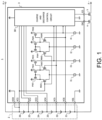
- FIG. 1 is a block diagram illustrating the charge and discharge control device and the battery device provided with the cell number determination circuit of this embodiment.
- the battery device 1 includes a charge and discharge control device 3, a battery pack 2 of six-series cell, which is an example of multiple cells connected in series, a discharge control FET 4, a charge control FET 5, an external terminal P+, and an external terminal P-.
- the battery pack 2 includes six cells 21 to 26 connected in series.
- the charge and discharge control device 3 includes a charge and discharge control circuit 30, PMOS transistors PM1 to PM6, heteropolar gate NMOS transistors NM1 and NM3, NMOS transistors NM2 and NM4, constant current sources I1 to I4, a power supply terminal VDD, a ground terminal VSS, input ports VC1 to VC6, and output ports CO and DO.
- the cell number determination circuit includes the PMOS transistors PM1 to PM 6, the heteropolar gate NMOS transistors NM1 and NM3, the NMOS transistors NM2 and NM4, and the constant current sources I1 to I4.
- the battery pack 2, the discharge control FET 4, and the charge control FET 5 are connected in series between the external terminal P+ and the external terminal P-.
- the cells 21 to 26 of the battery pack 2 are connected to the power supply terminal VDD, the input ports VC1 to VC6, and the ground terminal VSS of the charge and discharge control device 3, respectively.
- the gate of the discharge control FET 4 is connected to the output port DO of the charge and discharge control device 3.
- the gate of the charge control FET 5 is connected to the output port CO of the charge and discharge control device 3.
- the cell number determination circuit includes a first cell detection circuit that detects the presence or absence of the cell 22, that is, whether or not it is a four-series cell, and a second cell detection circuit that detects the presence or absence of the cell 21, that is, whether or not it is a five-series cell.
- the first cell detection circuit includes the PMOS transistors PM1, PM2, and PM3, the heteropolar gate NMOS transistor NM1, the NMOS transistor NM2, and the constant current sources I1 and I3.
- the differential amplifier includes the PMOS transistors PM1 and PM2, the heteropolar gate NMOS transistor NM1, the NMOS transistor NM2, and the constant current source I1.
- the output circuit includes the PMOS transistor PM3 and the constant current source I3.
- the gate of the heteropolar gate NMOS transistor NM1 is connected with the input port VC1 and receives the voltage VDD.
- the gate of the NMOS transistor NM2 is connected with the input port VC5 and receives the voltage VC5 of the input port VC5.
- the input differential pair of the differential amplifier includes the heteropolar gate NMOS transistor NM1 and the NMOS transistor NM2.
- the threshold value Vth of the heteropolar gate NMOS transistor NM1 is 1.7 V
- the threshold value Vth of the NMOS transistor NM2 is 0.7 V Since these transistors have the same configuration except for the polarity of the gate, their temperature characteristics and offsets are equal, and the tendency of the variation of the threshold value Vth is also equal.
- the difference between the threshold values Vth of these transistors may be set to 1.0 V with high accuracy. That is, the differential amplifier may detect a difference within 1.0 V of the input voltage without providing an offset to the input differential pair.
- the second cell detection circuit includes the PMOS transistors PM4, PM5, and PM6, the heteropolar gate NMOS transistor NM3, the NMOS transistor NM4, and the constant current sources I2 and I4.
- the differential amplifier includes the PMOS transistors PM4 and PM5, the heteropolar gate NMOS transistor NM3, the NMOS transistor NM4, and the constant current source I2.
- the output circuit includes the PMOS transistor PM6 and the constant current source I4.
- the gate of the heteropolar gate NMOS transistor NM3 is connected with the input port VC1 and receives the voltage VDD.
- the gate of the NMOS transistor NM4 is connected with the input port VC6 and receives the voltage VC6 of the input port VC6.
- the input differential pair of the differential amplifier includes the heteropolar gate NMOS transistor NM3 and the NMOS transistor NM4.
- the threshold value Vth of the heteropolar gate NMOS transistor NM3 is 1.7 V
- the threshold value Vth of the NMOS transistor NM4 is 0.7 V. Since these transistors have the same configuration except for the polarity of the gate, their temperature characteristics and offsets are equal, and the tendency of the variation of the threshold value Vth is also equal.
- the difference between the threshold values Vth of these transistors may be set to 1.0 V with high accuracy. That is, the differential amplifier may detect a difference within 1.0 V of the input voltage without providing an offset to the input differential pair.
- the first to sixth input ports are connected with the input ports VC1 to VC6, receive respective terminal voltages, and monitors the voltage of each cell. Further, in the charge and discharge control circuit 30, the first cell number detection terminal is connected with the output port of the first cell detection circuit, the second cell number detection terminal is connected with the output port of the second cell detection circuit, and the cell number of the battery pack is detected.
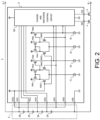
- FIG. 2 is a block diagram illustrating an example in which a battery pack 2 with the cell number reduced to four is connected to the battery device of this embodiment. Since the configuration is the same as in FIG. 1 except for the connection between the battery pack 2 and the charge and discharge control device 3, the description is omitted.
- each output port is connected to the positive terminal of the cell 26, and thus the voltage VDD is output.
- the input ports VC5 and VC6 receives the voltage VDD, and thus the gates of the NMOS transistors NM2 and NM4 receive the voltage VDD.
- the gate of the heteropolar gate NMOS transistor NM1 of the first cell detection circuit receives the voltage VDD, and the gate of the NMOS transistor NM2 receives the voltage VC5 of the input port VC5.
- the voltage VDD is 18V and the voltage VC5 is 6V
- the first cell detection circuit outputs an L level signal from the output port indicating that the cell is connected.
- the second cell detection circuit also outputs an L level signal from the output port.
- the first cell number detection terminal and the second cell number detection terminal receive the L level signal, it is determined that the connected battery pack 2 is a six-series cell.
- the gates of the heteropolar gate NMOS transistor NM1 and the NMOS transistor NM2 of the first cell detection circuit receive the voltage VDD.
- the threshold value Vth of the heteropolar gate NMOS transistor NM1 is 1.7 V
- the threshold value Vth of the NMOS transistor NM2 is 0.7 V
- the input differential pair receives the same voltage VDD, due to the difference in the threshold value Vth, the current flowing through the NMOS transistor NM2 is larger than the current flowing through the PMOS transistor PM2.
- the first cell detection circuit outputs an H level signal from the output port indicating that the cell is not connected.
- the second cell detection circuit also outputs an H level signal from the output port.
- the charge and discharge control circuit 30 since the first cell number detection terminal and the second cell number detection terminal receive the H level signal, it is determined that the connected battery pack 2 is a four-series cell.
- the input differential pair of the differential amplifier of the cell detection circuit includes the heteropolar gate NMOS transistor and the NMOS transistor, the presence or absence of a cell may be detected with high accuracy despite being a simple circuit.
- FIG. 3 is a block diagram illustrating another example of the charge and discharge control device 3 of this embodiment.
- the charge and discharge control device 3 in FIG. 3 is configured such that the PMOS transistor PM4, the heteropolar gate NMOS transistor NM3, and the constant current source I2 of the second cell detection circuit and the PMOS transistor PM1, the heteropolar gate NMOS transistor NM1, and the constant current source I3 of the first cell detection circuit are made common, that is, the MOS transistor and the constant current source on the heteropolar gate NMOS transistor NM3 side are made common, thereby reducing the number of element.
- the operation of the circuit is the same as that of the charge and discharge control device 3 in FIG. 1 , so the description thereof is omitted.
- the charge and discharge control device 3 configured in this manner may be configured with a minimum rise in the number of elements even if the number of cell number detection circuits is increased.
- the present invention is not limited to the above embodiment, and various changes may be made within the range without departing from the spirit of the present invention.
- the configuration is described as having a first cell detection circuit and a second cell detection circuit for a battery pack of six-series cell to four-series cell
- the cell number in the battery pack and the cell number capable of being increased or decreased, i.e., a cell number changeable (adjustable) range are not limited to these, and thus, the number of cell detection circuits included in the cell number determination circuit is also not limited.
- MOS transistor is an example of FET, and are not limited to MOS transistors. FETs other than MOS transistors, such as a junction FET (JFET) or a metal insulating film semiconductor FET (MISFET), may also be used.
- JFET junction FET
- MISFET metal insulating film semiconductor FET
- charge and discharge control circuit described above is a circuit configured to be able to control both charging and discharging, a circuit that does not have one of the control functions may be applied. That is, the charge and discharge control circuit described above may be replaced with a charge control circuit or a discharge control circuit.
Landscapes
- Engineering & Computer Science (AREA)
- Power Engineering (AREA)
- Physics & Mathematics (AREA)
- General Physics & Mathematics (AREA)
- Chemical & Material Sciences (AREA)
- Chemical Kinetics & Catalysis (AREA)
- Electrochemistry (AREA)
- General Chemical & Material Sciences (AREA)
- Manufacturing & Machinery (AREA)
- Charge And Discharge Circuits For Batteries Or The Like (AREA)
- Secondary Cells (AREA)
- Measurement Of Current Or Voltage (AREA)
Abstract
Description
- The present invention relates to a cell number (number of cells) determination circuit, as well as a charge and discharge control device and a battery device provided with a cell number determination circuit.
- A cell number determination device including a voltage measurement unit, a voltage comparison unit, and a cell number determination unit is disclosed (for example, see Patent Document 1). The voltage measurement unit selects the i-th cell from multiple cells connected in series constituting one battery and measures the voltage value between a terminal connected to the (i-1)th cell, which is one cell higher than that cell, and the ground potential. The voltage comparison unit determines the presence or absence of the i-th cell by comparing the voltage value of the (i+1)th cell, which is one cell below the i-th cell, with the voltage value of the i-th cell. The cell number determination unit determines the cell number installed in the battery based on the comparison results of this voltage comparison unit.
- [Patent Document 1] Japanese Patent Application Laid-Open (
JP-A) No. 2010-233359. - In a conventional cell number determination device, the circuit scale of the voltage measurement unit and the voltage comparison unit is large, which increases the circuit scale of the entire device.
- The present invention has been made in view of the above problems, and an object of the present invention is to provide a cell number determination device, a charge and discharge control device, and a battery device that have a smaller circuit scale than conventional devices. Means for Solving the Problems
- In order to solve the above problem, the cell number determination circuit of the present invention is a cell number determination circuit for determining a cell number in a battery pack equipped with multiple cells connected in series, including: multiple differential amplifiers provided corresponding to multiple cells in the battery pack of which the cell number is changeable; and multiple output circuits, provided corresponding to the differential amplifiers. An input differential pair of the differential amplifiers includes a heteropolar gate NMOS transistor and an NMOS transistor.
Further, the charge and discharge control device and the battery device according to the present invention include the cell number determination circuit. - In one embodiment, in the input differential pair of the differential amplifiers, the heteropolar gate NMOS transistor is connected to a maximum potential terminal of the battery pack, and the NMOS transistor is connected to a terminal to which the cells, of which the cell number is changeable, are connected.
- In one embodiment, the differential amplifiers are configured such that a MOS transistor and a constant current source on the heteropolar gate NMOS transistor side are made common.
- In one embodiment, a charge and discharge control device includes multiple input ports to which multiple terminals of the battery pack are connected; the above-mentioned cell number determination circuit, which determines a cell number in the battery pack based on voltages of a port corresponding to multiple cells, of which the number is changeable, among the input ports and a maximum potential terminal of the battery pack. The charge and discharge control device controls charging and discharging of the battery pack based on voltages of the input ports and an output signal of the cell number determination circuit.
- In one embodiment, a battery device includes: a battery pack, equipped with multiple cells connected in series; the above-mentioned charge and discharge control device; and a charge control FET and a discharge control FET, which are connected in series with the battery pack between external terminals.
- The present invention is capable of providing a cell number determination device, a charge and discharge control device, and a battery device with small circuit scale.
-
-
FIG. 1 is a block diagram illustrating the charge and discharge control device and the battery device provided with the cell number determination circuit of this embodiment. -
FIG. 2 is a block diagram illustrating an example in which a battery with the cell number reduced is connected to the battery device of this embodiment. -
FIG. 3 is a block diagram illustrating another example of the charge and discharge control device of this embodiment. - Hereinafter, a cell number determination circuit, as well as a charge and discharge control device and a battery device provided with a cell number determination circuit related to the present invention are described.
-
FIG. 1 is a block diagram illustrating the charge and discharge control device and the battery device provided with the cell number determination circuit of this embodiment.
Thebattery device 1 includes a charge anddischarge control device 3, abattery pack 2 of six-series cell, which is an example of multiple cells connected in series, a discharge control FET 4, acharge control FET 5, an external terminal P+, and an external terminal P-. Thebattery pack 2 includes sixcells 21 to 26 connected in series. - The charge and
discharge control device 3 includes a charge anddischarge control circuit 30, PMOS transistors PM1 to PM6, heteropolar gate NMOS transistors NM1 and NM3, NMOS transistors NM2 and NM4, constant current sources I1 to I4, a power supply terminal VDD, a ground terminal VSS, input ports VC1 to VC6, and output ports CO and DO. The cell number determination circuit includes the PMOS transistors PM1 to PM 6, the heteropolar gate NMOS transistors NM1 and NM3, the NMOS transistors NM2 and NM4, and the constant current sources I1 to I4. - The
battery pack 2, the discharge control FET 4, and thecharge control FET 5 are connected in series between the external terminal P+ and the external terminal P-. Thecells 21 to 26 of thebattery pack 2 are connected to the power supply terminal VDD, the input ports VC1 to VC6, and the ground terminal VSS of the charge anddischarge control device 3, respectively. The gate of the discharge control FET 4 is connected to the output port DO of the charge anddischarge control device 3. The gate of thecharge control FET 5 is connected to the output port CO of the charge anddischarge control device 3. - The cell number determination circuit includes a first cell detection circuit that detects the presence or absence of the
cell 22, that is, whether or not it is a four-series cell, and a second cell detection circuit that detects the presence or absence of thecell 21, that is, whether or not it is a five-series cell. - The first cell detection circuit includes the PMOS transistors PM1, PM2, and PM3, the heteropolar gate NMOS transistor NM1, the NMOS transistor NM2, and the constant current sources I1 and I3.
- The differential amplifier includes the PMOS transistors PM1 and PM2, the heteropolar gate NMOS transistor NM1, the NMOS transistor NM2, and the constant current source I1. The output circuit includes the PMOS transistor PM3 and the constant current source I3.
- The gate of the heteropolar gate NMOS transistor NM1 is connected with the input port VC1 and receives the voltage VDD. The gate of the NMOS transistor NM2 is connected with the input port VC5 and receives the voltage VC5 of the input port VC5.
- The input differential pair of the differential amplifier includes the heteropolar gate NMOS transistor NM1 and the NMOS transistor NM2. The threshold value Vth of the heteropolar gate NMOS transistor NM1 is 1.7 V, and the threshold value Vth of the NMOS transistor NM2 is 0.7 V Since these transistors have the same configuration except for the polarity of the gate, their temperature characteristics and offsets are equal, and the tendency of the variation of the threshold value Vth is also equal. Thus, the difference between the threshold values Vth of these transistors may be set to 1.0 V with high accuracy. That is, the differential amplifier may detect a difference within 1.0 V of the input voltage without providing an offset to the input differential pair.
- The second cell detection circuit includes the PMOS transistors PM4, PM5, and PM6, the heteropolar gate NMOS transistor NM3, the NMOS transistor NM4, and the constant current sources I2 and I4.
- The differential amplifier includes the PMOS transistors PM4 and PM5, the heteropolar gate NMOS transistor NM3, the NMOS transistor NM4, and the constant current source I2. The output circuit includes the PMOS transistor PM6 and the constant current source I4.
- The gate of the heteropolar gate NMOS transistor NM3 is connected with the input port VC1 and receives the voltage VDD. The gate of the NMOS transistor NM4 is connected with the input port VC6 and receives the voltage VC6 of the input port VC6.
- The input differential pair of the differential amplifier includes the heteropolar gate NMOS transistor NM3 and the NMOS transistor NM4. The threshold value Vth of the heteropolar gate NMOS transistor NM3 is 1.7 V, and the threshold value Vth of the NMOS transistor NM4 is 0.7 V. Since these transistors have the same configuration except for the polarity of the gate, their temperature characteristics and offsets are equal, and the tendency of the variation of the threshold value Vth is also equal. Thus, the difference between the threshold values Vth of these transistors may be set to 1.0 V with high accuracy. That is, the differential amplifier may detect a difference within 1.0 V of the input voltage without providing an offset to the input differential pair.
- In the charge and
discharge control circuit 30, the first to sixth input ports are connected with the input ports VC1 to VC6, receive respective terminal voltages, and monitors the voltage of each cell. Further, in the charge anddischarge control circuit 30, the first cell number detection terminal is connected with the output port of the first cell detection circuit, the second cell number detection terminal is connected with the output port of the second cell detection circuit, and the cell number of the battery pack is detected. -
FIG. 2 is a block diagram illustrating an example in which abattery pack 2 with the cell number reduced to four is connected to the battery device of this embodiment. Since the configuration is the same as inFIG. 1 except for the connection between thebattery pack 2 and the charge anddischarge control device 3, the description is omitted. - In the
battery pack 2, since thecell 21 and thecell 22 are reduced, each output port is connected to the positive terminal of thecell 26, and thus the voltage VDD is output. In the charge anddischarge control device 3, the input ports VC5 and VC6 receives the voltage VDD, and thus the gates of the NMOS transistors NM2 and NM4 receive the voltage VDD. - The operation of the cell number determination circuit of the charge and
discharge control device 3 of this embodiment is described. Here, the voltage of each cell is assumed to be 3V. - First, a case in which a six-series
cell battery pack 2 is connected to the charge anddischarge control device 3 as illustrated inFIG. 1 is described. - The gate of the heteropolar gate NMOS transistor NM1 of the first cell detection circuit receives the voltage VDD, and the gate of the NMOS transistor NM2 receives the voltage VC5 of the input port VC5. The voltage VDD is 18V and the voltage VC5 is 6V Thus, the first cell detection circuit outputs an L level signal from the output port indicating that the cell is connected. Similarly, the second cell detection circuit also outputs an L level signal from the output port.
- In the charge and
discharge control circuit 30, since the first cell number detection terminal and the second cell number detection terminal receive the L level signal, it is determined that the connectedbattery pack 2 is a six-series cell. - Next, a case in which a four-series
cell battery pack 2 is connected to the charge anddischarge control device 3 as illustrated inFIG. 2 is described. - The gates of the heteropolar gate NMOS transistor NM1 and the NMOS transistor NM2 of the first cell detection circuit receive the voltage VDD. At this time, the threshold value Vth of the heteropolar gate NMOS transistor NM1 is 1.7 V, and the threshold value Vth of the NMOS transistor NM2 is 0.7 V Although the input differential pair receives the same voltage VDD, due to the difference in the threshold value Vth, the current flowing through the NMOS transistor NM2 is larger than the current flowing through the PMOS transistor PM2.
- Thus, the first cell detection circuit outputs an H level signal from the output port indicating that the cell is not connected. Similarly, the second cell detection circuit also outputs an H level signal from the output port.
- In the charge and
discharge control circuit 30, since the first cell number detection terminal and the second cell number detection terminal receive the H level signal, it is determined that the connectedbattery pack 2 is a four-series cell. - As described above, in the cell number determination circuit of this embodiment, since the input differential pair of the differential amplifier of the cell detection circuit includes the heteropolar gate NMOS transistor and the NMOS transistor, the presence or absence of a cell may be detected with high accuracy despite being a simple circuit.
-
FIG. 3 is a block diagram illustrating another example of the charge anddischarge control device 3 of this embodiment. - The charge and
discharge control device 3 inFIG. 3 is configured such that the PMOS transistor PM4, the heteropolar gate NMOS transistor NM3, and the constant current source I2 of the second cell detection circuit and the PMOS transistor PM1, the heteropolar gate NMOS transistor NM1, and the constant current source I3 of the first cell detection circuit are made common, that is, the MOS transistor and the constant current source on the heteropolar gate NMOS transistor NM3 side are made common, thereby reducing the number of element. - The operation of the circuit is the same as that of the charge and
discharge control device 3 inFIG. 1 , so the description thereof is omitted. - The charge and
discharge control device 3 configured in this manner may be configured with a minimum rise in the number of elements even if the number of cell number detection circuits is increased. - Although the embodiment of the present invention has been described above, the present invention is not limited to the above embodiment, and various changes may be made within the range without departing from the spirit of the present invention.
For example, although the configuration is described as having a first cell detection circuit and a second cell detection circuit for a battery pack of six-series cell to four-series cell, the cell number in the battery pack and the cell number capable of being increased or decreased, i.e., a cell number changeable (adjustable) range are not limited to these, and thus, the number of cell detection circuits included in the cell number determination circuit is also not limited. - For example, the above-mentioned MOS transistor is an example of FET, and are not limited to MOS transistors. FETs other than MOS transistors, such as a junction FET (JFET) or a metal insulating film semiconductor FET (MISFET), may also be used. Moreover, although the charge and discharge control circuit described above is a circuit configured to be able to control both charging and discharging, a circuit that does not have one of the control functions may be applied. That is, the charge and discharge control circuit described above may be replaced with a charge control circuit or a discharge control circuit.
-
- 1 Battery device
- 2 Battery pack
- 3 Charge and discharge control device
- 4 Discharge control FET
- 5 Charge control FET
- 30 Charge and discharge control circuit
- PM1, PM2, PM3, PM4, PM5, PM6 PMOS transistor
- NM1, NM3 Heteropolar gate NMOS transistor
- NM2, NM4 NMOS transistor
- I1, I2, I3, I4 Constant current source
Claims (5)
- A cell number determination circuit for determining a cell number in a battery pack (2) equipped with a plurality of cells connected in series, comprising:a plurality of differential amplifiers provided corresponding to a plurality of cells in the battery pack of which the cell number is changeable, the differential amplifiers each including an input differential pair; anda plurality of output circuits provided corresponding to the plurality of differential amplifiers;wherein an input differential pair of the differential amplifiers comprises a heteropolar gate NMOS transistor (NM1, NM3) and an NMOS transistor (NM2, NM4).
- The cell number determination circuit according to claim 1, wherein
in the input differential pair of the differential amplifiers, the heteropolar gate NMOS transistor is connected to a maximum potential terminal of the battery pack, and the NMOS transistor is connected to a terminal to which the cells, of which the number is changeable, are connected. - The cell number determination circuit according to claim 2, wherein
the plurality of differential amplifiers are configured such that a MOS transistor and a constant current source (I1, I2, I3, I4) on the heteropolar gate NMOS transistor side are made common. - A charge and discharge control device (3), comprisinga plurality of input ports to which a plurality of terminals of the battery pack are connected;the cell number determination circuit according to any one of claims 1 to 3, which determines a cell number in the battery pack based on voltages of a port corresponding to a plurality of cells, of which the number is changeable, among the plurality of input ports and a maximum potential terminal of the battery pack,wherein the charge and discharge control device controls charging and discharging of the battery pack based on voltages of the plurality of input ports and an output signal of the cell number determination circuit.
- A battery device, comprising:a battery pack, equipped with a plurality of cells connected in series;the charge and discharge control device according to claim 4; anda charge control FET and a discharge control FET, which are connected in series with the battery pack between external terminals.
Applications Claiming Priority (1)
| Application Number | Priority Date | Filing Date | Title |
|---|---|---|---|
| JP2023054504A JP2024142382A (en) | 2023-03-30 | 2023-03-30 | Charge/discharge control device and battery device equipped with same |
Publications (2)
| Publication Number | Publication Date |
|---|---|
| EP4439919A2 true EP4439919A2 (en) | 2024-10-02 |
| EP4439919A3 EP4439919A3 (en) | 2024-11-27 |
Family
ID=90364922
Family Applications (1)
| Application Number | Title | Priority Date | Filing Date |
|---|---|---|---|
| EP24162618.3A Pending EP4439919A3 (en) | 2023-03-30 | 2024-03-11 | Cell number determination circuit, charge and discharge control device and battery device provided with cell number determination circuit |
Country Status (6)
| Country | Link |
|---|---|
| US (1) | US20240333005A1 (en) |
| EP (1) | EP4439919A3 (en) |
| JP (1) | JP2024142382A (en) |
| KR (1) | KR20240147500A (en) |
| CN (1) | CN118739461A (en) |
| TW (1) | TW202448002A (en) |
Families Citing this family (1)
| Publication number | Priority date | Publication date | Assignee | Title |
|---|---|---|---|---|
| CN120214609B (en) * | 2025-05-28 | 2025-08-26 | 深圳市德兰明海新能源股份有限公司 | A digital detection circuit and energy storage system |
Citations (1)
| Publication number | Priority date | Publication date | Assignee | Title |
|---|---|---|---|---|
| JP2010233359A (en) | 2009-03-27 | 2010-10-14 | Tdk-Lambda Corp | Method and device for determining cell count, power supply unit, and program |
Family Cites Families (2)
| Publication number | Priority date | Publication date | Assignee | Title |
|---|---|---|---|---|
| DE3537315A1 (en) * | 1985-10-19 | 1987-04-23 | Hirschmann Radiotechnik | COMPARATOR CIRCUIT |
| KR101894664B1 (en) * | 2017-04-28 | 2018-10-04 | 전북대학교산학협력단 | Cmos differential amplifier with offset voltage calibration function |
-
2023
- 2023-03-30 JP JP2023054504A patent/JP2024142382A/en active Pending
-
2024
- 2024-03-11 EP EP24162618.3A patent/EP4439919A3/en active Pending
- 2024-03-14 US US18/604,517 patent/US20240333005A1/en active Pending
- 2024-03-18 KR KR1020240037368A patent/KR20240147500A/en active Pending
- 2024-03-19 CN CN202410314177.2A patent/CN118739461A/en active Pending
- 2024-03-19 TW TW113110181A patent/TW202448002A/en unknown
Patent Citations (1)
| Publication number | Priority date | Publication date | Assignee | Title |
|---|---|---|---|---|
| JP2010233359A (en) | 2009-03-27 | 2010-10-14 | Tdk-Lambda Corp | Method and device for determining cell count, power supply unit, and program |
Also Published As
| Publication number | Publication date |
|---|---|
| JP2024142382A (en) | 2024-10-11 |
| EP4439919A3 (en) | 2024-11-27 |
| US20240333005A1 (en) | 2024-10-03 |
| CN118739461A (en) | 2024-10-01 |
| KR20240147500A (en) | 2024-10-08 |
| TW202448002A (en) | 2024-12-01 |
Similar Documents
| Publication | Publication Date | Title |
|---|---|---|
| JP4509852B2 (en) | Battery assembly and voltage detector | |
| US7521971B2 (en) | Buffer circuit | |
| KR101845911B1 (en) | Monitoring circuit of battery voltage | |
| US5646503A (en) | Method for balancing power sources and structure therefor | |
| JP4288590B2 (en) | Bidirectional switch current detection circuit | |
| CN109888855B (en) | Charge and discharge control device and battery device | |
| US7863942B2 (en) | Voltage detecting circuit | |
| US10771027B2 (en) | Operational amplifier circuit and current detection device using the same | |
| EP4439919A2 (en) | Cell number determination circuit, charge and discharge control device and battery device provided with cell number determination circuit | |
| JP2008099371A (en) | Voltage conversion circuit and battery device | |
| JP2010181351A (en) | Current detection circuit of bidirectional switch | |
| US20180328966A1 (en) | Voltage monitor | |
| US8952662B2 (en) | Circuit and system and method for controlling battery | |
| US11894850B1 (en) | Delay circuits and semiconductor devices | |
| EP3187885B1 (en) | A current sensing circuit and method | |
| JP2023147174A (en) | Voltage detection circuit, charge control circuit, charging and discharge control circuit, and semiconductor device | |
| JP2024142382A5 (en) | ||
| EP3754843A1 (en) | Voltage-current conversion circuit and charge-discharge control device | |
| EP4270723B1 (en) | Voltage detection circuit, charge control circuit, charge and discharge control circuit, and semiconductor device | |
| CN112600521B (en) | Switch circuit for adjusting offset voltage of amplifier, adjusting circuit and amplifier | |
| CN116930598A (en) | Voltage detection circuit, charge and discharge control circuit, and semiconductor device |
Legal Events
| Date | Code | Title | Description |
|---|---|---|---|
| PUAI | Public reference made under article 153(3) epc to a published international application that has entered the european phase |
Free format text: ORIGINAL CODE: 0009012 |
|
| STAA | Information on the status of an ep patent application or granted ep patent |
Free format text: STATUS: THE APPLICATION HAS BEEN PUBLISHED |
|
| AK | Designated contracting states |
Kind code of ref document: A2 Designated state(s): AL AT BE BG CH CY CZ DE DK EE ES FI FR GB GR HR HU IE IS IT LI LT LU LV MC ME MK MT NL NO PL PT RO RS SE SI SK SM TR |
|
| PUAL | Search report despatched |
Free format text: ORIGINAL CODE: 0009013 |
|
| AK | Designated contracting states |
Kind code of ref document: A3 Designated state(s): AL AT BE BG CH CY CZ DE DK EE ES FI FR GB GR HR HU IE IS IT LI LT LU LV MC ME MK MT NL NO PL PT RO RS SE SI SK SM TR |
|
| RIC1 | Information provided on ipc code assigned before grant |
Ipc: G01R 31/396 20190101ALI20241021BHEP Ipc: G01R 31/3835 20190101ALI20241021BHEP Ipc: H02J 7/00 20060101AFI20241021BHEP |
|
| STAA | Information on the status of an ep patent application or granted ep patent |
Free format text: STATUS: REQUEST FOR EXAMINATION WAS MADE |
|
| 17P | Request for examination filed |
Effective date: 20250314 |