EP4438657A1 - Polyamic acid, polyamic acid composition, polyimide, polyimide film, and printed circuit board - Google Patents
Polyamic acid, polyamic acid composition, polyimide, polyimide film, and printed circuit board Download PDFInfo
- Publication number
- EP4438657A1 EP4438657A1 EP24163504.4A EP24163504A EP4438657A1 EP 4438657 A1 EP4438657 A1 EP 4438657A1 EP 24163504 A EP24163504 A EP 24163504A EP 4438657 A1 EP4438657 A1 EP 4438657A1
- Authority
- EP
- European Patent Office
- Prior art keywords
- polyamic acid
- polyimide
- diamine
- dianhydride
- film
- Prior art date
- Legal status (The legal status is an assumption and is not a legal conclusion. Google has not performed a legal analysis and makes no representation as to the accuracy of the status listed.)
- Pending
Links
- 229920005575 poly(amic acid) Polymers 0.000 title claims abstract description 78
- 229920001721 polyimide Polymers 0.000 title claims abstract description 69
- 239000004642 Polyimide Substances 0.000 title claims abstract description 45
- 239000000203 mixture Substances 0.000 title claims abstract description 21
- 150000004985 diamines Chemical class 0.000 claims abstract description 79
- GTDPSWPPOUPBNX-UHFFFAOYSA-N ac1mqpva Chemical compound CC12C(=O)OC(=O)C1(C)C1(C)C2(C)C(=O)OC1=O GTDPSWPPOUPBNX-UHFFFAOYSA-N 0.000 claims abstract description 54
- 125000006158 tetracarboxylic acid group Chemical group 0.000 claims abstract description 30
- 239000000539 dimer Substances 0.000 claims abstract description 25
- 125000003983 fluorenyl group Chemical group C1(=CC=CC=2C3=CC=CC=C3CC12)* 0.000 claims abstract description 20
- 238000006243 chemical reaction Methods 0.000 claims abstract description 13
- 239000003960 organic solvent Substances 0.000 claims description 19
- 125000000217 alkyl group Chemical group 0.000 claims description 7
- 125000004209 (C1-C8) alkyl group Chemical group 0.000 claims description 6
- 125000004435 hydrogen atom Chemical group [H]* 0.000 claims description 6
- 125000005843 halogen group Chemical group 0.000 claims description 5
- 230000001747 exhibiting effect Effects 0.000 abstract description 16
- 239000011248 coating agent Substances 0.000 description 17
- 238000000576 coating method Methods 0.000 description 17
- 239000000758 substrate Substances 0.000 description 13
- 239000002904 solvent Substances 0.000 description 12
- 230000000052 comparative effect Effects 0.000 description 11
- 238000000034 method Methods 0.000 description 11
- SECXISVLQFMRJM-UHFFFAOYSA-N N-Methylpyrrolidone Chemical compound CN1CCCC1=O SECXISVLQFMRJM-UHFFFAOYSA-N 0.000 description 10
- 239000002253 acid Substances 0.000 description 10
- -1 aromatic diamine compound Chemical class 0.000 description 9
- 238000007363 ring formation reaction Methods 0.000 description 7
- IJGRMHOSHXDMSA-UHFFFAOYSA-N Atomic nitrogen Chemical compound N#N IJGRMHOSHXDMSA-UHFFFAOYSA-N 0.000 description 6
- ZMXDDKWLCZADIW-UHFFFAOYSA-N N,N-Dimethylformamide Chemical compound CN(C)C=O ZMXDDKWLCZADIW-UHFFFAOYSA-N 0.000 description 6
- 230000018044 dehydration Effects 0.000 description 6
- 238000006297 dehydration reaction Methods 0.000 description 6
- 230000002776 aggregation Effects 0.000 description 5
- 238000004220 aggregation Methods 0.000 description 5
- 238000005336 cracking Methods 0.000 description 5
- 238000011156 evaluation Methods 0.000 description 5
- 230000009477 glass transition Effects 0.000 description 5
- 238000010438 heat treatment Methods 0.000 description 5
- KIFDSGGWDIVQGN-UHFFFAOYSA-N 4-[9-(4-aminophenyl)fluoren-9-yl]aniline Chemical compound C1=CC(N)=CC=C1C1(C=2C=CC(N)=CC=2)C2=CC=CC=C2C2=CC=CC=C21 KIFDSGGWDIVQGN-UHFFFAOYSA-N 0.000 description 4
- 150000001408 amides Chemical class 0.000 description 4
- 150000004984 aromatic diamines Chemical class 0.000 description 4
- 125000003118 aryl group Chemical group 0.000 description 4
- 239000010419 fine particle Substances 0.000 description 4
- 238000005227 gel permeation chromatography Methods 0.000 description 4
- 238000005259 measurement Methods 0.000 description 4
- 238000002156 mixing Methods 0.000 description 4
- 229910052757 nitrogen Inorganic materials 0.000 description 4
- VLDPXPPHXDGHEW-UHFFFAOYSA-N 1-chloro-2-dichlorophosphoryloxybenzene Chemical compound ClC1=CC=CC=C1OP(Cl)(Cl)=O VLDPXPPHXDGHEW-UHFFFAOYSA-N 0.000 description 3
- HLBLWEWZXPIGSM-UHFFFAOYSA-N 4-Aminophenyl ether Chemical compound C1=CC(N)=CC=C1OC1=CC=C(N)C=C1 HLBLWEWZXPIGSM-UHFFFAOYSA-N 0.000 description 3
- WFDIJRYMOXRFFG-UHFFFAOYSA-N Acetic anhydride Chemical compound CC(=O)OC(C)=O WFDIJRYMOXRFFG-UHFFFAOYSA-N 0.000 description 3
- UHOVQNZJYSORNB-UHFFFAOYSA-N Benzene Chemical compound C1=CC=CC=C1 UHOVQNZJYSORNB-UHFFFAOYSA-N 0.000 description 3
- YMWUJEATGCHHMB-UHFFFAOYSA-N Dichloromethane Chemical compound ClCCl YMWUJEATGCHHMB-UHFFFAOYSA-N 0.000 description 3
- RTZKZFJDLAIYFH-UHFFFAOYSA-N Diethyl ether Chemical compound CCOCC RTZKZFJDLAIYFH-UHFFFAOYSA-N 0.000 description 3
- KFZMGEQAYNKOFK-UHFFFAOYSA-N Isopropanol Chemical compound CC(C)O KFZMGEQAYNKOFK-UHFFFAOYSA-N 0.000 description 3
- YXFVVABEGXRONW-UHFFFAOYSA-N Toluene Chemical compound CC1=CC=CC=C1 YXFVVABEGXRONW-UHFFFAOYSA-N 0.000 description 3
- ZMANZCXQSJIPKH-UHFFFAOYSA-N Triethylamine Chemical compound CCN(CC)CC ZMANZCXQSJIPKH-UHFFFAOYSA-N 0.000 description 3
- 239000012298 atmosphere Substances 0.000 description 3
- 150000001875 compounds Chemical class 0.000 description 3
- 229920000139 polyethylene terephthalate Polymers 0.000 description 3
- 239000005020 polyethylene terephthalate Substances 0.000 description 3
- 238000000197 pyrolysis Methods 0.000 description 3
- 239000000126 substance Substances 0.000 description 3
- 235000021122 unsaturated fatty acids Nutrition 0.000 description 3
- 150000004670 unsaturated fatty acids Chemical class 0.000 description 3
- CHLICZRVGGXEOD-UHFFFAOYSA-N 1-Methoxy-4-methylbenzene Chemical compound COC1=CC=C(C)C=C1 CHLICZRVGGXEOD-UHFFFAOYSA-N 0.000 description 2
- MXPYJVUYLVNEBB-UHFFFAOYSA-N 2-[2-(2-carboxybenzoyl)oxycarbonylbenzoyl]oxycarbonylbenzoic acid Chemical compound OC(=O)C1=CC=CC=C1C(=O)OC(=O)C1=CC=CC=C1C(=O)OC(=O)C1=CC=CC=C1C(O)=O MXPYJVUYLVNEBB-UHFFFAOYSA-N 0.000 description 2
- YEJRWHAVMIAJKC-UHFFFAOYSA-N 4-Butyrolactone Chemical compound O=C1CCCO1 YEJRWHAVMIAJKC-UHFFFAOYSA-N 0.000 description 2
- XKRFYHLGVUSROY-UHFFFAOYSA-N Argon Chemical compound [Ar] XKRFYHLGVUSROY-UHFFFAOYSA-N 0.000 description 2
- HEDRZPFGACZZDS-UHFFFAOYSA-N Chloroform Chemical compound ClC(Cl)Cl HEDRZPFGACZZDS-UHFFFAOYSA-N 0.000 description 2
- RYGMFSIKBFXOCR-UHFFFAOYSA-N Copper Chemical compound [Cu] RYGMFSIKBFXOCR-UHFFFAOYSA-N 0.000 description 2
- LCGLNKUTAGEVQW-UHFFFAOYSA-N Dimethyl ether Chemical compound COC LCGLNKUTAGEVQW-UHFFFAOYSA-N 0.000 description 2
- IAZDPXIOMUYVGZ-UHFFFAOYSA-N Dimethylsulphoxide Chemical compound CS(C)=O IAZDPXIOMUYVGZ-UHFFFAOYSA-N 0.000 description 2
- IMYZQPCYWPFTAG-UHFFFAOYSA-N Mecamylamine Chemical compound C1CC2C(C)(C)C(NC)(C)C1C2 IMYZQPCYWPFTAG-UHFFFAOYSA-N 0.000 description 2
- FXHOOIRPVKKKFG-UHFFFAOYSA-N N,N-Dimethylacetamide Chemical compound CN(C)C(C)=O FXHOOIRPVKKKFG-UHFFFAOYSA-N 0.000 description 2
- ISWSIDIOOBJBQZ-UHFFFAOYSA-N Phenol Chemical compound OC1=CC=CC=C1 ISWSIDIOOBJBQZ-UHFFFAOYSA-N 0.000 description 2
- 239000004793 Polystyrene Substances 0.000 description 2
- JUJWROOIHBZHMG-UHFFFAOYSA-N Pyridine Chemical compound C1=CC=NC=C1 JUJWROOIHBZHMG-UHFFFAOYSA-N 0.000 description 2
- WYURNTSHIVDZCO-UHFFFAOYSA-N Tetrahydrofuran Chemical compound C1CCOC1 WYURNTSHIVDZCO-UHFFFAOYSA-N 0.000 description 2
- 150000008065 acid anhydrides Chemical class 0.000 description 2
- 125000002723 alicyclic group Chemical group 0.000 description 2
- 125000001931 aliphatic group Chemical group 0.000 description 2
- 125000003277 amino group Chemical group 0.000 description 2
- 125000004202 aminomethyl group Chemical group [H]N([H])C([H])([H])* 0.000 description 2
- 125000002843 carboxylic acid group Chemical group 0.000 description 2
- 239000003054 catalyst Substances 0.000 description 2
- 229910052801 chlorine Inorganic materials 0.000 description 2
- 125000001309 chloro group Chemical group Cl* 0.000 description 2
- BGTOWKSIORTVQH-UHFFFAOYSA-N cyclopentanone Chemical compound O=C1CCCC1 BGTOWKSIORTVQH-UHFFFAOYSA-N 0.000 description 2
- KZTYYGOKRVBIMI-UHFFFAOYSA-N diphenyl sulfone Chemical compound C=1C=CC=CC=1S(=O)(=O)C1=CC=CC=C1 KZTYYGOKRVBIMI-UHFFFAOYSA-N 0.000 description 2
- 238000001035 drying Methods 0.000 description 2
- 239000003759 ester based solvent Substances 0.000 description 2
- 239000004210 ether based solvent Substances 0.000 description 2
- 229910052731 fluorine Inorganic materials 0.000 description 2
- 125000001153 fluoro group Chemical group F* 0.000 description 2
- ANSXAPJVJOKRDJ-UHFFFAOYSA-N furo[3,4-f][2]benzofuran-1,3,5,7-tetrone Chemical compound C1=C2C(=O)OC(=O)C2=CC2=C1C(=O)OC2=O ANSXAPJVJOKRDJ-UHFFFAOYSA-N 0.000 description 2
- 239000011261 inert gas Substances 0.000 description 2
- 239000005453 ketone based solvent Substances 0.000 description 2
- 239000000463 material Substances 0.000 description 2
- 125000002496 methyl group Chemical group [H]C([H])([H])* 0.000 description 2
- 229920000642 polymer Polymers 0.000 description 2
- 238000006116 polymerization reaction Methods 0.000 description 2
- 229920002223 polystyrene Polymers 0.000 description 2
- 230000035484 reaction time Effects 0.000 description 2
- 230000001105 regulatory effect Effects 0.000 description 2
- 239000002002 slurry Substances 0.000 description 2
- OLQWMCSSZKNOLQ-ZXZARUISSA-N (3s)-3-[(3r)-2,5-dioxooxolan-3-yl]oxolane-2,5-dione Chemical compound O=C1OC(=O)C[C@H]1[C@@H]1C(=O)OC(=O)C1 OLQWMCSSZKNOLQ-ZXZARUISSA-N 0.000 description 1
- OYHQOLUKZRVURQ-NTGFUMLPSA-N (9Z,12Z)-9,10,12,13-tetratritiooctadeca-9,12-dienoic acid Chemical compound C(CCCCCCC\C(=C(/C\C(=C(/CCCCC)\[3H])\[3H])\[3H])\[3H])(=O)O OYHQOLUKZRVURQ-NTGFUMLPSA-N 0.000 description 1
- WRIDQFICGBMAFQ-UHFFFAOYSA-N (E)-8-Octadecenoic acid Natural products CCCCCCCCCC=CCCCCCCC(O)=O WRIDQFICGBMAFQ-UHFFFAOYSA-N 0.000 description 1
- AVQQQNCBBIEMEU-UHFFFAOYSA-N 1,1,3,3-tetramethylurea Chemical compound CN(C)C(=O)N(C)C AVQQQNCBBIEMEU-UHFFFAOYSA-N 0.000 description 1
- WNXJIVFYUVYPPR-UHFFFAOYSA-N 1,3-dioxolane Chemical compound C1COCO1 WNXJIVFYUVYPPR-UHFFFAOYSA-N 0.000 description 1
- RYHBNJHYFVUHQT-UHFFFAOYSA-N 1,4-Dioxane Chemical compound C1COCCO1 RYHBNJHYFVUHQT-UHFFFAOYSA-N 0.000 description 1
- QTWJRLJHJPIABL-UHFFFAOYSA-N 2-methylphenol;3-methylphenol;4-methylphenol Chemical compound CC1=CC=C(O)C=C1.CC1=CC=CC(O)=C1.CC1=CC=CC=C1O QTWJRLJHJPIABL-UHFFFAOYSA-N 0.000 description 1
- LQJBNNIYVWPHFW-UHFFFAOYSA-N 20:1omega9c fatty acid Natural products CCCCCCCCCCC=CCCCCCCCC(O)=O LQJBNNIYVWPHFW-UHFFFAOYSA-N 0.000 description 1
- RHRNYXVSZLSRRP-UHFFFAOYSA-N 3-(carboxymethyl)cyclopentane-1,2,4-tricarboxylic acid Chemical compound OC(=O)CC1C(C(O)=O)CC(C(O)=O)C1C(O)=O RHRNYXVSZLSRRP-UHFFFAOYSA-N 0.000 description 1
- TYKLCAKICHXQNE-UHFFFAOYSA-N 3-[(2,3-dicarboxyphenyl)methyl]phthalic acid Chemical compound OC(=O)C1=CC=CC(CC=2C(=C(C(O)=O)C=CC=2)C(O)=O)=C1C(O)=O TYKLCAKICHXQNE-UHFFFAOYSA-N 0.000 description 1
- UCFMKTNJZCYBBJ-UHFFFAOYSA-N 3-[1-(2,3-dicarboxyphenyl)ethyl]phthalic acid Chemical compound C=1C=CC(C(O)=O)=C(C(O)=O)C=1C(C)C1=CC=CC(C(O)=O)=C1C(O)=O UCFMKTNJZCYBBJ-UHFFFAOYSA-N 0.000 description 1
- UCPOEBHXOCKECV-UHFFFAOYSA-N 3-[2-(2,3-dicarboxyphenyl)ethyl]phthalic acid Chemical compound OC(=O)C1=CC=CC(CCC=2C(=C(C(O)=O)C=CC=2)C(O)=O)=C1C(O)=O UCPOEBHXOCKECV-UHFFFAOYSA-N 0.000 description 1
- PAHZZOIHRHCHTH-UHFFFAOYSA-N 3-[2-(2,3-dicarboxyphenyl)propan-2-yl]phthalic acid Chemical compound C=1C=CC(C(O)=O)=C(C(O)=O)C=1C(C)(C)C1=CC=CC(C(O)=O)=C1C(O)=O PAHZZOIHRHCHTH-UHFFFAOYSA-N 0.000 description 1
- HYTCSCBDAFJMIP-UHFFFAOYSA-N 3-ethyl-1,1-dimethylurea Chemical compound CCNC(=O)N(C)C HYTCSCBDAFJMIP-UHFFFAOYSA-N 0.000 description 1
- LJMPOXUWPWEILS-UHFFFAOYSA-N 3a,4,4a,7a,8,8a-hexahydrofuro[3,4-f][2]benzofuran-1,3,5,7-tetrone Chemical compound C1C2C(=O)OC(=O)C2CC2C(=O)OC(=O)C21 LJMPOXUWPWEILS-UHFFFAOYSA-N 0.000 description 1
- IWXCYYWDGDDPAC-UHFFFAOYSA-N 4-[(3,4-dicarboxyphenyl)methyl]phthalic acid Chemical compound C1=C(C(O)=O)C(C(=O)O)=CC=C1CC1=CC=C(C(O)=O)C(C(O)=O)=C1 IWXCYYWDGDDPAC-UHFFFAOYSA-N 0.000 description 1
- IJJNNSUCZDJDLP-UHFFFAOYSA-N 4-[1-(3,4-dicarboxyphenyl)ethyl]phthalic acid Chemical compound C=1C=C(C(O)=O)C(C(O)=O)=CC=1C(C)C1=CC=C(C(O)=O)C(C(O)=O)=C1 IJJNNSUCZDJDLP-UHFFFAOYSA-N 0.000 description 1
- DDVYLSFEKWFRFS-UHFFFAOYSA-N 4-[2-(3,4-dicarboxyphenyl)ethyl]phthalic acid Chemical compound C1=C(C(O)=O)C(C(=O)O)=CC=C1CCC1=CC=C(C(O)=O)C(C(O)=O)=C1 DDVYLSFEKWFRFS-UHFFFAOYSA-N 0.000 description 1
- GEYAGBVEAJGCFB-UHFFFAOYSA-N 4-[2-(3,4-dicarboxyphenyl)propan-2-yl]phthalic acid Chemical compound C=1C=C(C(O)=O)C(C(O)=O)=CC=1C(C)(C)C1=CC=C(C(O)=O)C(C(O)=O)=C1 GEYAGBVEAJGCFB-UHFFFAOYSA-N 0.000 description 1
- JYZPDAUOQGFBKT-UHFFFAOYSA-N 4-[2-[2-[2-(3,4-dicarboxyphenoxy)phenyl]propan-2-yl]phenoxy]phthalic acid Chemical compound C=1C=CC=C(OC=2C=C(C(C(O)=O)=CC=2)C(O)=O)C=1C(C)(C)C1=CC=CC=C1OC1=CC=C(C(O)=O)C(C(O)=O)=C1 JYZPDAUOQGFBKT-UHFFFAOYSA-N 0.000 description 1
- YGYCECQIOXZODZ-UHFFFAOYSA-N 4415-87-6 Chemical compound O=C1OC(=O)C2C1C1C(=O)OC(=O)C12 YGYCECQIOXZODZ-UHFFFAOYSA-N 0.000 description 1
- JYCTWJFSRDBYJX-UHFFFAOYSA-N 5-(2,5-dioxooxolan-3-yl)-3a,4,5,9b-tetrahydrobenzo[e][2]benzofuran-1,3-dione Chemical compound O=C1OC(=O)CC1C1C2=CC=CC=C2C(C(=O)OC2=O)C2C1 JYCTWJFSRDBYJX-UHFFFAOYSA-N 0.000 description 1
- DGQOZCNCJKEVOA-UHFFFAOYSA-N 5-(2,5-dioxooxolan-3-yl)-7-methyl-3a,4,5,7a-tetrahydro-2-benzofuran-1,3-dione Chemical compound C1C(C(OC2=O)=O)C2C(C)=CC1C1CC(=O)OC1=O DGQOZCNCJKEVOA-UHFFFAOYSA-N 0.000 description 1
- QQGYZOYWNCKGEK-UHFFFAOYSA-N 5-[(1,3-dioxo-2-benzofuran-5-yl)oxy]-2-benzofuran-1,3-dione Chemical compound C1=C2C(=O)OC(=O)C2=CC(OC=2C=C3C(=O)OC(C3=CC=2)=O)=C1 QQGYZOYWNCKGEK-UHFFFAOYSA-N 0.000 description 1
- ZHBXLZQQVCDGPA-UHFFFAOYSA-N 5-[(1,3-dioxo-2-benzofuran-5-yl)sulfonyl]-2-benzofuran-1,3-dione Chemical compound C1=C2C(=O)OC(=O)C2=CC(S(=O)(=O)C=2C=C3C(=O)OC(C3=CC=2)=O)=C1 ZHBXLZQQVCDGPA-UHFFFAOYSA-N 0.000 description 1
- ZCYVEMRRCGMTRW-UHFFFAOYSA-N 7553-56-2 Chemical group [I] ZCYVEMRRCGMTRW-UHFFFAOYSA-N 0.000 description 1
- QSBYPNXLFMSGKH-UHFFFAOYSA-N 9-Heptadecensaeure Natural products CCCCCCCC=CCCCCCCCC(O)=O QSBYPNXLFMSGKH-UHFFFAOYSA-N 0.000 description 1
- 229920002799 BoPET Polymers 0.000 description 1
- WKBOTKDWSSQWDR-UHFFFAOYSA-N Bromine atom Chemical group [Br] WKBOTKDWSSQWDR-UHFFFAOYSA-N 0.000 description 1
- JOYRKODLDBILNP-UHFFFAOYSA-N Ethyl urethane Chemical compound CCOC(N)=O JOYRKODLDBILNP-UHFFFAOYSA-N 0.000 description 1
- ZQPPMHVWECSIRJ-UHFFFAOYSA-N Oleic acid Natural products CCCCCCCCC=CCCCCCCCC(O)=O ZQPPMHVWECSIRJ-UHFFFAOYSA-N 0.000 description 1
- 239000005642 Oleic acid Substances 0.000 description 1
- 239000004698 Polyethylene Substances 0.000 description 1
- 239000004743 Polypropylene Substances 0.000 description 1
- 239000006087 Silane Coupling Agent Substances 0.000 description 1
- XSQUKJJJFZCRTK-UHFFFAOYSA-N Urea Chemical compound NC(N)=O XSQUKJJJFZCRTK-UHFFFAOYSA-N 0.000 description 1
- AMNPXXIGUOKIPP-UHFFFAOYSA-N [4-(carbamothioylamino)phenyl]thiourea Chemical compound NC(=S)NC1=CC=C(NC(N)=S)C=C1 AMNPXXIGUOKIPP-UHFFFAOYSA-N 0.000 description 1
- 125000004018 acid anhydride group Chemical group 0.000 description 1
- 125000002015 acyclic group Chemical group 0.000 description 1
- DTOSIQBPPRVQHS-PDBXOOCHSA-N alpha-linolenic acid Chemical compound CC\C=C/C\C=C/C\C=C/CCCCCCCC(O)=O DTOSIQBPPRVQHS-PDBXOOCHSA-N 0.000 description 1
- 235000020661 alpha-linolenic acid Nutrition 0.000 description 1
- XAGFODPZIPBFFR-UHFFFAOYSA-N aluminium Chemical compound [Al] XAGFODPZIPBFFR-UHFFFAOYSA-N 0.000 description 1
- 229910052782 aluminium Inorganic materials 0.000 description 1
- 229910052786 argon Inorganic materials 0.000 description 1
- 150000004945 aromatic hydrocarbons Chemical class 0.000 description 1
- VAYBSUUSYTWKBX-UHFFFAOYSA-N bicyclo[2.2.1]heptane-2,3,3,4-tetracarboxylic acid Chemical compound C1CC2(C(O)=O)C(C(O)=O)(C(O)=O)C(C(=O)O)C1C2 VAYBSUUSYTWKBX-UHFFFAOYSA-N 0.000 description 1
- XQBSPQLKNWMPMG-UHFFFAOYSA-N bicyclo[2.2.2]octane-2,3,5,6-tetracarboxylic acid Chemical compound C1CC2C(C(O)=O)C(C(=O)O)C1C(C(O)=O)C2C(O)=O XQBSPQLKNWMPMG-UHFFFAOYSA-N 0.000 description 1
- 230000005540 biological transmission Effects 0.000 description 1
- 230000015572 biosynthetic process Effects 0.000 description 1
- WKDNYTOXBCRNPV-UHFFFAOYSA-N bpda Chemical compound C1=C2C(=O)OC(=O)C2=CC(C=2C=C3C(=O)OC(C3=CC=2)=O)=C1 WKDNYTOXBCRNPV-UHFFFAOYSA-N 0.000 description 1
- 239000004202 carbamide Substances 0.000 description 1
- 125000004432 carbon atom Chemical group C* 0.000 description 1
- 125000003178 carboxy group Chemical group [H]OC(*)=O 0.000 description 1
- 230000015556 catabolic process Effects 0.000 description 1
- 239000003795 chemical substances by application Substances 0.000 description 1
- 229910052802 copper Inorganic materials 0.000 description 1
- 239000010949 copper Substances 0.000 description 1
- 239000011889 copper foil Substances 0.000 description 1
- 229930003836 cresol Natural products 0.000 description 1
- 125000004122 cyclic group Chemical group 0.000 description 1
- SMEJCQZFRMVYGC-UHFFFAOYSA-N cyclohexane-1,2,3,4-tetracarboxylic acid Chemical compound OC(=O)C1CCC(C(O)=O)C(C(O)=O)C1C(O)=O SMEJCQZFRMVYGC-UHFFFAOYSA-N 0.000 description 1
- WOSVXXBNNCUXMT-UHFFFAOYSA-N cyclopentane-1,2,3,4-tetracarboxylic acid Chemical compound OC(=O)C1CC(C(O)=O)C(C(O)=O)C1C(O)=O WOSVXXBNNCUXMT-UHFFFAOYSA-N 0.000 description 1
- 230000003247 decreasing effect Effects 0.000 description 1
- 230000001934 delay Effects 0.000 description 1
- 230000000694 effects Effects 0.000 description 1
- 238000005516 engineering process Methods 0.000 description 1
- 125000001495 ethyl group Chemical group [H]C([H])([H])C([H])([H])* 0.000 description 1
- 239000007888 film coating Substances 0.000 description 1
- 238000009501 film coating Methods 0.000 description 1
- 239000011521 glass Substances 0.000 description 1
- GNOIPBMMFNIUFM-UHFFFAOYSA-N hexamethylphosphoric triamide Chemical compound CN(C)P(=O)(N(C)C)N(C)C GNOIPBMMFNIUFM-UHFFFAOYSA-N 0.000 description 1
- 125000005462 imide group Chemical group 0.000 description 1
- 230000006872 improvement Effects 0.000 description 1
- 230000002401 inhibitory effect Effects 0.000 description 1
- 238000009413 insulation Methods 0.000 description 1
- 239000011229 interlayer Substances 0.000 description 1
- 229910052740 iodine Inorganic materials 0.000 description 1
- QXJSBBXBKPUZAA-UHFFFAOYSA-N isooleic acid Natural products CCCCCCCC=CCCCCCCCCC(O)=O QXJSBBXBKPUZAA-UHFFFAOYSA-N 0.000 description 1
- 229960004488 linolenic acid Drugs 0.000 description 1
- KQQKGWQCNNTQJW-UHFFFAOYSA-N linolenic acid Natural products CC=CCCC=CCC=CCCCCCCCC(O)=O KQQKGWQCNNTQJW-UHFFFAOYSA-N 0.000 description 1
- 230000007257 malfunction Effects 0.000 description 1
- 238000004519 manufacturing process Methods 0.000 description 1
- 239000000178 monomer Substances 0.000 description 1
- AJFDBNQQDYLMJN-UHFFFAOYSA-N n,n-diethylacetamide Chemical compound CCN(CC)C(C)=O AJFDBNQQDYLMJN-UHFFFAOYSA-N 0.000 description 1
- DOBFTMLCEYUAQC-UHFFFAOYSA-N naphthalene-2,3,6,7-tetracarboxylic acid Chemical compound OC(=O)C1=C(C(O)=O)C=C2C=C(C(O)=O)C(C(=O)O)=CC2=C1 DOBFTMLCEYUAQC-UHFFFAOYSA-N 0.000 description 1
- YTVNOVQHSGMMOV-UHFFFAOYSA-N naphthalenetetracarboxylic dianhydride Chemical compound C1=CC(C(=O)OC2=O)=C3C2=CC=C2C(=O)OC(=O)C1=C32 YTVNOVQHSGMMOV-UHFFFAOYSA-N 0.000 description 1
- ZQPPMHVWECSIRJ-KTKRTIGZSA-N oleic acid Chemical compound CCCCCCCC\C=C/CCCCCCCC(O)=O ZQPPMHVWECSIRJ-KTKRTIGZSA-N 0.000 description 1
- 235000021313 oleic acid Nutrition 0.000 description 1
- 230000003287 optical effect Effects 0.000 description 1
- HVNWRBWNOPYOER-UHFFFAOYSA-N pentane-1,2,3,4-tetracarboxylic acid Chemical compound OC(=O)C(C)C(C(O)=O)C(C(O)=O)CC(O)=O HVNWRBWNOPYOER-UHFFFAOYSA-N 0.000 description 1
- 239000002985 plastic film Substances 0.000 description 1
- 229920006255 plastic film Polymers 0.000 description 1
- 239000004014 plasticizer Substances 0.000 description 1
- 239000004417 polycarbonate Substances 0.000 description 1
- 229920000515 polycarbonate Polymers 0.000 description 1
- 229920000728 polyester Polymers 0.000 description 1
- 229920000573 polyethylene Polymers 0.000 description 1
- 230000000379 polymerizing effect Effects 0.000 description 1
- 229920001155 polypropylene Polymers 0.000 description 1
- 230000002250 progressing effect Effects 0.000 description 1
- UMJSCPRVCHMLSP-UHFFFAOYSA-N pyridine Natural products COC1=CC=CN=C1 UMJSCPRVCHMLSP-UHFFFAOYSA-N 0.000 description 1
- 230000009257 reactivity Effects 0.000 description 1
- 238000009774 resonance method Methods 0.000 description 1
- 239000004065 semiconductor Substances 0.000 description 1
- 230000008054 signal transmission Effects 0.000 description 1
- 150000003384 small molecules Chemical class 0.000 description 1
- 239000007787 solid Substances 0.000 description 1
- 229910001220 stainless steel Inorganic materials 0.000 description 1
- 239000010935 stainless steel Substances 0.000 description 1
- 150000003457 sulfones Chemical class 0.000 description 1
- 239000004094 surface-active agent Substances 0.000 description 1
- 238000003786 synthesis reaction Methods 0.000 description 1
- OAXARSVKYJPDPA-UHFFFAOYSA-N tert-butyl 4-prop-2-ynylpiperazine-1-carboxylate Chemical compound CC(C)(C)OC(=O)N1CCN(CC#C)CC1 OAXARSVKYJPDPA-UHFFFAOYSA-N 0.000 description 1
- YLQBMQCUIZJEEH-UHFFFAOYSA-N tetrahydrofuran Natural products C=1C=COC=1 YLQBMQCUIZJEEH-UHFFFAOYSA-N 0.000 description 1
- 238000001029 thermal curing Methods 0.000 description 1
- 238000007669 thermal treatment Methods 0.000 description 1
- 230000000930 thermomechanical effect Effects 0.000 description 1
- NJMOHBDCGXJLNJ-UHFFFAOYSA-N trimellitic anhydride chloride Chemical compound ClC(=O)C1=CC=C2C(=O)OC(=O)C2=C1 NJMOHBDCGXJLNJ-UHFFFAOYSA-N 0.000 description 1
Classifications
-
- C—CHEMISTRY; METALLURGY
- C08—ORGANIC MACROMOLECULAR COMPOUNDS; THEIR PREPARATION OR CHEMICAL WORKING-UP; COMPOSITIONS BASED THEREON
- C08G—MACROMOLECULAR COMPOUNDS OBTAINED OTHERWISE THAN BY REACTIONS ONLY INVOLVING UNSATURATED CARBON-TO-CARBON BONDS
- C08G73/00—Macromolecular compounds obtained by reactions forming a linkage containing nitrogen with or without oxygen or carbon in the main chain of the macromolecule, not provided for in groups C08G12/00 - C08G71/00
- C08G73/06—Polycondensates having nitrogen-containing heterocyclic rings in the main chain of the macromolecule
- C08G73/10—Polyimides; Polyester-imides; Polyamide-imides; Polyamide acids or similar polyimide precursors
- C08G73/1042—Copolyimides derived from at least two different tetracarboxylic compounds or two different diamino compounds
-
- C—CHEMISTRY; METALLURGY
- C08—ORGANIC MACROMOLECULAR COMPOUNDS; THEIR PREPARATION OR CHEMICAL WORKING-UP; COMPOSITIONS BASED THEREON
- C08G—MACROMOLECULAR COMPOUNDS OBTAINED OTHERWISE THAN BY REACTIONS ONLY INVOLVING UNSATURATED CARBON-TO-CARBON BONDS
- C08G73/00—Macromolecular compounds obtained by reactions forming a linkage containing nitrogen with or without oxygen or carbon in the main chain of the macromolecule, not provided for in groups C08G12/00 - C08G71/00
- C08G73/06—Polycondensates having nitrogen-containing heterocyclic rings in the main chain of the macromolecule
- C08G73/10—Polyimides; Polyester-imides; Polyamide-imides; Polyamide acids or similar polyimide precursors
- C08G73/1003—Preparatory processes
- C08G73/1007—Preparatory processes from tetracarboxylic acids or derivatives and diamines
-
- C—CHEMISTRY; METALLURGY
- C08—ORGANIC MACROMOLECULAR COMPOUNDS; THEIR PREPARATION OR CHEMICAL WORKING-UP; COMPOSITIONS BASED THEREON
- C08G—MACROMOLECULAR COMPOUNDS OBTAINED OTHERWISE THAN BY REACTIONS ONLY INVOLVING UNSATURATED CARBON-TO-CARBON BONDS
- C08G73/00—Macromolecular compounds obtained by reactions forming a linkage containing nitrogen with or without oxygen or carbon in the main chain of the macromolecule, not provided for in groups C08G12/00 - C08G71/00
- C08G73/06—Polycondensates having nitrogen-containing heterocyclic rings in the main chain of the macromolecule
- C08G73/10—Polyimides; Polyester-imides; Polyamide-imides; Polyamide acids or similar polyimide precursors
- C08G73/1075—Partially aromatic polyimides
- C08G73/1082—Partially aromatic polyimides wholly aromatic in the tetracarboxylic moiety
-
- C—CHEMISTRY; METALLURGY
- C08—ORGANIC MACROMOLECULAR COMPOUNDS; THEIR PREPARATION OR CHEMICAL WORKING-UP; COMPOSITIONS BASED THEREON
- C08J—WORKING-UP; GENERAL PROCESSES OF COMPOUNDING; AFTER-TREATMENT NOT COVERED BY SUBCLASSES C08B, C08C, C08F, C08G or C08H
- C08J5/00—Manufacture of articles or shaped materials containing macromolecular substances
- C08J5/18—Manufacture of films or sheets
-
- H—ELECTRICITY
- H05—ELECTRIC TECHNIQUES NOT OTHERWISE PROVIDED FOR
- H05K—PRINTED CIRCUITS; CASINGS OR CONSTRUCTIONAL DETAILS OF ELECTRIC APPARATUS; MANUFACTURE OF ASSEMBLAGES OF ELECTRICAL COMPONENTS
- H05K1/00—Printed circuits
- H05K1/02—Details
- H05K1/03—Use of materials for the substrate
- H05K1/0313—Organic insulating material
-
- H—ELECTRICITY
- H05—ELECTRIC TECHNIQUES NOT OTHERWISE PROVIDED FOR
- H05K—PRINTED CIRCUITS; CASINGS OR CONSTRUCTIONAL DETAILS OF ELECTRIC APPARATUS; MANUFACTURE OF ASSEMBLAGES OF ELECTRICAL COMPONENTS
- H05K1/00—Printed circuits
- H05K1/02—Details
- H05K1/03—Use of materials for the substrate
- H05K1/0313—Organic insulating material
- H05K1/032—Organic insulating material consisting of one material
- H05K1/0346—Organic insulating material consisting of one material containing N
-
- C—CHEMISTRY; METALLURGY
- C08—ORGANIC MACROMOLECULAR COMPOUNDS; THEIR PREPARATION OR CHEMICAL WORKING-UP; COMPOSITIONS BASED THEREON
- C08J—WORKING-UP; GENERAL PROCESSES OF COMPOUNDING; AFTER-TREATMENT NOT COVERED BY SUBCLASSES C08B, C08C, C08F, C08G or C08H
- C08J2379/00—Characterised by the use of macromolecular compounds obtained by reactions forming in the main chain of the macromolecule a linkage containing nitrogen with or without oxygen, or carbon only, not provided for in groups C08J2361/00 - C08J2377/00
- C08J2379/04—Polycondensates having nitrogen-containing heterocyclic rings in the main chain; Polyhydrazides; Polyamide acids or similar polyimide precursors
- C08J2379/08—Polyimides; Polyester-imides; Polyamide-imides; Polyamide acids or similar polyimide precursors
-
- H—ELECTRICITY
- H05—ELECTRIC TECHNIQUES NOT OTHERWISE PROVIDED FOR
- H05K—PRINTED CIRCUITS; CASINGS OR CONSTRUCTIONAL DETAILS OF ELECTRIC APPARATUS; MANUFACTURE OF ASSEMBLAGES OF ELECTRICAL COMPONENTS
- H05K1/00—Printed circuits
- H05K1/02—Details
- H05K1/03—Use of materials for the substrate
- H05K1/0393—Flexible materials
-
- H—ELECTRICITY
- H05—ELECTRIC TECHNIQUES NOT OTHERWISE PROVIDED FOR
- H05K—PRINTED CIRCUITS; CASINGS OR CONSTRUCTIONAL DETAILS OF ELECTRIC APPARATUS; MANUFACTURE OF ASSEMBLAGES OF ELECTRICAL COMPONENTS
- H05K2201/00—Indexing scheme relating to printed circuits covered by H05K1/00
- H05K2201/01—Dielectrics
- H05K2201/0137—Materials
- H05K2201/0154—Polyimide
Definitions
- the present invention relates to a polyamic acid that can form a polyimide exhibiting a low dielectric property and high heat resistance and that has good film formability, and a polyamic acid composition, polyimide, polyimide film, and printed circuit board that are produced by using this polyamic acid.
- a polyimide which is an imidized polymer of a polyamic acid commonly synthesized from an acid dianhydride and an aromatic diamine compound, has excellent heat resistance, mechanical properties, and insulativity, and is therefore widely used for such insulative materials.
- a printed circuit board for high-speed large-capacity next-generation high-frequency wireless systems has been developed, and adopting a circuit substrate having a multilayer wiring structure enables high-speed transmission of signals.
- Polyimides are used for an interlayer insulative film in the multilayer wiring structure, but common polyimides have high dielectric properties such as dielectric constant, and thereby cause delays in the transmission of the signals to inhibit increase in the speed.
- an electrostatic capacity increases with the high dielectric constant, and thereby wiring near the insulative film generates heat in use with high-speed telecommunication (high frequency), and causes malfunction and the like of the printed circuit board.
- Patent Literature 1 discloses that a polyimide produced by using an aromatic diamine and tetracarboxylic dianhydride having specific structures exhibits a low dielectric constant and excellent heat resistance.
- a known method is decreasing a concentration of imide groups by introducing a fluorene skeleton into a diamine component to decrease the polarity of an entire molecule, and reducing a dielectric constant of the polyimide.
- J Patent Literature 2 discloses that a polyimide using trimellitic anhydride chloride as an acid anhydride and 9,9-bis(4-aminophenyl)fluorene as a diamine exhibits high heat resistance and low specific dielectric constant.
- the polyamic acid composition having a fluorene skeleton typically tends to have insufficient film formability, and may fail to yield a polyimide film having good properties.
- a polyamic acid that can form a polyimide exhibiting high heat resistance and a low dielectric property and that exhibits good film formability.
- An aspect of the present invention is a polyamic acid that is a product obtained by polyaddition reaction between a tetracarboxylic dianhydride (A) and at least two diamines (B), wherein the at least two diamines (B) comprise a diamine having a fluorene skeleton (B1) and a dimer diamine (B2).
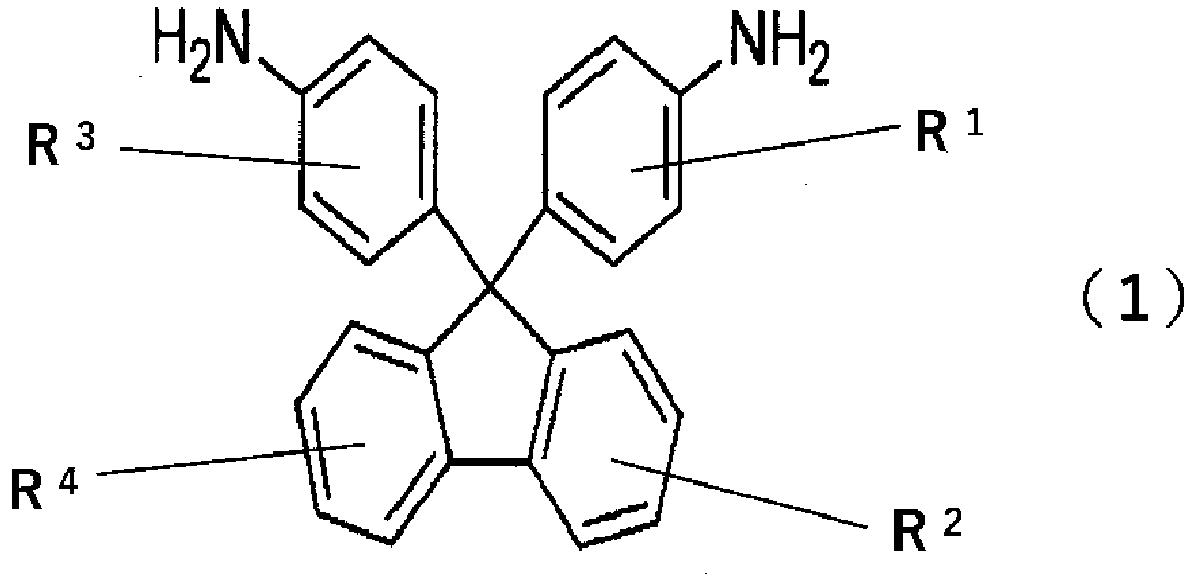
- the diamine having the fluorene skeleton (B1) has a structure represented by the following formula (1): wherein R 1 to R 4 each independently represent a hydrogen atom, a halogen atom, a C 1 to C 8 alkyl group, or a C 1 to C 8 halogenated alkyl group.
- Another aspect of the present invention is a polyamic acid composition
- a polyamic acid composition comprising the above polyamic acid and an organic solvent (C).
- Another aspect of the present invention is a polyimide obtained by imidizing the above polyamic acid.
- Another aspect of the present invention is a polyimide film comprising the above polyimide.
- Another aspect of the present invention is a printed circuit board comprising the above polyimide film.
- the polyamic acid that can form a polyimide exhibiting a low dielectric property and high heat resistance and that has good film formability, and the polyamic acid composition, polyimide, polyimide film, and printed circuit board that are produced by using this polyamic acid can be provided.
- a polyamic acid of the present invention is a product obtained by polyaddition reaction between a tetracarboxylic dianhydride (A) and at least two diamines (B), wherein the at least two diamines (B) contain a diamine having a fluorene skeleton (B1) and a dimer diamine (B2). That is, the polyamic acid of the present invention and the polyimide formed by using this polyamic acid have a fluorene skeleton and a dimer skeleton. If only the diamine having the fluorene skeleton is contained as the diamine component, sufficient film formability is not imparted to the polyamic acid.
- the polyamic acid having both the fluorene skeleton and the dimer skeleton can form the polyimide exhibiting the low dielectric property and the high heat resistance, and the insufficient film formability of the polyamic acid derived from the fluorene skeleton is improved to be able to achieve the polyamic acid exhibiting the good film formability.
- the polyamic acid of the present invention has a structural unit derived from the tetracarboxylic dianhydride in a molecule as an acid dianhydride component.
- the tetracarboxylic dianhydride may be any of an alicyclic tetracarboxylic dianhydride, an aromatic tetracarboxylic dianhydride, and an aliphatic tetracarboxylic dianhydride, and has two acid anhydride groups in one molecule.
- One tetracarboxylic dianhydride may be used, or two or more thereof may be used in combination.
- Examples of the alicyclic tetracarboxylic dianhydride include 1,2,3,4-cyclobutanetetracarboxylic dianhydride, 1,2,3,4-cyclopentanetetracarboxylic dianhydride, 3-carboxymethylcyclopentane-1,2,4-tricarboxylic dianhydride, 1,2,3,4-cyclohexanetetracarboxylic dianhydride, 1,2,4,5-cyclohexanetetracarboxylic dianhydride, bicyclo[2.2.1]heptanetetracarboxylic dianhydride, bicyclo[2.2.1]heptane-5-carboxymethyl-2,3,6-tricarboxylic dianhydride, bicyclo[2.2.2]oct-7-ene-2,3,5,6-tetracarboxylic dianhydride, bicyclo[2.2.2]octane-2,3,5,6-tetracarboxylic dianhydride, pentacyclo[8.
- aromatic tetracarboxylic dianhydride examples include 3,3',4,4'-diphenylsulfonetetracarboxylic dianhydride, 3,3'4,4'-benzophenonetetracarboxylic dianhydride, 4,4'-oxydiphthalic dianhydride, pyromellitic dianhydride, 2,2'3,3'-benzophenonetetracarboxylic dianhydride, 3,3',4,4'-biphenyltetracarboxylic dianhydride, 2,2'3,3'-biphenyltetracarboxylic dianhydride, 2,2-bis(3,4-dicarboxyphenyl)propane dianhydride, 2,2-bis(2,3-dicarboxyphenyl)propane dianhydride, 2,2-bis(3,4-dicarboxyphenoxyphenyl)propane dianhydride, 1,1-bis(2,3-dicarboxyphenyl)ethane
- Examples of the aliphatic tetracarboxylic dianhydride include 1,2,3,4-butanetetracarboxylic dianhydride, 1,2,3,4-pentanetetracarboxylic dianhydride, and derivatives thereof.
- the acid dianhydride component is preferably the aromatic tetracarboxylic dianhydride, and among the aromatic tetracarboxylic dianhydride, pyromellitic dianhydride is preferable.
- the polyamic acid of the present invention has a structural unit derived from at least two diamines as the diamine component, and one of the diamine components has a structural unit derived from a diamine having a fluorene skeleton (B1).
- a diamine having a fluorene skeleton preferably has a structure represented by the following formula (1).
- R 1 to R 4 each independently represent a hydrogen atom, a halogen atom, a C 1 to C 8 alkyl group, or a C 1 to C 8 halogenated alkyl group.
- R 1 to R 4 may be the same as or different from each other.
- the C 1 to C 8 alkyl group is preferably a C 1 to C 4 alkyl group, more preferably an ethyl group or a methyl group, and further preferably a methyl group.
- the halogen atom is a fluorine atom, a chlorine atom, a bromine atom, or an iodine atom, and is preferably a fluorine atom or a chlorine atom.
- Examples of the C 1 to C 8 halogenated alkyl group include a halogenated alkyl group in which a hydrogen atom in the above C 1 to C 8 alkyl group is substituted with the above halogen atom.
- R 1 to R 4 preferably represent a hydrogen atom or the C 1 to C 8 alkyl group, and R 1 to R 4 particularly preferably represent all hydrogen atoms.
- Preferable examples of the diamine having a fluorene skeleton represented by the formula (1) include a compound represented by the following formula (1-1), namely 9,9-bis(4-aminophenyl)fluorene.
- the polyamic acid of the present invention has a structural unit derived from a dimer diamine (B2) as another diamine component.
- the dimer diamine means an aliphatic diamine in which two terminal carboxylic acid groups (-COOH) of a cyclic or acyclic dimer acid obtained as a dimer of an unsaturated fatty acid are substituted with a primary aminomethyl group (-CH 2 -NH 2 ) or an amino group (-NH 2 ).
- the polyamic acid having the structural unit derived from the dimer diamine can impart the low dielectric property to the obtained polyimide.
- One dimer diamine may be used, or two or more thereof may be used in combination.
- the dimer acid is a dibasic acid obtained by an intermolecular polymerization reaction of the unsaturated fatty acid.
- the aliphatic diamine derived from the dimer acid is obtained by: polymerizing the unsaturated fatty acid such as, for example, oleic acid, linoleic acid, and linolenic acid to form the dimer acid; and reducing and then aminating this dimer acid.
- Such a dimer diamine is preferably a diamine compound obtained by substituting terminal carboxylic acid groups of a dibasic acid compound having carbon atoms within a range of 18 to 54, preferably within a range of 22 to 44, with a primary aminomethyl group or an amino group.
- Examples of commercial products of the dimer diamine include: “Versamine (R) 551” and “Versamine (R) 552”, manufactured by Cognis Japan Ltd.; and “PRIAMINE (R) 1073”, “PRIAMINE (R) 1074”, and “PRIAMINE (R) 1075", manufactured by Croda Japan KK.
- a molar ratio of the diamine having a fluorene skeleton (B1) relative to the entirety of the diamine component is not particularly limited, but is preferably 0.25 or more, and more preferably 0.50 or more.
- a molar ratio of the diamine to the tetracarboxylic dianhydride [(B)/(A)] is not particularly limited, but is preferably 0.90 to 1.10, more preferably 0.95 to 1.05, further preferably 0.97 to 1.03, and particularly preferably 0.98 to 1.02.
- the polyamic acid of the present invention can be synthesized by a known common method.
- the tetracarboxylic acid dianhydride and the diamine are reacted in an organic solvent (C) to obtain a polyamic acid composition (polyamic acid solution).
- the organic solvent used for the polymerization of the polyamic acid is not particularly limited as long as the solvent can dissolve the tetracarboxylic dianhydride and the diamine as monomer components, and can dissolve the polyamic acid generated by the polyaddition reaction.
- organic solvent examples include: urea solvents such as tetramethylurea and N,N-dimethylethylurea; sulfone solvents such as dimethyl sulfoxide, diphenyl sulfone, and tetramethylsulfone; amide solvents such as N,N-dimethylacetamide, N,N-dimethylformamide, N,N-diethylacetamide, N-methyl-2-pyrrolidone, and hexamethylphosphoric triamide; ester solvents such as ⁇ -butyrolactone; halogenated alkyl solvents such as chloroform and methylene chloride; aromatic hydrocarbon solvents such as benzene and toluene; phenol solvents such as phenol and cresol; ketone solvents such as cyclopentanone; and ether solvents such as tetrahydrofuran, 1,3-dioxolane, 1,4-dioxane, dimethyl ether
- organic solvents may be used singly, or may be used in combinations of two or more thereof.
- the organic solvent is preferably selected from the group consisting of the amide solvents, the ketone solvents, the ester solvents, and the ether solvents, and preferably the amide solvents such as N,N-dimethylacetamide, N,N-dimethylformamide, N,N'-diethylacetamide, and N-methyl-2-pyrrolidone.
- the molecular weight (weight-average molecular weight) of the polyamic acid is not particularly limited, but preferably 10,000 or more and 100,000 or less from the viewpoint of solubility in the organic solvent.
- the weight-average molecular weight of the polyamic acid can be determined from a value in terms of standard polystyrene by gel permeation chromatography (GPC) measurement, for example.
- the synthesis of the polyamic acid by the polyaddition reaction between the tetracarboxylic dianhydride and the diamine is preferably performed in an inert atmosphere such as argon and nitrogen.
- the polyaddition reaction proceeds by dissolving and mixing the tetracarboxylic dianhydride and the diamine in the organic solvent in the inert atmosphere.
- An addition order of the tetracarboxylic dianhydride and the diamine is not particularly limited.
- the diamine may be dissolved or dispersed like a slurry in the organic solvent to form a diamine solution, and the tetracarboxylic dianhydride may be added into the diamine solution.
- the tetracarboxylic dianhydride and the diamine may be directly added into the organic solvent in a solid state, or may be added in a state where the tetracarboxylic dianhydride and the diamine are separately dissolved or dispersed like a slurry in the organic solvent.
- a temperature condition of the polyaddition reaction is not particularly limited.
- the reaction temperature is preferably 100°C or lower from the viewpoint of inhibiting decrease in the molecular weight of the polyamic acid due to depolymerization, and the reaction temperature is more preferably 20 to 80°C from the viewpoint of appropriately progressing the polyaddition reaction.
- the reaction time is freely set within a range of 1 to 72 hours, and the resultant may be further left to stand overnight at room temperature as necessary.
- a viscosity of the solution when the polyamic acid composition of the present invention is prepared is preferably 500 mPa ⁇ s or more from the viewpoint of film formability.
- a concentration of the polyamic acid in the polyamic acid composition of the present invention is preferably 15 mass% or more, and more preferably 25 mass% or more. In particular, when the concentration of the polyamic acid is 25 mass% or more, productivity of forming a polyimide coating using the polyamic acid can be improved.
- An upper limit of the concentration of the polyamic acid is preferably 50 mass% or less, and further preferably 30 mass% or less from the viewpoint of sufficiently dissolving the polyamic acid in the organic solvent.
- various organic or inorganic low-molecular-weight compound or polymer compound may be blended with the polyamic acid composition.
- the polyamic acid composition may contain a dye, a surfactant, a leveling agent, a plasticizer, fine particles, a sensitizer, and a silane coupling agent.
- the fine particles may be any of organic fine particles and inorganic fine particles, and may have a porous or hollow structure.
- a method for converting the polyamic acid into the polyimide is not particularly limited, and the polyimide can be manufactured by dehydration and cyclization (imidization) of the polyamic acid obtained as described above.
- the method for the dehydration and cyclization (imidization) known methods such as a thermal imidization of dehydration and cyclization by heating, a chemical imidization of chemical cyclization by using a known dehydration and cyclization catalyst, and the like can be adopted.
- the heating temperature is preferably 120 to 350°C, and more preferably 150 to 250°C.
- the heating time is preferably 0.5 to 3 hours, and more preferably 1 to 2 hours.
- pyridine, triethylamine, acetic anhydride, and the like can be used as the dehydration and cyclization catalyst, for example.
- any temperature within 20 to 250°C can be selected as the reaction temperature.
- the temperature is preferably 100°C or lower, and the reaction time is preferably 0.5 to 3 hours.
- the imidization may be performed under air, under a reduced pressure, or in an inert gas such as nitrogen, the imidization is preferably performed under a reduced pressure or in an inert gas such as nitrogen to obtain a highly transparent polyimide film.
- a molecular weight (weight-average molecular weight) of the polyimide is not particularly limited, but is preferably 10,000 or more and 100,000 or less from the viewpoint of the low dielectric property, the film formability, and the solubility in the organic solvent of the obtained polyimide.
- the weight-average molecular weight of the polyimide can be determined from a value in terms of standard polystyrene by gel permeation chromatography (GPC) measurement, for example.
- the polyimide film of the present invention contains the polyimide obtained above.
- a method for manufacturing such a polyimide film is not particularly limited, and examples of the method include: a method including applying the above polyamic acid composition onto a substrate (for example, a plastic film such as polyethylene, polypropylene, urethane, polyester, polyethylene terephthalate (PET), or polycarbonate, a glass plate, a stainless steel plate, a copper plate including a very thin copper foil, an aluminum plate, or the like) in a film form, and then drying and heating the film to remove the solvent, and performing the dehydration and cyclization (imidization); and a method including dissolving the polyimide obtained by converting the polyamic acid into the polyimide in the organic solvent, applying the polyimide solution onto a substrate in a film form, and drying the film to remove the solvent.
- the method of application onto the substrate is not particularly limited, and conventionally known methods of application can be employed.
- a thickness of the polyimide film is not particularly limited, and may be appropriately selected depending on the use.
- the thickness of the polyimide film is preferably 10 to 100 ⁇ m, and more preferably 20 to 30 ⁇ m.
- the thickness of the polyimide film can be easily controlled by appropriately regulating a solid-content concentration of each component in the polyamic acid composition and the viscosity.
- the polyimide film of the present invention is suitably used as a film for members such as a color filter, a flexible display, a semiconductor component, and an optical component. Since the polyimide film exhibits insulativity, the polyimide film is suitably employed as an insulative substrate of a printed circuit board. In addition, since the polyimide film is an insulative, thin, and flexible film, the polyimide film is effectively employed as a base film of a bendable circuit substrate called flexible printed circuit (FPC).
- FPC flexible printed circuit
- a PET film (“Very-low Adhesion Sheet for Processing PET 75", manufactured by NEION Film Coatings Corp., thickness 75 ⁇ m) as the substrate was surface-treated (defatting-treated) with isopropyl alcohol, and then each of the polyamic acid compositions prepared in Examples 1 to 2 and Comparative Examples 1 to 3 was applied onto this substrate by using a bar coater, and thereafter subjected to a thermal treatment at 150°C for 1 hour and 180°C for 30 minutes for thermal curing to form a cured coating (polyimide film) having a predetermined thickness on the substrate, and to produce the specimen.
- a bar coater and thereafter subjected to a thermal treatment at 150°C for 1 hour and 180°C for 30 minutes for thermal curing to form a cured coating (polyimide film) having a predetermined thickness on the substrate, and to produce the specimen.
- a specimen was produced so that the thickness of the cured coating was 50 ⁇ m ⁇ 10 ⁇ m.
- the formed cured coating was visually observed and evaluated as follows: a case where aggregation or cracking of the coating was not observed and the coating had sufficient toughness was evaluated as "Good”; a case where aggregation or cracking of the coating was not observed but the coating had insufficient toughness was evaluated as "Fair”; and a case where aggregation or cracking of the coating was observed was evaluated as "Poor".
- thermomechanical analyzer manufactured by Hitachi High-Tech Science Corporation, "TMA/SS6000"
- Tg glass transition temperature
- CTE ⁇ 1 coefficient of thermal expansion
- thermogravimeter manufactured by Hitachi High-Tech Science Corporation, thermogravimeter "STA 7200RV" to evaluate the temperature as a pyrolysis resistant temperature (Td5) [°C].
- the specimen-producing step a specimen was produced so that the thickness of the cured coating was 25 ⁇ m ⁇ 10 ⁇ m. Then, the obtained specimen was cut to have a length of 50 mm and a width of 1.75 mm to prepare a sample, and a dielectric constant and a dielectric loss tangent were each measured with a cavity resonance method by using a network analyzer and a cavity resonator manufactured by Keysight Technologies under conditions of measurement temperature of 25°C, measurement humidity of 50 RH%, and frequency of 10 GHz.
- the specimen-producing step a specimen was produced so that the thickness of the cured coating was 50 ⁇ m ⁇ 10 ⁇ m. Then, the formed cured coating was peeled from the substrate and cut to a predetermined size to prepare a sample.
- an autograph manufactured by SHIMADZU CORPORATION an elastic modulus was measured under a condition of tensile speed of 5 mm/min.
- Comparative Example 1 which did not contain neither the diamine having a fluorene skeleton and the dimer diamine and used the common aromatic diamine as the diamine component, exhibited excellent film formability but higher dielectric constant and dielectric loss tangent than Examples 1 to 2, and failed to produce the polyimide exhibiting the desired low dielectric property. Note that Comparative Example 1 exhibited a high dielectric property, and thereby the other properties were not measured/evaluated.
- Comparative Example 2 which did not contain the diamine having a fluorene skeleton and used only the dimer diamine as the diamine component, exhibited excellent film formability and low values of dielectric constant and dielectric loss tangent but exhibited a lower glass transition temperature Tg than Examples 1 to 2 and further exhibited a high coefficient of thermal expansion CTE, and thereby failed to produce the polyimide exhibiting the desired high heat resistance.
- Comparative Example 3 which did not contain the dimer diamine and used only the diamine having a fluorene skeleton as the diamine component, aggregation or cracking of the coating was observed, and failed to produce the polyamic acid exhibiting the good film formability. Note that, in Comparative Example 3, aggregation or cracking of the coating was observed, and thereby the polyimide was failed to be produced and the other properties were not measured/evaluated.
- the polyamic acid of the present invention not only exhibits the good film formability but also can form the polyimide exhibiting the low dielectric property and the high heat resistance and further exhibiting good mechanical strength, and thereby the polyimide film produced by using such a polyimide has high utility value as, for example, an insulative substrate of a printed circuit board, specifically a base film of a flexible printed circuit.
Landscapes
- Chemical & Material Sciences (AREA)
- Engineering & Computer Science (AREA)
- Health & Medical Sciences (AREA)
- Chemical Kinetics & Catalysis (AREA)
- Medicinal Chemistry (AREA)
- Polymers & Plastics (AREA)
- Organic Chemistry (AREA)
- Manufacturing & Machinery (AREA)
- Microelectronics & Electronic Packaging (AREA)
- Materials Engineering (AREA)
- Macromolecular Compounds Obtained By Forming Nitrogen-Containing Linkages In General (AREA)
- Manufacture Of Macromolecular Shaped Articles (AREA)
Abstract
The present invention is related to providing a polyamic acid that can form a polyimide exhibiting a low dielectric property and high heat resistance and that has good film formability, and a polyamic acid composition, polyimide, polyimide film, and printed circuit board that are produced by using this polyamic acid. A polyamic acid that is a product obtained by polyaddition reaction between a tetracarboxylic dianhydride (A) and at least two diamines (B), wherein the at least two diamines (B) contain a diamine having a fluorene skeleton (B1) and a dimer diamine (B2).
Description
- The present invention relates to a polyamic acid that can form a polyimide exhibiting a low dielectric property and high heat resistance and that has good film formability, and a polyamic acid composition, polyimide, polyimide film, and printed circuit board that are produced by using this polyamic acid.
- For insulative materials forming mobile telecommunication devices such as smartphones and tablets, and electronic devices such as computers and car navigation systems, high insulation breakdown voltage and heat resistance are required. A polyimide, which is an imidized polymer of a polyamic acid commonly synthesized from an acid dianhydride and an aromatic diamine compound, has excellent heat resistance, mechanical properties, and insulativity, and is therefore widely used for such insulative materials.
- In recent years, a printed circuit board for high-speed large-capacity next-generation high-frequency wireless systems has been developed, and adopting a circuit substrate having a multilayer wiring structure enables high-speed transmission of signals. Polyimides are used for an interlayer insulative film in the multilayer wiring structure, but common polyimides have high dielectric properties such as dielectric constant, and thereby cause delays in the transmission of the signals to inhibit increase in the speed. Further, an electrostatic capacity increases with the high dielectric constant, and thereby wiring near the insulative film generates heat in use with high-speed telecommunication (high frequency), and causes malfunction and the like of the printed circuit board.
- For a countermeasure of such high frequency, a demand for a polyimide exhibiting a low dielectric property has increased. For example, Patent Literature 1 discloses that a polyimide produced by using an aromatic diamine and tetracarboxylic dianhydride having specific structures exhibits a low dielectric constant and excellent heat resistance.
- A known method is decreasing a concentration of imide groups by introducing a fluorene skeleton into a diamine component to decrease the polarity of an entire molecule, and reducing a dielectric constant of the polyimide. For example, J Patent Literature 2 discloses that a polyimide using trimellitic anhydride chloride as an acid anhydride and 9,9-bis(4-aminophenyl)fluorene as a diamine exhibits high heat resistance and low specific dielectric constant.
- However, the polyamic acid composition having a fluorene skeleton typically tends to have insufficient film formability, and may fail to yield a polyimide film having good properties. Thus, there has been a demand for providing a polyamic acid that can form a polyimide exhibiting high heat resistance and a low dielectric property and that exhibits good film formability.
-
- Patent Literature 1:
Japanese Patent Application Laid-Open No. H10-152559 - Patent Literature 2:
Japanese Patent Application Laid-Open No. 2005-298625 - It is an object of the present invention to provide a polyamic acid that can form a polyimide exhibiting a low dielectric property and high heat resistance and that has good film formability; and a polyamic acid composition, polyimide, polyimide film, and printed circuit board that are produced by using this polyamic acid.
- An aspect of the present invention is a polyamic acid that is a product obtained by polyaddition reaction between a tetracarboxylic dianhydride (A) and at least two diamines (B), wherein the at least two diamines (B) comprise a diamine having a fluorene skeleton (B1) and a dimer diamine (B2).
- In an embodiment of the present invention, the diamine having the fluorene skeleton (B1) has a structure represented by the following formula (1):
- Another aspect of the present invention is a polyamic acid composition comprising the above polyamic acid and an organic solvent (C).
- Another aspect of the present invention is a polyimide obtained by imidizing the above polyamic acid.
- Another aspect of the present invention is a polyimide film comprising the above polyimide.
- Another aspect of the present invention is a printed circuit board comprising the above polyimide film.
- According to the present invention, the polyamic acid that can form a polyimide exhibiting a low dielectric property and high heat resistance and that has good film formability, and the polyamic acid composition, polyimide, polyimide film, and printed circuit board that are produced by using this polyamic acid can be provided.
- Hereinafter, embodiments of the present invention will be described in detail. A polyamic acid of the present invention is a product obtained by polyaddition reaction between a tetracarboxylic dianhydride (A) and at least two diamines (B), wherein the at least two diamines (B) contain a diamine having a fluorene skeleton (B1) and a dimer diamine (B2). That is, the polyamic acid of the present invention and the polyimide formed by using this polyamic acid have a fluorene skeleton and a dimer skeleton. If only the diamine having the fluorene skeleton is contained as the diamine component, sufficient film formability is not imparted to the polyamic acid. Meanwhile, if only the diamine having the dimer skeleton is contained as the diamine component, a polyimide exhibiting the low dielectric property can be formed but sufficient heat resistance is not imparted to the polyimide, and mechanical properties are also deteriorated. In the present invention, the polyamic acid having both the fluorene skeleton and the dimer skeleton can form the polyimide exhibiting the low dielectric property and the high heat resistance, and the insufficient film formability of the polyamic acid derived from the fluorene skeleton is improved to be able to achieve the polyamic acid exhibiting the good film formability.
- The polyamic acid of the present invention has a structural unit derived from the tetracarboxylic dianhydride in a molecule as an acid dianhydride component. The tetracarboxylic dianhydride may be any of an alicyclic tetracarboxylic dianhydride, an aromatic tetracarboxylic dianhydride, and an aliphatic tetracarboxylic dianhydride, and has two acid anhydride groups in one molecule. One tetracarboxylic dianhydride may be used, or two or more thereof may be used in combination.
- Examples of the alicyclic tetracarboxylic dianhydride include 1,2,3,4-cyclobutanetetracarboxylic dianhydride, 1,2,3,4-cyclopentanetetracarboxylic dianhydride, 3-carboxymethylcyclopentane-1,2,4-tricarboxylic dianhydride, 1,2,3,4-cyclohexanetetracarboxylic dianhydride, 1,2,4,5-cyclohexanetetracarboxylic dianhydride, bicyclo[2.2.1]heptanetetracarboxylic dianhydride, bicyclo[2.2.1]heptane-5-carboxymethyl-2,3,6-tricarboxylic dianhydride, bicyclo[2.2.2]oct-7-ene-2,3,5,6-tetracarboxylic dianhydride, bicyclo[2.2.2]octane-2,3,5,6-tetracarboxylic dianhydride, pentacyclo[8.2.1.14.7.02.9.03.8]tetradecane-5,6,11,12-tetracarboxylic dianhydride, 5-(2,5-dioxotetrahydrofuryl)-3-methyl-3-cyclohexene-1,2-dicarboxylic anhydride, bicyclo[2.2.1]heptane-2-carboxymethyl-2,5,6-tricarboxylic dianhydride, bicyclo[2.2.2]octane-2-carboxyethyl-2,5,6-tricarboxylic dianhydride, 3,3',4,4'-dicyclohexyltetracarboxylic dianhydride, and derivatives thereof.
- Examples of the aromatic tetracarboxylic dianhydride include 3,3',4,4'-diphenylsulfonetetracarboxylic dianhydride, 3,3'4,4'-benzophenonetetracarboxylic dianhydride, 4,4'-oxydiphthalic dianhydride, pyromellitic dianhydride, 2,2'3,3'-benzophenonetetracarboxylic dianhydride, 3,3',4,4'-biphenyltetracarboxylic dianhydride, 2,2'3,3'-biphenyltetracarboxylic dianhydride, 2,2-bis(3,4-dicarboxyphenyl)propane dianhydride, 2,2-bis(2,3-dicarboxyphenyl)propane dianhydride, 2,2-bis(3,4-dicarboxyphenoxyphenyl)propane dianhydride, 1,1-bis(2,3-dicarboxyphenyl)ethane dianhydride, 1,2-bis(2,3-dicarboxyphenyl)ethane dianhydride, 1,1-bis(3,4-dicarboxyphenyl)ethane dianhydride, 1,2-bis(3,4-dicarboxyphenyl)ethane dianhydride, bis(2,3-dicarboxyphenyl)methane dianhydride, bis(3,4-dicarboxyphenyl)methane dianhydride, 4,4'-(p-phenylenedioxy)diphthalic dianhydride, 4,4'-(m-phenylenedioxy)diphthalic dianhydride, 2,3,6,7-naphthalenetetracarboxylic dianhydride, 1,4,5,8-naphthalenetetracarboxylic dianhydride, 1,2-ethylenebis(anhydrotrimellitate), 1,4-phenylenebis(anhydrotrimellitate), 1,3,3a,4,5,9b-hexahydro-5-(tetrahydro-2,5-dioxo-3-furanyl)naphtho[1,2-c]furan-1,3-dione, and derivatives thereof.
- Examples of the aliphatic tetracarboxylic dianhydride include 1,2,3,4-butanetetracarboxylic dianhydride, 1,2,3,4-pentanetetracarboxylic dianhydride, and derivatives thereof.
- Among these tetracarboxylic dianhydrides, the acid dianhydride component is preferably the aromatic tetracarboxylic dianhydride, and among the aromatic tetracarboxylic dianhydride, pyromellitic dianhydride is preferable.
- The polyamic acid of the present invention has a structural unit derived from at least two diamines as the diamine component, and one of the diamine components has a structural unit derived from a diamine having a fluorene skeleton (B1). Such a diamine having a fluorene skeleton preferably has a structure represented by the following formula (1). In the formula (1), R1 to R4 each independently represent a hydrogen atom, a halogen atom, a C1 to C8 alkyl group, or a C1 to C8 halogenated alkyl group. R1 to R4 may be the same as or different from each other.


- The C1 to C8 alkyl group is preferably a C1 to C4 alkyl group, more preferably an ethyl group or a methyl group, and further preferably a methyl group. The halogen atom is a fluorine atom, a chlorine atom, a bromine atom, or an iodine atom, and is preferably a fluorine atom or a chlorine atom. Examples of the C1 to C8 halogenated alkyl group include a halogenated alkyl group in which a hydrogen atom in the above C1 to C8 alkyl group is substituted with the above halogen atom.
- R1 to R4 preferably represent a hydrogen atom or the C1 to C8 alkyl group, and R1 to R4 particularly preferably represent all hydrogen atoms.
- Preferable examples of the diamine having a fluorene skeleton represented by the formula (1) include a compound represented by the following formula (1-1), namely 9,9-bis(4-aminophenyl)fluorene.


- The polyamic acid of the present invention has a structural unit derived from a dimer diamine (B2) as another diamine component. Here, the dimer diamine means an aliphatic diamine in which two terminal carboxylic acid groups (-COOH) of a cyclic or acyclic dimer acid obtained as a dimer of an unsaturated fatty acid are substituted with a primary aminomethyl group (-CH2-NH2) or an amino group (-NH2). The polyamic acid having the structural unit derived from the dimer diamine can impart the low dielectric property to the obtained polyimide. One dimer diamine may be used, or two or more thereof may be used in combination.
- The dimer acid is a dibasic acid obtained by an intermolecular polymerization reaction of the unsaturated fatty acid. The aliphatic diamine derived from the dimer acid is obtained by: polymerizing the unsaturated fatty acid such as, for example, oleic acid, linoleic acid, and linolenic acid to form the dimer acid; and reducing and then aminating this dimer acid. Such a dimer diamine is preferably a diamine compound obtained by substituting terminal carboxylic acid groups of a dibasic acid compound having carbon atoms within a range of 18 to 54, preferably within a range of 22 to 44, with a primary aminomethyl group or an amino group.
- Examples of commercial products of the dimer diamine include: "Versamine (R) 551" and "Versamine (R) 552", manufactured by Cognis Japan Ltd.; and "PRIAMINE (R) 1073", "PRIAMINE (R) 1074", and "PRIAMINE (R) 1075", manufactured by Croda Japan KK.
- In the polyamic acid of the present invention, a molar ratio of the diamine having a fluorene skeleton (B1) relative to the entirety of the diamine component is not particularly limited, but is preferably 0.25 or more, and more preferably 0.50 or more.
- A molar ratio of the diamine to the tetracarboxylic dianhydride [(B)/(A)] is not particularly limited, but is preferably 0.90 to 1.10, more preferably 0.95 to 1.05, further preferably 0.97 to 1.03, and particularly preferably 0.98 to 1.02.
- The polyamic acid of the present invention can be synthesized by a known common method. For example, the tetracarboxylic acid dianhydride and the diamine are reacted in an organic solvent (C) to obtain a polyamic acid composition (polyamic acid solution). The organic solvent used for the polymerization of the polyamic acid is not particularly limited as long as the solvent can dissolve the tetracarboxylic dianhydride and the diamine as monomer components, and can dissolve the polyamic acid generated by the polyaddition reaction. Examples of such an organic solvent include: urea solvents such as tetramethylurea and N,N-dimethylethylurea; sulfone solvents such as dimethyl sulfoxide, diphenyl sulfone, and tetramethylsulfone; amide solvents such as N,N-dimethylacetamide, N,N-dimethylformamide, N,N-diethylacetamide, N-methyl-2-pyrrolidone, and hexamethylphosphoric triamide; ester solvents such as γ-butyrolactone; halogenated alkyl solvents such as chloroform and methylene chloride; aromatic hydrocarbon solvents such as benzene and toluene; phenol solvents such as phenol and cresol; ketone solvents such as cyclopentanone; and ether solvents such as tetrahydrofuran, 1,3-dioxolane, 1,4-dioxane, dimethyl ether, diethyl ether, and p-cresol methyl ether. These organic solvents may be used singly, or may be used in combinations of two or more thereof. From the viewpoint of improvement of solubility and reactivity of the polyamic acid, the organic solvent is preferably selected from the group consisting of the amide solvents, the ketone solvents, the ester solvents, and the ether solvents, and preferably the amide solvents such as N,N-dimethylacetamide, N,N-dimethylformamide, N,N'-diethylacetamide, and N-methyl-2-pyrrolidone.
- Regulating a molar ratio between: the number of moles of the total amount of the tetracarboxylic dianhydride component; and the number of moles of the total amount of the diamine component can regulate a molecular weight of the polyamic acid. The molecular weight (weight-average molecular weight) of the polyamic acid is not particularly limited, but preferably 10,000 or more and 100,000 or less from the viewpoint of solubility in the organic solvent. The weight-average molecular weight of the polyamic acid can be determined from a value in terms of standard polystyrene by gel permeation chromatography (GPC) measurement, for example.
- The synthesis of the polyamic acid by the polyaddition reaction between the tetracarboxylic dianhydride and the diamine is preferably performed in an inert atmosphere such as argon and nitrogen. The polyaddition reaction proceeds by dissolving and mixing the tetracarboxylic dianhydride and the diamine in the organic solvent in the inert atmosphere. An addition order of the tetracarboxylic dianhydride and the diamine is not particularly limited. For example, the diamine may be dissolved or dispersed like a slurry in the organic solvent to form a diamine solution, and the tetracarboxylic dianhydride may be added into the diamine solution. The tetracarboxylic dianhydride and the diamine may be directly added into the organic solvent in a solid state, or may be added in a state where the tetracarboxylic dianhydride and the diamine are separately dissolved or dispersed like a slurry in the organic solvent.
- A temperature condition of the polyaddition reaction is not particularly limited. The reaction temperature is preferably 100°C or lower from the viewpoint of inhibiting decrease in the molecular weight of the polyamic acid due to depolymerization, and the reaction temperature is more preferably 20 to 80°C from the viewpoint of appropriately progressing the polyaddition reaction. The reaction time is freely set within a range of 1 to 72 hours, and the resultant may be further left to stand overnight at room temperature as necessary.
- A viscosity of the solution when the polyamic acid composition of the present invention is prepared is preferably 500 mPa·s or more from the viewpoint of film formability. A concentration of the polyamic acid in the polyamic acid composition of the present invention is preferably 15 mass% or more, and more preferably 25 mass% or more. In particular, when the concentration of the polyamic acid is 25 mass% or more, productivity of forming a polyimide coating using the polyamic acid can be improved. An upper limit of the concentration of the polyamic acid is preferably 50 mass% or less, and further preferably 30 mass% or less from the viewpoint of sufficiently dissolving the polyamic acid in the organic solvent.
- To impart processing properties and functionalities to the polyamic acid and the polyimide formed by using this polyamic acid, various organic or inorganic low-molecular-weight compound or polymer compound may be blended with the polyamic acid composition. For example, the polyamic acid composition may contain a dye, a surfactant, a leveling agent, a plasticizer, fine particles, a sensitizer, and a silane coupling agent. The fine particles may be any of organic fine particles and inorganic fine particles, and may have a porous or hollow structure.
- A method for converting the polyamic acid into the polyimide is not particularly limited, and the polyimide can be manufactured by dehydration and cyclization (imidization) of the polyamic acid obtained as described above. As the method for the dehydration and cyclization (imidization), known methods such as a thermal imidization of dehydration and cyclization by heating, a chemical imidization of chemical cyclization by using a known dehydration and cyclization catalyst, and the like can be adopted.
- In a case of the thermal imidization, the heating temperature is preferably 120 to 350°C, and more preferably 150 to 250°C. The heating time is preferably 0.5 to 3 hours, and more preferably 1 to 2 hours. In a case of the chemical imidization, pyridine, triethylamine, acetic anhydride, and the like can be used as the dehydration and cyclization catalyst, for example. In this case, any temperature within 20 to 250°C can be selected as the reaction temperature. The temperature is preferably 100°C or lower, and the reaction time is preferably 0.5 to 3 hours. Although the imidization may be performed under air, under a reduced pressure, or in an inert gas such as nitrogen, the imidization is preferably performed under a reduced pressure or in an inert gas such as nitrogen to obtain a highly transparent polyimide film.
- A molecular weight (weight-average molecular weight) of the polyimide is not particularly limited, but is preferably 10,000 or more and 100,000 or less from the viewpoint of the low dielectric property, the film formability, and the solubility in the organic solvent of the obtained polyimide. The weight-average molecular weight of the polyimide can be determined from a value in terms of standard polystyrene by gel permeation chromatography (GPC) measurement, for example.
- The polyimide film of the present invention contains the polyimide obtained above. A method for manufacturing such a polyimide film is not particularly limited, and examples of the method include: a method including applying the above polyamic acid composition onto a substrate (for example, a plastic film such as polyethylene, polypropylene, urethane, polyester, polyethylene terephthalate (PET), or polycarbonate, a glass plate, a stainless steel plate, a copper plate including a very thin copper foil, an aluminum plate, or the like) in a film form, and then drying and heating the film to remove the solvent, and performing the dehydration and cyclization (imidization); and a method including dissolving the polyimide obtained by converting the polyamic acid into the polyimide in the organic solvent, applying the polyimide solution onto a substrate in a film form, and drying the film to remove the solvent. The method of application onto the substrate is not particularly limited, and conventionally known methods of application can be employed.
- A thickness of the polyimide film is not particularly limited, and may be appropriately selected depending on the use. The thickness of the polyimide film is preferably 10 to 100 µm, and more preferably 20 to 30 µm. The thickness of the polyimide film can be easily controlled by appropriately regulating a solid-content concentration of each component in the polyamic acid composition and the viscosity.
- The polyimide film of the present invention is suitably used as a film for members such as a color filter, a flexible display, a semiconductor component, and an optical component. Since the polyimide film exhibits insulativity, the polyimide film is suitably employed as an insulative substrate of a printed circuit board. In addition, since the polyimide film is an insulative, thin, and flexible film, the polyimide film is effectively employed as a base film of a bendable circuit substrate called flexible printed circuit (FPC).
- Thereafter, Examples of the present invention will be described. However, the present invention is not limited to these examples as long as not departing from the spirit of the present invention.
- An organic solvent in which each diamine shown in the following Table 1 was dissolved was fed into a separable flask at a blending ratio shown in the following Table 1, and then a tetracarboxylic dianhydride shown in the following Table 1 was fed in this order at a blending ratio shown in the following Table 1, and the obtained mixture was stirred at 50°C for 3.5 hours and further stirred at room temperature for 24 hours to prepare a polyamic acid composition used in Examples 1 to 2 and Comparative Examples 1 to 3. The prepared polyamic acid composition was applied onto a substrate by using a specimen-producing step, described later, to produce a specimen. By using the produced specimen, properties shown in the following Table 1 were each evaluated. Table 1 shows the evaluation results. Note that the blending amount of each component shown in the following Table 1 is represented on parts by mass unless otherwise mentioned.
[Table 1] Polyamic acid composition Example 1 Example 2 Comparative Example 1 Comparative Example 2 Comparative Example 3 (A) Acid anhydride Tetracarboxylic dianhydride PMDA 10.91 10.91 10.91 10.91 1091 (B) Diamine (B1) Fluorene-skeleton diamine 9,9-Bis(4-aminophenyl)fluorene 8.71 13.07 17.42 (B2) Dimer diamine PRIAMINE 1075 13.35 6.68 26.70 (B3) Aromatic diamine 4,4'-ODA 10.01 (C) Organic solvent Amide solvent NMP 76.94 91.72 43.62 87.70 112.82 Molar ratio of component (B) to component (A) 1.00 1.00 1.00 1.00 1.00 Molar ratio of component (B1) relative to total amount of component (B) 0.50 0.75 - - 1.00 Evaluation of polyamic acid I polyimide Evaluation results Film formability Good Fair Good Good Poor Heat resistance Glass transition temperature Tg [°C] 128 227 unmeasured 64 - Coefficient of thermal expansion CTE a1 117 85 unmeasured 450 - Pyrolysis resistance Td5 [°C] 458 445 unmeasured 440 - Dielectric property Dielectric constant 2.40 2.79 3.70 1.70 - Dielectric loss tangent 0.0014 0.0084 0.0277 0.0016 - Mechanical strength Elastic modulus [GPa] 0.99 1.37 unmeasured 0.14 - - Details of each component in Table 1 were as follows.
- (A) Tetracarboxylic Dianhydride
- PMDA: pyromellitic dianhydride
- (B1) Fluorene-skeleton diamine
- BAF: 9,9-Bis(4-aminophenyl)fluorene
- (B2) Dimer Diamine
- PRIAMINE (R) 1075: manufactured by Croda Japan KK, Dimer Diamine
- (B3) Aromatic Diamine
- 4,4'-ODA: 4,4'-oxydianiline
- (C) Organic Solvent
- NMP: N-methyl-2-pyrrolidone
- A PET film ("Very-low Adhesion Sheet for Processing PET 75", manufactured by NEION Film Coatings Corp., thickness 75 µm) as the substrate was surface-treated (defatting-treated) with isopropyl alcohol, and then each of the polyamic acid compositions prepared in Examples 1 to 2 and Comparative Examples 1 to 3 was applied onto this substrate by using a bar coater, and thereafter subjected to a thermal treatment at 150°C for 1 hour and 180°C for 30 minutes for thermal curing to form a cured coating (polyimide film) having a predetermined thickness on the substrate, and to produce the specimen.
- In the specimen-producing step, a specimen was produced so that the thickness of the cured coating was 50 µm ± 10 µm. The formed cured coating was visually observed and evaluated as follows: a case where aggregation or cracking of the coating was not observed and the coating had sufficient toughness was evaluated as "Good"; a case where aggregation or cracking of the coating was not observed but the coating had insufficient toughness was evaluated as "Fair"; and a case where aggregation or cracking of the coating was observed was evaluated as "Poor".
- In the specimen-producing step, a specimen was produced so that the thickness of the cured coating was 50 µm ± 10 µm. Then, the formed cured coating was peeled from the substrate and cut to a predetermined size to prepare a sample. By using a thermomechanical analyzer (manufactured by Hitachi High-Tech Science Corporation, "TMA/SS6000"), a glass transition temperature Tg [°C] and a coefficient of thermal expansion CTEα1 (0°C to 100°C) of the sample were measured.
- In the specimen-producing step, a specimen was produced so that the thickness of the cured coating was 30 µm ± 10 µm. The obtained specimen was finely cut to prepare a sample. On the sample, a temperature at which the weight was reduced by 5% under an air atmosphere at a heating rate of 10°C/min was measured by using a thermogravimeter (manufactured by Hitachi High-Tech Science Corporation, thermogravimeter "STA 7200RV") to evaluate the temperature as a pyrolysis resistant temperature (Td5) [°C].
- In the specimen-producing step, a specimen was produced so that the thickness of the cured coating was 25 µm ± 10 µm. Then, the obtained specimen was cut to have a length of 50 mm and a width of 1.75 mm to prepare a sample, and a dielectric constant and a dielectric loss tangent were each measured with a cavity resonance method by using a network analyzer and a cavity resonator manufactured by Keysight Technologies under conditions of measurement temperature of 25°C, measurement humidity of 50 RH%, and frequency of 10 GHz.
- In the specimen-producing step, a specimen was produced so that the thickness of the cured coating was 50 µm ± 10 µm. Then, the formed cured coating was peeled from the substrate and cut to a predetermined size to prepare a sample. By using an autograph manufactured by SHIMADZU CORPORATION, an elastic modulus was measured under a condition of tensile speed of 5 mm/min.
- As shown in Table 1, in both of Examples 1 to 2, which used the polyamic acid obtained by the polyaddition reaction between the tetracarboxylic dianhydride and the diamine containing both the diamine having a fluorene skeleton and the dimer diamine, the evaluation of the film formability was "Fair" or better, and the polyamic acid exhibiting good film formability was produced. The polyamic acid exhibited a high glass transition temperature Tg and a low coefficient of thermal expansion CTE, and further exhibited low dielectric constant and dielectric loss tangent, and thereby the polyimide exhibiting the low dielectric property and the high heat resistance was produced.
- Meanwhile, Comparative Example 1, which did not contain neither the diamine having a fluorene skeleton and the dimer diamine and used the common aromatic diamine as the diamine component, exhibited excellent film formability but higher dielectric constant and dielectric loss tangent than Examples 1 to 2, and failed to produce the polyimide exhibiting the desired low dielectric property. Note that Comparative Example 1 exhibited a high dielectric property, and thereby the other properties were not measured/evaluated.
- Comparative Example 2, which did not contain the diamine having a fluorene skeleton and used only the dimer diamine as the diamine component, exhibited excellent film formability and low values of dielectric constant and dielectric loss tangent but exhibited a lower glass transition temperature Tg than Examples 1 to 2 and further exhibited a high coefficient of thermal expansion CTE, and thereby failed to produce the polyimide exhibiting the desired high heat resistance.
- In Comparative Example 3, which did not contain the dimer diamine and used only the diamine having a fluorene skeleton as the diamine component, aggregation or cracking of the coating was observed, and failed to produce the polyamic acid exhibiting the good film formability. Note that, in Comparative Example 3, aggregation or cracking of the coating was observed, and thereby the polyimide was failed to be produced and the other properties were not measured/evaluated.
- The polyamic acid of the present invention not only exhibits the good film formability but also can form the polyimide exhibiting the low dielectric property and the high heat resistance and further exhibiting good mechanical strength, and thereby the polyimide film produced by using such a polyimide has high utility value as, for example, an insulative substrate of a printed circuit board, specifically a base film of a flexible printed circuit.
Claims (6)
- A polyamic acid that is a product obtained by polyaddition reaction between a tetracarboxylic dianhydride (A) and at least two diamines (B), wherein
the at least two diamines (B) comprise a diamine having a fluorene skeleton (B1) and a dimer diamine (B2). - The polyamic acid according to claim 1, wherein the diamine having a fluorene skeleton (B1) has a structure represented by the following formula (1):

- A polyamic acid composition comprising:the polyamic acid according to claim 1 or 2; andan organic solvent (C).
- A polyimide obtained by imidizing the polyamic acid according to any one of claims 1 to 3.
- A polyimide film, comprising the polyimide according to claim 4.
- A printed circuit board, comprising the polyimide film according to claim 5.
Applications Claiming Priority (1)
| Application Number | Priority Date | Filing Date | Title |
|---|---|---|---|
| JP2023050565A JP2024139565A (en) | 2023-03-27 | 2023-03-27 | Polyamic acid, polyamic acid composition, polyimide, polyimide film and printed wiring board |
Publications (1)
| Publication Number | Publication Date |
|---|---|
| EP4438657A1 true EP4438657A1 (en) | 2024-10-02 |
Family
ID=90365932
Family Applications (1)
| Application Number | Title | Priority Date | Filing Date |
|---|---|---|---|
| EP24163504.4A Pending EP4438657A1 (en) | 2023-03-27 | 2024-03-14 | Polyamic acid, polyamic acid composition, polyimide, polyimide film, and printed circuit board |
Country Status (4)
| Country | Link |
|---|---|
| US (1) | US20240343866A1 (en) |
| EP (1) | EP4438657A1 (en) |
| JP (1) | JP2024139565A (en) |
| CN (1) | CN118702915A (en) |
Citations (5)
| Publication number | Priority date | Publication date | Assignee | Title |
|---|---|---|---|---|
| JPH10152559A (en) | 1996-11-21 | 1998-06-09 | Jsr Corp | Aromatic diamine compound and polyamic acid and polyimide using the same |
| JP2005298625A (en) | 2004-04-09 | 2005-10-27 | Fuji Photo Film Co Ltd | Polyamic acid and polyimide |
| JP2013032501A (en) * | 2011-07-01 | 2013-02-14 | Jnc Corp | Thermosetting ink composition and application of the same |
| JP2015180750A (en) * | 2015-07-08 | 2015-10-15 | 新日鉄住金化学株式会社 | Solvent-soluble polyimide resin |
| US20210261777A1 (en) * | 2021-03-10 | 2021-08-26 | Chin Yee Chemical Industries Co.,Ltd. | Benzocyclobutene-containing polyimide resin and its composition, manufacturing method, redistribution layer, polyimide film, and use |
Family Cites Families (3)
| Publication number | Priority date | Publication date | Assignee | Title |
|---|---|---|---|---|
| JP7003794B2 (en) * | 2017-03-29 | 2022-01-21 | 荒川化学工業株式会社 | Polyimide, adhesive, film-like adhesive, adhesive layer, adhesive sheet, copper foil with resin, copper-clad laminate, printed wiring board, and multilayer wiring board and their manufacturing method. |
| JP2021147610A (en) * | 2020-03-17 | 2021-09-27 | 日鉄ケミカル&マテリアル株式会社 | Polyimide, crosslinked polyimide, adhesive film, laminate, coverlay film, copper foil with resin, metal-clad laminate, circuit board and multilayer circuit board |
| JP7621161B2 (en) * | 2021-03-31 | 2025-01-24 | 日鉄ケミカル&マテリアル株式会社 | Resin films, laminates, coverlay films, resin-coated copper foils, metal-clad laminates, circuit boards and multilayer circuit boards |
-
2023
- 2023-03-27 JP JP2023050565A patent/JP2024139565A/en active Pending
-
2024
- 2024-03-14 EP EP24163504.4A patent/EP4438657A1/en active Pending
- 2024-03-14 US US18/605,619 patent/US20240343866A1/en active Pending
- 2024-03-15 CN CN202410301418.XA patent/CN118702915A/en active Pending
Patent Citations (5)
| Publication number | Priority date | Publication date | Assignee | Title |
|---|---|---|---|---|
| JPH10152559A (en) | 1996-11-21 | 1998-06-09 | Jsr Corp | Aromatic diamine compound and polyamic acid and polyimide using the same |
| JP2005298625A (en) | 2004-04-09 | 2005-10-27 | Fuji Photo Film Co Ltd | Polyamic acid and polyimide |
| JP2013032501A (en) * | 2011-07-01 | 2013-02-14 | Jnc Corp | Thermosetting ink composition and application of the same |
| JP2015180750A (en) * | 2015-07-08 | 2015-10-15 | 新日鉄住金化学株式会社 | Solvent-soluble polyimide resin |
| US20210261777A1 (en) * | 2021-03-10 | 2021-08-26 | Chin Yee Chemical Industries Co.,Ltd. | Benzocyclobutene-containing polyimide resin and its composition, manufacturing method, redistribution layer, polyimide film, and use |
Also Published As
| Publication number | Publication date |
|---|---|
| CN118702915A (en) | 2024-09-27 |
| US20240343866A1 (en) | 2024-10-17 |
| JP2024139565A (en) | 2024-10-09 |
Similar Documents
| Publication | Publication Date | Title |
|---|---|---|
| US10526451B2 (en) | Polyamide-imide precursor, polyamide-imide film, and display device comprising same | |
| US20130133929A1 (en) | Polyimide film | |
| KR101538559B1 (en) | Process for production of polyimide film laminate | |
| KR102302417B1 (en) | Polyamic acid, polyamic acid solution, polyimide, polyimide film, laminate and flexible device, and method for producing polyimide film | |
| JP7714391B2 (en) | Polyamic acid, polyimide, polyimide film, metal-clad laminate and circuit board | |
| KR102472537B1 (en) | Polyamic acid composition and polyimide comprising the same | |
| US20220282088A1 (en) | Polyamic acid composition, method for preparing polyamic acid composition and polyimide comprising the same | |
| KR102040355B1 (en) | High strength transparent polyamide-imide and process for preparing same | |
| KR102004660B1 (en) | Polyimide Precursor Composition Comprising Crosslinkable Dianhydride Compound and Antioxidant, and Polyimide Film Prepared Therefrom | |
| CN113493566A (en) | End-capping reagent for preparing polyimide material, polyimide material and preparation method thereof | |
| KR20240117105A (en) | Polyimide film, high-frequency circuit board, flexible electronic device board | |
| EP4438656A1 (en) | Polyamic acid, polyamic acid composition, polyimide, polyimide film, and printed circuit board | |
| EP3354676B1 (en) | Polyimide resin and polyimide film | |
| US20240343866A1 (en) | Polyamic acid, polyamic acid composition, polyimide, polyimide film, and printed circuit board | |
| KR102472532B1 (en) | Polyamic acid composition and polyimide comprising the same | |
| KR20220136222A (en) | Polyimide, metal-clad laminate plate and circuit board | |
| KR102040357B1 (en) | High strength transparent polyamide-imide and process for preparing same | |
| JP7817915B2 (en) | Polyamic acid, polyimide, polyimide film, materials for electronic substrates and electronic substrates | |
| US20260132256A1 (en) | Polyamic acid composition and polyimide prepared with the same | |
| TWI904399B (en) | Polyimide precursor composition whose flexibility and elongation are improved | |
| JP2026061716A (en) | Polyamic acid, polyamic acid compositions, polyimides, polyimide compositions, polyimide films, resin-coated copper foil, multilayer wiring boards, coil structures, magnetic devices, and insulated wires. | |
| JP2026059944A (en) | Resin compositions, resin films, resin-coated copper foil, multilayer wiring boards, coil structures, magnetic devices, and insulated wires. | |
| KR20260072472A (en) | Polyamic acid composition and polyimide prepared with the same | |
| CN117940486A (en) | Polyamic acid composition and polyimide prepared from same | |
| CN116568735A (en) | A kind of polyamic acid composition and polyimide containing it |
Legal Events
| Date | Code | Title | Description |
|---|---|---|---|
| PUAI | Public reference made under article 153(3) epc to a published international application that has entered the european phase |
Free format text: ORIGINAL CODE: 0009012 |
|
| STAA | Information on the status of an ep patent application or granted ep patent |
Free format text: STATUS: REQUEST FOR EXAMINATION WAS MADE |
|
| 17P | Request for examination filed |
Effective date: 20240314 |
|
| AK | Designated contracting states |
Kind code of ref document: A1 Designated state(s): AL AT BE BG CH CY CZ DE DK EE ES FI FR GB GR HR HU IE IS IT LI LT LU LV MC ME MK MT NL NO PL PT RO RS SE SI SK SM TR |