EP4438282A1 - Segmentierter härtungsring und reifenform für npt-elastomerbänder und verfahren zur härtung eines grünen elastomerbandes - Google Patents
Segmentierter härtungsring und reifenform für npt-elastomerbänder und verfahren zur härtung eines grünen elastomerbandes Download PDFInfo
- Publication number
- EP4438282A1 EP4438282A1 EP24166695.7A EP24166695A EP4438282A1 EP 4438282 A1 EP4438282 A1 EP 4438282A1 EP 24166695 A EP24166695 A EP 24166695A EP 4438282 A1 EP4438282 A1 EP 4438282A1
- Authority
- EP
- European Patent Office
- Prior art keywords
- type
- plates
- curing
- band
- along
- Prior art date
- Legal status (The legal status is an assumption and is not a legal conclusion. Google has not performed a legal analysis and makes no representation as to the accuracy of the status listed.)
- Pending
Links
- 229920001971 elastomer Polymers 0.000 title claims abstract description 97
- 239000000806 elastomer Substances 0.000 title claims abstract description 87
- 238000000034 method Methods 0.000 title claims abstract description 46
- 238000000465 moulding Methods 0.000 claims abstract description 36
- 230000008569 process Effects 0.000 claims description 17
- 230000003213 activating effect Effects 0.000 claims description 2
- 235000021476 total parenteral nutrition Nutrition 0.000 abstract description 12
- 230000000712 assembly Effects 0.000 abstract description 6
- 238000000429 assembly Methods 0.000 abstract description 6
- 238000004519 manufacturing process Methods 0.000 description 37
- 239000005060 rubber Substances 0.000 description 10
- 229910052751 metal Inorganic materials 0.000 description 9
- 239000002184 metal Substances 0.000 description 7
- 238000007906 compression Methods 0.000 description 5
- 238000007373 indentation Methods 0.000 description 4
- 239000000463 material Substances 0.000 description 4
- 229920002857 polybutadiene Polymers 0.000 description 4
- 239000011800 void material Substances 0.000 description 4
- 239000005062 Polybutadiene Substances 0.000 description 3
- 229910000831 Steel Inorganic materials 0.000 description 3
- 230000000295 complement effect Effects 0.000 description 3
- HQQADJVZYDDRJT-UHFFFAOYSA-N ethene;prop-1-ene Chemical group C=C.CC=C HQQADJVZYDDRJT-UHFFFAOYSA-N 0.000 description 3
- 229920000642 polymer Polymers 0.000 description 3
- 239000010959 steel Substances 0.000 description 3
- KAKZBPTYRLMSJV-UHFFFAOYSA-N Butadiene Chemical compound C=CC=C KAKZBPTYRLMSJV-UHFFFAOYSA-N 0.000 description 2
- 229920000049 Carbon (fiber) Polymers 0.000 description 2
- 229910001141 Ductile iron Inorganic materials 0.000 description 2
- 239000004593 Epoxy Substances 0.000 description 2
- RRHGJUQNOFWUDK-UHFFFAOYSA-N Isoprene Chemical compound CC(=C)C=C RRHGJUQNOFWUDK-UHFFFAOYSA-N 0.000 description 2
- 239000004677 Nylon Substances 0.000 description 2
- PPBRXRYQALVLMV-UHFFFAOYSA-N Styrene Chemical compound C=CC1=CC=CC=C1 PPBRXRYQALVLMV-UHFFFAOYSA-N 0.000 description 2
- 229910052782 aluminium Inorganic materials 0.000 description 2
- XAGFODPZIPBFFR-UHFFFAOYSA-N aluminium Chemical compound [Al] XAGFODPZIPBFFR-UHFFFAOYSA-N 0.000 description 2
- 239000004917 carbon fiber Substances 0.000 description 2
- 238000000748 compression moulding Methods 0.000 description 2
- 238000010276 construction Methods 0.000 description 2
- 238000013461 design Methods 0.000 description 2
- 238000005516 engineering process Methods 0.000 description 2
- 239000012530 fluid Substances 0.000 description 2
- 239000007769 metal material Substances 0.000 description 2
- VNWKTOKETHGBQD-UHFFFAOYSA-N methane Chemical compound C VNWKTOKETHGBQD-UHFFFAOYSA-N 0.000 description 2
- 239000000178 monomer Substances 0.000 description 2
- 229920001778 nylon Polymers 0.000 description 2
- 229920001084 poly(chloroprene) Polymers 0.000 description 2
- 239000002861 polymer material Substances 0.000 description 2
- 229920001897 terpolymer Polymers 0.000 description 2
- 238000013022 venting Methods 0.000 description 2
- HECLRDQVFMWTQS-RGOKHQFPSA-N 1755-01-7 Chemical compound C1[C@H]2[C@@H]3CC=C[C@@H]3[C@@H]1C=C2 HECLRDQVFMWTQS-RGOKHQFPSA-N 0.000 description 1
- NLHHRLWOUZZQLW-UHFFFAOYSA-N Acrylonitrile Chemical compound C=CC#N NLHHRLWOUZZQLW-UHFFFAOYSA-N 0.000 description 1
- VVQNEPGJFQJSBK-UHFFFAOYSA-N Methyl methacrylate Chemical compound COC(=O)C(C)=C VVQNEPGJFQJSBK-UHFFFAOYSA-N 0.000 description 1
- 229920005683 SIBR Polymers 0.000 description 1
- XUIMIQQOPSSXEZ-UHFFFAOYSA-N Silicon Chemical compound [Si] XUIMIQQOPSSXEZ-UHFFFAOYSA-N 0.000 description 1
- ATJFFYVFTNAWJD-UHFFFAOYSA-N Tin Chemical compound [Sn] ATJFFYVFTNAWJD-UHFFFAOYSA-N 0.000 description 1
- 230000004913 activation Effects 0.000 description 1
- 125000005370 alkoxysilyl group Chemical group 0.000 description 1
- 239000011324 bead Substances 0.000 description 1
- 238000005452 bending Methods 0.000 description 1
- -1 bromobutyl Chemical group 0.000 description 1
- 229920005557 bromobutyl Polymers 0.000 description 1
- VLLYOYVKQDKAHN-UHFFFAOYSA-N buta-1,3-diene;2-methylbuta-1,3-diene Chemical compound C=CC=C.CC(=C)C=C VLLYOYVKQDKAHN-UHFFFAOYSA-N 0.000 description 1
- RTACIUYXLGWTAE-UHFFFAOYSA-N buta-1,3-diene;2-methylbuta-1,3-diene;styrene Chemical compound C=CC=C.CC(=C)C=C.C=CC1=CC=CC=C1 RTACIUYXLGWTAE-UHFFFAOYSA-N 0.000 description 1
- 229920005549 butyl rubber Polymers 0.000 description 1
- 239000006229 carbon black Substances 0.000 description 1
- 229920005556 chlorobutyl Polymers 0.000 description 1
- 229920003193 cis-1,4-polybutadiene polymer Polymers 0.000 description 1
- 229920003211 cis-1,4-polyisoprene Polymers 0.000 description 1
- 238000004891 communication Methods 0.000 description 1
- 230000006835 compression Effects 0.000 description 1
- 229920001577 copolymer Polymers 0.000 description 1
- 230000008878 coupling Effects 0.000 description 1
- 238000010168 coupling process Methods 0.000 description 1
- 238000005859 coupling reaction Methods 0.000 description 1
- 230000001419 dependent effect Effects 0.000 description 1
- 238000010586 diagram Methods 0.000 description 1
- 150000001993 dienes Chemical class 0.000 description 1
- 239000013536 elastomeric material Substances 0.000 description 1
- 239000004744 fabric Substances 0.000 description 1
- 229920005555 halobutyl Polymers 0.000 description 1
- 125000004968 halobutyl group Chemical group 0.000 description 1
- 231100001261 hazardous Toxicity 0.000 description 1
- 238000010348 incorporation Methods 0.000 description 1
- 238000003780 insertion Methods 0.000 description 1
- 230000037431 insertion Effects 0.000 description 1
- 238000012423 maintenance Methods 0.000 description 1
- 229920001195 polyisoprene Polymers 0.000 description 1
- 229920002635 polyurethane Polymers 0.000 description 1
- 239000004814 polyurethane Substances 0.000 description 1
- 238000003825 pressing Methods 0.000 description 1
- 230000000135 prohibitive effect Effects 0.000 description 1
- 238000005096 rolling process Methods 0.000 description 1
- 238000000926 separation method Methods 0.000 description 1
- 229910052710 silicon Inorganic materials 0.000 description 1
- 239000010703 silicon Substances 0.000 description 1
- 229920003048 styrene butadiene rubber Polymers 0.000 description 1
- 239000000126 substance Substances 0.000 description 1
- 230000007704 transition Effects 0.000 description 1
- 238000009966 trimming Methods 0.000 description 1
Images


Classifications
-
- B—PERFORMING OPERATIONS; TRANSPORTING
- B29—WORKING OF PLASTICS; WORKING OF SUBSTANCES IN A PLASTIC STATE IN GENERAL
- B29D—PRODUCING PARTICULAR ARTICLES FROM PLASTICS OR FROM SUBSTANCES IN A PLASTIC STATE
- B29D30/00—Producing pneumatic or solid tyres or parts thereof
- B29D30/06—Pneumatic tyres or parts thereof (e.g. produced by casting, moulding, compression moulding, injection moulding, centrifugal casting)
- B29D30/0601—Vulcanising tyres; Vulcanising presses for tyres
- B29D30/0606—Vulcanising moulds not integral with vulcanising presses
- B29D30/0629—Vulcanising moulds not integral with vulcanising presses with radially movable sectors
-
- B—PERFORMING OPERATIONS; TRANSPORTING
- B29—WORKING OF PLASTICS; WORKING OF SUBSTANCES IN A PLASTIC STATE IN GENERAL
- B29D—PRODUCING PARTICULAR ARTICLES FROM PLASTICS OR FROM SUBSTANCES IN A PLASTIC STATE
- B29D30/00—Producing pneumatic or solid tyres or parts thereof
- B29D30/02—Solid tyres ; Moulds therefor
-
- B—PERFORMING OPERATIONS; TRANSPORTING
- B29—WORKING OF PLASTICS; WORKING OF SUBSTANCES IN A PLASTIC STATE IN GENERAL
- B29D—PRODUCING PARTICULAR ARTICLES FROM PLASTICS OR FROM SUBSTANCES IN A PLASTIC STATE
- B29D30/00—Producing pneumatic or solid tyres or parts thereof
- B29D30/06—Pneumatic tyres or parts thereof (e.g. produced by casting, moulding, compression moulding, injection moulding, centrifugal casting)
- B29D30/0601—Vulcanising tyres; Vulcanising presses for tyres
-
- B—PERFORMING OPERATIONS; TRANSPORTING
- B29—WORKING OF PLASTICS; WORKING OF SUBSTANCES IN A PLASTIC STATE IN GENERAL
- B29D—PRODUCING PARTICULAR ARTICLES FROM PLASTICS OR FROM SUBSTANCES IN A PLASTIC STATE
- B29D30/00—Producing pneumatic or solid tyres or parts thereof
- B29D30/06—Pneumatic tyres or parts thereof (e.g. produced by casting, moulding, compression moulding, injection moulding, centrifugal casting)
- B29D30/0601—Vulcanising tyres; Vulcanising presses for tyres
- B29D30/0606—Vulcanising moulds not integral with vulcanising presses
- B29D2030/0607—Constructional features of the moulds
- B29D2030/0618—Annular elements, e.g. rings, for moulding the tyre shoulder areas
-
- B—PERFORMING OPERATIONS; TRANSPORTING
- B29—WORKING OF PLASTICS; WORKING OF SUBSTANCES IN A PLASTIC STATE IN GENERAL
- B29D—PRODUCING PARTICULAR ARTICLES FROM PLASTICS OR FROM SUBSTANCES IN A PLASTIC STATE
- B29D30/00—Producing pneumatic or solid tyres or parts thereof
- B29D30/06—Pneumatic tyres or parts thereof (e.g. produced by casting, moulding, compression moulding, injection moulding, centrifugal casting)
- B29D30/52—Unvulcanised treads, e.g. on used tyres; Retreading
- B29D2030/523—Ring-shaped treads
Definitions
- the present disclosure relates generally to a segmented curing ring assembly for manufacturing elastomer bands for non-pneumatic tires (e.g., shear bands and/or shear band and tread band assemblies) and, more particularly, to a curing ring assembly that can be utilized within a tire mold for curing non-pneumatic tire elastomer bands (e.g., shear bands) using pneumatic tire curing equipment, such as pneumatic tire curing press machines and/or pneumatic tire curing molds. It also relates to a method for curing a green elastomer band.
- a non-pneumatic tire is an airless tire, also known as a flat-free tire, and is not supported by air pressure to carry the weight of a vehicle. Rather, the treads of an NPT support the weight of the vehicle using a web or spoke design.
- NPTs can be used on a variety of vehicles, especially where the risk of puncture is high, such as: riding lawn mowers, motorized golf carts, passenger vehicles, trucks, construction equipment, airplanes and/or the like. NPTs are often more durable than conventional pneumatic tires and require less maintenance. These advantages may be especially useful in off-road or hazardous road conditions.
- NPTs the structural difference between NPTs and conventional pneumatic tires inhibits the use of conventional manufacturing equipment in the construction of NPTs.
- specialized equipment is typically employed to manufacture NPTs, which can be cost prohibitive and/or can limit the availability of NPT manufacturing locations.
- the invention relates to a tire mold in accordance with claim 1, to a method for curing a green elastomer band in accordance with claim 7 and to an elastomer band curing ring in accordance with claim 11.
- a tire mold comprising a base plate having a plurality of channels oriented along a radial direction.
- the tire mold further comprises a plurality of inner segments configured to engage an inner radius of the elastomer band.
- Each inner segment includes an anchor for reception into a respective channel of the plurality of channels.
- the plurality of inner segments are configured to translate along the radial direction.
- the tire mold comprises a plurality of outer segments configured to engage an outer radius of the elastomer band.
- a method for curing a non-pneumatic tire elastomer band comprises assembling a segmented curing ring comprising a plurality of inner mold segments configured to travel across a base plate along a radial direction. The method also comprises positioning a green elastomer band between the plurality of inner segments and one or more outer mold segments. Further, the method comprises exerting an outward pressure on an inner surface of the green elastomer band via the plurality of inner mold segments while exerting an inward pressure on an outer surface of the green elastomer band via the one or more outer mold segments.
- an elastomer band curing ring comprises a plurality of plates that are vertically oriented from a base.
- the plurality of plates are configured to translate across the channels along a radial direction.
- the plurality of plates are positioned adjacent to each other to form an inner molding surface that is substantially flat along an axial direction that is perpendicular to the radial direction.
- Axial and “axially” mean lines or directions that are parallel to the axis of rotation of the tire.
- “Circumferential” means lines or directions extending along the perimeter of the surface of the annular tread perpendicular to the axial direction.
- Green band means a shear band that has not yet been cured and/or has not had treads added thereupon.
- Inner or “inwardly” means toward a central axis of the segmented curing ring.
- Outer or “outwardly” means away from a central axis of the segmented curing ring.
- Non-pneumatic tire refers to an airless tire, also known as a flat-free tire, that does not need to be supported by air pressure to support the weight.
- Pneumatic tire means a laminated mechanical device of generally toroidal shape (usually an open-torus) having beads and a tread and made of rubber, chemicals, fabric and steel or other materials. When mounted on the wheel of a motor vehicle, the tire through its tread provides traction and contains the fluid that sustains the vehicle load.
- Ring and radially are used to mean directions radially toward or away from the axis of rotation of the tire.
- Thread means a molded rubber component, which includes that portion of the tire that comes into contact with the road when the tire is normally inflated and under normal load.
- the tread has a depth conventionally measured from the tread outer surface to the bottom of the deepest groove of the tire.
- Tread block or “Tread element” or “Traction element” means a rib or a block element defined by a shape having adjacent grooves.
- the present disclosure relates generally to methods and/or apparatuses for producing cured elastomer bands (e.g., shear bands) having a flat inner surface for use in non-pneumatic tires, as well as other tire applications having similar requirements.
- the present disclosure relates generally to adapting pneumatic tire manufacturing methods and apparatuses for producing NPTs that require an elastomer band (e.g., a shear band) with a flat inner interface.
- elastomer bands e.g., shear bands
- Such elastomer bands may be useful in NPT applications or other applications requiring an elastomer band (e.g., shear band) having a flat inner surface.
- NPTs typically comprise a hub that is attachable to a vehicle's axis. Extending from the hub is a plurality of spokes, which further attach to a shear band.
- the spokes can be arranged in a pattern and are deformable by tension, buckling, compression, and/or bending during rolling of the NPT.
- the shear band can be a multi-layer structure with a tread band, which interfaces with the ground during operation of the NPT. The tension of the shear band on the spokes, and the strength of the spokes themselves, replaces the air pressure utilized by a pneumatic tire.
- Shear bands can be made from a polymer such as polyurethane and/or a rubber.
- an inner surface of the shear band e.g., a surface facing the axis of the NPT
- a curved, or deformed, inner surface can necessitate non-uniform spoke geometries, which in turn can cause manufacturing and/or performance challenges.
- the apparatuses and/or methods of the present disclosure have several advantages including the incorporation of pneumatic tire molding and curing technology into the production of NPTs, which provides for cost savings, especially in terms of additional capital investment, as well as economies of scale.
- the structure, operation, and advantages of the present invention will become apparent upon consideration of the description herein below taken in conjunction with the accompanying figures ( FIGs.1-9 ).
- various embodiments described herein can exhibit advantages over conventional compression processes utilized to manufacture elastomer bands (e.g., shear bands) for NPTs by enabling a venting of the molded part and/or stricter tolerance control over the dimensions of the resultant elastomer band (e.g., NPT shear band, which can include a tread pattern).
- elastomer bands e.g., shear bands
- mold venting techniques utilized with pneumatic tires can be utilized to manufacture the NPT shear bands while precluding the trimming works required with compression molding processes typically utilized for NPT shear band manufacturing.
- conventional compression processes require the mold to be bumped open during the curing stage to prevent rupture of the molded components.
- the pressure of the rubber during the compression process can reach about 28 MPa; thus, the mold is typically bumped open during the curing to relieve the pressure, then the mold is re-closed.
- the inner diameter of the shear band is preserved to a tolerance of, for example, 0.05 mm; however, the outer diameter of the shear band can vary up to, for example, 0.38 mm (e.g., due releasing the mold).
- the apparatuses, systems, and/or methods described herein can enable the inner and outer diameter of the NPT shear band to remain within, for example, a 0.1 mm tolerance, where an inflatable bladder can be utilized to compensate for the high hydraulic pressure utilized by the conventional compression process.
- the dimensions of the shear band can more closely match targeted dimensions (e.g., which can account for shrink rates of the rubber to meet the design dimensions of the resultant shear band).
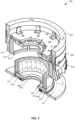
- FIG. 1 depicts a segmented curing ring 100 that can be utilized to manufacture one or more cured elastomer bands (e.g., NPT shear bands and/or shear band and tread band assemblies) having a flat interior surface.
- the segmented curing ring 100 can be a tire curing ring, such as a shear band curing ring.
- the segmented curing ring 100 is formed by a plurality of plates 102 that are positioned at a distal radial end of channels 104 in the base 106 of the segmented curing ring 100.
- the plurality of plates 102 can serve as a plurality of inner mold segments, where one or more molding segments of a tire curing press machine can serve as a plurality of outer mold segments during the curing process in accordance with one or more embodiments described herein.
- the base 106 and the plates 102 are described in more detail below with respect to FIGS. 2-8 .
- the plurality of plates 102 are oriented vertically along what will be an axial direction "A" of the NPT.
- an outer surface 107 of the plates 102 along what will be the circumferential direction "C" of the NPT, defines an interior geometry of a resultant elastomer band (e.g., shear band and/or shear band and tread band assembly) during the manufacturing process.
- the outer surface 107 can serve as an inner molding surface, where the outer surface 107 can be substantially flat along the axial direction A and/or substantially continuous along the circumferential direction C. As shown in FIG.
- the plurality of plates 102 can comprise a first type of plate 102a and a second type of plate 102b, which can interlock with each other via projections 108 and recesses 110 positioned along the sidewalls of the plurality of plates 102.
- the first type of plates 102a can include projections 108 extending from the sidewalls of the first type of plates 102a in the circumferential direction C.
- the second type of plates 102b can include recesses 110 positioned in the sidewalls second type of plates 102b along the circumferential direction C.
- the plurality of plates 102 can be composed of a metal or polymer material.
- Example materials that can compose the plurality of plates 102 include, but are not limited to: aluminum, steel, carbon fiber, nylon, ductile iron, epoxy, a combination thereof, and/or the like.
- the plurality of plates 102 can have one or more voids 111 to manage thermodynamics or weight of the segmented curing ring 100.
- FIG. 1 depicts example plates 102 having voids 111 on an inner surface and/or a top surface.
- the one or more voids 111 can extend into the body of the plates 102 without translating to the outer surface 107.
- the plates 102 can be free of depressions 111.
- the base 106 can comprise a plurality of channels 104 oriented in what will be the radial direction "R" of the NPT.
- the channels 104 can be recessed into the base 106 and can extend through the base 106 along the radial direction R.
- respective plates 102 can at least partially reside within respective channels 104.
- the plurality of plates 102 can be composed of a metal or polymer material.
- Example materials that can compose the base 106 include, but are not limited to: aluminum, steel, carbon fiber, nylon, ductile iron, epoxy, a combination thereof, and/or the like.
- the plurality of plates 102 can be initially placed into the base 106 via a first end 112 (e.g. an inner end) of the plurality of channels 104, which can be closest to a central axis 114 of the base 106.
- the plurality of segmented plates 102 can then be pushed along the radial direction R, where the plurality of channels 104 can guide the travel of the plurality of plates 102 and maintain a connection between the plates 102 and the base 106.
- the plurality of plates 102 can travel (e.g., translate) along the channels 104 between a collapsed state of the segmented curing ring 100 and an expanded state of the segmented curing ring 100.
- the number of plates 102 included in the segmented curing ring 100 can vary depending on the desired circumference of the resultant shear band. In some embodiments, the number of plates 102 comprising the segmented curing ring 100 can range from, for example, greater than or equal to 3 and less than or equal to 40.
- an inflatable bladder can be utilized to translate the plurality of plates 102 along the channels 104 and press the outer surface 107 against the inner diameter of a green band during a curing process that results in an elastomer band (e.g., a NPT shear band and/or shear band and tread band assembly).
- the green band can be positioned between the plates 102 and a curing press machine positioned on one or more wear plates 116 at least partially surrounding the plurality of plates 102 (e.g., adjacent to the outer surface 107).
- the outer surface 107 of the segmented curing ring 100 can ensure that the inner diameter surface of the resultant elastomer band (e.g., NPT shear band) remains flat, while the outer diameter surface of the resultant elastomer band (e.g., NPT shear band) can be molded to provide a tread pattern and can have a spherical molded radius.
- the flat inner diameter surface of the resultant elastomer band e.g., NPT shear band
- the spherical molded radius of the outer diameter surface of the resultant elastomer band (e.g., NPT shear band) can facilitate footprint pressure and tread wear control of the NPT.
- the inflatable bladder could deform during the curing process and the inner diameter surface of the resultant elastomer band (e.g., NPT shear band) would follow the spherical molded radius of the outer diameter surface of the resultant elastomer band (e.g., NPT shear band).
- the inner diameter surface of the resultant elastomer band e.g., NPT shear band
- a metal ring is utilized to provide a flat molding surface for the inner diameter surface of the NPT shear band.
- the metal ring can be expandable (e.g., by 50.8 mm), and the metal ring can allow the inner diameter surface of the resultant NPT shear band to be uncoupled from the spherical mold radius imparted to the outer diameter surface of the NPT shear band.
- minor deformities in the roundness of the metal ring can result in non-uniform forces exhibited by the NPT shear band.
- the plurality of plates 102 can resist deformations that the metal ring may be susceptible to during the curing process (e.g., due to at least the greater rigidity of the plates 102).
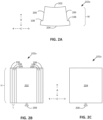
- FIG. 2A illustrates a top-down view of the first type of plates 102a.
- the first type of plates 102a can be tapered along the radial direction R.
- a first inner surface 202 of the first type of plates 102a can face towards the central axis 114 along the radial direction R, whereas a first opposing surface 204 of the first type of plates 102a can form a portion of the outer surface 107 of the segmented curing ring 100.
- the first inner surface 202 of the first type of plates 102a can be narrower along the circumferential direction C than the first opposing surface 204.
- the first type of plates 102a may have voids 111 (e.g., on the first inner surface 202) to manage thermodynamics or weight of the segmented curing ring 100, if desired.
- the first type of plates 102a can include a first set of slanted sidewalls 206 that can include the projections 108 extending outward, away from the body of the first type of plate 102a, along the circumferential direction C.
- each sidewall of the first set of slanted sidewalls 206 can include a projection 108.
- the first type of plates 102a can have a width "W" along the radial direction R ranging from, for example, greater than or equal to 12.7 mm and less than or equal to 127 mm.
- FIG. 2B illustrates a side perspective of the first inner surface 202 of the first type of plates 102a.
- first type of plates 102a can extend along the axial direction A to a height "H" ranging from, for example, greater than or equal to 25.4 mm and less than or equal to 533.4 mm.
- the projections 108 can extend from a body of the first type of plates 102a along the circumferential direction C to a length L ranging from, for example, less than or equal to 25.4 mm.
- the first type of plates 102a can include one or more anchors 208 extending from a bottom surface of the first type of plates 102a.
- the anchors 208 can have a geometry designed to fit within the one or more channels 104.
- FIG. 2B illustrates an example embodiment in which the one or more anchors 208 have a "T-shape" architecture; however, alternate architectures are also envisaged.
- the anchors 208 can have a spherical or polygonal shape that complements an interior cross-section of the one or more channels 104, as described further herein.
- FIG. 2C illustrates a side perspective of the first opposing surface 204.
- the first opposing surface 204 can be flat along the axial direction A (e.g., along the vertical orientation of the segmented curing tire 100).
- the first opposing surface 204 e.g., a portion of the outer surface 107 of the segmented curing ring 100
- FIG. 3A illustrates a top-down view of the second type of plates 102b.
- the second type of plates 102b can have a complementary (e.g., an opposing) tapering along the radial direction R to the tapering of the first type of plates 102a.
- a second inner surface 302 of the second type of plates 102b can face towards the central axis 114 along the radial direction R, whereas a second opposing surface 304 of the second type of plates 102b can form another portion of the outer surface 107 of the segmented curing ring 100.
- the second inner surface 302 of the second type of plates 102b can be wider along the circumferential direction C than the second opposing surface 304.
- the second type of plates 102b can include a second set of slanted sidewalls 306 that can include the recesses 110 extending into the second set of slanted sidewalls 306 toward the body of the second type of plate 102b, along the circumferential direction C.
- each sidewall of the second set of slanted sidewalls 306 can include one or more recesses 110.
- the second type of plates 102b can have an equivalent width "W" along the radial direction R as the width of the first type of plates 102a.
- FIG. 3B illustrates a side perspective of the second inner surface 302 of the second type of plates 102b.
- second type of plates 102b can extend along the axial direction A to an equivalent height H as the first type of plates 102a.
- the second type of plates 102b can also include the one or more anchors 208 extending from a bottom surface of the second type of plates 102b.
- the second type of plates 102b may have voids and/or depressions (e.g., on first inner surface 302) to manage thermodynamics and/or weight of the segmented curing ring 100, if desired.
- FIG. 3C illustrates a side perspective of the second opposing surface 304.
- the second opposing surface 304 can be flat along the axial direction A (e.g., along the vertical orientation of the segmented curing tire 100).
- the recesses 110 can extend along the circumferential direction C, from the second set of slanted sidewalls 306, by a length L equivalent to that of the projections 108.
- the second opposing surface 304 e.g., a portion of the outer surface 107 of the segmented curing ring 100
- the one or more first type of plates 102a can be positioned adjacent to the one or more second type of plates 102b along the circumferential direction C. Thereby, the projections 108 of the first type of plate 102a can rest within the recesses 110 of the second type of plate 102b. Additionally, in one or more embodiments, the slope of the first set of slanted sidewalls 206 can match the slope of the second set of slanted sidewalls 306.
- the complementary tapering of the first type of plates 102a and the second type of plates 102b can enable the plates 102 to be positioned tightly together along the expanded circumference.
- the number of plates 102 comprising the segmented curing ring 100 can be such that they create a continuous circle when engaged.
- first opposing surface 204 of the first type of plates 102a and the second opposing surface 304 of the second type of plates 102b can be curved such that, when the segmented curing ring 100 is the expanded state, the plurality of first opposing surfaces 204 and the plurality of second opposing surface 304 collectively form an outer surface 107 having a roundness that corresponds to the desired inner diameter of a resultant elastomer band (e.g., NPT shear band and/or shear band and tread band assembly) cured using the segmented curing ring 100.
- a resultant elastomer band e.g., NPT shear band and/or shear band and tread band assembly
- the curvature of the first opposing surface 204 and the second opposing surface 304 can be defined such that the outer surface 107 has a circular geometry of uniform roundness (e.g., a circle with a uniform diameter). Accordingly, the curvature of the first opposing surface 204 and the second opposing surface 304 can be based on the number of plates 102 and the desired circumference of the outer surface 107 (e.g., along the circumferential direction C) while the segmented curing ring 100 is the expanded state.
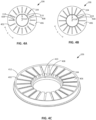
- FIGS. 4A and 4B illustrate top-down views of example bases 106 of the segmented curing ring 100.
- the base 106 has a plurality of channels 104 extending from a first end 112 to a second end 402 along the radial direction R.
- the second end 402 can be a furthest end of the channels from the central axis 114.
- FIG. 4A depicts a first example base 106 in which the first end 112 terminates at a cavity 404 in the top surface 406 of the base 106.
- the cavity 404 can have a larger diameter or width than the width (e.g., along the circumferential direction C) of the channels 104.
- the anchors 208 can be inserted into the cavities 404; however, once the anchors 208 slide radially into the channels 104, the narrowed width of the channels 104 can prevent the anchors 208 from exiting the channel 104 through the top surface 406.
- FIG. 4B depicts a second example base 106 in which the channels 104 can have a uniform, or substantially uniform, width (e.g., along the circumferential direction C), and the anchors 208 can enter the channels 104 at the first end 112 via an opening in the inner sidewall 408 of the base 106.
- the base 106 can include a void proximal to the central axis 114, where the void can be defined by an inner sidewall 408 of the base 106.
- the anchors 208 can be positioned within the void and then moved along the radial direction R into openings in the inner sidewall 408 that are in fluid communication with the channels 104.
- the width of the channels 104 at the top surface 406 can be narrower than a width of the anchors 208; thereby, the anchors 208 can be prevented from exiting the channels 104 via the top surface 406.
- Each channel 104 is capable of receiving an anchor 208 of a plate 102.
- the plurality of plates 102 can attach to the channels 104 through the one or more anchors 208, which can have geometry that is complementary to an inner cavity of the channels 104.
- the anchors 208 can be inserted into the channels 104 and thereby hold the plurality of plates 102 in their vertical orientation relative to the base 106.
- the interface between the anchors 208 and channels 104 is secure so that the connection of the plates 102 to the base 106 does not detach during operation of the methods disclosed herein.
- the interface between the anchors 208 and the channels 104 enables the plates 102 to translate radially from an inner portion of the base 106 (e.g., near the central axis 114) to an outer portion of the base 106 (e.g., outward in the radial direction R) without being detached from the base 106.
- the plurality of plates 102 can be situated along the channels 104 to provide a given geometry to the outer surface 107 of the segmented curing ring 100.
- the base 106 can further comprise a flange 410 positioned adjacent to the inner sidewall 408 (e.g., as shown in FIGS. 4A and 4B ).
- the flange 410 can facilitate securing the base 106 to a mounting station and/or other equipment utilized in the manufacturing of an NPT.
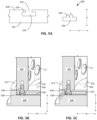
- FIG. 5A depicts a cross-sectional view of an example portion of the base 106 and an example anchor 208.
- an interior geometry of the channels 104 can include a channel opening 502 and a channel body 504.
- the channel opening 502 can be at the top surface 406 of the base 106.
- the channel opening 502 can enable a stem 506 of the anchor 208 to extend through the top surface 406 of the base 106 while traveling along the channels 104.
- the channel body 504 can be located within the base 106 and can accommodate the architecture of a distal end 508 of the anchors 208.
- the distal end 508 of the anchor 208 can have a width (e.g., along the circumferential direction C) that is greater than the width of the stem 506; whereas the width of the channel opening 502 can be narrower than a width of the channel body 504.
- the anchor 208 can travel (e.g., translate) along the radial direction R, but not the axial direction A.
- FIGS. 5B-C illustrate cross-sectional views of a portion of a plate 102 engaged with a portion of the base 106.
- FIG. 5B depicts a cross-sectional view of the plate 102 approaching the expanded state of the segmented curing ring 100 (e.g., at a partially expanded state).
- FIG. 5C depicts a cross-sectional view of the plate 102 at the fully expanded state of the segmented curing ring 100.
- the base 106 can further include a ridge 412 positioned at the circumference of the base 106. The ridge 412 can facilitate placement and/or support of the plurality of plates 102 while the segmented curing ring 100 is in the expanded state. For instance, FIG.
- the anchor 208 (e.g., the stem 506 of the anchor 208) can extend through the top surface 406 of the base 106 and into the channel body 504.
- the anchor 208 can be a fastener (e.g., a screw or bolt) extending from the bottom of the plate 102, where the head of the fastener (e.g., the screw head or bolt head) can be the distal end 508 of the anchor 208.
- a fastener e.g., a screw or bolt
- 5B-5C depict an example embodiment in which the anchor 208 is a fastener screwed into a bottom of the associated plate 102 (e.g., via a thread engagement between the stem 506 of the anchor 208 and an inner cavity located in the bottom of the plate 102).
- the anchor 208 is engaged within an example channel 104 and is shown translating along the radial direction R towards the ridge 412 to achieve the fully expanded state of the segmented curing ring 100; thus illustrating movement of the vertical oriented plate 102 along the channel 104 vis-a-vis the interface between the anchor 208 and channel body 504.
- the anchor 208 is a bolt aligned with the vertical axis of the plate 102 (e.g., along the axial direction A) and extends from the plate 102 into the channel 104 of the base 106.
- Suitable anchor 208 and channel body 504 geometries should be capable of securing the plates 102 to the base 106 in a desired configuration.
- the channels 104 can further house one or more springs (not shown) to assist in demolding the plurality of plates 102 from the resultant elastomer band (e.g., NPT shear band and/or shear band and tread band assembly) once the curing process is complete.
- one or more springs can be positioned within the channel body 504 at the second end 402 of the channels 104. The springs can bias the one or more anchors 208 away from the radial edge of the base 106 and toward the central axis 114.
- the plurality of plates 102 can be translated to the second end 402 of the channels 104, where the spring can be compressed via the expansion force provided by an inflatable bladder that moves the plates 102.
- the bladder can be deflated, thereby relieving the expansion force and enabling the springs to decompress by forcing the plurality plates 102 towards the central axis 114 and away from the resultant elastomer band (e.g., NPT shear band and/or shear band and tread band assembly).
- the resultant elastomer band e.g., NPT shear band and/or shear band and tread band assembly.
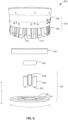
- FIG. 6 illustrates an exploded view of a manufacturing process 600 that can be implemented using the segmented curing ring 100 for curing an elastomer band (e.g., NPT shear band and/or shear band and tread band assembly) in accordance with one or more embodiments described herein.
- an elastomer band e.g., NPT shear band and/or shear band and tread band assembly
- one or more of the following steps can be practiced using the segmented curing ring 100.
- the manufacturing process 600 is not limited to specific order described below. Rather, one or more the manufacturing features can be practiced in an alternate order.
- the plurality of plates 102 can be inserted into the channels 104 of the base 106 to assemble the segmented curing ring 100 shown in FIG. 1 .
- the plurality of plates 102 can serve as a plurality of inner mold segments in accordance with one or more embodiments described herein.
- the plates 102 can be inserted into a first end 112 of the channels 104, nearest the central axis 114 of the base 106.
- the plates 102 can be inserted into the base 106 such that the anchors 208 are positioned into the cavities 404 of the channels 104.
- the plates 102 can be inserted into the base 106 by positioning the plates 102 into the middle void of the base 106 and then moving the plates 102 in the radial direction R such that the anchors 208 enter openings in the inner sidewall 408 of the base 106 to engage the channel bodies 504.
- each of the plurality of plates 102 can be inserted into the base 106 at this stage of the manufacturing process 600.
- the plates 102 can be inserted into the channels 104 in a clockwise or counter-clockwise sequence along the circumferential direction C, alternating between the first type of plates 102a and the second type of plates 102b.
- a bladder 602 can be positioned at, or in proximity to, the central axis 114 of the base 106.
- Any bladder 602 suitable for conventional pneumatic tire curing may be used in the methods of this disclosure.
- the bladder 602 can be inflatable, and can be composed of an elastomeric material (e.g., a rubber, such as carbon black).
- the bladder 602 can be in a collapsed, non-inflated or partially inflated state.
- the bladder 602 can be positioned on the top surface 406 and/or the flange 410 of the base 106.
- a green band 604 can be placed on the base 106 surrounding the plurality of plates 102 and/or the bladder 602.
- the green band 604 can be composed of non-cured components of the NPT shear band to result from the manufacturing process 600.
- the green band 604 can have a circumference that is equal to, or slightly less than, the circumference of the outer surface 107 when the segmented curing ring 100 is in the expanded state.
- the bladder 602 can be inflated so that the plurality of plates 102 are pushed radially along the channels 104 of the base 106 in an outward trajectory along the radial direction R toward the perimeter of the base 106.
- the bladder 602 can be inflated until the plates 102 reach the ridge 510 of the base 106 and/or the second end 402 of the channels 104.
- inflation of the bladder 602 can cause the plurality of plates 102 to travel (e.g., translate) to their position within the expanded state of the segmented curing ring 100.
- an outer surface 107 of the segmented curing ring 100 can be pressed against an inner surface of the green band 604.
- inflation of the bladder 602 can force the plurality of plate 102 to slightly stretch the green band 604 along the radial direction.
- the bladder 602 can be initially inflated to a holding pressure and then further inflated later in the manufacturing process to a higher pressure.
- the holding pressure can serve to hold the plates 102 in the expanded state, or a partially expanded state; while the bladder 602 can be further inflated once one or more molds fully enclose the green band 604 (e.g., as described further herein).
- the bladder 602 can be initially inflated to the holding pressure prior to placement of the green band 604 on the segmented curing ring 100 such that the plurality of plates 102 are translated to a partially expanded state, where the circumference of the outer surface 107 is smaller than the inner diameter of the green band 604. Subsequently, the bladder 602 can be further inflated, thereby translating the plurality of plates 102 to the fully expanded state, once one or more molds are positioned around the green band 604 (e.g., as described further herein).
- Green bands 604 suitable for use in the present disclosure may be comprised of one or more materials including, but not limited to: neoprene (polychloroprene), polybutadiene (including cis-1,4-polybutadiene), polyisoprene (including cis-1,4-polyisoprene) (natural or synthetic), butyl rubber, halobutyl rubber such as chlorobutyl rubber or bromobutyl rubber, styrene/isoprene/butadiene rubber, copolymers of 1,3-butadiene or isoprene with monomers such as styrene, acrylonitrile and methyl methacrylate, as well as ethylene/propylene terpolymers, also known as ethylene/propylene/diene monomer (EPDM) (e.g., ethylene/propylene/dicyclopentadiene terpolymers), alkoxy-silyl end functionalized solution
- the green band 604 may have a thickness (e.g., extending along the radial direction R when positioned around the plates 102) ranging, for example, from greater than or equal to 2.54 mm and less than or equal to 50.8 mm.
- a tire curing press machine 606 can then be positioned over the green band 604, segmented curing ring 100, and bladder 602.
- the tire curing press machine 606 can be any type of press suitable for curing pneumatic tires.
- the tire curing press machine 606 can cure the green band 604 through the application of heat (e.g., via steam) and/or pressure.
- operation of the tire curing press machine 606 can cure the components of the green band 604 and/or can impart a tread pattern into an outer surface of the green band 604 (e.g., a side facing away from the segmented curing ring 100); thereby resulting in the final form of the resultant elastomer band (e.g., NPT shear band and/or shear band and tread band assembly).
- the tire curing press machine 606 can cure the green band 604 at an internal curing pressure ranging from, for example, greater than or equal to 1 MPa and less than or equal to 2.07 MPa.
- the curing energy can be comprised of heat conducted through the thickness of the plurality of plates 102.
- FIG. 6 depicts an example tire curing press machine 606 comprising an actuator 608 and one or more segmented tire molds 609 (e.g., a pneumatic tire segmented tire mold).
- the segmented tire molds 609 can be comprised of molding segments 610 (e.g., which can face the green band 604 when the tire curing press machine 606 is placed around the segmented curing ring 100) and a wedged surface 612.
- the molding segments 610 can have a spherical radius to impart a molded radius to an outer diameter surface (e.g., an outer surface) of the resultant elastomer band (e.g., NPT shear band and/or shear band and tread band assembly).
- the one or more molding segments 610 can serve as one or more outer mold segments during the manufacturing process 600.
- the actuator 608 is preferably a conventional actuator that may be useful in pneumatic tire molding processes.
- the actuator 608 can be circular in shape and capable of accommodating the one or more segmented tire molds 609.
- the actuator 608 presses downward to the base of the segmented tire mold 609, the actuator 608 can engage the wedged surfaces 612 such that the slope of the wedged surfaces 612 causes the segmented tire mold 609 to be pushed inwardly along the radial direction R.
- the molding segments 610 move toward each other and the green band 604 (e.g., where the green band 604 is positioned around the outer surface 107 of the segmented curing ring 100, as described above).
- FIG. 6 depicts a separation between adjacent molding segments 610, where activation of the actuator 608 can bring the segments radially toward each other to engage the green band 604.
- the molding segment 610 can include a surface with an indentation pattern to impart indents and/or ridges into the outer surface of the green band 604 and thereby form a tread pattern (e.g., as shown in FIG. 9 ).
- the tire curing press machine 606 can heat the green band 604 to a curing temperature.
- the temperature and pressure provided by the tire pressing machine 606 can impart a tread pattern on the outer surface of the resultant NPT shear band, while the outer surface 107 of the segmented curing ring 100 can impart a flat inner surface to the resultant NPT shear band.
- the bladder 602 can be deflated, and the plates 102 can travel inwardly along the radial direction R about the channels 104; thereby releasing the resultant NPT shear band from a pressurized (e.g., stretched) state.
- the resultant shear bands may be used in NPT applications in addition to any other applications that require a shear band having a smooth inner surface.
- the segmented curing ring 100 can be utilized with tire curing press machines 606 employed during pneumatic tire curing processes (e.g., including the use of pneumatic tire segmented curing molds 609) to cure NPT shear bands.
- the tire curing press machines 606 can utilize molding segments 610 capable of producing a wider range of NPT shear band dimensions than typically available to shear bands formed from conventional compression molding processes.
- various embodiments described herein can achieve a resultant NPT shear band having an outer diameter (e.g., along the radial direction R) of up to 34 inches or 863.6 mm (e.g., up to 812.8 mm, or up to 736.6 mm).
- an outer diameter e.g., along the radial direction R
- 863.6 mm e.g., up to 812.8 mm, or up to 736.6 mm.
- FIG. 6 exemplifies the manufacturing process 600 utilizing a segmented mold curing press, embodiments which utilize a two-piece mold (e.g., as the molding segments 610) and two-piece curing presses (e.g., as the tire curing press machine 606) are also envisaged.
- a segmented mold curing press e.g., as the molding segments 610
- two-piece curing presses e.g., as the tire curing press machine 606
- FIG. 7 depicts a partially exploded view of the segmented curing ring 100 during one or more stages of the manufacturing process 600.
- the tire curing press machine 606 and the segmented curing ring 100 can serve as inner and outer mold segments of a tire mold 700 for curing the green band 604 and forming the cured elastomer band (e.g., NPT shear band and/or shear band and tread band assembly).
- the cured elastomer band e.g., NPT shear band and/or shear band and tread band assembly.
- the green band 604 is positioned around the outer surface 107 of the plurality of plates 102.
- the plurality of plates 102 can translate along the plurality of channels 104 to transition the segmented curing ring 100 into an expanded state; where the outer surface 107 can be pressed against, and/or provide support for, an inner surface of the green band 604 (e.g., a surface of the green band 604 facing the central axis 114 of the segmented curing ring 100).
- the tire curing press 606 can be positioned over the segmented curing ring 100 and green band 604.
- the tire curing press 606 can be positioned onto the one or more wear plates 116 such that the molding surface 702 of the molding segments 610 can be adjacent to an outer surface of the green band 604, where the outer surface can be opposite the inner surface of the green band 604.
- FIG. 7 depicts the one or more molding surfaces 702 as smooth surfaces, in various embodiments the one or more molding surfaces 702 can have one or more textured patterns (e.g., as shown in FIG. 9 ) to impart a desired tread onto the green band 604.
- the green band 604 can be located between a molding surface 702 of the one or more molding segments 610 and the outer surface 107 of the segmented curing ring 100.
- the actuator 608 engages the wedged surfaces 612
- the one or more molding segments 610 (and thereby the one or more molding surfaces 702) can be pressed towards the central axis 114 of the segmented curing ring 100.
- the one or more molding segments 610 can be pressed towards each other and against the green band 604 during the manufacturing process 600.
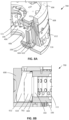
- FIG. 8A depicts another partially exploded view of the segmented curing 100 during one or more stages of the manufacturing process 600.
- FIG. 8A depicts the plurality of plates 102 positioned in a fully expanded state rather than a partially expanded state.
- portions of the plurality of channels 104 are more readily visible in FIG. 8A , as the plurality of plates 102 have translated along the plurality of channels 104 along the radial direction R.
- FIG. 8B depicts the segmented curing ring 100, green band 604, and tire curing press 606 during the manufacturing process 600, where the tire curing press 606 has fully actuated the one or more molding surfaces 610 against the green band 604 during a curing process.
- the one or more actuated molding surfaces 702 can abut the outer surface (e.g., along the radial direction R) of the green band 604, where the one or more plurality of plates 102 can abut the inner surface (e.g., along the radial direction R) of the green band 604.
- the bladder 602 is not shown; however, during this stage of the manufacturing process 600, the bladder 602 can be in an inflated state to maintain the plurality of plates 102 in the expanded state.
- the green band 604 can have beveled and/or curved side edges.
- the beveled side edge of the green band 604 can abut a slanted surface of the ridge 412; such that, as the plurality of plates 102 translate to the expanded state, at least a portion of the a side edge of the green band 604 is sandwiched between the plurality of plates 102 and the ridge 412 (e.g., as shown in FIG. 8B ).
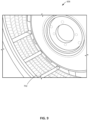
- FIG. 9 depicts an interior view of the tire curing press 606 in accordance with one or more embodiments described herein.
- the one or more molding surfaces 702 can include one or more ridges, protrusions, grooves, indentations, and/or the like configured to impart a tread pattern into the outer surface of the green band 604 (e.g., into a surface of the green band 604 that is opposite to an inner surface of the green band 604, which abuts the plurality of plates 102 during the manufacturing process 600).
- operation of the tire curing press 606 can press the one or more molding surfaces 702 against the outer surface of the green band 604, thereby imparting a tread pattern and/or curvature to the outer surface of the resultant shear band.
Landscapes
- Engineering & Computer Science (AREA)
- Mechanical Engineering (AREA)
- Moulds For Moulding Plastics Or The Like (AREA)
Applications Claiming Priority (1)
| Application Number | Priority Date | Filing Date | Title |
|---|---|---|---|
| US18/191,973 US20240326366A1 (en) | 2023-03-29 | 2023-03-29 | Segmented curing ring for npt elastomer bands |
Publications (1)
| Publication Number | Publication Date |
|---|---|
| EP4438282A1 true EP4438282A1 (de) | 2024-10-02 |
Family
ID=90482308
Family Applications (1)
| Application Number | Title | Priority Date | Filing Date |
|---|---|---|---|
| EP24166695.7A Pending EP4438282A1 (de) | 2023-03-29 | 2024-03-27 | Segmentierter härtungsring und reifenform für npt-elastomerbänder und verfahren zur härtung eines grünen elastomerbandes |
Country Status (2)
| Country | Link |
|---|---|
| US (1) | US20240326366A1 (de) |
| EP (1) | EP4438282A1 (de) |
Citations (2)
| Publication number | Priority date | Publication date | Assignee | Title |
|---|---|---|---|---|
| CA977112A (en) * | 1972-09-15 | 1975-11-04 | Irco Industries Inc. | Segmental tire curing mould |
| US20060113708A1 (en) * | 2004-11-29 | 2006-06-01 | Mcbride Michael L | Molding a tread belt for a two-piece tire |
-
2023
- 2023-03-29 US US18/191,973 patent/US20240326366A1/en not_active Abandoned
-
2024
- 2024-03-27 EP EP24166695.7A patent/EP4438282A1/de active Pending
Patent Citations (2)
| Publication number | Priority date | Publication date | Assignee | Title |
|---|---|---|---|---|
| CA977112A (en) * | 1972-09-15 | 1975-11-04 | Irco Industries Inc. | Segmental tire curing mould |
| US20060113708A1 (en) * | 2004-11-29 | 2006-06-01 | Mcbride Michael L | Molding a tread belt for a two-piece tire |
Also Published As
| Publication number | Publication date |
|---|---|
| US20240326366A1 (en) | 2024-10-03 |
Similar Documents
| Publication | Publication Date | Title |
|---|---|---|
| US7334617B2 (en) | Solid rubber tire with flexible hub and replaceable tire tread | |
| US8720505B2 (en) | Tyre for vehicles, in particular motor vehicles | |
| US20150013863A1 (en) | Tire With Pre-Formed Tread And Method Of Making Same | |
| US10625481B2 (en) | Vulcanising mould for manufacturing tyres for vehicle wheels | |
| EP1030789A2 (de) | Luftschlauch für reifen und verfahren zu seiner herstellung | |
| CN102159384B (zh) | 用于控制模制环形固定结构的阶段的方法、设备 | |
| EP0919405A1 (de) | Luftschlauch für Reifen und Verfahren zu seiner Herstellung | |
| EP4438282A1 (de) | Segmentierter härtungsring und reifenform für npt-elastomerbänder und verfahren zur härtung eines grünen elastomerbandes | |
| EP2181838B1 (de) | Blase und Vorrichtung zum Formen und Härten eines Reifens | |
| EP1629962B1 (de) | Reifenvulkanisierblase | |
| JP7559268B2 (ja) | 非空気入りタイヤのための硬化金型組立体並びにその製造方法 | |
| KR20030082424A (ko) | 타이어 비드를 성형하기 위한 접힘식 메카니즘 | |
| CN118382539B (zh) | 用于控制行驶轮胎的滚动阻力的方法和用于降低行驶轮胎的消耗的方法 | |
| WO2005014310A1 (ja) | 空気入りランフラットタイヤ用の支持体の製造方法 | |
| US20240246305A1 (en) | Curing Mold Assemblies For Non-Pneumatic Tires As Well As Methods Of Manufacture | |
| CN211251396U (zh) | 一种防滑转聚氨酯实心胎的生产装置 | |
| US20240262061A1 (en) | Curing Mold Assemblies For Non-Pneumatic Tires As Well As Methods Of Manufacture | |
| US20240253317A1 (en) | Curing Mold Assemblies For Non-Pneumatic Tires As Well As Methods Of Manufacture | |
| US7513282B1 (en) | Air bladder for tire liners with vee shaped air chambers | |
| JP2026510389A (ja) | 非空気式タイヤ用のトレッドバンド組立体を硬化させるためのシステム及び方法 | |
| KR20170062588A (ko) | 타이어 가류용 블래더 | |
| JP2006281709A (ja) | 空気入りタイヤの製造方法 | |
| JP2002519230A (ja) | 完全なタイヤ・車輪組立体 | |
| KR20160042682A (ko) | 중하중용 공기입 레디얼 타이어의 브레다 취부구조 |
Legal Events
| Date | Code | Title | Description |
|---|---|---|---|
| PUAI | Public reference made under article 153(3) epc to a published international application that has entered the european phase |
Free format text: ORIGINAL CODE: 0009012 |
|
| STAA | Information on the status of an ep patent application or granted ep patent |
Free format text: STATUS: THE APPLICATION HAS BEEN PUBLISHED |
|
| AK | Designated contracting states |
Kind code of ref document: A1 Designated state(s): AL AT BE BG CH CY CZ DE DK EE ES FI FR GB GR HR HU IE IS IT LI LT LU LV MC ME MK MT NL NO PL PT RO RS SE SI SK SM TR |
|
| STAA | Information on the status of an ep patent application or granted ep patent |
Free format text: STATUS: REQUEST FOR EXAMINATION WAS MADE |
|
| 17P | Request for examination filed |
Effective date: 20250324 |