EP4437862A1 - Inspektionsvorrichtung und inspektionsverfahren für filter - Google Patents
Inspektionsvorrichtung und inspektionsverfahren für filter Download PDFInfo
- Publication number
- EP4437862A1 EP4437862A1 EP21965613.9A EP21965613A EP4437862A1 EP 4437862 A1 EP4437862 A1 EP 4437862A1 EP 21965613 A EP21965613 A EP 21965613A EP 4437862 A1 EP4437862 A1 EP 4437862A1
- Authority
- EP
- European Patent Office
- Prior art keywords
- filter
- inspection
- peripheral surface
- shadow
- inspection device
- Prior art date
- Legal status (The legal status is an assumption and is not a legal conclusion. Google has not performed a legal analysis and makes no representation as to the accuracy of the status listed.)
- Pending
Links
Images




Classifications
-
- G—PHYSICS
- G01—MEASURING; TESTING
- G01N—INVESTIGATING OR ANALYSING MATERIALS BY DETERMINING THEIR CHEMICAL OR PHYSICAL PROPERTIES
- G01N21/00—Investigating or analysing materials by the use of optical means, i.e. using sub-millimetre waves, infrared, visible or ultraviolet light
- G01N21/84—Systems specially adapted for particular applications
- G01N21/88—Investigating the presence of flaws or contamination
- G01N21/8851—Scan or image signal processing specially adapted therefor, e.g. for scan signal adjustment, for detecting different kinds of defects, for compensating for structures, markings, edges
-
- A—HUMAN NECESSITIES
- A24—TOBACCO; CIGARS; CIGARETTES; SIMULATED SMOKING DEVICES; SMOKERS' REQUISITES
- A24C—MACHINES FOR MAKING CIGARS OR CIGARETTES
- A24C5/00—Making cigarettes; Making tipping materials for, or attaching filters or mouthpieces to, cigars or cigarettes
- A24C5/32—Separating, ordering, counting or examining cigarettes; Regulating the feeding of tobacco according to rod or cigarette condition
- A24C5/34—Examining cigarettes or the rod, e.g. for regulating the feeding of tobacco; Removing defective cigarettes
- A24C5/3412—Examining cigarettes or the rod, e.g. for regulating the feeding of tobacco; Removing defective cigarettes by means of light, radiation or electrostatic fields
-
- A—HUMAN NECESSITIES
- A24—TOBACCO; CIGARS; CIGARETTES; SIMULATED SMOKING DEVICES; SMOKERS' REQUISITES
- A24C—MACHINES FOR MAKING CIGARS OR CIGARETTES
- A24C5/00—Making cigarettes; Making tipping materials for, or attaching filters or mouthpieces to, cigars or cigarettes
- A24C5/54—Folding the ends of cigarette paper tubes after filling them with tobacco
-
- A—HUMAN NECESSITIES
- A24—TOBACCO; CIGARS; CIGARETTES; SIMULATED SMOKING DEVICES; SMOKERS' REQUISITES
- A24D—CIGARS; CIGARETTES; TOBACCO SMOKE FILTERS; MOUTHPIECES OF CIGARS OR CIGARETTES; MANUFACTURE OF TOBACCO SMOKE FILTERS OR MOUTHPIECES
- A24D3/00—Tobacco smoke filters, e.g. filter tips or filtering inserts; Filters specially adapted for simulated smoking devices; Mouthpieces of cigars or cigarettes
- A24D3/02—Manufacture of tobacco smoke filters
-
- A—HUMAN NECESSITIES
- A24—TOBACCO; CIGARS; CIGARETTES; SIMULATED SMOKING DEVICES; SMOKERS' REQUISITES
- A24D—CIGARS; CIGARETTES; TOBACCO SMOKE FILTERS; MOUTHPIECES OF CIGARS OR CIGARETTES; MANUFACTURE OF TOBACCO SMOKE FILTERS OR MOUTHPIECES
- A24D3/00—Tobacco smoke filters, e.g. filter tips or filtering inserts; Filters specially adapted for simulated smoking devices; Mouthpieces of cigars or cigarettes
- A24D3/02—Manufacture of tobacco smoke filters
- A24D3/0295—Process control means
-
- G—PHYSICS
- G01—MEASURING; TESTING
- G01N—INVESTIGATING OR ANALYSING MATERIALS BY DETERMINING THEIR CHEMICAL OR PHYSICAL PROPERTIES
- G01N21/00—Investigating or analysing materials by the use of optical means, i.e. using sub-millimetre waves, infrared, visible or ultraviolet light
- G01N21/17—Systems in which incident light is modified in accordance with the properties of the material investigated
- G01N21/25—Colour; Spectral properties, i.e. comparison of effect of material on the light at two or more different wavelengths or wavelength bands
- G01N21/31—Investigating relative effect of material at wavelengths characteristic of specific elements or molecules, e.g. atomic absorption spectrometry
-
- G—PHYSICS
- G01—MEASURING; TESTING
- G01N—INVESTIGATING OR ANALYSING MATERIALS BY DETERMINING THEIR CHEMICAL OR PHYSICAL PROPERTIES
- G01N21/00—Investigating or analysing materials by the use of optical means, i.e. using sub-millimetre waves, infrared, visible or ultraviolet light
- G01N21/84—Systems specially adapted for particular applications
- G01N21/88—Investigating the presence of flaws or contamination
- G01N21/95—Investigating the presence of flaws or contamination characterised by the material or shape of the object to be examined
- G01N21/952—Inspecting the exterior surface of cylindrical bodies or wires
-
- G—PHYSICS
- G01—MEASURING; TESTING
- G01N—INVESTIGATING OR ANALYSING MATERIALS BY DETERMINING THEIR CHEMICAL OR PHYSICAL PROPERTIES
- G01N35/00—Automatic analysis not limited to methods or materials provided for in any single one of groups G01N1/00 - G01N33/00; Handling materials therefor
- G01N35/02—Automatic analysis not limited to methods or materials provided for in any single one of groups G01N1/00 - G01N33/00; Handling materials therefor using a plurality of sample containers moved by a conveyor system past one or more treatment or analysis stations
- G01N35/04—Details of the conveyor system
-
- A—HUMAN NECESSITIES
- A24—TOBACCO; CIGARS; CIGARETTES; SIMULATED SMOKING DEVICES; SMOKERS' REQUISITES
- A24D—CIGARS; CIGARETTES; TOBACCO SMOKE FILTERS; MOUTHPIECES OF CIGARS OR CIGARETTES; MANUFACTURE OF TOBACCO SMOKE FILTERS OR MOUTHPIECES
- A24D3/00—Tobacco smoke filters, e.g. filter tips or filtering inserts; Filters specially adapted for simulated smoking devices; Mouthpieces of cigars or cigarettes
- A24D3/02—Manufacture of tobacco smoke filters
- A24D3/0275—Manufacture of tobacco smoke filters for filters with special features
- A24D3/0291—Manufacture of tobacco smoke filters for filters with special features for hollow tipped filters, e.g. recess filters
-
- G—PHYSICS
- G01—MEASURING; TESTING
- G01N—INVESTIGATING OR ANALYSING MATERIALS BY DETERMINING THEIR CHEMICAL OR PHYSICAL PROPERTIES
- G01N21/00—Investigating or analysing materials by the use of optical means, i.e. using sub-millimetre waves, infrared, visible or ultraviolet light
- G01N21/84—Systems specially adapted for particular applications
- G01N21/88—Investigating the presence of flaws or contamination
- G01N21/8851—Scan or image signal processing specially adapted therefor, e.g. for scan signal adjustment, for detecting different kinds of defects, for compensating for structures, markings, edges
- G01N2021/8854—Grading and classifying of flaws
- G01N2021/8861—Determining coordinates of flaws
- G01N2021/8864—Mapping zones of defects
-
- G—PHYSICS
- G01—MEASURING; TESTING
- G01N—INVESTIGATING OR ANALYSING MATERIALS BY DETERMINING THEIR CHEMICAL OR PHYSICAL PROPERTIES
- G01N21/00—Investigating or analysing materials by the use of optical means, i.e. using sub-millimetre waves, infrared, visible or ultraviolet light
- G01N21/84—Systems specially adapted for particular applications
- G01N21/88—Investigating the presence of flaws or contamination
- G01N21/8851—Scan or image signal processing specially adapted therefor, e.g. for scan signal adjustment, for detecting different kinds of defects, for compensating for structures, markings, edges
- G01N2021/8854—Grading and classifying of flaws
- G01N2021/8874—Taking dimensions of defect into account
-
- G—PHYSICS
- G01—MEASURING; TESTING
- G01N—INVESTIGATING OR ANALYSING MATERIALS BY DETERMINING THEIR CHEMICAL OR PHYSICAL PROPERTIES
- G01N21/00—Investigating or analysing materials by the use of optical means, i.e. using sub-millimetre waves, infrared, visible or ultraviolet light
- G01N21/84—Systems specially adapted for particular applications
- G01N21/88—Investigating the presence of flaws or contamination
- G01N21/8851—Scan or image signal processing specially adapted therefor, e.g. for scan signal adjustment, for detecting different kinds of defects, for compensating for structures, markings, edges
- G01N2021/8887—Scan or image signal processing specially adapted therefor, e.g. for scan signal adjustment, for detecting different kinds of defects, for compensating for structures, markings, edges based on image processing techniques
-
- G—PHYSICS
- G01—MEASURING; TESTING
- G01N—INVESTIGATING OR ANALYSING MATERIALS BY DETERMINING THEIR CHEMICAL OR PHYSICAL PROPERTIES
- G01N35/00—Automatic analysis not limited to methods or materials provided for in any single one of groups G01N1/00 - G01N33/00; Handling materials therefor
- G01N35/02—Automatic analysis not limited to methods or materials provided for in any single one of groups G01N1/00 - G01N33/00; Handling materials therefor using a plurality of sample containers moved by a conveyor system past one or more treatment or analysis stations
- G01N35/04—Details of the conveyor system
- G01N2035/0401—Sample carriers, cuvettes or reaction vessels
- G01N2035/0429—Sample carriers adapted for special purposes
-
- G—PHYSICS
- G01—MEASURING; TESTING
- G01N—INVESTIGATING OR ANALYSING MATERIALS BY DETERMINING THEIR CHEMICAL OR PHYSICAL PROPERTIES
- G01N35/00—Automatic analysis not limited to methods or materials provided for in any single one of groups G01N1/00 - G01N33/00; Handling materials therefor
- G01N35/02—Automatic analysis not limited to methods or materials provided for in any single one of groups G01N1/00 - G01N33/00; Handling materials therefor using a plurality of sample containers moved by a conveyor system past one or more treatment or analysis stations
- G01N35/04—Details of the conveyor system
- G01N2035/0439—Rotary sample carriers, i.e. carousels
- G01N2035/0441—Rotary sample carriers, i.e. carousels for samples
-
- G—PHYSICS
- G01—MEASURING; TESTING
- G01N—INVESTIGATING OR ANALYSING MATERIALS BY DETERMINING THEIR CHEMICAL OR PHYSICAL PROPERTIES
- G01N2201/00—Features of devices classified in G01N21/00
- G01N2201/12—Circuits of general importance; Signal processing
- G01N2201/127—Calibration; base line adjustment; drift compensation
- G01N2201/12723—Self check capacity; automatic, periodic step of checking
Definitions
- the present invention relates to an inspection device and an inspection method for a filter, and, specifically, relates to an inspection device and an inspection method that inspect a powder containing material disposed in a filter.
- PTL 1 discloses an inspection device that inspects a continuous body, which is an intermediate product of a filter.
- a capsule filled with a content liquid containing, for example, a flavoring agent is disposed in a space between filter elements that are arranged side by side in an axial direction, in other words, in a cavity.
- the inspection device is disposed at an inspection position situated on a transport line between a windup section and a cutter, and performs irradiation with infrared light including an infrared ray from an infrared light irradiation unit disposed above the continuous body.
- the infrared light is transmitted through moldable paper, in other words, an outer plug wrapper, the capsule, and an outer plug wrapper, and transmitted infrared light is emitted downward from the continuous body.
- the transmitted infrared light is detected by an infrared sensor or is subjected to photographing by an infrared camera, and a detection signal or a photographing signal is transmitted to an assessment unit.
- the assessment unit assesses the quality of the content liquid with which the capsule is filled based on the detection signal or the photographing signal.
- PTL 2 discloses a filter including an upstream filter portion, a downstream filter portion, and a powder containing material.
- the upstream filter portion is adjacent to a flavor element, such as a tobacco rod, in an axial direction.
- the downstream filter portion includes a mouthpiece end of a flavor inhalation article, such as a smoking article.
- the powder containing material becomes powder when raw material powder containing at least one of a taste component and a flavor component is molded into one lump and an external force is applied.
- a cavity is formed in the filter.
- the cavity is formed by disposing the upstream filter portion and the downstream filter portion apart from each other in the axial direction and wrapping them with an outer plug wrapper, and the powder containing material is disposed in the cavity.
- a powder supply path is formed in the downstream filter portion. The powder supply path causes the cavity and the mouthpiece end to communicate with each other, and allows powder to be supplied from the cavity to the mouthpiece end.
- the powder containing material is crushed as a result of a user applying an external force to the powder containing material by, for example, crushing the powder containing material with his fingers when the user inhales the flavor inhalation article.
- the user inhales the crushed powder from the mouthpiece end through the powder supply path.
- the filter formed in this way is connected to a peripheral surface of the outer plug wrapper and a peripheral surface of an end portion of a flavor element by wrapping them with tipping paper. Therefore, the filter constitutes a part of the flavor inhalation article.
- the powder containing material may be subjected to a shock and as a result may be chipped, cracked, crushed, or the like.
- the powder containing material may not be successfully disposed in the cavity. Since the chipping, cracking, crushing, and absence of the powder containing material reduce the quality of the filter and thus the flavor inhalation article, such a defective flavor inhalation article needs to be eliminated before being shipped as a product.
- an inspection of the presence or absence and the quality of the powder containing material by using the inspection device described in PTL 1 may be considered.
- an inspection object in PTL 1 is an internal liquid of a capsule, whereas the powder containing material is a solid, as a result of which an inspection using transmitted infrared light is not realistic.
- the inspection device described in PTL 1 inspects a continuous body, which is an intermediate product of the filter, infrared light, which is inspection light, is successively transmitted through the outer plug wrapper, the capsule, and the outer plug wrapper, and transmitted infrared light transmitted through two paper webs in addition to the capsule, which is an inspection object, is used in the inspection.
- the powder containing material is inspected by using the inspection device of PTL 1.
- the infrared light which is inspection light
- the infrared light is successively transmitted through the outer plug wrapper and tipping paper on the opposite side. That is, transmitted infrared light that is transmitted through four paper webs in addition to the powder containing material, which is an inspection object, is used in the inspection. Therefore, since the transmitted infrared light that is transmitted through twice the number of paper webs as compared to that in the case in PTL 1 is used in the inspection, the inspection precision is reduced.
- the present invention has been made in view of such problems, and it is an object of the present invention to provide an inspection device and an inspection method for a filter, which are capable of efficiently inspecting with high precision in a flavor inhalation article the absence or presence and the quality of a solid material, such as a powder containing material, disposed in a filter, and which are capable of improving the quality of the filter and thus the flavor inhalation article.
- an inspection device for a filter is an inspection device that inspects the filter that is provided at a flavor inhalation article, in which the filter includes a mouthpiece end, a solid material, and a communication path that communicates with the solid material and opens to the mouthpiece end, and in which the inspection device includes an illumination that irradiates the mouthpiece end with inspection light in an irradiation direction along an axial direction; a camera that photographs a peripheral surface of the filter in a photographing direction along a radial direction of the filter; an image processing unit that processes an image photographed by the camera and detects a shadow of the solid material; and an assessment unit that assesses presence or absence and a quality of the solid material based on the shadow detected by the image processing unit.
- An inspection method for a filter is an inspection method of inspecting the filter that is provided at a flavor inhalation article, in which the filter includes a mouthpiece end, a solid material, and a communication path that communicates with the solid material and opens to the mouthpiece end, and in which the inspection method includes an irradiation step of irradiating the mouthpiece end with inspection light in an irradiation direction along the axial direction; a photographing step of photographing a peripheral surface of the filter in a photographing direction along a radial direction of the filter; an image processing step of processing an image photographed in the photographing step and detecting a shadow of the solid material; and an assessment step of assessing presence or absence and a quality of the solid material based on the shadow detected in the image processing step.
- Fig. 1 is a perspective view of a flavor inhalation article and Fig. 2 is a vertical sectional view along an axial direction X of a main portion of Fig. 1 .
- a flavor inhalation article 1 (hereunder may also be simply called “article") includes, for example, a flavor element 2 and a filter 4.
- the flavor element 2 is filled with a flavor material 6 molded in a rod shape.
- the filter 4 includes an upstream filter portion 8, a downstream filter portion 10, and a powder containing material (solid material) 12.
- An outer peripheral portion of the upstream filter portion 8 and an outer peripheral portion of the downstream filter portion 10 are filled with a filter material 14.
- the upstream filter portion 8 is adjacent to the flavor element 2 in the axial direction X.
- the downstream filter portion 10 includes a mouthpiece end 16 of the article 1 on an outer end thereof in the axial direction X.
- the powder containing material 12 becomes powder when raw material powder containing at least one of a taste component and a flavor component is molded into one lump and an external force is applied.
- a cavity 18 is formed in the filter 4. The cavity 18 is formed by disposing the upstream filter portion 8 and the downstream filter portion 10 apart from each other in the axial direction X and wrapping them with an outer plug wrapper (wrapper) 20.
- the powder containing material 12 is disposed in the cavity 18.
- a plurality of vent holes 22 for introducing air for ventilation into the filter 4 are formed in the cavity 18.
- a powder supply path (communication path) 24 is formed in the downstream filter portion 10. The powder supply path 24 causes the cavity 18 and the mouthpiece end 16 to communicate with each other, and allows powder to be supplied from the cavity 18 to the mouthpiece end 16.
- the powder containing material 12 is a so-called powder ball, which is molded into a sphere, and is crushed as a result of a user applying an external force to the powder containing material 12 by, for example, crushing the powder containing material 12 with his fingers when the user inhales the article 1.
- the user inhales the crushed powder from the mouthpiece end 16 through the powder supply path 24.
- the filter 4 formed in this way is connected to the flavor element 2 by wrapping tipping paper (wrapper) 28 around a peripheral surface of the outer plug wrapper 20 and a peripheral surface of an outer plug wrapper 26 on an end portion of the flavor element 2.
- the filter 4 is provided with wrap portions 30 and 32 formed, respectively, at the peripheral surface of the outer plug wrapper 20 and a peripheral surface of the tipping paper 28 along the axial direction X.
- the peripheral surface of the tipping paper 28 of the filter 4 may be printed with, for example, a logomark 34 that indicates the brand name of the article 1 near the position of the cavity 18.
- Fig. 3 is a schematic view of a transport section 40 of the article 1 and an inspection device 50 of the filter 4.
- Fig. 4 is a diagram of a main portion of Fig. 3 when seen from a side surface of a transport drum 42.
- the inspection device 50 is disposed at the transport section 40 of the article 1 and inspects the filter 4 of the article 1.
- the transport section 40 is constituted by a drum row in which the article 1 is transferred between a plurality of transport drums, and Figs. 3 and 4 show one transport drum 42 among the transport drums.
- the article 1 manufactured at a preceding section 80 of the transport section 40 is, after being transported along a peripheral direction Z of the transport drum 42, supplied to a subsequent section 90, is processed, for example, is canned, and is shipped.
- the transport drum 42 includes a cylindrical core 46 in whose interior a suction source 44 is disposed, and a drum shell 48 that covers the cylindrical core 46.
- the drum shell 48 is disposed so as to be rotatable around a rotational axis Ra as a center with respect to the cylindrical core 46.
- a plurality of holding grooves 48b that hold the article 1 are formed in an outer peripheral surface 48a of the drum shell 48 along the peripheral direction Z.
- a suction pressure from the suction source 44 is applied to each holding groove 48b.
- the drum shell 48 transports the article 1 along the peripheral direction Z while the article 1 is held by the suction pressure of the suction source 44 and at a holding groove 48b in the outer peripheral surface 48a of the drum shell 48 in an orientation in which the axial direction X of the article 1 is parallel to the rotational axis Ra.
- the inspection device 50 includes an illumination 52, a camera 54, a sensor 56, and a control unit 60.
- the control unit 60 includes an image processing unit 62 and an assessment unit 64.
- the camera 54 and the sensor 56 are electrically connected to the control unit 60. Electrical power is supplied to the illumination 52 from a power source 66. Note that electrical power may be supplied to the illumination 52 from the control unit 60.
- a display unit (not shown) that displays a photographed image photographed by the camera 54 may be provided.
- Fig. 5 is a diagram of an irradiation direction and an irradiation region of inspection light for irradiation from the illumination 52, and a photographing direction and a photographing region of the camera 54 when the vertical section of the filter 4 is enlarged.
- the illumination 52 irradiates the mouthpiece end 16 with the inspection light in the irradiation direction along the axial direction X.
- the inspection light is infrared light including near an infrared ray, which is a predetermined wavelength range.
- the wavelength range of the inspection light is preferably set within a range in which, though a shadow of the powder containing material 12 appears in a monochromatic photographed image obtained by photographing the filter 4 with the camera 54, a contour of each vent hole 22 and a shadow of the logomark 34 do not appear in the monochromatic photographed image.
- the wavelength range of the inspection light is preferably 900 ⁇ m to 1700 ⁇ m, is more preferably 1000 ⁇ m to 1600 ⁇ m, and is even more preferably 1100 ⁇ m to 1500 ⁇ m.
- the camera 54 is an infrared camera that is capable of performing a photographing operation using an infrared ray, and photographs at least a region where the powder containing material 12 exists of the filter 4 at the peripheral surface of the tipping paper 28 in the photographing direction along the radial direction Y of the filter 4.
- the sensor 56 detects a sending of the article 1 into the transport drum 42, and outputs a photographing start signal to the control unit 60.
- the camera 54 is fixed to an outer side of the outer peripheral surface 48a of the drum shell 48 in the radial direction Y by a bracket (not shown).
- the camera 54 photographs a peripheral surface of the filter 4 that is on a side opposite to each of the wrap portions 30 and 32 in the radial direction Y, in other words, the peripheral surface of the tipping paper 28.
- the illumination 52 is fixed to an outer side of the outer peripheral surface 48a of the drum shell 48 in the axial direction X by a bracket (not shown), and irradiates the mouthpiece end 16 with inspection light.
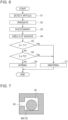
- Fig. 6 is a flowchart of an inspection by the inspection device 50.
- the sensor 56 detects a sending of the article 1 into the transport section 40, and outputs a photographing start signal to the control unit 60 (article detection step S1).
- the illumination 52 irradiates the mouthpiece end 16 with inspection light in the irradiation direction along the axial direction X (irradiation step S2).
- the camera 54 receives the photographing start signal from the sensor 56 through the control unit 60, photographs the peripheral surface of the filter 4 in the photographing direction along the radial direction Y at a timing in which the article 1 that is an inspection object sent into the transport drum 42 is transported to a photographing position P, and transmits photographed image data to the image processing unit 62 (photographing step S3).
- the image processing unit 62 processes the photographed image transmitted from the camera 54 and detects a shadow of the powder containing material 12 (image processing step S4).
- the image processing unit 62 calculates an area S of the shadow of the powder containing material 12.
- the assessment unit 64 assesses the presence or absence and the quality of the powder containing material 12 based on the shadow detected by the image processing unit 62 (assessment steps S5, S6). Specifically, in the assessment step S5, the assessment unit 64 assesses whether or not the area S of the shadow of the powder containing material 12 is less than a predetermined first threshold value T1, that is, assesses whether or not S ⁇ T1 holds.
- Fig. 7 shows a photographed image when S ⁇ T1 does not hold in the assessment step S5.
- a two-dimensional image of a shadow 68 of the powder containing material 12 that is normal is colored black or gray and has a circular outer edge.
- a first threshold value T1 is set to a value that is equivalent to a projection area of the powder containing material 12.
- the assessment step S5 when an assessment result is No and S ⁇ T1 does not hold, it is assessed that the powder containing material 12 exists in the cavity 18 and that the powder containing material 12 is not chipped, cracked, or crushed, and the process proceeds to the assessment step S6.
- Fig. 8 shows an example of a photographed image when S ⁇ T1 holds in the assessment step S5.
- S ⁇ T1 holds, and the area S of the shadow 68 is less than the first threshold value T1, as shown in Fig. 8 , a missing portion 70 or the like exists in the shadow 68 of the powder containing material 12, and the projection area of the powder containing material 12 is decreased.
- the projection area of the powder containing material 12 becomes zero.
- the assessment unit 64 assesses whether or not the area S of the shadow 68 of the powder containing material 12 is greater than or equal to a predetermined second threshold value T2, that is, assesses whether or not S ⁇ T2 holds.
- the second threshold value T2 is set to a value that is at least larger than the projection area of the normal powder containing material 12.
- Fig. 9 shows an example of a photographed image when S ⁇ T2 holds in the assessment step S6.
- an assessment result in the assessment step S6 is Yes
- S ⁇ T2 holds, and the area S of the shadow 68 is greater than or equal to the second threshold value T2
- the powder containing material 12 is crushed to pieces, the powder adheres to an inner wall of the cavity 18, and, as shown in Fig. 9 , the area S of the shadow 68 is increased so as to be equivalent to the projection area of the cavity 18.
- Step S7 any one of the following cases, a powder containing material 12 does not exist, the powder containing material 12 is chipped, the powder containing material 12 is cracked, and the powder containing material 12 is crushed, has occurred, and an output is made that an abnormality has occurred in the powder containing material 12, and the inspection ends.
- the article 1 in which the powder containing material 12 has been assessed as being abnormal and in which the abnormality has been output is eliminated before being shipped as a product.
- Step S6 when the assessment result is No and S ⁇ T2 does not hold, it is assessed that the powder containing material 12 is not crushed and the process proceeds to Step S8.
- Step S8 an output is made that the powder containing material 12 is normal, and the inspection ends. In this way, each time the sensor 56 detects an article 1, an inspection of a powder containing material 12 disposed in a filter 4 of the article 1 that is being transported is successively performed in accordance with the inspection flow.
- the illumination 52 irradiates the mouthpiece end 16 with inspection light in the irradiation direction along the axial direction X. Therefore, the inspection light is transmitted through the powder supply path 24 from the mouthpiece end 16, and the powder containing material 12 disposed in the cavity 18 is directly irradiated with the inspection light.
- the shadow 68 of the powder containing material 12 is formed by the inspection light with which the powder containing material 12 is irradiated.
- the camera 54 primarily photographs the peripheral surface of the filter 4 at the cavity 18 where the powder containing material 12 is disposed in the photographing direction along the radial direction Y.
- the camera 54 photographs the powder containing material 12 with two paper webs, that is, the outer plug wrapper 20 and the tipping paper 28 in between, and the image processing unit 62 processes a photographed image that has been transmitted from the camera 54 and detects the shadow 68 of the powder containing material 12.
- the powder containing material 12 is directly irradiated with inspection light that has passed through the powder supply path 24, and obstacles for detecting the shadow 68 of the powder containing material 12 is reduced to two paper webs. Therefore, compared to a related-art inspection using transmitted infrared light, it is possible to obtain a clearer shadow 68 of the powder containing material 12.
- the powder containing material 12 disposed in the filter 4 of the article 1 is inspected when the article 1 is in the process of being transported at the transport section 40. Therefore, it is possible to efficiently inspect with high precision in the article 1 the presence or absence and the quality of the powder containing material 12 disposed in the filter 4 and to improve the quality of the filter 4 and thus the article 1.
- the assessment unit 64 assesses that the powder containing material 12 is defective due to the occurrence of any one of the following cases, a powder containing material 12 does not exist, the powder containing material 12 is chipped, the powder containing material 12 is cracked, and the powder containing material 12 is crushed. Since the powder containing material 12 is a sphere, the presence or absence and the quality of the powder containing material 12 can be efficiently inspected by such a simple assessment.
- the assessment unit 64 assesses that the powder containing material 12 has been crushed. Therefore, before shipment, it is possible to reliably eliminate the defective filter 4 in which the powder containing material 12 is already crushed.
- the illumination 52 is fixed to the outer side of the outer peripheral surface 48a of the drum shell 48 in the axial direction X, and, in this fixed state, irradiates the mouthpiece end 16 with inspection light.
- the camera 54 is fixed to the outer side of the outer peripheral surface 48a of the drum shell 48 in the radial direction Y, and, in this fixed state, photographs a peripheral surface of the filter 4 that is on a side opposite to each of the wrap portions 30 and 32 from the radial direction Y. Therefore, it is possible to use the existing transport drum 42 without converting it and set the inspection device 50.
- Fig. 10 shows a case in which a shadow 72 of the wrap portion 30 of the outer plug wrapper 20 and a shadow 72 of the wrap portion 32 of the tipping paper 28 appear in a photographed image.
- the shadow 72 of the wrap portion 30 and the shadow 72 of the wrap portion 32 appear in the photographed image so as to overlap the shadow 68 of the powder containing material 12. Therefore, as shown in Fig. 10 , even if there is the missing portion 70 in the shadow 68 of the powder containing material 12, the areas of the shadows 72 of the wrap portions 30 and 32 are added to the area S of the shadow 68 of the powder containing material 12, and S ⁇ T1 may hold in the assessment step S5.
- the filter 4 is such that each of the wrap portions 30 and 32 facing the side of the outer peripheral surface 48a of the drum shell 48 is held by the outer peripheral surface 48a, and the camera 54 photographs the peripheral surface of the filter 4 that is on a side opposite to each of the wrap portions 30 and 32 from the radial direction Y. Therefore, the shadows 72 of the wrap portions 30 and 32 are prevented from appearing in a photographed image, and erroneous assessments caused by the shadows 72 of the wrap portions 30 and 32 are prevented. Consequently, the inspection precision of the powder containing material 12 is further improved.
- the inspection device 50 includes a sensor 56 that detects a sending of the article 1 into the transport drum 42 and outputs a photographing start signal.
- the camera 54 receives the photographing start signal from the sensor 56, photographs the peripheral surface of the filter 4 at a timing in which the article 1 that is an inspection object sent into the transport drum 42 is transported to the photographing position P. Therefore, it is possible to reliably inspect all the filters 4 of the articles 1 that are successively sent into the transport drum 42.
- Fig. 11 shows a case in which contours 74 of the vent holes 22 of the filter 4 appear in a photographed image.
- the contours 74 of the vent holes 22 appear in the photographed image so as to overlap the shadow 68 of the powder containing material 12. Therefore, as shown in Fig. 11 , even if the shadow 68 of the powder containing material 12 is normal, the area of a white region on an inner side of each contour 74 is subtracted from the area S of the shadow 68 of the powder containing material 12, and S ⁇ T1 may not hold in the assessment step S5.
- the illumination 52 applies, as inspection light, infrared light including a near infrared ray, which is a predetermined wavelength range.
- the wavelength range of the inspection light is a range in which, though the shadow 68 of the powder containing material 12 appears, the contour 74 of each vent hole 22 does not appear.
- the wavelength range of the inspection light is preferably 900 ⁇ m to 1700 ⁇ m, is more preferably 1000 ⁇ m to 1600 ⁇ m, and is even more preferably 1100 ⁇ m to 1500 ⁇ m.
- Fig. 12 shows a case in which a shadow 76 of a part of the logomark 34 of the filter 4 appears in a photographed image.
- the shadow 76 of the logomark 34 appears in the photographed image so as to be adjacent to the shadow 68 of the powder containing material 12. Therefore, as shown in Fig. 12 , even though there is the missing portion 70 in the shadow 68 of the powder containing material 12, the area of the shadow 76 of the logomark 34 is added to the area S of the shadow 68 of the powder containing material 12, and S ⁇ T1 may hold in the assessment step S5.
- the illumination 52 applies, as inspection light, infrared light including a near infrared ray, which is a predetermined wavelength range.
- the wavelength range of the inspection light is set to be the aforementioned range in which, though the shadow 68 of the powder containing material 12 appears, the shadow 76 of the logomark 34 does not appear.
- the article 1 may be a combustion-heating-type or may be a non-combustion-heating-type.
- a structural element that the upstream filter portion 8 is adjacent to in the axial direction X is not limited to the flavor element 2 and may be a tubular element.
- the flavor material 6 contains at least a flavor raw material
- the flavor material 6 may or may not contain a tobacco raw material, such as shredded tobacco.
- the filter material 14 is, for example, a filter fiber bundle, such as acetate tow, a filler in which an unwoven fabric sheet is folded, or a filler in which a paper web is gathered.
- a capsule may be embedded in the filter material 14, activated carbon particles may be added to the filter material 14, or hydrotalcite compound particles may be added to the filter material 14.
- the inspection device 50 is not limited to one inspecting the completed article 1, and may be one inspecting the filter 4 of a rod-shaped article that has been molded in a state close to that of the article 1. Specifically, the inspection device 50 may inspect the filter 4 before forming the vent holes 22 in the article 1.
- the vent holes 22 may be formed in a portion other than the cavity 18, and may be formed in, for example, the upstream filter portion 8.
- the contours 74 of the vent holes 22 such as those shown in Fig. 11 do not appear in a photographed image, one reason that causes erroneous assessment of the powder containing material 12 in the assessment step S5 is eliminated.
- the logomark 34 or the like may not be printed near the position of the cavity 18. In this case, since the shadow 76 of a part of, for example, the logomark 34, such as that shown in Fig. 12 , does not appear in a photographed image, one reason that causes erroneous assessment of the powder containing material 12 in the assessment step S5 is eliminated.
- the filter 4 is held by the outer peripheral surface 48a in an orientation in which each of the wrap portions 30 and 32 is on the side of the outer peripheral surface 48a of the drum shell 48.
- the present invention is not limited thereto, and the filter 4 may be held by the outer peripheral surface 48a in an orientation in which each of the wrap portions 30 and 32 is on the outer side of the drum shell 48 in the radial direction.
- the camera 54 is disposed to be fixed to the cylindrical core 46 and photographs a peripheral surface of the filter 4 from the inner side of the transport drum 42. Therefore, the camera 54 is capable of photographing the peripheral surface of the filter 4 on a side opposite to each of the wrap portions 30 and 32 from the radial direction Y.
- the inspection device 50 is disposed at the transport section 40 of the article 1 and inspects the filter 4 of the article 1 that is transported to the transport drum 42.
- the present invention is not limited thereto, and, as long as the inspection device 50 is to inspect the filter 4 when the article 1 is in the process of being transported, the inspection device 50 may inspect the filter 4 at another transport device.
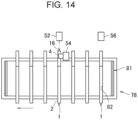
- Fig. 13 is a side view of the inspection device 50 disposed at a conveyor device 78 that transports an article 1
- Fig. 14 is a top view of a main portion of Fig. 13 .
- an article 1 is disposed in a groove portion 82 extending in a width direction of a transport belt 81 and transports the article 1 along a travel direction, indicated by an arrow, of the transport belt 81. Even in this case, as shown in Figs.
- the illumination 52 irradiates the mouthpiece end 16 with inspection light in the irradiation direction along the axial direction X
- the camera 54 photographs a peripheral surface of the filter 4 in the photographing direction along the radial direction Y to make it possible to inspect the filter 4 in the same way as the case shown in Fig. 3 .
- the inspection device 50 is not limited to being capable of inspecting the powder containing material 12 and is capable of inspecting shapes of various solid materials disposed in the filter 4.
- the inspection device 50 can be applied to an inspection of flavoring agent beads whose flavor is volatilized as the article 1 is inhaled.
- the powder supply path 24 is used as a communication path for inhaling the flavor of the flavoring agent beads.
- the inspection device 50 includes a sensor 56 that detects a sending of the article 1 into the transport drum 42, and outputs a photographing start signal.
- the present invention is not limited thereto, and when the article 1 is in the process of being transported by the transport drum 42 or the conveyor device 78, instead of a sending of the article 1 into the transport drum 42, the rotation of the transport drum 42 or the movement of the transport belt 81 may be detected by an encoder. In this case, a detection signal of the encoder is used as the photographing start signal.
Landscapes
- Physics & Mathematics (AREA)
- General Health & Medical Sciences (AREA)
- Health & Medical Sciences (AREA)
- Immunology (AREA)
- Analytical Chemistry (AREA)
- Biochemistry (AREA)
- Chemical & Material Sciences (AREA)
- General Physics & Mathematics (AREA)
- Life Sciences & Earth Sciences (AREA)
- Pathology (AREA)
- Spectroscopy & Molecular Physics (AREA)
- Toxicology (AREA)
- Engineering & Computer Science (AREA)
- Computer Vision & Pattern Recognition (AREA)
- Signal Processing (AREA)
- Investigating Materials By The Use Of Optical Means Adapted For Particular Applications (AREA)
Applications Claiming Priority (1)
| Application Number | Priority Date | Filing Date | Title |
|---|---|---|---|
| PCT/JP2021/043193 WO2023095241A1 (ja) | 2021-11-25 | 2021-11-25 | フィルタの検査装置及び検査方法 |
Publications (3)
| Publication Number | Publication Date |
|---|---|
| EP4437862A1 true EP4437862A1 (de) | 2024-10-02 |
| EP4437862A8 EP4437862A8 (de) | 2024-11-13 |
| EP4437862A4 EP4437862A4 (de) | 2025-09-03 |
Family
ID=86539228
Family Applications (1)
| Application Number | Title | Priority Date | Filing Date |
|---|---|---|---|
| EP21965613.9A Pending EP4437862A4 (de) | 2021-11-25 | 2021-11-25 | Inspektionsvorrichtung und inspektionsverfahren für filter |
Country Status (6)
| Country | Link |
|---|---|
| US (1) | US20240302288A1 (de) |
| EP (1) | EP4437862A4 (de) |
| JP (1) | JP7686781B2 (de) |
| KR (1) | KR20240090905A (de) |
| CN (1) | CN118265465A (de) |
| WO (1) | WO2023095241A1 (de) |
Family Cites Families (10)
| Publication number | Priority date | Publication date | Assignee | Title |
|---|---|---|---|---|
| JP3730082B2 (ja) * | 2000-04-12 | 2005-12-21 | 日本たばこ産業株式会社 | シガレット検査装置 |
| US6952257B2 (en) * | 2003-06-13 | 2005-10-04 | Philip Morris Usa Inc. | Inspection station |
| JP2014178117A (ja) * | 2011-07-06 | 2014-09-25 | Japan Tobacco Inc | カプセル検査装置及びその検査方法 |
| CN107613794B (zh) | 2015-05-13 | 2021-01-01 | 日本烟草产业株式会社 | 带过滤嘴的吸烟物品及吸烟物品的过滤嘴 |
| CN207167743U (zh) * | 2017-08-09 | 2018-04-03 | 湖北中烟卷烟材料厂 | 一种复合滤棒影像检测机构 |
| WO2019077665A1 (ja) * | 2017-10-16 | 2019-04-25 | 日本たばこ産業株式会社 | 喫煙用ロッド状物品の検査装置、喫煙用ロッド状物品の製造機、及び喫煙用ロッド状物品の検査方法 |
| CN111492230A (zh) * | 2017-12-15 | 2020-08-04 | 日本烟草产业株式会社 | 香烟过滤嘴的检查方法、香烟过滤嘴的检查装置及香烟过滤嘴的检查程序 |
| DE102018100499A1 (de) * | 2018-01-11 | 2019-07-11 | Hauni Maschinenbau Gmbh | Vorrichtung und Verfahren der Tabak verarbeitenden Industrie mit einer Beleuchtungsvorrichtung zum optischen Prüfen von stabförmigen Artikeln |
| DE102018108288A1 (de) * | 2018-04-09 | 2019-10-10 | Hauni Maschinenbau Gmbh | Vorrichtung und Verfahren zur Inspektion einer Stirnfläche eines stabförmigen Rauchartikels |
| IT201800010374A1 (it) * | 2018-11-15 | 2020-05-15 | Xepics Sa | Metodo e sistema automatico di misura per la misurazione di parametri fisici e dimensionali di articoli combinati. |
-
2021
- 2021-11-25 EP EP21965613.9A patent/EP4437862A4/de active Pending
- 2021-11-25 KR KR1020247017277A patent/KR20240090905A/ko active Pending
- 2021-11-25 JP JP2023563408A patent/JP7686781B2/ja active Active
- 2021-11-25 CN CN202180104193.3A patent/CN118265465A/zh active Pending
- 2021-11-25 WO PCT/JP2021/043193 patent/WO2023095241A1/ja not_active Ceased
-
2024
- 2024-05-17 US US18/666,862 patent/US20240302288A1/en active Pending
Also Published As
| Publication number | Publication date |
|---|---|
| CN118265465A (zh) | 2024-06-28 |
| KR20240090905A (ko) | 2024-06-21 |
| US20240302288A1 (en) | 2024-09-12 |
| EP4437862A8 (de) | 2024-11-13 |
| JPWO2023095241A1 (de) | 2023-06-01 |
| JP7686781B2 (ja) | 2025-06-02 |
| WO2023095241A1 (ja) | 2023-06-01 |
| EP4437862A4 (de) | 2025-09-03 |
Similar Documents
| Publication | Publication Date | Title |
|---|---|---|
| US6578583B2 (en) | Apparatus for making and inspecting multi-component wrapped article | |
| EP2934200B1 (de) | Inspektionssystem | |
| US9664570B2 (en) | System for analyzing a smoking article filter associated with a smoking article, and associated method | |
| EP3341713B1 (de) | Kapselobjektinspektionssystem und zugehöriges verfahren | |
| US10063814B2 (en) | Smoking article package inspection system and associated method | |
| CN100519345C (zh) | 包括微粒填充空腔的平行的香烟滤嘴组合技术 | |
| WO2019116543A1 (ja) | シガレットフィルタ検査方法、シガレットフィルタ検査装置、及びシガレットフィルタ検査プログラム | |
| JP2014178117A (ja) | カプセル検査装置及びその検査方法 | |
| WO2013145163A1 (ja) | シガレットのフィルタ検査装置及びその検査方法 | |
| US11606967B2 (en) | Smoking-related article inspection systems and associated methods | |
| US20230397652A1 (en) | Apparatus for recovering tobacco material and related method | |
| JP2008131856A (ja) | 多重フィルタロッドの検査装置 | |
| CN111717440B (zh) | 检查装置、ptp包装机和ptp片的制造方法 | |
| US20240302288A1 (en) | Inspection device and inspection method for filter | |
| JP4424537B2 (ja) | 異物検査装置 | |
| JP2025084853A (ja) | エアロゾル供給システム用消耗品を製造するための装置および方法 | |
| EP3806666B1 (de) | Detektionseinheit und -verfahren für die tabakindustrie | |
| EP3853594B1 (de) | Elektromagnetischer detektor zur erfassung von eigenschaften von produkten der tabakverarbeitenden industrie | |
| WO2021152653A1 (ja) | 喫煙物品用フィルターの検査方法及び検査装置 | |
| JP2004279079A (ja) | 樹脂チューブフィルムの印刷不良検査装置 |
Legal Events
| Date | Code | Title | Description |
|---|---|---|---|
| STAA | Information on the status of an ep patent application or granted ep patent |
Free format text: STATUS: THE INTERNATIONAL PUBLICATION HAS BEEN MADE |
|
| PUAI | Public reference made under article 153(3) epc to a published international application that has entered the european phase |
Free format text: ORIGINAL CODE: 0009012 |
|
| STAA | Information on the status of an ep patent application or granted ep patent |
Free format text: STATUS: REQUEST FOR EXAMINATION WAS MADE |
|
| 17P | Request for examination filed |
Effective date: 20240423 |
|
| AK | Designated contracting states |
Kind code of ref document: A1 Designated state(s): AL AT BE BG CH CY CZ DE DK EE ES FI FR GB GR HR HU IE IS IT LI LT LU LV MC MK MT NL NO PL PT RO RS SE SI SK SM TR |
|
| RAP3 | Party data changed (applicant data changed or rights of an application transferred) |
Owner name: JAPAN TOBACCO INC. |
|
| RAP3 | Party data changed (applicant data changed or rights of an application transferred) |
Owner name: JAPAN TOBACCO INC. |
|
| DAV | Request for validation of the european patent (deleted) | ||
| DAX | Request for extension of the european patent (deleted) | ||
| A4 | Supplementary search report drawn up and despatched |
Effective date: 20250801 |
|
| RIC1 | Information provided on ipc code assigned before grant |
Ipc: A24C 5/34 20060101AFI20250728BHEP Ipc: A24D 3/02 20060101ALI20250728BHEP Ipc: G01N 21/88 20060101ALI20250728BHEP Ipc: G01N 21/952 20060101ALI20250728BHEP |