EP4435792A1 - Datenverarbeitungsverfahren und -vorrichtung für quantenchemiesystem - Google Patents
Datenverarbeitungsverfahren und -vorrichtung für quantenchemiesystem Download PDFInfo
- Publication number
- EP4435792A1 EP4435792A1 EP23787795.6A EP23787795A EP4435792A1 EP 4435792 A1 EP4435792 A1 EP 4435792A1 EP 23787795 A EP23787795 A EP 23787795A EP 4435792 A1 EP4435792 A1 EP 4435792A1
- Authority
- EP
- European Patent Office
- Prior art keywords
- walker
- walkers
- processing
- wave function
- diffused
- Prior art date
- Legal status (The legal status is an assumption and is not a legal conclusion. Google has not performed a legal analysis and makes no representation as to the accuracy of the status listed.)
- Pending
Links
Images




Classifications
-
- G—PHYSICS
- G06—COMPUTING OR CALCULATING; COUNTING
- G06N—COMPUTING ARRANGEMENTS BASED ON SPECIFIC COMPUTATIONAL MODELS
- G06N7/00—Computing arrangements based on specific mathematical models
- G06N7/01—Probabilistic graphical models, e.g. probabilistic networks
-
- G—PHYSICS
- G16—INFORMATION AND COMMUNICATION TECHNOLOGY [ICT] SPECIALLY ADAPTED FOR SPECIFIC APPLICATION FIELDS
- G16C—COMPUTATIONAL CHEMISTRY; CHEMOINFORMATICS; COMPUTATIONAL MATERIALS SCIENCE
- G16C10/00—Computational theoretical chemistry, i.e. ICT specially adapted for theoretical aspects of quantum chemistry, molecular mechanics, molecular dynamics or the like
-
- G—PHYSICS
- G06—COMPUTING OR CALCULATING; COUNTING
- G06F—ELECTRIC DIGITAL DATA PROCESSING
- G06F17/00—Digital computing or data processing equipment or methods, specially adapted for specific functions
- G06F17/10—Complex mathematical operations
- G06F17/18—Complex mathematical operations for evaluating statistical data, e.g. average values, frequency distributions, probability functions, regression analysis
-
- G—PHYSICS
- G06—COMPUTING OR CALCULATING; COUNTING
- G06N—COMPUTING ARRANGEMENTS BASED ON SPECIFIC COMPUTATIONAL MODELS
- G06N3/00—Computing arrangements based on biological models
- G06N3/02—Neural networks
- G06N3/04—Architecture, e.g. interconnection topology
-
- G—PHYSICS
- G06—COMPUTING OR CALCULATING; COUNTING
- G06N—COMPUTING ARRANGEMENTS BASED ON SPECIFIC COMPUTATIONAL MODELS
- G06N3/00—Computing arrangements based on biological models
- G06N3/02—Neural networks
- G06N3/04—Architecture, e.g. interconnection topology
- G06N3/045—Combinations of networks
-
- G—PHYSICS
- G06—COMPUTING OR CALCULATING; COUNTING
- G06N—COMPUTING ARRANGEMENTS BASED ON SPECIFIC COMPUTATIONAL MODELS
- G06N3/00—Computing arrangements based on biological models
- G06N3/02—Neural networks
- G06N3/08—Learning methods
-
- G—PHYSICS
- G16—INFORMATION AND COMMUNICATION TECHNOLOGY [ICT] SPECIALLY ADAPTED FOR SPECIFIC APPLICATION FIELDS
- G16C—COMPUTATIONAL CHEMISTRY; CHEMOINFORMATICS; COMPUTATIONAL MATERIALS SCIENCE
- G16C20/00—Chemoinformatics, i.e. ICT specially adapted for the handling of physicochemical or structural data of chemical particles, elements, compounds or mixtures
- G16C20/30—Prediction of properties of chemical compounds, compositions or mixtures
-
- G—PHYSICS
- G16—INFORMATION AND COMMUNICATION TECHNOLOGY [ICT] SPECIALLY ADAPTED FOR SPECIFIC APPLICATION FIELDS
- G16C—COMPUTATIONAL CHEMISTRY; CHEMOINFORMATICS; COMPUTATIONAL MATERIALS SCIENCE
- G16C20/00—Chemoinformatics, i.e. ICT specially adapted for the handling of physicochemical or structural data of chemical particles, elements, compounds or mixtures
- G16C20/70—Machine learning, data mining or chemometrics
Definitions
- the present disclosure relates to the field of quantum chemistry, and in particular, to data processing for a chemical system.
- Quantum chemistry is an important branch of theoretical chemistry. Its research scope may include structures and properties of stable and unstable molecules, and relationships between the structures and properties; interaction between molecules; and mutual collisions and reactions between molecules, and other issues.
- the main theoretical basis in the quantum chemistry research is quantum mechanics, which describes the laws that govern operations in the microscopic world.
- a data processing method for a quantum chemical system may include the following steps: acquiring a specific wave function suitable for the quantum chemical system that is constructed based on a neural network; performing walker processing based on the specific wave function, the walker processing including diffusion of walkers; and determining related information about chemical properties of the quantum chemical system based on the specific wave function and the processed walkers.
- a data processing apparatus for a quantum chemical system may include: an acquisition unit configured to acquire a specific wave function suitable for the quantum chemical system that is constructed based on a neural network; a walker processing unit configured to perform walker processing based on the specific wave function, the walker processing including diffusion of walkers; and an information generation unit configured to determine related information about chemical properties of the quantum chemical system based on the specific wave function and the processed walkers.
- a data processing method for a quantum chemical system may include the following steps: acquiring a specific wave function suitable for the quantum chemical system; performing walker processing based on the specific wave function, the walker processing including diffusion of walkers, and the diffusion of the walkers being performed such that the number of walkers remains constant during the processing; and determining related information about chemical properties of the quantum chemical system based on the specific wave function and the processed walkers.
- a data processing apparatus for a quantum chemical system may include an acquisition unit configured to acquire a specific wave function suitable for the quantum chemical system; a walker processing unit configured to performs walker processing based on the specific wave function, the walker processing including diffusion of walkers, and the diffusion of the walkers being performed such that the number of walkers remains constant during the processing; and an information generation unit that determines related information about chemical properties of the quantum chemical system based on the specific wave function and the processed walkers.
- an electronic device includes: a memory storing instructions; and a processor, wherein the instructions, when executed by the processor, cause the method according to any one of the embodiments of the present disclosure to be implemented.
- a computer-readable storage medium having a computer program stored thereon, wherein the program, when executed by a processor, causes the method according to any one of the embodiments of the present disclosure to be implemented.
- a computer program product including instructions that, when executed by a processor, cause the method according to any one of the embodiments of the present disclosure to be implemented.
- a computer program including program codes that, when executed by a processor, cause the method according to any one of the embodiments of the present disclosure to be implemented.
- quantum chemistry has always attracted great attention, especially in research on a chemical system through the application of quantum mechanics.
- the research on the chemical system mainly involves research/analysis for acquiring chemical properties of the chemical system, and the chemical properties of the chemical system may include any appropriate properties/attributes, such as attributes/indicators related to energy, and so on.
- ground-state energy of the chemical system is very important for quantum chemistry research, for example, a capability to accurately calculate the ground-state energy helps chemists to develop new materials, such as new materials used to accelerate agricultural nitrogen fixation and a hydrolysis process for making clean energy, and so on.
- the present disclosure provides an improved data processing technique for a quantum chemical system.
- a high-accuracy wave function can be constructed, and on basis of application of the wave function, a specific quantum chemical method can be applied to further process data, so that accurate solutions for chemical performance can be obtained.
- the present disclosure proposes the use of a neural network to construct a wave function, and applies the constructed wave function as a trial wave function to a specific quantum chemical method, especially a diffusion Monte Carlo method.
- a wave function can be constructed based on the neural network, and the constructed wave function can be applied as a trial wave function to the specific quantum chemical method, especially the diffusion Monte Carlo method, and during the operation of the specific quantum chemical method (especially the diffusion Monte Carlo method), a specific processing device can be used to perform data processing in the quantum chemical system in an appropriate manner. In this way, improvements can be achieved in both data processing accuracy and processing efficiency.
- the chemical properties of the quantum chemical system are particularly attributes related to ground-state energy.
- the energy of a chemical system can only have some specific values. The lowest energy is called ground-state energy, a corresponding state of the system is called a ground state, and its corresponding wave function is called a ground-state wave function. The other states are all called excited states.
- the attributes related to the ground-state energy may be represented in various appropriate forms, especially in relative values of the ground-state energy. For example, when the ground-state energy and several excited-state energies can be obtained, attributes related to the ground-state energy may be represented as ratios of the ground-state energy to other excited-state energies, etc.
- the wave function acquired in advance may be used as a trial wave function, which may serve as a basis for subsequent analysis/research of the quantum chemical system, such as determining the chemical properties of the quantum chemical system.
- the wave function acquired in advance may particularly serve as a trial wave function for the diffusion Monte Carlo method.
- the wave function may be any appropriate wave function, in some embodiments of the present disclosure, the wave function is a function that describes states of a microscopic system, particularly a wave function that describes electron states.
- An input of the wave function may be information about a state/attribute of an electron, for example, a spatial coordinate of the electron, and a square modulus of an output of the wave function is proportional to a probability of the electron appearing at this location.
- statistical characteristics of the processed walkers may characterize the chemical properties of the chemical system that are desired/required to be acquired, such as attributes of specific energy.
- a walker may include information about attributes of electrons in the chemical system, particularly information related to a distribution of the electrons.
- the walkers used may include two parts: position coordinates of all electrons in the system and their corresponding weights.
- the ground state means a state that the energy of the chemical system in quantum chemistry is lowest, and the ground-state energy refers to a lowest energy state of a molecule.
- the ground-state energy is merely exemplary and not restrictive.
- the embodiments according to the present disclosure may also be applied to research/analysis of other chemical attitudes/energies of the quantum chemical system, for example, any required energy, such as any required excited-state energy, and in this case, adaptive adjustments can be made on the basis of the solutions of the present disclosure with respect to requirements.
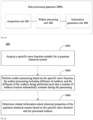
- FIG. 2A is a flowchart of a data processing method for a quantum chemical system according to an embodiment of the present disclosure.
- data processing for the quantum chemical system is specifically data processing related to chemical attributes of the quantum chemical system, which may, for example, include, but not limited to, computing, fitting, etc. of data/numeric values/information, etc.
- the chemical system in quantum chemistry as mentioned in the present disclosure (hereinafter referred to as a quantum chemical system or chemical system) refers to a molecule formed by some single atoms or multiple atoms in specific configurations, and a microscopic image of the molecule may include an atomic nucleus located at a relatively fixed position and electrons moving freely therein.
- the embodiments according to the present disclosure are particularly suitable for molecular-scale applications.
- step S201 a specific wave function suitable for the quantum chemical system that is constructed based on a neural network is acquired.
- step S202 walker processing is performed based on the specific wave function, the walker processing including diffusion of walkers.
- step S203 related information about chemical properties of the quantum chemical system is determined based on the specific wave function and the processed walkers.
- the specific wave function may be a function that describes a state of a microscopic system of the chemical system.
- an input of the wave function may be information about parameters in the state of the microscopic system of the quantum chemical system
- an output of the wave function may be a property characterizing the quantum chemical system.
- the information about parameters in the state of the microscopic system may mean, for example, information related to states/properties of electrons in the chemical system, including but not limited to information related to a spatial distribution of electrons in a solid system.
- the information related to spatial distribution of electrons may include or be based on spatial coordinates of all electrons (such as three-dimensional spatial coordinates, which may be in a vector form), etc.
- the properties of the quantum chemical system may include energy-related states, distribution-related states, etc.
- the atomic nucleus located at a relatively fixed position serves as a skeleton, while the electrons move freely relative to the nucleus. Therefore, in one embodiment, the specific wave function is a wave function that characterizes electronic states in the chemical system.
- An input of the wave function may be information about a state/attribute of the electron, for example, spatial coordinates of all electrons in the system, and a square modulus of an output of the wave function is proportional to a probability of the electron appearing at this location.
- the trial wave function is an auxiliary wave function used to reduce energy variance and fix a nodal surface during data processing.
- the accuracy of research/analysis of the chemical properties of the quantum chemical system is limited by the nodal surface of the trial wave function.
- the present disclosure proposes to use a neural network to construct the wave function, and apply the constructed wave function as the trial wave function to a specific quantum chemical method, particularly a diffusion Monte Carlo method, which allows for leveraging a strong fitting capability of the neural network to acquire/construct a high-accuracy wave function, thereby improving the accuracy of the specific quantum chemical method, especially the accuracy of the diffusion Monte Carlo method, and thus achieving accurate research/analysis of the chemical system in quantum chemistry.
- the specific wave function constructed based on the neural network may serve as a basis for subsequent processing of walkers, and the closer the nodal surface of the trial wave function is to the nodal surface of the true ground-state wave function, the closer the energy obtained by the walker processing based on the trial wave function is to the true ground-state energy. Therefore, a more accurate result can be obtained, for example, a more accurate ground-state wave function and ground-state energy can be obtained.
- the wave function may be determined/trained in various appropriate manners, and may specifically be computed by using a corresponding model (for example, a neural network model).
- a corresponding model for example, a neural network model
- the input is an initial electron configuration (for example, spatial coordinates of all the electrons), and then the neural network model may output a wave function for any configuration.
- the network is trained to find an approximation of the ground-state wave function by minimizing the energy state.
- the network modifies its parameters until the energy reaches a minimum value, with corresponding network parameters corresponding to the ground-state wave function.
- a neural network may be trained first, and after completion of the training, parameters of the neural network may be fixed, that is, a wave function characterized by the neural network may be fixed, then the wave function can be used as a trial wave function to carry out the walker simulation according to the present disclosure to obtain a more accurate ground-state wave function and ground-state energy.
- the neural network may be trained in various appropriate manners. For example, it may be trained using various wave function construction methods known in the art. Preferably, the specific wave function is obtained by training the neural network using a variational Monte Carlo method. In some embodiments, various appropriate neural networks may be used to construct the specific wave function according to embodiments of the present disclosure as the trial wave function.
- a "Fermi neural network” may be used to construct the trial wave function according to embodiments of the present disclosure. Specifically, the Fermi neural network is trained first using the variational Monte Carlo method, and after completion of the training, parameters of the neural network are fixed, that is, a wave function characterized by the neural network is fixed. In some embodiments, another neural network method in quantum chemistry, such as a "Pauli neural network” or the like, may alternatively be used.
- the walkers may be parameters used in quantum chemical computations, and may mean sample points for sampling.
- the walkers may indicate sampling points for sampling with respect to a given distribution (e.g., a distribution acquired using a trial basis function).
- the walkers may correspond to electrons in the microscopic system of the quantum chemical system, such as the information about electron attributes as described above that includes the spatial coordinates of electrons and the corresponding weights.
- statistical information about the walkers may indicate specific energy in the microscopic system of the quantum chemical system, especially the ground-state energy.
- a walker may be expressed in various appropriate forms.
- the walker may be in the form of a vector, where dimensions of the vector may depend on the number of electrons in the chemical system, such as the product of the number of electrons and the number of spatial dimensions (e.g., the number is 3, for a three-dimensional space).
- the walker may be initially set in any appropriate manner, and specifically, the walker is initially set randomly.
- a specific molecule such as a water molecule
- the walker may correspond to coordinates of 10 electrons in the three-dimensional space, and thus the walker is a 30-dimensional vector.
- values in the vectors of walker may be randomly set, for example, numerical values in the 30-dimensional vector may be random.
- data processing of walkers can be performed based on the trial wave function.
- walker simulation/processing can be performed based on the improved wave function constructed using the neural network, to accurately acquire chemical performance.
- the walker processing may include diffusion.
- the walker may be diffused with drift and a weight for the walker can be adjusted accordingly.
- the adjustment of the weight for the walker during the diffusion may be performed in any appropriate manner in the art, for example, the adjustment may particularly be performed based on energy of the diffused walker.
- the walker processing may further include performing a detection on such diffusion, especially on the diffused walkers, based on the trial wave function, preferably performing a crossing detection based on the nodal surface of the trial wave function, and performing corresponding processing based on a detection result.
- the nodal surface of the wave function is all of points of the function that have a value of zero.
- the nodal surface crossing detection is performed on the diffused walkers, that is, it is judged whether the diffused walkers cross the nodal surface of the wave function, and appropriate processing is performed on the diffused walkers based on a judgement result.
- the processing may specifically involve configuration, such as position, quantity, or weight, of the walkers. Such processing may be considered to be included in the diffusion, or may certainly be performed after the diffusion. According to embodiments of the present disclosure, whether the walker crosses the nodal surface of the constructed wave function may be judged by determining whether a spatial position of the diffused walker crosses the nodal surface, which may be performed in various appropriate manners in the art and will not be described in detail here.
- the appropriate processing may involve adjustment of configuration of the walkers, particularly adjustment of the position, quantity, weight, etc. of the walkers, especially adjustment based on the weights for the walkers.
- the processing may be performed based on the weights for the diffused walkers, for example, the processing may include at least one of reproduction, merging, or even no operation. Specifically, if a weight for a walker is too large after adjustment, for example, greater than or equal to a first specific threshold (which may be referred to as a first weight threshold), reproduction is performed.
- a first specific threshold which may be referred to as a first weight threshold
- Reproduction may also be referred to as derivation, duplication, etc., and may be performed in various appropriate manners in the art, and may particularly include duplicating a walker whose weight is greater than the first specific threshold, where a weight for each of two walkers obtained through duplication is half of the weight for the original walker.
- coordinates of the duplicated walkers may be appropriately set, for example, may especially be located at the original position, which will not be described in detail here.
- the merging merges two appropriate walkers into a single walker, and the walkers to be merged may be appropriately selected, for example, based on weights, positions of the walkers, or correlation between the walkers.
- walkers less than the weight may be merged, or walkers at the same computing node may be merged, and so on.
- the attribute (e.g., a weight, spatial coordinates, etc.) of a merged walker may be derived based on attributes of the two walkers being merged, which may be implemented in various appropriate manners in the art, for example, a weight for the merged walker may be a mathematical statistical value of weights for the two walkers being merged, such as the sum of the weights, for example, the coordinate of the merged walker may be the coordinate of one of the two walkers being merged, or may be an appropriate coordinate between the two walkers, such as intermediate coordinate, etc., which will not be described in detail here.
- the weight for the walker is greater than or equal to the second specific threshold and less than the first specific threshold, there is no need to perform further processing on the walker, that is, the reproduction or merging as described above will not be performed on the diffused walker.
- the above-mentioned processing may be performed based on specific application requirements, processing configurations, etc., without being only limited to or dependent on weights, for example, the reproduction and the merging may be performed in a correlated manner, which will be described in detail below.
- the walker when a walker crosses the nodal surface of the constructed wave function, the walker may be reset/reinitialized. Specifically, the attributes of the walker may be restored to the attributes before diffusion, for example, the position and weight of the walker may be restored to its position and weight before diffusion.
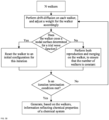
- FIG. 2B is a diagram of a concept of exemplary walker diffusion iteratively performed.
- a walker may be diffused and a weight for the walker may be adjusted, and then a detection may be performed on the diffused walker based on the trial wave function, especially a nodal surface crossing detection may be performed on the diffused walker based on the nodal surface of the trial wave function, and a walker which is detected as crossing the nodal surface is reset, while a walker which is not detected as crossing the nodal surface will be appropriately processed, for example, reproduction, merging, or even no processing will be performed on the walker, then, it is verified whether an iteration termination condition is met after this iteration, and if the termination condition is not met, walker processing continues to be performed, otherwise the chemical properties of the chemical system can be determined based on a processing result of the walkers.
- FIG. 2B is merely exemplary, and the processing flow may be appropriately adjusted, for example, it can be first verified whether the iteration termination condition is met, and then when the termination condition is not met, diffusion, weight adjustment, reproduction, merging, or the like of the walker may continue to be performed. Specific processing in the diffusion of walkers will be described in detail below.
- each iteration of the diffusion of walkers at least the following operations may be included: performing drift-diffusion and then performing weight adjustment accordingly on the walkers; performing, based on a nodal surface of the wave function, crossing detection with respect to the nodal surface on the diffused walkers; and when it is not detected that any diffused walker crosses the nodal surface, performing further processing on the diffused walker, where the further processing may be performed based on a weight for the diffused walker, and may include, but not limited to, reproduction, merging, or even no processing.
- the following operation may further be included: when a diffused walker crosses the nodal surface of the specific wave function, resetting the diffused walker to an initial setting for this iteration. In some embodiments, resetting the walker is to reset the walker to an initial setting before the start of this iteration. Furthermore, in this operation, only the walkers that cross the nodal surface of the wave function are reset, rather than all walkers.
- a drift quantity for a walker may be expressed in an appropriate form. As an example, it may be expressed in a form corresponding to/matching the walker. Specifically, the drift quantity may be in the form of a vector whose vector dimensions match dimensions of the walker. As an example, the dimensions of the drift quantity are related to the number of electrons in the system, and are especially the product of the number of electrons and the number (3) of spatial dimensions. According to this embodiment of the present disclosure, a value of the drift quantity may be appropriately set, for example, may be initially set to an appropriate value. Preferably, the drift quantity may be set depending on the trial wave function.
- the drift quantity may be constant across iterations, for example, the same drift quantity may be used in each iteration.
- the drift quantity is variable across iterations, for example, it may change according to a specific rule or a specific change function, and such a change rule or specific change function may be preset based on experience.
- the weight for a walker may be initially preset, for example, randomly set to any initial value.
- the weight for the walker may be appropriately adjusted/updated when performing diffusion of the walker during each iteration.
- the weight for the diffused walker may be adjusted based on local energy of the diffused walker. If the local energy of the diffused walker is too small, the weight may be increased, otherwise the weight may be reduced. In other words, a walker with small local energy may be "preferred".
- the local energy may refer to a physical quantity defined in spatial coordinates of electrons. The local energy of the walker may be calculated using a solution known in the art, especially relying on the trial wave function, which is not described in detail here.
- the termination condition of the iterative processing of the walkers may be any appropriate condition.
- it can be judged whether to terminate the iteration of the diffusion of walkers based on at least one of the following conditions: the number of iterations exceeds a threshold number; and in a specific number of consecutive iterations, a change in total energy reflected by walkers is less than a specific change threshold.
- the iteration may be terminated.
- appropriate processing can be performed on the walkers during each iteration before terminating the iteration, including the above-mentioned reproduction, merging, or even no processing, and then the total energy after this iteration may be calculated to determine an energy change accordingly.
- the total energy may be determined based on a statistical value of the energy of each walker.
- the total energy after this iteration can be acquired by calculating local energy of each walker and weighted averaging the local energies of the walkers. Specifically, the weighted averaging may mean weighted averaging performed based on the weights for the walkers.
- the iteration when the number of iterations reaches a predetermined number threshold, the iteration may be terminated.
- the diffusion of walkers may be performed in each iteration before terminating the iteration, and optionally, after reproduction, merging, resetting, etc. performed after the diffusion, operations to be performed for a next iteration can be specified.
- the trial wave function may be involved in the drift quantity, the nodal surface detection, and the local energy calculation. If the trial wave function is more accurate, the accuracy of attributes related to the ground-state energy acquired in the solution of the present disclosure is also higher, and the convergence is faster. Therefore, in the above embodiments, by constructing the accurate trial wave function by using the neural network, the accuracy of the present invention is higher and the convergence is faster.
- FIG. 2C shows an exemplary implementation of data processing for the quantum chemical system according to this embodiment of the present disclosure.
- a indicates energy attributes of the chemical system implemented according to embodiments of the present disclosure, which may indicate proportions of components, such as a ground state and excited states in the state of the quantum chemical system, and the leftmost column indicates the proportion of the ground-state component.
- initial eigenstates including ground state-energy and first to third excited-state energies from left to right
- the ground-state component acquired using the variational Monte Carlo method has been improved, but the other excited-state components than the ground-state energy still exist quite obviously.
- FIG. 2C b indicates construction of a wave function, especially construction of the wave function based on a neural network, where nucleus-electron interaction and electron-electron interaction are taken into account, and the acquired wave function can achieve a fixed nodal surface for the detection in processing for walkers.
- the processing for walkers may be shown as c in FIG.
- the walker processing includes diffusion of the walkers
- walker data statistical values of the diffused walkers may be used to simulate/acquire the chemical properties of the quantum chemical system.
- the walker processing may be fully parallelized, for example, by using a plurality of computing nodes for distributed processing, which will be described in further detail below.
- d indicates various exemplary operations in the diffusion of the walkers, specifically, during the diffusion operation, if a diffused walker crosses the fixed nodal surface, it will be reset, otherwise it will be subjected to appropriate processing, for example, including reproduction and merging.
- the iterative processing for the walkers may be further optimized, thereby further improving the efficiency of the method according to the present disclosure.
- the optimized processing for the walkers preferably enables the number of walkers after diffusion to remain constant, thereby facilitating more efficient data processing.
- the conventional variational Monte Carlo method with limited accuracy is often used currently to obtain the trial wave function, and most of the computing software runs on CPUs correspondingly, resulting in severe limitations on accuracy and efficiency.
- the neural network method has strong expressive power and high computational accuracy, but the cost is a huge amount of computation, which requires GPU devices for acceleration. In view of this, the present disclosure particularly considers the comprehensive application of neural networks and GPU devices.
- the walker processing according to embodiments of the present disclosure can be combined with the neural network method and can be efficiently computed on the GPU devices. Therefore, the present disclosure proposes a set of methods that are easy to be combined with neural network methods, can implement efficient computations on GPU devices, and have excellent scalability, thereby fully utilizing the advantages of the neural network methods and achieving a series of high-accuracy calculation results in quantum chemistry problems.
- the walker processing can be performed on at least one computing node, where at least one of the at least one computing node can include a graphics processing unit (GPU).
- the walker processing can be performed on a plurality of computing nodes in a distributed manner, at least one of the plurality of computing nodes includes a graphics processing unit (GPU), and a part of the walker processing is performed on each computing node.
- the computing node may include, but not limited to, one or more processors, such as one or more CPUs, or one or more GPUs, and so on.
- the computing nodes may often be implemented by one or more processors that are physically integrated together.
- both reproduction and merging may be performed on the walkers.
- the reproduction and merging of the walkers are performed in a correlated manner, which may also be referred to as being performed in pairs, substantially performed concurrently.
- the merging is performed accordingly, thereby an increase in the number of walkers caused by the reproduction may offset a reduction in the number of walkers caused by the merging, such that the total number of walkers remains unchanged.
- the reproduction is performed accordingly.
- the reproduction operation is performed on an appropriate walker, for example, a walker with a maximum weight, to compensate for a reduction in the number of walkers caused by the merging, such that the total number of walkers remains unchanged.
- the computing nodes are composed of GPUs. Therefore, for such processing nodes composed of GPUs, the above-mentioned reproduction and merging may be performed in a correlated manner, such that at such processing nodes composed of GPUs, the number of walkers remains unchanged in each iteration.
- the walker is duplicated if the weight for the walker is greater than a specific threshold, a weight for each of two walkers obtained through duplication being half of the weight for the original walker, and at the same time, two walkers with minimum weights are selected for merging, which can ensure that the number of walkers remains unchanged.
- the walker processed in this way is particularly suitable for a specific processing node, especially a node containing a graphics processing unit (GPU), which may greatly improve the processing efficiency.
- GPU graphics processing unit
- the walker is duplicated, the weight for each of the two walkers obtained through duplication being half of the weight for the original walker, and meanwhile, a walker that is annihilated in the merging concurrently performed is replaced with one duplicated walker.
- This may ensure that "reproduction” and “merging” operations can run efficiently on the specific processing node, especially the node containing the GPU, achieving compilability of modules and significantly improving efficiency.
- the processing in the present disclosure may be performed in a distributed manner.
- the processing in the present disclosure may be performed on a computing node cluster consisting of a plurality of computing nodes, and the plurality of computing nodes may communicate with each other. Therefore, performing data processing on a plurality of processing nodes in a distributed manner may further improve the efficiency and effects of data processing in the quantum chemical system.
- the processing in the present disclosure may be distributed across a plurality of computing nodes in any appropriate manner. For example, it may be evenly distributed, and numbers of walkers may be evenly distributed; alternatively, it may be accordingly distributed according to processing capabilities of the computing nodes, and a computing node with a larger processing capability may be assigned more walkers.
- the iterative processing is performed on each computing node, that is, the iteration can be performed on walkers assigned to the computing node.
- the processing for walkers between different computing nodes may be performed separately, and only computation results, synchronization information, etc. are communicated, thereby reducing communication overheads in distributed computing.
- the processing is performed on the plurality of computing nodes, and at least one of the computing nodes is composed of GPUs, operations may be performed on the computing node composed of GPUs so that the number of walkers in the iterative processing on the computing node remains constant.
- the reproduction and merging of the walkers may be performed in a correlated manner as described above, such that the total number of walkers remains unchanged.
- the processing efficiency can be improved by fully using the GPUs.
- the processing is entirely performed on the computing nodes composed of GPUs, thereby further improving the processing efficiency.
- the communication latencies of the computing nodes may be extended at the beginning of the process, to ensure that the plurality of computing nodes can successfully communicate with each other and form the computing cluster.
- the distributed computing may be performed in various appropriate manners.
- a control node may be provided for the distributed computing.
- the control node is responsible for summarizing processing results from all the nodes and then notifying all the nodes of a final result.
- the control node may also be responsible for synchronizing the processing of all the nodes.
- the control node may summarize local energies of walkers on each computing node to obtain total energy of the walkers, verify whether to terminate the iteration, and then notify each computing node of a verification result, to guide/synchronize the iterative processing of the walkers on each computing node.
- one of the computing nodes configured to perform distributed computing may serve as the control node.
- an additional control node may be provided, such as another server.
- no control node in the distributed computing, no control node is provided.
- Each node may obtain information about all other nodes, then, each node may locally compute processing results of all the nodes, determine whether to continue with the iteration, and then notify all the other nodes of the determination result. Furthermore, the computing nodes may agree on a synchronization time between them.
- a detection point may be determined for each computing node for synchronization and error correction during distributed processing. Specifically, the detection point may record an intermediate state of the operation during the processing, which can be used to restore a corresponding computing state when the computing is interrupted or restarted.
- the detection point may be generated periodically or as required, and may be used to restore processing of the computing node when errors, interruptions, etc. occur in computing.
- the detection point may be generated periodically and uploaded to a remote storage cluster. If the computing is interrupted and needs to be restarted, the present invention supports automatically downloading a latest detection point from the remote storage cluster to each computing node, to implement breakpoint reconnection.
- the operations of generating and uploading the detection point need to be synchronized on each computing node, and each computing node generates its own corresponding detection point and uploads it to the remote storage cluster.
- This process can be initiated by a computing node, whose serial numbered is zero, in the computing cluster, and upon receiving the request, the other nodes simultaneously generate and upload detection points.
- the walker processing method implemented in the present disclosure can run efficiently on GPU devices, with its efficiency far exceeding that of the conventional method running on CPUs.
- the method implemented in the present disclosure can utilize the neural network method as the trial wave function, achieving higher accuracy than the conventional quantum chemical method.
- the improved wave function is constructed, thereby improving the preprocessing accuracy, which in turn can improve the accuracy of acquiring the chemical attributes of the microscopic system of the quantum chemical system.
- the method implemented in the present disclosure performs operations on distributed GPUs. This allows for combination with different wave function methods based on the neural network and utilization of the parallel acceleration of GPU devices to achieve further efficiency improvements.
- the present invention can process larger chemical systems more efficiently and achieve more accurate results under the condition of using the same computing resources.
- the improved data processing according to embodiments of the present disclosure may be considered equivalent to constructing/computing an improved wave function for characterizing the microscopic system of the quantum chemical system, such as a wave function that more accurately reflects chemical characteristics of the quantum chemical system and/or satisfies the wave function requirements of the quantum chemical system. That is, the above-mentioned data processing according to the present disclosure may be equivalent to applying information about chemical attributes of the quantum chemical system to such constructed/computed wave function, to obtain a wave function output that reflects the characteristics of the quantum chemical system and/or the wave function requirements of the quantum chemical system, thereby achieving more accurate analysis results of chemical attributes of the quantum chemical system.
- FIG. 2D is a block diagram of a data processing apparatus for a quantum chemical system according to an embodiment of the present disclosure.
- the data processing apparatus 200A may include an acquisition unit 201 configured to acquire a specific wave function suitable for the quantum chemical system that is constructed based on a neural network; a walker processing unit 202 configured to perform walker processing based on the specific wave function, the walker processing including diffusion of walkers; and an information generation unit 203 configured to determine related information about chemical properties of the quantum chemical system based on the specific wave function and the processed walkers.
- the walker processing unit 202 may be configured to perform, based on a nodal surface of the specific wave function, crossing detection with respect to the nodal surface on diffused walkers, and the information generation unit 203 may be configured to determine the related information about the chemical properties of the quantum chemical system based on the specific wave function and the processed walkers when it is not detected that the diffused walker crosses the nodal surface.
- the walker processing unit 202 may be further configured to perform, based on a nodal surface of the specific wave function, crossing detection with respect to the nodal surface on the diffused walkers; and perform walker configuration-related processing on the diffused walkers based on a detection result of the diffused walkers, and the information generation unit 203 may be further configured to determine the related information about the chemical properties of the quantum chemical system based on the specific wave function and the processed diffused walkers.
- the information generation unit 203 may be further configured to adjust a walker configuration based on a weight for a diffused walker when it is not detected that the diffused walker crosses the nodal surface; and/or reset the configuration of the diffused walker when it is detected that the diffused walker crosses the nodal surface.
- the walker processing unit 202 may be configured to iteratively perform the diffusion of the walkers, and in each iteration of the diffusion of the walkers, perform the following operations: performing drift-diffusion on the walkers, and adjusting weights for the walkers accordingly; performing, based on the nodal surface of the specific wave function, crossing detection with respect to the nodal surface on the diffused walkers; and performing further processing on the diffused walkers when it is not detected that the diffused walkers cross the nodal surface of the specific wave function.
- the further processing may be performed based on the weights after diffusion, and may include, for example, reproduction, merging, or even no processing, which may be performed as described above.
- the walker processing unit 202 may be configured to reset the diffused walker to an initial setting for this iteration when the diffused walker crosses the nodal surface of the specific wave function.
- the walker processing unit 202 may be configured to, when the diffused walker does not cross the nodal surface of the specific wave function, process the diffused walker so that the number of walkers after this iteration of processing remains constant.
- the processing may be as described above, and will not be described in detail here.
- the walker processing unit 202 may be configured to perform the walker processing on at least one computing node, including but not limited to diffusion, detection, reproduction, merging, and other processing, where at least one of the at least one computing node includes a graphics processing unit (GPU). Specifically, the walker processing is performed such that after each iteration of processing, the number of walkers remains constant at least on the computing node that includes the graphics processing unit (GPU).
- GPU graphics processing unit
- the information generation unit 203 may be configured to: calculate local energy of each walker based on the specific wave function; perform weighted averaging on the local energy of each walker to obtain total energy reflected by all walkers; and determine, based on the total energy reflected by all the walkers, information reflecting ground-state energy of the quantum chemical system.
- the processing performed by the above-mentioned units including the diffusion of the walkers, the execution and termination of the iteration, etc., may be performed as described above, and will not be described in detail here.
- the above-mentioned various units are merely logical modules divided according to specific functions implemented by the units, and are not used to limit specific implementations.
- the units may be implemented by software, hardware, or a combination of software and hardware.
- the above-mentioned various units may be implemented as separate physical entities, or may be implemented by a single entity (for example, a processor (a CPU, a DSP, etc.), or an integrated circuit).
- the above-mentioned various units are shown with dotted lines in the drawings to indicate that these units may not actually exist, and the operations/functions implemented by them may be implemented by a processing circuit.
- the device may further include a memory, which may store various information generated during the operations by the device and the various units included in the device, program and data used for the operations, data to be sent by a communication unit, etc.
- the memory may be a volatile memory and/or a non-volatile memory.
- the memory may include, but is not limited to, a random access memory (RAM), a dynamic random access memory (DRAM), a static random access memory (SRAM), a read-only memory (ROM), and a flash memory.
- the memory may alternatively be located outside of the device.
- the device may further include a communication unit, which may be used to communicate with other apparatuses.
- the communication unit may be implemented in an appropriate manner known in the art, for example, including communication components such as an antenna array and/or a radio frequency link, various types of interfaces, communication units, and the like. This is not described in detail here.
- the device may further include other components not shown, such as a radio frequency link, a baseband processing unit, a network interface, a processor, and a controller. This is not described in detail here.
- the data processing for the quantum chemical system according to a second embodiment of the present disclosure will be described in detail with reference to the drawings.
- the second embodiment according to the present disclosure mainly aims to improve the efficiency of data processing in the quantum chemical system.
- improved diffusion of walkers is employed, especially a specific processing device (such as a GPU) and processing of walkers particularly suitable for such a processing device are employed, which may significantly improve the data efficiency, without being particularly limited to the determination of the trial wave function.
- FIG. 3A is a flowchart of a data processing method for a quantum chemical system according to the second embodiment of the present disclosure.
- a specific wave function suitable for the quantum chemical system is acquired; in step S302, diffusion of walkers is performed based on the specific wave function, where the diffusion is performed such that the number of walkers remains constant during processing; and in step S303, related information about chemical attributes of the quantum chemical system is determined based on the specific wave function and energy of the processed walkers.
- the acquired specific wave function may be any appropriate wave function, such as a wave function used in the conventional quantum chemical method as described above, or a wave function constructed based on any appropriate neural network.
- a conventional quantum chemical method such as a Hartree-Jastrow type wave function
- a conventional wave function may be used as the trial wave function.
- the specific wave function here may be used for detection, energy generation, etc., for the diffused walkers as mentioned above.
- the walker processing may be iteratively performed, and during each iteration, the number of diffused walkers remains substantially stable, particularly constant.
- the walker processing is performed on at least one computing node, where at least one of the at least one computing node includes a graphics processing unit (GPU); and the walker processing is iteratively performed, and after each iteration of processing, the number of walkers remains constant at least on the computing node that includes the graphics processing unit (GPU).
- GPU graphics processing unit
- FIG. 3B shows diffusion of walkers used for the quantum chemical system according to the second embodiment of the present disclosure.
- a detection may also be performed based on the nodal surface of the wave function, to determine an appropriate operation for the walker. Specifically, when a diffused walker crosses an interface of the specific wave function, configuration of the walker is reset, for example, restored to an initial configuration at the beginning of this iteration, for example, an initial position. When the diffused walker does not cross a nodal surface of the specific wave function, the diffused walker is performed so that the number of walkers after this iteration of processing remains constant.
- the processing that enables the number of walkers after this iteration of processing to remain constant may include at least one of the following operations:
- the iterative processing of the walkers may be terminated according to any appropriate condition, as described above, and will not be described in detail here.
- the plurality of computing nodes can be effectively utilized to perform distributed data processing, thereby facilitating diffusion and achieving a high degree of parallelism. Specifically, efficient running on the GPU is achieved, thus greatly improving work efficiency.
- embodiments of the present disclosure can be conveniently combined with the conventional quantum chemical method, making embodiments of the present disclosure more universal.
- FIG. 3C is a block diagram of a data processing apparatus for a quantum chemical system according to the second embodiment of the present disclosure.
- the data processing apparatus 300A includes an acquisition unit 301 configured to acquire a specific wave function suitable for the quantum chemical system; a walker processing unit 302 configured to perform walker processing based on the specific wave function, the walker processing including diffusion of walkers, and the diffusion of the walkers being performed such that the number of walkers remains constant during the processing; and an information generation unit 303 configured to derive related information about chemical properties of the quantum chemical system based on the specific wave function and the processed walkers.
- the acquisition unit, the walker processing unit, and the information generation unit may perform the above-mentioned various corresponding processing, which will not be described in detail here.
- the above-mentioned various units are merely logical modules divided according to specific functions implemented by the units, and are not used to limit specific implementations, for example, the units may be implemented by software, hardware, or a combination of software and hardware.
- the above-mentioned various units may be implemented as separate chemical entities, or may be implemented by a single entity (for example, a processor (a CPU, a DSP, etc.), or an integrated circuit, etc.).
- the above-mentioned various units are shown with dotted lines in the drawings to indicate that these units may not actually exist, and the operations/functions implemented by them may be implemented by a processing circuit.
- the device may further include other appropriate devices, such as a memory, a communication unit, and any other suitable components, which may be as described above and will not be described in detail here.
- an embodiment of the present disclosure will be verified in several classical quantum chemical systems, and compared with the results of and experimental data for mature methods in the art.
- FIG. 4A to FIG. 4E show chemical attribute results obtained by the data processing solution of the quantum chemical system according to embodiments of the present disclosure.
- the solution of the embodiment of the present disclosure can be combined with the most advanced neural network method "Fermi neural network" in current quantum chemistry, reaching a current optimal level in a series of energy calculations for the chemical systems.
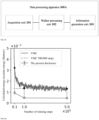
- FIG. 4A shows energy calculation for beryllium (Be) atoms according to embodiments of the present disclosure.
- the present disclosure is based on the "Fermi neural network” method, but achieves a significantly higher convergence speed and accuracy than the "Fermi neural network”.
- the present invention only needs to train the "Fermi neural network” for 1,000 steps to achieve accuracy exceeding a result of training with the "Fermi neural network” alone for 50,000 steps.
- FIG. 4B shows energy calculation for a monatomic system according to embodiments of the present disclosure.
- a comparison is made between energy calculation results of these two methods for atoms in the second and third periods.
- the energy calculated in the present invention is significantly closer to true energy. It can be seen that, under a fixed amount of computing resources, the present invention can obtain more accurate results in calculations for larger systems.
- FIG. 4C shows energy calculation for cyclobutadiene according to embodiments of the present disclosure.
- the present invention only needs to train the "Fermi neural network” for 60,000 steps in both an equilibrium state and a transition state of cyclobutadiene to achieve more accurate energy than the variational Monte Carlo using the "Fermi neural network” alone trained for 500,000 steps.
- an energy difference calculated according to the solution of the present disclosure that is, a transition energy barrier, is also consistent with the calculation result of the variational Monte Carlo and is within the range of experimental data. It can be seen that the accuracy and efficiency of the solution of the present disclosure are also verified for cyclobutadiene molecules.
- FIG. 4E shows energy calculation for a benzene ring according to embodiments of the present disclosure.
- the accuracy of the present invention in calculating ground-state energy of the benzene ring is obviously higher than that of the variational Monte Carlo using the "fermionic neural network” alone, and far exceeds that of the conventional method (extended to a complete basis set coupled-cluster method with single, double, and partial triple excitations).
- the lower the energy here the better the corresponding method.
- the energy obtained by the present invention is tens of milli-Hartrees lower than that of the variational Monte Carlo using the "Fermi neural network” with the same network configuration, and is hundreds of milli-Hartrees lower than that of the conventional method.
- the present disclosure is also higher in overall efficiency, that is, only needs to train the "Fermi neural network” for fewer steps to achieve the same or even higher accuracy.
- the solution of the present disclosure has excellent scalability and may effectively utilize a cluster consisting of hundreds of NVIDIA V100 GPUs to accelerate computing, with a near-linear acceleration ratio, thereby performing high-accuracy calculation for larger chemical systems.
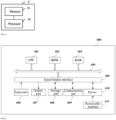
- FIG. 5 is a block diagram of an electronic device according to some embodiments of the present disclosure.
- the electronic device 5 may be various types of devices, for example, may include, but not limited to, mobile terminals such as a mobile phone, a notebook computer, a digital broadcast receiver, a personal digital assistant (PDA), a tablet computer (PAD), a portable multimedia player (PMP), and a vehicle-mounted terminal (such as a vehicle navigation terminal), and fixed terminals such as a digital TV and a desktop computer.
- mobile terminals such as a mobile phone, a notebook computer, a digital broadcast receiver, a personal digital assistant (PDA), a tablet computer (PAD), a portable multimedia player (PMP), and a vehicle-mounted terminal (such as a vehicle navigation terminal), and fixed terminals such as a digital TV and a desktop computer.
- PDA personal digital assistant
- PAD tablet computer
- PMP portable multimedia player
- vehicle-mounted terminal such as a vehicle navigation terminal
- fixed terminals such as a digital TV and a desktop
- the electronic device 5 may include a display panel configured to display data used in the solution according to the present disclosure and/or execution results.
- the display panel may be in various shapes, such as a rectangular panel, an elliptical panel, or a polygonal panel, etc.
- the display panel may be a flat panel, a curved panel, or even a spherical panel.
- the electronic device 5 in this embodiment includes: a memory 51 and a processor 52 coupled to the memory 51.
- the components of the electronic device 50 shown in FIG. 5 are merely exemplary and non-limiting.
- the electronic device 50 may further have other components according to actual application requirements.
- the processor 52 may control other components in the electronic device 5 to perform desired functions.
- the memory 51 is configured to store one or more computer-readable instructions.
- the processor 52 is configured to run computer-readable instructions, and the computer-readable instructions, when run by the processor 52, cause the method according to any one of the above embodiments to be implemented. For specific implementations of the steps of the method and related explanation content, reference may be made to the above embodiments, and repetitions will not be repeated here.
- the processor 52 and the memory 51 may communicate with each other directly or indirectly.
- the processor 52 and the memory 51 may communicate with each other via a network.
- the network may include a wireless network, a wired network, and/or any combination of wireless networks and wired networks.
- the processor 52 and the memory 51 may also communicate with each other through a system bus, which is not limited in the present disclosure.
- the processor 52 may be embodied as various appropriate processors, processing apparatuses, etc., such as a central processing unit (CPU), a graphics processing unit (GPU), and a network processor (NP); or may be a digital signal processor (DSP), an application-specific integrated circuit (ASIC), a field programmable gate array (FPGA) or other programmable logic devices, a discrete gate or transistor logic device, or a discrete hardware component.
- the central processing unit (CPU) may be of an X86 or ARM architecture, etc.
- the memory 51 may include any combination of various forms of computer-readable storage media, for example, a volatile memory and/or a non-volatile memory.
- the memory 51 may include, for example, a system memory, and the system memory stores, for example, an operating system, an application, a boot loader, a database, and other programs. Various applications and various data may also be stored in the storage medium.
- FIG. 6 is a block diagram of an example structure of a computer system that can be used according to an embodiment of the present disclosure.
- a central processing unit (CPU) 601 performs various processing according to a program stored in a read-only memory (ROM) 602 or loaded from a storage part 608 into a random access memory (RAM) 603. Data required for the CPU 601 to perform various processing and the like is also stored in the RAM 603 as required.
- the central processing unit is merely exemplary, and it may alternatively be other types of processors, such as the various processors described above.
- the ROM 602, the RAM 603, and the storage part 608 may be various forms of computer-readable storage media, as described below. It should be noted that although the ROM 602, the RAM 603, and the storage device 608 are shown separately in FIG. 6 , one or more of them may be combined or located in the same or different memories or storage modules.
- an input part 606 for example, a touch screen, a touchpad, a keyboard, a mouse, an image sensor, a microphone, an accelerometer, or a gyroscope
- an output part 607 including a display, such as a cathode-ray tube (CRT), a liquid crystal display (LCD), a speaker, or a vibrator
- the storage part 608 including a hard disk, a magnetic tape, etc.
- a communication part 609 including a network interface card, such as a LAN card, or a modem.
- the communication part 609 allows communication processing to be performed via a network such as the Internet.
- a driver 610 is also connected to the input/output interface 605 as required.
- a removable medium 611 such as a magnetic disk, an optical disk, a magneto-optical disk, or a semiconductor memory, is installed on the driver 610 as required, such that a computer program read therefrom is installed into the storage part 608 as required.
- programs constituting the software may be installed from a network such as the Internet or a storage medium such as the removable medium 611.
- the computer-readable medium may be a tangible medium that may contain or store a program for use by or in conjunction with an instruction execution system, apparatus, or device.
- the computer-readable medium may be a computer-readable signal medium, a computer-readable storage medium, or any combination thereof.
- the computer-readable storage medium may be, for example, but is not limited to, an electric, magnetic, optical, electromagnetic, infrared, or semi-conductive system, apparatus, or device, or any combination thereof.
- a more specific example of the computer-readable storage medium may include, but is not limited to: an electrical connection having one or more wires, a portable computer magnetic disk, a hard disk, a random access memory (RAM), a read-only memory (ROM), an erasable programmable read-only memory (EPROM or flash memory), an optical fiber, a portable compact disk read-only memory (CD-ROM), an optical storage device, a magnetic storage device, or any suitable combination thereof.
- the computer-readable storage medium may be any tangible medium containing or storing a program which may be used by or in combination with an instruction execution system, apparatus, or device.
- the computer-readable signal medium may include a data signal propagated in a baseband or as a part of a carrier, the data signal carrying computer-readable program code.
- the propagated data signal may be in various forms, including but not limited to an electromagnetic signal, an optical signal, or any suitable combination thereof.
- the computer-readable signal medium may also be any computer-readable medium other than the computer-readable storage medium.
- the computer-readable signal medium can send, propagate, or transmit a program used by or in combination with an instruction execution system, apparatus, or device.
- the program code contained in the computer-readable medium may be transmitted by any suitable medium, including but not limited to: electric wires, optical cables, radio frequency (RF), etc., or any suitable combination thereof.
- the above computer-readable medium may be contained in the above electronic device.
- the computer-readable medium may exist independently, without being assembled into the electronic device.
- a computer program includes instructions that, when executed by a processor, cause the processor to perform the method in any one of the above embodiments.
- the instructions may be embodied as computer program code.
- the computer program code for performing the operations of the present disclosure may be written in one or more programming languages or a combination thereof, where the programming languages include, but are not limited to, an object-oriented programming language, such as Java, Smalltalk, and C++, and further include conventional procedural programming languages, such as "C" language or similar programming languages.
- the program code may be completely executed on a computer of a user, partially executed on a computer of a user, executed as an independent software package, partially executed on a computer of a user and partially executed on a remote computer, or completely executed on a remote computer or server.
- the remote computer may be connected to the computer of the user via any kind of network, including a local area network (LAN) or a wide area network (WAN), or may be connected to an external computer (for example, connected via the Internet with the aid of an Internet service provider).
- LAN local area network
- WAN wide area network
- an external computer for example, connected via the Internet with the aid of an Internet service provider.
- each block in the flowchart or block diagram may represent a module, program segment, or part of code, and the module, program segment, or part of code contains one or more executable instructions for implementing the specified logical functions.
- the functions marked in the blocks may also occur in an order different from that marked in the accompanying drawings. For example, two blocks shown in succession can actually be performed substantially in parallel, or they can sometimes be performed in the reverse order, depending on the functions involved.
- each block in the block diagram and/or the flowchart, and a combination of the blocks in the block diagram and/or the flowchart may be implemented by a dedicated hardware-based system that executes specified functions or operations, or may be implemented by a combination of dedicated hardware and computer instructions.
- the related modules, components, or units described in the embodiments of the present disclosure may be implemented by software, or may be implemented by hardware.
- the names of the modules, components, or units do not constitute a limitation on the modules, components, or units themselves in some cases.
- exemplary hardware logic components include: a field programmable gate array (FPGA), an application-specific integrated circuit (ASIC), an application-specific standard product (ASSP), a system on a chip (SOC), a complex programmable logic device (CPLD), and the like.
- FPGA field programmable gate array
- ASIC application-specific integrated circuit
- ASSP application-specific standard product
- SOC system on a chip
- CPLD complex programmable logic device
- a data processing method for a quantum chemical system includes: acquiring a specific wave function suitable for the quantum chemical system that is constructed based on a neural network; performing walker processing based on the specific wave function, the walker processing including diffusion of walkers; and determining related information about chemical properties of the quantum chemical system based on the specific wave function and the processed walkers.
- performing the walker processing based on the specific wave function further includes: performing, based on a nodal surface of the specific wave function, crossing detection with respect to the nodal surface on a diffused walker; determining the related information about the chemical properties of the quantum chemical system based on the specific wave function and the processed walker when it is not detected that the diffused walker cross the nodal surface.
- the walker processing based on the specific wave function is iteratively performed, and in each iteration, the following operations are performed: performing drift-diffusion on a walker, and adjusting a weight for the diffused walker accordingly; performing, based on the nodal surface of the specific wave function, crossing detection with respect to the nodal surface on the diffused walker; and performing further processing on the diffused walker when it is not detected that the diffused walkers cross the nodal surface, the further processing including processing performed based on weight for the diffused walker.
- the processing performed based on the weight for the diffused walker includes at least one of the following: if the weight for the diffused walker is greater than or equal to a first weight threshold, performing reproduction on the walker to duplicate the walker into two walkers; if the weight for the diffused walker is less than a second weight threshold, performing merging on the walker to merge two walkers into one walker; and if the weight for the diffused walker is greater than or equal to the second weight threshold and less than the first weight threshold, not performing reproduction and merging on the diffused walker.
- a processing that enables the number of walkers after this iteration of processing to remain constant is performed on the diffused walker.
- the processing that enables the number of walkers after this iteration of processing to remain constant includes at least one of the following: duplicating a walker if the weight for the walker is greater than a specific threshold, a weight for each of two walkers obtained through duplication being half of the weight for the original walker, and selecting two walkers with minimum weights for merging; or duplicating a walker if the weight for the walker is greater than a specific threshold, the weight for each of the two walkers obtained through duplication being half of the weight for the original walker, and replacing, with one duplicated walker, a walker annihilated in the merging concurrently performed.
- the walker processing is performed on a plurality of computing nodes in a distributed manner, at least one of the plurality of computing nodes includes a graphics processing unit, and a part of the walker processing is performed on each computing node.
- the walker processing when the walker processing is performed on a plurality of computing nodes in the distributed manner, generating a detection point synchronously among the plurality of computing nodes periodically or as required.
- the diffusion of walkers is iteratively performed, and the diffusion of walkers is performed such that the number of walkers after each iteration of processing remains constant at least on the computing node that includes the graphics processing unit.
- the related information about the chemical properties of the quantum chemical system includes a ground-state energy
- determining the related information about the chemical properties of the quantum chemical system based on the specific wave function and the processed walkers includes: calculating local energy of each walker based on the specific wave function; performing weighted averaging on the local energy of each walker to obtain total energy reflected by all walkers; and determining, based on the total energy reflected by all the walkers, information reflecting the ground-state energy of the quantum chemical system.
- the diffusion of walkers is iteratively performed, and the iteration of the diffusion of walkers is terminated under at least one of the following conditions: the number of iterations exceeds a threshold number; or in a specific number of consecutive iterations, a change in total energy reflected by all walkers is less than a specific change threshold.
- the specific wave function is a wave function that characterizes states of electrons in the quantum chemical system; and/or the specific wave function is obtained by performing training on the neural network using a variational Monte Carlo method.
- a data processing method for a quantum chemical system includes: acquiring a specific wave function suitable for the quantum chemical system; performing walker processing based on the specific wave function, the walker processing including diffusion of walkers, and the walker processing being further performed such that the number of walkers remains constant during the processing; and determining related information about chemical properties of the quantum chemical system based on the specific wave function and the processed walkers.
- the walker processing is iteratively performed, and in each iteration of the walker processing, the following operations are performed: performing drift-diffusion on the walkers, and adjusting weights for the walkers accordingly; performing, based on the nodal surface of the specific wave function, crossing detection with respect to the nodal surface on the diffused walkers; and performing, on a diffused walker when it is detected that the diffused walker does not cross the nodal surface, processing that enables the number of walkers after this iteration of processing to remain constant.
- the processing that enables the number of walkers after this iteration of processing to remain constant includes at least one of the following: duplicating a walker if a weight for the walker is greater than a specific threshold, a weight for each of two walkers obtained through duplication being half of the weight for the original walker, and selecting two walkers with minimum weights for merging; or duplicating a walker if a weight for the walker is greater than the specific threshold, the weight for each of the two walkers obtained through duplication being half of the weight for the original walker, and replacing, with one duplicated walker, a walker annihilated in the merging concurrently performed.
- the walker processing is performed on the plurality of computing nodes in a distributed manner, at least one of the computing nodes includes a graphics processing unit, and a part of the walker processing is performed on each computing node, and where the walker processing is iteratively performed, and the walker processing is performed such that the number of walkers after each iteration of processing remains constant at least on the computing node that includes the graphics processing unit.
- a data processing apparatus for a quantum chemical system includes: an acquisition unit configured to acquire a specific wave function suitable for the quantum chemical system that is constructed based on a neural network; a walker processing unit configured to perform walker processing based on the specific wave function, the walker processing including diffusion of walkers; and an information generation unit configured to determine related information about chemical properties of the quantum chemical system based on the specific wave function and the processed walkers.
- a data processing apparatus for a quantum chemical system.
- the apparatus includes: an acquisition unit configured to acquire a specific wave function suitable for the quantum chemical system; a walker processing unit configured to performs walker processing based on the specific wave function, the walker processing including diffusion of walkers, and the walker processing being further performed such that the number of walkers remains constant during the processing; and an information generation unit configured to determine related information about chemical properties of the quantum chemical system based on the specific wave function and the processed walkers.
- an electronic device includes: a memory; and a processor coupled to the memory, where the memory stores instructions that, when executed by the processor, cause the electronic device to perform the method according to any one of the embodiments of the present disclosure.
- a computer-readable storage medium having a computer program stored thereon, where the program, when executed by a processor, causes the method according to any one of the embodiments of the present disclosure to be implemented.
- the computer program includes: instructions that, when executed by a processor, cause the processor to perform the method according to any one of the embodiments of the present disclosure.
- a computer program product including instructions that, when executed by a processor, cause the method according to any one of the embodiments of the present disclosure to be implemented.
Landscapes
- Engineering & Computer Science (AREA)
- Theoretical Computer Science (AREA)
- Physics & Mathematics (AREA)
- Computing Systems (AREA)
- General Physics & Mathematics (AREA)
- Life Sciences & Earth Sciences (AREA)
- Data Mining & Analysis (AREA)
- General Health & Medical Sciences (AREA)
- Health & Medical Sciences (AREA)
- Software Systems (AREA)
- Mathematical Physics (AREA)
- Bioinformatics & Cheminformatics (AREA)
- Bioinformatics & Computational Biology (AREA)
- Evolutionary Computation (AREA)
- Artificial Intelligence (AREA)
- General Engineering & Computer Science (AREA)
- Mathematical Optimization (AREA)
- Computational Mathematics (AREA)
- Mathematical Analysis (AREA)
- Pure & Applied Mathematics (AREA)
- Spectroscopy & Molecular Physics (AREA)
- Algebra (AREA)
- Molecular Biology (AREA)
- Biophysics (AREA)
- Biomedical Technology (AREA)
- Computational Linguistics (AREA)
- Probability & Statistics with Applications (AREA)
- Chemical & Material Sciences (AREA)
- Crystallography & Structural Chemistry (AREA)
- Databases & Information Systems (AREA)
- Computer Vision & Pattern Recognition (AREA)
- Medical Informatics (AREA)
- Evolutionary Biology (AREA)
- Operations Research (AREA)
- Management, Administration, Business Operations System, And Electronic Commerce (AREA)
- Junction Field-Effect Transistors (AREA)
Applications Claiming Priority (2)
| Application Number | Priority Date | Filing Date | Title |
|---|---|---|---|
| CN202210395445.9A CN114758733B (zh) | 2022-04-15 | 2022-04-15 | 用于量子化学体系的数据处理方法和装置 |
| PCT/CN2023/088084 WO2023198153A1 (zh) | 2022-04-15 | 2023-04-13 | 用于量子化学体系的数据处理方法和装置 |
Publications (2)
| Publication Number | Publication Date |
|---|---|
| EP4435792A1 true EP4435792A1 (de) | 2024-09-25 |
| EP4435792A4 EP4435792A4 (de) | 2025-04-09 |
Family
ID=82330866
Family Applications (1)
| Application Number | Title | Priority Date | Filing Date |
|---|---|---|---|
| EP23787795.6A Pending EP4435792A4 (de) | 2022-04-15 | 2023-04-13 | Datenverarbeitungsverfahren und -vorrichtung für quantenchemiesystem |
Country Status (3)
| Country | Link |
|---|---|
| EP (1) | EP4435792A4 (de) |
| CN (1) | CN114758733B (de) |
| WO (1) | WO2023198153A1 (de) |
Families Citing this family (3)
| Publication number | Priority date | Publication date | Assignee | Title |
|---|---|---|---|---|
| CN114758733B (zh) * | 2022-04-15 | 2024-10-15 | 北京有竹居网络技术有限公司 | 用于量子化学体系的数据处理方法和装置 |
| CN115527629B (zh) * | 2022-09-29 | 2025-07-18 | 北京有竹居网络技术有限公司 | 用于量子化学体系的数据处理方法和装置 |
| WO2025217775A1 (en) * | 2024-04-15 | 2025-10-23 | Beijing Youzhuju Network Technology Co., Ltd. | Moiré superlattice simulation |
Family Cites Families (9)
| Publication number | Priority date | Publication date | Assignee | Title |
|---|---|---|---|---|
| WO2001096492A1 (en) * | 2000-06-13 | 2001-12-20 | Matsushita Electric Industrial Co.,Ltd. | Exciton forming substance, luminescent material using the substance, method for light emission and luminescent element, and device using the element |
| CN108287881A (zh) * | 2017-12-29 | 2018-07-17 | 北京理工大学 | 一种基于随机游走关系发现的优化方法 |
| CN108595820B (zh) * | 2018-04-19 | 2021-01-22 | 广东电网有限责任公司电力科学研究院 | 一种分子电离碰撞截面的计算方法及装置 |
| US11314536B2 (en) * | 2019-07-08 | 2022-04-26 | Tencent America LLC | Quantum variational method, apparatus, and storage medium for simulating quantum systems |
| US11640528B2 (en) * | 2019-10-22 | 2023-05-02 | Baidu Usa Llc | Method, electronic device and computer readable medium for information processing for accelerating neural network training |
| CN111126611B (zh) * | 2019-12-09 | 2023-04-18 | 南京师范大学 | 一种顾及目的地选择的高速通行流量分布模拟量子计算方法 |
| US20230169383A1 (en) * | 2020-04-13 | 2023-06-01 | Texas Tech University System | Methods and systems for quantum computational chemistry modeling |
| CN113723584B (zh) * | 2021-08-28 | 2023-05-26 | 重庆理工大学 | 一种通过离散时间量子游走的多域网络社区检测方法 |
| CN114758733B (zh) * | 2022-04-15 | 2024-10-15 | 北京有竹居网络技术有限公司 | 用于量子化学体系的数据处理方法和装置 |
-
2022
- 2022-04-15 CN CN202210395445.9A patent/CN114758733B/zh active Active
-
2023
- 2023-04-13 EP EP23787795.6A patent/EP4435792A4/de active Pending
- 2023-04-13 WO PCT/CN2023/088084 patent/WO2023198153A1/zh not_active Ceased
Also Published As
| Publication number | Publication date |
|---|---|
| CN114758733B (zh) | 2024-10-15 |
| EP4435792A4 (de) | 2025-04-09 |
| US20250174307A1 (en) | 2025-05-29 |
| WO2023198153A1 (zh) | 2023-10-19 |
| CN114758733A (zh) | 2022-07-15 |
Similar Documents
| Publication | Publication Date | Title |
|---|---|---|
| EP4435792A1 (de) | Datenverarbeitungsverfahren und -vorrichtung für quantenchemiesystem | |
| JP7433373B2 (ja) | 深層学習モデルの分散トレーニング方法、装置、電子機器、記憶媒体およびコンピュータプログラム | |
| US20230267357A1 (en) | Simulation method of quantum system, computing device and storage medium | |
| US20210357740A1 (en) | Second-order optimization methods for avoiding saddle points during the training of deep neural networks | |
| US9002946B2 (en) | Dual modeling environment in which commands are executed concurrently and independently on both a light weight version of a proxy module on a client and a precise version of the proxy module on a server | |
| CN117093871B (zh) | 一种面向深度学习分布式训练测评方法和系统 | |
| CN115101140B (zh) | 确定分子的基态特征的方法、设备及存储介质 | |
| EP4092682A1 (de) | Verfahren und vorrichtung zur retrosyntheseverarbeitung sowie elektronische vorrichtung und computerlesbares speichermedium | |
| CN115527629B (zh) | 用于量子化学体系的数据处理方法和装置 | |
| US20250245565A1 (en) | Cross-cluster communication for machine learning workloads | |
| EP3827376B1 (de) | Dynamische minibatch-grössen | |
| WO2022033444A1 (zh) | 动态流体效果处理方法、装置、电子设备和可读介质 | |
| US20250157587A1 (en) | Data processing method and apparatus for solid system | |
| CN118395802A (zh) | 电机温度应力场代理模型构建方法、装置、设备及介质 | |
| US10949353B1 (en) | Data iterator with automatic caching | |
| US12620456B2 (en) | Data processing method and apparatus for quantum chemistry system | |
| CN115579051B (zh) | 差异表达谱预测模型训练方法、预测方法及装置 | |
| US20250343693A1 (en) | Method, device, and medium for improving latency | |
| CN110764742B (zh) | 一种气候观测数据线性相关度高速计算方法及系统 | |
| CN111275799B (zh) | 动画的生成方法、装置和电子设备 | |
| Zhang et al. | CDFGNN: a Systematic Design of Cache-based Distributed Full-Batch Graph Neural Network Training with Communication Reduction | |
| Wassenaar et al. | SQUEEZE-E: The optimal solution for molecular simulations with periodic boundary conditions | |
| Zhu et al. | An efficient parallel computing method for random vibration analysis of a three-dimensional train-track-soil coupled model using Seed-PCG algorithm | |
| CN112799845A (zh) | 一种基于grape框架的图算法并行加速方法和装置 | |
| Jayakody et al. | AIRES: Accelerating Out-of-Core GCNs via Algorithm-System Co-Design |
Legal Events
| Date | Code | Title | Description |
|---|---|---|---|
| STAA | Information on the status of an ep patent application or granted ep patent |
Free format text: STATUS: THE INTERNATIONAL PUBLICATION HAS BEEN MADE |
|
| PUAI | Public reference made under article 153(3) epc to a published international application that has entered the european phase |
Free format text: ORIGINAL CODE: 0009012 |
|
| STAA | Information on the status of an ep patent application or granted ep patent |
Free format text: STATUS: REQUEST FOR EXAMINATION WAS MADE |
|
| 17P | Request for examination filed |
Effective date: 20240619 |
|
| AK | Designated contracting states |
Kind code of ref document: A1 Designated state(s): AL AT BE BG CH CY CZ DE DK EE ES FI FR GB GR HR HU IE IS IT LI LT LU LV MC ME MK MT NL NO PL PT RO RS SE SI SK SM TR |
|
| A4 | Supplementary search report drawn up and despatched |
Effective date: 20250310 |
|
| RIC1 | Information provided on ipc code assigned before grant |
Ipc: G06N 7/01 20230101ALI20250304BHEP Ipc: G06N 3/08 20230101ALI20250304BHEP Ipc: G06N 3/04 20230101ALI20250304BHEP Ipc: G16C 20/70 20190101ALI20250304BHEP Ipc: G16C 20/30 20190101ALI20250304BHEP Ipc: G06F 17/18 20060101ALI20250304BHEP Ipc: G06N 7/00 20230101ALI20250304BHEP Ipc: G16C 10/00 20190101AFI20250304BHEP |
|
| DAV | Request for validation of the european patent (deleted) | ||
| DAX | Request for extension of the european patent (deleted) | ||
| STAA | Information on the status of an ep patent application or granted ep patent |
Free format text: STATUS: EXAMINATION IS IN PROGRESS |
|
| 17Q | First examination report despatched |
Effective date: 20251024 |
|
| GRAP | Despatch of communication of intention to grant a patent |
Free format text: ORIGINAL CODE: EPIDOSNIGR1 |
|
| STAA | Information on the status of an ep patent application or granted ep patent |
Free format text: STATUS: GRANT OF PATENT IS INTENDED |