EP4435722A1 - Verfahren zur überprüfung von kalibrierten extrinsischen parameterwerten einer kamera, vorrichtung und medium - Google Patents
Verfahren zur überprüfung von kalibrierten extrinsischen parameterwerten einer kamera, vorrichtung und medium Download PDFInfo
- Publication number
- EP4435722A1 EP4435722A1 EP23220011.3A EP23220011A EP4435722A1 EP 4435722 A1 EP4435722 A1 EP 4435722A1 EP 23220011 A EP23220011 A EP 23220011A EP 4435722 A1 EP4435722 A1 EP 4435722A1
- Authority
- EP
- European Patent Office
- Prior art keywords
- extrinsic parameter
- parameter values
- calibrated
- camera
- verifying
- Prior art date
- Legal status (The legal status is an assumption and is not a legal conclusion. Google has not performed a legal analysis and makes no representation as to the accuracy of the status listed.)
- Pending
Links
Images

Classifications
-
- G—PHYSICS
- G06—COMPUTING OR CALCULATING; COUNTING
- G06T—IMAGE DATA PROCESSING OR GENERATION, IN GENERAL
- G06T7/00—Image analysis
- G06T7/80—Analysis of captured images to determine intrinsic or extrinsic camera parameters, i.e. camera calibration
-
- G—PHYSICS
- G06—COMPUTING OR CALCULATING; COUNTING
- G06T—IMAGE DATA PROCESSING OR GENERATION, IN GENERAL
- G06T7/00—Image analysis
- G06T7/70—Determining position or orientation of objects or cameras
- G06T7/73—Determining position or orientation of objects or cameras using feature-based methods
-
- G—PHYSICS
- G06—COMPUTING OR CALCULATING; COUNTING
- G06T—IMAGE DATA PROCESSING OR GENERATION, IN GENERAL
- G06T2207/00—Indexing scheme for image analysis or image enhancement
- G06T2207/30—Subject of image; Context of image processing
- G06T2207/30244—Camera pose
-
- G—PHYSICS
- G06—COMPUTING OR CALCULATING; COUNTING
- G06T—IMAGE DATA PROCESSING OR GENERATION, IN GENERAL
- G06T2207/00—Indexing scheme for image analysis or image enhancement
- G06T2207/30—Subject of image; Context of image processing
- G06T2207/30248—Vehicle exterior or interior
- G06T2207/30252—Vehicle exterior; Vicinity of vehicle
Definitions
- the disclosure relates to the field of computer vision technologies, and specifically, to a method for verifying calibrated extrinsic parameter values of a camera, a device, and a medium.
- Cameras are one of the most important sensors for a vehicle to achieve autonomous driving. Therefore, calibration of cameras in relation to their installation positions on the vehicle (that is, extrinsic parameters R/T) is of utmost importance. Accurate extrinsic parameters can improve the accuracy of algorithms such as perception and fusion, and also provide effective initial value guarantee for secondary development of the backend.
- the disclosure is proposed to provide a method for verifying calibrated extrinsic parameter values of a camera, a device, and a medium that solve or at least partially solve the technical problem of being unable to check whether calibrated extrinsic parameter values of a camera are optimal values.
- a method for verifying calibrated extrinsic parameter values of a camera including:
- the verifying based on a comparison between an extrinsic parameter value corresponding to a minimum first reprojection error in the first reprojection errors and the calibrated extrinsic parameter values, whether the calibrated extrinsic parameter values are optimal values includes:
- the verifying based on a comparison between an extrinsic parameter value corresponding to a minimum first reprojection error in the first reprojection errors and the calibrated extrinsic parameter values, whether the calibrated extrinsic parameter values are optimal values further includes: if throughout all of the number of iterations, the extrinsic parameter value corresponding to the minimum first reprojection error is equal to the calibrated extrinsic parameter values, verifying the calibrated extrinsic parameter values as optimal values.
- the method further includes: obtaining the calibrated extrinsic parameter values of the camera based on three-dimensional coordinate points under a world coordinate system, corresponding pixels under an image coordinate system, and intrinsic camera parameters.
- the method further includes:
- the method further includes:
- the method further includes: comparing the calibrated extrinsic parameter values with a design value to check a deviation degree of the camera.
- an electronic device in a second aspect, includes a processor and a storage apparatus adapted to store a plurality of pieces of program code, where the program code is adapted to be loaded and run by the processor to perform the method for verifying calibrated extrinsic parameter values of a camera in any one of the technical solutions of the above method for verifying calibrated extrinsic parameter values of a camera.
- a computer-readable storage medium is provided.
- a plurality of pieces of program code are stored in the computer-readable storage medium, and the program code is adapted to be loaded and run by a processor to perform the method for verifying calibrated extrinsic parameter values of a camera in any one of the technical solutions of the above method for verifying calibrated extrinsic parameter values of a camera.
- a plurality of perturbations are applied to calibrated extrinsic parameter values of a camera, at least one perturbed extrinsic parameter value is obtained based on any one of the perturbations applied, first reprojection errors respectively corresponding to the calibrated extrinsic parameter values and the perturbed extrinsic parameter value are calculated, and whether the calibrated extrinsic parameter values are optimal values is verified based on a comparison between an extrinsic parameter value corresponding to a minimum first reprojection error in the first reprojection errors and the calibrated extrinsic parameter values.
- the convergence of iterative interference may be checked, and whether the calibrated extrinsic parameter values of the camera are optimal values may be verified, which has the characteristics of high accuracy and high applicability.
- 801 processor; 802: storage apparatus.
- a “module” or “processor” may include hardware, software, or a combination thereof.
- a module may include a hardware circuit, various suitable sensors, a communication port, and a memory, or may include a software part, for example, program code, or may be a combination of software and hardware.
- the processor may be a central processing unit, a microprocessor, a graphics processing unit, a digital signal processor, or any other suitable processor.
- the processor has a data and/or signal processing function.
- the processor may be implemented in software, hardware, or a combination thereof.
- a non-transitory computer-readable storage medium includes any suitable medium that may store program codes, for example, a magnetic disk, a hard disk, an optical disc, a flash memory, a read-only memory, or a random access memory.
- the term “A and/or B” indicates all possible combinations of A and B, for example, only A, only B, or A and B.
- the term “at least one of A or B” or “at least one of A and B” has a meaning similar to “A and/or B" and may include only A, only B, or A and B.
- the terms “a/an” and “this” in the singular form may also include the plural form.
- Camera calibration In an image measurement process and machine vision applications, to determine a relationship between a three-dimensional geometric position of a point on a surface of a spatial object and a corresponding point of the point in an image, a geometric model for camera imaging must be established, and these geometric model parameters are camera parameters. Under most conditions, these parameters must be obtained through experiments and calculations. This process of solving parameters is called camera calibration, also known as video camera calibration. Coordinate systems involved in the camera calibration process include a world coordinate system, a camera coordinate system, an image coordinate system, and a pixel coordinate system.
- World coordinate system During movement of a robot or a camera, there is a need to know its position. Therefore, a world coordinate system needs to be set and considered fixed as a reference coordinate system, to describe a position of any point P (x w , y w , z w ) in the world.
- Camera coordinate system It is a coordinate system for movement of a camera or a robot, calculated through transformation of a world coordinate system (a rotation matrix R and a translation matrix T). Therefore, it mainly transforms a point P (x w , y w , y w ) described in the world coordinate system to a point P (x c , y c , z c ) under the camera coordinate system. This makes it easier to calculate coordinates in an image coordinate system, with the optical center as the origin.
- Image coordinate system It describes a position of an imaging point P (x, y) in the image coordinate system.
- Pixel coordinate system An image is composed of pixels, which are points.
- the image is composed of small pixels P (u, v), which is the pixel coordinate system, and its unit is pixel.
- Intrinsic camera parameters also known as an intrinsic camera parameter matrix, and are parameters related to own characteristics of a camera. They generally include focal lengths of the camera in the x-axis and the y-axis in an imaging plane, coordinate axis tilt parameters of the imaging plane of the camera, a pixel size, etc.
- Extrinsic camera parameter values also known as an extrinsic camera parameter matrix.
- Coordinate systems involved in an imaging process include a world coordinate system, a camera coordinate system, an image coordinate system, and a pixel coordinate system in sequence.
- the world coordinate system and the camera coordinate system are three-dimensional rectangular coordinate systems, while the image coordinate system and the pixel coordinate system are two-dimensional rectangular coordinate systems.
- the extrinsic camera parameter values are parameters under the world coordinate system, such as a position and a rotation direction of a camera, etc., which are used for coordinate system transformation between the image coordinate system and the world coordinate system. Therefore, the extrinsic camera parameter values include a rotation matrix R and a translation matrix T.
- the rotation matrix describes a direction of the coordinate axes of the world coordinate system relative to the coordinate axes of a video camera; and the translation matrix describes a position of an origin of space in the camera coordinate system.
- PNP Perspective-N-Point
- Perspective-N-Point is a method for solving correspondences between points from three dimensions to two dimensions. It describes how to estimate and calculate extrinsic parameters of a camera when N three-dimensional spatial points and their positions are known. If three-dimensional positions of feature points in one of two images are consistent, at least three pairs of points (and at least one additional verification point to verify the results) are needed to calculate movement of the camera.
- Reprojection error refers to a difference between a projection of a real three-dimensional spatial point on an image plane (that is, an actual pixel on an image) and a reprojection (that is, a theoretical pixel calculated). In the disclosure, it represents a variance of Euclidean distances between all actual pixels and theoretical pixels.
- the disclosure provides a method for verifying calibrated extrinsic parameter values of a camera, a device, and a medium.
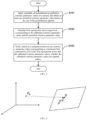
- FIG. 1 is a schematic flowchart of main steps of a method for verifying calibrated extrinsic parameter values of a camera according to an embodiment of the disclosure.
- the method for verifying calibrated extrinsic parameter values of a camera in this embodiment of the disclosure mainly includes the following step S 101 to step S 103.
- Step S101 Apply a plurality of perturbations to the calibrated extrinsic parameter values of the camera, and obtain at least one perturbed extrinsic parameter value based on any one of the perturbations applied.
- Step S102 Calculate first reprojection errors respectively corresponding to the calibrated extrinsic parameter values and the perturbed extrinsic parameter value.
- Step S103 Verify, based on a comparison between an extrinsic parameter value corresponding to a minimum first reprojection error in the first reprojection errors and the calibrated extrinsic parameter values, whether the calibrated extrinsic parameter values are optimal values.
- the convergence of iterative interference may be checked, and whether the calibrated extrinsic parameter values of the camera are optimal values may be verified, which has the characteristics of high accuracy and high applicability.
- the method before the above step S 101 is performed, the method further includes: obtaining the calibrated extrinsic parameter values of the camera based on three-dimensional coordinate points under a world coordinate system, corresponding pixels under an image coordinate system, and intrinsic camera parameters.
- a PNP algorithm may be used to calculate the calibrated extrinsic parameter values of the camera.
- Main calculation methods include direct linear transformation (DLT), P3P, EPNP, bundle adjustment (BA), etc., and these methods are further described below.
- ICP is an abbreviation of Iterative Closest Point. It is mainly used for precise stitching of depth images in computer vision. It achieves precise stitching by continuously minimizing correspondence points between source data and target data through iteration. There are already many variants, and the main focus is on how to efficiently and robustly achieve better stitching effects.
- EPNP Four control points are selected based on world coordinates of N points and a weighting coefficient is calculated. Through a camera model and pixel coordinates of the N points, coordinates of the four control points under the camera coordinate system are solved, and then coordinates of the N points under the camera coordinate system are further obtained. This issue is transformed into solving three-dimensional point-to-three-dimensional point extrinsic parameter values, and then the ICP is used for solution.
- a nonlinear optimization issue is constructed based on a reprojection error of a corresponding point.
- a derivative of the error with respect to a pose is obtained using Lie algebra, to guide an optimization direction.
- An extrinsic parameter value that minimizes a sum of reprojection errors of all corresponding points is iteratively obtained.
- Lie algebra is a type of important non-associative algebra. It is a mathematical concept introduced by a Norwegian mathematician Sophus Lie during his study of continuous transformation groups. It is closely related to the study of Lie groups.
- the calculated calibrated extrinsic parameter values of the camera include a rotation matrix R and a translation matrix T, where the rotation matrix R includes three values, which are respectively rotation angles in the directions of the three coordinate axes of x, y, and z in the camera coordinate system, and the translation matrix T also includes three values, which are respectively translation distances in the directions of the three coordinate axes of x, y, and z in the camera coordinate system.
- the PNP iterative algorithm may be used to verify the calibrated extrinsic camera parameter values.
- step S101 the following step S 1011 and step S 1012 are mainly included.
- Step S1011 Set a number of iterations for applying the perturbations.
- the number of iterations for applying the perturbations may be set to 4-6, which is not limited here.
- Step S 1012 In any one of the iterations, apply at least one perturbation to the calibrated extrinsic parameter values to obtain at least one corresponding perturbed extrinsic parameter value, where a perturbation step size of perturbations applied in an iteration is less than a perturbation step size of perturbations applied in a previous iteration.
- the calibrated extrinsic parameter values may be set to x 0 , and perturbations may be applied to the calibrated extrinsic parameter value x 0 , where perturbations applied in one iteration include six values, which correspond to three values of the rotation matrix R and three values of the translation matrix T, respectively.
- a perturbation value of 0.001° is applied to each of the three values of the rotation matrix R
- a perturbation value of 0.001 m is applied to each of the three values of the translation matrix T
- this perturbation value is used as a step size, so that the calibrated extrinsic parameter value x 0 is selected to be increased or reduced by a corresponding step size, to obtain perturbed extrinsic parameter values x 1 , x 2 , x 3 , x 4 , x -1 , x -2 , x -3 , and x -4 .
- x 1 is a perturbed value obtained by increasing x 0 by one step size
- x 2 is a perturbed value obtained by increasing x 0 by two step sizes
- x 3 is a perturbed value obtained by increasing x 0 by three step sizes
- x 4 is a perturbed value obtained by increasing x 0 by four step sizes
- x -1 is a perturbed value obtained by reducing x 0 by one step size
- x -2 is a perturbed value obtained by reducing x 0 by two step sizes
- x -3 is a perturbed value obtained by reducing x 0 by three step sizes
- x -4 is a perturbed value obtained by reducing x 0 by four step sizes.
- a perturbation step size is reduced. For example, a perturbation value of 0.0005° is applied to each of the three values of the rotation matrix R, a perturbation value of 0.0005 m is applied to each of the three values of the translation matrix T, and this perturbation value is used as a step size, so that the calibrated extrinsic parameter value x 0 is selected to be increased or reduced by a corresponding step size, to obtain perturbed extrinsic parameter values.
- a perturbation step size is further reduced.
- a perturbation value of 0.00025° is applied to each of the three values of the rotation matrix R
- a perturbation value of 0.00025 m is applied to each of the three values of the translation matrix T
- this perturbation value is used as a step size, so that the calibrated extrinsic parameter value x 0 is selected to be increased or reduced by a corresponding step size, to obtain perturbed extrinsic parameter values, and so on, until the set number of iterations is reached.
- perturbation value to be applied to each of the three values of the rotation matrix R may be the same as or different from that to be applied to each of the three values of the translation matrix T.
- perturbed extrinsic parameter values are merely schematically illustrative. In practical applications, those skilled in the art may apply perturbation values according to specific situations to obtain corresponding perturbed extrinsic parameter values, which is not limited here.
- Step S101 is further described above, and step S102 is further described below.
- step S102 when the first reprojection errors are calculated using the PNP iteration algorithm, three-dimensional coordinate points under the world coordinate system, observed values of corresponding pixels under the image coordinate system, the calibrated extrinsic camera parameter values, and intrinsic camera parameter values that participate in the PNP iterations need to be inputted.
- FIG. 2 is a schematic diagram of a first reprojection according to an embodiment of the disclosure.
- a point P w (x w , y w , z w ) is a three-dimensional coordinate point under the world coordinate system
- a point P c (x c , y c , z c ) is a three-dimensional coordinate point of the point P w under the camera coordinate system
- a point P' is an observed value (that is, an actual value) of a corresponding pixel of the point P w under the image coordinate system
- a point P is a calculated value (that is, a theoretical value) of a corresponding pixel of the point P w under the image coordinate system
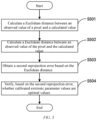
- calculating a first reprojection error mainly includes the following step S 1021 to step S1023.
- Step S1021 Map the three-dimensional coordinate point under the world coordinate system to the image coordinate system based on the calibrated extrinsic parameter values of the camera, to obtain a calculated value of a corresponding pixel.
- Step S1022 Calculate a Euclidean distance between an observed value of the pixel and the calculated value.
- Step S1023 Obtain a first reprojection error based on the Euclidean distance.
- Euclidean distances e between actual value points and theoretical value points of all points under the image coordinate system may be first obtained based on the above formula, and further, a variance or standard deviation of the Euclidean distances of all points can be calculated to obtain a value of the first reprojection error, which may be represented by error.
- the first reprojection errors respectively corresponding to the calibrated extrinsic parameter value x 0 and the perturbed extrinsic parameter values x 1 , x 2 , x 3 , x 4 , x -1 , x -2 , x -3 , and x -4 can be calculated using the method in the above step S1021 to step S 1023.
- Step S102 is further described above, and step S 103 is further described below.
- step S103 whether the calibrated extrinsic parameter values are optimal values may be verified based on a comparison between an extrinsic parameter value corresponding to a minimum first reprojection error in the first reprojection errors and the calibrated extrinsic parameter values, according to the following step S1031 and step S1032.
- Step S1031 Compare first reprojection errors corresponding to a current iteration, to obtain a minimum first reprojection error in the first reprojection errors.
- FIG. 3 is a schematic diagram of distribution of first reprojection errors in the first iteration according to an embodiment of the disclosure.
- the first reprojection error corresponding to the calibrated extrinsic parameter value x 0 is the minimum first reprojection error.
- Step S1032 Compare whether an extrinsic parameter value corresponding to the minimum first reprojection error is equal to the calibrated extrinsic parameter values.
- the calibrated extrinsic parameter values are verified as not optimal values.
- the calibrated extrinsic parameter values are verified as not optimal values, and the PNP iterative calculation is stopped.
- step S 1031 and step S 1032 are repeated based on first reprojection errors obtained in a next iteration, until the number of iterations is reached.
- the number of iterations is set to 5.
- the first reprojection error corresponding to x 0 is the minimum first reprojection error.
- the above step S 1031 and step S 1032 are repeated until the fifth iteration is completed.
- the calibrated extrinsic parameter values are verified as optimal values.
- FIG. 4 is a schematic diagram of distribution of first reprojection errors in the fifth iteration according to an embodiment of the disclosure.
- the first reprojection error corresponding to the calibrated extrinsic parameter value x 0 is still the minimum first reprojection error.
- the calibrated extrinsic parameter values are verified as optimal extrinsic parameter values.
- step S 103 The above is a description of step S 103.
- the first reprojection error calculated may not necessarily reach a minimum value. It may be a local minimum value, or a maximum number of iterations is reached, but the first reprojection error has not reached a minimum value.
- the method for verifying calibrated extrinsic parameter values of a camera provided in the disclosure may check whether the first reprojection error is the minimum value, and further verify whether the calibrated extrinsic parameter values of the camera are optimal values.
- FIG. 5 is a schematic flowchart of main steps of a method for verifying calibrated extrinsic parameter values of a camera according to an embodiment of the disclosure, which is used for verifying extrinsic parameter values of the three-dimensional points participating in the PNP iterations.
- the method for verifying calibrated extrinsic parameter values of a camera in this embodiment of the disclosure mainly includes the following step S501 to step S504.
- Step S502 Calculate a Euclidean distance between an observed value of the pixel and the calculated value.
- Step S503 Obtain a second reprojection error based on the Euclidean distance.
- Euclidean distances e between actual value points and theoretical value points of all points under the image coordinate system may be first obtained based on the above formula, and further, a variance or standard deviation of the Euclidean distances of all points is calculated to obtain the second reprojection error.
- Step S504 Verify, based on the second reprojection error, whether the calibrated extrinsic parameter values are optimal values.
- the second reprojection error the higher the accuracy of the calibrated extrinsic parameter values.
- the second reprojection error should be less than 0.2 pixel.
- the extrinsic camera parameter values are verified as optimal values.
- those skilled in the art may set a threshold of the second reprojection error according to specific scenarios, which is not limited here.
- step S501 to step S504 The formulas and specific calculation methods involved in this method are detailed in the above step S501 to step S504 and will not be repeated here.
- the second reprojection error of the three-dimensional point not participating in the PNP iterations may be calculated to verify whether the calibrated extrinsic parameter values of the camera are only applicable to the three-dimensional point participating in the PNP iterations.
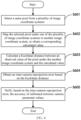
- FIG. 6 is a schematic flowchart of main steps of a method for verifying calibrated extrinsic parameter values of a multi-lens camera according to an embodiment of the disclosure. As shown in FIG. 6 , the method in this embodiment of the disclosure mainly includes the following step S601 to step S605.
- Step S601 Select a same pixel from a plurality of image coordinate systems.
- a same pixel under image coordinate systems of a left camera and a right camera of a binocular camera may be selected, or a same pixel under a plurality of image coordinate systems corresponding to a multi-lens camera may be selected, which is not limited here.
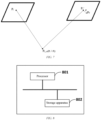
- FIG. 7 is a schematic diagram of reprojection of a binocular camera according to an embodiment of the disclosure.
- a point Pi (u l , v l ) is an observed pixel under an image coordinate system of a left camera
- a point P r (u r , v r ) is an observed pixel (that is, an actual value), the same as the point Pi, under an image coordinate system of a right camera
- a point Pi (x l , y l , z l ) is three-dimensional coordinates under a camera coordinate system of the left camera
- a point P l_w (x l_w , y l_w , z l_w ) is three-dimensional coordinates of the point Pi under the world coordinate system
- a point P l_r is three-dimensional coordinates of the point Pi under a camera coordinate system of the right camera
- a point P l_r is three-dimensional coordinates of the point Pi under a camera coordinate system
- Step S602 Map the selected pixel under any one of the plurality of image coordinate systems to another image coordinate system, to obtain a corresponding calculated value.
- Step S603 Calculate a Euclidean distance between an observed value of the pixel under the another image coordinate system and the calculated value.
- Step S604 Obtain an inter-camera reprojection error based on the Euclidean distance.
- Euclidean distances e between actual value points and theoretical value points of all points under the image coordinate system of the right camera may be first obtained according to the above formula, and further, a variance or standard deviation of the Euclidean distances of all points may be calculated to obtain a value of the inter-camera reprojection error, which is recorded as a third reprojection error.
- Step S605 Verify, based on the inter-camera reprojection error, the accuracy of the calibrated extrinsic camera parameter values.
- the smaller the third reprojection error the higher the accuracy of the calibrated extrinsic parameter values.
- those skilled in the art may set a threshold of the third reprojection error according to specific scenarios, and consider the calibrated extrinsic parameter values as optimal values when the third reprojection error meets the threshold.
- the method for verifying calibrated extrinsic parameter values of a camera provided in the disclosure further includes: comparing the calibrated extrinsic parameter values of the camera with a design value to check a deviation degree of the camera.
- the design value of the extrinsic parameters of the camera may be inputted into a program and compared with the calibrated extrinsic parameter values of the camera to determine whether the camera is severely deviated, and when the camera is severely deviated, appropriate adjustments may be made to avoid affecting perception functions of the camera.
- the accuracy of the calibrated extrinsic parameter values may be more comprehensively checked, and the convergence of iterative interference may be verified, which has the characteristics of high accuracy and high applicability.
- the computer program may be stored in a computer-readable storage medium, and when the computer program is executed by a processor, the steps of the above method embodiments may be implemented.
- the computer program includes computer program code, which may be in a source code form, an object code form, an executable file form, some intermediate forms, or the like.
- the computer-readable storage medium may include: any entity or apparatus that can carry the computer program code, a medium, a USB flash drive, a removable hard disk, a magnetic disk, an optical disc, a computer memory, a read-only memory, a random access memory, an electric carrier signal, a telecommunications signal, and a software distribution medium.
- FIG. 8 is a schematic diagram of a main structure of an embodiment of an electronic device according to the disclosure.
- the electronic device in this embodiment of the disclosure mainly includes a processor 801 and a storage apparatus 802.
- the storage apparatus 802 may be configured to store a program for performing the method for verifying calibrated extrinsic parameter values of a camera in the above method embodiments.
- the processor 801 may be configured to execute the program in the storage apparatus 802, where the program includes, but is not limited to, a program for performing the method for verifying calibrated extrinsic parameter values of a camera in the above method embodiments.
- the program includes, but is not limited to, a program for performing the method for verifying calibrated extrinsic parameter values of a camera in the above method embodiments.
- the electronic device may include a plurality of processors 801 and a plurality of storage apparatuses 802.
- the program for performing the method for verifying calibrated extrinsic parameter values of a camera in the above method embodiments may be divided into a plurality of segments of subprogram, and each segment of subprogram may be loaded and run by the processor 801 to perform a different step of the method for verifying calibrated extrinsic parameter values of a camera in the above method embodiments.
- each segment of subprogram may be stored in a different storage apparatus 802, and each processor 801 may be configured to execute programs in one or more storage apparatuses 802 to jointly implement the method for verifying calibrated extrinsic parameter values of a camera in the above method embodiments.
- each processor 801 performs different steps of the method for verifying calibrated extrinsic parameter values of a camera in the above method embodiments, to jointly implement the method for verifying calibrated extrinsic parameter values of a camera in the above method embodiments.
- the plurality of processors 801 may be processors deployed on a same device.
- the above electronic device may be a high-performance device composed of a plurality of processors.
- the plurality of processors 801 may be processors configured on the high-performance device.
- the plurality of processors 801 may alternatively be processors deployed on different devices.
- the above electronic device may be a server cluster, and the plurality of processors 801 may be processors on different servers in the server cluster.
- the above electronic device may be a driving device cluster, and the plurality of processors 801 may be processors on different driving devices in the driving device cluster.
- the disclosure further provides a computer-readable storage medium.
- the computer-readable storage medium may be configured to store a program for performing the method for verifying calibrated extrinsic parameter values of a camera in the above method embodiments, and the program may be loaded and run by a processor to implement the above method for verifying calibrated extrinsic parameter values of a camera.
- the computer-readable storage medium may be a storage apparatus formed by various electronic devices.
- the computer-readable storage medium in the embodiment of the disclosure is a non-transitory computer-readable storage medium.
Landscapes
- Engineering & Computer Science (AREA)
- Computer Vision & Pattern Recognition (AREA)
- Physics & Mathematics (AREA)
- General Physics & Mathematics (AREA)
- Theoretical Computer Science (AREA)
- Length Measuring Devices By Optical Means (AREA)
- Image Processing (AREA)
Applications Claiming Priority (1)
| Application Number | Priority Date | Filing Date | Title |
|---|---|---|---|
| CN202310281589.6A CN116363225A (zh) | 2023-03-20 | 2023-03-20 | 相机的标定外参数值验证方法、设备及介质 |
Publications (1)
| Publication Number | Publication Date |
|---|---|
| EP4435722A1 true EP4435722A1 (de) | 2024-09-25 |
Family
ID=86913115
Family Applications (1)
| Application Number | Title | Priority Date | Filing Date |
|---|---|---|---|
| EP23220011.3A Pending EP4435722A1 (de) | 2023-03-20 | 2023-12-22 | Verfahren zur überprüfung von kalibrierten extrinsischen parameterwerten einer kamera, vorrichtung und medium |
Country Status (2)
| Country | Link |
|---|---|
| EP (1) | EP4435722A1 (de) |
| CN (1) | CN116363225A (de) |
Cited By (1)
| Publication number | Priority date | Publication date | Assignee | Title |
|---|---|---|---|---|
| CN119832088A (zh) * | 2025-01-14 | 2025-04-15 | 合肥综合性国家科学中心人工智能研究院(安徽省人工智能实验室) | 一种相机外参标定方法、装置和设备 |
Citations (3)
| Publication number | Priority date | Publication date | Assignee | Title |
|---|---|---|---|---|
| WO2019050417A1 (en) * | 2017-09-06 | 2019-03-14 | Auckland Uniservices Limited | METHOD FOR CALIBRATING STEREOSCOPIC SYSTEM |
| US20210112190A1 (en) * | 2019-10-09 | 2021-04-15 | Beijing Baidu Netcom Science And Technology Co., Ltd. | Method and apparatus for jointly calibrating external parameters of multiple cameras, device and medium |
| JP7038346B2 (ja) * | 2017-05-01 | 2022-03-18 | パナソニックIpマネジメント株式会社 | カメラパラメータ算出方法、カメラパラメータ算出プログラム、及びカメラパラメータ算出装置 |
Family Cites Families (4)
| Publication number | Priority date | Publication date | Assignee | Title |
|---|---|---|---|---|
| CN110728718B (zh) * | 2019-09-29 | 2023-08-22 | 上海电力大学 | 改进摄像机标定各参数的方法 |
| CN112907552B (zh) * | 2021-03-09 | 2024-03-01 | 百度在线网络技术(北京)有限公司 | 图像处理模型的鲁棒性检测方法、设备及程序产品 |
| CN113112554B (zh) * | 2021-06-16 | 2021-08-27 | 腾讯科技(深圳)有限公司 | 相机外参标定方法、装置、计算机设备和存储介质 |
| CN114842087B (zh) * | 2021-11-30 | 2025-06-06 | 深圳元戎启行科技有限公司 | 相机和激光雷达的外参验证方法、系统及可读存储介质 |
-
2023
- 2023-03-20 CN CN202310281589.6A patent/CN116363225A/zh active Pending
- 2023-12-22 EP EP23220011.3A patent/EP4435722A1/de active Pending
Patent Citations (3)
| Publication number | Priority date | Publication date | Assignee | Title |
|---|---|---|---|---|
| JP7038346B2 (ja) * | 2017-05-01 | 2022-03-18 | パナソニックIpマネジメント株式会社 | カメラパラメータ算出方法、カメラパラメータ算出プログラム、及びカメラパラメータ算出装置 |
| WO2019050417A1 (en) * | 2017-09-06 | 2019-03-14 | Auckland Uniservices Limited | METHOD FOR CALIBRATING STEREOSCOPIC SYSTEM |
| US20210112190A1 (en) * | 2019-10-09 | 2021-04-15 | Beijing Baidu Netcom Science And Technology Co., Ltd. | Method and apparatus for jointly calibrating external parameters of multiple cameras, device and medium |
Cited By (1)
| Publication number | Priority date | Publication date | Assignee | Title |
|---|---|---|---|---|
| CN119832088A (zh) * | 2025-01-14 | 2025-04-15 | 合肥综合性国家科学中心人工智能研究院(安徽省人工智能实验室) | 一种相机外参标定方法、装置和设备 |
Also Published As
| Publication number | Publication date |
|---|---|
| CN116363225A (zh) | 2023-06-30 |
Similar Documents
| Publication | Publication Date | Title |
|---|---|---|
| EP4329296B1 (de) | System und verfahren zur extrinsischen kalibrierung von kameras und diffraktiven optischen elementen | |
| US10085011B2 (en) | Image calibrating, stitching and depth rebuilding method of a panoramic fish-eye camera and a system thereof | |
| CN110809786B (zh) | 校准装置、校准图表、图表图案生成装置和校准方法 | |
| US9311706B2 (en) | System for calibrating a vision system | |
| KR102415501B1 (ko) | 3차원 디스플레이 장치의 파라미터 추정 방법 및 그 방법을 이용한 3차원 디스플레이 장치 | |
| US9858684B2 (en) | Image processing method and apparatus for calibrating depth of depth sensor | |
| US11663741B2 (en) | Stereo calibration method for movable vision system | |
| US9349073B2 (en) | Apparatus and method for image matching between multiview cameras | |
| US20230141515A1 (en) | System and method for stereoscopic image analysis | |
| CN106233330B (zh) | 用于在用于车辆的立体视频系统内识别相对偏航角改变的方法和控制设备 | |
| CN104200454B (zh) | 鱼眼图像畸变校正方法及装置 | |
| CN101577004B (zh) | 一种极线矫正方法、装置和系统 | |
| US11205281B2 (en) | Method and device for image rectification | |
| EP4435722A1 (de) | Verfahren zur überprüfung von kalibrierten extrinsischen parameterwerten einer kamera, vorrichtung und medium | |
| WO2020125637A1 (zh) | 一种立体匹配方法、装置和电子设备 | |
| CN114445583B (zh) | 数据处理方法、装置、电子设备及存储介质 | |
| US11240477B2 (en) | Method and device for image rectification | |
| CN111583338B (zh) | 用于无人设备的定位方法、装置、介质及无人设备 | |
| CN113487686B (zh) | 一种多目相机的标定方法、装置、多目相机和存储介质 | |
| CN112669388B (zh) | 激光雷达与摄像装置的标定方法及装置、可读存储介质 | |
| CN120206523A (zh) | 基于单目相机与机械臂结合的集装箱锁销定位方法及系统 | |
| CN109089100A (zh) | 一种双目立体视频的合成方法 | |
| CN119762598A (zh) | 外参校准方法、装置、电子设备及存储介质 | |
| CN114677734B (zh) | 关键点的标注方法及装置 | |
| CN114679544A (zh) | 双目相机的调整方法、装置、电子设备及存储介质 |
Legal Events
| Date | Code | Title | Description |
|---|---|---|---|
| PUAI | Public reference made under article 153(3) epc to a published international application that has entered the european phase |
Free format text: ORIGINAL CODE: 0009012 |
|
| STAA | Information on the status of an ep patent application or granted ep patent |
Free format text: STATUS: EXAMINATION IS IN PROGRESS |
|
| 17P | Request for examination filed |
Effective date: 20240122 |
|
| AK | Designated contracting states |
Kind code of ref document: A1 Designated state(s): AL AT BE BG CH CY CZ DE DK EE ES FI FR GB GR HR HU IE IS IT LI LT LU LV MC ME MK MT NL NO PL PT RO RS SE SI SK SM TR |