EP4435404A1 - Probenehmer für einen bioreaktor - Google Patents
Probenehmer für einen bioreaktor Download PDFInfo
- Publication number
- EP4435404A1 EP4435404A1 EP21923475.4A EP21923475A EP4435404A1 EP 4435404 A1 EP4435404 A1 EP 4435404A1 EP 21923475 A EP21923475 A EP 21923475A EP 4435404 A1 EP4435404 A1 EP 4435404A1
- Authority
- EP
- European Patent Office
- Prior art keywords
- sampler
- conduit
- bioreactor
- aqueous solution
- cell culture
- Prior art date
- Legal status (The legal status is an assumption and is not a legal conclusion. Google has not performed a legal analysis and makes no representation as to the accuracy of the status listed.)
- Pending
Links
- 239000007787 solid Substances 0.000 claims abstract description 70
- 238000004113 cell culture Methods 0.000 claims abstract description 56
- 239000007864 aqueous solution Substances 0.000 claims abstract description 48
- 238000004458 analytical method Methods 0.000 claims abstract description 30
- 230000002209 hydrophobic effect Effects 0.000 claims abstract description 29
- 230000001954 sterilising effect Effects 0.000 claims description 34
- 230000003287 optical effect Effects 0.000 claims description 23
- 239000010453 quartz Substances 0.000 claims description 7
- VYPSYNLAJGMNEJ-UHFFFAOYSA-N silicon dioxide Inorganic materials O=[Si]=O VYPSYNLAJGMNEJ-UHFFFAOYSA-N 0.000 claims description 7
- 230000005855 radiation Effects 0.000 claims description 4
- 238000003466 welding Methods 0.000 claims description 4
- 230000000694 effects Effects 0.000 claims description 3
- 244000052769 pathogen Species 0.000 description 20
- 230000005484 gravity Effects 0.000 description 18
- 230000006378 damage Effects 0.000 description 16
- 238000005070 sampling Methods 0.000 description 16
- 238000004519 manufacturing process Methods 0.000 description 9
- 230000001717 pathogenic effect Effects 0.000 description 9
- 238000011179 visual inspection Methods 0.000 description 9
- 241000700605 Viruses Species 0.000 description 8
- 239000011521 glass Substances 0.000 description 8
- 230000000007 visual effect Effects 0.000 description 8
- 239000004033 plastic Substances 0.000 description 7
- 229920003023 plastic Polymers 0.000 description 7
- 238000004659 sterilization and disinfection Methods 0.000 description 7
- 230000003213 activating effect Effects 0.000 description 4
- 244000000010 microbial pathogen Species 0.000 description 4
- 230000007935 neutral effect Effects 0.000 description 4
- 230000007918 pathogenicity Effects 0.000 description 4
- 230000035939 shock Effects 0.000 description 4
- 239000002699 waste material Substances 0.000 description 4
- 230000009471 action Effects 0.000 description 3
- 230000008901 benefit Effects 0.000 description 3
- 239000012678 infectious agent Substances 0.000 description 3
- 230000036512 infertility Effects 0.000 description 3
- 239000007788 liquid Substances 0.000 description 3
- 239000000463 material Substances 0.000 description 3
- 239000002609 medium Substances 0.000 description 3
- 235000015097 nutrients Nutrition 0.000 description 3
- 238000012428 routine sampling Methods 0.000 description 3
- 238000002798 spectrophotometry method Methods 0.000 description 3
- 241000894006 Bacteria Species 0.000 description 2
- 239000011324 bead Substances 0.000 description 2
- 239000006285 cell suspension Substances 0.000 description 2
- 230000008614 cellular interaction Effects 0.000 description 2
- 238000011109 contamination Methods 0.000 description 2
- 238000013461 design Methods 0.000 description 2
- 238000011161 development Methods 0.000 description 2
- 229940079593 drug Drugs 0.000 description 2
- 239000003814 drug Substances 0.000 description 2
- 230000004907 flux Effects 0.000 description 2
- 208000015181 infectious disease Diseases 0.000 description 2
- 230000003993 interaction Effects 0.000 description 2
- 238000000034 method Methods 0.000 description 2
- 230000008569 process Effects 0.000 description 2
- 238000003756 stirring Methods 0.000 description 2
- 239000000725 suspension Substances 0.000 description 2
- 230000008719 thickening Effects 0.000 description 2
- 230000003612 virological effect Effects 0.000 description 2
- 241000537222 Betabaculovirus Species 0.000 description 1
- 239000003124 biologic agent Substances 0.000 description 1
- 238000007664 blowing Methods 0.000 description 1
- 239000006143 cell culture medium Substances 0.000 description 1
- 230000030833 cell death Effects 0.000 description 1
- 230000006037 cell lysis Effects 0.000 description 1
- 230000003749 cleanliness Effects 0.000 description 1
- 230000006835 compression Effects 0.000 description 1
- 238000007906 compression Methods 0.000 description 1
- 230000008878 coupling Effects 0.000 description 1
- 238000010168 coupling process Methods 0.000 description 1
- 238000005859 coupling reaction Methods 0.000 description 1
- 230000001186 cumulative effect Effects 0.000 description 1
- 238000002474 experimental method Methods 0.000 description 1
- 238000001914 filtration Methods 0.000 description 1
- 238000007511 glassblowing Methods 0.000 description 1
- 230000001900 immune effect Effects 0.000 description 1
- 238000005259 measurement Methods 0.000 description 1
- 238000009629 microbiological culture Methods 0.000 description 1
- 239000000203 mixture Substances 0.000 description 1
- 238000012544 monitoring process Methods 0.000 description 1
- 238000000465 moulding Methods 0.000 description 1
- 230000035515 penetration Effects 0.000 description 1
- 229920000642 polymer Polymers 0.000 description 1
- 238000002360 preparation method Methods 0.000 description 1
- 230000001681 protective effect Effects 0.000 description 1
- 238000010926 purge Methods 0.000 description 1
- 238000011160 research Methods 0.000 description 1
- 238000004904 shortening Methods 0.000 description 1
- 230000011664 signaling Effects 0.000 description 1
- 239000000126 substance Substances 0.000 description 1
- 238000004114 suspension culture Methods 0.000 description 1
- 229920006352 transparent thermoplastic Polymers 0.000 description 1
- 229960005486 vaccine Drugs 0.000 description 1
- 244000052613 viral pathogen Species 0.000 description 1
Images

Classifications
-
- G—PHYSICS
- G01—MEASURING; TESTING
- G01N—INVESTIGATING OR ANALYSING MATERIALS BY DETERMINING THEIR CHEMICAL OR PHYSICAL PROPERTIES
- G01N1/00—Sampling; Preparing specimens for investigation
- G01N1/02—Devices for withdrawing samples
- G01N1/10—Devices for withdrawing samples in the liquid or fluent state
-
- C—CHEMISTRY; METALLURGY
- C12—BIOCHEMISTRY; BEER; SPIRITS; WINE; VINEGAR; MICROBIOLOGY; ENZYMOLOGY; MUTATION OR GENETIC ENGINEERING
- C12M—APPARATUS FOR ENZYMOLOGY OR MICROBIOLOGY; APPARATUS FOR CULTURING MICROORGANISMS FOR PRODUCING BIOMASS, FOR GROWING CELLS OR FOR OBTAINING FERMENTATION OR METABOLIC PRODUCTS, i.e. BIOREACTORS OR FERMENTERS
- C12M33/00—Means for introduction, transport, positioning, extraction, harvesting, peeling or sampling of biological material in or from the apparatus
- C12M33/04—Means for introduction, transport, positioning, extraction, harvesting, peeling or sampling of biological material in or from the apparatus by injection or suction, e.g. using pipettes, syringes, needles
-
- B—PERFORMING OPERATIONS; TRANSPORTING
- B01—PHYSICAL OR CHEMICAL PROCESSES OR APPARATUS IN GENERAL
- B01D—SEPARATION
- B01D35/00—Filtering devices having features not specifically covered by groups B01D24/00 - B01D33/00, or for applications not specifically covered by groups B01D24/00 - B01D33/00; Auxiliary devices for filtration; Filter housing constructions
- B01D35/02—Filters adapted for location in special places, e.g. pipe-lines, pumps, stop-cocks
-
- C—CHEMISTRY; METALLURGY
- C12—BIOCHEMISTRY; BEER; SPIRITS; WINE; VINEGAR; MICROBIOLOGY; ENZYMOLOGY; MUTATION OR GENETIC ENGINEERING
- C12M—APPARATUS FOR ENZYMOLOGY OR MICROBIOLOGY; APPARATUS FOR CULTURING MICROORGANISMS FOR PRODUCING BIOMASS, FOR GROWING CELLS OR FOR OBTAINING FERMENTATION OR METABOLIC PRODUCTS, i.e. BIOREACTORS OR FERMENTERS
- C12M1/00—Apparatus for enzymology or microbiology
- C12M1/26—Inoculator or sampler
- C12M1/28—Inoculator or sampler being part of container
-
- C—CHEMISTRY; METALLURGY
- C12—BIOCHEMISTRY; BEER; SPIRITS; WINE; VINEGAR; MICROBIOLOGY; ENZYMOLOGY; MUTATION OR GENETIC ENGINEERING
- C12M—APPARATUS FOR ENZYMOLOGY OR MICROBIOLOGY; APPARATUS FOR CULTURING MICROORGANISMS FOR PRODUCING BIOMASS, FOR GROWING CELLS OR FOR OBTAINING FERMENTATION OR METABOLIC PRODUCTS, i.e. BIOREACTORS OR FERMENTERS
- C12M37/00—Means for sterilizing, maintaining sterile conditions or avoiding chemical or biological contamination
- C12M37/02—Filters
-
- G—PHYSICS
- G01—MEASURING; TESTING
- G01N—INVESTIGATING OR ANALYSING MATERIALS BY DETERMINING THEIR CHEMICAL OR PHYSICAL PROPERTIES
- G01N1/00—Sampling; Preparing specimens for investigation
- G01N1/02—Devices for withdrawing samples
- G01N1/10—Devices for withdrawing samples in the liquid or fluent state
- G01N1/14—Suction devices, e.g. pumps; Ejector devices
-
- G—PHYSICS
- G01—MEASURING; TESTING
- G01N—INVESTIGATING OR ANALYSING MATERIALS BY DETERMINING THEIR CHEMICAL OR PHYSICAL PROPERTIES
- G01N21/00—Investigating or analysing materials by the use of optical means, i.e. using sub-millimetre waves, infrared, visible or ultraviolet light
- G01N21/01—Arrangements or apparatus for facilitating the optical investigation
- G01N21/03—Cuvette constructions
-
- G—PHYSICS
- G01—MEASURING; TESTING
- G01N—INVESTIGATING OR ANALYSING MATERIALS BY DETERMINING THEIR CHEMICAL OR PHYSICAL PROPERTIES
- G01N21/00—Investigating or analysing materials by the use of optical means, i.e. using sub-millimetre waves, infrared, visible or ultraviolet light
- G01N21/17—Systems in which incident light is modified in accordance with the properties of the material investigated
- G01N21/25—Colour; Spectral properties, i.e. comparison of effect of material on the light at two or more different wavelengths or wavelength bands
-
- C—CHEMISTRY; METALLURGY
- C12—BIOCHEMISTRY; BEER; SPIRITS; WINE; VINEGAR; MICROBIOLOGY; ENZYMOLOGY; MUTATION OR GENETIC ENGINEERING
- C12M—APPARATUS FOR ENZYMOLOGY OR MICROBIOLOGY; APPARATUS FOR CULTURING MICROORGANISMS FOR PRODUCING BIOMASS, FOR GROWING CELLS OR FOR OBTAINING FERMENTATION OR METABOLIC PRODUCTS, i.e. BIOREACTORS OR FERMENTERS
- C12M33/00—Means for introduction, transport, positioning, extraction, harvesting, peeling or sampling of biological material in or from the apparatus
Definitions
- the present invention relates to a field of biotechnology and, in particular, to accessories for equipment used in working with pathogenic microorganisms (infectious agents), for example during a development and manufacturing of immunobiological drugs.
- Such equipment may be a bioreactor (in disposable or reusable version) filled with a nutrient (for cell culture) medium, such as an aqueous solution.
- This bioreactor also called “fermenter”
- the invention relates to an accessory such as a bioreactor sampling tool. It concerns samples of an aqueous solution with a cell culture contaminated with pathogenic microorganisms. Such instrument is called a sampler.
- This sampler is adapted in an operational state for connection to a bioreactor filled with a cell culture aqueous solution.
- the sampler comprises a conduit having:
- the sampler comprises a hydrophobic air filter disposed within the conduit between its first end and its second free end.
- This hydrophobic air filter is adapted for a free egress of air from the conduit to an exterior through the second free end under an effect of a pressure differential between the first end and the second free end, when the conduit of the sampler is filled, in the operational state, with the cell culture aqueous solution from the bioreactor.
- the hydrophobic air filter is impermeable to the cell culture aqueous solution.
- the sampler described above is known.
- operators scientificists, developers, and manufacturers
- Once infected with a pathogen it is necessary to monitor cell culture conditions. For example, in the production of viral pathogens that cause a cell lysis, i.e. a cell death, a maximum yield of pathogens can often be harvested after destruction of a vast majority of cells.
- One of check points during manufacturing of viral preparations is a visual inspection with an optical microscope of the infected cell culture, signaling a correct flow of the process and a need to proceed to a next step of the manufacturing process.
- the first end of the known sampler is first connected to a special sampling port, which, as a rule, is available in all bioreactors, regardless of their design features.
- the operator performs the actual sampling, in which a sample of an aqueous solution of an infected cell culture of a certain volume flows, e.g. by gravity, from the bioreactor into the sampler, gradually pushing air out of the second free end of the piping through a hydrophobic air filter.
- the operator disconnects the first end from the bioreactor and carefully (i.e., taking care not to spill the contents of the piping around him/her) drains a portion of the collected sample onto a slide for subsequent visual examination using an optical microscope.
- the present invention is mainly intended to provide a sampler which at least mitigates at least one of the above-mentioned disadvantages.
- the sampler corresponding to the general description given in the introduction above is characterized essentially in that it comprises a transparent solid container cut into the conduit between the first end and the hydrophobic air filter.
- the transparent solid container is adapted:
- the transparent solid container which is an integral part of the conduit, it is possible to carry out the process of viewing and/or instrumental analysis of a sample of cell culture infected with pathogens from the sampler without disconnecting it from the bioreactor, i.e. without contact of the bioreactor contents with the environment, which reduces the risk of pathogen release from the bioreactor into the workroom and/or onto the operator.
- the ability to analyze the sample inside a transparent solid container without transferring the sample from the conduit and even without disconnecting the sampler from the bioreactor minimizes the time between sample collection and visual inspection.
- the aqueous solution with pathogen-infected cell cultures does not have time to cool down.
- frictional contact of the cells with the piping is minimized. Both of these factors contribute to the accuracy of visual inspection, as cell destruction due to thermal shock and/or mechanical damage due to cell interaction with each other (or with the inner surface of the conduit) is minimized.
- the transparent solid container is in the form of a quartz cuvette.
- This quartz cuvette is adapted to be placed in a spectrophotometer.
- spectrophotometric analysis allows the operator to assess the density and condition of infected suspension cultures and pathogenic microbial cultures. This expands the functionality of the sampler.
- the transparent solid container is adapted to be placed on a slide of an optical microscope.
- the operator can place the transparent solid container on the slide of the optical microscope in advance, i.e. even before sampling.
- This allows visual inspection to be carried out almost immediately after the aqueous solution with pathogen-infected cell cultures from the bioreactor enters the conduit and, consequently, the transparent solid container. Shortening the time between the moment of sampling and the moment of visual inspection with an optical microscope contributes to the accuracy of visual inspection, because the destruction of cells due to thermal shock and/or due to their mechanical damage in interaction with each other (or with the inner surface of the conduit) is minimized.
- the transparent solid container is made of glass.
- the use of glass improves the transparency of the solid container and thus facilitates visual observations of the selected aqueous solution with pathogen-infected cell cultures using an optical microscope.
- the glass is resistant to sterilization.
- the transparent solid container may be made of plastic.
- plastic instead of glass (as a material for a transparent solid container) allows to reduce thermal losses of aqueous solution with cell cultures infected with pathogens at the moment of its getting into a transparent solid container. This contributes to the accuracy of visual control, because the destruction of cells due to thermal shock in a transparent solid container is minimized.
- the plastic is resistant to sterilization.
- the transparent solid container comprises an analysis zone in the form of a flat slit extending along an axis of the conduit.
- an inner thickness of this flat slit is comprised in a first interval from 1 mm to 4 mm: 1 mm ⁇ ⁇ ⁇ 4 mm.
- the aqueous solution with cell cultures infected with pathogens is distributed inside the transparent solid container as a thin liquid film, the characteristic thickness of which is determined by the inner thickness of the flat slit.
- the transparent solid container is placed on the slide of the optical microscope so that the axis of the conduit is parallel to the plane of the slide.
- the light flux of the optical microscope passes through the liquid film filling the flat slit perpendicular to the plane of the slide: having in mind the small (in comparison with the length along the conduit axis) inner thickness of this flat slit, the optical path length and the geometric path length traveled by the light practically coincide. This simplifies the visual analysis of the sample.
- This selective shape (in the form of a flat slit) of the transparent solid container is particularly adapted for culture control of cells grown on microcarriers (e.g., in the form of optically transparent beads).
- the small (compared to the length along the conduit axis) inner thickness ⁇ of this flat slit limits the number of microcarriers that can be packed on top of each other inside the liquid film perpendicular to the conduit axis, i.e. along the passage of the light flux. This facilitates a more accurate determination with an optical microscope of the state of pathogen-infected cells located on the microcarriers.
- the sampler is preferably adapted for disposable use.
- the piping is made of flexible material.
- the sampler is adapted for sterilizing in an autoclave at a temperature T of at least 120°C during at least 1 hour.
- Such sterilization conditions ensure that pathogens are guaranteed to be destroyed on the external and internal surfaces of the sampler (also before disposal of the sampler by, for example, mechanical destruction).
- this advantageous feature contributes to increased safety when the operator is working with the sampler.
- it allows the sampler to be reused many times, thereby reducing the amount of waste sent for disposal.
- the sampler is adapted for steam sterilizing at a temperature T comprised in a second interval from 120°C to 160°C during at least 1 hour.
- Such sterilization conditions ensure that pathogens are guaranteed to be destroyed on the external and internal surfaces of the sampler (also before disposal of the sampler by, for example, mechanical destruction).
- this advantageous feature contributes to increased safety when the operator is working with the sampler.
- it allows the sampler to be reused many times, thereby reducing the amount of waste sent for disposal.
- the sampler is adapted for sterilizing with ionizing gamma radiation.
- Such sterilization conditions ensure that pathogens are guaranteed to be destroyed on the external and internal surfaces of the sampler (also before disposal of the sampler by, for example, mechanical destruction).
- this advantageous feature contributes to increased safety when the operator is working with the sampler.
- it allows the sampler to be reused many times, thereby reducing the amount of waste sent for disposal.
- the second free end of the conduit is adapted for connection to an air pump.
- the sampler in the operational state E 1 is adapted for operating under a pressure P in the conduit comprising in a third interval from 0,1 bar to 2,0 bar: 0,1 bar ⁇ P ⁇ 2,0 bar.
- a controlled discharge can be created in the conduit to draw a sample from the bioreactor or, conversely, a controlled compression can be created to return the sample back to the bioreactor. This simplifies the operator's work.
- the transparent solid container has a wall thickness ⁇ less than or equal to 1 millimeter: ⁇ ⁇ 1 mm.
- the wall thickness ⁇ of a transparent solid container affects its rigidity, transparency, and thermal conductivity.
- the specified threshold (1 mm) of the maximum wall thickness ⁇ of a transparent solid container is a compromise: exceeding this threshold is not optimal, because it worsens the transparency of the solid container without a significant gain in stiffness and thermal conductivity.
- the sampler comprises a sterilizing air filter arranged inside the conduit between the hydrophobic air filter and the second free end of the conduit.
- Said sterilizing air filter is adapted for sterilizing an external air forced inside the conduit through the second free end by an air pump when the sampler is emptied back into the bioreactor after the contactless analysis of the cell culture aqueous solution.
- the sterilizing air filter has a porosity ⁇ comprising in a fourth interval from 0,1 micrometer to 0,2 micrometer: 0,1 ⁇ m ⁇ ⁇ ⁇ 0,2 ⁇ m.
- the sampler comprises a first locking element arranged between the transparent solid container and the first end of the conduit and adapted for locking the conduit from the side of the first end of the conduit.
- the first locking element allows to close the conduit from the bioreactor side. This extends the functionality of the sampler, especially in its disposable version, because it allows the operator not to pour the sample back into the bioreactor after its analysis, but - having previously closed the conduit from the bioreactor side using the first locking element - to immediately dispose of the sampler (together with the remaining sample in the conduit).
- This protocol increases operator safety when working with cell cultures contaminated with highly dangerous pathogens (in particular, viruses from the second, third and fourth pathogenicity groups).
- the sampler comprises a second locking element arranged between the hydrophobic air filter and the second end of the conduit and adapted for locking the conduit from the side of the second free end of the conduit.
- the presence of the second locking element allows to reliably close the conduit from the side of its second free end, thus eliminating the emergency ingress of the sampled sample into the working room in case of accidental damage to the hydrophobic air filter. This expands the functionality of the sampler and increases operator safety when working with cell cultures contaminated with particularly dangerous pathogens (in particular, viruses from the second, third and fourth pathogenicity groups).
- the second locking element is arranged on the side of the second free end of the conduit between the hydrophobic air filter and the sterilizing air filter.
- This arrangement of the second locking element allows the conduit to be securely closed at its second free end, in the segment located along the conduit axis after the hydrophobic air filter before the sterilizing air filter. This eliminates contact of the collected sample with the sterilizing air filter in the event of accidental damage to the hydrophobic air filter. This expands the functionality of the sampler and increases operator safety when working with cell cultures contaminated with highly dangerous pathogens (in particular, viruses from the second, third and fourth pathogenicity groups).
- the sampler comprises a retainer (for example, in the form of one or more elastic rings) associated with the transparent solid container and adapted to secure the transparent solid container to the analyzer of the cell culture aqueous solution from the bioreactor.
- a retainer for example, in the form of one or more elastic rings
- Such a clamp provides secure fixation of the transparent solid container to the analyzer of aqueous solution with cell culture from a bioreactor, for example, to the slide of an optical microscope. This expands the functionality of the sampler and increases operator safety when working with cell cultures contaminated with particularly dangerous pathogens (in particular, viruses from the second, third and fourth pathogenicity groups).
- the sampler comprises a first connector arranged at a first end of the conduit and adapted for first quick-release connection of the conduit to a port of the bioreactor for sampling an aqueous solution containing a cell culture.
- the first connector allows the sampler to be attached to any standard bioreactor port using the first quick-release connection. This expands the functionality of the sampler, minimizes the risk of operator error when connecting the sampler and bioreactor to each other, and speeds up the routine sampling operation, thereby reducing the total time the operator spends in the work area, which contributes to increased operator safety during routine work.
- the sampler comprises a second connector arranged at the second end of the conduit and adapted for a second quick release connection of the conduit to the air pump.
- a second connector allows the air pump to be attached to the sampler using a second quick release coupling. This expands the functionality of the sampler, minimizes the risk of operator error when connecting the sampler and air pump to each other, and speeds up the routine sampling operation, thereby reducing the total time the operator spends in the work area, which contributes to increased operator safety during routine work.
- the first end of the conduit may be adapted for connection by welding to the port of the bioreactor, said port being intended for collecting samples of the cell culture aqueous solution.
- a length L of the conduit between its first end and the transparent solid container does not exceed 10 meters: L ⁇ 10 m.
- This length L of the conduit helps to optimize the operator's movements in the workroom, where the bioreactor and the analysis instruments (optical microscope, spectrometer) can be separated from each other.
- the conduit length margin allows the bioreactor to be located in the first working room and the sample measurements to be carried out in the adjacent separate second working room: this contributes to the operator's safety during routine work.
- the length L of the conduit between its first end and the transparent solid container may be in the range from 0,5 meters to 1,5 meters: 0,5 m ⁇ L ⁇ 1,5 m.
- the length L of the conduit from 0,5 meters to 1,5 meters allows minimizing the sample volume taken by the sampler from the bioreactor. In addition, this length L of the conduit is short enough: the sample of aqueous solution with pathogen-infected cell cultures does not have time to cool down. In addition, frictional contact of cells with the conduit is minimized. Both of these factors contribute to the accuracy of visual inspection, as cell destruction due to thermal shock and/or mechanical damage due to cell interaction with each other (or with the inner surface of the conduit) is minimized.
- the conduit has a polished inner surface.
- This advantageous feature contributes to minimizing frictional contact of the cells with the conduit, which ultimately contributes to the accuracy of visual inspection, since the destruction of the cells due to their mechanical damage in interaction with the inner surface of the conduit during sampling is minimized.
- the conduit has a chemically neutral inner surface.
- the invention relates to a sampler 1 adapted in operational state E 1 for connection to a bioreactor 2.
- the latter enables a multiplication of pathogenic microorganisms, such as viruses, on a culture of cells contained within the bioreactor 2 in a nutrient medium (aqueous solution) under controlled conditions in terms of sterility, in terms of stirring intensity, in terms of continuous purging with sterile air, and in terms of constant temperature.
- the bioreactors 2 may be in various designs (disposable, e.g., in the form of a plastic bag, or reusable, e.g., in the form of a glass tank or flask).
- the bioreactors 2 can be designed in various volumes, ranging from a few hundred milliliters to thousands of liters. Cells can be cultured on suspension cells or on microcarriers, for example in the form of polymer beads.
- the sampler 1 In a non-operational state (not shown), the sampler 1 is disconnected from the bioreactor 2. It may be in this non-operational state as a separate accessory until it is connected to bioreactor 2 (i.e., until a sample is taken). Alternatively, the sampler 1 may remain in a non-operational state after disconnection from the bioreactor 2 (i.e., after sample collection) pending further sterilization and/or or disposal.
- the sampler 1 comprises:
- the sampler 1 comprises a transparent solid container 12 incorporated into the conduit 10 between the first end 101 and the hydrophobic air filter 11.
- the transparent solid container 12 is adapted for filling with said cell culture aqueous solution and for a contactless analysis of said cell culture aqueous solution.
- This analysis is performed by an operator using an analyzer 40 ( fig. 1 ), that is, using one or more instruments that are adapted to measure properties, composition, structure of the sample.
- analyzer 40 may be, for example, a spectrophotometer.
- the transparent solid container 12 may be in the form of a quartz cuvette (not shown). This quartz cuvette is adapted to be placed in a cuvette holder of the spectrophotometer (not shown).
- the analyzer 40 may be, for example, an optical microscope (not shown).
- the transparent solid container 12 may be made of glass or plastic ( figs. 2-5 ). This transparent solid container 12 may be adapted to be placed on a slide (not shown) of the optical microscope.
- the transparent solid container 12 has the shape of a cylinder ( fig. 3 ) extending along the axis AB of the conduit 10, which in the analysis zone comprises a flat (in the plane perpendicular to the gravity force G in fig. 2 ) elliptically shaped extension.
- an inner diameter ⁇ of this cylinder (measured, as shown in fig. 3 , along the force of gravity G) is comprised within a range from 1 mm to 6 mm : 1 mm ⁇ ⁇ ⁇ 6 mm
- the flat elliptical extension has a characteristic maximum dimension ⁇ (measured, as shown in fig.
- An advantage of the first embodiment of the transparent solid container 12 is the simplicity and rapidity of its manufacture in mass production: such a shape is easily obtained by glass blowing or thermal molding of corresponding transparent thermoplastic plastics.
- opposing ends of the cylinder may include thickenings 120 (e.g., in the form of a ring molded onto the outer surface of the transparent solid container 12) designed to securely fasten the transparent solid container 12 to the conduit 10.
- an outer diameter ⁇ of the thickening 120 (measured, as shown in fig. 2 , perpendicular to the force of gravity G) corresponds approximately (in order of magnitude) to two inner diameters of the cylinder: ⁇ ⁇ 2 ⁇ . This increases operator safety when handling the sampler 1.
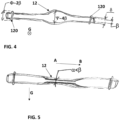
- a second embodiment of the transparent solid container 12 is shown in figs. 4-5 .
- the transparent solid container 12 has the shape of a cylinder ( fig. 5 ) extending along the axis AB of the conduit 10, which in the analysis zone contains a flat (in the plane perpendicular to the force of gravity G in fig.4 ) elliptically shaped extension.
- the inner diameter ⁇ of this cylinder (measured as shown perpendicular to gravity G in FIG.
- the elliptically shaped flat extension has a characteristic maximum dimension ⁇ (measured as shown in fig. 4 in the plane perpendicular to the gravity G) exceeding the inner diameter ⁇ by a factor of about (in order of magnitude) four: ⁇ ⁇ 4 ⁇ .
- this wall thickness ⁇ is less than or equal to 1 millimeter: ⁇ ⁇ 1mm.
- the analysis zone which contains, as indicated above, a flat (in a plane perpendicular to gravity G in fig. 4 ) elliptically shaped extension ( fig. 4 ), is additionally a flat slot extending along the axis AB of the conduit 10.
- the inner thickness ⁇ of this flat slot is smaller than the inner diameter of the cylinder (i.e. ⁇ ⁇ ⁇ ) and is predominantly in the first range of one to four millimeters: 1 mm ⁇ ⁇ ⁇ _ 4 mm.
- the sampler 1 is adapted for disposable use.
- the conduit 10 may be made of a flexible material.
- the sampling device 1 can be adapted:
- the second free end 102 may be adapted to be connected to an air pump 3 (e.g. in the form of a medical syringe of appropriate volume).
- the sampler 1 in the operational state E 1 is adapted to operate at a pressure P in the conduit 10 comprising in a third interval from 0,1 bar and 2,0 bar: 0,1 bar ⁇ P ⁇ 2,0 bar.
- the sampler 1 may comprise a sterilizing air filter 13 positioned within the conduit 10 between the hydrophobic air filter 11 and the second free end 102 of the conduit 10.
- This sterilizing air filter 13 is adapted to sterilize external air forced inside the conduit 10 through the second free end 102 by the air pump 3 when the sampler 1 is emptied back into the bioreactor 2 after non-contact analysis of the aqueous solution containing the cell culture.
- the sterilizing air filter 13 has a porosity ⁇ , comprising in a fourth interval from 0,1 micrometer to 0,2 micrometer: 0,1 micrometer ⁇ ⁇ ⁇ 0,2 micrometer.
- the sampling device 1 may comprise a first locking element 14 disposed between the transparent solid container 12 and the first end 101 of the conduit 10 and adapted to lock the conduit 10 at a side of the first end 101 of the conduit 10.
- the sampling device 1 may include a second locking element 15 disposed between the hydrophobic air filter 11 and the second end of the conduit 102 and adapted to lock the conduit 10 to the side of the second end 102 of the conduit 10.
- the second locking element 15 is arranged on the side of the second free end 102 of the conduit 10 between the hydrophobic air filter 11 and the sterilizing air filter 13.
- the sampler 1 may include a retainer 16 associated with the transparent solid container 12 and adapted to secure the transparent solid container 12 to the analyzer 40 of an aqueous solution containing cell culture from the bioreactor 2.
- the sampler 1 may include a first connector 17 disposed at a first end 101 of the conduit 10 and adapted for first quick-release connection of the conduit 10 to a port 21 of the bioreactor 2 for sampling an aqueous solution containing a cell culture.
- the sampler 1 may include a second connector 18 disposed at the second end 102 of the conduit 10 and adapted for a second quick-release connection of the conduit 10 to the air pump 3.
- the first end 101 of the conduit 10 may be adapted to be connected by heat welding (not shown) to a port 21 of the bioreactor 2 for sampling an aqueous solution with cell culture.
- the length L of the conduit 10 between its first end 101 and the transparent solid container 12 does not exceed 10 meters: L ⁇ 10 m.
- the length L of the conduit 10 between its first end 101 and the transparent solid container 12 is comprised in a spot range from 0,5 meters to 1,5 meters: 0,5 m ⁇ L ⁇ 1,5 m.
- the conduit 10 is a polished and chemically neutral inner surface.
- the operator takes the sampler 1 in a disposable and inoperable state from the accessory box for the bioreactor 2.
- This sampler 1 comprises a conduit 10 (in the form of a flexible hose with a polished and chemically neutral inner surface), a transparent solid container 12, a hydrophobic air filter 11, and a sterilizing air filter 13.
- the operator locks the conduit 10 with a first locking element 14 on the side of the first end 101, and with a second locking element 15 on the side of the second free end 102.
- the operator brings the sampler 1 into the operational state E 1 , shown in fig.
- the operator After filling this cuvette with sample, the operator places the cuvette in the cuvette holder (otherwise known as the "nest") of the spectrophotometer. Next, the operator performs a spectrophotometric analysis of the contents of the bioreactor 2. After the end of the analysis by activating the air pump 3 (i.e. by reverse stroke of the syringe piston) the cell suspension with pathogen is brought from the sampler 1 back into the bioreactor 2. Next, the operator locks the conduit 10 with the first locking element 14 at the side of the first end 101. Thereafter, the operator places the sampler 1 in an inoperable state by disconnecting the first end 101 of the conduit 10 from the bioreactor 2 using the first connector 17. Finally, the disposable sampler 1 together with the air pump 3 connected thereto is disposed.
- the air pump 3 i.e. by reverse stroke of the syringe piston
- the operator takes a reusable and inoperable sampler 1 from the bioreactor accessory box 2.
- This sampler 1 comprises a conduit 10 (in the form of a flexible hose with a polished and chemically neutral inner surface), a transparent solid container 12, a hydrophobic air filter 11, and a sterilizing air filter 13.
- the operator locks the conduit 10 with a first locking element 14 on the side of the first end 101, and with a second locking element 15 on the side of the second free end 102. 1
- the operator brings the sampler 1 into the operating state E , shown in FIG.
- the operator fills 1/3 of the entire volume of the transparent solid container 12 with the sample.
- the operator re-locks the conduit 10 with a first locking element 14 on the side of the first end 101, and with a second locking element 15 on the side of the second free end 102.
- the operator secures the one-third filled transparent solid container 12 to the optical microscope slide by means of a retainer 16 (in this example, by means of two rubber bands located on either side of the transparent solid container 12 along the axis AB of the conduit 10).
- the operator then visually analyzes the state of the cell culture within the transparent solid container 12 using the optical microscope.
- the operator unclamps the first locking element 14 and the second locking element 15, and then by activating the air pump 3 (i.e. by reversing the stroke of the syringe piston) the cell suspension with the pathogen is introduced from the sampler 1 back into the bioreactor 2.
- the operator re-locks the conduit 10 with a first locking element 14 on the side of the first end 101, and with a second locking element 15 on the side of the second free end 102.
- the operator places the sampler 1 in an inoperable state by disconnecting the first end 101 of the conduit 10 from the bioreactor 2 using the first connector 17 and the second end 102 of the conduit 10 from the air pump 3 using the second connector 18.
- the reusable sampler 1 is sterilized by ionizing gamma radiation for further use.
Landscapes
- Life Sciences & Earth Sciences (AREA)
- Health & Medical Sciences (AREA)
- Chemical & Material Sciences (AREA)
- Engineering & Computer Science (AREA)
- Bioinformatics & Cheminformatics (AREA)
- General Health & Medical Sciences (AREA)
- Biochemistry (AREA)
- Zoology (AREA)
- Organic Chemistry (AREA)
- Wood Science & Technology (AREA)
- Biotechnology (AREA)
- Physics & Mathematics (AREA)
- Pathology (AREA)
- Immunology (AREA)
- General Physics & Mathematics (AREA)
- Analytical Chemistry (AREA)
- Genetics & Genomics (AREA)
- Sustainable Development (AREA)
- Biomedical Technology (AREA)
- General Engineering & Computer Science (AREA)
- Microbiology (AREA)
- Hydrology & Water Resources (AREA)
- Molecular Biology (AREA)
- Medicinal Chemistry (AREA)
- Chemical Kinetics & Catalysis (AREA)
- Spectroscopy & Molecular Physics (AREA)
- Apparatus Associated With Microorganisms And Enzymes (AREA)
Applications Claiming Priority (1)
| Application Number | Priority Date | Filing Date | Title |
|---|---|---|---|
| PCT/RU2021/000511 WO2022164339A1 (ru) | 2021-11-17 | 2021-11-17 | Пробоотборник для биореактора |
Publications (1)
| Publication Number | Publication Date |
|---|---|
| EP4435404A1 true EP4435404A1 (de) | 2024-09-25 |
Family
ID=82653759
Family Applications (1)
| Application Number | Title | Priority Date | Filing Date |
|---|---|---|---|
| EP21923475.4A Pending EP4435404A1 (de) | 2021-11-17 | 2021-11-17 | Probenehmer für einen bioreaktor |
Country Status (5)
| Country | Link |
|---|---|
| US (1) | US20250084359A1 (de) |
| EP (1) | EP4435404A1 (de) |
| KR (1) | KR20240119269A (de) |
| CN (1) | CN118556180A (de) |
| WO (1) | WO2022164339A1 (de) |
Family Cites Families (3)
| Publication number | Priority date | Publication date | Assignee | Title |
|---|---|---|---|---|
| SE507448C2 (sv) * | 1995-11-02 | 1998-06-08 | Novaseptum Ab | Anordning för införande och/eller uttagande av medium i en behållare innefattande en kanyl och ett membran |
| DE102009043699A1 (de) * | 2009-10-01 | 2011-04-07 | Infors Ag | Vorrichtung zur Probenahme |
| DE102018204477A1 (de) * | 2018-03-23 | 2019-09-26 | Bbi-Biotech Gmbh | Vorrichtung und verfahren zur sterilen probenahme |
-
2021
- 2021-11-17 CN CN202180105376.7A patent/CN118556180A/zh active Pending
- 2021-11-17 US US18/711,274 patent/US20250084359A1/en active Pending
- 2021-11-17 KR KR1020247020189A patent/KR20240119269A/ko active Pending
- 2021-11-17 EP EP21923475.4A patent/EP4435404A1/de active Pending
- 2021-11-17 WO PCT/RU2021/000511 patent/WO2022164339A1/ru not_active Ceased
Also Published As
| Publication number | Publication date |
|---|---|
| US20250084359A1 (en) | 2025-03-13 |
| WO2022164339A1 (ru) | 2022-08-04 |
| CN118556180A (zh) | 2024-08-27 |
| KR20240119269A (ko) | 2024-08-06 |
Similar Documents
| Publication | Publication Date | Title |
|---|---|---|
| US12465335B2 (en) | Specimen collection and delivery apparatus | |
| US20260115343A1 (en) | Apparatus and methods for maintaining sterility of a specimen container | |
| DK2475973T3 (en) | Sampling Device. | |
| CN104135927A (zh) | 具有集成的传感器装置的采血试管 | |
| WO2014089186A1 (en) | Sterile bodily-fluid collection device and methods | |
| WO2019018324A1 (en) | DEVICE FOR TRAPPING AN INITIAL BLOOD FLOW | |
| KR102458777B1 (ko) | 생물학적 유체 수집 및 안정화 시스템 | |
| EP4435404A1 (de) | Probenehmer für einen bioreaktor | |
| US7687032B2 (en) | Filter assembly for molecular testing | |
| US20040228764A1 (en) | Sampling system | |
| KR20120128301A (ko) | 미생물 검체 채취 증균 사멸 배지 | |
| JP7296569B2 (ja) | サンプル貯留装置 | |
| US11318456B2 (en) | Aseptic sampling apparatus and sampling method using the same | |
| EA048756B1 (ru) | Пробоотборник для биореактора | |
| GB2143033A (en) | Apparatus for indicating whether the interior of a container has been sterilized during a sterilization process | |
| CN204581534U (zh) | 一种临床检验专用末梢血采血箱 | |
| CN119654194A (zh) | 生物标本可控暴露室 | |
| WO2021186361A1 (en) | Sample collection device | |
| CN104605948A (zh) | 一种临床检验专用末梢血采血箱 | |
| Miller et al. | Laboratory Safety For the Electron and Correlative Microscopist | |
| CN2038106U (zh) | 密闭式病原菌培养器 |
Legal Events
| Date | Code | Title | Description |
|---|---|---|---|
| STAA | Information on the status of an ep patent application or granted ep patent |
Free format text: STATUS: THE INTERNATIONAL PUBLICATION HAS BEEN MADE |
|
| PUAI | Public reference made under article 153(3) epc to a published international application that has entered the european phase |
Free format text: ORIGINAL CODE: 0009012 |
|
| STAA | Information on the status of an ep patent application or granted ep patent |
Free format text: STATUS: REQUEST FOR EXAMINATION WAS MADE |
|
| 17P | Request for examination filed |
Effective date: 20240617 |
|
| AK | Designated contracting states |
Kind code of ref document: A1 Designated state(s): AL AT BE BG CH CY CZ DE DK EE ES FI FR GB GR HR HU IE IS IT LI LT LU LV MC MK MT NL NO PL PT RO RS SE SI SK SM TR |
|
| DAV | Request for validation of the european patent (deleted) | ||
| DAX | Request for extension of the european patent (deleted) |