EP4434587A2 - Antibody variable domain combinations targeting the nkg2d receptor - Google Patents
Antibody variable domain combinations targeting the nkg2d receptor Download PDFInfo
- Publication number
- EP4434587A2 EP4434587A2 EP24179053.4A EP24179053A EP4434587A2 EP 4434587 A2 EP4434587 A2 EP 4434587A2 EP 24179053 A EP24179053 A EP 24179053A EP 4434587 A2 EP4434587 A2 EP 4434587A2
- Authority
- EP
- European Patent Office
- Prior art keywords
- amino acid
- acid sequence
- constant region
- seq
- antibody
- Prior art date
- Legal status (The legal status is an assumption and is not a legal conclusion. Google has not performed a legal analysis and makes no representation as to the accuracy of the status listed.)
- Withdrawn
Links
Images








Classifications
-
- C—CHEMISTRY; METALLURGY
- C07—ORGANIC CHEMISTRY
- C07K—PEPTIDES
- C07K16/00—Immunoglobulins [IG], e.g. monoclonal or polyclonal antibodies
- C07K16/18—Immunoglobulins [IG], e.g. monoclonal or polyclonal antibodies against material from animals or humans
- C07K16/28—Immunoglobulins [IG], e.g. monoclonal or polyclonal antibodies against material from animals or humans against receptors, cell surface antigens or cell surface determinants
- C07K16/2851—Immunoglobulins [IG], e.g. monoclonal or polyclonal antibodies against material from animals or humans against receptors, cell surface antigens or cell surface determinants against the lectin superfamily, e.g. CD23, CD72
-
- C—CHEMISTRY; METALLURGY
- C07—ORGANIC CHEMISTRY
- C07K—PEPTIDES
- C07K16/00—Immunoglobulins [IG], e.g. monoclonal or polyclonal antibodies
- C07K16/18—Immunoglobulins [IG], e.g. monoclonal or polyclonal antibodies against material from animals or humans
- C07K16/28—Immunoglobulins [IG], e.g. monoclonal or polyclonal antibodies against material from animals or humans against receptors, cell surface antigens or cell surface determinants
-
- A—HUMAN NECESSITIES
- A61—MEDICAL OR VETERINARY SCIENCE; HYGIENE
- A61P—SPECIFIC THERAPEUTIC ACTIVITY OF CHEMICAL COMPOUNDS OR MEDICINAL PREPARATIONS
- A61P35/00—Antineoplastic agents
-
- A—HUMAN NECESSITIES
- A61—MEDICAL OR VETERINARY SCIENCE; HYGIENE
- A61P—SPECIFIC THERAPEUTIC ACTIVITY OF CHEMICAL COMPOUNDS OR MEDICINAL PREPARATIONS
- A61P35/00—Antineoplastic agents
- A61P35/02—Antineoplastic agents specific for leukemia
-
- C—CHEMISTRY; METALLURGY
- C07—ORGANIC CHEMISTRY
- C07K—PEPTIDES
- C07K14/00—Peptides having more than 20 amino acids; Gastrins; Somatostatins; Melanotropins; Derivatives thereof
- C07K14/435—Peptides having more than 20 amino acids; Gastrins; Somatostatins; Melanotropins; Derivatives thereof from animals; from humans
- C07K14/705—Receptors; Cell surface antigens; Cell surface determinants
- C07K14/7056—Lectin superfamily, e.g. CD23, CD72
-
- C—CHEMISTRY; METALLURGY
- C07—ORGANIC CHEMISTRY
- C07K—PEPTIDES
- C07K16/00—Immunoglobulins [IG], e.g. monoclonal or polyclonal antibodies
- C07K16/18—Immunoglobulins [IG], e.g. monoclonal or polyclonal antibodies against material from animals or humans
- C07K16/28—Immunoglobulins [IG], e.g. monoclonal or polyclonal antibodies against material from animals or humans against receptors, cell surface antigens or cell surface determinants
- C07K16/2803—Immunoglobulins [IG], e.g. monoclonal or polyclonal antibodies against material from animals or humans against receptors, cell surface antigens or cell surface determinants against the immunoglobulin superfamily
- C07K16/283—Immunoglobulins [IG], e.g. monoclonal or polyclonal antibodies against material from animals or humans against receptors, cell surface antigens or cell surface determinants against the immunoglobulin superfamily against Fc-receptors, e.g. CD16, CD32, CD64
-
- C—CHEMISTRY; METALLURGY
- C07—ORGANIC CHEMISTRY
- C07K—PEPTIDES
- C07K16/00—Immunoglobulins [IG], e.g. monoclonal or polyclonal antibodies
- C07K16/18—Immunoglobulins [IG], e.g. monoclonal or polyclonal antibodies against material from animals or humans
- C07K16/32—Immunoglobulins [IG], e.g. monoclonal or polyclonal antibodies against material from animals or humans against translation products of oncogenes
-
- A—HUMAN NECESSITIES
- A61—MEDICAL OR VETERINARY SCIENCE; HYGIENE
- A61K—PREPARATIONS FOR MEDICAL, DENTAL OR TOILETRY PURPOSES
- A61K39/00—Medicinal preparations containing antigens or antibodies
- A61K2039/505—Medicinal preparations containing antigens or antibodies comprising antibodies
-
- A—HUMAN NECESSITIES
- A61—MEDICAL OR VETERINARY SCIENCE; HYGIENE
- A61K—PREPARATIONS FOR MEDICAL, DENTAL OR TOILETRY PURPOSES
- A61K38/00—Medicinal preparations containing peptides
-
- C—CHEMISTRY; METALLURGY
- C07—ORGANIC CHEMISTRY
- C07K—PEPTIDES
- C07K2317/00—Immunoglobulins specific features
- C07K2317/20—Immunoglobulins specific features characterized by taxonomic origin
- C07K2317/24—Immunoglobulins specific features characterized by taxonomic origin containing regions, domains or residues from different species, e.g. chimeric, humanized or veneered
-
- C—CHEMISTRY; METALLURGY
- C07—ORGANIC CHEMISTRY
- C07K—PEPTIDES
- C07K2317/00—Immunoglobulins specific features
- C07K2317/30—Immunoglobulins specific features characterized by aspects of specificity or valency
- C07K2317/31—Immunoglobulins specific features characterized by aspects of specificity or valency multispecific
-
- C—CHEMISTRY; METALLURGY
- C07—ORGANIC CHEMISTRY
- C07K—PEPTIDES
- C07K2317/00—Immunoglobulins specific features
- C07K2317/30—Immunoglobulins specific features characterized by aspects of specificity or valency
- C07K2317/35—Valency
-
- C—CHEMISTRY; METALLURGY
- C07—ORGANIC CHEMISTRY
- C07K—PEPTIDES
- C07K2317/00—Immunoglobulins specific features
- C07K2317/50—Immunoglobulins specific features characterized by immunoglobulin fragments
- C07K2317/52—Constant or Fc region; Isotype
-
- C—CHEMISTRY; METALLURGY
- C07—ORGANIC CHEMISTRY
- C07K—PEPTIDES
- C07K2317/00—Immunoglobulins specific features
- C07K2317/50—Immunoglobulins specific features characterized by immunoglobulin fragments
- C07K2317/56—Immunoglobulins specific features characterized by immunoglobulin fragments variable (Fv) region, i.e. VH and/or VL
- C07K2317/565—Complementarity determining region [CDR]
-
- C—CHEMISTRY; METALLURGY
- C07—ORGANIC CHEMISTRY
- C07K—PEPTIDES
- C07K2317/00—Immunoglobulins specific features
- C07K2317/60—Immunoglobulins specific features characterized by non-natural combinations of immunoglobulin fragments
- C07K2317/62—Immunoglobulins specific features characterized by non-natural combinations of immunoglobulin fragments comprising only variable region components
- C07K2317/622—Single chain antibody (scFv)
-
- C—CHEMISTRY; METALLURGY
- C07—ORGANIC CHEMISTRY
- C07K—PEPTIDES
- C07K2317/00—Immunoglobulins specific features
- C07K2317/60—Immunoglobulins specific features characterized by non-natural combinations of immunoglobulin fragments
- C07K2317/64—Immunoglobulins specific features characterized by non-natural combinations of immunoglobulin fragments comprising a combination of variable region and constant region components
-
- C—CHEMISTRY; METALLURGY
- C07—ORGANIC CHEMISTRY
- C07K—PEPTIDES
- C07K2317/00—Immunoglobulins specific features
- C07K2317/70—Immunoglobulins specific features characterized by effect upon binding to a cell or to an antigen
-
- C—CHEMISTRY; METALLURGY
- C07—ORGANIC CHEMISTRY
- C07K—PEPTIDES
- C07K2317/00—Immunoglobulins specific features
- C07K2317/70—Immunoglobulins specific features characterized by effect upon binding to a cell or to an antigen
- C07K2317/73—Inducing cell death, e.g. apoptosis, necrosis or inhibition of cell proliferation
- C07K2317/732—Antibody-dependent cellular cytotoxicity [ADCC]
-
- C—CHEMISTRY; METALLURGY
- C07—ORGANIC CHEMISTRY
- C07K—PEPTIDES
- C07K2317/00—Immunoglobulins specific features
- C07K2317/70—Immunoglobulins specific features characterized by effect upon binding to a cell or to an antigen
- C07K2317/76—Antagonist effect on antigen, e.g. neutralization or inhibition of binding
-
- C—CHEMISTRY; METALLURGY
- C07—ORGANIC CHEMISTRY
- C07K—PEPTIDES
- C07K2317/00—Immunoglobulins specific features
- C07K2317/90—Immunoglobulins specific features characterized by (pharmaco)kinetic aspects or by stability of the immunoglobulin
- C07K2317/92—Affinity (KD), association rate (Ka), dissociation rate (Kd) or EC50 value
-
- C—CHEMISTRY; METALLURGY
- C07—ORGANIC CHEMISTRY
- C07K—PEPTIDES
- C07K2317/00—Immunoglobulins specific features
- C07K2317/90—Immunoglobulins specific features characterized by (pharmaco)kinetic aspects or by stability of the immunoglobulin
- C07K2317/94—Stability, e.g. half-life, pH, temperature or enzyme-resistance
Definitions
- the invention provides proteins with antibody heavy chain and light chain variable domains that can be paired to form an antigen-binding site targeting the Natural Killer group 2D (NKG2D) receptor on natural killer cells, pharmaceutical compositions comprising such proteins, and therapeutic methods using such proteins and pharmaceutical compositions, including for the treatment of cancer.
- NSG2D Natural Killer group 2D
- Cancer continues to be a significant health problem despite the substantial research efforts and scientific advances reported in the literature for treating this disease.
- Some of the most frequently diagnosed cancers include prostate cancer, breast cancer, and lung cancer.
- Prostate cancer is the most common form of cancer in men.
- Breast cancer remains a leading cause of death in women.
- Current treatment options for these cancers are not effective for all patients and/or can have substantial adverse side effects.
- Other types of cancer also remain challenging to treat using existing therapeutic options.
- Cancer immunotherapies are desirable because they are highly specific and can facilitate destruction of cancer cells using the patient's own immune system. Fusion proteins such as bi-specific T-cell engagers are cancer immunotherapies described in the literature that bind to tumor cells and T-cells to facilitate destruction of tumor cells. Antibodies that bind to certain tumor-associated antigens and to certain immune cells have been described in the literature. See, for example WO 2016/134371 and WO 2015/095412 .
- NK cells Natural killer cells are a component of the innate immune system and make up approximately 15% of circulating lymphocytes. NK cells infiltrate virtually all tissues and were originally characterized by their ability to kill tumor cells effectively without the need for priming, which distinguishes them from T cells. Activated NK cells kill target cells by means similar to cytotoxic T cells - i.e., via cytolytic granules that contain perforin and granzymes as well as via death receptor pathways. Activated NK cells also secrete inflammatory cytokines such as IFN-gamma and chemokines that promote the recruitment of other leukocytes to the target tissue.
- cytotoxic T cells i.e., via cytolytic granules that contain perforin and granzymes as well as via death receptor pathways.
- Activated NK cells also secrete inflammatory cytokines such as IFN-gamma and chemokines that promote the recruitment of other leukocytes to the target tissue.
- NK cells respond to signals through a variety of activating and inhibitory receptors on their surface. For example, when NK cells encounter healthy self-cells, their activity is inhibited through activation of the killer-cell immunoglobulin-like receptors (KIRs). Alternatively, when NK cells encounter cancer cells, they are activated via their activating receptors (e.g., NKG2D, NCRs, DNAM1). NK cells are also activated by the constant region of some immunoglobulins through CD16 receptors on their surface. The overall sensitivity of NK cells to activation depends on the sum of stimulatory and inhibitory signals. NKG2D is a type-II transmembrane protein that is expressed by essentially all natural killer cells where NKG2D serves as an activating receptor. The ability to modulate NK cell function via NKG2D is useful in various therapeutic contexts including malignancy.
- KIRs killer-cell immunoglobulin-like receptors
- Antibodies to NKG2D have been identified that provide important advantages in the design of therapeutic agents. For example, some of these antibodies do not merely bind human NKG2D receptor, but have one or more further advantages such as the ability to agonize the receptor; the ability to compete with a natural ligand for binding to the receptor; and/or the ability to cross-react with NKG2D from other species such as cynomolgus monkey. These advantages can be achieved across a range of affinities for NKG2D.
- one aspect of the invention relates to an antibody heavy chain variable domain at least 90% identical to the amino acid sequence QVQLVQSGAEVKKPGASVKVSCKASGYTFTSYYMHWVRQAPGQGLEWMGIINPSG GSTSYAQKFQGRVTMTRDTSTSTVYMELSSLRSEDTAVYYCARGAPNYGDTTHDYY YMDVWGKGTTVTVSS (SEQ ID NO:1, ADI-29379).
- the antibody heavy chain variable domain is at least 95% identical to SEQ ID NO:1.
- the heavy chain variable domain includes amino acid sequences YTFTSYYMH (SEQ ID NO:11) as the first complementarity-determining region 1 ("CDR1"), IINPSGGSTSYAQKFQG (SEQ ID NO:12) as the second CDR (“CDR2”), and ARGAPNYGDTTHDYYYMDV (SEQ ID NO:13) as the third CDR (“CDR3”) of SEQ ID NO:1.
- the heavy chain variable domain includes amino acid sequences SYYMH (SEQ ID NO:45) as CDR1, IINPSGGSTSYAQKFQG (SEQ ID NO: 12) as CDR2, and GAPNYGDTTHDYYYMDV (SEQ ID NO:68) as CDR3 of SEQ ID NO: 1.
- Another aspect of the invention relates to an antibody heavy chain variable domain at least 90% identical to the amino acid sequence QVQLVQSGAEVKKPGASVKVSCKASGYTFTGYYMHWVRQAPGQGLEWMGWINPN SGGTNYAQKFQGRVTMTRDTSISTAYMELSRLRSDDTAVYYCARDTGEYYDTDDH GMDVWGQGTTVTVSS (SEQ ID NO: 3, ADI-29463).
- the antibody heavy chain variable domain is at least 95% identical to SEQ ID NO:3.
- the heavy chain variable domain includes amino acid sequences YTFTGYYMH (SEQ ID NO: 17) as the first complementarity-determining region (“CDR1”), WINPNSGGTNYAQKFQG (SEQ ID NO: 18) as the second CDR (“CDR2”), and ARDTGEYYDTDDHGMDV (SEQ ID NO: 19) as the third CDR (“CDR3”) of SEQ ID NO:3.
- the heavy chain variable domain includes amino acid sequences GYYMH (SEQ ID NO: 92) as CDR1, WINPNSGGTNYAQKFQG (SEQ ID NO: 18) as CDR2, and DTGEYYDTDDHGMDV (SEQ ID NO:69) as CDR3 of SEQ ID NO:3.
- Another aspect of the invention relates to an antibody heavy chain variable domain at least 90% identical to the amino acid sequence EVQLLESGGGLVQPGGSLRLSCAASGFTFSSYAMSWVRQAPGKGLEWVSAISGSGG STYYADSVKGRFTISRDNSKNTLYLQMNSLRAEDTAVYYCAKDGGYYDSGAGDYW GQGTLVTVSS (SEQ ID NO:5, ADI-27744).
- the antibody heavy chain variable domain is at least 95% identical to SEQ ID NO:5.
- the heavy chain variable domain includes amino acid sequences FTFSSYAMS (SEQ ID NO:23) as the first complementarity-determining region ("CDR1"), AISGSGGSTYYADSVKG (SEQ ID NO:24) as the second CDR ("CDR2"), and AKDGGYYDSGAGDY (SEQ ID NO:25) as the third CDR (“CDR3") of SEQ ID NO:5.
- the heavy chain variable domain includes amino acid sequences SYAMS (SEQ ID NO:47) as CDR1, AISGSGGSTYYADSVKG (SEQ ID NO:24) as CDR2, and DGGYYDSGAGDY (SEQ ID NO:70) as CDR3 of SEQ ID NO:5.
- Another aspect of the invention relates to an antibody heavy chain variable domain at least 90% identical to the amino acid sequence EVQLVESGGGLVKPGGSLRLSCAASGFTFSSYSMNWVRQAPGKGLEWVSSISSSSSYI YYADSVKGRFTISRDNAKNSLYLQMNSLRAEDTAVYYCARGAPMGAAAGWFDPW GQGTLVTVSS (SEQ ID NO:7, ADI-27749).
- the antibody heavy chain variable domain is at least 95% identical to SEQ ID NO:7.
- the heavy chain variable domain includes amino acid sequences FTFSSYSMN (SEQ ID NO:29) as the first complementarity-determining region ("CDR1"), SISSSSSYIYYADSVKG (SEQ ID NO: 30) as the second CDR (“CDR2"), and ARGAPMGAAAGWFDP (SEQ ID NO:31) as the third CDR ("CDR3") of SEQ ID NO:7.
- the heavy chain variable domain includes amino acid sequences SYSMN (SEQ ID NO:48) as CDR1, SISSSSSYIYYADSVKG (SEQ ID NO: 30) as CDR2, and GAPMGAAAGWFDP (SEQ ID NO:71) as CDR3 of SEQ ID NO:7.
- Another aspect of the invention relates to an antibody heavy chain variable domain at least 90% identical to the amino acid sequence EVQLVESGGGLVKPGGSLRLSCAASGFTFSSYSMNWVRQAPGKGLEWVSSISSSSSYI YYADSVKGRFTISRDNAKNSLYLQMNSLRAEDTAVYYCARGAPIGAAAGWFDPWG QGTLVTVSS (SEQ ID NO:85, A49MI).
- the antibody heavy chain variable domain is at least 95% identical to SEQ ID NO:85.
- the heavy chain variable domain includes amino acid sequences FTFSSYSMN (SEQ ID NO:29) as CDR1, SISSSSSYIYYADSVKG (SEQ ID NO: 30) as CDR2, and ARGAPIGAAAGWFDP (SEQ ID NO:77) as CDR3 of SEQ ID NO:85.
- the heavy chain variable domain includes amino acid sequences SYSMN (SEQ ID NO:48) as CDR1, SISSSSSYIYYADSVKG (SEQ ID NO: 30) as CDR2, and GAPIGAAAGWFDP (SEQ ID NO:78) as CDR3 of SEQ ID NO:85.
- Another aspect of the invention relates to an antibody heavy chain variable domain at least 90% identical to the amino acid sequence QVQLVQSGAEVKKPGASVKVSCKASGYTFTSYYMHWVRQAPGQGLEWMGIINPSG GSTSYAQKFQGRVTMTRDTSTSTVYMELSSLRSEDTAVYYCAREGAGFAYGMDYY YMDVWGKGTTVTVSS (SEQ ID NO:9, ADI-29378).
- the antibody heavy chain variable domain is at least 95% identical to SEQ ID NO:9.
- the heavy chain variable domain includes amino acid sequences YTFTSYYMH (SEQ ID NO:35) as the first complementarity-determining region (“CDR1"), IINPSGGSTSYAQKFQG (SEQ ID NO: 36) as the second CDR (“CDR2”), and AREGAGF A YGMDYYYMDV (SEQ ID NO:37) as the third CDR (“CDR3”) of SEQ ID NO:9.
- the heavy chain variable domain includes amino acid sequences SYYMH (SEQ ID NO:45) as CDR1, IINPSGGSTSYAQKFQG (SEQ ID NO: 36) as CDR2, and EGAGFAYGMDYYYMDV (SEQ ID NO:72) as CDR3 of SEQ ID NO:9.
- An antibody heavy chain variable domain of the invention can optionally be coupled to an amino acid sequence at least 90% identical to an antibody constant region, such as an IgG constant region including hinge, CH2 and CH3 domains with or without CH1 domain.
- an antibody constant region such as an IgG constant region including hinge, CH2 and CH3 domains with or without CH1 domain.
- the amino acid sequence of the constant region is at least 90% identical to a human antibody constant region, such as an human IgG1 constant region, an IgG2 constant region, IgG3 constant region, or IgG4 constant region.
- the amino acid sequence of the constant region is at least 90% identical to an antibody constant region from another mammal, such as rabbit, dog, cat, mouse, or horse.
- One or more mutations can be included into the constant region as compared to human IgG1 constant region, for example at Q347, Y349, L351, S354, E356, E357, K360, Q362, S364, T366, L368, K370, N390, K392, T394, D399, S400, D401, F405, Y407, K409, T411 and/or K439.
- substitutions include, for example, Q347E, Q347R, Y349S, Y349K, Y349T, Y349D, Y349E, Y349C, T350V, L351K, L351D, L351Y, S354C, E356K, E357Q, E357L, E357W, K360E, K360W, Q362E, S364K, S364E, S364H, S364D, T366V, T366I, T366L, T366M, T366K, T366W, T366S, L368E, L368A, L368D, K370S, N390D, N390E, K392L, K392M, K392V, K392F, K392D, K392E, T394F, T394W, D399R, D399K, D399V, S400K,
- mutations that can be included into the CH1 of a human IgG1 constant region may be at amino acid V125, F126, P127, T135, T139, A140, F170, P171, and/or V173.
- mutations that can be included into the C ⁇ of a human IgG1 constant region may be at amino acid E123, F116, S176, V163, S174, and/or T164.
- one of the heavy chain variable domains described herein is combined with a light chain variable domain to form an antigen-binding site capable of binding NKG2D.
- an antibody heavy chain variable domain at least 90% identical to the amino acid sequence of SEQ ID NO:1 can be paired with an antibody light chain variable domain at least 90% identical to the amino acid sequence EIVMTQ SPATLSV SPGERATLSCRASQ S V S SNLAWYQQKPGQAPRLLIYGASTRATGI PARFSGSGSGTEFTLTISSLQSEDFAVYYCQQYDDWPFTFGGGTKVEIK (SEQ ID NO:2, ADI-29379).
- the antibody light chain variable domain is at least 95% identical to SEQ ID NO:2.
- the light chain variable domain includes amino acid sequences RASQSVSSNLA (SEQ ID NO:14) as the first complementarity-determining region (“CDR"), GASTRAT (SEQ ID NO:15) as the second CDR, and QQYDDWPFT (SEQ ID NO:16) as the third CDR.
- RASQSVSSNLA SEQ ID NO:14
- GASTRAT SEQ ID NO:15
- QQYDDWPFT SEQ ID NO:16
- an antibody heavy chain variable domain at least 90% identical to the amino acid sequence of SEQ ID NO:3 can be paired with an antibody light chain variable domain at least 90% identical to the amino acid sequence EIVLTQSPGTLSLSPGERATLSCRASQSVSSNLAWYQQKPGQAPRLLIYGASTRATGIP ARFSGSGSGTEFTLTISSLQSEDFAVYYCQQDDYWPPTFGGGTKVEIK (SEQ ID NO:4, ADI-29463).
- the antibody light chain variable domain is at least 95% identical to SEQ ID NO:4.
- the light chain variable domain includes amino acid sequences RASQSVSSNLA (SEQ ID NO:20) as the first complementarity-determining region (“CDR"), GASTRAT (SEQ ID NO:21) as the second CDR, and QQDDYWPPT (SEQ ID NO:22) as the third CDR.
- RASQSVSSNLA SEQ ID NO:20
- GASTRAT SEQ ID NO:21
- QQDDYWPPT SEQ ID NO:22
- an antibody heavy chain variable domain at least 90% identical to the amino acid sequence of SEQ ID NO:5 can be paired with an antibody light chain variable domain at least 90% identical to the amino acid sequence DIQMTQSPSSVSASVGDRVTITCRASQGIDSWLAWYQQKPGKAPKLLIYAASSLQSG VPSRFSGSGSGTDFTLTISSLQPEDFATYYCQQGVSYPRTFGGGTKVEIK (SEQ ID NO:6, ADI-27744).
- the antibody light chain variable domain is at least 95% identical to SEQ ID NO:6.
- the light chain variable domain includes amino acid sequences RASQGIDSWLA (SEQ ID NO:26) as the first complementarity-determining region ("CDR"), AASSLQS (SEQ ID NO:27) as the second CDR, and QQGVSYPRT (SEQ ID NO:28) as the third CDR.
- RASQGIDSWLA SEQ ID NO:26
- AASSLQS SEQ ID NO:27
- QQGVSYPRT SEQ ID NO:28
- an antibody heavy chain variable domain at least 90% identical to the amino acid sequence of SEQ ID NO:7 or 85 can be paired with an antibody light chain variable domain at least 90% identical to the amino acid sequence DIQMTQSPSSVSASVGDRVTITCRASQGISSWLAWYQQKPGKAPKLLIYAASSLQSG VPSRFSGSGSGTDFTLTISSLQPEDFATYYCQQGVSFPRTFGGGTKVEIK (SEQ ID NO:8, ADI-27749).
- the antibody light chain variable domain is at least 95% identical to SEQ ID NO:8.
- the light chain variable domain includes amino acid sequences RASQGISSWLA (SEQ ID NO:32) as the first complementarity-determining region (“CDR"), AASSLQS (SEQ ID NO:33) as the second CDR, and QQGVSFPRT (SEQ ID NO:34) as the third CDR.
- RASQGISSWLA SEQ ID NO:32
- AASSLQS SEQ ID NO:33
- QQGVSFPRT SEQ ID NO:34
- an antibody heavy chain variable domain at least 90% identical to the amino acid sequence of SEQ ID NO:9 can be paired with an antibody light chain variable domain at least 90% identical to the amino acid sequence EIVLTQSPATLSLSPGERATLSCRASQSVSSYLAWYQQKPGQAPRLLIYDASNRATGI PARFSGSGSGTDFTLTISSLEPEDFAVYYCQQSDNWPFTFGGGTKVEIK (SEQ ID NO: 10, ADI-29378).
- the antibody light chain variable domain is at least 95% identical to SEQ ID NO: 10.
- the light chain variable domain includes amino acid sequences RASQSVSSYLA (SEQ ID NO:38) as the first complementarity-determining region ("CDR"), DASNRAT (SEQ ID NO:39) as the second CDR, and QQSDNWPFT (SEQ ID NO:40) as the third CDR.
- RASQSVSSYLA SEQ ID NO:38
- DASNRAT SEQ ID NO:39
- QQSDNWPFT SEQ ID NO:40
- the antigen-binding site can be included into a variety of structures, for example, a typical antibody structure with two identical heavy chains and two identical light chains, forming a pair of antigen-binding sites capable of binding NKG2D; a bi-specific, tri-specific, tetra-specific or other multi-specific antibody; or a smaller structure such as an scFv (in which the heavy chain variable domain is linked to the light chain variable domain).
- any NKG2D antigen-binding site disclosed in the instant invention is included into a protein that also includes a separate antigen-binding site that binds a tumor-associated antigen, which may permit the protein to simultaneously interact with an NK cell and a tumor cell.
- the tumor-associated antigen for example, can be CD33, HER2, EpCAM, CD2, CD3, CD8, CD10, CD19, CD20, CD21, CD22, CD23, CD24, CD25, CD30, CD37, CD38, CD40, CD45RO, CD48, CD52, CD55, CD59, CD70, CD74, CD80, CD86, CD138, CD147, HLA-DR, CSAp, CA-125, TAG-72, EFGR/ERBB1, IGF1R, HER2, HER3, HER4, IGF-1R, c-Met, PDGFR, MUC1, MUC2, MUC3, MUC4, TNFR1, TNFR2, NGFR, TRAILR1, TRAILR2, Fas (CD95), DR3, DR4, DR5, DR6, VEGF, PIGF, tenascin, ED-B fibronectin, PSA, and IL-6, MAGE-A3, B7.1, B7.2, CTLA4 or PD1.
- any NKG2D antigen-binding site disclosed in the instant invention is included into a protein that also contain a tumor-associated antigen site and CD 16 binding site.
- the CD 16 binding site can be an additional antigen-binding site or an antibody constant region or a portion thereof, such as an IgG1 constant region (which may optionally include one or more mutations affecting, for example, effector activity or CD16 binding affinity).
- Another aspect of the invention provides a method of enhancing tumor cell death and treating cancer in a patient.
- the method comprises administering to a patient in need thereof a therapeutically effective amount of a protein described herein to treat the cancer.
- the invention provides antibody heavy chain variable domains that can be paired with antibody light chain variable domains to form an antigen-binding site targeting the NKG2D receptor on natural killer cells, proteins that include the NKG2D antigen-binding sites, pharmaceutical compositions comprising such proteins, and therapeutic methods using such proteins and pharmaceutical compositions for the treatment of cancer.
- Various aspects of the invention are set forth below in sections; however, aspects of the invention described in one particular section are not to be limited to any particular section.
- the terms "subject” and “patient” refer to an organism to be treated by the methods and compositions described herein. Such organisms preferably include, but are not limited to, mammals (e.g ., murines, simians, equines, bovines, porcines, canines, felines, and the like), and more preferably include humans.
- the term "antigen-binding site” refers to the part of the immunoglobulin molecule that participates in antigen binding.
- the antigen-binding site is formed by amino acid residues of the N-terminal variable ("V") regions of the heavy ("H") and light (“L”) chains.
- V N-terminal variable
- H heavy
- L light
- Three highly divergent stretches within the V regions of the heavy and light chains are referred to as “hypervariable regions" which are interposed between more conserved flanking stretches known as “framework regions,” or "FRs.”
- FR refers to amino acid sequences which are naturally found between and adjacent to hypervariable regions in immunoglobulins.
- the three hypervariable regions of a light chain and the three hypervariable regions of a heavy chain are disposed relative to each other in three dimensional space to form an antigen-binding surface.
- the antigen-binding surface is complementary to the three-dimensional surface of a bound antigen, and the three hypervariable regions of each of the heavy and light chains are referred to as "complementarity-determining regions," or "CDRs.”
- CDRs complementarity-determining regions
- the antigen-binding site is formed by a single antibody chain providing a "single domain antibody.”
- Antigen-binding sites can exist in an intact antibody, in an antigen-binding fragment of an antibody that retains the antigen-binding surface, or in a recombinant polypeptide such as an scFv, using a peptide linker to connect the heavy chain variable domain to the light chain variable domain in a single polypeptide.
- the term "effective amount” refers to the amount of a compound (e.g ., a compound of the present invention) sufficient to effect beneficial or desired results.
- An effective amount can be administered in one or more administrations, applications or dosages and is not intended to be limited to a particular formulation or administration route.
- the term “treating” includes any effect, e.g ., lessening, reducing, modulating, ameliorating or eliminating, that results in the improvement of the condition, disease, disorder, and the like, or ameliorating a symptom thereof.
- composition refers to the combination of an active agent with a carrier, inert or active, making the composition especially suitable for diagnostic or therapeutic use in vivo or ex vivo.
- the term "pharmaceutically acceptable carrier” refers to any of the standard pharmaceutical carriers, such as a phosphate buffered saline solution, water, emulsions ( e.g ., such as an oil/water or water/oil emulsions), and various types of wetting agents.
- the compositions also can include stabilizers and preservatives.
- stabilizers and adjuvants see e.g. , Martin, Remington's Pharmaceutical Sciences, 15th Ed., Mack Publ. Co., Easton, PA [1975 ].
- compositions are described as having, including, or comprising specific components, or where processes and methods are described as having, including, or comprising specific steps, it is contemplated that, additionally, there are compositions of the present invention that consist essentially of, or consist of, the recited components, and that there are processes and methods according to the present invention that consist essentially of, or consist of, the recited processing steps.
- compositions specifying a percentage are by weight unless otherwise specified. Further, if a variable is not accompanied by a definition, then the previous definition of the variable controls.
- the invention provides antigen-binding sites that bind NKG2D, and antigen heavy chain variable domains that can be used to create such antigen-binding sites.
- Antibody heavy chain variable domains and the light chain variable domains which they pair to form antigen-binding sites capable of binding and agonizing the NKG2D receptor have now been identified and are provided in Table 1, below. Unless otherwise indicated, the CDR sequences provided in Table 1 are determined under Kabat.
- One advantage of one or more of the antibody heavy chain variable domain amino acid sequences described above is that they can bind to NKG2D from humans and cynomolgus monkeys to agonize the receptor, and compete with natural ligands for binding to the receptor. Additional antigen-binding sites that bind NKG2D and share one or more of these properties are also particularly useful and can be identified by binding competition assays known in the art. For example, the additional antigen-binding sites can be identified by competition with ADI-29379, ADI-29463, ADI-27744, ADI-27749, or ADI-29378 for binding to both human and optionally cynomolgus monkey NKG2D.
- NKG2D-binding sites which comprise the antibody heavy chain variable domains and light chain variable domains sequences described above are that they can bind to NKG2D with high affinity.
- NKG2D-binding sites bind to NKG2D with a K D of 0.1 to 1000 nM.
- NKG2D-binding sites bind to NKG2D with a K D of 1 to 500 nM.
- NKG2D-binding sites bind to NKG2D with a K D of 5 to 100 nM.
- NKG2D-binding sites bind to NKG2D with a K D of 10 to 62 nM.
- the present invention provides an antigen-binding site that includes an antibody heavy chain variable domain that includes an amino acid sequence at least 90% (e .g., 91%, 92%, 93%, 94%, 95%, 96%, 97%, 98%, 99%, or 100%) identical to the amino acid sequence of SEQ ID NO: 1, and an antibody light chain variable domain that includes an amino acid sequence at least 90% ( e .g., 91%, 92%, 93%, 94%, 95%, 96%, 97%, 98%, 99%, or 100%) identical to SEQ ID NO:2.
- an antigen-binding site that includes an antibody heavy chain variable domain with an amino acid sequence at least 90% (e .g., 91%, 92%, 93%, 94%, 95%, 96%, 97%, 98%, 99%, or 100%) identical to the amino acid sequence of SEQ ID NO: 1, includes a CDR1 sequence represented by the amino acid sequence of SEQ ID NO:11 or SEQ ID NO:91, a CDR2 sequence represented by the amino acid sequence of SEQ ID NO: 12, and a CDR3 sequence represented by the amino acid sequence of SEQ ID NO: 13 or 68.
- an antigen-binding site that includes an antibody light chain variable domain with an amino acid sequence at least 90% (e .g., 91%, 92%, 93%, 94%, 95%, 96%, 97%, 98%, 99%, or 100%) identical to the amino acid sequence of SEQ ID NO:2, includes a CDR1 sequence represented by the amino acid sequence of SEQ ID NO:14, a CDR2 sequence represented by the amino acid sequence of SEQ ID NO:15, and a CDR3 sequence represented by the amino acid sequence of SEQ ID NO:16.
- the present invention provides an antigen-binding site that includes an antibody heavy chain variable domain that includes an amino acid sequence at least 90% (e .g., 91%, 92%, 93%, 94%, 95%, 96%, 97%, 98%, 99%, or 100%) identical to the amino acid sequence of SEQ ID NO:3, and an antibody light chain variable domain that includes an amino acid sequence at least 90% (e.g., 91%, 92%, 93%, 94%, 95%, 96%, 97%, 98%, 99%, or 100%) identical to SEQ ID NO:4.
- an antigen-binding site that includes an antibody heavy chain variable domain with an amino acid sequence at least 90% (e .g., 91%, 92%, 93%, 94%, 95%, 96%, 97%, 98%, 99%, or 100%) identical to the amino acid sequence of SEQ ID NO:3, includes a CDR1 sequence represented by the amino acid sequence of SEQ ID NO:17 or SEQ ID NO:92, a CDR2 sequence represented by the amino acid sequence of SEQ ID NO:18, and a CDR3 sequence represented by the amino acid sequence of SEQ ID NO:19 or SEQ ID NO:69.
- an antigen-binding site that includes an antibody light chain variable domain with an amino acid sequence at least 90% (e .g., 91%, 92%, 93%, 94%, 95%, 96%, 97%, 98%, 99%, or 100%) identical to the amino acid sequence of SEQ ID NO:4, includes a CDR1 sequence represented by the amino acid sequence of SEQ ID NO:20, a CDR2 sequence represented by the amino acid sequence of SEQ ID NO:21, and a CDR3 sequence represented by the amino acid sequence of SEQ ID NO:22.
- the present invention provides an antigen-binding site that includes an antibody heavy chain variable domain that includes an amino acid sequence at least 90% (e .g., 91%, 92%, 93%, 94%, 95%, 96%, 97%, 98%, 99%, or 100%) identical to the amino acid sequence of SEQ ID NO:5, and an antibody light chain variable domain that includes an amino acid sequence at least 90% ( e .g., 91%, 92%, 93%, 94%, 95%, 96%, 97%, 98%, 99%, or 100%) identical to SEQ ID NO:6.
- an antibody heavy chain variable domain that includes an amino acid sequence at least 90% (e .g., 91%, 92%, 93%, 94%, 95%, 96%, 97%, 98%, 99%, or 100%) identical to SEQ ID NO:6.
- an antigen-binding site that includes an antibody heavy chain variable domain with an amino acid sequence at least 90% (e .g., 91%, 92%, 93%, 94%, 95%, 96%, 97%, 98%, 99%, or 100%) identical to the amino acid sequence of SEQ ID NO:5, includes a CDR1 sequence represented by the amino acid sequence of SEQ ID NO:23 or SEQ ID NO:93, a CDR2 sequence represented by the amino acid sequence of SEQ ID NO:24, and a CDR3 sequence represented by the amino acid sequence of SEQ ID NO:25 or SEQ ID NO:70.
- an antigen-binding site that includes an antibody light chain variable domain with an amino acid sequence at least 90% (e .g., 91%, 92%, 93%, 94%, 95%, 96%, 97%, 98%, 99%, or 100%) identical to the amino acid sequence of SEQ ID NO:6, includes a CDR1 sequence represented by the amino acid sequence of SEQ ID NO:26, a CDR2 sequence represented by the amino acid sequence of SEQ ID NO:27, and a CDR3 sequence represented by the amino acid sequence of SEQ ID NO:28.
- the present invention provides an antigen-binding site that includes an antibody heavy chain variable domain that includes an amino acid sequence at least 90% (e .g., 91%, 92%, 93%, 94%, 95%, 96%, 97%, 98%, 99%, or 100%) identical to the amino acid sequence of SEQ ID NO:7, and an antibody light chain variable domain that includes an amino acid sequence at least 90% ( e .g., 91%, 92%, 93%, 94%, 95%, 96%, 97%, 98%, 99%, or 100%) identical to SEQ ID NO:8.
- an antibody heavy chain variable domain that includes an amino acid sequence at least 90% (e .g., 91%, 92%, 93%, 94%, 95%, 96%, 97%, 98%, 99%, or 100%) identical to SEQ ID NO:8.
- an antigen-binding site that includes an antibody heavy chain variable domain with an amino acid sequence at least 90% (e .g., 91%, 92%, 93%, 94%, 95%, 96%, 97%, 98%, 99%, or 100%) identical to the amino acid sequence of SEQ ID NO:7 includes a CDR1 sequence represented by the amino acid sequence of SEQ ID NO:29 or SEQ ID NO:94, a CDR2 sequence represented by the amino acid sequence of SEQ ID NO:30, and a CDR3 sequence represented by the amino acid sequence of SEQ ID NO:31 or SEQ ID NO:71.
- an antigen-binding site that includes an antibody light chain variable domain with an amino acid sequence at least 90% (e .g., 91%, 92%, 93%, 94%, 95%, 96%, 97%, 98%, 99%, or 100%) identical to the amino acid sequence of SEQ ID NO:8, includes a CDR1 sequence represented by the amino acid sequence of SEQ ID NO:32, a CDR2 sequence represented by the amino acid sequence of SEQ ID NO:33, and a CDR3 sequence represented by the amino acid sequence of SEQ ID NO:34.
- the amino acid residue M at position 102 of SEQ ID NO:7, which is in CDR3 of the heavy chain variable domain, can be mutated.
- M102 is substituted by a non-charged residue.
- M102 is substituted by a hydrophobic residue (Gly, Ala, Val, Leu, Ile, Pro, Phe, or Trp).
- M102 is substituted by a polar residue (Ser, Thr, Cys, Asn, Gln, or Tyr).
- M102 is substituted by Leu, Ile, Val, Gln, or Phe.
- the present invention provides an antigen-binding site that includes an antibody heavy chain variable domain that includes an amino acid sequence at least 90% (e .g., 91%, 92%, 93%, 94%, 95%, 96%, 97%, 98%, 99%, or 100%) identical to the amino acid sequence of SEQ ID NO:83, and an antibody light chain variable domain that includes an amino acid sequence at least 90% ( e .g., 91%, 92%, 93%, 94%, 95%, 96%, 97%, 98%, 99%, or 100%) identical to SEQ ID NO:8.
- an antibody heavy chain variable domain that includes an amino acid sequence at least 90% (e .g., 91%, 92%, 93%, 94%, 95%, 96%, 97%, 98%, 99%, or 100%) identical to SEQ ID NO:8.
- an antigen-binding site that includes an antibody heavy chain variable domain with an amino acid sequence at least 90% (e .g., 91%, 92%, 93%, 94%, 95%, 96%, 97%, 98%, 99%, or 100%) identical to the amino acid sequence of SEQ ID NO:83, includes a CDR1 sequence represented by the amino acid sequence of SEQ ID NO:29 or SEQ ID NO:94, a CDR2 sequence represented by the amino acid sequence of SEQ ID NO:30, and a CDR3 sequence represented by the amino acid sequence of SEQ ID NO:73 or SEQ ID NO:74.
- an antigen-binding site that includes an antibody light chain variable domain with an amino acid sequence at least 90% (e .g., 91%, 92%, 93%, 94%, 95%, 96%, 97%, 98%, 99%, or 100%) identical to the amino acid sequence of SEQ ID NO:8, includes a CDR1 sequence represented by the amino acid sequence of SEQ ID NO:32, a CDR2 sequence represented by the amino acid sequence of SEQ ID NO:33, and a CDR3 sequence represented by the amino acid sequence of SEQ ID NO:34.
- the present invention provides an antigen-binding site that includes an antibody heavy chain variable domain that includes an amino acid sequence at least 90% (e .g., 91%, 92%, 93%, 94%, 95%, 96%, 97%, 98%, 99%, or 100%) identical to the amino acid sequence of SEQ ID NO:84, and an antibody light chain variable domain that includes an amino acid sequence at least 90% ( e .g., 91%, 92%, 93%, 94%, 95%, 96%, 97%, 98%, 99%, or 100%) identical to SEQ ID NO:8.
- an antibody heavy chain variable domain that includes an amino acid sequence at least 90% (e .g., 91%, 92%, 93%, 94%, 95%, 96%, 97%, 98%, 99%, or 100%) identical to SEQ ID NO:8.
- an antigen-binding site that includes an antibody heavy chain variable domain with an amino acid sequence at least 90% (e .g., 91%, 92%, 93%, 94%, 95%, 96%, 97%, 98%, 99%, or 100%) identical to the amino acid sequence of SEQ ID NO:84 includes a CDR1 sequence represented by the amino acid sequence of SEQ ID NO:29 or SEQ ID NO:94, a CDR2 sequence represented by the amino acid sequence of SEQ ID NO:30, and a CDR3 sequence represented by the amino acid sequence of SEQ ID NO:75 or SEQ ID NO:76.
- an antigen-binding site that includes an antibody light chain variable domain with an amino acid sequence at least 90% (e .g., 91%, 92%, 93%, 94%, 95%, 96%, 97%, 98%, 99%, or 100%) identical to the amino acid sequence of SEQ ID NO:8, includes a CDR1 sequence represented by the amino acid sequence of SEQ ID NO:32, a CDR2 sequence represented by the amino acid sequence of SEQ ID NO:33, and a CDR3 sequence represented by the amino acid sequence of SEQ ID NO:34.
- the present invention provides an antigen-binding site that includes an antibody heavy chain variable domain that includes an amino acid sequence at least 90% (e. g ., 91%, 92%, 93%, 94%, 95%, 96%, 97%, 98%, 99%, or 100%) identical to the amino acid sequence of SEQ ID NO:85, and an antibody light chain variable domain that includes an amino acid sequence at least 90% ( e. g., 91%, 92%, 93%, 94%, 95%, 96%, 97%, 98%, 99%, or 100%) identical to SEQ ID NO:8.
- an antigen-binding site that includes an antibody heavy chain variable domain with an amino acid sequence at least 90% (e.
- an antigen-binding site that includes an antibody light chain variable domain with an amino acid sequence at least 90% (e.
- amino acid sequence of SEQ ID NO:8 includes a CDR1 sequence represented by the amino acid sequence of SEQ ID NO:32, a CDR2 sequence represented by the amino acid sequence of SEQ ID NO:33, and a CDR3 sequence represented by the amino acid sequence of SEQ ID NO:34.
- the present invention provides an antigen-binding site that includes an antibody heavy chain variable domain that includes an amino acid sequence at least 90% (e. g., 91%, 92%, 93%, 94%, 95%, 96%, 97%, 98%, 99%, or 100%) identical to the amino acid sequence of SEQ ID NO:86, and an antibody light chain variable domain that includes an amino acid sequence at least 90% ( e. g., 91%, 92%, 93%, 94%, 95%, 96%, 97%, 98%, 99%, or 100%) identical to SEQ ID NO:8.
- an antigen-binding site that includes an antibody heavy chain variable domain with an amino acid sequence at least 90% (e.
- an antigen-binding site that includes an antibody light chain variable domain with an amino acid sequence at least 90% (e .g.
- amino acid sequence of SEQ ID NO:8 includes a CDR1 sequence represented by the amino acid sequence of SEQ ID NO:32, a CDR2 sequence represented by the amino acid sequence of SEQ ID NO:33, and a CDR3 sequence represented by the amino acid sequence of SEQ ID NO:34.
- the present invention provides an antigen-binding site that includes an antibody heavy chain variable domain that includes an amino acid sequence at least 90% (e .g., 91%, 92%, 93%, 94%, 95%, 96%, 97%, 98%, 99%, or 100%) identical to the amino acid sequence of SEQ ID NO:41, and an antibody light chain variable domain that includes an amino acid sequence at least 90% ( e .g., 91%, 92%, 93%, 94%, 95%, 96%, 97%, 98%, 99%, or 100%) identical to SEQ ID NO:8.
- an antibody heavy chain variable domain that includes an amino acid sequence at least 90% (e .g., 91%, 92%, 93%, 94%, 95%, 96%, 97%, 98%, 99%, or 100%) identical to SEQ ID NO:8.
- an antigen-binding site that includes an antibody heavy chain variable domain with an amino acid sequence at least 90% (e .g., 91%, 92%, 93%, 94%, 95%, 96%, 97%, 98%, 99%, or 100%) identical to the amino acid sequence of SEQ ID NO:41, includes a CDR1 sequence represented by the amino acid sequence of SEQ ID NO:29 or SEQ ID NO:94, a CDR2 sequence represented by the amino acid sequence of SEQ ID NO:30, and a CDR3 sequence represented by the amino acid sequence of SEQ ID NO:81 or SEQ ID NO:82.
- an antigen-binding site that includes an antibody light chain variable domain with an amino acid sequence at least 90% (e .g., 91%, 92%, 93%, 94%, 95%, 96%, 97%, 98%, 99%, or 100%) identical to the amino acid sequence of SEQ ID NO:8, includes a CDR1 sequence represented by the amino acid sequence of SEQ ID NO:32, a CDR2 sequence represented by the amino acid sequence of SEQ ID NO:33, and a CDR3 sequence represented by the amino acid sequence of SEQ ID NO:34.
- the present invention provides an antigen-binding site that includes an antibody heavy chain variable domain that includes an amino acid sequence at least 90% (e .g., 91%, 92%, 93%, 94%, 95%, 96%, 97%, 98%, 99%, or 100%) identical to the amino acid sequence of SEQ ID NO:9, and an antibody light chain variable domain that includes an amino acid sequence at least 90% ( e .g., 91%, 92%, 93%, 94%, 95%, 96%, 97%, 98%, 99%, or 100%) identical to SEQ ID NO:10.
- an antigen-binding site that includes an antibody heavy chain variable domain with an amino acid sequence at least 90% (e .g., 91%, 92%, 93%, 94%, 95%, 96%, 97%, 98%, 99%, or 100%) identical to the amino acid sequence of SEQ ID NO:9, includes a CDR1 sequence represented by the amino acid sequence of SEQ ID NO:35 or SEQ ID NO:91, a CDR2 sequence represented by the amino acid sequence of SEQ ID NO:36, and a CDR3 sequence represented by the amino acid sequence of SEQ ID NO:37 or SEQ ID NO:72.
- an antigen-binding site that includes an antibody light chain variable domain with an amino acid sequence at least 90% (e .g., 91%, 92%, 93%, 94%, 95%, 96%, 97%, 98%, 99%, or 100%) identical to the amino acid sequence of SEQ ID NO:10, includes a CDR1 sequence represented by the amino acid sequence of SEQ ID NO:38, a CDR2 sequence represented by the amino acid sequence of SEQ ID NO:39, and a CDR3 sequence represented by the amino acid sequence of SEQ ID NO:40.
- the present invention provides an antigen-binding site that includes an antibody heavy chain variable domain that includes an amino acid sequence at least 90% (e .g., 91%, 92%, 93%, 94%, 95%, 96%, 97%, 98%, 99%, or 100%) identical to the amino acid sequence of SEQ ID NO:5, and an antibody light chain variable domain that includes an amino acid sequence at least 90% ( e .g., 91%, 92%, 93%, 94%, 95%, 96%, 97%, 98%, 99%, or 100%) identical to SEQ ID NO:6, that does not block the binding of anti-NKG2D antibodies MS, 1D11, and MAB139 to NKG2D.
- an antibody heavy chain variable domain that includes an amino acid sequence at least 90% (e .g., 91%, 92%, 93%, 94%, 95%, 96%, 97%, 98%, 99%, or 100%) identical to SEQ ID NO:5, that does not block the binding of anti-NKG2D antibodies MS, 1D11, and MA
- an antigen-binding site that includes an antibody heavy chain variable domain that includes an amino acid sequence at least 90% (e .g., 91%, 92%, 93%, 94%, 95%, 96%, 97%, 98%, 99%, or 100%) identical to the amino acid sequence of SEQ ID NO:7, 83, 84, 85, 86, or 87, and an antibody light chain variable domain that includes an amino acid sequence at least 90% ( e. g., 91%, 92%, 93%, 94%, 95%, 96%, 97%, 98%, 99%, or 100%) identical to SEQ ID NO:8, does not block binding of an antigen-binding site that includes an antibody heavy chain variable domain that includes an amino acid sequence at least 90% ( e.
- an antigen-binding site that includes an antibody heavy chain variable domain that includes an amino acid sequence at least 90% (e. g., 91%, 92%, 93%, 94%, 95%, 96%, 97%, 98%, 99%, or 100%) identical to the amino acid sequence of SEQ ID NO:5
- an antibody light chain variable domain that includes an amino acid sequence at least 90% (e. g., 91%, 92%, 93%, 94%, 95%, 96%, 97%, 98%, 99%, or 100%) identical to SEQ ID NO:6
- the NKG2D antigen-binding sites formed by pairing an antibody heavy chain variable domain with a light chain variable domain described herein can be included into larger proteins such as intact antibodies, multi-specific binding proteins or multi-specific binding antibodies.
- an NKG2D-binding site can be combined with a second component, e.g ., a second antigen-binding site.
- the second antigen-binding site binds to one or more tumor-associated antigens, such as CD33, HER2, EpCAM, CD2, CD3, CD8, CD10, CD19, CD20, CD21, CD22, CD23, CD24, CD25, CD30, CD33, CD37, CD38, CD40, CD45RO, CD48, CD52, CD55, CD59, CD70, CD74, CD80, CD86, CD138, CD147, HLA-DR, CSAp, CA-125, TAG-72, EFGR/ERBB1, IGF1R, HER3, HER4, IGF-1R, c-Met, PDGFR, MUC1, MUC2, MUC3, MUC4, TNFR1, TNFR2, NGFR, TRAILR1, TRAILR2, Fas (CD95), DR3, DR4, DR5, DR6, VEGF, PIGF, tenascin, ED-B fibronectin, PSA, and IL-6, MAGE-A
- a multi-specific binding protein in addition to an NKG2D-binding site and a tumor-associated antigen-binding site, can further include a domain that binds to CD16, an Fc receptor on the surface of leukocytes including natural killer cells, macrophages, neutrophils, eosinophils, mast cells, and follicular dendritic cells.
- the CD16 binding domain can include an antibody Fc region or a portion thereof.
- the domain that binds to CD16 contains hinge, CH2 and CH3 domains of an antibody Fc region without or without CH1 domain.
- the antibody Fc region is derived from the Fc regions in the human and/or other mammalian immunoglobulins. It is known that within the Fc region, CD16 binding is mediated by the hinge region and the CH2 domain. For example, within human IgG1, the interaction with CD16 is mediated through amino acid residues Asp 265 - Glu 269, Asn 297 - Thr 299, Ala 327 - Ile 332, Leu 234 - Ser 239, and carbohydrate residue N-acetyl-D-glucosamine in the CH2 domain (see Sondermann et al, Nature, 406(6793):267-273 ).
- mutations can be selected within the CD16 binding domain to enhance or reduce its binding affinity to CD16.
- Selection methods are well known methods in the art, such as phage-displayed libraries or yeast surface-displayed cDNA libraries. Appropriate selection methods can also be designed based on the known three-dimensional structure of the interaction by a skilled person in the art.
- the multi-specific binding proteins described herein can take various formats.
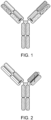
- one format is a heterodimeric, multi-specific antibody that includes a first immunoglobulin heavy chain, a first immunoglobulin light chain, a second immunoglobulin heavy chain and a second immunoglobulin light chain.
- the first immunoglobulin heavy chain includes a first Fc (hinge-CH2-CH3) domain, a first heavy chain variable domain and optionally a first CH1 heavy chain domain.
- the first immunoglobulin light chain includes a first light chain variable domain and a first light chain constant domain.
- the first immunoglobulin light chain, together with the first immunoglobulin heavy chain forms an antigen-binding site that binds NKG2D.
- the second immunoglobulin heavy chain comprises a second Fc (hinge-CH2-CH3) domain, a second heavy chain variable domain and optionally a second CH1 heavy chain domain.
- the second immunoglobulin light chain includes a second light chain variable domain and a second light chain constant domain.
- the second immunoglobulin light chain, together with the second immunoglobulin heavy chain, forms an antigen-binding site that binds a tumor antigen.
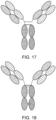
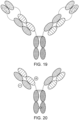
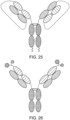
- the first Fc domain and second Fc domain together are able to bind to CD16 ( FIG. 1 ).
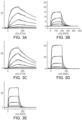
- Another exemplary format involves a heterodimeric, multi-specific antibody that includes a first immunoglobulin heavy chain, a second immunoglobulin heavy chain and an immunoglobulin light chain.
- the first immunoglobulin heavy chain includes a first Fc (hinge-CH2-CH3) domain fused via either a linker or an antibody hinge to a single-chain variable fragment (scFv) composed of a heavy variable domain and light chain variable domain which pair and bind NKG2D.
- the second immunoglobulin heavy chain includes a second Fc (hinge-CH2-CH3) domain, a second heavy chain variable domain and optionally a CH1 heavy chain domain.
- the immunoglobulin light chain includes a light chain variable domain and a constant light chain domain.
- the second immunoglobulin heavy chain pairs with the immunoglobulin light chain and binds to a tumor-associated antigen.
- the first Fc domain and the second Fc domain together are able to bind to CD16 ( FIG. 2 ).
- Additional formats of the multi-specific binding proteins can be devised by combining various formats of NKG2D-binding-fragments described herein.
- One or more additional binding motifs may be fused to the C-terminus of the constant region CH3 domain, optionally via a linker sequence.
- the antigen-binding site could be a single-chain or disulfide-stabilized variable region (scFv) or could form a tetravalent or trivalent molecule.
- the multi-specific binding protein is in the Triomab form, which is a trifunctional, bispecific antibody that maintains an IgG-like shape.
- This chimera consists of two half antibodies, each with one light and one heavy chain, that originate from two parental antibodies.
- Triomab form is an heterodimeric construct containing 1 ⁇ 2 of rat antibody and 1 ⁇ 2 of mouse antibody.
- the multi-specific binding protein is the KiH Common Light Chain (LC) form, which involves the knobs-into-holes (KIHs) technology.
- the KIH involves engineering C H 3 domains to create either a "knob” or a "hole” in each heavy chain to promote heterodimerization.
- the concept behind the "Knobs-into-Holes (KiH)" Fc technology was to introduce a "knob” in one CH3 domain (CH3A) by substitution of a small residue with a bulky one (i.e., T366W CH3A in EU numbering).
- a complementary "hole” surface was created on the other CH3 domain (CH3B) by replacing the closest neighboring residues to the knob with smaller ones (i.e., T366S/L368A/Y407V CH3B ).
- the "hole” mutation was optimized by structured-guided phage library screening ( Atwell S, Ridgway JB, Wells JA, Carter P. Stable heterodimers from remodeling the domain interface of a homodimer using a phage display library. J Mol Biol (1997) 270(1):26-35 ).
- the multi-specific binding protein is in the dual-variable domain immunoglobulin (DVD-Ig TM ) form, which combines the target binding domains of two monoclonal antibodies via flexible naturally occurring linkers, and yields a tetravalent IgG - like molecule.
- DVD-Ig TM is an homodimeric construct where variable domain targeting antigen 2 is fused to the N terminus of variable domain of Fab targeting antigen 1 Construct contains normal Fc.
- the multi-specific binding protein is in the Orthogonal Fab interface (Ortho-Fab) form, which is an heterodimeric construct that contains 2 Fabs binding to target 1 and target 2 fused to Fc.
- LC-HC pairing is ensured by orthogonal interface.
- Heterodimerization is ensured by mutations in the Fc.
- ortho-Fab IgG approach Lewis SM, Wu X, Pustilnik A, Sereno A, Huang F, Rick HL, et al. Generation of bispecific IgG antibodies by structure-based design of an orthogonal Fab interface. Nat. Biotechnol. (2014) 32(2): 191-8 )
- structure-based regional design introduces complementary mutations at the LC and HC VH-CH1 interface in only one Fab, without any changes being made to the other Fab.
- the multi-specific binding protein is in the 2-in-1 Ig format. In some embodiments, the multi-specific binding protein is in the ES form, which is an heterodimeric construct containing 2 different Fabs binding to target 1 and target 2 fused to the Fc. Heterodimerization is ensured by electrostatic steering mutations in the Fc.
- the multi-specific binding protein is in the ⁇ -Body form, which are an heterodimeric constructs with 2 different Fabs fused to Fc stabilized by heterodimerization mutations: Fab1 targeting antigen 1 contains kappa LC, while second Fab targeting antigen 2 contains lambda LC.
- the multi-specific binding protein is in Fab Arm Exchange form (antibodies that exchange Fab arms by swapping a heavy chain and attached light chain (half-molecule) with a heavy-light chain pair from another molecule, which results in bispecific antibodies).
- Fab Arm Exchange form (cFae) is a heterodimer containing 2 Fabs binding to target 1 and 2, and an Fc stabilized by heterodimerization mutations.
- the multi-specific binding protein is in the SEED Body form which is an heterodimer containing 2 Fabs binding to target 1 and 2, and an Fc stabilized by heterodimerization mutations.
- the strand-exchange engineered domain (SEED) platform was designed to generate asymmetric and bispecific antibody-like molecules, a capability that expands therapeutic applications of natural antibodies. This protein engineered platform is based on exchanging structurally related sequences of immunoglobulin within the conserved CH3 domains.
- SEED design allows efficient generation of AG/GA heterodimers, while disfavoring homodimerization of AG and GA SEED CH3 domains. ( Muda M. et al., Protein Eng. Des. Sel. (2011, 24(5):447-54 )).
- the multi-specific binding protein is in the LuZ-Y form, in which leucine zipper is used to induce heterodimerization of two different HCs.
- leucine zipper is used to induce heterodimerization of two different HCs.
- LuZ-Y form is a heterodimer containing 2 different scFabs binding to target 1 and 2, fused to Fc. Heterodimerization is ensured through leucine zipper motifs fused to C-terminus of Fc.
- the multi-specific binding protein is in the Cov-X-Body form (In bispecific CovX-Bodies, two different peptides are joined together using a branched azetidinone linker and fused to the scaffold antibody under mild conditions in a site-specific manner. Whereas the pharmacophores are responsible for functional activities, the antibody scaffold imparts long half-life and Ig-like distribution. The pharmacophores can be chemically optimized or replaced with other pharmacophores to generate optimized or unique bispecific antibodies. ( Doppalapudi VR et al., PNAS (2010), 107(52);22611-22616 ).
- the multi-specific binding protein is in an Oasc-Fab heterodimeric format that includes Fab binding to target 1 and scFab binding to target 2 fused to Fc. Heterodimerization is ensured by mutations in the Fc.
- the multi-specific binding protein is in an DuetMab format containing 2 different Fabs binding to antigen 1 and 2 and Fc stabilized by heterodimerization mutations.
- Fab 1 and 2 contain differential S-S bridges that ensure correct LC and HC pairing.
- the multi-specific binding protein is in an CrossmAb format which is an heterodimeric construct with 2 different Fabs binding to Target 1 and 2 fused to Fc stabilized by heterodimerization.
- CL and CH1 domains and VH and VL domains are switched, e.g. CH1 is fused in-line with VL, while CL is fused in-line with VH.
- the multi-specific binding protein is in an CrossmAb format which is an homodimeric constructs where Fab binding to antigen 2 is fused to the N terminus of HC of Fab that binds to antigen 1.
- the construct contains wild-recombination variants
- Assembly of heterodimeric antibody heavy chains can be accomplished by expressing two different antibody heavy chain sequences in the same cell, which may lead to the assembly of homodimers of each antibody heavy chain as well as assembly of heterodimers.
- Preferential assembly of heterodimeric heavy chains within the multi-specific binding proteins described herein can be promoted by incorporating distinct pairs of amino acid substitutions into the first CH3 domain within the first heavy chain polypeptide and the second CH3 domain within the second heavy chain polypeptide that allow these two chains to selectively heterodimerize with each other, as shown in US13/494870 , US16/028850 , US11/533709 , US12/875015 , US13/289934 , US14/773418 , US12/811207 , US13/866756 , US14/647480 , US14/830336 .
- the multi-specific binding proteins contain the Fc domain of human IgG1.
- Fc domain of human IgG1 Fc domains are listed below to facilitate heterodimerization of two heavy chains. Each positions of amino acid substitutions is numbered according to the EU index as in Kabat.
- an amino acid substitution in the first polypeptide replaces the original amino acid with a larger amino acid, selected from arginine (R), phenylalanine (F), tyrosine (Y) or tryptophan (W), and at least one amino acid substitution in the second polypeptide replaces the original amino acid(s) with a smaller amino acid(s), chosen from alanine (A), serine (S), threonine (T), or valine (V), such that the larger amino acid substitution (a protuberance) fits into the surface of the smaller amino acid substitutions (a cavity).
- one polypeptide can include a T366W substitution, and the other can include three substitutions including T366S, L368A, and Y407V.
- amino acid substitutions could be selected from the following sets of substitutions shown in Table 2.
- Table 2 First Polypeptide Second Polypeptide Set 1 S364E/F405A Y349K/T394F Set 2 S364H/D401K Y349T/T411E Set 3 S364H/T394F Y349T/F405A Set 4 S364E/T394F Y349K/F405A Set 5 S364E/T411E Y349K/D401K Set 6 S364D/T394F Y349K/F405A Set 7 S364H/F405A Y349T/T394F Set 8 S364K/E357Q L368D/K370S Set 9 L368D/K370S S364K Set 10 L368E/K370S S364K Set 11 K360E/Q362E D401K Set 12 L368D/K370S S364K/E357L
- amino acid substitutions could be selected from the following sets of substitutions shown in Table 3.
- Table 3 First Polypeptide Second Polypeptide Set 1 K409W D399V/F405T Set 2 Y349S E357W Set 3 K360E Q347R Set 4 K360E/K409W Q347R/D399V/F405T Set 5 Q347E/K360E/K409W Q347R/D399V/F405T Set 6 Y349S/K409W E357W/D399V/F405T
- amino acid substitutions could be selected from the following set of substitutions shown in Table 4.
- Table 4 First Polypeptide Second Polypeptide Set 1 T366K/L351K L351D/L368E Set 2 T366K/L351K L351D/Y349E Set 3 T366K/L351K L351D/Y349D Set 4 T366K/L351K L351D/Y349E/L368E Set 5 T366K/L351K L351D/Y349D/L368E Set 6 E356K/D399K K392D/K409D
- At least one amino acid substitution in each polypeptide chain could be selected from Table 5.
- Table 5 First Polypeptide Second Polypeptide L351Y, D399R, D399K, S400K, S400R, Y407A, Y407I, Y407V T366V, T366I, T366L, T366M, N390D, N390E, K392L, K392M, K392V, K392F K392D, K392E, K409F, K409W, T411D and T411E
- At least one amino acid substitutions could be selected from the following set of substitutions in Table 6, where the position(s) indicated in the First Polypeptide column is replaced by any known negatively-charged amino acid, and the position(s) indicated in the Second Polypeptide Column is replaced by any known positively-charged amino acid.
- At least one amino acid substitutions could be selected from the following set of in Table 7, where the position(s) indicated in the First Polypeptide column is replaced by any known positively-charged amino acid, and the position(s) indicated in the Second Polypeptide Column is replaced by any known negatively-charged amino acid.
- Table 7 First Polypeptide Second Polypeptide D399, E356, or E357 K409, K439, K370, or K392
- amino acid substitutions could be selected from the following set of in Table 8.
- Table 8 First Polypeptide Second Polypeptide T350V, L351Y, F405A, and Y407V T350V, T366L, K392L, and T394W
- the structural stability of heterodimeric heavy chains within the multi-specific binding proteins can be increased by introducing S354C on either of the first or second polypeptide chain, and Y349C on the opposing polypeptide chain, which forms an artificial disulfide bridge within the interface of the two polypeptides.
- the multi-specific binding proteins described above can be made using recombinant DNA technology well known to a skilled person in the art.
- a first nucleic acid sequence encoding the first immunoglobulin heavy chain can be cloned into a first expression vector
- a second nucleic acid sequence encoding the second immunoglobulin heavy chain can be cloned into a second expression vector
- a third nucleic acid sequence encoding the first immunoglobulin light chain can be cloned into a third expression vector
- a fourth nucleic acid sequence encoding the second immunoglobulin light chain can be cloned into a fourth expression vector
- the first, second, third and fourth expression vectors can be stably transfected together into host cells to produce the multimeric proteins.
- first, second, third and fourth expression vectors can be explored to determine the optimal ratio for transfection into the host cells.
- single clones can be isolated for cell bank generation using methods known in the art, such as limited dilution, ELISA, FACS, microscopy, or Clonepix.
- Clones can be cultured under conditions suitable for bio-reactor scale-up and maintained expression of the multi-specific protein.
- the multi-specific binding proteins can be isolated and purified using methods known in the art including centrifugation, depth filtration, cell lysis, homogenization, freeze-thawing, affinity purification, gel filtration, ion exchange chromatography, hydrophobic interaction exchange chromatography, and mixed-mode chromatography.
- a protein comprising an antigen-binding site that competes with the NKG2D-binding sites described herein
- the present invention provides a protein that includes an antigen-binding site that competes with the NKG2D-binding sites described herein to bind to NKG2D.
- the NKG2D-binding sites described herein comprises amino acid sequences of SEQ ID NOs: 1 and 2; amino acid sequences of SEQ ID NOs: 3 and 4; amino acid sequences of SEQ ID NOs: 5 and 6; amino acid sequences of SEQ ID NOs: 7 and 8; amino acid sequences of SEQ ID NOs: 9 and 10; amino acid sequences of SEQ ID NOs: 83 and 8; amino acid sequences of SEQ ID NOs: 84 and 8; amino acid sequences of SEQ ID NOs: 85 and 8; amino acid sequences of SEQ ID NOs: 86 and 8; or amino acid sequences of SEQ ID NOs: 87 and 8.
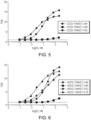
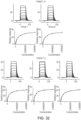
- NKG2D-binding sites can bind to different epitopes on NKG2D mapped by surface plasmon resonance.
- ADI-27744 binds to a different epitope on NKG2D from ADI-27749 and other existing NKG2D antibodies, as shown in Example 2.
- an antigen-binding site of the protein that competes with the NKG2D-binding sites includes a heavy chain variable domain having an amino acid sequence at least 50% (e .g., 50%, 60%, 70%, 80%, 90%, 91%, 92%, 93%, 94%, 95%, 96%, 97%, 98%, 99%, or 100%) identical to the amino acid sequence of SEQ ID NO: 1 and a light chain variable domain having an amino acid sequence at least at least 50% (e.g., 50%, 60%, 70%, 80%, 90%, 91%, 92%, 93%, 94%, 95%, 96%, 97%, 98%, 99%, or 100%) identical to the amino acid sequence of SEQ ID NO:2.
- an antigen-binding site of the protein that competes with the NKG2D-binding sites includes a heavy chain variable domain having an amino acid sequence at least at least 50% (e .g., 50%, 60%, 70%, 80%, 90%, 91%, 92%, 93%, 94%, 95%, 96%, 97%, 98%, 99%, or 100%) identical to the amino acid sequence of SEQ ID NO:3 and a light chain variable domain having an amino acid sequence at least at least 50% ( e .g., 50%, 60%, 70%, 80%, 90%, 91%, 92%, 93%, 94%, 95%, 96%, 97%, 98%, 99%, or 100%) identical to the amino acid sequence of SEQ ID NO:4.
- an antigen-binding site of the protein that competes with the NKG2D-binding sites includes a heavy chain variable domain having an amino acid sequence at least at least 50% (e .g., 50%, 60%, 70%, 80%, 90%, 91%, 92%, 93%, 94%, 95%, 96%, 97%, 98%, 99%, or 100%) identical to the amino acid sequence of SEQ ID NO:5 and a light chain variable domain having an amino acid sequence at least at least 50% ( e .g., 50%, 60%, 70%, 80%, 90%, 91%, 92%, 93%, 94%, 95%, 96%, 97%, 98%, 99%, or 100%) identical to the amino acid sequence of SEQ ID NO:6.
- an antigen-binding site of the protein that competes with the NKG2D-binding sites includes a heavy chain variable domain having an amino acid sequence at least at least 50% (e .g., 50%, 60%, 70%, 80%, 90%, 91%, 92%, 93%, 94%, 95%, 96%, 97%, 98%, 99%, or 100%) identical to the amino acid sequence of SEQ ID NO:7 and a light chain variable domain having an amino acid sequence at least at least 50% ( e .g., 50%, 60%, 70%, 80%, 90%, 91%, 92%, 93%, 94%, 95%, 96%, 97%, 98%, 99%, or 100%) identical to the amino acid sequence of SEQ ID NO:8.
- an antigen-binding site of the protein that competes with the NKG2D-binding sites includes a heavy chain variable domain having an amino acid sequence at least at least 50% (e .g., 50%, 60%, 70%, 80%, 90%, 91%, 92%, 93%, 94%, 95%, 96%, 97%, 98%, 99%, or 100%) identical to the amino acid sequence of SEQ ID NO:9 and a light chain variable domain having an amino acid sequence at least at least 50% ( e .g., 50%, 60%, 70%, 80%, 90%, 91%, 92%, 93%, 94%, 95%, 96%, 97%, 98%, 99%, or 100%) identical to the amino acid sequence of SEQ ID NO: 10.
- the protein that includes an antigen-binding site that competes with NKG2D-binding sites described herein further includes a second antigen-binding site that binds a tumor-associated antigen and/or a CD16 binding site.
- the CD16 binding site is an antibody constant region or a portion thereof capable of binding CD16.
- the CD16 binding site contains a human IgG1 Fc domain.
- the present disclosure provides a cell comprising one or more nucleic acids encoding a protein that contains: an NKG2D-binding site with a heavy chain variable domain having an amino acid sequence at least 90% (e .g., 91%, 92%, 93%, 94%, 95%, 96%, 97%, 98%, 99%, or 100%) identical to the amino acid sequence of SEQ ID NO:1, and a light chain variable domain having an amino acid sequence at least 90% ( e .g., 91%, 92%, 93%, 94%, 95%, 96%, 97%, 98%, 99%, or 100%) identical to the amino acid sequence of SEQ ID NO:2; a NKG2D-binding site with a heavy chain variable domain having an amino acid sequence at least 90% ( e.
- the invention provides methods for enhancing tumor cell death and/or treating cancer using a multi-specific binding protein described herein and/or a pharmaceutical composition described herein.
- the methods may be used to treat a variety of cancers.
- the type of cancer to be treated is desirably matched with the type of cancer cell to which the protein binds. Additional aspects and embodiments of the therapeutic methods are described below.
- compositions that contain an effective amount of a protein, which contains an NKG2D-binding site described herein or an NKG2D-binding site that competes with the NKG2D-binding sites described herein, and a pharmaceutically acceptable carrier.
- the formulation includes a protein that comprises an antigen-binding site with a heavy chain variable domain having an amino acid sequence at least 90% (e .g., 91%, 92%, 93%, 94%, 95%, 96%, 97%, 98%, 99%, or 100%) identical to the amino acid sequence of SEQ ID NO: 1, and a light chain variable domain having an amino acid sequence at least 90% ( e. g. , 91%, 92%, 93%, 94%, 95%, 96%, 97%, 98%, 99%, or 100%) identical to the amino acid sequence of SEQ ID NO:2.
- the formulation includes a protein that includes an antigen-binding site with a heavy chain variable domain having an amino acid sequence at least 90% (e .g., 91%, 92%, 93%, 94%, 95%, 96%, 97%, 98%, 99%, or 100%) identical to the amino acid sequence of SEQ ID NO:3, and a light chain variable domain having an amino acid sequence at least 90% ( e .g., 91%, 92%, 93%, 94%, 95%, 96%, 97%, 98%, 99%, or 100%) identical to the amino acid sequence of SEQ ID NO:4.
- the formulation includes a protein that includes an antigen-binding site with a heavy chain variable domain having an amino acid sequence at least 90% (e .g., 91%, 92%, 93%, 94%, 95%, 96%, 97%, 98%, 99%, or 100%) identical to the amino acid sequence of SEQ ID NO:5, and a light chain variable domain having an amino acid sequence at least 90% ( e .g., 91%, 92%, 93%, 94%, 95%, 96%, 97%, 98%, 99%, or 100%) identical to the amino acid sequence of SEQ ID NO:6.
- the formulation includes a protein that includes an antigen-binding site with a heavy chain variable domain having an amino acid sequence at least 90% (e .g., 91%, 92%, 93%, 94%, 95%, 96%, 97%, 98%, 99%, or 100%) identical to the amino acid sequence of SEQ ID NO:7, 83, 84, 85, 86, or 87, and a light chain variable domain having an amino acid sequence at least 90% ( e .g., 91%, 92%, 93%, 94%, 95%, 96%, 97%, 98%, 99%, or 100%) identical to the amino acid sequence of SEQ ID NO:8.
- a heavy chain variable domain having an amino acid sequence at least 90% (e .g., 91%, 92%, 93%, 94%, 95%, 96%, 97%, 98%, 99%, or 100%) identical to the amino acid sequence of SEQ ID NO:8.
- the formulation includes a protein that includes an antigen-binding site with a heavy chain variable domain having an amino acid sequence at least 90% (e .g., 91%, 92%, 93%, 94%, 95%, 96%, 97%, 98%, 99%, or 100%) identical to the amino acid sequence of SEQ ID NO:9, and a light chain variable domain having an amino acid sequence at least 90% ( e .g., 91%, 92%, 93%, 94%, 95%, 96%, 97%, 98%, 99%, or 100%) identical to the amino acid sequence of SEQ ID NO: 10.
- composition can be formulated for use in a variety of drug delivery systems.
- One or more physiologically acceptable excipients or carriers can be included in the composition for proper formulation.
- Suitable formulations for use in the present disclosure are found in Remington's Pharmaceutical Sciences, Mack Publishing Company, Philadelphia, Pa., 17th ed., 1985 .
- Langer Science 249:1527-1533, 1990 ).
- an aqueous pharmaceutical formulation including a therapeutically effective amount of the protein in a buffered solution forming a formulation.
- Aqueous carriers can include sterile water for injection (SWFI), bacteriostatic water for injection (BWFI), a pH buffered solution (e.g . phosphate-buffered saline), sterile saline solution, Ringer's solution or dextrose solution.
- SWFI sterile water for injection
- BWFI bacteriostatic water for injection
- a pH buffered solution e.g phosphate-buffered saline
- sterile saline solution e.g phosphate-buffered saline
- Ringer's solution sterile saline solution
- dextrose solution e.g. phosphate-buffered saline
- an aqueous formulation is prepared including the protein disclosed herein in a pH-buffered solution.
- the pH of the preparations typically will be between 3
- Ranges intermediate to the above recited pH's are also intended to be part of this disclosure. For example, ranges of values using a combination of any of the above recited values as upper and/or lower limits are intended to be included.
- buffers that will control the pH within this range include acetate (e.g . sodium acetate), succinate (such as sodium succinate), gluconate, histidine, citrate and other organic acid buffers.
- the buffer system includes citric acid monohydrate, sodium citrate, disodium phosphate dihydrate, and/or sodium dihydrogen phosphate dihydrate.
- the buffer system includes about 1.3 mg/ml of citric acid (e.g., 1.305 mg/ml), about 0.3 mg/ml of sodium citrate ( e.g., 0.305 mg/ml), about 1.5 mg/ml of disodium phosphate dihydrate ( e.g. 1.53 mg/ml), about 0.9 mg/ml of sodium dihydrogen phosphate dihydrate ( e.g., 0.86), and about 6.2 mg/ml of sodium chloride ( e.g., 6.165 mg/ml).
- citric acid e.g., 1.305 mg/ml
- sodium citrate e.g. 0.305 mg/ml
- 1.5 mg/ml of disodium phosphate dihydrate e.g. 1.53 mg/ml
- about 0.9 mg/ml of sodium dihydrogen phosphate dihydrate e.g. 0.86
- about 6.2 mg/ml of sodium chloride e.g., 6.165 mg/ml
- the buffer system includes 1-1.5 mg/ml of citric acid, 0.25 to 0.5 mg/ml of sodium citrate, 1.25 to 1.75 mg/ml of disodium phosphate dihydrate, 0.7 to 1.1 mg/ml of sodium dihydrogen phosphate dihydrate, and 6.0 to 6.4 mg/ml of sodium chloride.
- the pH of the liquid formulation may be set by addition of a pharmaceutically acceptable acid and/or base.
- the pharmaceutically acceptable acid may be hydrochloric acid.
- the base may be sodium hydroxide.
- the formulation includes an aqueous carrier, which is pharmaceutically acceptable (safe and non-toxic for administration to a human) and is useful for the preparation of a liquid formulation.
- aqueous carrier which is pharmaceutically acceptable (safe and non-toxic for administration to a human) and is useful for the preparation of a liquid formulation.
- aqueous carrier include sterile water for injection (SWFI), bacteriostatic water for injection (BWFI), a pH buffered solution (e.g . phosphate-buffered saline), sterile saline solution, Ringer's solution or dextrose solution.
- a polyol which acts as a tonicifier and may stabilize the antibody, may also be included in the formulation.
- the polyol is added to the formulation in an amount which may vary with respect to the desired isotonicity of the formulation.
- the aqueous formulation may be isotonic.
- the amount of polyol added may also be altered with respect to the molecular weight of the polyol. For example, a lower amount of a monosaccharide (e.g . mannitol) may be added, compared to a disaccharide (such as trehalose).
- the polyol which may be used in the formulation as a tonicity agent is mannitol.
- a detergent or surfactant may also be added to the formulation.
- exemplary detergents include nonionic detergents such as polysorbates (e.g . polysorbates 20, 80 etc.) or poloxamers ( e.g ., poloxamer 188).
- the amount of detergent added is such that it reduces aggregation of the formulated antibody and/or minimizes the formation of particulates in the formulation and/or reduces adsorption.
- the formulation may include a surfactant which is a polysorbate.
- the formulation may contain the detergent polysorbate 80 or Tween 80.
- Tween 80 is a term used to describe polyoxyethylene (20) sorbitanmonooleate ( see Fiedler, Lexikon der Hifsstoffe, Editio Cantor Verlag Aulendorf, 4th edi., 1996 ).
- the formulation may contain between about 0.1 mg/mL and about 10 mg/mL of polysorbate 80, or between about 0.5 mg/mL and about 5 mg/mL. In certain embodiments, about 0.1% polysorbate 80 may be added in the formulation.
- the present disclosure provides a formulation with an extended shelf life including the protein of the present disclosure, in combination with mannitol, citric acid monohydrate, sodium citrate, disodium phosphate dihydrate, sodium dihydrogen phosphate dihydrate, sodium chloride, polysorbate 80, water, and sodium hydroxide.
- Deamidation is a common product variant of peptides and proteins that may occur during fermentation, harvest/cell clarification, purification, drug substance/drug product storage and during sample analysis. Deamidation is the loss of NH3 from a protein forming a succinimide intermediate that can undergo hydrolysis. The succinimide intermediate results in a mass decrease of 17 Da from the parent peptide. The subsequent hydrolysis results in an 18 u mass increase. Isolation of the succinimide intermediate is difficult due to instability under aqueous conditions. As such, deamidation is typically detectable as 1 u mass increase. Deamidation of an asparagine results in either aspartic or isoaspartic acid.
- the parameters affecting the rate of deamidation include pH, temperature, solvent dielectric constant, ionic strength, primary sequence, local polypeptide conformation and tertiary structure.
- the amino acid residues adjacent to Asn in the peptide chain affect deamidation rates. Gly and Ser following an Asn in protein sequences results in a higher susceptibility to deamidation.
- the liquid formulation of the present disclosure may be preserved under conditions of pH and humidity to prevent deamination of the protein product.
- the formulation is a lyophilized formulation. In certain embodiments, the formulation is freeze-dried (lyophilized) and contained in about 12-60 vials. In certain embodiments, the formulation is freeze-dried and 45 mg of the freeze-dried formulation may be contained in one vial. In certain embodiments, the about 40 mg - about 100 mg of freeze-dried formulation is contained in one vial. In certain embodiments, freeze dried formulation from 12, 27, or 45 vials are combined to obtained a therapeutic dose of the protein in the intravenous drug formulation.
- the formulation may be a liquid formulation. In some embodiments, a liquid formulation is stored as about 250 mg/vial to about 1000 mg/vial. In certain embodiments, the liquid formulation is stored as about 600 mg/vial. In certain embodiments, the liquid formulation is stored as about 250 mg/vial.
- the lyophilized formulation includes the proteins described herein and a lyoprotectant.
- the lyoprotectant may be sugar, e.g ., disaccharides.
- the lycoprotectant may be sucrose or maltose.
- the lyophilized formulation may also include one or more of a buffering agent, a surfactant, a bulking agent, and/or a preservative.
- the amount of sucrose or maltose useful for stabilization of the lyophilized drug product may be in a weight ratio of at least 1:2 protein to sucrose or maltose.
- the protein to sucrose or maltose weight ratio may be of from 1:2 to 1:5.
- the pH of the formulation, prior to lyophilization may be set by addition of a pharmaceutically acceptable acid and/or base.
- the pharmaceutically acceptable acid may be hydrochloric acid.
- the pharmaceutically acceptable base may be sodium hydroxide.
- the pH of the solution containing the protein of the present disclosure may be adjusted between 6 to 8.
- the pH range for the lyophilized drug product may be from 7 to 8.
- a “bulking agent” may be added.
- a “bulking agent” is a compound which adds mass to a lyophilized mixture and contributes to the physical structure of the lyophilized cake (e.g ., facilitates the production of an essentially uniform lyophilized cake which maintains an open pore structure).
- Illustrative bulking agents include mannitol, glycine, polyethylene glycol and sorbitol. The lyophilized formulations of the present invention may contain such bulking agents.
- the lyophilized protein product is constituted with an aqueous carrier.
- the aqueous carrier of interest herein is one which is pharmaceutically acceptable (e.g ., safe and non-toxic for administration to a human) and is useful for the preparation of a liquid formulation, after lyophilization.
- Illustrative diluents include sterile water for injection (SWFI), bacteriostatic water for injection (BWFI), a pH buffered solution (e.g . phosphate-buffered saline), sterile saline solution, Ringer's solution or dextrose solution.
- the lyophilized drug product of the current disclosure is reconstituted with either Sterile Water for Injection, USP (SWFI) or 0.9% Sodium Chloride Injection, USP.
- SWFI Sterile Water for Injection
- USP 0.9% Sodium Chloride Injection
- the lyophilized powder dissolves into a solution.
- the lyophilized protein product of the instant disclosure is constituted to about 4.5 mL water for injection and diluted with 0.9% saline solution (sodium chloride solution).
- the protein compositions may be sterilized by conventional sterilization techniques, or may be sterile filtered.
- the resulting aqueous solutions may be packaged for use as-is, or lyophilized, the lyophilized preparation being combined with a sterile aqueous carrier prior to administration.
- the resulting compositions in solid form may be packaged in multiple single dose units, each containing a fixed amount of the above-mentioned agent or agents.
- the composition in solid form can also be packaged in a container for a flexible quantity.
- Actual dosage levels of the active ingredients in the pharmaceutical compositions of this invention may be varied so as to obtain an amount of the active ingredient which is effective to achieve the desired therapeutic response for a particular patient, composition, and mode of administration, without being toxic to the patient.
- the specific dose can be a uniform dose for each patient, for example, 50-5000 mg of protein.
- a patient's dose can be tailored to the approximate body weight or surface area of the patient.
- Other factors in determining the appropriate dosage can include the disease or condition to be treated or prevented, the severity of the disease, the route of administration, and the age, sex and medical condition of the patient. Further refinement of the calculations necessary to determine the appropriate dosage for treatment is routinely made by those skilled in the art, especially in light of the dosage information and assays disclosed herein.
- the dosage can also be determined through the use of known assays for determining dosages used in conjunction with appropriate dose-response data. An individual patient's dosage can be adjusted as the progress of the disease is monitored.
- Blood levels of the targetable construct or complex in a patient can be measured to see if the dosage needs to be adjusted to reach or maintain an effective concentration.
- Pharmacogenomics may be used to determine which targetable constructs and/or complexes, and dosages thereof, are most likely to be effective for a given individual ( Schmitz et al., Clinica Chimica Acta 308: 43-53, 2001 ; Steimer et al., Clinica Chimica Acta 308: 33-41, 2001 ).
- dosages based on body weight are from about 0.01 ⁇ g to about 100 mg per kg of body weight, such as about 0.01 ⁇ g to about 100 mg/kg of body weight, about 0.01 ⁇ g to about 50 mg/kg of body weight, about 0.01 ⁇ g to about 10 mg/kg of body weight, about 0.01 ⁇ g to about 1 mg/kg of body weight, about 0.01 ⁇ g to about 100 ⁇ g/kg of body weight, about 0.01 ⁇ g to about 50 ⁇ g/kg of body weight, about 0.01 ⁇ g to about 10 ⁇ g/kg of body weight, about 0.01 ⁇ g to about 1 ⁇ g/kg of body weight, about 0.01 ⁇ g to about 0.1 ⁇ g/kg of body weight, about 0.1 ⁇ g to about 100 mg/kg of body weight, about 0.1 ⁇ g to about 50 mg/kg of body weight, about 0.1 ⁇ g to about 10 mg/kg of body weight, about 0.1 ⁇ g to about 1 mg/kg of body weight, about 0.1 ⁇ g to about
- Doses may be given once or more times daily, weekly, monthly or yearly, or even once every 2 to 20 years. Persons of ordinary skill in the art can easily estimate repetition rates for dosing based on measured residence times and concentrations of the targetable construct or complex in bodily fluids or tissues.
- Administration of the present invention could be intravenous, intraarterial, intraperitoneal, intramuscular, subcutaneous, intrapleural, intrathecal, intracavitary, by perfusion through a catheter or by direct intralesional injection. This may be administered once or more times daily, once or more times weekly, once or more times monthly, and once or more times annually.
- the invention provides methods of enhancing tumor cell death and/or treating cancer in patient.
- the method comprises exposing a tumor and natural killer cells to a multi-specific binding protein disclosed herein.
- the method includes administering to a patient in need thereof a therapeutically effective amount of a protein and or its desired formulation described herein.
- the multi-specific binding protein can contain: an antigen-binding site with a heavy chain variable domain having an amino acid sequence at least 90% (e.g ., 91%, 92%, 93%, 94%, 95%, 96%, 97%, 98%, 99%, or 100%) identical to the amino acid sequence of SEQ ID NO: 1, and a light chain variable domain having an amino acid sequence at least 90% (e.g., 91%, 92%, 93%, 94%, 95%, 96%, 97%, 98%, 99%, or 100%) identical to the amino acid sequence of SEQ ID NO:2; an antigen-binding site with a heavy chain variable domain having an amino acid sequence at least 90% ( e .g., 91%, 92%, 93%, 94%, 95%, 96%, 97%, 98%, 99%, or 100%) identical to the amino acid sequence of SEQ ID NO:3 and a light chain variable domain having an amino acid sequence at least 90% ( e .g., 91%, 92%, 93%, 94%,
- the type of cancer to be treated is desirably matched with the type of cancer cell to which the multi-specific binding protein disclosed herein binds.
- treatment of a cancer expressing epithelial cell adhesion molecule (EpCAM), such as a colon cancer expressing EpCAM is desirably treated using a multi specific-binding protein described herein that binds to EpCAM and NKG2D.
- EpCAM epithelial cell adhesion molecule
- patients to be treated contain cancer cells that expresses one or more of the following: CD33, HER2, CD2, CD19, CD20, CD30, CD38, CD40, CD52, CD70, EGFR/ERBB1, IGF1R, HER3/ERBB3, HER4/ERBB4, MUC1, CEA, cMET, SLAMF7, PSCA, MICA, MICB, TRAILR1, TRAILR2, MAGE-A3, B7.1, B7.2, CTLA4, and PD1.
- CD33 HER2, CD2, CD19, CD20, CD30, CD38, CD40, CD52, CD70, EGFR/ERBB1, IGF1R, HER3/ERBB3, HER4/ERBB4, MUC1, CEA, cMET, SLAMF7, PSCA, MICA, MICB, TRAILR1, TRAILR2, MAGE-A3, B7.1, B7.2, CTLA4, and PD1.
- the patients to be treated have a solid cancer, such as brain cancer, bladder cancer, breast cancer, cervical cancer, colon cancer, colorectal cancer, endometrial cancer, esophageal cancer, leukemia, lung cancer, liver cancer, melanoma, ovarian cancer, pancreatic cancer, prostate cancer, rectal cancer, renal cancer, stomach cancer, testicular cancer, or uterine cancer.
- a solid cancer such as brain cancer, bladder cancer, breast cancer, cervical cancer, colon cancer, colorectal cancer, endometrial cancer, esophageal cancer, leukemia, lung cancer, liver cancer, melanoma, ovarian cancer, pancreatic cancer, prostate cancer, rectal cancer, renal cancer, stomach cancer, testicular cancer, or uterine cancer.
- the cancer is a vascularized tumor, squamous cell carcinoma, adenocarcinoma, small cell carcinoma, melanoma, glioma, neuroblastoma, sarcoma (e.g ., an angiosarcoma or chondrosarcoma), larynx cancer, parotid cancer, bilary tract cancer, thyroid cancer, acral lentiginous melanoma, actinic keratoses, acute lymphocytic leukemia, acute myeloid leukemia, adenoid cycstic carcinoma, adenomas, adenosarcoma, adenosquamous carcinoma, anal canal cancer, anal cancer, anorectum cancer, astrocytic tumor, bartholin gland carcinoma, basal cell carcinoma, biliary cancer, bone cancer, bone marrow cancer, bronchial cancer, bronchial gland carcinoma, carcinoid, cholangio
- the patients to be treated have non-Hodgkin's lymphoma, such as a B-cell lymphoma or a T-cell lymphoma.
- the non-Hodgkin's lymphoma is a B-cell lymphoma, such as a diffuse large B-cell lymphoma, primary mediastinal B-cell lymphoma, follicular lymphoma, small lymphocytic lymphoma, mantle cell lymphoma, marginal zone B-cell lymphoma, extranodal marginal zone B-cell lymphoma, nodal marginal zone B-cell lymphoma, splenic marginal zone B-cell lymphoma, Burkitt lymphoma, lymphoplasmacytic lymphoma, hairy cell leukemia, or primary central nervous system (CNS) lymphoma.
- B-cell lymphoma such as a diffuse large B-cell lymphoma, primary mediastinal B-cell lymphoma, follicular
- the non-Hodgkin's lymphoma is a T-cell lymphoma, such as a precursor T-lymphoblastic lymphoma, peripheral T-cell lymphoma, cutaneous T-cell lymphoma, angioimmunoblastic T-cell lymphoma, extranodal natural killer/T-cell lymphoma, enteropathy type T-cell lymphoma, subcutaneous panniculitis-like T-cell lymphoma, anaplastic large cell lymphoma, or peripheral T-cell lymphoma.
- T-cell lymphoma such as a precursor T-lymphoblastic lymphoma, peripheral T-cell lymphoma, cutaneous T-cell lymphoma, angioimmunoblastic T-cell lymphoma, extranodal natural killer/T-cell lymphoma, enteropathy type T-cell lymphoma, subcutaneous panniculitis-like T-cell lymphoma, anaplastic large cell lymphoma, or
- proteins described herein are used in combination with additional therapeutic agents to treat patients with cancer.
- exemplary therapeutic agents that may be used as part of a combination therapy in treating cancer, include, for example, radiation, mitomycin, tretinoin, ribomustin, gemcitabine, vincristine, etoposide, cladribine, mitobronitol, methotrexate, doxorubicin, carboquone, pentostatin, nitracrine, zinostatin, cetrorelix, letrozole, raltitrexed, daunorubicin, fadrozole, fotemustine, thymalfasin, sobuzoxane, nedaplatin, cytarabine, bicalutamide, vinorelbine, vesnarinone, aminoglutethimide, amsacrine, proglumide, elliptinium acetate, ketanserin, dox
- immune checkpoint inhibitors include agents that inhibit one or more of (i) cytotoxic T-lymphocyte-associated antigen 4 (CTLA4), (ii) programmed cell death protein 1 (PD1), (iii) PDL1, (iv) LAG3, (v) B7-H3, (vi) B7-H4, and (vii) TIM3.
- CTLA4 inhibitor ipilimumab has been approved by the United States Food and Drug Administration for treating melanoma.
- agents that may be used as part of a combination therapy in treating cancer are monoclonal antibody agents that target non-checkpoint targets (e.g ., herceptin) and non-cytotoxic agents (e.g ., tyrosine-kinase inhibitors).
- non-checkpoint targets e.g ., herceptin
- non-cytotoxic agents e.g ., tyrosine-kinase inhibitors
- anti-cancer agents include, for example: (i) an inhibitor selected from an ALK Inhibitor, an ATR Inhibitor, an A2A Antagonist, a Base Excision Repair Inhibitor, a Bcr-Abl Tyrosine Kinase Inhibitor, a Bruton's Tyrosine Kinase Inhibitor, a CDC7 Inhibitor, a CHK1 Inhibitor, a Cyclin-Dependent Kinase Inhibitor, a DNA-PK Inhibitor, an Inhibitor of both DNA-PK and mTOR, a DNMT 1 Inhibitor, a DNMT1 Inhibitor plus 2-chloro-deoxyadenosine, an HDAC Inhibitor, a Hedgehog Signaling Pathway Inhibitor, an IDO Inhibitor, a JAK Inhibitor, a mTOR Inhibitor, a MEK Inhibitor, a MELK
- Proteins of the invention can also be used as an adjunct to surgical removal of the primary lesion.
- the amount of protein and additional therapeutic agent and the relative timing of administration may be selected in order to achieve a desired combined therapeutic effect.
- the therapeutic agents in the combination, or a pharmaceutical composition or compositions comprising the therapeutic agents may be administered in any order such as, for example, sequentially, concurrently, together, simultaneously and the like.
- a protein described herein may be administered during a time when the additional therapeutic agent(s) exerts its prophylactic or therapeutic effect, or vice versa.
- ADI-27744 (A44) NKG2D-binding domain was performed against a series of antibodies and ULBP6 (NKG2D natural ligand) by surface plasmon resonance using a Biacore 8K instrument. Briefly, mouse Fc-human NKG2D was captured using an anti-mouse Fc antibody immobilized on a CM5 chip at a density of approximately 100 RU.
- NKG2D monoclonal antibody comprising ADI-27744, ADI-27749, F47 (sequences listed below) or 1D11 (a commercial monoclonal NKG2D antibody), ULBP6 (sequence listed below), MS (NKG2D antibody from Novo Nordisk, sequences listed below), and MAB139 (NKG2D antibody from R&D system, clone 149810) at 30 ⁇ l/min at 25 °C.
- Biacore 8K evaluation software was used for all data analysis.
- FIG. 4A shows the profile that an NKG2D monoclonal antibody comprising an ADI-27744 was injected over the immobilized NKG2D, followed by injection of ULBP6.
- FIG. 4B shows the profile of ULBP6 that was injected over an the immobilized NKG2D, followed by injection of NKG2D monoclonal antibody including ADI-27744.
- FIG. 4C shows the profile that MS monoclonal antibody was injected over the NKG2D, followed by injection of ULBP6. MS monoclonal antibody blocks ULBP6 from binding to NKG2D.
- FIGS. 4D-F shows the profile that MS, 1D11, or MAB139 was injected over the immobilized NKG2D, followed by injection of NKG2D monoclonal antibody comprising ADI-27744.
- FIGS. 4G-H shows the profile that NKG2D monoclonal antibody comprising ADI-27744 was injected over immobilized NKG2D, followed by injection of NKG2D monoclonal antibody comprising ADI-27749 or F47.
- TriNKETs tested include CD33-TriNKET-A44 (ADI-27744 and a CD33 binding domain), CD33-TriNKET-A49 (ADI-27749 and a CD33 binding domain), CD33-TriNKET-F63 (ADI-29463 and a CD33 binding domain), HER2-TriNKET-A44 (ADI-27744 and a CD33 binding domain), HER2-TriNKET-A49 (ADI-27749 and a HER2 binding domain), HER2-TriNKET-F63 (ADI-29463 and a HER-binding domain), and HER2-TriNKET-E79 (ADI-29379 and a HER2 binding domain).
- the HER2-binding domain is composed of a heavy chain variable domain and a light chain variable domain of Trastuzumab.
- the CD33 binding domain is composed of a heavy chain variable domain and a light chain variable domain listed below.
- TriNKETs bind NKG2D on EL4 cells, but with different affinities.
- CD33-TriNKET-A44 show the same binding profile as HER2-TriNKET-A44, so do CD33-TriNKET-A49 as HER2-TriNKET-A49, and CD33-TriNKET-F63 to HER2-TriNKET-F63.
- the NKG2D-binding affinity for each clone was similar between cells expressing human and mouse NKG2D ( FIGs. 5-6 ).
- Trispecific binding proteins bind to CD33
- Human AML cell line MV4-11, expressing CD33 was used to assay the binding of TriNKETs to the tumor-associated antigen.
- TriNKETs and the parental CD33 monoclonal antibody were incubated with the cells, and the binding was detected using fluorophore-conjugated anti-human IgG secondary antibodies.
- Cells were analyzed by flow cytometry, and fold-over-background (FOB) was calculated using the mean fluorescence intensity (MFI) from TriNKETs and the parental monoclonal CD33 antibody normalized to secondary antibody controls.
- MFI mean fluorescence intensity
- CD33-TriNKET-A44, CD33-TriNKET-A49, and CD33-TriNKET-F63 show comparable levels of binding to CD33 as compared with the parental CD33 antibody ( FIG. 7 ).
- Trispecific binding proteins bind to HER2
- Human cancer cell lines expressing HER2 were used to assay the binding of TriNKETs to the tumor-associated antigen. Renal cell carcinoma cell line 786-O expresses low level of HER2, and human lung cancer cell line NCI-H661 expresses moderate levels of HER2. TriNKETs and optionally the parental HER2 monoclonal antibody (Trastuzumab) were incubated with the cells, and the binding was detected using fluorophore-conjugated anti-human IgG secondary antibodies. Cells were analyzed by flow cytometry, and fold-over-background (FOB) was calculated using the mean fluorescence intensity (MFI) from TriNKETs and Trastuzumab normalized to secondary antibody controls.
- MFI mean fluorescence intensity
- HER2-TriNKET-A44, HER2-TriNKET-A49, and HER2-TriNKET-F63 show comparable levels of binding to HER2 expressed on 786-O cells as compared with Trastuzumab ( FIG. 8 ). Binding to HER2 expressed on NCI-H661 cells by HER2-TriNKET-E79 is shown ( FIG. 9 ).
- PBMCs Peripheral blood mononuclear cells
- NK cells CD3 - CD56 +
- Isolated NK cells were cultured in media containing 100 ng/mL IL-2 for activation or rested overnight without cytokine.
- IL-2-activated NK cells were used within 24-48 hours after activation.
- Human cancer cells expressing a tumor antigen were harvested and resuspended in culture media at 2 ⁇ 10 6 cells/mL. Monoclonal antibodies or TriNKETs targeting the tumor antigen were diluted in culture media. Activated NK cells were harvested, washed, and resuspended at 2 ⁇ 10 6 cells/mL in culture media. Cancer cells were then mixed with monoclonal antibodies/TriNKETs and activated NK cells in the presence of IL-2. Brefeldin-A and monensin were also added to the mixed culture to block protein transport out of the cell for intracellular cytokine staining.
- Fluorophore-conjugated anti-CD107a was added to the mixed culture and the culture was incubated for 4hrs before samples were prepared for FACS analysis using fluorophore-conjugated antibodies against CD3, CD56 and IFN-gamma.
- CD107a and IFN-gamma staining was analyzed in CD3 - CD56 + cells to assess NK cell activation. The increase in CD107a/IFN-gamma double-positive cells is indicative of better NK cell activation through engagement of two activating receptors rather than one receptor.
- TriNKETs mediate activation of human NK cells co-cultured with HER2-expressing NCI-H661 cells ( FIG. 10 ) and SkBr-3 cells ( FIG. 11 ) respectively as indicated by an increase of CD107a degranulation and IFN-gamma production. Compared to the monoclonal antibody Trastuzumab, TriNKETs show superior activation of human NK cells in the presence of human cancer cells.
- TriNKETs mediate activation of human NK cells co-cultured with CD33-expressing human AML Mv4-11 cells as shown by an increase of CD107a degranulation and IFN-gamma production ( FIG. 12 ). Compared to the monoclonal anti-CD33 antibody, TriNKETs show superior activation of human NK cells in the presence of human cancer cells.
- Example 6 Trispecific binding proteins enable cytotoxicity of target cancer cells
- PBMCs Peripheral blood mononuclear cells
- NK cells CD3 - CD56 +
- Isolated NK cells were cultured in media containing 100 ng/mL IL-2 for activation or rested overnight without cytokine.
- IL-2-activated or rested NK cells were used the following day in cytotoxicity assays.
- a cytoTox 96 non-radioactive cytotoxicity assay from Promega (G1780) was used according to manufacturer's instruction. Briefly, human cancer cells expressing a tumor antigen were harvested, washed, and resuspended in culture media at 1-2 ⁇ 10 5 cells/mL. Rested and/or activated NK cells were harvested, washed, and resuspended at 10 5 -2.0 ⁇ 10 6 cells/mL in the same culture media as that of the cancer cells.
- % Specific lysis ((experimental lysis - spontaneous lysis from NK cells alone - spontaneous lysis from cancer cells alone) / (Maximum lysis - negative reagent control)) * 100%
- TriNKETs mediate cytotoxicity of human NK cells against the CD33-positive Molm-13 human AML cell line.
- rested human NK cells were mixed with Molm-13 cancer cells, and TriNKETs are able to enhance the cytotoxic activity of rested human NK cells in a dose-responsive manor against the cancer cells.
- the dotted line indicates cytotoxic activity of rested NK cells without TriNKETs.
- activated human NK cells were mixed with Molm-13 cancer cells, and TriNKETs enhance the cytotoxic activity of activated human NK cells even further in a dose-responsive manor against the cancer cells.
- TriNKETs mediate cytotoxicity of human NK cells against the HER2-positive 786-O human renal cell carcinoma cell line.
- rested human NK cells were mixed with 786-O cancer cells, and TriNKETs are able to enhance the cytotoxic activity of rested human NK cells in a dose-responsive manor against the cancer cells (each TriNKET was added at 5, 1, 0.2 ⁇ g/ml in the assay and the results are represented in 3 columns from the left to the right in each TriNKET in the FIGS. 15-16 ).
- Dotted line indicates the cytotoxic activity of rested NK cells against 786-O cells in the absence of TriNKETs. As shown in FIG.
- activated human NK cells were mixed with 786-O cells, and TriNKETs enhance the cytotoxic activity of activated human NK cells even further in a dose-responsive manor against the cancer cells.
- Dotted line indicates the cytotoxic activity of activated NK cells against 786-O cells in the absence of TriNKETs.
- ADI-27749 contains, inter alia , a heavy chain CDR3 having the amino acid sequence of GAPMGAAAGWFDP (SEQ ID NO:71).
- the Met at position 102 of SEQ ID NO:7 i.e. , at position 4 of this CDR3 sequence
- TriNKET A TriNKET containing A49
- TriNKET A* a mutant form of TriNKET A having a substitution of Ile, Leu, Val, Gln, or Phe for the Met
- HIC analytical hydrophobic interaction chromatography
- T m is the midpoint transition temperature of an individual domain.
- the M102 mutation had a small effect on the T m values of the two most stable transitions (T m3 and T m4 ) by shifting them 0.6 and 0.7 °C lower, compared to the TriNKET A.
- the earlier transitions (T m1 and T m2 ) were unaffected. Therefore, the M102 mutation had only a marginal effect on the overall thermal stability of TriNKET A.
- Table 13 Protein T m 1 T m 2 T m 3 T m 4 TriNKET A 66.2 80.2 86.3 88.4 TriNKET A* 66.2 80.5 85.7 87.7
- TriNKET A and TriNKET A* Binding of TriNKET A and TriNKET A* to a fusion protein of human NKG2D and murine Fc ("mFc-hNKG2D") was characterized by surface plasmon resonance (SPR) at 37 °C. Two different fits, steady state affinity fit and kinetic fit, were utilized to obtain the equilibrium affinity data ( FIG. 32 ). The kinetic constants and equilibrium affinity constants were calculated, and data from the two independent experiments for TriNKET A* and the three independent experiments for TriNKET A were averaged.
- SPR surface plasmon resonance
- the equilibrium affinity constants (K D ) obtained from both the affinity and kinetic fits were very similar between the replicates, which suggested a high confidence in the measured parameters.
- the M102 variant has less than 2-fold reduced affinity for human NKG2D compared to TriNKET A.
- the K D for TriNKET A* was (6.87 ⁇ 0.16) ⁇ 10 -7 M, while the K D for TriNKET A was (4.87 ⁇ 0.83) ⁇ 10 -7 M (calculated from the affinity fit). Similar differences in affinities were observed when K D was calculated from the kinetic fit.
- KHYG-1 cells expressing the high-affinity variant of CD16a were generated through retroviral transduction. Following transduction, cells were selected in puromycin-containing growth media to generate a selected population of KHYG-1-CD16V cells. The selected population was maintained in media containing 10 ng/mL human IL-2.
- the KHYG-1-CD16V cells were harvested from culture, pelleted, washed three times in culture media without IL-2, and resuspended in culture media without IL-2 and rested for 24 hours.
- Human cancer cell lines expressing a target of interest were harvested from culture. The cells were washed with HBS, and were resuspended in growth media at 10 6 cells/mL for labeling with BATDA reagent (Perkin Elmer C136-100). Manufacturer instructions were followed for labeling of the target cells. After labeling, the cells were washed three times with HBS and were resuspended at 0.5 ⁇ 10 5 cells /mL in culture media. 100 ⁇ l of BATDA labeled cells were added to each well of a 96-well plate.
- the plate was removed from the incubator, and the cells were pelleted by centrifugation at 200 ⁇ g for 5 minutes. 20 ⁇ l of culture supernatant was transferred to a clean microplate provided from the manufacturer. Supernatant from the labeled cells incubated alone without NK cells was used to measure spontaneous release of TDA. Supernatant from labeled cells incubated with 1% Triton-X was used to measure maximum lysis of the target cells. Supernatant from the labeled cells prior to the 2-3 hours of incubation was used to measure the background and for quality control purposes.
- % specific lysis ((Experimental release - Spontaneous release) / (Maximum release - Spontaneous release)) ⁇ 100%.
- TriNKET A and TriNKET A* To measure the activity of TriNKET A and TriNKET A*, a cell line that expressed the first tumor antigen was selected as target cells. Two different lots of TriNKET A were used for comparison. The % specific lysis values were plotted in FIG. 33 , and the EC50 and maximum % specific lysis values were summarized in Table 15. The EC50 and maximum % specific lysis values of TriNKET A* were similar to those of TriNKET A, suggesting that the M102 mutation did not affect the biological activity of TriNKET A. Table 15 Protein EC 50 (nM) Max lysis (%) TriNKET A* 0.15 73 TriNKET A - lot 1 0.17 76 TriNKET A - lot 2 0.15 76
- TriNKET A and TriNKET A* that bind to a second, different tumor antigen were constructed.
- the activity of the two TriNKETs were compared in cytotoxicity assays using a cell line that expressed the second tumor antigen as target cells and KHYG-1-CD16V cells as effector cells. As shown in FIG. 34 , TriNKET A* demonstrated equivalent activity to TriNKET A.
Landscapes
- Health & Medical Sciences (AREA)
- Chemical & Material Sciences (AREA)
- Organic Chemistry (AREA)
- Immunology (AREA)
- Life Sciences & Earth Sciences (AREA)
- Medicinal Chemistry (AREA)
- General Health & Medical Sciences (AREA)
- Genetics & Genomics (AREA)
- Biophysics (AREA)
- Molecular Biology (AREA)
- Biochemistry (AREA)
- Proteomics, Peptides & Aminoacids (AREA)
- Oncology (AREA)
- Veterinary Medicine (AREA)
- Public Health (AREA)
- Animal Behavior & Ethology (AREA)
- Pharmacology & Pharmacy (AREA)
- Nuclear Medicine, Radiotherapy & Molecular Imaging (AREA)
- General Chemical & Material Sciences (AREA)
- Chemical Kinetics & Catalysis (AREA)
- Hematology (AREA)
- Cell Biology (AREA)
- Toxicology (AREA)
- Zoology (AREA)
- Gastroenterology & Hepatology (AREA)
- Peptides Or Proteins (AREA)
- Medicines Containing Antibodies Or Antigens For Use As Internal Diagnostic Agents (AREA)
- Micro-Organisms Or Cultivation Processes Thereof (AREA)
- Preparation Of Compounds By Using Micro-Organisms (AREA)
Abstract
Description
- This application claims the benefit of and priority to
U.S. Provisional Patent Application No. 62/628,161, filed February 8, 2018 U.S. Provisional Patent Application No. 62/716,259, filed August 8, 2018 - The invention provides proteins with antibody heavy chain and light chain variable domains that can be paired to form an antigen-binding site targeting the Natural Killer group 2D (NKG2D) receptor on natural killer cells, pharmaceutical compositions comprising such proteins, and therapeutic methods using such proteins and pharmaceutical compositions, including for the treatment of cancer.
- Cancer continues to be a significant health problem despite the substantial research efforts and scientific advances reported in the literature for treating this disease. Some of the most frequently diagnosed cancers include prostate cancer, breast cancer, and lung cancer. Prostate cancer is the most common form of cancer in men. Breast cancer remains a leading cause of death in women. Current treatment options for these cancers are not effective for all patients and/or can have substantial adverse side effects. Other types of cancer also remain challenging to treat using existing therapeutic options.
- Cancer immunotherapies are desirable because they are highly specific and can facilitate destruction of cancer cells using the patient's own immune system. Fusion proteins such as bi-specific T-cell engagers are cancer immunotherapies described in the literature that bind to tumor cells and T-cells to facilitate destruction of tumor cells. Antibodies that bind to certain tumor-associated antigens and to certain immune cells have been described in the literature. See, for example
WO 2016/134371 andWO 2015/095412 . - Natural killer (NK) cells are a component of the innate immune system and make up approximately 15% of circulating lymphocytes. NK cells infiltrate virtually all tissues and were originally characterized by their ability to kill tumor cells effectively without the need for priming, which distinguishes them from T cells. Activated NK cells kill target cells by means similar to cytotoxic T cells - i.e., via cytolytic granules that contain perforin and granzymes as well as via death receptor pathways. Activated NK cells also secrete inflammatory cytokines such as IFN-gamma and chemokines that promote the recruitment of other leukocytes to the target tissue.
- NK cells respond to signals through a variety of activating and inhibitory receptors on their surface. For example, when NK cells encounter healthy self-cells, their activity is inhibited through activation of the killer-cell immunoglobulin-like receptors (KIRs). Alternatively, when NK cells encounter cancer cells, they are activated via their activating receptors (e.g., NKG2D, NCRs, DNAM1). NK cells are also activated by the constant region of some immunoglobulins through CD16 receptors on their surface. The overall sensitivity of NK cells to activation depends on the sum of stimulatory and inhibitory signals. NKG2D is a type-II transmembrane protein that is expressed by essentially all natural killer cells where NKG2D serves as an activating receptor. The ability to modulate NK cell function via NKG2D is useful in various therapeutic contexts including malignancy.
- Antibodies to NKG2D have been identified that provide important advantages in the design of therapeutic agents. For example, some of these antibodies do not merely bind human NKG2D receptor, but have one or more further advantages such as the ability to agonize the receptor; the ability to compete with a natural ligand for binding to the receptor; and/or the ability to cross-react with NKG2D from other species such as cynomolgus monkey. These advantages can be achieved across a range of affinities for NKG2D.
- Accordingly, one aspect of the invention relates to an antibody heavy chain variable domain at least 90% identical to the amino acid sequence QVQLVQSGAEVKKPGASVKVSCKASGYTFTSYYMHWVRQAPGQGLEWMGIINPSG GSTSYAQKFQGRVTMTRDTSTSTVYMELSSLRSEDTAVYYCARGAPNYGDTTHDYY YMDVWGKGTTVTVSS (SEQ ID NO:1, ADI-29379). In some embodiments, the antibody heavy chain variable domain is at least 95% identical to SEQ ID NO:1. In some embodiments, the heavy chain variable domain includes amino acid sequences YTFTSYYMH (SEQ ID NO:11) as the first complementarity-determining region 1 ("CDR1"), IINPSGGSTSYAQKFQG (SEQ ID NO:12) as the second CDR ("CDR2"), and ARGAPNYGDTTHDYYYMDV (SEQ ID NO:13) as the third CDR ("CDR3") of SEQ ID NO:1. In some embodiments, the heavy chain variable domain includes amino acid sequences SYYMH (SEQ ID NO:45) as CDR1, IINPSGGSTSYAQKFQG (SEQ ID NO: 12) as CDR2, and GAPNYGDTTHDYYYMDV (SEQ ID NO:68) as CDR3 of SEQ ID NO: 1.
- Another aspect of the invention relates to an antibody heavy chain variable domain at least 90% identical to the amino acid sequence QVQLVQSGAEVKKPGASVKVSCKASGYTFTGYYMHWVRQAPGQGLEWMGWINPN SGGTNYAQKFQGRVTMTRDTSISTAYMELSRLRSDDTAVYYCARDTGEYYDTDDH GMDVWGQGTTVTVSS (SEQ ID NO: 3, ADI-29463). In some embodiments, the antibody heavy chain variable domain is at least 95% identical to SEQ ID NO:3. In some embodiments, the heavy chain variable domain includes amino acid sequences YTFTGYYMH (SEQ ID NO: 17) as the first complementarity-determining region ("CDR1"), WINPNSGGTNYAQKFQG (SEQ ID NO: 18) as the second CDR ("CDR2"), and ARDTGEYYDTDDHGMDV (SEQ ID NO: 19) as the third CDR ("CDR3") of SEQ ID NO:3. In some embodiments, the heavy chain variable domain includes amino acid sequences GYYMH (SEQ ID NO: 92) as CDR1, WINPNSGGTNYAQKFQG (SEQ ID NO: 18) as CDR2, and DTGEYYDTDDHGMDV (SEQ ID NO:69) as CDR3 of SEQ ID NO:3.
- Another aspect of the invention relates to an antibody heavy chain variable domain at least 90% identical to the amino acid sequence EVQLLESGGGLVQPGGSLRLSCAASGFTFSSYAMSWVRQAPGKGLEWVSAISGSGG STYYADSVKGRFTISRDNSKNTLYLQMNSLRAEDTAVYYCAKDGGYYDSGAGDYW GQGTLVTVSS (SEQ ID NO:5, ADI-27744). In some embodiments, the antibody heavy chain variable domain is at least 95% identical to SEQ ID NO:5. In some embodiments, the heavy chain variable domain includes amino acid sequences FTFSSYAMS (SEQ ID NO:23) as the first complementarity-determining region ("CDR1"), AISGSGGSTYYADSVKG (SEQ ID NO:24) as the second CDR ("CDR2"), and AKDGGYYDSGAGDY (SEQ ID NO:25) as the third CDR ("CDR3") of SEQ ID NO:5. In some embodiments, the heavy chain variable domain includes amino acid sequences SYAMS (SEQ ID NO:47) as CDR1, AISGSGGSTYYADSVKG (SEQ ID NO:24) as CDR2, and DGGYYDSGAGDY (SEQ ID NO:70) as CDR3 of SEQ ID NO:5.
- Another aspect of the invention relates to an antibody heavy chain variable domain at least 90% identical to the amino acid sequence EVQLVESGGGLVKPGGSLRLSCAASGFTFSSYSMNWVRQAPGKGLEWVSSISSSSSYI YYADSVKGRFTISRDNAKNSLYLQMNSLRAEDTAVYYCARGAPMGAAAGWFDPW GQGTLVTVSS (SEQ ID NO:7, ADI-27749). In some embodiments, the antibody heavy chain variable domain is at least 95% identical to SEQ ID NO:7. In some embodiments, the heavy chain variable domain includes amino acid sequences FTFSSYSMN (SEQ ID NO:29) as the first complementarity-determining region ("CDR1"), SISSSSSYIYYADSVKG (SEQ ID NO: 30) as the second CDR ("CDR2"), and ARGAPMGAAAGWFDP (SEQ ID NO:31) as the third CDR ("CDR3") of SEQ ID NO:7. In some embodiments, the heavy chain variable domain includes amino acid sequences SYSMN (SEQ ID NO:48) as CDR1, SISSSSSYIYYADSVKG (SEQ ID NO: 30) as CDR2, and GAPMGAAAGWFDP (SEQ ID NO:71) as CDR3 of SEQ ID NO:7.
- Another aspect of the invention relates to an antibody heavy chain variable domain at least 90% identical to the amino acid sequence EVQLVESGGGLVKPGGSLRLSCAASGFTFSSYSMNWVRQAPGKGLEWVSSISSSSSYI YYADSVKGRFTISRDNAKNSLYLQMNSLRAEDTAVYYCARGAPIGAAAGWFDPWG QGTLVTVSS (SEQ ID NO:85, A49MI). In some embodiments, the antibody heavy chain variable domain is at least 95% identical to SEQ ID NO:85. In some embodiments, the heavy chain variable domain includes amino acid sequences FTFSSYSMN (SEQ ID NO:29) as CDR1, SISSSSSYIYYADSVKG (SEQ ID NO: 30) as CDR2, and ARGAPIGAAAGWFDP (SEQ ID NO:77) as CDR3 of SEQ ID NO:85. In some embodiments, the heavy chain variable domain includes amino acid sequences SYSMN (SEQ ID NO:48) as CDR1, SISSSSSYIYYADSVKG (SEQ ID NO: 30) as CDR2, and GAPIGAAAGWFDP (SEQ ID NO:78) as CDR3 of SEQ ID NO:85.
- Another aspect of the invention relates to an antibody heavy chain variable domain at least 90% identical to the amino acid sequence QVQLVQSGAEVKKPGASVKVSCKASGYTFTSYYMHWVRQAPGQGLEWMGIINPSG GSTSYAQKFQGRVTMTRDTSTSTVYMELSSLRSEDTAVYYCAREGAGFAYGMDYY YMDVWGKGTTVTVSS (SEQ ID NO:9, ADI-29378). In some embodiments, the antibody heavy chain variable domain is at least 95% identical to SEQ ID NO:9. In some embodiments, the heavy chain variable domain includes amino acid sequences YTFTSYYMH (SEQ ID NO:35) as the first complementarity-determining region ("CDR1"), IINPSGGSTSYAQKFQG (SEQ ID NO: 36) as the second CDR ("CDR2"), and AREGAGF A YGMDYYYMDV (SEQ ID NO:37) as the third CDR ("CDR3") of SEQ ID NO:9. In some embodiments, the heavy chain variable domain includes amino acid sequences SYYMH (SEQ ID NO:45) as CDR1, IINPSGGSTSYAQKFQG (SEQ ID NO: 36) as CDR2, and EGAGFAYGMDYYYMDV (SEQ ID NO:72) as CDR3 of SEQ ID NO:9.
- An antibody heavy chain variable domain of the invention can optionally be coupled to an amino acid sequence at least 90% identical to an antibody constant region, such as an IgG constant region including hinge, CH2 and CH3 domains with or without CH1 domain. In some embodiments, the amino acid sequence of the constant region is at least 90% identical to a human antibody constant region, such as an human IgG1 constant region, an IgG2 constant region, IgG3 constant region, or IgG4 constant region. In some other embodiments, the amino acid sequence of the constant region is at least 90% identical to an antibody constant region from another mammal, such as rabbit, dog, cat, mouse, or horse. One or more mutations can be included into the constant region as compared to human IgG1 constant region, for example at Q347, Y349, L351, S354, E356, E357, K360, Q362, S364, T366, L368, K370, N390, K392, T394, D399, S400, D401, F405, Y407, K409, T411 and/or K439. Exemplary substitutions include, for example, Q347E, Q347R, Y349S, Y349K, Y349T, Y349D, Y349E, Y349C, T350V, L351K, L351D, L351Y, S354C, E356K, E357Q, E357L, E357W, K360E, K360W, Q362E, S364K, S364E, S364H, S364D, T366V, T366I, T366L, T366M, T366K, T366W, T366S, L368E, L368A, L368D, K370S, N390D, N390E, K392L, K392M, K392V, K392F, K392D, K392E, T394F, T394W, D399R, D399K, D399V, S400K, S400R, D401K, F405A, F405T, Y407A, Y407I, Y407V, K409F, K409W, K409D, T411D, T411E, K439D, and K439E.
- In certain embodiments, mutations that can be included into the CH1 of a human IgG1 constant region may be at amino acid V125, F126, P127, T135, T139, A140, F170, P171, and/or V173. In certain embodiments, mutations that can be included into the Cκ of a human IgG1 constant region may be at amino acid E123, F116, S176, V163, S174, and/or T164.
- In some embodiments, one of the heavy chain variable domains described herein is combined with a light chain variable domain to form an antigen-binding site capable of binding NKG2D. For example, an antibody heavy chain variable domain at least 90% identical to the amino acid sequence of SEQ ID NO:1 can be paired with an antibody light chain variable domain at least 90% identical to the amino acid sequence EIVMTQ SPATLSV SPGERATLSCRASQ S V S SNLAWYQQKPGQAPRLLIYGASTRATGI PARFSGSGSGTEFTLTISSLQSEDFAVYYCQQYDDWPFTFGGGTKVEIK (SEQ ID NO:2, ADI-29379). In some embodiments, the antibody light chain variable domain is at least 95% identical to SEQ ID NO:2. In some embodiments, the light chain variable domain includes amino acid sequences RASQSVSSNLA (SEQ ID NO:14) as the first complementarity-determining region ("CDR"), GASTRAT (SEQ ID NO:15) as the second CDR, and QQYDDWPFT (SEQ ID NO:16) as the third CDR.
- For example, an antibody heavy chain variable domain at least 90% identical to the amino acid sequence of SEQ ID NO:3 can be paired with an antibody light chain variable domain at least 90% identical to the amino acid sequence EIVLTQSPGTLSLSPGERATLSCRASQSVSSNLAWYQQKPGQAPRLLIYGASTRATGIP ARFSGSGSGTEFTLTISSLQSEDFAVYYCQQDDYWPPTFGGGTKVEIK (SEQ ID NO:4, ADI-29463). In some embodiments, the antibody light chain variable domain is at least 95% identical to SEQ ID NO:4. In some embodiments, the light chain variable domain includes amino acid sequences RASQSVSSNLA (SEQ ID NO:20) as the first complementarity-determining region ("CDR"), GASTRAT (SEQ ID NO:21) as the second CDR, and QQDDYWPPT (SEQ ID NO:22) as the third CDR.
- For example, an antibody heavy chain variable domain at least 90% identical to the amino acid sequence of SEQ ID NO:5 can be paired with an antibody light chain variable domain at least 90% identical to the amino acid sequence DIQMTQSPSSVSASVGDRVTITCRASQGIDSWLAWYQQKPGKAPKLLIYAASSLQSG VPSRFSGSGSGTDFTLTISSLQPEDFATYYCQQGVSYPRTFGGGTKVEIK (SEQ ID NO:6, ADI-27744). In some embodiments, the antibody light chain variable domain is at least 95% identical to SEQ ID NO:6. In some embodiments, the light chain variable domain includes amino acid sequences RASQGIDSWLA (SEQ ID NO:26) as the first complementarity-determining region ("CDR"), AASSLQS (SEQ ID NO:27) as the second CDR, and QQGVSYPRT (SEQ ID NO:28) as the third CDR.
- For example, an antibody heavy chain variable domain at least 90% identical to the amino acid sequence of SEQ ID NO:7 or 85 can be paired with an antibody light chain variable domain at least 90% identical to the amino acid sequence DIQMTQSPSSVSASVGDRVTITCRASQGISSWLAWYQQKPGKAPKLLIYAASSLQSG VPSRFSGSGSGTDFTLTISSLQPEDFATYYCQQGVSFPRTFGGGTKVEIK (SEQ ID NO:8, ADI-27749). In some embodiments, the antibody light chain variable domain is at least 95% identical to SEQ ID NO:8. In some embodiments, the light chain variable domain includes amino acid sequences RASQGISSWLA (SEQ ID NO:32) as the first complementarity-determining region ("CDR"), AASSLQS (SEQ ID NO:33) as the second CDR, and QQGVSFPRT (SEQ ID NO:34) as the third CDR.
- For example, an antibody heavy chain variable domain at least 90% identical to the amino acid sequence of SEQ ID NO:9 can be paired with an antibody light chain variable domain at least 90% identical to the amino acid sequence EIVLTQSPATLSLSPGERATLSCRASQSVSSYLAWYQQKPGQAPRLLIYDASNRATGI PARFSGSGSGTDFTLTISSLEPEDFAVYYCQQSDNWPFTFGGGTKVEIK (SEQ ID NO: 10, ADI-29378). In some embodiments, the antibody light chain variable domain is at least 95% identical to SEQ ID NO: 10. In some embodiments, the light chain variable domain includes amino acid sequences RASQSVSSYLA (SEQ ID NO:38) as the first complementarity-determining region ("CDR"), DASNRAT (SEQ ID NO:39) as the second CDR, and QQSDNWPFT (SEQ ID NO:40) as the third CDR.
- When a heavy chain variable domain is combined with a light chain variable domain to form an antigen-binding site capable of binding NKG2D, the antigen-binding site can be included into a variety of structures, for example, a typical antibody structure with two identical heavy chains and two identical light chains, forming a pair of antigen-binding sites capable of binding NKG2D; a bi-specific, tri-specific, tetra-specific or other multi-specific antibody; or a smaller structure such as an scFv (in which the heavy chain variable domain is linked to the light chain variable domain).
- In some embodiments, any NKG2D antigen-binding site disclosed in the instant invention is included into a protein that also includes a separate antigen-binding site that binds a tumor-associated antigen, which may permit the protein to simultaneously interact with an NK cell and a tumor cell. The tumor-associated antigen, for example, can be CD33, HER2, EpCAM, CD2, CD3, CD8, CD10, CD19, CD20, CD21, CD22, CD23, CD24, CD25, CD30, CD37, CD38, CD40, CD45RO, CD48, CD52, CD55, CD59, CD70, CD74, CD80, CD86, CD138, CD147, HLA-DR, CSAp, CA-125, TAG-72, EFGR/ERBB1, IGF1R, HER2, HER3, HER4, IGF-1R, c-Met, PDGFR, MUC1, MUC2, MUC3, MUC4, TNFR1, TNFR2, NGFR, TRAILR1, TRAILR2, Fas (CD95), DR3, DR4, DR5, DR6, VEGF, PIGF, tenascin, ED-B fibronectin, PSA, and IL-6, MAGE-A3, B7.1, B7.2, CTLA4 or PD1.
- In some embodiments, any NKG2D antigen-binding site disclosed in the instant invention is included into a protein that also contain a tumor-associated antigen site and CD 16 binding site. The CD 16 binding site can be an additional antigen-binding site or an antibody constant region or a portion thereof, such as an IgG1 constant region (which may optionally include one or more mutations affecting, for example, effector activity or CD16 binding affinity).
- Another aspect of the invention provides a method of enhancing tumor cell death and treating cancer in a patient. The method comprises administering to a patient in need thereof a therapeutically effective amount of a protein described herein to treat the cancer.
-
-
FIG. 1 is a representation of a multispecific binding protein that contains an NKG2D-binding domain (right arm), a tumor-associated antigen-binding domain (left arm) and an Fc domain or a portion thereof that binds to CD16. -
FIG. 2 is a representation of a multispecific binding protein that includes a NKG2D-binding domain or a tumor-associated antigen-binding domain, either one of which can be in an scFv format, and an Fc domain or a portion thereof that binds to CD16. - FIGs. 3A-3F are profiles of NKG2D-binding affinity of the NKG2D-binding domains measured by surface plasmon resonance.
FIG. 3A is the NKG2D-binding affinity of the NKG2D-binding domain ADI-27744 measured by surface plasmon resonance;FIG. 3B is the NKG2D-binding affinity of the NKG2D-binding domain ADI-29379 measured by surface plasmon resonance;FIG. 3C is the NKG2D-binding affinity of the NKG2D-binding domain ADI-27749 measured by surface plasmon resonance;FIG. 3D is the NKG2D-binding affinity of the NKG2D-binding domain ADI-29463 measured by surface plasmon resonance; andFIG. 3E is the NKG2D-binding affinity of the NKG2D-binding domain ADI-29378 measured by surface plasmon resonance. -
FIGs. 4A-H are profiles of competitive NKG2D binding by NKG2D-binding domain ADI-27744 (A44) and ULBP6 or other NKG2D antibodies measured by surface plasmon resonance.FIG. 4A shows the profile of NKG2D monoclonal antibody comprising ADI-27744 injected over immobilized NKG2D, followed by injection of ULBP6.FIG. 4B shows the profile of ULBP6 injected over immobilized NKG2D, followed by injection of NKG2D monoclonal antibody comprising ADI-27744.FIG. 4C shows the profile of MS monoclonal antibody injected over immobilized NKG2D, followed by injection of ULBP6.FIG. 4D shows the profile of MS injected over the immobilized NKG2D, followed by injection of NKG2D monoclonal antibody comprising ADI-27744.FIG. 4E shows the profile of 1D11 injected over the immobilized NKG2D, followed by injection of NKG2D monoclonal antibody comprising ADI-27744.FIG. 4F shows the profile of MAB139 injected over the immobilized NKG2D, followed by injection of NKG2D monoclonal antibody comprising ADI-27744.FIG. 4G shows the profile of NKG2D monoclonal antibody comprising ADI-27744 was injected over the immobilized NKG2D, followed by injection of NKG2D monoclonal antibody comprising ADI-27749 (A49); andFIG. 4H shows the profile of NKG2D monoclonal antibody comprising ADI-27744 was injected over the immobilized NKG2D, followed by injection of NKG2D monoclonal antibody comprising F47. -
FIG. 5 are line graphs showing the binding profile of CD33-targeting TriNKETs to NKG2D expressed on EL4 cells. -
FIG. 6 are line graphs showing the binding profile of HER2-targeting TriNKETs to NKG2D expressed on EL4 cells. -
FIG. 7 are bar graphs showing the binding profile of CD33-targeting TriNKETs to CD33 expressed on Mv4-11 cells. -
FIG. 8 are bar graphs showing the binding profile of HER2-targeting TriNKETs to HER2 expressed on 786-O cells. -
FIG. 9 are bar graphs showing the binding profile of a HER2-targeting TriNKETs to HER2 expressed on NCI-H661 cells. -
FIG. 10 are bar graphs showing that HER2-targeting TriNKETs mediate activation of human NK cells co-cultured with HER2-expressing NCI-H661 cells. -
FIG. 11 are bar graphs showing that HER2-targeting TriNKETs mediate activation of human NK cells co-cultured with HER2 expressing SkBr-3 cells. -
FIG. 12 are bar graphs showing that CD33-targeting TriNKETs mediate activation of human NK cells co-cultured with CD33-expressing human AML Mv4-11 cells. -
FIG. 13 are line graphs showing that CD33-targeting TriNKETs enable cytotoxicity of rested NK cells against CD33-expressing Molm-13 cancer cells. -
FIG. 14 are line graphs showing that CD33-targeting TriNKETs enable cytotoxicity of activated NK cells against CD33-expressing Molm-13 cancer cells. -
FIG. 15 are bar graphs showing that HER2-targeting TriNKETs enable cytotoxicity of rested NK cells against HER2-expressing 786-O cancer cells. -
FIG. 16 are bar graphs showing that HER2-targeting TriNKETs enable cytotoxicity of activated NK cells against HER2-expressing 786-O cancer cells. -
FIG. 17 is a representation of a TriNKET in the Triomab form, which is a trifunctional, bispecific antibody that maintains an IgG-like shape. This chimera consists of two half antibodies, each with one light and one heavy chain, that originate from two parental antibodies. Triomab form is an heterodimeric construct containing ½ of rat antibody and ½ of mouse antibody. -
FIG. 18 is a representation of a TriNKET in the KiH Common Light Chain (LC) form, which involves the knobs-into-holes (KIHs) technology. KiH is a heterodimer containing 2 Fabs binding to target 1 and 2, and an Fc stabilized by heterodimerization mutations. TriNKET in the KiH format may be an heterodimeric construct with 2 fabs binding to target 1 andtarget 2, containing 2 different heavy chains and a common light chain that pairs with both HC. -
FIG. 19 is a representation of a TriNKET in the dual-variable domain immunoglobulin (DVD-Ig™) form, which combines the target binding domains of two monoclonal antibodies via flexible naturally occurring linkers, and yields a tetravalent IgG - like molecule. DVD-Ig™ is an homodimeric construct where variabledomain targeting antigen 2 is fused to the N terminus of variable domain ofFab targeting antigen 1 Construct contains normal Fc. -
FIG. 20 is a representation of a TriNKET in the Orthogonal Fab interface (Ortho-Fab) form, which is an heterodimeric construct that contains 2 Fabs binding to target1 and target2 fused to Fc. LC-HC pairing is ensured by orthogonal interface. Heterodimerization is ensured by mutations in the Fc. -
FIG. 21 is a representation of a TrinKET in the 2-in-1 Ig format. -
FIG. 22 is a representation of a TriNKET in the ES form, which is an heterodimeric construct containing 2 different Fabs binding to target 1 andtarget 2 fused to the Fc. Heterodimerization is ensured by electrostatic steering mutations in the Fc. -
FIG. 23 is a representation of a TriNKET in the Fab Arm Exchange form: antibodies that exchange Fab arms by swapping a heavy chain and attached light chain (half-molecule) with a heavy-light chain pair from another molecule, resulting in bispecific antibodies. Fab Arm Exchange form (cFae) is a heterodimer containing 2 Fabs binding to target 1 and 2, and an Fc stabilized by heterodimerization mutations. -
FIG. 24 is a representation of a TriNKET in the SEED Body form, which is an heterodimer containing 2 Fabs binding to target 1 and 2, and an Fc stabilized by heterodimerization mutations. -
FIG. 25 is a representation of a TriNKET in the LuZ-Y form, in which leucine zipper is used to induce heterodimerization of two different HCs. LuZ-Y form is a heterodimer containing 2 different scFabs binding to target 1 and 2, fused to Fc. Heterodimerization is ensured through leucine zipper motifs fused to C-terminus of Fc. -
FIG. 26 is a representation of a TriNKET in the Cov-X-Body form. -
FIGs. 27A-27B are representations of TriNKETs in the κλ-Body forms, which are an heterodimeric constructs with 2 different Fabs fused to Fc stabilized by heterodimerization mutations:Fab1 targeting antigen 1 contains kappa LC, while secondFab targeting antigen 2 contains lambda LC.FIG. 27A is an exemplary representation of one form of a κλ-Body;FIG. 27B is an exemplary representation of another κλ-Body. -
FIG. 28 is an Oasc-Fab heterodimeric construct that includes Fab binding to target 1 and scFab binding to target 2 fused to Fc. Heterodimerization is ensured by mutations in the Fc. -
FIG. 29 is a DuetMab, which is an heterodimeric construct containing 2 different Fabs binding toantigen Fab -
FIG. 30 is a CrossmAb, which is an heterodimeric construct with 2 different Fabs binding toTarget -
FIG. 31 is a Fit-Ig, which is an homodimeric constructs where Fab binding toantigen 2 is fused to the N terminus of HC of Fab that binds toantigen 1. The construct contains wild-type Fc. -
FIG. 32 is a series of line graphs showing the binding of TriNKET A* and TriNKET A to human NKG2D as tested by SPR. The upper panels represent kinetic fit, and the lower panels represent steady state affinity fit. -
FIG. 33 is a line graph showing the potency of TriNKET A and TriNKET A* in mediating cytotoxicity of NK cells against target cells. -
FIG. 34 is a line graph showing the potency of TriNKET A and TriNKET A* in mediating cytotoxicity of NK cells against target cells. - The invention provides antibody heavy chain variable domains that can be paired with antibody light chain variable domains to form an antigen-binding site targeting the NKG2D receptor on natural killer cells, proteins that include the NKG2D antigen-binding sites, pharmaceutical compositions comprising such proteins, and therapeutic methods using such proteins and pharmaceutical compositions for the treatment of cancer. Various aspects of the invention are set forth below in sections; however, aspects of the invention described in one particular section are not to be limited to any particular section.
- To facilitate an understanding of the present invention, a number of terms and phrases are defined below.
- The terms "a" and "an" as used herein mean "one or more" and include the plural unless the context is inappropriate.
- As used herein, the terms "subject" and "patient" refer to an organism to be treated by the methods and compositions described herein. Such organisms preferably include, but are not limited to, mammals (e.g., murines, simians, equines, bovines, porcines, canines, felines, and the like), and more preferably include humans.
- As used herein, the term "antigen-binding site" refers to the part of the immunoglobulin molecule that participates in antigen binding. In human antibodies, the antigen-binding site is formed by amino acid residues of the N-terminal variable ("V") regions of the heavy ("H") and light ("L") chains. Three highly divergent stretches within the V regions of the heavy and light chains are referred to as "hypervariable regions" which are interposed between more conserved flanking stretches known as "framework regions," or "FRs." Thus the term "FR" refers to amino acid sequences which are naturally found between and adjacent to hypervariable regions in immunoglobulins. In a human antibody molecule, the three hypervariable regions of a light chain and the three hypervariable regions of a heavy chain are disposed relative to each other in three dimensional space to form an antigen-binding surface. The antigen-binding surface is complementary to the three-dimensional surface of a bound antigen, and the three hypervariable regions of each of the heavy and light chains are referred to as "complementarity-determining regions," or "CDRs." In certain animals, such as camels and cartilaginous fish, the antigen-binding site is formed by a single antibody chain providing a "single domain antibody." Antigen-binding sites can exist in an intact antibody, in an antigen-binding fragment of an antibody that retains the antigen-binding surface, or in a recombinant polypeptide such as an scFv, using a peptide linker to connect the heavy chain variable domain to the light chain variable domain in a single polypeptide.
- As used herein, the term "effective amount" refers to the amount of a compound (e.g., a compound of the present invention) sufficient to effect beneficial or desired results. An effective amount can be administered in one or more administrations, applications or dosages and is not intended to be limited to a particular formulation or administration route. As used herein, the term "treating" includes any effect, e.g., lessening, reducing, modulating, ameliorating or eliminating, that results in the improvement of the condition, disease, disorder, and the like, or ameliorating a symptom thereof.
- As used herein, the term "pharmaceutical composition" refers to the combination of an active agent with a carrier, inert or active, making the composition especially suitable for diagnostic or therapeutic use in vivo or ex vivo.
- As used herein, the term "pharmaceutically acceptable carrier" refers to any of the standard pharmaceutical carriers, such as a phosphate buffered saline solution, water, emulsions (e.g., such as an oil/water or water/oil emulsions), and various types of wetting agents. The compositions also can include stabilizers and preservatives. For examples of carriers, stabilizers and adjuvants, see e.g., Martin, Remington's Pharmaceutical Sciences, 15th Ed., Mack Publ. Co., Easton, PA [1975].
- Throughout the description, where compositions are described as having, including, or comprising specific components, or where processes and methods are described as having, including, or comprising specific steps, it is contemplated that, additionally, there are compositions of the present invention that consist essentially of, or consist of, the recited components, and that there are processes and methods according to the present invention that consist essentially of, or consist of, the recited processing steps.
- As a general matter, compositions specifying a percentage are by weight unless otherwise specified. Further, if a variable is not accompanied by a definition, then the previous definition of the variable controls.
- The invention provides antigen-binding sites that bind NKG2D, and antigen heavy chain variable domains that can be used to create such antigen-binding sites.
- Antibody heavy chain variable domains and the light chain variable domains which they pair to form antigen-binding sites capable of binding and agonizing the NKG2D receptor have now been identified and are provided in Table 1, below. Unless otherwise indicated, the CDR sequences provided in Table 1 are determined under Kabat.
Table 1 Clones Heavy chain variable region amino acid sequence Light chain variable region amino acid sequence ADI-29379 (E79) CDR1 non-Kabat (SEQ ID NO:11) - YTFTSYYMH or CDR1 (SEQ ID NO:45) - SYYMH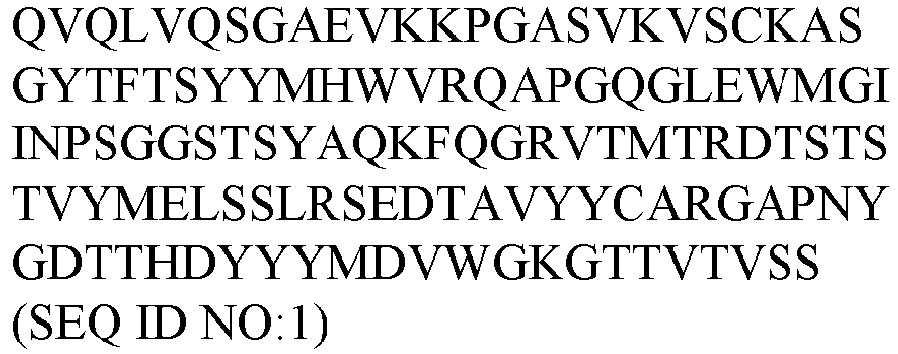 CDR1 (SEQ ID NO:14) - RASQSVSSNLA CDR2 (SEQ ID NO:15) - GASTRAT

CDR2 (SEQ ID NO:12) - IINPSGGSTSYAQKFQG CDR3 (SEQ ID NO:16) - QQYDDWPFT CDR3 non-Kabat (SEQ ID NO:13) - ARGAPNYGDTTHDYYYMDV or CDR3 (SEQ ID NO:68) - GAPNYGDTTHDYYYMDV ADI-29463 (F63) CDR1 non-Kabat (SEQ ID NO:17) - YTFTGYYMH or CDR1 (SEQ ID NO:46) - GYYMH CDR1 (SEQ ID NO:20) - RASQSVSSNLA

CDR2 (SEQ ID NO:21) - GASTRAT CDR2 (SEQ ID NO:18) - WINPNSGGTNYAQKFQG CDR3 (SEQ ID NO:22) - QQDDYWPPT CDR3 non-Kabat (SEQ ID NO:19) - ARDTGEYYDTDDHGMDV or CDR3 (SEQ ID NO:69) - DTGEYYDTDDHGMDV ADI-27744 (A44) CDR1 non-Kabat (SEQ ID NO:23) - FTFSSYAMS or CDR1 (SEQ ID NO:47) - SYAMS CDR1 (SEQ ID NO:26) - RASQGIDSWLA

CDR2 (SEQ ID NO:27) - AASSLQS CDR2 (SEQ ID NO:24) - AISGSGGSTYYADSVKG CDR3 (SEQ ID NO:28) - QQGVSYPRT CDR3 non-Kabat (SEQ ID NO:25) - AKDGGYYDSGAGDY or CDR3 (SEQ ID NO:70) - DGGYYDSGAGDY ADI-27749 (A49) CDR1 non-Kabat (SEQ ID NO:29) - FTFSSYSMN or CDR1 (SEQ ID NO:48) - SYSMN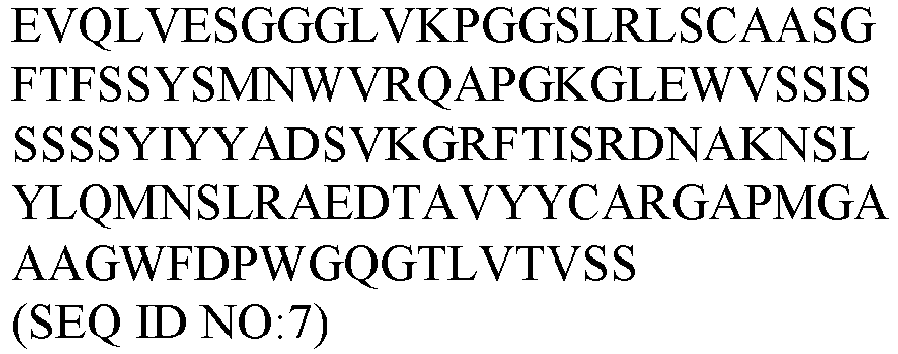 CDR1 (SEQ ID NO:32) - RASQGISSWLA

CDR2 (SEQ ID NO:33) - AASSLQS CDR2 (SEQ ID NO:30) - SISSSSSYIYYADSVKG CDR3 (SEQ ID NO:34) - QQGVSFPRT CDR3 non-Kabat (SEQ ID NO:31) - ARGAPMGAAAGWFDP or CDR3 (SEQ ID NO:71) - GAPMGAAAGWFDP ADI-29378 (E78) CDR1 non-Kabat (SEQ ID NO:35) - YTFTSYYMH or CDR1 (SEQ ID NO:45) - SYYMH CDR1 (SEQ ID NO:38) - RASQSVSSYLA

CDR2 (SEQ ID NO:39) - DASNRAT CDR2 (SEQ ID NO:36) - IINPSGGSTSYAQKFQG CDR3 (SEQ ID NO:40) - QQSDNWPFT CDR3 non-Kabat (SEQ ID NO:37) - AREGAGF A YGMDYYYMDV or CDR3 (SEQ ID NO:72) - EGAGFAYGMDYYYMDV A49MQ CDR1 non-Kabat (SEQ ID NO:29) - FTFSSYSMN or CDR1 (SEQ ID NO:48) - SYSMN CDR1 (SEQ ID NO:32) - RASQGISSWLA

CDR2 (SEQ ID NO:33) - AASSLQS CDR2 (SEQ ID NO:30) - SISSSSSYIYYADSVKG CDR3 (SEQ ID NO:34) - QQGVSFPRT CDR3 non-Kabat (SEQ ID NO:73) - ARGAP Q GAAAGWFDP or CDR3 (SEQ ID NO:74) - GAP Q GAAAGWFDP A49ML CDR1 non-Kabat (SEQ ID NO:29) - FTFSSYSMN or CDR1 (SEQ ID NO:48) - SYSMN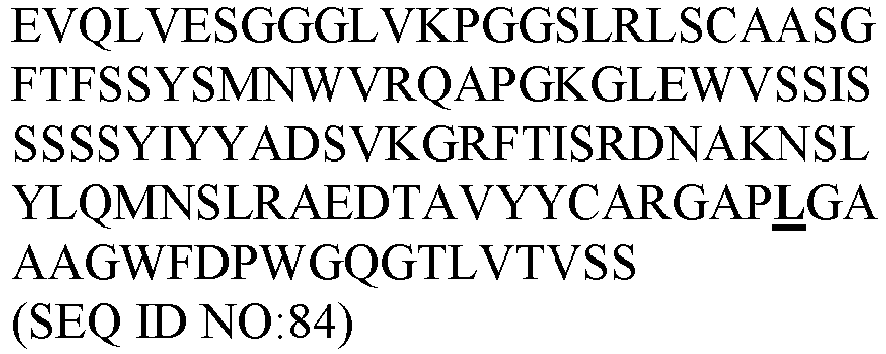 CDR1 (SEQ ID NO:32) - RASQGISSWLA

CDR2 (SEQ ID NO:33) - AASSLQS CDR2 (SEQ ID NO:30) - SISSSSSYIYYADSVKG CDR3 (SEQ ID NO:34) - QQGVSFPRT CDR3 non-Kabat (SEQ ID NO:75) - ARGAP L GAAAGWFDP or CDR3 (SEQ ID NO:76) - GAP L GAAAGWFDP A49MI 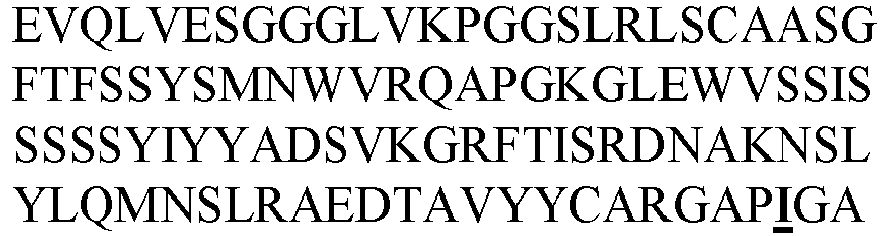
 CDR1 non-Kabat (SEQ ID NO:29) - FTFSSYSMN or CDR1 (SEQ ID NO:48) -
 CDR1 (SEQ ID NO:32) - RASQGISSWLA

SYSMN CDR2 (SEQ ID NO:33) - AASSLQS CDR2 (SEQ ID NO:30) - SISSSSSYIYYADSVKG CDR3 (SEQ ID NO:34) - QQGVSFPRT CDR3 non-Kabat (SEQ ID NO:77) - ARGAP I GAAAGWFDP or CDR3 (SEQ ID NO:78) - GAP I GAAAGWFDP A49MF CDR1 non-Kabat (SEQ ID NO:29) - FTFSSYSMN or CDR1 (SEQ ID NO:48) - CDR1 (SEQ ID NO:32) - RASQGISSWLA
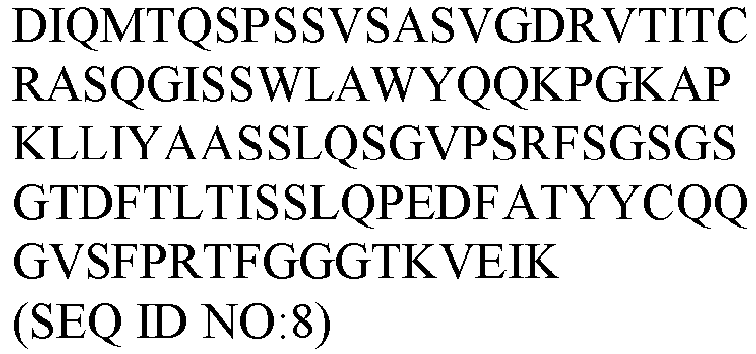
SYSMN CDR2 (SEQ ID NO:33) - AASSLQS CDR2 (SEQ ID NO:30) - SISSSSSYIYYADSVKG CDR3 (SEQ ID NO:34) - QQGVSFPRT CDR3 non-Kabat (SEQ ID NO:79) - ARGAP F GAAAGWFDP or CDR3 (SEQ ID NO:80) - GAP F GAAAGWFDP A49MV CDR1 non-Kabat (SEQ ID NO:29) - FTFSSYSMN or CDR1 (SEQ ID NO:48) - CDR1 (SEQ ID NO:32) - RASQGISSWLA

SYSMN CDR2 (SEQ ID NO:33) - AASSLQS CDR2 (SEQ ID NO:30) - SISSSSSYIYYADSVKG CDR3 (SEQ ID NO:34) - QQGVSFPRT CDR3 non-Kabat (SEQ ID NO:81) - ARGAP V GAAAGWFDP or CDR3 (SEQ ID NO:82) - GAP V GAAAGWFDP A49-consensus EVQLVESGGGLVKPGGSLRLSCAASG FTFSSYSMNWVRQAPGKGLEWVSSIS SSSSYIYYADSVKGRFTISRDNAKNSL YLQMNSLRAEDTAVYYCARGAP X GA AAGWFDPWGQGTLVTVSS, wherein X is M, L, I, V, Q, or F (SEQ ID NO:42) CDR1 (SEQ ID NO:32) - RASQGISSWLA
CDR1 non-Kabat (SEQ ID NO:29) - FTFSSYSMN or CDR1 (SEQ ID NO:48) - CDR2 (SEQ ID NO:33) - AASSLQS SYSMN CDR3 (SEQ ID NO:34) - QQGVSFPRT CDR2 (SEQ ID NO:30) - SISSSSSYIYYADSVKG CDR3 non-Kabat (SEQ ID NO:43) - ARGAP X GAAAGWFDP or CDR3 (SEQ ID NO:44) - GAP X GAAAGWFDP, wherein X is M, L, I, V, Q, or F - One advantage of one or more of the antibody heavy chain variable domain amino acid sequences described above is that they can bind to NKG2D from humans and cynomolgus monkeys to agonize the receptor, and compete with natural ligands for binding to the receptor. Additional antigen-binding sites that bind NKG2D and share one or more of these properties are also particularly useful and can be identified by binding competition assays known in the art. For example, the additional antigen-binding sites can be identified by competition with ADI-29379, ADI-29463, ADI-27744, ADI-27749, or ADI-29378 for binding to both human and optionally cynomolgus monkey NKG2D.
- Another advantage of the NKG2D-binding sites which comprise the antibody heavy chain variable domains and light chain variable domains sequences described above is that they can bind to NKG2D with high affinity. In some embodiments, NKG2D-binding sites bind to NKG2D with a KD of 0.1 to 1000 nM. In some embodiments, NKG2D-binding sites bind to NKG2D with a KD of 1 to 500 nM. In some embodiments, NKG2D-binding sites bind to NKG2D with a KD of 5 to 100 nM. In some embodiments, NKG2D-binding sites bind to NKG2D with a KD of 10 to 62 nM.
- In certain embodiments, the present invention provides an antigen-binding site that includes an antibody heavy chain variable domain that includes an amino acid sequence at least 90% (e.g., 91%, 92%, 93%, 94%, 95%, 96%, 97%, 98%, 99%, or 100%) identical to the amino acid sequence of SEQ ID NO: 1, and an antibody light chain variable domain that includes an amino acid sequence at least 90% (e.g., 91%, 92%, 93%, 94%, 95%, 96%, 97%, 98%, 99%, or 100%) identical to SEQ ID NO:2. In certain embodiments, an antigen-binding site that includes an antibody heavy chain variable domain with an amino acid sequence at least 90% (e.g., 91%, 92%, 93%, 94%, 95%, 96%, 97%, 98%, 99%, or 100%) identical to the amino acid sequence of SEQ ID NO: 1, includes a CDR1 sequence represented by the amino acid sequence of SEQ ID NO:11 or SEQ ID NO:91, a CDR2 sequence represented by the amino acid sequence of SEQ ID NO: 12, and a CDR3 sequence represented by the amino acid sequence of SEQ ID NO: 13 or 68. In certain embodiments, an antigen-binding site that includes an antibody light chain variable domain with an amino acid sequence at least 90% (e.g., 91%, 92%, 93%, 94%, 95%, 96%, 97%, 98%, 99%, or 100%) identical to the amino acid sequence of SEQ ID NO:2, includes a CDR1 sequence represented by the amino acid sequence of SEQ ID NO:14, a CDR2 sequence represented by the amino acid sequence of SEQ ID NO:15, and a CDR3 sequence represented by the amino acid sequence of SEQ ID NO:16.
- In certain embodiments, the present invention provides an antigen-binding site that includes an antibody heavy chain variable domain that includes an amino acid sequence at least 90% (e.g., 91%, 92%, 93%, 94%, 95%, 96%, 97%, 98%, 99%, or 100%) identical to the amino acid sequence of SEQ ID NO:3, and an antibody light chain variable domain that includes an amino acid sequence at least 90% (e.g., 91%, 92%, 93%, 94%, 95%, 96%, 97%, 98%, 99%, or 100%) identical to SEQ ID NO:4. In certain embodiments, an antigen-binding site that includes an antibody heavy chain variable domain with an amino acid sequence at least 90% (e.g., 91%, 92%, 93%, 94%, 95%, 96%, 97%, 98%, 99%, or 100%) identical to the amino acid sequence of SEQ ID NO:3, includes a CDR1 sequence represented by the amino acid sequence of SEQ ID NO:17 or SEQ ID NO:92, a CDR2 sequence represented by the amino acid sequence of SEQ ID NO:18, and a CDR3 sequence represented by the amino acid sequence of SEQ ID NO:19 or SEQ ID NO:69. In certain embodiments, an antigen-binding site that includes an antibody light chain variable domain with an amino acid sequence at least 90% (e.g., 91%, 92%, 93%, 94%, 95%, 96%, 97%, 98%, 99%, or 100%) identical to the amino acid sequence of SEQ ID NO:4, includes a CDR1 sequence represented by the amino acid sequence of SEQ ID NO:20, a CDR2 sequence represented by the amino acid sequence of SEQ ID NO:21, and a CDR3 sequence represented by the amino acid sequence of SEQ ID NO:22.
- In certain embodiments, the present invention provides an antigen-binding site that includes an antibody heavy chain variable domain that includes an amino acid sequence at least 90% (e.g., 91%, 92%, 93%, 94%, 95%, 96%, 97%, 98%, 99%, or 100%) identical to the amino acid sequence of SEQ ID NO:5, and an antibody light chain variable domain that includes an amino acid sequence at least 90% (e.g., 91%, 92%, 93%, 94%, 95%, 96%, 97%, 98%, 99%, or 100%) identical to SEQ ID NO:6. In certain embodiments, an antigen-binding site that includes an antibody heavy chain variable domain with an amino acid sequence at least 90% (e.g., 91%, 92%, 93%, 94%, 95%, 96%, 97%, 98%, 99%, or 100%) identical to the amino acid sequence of SEQ ID NO:5, includes a CDR1 sequence represented by the amino acid sequence of SEQ ID NO:23 or SEQ ID NO:93, a CDR2 sequence represented by the amino acid sequence of SEQ ID NO:24, and a CDR3 sequence represented by the amino acid sequence of SEQ ID NO:25 or SEQ ID NO:70. In certain embodiments, an antigen-binding site that includes an antibody light chain variable domain with an amino acid sequence at least 90% (e.g., 91%, 92%, 93%, 94%, 95%, 96%, 97%, 98%, 99%, or 100%) identical to the amino acid sequence of SEQ ID NO:6, includes a CDR1 sequence represented by the amino acid sequence of SEQ ID NO:26, a CDR2 sequence represented by the amino acid sequence of SEQ ID NO:27, and a CDR3 sequence represented by the amino acid sequence of SEQ ID NO:28.
- In certain embodiments, the present invention provides an antigen-binding site that includes an antibody heavy chain variable domain that includes an amino acid sequence at least 90% (e.g., 91%, 92%, 93%, 94%, 95%, 96%, 97%, 98%, 99%, or 100%) identical to the amino acid sequence of SEQ ID NO:7, and an antibody light chain variable domain that includes an amino acid sequence at least 90% (e.g., 91%, 92%, 93%, 94%, 95%, 96%, 97%, 98%, 99%, or 100%) identical to SEQ ID NO:8. In certain embodiments, an antigen-binding site that includes an antibody heavy chain variable domain with an amino acid sequence at least 90% (e.g., 91%, 92%, 93%, 94%, 95%, 96%, 97%, 98%, 99%, or 100%) identical to the amino acid sequence of SEQ ID NO:7, includes a CDR1 sequence represented by the amino acid sequence of SEQ ID NO:29 or SEQ ID NO:94, a CDR2 sequence represented by the amino acid sequence of SEQ ID NO:30, and a CDR3 sequence represented by the amino acid sequence of SEQ ID NO:31 or SEQ ID NO:71. In certain embodiments, an antigen-binding site that includes an antibody light chain variable domain with an amino acid sequence at least 90% (e.g., 91%, 92%, 93%, 94%, 95%, 96%, 97%, 98%, 99%, or 100%) identical to the amino acid sequence of SEQ ID NO:8, includes a CDR1 sequence represented by the amino acid sequence of SEQ ID NO:32, a CDR2 sequence represented by the amino acid sequence of SEQ ID NO:33, and a CDR3 sequence represented by the amino acid sequence of SEQ ID NO:34.
- The amino acid residue M at position 102 of SEQ ID NO:7, which is in CDR3 of the heavy chain variable domain, can be mutated. In certain embodiments, M102 is substituted by a non-charged residue. In certain embodiments, M102 is substituted by a hydrophobic residue (Gly, Ala, Val, Leu, Ile, Pro, Phe, or Trp). In certain embodiments, M102 is substituted by a polar residue (Ser, Thr, Cys, Asn, Gln, or Tyr). In certain embodiments, M102 is substituted by Leu, Ile, Val, Gln, or Phe.
- Accordingly, in certain embodiments, the present invention provides an antigen-binding site that includes an antibody heavy chain variable domain that includes an amino acid sequence at least 90% (e.g., 91%, 92%, 93%, 94%, 95%, 96%, 97%, 98%, 99%, or 100%) identical to the amino acid sequence of SEQ ID NO:83, and an antibody light chain variable domain that includes an amino acid sequence at least 90% (e.g., 91%, 92%, 93%, 94%, 95%, 96%, 97%, 98%, 99%, or 100%) identical to SEQ ID NO:8. In certain embodiments, an antigen-binding site that includes an antibody heavy chain variable domain with an amino acid sequence at least 90% (e.g., 91%, 92%, 93%, 94%, 95%, 96%, 97%, 98%, 99%, or 100%) identical to the amino acid sequence of SEQ ID NO:83, includes a CDR1 sequence represented by the amino acid sequence of SEQ ID NO:29 or SEQ ID NO:94, a CDR2 sequence represented by the amino acid sequence of SEQ ID NO:30, and a CDR3 sequence represented by the amino acid sequence of SEQ ID NO:73 or SEQ ID NO:74. In certain embodiments, an antigen-binding site that includes an antibody light chain variable domain with an amino acid sequence at least 90% (e.g., 91%, 92%, 93%, 94%, 95%, 96%, 97%, 98%, 99%, or 100%) identical to the amino acid sequence of SEQ ID NO:8, includes a CDR1 sequence represented by the amino acid sequence of SEQ ID NO:32, a CDR2 sequence represented by the amino acid sequence of SEQ ID NO:33, and a CDR3 sequence represented by the amino acid sequence of SEQ ID NO:34.
- In certain embodiments, the present invention provides an antigen-binding site that includes an antibody heavy chain variable domain that includes an amino acid sequence at least 90% (e.g., 91%, 92%, 93%, 94%, 95%, 96%, 97%, 98%, 99%, or 100%) identical to the amino acid sequence of SEQ ID NO:84, and an antibody light chain variable domain that includes an amino acid sequence at least 90% (e.g., 91%, 92%, 93%, 94%, 95%, 96%, 97%, 98%, 99%, or 100%) identical to SEQ ID NO:8. In certain embodiments, an antigen-binding site that includes an antibody heavy chain variable domain with an amino acid sequence at least 90% (e.g., 91%, 92%, 93%, 94%, 95%, 96%, 97%, 98%, 99%, or 100%) identical to the amino acid sequence of SEQ ID NO:84, includes a CDR1 sequence represented by the amino acid sequence of SEQ ID NO:29 or SEQ ID NO:94, a CDR2 sequence represented by the amino acid sequence of SEQ ID NO:30, and a CDR3 sequence represented by the amino acid sequence of SEQ ID NO:75 or SEQ ID NO:76. In certain embodiments, an antigen-binding site that includes an antibody light chain variable domain with an amino acid sequence at least 90% (e.g., 91%, 92%, 93%, 94%, 95%, 96%, 97%, 98%, 99%, or 100%) identical to the amino acid sequence of SEQ ID NO:8, includes a CDR1 sequence represented by the amino acid sequence of SEQ ID NO:32, a CDR2 sequence represented by the amino acid sequence of SEQ ID NO:33, and a CDR3 sequence represented by the amino acid sequence of SEQ ID NO:34.
- In certain embodiments, the present invention provides an antigen-binding site that includes an antibody heavy chain variable domain that includes an amino acid sequence at least 90% (e.g., 91%, 92%, 93%, 94%, 95%, 96%, 97%, 98%, 99%, or 100%) identical to the amino acid sequence of SEQ ID NO:85, and an antibody light chain variable domain that includes an amino acid sequence at least 90% (e.g., 91%, 92%, 93%, 94%, 95%, 96%, 97%, 98%, 99%, or 100%) identical to SEQ ID NO:8. In certain embodiments, an antigen-binding site that includes an antibody heavy chain variable domain with an amino acid sequence at least 90% (e.g., 91%, 92%, 93%, 94%, 95%, 96%, 97%, 98%, 99%, or 100%) identical to the amino acid sequence of SEQ ID NO:85, includes a CDR1 sequence represented by the amino acid sequence of SEQ ID NO:29 or SEQ ID NO:94, a CDR2 sequence represented by the amino acid sequence of SEQ ID NO:30, and a CDR3 sequence represented by the amino acid sequence of SEQ ID NO:77 or SEQ ID NO:78. In certain embodiments, an antigen-binding site that includes an antibody light chain variable domain with an amino acid sequence at least 90% (e.g., 91%, 92%, 93%, 94%, 95%, 96%, 97%, 98%, 99%, or 100%) identical to the amino acid sequence of SEQ ID NO:8, includes a CDR1 sequence represented by the amino acid sequence of SEQ ID NO:32, a CDR2 sequence represented by the amino acid sequence of SEQ ID NO:33, and a CDR3 sequence represented by the amino acid sequence of SEQ ID NO:34.
- In certain embodiments, the present invention provides an antigen-binding site that includes an antibody heavy chain variable domain that includes an amino acid sequence at least 90% (e.g., 91%, 92%, 93%, 94%, 95%, 96%, 97%, 98%, 99%, or 100%) identical to the amino acid sequence of SEQ ID NO:86, and an antibody light chain variable domain that includes an amino acid sequence at least 90% (e.g., 91%, 92%, 93%, 94%, 95%, 96%, 97%, 98%, 99%, or 100%) identical to SEQ ID NO:8. In certain embodiments, an antigen-binding site that includes an antibody heavy chain variable domain with an amino acid sequence at least 90% (e.g., 91%, 92%, 93%, 94%, 95%, 96%, 97%, 98%, 99%, or 100%) identical to the amino acid sequence of SEQ ID NO:86, includes a CDR1 sequence represented by the amino acid sequence of SEQ ID NO:29 or SEQ ID NO:94, a CDR2 sequence represented by the amino acid sequence of SEQ ID NO:30, and a CDR3 sequence represented by the amino acid sequence of SEQ ID NO:79 or 80. In certain embodiments, an antigen-binding site that includes an antibody light chain variable domain with an amino acid sequence at least 90% (e.g., 91%, 92%, 93%, 94%, 95%, 96%, 97%, 98%, 99%, or 100%) identical to the amino acid sequence of SEQ ID NO:8, includes a CDR1 sequence represented by the amino acid sequence of SEQ ID NO:32, a CDR2 sequence represented by the amino acid sequence of SEQ ID NO:33, and a CDR3 sequence represented by the amino acid sequence of SEQ ID NO:34.
- In certain embodiments, the present invention provides an antigen-binding site that includes an antibody heavy chain variable domain that includes an amino acid sequence at least 90% (e.g., 91%, 92%, 93%, 94%, 95%, 96%, 97%, 98%, 99%, or 100%) identical to the amino acid sequence of SEQ ID NO:41, and an antibody light chain variable domain that includes an amino acid sequence at least 90% (e.g., 91%, 92%, 93%, 94%, 95%, 96%, 97%, 98%, 99%, or 100%) identical to SEQ ID NO:8. In certain embodiments, an antigen-binding site that includes an antibody heavy chain variable domain with an amino acid sequence at least 90% (e.g., 91%, 92%, 93%, 94%, 95%, 96%, 97%, 98%, 99%, or 100%) identical to the amino acid sequence of SEQ ID NO:41, includes a CDR1 sequence represented by the amino acid sequence of SEQ ID NO:29 or SEQ ID NO:94, a CDR2 sequence represented by the amino acid sequence of SEQ ID NO:30, and a CDR3 sequence represented by the amino acid sequence of SEQ ID NO:81 or SEQ ID NO:82. In certain embodiments, an antigen-binding site that includes an antibody light chain variable domain with an amino acid sequence at least 90% (e.g., 91%, 92%, 93%, 94%, 95%, 96%, 97%, 98%, 99%, or 100%) identical to the amino acid sequence of SEQ ID NO:8, includes a CDR1 sequence represented by the amino acid sequence of SEQ ID NO:32, a CDR2 sequence represented by the amino acid sequence of SEQ ID NO:33, and a CDR3 sequence represented by the amino acid sequence of SEQ ID NO:34.
- In certain embodiments, the present invention provides an antigen-binding site that includes an antibody heavy chain variable domain that includes an amino acid sequence at least 90% (e.g., 91%, 92%, 93%, 94%, 95%, 96%, 97%, 98%, 99%, or 100%) identical to the amino acid sequence of SEQ ID NO:9, and an antibody light chain variable domain that includes an amino acid sequence at least 90% (e.g., 91%, 92%, 93%, 94%, 95%, 96%, 97%, 98%, 99%, or 100%) identical to SEQ ID NO:10. In certain embodiments, an antigen-binding site that includes an antibody heavy chain variable domain with an amino acid sequence at least 90% (e.g., 91%, 92%, 93%, 94%, 95%, 96%, 97%, 98%, 99%, or 100%) identical to the amino acid sequence of SEQ ID NO:9, includes a CDR1 sequence represented by the amino acid sequence of SEQ ID NO:35 or SEQ ID NO:91, a CDR2 sequence represented by the amino acid sequence of SEQ ID NO:36, and a CDR3 sequence represented by the amino acid sequence of SEQ ID NO:37 or SEQ ID NO:72. In certain embodiments, an antigen-binding site that includes an antibody light chain variable domain with an amino acid sequence at least 90% (e.g., 91%, 92%, 93%, 94%, 95%, 96%, 97%, 98%, 99%, or 100%) identical to the amino acid sequence of SEQ ID NO:10, includes a CDR1 sequence represented by the amino acid sequence of SEQ ID NO:38, a CDR2 sequence represented by the amino acid sequence of SEQ ID NO:39, and a CDR3 sequence represented by the amino acid sequence of SEQ ID NO:40.
- In certain embodiments, the present invention provides an antigen-binding site that includes an antibody heavy chain variable domain that includes an amino acid sequence at least 90% (e.g., 91%, 92%, 93%, 94%, 95%, 96%, 97%, 98%, 99%, or 100%) identical to the amino acid sequence of SEQ ID NO:5, and an antibody light chain variable domain that includes an amino acid sequence at least 90% (e.g., 91%, 92%, 93%, 94%, 95%, 96%, 97%, 98%, 99%, or 100%) identical to SEQ ID NO:6, that does not block the binding of anti-NKG2D antibodies MS, 1D11, and MAB139 to NKG2D.
- In embodiments, an antigen-binding site that includes an antibody heavy chain variable domain that includes an amino acid sequence at least 90% (e.g., 91%, 92%, 93%, 94%, 95%, 96%, 97%, 98%, 99%, or 100%) identical to the amino acid sequence of SEQ ID NO:7, 83, 84, 85, 86, or 87, and an antibody light chain variable domain that includes an amino acid sequence at least 90% (e.g., 91%, 92%, 93%, 94%, 95%, 96%, 97%, 98%, 99%, or 100%) identical to SEQ ID NO:8, does not block binding of an antigen-binding site that includes an antibody heavy chain variable domain that includes an amino acid sequence at least 90% (e.g., 91%, 92%, 93%, 94%, 95%, 96%, 97%, 98%, 99%, or 100%) identical to the amino acid sequence of SEQ ID NO:5, and an antibody light chain variable domain that includes an amino acid sequence at least 90% (e.g., 91%, 92%, 93%, 94%, 95%, 96%, 97%, 98%, 99%, or 100%) identical to SEQ ID NO:6 to NKG2D.
- In certain embodiments, an antigen-binding site that includes an antibody heavy chain variable domain that includes an amino acid sequence at least 90% (e.g., 91%, 92%, 93%, 94%, 95%, 96%, 97%, 98%, 99%, or 100%) identical to the amino acid sequence of SEQ ID NO:5, and an antibody light chain variable domain that includes an amino acid sequence at least 90% (e.g., 91%, 92%, 93%, 94%, 95%, 96%, 97%, 98%, 99%, or 100%) identical to SEQ ID NO:6, binds to a unique epitope on NKG2D, different from MS, 1D11, MAB139, ADI-27749 and F47 binding epitope(s).
- In some embodiments of this invention, the NKG2D antigen-binding sites formed by pairing an antibody heavy chain variable domain with a light chain variable domain described herein can be included into larger proteins such as intact antibodies, multi-specific binding proteins or multi-specific binding antibodies. For example, an NKG2D-binding site can be combined with a second component, e.g., a second antigen-binding site. In some embodiments, the second antigen-binding site binds to one or more tumor-associated antigens, such as CD33, HER2, EpCAM, CD2, CD3, CD8, CD10, CD19, CD20, CD21, CD22, CD23, CD24, CD25, CD30, CD33, CD37, CD38, CD40, CD45RO, CD48, CD52, CD55, CD59, CD70, CD74, CD80, CD86, CD138, CD147, HLA-DR, CSAp, CA-125, TAG-72, EFGR/ERBB1, IGF1R, HER3, HER4, IGF-1R, c-Met, PDGFR, MUC1, MUC2, MUC3, MUC4, TNFR1, TNFR2, NGFR, TRAILR1, TRAILR2, Fas (CD95), DR3, DR4, DR5, DR6, VEGF, PIGF, tenascin, ED-B fibronectin, PSA, and IL-6, MAGE-A3, B7.1, B7.2, CTLA4 or PD1. Binding of a multi-specific protein to NKG2D and to a tumor-associated antigen on a cancer cell brings the cancer cell into proximity to the natural killer cell, which facilitates destruction of the cancer cell by the natural killer cell either directly or indirectly.
- In some embodiments, in addition to an NKG2D-binding site and a tumor-associated antigen-binding site, a multi-specific binding protein can further include a domain that binds to CD16, an Fc receptor on the surface of leukocytes including natural killer cells, macrophages, neutrophils, eosinophils, mast cells, and follicular dendritic cells. In some embodiments, the CD16 binding domain can include an antibody Fc region or a portion thereof. In some embodiments, the domain that binds to CD16 contains hinge, CH2 and CH3 domains of an antibody Fc region without or without CH1 domain. In some embodiments, the antibody Fc region is derived from the Fc regions in the human and/or other mammalian immunoglobulins. It is known that within the Fc region, CD16 binding is mediated by the hinge region and the CH2 domain. For example, within human IgG1, the interaction with CD16 is mediated through amino acid residues Asp 265 - Glu 269, Asn 297 - Thr 299, Ala 327 - Ile 332, Leu 234 - Ser 239, and carbohydrate residue N-acetyl-D-glucosamine in the CH2 domain (see Sondermann et al, Nature, 406(6793):267-273). Based on the known domains and amino acid residues, in some embodiments, mutations can be selected within the CD16 binding domain to enhance or reduce its binding affinity to CD16. Selection methods are well known methods in the art, such as phage-displayed libraries or yeast surface-displayed cDNA libraries. Appropriate selection methods can also be designed based on the known three-dimensional structure of the interaction by a skilled person in the art.
- The multi-specific binding proteins described herein can take various formats. For example, one format is a heterodimeric, multi-specific antibody that includes a first immunoglobulin heavy chain, a first immunoglobulin light chain, a second immunoglobulin heavy chain and a second immunoglobulin light chain. The first immunoglobulin heavy chain includes a first Fc (hinge-CH2-CH3) domain, a first heavy chain variable domain and optionally a first CH1 heavy chain domain. The first immunoglobulin light chain includes a first light chain variable domain and a first light chain constant domain. The first immunoglobulin light chain, together with the first immunoglobulin heavy chain, forms an antigen-binding site that binds NKG2D. The second immunoglobulin heavy chain comprises a second Fc (hinge-CH2-CH3) domain, a second heavy chain variable domain and optionally a second CH1 heavy chain domain. The second immunoglobulin light chain includes a second light chain variable domain and a second light chain constant domain. The second immunoglobulin light chain, together with the second immunoglobulin heavy chain, forms an antigen-binding site that binds a tumor antigen. The first Fc domain and second Fc domain together are able to bind to CD16 (
FIG. 1 ). - Another exemplary format involves a heterodimeric, multi-specific antibody that includes a first immunoglobulin heavy chain, a second immunoglobulin heavy chain and an immunoglobulin light chain. The first immunoglobulin heavy chain includes a first Fc (hinge-CH2-CH3) domain fused via either a linker or an antibody hinge to a single-chain variable fragment (scFv) composed of a heavy variable domain and light chain variable domain which pair and bind NKG2D. The second immunoglobulin heavy chain includes a second Fc (hinge-CH2-CH3) domain, a second heavy chain variable domain and optionally a CH1 heavy chain domain. The immunoglobulin light chain includes a light chain variable domain and a constant light chain domain. The second immunoglobulin heavy chain pairs with the immunoglobulin light chain and binds to a tumor-associated antigen. The first Fc domain and the second Fc domain together are able to bind to CD16 (
FIG. 2 ). Additional formats of the multi-specific binding proteins can be devised by combining various formats of NKG2D-binding-fragments described herein. - One or more additional binding motifs may be fused to the C-terminus of the constant region CH3 domain, optionally via a linker sequence. In certain embodiments, the antigen-binding site could be a single-chain or disulfide-stabilized variable region (scFv) or could form a tetravalent or trivalent molecule.
- In some embodiments, the multi-specific binding protein is in the Triomab form, which is a trifunctional, bispecific antibody that maintains an IgG-like shape. This chimera consists of two half antibodies, each with one light and one heavy chain, that originate from two parental antibodies. Triomab form is an heterodimeric construct containing ½ of rat antibody and ½ of mouse antibody.
- In some embodiments, the multi-specific binding protein is the KiH Common Light Chain (LC) form, which involves the knobs-into-holes (KIHs) technology. The KIH involves
engineering C H3 domains to create either a "knob" or a "hole" in each heavy chain to promote heterodimerization. The concept behind the "Knobs-into-Holes (KiH)" Fc technology was to introduce a "knob" in one CH3 domain (CH3A) by substitution of a small residue with a bulky one (i.e., T366WCH3A in EU numbering). To accommodate the "knob," a complementary "hole" surface was created on the other CH3 domain (CH3B) by replacing the closest neighboring residues to the knob with smaller ones (i.e., T366S/L368A/Y407VCH3B). The "hole" mutation was optimized by structured-guided phage library screening (Atwell S, Ridgway JB, Wells JA, Carter P. Stable heterodimers from remodeling the domain interface of a homodimer using a phage display library. J Mol Biol (1997) 270(1):26-35). X-ray crystal structures of KiH Fc variants (Elliott JM, Ultsch M, Lee J, Tong R, Takeda K, Spiess C, et al., Antiparallel conformation of knob and hole aglycosylated half-antibody homodimers is mediated by a CH2-CH3 hydrophobic interaction. J Mol Biol (2014) 426(9): 1947-57; Mimoto F, Kadono S, Katada H, Igawa T, Kamikawa T, Hattori K. Crystal structure of a novel asymmetrically engineered Fc variant with improved affinity for FcgammaRs. Mol Immunol (2014) 58(1):132-8) demonstrated that heterodimerization is thermodynamically favored by hydrophobic interactions driven by steric complementarity at the inter-CH3 domain core interface, whereas the knob-knob and the hole-hole interfaces do not favor homodimerization owing to steric hindrance and disruption of the favorable interactions, respectively. - In some embodiments, the multi-specific binding protein is in the dual-variable domain immunoglobulin (DVD-Ig™) form, which combines the target binding domains of two monoclonal antibodies via flexible naturally occurring linkers, and yields a tetravalent IgG - like molecule. DVD-Ig™ is an homodimeric construct where variable
domain targeting antigen 2 is fused to the N terminus of variable domain ofFab targeting antigen 1 Construct contains normal Fc. - In some embodiments, the multi-specific binding protein is in the Orthogonal Fab interface (Ortho-Fab) form, which is an heterodimeric construct that contains 2 Fabs binding to target 1 and
target 2 fused to Fc. LC-HC pairing is ensured by orthogonal interface. Heterodimerization is ensured by mutations in the Fc. In ortho-Fab IgG approach (Lewis SM, Wu X, Pustilnik A, Sereno A, Huang F, Rick HL, et al. Generation of bispecific IgG antibodies by structure-based design of an orthogonal Fab interface. Nat. Biotechnol. (2014) 32(2): 191-8), structure-based regional design introduces complementary mutations at the LC and HCVH-CH1 interface in only one Fab, without any changes being made to the other Fab. - In some embodiments, the multi-specific binding protein is in the 2-in-1 Ig format. In some embodiments, the multi-specific binding protein is in the ES form, which is an heterodimeric construct containing 2 different Fabs binding to target 1 and
target 2 fused to the Fc. Heterodimerization is ensured by electrostatic steering mutations in the Fc. - In some embodiments, the multi-specific binding protein is in the κλ-Body form, which are an heterodimeric constructs with 2 different Fabs fused to Fc stabilized by heterodimerization mutations:
Fab1 targeting antigen 1 contains kappa LC, while secondFab targeting antigen 2 contains lambda LC. - In some embodiments, the multi-specific binding protein is in Fab Arm Exchange form (antibodies that exchange Fab arms by swapping a heavy chain and attached light chain (half-molecule) with a heavy-light chain pair from another molecule, which results in bispecific antibodies). Fab Arm Exchange form (cFae) is a heterodimer containing 2 Fabs binding to target 1 and 2, and an Fc stabilized by heterodimerization mutations.
- In some embodiments, the multi-specific binding protein is in the SEED Body form which is an heterodimer containing 2 Fabs binding to target 1 and 2, and an Fc stabilized by heterodimerization mutations. The strand-exchange engineered domain (SEED) platform was designed to generate asymmetric and bispecific antibody-like molecules, a capability that expands therapeutic applications of natural antibodies. This protein engineered platform is based on exchanging structurally related sequences of immunoglobulin within the conserved CH3 domains. The SEED design allows efficient generation of AG/GA heterodimers, while disfavoring homodimerization of AG and GA SEED CH3 domains. (Muda M. et al., Protein Eng. Des. Sel. (2011, 24(5):447-54)).
- In some embodiments, the multi-specific binding protein is in the LuZ-Y form, in which leucine zipper is used to induce heterodimerization of two different HCs. (Wranik, BJ. et al., J. Biol. Chem. (2012), 287:43331-9). LuZ-Y form is a heterodimer containing 2 different scFabs binding to target 1 and 2, fused to Fc. Heterodimerization is ensured through leucine zipper motifs fused to C-terminus of Fc.
- In some embodiments, the multi-specific binding protein is in the Cov-X-Body form (In bispecific CovX-Bodies, two different peptides are joined together using a branched azetidinone linker and fused to the scaffold antibody under mild conditions in a site-specific manner. Whereas the pharmacophores are responsible for functional activities, the antibody scaffold imparts long half-life and Ig-like distribution. The pharmacophores can be chemically optimized or replaced with other pharmacophores to generate optimized or unique bispecific antibodies. (Doppalapudi VR et al., PNAS (2010), 107(52);22611-22616).
- In some embodiments, the multi-specific binding protein is in an Oasc-Fab heterodimeric format that includes Fab binding to target 1 and scFab binding to target 2 fused to Fc. Heterodimerization is ensured by mutations in the Fc.
- In some embodiments, the multi-specific binding protein is in an DuetMab format containing 2 different Fabs binding to
antigen Fab - In some embodiments, the multi-specific binding protein is in an CrossmAb format which is an heterodimeric construct with 2 different Fabs binding to
Target - In some embodiments, the multi-specific binding protein is in an CrossmAb format which is an homodimeric constructs where Fab binding to
antigen 2 is fused to the N terminus of HC of Fab that binds toantigen 1. The construct contains wild- - Assembly of heterodimeric antibody heavy chains can be accomplished by expressing two different antibody heavy chain sequences in the same cell, which may lead to the assembly of homodimers of each antibody heavy chain as well as assembly of heterodimers. Preferential assembly of heterodimeric heavy chains within the multi-specific binding proteins described herein can be promoted by incorporating distinct pairs of amino acid substitutions into the first CH3 domain within the first heavy chain polypeptide and the second CH3 domain within the second heavy chain polypeptide that allow these two chains to selectively heterodimerize with each other, as shown in
US13/494870 US16/028850 US11/533709 US12/875015 US13/289934 US14/773418 US12/811207 US13/866756 US14/647480 US14/830336 - In one scenario, an amino acid substitution in the first polypeptide replaces the original amino acid with a larger amino acid, selected from arginine (R), phenylalanine (F), tyrosine (Y) or tryptophan (W), and at least one amino acid substitution in the second polypeptide replaces the original amino acid(s) with a smaller amino acid(s), chosen from alanine (A), serine (S), threonine (T), or valine (V), such that the larger amino acid substitution (a protuberance) fits into the surface of the smaller amino acid substitutions (a cavity). For example, one polypeptide can include a T366W substitution, and the other can include three substitutions including T366S, L368A, and Y407V.
- Alternatively, amino acid substitutions could be selected from the following sets of substitutions shown in Table 2.
Table 2 First Polypeptide Second Polypeptide Set 1 S364E/F405A Y349K/ T394F Set 2 S364H/D401K Y349T/ T411E Set 3 S364H/T394F Y349T/F405A Set 4 S364E/T394F Y349K/ F405A Set 5 S364E/T411E Y349K/D401K Set 6 S364D/T394F Y349K/ F405A Set 7 S364H/F405A Y349T/ T394F Set 8 S364K/E357Q L368D/K370S Set 9 L368D/ K370S S364K Set 10 L368E/ K370S S364K Set 11 K360E/Q362E D401K Set 12 L368D/K370S S364K/E357L Set 13 K370S S364K/E357Q Set 14 F405L K409R Set 15 K409R F405L - Alternatively, amino acid substitutions could be selected from the following sets of substitutions shown in Table 3.
Table 3 First Polypeptide Second Polypeptide Set 1 K409W D399V/ F405T Set 2 Y349S E357W Set 3 K360E Q347R Set 4 K360E/K409W Q347R/D399V/ F405T Set 5 Q347E/K360E/K409W Q347R/D399V/F405T Set 6 Y349S/K409W E357W/D399V/F405T - Alternatively, amino acid substitutions could be selected from the following set of substitutions shown in Table 4.
Table 4 First Polypeptide Second Polypeptide Set 1 T366K/L351K L351D/ L368E Set 2 T366K/L351K L351D/ Y349E Set 3 T366K/L351K L351D/Y349D Set 4 T366K/L351K L351D/Y349E/ L368E Set 5 T366K/L351K L351D/Y349D/L368E Set 6 E356K/D399K K392D/K409D - Alternatively, at least one amino acid substitution in each polypeptide chain could be selected from Table 5.
Table 5 First Polypeptide Second Polypeptide L351Y, D399R, D399K, S400K, S400R, Y407A, Y407I, Y407V T366V, T366I, T366L, T366M, N390D, N390E, K392L, K392M, K392V, K392F K392D, K392E, K409F, K409W, T411D and T411E - Alternatively, at least one amino acid substitutions could be selected from the following set of substitutions in Table 6, where the position(s) indicated in the First Polypeptide column is replaced by any known negatively-charged amino acid, and the position(s) indicated in the Second Polypeptide Column is replaced by any known positively-charged amino acid.
Table 6 First Polypeptide Second Polypeptide K392, K370, K409, or K439 D399, E356, or E357 - Alternatively, at least one amino acid substitutions could be selected from the following set of in Table 7, where the position(s) indicated in the First Polypeptide column is replaced by any known positively-charged amino acid, and the position(s) indicated in the Second Polypeptide Column is replaced by any known negatively-charged amino acid.
Table 7 First Polypeptide Second Polypeptide D399, E356, or E357 K409, K439, K370, or K392 - Alternatively, amino acid substitutions could be selected from the following set of in Table 8.
Table 8 First Polypeptide Second Polypeptide T350V, L351Y, F405A, and Y407V T350V, T366L, K392L, and T394W - Alternatively, or in addition, the structural stability of heterodimeric heavy chains within the multi-specific binding proteins can be increased by introducing S354C on either of the first or second polypeptide chain, and Y349C on the opposing polypeptide chain, which forms an artificial disulfide bridge within the interface of the two polypeptides.
- The multi-specific binding proteins described above can be made using recombinant DNA technology well known to a skilled person in the art. For example, a first nucleic acid sequence encoding the first immunoglobulin heavy chain can be cloned into a first expression vector; a second nucleic acid sequence encoding the second immunoglobulin heavy chain can be cloned into a second expression vector; a third nucleic acid sequence encoding the first immunoglobulin light chain can be cloned into a third expression vector; a fourth nucleic acid sequence encoding the second immunoglobulin light chain can be cloned into a fourth expression vector; the first, second, third and fourth expression vectors can be stably transfected together into host cells to produce the multimeric proteins.
- To achieve the highest yield of the multi-specific binding proteins, different ratios of the first, second, third and fourth expression vectors can be explored to determine the optimal ratio for transfection into the host cells. After transfection, single clones can be isolated for cell bank generation using methods known in the art, such as limited dilution, ELISA, FACS, microscopy, or Clonepix.
- Clones can be cultured under conditions suitable for bio-reactor scale-up and maintained expression of the multi-specific protein. The multi-specific binding proteins can be isolated and purified using methods known in the art including centrifugation, depth filtration, cell lysis, homogenization, freeze-thawing, affinity purification, gel filtration, ion exchange chromatography, hydrophobic interaction exchange chromatography, and mixed-mode chromatography.
- In certain embodiments, the present invention provides a protein that includes an antigen-binding site that competes with the NKG2D-binding sites described herein to bind to NKG2D. The NKG2D-binding sites described herein comprises amino acid sequences of SEQ ID NOs: 1 and 2; amino acid sequences of SEQ ID NOs: 3 and 4; amino acid sequences of SEQ ID NOs: 5 and 6; amino acid sequences of SEQ ID NOs: 7 and 8; amino acid sequences of SEQ ID NOs: 9 and 10; amino acid sequences of SEQ ID NOs: 83 and 8; amino acid sequences of SEQ ID NOs: 84 and 8; amino acid sequences of SEQ ID NOs: 85 and 8; amino acid sequences of SEQ ID NOs: 86 and 8; or amino acid sequences of SEQ ID NOs: 87 and 8. These NKG2D-binding sites can bind to different epitopes on NKG2D mapped by surface plasmon resonance. For example, ADI-27744 binds to a different epitope on NKG2D from ADI-27749 and other existing NKG2D antibodies, as shown in Example 2.
- In some embodiments, an antigen-binding site of the protein that competes with the NKG2D-binding sites includes a heavy chain variable domain having an amino acid sequence at least 50% (e.g., 50%, 60%, 70%, 80%, 90%, 91%, 92%, 93%, 94%, 95%, 96%, 97%, 98%, 99%, or 100%) identical to the amino acid sequence of SEQ ID NO: 1 and a light chain variable domain having an amino acid sequence at least at least 50% (e.g., 50%, 60%, 70%, 80%, 90%, 91%, 92%, 93%, 94%, 95%, 96%, 97%, 98%, 99%, or 100%) identical to the amino acid sequence of SEQ ID NO:2. In some embodiments, an antigen-binding site of the protein that competes with the NKG2D-binding sites includes a heavy chain variable domain having an amino acid sequence at least at least 50% (e.g., 50%, 60%, 70%, 80%, 90%, 91%, 92%, 93%, 94%, 95%, 96%, 97%, 98%, 99%, or 100%) identical to the amino acid sequence of SEQ ID NO:3 and a light chain variable domain having an amino acid sequence at least at least 50% (e.g., 50%, 60%, 70%, 80%, 90%, 91%, 92%, 93%, 94%, 95%, 96%, 97%, 98%, 99%, or 100%) identical to the amino acid sequence of SEQ ID NO:4. In some embodiments, an antigen-binding site of the protein that competes with the NKG2D-binding sites includes a heavy chain variable domain having an amino acid sequence at least at least 50% (e.g., 50%, 60%, 70%, 80%, 90%, 91%, 92%, 93%, 94%, 95%, 96%, 97%, 98%, 99%, or 100%) identical to the amino acid sequence of SEQ ID NO:5 and a light chain variable domain having an amino acid sequence at least at least 50% (e.g., 50%, 60%, 70%, 80%, 90%, 91%, 92%, 93%, 94%, 95%, 96%, 97%, 98%, 99%, or 100%) identical to the amino acid sequence of SEQ ID NO:6. In some embodiments, an antigen-binding site of the protein that competes with the NKG2D-binding sites includes a heavy chain variable domain having an amino acid sequence at least at least 50% (e.g., 50%, 60%, 70%, 80%, 90%, 91%, 92%, 93%, 94%, 95%, 96%, 97%, 98%, 99%, or 100%) identical to the amino acid sequence of SEQ ID NO:7 and a light chain variable domain having an amino acid sequence at least at least 50% (e.g., 50%, 60%, 70%, 80%, 90%, 91%, 92%, 93%, 94%, 95%, 96%, 97%, 98%, 99%, or 100%) identical to the amino acid sequence of SEQ ID NO:8. In some embodiments an antigen-binding site of the protein that competes with the NKG2D-binding sites includes a heavy chain variable domain having an amino acid sequence at least at least 50% (e.g., 50%, 60%, 70%, 80%, 90%, 91%, 92%, 93%, 94%, 95%, 96%, 97%, 98%, 99%, or 100%) identical to the amino acid sequence of SEQ ID NO:9 and a light chain variable domain having an amino acid sequence at least at least 50% (e.g., 50%, 60%, 70%, 80%, 90%, 91%, 92%, 93%, 94%, 95%, 96%, 97%, 98%, 99%, or 100%) identical to the amino acid sequence of SEQ ID NO: 10.
- In some embodiments, the protein that includes an antigen-binding site that competes with NKG2D-binding sites described herein further includes a second antigen-binding site that binds a tumor-associated antigen and/or a CD16 binding site. In some embodiments, the CD16 binding site is an antibody constant region or a portion thereof capable of binding CD16. In some embodiments, the CD16 binding site contains a human IgG1 Fc domain.
- In one aspect, the present disclosure provides a cell comprising one or more nucleic acids encoding a protein that contains: an NKG2D-binding site with a heavy chain variable domain having an amino acid sequence at least 90% (e.g., 91%, 92%, 93%, 94%, 95%, 96%, 97%, 98%, 99%, or 100%) identical to the amino acid sequence of SEQ ID NO:1, and a light chain variable domain having an amino acid sequence at least 90% (e.g., 91%, 92%, 93%, 94%, 95%, 96%, 97%, 98%, 99%, or 100%) identical to the amino acid sequence of SEQ ID NO:2; a NKG2D-binding site with a heavy chain variable domain having an amino acid sequence at least 90% (e.g., 91%, 92%, 93%, 94%, 95%, 96%, 97%, 98%, 99%, or 100%) identical to the amino acid sequence of SEQ ID NO:3, and a light chain variable domain having an amino acid sequence at least 90% (e.g., 91%, 92%, 93%, 94%, 95%, 96%, 97%, 98%, 99%, or 100%) identical to the amino acid sequence of SEQ ID NO:4; an NKG2D-binding site with a heavy chain variable domain having an amino acid sequence at least 90% (e.g., 91%, 92%, 93%, 94%, 95%, 96%, 97%, 98%, 99%, or 100%) identical to the amino acid sequence of SEQ ID NO:5, and a light chain variable domain having an amino acid sequence at least 90% (e.g., 91%, 92%, 93%, 94%, 95%, 96%, 97%, 98%, 99%, or 100%) identical to the amino acid sequence of SEQ ID NO:6; an NKG2D-binding site with a heavy chain variable domain having an amino acid sequence at least 90% (e.g., 91%, 92%, 93%, 94%, 95%, 96%, 97%, 98%, 99%, or 100%) identical to the amino acid sequence of SEQ ID NO:7, 83, 84, 85, 86, or 87, and a light chain variable domain having an amino acid sequence at least 90% (e.g., 91%, 92%, 93%, 94%, 95%, 96%, 97%, 98%, 99%, or 100%) identical to the amino acid sequence of SEQ ID NO:8; or an NKG2D-binding site with a heavy chain variable domain having an amino acid sequence at least 90% (e.g., 91%, 92%, 93%, 94%, 95%, 96%, 97%, 98%, 99%, or 100%) identical to the amino acid sequence of SEQ ID NO:9, and a light chain variable domain having an amino acid sequence at least 90% (e.g., 91%, 92%, 93%, 94%, 95%, 96%, 97%, 98%, 99%, or 100%) identical to the amino acid sequence of SEQ ID NO: 10.
- The invention provides methods for enhancing tumor cell death and/or treating cancer using a multi-specific binding protein described herein and/or a pharmaceutical composition described herein. The methods may be used to treat a variety of cancers. The type of cancer to be treated is desirably matched with the type of cancer cell to which the protein binds. Additional aspects and embodiments of the therapeutic methods are described below.
- In one aspect, the present disclosure also features pharmaceutical compositions that contain an effective amount of a protein, which contains an NKG2D-binding site described herein or an NKG2D-binding site that competes with the NKG2D-binding sites described herein, and a pharmaceutically acceptable carrier.
- In certain embodiments, the formulation includes a protein that comprises an antigen-binding site with a heavy chain variable domain having an amino acid sequence at least 90% (e.g., 91%, 92%, 93%, 94%, 95%, 96%, 97%, 98%, 99%, or 100%) identical to the amino acid sequence of SEQ ID NO: 1, and a light chain variable domain having an amino acid sequence at least 90% (e.g., 91%, 92%, 93%, 94%, 95%, 96%, 97%, 98%, 99%, or 100%) identical to the amino acid sequence of SEQ ID NO:2. In certain embodiments, the formulation includes a protein that includes an antigen-binding site with a heavy chain variable domain having an amino acid sequence at least 90% (e.g., 91%, 92%, 93%, 94%, 95%, 96%, 97%, 98%, 99%, or 100%) identical to the amino acid sequence of SEQ ID NO:3, and a light chain variable domain having an amino acid sequence at least 90% (e.g., 91%, 92%, 93%, 94%, 95%, 96%, 97%, 98%, 99%, or 100%) identical to the amino acid sequence of SEQ ID NO:4. In certain embodiments, the formulation includes a protein that includes an antigen-binding site with a heavy chain variable domain having an amino acid sequence at least 90% (e.g., 91%, 92%, 93%, 94%, 95%, 96%, 97%, 98%, 99%, or 100%) identical to the amino acid sequence of SEQ ID NO:5, and a light chain variable domain having an amino acid sequence at least 90% (e.g., 91%, 92%, 93%, 94%, 95%, 96%, 97%, 98%, 99%, or 100%) identical to the amino acid sequence of SEQ ID NO:6. In certain embodiments, the formulation includes a protein that includes an antigen-binding site with a heavy chain variable domain having an amino acid sequence at least 90% (e.g., 91%, 92%, 93%, 94%, 95%, 96%, 97%, 98%, 99%, or 100%) identical to the amino acid sequence of SEQ ID NO:7, 83, 84, 85, 86, or 87, and a light chain variable domain having an amino acid sequence at least 90% (e.g., 91%, 92%, 93%, 94%, 95%, 96%, 97%, 98%, 99%, or 100%) identical to the amino acid sequence of SEQ ID NO:8. In certain embodiments, the formulation includes a protein that includes an antigen-binding site with a heavy chain variable domain having an amino acid sequence at least 90% (e.g., 91%, 92%, 93%, 94%, 95%, 96%, 97%, 98%, 99%, or 100%) identical to the amino acid sequence of SEQ ID NO:9, and a light chain variable domain having an amino acid sequence at least 90% (e.g., 91%, 92%, 93%, 94%, 95%, 96%, 97%, 98%, 99%, or 100%) identical to the amino acid sequence of SEQ ID NO: 10.
- The composition can be formulated for use in a variety of drug delivery systems. One or more physiologically acceptable excipients or carriers can be included in the composition for proper formulation. Suitable formulations for use in the present disclosure are found in Remington's Pharmaceutical Sciences, Mack Publishing Company, Philadelphia, Pa., 17th ed., 1985. For a brief review of methods for drug delivery, see, e.g., Langer (Science 249:1527-1533, 1990).
- For example, this present disclosure could exist in an aqueous pharmaceutical formulation including a therapeutically effective amount of the protein in a buffered solution forming a formulation. Aqueous carriers can include sterile water for injection (SWFI), bacteriostatic water for injection (BWFI), a pH buffered solution (e.g. phosphate-buffered saline), sterile saline solution, Ringer's solution or dextrose solution. In certain embodiments, an aqueous formulation is prepared including the protein disclosed herein in a pH-buffered solution. The pH of the preparations typically will be between 3 and 11, more preferably between 5 and 9 or between 6 and 8, and most preferably between 7 and 8, such as 7 to 7.5. Ranges intermediate to the above recited pH's are also intended to be part of this disclosure. For example, ranges of values using a combination of any of the above recited values as upper and/or lower limits are intended to be included. Examples of buffers that will control the pH within this range include acetate (e.g. sodium acetate), succinate (such as sodium succinate), gluconate, histidine, citrate and other organic acid buffers. In certain embodiments, the buffer system includes citric acid monohydrate, sodium citrate, disodium phosphate dihydrate, and/or sodium dihydrogen phosphate dihydrate. In certain embodiments, the buffer system includes about 1.3 mg/ml of citric acid (e.g., 1.305 mg/ml), about 0.3 mg/ml of sodium citrate (e.g., 0.305 mg/ml), about 1.5 mg/ml of disodium phosphate dihydrate (e.g. 1.53 mg/ml), about 0.9 mg/ml of sodium dihydrogen phosphate dihydrate (e.g., 0.86), and about 6.2 mg/ml of sodium chloride (e.g., 6.165 mg/ml). In certain embodiments, the buffer system includes 1-1.5 mg/ml of citric acid, 0.25 to 0.5 mg/ml of sodium citrate, 1.25 to 1.75 mg/ml of disodium phosphate dihydrate, 0.7 to 1.1 mg/ml of sodium dihydrogen phosphate dihydrate, and 6.0 to 6.4 mg/ml of sodium chloride. The pH of the liquid formulation may be set by addition of a pharmaceutically acceptable acid and/or base. In certain embodiments, the pharmaceutically acceptable acid may be hydrochloric acid. In certain embodiments, the base may be sodium hydroxide.
- In some embodiments, the formulation includes an aqueous carrier, which is pharmaceutically acceptable (safe and non-toxic for administration to a human) and is useful for the preparation of a liquid formulation. Illustrative carriers include sterile water for injection (SWFI), bacteriostatic water for injection (BWFI), a pH buffered solution (e.g. phosphate-buffered saline), sterile saline solution, Ringer's solution or dextrose solution.
- A polyol, which acts as a tonicifier and may stabilize the antibody, may also be included in the formulation. The polyol is added to the formulation in an amount which may vary with respect to the desired isotonicity of the formulation. In certain embodiments, the aqueous formulation may be isotonic. The amount of polyol added may also be altered with respect to the molecular weight of the polyol. For example, a lower amount of a monosaccharide (e.g. mannitol) may be added, compared to a disaccharide (such as trehalose). In certain embodiments, the polyol which may be used in the formulation as a tonicity agent is mannitol. In certain embodiments, the mannitol concentration may be about 5 to about 20 mg/ml. In certain embodiments, the concentration of mannitol may be about 7.5 to 15 mg/ml. In certain embodiments, the concentration of mannitol may be about 10-14 mg/ml. In certain embodiments, the concentration of mannitol may be about 12 mg/ml. In certain embodiments, the polyol sorbitol may be included in the formulation.
- A detergent or surfactant may also be added to the formulation. Exemplary detergents include nonionic detergents such as polysorbates (e.g.
polysorbates detergent polysorbate 80 orTween 80.Tween 80 is a term used to describe polyoxyethylene (20) sorbitanmonooleate (see Fiedler, Lexikon der Hifsstoffe, Editio Cantor Verlag Aulendorf, 4th edi., 1996). In certain embodiments, the formulation may contain between about 0.1 mg/mL and about 10 mg/mL ofpolysorbate 80, or between about 0.5 mg/mL and about 5 mg/mL. In certain embodiments, about 0.1% polysorbate 80 may be added in the formulation. - In certain embodiments, the liquid formulation of the disclosure may be prepared as a 10 mg/mL concentration solution in combination with a sugar at stabilizing levels. In certain embodiments the liquid formulation may be prepared in an aqueous carrier. In certain embodiments, a stabilizer may be added in an amount no greater than that which may result in a viscosity undesirable or unsuitable for intravenous administration. In certain embodiments, the sugar may be disaccharides, e.g., sucrose. In certain embodiments, the liquid formulation may also include one or more of a buffering agent, a surfactant, and a preservative, which is added to the formulations herein to reduce bacterial action. The addition of a preservative may, for example, facilitate the production of a multi-use (multiple-dose) formulation.
- In some embodiments, the present disclosure provides a formulation with an extended shelf life including the protein of the present disclosure, in combination with mannitol, citric acid monohydrate, sodium citrate, disodium phosphate dihydrate, sodium dihydrogen phosphate dihydrate, sodium chloride,
polysorbate 80, water, and sodium hydroxide. - Deamidation is a common product variant of peptides and proteins that may occur during fermentation, harvest/cell clarification, purification, drug substance/drug product storage and during sample analysis. Deamidation is the loss of NH3 from a protein forming a succinimide intermediate that can undergo hydrolysis. The succinimide intermediate results in a mass decrease of 17 Da from the parent peptide. The subsequent hydrolysis results in an 18 u mass increase. Isolation of the succinimide intermediate is difficult due to instability under aqueous conditions. As such, deamidation is typically detectable as 1 u mass increase. Deamidation of an asparagine results in either aspartic or isoaspartic acid. The parameters affecting the rate of deamidation include pH, temperature, solvent dielectric constant, ionic strength, primary sequence, local polypeptide conformation and tertiary structure. The amino acid residues adjacent to Asn in the peptide chain affect deamidation rates. Gly and Ser following an Asn in protein sequences results in a higher susceptibility to deamidation. In certain embodiments, the liquid formulation of the present disclosure may be preserved under conditions of pH and humidity to prevent deamination of the protein product.
- In some embodiment, the formulation is a lyophilized formulation. In certain embodiments, the formulation is freeze-dried (lyophilized) and contained in about 12-60 vials. In certain embodiments, the formulation is freeze-dried and 45 mg of the freeze-dried formulation may be contained in one vial. In certain embodiments, the about 40 mg - about 100 mg of freeze-dried formulation is contained in one vial. In certain embodiments, freeze dried formulation from 12, 27, or 45 vials are combined to obtained a therapeutic dose of the protein in the intravenous drug formulation. The formulation may be a liquid formulation. In some embodiments, a liquid formulation is stored as about 250 mg/vial to about 1000 mg/vial. In certain embodiments, the liquid formulation is stored as about 600 mg/vial. In certain embodiments, the liquid formulation is stored as about 250 mg/vial.
- In some embodiments, the lyophilized formulation includes the proteins described herein and a lyoprotectant. The lyoprotectant may be sugar, e.g., disaccharides. In certain embodiments, the lycoprotectant may be sucrose or maltose. The lyophilized formulation may also include one or more of a buffering agent, a surfactant, a bulking agent, and/or a preservative. The amount of sucrose or maltose useful for stabilization of the lyophilized drug product may be in a weight ratio of at least 1:2 protein to sucrose or maltose. In certain embodiments, the protein to sucrose or maltose weight ratio may be of from 1:2 to 1:5.
- In certain embodiments, the pH of the formulation, prior to lyophilization, may be set by addition of a pharmaceutically acceptable acid and/or base. In certain embodiments the pharmaceutically acceptable acid may be hydrochloric acid. In certain embodiments, the pharmaceutically acceptable base may be sodium hydroxide. Before lyophilization, the pH of the solution containing the protein of the present disclosure may be adjusted between 6 to 8. In certain embodiments, the pH range for the lyophilized drug product may be from 7 to 8.
- In certain embodiments, a "bulking agent" may be added. A "bulking agent" is a compound which adds mass to a lyophilized mixture and contributes to the physical structure of the lyophilized cake (e.g., facilitates the production of an essentially uniform lyophilized cake which maintains an open pore structure). Illustrative bulking agents include mannitol, glycine, polyethylene glycol and sorbitol. The lyophilized formulations of the present invention may contain such bulking agents.
- In certain embodiments, the lyophilized protein product is constituted with an aqueous carrier. The aqueous carrier of interest herein is one which is pharmaceutically acceptable (e.g., safe and non-toxic for administration to a human) and is useful for the preparation of a liquid formulation, after lyophilization. Illustrative diluents include sterile water for injection (SWFI), bacteriostatic water for injection (BWFI), a pH buffered solution (e.g. phosphate-buffered saline), sterile saline solution, Ringer's solution or dextrose solution. In certain embodiments, the lyophilized drug product of the current disclosure is reconstituted with either Sterile Water for Injection, USP (SWFI) or 0.9% Sodium Chloride Injection, USP. During reconstitution, the lyophilized powder dissolves into a solution. In certain embodiments, the lyophilized protein product of the instant disclosure is constituted to about 4.5 mL water for injection and diluted with 0.9% saline solution (sodium chloride solution).
- The protein compositions may be sterilized by conventional sterilization techniques, or may be sterile filtered. The resulting aqueous solutions may be packaged for use as-is, or lyophilized, the lyophilized preparation being combined with a sterile aqueous carrier prior to administration. The resulting compositions in solid form may be packaged in multiple single dose units, each containing a fixed amount of the above-mentioned agent or agents. The composition in solid form can also be packaged in a container for a flexible quantity.
- Actual dosage levels of the active ingredients in the pharmaceutical compositions of this invention may be varied so as to obtain an amount of the active ingredient which is effective to achieve the desired therapeutic response for a particular patient, composition, and mode of administration, without being toxic to the patient.
- The specific dose can be a uniform dose for each patient, for example, 50-5000 mg of protein. Alternatively, a patient's dose can be tailored to the approximate body weight or surface area of the patient. Other factors in determining the appropriate dosage can include the disease or condition to be treated or prevented, the severity of the disease, the route of administration, and the age, sex and medical condition of the patient. Further refinement of the calculations necessary to determine the appropriate dosage for treatment is routinely made by those skilled in the art, especially in light of the dosage information and assays disclosed herein. The dosage can also be determined through the use of known assays for determining dosages used in conjunction with appropriate dose-response data. An individual patient's dosage can be adjusted as the progress of the disease is monitored. Blood levels of the targetable construct or complex in a patient can be measured to see if the dosage needs to be adjusted to reach or maintain an effective concentration. Pharmacogenomics may be used to determine which targetable constructs and/or complexes, and dosages thereof, are most likely to be effective for a given individual (Schmitz et al., Clinica Chimica Acta 308: 43-53, 2001; Steimer et al., Clinica Chimica Acta 308: 33-41, 2001).
- In general, dosages based on body weight are from about 0.01 µg to about 100 mg per kg of body weight, such as about 0.01 µg to about 100 mg/kg of body weight, about 0.01 µg to about 50 mg/kg of body weight, about 0.01 µg to about 10 mg/kg of body weight, about 0.01 µg to about 1 mg/kg of body weight, about 0.01 µg to about 100 µg/kg of body weight, about 0.01 µg to about 50 µg/kg of body weight, about 0.01 µg to about 10 µg/kg of body weight, about 0.01 µg to about 1 µg/kg of body weight, about 0.01 µg to about 0.1 µg/kg of body weight, about 0.1 µg to about 100 mg/kg of body weight, about 0.1 µg to about 50 mg/kg of body weight, about 0.1 µg to about 10 mg/kg of body weight, about 0.1 µg to about 1 mg/kg of body weight, about 0.1 µg to about 100 µg/kg of body weight, about 0.1 µg to about 10 µg/kg of body weight, about 0.1 µg to about 1 µg/kg of body weight, about 1 µg to about 100 mg/kg of body weight, about 1 µg to about 50 mg/kg of body weight, about 1 µg to about 10 mg/kg of body weight, about 1 µg to about 1 mg/kg of body weight, about 1 µg to about 100 µg/kg of body weight, about 1 µg to about 50 µg/kg of body weight, about 1 µg to about 10 µg/kg of body weight, about 10 µg to about 100 mg/kg of body weight, about 10 µg to about 50 mg/kg of body weight, about 10 µg to about 10 mg/kg of body weight, about 10 µg to about 1 mg/kg of body weight, about 10 µg to about 100 µg/kg of body weight, about 10 µg to about 50 µg/kg of body weight, about 50 µg to about 100 mg/kg of body weight, about 50µg to about 50 mg/kg of body weight, about 50 µg to about 10 mg/kg of body weight, about 50 µg to about 1 mg/kg of body weight, about 50 µg to about 100 µg/kg of body weight, about 100 µg to about 100 mg/kg of body weight, about 100 µg to about 50 mg/kg of body weight, about 100 µg to about 10 mg/kg of body weight, about 100 µg to about 1 mg/kg of body weight, about 1 mg to about 100 mg/kg of body weight, about 1 mg to about 50 mg/kg of body weight, about 1 mg to about 10 mg/kg of body weight, about 10 mg to about 100 mg/kg of body weight, about 10 mg to about 50 mg/kg of body weight, about 50 mg to about 100 mg/kg of body weight. Doses may be given once or more times daily, weekly, monthly or yearly, or even once every 2 to 20 years. Persons of ordinary skill in the art can easily estimate repetition rates for dosing based on measured residence times and concentrations of the targetable construct or complex in bodily fluids or tissues. Administration of the present invention could be intravenous, intraarterial, intraperitoneal, intramuscular, subcutaneous, intrapleural, intrathecal, intracavitary, by perfusion through a catheter or by direct intralesional injection. This may be administered once or more times daily, once or more times weekly, once or more times monthly, and once or more times annually.
- The invention provides methods of enhancing tumor cell death and/or treating cancer in patient. In some embodiments, the method comprises exposing a tumor and natural killer cells to a multi-specific binding protein disclosed herein. In some embodiments, the method includes administering to a patient in need thereof a therapeutically effective amount of a protein and or its desired formulation described herein. In those embodiments, the multi-specific binding protein can contain: an antigen-binding site with a heavy chain variable domain having an amino acid sequence at least 90% (e.g., 91%, 92%, 93%, 94%, 95%, 96%, 97%, 98%, 99%, or 100%) identical to the amino acid sequence of SEQ ID NO: 1, and a light chain variable domain having an amino acid sequence at least 90% (e.g., 91%, 92%, 93%, 94%, 95%, 96%, 97%, 98%, 99%, or 100%) identical to the amino acid sequence of SEQ ID NO:2; an antigen-binding site with a heavy chain variable domain having an amino acid sequence at least 90% (e.g., 91%, 92%, 93%, 94%, 95%, 96%, 97%, 98%, 99%, or 100%) identical to the amino acid sequence of SEQ ID NO:3 and a light chain variable domain having an amino acid sequence at least 90% (e.g., 91%, 92%, 93%, 94%, 95%, 96%, 97%, 98%, 99%, or 100%) identical to the amino acid sequence of SEQ ID NO:4; an antigen-binding site with a heavy chain variable domain having an amino acid sequence at least 90% (e.g., 91%, 92%, 93%, 94%, 95%, 96%, 97%, 98%, 99%, or 100%) identical to the amino acid sequence of SEQ ID NO:5 and a light chain variable domain having an amino acid sequence at least 90% (e.g., 91%, 92%, 93%, 94%, 95%, 96%, 97%, 98%, 99%, or 100%) identical to the amino acid sequence of SEQ ID NO:6; an antigen-binding site with a heavy chain variable domain having an amino acid sequence at least 90% (e.g., 91%, 92%, 93%, 94%, 95%, 96%, 97%, 98%, 99%, or 100%) identical to the amino acid sequence of SEQ ID NO:7, 83, 84, 85, 86, or 87 and a light chain variable domain having an amino acid sequence at least 90% (e.g., 91%, 92%, 93%, 94%, 95%, 96%, 97%, 98%, 99%, or 100%) identical to the amino acid sequence of SEQ ID NO:8; or an antigen-binding site with a heavy chain variable domain having an amino acid sequence at least 90% (e.g., 91%, 92%, 93%, 94%, 95%, 96%, 97%, 98%, 99%, or 100%) identical to the amino acid sequence of SEQ ID NO:9 and a light chain variable domain having an amino acid sequence at least 90% (e.g., 91%, 92%, 93%, 94%, 95%, 96%, 97%, 98%, 99%, or 100%) identical to the amino acid sequence of SEQ ID NO: 10.
- The type of cancer to be treated is desirably matched with the type of cancer cell to which the multi-specific binding protein disclosed herein binds. For example, treatment of a cancer expressing epithelial cell adhesion molecule (EpCAM), such as a colon cancer expressing EpCAM, is desirably treated using a multi specific-binding protein described herein that binds to EpCAM and NKG2D.
- In some embodiment, patients to be treated contain cancer cells that expresses one or more of the following: CD33, HER2, CD2, CD19, CD20, CD30, CD38, CD40, CD52, CD70, EGFR/ERBB1, IGF1R, HER3/ERBB3, HER4/ERBB4, MUC1, CEA, cMET, SLAMF7, PSCA, MICA, MICB, TRAILR1, TRAILR2, MAGE-A3, B7.1, B7.2, CTLA4, and PD1. In some embodiments, the patients to be treated have a solid cancer, such as brain cancer, bladder cancer, breast cancer, cervical cancer, colon cancer, colorectal cancer, endometrial cancer, esophageal cancer, leukemia, lung cancer, liver cancer, melanoma, ovarian cancer, pancreatic cancer, prostate cancer, rectal cancer, renal cancer, stomach cancer, testicular cancer, or uterine cancer. In yet other embodiments, the cancer is a vascularized tumor, squamous cell carcinoma, adenocarcinoma, small cell carcinoma, melanoma, glioma, neuroblastoma, sarcoma (e.g., an angiosarcoma or chondrosarcoma), larynx cancer, parotid cancer, bilary tract cancer, thyroid cancer, acral lentiginous melanoma, actinic keratoses, acute lymphocytic leukemia, acute myeloid leukemia, adenoid cycstic carcinoma, adenomas, adenosarcoma, adenosquamous carcinoma, anal canal cancer, anal cancer, anorectum cancer, astrocytic tumor, bartholin gland carcinoma, basal cell carcinoma, biliary cancer, bone cancer, bone marrow cancer, bronchial cancer, bronchial gland carcinoma, carcinoid, cholangiocarcinoma, chondosarcoma, choriod plexus papilloma/carcinoma, chronic lymphocytic leukemia, chronic myeloid leukemia, clear cell carcinoma, connective tissue cancer, cystadenoma, digestive system cancer, duodenum cancer, endocrine system cancer, endodermal sinus tumor, endometrial hyperplasia, endometrial stromal sarcoma, endometrioid adenocarcinoma, endothelial cell cancer, ependymal cancer, epithelial cell cancer, Ewing's sarcoma, eye and orbit cancer, female genital cancer, focal nodular hyperplasia, gallbladder cancer, gastric antrum cancer, gastric fundus cancer, gastrinoma, glioblastoma, glucagonoma, heart cancer, hemangiblastomas, hemangioendothelioma, hemangiomas, hepatic adenoma, hepatic adenomatosis, hepatobiliary cancer, hepatocellular carcinoma, Hodgkin's disease, ileum cancer, insulinoma, intaepithelial neoplasia, interepithelial squamous cell neoplasia, intrahepatic bile duct cancer, invasive squamous cell carcinoma, jejunum cancer, joint cancer, Kaposi's sarcoma, pelvic cancer, large cell carcinoma, large intestine cancer, leiomyosarcoma, lentigo maligna melanomas, lymphoma, male genital cancer, malignant melanoma, malignant mesothelial tumors, medulloblastoma, medulloepithelioma, meningeal cancer, mesothelial cancer, metastatic carcinoma, mouth cancer, mucoepidermoid carcinoma, multiple myeloma, muscle cancer, nasal tract cancer, nervous system cancer, neuroepithelial adenocarcinoma nodular melanoma, non-epithelial skin cancer, non-Hodgkin's lymphoma, oat cell carcinoma, oligodendroglial cancer, oral cavity cancer, osteosarcoma, papillary serous adenocarcinoma, penile cancer, pharynx cancer, pituitary tumors, plasmacytoma, pseudosarcoma, pulmonary blastoma, rectal cancer, renal cell carcinoma, respiratory system cancer, retinoblastoma, rhabdomyosarcoma, sarcoma, serous carcinoma, sinus cancer, skin cancer, small cell carcinoma, small intestine cancer, smooth muscle cancer, soft tissue cancer, somatostatin-secreting tumor, spine cancer, squamous cell carcinoma, striated muscle cancer, submesothelial cancer, superficial spreading melanoma, T cell leukemia, tongue cancer, undifferentiated carcinoma, ureter cancer, urethra cancer, urinary bladder cancer, urinary system cancer, uterine cervix cancer, uterine corpus cancer, uveal melanoma, vaginal cancer, verrucous carcinoma, VIPoma, vulva cancer, well differentiated carcinoma, or Wilms tumor.
- In some embodiments, the patients to be treated have non-Hodgkin's lymphoma, such as a B-cell lymphoma or a T-cell lymphoma. In certain embodiments, the non-Hodgkin's lymphoma is a B-cell lymphoma, such as a diffuse large B-cell lymphoma, primary mediastinal B-cell lymphoma, follicular lymphoma, small lymphocytic lymphoma, mantle cell lymphoma, marginal zone B-cell lymphoma, extranodal marginal zone B-cell lymphoma, nodal marginal zone B-cell lymphoma, splenic marginal zone B-cell lymphoma, Burkitt lymphoma, lymphoplasmacytic lymphoma, hairy cell leukemia, or primary central nervous system (CNS) lymphoma. In certain other embodiments, the non-Hodgkin's lymphoma is a T-cell lymphoma, such as a precursor T-lymphoblastic lymphoma, peripheral T-cell lymphoma, cutaneous T-cell lymphoma, angioimmunoblastic T-cell lymphoma, extranodal natural killer/T-cell lymphoma, enteropathy type T-cell lymphoma, subcutaneous panniculitis-like T-cell lymphoma, anaplastic large cell lymphoma, or peripheral T-cell lymphoma.
- In some embodiments, proteins described herein are used in combination with additional therapeutic agents to treat patients with cancer. Exemplary therapeutic agents that may be used as part of a combination therapy in treating cancer, include, for example, radiation, mitomycin, tretinoin, ribomustin, gemcitabine, vincristine, etoposide, cladribine, mitobronitol, methotrexate, doxorubicin, carboquone, pentostatin, nitracrine, zinostatin, cetrorelix, letrozole, raltitrexed, daunorubicin, fadrozole, fotemustine, thymalfasin, sobuzoxane, nedaplatin, cytarabine, bicalutamide, vinorelbine, vesnarinone, aminoglutethimide, amsacrine, proglumide, elliptinium acetate, ketanserin, doxifluridine, etretinate, isotretinoin, streptozocin, nimustine, vindesine, flutamide, drogenil, butocin, carmofur, razoxane, sizofilan, carboplatin, mitolactol, tegafur, ifosfamide, prednimustine, picibanil, levamisole, teniposide, improsulfan, enocitabine, lisuride, oxymetholone, tamoxifen, progesterone, mepitiostane, epitiostanol, formestane, interferon-alpha, interferon-2 alpha, interferon-beta, interferon-gamma, colony stimulating factor-1, colony stimulating factor-2, denileukin diftitox, interleukin-2, luteinizing hormone releasing factor and variations of the aforementioned agents that may exhibit differential binding to its cognate receptor, and increased or decreased serum half-life.
- An additional class of agents that may be used as part of a combination therapy in treating cancer is immune checkpoint inhibitors. Exemplary immune checkpoint inhibitors include agents that inhibit one or more of (i) cytotoxic T-lymphocyte-associated antigen 4 (CTLA4), (ii) programmed cell death protein 1 (PD1), (iii) PDL1, (iv) LAG3, (v) B7-H3, (vi) B7-H4, and (vii) TIM3. The CTLA4 inhibitor ipilimumab has been approved by the United States Food and Drug Administration for treating melanoma.
- Yet other agents that may be used as part of a combination therapy in treating cancer are monoclonal antibody agents that target non-checkpoint targets (e.g., herceptin) and non-cytotoxic agents (e.g., tyrosine-kinase inhibitors).
- Yet other categories of anti-cancer agents include, for example: (i) an inhibitor selected from an ALK Inhibitor, an ATR Inhibitor, an A2A Antagonist, a Base Excision Repair Inhibitor, a Bcr-Abl Tyrosine Kinase Inhibitor, a Bruton's Tyrosine Kinase Inhibitor, a CDC7 Inhibitor, a CHK1 Inhibitor, a Cyclin-Dependent Kinase Inhibitor, a DNA-PK Inhibitor, an Inhibitor of both DNA-PK and mTOR, a
DNMT 1 Inhibitor, a DNMT1 Inhibitor plus 2-chloro-deoxyadenosine, an HDAC Inhibitor, a Hedgehog Signaling Pathway Inhibitor, an IDO Inhibitor, a JAK Inhibitor, a mTOR Inhibitor, a MEK Inhibitor, a MELK Inhibitor, a MTH1 Inhibitor, a PARP Inhibitor, a Phosphoinositide 3-Kinase Inhibitor, an Inhibitor of both PARP1 and DHODH, a Proteasome Inhibitor, a Topoisomerase-II Inhibitor, a Tyrosine Kinase Inhibitor, a VEGFR Inhibitor, and a WEE1 Inhibitor; (ii) an agonist of OX40, CD137, CD40, GITR, CD27, HVEM, TNFRSF25, or ICOS; and (iii) a cytokine selected from IL-12, IL-15, GM-CSF, and G-CSF. - Proteins of the invention can also be used as an adjunct to surgical removal of the primary lesion.
- The amount of protein and additional therapeutic agent and the relative timing of administration may be selected in order to achieve a desired combined therapeutic effect. For example, when administering a combination therapy to a patient in need of such administration, the therapeutic agents in the combination, or a pharmaceutical composition or compositions comprising the therapeutic agents, may be administered in any order such as, for example, sequentially, concurrently, together, simultaneously and the like. Further, for example, a protein described herein may be administered during a time when the additional therapeutic agent(s) exerts its prophylactic or therapeutic effect, or vice versa.
- The description above describes multiple aspects and embodiments of the invention. The patent application specifically contemplates all combinations and permutations of the aspects and embodiments.
- The invention now being generally described, will be more readily understood by reference to the following examples, which are included merely for purposes of illustration of certain aspects and embodiments of the present invention, and is not intended to limit the invention.
- Kinetics and affinity of various NKG2D-binding domains were assessed by surface plasmon resonance using Biacore 8K instrument (GE Healthcare). Anti-human Fc antibody was immobilized on a CM5 chip using standard amine coupling chemistry. Human monoclonal antibodies containing various NKG2D-binding domains were captured on the anti-human Fc chip at a density of approximately 100 RU. Solutions containing 0.411 - 100 nM soluble mouse Fc-human NKG2D dimers were injected over the captured NKG2D antibodies and control surfaces at 30 µl/min at 37 °C. Surfaces were regenerated between cycles by quick injection of 10 mM glycine, pH 1.8. To obtain kinetic rate constants, double-referenced data were fit to a 1:1 interaction model using Biacore 8K Evaluation software (GE Healthcare). The equilibrium binding constant KD was determined by the ratio of dissociation constant kd and association constant ka (kd /ka ). As shown in Table 9 and
FIG. 3 , binding affinities of NKG2D-binding domains to NKG2D are in the range of 10 - 62 nM.Table 9 NKG2D-binding domain ka (1/Ms) kd (1/s) KD (nM) ADI-27744 (A44) 2.95E+05 2.99E-03 10.1 ADI-27749 (A49) 3.95E+05 4.89E-03 12.4 ADI-29378 (E78) 8.32E+05 4.87E-02 58.5 ADI-29379 (E79) 4.43E+05 2.25E-02 50.7 ADI-29463 (F63) 1.64E+06 1.01E-01 61.8 - The binning of ADI-27744 (A44) NKG2D-binding domain was performed against a series of antibodies and ULBP6 (NKG2D natural ligand) by surface plasmon resonance using a Biacore 8K instrument. Briefly, mouse Fc-human NKG2D was captured using an anti-mouse Fc antibody immobilized on a CM5 chip at a density of approximately 100 RU. This was followed by consecutive injections of antibodies, including an NKG2D monoclonal antibody comprising ADI-27744, ADI-27749, F47 (sequences listed below) or 1D11 (a commercial monoclonal NKG2D antibody), ULBP6 (sequence listed below), MS (NKG2D antibody from Novo Nordisk, sequences listed below), and MAB139 (NKG2D antibody from R&D system, clone 149810) at 30 µl/min at 25 °C. Biacore 8K evaluation software was used for all data analysis.
Table 10 Heavy chain variable region Light chain variable region F47 

CDR1 (SEQ ID NO:56) - CDR1 (SEQ ID NO:52) - GSFSGYYWS RASQSISSWLA CDR2 (SEQ ID NO:53) - EIDHSGSTNYNPSLKS CDR2 (SEQ ID NO:57) - KASSLES CDR3 (SEQ ID NO:58) - QQYDTFIT CDR3 (SEQ ID NO:54) - ARARGPWSFDP MS 

CDR1 (SEQ ID NO:60) - SYYWS CDR1 (SEQ ID NO:64) - RASQSVSSSYLA CDR2 (SEQ ID NO:61) - HISYSGSANYNPSLKS CDR2 (SEQ ID NO:65) - GASSRAT CDR3 (SEQ ID NO:62) - WDDAFNI CDR3 (SEQ ID NO:66) - QQYGSSPWT - ULBP amino acid sequence SEQ ID NO:67:

-
FIG. 4A shows the profile that an NKG2D monoclonal antibody comprising an ADI-27744 was injected over the immobilized NKG2D, followed by injection of ULBP6.FIG. 4B shows the profile of ULBP6 that was injected over an the immobilized NKG2D, followed by injection of NKG2D monoclonal antibody including ADI-27744. These results show that NKG2D monoclonal antibody including an ADI-27744 antigen-binding site does not block ULBP6 binding to NKG2D, i.e., ADI-27744 binds to an different epitope on NKG2D from ULBP6. -
FIG. 4C shows the profile that MS monoclonal antibody was injected over the NKG2D, followed by injection of ULBP6. MS monoclonal antibody blocks ULBP6 from binding to NKG2D.FIGS. 4D-F shows the profile that MS, 1D11, or MAB139 was injected over the immobilized NKG2D, followed by injection of NKG2D monoclonal antibody comprising ADI-27744.FIGS. 4G-H shows the profile that NKG2D monoclonal antibody comprising ADI-27744 was injected over immobilized NKG2D, followed by injection of NKG2D monoclonal antibody comprising ADI-27749 or F47. ADI-27744 does not block the binding of MS, 1D11, and MAB139 to NKG2D. ADI-27749 and F47 do not block the binding of ADI-27744 to NKG2D. These results indicate that ADI-27744 binds to a unique epitope on NKG2D, different from the MS, 1D11, MAB139, ADI-27749 and F47 binding epitope(s). - EL4 mouse lymphoma cell lines were engineered to express human NKG2D. Trispecific binding proteins (TriNKETs) that each contain an NKG2D-binding domain, a tumor-associated antigen-binding domain (such as a CD33 or a HER2-binding domain), and an Fc domain that binds to CD16 as shown in
FIG. 1 , were tested for their affinity to extracellular NKG2D expressed on EL4 cells. The binding of the multispecific binding proteins to NKG2D was detected using fluorophore-conjugated anti-human IgG secondary antibodies. Cells were analyzed by flow cytometry, and fold-over-background (FOB) was calculated using the mean fluorescence intensity (MFI) of NKG2D expressing cells compared to parental EL4 cells. - TriNKETs tested include CD33-TriNKET-A44 (ADI-27744 and a CD33 binding domain), CD33-TriNKET-A49 (ADI-27749 and a CD33 binding domain), CD33-TriNKET-F63 (ADI-29463 and a CD33 binding domain), HER2-TriNKET-A44 (ADI-27744 and a CD33 binding domain), HER2-TriNKET-A49 (ADI-27749 and a HER2 binding domain), HER2-TriNKET-F63 (ADI-29463 and a HER-binding domain), and HER2-TriNKET-E79 (ADI-29379 and a HER2 binding domain). The HER2-binding domain is composed of a heavy chain variable domain and a light chain variable domain of Trastuzumab. The CD33 binding domain is composed of a heavy chain variable domain and a light chain variable domain listed below.
- SEQ ID NO:49


- SEQ ID NO:50

- All TriNKETs bind NKG2D on EL4 cells, but with different affinities. CD33-TriNKET-A44 show the same binding profile as HER2-TriNKET-A44, so do CD33-TriNKET-A49 as HER2-TriNKET-A49, and CD33-TriNKET-F63 to HER2-TriNKET-F63. The NKG2D-binding affinity for each clone was similar between cells expressing human and mouse NKG2D (
FIGs. 5-6 ). - Human AML cell line MV4-11, expressing CD33 was used to assay the binding of TriNKETs to the tumor-associated antigen. TriNKETs and the parental CD33 monoclonal antibody were incubated with the cells, and the binding was detected using fluorophore-conjugated anti-human IgG secondary antibodies. Cells were analyzed by flow cytometry, and fold-over-background (FOB) was calculated using the mean fluorescence intensity (MFI) from TriNKETs and the parental monoclonal CD33 antibody normalized to secondary antibody controls.
- CD33-TriNKET-A44, CD33-TriNKET-A49, and CD33-TriNKET-F63 show comparable levels of binding to CD33 as compared with the parental CD33 antibody (
FIG. 7 ). - Human cancer cell lines expressing HER2 were used to assay the binding of TriNKETs to the tumor-associated antigen. Renal cell carcinoma cell line 786-O expresses low level of HER2, and human lung cancer cell line NCI-H661 expresses moderate levels of HER2. TriNKETs and optionally the parental HER2 monoclonal antibody (Trastuzumab) were incubated with the cells, and the binding was detected using fluorophore-conjugated anti-human IgG secondary antibodies. Cells were analyzed by flow cytometry, and fold-over-background (FOB) was calculated using the mean fluorescence intensity (MFI) from TriNKETs and Trastuzumab normalized to secondary antibody controls.
- HER2-TriNKET-A44, HER2-TriNKET-A49, and HER2-TriNKET-F63 show comparable levels of binding to HER2 expressed on 786-O cells as compared with Trastuzumab (
FIG. 8 ). Binding to HER2 expressed on NCI-H661 cells by HER2-TriNKET-E79 is shown (FIG. 9 ). - Peripheral blood mononuclear cells (PBMCs) were isolated from human peripheral blood buffy coats using density gradient centrifugation. NK cells (CD3-CD56+) were isolated using negative selection with magnetic beads from PBMCs, and the purity of the isolated NK cells was typically >90%. Isolated NK cells were cultured in media containing 100 ng/mL IL-2 for activation or rested overnight without cytokine. IL-2-activated NK cells were used within 24-48 hours after activation.
- Human cancer cells expressing a tumor antigen were harvested and resuspended in culture media at 2×10⁶ cells/mL. Monoclonal antibodies or TriNKETs targeting the tumor antigen were diluted in culture media. Activated NK cells were harvested, washed, and resuspended at 2×10⁶ cells/mL in culture media. Cancer cells were then mixed with monoclonal antibodies/TriNKETs and activated NK cells in the presence of IL-2. Brefeldin-A and monensin were also added to the mixed culture to block protein transport out of the cell for intracellular cytokine staining. Fluorophore-conjugated anti-CD107a was added to the mixed culture and the culture was incubated for 4hrs before samples were prepared for FACS analysis using fluorophore-conjugated antibodies against CD3, CD56 and IFN-gamma. CD107a and IFN-gamma staining was analyzed in CD3-CD56+ cells to assess NK cell activation. The increase in CD107a/IFN-gamma double-positive cells is indicative of better NK cell activation through engagement of two activating receptors rather than one receptor.
- TriNKETs mediate activation of human NK cells co-cultured with HER2-expressing NCI-H661 cells (
FIG. 10 ) and SkBr-3 cells (FIG. 11 ) respectively as indicated by an increase of CD107a degranulation and IFN-gamma production. Compared to the monoclonal antibody Trastuzumab, TriNKETs show superior activation of human NK cells in the presence of human cancer cells. - TriNKETs mediate activation of human NK cells co-cultured with CD33-expressing human AML Mv4-11 cells as shown by an increase of CD107a degranulation and IFN-gamma production (
FIG. 12 ). Compared to the monoclonal anti-CD33 antibody, TriNKETs show superior activation of human NK cells in the presence of human cancer cells. - Peripheral blood mononuclear cells (PBMCs) were isolated from human peripheral blood buffy coats using density gradient centrifugation. NK cells (CD3-CD56+) were isolated using negative selection with magnetic beads from PBMCs, and the purity of the isolated NK cells was typically >90%. Isolated NK cells were cultured in media containing 100 ng/mL IL-2 for activation or rested overnight without cytokine. IL-2-activated or rested NK cells were used the following day in cytotoxicity assays.
- In order to test the ability of human NK cells to lyse cancer cells in the presence of TriNKETs, a cytoTox 96 non-radioactive cytotoxicity assay from Promega (G1780) was used according to manufacturer's instruction. Briefly, human cancer cells expressing a tumor antigen were harvested, washed, and resuspended in culture media at 1-2×10⁵ cells/mL. Rested and/or activated NK cells were harvested, washed, and resuspended at 105-2.0×10⁶ cells/mL in the same culture media as that of the cancer cells. In each well of a 96 well plate, 50 µl of the cancer cell suspension was mixed with 50 µl of NK cell suspension with or without TriNKETs targeting the tumor antigen expressed on the cancer cells. After incubation at 37 °C with 5% CO2 for 3 hours and 15 minutes, 10x lysis buffer was added to wells containing only cancer cells, and to wells containing only media for the maximum lysis and negative reagent control respectively. The plate was then placed back into the incubator for an additional 45 minutes to reach a total of 4 hours incubation. Cells were then pelleted, and the culture supernatant was transferred to a new 96 well plate and mixed with a substrate for development. The new plate was incubated for 30 minutes at room temperature, and the absorbance was read at 492 nm on a SpectraMax i3x. Percentage of specific lysis of the cancer cells was calculated as follows: % Specific lysis = ((experimental lysis - spontaneous lysis from NK cells alone - spontaneous lysis from cancer cells alone) / (Maximum lysis - negative reagent control)) * 100%
- TriNKETs mediate cytotoxicity of human NK cells against the CD33-positive Molm-13 human AML cell line. As shown in
FIG. 13 , rested human NK cells were mixed with Molm-13 cancer cells, and TriNKETs are able to enhance the cytotoxic activity of rested human NK cells in a dose-responsive manor against the cancer cells. The dotted line indicates cytotoxic activity of rested NK cells without TriNKETs. As shown inFIG. 14 , activated human NK cells were mixed with Molm-13 cancer cells, and TriNKETs enhance the cytotoxic activity of activated human NK cells even further in a dose-responsive manor against the cancer cells. - TriNKETs mediate cytotoxicity of human NK cells against the HER2-positive 786-O human renal cell carcinoma cell line. As shown in
FIG. 15 , rested human NK cells were mixed with 786-O cancer cells, and TriNKETs are able to enhance the cytotoxic activity of rested human NK cells in a dose-responsive manor against the cancer cells (each TriNKET was added at 5, 1, 0.2 µg/ml in the assay and the results are represented in 3 columns from the left to the right in each TriNKET in theFIGS. 15-16 ). Dotted line indicates the cytotoxic activity of rested NK cells against 786-O cells in the absence of TriNKETs. As shown inFIG. 16 , activated human NK cells were mixed with 786-O cells, and TriNKETs enhance the cytotoxic activity of activated human NK cells even further in a dose-responsive manor against the cancer cells. Dotted line indicates the cytotoxic activity of activated NK cells against 786-O cells in the absence of TriNKETs. - As described above, ADI-27749 (A49) contains, inter alia, a heavy chain CDR3 having the amino acid sequence of GAPMGAAAGWFDP (SEQ ID NO:71). The Met at position 102 of SEQ ID NO:7 (i.e., at position 4 of this CDR3 sequence) may be replaced by Gln, Leu, Ile, Phe, or Val, thereby generating NKG2D antibodies A49MQ, A49ML, A49MI, A49MF, and A49MV, respectively, having the corresponding heavy chain variable region, light chain variable region, and CDR sequences provided in Table 1.
- The effects of these mutations on hydrophobicity were analyzed using the MOE2018.01 program using the parameter setting of avg_pro_patch_cdr_hyd. Residues were mutated using the protein builder module and entire Fab was minimized after tethering all residues. Dynamic property sampling was performed using the lowMD protocol in BIOMOE. As shown in Table 11, these mutations did not have a substantial negative effect on the predicted hydrophobicity of the A49 Fab.
Table 11 Amino acid residue avg_pro_patch_cdr_hyd M 524.0968 L 529.67743 I 551.93549 V 477.09677 Q 447.09677 F 542.25806 - The hydrophobicity of a TriNKET containing A49 ("TriNKET A") and a mutant form of TriNKET A having a substitution of Ile, Leu, Val, Gln, or Phe for the Met ("TriNKET A*") were tested by analytical hydrophobic interaction chromatography (HIC). Each of the TriNKETs also bound to a first tumor antigen. As shown in Table 12, the retention time of TriNKET A* was similar to that of TriNKET A.
Table 12 Protein Retention time TriNKET A* 8.6 min TriNKET A 8.65 ±0.05 min - Thermal stability of TriNKET A and TriNKET A* was examined by differential scanning calorimetry analysis (DSC) in 20 mM Histidine, 260 mM sucrose, and 0.005% PS-80 at pH 6.0. The values of the Tm are shown in Table 13, where Tm is the midpoint transition temperature of an individual domain. The M102 mutation had a small effect on the Tm values of the two most stable transitions (Tm3 and Tm4) by shifting them 0.6 and 0.7 °C lower, compared to the TriNKET A. The earlier transitions (Tm1 and Tm2) were unaffected. Therefore, the M102 mutation had only a marginal effect on the overall thermal stability of TriNKET A.
Table 13 Protein Tm1 Tm2 Tm3 Tm4 TriNKET A 66.2 80.2 86.3 88.4 TriNKET A* 66.2 80.5 85.7 87.7 - Binding of TriNKET A and TriNKET A* to a fusion protein of human NKG2D and murine Fc ("mFc-hNKG2D") was characterized by surface plasmon resonance (SPR) at 37 °C. Two different fits, steady state affinity fit and kinetic fit, were utilized to obtain the equilibrium affinity data (
FIG. 32 ). The kinetic constants and equilibrium affinity constants were calculated, and data from the two independent experiments for TriNKET A* and the three independent experiments for TriNKET A were averaged.Table 14 Capture Analyte k a (1/Ms) k d (1/s) Kinetics K D (M) Steady State Affinity K D (M) Stoichiometry mFc-hNKG2D TriNKET A* 1.41 × 10⁵ 1.31 × 10⁻¹ 9.31 × 10⁻⁷ 6.98 x 10⁻⁷ 0.86 mFc-hNKG2D TriNKET A* 1.56 × 10⁵ 1.28 × 10⁻¹ 8.19 × 10⁻⁷ 6.76 × 10⁻⁷ 0.85 Average 1.49 × 10⁵ 1.30 × 10⁻¹ 8.75 × 10⁻⁷ 6.87 × 10⁻⁷ 0.85 mFc-hNKG2D TriNKET A 1.91 × 10⁵ 1.16 × 10⁻¹ 6.05 × 10⁻⁷ 4.62 × 10⁻⁷ 1.01 mFc-hNKG2D TriNKET A 2.03 × 10⁵ 1.06 × 10⁻¹ 5.23 × 10⁻⁷ 4.20 × 10⁻⁷ 0.88 mFc-hNKG2D TriNKET A 1.93 × 10⁵ 1.15 × 10⁻¹ 5.95 × 10⁻⁷ 5.80 × 10⁻⁷ 1.12 Average±stdev (1.96±0.06) × 105 (1.12±0.06) × 10-1 (5.74±0.45) × 10-7 (4.87±0.83) × 10-7 1.01±0.11 - As shown in Table 14, the equilibrium affinity constants (KD) obtained from both the affinity and kinetic fits were very similar between the replicates, which suggested a high confidence in the measured parameters. The M102 variant has less than 2-fold reduced affinity for human NKG2D compared to TriNKET A. The KD for TriNKET A* was (6.87±0.16) × 10-7 M, while the KD for TriNKET A was (4.87±0.83) × 10-7 M (calculated from the affinity fit). Similar differences in affinities were observed when KD was calculated from the kinetic fit. The stoichiometry of NKG2D binding to TriNKET A* was 0.85±0.12, similar to the 1.01±0.11 for TriNKET A, confirming that each NKG2D dimer binds to one molecule of TriNKET A*. This suggests that the M102 mutation had only a minor effect on the binding of an A49-containing TriNKET to human NKG2D.
- Finally, the effect of the M102 mutation on the potency of TriNKETs was assessed in a cytotoxicity assay. Briefly, KHYG-1 cells expressing the high-affinity variant of CD16a (158V) were generated through retroviral transduction. Following transduction, cells were selected in puromycin-containing growth media to generate a selected population of KHYG-1-CD16V cells. The selected population was maintained in media containing 10 ng/mL human IL-2. To prepare the KHYG-1-CD16V cells for use as effectors in cytotoxicity assays, the cells were harvested from culture, pelleted, washed three times in culture media without IL-2, and resuspended in culture media without IL-2 and rested for 24 hours.
- Human cancer cell lines expressing a target of interest were harvested from culture. The cells were washed with HBS, and were resuspended in growth media at 106 cells/mL for labeling with BATDA reagent (Perkin Elmer C136-100). Manufacturer instructions were followed for labeling of the target cells. After labeling, the cells were washed three times with HBS and were resuspended at 0.5×10⁵ cells /mL in culture media. 100 µl of BATDA labeled cells were added to each well of a 96-well plate.
- TriNKETs were serially diluted in culture media, and 50 µl of a diluted TriNKET was added to each well. Rested NK cells were harvested from culture, washed, and resuspended at 1.0×10⁶ cells/mL in culture media. 50 µl of NK cells were added to each well of the plate to attain a desired E:T ratio of 10:1 and to make a total of 200 µl culture volume in each well. The plate was incubated at 37 °C with 5% CO2 for 2-3 hours.
- After the culturing, the plate was removed from the incubator, and the cells were pelleted by centrifugation at 200×g for 5 minutes. 20 µl of culture supernatant was transferred to a clean microplate provided from the manufacturer. Supernatant from the labeled cells incubated alone without NK cells was used to measure spontaneous release of TDA. Supernatant from labeled cells incubated with 1% Triton-X was used to measure maximum lysis of the target cells. Supernatant from the labeled cells prior to the 2-3 hours of incubation was used to measure the background and for quality control purposes.
- 200 µl of room temperature europium solution (Perkin Elmer C135-100) was added to each well containing culture supernatant. The plate was protected from light and incubated on a plate shaker at 250 rpm for 15 minutes. Fluorescence was measured using a SpectraMax i3X instrument. The fluorescent levels represented lysis of the target cells. The values of % specific lysis were calculated as: % specific lysis = ((Experimental release - Spontaneous release) / (Maximum release - Spontaneous release)) × 100%.
- To measure the activity of TriNKET A and TriNKET A*, a cell line that expressed the first tumor antigen was selected as target cells. Two different lots of TriNKET A were used for comparison. The % specific lysis values were plotted in
FIG. 33 , and the EC50 and maximum % specific lysis values were summarized in Table 15. The EC50 and maximum % specific lysis values of TriNKET A* were similar to those of TriNKET A, suggesting that the M102 mutation did not affect the biological activity of TriNKET A.Table 15 Protein EC50 (nM) Max lysis (%) TriNKET A* 0.15 73 TriNKET A - lot 10.17 76 TriNKET A - lot 20.15 76 - To confirm that the absence of effect of the M102 mutation on TriNKET activity was not tumor antigen-specific, TriNKET A and TriNKET A* that bind to a second, different tumor antigen were constructed. The activity of the two TriNKETs were compared in cytotoxicity assays using a cell line that expressed the second tumor antigen as target cells and KHYG-1-CD16V cells as effector cells. As shown in
FIG. 34 , TriNKET A* demonstrated equivalent activity to TriNKET A. - The entire disclosure of each of the patent documents and scientific articles referred to herein is included by reference for all purposes.
- The invention may be embodied in other specific forms without departing from the spirit or essential characteristics thereof. The foregoing embodiments are therefore to be considered in all respects illustrative rather than limiting the invention described herein. Scope of the invention is thus indicated by the appended claims rather than by the foregoing description, and all changes that come within the meaning and range of equivalency of the claims are intended to be embraced therein.
- Embodiments of the invention
- 1. An antibody heavy chain variable domain comprising an amino acid sequence at least 90% identical to the amino acid sequence of SEQ ID NO:7.
- 2. The antibody heavy chain variable domain according to
embodiment 1, wherein the amino acid sequence comprises:
a complementarity-determining region 1 (CDR1) sequence represented by the amino acid sequence of SEQ ID NO:48;- a complementarity-determining region 2 (CDR2) sequence represented by the amino acid sequence of SEQ ID NO:30; and
- a complementarity-determining region 3 (CDR3) sequence represented by the amino acid sequence of SEQ ID NO:44.
- 3. The antibody heavy chain variable domain according to
embodiment 1, wherein the amino acid sequence comprises:
a CDR1 sequence represented by the amino acid sequence of SEQ ID NO:29;- a CDR2 sequence represented by the amino acid sequence of SEQ ID NO:30; and
- a CDR3 sequence represented by the amino acid sequence of SEQ ID NO:31.
- 4. The antibody heavy chain variable domain according to
embodiment 1, wherein the amino acid sequence comprises:
a CDR1 sequence represented by the amino acid sequence of SEQ ID NO:48;- a CDR2 sequence represented by the amino acid sequence of SEQ ID NO:30; and
- a CDR3 sequence represented by the amino acid sequence of SEQ ID NO:71.
- 5. The antibody heavy chain variable domain according to
embodiment 1, wherein the amino acid sequence comprises:
a CDR1 sequence represented by the amino acid sequence of SEQ ID NO:29;- a CDR2 sequence represented by the amino acid sequence of SEQ ID NO:30; and
- a CDR3 sequence represented by the amino acid sequence of SEQ ID NO:77.
- 6. The antibody heavy chain variable domain according to
embodiment 1, wherein the amino acid sequence comprises:
a CDR1 sequence represented by the amino acid sequence of SEQ ID NO:48;- a CDR2 sequence represented by the amino acid sequence of SEQ ID NO:30; and
- a CDR3 sequence represented by the amino acid sequence of SEQ ID NO:78.
- 7. An antibody heavy chain variable domain comprising an amino acid sequence at least 90% identical to the amino acid sequence of SEQ ID NO:1.
- 8. The antibody heavy chain variable domain according to
embodiment 7, wherein the amino acid sequence comprises:- a CDR1 sequence represented by the amino acid sequence of SEQ ID NO:11;
- a CDR2 sequence represented by the amino acid sequence of SEQ ID NO:12; and
- a CDR3 sequence represented by the amino acid sequence of SEQ ID NO:13.
- 9. The antibody heavy chain variable domain according to
embodiment 7, wherein the amino acid sequence comprises:- a CDR1 sequence represented by the amino acid sequence of SEQ ID NO:45;
- a CDR2 sequence represented by the amino acid sequence of SEQ ID NO:12; and
- a CDR3 sequence represented by the amino acid sequence of SEQ ID NO:68.
- 10. An antibody heavy chain variable domain comprising an amino acid sequence at least 90% identical to the amino acid sequence of SEQ ID NO:3.
- 11. The antibody heavy chain variable domain according to
embodiment 10, wherein the amino acid sequence comprises:
a CDR1 sequence represented by the amino acid sequence of SEQ ID NO:17;- a CDR2 sequence represented by the amino acid sequence of SEQ ID NO:18; and
- a CDR3 sequence represented by the amino acid sequence of SEQ ID NO:19.
- 12. The antibody heavy chain variable domain according to
embodiment 10, wherein the amino acid sequence comprises:
a CDR1 sequence represented by the amino acid sequence of SEQ ID NO:46;- a CDR2 sequence represented by the amino acid sequence of SEQ ID NO:18; and
- a CDR3 sequence represented by the amino acid sequence of SEQ ID NO:69.
- 13. An antibody heavy chain variable domain comprising an amino acid sequence at least 90% identical to the amino acid sequence of SEQ ID NO:5.
- 14. The antibody heavy chain variable domain according to embodiment 13, wherein the amino acid sequence comprises:
a CDR1 sequence represented by the amino acid sequence of SEQ ID NO:23;- a CDR2 sequence represented by the amino acid sequence of SEQ ID NO:24; and
- a CDR3 sequence represented by the amino acid sequence of SEQ ID NO:25.
- 15. The antibody heavy chain variable domain according to embodiment 13, wherein the amino acid sequence comprises:
a CDR1 sequence represented by the amino acid sequence of SEQ ID NO:47;- a CDR2 sequence represented by the amino acid sequence of SEQ ID NO:24; and
- a CDR3 sequence represented by the amino acid sequence of SEQ ID NO:70.
- 16. An antibody heavy chain variable domain comprising an amino acid sequence at least 90% identical to the amino acid sequence of SEQ ID NO:9.
- 17. The antibody heavy chain variable domain according to embodiment 16, wherein the amino acid sequence comprises:
a CDR1 sequence represented by the amino acid sequence of SEQ ID NO:35;- a CDR2 sequence represented by the amino acid sequence of SEQ ID NO:36; and
- a CDR3 sequence represented by the amino acid sequence of SEQ ID NO:37.
- 18. The antibody heavy chain variable domain according to embodiment 16, wherein the amino acid sequence comprises:
a CDR1 sequence represented by the amino acid sequence of SEQ ID NO:45;- a CDR2 sequence represented by the amino acid sequence of SEQ ID NO:36; and
- a CDR3 sequence represented by the amino acid sequence of SEQ ID NO:72.
- 19. An antibody heavy chain comprising an antibody heavy chain variable domain according to any one of embodiments 1-18 and an amino acid sequence at least 90% identical to an antibody constant region.
- 20. The antibody heavy chain according to embodiment 19, wherein the antibody constant region is a human IgG constant region comprising hinge, CH2, and CH3 domains.
- 21. The antibody heavy chain according to
embodiment 20, wherein the antibody constant region is a human IgG constant region further comprising a CH1 domain. - 22. The antibody heavy chain according to any one of embodiments 19-21, wherein the antibody constant region is 90% identical to a IgG1 constant region.
- 23. The antibody heavy chain according to
embodiment 22, wherein the amino acid sequence at least 90% identical to an antibody constant region differs from the amino acid sequence of an IgG1 constant region at Q347, Y349, L351, S354, E356, E357, K360, Q362, S364, T366, L368, K370, N390, K392, T394, D399, S400, D401, F405, Y407, K409, T411, or K439, or any combination thereof. - 24. The antibody heavy chain according to embodiment 23, wherein the amino acid sequence at least 90% identical to an antibody constant region differs from the amino acid sequence of an IgG1 constant region by a substitution selected from the group consisting of Q347E, Q347R, Y349S, Y349K, Y349T, Y349D, Y349E, Y349C, L351K, L351D, L351Y, S354C, E356K, E357Q, E357L, E357W, K360E, K360W, Q362E, S364K, S364E, S364H, S364D, T366V, T366I, T366L, T366M, T366K, T366W, T366S, L368E, L368A, L368D, K370S, N390D, N390E, K392L, K392M, K392V, K392F, K392D, K392E, T394F, D399R, D399K, D399V, S400K, S400R, D401K, F405A, F405T, Y407A, Y407I, Y407V, K409F, K409W, K409D, T411D, T411E, K439D, and K439E, or any combination thereof.
- 25. An antigen-binding site comprising the antibody heavy chain variable domain according to any one of embodiments 1-6, and an antibody light chain variable domain comprising an amino acid sequence at least 90% identical to SEQ ID NO:8.
- 26. The antigen-binding site according to
embodiment 25, wherein the light chain variable domain comprises a CDR1 sequence identical to the amino acid sequence of SEQ ID NO:32, a CDR2 sequence identical to the amino acid sequence of SEQ ID NO:33, and a CDR3 sequence identical to the amino acid sequence of SEQ ID NO:34. - 27. The antigen-binding site according to
embodiment 25 or 26 having a KD of between 2 - 120 nM, as measured by surface plasmon resonance. - 28. An antigen-binding site comprising the antibody heavy chain variable domain according to any one of embodiments 7-9, and an antibody light chain variable domain comprising an amino acid sequence at least 90% identical to SEQ ID NO:2.
- 29. The antigen-binding site according to embodiment 28, wherein the light chain variable domain comprises a CDR1 sequence identical to the amino acid sequence of SEQ ID NO:14, a CDR2 sequence identical to the amino acid sequence of SEQ ID NO:15, and a CDR3 sequence identical to the amino acid sequence of SEQ ID NO:16.
- 30. The antigen-binding site according to embodiment 28 or 29 having a KD of between 5 - 500 nM, as measured by surface plasmon resonance.
- 31. An antigen-binding site comprising the antibody heavy chain variable domain according to any one of embodiments 10-12, and an antibody light chain variable domain comprising an amino acid sequence at least 90% identical to SEQ ID NO:4.
- 32. The antigen-binding site according to embodiment 31, wherein the light chain variable domain comprises a CDR1 sequence identical to the amino acid sequence of SEQ ID NO:20, a CDR2 sequence identical to the amino acid sequence of SEQ ID NO:21, and a CDR3 sequence identical to the amino acid sequence of SEQ ID NO:22.
- 33. The antigen-binding site according to embodiment 31 or 32 having a KD of between 6 - 600 nM, as measured by surface plasmon resonance.
- 34. An antigen-binding site comprising the antibody heavy chain variable domain according to any one of embodiments 13-15, and an antibody light chain variable domain comprising an amino acid sequence at least 90% identical to SEQ ID NO:6.
- 35. The antigen-binding site according to embodiment 34, wherein the light chain variable domain comprises a CDR1 sequence identical to the amino acid sequence of SEQ ID NO:26, a CDR2 sequence identical to the amino acid sequence of SEQ ID NO:27, and a CDR3 sequence identical to the amino acid sequence of SEQ ID NO:28.
- 36. The antigen-binding site according to embodiment 34 or 35 having a KD of between 1 - 100 nM, as measured by surface plasmon resonance.
- 37. An antigen-binding site comprising the antibody heavy chain variable domain according to any one of embodiments 16-18, and an antibody light chain variable domain comprising an amino acid sequence at least 90% identical to SEQ ID NO:10.
- 38. The antigen-binding site according to embodiment 37, wherein the light chain variable domain comprises a CDR1 sequence identical to the amino acid sequence of SEQ ID NO:38, a CDR2 sequence identical to the amino acid sequence of SEQ ID NO:39, and a CDR3 sequence identical to the amino acid sequence of SEQ ID NO:40.
- 39. The antigen-binding site according to embodiment 37 or 38 having a KD of between 6 - 600 nM, as measured by surface plasmon resonance.
- 40. A protein comprising:
an antigen-binding site according to any one of embodiments 25-39, wherein the antigen-binding site binds to NKG2D; and an additional antigen-binding site. - 41. The protein according to
embodiment 40, wherein the additional antigen-binding site binds to a tumor-associated antigen. - 42. The protein according to embodiment 41, wherein the tumor-associated antigen is selected from the group consisting of CD33, HER2, EpCAM, CD2, CD19, CD20, CD30, CD38, CD40, CD52, CD70, EGFR/ERBB1, IGF1R, HER3/ERBB3, HER4/ERBB4, MUC1, cMET, SLAMF7, PSCA, MICA, MICB, TRAILR1, TRAILR2, MAGE-A3, B7.1, B7.2, CTLA4, and PD1.
- 43. The protein according to any one of embodiments 40-42, wherein the antigen-binding site binding NKG2D comprises a first antibody heavy chain variable domain, and the additional antigen-binding site comprises a second antibody heavy chain variable domain; and
wherein the first antibody heavy chain variable domain is present on a first polypeptide further comprising a first antibody constant region, and the second antibody heavy chain variable domain is present on a second polypeptide further comprising a second antibody constant region. - 44. The protein according to embodiment 43, wherein the first antibody constant region and the second antibody constant region form a complex capable of binding CD16.
- 45. The protein according to embodiment 43 or 44, wherein the first antibody constant region and the second antibody constant region each comprise hinge, CH2, and CH3 domains.
- 46. The protein according to any one of embodiments 43-45, wherein the first antibody constant region and the second antibody constant region each further comprise a CH1 domain.
- 47. The protein according to any one of embodiments 43-46, wherein the amino acid sequences of the first antibody constant region and the second antibody constant region are each at least 90% identical to human IgG1 constant region.
- 48. The protein according to embodiment 47, wherein:
- the amino acid sequence of the first antibody constant region differs from the amino acid sequence of an IgG1 constant region at Q347, Y349, L351, S354, E356, E357, K360, Q362, S364, T366, L368, K370, K392, T394, D399, S400, D401, F405, Y407, K409, T411, or K439, or any combination thereof; and
- the amino acid sequence of the second antibody constant region differs from the amino acid sequence of an IgG1 constant region at Q347, Y349, L351, S354, E356, E357, S364, T366, L368, K370, N390, K392, T394, D399, D401, F405, Y407, K409, T411, or K439, or any combination thereof.
- 49. The protein according to embodiment 47, wherein the amino acid sequence of the first antibody constant region differs from the amino acid sequence of an IgG1 constant region at position T366, and wherein the amino acid sequence of the second antibody constant region differs from the amino acid sequence of an IgG1 constant region at T366, L368, or Y407, or any combination thereof.
- 50. The protein according to embodiment 47, wherein the amino acid sequence of the first antibody constant region differs from the amino acid sequence of an IgG1 constant region at T366, L368, or Y407, or any combination thereof, and wherein the amino acid sequence of the second antibody constant region differs from the amino acid sequence of an IgG1 constant region at position T366.
- 51. The protein according to embodiment 47, wherein the amino acid sequence of the first antibody constant region differs from the amino acid sequence of an IgG1 constant region at E357, K360, Q362, S364, L368, K370, T394, D401, F405, or T411, or any combination thereof, and wherein the amino acid sequence of the second antibody constant region differs from the amino acid sequence of an IgG1 constant region at Y349, E357, S364, L368, K370, T394, D401, F405, or T411, or any combination thereof.
- 52. The protein according to embodiment 47, wherein the amino acid sequence of the first antibody constant region differs from the amino acid sequence of an IgG1 constant region at Y349, E357, S364, L368, K370, T394, D401, F405, or T411, or any combination thereof, and wherein the amino acid sequence of the second antibody constant region differs from the amino acid sequence of an IgG1 constant region at E357, K360, Q362, S364, L368, K370, T394, D401, F405, orT411, or any combination thereof.
- 53. The protein according to embodiment 47, wherein the amino acid sequence of the first antibody constant region differs from the amino acid sequence of an IgG1 constant region at L351, D399, S400, or Y407, or any combination thereof, and wherein the amino acid sequence of the second antibody constant region differs from the amino acid sequence of an IgG1 constant region at T366, N390, K392, K409, or T411, or any combination thereof.
- 54. The protein according to embodiment 47, wherein the amino acid sequence of the a first antibody constant region differs from the amino acid sequence of an IgG1 constant region at T366, N390, K392, K409, or T411, or any combination thereof, and wherein the amino acid sequence of the second antibody constant region differs from the amino acid sequence of an IgG1 constant region at L351, D399, S400, or Y407, or any combination thereof.
- 55. The protein according to embodiment 47, wherein the amino acid sequence of the first antibody constant region differs from the amino acid sequence of an IgG1 constant region at Q347, Y349, K360, or K409, or any combination thereof, and wherein the amino acid sequence of the second antibody constant region differs from the amino acid sequence of an IgG1 constant region at Q347, E357, D399, or F405, or any combination thereof.
- 56. The protein according to embodiment 47, wherein the amino acid sequence of the first antibody constant region differs from the amino acid sequence of an IgG1 constant region at Q347, E357, D399, or F405, or any combination thereof, and wherein the amino acid sequence of the second antibody constant region differs from the amino acid sequence of an IgG1 constant region at Y349, K360, Q347, or K409, or any combination thereof.
- 57. The protein according to embodiment 47, wherein the amino acid sequence of the first antibody constant region differs from the amino acid sequence of an IgG1 constant region at K370, K392, K409, or K439, or any combination thereof, and wherein the amino acid sequence of the second antibody constant region differs from the amino acid sequence of an IgG1 constant region at D356, E357, or D399, or any combination thereof.
- 58. The protein according to embodiment 47, wherein the amino acid sequence of the first antibody constant region differs from the amino acid sequence of an IgG1 constant region at D356, E357, or D399, or any combination thereof, and wherein the amino acid sequence of the second antibody constant region differs from the amino acid sequence of an IgG1 constant region at K370, K392, K409, or K439, or any combination thereof.
- 59. The protein according to embodiment 47, wherein the amino acid sequence of the first antibody constant region differs from the amino acid sequence of an IgG1 constant region at L351, E356, T366, or D399, or any combination thereof, and wherein the amino acid sequence of the second antibody constant region differs from the amino acid sequence of an IgG1 constant region at Y349, L351, L368, K392, or K409, or any combination thereof.
- 60. The protein according to embodiment 47, wherein the amino acid sequence of the first antibody constant region differs from the amino acid sequence of an IgG1 constant region at Y349, L351, L368, K392, or K409, or any combination thereof, and wherein the amino acid sequence of the second antibody constant region differs from the amino acid sequence of an IgG1 constant region at L351, E356, T366, or D399, or any combination thereof.
- 61. The protein according to embodiment 47, wherein the amino acid sequence of the first antibody constant region differs from the amino acid sequence of an IgG1 constant region by an S354C substitution and wherein the amino acid sequence of the second antibody constant region differs from the amino acid sequence of an IgG1 constant region by a Y349C substitution.
- 62. The protein according to embodiment 47, wherein the amino acid sequence of the first antibody constant region differs from the amino acid sequence of an IgG1 constant region by a Y349C substitution and wherein the amino acid sequence of the second antibody constant region differs from the amino acid sequence of an IgG1 constant region by an S354C substitution.
- 63. The protein according to embodiment 47, wherein the amino acid sequence of the first antibody constant region differs from the amino acid sequence of an IgG1 constant region by K360E and K409W substitutions and wherein the amino acid sequence of the second antibody constant region differs from the amino acid sequence of an IgG1 constant region by O347R, D399V and F405T substitutions.
- 64. The protein according to embodiment 47, wherein the amino acid sequence of the first antibody constant region differs from the amino acid sequence of an IgG1 constant region by O347R, D399V and F405T substitutions and wherein the amino acid sequence of the second antibody constant region differs from the amino acid sequence of an IgG1 constant region by K360E and K409W substitutions.
- 65. The protein according to embodiment 47, wherein the amino acid sequence of the first antibody constant region differs from the amino acid sequence of an IgG1 constant region by a T366W substitutions and wherein the amino acid sequence of the second antibody constant region differs from the amino acid sequence of an IgG1 constant region by T366S, T368A, and Y407V substitutions.
- 66. The protein according to embodiment 47, wherein the amino acid sequence of the first antibody constant region differs from the amino acid sequence of an IgG1 constant region by T366S, T368A, and Y407V substitutions and wherein the amino acid sequence of the second antibody constant region differs from the amino acid sequence of an IgG1 constant region by a T366W substitution.
- 67. The protein according to embodiment 47, wherein the amino acid sequence of the first antibody constant region differs from the amino acid sequence of an IgG1 constant region by T350V, L351Y, F405A, and Y407V substitutions and wherein the amino acid sequence of the second antibody constant region differs from the amino acid sequence of an IgG1 constant region by T350V, T366L, K392L, and T394W substitutions.
- 68. The protein according to embodiment 47, wherein the amino acid sequence of the first antibody constant region differs from the amino acid sequence of an IgG1 constant region by T350V, T366L, K392L, and T394W substitutions and wherein the amino acid sequence of the second antibody constant region differs from the amino acid sequence of an IgG1 constant region by T350V, L351Y, F405A, and Y407V substitutions.
- 69. The protein according to any one of embodiments 40-42, wherein the protein further comprises an antigen-binding site capable of binding CD16.
- 70. A protein comprising an antigen-binding site that competes for binding to human and/or cynomolgus NKG2D with an antibody comprising a heavy chain variable region having the amino acid sequence of SEQ ID NO:7 and a light chain variable region having the amino acid sequence of SEQ ID NO:8.
- 71. A protein comprising an antigen-binding site that competes for binding to human and/or cynomolgus NKG2D with an antibody comprising a heavy chain variable region having the amino acid sequence of SEQ ID NO:85 and a light chain variable region having the amino acid sequence of SEQ ID NO:8.
- 72. A protein comprising an antigen-binding site that competes for binding to human and/or cynomolgus NKG2D with an antibody comprising a heavy chain variable region having the amino acid sequence of SEQ ID NO:1 and a light chain variable region having the amino acid sequence of SEQ ID NO:2.
- 73. A protein comprising an antigen-binding site that competes for binding to human and/or cynomolgus NKG2D with an antibody comprising a heavy chain variable region having the amino acid sequence of SEQ ID NO:3 and a light chain variable region having the amino acid sequence of SEQ ID NO:4.
- 74. A protein comprising an antigen-binding site that competes for binding to human and/or cynomolgus NKG2D with an antibody comprising a heavy chain variable region having the amino acid sequence of SEQ ID NO:5 and a light chain variable region having the amino acid sequence of SEQ ID NO:6.
- 75. A protein comprising an antigen-binding site that competes for binding to human and/or cynomolgus NKG2D with an antibody comprising a heavy chain variable region having the amino acid sequence of SEQ ID NO:9 and a light chain variable region having the amino acid sequence of SEQ ID NO:20.
- 76. A formulation comprising the protein according to any one of embodiments 40-75 and a pharmaceutically acceptable carrier.
- 77. A cell comprising one or more nucleic acids encoding the protein according to any one of embodiments 40-75.
- 78. A method of enhancing tumor cell death, the method comprising exposing a tumor and natural killer cells to the protein according to any one of embodiments 40-75.
- 79. A method of treating cancer, wherein the method comprises administering the protein according to any one of embodiments 40-75 or the formulation according to embodiment 76 to a patient.
- 80. The method according to embodiment 79, wherein the cancer is selected from the group consisting of acute myeloid leukemia, acute myelomonocytic leukemia, B cell lymphoma, bladder cancer, breast cancer, colorectal cancer, diffuse large B cell lymphoma esophageal cancer, Ewing's sarcoma, follicular lymphoma, gastric cancer, gastrointestinal cancer, gastrointestinal stromal tumors, glioblastoma, head and neck cancer, melanoma, mesothelioma, multiple myeloma, myelodysplastic syndrome, renal cell carcinoma, neuroblastoma, non-small cell lung cancer, neuroendocrine tumors, ovarian cancer, and pancreatic cancer, prostate cancer, sarcomas, small cell lung cancer, T cell lymphoma, testis cancer, thymic carcinoma, thyroid cancer, urothelial cancer, cancers infiltrated by myeloid-derived suppressor cells, cancers with extracellular matrix deposition, cancers with high levels of reactive stroma, and cancers with neoangiogenesis.
Claims (13)
- An anti-NKG2D antibody or an antigen-binding portion thereof comprising:
an antibody heavy chain variable domain comprising a complementarity-determining region 1 (CDR1) amino acid sequence of SEQ ID NO:47, a complementarity-determining region 2 (CDR2) amino acid sequence of SEQ ID NO:24, and a complementarity-determining region 3 (CDR3) amino acid sequence of SEQ ID NO:70; and an antibody light chain variable domain comprising a CDR1 amino acid sequence of SEQ ID NO:26, a CDR2 amino acid sequence of SEQ ID NO:27, and a CDR3 amino acid sequence of SEQ ID NO:28. - The anti-NKG2D antibody or the antigen-binding portion thereof according to claim 1, wherein the antibody heavy chain variable domain comprises a CDR1 amino acid sequence of SEQ ID NO:23, a CDR2 amino acid sequence of SEQ ID NO:24, and a CDR3 amino acid sequence of SEQ ID NO:25.
- The anti-NKG2D antibody or the antigen-binding portion thereof according to claim 1 or 2, wherein the antibody heavy chain variable domain comprises an amino acid sequence at least 90% identical to SEQ ID NO:5, and the antibody light chain variable domain comprises an amino acid sequence at least 90% identical to SEQ ID NO:6.
- A protein comprising the anti-NKG2D antibody or the antigen-binding portion thereof according to any one of claims 1-3 and an additional antigen-binding site, wherein the antigen-binding site is the part of an immunoglobulin molecule that participates in antigen binding.
- The protein of claim 4, wherein the additional antigen-binding site binds a tumor-associated antigen.
- The protein according to claim 4 or 5, wherein the additional antigen-binding site comprises an antibody heavy chain variable domain;
wherein the antibody heavy chain variable domain of the anti-NKG2D antibody or the antigen-binding portion thereof is present on a first polypeptide that further comprises a first antibody constant region, and the antibody heavy chain variable domain of the additional antigen-binding site is present on a second polypeptide that further comprises a second antibody constant region. - The protein according to claim 6, wherein the first antibody constant region and the second antibody constant region:(a) form a complex capable of binding CD16;(b) each comprise hinge, CH2, and CH3 domains; and/or(c) each comprise a CH1, domain.
- The protein according to claim 6 or 7, wherein the amino acid sequences of the first antibody constant region and the second antibody constant region are each at least 90% identical to a human IgG1 constant region, and optionally wherein:a. the amino acid sequence of the first antibody constant region differs from the amino acid sequence of an IgG1 constant region at Q347, Y349, L351, S354, E356, E357, K360, Q362, S364, T366, L368, K370, K392, T394, D399, S400, D401, F405, Y407, K409, T411, or K439, or any combination thereof, and the amino acid sequence of the second antibody constant region differs from the amino acid sequence of an IgG1 constant region at Q347, Y349, L351, S354, E356, E357, S364, T366, L368, K370, N390, K392, T394, D399, D401, F405, Y407, K409, T411, or K439, or any combination thereof;b. the amino acid sequence of the first antibody constant region differs from the amino acid sequence of an IgG1 constant region at position T366, and the amino acid sequence of the second antibody constant region differs from the amino acid sequence of an IgG1 constant region at T366, L368, or Y407, or any combination thereof;c. the amino acid sequence of the first antibody constant region differs from the amino acid sequence of an IgG1 constant region at T366, L368, or Y407, or any combination thereof, and the amino acid sequence of the second antibody constant region differs from the amino acid sequence of an IgG1 constant region at position T366;d. the amino acid sequence of the first antibody constant region differs from the amino acid sequence of an IgG1 constant region at E357, K360, Q362, S364, L368, K370, T394, D401, F405, or T411, or any combination thereof, and the amino acid sequence of the second antibody constant region differs from the amino acid sequence of an IgG1 constant region at Y349, E357, S364, L368, K370, T394, D401, F405, or T411, or any combination thereof;e. the amino acid sequence of the first antibody constant region differs from the amino acid sequence of an IgG1 constant region at Y349, E357, S364, L368, K370, T394, D401, F405, or T411, or any combination thereof, and the amino acid sequence of the second antibody constant region differs from the amino acid sequence of an IgG1 constant region at E357, K360, Q362, S364, L368, K370, T394, D401, F405, or T411, or any combination thereof;f. the amino acid sequence of the first antibody constant region differs from the amino acid sequence of an IgG1 constant region at L351, D399, S400, or Y407, or any combination thereof, and the amino acid sequence of the second antibody constant region differs from the amino acid sequence of an IgG1 constant region at T366, N390, K392, K409, or T411, or any combination thereof;g. the amino acid sequence of the first antibody constant region differs from the amino acid sequence of an IgG1 constant region at T366, N390, K392, K409, or T411, or any combination thereof, and the amino acid sequence of the second antibody constant region differs from the amino acid sequence of an IgG1 constant region at L351, D399, S400, or Y407, or any combination thereof;h. the amino acid sequence of the first antibody constant region differs from the amino acid sequence of an IgG1 constant region at Q347, Y349, K360, or K409, or any combination thereof, and the amino acid sequence of the second antibody constant region differs from the amino acid sequence of an IgG1 constant region at Q347, E357, D399, or F405, or any combination thereof;i. the amino acid sequence of the first antibody constant region differs from the amino acid sequence of an IgG1 constant region at Q347, E357, D399, or F405, or any combination thereof, and the amino acid sequence of the second antibody constant region differs from the amino acid sequence of an IgG1 constant region at Y349, K360, Q347, or K409, or any combination thereof;j. the amino acid sequence of the first antibody constant region differs from the amino acid sequence of an IgG1 constant region at K370, K392, K409, or K439, or any combination thereof, and the amino acid sequence of the second antibody constant region differs from the amino acid sequence of an IgG1 constant region at D356, E357, or D399, or any combination thereof;k. the amino acid sequence of the first antibody constant region differs from the amino acid sequence of an IgG1 constant region at D356, E357, or D399, or any combination thereof, and the amino acid sequence of the second antibody constant region differs from the amino acid sequence of an IgG1 constant region at K370, K392, K409, or K439, or any combination thereof;l. the amino acid sequence of the first antibody constant region differs from the amino acid sequence of an IgG1 constant region at L351, E356, T366, or D399, or any combination thereof, and the amino acid sequence of the second antibody constant region differs from the amino acid sequence of an IgG1 constant region at Y349, L351, L368, K392, or K409, or any combination thereof;m. the amino acid sequence of the first antibody constant region differs from the amino acid sequence of an IgG1 constant region at Y349, L351, L368, K392, or K409, or any combination thereof, and the amino acid sequence of the second antibody constant region differs from the amino acid sequence of an IgG1 constant region at L351, E356, T366, or D399, or any combination thereof;n. the amino acid sequence of the first antibody constant region differs from the amino acid sequence of an IgG1 constant region by an S354C substitution, and the amino acid sequence of the second antibody constant region differs from the amino acid sequence of an IgG1 constant region by a Y349C substitution;o. the amino acid sequence of the first antibody constant region differs from the amino acid sequence of an IgG1 constant region by a Y349C substitution, and the amino acid sequence of the second antibody constant region differs from the amino acid sequence of an IgG1 constant region by an S354C substitution;p. the amino acid sequence of the first antibody constant region differs from the amino acid sequence of an IgG1 constant region by K360E and K409W substitutions, and the amino acid sequence of the second antibody constant region differs from the amino acid sequence of an IgG1 constant region by Q347R, D399V and F405T substitutions;q. the amino acid sequence of the first antibody constant region differs from the amino acid sequence of an IgG1 constant region by Q347R, D399V and F405T substitutions, and the amino acid sequence of the second antibody constant region differs from the amino acid sequence of an IgG1 constant region by K360E and K409W substitutions;r. the amino acid sequence of the first antibody constant region differs from the amino acid sequence of an IgG1 constant region by a T366W substitution, and the amino acid sequence of the second antibody constant region differs from the amino acid sequence of an IgG1 constant region by T366S, L368A, and Y407V substitutions;s. the amino acid sequence of the first antibody constant region differs from the amino acid sequence of an IgG1 constant region by T366S, L368A, and Y407V substitutions, and the amino acid sequence of the second antibody constant region differs from the amino acid sequence of an IgG1 constant region by a T366W substitution;t. the amino acid sequence of the first antibody constant region differs from the amino acid sequence of an IgG1 constant region by T350V, L351Y, F405A, and Y407V substitutions, and the amino acid sequence of the second antibody constant region differs from the amino acid sequence of an IgG1 constant region by T350V, T366L, K392L, and T394W substitutions; oru. the amino acid sequence of the first antibody constant region differs from the amino acid sequence of an IgG1 constant region by T350V, T366L, K392L, and T394W substitutions, and the amino acid sequence of the second antibody constant region differs from the amino acid sequence of an IgG1 constant region by T350V, L351Y, F405A, and Y407V substitutions.
- The protein according to claim 4 or 5, wherein the protein further comprises an antibody constant region capable of binding CD16.
- A formulation comprising the protein according to any one of claims 4-9 and a pharmaceutically acceptable carrier.
- A cell comprising one or more nucleic acids encoding the protein according to any one of claims 4-9.
- An in vitro method of enhancing tumor cell death, the method comprising exposing the tumor cell and a natural killer cell to the protein according to any one of claims 4-9.
- The protein according to any one of claims 4-9 or the formulation of claim 10 for use in a method of treating cancer, wherein the method comprises administering the protein or the formulation to a patient, optionally wherein the cancer is selected from the group consisting of acute myeloid leukemia, acute myelomonocytic leukemia, B cell lymphoma, bladder cancer, breast cancer, colorectal cancer, diffuse large B cell lymphoma, esophageal cancer, Ewing's sarcoma, follicular lymphoma, gastric cancer, gastrointestinal cancer, gastrointestinal stromal tumor, glioblastoma, head and neck cancer, melanoma, mesothelioma, multiple myeloma, myelodysplastic syndrome, renal cell carcinoma, neuroblastoma, non-small cell lung cancer, neuroendocrine tumor, ovarian cancer, pancreatic cancer, prostate cancer, sarcoma, small cell lung cancer, T cell lymphoma, testis cancer, thymic carcinoma, thyroid cancer, urothelial cancer, cancer infiltrated by myeloid-derived suppressor cells, cancer with extracellular matrix deposition, cancer with a high level of reactive stroma, and cancer with neoangiogenesis.
Applications Claiming Priority (4)
| Application Number | Priority Date | Filing Date | Title |
|---|---|---|---|
| US201862628161P | 2018-02-08 | 2018-02-08 | |
| US201862716259P | 2018-08-08 | 2018-08-08 | |
| PCT/US2019/017330 WO2019157366A1 (en) | 2018-02-08 | 2019-02-08 | Antibody variable domains targeting the nkg2d receptor |
| EP19750602.5A EP3749346B1 (en) | 2018-02-08 | 2019-02-08 | Antibody variable domain combinations targeting the nkg2d receptor |
Related Parent Applications (2)
| Application Number | Title | Priority Date | Filing Date |
|---|---|---|---|
| EP19750602.5A Division EP3749346B1 (en) | 2018-02-08 | 2019-02-08 | Antibody variable domain combinations targeting the nkg2d receptor |
| EP19750602.5A Division-Into EP3749346B1 (en) | 2018-02-08 | 2019-02-08 | Antibody variable domain combinations targeting the nkg2d receptor |
Publications (2)
| Publication Number | Publication Date |
|---|---|
| EP4434587A2 true EP4434587A2 (en) | 2024-09-25 |
| EP4434587A3 EP4434587A3 (en) | 2025-01-01 |
Family
ID=67549068
Family Applications (2)
| Application Number | Title | Priority Date | Filing Date |
|---|---|---|---|
| EP19750602.5A Active EP3749346B1 (en) | 2018-02-08 | 2019-02-08 | Antibody variable domain combinations targeting the nkg2d receptor |
| EP24179053.4A Withdrawn EP4434587A3 (en) | 2018-02-08 | 2019-02-08 | Antibody variable domain combinations targeting the nkg2d receptor |
Family Applications Before (1)
| Application Number | Title | Priority Date | Filing Date |
|---|---|---|---|
| EP19750602.5A Active EP3749346B1 (en) | 2018-02-08 | 2019-02-08 | Antibody variable domain combinations targeting the nkg2d receptor |
Country Status (18)
| Country | Link |
|---|---|
| US (5) | US11884733B2 (en) |
| EP (2) | EP3749346B1 (en) |
| JP (2) | JP7690286B2 (en) |
| KR (1) | KR102787591B1 (en) |
| CN (2) | CN112368012B (en) |
| AU (1) | AU2019218136B2 (en) |
| CA (2) | CA3090244A1 (en) |
| CL (1) | CL2020002042A1 (en) |
| CO (1) | CO2020010345A2 (en) |
| DK (1) | DK3749346T3 (en) |
| ES (1) | ES2986967T3 (en) |
| FI (1) | FI3749346T3 (en) |
| IL (1) | IL276459A (en) |
| MX (1) | MX2020008336A (en) |
| PE (1) | PE20220278A1 (en) |
| PT (1) | PT3749346T (en) |
| SG (1) | SG11202007482WA (en) |
| WO (1) | WO2019157366A1 (en) |
Families Citing this family (28)
| Publication number | Priority date | Publication date | Assignee | Title |
|---|---|---|---|---|
| CN110944651A (en) | 2017-02-08 | 2020-03-31 | 蜻蜓疗法股份有限公司 | Multispecific binding proteins for natural killer cell activation and therapeutic uses thereof for treating cancer |
| EP4273258A3 (en) | 2017-02-20 | 2024-01-17 | Dragonfly Therapeutics, Inc. | Proteins binding her2, nkg2d and cd16 |
| MX2019010156A (en) * | 2017-02-27 | 2020-01-09 | Dragonfly Therapeutics Inc | Multispecific binding proteins targeting caix, ano1, mesothelin,trop2, cea, or claudin-18.2. |
| RU2021110369A (en) * | 2017-09-07 | 2021-06-01 | Драгонфлай Терапьютикс, Инк. | PROTEINS BINDING NKG2D, CD16 AND TUMOR ASSOCIATED ANTIGEN |
| MX2020008333A (en) | 2018-02-08 | 2020-09-21 | Dragonfly Therapeutics Inc | COMBINATION THERAPY OF CANCER INCLUDING MULTISPECIFIC BINDING PROTEINS THAT ACTIVATE NATURAL KILLER CELLS. |
| CA3090244A1 (en) | 2018-02-08 | 2019-08-15 | Dragonfly Therapeutics, Inc. | Antibody variable domains targeting the nkg2d receptor |
| CN112119093A (en) | 2018-02-20 | 2020-12-22 | 蜻蜓治疗公司 | Multispecific binding proteins that bind CD33, NKG2D, and CD16 and methods of use |
| WO2020033702A1 (en) * | 2018-08-08 | 2020-02-13 | Dragonfly Therapeutics, Inc. | Proteins binding nkg2d, cd16 and a tumor-associated antigen |
| EA202091888A1 (en) * | 2018-08-08 | 2020-10-23 | Драгонфлай Терапьютикс, Инк. | VARIABLE ANTIBODY DOMAINS TARGETED ON THE NKG2D RECEPTOR |
| CN113164570B (en) | 2018-08-08 | 2024-05-14 | 蜻蜓疗法股份有限公司 | Proteins binding NKG2D, CD and tumor-associated antigens |
| CA3108427A1 (en) | 2018-08-08 | 2020-02-13 | Dragonfly Therapeutics, Inc. | Multi-specific binding proteins that bind bcma, nkg2d and cd16, and methods of use |
| AR119393A1 (en) | 2019-07-15 | 2021-12-15 | Hoffmann La Roche | ANTIBODIES THAT BIND NKG2D |
| JP2022546454A (en) * | 2019-08-30 | 2022-11-04 | ドラゴンフライ セラピューティクス, インコーポレイテッド | Pharmaceutical formulations and dosage regimens of multispecific binding proteins that bind HER2, NKG2D and CD16 for cancer treatment |
| BR112022007128A2 (en) * | 2019-10-15 | 2022-07-05 | Dragonfly Therapeutics Inc | NKG2D, CD16 AND FLT3 PROTEIN BINDING |
| AU2021268340A1 (en) | 2020-05-06 | 2022-12-08 | Dragonfly Therapeutics, Inc. | Proteins binding NKG2D, CD16 and CLEC12A |
| CN116462766A (en) * | 2020-05-21 | 2023-07-21 | 美勒斯公司 | Methods and means for producing IG-like molecules |
| BR112023002116A2 (en) | 2020-08-05 | 2023-04-25 | Dragonfly Therapeutics Inc | PROTEINS THAT BINDING NKG2D, CD16, AND EGFR |
| EP4192874A1 (en) | 2020-08-05 | 2023-06-14 | Dragonfly Therapeutics, Inc. | Antibodies targeting egfr and use thereof |
| EP4225792A1 (en) | 2020-10-08 | 2023-08-16 | Affimed GmbH | Trispecific binders |
| EP4301774A4 (en) | 2021-03-03 | 2025-08-13 | Dragonfly Therapeutics Inc | Methods for treating cancer with multispecific binding proteins for binding NKG2D, CD16, and a tumor-associated antigen |
| JP2024529381A (en) | 2021-07-30 | 2024-08-06 | アフィメド ゲーエムベーハー | Duplex Body |
| CN116199777B (en) * | 2021-12-01 | 2025-01-28 | 北京免疫方舟医药科技有限公司 | Anti-hNKG2D antibodies and their applications |
| WO2023107954A1 (en) | 2021-12-08 | 2023-06-15 | Dragonfly Therapeutics, Inc. | Antibodies targeting 5t4 and uses thereof |
| US20230203202A1 (en) | 2021-12-08 | 2023-06-29 | Dragonfly Therapeutics, Inc. | Proteins binding nkg2d, cd16 and 5t4 |
| AR130144A1 (en) | 2022-08-10 | 2024-11-06 | Merck Sharp & Dohme Llc | NKG2D, CD16 AND CEACAM5 BINDING PROTEINS |
| EP4587122A1 (en) | 2022-09-15 | 2025-07-23 | Avidicure IP B.V. | Multispecific antigen binding proteins for stimulating nk cells and use thereof |
| WO2025191136A1 (en) | 2024-03-15 | 2025-09-18 | Avidicure Ip B.V. | Muteins of 4-1bb ligand extracellular domain, fusion proteins comprising the same and uses thereof |
| WO2025191133A1 (en) | 2024-03-15 | 2025-09-18 | Avidicure Ip B.V. | Il-21 muteins, fusion proteins comprising the same and uses thereof |
Citations (2)
| Publication number | Priority date | Publication date | Assignee | Title |
|---|---|---|---|---|
| WO2015095412A1 (en) | 2013-12-19 | 2015-06-25 | Zhong Wang | Bispecific antibody with two single-domain antigen-binding fragments |
| WO2016134371A2 (en) | 2015-02-20 | 2016-08-25 | Ohio State Innovation Foundation | Bivalent antibody directed against nkg2d and tumor associated antigens |
Family Cites Families (310)
| Publication number | Priority date | Publication date | Assignee | Title |
|---|---|---|---|---|
| EP0366707A1 (en) | 1987-05-06 | 1990-05-09 | OOSTERWIJK, Egbert | Monoclonal antibodies to renal cell carcinoma |
| WO1989006692A1 (en) | 1988-01-12 | 1989-07-27 | Genentech, Inc. | Method of treating tumor cells by inhibiting growth factor receptor function |
| WO1989006544A1 (en) | 1988-01-15 | 1989-07-27 | Centocor, Inc. | Heteroligating antibodies and therapeutic uses thereof |
| AU8727291A (en) | 1990-10-29 | 1992-06-11 | Cetus Oncology Corporation | Bispecific antibodies, method of production, and uses thereof |
| WO1994004679A1 (en) | 1991-06-14 | 1994-03-03 | Genentech, Inc. | Method for making humanized antibodies |
| EP0590058B1 (en) | 1991-06-14 | 2003-11-26 | Genentech, Inc. | HUMANIZED Heregulin ANTIBODy |
| US6036955A (en) | 1992-03-05 | 2000-03-14 | The Scripps Research Institute | Kits and methods for the specific coagulation of vasculature |
| US5965132A (en) | 1992-03-05 | 1999-10-12 | Board Of Regents, The University Of Texas System | Methods and compositions for targeting the vasculature of solid tumors |
| US5776427A (en) | 1992-03-05 | 1998-07-07 | Board Of Regents, The University Of Texas System | Methods for targeting the vasculature of solid tumors |
| EP1306095A3 (en) | 1992-03-05 | 2003-06-25 | Board Of Regents, The University Of Texas System | Methods and compositions for targeting the vasculature of solid tumors |
| US7381803B1 (en) | 1992-03-27 | 2008-06-03 | Pdl Biopharma, Inc. | Humanized antibodies against CD3 |
| US6129914A (en) | 1992-03-27 | 2000-10-10 | Protein Design Labs, Inc. | Bispecific antibody effective to treat B-cell lymphoma and cell line |
| US5622701A (en) | 1994-06-14 | 1997-04-22 | Protein Design Labs, Inc. | Cross-reacting monoclonal antibodies specific for E- and P-selectin |
| US5731168A (en) | 1995-03-01 | 1998-03-24 | Genentech, Inc. | Method for making heteromultimeric polypeptides |
| EP0871673B1 (en) | 1995-05-03 | 2006-04-05 | Bioenhancementsments Ltd. | Bispecific antibodies in which the binding capability is reversibly inhibited by a photocleavable moiety |
| DE19531346A1 (en) | 1995-08-25 | 1997-02-27 | Gsf Forschungszentrum Umwelt | Medicines for immunotherapy, containing antibodies that specifically recognize the MHCII antigen of a patient to be treated |
| US7951917B1 (en) | 1997-05-02 | 2011-05-31 | Genentech, Inc. | Method for making multispecific antibodies having heteromultimeric and common components |
| CA2326389C (en) | 1998-04-21 | 2007-01-23 | Micromet Gesellschaft Fur Biomedizinische Forschung Mbh | Novel cd19xcd3 specific polypeptides and uses thereof |
| US6572856B1 (en) | 1998-09-10 | 2003-06-03 | The University Of Virginia Patent Foundation | Methods for the prevention and treatment of cancer using anti-C3b(i) antibodies |
| EP1124568B1 (en) | 1998-10-21 | 2007-08-22 | Altor BioScience Corporation | Polyspecific binding molecules and uses thereof |
| US6737056B1 (en) | 1999-01-15 | 2004-05-18 | Genentech, Inc. | Polypeptide variants with altered effector function |
| EP1266014A2 (en) | 2000-03-24 | 2002-12-18 | Peter Kufer | Multifunctional polypeptides comprising a binding site to an epitope of the nkg2d receptor complex |
| AU2001264946A1 (en) | 2000-05-24 | 2001-12-03 | Imclone Systems Incorporated | Bispecific immunoglobulin-like antigen binding proteins and method of production |
| US20040115198A1 (en) | 2001-02-28 | 2004-06-17 | Fred Hutchinson Cancer Research Center | Activation of lymphocyte populations expressing NKG2D using anti-NKG2D antibodies and ligand derivatives |
| US20030095965A1 (en) | 2001-05-02 | 2003-05-22 | Katrien Van Beneden | Antibodies to Ly49E and CD94/NKG2 receptors |
| US20020193569A1 (en) | 2001-06-04 | 2002-12-19 | Idec Pharmaceuticals Corporation | Bispecific fusion protein and method of use for enhancing effector cell killing of target cells |
| DE10156482A1 (en) | 2001-11-12 | 2003-05-28 | Gundram Jung | Bispecific antibody molecule |
| EP1542724A4 (en) | 2002-08-19 | 2005-10-19 | Abgenix Inc | Antibodies directed to monocyte chemo-attractant protein-1 (mcp-1) and uses thereof |
| US7820166B2 (en) | 2002-10-11 | 2010-10-26 | Micromet Ag | Potent T cell modulating molecules |
| DE10261223A1 (en) | 2002-12-20 | 2004-07-08 | MedInnova Gesellschaft für medizinische Innovationen aus akademischer Forschung mbH | Increasing the immune response through substances that influence the function of natural killer cells |
| CA2515100A1 (en) | 2003-02-06 | 2004-08-19 | Micromet Ag | Trimeric polypeptide construct to induce an enduring t cell response |
| US7666417B2 (en) | 2003-04-22 | 2010-02-23 | Fred Hutchinson Cancer Research Center | Methods and compositions for treating autoimmune diseases or conditions |
| AU2004242846A1 (en) | 2003-05-31 | 2004-12-09 | Micromet Ag | Pharmaceutical compositions comprising bispecific anti-CD3, anti-CD19 antibody constructs for the treatment of B-cell related disorders |
| AU2004242845B2 (en) | 2003-05-31 | 2011-06-02 | Amgen Research (Munich) Gmbh | Human-anti-human CD3 binding molecules |
| HRP20120845T1 (en) | 2003-07-02 | 2012-11-30 | Innate Pharma | Pan-kir2dl nk-receptor antibodies and their use in diagnostic and therapy |
| HUE033129T2 (en) | 2003-07-24 | 2017-11-28 | Innate Pharma Sa | Methods and compositions for increasing the efficiency of therapeutic antibodies using nk cell potentiating compounds |
| HN2004000285A (en) | 2003-08-04 | 2006-04-27 | Pfizer Prod Inc | ANTIBODIES DIRECTED TO c-MET |
| US8076459B2 (en) | 2003-10-16 | 2011-12-13 | Micromet Ag | Multispecfic deimmunized CD3-binders |
| US7235641B2 (en) | 2003-12-22 | 2007-06-26 | Micromet Ag | Bispecific antibodies |
| US20110020273A1 (en) | 2005-04-06 | 2011-01-27 | Ibc Pharmaceuticals, Inc. | Bispecific Immunocytokine Dock-and-Lock (DNL) Complexes and Therapeutic Use Thereof |
| BRPI0507649A (en) | 2004-02-16 | 2007-07-10 | Micromet Ag | bispecifically binding molecule, nucleic acid sequence, vector, process for the production of bispecifically binding molecule, composition, use of bispecifically binding molecule in the preparation of the pharmaceutical composition, and kit |
| WO2005105849A1 (en) | 2004-04-30 | 2005-11-10 | Innate Pharma | Compositions and methods for treating proliferative disorders such as nk-type ldgl |
| JP5014988B2 (en) | 2004-07-16 | 2012-08-29 | マイクロメット アクツィエン ゲゼルシャフト | Expression enhancing polypeptide |
| UA90480C2 (en) | 2004-07-22 | 2010-05-11 | Джэнэнтэк, Инк. | HER2 antibody composition exhibiting anticancer activity |
| EP1809669A2 (en) | 2004-10-01 | 2007-07-25 | Avidex Ltd | T-cell receptors containing a non-native disulfide interchain bond linked to therapeutic agents |
| DOP2006000029A (en) | 2005-02-07 | 2006-08-15 | Genentech Inc | ANTIBODY VARIANTS AND USES THEREOF. (VARIATIONS OF AN ANTIBODY AND USES OF THE SAME) |
| US9284375B2 (en) | 2005-04-15 | 2016-03-15 | Macrogenics, Inc. | Covalent diabodies and uses thereof |
| JP5838021B2 (en) | 2005-04-15 | 2015-12-24 | マクロジェニクス,インコーポレーテッド | Covalently bonded diabody and its use |
| JP2006316040A (en) | 2005-05-13 | 2006-11-24 | Genentech Inc | HERCEPTIN® adjuvant therapy |
| WO2007002905A1 (en) | 2005-06-29 | 2007-01-04 | University Of Miami | Antibody-immune cell ligand fusion protein for cancer therapy |
| EP1928495A2 (en) | 2005-08-19 | 2008-06-11 | Cerus Corporation | Antibody-mediated enhancement of immune response |
| PE20071101A1 (en) | 2005-08-31 | 2007-12-21 | Amgen Inc | POLYPEPTIDES AND ANTIBODIES |
| US8236308B2 (en) | 2005-10-11 | 2012-08-07 | Micromet Ag | Composition comprising cross-species-specific antibodies and uses thereof |
| EP1934260B1 (en) | 2005-10-14 | 2017-05-17 | Innate Pharma | Compositions and methods for treating proliferative disorders |
| EP1945771A1 (en) | 2005-10-28 | 2008-07-23 | Novo Nordisk A/S | Fusion proteins that bind effector lymphocytes and target cells |
| EP1949107A1 (en) | 2005-11-03 | 2008-07-30 | Fred Hutchinson Cancer Research Center | Negative immunomodulation of immune responses by nkg2d-positive cd4-positive cells |
| CA2628253A1 (en) | 2005-11-03 | 2007-08-30 | Genentech, Inc. | Therapeutic anti-her2 antibody fusion polypeptides |
| US8007796B2 (en) | 2005-12-16 | 2011-08-30 | Micromet Ag | Means and methods for the treatment of tumorous diseases |
| EP1820513A1 (en) | 2006-02-15 | 2007-08-22 | Trion Pharma Gmbh | Destruction of tumor cells expressing low to medium levels of tumor associated target antigens by trifunctional bispecific antibodies |
| CN105837690A (en) | 2006-06-12 | 2016-08-10 | 新兴产品开发西雅图有限公司 | Single-chain multivalent binding proteins with effector function |
| GB0614780D0 (en) | 2006-07-25 | 2006-09-06 | Ucb Sa | Biological products |
| CA2663388C (en) | 2006-09-07 | 2017-01-17 | Crucell Holland B.V. | Human binding molecules capable of neutralizing influenza virus h5n1 and uses thereof |
| EP1900752A1 (en) | 2006-09-15 | 2008-03-19 | DOMPE' pha.r.ma s.p.a. | Human anti-folate receptor alpha antibodies and antibody fragments for the radioimmunotherapy of ovarian carcinoma |
| WO2009077483A1 (en) | 2007-12-14 | 2009-06-25 | Novo Nordisk A/S | Antibodies against human nkg2d and uses thereof |
| MX2009012343A (en) | 2007-05-14 | 2010-02-10 | Biogen Idec Inc | REGIONS FC (SC FC) OF SIMPLE CHAIN, LINK POLYPEPTIDES THAT INCLUDE THE SAME, AND METHODS RELATED TO IT. |
| EP2014680A1 (en) | 2007-07-10 | 2009-01-14 | Friedrich-Alexander-Universität Erlangen-Nürnberg | Recombinant, single-chain, trivalent tri-specific or bi-specific antibody derivatives |
| ES2320076B2 (en) | 2007-07-11 | 2010-01-26 | La Morella Nuts, S.A. | CONTINUOUS PROCEDURE FOR MANUFACTURING FOOD PRODUCTS. |
| US8119130B2 (en) | 2007-07-25 | 2012-02-21 | Medimmune Limited | Targeted binding agents directed to KDR and uses thereof—035 |
| CA2695374A1 (en) | 2007-08-15 | 2009-02-19 | Amunix, Inc. | Compositions and methods for modifying properties of biologically active polypeptides |
| JOP20080381B1 (en) | 2007-08-23 | 2023-03-28 | Amgen Inc | Antigen Binding Proteins to Proprotein Convertase subtillisin Kexin type 9 (pcsk9) |
| WO2009036379A2 (en) | 2007-09-14 | 2009-03-19 | Adimab, Inc. | Rationally designed, synthetic antibody libraries and uses therefor |
| EP3663318A1 (en) | 2008-01-07 | 2020-06-10 | Amgen Inc. | Method for making antibody fc-heterodimeric molecules using electrostatic steering effects |
| US20090226442A1 (en) * | 2008-01-22 | 2009-09-10 | Biogen Idec Ma Inc. | RON antibodies and uses thereof |
| KR20110016959A (en) | 2008-06-03 | 2011-02-18 | 아보트 러보러터리즈 | Dual Variable Domain Immunoglobulins and Uses thereof |
| US8067339B2 (en) | 2008-07-09 | 2011-11-29 | Merck Sharp & Dohme Corp. | Surface display of whole antibodies in eukaryotes |
| US9273136B2 (en) | 2008-08-04 | 2016-03-01 | The United States Of America, As Represented By The Secretary, Department Of Health And Human Services | Fully human anti-human NKG2D monoclonal antibodies |
| JP2012503490A (en) | 2008-09-26 | 2012-02-09 | ワイス・エルエルシー | Single chain antibody library design |
| US9221902B2 (en) | 2008-11-07 | 2015-12-29 | Fabrus, Inc. | Combinatorial antibody libraries and uses thereof |
| ES2550384T3 (en) | 2008-12-18 | 2015-11-06 | Dana-Farber Cancer Institute, Inc. | NKG2D-Fc for immunotherapy |
| JP5734201B2 (en) | 2008-12-19 | 2015-06-17 | マクロジェニクス,インコーポレーテッド | Covalently bonded diabody and use thereof |
| CN102378768A (en) | 2009-04-07 | 2012-03-14 | 罗氏格黎卡特股份公司 | Bispecific anti-erbb-3/anti-c-met antibodies |
| WO2010132697A2 (en) | 2009-05-13 | 2010-11-18 | Genzyme Corporation | Methods and compositions for treatment |
| GB0909904D0 (en) | 2009-06-09 | 2009-07-22 | Affitech As | Product |
| US20130209514A1 (en) | 2009-06-09 | 2013-08-15 | Eli Gilboa | Aptamer-targeted costimulatory ligand aptamer |
| US9050375B2 (en) | 2009-07-06 | 2015-06-09 | Hoffmann-La Roche, Inc. | Bi-specific digoxigenin binding antibodies |
| TW201109438A (en) | 2009-07-29 | 2011-03-16 | Abbott Lab | Dual variable domain immunoglobulins and uses thereof |
| US9493578B2 (en) | 2009-09-02 | 2016-11-15 | Xencor, Inc. | Compositions and methods for simultaneous bivalent and monovalent co-engagement of antigens |
| WO2011030851A1 (en) | 2009-09-11 | 2011-03-17 | タカラバイオ株式会社 | Process for production of natural killer cells |
| DE102009045006A1 (en) | 2009-09-25 | 2011-04-14 | Technische Universität Dresden | Anti-CD33 antibodies and their use for immuno-targeting in the treatment of CD33-associated diseases |
| NZ598732A (en) | 2009-10-27 | 2014-09-26 | Amgen Res Munich Gmbh | Dosage regimen for administering a cd19xcd3 bispecific antibody |
| US8999398B2 (en) | 2009-11-06 | 2015-04-07 | Transtarget Inc. | Polyclonal bispecific antibody compositions and method of use |
| EP2332994A1 (en) | 2009-12-09 | 2011-06-15 | Friedrich-Alexander-Universität Erlangen-Nürnberg | Trispecific therapeutics against acute myeloid leukaemia |
| US20120288507A1 (en) | 2009-12-18 | 2012-11-15 | Amgen Inc. | Wise binding agents and epitopes |
| US8658765B2 (en) | 2009-12-31 | 2014-02-25 | Avidbiotics Corp. | Non-natural MIC proteins |
| US8796420B2 (en) | 2009-12-31 | 2014-08-05 | Avidbiotics Corp. | Non-natural MIC proteins |
| US20120294857A1 (en) | 2010-01-11 | 2012-11-22 | Trustees Of Dartmouth College | Monomeric Bi-Specific Fusion Protein |
| DK2542256T3 (en) | 2010-03-04 | 2019-08-26 | Macrogenics Inc | ANTIBODIES REACTIVE WITH B7-H3, IMMUNOLOGICALLY ACTIVE FRAGMENTS THEREOF AND APPLICATIONS THEREOF |
| PH12012501751A1 (en) | 2010-03-04 | 2012-11-12 | Macrogenics Inc | Antibodies reactive with b7-h3, immunologically active fragments thereof and uses thereof |
| TWI653333B (en) | 2010-04-01 | 2019-03-11 | 安進研究(慕尼黑)有限責任公司 | Cross-species specific PSMAxCD3 bispecific single chain antibody |
| PT2560993T (en) | 2010-04-20 | 2024-09-16 | Genmab As | FC HETERODIMERIC ANTIBODY CONTAINING PROTEINS AND METHODS FOR THEIR PRODUCTION |
| WO2011133886A2 (en) | 2010-04-23 | 2011-10-27 | Genentech, Inc. | Production of heteromultimeric proteins |
| WO2011143545A1 (en) | 2010-05-14 | 2011-11-17 | Rinat Neuroscience Corporation | Heterodimeric proteins and methods for producing and purifying them |
| NZ603581A (en) | 2010-06-19 | 2015-05-29 | Sloan Kettering Inst Cancer | Anti-gd2 antibodies |
| UY33492A (en) | 2010-07-09 | 2012-01-31 | Abbott Lab | IMMUNOGLOBULINS WITH DUAL VARIABLE DOMAIN AND USES OF THE SAME |
| DE102010039018B4 (en) | 2010-08-06 | 2013-02-28 | Technische Universität Dresden | Anti-La antibodies and their use for immuno-targeting |
| JP2013537416A (en) | 2010-08-13 | 2013-10-03 | メディミューン リミテッド | Monomer polypeptide containing mutant Fc region and method of use |
| CN103068846B9 (en) | 2010-08-24 | 2016-09-28 | 弗·哈夫曼-拉罗切有限公司 | Bispecific antibodies comprising disulfide-stabilized Fv fragments |
| TWI560199B (en) | 2010-08-31 | 2016-12-01 | Sanofi Sa | Peptide or peptide complex binding to α2 integrin and methods and uses involving the same |
| WO2012032080A1 (en) | 2010-09-07 | 2012-03-15 | F-Star Biotechnologische Forschungs- Und Entwicklungsges.M.B.H | Stabilised human fc |
| WO2012034039A2 (en) * | 2010-09-10 | 2012-03-15 | Apexigen, Inc. | Anti-il-1 beta antibodies and methods of use |
| UA112062C2 (en) | 2010-10-04 | 2016-07-25 | Бьорінгер Інгельхайм Інтернаціональ Гмбх | CD33-Binding Agent |
| UY33707A (en) | 2010-11-04 | 2012-05-31 | Abbott Lab | IMMUNOGLOBULINS WITH DUAL VARIABLE DOMAIN AND USES OF THE SAME |
| CN103429620B (en) | 2010-11-05 | 2018-03-06 | 酵活有限公司 | Antibody design for stable heterodimerization with mutations in the Fc domain |
| CA2817015A1 (en) | 2010-11-09 | 2012-05-18 | Altimab Therapeutics, Inc. | Protein complexes for antigen binding and methods of use |
| CN105859889B (en) | 2010-11-17 | 2020-01-07 | 中外制药株式会社 | Multispecific antigen binding molecules with functions that replace the functions of coagulation factor VIII |
| US20120195900A1 (en) | 2010-12-22 | 2012-08-02 | Abbott Laboratories | Tri-variable domain binding proteins and uses thereof |
| SG10201609665PA (en) | 2011-02-25 | 2017-01-27 | Chugai Pharmaceutical Co Ltd | FcɣRIIb-SPECIFIC Fc ANTIBODY |
| WO2012125850A1 (en) | 2011-03-16 | 2012-09-20 | Amgen Inc. | Fc variants |
| JP2014511836A (en) | 2011-03-25 | 2014-05-19 | グレンマーク ファーマシューティカルズ, エセ.アー. | Heterodimeric immunoglobulin |
| WO2015070061A1 (en) | 2013-11-07 | 2015-05-14 | Memorial Sloan-Kettering Cancer Center | Anti-wt1/hla bi-specific antibody |
| JP6400470B2 (en) | 2011-05-16 | 2018-10-03 | ジェネロン(シャンハイ)コーポレイション リミテッド | Multispecific Fab fusion proteins and methods of use |
| US9376495B2 (en) | 2011-05-21 | 2016-06-28 | Macrogenics, Inc. | Deimmunized serum-binding domains and their use in extending serum half-life |
| DK2714738T3 (en) | 2011-05-24 | 2019-01-28 | Zyngenia Inc | MULTIVALENT AND MONOVALENT MULTISPECIFIC COMPLEXES AND THEIR APPLICATIONS |
| US8852599B2 (en) | 2011-05-26 | 2014-10-07 | Bristol-Myers Squibb Company | Immunoconjugates, compositions for making them, and methods of making and use |
| WO2012175613A1 (en) | 2011-06-21 | 2012-12-27 | Innate Pharma | NKp46-MEDIATED NK CELL TUNING |
| DE102011118022B4 (en) | 2011-06-30 | 2018-01-18 | Gemoab Monoclonals Gmbh | Antibodies against the prostate-specific stem cell antigen and its use |
| WO2013002362A1 (en) | 2011-06-30 | 2013-01-03 | 中外製薬株式会社 | Heterodimerized polypeptide |
| US8790651B2 (en) | 2011-07-21 | 2014-07-29 | Zoetis Llc | Interleukin-31 monoclonal antibody |
| AU2011373925B2 (en) | 2011-07-22 | 2016-04-28 | Affimed Therapeutics Ag | Multivalent antigen-binding Fv molecule |
| WO2013036799A2 (en) | 2011-09-09 | 2013-03-14 | Fred Hutchinson Cancer Research Center | Methods and compositions involving nkg2d inhibitors and cancer |
| CN107287660A (en) | 2011-09-30 | 2017-10-24 | 中外制药株式会社 | Ion concentration dependence binding molecule library |
| JP6322411B2 (en) | 2011-09-30 | 2018-05-09 | 中外製薬株式会社 | Antigen-binding molecules that promote the disappearance of antigens with multiple physiological activities |
| CN104203981A (en) | 2011-12-19 | 2014-12-10 | 合成免疫股份有限公司 | Bispecific antibody molecule |
| WO2013120012A2 (en) | 2012-02-08 | 2013-08-15 | Igm Biosciences Inc. | Cdim binding proteins and uses thereof |
| GB201203442D0 (en) | 2012-02-28 | 2012-04-11 | Univ Birmingham | Immunotherapeutic molecules and uses |
| US9029510B2 (en) | 2012-03-30 | 2015-05-12 | Sorrento Therapeutics, Inc. | Fully human antibodies that bind to VEGFR2 and methods of use thereof |
| WO2013157953A1 (en) | 2012-04-20 | 2013-10-24 | Merus B.V. | Methods and means for the production of ig-like molecules |
| US9163090B2 (en) | 2012-05-07 | 2015-10-20 | Cellerant Therapeutics, Inc. | Antibodies specific for CLL-1 |
| WO2013180200A1 (en) | 2012-05-30 | 2013-12-05 | 中外製薬株式会社 | Target-tissue-specific antigen-binding molecule |
| EP4310191A3 (en) | 2012-06-14 | 2024-05-15 | Chugai Seiyaku Kabushiki Kaisha | Antigen-binding molecule containing modified fc region |
| HK1208181A1 (en) | 2012-06-21 | 2016-02-26 | Sorrento Therapeutics, Inc. | Antigen binding proteins that bind c-met |
| ES2597228T3 (en) | 2012-06-27 | 2017-01-17 | F. Hoffmann-La Roche Ag | Procedure for the selection and production of objectification entities, such as targets, highly selective and multi-specific, customized, which contain at least two different binding entities, and use of these |
| BR112015000798A2 (en) | 2012-07-13 | 2017-06-27 | Zymeworks Inc | Bispecific asymmetric heterodimers comprising anti-cd3 constructs |
| CN104640561A (en) | 2012-07-23 | 2015-05-20 | 酵活有限公司 | Immunoglobulin constructs comprising selective pairing of light and heavy chains |
| US20150203591A1 (en) | 2012-08-02 | 2015-07-23 | Regeneron Pharmaceuticals, Inc. | Mutivalent antigen-binding proteins |
| AU2013302696B9 (en) | 2012-08-14 | 2018-08-09 | Ibc Pharmaceuticals, Inc. | T-cell redirecting bispecific antibodies for treatment of disease |
| BR112015006824A2 (en) | 2012-09-27 | 2017-07-04 | Merus B V | bispecific igg antibody, method for producing a bispecific igg antibody, antibody, pharmaceutical composition and use of a bispecific igg antibody |
| US9562110B2 (en) | 2012-11-21 | 2017-02-07 | Wuhan Yzy Biopharma Co., Ltd. | Bispecific antibody |
| EA032681B1 (en) | 2012-11-27 | 2019-07-31 | Аджоу Юниверсити Индастри-Академик Кооперейшн Фаундейшн | HETERODIMER Fc OF IMMUNOGLOBULIN COMPRISING A CH3 DOMAIN VARIANT FOR FORMING AN ANTIBODY OR A FUSION PROTEIN WITH A HETERODIMERIC Fc AT HIGH EFFICIENCY, METHOD FOR PREPARING AND USING SAME |
| EP2934577A1 (en) | 2012-12-19 | 2015-10-28 | Adimab, LLC | Multivalent antibody analogs, and methods of their preparation and use |
| MX387324B (en) | 2013-01-10 | 2025-03-18 | Genmab Bv | HUMAN IGG1 FC REGION VARIANTS AND THEIR USES. |
| US10968276B2 (en) | 2013-03-12 | 2021-04-06 | Xencor, Inc. | Optimized anti-CD3 variable regions |
| KR102391731B1 (en) | 2013-01-14 | 2022-04-27 | 젠코어 인코포레이티드 | Novel heterodimeric proteins |
| EP2948475A2 (en) | 2013-01-23 | 2015-12-02 | AbbVie Inc. | Methods and compositions for modulating an immune response |
| JP6636803B2 (en) | 2013-02-05 | 2020-01-29 | エンクマフ エスアーエールエル | Method for selection of antibodies to BCMA |
| HK1218930A1 (en) | 2013-02-08 | 2017-03-17 | Abbvie Stemcentrx Llc | Novel multispecific constructs |
| CN110437337B (en) | 2013-02-26 | 2024-07-30 | 罗切格利卡特公司 | Bispecific T cell activating antigen binding molecules |
| CA2906566C (en) | 2013-03-14 | 2024-09-10 | Macrogenics, Inc. | Bispecific molecules that are immunoreactive with immune effector cells that express an activating receptor |
| EP3587448B1 (en) | 2013-03-15 | 2021-05-19 | Xencor, Inc. | Heterodimeric proteins |
| US10047167B2 (en) | 2013-03-15 | 2018-08-14 | Eli Lilly And Company | Methods for producing fabs and bi-specific antibodies |
| US10858417B2 (en) | 2013-03-15 | 2020-12-08 | Xencor, Inc. | Heterodimeric proteins |
| AU2014228772B2 (en) | 2013-03-15 | 2019-02-28 | Memorial Sloan Kettering Cancer Center | High affinity anti-GD2 antibodies |
| WO2014165818A2 (en) | 2013-04-05 | 2014-10-09 | T Cell Therapeutics, Inc. | Compositions and methods for preventing and treating prostate cancer |
| HK1221908A1 (en) | 2013-04-29 | 2017-06-16 | Adimab, Llc | Polyspecificity reagents, methods for their preparation and use |
| CA2911946A1 (en) | 2013-05-10 | 2014-11-13 | Numab Ag | Bispecific constructs and their use in the treatment of various diseases |
| WO2014198748A1 (en) | 2013-06-11 | 2014-12-18 | INSERM (Institut National de la Santé et de la Recherche Médicale) | Anti-her2 single domain antibodies, polypeptides comprising thereof and their use for treating cancer |
| TW201536810A (en) * | 2013-07-15 | 2015-10-01 | Novo Nordisk As | Antibodies that bind urokinase plasminogen activator |
| TWI888366B (en) | 2013-07-16 | 2025-07-01 | 美商建南德克公司 | Methods of treating cancer using pd-1 axis binding antagonists and tigit inhibitors |
| JP6693872B2 (en) | 2013-07-25 | 2020-05-13 | シトムクス セラピューティクス,インコーポレイティド | Multispecific antibodies, multispecific activatable antibodies, and methods of use thereof |
| ES2773306T3 (en) | 2013-09-16 | 2020-07-10 | Helmholtz Zentrum Muenchen Deutsches Forschungszentrum Gesundheit & Umwelt Gmbh | Bi or multispecific polypeptides binding to immune effector cell surface antigens and HBV antigens to treat HBV infections and associated states |
| GB2518221A (en) | 2013-09-16 | 2015-03-18 | Sergej Michailovic Kiprijanov | Tetravalent antigen-binding protein molecule |
| GB2519786A (en) | 2013-10-30 | 2015-05-06 | Sergej Michailovic Kiprijanov | Multivalent antigen-binding protein molecules |
| DE102013019352A1 (en) | 2013-11-13 | 2015-09-17 | Elke Pogge Von Strandmann | Tri-specific recombinant antibody derivatives for the treatment of malignant diseases by activating an NK cell-based immune response |
| LT3074424T (en) | 2013-11-27 | 2025-05-26 | Zymeworks Bc Inc. | BISPECIFIC ANTIGEN-BINDING CONSTRUCTS TARGETED TO HER2 |
| AR098743A1 (en) | 2013-12-13 | 2016-06-08 | Genentech Inc | ANTI-CD33 ANTIBODIES AND IMMUNOCATION |
| JP6510532B2 (en) | 2013-12-20 | 2019-05-08 | エフ・ホフマン−ラ・ロシュ・アクチェンゲゼルシャフト | Bispecific HER2 antibodies and methods of use |
| BR112016011027A2 (en) | 2013-12-20 | 2017-12-05 | Genentech Inc | method of producing an antibody, antibodies, pharmaceutical composition, polynucleotide, vector, host cell, method of treating asthma and method of treating a disorder |
| KR20160122127A (en) | 2013-12-23 | 2016-10-21 | 자임워크스 인코포레이티드 | Antibodies comprising c-terminal light chain polypeptide extensions and conjugates and methods of use thereof |
| AU2014374055B2 (en) | 2013-12-30 | 2018-11-08 | Epimab Biotherapeutics Inc. | Fabs-in-tandem immunoglobulin and uses thereof |
| US20160326249A1 (en) | 2014-01-15 | 2016-11-10 | Zymeworks Inc. | Bi-specific cd3 and cd19 antigen-binding constructs |
| RU2744046C2 (en) | 2014-03-05 | 2021-03-02 | Отолус Лимитед | CHIMERIC ANTIGEN RECEPTOR (CAR) WITH ANTIGEN-BINDING DOMAINS TO THE T-CELL RECEPTOR β- CONSTANT REGION |
| KR20160146747A (en) | 2014-03-31 | 2016-12-21 | 제넨테크, 인크. | Combination therapy comprising anti-angiogenesis agents and ox40 binding agonists |
| EP4050026A1 (en) | 2014-04-01 | 2022-08-31 | Adimab, LLC | Method of obtaining or identifying one or more common light chains for use in preparing a multispecific antibody |
| UA117289C2 (en) | 2014-04-02 | 2018-07-10 | Ф. Хоффманн-Ля Рош Аг | MULTISPECIFIC ANTIBODY |
| EP4011910A1 (en) | 2014-04-03 | 2022-06-15 | IGM Biosciences, Inc. | Modified j-chain |
| CA2943299A1 (en) | 2014-04-11 | 2015-10-15 | Medimmune, Llc | Bispecific her2 antibodies |
| EP2930188A1 (en) | 2014-04-13 | 2015-10-14 | Affimed Therapeutics AG | Trifunctional antigen-binding molecule |
| EP2942629A1 (en) | 2014-05-08 | 2015-11-11 | Universität Würzburg | Predictive markers for successful cancer immunotherapy |
| US10647768B2 (en) | 2014-05-29 | 2020-05-12 | Macrogenics, Inc. | Multi-chain polypeptide-containing tri-specific binding molecules |
| GB201409558D0 (en) | 2014-05-29 | 2014-07-16 | Ucb Biopharma Sprl | Method |
| WO2015197582A1 (en) | 2014-06-27 | 2015-12-30 | Innate Pharma | Monomeric multispecific antigen binding proteins |
| AU2015279321B2 (en) | 2014-06-27 | 2021-03-04 | Innate Pharma, S.A. | Multispecific antigen binding proteins |
| JP6822849B2 (en) | 2014-06-27 | 2021-01-27 | イナート・ファルマ・ソシエテ・アノニムInnate Pharma Pharma S.A. | Multispecific NKp46 binding protein |
| MX2016017393A (en) | 2014-07-01 | 2017-09-05 | Pfizer | Bispecific heterodimeric diabodies and uses thereof. |
| AU2015292744C1 (en) | 2014-07-21 | 2021-01-21 | Novartis Ag | Treatment of cancer using humanized anti-BCMA chimeric antigen receptor |
| WO2016011571A1 (en) | 2014-07-21 | 2016-01-28 | Wuhan Yzy Biopharma Co., Ltd. | Bispecific antibody-mediated cancer therapy with cytokine-induced killer cell |
| US9777073B2 (en) | 2014-07-21 | 2017-10-03 | Wuhan Yzy Biopharma Co., Ltd. | Construction and application of bispecific antibody EpCAM×CD3 |
| JP6831777B2 (en) | 2014-07-21 | 2021-02-17 | ノバルティス アーゲー | Treatment of cancer using the CD33 chimeric antigen receptor |
| JP6390239B2 (en) | 2014-07-25 | 2018-09-19 | 富士ゼロックス株式会社 | Information processing apparatus and program |
| EP3180359A1 (en) | 2014-08-14 | 2017-06-21 | Novartis AG | Treatment of cancer using gfr alpha-4 chimeric antigen receptor |
| EP2985294A1 (en) | 2014-08-14 | 2016-02-17 | Deutsches Krebsforschungszentrum | Recombinant antibody molecule and its use for target cell restricted T cell activation |
| JO3663B1 (en) | 2014-08-19 | 2020-08-27 | Merck Sharp & Dohme | Anti-lag3 antibodies and antigen-binding fragments |
| RU2017105425A (en) | 2014-08-28 | 2018-09-28 | Академиш Зикенхёйс Лейден Х.О.Д.Н. Люмк | ANTIBODY COMBINATIONS AGAINST CD94 / NKG2A AND / OR CD94 / NKG2B AND VACCINES |
| ES2688035T3 (en) | 2014-08-29 | 2018-10-30 | Gemoab Monoclonals Gmbh | Universal antigen receptor that expresses immune cells for addressing multiple multiple antigens, procedure for manufacturing it and using it for the treatment of cancer, infections and autoimmune diseases |
| CN107074961A (en) | 2014-11-03 | 2017-08-18 | 默克专利股份公司 | Method for generating the variable antibody domain of bispecific shark and application thereof |
| WO2016087416A1 (en) | 2014-12-03 | 2016-06-09 | F. Hoffmann-La Roche Ag | Multispecific antibodies |
| LT3227311T (en) | 2014-12-05 | 2022-02-25 | Xyphos Biosciences Inc. | VARIABLE ANTIBODY FRAGMENTS AND MODIFIED A1G-A2 DOMAINS OF NKG2D INSERT |
| SG11201704726VA (en) | 2014-12-17 | 2017-07-28 | Intrexon Corp | Intercalated single-chain variable fragments |
| MX384198B (en) | 2014-12-19 | 2025-03-14 | Chiome Bioscience Inc | FUSION PROTEIN COMPRISING THREE 5T4 AND CD3 BINDING DOMAINS. |
| CA2972800A1 (en) | 2015-01-02 | 2016-07-07 | Dyax Corp. | Bispecific antibodies against plasma kallikrein and factor xii |
| WO2016115274A1 (en) | 2015-01-14 | 2016-07-21 | Compass Therapeutics Llc | Multispecific immunomodulatory antigen-binding constructs |
| WO2016122701A1 (en) | 2015-01-26 | 2016-08-04 | Macrogenics, Inc. | Anti-dr5 antibodies and molecules comprising dr5-binding domains thereof |
| MA41613A (en) | 2015-02-23 | 2018-01-02 | Abbvie Stemcentrx Llc | ANTI-DLL3 CHEMERICAL ANTIGENIC RECEPTORS AND METHODS FOR USING SUCH RECEIVERS |
| WO2016135041A1 (en) | 2015-02-26 | 2016-09-01 | INSERM (Institut National de la Santé et de la Recherche Médicale) | Fusion proteins and antibodies comprising thereof for promoting apoptosis |
| WO2016142768A1 (en) | 2015-03-10 | 2016-09-15 | Eureka Therapeutics, Inc. | Ror2 antibody |
| RU2733496C2 (en) | 2015-03-16 | 2020-10-02 | Гельмгольц Центрум Мюнхен - Дойчес Форшунгсцентрум Фюр Гезундхайт Унд Умвельт (Гмбх) | Trispecific binding molecules for treating viral hepatitis b infection and bound states |
| CN114456272A (en) | 2015-04-03 | 2022-05-10 | 优瑞科生物技术公司 | Constructs targeting AFP peptide/MHC complexes and their uses |
| SG11201708257UA (en) | 2015-04-06 | 2017-11-29 | Subdomain Llc | De novo binding domain containing polypeptides and uses thereof |
| EP3991748A3 (en) | 2015-04-07 | 2022-08-24 | Alector LLC | Anti-sortilin antibodies and methods of use thereof |
| WO2016166139A1 (en) | 2015-04-14 | 2016-10-20 | Eberhard Karls Universität Tübingen | Bispecific fusion proteins for enhancing immune responses of lymphocytes against tumor cells |
| HK1253507A1 (en) | 2015-05-18 | 2019-06-21 | Eureka Therapeutics, Inc. | Anti-ror1 antibodies |
| EP3095792A1 (en) | 2015-05-19 | 2016-11-23 | Klinikum rechts der Isar der Technischen Universität München | T cell receptor with specificity for myeloperoxidase peptide and uses thereof |
| US20180147257A1 (en) | 2015-05-22 | 2018-05-31 | The Board Of Trustees Of The Leland Stanford Junior University | Btn3a ectodomain proteins and methods of use |
| AU2016271111B2 (en) | 2015-05-29 | 2022-04-28 | Bristol-Myers Squibb Company | Antibodies against OX40 and uses thereof |
| DK3303394T3 (en) | 2015-05-29 | 2020-07-06 | Agenus Inc | ANTI-CTLA-4 ANTIBODIES AND PROCEDURES FOR USE THEREOF |
| EP3307779A2 (en) | 2015-06-12 | 2018-04-18 | Alector LLC | Anti-cd33 antibodies and methods of use thereof |
| AU2016274989A1 (en) | 2015-06-12 | 2017-11-02 | Immunomedics, Inc. | Disease therapy with chimeric antigen receptor (car) constructs and t cells (car-t) or nk cells (car-nk) expressing car constructs |
| AU2016284871B2 (en) | 2015-06-23 | 2022-09-29 | Innate Pharma | Multispecific NK engager proteins |
| JP6840682B2 (en) | 2015-06-23 | 2021-03-10 | イナート・ファルマ・ソシエテ・アノニムInnate Pharma Pharma S.A. | Multispecific antigen binding protein |
| CA2991264C (en) | 2015-07-06 | 2023-10-10 | Ucb Biopharma Sprl | Tau-binding antibodies |
| WO2017011342A1 (en) | 2015-07-10 | 2017-01-19 | Abbvie Inc. | Igm-or-ige-modified binding proteins and uses thereof |
| JP2018524373A (en) | 2015-07-15 | 2018-08-30 | ザイムワークス,インコーポレイテッド | Drug-conjugated bispecific antigen-binding construct |
| WO2017011803A1 (en) | 2015-07-16 | 2017-01-19 | Cellerant Therapeutics, Inc. | Cysteine-substituted immunoglobulins |
| TWI793062B (en) | 2015-07-31 | 2023-02-21 | 德商安美基研究(慕尼黑)公司 | Antibody constructs for dll3 and cd3 |
| CA2998589A1 (en) | 2015-09-14 | 2017-03-23 | Compass Therapeutics Llc | Compositions and methods for treating cancer via antagonism of the cd155/tigit pathway and tgf-.beta. |
| MY206406A (en) | 2015-10-02 | 2024-12-16 | Hoffmann La Roche | Bispecific antibodies specific for a costimulatory tnf receptor |
| KR101851380B1 (en) | 2015-10-12 | 2018-04-23 | 아주대학교산학협력단 | Method to generate CH3 domain mutant pairs of heterodimeric Fc using yeast mating and CH3 domain mutant pairs thereby |
| SG11201803567XA (en) | 2015-10-29 | 2018-05-30 | Alector Llc | Anti-siglec-9 antibodies and methods of use thereof |
| ES2909973T3 (en) | 2015-11-04 | 2022-05-10 | Hope City | Chimeric receptors for the antigen that target HER2 |
| EP3373952A4 (en) | 2015-11-10 | 2019-05-22 | Fred Hutchinson Cancer Research Center | LURES NKG2D |
| US20180327499A1 (en) | 2015-11-13 | 2018-11-15 | INSERM (Institut National de la Santé et de la Recherche Médicale) | Anti- nkg2d single domain antibodies and uses thereof |
| CA3007898A1 (en) | 2015-12-28 | 2017-07-06 | Innate Pharma | Variable regions for nkp46 binding proteins |
| US20190031785A1 (en) | 2016-01-13 | 2019-01-31 | Compass Therapeutics Llc | Multispecific immunomodulatory antigen-binding constructs |
| EP3851457A1 (en) | 2016-01-21 | 2021-07-21 | Novartis AG | Multispecific molecules targeting cll-1 |
| AR108034A1 (en) | 2016-02-17 | 2018-07-11 | Macrogenics Inc | MOLECULES OF UNION TO ROR1, AND METHODS OF USE OF THE SAME |
| AU2017222700B2 (en) | 2016-02-26 | 2018-09-27 | Imunexus Therapeutics Limited | Multi-specific molecules |
| US11291721B2 (en) | 2016-03-21 | 2022-04-05 | Marengo Therapeutics, Inc. | Multispecific and multifunctional molecules and uses thereof |
| EP3432924A1 (en) | 2016-03-23 | 2019-01-30 | Novartis AG | Cell secreted minibodies and uses thereof |
| CN109069633A (en) | 2016-04-15 | 2018-12-21 | 宏观基因有限公司 | Novel B7-H3- binding molecule, its antibody drug conjugate and its application method |
| WO2017177337A1 (en) | 2016-04-15 | 2017-10-19 | Zymeworks Inc. | Multi-specific antigen-binding constructs targeting immunotherapeutics |
| GB201610044D0 (en) | 2016-06-08 | 2016-07-20 | Ucb Biopharma Sprl | Antibodies |
| CA3026151A1 (en) | 2016-06-14 | 2017-12-21 | Xencor, Inc. | Bispecific checkpoint inhibitor antibodies |
| US9567399B1 (en) | 2016-06-20 | 2017-02-14 | Kymab Limited | Antibodies and immunocytokines |
| CN105906722B (en) | 2016-06-24 | 2020-02-07 | 安徽未名细胞治疗有限公司 | Her2 specific chimeric antigen receptor and application thereof |
| US20200048347A1 (en) | 2016-09-01 | 2020-02-13 | Immunomab, Inc. | Bispecific antibodies |
| WO2018071777A1 (en) | 2016-10-14 | 2018-04-19 | Harpoon Therapeutics, Inc. | Innate immune cell trispecific binding proteins and methods of use |
| EP3532091A2 (en) | 2016-10-29 | 2019-09-04 | H. Hoffnabb-La Roche Ag | Anti-mic antibidies and methods of use |
| CN110177803A (en) | 2016-11-22 | 2019-08-27 | T细胞受体治疗公司 | Compositions and methods for TCR reprogramming using fusion proteins |
| JOP20190134A1 (en) | 2016-12-23 | 2019-06-02 | Potenza Therapeutics Inc | Anti-neuropilin antigen-binding proteins and methods of use thereof |
| CN110944651A (en) | 2017-02-08 | 2020-03-31 | 蜻蜓疗法股份有限公司 | Multispecific binding proteins for natural killer cell activation and therapeutic uses thereof for treating cancer |
| US20200095327A1 (en) | 2017-02-08 | 2020-03-26 | Dragonfly Therapeutics, Inc. | Antibody heavy chain variable domains targeting the nkg2d receptor |
| AU2018219348A1 (en) * | 2017-02-10 | 2019-08-29 | Dragonfly Therapeutics, Inc. | Proteins binding BCMA, NKG2D and CD16 |
| CA3053275A1 (en) | 2017-02-10 | 2018-08-16 | Dragonfly Therapeutics, Inc. | Proteins binding psma, nkg2d and cd16 |
| EP3583132A4 (en) | 2017-02-20 | 2020-11-04 | Dragonfly Therapeutics, Inc. | PROTEINS THAT BIND CD123, NKG2D AND CD16 |
| AU2018220734B2 (en) | 2017-02-20 | 2025-03-06 | Dragonfly Therapeutics, Inc. | Proteins binding CD33, NKG2D and CD16 |
| WO2018152530A1 (en) | 2017-02-20 | 2018-08-23 | Adimab, Llc | Proteins binding gd2, nkg2d and cd16 |
| EP4273258A3 (en) | 2017-02-20 | 2024-01-17 | Dragonfly Therapeutics, Inc. | Proteins binding her2, nkg2d and cd16 |
| MX2019010156A (en) | 2017-02-27 | 2020-01-09 | Dragonfly Therapeutics Inc | Multispecific binding proteins targeting caix, ano1, mesothelin,trop2, cea, or claudin-18.2. |
| EP3615068A1 (en) | 2017-04-28 | 2020-03-04 | Novartis AG | Bcma-targeting agent, and combination therapy with a gamma secretase inhibitor |
| CA3064567A1 (en) | 2017-05-23 | 2018-11-29 | Dragonfly Therapeutics, Inc. | A protein binding nkg2d, cd16 and a tumor-associated antigen |
| AU2018271872A1 (en) | 2017-05-23 | 2019-12-12 | Dragonfly Therapeutics, Inc. | A protein binding NKG2D, CD16 and ROR1 or ROR2 |
| CA3064714A1 (en) | 2017-05-23 | 2018-11-29 | Dragonfly Therapeutics, Inc. | A protein binding nkg2d, cd16 and a tumor-associated antigen |
| JP2019014449A (en) | 2017-07-10 | 2019-01-31 | トヨタ自動車株式会社 | Vehicular power transmission device |
| BR112020001972A2 (en) | 2017-07-31 | 2020-08-04 | Dragonfly Therapeutics, Inc. | nkg2d, cd16 and flt3 binding proteins |
| KR20210029298A (en) | 2017-08-16 | 2021-03-15 | 드래곤플라이 쎄라퓨틱스, 인크. | Proteins binding nkg2d, cd16, and egfr, ccr4, or pd-l1 |
| IL311488A (en) | 2017-08-23 | 2024-05-01 | Dragonfly Therapeutics Inc | Proteins binding nkg2d, cd16 and a tumor-associated antigen |
| RU2021110369A (en) | 2017-09-07 | 2021-06-01 | Драгонфлай Терапьютикс, Инк. | PROTEINS BINDING NKG2D, CD16 AND TUMOR ASSOCIATED ANTIGEN |
| MX2020002880A (en) | 2017-09-14 | 2020-10-01 | Dragonfly Therapeutics Inc | Proteins binding nkg2d, cd16, and c-type lectin-like molecule-1 (cll-1). |
| MX2020008333A (en) | 2018-02-08 | 2020-09-21 | Dragonfly Therapeutics Inc | COMBINATION THERAPY OF CANCER INCLUDING MULTISPECIFIC BINDING PROTEINS THAT ACTIVATE NATURAL KILLER CELLS. |
| CA3090244A1 (en) | 2018-02-08 | 2019-08-15 | Dragonfly Therapeutics, Inc. | Antibody variable domains targeting the nkg2d receptor |
| EA202091976A1 (en) | 2018-02-20 | 2021-07-06 | Драгонфлай Терапьютикс, Инк. | VARIABLE ANTIBODY DOMAINS TARGETING CD33 AND THEIR APPLICATION |
| CN112119093A (en) | 2018-02-20 | 2020-12-22 | 蜻蜓治疗公司 | Multispecific binding proteins that bind CD33, NKG2D, and CD16 and methods of use |
| US20220025037A1 (en) | 2018-04-03 | 2022-01-27 | Dragonfly Therapeutics, Inc. | Antibody variable domains targeting dll3, and use thereof |
| EP3773676A4 (en) | 2018-04-03 | 2022-05-18 | Dragonfly Therapeutics, Inc. | BINDING PROTEINS TO NKG2D, CD16 AND TUMOR-ASSOCIATED ANTIGEN, MDSC AND/OR TAM |
| JP2021523140A (en) | 2018-05-07 | 2021-09-02 | ドラゴンフライ セラピューティクス, インコーポレイテッド | Proteins that bind to NKG2D, CD16, and tumor-related antigens |
| SG11202011139YA (en) | 2018-05-16 | 2020-12-30 | Dragonfly Therapeutics Inc | Protein binding nkg2d, cd16 and a fibroblast activation protein |
| EA202091977A1 (en) | 2018-05-28 | 2021-02-09 | Драгонфлай Терапьютикс, Инк. | MULTI-SPECIFIC BINDING PROTEINS THAT BIND CD33, NKG2D AND CD16 AND METHODS OF APPLICATION |
| CN113164570B (en) | 2018-08-08 | 2024-05-14 | 蜻蜓疗法股份有限公司 | Proteins binding NKG2D, CD and tumor-associated antigens |
| EA202091888A1 (en) | 2018-08-08 | 2020-10-23 | Драгонфлай Терапьютикс, Инк. | VARIABLE ANTIBODY DOMAINS TARGETED ON THE NKG2D RECEPTOR |
| CA3108427A1 (en) | 2018-08-08 | 2020-02-13 | Dragonfly Therapeutics, Inc. | Multi-specific binding proteins that bind bcma, nkg2d and cd16, and methods of use |
| WO2020033702A1 (en) | 2018-08-08 | 2020-02-13 | Dragonfly Therapeutics, Inc. | Proteins binding nkg2d, cd16 and a tumor-associated antigen |
| KR20210080460A (en) | 2018-10-23 | 2021-06-30 | 드래곤플라이 쎄라퓨틱스, 인크. | Heterodimeric Fc-fused protein |
| US20230002450A1 (en) | 2019-02-18 | 2023-01-05 | Courier Therapeutics, Inc. | Bispecific Fusion Protein Using Orthopoxvirus Major Histocompatibility Complex (MHC) Class I-Like Protein (OMCP) and Tumor-Specific Binding Partner |
| CN114245807B (en) | 2019-06-25 | 2025-05-02 | 吉利德科学公司 | FLT3L-FC fusion proteins and methods of use |
| AR119393A1 (en) | 2019-07-15 | 2021-12-15 | Hoffmann La Roche | ANTIBODIES THAT BIND NKG2D |
| JP2022546454A (en) | 2019-08-30 | 2022-11-04 | ドラゴンフライ セラピューティクス, インコーポレイテッド | Pharmaceutical formulations and dosage regimens of multispecific binding proteins that bind HER2, NKG2D and CD16 for cancer treatment |
| BR112022007128A2 (en) | 2019-10-15 | 2022-07-05 | Dragonfly Therapeutics Inc | NKG2D, CD16 AND FLT3 PROTEIN BINDING |
| CN115348972A (en) | 2019-10-15 | 2022-11-15 | 蜻蜓疗法股份有限公司 | Antibodies targeting FLT3 and uses thereof |
| AU2021260960A1 (en) | 2020-04-22 | 2022-11-24 | Dragonfly Therapeutics, Inc. | Formulation, dosage regimen, and manufacturing process for heterodimeric Fc-fused proteins |
| WO2021226163A2 (en) | 2020-05-06 | 2021-11-11 | Dragonfly Therapeutics, Inc. | Antibodies targeting clec12a and use thereof |
| AU2021268340A1 (en) | 2020-05-06 | 2022-12-08 | Dragonfly Therapeutics, Inc. | Proteins binding NKG2D, CD16 and CLEC12A |
| BR112023002116A2 (en) | 2020-08-05 | 2023-04-25 | Dragonfly Therapeutics Inc | PROTEINS THAT BINDING NKG2D, CD16, AND EGFR |
| EP4192874A1 (en) | 2020-08-05 | 2023-06-14 | Dragonfly Therapeutics, Inc. | Antibodies targeting egfr and use thereof |
| EP4301774A4 (en) | 2021-03-03 | 2025-08-13 | Dragonfly Therapeutics Inc | Methods for treating cancer with multispecific binding proteins for binding NKG2D, CD16, and a tumor-associated antigen |
| JP2024537772A (en) | 2021-09-29 | 2024-10-16 | ドラゴンフライ セラピューティクス, インコーポレイテッド | Antibodies targeting BAFF-R and uses thereof |
| JP2024537779A (en) | 2021-09-29 | 2024-10-16 | ドラゴンフライ セラピューティクス, インコーポレイテッド | Proteins that bind to NKG2D, CD16, and BAFF-R |
| US20230203202A1 (en) | 2021-12-08 | 2023-06-29 | Dragonfly Therapeutics, Inc. | Proteins binding nkg2d, cd16 and 5t4 |
| WO2023107954A1 (en) | 2021-12-08 | 2023-06-15 | Dragonfly Therapeutics, Inc. | Antibodies targeting 5t4 and uses thereof |
| EP4476263A4 (en) | 2022-02-09 | 2026-01-28 | Dragonfly Therapeutics Inc | Pharmaceutical formulations and therapeutic uses of multispecific binding proteins for binding EGFR, NKG2D and CD16 |
| US20230416402A1 (en) | 2022-03-03 | 2023-12-28 | Dragonfly Therapeutics, Inc. | Methods of treating cancer using multi-specific binding proteins that bind nkg2d, cd16, and her2 |
-
2019
- 2019-02-08 CA CA3090244A patent/CA3090244A1/en active Pending
- 2019-02-08 PE PE2020001194A patent/PE20220278A1/en unknown
- 2019-02-08 US US16/967,216 patent/US11884733B2/en active Active
- 2019-02-08 EP EP19750602.5A patent/EP3749346B1/en active Active
- 2019-02-08 DK DK19750602.5T patent/DK3749346T3/en active
- 2019-02-08 WO PCT/US2019/017330 patent/WO2019157366A1/en not_active Ceased
- 2019-02-08 SG SG11202007482WA patent/SG11202007482WA/en unknown
- 2019-02-08 CN CN201980012297.4A patent/CN112368012B/en active Active
- 2019-02-08 KR KR1020207024734A patent/KR102787591B1/en active Active
- 2019-02-08 CN CN202411164987.0A patent/CN120137046A/en active Pending
- 2019-02-08 EP EP24179053.4A patent/EP4434587A3/en not_active Withdrawn
- 2019-02-08 PT PT197506025T patent/PT3749346T/en unknown
- 2019-02-08 MX MX2020008336A patent/MX2020008336A/en unknown
- 2019-02-08 JP JP2020542863A patent/JP7690286B2/en active Active
- 2019-02-08 CA CA3237846A patent/CA3237846A1/en active Pending
- 2019-02-08 ES ES19750602T patent/ES2986967T3/en active Active
- 2019-02-08 FI FIEP19750602.5T patent/FI3749346T3/en active
- 2019-02-08 AU AU2019218136A patent/AU2019218136B2/en active Active
-
2020
- 2020-08-03 IL IL276459A patent/IL276459A/en unknown
- 2020-08-06 CL CL2020002042A patent/CL2020002042A1/en unknown
- 2020-08-21 CO CONC2020/0010345A patent/CO2020010345A2/en unknown
-
2023
- 2023-11-03 US US18/501,419 patent/US12129300B2/en active Active
- 2023-11-03 US US18/501,413 patent/US11939384B1/en active Active
- 2023-11-03 US US18/501,427 patent/US12264200B2/en active Active
-
2024
- 2024-09-24 US US18/894,660 patent/US20250019444A1/en active Pending
- 2024-12-16 JP JP2024220384A patent/JP2025032351A/en not_active Withdrawn
Patent Citations (2)
| Publication number | Priority date | Publication date | Assignee | Title |
|---|---|---|---|---|
| WO2015095412A1 (en) | 2013-12-19 | 2015-06-25 | Zhong Wang | Bispecific antibody with two single-domain antigen-binding fragments |
| WO2016134371A2 (en) | 2015-02-20 | 2016-08-25 | Ohio State Innovation Foundation | Bivalent antibody directed against nkg2d and tumor associated antigens |
Non-Patent Citations (11)
| Title |
|---|
| ATWELL SRIDGWAY JBWELLS JACARTER P: "Stable heterodimers from remodeling the domain interface of a homodimer using a phage display library", J MOL BIOL, vol. 270, no. 1, 1997, pages 26 - 35, XP002610109, DOI: 10.1006/jmbi.1997.1116 |
| DOPPALAPUDI VR ET AL., PNAS, vol. 107, no. 52, 2010, pages 22611 - 22616 |
| ELLIOTT JMULTSCH MLEE JTONG RTAKEDA KSPIESS C ET AL.: "Antiparallel conformation of knob and hole aglycosylated half-antibody homodimers is mediated by a CH2-CH3 hydrophobic interaction", J MOL BIOL, vol. 426, no. 9, 2014, pages 1947 - 57, XP028844614, DOI: 10.1016/j.jmb.2014.02.015 |
| LANGER, SCIENCE, vol. 249, 1990, pages 1527 - 1533 |
| LEWIS SMWU XPUSTILNIK ASERENO AHUANG FRICK HL ET AL.: "Generation of bispecific IgG antibodies by structure-based design of an orthogonal Fab interface", NAT. BIOTECHNOL., vol. 32, no. 2, 2014, pages 191 - 8, XP055240003, DOI: 10.1038/nbt.2797 |
| MARTIN: "Remington's Pharmaceutical Sciences", 1985, MACK PUBLISHING COMPANY |
| MIMOTO FKADONO SKATADA HIGAWA TKAMIKAWA THATTORI K: "Crystal structure of a novel asymmetrically engineered Fc variant with improved affinity for FcgammaRs", MOL IMMUNOL, vol. 58, no. 1, 2014, pages 132 - 8, XP028548629, DOI: 10.1016/j.molimm.2013.11.017 |
| MUDA M. ET AL., PROTEIN ENG. DES. SEL., vol. 24, no. 5, 2011, pages 447 - 54 |
| SONDERMANN ET AL., NATURE, vol. 406, no. 6793, pages 267 - 273 |
| STEIMER ET AL., CLINICA CHIMICA ACTA, vol. 308, 2001, pages 33 - 41 |
| WRANIK, BJ. ET AL., J. BIOL. CHEM., vol. 287, 2012, pages 43331 - 9 |
Also Published As
Similar Documents
| Publication | Publication Date | Title |
|---|---|---|
| US11939384B1 (en) | Antibody variable domains targeting the NKG2D receptor | |
| US20210261668A1 (en) | Proteins binding nkg2d, cd16, and egfr, ccr4, or pd-l1 | |
| US20240018266A1 (en) | Proteins binding cd123, nkg2d and cd16 | |
| US20200277384A1 (en) | Proteins binding nkg2d, cd16, and c-type lectin-like molecule-1 (cll-1) | |
| US20190375838A1 (en) | Proteins binding bcma, nkg2d and cd16 | |
| US20200024353A1 (en) | Proteins binding psma, nkg2d and cd16 | |
| HK40043178B (en) | Antibody variable domain combinations targeting the nkg2d receptor | |
| HK40043178A (en) | Antibody variable domain combinations targeting the nkg2d receptor | |
| HK40062610A (en) | Proteins binding nkg2d, cd16, and egfr, ccr4, or pd-l1 | |
| BR112020016190B1 (en) | ANTIGEN BINDING SITE THAT BINDS TO NKG2D, PROTEIN, FORMULATION COMPRISING THE SAME AND ITS USES | |
| EA043960B1 (en) | ANTIGEN-BINDING SITES THAT BIND TO THE NATURAL KILLER GROUP 2D RECEPTOR |
Legal Events
| Date | Code | Title | Description |
|---|---|---|---|
| PUAI | Public reference made under article 153(3) epc to a published international application that has entered the european phase |
Free format text: ORIGINAL CODE: 0009012 |
|
| STAA | Information on the status of an ep patent application or granted ep patent |
Free format text: STATUS: THE APPLICATION HAS BEEN PUBLISHED |
|
| AC | Divisional application: reference to earlier application |
Ref document number: 3749346 Country of ref document: EP Kind code of ref document: P |
|
| AK | Designated contracting states |
Kind code of ref document: A2 Designated state(s): AL AT BE BG CH CY CZ DE DK EE ES FI FR GB GR HR HU IE IS IT LI LT LU LV MC MK MT NL NO PL PT RO RS SE SI SK SM TR |
|
| REG | Reference to a national code |
Ref country code: DE Ref legal event code: R079 Free format text: PREVIOUS MAIN CLASS: A61P0035000000 Ipc: C07K0016280000 |
|
| PUAL | Search report despatched |
Free format text: ORIGINAL CODE: 0009013 |
|
| AK | Designated contracting states |
Kind code of ref document: A3 Designated state(s): AL AT BE BG CH CY CZ DE DK EE ES FI FR GB GR HR HU IE IS IT LI LT LU LV MC MK MT NL NO PL PT RO RS SE SI SK SM TR |
|
| RIC1 | Information provided on ipc code assigned before grant |
Ipc: C07K 14/705 20060101ALI20241125BHEP Ipc: A61K 38/17 20060101ALI20241125BHEP Ipc: A61P 35/00 20060101ALI20241125BHEP Ipc: A61K 39/395 20060101ALI20241125BHEP Ipc: C07K 16/32 20060101ALI20241125BHEP Ipc: C07K 16/28 20060101AFI20241125BHEP |
|
| STAA | Information on the status of an ep patent application or granted ep patent |
Free format text: STATUS: THE APPLICATION IS DEEMED TO BE WITHDRAWN |
|
| 18D | Application deemed to be withdrawn |
Effective date: 20250702 |