EP4432970B1 - Giessmatrix zum giessen eines künstlichen gingivateils - Google Patents
Giessmatrix zum giessen eines künstlichen gingivateils Download PDFInfo
- Publication number
- EP4432970B1 EP4432970B1 EP22818231.7A EP22818231A EP4432970B1 EP 4432970 B1 EP4432970 B1 EP 4432970B1 EP 22818231 A EP22818231 A EP 22818231A EP 4432970 B1 EP4432970 B1 EP 4432970B1
- Authority
- EP
- European Patent Office
- Prior art keywords
- digital
- model
- matrix
- casting
- denture
- Prior art date
- Legal status (The legal status is an assumption and is not a legal conclusion. Google has not performed a legal analysis and makes no representation as to the accuracy of the status listed.)
- Active
Links
Images






Classifications
-
- A—HUMAN NECESSITIES
- A61—MEDICAL OR VETERINARY SCIENCE; HYGIENE
- A61C—DENTISTRY; APPARATUS OR METHODS FOR ORAL OR DENTAL HYGIENE
- A61C13/00—Dental prostheses; Making same
- A61C13/08—Artificial teeth; Making same
- A61C13/081—Making teeth by casting or moulding
-
- A—HUMAN NECESSITIES
- A61—MEDICAL OR VETERINARY SCIENCE; HYGIENE
- A61C—DENTISTRY; APPARATUS OR METHODS FOR ORAL OR DENTAL HYGIENE
- A61C13/00—Dental prostheses; Making same
- A61C13/0003—Making bridge-work, inlays, implants or the like
- A61C13/0004—Computer-assisted sizing or machining of dental prostheses
-
- A—HUMAN NECESSITIES
- A61—MEDICAL OR VETERINARY SCIENCE; HYGIENE
- A61C—DENTISTRY; APPARATUS OR METHODS FOR ORAL OR DENTAL HYGIENE
- A61C13/00—Dental prostheses; Making same
- A61C13/0003—Making bridge-work, inlays, implants or the like
- A61C13/0006—Production methods
- A61C13/0019—Production methods using three dimensional printing
-
- A—HUMAN NECESSITIES
- A61—MEDICAL OR VETERINARY SCIENCE; HYGIENE
- A61C—DENTISTRY; APPARATUS OR METHODS FOR ORAL OR DENTAL HYGIENE
- A61C13/00—Dental prostheses; Making same
- A61C13/01—Palates or other bases or supports for the artificial teeth; Making same
-
- A—HUMAN NECESSITIES
- A61—MEDICAL OR VETERINARY SCIENCE; HYGIENE
- A61C—DENTISTRY; APPARATUS OR METHODS FOR ORAL OR DENTAL HYGIENE
- A61C13/00—Dental prostheses; Making same
- A61C13/01—Palates or other bases or supports for the artificial teeth; Making same
- A61C13/04—Palates or other bases or supports for the artificial teeth; Making same made by casting
-
- A—HUMAN NECESSITIES
- A61—MEDICAL OR VETERINARY SCIENCE; HYGIENE
- A61C—DENTISTRY; APPARATUS OR METHODS FOR ORAL OR DENTAL HYGIENE
- A61C13/00—Dental prostheses; Making same
- A61C13/10—Fastening of artificial teeth to denture palates or the like
-
- A—HUMAN NECESSITIES
- A61—MEDICAL OR VETERINARY SCIENCE; HYGIENE
- A61C—DENTISTRY; APPARATUS OR METHODS FOR ORAL OR DENTAL HYGIENE
- A61C13/00—Dental prostheses; Making same
- A61C13/20—Methods or devices for soldering, casting, moulding or melting
-
- B—PERFORMING OPERATIONS; TRANSPORTING
- B33—ADDITIVE MANUFACTURING TECHNOLOGY
- B33Y—ADDITIVE MANUFACTURING, i.e. MANUFACTURING OF THREE-DIMENSIONAL [3D] OBJECTS BY ADDITIVE DEPOSITION, ADDITIVE AGGLOMERATION OR ADDITIVE LAYERING, e.g. BY 3D PRINTING, STEREOLITHOGRAPHY OR SELECTIVE LASER SINTERING
- B33Y80/00—Products made by additive manufacturing
Definitions
- the invention relates to the field of dental technology. More particularly, the invention relates to a computer-implemented method for providing a template for a casting matrix configured for casting one or more artificial gingiva parts of a removable denture. The invention furthermore relates to a computer device and a computer program product for providing a template for a casting matrix configured for casting one or more artificial gingiva parts of a removable denture as well as to a manufacturing system comprising the computer device. Furthermore, the invention relates to a machined or 3D printed casting matrix configured for casting one or more artificial gingiva parts of a removable denture.
- Removable dentures are prosthetic devices constructed to replace missing teeth of a patient, e.g., for functional and/or aesthetic reasons. They are configured to be arranged on tissues of an oral cavity of the patient and may be removed from as well as reinserted into the oral cavity by the patient on his own as desired.
- Such removable dentures may comprise one or more replacement teeth attached to a base providing an artificial gingiva for the replacement teeth.
- the base with the artificial gingiva is required to provide sufficient stability to ensure a structural integrity of the removable denture, when being used, e.g., for chewing.
- the artificial gingiva may be shaped and colored to mimic the patient's natural gingiva. Furthermore, the artificial gingiva is required to fit the natural geometry of the in the patient's tissues on which the removable is arranged within the oral cavity.
- US 2019/247167 A1 describes a method for manufacture of a removable dental prosthesis by moulding.
- the method includes digital modelling of a prosthesis model, a step of producing a mould including a lower half-shell corresponding to a tooth part of the prosthesis and an upper half-shell corresponding to a gum part of the prosthesis, the two half-shells being able to be joined together by affixing one to the other, thereby forming an impression of the prosthesis, the step including digital modelling of a model of the mould, followed by additive manufacture of at least the lower half-shell, and a step of producing the prosthesis, the step including in succession at least one provision of at least one artificial tooth, positioning of the artificial tooth in a seat of the lower half-shell, assembling the mould and pouring a filler material into the mould.
- US 2020/107916 A1 describes a method for producing an artificial gingiva, in which a 3D model of the artificial gingiva is already provided.
- a gingiva template representing at least partial areas of the 3D model of the artificial gingiva is constructed as a negative mold using the 3D model of the artificial gingiva.
- DE 10 2016 105628 A1 describes a method for producing a total or partial dental prosthesis with a dental setup having at least one artificial tooth and with a base section that interacts with a jaw or jaw section of a patient in a position of use.
- the method comprises the steps of digital recording of the jaw or jaw area for which the dental prosthesis is intended, generating a digital jaw model based on the recorded data, calculating a digital base section model adapted to the jaw or jaw area based on the digital jaw model, generating a digital model of the dental setup, generating a prosthesis model based on the digital base section model and the digital model of the dental setup, - producing a first matrix part of a mold based on a part of the prosthesis model comprising the base section model by means of a digitally controlled material-removing manufacturing process, providing a second matrix part of the mold that was produced based on a part of the prosthesis model comprising the digital model of the dental setup, assembling the first and the second matrix part for forming the mold and - manufacturing the dental
- EP 2 915 503 A1 decribes a method for manufacturing a layered denture.
- the method comprises machining a material blank, the blank comprising an enamel material, wherein said machining forms a first cavity in the material blank and wherein said first cavity comprises a first tooth boundary and an aft cavity; filling a first denture material in to the first cavity wherein the first denture material covers the first tooth boundary and extends into the aft cavity; machining the first denture material wherein said machining forms a second cavity in at least one of the material blank and the first denture material; filling a second denture material into the second cavity; and machining the second denture material wherein the machining forms a base pocket in the second denture material.
- the invention relates to a computer-implemented method for providing a template for a casting matrix configured for casting one or more artificial gingiva parts of a removable denture.
- the casting matrix comprises one or more recesses.
- Each of the recesses has a 3D geometric form, which is a negative of a 3D geometric form of a section of the removable denture with one of the artificial gingiva parts to be casted.
- the method comprises providing a 3D digital tissue model of tissue of an oral cavity of a patient on which the removable denture is to be arranged.
- a 3D digital denture model of the removable denture is provided using the 3D digital tissue model.
- the removable denture comprises one or more artificial teeth arranged within the one or more artificial gingiva parts arranged on the 3D digital tissue model.
- the 3D digital tissue model and the 3D digital denture model are used for generating a 3D digital matrix model of the casting matrix.
- the 3D digital matrix model envelops the one or more sections of the 3D digital denture model with the one or more artificial gingiva parts arranged on the 3D digital tissue model.
- the 3D digital matrix model is provided as template for manufacturing the casting matrix.
- Examples may have the beneficial effect of providing a digital template for manufacturing a casting matrix configured for casting one or more artificial gingiva parts of a removable denture as defined by a 3D digital denture model.
- the 3D digital denture model may be generated using a 3D digital tissue model.
- the 3D digital tissue model may be generated using scan data of the patient's oral cavity.
- the patient's tissue in the oral cavity may be scan using a scanner, e.g., an optical scanner.
- the achieved scan data may be used to provide the 3D digital tissue model of the scanned tissue of the oral cavity.
- an impression of the patient's tissue in the oral cavity i.e., a negative imprint of hard and soft tissue may be taken.
- Either this impression may be scanned, e.g., using an optical scanner or the negative imprint provided by the impression may be used to generate a positive reproduction of the patient's tissue, i.e., a 3D physical tissue model or cast, which is scanned, e.g., by the optical scanner to provide the scan data used to generate the 3D digital tissue model.
- the 3D digital tissue model may be used as a base on which the 3D digital denture model is generated.
- the 3D digital denture model may define a removable partial denture designed for completing the patient's denture as defined by the 3D digital tissue model, which is missing one or more teeth.
- the 3D digital denture model may be configured to replace one or more missing teeth on the mandibular arch or on the maxillary arch of the patient.
- the 3D digital denture model may define a removable complete denture used to replace a missing dental arch on the patient's remaining edentulous tissue defined by the 3D digital tissue model.
- the edentulous tissue may, e.g., an edentulous mandibular arch or an edentulous maxillary arch of the patient.
- the 3D digital tissue model may resemble 1:1 the patient's natural tissue.
- the 3D digital tissue model may be modified relative to the patient's natural tissue by adding non-anatomical elements in order to implement features configured to facilitate the usage of the casting matrix.
- the modified 3D digital tissue model may be used as a template to manufacture a physical tissue model used in combination with the casting matrix to generate the removable denture.
- the physical tissue model may comprise the non-anatomical elements.
- the non-anatomical elements may be used to implement feature to which the 3D digital matrix model is not adjusted, but which may still facilitate the usage of the casting matrix in combination with the physical tissue model.
- the non-anatomical elements may be used to implement feature to which the 3D digital matrix model is adjusted.
- the non-anatomical elements facilitate connecting the casting matrix to the physical tissue model.
- the non-anatomical elements comprise connecting elements.
- the non-anatomical elements comprise lateral protrusions configured to bridge undercuts of the artificial gingiva parts of the 3D digital denture model.
- the casting matrix may be designed using a simpler geometry without having to take the undercuts into consideration.
- the casting matrix may, e.g., have straight wall sections facilitating removing the casting matrix from the removable denture after the casting material is cured.
- the 3D digital denture model and in particular the one or more artificial gingiva parts comprised by the 3D digital denture model, may be adjusted to fit precisely on the 3D digital tissue model.
- a casting matrix manufactured using the 3D digital matrix model may be used to manufacture a removable denture resembling the 3D digital denture model.
- the casting matrix as defined by the 3D digital matrix model may be configured for casting one or more artificial gingiva parts of the removable denture.
- the casting matrix may be configured for receiving one or more elements of the removable denture to be integrated and/or connected to the artificial gingiva parts to be casted, like one or more artificial teeth and/or a supporting framework.
- the casting matrix comprises recesses defining negatives of sections of the removable denture with the artificial gingiva parts to be casted.
- the recesses may each comprise one or more receptions for receiving the one or more artificial teeth of the removable denture. These artificial teeth may to be connected to the artificial gingiva parts to be casted.
- the artificial gingiva may have to, at least partially, enclose the supporting framework.
- An upper section of the artificial gingiva may extend over the supporting framework mimicking the patient's natural gingiva, while a lower section may extend underneath the framework and provide a supporting surface shaped to fit onto the tissue of the oral cavity.
- CAD/CAM manufacturing methods like 3D printing or machining, may exclude manufacturing the artificial gingiva part enclosing a part of the supporting framework as one piece, wherein the upper section of the artificial gingiva is formed integrally with the lower upper section of the artificial gingiva.
- Using a casting matrix for an artificial gingiva part of a removable denture may allow for casting the respective artificial gingiva part as one piece, wherein the upper section of the artificial gingiva is formed integrally with the lower upper section of the artificial gingiva.
- the casting matrix is configured for being arranged on at least one of the following: tissue of the oral cavity of the patient on which the removable denture is to be arranged, on a physical tissue model of the tissue of the oral cavity of the patient on which the removable denture is to be arranged.
- the casting matrix may be configured for being arranged on at least one of the following: tissue of the oral cavity of the patient on which the removable denture is to be arranged, on a physical tissue model of the tissue of the oral cavity of the patient on which the removable denture is to be arranged.
- the casting matrix may be configured for being arranged on a physical tissue model of the tissue of the oral cavity of the patient on which the removable denture is to be arranged.
- a physical tissue model may be easy to handle, thereby facilitating the casting of the artificial gingiva parts.
- physical tissue model may comprise non-anatomical elements configured to facilitate the usage of the casting matrix provided using the 3D digital matrix model.
- the 3D digital matrix model and thus the casting matrix may be adjusted to one or more of the non-anatomical elements of the physical tissue model.
- the physical tissue model may be optimized for being used in combination with the casting matrix to cast the artificial gingiva parts of a physical tissue model.
- the casting matrix is manufactured using one of the following: machining, 3D printing, casting.
- the casting matrix may be manufactured using a machining device configured to manufacture the casting matrix by processing a blank to provide a casting model with a 3D geometry defined by the 3D digital matrix model.
- the casting matrix may be manufactured using a 3D printing device, i.e., printer, configured to print the casting matrix with a 3D geometry defined by the 3D digital matrix model.
- the 3D digital matrix model may be used as a positive to define a negative of the casting matrix in form of a negative 3D digital matrix model.
- the negative 3D digital matrix model may, e.g., be used to manufacture, e.g., using machining or 3D printing, a matrix for casting the casting matrix, which may then be used to cast the one or more artificial gingiva parts of the removable denture defined by the 3D digital denture model.
- the method further comprises providing the 3D digital tissue model as template for manufacturing a physical tissue model of the tissue of the oral cavity of the patient on which the removable denture is to be arranged.
- the casting matrix is configured for being arranged on the tissue model.
- the tissue model is manufactured using the 3D digital tissue model as template.
- the manufactured tissue model is a physical copy of the respective template.
- Examples may have the beneficial effect of providing a physical tissue model, which may be used in combination with the physical casting matrix for casting the one or more artificial gingiva parts of the removable denture as defined by the 3D digital denture model.
- the manufactured tissue model may resemble, e.g., 1:1, the tissue of the oral cavity of the patient on which the removable denture is to be arranged.
- the physical tissue model may in addition comprise non-anatomical elements configured to facilitate the usage of the casting matrix provided using the 3D digital matrix model.
- the casting matrix may be adjusted to one or more of the non-anatomical elements of the physical tissue model.
- the physical tissue model may be optimized for being used in combination with the casting matrix to cast the artificial gingiva parts of a physical tissue model.
- the negative 3D digital tissue model may, e.g., be used to manufacture, e.g., using machining or 3D printing, a matrix for casting the tissue model, which may then be used in combination with the casting matrix defined by the 3D digital matrix model to cast the one or more artificial gingiva parts of the removable denture defined by the 3D digital denture model.
- the method further comprises providing one or more 3D digital tooth models of one or more teeth comprised by the 3D digital denture model as templates for manufacturing the one or more teeth of the removable denture.
- the one or more teeth of the removable denture are manufactured using the 3D digital tooth models as templates.
- the manufactured teeth are physical copies of the respective templates.
- Examples may have the beneficial effect of providing the physical artificial teeth to be inserted into and connected to the removable denture.
- the artificial teeth may be arranged in the receptions of the recesses of the casting matrix and anchored within the casted artificial gingiva parts, when the casting material inserted into the casting matrix is cured.
- the 3D digital tooth models may, e.g., be provided by applying a segmentation to the 3D digital denture model.
- the 3D digital tooth models are added to the 3D digital denture model such that they can in addition be used as templates for manufacturing one or more teeth.
- the 3D digital tooth models are 3D digital models of library teeth from a tooth library.
- the 3D digital tooth models i.e., the artificial teeth to be added to the removable denture, may be selected from a tooth library providing a plurality of sets of artificial teeth.
- the 3D digital tooth models may be added to the 3D digital denture model as well as adjusted to the 3D digital tissue model and/or to each other.
- the one or more teeth are manufactured using one of the following: machining, 3D printing, casting.
- the one or more teeth may be manufactured using a machining device configured to manufacture the one or more teeth by processing one or more blanks to provide one or more artificial teeth with 3D geometries defined by the one or more 3D digital tooth models of the 3D digital denture model.
- the one or more teeth may be manufactured using a 3D printing device, i.e., printer, configured to print the teeth with 3D geometries defined by the one or more 3D digital tooth models of the 3D digital denture model.
- the 3D digital tooth models may be used as positives to define one or more negatives of the one or more teeth in form of one or more negative 3D digital teeth models.
- the one or more negative 3D digital tooth models may, e.g., be used to manufacture, e.g., using machining or 3D printing, one or more matrices for casting the one or more artificial teeth, which may then be inserted into the casting matrix defined by the 3D digital matrix model to manufacture the removable denture by casting the one or more artificial gingiva parts of the removable denture defined by the 3D digital denture model.
- the 3D digital denture model further comprises a 3D digital framework model of a supporting framework of the removable denture.
- the supporting framework is configured for supporting the one or more teeth of the removable denture and stabilizing the removable denture.
- Examples may have the beneficial effect that a supporting framework may be designed in order to support the one or more teeth of the removable denture as well as to stabilize the removable denture.
- the 3D digital framework model may, e.g., be provided by scanning a supporting framework manufactured for the removable denture.
- the 3D digital framework model may, e.g., be generated from scratch or the 3D digital framework model may be generated by adjusting a 3D digital model of a generic supporting framework to the 3D digital tissue model and/or the 3D digital denture model, to which the 3D digital model of a generic supporting framework is added.
- a set of 3D digital models of elements of generic supporting frameworks i.e., generic supporting elements, may be provided. From this set of 3D digital models of elements of generic supporting frameworks one or more 3D digital models may, e.g., be selected, combined and adjusted to the 3D digital tissue model in order to provide the 3D digital framework model.
- the 3D digital framework model may, e.g., be a 3D digital model of a supporting framework to be provided in form of a metal framework.
- the supporting framework may, e.g., comprise one or more direct retainers for connecting the removable denture to the patient's remaining dentition, e.g., one or more remaining teeth or tooth stumps, or an artificial abutment, e.g., an abutment attached to an implant.
- the direct retainers may for example comprise rests, clasps or telescopes.
- a telescopic fitting may, e.g., be configured to fit over an abutment attached to an implant.
- the supporting framework may be configured to fit over a dental bar for support.
- the supporting framework may further comprise one or more major connectors and/or one or more minor connectors.
- the supporting framework may further comprise offsets, e.g., risers and reliefs.
- a major connector is an element of a removable partial denture providing a link between elements of the removable partial denture arranged on different sides of a patient's dental arch.
- Such a major connector may for example be provided in form of a lingual bar, a sublingual bar, a prelingual bar, a lingual plate, a buccal bar, a continuous clasp, a palatal plate, a palatal spoon plate, a palatal bar, or a u-shaped palatal bar.
- a minor connector is an element of a removable partial denture providing a link between the major connector and other elements of the removable partial denture.
- a direct retainer or stabilizer is an element of the removable partial denture connecting the removable partial denture to an abutment tooth or other kind of abutment. It may retain and stabilize the removable partial denture in the oral cavity. A direct retainer or stabilizer may partially encompass or contact the abutment.
- the supporting framework is at least partially comprised by the one or more artificial gingiva parts of the removable denture.
- the supporting framework may be able to support the one or more artificial gingiva parts and provide stability to the removable denture.
- problems may arise, when printing trying to print the one or more artificial gingiva parts as a whole and at the same time to arrange e the supporting framework within the one or more artificial gingiva parts.
- sections of the one or more artificial gingiva parts extending over and/or laterally along the supporting framework may be printed. However, this may result in one or more hollow sections below the supporting framework.
- Using a casting matrix for casting artificial gingiva parts of the removable denture may prevent such hollow sections below the supporting framework.
- Casting material inserted into the casting matrix may spread below the supporting framework due to its fluidity.
- the casting material may, e.g., spread around at least a part of the supporting framework, enveloping the respective section.
- Fluidity refers to the reciprocal of viscosity. The viscosity of a fluid is a measure of its resistance to deformation at a given rate.
- the one or more gingiva parts being casted may, e.g., each envelope at least a part of the supporting framework.
- the supporting framework is arranged within the casting matrix together with the one or more artificial teeth before the casting material is inserted into the casting matrix.
- the one or more gingiva parts being casted may, e.g., be lower gingiva parts extending underneath the supporting framework.
- the one or more pre-manufactured additional gingiva parts may be upper gingiva parts extending over the supporting framework of the removable denture.
- This additional gingiva parts may be manufactured before casting the other gingiva parts.
- the additional gingiva parts are manufactured using machining or 3D printing with the 3D digital denture model providing a template for the additional gingiva parts.
- the supporting framework is arranged within the casting matrix together with the one or more artificial teeth and the pre-manufactured additional gingiva parts before the casting material is inserted into the casting matrix.
- the pre-manufactured additional gingiva parts each comprises one or more receptions for receiving one or more of the artificial teeth.
- the receptions for receiving the artificial teeth are provided in form of blind holes or through-holes, in which the artificial teeth are inserted.
- the casted gingiva parts may complete the additional gingiva parts by extending below the supporting framework such that the resulting artificial gingiva envelopes at least a part of the supporting framework without any hollow sections below the supporting framework.
- the casted gingiva parts may each comprise a supporting surface configured to support the casted gingiva parts and thus the removable denture on natural tissue within the patient's oral cavity.
- the supporting surface may have a 3D geometry resembling a negative of the geometry of the natural tissue of the patient, on which the respective casted gingiva part is to be arranged.
- the supporting framework is further configured to fix the removable denture to one or more teeth of the tissue model.
- the supporting framework may comprise one or more retaining elements, like clasps, configured for retaining the removable denture at its predefined place at the one or more teeth of the tissue model.
- the method further comprises providing the 3D digital framework model as template for manufacturing the supporting framework.
- the supporting framework is manufactured using the 3D digital framework model as template.
- the manufactured supporting framework is a physical copy of the respective template.
- Examples may have the beneficial effect of providing a physical supporting framework, which may be used to manufacture the removable denture.
- the physical supporting framework may be arranged within the physical casting matrix and the one or more artificial teeth before the casting matrix is arranged on the patient's natural tissue or a tissue model of the patient's natural tissue.
- the supporting framework is manufactured using one of the following: machining, 3D printing, casting.
- the supporting framework may be manufactured using a machining device configured to manufacture the supporting framework by processing a blank to provide a supporting framework with a 3D geometry defined by the 3D digital framework model.
- the supporting framework may be manufactured using a 3D printing device, i.e., printer, configured to print the supporting framework with a 3D geometry defined by the 3D digital framework model.
- the 3D digital tissue model may be used as a positive to define a negative of the supporting framework in form of a negative 3D digital framework model.
- the negative 3D digital framework model may, e.g., be used to manufacture, e.g., using machining or 3D printing, a matrix for casting the supporting framework, which may then be inserted into the casting matrix defined by the 3D digital matrix model and used manufacture the denture model by casting artificial gingiva parts of the removable denture defined by the 3D digital denture model.
- the supporting framework may be a metal framework.
- a metal framework may, e.g., be 3D printed using a selective laser sintering or melting method.
- Selective laser sintering uses a laser for sintering a powdered material, aiming the laser automatically at points in space defined by a 3D digital model of the element to be printed. The laser energy may result in a local sintering or melting of the powdered material, binding the material together to create a solid structure.
- the method further comprises manufacturing the removable denture.
- the manufacturing of the removable denture comprises arranging one or more artificial teeth of the removable denture in the one or more receptions of the one or more recesses of the manufactured casting matrix.
- the manufactured casting matrix with the one or more artificial teeth of the removable denture is arranged on the physical tissue model.
- Casting material for casting the one or more artificial gingiva parts of the removable denture is inserted into the remaining free space of the one or more recesses of the manufactured casting matrix arranged on the physical tissue model.
- the manufactured casting matrix is removed from the physical tissue model, after the inserted casting material is cured.
- the removable denture is provided comprising the one or more artificial gingiva parts casted using the casting material.
- Examples may have the beneficial effect of providing a removable denture defined by the 3D digital denture model using the manufactured casting matrix defined by the 3D digital matrix model.
- the removable denture may comprise one or more artificial gingiva parts casted using the casting matrix as well as one or more artificial teeth.
- a tissue model may be used for manufacturing the removable denture.
- Using a tissue model may have the beneficial effect that the tissue model may not only resemble the natural tissue in the patient's oral cavity, but in addition may also be provided with additional non-anatomical elements in order to facilitate the casting.
- the tissue model may comprise connection sections for connecting the casting matrix and/or lateral protrusions for bridging undercuts of the natural tissue.
- the manufacturing of the removable denture further comprises arranging the supporting framework on the physical tissue model, such that at least one or more sections of the supporting framework are arranged within the one or more recesses of the casting matrix arranged on the physical tissue model.
- Examples may have the beneficial effect providing a removable denture comprising a supporting framework.
- the supporting framework may support the one or more artificial teeth of the removable denture as well as stabilize the removable denture, in particular the one or more artificial gingiva parts casted using the casting matrix.
- the method further comprises manufacturing the removable denture.
- the manufacturing of the removable denture comprises arranging one or more artificial teeth of the removable denture in the one or more receptions of the one or more recesses of the manufactured casting matrix.
- the manufactured casting matrix with the one or more artificial teeth of the removable denture is arranged on the tissue in the oral cavity of the patient.
- Casting material for casting the one or more artificial gingiva parts of the removable denture is inserted into the remaining free space of the one or more recesses of the manufactured casting matrix arranged on the tissue.
- the manufactured casting matrix is removed from the tissue, after the inserted casting material is cured.
- the removable denture is comprising with the one or more artificial gingiva parts casted using the casting material.
- Examples may have the beneficial effect of providing a removable denture defined by the 3D digital denture model using the manufactured casting matrix defined by the 3D digital matrix model.
- the removable denture may comprise one or more artificial gingiva parts casted using the casting matrix as well as one or more artificial teeth.
- the one or more artificial gingiva parts casted may be casted within the patient's oral cavity.
- the natural tissue may be used to ensure a precise anatomical fit of the gingiva parts casted within the oral cavity.
- the method may further comprise arranging a protective film layer, e.g., a plastic sheet, on the tissue in the oral cavity of the patient.
- a protective film layer e.g., a plastic sheet
- the protective film layer may be arranged on the tissue before arranging the manufactured casting matrix with the one or more artificial teeth of the removable denture thereon.
- the protective film layer may protect the tissue from direct contact with the casting material.
- the manufacturing of the removable denture further comprises arranging the supporting framework on the tissue in the oral cavity, such that at least one or more sections of the supporting framework are arranged within the one or more recesses of the casting matrix arranged on the tissue.
- Examples may have the beneficial effect providing a removable denture comprising a supporting framework.
- the supporting framework may support the one or more artificial teeth of the removable denture as well as stabilize the removable denture, in particular the one or more artificial gingiva parts casted using the casting matrix.
- the supporting framework When arranging the supporting framework on the tissue in the oral cavity, the supporting framework may, e.g., be fixed to one or more natural teeth within the oral cavity of the patient.
- the supporting framework may comprise one or more retaining elements, like clasps, configured for retaining the removable denture at its predefined place within the oral cavity.
- the method further comprises manufacturing one or more additional gingiva parts of the removable denture to be complemented by the one or more gingiva parts being casted.
- the one or more additional gingiva parts are arranged together with the artificial teeth in the one or more recesses of the manufactured casting matrix. Examples may have the beneficial effect that the one or more additional gingiva parts may be pre-manufactured gingiva parts.
- the 3D geometric form of the pre-manufactured gingiva parts may be defined by the 3D digital denture model.
- These pre-manufactured gingiva parts may be manufactured, e.g., using machining or 3D printing.
- the one or more additional gingiva parts are manufactured using one of the following: machining, 3D printing.
- the additional gingiva parts may be manufactured using a machining device configured to manufacture the one or more additional gingiva parts by processing one or more blank to provide one or more additional gingiva parts with 3D geometries defined by the 3D digital denture model.
- the additional gingiva parts may be manufactured using a 3D printing device, i.e., printer, configured to print the additional gingiva parts with 3D geometries defined by the 3D digital denture model.
- 3D digital models of the additional gingiva parts may be provided. These 3D digital models of the additional gingiva parts may, e.g., be used as templates for manufacturing the one or more additional gingiva parts.
- the 3D digital models of the additional gingiva parts may, e.g., be comprised by the 3D digital denture model.
- the 3D digital models of the additional gingiva parts may be provided by applying a segmentation to the 3D digital denture model, more precisely to the artificial gingiva defined by the 3D digital denture model.
- the 3D digital models of the additional gingiva parts may be added to the 3D digital denture model such that they can in addition be used as templates for manufacturing one or more additional gingiva parts.
- the 3D digital models of the additional gingiva parts are provided by a gingiva library providing 3D digital models of artificial gingivas.
- the 3D digital gingiva models provided by the gingiva library may each be provided as a set of gingiva parts or each of the 3D digital gingiva models may comprise predefined splitting contours for splitting the respective 3D digital gingiva model in a plurality of gingiva parts.
- the 3D digital models of the additional gingiva parts to be added to the removable denture may be selected from a gingiva library providing a plurality of sets of gingiva parts.
- the 3D digital models of the additional gingiva parts may be added to the 3D digital denture model as well as adjusted to the 3D digital tissue model and/or to each other.
- the one or more additional gingiva parts are upper gingiva parts extending over the supporting framework of the removable denture.
- the one or more gingiva parts being casted are lower gingiva parts extending underneath the supporting framework. Examples may have the beneficial effect that the casted lower gingiva parts may be used to complete the upper gingiva parts, i.e., the pre-manufactured additional gingiva parts.
- hollow sections below the supporting framework may be filled.
- the upper side of the removable denture is the side of the removable denture on which the one or more artificial teeth are arranged, while the lower side is the side opposite to the upper side.
- the upper gingiva parts extending over the supporting framework of the removable denture may thus extend around the artificial teeth.
- the lower side of the removable denture is, at least partially, provided by the lower gingiva parts extending underneath the supporting framework and configured to be arranged on the tissue in the oral cavity of the patient.
- the 3D digital matrix model is configured to build a sealed contact between boundaries of the one or more recesses of the 3D digital matrix model arranged on the 3D digital tissue model and the 3D digital tissue model.
- the sealed contact prevents the casting material from escaping from the one or more recesses. Examples may have the beneficial effect that the casting material may be effectively prevented from escaping from the one or more recesses, when being inserted into the casting matrix arranged on the tissue model.
- a contour of the 3D digital matrix model may be a negative of a contour of a contact line or face of the 3D digital tissue model.
- a contour of the physical casting matrix may be a negative of a contour of a contact line or face of the tissue model, ensuring a tight fit of the casting matrix on the tissue model providing the sealed contact.
- the resulting casting matrix may thus be configured to build a sealed contact between boundaries of the of the one or more recesses of the casting matrix arranged on the physical tissue model and the physical tissue model.
- the sealed contact prevents casting material from escaping from the one or more recesses.
- the resulting casting matrix may thus be configured to build a sealed contact between boundaries of the of the one or more recesses of the casting matrix arranged on the tissue in the oral cavity and the tissue.
- the sealed contact prevents casting material from escaping from the one or more recesses.
- a contour of the 3D digital matrix model may be a negative of a contour of a contact line or face of the 3D digital tissue model resembling the natural tissue in the oral cavity of the patient.
- a contour of the physical casting matrix may be a negative of a contour of a contact line or face of the natural tissue in the oral cavity of the patient, ensuring a tight fit of the casting matrix on the natural tissue providing the sealed contact.
- the resulting casting matrix may thus comprise one or more openings between boundaries of the one or more recesses of the casting matrix arranged on the physical tissue model and the physical tissue model.
- the openings are configured for inserting casting material into the one or more recesses.
- the 3D digital matrix model comprises one or more openings between boundaries of the one or more recesses of the 3D digital matrix model arranged on the 3D digital tissue model and the 3D digital tissue model.
- the openings are configured for inserting casting material into the one or more recesses. Examples may have the beneficial effect that the openings may facilitate inserting the casting material into the casting matrix.
- the casting material may, e.g., be poured into the casting matrix via the one or more openings.
- the one or more openings are arranged on at least one of the following sides of the one or more recesses: on an oral side, on a vestibular side.
- the 3D digital matrix model comprises one or more injection channels configured for inserting the casting material by injecting the casting material into the one or more recesses of the 3D digital matrix model.
- an injection device may be used, e.g., a reciprocating pump, like a syringe.
- the injection channels may each, e.g., comprise a mouth.
- the mouths of the injection channels may, e.g., be arranged on an occlusal side of the casting matrix.
- the resulting casting matrix manufactured using the 3D digital matrix model as a template, may thus comprise one or more injection channels configured for inserting the casting material by injecting the casting material into the one or more recesses of the casting matrix.
- the 3D digital matrix model comprises one or more venting channels configured for letting out air form the one or more recesses, when the casting material is injected into the one or more recesses of the 3D digital matrix model.
- venting channels may ensure an effective venting of the casting matrix manufactured using the 3D digital matrix model as a template, when the casting material being injected into the casting matrix generates an overpressure within the casting matrix relative to the environment of the casting matrix.
- the resulting casting matrix may thus comprise one or more venting channels configured for letting out air form the one or more recesses, when the casting material is inserted, e.g., injected, into the one or more recesses of the casting matrix.
- the 3D digital matrix model comprises one or more positioning elements for arranging and fixating the casting matrix at a predefined position on the 3D digital tissue model.
- the positioning elements may facilitate a positioning and/or fixating of the casting material on the tissue model resembling the natural tissue of the patient or the natural tissue within the oral cavity of the patient.
- the resulting casting matrix may thus comprise one or more positioning elements for arranging and fixating the casting matrix at a predefined position on the physical tissue model.
- the positioning elements comprise one or more tooth fixating elements for fixating the casting matrix at one or more teeth of the 3D digital tissue model.
- the positioning elements may have the beneficial effect that the positioning elements may facilitate a positioning and/or fixating of the casting material using the natural teeth of the patient or teeth of the tissue model resembling natural teeth of the patient.
- the tooth fixating elements comprise one or more receptions for receiving one or more teeth of the 3D digital tissue model.
- the receptions may, e.g., be configured to receive natural teeth of the patient or teeth of the tissue model resembling natural teeth of the patient.
- the positioning elements comprise one or more claps configured to clip onto one or more natural teeth of the patient or teeth of the tissue model resembling natural teeth of the patient, in order to retain the casting matrix at a predefined position.
- the positioning elements comprise one or more first connection sections configured for establishing a non-destructive detachable connection with one or more second connection sections added to the 3D digital tissue model.
- Each of the first connection sections comprises one or more non-anatomical first connection elements.
- Each of the second connection sections comprises one or more non-anatomical second connection elements.
- Examples may have the beneficial effect that by adding the non-anatomical connection elements, the 3D digital matrix model and the 3D digital tissue model may be effectively connectable in order to provide a stable non-destructive detachable connection between the both during the casting of the one or more artificial gingiva parts of the removal denture.
- the physical casting matrix manufactured using the 3D digital matrix model as a template as well as the physical tissue model manufactured using the 3D digital tissue model as a template may both comprise non-anatomical connection elements.
- the one or more non-anatomical first connection elements may, e.g., comprise one or more protrusions configured to be received by one or more receptions provided by the one or more non-anatomical second connection elements.
- the one or more non-anatomical first connection elements may, in addition or alternatively, comprise one or more receptions configured to receive one or more protrusions provided by the one or more non-anatomical second connection elements.
- the one or more non-anatomical first connection elements comprise one or more first protrusions configured to be inserted into one or more second receptions comprised by the one or more non-anatomical second connection elements.
- the one or more non-anatomical first connection elements comprise one or more first receptions configured to receive one or more second protrusions comprised by the one or more non-anatomical second connection elements.
- the 3D digital tissue model is provided with one or more non-anatomical lateral protrusions.
- the one or more non-anatomical lateral protrusions are configured to bridge one or more undercuts of the one or more artificial gingiva parts of the 3D digital denture model arranged on the 3D digital tissue model. Examples may have the beneficial effect that bridging undercuts, may allow to provide the 3D digital matrix model with a simpler 3D geometry.
- the 3D digital matrix model may be configured without inner protrusion extending into any undercut of the one or more artificial gingiva parts of the 3D digital denture model.
- the 3D digital matrix model may be easier pulled off the 3D digital denture model. Consequently, the physical casting matrix manufactured using the 3D digital matrix model as a template may be pulled off the physical tissue model manufactured using the 3D digital tissue model as a template easier as well.
- the one or more non-anatomical lateral protrusions may, e.g., extend in oral direction.
- the one or more non-anatomical lateral protrusions may, e.g., extend in vestibular direction.
- the 3D digital matrix model is provided in a two-part form comprising a vestibular part and an oral part.
- the vestibular and oral parts are configured to establish a non-destructive detachable connection with each other. Examples may have the beneficial effect that the 3D digital matrix model in the two-part form may be removed from the 3D digital denture model by detaching the connection between the vestibular part and an oral part of the 3D digital matrix model.
- the 3D digital matrix model thus may be easily split facilitating its removal from the 3D digital denture model.
- the resulting casting matrix manufactured using the 3D digital matrix model as a template is provided in a two-part form as well comprising a vestibular part and an oral part.
- the vestibular and oral parts are configured to establish a non-destructive detachable connection with each other.
- the casting matrix in the two-part form may, e.g., be removed from the denture model by detaching the connection between the vestibular part and an oral part of the casting matrix.
- the casting matrix thus be easily split facilitating its removal from the removable denture.
- the vestibular part comprises one or more third connection elements for establishing the detachable connection.
- the oral part comprises one or more fourth connection elements configured for establishing the detachable connection.
- the one or more third connection elements comprise one or more third protrusions configured to be inserted into one or more fourth receptions comprised by the one or more fourth connection elements.
- the one or more third connection elements may comprise one or more third receptions configured to receive one or more fourth protrusions comprised by the one or more fourth connection elements.
- Examples may have the beneficial effect that by using the third and fourth connection elements, which may be non-anatomical connection elements, the vestibular part and the oral part of the 3D digital matrix model may be effectively connectable in order to provide a stable non-destructive detachable connection between the both during the casting of the one or more artificial gingiva parts of the removal denture.
- the vestibular part and the oral part of the physical casting matrix manufactured using the 3D digital matrix model as a template may as well comprise third and fourth connection elements, which may be non-anatomical connection elements, enabling a stable non-destructive detachable connection between the both during the casting of the one or more artificial gingiva parts of the removal denture.
- the 3D digital matrix model comprises one or more additional clamping elements.
- the clamping elements are configured to span round the vestibular part and the oral part exerting a clamping force pressing the vestibular part and the oral part against each other.
- Examples may have the beneficial effect that by using the additional clamping elements the vestibular part and the oral part of the 3D digital matrix model may be effectively connectable in order to provide a stable non-destructive detachable connection between the both during the casting of the one or more artificial gingiva parts of the removal denture.
- the physical casting matrix manufactured using the 3D digital matrix model as a template may as well comprise one or more additional clamping elements enabling a stable non-destructive detachable connection between the vestibular part and the oral part of the casting matrix during the casting of the one or more artificial gingiva parts of the removal denture.
- the resulting casting matrix may thus comprise one or more additional clamping elements.
- the clamping elements are configured to span round the vestibular part and the oral part exerting a clamping force pressing the vestibular part and the oral part against each other.
- the vestibular part and the oral part of the casting matrix may be manufactured using the same material.
- the vestibular part of the casting matrix is manufactured using a first material.
- the oral part of the casting matrix is manufactured using a second material.
- One of the two materials being more rigid than the other one. Examples may have the beneficial effect that by using one material which is more flexible, i.e., less rigid, while the other material is less flexible, i.e., more rigid, removing the casting matrix from the removable denture may be facilitated.
- the more flexible material may be easier detachable from the less flexible material and, due to its flexibility, easier removable from the removable denture.
- the less flexible material may provide more stability to the casting matrix during casting. Thus, stability during casting as well as removability after casting may both be implemented.
- the method further comprises generating at least one 3D digital shell model of a mantle shell for the casting matrix.
- the 3D digital shell is a negative of an outer 3D geometrical form of the 3D digital matrix model.
- the mantle shell is configured to be slipped over the casting matrix providing structural support to the casting matrix.
- the 3D digital shell model is provided as a template for manufacturing the mantle shell. Examples may have the beneficial effect that the mantle shell may be used to provide stability to the casing matrix.
- the shell mantle may, e.g., be manufactured from a material more rigid than a material, from which the casting matrix is manufactured.
- the inner surfaces of the mantle shell in contact with the outer surfaces of the casting matrix may have a simpler 3D geometry than the inner surfaces of the casting matrix in contact with outer surfaces of the removable denture and the tissue model or natural tissue.
- the simpler 3D geometry e.g., with straight faces, may facilitate a removal of the mantle shell from the casting matrix, despite of its more rigid material.
- the more flexible material of the casting matrix may facilitate a removal of the casting matrix from the removable denture and the tissue model or natural tissue, despite of its more complex geometry.
- the 3D digital shell model of the mantle shell provides a reception for receiving the casting matrix.
- the reception of the mantle shell comprises straight internal side-faces.
- the casting matrix comprises straight external side-faces in contact with the straight internal side-faces of the mantle shell, when the mantle shell is slipped over the casting matrix. Examples may have the beneficial effect that the straight internal side-faces of the mantle shell may facilitate a removal from the casting matrix with the straight external side-faces.
- the reception of the 3D digital shell model of the mantle shell comprises a U-shaped cross section.
- the outer 3D geometrical form of the 3D digital matrix model comprises a matching U-shaped cross section.
- the mantle shell is manufactured using one of the following: machining, 3D printing, casting.
- the mantle shell may be manufactured using a machining device configured to manufacture the mantle shell by processing a blank to provide a casting model with a 3D geometry defined by the 3D digital shell model.
- the mantle shell may be manufactured using a 3D printing device, i.e., printer, configured to print mantle shell with a 3D geometry defined by the 3D digital shell model.
- the 3D digital shell model may be used as a positive to define a negative of the mantle shell in form of a negative 3D digital shell model.
- the negative 3D digital shell model may, e.g., be used to manufacture, e.g., using machining or 3D printing, a matrix for casting the mantle shell, which may then be used in combination with the casting matrix defined by the 3D digital matrix model to cast the one or more artificial gingiva parts of the removable denture defined by the 3D digital denture model.
- the mantle shell is manufactured using a material which is more rigid than a material used for manufacturing the casting matrix. Examples may have the beneficial effect that the mantle shell may provide stability to the casting matrix, while the casting matrix due to its higher flexibility is easier removable from the removable denture.
- the 3D digital shell model comprises one or more injection channels configured for inserting the casting material by injecting the casting material into the one or more recesses of the 3D digital matrix model, over which the 3D digital shell model is slipped.
- the injection channels of the 3D digital shell model may be aligned with the injection channels of the 3D digital matrix model. Examples may have the beneficial effect that the injection channels of the 3D digital shell model may facilitate injecting the casting material into the 3D digital matrix model.
- the resulting mantle shell may thus comprise one or more injection channels configured for inserting the casting material by injecting the casting material into the one or more recesses of the casting matrix, over which the mantle shell is slipped.
- the injection channels of the mantle shell may be aligned with the injection channels of the casting model.
- an injection device may be used, e.g., a reciprocating pump, like a syringe.
- the injection channels may each, e.g., comprise a mouth.
- the mouths of the injection channels may, e.g., be arranged on an occlusal side of the mantle shell.
- the 3D digital shell model comprises one or more venting channels configured for letting out air form the one or more recesses, when the casting material is injected into the one or more recesses of the 3D digital matrix model, over which the 3D digital shell mode is slipped.
- the venting channels of the 3D digital shell model may be aligned with the venting channels of the 3D digital matrix model. Examples may have the beneficial effect that the venting channels may ensure an effective venting of the casting matrix manufactured using the 3D digital matrix model as a template, when the casting material being injected into the casting matrix generates an overpressure within the casting matrix relative to the environment of the casting matrix.
- the resulting mantle shell may thus comprise one or more venting channels configured for letting out air form the one or more recesses, when the casting material is inserted, e.g., injected, into the one or more recesses of the casting matrix, over which the mantle shell is slipped.
- the venting channels of the mantle shell may be aligned with the venting channels of the casting model.
- the mouths of the injection channels may, e.g., be arranged on an occlusal side of the mantle shell.
- the one or more receptions of the one or more recesses of the resulting casting matrix for receiving the one or more artificial teeth of the removable denture may thus each comprise a through-hole for inserting an attachment element for attaching the artificial teeth to the casting matrix. Examples may have the beneficial effect of enabling an effective attaching of the one or more artificial teeth to the casting matrix, within which artificial teeth are arranged.
- the attaching may prevent any dislocating of the artificial teeth during the arranging of the casting matrix on the tissue model or the natural tissue. Furthermore, the attaching may prevent any dislocating of the artificial teeth during the casting of the one or more artificial gingiva parts.
- the removable denture is one of the following: a removable partial denture, a removable full denture.
- the 3D digital tissue model comprising one of the following: a 3D digital mandibular tissue model of a mandibular jaw, a 3D digital maxillary model of a maxillary jaw.
- the removable denture may be a removable denture for the mandibular jaw or for the maxillary jaw.
- the casting matrix may be configured for casting one or more artificial gingiva parts of mandibular denture.
- the casting matrix may be configured for casting one or more artificial gingiva parts of maxillary denture.
- the removable denture may comprise a mandibular part and a maxillary part.
- the casting matrix may comprise a mandibular part and a maxillary part for casting artificial gingiva parts of the mandibular denture and the maxillary denture.
- each of the jaws is one of the following: a partially edentulous jaw comprising one or more teeth, a completely edentulous jaw.
- the invention in another aspect, relates to a computer program product for providing a template for a casting matrix configured for casting one or more artificial gingiva parts of a removable denture.
- the casting matrix comprises one or more recesses.
- Each of the recesses has a 3D geometric form, which is a negative of a 3D geometric form of a section of the removable denture with one of the artificial gingiva parts to be casted.
- the computer program product comprises a computer readable storage medium having program instructions embodied therewith.
- the program instructions being executable by a processor of a computer device to cause the computer device to provide a 3D digital tissue model of tissue of an oral cavity of a patient on which the removable denture is to be arranged.
- a 3D digital denture model of the removable denture is provided using the 3D digital tissue model.
- the removable denture comprises one or more artificial teeth arranged within the one or more artificial gingiva parts arranged on the 3D digital tissue model.
- the 3D digital tissue model and the 3D digital denture model are used for generating a 3D digital matrix model of the casting matrix.
- the 3D digital matrix model envelops the one or more sections of the 3D digital denture model with the one or more artificial gingiva parts arranged on the 3D digital tissue model.
- the 3D digital matrix model is provided as template for manufacturing the casting matrix.
- the program instructions provided by the computer program product may be configured for causing the computer device to execute any of the aforementioned methods for providing a template for a casting matrix.
- the invention in another aspect, relates to a computer device for providing a template for a casting matrix configured for casting one or more artificial gingiva parts of a removable denture.
- the casting matrix comprises one or more recesses.
- Each of the recesses has a 3D geometric form, which is a negative of a 3D geometric form of a section of the removable denture with one of the artificial gingiva parts to be casted.
- the computer device comprises a processor and a memory storing program instructions executable by the processor.
- Execution of the program instructions by the processor causes the computer device to provide a 3D digital tissue model of tissue of an oral cavity of a patient on which the removable denture is to be arranged.
- a 3D digital denture model of the removable denture is provided using the 3D digital tissue model.
- the removable denture comprises one or more artificial teeth arranged within the one or more artificial gingiva parts arranged on the 3D digital tissue model.
- the 3D digital tissue model and the 3D digital denture model are used for generating a 3D digital matrix model of the casting matrix.
- the 3D digital matrix model envelops the one or more sections of the 3D digital denture model with the one or more artificial gingiva parts arranged on the 3D digital tissue model.
- the 3D digital matrix model is provided as template for manufacturing the casting matrix.
- the manufacturing device may be configured for manufacturing any of the aforementioned examples of a casting matrix.
- the invention in another aspect, relates to a machined or 3D printed casting matrix configured for casting one or more artificial gingiva parts of a removable denture.
- the casting matrix comprises one or more recesses.
- Each of the recesses has a 3D geometric form, which is a negative of a 3D geometric form of a section of the removable denture with one of the artificial gingiva parts to be casted.
- the casting matrix is configured for being arranged on at least one of the following: tissue of an oral cavity of a patient on which the removable denture is to be arranged, on a tissue model of the tissue of the oral cavity of the patient on which the removable denture is to be arranged.
- the casting matrix may, e.g., be a machined or 3D printed casting matrix.
- each of the recesses may comprise one or more receptions for receiving one or more artificial teeth of the removable denture.
- the casting matrix may be any of the aforementioned examples of a casting matrix.
- the casting matrix may be manufactured using any of the aforementioned examples of a method for providing a template for a casting matrix.
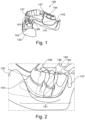
- Fig. 1 shows an exemplary 3D digital denture model 140 arranged on an exemplary 3D digital tissue model 130.
- the 3D digital denture model 140 comprises two sections 141 with artificial gingiva parts 142.
- the artificial gingiva parts 142 are shaped and colored to mimic the patient's natural gingiva.
- Within each of the artificial gingiva parts 142 a plurality of artificial teeth 144 is arranged.
- the 3D digital denture model 140 further comprises supporting framework 146.
- the supporting framework 146 is configured for supporting the artificial teeth 144 and stabilizing the removable denture defined by the 3D digital denture model 140.
- the supporting framework 146 comprises clasps 147 configured for retaining the removable denture at natural teeth of the patient resembled by the 3D digital tissue model 130.
- the 3D digital tissue model 130 may be provided and the 3D digital denture model 140 may be generated on the 3D digital tissue model 130 taking into account individual anatomical features of the patient as defined by the 3D digital tissue model 130.
- the 3D digital tissue model 130 may, e.g., be provided using scan data of the patient's oral cavity.
- the patient's tissue in the oral cavity may be scan using a scanner, e.g., an optical scanner.
- the achieved scan data may be used to generate and provide the 3D digital tissue model 130.
- an impression of the patient's tissue in the oral cavity i.e., a negative imprint of hard and soft tissue may be taken.
- Either this impression may be scanned, e.g., using an optical scanner or the negative imprint provided by the impression may be used to generate a positive reproduction of the patient's tissue, i.e., a 3D physical tissue model or cast, which is scanned, e.g., by the optical scanner to provide the scan data used to generate the 3D digital tissue model 130.
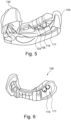
- Fig. 2 shows a detailed view of a section 141 of a 3D digital denture model 140 arranged on the 3D digital tissue model 130.
- Section 141 comprises an artificial gingiva, which is an upper artificial gingiva part 143 extending over the supporting framework 146 of the 3D digital denture model 140.
- the supporting framework 146 is retainable at a natural tooth of the patient resembled by the 3D digital tissue model 130 using a clasp 147.
- a plurality of artificial teeth 144 is arranged within this upper gingiva part 143 .
- Such an upper artificial gingiva part 143 may, e.g., be manufactured using a CAD/CAM method, like machining or 3D printing.
- a sectional plane 148 extending perpendicularly through the section 141 of the 3D digital denture model 140 is indicated.
- Fig. 3 shows a cross-sectional view of a sectional plane 148 through section 141 of the 3D digital denture model 140 and the 3D digital tissue model 130 of Fig. 2 .
- the upper artificial gingiva part 143 extends over and laterally along the supporting framework 146 of the 3D digital denture model 140.
- Artificial teeth 144 are arranged within the upper artificial gingiva part 143. Manufacturing the upper artificial gingiva part 143 using methods like machining or 3D printing may result in one or more hollow sections 145 below the supporting framework 146.
- an alternative method may be used to manufacture artificial gingiva parts enveloping the supporting framework 146 or to complete the upper artificial gingiva part 143 with a lower artificial gingiva part extending below the supporting framework 146 such that the resulting combination of upper and lower artificial gingiva part envelope the supporting framework 146.
- Fig. 4 shows the section 141 of the 3D digital denture model 140 of Fig. 2 from below without the 3D digital tissue model 130.
- Artificial teeth 144 are arranged within the upper artificial gingiva part 143.
- the upper artificial gingiva part 143 extends over and laterally along the supporting framework 146 of the 3D digital denture model 140.
- the artificial gingiva part 143 does not extend below the supporting framework 146 resulting in a hollow section below the supporting framework 146, when the removable denture defined by the 3D digital denture model 140 is arranged on the natural tissue in the oral cavity of the patient.
- the artificial gingiva defined by the 3D digital denture model 140 extends below the supporting framework 146.
- the artificial gingiva extending below the supporting framework 146 does not have to be defined explicitly. In may be sufficient to define the upper surface of the upper artificial gingiva part 143.
- This upper surface of the upper artificial gingiva part 143 may be used to define a 3D digital matrix model 100 of a casting matrix to be used for casting the artificial gingiva parts.
- casting matrix may be defined as a negative of the 3D digital denture model 140 and thus of the upper artificial gingiva part 143.
- Fig. 5 shows an exemplary 3D digital matrix model 100 arranged on an exemplary 3D digital tissue model 130.
- a 3D digital matrix model 100 is generated.
- the 3D digital matrix model 100 may be defined as a negative of a 3D digital denture model 140 arranged on the 3D digital tissue model 130.
- Using a casting matrix as defined by the 3D digital matrix model 100 for casting artificial gingiva parts of a removable denture may prevent hollow sections below the supporting framework, since all the free space around the supporting framework as defined by the casting matrix arranged on a tissue model or on natural tissue in an oral cavity may be filled up with casting material enveloping the supporting framework.
- the casting material spread below the supporting framework due to its fluidity resulting in an artificial gingiva extending below the supporting framework.
- the casting matrix defined by the 3D digital matrix model 100 may comprise one or more recesses 117.
- the recesses 117 each have a 3D geometric form, which is a negative of a 3D geometric form of a section of the removable denture comprising an artificial gingiva part to be casted as defined by a 3D digital denture model, e.g., by 3D digital denture model 140 of Fig. 1 .
- the recesses 117 comprising receptions 116 for receiving artificial teeth of the removable denture as defined by the 3D digital denture model.
- the recesses 117 may further be configured for receiving a supporting framework of the removable denture.
- the 3D digital matrix model 100 may further comprise positioning elements for arranging and fixating the casting matrix defined by the 3D digital matrix model 100 at a predefined position on the 3D digital tissue model 130. These positioning elements may, e.g., comprising one or more receptions 124 for receiving one or more of the natural teeth defined by the of the 3D digital tissue model 130.
- the 3D digital matrix model 100 as shown in Fig. 5 additionally comprises a lateral opening 106, e.g., on the oral side of the casting matrix, configured for inserting casting material into the casting matrix as defined by the 3D digital matrix model 100.
- Fig. 6 shows the exemplary 3D digital matrix model 100 of Fig. 5 without the 3D digital tissue model 130.
- 3D digital matrix model 100 may be used to manufacture a casting matrix for casting artificial gingiva parts of a removable denture.
- the casting matrix may be generated using a CAD/CAM method, e.g., machining or 3D printing.
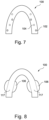
- Fig. 7 shows an exemplary 3D digital matrix model 100.
- the 3D digital matrix model 100 comprises injection channels 102 and venting channels 104.
- the 3D digital matrix model 100 is depicted from above.
- a casting matrix manufactured using the 3D digital matrix model 100 as a template may comprise the injection channels 102 and venting channels 104 as well.
- the injection channels 102 are configured for injecting casting material into the recesses of the casting matrix defined by the 3D digital matrix model 100.
- an injection device may be used, e.g., a reciprocating pump, like a syringe.
- the injection channels 102 may each, e.g., comprise a mouth arranged on an occlusal side of the casting matrix as shown in Fig. 7 .
- the venting channels 104 are configured for letting out air form the recesses of the casting matrix defined by the 3D digital matrix model 100, when the casting material is injected via the injection channels 102.
- the venting channels 102 may ensure an effective venting of the casting matrix, when the casting material being injected into the casting matrix generates an overpressure within the casting matrix relative to the environment of the casting matrix.
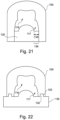
- Fig. 8 shows a 3D digital matrix model 100 with openings 106 for inserting casting material into the casting matrix.
- the 3D digital matrix model 100 is depicted from below.
- a 3D digital matrix model 100 may, e.g., have more or less openings 106 than shown in Fig.8 .
- the openings may be arranged lateral, e.g., oral or vestibular, on a lower side of the 3D digital matrix model 100.
- the openings 106 are openings between boundaries of the recesses 117 of the 3D digital matrix model 100 arranged on a 3D digital tissue model and the 3D digital tissue model.
- the openings may facilitate inserting the casting material into the casting matrix defined by the 3D digital matrix model 100, when the casting matrix is arranged on a 3D digital tissue model.
- the casting material may, e.g., be poured into the casting matrix via the openings 106.
- Fig. 9 shows a 3D digital matrix model 100 in a two-part form comprising a vestibular part 110 and an oral part 111.
- the vestibular part 110 and the oral part 111 may be manufactured using different materials.
- the vestibular part 110 may be manufactured using a first material.
- the oral part 111 may be manufactured using a second material.
- One of the two materials may, e.g., be more rigid than the other one.
- Using a more flexible and a less flexible material may facilitate removing the casting matrix defined by the 3D digital matrix model 100 from the removable denture.
- the more flexible material may be easier detachable from the less flexible material and, due to its flexibility, easier removable from the removable denture.
- the less flexible material may provide more stability to the casting matrix during casting of the artificial gingiva parts.
- stability during casting as well as removability after casting may both be implemented.
- the vestibular part 110 may be more flexible than the oral part 111.
- the oral part 111 may be more flexible than the vestibular part 110.
- a sectional plane 113 extending perpendicularly through the vestibular part 110 and the oral part 111 of the 3D digital matrix model 100 is indicated.
- Fig. 11 shows a 3D digital matrix model 100 in a two-part form with additional clamping elements 108.
- the clamping elements 108 are configured to span round the vestibular part 110 and the oral part 111 exerting a clamping force pressing the vestibular part 110 and the oral part 111 against each other.
- a non-destructive detachable connection between the vestibular part 110 and the oral part 111 may be established.
- the casting matrix defined by the 3D digital matrix model 100 may easily be split into the two parts, i.e., the vestibular part 110 and the oral part 111.
- the splitting may facilitate a removal of the casting matrix defined by the 3D digital matrix model 100 from the denture model after the casting material is cured.
- the clamping elements 108 may ensure a stable non-destructive detachable connection between the vestibular part 110 and the oral part 111 during the casting of the artificial gingiva parts of the removal denture.
- the inner surfaces of the 3D digital shell model 118 configured to be in contact with the outer surfaces of the 3D digital matrix model 100 may have a simpler 3D geometry than the inner surfaces of the 3D digital matrix model 100 configured for providing the 3D geometry of the artificial gingiva parts of the removable denture to be casted.
- the simpler 3D geometry e.g., with straight faces, may facilitate a removal of the mantle shell defined by the 3D digital shell model 118 from the casting matrix defined by the 3D digital matrix model 100, despite of its more rigid material.
- the more flexible material of the casting matrix may facilitate a removal of the casting matrix defined by the 3D digital matrix model 100 from the removable denture and the tissue model or natural tissue, despite of its more complex geometry.
- a sectional plane 126 extending perpendicularly through the 3D digital shell model 118 and the 3D digital matrix model 100 is indicated.
- Fig. 16 shows a cross-sectional view of a sectional plane 126 of Fig. 15 through the 3D digital shell model 118 and the 3D digital matrix model 100.
- the 3D digital shell model 118 provides a reception for receiving the casting matrix defined by the 3D digital matrix model 100.
- the reception of the mantle shell may comprise straight internal side-faces.
- the casting matrix may comprise straight external side-faces in contact with the straight internal side-faces of the mantle shell, when the mantle shell is slipped over the casting matrix.
- Fig. 25 shows a schematic diagram of an exemplary computer device 10 for providing a template for a casting matrix configured for casting one or more artificial gingiva parts of a removable denture.
- the computer device 10 may be operational with numerous other general-purpose or special-purpose computing system environments or configurations.
- Computer device 10 may be described in the general context of computer device executable instructions, such as program modules comprising executable program instructions, being executable by the computer device 10.
- program modules may include routines, programs, objects, components, logic, data structures, and so on that perform particular tasks or implement particular abstract data types.
- Computer device 10 may be practiced in distributed computing environments where tasks are performed by remote processing devices that are linked through a communications network. In a distributed computing environment, program modules may be located in both local and remote computer device storage media including memory storage devices.
- a system memory 28 may include computer device readable storage media in the form of volatile memory, such as random-access memory (RAM) 30 and/or cache memory 32.
- Computer device 10 may further include other removable/non-removable, volatile/non-volatile computer device storage media.
- storage system 34 may be provided for reading from and writing to a non-removable, non-volatile magnetic media also referred to as a hard drive.
- a magnetic disk drive for reading from and writing to a removable, non-volatile magnetic disk, e.g., a floppy disk
- an optical disk drive for reading from or writing to a removable, non-volatile optical disk such as a CD-ROM, DVD-ROM or other optical storage media may be provided.
- each storage medium may be connected to bus 18 by one or more data media interfaces.
- Memory 28 may include at least one program product having a set of program modules, e.g., at least one program module, configured to provide the template for the casting matrix configured for casting one or more artificial gingiva parts of the removable denture.
- Memory 28 may, e.g., further comprise a tooth library providing a plurality of predefined sets of artificial teeth, a gingiva library providing a plurality of predefined artificial gingivas or gingiva parts and/or a set of predefined elements of supporting frameworks. For example, from the tooth library artificial teeth, from the gingiva library artificial gingiva parts and/or from the set of predefined elements of supporting frameworks elements to be used to generate a supporting frame may be selected for providing the 3D digital denture model.
- Program 40 may have a set of one or more program modules 42 and by way of example be stored in memory 28.
- the program modules 42 may comprise an operating system, one or more application programs, other program modules, and/or program data. Each of the operating system, one or more application programs, other program modules, and program data or some combination thereof, may include an implementation of a networking environment.
- One or more of the program modules 42 may enable a providing of the template for the casting matrix configured for casting one or more artificial gingiva parts of the removable denture.
- Computer device 10 may further communicate with one or more external devices 14 such as a keyboard, a pointing device, like a mouse, and a display 24 enabling a user to interact with computer device 10. Such communication can occur via input/output (I/O) interfaces 22.
- Computer device 10 may further communicate with one or more networks such as a local area network (LAN), a general wide area network (WAN), and/or a public network, like the Internet, via network adapter 20.
- Network adapter 20 may communicate with other components of computer device 10 via bus 18. It should be understood that although not shown, other hardware and/or software components could be used in conjunction with computer device 10.
- the computer device 10 shown in Fig. 25 may be configured for providing of the template for the casting matrix configured for casting one or more artificial gingiva parts of the removable denture.
- the computer device 10 may be a standalone computer with no network connectivity that may receive data to be processed through a local interface.
- the data received by computer device 10 may for example comprise scan data of a patient's mouth from an intraoral scan or from a scan of a classical mold/impression, e.g., providing information about the surface structure of the patient's intraoral tissue on which the removal denture is to be arranged. This data may be used to provide a 3D tissue model used to generate a 3D digital denture model.
- the 3D digital tissue model and the 3D digital denture model may be used to generate a 3D digital matrix model of a casting matrix configured to cast the artificial gingiva parts of the removable denture.
- the data received may, e.g., comprise the 3D digital tissue model and/or the 3D digital denture model.
- the computer device 10 may be used to provide the template for the casting matrix configured for casting one or more artificial gingiva parts of the removable denture. Such operation may, however, likewise be performed using a computer device that is connected to a network such as a communications network and/or a computing network.
- Fig. 26 shows an exemplary system 11 comprising a computer device 10 for providing a template for a casting matrix configured for casting one or more artificial gingiva parts of a removable denture.
- the computer device 10 may, e.g., be configured as shown in Fig. 25 .
- the computer device 10 may comprise a hardware component 54 comprising one or more processors as well as a memory storing machine-executable program instructions. Execution of the program instructions by the one or more processors may cause the one or more processors to control the computer device 10 to provide the template for the casting matrix configured for casting one or more artificial gingiva parts of the removable denture.
- the casting matrix comprises one or more recesses.
- Each of the recesses has a 3D geometric form, which is a negative of a 3D geometric form of a section of the removable denture with one of the artificial gingiva parts to be casted.
- each of the recesses comprises one or more receptions for receiving one or more artificial teeth of the removable denture.
- the providing may require providing a 3D digital tissue model of tissue of an oral cavity of a patient on which the removable denture is to be arranged, providing a 3D digital denture model of the removable denture using the 3D digital tissue model with the removable denture comprising one or more artificial teeth arranged within the one or more artificial gingiva parts arranged on the 3D digital tissue model and generating using the 3D digital tissue model and the 3D digital denture model a 3D digital matrix model of the casting matrix.
- the 3D digital matrix model envelopes the one or more sections of the 3D digital denture model with the one or more artificial gingiva parts arranged on the 3D digital tissue model.
- the computer device 10 may further comprise one or more input devices, like a keyboard 58 and a mouse 56, enabling a user to interact with the computer device 10. Furthermore, the computer device 10 may comprise one or more output devices, like a display 24 providing a graphical user interface 50 with control elements 52, e.g., GUI elements, enabling the user to control the providing of the template in form of a 3D digital matrix model 100 for the casting matrix configured for casting one or more artificial gingiva parts of the removable denture. Furthermore, the control elements 52 may, e.g., be used to generate, adjust and/or modify a 3D digital denture model, 3D digital tissue model and/or 3D digital shell model.
- input devices like a keyboard 58 and a mouse 56
- the computer device 10 may comprise one or more output devices, like a display 24 providing a graphical user interface 50 with control elements 52, e.g., GUI elements, enabling the user to control the providing of the template in form of a 3D digital matrix model 100 for the casting matrix configured for casting one or
- Fig. 27 shows an exemplary system 11 for manufacturing a physical casting matrix using the 3D digital matrix model 100 as a template.
- the physical casting matrix is a physical copy of the respective template. It may be configured to be used for casting one or more artificial gingiva parts of a removable denture.
- the system 11 may be configured for manufacturing a physical tissue model of the natural tissue of a patient using a 3D digital tissue model as template.
- the manufactured tissue model is a physical copy of the respective template.
- the system 11 may be configured for manufacturing one or more teeth of the removable denture using 3D digital tooth models as templates.
- the manufactured teeth being physical copies of the respective templates.
- the system 11 may be configured for manufacturing a supporting framework of the removable denture using a 3D digital framework model as template.
- the manufactured supporting framework being a physical copy of the respective template.
- the system 11 may be configured for manufacturing a mantle shell using a 3D digital shell model as template.
- the manufactured mantle shell being a physical copy of the respective template.
- the system 11 may be configured for manufacturing one or more additional non-casted gingiva parts using a 3D digital denture model as template.
- the manufactured additional non-casted gingiva parts being physical copies of the respective templates.
- the additional non-casted gingiva parts may be upper gingiva parts extending over the supporting framework of the removable denture.
- the upper gingiva parts may comprise receptions, e.g., in form of blind hole or a through-hole. This additional non-casted gingiva parts may be manufactured before casting the other gingiva parts.
- the additional gingiva parts are manufactured using machining or 3D printing.
- the casted gingiva parts may, e.g., complete the additional non-casted gingiva parts by extending below the supporting framework such that the resulting artificial gingiva envelopes at least a part of the supporting framework without hollow sections below the supporting framework.
- the system 11 may comprise the computer device 10 of Fig. 26 .
- the computer device 10 may further be configured to control one or more manufacturing devices 60, 70.
- the system 11 may comprise a manufacturing device in form of a machining device 70 controlled by the computer device 10.
- the machining device 70 may be configured to machining a blank 76 using one or more machining tools 72.
- the blank 76 of raw material 78 may be provided using a holding device 74 and cut into a desired final shape and size of the dental element to be manufactured, e.g., a physical casting matrix 101 as defined by the 3D digital matrix model 100, using the one or more machining tools 72 for executing a controlled material-removal process.
- the machining tool 72 may, e.g., be a milling tool.
- a 3D digital model, e.g., the 3D digital matrix mode 100 may provide a template for the element being manufactured using the machining device 70, e.g., the physical casting matrix 101.
- the machining device 70 may further be used to manufacture one or more of the following: a physical tissue model of the natural tissue of a patient using, e.g., a 3D digital tissue model as template, one or more teeth of the removable denture using 3D digital tooth models, e.g., provided by a 3D digital denture model, as templates, a supporting framework of the removable denture using, e.g., the 3D digital framework model as template, a mantle shell using, e.g., a 3D digital shell model as template, one or more additional non-casted gingiva parts using, e.g., the 3D digital denture model as templates.
- the system 11 may comprise a manufacturing device in form of a 3D printing device 60.
- the 3D printing device 60 may be controlled by the computer device 10 and configured to print one or more dental element to be manufactured, e.g., an artificial gingiva 112 defining an adjusted position of a dental arch.
- the 3D printing device 60 may comprise a printing element 62 configured to print the respective element, like the casting matrix 101, layer by layer.
- the printing element 62 may, e.g., comprise a nozzle configured for distributing printing material.
- a 3D digital model e.g., a 3D digital matrix model 100, may provide a template of the physical element manufactured using the 3D printing device 60, e.g., of the casting matrix 101.
- the 3D printing device 60 may further be used to manufacture one or more of the following: a physical tissue model of the natural tissue of a patient using, e.g., a 3D digital tissue model as template, one or more teeth of the removable denture using 3D digital tooth models, e.g., provided by a 3D digital denture model, as templates, a supporting framework of the removable denture using, e.g., the 3D digital framework model as template, a mantle shell using, e.g., a 3D digital shell model as template, one or more additional non-casted gingiva parts using, e.g., the 3D digital denture model as templates.
- the 3D printing device 60 be configured for executing selective laser sintering or melting.
- Selective laser sintering uses a laser for sintering a powdered material, aiming the laser automatically at points in space defined by a 3D digital model of the element to be printed.
- the laser energy may result in a local sintering or melting of the powdered material, binding the material together to create a solid structure.
- the printing element 62 may comprise a laser and/or a distributing device for distributing the powdered material.
- Fig. 28 shows an exemplary method for providing a template for a casting matrix.
- the template is provided in form of a 3D digital casting matrix.
- a 3D digital tissue model of tissue of an oral cavity of a patient is provided on which the removable denture is to be arranged.
- the 3D digital tissue model may be received via a network, read from a storage medium or generated using scan data of the tissue.
- the scan data may, e.g., be scan data acquired using an optical scanner.
- the scan data may be scan data resulting from an intraoral scan, from a scan of an impression of the natural tissue or from a scan from of a physical tissue model generated using the impression of the natural tissue.
- a 3D digital denture model of the removable denture is provided using the 3D digital tissue model.
- the 3D digital denture model may, e.g., be generated on the 3D digital tissue model and adjusted to the individual anatomical features of the patient.
- the removable denture defined by the 3D digital denture model comprises one or more artificial teeth arranged within one or more artificial gingiva parts arranged on the 3D digital tissue model.
- the 3D digital denture model may, e.g., comprise a supporting framework. The supporting framework may be configured for supporting the artificial teeth of the removable denture and stabilizing the removable denture.
- the 3D digital tissue model provided in block 300 and the 3D digital denture model provided in block 302 are used for generating a 3D digital matrix model of the casting matrix.
- the casting matrix comprises one or more recesses.
- Each of the recesses has a 3D geometric form, which is a negative of a 3D geometric form of a section of the removable denture with one of the artificial gingiva parts to be casted.
- each of the recesses comprises one or more receptions for receiving one or more artificial teeth of the removable denture.
- the 3D digital matrix model envelops the sections of the 3D digital denture model with artificial gingiva parts and the artificial teeth arranged on the 3D digital tissue model.
- the 3D digital matrix model is provided as template for manufacturing the casting matrix.
- the casting matrix is manufactured using the 3D digital matrix model as the template.
- the manufactured casting matrix is a physical copy of the respective template.
- the casting matrix may, e.g., be manufactured using machining or 3D printing.
- Fig. 29 shows an exemplary method for manufacturing a removable denture using a casting matrix and a tissue model.
- the physical tissue model is provided resembling the natural intraoral tissue of the patient is provided, on which the removable denture is to be arranged.
- the physical tissue model may be manufactured using a 3D digital matrix model.
- a supporting framework may be arranged on the physical tissue model.
- the supporting framework may be manufactured using a 3D digital denture model.
- a casting matrix is provided.
- the casting matrix may, e.g., be manufactured as described in Fig. 28 .
- the one or more artificial teeth of the removable denture are arranged in one or more receptions of the casting matrix.
- the artificial teeth may be manufactured using the 3D digital denture model.
- additional pre-manufactured artificial gingiva parts may additionally be arranged in the casting matrix or on the supporting framework.
- the pre-manufactured artificial gingiva parts may be upper gingiva parts extending over the supporting framework.
- the casting matrix with the artificial teeth is arranged on the physical tissue model.
- the supporting framework may, e.g., be arranged as described in block 312.
- the supporting framework may be arranged within the casting matrix, after the artificial teeth have been arranged therein.
- the casting matrix with the artificial teeth and the supporting framework is arranged on the physical tissue model.
- the casting matrix may, e.g., be arranged on the tissue model in such a way that the walls of the casting matrix enclosing the recesses each come into contact with the tissue model in a sealing manner.
- casting material for casting the artificial gingiva parts of the removable denture is inserted into the casting matrix arranged on the physical tissue model, i.e., into the remaining free space of the recesses of the manufactured casting matrix.
- the manufactured casting matrix is removed from the physical tissue model, after the inserted casting material is cured.
- the removable denture is removed from the tissue model and provided comprising the artificial gingiva parts casted using the casting material.
- Fig. 30 shows an exemplary method for manufacturing a removable denture on intraoral tissue of a patient.
- a protective film layer is arranged on the intraoral tissue.
- a supporting framework may be arranged on the intraoral tissue.
- the supporting framework may be manufactured using a 3D digital denture model.
- a casting matrix is provided.
- the casting matrix may, e.g., be manufactured as described in Fig. 28 .
- the one or more artificial teeth of the removable denture are arranged in one or more receptions of the casting matrix.
- the artificial teeth may be manufactured using the 3D digital denture model.
- additional pre-manufactured artificial gingiva parts may additionally be arranged in the casting matrix or on the supporting framework.
- the pre-manufactured artificial gingiva parts may be upper gingiva parts extending over the supporting framework.
- the casting matrix with the artificial teeth is arranged on the intraoral tissue.
- the supporting framework may, e.g., be arranged as described in block 332.
- the supporting framework may be arranged within the casting matrix, after the artificial teeth have been arranged therein.
- the casting matrix with the artificial teeth and the supporting framework is arranged on the intraoral tissue.
- the casting matrix may, e.g., be arranged on the tissue model in such a way that the walls of the casting matrix enclosing the recesses each come into contact with the protective film layer arranged on the intraoral tissue in a sealing manner.
- casting material for casting the artificial gingiva parts of the removable denture is inserted into the casting matrix arranged on the intraoral tissue, i.e., into the remaining free space of the recesses of the manufactured casting matrix.
- the manufactured casting matrix is removed from the intraoral tissue, after the inserted casting material is cured.
- the removable denture is removed from the intraoral tissue and provided comprising the artificial gingiva parts casted using the casting material.
- a single processor or other unit may fulfill the functions of several items recited in the claims.
- a computer program may be stored/distributed on a suitable medium, such as an optical storage medium or a solid-state medium supplied together with or as part of other hardware, but may also be distributed in other forms, such as via the Internet or other wired or wireless telecommunication systems.
- aspects of the present invention may be embodied as an apparatus, method, computer program or computer program product. Accordingly, aspects of the present invention may take the form of an entirely hardware embodiment, an entirely software embodiment (including firmware, resident software, micro-code, etc.) or an embodiment combining software and hardware aspects that may all generally be referred to herein as a "circuit,” “module” or “system.” Furthermore, aspects of the present invention may take the form of a computer program product embodied in one or more computer readable medium(s) having computer executable code embodied thereon. A computer program comprises the computer executable code or "program instructions".
- the computer readable medium may be a computer readable signal medium or a computer readable storage medium.
- a "computer-readable storage medium” as used herein encompasses any tangible storage medium which may store instructions which are executable by a processor of a computing device.
- the computer-readable storage medium may be referred to as a computer-readable non-transitory storage medium.
- the computer-readable storage medium may also be referred to as a tangible computer readable medium.
- a computer-readable storage medium may also be able to store data which is able to be accessed by the processor of the computing device.
- Examples of computer-readable storage media include, but are not limited to: a floppy disk, a magnetic hard disk drive, a solid-state hard disk, flash memory, a USB thumb drive, Random Access Memory (RAM), Read Only Memory (ROM), an optical disk, a magneto-optical disk, and the register file of the processor.
- Examples of optical disks include Compact Disks (CD) and Digital Versatile Disks (DVD), for example CD-ROM, CD-RW, CD-R, DVD-ROM, DVD-RW, or DVD-R disks.
- a further example of an optical disk may be a Blu-ray disk.
- the term computer readable-storage medium also refers to various types of recording media capable of being accessed by the computer device via a network or communication link.
Landscapes
- Health & Medical Sciences (AREA)
- Oral & Maxillofacial Surgery (AREA)
- Dentistry (AREA)
- Epidemiology (AREA)
- Life Sciences & Earth Sciences (AREA)
- Animal Behavior & Ethology (AREA)
- General Health & Medical Sciences (AREA)
- Public Health (AREA)
- Veterinary Medicine (AREA)
- Engineering & Computer Science (AREA)
- Manufacturing & Machinery (AREA)
- Chemical & Material Sciences (AREA)
- Materials Engineering (AREA)
- Instructional Devices (AREA)
- Dental Prosthetics (AREA)
Claims (15)
- Computer-implementiertes Verfahren zur Bereitstellung einer Gießmatrix (101), die dafür konfiguriert ist, ein oder mehrere künstliche Gingivateile (142) einer herausnehmbaren Zahnprothese zu gießen, wobei die Gießmatrix (101) eine oder mehrere Vertiefungen (117) aufweist, wobei jede der Vertiefungen (117) eine geometrische 3D-Form aufweist, bei der es sich um ein Negativ einer geometrischen 3D-Form eines Abschnitts (141) der herausnehmbaren Zahnprothese handelt, mit einem der künstlichen Gingivateile (142), der gegossen werden soll,
das Verfahren umfassend:Bereitstellen eines digitalen 3D-Gewebemodells (130) eines Gewebes einer Mundhöhle eines Patienten, an dem die herausnehmbare Zahnprothese angeordnet werden soll,Bereitstellen eines digitalen 3D-Zahnprothesenmodells (140) der herausnehmbaren Zahnprothese mithilfe des digitalen 3D-Gewebemodells (130), wobei die herausnehmbare Zahnprothese einen oder mehrere künstliche Zähne (144) umfasst, die in dem einen oder den mehreren künstlichen Gingivateilen (142) angeordnet sind, die sich am digitalen 3D-Gewebemodell (130) befinden,Generieren, mithilfe des digitalen 3D-Gewebemodells (130) und des digitalen 3D-Zahnprothesenmodells (140), eines digitalen 3D-Matrixmodells (100) der Gießmatrix (101), wobei das digitale 3D-Matrixmodell (100) den einen oder die mehreren Abschnitte (141) des digitalen 3D-Zahnprothesenmodells (140) mit dem einen oder den mehreren künstlichen Gingivateilen (142), die sich an dem digitalen 3D-Gewebemodell (130) befinden, umschließt,Bereitstellen des digitalen 3D-Matrixmodells (100) als Vorlage zum Anfertigen der Gießmatrix (101), wobei das digitale 3D-Matrixmodell (100) in einer zweiteiligen Form bereitgestellt wird, die einen vestibulären Teil (110) und einen oralen Teil (111) umfasst, wobei der vestibuläre und der orale Teil (111) dafür konfiguriert sind, eine zerstörungsfreie lösbare Verbindung miteinander herzustellen. - Verfahren nach Anspruch 1, ferner ein Anfertigen der Gießmatrix (101) mithilfe des digitalen 3D-Matrixmodells (100) als Vorlage umfassend, wobei die gefertigte Gießmatrix (101) eine physische Kopie der jeweiligen Vorlage ist, und/oder
weiterhin umfassend:Bereitstellen des digitalen 3D-Gewebemodells (130) als Vorlage zum Anfertigen eines physischen Gewebemodells des Gewebes der Mundhöhle des Patienten, an dem die herausnehmbare Zahnprothese angeordnet wird, wobei die Gießmatrix (101) dafür konfiguriert ist, an dem Gewebemodell angeordnet zu werden,Anfertigen des Gewebemodells mithilfe des digitalen 3D-Gewebemodells (130) als Vorlage, wobei das gefertigte Gewebemodell eine physische Kopie der jeweiligen Vorlage ist, und/oderweiterhin umfassend:Bereitstellen eines oder mehrere digitaler 3D-Zahnmodelle von einem oder mehreren Zähnen, die in dem digitalen 3D-Zahnprothesenmodell (140) als Vorlagen enthalten sind, um den einen oder die mehreren Zähne der herausnehmbaren Zahnprothese zu fertigen,Anfertigen des einen oder der mehreren Zähne der herausnehmbaren Zahnprothese mithilfe der digitalen 3D-Zahnmodelle als Vorlagen, wobei die gefertigten Zähne physische Kopien der jeweiligen Vorlagen sind. - Verfahren nach einem der vorstehenden Ansprüche, wobei das digitale 3D-Zahnprothesenmodell (140) ferner ein digitales 3D-Rahmenmodell (146) eines Stützrahmens der herausnehmbaren Zahnprothese umfasst, wobei der Stützrahmen dafür konfiguriert ist, den einen oder die mehreren Zähne der herausnehmbaren Zahnprothese zu stützen und die herausnehmbare Zahnprothese zu stabilisieren,
bevorzugt weiterhin umfassend:Bereitstellen des digitalen 3D-Rahmenmodells (146) als Vorlage zum Anfertigen des Stützrahmens,Anfertigen des Stützrahmens mithilfe des digitalen 3D-Stützrahmenmodells (146) als Vorlage, wobei der gefertigte Stützrahmen eine physische Kopie der jeweiligen Vorlage ist. - Verfahren nach einem der Ansprüche 2 bis 3, ferner das Anfertigen der herausnehmbaren Zahnprothese umfassend, wobei das Anfertigen der herausnehmbaren Zahnprothese umfasst:Anordnen des einen oder der mehreren künstlichen Zähne (144) der herausnehmbaren Zahnprothese in einer oder mehreren Aufnahmen (116) der einen oder mehreren Vertiefungen (117) der gefertigten Gießmatrix (101), wobei jede der Aufnahmen (116) dafür konfiguriert ist, einen der künstlichen Zähne (144) der herausnehmbaren Zahnprothese aufzunehmen,Anordnen der gefertigten Gießmatrix (101) mit dem einen oder den mehreren künstlichen Zähnen (144) der herausnehmbaren Zahnprothese an dem physischen Gewebemodell,Einbringen von Gießmaterial zum Gießen des einen oder der mehreren künstlichen Gingivateile (142) der herausnehmbaren Zahnprothese in den verbleibenden freien Raum der einen oder mehreren Vertiefungen (117) der gefertigten Gießmatrix (101), die an dem physischen Gewebemodell angeordnet sind,Entfernen der gefertigten Gießmatrix (101) von dem physischen Gewebemodell, nachdem das eingebrachte Gießmaterial ausgehärtet ist,Bereitstellen der herausnehmbaren Zahnprothese, den einen oder die mehreren Gingivateile (142) umfassend, die mithilfe des Gießmaterials gegossen worden sind.
- Verfahren nach Anspruch 4, ferner das Anfertigen eines oder mehrerer zusätzlicher Gingivateile (143) der herausnehmbaren Zahnprothese umfassend, um sie durch den einen oder die mehreren gegossenen Gingivateile zu ergänzen, wobei der eine oder die mehreren zusätzlichen Gingivateile (143) zusammen mit den künstlichen Zähnen (144) in der einen oder den mehreren Vertiefungen (117) der gefertigten Gießmatrix (101) angeordnet werden,
wobei der eine oder die mehreren zusätzlichen Gingivateile (143) bevorzugt obere Gingivateile sind, die oberhalb des Stützrahmen der herausnehmbaren Zahnprothese verlaufen, wobei der eine oder die mehreren Gingivateile bevorzugt als untere Gingivateile gegossen werden, die unterhalb des Stützrahmens verlaufen. - Verfahren nach einem der vorstehenden Ansprüche, wobei das digitale 3D-Matrixmodell (100) dafür konfiguriert ist, einen abgedichteten Kontakt zwischen Grenzen der einen oder den mehreren Vertiefungen (117) des digitalen 3D-Matrixmodells (100), die an dem digitalen 3D-Gewebemodell (130) angeordnet sind, und dem digitalen 3D-Gewebemodell (130) herzustellen, wobei der abgedichtete Kontakt verhindert, dass Gießmaterial aus der einen oder den mehreren Vertiefungen (117) entweicht, oder
wobei das digitale 3D-Matrixmodell (100) eine oder mehrere Öffnungen (106) zwischen Grenzen der einen oder mehreren Vertiefungen (117) des digitalen 3D-Matrixmodells (100), die an dem digitalen 3D-Gewebemodell (130) angeordnet sind, und dem digitalen 3D-Gewebemodell (130) umfasst, wobei die Öffnungen (106) dafür konfiguriert sind, Gießmaterial in die eine oder mehreren Vertiefungen (117) einzubringen. - Verfahren nach einem der vorstehenden Ansprüche, wobei das digitale 3D-Gewebemodell (130) mit einem oder mehreren nicht anatomischen seitlichen Vorsprüngen (136) bereitgestellt wird, wobei der eine oder die mehreren seitlichen Vorsprünge (136) dafür konfiguriert sind, einen oder mehrere Hinterschnitte (134) des einen oder der mehreren künstlichen Gingivateile (142) des digitalen 3D-Zahnprothesenmodells (140), die an dem digitalen 3D-Gewebemodell (130) angeordnet sind, zu überbrücken.
- Verfahren nach einem der vorstehenden Ansprüche, wobei der vestibuläre Teil (110) ein oder mehrere dritte Verbindungselemente (114) umfasst, um die trennbare Verbindung herzustellen, wobei der orale Teil (111) ein oder mehrere vierte Verbindungselemente (115) umfasst, die dafür konfiguriert sind, die trennbare Verbindung herzustellen, und/oderwobei das digitale 3D-Matrixmodell (100) ein oder mehrere zusätzliche Klemmelemente (108) umfasst, wobei die Klemmelemente (108) dafür konfiguriert sind, den vestibulären Teile (110) und den oralen Teil (111) zu umspannen, wobei eine Klemmkraft ausgeübt wird, die den vestibulären Teil (110) und den oralen Teil (111) gegeneinander drückt, und/oderwobei der vestibuläre Teil (110) der Gießmatrix (101) mithilfe eines ersten Materials gefertigt wird, und der orale Teil (111) der Gießmatrix (101) mithilfe eines zweiten Materials gefertigt wird, wobei eins der zwei Materialien steifer als das andere ist.
- Verfahren nach einem der vorstehenden Ansprüche, ferner umfassend:Generieren von mindestens einem digitalen 3D-Schalenmodell (118) eines Mantels für die Gießmatrix (101), wobei die digitale 3D-Schale ein Negativ einer äußeren geometrischen 3D-Form eines digitalen 3D-Matrixmodells (100) ist, wobei der Mantel dafür konfiguriert ist, über die Gießmatrix (101) geschoben zu werden, was der Gießmatrix (101) strukturellen Halt gibt,Bereitstellen des digitalen 3D-Schalenmodells (118) als Vorlage zum Anfertigen des Mantels.
- Verfahren nach Anspruch 9, wobei das digitale 3D-Schalenmodell (118) des Mantels eine Aufnahme (119) bereitstellt, um die Gießmatrix (101) aufzunehmen, wobei die Aufnahme (119) des Mantels gerade innere Seitenflächen umfasst, wobei die Gießmatrix (101) gerade äußere Seitenflächen umfasst, die im Kontakt mit den geraden inneren Seitenflächen des Mantels sind, wenn der Mantel über die Gießmatrix (101) geschoben wird, und/oderdie Aufnahme (119) des digitalen 3D-Schalenmodells (118) des Mantels einen U-förmigen Querschnitt umfasst, wobei die äußere geometrische 3D-Form des digitalen 3D-Matrixmodells (100) einen passenden U-förmigen Querschnitt umfasst, und/oderdas digitale 3D-Schalenmodell (118) einen oder mehrere Einspritzkanäle (120) umfasst, die dafür konfiguriert sind, das Gießmaterial durch Einspritzen des Gießmaterials in die eine oder mehreren Vertiefungen (117) des digitalen 3D-Matrixmodells (100), über welches das digitale 3D-Schalenmodell (118) geschoben ist, einzubringen, und/oderdas digitale 3D-Schalenmodell (118) einen oder mehrere Lüftungskanäle (122) umfasst, die dafür konfiguriert sind, Luft aus der einen oder den mehreren Vertiefungen (117) entweichen zu lassen, wenn das Gießmaterial in die eine oder mehreren Vertiefungen (117) des digitalen 3D-Matrixmodells (100) eingebracht wird, über welches das digitale 3D-Schalenmodell geschoben ist, und/oderferner umfassend, den Mantel mithilfe des digitalen 3D-Schalenmodells (118) als Vorlage zu fertigen, wobei der gefertigte Mantel eine physische Kopie der jeweiligen Vorlage ist.
- Verfahren nach einem der vorstehenden Ansprüche, wobei die eine oder mehreren Aufnahmen der einen oder mehreren Vertiefungen (117) des digitalen 3D-Gießmodells zur Aufnahme des einen oder der mehreren künstlichen Zähne (144) der herausnehmbaren Zahnprothese jeweils ein Durchgangsloch (103) zum Einführen eines Befestigungselements (150) zum Befestigen der künstlichen Zähne (144) an dem digitalen 3D-Gießmodell umfasst, und/oderdie herausnehmbare Zahnprothese eins von Folgendem ist: eine herausnehmbare Teilzahnprothese, ein herausnehmbare Vollzahnprothese, und/oderdas digitale 3D-Gewebemodell (130), eins von Folgendem umfassend: ein digitales mandibuläres 3D-Gewebemodell eines Unterkiefers, ein digitales maxilläres 3D-Gewebemodell eines Oberkiefers.
- Computerprogrammprodukt zur Bereitstellung einer Vorlage für eine Gießmatrix (101), die dafür konfiguriert ist, eine oder mehrere künstliche Gingivateile (142) einer herausnehmbaren Zahnprothese zu gießen, wobei die Gießmatrix (101) eine oder mehrere Vertiefungen (117) aufweist, wobei jede der Vertiefungen (117) eine geometrische 3D-Form aufweist, bei der es sich um ein Negativ einer geometrischen 3D-Form eines Abschnitts (141) der herausnehmbaren Zahnprothese handelt, mit einem der künstlichen Gingivateile (142), der gegossen werden soll,
wobei das Computerprogrammprodukt ein computerlesbares Speichermedium umfasst, in dem Programmanweisungen enthalten sind, wobei die Programmanweisungen durch einen Prozessor (16) einer Computervorrichtung (10) ausführbar sind, um die Computervorrichtung (10) zu Folgendem zu veranlassen:Bereitstellen eines digitalen 3D-Gewebemodells (130) eines Gewebes einer Mundhöhle eines Patienten, an dem die herausnehmbare Zahnprothese angeordnet werden soll,Bereitstellen eines digitalen 3D-Zahnprothesenmodells (140) der herausnehmbaren Zahnprothese mithilfe des digitalen 3D-Gewebemodells (130), wobei die herausnehmbare Zahnprothese einen oder mehrere künstliche Zähne (144) umfasst, die in dem einen oder den mehreren künstlichen Gingivateilen (142) angeordnet sind, die sich am digitalen 3D-Gewebemodell (130) befinden,Generieren, mithilfe des digitalen 3D-Gewebemodells (130) und des digitalen 3D-Zahnprothesenmodells (140), eines digitalen 3D-Matrixmodells (100) der Gießmatrix (101), wobei das digitale 3D-Matrixmodell (100) den einen oder die mehreren Abschnitte (141) des digitalen 3D-Zahnprothesenmodells (140) mit dem einen oder den mehreren künstlichen Gingivateilen (142), die sich an dem digitalen 3D-Gewebemodell (130) befinden, umschließt.Bereitstellen des digitalen 3D-Matrixmodells (100) als Vorlage zum Anfertigen der Gießmatrix (101), wobei das digitale 3D-Matrixmodell (100) in einer zweiteiligen Form bereitgestellt wird, die einen vestibulären Teil (110) und einen oralen Teil (111) umfasst, wobei der vestibuläre und der orale Teil (111) dafür konfiguriert sind, eine zerstörungsfreie lösbare Verbindung miteinander herzustellen. - Computervorrichtung (10) zur Bereitstellung einer Gießmatrix (101), die dafür konfiguriert ist, einen oder mehrere künstliche Gingivateile (142) einer herausnehmbaren Zahnprothese zu gießen, wobei die Gießmatrix (101) eine oder mehrere Vertiefungen (117) aufweist, wobei jede der Vertiefungen (117) eine geometrische 3D-Form aufweist, bei der es sich um ein Negativ einer geometrischen 3D-Form eines Abschnitts (141) der herausnehmbaren Zahnprothese handelt, mit einem der künstlichen Gingivateile (142), der gegossen werden soll,
wobei die Computervorrichtung (10) einen Prozessor (16) und einen Speicher (28) umfasst, der Programmanweisungen speichert, die durch den Prozessor (16) ausführbar sind, wobei die Ausführung der Programmanweisungen durch den Prozessor (16) die Computervorrichtung (10) zu Folgendem veranlasst:Bereitstellen eines digitalen 3D-Gewebemodells (130) eines Gewebes einer Mundhöhle eines Patienten, an dem die herausnehmbare Zahnprothese angeordnet werden soll,Bereitstellen eines digitalen 3D-Zahnprothesenmodells (140) der herausnehmbaren Zahnprothese mithilfe des digitalen 3D-Gewebemodells (130), wobei die herausnehmbare Zahnprothese einen oder mehrere künstliche Zähne (144) umfasst, die in dem einen oder den mehreren künstlichen Gingivateilen (142) angeordnet sind, die sich am digitalen 3D-Gewebemodell (130) befinden,Generieren, mithilfe des digitalen 3D-Gewebemodells (130) und des digitalen 3D-Zahnprothesenmodells (140), eines digitalen 3D-Matrixmodells (100) der Gießmatrix (101), wobei das digitale 3D-Matrixmodell (100) den einen oder die mehreren Abschnitte (141) des digitalen 3D-Zahnprothesenmodells (140) mit dem einen oder den mehreren künstlichen Gingivateilen (142), die sich an dem digitalen 3D-Gewebemodell (130) befinden, umschließt.Bereitstellen des digitalen 3D-Matrixmodells (100) als Vorlage zum Anfertigen der Gießmatrix (101), wobei das digitale 3D-Matrixmodell (100) in einer zweiteiligen Form bereitgestellt wird, die einen vestibulären Teil (110) und einen oralen Teil (111) umfasst, wobei der vestibuläre und der orale Teil (111) dafür konfiguriert sind, eine zerstörungsfreie lösbare Verbindung miteinander herzustellen. - Fertigungssystem (11), die Computervorrichtung (10) nach Anspruch 13 umfassend, wobei das Fertigungssystem (11) ferner eine Fertigungsvorrichtung (60, 70) umfasst, die dafür konfiguriert ist, die Gießmatrix (101) zu fertigen,
wobei die Ausführung der Programmanweisung durch den Prozessor (16) ferner die Computervorrichtung (10) veranlasst, die Fertigungsvorrichtung (60, 70) zu steuern, um die Gießmatrix (101) mithilfe des digitalen 3D-Matrixmodells (100) als Vorlage zu fertigen, wobei die gefertigte Gießmatrix (101) eine physische Kopie der jeweiligen Vorlage ist. - Maschinell gefertigte oder 3D-gedruckte Gießmatrix (101), die dafür konfiguriert ist, ein oder mehrere künstliche Gingivateile (142) einer herausnehmbaren Zahnprothese zu gießen, wobei die Gießmatrix (101) eine oder mehrere Vertiefungen (117) umfasst, wobei jede der Vertiefungen (117) eine geometrische 3D-Form hat, die ein Negativ einer geometrischen 3D-Form eines Abschnitts (141) der herausnehmbaren Zahnprothese ist, mit der eines der künstlichen Gingivateile (142) gegossen werden soll, wobei die Gießmatrix (101) dafür konfiguriert ist, an mindestens einem von dem Folgenden angeordnet zu werden: Gewebe einer Mundhöhle eines Patienten, an dem die herausnehmbare Zahnprothese angeordnet werden soll, an einem Gewebemodell des Gewebes der Mundhöhle des Patienten, an dem die herausnehmbare Zahnprothese angeordnet werden soll, wobei das Matrixmodell (101) in zweiteiliger Form bereitgestellt wird, einen vestibulären Teil (110) und einen oralen Teil (111) umfassend, wobei der vestibuläre und der orale Teil (111) dafür konfiguriert sind, eine zerstörungsfreie lösbare Verbindung miteinander herzustellen.
Applications Claiming Priority (2)
| Application Number | Priority Date | Filing Date | Title |
|---|---|---|---|
| US17/531,153 US11877901B2 (en) | 2021-11-19 | 2021-11-19 | Casting matrix for casting an artificial gingiva part |
| PCT/EP2022/081748 WO2023088831A1 (en) | 2021-11-19 | 2022-11-14 | Casting matrix for casting an artificial gingiva part |
Publications (3)
| Publication Number | Publication Date |
|---|---|
| EP4432970A1 EP4432970A1 (de) | 2024-09-25 |
| EP4432970B1 true EP4432970B1 (de) | 2025-07-09 |
| EP4432970C0 EP4432970C0 (de) | 2025-07-09 |
Family
ID=84420990
Family Applications (1)
| Application Number | Title | Priority Date | Filing Date |
|---|---|---|---|
| EP22818231.7A Active EP4432970B1 (de) | 2021-11-19 | 2022-11-14 | Giessmatrix zum giessen eines künstlichen gingivateils |
Country Status (4)
| Country | Link |
|---|---|
| US (1) | US11877901B2 (de) |
| EP (1) | EP4432970B1 (de) |
| DE (1) | DE112022005531T5 (de) |
| WO (1) | WO2023088831A1 (de) |
Families Citing this family (7)
| Publication number | Priority date | Publication date | Assignee | Title |
|---|---|---|---|---|
| CN218474653U (zh) | 2018-08-10 | 2023-02-14 | 3M创新有限公司 | 用于在患者的口部中形成牙修复体的定制工具 |
| US12251285B2 (en) * | 2020-01-23 | 2025-03-18 | 3Shape A/S | System and method for fabricating a dental tray |
| DE102020113928B4 (de) * | 2020-05-25 | 2022-01-05 | Exocad Gmbh | Einklebehilfsvorrichtung für künstliche Zähne |
| US11903781B2 (en) * | 2020-10-13 | 2024-02-20 | Exocad Gmbh | Split denture |
| DE102023109570B4 (de) | 2023-04-17 | 2024-10-31 | Kulzer Gmbh | Verfahren zur Herstellung einer dentalen Teilprothese mit Trägerstruktur |
| WO2025185820A1 (en) * | 2024-03-06 | 2025-09-12 | Exocad Gmbh | Methods and devices for casting a restoration matrix for placement over a tooth or a set of teeth as part of a restoration process for restoring said tooth |
| US12402986B1 (en) * | 2025-04-28 | 2025-09-02 | King Saud University | Research dental mounting aid |
Family Cites Families (6)
| Publication number | Priority date | Publication date | Assignee | Title |
|---|---|---|---|---|
| KR101799873B1 (ko) * | 2010-10-01 | 2017-11-22 | 쓰리세이프 에이/에스 | 의치의 모형 제작 및 제작 |
| EP3777756B1 (de) * | 2012-02-14 | 2025-04-09 | 3Shape A/S | Modellierung eines digitalen entwurfs einer zahnprothese |
| US10206764B2 (en) | 2014-03-03 | 2019-02-19 | Global Dental Sciences, LLC | System and method for manufacturing layered dentures |
| DE102016105628A1 (de) | 2016-03-24 | 2017-09-28 | Dekema Dental-Keramiköfen GmbH | Verfahren zur Herstellung einer totalen oder teilweisen Zahnprothese |
| FR3053241B1 (fr) | 2016-06-30 | 2021-11-19 | Mojito | Procede de fabrication d'une prothese dentaire amovible par moulage a l'aide d'un moule realise en fabrication additive |
| DE102017211249A1 (de) | 2017-07-03 | 2019-01-03 | Sirona Dental Systems Gmbh | Verfahren zur Herstellung einer künstlichen Gingiva |
-
2021
- 2021-11-19 US US17/531,153 patent/US11877901B2/en active Active
-
2022
- 2022-11-14 EP EP22818231.7A patent/EP4432970B1/de active Active
- 2022-11-14 WO PCT/EP2022/081748 patent/WO2023088831A1/en not_active Ceased
- 2022-11-14 DE DE112022005531.6T patent/DE112022005531T5/de active Pending
Also Published As
| Publication number | Publication date |
|---|---|
| EP4432970A1 (de) | 2024-09-25 |
| WO2023088831A1 (en) | 2023-05-25 |
| EP4432970C0 (de) | 2025-07-09 |
| US11877901B2 (en) | 2024-01-23 |
| US20230157796A1 (en) | 2023-05-25 |
| DE112022005531T5 (de) | 2024-09-19 |
Similar Documents
| Publication | Publication Date | Title |
|---|---|---|
| EP4432970B1 (de) | Giessmatrix zum giessen eines künstlichen gingivateils | |
| US11771535B2 (en) | Apparatus and methods of making denture devices | |
| US7819662B2 (en) | Multi-component dental appliances and a method for constructing the same | |
| Hu et al. | Using intraoral scanning technology for three‐dimensional printing of kennedy class i removable partial denture metal framework: A clinical report | |
| US10245124B2 (en) | Simplified protocol for fixed implant restorations using intra-oral scanning and dental CAD/CAM | |
| CN106999265B (zh) | 用模板制造牙科假体的方法 | |
| US9326834B2 (en) | Apparatus and methods of making denture devices | |
| US11432914B2 (en) | Method for manufacture of a removable dental prosthesis by moulding with the aid of a mould formed by additive manufacture | |
| EP0797961A2 (de) | Vorrichtung zum Applizieren von Abformmaterial auf die okklusale Zahnoberfläche | |
| JP2006501010A (ja) | 物質的プラスターモデルを準備する方法 | |
| EP4395694B1 (de) | Computerimplementiertes verfahren, computerprogramm und computersystem zum anpassen der position von künstlichen zähnen einer zahnprothese | |
| EP4228546B1 (de) | Geteilte zahnprothese | |
| US20110117524A1 (en) | Universal dental crown and system and method of restoring a tooth using a universal dental crown | |
| EP4226888B1 (de) | Halteschiene zum halten von restaurationsformen und computerimplementiertes verfahren, computerprogrammprodukt und computervorrichtung zum bereitstellen derselben | |
| Ahmed et al. | Managing excessive gingival display using a digital workflow | |
| Li et al. | Design of complete dentures by adopting CAD developed for fixed prostheses | |
| Manoj et al. | Management of compromised ridges: a case report | |
| WO2024235801A1 (en) | Correcting relative tooth positions of antagonistic teeth | |
| US20260000494A1 (en) | Try-in denture base | |
| JP2022105976A (ja) | 歯科技工器具セット、義歯の製造方法、及びプログラム | |
| Kim et al. | CAD/CAM Technology for Complete Denture Fabrication. | |
| JPS61103184A (ja) | 実習用人工歯とその製造法 | |
| US20250262036A1 (en) | Injection-molded partial denture appliances | |
| JPH02218358A (ja) | 歯科補綴物の製作方法 | |
| JPH08123319A (ja) | 乳歯の歯並び模型及びその製法 |
Legal Events
| Date | Code | Title | Description |
|---|---|---|---|
| STAA | Information on the status of an ep patent application or granted ep patent |
Free format text: STATUS: UNKNOWN |
|
| STAA | Information on the status of an ep patent application or granted ep patent |
Free format text: STATUS: THE INTERNATIONAL PUBLICATION HAS BEEN MADE |
|
| PUAI | Public reference made under article 153(3) epc to a published international application that has entered the european phase |
Free format text: ORIGINAL CODE: 0009012 |
|
| STAA | Information on the status of an ep patent application or granted ep patent |
Free format text: STATUS: REQUEST FOR EXAMINATION WAS MADE |
|
| 17P | Request for examination filed |
Effective date: 20240619 |
|
| AK | Designated contracting states |
Kind code of ref document: A1 Designated state(s): AL AT BE BG CH CY CZ DE DK EE ES FI FR GB GR HR HU IE IS IT LI LT LU LV MC ME MK MT NL NO PL PT RO RS SE SI SK SM TR |
|
| DAV | Request for validation of the european patent (deleted) | ||
| DAX | Request for extension of the european patent (deleted) | ||
| GRAP | Despatch of communication of intention to grant a patent |
Free format text: ORIGINAL CODE: EPIDOSNIGR1 |
|
| STAA | Information on the status of an ep patent application or granted ep patent |
Free format text: STATUS: GRANT OF PATENT IS INTENDED |
|
| INTG | Intention to grant announced |
Effective date: 20250410 |
|
| GRAS | Grant fee paid |
Free format text: ORIGINAL CODE: EPIDOSNIGR3 |
|
| GRAA | (expected) grant |
Free format text: ORIGINAL CODE: 0009210 |
|
| STAA | Information on the status of an ep patent application or granted ep patent |
Free format text: STATUS: THE PATENT HAS BEEN GRANTED |
|
| AK | Designated contracting states |
Kind code of ref document: B1 Designated state(s): AL AT BE BG CH CY CZ DE DK EE ES FI FR GB GR HR HU IE IS IT LI LT LU LV MC ME MK MT NL NO PL PT RO RS SE SI SK SM TR |
|
| REG | Reference to a national code |
Ref country code: GB Ref legal event code: FG4D |
|
| REG | Reference to a national code |
Ref country code: CH Ref legal event code: EP |
|
| REG | Reference to a national code |
Ref country code: IE Ref legal event code: FG4D |
|
| REG | Reference to a national code |
Ref country code: DE Ref legal event code: R096 Ref document number: 602022017459 Country of ref document: DE |
|
| U01 | Request for unitary effect filed |
Effective date: 20250710 |
|
| U07 | Unitary effect registered |
Designated state(s): AT BE BG DE DK EE FI FR IT LT LU LV MT NL PT RO SE SI Effective date: 20250716 |
|
| U20 | Renewal fee for the european patent with unitary effect paid |
Year of fee payment: 4 Effective date: 20251127 |
|
| PG25 | Lapsed in a contracting state [announced via postgrant information from national office to epo] |
Ref country code: IS Free format text: LAPSE BECAUSE OF FAILURE TO SUBMIT A TRANSLATION OF THE DESCRIPTION OR TO PAY THE FEE WITHIN THE PRESCRIBED TIME-LIMIT Effective date: 20251109 |
|
| PG25 | Lapsed in a contracting state [announced via postgrant information from national office to epo] |
Ref country code: NO Free format text: LAPSE BECAUSE OF FAILURE TO SUBMIT A TRANSLATION OF THE DESCRIPTION OR TO PAY THE FEE WITHIN THE PRESCRIBED TIME-LIMIT Effective date: 20251009 |
|
| PG25 | Lapsed in a contracting state [announced via postgrant information from national office to epo] |
Ref country code: HR Free format text: LAPSE BECAUSE OF FAILURE TO SUBMIT A TRANSLATION OF THE DESCRIPTION OR TO PAY THE FEE WITHIN THE PRESCRIBED TIME-LIMIT Effective date: 20250709 |
|
| PG25 | Lapsed in a contracting state [announced via postgrant information from national office to epo] |
Ref country code: GR Free format text: LAPSE BECAUSE OF FAILURE TO SUBMIT A TRANSLATION OF THE DESCRIPTION OR TO PAY THE FEE WITHIN THE PRESCRIBED TIME-LIMIT Effective date: 20251010 |
|
| REG | Reference to a national code |
Ref country code: CH Ref legal event code: W10 Free format text: ST27 STATUS EVENT CODE: U-0-0-W10-W00 (AS PROVIDED BY THE NATIONAL OFFICE) Effective date: 20260121 |
|
| PG25 | Lapsed in a contracting state [announced via postgrant information from national office to epo] |
Ref country code: PL Free format text: LAPSE BECAUSE OF FAILURE TO SUBMIT A TRANSLATION OF THE DESCRIPTION OR TO PAY THE FEE WITHIN THE PRESCRIBED TIME-LIMIT Effective date: 20250709 |
|
| PG25 | Lapsed in a contracting state [announced via postgrant information from national office to epo] |
Ref country code: RS Free format text: LAPSE BECAUSE OF FAILURE TO SUBMIT A TRANSLATION OF THE DESCRIPTION OR TO PAY THE FEE WITHIN THE PRESCRIBED TIME-LIMIT Effective date: 20251009 |
|
| PG25 | Lapsed in a contracting state [announced via postgrant information from national office to epo] |
Ref country code: ES Free format text: LAPSE BECAUSE OF FAILURE TO SUBMIT A TRANSLATION OF THE DESCRIPTION OR TO PAY THE FEE WITHIN THE PRESCRIBED TIME-LIMIT Effective date: 20250709 |
|
| RAP4 | Party data changed (patent owner data changed or rights of a patent transferred) |
Owner name: EXOCAD GMBH |
|
| U1H | Name or address of the proprietor changed after the registration of the unitary effect |
Owner name: EXOCAD GMBH; DE |
|
| PG25 | Lapsed in a contracting state [announced via postgrant information from national office to epo] |
Ref country code: SM Free format text: LAPSE BECAUSE OF FAILURE TO SUBMIT A TRANSLATION OF THE DESCRIPTION OR TO PAY THE FEE WITHIN THE PRESCRIBED TIME-LIMIT Effective date: 20250709 |
|
| PG25 | Lapsed in a contracting state [announced via postgrant information from national office to epo] |
Ref country code: CZ Free format text: LAPSE BECAUSE OF FAILURE TO SUBMIT A TRANSLATION OF THE DESCRIPTION OR TO PAY THE FEE WITHIN THE PRESCRIBED TIME-LIMIT Effective date: 20250709 |
|
| PG25 | Lapsed in a contracting state [announced via postgrant information from national office to epo] |
Ref country code: SK Free format text: LAPSE BECAUSE OF FAILURE TO SUBMIT A TRANSLATION OF THE DESCRIPTION OR TO PAY THE FEE WITHIN THE PRESCRIBED TIME-LIMIT Effective date: 20250709 |