EP4432154A1 - Programm, vorschlagsvorrichtung und vorschlagsverfahren - Google Patents
Programm, vorschlagsvorrichtung und vorschlagsverfahren Download PDFInfo
- Publication number
- EP4432154A1 EP4432154A1 EP22890042.9A EP22890042A EP4432154A1 EP 4432154 A1 EP4432154 A1 EP 4432154A1 EP 22890042 A EP22890042 A EP 22890042A EP 4432154 A1 EP4432154 A1 EP 4432154A1
- Authority
- EP
- European Patent Office
- Prior art keywords
- model
- comparative
- proposed
- configuration
- heating element
- Prior art date
- Legal status (The legal status is an assumption and is not a legal conclusion. Google has not performed a legal analysis and makes no representation as to the accuracy of the status listed.)
- Pending
Links
Images




Classifications
-
- G—PHYSICS
- G06—COMPUTING OR CALCULATING; COUNTING
- G06F—ELECTRIC DIGITAL DATA PROCESSING
- G06F30/00—Computer-aided design [CAD]
- G06F30/20—Design optimisation, verification or simulation
-
- G—PHYSICS
- G01—MEASURING; TESTING
- G01N—INVESTIGATING OR ANALYSING MATERIALS BY DETERMINING THEIR CHEMICAL OR PHYSICAL PROPERTIES
- G01N25/00—Investigating or analyzing materials by the use of thermal means
- G01N25/18—Investigating or analyzing materials by the use of thermal means by investigating thermal conductivity
-
- G—PHYSICS
- G06—COMPUTING OR CALCULATING; COUNTING
- G06F—ELECTRIC DIGITAL DATA PROCESSING
- G06F30/00—Computer-aided design [CAD]
- G06F30/30—Circuit design
-
- G—PHYSICS
- G06—COMPUTING OR CALCULATING; COUNTING
- G06F—ELECTRIC DIGITAL DATA PROCESSING
- G06F30/00—Computer-aided design [CAD]
- G06F30/30—Circuit design
- G06F30/39—Circuit design at the physical level
- G06F30/398—Design verification or optimisation, e.g. using design rule check [DRC], layout versus schematics [LVS] or finite element methods [FEM]
-
- H—ELECTRICITY
- H10—SEMICONDUCTOR DEVICES; ELECTRIC SOLID-STATE DEVICES NOT OTHERWISE PROVIDED FOR
- H10W—GENERIC PACKAGES, INTERCONNECTIONS, CONNECTORS OR OTHER CONSTRUCTIONAL DETAILS OF DEVICES COVERED BY CLASS H10
- H10W40/00—Arrangements for thermal protection or thermal control
- H10W40/10—Arrangements for heating
-
- H—ELECTRICITY
- H10—SEMICONDUCTOR DEVICES; ELECTRIC SOLID-STATE DEVICES NOT OTHERWISE PROVIDED FOR
- H10W—GENERIC PACKAGES, INTERCONNECTIONS, CONNECTORS OR OTHER CONSTRUCTIONAL DETAILS OF DEVICES COVERED BY CLASS H10
- H10W40/00—Arrangements for thermal protection or thermal control
- H10W40/20—Arrangements for cooling
- H10W40/25—Arrangements for cooling characterised by their materials
- H10W40/255—Arrangements for cooling characterised by their materials having a laminate or multilayered structure, e.g. direct bond copper [DBC] ceramic substrates
-
- H—ELECTRICITY
- H10—SEMICONDUCTOR DEVICES; ELECTRIC SOLID-STATE DEVICES NOT OTHERWISE PROVIDED FOR
- H10W—GENERIC PACKAGES, INTERCONNECTIONS, CONNECTORS OR OTHER CONSTRUCTIONAL DETAILS OF DEVICES COVERED BY CLASS H10
- H10W70/00—Package substrates; Interposers; Redistribution layers [RDL]
- H10W70/60—Insulating or insulated package substrates; Interposers; Redistribution layers
-
- G—PHYSICS
- G06—COMPUTING OR CALCULATING; COUNTING
- G06F—ELECTRIC DIGITAL DATA PROCESSING
- G06F2119/00—Details relating to the type or aim of the analysis or the optimisation
- G06F2119/08—Thermal analysis or thermal optimisation
Definitions
- the present invention relates to programs, proposal devices, and proposal methods.
- Non-Patent Document 1 discloses an analytical solution for calculating the thermal resistance of a power module that has a structure in which same-sized components are stacked in a planar direction.
- Non-Patent Document 1 K. R. Choudhury, D. J. Rogers, "Transient Thermal Modeling of a Power Module: An N-Layer Fourier Approach", IEEE Transactions on Power Electronics, vol. 34, no. 2, pp. 1500-1508, 2019 .
- the disclosure aims to enable proposal of a heating element configuration that can maintain the heat dissipation performance when the configuration of a thermally conductive member is changed.
- the disclosure includes the following configurations.
- the first embodiment of the present invention is a proposal system.
- the proposal system receives, as inputs, a semiconductor device configuration that serves as a reference (to be also referred to as a "reference model” hereinafter) and a semiconductor device configuration in which a portion of the reference model has been changed (to be also referred to as a "comparative model” hereinafter), and outputs information (to be also referred to as “proposed information” hereinafter) based on a semiconductor device configuration in which another portion of the comparative model is changed (to be also referred to as a “proposed model” hereinafter) so as to have heat dissipation performance equivalent to the heat dissipation performance of the reference model.
- the embodiment is applicable to a semiconductor device in which a multi-layered thermally conductive member includes a heating element.
- a power module is one example of such a semiconductor device.
- the comparative model according to the embodiment is a model in which the configuration (for example, the dimensions, the material, or the layout) of the thermally conductive member has been changed from the configuration of the thermally conductive member of the reference model.
- the proposed model according to the embodiment is a model in which the configuration (for example, the dimensions, the material, and the layout) of the heating element of the comparative model has been changed. That is, the proposal system according to the embodiment is a system that proposes the configuration for a heating element that can maintain the heat dissipation performance when the configuration of the thermally conductive member of the reference model is changed.
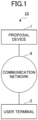
- FIG. 1 is a block diagram illustrating an example of the overall configuration of the proposal system according to the embodiment.
- a proposal system 10 includes a proposal device 1 and a user terminal 2.
- the proposal device 1 and the user terminal 2 are connected together via a communication network 9 such as a local area network (LAN), the Internet, or the like to be able to perform data communication with each other.
- a communication network 9 such as a local area network (LAN), the Internet, or the like to be able to perform data communication with each other.
- the user terminal 2 is an information processing terminal, for example, a personal computer (PC), a tablet terminal, a smartphone, or the like that is operated by a user.
- the user terminal 2 receives the reference model and the comparative model as inputs and transmits the reference model and the comparative model to the proposal device 1 in accordance with the operation by the user.
- the user terminal 2 receives the proposed information from the proposal device 1 and outputs the proposed information to the user.
- the proposal device 1 is an information processing apparatus such as a PC, a work station, or a server that generates a proposed model based on the reference model and the comparative model received from the user terminal 2.
- the proposal device 1 generates proposed information based on the proposed model, and transmits the proposed information to the user terminal 2.
- the overall system configuration of the proposal system 10 illustrated in FIG. 1 is merely an example, and the system configuration can be implemented in various manners in accordance with the use and the purpose.
- the proposal device 1 may be implemented by a plurality of computers or may be implemented as a cloud computing service.
- the proposal system 10 may be implemented by a stand-alone computer that has functions of the proposal device 1 and the user terminal 2.
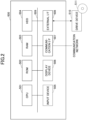
- FIG. 2 is a block diagram illustrating an example of the hardware configuration of a computer 500 according to the embodiment.
- the computer 500 includes a central processing unit (CPU) 501, a read only memory (ROM) 502, and a random access memory (RAM) 503.
- CPU central processing unit
- ROM read only memory
- RAM random access memory
- the CPU 501, the ROM 502, and the RAM 503 form what is known in the art as a computer.
- the computer 500 includes an hard disk drive (HDD) 504, an input device 505, a display device 506, a communication interface (I/F) 507, and an external I/F 508. These hardware components of the computer 500 are connected to each other via a bus line 509. Note that input device 505 and the display device 506 may be connected to the external I/F 508 so as to be used through the external I/F 508.
- HDD hard disk drive
- I/F communication interface
- the CPU 501 is an arithmetic processing device that can control and implement the functions of the computer 500 overall by loading programs and data onto the RAM 503 from a storage device, such as the ROM 502, the HDD 504, or the like, and executing processing.
- the ROM 502 is an example of a nonvolatile semiconductor memory (storage device) that can hold programs and data even when the power is turned off.
- the ROM 502 functions as a main storage device that stores various programs, data, and the like for the CPU 501 to execute the various programs installed in the HDD 504. More specifically, the ROM 502 stores a startup program such as the basic input/output system (BIOS), extensible firmware interface (EFI), or the like executed at the activation of the computer 500 and data of operating system (OS) settings, network settings, and the like.
- BIOS basic input/output system
- EFI extensible firmware interface
- the RAM 503 is an example of a volatile semiconductor memory (storage device) in which programs and data are erased when power is turned off.
- the RAM 503 may be, for example, a dynamic random access memory (DRAM), a static random access memory (SRAM), or the like.
- the RAM 503 provides a work area to which various programs installed in the HDD 504 are loaded when these programs are executed by the CPU 501.
- the HDD 504 is an example of a nonvolatile storage device that stores programs and data.
- the programs and data stored in the HDD 504 include, for example, an OS that is the basic software for controlling the whole computer 500, applications that provide various functions on the OS, and the like.
- the computer 500 may use, instead of the HDD 504, a storage device (for example, a solid state drive [SSD] or the like) that uses a flash memory as a storage medium.
- SSD solid state drive
- the input device 505 is a device used by the user to input various signals, for example, a touch panel, operation keys and buttons, a keyboard, a mouse, a microphone for inputting audio data such as sounds, or the like.
- the display device 506 is formed by, for example, a display such as a liquid-crystal display or an organic electroluminescent (EL) display that displays screens, a speaker that outputs audio data such as sound, and the like.
- a display such as a liquid-crystal display or an organic electroluminescent (EL) display that displays screens, a speaker that outputs audio data such as sound, and the like.
- EL organic electroluminescent
- the communication I/F 507 is, for example, an interface to allow the computer 500 to execute data communication by connecting the computer 500 to a communication network.
- the external I/F 508 is, for example, an interface with an external device.
- the external device may be a drive device 510 or the like.
- the drive device 510 is a device into which a recording medium 511 is inserted.
- the recording medium 511 mentioned here includes a medium that optically, electrically, or magnetically records information such as a CD-ROM, a flexible disk, a magneto-optical disk, or the like.
- the recording medium 511 may also include a semiconductor memory that records information electrically such as a ROM, a flash memory, or the like.
- the computer 500 can, therefore, at least read from or write on the recording medium 511 via the external I/F 508.
- the various programs to be installed in the HDD 504 are installed by, for example, setting the distributed recording medium 511 in the drive device 510 that is connected to the external I/F 508 and causing the drive device 510 to read the various programs recorded in the recording medium 511.
- the various programs to be installed in the HDD 504 are installed by, for example, downloading the programs from a network different from the communication network through the communication I/F 507.
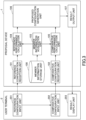
- FIG. 3 is a block diagram illustrating an example of the functional configuration of the proposal system 10 according to the embodiment.
- the user terminal 2 includes a reference configuration input unit 201, a comparative configuration input unit 202, and a result display unit 203.
- the reference configuration input unit 201, the comparative configuration input unit 202, and the result display unit 203 included in the user terminal 2 are implemented by processes executed by the CPU 501 when programs are loaded from the HDD 504 to the RAM 503 illustrated in FIG. 2 .
- the reference configuration input unit 201 receives the reference model that is input in accordance with the user's operation on the input device 505.
- the reference configuration input unit 201 also transmits the input reference model to the proposal device 1.
- the reference model according to the embodiment includes information to specify the dimensions, the material, and the layout of the heating element; and the dimensions, the material, and the layout of the respective layers of the thermally conductive member.
- the comparative configuration input unit 202 receives the comparative model input in accordance with the user's operation on the input device 505.
- the comparative configuration input unit 202 also transmits the input comparative model to the proposal device 1.
- the comparative model according to the embodiment is a model obtained by changing the information about the dimensions, the material, or the layout of the respective layers of the thermally conductive member included in the reference model, or any combination thereof.
- the result display unit 203 receives the proposed information transmitted from the proposal device 1.
- the result display unit 203 also causes the display device 506 or the like to output the received proposed information.
- the proposed information according to the embodiment includes the dimensions of the heating element of the proposed model and the heat dissipation performance based on the proposed model.
- the proposal device 1 includes a member information storage unit 100, a reference configuration reception unit 101, a comparative configuration reception unit 102, a member information acquisition unit 103, a reference performance calculation unit 104, a comparative performance calculation unit 105, a proposed configuration generation unit 106, and a result output unit 107.
- the reference configuration reception unit 101, the comparative configuration reception unit 102, the member information acquisition unit 103, the reference performance calculation unit 104, the comparative performance calculation unit 105, the proposed configuration generation unit 106, and the result output unit 107 included in the proposal device 1 are implemented by processes executed by the CPU 501 when programs are loaded from the HDD 504 to the RAM 503 illustrated in FIG. 2 .
- the member information storage unit 100 included in the proposal device 1 may have a function or may be a functional unit implemented by reading data from or writing data to the HDD 504 illustrated in FIG. 2 .
- the member information storage unit 100 stores information (to be also referred to as "member information” hereinafter) related to members used in the heating element and the respective layers of the thermally conductive member of the semiconductor device.
- the member information is stored in a member information table stored in the member information storage unit 100.
- the reference configuration reception unit 101 receives the reference model transmitted from the user terminal 2.
- the reference configuration reception unit 101 inputs the received reference model into the reference performance calculation unit 104.
- the comparative configuration reception unit 102 receives the comparative model transmitted from the user terminal 2.
- the comparative configuration reception unit 102 also inputs the received comparative model into the comparative performance calculation unit 105.
- the member information acquisition unit 103 reads the member information from the member information storage unit 100 and inputs the member information to the reference performance calculation unit 104 and the comparative performance calculation unit 105.
- the reference performance calculation unit 104 uses the member information received from the member information acquisition unit 103 to calculate the heat dissipation performance (to be also referred to as "reference performance") based on the reference model.
- the reference performance calculation unit 104 inputs the calculated reference performance to the proposed configuration generation unit 106.
- the comparative performance calculation unit 105 uses the member information received from the member information acquisition unit 103 to calculate the heat dissipation performance (to be also referred to as "comparative performance” hereinafter) based on the comparative model.
- the comparative performance calculation unit 105 also inputs the calculated comparative performance to the proposed configuration generation unit 106.
- the proposed configuration generation unit 106 generates a proposed model in which a configuration related to the heating element of the comparative model has been changed so that the heat dissipation performance is equivalent to the heat dissipation performance of the reference performance.
- the proposed configuration generation unit 106 also inputs the generated proposed model to the result output unit 107.
- the result output unit 107 generates the proposed information based on the proposed model received from the proposed configuration generation unit 106.
- the result output unit 107 also transmits the generated proposed information to the user terminal 2.
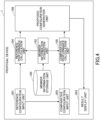
- FIG. 4 is a block diagram illustrating an example of the functional configuration of the proposal system 10 that has a stand-alone structure.
- the proposal device 1 that has the stand-alone structure does not include the reference configuration reception unit 101, the comparative configuration reception unit 102, and the result output unit 107. Instead, the proposal device 1 may include the reference configuration input unit 201, the comparative configuration input unit 202, and the result display unit 203.
- FIG. 5 is a flowchart illustrating an example of the processing procedure of the proposal method according to the embodiment.
- step S200 the user terminal 2 causes the display device 506 to display a proposal screen in accordance with the user's operation to activate the proposal screen.
- the proposal screen according to the embodiment is a screen by which the reference model and the comparative model input by the user can be transmitted to the proposal device 1, and the proposed information received from the proposal device 1 can be displayed.
- the reference model operation unit 2100 is a screen area where information related to the reference model can be input and displayed.
- the reference model operation unit 2100 includes a reference configuration input field 2101, a reference dimensions input field 2102, a thermal resistance calculation button 2103, and a reference performance display field 2104.
- the comparative model operation unit 2200 is a screen area where information related to the comparative model can be input and displayed.
- the comparative model operation unit 2200 includes a comparative configuration input field 2201, a comparative dimensions input field 2202, an element area calculation button 2203, and a comparative performance display field 2204.
- the reference model operation unit 2100 and the comparative model operation unit 2200 may each be provided with an input field for inputting the cooling method (forced water cooling or forced air cooling). Also, the reference model operation unit 2100 and the comparative model operation unit 2200 may each be provided with an input field for inputting information used to calculate the heat dissipation performance.
- the information used to calculate the heat dissipation performance includes, for example, the ambient environmental temperature of the semiconductor device, the heating value of the semiconductor element, and the heat transfer coefficient of the bottom surface of the semiconductor device, and the like. Note that, in lieu of providing the input field, the heating value of the semiconductor element may be calculated from the current value.
- the proposed information display unit 2300 is a screen area where the proposed information received from the proposal device 1 is displayed.
- the proposed information display unit 2300 includes a proposed dimensions display field 2301, a proposed performance display field 2302, an area ratio display field 2303, and a graph display field 2304.
- step S201 the reference configuration input unit 201 of the user terminal 2 receives the reference model that the user inputs through the reference configuration input field 2101 and the reference dimensions input field 2102 in the proposal screen 2000.
- FIG. 7 is a plan view illustrating an example of the semiconductor device according to the embodiment.
- FIG. 8 is a cross-sectional view that is taken along a line A - B of FIG. 7 and illustrates an example of the semiconductor device according to the embodiment.
- a heating element 1100 is provided in the center of a thermally conductive member 1200 of a semiconductor device 1000 according to the embodiment.
- One or more heating elements 1100 may be provided in the thermally conductive member 1200.
- the heating element 1100 may be provided in the center of or in the vicinity of the peripheral edge of the thermally conductive member 1200.
- the thermally conductive member 1200 is formed by stacking a bonding layer 1210, an interconnect layer 1220, an insulating substrate 1230, an interconnect layer 1240, a bonding layer 1250, and a base plate 1260. Note that a heat sink may be used instead of the base plate 1260.
- the bonding layer 1210 is formed to have the same dimensions as the heating element 1100, and bonds the heating element 1100 and the interconnect layer 1220 together.
- the interconnect layer 1220, the insulating substrate 1230, the interconnect layer 1240, the bonding layer 1250, and the base plate 1260 are formed to have the same length and width dimensions, and can be formed to have any thickness within a range allowed by the material.
- the user has input the reference model based on the semiconductor device 1000 illustrated in FIGS. 7 and 8 .
- the heating element 1100 is 10 mm in length and width and the thermally conductive member is 40 mm in length and width. Further, the heating element 1100 is provided in the center of the thermally conductive member.
- the bonding layer 1210 and the bonding layer 1250 are each made of solder and have a thickness of 0.15 mm.
- the interconnect layer 1220 and the interconnect layer 1240 are each made of aluminum (Al) and have a thickness of 0.6 mm.
- the insulating substrate 1230 is made of alumina (Al 2 O 3 ) and has a thickness of 0.635 mm.
- the base plate 1260 is made of an aluminum alloy and has a thickness of 0.72 mm.
- the configuration of the semiconductor device 1000 illustrated in FIGS. 7 and 8 has been input to the reference model operation unit 2100 of the proposal screen 2000 illustrated FIG. 6 .
- a method in which the user directly inputs the configuration or a method in which the user selects the configuration from a drop-down list may be employed as the method to input the configuration of each layer to the reference configuration input field 2101 of the reference model operation unit 2100.
- a drop-down list is employed, a list of members can be acquired from the member information storage unit 100 (to be described later) and be presented as options.
- the user may input a product number for identifying a member, the information about the member identified based on the product number may be acquired from the member information storage unit 100, and the acquired information may be supplemented accordingly.
- the reference performance calculation unit 104 calculates the thermal resistance based on the reference model.
- step S202 the comparative configuration input unit 202 of the user terminal 2 receives the comparative model that the user inputs to the comparative model operation unit 2200 in the proposal screen 2000.
- FIG. 9 is a cross-sectional view illustrating an example of the comparative model in which the dimensions of the thermally conductive member have been changed.
- FIG. 10 is a cross-sectional view illustrating an example of the comparative model in which the materials of the thermally conductive member have been changed.
- the thickness of the insulating substrate 1230 has been changed from 0.635 mm to 0.32 mm as compared with the reference model 1000.
- the comparative model can be a model in which the thickness of one of the layers of the thermally conductive member has been changed.
- the material of the insulating substrate 1230 has been changed from aluminum to aluminum nitride (AlN) as compared with the reference model 1000.
- AlN aluminum nitride
- the comparative model may be a model in which the thickness and the material of one of the layers of the thermally conductive member have been changed.
- the comparative model may be a model in which at least the thickness or the material of two or more layers of the thermally conductive member has been changed.
- the comparative model may be a model in which the layout of the thermally conductive member has been changed. Note that the layout of the thermally conductive member may be the order of the layers of the thermally conductive member. The change in the layout of the thermally conductive member may be the addition or the deletion of a layer in the thermally conductive member.
- the configuration of the semiconductor device 1010 illustrated in FIG. 9 has been input to the comparative model operation unit 2200 of the proposal screen 2000 illustrated in FIG. 6 .
- the respective configurations of the layers of the reference model input to the reference configuration input field 2101 are displayed in the comparative configuration input field 2201 of the comparative model operation unit 2200.
- the user can change the configuration of any layer of the thermally conductive member in the comparative configuration input field 2201.
- the same method used to input the respective configurations of the layers in the reference configuration input field 2101 can be used as the method to change the respective configurations of the layers in the comparative configuration input field 2201.
- a thermal resistance is calculated based on the comparative model input to the comparative configuration input field 2201 and the comparative dimensions input field 2202, and the calculation result is displayed in the comparative performance display field 2204.
- the comparative performance calculation unit 105 calculates the thermal resistance based on the comparative model.
- FIG. 11 is a view illustrating an example of a proposal screen 2010 in which the configuration of the comparative model 1020 illustrated in FIG. 10 has been input to the comparative model operation unit 2200.
- the reference configuration input unit 201 transmits the reference model that was input to the reference model operation unit 2100 to the proposal device 1.
- the comparative configuration input unit 202 transmits the comparative model that was input to the comparative model operation unit 2200 to the proposal device 1.
- step S101 the reference configuration reception unit 101 of the proposal device 1 receives the reference model transmitted from the user terminal 2. Further, the reference configuration reception unit 101 inputs the reference model received from the user terminal 2 to the reference performance calculation unit 104.
- step S102 the comparative configuration reception unit 102 of the proposal device 1 receives the comparative model from the user terminal 2. Further, the comparative configuration reception unit 102 inputs the comparative model received from the user terminal 2 to the comparative performance calculation unit 105.
- step S103 the member information acquisition unit 103 of the proposal device 1 reads the member information stored in the member information table from the member information storage unit 100.
- the member information acquisition unit 103 inputs the member information read from the member information storage unit 100 to the reference performance calculation unit 104 and the comparative performance calculation unit 105.
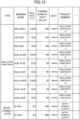
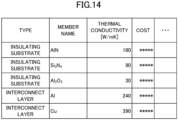
- FIGS. 12 to 14 are views illustrating examples of the member information table according to the embodiment.
- an example of the member information table according to the embodiment includes, as data items, "type”, “member name”, “thickness”, “thermal conductivity”, “cost”, and "product number”.
- Type is information indicating the layer of thermally conductive member in which the member can be used.
- Member name is the name of the member.
- Thickness is information indicating the thickness of the member.
- Thermal conductivity is information indicating the thermal conductivity of the member.
- Cost is information indicating the unit cost of the member.
- Product number is the identification information used to identify the member.
- the product number to be included in the member information table may be assigned to identify a product composed of a plurality of members.
- each product is to be provided as a module in which an interconnect layer, an insulating substrate, and an interconnect layer are stacked.
- the member information table may not include the information indicating the thickness.
- the user will need to input the thickness to the reference configuration input field 2101 or the comparative configuration input field 2201 of the proposal screen 2000.
- step S104 the reference performance calculation unit 104 of the proposal device 1 uses the member information received from the member information acquisition unit 103 to calculate the reference performance that is the heat dissipation performance based on the reference model.
- the heat dissipation performance according to the embodiment includes the thermal resistance and the maximum temperature at which the semiconductor element reaches equilibrium.
- the maximum temperature is the value indicating the actual temperature (C°) that the semiconductor element reaches at equilibrium.
- the maximum temperature can be obtained as follows. environmental temperature [K] + actual heating value [W] ⁇ thermal resistance [K/W]
- the thermal resistance is a value indicating how much the temperature of the semiconductor element increases when the semiconductor element has a given heating value.
- the method of calculating the thermal resistance may be linked with an analysis using the finite element method or may use the maximum temperature of the heating element for which an analytical solution has been obtained in advance.
- the analytical solution for calculating the thermal resistance is described in, for example, Non-Patent Document 1.
- the thermal resistance may be calculated by setting a value obtained by multiplying the heat transfer coefficient by the effective area in consideration of the surface area of the heat sink.
- the thermal transfer coefficient is a coefficient [W/m 2 K] representing the ease of heat transfer between the heat sink and a cooling medium.
- the heat loss amount can be obtained as follows: the temperature difference from the surroundings ⁇ the surface area ⁇ the heat transfer coefficient.
- step S105 the comparative performance calculation unit 105 of the proposal device 1 uses the member information received from the member information acquisition unit 103 to calculate the comparative performance that is the heat dissipation performance based on the comparative model.
- the method used by the comparative performance calculation unit 105 to calculate the heat dissipation performance is the same as the method used by the reference performance calculation unit 104.
- step S106 the proposed configuration generation unit 106 of the proposal device 1 generates a proposed model in which the configuration related to the heating element of the comparative model is changed such that the comparative performance is equivalent to the reference performance. Furthermore, the proposed configuration generation unit 106 inputs the proposed model to the result output unit 107.
- a proposed model in which the configuration of one heating element of the plurality of heating elements has been changed may be generated, a proposed model in which the respective configurations of all of the plurality of heating elements have been changed may be generated, or a proposed model in which the respective configurations of some of the plurality of heating elements have been changed may be generated.
- the proposed model according to the embodiment is a model in which the dimensions of the heating element included in the comparative model have been changed. Note that in a case where the dimensions of the heating element are to be changed, the length and width are multiplied by the same coefficient to change the area without changing the aspect ratio. This is because changing the aspect ratio of the heating element may change the form of heat dissipation even if the area is the same, and, thus, may change the thermal resistance.
- step S107 the result output unit 107 of the proposal device 1 generates the proposed information based on the proposed model received from the proposed configuration generation unit 106. Furthermore, the result output unit 107 transmits the proposed information to the user terminal 2.
- the proposed information according to the embodiment includes the dimensions of the heating element of the proposed model and the heat dissipation performance based on the proposed model.
- the proposed information may also include the cost of the overall semiconductor device based on the proposed model.
- the cost of the overall semiconductor device can be obtained by acquiring the respective costs of the members included in the proposed model from the member information stored in the member information storage unit 100 and adding up the acquired costs of the members. Including the cost of the overall semiconductor device in the proposed information allows the user to ascertain firsthand the benefits to the cost when the configuration of the semiconductor device is changed to the configuration of the proposed model.
- the proposed information may include at least the volume or the weight of the heating element of the proposed model. If at least the volume or the weight is included in the proposed information, it will be possible to make a more suitable proposal to the user in a case where the user desires a semiconductor device that has a small volume or light weight without any regard for cost.
- step S203 the result display unit 203 of the user terminal 2 receives the proposed information from the proposal device 1. Furthermore, the result display unit 203 causes the proposed information received from the proposal device 1 to be displayed on the proposal screen.
- the dimensions of the heating element of the proposed model are displayed in the proposed dimensions display field 2301
- the thermal resistance based on the proposed model is displayed in the proposed performance display field 2302
- the element area ratio is displayed in the area ratio display field 2303.
- the element area ratio is the ratio of the area of the heating element in the reference model to the area of the heating element in the proposed model. The user can look at the element area ratio to intuitively understand how much the size of the heating element can be reduced.
- the dimensions of the heating element may be converted into and output as discrete values.
- the product number of a member may be output by acquiring the product number from a table in which members and dimensions of the heating element have been associated with each other.
- the user can design a semiconductor device (for example, a power module) based on the proposed information displayed on the proposal screen 2000.
- the user can manufacture the semiconductor device based on the design.
- a semiconductor device that is manufactured in this manner differs from the reference semiconductor device in the configuration of the heating element, but has the same heat dissipation performance.
- the proposal device 1 generates a proposed model in which the configuration of the heating element in a comparative model has been changed such that the heat dissipation performance of the comparative model, in which the configuration of the thermally conductive member has been changed from the configuration of the thermally conductive member of a reference model, is equivalent to the heat dissipation performance of the reference model representing the configuration of the reference semiconductor device.
- the proposal device 1 subsequently outputs information based on the proposed model.
- the heat dissipation performance can be calculated using, for example, the finite element method or the like, on a database of dimensions and thermal conductivities of members usable for the thermally conductive member, new experiments or simulations do not need to be performed. Therefore, according to the embodiment, it is possible to greatly reduce the time it takes to make a proposal for the configuration of the heating element.
- the proposed configuration generation unit included in the proposal device can more efficiently obtain the dimensions of the heating element in the configuration of the thermally conductive member in the comparative model so that the thermal resistance of the heating element in the comparative model becomes equivalent to the thermal resistance of the reference model.
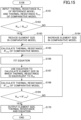
- FIG. 15 is a flowchart illustrating an example of the processing procedure of the proposed configuration generation unit 106 according to the embodiment.
- step S161 the proposed configuration generation unit 106 receives a thermal resistance R ref based on the reference model from the reference performance calculation unit 104.
- the proposed configuration generation unit 106 receives a thermal resistance R cmp based on the comparative model from the comparative performance calculation unit 105.
- step S162 the proposed configuration generation unit 106 compares R ref and R cmp , and determines whether the thermal resistance R ref is greater than the thermal resistance R cmp (R ref > R cmp ). In a case where the thermal resistance R ref is greater than the thermal resistance R cmp (YES), the proposed configuration generation unit 106 advances the process to step S163. In a case where the thermal resistance R ref is less than or equal to the thermal resistance R cmp (NO), the proposed configuration generation unit 106 advances the process to step S164.
- step S163 the proposed configuration generation unit 106 reduces the dimensions of the heating element in the comparative model. For example, the proposed configuration generation unit 106 multiplies the length and the width of the heating element of the comparative model by a coefficient that is less than 1.
- step S164 the proposed configuration generation unit 106 increases the dimensions of the heating element in the comparative model. For example, the proposed configuration generation unit 106 multiplies the length and the width of the heating element of the comparative model by a coefficient that is greater than 1.
- step S165 the proposed configuration generation unit 106 calculates a thermal resistance R' cmp based on the comparative model in which the dimensions of the heating element have been changed in step S163 or step S164.
- the method of calculating the thermal resistance is the same as the method employed by the reference performance calculation unit 104 and the comparative performance calculation unit 105.
- step S166 the proposed configuration generation unit 106 uses the thermal resistance R cmp and the thermal resistance R' cmp to fit an equation relating a heating area to the thermal resistance.
- step S167 the proposed configuration generation unit 106 uses the equation fitted in step S166 to obtain an heating area S' that corresponds to the thermal resistance R th .
- the proposed configuration generation unit 106 also changes the dimensions (element size) of the heating element in the comparative model so as to make the dimensions correspond to the heating area S'. For example, in a case where the length and width dimensions of the heating element are equal to each other, the square root ( ⁇ S') of the heating area S' can be set as the length and width dimensions of the heating element.
- step S168 the proposed configuration generation unit 106 calculates a thermal resistance R" cmp based on the comparative model in which the dimensions of the heating element have been changed in step S167.
- the method of calculating the thermal resistance is the same as the method employed in step S165.
- step S170 the proposed configuration generation unit 106 generates the comparative model in which the dimensions of the heating element have been changed as the proposed model, and outputs the dimensions (element size) of the heating element of the proposed model, the thermal resistance based on the proposed model, and the fitted equation.
- a graph in which the fitted equation and the respective heating areas and thermal resistances of the reference model, the comparative model, and the proposed model have been plotted is displayed in the graph display field 2304.
- ⁇ indicates the relationship between the heating area and the thermal resistance based on the reference model
- ⁇ indicates the relationship between the heating area and the thermal resistance based on the comparative model
- ⁇ indicates the relationship between the heating area and the thermal resistance based on the proposed model.
- FIG. 16 is a view illustrating the configuration of the reference model used in the analysis.
- the table of FIG. 16(A) indicates the material, the thickness, and the thermal conductivity of each layer in the reference model.
- FIG. 16(B) indicates the dimensions, the layout, and cooling method of each layer in the reference model used in the analysis.
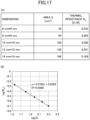
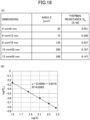
- FIG. 17(A) indicates the result of changing the dimensions of the heating element having an aspect ratio of 1:1 in the reference model illustrated in FIG. 16 and obtaining the relationship between the heating area and the thermal resistance.
- FIG. 17(B) is a graph illustrating the relationship between the heating area and the thermal resistance indicated in FIG. 17(A) .
- FIG. 18(A) indicates the result of changing the dimensions of the heating element having an aspect ratio of 1:2 in the reference model illustrated in FIG. 16 and obtaining the relationship between the heating area and the thermal resistance.
- FIG. 18(B) is a graph illustrating the relationship between the heating area and the thermal resistance indicated in FIG. 18(A) .
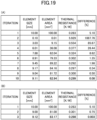
- FIG. 19(A) is a table illustrating the result of using the bisection method to obtain the dimensions of the heating element.
- the bisection method is a root-finding algorithm that solves an equation by repeating an operation for finding an intermediate point of a section including a solution.
- FIG. 19(A) indicates the results obtained after repeatedly changing the element size and calculating the thermal resistance until the difference between the respective thermal resistances of the reference model and the comparative model becomes 0.1% with the interval of 0.1 to 1 as an initial condition.
- FIG. 19(B) is a table illustrating the result of obtaining the element size of the heating element based on the processing procedure of the proposed configuration generation unit according to the embodiment.
- FIG. 19(B) indicates the results obtained by repeatedly changing the element size and calculating the resistance upon making setting so that the thermal resistance R ref and the thermal resistance R" cmp will be determined to be equivalent to each other when the difference between the thermal resistance R ref and the thermal resistance R" cmp is 0.1% or less in the process of step S169 of FIG. 15 .
- the equation relating the heating area to the thermal resistance is fitted to obtain the dimensions of the heating element, in which the thermal resistance becomes equivalent to the thermal resistance of the reference model, in the configuration of the thermally conductive member of the comparative model.
- Using the equation relating the heating area to the thermal resistance allows an inverse problem to be solved. Hence, it will be possible to efficiently and quickly obtain the dimensions of the heating element in which the thermal resistance becomes equivalent to the thermal resistance of the reference model.
- the process of step S104 executed by the reference performance calculation unit 104 is an example of a reference performance calculation procedure.
- the process of step S105 executed by the comparative performance calculation unit 105 is an example of the comparative performance calculation procedure.
- the process of step S106 executed by the proposed configuration generation unit 106 is an example of the proposed configuration generation procedure.
- the process of step S203 executed by the result display unit 203 is an example of the result output procedure.
Landscapes
- Engineering & Computer Science (AREA)
- Physics & Mathematics (AREA)
- Theoretical Computer Science (AREA)
- Computer Hardware Design (AREA)
- General Physics & Mathematics (AREA)
- Evolutionary Computation (AREA)
- Geometry (AREA)
- General Engineering & Computer Science (AREA)
- Chemical & Material Sciences (AREA)
- Health & Medical Sciences (AREA)
- Life Sciences & Earth Sciences (AREA)
- Analytical Chemistry (AREA)
- Biochemistry (AREA)
- General Health & Medical Sciences (AREA)
- Immunology (AREA)
- Pathology (AREA)
- Cooling Or The Like Of Semiconductors Or Solid State Devices (AREA)
- Investigating Or Analyzing Materials Using Thermal Means (AREA)
- Materials Engineering (AREA)
Applications Claiming Priority (2)
| Application Number | Priority Date | Filing Date | Title |
|---|---|---|---|
| JP2021181661 | 2021-11-08 | ||
| PCT/JP2022/041272 WO2023080222A1 (ja) | 2021-11-08 | 2022-11-04 | プログラム、提案装置及び提案方法 |
Publications (2)
| Publication Number | Publication Date |
|---|---|
| EP4432154A1 true EP4432154A1 (de) | 2024-09-18 |
| EP4432154A4 EP4432154A4 (de) | 2025-09-10 |
Family
ID=86241594
Family Applications (1)
| Application Number | Title | Priority Date | Filing Date |
|---|---|---|---|
| EP22890042.9A Pending EP4432154A4 (de) | 2021-11-08 | 2022-11-04 | Programm, vorschlagsvorrichtung und vorschlagsverfahren |
Country Status (5)
| Country | Link |
|---|---|
| US (1) | US20240095421A1 (de) |
| EP (1) | EP4432154A4 (de) |
| JP (1) | JP7302762B1 (de) |
| CN (1) | CN118176507A (de) |
| WO (1) | WO2023080222A1 (de) |
Family Cites Families (8)
| Publication number | Priority date | Publication date | Assignee | Title |
|---|---|---|---|---|
| US7472363B1 (en) * | 2004-01-28 | 2008-12-30 | Gradient Design Automation Inc. | Semiconductor chip design having thermal awareness across multiple sub-system domains |
| JP2008102631A (ja) * | 2006-10-17 | 2008-05-01 | Matsushita Electric Ind Co Ltd | 半導体集積回路システムの設計方法、半導体集積回路実装基板の設計方法、パッケージの設計方法、半導体集積回路の設計方法、半導体集積回路システムの設計装置、半導体集積回路システム、半導体集積回路実装基板、パッケージ、および半導体集積回路 |
| JP2009048505A (ja) * | 2007-08-21 | 2009-03-05 | Sharp Corp | 回路動作検証装置、回路動作検証方法、半導体集積回路の製造方法、制御プログラム、およびコンピュータ読み取り可能な可読記憶媒体 |
| JP2009176050A (ja) * | 2008-01-24 | 2009-08-06 | Fujitsu Ltd | 解析支援装置、解析支援方法および解析支援プログラム |
| JP2009301444A (ja) * | 2008-06-16 | 2009-12-24 | Sharp Corp | 素子配置配線装置、半導体集積回路の製造方法、素子配置配線方法、制御プログラム、および記録媒体 |
| CN102224501A (zh) * | 2008-11-20 | 2011-10-19 | 日本电气株式会社 | 模拟设备、模拟方法、以及存储程序的记录介质 |
| EP3038152A1 (de) * | 2014-12-26 | 2016-06-29 | Kabushiki Kaisha Toshiba | Leiterplatte und halbleitergehäuse mit leiterplatte |
| JP2021181661A (ja) | 2020-05-20 | 2021-11-25 | クロバー株式会社 | 手芸用補助具、および湾曲部材 |
-
2022
- 2022-11-04 US US18/264,833 patent/US20240095421A1/en active Pending
- 2022-11-04 JP JP2023516805A patent/JP7302762B1/ja active Active
- 2022-11-04 CN CN202280072731.XA patent/CN118176507A/zh active Pending
- 2022-11-04 WO PCT/JP2022/041272 patent/WO2023080222A1/ja not_active Ceased
- 2022-11-04 EP EP22890042.9A patent/EP4432154A4/de active Pending
Also Published As
| Publication number | Publication date |
|---|---|
| US20240095421A1 (en) | 2024-03-21 |
| JP7302762B1 (ja) | 2023-07-04 |
| JPWO2023080222A1 (de) | 2023-05-11 |
| CN118176507A (zh) | 2024-06-11 |
| EP4432154A4 (de) | 2025-09-10 |
| WO2023080222A1 (ja) | 2023-05-11 |
Similar Documents
| Publication | Publication Date | Title |
|---|---|---|
| Fang et al. | Global response approximation with radial basis functions | |
| Kim et al. | Missing value estimation for DNA microarray gene expression data: local least squares imputation | |
| Choudhary et al. | JARVIS-Leaderboard: a large scale benchmark of materials design methods | |
| HK1232318A1 (zh) | 用於计算设备的热管理的集成蒸汽室 | |
| CN102930227A (zh) | 用于使用外部存储服务来保存文档的用户界面 | |
| KR102061763B1 (ko) | 시뮬레이션 시스템 및 방법, 상기 시스템을 포함하는 컴퓨팅 시스템 | |
| Hotta et al. | Experiment driven ANN-GA based technique for optimal distribution of discrete heat sources under mixed convection | |
| WO2013089951A1 (en) | System and method for use case-based thermal analysis of heuristically determined component combinations and layouts in a portable computing device | |
| Damm et al. | Spectral radiative heat transfer analysis of the planar SOFC | |
| Iyer et al. | Descriptor aided Bayesian optimization for many-level qualitative variables with materials design applications | |
| CN111091138B (zh) | 辐照预报的处理方法、堆叠泛化模型的训练方法及装置 | |
| Tao et al. | Multiscale analysis of multilayer printed circuit board using mechanics of structure genome | |
| EP4432154A1 (de) | Programm, vorschlagsvorrichtung und vorschlagsverfahren | |
| Lasance | How to estimate heat spreading effects in practice | |
| Lian | Variable selection in high-dimensional partly linear additive models | |
| Algahtani et al. | Four point probe geometry modified correction factor for determining resistivity | |
| US20250190668A1 (en) | Design assist apparatus, design assist method, design assist system, and computer readable medium | |
| Cope et al. | Heat capacity estimation of complex materials for energy technologies | |
| Lamb et al. | Adjoint method for the optimization of the catalyst distribution in proton exchange membrane fuel cells | |
| Nakayama et al. | A new role of CFD simulation in thermal design of compact electronic equipment: application of the build-up approach to thermal analysis of a benchmark model | |
| Gururaja Rao et al. | Simulation studies on multimode heat transfer from a square-shaped electronic device with multiple discrete heat sources | |
| De Kock et al. | Trade-off design of extruded heat sinks using mathematical optimization | |
| Kim et al. | A method for the periodic boundary condition for thermo-elastic analysis of V-NAND flash memory structure | |
| CN116011380B (zh) | 电缆连接图生成方法、装置、计算机设备和存储介质 | |
| Jeong et al. | A Kriging-based probabilistic optimization method with an adaptive search region |
Legal Events
| Date | Code | Title | Description |
|---|---|---|---|
| STAA | Information on the status of an ep patent application or granted ep patent |
Free format text: STATUS: THE INTERNATIONAL PUBLICATION HAS BEEN MADE |
|
| PUAI | Public reference made under article 153(3) epc to a published international application that has entered the european phase |
Free format text: ORIGINAL CODE: 0009012 |
|
| STAA | Information on the status of an ep patent application or granted ep patent |
Free format text: STATUS: REQUEST FOR EXAMINATION WAS MADE |
|
| 17P | Request for examination filed |
Effective date: 20230817 |
|
| AK | Designated contracting states |
Kind code of ref document: A1 Designated state(s): AL AT BE BG CH CY CZ DE DK EE ES FI FR GB GR HR HU IE IS IT LI LT LU LV MC ME MK MT NL NO PL PT RO RS SE SI SK SM TR |
|
| DAV | Request for validation of the european patent (deleted) | ||
| DAX | Request for extension of the european patent (deleted) | ||
| A4 | Supplementary search report drawn up and despatched |
Effective date: 20250808 |
|
| RIC1 | Information provided on ipc code assigned before grant |
Ipc: G06F 30/20 20200101AFI20250804BHEP Ipc: G01N 25/18 20060101ALI20250804BHEP Ipc: G06F 30/10 20200101ALI20250804BHEP Ipc: H01L 23/12 20060101ALI20250804BHEP Ipc: H01L 23/36 20060101ALI20250804BHEP Ipc: G06F 119/08 20200101ALI20250804BHEP Ipc: G06F 30/30 20200101ALI20250804BHEP Ipc: G06F 30/398 20200101ALI20250804BHEP Ipc: H01L 23/373 20060101ALI20250804BHEP |