EP4432084A1 - System und verfahren zur umpositionierung von webdiensten und zur neuzuordnung von benutzern zur datenresidenzkonformität - Google Patents
System und verfahren zur umpositionierung von webdiensten und zur neuzuordnung von benutzern zur datenresidenzkonformität Download PDFInfo
- Publication number
- EP4432084A1 EP4432084A1 EP24151138.5A EP24151138A EP4432084A1 EP 4432084 A1 EP4432084 A1 EP 4432084A1 EP 24151138 A EP24151138 A EP 24151138A EP 4432084 A1 EP4432084 A1 EP 4432084A1
- Authority
- EP
- European Patent Office
- Prior art keywords
- centers
- web services
- user
- data
- latency
- Prior art date
- Legal status (The legal status is an assumption and is not a legal conclusion. Google has not performed a legal analysis and makes no representation as to the accuracy of the status listed.)
- Pending
Links
Images




Classifications
-
- H—ELECTRICITY
- H04—ELECTRIC COMMUNICATION TECHNIQUE
- H04L—TRANSMISSION OF DIGITAL INFORMATION, e.g. TELEGRAPHIC COMMUNICATION
- H04L41/00—Arrangements for maintenance, administration or management of data switching networks, e.g. of packet switching networks
- H04L41/50—Network service management, e.g. ensuring proper service fulfilment according to agreements
- H04L41/5041—Network service management, e.g. ensuring proper service fulfilment according to agreements characterised by the time relationship between creation and deployment of a service
- H04L41/5045—Making service definitions prior to deployment
-
- G—PHYSICS
- G06—COMPUTING OR CALCULATING; COUNTING
- G06F—ELECTRIC DIGITAL DATA PROCESSING
- G06F9/00—Arrangements for program control, e.g. control units
- G06F9/06—Arrangements for program control, e.g. control units using stored programs, i.e. using an internal store of processing equipment to receive or retain programs
- G06F9/46—Multiprogramming arrangements
- G06F9/50—Allocation of resources, e.g. of the central processing unit [CPU]
- G06F9/5083—Techniques for rebalancing the load in a distributed system
-
- G—PHYSICS
- G06—COMPUTING OR CALCULATING; COUNTING
- G06F—ELECTRIC DIGITAL DATA PROCESSING
- G06F9/00—Arrangements for program control, e.g. control units
- G06F9/06—Arrangements for program control, e.g. control units using stored programs, i.e. using an internal store of processing equipment to receive or retain programs
- G06F9/46—Multiprogramming arrangements
- G06F9/48—Program initiating; Program switching, e.g. by interrupt
- G06F9/4806—Task transfer initiation or dispatching
- G06F9/4843—Task transfer initiation or dispatching by program, e.g. task dispatcher, supervisor, operating system
- G06F9/485—Task life-cycle, e.g. stopping, restarting, resuming execution
- G06F9/4856—Task life-cycle, e.g. stopping, restarting, resuming execution resumption being on a different machine, e.g. task migration, virtual machine migration
- G06F9/4862—Task life-cycle, e.g. stopping, restarting, resuming execution resumption being on a different machine, e.g. task migration, virtual machine migration the task being a mobile agent, i.e. specifically designed to migrate
- G06F9/4875—Task life-cycle, e.g. stopping, restarting, resuming execution resumption being on a different machine, e.g. task migration, virtual machine migration the task being a mobile agent, i.e. specifically designed to migrate with migration policy, e.g. auction, contract negotiation
-
- G—PHYSICS
- G06—COMPUTING OR CALCULATING; COUNTING
- G06F—ELECTRIC DIGITAL DATA PROCESSING
- G06F9/00—Arrangements for program control, e.g. control units
- G06F9/06—Arrangements for program control, e.g. control units using stored programs, i.e. using an internal store of processing equipment to receive or retain programs
- G06F9/46—Multiprogramming arrangements
- G06F9/50—Allocation of resources, e.g. of the central processing unit [CPU]
- G06F9/5005—Allocation of resources, e.g. of the central processing unit [CPU] to service a request
- G06F9/5027—Allocation of resources, e.g. of the central processing unit [CPU] to service a request the resource being a machine, e.g. CPUs, Servers, Terminals
- G06F9/5033—Allocation of resources, e.g. of the central processing unit [CPU] to service a request the resource being a machine, e.g. CPUs, Servers, Terminals considering data affinity
-
- G—PHYSICS
- G06—COMPUTING OR CALCULATING; COUNTING
- G06F—ELECTRIC DIGITAL DATA PROCESSING
- G06F9/00—Arrangements for program control, e.g. control units
- G06F9/06—Arrangements for program control, e.g. control units using stored programs, i.e. using an internal store of processing equipment to receive or retain programs
- G06F9/46—Multiprogramming arrangements
- G06F9/50—Allocation of resources, e.g. of the central processing unit [CPU]
- G06F9/5061—Partitioning or combining of resources
- G06F9/5072—Grid computing
-
- H—ELECTRICITY
- H04—ELECTRIC COMMUNICATION TECHNIQUE
- H04L—TRANSMISSION OF DIGITAL INFORMATION, e.g. TELEGRAPHIC COMMUNICATION
- H04L41/00—Arrangements for maintenance, administration or management of data switching networks, e.g. of packet switching networks
- H04L41/08—Configuration management of networks or network elements
- H04L41/0896—Bandwidth or capacity management, i.e. automatically increasing or decreasing capacities
- H04L41/0897—Bandwidth or capacity management, i.e. automatically increasing or decreasing capacities by horizontal or vertical scaling of resources, or by migrating entities, e.g. virtual resources or entities
-
- H—ELECTRICITY
- H04—ELECTRIC COMMUNICATION TECHNIQUE
- H04L—TRANSMISSION OF DIGITAL INFORMATION, e.g. TELEGRAPHIC COMMUNICATION
- H04L41/00—Arrangements for maintenance, administration or management of data switching networks, e.g. of packet switching networks
- H04L41/50—Network service management, e.g. ensuring proper service fulfilment according to agreements
- H04L41/5003—Managing SLA; Interaction between SLA and QoS
- H04L41/5009—Determining service level performance parameters or violations of service level contracts, e.g. violations of agreed response time or mean time between failures [MTBF]
-
- H—ELECTRICITY
- H04—ELECTRIC COMMUNICATION TECHNIQUE
- H04L—TRANSMISSION OF DIGITAL INFORMATION, e.g. TELEGRAPHIC COMMUNICATION
- H04L41/00—Arrangements for maintenance, administration or management of data switching networks, e.g. of packet switching networks
- H04L41/50—Network service management, e.g. ensuring proper service fulfilment according to agreements
- H04L41/5003—Managing SLA; Interaction between SLA and QoS
- H04L41/5019—Ensuring fulfilment of SLA
-
- H—ELECTRICITY
- H04—ELECTRIC COMMUNICATION TECHNIQUE
- H04L—TRANSMISSION OF DIGITAL INFORMATION, e.g. TELEGRAPHIC COMMUNICATION
- H04L41/00—Arrangements for maintenance, administration or management of data switching networks, e.g. of packet switching networks
- H04L41/50—Network service management, e.g. ensuring proper service fulfilment according to agreements
- H04L41/5003—Managing SLA; Interaction between SLA and QoS
- H04L41/5019—Ensuring fulfilment of SLA
- H04L41/5025—Ensuring fulfilment of SLA by proactively reacting to service quality change, e.g. by reconfiguration after service quality degradation or upgrade
-
- H—ELECTRICITY
- H04—ELECTRIC COMMUNICATION TECHNIQUE
- H04L—TRANSMISSION OF DIGITAL INFORMATION, e.g. TELEGRAPHIC COMMUNICATION
- H04L41/00—Arrangements for maintenance, administration or management of data switching networks, e.g. of packet switching networks
- H04L41/50—Network service management, e.g. ensuring proper service fulfilment according to agreements
- H04L41/508—Network service management, e.g. ensuring proper service fulfilment according to agreements based on type of value added network service under agreement
- H04L41/5096—Network service management, e.g. ensuring proper service fulfilment according to agreements based on type of value added network service under agreement wherein the managed service relates to distributed or central networked applications
-
- H—ELECTRICITY
- H04—ELECTRIC COMMUNICATION TECHNIQUE
- H04L—TRANSMISSION OF DIGITAL INFORMATION, e.g. TELEGRAPHIC COMMUNICATION
- H04L67/00—Network arrangements or protocols for supporting network services or applications
- H04L67/50—Network services
-
- G—PHYSICS
- G06—COMPUTING OR CALCULATING; COUNTING
- G06F—ELECTRIC DIGITAL DATA PROCESSING
- G06F2209/00—Indexing scheme relating to G06F9/00
- G06F2209/50—Indexing scheme relating to G06F9/50
- G06F2209/5015—Service provider selection
-
- G—PHYSICS
- G06—COMPUTING OR CALCULATING; COUNTING
- G06F—ELECTRIC DIGITAL DATA PROCESSING
- G06F2209/00—Indexing scheme relating to G06F9/00
- G06F2209/50—Indexing scheme relating to G06F9/50
- G06F2209/506—Constraint
-
- G—PHYSICS
- G06—COMPUTING OR CALCULATING; COUNTING
- G06F—ELECTRIC DIGITAL DATA PROCESSING
- G06F2209/00—Indexing scheme relating to G06F9/00
- G06F2209/50—Indexing scheme relating to G06F9/50
- G06F2209/508—Monitor
-
- H—ELECTRICITY
- H04—ELECTRIC COMMUNICATION TECHNIQUE
- H04L—TRANSMISSION OF DIGITAL INFORMATION, e.g. TELEGRAPHIC COMMUNICATION
- H04L43/00—Arrangements for monitoring or testing data switching networks
- H04L43/08—Monitoring or testing based on specific metrics, e.g. QoS, energy consumption or environmental parameters
- H04L43/0852—Delays
Definitions
- the disclosure herein generally relates to the field of data placement in cloud and more specifically, to a method and system for minimizing migration of user centers as well as web services to data centers to comply with data residency regulations and quality of service.
- Cloud Service Providers offer computational resources based on pay per use model which helps customers to save costs.
- the costs for web service deployment, data storage, processing and transfer vary across different CSPs, and data centers of the same CSP at different locations. This makes selection of CSPs and data centers challenging.
- WSLAP Web Service Location Allocation Problem
- DR Data Residency
- enterprise needs to review their web services location allocation decisions.
- the current allocation of user centers to data centers for accessing the web services may not be DR compliant.
- the enterprise may need to make alteration in their current data placement strategy, to avail the benefits of the new service offerings made by CSPs or cater services to new user centers, or to be DR compliant.
- multiple options could exist like to host web services in already rented data centers or opt for new data center locations or make new contract with CSPs.
- making drastic changes from the original setup could include higher costs and hence, the enterprise may prefer to re-allocate with minimal migration and minimal operational cost.
- Embodiments of the disclosure present technological improvements as solutions to one or more of the above-mentioned technical problems recognized by the inventors in conventional systems. For example, in one embodiment, a method and system for minimizing migration of user centers as well as web services to data centers to comply with data residency regulations and quality of service is provided.
- a processor-implemented method for minimizing migration of user centers as well as web services to data center to comply with data residency regulations and quality of service includes one or more steps such as receiving an information of one or more user centers, one or more data centers managed by one or more cloud service providers, allocation of one or more web services to the one or more data centers, a set of data residency regulations, a deployment cost between web services and data centers, an invocation frequency between user centers and web services, a latency between user centers and data centers, and a predefined service level agreement (SLA) for latency of each web service.
- SLA service level agreement
- the processor-implemented method comprising analyzing the allocation of each of the one or more user centers and each of the one or more web services to one or more data centers to identify a non-compliance to the set of data residency regulations and a change in a predefined latency threshold for web services based on one or more user demands.
- the processor-implemented method comprising determining an impact on the one or more user centers and on the one or more web services based on the non-compliance to the set of data residency regulations and the change in a predefined latency threshold for web services based on one or more user demands. Further, the processor-implemented method identifying at least one of the one or more data centers which are compliant to the data residency regulations and compliant with the predefined latency threshold for web services based on one or more user demands and migrating either the impacted one or more user centers, or the impacted one or more web services to the identified at least one of the one or more compliant data centers.
- the processor-implemented method comprising minimizing number of migrations of the one or more user centers and the one or more web services based on the invocation frequency, the deployment latency, and the predefined cost of deployment, wherein an increase in the invocation frequency increases the deployment latency for the one or more web services.
- a system for minimizing migration of user centers as well as web services to data center to comply with data residency regulations and quality of service includes an input/output interface configured to receive an information of one or more user centers, one or more data centers managed by one or more cloud service providers, allocation of one or more web services to the one or more data centers, a set of data residency regulations, a deployment cost between web services and data centers, invocation frequency between user centers and web services, latency between user centers and data centers, and a predefined service level agreement (SLA) for latency of each web service, one or more hardware processors and at least one memory storing a plurality of instructions, wherein the one or more hardware processors are configured to execute the plurality of instructions stored in the at least one memory.
- SLA service level agreement
- the system is configured to analyze the allocation of each of the one or more user centers and each of the one or more web services to one or more data centers to identify a non-compliance to the set of data residency regulations and a change in a predefined latency threshold for web services based on one or more user demands to determine an impact on the one or more user centers and on the one or more web services based on the non-compliance to the set of data residency regulations and the change in a predefined latency threshold for web services based on one or more user demands. Furthermore, the system is configured to identify at least one of the one or more data centers which are compliant to the data residency regulations and compliant with the predefined latency threshold for web services based on one or more user demands.
- the system is configured to migrate either the impacted one or more user centers or the impacted one or more web services to the identified at least one of the one or more compliant data centers. Finally, the system is configured to minimize number of migrations of the one or more user centers and the one or more web services based on an invocation frequency, a deployment latency, and a cost of deployment, wherein an increase in the invocation frequency increases the deployment latency for the one or more web services.
- one or more non-transitory machine-readable information storage mediums comprising one or more instructions which when executed by one or more hardware processors cause a method for minimizing migration of user centers as well as web services to data center to comply with data residency regulations and quality of service.
- the processor-implemented method includes one or more steps such as receiving an information of one or more user centers, one or more data centers managed by one or more cloud service providers, allocation of one or more web services to the one or more data centers, a set of data residency regulations, a deployment cost between web services and data centers, invocation frequency between user centers and web services, latency between user centers and data centers, and predefined service level agreement (SLA) for latency of each web service.
- SLA service level agreement
- the processor-implemented method comprising analyzing the allocation of each of the one or more user centers and each of the one or more web services to one or more data centers to identify a non-compliance to the set of data residency regulations and a change in a predefined latency threshold for web services based on one or more user demands.
- the processor-implemented method is comprising determining an impact on the one or more user centers and on the one or more web services based on the non-compliance to the set of data residency regulations and the change in a predefined latency threshold for web services based on one or more user demands. Further, the processor-implemented method identifying at least one of the one or more data centers which are compliant to the data residency regulations and compliant with the predefined latency threshold for web services based on one or more user demands and migrating either the impacted one or more user centers, or the impacted one or more web services to the identified at least one of the one or more compliant data centers.
- the processor-implemented method comprising minimizing number of migrations of the one or more user centers and the one or more web services based on an invocation frequency, a deployment latency, and a cost of deployment, wherein an increase in the invocation frequency increases the deployment latency for the one or more web services.
- WSLAP Web Service Location Allocation Problem
- the embodiments herein provide a method for minimizing migration of user centers as well as web services to data center to comply with data residency (DR) regulations and quality of service (QoS), in accordance with some embodiments of the present disclosure.
- the method and system provide a framework that assists enterprises in migrating web services and user allocation to different data centers with minimal changes and with lower additional operational cost.
- non-compliant users are allocated to compliant data centers with minimal changes in the original configuration.
- web services need to be deployed across a finite number of servers, there are multiple sub-problems such as minimizing latency that needs to be addressed.
- FIG. 1 through FIG. 10 where similar reference characters denote corresponding features consistently throughout the figures, there are shown preferred embodiments and these embodiments are described in the context of the following exemplary system and/or method.
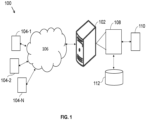
- FIG. 1 illustrates a block diagram of a system 100 for minimizing migration of one or more user centers and web services, in accordance with an example embodiment.
- the system 100 may comprise one or more computing devices 102, such as a laptop computer, a desktop computer, a notebook, a workstation, a cloud-based computing environment and the like. It will be understood that the system 100 may be accessed through one or more input/output interfaces 104-1, 104-2... 104-N, collectively referred to as I/O interface 104.
- Examples of the I/O interface 104 may include, but are not limited to, a user interface, a portable computer, a personal digital assistant, a handheld device, a smartphone, a tablet computer, a workstation, and the like.
- the I/O interface 104 are communicatively coupled to the system 100 through a network 106.
- the network 106 may be a wireless or a wired network, or a combination thereof.
- the network 106 can be implemented as a computer network, as one of the different types of networks, such as virtual private network (VPN), intranet, local area network (LAN), wide area network (WAN), the internet, and such.
- the network 106 may either be a dedicated network or a shared network, which represents an association of the different types of networks that use a variety of protocols, for example, Hypertext Transfer Protocol (HTTP), Transmission Control Protocol/Internet Protocol (TCP/IP), and Wireless Application Protocol (WAP), to communicate with each other.
- the network 106 may include a variety of network devices, including routers, bridges, servers, computing devices, storage devices. The network devices within the network 106 may interact with the system 100 through communication links.
- the system 100 supports various connectivity options such as BLUETOOTH ® , USB, ZigBee, and other cellular services.
- the network environment enables connection of various components of the system 100 using any communication link including Internet, WAN, MAN, and so on.
- the system 100 is implemented to operate as a stand-alone device.
- the system 100 may be implemented to work as a loosely coupled device to a smart computing environment.
- the system 100 comprises at least one memory with a plurality of instructions, one or more databases 112, and one or more hardware processors 108 which are communicatively coupled with the at least one memory to execute a plurality of modules 114 therein.
- the components and functionalities of the system 100 are described further in detail.
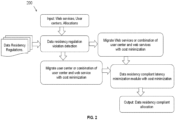
- FIG. 2 is a functional block diagram of the system 100 for Web Service Location Allocation Problem (WSLAP)- Repair on change in data residency regulation using FIG. 1 , in accordance with some embodiments of the present disclosure.
- WSLAP Web Service Location Allocation Problem
- the non-compliance in any existing configuration can be triggered due to change in data residency (DR) laws in countries (which make some of the existing allocation DR non-compliant) or due to change in user demands resulting in increased invocation frequency and possible violation of quality of service (QoS).
- DR data residency
- QoS quality of service
- To tackle change in DR regulations obtaining the set of violations, migrating allocation of user centers or deployment of web services while ensuring minimal cost and latency helps to comprehensively repair existing non-compliant allocations. Increase in the invocation frequency increases overall deployment latency for web services.
- a non-compliance detection module of the system 100 helps to detect non-compliant allocations due to change in DR regulations or change in deployment latency of web services. If DR non-compliant allocations are obtained, then decision for migrating allocation of user centers or deployment of web services are made based on a novel search technique.
- the modules of the system 100 for migration of user center or web service helps in migration to compliant data centers depending on the decision made earlier.
- the modules of the system 100 for migration of one or more user centers or one or more web services also try to minimize costs during repair which reduces the search space for obtaining compliant data centers and generate compliant allocations in short durations.
- Latency of web service might violate latency constraints in two cases: (i) migrations of user center allocations and web service deployment to repair data residency non-compliance leads to increase in latency, (ii) changes in invocation frequency of some user centers leads higher deployment latency for web service at data centers.
- the latency minimization module helps to minimize deployment latency for web services by looking for data centers having lower latency with user centers. Finally, the repaired solution with latency minimization is generated as output.
- FIG. 3 is an exemplary flow diagram illustrating a processor-implemented method 300 for minimizing migration of user centers as well as web services to data center to comply with data residency regulations and quality of service implemented by the system of FIG. 1 .
- Functions of the components of the system 100 are now explained with reference to FIG. 2 through steps of flow diagram in FIG. 3 , according to some embodiments of the present disclosure.
- an information of one or more user centers, one or more data centers managed by one or more cloud service providers, allocation of one or more web services to the one or more data centers, a set of data residency regulations, a deployment cost between web services and data centers, invocation frequency between user centers and web services, latency between user centers and data centers, and predefined service level agreement (SLA) for latency of each web service is received, via an input/output interface 104, as an input.
- SLA service level agreement
- the one or more hardware processors 108 are configured by the programmed instructions to analyze the allocation of each of the one or more user centers and each of the one or more web services to one or more data centers to identify a non-compliance to the set of data residency regulations and a change in a predefined latency threshold for web services based on one or more user demands.
- the WSLAP-Repair is to find a new location-allocation for user centers and web services with the goal of minimal perturbations (migrations) from the original solution, such that new solution is within permitted deployment cost and network latency requirements.
- constraints (2) and (3) ensures that each web service must be deployed at least at one data center.
- Constraint (4) ensures that every user center ( i ) using web service (k) must be allocated to exactly one data center ( j ) if it uses that web service.
- the one or more hardware processors 108 are configured by the programmed instructions to determine an impact on the one or more user centers and on the one or more web services based on the non-compliance to the set of data residency regulations and the change in a predefined latency threshold for web services based on one or more user demands.
- the one or more user demands comprising a deployment cost, a latency, and an invocation frequency. It is to be noted that the non-compliance due to change in the user demands results? in an increased invocation frequency and a violation of a predefined quality of service.
- the one or more hardware processors 108 are configured by the programmed instructions to identify at least one of the one or more data centers which are compliant to the DR regulations and compliant with the predefined latency threshold for web services based on one or more user demands.
- the one or more hardware processors 108 are configured by the programmed instructions to migrate at least one of (1) the impacted one or more user centers, or (2) the impacted one or more web services to the identified at least one of the one or more compliant data centers.
- ncomp [ U ][ W ] is used to store the detected allocation non-compliance between user centers and web services at data centers. The procedure for non-compliance detected and decisions on migrations is explained as:
- equation (6) restricts the network latency by keeping an upper bound on latency for each web service ( k ).
- the bound-on latency is decided by the enterprise based on SLAs. y ijk ⁇ ⁇ ijk ⁇ i ⁇ U , j ⁇ A & k ⁇ W wherein, the equation (7) ensures that the data residency regulations are met. It does not permit the user (i) to be allocated to a data center location for accessing web service ( k ), where data transfer is prohibited by the country of that user.
- the equation (8) establishes a relationship between the decision variables x kj and y ijk of the model. It ensures that user center ( i ) can be allocated to data center (j) for using web service ( k ) , only if web service ( k ) is deployed at data center ( j ).
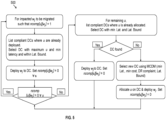
- FIG. 4 is a flow diagram 400 to illustrate a user center migration, in accordance with some embodiments of the present disclosure.
- the user center and the list of non-compliant web services ( n web ) at one or more data centers is obtained.
- a list of compliant data centers is obtained where maximum of the n web web services are already deployed to serve other user centers.
- the allocation of user center is migrated to the data center which gives minimum latency.
- the allocation of the one or more user centers is migrated to a compliant data center having the web service already deployed and gives minimum increase in latency. If none of the other compliant data centers have the web service deployed, then the web service is deployed to a compliant data center which would give minimum cost and latency on allocating the user center.
- a web service deployed at a data center to serve one or more user centers might become non-compliant.
- the deployment of the one or more web services which becomes data residency non-compliant with n user user centers at one or more data centers require to be migrated to the compliant data centers where the user centers are already allocated or need to be re-allocated with minimum cost and latency.
- the allocation strategies for web service can be (i) full allocation, (ii) max allocation, (iii) fixed allocation, which works in the same way as the user center allocation migration strategies with the roles of user center and web service being interchanged during migration.
- FIG. 5 is flow diagram 500 to illustrate a web service migration, in accordance with some embodiments of the present disclosure.
- the one or more web services the list of non-compliant user centers ( n user ) and one or more data centers is obtained.
- a list of compliant data centers is also obtained where maximum of the n user user centers are already allocated for accessing other web services.
- the deployment of web services is migrated to the data center which gives minimum cost and latency.
- the deployment of web service is migrated to a compliant data center having the user center already deployed and gives minimum cost and latency. If none of the other compliant data centers have the user center allocated, then the user center is allocated to a compliant data center which would give minimum cost and latency on deploying the web service.
- FIG. 6 through FIG. 9 are schematic diagrams to determine a data residency matrix based on user center location, data type of the web services, and cloud data center location, in accordance with some embodiments of the present disclosure.
- FIG. 6 current web services location allocation problem configuration, where a web service provider has deployed three web services ( w 1 , w 2 , w 3 ) on three data centers ( a 1 , a 2 , a 3 ) for its three user centers ( u 1 , u 2 , u 3 ).
- the input data set comprises of the invocation frequency, the latency, and the deployment cost matrices.
- the non-compliant user centers from its currently allocated data centers are migrated to other compliant data centers.
- the user center u 3 must be migrated from data center a 2 to some other data center for using web service w 2 .
- the available options for migration are a 1 and a 3 data centers.
- the latency for the web service w 2 is represented by ⁇ w 2 ( ⁇ 1 ) and if the user center u 3 is migrated from data center a 2 to a 3 , then the latency for the web service is represented by w 2 is ⁇ w 2 ( ⁇ 2 )
- both the allocation configurations ⁇ 1 and ⁇ 2 might violate the latency criteria for the web service w 2 .
- migrating only, the non-compliant pairs is not enough.
- the latency for web service w 2 is represented by ⁇ w 2 ( ⁇ 3 ) and for the migration of the web service w 2 from data center a 2 to a 3 , then latency for web service w 2 , is represented by ⁇ w 2 ( ⁇ 4 ).
- both the allocations ⁇ 3 and ⁇ 4 might also violative of the latency constraint for web service w 2 .
- the web services is not enough.
- the one or more hardware processors 108 are configured by the programmed instructions to minimize number of migrations of the one or more user centers and the one or more web services based on an invocation frequency, a deployment latency, and a cost of deployment. Wherein an increase in the invocation frequency increases the deployment latency for the one or more web services.
- a web service can be accessed by several user centers at one or more than one data center.
- a latency minimization module of the system 100 is used to minimize the deployment latency for the one or more web services in the event of (i) increase in web service latency and latency constraint violation for web service due to migrations, and (ii) latency constraint violation for web service due to increase in invocation frequency.
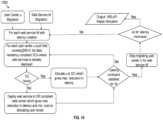
- FIG. 10 is a flow diagram 1000 to illustrate a latency minimization, in accordance with some embodiments of the present disclosure.
- allocation of user centers needs to be migrated to other compliant data centers having lower latency as the invocation frequency of a user center cannot be compromised.
- the one or more web services can be deployed at more than one data centers.
- the allocation of the one or more user centers at the data centers accessing the web service need to be migrated to another compliant data center where the web service is deployed and gives maximum reduction in latency. This strategy is repeated for user centers accessing the web service until the deployment latency satisfies the latency constraint.
- the column 'Change (%)' gives the percentage increase in cost and latency.
- the comparison of WSLAP-Repair solution is done with the current (i.e., prior) solution.
- Table 1 shows the implications of data regulation change on WSLAP. If the problem is solved from scratch to obtain the compliant solution, the number of reallocations is very large. While with WSLAP-Repair model, the reallocations are minimal. Note, large reallocations (migration) could incur additional overheads, hence enterprises could opt for WSLAP-Repair strategy.
- the embodiments of present disclosure herein address the need of minimizing migration of user centers and web services to comply with data residency regulations and change in latency threshold for web services based on user demands.
- the method and system provide a framework that assists enterprises in migrating web services and user allocation to different data centers with minimal changes and with lower additional operational cost.
- non-compliant users are allocated to compliant data centers with minimal changes in the original configuration.
- web services need to be deployed across a finite number of servers, there are multiple sub-problems such as minimizing latency that needs to be addressed.
- Such computer-readable storage means contain program-code means for implementation of one or more steps of the method, when the program runs on a server or mobile device or any suitable programmable device.
- the hardware device can be any kind of device which can be programmed including e.g., any kind of computer like a server or a personal computer, or the like, or any combination thereof.
- the device may also include means which could be e.g., hardware means like e.g., an application-specific integrated circuit (ASIC), a field-programmable gate array (FPGA), or a combination of hardware and software means, e.g., an ASIC and an FPGA, or at least one microprocessor and at least one memory with software modules located therein.
- ASIC application-specific integrated circuit
- FPGA field-programmable gate array
- the means can include both hardware means, and software means.
- the method embodiments described herein could be implemented in hardware and software.
- the device may also include software means. Alternatively, the embodiments may be implemented on different hardware devices, e.g., using a plurality of CPUs.
- the embodiments herein can comprise hardware and software elements.
- the embodiments that are implemented in software include but are not limited to, firmware, resident software, microcode, etc.
- the functions performed by various modules described herein may be implemented in other modules or combinations of other modules.
- a computer-usable or computer readable medium can be any apparatus that can comprise, store, communicate, propagate, or transport the program for use by or in connection with the instruction execution system, apparatus, or device.
- a computer-readable storage medium refers to any type of physical memory on which information or data readable by a processor may be stored.
- a computer-readable storage medium may store instructions for execution by one or more processors, including instructions for causing the processor(s) to perform steps or stages consistent with the embodiments described herein.
- the term "computer-readable medium” should be understood to include tangible items and exclude carrier waves and transient signals, i.e., be non-transitory. Examples include random access memory (RAM), read-only memory (ROM), volatile memory, nonvolatile memory, hard drives, CD ROMs, DVDs, flash drives, disks, and any other known physical storage media.
Landscapes
- Engineering & Computer Science (AREA)
- Computer Networks & Wireless Communication (AREA)
- Signal Processing (AREA)
- Software Systems (AREA)
- Theoretical Computer Science (AREA)
- Physics & Mathematics (AREA)
- General Engineering & Computer Science (AREA)
- General Physics & Mathematics (AREA)
- Quality & Reliability (AREA)
- Mathematical Physics (AREA)
- Management, Administration, Business Operations System, And Electronic Commerce (AREA)
Applications Claiming Priority (1)
| Application Number | Priority Date | Filing Date | Title |
|---|---|---|---|
| IN202321017889 | 2023-03-16 |
Publications (1)
| Publication Number | Publication Date |
|---|---|
| EP4432084A1 true EP4432084A1 (de) | 2024-09-18 |
Family
ID=89573368
Family Applications (1)
| Application Number | Title | Priority Date | Filing Date |
|---|---|---|---|
| EP24151138.5A Pending EP4432084A1 (de) | 2023-03-16 | 2024-01-10 | System und verfahren zur umpositionierung von webdiensten und zur neuzuordnung von benutzern zur datenresidenzkonformität |
Country Status (2)
| Country | Link |
|---|---|
| US (1) | US12476884B2 (de) |
| EP (1) | EP4432084A1 (de) |
Citations (2)
| Publication number | Priority date | Publication date | Assignee | Title |
|---|---|---|---|---|
| US20220060431A1 (en) * | 2020-08-21 | 2022-02-24 | Kyndryl, Inc. | Microservice placement in hybrid multi-cloud using graph matching |
| US20220357969A1 (en) * | 2021-03-24 | 2022-11-10 | Tata Consultancy Services Limited | Method and system for web service location allocation and virtual machine deployment |
Family Cites Families (17)
| Publication number | Priority date | Publication date | Assignee | Title |
|---|---|---|---|---|
| US9367257B2 (en) | 2008-09-11 | 2016-06-14 | Microsoft Technology Licensing, Llc | Techniques for resource location and migration across data centers |
| US11336519B1 (en) | 2015-03-10 | 2022-05-17 | Amazon Technologies, Inc. | Evaluating placement configurations for distributed resource placement |
| US9959146B2 (en) * | 2015-10-20 | 2018-05-01 | Intel Corporation | Computing resources workload scheduling |
| JP6819131B2 (ja) * | 2016-08-18 | 2021-01-27 | 富士通株式会社 | 情報処理装置、情報処理方法、情報処理プログラムおよび情報処理システム |
| US10795583B2 (en) * | 2017-07-19 | 2020-10-06 | Samsung Electronics Co., Ltd. | Automatic data placement manager in multi-tier all-flash datacenter |
| US11134013B1 (en) * | 2018-05-31 | 2021-09-28 | NODUS Software Solutions LLC | Cloud bursting technologies |
| US10749773B2 (en) * | 2018-07-06 | 2020-08-18 | International Business Machines Corporation | Determining a location of optimal computing resources for workloads |
| US11023287B2 (en) * | 2019-03-27 | 2021-06-01 | International Business Machines Corporation | Cloud data center with reduced energy consumption |
| US12450078B2 (en) * | 2020-02-19 | 2025-10-21 | Citrix Systems, Inc. | Migration of a desktop workload |
| US12192820B2 (en) * | 2021-03-22 | 2025-01-07 | Intel Corporation | Reinforcement learning for multi-access traffic management |
| US12019776B2 (en) | 2021-04-30 | 2024-06-25 | Accenture Global Solutions Limited | Policy-based application architecture generation |
| US11675518B2 (en) * | 2021-05-04 | 2023-06-13 | EMC IP Holding Company LLC | Determining migrations between geographically distributed data centers |
| US11797187B2 (en) * | 2021-06-28 | 2023-10-24 | QoS Tech LLC | Optimized I/O performance regulation for non-volatile storage |
| WO2023048747A1 (en) * | 2021-09-24 | 2023-03-30 | Intel Corporation | Systems, apparatus, articles of manufacture, and methods for cross training and collaborative artificial intelligence for proactive data management and analytics |
| US20220116289A1 (en) * | 2021-12-22 | 2022-04-14 | Palaniappan Ramanathan | Adaptive cloud autoscaling |
| US20240143372A1 (en) * | 2022-10-31 | 2024-05-02 | Nvidia Corporation | Facilitating workload migration in data centers using virtual machine management |
| US20240202021A1 (en) * | 2022-12-16 | 2024-06-20 | Veea Inc. | Systems and Methods for NextG Edge Computing Orchestration |
-
2024
- 2024-01-10 EP EP24151138.5A patent/EP4432084A1/de active Pending
- 2024-01-16 US US18/414,217 patent/US12476884B2/en active Active
Patent Citations (2)
| Publication number | Priority date | Publication date | Assignee | Title |
|---|---|---|---|---|
| US20220060431A1 (en) * | 2020-08-21 | 2022-02-24 | Kyndryl, Inc. | Microservice placement in hybrid multi-cloud using graph matching |
| US20220357969A1 (en) * | 2021-03-24 | 2022-11-10 | Tata Consultancy Services Limited | Method and system for web service location allocation and virtual machine deployment |
Non-Patent Citations (1)
| Title |
|---|
| SAHU PANKAJ ET AL: "Cloud Storage and Processing Service Selection considering Tiered Pricing and Data Regulations", 2022 IEEE/ACM 15TH INTERNATIONAL CONFERENCE ON UTILITY AND CLOUD COMPUTING (UCC), IEEE, 6 December 2022 (2022-12-06), pages 92 - 101, XP034307657, DOI: 10.1109/UCC56403.2022.00020 * |
Also Published As
| Publication number | Publication date |
|---|---|
| US20240314049A1 (en) | 2024-09-19 |
| US12476884B2 (en) | 2025-11-18 |
Similar Documents
| Publication | Publication Date | Title |
|---|---|---|
| US12175266B1 (en) | Virtual provisioning with implementation resource boundary awareness | |
| US11086648B1 (en) | Trust-based resource allocation | |
| US11727318B2 (en) | Meeting room selection based on internet of things privacy level | |
| US10013662B2 (en) | Virtual resource cost tracking with dedicated implementation resources | |
| US10735451B1 (en) | Systems and methods for maintaining IT infrastructure security and compliance with security policies and regulations | |
| US8639595B1 (en) | Statistically cost-following accounting model for dedicated resources | |
| CN110717075B (zh) | 信息技术基础设施事故的优先化 | |
| US8229415B1 (en) | Wireless communication data store construction and analysis | |
| US11824716B2 (en) | Systems and methods for controlling the deployment of network configuration changes based on weighted impact | |
| US11601347B2 (en) | Identification of incident required resolution time | |
| US10402765B1 (en) | Analysis for network management using customer provided information | |
| EP4432084A1 (de) | System und verfahren zur umpositionierung von webdiensten und zur neuzuordnung von benutzern zur datenresidenzkonformität | |
| US11563693B2 (en) | Techniques for excess resource utilization | |
| US20230385123A1 (en) | System and method for recommending cost optimization options for a cloud resource | |
| US12423712B2 (en) | Method and system for data regulations-aware cloud storage and processing service allocation | |
| WO2025212171A1 (en) | Visualization for network services and their relationships with end-users, service locations, and other network services | |
| Ferreira et al. | A federated machine learning approach to detect international revenue share fraud on the 5G edge | |
| EP3121777A1 (de) | Systeme und verfahren zur dynamischen zuweisung von mobilen agenten | |
| US20230401087A1 (en) | Method and system for automated migration of high performance computing application to serverless platform | |
| US20200404105A1 (en) | Data gap bridging methods and systems | |
| US12406313B2 (en) | System and method for technology debt assessment | |
| EP4235423A1 (de) | System und verfahren für die aufenthaltskonforme platzierung von daten in einer cloud | |
| Izydorek et al. | Challenges regarding network neutrality for commercial deployment of 5G networks | |
| EP4451114A1 (de) | Verfahren und system zur konstruktion eines neufaktorierungspfades für vor-ort-anwendungsmigration in eine cloud | |
| CN107295556B (zh) | 策略控制和计费策略冲突的检测方法及装置、设备 |
Legal Events
| Date | Code | Title | Description |
|---|---|---|---|
| PUAI | Public reference made under article 153(3) epc to a published international application that has entered the european phase |
Free format text: ORIGINAL CODE: 0009012 |
|
| STAA | Information on the status of an ep patent application or granted ep patent |
Free format text: STATUS: THE APPLICATION HAS BEEN PUBLISHED |
|
| STAA | Information on the status of an ep patent application or granted ep patent |
Free format text: STATUS: REQUEST FOR EXAMINATION WAS MADE |
|
| AK | Designated contracting states |
Kind code of ref document: A1 Designated state(s): AL AT BE BG CH CY CZ DE DK EE ES FI FR GB GR HR HU IE IS IT LI LT LU LV MC ME MK MT NL NO PL PT RO RS SE SI SK SM TR |
|
| 17P | Request for examination filed |
Effective date: 20240905 |
|
| RBV | Designated contracting states (corrected) |
Designated state(s): AL AT BE BG CH CY CZ DE DK EE ES FI FR GB GR HR HU IE IS IT LI LT LU LV MC ME MK MT NL NO PL PT RO RS SE SI SK SM TR |
|
| RAP3 | Party data changed (applicant data changed or rights of an application transferred) |
Owner name: TATA CONSULTANCY SERVICES LIMITED |