EP4451114A1 - Verfahren und system zur konstruktion eines neufaktorierungspfades für vor-ort-anwendungsmigration in eine cloud - Google Patents
Verfahren und system zur konstruktion eines neufaktorierungspfades für vor-ort-anwendungsmigration in eine cloud Download PDFInfo
- Publication number
- EP4451114A1 EP4451114A1 EP24161498.1A EP24161498A EP4451114A1 EP 4451114 A1 EP4451114 A1 EP 4451114A1 EP 24161498 A EP24161498 A EP 24161498A EP 4451114 A1 EP4451114 A1 EP 4451114A1
- Authority
- EP
- European Patent Office
- Prior art keywords
- application
- premises
- premises application
- cloud environment
- target cloud
- Prior art date
- Legal status (The legal status is an assumption and is not a legal conclusion. Google has not performed a legal analysis and makes no representation as to the accuracy of the status listed.)
- Pending
Links
Images









Classifications
-
- G—PHYSICS
- G06—COMPUTING OR CALCULATING; COUNTING
- G06F—ELECTRIC DIGITAL DATA PROCESSING
- G06F8/00—Arrangements for software engineering
- G06F8/70—Software maintenance or management
- G06F8/76—Adapting program code to run in a different environment; Porting
-
- G—PHYSICS
- G06—COMPUTING OR CALCULATING; COUNTING
- G06F—ELECTRIC DIGITAL DATA PROCESSING
- G06F9/00—Arrangements for program control, e.g. control units
- G06F9/06—Arrangements for program control, e.g. control units using stored programs, i.e. using an internal store of processing equipment to receive or retain programs
- G06F9/46—Multiprogramming arrangements
- G06F9/50—Allocation of resources, e.g. of the central processing unit [CPU]
- G06F9/5061—Partitioning or combining of resources
-
- G—PHYSICS
- G06—COMPUTING OR CALCULATING; COUNTING
- G06F—ELECTRIC DIGITAL DATA PROCESSING
- G06F8/00—Arrangements for software engineering
- G06F8/60—Software deployment
- G06F8/65—Updates
-
- G—PHYSICS
- G06—COMPUTING OR CALCULATING; COUNTING
- G06F—ELECTRIC DIGITAL DATA PROCESSING
- G06F8/00—Arrangements for software engineering
- G06F8/70—Software maintenance or management
- G06F8/72—Code refactoring
-
- G—PHYSICS
- G06—COMPUTING OR CALCULATING; COUNTING
- G06F—ELECTRIC DIGITAL DATA PROCESSING
- G06F9/00—Arrangements for program control, e.g. control units
- G06F9/06—Arrangements for program control, e.g. control units using stored programs, i.e. using an internal store of processing equipment to receive or retain programs
- G06F9/46—Multiprogramming arrangements
- G06F9/48—Program initiating; Program switching, e.g. by interrupt
- G06F9/4806—Task transfer initiation or dispatching
- G06F9/4843—Task transfer initiation or dispatching by program, e.g. task dispatcher, supervisor, operating system
- G06F9/485—Task life-cycle, e.g. stopping, restarting, resuming execution
- G06F9/4856—Task life-cycle, e.g. stopping, restarting, resuming execution resumption being on a different machine, e.g. task migration, virtual machine migration
Definitions
- the disclosure herein generally relates to application migration, and, more particularly, to method and system of constructing refactoring path for on-premises application migration to cloud.
- Cloud computing has been perceived by many enterprises as solution that boosts businesses growth and accelerates commercialization with reduced migration resources. This has led to rapid adoption of cloud technology by organizations of different sizes and sectors. Cloud computing has reconfigured how organizational systems are deployed, managed, and implemented. Transition from application-based products to cloud-based businessoriented services has been accelerated by cloud computing.
- Application migration is the process of moving a software application from on-premises server(s) to a cloud provider's environment. Transferring databases, data, applications, and IT processes to the cloud is part of the cloud migration process. Some custom applications can be pushed to the cloud without modification, while others require some form of re-engineering and are rarely obsolete or need to be built from scratch. Refactoring is the process of running application on the cloud provider's infrastructure after completely redesigning the application to better fit the new cloud environment. This strategy requires changing current application, or at least changing a large part of code base to take advantage of Cloud environment more effectively.
- a system of constructing refactoring path for on-premise application migration to cloud includes discovering a set of attributes of on-premise application received from a user for cloud migration and creates a target cloud environment for the on-premise application, based on the set of attributes.
- the on-premise application to be migrated is parsed to the target cloud environment through a set of pre-constructed refactoring stages. Further, migration analysis of the on-premise application is performed through one or more impacts of the set of pre-constructed refactoring stages over a set of considerations.
- One or more impacts of the on-premise application are analyzed to recommend the on-premise application that qualifies for at least one of a migration, a transformation and a rebuild. Then, the on-premise application is categorically mapped for facilitating a successful migration to the target cloud environment, based on one or more variations identified across each technology domain(s), with corresponding subdomain(s) and constructing a service compatibility matrix of the migrated on-premises application in the target cloud environment.
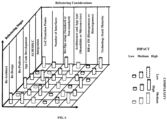
- the set of considerations for the on-premise application comprises one or more function points over each refactoring stage, total number of interface stages, platform configuration of the on-premise application, the on-premise application type, an architecture type of the on-premise application, database of the on-premise application, and technology stack maturity.
- one or more application modernization activities comprises to generate one or more modified features of the target cloud environment that overlaps with one or more existing attributes of the on-premises application platform and providing a feasible assistance to select specific feature from a set of pre-defined stacks. Then, a version affinity of the on-premises application is evaluated, when migrated to the target cloud environment and utilizing an affinity look-up table for fitment of the target cloud environment.
- one or more impacts of the on-premise application are analyzed to upgrade usage of existing software platform technology version with progressive software platform technology version.
- one or more impacts of each on-premise application may be categorized into at least one of a low, medium, and high severity.
- the on-premise application migration is optimal, when one or more dependencies and one or more interfaces of technology domain synchronize with the target cloud environment.
- a method of constructing refactoring path for on-premises application migration to cloud includes discovering a set of attributes of on-premise application received from a user for cloud migration and creates a target cloud environment for the on-premise application based on the set of attributes.
- the on-premise application to be migrated is parsed to the target cloud environment, through a set of pre-constructed refactoring stages.
- a migration analysis of the on-premises application is performed through one or more impacts of the set of pre-constructed refactoring stages over a set of considerations.
- One or more impacts of the on-premise application are analyzed to recommend the on-premises application that qualifies for at least one of a migration, a transformation and a rebuild.
- the on-premises application is categorically mapped for facilitating a successful migration to the target cloud environment, based on one or more variations identified across each technology domain(s) with corresponding sub- domain(s) and constructing a service compatibility matrix of the migrated on-premise application in the target cloud environment.
- the set of pre-constructed refactoring stages comprises rearchitecting the on-premise application received from user, based on set of attributes, and redesigning the target cloud environment to facilitate successful on-premise application migration.
- the on-premise application to be migrated to the target cloud environment is transformed by recommending one or more application modernization activities.
- code refactoring of the application to be migrated to the target cloud environment is performed based on a set of predefined rules and a set of constraints.
- one or more impacts of the on-premise application are analyzed to upgrade usage of existing software platform version with progressive software platform version.
- one or more impacts of each on-premise application may be categorized into at least one of a low, medium, and high severity.
- One or more impacts of the on-premise application are analyzed to recommend the on-premise application is categorically mapped for facilitating a successful migration to the target cloud environment, based on one or more variations identified across each technology domain(s) with corresponding sub-domain(s) and constructing a service compatibility matrix of the migrated on-premise application in the target cloud environment.
- Embodiments herein provide a method and system of constructing refactoring path for on-premises application migration to cloud.
- the method of the present disclosure enables migrations of on-premises application to target cloud environment, based on user specified requirements.
- the on-premises application(s) may include for example an application comprising of various software platforms weaved together, with custom code based on respective user's business requirements.
- the application would consider complete ecosystem, by taking an enterprise view when the user decides to migrate to cloud. Each application is created, set up, and configured differently for on-premises deployment, than for cloud deployment.
- Refactoring path for on-premises application migration process offers thorough coverage of all architectures, designs, application types, technological changes, and code refactoring concerns throughout migration. The technique also reveals dependencies between the target platform and the current software platform.
- the disclosed system is further explained with the method as described in conjunction with FIG. 1 to FIG.10F below.
- FIG. 1 through FIG.10F where similar reference characters denote corresponding features consistently throughout the figures, preferred embodiments shown, and these embodiments are described in the context of following exemplary system and/or method.
- FIG. 1 illustrates an exemplary application migration system using FIG. 1 , in accordance with some embodiments of the present disclosure.
- the batch processing system 100 includes processor (s) 104, communication interface (s), alternatively referred as or input/output (I/O) interface(s) 106, and one or more data storage devices or memory 102 operatively coupled to the processor (s) 104.
- the system 100, with the processor(s) is configured to execute functions of one or more functional blocks of the system 100.
- the processor (s) 104 can be one or more hardware processors 104.
- the one or more hardware processors 104 can be implemented as one or more microprocessors, microcomputers, microcontrollers, digital signal processors, central processing units, state machines, logic circuitries, and/or any devices that manipulate signals based on operational instructions.
- the processor(s) 104 is configured to fetch and execute computer-readable instructions stored in the memory.
- the system 100 can be implemented in a variety of computing systems, such as laptop computers, notebooks, hand-held devices, workstations, mainframe computers, servers, a network cloud, and the like.
- the I/O interface(s) 106 can include a variety of software and hardware interfaces, for example, a web interface, a graphical user interface, and the like and can facilitate multiple communications within a wide variety of networks N/W and protocol types, including wired networks, for example, LAN, cable, etc., and wireless networks, such as WLAN, cellular, or satellite.
- the I/O interface (s) 106 can include one or more ports for connecting a number of devices (nodes) of the system 100 to one another or to another server.
- the memory 102 may include any computer-readable medium known in the art including, for example, volatile memory, such as static random-access memory (SRAM) and dynamic random-access memory (DRAM), and/or non-volatile memory, such as read only memory (ROM), erasable programmable ROM, flash memories, hard disks, optical disks, and magnetic tapes.
- volatile memory such as static random-access memory (SRAM) and dynamic random-access memory (DRAM)
- non-volatile memory such as read only memory (ROM), erasable programmable ROM, flash memories, hard disks, optical disks, and magnetic tapes.
- ROM read only memory
- erasable programmable ROM erasable programmable ROM
- flash memories hard disks
- optical disks optical disks
- magnetic tapes magnetic tapes.
- the memory 102 may comprise information pertaining to input(s)/output(s) of each step performed by the processor(s) 104 of the system 100 and methods of the present disclosure. Functions of
- FIG.2 is a functional block diagram depicting an on-premises application refactoring path of migration to a target cloud environment using the system of FIG. 1 , in accordance with some embodiments of the present disclosure.
- the system 100 includes a discovery unit 202, a rearchitect unit 204, a redesign unit 206, a technology change unit 208, a code refactoring unit 210 and a development operations refactoring unit 212, and an application lifecycle management unit 214.
- the discovery unit 202 of the system 100 identifies system properties using a set of rule bases.
- a component recognition template is chosen using the rule base as well.
- a set of attributes that should be identified for each application type make up the component detection template. It also includes pointers to the applications or objects that were used to get the set of attributes.
- the discovery unit provides numerous component detection templates for various application characteristics, including platforms, infrastructure, users, and data. It helps to collect the following information about entire on-premises application ecosystem application type, platform, current version, backend database, operating system. Further, application architecture, implementation design, application logic as modules, security products used.
- Each application recognize a certain set of properties from the component recognition template. This includes a reference to the object or script that was used to obtain a list of attributes that included the user's inventory of applications that were available on-premises.
- Each application's server mappings are gathered. configuration elements, performance metrics, processes that are active, network connections, data characteristics, and a dependency diagram. The technology mapper tool's top-down mapping of the relationships between application and infrastructure components and their mappings are extremely accurate.
- the rearchitect unit 204 of the system 100 creates the on-premises application to be migrated in the target cloud deployment environment.
- the initial stage of on-premises application restructuring is called rearchitect unit, and it lays the groundwork for the full refactoring path for cloud migration.
- the target cloud environment is visualized using source architecture of the on-premises application ecosystem, and determined architectural efforts are made to transition to the target design. Discovery and visualization of source architectures can be utilized in all environments, for on-premises setups considering entire application ecosystem, including application security and user access management.
- the redesign unit 206 of system 100 provides high-level detailed arrangement within the components and the design pattern solves code impact information.
- the technology change unit 208 of the system 100 provides application modernization activity required as part of a cloud migration initiative. This represents changing the use of existing technology platforms, or replacing existing technology platforms, or removing existing technology platforms entirely. All of this should be driven by realizing the cloud environment as a cloud target environment.
- the cloud target environment is designed based on the user inputs.
- Technology changes are required to further develop the on-premises application ecosystem. This enables transformation part of cloud migration for competitiveness and future viability. During this phase, technology change improves robustness during post-migration situations.
- the technology platforms may include middleware integration, business analytics, Bigdata, nonrelational databases (NoSQL), messaging middleware and thereof.
- the application lifecycle management unit 214 of the system 100 performs refactoring activities. After completing the aforementioned core phases of the application refactoring process, the refactoring activities related to application lifecycle management are performed according to component interactions.
- FIG.3 is a flow diagram of a method of migrating on-premises application to the target cloud environment using the system of FIG. 1 , in accordance with some embodiments of the present disclosure.
- the system 100 comprises one or more data storage devices or the memory 102 operatively coupled to the processor(s) 104 and is configured to store instructions for execution of steps of the method 300 by the processor(s) or one or more hardware processors 104.
- the steps of the method 300 of the present disclosure will now be explained with reference to the components or blocks of the system 100 as depicted in FIG. 1 through FIG.2 and the steps of flow diagram as depicted in FIG.3 .
- the one or more hardware processors 104 discovers a set of attributes of on-premises application received from a user for cloud migration.
- Refactored application runs on the cloud provider's infrastructure. This means that applications must be completely redesigned to better adapt to the new cloud environment. This approach involves modifying existing applications, or at least large portions of the code base, to better take advantage of cloud-based functionality and the additional flexibility that comes with it.
- the system 100 constructed as described herein carries out a process or processes for migrating a complex on-premises application from an initial application configuration to a new, "migrated" application configuration.
- Initiating the application discovery process in the system extracts the user application server name or IP address, location, privilege username, password and thereof.
- a typical on-premises packaged application(s) may include sales and marketing, supply chain management, human resources (HR), finance, and other function areas.
- the on-premises application may include for example Mulesoft, Cognos, Oracle, RabbitMQ, Cassandra, and thereof or any combination of technology domains and software platform.
- the discovery unit 202 of the system 100 collects the server(s) mapped to each on-premises application and the set of attributes comprising application configurations, performance parameters, running processes, network connections and data characteristics.
- the on-premises application inventory applies probes and detection agents to each server internet protocol (IP) received from the user and collects a list of applications and ecosystem information. Additionally, each on-premises application is mapped to the server based on server type, specifications, capacity details, and utilization details. This further identifies the platform(s) in use, version, deployment, configuration details, and thereof to identify the technology stack.
- IP internet protocol
- the disclosed method addresses the application refactoring path of cloud migration is not limited to deployment of on-premises application in public clouds, on-premises private clouds to public clouds, hybrid model coverage with a combination of public cloud, private cloud, and multi-cloud to a single public cloud.
- FIG.4 illustrates schematic diagram depicting application refactoring manager using the system of FIG. 1 , in accordance with some embodiments of the. present disclosure.
- the application refactoring manager comprises a function model viewer, a simulation engine, and an application dashboard viewer.
- the application refactoring manager provides a single portal to view various aspects of migrations related to multiple applications in ecosystem.
- the application refactoring manager provides a consolidated dashboard view of the application environment, from deployment and configuration to integration and interfaces, providing clarity on the environment.
- the functional model viewer allows to view a visual model of the application, including source and target cloud environments.
- Application design provides information about the high-level and low-level design of the application in the target environment.
- the dashboard's functional model viewer provides technical changes for version upgrades and replacement of existing technologies.
- the Devops model offers a cloud environment in the migrated setup.
- the application dashboard viewer allows users to view all available refactoring policies and templates, including a comprehensive real-time application ecosystem dashboard view of user application migration status.
- the migration validation for application migration refactoring paths allow users to view status of regular or ad hoc audits of refactoring migration activities. This allow users to drill down into specific results and related control details.
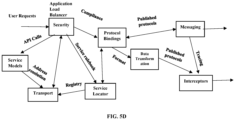
- FIG.5A and FIG.5B Considering a visualized example application ecosystem, which is an on-premises application (for example a Mule ESB) of a user to be referred as the source architecture (as depicted in FIG.5A and FIG.5B ).
- the one or more hardware processors 104 create a target cloud environment for the on-premises application based on the set of attributes.
- the method of the present disclosure creates the target cloud environment based on the set of attributes discovered from the discovery unit 202 of the system 100.
- the user initiates the application rearchitect process in the system, and receives information from the user server(s), username, or IP address(es), location, privilege username, and privilege password.
- the disclosed method further creates the target cloud environment for the entire application ecosystem within user's on-premises, based on application architecture guidelines for the target cloud and architectural best practice repository.
- An architecture gap analysis is performed by identifying gaps between source and target cloud environments and identifying complementary and overlapping cloud-native capabilities available in the application. This also identifies the level of usage of cloud features, and selects the best feature from one or more features and rebuilds each application for self-healing.
- the one or more hardware processors 104 parse the on-premises application to be migrated to the target cloud environment through a set of pre-constructed refactoring stages.
- the set of pre-constructed refactoring stages comprises the steps of rearchitecting the on-premises application received from the user based on the set of attributes.
- Rearchitect process provides visual modeling of on-premises application for refactoring migration path, based on reference models for specific scenarios and provides ability to simulate functional and non-functional aspects.
- the cloud is further redesigned to facilitate a successful on-premises application migration for selected applications to the target cloud environment.
- the cloud continues to transform for on-premises application success.
- one or more design guidelines from the repository are applied, and specific patterns for each platform are extracted and applied.
- the on-premises application is transformed to be migrated to the target cloud environment by recommending one or more application modernization activities.
- the one or more application modernization activities comprises generating one or more modified features (referring now to FIG.5D ) of the target cloud environment that overlaps with existing attributes of the on-premises application platform and provides feasible assistance to select specific feature from a set of pre-defined stacks. Further, a version affinity of the on-premises application is evaluated when migrated to the target cloud environment and an affinity look-up table is utilized for fitment of the target cloud environment.
- the set of predefined rules are based on for example Java, dot net technologies and the like.
- the method provides comprehensive recommendations for architecture, design, code, configuration, and management.
- Architectural recommendations form the basis for refactoring activities.
- Design recommendations are based on predefined platform design patterns and use cases.
- Code refactoring recommendations are derived from a predefined rule base built for different technology stacks. Configuration recommendations for each platform consider on-premises deployments and cloud setups.
- the one or more hardware processors 104 perform a migration analysis of the on-premises application through one or more impacts of the set of pre-constructed refactoring stages over a set of considerations.
- the set of considerations (referring now FIG.6 ) for the on-premises application comprises a one or more function points over each refactoring stage, a total number of interface stages, a platform configuration of the on-premises application, the on-premises application type, an architecture type of the on-premises application, a database of the on-premises application, and a technology stack maturity.
- the one or more hardware processors 104 analyze one or more impacted areas of the on-premises application and recommend the on-premises application that qualifies for at least one of a migration, a transformation and a rebuild.
- the one or more impacts are analyzed based on predefined impact analysis templates for specific platforms and scenarios.
- users can add new templates based on changing technology or usage patterns.
- Each impact analysis templates are based on platform characteristics, application characteristics, infrastructure characteristics, and data characteristics.
- the impact analysis template has ability to customize recommended templates based on user specific needs. Also, recommending appropriate configurations and code impacts to support cloud migration of application transformations.
- the one or more hardware processors 104 categorically map the on-premises application for facilitating a successful migration to the target cloud environment based on one or more variations identified across each technology domain(s) with corresponding sub-domain(s) and constructing a service compatibility matrix of the migrated on-premises application to the target cloud environment.
- FIG.7A where the user login screen of on-premises application refactoring manager is listed, user performs refactoring process over the on-premises application.
- FIG.8A through FIG.8C illustrates refactoring process screens of application migration manager using the system of FIG. 1 , in accordance with some embodiments of the present disclosure.
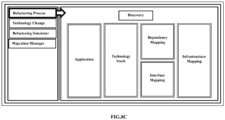
- the migration manager refactoring process is having discovery unit to extract the set of attributes of the user's on-premises application being set for migration.
- FIG.9A through FIG.9C illustrates refactoring process screens of on-premises application technology manager using the system of FIG. 1 , in accordance with some embodiments of the present disclosure.
- FIG.9A depicts the technology domains option listing a set of pre-existing technologies, for which user selects the application migration technology.
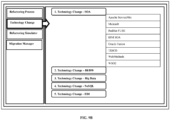
- FIG.9B lists sub-domain for each technology domain(s).
- service oriented architecture comprises Apache service mix, enterprise service bus (ESB) Mulesoft, RedHat FUSE, IBM SOA, Oracle Fusion, TIBCO, Web methods, WSO2 and thereof.
- FIG.9C lists technology change to rearchitect the on-premises application based on for example self-healing, scale-out, distributed, and thereof.
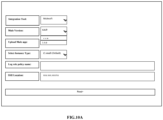
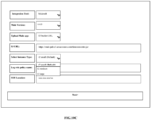
- FIG. 10 B illustrates a next step of the on-premises application migration which is to upload the application code which is already used by the user in their environment. This is an important step in the entire migration and refactoring process.
- user uploads from the local file system or leverage for example amazon web service (AWS) to provide the uniform resource locator (URL) where the application code has been placed.
- AWS amazon web service
- FIG.10C illustrates the migration refactoring manager screen can be used in different environments like development, testing, pre-production, production. Based on environment the infrastructure provision specific decision can be taken.
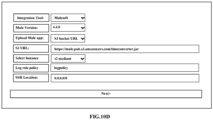
- FIG.10D depicts the screen related to logs that need to be referred for monitoring after infrastructure provisioning and business application is deployed in the cloud environment.
- FIG.10E illustrates the login screen into the instance that is being provisioned. Once the user provide specific IP address then after infrastructure provisioning is completed by the user, with secure shell from specified IP address.
- FIG.10F illustrates target cloud formation template for migrating on-premises application to cloud.
- the embodiments of present disclosure herein addresses unresolved problem of application migration.
- the embodiment thus provides method and system of constructing refactoring path for on-premises application migration to cloud.
- the embodiments herein further provide on-premises application refactoring process.
- This method has potential to improve application availability by 15% to 25%, depending on policy configuration. This is achieved through a comprehensive refactoring framework, technology change management, code refactoring, seamless integration, and reduced downtime.
- This system potentially increases the dynamic composability of applications by 50% and is achieved by layering technology and data platforms during refactoring.
- This method has the ability to duplicate configuration or deployment policies, and policies are applied incrementally to application environments in the cloud.
- the system improves real-time monitoring and correlation of cloud migration refactoring paths across on-premises application ecosystems by 20%-30% through platform-specific validation connectors and rearchitect definition correlations.
- consistent data-at-rest and data-in-transit protection data encryption/data masking
- the system can improve data transfer speeds across the application ecosystem.
- endpoint input validation and job validation this method can improve application reliability by 80-90%.
- Automated source infrastructure discovery, recommendation engines, the ability to leverage existing application platform investments, and non-functional impact simulations ensure proper restructuring and policy redesign to reduce infrastructure outages. Has a potential of 25% reduction in infrastructure capacity required for implementation.
- Such computer-readable storage means contain program-code means for implementation of one or more steps of the method, when the program runs on a server or mobile device or any suitable programmable device.
- the hardware device can be any kind of device which can be programmed including e.g., any kind of computer like a server or a personal computer, or the like, or any combination thereof.
- the device may also include means which could be e.g., hardware means like e.g., an applicationspecific integrated circuit (ASIC), a field-programmable gate array (FPGA), or a combination of hardware and software means, e.g., an ASIC and an FPGA, or at least one microprocessor and at least one memory with software processing components located therein.
- the means can include both hardware means, and software means.
- the method embodiments described herein could be implemented in hardware and software.
- the device may also include software means. Alternatively, the embodiments may be implemented on different hardware devices, e.g., using a plurality of CPUs.
- the embodiments herein can comprise hardware and software elements.
- the embodiments that are implemented in software include, but are not limited to, firmware, resident software, microcode, etc.
- the functions performed by various components described herein may be implemented in other components or combinations of other components.
- a computerusable or computer readable medium can be any apparatus that can comprise, store, communicate, propagate, or transport the program for use by or in connection with the instruction execution system, apparatus, or device.
- a computer-readable storage medium refers to any type of physical memory on which information or data readable by a processor may be stored.
- a computer-readable storage medium may store instructions for execution by one or more processors, including instructions for causing the processor(s) to perform steps or stages consistent with the embodiments described herein.
- the term "computer-readable medium” should be understood to include tangible items and exclude carrier waves and transient signals, i.e., be non-transitory. Examples include random access memory (RAM), read-only memory (ROM), volatile memory, nonvolatile memory, hard drives, CD ROMs, DVDs, flash drives, disks, and any other known physical storage media.
Landscapes
- Engineering & Computer Science (AREA)
- Software Systems (AREA)
- Theoretical Computer Science (AREA)
- General Engineering & Computer Science (AREA)
- Physics & Mathematics (AREA)
- General Physics & Mathematics (AREA)
- Computer Security & Cryptography (AREA)
- Stored Programmes (AREA)
Applications Claiming Priority (1)
| Application Number | Priority Date | Filing Date | Title |
|---|---|---|---|
| IN202321022677 | 2023-03-28 |
Publications (1)
| Publication Number | Publication Date |
|---|---|
| EP4451114A1 true EP4451114A1 (de) | 2024-10-23 |
Family
ID=90362084
Family Applications (1)
| Application Number | Title | Priority Date | Filing Date |
|---|---|---|---|
| EP24161498.1A Pending EP4451114A1 (de) | 2023-03-28 | 2024-03-05 | Verfahren und system zur konstruktion eines neufaktorierungspfades für vor-ort-anwendungsmigration in eine cloud |
Country Status (2)
| Country | Link |
|---|---|
| US (1) | US20240330068A1 (de) |
| EP (1) | EP4451114A1 (de) |
Citations (1)
| Publication number | Priority date | Publication date | Assignee | Title |
|---|---|---|---|---|
| US20140359129A1 (en) * | 2013-05-28 | 2014-12-04 | Accenture Global Services Limited | Migration Assessment for Cloud Computing Platforms |
-
2024
- 2024-03-05 EP EP24161498.1A patent/EP4451114A1/de active Pending
- 2024-03-06 US US18/596,737 patent/US20240330068A1/en active Pending
Patent Citations (1)
| Publication number | Priority date | Publication date | Assignee | Title |
|---|---|---|---|---|
| US20140359129A1 (en) * | 2013-05-28 | 2014-12-04 | Accenture Global Services Limited | Migration Assessment for Cloud Computing Platforms |
Also Published As
| Publication number | Publication date |
|---|---|
| US20240330068A1 (en) | 2024-10-03 |
Similar Documents
| Publication | Publication Date | Title |
|---|---|---|
| Jamshidi et al. | Pattern‐based multi‐cloud architecture migration | |
| CN103309703B (zh) | 用于在网络化计算环境中标识最佳升级方案的系统和方法 | |
| US20080077652A1 (en) | Method and system for providing an enhanced service-oriented architecture | |
| US11736525B1 (en) | Generating access control policies using static analysis | |
| AU2022245632B2 (en) | Run-time communications protocol parameter adjustment in containerized applications | |
| US20200034443A1 (en) | Infrastructure Program Management Platform | |
| Riti | Pro DevOps with Google Cloud Platform | |
| Siebra et al. | From theory to practice: The challenges of a devops infrastructure as code implementation | |
| US9697300B2 (en) | Graph syntax validation system and method | |
| US12039473B2 (en) | Software development project infrastructure builder tool | |
| EP4451114A1 (de) | Verfahren und system zur konstruktion eines neufaktorierungspfades für vor-ort-anwendungsmigration in eine cloud | |
| US20230153089A1 (en) | System architecture for pattern-based software applications | |
| EP3745265A1 (de) | System und verfahren zum bereitstellen, aufrüsten und verfolgen von lösungen in einer mandantenfähigen plattform | |
| US12436820B2 (en) | Method high performance computing application to serverless platform | |
| US20230267377A1 (en) | Applied machine learning prototypes for hybrid cloud data platform and approaches to developing, personalizing, and implementing the same | |
| Yussupov et al. | Serverless parachutes: Preparing chosen functionalities for exceptional workloads | |
| Makki et al. | Scalable and manageable customization of workflows in multi-tenant saas offerings | |
| Holmes et al. | Refactoring architecture models for compliance with custom requirements | |
| Antonio Parejo et al. | Cloud development and deployment | |
| Arachchi | Process of Conversion Monolithic Application to Microservices Based Architecture | |
| US20250335273A1 (en) | Automatic configuration and deployment of api functionality in a distributed computing environment | |
| Martinez et al. | Multivendor deployment integration for future mobile networks | |
| US20260050428A1 (en) | Methods, systems, and devices for high-level model driven infrastructure definition and provisioning | |
| US12493477B2 (en) | Systems and methods for provisioning and configuring computing services | |
| US11860980B2 (en) | Cognitive method to split monolithic architecture into microservice architecture |
Legal Events
| Date | Code | Title | Description |
|---|---|---|---|
| PUAI | Public reference made under article 153(3) epc to a published international application that has entered the european phase |
Free format text: ORIGINAL CODE: 0009012 |
|
| STAA | Information on the status of an ep patent application or granted ep patent |
Free format text: STATUS: THE APPLICATION HAS BEEN PUBLISHED |
|
| AK | Designated contracting states |
Kind code of ref document: A1 Designated state(s): AL AT BE BG CH CY CZ DE DK EE ES FI FR GB GR HR HU IE IS IT LI LT LU LV MC ME MK MT NL NO PL PT RO RS SE SI SK SM TR |
|
| STAA | Information on the status of an ep patent application or granted ep patent |
Free format text: STATUS: REQUEST FOR EXAMINATION WAS MADE |
|
| 17P | Request for examination filed |
Effective date: 20250404 |