EP4431925A2 - X-ray shielding cabinet - Google Patents
X-ray shielding cabinet Download PDFInfo
- Publication number
- EP4431925A2 EP4431925A2 EP24158574.4A EP24158574A EP4431925A2 EP 4431925 A2 EP4431925 A2 EP 4431925A2 EP 24158574 A EP24158574 A EP 24158574A EP 4431925 A2 EP4431925 A2 EP 4431925A2
- Authority
- EP
- European Patent Office
- Prior art keywords
- door
- track
- housing
- sample
- rail
- Prior art date
- Legal status (The legal status is an assumption and is not a legal conclusion. Google has not performed a legal analysis and makes no representation as to the accuracy of the status listed.)
- Pending
Links
Images


Classifications
-
- G—PHYSICS
- G01—MEASURING; TESTING
- G01N—INVESTIGATING OR ANALYSING MATERIALS BY DETERMINING THEIR CHEMICAL OR PHYSICAL PROPERTIES
- G01N23/00—Investigating or analysing materials by the use of wave or particle radiation, e.g. X-rays or neutrons, not covered by groups G01N3/00 – G01N17/00, G01N21/00 or G01N22/00
- G01N23/02—Investigating or analysing materials by the use of wave or particle radiation, e.g. X-rays or neutrons, not covered by groups G01N3/00 – G01N17/00, G01N21/00 or G01N22/00 by transmitting the radiation through the material
- G01N23/04—Investigating or analysing materials by the use of wave or particle radiation, e.g. X-rays or neutrons, not covered by groups G01N3/00 – G01N17/00, G01N21/00 or G01N22/00 by transmitting the radiation through the material and forming images of the material
-
- G—PHYSICS
- G21—NUCLEAR PHYSICS; NUCLEAR ENGINEERING
- G21K—HANDLING OF PARTICLES OR IONISING RADIATION NOT OTHERWISE PROVIDED FOR; IRRADIATION DEVICES; GAMMA RAY OR X-RAY MICROSCOPES
- G21K1/00—Arrangements for handling particles or ionising radiation, e.g. focusing or moderating
-
- G—PHYSICS
- G21—NUCLEAR PHYSICS; NUCLEAR ENGINEERING
- G21F—PROTECTION AGAINST X-RADIATION, GAMMA RADIATION, CORPUSCULAR RADIATION OR PARTICLE BOMBARDMENT; TREATING RADIOACTIVELY CONTAMINATED MATERIAL; DECONTAMINATION ARRANGEMENTS THEREFOR
- G21F5/00—Transportable or portable shielded containers
- G21F5/02—Transportable or portable shielded containers with provision for restricted exposure of a radiation source within the container
-
- A—HUMAN NECESSITIES
- A61—MEDICAL OR VETERINARY SCIENCE; HYGIENE
- A61B—DIAGNOSIS; SURGERY; IDENTIFICATION
- A61B6/00—Apparatus or devices for radiation diagnosis; Apparatus or devices for radiation diagnosis combined with radiation therapy equipment
- A61B6/10—Safety means specially adapted therefor
- A61B6/107—Protection against radiation, e.g. shielding
-
- G—PHYSICS
- G21—NUCLEAR PHYSICS; NUCLEAR ENGINEERING
- G21F—PROTECTION AGAINST X-RADIATION, GAMMA RADIATION, CORPUSCULAR RADIATION OR PARTICLE BOMBARDMENT; TREATING RADIOACTIVELY CONTAMINATED MATERIAL; DECONTAMINATION ARRANGEMENTS THEREFOR
- G21F5/00—Transportable or portable shielded containers
- G21F5/06—Details of, or accessories to, the containers
-
- G—PHYSICS
- G21—NUCLEAR PHYSICS; NUCLEAR ENGINEERING
- G21F—PROTECTION AGAINST X-RADIATION, GAMMA RADIATION, CORPUSCULAR RADIATION OR PARTICLE BOMBARDMENT; TREATING RADIOACTIVELY CONTAMINATED MATERIAL; DECONTAMINATION ARRANGEMENTS THEREFOR
- G21F7/00—Shielded cells or rooms
Definitions
- the disclosure relates to technologies for inspection of larger and heavier parts with very high precision scanning systems.
- Inspections are conducted within a controlled environment, for example with a dedicated scanner and manipulator within a shielded housing.
- a dedicated scanner and manipulator within a shielded housing.
- Such a scanner supports the component, part, or item to be scanned, then moves the component and/or x-ray source and detector relative to one another.
- This disclosure relates to manipulating and inspecting large and heavy components, sometimes within a shielded cabinet.
- a scanning system having first and second parallel rails.
- a gantry can span between the first and second rails and it can be movable along a length thereof.
- a vertical track can be mounted to the gantry and can be movable with the gantry.
- a sample platform can coupled to the vertical track and can be movable along the vertical track.
- the sample platform can be configured to be moved vertically along a Z-axis and horizontally along an X-axis and a Y-axis.
- a first support can extend between the first rail and the second rail. In such embodiments, the first support can be at a first end of the first rail and a first end of the second rail.
- a second support can extend between the first and second rails and can be at a second end of the first rail and a second end of the second rail.
- a housing can surround the scanner.
- the first support can include a tower extending vertically.
- the tower can have a height greater than (e.g., taller than) a height of the gantry.
- An x-ray tube can be mounted to the tower.
- the x-ray tube is a first x-ray tube
- the system can further include a second x-ray tube mounted to the tower.
- the first x-ray tube and the second x-ray tube can be in a same horizontal plane.
- the first x-ray tube can be parallel to the first rail and the second rail, and the second x-ray tube can be 40 degrees from parallel with the first rail and the second rail.
- the gantry is movable underneath the first x-ray tube and the second x-ray tube.
- the second support can include a detector mounted on a horizontal track.
- the detector can be movable on the horizontal track, and the horizontal track can be parallel and aligned with the second support.
- the detector can be configured to detect x-rays, emitted from at least one of the first x-ray tube and the second x-ray tube, that have passed through a sample resting atop the sample platform.
- the gantry can be a first gantry, and the second support can be a part of a second gantry movable along the first rail and the second rail.
- the first gantry can include a span made of stone.
- the sample platform can have sufficient rigidity that deflections of the platform do not affect operations across an entire weight range of samples.
- a plate can extend between the first rail and the second rail. Such a plate can be substantially equal length to at least one of the first rail and the second rail.
- a sample can be received by the sample platform.
- a position of the sample platform can be adjusted by the gantry and the vertical track.
- the sample can be exposed to x-rays from an x-ray tube.
- the x-rays can be received by a detector opposite the x-ray tube. In such situations, the received x-rays have passed through the sample.
- the sample platform Prior to adjusting the sample platform, the sample platform can receive a sample to be scanned. In some instances, the sample can have a mass between 75kg and 100kg. Based on the sample properties, an x-ray tube can be selected from multiple x-ray tubes. A position of the detector can then be adjusted based on the selected x-ray tube. Adjusting can include setting an X-position, a Y-position, and a Z-position of the sample platform. During scanning, a height of the sample can be adjusted, and the sample can be rotated, while the detector receives the x-rays.
- an x-ray shielding cabinet includes a housing that at least partially defines a cavity configured to receive and retain an x-ray scanning system.
- a first door can partially define a side and top of the cavity.
- a first track on the housing can support a first end of the first door and a second track on the housing can support a second end of the first door.
- the first door can be moved along the first track and the second track.
- a second door partially defines a side and top of the cavity.
- a third track on the housing can support a first end of the second door, and a fourth track on the housing can support a second end of the second door.
- the fourth track can be parallel to the first track, the second track, and the third track.
- the second door can be moved along the third track and the fourth track.
- the first and second doors can be configured to travel across one another when moving between an open position and a closed position.
- the first door and the second door include one or more of the following features.
- the first door and the second door can overlap, for example by substantially 125 mm (within standard manufacturing tolerances) when the first door and the second door are both in the closed position.
- the first door and/or the second door can be L-shaped.
- the first door and/or the second door can be removable from the housing.
- an interface between the first door and the housing can include a labyrinth shield defined by the first door and the housing.
- an interface between the second door and the housing can include a labyrinth shield defined by the second door and the housing in some embodiments.
- substantially 64% (+ or -5%) a length of the housing can be open when either the first door or the second door is in an open position.
- the first door by can be received the first track and the second track positioned on an x-ray shielding cabinet.
- the second door can be received by the third track and a fourth track.
- the first door can be moved between an open position and a closed position by a motor.
- the second door can be moved by a motor between an open position and the closed position. Regardless of which door moves, in some embodiments, either the first door or the second door, in the open position, overlaps a majority of the other door.
- at least a portion of x-rays can be blocked by a labyrinth shield defined by the first door and the cabinet or by the second door and the cabinet.
- like-named components of the embodiments generally have similar features, and thus within a particular embodiment each feature of each like-named component is not necessarily fully elaborated upon.
- linear or circular dimensions are used in the description of the disclosed systems, devices, and methods, such dimensions are not intended to limit the types of shapes that can be used in conjunction with such systems, devices, and methods.
- a person skilled in the art will recognize that an equivalent to such linear and circular dimensions can easily be determined for any geometric shape. Sizes and shapes of the systems and devices, and the components thereof, can depend at least on the anatomy of the subject in which the systems and devices will be used, the size and shape of components with which the systems and devices will be used, and the methods and procedures in which the systems and devices will be used.
- Scanning large and heavy items can be difficult.
- members of the scanning device can deflect during scanning to the point that the deflection interferes with scanning operations.
- many cabinet designs limit the size of scannable samples as the cabinets define the openings through which the samples are received.
- a scanning system along with a cabinet configured to retain and shielding the scanner.
- the scanner itself includes first and second parallel rails with a gantry spanning between the rails.
- the gantry can be movable along a length of the first and second rails.
- a vertical track can be mounted to the gantry and it can be movable with the gantry.
- a sample platform can coupled to the vertical track and it can be movable along the vertical track.
- the sample platform can be configured to be moved vertically along a Z-axis and horizontally along an X-axis and a Y-axis.
- the gantry with the sample platform mounted thereto can be configured to move horizontally along the X-axis.
- the system can also include first support extending between the first rail and the second rail.
- the first support can be at a first end of the first rail and a first end of the second rail.
- the system can also include a second support extending between the first rail and the second rail. The second support can be at a second end of the first rail and a second end of the second rail.
- an x-ray shielding cabinet includes a housing that at least partially defines a cavity configured to receive and retain an x-ray scanning system.
- a first door can partially define a side and top of the cavity.
- a first track on the housing can support a first end of the first door and a second track on the housing can support a second end of the first door.
- the first door can be movable along the first track and the second track.
- a second door partially defines a side and top of the cavity.
- a third track on the housing can support a first end of the second door, and a fourth track on the housing can support a second end of the second door.
- the fourth track can be parallel to the first track, the second track, and the third track.
- the second door can be movable along the third track and the fourth track. The first and second doors can be configured to travel across one another when moving between an open position and a closed position.
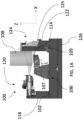
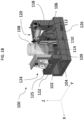
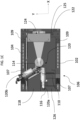
- FIG. 1A , 1B , and 1C illustrate one exemplary embodiment of an x-ray scanning system 100.
- the illustrate system 100 includes a first rail 102 and a second rail 104 that extend parallel to one another.
- a gantry 106 spans, or extends, between the first rail 102 and the second rail 104 and is supported by the first rail 102 and the second rail 104 at both ends of the gantry 106. Having support at both ends can, in some instances, provide improved stiffness and reduced deflection when compared to being supported at a single end.
- the gantry 106 is movable along the first rail 102 and the second rail 104 and is configured to be sufficiently stiff as to reduce deflections under heavy loads, for example, with a heavy sample 108.
- the gantry 106 can include a stone span 110 for such rigidity.
- the span 110 can be constructed of other sufficiently stiff materials without departing from this disclosure.
- the span 110 extends between two carts 107 that are configured to along the first rail 102 and the second rail 104. In some embodiments, the carts can be laterally retained to the first rail 102, and/or the second rail 104, being movable only along the X-axis.
- a vertical track 112 can be coupled to the span 110.
- the vertical track 112 is movable with the gantry 106 and along the span 110 of the gantry 106.
- the vertical track can be coupled to a motor, such as a stepper motor or servo motor, and a rack arranged to move the vertical track 112 along the span 110.
- a worm gear arrangement can similarly be used.
- direct linear motors, belt systems, or rack and pinion systems can be used without departing from this disclosure.
- a sample platform 114 is coupled to the vertical track 112 and is configured to move along the vertical track 112.
- the sample platform 114 can be coupled to a motor and a rack arranged to move the sample platform 114 along the vertical track 112.
- a worm gear arrangement can similarly be used.
- direct linear motors, belt systems, or rack and pinion systems can be used without departing from this disclosure.
- the sample platform 114 can move vertically along a Z-axis by the vertical track, along a Y-axis, perpendicular to the Z-axis, by the vertical track being movable across the span 110, and along the X-axis, perpendicular to both the Z-axis and the Y-axis, by the gantry 106.
- the sample platform 114 can have sufficient rigidity such that deflections of the platform 114 do not affect operations across an entire weight range of samples. This can be achieved by constructing the platform to have a relatively short offset relative to other x-ray scanners, reducing a cantilever length "L". The cantilever length also does not change as the gantry 106 and vertical track 112 move the sample platform along the X-axis and the Y-axis.
- the sample platform 114 can also be configured to rotate about the Z-axis. Such rotation can be performed by a motor within the sample platform.
- the rotatable sample platform 114 has sufficient torque to rotate the sample 108 across a wide range of masses, for example, 75 kilograms (kg) to 100 kg. Similarly, such mass can be moved along the X-axis, the Y- axis, and the Z-axis.
- a first support 116 can extend between the first rail 102 and the second rail 104.
- the first support 116 can include a rectangular span or a truss.
- the first support 116 can include and/or support a tower 118 extending vertically and having a height greater than a height of the gantry 106. Atop the tower 118 can be one or more x-ray tubes 120.
- a first x-ray tube 120a and a second x-ray tube 120b are mounted in a same horizontal plane.
- first x-ray tube 120a and a second x-ray tube can be useful for a variety of reasons, for example, in some embodiments, the first x-ray tube and the second x-ray tube 120b can have different power ratings. In some embodiments, the first x-ray tube 120a and the second x-ray tube 120b can have different focal lengths. In some embodiments, he first x-ray tube 120a and the second x-ray tube 120b can be different sizes. In the illustrated example, the first x-ray tube 120a is parallel to the first rail 102 and the second rail 104 while the second x-ray tube 120b is 40 degrees from parallel with the first rail 102 and the second rail 104.
- the gantry 106 is movable underneath the x-ray tubes 120. This allows for a wider range of sample sizes to be scanned by the system 100.
- a second support 122 extends between the first rail 102 and the second rail 104.
- the second support 122 can include a rectangular span or a truss.
- the second support 122 can support a detector 124 mounted on a horizontal track 125 that is parallel and aligned with the second support 122.
- the detector is configured to detect x-rays emitted from at least one of the x-ray tubes 120 that have passed through the sample 108 resting atop the sample platform 114.
- the second support 122 acts as a second gantry movable along the first rail 102 and the second rail 104. In such embodiments, the support can rest upon carts 109 at each end of the support.
- the carts are coupled to the first rail 102 and the second rail 104 similar to the carts 107 for the gantry 106.
- a base plate 126 can extend between the first rail 102 and the second rail 104. In some embodiments, the base plate 126 can also act as the second support. The base plate 126 can have a length that is substantially equal to a length of at least one of the first rail 102 and the second rail 104. In some embodiments the base plate 126 can be made of stone.
- the components described herein can be made of stiff and/or heavy materials, for example, stone such as granite.
- the first support, the second support, the tower, the first rail, the second rail, or the gantry can include stone components.
- other rigid materials and/or geometries with sufficient stiffness can be used without departing from this disclosure.
- steel can be used.
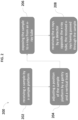
- the sample 108 ( FIG. 1A-1C ) can be received by the sample platform 114 at 202.
- a position of the sample platform 114 can be adjusted by the gantry 106 and the vertical track 112.
- adjusting the sample includes setting an X-position, a Y-position, and a Z-position of the sample platform.
- an angular position along the Z-axis can be set as well.
- one of the x-ray tubes 120 can be selected for scanning operations. In such embodiments, the position of the detector 124 can then be adjusted based on the selected x-ray tube 120.
- the sample 108 is exposed to x-rays from an x-ray tube 120.
- the x-rays pass through the sample 108 and are received by the detector 124 opposite the x-ray tube 120. While the x-rays pass through the sample 108 and are received by the detector 124, in some instances, the sample 108 can be rotated. Alternatively or in addition, a height of the sample platform and the sample can be adjusted while exposing the sample to x-rays and while receiving the x-rays by the detector 124.
- FIG. 3 illustrates the x-ray system 100 being placed in such a cabinet 300.
- the illustrated cabinet 300 includes a housing 302 at least partially defining a cavity configured to receive and retain an x-ray scanning system 100.
- the housing 302 has a generally rectangular configuration, with front 304, back 306, left 308, and right 310 sidewalls, as well as a top 312 and bottom base 314.
- a portion of the front and top walls can define an opening 316 to provide access into the cavity.
- the housing 302 can further includes shielding, such as lead sheets, within the walls that are potentially exposed to radiation.
- the cabinet 300 can also include removable doors or panels (removed in FIG. 3 ) positioned within the opening 316 to ease egress and ingress of the scanner system 100.
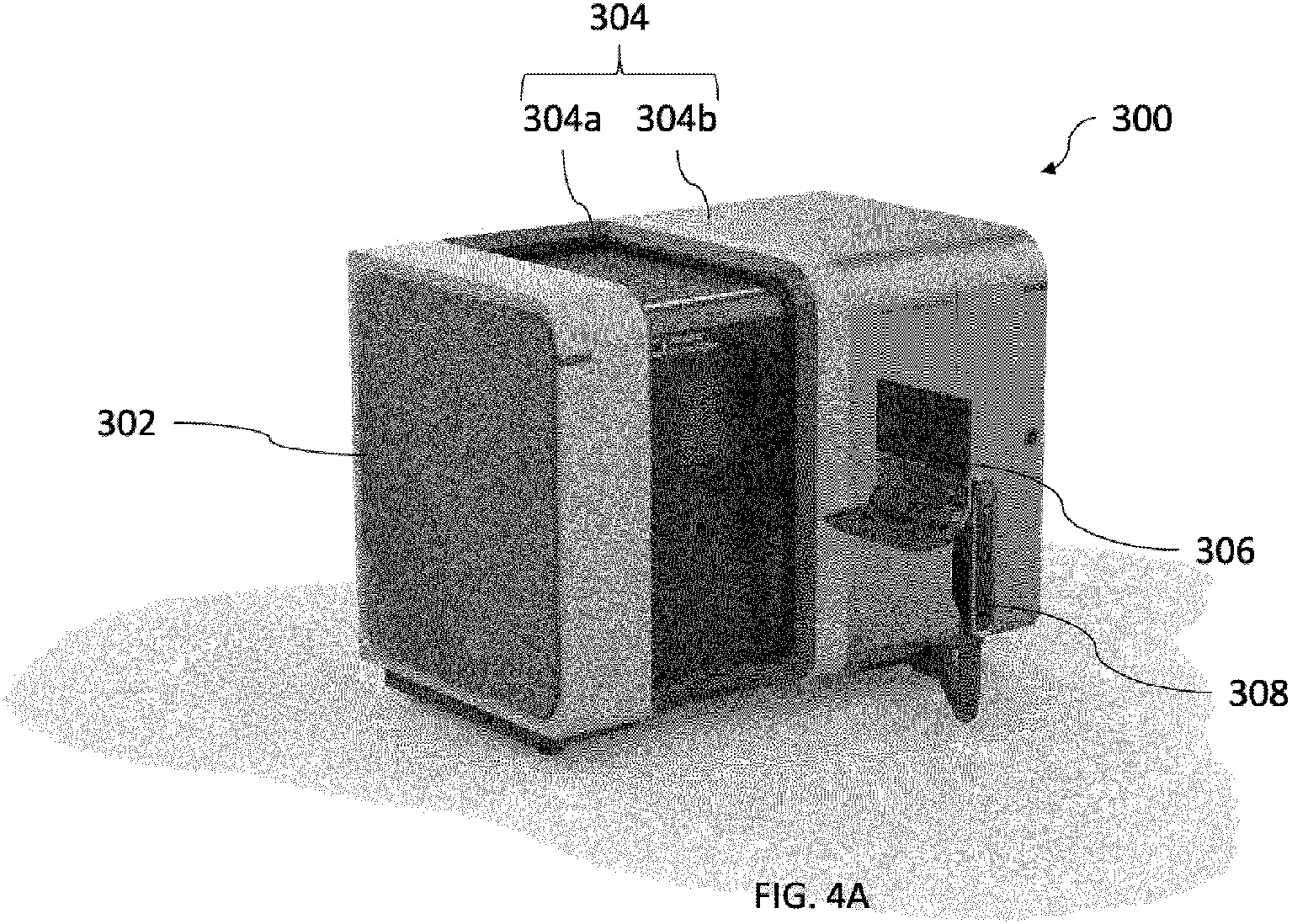
- FIG. 4A illustrates the cabinet with the doors 304 installed.
- a first sample door 304a partially defines a side and a top of the cavity while a second maintenance door 304b also partially defines a side and a top of the cavity.
- both doors can be L-shaped.
- U-shaped doors can also be used without departing from this disclosure.
- Both the sample door 304a and the maintenance door 304b are configured to be supported by the housing 302.
- the sample door 304a can be arranged and configured to travel across the maintenance door 304b when moving between an open position and a closed position (shown).
- the maintenance door 304b can be arranged and configured to travel across the sample door 304a when moving between an open position and a closed position (shown).
- the sample door 304a and the maintenance door 304b are configured to travel across one another when moving between an open position and a closed position.
- the doors 304 can include internal radiation shielding, such as lead sheets. To provide adequate shielding, the doors can overlap by a certain amount, e.g., by substantially 60-100 millimeters, and more preferably 125 millimeters (within standard manufacturing tolerances) when the maintenance door 304b and the sample door 304a are both in the closed position.
- a controller interface 306 can be attached to the cabinet 300.
- the control interface can be used to actuate parts of the scanning system 100 within the cabinet 300.
- the controller interface 306 can be used to direct the sample door and/or the maintenance door to transition between open and closed positions.
- the control interface 306 is mounted on a swivel arm 308. This allows the controller interface 306 to be moved away from the doors 304 for easier access into the cavity.
- the scanning system 100 and/or the cabinet can be controlled remotely, for example, from a control room.
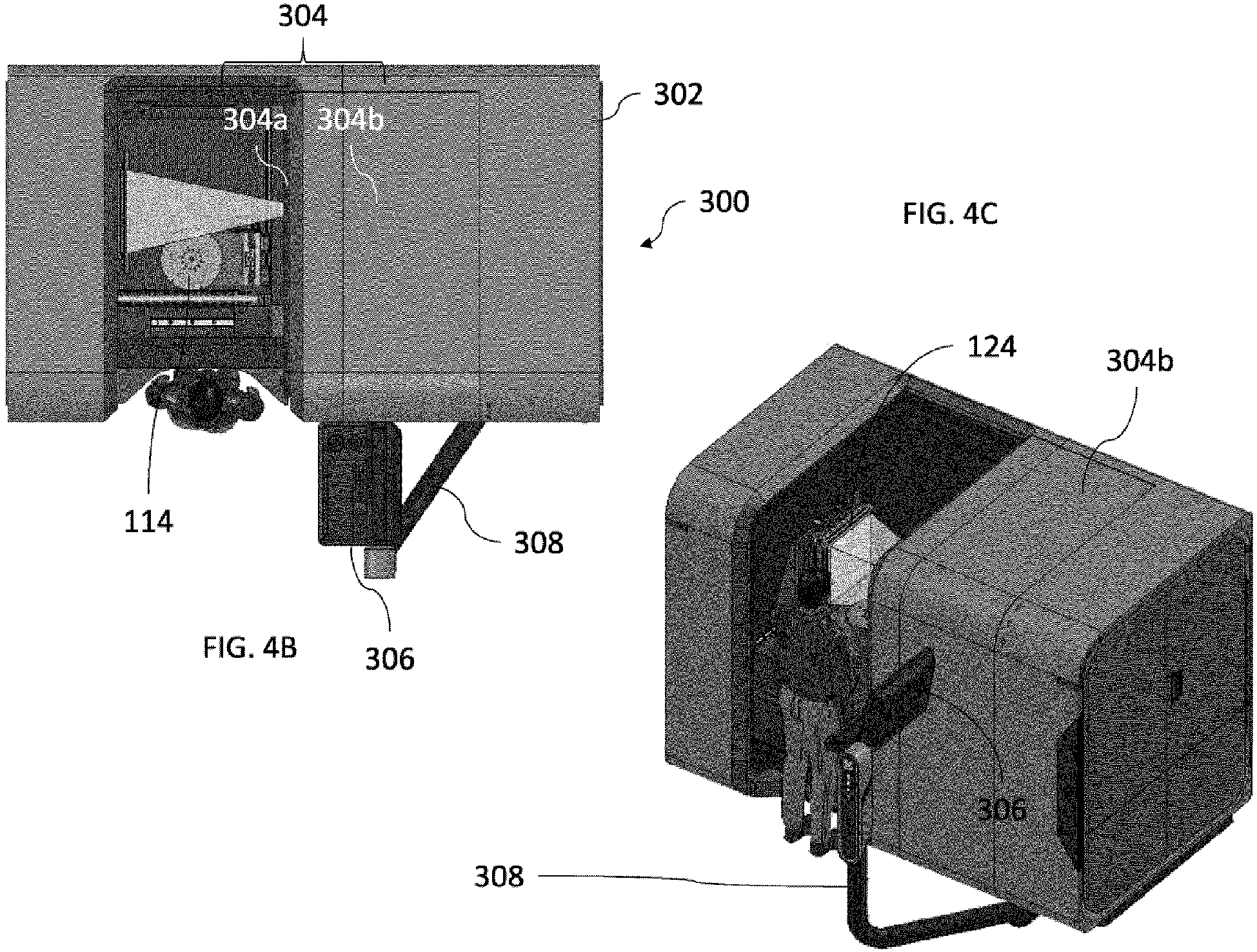
- the sample door 304a is shown in the open position in FIGS. 4B-4C .
- the sample door 304a is arranged to allow ingress and egress of samples onto the sample platform 114 of the scanning system 100.
- the sample door 304a allows access to the cavity, and the sample platform 114 within the cavity, along both a side and top of the cabinet.
- Such an opening allows for heavy samples to be lowered onto the sample platform 114 by machinery, such as a crane or robotic arm.
- Side access also allows the sample 108 to be manipulated while the sample 108 is being placed on the sample platform 114 or after the sample 108 has been placed.
- the maintenance door 304b is shown in the open position in FIG. 4D .
- the maintenance door 304b is arranged to allow access to components of the scanning system 100 for maintenance and repair, for example, the first x-ray tube 120a and the second x-ray tube 120b. These x-ray tubes 120 can be swapped out based on the sample being scanned or based on maintenance schedules. Other components, such as the gantry may also be accessed through the maintenance door 304b.
- Both the maintenance door 304b and the sample door can offer wide openings for easy access for example, in some embodiments, at least 50%, and more preferably about 64% of a length of the housing can be exposed or open when either the maintenance door 304b or the sample door 304a are in an open position. Further assisting with access, as previously described, both doors 304 can be removable from the housing 302. The opening exposed by removing both doors is sufficient to allow the scanning system 100 to be removed or received from the cabinet 300 in a single unitary piece.
- the doors 304 themselves interface with the housing, as shown in FIG. 5A and FIG. 5B , at tracks along each end of the doors 304.
- the maintenance door 304b and the sample door 304a are both pictured.
- an upper maintenance track 502b can support an upper end of the maintenance door 304b to the housing 302.
- an upper sample track 502a can support an upper end of the sample door 304a to the housing 302.
- the upper sample track 502a and the upper sample track 502b can be located near an upper edge of the back sidewall 306.
- a labyrinth shield 504 (for example, overlapping shielding sections) can be defined by the maintenance door 304b, the sample door 304a, the housing 302, or a combination.
- the housing 302 can define two overlapping shielded sections and the maintenance door can define two overlapping sections to form the labyrinth shield.
- a lower end of the maintenance door 304b and the sample door 304a similarly can include a lower maintenance track 506b and a lower sample track 506a.
- a lower maintenance track 506b can support a lower end of the maintenance door 304b to the housing 302.
- a lower sample track 506a can support a lower end of the sample door 304a to the housing 302.
- the lower sample track 506a and the lower maintenance track 506b can be located near a front edge of the cabinet base 314.
- the tracks (502a, 502b, 506a, 506b) described throughout this disclosure can include roller tracks, slider tracks, or any other type of tracks.
- the tracks (502a, 502b, 506a, 506b) can all be parallel to one another.
- a motor can be coupled to one or more of the tracks.
- the motor can be used to move one or both doors between an open position and a closed position. Similar to an upper end of the doors 304, the lower end of the doors 304 can interface with a lower labyrinth shield 508.
- the housing can define two overlapping shielded sections to form the labyrinth shield 508.
- a scanning system such as system 100
- the first door can then be mounted on the first and second tracks.
- the lower door that is, the door that travels underneath the other door
- the second door can then be mounted on the third and fourth tracks.
- the upper door that is, the door that travels over the other door
- the third track and the fourth track being parallel to each other and to the first track and the second track.
- the doors 304 can be moved between open and closed positions.
- the sample door 304a can be moved between an open position and a closed position.
- the maintenance door can be moved between an open position and a closed position.
- Such movement of either the sample door or the second door can be accomplished by a system operator or a motor built into the cabinet 300. Regardless of how the motion is achieved, when the upper door in the open position, the upper door can overlap a majority of the lower door, for example, over at least about 90% of the lower door.
- the lower door when the lower door is in the open position, the lower door can have a majority of the lower door covered by the upper door, for example, at least about 90% of the lower door.
- a labyrinth shield (504, 508) defined by the sample door 304a and the cabinet 300 or by the maintenance door 304b and the cabinet 300.
Landscapes
- Physics & Mathematics (AREA)
- Engineering & Computer Science (AREA)
- High Energy & Nuclear Physics (AREA)
- General Engineering & Computer Science (AREA)
- Health & Medical Sciences (AREA)
- Life Sciences & Earth Sciences (AREA)
- Pathology (AREA)
- Medical Informatics (AREA)
- General Health & Medical Sciences (AREA)
- Spectroscopy & Molecular Physics (AREA)
- Molecular Biology (AREA)
- Veterinary Medicine (AREA)
- Biomedical Technology (AREA)
- Heart & Thoracic Surgery (AREA)
- Optics & Photonics (AREA)
- Surgery (AREA)
- Animal Behavior & Ethology (AREA)
- Nuclear Medicine, Radiotherapy & Molecular Imaging (AREA)
- Public Health (AREA)
- Radiology & Medical Imaging (AREA)
- Biophysics (AREA)
- Chemical & Material Sciences (AREA)
- Analytical Chemistry (AREA)
- Biochemistry (AREA)
- General Physics & Mathematics (AREA)
- Immunology (AREA)
- Analysing Materials By The Use Of Radiation (AREA)
- Apparatus For Radiation Diagnosis (AREA)
Abstract
Description
- The disclosure relates to technologies for inspection of larger and heavier parts with very high precision scanning systems.
- Components, parts, and/or samples sometimes need to be inspected with x-rays or similar inspection techniques. In such instances, inspections are conducted within a controlled environment, for example with a dedicated scanner and manipulator within a shielded housing. Such a scanner supports the component, part, or item to be scanned, then moves the component and/or x-ray source and detector relative to one another.
- This disclosure relates to manipulating and inspecting large and heavy components, sometimes within a shielded cabinet.
- In one embodiment, a scanning system is provided having first and second parallel rails. A gantry can span between the first and second rails and it can be movable along a length thereof. A vertical track can be mounted to the gantry and can be movable with the gantry. A sample platform can coupled to the vertical track and can be movable along the vertical track. In some embodiments, the sample platform can be configured to be moved vertically along a Z-axis and horizontally along an X-axis and a Y-axis. In some embodiments, a first support can extend between the first rail and the second rail. In such embodiments, the first support can be at a first end of the first rail and a first end of the second rail. A second support can extend between the first and second rails and can be at a second end of the first rail and a second end of the second rail. In some embodiments, a housing can surround the scanner.
- In other aspects, the first support can include a tower extending vertically. The tower can have a height greater than (e.g., taller than) a height of the gantry. An x-ray tube can be mounted to the tower. In some embodiments, the x-ray tube is a first x-ray tube, and the system can further include a second x-ray tube mounted to the tower. The first x-ray tube and the second x-ray tube can be in a same horizontal plane. In some embodiments, the first x-ray tube can be parallel to the first rail and the second rail, and the second x-ray tube can be 40 degrees from parallel with the first rail and the second rail. In some embodiments, the gantry is movable underneath the first x-ray tube and the second x-ray tube.
- In some aspects, the second support can include a detector mounted on a horizontal track. In such arrangements, the detector can be movable on the horizontal track, and the horizontal track can be parallel and aligned with the second support. The detector can be configured to detect x-rays, emitted from at least one of the first x-ray tube and the second x-ray tube, that have passed through a sample resting atop the sample platform. In some embodiments, the gantry can be a first gantry, and the second support can be a part of a second gantry movable along the first rail and the second rail. In some embodiments, the first gantry can include a span made of stone.
- In some embodiments, the sample platform can have sufficient rigidity that deflections of the platform do not affect operations across an entire weight range of samples. In some embodiments, a plate can extend between the first rail and the second rail. Such a plate can be substantially equal length to at least one of the first rail and the second rail.
- Various methods for scanning a sample are also provided. In one embodiment, during operation, a sample can be received by the sample platform. A position of the sample platform can be adjusted by the gantry and the vertical track. The sample can be exposed to x-rays from an x-ray tube. The x-rays can be received by a detector opposite the x-ray tube. In such situations, the received x-rays have passed through the sample.
- Prior to adjusting the sample platform, the sample platform can receive a sample to be scanned. In some instances, the sample can have a mass between 75kg and 100kg. Based on the sample properties, an x-ray tube can be selected from multiple x-ray tubes. A position of the detector can then be adjusted based on the selected x-ray tube. Adjusting can include setting an X-position, a Y-position, and a Z-position of the sample platform. During scanning, a height of the sample can be adjusted, and the sample can be rotated, while the detector receives the x-rays.
- In some embodiments, an x-ray shielding cabinet includes a housing that at least partially defines a cavity configured to receive and retain an x-ray scanning system. A first door can partially define a side and top of the cavity. A first track on the housing can support a first end of the first door and a second track on the housing can support a second end of the first door. In some embodiments, the first door can be moved along the first track and the second track. In some embodiments, a second door partially defines a side and top of the cavity. In such embodiments, a third track on the housing can support a first end of the second door, and a fourth track on the housing can support a second end of the second door. In some embodiments, the fourth track can be parallel to the first track, the second track, and the third track. In some embodiments, the second door can be moved along the third track and the fourth track. The first and second doors can be configured to travel across one another when moving between an open position and a closed position.
- In some embodiments, the first door and the second door include one or more of the following features. In some embodiments the first door and the second door can overlap, for example by substantially 125 mm (within standard manufacturing tolerances) when the first door and the second door are both in the closed position. In some embodiments the first door and/or the second door can be L-shaped. Similarly, in some embodiments, the first door and/or the second door can be removable from the housing. Regardless of the shape or removability of each door, in some embodiments, an interface between the first door and the housing can include a labyrinth shield defined by the first door and the housing. Similarly, an interface between the second door and the housing can include a labyrinth shield defined by the second door and the housing in some embodiments. In some configurations, substantially 64% (+ or -5%) a length of the housing can be open when either the first door or the second door is in an open position.
- In operation, the first door by can be received the first track and the second track positioned on an x-ray shielding cabinet. Similarly, the second door can be received by the third track and a fourth track. In some instances, the first door can be moved between an open position and a closed position by a motor. Similarly, in some instances, the second door can be moved by a motor between an open position and the closed position. Regardless of which door moves, in some embodiments, either the first door or the second door, in the open position, overlaps a majority of the other door. In operation, at least a portion of x-rays can be blocked by a labyrinth shield defined by the first door and the cabinet or by the second door and the cabinet.
- The accompanying drawings, which are incorporated in and constitute a part of this disclosure, show certain aspects of the subject matter disclosed herein and, together with the description, help explain some of the principles associated with the disclosed implementations.
-
FIG. 1A is a side view of an example x-ray scanning device -
FIG. 1B is a perspective view of the example x-ray scanning device ofFIG. 1A ; -
FIG. 1C is a top-down view of an example x-ray scanning device ofFIG. 1A ; -
FIG. 2 is flowchart of one embodiment of a method for scanning a sample; -
FIG. 3 is a perspective view of the x-ray scanning device ofFIGS. 1A being placed within one embodiment of a shielded cabinet that has two access door removed; -
FIG. 4A is a perspective view of the cabinet ofFIG. 3 with both a sample door and a maintenance door installed. -
FIG. 4B is a top-down view of the cabinet ofFIG. 3 with a sample door in an open position; -
FIG. 4C is a perspective view of the cabinet ofFIG. 3 with a sample door in an open position; -
FIG. 4D is a perspective view of the cabinet ofFIG. 3 with an maintenance door in an open position; -
FIG. 5A is a side cross-sectional view of an interface between a upper end of the doors and the housing; and -
FIG. 5B is a side cross-sectional view of an interface between the lower end of the doors and the housing. - Certain embodiments will now be described to provide an overall understanding of the principles of the structure, function, manufacture, and use of the devices and methods disclosed herein. One or more examples of these embodiments are illustrated in the accompanying drawings. Those skilled in the art will understand that the devices and methods specifically described herein and illustrated in the accompanying drawings are non-limiting embodiments and that the scope of the present invention is defined solely by the claims. The features illustrated or described in connection with one embodiment may be combined with the features of other embodiments. Such modifications and variations are intended to be included within the scope of the present invention.
- Further, in the present disclosure, like-named components of the embodiments generally have similar features, and thus within a particular embodiment each feature of each like-named component is not necessarily fully elaborated upon. Additionally, to the extent that linear or circular dimensions are used in the description of the disclosed systems, devices, and methods, such dimensions are not intended to limit the types of shapes that can be used in conjunction with such systems, devices, and methods. A person skilled in the art will recognize that an equivalent to such linear and circular dimensions can easily be determined for any geometric shape. Sizes and shapes of the systems and devices, and the components thereof, can depend at least on the anatomy of the subject in which the systems and devices will be used, the size and shape of components with which the systems and devices will be used, and the methods and procedures in which the systems and devices will be used.
- Scanning large and heavy items (items too large and heavy for a single person to safely place within a scanner) can be difficult. Depending on the scanner design, members of the scanning device can deflect during scanning to the point that the deflection interferes with scanning operations. Similarly, many cabinet designs limit the size of scannable samples as the cabinets define the openings through which the samples are received.
- Accordingly, a scanning system is provided, along with a cabinet configured to retain and shielding the scanner. The scanner itself includes first and second parallel rails with a gantry spanning between the rails. The gantry can be movable along a length of the first and second rails. A vertical track can be mounted to the gantry and it can be movable with the gantry. A sample platform can coupled to the vertical track and it can be movable along the vertical track. In some embodiments, the sample platform can be configured to be moved vertically along a Z-axis and horizontally along an X-axis and a Y-axis. For example, in some configurations, the gantry with the sample platform mounted thereto can be configured to move horizontally along the X-axis. The system can also include first support extending between the first rail and the second rail. In such embodiments, the first support can be at a first end of the first rail and a first end of the second rail. The system can also include a second support extending between the first rail and the second rail. The second support can be at a second end of the first rail and a second end of the second rail.
- As indicated above, a cabinet is also provided. In some embodiments, an x-ray shielding cabinet includes a housing that at least partially defines a cavity configured to receive and retain an x-ray scanning system. A first door can partially define a side and top of the cavity. A first track on the housing can support a first end of the first door and a second track on the housing can support a second end of the first door. In some embodiments, the first door can be movable along the first track and the second track. In some embodiments, a second door partially defines a side and top of the cavity. In such embodiments, a third track on the housing can support a first end of the second door, and a fourth track on the housing can support a second end of the second door. In some embodiments, the fourth track can be parallel to the first track, the second track, and the third track. In some embodiments, the second door can be movable along the third track and the fourth track. The first and second doors can be configured to travel across one another when moving between an open position and a closed position.
-
FIG. 1A ,1B , and1C illustrate one exemplary embodiment of anx-ray scanning system 100. As shown, the illustratesystem 100 includes afirst rail 102 and asecond rail 104 that extend parallel to one another. Agantry 106 spans, or extends, between thefirst rail 102 and thesecond rail 104 and is supported by thefirst rail 102 and thesecond rail 104 at both ends of thegantry 106. Having support at both ends can, in some instances, provide improved stiffness and reduced deflection when compared to being supported at a single end. Thegantry 106 is movable along thefirst rail 102 and thesecond rail 104 and is configured to be sufficiently stiff as to reduce deflections under heavy loads, for example, with aheavy sample 108. In some embodiments, thegantry 106 can include astone span 110 for such rigidity. Thespan 110 can be constructed of other sufficiently stiff materials without departing from this disclosure. Thespan 110 extends between twocarts 107 that are configured to along thefirst rail 102 and thesecond rail 104. In some embodiments, the carts can be laterally retained to thefirst rail 102, and/or thesecond rail 104, being movable only along the X-axis. - A
vertical track 112 can be coupled to thespan 110. Thevertical track 112 is movable with thegantry 106 and along thespan 110 of thegantry 106. For example, in some embodiments, the vertical track can be coupled to a motor, such as a stepper motor or servo motor, and a rack arranged to move thevertical track 112 along thespan 110. Alternatively or in addition, a worm gear arrangement can similarly be used. For example, direct linear motors, belt systems, or rack and pinion systems can be used without departing from this disclosure. Asample platform 114 is coupled to thevertical track 112 and is configured to move along thevertical track 112. For example, in some embodiments, thesample platform 114 can be coupled to a motor and a rack arranged to move thesample platform 114 along thevertical track 112. Alternatively or in addition, a worm gear arrangement can similarly be used. For example, direct linear motors, belt systems, or rack and pinion systems can be used without departing from this disclosure. Regardless of the movement mechanism, thesample platform 114 can move vertically along a Z-axis by the vertical track, along a Y-axis, perpendicular to the Z-axis, by the vertical track being movable across thespan 110, and along the X-axis, perpendicular to both the Z-axis and the Y-axis, by thegantry 106. - Focusing on the
sample platform 114, thesample platform 114 can have sufficient rigidity such that deflections of theplatform 114 do not affect operations across an entire weight range of samples. This can be achieved by constructing the platform to have a relatively short offset relative to other x-ray scanners, reducing a cantilever length "L". The cantilever length also does not change as thegantry 106 andvertical track 112 move the sample platform along the X-axis and the Y-axis. Thesample platform 114 can also be configured to rotate about the Z-axis. Such rotation can be performed by a motor within the sample platform. Therotatable sample platform 114 has sufficient torque to rotate thesample 108 across a wide range of masses, for example, 75 kilograms (kg) to 100 kg. Similarly, such mass can be moved along the X-axis, the Y- axis, and the Z-axis. - Moving to a first end of the
system 100, afirst support 116 can extend between thefirst rail 102 and thesecond rail 104. In some embodiments, thefirst support 116 can include a rectangular span or a truss. In some embodiments, thefirst support 116 can include and/or support atower 118 extending vertically and having a height greater than a height of thegantry 106. Atop thetower 118 can be one ormore x-ray tubes 120. For example, in the illustrated embodiment, afirst x-ray tube 120a and asecond x-ray tube 120b are mounted in a same horizontal plane. Having afirst x-ray tube 120a and a second x-ray tube can be useful for a variety of reasons, for example, in some embodiments, the first x-ray tube and thesecond x-ray tube 120b can have different power ratings. In some embodiments, thefirst x-ray tube 120a and thesecond x-ray tube 120b can have different focal lengths. In some embodiments, he first x-raytube 120a and thesecond x-ray tube 120b can be different sizes. In the illustrated example, thefirst x-ray tube 120a is parallel to thefirst rail 102 and thesecond rail 104 while thesecond x-ray tube 120b is 40 degrees from parallel with thefirst rail 102 and thesecond rail 104. Regardless of the number of x-ray tubes or the orientation of the x-ray tubes, in some embodiments, thegantry 106 is movable underneath thex-ray tubes 120. This allows for a wider range of sample sizes to be scanned by thesystem 100. - Looking to the second end of the
system 100, asecond support 122 extends between thefirst rail 102 and thesecond rail 104. In some embodiments, thesecond support 122 can include a rectangular span or a truss. Thesecond support 122 can support adetector 124 mounted on ahorizontal track 125 that is parallel and aligned with thesecond support 122. The detector is configured to detect x-rays emitted from at least one of thex-ray tubes 120 that have passed through thesample 108 resting atop thesample platform 114. In some embodiments, thesecond support 122 acts as a second gantry movable along thefirst rail 102 and thesecond rail 104. In such embodiments, the support can rest uponcarts 109 at each end of the support. In some embodiments, the carts are coupled to thefirst rail 102 and thesecond rail 104 similar to thecarts 107 for thegantry 106. - In some embodiments, a
base plate 126 can extend between thefirst rail 102 and thesecond rail 104. In some embodiments, thebase plate 126 can also act as the second support. Thebase plate 126 can have a length that is substantially equal to a length of at least one of thefirst rail 102 and thesecond rail 104. In some embodiments thebase plate 126 can be made of stone. - As scanning can be sensitive to vibrations and component deflection, a variety of the components described herein can be made of stiff and/or heavy materials, for example, stone such as granite. For example, in some embodiments, the first support, the second support, the tower, the first rail, the second rail, or the gantry can include stone components. Alternatively or in addition, other rigid materials and/or geometries with sufficient stiffness can be used without departing from this disclosure. For example, in some embodiments, steel can be used.
- In operation, as shown in
FIG. 2 , the sample 108 (FIG. 1A-1C ) can be received by thesample platform 114 at 202. At 204, a position of thesample platform 114 can be adjusted by thegantry 106 and thevertical track 112. In some instances, adjusting the sample includes setting an X-position, a Y-position, and a Z-position of the sample platform. In some embodiments, an angular position along the Z-axis can be set as well. - In embodiments where
multiple x-ray tubes 120 are present, one of thex-ray tubes 120 can be selected for scanning operations. In such embodiments, the position of thedetector 124 can then be adjusted based on the selectedx-ray tube 120. At 206, thesample 108 is exposed to x-rays from anx-ray tube 120. At 208, the x-rays pass through thesample 108 and are received by thedetector 124 opposite thex-ray tube 120. While the x-rays pass through thesample 108 and are received by thedetector 124, in some instances, thesample 108 can be rotated. Alternatively or in addition, a height of the sample platform and the sample can be adjusted while exposing the sample to x-rays and while receiving the x-rays by thedetector 124. - As scanning operations involve high doses of radiation, a cabinet capable of shielding operators from radiation exposure may be required.
FIG. 3 illustrates thex-ray system 100 being placed in such acabinet 300. The illustratedcabinet 300 includes ahousing 302 at least partially defining a cavity configured to receive and retain anx-ray scanning system 100. Thehousing 302 has a generally rectangular configuration, withfront 304, back 306, left 308, and right 310 sidewalls, as well as a top 312 andbottom base 314. However, as shown inFIG. 3 , a portion of the front and top walls can define anopening 316 to provide access into the cavity. Thehousing 302 can further includes shielding, such as lead sheets, within the walls that are potentially exposed to radiation. Thecabinet 300 can also include removable doors or panels (removed inFIG. 3 ) positioned within theopening 316 to ease egress and ingress of thescanner system 100. -
FIG. 4A illustrates the cabinet with thedoors 304 installed. Afirst sample door 304a partially defines a side and a top of the cavity while asecond maintenance door 304b also partially defines a side and a top of the cavity. To achieve this, in some implementations, both doors can be L-shaped. Alternatively or in addition, U-shaped doors can also be used without departing from this disclosure. Both thesample door 304a and themaintenance door 304b are configured to be supported by thehousing 302. Thesample door 304a can be arranged and configured to travel across themaintenance door 304b when moving between an open position and a closed position (shown). Similarly, themaintenance door 304b can be arranged and configured to travel across thesample door 304a when moving between an open position and a closed position (shown). In other words, thesample door 304a and themaintenance door 304b are configured to travel across one another when moving between an open position and a closed position. In embodiments where thedoors 304 could be exposed to radiation, thedoors 304 can include internal radiation shielding, such as lead sheets. To provide adequate shielding, the doors can overlap by a certain amount, e.g., by substantially 60-100 millimeters, and more preferably 125 millimeters (within standard manufacturing tolerances) when themaintenance door 304b and thesample door 304a are both in the closed position. - In some embodiments a
controller interface 306 can be attached to thecabinet 300. The control interface can be used to actuate parts of thescanning system 100 within thecabinet 300. Alternatively or in addition, thecontroller interface 306 can be used to direct the sample door and/or the maintenance door to transition between open and closed positions. In some embodiments, thecontrol interface 306 is mounted on aswivel arm 308. This allows thecontroller interface 306 to be moved away from thedoors 304 for easier access into the cavity. Alternatively or in addition, thescanning system 100 and/or the cabinet can be controlled remotely, for example, from a control room. - The
sample door 304a is shown in the open position inFIGS. 4B-4C . Thesample door 304a is arranged to allow ingress and egress of samples onto thesample platform 114 of thescanning system 100. Assamples 108 can be quite large and/or heavy, thesample door 304a allows access to the cavity, and thesample platform 114 within the cavity, along both a side and top of the cabinet. Such an opening allows for heavy samples to be lowered onto thesample platform 114 by machinery, such as a crane or robotic arm. Side access also allows thesample 108 to be manipulated while thesample 108 is being placed on thesample platform 114 or after thesample 108 has been placed. - The
maintenance door 304b is shown in the open position inFIG. 4D . Themaintenance door 304b is arranged to allow access to components of thescanning system 100 for maintenance and repair, for example, thefirst x-ray tube 120a and thesecond x-ray tube 120b. Thesex-ray tubes 120 can be swapped out based on the sample being scanned or based on maintenance schedules. Other components, such as the gantry may also be accessed through themaintenance door 304b. - Both the
maintenance door 304b and the sample door can offer wide openings for easy access for example, in some embodiments, at least 50%, and more preferably about 64% of a length of the housing can be exposed or open when either themaintenance door 304b or thesample door 304a are in an open position. Further assisting with access, as previously described, bothdoors 304 can be removable from thehousing 302. The opening exposed by removing both doors is sufficient to allow thescanning system 100 to be removed or received from thecabinet 300 in a single unitary piece. - The
doors 304 themselves interface with the housing, as shown inFIG. 5A and FIG. 5B , at tracks along each end of thedoors 304. In the illustrated cross section, themaintenance door 304b and thesample door 304a are both pictured. In some embodiments, anupper maintenance track 502b can support an upper end of themaintenance door 304b to thehousing 302. Similarly, anupper sample track 502a can support an upper end of thesample door 304a to thehousing 302. In some embodiments, theupper sample track 502a and theupper sample track 502b can be located near an upper edge of theback sidewall 306. In some embodiments, a labyrinth shield 504 (for example, overlapping shielding sections) can be defined by themaintenance door 304b, thesample door 304a, thehousing 302, or a combination. For example, along the upper tracks (502a, 502b), thehousing 302 can define two overlapping shielded sections and the maintenance door can define two overlapping sections to form the labyrinth shield. - A lower end of the
maintenance door 304b and thesample door 304a similarly can include alower maintenance track 506b and alower sample track 506a. In some embodiments, alower maintenance track 506b can support a lower end of themaintenance door 304b to thehousing 302. Similarly, alower sample track 506a can support a lower end of thesample door 304a to thehousing 302. In some embodiments, thelower sample track 506a and thelower maintenance track 506b can be located near a front edge of thecabinet base 314. The tracks (502a, 502b, 506a, 506b) described throughout this disclosure can include roller tracks, slider tracks, or any other type of tracks. In some embodiments, the tracks (502a, 502b, 506a, 506b) can all be parallel to one another. In some embodiments, a motor can be coupled to one or more of the tracks. In such embodiments, the motor can be used to move one or both doors between an open position and a closed position. Similar to an upper end of thedoors 304, the lower end of thedoors 304 can interface with alower labyrinth shield 508. For example, along the lower tracks (506a, 506b) the housing can define two overlapping shielded sections to form thelabyrinth shield 508. - In use, as indicated above a scanning system, such as
system 100, can be positioned in the cabinet with the doors removed. The first door can then be mounted on the first and second tracks. In some embodiments, the lower door, that is, the door that travels underneath the other door, is the first door received. While primarily illustrated as thesample door 304a being the lower door and themaintenance door 304b being the upper door, the opposite can be the case without departing from this disclosure. The second door can then be mounted on the third and fourth tracks. In some embodiments, the upper door, that is, the door that travels over the other door, is the second door received. The third track and the fourth track being parallel to each other and to the first track and the second track. - Once the
doors 304 are mounted on their respective tracks, in operation, thedoors 304 can be moved between open and closed positions. For example, in some instances, thesample door 304a can be moved between an open position and a closed position. Similarly, in some instances, the maintenance door can be moved between an open position and a closed position. Such movement of either the sample door or the second door can be accomplished by a system operator or a motor built into thecabinet 300. Regardless of how the motion is achieved, when the upper door in the open position, the upper door can overlap a majority of the lower door, for example, over at least about 90% of the lower door. Similarly, when the lower door is in the open position, the lower door can have a majority of the lower door covered by the upper door, for example, at least about 90% of the lower door. When both doors are in the closed position, during scanning operations, x-rays can be blocked by a labyrinth shield (504, 508) defined by thesample door 304a and thecabinet 300 or by themaintenance door 304b and thecabinet 300. - While this disclosure contains many specific embodiment details, these should not be construed as limitations on the scope of what may be claimed, but rather as descriptions of features specific to particular embodiments. Certain features that are described in this disclosure in the context of separate embodiments can also be implemented in combination in a single embodiment. Conversely, various features that are described in the context of a single embodiment can also be implemented in multiple embodiments separately or in any suitable subcombination. Moreover, although features may be described above as acting in certain combinations and even initially claimed as such, one or more features from a claimed combination can in some cases be excised from the combination, and the claimed combination may be directed to a subcombination or variation of a subcombination.
- Similarly, while operations are depicted in the drawings in a particular order, this should not be understood as requiring that such operations be performed in the particular order shown or in sequential order, or that all illustrated operations be performed, to achieve desirable results. Moreover, the separation of various system components in the embodiments described above should not be understood as requiring such separation in all embodiments, and it should be understood that the described components and systems can generally be integrated together in a single product or packaged into multiple products.
- Thus, particular embodiments of the subject matter have been described. Other embodiments are within the scope of the following claims. In some cases, the actions recited in the claims can be performed in a different order and still achieve desirable results. In addition, the processes depicted in the accompanying figures do not necessarily require the particular order shown, or sequential order, to achieve desirable results.
- Other embodiments can be within the scope of the following claims.
Claims (20)
- An x-ray shielding cabinet comprising:a housing at least partially defining a cavity configured to receive and retain an x-ray scanning system;a first door partially defining a side and top of the cavity;a first track on the housing supporting a first end of the first door;a second track on the housing supporting a second end of the first door, the first door being movable along the first track and the second track;a second door partially defining a side and top of the cavity;a third track on the housing supporting a first end of the second door; anda fourth track on the housing supporting a second end of the second door, the fourth track being parallel to the first track, the second track, and the third track, the second door being movable along the third track and the fourth track;wherein the first and second doors are configured to travel across one another when moving between an open position and a closed position.
- The x-ray shielding cabinet of claim 1, wherein the first door and the second door overlap by substantially 125 mm when the first door and the second door are both in the closed position.
- The x-ray shielding cabinet of claim 1, wherein the first door and the second door are each L-shaped.
- The x-ray shielding cabinet of claim 1, wherein the first door and the second door are removable from the housing.
- The x-ray shielding cabinet of claim 1, wherein an interface between the first door and the housing comprises a labyrinth shield defined by the first door and the housing.
- The x-ray shielding cabinet of claim 1, wherein an interface between the second door and the housing comprises a labyrinth shield defined by the second door and the housing.
- The x-ray shielding cabinet of claim 1, wherein substantially 64% a length of the housing is open when either the first door or the second door is in an open position.
- A method comprising:receiving a first door by a first track and a second track, the first track and the second track being positioned on an x-ray shielding cabinet, the first track and the second track being parallel to one another; andreceiving a second door by a third track and a fourth track, the third track and the fourth track being parallel to each other and to the first track and the second track.
- The method of claim 8, further comprising:
moving the first door, by a motor, between an open position and a closed position, wherein the first door in the open position overlaps a majority of the second door. - The method of claim 8, further comprising:
moving the second door, by a motor, between an open position and a closed position, wherein the second door in the open position overlaps a majority of the first door. - The method of claim 8, wherein the first door and the second door overlap by substantially 125 millimeters when both the first door and the second door are each in a closed position.
- The method of claim 8, further comprising blocking x-rays by a labyrinth shield defined by the first door and the cabinet or by the second door and the cabinet.
- A system comprising:an x-ray scanner; andan x-ray shielding cabinet comprising:a housing at least partially defining a cavity configured to receive and retain an x-ray scanning system;a first door partially defining a side and top of the cavity, the first door configured to be supported by the housing;a second door partially defining a side and top of the cavity, the second door configured to be supported by the housing, wherein the first door is configured to travel across the second door when moving between an open position and a closed position, and wherein the second door is configured to travel across the first door when moving between an open position and a closed position.
- The system of claim 13, wherein the first door and the second door overlap by substantially 125 mm when the first door and the second door are both in the closed position.
- The system of claim 13, wherein the first door is L-shaped.
- The system of claim 13, wherein the second door is L-shaped.
- The system of claim 13, wherein the first door is are removable from the housing.
- The system of claim 13, wherein the second door is removable from the housing.
- The system of claim 13, wherein an interface between the first door and the housing comprises a labyrinth shield defined by the first door and the housing.
- The system of claim 13, wherein an interface between the second door and the housing comprises a labyrinth shield defined by the second door and the housing.
Applications Claiming Priority (1)
| Application Number | Priority Date | Filing Date | Title |
|---|---|---|---|
| US18/184,491 US12315652B2 (en) | 2023-03-15 | 2023-03-15 | X-ray shielding cabinet |
Publications (2)
| Publication Number | Publication Date |
|---|---|
| EP4431925A2 true EP4431925A2 (en) | 2024-09-18 |
| EP4431925A3 EP4431925A3 (en) | 2024-12-18 |
Family
ID=90038381
Family Applications (1)
| Application Number | Title | Priority Date | Filing Date |
|---|---|---|---|
| EP24158574.4A Pending EP4431925A3 (en) | 2023-03-15 | 2024-02-20 | X-ray shielding cabinet |
Country Status (3)
| Country | Link |
|---|---|
| US (1) | US12315652B2 (en) |
| EP (1) | EP4431925A3 (en) |
| CN (1) | CN118675783A (en) |
Family Cites Families (16)
| Publication number | Priority date | Publication date | Assignee | Title |
|---|---|---|---|---|
| GB490480A (en) | 1937-07-27 | 1938-08-16 | Oscar Cecil Hartridge | Improvements relating to x-ray apparatus |
| KR100367413B1 (en) | 1999-06-08 | 2003-01-10 | 화진정밀 주식회사 | Emission shield door assembly |
| SE516433C2 (en) | 2000-05-02 | 2002-01-15 | Ove Bornvall Med Borntech Fa | Methods and devices for protection against radiation when working in a radiant zone |
| CN2500262Y (en) | 2001-09-14 | 2002-07-17 | 董蒲 | Composite x-ray protective screen |
| JP2003161707A (en) | 2001-11-27 | 2003-06-06 | Toshiba It & Control Systems Corp | Fluoroscopic examination apparatus |
| DE102004004842B4 (en) | 2004-01-30 | 2009-01-15 | Siemens Ag | Device for setting up and system testing X-ray systems |
| KR100894112B1 (en) | 2008-02-28 | 2009-04-20 | (주) 액트 | Radiation shielding sliding door |
| DE102008020730B3 (en) * | 2008-04-25 | 2009-12-31 | Bruker Axs Gmbh | Safety housing for an X-ray machine with combined sash and sliding door |
| JP5150711B2 (en) | 2010-12-07 | 2013-02-27 | 富士フイルム株式会社 | Radiography apparatus and radiation imaging system |
| JP2013122404A (en) | 2011-12-09 | 2013-06-20 | Yamaha Motor Co Ltd | X-ray examination device |
| KR101580910B1 (en) | 2014-07-25 | 2015-12-31 | 삼성중공업 주식회사 | Radioactive rays shielding device |
| GB2597896B (en) * | 2018-08-14 | 2023-06-07 | Nordson Corp | Binder permeated ionizing radiation shielding panels, method of construction of ionizing radiation shielding panels and an x-ray inspection system |
| CN109065200B (en) | 2018-09-21 | 2023-06-06 | 山东建筑大学 | Transparent X-ray shielding room |
| CN111272788B (en) | 2020-04-09 | 2024-12-31 | 兰州瑞奇戈德测控技术有限公司 | An automatic X-ray detection device for special-shaped tubes |
| US12415243B2 (en) * | 2020-05-14 | 2025-09-16 | Dmg Mori Co., Ltd. | Processing machine and slide mechanism |
| CN114740023A (en) | 2022-03-08 | 2022-07-12 | 刘长鑫 | Micro CT equipment using radioactive isotope as ray source |
-
2023
- 2023-03-15 US US18/184,491 patent/US12315652B2/en active Active
-
2024
- 2024-02-20 EP EP24158574.4A patent/EP4431925A3/en active Pending
- 2024-03-13 CN CN202410285236.8A patent/CN118675783A/en active Pending
Also Published As
| Publication number | Publication date |
|---|---|
| US20240312662A1 (en) | 2024-09-19 |
| EP4431925A3 (en) | 2024-12-18 |
| CN118675783A (en) | 2024-09-20 |
| US12315652B2 (en) | 2025-05-27 |
Similar Documents
| Publication | Publication Date | Title |
|---|---|---|
| KR102449430B1 (en) | X-ray inspection apparatus for inspecting semiconductor wafers | |
| EP4439055A1 (en) | Manipulating and inspecting large and heavy components | |
| KR20210144723A (en) | Transmissive Small Angle Scattering Device | |
| EP4431925A2 (en) | X-ray shielding cabinet | |
| US6943945B2 (en) | Two axis state for microscope | |
| JPH05306972A (en) | Tomographic device | |
| KR102933938B1 (en) | Apparatus of working for nuclear reactor | |
| CN100399503C (en) | Substrate processing equipment | |
| JP2025107820A (en) | X-ray inspection equipment | |
| JP2008281409A (en) | X-ray inspection equipment |
Legal Events
| Date | Code | Title | Description |
|---|---|---|---|
| PUAI | Public reference made under article 153(3) epc to a published international application that has entered the european phase |
Free format text: ORIGINAL CODE: 0009012 |
|
| STAA | Information on the status of an ep patent application or granted ep patent |
Free format text: STATUS: REQUEST FOR EXAMINATION WAS MADE |
|
| 17P | Request for examination filed |
Effective date: 20240220 |
|
| AK | Designated contracting states |
Kind code of ref document: A2 Designated state(s): AL AT BE BG CH CY CZ DE DK EE ES FI FR GB GR HR HU IE IS IT LI LT LU LV MC ME MK MT NL NO PL PT RO RS SE SI SK SM TR |
|
| RIC1 | Information provided on ipc code assigned before grant |
Ipc: G21F 7/00 20060101ALI20240820BHEP Ipc: G21F 5/00 20060101ALI20240820BHEP Ipc: A61B 6/10 20060101ALI20240820BHEP Ipc: G01N 23/04 20180101AFI20240820BHEP |
|
| PUAL | Search report despatched |
Free format text: ORIGINAL CODE: 0009013 |
|
| AK | Designated contracting states |
Kind code of ref document: A3 Designated state(s): AL AT BE BG CH CY CZ DE DK EE ES FI FR GB GR HR HU IE IS IT LI LT LU LV MC ME MK MT NL NO PL PT RO RS SE SI SK SM TR |
|
| RIC1 | Information provided on ipc code assigned before grant |
Ipc: G21F 7/00 20060101ALI20241111BHEP Ipc: G21F 5/00 20060101ALI20241111BHEP Ipc: A61B 6/10 20060101ALI20241111BHEP Ipc: G01N 23/04 20180101AFI20241111BHEP |
|
| P01 | Opt-out of the competence of the unified patent court (upc) registered |
Free format text: CASE NUMBER: UPC_APP_4240_4431925/2025 Effective date: 20250825 |