EP4431631A1 - Austenitic stainless steel and manufacturing method therefor - Google Patents
Austenitic stainless steel and manufacturing method therefor Download PDFInfo
- Publication number
- EP4431631A1 EP4431631A1 EP22907677.3A EP22907677A EP4431631A1 EP 4431631 A1 EP4431631 A1 EP 4431631A1 EP 22907677 A EP22907677 A EP 22907677A EP 4431631 A1 EP4431631 A1 EP 4431631A1
- Authority
- EP
- European Patent Office
- Prior art keywords
- equation
- austenitic stainless
- stainless steel
- asp
- steel sheet
- Prior art date
- Legal status (The legal status is an assumption and is not a legal conclusion. Google has not performed a legal analysis and makes no representation as to the accuracy of the status listed.)
- Pending
Links
Images
Classifications
-
- C—CHEMISTRY; METALLURGY
- C22—METALLURGY; FERROUS OR NON-FERROUS ALLOYS; TREATMENT OF ALLOYS OR NON-FERROUS METALS
- C22C—ALLOYS
- C22C38/00—Ferrous alloys, e.g. steel alloys
- C22C38/18—Ferrous alloys, e.g. steel alloys containing chromium
- C22C38/40—Ferrous alloys, e.g. steel alloys containing chromium with nickel
- C22C38/58—Ferrous alloys, e.g. steel alloys containing chromium with nickel with more than 1.5% by weight of manganese
-
- C—CHEMISTRY; METALLURGY
- C21—METALLURGY OF IRON
- C21D—MODIFYING THE PHYSICAL STRUCTURE OF FERROUS METALS; GENERAL DEVICES FOR HEAT TREATMENT OF FERROUS OR NON-FERROUS METALS OR ALLOYS; MAKING METAL MALLEABLE, e.g. BY DECARBURISATION OR TEMPERING
- C21D9/00—Heat treatment, e.g. annealing, hardening, quenching or tempering, adapted for particular articles; Furnaces therefor
- C21D9/46—Heat treatment, e.g. annealing, hardening, quenching or tempering, adapted for particular articles; Furnaces therefor for sheet metals
-
- C—CHEMISTRY; METALLURGY
- C21—METALLURGY OF IRON
- C21D—MODIFYING THE PHYSICAL STRUCTURE OF FERROUS METALS; GENERAL DEVICES FOR HEAT TREATMENT OF FERROUS OR NON-FERROUS METALS OR ALLOYS; MAKING METAL MALLEABLE, e.g. BY DECARBURISATION OR TEMPERING
- C21D6/00—Heat treatment of ferrous alloys
- C21D6/004—Heat treatment of ferrous alloys containing Cr and Ni
-
- C—CHEMISTRY; METALLURGY
- C21—METALLURGY OF IRON
- C21D—MODIFYING THE PHYSICAL STRUCTURE OF FERROUS METALS; GENERAL DEVICES FOR HEAT TREATMENT OF FERROUS OR NON-FERROUS METALS OR ALLOYS; MAKING METAL MALLEABLE, e.g. BY DECARBURISATION OR TEMPERING
- C21D6/00—Heat treatment of ferrous alloys
- C21D6/005—Heat treatment of ferrous alloys containing Mn
-
- C—CHEMISTRY; METALLURGY
- C21—METALLURGY OF IRON
- C21D—MODIFYING THE PHYSICAL STRUCTURE OF FERROUS METALS; GENERAL DEVICES FOR HEAT TREATMENT OF FERROUS OR NON-FERROUS METALS OR ALLOYS; MAKING METAL MALLEABLE, e.g. BY DECARBURISATION OR TEMPERING
- C21D8/00—Modifying the physical properties of ferrous metals or ferrous alloys by deformation combined with, or followed by, heat treatment
- C21D8/02—Modifying the physical properties of ferrous metals or ferrous alloys by deformation combined with, or followed by, heat treatment during manufacturing of plates or strips
-
- C—CHEMISTRY; METALLURGY
- C21—METALLURGY OF IRON
- C21D—MODIFYING THE PHYSICAL STRUCTURE OF FERROUS METALS; GENERAL DEVICES FOR HEAT TREATMENT OF FERROUS OR NON-FERROUS METALS OR ALLOYS; MAKING METAL MALLEABLE, e.g. BY DECARBURISATION OR TEMPERING
- C21D8/00—Modifying the physical properties of ferrous metals or ferrous alloys by deformation combined with, or followed by, heat treatment
- C21D8/02—Modifying the physical properties of ferrous metals or ferrous alloys by deformation combined with, or followed by, heat treatment during manufacturing of plates or strips
- C21D8/0221—Modifying the physical properties of ferrous metals or ferrous alloys by deformation combined with, or followed by, heat treatment during manufacturing of plates or strips characterised by the working steps
- C21D8/0226—Hot rolling
-
- C—CHEMISTRY; METALLURGY
- C21—METALLURGY OF IRON
- C21D—MODIFYING THE PHYSICAL STRUCTURE OF FERROUS METALS; GENERAL DEVICES FOR HEAT TREATMENT OF FERROUS OR NON-FERROUS METALS OR ALLOYS; MAKING METAL MALLEABLE, e.g. BY DECARBURISATION OR TEMPERING
- C21D8/00—Modifying the physical properties of ferrous metals or ferrous alloys by deformation combined with, or followed by, heat treatment
- C21D8/02—Modifying the physical properties of ferrous metals or ferrous alloys by deformation combined with, or followed by, heat treatment during manufacturing of plates or strips
- C21D8/0221—Modifying the physical properties of ferrous metals or ferrous alloys by deformation combined with, or followed by, heat treatment during manufacturing of plates or strips characterised by the working steps
- C21D8/0236—Cold rolling
-
- C—CHEMISTRY; METALLURGY
- C21—METALLURGY OF IRON
- C21D—MODIFYING THE PHYSICAL STRUCTURE OF FERROUS METALS; GENERAL DEVICES FOR HEAT TREATMENT OF FERROUS OR NON-FERROUS METALS OR ALLOYS; MAKING METAL MALLEABLE, e.g. BY DECARBURISATION OR TEMPERING
- C21D8/00—Modifying the physical properties of ferrous metals or ferrous alloys by deformation combined with, or followed by, heat treatment
- C21D8/02—Modifying the physical properties of ferrous metals or ferrous alloys by deformation combined with, or followed by, heat treatment during manufacturing of plates or strips
- C21D8/0247—Modifying the physical properties of ferrous metals or ferrous alloys by deformation combined with, or followed by, heat treatment during manufacturing of plates or strips characterised by the heat treatment
- C21D8/0263—Modifying the physical properties of ferrous metals or ferrous alloys by deformation combined with, or followed by, heat treatment during manufacturing of plates or strips characterised by the heat treatment following hot rolling
-
- C—CHEMISTRY; METALLURGY
- C21—METALLURGY OF IRON
- C21D—MODIFYING THE PHYSICAL STRUCTURE OF FERROUS METALS; GENERAL DEVICES FOR HEAT TREATMENT OF FERROUS OR NON-FERROUS METALS OR ALLOYS; MAKING METAL MALLEABLE, e.g. BY DECARBURISATION OR TEMPERING
- C21D8/00—Modifying the physical properties of ferrous metals or ferrous alloys by deformation combined with, or followed by, heat treatment
- C21D8/02—Modifying the physical properties of ferrous metals or ferrous alloys by deformation combined with, or followed by, heat treatment during manufacturing of plates or strips
- C21D8/0247—Modifying the physical properties of ferrous metals or ferrous alloys by deformation combined with, or followed by, heat treatment during manufacturing of plates or strips characterised by the heat treatment
- C21D8/0273—Final recrystallisation annealing
-
- C—CHEMISTRY; METALLURGY
- C22—METALLURGY; FERROUS OR NON-FERROUS ALLOYS; TREATMENT OF ALLOYS OR NON-FERROUS METALS
- C22C—ALLOYS
- C22C38/00—Ferrous alloys, e.g. steel alloys
- C22C38/001—Ferrous alloys, e.g. steel alloys containing N
-
- C—CHEMISTRY; METALLURGY
- C22—METALLURGY; FERROUS OR NON-FERROUS ALLOYS; TREATMENT OF ALLOYS OR NON-FERROUS METALS
- C22C—ALLOYS
- C22C38/00—Ferrous alloys, e.g. steel alloys
- C22C38/004—Very low carbon steels, i.e. having a carbon content of less than 0,01%
-
- C—CHEMISTRY; METALLURGY
- C22—METALLURGY; FERROUS OR NON-FERROUS ALLOYS; TREATMENT OF ALLOYS OR NON-FERROUS METALS
- C22C—ALLOYS
- C22C38/00—Ferrous alloys, e.g. steel alloys
- C22C38/02—Ferrous alloys, e.g. steel alloys containing silicon
-
- C—CHEMISTRY; METALLURGY
- C22—METALLURGY; FERROUS OR NON-FERROUS ALLOYS; TREATMENT OF ALLOYS OR NON-FERROUS METALS
- C22C—ALLOYS
- C22C38/00—Ferrous alloys, e.g. steel alloys
- C22C38/04—Ferrous alloys, e.g. steel alloys containing manganese
-
- C—CHEMISTRY; METALLURGY
- C22—METALLURGY; FERROUS OR NON-FERROUS ALLOYS; TREATMENT OF ALLOYS OR NON-FERROUS METALS
- C22C—ALLOYS
- C22C38/00—Ferrous alloys, e.g. steel alloys
- C22C38/18—Ferrous alloys, e.g. steel alloys containing chromium
- C22C38/40—Ferrous alloys, e.g. steel alloys containing chromium with nickel
- C22C38/42—Ferrous alloys, e.g. steel alloys containing chromium with nickel with copper
-
- C—CHEMISTRY; METALLURGY
- C21—METALLURGY OF IRON
- C21D—MODIFYING THE PHYSICAL STRUCTURE OF FERROUS METALS; GENERAL DEVICES FOR HEAT TREATMENT OF FERROUS OR NON-FERROUS METALS OR ALLOYS; MAKING METAL MALLEABLE, e.g. BY DECARBURISATION OR TEMPERING
- C21D2211/00—Microstructure comprising significant phases
- C21D2211/001—Austenite
Definitions
- the present disclosure relates to an austenitic stainless steel and a manufacturing method therefor, and more particularly, to an austenitic stainless steel having both high strength and ductility even after undergoing low-temperature annealing and having excellent price-competitiveness and corrosion resistance and a manufacturing method therefor.
- Stainless steels with excellent corrosion resistance which do not require additional investment for separate facilities to improve corrosion resistance, are suitable not only for transportation and construction parts but also mass production in small variety that is a recent market trend. Particularly, due to excellent formability and elongation, austenitic stainless steels are easy to form complex shapes to meet various needs of customers and have aesthetically appealing appearance.
- Korean Patent Application Publication No. 10-2016-0138277 discloses an austenitic stainless steel and a manufacturing method therefor, wherein the austenitic stainless steel includes 0.10% or less of C, 1.0% or less of Si, 2.1 to 6.0% of Mn, 0.045% or less of P, 0.1% or less of S, 8.0 to 16.0% of Ni, 15.0 to 30.0% of Cr, 1.0 to 5.0% of Mo, 0.05 to 0.45% of N, 0 to 0.50% of Nb, 0 to 0.50% of V, and the balance of Fe and impurities, has a chemical composition satisfying a specific Equation (1), a grain size number of less than 8.0, and a tensile strength of 690 MPa or more. However, a large amount of nickel is required.
- the technology of realizing ultra-fine grains in an austenitic stainless steel may generally be conducted by transforming an austenite phase into a martensite phase by cold rolling, and annealing at a low temperature.
- ultra-fine grains are formed, it is difficult to prepare a material having both excellent yield strength and elongation. This is because the contents of Ni, Cr, Mn, and the like may vary within a range capable of obtaining price-competitiveness, the amount of martensitic transformation may vary according to the austenitic stability parameter (ASP) value, and elongation may vary in accordance with transformation induced plasticity (TRIP) transformation behavior during a tensile test.
- ASP austenitic stability parameter
- TRIP transformation induced plasticity
- Patent Document 1 Korean Patent Application Publication No. 10-2016-0138277 (Published on December 2, 2016 )
- Embodiments of the present disclosure provide an austenitic stainless steel having excellent yield strength and elongation, and high price-competitiveness, and excellent corrosion resistance so as to be applicable to industrial materials.
- the present disclosure provides a high strength-high ductility austenitic stainless steel sheet having applicable to outer panels of automobiles and construction parts by using the technology of manufacturing ultrafine grains and a manufacturing method therefor.
- an austenitic stainless steel includes, in percent by weight (wt%), 0.005 to 0.060% of carbon (C), 0.1 to 1.5% of silicon (Si), 5.0 to 10.0% of manganese (Mn), more than 0% but not more than 3% of nickel (Ni), 14.0 to 18.0% of chromium (Cr), more than 0% but not more than 2.0% of copper (Cu), 0.01 to 0.25% of nitrogen (N), and the balance of iron (Fe) and inevitable impurities, wherein an ⁇ value defined in Equation (1) below satisfies 10,000 or more, and a ⁇ value defined in Equation (2) below satisfies 100 or more.
- Equation (1) and Equation (2) [Ni], [Cr], and [Mn] represent amounts (wt%) of respective elements, YS refers to yield stress (MPa), EL refers to elongation (%), austenitic stability parameter (ASP) is a value calculated by using Equation (2-1) below, and d refers to an average grain size ( ⁇ m) of a thickness central region.
- ASP 551-462([C]+[N])-9.2[Si]-8.1[Mn]-13.7[Cr]- 29([Ni]+[Cu])
- Equation (2-1) [C], [N], [Si], [Mn], [Cr], [Ni], and [Cu] represent amounts (wt%) of respective elements.
- the average grain size (d) of the thickness central region may be 5.0 ⁇ m or less.
- the ASP value of Equation (2) may satisfy a range of 15 to 70.
- the austenitic stainless steel may have a pitting potential of 100 mV or more.
- the austenitic stainless steel may have a yield strength of 540.0 MPa or more an elongation of 30.0% or more.
- a method for manufacturing an austenitic stainless steel includes: providing a material including, in percent by weight (wt%), 0.005 to 0.060% of carbon (C), 0.1 to 1.5% of silicon (Si), 5.0 to 10.0% of manganese (Mn), more than 0% but not more than 3% of nickel (Ni), 14.0 to 18.0% of chromium (Cr), more than 0% but not more than 2.0% of copper (Cu), 0.01 to 0.25% of nitrogen (N), and the balance of iron (Fe) and inevitable impurities; hot rolling the material to prepare a hot-rolled steel sheet; cold rolling the hot-rolled steel sheet to prepare a cold-rolled steel sheet; and finally annealing the cold-rolled steel sheet, wherein the finally-annealed steel sheet satisfies an ⁇ value defined in Equation (1) below of 10,000 or more, a ⁇ value defined in Equation (2) below of 100 or more, and a ⁇ defined in Equation
- Equation (2-1) [C], [N], [Si], [Mn], [Cr], [Ni], and [Cu] represent amounts (wt%) of respective elements.
- the final annealing process may be performed in a temperature range of 750 to 850°C.
- the method may further include primarily annealing the hot-rolled steel sheet at 1000 to 1150°C before the cold rolling.
- the hot-rolled steel sheet may be rolled with a thickness reduction ratio of 50% or more in a room temperature range to form the cold-rolled steel sheet.
- the austenitic stainless steel may satisfy an ASP value range of 15 to 70.
- an average grain size (d) of the thickness central region may be 5.0 ⁇ m or less.
- an austenitic stainless steel having excellent yield strength and elongation and manufactured with low costs by minimizing the Ni content.
- the present disclosure may provide an austenitic stainless steel having excellent ultra-fine grain characteristics with excellent strength, ductility, and corrosion resistance as well as high price-competitiveness, and a manufacturing method therefor.
- An embodiment of the present disclosure provides an austenitic stainless steel including, in percent by weight (wt%), 0.005 to 0.060% of carbon (C), 0.1 to 1.5% of silicon (Si), 5.0 to 10.0% of manganese (Mn), more than 0% but not more than 3% of nickel (Ni), 14.0 to 18.0% of chromium (Cr), more than 0% but not more than 2.0% of copper (Cu), 0.01 to 0.25% of nitrogen (N), and the balance of iron (Fe) and inevitable impurities, wherein an ⁇ value defined by Equation (1) below satisfies 10,000 or more and a ⁇ value defined by Equation (2) below satisfies 100 or more.
- Equation (2-1) [C], [N], [Si], [Mn], [Cr], [Ni], and [Cu] represent amounts (wt%) of respective elements.
- Ultra-fine grain (UFG) materials have properties such as excellent strength-elongation balance, fatigue resistance, and etching processibility.
- the present disclosure provides an austenitic stainless steel including ultra-fine grains realizing high strength-high ductility, and a manufacturing method therefor. Furthermore, provided is an austenitic stainless steel sheet having yield strength and elongation suitable for structural members such as outer panels of automobiles and construction parts.
- An austenitic stainless steel may include, in percent by weight (wt%), 0.005 to 0.060% of carbon (C), 0.1 to 1.5% of silicon (Si), 5.0 to 10.0% of manganese (Mn), more than 0% but not more than 2.0% of copper (Cu), more than 0% but not more than 3.0% of nickel (Ni), 14.0 to 18.0% of chromium (Cr), 0.01 to 0.25% of nitrogen (N), and the balance of iron (Fe) and inevitable impurities.
- Carbon as an element effective on stabilizing an austenite phase, may be added in an amount of 0.005% or more to obtain yield strength of an austenitic stainless steel.
- an excess of C may not only deteriorate cold workability due to solid strengthening effect, but also induce grain boundary precipitation of a Cr carbide during low-temperature annealing adversely affecting ductility, toughness, corrosion resistance, and the like.
- an upper limit thereof may be controlled to 0.060%.
- Silicon serving as a deoxidizer during a steelmaking process, is effective on enhancing corrosion resistance and may be added in an amount of 0.01% or more.
- Si is also an element effective on stabilizing a ferrite phase, and an excess of Si may promote formation of delta ( ⁇ ) ferrite in a cast slab, thereby not only deteriorating hot workability but also adversely affecting ductility and impact properties.
- an upper limit thereof may be controlled to 1.5%.
- Manganese (Mn) as an element stabilizing an austenite phase added as a Ni substitute, may be added in an amount of 5.0% or more to improve stability of an austenite.
- MnS S-based inclusions
- an upper limit thereof may be controlled to 10.0%.
- Ni that is a high-priced element may increase costs of raw materials in the case of adding a large amount.
- an upper limit thereof may be controlled to 3.0% in consideration of both costs and efficiency of steel materials.
- Chromium (Cr) is an element stabilizing a ferrite phase but effective on suppressing formation of a martensite phase.
- Cr may be added in an amount of 14% or more.
- an excess of Cr may increase manufacturing costs and promote formation of a large amount of delta ( ⁇ ) ferrite in a steel material, resulting in deterioration of hot workability and adverse effects on properties.
- an upper limit thereof may be controlled to 18.0%.
- Cu may be added as an element for enhancing corrosion resistance under a reducing environment.
- an excess of Cu not only increases costs of raw materials but also causes liquefaction and embrittlement at a low temperature.
- an upper limit thereof may be controlled to 2.0% in consideration of cost efficiency and properties of steel materials.
- Nitrogen as a strong austenite-stabilizing element effective on enhancing corrosion resistance and yield strength of an austenitic stainless steel, may be added in an amount of 0.01% or more. However, an excess of N may cause hardening of a material and deterioration of hot workability due to solid strengthening effect. Thus, an upper limit thereof may be controlled to 0.25%.
- the austenitic stainless steel according to an embodiment of the present disclosure may further include at least one of phosphorous (P) and sulfur (S) as inevitable impurities.
- a content of phosphorus (P) is 0.035% or less.
- Phosphorus (P) as an impurity inevitably contained in steels, is a major element causing grain boundary corrosion or deterioration of hot workability, and therefore, it is preferable to control the P content as low as possible.
- an upper limit of the P content is controlled to 0.035% or less.
- a content of sulfur (S) is 0.01% or less.
- Sulfur (S) as an impurity that is inevitably contained in steels, is a major element causing deterioration of hot workability as being segregated in grain boundaries, and therefore, it is preferable to control the S content as low as possible.
- an upper limit of the S content is controlled to 0.01% or less.
- the remaining component of the composition of the present disclosure is iron (Fe).
- the composition may include unintended impurities inevitably incorporated from raw materials or surrounding environments, and thus addition of other alloy components is not excluded. These impurities are known to any person skilled in the art of manufacturing and details thereof are not specifically mentioned in the present disclosure.
- the austenitic stainless steel is characterized to have an ⁇ value defined by Equation (1) below satisfying 10,000 or more. If the ⁇ value is 10,000 or more, not only price-competitiveness, but also high strength and high ductility may be obtained.
- ⁇ YS ⁇ EL ⁇ 200 8 Ni + Cr + 3 Mn
- Equation (1) [Ni], [Cr], and [Mn] represent amounts (wt%) of respective elements, YS refers to yield stress (MPa), and EL refers to elongation (%).
- austenitic stability parameter is a value calculated by using Equation (2-1) below, and d refers to an average grain size ( ⁇ m) of a thickness central region.
- ASP 551-462([C]+[N])-9.2[Si]-8.1[Mn]-13.7[Cr]- 29([Ni]+[Cu])
- Equation (2-1) [C], [N], [Si], [Mn], [Cr], [Ni], and [Cu] represent amounts (wt%) of respective elements.
- the average grain size (d) of the thickness central region may be 5.0 ⁇ m or less indicating ultra-fine grains, and the ASP value of Equation (2) may satisfy the range of 15 to 70.
- the austenitic stainless steel according to an embodiment may have a pitting potential of 100 mV or more indicating excellent corrosion resistance when the potting potential is measured using a 3.5% NaCl solution at 30°C.
- the austenitic stainless steel according to an embodiment has a yield strength of 540.0 MPa or more indicating excellent strength and an elongation of 30.0% or more indicating excellent ductility.
- the average grain size (d) of the thickness central region is 5 ⁇ m or less, and the pitting potential, when measured using a 3.5% NaCl solution (30°C), satisfies 100 mV or more.
- the method for manufacturing an austenitic stainless steel may include: providing a material; hot rolling the material to prepare a hot-rolled steel sheet; cold-rolling the hot-rolled steel sheet to prepare a cold-rolled steel sheet; and finally annealing the cold-rolled steel sheet, wherein the method may further include primarily annealing the hot-rolled steel sheet before the cold rolling.
- a material including, in percent by weight (wt%) 0.005 to 0.060% of carbon (C), 0.1 to 1.5% of silicon (Si), 5.0 to 10.0% of manganese (Mn), more than 0% but not more than 3.0% of nickel (Ni), 14.0 to 18.0% of chromium (Cr), more than 0% but not more than 2.0% of copper (Cu), 0.01 to 0.25% of nitrogen (N), and the balance of iron (Fe) and inevitable impurities may be provided.
- C carbon
- Si silicon
- Mn manganese
- Ni nickel
- Cr chromium
- Cu copper
- N nitrogen
- Fe iron
- composition of the material may be controlled such that the ASP value defined by Equation (2-1) below satisfies a range of 15 to 70.
- ASP 551-462([C]+[N])-9.2[Si]-8.1[Mn]-13.7[Cr]- 29([Ni]+[Cu])
- [C], [N], [Si], [Mn], [Cr], [Ni], and [Cu] represent amounts (wt%) of respective elements.
- the method for manufacturing an austenitic stainless steel according to an embodiment of the present disclosure includes controlling the ⁇ value defined by Equation (1) below to satisfy 10,000 or more. If the ⁇ value is controlled to 10,000 or more, not only high price-competitiveness but also high strength and high ductility may be obtained.
- ⁇ YS ⁇ EL ⁇ 200 8 Ni + Cr + 3 Mn
- Ni, Cr, and Mn represent amounts (wt%) of respective elements, YS refers to yield stress (MPa), and EL refers to elongation (%).
- the method for manufacturing an austenitic stainless steel includes controlling the ⁇ value defined by Equation (2) below to satisfy 100 or more. If the ⁇ value is controlled to 100 or more, ultra-fine grains having an average grain size (d) of the thickness central region of 5.0 ⁇ m or less are formed, thereby obtaining both high strength and high ductility.
- ⁇ ASP + 150 / d
- austenitic stability parameter is a value calculated by Equation (2-1) described above and may preferably satisfy a range of 15 to 70.
- D refers to an average grain size ( ⁇ m) of a thickness central region and may preferably be 5.0 ⁇ m or less.
- cold rolling may be performed without conducting annealing, or cold rolling may be performed after primary annealing.
- the primary annealing may be performed in a temperature range of 1000 to 1150°C.
- the cold rolling process may be performed such that a thickness reduction ratio of the hot-rolled steel sheet is 50% or more in a room temperature range.
- the final annealing process may be performed in a temperature range of 750 to 850°C, and furthermore, a final annealing temperature may be controlled such that the ⁇ value defined by Equation (3) below is 0 or more. If the ⁇ value is controlled to 0 or more, the components such as manganese, chromium, and nitrogen may be balanced so as to obtain sufficient corrosion resistance although low-temperature annealing is performed.
- ⁇ Cr + 16 N ⁇ 0.5 Mn ⁇ 390 / Temp
- Equation (3) [Cr], [N], and [Mn] represent amounts (wt%) of respective elements, and Temp refers to a final annealing temperature (°C).
- a pitting potential which is measured using a 3.5% NaCl solution at 30°C, is 100 mV or more, thereby achieving excellent corrosion resistance.
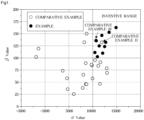
- FIG. 1 shows ⁇ values and ⁇ values of the examples and comparative examples.
- Examples 1 to 10 had ASP values of 15 to 70 and average grain sizes (d) of the thickness central region satisfying 5 ⁇ m or less. On the contrary, it was confirmed that Comparative Examples 1 to 9 and 12 to 24 had ASP values out of the range of 10 to 70 or average grain sizes (d) of the thickness central region of not less than 5.1 ⁇ m.
- Examples 1 to 10 exhibit austenitic stainless steel having excellent corrosion resistance with high strength and high ductility with low manufacturing costs. All of Examples 1 to 10 satisfy the ⁇ value of 10,000 or more, the ⁇ value of 100 or more, the ⁇ value of 0 or more, and the pitting potential value of 100 mV or more.
- Comparative Examples 1 to 6 which are commercially produced standard austenitic stainless steels, have low price-competitiveness because steel types not satisfying the composition range of the present disclosure were used and do not satisfy the ⁇ value conditions because the ⁇ values were less than 10,000, thereby failing to realize high strength and high ductility with high price-competitiveness.
- Comparative Examples 7 and 8, 12, 14, and 16 to 21 have problems of failing to realize high strength and high ductility with high price-competitiveness because the ⁇ values, less than 10,000 in common, do not satisfy the ⁇ value conditions.
- Comparative Examples 7 to 9, 12 to 15, and 18 to 24 had problems that the average grain size (d) of the thickness central region could not satisfy 5 ⁇ m or less, and the ⁇ value was less than 100.
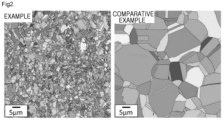
- FIG. 2 shows grain sizes of Example 1 and Comparative Example 9. In the comparative examples not satisfying 5 ⁇ m or less, coarse grains are formed as shown in the right image (Comparative Example 9), and thus ultra-fine grains, as shown in the left image (Example 1) could not be realized. Accordingly, high strength and high ductility could not be obtained simultaneously.
- Comparative Examples 10 and 11 exhibits a problem that the ⁇ value is less than 0. This is because the components consisting of a large amount of Mn and small amounts of Cr and N are not balanced. Since it is difficult to obtain sufficient corrosion resistance of the material while undergoing low-temperature annealing, problems of failing to obtain both high strength and high ductility with excellent corrosion resistance may be caused.
- the austenitic stainless steel according to the present disclosure has excellent strength, ductility, and corrosion resistance as well as excellent price-competitiveness, the present disclosure has industrial applicability.
Landscapes
- Chemical & Material Sciences (AREA)
- Engineering & Computer Science (AREA)
- Mechanical Engineering (AREA)
- Materials Engineering (AREA)
- Metallurgy (AREA)
- Organic Chemistry (AREA)
- Physics & Mathematics (AREA)
- Thermal Sciences (AREA)
- Crystallography & Structural Chemistry (AREA)
- Heat Treatment Of Sheet Steel (AREA)
- Heat Treatment Of Steel (AREA)
Abstract
Description
- The present disclosure relates to an austenitic stainless steel and a manufacturing method therefor, and more particularly, to an austenitic stainless steel having both high strength and ductility even after undergoing low-temperature annealing and having excellent price-competitiveness and corrosion resistance and a manufacturing method therefor.
- Stainless steels with excellent corrosion resistance, which do not require additional investment for separate facilities to improve corrosion resistance, are suitable not only for transportation and construction parts but also mass production in small variety that is a recent market trend. Particularly, due to excellent formability and elongation, austenitic stainless steels are easy to form complex shapes to meet various needs of customers and have aesthetically appealing appearance.
- However, due to lower yield strength of 200 to 350 MPa of frequently used austenitic stainless steels than that of carbon steels, there are limits to apply the austenitic stainless steels to structures. In order to obtain higher yield strength in such general-purpose 300 series stainless steels, an additional skin pass rolling process, which causes problems of increasing costs and rapidly deteriorating elongation and formability, is performed. In addition, because common stainless steels contain high-priced alloying elements, a problem of low price-competitiveness may occur. Particularly, Ni contained in austenitic stainless steels has low price competitiveness because the supply of raw materials is unstable due to extreme fluctuation in price, it is difficult to secure stable supply price, and the price thereof itself is high.
- For example,
Korean Patent Application Publication No. 10-2016-0138277 - Meanwhile, the technology of realizing ultra-fine grains in an austenitic stainless steel may generally be conducted by transforming an austenite phase into a martensite phase by cold rolling, and annealing at a low temperature. However, although ultra-fine grains are formed, it is difficult to prepare a material having both excellent yield strength and elongation. This is because the contents of Ni, Cr, Mn, and the like may vary within a range capable of obtaining price-competitiveness, the amount of martensitic transformation may vary according to the austenitic stability parameter (ASP) value, and elongation may vary in accordance with transformation induced plasticity (TRIP) transformation behavior during a tensile test.
- Therefore, there is a need to develop a material having excellent yield strength, elongation, and corrosion resistance with minimum amounts of high-priced alloying elements such as Ni and a manufacturing method therefor.
- Patent Document 1:
Korean Patent Application Publication No. 10-2016-0138277 (Published on December 2, 2016 - Embodiments of the present disclosure provide an austenitic stainless steel having excellent yield strength and elongation, and high price-competitiveness, and excellent corrosion resistance so as to be applicable to industrial materials.
- Specifically, the present disclosure provides a high strength-high ductility austenitic stainless steel sheet having applicable to outer panels of automobiles and construction parts by using the technology of manufacturing ultrafine grains and a manufacturing method therefor.
- However, the technical problems to be solved by the present disclosure are not limited to the aforementioned problems, and any other technical problems not mentioned herein will be clearly understood from the following description by those skilled in the art to which the present disclosure pertains.
- In accordance with an aspect of the present disclosure to achieve the above-described objects, an austenitic stainless steel includes, in percent by weight (wt%), 0.005 to 0.060% of carbon (C), 0.1 to 1.5% of silicon (Si), 5.0 to 10.0% of manganese (Mn), more than 0% but not more than 3% of nickel (Ni), 14.0 to 18.0% of chromium (Cr), more than 0% but not more than 2.0% of copper (Cu), 0.01 to 0.25% of nitrogen (N), and the balance of iron (Fe) and inevitable impurities, wherein an α value defined in Equation (1) below satisfies 10,000 or more, and a β value defined in Equation (2) below satisfies 100 or more.


- In Equation (1) and Equation (2), [Ni], [Cr], and [Mn] represent amounts (wt%) of respective elements, YS refers to yield stress (MPa), EL refers to elongation (%), austenitic stability parameter (ASP) is a value calculated by using Equation (2-1) below, and d refers to an average grain size (µm) of a thickness central region.
ASP = 551-462([C]+[N])-9.2[Si]-8.1[Mn]-13.7[Cr]- 29([Ni]+[Cu]) - In Equation (2-1), [C], [N], [Si], [Mn], [Cr], [Ni], and [Cu] represent amounts (wt%) of respective elements.
- In addition, the average grain size (d) of the thickness central region may be 5.0 µm or less.
- In addition, the ASP value of Equation (2) may satisfy a range of 15 to 70.
- In addition, the austenitic stainless steel may have a pitting potential of 100 mV or more.
- In addition, the austenitic stainless steel may have a yield strength of 540.0 MPa or more an elongation of 30.0% or more.
- In accordance with another aspect of the present disclosure to achieve the above-described objects, a method for manufacturing an austenitic stainless steel includes: providing a material including, in percent by weight (wt%), 0.005 to 0.060% of carbon (C), 0.1 to 1.5% of silicon (Si), 5.0 to 10.0% of manganese (Mn), more than 0% but not more than 3% of nickel (Ni), 14.0 to 18.0% of chromium (Cr), more than 0% but not more than 2.0% of copper (Cu), 0.01 to 0.25% of nitrogen (N), and the balance of iron (Fe) and inevitable impurities; hot rolling the material to prepare a hot-rolled steel sheet; cold rolling the hot-rolled steel sheet to prepare a cold-rolled steel sheet; and finally annealing the cold-rolled steel sheet, wherein the finally-annealed steel sheet satisfies an α value defined in Equation (1) below of 10,000 or more, a β value defined in Equation (2) below of 100 or more, and a γ defined in Equation (3) below of 0 or more.


- In Equation (1) to Equation (3), [Ni], [Cr], [Mn], and [N] represent amounts (wt%) of respective elements, YS refers to yield stress (MPa), EL refers to elongation (%), austenitic stability parameter (ASP) is a value calculated by using Equation (2-1) below, d refers to an average grain size (µm) of a thickness central region, and Temp refers to a final annealing temperature (°C).
ASP = 551-462([C]+[N])-9.2[Si]-8.1[Mn]-13.7[Cr]- 29([Ni]+[Cu]) - In Equation (2-1), [C], [N], [Si], [Mn], [Cr], [Ni], and [Cu] represent amounts (wt%) of respective elements.
- In addition, the final annealing process may be performed in a temperature range of 750 to 850°C.
- In addition, the method may further include primarily annealing the hot-rolled steel sheet at 1000 to 1150°C before the cold rolling.
- In addition, in the cold rolling process, the hot-rolled steel sheet may be rolled with a thickness reduction ratio of 50% or more in a room temperature range to form the cold-rolled steel sheet.
- In addition, the austenitic stainless steel may satisfy an ASP value range of 15 to 70.
- In addition, in the finally annealed steel sheet, an average grain size (d) of the thickness central region may be 5.0 µm or less.
- According to an embodiment of the present disclosure, an austenitic stainless steel having excellent yield strength and elongation and manufactured with low costs by minimizing the Ni content.
- The present disclosure may provide an austenitic stainless steel having excellent ultra-fine grain characteristics with excellent strength, ductility, and corrosion resistance as well as high price-competitiveness, and a manufacturing method therefor.
-
-
FIG. 1 shows ranges of α value calculated by Equation (1) and β value calculated by Equation (2) according to examples and comparative examples. -
FIG. 2 shows average grain sizes of thickness central regions of austenitic stainless steels according to examples and comparative examples. - An embodiment of the present disclosure provides an austenitic stainless steel including, in percent by weight (wt%), 0.005 to 0.060% of carbon (C), 0.1 to 1.5% of silicon (Si), 5.0 to 10.0% of manganese (Mn), more than 0% but not more than 3% of nickel (Ni), 14.0 to 18.0% of chromium (Cr), more than 0% but not more than 2.0% of copper (Cu), 0.01 to 0.25% of nitrogen (N), and the balance of iron (Fe) and inevitable impurities, wherein an α value defined by Equation (1) below satisfies 10,000 or more and a β value defined by Equation (2) below satisfies 100 or more.


- In Equation (1) and Equation (2),
- [Ni], [Cr], and [Mn] represent amounts (wt%) of respective elements,
- YS refers to yield stress (MPa),
- EL refers to elongation (%),
- austenitic stability parameter (ASP) is a value calculated by using Equation (2-1) below, and
- d is an average grain size (µm) of a thickness central region.
ASP = 551-462([C]+[N])-9.2[Si]-8.1[Mn]-13.7[Cr]- 29([Ni]+[Cu]) - In Equation (2-1), [C], [N], [Si], [Mn], [Cr], [Ni], and [Cu] represent amounts (wt%) of respective elements.
- The terms used herein are merely used to describe the present disclosure and not intended to the scope of the present disclosure. Thus, an expression used in the singular encompasses the expression of the plural, unless it has a clearly different meaning in the context.
- Hereinafter, the unit is wt% unless otherwise stated. In addition, it is to be understood that the terms such as "including" or "having" are intended to indicate the existence of components disclosed in the specification, and are not intended to preclude the possibility that one or more other components may exist or may be added.
- Unless otherwise defined, all technical and scientific terms used herein have the same meaning as commonly understood by one of ordinary skill in the art to which present disclosure belongs. Terms defined in the dictionary are interpreted to have meanings consistent with related technical documents and content disclosed herein.
- In addition, the terms "about", "substantially", etc. used throughout the specification mean that when a natural manufacturing and substance allowable error are suggested, such an allowable error corresponds a value or is similar to the value, and such values are intended for the sake of clear understanding of the present invention or to prevent an unconscious infringer from illegally using the disclosure of the present invention.
- Ultra-fine grain (UFG) materials have properties such as excellent strength-elongation balance, fatigue resistance, and etching processibility. The present disclosure provides an austenitic stainless steel including ultra-fine grains realizing high strength-high ductility, and a manufacturing method therefor. Furthermore, provided is an austenitic stainless steel sheet having yield strength and elongation suitable for structural members such as outer panels of automobiles and construction parts.
- In addition, in the present disclosure, in order to increase price-competitiveness of the austenitic stainless steel, manganese and nitrogen have been used to maintain excellent performance while reducing high-priced elements such as nickel.
- Hereinafter, an austenitic stainless steel according to an embodiment of the present disclosure will be described in more detail.
- An austenitic stainless steel according to an embodiment of the present disclosure may include, in percent by weight (wt%), 0.005 to 0.060% of carbon (C), 0.1 to 1.5% of silicon (Si), 5.0 to 10.0% of manganese (Mn), more than 0% but not more than 2.0% of copper (Cu), more than 0% but not more than 3.0% of nickel (Ni), 14.0 to 18.0% of chromium (Cr), 0.01 to 0.25% of nitrogen (N), and the balance of iron (Fe) and inevitable impurities.
- Carbon, as an element effective on stabilizing an austenite phase, may be added in an amount of 0.005% or more to obtain yield strength of an austenitic stainless steel. However, an excess of C may not only deteriorate cold workability due to solid strengthening effect, but also induce grain boundary precipitation of a Cr carbide during low-temperature annealing adversely affecting ductility, toughness, corrosion resistance, and the like. Thus, an upper limit thereof may be controlled to 0.060%.
- Silicon, serving as a deoxidizer during a steelmaking process, is effective on enhancing corrosion resistance and may be added in an amount of 0.01% or more. However, Si is also an element effective on stabilizing a ferrite phase, and an excess of Si may promote formation of delta (δ) ferrite in a cast slab, thereby not only deteriorating hot workability but also adversely affecting ductility and impact properties. Thus, an upper limit thereof may be controlled to 1.5%.
- Manganese (Mn), as an element stabilizing an austenite phase added as a Ni substitute, may be added in an amount of 5.0% or more to improve stability of an austenite. However, an excess of Mn may cause excessive formation of S-based inclusions (MnS), resulting in deterioration of ductility, toughness, and corrosion resistance of an austenitic stainless steel, and may also cause formation of Mn fumes during a steelmaking process, resulting in increases in risks in the manufacture. Thus, an upper limit thereof may be controlled to 10.0%.
- Nickel (Ni), as a strong austenite phase-stabilizing element, is essential to obtain excellent hot workability and cold workability. However, Ni that is a high-priced element may increase costs of raw materials in the case of adding a large amount. Thus, an upper limit thereof may be controlled to 3.0% in consideration of both costs and efficiency of steel materials.
- Chromium (Cr) is an element stabilizing a ferrite phase but effective on suppressing formation of a martensite phase. As a basic element for obtaining corrosion resistance required in stainless steels, Cr may be added in an amount of 14% or more. However, an excess of Cr may increase manufacturing costs and promote formation of a large amount of delta (δ) ferrite in a steel material, resulting in deterioration of hot workability and adverse effects on properties. Thus, an upper limit thereof may be controlled to 18.0%.
- Copper (Cu), as an austenite phase-stabilizing element, is added instead of nickel (Ni) in the present disclosure. Cu may be added as an element for enhancing corrosion resistance under a reducing environment. However, an excess of Cu not only increases costs of raw materials but also causes liquefaction and embrittlement at a low temperature. Thus, an upper limit thereof may be controlled to 2.0% in consideration of cost efficiency and properties of steel materials.
- Nitrogen, as a strong austenite-stabilizing element effective on enhancing corrosion resistance and yield strength of an austenitic stainless steel, may be added in an amount of 0.01% or more. However, an excess of N may cause hardening of a material and deterioration of hot workability due to solid strengthening effect. Thus, an upper limit thereof may be controlled to 0.25%.
- In addition, the austenitic stainless steel according to an embodiment of the present disclosure may further include at least one of phosphorous (P) and sulfur (S) as inevitable impurities.
- A content of phosphorus (P) is 0.035% or less. Phosphorus (P), as an impurity inevitably contained in steels, is a major element causing grain boundary corrosion or deterioration of hot workability, and therefore, it is preferable to control the P content as low as possible. In the present disclosure, an upper limit of the P content is controlled to 0.035% or less.
- A content of sulfur (S) is 0.01% or less. Sulfur (S), as an impurity that is inevitably contained in steels, is a major element causing deterioration of hot workability as being segregated in grain boundaries, and therefore, it is preferable to control the S content as low as possible. In the present disclosure, an upper limit of the S content is controlled to 0.01% or less.
- The remaining component of the composition of the present disclosure is iron (Fe). However, the composition may include unintended impurities inevitably incorporated from raw materials or surrounding environments, and thus addition of other alloy components is not excluded. These impurities are known to any person skilled in the art of manufacturing and details thereof are not specifically mentioned in the present disclosure.
- In addition, the austenitic stainless steel is characterized to have an α value defined by Equation (1) below satisfying 10,000 or more. If the α value is 10,000 or more, not only price-competitiveness, but also high strength and high ductility may be obtained.

- In Equation (1), [Ni], [Cr], and [Mn] represent amounts (wt%) of respective elements, YS refers to yield stress (MPa), and EL refers to elongation (%).
- In addition, the austenitic stainless steel is characterized to have a β value defined by Equation (2) below satisfying 100 or more. If the β value is 100 or more, ultra-fine grains are formed to obtain both high strength and high ductility.

- In Equation (2), austenitic stability parameter (ASP) is a value calculated by using Equation (2-1) below, and d refers to an average grain size (µm) of a thickness central region.
ASP = 551-462([C]+[N])-9.2[Si]-8.1[Mn]-13.7[Cr]- 29([Ni]+[Cu]) - In Equation (2-1), [C], [N], [Si], [Mn], [Cr], [Ni], and [Cu] represent amounts (wt%) of respective elements.
- The average grain size (d) of the thickness central region may be 5.0 µm or less indicating ultra-fine grains, and the ASP value of Equation (2) may satisfy the range of 15 to 70.
- The austenitic stainless steel according to an embodiment may have a pitting potential of 100 mV or more indicating excellent corrosion resistance when the potting potential is measured using a 3.5% NaCl solution at 30°C.
- The austenitic stainless steel according to an embodiment has a yield strength of 540.0 MPa or more indicating excellent strength and an elongation of 30.0% or more indicating excellent ductility.
- In the case where a material produced in a casting process according to an embodiment of the present disclosure is hot rolled and finally cold rolled with a total thickness reduction ratio of 50% or more at room temperature without performing annealing, and then finally cold annealed in an annealing temperature range of 750 to 850°C, or in the case where a material produced in the casting process is hot rolled, annealed in an annealing temperature range of 1000 to 1150°C, and finally cold rolled with a total thickness reduction ratio of 50% or more at room temperature, and then finally annealed in a temperature range of 750 to 850°C, the average grain size (d) of the thickness central region is 5 µm or less, and the pitting potential, when measured using a 3.5% NaCl solution (30°C), satisfies 100 mV or more.
- Therefore, hereinafter, a method for manufacturing an austenitic stainless steel according to an embodiment of the present disclosure will be described.
- The method for manufacturing an austenitic stainless steel according to an embodiment of the present disclosure may include: providing a material; hot rolling the material to prepare a hot-rolled steel sheet; cold-rolling the hot-rolled steel sheet to prepare a cold-rolled steel sheet; and finally annealing the cold-rolled steel sheet, wherein the method may further include primarily annealing the hot-rolled steel sheet before the cold rolling.
- In the providing of the material, a material (ingot or slab) including, in percent by weight (wt%) 0.005 to 0.060% of carbon (C), 0.1 to 1.5% of silicon (Si), 5.0 to 10.0% of manganese (Mn), more than 0% but not more than 3.0% of nickel (Ni), 14.0 to 18.0% of chromium (Cr), more than 0% but not more than 2.0% of copper (Cu), 0.01 to 0.25% of nitrogen (N), and the balance of iron (Fe) and inevitable impurities may be provided.
- The composition of the material may be controlled such that the ASP value defined by Equation (2-1) below satisfies a range of 15 to 70.
ASP = 551-462([C]+[N])-9.2[Si]-8.1[Mn]-13.7[Cr]- 29([Ni]+[Cu]) - In the equation, [C], [N], [Si], [Mn], [Cr], [Ni], and [Cu] represent amounts (wt%) of respective elements.
- In addition, the method for manufacturing an austenitic stainless steel according to an embodiment of the present disclosure includes controlling the α value defined by Equation (1) below to satisfy 10,000 or more. If the α value is controlled to 10,000 or more, not only high price-competitiveness but also high strength and high ductility may be obtained.

- In Equation (1), Ni, Cr, and Mn represent amounts (wt%) of respective elements, YS refers to yield stress (MPa), and EL refers to elongation (%).
- In addition, the method for manufacturing an austenitic stainless steel according to an embodiment of the present disclosure includes controlling the β value defined by Equation (2) below to satisfy 100 or more. If the β value is controlled to 100 or more, ultra-fine grains having an average grain size (d) of the thickness central region of 5.0 µm or less are formed, thereby obtaining both high strength and high ductility.

- In Equation (2), austenitic stability parameter (ASP) is a value calculated by Equation (2-1) described above and may preferably satisfy a range of 15 to 70.
- D refers to an average grain size (µm) of a thickness central region and may preferably be 5.0 µm or less.
- After the hot rolling process, cold rolling may be performed without conducting annealing, or cold rolling may be performed after primary annealing. In the case of performing primary annealing, the primary annealing may be performed in a temperature range of 1000 to 1150°C.
- The cold rolling process may be performed such that a thickness reduction ratio of the hot-rolled steel sheet is 50% or more in a room temperature range.
- The final annealing process may be performed in a temperature range of 750 to 850°C, and furthermore, a final annealing temperature may be controlled such that the γ value defined by Equation (3) below is 0 or more. If the γ value is controlled to 0 or more, the components such as manganese, chromium, and nitrogen may be balanced so as to obtain sufficient corrosion resistance although low-temperature annealing is performed.

- In Equation (3), [Cr], [N], and [Mn] represent amounts (wt%) of respective elements, and Temp refers to a final annealing temperature (°C).
- Specifically, if the γ value is controlled to 0 or more, a pitting potential, which is measured using a 3.5% NaCl solution at 30°C, is 100 mV or more, thereby achieving excellent corrosion resistance.
- Hereinafter, the present disclosure will be described in more detail with reference to the following examples.
- Alloying elements and composition ranges of steel types used in examples and comparative examples of the austenitic stainless steel, and austenite stability parameter (ASP) values, as parameters of major components, are listed in Table 1 below.
ASP = 551-462([C]+[N])-9.2[Si]-8.1[Mn]-13.7[Cr]- 29([Ni]+[Cu]) [Table 1] Category Alloying element (wt%) ASP C Si Mn Ni Cr Cu N Steel Type 1 0.030 0.5 8.5 2.5 15.5 1.2 0.20 51.64 Steel Type 2 0.040 0.5 8.5 2.0 16.0 2.5 0.20 16.97 Steel Type 3 0.040 0.5 9.2 1.2 15.5 1.8 0.20 61.65 Steel Type 4 0.030 0.4 9.5 1.9 15.2 1.5 0.20 57.27 Steel Type 5 0.030 0.4 9.5 2.5 16.2 1.0 0.22 31.43 Steel Type 6 0.030 1.0 9.5 1.9 15.2 1.0 0.23 52.39 Steel Type 7 0.120 0.6 0.9 6.8 17.1 0.0 0.05 28.18 Steel Type 8 0.055 0.4 1.1 8.1 18.2 0.1 0.04 7.38 Steel Type 9 0.030 1.0 8.8 2.5 16.2 0.5 0.20 55.32 Steel Type 100.030 0.4 10.0 3.5 16.5 1.0 0.23 -10.35 Steel Type 110.030 1.5 10.0 1.8 15.8 1.9 0.23 12.32 - Some of the steel types of Table 1 were manufactured as ingots by Lab. vacuum melting, and some were manufactured as slabs via an electric furnace-casting process. Coils of Examples 1 to 10 and Comparative Examples 1 to 24 were prepared at final annealing temperatures (Temp; °C) shown in Table 2 below. The average grain size (d) was measured at the thickness central region of the prepared materials, and the yield strength (YS; MPa) and the elongation (EL; %) were measured by using JIS13B tensile test pieces by a tensile test at room temperature in a crosshead range of 10 mm/min to 20 mm/min, and the pitting potential was measured by using a 3.5% NaCl solution (30°C), and the results are shown in Table 2 below.
- In addition, based on the compositions and measurement values of Table 1, α, β, and γ values defined by Equation (1) to Equation (3) below were calculated and shown in Table 2 below.
FIG. 1 shows α values and β values of the examples and comparative examples.


[Table 2] Category Steel Type Temp. (°C) d (µm) YS (MPa) EL (%) Pitting potential (mV) α β γ Example 1 Steel Type 1 800 2.5 636.4 37.9 110.7 11919.56 146.51 0.66 Example 2 Steel Type 1 850 3.2 543.8 42.2 106.1 10748.36 135.49 1.07 Example 3 Steel Type 2 850 2.6 653.3 36.1 142.2 12084.13 110.00 1.57 Example 4 Steel Type 3 800 2.2 658.6 38.6 107.6 14881.96 162.78 0.31 Example 5 Steel Type 3 850 2.7 584.2 41.0 112.5 13412.20 152.94 0.72 Example 6 Steel Type 4 850 4.9 599.7 38.6 103.5 11368.42 125.03 0.27 Example 7 Steel Type 5 750 3.5 760.0 30.8 115.5 10468.00 111.61 0.73 Example 8 Steel Type 5 800 4.4 666.1 35.9 109.0 10972.99 102.94 1.18 Example 9 Steel Type 6 800 3.5 710.5 34.5 116.9 12732.25 132.57 0.34 Example 10 Steel Type 6 850 4.4 650.5 37.3 107.5 12483.65 123.90 0.75 Comparative Example 1 Steel Type 7 800 2.7 620.7 21.7 262.7 -1370.81 119.47 3.66 Comparative Example 2 Steel Type 7 850 4.1 569.3 22.8 311.7 -1859.96 102.26 4.07 Comparative Example 3 Steel Type 7 1050 25.5 494.7 50.1 388.3 9944.47 57.88 5.41 Comparative Example 4 Steel Type 8 800 5.1 594.9 35.2 288.4 3680.48 73.80 4.50 Comparative Example 5 Steel Type 8 850 8.7 593.5 36.8 284.0 4580.80 58.23 4.91 Comparative Example 6 Steel Type 8 1050 27.7 465.8 47.2 332.4 4725.76 35.88 6.25 Comparative Example 7 Steel Type 1 1050 20.9 402.9 54.7 109.3 9838.63 84.45 2.41 Comparative Example 8 Steel Type 2 1050 26.3 420.0 47.7 192.8 8534.00 46.22 2.91 Comparative Example 9 Steel Type 3 1050 25.9 413.3 53.6 152.4 11612.88 91.11 2.06 Comparative Example 10 Steel Type 4 750 3.6 762.9 29.4 6.3 10649.26 136.33 -0.59 Comparative Example 11 Steel Type 4 800 4.0 655.0 36.1 26.8 11865.50 132.27 -0.14 Comparative Example 12 Steel Type 4 1050 26.8 430.2 50.0 142.2 9730.00 86.25 1.61 Comparative Steel Type 5 850 5.5 618.1 37.9 127.4 10485.99 95.39 1.59 Example 13 Comparative Example 14 Steel Type 5 1050 19.3 453.0 46.3 113.8 8033.90 65.57 2.93 Comparative Example 15 Steel Type 6 1050 22.8 457.8 50.1 132.2 11155.78 83.80 2.09 Comparative Example 16 Steel Type 9 800 2.5 730.4 29.1 74.1 8734.64 150.19 1.21 Comparative Example 17 Steel Type 9 850 3.8 689.4 30.1 145.9 8230.94 132.27 1.62 Comparative Example 18 Steel Type 9 1050 19.5 494.3 42.6 169.0 8537.18 89.29 2.96 Comparative Example 19 Steel Type 10 800 7.1 661.7 35.6 81.1 8656.52 45.94 1.39 Comparative Example 20 Steel Type 10 850 9.5 612.5 37.2 171.9 7885.00 38.32 1.80 Comparative Example 21 Steel Type 10 1050 17.3 449.2 46.6 196.3 6032.72 25.71 3.14 Comparative Example 22 Steel Type 11 800 5.1 742.9 33.6 51.2 12921.44 78.74 0.69 Comparative Example 23 Steel Type 11 850 6.9 686.1 36.5 54.3 13002.65 69.42 1.10 Comparative Example 24 Steel Type 11 1050 19.0 482.1 48.8 60.7 11486.48 46.73 2.44 - Referring to Tables 1 and 2, Examples 1 to 10 had ASP values of 15 to 70 and average grain sizes (d) of the thickness central region satisfying 5 µm or less. On the contrary, it was confirmed that Comparative Examples 1 to 9 and 12 to 24 had ASP values out of the range of 10 to 70 or average grain sizes (d) of the thickness central region of not less than 5.1 µm. Examples 1 to 10 exhibit austenitic stainless steel having excellent corrosion resistance with high strength and high ductility with low manufacturing costs. All of Examples 1 to 10 satisfy the α value of 10,000 or more, the β value of 100 or more, the γ value of 0 or more, and the pitting potential value of 100 mV or more.
- Comparative Examples 1 to 6, which are commercially produced standard austenitic stainless steels, have low price-competitiveness because steel types not satisfying the composition range of the present disclosure were used and do not satisfy the α value conditions because the α values were less than 10,000, thereby failing to realize high strength and high ductility with high price-competitiveness.
- Comparative Examples 7 and 8, 12, 14, and 16 to 21 have problems of failing to realize high strength and high ductility with high price-competitiveness because the α values, less than 10,000 in common, do not satisfy the α value conditions.
- Comparative Examples 7 to 9, 12 to 15, and 18 to 24 had problems that the average grain size (d) of the thickness central region could not satisfy 5 µm or less, and the β value was less than 100.
FIG. 2 shows grain sizes of Example 1 and Comparative Example 9. In the comparative examples not satisfying 5 µm or less, coarse grains are formed as shown in the right image (Comparative Example 9), and thus ultra-fine grains, as shown in the left image (Example 1) could not be realized. Accordingly, high strength and high ductility could not be obtained simultaneously. - Comparative Examples 10 and 11 exhibits a problem that the γ value is less than 0. This is because the components consisting of a large amount of Mn and small amounts of Cr and N are not balanced. Since it is difficult to obtain sufficient corrosion resistance of the material while undergoing low-temperature annealing, problems of failing to obtain both high strength and high ductility with excellent corrosion resistance may be caused.
- While the present disclosure has been particularly described with reference to exemplary embodiments, it should be understood by those of skilled in the art that various changes and modifications in form and details may be made without departing from the spirit and scope of the present disclosure.
- Because the austenitic stainless steel according to the present disclosure has excellent strength, ductility, and corrosion resistance as well as excellent price-competitiveness, the present disclosure has industrial applicability.
Claims (11)
- An austenitic stainless steel comprising, in percent by weight (wt%), 0.005 to 0.060% of carbon (C), 0.1 to 1.5% of silicon (Si), 5.0 to 10.0% of manganese (Mn), more than 0% but not more than 3% of nickel (Ni), 14.0 to 18.0% of chromium (Cr), more than 0% but not more than 2.0% of copper (Cu), 0.01 to 0.25% of nitrogen (N), and the balance of iron (Fe) and inevitable impurities,wherein an α value defined by Equation (1) below satisfies 10,000 or more,a β value defined by Equation (2) below satisfies 100 or more,

 in Equation (1) and Equation (2),[Ni], [Cr], and [Mn] represent amounts (wt%) of respective elements,YS refers to yield stress (MPa),EL refers to elongation (%),austenitic stability parameter (ASP) is a value calculated by using Equation (2-1) below,d is an average grain size (µm) of a thickness central region; and
ASP = 551-462([C]+[N])-9.2[Si]-8.1[Mn]-13.7[Cr]- 29([Ni]+[Cu]) in Equation (2-1), [C], [N], [Si], [Mn], [Cr], [Ni], and [Cu] represent amounts (wt%) of respective elements. - The austenitic stainless steel according to claim 1, wherein the average grain size (d) of the thickness central region is 5.0 µm or less.
- The austenitic stainless steel according to claim 1, wherein the ASP value of Equation (2) satisfies a range of 15 to 70.
- The austenitic stainless steel according to claim 1, wherein the austenitic stainless steel has a pitting potential value of 100 mV or more.
- The austenitic stainless steel according to claim 1, wherein the austenitic stainless steel has a yield strength of 540.0 MPa or more and an elongation of 30.0% or more.
- A method for manufacturing an austenitic stainless steel, the method comprising:providing a material comprising, in percent by weight (wt%), 0.005 to 0.060% of carbon (C), 0.1 to 1.5% of silicon (Si), 5.0 to 10.0% of manganese (Mn), more than 0% but not more than 3.0% of nickel (Ni), 14.0 to 18.0% of chromium (Cr), more than 0% but not more than 2.0% of copper (Cu), 0.01 to 0.25% of nitrogen (N), and the balance of iron (Fe) and inevitable impurities;hot rolling the material to obtain a hot-rolled steel sheet;cold rolling the hot-rolled steel sheet to prepare a cold-rolled steel sheet; andfinally annealing the cold-rolled steel sheet,wherein the finally annealed steel sheet has an α value defined by Equation (1) below satisfying 10,000 or more, a β value defined by Equation (2) below satisfying 100 or more, anda γ defined by Equation (3) below satisfying 0 or more,


 in Equation (1) to Equation (3),[Ni], [Cr], [Mn], and [N] represent amounts (wt%) of respective elements,YS refers to yield stress (MPa),EL refers to elongation (%),austenitic stability parameter (ASP) is a value calculated by using Equation (2-1) below,d is an average grain size (µm) of a thickness central region,Temp refers to a final annealing temperature (°C); and
ASP = 551-462([C]+[N])-9.2[Si]-8.1[Mn]-13.7[Cr]- 29([Ni]+[Cu]) in Equation (2-1), [C], [N], [Si], [Mn], [Cr], [Ni], and [Cu] represent amounts (wt%) of respective elements. - The method according to Claim 6, wherein the finally annealing is performed in a temperature range of 750 to 850°C.
- The method according to Claim 6, further comprising primarily annealing the hot-rolled steel sheet at 1000 to 1150°C before the cold rolling.
- The method according to Claim 6, wherein the cold-rolled steel sheet is prepared by rolling the hot-rolled steel sheet with a thickness reduction ratio of 50% in a room temperature range.
- The method according to Claim 6, wherein the ASP value of the austenitic stainless steel satisfies a range of 15 to 70.
- The method according to Claim 6, wherein the finally annealed steel sheet has an average grain size (d) of the thickness central region of 5.0 µm or less.
Applications Claiming Priority (2)
| Application Number | Priority Date | Filing Date | Title |
|---|---|---|---|
| KR1020210180891A KR20230091618A (en) | 2021-12-16 | 2021-12-16 | Austenitic stainless steel and method for producing the same |
| PCT/KR2022/016305 WO2023113206A1 (en) | 2021-12-16 | 2022-10-25 | Austenitic stainless steel and manufacturing method therefor |
Publications (2)
| Publication Number | Publication Date |
|---|---|
| EP4431631A1 true EP4431631A1 (en) | 2024-09-18 |
| EP4431631A4 EP4431631A4 (en) | 2025-10-22 |
Family
ID=86772928
Family Applications (1)
| Application Number | Title | Priority Date | Filing Date |
|---|---|---|---|
| EP22907677.3A Pending EP4431631A4 (en) | 2021-12-16 | 2022-10-25 | AUSTENITIC STAINLESS STEEL AND MANUFACTURING PROCESSES THEREFOR |
Country Status (6)
| Country | Link |
|---|---|
| US (1) | US20250051894A1 (en) |
| EP (1) | EP4431631A4 (en) |
| JP (1) | JP7820521B2 (en) |
| KR (1) | KR20230091618A (en) |
| CN (1) | CN118414446A (en) |
| WO (1) | WO2023113206A1 (en) |
Families Citing this family (1)
| Publication number | Priority date | Publication date | Assignee | Title |
|---|---|---|---|---|
| CN120536836A (en) * | 2025-04-21 | 2025-08-26 | 山西太钢不锈钢股份有限公司 | A high-strength austenitic stainless steel with a yield strength of 420 MPa |
Family Cites Families (13)
| Publication number | Priority date | Publication date | Assignee | Title |
|---|---|---|---|---|
| KR20060075725A (en) * | 2004-12-29 | 2006-07-04 | 주식회사 포스코 | Work Hardening Low Nickel Austenitic Stainless Steel |
| US10329649B2 (en) * | 2012-01-20 | 2019-06-25 | Solu Stainless Oy | Austenitic stainless steel product and a method for manufacturing same |
| JP2014001422A (en) * | 2012-06-18 | 2014-01-09 | Nippon Steel & Sumitomo Metal | Austenitic stainless steel plate and manufacturing method for the same |
| JPWO2014157146A1 (en) * | 2013-03-26 | 2017-02-16 | 日新製鋼株式会社 | Austenitic stainless steel sheet and method for producing high-strength steel using the same |
| JP5896089B1 (en) | 2014-04-17 | 2016-03-30 | 新日鐵住金株式会社 | Austenitic stainless steel and manufacturing method thereof |
| FI127274B (en) * | 2014-08-21 | 2018-02-28 | Outokumpu Oy | AUSTENITIC STAINLESS STEEL WITH HIGH STABILITY AND ITS PRODUCTION METHOD |
| JP6623761B2 (en) * | 2016-01-04 | 2019-12-25 | 日本製鉄株式会社 | Manufacturing method of metastable austenitic stainless steel |
| CN109837470B (en) * | 2017-11-29 | 2022-04-01 | 宝钢德盛不锈钢有限公司 | High-strength nitrogen-containing economical austenitic stainless steel and manufacturing method thereof |
| KR102268906B1 (en) * | 2019-07-17 | 2021-06-25 | 주식회사 포스코 | Austenitic stainless steel with imporoved strength and method for manufacturing the same |
| KR102272785B1 (en) * | 2019-10-29 | 2021-07-05 | 주식회사 포스코 | Austenitic stainless steel with imporoved yield ratio and method for manufacturing the same |
| KR102385472B1 (en) * | 2020-04-22 | 2022-04-13 | 주식회사 포스코 | High-strength, high-formability, low cost austenitic stainless steel and manufacturing method thereof |
| KR102448735B1 (en) * | 2020-09-03 | 2022-09-30 | 주식회사 포스코 | Austenitic stainless steel and manufacturing method thereof |
| KR20230007619A (en) * | 2021-07-06 | 2023-01-13 | 주식회사 포스코 | Austenitic stainless steel and manufacturing nmethod thereof |
-
2021
- 2021-12-16 KR KR1020210180891A patent/KR20230091618A/en active Pending
-
2022
- 2022-10-25 US US18/716,667 patent/US20250051894A1/en active Pending
- 2022-10-25 CN CN202280083261.7A patent/CN118414446A/en active Pending
- 2022-10-25 WO PCT/KR2022/016305 patent/WO2023113206A1/en not_active Ceased
- 2022-10-25 EP EP22907677.3A patent/EP4431631A4/en active Pending
- 2022-10-25 JP JP2024535605A patent/JP7820521B2/en active Active
Also Published As
| Publication number | Publication date |
|---|---|
| CN118414446A (en) | 2024-07-30 |
| US20250051894A1 (en) | 2025-02-13 |
| JP7820521B2 (en) | 2026-02-25 |
| JP2025500865A (en) | 2025-01-15 |
| WO2023113206A1 (en) | 2023-06-22 |
| EP4431631A4 (en) | 2025-10-22 |
| KR20230091618A (en) | 2023-06-23 |
Similar Documents
| Publication | Publication Date | Title |
|---|---|---|
| EP4177369A1 (en) | Austenitic stainless steel and manufacturing method thereof | |
| EP3722448B1 (en) | High-mn steel and method for manufacturing same | |
| US12173392B2 (en) | Austenitic stainless steel having increased yield ratio and manufacturing method thereof | |
| KR102268906B1 (en) | Austenitic stainless steel with imporoved strength and method for manufacturing the same | |
| US20240336989A1 (en) | Austenitic stainless steel and method for manufacturing same | |
| CN104726789A (en) | Low-nickel containing stainless steels | |
| US12590359B2 (en) | Austenitic stainless steel with excellent productivity and cost reduction effect and method for producing same | |
| US20250051894A1 (en) | Austenitic stainless steel and manufacturing method therefor | |
| EP3699314A1 (en) | Utility ferritic stainless steel having excellent hot workability, and manufacturing method therefor | |
| EP4119693A1 (en) | Low-cost austenitic stainless steel having high strength and high formability, and method for manufacturing same | |
| EP4585712A1 (en) | Austenitic stainless steel having excellent low-temperature impact toughness and method for manufacturing same | |
| JP7727222B2 (en) | Austenitic stainless steel and method for producing austenitic stainless steel | |
| EP4481081A1 (en) | Austenitic stainless steel | |
| EP4343014A1 (en) | Austenitic stainless steel and manufacturing method thereof | |
| EP4442851A1 (en) | Ultra-high strength cold-rolled steel sheet having excellent elongation and manufacturing method thereof | |
| EP4343013A1 (en) | Austenitic stainless steel and manufacturing method thereof | |
| EP4257719A1 (en) | Ferritic stainless steel with improved grain boundary erosion, and manufacturing method thereof | |
| KR20190077672A (en) | Ferritic stainless steel excellent in ridging property | |
| EP4606923A1 (en) | High-strength austenitic stainless steel and manufacturing method thereof | |
| EP4509633A1 (en) | Austenite stainless steel and manufacturing method therefor | |
| KR20250085540A (en) | High-strength austenitic stainless steel and manufacturing method thereof | |
| KR20250085551A (en) | High-strength stainless steel and manufacturing method thereof | |
| JPH08283911A (en) | High-strength stainless steel with excellent workability and method for producing the same |
Legal Events
| Date | Code | Title | Description |
|---|---|---|---|
| STAA | Information on the status of an ep patent application or granted ep patent |
Free format text: STATUS: THE INTERNATIONAL PUBLICATION HAS BEEN MADE |
|
| PUAI | Public reference made under article 153(3) epc to a published international application that has entered the european phase |
Free format text: ORIGINAL CODE: 0009012 |
|
| STAA | Information on the status of an ep patent application or granted ep patent |
Free format text: STATUS: REQUEST FOR EXAMINATION WAS MADE |
|
| 17P | Request for examination filed |
Effective date: 20240613 |
|
| AK | Designated contracting states |
Kind code of ref document: A1 Designated state(s): AL AT BE BG CH CY CZ DE DK EE ES FI FR GB GR HR HU IE IS IT LI LT LU LV MC ME MK MT NL NO PL PT RO RS SE SI SK SM TR |
|
| DAV | Request for validation of the european patent (deleted) | ||
| DAX | Request for extension of the european patent (deleted) | ||
| A4 | Supplementary search report drawn up and despatched |
Effective date: 20250924 |
|
| RIC1 | Information provided on ipc code assigned before grant |
Ipc: C22C 38/58 20060101AFI20250918BHEP Ipc: C22C 38/42 20060101ALI20250918BHEP Ipc: C22C 38/00 20060101ALI20250918BHEP Ipc: C21D 9/46 20060101ALI20250918BHEP Ipc: C21D 8/02 20060101ALI20250918BHEP Ipc: C21D 6/00 20060101ALI20250918BHEP Ipc: C22C 38/02 20060101ALI20250918BHEP Ipc: C22C 38/04 20060101ALI20250918BHEP |