EP4431561A1 - Phosphorsäureester-zusammensetzungen für flammwidriges weich-pvc mit hoher thermostabilität - Google Patents
Phosphorsäureester-zusammensetzungen für flammwidriges weich-pvc mit hoher thermostabilität Download PDFInfo
- Publication number
- EP4431561A1 EP4431561A1 EP23162067.5A EP23162067A EP4431561A1 EP 4431561 A1 EP4431561 A1 EP 4431561A1 EP 23162067 A EP23162067 A EP 23162067A EP 4431561 A1 EP4431561 A1 EP 4431561A1
- Authority
- EP
- European Patent Office
- Prior art keywords
- weight
- mixture
- pvc
- pho
- flame retardant
- Prior art date
- Legal status (The legal status is an assumption and is not a legal conclusion. Google has not performed a legal analysis and makes no representation as to the accuracy of the status listed.)
- Withdrawn
Links
Classifications
-
- C—CHEMISTRY; METALLURGY
- C08—ORGANIC MACROMOLECULAR COMPOUNDS; THEIR PREPARATION OR CHEMICAL WORKING-UP; COMPOSITIONS BASED THEREON
- C08K—Use of inorganic or non-macromolecular organic substances as compounding ingredients
- C08K5/00—Use of organic ingredients
- C08K5/49—Phosphorus-containing compounds
- C08K5/51—Phosphorus bound to oxygen
- C08K5/52—Phosphorus bound to oxygen only
- C08K5/521—Esters of phosphoric acids, e.g. of H3PO4
- C08K5/523—Esters of phosphoric acids, e.g. of H3PO4 with hydroxyaryl compounds
-
- C—CHEMISTRY; METALLURGY
- C07—ORGANIC CHEMISTRY
- C07F—ACYCLIC, CARBOCYCLIC OR HETEROCYCLIC COMPOUNDS CONTAINING ELEMENTS OTHER THAN CARBON, HYDROGEN, HALOGEN, OXYGEN, NITROGEN, SULFUR, SELENIUM OR TELLURIUM
- C07F9/00—Compounds containing elements of Groups 5 or 15 of the Periodic Table
- C07F9/02—Phosphorus compounds
- C07F9/06—Phosphorus compounds without P—C bonds
- C07F9/08—Esters of oxyacids of phosphorus
- C07F9/09—Esters of phosphoric acids
- C07F9/091—Esters of phosphoric acids with hydroxyalkyl compounds with further substituents on alkyl
-
- C—CHEMISTRY; METALLURGY
- C07—ORGANIC CHEMISTRY
- C07F—ACYCLIC, CARBOCYCLIC OR HETEROCYCLIC COMPOUNDS CONTAINING ELEMENTS OTHER THAN CARBON, HYDROGEN, HALOGEN, OXYGEN, NITROGEN, SULFUR, SELENIUM OR TELLURIUM
- C07F9/00—Compounds containing elements of Groups 5 or 15 of the Periodic Table
- C07F9/02—Phosphorus compounds
- C07F9/06—Phosphorus compounds without P—C bonds
- C07F9/08—Esters of oxyacids of phosphorus
- C07F9/09—Esters of phosphoric acids
- C07F9/12—Esters of phosphoric acids with hydroxyaryl compounds
-
- C—CHEMISTRY; METALLURGY
- C08—ORGANIC MACROMOLECULAR COMPOUNDS; THEIR PREPARATION OR CHEMICAL WORKING-UP; COMPOSITIONS BASED THEREON
- C08K—Use of inorganic or non-macromolecular organic substances as compounding ingredients
- C08K5/00—Use of organic ingredients
- C08K5/0008—Organic ingredients according to more than one of the "one dot" groups of C08K5/01 - C08K5/59
- C08K5/0066—Flame-proofing or flame-retarding additives
-
- C—CHEMISTRY; METALLURGY
- C08—ORGANIC MACROMOLECULAR COMPOUNDS; THEIR PREPARATION OR CHEMICAL WORKING-UP; COMPOSITIONS BASED THEREON
- C08L—COMPOSITIONS OF MACROMOLECULAR COMPOUNDS
- C08L27/00—Compositions of homopolymers or copolymers of compounds having one or more unsaturated aliphatic radicals, each having only one carbon-to-carbon double bond, and at least one being terminated by a halogen; Compositions of derivatives of such polymers
- C08L27/02—Compositions of homopolymers or copolymers of compounds having one or more unsaturated aliphatic radicals, each having only one carbon-to-carbon double bond, and at least one being terminated by a halogen; Compositions of derivatives of such polymers not modified by chemical after-treatment
- C08L27/04—Compositions of homopolymers or copolymers of compounds having one or more unsaturated aliphatic radicals, each having only one carbon-to-carbon double bond, and at least one being terminated by a halogen; Compositions of derivatives of such polymers not modified by chemical after-treatment containing chlorine atoms
- C08L27/06—Homopolymers or copolymers of vinyl chloride
-
- C—CHEMISTRY; METALLURGY
- C10—PETROLEUM, GAS OR COKE INDUSTRIES; TECHNICAL GASES CONTAINING CARBON MONOXIDE; FUELS; LUBRICANTS; PEAT
- C10M—LUBRICATING COMPOSITIONS; USE OF CHEMICAL SUBSTANCES EITHER ALONE OR AS LUBRICATING INGREDIENTS IN A LUBRICATING COMPOSITION
- C10M105/00—Lubricating compositions characterised by the base-material being a non-macromolecular organic compound
- C10M105/74—Lubricating compositions characterised by the base-material being a non-macromolecular organic compound containing phosphorus
-
- C—CHEMISTRY; METALLURGY
- C10—PETROLEUM, GAS OR COKE INDUSTRIES; TECHNICAL GASES CONTAINING CARBON MONOXIDE; FUELS; LUBRICANTS; PEAT
- C10M—LUBRICATING COMPOSITIONS; USE OF CHEMICAL SUBSTANCES EITHER ALONE OR AS LUBRICATING INGREDIENTS IN A LUBRICATING COMPOSITION
- C10M137/00—Lubricating compositions characterised by the additive being an organic non-macromolecular compound containing phosphorus
- C10M137/02—Lubricating compositions characterised by the additive being an organic non-macromolecular compound containing phosphorus having no phosphorus-to-carbon bond
- C10M137/04—Phosphate esters
-
- C—CHEMISTRY; METALLURGY
- C08—ORGANIC MACROMOLECULAR COMPOUNDS; THEIR PREPARATION OR CHEMICAL WORKING-UP; COMPOSITIONS BASED THEREON
- C08K—Use of inorganic or non-macromolecular organic substances as compounding ingredients
- C08K2201/00—Specific properties of additives
- C08K2201/014—Additives containing two or more different additives of the same subgroup in C08K
-
- C—CHEMISTRY; METALLURGY
- C10—PETROLEUM, GAS OR COKE INDUSTRIES; TECHNICAL GASES CONTAINING CARBON MONOXIDE; FUELS; LUBRICANTS; PEAT
- C10M—LUBRICATING COMPOSITIONS; USE OF CHEMICAL SUBSTANCES EITHER ALONE OR AS LUBRICATING INGREDIENTS IN A LUBRICATING COMPOSITION
- C10M2223/00—Organic non-macromolecular compounds containing phosphorus as ingredients in lubricant compositions
- C10M2223/02—Organic non-macromolecular compounds containing phosphorus as ingredients in lubricant compositions having no phosphorus-to-carbon bonds
- C10M2223/04—Phosphate esters
-
- C—CHEMISTRY; METALLURGY
- C10—PETROLEUM, GAS OR COKE INDUSTRIES; TECHNICAL GASES CONTAINING CARBON MONOXIDE; FUELS; LUBRICANTS; PEAT
- C10M—LUBRICATING COMPOSITIONS; USE OF CHEMICAL SUBSTANCES EITHER ALONE OR AS LUBRICATING INGREDIENTS IN A LUBRICATING COMPOSITION
- C10M2223/00—Organic non-macromolecular compounds containing phosphorus as ingredients in lubricant compositions
- C10M2223/02—Organic non-macromolecular compounds containing phosphorus as ingredients in lubricant compositions having no phosphorus-to-carbon bonds
- C10M2223/04—Phosphate esters
- C10M2223/0405—Phosphate esters used as base material
-
- C—CHEMISTRY; METALLURGY
- C10—PETROLEUM, GAS OR COKE INDUSTRIES; TECHNICAL GASES CONTAINING CARBON MONOXIDE; FUELS; LUBRICANTS; PEAT
- C10M—LUBRICATING COMPOSITIONS; USE OF CHEMICAL SUBSTANCES EITHER ALONE OR AS LUBRICATING INGREDIENTS IN A LUBRICATING COMPOSITION
- C10M2223/00—Organic non-macromolecular compounds containing phosphorus as ingredients in lubricant compositions
- C10M2223/02—Organic non-macromolecular compounds containing phosphorus as ingredients in lubricant compositions having no phosphorus-to-carbon bonds
- C10M2223/04—Phosphate esters
- C10M2223/041—Triaryl phosphates
-
- C—CHEMISTRY; METALLURGY
- C10—PETROLEUM, GAS OR COKE INDUSTRIES; TECHNICAL GASES CONTAINING CARBON MONOXIDE; FUELS; LUBRICANTS; PEAT
- C10N—INDEXING SCHEME ASSOCIATED WITH SUBCLASS C10M RELATING TO LUBRICATING COMPOSITIONS
- C10N2040/00—Specified use or application for which the lubricating composition is intended
- C10N2040/08—Hydraulic fluids, e.g. brake-fluids
-
- E—FIXED CONSTRUCTIONS
- E04—BUILDING
- E04H—BUILDINGS OR LIKE STRUCTURES FOR PARTICULAR PURPOSES; SWIMMING OR SPLASH BATHS OR POOLS; MASTS; FENCING; TENTS OR CANOPIES, IN GENERAL
- E04H15/00—Tents or canopies, in general
Definitions
- Phosphoric acid esters can be used in various technical applications, e.g. as plasticizers (cf. DE 1 768 076 ), as flame retardants (cf. US 8,129,457 B2 ), in lubricants (cf. US10,414,964 B2 ) or in hydraulic fluids (cf. US6,703,355 B2 ).
- plasticizers cf. DE 1 768 076
- flame retardants cf. US 8,129,457 B2
- lubricants cf. US10,414,964 B2
- hydraulic fluids cf. US6,703,355 B2
- phosphoric acid esters and their use as flame retardants.
- phosphoric acid aryl esters are used which are composed of phenol, cresol, tert-butylated phenol, isopropylated phenol or mixtures thereof.
- the phosphoric acid triaryl ester compositions described in the prior art generally show a high flame retardancy in PVC.
- the soft PVC materials produced with them have a low thermal stability.
- Another disadvantage of many state-of-the-art phosphoric acid triaryl ester compositions is their content of triphenyl phosphate. Its hazardous properties have led to ever lower levels of this substance being required in consumer applications.
- the object of the present invention was therefore to provide a flame retardant preparation which, in addition to a sufficient flame retardant effect, has a plasticizing effect for plastics, in particular for PVC molding compounds, and also has a high thermal stability.
- this flame retardant should be in liquid form at room temperature, be obtainable by a relatively inexpensive process and have a low content of triphenyl phosphate.
- R in formula (I) corresponds to the radical
- the mixtures according to the invention preferably contain less than 10% by weight, preferably less than 5% by weight, particularly preferably less than 1% by weight, very particularly preferably less than 0.5% by weight and most preferably not more than 0.2% by weight of triphenyl phosphate.
- the mixtures according to the invention are preferably in the form of a liquid at 23°C, since such a state facilitates or enables use as a flame retardant or in lubricants or hydraulic fluids.
- the mixtures according to the invention preferably have a dynamic viscosity of 20 to 5000 mPa s, particularly preferably 50 to 2000 mPa s (each at 23°C).
- the mixtures according to the invention preferably have an acid number of less than 5 mg KOH/g, preferably less than 1 mg KOH/g, particularly preferably less than 0.3 mg KOH/g, very preferably less than 0.1 mg KOH/g.
- PVC molding compounds containing the mixture according to the invention have high thermal stability and high flame retardancy.
- the mixtures according to the invention can be produced unexpectedly easily using a novel process.
- a preferred embodiment of the process allows production in a form such that the mixture contains no or only very little triphenyl phosphate.
- At least part of the phosphorus oxychloride is only added in step b). It is also possible that at least part of the guaiacol is only added in step b).
- a catalyst can be added for the reaction in step b) and/or c).
- Suitable catalysts are, for example: NaCl, KCl, LiCl, MgCl 2 , MgO, CaCl 2 , AlCl 3 , FeCl 3 , ZnCl 2 , TiCl 4 , SbCl 4 .
- the addition can take place in step a), b) or c) or between steps a) and b) or b) and c).
- the reaction according to step b) is usually carried out in the range from 80°C to 300°C, preferably in the range from 80°C to 250°C, particularly preferably in the range from 80°C to 200°C.
- a distillative separation of (unreacted) reactants from step a) and/or by-products formed can take place between step b) and step c).
- the distillation can be carried out as a batch process or as a continuous process.
- the temperature of the distillation is preferably in the range from 80°C to 250°C.
- the distillation is particularly preferably carried out at the reaction temperature of step b) or at a temperature between 80°C and the reaction temperature of step b).
- the distillation takes place in a pressure range of 0.01 mbar and 1013 mbar, preferably in the range of 0.01 mbar and 100 mbar, very particularly preferably in the range of 0.01 mbar and 50 mbar.
- the reaction according to step c) is usually carried out in the range from 100°C to 300°C, preferably in the range from 100°C to 250°C, particularly preferably in the range from 120°C to 250°C.
- step c at least part of the phenol is only added during the reaction in step c). It is also possible that at least part of the reaction mixture obtained from step b) (either directly or after distillative separation from the reactants of step a) and/or by-products formed in step b)) is added during the reaction in step c).
- a distillative separation of (unreacted) reactants and/or by-products formed in steps b) and/or c) can be carried out.
- the distillation can be carried out as a batch process or as a continuous process.
- the temperature of the distillation is preferably in the range from 80°C to 250°C.
- the distillation takes place in a pressure range of 0.01 mbar and 1013 mbar, preferably in the range from 0.01 mbar and 100 mbar, very particularly preferably in the range from 0.01 mbar and 50 mbar.
- the mixtures according to the invention can contain further auxiliary substances depending on the application.
- Possible auxiliary substances are, for example, plasticizers, plasticizing polymers, polymer modifiers, stabilizers (e.g. thermal stabilizers, light stabilizers, antioxidants), co-stabilizers (e.g. acid scavengers, radical scavengers), internal and external lubricants, viscosity regulators, fillers, color pigments, dyes, flame retardants, flame retardant synergists, blowing agents and other functional additives such as antistatic agents, nucleating agents, UV protection agents or biocides (see e.g. RD Maier, M. Schiller, Handbook of Plastics Additives, 4th edition, Kunststoff, Carl Hanser Verlag, 2016, p. 513 ff ).
- the mixtures according to the invention are suitable as flame retardants.
- the present invention therefore further relates to the use of the mixtures according to the invention as flame retardants.
- the mixtures according to the invention are particularly preferably used as flame retardants for polyvinyl chloride (PVC), for example in PVC molding compounds, i.e. in compositions containing PVC which are in the form of a granulate, a powder, a paste or a plastisol.
- PVC polyvinyl chloride
- the invention therefore also relates to compositions preferably in the form of a granulate, a powder, a paste or a plastisol, containing a mixture according to the invention and polyvinyl chloride (PVC).
- PVC molding compounds according to the invention are preferably soft PVC.
- the inventive PVC moulding compounds can be produced by reacting PVC with the mixtures according to the invention and optionally other auxiliary substances, e.g. stabilisers, in a manner known per se (see e.g. G. Becker, D. Braun, Plastics Handbook, Polyvinyl Chloride, Vol. 2/2, Kunststoff, Vienna, Carl Hanser Verlag, 1986, p. 829 ff) mixed and compounded or dispersed to form a plastisol or organosol ready for processing.
- auxiliary substances e.g. stabilisers
- the PVC molding composition according to the invention preferably contains 5 to 150 parts by weight, particularly preferably 30 to 70 parts by weight, of phosphoric acid esters of the formula (I) based on 100 parts by weight of PVC.
- the PVC molding composition according to the invention contains 5 to 150 parts by weight, particularly preferably 30 to 70 parts by weight, of phosphoric acid esters of the formula (I) based on 100 parts by weight of PVC.
- the PVC molding compound according to the invention is used in coatings, films, cables, pipelines, hoses, seals, conveyor belts, roofing membranes, adhesive tape films, tarpaulins, awnings and tents.
- the invention further relates to the use of the mixtures according to the invention in hydraulic fluids or for producing hydraulic fluids.
- the mixtures according to the invention are preferably used in flame-retardant hydraulic fluids.
- the invention further relates to the use of the mixtures according to the invention as lubricant additives.
- the mixtures according to the invention are preferably used in flame-retardant lubricants.
- Another object of the invention is the use of the mixtures according to the invention as additives for paints, adhesives, sealants and coatings.
- the invention further relates to the use of the mixtures according to the invention as heat transfer media or in preparations that are used as heat transfer media.
- the mixtures according to the invention are preferably used as heat transfer media or in heat transfer media preparations in the immersion cooling of electrical components.
- the heat transfer media preparations contain, for example, further trialkyl phosphates, triaryl phosphates, mineral oils, polyalphaolefins, esters, antioxidants, metal deactivators, flow additives, Corrosion inhibitors, foam inhibitors, demulsifiers and/or pour point depressants.
- Phosphorus oxychloride 200 parts by weight
- guaiacol 162 parts by weight
- magnesium chloride 0.1 part by weight
- the reaction mixture was heated to 100°C with stirring and kept at this temperature until hardly any gas formation was observed.
- the pressure in the apparatus was gradually reduced from atmospheric pressure to 10 mbar and kept under final conditions for 1 h.
- phenol 308 parts by weight
- the temperature of the reaction mixture was gradually increased to a final temperature of 140°C and kept at this temperature until complete conversion. Excess phenol was removed at a final temperature of 140°C and a pressure of 10 mbar.
- the product mixture was isolated as a viscous liquid (180 mPa s at 23°C). The acid number was ⁇ 0.1 mg KOH/g.
- Phosphorus oxychloride 200 parts by weight
- guaiacol 243 parts by weight
- magnesium chloride 0.1 part by weight
- the reaction mixture was gradually heated to 100°C with stirring and kept at this temperature until hardly any gas formation was observed.
- phenol 307 parts by weight
- the temperature of the reaction mixture was gradually increased to a final temperature of 120°C and kept at this temperature until complete conversion.
- Excess phenol was removed at a final temperature of 160°C and a pressure of 10 mbar.
- the product mixture was isolated as a viscous liquid (430 mPa s at 23°C).
- the acid number was ⁇ 0.1 mg KOH/g.
- Phosphorus oxychloride 200 parts by weight
- guaiacol 324 parts by weight
- magnesium chloride 0.1 part by weight
- the reaction mixture was gradually heated to 120°C with stirring and kept at this temperature until hardly any gas formation was observed.
- phenol 185 parts by weight
- the temperature of the reaction mixture was gradually increased to a final temperature of 140°C and kept at this temperature until complete conversion.
- Excess phenol was removed at a final temperature of 160°C and a pressure of 10 mbar.
- the product mixture was isolated as a viscous liquid (1810 mPa s at 23°C).
- the acid number was 0.4 mg KOH/g.
- Quantitative GC-FID analysis was carried out using an Agilent GC device of type 7890A equipped with a quartz capillary column of type CB-Sil 5 CB (length: 30 m, diameter: 0.32 mm, layer thickness: 3.00 ⁇ m). Hydrogen was used as carrier gas.
- the sample (dissolved in acetone) was injected in split mode (86: 1) at a temperature of 300°C.
- the following temperature program was set: 60°C starting temperature, heating rate 10°C/min up to a temperature of 150°C, then with a heating rate of 25°C/min to 280°C, holding time: 10 min, then with a heating rate of 25°C/min to a final temperature of 320°C/min, holding time: 10 min.
- the evaluation was carried out by integrating the corresponding baseline-separated signal and converting the peak areas into a content after previous calibration.
- the dynamic viscosity of phosphoric acid esters was measured using an Anton Paar shear rheometer type MCR 102 at the specified temperature with a shear rate of 200 s -1 according to DIN 53018.
- the acid number of the samples was determined in accordance with DIN EN ISO 2114 (method B, colorimetric titration with phenolphthalein).
- Sodium hydroxide solution (0.1 mol/L) was titrated from a burette until the color change from colorless to pink persisted for at least 10 seconds while stirring. A blank value was measured in the same way but without a sample.
- Table 2 lists known phosphoric acid ester compositions that were used as comparison samples for the production of soft PVC.
- the triguaiacyl phosphate was prepared according to WO 2014171122 A1
- the other comparison samples are commercial products of Lanxess Deutschland GmbH.
- Comparison sample Alcohol/phenol component Condition at 23°C Disflamoll ® DPK Cresol/Phenol fluid Disflamoll ® TKP Cresol fluid Disflamoll® 51092 t-Butylphenol/Phenol fluid Reofos ® 65 Isopropylphenol/Phenol fluid Triguaiacyl phosphate Guaiacol Solid
- the soft PVC molding compounds used for the test were produced on a laboratory rolling mill. After adding the mixture of all the recipe components (see Table 3), they were left on the roller until a sheet had formed. From the time the sheet had formed, the compounds were compounded on the roller for a further 10 minutes and finally removed as a rolled sheet. The rolling temperature was 165°C.
- test specimens for determining the LOI were made from the rolled sheets using a press.
- the pressing temperature was 170°C
- the pressing time was 4 minutes for preheating at low pressure ( ⁇ 10 bar) and 2 minutes at high pressure (> 100 bar).
- Test specimens measuring 90 x 13 x 4 mm were sawn from the 4 mm thick pressed plates.
- test specimens for determining the hardness of the compounds (50 x 40 x 6 mm) are pressed for longer at the same temperature due to their large thickness of 6 mm.
- the pressing time was 7 minutes for preheating at low pressure and 3 minutes for compression molding at high pressure.
- the LOI is a measure of the fire behavior of plastics and other materials.
- the LOI is the minimum oxygen concentration of a nitrogen/oxygen mixture under which combustion of a test specimen can just take place under standardized conditions. The test was carried out in accordance with ISO 4589-2. For practical applicability, a value of at least 30 should be achieved in the test.
- the plasticizing effect of the phosphoric acid esters was determined by measuring the Shore A hardness of the soft PVC compounds containing phosphoric acid esters. The measuring principle is based on the penetration depth of a metal test pin into the material sample for 15 s with a force of 12.5 N. The Shore A hardness was determined for test specimens with dimensions of 50 x 40 x 6 mm. The Shore hardness measurement was carried out in accordance with DIN ISO 7619-1. A Shore A hardness of less than 95 is considered an indicator of a plasticizing effect.
- the thermal stability was determined using the Congo red method based on DIN EN ISO 182-1 3.
- the material sample was heated to 180°C in a test tube in a tempered oil bath. At this temperature, the PVC gradually decomposes, releasing hydrochloric acid. This process is strongly influenced by the recipe components, which can accelerate or delay the release of hydrochloric acid.
- the hydrochloric acid produced during the test is detected using a paper strip that has been soaked in a Congo red solution and placed 3 cm above the PVC sample in the test tube. The time until the color changed from red to blue was measured. The results of the measurements are summarized in Table 5. ⁇ b>Table 5: ⁇ /b> Determination of the thermal stability of the PVC samples using the Congo Red method.
Landscapes
- Chemical & Material Sciences (AREA)
- Organic Chemistry (AREA)
- Chemical Kinetics & Catalysis (AREA)
- Health & Medical Sciences (AREA)
- Medicinal Chemistry (AREA)
- Polymers & Plastics (AREA)
- Life Sciences & Earth Sciences (AREA)
- Oil, Petroleum & Natural Gas (AREA)
- General Chemical & Material Sciences (AREA)
- Biochemistry (AREA)
- General Health & Medical Sciences (AREA)
- Molecular Biology (AREA)
- Compositions Of Macromolecular Compounds (AREA)
- Fireproofing Substances (AREA)
- Lubricants (AREA)
- Addition Polymer Or Copolymer, Post-Treatments, Or Chemical Modifications (AREA)
Abstract
(RO)m(PhO)3-mP=O (I)
mit m = 1, 2 oder 3, worin R dem Rest
Description
- Phosphorsäureester können in verschiedenen technischen Anwendungen eingesetzt werden, z.B. als Weichmacher (vgl.
DE 1 768 076 ), als Flammschutzmittel (vgl.US 8,129,457 B2 ), in Schmierstoffen (vgl.US 10,414,964 B2 US 6,703,355 B2 ). - Die Flammschutzwirkung von Phosphorsäureestern wurde bereits in verschiedenen Kunststoffen, z.B. in PVC (vgl.
GB 2 302 543 A US 11,008,440 B2 US 9,000,148 B2 US 8,129,457 B2 ), in Stryrolpolymeren (vgl.US 8,026,303 B2 ) oder in Polycarbonat/Acrylnitril-Butadien-Styrol (PC/ABS; vgl.WO 2014171122 A1 ) gezeigt. - Im Stand der Technik sind verschiedene Arten von Phosphorsäureestern und deren Verwendung als Flammschutzmittel beschrieben. Beispielweise werden Phosphorsäurearylester verwendet, die aus Phenol, Kresol, tert-butyliertem Phenol, isopropyliertem Phenol oder Mischungen daraus aufgebaut sind.
- Neben Phosphorsäuretriarylestern kennt der Fachmann auch gemischte Phosphorsäurealkyl-arylester.
US 5,087,521 offenbart, dass eine Mischung aus Diarylalkylphosphaten und (monoalkylierten) Triarylphosphaten besonders thermostabile PVC-Compounds ergibt. Diese Eigenschaft ist für sämtliche Anwendungen von Weich-PVC wünschenswert, da die Herstellung solcher Materialien bei hohen Temperaturen erfolgt. PVC-Formmassen mit hoher Thermostabilität zeichnen sich also durch eine leichtere Verarbeitbarkeit und bessere Rezyklierbarkeit aus. Die Verwendung von zwei verschiedenen Flammschutzmittel-Zubereitungen gemäßUS 5,087,521 stellt jedoch einen erheblichen synthetischen Mehraufwand dar. - In ähnlicher Weise werden zur Herstellung thermisch stabiler, flammwidriger PVC-Materialien in
EP 0401366 A4 Mischungen aus cyclischen Arylphosphaten mit halogenhaltigen Verbindungen eingesetzt. Die Verwendung halogenhaltiger Flammschutzmittel ist jedoch aus regulatorischer Sicht oft problematisch. - Die im Stand der Technik beschriebenen Phosphorsäuretriarylester-Zusammensetzungen zeigen im Allgemeinen eine hohe Flammschutzwirkung in PVC. Die damit hergestellten Weich-PVC-Materialien weisen jedoch eine geringe Thermostabilität auf. Ein weiterer Nachteil vieler Phosphorsäuretriarylester-Zusammensetzungen aus dem Stand der Technik ist ihr Gehalt an Triphenylphosphat. Dessen Gefahrstoffeigenschaften haben dazu geführt, dass immer niedrigere Gehalte dieser Substanz in verbrauchernahen Anwendungen gefordert werden.
- Zur Herstellung von Weich-PVC mit erhöhter Thermostabilität sind dem Fachmann auch komplexe Formulierungen bekannt, enthaltend einen Weichmacher, ein Flammschutzmittel, einen Stabilisator und gegebenenfalls weitere Zusatzstoffe. So wird beispielsweise in
WO 2022 121330 A1 die Herstellung von flammwidrigen Weich-PVC beschrieben, bei dem eine Mischung aus Trioctyltrimellitat (Weichmacher), Antimontrioxid (Flammschutzmittel), einem Calcium-Zink-Stabilisator und Calciumcarbonat (Füllstoff) eingesetzt wird. Die hohe Anzahl an benötigten Additiven führt jedoch zu einem erheblichen technischen Mehraufwand. Zudem wirkt sich Antimontrioxid negativ auf die Transparenz der PVC-Compound auf, was für manche anspruchsvolle Anwendungen nicht wünschenswert ist. - Aufgabe der vorliegenden Erfindung war es daher, eine Flammschutzmittel-Zubereitung bereitzustellen, welche neben einer ausreichenden Flammschutzwirkung eine weichmachende Wirkung für Kunststoffe, insbesondere für PVC-Formmassen und zudem eine hohe Thermostabilität aufweist, Bevorzugt sollte diese Flammschutzmittel bei Raumtemperatur in flüssiger Form vorliegen, durch ein wenig aufwändiges Verfahren und mit einem niedrigen Gehalt an Triphenylphosphat erhältlich sein.
- Die genannten Aufgabe wird gelöst durch Mischungen enthaltend mindestens zwei Substanzen der allgemeinen Formel (I)
(RO)m(PhO)3-mP=O (I)
- mit m = 1, 2 oder 3, worin R dem Rest

- und Ph dem Phenylrest entspricht.
- In einer bevorzugten Ausführungsform der Erfindung entspricht R in Formel (I) dem Rest
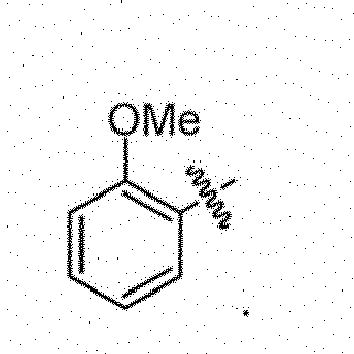
- In einer weiteren bevorzugten Ausführungsform der Erfindung enthält die erfindungsgemäße Mischung (RO)3P=O, (RO)2(PhO)P=O, (RO)(PhO)2P=O und (PhO)3P=O (Triphenylphosphat, "TPP") sowie gegebenenfalls Nebenkomponenten, wie beispielsweise Guajacol, Phenol, Katalysatorbestandteile, oder Nebenprodukte.
- Die erfindungsgemäßen Mischungen enthalten vorzugsweise 50 Gew.-% oder mehr, besonders bevorzugt 70 Gew.-% oder mehr, ganz besonders bevorzugt 80 Gew.-% oder mehr und meist bevorzugt 90 Gew.-% oder mehr Substanzen der allgemeinen Formel (I)
(RO)m(PhO)3-mP=O (I),
wobei R, Ph und m die oben angegebenen Bedeutungen haben. - In einer bevorzugten Ausführungsform enthalten die erfindungsgemäßen Mischungen
- (i) 5 bis 90 Gew.-% (RO)2(PhO)P=O, und
- (ii) 5 bis 90 Gew.-% (RO)(PhO)2P=O,
- Eine weitere bevorzugte Ausführungsform sind Mischungen enthaltend:
(RO)3P=O 0 bis 30 Gew.-% (RO)2(PhO)P=O 5 bis 90 Gew.-% (RO)(PhO)2P=O 5 bis 90 Gew.-% (PhO)3P=O ("TPP") 0 bis 30 Gew.-% - Bevorzugt enthalten die erfindungsgemäßen Mischungen weniger als 10 Gew.-%, bevorzugt weniger als 5 Gew.-%, besonders bevorzugt weniger als 1 Gew.-%, ganz besonders bevorzugt weniger als 0,5 Gew.-% und meist bevorzugt nicht mehr als 0,2 Gew.-% Triphenylphosphat.
- Bevorzugt liegen die erfindungsgemäßen Mischungen bei 23°C als Flüssigkeit vor, da eine solche Zustandsform die Verwendung als Flammschutzmittel bzw. in Schmiermitteln oder Hydraulikflüssigkeiten erleichtern oder erst ermöglichen. Bevorzugt weisen die erfindungsgemäßen Mischungen eine dynamische Viskosität von 20 bis 5000 mPa s, besonders bevorzugt von 50 bis 2000 mPa·s (jeweils bei 23°C) auf.
- Bevorzugt weisen die erfindungsgemäßen Mischungen eine Säurezahl kleiner 5 mg KOH/g, bevorzugt kleiner 1 mg KOH/g, besonders bevorzugt kleiner 0,3 mg KOH/g, ganz bevorzugt kleiner 0,1 mg KOH/g auf.
- Überraschenderweise zeigte sich, dass PVC-Formmassen enthaltend die erfindungsgemäße Mischung eine hohe Thermostabilität und eine hohe Flammwidrigkeit aufweisen. Die erfindungsgemäßen Mischungen können unerwartet einfach in einem neuartigen Verfahren hergestellt werden. Eine bevorzugte Ausführungsform des Verfahrens erlaubt dabei die Herstellung in einer Form, dass die Mischung kein oder nur sehr wenig Triphenylphosphat enthält.
- Ein weiterer Gegenstand der Erfindung ist ein Verfahren zur Herstellung der erfindungsgemäßen Mischungen, umfassend die Schritte:
- a) Bereitstellen einer Mischung enthaltend Phosphoroxychlorid und Guajacol,
- b) Umsetzung zumindest eines Teils der Mischung aus a) bei Temperaturen zwischen 80°C bis 300°C unter Abtrennung von Chlorwasserstoff,
- c) Zugabe von Phenol zu der aus b) erhaltenen Mischung und weitere Umsetzung zwischen 100°C bis 300°C unter Abspaltung von Chlorwasserstoff,
- In einer alternativen Ausführungsform wird zumindest ein Teil des Phosphoroxychlorid erst in Schritt b) zudosiert. Es ist auch möglich, dass zumindest ein Teil des Guajacols erst in Schritt b) zudosiert wird.
- Für die Umsetzung in Schritt b) und/oder c) kann ein Katalysator zugesetzt werden. Geeignete Katalysatoren sind z.B: NaCl, KCl, LiCl, MgCl2, MgO, CaCl2, AlCl3, FeCl3, ZnCl2, TiCl4, SbCl4. Die Zugabe kann in Schritt a), b) oder c) oder zwischen den Schritten a) und b) bzw. b) und c) erfolgen.
- Die Umsetzung gemäß Schritt b) erfolgt üblicherweise im Bereich von 80°C bis 300°C, vorzugsweise im Bereich von 80°C bis 250°C, besonders bevorzugt im Bereich von 80°C bis 200°C.
- Optional kann zwischen dem Schritt b) und dem Schritt c) eine destillative Abtrennung von (nicht umgesetzten) Edukten des Schritts a) und/oder gebildeten Nebenprodukten erfolgen. Die Destillation kann als Batch-Verfahren oder als kontinuierlicher Prozess durchgeführt werden. Die Temperatur der Destillation liegt vorzugsweise im Bereich von 80°C bis 250°C. Besonders bevorzugt wird die Destillation bei der Reaktionstemperatur von Schritt b) oder bei einer Temperatur zwischen 80°C und der Reaktionstemperatur von Schritt b) durchgeführt. Die Destillation erfolgt in einem Druckbereich von 0,01 mbar und 1013 mbar, bevorzugt im Bereich von 0,01 mbar und 100 mbar, ganz besonders bevorzugt im Bereich von 0,01 mbar und 50 mbar.
- Die Umsetzung gemäß Schritt c) erfolgt üblicherweise im Bereich von 100°C bis 300°C, vorzugsweise im Bereich von 100°C und 250°C, besonders bevorzugt im Bereich von 120°C bis 250°C.
- In einer alternativen Ausführungsform wird zumindest ein Teil des Phenols erst während der Reaktion in Schritt c) zudosiert. Es ist auch möglich, dass zumindest ein Teil der Reaktionsmischung erhalten aus Schritt b) (entweder direkt oder nach destillativer Abtrennung von den Edukten des Schritts a) und/oder gebildeten Nebenprodukten in Schritt b)) während der Reaktion in Schritt c) zudosiert wird.
- Optional kann nach dem Schritt c) eine destillative Abtrennung von (nicht umgesetzten) Edukten und/oder gebildeten Nebenprodukten der Schritte b) und/oder c) erfolgen. Die Destillation kann als Batch-Verfahren oder als kontinuierlicher Prozess durchgeführt werden. Die Temperatur der Destillation liegt vorzugsweise im Bereich von 80°C bis 250°C. Die Destillation erfolgt in einem Druckbereich von 0,01 mbar und 1013 mbar, bevorzugt im Bereich von 0,01 mbar und 100 mbar, ganz besonders bevorzugt im Bereich von 0,01 mbar und 50 mbar.
- Die erfindungsgemäßen Mischungen können je nach Anwendung noch weitere Hilfsstoffe enthalten. Als Hilfsstoffe kommen zum Beispiel Weichmacher, weichmachende Polymere, polymere Modifikatoren, Stabilisatoren (z.B. Thermostabilisatoren, Lichtstabilisatoren, Antioxidantien), Co-Stabilisatoren (z.B. Säurefänger, Radikalfänger), innere und äußere Gleitmittel, Viskositätsregler, Füllstoffe, Farbpigmente, Farbstoffe, Flammschutzmittel, Flammschutzmittel-Synergisten, Treibmittel sowie weitere Funktionsadditive wie z.B. Antistatika, Nukleierungsmittel, UV-Schutzmittel oder Biozide, in Frage (siehe z.B. R. D. Maier, M. Schiller, Handbuch Kunststoff-Additive, 4. Auflage, München, Carl Hanser Verlag, 2016, S. 513 ff).
- Die erfindungsgemäßen Mischungen eignen sich als Flammschutzmittel. Ein weiterer Gegenstand der vorliegenden Erfindung ist daher die Verwendung der erfindungsgemäßen Mischungen als Flammschutzmittel.
- Die erfindungsgemäßen Mischungen können als Flammschutzmittel in allen dem Fachmann bekannten Anwendungen für Flammschutzmittel verwendet werden. Bevorzugt werden die erfindungsgemäße Mischungen als Flammschutzmittel für
- synthetische Polymere, wie Polyolefine, Polyvinylchlorid, Polycarbonate, Styrolbasierte (Co-)Polymere, Polyamide, Polyester, Polyurethane, Elastomere wie NBR, CR, SBR, oder EPDM und Duroplaste wie Epoxidharze, ungesättigte Polyesterharze und Phenol-Formaldehydharze,
- Werkstoffe pflanzlichen Ursprungs, wie Holz, Holz-Kunststoff-Komposite, Papier und Pappe, und
- Werkstoffe tierischen Ursprungs, wie Leder, verwendet.
- Besonders bevorzugt werden die erfindungsgemäßen Mischungen als Flammschutzmittel für Polyvinylchlorid (PVC) verwendet, beispielsweise in PVC-Formmassen, d.h. in Zusammensetzungen enthaltend PVC welche in Form eines Granulats, eines Pulvers, einer Paste oder eines Plastisols vorliegen.
- Gegenstand der Erfindung sind daher auch Zusammensetzungen vorzugsweise in Form eines Granulats, eines Pulvers, einer Paste oder eines Plastisols, enthaltend eine erfindungsgemäße Mischung und Polyvinylchlorid (PVC). Bevorzugt handelt es sich bei diesen erfindungsgemäßen PVC-Formmassen um Weich-PVC. Die erfindungsgemäßen PVC-Formmassen können hergestellt werden, indem man PVC mit den erfindungsgemäßen Mischungen und gegebenenfalls weiterer Hilfsstoffe, z.B. Stabilisatoren in an sich bekannter Weise (siehe z.B. G. Becker, D. Braun, Kunststoff-Handbuch, Polyvinylchlorid, Bd.2/2, München, Wien, Carl Hanser Verlag, 1986, S.829 ff) vermischt und compoundiert oder zu einem verarbeitungsbereiten Plastisol oder Organosol dispergiert.
- Die erfindungsgemäße PVC-Formmasse enthält vorzugsweise 5 bis 150 Gewichtsteile, besonders bevorzugt 30 bis 70 Gewichtsteile an Phosphorsäureestern der Formel (I) bezogen auf 100 Gewichtsteile PVC. In einer bevorzugten Ausführungsform enthält die erfindungsgemäße PVC-Formmasse 5 bis 150 Gewichtsteile, besonders bevorzugt 30 bis 70 Gewichtsteile an Phosphorsäureestern der Formel (I) bezogen auf 100 Gewichtsteile PVC.
- Die erfindungsgemäße PVC-Formmasse findet Anwendung in Beschichtungen, Folien, Kabel, Rohrleitungen, Schläuchen, Dichtungen, Förderbändern, Dachbahnen, Klebebandfolien, Planen, Markisen und Zelten.
- Ein weiterer Gegenstand der Erfindung ist die Verwendung der erfindungsgemäßen Mischungen in Hydraulikflüssigkeiten oder zur Herstellung von Hydraulikflüssigkeiten. Bevorzugt werden die erfindungsgemäßen die Mischungen in flammwidrigen Hydraulikflüssigkeiten verwendet.
- Ein weiterer Gegenstand der Erfindung ist die Verwendung der erfindungsgemäßen Mischungen als Schmierstoffadditiv. Bevorzugt werden die erfindungsgemäßen Mischungen in flammwidrigen Schmierstoffen verwendet.
- Ein weiterer Gegenstand der Erfindung ist die Verwendung der erfindungsgemäßen Mischungen als Additiv für Lacke, Klebstoffe, Dichtmassen und Beschichtungen.
- Ein weiterer Gegenstand der Erfindung ist die Verwendung der erfindungsgemäßen Mischungen als Wärmeträger oder in Zubereitungen, die als Wärmeträger verwendet werden. Bevorzugt werden die erfindungsgemäßen Mischungen als Wärmeträger oder in Wärmeträger-Zubereitungen in der Immersionskühlung elektrischer Komponenten verwendet. Die Wärmeträger-Zubereitungen enthalten neben den erfindungsgemäßen Mischungen beispielsweise weitere Trialkylphosphate, Triarylphosphate, Mineralöle, Polyalphaolefine, Ester, Antioxidantien, Metalldeaktivatoren, Fließadditive, Korrosionsinhibitoren, Schauminhibitoren, Demulgatoren und/oder Pourpoint-Erniedriger.
- In einem Reaktor mit Rührer, Innenthermometer, Stickstoffeinleitung und Rückflusskühler wurden Phosphoroxychlorid (200 Gewichtsteile), Guajacol (162 Gewichtsteile) und Magnesiumchlorid (0,1 Gewichtsteile) vorgelegt. Die Reaktionsmischung wurde unter Rührung auf 100°C erhitzt und bei dieser Temperatur solange gehalten, bis kaum noch Gasbildung zu beobachten war. Der Druck in der Apparatur wurde schrittweise von Atmosphärendruck auf 10 mbar gesenkt und für 1 h unter Endbedingungen gehalten. Nach Zugabe von Phenol (308 Gewichtsteile) wurde die Temperatur der Reaktionsmischung schrittweise auf eine Endtemperatur von 140°C erhöht und bis zum vollständigen Umsatz bei dieser Temperatur gehalten. Überschüssiges Phenol wurde bei einer Endtemperatur von 140°C und einem Druck von 10 mbar entfernt. Die Produktmischung wurde als viskose Flüssigkeit (180 mPa·s bei 23°C) isoliert. Die Säurezahl betrug < 0,1 mg KOH/g. Die Produktmischung enthielt 0,4 Gew.-% (GuajacylO)3P=O, 8,6 Gew.-% (GuajacylO)2(PhO)P=O, 86,5 Gew.-% (GuajacylO)(PhO)2P=O und 4,5 Gew% (PhO)3P=O ("TPP").
- In einem Reaktor mit Rührer, Innenthermometer, Stickstoffeinleitung und Rückflusskühler wurden Phosphoroxychlorid (200 Gewichtsteile), Guajacol (243 Gewichtsteile) und Magnesiumchlorid (0,1 Gewichtsteile) vorgelegt. Die Reaktionsmischung wurde unter Rührung schrittweise auf 100°C erhitzt und bei dieser Temperatur solange gehalten, bis kaum noch Gasbildung zu beobachten war. Nach Zugabe von Phenol (307 Gewichtsteile) wurde die Temperatur der Reaktionsmischung schrittweise auf eine Endtemperatur von 120°C erhöht und bis zum vollständigen Umsatz bei dieser Temperatur gehalten. Überschüssiges Phenol wurde bei einer Endtemperatur von 160°C und einem Druck von 10 mbar entfernt. Die Produktmischung wurde als viskose Flüssigkeit (430 mPa·s bei 23°C) isoliert. Die Säurezahl betrug < 0,1 mg KOH/g. Die Produktmischung enthielt 2,9 Gew.-% (GuajacylO)3P=O, 45,8 Gew.-% (GuajacylO)2(PhO)P=O, 47,8 Gew% (GuajacylO)(PhO)2P=O und 3,5 Gew% (PhO)3P=O ("TPP").
- In einem Reaktor mit Rührer, Innenthermometer, Stickstoffeinleitung und Rückflusskühler wurden Phosphoroxychlorid (200 Gewichtsteile), Guajacol (324 Gewichtsteile) und Magnesiumchlorid (0,1 Gewichtsteile) vorgelegt. Die Reaktionsmischung wurde unter Rührung schrittweise auf 120°C erhitzt und bei dieser Temperatur solange gehalten, bis kaum noch Gasbildung zu beobachten war. Nach Zugabe von Phenol (185 Gewichtsteile) wurde die Temperatur der Reaktionsmischung schrittweise auf eine Endtemperatur von 140°C erhöht und bis zum vollständigen Umsatz bei dieser Temperatur gehalten. Überschüssiges Phenol wurde bei einer Endtemperatur von 160°C und einem Druck von 10 mbar entfernt. Die Produktmischung wurde als viskose Flüssigkeit (1810 mPa·s bei 23°C) isoliert. Die Säurezahl betrug 0,4 mg KOH/g. Die Produktmischung enthielt 11,4 Gew.-% (GuajacylO)3P=O, 81,5 Gew.-% (GuajacylO)2(PhO)P=O, 6,9 Gew% (GuajacylO)(PhO)2P=O und 0,2 Gew% (PhO)3P=O ("TPP").
- Die Einsatzmengen der Synthesebeispiele S1 bis S3 sind in Tabelle 1 zusammengefasst:

- Quantitative GC-FID-Analytik wurde mit einem Agilent GC-Gerät des Typs 7890A ausgestattet mit einer Quarzkapillarsäule des Typs CB-Sil 5 CB (Länge: 30 m, Durchmesser: 0,32 mm, Schichtdicke: 3,00 µm) durchgeführt. Als Trägergas wurde Wasserstoff verwendet. Die Injektion der Probe (gelöst in Aceton) erfolgte im Split-Modus (86: 1) bei einer Temperatur von 300°C. Folgendes Temperaturprogramm wurde eingestellt: 60°C Starttemperatur, Heizrate 10°C/min bis zu einer Temperatur von 150°C, dann mit einer Heizrate von 25°C/min auf 280°C, Haltezeit: 10 min, dann mit einer Heizrate von 25°C/min auf eine Endtemperatur von 320°C/min, Haltezeit: 10 min. Die Auswertung erfolgte durch Integration des entsprechenden basisliniengetrennten Signals und Umrechnen der Peakflächen in einen Gehalt nach vorheriger Kalibration.
- Die Messung der dynamischen Viskosität von Phosphorsäureestern erfolgte mit einem Anton Paar Scherrheometer des Typs MCR 102 bei der angegebenen Temperatur mit einer Scherrate von 200 s-1 gemäß DIN 53018.
- Die Säurezahl der Proben wurde in Anlehnung an die DIN EN ISO 2114 (Verfahren B, kolorimetrische Titration mit Phenolphthalein) durchgeführt. Dazu wurde die Probe (10 g) eingewogen, in Aceton (200 mL) und Wasser (50 mL) gelöst und mit 2-3 Tropfen einer Phenolphthalein-Lösung (0,1 Gew% in Ethanol/Wasser (v/v = 4/1)) versetzt. Aus einer Bürette wurde solange Natronlauge (0,1 mol/L) titriert bis der Farbumschlag von farblos zu pink für mindestens 10 Sekunden unter Rühren bestehen blieb. In gleicher Wiese aber ohne Probe wurde ein Blindwert gemessen.
- In Tabelle 2 sind bekannte Phosphorsäureester-Zusammensetzungen aufgelistet, die als Vergleichsmuster zur Herstellung von Weich-PVC eingesetzt wurden. Das Triguajacylphosphat wurde gemäß
WO 2014171122 A1 hergestellt. Die anderen Vergleichsmuster sind Handelsprodukte der Lanxess Deutschland GmbH.Tabelle 2: Eingesetzte Vergleichsmuster. Vergleichsmuster Alkohol-/Phenol-Komponente Zustand bei 23°C Disflamoll® DPK Kresol/Phenol flüssig Disflamoll® TKP Kresol flüssig Disflamoll® 51092 t-Butylphenol/Phenol flüssig Reofos® 65 Isopropylphenol/Phenol flüssig Triguajacylphosphat Guajacol Feststoff - Die für die Ausprüfung eingesetzten Weich-PVC-Formmassen wurden auf einem Laborwalzwerk hergestellt. Nach dem Aufgeben der Mischung aller Rezepturbestandteile (siehe Tabelle 3) beließ man diese auf der Walze bis eine Fellbildung erfolgte. Ab dem Zeitpunkt der Fellbildung wurden die Compounds noch 10 Minuten auf dem Walzwerk compoundiert und schließlich als Walzfell abgenommen. Die Walztemperatur betrug 165°C.
- Die Prüfkörper zur Bestimmung des LOI wurden aus den Walzfellen mit einer Presse hergestellt. Die Presstemperatur betrug 170°C, die Pressdauer 4 Minuten zum Vorwärmen bei Niederdruck (< 10 bar) und 2 Minuten bei Hochdruck (> 100 bar). Aus den 4 mm dicken Pressplatten wurden Prüfkörper mit den Abmessungen 90 x 13 x 4 mm gesägt.
- Die Prüfkörper zur Bestimmung der Härte der Compounds (50 x 40 x 6 mm) werden wegen der großen Dicke von 6 mm bei gleicher Temperatur länger gepresst. Die Pressdauer betrug 7 Minuten zum Vorwärmen bei Niederdruck und 3 Minuten zum Formpressen bei Hochdruck.
- Die Prüfkörper für die Prüfung der Thermostabilität wurden aus einem dünnen (< 1 mm) Walzfell geschnitten, das nach 10 Minuten Walzzeit vom Walzwerk abgenommen wurde.
Tabelle 3: Rezepturbestandteile zur Herstellung von Weich-PVC. Komponente Funktion Beschreibung Menge (Gewichtsteile) A PVC Vinnol S4170 100 B Co-Stabilisator Drapex 39 2,5 C PVC-Stabilisator Bärostab UBZ 780 RF 2,5 D Flammschutzmittel Wie in Tabelle 4 dargestellt 55 - Nach dieser Vorschrift wurden PVC-Muster hergestellt (Tabelle 4).
- Für die Beurteilung der Flammwidrigkeit wurde der Sauerstoffindex (Limiting Oxygen Index = LOI) herangezogen. Der LOI ist ein Maß für das Brandverhalten von Kunststoffen und anderen Werkstoffen. Der LOI ist die minimale Sauerstoffkonzentration eines Sickstoff/Sauerstoff-Gemisches, unter der die Verbrennung eines Prüfkörpers unter normierten Bedingungen gerade noch stattfinden kann. Die Prüfung wurde gemäß ISO 4589-2 durchgeführt. Für eine praktische Anwendbarkeit sollte bei der Prüfung ein Wert von mindestens 30 erzielt werden.
- Die Weichmacherwirkung der Phosphorsäureester wurde mit einer Shore A-Härte-Messung der Phosphorsäureester-enthaltenden Weich-PVC-Compounds bestimmt. Das Messprinzip beruht auf der Eindringtiefe eines Metallprüfstiftes in die Materialprobe für 15 s mit einer Kraft von 12,5 N. Bestimmt wurde die Shore A-Härte bei Prüfkörpern mit den Abmessungen von 50 x 40 x 6 mm. Die Shore-Härte-Messung wurde in Anlehnung an die DIN ISO 7619-1 ausgeführt. Als Indikator für eine weichmachende Wirkung ist eine Shore A-Härte von weniger als 95 anzusehen.
- Die Ergebnisse der Messungen sind in Tabelle 4 zusammengefasst.
Tabelle 4: Bestimmung der Flammwidrigkeit der hergestellten PVC-Muster Beispiel Flammschutzmittel (Komponente D) LOI > 30 Shore A-Härte < 95 V1 Disflamoll DPK + + V2 Disflamoll TKP + + V3 Disflamoll 51092 + + V4 Reofos 65 + + V5 Triguajacylphosphat + - E6 S1 + + E7 S2 + + E8 S3 + + - Die Ergebnisse zeigen, dass sowohl die Vergleichsprodukte (Beispiele V1- V5) als auch die erfindungsgemäßen Mischungen S1, S2 und S3 (Beispiele E6-E8) gute Flammschutzeigenschaften bewirken. Die Weichmacherwirkung (Shore A-Härte) liegt bei den Vergleichsbeispielen V1-V4 sowie den erfindungsgemäßen Beispielen E6-E8 unter einem Wert von 95. Hingegen zeigt das aus
WO 2014171122 A1 bekannte Triguajacylphosphat (Beispiel V5) keine ausreichende Weichmacherwirkung. Diese Verbindung eignet sich daher nicht als weichmachendes Flammschutzmittel und wurde nicht weiter untersucht. - Die Bestimmung der Thermostabilität erfolgte mit Hilfe der Kongorot-Methode in Anlehnung an die DIN EN ISO 182-1 3. Hierfür wurde die Materialprobe in einem Reagenzglas in einem temperierten Ölbad auf 180°C erwärmt. Bei dieser Temperaturbelastung zersetzt sich das PVC allmählich unter Abspaltung von Salzsäure. Dieser Vorgang wird stark von den Rezepturbestandteilen beeinflusst, die die Salzsäureabspaltung beschleunigen oder verzögern können. Die bei der Prüfung entstehende Salzsäure wird mit einem Papierstreifen detektiert, der mit einer Kongorotlösung getränkt und 3 cm über der PVC-Probe im Reagenzglas platziert wurde. Es wurde die Zeit bis zum Umschlagen von Rot nach Blau gemessen. Die Ergebnisse der Messungen sind in Tabelle 5 zusammengefasst.
Tabelle 5: Ermittlung der Thermostabilität der PVC-Muster nach der Kongorot-Methode. Beispiel Flammschutzmittel (Komponente D) Zeit [min] V1 Disflamoll DPK 15 V2 Disflamoll TKP 10 V3 Disflamoll 51092 4 V4 Reofos 65 9 E6 S1 21 E7 S2 20 E8 S3 17 - Die Ergebnisse zeigen, dass die erfindungsgemäßen Mischungen S1, S2, und S3 (Beispiele E6-E8) eine höhere Thermostabilität als die Vergleichsbeispiele (Beispiele V1-V4).
Claims (16)
- Mischungen enthaltend mindestens zwei Substanzen der allgemeinen Formel (I)
(RO)m(PhO)3-mP=O (I)
mit m = 1, 2 oder 3, worin R dem Rest und Ph einem Phenylrest entspricht.
 - Mischungen gemäß Anspruch 1, wobei R dem Rest

- Mischungen gemäß Anspruch 1 oder 2, welche(i) 5 bis 90 Gew.-% (RO)2(PhO)P=O, und(ii) 5 bis 90 Gew.-% (RO)(PhO)2P=O,enthalten, wobei R und Ph die oben genannten Bedeutungen haben.
- Mischungen gemäß einem oder mehreren der Ansprüche 1 bis 3, welche weniger als 10 Gew.-%, bevorzugt weniger als 5 Gew.-%, besonders bevorzugt weniger als 1 Gew.-%, ganz besonders bevorzugt weniger als 0,5 Gew.-% und meist bevorzugt nicht mehr als 0,2 Gew.-% Triphenylphosphat enthalten.
- Mischungen gemäß einem oder mehreren der Ansprüche 1 bis 4, wobei diese bei 23°C und 1013 mbar als Flüssigkeit vorliegen, bevorzugt als Flüssigkeit mit einer dynamischen Viskosität von 20 bis 5000 mPa·s, besonders bevorzugt von 50 bis 2000 mPas (jeweils bei 23°C).
- Verfahren zur Herstellung von Mischungen gemäß einem oder mehreren der Ansprüche 1 bis 5 umfassend die Schritte:(a) Bereitstellen einer Mischung enthaltend mindestens- Phosphoroxychlorid und- Guajacol,(b) Umsetzung zumindest eines Teils der Mischung aus a) bei Temperaturen zwischen 80°C bis 300°C unter Abtrennung von Chlorwasserstoff,(c) Zugabe von Phenol zu der aus b) erhaltenen Mischung und weitere Umsetzung zwischen 100°C bis 300°C unter Abtrennung von Chlorwasserstoff,
- Verfahren gemäß Anspruch 6, wobei zwischen dem Schritt b) und dem Schritt c) eine destillative Abtrennung von Edukten des Schritts a) und/oder von Nebenprodukten erfolgt.
- Verfahren gemäß Anspruch 6 oder 7, wobei nach dem Schritt c) eine destillative Abtrennung von Edukten und/oder von Nebenprodukten der Schritte b) und/oder c) erfolgt.
- Verwendung von Mischung gemäß einem oder mehreren der Ansprüche 1 bis 5 als Flammschutzmittel, vorzugsweise als Flammschutzmittel für synthetische Polymere, Werkstoffe pflanzlichen Ursprungs oder Werkstoffe tierischen Ursprungs, und besonders bevorzugt als Flammschutzmittel für Polyvinylchlorid (PVC).
- Formmasse, enthaltend eine Mischung gemäß einem oder mehreren der Ansprüche 1 bis 5 und Polyvinylchlorid (PVC).
- Formmasse gemäß Anspruch 10, welche von 5 bis 150 Gewichtsteile, vorzugsweise von 30 bis 70 Gewichtsteile an Phosphorsäureester der Formel (I) bezogen auf 100 Gewichtsteile PVC enthält.
- Verwendung Zusammensetzungen gemäß Anspruch 10 oder 11 zur Herstellung von Beschichtungen, Folien, Kabel, Rohrleitungen, Schläuchen, Dichtungen, Förderbändern, Dachbahnen, Klebebandfolien, Planen, Markisen und Zelte.
- Verwendung einer Mischung gemäß einem oder mehreren der Ansprüche 1 bis 5 als Hydraulikflüssigkeit.
- Verwendung einer Mischung gemäß wenigstens einem der Ansprüche 1 bis 5 als Schmierstoffadditiv.
- Verwendung einer Mischung gemäß einem oder mehreren der Ansprüche 1 bis 5 als Additiv für Lacke, Klebstoffe, Dichtmassen oder Beschichtungen.
- Verwendung einer Mischung gemäß einem oder mehreren der Ansprüche 1 bis 5 als Wärmeträger.
Priority Applications (7)
| Application Number | Priority Date | Filing Date | Title |
|---|---|---|---|
| EP23162067.5A EP4431561A1 (de) | 2023-03-15 | 2023-03-15 | Phosphorsäureester-zusammensetzungen für flammwidriges weich-pvc mit hoher thermostabilität |
| EP24708827.1A EP4680668A1 (de) | 2023-03-15 | 2024-03-07 | Phosphorsäureester-zusammensetzungen für flammwidriges weich-pvc mit hoher thermostabilität |
| PCT/EP2024/055938 WO2024188777A1 (de) | 2023-03-15 | 2024-03-07 | Phosphorsäureester-zusammensetzungen für flammwidriges weich-pvc mit hoher thermostabilität |
| KR1020257030301A KR20250156728A (ko) | 2023-03-15 | 2024-03-07 | 높은 열 안정성을 갖는 난연성 연질 pvc용 인산 에스터 조성물 |
| CN202480018923.1A CN120882797A (zh) | 2023-03-15 | 2024-03-07 | 用于具有高热稳定性的阻燃软pvc的磷酸酯组合物 |
| JP2025553817A JP2026507972A (ja) | 2023-03-15 | 2024-03-07 | 高い熱安定性を有する難燃性軟質pvcのためのリン酸エステル組成物 |
| MX2025010829A MX2025010829A (es) | 2023-03-15 | 2025-09-12 | Composiciones de esteres de acido fosforico para pvc blando ignifugo con alta estabilidad termica |
Applications Claiming Priority (1)
| Application Number | Priority Date | Filing Date | Title |
|---|---|---|---|
| EP23162067.5A EP4431561A1 (de) | 2023-03-15 | 2023-03-15 | Phosphorsäureester-zusammensetzungen für flammwidriges weich-pvc mit hoher thermostabilität |
Publications (1)
| Publication Number | Publication Date |
|---|---|
| EP4431561A1 true EP4431561A1 (de) | 2024-09-18 |
Family
ID=85706790
Family Applications (2)
| Application Number | Title | Priority Date | Filing Date |
|---|---|---|---|
| EP23162067.5A Withdrawn EP4431561A1 (de) | 2023-03-15 | 2023-03-15 | Phosphorsäureester-zusammensetzungen für flammwidriges weich-pvc mit hoher thermostabilität |
| EP24708827.1A Pending EP4680668A1 (de) | 2023-03-15 | 2024-03-07 | Phosphorsäureester-zusammensetzungen für flammwidriges weich-pvc mit hoher thermostabilität |
Family Applications After (1)
| Application Number | Title | Priority Date | Filing Date |
|---|---|---|---|
| EP24708827.1A Pending EP4680668A1 (de) | 2023-03-15 | 2024-03-07 | Phosphorsäureester-zusammensetzungen für flammwidriges weich-pvc mit hoher thermostabilität |
Country Status (6)
| Country | Link |
|---|---|
| EP (2) | EP4431561A1 (de) |
| JP (1) | JP2026507972A (de) |
| KR (1) | KR20250156728A (de) |
| CN (1) | CN120882797A (de) |
| MX (1) | MX2025010829A (de) |
| WO (1) | WO2024188777A1 (de) |
Citations (14)
| Publication number | Priority date | Publication date | Assignee | Title |
|---|---|---|---|---|
| DE1768076A1 (de) | 1967-05-16 | 1972-02-03 | Koppers Co Inc | Normalerweise fluessiges Phosphatesterpraeparat |
| EP0401366A1 (de) | 1988-12-22 | 1990-12-12 | Great Lakes Chemical Corporation | Wärme- und lichtstabile flammverzögernde thermoplastische polyolefin- und polystyren-zusammensetzungen |
| US5087521A (en) | 1984-08-09 | 1992-02-11 | At&T Bell Laboratories | Modified polymer containing articles |
| GB2302543A (en) | 1995-06-24 | 1997-01-22 | Fmc Corp | Plasticised PVC compositions |
| DE10223649C1 (de) * | 2002-05-28 | 2003-08-14 | Bayer Ag | Verfahren zur Herstellung von Phosphorsäuretriester |
| US6703355B2 (en) | 2000-08-04 | 2004-03-09 | Exxonmobil Research And Engineering Company | Method for lubricating high pressure hydraulic system using phosphate ester hydraulic fluid |
| US8026303B2 (en) | 2006-01-06 | 2011-09-27 | Icl-Ip America Inc. | Halogen-free flame retardant compositions, thermoplastic compositions comprising the same and methods of producing the compositions |
| US8129457B2 (en) | 2006-03-22 | 2012-03-06 | Chemtura Corporation | Flame retardant blends for flexible polyurethane foam |
| WO2014171122A1 (en) | 2013-04-17 | 2014-10-23 | Canon Kabushiki Kaisha | Novel compound and resin composition containing the same |
| US9000148B2 (en) | 2013-01-04 | 2015-04-07 | International Business Machines Corporation | Flame retardant cellulose acetate |
| EP3208276A1 (de) * | 2016-02-18 | 2017-08-23 | PCC Rokita SA | Verfahren zur herstellung einer triarylphosphatesterzusammensetzung |
| US10414964B2 (en) | 2015-06-30 | 2019-09-17 | Exxonmobil Chemical Patents Inc. | Lubricant compositions containing phosphates and/or phosphites and methods of making and using same |
| US11008440B2 (en) | 2016-07-28 | 2021-05-18 | Sabic Global Technologies B.V. | Flame retardant propylene composition |
| WO2022121330A1 (zh) | 2020-12-11 | 2022-06-16 | 长春捷翼汽车零部件有限公司 | Pvc料及其制备方法 |
-
2023
- 2023-03-15 EP EP23162067.5A patent/EP4431561A1/de not_active Withdrawn
-
2024
- 2024-03-07 EP EP24708827.1A patent/EP4680668A1/de active Pending
- 2024-03-07 JP JP2025553817A patent/JP2026507972A/ja active Pending
- 2024-03-07 WO PCT/EP2024/055938 patent/WO2024188777A1/de not_active Ceased
- 2024-03-07 CN CN202480018923.1A patent/CN120882797A/zh active Pending
- 2024-03-07 KR KR1020257030301A patent/KR20250156728A/ko active Pending
-
2025
- 2025-09-12 MX MX2025010829A patent/MX2025010829A/es unknown
Patent Citations (14)
| Publication number | Priority date | Publication date | Assignee | Title |
|---|---|---|---|---|
| DE1768076A1 (de) | 1967-05-16 | 1972-02-03 | Koppers Co Inc | Normalerweise fluessiges Phosphatesterpraeparat |
| US5087521A (en) | 1984-08-09 | 1992-02-11 | At&T Bell Laboratories | Modified polymer containing articles |
| EP0401366A1 (de) | 1988-12-22 | 1990-12-12 | Great Lakes Chemical Corporation | Wärme- und lichtstabile flammverzögernde thermoplastische polyolefin- und polystyren-zusammensetzungen |
| GB2302543A (en) | 1995-06-24 | 1997-01-22 | Fmc Corp | Plasticised PVC compositions |
| US6703355B2 (en) | 2000-08-04 | 2004-03-09 | Exxonmobil Research And Engineering Company | Method for lubricating high pressure hydraulic system using phosphate ester hydraulic fluid |
| DE10223649C1 (de) * | 2002-05-28 | 2003-08-14 | Bayer Ag | Verfahren zur Herstellung von Phosphorsäuretriester |
| US8026303B2 (en) | 2006-01-06 | 2011-09-27 | Icl-Ip America Inc. | Halogen-free flame retardant compositions, thermoplastic compositions comprising the same and methods of producing the compositions |
| US8129457B2 (en) | 2006-03-22 | 2012-03-06 | Chemtura Corporation | Flame retardant blends for flexible polyurethane foam |
| US9000148B2 (en) | 2013-01-04 | 2015-04-07 | International Business Machines Corporation | Flame retardant cellulose acetate |
| WO2014171122A1 (en) | 2013-04-17 | 2014-10-23 | Canon Kabushiki Kaisha | Novel compound and resin composition containing the same |
| US10414964B2 (en) | 2015-06-30 | 2019-09-17 | Exxonmobil Chemical Patents Inc. | Lubricant compositions containing phosphates and/or phosphites and methods of making and using same |
| EP3208276A1 (de) * | 2016-02-18 | 2017-08-23 | PCC Rokita SA | Verfahren zur herstellung einer triarylphosphatesterzusammensetzung |
| US11008440B2 (en) | 2016-07-28 | 2021-05-18 | Sabic Global Technologies B.V. | Flame retardant propylene composition |
| WO2022121330A1 (zh) | 2020-12-11 | 2022-06-16 | 长春捷翼汽车零部件有限公司 | Pvc料及其制备方法 |
Non-Patent Citations (5)
| Title |
|---|
| DATABASE CA [online] CHEMICAL ABSTRACTS SERVICE, COLUMBUS, OHIO, US; 13 February 1997 (1997-02-13), GENKINA, G. K. ET AL: "Synthesis of asymmetric triaryl phosphates via phase-transfer catalysis", XP002809914, retrieved from STN Database accession no. 1997:102652 * |
| G. BECKERD. BRAUN: "Kunststoff-Handbuch, Polyvinylchlorid", 1986, CARL HANSER VERLAG, pages: 829 |
| G. K. GENKINA, A. E. SHIPOV, T. A. MASTRYUKOVA, M. I. KABACHNIK: "Synthesis of asymmetric triaryl phosphates via phase-transfer catalysis", ZHURNAL OBSHCHEI KHIMII, vol. 66, no. 11, 1996, pages 1788 - 190, XP009546263, ISSN: 0044-460X * |
| GRANGER EMILY ET AL: "Exploration of chiral Lewis acid Mg 2+ catalysts in the synthesis of aryl organophosphate triesters from phosphorus oxychloride through a three-step, two-pot substitution sequence", TETRAHEDRON LETTERS, vol. 59, no. 14, 1 April 2018 (2018-04-01), Amsterdam , NL, pages 1404 - 1408, XP093072183, ISSN: 0040-4039, DOI: 10.1016/j.tetlet.2018.02.066 * |
| R. D. MAIERM. SCHILLER: "Handbuch Kunststoff-Additive", vol. 4, 2016, CARL HANSER VERLAG, pages: 513 |
Also Published As
| Publication number | Publication date |
|---|---|
| JP2026507972A (ja) | 2026-03-06 |
| EP4680668A1 (de) | 2026-01-21 |
| MX2025010829A (es) | 2025-10-01 |
| KR20250156728A (ko) | 2025-11-03 |
| WO2024188777A1 (de) | 2024-09-19 |
| CN120882797A (zh) | 2025-10-31 |
Similar Documents
| Publication | Publication Date | Title |
|---|---|---|
| EP3147317B1 (de) | Tripentylester der trimellitsäure | |
| DE102006026624A1 (de) | Tripentylcitrate und deren Verwendung | |
| EP2857383A1 (de) | Zitronensäureestergemische und ihre Verwendung | |
| DE102011006557A1 (de) | Gemisch von Bersteinsäureestern | |
| EP4680667A1 (de) | Phosphorsäureester-zusammensetzungen für flammwidriges weich-pvc mit hoher farbstabilität | |
| EP4680668A1 (de) | Phosphorsäureester-zusammensetzungen für flammwidriges weich-pvc mit hoher thermostabilität | |
| EP1672013A1 (de) | Estermischungen | |
| EP3050891B1 (de) | Hydroxylgruppen-haltige poly(alkylenphosphate) | |
| EP4431586A1 (de) | Triphenylphosphat-freie mischungen für flammwidriges weich-pvc | |
| EP3388480A1 (de) | Poly(alkylenphosphate) mit verringerter hygroskopie | |
| EP4431517A1 (de) | Phosphorsäureester-zusammensetzungen für flammwidriges weich-pvc mit niedriger flüchtigkeit | |
| DE2346458C2 (de) | Thiaalkylphenole, deren Herstellung und das mit ihrer Hilfe stabilisierte organische Material | |
| EP4729527A1 (de) | Mischungen von phenylphosphonsäurediarylester und ihre verwendung als flammschutzmittel | |
| DE69324168T2 (de) | Hydrolytisch stabile pentaerythritoldiphosphite | |
| WO2026057794A1 (de) | Neue phenylphosphonsäureester und ihre verwendung als flammschutzmittel | |
| DE2450949A1 (de) | Flammhemmende weichmacher fuer polyvinylchlorid | |
| EP4105272A1 (de) | Weichmacherzusammensetzung umfassend tripentylester der 1,2,4-cyclohexantricarbonsäure | |
| WO2026087372A1 (de) | Flammwidrig ausgestattete formmassen mit hoher kälteflexibilität | |
| DE2656748C2 (de) | Phosphitgemische, Verfahren zu ihrer Herstellung und ihre Verwendung zum Stabilisieren organischer Materialien | |
| DE961528C (de) | Verfahren zum Stabilisieren von Kieselsaeureestern | |
| DE69127814T2 (de) | Polyvinylchloridzusammensetzung und Stabilisatoren dafür | |
| DE1768076A1 (de) | Normalerweise fluessiges Phosphatesterpraeparat | |
| DE3806094A1 (de) | Stabilisatormischung fuer formmassen auf der basis von polymerisaten des vinylchlorids, deren verwendung sowie die formmassen | |
| EP4345129A1 (de) | Tetraisopentylester der butantetracarbonsäure, deren herstellung und deren verwendung als weichmacher | |
| EP2924063A1 (de) | Weichmacherzusammensetzung |
Legal Events
| Date | Code | Title | Description |
|---|---|---|---|
| PUAI | Public reference made under article 153(3) epc to a published international application that has entered the european phase |
Free format text: ORIGINAL CODE: 0009012 |
|
| STAA | Information on the status of an ep patent application or granted ep patent |
Free format text: STATUS: THE APPLICATION HAS BEEN PUBLISHED |
|
| AK | Designated contracting states |
Kind code of ref document: A1 Designated state(s): AL AT BE BG CH CY CZ DE DK EE ES FI FR GB GR HR HU IE IS IT LI LT LU LV MC ME MK MT NL NO PL PT RO RS SE SI SK SM TR |
|
| STAA | Information on the status of an ep patent application or granted ep patent |
Free format text: STATUS: REQUEST FOR EXAMINATION WAS MADE |
|
| 17P | Request for examination filed |
Effective date: 20250318 |
|
| STAA | Information on the status of an ep patent application or granted ep patent |
Free format text: STATUS: THE APPLICATION IS DEEMED TO BE WITHDRAWN |
|
| 18D | Application deemed to be withdrawn |
Effective date: 20250319 |