EP4428492A1 - Sin-based integrated optical chip for optical fiber gyroscope employing sion polarizer - Google Patents
Sin-based integrated optical chip for optical fiber gyroscope employing sion polarizer Download PDFInfo
- Publication number
- EP4428492A1 EP4428492A1 EP22903034.1A EP22903034A EP4428492A1 EP 4428492 A1 EP4428492 A1 EP 4428492A1 EP 22903034 A EP22903034 A EP 22903034A EP 4428492 A1 EP4428492 A1 EP 4428492A1
- Authority
- EP
- European Patent Office
- Prior art keywords
- optical fibre
- waveguide
- optical
- sion
- waveguide mode
- Prior art date
- Legal status (The legal status is an assumption and is not a legal conclusion. Google has not performed a legal analysis and makes no representation as to the accuracy of the status listed.)
- Pending
Links
Images

Classifications
-
- G—PHYSICS
- G01—MEASURING; TESTING
- G01C—MEASURING DISTANCES, LEVELS OR BEARINGS; SURVEYING; NAVIGATION; GYROSCOPIC INSTRUMENTS; PHOTOGRAMMETRY OR VIDEOGRAMMETRY
- G01C19/00—Gyroscopes; Turn-sensitive devices using vibrating masses; Turn-sensitive devices without moving masses; Measuring angular rate using gyroscopic effects
- G01C19/58—Turn-sensitive devices without moving masses
- G01C19/64—Gyrometers using the Sagnac effect, i.e. rotation-induced shifts between counter-rotating electromagnetic beams
- G01C19/72—Gyrometers using the Sagnac effect, i.e. rotation-induced shifts between counter-rotating electromagnetic beams with counter-rotating light beams in a passive ring, e.g. fibre laser gyrometers
- G01C19/721—Details, e.g. optical or electronical details
-
- G—PHYSICS
- G02—OPTICS
- G02B—OPTICAL ELEMENTS, SYSTEMS OR APPARATUS
- G02B6/00—Light guides; Structural details of arrangements comprising light guides and other optical elements, e.g. couplings
- G02B6/10—Light guides; Structural details of arrangements comprising light guides and other optical elements, e.g. couplings of the optical waveguide type
- G02B6/12—Light guides; Structural details of arrangements comprising light guides and other optical elements, e.g. couplings of the optical waveguide type of the integrated circuit kind
- G02B6/126—Light guides; Structural details of arrangements comprising light guides and other optical elements, e.g. couplings of the optical waveguide type of the integrated circuit kind using polarisation effects
-
- G—PHYSICS
- G02—OPTICS
- G02B—OPTICAL ELEMENTS, SYSTEMS OR APPARATUS
- G02B6/00—Light guides; Structural details of arrangements comprising light guides and other optical elements, e.g. couplings
- G02B6/10—Light guides; Structural details of arrangements comprising light guides and other optical elements, e.g. couplings of the optical waveguide type
- G02B6/14—Mode converters
-
- G—PHYSICS
- G02—OPTICS
- G02B—OPTICAL ELEMENTS, SYSTEMS OR APPARATUS
- G02B6/00—Light guides; Structural details of arrangements comprising light guides and other optical elements, e.g. couplings
- G02B6/24—Coupling light guides
- G02B6/26—Optical coupling means
- G02B6/27—Optical coupling means with polarisation selective and adjusting means
-
- G—PHYSICS
- G02—OPTICS
- G02B—OPTICAL ELEMENTS, SYSTEMS OR APPARATUS
- G02B6/00—Light guides; Structural details of arrangements comprising light guides and other optical elements, e.g. couplings
- G02B6/10—Light guides; Structural details of arrangements comprising light guides and other optical elements, e.g. couplings of the optical waveguide type
- G02B6/12—Light guides; Structural details of arrangements comprising light guides and other optical elements, e.g. couplings of the optical waveguide type of the integrated circuit kind
- G02B6/122—Basic optical elements, e.g. light-guiding paths
- G02B6/1228—Tapered waveguides, e.g. integrated spot-size transformers
Definitions
- the present disclosure relates to the technical fields of integrated optics and inertial sensing, in particular to a SiON-polarizer-based integrated SiN optical chip for fibre optic gyroscopes.
- gyroscopes capable of precisely measuring angular displacement and being high in sensitivity play an important role in a series of fields such as airborne navigation, robots, unmanned vehicle driving, and geographical mapping
- compact gyroscopes with low cost are more popular in the market.
- Optical gyroscopes based on Sagnac effects have been widely concerned because of their high sensitivity, and have been developed into a multi-purpose mature technology.
- optical gyroscopes are not provided with motion modules, so they are not affected by gravity, impact, and vibration, which also means that no special universal suspension or packaging means is required.
- all-fibre optical gyroscopes are developed when the optical fibres and the fibre optic devices are applied to the optical gyroscopes.
- the fibre optic gyroscopes have been developed into mature technical means with high sensitivity, stability and reliability at present, have better performance than most advanced micro-electro-mechanic system-based gyroscopes, and have lower cost and power consumption and smaller size.
- a typical fibre optic gyroscope mainly includes three assemblies, a passive sensing fibre optic coil, an optical component consisting of active and passive devices (such as an optical source, a phase modulator, a photodetector, and couplers), and a readout circuit.
- a passive sensing fibre optic coil an optical component consisting of active and passive devices (such as an optical source, a phase modulator, a photodetector, and couplers), and a readout circuit.
- active and passive devices such as an optical source, a phase modulator, a photodetector, and couplers
- a readout circuit To continuously improve the passive sensing element, researchers have carried out a lot of related research in recent years and invented a series of novel optic fibres, such as hollow optic fibres with extremely low nonlinearity and thermal effects and optic fibres with high polarization extinction ratios.
- more complex optic fibre winding technologies are continuously developed to eliminate nonreciprocal noise and drifting caused by thermal gradient and vibration. Further development includes the
- Integrated optical driver chips are formed by integrating all active and passive optical devices, except sensing coils, needed by the optical gyroscopes, and the device chips can be connected with the sensing coils, such as passive optical fibres or ultra-low-loss silicon nitride waveguides to form interferometric optical gyroscopes. Therefore, the size, weight, loss, and manufacturing cost of the optical gyroscopes are greatly reduced by the adoption of the integrated driver chips. Therefore, they play an important role in promoting the popularization of the optical gyroscopes.
- Integrated optical chips widely applied to fibre optic gyroscope systems at present are integrated chips based on lithium niobate (LiNbO 3 ) materials.
- a Y-type beam splitter, a polarizer, and a phase modulator are integrated on the same chip, which are mainly used for closed-loop fibre optic gyroscope under different degrees of precision, thereby achieving closed-loop feedback of interferometric phases, reducing influences of device drifting and achieving high precision.
- the integrated chips based on the lithium niobate materials also have the following shortcomings: (1) a manufacturing method for lithium niobate optical waveguides is a proton exchange method, which has high requirements for proton exchange time and temperature, characteristics of an exchange medium and annealing temperature and time, and a preparation process is complex and high in cost; and (2) thermo-optical coefficients of the materials are high; and when light passes through the LiNbO 3 materials, optical transmission characteristics of the devices will be affected due to the change in environmental temperature, thereby generating a temperature drifting effect. Therefore, a temperature compensation measure must be taken to ensure the working stability of the devices within a wide temperature range, resulting in a complex peripheral control circuit.
- a technical problem to be solved by an embodiment of the present disclosure is to provide a SiON-polarizer-based integrated SiN optical chip for fibre optic gyroscopes, so as to effectively improve the stability and reliability of the integrated SiN optical chip.
- an embodiment of the present disclosure provides a SiON-polarizer-based integrated SiN optical chip for fibre optic gyroscopes, including a first optical fibre-waveguide mode transducer, a second optical fibre-waveguide mode transducer, a first 3dB coupler, a SiON polarizer, a second 3dB coupler, a third optical fibre-waveguide mode transducer and a fourth optical fibre-waveguide mode transducer; wherein one end of the first optical fibre-waveguide mode transducer is connected with an external optical source through an optical fibre, and the other end of the first optical fibre-waveguide mode transducer is connected with one branch of the first 3dB coupler; one end of the second optical fibre-waveguide mode transducer is connected with an external photodetector through an optical fibre, and the other end of the second optical fibre-waveguide mode transducer is connected with the other branch of the first 3dB coupler; a base waveguide of the first 3dB coupler is connected with one
- the first optical fibre-waveguide mode transducer, the second optical fibre-waveguide mode transducer, the third optical fibre-waveguide mode transducer, and the fourth optical fibre-waveguide mode transducer all adopt an inversed taper structure to be matched with an input polarization-maintaining optical fibre in a mode field diameter, and a working wavelength ranges from 800 nm to 900 nm.
- first 3dB coupler and the second 3dB coupler are both achieved by a 1 ⁇ 2MMI coupler or a Y-type beam splitter, and a working wavelength ranges from 800 nm to 900 nm.
- the structure of the SiON polarizer sequentially consists of a SiO 2 upper cladding, a SiON upper cladding, a SiO 2 intermediate layer, a SiN waveguide, a SiO 2 lower cladding, and a Si substrate from top to bottom.
- the SiON upper cladding has a thickness greater than or equal to 1 mm, and a width greater than or equal to 3 mm in a direction perpendicular to the SiN waveguide; and a thickness of the SiN waveguide and waveguide thicknesses of the optical fibre-waveguide mode transducers are kept consistent.
- a SiON-polarizer-based integrated SiN optical chip for fibre optic gyroscopes includes a first optical fibre-waveguide mode transducer 1-1, a second optical fibre-waveguide mode transducer 1-2, a first 3dB coupler 2, a SiON polarizer, a second 3dB coupler 6, a third optical fibre-waveguide mode transducer 7-1 and a fourth optical fibre-waveguide mode transducer 7-2.
- One end of the first optical fibre-waveguide mode transducer 1-1 is connected with an external optical source through an optical fibre, and the other end of the first optical fibre-waveguide mode transducer 1-1 is connected with one branch of the first 3dB coupler 2; and one end of the second optical fibre-waveguide mode transducer 1-2 is connected with an external photodetector through an optical fibre, and the other end of the second optical fibre-waveguide mode transducer 1-2 is connected with the other branch of the first 3dB coupler 2.
- a base waveguide of the first 3dB coupler 2 is connected with one end of the SiON polarizer; and the other end of the SiON polarizer is connected with a base waveguide of the second 3dB coupler 6.
- One branch of the second 3dB coupler 6 is connected with one end of the third optical fibre-waveguide mode transducer 7-1, and the other branch of the second 3dB coupler 6 is connected with one end of the fourth optical fibre-waveguide mode transducer 7-2; the other end of the third optical fibre-waveguide mode transducer 7-1 is connected with one end of an external fibre optic ring; and the other end of the fourth optical fibre-waveguide mode transducer 7-2 is connected with the other end of the external fibre optic ring.
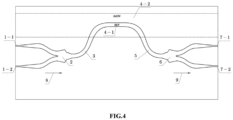
- light output from the external optical source is coupled to the first optical fibre-waveguide mode transducer 1-1 on the chip in a direction marked by an arrow 8, and light output from the first optical fibre-waveguide mode transducer 1-1 includes two different polarization modes (quasi TE 0 and TM 0 ); the light in the two different polarization modes enter the SiON polarizer through a bent waveguide A3 after passing through the first 3dB coupler 2, and light in the quasi TM 0 mode leaks to the SiON cladding 4-2, whereas only light in the quasi TE 0 mode is reserved in the SiN waveguide 4-1 due to polarization selection of the polarizer; the light in the TE 0 mode enters the second 3dB coupler 6 through a bent waveguide B5 to be split into two beams, the two beams are coupled into a fibre optic ring after passing through the third optical fibre-waveguide mode transducer 7-1 and the fourth optical fibre-waveguide mode transducer 7-2; and the
- a Sagnac effect is generated when the fibre optic ring rotates around its central axis, such that intensity of interferometric light returning to the second 3dB coupler 6 changes; and the interferometric light signal is coupled and output to the external photodetector after passing through the second 3dB coupler 6, the bent waveguide B5, the SiON polarizer, the bent waveguide A3, the first 3dB coupler 2 and the second optical fibre-waveguide mode transducer 1-2, so as to detect changed light intensity, and rotational angular speed information is obtained after processing.
- the first optical fibre-waveguide mode transducer, the second optical fibre-waveguide mode transducer, the third optical fibre-waveguide mode transducer and the fourth optical fibre-waveguide mode transducer all adopt an inversed taper structure to be matched with an input polarization-maintaining optical fibre as to the mode field diameter, and the working wavelength ranges from 800 nm to 900 nm. As shown in FIG.
- the diameter of the cladding is 40 ⁇ m
- the diameter of the fibre core is 3 ⁇ m
- the mode field diameter in a quasi TE 0 mode in the optical fibre at the wavelength of 830 nm is about 3.7 ⁇ m; and with respect to an inversed taper structure, matching with the mode field diameter of the optical fibre can be achieved by optimizing the width of an input end waveguide under the condition of a fixed waveguide thickness.
- the optimal waveguide width is 130 nm
- the mode field diameter of the quasi-TE 0 mode in the corresponding waveguide at 830 nm is about 3.7 ⁇ m, such that mode field matching is achieved; and when a taper is long enough, 80% coupling efficiency can be achieved, and mode crosstalk is negligible.
- the thickness of the SiN waveguide is 180 nm
- the width of the input end waveguide is 130 nm
- the mode field diameter of the quasi TE 0 mode in the corresponding waveguide at 830 nm is about 3.7 ⁇ m.
- the length of the input end straight waveguide is 20 ⁇ m
- the length of the taper is 100 ⁇ m
- the width of the output end waveguide is 550 nm.
- the first 3dB coupler 2 and the second 3dB coupler 6 are both achieved by a 1 ⁇ 2MMI coupler or a Y-type beam splitter, and the working wavelength ranges from 800 nm to 900 nm.
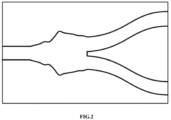
- the boundary of the Y-type beam splitter is optimized based on the inverse design principle, the interval between two output ports is increased on the premise of ensuring a high enough forward transmittance and inhibited backward reflection, and structural design is shown in FIG. 2 .
- the thickness of the SiN waveguide is 180 nm
- the length of the coupling region is 4 ⁇ m
- discrete widthsused for generating continuous boundary distribution, uniformly distributed in the coupling region are 0.55 ⁇ m, 0.65 ⁇ m, 0.76 ⁇ m, 0.93 ⁇ m, 1.29 ⁇ m, 1.75 ⁇ m, 1.65 ⁇ m, 1.58 ⁇ m, 1.52 ⁇ m, 1.42 ⁇ m, 1.4 ⁇ m and 1.3 ⁇ m respectively, and the distance between two arms is 0.2 ⁇ m.
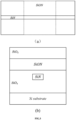
- the structure of the SiON polarizer sequentially consists of a SiO 2 upper cladding, a SiON upper cladding, a SiO 2 intermediate layer, a SiN waveguide, a SiO 2 lower cladding and a Si substrate from top to bottom.
- the design principle of the polarizer is as follows: a waveguide size is reasonably selected within the target working waveguide range of 800 nm to 900 nm, such that only quasi TE 0 /TM 0 modes are supported; the upper coupling SiON slab waveguide is introduced, and the coupling between the quasi TM 0 mode and the slab waveguide mode is increased as much as possible by adjusting the refractive index (between effective refractive indexes of the quasi TE 0 /TM 0 ) of SiON and the spacing from the SiN waveguide, such that mode field distribution of the TM 0 mode is extended into the slab SiON waveguide, and thereby greatly reducing the energy distribution proportion in the SiN waveguide; and on the other hand, weak coupling between the quasi TE 0 mode and the slab waveguide mode is ensured, such that energy is mainly concentrated in the SiN waveguide.
- the size of the SiN waveguide is 550 nm ⁇ 180 nm
- the thickness of the SiON cladding is 1 mm
- the width of the SiON cladding in a direction perpendicular to the waveguide is 3 mm
- the distance between the SiON cladding and the SiN waveguide is 200 nm.
- the thickness of the SiON upper c ladding, the thickness of the SiO2 intermediate layer and the width and height of the SiN waveguide respectively meet: the thickness of the SiON upper cladding is greater than or equal to 1 mm, and the width of the SiON upper cladding in the direction perpendicular to the SiN waveguide is greater than or equal to 3 mm; the thickness of the SiN waveguide and waveguide thicknesses of the optical fibre-waveguide mode transducers are kept consistent; an appropriate width of the SiN waveguide is selected to ensure that only TE 0 and TM 0 modes are supported in the waveguide and the difference between the effective refractive indexes therebetween is as large as possible, and a reasonable value range is [400 nm, 600 nm]; and selection of the thickness of the SiO 2 intermediate layer is related to the geometric dimension of the SiN waveguide, so as to ensure that the difference between energy distribution proportions of the TE 0 and TM 0 modes in the SiON upper cladding is as large as possible,
- the stability and reliability of the open-loop fibre optic gyroscope can be effectively improved while precision thereof is ensured, multiple properties of the open-loop fibre optic gyroscope is improved, and smaller size, lower power consumption, lower cost and simpler structural design and process of the open-loop fibre optic gyroscope are achieved.
Landscapes
- Physics & Mathematics (AREA)
- General Physics & Mathematics (AREA)
- Optics & Photonics (AREA)
- Engineering & Computer Science (AREA)
- Electromagnetism (AREA)
- Power Engineering (AREA)
- Radar, Positioning & Navigation (AREA)
- Remote Sensing (AREA)
- Microelectronics & Electronic Packaging (AREA)
- Gyroscopes (AREA)
Abstract
Description
- The present application claims priority to
Chinese Patent Application No. 202111472069.0, filed to China National Intellectual Property Administration on December 6, 2021 - The present disclosure relates to the technical fields of integrated optics and inertial sensing, in particular to a SiON-polarizer-based integrated SiN optical chip for fibre optic gyroscopes.
- Since gyroscopes capable of precisely measuring angular displacement and being high in sensitivity play an important role in a series of fields such as airborne navigation, robots, unmanned vehicle driving, and geographical mapping, compact gyroscopes with low cost are more popular in the market. Optical gyroscopes based on Sagnac effects have been widely concerned because of their high sensitivity, and have been developed into a multi-purpose mature technology. Compared to traditional mechanical gyroscopes based on the conservation of angular momentum, optical gyroscopes are not provided with motion modules, so they are not affected by gravity, impact, and vibration, which also means that no special universal suspension or packaging means is required.
- With the rapid development of low-loss single-mode optical fibres and various fibre optic devices used in the field of communication, all-fibre optical gyroscopes are developed when the optical fibres and the fibre optic devices are applied to the optical gyroscopes. As typical representatives of optical gyroscopes, the fibre optic gyroscopes have been developed into mature technical means with high sensitivity, stability and reliability at present, have better performance than most advanced micro-electro-mechanic system-based gyroscopes, and have lower cost and power consumption and smaller size. A typical fibre optic gyroscope mainly includes three assemblies, a passive sensing fibre optic coil, an optical component consisting of active and passive devices (such as an optical source, a phase modulator, a photodetector, and couplers), and a readout circuit. To continuously improve the passive sensing element, researchers have carried out a lot of related research in recent years and invented a series of novel optic fibres, such as hollow optic fibres with extremely low nonlinearity and thermal effects and optic fibres with high polarization extinction ratios. In addition, more complex optic fibre winding technologies are continuously developed to eliminate nonreciprocal noise and drifting caused by thermal gradient and vibration. Further development includes the adoption of thinner claddings or multi-core optical fibres, to significantly reduce the size of sensing fibre optic coils, while still keeping high sensitivity.
- However, most fibre optic gyroscopes at present generate, modulate and detect optical signals through discrete optical devices, and these discrete optical devices are usually connected together through tail fibres, to form Sagnac interferometric optical loops. Although there is a certain freedom to choose different discrete optical devices in making the fibre optic gyroscope, a series of problems, such as parasitic reflection, insertion losses increased at connection points, and environment-sensitive polarization mismatch will also be caused, and the performance of a system will be reduced by the above conditions to different degrees. Although influences of the above effects can be reduced as much as possible by adopting, for example, mode and polarization filtering devices, packaging cost is increased correspondingly. In addition, the size and weight of the system will also be increased by adopting a series of discrete optical devices.
- To avoid parasitic reflection, insertion losses increased at connection points, and environment-sensitive polarization mismatch introduced by the discrete devices, researchers have proposed integrated optical gyroscopes in recent years with the development of integrated photonics. Integrated optical driver chips are formed by integrating all active and passive optical devices, except sensing coils, needed by the optical gyroscopes, and the device chips can be connected with the sensing coils, such as passive optical fibres or ultra-low-loss silicon nitride waveguides to form interferometric optical gyroscopes. Therefore, the size, weight, loss, and manufacturing cost of the optical gyroscopes are greatly reduced by the adoption of the integrated driver chips. Therefore, they play an important role in promoting the popularization of the optical gyroscopes.
- Integrated optical chips widely applied to fibre optic gyroscope systems at present are integrated chips based on lithium niobate (LiNbO3) materials. A Y-type beam splitter, a polarizer, and a phase modulator are integrated on the same chip, which are mainly used for closed-loop fibre optic gyroscope under different degrees of precision, thereby achieving closed-loop feedback of interferometric phases, reducing influences of device drifting and achieving high precision. On the other hand, during actual application, the integrated chips based on the lithium niobate materials also have the following shortcomings: (1) a manufacturing method for lithium niobate optical waveguides is a proton exchange method, which has high requirements for proton exchange time and temperature, characteristics of an exchange medium and annealing temperature and time, and a preparation process is complex and high in cost; and (2) thermo-optical coefficients of the materials are high; and when light passes through the LiNbO3 materials, optical transmission characteristics of the devices will be affected due to the change in environmental temperature, thereby generating a temperature drifting effect. Therefore, a temperature compensation measure must be taken to ensure the working stability of the devices within a wide temperature range, resulting in a complex peripheral control circuit.
- A technical problem to be solved by an embodiment of the present disclosure is to provide a SiON-polarizer-based integrated SiN optical chip for fibre optic gyroscopes, so as to effectively improve the stability and reliability of the integrated SiN optical chip.
- In order to solve the above technical problem, an embodiment of the present disclosure provides a SiON-polarizer-based integrated SiN optical chip for fibre optic gyroscopes, including a first optical fibre-waveguide mode transducer, a second optical fibre-waveguide mode transducer, a first 3dB coupler, a SiON polarizer, a second 3dB coupler, a third optical fibre-waveguide mode transducer and a fourth optical fibre-waveguide mode transducer; wherein
one end of the first optical fibre-waveguide mode transducer is connected with an external optical source through an optical fibre, and the other end of the first optical fibre-waveguide mode transducer is connected with one branch of the first 3dB coupler; one end of the second optical fibre-waveguide mode transducer is connected with an external photodetector through an optical fibre, and the other end of the second optical fibre-waveguide mode transducer is connected with the other branch of the first 3dB coupler; a base waveguide of the first 3dB coupler is connected with one end of the SiON polarizer; the other end of the SiON polarizer is connected with a base waveguide of the second 3dB coupler; one branch of the second 3dB coupler is connected with one end of the third optical fibre-waveguide mode transducer, and the other branch of the second 3dB coupler is connected with one end of the fourth optical fibre-waveguide mode transducer; the other end of the third optical fibre-waveguide mode transducer is connected with one end of an external fibre optic ring; and the other end of the fourth optical fibre-waveguide mode transducer is connected with the other end of the external fibre optic ring. - Furthermore, the first optical fibre-waveguide mode transducer, the second optical fibre-waveguide mode transducer, the third optical fibre-waveguide mode transducer, and the fourth optical fibre-waveguide mode transducer all adopt an inversed taper structure to be matched with an input polarization-maintaining optical fibre in a mode field diameter, and a working wavelength ranges from 800 nm to 900 nm.
- Furthermore, the first 3dB coupler and the second 3dB coupler are both achieved by a 1 × 2MMI coupler or a Y-type beam splitter, and a working wavelength ranges from 800 nm to 900 nm.
- Furthermore, the structure of the SiON polarizer sequentially consists of a SiO2 upper cladding, a SiON upper cladding, a SiO2 intermediate layer, a SiN waveguide, a SiO2 lower cladding, and a Si substrate from top to bottom.
- Furthermore, the SiON upper cladding has a thickness greater than or equal to 1 mm, and a width greater than or equal to 3 mm in a direction perpendicular to the SiN waveguide; and a thickness of the SiN waveguide and waveguide thicknesses of the optical fibre-waveguide mode transducers are kept consistent.
- The present disclosure has the following beneficial effects:
- 1. Since the SiN waveguide has a high transmission characteristic within an 800-900 nm wavelength range, the fibre optic gyroscope based on the integrated SiN optical chip has a higher scale factor within a short wavelength range.
- 2. High double refraction can be achieved in the SiN waveguide, and good phase error suppression can be achieved by the waveguide with the high double refraction.
- 3. SiN is a mature material in the microelectronics industry, which is used as an electrical insulator and a thermal insulator in a circuit. Manufacturing technology relevant to the SiN process is mature. SiN further has a series of excellent optical characteristics that make it ideal for many integrated photonic device applications.
- 4. Temperature stability and reliability of the open-loop fibre optic gyroscope are improved, and miniaturization of the open-loop fibre optic gyroscope is achieved. The influences of the change in environmental temperature on optical transmission characteristics are lower due to a low thermo-optical coefficient of the SiN material, thereby suppressing a temperature drifting effect to a certain degree and improving the temperature stability of the gyroscope. In addition, parasitic reflection, insertion losses increased at connection points, and environment-sensitive polarization mismatch by discrete devices are avoided by integrating optical waveguides and devices, reliability of a system is further improved, the size is reduced, the system is suitable for the integration of the miniaturized open-loop fibre optic gyroscope, and costs of the open-loop fibre optic gyroscope are further reduced.
-
- In
FIG. 1 , (a) is a top view of a optical fibre-waveguide mode transducer according to an embodiment of the present disclosure, and (b) is a cross-section view of the optical fibre-waveguide mode transducer according to the embodiment of the present disclosure. -
FIG. 2 is a schematic structural diagram of a Y-type beam splitter according to an embodiment of the present disclosure. - In
FIG. 3 , (a) is a top view of a SiON polarizer, and (b) is a cross-section view of the SiON polarizer. -
FIG. 4 is a schematic structural diagram of a SiON-polarizer-based integrated SiN optical chip for fibre optic gyroscopes according to an embodiment of the present disclosure. - First optical fibre-waveguide mode transducer 1-1, second optical fibre-waveguide mode transducer 1-2,
first 3dB coupler 2, bent waveguide A3, SiN waveguide 4-1, SiON cladding 4-2, bent waveguide B5,second 3dB coupler 6, third optical fibre-waveguide mode transducer 7-1, fourth optical fibre-waveguide mode transducer 7-2, an arrow direction of a reference sign 8 is a direction of light output from an external optical source, and an arrow direction of a reference sign 9 is a direction of light output to an external fibre optic ring. - It should be noted that embodiments and features in the embodiments in the present application may be mutually combined without conflicts. The present disclosure is further described in detail below with reference to the drawings and the specific embodiments.
- Referring to
FIG. 1 to FIG. 4 , a SiON-polarizer-based integrated SiN optical chip for fibre optic gyroscopes according to an embodiment of the present disclosure includes a first optical fibre-waveguide mode transducer 1-1, a second optical fibre-waveguide mode transducer 1-2, afirst 3dB coupler 2, a SiON polarizer, asecond 3dB coupler 6, a third optical fibre-waveguide mode transducer 7-1 and a fourth optical fibre-waveguide mode transducer 7-2. - One end of the first optical fibre-waveguide mode transducer 1-1 is connected with an external optical source through an optical fibre, and the other end of the first optical fibre-waveguide mode transducer 1-1 is connected with one branch of the
first 3dB coupler 2; and one end of the second optical fibre-waveguide mode transducer 1-2 is connected with an external photodetector through an optical fibre, and the other end of the second optical fibre-waveguide mode transducer 1-2 is connected with the other branch of thefirst 3dB coupler 2. A base waveguide of thefirst 3dB coupler 2 is connected with one end of the SiON polarizer; and the other end of the SiON polarizer is connected with a base waveguide of thesecond 3dB coupler 6. One branch of thesecond 3dB coupler 6 is connected with one end of the third optical fibre-waveguide mode transducer 7-1, and the other branch of thesecond 3dB coupler 6 is connected with one end of the fourth optical fibre-waveguide mode transducer 7-2; the other end of the third optical fibre-waveguide mode transducer 7-1 is connected with one end of an external fibre optic ring; and the other end of the fourth optical fibre-waveguide mode transducer 7-2 is connected with the other end of the external fibre optic ring. - Referring to
FIG. 4 , light output from the external optical source is coupled to the first optical fibre-waveguide mode transducer 1-1 on the chip in a direction marked by an arrow 8, and light output from the first optical fibre-waveguide mode transducer 1-1 includes two different polarization modes (quasi TE0 and TM0); the light in the two different polarization modes enter the SiON polarizer through a bent waveguide A3 after passing through thefirst 3dB coupler 2, and light in the quasi TM0 mode leaks to the SiON cladding 4-2, whereas only light in the quasi TE0 mode is reserved in the SiN waveguide 4-1 due to polarization selection of the polarizer; the light in the TE0 mode enters thesecond 3dB coupler 6 through a bent waveguide B5 to be split into two beams, the two beams are coupled into a fibre optic ring after passing through the third optical fibre-waveguide mode transducer 7-1 and the fourth optical fibre-waveguide mode transducer 7-2; and the two light beams are oppositely transmitted in the fibre optic ring in a clockwise direction and a counter-clockwise direction respectively, and the two light beams meet coherent conditions. A Sagnac effect is generated when the fibre optic ring rotates around its central axis, such that intensity of interferometric light returning to thesecond 3dB coupler 6 changes; and the interferometric light signal is coupled and output to the external photodetector after passing through thesecond 3dB coupler 6, the bent waveguide B5, the SiON polarizer, the bent waveguide A3, thefirst 3dB coupler 2 and the second optical fibre-waveguide mode transducer 1-2, so as to detect changed light intensity, and rotational angular speed information is obtained after processing. - As an implementation, the first optical fibre-waveguide mode transducer, the second optical fibre-waveguide mode transducer, the third optical fibre-waveguide mode transducer and the fourth optical fibre-waveguide mode transducer all adopt an inversed taper structure to be matched with an input polarization-maintaining optical fibre as to the mode field diameter, and the working wavelength ranges from 800 nm to 900 nm. As shown in
FIG. 1 , taking an ultra-thin polarization-maintaining optical fibre as an example, the diameter of the cladding is 40 µm, the diameter of the fibre core is 3 µm, and the mode field diameter in a quasi TE0 mode in the optical fibre at the wavelength of 830 nm is about 3.7 µm; and with respect to an inversed taper structure, matching with the mode field diameter of the optical fibre can be achieved by optimizing the width of an input end waveguide under the condition of a fixed waveguide thickness. Taking a waveguide thickness of 180 nm as an example, the optimal waveguide width is 130 nm, the mode field diameter of the quasi-TE0 mode in the corresponding waveguide at 830 nm is about 3.7 µm, such that mode field matching is achieved; and when a taper is long enough, 80% coupling efficiency can be achieved, and mode crosstalk is negligible. In the embodiment, the thickness of the SiN waveguide is 180 nm, the width of the input end waveguide is 130 nm, and the mode field diameter of the quasi TE0 mode in the corresponding waveguide at 830 nm is about 3.7 µm. The length of the input end straight waveguide is 20 µm,the length of the taper is 100 µm, and the width of the output end waveguide is 550 nm. - As an implementation, the
first 3dB coupler 2 and thesecond 3dB coupler 6 are both achieved by a 1 × 2MMI coupler or a Y-type beam splitter, and the working wavelength ranges from 800 nm to 900 nm. In order to reduce parasitic reflection and machining errors, the boundary of the Y-type beam splitter is optimized based on the inverse design principle, the interval between two output ports is increased on the premise of ensuring a high enough forward transmittance and inhibited backward reflection, and structural design is shown inFIG. 2 . In the embodiment, the thickness of the SiN waveguide is 180 nm, the length of the coupling region is 4 µm, discrete widthsused for generating continuous boundary distribution, uniformly distributed in the coupling region are 0.55 µm, 0.65 µm, 0.76 µm, 0.93 µm, 1.29 µm, 1.75 µm, 1.65 µm, 1.58 µm, 1.52 µm, 1.42 µm, 1.4 µm and 1.3 µm respectively, and the distance between two arms is 0.2 µm. - As an implementation, the structure of the SiON polarizer sequentially consists of a SiO2 upper cladding, a SiON upper cladding, a SiO2 intermediate layer, a SiN waveguide, a SiO2 lower cladding and a Si substrate from top to bottom. The design principle of the polarizer is as follows: a waveguide size is reasonably selected within the target working waveguide range of 800 nm to 900 nm, such that only quasi TE0/TM0 modes are supported; the upper coupling SiON slab waveguide is introduced, and the coupling between the quasi TM0 mode and the slab waveguide mode is increased as much as possible by adjusting the refractive index (between effective refractive indexes of the quasi TE0/TM0) of SiON and the spacing from the SiN waveguide, such that mode field distribution of the TM0 mode is extended into the slab SiON waveguide, and thereby greatly reducing the energy distribution proportion in the SiN waveguide; and on the other hand, weak coupling between the quasi TE0 mode and the slab waveguide mode is ensured, such that energy is mainly concentrated in the SiN waveguide. In the embodiment, the size of the SiN waveguide is 550 nm × 180 nm, the thickness of the SiON cladding is 1 mm, the width of the SiON cladding in a direction perpendicular to the waveguide is 3 mm, and the distance between the SiON cladding and the SiN waveguide is 200 nm.
- As an implementation, the thickness of the SiON upper c ladding, the thickness of the SiO2 intermediate layer and the width and height of the SiN waveguide respectively meet: the thickness of the SiON upper cladding is greater than or equal to 1 mm, and the width of the SiON upper cladding in the direction perpendicular to the SiN waveguide is greater than or equal to 3 mm; the thickness of the SiN waveguide and waveguide thicknesses of the optical fibre-waveguide mode transducers are kept consistent; an appropriate width of the SiN waveguide is selected to ensure that only TE0 and TM0 modes are supported in the waveguide and the difference between the effective refractive indexes therebetween is as large as possible, and a reasonable value range is [400 nm, 600 nm]; and selection of the thickness of the SiO2 intermediate layer is related to the geometric dimension of the SiN waveguide, so as to ensure that the difference between energy distribution proportions of the TE0 and TM0 modes in the SiON upper cladding is as large as possible, and taking 550 nm × 180 nm as an example, an appropriate thickness of the SiO2 intermediate layer is 200 nm.
- By means of the present disclosure, the stability and reliability of the open-loop fibre optic gyroscope can be effectively improved while precision thereof is ensured, multiple properties of the open-loop fibre optic gyroscope is improved, and smaller size, lower power consumption, lower cost and simpler structural design and process of the open-loop fibre optic gyroscope are achieved.
- Although the embodiments of the present disclosure have been shown and described, various changes, modifications, replacements and variations can be made to these embodiments by those ordinarily skilled in the art without departing from the principle and spirit of the present disclosure, and the scope of the present disclosure is defined by appended claims and equivalents thereof.
Claims (5)
- A SiON-polarizer-based integrated SiN optical chip for fibre optic gyroscopes, characterized by comprising a first optical fibre-waveguide mode transducer, a second optical fibre-waveguide mode transducer, a first 3dB coupler, the SiON polarizer, a second 3dB coupler, a third optical fibre-waveguide mode transducer and a fourth optical fibre-waveguide mode transducer; wherein
one end of the first optical fibre-waveguide mode transducer is connected with an external optical source through an optical fibre, and the other end of the first optical fibre-waveguide mode transducer is connected with one branch of the first 3dB coupler; one end of the second optical fibre-waveguide mode transducer is connected with an external photodetector through an optical fibre, and the other end of the second optical fibre-waveguide mode transducer is connected with the other branch of the first 3dB coupler; a base waveguide of the first 3dB coupler is connected with one end of the SiON polarizer; the other end of the SiON polarizer is connected with a base waveguide of the second 3dB coupler; one branch of the second 3dB coupler is connected with one end of the third optical fibre-waveguide mode transducer, and the other branch of the second 3dB coupler is connected with one end of the fourth optical fibre-waveguide mode transducer; the other end of the third optical fibre-waveguide mode transducer is connected with one end of an external fibre optic ring; and the other end of the fourth optical fibre-waveguide mode transducer is connected with the other end of the external fibre optic ring. - The SiON-polarizer-based integrated SiN optical chip for fibre optic gyroscopes according to claim 1, characterized in that the first optical fibre-waveguide mode transducer, the second optical fibre-waveguide mode transducer, the third optical fibre-waveguide mode transducer and the fourth optical fibre-waveguide mode transducer all adopt an inversed taper structure to be matched with an input polarization-maintaining optical fibre in a mode field diameter, and a working wavelength ranges from 800 nm to 900 nm.
- The SiON-polarizer-based integrated SiN optical chip for fibre optic gyroscopes according to claim 1, characterized in that the first 3dB coupler and the second 3dB coupler are both achieved by a 1 × 2MMI coupler or a Y-type beam splitter, and a working wavelength ranges from 800 nm to 900 nm.
- The SiON-polarizer-based integrated SiN optical chip for fibre optic gyroscopes according to claim 1, characterized in that a structure of the SiON polarizer sequentially consists of a SiO2 upper cladding, a SiON upper cladding, a SiO2 intermediate layer, a SiN waveguide, a SiO2 lower cladding and a Si substrate from top to bottom.
- The SiON-polarizer-based integrated SiN optical chip for fibre optic gyroscopes according to claim 4, characterized in that the SiON upper cladding has a thickness greater than or equal to 1 mm, and a width greater than or equal to 3 mm in a direction perpendicular to the SiN waveguide; and a thickness of the SiN waveguide and waveguide thicknesses of the optical fibre-waveguide mode transducers are kept consistent.
Applications Claiming Priority (2)
| Application Number | Priority Date | Filing Date | Title |
|---|---|---|---|
| CN202111472069.0A CN113865578B (en) | 2021-12-06 | 2021-12-06 | SiN-based integrated optical chip for optical fiber gyroscope based on SiON polarizer |
| PCT/CN2022/126677 WO2023103610A1 (en) | 2021-12-06 | 2022-10-21 | Sin-based integrated optical chip for optical fiber gyroscope employing sion polarizer |
Publications (2)
| Publication Number | Publication Date |
|---|---|
| EP4428492A1 true EP4428492A1 (en) | 2024-09-11 |
| EP4428492A4 EP4428492A4 (en) | 2025-10-22 |
Family
ID=78985822
Family Applications (1)
| Application Number | Title | Priority Date | Filing Date |
|---|---|---|---|
| EP22903034.1A Pending EP4428492A4 (en) | 2021-12-06 | 2022-10-21 | SIN-BASED INTEGRATED OPTICAL CHIP FOR FIBER OPTIC GYROSCOPE WITH A SION POLARIZER |
Country Status (3)
| Country | Link |
|---|---|
| EP (1) | EP4428492A4 (en) |
| CN (1) | CN113865578B (en) |
| WO (1) | WO2023103610A1 (en) |
Families Citing this family (6)
| Publication number | Priority date | Publication date | Assignee | Title |
|---|---|---|---|---|
| CN113865578B (en) * | 2021-12-06 | 2022-02-08 | 深圳奥斯诺导航科技有限公司 | SiN-based integrated optical chip for optical fiber gyroscope based on SiON polarizer |
| CN114690453A (en) * | 2022-04-26 | 2022-07-01 | 深圳奥斯诺导航科技有限公司 | Piezoelectric-elastic optical phase shifter and optical gyroscope SiN integrated chip |
| CN114815051B (en) * | 2022-06-30 | 2022-09-16 | 深圳奥斯诺导航科技有限公司 | Optical gyroscope double-layer SiN-based integrated drive chip |
| CN117870656A (en) * | 2023-12-25 | 2024-04-12 | 贵州航天控制技术有限公司 | Lightweight optical fiber gyro inertial measurement system |
| CN119717126B (en) * | 2024-12-27 | 2026-04-03 | 中国航空工业集团公司西安飞行自动控制研究所 | A heterogeneous integrated chip configuration for thin-film lithium niobate for fiber optic gyroscopes |
| CN119958523B (en) * | 2025-01-16 | 2025-11-25 | 中国船舶集团有限公司第七〇七研究所 | Integrated special device for optical fiber gyro |
Family Cites Families (18)
| Publication number | Priority date | Publication date | Assignee | Title |
|---|---|---|---|---|
| US4220395A (en) * | 1974-05-13 | 1980-09-02 | Regents Of University Of California | Polarization converter and circuit elements for use in optical waveguides |
| JP3692474B2 (en) * | 2002-11-01 | 2005-09-07 | 日本航空電子工業株式会社 | Fiber optic gyro |
| CN101216317B (en) * | 2008-01-21 | 2010-12-01 | 浙江大学 | Reciprocity Integrated Optical Modulation Chip for Fiber Optic Gyroscope |
| CN101320113B (en) * | 2008-07-15 | 2010-06-09 | 浙江大学 | A Waveguide Polarization Mode Converter |
| CN102565955B (en) * | 2012-01-16 | 2013-03-20 | 中国科学院半导体研究所 | Electric tunable grating coupler |
| EP2924482B1 (en) * | 2014-03-26 | 2017-12-20 | Huawei Technologies Co., Ltd. | Polarisation mode converter with an asymmetric silicon nitride waveguide |
| US10041797B2 (en) * | 2014-10-02 | 2018-08-07 | Faquir Chand Jain | Fiber optic gyroscope with 3×3 and 2×2 waveguide couplers |
| CN105444750B (en) * | 2015-11-27 | 2018-05-22 | 湖北三江航天红峰控制有限公司 | A kind of polarization-maintaining photonic crystal fiber gyro and its manufacturing method |
| EP3593087B1 (en) * | 2017-03-09 | 2020-12-02 | KVH Industries, Inc. | Photonic integrated circuit for an interference fiber optic gyroscope (ifog) |
| CN107561646B (en) * | 2017-10-18 | 2020-05-05 | 西安奇芯光电科技有限公司 | Optical waveguide polarization splitter and method of manufacturing the same |
| CN109579816B (en) * | 2018-12-12 | 2020-06-19 | 天津津航技术物理研究所 | Hybrid integrated optical fiber gyroscope optical chip |
| CN109579818B (en) * | 2018-12-12 | 2020-06-19 | 天津津航技术物理研究所 | Preparation method of hybrid integrated fiber-optic gyroscope optical chip |
| CN109725385B (en) * | 2019-02-28 | 2020-05-12 | 中国电子科技集团公司第二十四研究所 | A light polarization state adjustment chip based on waveguide grating coupler |
| US11353655B2 (en) * | 2019-05-22 | 2022-06-07 | Kvh Industries, Inc. | Integrated optical polarizer and method of making same |
| US10871614B1 (en) * | 2019-07-03 | 2020-12-22 | Globalfoundries Inc. | Transverse-electric (TE) pass polarizer |
| TWI719888B (en) * | 2020-04-17 | 2021-02-21 | 極星光電股份有限公司 | Integrated double-wing photoelectric sensor core chip |
| CN112833873A (en) * | 2020-09-12 | 2021-05-25 | 天津领芯科技发展有限公司 | Photonic integrated chip and interference type optical fiber gyroscope |
| CN113865578B (en) * | 2021-12-06 | 2022-02-08 | 深圳奥斯诺导航科技有限公司 | SiN-based integrated optical chip for optical fiber gyroscope based on SiON polarizer |
-
2021
- 2021-12-06 CN CN202111472069.0A patent/CN113865578B/en active Active
-
2022
- 2022-10-21 WO PCT/CN2022/126677 patent/WO2023103610A1/en not_active Ceased
- 2022-10-21 EP EP22903034.1A patent/EP4428492A4/en active Pending
Also Published As
| Publication number | Publication date |
|---|---|
| WO2023103610A1 (en) | 2023-06-15 |
| CN113865578B (en) | 2022-02-08 |
| EP4428492A4 (en) | 2025-10-22 |
| CN113865578A (en) | 2021-12-31 |
Similar Documents
| Publication | Publication Date | Title |
|---|---|---|
| EP4428492A1 (en) | Sin-based integrated optical chip for optical fiber gyroscope employing sion polarizer | |
| CN114397729B (en) | SiN integrated optical chip based on continuous curvature curved waveguide polarizer | |
| CN114063212B (en) | Monolithic integrated beam-splitting modulation chip based on film lithium niobate | |
| EP4428587A1 (en) | Optical gyroscope double-layer sin-based integrated drive chip | |
| CN101387519B (en) | Hollow photonic crystal fiber gyroscope | |
| CN112833873A (en) | Photonic integrated chip and interference type optical fiber gyroscope | |
| CN114527538B (en) | Lithium niobate thin film chip with mode selection structure | |
| CN111854726B (en) | Hollow anti-resonance optical fiber gyroscope | |
| CN105865433B (en) | Single chip integrated depolarized type optical fibre gyro optical chip | |
| CN114739376B (en) | Hollow-core photonic crystal fiber gyroscope based on silica waveguide polarization beam splitter | |
| CN109579817B (en) | Preparation method of silicon-based-LN-based hybrid integrated optical chip | |
| CN112097754B (en) | Lithium niobate and SU-8 hybrid integrated hollow-core photonic crystal fiber optic gyroscope | |
| CN112066973B (en) | Integrated photonic crystal fiber-optic gyroscope with lithium niobate waveguide | |
| CN117490676B (en) | Monolithic integrated thin-film lithium niobate photon driver chip and fiber optic gyroscope | |
| Guo et al. | Three-axis interferometric fiber optic gyroscope with silica integrated coupler chip | |
| CN119087580B (en) | An optical gyroscope integrated chip based on thin-film lithium niobate photonic integration platform | |
| CN114636413B (en) | Optical gyroscope integrated chip based on silicon carbide photonic integrated platform on insulating substrate | |
| CN109612452A (en) | Silicon substrate-LN base hybrid integrated optical chip for three axis optical fibre gyro | |
| CN116974099A (en) | Lithium niobate thin film modulator connected into integrated optical gyro system | |
| CN113884085B (en) | Integrated optical chip for fiber optic gyroscope based on SiO2-SiN coupled chip structure | |
| CN109186582B (en) | An On-Chip Optical Interferometric Angular Velocity Sensing Module | |
| CN102175239A (en) | Integrated optic chip for three-axis fiber optic gyroscope | |
| CN202041212U (en) | An integrated optical chip for a three-axis fiber optic gyroscope | |
| CN116540355A (en) | Optical multimode interference coupler based on strip-shaped ridge waveguide mixed structure | |
| CN114690453A (en) | Piezoelectric-elastic optical phase shifter and optical gyroscope SiN integrated chip |
Legal Events
| Date | Code | Title | Description |
|---|---|---|---|
| STAA | Information on the status of an ep patent application or granted ep patent |
Free format text: STATUS: THE INTERNATIONAL PUBLICATION HAS BEEN MADE |
|
| PUAI | Public reference made under article 153(3) epc to a published international application that has entered the european phase |
Free format text: ORIGINAL CODE: 0009012 |
|
| STAA | Information on the status of an ep patent application or granted ep patent |
Free format text: STATUS: REQUEST FOR EXAMINATION WAS MADE |
|
| 17P | Request for examination filed |
Effective date: 20240604 |
|
| AK | Designated contracting states |
Kind code of ref document: A1 Designated state(s): AL AT BE BG CH CY CZ DE DK EE ES FI FR GB GR HR HU IE IS IT LI LT LU LV MC ME MK MT NL NO PL PT RO RS SE SI SK SM TR |
|
| DAV | Request for validation of the european patent (deleted) | ||
| DAX | Request for extension of the european patent (deleted) | ||
| A4 | Supplementary search report drawn up and despatched |
Effective date: 20250924 |
|
| RIC1 | Information provided on ipc code assigned before grant |
Ipc: G01C 19/72 20060101AFI20250918BHEP Ipc: G02B 6/27 20060101ALI20250918BHEP |