EP4428191A1 - Rubber composition for vehicle coolant transport hose, and vehicle coolant transport hose obtained using same - Google Patents
Rubber composition for vehicle coolant transport hose, and vehicle coolant transport hose obtained using same Download PDFInfo
- Publication number
- EP4428191A1 EP4428191A1 EP22904123.1A EP22904123A EP4428191A1 EP 4428191 A1 EP4428191 A1 EP 4428191A1 EP 22904123 A EP22904123 A EP 22904123A EP 4428191 A1 EP4428191 A1 EP 4428191A1
- Authority
- EP
- European Patent Office
- Prior art keywords
- vulcanization accelerator
- rubber composition
- mass
- hose
- transport hose
- Prior art date
- Legal status (The legal status is an assumption and is not a legal conclusion. Google has not performed a legal analysis and makes no representation as to the accuracy of the status listed.)
- Pending
Links
- 239000000203 mixture Substances 0.000 title claims abstract description 65
- 239000002826 coolant Substances 0.000 title claims abstract description 58
- 238000004073 vulcanization Methods 0.000 claims abstract description 104
- 229920001577 copolymer Polymers 0.000 claims abstract description 30
- KUAZQDVKQLNFPE-UHFFFAOYSA-N thiram Chemical compound CN(C)C(=S)SSC(=S)N(C)C KUAZQDVKQLNFPE-UHFFFAOYSA-N 0.000 claims abstract description 15
- 229960002447 thiram Drugs 0.000 claims abstract description 15
- DKVNPHBNOWQYFE-UHFFFAOYSA-N carbamodithioic acid Chemical compound NC(S)=S DKVNPHBNOWQYFE-UHFFFAOYSA-N 0.000 claims abstract description 11
- 239000012990 dithiocarbamate Substances 0.000 claims abstract description 11
- QAZLUNIWYYOJPC-UHFFFAOYSA-M sulfenamide Chemical compound [Cl-].COC1=C(C)C=[N+]2C3=NC4=CC=C(OC)C=C4N3SCC2=C1C QAZLUNIWYYOJPC-UHFFFAOYSA-M 0.000 claims abstract description 8
- 239000004636 vulcanized rubber Substances 0.000 claims abstract description 6
- 239000000470 constituent Substances 0.000 claims description 3
- 239000000463 material Substances 0.000 abstract description 20
- 239000010410 layer Substances 0.000 description 34
- NINIDFKCEFEMDL-UHFFFAOYSA-N Sulfur Chemical compound [S] NINIDFKCEFEMDL-UHFFFAOYSA-N 0.000 description 16
- 239000003795 chemical substances by application Substances 0.000 description 15
- 239000011593 sulfur Substances 0.000 description 15
- 229910052717 sulfur Inorganic materials 0.000 description 15
- 230000000694 effects Effects 0.000 description 10
- -1 powdered sulfur Chemical compound 0.000 description 10
- 239000000126 substance Substances 0.000 description 9
- 238000000605 extraction Methods 0.000 description 8
- 239000010734 process oil Substances 0.000 description 8
- 230000003014 reinforcing effect Effects 0.000 description 8
- 230000009471 action Effects 0.000 description 7
- 230000000052 comparative effect Effects 0.000 description 7
- 238000000354 decomposition reaction Methods 0.000 description 7
- 239000000945 filler Substances 0.000 description 7
- 239000000446 fuel Substances 0.000 description 7
- 239000002356 single layer Substances 0.000 description 7
- VTEKOFXDMRILGB-UHFFFAOYSA-N bis(2-ethylhexyl)carbamothioylsulfanyl n,n-bis(2-ethylhexyl)carbamodithioate Chemical compound CCCCC(CC)CN(CC(CC)CCCC)C(=S)SSC(=S)N(CC(CC)CCCC)CC(CC)CCCC VTEKOFXDMRILGB-UHFFFAOYSA-N 0.000 description 6
- DEQZTKGFXNUBJL-UHFFFAOYSA-N n-(1,3-benzothiazol-2-ylsulfanyl)cyclohexanamine Chemical compound C1CCCCC1NSC1=NC2=CC=CC=C2S1 DEQZTKGFXNUBJL-UHFFFAOYSA-N 0.000 description 6
- XLOMVQKBTHCTTD-UHFFFAOYSA-N Zinc monoxide Chemical compound [Zn]=O XLOMVQKBTHCTTD-UHFFFAOYSA-N 0.000 description 5
- 230000003712 anti-aging effect Effects 0.000 description 5
- 239000006229 carbon black Substances 0.000 description 5
- 238000001816 cooling Methods 0.000 description 5
- 239000000370 acceptor Substances 0.000 description 4
- 239000002253 acid Substances 0.000 description 4
- 239000003463 adsorbent Substances 0.000 description 4
- 150000001993 dienes Chemical class 0.000 description 4
- AUZONCFQVSMFAP-UHFFFAOYSA-N disulfiram Chemical compound CCN(CC)C(=S)SSC(=S)N(CC)CC AUZONCFQVSMFAP-UHFFFAOYSA-N 0.000 description 4
- 238000011156 evaluation Methods 0.000 description 4
- 238000004898 kneading Methods 0.000 description 4
- 239000003921 oil Substances 0.000 description 4
- XLYOFNOQVPJJNP-UHFFFAOYSA-N water Substances O XLYOFNOQVPJJNP-UHFFFAOYSA-N 0.000 description 4
- CPGFMWPQXUXQRX-UHFFFAOYSA-N 3-amino-3-(4-fluorophenyl)propanoic acid Chemical compound OC(=O)CC(N)C1=CC=C(F)C=C1 CPGFMWPQXUXQRX-UHFFFAOYSA-N 0.000 description 3
- MTHSVFCYNBDYFN-UHFFFAOYSA-N diethylene glycol Chemical compound OCCOCCO MTHSVFCYNBDYFN-UHFFFAOYSA-N 0.000 description 3
- 238000000034 method Methods 0.000 description 3
- 238000010248 power generation Methods 0.000 description 3
- 238000010059 sulfur vulcanization Methods 0.000 description 3
- 239000011787 zinc oxide Substances 0.000 description 3
- 235000014692 zinc oxide Nutrition 0.000 description 3
- OJOWICOBYCXEKR-APPZFPTMSA-N (1S,4R)-5-ethylidenebicyclo[2.2.1]hept-2-ene Chemical compound CC=C1C[C@@H]2C[C@@H]1C=C2 OJOWICOBYCXEKR-APPZFPTMSA-N 0.000 description 2
- YXIWHUQXZSMYRE-UHFFFAOYSA-N 1,3-benzothiazole-2-thiol Chemical compound C1=CC=C2SC(S)=NC2=C1 YXIWHUQXZSMYRE-UHFFFAOYSA-N 0.000 description 2
- HECLRDQVFMWTQS-RGOKHQFPSA-N 1755-01-7 Chemical compound C1[C@H]2[C@@H]3CC=C[C@@H]3[C@@H]1C=C2 HECLRDQVFMWTQS-RGOKHQFPSA-N 0.000 description 2
- INYHZQLKOKTDAI-UHFFFAOYSA-N 5-ethenylbicyclo[2.2.1]hept-2-ene Chemical compound C1C2C(C=C)CC1C=C2 INYHZQLKOKTDAI-UHFFFAOYSA-N 0.000 description 2
- VTYYLEPIZMXCLO-UHFFFAOYSA-L Calcium carbonate Chemical compound [Ca+2].[O-]C([O-])=O VTYYLEPIZMXCLO-UHFFFAOYSA-L 0.000 description 2
- OKTJSMMVPCPJKN-UHFFFAOYSA-N Carbon Chemical compound [C] OKTJSMMVPCPJKN-UHFFFAOYSA-N 0.000 description 2
- UDIPTWFVPPPURJ-UHFFFAOYSA-M Cyclamate Chemical compound [Na+].[O-]S(=O)(=O)NC1CCCCC1 UDIPTWFVPPPURJ-UHFFFAOYSA-M 0.000 description 2
- VGGSQFUCUMXWEO-UHFFFAOYSA-N Ethene Chemical compound C=C VGGSQFUCUMXWEO-UHFFFAOYSA-N 0.000 description 2
- 239000005977 Ethylene Substances 0.000 description 2
- ZRALSGWEFCBTJO-UHFFFAOYSA-N Guanidine Chemical compound NC(N)=N ZRALSGWEFCBTJO-UHFFFAOYSA-N 0.000 description 2
- AFCARXCZXQIEQB-UHFFFAOYSA-N N-[3-oxo-3-(2,4,6,7-tetrahydrotriazolo[4,5-c]pyridin-5-yl)propyl]-2-[[3-(trifluoromethoxy)phenyl]methylamino]pyrimidine-5-carboxamide Chemical compound O=C(CCNC(=O)C=1C=NC(=NC=1)NCC1=CC(=CC=C1)OC(F)(F)F)N1CC2=C(CC1)NN=N2 AFCARXCZXQIEQB-UHFFFAOYSA-N 0.000 description 2
- SMWDFEZZVXVKRB-UHFFFAOYSA-N Quinoline Chemical compound N1=CC=CC2=CC=CC=C21 SMWDFEZZVXVKRB-UHFFFAOYSA-N 0.000 description 2
- 235000021355 Stearic acid Nutrition 0.000 description 2
- FZWLAAWBMGSTSO-UHFFFAOYSA-N Thiazole Chemical compound C1=CSC=N1 FZWLAAWBMGSTSO-UHFFFAOYSA-N 0.000 description 2
- 150000001875 compounds Chemical class 0.000 description 2
- 230000006866 deterioration Effects 0.000 description 2
- AFZSMODLJJCVPP-UHFFFAOYSA-N dibenzothiazol-2-yl disulfide Chemical compound C1=CC=C2SC(SSC=3SC4=CC=CC=C4N=3)=NC2=C1 AFZSMODLJJCVPP-UHFFFAOYSA-N 0.000 description 2
- DMBHHRLKUKUOEG-UHFFFAOYSA-N diphenylamine Chemical compound C=1C=CC=CC=1NC1=CC=CC=C1 DMBHHRLKUKUOEG-UHFFFAOYSA-N 0.000 description 2
- 239000000284 extract Substances 0.000 description 2
- QIQXTHQIDYTFRH-UHFFFAOYSA-N octadecanoic acid Chemical compound CCCCCCCCCCCCCCCCCC(O)=O QIQXTHQIDYTFRH-UHFFFAOYSA-N 0.000 description 2
- OQCDKBAXFALNLD-UHFFFAOYSA-N octadecanoic acid Natural products CCCCCCCC(C)CCCCCCCCC(O)=O OQCDKBAXFALNLD-UHFFFAOYSA-N 0.000 description 2
- 239000003002 pH adjusting agent Substances 0.000 description 2
- 238000011160 research Methods 0.000 description 2
- 239000008117 stearic acid Substances 0.000 description 2
- UMGDCJDMYOKAJW-UHFFFAOYSA-N thiourea Chemical compound NC(N)=S UMGDCJDMYOKAJW-UHFFFAOYSA-N 0.000 description 2
- BOXSVZNGTQTENJ-UHFFFAOYSA-L zinc dibutyldithiocarbamate Chemical compound [Zn+2].CCCCN(C([S-])=S)CCCC.CCCCN(C([S-])=S)CCCC BOXSVZNGTQTENJ-UHFFFAOYSA-L 0.000 description 2
- DUBNHZYBDBBJHD-UHFFFAOYSA-L ziram Chemical compound [Zn+2].CN(C)C([S-])=S.CN(C)C([S-])=S DUBNHZYBDBBJHD-UHFFFAOYSA-L 0.000 description 2
- RRKODOZNUZCUBN-CCAGOZQPSA-N (1z,3z)-cycloocta-1,3-diene Chemical compound C1CC\C=C/C=C\C1 RRKODOZNUZCUBN-CCAGOZQPSA-N 0.000 description 1
- PRBHEGAFLDMLAL-GQCTYLIASA-N (4e)-hexa-1,4-diene Chemical compound C\C=C\CC=C PRBHEGAFLDMLAL-GQCTYLIASA-N 0.000 description 1
- HYBLFDUGSBOMPI-BQYQJAHWSA-N (4e)-octa-1,4-diene Chemical compound CCC\C=C\CC=C HYBLFDUGSBOMPI-BQYQJAHWSA-N 0.000 description 1
- MACMAADVRVVHBD-VMPITWQZSA-N (e)-1-(2,4-dihydroxyphenyl)-3-(2-hydroxyphenyl)prop-2-en-1-one Chemical compound OC1=CC(O)=CC=C1C(=O)\C=C\C1=CC=CC=C1O MACMAADVRVVHBD-VMPITWQZSA-N 0.000 description 1
- GEYOCULIXLDCMW-UHFFFAOYSA-N 1,2-phenylenediamine Chemical compound NC1=CC=CC=C1N GEYOCULIXLDCMW-UHFFFAOYSA-N 0.000 description 1
- PRBHEGAFLDMLAL-UHFFFAOYSA-N 1,5-Hexadiene Natural products CC=CCC=C PRBHEGAFLDMLAL-UHFFFAOYSA-N 0.000 description 1
- UJPKMTDFFUTLGM-UHFFFAOYSA-N 1-aminoethanol Chemical compound CC(N)O UJPKMTDFFUTLGM-UHFFFAOYSA-N 0.000 description 1
- DSAYAFZWRDYBQY-UHFFFAOYSA-N 2,5-dimethylhexa-1,5-diene Chemical compound CC(=C)CCC(C)=C DSAYAFZWRDYBQY-UHFFFAOYSA-N 0.000 description 1
- BUZICZZQJDLXJN-UHFFFAOYSA-N 3-azaniumyl-4-hydroxybutanoate Chemical compound OCC(N)CC(O)=O BUZICZZQJDLXJN-UHFFFAOYSA-N 0.000 description 1
- NWPQAENAYWENSD-UHFFFAOYSA-N 5-butylidenebicyclo[2.2.1]hept-2-ene Chemical compound C1C2C(=CCCC)CC1C=C2 NWPQAENAYWENSD-UHFFFAOYSA-N 0.000 description 1
- DMGCMUYMJFRQSK-UHFFFAOYSA-N 5-prop-1-en-2-ylbicyclo[2.2.1]hept-2-ene Chemical compound C1C2C(C(=C)C)CC1C=C2 DMGCMUYMJFRQSK-UHFFFAOYSA-N 0.000 description 1
- KXDHJXZQYSOELW-UHFFFAOYSA-M Carbamate Chemical compound NC([O-])=O KXDHJXZQYSOELW-UHFFFAOYSA-M 0.000 description 1
- PDQAZBWRQCGBEV-UHFFFAOYSA-N Ethylenethiourea Chemical compound S=C1NCCN1 PDQAZBWRQCGBEV-UHFFFAOYSA-N 0.000 description 1
- 101100011750 Mus musculus Hsp90b1 gene Proteins 0.000 description 1
- CHJJGSNFBQVOTG-UHFFFAOYSA-N N-methyl-guanidine Natural products CNC(N)=N CHJJGSNFBQVOTG-UHFFFAOYSA-N 0.000 description 1
- 241000282320 Panthera leo Species 0.000 description 1
- ISWSIDIOOBJBQZ-UHFFFAOYSA-N Phenol Chemical compound OC1=CC=CC=C1 ISWSIDIOOBJBQZ-UHFFFAOYSA-N 0.000 description 1
- 239000002202 Polyethylene glycol Substances 0.000 description 1
- 239000004743 Polypropylene Substances 0.000 description 1
- 239000004902 Softening Agent Substances 0.000 description 1
- XSQUKJJJFZCRTK-UHFFFAOYSA-N Urea Natural products NC(N)=O XSQUKJJJFZCRTK-UHFFFAOYSA-N 0.000 description 1
- 239000000853 adhesive Substances 0.000 description 1
- 230000001070 adhesive effect Effects 0.000 description 1
- 230000002411 adverse Effects 0.000 description 1
- 229940037003 alum Drugs 0.000 description 1
- 230000002528 anti-freeze Effects 0.000 description 1
- 238000009954 braiding Methods 0.000 description 1
- 230000001680 brushing effect Effects 0.000 description 1
- 229910000019 calcium carbonate Inorganic materials 0.000 description 1
- AXCZMVOFGPJBDE-UHFFFAOYSA-L calcium dihydroxide Chemical compound [OH-].[OH-].[Ca+2] AXCZMVOFGPJBDE-UHFFFAOYSA-L 0.000 description 1
- 239000000920 calcium hydroxide Substances 0.000 description 1
- 229910001861 calcium hydroxide Inorganic materials 0.000 description 1
- 229910052799 carbon Inorganic materials 0.000 description 1
- 230000008859 change Effects 0.000 description 1
- 239000011248 coating agent Substances 0.000 description 1
- 238000000576 coating method Methods 0.000 description 1
- UVJHQYIOXKWHFD-UHFFFAOYSA-N cyclohexa-1,4-diene Chemical compound C1C=CCC=C1 UVJHQYIOXKWHFD-UHFFFAOYSA-N 0.000 description 1
- 238000010586 diagram Methods 0.000 description 1
- GDVKFRBCXAPAQJ-UHFFFAOYSA-A dialuminum;hexamagnesium;carbonate;hexadecahydroxide Chemical compound [OH-].[OH-].[OH-].[OH-].[OH-].[OH-].[OH-].[OH-].[OH-].[OH-].[OH-].[OH-].[OH-].[OH-].[OH-].[OH-].[Mg+2].[Mg+2].[Mg+2].[Mg+2].[Mg+2].[Mg+2].[Al+3].[Al+3].[O-]C([O-])=O GDVKFRBCXAPAQJ-UHFFFAOYSA-A 0.000 description 1
- WITDFSFZHZYQHB-UHFFFAOYSA-N dibenzylcarbamothioylsulfanyl n,n-dibenzylcarbamodithioate Chemical compound C=1C=CC=CC=1CN(CC=1C=CC=CC=1)C(=S)SSC(=S)N(CC=1C=CC=CC=1)CC1=CC=CC=C1 WITDFSFZHZYQHB-UHFFFAOYSA-N 0.000 description 1
- PGAXJQVAHDTGBB-UHFFFAOYSA-N dibutylcarbamothioylsulfanyl n,n-dibutylcarbamodithioate Chemical compound CCCCN(CCCC)C(=S)SSC(=S)N(CCCC)CCCC PGAXJQVAHDTGBB-UHFFFAOYSA-N 0.000 description 1
- SWSQBOPZIKWTGO-UHFFFAOYSA-N dimethylaminoamidine Natural products CN(C)C(N)=N SWSQBOPZIKWTGO-UHFFFAOYSA-N 0.000 description 1
- 238000007598 dipping method Methods 0.000 description 1
- PXJJSXABGXMUSU-UHFFFAOYSA-N disulfur dichloride Chemical compound ClSSCl PXJJSXABGXMUSU-UHFFFAOYSA-N 0.000 description 1
- 238000010828 elution Methods 0.000 description 1
- 238000005516 engineering process Methods 0.000 description 1
- 230000001747 exhibiting effect Effects 0.000 description 1
- 238000002474 experimental method Methods 0.000 description 1
- PYGSKMBEVAICCR-UHFFFAOYSA-N hexa-1,5-diene Chemical compound C=CCCC=C PYGSKMBEVAICCR-UHFFFAOYSA-N 0.000 description 1
- 229960001545 hydrotalcite Drugs 0.000 description 1
- 229910001701 hydrotalcite Inorganic materials 0.000 description 1
- 230000006872 improvement Effects 0.000 description 1
- 230000002452 interceptive effect Effects 0.000 description 1
- 239000000395 magnesium oxide Substances 0.000 description 1
- CPLXHLVBOLITMK-UHFFFAOYSA-N magnesium oxide Inorganic materials [Mg]=O CPLXHLVBOLITMK-UHFFFAOYSA-N 0.000 description 1
- AXZKOIWUVFPNLO-UHFFFAOYSA-N magnesium;oxygen(2-) Chemical compound [O-2].[Mg+2] AXZKOIWUVFPNLO-UHFFFAOYSA-N 0.000 description 1
- 229910021645 metal ion Inorganic materials 0.000 description 1
- 238000005065 mining Methods 0.000 description 1
- 238000002156 mixing Methods 0.000 description 1
- 238000012986 modification Methods 0.000 description 1
- 230000004048 modification Effects 0.000 description 1
- 239000000178 monomer Substances 0.000 description 1
- GQWNEBHACPGBIG-UHFFFAOYSA-N n-(1,3-benzothiazol-2-ylsulfanyl)-2-[2-(1,3-benzothiazol-2-ylsulfanylamino)ethoxy]ethanamine Chemical compound C1=CC=C2SC(SNCCOCCNSC=3SC4=CC=CC=C4N=3)=NC2=C1 GQWNEBHACPGBIG-UHFFFAOYSA-N 0.000 description 1
- 239000012188 paraffin wax Substances 0.000 description 1
- 239000010690 paraffinic oil Substances 0.000 description 1
- QYZLKGVUSQXAMU-UHFFFAOYSA-N penta-1,4-diene Chemical compound C=CCC=C QYZLKGVUSQXAMU-UHFFFAOYSA-N 0.000 description 1
- 238000010060 peroxide vulcanization Methods 0.000 description 1
- 229920001223 polyethylene glycol Polymers 0.000 description 1
- 229920000642 polymer Polymers 0.000 description 1
- 229920001155 polypropylene Polymers 0.000 description 1
- 239000007787 solid Substances 0.000 description 1
- 238000005507 spraying Methods 0.000 description 1
- 150000003464 sulfur compounds Chemical class 0.000 description 1
- 229940052367 sulfur,colloidal Drugs 0.000 description 1
- 239000000454 talc Substances 0.000 description 1
- 229910052623 talc Inorganic materials 0.000 description 1
- 229920006027 ternary co-polymer Polymers 0.000 description 1
- 101150117196 tra-1 gene Proteins 0.000 description 1
- 239000001993 wax Substances 0.000 description 1
- RKQOSDAEEGPRER-UHFFFAOYSA-L zinc diethyldithiocarbamate Chemical compound [Zn+2].CCN(CC)C([S-])=S.CCN(CC)C([S-])=S RKQOSDAEEGPRER-UHFFFAOYSA-L 0.000 description 1
- PGNWIWKMXVDXHP-UHFFFAOYSA-L zinc;1,3-benzothiazole-2-thiolate Chemical compound [Zn+2].C1=CC=C2SC([S-])=NC2=C1.C1=CC=C2SC([S-])=NC2=C1 PGNWIWKMXVDXHP-UHFFFAOYSA-L 0.000 description 1
- AUMBZPPBWALQRO-UHFFFAOYSA-L zinc;n,n-dibenzylcarbamodithioate Chemical compound [Zn+2].C=1C=CC=CC=1CN(C(=S)[S-])CC1=CC=CC=C1.C=1C=CC=CC=1CN(C(=S)[S-])CC1=CC=CC=C1 AUMBZPPBWALQRO-UHFFFAOYSA-L 0.000 description 1
- KMNUDJAXRXUZQS-UHFFFAOYSA-L zinc;n-ethyl-n-phenylcarbamodithioate Chemical compound [Zn+2].CCN(C([S-])=S)C1=CC=CC=C1.CCN(C([S-])=S)C1=CC=CC=C1 KMNUDJAXRXUZQS-UHFFFAOYSA-L 0.000 description 1
Images
Classifications
-
- C—CHEMISTRY; METALLURGY
- C08—ORGANIC MACROMOLECULAR COMPOUNDS; THEIR PREPARATION OR CHEMICAL WORKING-UP; COMPOSITIONS BASED THEREON
- C08F—MACROMOLECULAR COMPOUNDS OBTAINED BY REACTIONS ONLY INVOLVING CARBON-TO-CARBON UNSATURATED BONDS
- C08F210/00—Copolymers of unsaturated aliphatic hydrocarbons having only one carbon-to-carbon double bond
- C08F210/16—Copolymers of ethene with alpha-alkenes, e.g. EP rubbers
-
- F—MECHANICAL ENGINEERING; LIGHTING; HEATING; WEAPONS; BLASTING
- F16—ENGINEERING ELEMENTS AND UNITS; GENERAL MEASURES FOR PRODUCING AND MAINTAINING EFFECTIVE FUNCTIONING OF MACHINES OR INSTALLATIONS; THERMAL INSULATION IN GENERAL
- F16L—PIPES; JOINTS OR FITTINGS FOR PIPES; SUPPORTS FOR PIPES, CABLES OR PROTECTIVE TUBING; MEANS FOR THERMAL INSULATION IN GENERAL
- F16L11/00—Hoses, i.e. flexible pipes
- F16L11/04—Hoses, i.e. flexible pipes made of rubber or flexible plastics
-
- B—PERFORMING OPERATIONS; TRANSPORTING
- B32—LAYERED PRODUCTS
- B32B—LAYERED PRODUCTS, i.e. PRODUCTS BUILT-UP OF STRATA OF FLAT OR NON-FLAT, e.g. CELLULAR OR HONEYCOMB, FORM
- B32B1/00—Layered products having a non-planar shape
- B32B1/08—Tubular products
-
- B—PERFORMING OPERATIONS; TRANSPORTING
- B32—LAYERED PRODUCTS
- B32B—LAYERED PRODUCTS, i.e. PRODUCTS BUILT-UP OF STRATA OF FLAT OR NON-FLAT, e.g. CELLULAR OR HONEYCOMB, FORM
- B32B25/00—Layered products comprising a layer of natural or synthetic rubber
- B32B25/02—Layered products comprising a layer of natural or synthetic rubber with fibres or particles being present as additives in the layer
-
- B—PERFORMING OPERATIONS; TRANSPORTING
- B32—LAYERED PRODUCTS
- B32B—LAYERED PRODUCTS, i.e. PRODUCTS BUILT-UP OF STRATA OF FLAT OR NON-FLAT, e.g. CELLULAR OR HONEYCOMB, FORM
- B32B25/00—Layered products comprising a layer of natural or synthetic rubber
- B32B25/10—Layered products comprising a layer of natural or synthetic rubber next to a fibrous or filamentary layer
-
- B—PERFORMING OPERATIONS; TRANSPORTING
- B32—LAYERED PRODUCTS
- B32B—LAYERED PRODUCTS, i.e. PRODUCTS BUILT-UP OF STRATA OF FLAT OR NON-FLAT, e.g. CELLULAR OR HONEYCOMB, FORM
- B32B25/00—Layered products comprising a layer of natural or synthetic rubber
- B32B25/16—Layered products comprising a layer of natural or synthetic rubber comprising polydienes homopolymers or poly-halodienes homopolymers
-
- B—PERFORMING OPERATIONS; TRANSPORTING
- B32—LAYERED PRODUCTS
- B32B—LAYERED PRODUCTS, i.e. PRODUCTS BUILT-UP OF STRATA OF FLAT OR NON-FLAT, e.g. CELLULAR OR HONEYCOMB, FORM
- B32B5/00—Layered products characterised by the non- homogeneity or physical structure, i.e. comprising a fibrous, filamentary, particulate or foam layer; Layered products characterised by having a layer differing constitutionally or physically in different parts
- B32B5/02—Layered products characterised by the non- homogeneity or physical structure, i.e. comprising a fibrous, filamentary, particulate or foam layer; Layered products characterised by having a layer differing constitutionally or physically in different parts characterised by structural features of a fibrous or filamentary layer
-
- C—CHEMISTRY; METALLURGY
- C08—ORGANIC MACROMOLECULAR COMPOUNDS; THEIR PREPARATION OR CHEMICAL WORKING-UP; COMPOSITIONS BASED THEREON
- C08K—Use of inorganic or non-macromolecular organic substances as compounding ingredients
- C08K5/00—Use of organic ingredients
- C08K5/36—Sulfur-, selenium-, or tellurium-containing compounds
- C08K5/39—Thiocarbamic acids; Derivatives thereof, e.g. dithiocarbamates
-
- C—CHEMISTRY; METALLURGY
- C08—ORGANIC MACROMOLECULAR COMPOUNDS; THEIR PREPARATION OR CHEMICAL WORKING-UP; COMPOSITIONS BASED THEREON
- C08K—Use of inorganic or non-macromolecular organic substances as compounding ingredients
- C08K5/00—Use of organic ingredients
- C08K5/36—Sulfur-, selenium-, or tellurium-containing compounds
- C08K5/39—Thiocarbamic acids; Derivatives thereof, e.g. dithiocarbamates
- C08K5/40—Thiurams, i.e. compounds containing groups
-
- C—CHEMISTRY; METALLURGY
- C08—ORGANIC MACROMOLECULAR COMPOUNDS; THEIR PREPARATION OR CHEMICAL WORKING-UP; COMPOSITIONS BASED THEREON
- C08K—Use of inorganic or non-macromolecular organic substances as compounding ingredients
- C08K5/00—Use of organic ingredients
- C08K5/36—Sulfur-, selenium-, or tellurium-containing compounds
- C08K5/43—Compounds containing sulfur bound to nitrogen
- C08K5/44—Sulfenamides
-
- F—MECHANICAL ENGINEERING; LIGHTING; HEATING; WEAPONS; BLASTING
- F01—MACHINES OR ENGINES IN GENERAL; ENGINE PLANTS IN GENERAL; STEAM ENGINES
- F01P—COOLING OF MACHINES OR ENGINES IN GENERAL; COOLING OF INTERNAL-COMBUSTION ENGINES
- F01P11/00—Component parts, details, or accessories not provided for in, or of interest apart from, groups F01P1/00 - F01P9/00
- F01P11/04—Arrangements of liquid pipes or hoses
-
- B—PERFORMING OPERATIONS; TRANSPORTING
- B32—LAYERED PRODUCTS
- B32B—LAYERED PRODUCTS, i.e. PRODUCTS BUILT-UP OF STRATA OF FLAT OR NON-FLAT, e.g. CELLULAR OR HONEYCOMB, FORM
- B32B2597/00—Tubular articles, e.g. hoses, pipes
-
- C—CHEMISTRY; METALLURGY
- C08—ORGANIC MACROMOLECULAR COMPOUNDS; THEIR PREPARATION OR CHEMICAL WORKING-UP; COMPOSITIONS BASED THEREON
- C08F—MACROMOLECULAR COMPOUNDS OBTAINED BY REACTIONS ONLY INVOLVING CARBON-TO-CARBON UNSATURATED BONDS
- C08F2810/00—Chemical modification of a polymer
-
- F—MECHANICAL ENGINEERING; LIGHTING; HEATING; WEAPONS; BLASTING
- F16—ENGINEERING ELEMENTS AND UNITS; GENERAL MEASURES FOR PRODUCING AND MAINTAINING EFFECTIVE FUNCTIONING OF MACHINES OR INSTALLATIONS; THERMAL INSULATION IN GENERAL
- F16L—PIPES; JOINTS OR FITTINGS FOR PIPES; SUPPORTS FOR PIPES, CABLES OR PROTECTIVE TUBING; MEANS FOR THERMAL INSULATION IN GENERAL
- F16L11/00—Hoses, i.e. flexible pipes
- F16L11/04—Hoses, i.e. flexible pipes made of rubber or flexible plastics
- F16L11/08—Hoses, i.e. flexible pipes made of rubber or flexible plastics with reinforcements embedded in the wall
- F16L11/085—Hoses, i.e. flexible pipes made of rubber or flexible plastics with reinforcements embedded in the wall comprising one or more braided layers
Definitions
- the disclosure relates to a rubber composition for a vehicle coolant transport hose and a vehicle coolant transport hose obtained using the same. Specifically, the disclosure relates to an improvement technology for vehicle coolant transport hoses used in connection between an engine and a radiator, a connection between an engine and a heater core, a fuel cell system, etc., in various vehicles such as automobiles.
- Ethylene-propylene copolymer rubber which is excellent in water resistance, is generally used as a forming material for vehicle hoses through which coolant mixed with antifreeze (LLC) flows (vehicle coolant transport hoses).
- the forming material usually contains fillers such as carbon black, softening agents such as process oil, vulcanizing agents, vulcanization accelerators, and the like, and a desired coolant transport hose is formed using the rubber composition obtained by kneading the foregoing.
- the hose material for example, it is common to adopt the specification of "sulfur vulcanization", which is advantageous in terms of cost, etc., as described in Patent Document 1.
- sulfur vulcanization which is advantageous in terms of cost, etc.
- the rubber contains unreacted excess residues of the vulcanization accelerator used in sulfur vulcanization and decomposition products of the vulcanization accelerator.
- the extracted components may increase the conductivity of the coolant, which may cause various issues (deterioration of the hose, spark ignition, etc.).
- a power generation method using a fuel cell system (especially a solid polymer fuel cell) has been viewed as a promising next-generation power generation method for various vehicles such as automobiles. It is said that the performance of the power generation site in this fuel cell system is significantly degraded by foreign mixed substances such as sulfur or metal ions.
- hoses or piping members such as the coolant transport hose used in such fuel cell systems, clean ones exhibiting low extractability (the property of being difficult to extract by the coolant, such as water flowing through the hose) are required.
- the hose described in Patent Document 2 is a hose using a peroxide-vulcanized ethylene-propylene copolymer rubber composition, which does not cause the above-mentioned issues due to the extracted components, but is disadvantageous in terms of cost and easily causes insufficient vulcanization, and there are many other issues to be addressed.
- the disclosure is made in view of the above circumstances and provides a rubber composition for a vehicle coolant transport hose and a vehicle coolant transport hose obtained using the same, which may solve various issues, such as clogging of the filter of a vehicle cooling system and issues associated with the increased coolant conductivity, which are conventionally observed when a sulfur-vulcanized ethylene-propylene copolymer rubber composition is used as a material for a vehicle coolant transport hose.
- the inventors have conducted extensive research on the rubber composition for vehicle coolant transport hoses to address the above issue.
- the inventors paid attention to vulcanization accelerators used in the sulfur-vulcanized ethylene-propylene copolymer rubber composition.
- Many of the vulcanization accelerators conventionally used in the sulfur-vulcanized ethylene-propylene copolymer rubber compositions have low molecular weights, and the unreacted excess residues and decomposition products thereof tend to be extracted (eluted) into the coolant as mentioned above.
- the inventors conducted various experiments and found that when a specific vulcanization accelerator was used as the vulcanization accelerator (at least one vulcanization accelerator selected from the group consisting of a dithiocarbamate vulcanization accelerator having a molecular weight of 380 or more (B-1), a thiuram vulcanization accelerator having a molecular weight of 380 or more (B-2), and a sulfenamide vulcanization accelerator (B-3)) in a specific proportion, extraction (elution) into the coolant as described above was suppressed without impairing the properties and functions required for the vehicle coolant transport hose, and issues such as clogging of the filters of the vehicle cooling systems and increased coolant conductivity could be eliminated.
- a specific vulcanization accelerator at least one vulcanization accelerator selected from the group consisting of a dithiocarbamate vulcanization accelerator having a molecular weight of 380 or more (B-1), a thiuram vulcanization accelerator having a mole
- the gist of the disclosure is [1] to [5] as follows.
- the rubber composition for a vehicle coolant transport hose is a sulfur-vulcanized rubber composition, which is advantageous in terms of cost, etc., and the rubber composition contains a specific vulcanization accelerator in a specific proportion.
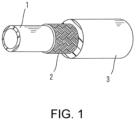
- FIG. 1 is a configuration diagram showing an example of a vehicle coolant transport hose according to the disclosure.
- X and/or Y (X, Y are arbitrary configurations) means at least one of X and Y, and can mean X only, Y only, or X and Y, in three ways.
- a rubber composition for a vehicle coolant transport hose (hereinafter referred to as "the rubber composition") in one embodiment of the disclosure is a sulfur-vulcanized rubber composition containing an ethylene-propylene copolymer rubber (A) as a main component and a vulcanization accelerator (B).
- the vulcanization accelerator (B) contains at least one selected from a group consisting of (B-1) to (B-3) below, a total amount of (B-1) to (B-3) is 3.25 parts by mass or less per 100 parts by mass of the ethylene-propylene copolymer rubber (A), and a total amount of (B-1) to (B-3) is 75% by mass or more of the vulcanization accelerator (B) as a whole.
- the “main component” here refers to the component that has a significant effect on the properties of the rubber composition, and usually indicates that more than 50% by mass of the rubber composition as a whole (excluding fillers such as carbon black) is ethylene-propylene copolymer rubber (A).
- a vehicle coolant transport hose (hereinafter referred to as "the hose"), which is one embodiment of the disclosure, is a vehicle coolant transport hose including at least one constituent layer in which an innermost layer includes a vulcanizate of the rubber composition.
- examples of the hose include a hose having a three-layer structure in which a rubber inner layer 1 made of the vulcanizate of the rubber composition, a reinforcing yarn layer 2, and a rubber outer layer 3 are laminated sequentially and a hose having a single-layer structure in which only a rubber layer made of the vulcanizate of the rubber composition is provided.
- the rubber outer layer 3 may be a rubber layer made of a vulcanizate of the rubber composition or a rubber layer made of a vulcanizate of other rubber composition. However, in the case where the rubber outer layer 3 is to be adhesivelessly interlaminated with the rubber inner layer 1 through the mesh of the reinforcing yarn layer 2, the rubber outer layer 3 is preferably a rubber layer made of a vulcanizate of the rubber composition.
- ethylene-propylene copolymer rubber (A) used in the rubber composition examples include an ethylene-propylene-diene ternary copolymer rubber (EPDM) and an ethylene-propylene copolymer rubber (EPM), and these materials may be used alone or two or more thereof may be used in combination.
- EPDM ethylene-propylene-diene ternary copolymer rubber
- EPM ethylene-propylene copolymer rubber
- the ethylene-propylene copolymer rubber (A), for example, preferably has an ethylene content of 50 to 70% by mass, more preferably 52 to 58% by mass.
- the EPDM preferably has a diene content of 3% by mass or more, more preferably 4 to 5.5% by mass.
- diene monomers having a carbon number of 5 to 20 are preferably used, specifically, examples include 1,4-pentadiene, 1,4-hexadiene, 1,5-hexadiene, 2,5-dimethyl-1,5-hexadiene, 1,4-octadiene, 1,4-cyclohexadiene, cyclooctadiene, dicyclopentadiene (DCP), 5-ethylidene-2-norbornene (ENB), 5-vinyl-2-norbornene (VNB), 5-butylidene-2-norbornene, 2-methallyl-5-norbornene, 2-isopropenyl-5-norbornene, etc. These materials may be used alone or two or more thereof may be used in combination.
- the rubber composition is sulfur-vulcanized, a sulfur vulcanizing agent is used as the vulcanizing agent.
- sulfur vulcanizing agent examples include sulfur such as powdered sulfur, surface-treated sulfur, precipitated sulfur, colloidal sulfur, and insoluble sulfur, and sulfur compounds that can act as sulfur donor such as sulfur chloride, 2-mercaptoimidazoline, dipentamethylenethiuram pentasulfide (excluding those corresponding to the vulcanization accelerators). These materials may be used alone or two or more thereof may be used in combination.
- the content of the sulfur vulcanizing agent is preferably in the range of 0.1 to 3.0 parts by mass per 100 parts by mass of the ethylene-propylene copolymer rubber (A), more preferably in the range of 0.3 to 1.2 parts by mass.
- the amount of sulfur vulcanizing agent is too small, vulcanization is insufficient, and hose strength becomes inferior.
- the amount of sulfur vulcanizing agent is too much, the hose tends to become too hard and less flexible, and the scorch time tends to shorten, resulting in poor processability.
- the vulcanization accelerator (B) indicates all vulcanization accelerators used in the rubber composition, and as described above, the vulcanization accelerator (B) contains at least one selected from a group consisting of (B-1) to (B-3) below. Then, the vulcanization accelerator (B) is added in such a proportion that the total amount of (B-1) to (B-3) is 3.25 parts by mass or less per 100 parts by mass of the ethylene-propylene copolymer rubber (A), and in such a proportion that the total amount of (B-1) to (B-3) is 75% by mass or more of the vulcanization accelerator (B) as a whole.
- the rubber composition is possible to suppress the extraction of unreacted excess residues and decomposition products of the vulcanization accelerator into the coolant, and solving clogging of the filter of the vehicle cooling system and various issues associated with increased coolant conductivity caused by these extracts (extracted components).
- the total amount of (B-1) to (B-3) in the rubber composition is preferably in the range of 2.0 to 3.25 parts by mass per 100 parts by mass of the ethylene-propylene copolymer rubber (A).
- the total amount of (B-1) to (B-3) in the rubber composition is preferably 80% by mass or more, and especially preferably 100% by mass (where the vulcanization accelerator (B) includes only (B-1), (B-2), and/or (B-3)) of the vulcanization accelerator (B) as a whole.
- the molecular weight of (B-1) is preferably 400 or more.
- the molecular weight of (B-1) is usually 1000 or less, preferably 670 or less.
- Examples of those corresponding to the dithiocarbamate vulcanization accelerators of (B-1) include zinc dibutyldithiocarbamate, zinc N-pentamethylene dithiocarbamate, zinc dibenzyldithiocarbamate, zinc N-ethyl-N-phenyldithiocarbamate, etc. These materials may be used alone or two or more thereof may be used in combination.
- the molecular weight of (B-2) is preferably 400 or more.
- the molecular weight of (B-2) is usually 1000 or less, preferably 700 or less.
- Examples of those corresponding to the thiuram vulcanization accelerator of (B-2) include tetrabutylthiuram disulfide, tetrakis(2-ethylhexyl)thiuram disulfide, dipentamethylenethiuram tetrasulfide, N,N,N',N'-tetrabenzylthiuram disulfide, etc. These materials may be used alone or two or more thereof may be used in combination. Particularly, tetrakis(2-ethylhexyl)thiuram disulfide and dipentamethylenethiuram tetrasulfide are preferred.
- the vulcanization accelerator (B) contains at least a vulcanization accelerator selected from a group consisting of (B-1) and (B-2), where the molecular weight of (B-1) and/or (B-2) is preferably 400 or more, and the total amount of (B-1) and (B-2) is preferably 75% by mass or more of the vulcanization accelerator (B) as a whole.
- the total amount of (B-1) and (B-2) in the rubber composition is preferably 80% by mass or more, and especially preferably 100% by mass (where the vulcanization accelerator (B) includes only (B-1) and/or (B-2)) of the vulcanization accelerator (B) as a whole.
- Examples of those corresponding to the sulfenamide vulcanization accelerator of (B-3) include N-cyclohexyl-2-benzothiazolylsulfenamide, N-oxydiethylene-2-benzothiazolylsulfenamide, N-t-butyl-2-benzothiazoylsulfenamide, N,N'-dicyclohexyl-2-benzothiazoylsulfenamide, etc. These materials may be used alone or two or more thereof may be used in combination. Particularly, N-cyclohexyl-2-benzothiazolylsulfenamide is preferred.
- vulcanization accelerators examples include dithiocarbamate vulcanization accelerators having a molecular weight of less than 380 (zinc dimethyldithiocarbamate, zinc diethyldithiocarbamate, etc.), thiuram vulcanization accelerators having a molecular weight of less than 380 (tetramethylthiuram disulfide, tetraethylthiuram disulfide, tetramethylthiuram monosulfide, etc.), thiazole vulcanization accelerators (di-2-benzothiazolyl disulfide, dibenzothiazyl disulfide, 2-mercaptobenzothiazole, 2-mercaptobenzothiazole sodium salt, 2-mercaptobenzothiazole zinc salt, etc.), aldehyde ammonia vulcanization accelerators, aldehyde amine vulcanization accelerators, guanidine vulcanization accelerators, thiourea vulcanization
- the thiuram vulcanization accelerators having a molecular weight of less than 380 (tetramethylthiuram disulfide, tetraethylthiuram disulfide, etc.) not be used (not included) in the disclosure due to a high possibility of interfering with the solution of the issues of the disclosure.
- the thiazole vulcanization accelerators also not be used (not included) or that the content be suppressed to less than 20% by mass of the vulcanization accelerator (B) as a whole.
- the rubber composition may be blended with acid acceptors, adsorbents, pH adjusters, fillers, vulcanization aids, process oils, anti-aging agents, etc., as necessary.
- Examples of the acid acceptor include magnesium oxide, calcium hydroxide, hydrotalcite, etc. These materials may be used alone or two or more thereof may be used in combination.
- Examples of the adsorbent include Lionite SF manufactured by Lion Corporation.
- pH adjuster examples include diethylene glycol, polyethylene glycol, alum, etc. These materials may be used alone or two or more thereof may be used in combination.
- the filler examples include carbon black, calcium carbonate, talc, etc. These materials may be used alone or two or more thereof may be used in combination. Particularly, carbon black is preferred due to the ability to effectively increase mechanical strength, such as tensile strength.
- the content of the filler is preferably in the range of 5 to 350 parts by mass, more preferably in the range of 80 to 250 parts by mass per 100 parts by mass of the ethylene-propylene copolymer rubber (A).
- vulcanizing aid examples include zinc white (zinc oxide), stearic acid, etc. These materials may be used alone or two or more thereof may be used in combination.
- the content of the vulcanizing aid is preferably in the range of 1 to 25 parts by mass, more preferably in the range of 3 to 8 parts by mass, per 100 parts by mass of the ethylene-propylene copolymer rubber (A).
- the content of the process oil is preferably in the range of 5 to 140 parts by mass, more preferably in the range of 30 to 90 parts by mass per 100 parts by mass of the ethylene-propylene copolymer rubber (A).
- the rubber composition can be prepared, for example, by blending the ethylene-propylene copolymer rubber (A) with acid acceptors, adsorbents, pH adjusters, fillers, vulcanization aids, process oils, anti-aging agents, etc., as necessary, and kneading these materials by using kneading machines such as kneaders, Banbury mixers, rolls, etc., and then adding and kneading the sulfur vulcanizing agent and the specific vulcanization accelerator (B).
- kneading machines such as kneaders, Banbury mixers, rolls, etc.
- the hose may be produced, for example, in the following manner using the rubber composition prepared as described above.
- the rubber composition prepared as described above is extruded into a hose shape to produce an unvulcanized hose. It is also possible to produce an unvulcanized hose by inserting a mandrel into the unvulcanized hose or by extruding the rubber composition on a straight-shaped mandrel.
- the unvulcanized hose is heated and vulcanized under predetermined conditions (140 to 160 °C for 30 to 60 minutes), and in the case where a mandrel is used, the desired hose may be produced by pulling out the mandrel.
- the reinforcing yarn layer 2 is formed by, for example, braiding reinforcing yarn on the outer circumferential surface of the hose with a predetermined number of pulls and number of strokes.
- an adhesive is coated on the above-mentioned reinforcing yarn layer 2 by dipping, spraying, roll coating, brushing, or other methods, the rubber composition for forming the rubber outer layer 3 is extruded on the coated surface (or on the reinforcing yarn layer 2), and a laminate (hose structure) in an unvulcanized state is produced.
- the laminate (hose structure) in the unvulcanized state so obtained is heated and vulcanized under predetermined conditions (140 to 160 °C for 30 to 60 minutes), and in the case where a mandrel is used, the desired hose may be produced by pulling out the mandrel.
- the hose may also be formed into the desired bent pipe shape.
- the hose so obtained may have a single-layer structure or a multi-layer structure in which two or more layers are laminated, but there is no particular limitation, it is preferable that, from the viewpoint of favorably obtaining the action and effect of the present disclosure as described above, at least the innermost layer (in the case of a single-layer structure, that single layer) is made of the rubber composition.
- the thickness of the innermost layer is preferably 0.25 to 10 mm, more preferably 0.5 to 5 mm. Further, as shown in FIG. 1 , in the case where the rubber outer layer 3 is provided, the thickness thereof is preferably 0.25 to 10 mm, more preferably 0.5 to 5 mm. Further, the inner diameter of the hose is preferably 5 to 60 mm, more preferably 10 to 40 mm.
- the hose may demonstrate excellent performance as, for example, a radiator hose, a heater hose, a coolant transport hose for fuel cell systems, a drain hose, and other vehicle coolant transport hoses.
- the conductivity of the extracted solution in the container at 25°C was measured using a conductivity meter (manufactured by HORIBA Advanced Techno, Co., Ltd., D-210PC-S).
- the rubber composition for a vehicle coolant transport hose of the present disclosure may be used as a rubber composition for a vehicle coolant transport hose such as a radiator hose, a heater hose, a coolant transport hose for fuel cell systems, and a drain hose.
- vehicle coolant transport hose is preferably used not only for automobiles but also for other transportation machines (industrial transportation vehicles such as airplanes, forklifts, shovel cars, cranes, and railway vehicles), vending machines, etc.
Landscapes
- Chemical & Material Sciences (AREA)
- Engineering & Computer Science (AREA)
- Health & Medical Sciences (AREA)
- Chemical Kinetics & Catalysis (AREA)
- Medicinal Chemistry (AREA)
- Polymers & Plastics (AREA)
- Organic Chemistry (AREA)
- Mechanical Engineering (AREA)
- General Engineering & Computer Science (AREA)
- Combustion & Propulsion (AREA)
- Compositions Of Macromolecular Compounds (AREA)
Abstract
Description
- The disclosure relates to a rubber composition for a vehicle coolant transport hose and a vehicle coolant transport hose obtained using the same. Specifically, the disclosure relates to an improvement technology for vehicle coolant transport hoses used in connection between an engine and a radiator, a connection between an engine and a heater core, a fuel cell system, etc., in various vehicles such as automobiles.
- Ethylene-propylene copolymer rubber, which is excellent in water resistance, is generally used as a forming material for vehicle hoses through which coolant mixed with antifreeze (LLC) flows (vehicle coolant transport hoses). In addition to the ethylene-propylene copolymer rubber, the forming material usually contains fillers such as carbon black, softening agents such as process oil, vulcanizing agents, vulcanization accelerators, and the like, and a desired coolant transport hose is formed using the rubber composition obtained by kneading the foregoing.
- When the ethylene-propylene copolymer rubber as described above is used as the main material, there are two types of vulcanization modes, which are "sulfur vulcanization" and "peroxide vulcanization" (e.g., see
Patent Documents -
- Patent Document 1: International Publication No.
2019/107415. - Patent Document 2: Japanese Patent Application Laid-Open (
JP-A) No. H06-262728 - As for the hose material, for example, it is common to adopt the specification of "sulfur vulcanization", which is advantageous in terms of cost, etc., as described in
Patent Document 1. However, in a hose using a sulfur-vulcanized ethylene-propylene copolymer rubber composition, the rubber contains unreacted excess residues of the vulcanization accelerator used in sulfur vulcanization and decomposition products of the vulcanization accelerator. - In a conventional vehicle coolant transport hose that uses a sulfur-vulcanized ethylene-propylene copolymer rubber composition, due to contact with the coolant flowing inside the hose, it can be seen that the components as described above (unreacted excess residues of the vulcanization accelerator and decomposition products of the vulcanization accelerator) tend to be extracted (eluted) into the coolant. When such a phenomenon occurs, some of the extracted components react with the compounds in the coolant to generate new compounds, which may result in adverse effects such as clogging of filters in the vehicle cooling system to which the hose is connected.
- In addition, there is concern that the extracted components may increase the conductivity of the coolant, which may cause various issues (deterioration of the hose, spark ignition, etc.).
- Furthermore, in recent years, a power generation method using a fuel cell system (especially a solid polymer fuel cell) has been viewed as a promising next-generation power generation method for various vehicles such as automobiles. It is said that the performance of the power generation site in this fuel cell system is significantly degraded by foreign mixed substances such as sulfur or metal ions. Thus, among hoses or piping members such as the coolant transport hose used in such fuel cell systems, clean ones exhibiting low extractability (the property of being difficult to extract by the coolant, such as water flowing through the hose) are required.
- On the other hand, the hose described in
Patent Document 2 is a hose using a peroxide-vulcanized ethylene-propylene copolymer rubber composition, which does not cause the above-mentioned issues due to the extracted components, but is disadvantageous in terms of cost and easily causes insufficient vulcanization, and there are many other issues to be addressed. - The disclosure is made in view of the above circumstances and provides a rubber composition for a vehicle coolant transport hose and a vehicle coolant transport hose obtained using the same, which may solve various issues, such as clogging of the filter of a vehicle cooling system and issues associated with the increased coolant conductivity, which are conventionally observed when a sulfur-vulcanized ethylene-propylene copolymer rubber composition is used as a material for a vehicle coolant transport hose.
- The inventors have conducted extensive research on the rubber composition for vehicle coolant transport hoses to address the above issue. In the course of the research, the inventors paid attention to vulcanization accelerators used in the sulfur-vulcanized ethylene-propylene copolymer rubber composition. Many of the vulcanization accelerators conventionally used in the sulfur-vulcanized ethylene-propylene copolymer rubber compositions have low molecular weights, and the unreacted excess residues and decomposition products thereof tend to be extracted (eluted) into the coolant as mentioned above. The inventors conducted various experiments and found that when a specific vulcanization accelerator was used as the vulcanization accelerator (at least one vulcanization accelerator selected from the group consisting of a dithiocarbamate vulcanization accelerator having a molecular weight of 380 or more (B-1), a thiuram vulcanization accelerator having a molecular weight of 380 or more (B-2), and a sulfenamide vulcanization accelerator (B-3)) in a specific proportion, extraction (elution) into the coolant as described above was suppressed without impairing the properties and functions required for the vehicle coolant transport hose, and issues such as clogging of the filters of the vehicle cooling systems and increased coolant conductivity could be eliminated.
- However, the gist of the disclosure is [1] to [5] as follows.
- [1] A sulfur-vulcanized rubber composition for a vehicle coolant transport hose, containing an ethylene-propylene copolymer rubber (A) as a main component and a vulcanization accelerator (B). The vulcanization accelerator (B) contains at least one selected from a group consisting of (B-1) to (B-3) below,
- a total amount of (B-1) to (B-3) is 3.25 parts by mass or less per 100 parts by mass of the ethylene-propylene copolymer rubber (A), and
- a total amount of (B-1) to (B-3) is 75% by mass or more of the vulcanization accelerator (B) as a whole.
- (B-1) is a dithiocarbamate vulcanization accelerator having a molecular weight of 380 or more,
- (B-2) is a thiuram vulcanization accelerator having a molecular weight of 380 or more, and
- (B-3) a sulfenamide vulcanization accelerator.
- [2] The rubber composition for the vehicle coolant transport hose described in [1], where (B-1) is a dithiocarbamate vulcanization accelerator having a molecular weight of 400 or more.
- [3] The rubber composition for the vehicle coolant transport hose described in [1] or [2], where (B-2) is a thiuram vulcanization accelerator having a molecular weight of 400 or more.
- [4] The rubber composition for the coolant transport hose for the vehicle described in [2] or [3], where the vulcanization accelerator (B) contains at least a vulcanization accelerator selected from a group consisting of (B-1) and (B-2), and the total amount of (B-1) and (B-2) is 75% by mass or more of the vulcanization accelerator (B) as a whole.
- [5] A vehicle coolant transport hose, including at least one constituent layer in which an innermost layer includes a vulcanizate of the rubber composition for the vehicle coolant transport hose described in any one of [1] to [4].
- In the disclosure, the rubber composition for a vehicle coolant transport hose is a sulfur-vulcanized rubber composition, which is advantageous in terms of cost, etc., and the rubber composition contains a specific vulcanization accelerator in a specific proportion. Thus, it is possible to suppress the extraction of unreacted excess residues and decomposition products of the vulcanization accelerator into the coolant, and solving clogging of the filter of the vehicle cooling system and various issues associated with the increased coolant conductivity caused by these extracts (extracted components).
- [
FIG. 1 ] is a configuration diagram showing an example of a vehicle coolant transport hose according to the disclosure. - In the following, the embodiments of the disclosure will be described in detail. However, the disclosure is not limited to such embodiments.
- It is noted that, in this specification, "X and/or Y (X, Y are arbitrary configurations)" means at least one of X and Y, and can mean X only, Y only, or X and Y, in three ways.
- A rubber composition for a vehicle coolant transport hose (hereinafter referred to as "the rubber composition") in one embodiment of the disclosure is a sulfur-vulcanized rubber composition containing an ethylene-propylene copolymer rubber (A) as a main component and a vulcanization accelerator (B). The vulcanization accelerator (B) contains at least one selected from a group consisting of (B-1) to (B-3) below, a total amount of (B-1) to (B-3) is 3.25 parts by mass or less per 100 parts by mass of the ethylene-propylene copolymer rubber (A), and a total amount of (B-1) to (B-3) is 75% by mass or more of the vulcanization accelerator (B) as a whole. The "main component" here refers to the component that has a significant effect on the properties of the rubber composition, and usually indicates that more than 50% by mass of the rubber composition as a whole (excluding fillers such as carbon black) is ethylene-propylene copolymer rubber (A).
- (B-1) is a dithiocarbamate vulcanization accelerator having a molecular weight of 380 or more,
- (B-2) is a thiuram vulcanization accelerator having a molecular weight of 380 or more, and
- (B-3) a sulfenamide vulcanization accelerator.
- Further, a vehicle coolant transport hose (hereinafter referred to as "the hose"), which is one embodiment of the disclosure, is a vehicle coolant transport hose including at least one constituent layer in which an innermost layer includes a vulcanizate of the rubber composition.
- As shown in
FIG. 1 , examples of the hose include a hose having a three-layer structure in which a rubberinner layer 1 made of the vulcanizate of the rubber composition, a reinforcingyarn layer 2, and a rubberouter layer 3 are laminated sequentially and a hose having a single-layer structure in which only a rubber layer made of the vulcanizate of the rubber composition is provided. - The rubber
outer layer 3 may be a rubber layer made of a vulcanizate of the rubber composition or a rubber layer made of a vulcanizate of other rubber composition. However, in the case where the rubberouter layer 3 is to be adhesivelessly interlaminated with the rubberinner layer 1 through the mesh of thereinforcing yarn layer 2, the rubberouter layer 3 is preferably a rubber layer made of a vulcanizate of the rubber composition. - Next, each component constituting the rubber composition will be described.
- Examples of the ethylene-propylene copolymer rubber (A) used in the rubber composition include an ethylene-propylene-diene ternary copolymer rubber (EPDM) and an ethylene-propylene copolymer rubber (EPM), and these materials may be used alone or two or more thereof may be used in combination.
- The ethylene-propylene copolymer rubber (A), for example, preferably has an ethylene content of 50 to 70% by mass, more preferably 52 to 58% by mass. The EPDM preferably has a diene content of 3% by mass or more, more preferably 4 to 5.5% by mass.
- For example, as the diene component of the EPDM, diene monomers having a carbon number of 5 to 20 are preferably used, specifically, examples include 1,4-pentadiene, 1,4-hexadiene, 1,5-hexadiene, 2,5-dimethyl-1,5-hexadiene, 1,4-octadiene, 1,4-cyclohexadiene, cyclooctadiene, dicyclopentadiene (DCP), 5-ethylidene-2-norbornene (ENB), 5-vinyl-2-norbornene (VNB), 5-butylidene-2-norbornene, 2-methallyl-5-norbornene, 2-isopropenyl-5-norbornene, etc. These materials may be used alone or two or more thereof may be used in combination.
- Since the rubber composition is sulfur-vulcanized, a sulfur vulcanizing agent is used as the vulcanizing agent.
- Examples of the sulfur vulcanizing agent include sulfur such as powdered sulfur, surface-treated sulfur, precipitated sulfur, colloidal sulfur, and insoluble sulfur, and sulfur compounds that can act as sulfur donor such as sulfur chloride, 2-mercaptoimidazoline, dipentamethylenethiuram pentasulfide (excluding those corresponding to the vulcanization accelerators). These materials may be used alone or two or more thereof may be used in combination.
- From the viewpoint of vulcanizability, the content of the sulfur vulcanizing agent is preferably in the range of 0.1 to 3.0 parts by mass per 100 parts by mass of the ethylene-propylene copolymer rubber (A), more preferably in the range of 0.3 to 1.2 parts by mass. In other words, in the case where the amount of sulfur vulcanizing agent is too small, vulcanization is insufficient, and hose strength becomes inferior. On the other hand, in the case where the amount of sulfur vulcanizing agent is too much, the hose tends to become too hard and less flexible, and the scorch time tends to shorten, resulting in poor processability.
- The vulcanization accelerator (B) indicates all vulcanization accelerators used in the rubber composition, and as described above, the vulcanization accelerator (B) contains at least one selected from a group consisting of (B-1) to (B-3) below. Then, the vulcanization accelerator (B) is added in such a proportion that the total amount of (B-1) to (B-3) is 3.25 parts by mass or less per 100 parts by mass of the ethylene-propylene copolymer rubber (A), and in such a proportion that the total amount of (B-1) to (B-3) is 75% by mass or more of the vulcanization accelerator (B) as a whole.
- (B-1) is a dithiocarbamate vulcanization accelerator having a molecular weight of 380 or more,
- (B-2) is a thiuram vulcanization accelerator having a molecular weight of 380 or more, and
- (B-3) a sulfenamide vulcanization accelerator.
- By containing specific vulcanization accelerators in specific proportions as described above, the rubber composition is possible to suppress the extraction of unreacted excess residues and decomposition products of the vulcanization accelerator into the coolant, and solving clogging of the filter of the vehicle cooling system and various issues associated with increased coolant conductivity caused by these extracts (extracted components).
- From the viewpoint of favorably obtaining the action and effect of the present disclosure as described above, the total amount of (B-1) to (B-3) in the rubber composition is preferably in the range of 2.0 to 3.25 parts by mass per 100 parts by mass of the ethylene-propylene copolymer rubber (A).
- In addition, from the viewpoint of favorably obtaining the action and effect of the present disclosure as described above, the total amount of (B-1) to (B-3) in the rubber composition is preferably 80% by mass or more, and especially preferably 100% by mass (where the vulcanization accelerator (B) includes only (B-1), (B-2), and/or (B-3)) of the vulcanization accelerator (B) as a whole.
- Here, from the viewpoint of favorably obtaining the action and effect of the present disclosure as described above, the molecular weight of (B-1) is preferably 400 or more. The molecular weight of (B-1) is usually 1000 or less, preferably 670 or less.
- Examples of those corresponding to the dithiocarbamate vulcanization accelerators of (B-1) include zinc dibutyldithiocarbamate, zinc N-pentamethylene dithiocarbamate, zinc dibenzyldithiocarbamate, zinc N-ethyl-N-phenyldithiocarbamate, etc. These materials may be used alone or two or more thereof may be used in combination.
- Further, from the viewpoint of favorably obtaining the action and effect of the present disclosure as described above, the molecular weight of (B-2) is preferably 400 or more. The molecular weight of (B-2) is usually 1000 or less, preferably 700 or less.
- Examples of those corresponding to the thiuram vulcanization accelerator of (B-2) include tetrabutylthiuram disulfide, tetrakis(2-ethylhexyl)thiuram disulfide, dipentamethylenethiuram tetrasulfide, N,N,N',N'-tetrabenzylthiuram disulfide, etc. These materials may be used alone or two or more thereof may be used in combination. Particularly, tetrakis(2-ethylhexyl)thiuram disulfide and dipentamethylenethiuram tetrasulfide are preferred.
- Furthermore, from the viewpoint of favorably obtaining the action and effect of the present disclosure as described above, the vulcanization accelerator (B) contains at least a vulcanization accelerator selected from a group consisting of (B-1) and (B-2), where the molecular weight of (B-1) and/or (B-2) is preferably 400 or more, and the total amount of (B-1) and (B-2) is preferably 75% by mass or more of the vulcanization accelerator (B) as a whole.
- Then, from the viewpoint described above, the total amount of (B-1) and (B-2) in the rubber composition is preferably 80% by mass or more, and especially preferably 100% by mass (where the vulcanization accelerator (B) includes only (B-1) and/or (B-2)) of the vulcanization accelerator (B) as a whole.
- Examples of those corresponding to the sulfenamide vulcanization accelerator of (B-3) include N-cyclohexyl-2-benzothiazolylsulfenamide, N-oxydiethylene-2-benzothiazolylsulfenamide, N-t-butyl-2-benzothiazoylsulfenamide, N,N'-dicyclohexyl-2-benzothiazoylsulfenamide, etc. These materials may be used alone or two or more thereof may be used in combination. Particularly, N-cyclohexyl-2-benzothiazolylsulfenamide is preferred.
- It is noted that even a vulcanization accelerator that does not correspond to the above (B-1) to (B-3) may be used in a small amount as the vulcanization accelerator (B).
- Examples of such vulcanization accelerators include dithiocarbamate vulcanization accelerators having a molecular weight of less than 380 (zinc dimethyldithiocarbamate, zinc diethyldithiocarbamate, etc.), thiuram vulcanization accelerators having a molecular weight of less than 380 (tetramethylthiuram disulfide, tetraethylthiuram disulfide, tetramethylthiuram monosulfide, etc.), thiazole vulcanization accelerators (di-2-benzothiazolyl disulfide, dibenzothiazyl disulfide, 2-mercaptobenzothiazole, 2-mercaptobenzothiazole sodium salt, 2-mercaptobenzothiazole zinc salt, etc.), aldehyde ammonia vulcanization accelerators, aldehyde amine vulcanization accelerators, guanidine vulcanization accelerators, thiourea vulcanization accelerators, etc. However, it is desirable that the thiuram vulcanization accelerators having a molecular weight of less than 380 (tetramethylthiuram disulfide, tetraethylthiuram disulfide, etc.) not be used (not included) in the disclosure due to a high possibility of interfering with the solution of the issues of the disclosure. For the same reason, in the disclosure, it is desirable that the thiazole vulcanization accelerators also not be used (not included) or that the content be suppressed to less than 20% by mass of the vulcanization accelerator (B) as a whole.
- In addition to the ethylene-propylene copolymer rubber (A), the sulfur vulcanizing agent, and the specific vulcanization accelerator (B), the rubber composition may be blended with acid acceptors, adsorbents, pH adjusters, fillers, vulcanization aids, process oils, anti-aging agents, etc., as necessary.
- Examples of the acid acceptor include magnesium oxide, calcium hydroxide, hydrotalcite, etc. These materials may be used alone or two or more thereof may be used in combination.
- Examples of the adsorbent include Lionite SF manufactured by Lion Corporation.
- Examples of the pH adjuster include diethylene glycol, polyethylene glycol, alum, etc. These materials may be used alone or two or more thereof may be used in combination.
- Examples of the filler include carbon black, calcium carbonate, talc, etc. These materials may be used alone or two or more thereof may be used in combination. Particularly, carbon black is preferred due to the ability to effectively increase mechanical strength, such as tensile strength.
- The content of the filler is preferably in the range of 5 to 350 parts by mass, more preferably in the range of 80 to 250 parts by mass per 100 parts by mass of the ethylene-propylene copolymer rubber (A).
- Examples of the vulcanizing aid include zinc white (zinc oxide), stearic acid, etc. These materials may be used alone or two or more thereof may be used in combination.
- The content of the vulcanizing aid is preferably in the range of 1 to 25 parts by mass, more preferably in the range of 3 to 8 parts by mass, per 100 parts by mass of the ethylene-propylene copolymer rubber (A).
- Examples of the process oil include naphthenic oils, paraffin oils, aroma oils, etc. These materials may be used alone or two or more thereof may be used in combination. Particularly, naphthenic oils and paraffinic oils are preferred due to their excellent tensile strength and workability.
- The content of the process oil is preferably in the range of 5 to 140 parts by mass, more preferably in the range of 30 to 90 parts by mass per 100 parts by mass of the ethylene-propylene copolymer rubber (A).
- Examples of the anti-aging agent include carbamate-based, phenylenediamine-based, phenol-based, diphenylamine-based, quinoline-based anti-aging agents, waxes, etc. These materials may be used alone or two or more thereof may be used in combination.
- The rubber composition can be prepared, for example, by blending the ethylene-propylene copolymer rubber (A) with acid acceptors, adsorbents, pH adjusters, fillers, vulcanization aids, process oils, anti-aging agents, etc., as necessary, and kneading these materials by using kneading machines such as kneaders, Banbury mixers, rolls, etc., and then adding and kneading the sulfur vulcanizing agent and the specific vulcanization accelerator (B).
- The hose may be produced, for example, in the following manner using the rubber composition prepared as described above.
- That is, first, the rubber composition prepared as described above is extruded into a hose shape to produce an unvulcanized hose. It is also possible to produce an unvulcanized hose by inserting a mandrel into the unvulcanized hose or by extruding the rubber composition on a straight-shaped mandrel.
- To produce a single-layer hose, the unvulcanized hose is heated and vulcanized under predetermined conditions (140 to 160 °C for 30 to 60 minutes), and in the case where a mandrel is used, the desired hose may be produced by pulling out the mandrel.
- In the case where the layer composition such that a reinforcing
yarn layer 2 is provided between the rubberinner layer 1 and the rubberouter layer 3, as in the hose shown inFIG. 1 , after producing an unvulcanized hose of the rubber composition as described above, the reinforcingyarn layer 2 is formed by, for example, braiding reinforcing yarn on the outer circumferential surface of the hose with a predetermined number of pulls and number of strokes. After that, as necessary, an adhesive is coated on the above-mentioned reinforcingyarn layer 2 by dipping, spraying, roll coating, brushing, or other methods, the rubber composition for forming the rubberouter layer 3 is extruded on the coated surface (or on the reinforcing yarn layer 2), and a laminate (hose structure) in an unvulcanized state is produced. The laminate (hose structure) in the unvulcanized state so obtained is heated and vulcanized under predetermined conditions (140 to 160 °C for 30 to 60 minutes), and in the case where a mandrel is used, the desired hose may be produced by pulling out the mandrel. - It is noted that by using one with a predetermined bent pipe shape as the mandrel, the hose may also be formed into the desired bent pipe shape.
- The hose so obtained may have a single-layer structure or a multi-layer structure in which two or more layers are laminated, but there is no particular limitation, it is preferable that, from the viewpoint of favorably obtaining the action and effect of the present disclosure as described above, at least the innermost layer (in the case of a single-layer structure, that single layer) is made of the rubber composition.
- In the hose obtained as described above, the thickness of the innermost layer (in the case of a single-layer structure, that single layer) is preferably 0.25 to 10 mm, more preferably 0.5 to 5 mm. Further, as shown in
FIG. 1 , in the case where the rubberouter layer 3 is provided, the thickness thereof is preferably 0.25 to 10 mm, more preferably 0.5 to 5 mm. Further, the inner diameter of the hose is preferably 5 to 60 mm, more preferably 10 to 40 mm. - Given the above-mentioned action and effect, the hose may demonstrate excellent performance as, for example, a radiator hose, a heater hose, a coolant transport hose for fuel cell systems, a drain hose, and other vehicle coolant transport hoses.
- In the following, Examples are described together with Comparative Examples. However, the disclosure is not limited to the Examples.
- First, prior to the Examples and the Comparative Examples, a vulcanization accelerator corresponding to any of (i) to (iv) below was prepared.
- [(i) Dithiocarbamate vulcanization accelerator (B-1) having a molecular weight of 380 or more]
- SANCELER BZ (zinc dibutyldithiocarbamate, manufactured by Sanshin Chemical Industry Co. Ltd, molecular weight: 474)
- NOCCELER ZP (Zinc N-pentamethylene dithiocarbamate, manufactured by Ouchi Shinko Chemical Industrial Co., Ltd., molecular weight: 386)
- [(ii) Thiuram vulcanization accelerator (B-2) having a molecular weight of 380 or more] NOCCELER TOT-N (tetrakis(2-ethylhexyl)thiuram disulfide, manufactured by Ouchi Shinko Chemical Industrial Co., Ltd., molecular weight: 633)
NOCCELER TRA (dipentamethylenethiuram tetrasulfide, manufactured by Ouchi Shinko Chemical Industrial Co., Ltd., molecular weight: 385) - [(iii) Sulfenamide vulcanization accelerator (B-3)]
SANCELER CM-G (N-cyclohexyl-2-benzothiazolylsulfenamide, manufactured by Sanshin Chemical Industry Co. Ltd, molecular weight: 264) - [(iv) Vulcanization accelerator other than (B-1) to (B-3)]
- NOCCELER PZ (zinc dimethyldithiocarbamate, manufactured by Ouchi Shinko Chemical Industrial Co., Ltd., molecular weight: 306)
- SANCELER TT (tetramethylthiuram disulfide, manufactured by Sanshin Chemical Industry Co. Ltd, molecular weight: 240)
- 100 parts by mass of EPDM (manufactured by Sumitomo Chemical Co., Ltd., product name: Esprene 532, ethylene content: 51% by mass, diene content: 3.5% by mass) was blended with 120 parts by mass of SRF grade carbon black (manufactured by Cabot Japan K.K, product name: SPHERON 5200), 68 parts by mass of process oil (manufactured by Idemitsu Kosan Co., Ltd., product name: Diana Process Oil PW-380), 1 part by mass of stearic acid (manufactured by KAO Corporation), and 5 parts by mass of zinc oxide (manufactured by Mitsui Mining & Smelting Co., Ltd.), and was blended with 1.2 parts by mass of sulfur (manufactured by Tsurumi Chemical Industry Co., Ltd., product name: Sulfax T-10) and each of the above vulcanization accelerators in the proportions shown in Table 1 and Table 2 below. The obtained matter was kneaded using a Banbury mixer and an open roll to prepare a rubber composition (rubber composition for vehicle coolant transport hose).
- The rubber composition of the Examples and the Comparative Examples so obtained were used, and the respective properties were evaluated according to the following criteria. The results are also shown in Table 1 and Table 2 in the following.
- Each of the obtained rubber compositions was used and press-vulcanized at 160° C for 60 minutes to produce a vulcanized rubber sheet (sample) with a thickness of 2 mm. Subsequently, four 2.8 cm square rubber pieces were punched out from this rubber sheet. These four rubber pieces were sealed together with 100 ml of pure water (conductivity: 1.0 µS/cm) in a 100 ml container made of polypropylene with a lid and heat treated at 90° C for 336 hours to extract the components in the rubber pieces. Then, to observe the change in conductivity due to the components extracted into the pure water, the conductivity of the extracted solution in the container at 25°C was measured using a conductivity meter (manufactured by HORIBA Advanced Techno, Co., Ltd., D-210PC-S).
- It may be evaluated that the higher the conductivity, the more unreacted excess residues and decomposition products of the vulcanization accelerator in the sample were extracted. Thus, the evaluation of extraction amount (evaluation of low extractability) was performed according to the following criteria.
-
○ (very good): the measured value of the conductivity is less than 230 µS/cm
× (poor): the measured value of the conductivity is 230 µS/cm or more
[Table 1](parts by mass) Example 1 2 3 4 5 6 7 8 9 10 11 i SANCELER BZ 0.5 - 2 - 1 1 - 0.5 - - - i NOCCELER ZP - - - - - - - - 1 0.75 1.25 ii NOCCELER TOT-N 1 2 - - 1 - 1 - 0.5 - - ii NOCCELER TRA - - - - - - - 1 - 0.75 1.25 iii SANCELER CM-G 0.5 - - 2 - 1 1 0.5 0.5 0.5 0.5 iv NOCCELER PZ - - - - - - - - - - 0.7 iv SANCELER TT - - - - - - - - - - - [( i + ii + iii)/( i + ii + iii + iv)] × 100 (% by mass) 100 100 100 100 100 100 100 100 100 100 81 [( i + ii )/( i + ii + iii + iv )] × 100 (% by mass) 75 100 100 0 100 50 50 75 75 75 68 i + ii + iii (parts by mass) 2.0 2.0 2.0 2.0 2.0 2.0 2.0 2.0 2.0 2.0 3.0 Extraction amount (µS/cm) 22 19 19 54 17 31 25 53 59 96 213 Evaluation ○ ○ ○ ○ ○ ○ ○ ○ ○ ○ ○ [Table 2] (parts by mass) Comparative Example 1 2 3 4 i SANCELER BZ - - - - i NOCCELER ZP 1.5 1.25 1.25 - ii NOCCELER TOT-N - - - - ii NOCCELER TRA 1.5 1.25 1.25 - iii SANCELER CM-G 0.5 0.5 0.5 0.5 iv NOCCELER PZ 0.7 1.3 - 1.0 iv SANCELER TT - - 1.3 1.0 {( i + ii + iii)/( i + ii + iii + iv )} × 100 (% by mass) 83 70 70 20 {( i + ii )/( i + ii + iii + iv)} × 100 (% by mass) 71 58 58 0 i + ii + iii (parts by mass) 3.5 3.0 3.0 0.5 Extraction amount (µS/cm) 236 280 304 237 Evaluation × × × × - According to the results of Table 1 and Table 2, it may be seen that the type and proportion of the vulcanization accelerator in the rubber composition of the Examples satisfy the specified requirements of the disclosure, and as a result, the extraction amount of the unreacted excess residues and decomposition products of the vulcanization accelerator are suppressed. From this, a vehicle coolant transport hose having an innermost layer made of a vulcanizate of the rubber composition in the Examples is judged to have excellent low extractability, and may solve various issues (hose deterioration, spark ignition, etc.) caused by increased conductivity of the extracted solution.
- On the other hand, in the rubber composition of Comparative Example 1, the total amount of the vulcanization accelerators corresponding to (B-1) to (B-3) is too much (the amount of "i+ii+iii" is 3.5 parts by mass per 100 parts by mass of EPDM, which exceeds the 3.25 parts by mass specified in the disclosure), and the result is poor in terms of low extractability. In the rubber compositions of Comparative Examples 2 to 4, although the total amount of the vulcanization accelerators corresponding to (B-1) to (B-3) is suppressed, the proportion of the vulcanization accelerators corresponding to (B -1) to (B -3) to the vulcanization accelerator as a whole (the value of "{(i+ii+iii)/(i+ii+iii+iv)}×100" is less than 75% by mass), and the result is poor in terms of low extractability.
- In the above Examples, specific embodiments of the disclosure have been shown, but the above Examples are merely illustrative and should not be construed as limiting. Various modifications apparent to those skilled in the art are intended to be within the scope of the disclosure.
- The rubber composition for a vehicle coolant transport hose of the present disclosure may be used as a rubber composition for a vehicle coolant transport hose such as a radiator hose, a heater hose, a coolant transport hose for fuel cell systems, and a drain hose. The vehicle coolant transport hose is preferably used not only for automobiles but also for other transportation machines (industrial transportation vehicles such as airplanes, forklifts, shovel cars, cranes, and railway vehicles), vending machines, etc.
-
- 1 Rubber inner layer
- 2 Reinforcing yarn layer
- 3 Rubber outer layer
Claims (5)
- A sulfur-vulcanized rubber composition for a vehicle coolant transport hose, containing an ethylene-propylene copolymer rubber (A) as a main component and a vulcanization accelerator (B), whereinthe vulcanization accelerator (B) contains at least one selected from a group consisting of (B-1) to (B-3) below,a total amount of (B-1) to (B-3) is 3.25 parts by mass or less per 100 parts by mass of the ethylene-propylene copolymer rubber (A), anda total amount of (B-1) to (B-3) is 75% by mass or more of the vulcanization accelerator (B) as a whole, wherein:(B-1) is a dithiocarbamate vulcanization accelerator having a molecular weight of 380 or more,(B-2) is a thiuram vulcanization accelerator having a molecular weight of 380 or more, and(B-3) a sulfenamide vulcanization accelerator.
- The rubber composition for the vehicle coolant transport hose according to claim 1, wherein (B-1) is a dithiocarbamate vulcanization accelerator having a molecular weight of 400 or more.
- The rubber composition for the vehicle coolant transport hose according to claim 1 or 2, wherein (B-2) is a thiuram vulcanization accelerator having a molecular weight of 400 or more.
- The rubber composition for the coolant transport hose for the vehicle according to claim 2 or 3, wherein the vulcanization accelerator (B) contains at least a vulcanization accelerator selected from a group consisting of (B-1) and (B-2), and a total amount of (B-1) and (B-2) is 75% by mass or more of the vulcanization accelerator (B) as a whole.
- A vehicle coolant transport hose, comprising at least one constituent layer in which an innermost layer comprises a vulcanizate of the rubber composition for the vehicle coolant transport hose according to any one of claims 1 to 4.
Applications Claiming Priority (2)
| Application Number | Priority Date | Filing Date | Title |
|---|---|---|---|
| JP2021200355 | 2021-12-09 | ||
| PCT/JP2022/044345 WO2023106192A1 (en) | 2021-12-09 | 2022-12-01 | Rubber composition for vehicle coolant transport hose, and vehicle coolant transport hose obtained using same |
Publications (2)
| Publication Number | Publication Date |
|---|---|
| EP4428191A1 true EP4428191A1 (en) | 2024-09-11 |
| EP4428191A4 EP4428191A4 (en) | 2025-02-26 |
Family
ID=86730218
Family Applications (1)
| Application Number | Title | Priority Date | Filing Date |
|---|---|---|---|
| EP22904123.1A Pending EP4428191A4 (en) | 2021-12-09 | 2022-12-01 | Rubber composition for vehicle coolant transport hose, and vehicle coolant transport hose obtained using same |
Country Status (5)
| Country | Link |
|---|---|
| US (1) | US20240317912A1 (en) |
| EP (1) | EP4428191A4 (en) |
| JP (1) | JPWO2023106192A1 (en) |
| CN (1) | CN118355071A (en) |
| WO (1) | WO2023106192A1 (en) |
Families Citing this family (1)
| Publication number | Priority date | Publication date | Assignee | Title |
|---|---|---|---|---|
| JP2025102072A (en) * | 2023-12-26 | 2025-07-08 | 住友理工株式会社 | Composition for vehicle coolant transport hose and vehicle coolant transport hose |
Family Cites Families (9)
| Publication number | Priority date | Publication date | Assignee | Title |
|---|---|---|---|---|
| JP2530764B2 (en) * | 1991-05-10 | 1996-09-04 | 横浜ゴム株式会社 | Air-conditioner refrigerant hose |
| JP2809051B2 (en) | 1993-01-13 | 1998-10-08 | 東海ゴム工業株式会社 | Coolant transfer hose for vehicles |
| JPH06256600A (en) * | 1993-03-04 | 1994-09-13 | Bridgestone Corp | Rubber composition and rubber hose using the same |
| CA2190301A1 (en) * | 1995-11-22 | 1997-05-23 | Robert Joseph Noel Bernier | Curable ethylene-alpha olefin-diene elastomer |
| JP3766664B2 (en) * | 2003-04-18 | 2006-04-12 | 三井化学株式会社 | Rubber composition for building material gasket |
| JP5369690B2 (en) * | 2009-01-13 | 2013-12-18 | 株式会社ブリヂストン | Rubber composition for hose jacket |
| JP5027342B1 (en) * | 2011-09-12 | 2012-09-19 | 東海ゴム工業株式会社 | Manufacturing method of hose with protector layer |
| CN102432950B (en) * | 2011-09-28 | 2013-06-12 | 宁波市天基汽车部件有限公司 | Method for preparing cooling water pipe rubber material for automobile |
| CN111234388A (en) * | 2018-11-28 | 2020-06-05 | 宁海建新胶管有限公司 | High-temperature-resistant low-pressure-change radiator water pipe material vulcanized by sulfur system and preparation method thereof |
-
2022
- 2022-12-01 CN CN202280080355.9A patent/CN118355071A/en active Pending
- 2022-12-01 WO PCT/JP2022/044345 patent/WO2023106192A1/en not_active Ceased
- 2022-12-01 JP JP2022574645A patent/JPWO2023106192A1/ja active Pending
- 2022-12-01 EP EP22904123.1A patent/EP4428191A4/en active Pending
-
2024
- 2024-06-06 US US18/735,218 patent/US20240317912A1/en active Pending
Also Published As
| Publication number | Publication date |
|---|---|
| US20240317912A1 (en) | 2024-09-26 |
| CN118355071A (en) | 2024-07-16 |
| WO2023106192A1 (en) | 2023-06-15 |
| EP4428191A4 (en) | 2025-02-26 |
| JPWO2023106192A1 (en) | 2023-06-15 |
Similar Documents
| Publication | Publication Date | Title |
|---|---|---|
| CN101407602B (en) | Rubber composition for non-aqueous pipe for automobile and non-aqueous pipe using same | |
| EP1195244B1 (en) | Rubber hose | |
| JP6128550B2 (en) | hose | |
| US20240317912A1 (en) | Rubber composition for vehicle coolant transport hose, and vehicle coolant transport hose obtained using same | |
| JP2003278958A (en) | Hydrogen fuel transfer hose for fuel cell vehicles | |
| JPWO2012043372A1 (en) | Rubber composition for water-based hose and water-based hose obtained using the same | |
| CN101668645B (en) | Low air permeability laminate and pneumatic tire using same | |
| US6391963B1 (en) | Rubber composition and a fuel transporting hose for a vehicle | |
| CN113950502B (en) | Oil hose | |
| CN103228732B (en) | Refrigerant transporting hose | |
| EP3406665A1 (en) | Rubber composition for coolant transport hose, and coolant transport hose | |
| JP2013228081A (en) | Air conditioner hose | |
| JP2004002682A (en) | Rubber part which comes into contact with aqueous liquid | |
| DE112017005273B4 (en) | Hose for conducting a refrigerant | |
| US20090130358A1 (en) | Water hose and composition for hose | |
| JP4867311B2 (en) | Composition for vulcanized rubber and vulcanized product thereof | |
| JP5622506B2 (en) | Resin composition for refrigerant transport hose and refrigerant transport hose obtained by using the same | |
| JP5403419B2 (en) | Rubber composition for vulcanization for producing molded parts in direct contact with biodiesel fuel | |
| WO2024070076A1 (en) | Industrial hose | |
| JP4556333B2 (en) | Automotive hose | |
| JP2010071418A (en) | Refrigerant transportation hose | |
| CN111315816B (en) | Rubber composition for water system hose and water system hose obtained by using the same | |
| JP5719556B2 (en) | Rubber composition for water-based hose and water-based hose obtained using the same | |
| JP2005239776A (en) | Rubber composition and hose using the same | |
| JP2005187584A (en) | hose |
Legal Events
| Date | Code | Title | Description |
|---|---|---|---|
| STAA | Information on the status of an ep patent application or granted ep patent |
Free format text: STATUS: THE INTERNATIONAL PUBLICATION HAS BEEN MADE |
|
| PUAI | Public reference made under article 153(3) epc to a published international application that has entered the european phase |
Free format text: ORIGINAL CODE: 0009012 |
|
| STAA | Information on the status of an ep patent application or granted ep patent |
Free format text: STATUS: REQUEST FOR EXAMINATION WAS MADE |
|
| 17P | Request for examination filed |
Effective date: 20240603 |
|
| AK | Designated contracting states |
Kind code of ref document: A1 Designated state(s): AL AT BE BG CH CY CZ DE DK EE ES FI FR GB GR HR HU IE IS IT LI LT LU LV MC ME MK MT NL NO PL PT RO RS SE SI SK SM TR |
|
| A4 | Supplementary search report drawn up and despatched |
Effective date: 20250124 |
|
| RIC1 | Information provided on ipc code assigned before grant |
Ipc: F16L 11/04 20060101ALI20250120BHEP Ipc: C08K 5/44 20060101ALI20250120BHEP Ipc: C08K 5/40 20060101ALI20250120BHEP Ipc: C08K 5/39 20060101ALI20250120BHEP Ipc: C08K 3/06 20060101ALI20250120BHEP Ipc: C08L 23/16 20060101AFI20250120BHEP |
|
| DAV | Request for validation of the european patent (deleted) | ||
| DAX | Request for extension of the european patent (deleted) |