EP4427947A1 - Rfid-tag coating rubber composition, and tire - Google Patents
Rfid-tag coating rubber composition, and tire Download PDFInfo
- Publication number
- EP4427947A1 EP4427947A1 EP22889735.1A EP22889735A EP4427947A1 EP 4427947 A1 EP4427947 A1 EP 4427947A1 EP 22889735 A EP22889735 A EP 22889735A EP 4427947 A1 EP4427947 A1 EP 4427947A1
- Authority
- EP
- European Patent Office
- Prior art keywords
- rubber composition
- mass
- rubber
- rfid
- sulfur
- Prior art date
- Legal status (The legal status is an assumption and is not a legal conclusion. Google has not performed a legal analysis and makes no representation as to the accuracy of the status listed.)
- Pending
Links
- 229920001971 elastomer Polymers 0.000 title claims abstract description 235
- 239000005060 rubber Substances 0.000 title claims abstract description 235
- 239000000203 mixture Substances 0.000 title claims abstract description 162
- 239000011248 coating agent Substances 0.000 title claims abstract description 61
- 238000000576 coating method Methods 0.000 title claims abstract description 61
- NINIDFKCEFEMDL-UHFFFAOYSA-N Sulfur Chemical compound [S] NINIDFKCEFEMDL-UHFFFAOYSA-N 0.000 claims abstract description 66
- 229910052717 sulfur Inorganic materials 0.000 claims abstract description 66
- 239000011593 sulfur Substances 0.000 claims abstract description 66
- VYPSYNLAJGMNEJ-UHFFFAOYSA-N Silicium dioxide Chemical compound O=[Si]=O VYPSYNLAJGMNEJ-UHFFFAOYSA-N 0.000 claims abstract description 62
- ZRALSGWEFCBTJO-UHFFFAOYSA-N Guanidine Chemical compound NC(N)=N ZRALSGWEFCBTJO-UHFFFAOYSA-N 0.000 claims abstract description 44
- 238000004073 vulcanization Methods 0.000 claims abstract description 41
- 239000000377 silicon dioxide Substances 0.000 claims abstract description 31
- CHJJGSNFBQVOTG-UHFFFAOYSA-N N-methyl-guanidine Natural products CNC(N)=N CHJJGSNFBQVOTG-UHFFFAOYSA-N 0.000 claims abstract description 22
- SWSQBOPZIKWTGO-UHFFFAOYSA-N dimethylaminoamidine Natural products CN(C)C(N)=N SWSQBOPZIKWTGO-UHFFFAOYSA-N 0.000 claims abstract description 22
- OWRCNXZUPFZXOS-UHFFFAOYSA-N 1,3-diphenylguanidine Chemical group C=1C=CC=CC=1NC(=N)NC1=CC=CC=C1 OWRCNXZUPFZXOS-UHFFFAOYSA-N 0.000 claims description 6
- 238000005336 cracking Methods 0.000 abstract description 24
- 238000004891 communication Methods 0.000 abstract description 16
- 229920005989 resin Polymers 0.000 description 76
- 239000011347 resin Substances 0.000 description 76
- 239000003208 petroleum Substances 0.000 description 38
- 238000000034 method Methods 0.000 description 31
- 238000002156 mixing Methods 0.000 description 22
- 230000008569 process Effects 0.000 description 22
- 239000003921 oil Substances 0.000 description 21
- 235000019198 oils Nutrition 0.000 description 21
- 238000012360 testing method Methods 0.000 description 18
- 239000010426 asphalt Substances 0.000 description 17
- 238000004898 kneading Methods 0.000 description 15
- 239000003351 stiffener Substances 0.000 description 15
- 239000004636 vulcanized rubber Substances 0.000 description 15
- 239000011324 bead Substances 0.000 description 14
- 239000006229 carbon black Substances 0.000 description 12
- 238000000465 moulding Methods 0.000 description 12
- 239000002199 base oil Substances 0.000 description 11
- -1 glycerol ester Chemical class 0.000 description 10
- 150000003505 terpenes Chemical class 0.000 description 10
- 235000007586 terpenes Nutrition 0.000 description 10
- PPBRXRYQALVLMV-UHFFFAOYSA-N Styrene Chemical compound C=CC1=CC=CC=C1 PPBRXRYQALVLMV-UHFFFAOYSA-N 0.000 description 9
- 229920001568 phenolic resin Polymers 0.000 description 9
- 239000005011 phenolic resin Substances 0.000 description 9
- 230000007423 decrease Effects 0.000 description 8
- KXGFMDJXCMQABM-UHFFFAOYSA-N 2-methoxy-6-methylphenol Chemical compound [CH]OC1=CC=CC([CH])=C1O KXGFMDJXCMQABM-UHFFFAOYSA-N 0.000 description 7
- 230000006866 deterioration Effects 0.000 description 7
- 238000001125 extrusion Methods 0.000 description 7
- 238000005979 thermal decomposition reaction Methods 0.000 description 7
- 238000010792 warming Methods 0.000 description 7
- HECLRDQVFMWTQS-RGOKHQFPSA-N 1755-01-7 Chemical compound C1[C@H]2[C@@H]3CC=C[C@@H]3[C@@H]1C=C2 HECLRDQVFMWTQS-RGOKHQFPSA-N 0.000 description 6
- YBYIRNPNPLQARY-UHFFFAOYSA-N 1H-indene Chemical compound C1=CC=C2CC=CC2=C1 YBYIRNPNPLQARY-UHFFFAOYSA-N 0.000 description 6
- RSWGJHLUYNHPMX-UHFFFAOYSA-N Abietic-Saeure Natural products C12CCC(C(C)C)=CC2=CCC2C1(C)CCCC2(C)C(O)=O RSWGJHLUYNHPMX-UHFFFAOYSA-N 0.000 description 6
- KHPCPRHQVVSZAH-HUOMCSJISA-N Rosin Natural products O(C/C=C/c1ccccc1)[C@H]1[C@H](O)[C@@H](O)[C@@H](O)[C@@H](CO)O1 KHPCPRHQVVSZAH-HUOMCSJISA-N 0.000 description 6
- 150000001732 carboxylic acid derivatives Chemical class 0.000 description 6
- 239000003795 chemical substances by application Substances 0.000 description 6
- 125000002887 hydroxy group Chemical group [H]O* 0.000 description 6
- KHPCPRHQVVSZAH-UHFFFAOYSA-N trans-cinnamyl beta-D-glucopyranoside Natural products OC1C(O)C(O)C(CO)OC1OCC=CC1=CC=CC=C1 KHPCPRHQVVSZAH-UHFFFAOYSA-N 0.000 description 6
- 150000001334 alicyclic compounds Chemical class 0.000 description 5
- 150000001875 compounds Chemical class 0.000 description 5
- 230000000694 effects Effects 0.000 description 5
- 239000000025 natural resin Substances 0.000 description 5
- 230000000379 polymerizing effect Effects 0.000 description 5
- 229920003002 synthetic resin Polymers 0.000 description 5
- 239000000057 synthetic resin Substances 0.000 description 5
- 241000254043 Melolonthinae Species 0.000 description 4
- ISWSIDIOOBJBQZ-UHFFFAOYSA-N Phenol Chemical compound OC1=CC=CC=C1 ISWSIDIOOBJBQZ-UHFFFAOYSA-N 0.000 description 4
- 239000006087 Silane Coupling Agent Substances 0.000 description 4
- ZSWFCLXCOIISFI-UHFFFAOYSA-N cyclopentadiene Chemical compound C1C=CC=C1 ZSWFCLXCOIISFI-UHFFFAOYSA-N 0.000 description 4
- 238000004519 manufacturing process Methods 0.000 description 4
- 239000000047 product Substances 0.000 description 4
- QGJOPFRUJISHPQ-UHFFFAOYSA-N Carbon disulfide Chemical compound S=C=S QGJOPFRUJISHPQ-UHFFFAOYSA-N 0.000 description 3
- RRHGJUQNOFWUDK-UHFFFAOYSA-N Isoprene Chemical compound CC(=C)C=C RRHGJUQNOFWUDK-UHFFFAOYSA-N 0.000 description 3
- CTQNGGLPUBDAKN-UHFFFAOYSA-N O-Xylene Chemical compound CC1=CC=CC=C1C CTQNGGLPUBDAKN-UHFFFAOYSA-N 0.000 description 3
- XLOMVQKBTHCTTD-UHFFFAOYSA-N Zinc monoxide Chemical compound [Zn]=O XLOMVQKBTHCTTD-UHFFFAOYSA-N 0.000 description 3
- 239000010692 aromatic oil Substances 0.000 description 3
- 125000003118 aryl group Chemical group 0.000 description 3
- 239000003245 coal Substances 0.000 description 3
- 239000000306 component Substances 0.000 description 3
- 238000013329 compounding Methods 0.000 description 3
- 229920003244 diene elastomer Polymers 0.000 description 3
- 229920003049 isoprene rubber Polymers 0.000 description 3
- 238000012719 thermal polymerization Methods 0.000 description 3
- VZCYOOQTPOCHFL-UHFFFAOYSA-N trans-butenedioic acid Natural products OC(=O)C=CC(O)=O VZCYOOQTPOCHFL-UHFFFAOYSA-N 0.000 description 3
- 239000008096 xylene Substances 0.000 description 3
- GRWFGVWFFZKLTI-IUCAKERBSA-N (-)-α-pinene Chemical compound CC1=CC[C@@H]2C(C)(C)[C@H]1C2 GRWFGVWFFZKLTI-IUCAKERBSA-N 0.000 description 2
- OPNUROKCUBTKLF-UHFFFAOYSA-N 1,2-bis(2-methylphenyl)guanidine Chemical compound CC1=CC=CC=C1N\C(N)=N\C1=CC=CC=C1C OPNUROKCUBTKLF-UHFFFAOYSA-N 0.000 description 2
- IANQTJSKSUMEQM-UHFFFAOYSA-N 1-benzofuran Chemical compound C1=CC=C2OC=CC2=C1 IANQTJSKSUMEQM-UHFFFAOYSA-N 0.000 description 2
- SMZOUWXMTYCWNB-UHFFFAOYSA-N 2-(2-methoxy-5-methylphenyl)ethanamine Chemical compound COC1=CC=C(C)C=C1CCN SMZOUWXMTYCWNB-UHFFFAOYSA-N 0.000 description 2
- NIXOWILDQLNWCW-UHFFFAOYSA-N 2-Propenoic acid Natural products OC(=O)C=C NIXOWILDQLNWCW-UHFFFAOYSA-N 0.000 description 2
- BKOOMYPCSUNDGP-UHFFFAOYSA-N 2-methylbut-2-ene Chemical compound CC=C(C)C BKOOMYPCSUNDGP-UHFFFAOYSA-N 0.000 description 2
- XKRFYHLGVUSROY-UHFFFAOYSA-N Argon Chemical compound [Ar] XKRFYHLGVUSROY-UHFFFAOYSA-N 0.000 description 2
- IJGRMHOSHXDMSA-UHFFFAOYSA-N Atomic nitrogen Chemical compound N#N IJGRMHOSHXDMSA-UHFFFAOYSA-N 0.000 description 2
- 238000005698 Diels-Alder reaction Methods 0.000 description 2
- 239000004606 Fillers/Extenders Substances 0.000 description 2
- VZCYOOQTPOCHFL-OWOJBTEDSA-N Fumaric acid Chemical compound OC(=O)\C=C\C(O)=O VZCYOOQTPOCHFL-OWOJBTEDSA-N 0.000 description 2
- PEDCQBHIVMGVHV-UHFFFAOYSA-N Glycerol Natural products OCC(O)CO PEDCQBHIVMGVHV-UHFFFAOYSA-N 0.000 description 2
- 244000043261 Hevea brasiliensis Species 0.000 description 2
- 239000005062 Polybutadiene Substances 0.000 description 2
- OFOBLEOULBTSOW-UHFFFAOYSA-N Propanedioic acid Natural products OC(=O)CC(O)=O OFOBLEOULBTSOW-UHFFFAOYSA-N 0.000 description 2
- XXROGKLTLUQVRX-UHFFFAOYSA-N allyl alcohol Chemical compound OCC=C XXROGKLTLUQVRX-UHFFFAOYSA-N 0.000 description 2
- 238000004458 analytical method Methods 0.000 description 2
- 239000013043 chemical agent Substances 0.000 description 2
- 239000007795 chemical reaction product Substances 0.000 description 2
- 230000000052 comparative effect Effects 0.000 description 2
- 239000002131 composite material Substances 0.000 description 2
- 125000004185 ester group Chemical group 0.000 description 2
- 239000000945 filler Substances 0.000 description 2
- 238000009472 formulation Methods 0.000 description 2
- 229930195733 hydrocarbon Natural products 0.000 description 2
- XMGQYMWWDOXHJM-UHFFFAOYSA-N limonene Chemical compound CC(=C)C1CCC(C)=CC1 XMGQYMWWDOXHJM-UHFFFAOYSA-N 0.000 description 2
- VZCYOOQTPOCHFL-UPHRSURJSA-N maleic acid Chemical compound OC(=O)\C=C/C(O)=O VZCYOOQTPOCHFL-UPHRSURJSA-N 0.000 description 2
- 239000011976 maleic acid Substances 0.000 description 2
- 229910052751 metal Inorganic materials 0.000 description 2
- 239000002184 metal Substances 0.000 description 2
- NFWSQSCIDYBUOU-UHFFFAOYSA-N methylcyclopentadiene Chemical compound CC1=CC=CC1 NFWSQSCIDYBUOU-UHFFFAOYSA-N 0.000 description 2
- 239000000178 monomer Substances 0.000 description 2
- 229920003052 natural elastomer Polymers 0.000 description 2
- 229920001194 natural rubber Polymers 0.000 description 2
- 239000010690 paraffinic oil Substances 0.000 description 2
- YWAKXRMUMFPDSH-UHFFFAOYSA-N pentene Chemical compound CCCC=C YWAKXRMUMFPDSH-UHFFFAOYSA-N 0.000 description 2
- QMMOXUPEWRXHJS-UHFFFAOYSA-N pentene-2 Natural products CCC=CC QMMOXUPEWRXHJS-UHFFFAOYSA-N 0.000 description 2
- 150000002989 phenols Chemical class 0.000 description 2
- 229920001084 poly(chloroprene) Polymers 0.000 description 2
- 229920002857 polybutadiene Polymers 0.000 description 2
- 238000002360 preparation method Methods 0.000 description 2
- 239000002994 raw material Substances 0.000 description 2
- 239000000126 substance Substances 0.000 description 2
- 239000011787 zinc oxide Substances 0.000 description 2
- 235000014692 zinc oxide Nutrition 0.000 description 2
- WTARULDDTDQWMU-RKDXNWHRSA-N (+)-β-pinene Chemical compound C1[C@H]2C(C)(C)[C@@H]1CCC2=C WTARULDDTDQWMU-RKDXNWHRSA-N 0.000 description 1
- WTARULDDTDQWMU-IUCAKERBSA-N (-)-Nopinene Natural products C1[C@@H]2C(C)(C)[C@H]1CCC2=C WTARULDDTDQWMU-IUCAKERBSA-N 0.000 description 1
- KMOUUZVZFBCRAM-OLQVQODUSA-N (3as,7ar)-3a,4,7,7a-tetrahydro-2-benzofuran-1,3-dione Chemical compound C1C=CC[C@@H]2C(=O)OC(=O)[C@@H]21 KMOUUZVZFBCRAM-OLQVQODUSA-N 0.000 description 1
- PMJHHCWVYXUKFD-SNAWJCMRSA-N (E)-1,3-pentadiene Chemical compound C\C=C\C=C PMJHHCWVYXUKFD-SNAWJCMRSA-N 0.000 description 1
- ORTVZLZNOYNASJ-UPHRSURJSA-N (z)-but-2-ene-1,4-diol Chemical compound OC\C=C/CO ORTVZLZNOYNASJ-UPHRSURJSA-N 0.000 description 1
- KCNBAUKGODRNGM-UHFFFAOYSA-N 1,2-bis(2-propan-2-ylphenyl)guanidine Chemical compound CC(C)C1=CC=CC=C1NC(=N)NC1=CC=CC=C1C(C)C KCNBAUKGODRNGM-UHFFFAOYSA-N 0.000 description 1
- SQZCAOHYQSOZCE-UHFFFAOYSA-N 1-(diaminomethylidene)-2-(2-methylphenyl)guanidine Chemical compound CC1=CC=CC=C1N=C(N)N=C(N)N SQZCAOHYQSOZCE-UHFFFAOYSA-N 0.000 description 1
- KPAPHODVWOVUJL-UHFFFAOYSA-N 1-benzofuran;1h-indene Chemical compound C1=CC=C2CC=CC2=C1.C1=CC=C2OC=CC2=C1 KPAPHODVWOVUJL-UHFFFAOYSA-N 0.000 description 1
- JAHNSTQSQJOJLO-UHFFFAOYSA-N 2-(3-fluorophenyl)-1h-imidazole Chemical compound FC1=CC=CC(C=2NC=CN=2)=C1 JAHNSTQSQJOJLO-UHFFFAOYSA-N 0.000 description 1
- YRVRZDIWEXCJSX-UHFFFAOYSA-N 2-methyl-3-(3-triethoxysilylpropyl)thiirane-2-carboxylic acid Chemical compound CCO[Si](OCC)(OCC)CCCC1SC1(C)C(O)=O YRVRZDIWEXCJSX-UHFFFAOYSA-N 0.000 description 1
- HHZDRADWWVVISO-UHFFFAOYSA-N 2-methyl-3-(3-trimethoxysilylpropyl)thiirane-2-carboxylic acid Chemical compound CO[Si](OC)(OC)CCCC1SC1(C)C(O)=O HHZDRADWWVVISO-UHFFFAOYSA-N 0.000 description 1
- MHNNAWXXUZQSNM-UHFFFAOYSA-N 2-methylbut-1-ene Chemical compound CCC(C)=C MHNNAWXXUZQSNM-UHFFFAOYSA-N 0.000 description 1
- ROGIWVXWXZRRMZ-UHFFFAOYSA-N 2-methylbuta-1,3-diene;styrene Chemical compound CC(=C)C=C.C=CC1=CC=CC=C1 ROGIWVXWXZRRMZ-UHFFFAOYSA-N 0.000 description 1
- QTWJRLJHJPIABL-UHFFFAOYSA-N 2-methylphenol;3-methylphenol;4-methylphenol Chemical compound CC1=CC=C(O)C=C1.CC1=CC=CC(O)=C1.CC1=CC=CC=C1O QTWJRLJHJPIABL-UHFFFAOYSA-N 0.000 description 1
- DVNPFNZTPMWRAX-UHFFFAOYSA-N 2-triethoxysilylethanethiol Chemical compound CCO[Si](CCS)(OCC)OCC DVNPFNZTPMWRAX-UHFFFAOYSA-N 0.000 description 1
- LOSLJXKHQKRRFN-UHFFFAOYSA-N 2-trimethoxysilylethanethiol Chemical compound CO[Si](OC)(OC)CCS LOSLJXKHQKRRFN-UHFFFAOYSA-N 0.000 description 1
- QPISLCVEROXXQD-UHFFFAOYSA-N 3-(1,3-benzothiazol-2-yltetrasulfanyl)propyl-triethoxysilane Chemical compound C1=CC=C2SC(SSSSCCC[Si](OCC)(OCC)OCC)=NC2=C1 QPISLCVEROXXQD-UHFFFAOYSA-N 0.000 description 1
- HFGLXKZGFFRQAR-UHFFFAOYSA-N 3-(1,3-benzothiazol-2-yltetrasulfanyl)propyl-trimethoxysilane Chemical compound C1=CC=C2SC(SSSSCCC[Si](OC)(OC)OC)=NC2=C1 HFGLXKZGFFRQAR-UHFFFAOYSA-N 0.000 description 1
- LOOUJXUUGIUEBC-UHFFFAOYSA-N 3-(dimethoxymethylsilyl)propane-1-thiol Chemical compound COC(OC)[SiH2]CCCS LOOUJXUUGIUEBC-UHFFFAOYSA-N 0.000 description 1
- YHQXBTXEYZIYOV-UHFFFAOYSA-N 3-methylbut-1-ene Chemical compound CC(C)C=C YHQXBTXEYZIYOV-UHFFFAOYSA-N 0.000 description 1
- PAKGDPSCXSUALC-UHFFFAOYSA-N 3-methylbuta-1,2-diene Chemical compound CC(C)=C=C PAKGDPSCXSUALC-UHFFFAOYSA-N 0.000 description 1
- DCQBZYNUSLHVJC-UHFFFAOYSA-N 3-triethoxysilylpropane-1-thiol Chemical compound CCO[Si](OCC)(OCC)CCCS DCQBZYNUSLHVJC-UHFFFAOYSA-N 0.000 description 1
- UUEWCQRISZBELL-UHFFFAOYSA-N 3-trimethoxysilylpropane-1-thiol Chemical compound CO[Si](OC)(OC)CCCS UUEWCQRISZBELL-UHFFFAOYSA-N 0.000 description 1
- KXYDGGNWZUHESZ-UHFFFAOYSA-N 4-(2,2,4-trimethyl-3h-chromen-4-yl)phenol Chemical compound C12=CC=CC=C2OC(C)(C)CC1(C)C1=CC=C(O)C=C1 KXYDGGNWZUHESZ-UHFFFAOYSA-N 0.000 description 1
- IGFHQQFPSIBGKE-UHFFFAOYSA-N 4-nonylphenol Chemical compound CCCCCCCCCC1=CC=C(O)C=C1 IGFHQQFPSIBGKE-UHFFFAOYSA-N 0.000 description 1
- NTDQQZYCCIDJRK-UHFFFAOYSA-N 4-octylphenol Chemical compound CCCCCCCCC1=CC=C(O)C=C1 NTDQQZYCCIDJRK-UHFFFAOYSA-N 0.000 description 1
- QHPQWRBYOIRBIT-UHFFFAOYSA-N 4-tert-butylphenol Chemical compound CC(C)(C)C1=CC=C(O)C=C1 QHPQWRBYOIRBIT-UHFFFAOYSA-N 0.000 description 1
- ZSBKFEOSHGFEKJ-UHFFFAOYSA-N C1=CC=C2SC(SSSSCCC[SiH2]C(OC)OC)=NC2=C1 Chemical compound C1=CC=C2SC(SSSSCCC[SiH2]C(OC)OC)=NC2=C1 ZSBKFEOSHGFEKJ-UHFFFAOYSA-N 0.000 description 1
- FSPIGXNLDXWYKZ-UHFFFAOYSA-N CCO[Si](CCC[S+]=C(N(C)C)SSSSC(N(C)C)=[S+]CCC[Si](OCC)(OCC)OCC)(OCC)OCC Chemical compound CCO[Si](CCC[S+]=C(N(C)C)SSSSC(N(C)C)=[S+]CCC[Si](OCC)(OCC)OCC)(OCC)OCC FSPIGXNLDXWYKZ-UHFFFAOYSA-N 0.000 description 1
- SXLPVOKGQWNWFD-UHFFFAOYSA-N CCO[Si](CC[S+]=C(N(C)C)SSSSC(N(C)C)=[S+]CC[Si](OCC)(OCC)OCC)(OCC)OCC Chemical compound CCO[Si](CC[S+]=C(N(C)C)SSSSC(N(C)C)=[S+]CC[Si](OCC)(OCC)OCC)(OCC)OCC SXLPVOKGQWNWFD-UHFFFAOYSA-N 0.000 description 1
- ZZOXWBGGPBLVNQ-UHFFFAOYSA-N CN(C)C(SSSSC(N(C)C)=[S+]CCC[SiH2]C(OC)OC)=[S+]CCC[SiH2]C(OC)OC Chemical compound CN(C)C(SSSSC(N(C)C)=[S+]CCC[SiH2]C(OC)OC)=[S+]CCC[SiH2]C(OC)OC ZZOXWBGGPBLVNQ-UHFFFAOYSA-N 0.000 description 1
- SKFGZHGVWONCTD-UHFFFAOYSA-N CN(C)C(SSSSC(N(C)C)=[S+]CCC[Si](OC)(OC)OC)=[S+]CCC[Si](OC)(OC)OC Chemical compound CN(C)C(SSSSC(N(C)C)=[S+]CCC[Si](OC)(OC)OC)=[S+]CCC[Si](OC)(OC)OC SKFGZHGVWONCTD-UHFFFAOYSA-N 0.000 description 1
- 241000196324 Embryophyta Species 0.000 description 1
- 238000005727 Friedel-Crafts reaction Methods 0.000 description 1
- 239000004233 Indanthrene blue RS Substances 0.000 description 1
- 239000006057 Non-nutritive feed additive Substances 0.000 description 1
- 235000019482 Palm oil Nutrition 0.000 description 1
- 239000004735 Petcoal® Substances 0.000 description 1
- WTARULDDTDQWMU-UHFFFAOYSA-N Pseudopinene Natural products C1C2C(C)(C)C1CCC2=C WTARULDDTDQWMU-UHFFFAOYSA-N 0.000 description 1
- 241000872198 Serjania polyphylla Species 0.000 description 1
- 239000004902 Softening Agent Substances 0.000 description 1
- 235000021355 Stearic acid Nutrition 0.000 description 1
- QROGIFZRVHSFLM-QHHAFSJGSA-N [(e)-prop-1-enyl]benzene Chemical compound C\C=C\C1=CC=CC=C1 QROGIFZRVHSFLM-QHHAFSJGSA-N 0.000 description 1
- YKTSYUJCYHOUJP-UHFFFAOYSA-N [O--].[Al+3].[Al+3].[O-][Si]([O-])([O-])[O-] Chemical compound [O--].[Al+3].[Al+3].[O-][Si]([O-])([O-])[O-] YKTSYUJCYHOUJP-UHFFFAOYSA-N 0.000 description 1
- VUBQYTCIOHLJGQ-UHFFFAOYSA-N acetylene;4-tert-butylphenol Chemical group C#C.CC(C)(C)C1=CC=C(O)C=C1 VUBQYTCIOHLJGQ-UHFFFAOYSA-N 0.000 description 1
- 239000000853 adhesive Substances 0.000 description 1
- 230000001070 adhesive effect Effects 0.000 description 1
- 230000002411 adverse Effects 0.000 description 1
- 239000003570 air Substances 0.000 description 1
- 125000001931 aliphatic group Chemical group 0.000 description 1
- 150000001336 alkenes Chemical class 0.000 description 1
- 125000005907 alkyl ester group Chemical group 0.000 description 1
- XCPQUQHBVVXMRQ-UHFFFAOYSA-N alpha-Fenchene Natural products C1CC2C(=C)CC1C2(C)C XCPQUQHBVVXMRQ-UHFFFAOYSA-N 0.000 description 1
- XYLMUPLGERFSHI-UHFFFAOYSA-N alpha-Methylstyrene Chemical compound CC(=C)C1=CC=CC=C1 XYLMUPLGERFSHI-UHFFFAOYSA-N 0.000 description 1
- MVNCAPSFBDBCGF-UHFFFAOYSA-N alpha-pinene Natural products CC1=CCC23C1CC2C3(C)C MVNCAPSFBDBCGF-UHFFFAOYSA-N 0.000 description 1
- 239000012080 ambient air Substances 0.000 description 1
- 239000003963 antioxidant agent Substances 0.000 description 1
- 230000003078 antioxidant effect Effects 0.000 description 1
- 229910052786 argon Inorganic materials 0.000 description 1
- 150000001491 aromatic compounds Chemical class 0.000 description 1
- QVGXLLKOCUKJST-UHFFFAOYSA-N atomic oxygen Chemical compound [O] QVGXLLKOCUKJST-UHFFFAOYSA-N 0.000 description 1
- QZEWCQGGAIGUPS-UHFFFAOYSA-N benzene-1,2-diol;boric acid Chemical compound OB(O)O.OC1=CC=CC=C1O.OC1=CC=CC=C1O QZEWCQGGAIGUPS-UHFFFAOYSA-N 0.000 description 1
- 229930006722 beta-pinene Natural products 0.000 description 1
- 239000006227 byproduct Substances 0.000 description 1
- 239000000378 calcium silicate Substances 0.000 description 1
- 229910052918 calcium silicate Inorganic materials 0.000 description 1
- OYACROKNLOSFPA-UHFFFAOYSA-N calcium;dioxido(oxo)silane Chemical compound [Ca+2].[O-][Si]([O-])=O OYACROKNLOSFPA-UHFFFAOYSA-N 0.000 description 1
- 238000004364 calculation method Methods 0.000 description 1
- 239000003054 catalyst Substances 0.000 description 1
- 238000010538 cationic polymerization reaction Methods 0.000 description 1
- HNEGQIOMVPPMNR-IHWYPQMZSA-N citraconic acid Chemical compound OC(=O)C(/C)=C\C(O)=O HNEGQIOMVPPMNR-IHWYPQMZSA-N 0.000 description 1
- 229940018557 citraconic acid Drugs 0.000 description 1
- 238000004440 column chromatography Methods 0.000 description 1
- 239000013065 commercial product Substances 0.000 description 1
- 239000000470 constituent Substances 0.000 description 1
- 229920001577 copolymer Chemical class 0.000 description 1
- 235000012343 cottonseed oil Nutrition 0.000 description 1
- 239000002385 cottonseed oil Substances 0.000 description 1
- 229930003836 cresol Natural products 0.000 description 1
- IFDVQVHZEKPUSC-UHFFFAOYSA-N cyclohex-3-ene-1,2-dicarboxylic acid Chemical compound OC(=O)C1CCC=CC1C(O)=O IFDVQVHZEKPUSC-UHFFFAOYSA-N 0.000 description 1
- 230000002542 deteriorative effect Effects 0.000 description 1
- 150000001993 dienes Chemical class 0.000 description 1
- GSYVJAOBRKCNOT-UHFFFAOYSA-N diethoxymethyl-[3-[3-(diethoxymethylsilyl)propyltetrasulfanyl]propyl]silane Chemical compound CCOC(OCC)[SiH2]CCCSSSSCCC[SiH2]C(OCC)OCC GSYVJAOBRKCNOT-UHFFFAOYSA-N 0.000 description 1
- LRCFXGAMWKDGLA-UHFFFAOYSA-N dioxosilane;hydrate Chemical compound O.O=[Si]=O LRCFXGAMWKDGLA-UHFFFAOYSA-N 0.000 description 1
- 238000009826 distribution Methods 0.000 description 1
- 238000011156 evaluation Methods 0.000 description 1
- 230000001747 exhibiting effect Effects 0.000 description 1
- WSFSSNUMVMOOMR-UHFFFAOYSA-N formaldehyde Substances O=C WSFSSNUMVMOOMR-UHFFFAOYSA-N 0.000 description 1
- OIAUFEASXQPCFE-UHFFFAOYSA-N formaldehyde;1,3-xylene Chemical compound O=C.CC1=CC=CC(C)=C1 OIAUFEASXQPCFE-UHFFFAOYSA-N 0.000 description 1
- 239000001530 fumaric acid Substances 0.000 description 1
- LCWMKIHBLJLORW-UHFFFAOYSA-N gamma-carene Natural products C1CC(=C)CC2C(C)(C)C21 LCWMKIHBLJLORW-UHFFFAOYSA-N 0.000 description 1
- 239000007789 gas Substances 0.000 description 1
- 239000001307 helium Substances 0.000 description 1
- 229910052734 helium Inorganic materials 0.000 description 1
- SWQJXJOGLNCZEY-UHFFFAOYSA-N helium atom Chemical compound [He] SWQJXJOGLNCZEY-UHFFFAOYSA-N 0.000 description 1
- 230000000887 hydrating effect Effects 0.000 description 1
- 230000006872 improvement Effects 0.000 description 1
- 239000011261 inert gas Substances 0.000 description 1
- 230000003993 interaction Effects 0.000 description 1
- 238000010030 laminating Methods 0.000 description 1
- 239000007788 liquid Substances 0.000 description 1
- FPYJFEHAWHCUMM-UHFFFAOYSA-N maleic anhydride Chemical compound O=C1OC(=O)C=C1 FPYJFEHAWHCUMM-UHFFFAOYSA-N 0.000 description 1
- 239000000463 material Substances 0.000 description 1
- 238000005259 measurement Methods 0.000 description 1
- LVHBHZANLOWSRM-UHFFFAOYSA-N methylenebutanedioic acid Natural products OC(=O)CC(=C)C(O)=O LVHBHZANLOWSRM-UHFFFAOYSA-N 0.000 description 1
- 230000004048 modification Effects 0.000 description 1
- 238000012986 modification Methods 0.000 description 1
- 229910052757 nitrogen Inorganic materials 0.000 description 1
- 229920003986 novolac Polymers 0.000 description 1
- QIQXTHQIDYTFRH-UHFFFAOYSA-N octadecanoic acid Chemical compound CCCCCCCCCCCCCCCCCC(O)=O QIQXTHQIDYTFRH-UHFFFAOYSA-N 0.000 description 1
- OQCDKBAXFALNLD-UHFFFAOYSA-N octadecanoic acid Natural products CCCCCCCC(C)CCCCCCCCC(O)=O OQCDKBAXFALNLD-UHFFFAOYSA-N 0.000 description 1
- JRZJOMJEPLMPRA-UHFFFAOYSA-N olefin Natural products CCCCCCCC=C JRZJOMJEPLMPRA-UHFFFAOYSA-N 0.000 description 1
- 239000001301 oxygen Substances 0.000 description 1
- 229910052760 oxygen Inorganic materials 0.000 description 1
- 239000002540 palm oil Substances 0.000 description 1
- LVMTVPFRTKXRPH-UHFFFAOYSA-N penta-1,2-diene Chemical compound CCC=C=C LVMTVPFRTKXRPH-UHFFFAOYSA-N 0.000 description 1
- OCNVVYBTRKWBCO-JUZPTULESA-N petrosin Chemical compound C([C@@H]1CCCN2C[C@@H](C([C@H]([C@H]21)CCCCC1)=O)C)CCCC[C@@H]2C(=O)[C@@H](C)CN3CCC[C@@H]1[C@@H]32 OCNVVYBTRKWBCO-JUZPTULESA-N 0.000 description 1
- OCNVVYBTRKWBCO-UHFFFAOYSA-N petrosin-B Natural products C1CCCCC(C23)C(=O)C(C)CN2CCCC3CCCCCC2C(=O)C(C)CN3CCCC1C32 OCNVVYBTRKWBCO-UHFFFAOYSA-N 0.000 description 1
- 230000000704 physical effect Effects 0.000 description 1
- PMJHHCWVYXUKFD-UHFFFAOYSA-N piperylene Natural products CC=CC=C PMJHHCWVYXUKFD-UHFFFAOYSA-N 0.000 description 1
- 229920001083 polybutene Polymers 0.000 description 1
- HJWLCRVIBGQPNF-UHFFFAOYSA-N prop-2-enylbenzene Chemical compound C=CCC1=CC=CC=C1 HJWLCRVIBGQPNF-UHFFFAOYSA-N 0.000 description 1
- GRWFGVWFFZKLTI-UHFFFAOYSA-N rac-alpha-Pinene Natural products CC1=CCC2C(C)(C)C1C2 GRWFGVWFFZKLTI-UHFFFAOYSA-N 0.000 description 1
- 230000009467 reduction Effects 0.000 description 1
- 230000003014 reinforcing effect Effects 0.000 description 1
- 229960004029 silicic acid Drugs 0.000 description 1
- 239000003549 soybean oil Substances 0.000 description 1
- 235000012424 soybean oil Nutrition 0.000 description 1
- 239000008117 stearic acid Substances 0.000 description 1
- 229920003048 styrene butadiene rubber Polymers 0.000 description 1
- 150000003440 styrenes Chemical class 0.000 description 1
- 239000003784 tall oil Substances 0.000 description 1
- UFDHBDMSHIXOKF-UHFFFAOYSA-N tetrahydrophthalic acid Natural products OC(=O)C1=C(C(O)=O)CCCC1 UFDHBDMSHIXOKF-UHFFFAOYSA-N 0.000 description 1
- ASAOXGWSIOQTDI-UHFFFAOYSA-N triethoxy-[2-(2-triethoxysilylethyltetrasulfanyl)ethyl]silane Chemical compound CCO[Si](OCC)(OCC)CCSSSSCC[Si](OCC)(OCC)OCC ASAOXGWSIOQTDI-UHFFFAOYSA-N 0.000 description 1
- FBBATURSCRIBHN-UHFFFAOYSA-N triethoxy-[3-(3-triethoxysilylpropyldisulfanyl)propyl]silane Chemical compound CCO[Si](OCC)(OCC)CCCSSCCC[Si](OCC)(OCC)OCC FBBATURSCRIBHN-UHFFFAOYSA-N 0.000 description 1
- VTHOKNTVYKTUPI-UHFFFAOYSA-N triethoxy-[3-(3-triethoxysilylpropyltetrasulfanyl)propyl]silane Chemical compound CCO[Si](OCC)(OCC)CCCSSSSCCC[Si](OCC)(OCC)OCC VTHOKNTVYKTUPI-UHFFFAOYSA-N 0.000 description 1
- KLFNHRIZTXWZHT-UHFFFAOYSA-N triethoxy-[3-(3-triethoxysilylpropyltrisulfanyl)propyl]silane Chemical compound CCO[Si](OCC)(OCC)CCCSSSCCC[Si](OCC)(OCC)OCC KLFNHRIZTXWZHT-UHFFFAOYSA-N 0.000 description 1
- JSXKIRYGYMKWSK-UHFFFAOYSA-N trimethoxy-[2-(2-trimethoxysilylethyltetrasulfanyl)ethyl]silane Chemical compound CO[Si](OC)(OC)CCSSSSCC[Si](OC)(OC)OC JSXKIRYGYMKWSK-UHFFFAOYSA-N 0.000 description 1
- JTTSZDBCLAKKAY-UHFFFAOYSA-N trimethoxy-[3-(3-trimethoxysilylpropyltetrasulfanyl)propyl]silane Chemical compound CO[Si](OC)(OC)CCCSSSSCCC[Si](OC)(OC)OC JTTSZDBCLAKKAY-UHFFFAOYSA-N 0.000 description 1
- 229930195735 unsaturated hydrocarbon Natural products 0.000 description 1
- 239000001993 wax Substances 0.000 description 1
- 239000002023 wood Substances 0.000 description 1
- 150000003739 xylenols Chemical class 0.000 description 1
Images
Classifications
-
- C—CHEMISTRY; METALLURGY
- C09—DYES; PAINTS; POLISHES; NATURAL RESINS; ADHESIVES; COMPOSITIONS NOT OTHERWISE PROVIDED FOR; APPLICATIONS OF MATERIALS NOT OTHERWISE PROVIDED FOR
- C09D—COATING COMPOSITIONS, e.g. PAINTS, VARNISHES OR LACQUERS; FILLING PASTES; CHEMICAL PAINT OR INK REMOVERS; INKS; CORRECTING FLUIDS; WOODSTAINS; PASTES OR SOLIDS FOR COLOURING OR PRINTING; USE OF MATERIALS THEREFOR
- C09D7/00—Features of coating compositions, not provided for in group C09D5/00; Processes for incorporating ingredients in coating compositions
- C09D7/40—Additives
- C09D7/60—Additives non-macromolecular
- C09D7/61—Additives non-macromolecular inorganic
-
- C—CHEMISTRY; METALLURGY
- C09—DYES; PAINTS; POLISHES; NATURAL RESINS; ADHESIVES; COMPOSITIONS NOT OTHERWISE PROVIDED FOR; APPLICATIONS OF MATERIALS NOT OTHERWISE PROVIDED FOR
- C09D—COATING COMPOSITIONS, e.g. PAINTS, VARNISHES OR LACQUERS; FILLING PASTES; CHEMICAL PAINT OR INK REMOVERS; INKS; CORRECTING FLUIDS; WOODSTAINS; PASTES OR SOLIDS FOR COLOURING OR PRINTING; USE OF MATERIALS THEREFOR
- C09D107/00—Coating compositions based on natural rubber
-
- B—PERFORMING OPERATIONS; TRANSPORTING
- B60—VEHICLES IN GENERAL
- B60C—VEHICLE TYRES; TYRE INFLATION; TYRE CHANGING; CONNECTING VALVES TO INFLATABLE ELASTIC BODIES IN GENERAL; DEVICES OR ARRANGEMENTS RELATED TO TYRES
- B60C1/00—Tyres characterised by the chemical composition or the physical arrangement or mixture of the composition
-
- C—CHEMISTRY; METALLURGY
- C09—DYES; PAINTS; POLISHES; NATURAL RESINS; ADHESIVES; COMPOSITIONS NOT OTHERWISE PROVIDED FOR; APPLICATIONS OF MATERIALS NOT OTHERWISE PROVIDED FOR
- C09D—COATING COMPOSITIONS, e.g. PAINTS, VARNISHES OR LACQUERS; FILLING PASTES; CHEMICAL PAINT OR INK REMOVERS; INKS; CORRECTING FLUIDS; WOODSTAINS; PASTES OR SOLIDS FOR COLOURING OR PRINTING; USE OF MATERIALS THEREFOR
- C09D7/00—Features of coating compositions, not provided for in group C09D5/00; Processes for incorporating ingredients in coating compositions
- C09D7/40—Additives
- C09D7/60—Additives non-macromolecular
- C09D7/63—Additives non-macromolecular organic
-
- B—PERFORMING OPERATIONS; TRANSPORTING
- B60—VEHICLES IN GENERAL
- B60C—VEHICLE TYRES; TYRE INFLATION; TYRE CHANGING; CONNECTING VALVES TO INFLATABLE ELASTIC BODIES IN GENERAL; DEVICES OR ARRANGEMENTS RELATED TO TYRES
- B60C19/00—Tyre parts or constructions not otherwise provided for
-
- B—PERFORMING OPERATIONS; TRANSPORTING
- B60—VEHICLES IN GENERAL
- B60C—VEHICLE TYRES; TYRE INFLATION; TYRE CHANGING; CONNECTING VALVES TO INFLATABLE ELASTIC BODIES IN GENERAL; DEVICES OR ARRANGEMENTS RELATED TO TYRES
- B60C1/00—Tyres characterised by the chemical composition or the physical arrangement or mixture of the composition
- B60C2001/005—Compositions of the bead portions, e.g. clinch or chafer rubber or cushion rubber
-
- C—CHEMISTRY; METALLURGY
- C08—ORGANIC MACROMOLECULAR COMPOUNDS; THEIR PREPARATION OR CHEMICAL WORKING-UP; COMPOSITIONS BASED THEREON
- C08K—Use of inorganic or non-macromolecular organic substances as compounding ingredients
- C08K3/00—Use of inorganic substances as compounding ingredients
- C08K3/30—Sulfur-, selenium- or tellurium-containing compounds
-
- C—CHEMISTRY; METALLURGY
- C08—ORGANIC MACROMOLECULAR COMPOUNDS; THEIR PREPARATION OR CHEMICAL WORKING-UP; COMPOSITIONS BASED THEREON
- C08K—Use of inorganic or non-macromolecular organic substances as compounding ingredients
- C08K3/00—Use of inorganic substances as compounding ingredients
- C08K3/34—Silicon-containing compounds
- C08K3/36—Silica
Definitions
- the present invention relates to an RFID-tag coating rubber composition, and a tire.
- the RFID tag is generally coated with coating rubber, taking it into consideration that the RFID tag is provided in a tire mainly constituted of a rubber member.
- the coating rubber for the RFID tag needs to satisfy various requirements, in this respect, such as satisfactory communication performance, satisfactory resistance to cracking, satisfactory adhesiveness to an adjacent rubber member, and satisfactory elastic modulus.
- the inventor of the present disclosure studied the conventional coating rubber for the RFID tag and found out that the conventional one cannot achieve satisfactory communication performance, satisfactory resistance to cracking, satisfactory adhesiveness to an adjacent rubber member, and satisfactory elastic modulus simultaneously in a well-balanced manner. For example, when a content of sulfur compounded in a rubber composition for the coating rubber is increased in order to improve elastic modulus of the coating rubber, the sulfur bloom occurs and adhesiveness or tackiness of the rubber composition deteriorates, thereby causing a problem of poor workability in a tire molding process.
- An object of the present disclosure is therefore to solve the prior art problems described above and provide an RFID-tag coating rubber composition which can achieve satisfactory communication performance, satisfactory resistance to cracking, satisfactory adhesiveness to an adjacent rubber member, and satisfactory elastic modulus simultaneously in a well-balanced manner and also is excellent in workability. Further, another object of the present disclosure is to provide a tire provided with an RFID tag and being excellent in communication performance, durability, and productivity.
- an RFID-tag coating rubber composition which can achieve satisfactory communication performance, satisfactory resistance to cracking, satisfactory adhesiveness to an adjacent rubber member, and satisfactory elastic modulus simultaneously in a well-balanced manner and is excellent in workability as well. Further, according to the present disclosure, it is possible to provide a tire being excellent in communication performance, durability, and productivity.
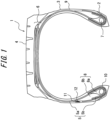
- FIG. 1 is a sectional view of a tire of the present disclosure according to an embodiment thereof.
- An RFID-tag coating rubber composition of the present disclosure includes therein a rubber component, sulfur, silica, and a guanidine-based vulcanization accelerator, wherein the sulfur includes insoluble sulfur and a content of the sulfur is 6.0 parts by mass or more with respect to 100 parts by mass of the rubber component.
- a rubber composition generally contains carbon black therein. Carbon black, however, increases relative permittivity of the rubber composition, thereby causing a reduction of the communicable distance and thus deterioration of communication performance of an RFID tag embedded in the rubber composition. In this regard, resistance to cracking and elastic modulus of the rubber composition will deteriorate if carbon black is simply eliminated from the rubber composition.
- an RFID-tag coating rubber composition of the present disclosure includes therein silica, which does not increase relative permittivity of the rubber composition as carbon black does, whereby the communicable distance of the RFID tag can remain satisfactorily long and thus the communication performance thereof avoids deterioration. Further, inclusion of silica improves resistance to cracking and elastic modulus of the rubber composition.
- the RFID-tag coating rubber composition of the present disclosure including a guanidine-based vulcanization accelerator therein, can reliably suppress a decrease in elastic modulus and deterioration of the vulcanization property (i.e., a decrease in the vulcanization rate) of the rubber composition. Further, in the present disclosure, since the rubber composition has satisfactory elastic modulus accordingly, it is possible to suppress concentration of stress to the RFID tag coated with the rubber composition, thereby ensuring good adhesion between the rubber composition (the coating rubber) and a rubber member adjacent thereto.
- a content of the sulfur therein can be 6.0 parts by mass or more with respect to 100 parts by mass of the rubber component. If ordinary sulfur (not containing insoluble sulfur) were to be blended by 2.5 parts by mass or more with respect to 100 parts by mass of the rubber component, the sulfur bloom would occur and adhesiveness or tackiness of the rubber composition would deteriorate, thereby resulting in poor workability of the rubber composition in a tire molding process.
- the RFID-tag coating rubber composition of the present disclosure in which the sulfur includes insoluble sulfur, can suppress occurrence of sulfur bloom and tackiness deterioration of the rubber composition, thereby successfully improving workability of the rubber composition during a tire molding process.
- the RFID-tag coating rubber composition of the present disclosure can achieve satisfactory communication performance, satisfactory resistance to cracking, satisfactory adhesiveness to an adjacent rubber member, and satisfactory elastic modulus simultaneously in a well-balanced manner and is excellent in workability as well.
- the RFID-tag coating rubber composition of the present disclosure contains therein a rubber component, which imparts rubber elasticity to the composition.
- the rubber component is preferably diene rubber, which may either be one of natural rubber (NR) and synthetic diene rubber or include both of them.
- Examples of the synthetic diene rubber include isoprene rubber (IR), styrene-butadiene rubber (SBR), butadiene rubber (BR), styrene-isoprene rubber (SIR), chloroprene rubber (CR), and the like. Either single type or combination (blend) of two or more types of the aforementioned examples may be used as the rubber component.
- the RFID-tag coating rubber composition of the present disclosure contains sulfur therein. Inclusion of sulfur in the rubber composition makes the composition vulcanizable, thereby improving physical properties related to resistance to cracking and elastic modulus of the rubber composition.
- a content of sulfur is to be 6.0 parts by mass or more with respect to 100 parts by mass of the rubber component.
- a content of sulfur is less than 6.0 parts by mass with respect to 100 parts by mass of the rubber component, elastic modulus of the rubber composition fails to increase in a satisfactory manner and resistance to cracking thereof deteriorates.
- the sulfur content is preferably ⁇ 6.5 parts by mass and more preferably ⁇ 6.8 parts by mass with respect to 100 parts by mass of the rubber component.
- the sulfur content of ⁇ 6.5 parts by mass with respect to 100 parts by mass of the rubber component further increases and thus improves resistance to cracking and elastic modulus of the rubber composition.
- the sulfur content of ⁇ 6.8 parts by mass with respect to 100 parts by mass of the rubber component still further increases and thus improves resistance to cracking and elastic modulus of the rubber composition.
- the sulfur content of ⁇ 6.0 parts by mass with respect to 100 parts by mass of the rubber component decreases elastic modulus of the rubber composition, thereby possibly deteriorating durability of a tire.
- the sulfur is to contain insoluble sulfur therein. Inclusion of insoluble sulfur in the sulfur suppresses occurrence of sulfur bloom, thereby successfully curbing deterioration of tackiness of the rubber composition and thus improving workability thereof in a molding process of a tire.
- the insoluble sulfur is sulfur insoluble to carbon disulfide (amorphous polymeric sulfur), exhibiting lower solubility to the rubber component than soluble sulfur does and thus being less likely to cause bloom.
- a ratio of the insoluble sulfur in the sulfur is preferably ⁇ 50 mass %, more preferably ⁇ 80 mass %, and preferably ⁇ 90 mass %.
- the ratio of the insoluble sulfur in the sulfur of ⁇ 50 mass % enhances an effect of suppressing sulfur bloom, thereby successfully further improving workability of the rubber composition in a molding process of a tire.
- the ratio of the insoluble sulfur in the sulfur of ⁇ 50 mass % may result in occurrence of sulfur bloom and thus deterioration of workability of the rubber composition in a tire molding process when the sulfur is blended for the purpose of maintaining a satisfactory elastic modulus.
- the insoluble sulfur content in the sulfur in the range of 50 mass % to 90 mass % reliably enhances an effect of suppressing sulfur bloom and further improves workability of the rubber composition in a tire molding process.
- the RFID-tag coating rubber composition of the present disclosure contains silica therein. Inclusion of silica in the rubber composition successfully increases and thus improves resistance to cracking and elastic modulus of the rubber composition without a rise in relative permittivity thereof.
- the relative permittivity of the rubber composition is preferably ⁇ 4.0 and more preferably ⁇ 2.5 in consideration of maintaining a satisfactorily long communicable distance of the RFID tag.
- silica examples include wet silica (hydrated silica), dry silica (anhydrous silica), calcium silicate, aluminum silicate, and the like. Wet silica is preferable among those examples. Either single type or combination of two or more types of the aforementioned examples may be used as the silica.
- a content of the silica is preferably ⁇ 40 parts by mass and preferably ⁇ 100 pars by mass, and more preferably in the range of 60 to 80 parts by mass with respect to 100 parts by mass of the rubber component.
- a content of the silica of ⁇ 60 parts by mass with respect to 100 parts by mass of the rubber component further successfully increases and thus improves resistance to cracking and elastic modulus of the rubber composition.
- a content of the silica of ⁇ 40 parts by mass with respect to 100 parts by mass of the rubber component reduces resistance to cracking of the rubber composition. Accordingly, a content of the silica in the range of 40 to 100 parts by mass with respect to 100 parts by mass of the rubber component reliably further increases and thus improves resistance to cracking and elastic modulus of the rubber composition.
- the RFID-tag coating rubber composition of the present disclosure contains a guanidine-based vulcanization accelerator therein. Inclusion of the guanidine-based vulcanization accelerator in the rubber composition successfully suppresses a decrease in elastic modulus and deterioration of the vulcanization property (i.e., a decrease in the vulcanization rate) of the rubber composition.
- Examples of the guanidine-based vulcanization accelerator include 1,3-diphenylguanidine (DPG), 1,3-di-o-tolylguanidine, 1-(o-tolyl)biguanide, di-(o-tolyl)guanidine salt of bis-catechol borate, 1,3-di-(o-cumenyl)guanidine, 1,3-di-o-biphenylguanidine, 1,3-di-o-cumenyl-2-propyonylguanidine, and the like. Either single type or combination of two or more types of the aforementioned examples may be used as the guanidine-based vulcanization accelerator.
- DPG 1,3-diphenylguanidine
- 1,3-di-o-tolylguanidine 1-(o-tolyl)biguanide
- di-(o-tolyl)guanidine salt of bis-catechol borate 1,3-di-(o-cumenyl)guan
- a content of the guanidine-based vulcanization accelerator is preferably ⁇ 0.1 parts by mass and preferably ⁇ 1.0 pars by mass, and more preferably in the range of 0.3 to 0.7 parts by mass with respect to 100 parts by mass of the rubber component.
- a content of the guanidine-based vulcanization accelerator of ⁇ 0.3 parts by mass with respect to 100 parts by mass of the rubber component further successfully increases and thus improves a vulcanization rate, thereby further increasing and thus improving elastic modulus of the rubber composition.
- a content of the guanidine-based vulcanization accelerator of ⁇ 0.1 parts by mass with respect to 100 parts by mass of the rubber component decreases elastic modulus of the rubber composition.
- the RFID-tag coating rubber composition of the present disclosure further contains therein a silane coupling agent, oil, and a tackifier, in addition to the rubber component, sulfur, silica, and the guanidine-based vulcanization accelerator described above.
- various compounding agent components generally employed in the rubber industry such as a filler other than silica, antioxidant, wax, a softening agent other than oil, processing aid, stearic acid, zinc oxide (zinc white), a vulcanization accelerator other than the guanidine-based vulcanization accelerator, a vulcanizing agent other than sulfur, and the like may be optionally selected and added to the RFID-tag coating rubber composition of the present disclosure according to necessity unless the addition thereof adversely affects the objects of the present disclosure.
- Commercially available products can be suitably used as those compounding agents.
- a silane coupling agent in the rubber composition enhances interaction between the rubber component and silica and thus improves dispersibility of silica into the rubber component.
- the silica of which dispersibility to the rubber component has been thus improved, can fully demonstrate its effect, thereby further increasing and thus improving elastic modulus and resistance to cracking of the rubber composition.
- silane coupling agent examples include bis(3-triethoxysilylpropyl) tetrasulfide, bis(3-triethoxysilylpropyl) trisulfide, bis(3-triethoxysilylpropyl) disulfide, bis(2-triethoxysilylethyl) tetrasulfide, bis(3-trimethoxysilylpropyl) tetrasulfide, bis(2-trimethoxysilylethyl) tetrasulfide, (3-mercaptopropyl)trimethoxysilane, (3-mercaptopropyl)triethoxysilane, (2-mercaptoethyl)trimethoxysilane, (2-mercaptoethyl)triethoxysilane, 3-trimethoxysilylpropyl-N,N-dimethylthiocarbamoyl tetrasulfide, 3-triethoxy
- a content of the silane coupling agent is preferably in the range of 5 to 20 mass % (i.e., 5 to 20 parts by mass with respect to 100 parts by mass of the silica) in terms of further improving dispersibility of silica into the rubber component and thereby further increasing and thus improving elastic modulus and resistance to cracking of the rubber composition.
- the oil mentioned above comprehensively represents: an extender oil contained in the rubber component; and an oil component in a liquid state added as a compounding agent to the rubber composition.
- examples of the oil include: a petroleum-based softener such as aromatic oil, paraffinic oil, naphthenic oil; and a plant-based softener such as palm oil, caster oil, cottonseed oil, soybean oil.
- the petroleum-based softener such as aromatic oil, paraffinic oil, naphthenic oil is preferable among those examples.
- Naphthenic oil containing asphalt therein is preferable as the oil.
- the rubber composition includes therein naphthenic oil containing asphalt, doughy consistency of the rubber composition in a mixing and kneading process further improves, which results in even better workability of the rubber composition in the mixing and kneading process.
- a mixture of naphthenic base oil and asphalt (a mass ratio of naphthenic base oil/asphalt is in the range of 95/5 to 30/70) is preferable as the naphthenic oil containing asphalt therein.
- Compatibility of the rubber component with the oil further improves when the mass ratio of naphthenic base oil/asphalt is within the range described above.
- Hydrogenated naphthenic base oil is preferable and hydrogenated naphthenic base oil obtained by highly hydrorefining aromatic oil or naphthenic oil by a high pressure-high temperature hydrorefining equipment is particularly preferable as the naphthenic base oil.
- such hydrogenated naphthenic base oil as described above is available as a commercial product like "SNH8 ® “, “SNH46 ® “, “SNH220 ® “, “SNH440 ® “, or the like manufacturd by SANKYO YUKA KOGYO K.K..
- a content of asphaltene component in the asphalt mixed with the naphthenic base oil is preferably 5 mass % or less in consideration of obtaining good compatibility of the asphalt with the rubber component in use and satisfactory doughiness of the rubber composition in a mixing and kneading process.
- a content of the asphaltene component is quantitatively determined from composition analysis carried out according to a method of the JPI Standard [The Japan Petroleum Institute Standard: JPI-5S-22-83 (1983), Standard Name "Fractioned Analysis for Asphaltic Bitumen by Column Chromatography"].
- the asphalt described above is preferably straight asphalt and particularly preferably naphthenic straight asphalt. Further, the asphalt described above preferably has kinematic viscosity of ⁇ 300 mm 2 /second at 120°C.
- a method for mixing the asphalt as described above with the naphthenic base oil which is not particularly restricted, preferably includes dissolving the asphalt in a naphthenic base oil (as extender oil, compounded oil, or the like), in consideration of easiness and economic efficiency of the preparation.
- Examples of the naphthenic oil containing asphalt therein described above include the product name "A/O MIX” manufactured by SANKYO YUKA KOGYO K.K., obtained by mixing a hydrogenated naphthenic base oil prepared by a high pressure-high temperature hydrorefining equipment, with a naphthenic straight asphalt having an asphaltene content of ⁇ 5 mass %, at a mixing mass ratio of 63/37.
- a content of the oil is preferably > 0 parts by mass and ⁇ 15 parts by mass with respect to 100 parts by mass of the rubber component in terms of further improving doughy consistency of the rubber composition and thereby further improving workability thereof in a mixing and kneading process.
- Tackiness of the rubber composition improves and thus workability of the rubber composition in a tire molding process improves, as well, when the rubber composition contains a tackifier therein.
- Various types of natural resins and synthetic resins can be used as the tackifier. Specifically, rosin resin, terpene resin, petroleum resin, phenolic resin, coal-derived resin, and xylene resin are preferably used as the tackifier. Either single type or combination of two or more types of the aforementioned examples may be used as the tackifier.
- Tackiness of the rubber composition further improves and thus workability of the rubber composition in a tire molding process further improves, as well, when the rubber composition contains as a tackifier therein at least one selected from the group consisting of rosin resin, terpene resin, petroleum resin, phenolic resin, coal-derived resin, and xylene resin.
- rosin resin examples include gum rosin, tall oil resin, wood resin, hydrogenated rosin, disproportionated resin, polymerized resin, glycerol ester of a modified rosin, pentaerythritol ester of a modified resin, and the like.
- terpene resin examples include: terpene resin such as ⁇ -pinene resin, ⁇ -pinene resin, dipentene; aromatic modified terpene resin; terpene phenolic resin; hydrogenated terpene resin; and the like.
- Polymerized resin, terpene phenolic resin and hydrogenated terpene resin are preferable among those examples of the natural resin in terms of ensuring satisfactory fracture resistance of the rubber composition with which the natural resin is compounded.
- the petroleum resin as a synthetic resin for the tackifier is obtained, for example, by polymerizing by using a Friedel-Crafts catalyst a mixture of decomposed oil fractions containing unsaturated hydrocarbons such as olefins and diolefins generated as byproducts together with petrochemical basic raw materials such as ethylene, propylene, and the like as a result of thermal decomposition of naphtha in the petrochemical industry.
- Examples of the petroleum resin include: aliphatic petroleum resin obtained by (co)polymerizing the Cs fractions derived from thermal decomposition of naphtha (which resin will occasionally be referred to as “Cs resin” hereinafter); aromatic petroleum resin obtained by (co)polymerizing the C 9 fractions derived from thermal decomposition of naphtha (which resin will occasionally be referred to as “C 9 resin” hereinafter); copolymerized petroleum resin obtained by copolymerizing the C 5 fractions and the C 9 fractions (which resin will occasionally be referred to as "C 5 -C 9 resin” hereinafter); hydrogenated petroleum resin; petroleum resin derived from an alicyclic compound such as dicyclopentadiene; styrene resin derived from styrene, substituted styrene, or a copolymer of styrene and another monomer; and the like.
- Cs resin aromatic petroleum resin obtained by (co)polymerizing the C 9 fractions derived from
- Examples of the C 5 fractions derived from thermal decomposition of naphtha generally include: olefin hydrocarbons such as 1-pentene, 2-pentene, 2-methyl-1-butene, 2-methyl-2-butene, 3-methyl-1-butene; diolefin hydrocarbons such as 2-methyl-1,3-butadiene, 1,2-pentadiene, 1,3-pentadiene, 3-methyl-1,2-butadiene; and the like.
- the aromatic petroleum resin obtained by (co)polymerizing the C 9 fractions is specifically a resin obtained by polymerizing C 9 aromatic compounds primarily constituted of vinyl toluene and/or indene as constituent monomers.
- C 9 fractions derived from thermal decomposition of naphtha include: styrene homologue such as ⁇ -methylstyrene, ⁇ -methylstyrene, ⁇ -methylstyrene; indene homologue such as indene, coumarone; and the like.
- relevant product names include "PETROSIN” manufactured by Mitsui Petrochemical Industries, “PETRITE” manufactured by Mikuni Chemical Industry Co., Ltd., “NEOPOLYMER” manufactured by Nippon Petrochemicals Co., Ltd., “PETCOAL” manufactured by Tosoh Corporation, and the like.
- a modified petroleum resin obtained by modifying a petroleum resin derived from the C 9 fractions can be suitably used in consideration of workability.
- the modified petroleum resin include a C 9 petroleum resin modified by an unsaturated alicyclic compound, a C 9 petroleum resin modified by a compound having hydroxyl group, a C 9 petroleum resin modified by an unsaturated carboxylic compound, and the like.
- the unsaturated alicyclic compound examples include cyclopentadiene, methylcyclopentadiene, and the like. Further, a Diels-Alder reaction product of alkylcyclopentadiene is also preferable as the unsaturated alicyclic compound. Examples of the Diels-Alder reaction product of alkylcyclopentadiene include dicyclopentadiene, cyclopentadiene/methylcyclopentadiene codimer, tricyclopentadiene, and the like. Dicyclopentadiene is particularly preferable as the unsaturated alicyclic compound.
- a C 9 petroleum resin modified by dicyclopentadiene can be obtained, for example, by thermal polymerization under the presence of both dicyclopentadiene and the C 9 fractions.
- Examples of the C 9 petroleum resin modified by dicyclopentadiene include "NEOPOLYMER 130S” manufactured by Nippon Petrochemicals Co., Ltd.
- Examples of the compound having hydroxyl group described above include an alcohol compound, a phenolic compound, and the like.
- the alcohol compound include an alcohol compound having a double bond such as allyl alcohol, 2-butene-1,4-diol, and the like.
- the phenolic compound which can be used include phenol and alkylphenols such as cresol, xylenol, p-tert-butylphenol, p-octylphenol, p-nonylphenol, and the like. Either single type or combination of two or more types of the aforementioned examples may be used as the compound having hydroxyl group.
- a C 9 petroleum resin having hydroxyl group can be manufactured by, for example, i) a method including: introducing an ester group into a petroleum resin by thermal polymerization of an alkyl ester of (metha)acrylic acid and petroleum fractions; and then reducing the ester group, and ii) a method including protecting/introducing a double bond in a petroleum resin and then hydrating the double bond.
- a petroleum resin modified by phenol is preferable as the C 9 petroleum resin having hydroxyl group, in consideration of advantages in the production processes and performances thereof.
- the petroleum resin modified by phenol which can be obtained by cationic polymerization of the C 9 fractions under the presence of phenol, is advantageous because the modification process involved therewith is easy, whereby the resin is inexpensive.
- Examples of the phenol-modified C 9 petroleum resin include "NEOPOLYMER-E-130" manufactured by Nippon Petrochemicals Co., Ltd.
- the C 9 petroleum resin modified by an unsaturated carboxylic compound as described above can be obtained by modifying a C 9 petroleum resin with an ethylenic unsaturated carboxylic acid.
- Typical examples of the ethylenic unsaturated carboxylic acid include maleic acid, maleic anhydride, fumaric acid, itaconic acid, tetrahydrophthalic acid, tetrahydrophthalic anhydride, (metha)acrylic acid, citraconic acid, and the like.
- the C 9 petroleum resin modified by an unsaturated carboxylic acid can be obtained by thermal polymerization of a C 9 petroleum resin and an ethylenic unsaturated carboxylic acid.
- a C 9 petroleum resin modified by maleic acid is preferable as the C 9 petroleum resin modified by an unsaturated carboxylic acid in the present disclosure.
- Examples of the C 9 petroleum resin modified by an unsaturated carboxylic acid include "NEOPOLYMER-160” manufactured by Nippon Petrochemicals Co., Ltd.
- a copolymerized resin of the C 5 fractions and the C 9 fractions which are obtained by thermal decomposition of naphtha can be suitably used as the petroleum resin.
- the C 9 fractions, of which type is not particularly restricted, are preferably the C 9 fractions obtained by thermal decomposition of naphtha.
- Specific examples of the C 5 -C 9 resin include "TS30", “TS30-DL”, “TS35”, “TS35-DL” of "STRUCTOL ® " series manufactured by Schill+Seilacher GmbH.
- phenolic resin examples include: alkylphenol-formaldehyde resin and a rosin-modified derivative thereof; alkylphenolacetylene resin; modified alkyl phenolic resin; terpene phenolic resin; and the like. More specific examples of the phenolic resin include "Hitanol ® 1502" (novolak type alkyl phenolic resin) manufactured by Hitachi Chemical Company, Ltd., "Koresin ® " (p-tert-butylphenol-acetylene resin) manufactured by BASF SE, and the like.
- coal-derived resin as a synthetic resin for the tackifier
- examples of the coal-derived resin as a synthetic resin for the tackifier include coumarone-indene resin and the like and examples of the xylene resin as a synthetic resin for the tackifier include xylene-formaldehyde resin and the like.
- polybutene is also applicable as a resin having tackiness.
- a content of the tackifier is preferably > 0 parts by mass and ⁇ 10 parts by mass with respect to 100 parts by mass of the rubber component in terms of further improving tackiness of the rubber composition and thereby further improving workability thereof in a mixing and kneading process of a tire.
- the RFID-tag coating rubber composition of the present disclosure may either include or exclude carbon black in/from the filler(s) other than silica.
- a content of the carbon black is preferably ⁇ 20 parts by mass and particularly preferably 0 parts by mass (i.e., the rubber composition contains no carbon black) with respect to 100 parts by mass of the rubber component in the present disclosure.
- the carbon black content of ⁇ 20 parts by mass with respect to 100 parts by mass of the rubber component ensures a decrease in relative permittivity of the rubber composition and thus an increase in the communicable distance of the RFID tag.
- the carbon black content of 0 parts by mass with respect to 100 parts by mass of the rubber component ensures a further decrease in relative permittivity of the rubber composition and thus a further increase in the communicable distance of the RFID tag.
- a method for manufacturing the rubber composition described above is not particularly restricted.
- the rubber composition can be manufactured, for example, by: blending, mixing and kneading the aforementioned rubber component, sulfur, silica, and the guanidine-based vulcanization accelerator, and various other components optionally selected according to necessity; and subjecting the mixture thus mixed and kneaded, to warming, extrusion, and the like. Further, a vulcanized rubber can be obtained by vulcanizing the rubber composition thus obtained.
- Conditions during the mixing and kneading process are not particularly restricted. Various relevant conditions such as a volume of a raw material to be charged into a kneader, rotational speed of a rotor, ram pressure, temperature and time period in the mixing and kneading process, type of a kneader, and the like can be optionally selected according to the purpose.
- the kneader include Banbury mixer, intermix machine, kneader, rolls, and the like, which are generally employed for mixing and kneading of a rubber composition.
- Conditions of the warming are not particularly restricted, either. Various relevant conditions such as temperature and time period in the warming process, type of a warming device, and the like can be optionally selected according to the purpose. Examples of the warming device include warming rolls and like, which are generally employed for warming of a rubber composition.
- Conditions of the extrusion are not particularly restricted, either. Various relevant conditions such as extrusion time, extrusion speed, type of an extruder, temperature in the extrusion process, and the like can be optionally selected according to the purpose.
- the extruder include an extruder or the like, which is generally employed for extrusion of a rubber composition.
- the temperature during the extrusion process may be optionally set as required.
- a tire of the present disclosure characteristically includes therein an RFID tag coated with the RFID-tag coating rubber composition described above.
- the tire of the present disclosure is excellent in communication performance, durability, and productivity because it includes therein an RFID tag coated with the RFID-tag coating rubber composition described above.
- the RFID tag is generally formed by a material such as metal, resin, or the like.
- an RFID tag has an electronic device portion and an antenna portion connected with the electronic device portion, wherein a package of the electronic device portion is made of resin and the antenna portion is made of metal, in an embodiment thereof.
- the RFID tag is coated with the aforementioned RFID-tag coating rubber composition of the present disclosure in the embodiment, satisfactory adhesion between the RFID tag and the coating rubber can be ensured by pre-coating the RFID tag in advance (prior to the coating with the RFID-tag coating rubber composition) with an adhesive such as product name "Chemlok ® " manufactured by LORD Corporation.
- the RFID tag is relatively hard as compared with other rubber members in the tire. Therefore, it is preferable that the coating rubber of the RFID tag has higher elastic modulus (i.e., is harder) than a rubber member adjacent thereto (for example, side rubber, stiffener, or the like described below) in order to suppress concentration of stress on the RFID tag.
- the RFID-tag coating rubber composition described above having high elastic modulus and thus being hard, reliably causes an effect of suppressing concentration of stress on the RFID tag.
- the RFID tag is provided in the tire preferably in a portion thereof experiencing relatively small strain during running of the tire. It is preferable in an embodiment that an RFID tag coated with the RFID-tag coating rubber composition described above is provided between a stiffener disposed on the tire radially outer side of a bead core embedded in a bead portion of the tire and a side rubber disposed on the tire widthwise outer side of a carcass in a side portion of the tire. In this respect, it is more preferable in the embodiment that the RFID tag coated with the RFID-tag coating rubber composition is provided at a position on the inner side in the tire radial direction from the maximum width portion of the tire.
- the stiffener 8 includes therein: a hard stiffener 8a having relatively high rigidity and being adjacent to the corresponding bead core 7 on the outer side in the tire radial direction of the bead core 7; and a soft stiffener 8b having relatively low rigidity and being adjacent to the corresponding hard stiffener 8a on the outer side in the tire radial direction of the hard stiffener 8a.
- a side rubber 9 is provided on the outer side in the tire widthwise direction of the carcass 5 in each side portion 3.
- the carcass 5 has: a main body portion 5 a extending in a toroidal shape across the pair of bead cores 7; and a turn-up portion 5b wound up around each bead core 7 from the inner side toward the outer side in the tire widthwise direction and then toward the outer side in the tire radial direction of the bead core 7.
- the stiffener 8 is disposed between the main body portion 5a and each of the turn-up portions 5b.
- a wire chafer 10 is disposed on the outer surface side of each turn-up portion 5b of the carcass 5. The wire chafer 10 extends along the stiffener 8 on the outer surface side in the tire widthwise direction of the stiffener 8.
- a RFID tag 12 coated with coating rubber 11 is provided on the outer side in the tire radial direction of the wire chafer 10 between the side rubber 9 and the soft stiffener 8b at a position on the inner side in the tire radial direction from the maximum width portion of the tire.
- the RFID-tag coating rubber composition described above is used for the coating rubber 11 in the present embodiment.
- the RFID tag 12 coated with the coating rubber 11 can be prepared by, for example, interposing the RFID tag 12 between two rubber sheets made of the RFID-tag coating rubber composition described above.
- the tire of the present embodiment can be manufactured by: laminating the relevant rubber members and the RFID tag-rubber composite, thereby building a green tire; and subjecting the green tire to vulcanization.
- the tire 1 shown in FIG. 1 allows a satisfactorily long communicable distance and is excellent in communication performance because the rubber composition applied to the coating rubber 11 demonstrates good communication performance as described above.
- the tire shown in FIG. 1 exhibits excellent durability because the rubber composition applied to the coating rubber 11 can achieve satisfactory resistance to cracking, satisfactory adhesiveness to an adjacent rubber member, and satisfactory elastic modulus simultaneously in a well-balanced manner as described above.
- the tire shown in FIG. 1 can achieve high productivity because the rubber composition applied to the coating rubber 11 is excellent in workability as described above.
- the tire of the present embodiment may be manufactured, depending on the tire type for the application, by either i) molding the aforementioned rubber composition in an unvulcanized state and subjecting a resulting green tire to vulcanization or ii) subjecting the aforementioned rubber composition to a preliminary vulcanization process, molding a resulting half-vulcanized rubber, and subjecting a resulting tire to a main vulcanization process.
- the tire of the present disclosure is preferably a pneumatic tire, wherein examples of gas with which the tire is to be inflated include inert gas such as nitrogen, argon, helium or the like, as well as ambient air and air of which oxygen partial pressure has been adjusted.
- a relative permittivity of the rubber composition is measured for each of the plate-shaped vulcanized rubber composition samples at 860 MHz by using a relative permittivity analyzer. It is known from the measurement results of relative permittivity in the past that a relative permittivity of a rubber composition can be deduced from an amount of carbon black blended therein. Accordingly, a relative permittivity of the rubber composition is obtained by calculation in the present disclosure.
- the larger number of force exertions required before fracture of the test specimen represents the higher resistance to crack growth of the test specimen, i.e., the higher resistance to crack growth of a sample tire formed by the vulcanized rubber of the test specimen. Resistance to crack growth of the test specimen is regarded as excellently high when the number of force exertions required before fracture of the test specimen is ⁇ 10,000.
- Dynamic modulus (E') of the rubber composition was measured for each (test specimen) of the plate-shaped vulcanized rubber composition samples by using a spectrometer (manufactured by Ueshima Seisakusho Co., Ltd.) under the conditions of temperature: 24 °C, strain: 1 %, and frequency: 52 Hz.
- the larger dynamic modulus (E') represents the higher hardness, the less deformability, and thus the better durability of the rubber, i.e., the better durability of a sample tire formed by the vulcanized rubber of the test specimen. Further, a vulcanized rubber having high dynamic modulus (E') can effectively curb concentration of stress on an RFID tag, thereby ensuring satisfactory adhesion thereof to an adjacent rubber member.
- modulus at 100 % elongation was measured for each (test specimen) of the plate-shaped vulcanized rubber composition samples.
- modulus at 100 % elongation was measured according to JIS K 6251 (2017) as tensile elastic modulus (MPa) of a vulcanized rubber test specimen having thickness of 2 mm (prepared from the plate-shaped vulcanized rubber composition sample) when the test specimen was stretched at 100 % elongation at 25 °C.
- MPa tensile elastic modulus
- the larger value of elastic modulus (M100) represents the less deformability and thus the better durability of the rubber, i.e., the better durability of a sample tire formed by the vulcanized rubber of the test specimen.
- a vulcanized rubber having high elastic modulus (M100) can effectively curb concentration of stress on an RFID tag, thereby ensuring satisfactory adhesion thereof to an adjacent rubber member.
- each of the rubber compositions of the Examples according to the present disclosure can achieve satisfactory communication performance, satisfactory resistance to cracking, satisfactory adhesiveness to an adjacent rubber member, and satisfactory elastic modulus simultaneously in a well-balanced manner and also is excellent in workability.
Landscapes
- Chemical & Material Sciences (AREA)
- Engineering & Computer Science (AREA)
- Mechanical Engineering (AREA)
- Life Sciences & Earth Sciences (AREA)
- Materials Engineering (AREA)
- Wood Science & Technology (AREA)
- Organic Chemistry (AREA)
- Inorganic Chemistry (AREA)
- Compositions Of Macromolecular Compounds (AREA)
Abstract
Description
- The present invention relates to an RFID-tag coating rubber composition, and a tire.
- It has been proposed in the prior art to provide a tire with an RFID (Radio Frequency Identification) tag in/from which various data such as production history, distribution history and use history of the tire can be written/read out, so that the tire is under reliable individual management (PTL 1).
The RFID tag is generally coated with coating rubber, taking it into consideration that the RFID tag is provided in a tire mainly constituted of a rubber member. The coating rubber for the RFID tag needs to satisfy various requirements, in this respect, such as satisfactory communication performance, satisfactory resistance to cracking, satisfactory adhesiveness to an adjacent rubber member, and satisfactory elastic modulus. - PTL 1:
EP1580041 B1 - In view of this, the inventor of the present disclosure studied the conventional coating rubber for the RFID tag and found out that the conventional one cannot achieve satisfactory communication performance, satisfactory resistance to cracking, satisfactory adhesiveness to an adjacent rubber member, and satisfactory elastic modulus simultaneously in a well-balanced manner. For example, when a content of sulfur compounded in a rubber composition for the coating rubber is increased in order to improve elastic modulus of the coating rubber, the sulfur bloom occurs and adhesiveness or tackiness of the rubber composition deteriorates, thereby causing a problem of poor workability in a tire molding process.
- An object of the present disclosure is therefore to solve the prior art problems described above and provide an RFID-tag coating rubber composition which can achieve satisfactory communication performance, satisfactory resistance to cracking, satisfactory adhesiveness to an adjacent rubber member, and satisfactory elastic modulus simultaneously in a well-balanced manner and also is excellent in workability.
Further, another object of the present disclosure is to provide a tire provided with an RFID tag and being excellent in communication performance, durability, and productivity. - The primary structural features of an RFID-tag coating rubber composition and a tire of the present disclosure for achieving the aforementioned objects are as follows.
- [1] An RFID-tag coating rubber composition, comprising:
- a rubber component;
- sulfur;
- silica; and
- a guanidine-based vulcanization accelerator,
- wherein the sulfur includes insoluble sulfur, and
- a content of the sulfur is 6.0 parts by mass or more with respect to 100 parts by mass of the rubber component.
- [2] The RFID-tag coating rubber composition of [1], wherein a content of the silica is in the range of 40 to 100 parts by mass with respect to 100 parts by mass of the rubber component.
- [3] The RFID-tag coating rubber composition of [1] or [2], wherein the sulfur content is 6.5 parts by mass or more, preferably 6.8 parts by mass or more, with respect to 100 parts by mass of the rubber component.
- [4] The RFID-tag coating rubber composition of any of [1] to [3], wherein a content of the guanidine-based vulcanization accelerator is in the range of 0.1 to 1.0 parts by mass with respect to 100 parts by mass of the rubber component.
- [5] The RFID-tag coating rubber composition of any of [1] to [4], wherein a ratio of the insoluble sulfur in the sulfur is in the range of 50 to 90 mass %.
- [6] The RFID-tag coating rubber composition of any of [1] to [5], wherein the guanidine-based vulcanization accelerator is 1,3-diphenylguanidine (DPG).
- [7] A tire, having an RFID tag coated with the RFID-tag coating rubber composition of any of [1] to [6].
- According to the present disclosure, it is possible to provide an RFID-tag coating rubber composition which can achieve satisfactory communication performance, satisfactory resistance to cracking, satisfactory adhesiveness to an adjacent rubber member, and satisfactory elastic modulus simultaneously in a well-balanced manner and is excellent in workability as well.
Further, according to the present disclosure, it is possible to provide a tire being excellent in communication performance, durability, and productivity. - In the accompanying drawing, wherein:
FIG. 1 is a sectional view of a tire of the present disclosure according to an embodiment thereof. - Hereinafter, an RFID-tag coating rubber composition and a tire of the present disclosure will be demonstratively described in detail based on an embodiment thereof.
- An RFID-tag coating rubber composition of the present disclosure includes therein a rubber component, sulfur, silica, and a guanidine-based vulcanization accelerator, wherein the sulfur includes insoluble sulfur and a content of the sulfur is 6.0 parts by mass or more with respect to 100 parts by mass of the rubber component.
- A rubber composition generally contains carbon black therein. Carbon black, however, increases relative permittivity of the rubber composition, thereby causing a reduction of the communicable distance and thus deterioration of communication performance of an RFID tag embedded in the rubber composition. In this regard, resistance to cracking and elastic modulus of the rubber composition will deteriorate if carbon black is simply eliminated from the rubber composition. In view of this, an RFID-tag coating rubber composition of the present disclosure includes therein silica, which does not increase relative permittivity of the rubber composition as carbon black does, whereby the communicable distance of the RFID tag can remain satisfactorily long and thus the communication performance thereof avoids deterioration. Further, inclusion of silica improves resistance to cracking and elastic modulus of the rubber composition.
- However, simply replacing carbon black with silica in the rubber composition may still not ensure satisfactory elastic modulus or satisfactory vulcanization property (that is, the vulcanization rate may still not be satisfactorily high). In this respect, the RFID-tag coating rubber composition of the present disclosure, including a guanidine-based vulcanization accelerator therein, can reliably suppress a decrease in elastic modulus and deterioration of the vulcanization property (i.e., a decrease in the vulcanization rate) of the rubber composition. Further, in the present disclosure, since the rubber composition has satisfactory elastic modulus accordingly, it is possible to suppress concentration of stress to the RFID tag coated with the rubber composition, thereby ensuring good adhesion between the rubber composition (the coating rubber) and a rubber member adjacent thereto.
- It should be noted that improvement of elastic modulus of the rubber composition can be ensured by setting a content of the sulfur therein to be 6.0 parts by mass or more with respect to 100 parts by mass of the rubber component. If ordinary sulfur (not containing insoluble sulfur) were to be blended by 2.5 parts by mass or more with respect to 100 parts by mass of the rubber component, the sulfur bloom would occur and adhesiveness or tackiness of the rubber composition would deteriorate, thereby resulting in poor workability of the rubber composition in a tire molding process. In contrast, the RFID-tag coating rubber composition of the present disclosure, in which the sulfur includes insoluble sulfur, can suppress occurrence of sulfur bloom and tackiness deterioration of the rubber composition, thereby successfully improving workability of the rubber composition during a tire molding process.
- Accordingly, the RFID-tag coating rubber composition of the present disclosure can achieve satisfactory communication performance, satisfactory resistance to cracking, satisfactory adhesiveness to an adjacent rubber member, and satisfactory elastic modulus simultaneously in a well-balanced manner and is excellent in workability as well.
- The RFID-tag coating rubber composition of the present disclosure contains therein a rubber component, which imparts rubber elasticity to the composition. The rubber component is preferably diene rubber, which may either be one of natural rubber (NR) and synthetic diene rubber or include both of them. Examples of the synthetic diene rubber include isoprene rubber (IR), styrene-butadiene rubber (SBR), butadiene rubber (BR), styrene-isoprene rubber (SIR), chloroprene rubber (CR), and the like. Either single type or combination (blend) of two or more types of the aforementioned examples may be used as the rubber component.
- The RFID-tag coating rubber composition of the present disclosure contains sulfur therein. Inclusion of sulfur in the rubber composition makes the composition vulcanizable, thereby improving physical properties related to resistance to cracking and elastic modulus of the rubber composition.
- A content of sulfur is to be 6.0 parts by mass or more with respect to 100 parts by mass of the rubber component. When a content of sulfur is less than 6.0 parts by mass with respect to 100 parts by mass of the rubber component, elastic modulus of the rubber composition fails to increase in a satisfactory manner and resistance to cracking thereof deteriorates.
- The sulfur content is preferably ≥ 6.5 parts by mass and more preferably ≥ 6.8 parts by mass with respect to 100 parts by mass of the rubber component. The sulfur content of ≥ 6.5 parts by mass with respect to 100 parts by mass of the rubber component further increases and thus improves resistance to cracking and elastic modulus of the rubber composition. The sulfur content of ≥ 6.8 parts by mass with respect to 100 parts by mass of the rubber component still further increases and thus improves resistance to cracking and elastic modulus of the rubber composition. On the other hand, the sulfur content of < 6.0 parts by mass with respect to 100 parts by mass of the rubber component decreases elastic modulus of the rubber composition, thereby possibly deteriorating durability of a tire.
- The sulfur is to contain insoluble sulfur therein. Inclusion of insoluble sulfur in the sulfur suppresses occurrence of sulfur bloom, thereby successfully curbing deterioration of tackiness of the rubber composition and thus improving workability thereof in a molding process of a tire.
- The insoluble sulfur is sulfur insoluble to carbon disulfide (amorphous polymeric sulfur), exhibiting lower solubility to the rubber component than soluble sulfur does and thus being less likely to cause bloom.
- A ratio of the insoluble sulfur in the sulfur is preferably ≥ 50 mass %, more preferably ≥ 80 mass %, and preferably ≤ 90 mass %. The ratio of the insoluble sulfur in the sulfur of ≥ 50 mass % enhances an effect of suppressing sulfur bloom, thereby successfully further improving workability of the rubber composition in a molding process of a tire. On the other hand, the ratio of the insoluble sulfur in the sulfur of ≤ 50 mass % may result in occurrence of sulfur bloom and thus deterioration of workability of the rubber composition in a tire molding process when the sulfur is blended for the purpose of maintaining a satisfactory elastic modulus. The insoluble sulfur content in the sulfur in the range of 50 mass % to 90 mass % reliably enhances an effect of suppressing sulfur bloom and further improves workability of the rubber composition in a tire molding process.
- The RFID-tag coating rubber composition of the present disclosure contains silica therein. Inclusion of silica in the rubber composition successfully increases and thus improves resistance to cracking and elastic modulus of the rubber composition without a rise in relative permittivity thereof. The relative permittivity of the rubber composition is preferably ≤ 4.0 and more preferably ≤ 2.5 in consideration of maintaining a satisfactorily long communicable distance of the RFID tag.
- Examples of the silica include wet silica (hydrated silica), dry silica (anhydrous silica), calcium silicate, aluminum silicate, and the like. Wet silica is preferable among those examples. Either single type or combination of two or more types of the aforementioned examples may be used as the silica.
- A content of the silica is preferably ≥ 40 parts by mass and preferably ≤ 100 pars by mass, and more preferably in the range of 60 to 80 parts by mass with respect to 100 parts by mass of the rubber component. A content of the silica of ≥ 60 parts by mass with respect to 100 parts by mass of the rubber component further successfully increases and thus improves resistance to cracking and elastic modulus of the rubber composition. A content of the silica of < 40 parts by mass with respect to 100 parts by mass of the rubber component reduces resistance to cracking of the rubber composition. Accordingly, a content of the silica in the range of 40 to 100 parts by mass with respect to 100 parts by mass of the rubber component reliably further increases and thus improves resistance to cracking and elastic modulus of the rubber composition.
- The RFID-tag coating rubber composition of the present disclosure contains a guanidine-based vulcanization accelerator therein. Inclusion of the guanidine-based vulcanization accelerator in the rubber composition successfully suppresses a decrease in elastic modulus and deterioration of the vulcanization property (i.e., a decrease in the vulcanization rate) of the rubber composition.
- Examples of the guanidine-based vulcanization accelerator include 1,3-diphenylguanidine (DPG), 1,3-di-o-tolylguanidine, 1-(o-tolyl)biguanide, di-(o-tolyl)guanidine salt of bis-catechol borate, 1,3-di-(o-cumenyl)guanidine, 1,3-di-o-biphenylguanidine, 1,3-di-o-cumenyl-2-propyonylguanidine, and the like. Either single type or combination of two or more types of the aforementioned examples may be used as the guanidine-based vulcanization accelerator.
- 1,3-diphenylguanidine (DPG) is preferable as the guanidine-based vulcanization accelerator. Inclusion of 1,3-diphenylguanidine (DPG) in the rubber composition further successfully increases and thus improves a vulcanization rate, thereby further increasing and thus improving elastic modulus of the rubber composition.
- A content of the guanidine-based vulcanization accelerator is preferably ≥ 0.1 parts by mass and preferably ≤ 1.0 pars by mass, and more preferably in the range of 0.3 to 0.7 parts by mass with respect to 100 parts by mass of the rubber component. A content of the guanidine-based vulcanization accelerator of ≥ 0.3 parts by mass with respect to 100 parts by mass of the rubber component further successfully increases and thus improves a vulcanization rate, thereby further increasing and thus improving elastic modulus of the rubber composition. A content of the guanidine-based vulcanization accelerator of < 0.1 parts by mass with respect to 100 parts by mass of the rubber component decreases elastic modulus of the rubber composition. Accordingly, a content of the guanidine-based vulcanization accelerator in the range of 0.1 to 1.0 parts by mass with respect to 100 parts by mass of the rubber component reliably further increases and thus improves a vulcanization rate, thereby reliably further increasing and thus improving elastic modulus of the rubber composition.
- It is preferable that the RFID-tag coating rubber composition of the present disclosure further contains therein a silane coupling agent, oil, and a tackifier, in addition to the rubber component, sulfur, silica, and the guanidine-based vulcanization accelerator described above.
- Moreover, various compounding agent components generally employed in the rubber industry such as a filler other than silica, antioxidant, wax, a softening agent other than oil, processing aid, stearic acid, zinc oxide (zinc white), a vulcanization accelerator other than the guanidine-based vulcanization accelerator, a vulcanizing agent other than sulfur, and the like may be optionally selected and added to the RFID-tag coating rubber composition of the present disclosure according to necessity unless the addition thereof adversely affects the objects of the present disclosure. Commercially available products can be suitably used as those compounding agents.
- Inclusion of a silane coupling agent in the rubber composition enhances interaction between the rubber component and silica and thus improves dispersibility of silica into the rubber component. The silica, of which dispersibility to the rubber component has been thus improved, can fully demonstrate its effect, thereby further increasing and thus improving elastic modulus and resistance to cracking of the rubber composition.
- Examples of the silane coupling agent include bis(3-triethoxysilylpropyl) tetrasulfide, bis(3-triethoxysilylpropyl) trisulfide, bis(3-triethoxysilylpropyl) disulfide, bis(2-triethoxysilylethyl) tetrasulfide, bis(3-trimethoxysilylpropyl) tetrasulfide, bis(2-trimethoxysilylethyl) tetrasulfide, (3-mercaptopropyl)trimethoxysilane, (3-mercaptopropyl)triethoxysilane, (2-mercaptoethyl)trimethoxysilane, (2-mercaptoethyl)triethoxysilane, 3-trimethoxysilylpropyl-N,N-dimethylthiocarbamoyl tetrasulfide, 3-triethoxysilylpropyl-N,N-dimethylthiocarbamoyl tetrasulfide, 2-triethoxysilylethyl-N,N-dimethylthiocarbamoyl tetrasulfide, 3-trimethoxysilylpropylbenzothiazolyl tetrasulfide, 3-triethoxysilylpropylbenzothiazolyl tetrasulfide, 3-triethoxysilylpropylmethacrylate monosulfide, 3-trimethoxysilylpropylmethacrylate monosulfide, bis(3-diethoxymethylsilylpropyl)tetrasulfide, (3-mercaptopropyl)dimethoxymethylsilane, dimethoxymethylsilylpropyl-N,N-dimethylthiocarbamoyl tetrasulfide, dimethoxymethylsilylpropylbenzothiazolyl tetrasulfide, and the like.
- A content of the silane coupling agent is preferably in the range of 5 to 20 mass % (i.e., 5 to 20 parts by mass with respect to 100 parts by mass of the silica) in terms of further improving dispersibility of silica into the rubber component and thereby further increasing and thus improving elastic modulus and resistance to cracking of the rubber composition.
- In a case where the rubber composition contains oil therein, doughiness of the rubber composition in a mixing and kneading process improves, which results in better workability of the rubber composition in the mixing and kneading process. The oil mentioned above comprehensively represents: an extender oil contained in the rubber component; and an oil component in a liquid state added as a compounding agent to the rubber composition. Examples of the oil include: a petroleum-based softener such as aromatic oil, paraffinic oil, naphthenic oil; and a plant-based softener such as palm oil, caster oil, cottonseed oil, soybean oil. The petroleum-based softener such as aromatic oil, paraffinic oil, naphthenic oil is preferable among those examples.
- Naphthenic oil containing asphalt therein is preferable as the oil. In a case where the rubber composition includes therein naphthenic oil containing asphalt, doughy consistency of the rubber composition in a mixing and kneading process further improves, which results in even better workability of the rubber composition in the mixing and kneading process.
- A mixture of naphthenic base oil and asphalt (a mass ratio of naphthenic base oil/asphalt is in the range of 95/5 to 30/70) is preferable as the naphthenic oil containing asphalt therein. Compatibility of the rubber component with the oil further improves when the mass ratio of naphthenic base oil/asphalt is within the range described above. Hydrogenated naphthenic base oil is preferable and hydrogenated naphthenic base oil obtained by highly hydrorefining aromatic oil or naphthenic oil by a high pressure-high temperature hydrorefining equipment is particularly preferable as the naphthenic base oil. Specifically, such hydrogenated naphthenic base oil as described above is available as a commercial product like "SNH8®", "SNH46®", "SNH220®", "SNH440®", or the like manufacturd by SANKYO YUKA KOGYO K.K..
- A content of asphaltene component in the asphalt mixed with the naphthenic base oil is preferably 5 mass % or less in consideration of obtaining good compatibility of the asphalt with the rubber component in use and satisfactory doughiness of the rubber composition in a mixing and kneading process. A content of the asphaltene component is quantitatively determined from composition analysis carried out according to a method of the JPI Standard [The Japan Petroleum Institute Standard: JPI-5S-22-83 (1983), Standard Name "Fractioned Analysis for Asphaltic Bitumen by Column Chromatography"].
- The asphalt described above is preferably straight asphalt and particularly preferably naphthenic straight asphalt. Further, the asphalt described above preferably has kinematic viscosity of ≤ 300 mm2/second at 120°C.
- A method for mixing the asphalt as described above with the naphthenic base oil, which is not particularly restricted, preferably includes dissolving the asphalt in a naphthenic base oil (as extender oil, compounded oil, or the like), in consideration of easiness and economic efficiency of the preparation.
- Examples of the naphthenic oil containing asphalt therein described above include the product name "A/O MIX" manufactured by SANKYO YUKA KOGYO K.K., obtained by mixing a hydrogenated naphthenic base oil prepared by a high pressure-high temperature hydrorefining equipment, with a naphthenic straight asphalt having an asphaltene content of ≤ 5 mass %, at a mixing mass ratio of 63/37.
- A content of the oil is preferably > 0 parts by mass and ≤ 15 parts by mass with respect to 100 parts by mass of the rubber component in terms of further improving doughy consistency of the rubber composition and thereby further improving workability thereof in a mixing and kneading process.
- Tackiness of the rubber composition improves and thus workability of the rubber composition in a tire molding process improves, as well, when the rubber composition contains a tackifier therein. Various types of natural resins and synthetic resins can be used as the tackifier. Specifically, rosin resin, terpene resin, petroleum resin, phenolic resin, coal-derived resin, and xylene resin are preferably used as the tackifier. Either single type or combination of two or more types of the aforementioned examples may be used as the tackifier. Tackiness of the rubber composition further improves and thus workability of the rubber composition in a tire molding process further improves, as well, when the rubber composition contains as a tackifier therein at least one selected from the group consisting of rosin resin, terpene resin, petroleum resin, phenolic resin, coal-derived resin, and xylene resin.
- Examples of the rosin resin, as the natural resin for the tackifier, include gum rosin, tall oil resin, wood resin, hydrogenated rosin, disproportionated resin, polymerized resin, glycerol ester of a modified rosin, pentaerythritol ester of a modified resin, and the like.
- Examples of the terpene resin, as the natural resin for the tackifier, include: terpene resin such as α-pinene resin, β-pinene resin, dipentene; aromatic modified terpene resin; terpene phenolic resin; hydrogenated terpene resin; and the like. Polymerized resin, terpene phenolic resin and hydrogenated terpene resin are preferable among those examples of the natural resin in terms of ensuring satisfactory fracture resistance of the rubber composition with which the natural resin is compounded.
- The petroleum resin as a synthetic resin for the tackifier is obtained, for example, by polymerizing by using a Friedel-Crafts catalyst a mixture of decomposed oil fractions containing unsaturated hydrocarbons such as olefins and diolefins generated as byproducts together with petrochemical basic raw materials such as ethylene, propylene, and the like as a result of thermal decomposition of naphtha in the petrochemical industry. Examples of the petroleum resin include: aliphatic petroleum resin obtained by (co)polymerizing the Cs fractions derived from thermal decomposition of naphtha (which resin will occasionally be referred to as "Cs resin" hereinafter); aromatic petroleum resin obtained by (co)polymerizing the C9 fractions derived from thermal decomposition of naphtha (which resin will occasionally be referred to as "C9 resin" hereinafter); copolymerized petroleum resin obtained by copolymerizing the C5 fractions and the C9 fractions (which resin will occasionally be referred to as "C5-C9 resin" hereinafter); hydrogenated petroleum resin; petroleum resin derived from an alicyclic compound such as dicyclopentadiene; styrene resin derived from styrene, substituted styrene, or a copolymer of styrene and another monomer; and the like.
- Examples of the C5 fractions derived from thermal decomposition of naphtha generally include: olefin hydrocarbons such as 1-pentene, 2-pentene, 2-methyl-1-butene, 2-methyl-2-butene, 3-methyl-1-butene; diolefin hydrocarbons such as 2-methyl-1,3-butadiene, 1,2-pentadiene, 1,3-pentadiene, 3-methyl-1,2-butadiene; and the like. The aromatic petroleum resin obtained by (co)polymerizing the C9 fractions is specifically a resin obtained by polymerizing C9 aromatic compounds primarily constituted of vinyl toluene and/or indene as constituent monomers. Specific examples of the C9 fractions derived from thermal decomposition of naphtha include: styrene homologue such as α-methylstyrene, β-methylstyrene, γ-methylstyrene; indene homologue such as indene, coumarone; and the like. Examples of the relevant product names include "PETROSIN" manufactured by Mitsui Petrochemical Industries, "PETRITE" manufactured by Mikuni Chemical Industry Co., Ltd., "NEOPOLYMER" manufactured by Nippon Petrochemicals Co., Ltd., "PETCOAL" manufactured by Tosoh Corporation, and the like.
- Further, a modified petroleum resin obtained by modifying a petroleum resin derived from the C9 fractions can be suitably used in consideration of workability. Examples of the modified petroleum resin include a C9 petroleum resin modified by an unsaturated alicyclic compound, a C9 petroleum resin modified by a compound having hydroxyl group, a C9 petroleum resin modified by an unsaturated carboxylic compound, and the like.
- Preferable examples of the unsaturated alicyclic compound include cyclopentadiene, methylcyclopentadiene, and the like. Further, a Diels-Alder reaction product of alkylcyclopentadiene is also preferable as the unsaturated alicyclic compound. Examples of the Diels-Alder reaction product of alkylcyclopentadiene include dicyclopentadiene, cyclopentadiene/methylcyclopentadiene codimer, tricyclopentadiene, and the like. Dicyclopentadiene is particularly preferable as the unsaturated alicyclic compound. A C9 petroleum resin modified by dicyclopentadiene can be obtained, for example, by thermal polymerization under the presence of both dicyclopentadiene and the C9 fractions. Examples of the C9 petroleum resin modified by dicyclopentadiene include "NEOPOLYMER 130S" manufactured by Nippon Petrochemicals Co., Ltd.
- Examples of the compound having hydroxyl group described above include an alcohol compound, a phenolic compound, and the like. Specific examples of the alcohol compound include an alcohol compound having a double bond such as allyl alcohol, 2-butene-1,4-diol, and the like. Examples of the phenolic compound which can be used include phenol and alkylphenols such as cresol, xylenol, p-tert-butylphenol, p-octylphenol, p-nonylphenol, and the like. Either single type or combination of two or more types of the aforementioned examples may be used as the compound having hydroxyl group. A C9 petroleum resin having hydroxyl group can be manufactured by, for example, i) a method including: introducing an ester group into a petroleum resin by thermal polymerization of an alkyl ester of (metha)acrylic acid and petroleum fractions; and then reducing the ester group, and ii) a method including protecting/introducing a double bond in a petroleum resin and then hydrating the double bond. Although any of the C9 petroleum resin having hydroxyl group obtained by the various methods as described above can be used, a petroleum resin modified by phenol is preferable as the C9 petroleum resin having hydroxyl group, in consideration of advantages in the production processes and performances thereof. The petroleum resin modified by phenol, which can be obtained by cationic polymerization of the C9 fractions under the presence of phenol, is advantageous because the modification process involved therewith is easy, whereby the resin is inexpensive. Examples of the phenol-modified C9 petroleum resin include "NEOPOLYMER-E-130" manufactured by Nippon Petrochemicals Co., Ltd.
- The C9 petroleum resin modified by an unsaturated carboxylic compound as described above can be obtained by modifying a C9 petroleum resin with an ethylenic unsaturated carboxylic acid. Typical examples of the ethylenic unsaturated carboxylic acid include maleic acid, maleic anhydride, fumaric acid, itaconic acid, tetrahydrophthalic acid, tetrahydrophthalic anhydride, (metha)acrylic acid, citraconic acid, and the like. The C9 petroleum resin modified by an unsaturated carboxylic acid can be obtained by thermal polymerization of a C9 petroleum resin and an ethylenic unsaturated carboxylic acid. A C9 petroleum resin modified by maleic acid is preferable as the C9 petroleum resin modified by an unsaturated carboxylic acid in the present disclosure. Examples of the C9 petroleum resin modified by an unsaturated carboxylic acid include "NEOPOLYMER-160" manufactured by Nippon Petrochemicals Co., Ltd.
- A copolymerized resin of the C5 fractions and the C9 fractions which are obtained by thermal decomposition of naphtha can be suitably used as the petroleum resin. The C9 fractions, of which type is not particularly restricted, are preferably the C9 fractions obtained by thermal decomposition of naphtha. Specific examples of the C5-C9 resin include "TS30", "TS30-DL", "TS35", "TS35-DL" of "STRUCTOL®" series manufactured by Schill+Seilacher GmbH.
- Examples of the phenolic resin as a synthetic resin for the tackifier include: alkylphenol-formaldehyde resin and a rosin-modified derivative thereof; alkylphenolacetylene resin; modified alkyl phenolic resin; terpene phenolic resin; and the like. More specific examples of the phenolic resin include "Hitanol® 1502" (novolak type alkyl phenolic resin) manufactured by Hitachi Chemical Company, Ltd., "Koresin®" (p-tert-butylphenol-acetylene resin) manufactured by BASF SE, and the like.
- Examples of the coal-derived resin as a synthetic resin for the tackifier include coumarone-indene resin and the like and examples of the xylene resin as a synthetic resin for the tackifier include xylene-formaldehyde resin and the like. Further, polybutene is also applicable as a resin having tackiness.
- A content of the tackifier is preferably > 0 parts by mass and ≤ 10 parts by mass with respect to 100 parts by mass of the rubber component in terms of further improving tackiness of the rubber composition and thereby further improving workability thereof in a mixing and kneading process of a tire.
- The RFID-tag coating rubber composition of the present disclosure may either include or exclude carbon black in/from the filler(s) other than silica. A content of the carbon black is preferably ≤ 20 parts by mass and particularly preferably 0 parts by mass (i.e., the rubber composition contains no carbon black) with respect to 100 parts by mass of the rubber component in the present disclosure. The carbon black content of ≤ 20 parts by mass with respect to 100 parts by mass of the rubber component ensures a decrease in relative permittivity of the rubber composition and thus an increase in the communicable distance of the RFID tag. The carbon black content of 0 parts by mass with respect to 100 parts by mass of the rubber component (i.e., the rubber composition contains no carbon black) ensures a further decrease in relative permittivity of the rubber composition and thus a further increase in the communicable distance of the RFID tag.
- A method for manufacturing the rubber composition described above is not particularly restricted. The rubber composition can be manufactured, for example, by: blending, mixing and kneading the aforementioned rubber component, sulfur, silica, and the guanidine-based vulcanization accelerator, and various other components optionally selected according to necessity; and subjecting the mixture thus mixed and kneaded, to warming, extrusion, and the like. Further, a vulcanized rubber can be obtained by vulcanizing the rubber composition thus obtained.
- Conditions during the mixing and kneading process are not particularly restricted. Various relevant conditions such as a volume of a raw material to be charged into a kneader, rotational speed of a rotor, ram pressure, temperature and time period in the mixing and kneading process, type of a kneader, and the like can be optionally selected according to the purpose. Examples of the kneader include Banbury mixer, intermix machine, kneader, rolls, and the like, which are generally employed for mixing and kneading of a rubber composition.
- Conditions of the warming are not particularly restricted, either. Various relevant conditions such as temperature and time period in the warming process, type of a warming device, and the like can be optionally selected according to the purpose. Examples of the warming device include warming rolls and like, which are generally employed for warming of a rubber composition.
- Conditions of the extrusion are not particularly restricted, either. Various relevant conditions such as extrusion time, extrusion speed, type of an extruder, temperature in the extrusion process, and the like can be optionally selected according to the purpose. Examples of the extruder include an extruder or the like, which is generally employed for extrusion of a rubber composition. The temperature during the extrusion process may be optionally set as required.
- Details of a device, a method, conditions, and the like for vulcanization are not particularly restricted and may be optionally decided/selected according to the purpose. Examples of a vulcanizing device include a vulcanizing molding machine provided with a die, which is generally employed for vulcanization of a rubber composition. Temperature, as a condition during the vulcanization process, is, for example, in the range of 100 °C to 190 °C or so.
- A tire of the present disclosure characteristically includes therein an RFID tag coated with the RFID-tag coating rubber composition described above. The tire of the present disclosure is excellent in communication performance, durability, and productivity because it includes therein an RFID tag coated with the RFID-tag coating rubber composition described above.
- The RFID tag is generally formed by a material such as metal, resin, or the like. For example, an RFID tag has an electronic device portion and an antenna portion connected with the electronic device portion, wherein a package of the electronic device portion is made of resin and the antenna portion is made of metal, in an embodiment thereof. In a case where the RFID tag is coated with the aforementioned RFID-tag coating rubber composition of the present disclosure in the embodiment, satisfactory adhesion between the RFID tag and the coating rubber can be ensured by pre-coating the RFID tag in advance (prior to the coating with the RFID-tag coating rubber composition) with an adhesive such as product name "Chemlok®" manufactured by LORD Corporation.
- The RFID tag is relatively hard as compared with other rubber members in the tire. Therefore, it is preferable that the coating rubber of the RFID tag has higher elastic modulus (i.e., is harder) than a rubber member adjacent thereto (for example, side rubber, stiffener, or the like described below) in order to suppress concentration of stress on the RFID tag. In this respect, the RFID-tag coating rubber composition described above, having high elastic modulus and thus being hard, reliably causes an effect of suppressing concentration of stress on the RFID tag.
- The RFID tag is provided in the tire preferably in a portion thereof experiencing relatively small strain during running of the tire. It is preferable in an embodiment that an RFID tag coated with the RFID-tag coating rubber composition described above is provided between a stiffener disposed on the tire radially outer side of a bead core embedded in a bead portion of the tire and a side rubber disposed on the tire widthwise outer side of a carcass in a side portion of the tire. In this respect, it is more preferable in the embodiment that the RFID tag coated with the RFID-tag coating rubber composition is provided at a position on the inner side in the tire radial direction from the maximum width portion of the tire.
-
FIG. 1 is a sectional view of a tire of the present disclosure according to an embodiment thereof. - The tire 1 shown in
FIG. 1 has: a pair of bead portions 2; a pair ofside portions 3; atread portion 4 continuous with therespective side portions 3; acarcass 5 extending in a toroidal shape across the pair of bead portions 2, for reinforcing the bead portions 2, theside portions 3 and thetread portion 4; abelt 6 disposed on the outer side in the tire radial direction of a crown portion of thecarcass 5; and astiffener 8 disposed on the outer side in the tire radial direction of a ring-shaped bead core 7 embedded in each of the bead portions 2. - The
stiffener 8 includes therein: ahard stiffener 8a having relatively high rigidity and being adjacent to the corresponding bead core 7 on the outer side in the tire radial direction of the bead core 7; and asoft stiffener 8b having relatively low rigidity and being adjacent to the corresponding hard stiffener 8a on the outer side in the tire radial direction of thehard stiffener 8a. - A
side rubber 9 is provided on the outer side in the tire widthwise direction of thecarcass 5 in eachside portion 3. - In the tire 1 shown as an example in the drawing, the
carcass 5 has: amain body portion 5 a extending in a toroidal shape across the pair of bead cores 7; and a turn-upportion 5b wound up around each bead core 7 from the inner side toward the outer side in the tire widthwise direction and then toward the outer side in the tire radial direction of the bead core 7. It should be noted that the structure and the number of plies of thecarcass 5 are not limited to those shown inFIG. 1 . Thestiffener 8 is disposed between themain body portion 5a and each of the turn-upportions 5b. Awire chafer 10 is disposed on the outer surface side of each turn-upportion 5b of thecarcass 5. Thewire chafer 10 extends along thestiffener 8 on the outer surface side in the tire widthwise direction of thestiffener 8. - A
RFID tag 12 coated withcoating rubber 11 is provided on the outer side in the tire radial direction of thewire chafer 10 between theside rubber 9 and thesoft stiffener 8b at a position on the inner side in the tire radial direction from the maximum width portion of the tire. The RFID-tag coating rubber composition described above is used for thecoating rubber 11 in the present embodiment. - The
RFID tag 12 coated with the coating rubber 11 (the RFID tag-rubber composite) can be prepared by, for example, interposing theRFID tag 12 between two rubber sheets made of the RFID-tag coating rubber composition described above. The tire of the present embodiment can be manufactured by: laminating the relevant rubber members and the RFID tag-rubber composite, thereby building a green tire; and subjecting the green tire to vulcanization. - The tire 1 shown in
FIG. 1 allows a satisfactorily long communicable distance and is excellent in communication performance because the rubber composition applied to thecoating rubber 11 demonstrates good communication performance as described above. - Further, the tire shown in
FIG. 1 exhibits excellent durability because the rubber composition applied to thecoating rubber 11 can achieve satisfactory resistance to cracking, satisfactory adhesiveness to an adjacent rubber member, and satisfactory elastic modulus simultaneously in a well-balanced manner as described above. - Yet further, the tire shown in
FIG. 1 can achieve high productivity because the rubber composition applied to thecoating rubber 11 is excellent in workability as described above. - The tire of the present embodiment may be manufactured, depending on the tire type for the application, by either i) molding the aforementioned rubber composition in an unvulcanized state and subjecting a resulting green tire to vulcanization or ii) subjecting the aforementioned rubber composition to a preliminary vulcanization process, molding a resulting half-vulcanized rubber, and subjecting a resulting tire to a main vulcanization process. The tire of the present disclosure is preferably a pneumatic tire, wherein examples of gas with which the tire is to be inflated include inert gas such as nitrogen, argon, helium or the like, as well as ambient air and air of which oxygen partial pressure has been adjusted.
- The present disclosure will be described further in detail by Examples hereinafter. The present disclosure is not limited by any means to these Examples.
- Each of unvulcanized rubber composition samples of Examples and Comparative Examples was obtained by:
- charging the blending components, excluding a vulcanization accelerator, a vulcanizing agent and other "Pro" chemical agents, according to the blending formulation thereof shown in Table 1 at a charging rate in the range of 55 % to 65 % in a 1.7 L Banbury mixer manufactured by Kobe Steel, Ltd.;
- mixing and kneading the mixture at a rotational speed of 80 rpm until either the temperature of the mixture reached 160 °C or four minutes passed after the start of mixing and kneading;
- then adding a vulcanization accelerator, a vulcanizing agent and other "Pro" chemical agents, by the amounts according to the blending formulation shown in Table 1, to the mixture thus mixed and kneaded; and
- further mixing and kneading the resulting mixture for two minutes at 80 °C by using open rolls, thereby obtaining the unvulcanized rubber composition sample. Further, a plate-shaped crosslinked rubber composition sample was prepared by vulcanizing the unvulcanized rubber composition sample thus obtained, at 145 °C for 45 minutes.
- Communication performance, resistance to cracking, adhesiveness to an adjacent rubber member, elastic modulus, and workability were evaluated for each of the rubber composition samples of Examples and Comparative Examples thus obtained by the respective methods described below. The results are shown in Table 1.
- A relative permittivity of the rubber composition is measured for each of the plate-shaped vulcanized rubber composition samples at 860 MHz by using a relative permittivity analyzer. It is known from the measurement results of relative permittivity in the past that a relative permittivity of a rubber composition can be deduced from an amount of carbon black blended therein. Accordingly, a relative permittivity of the rubber composition is obtained by calculation in the present disclosure.
- Resistance to cracking of the rubber composition was determined for each of the plate-shaped vulcanized rubber composition samples by:
- preparing a JIS No. 5 test specimen having thickness of 2 mm from the plate-shaped vulcanized rubber composition sample and forming a crack of 0.5 mm length at the center of the test specimen; and
- gripping the respective ends of the test specimen, exerting a force on the test specimen repeatedly under the conditions described below, counting the number of force exertions required before fracture of the test specimen, and regarding the number thus counted as resistance to cracking of the rubber composition.
- Test stress: 1.9 N · m
- Frequency: 5 Hz
- Temperature of atmosphere: 80 °C
- The number of force exertions required before fracture of the test specimen, thus counted, was rounded to the nearest hundred, and the value thus rounded is shown in Table 1.
- The larger number of force exertions required before fracture of the test specimen represents the higher resistance to crack growth of the test specimen, i.e., the higher resistance to crack growth of a sample tire formed by the vulcanized rubber of the test specimen. Resistance to crack growth of the test specimen is regarded as excellently high when the number of force exertions required before fracture of the test specimen is ≥ 10,000.
- Dynamic modulus (E') of the rubber composition was measured for each (test specimen) of the plate-shaped vulcanized rubber composition samples by using a spectrometer (manufactured by Ueshima Seisakusho Co., Ltd.) under the conditions of temperature: 24 °C, strain: 1 %, and frequency: 52 Hz.
- The larger dynamic modulus (E') represents the higher hardness, the less deformability, and thus the better durability of the rubber, i.e., the better durability of a sample tire formed by the vulcanized rubber of the test specimen. Further, a vulcanized rubber having high dynamic modulus (E') can effectively curb concentration of stress on an RFID tag, thereby ensuring satisfactory adhesion thereof to an adjacent rubber member.
- The value of modulus at 100 % elongation (M100) was measured for each (test specimen) of the plate-shaped vulcanized rubber composition samples.
- Specifically, the value of modulus at 100 % elongation (M100) was measured according to JIS K 6251 (2017) as tensile elastic modulus (MPa) of a vulcanized rubber test specimen having thickness of 2 mm (prepared from the plate-shaped vulcanized rubber composition sample) when the test specimen was stretched at 100 % elongation at 25 °C. The larger value of elastic modulus (M100) represents the less deformability and thus the better durability of the rubber, i.e., the better durability of a sample tire formed by the vulcanized rubber of the test specimen. Further, a vulcanized rubber having high elastic modulus (M100) can effectively curb concentration of stress on an RFID tag, thereby ensuring satisfactory adhesion thereof to an adjacent rubber member.
- Workability of the rubber composition was determined by: storing each of the unvulcanized rubber composition samples with smooth rubber surfaces, obtained by mixing and kneading the relevant mixture for two minutes at 80 °C by using open rolls, in a thermostatic chamber at 40 °C for two weeks; and then visually observing absence/presence of sulfur bloom at the surfaces of the unvulcanized rubber composition sample. The unvulcanized rubber composition sample, of which surfaces became white due to occurrence of sulfur bloom, tends to exhibit significantly deteriorated rubber adhesiveness, which possibly renders the subsequent tire-building work difficult.


- It is understood from Table 1 that each of the rubber compositions of the Examples according to the present disclosure can achieve satisfactory communication performance, satisfactory resistance to cracking, satisfactory adhesiveness to an adjacent rubber member, and satisfactory elastic modulus simultaneously in a well-balanced manner and also is excellent in workability.
-
- 1:
- Tire
- 2:
- Bead portion
- 3:
- Side portion
- 4:
- Tread portion
- 5:
- Carcass
- 5a:
- Main body portion of carcass
- 5b:
- Turn-up portion of carcass
- 6:
- Belt
- 7:
- Bead core
- 8:
- Stiffener
- 8a
- Hard stiffener
- 8b:
- Soft stiffener
- 9:
- Side rubber
- 10:
- Wire chafer
- 11:
- Coating rubber
- 12:
- RFID tag
Claims (7)
- An RFID-tag coating rubber composition, comprising:a rubber component;sulfur;silica; anda guanidine-based vulcanization accelerator,wherein the sulfur includes insoluble sulfur, anda content of the sulfur is 6.0 parts by mass or more with respect to 100 parts by mass of the rubber component.
- The RFID-tag coating rubber composition of claim 1, wherein a content of the silica is in the range of 40 to 100 parts by mass with respect to 100 parts by mass of the rubber component.
- The RFID-tag coating rubber composition of claim 1 or 2, wherein the sulfur content is 6.8 parts by mass or more with respect to 100 parts by mass of the rubber component.
- The RFID-tag coating rubber composition of any of claims 1 to 3, wherein a content of the guanidine-based vulcanization accelerator is in the range of 0.1 to 1.0 parts by mass with respect to 100 parts by mass of the rubber component.
- The RFID-tag coating rubber composition of any of claims 1 to 4, wherein a ratio of the insoluble sulfur in the sulfur is in the range of 50 to 90 mass %.
- The RFID-tag coating rubber composition of any of claims 1 to 5, wherein the guanidine-based vulcanization accelerator is 1,3-diphenylguanidine, i.e., DPG.
- A tire, having an RFID tag coated with the RFID-tag coating rubber composition of any of claims 1 to 6.
Applications Claiming Priority (2)
| Application Number | Priority Date | Filing Date | Title |
|---|---|---|---|
| JP2021179847 | 2021-11-02 | ||
| PCT/JP2022/037917 WO2023079912A1 (en) | 2021-11-02 | 2022-10-11 | Rfid-tag coating rubber composition, and tire |
Publications (2)
| Publication Number | Publication Date |
|---|---|
| EP4427947A1 true EP4427947A1 (en) | 2024-09-11 |
| EP4427947A4 EP4427947A4 (en) | 2025-02-19 |
Family
ID=86241330
Family Applications (1)
| Application Number | Title | Priority Date | Filing Date |
|---|---|---|---|
| EP22889735.1A Pending EP4427947A4 (en) | 2021-11-02 | 2022-10-11 | Rfid-tag coating rubber composition, and tire |
Country Status (5)
| Country | Link |
|---|---|
| US (1) | US20240392153A1 (en) |
| EP (1) | EP4427947A4 (en) |
| JP (1) | JP7894383B2 (en) |
| CN (1) | CN118201782A (en) |
| WO (1) | WO2023079912A1 (en) |
Families Citing this family (1)
| Publication number | Priority date | Publication date | Assignee | Title |
|---|---|---|---|---|
| WO2026154574A1 (en) * | 2025-01-15 | 2026-07-23 | 株式会社ブリヂストン | Rfid tag coating rubber composition and tire |
Family Cites Families (11)
| Publication number | Priority date | Publication date | Assignee | Title |
|---|---|---|---|---|
| JP5977083B2 (en) * | 2012-05-29 | 2016-08-24 | 住友ゴム工業株式会社 | Rubber composition for case topping and pneumatic tire |
| JP5876515B2 (en) * | 2014-01-08 | 2016-03-02 | 住友ゴム工業株式会社 | Pneumatic tire |
| EP3237525B1 (en) * | 2014-12-22 | 2019-04-17 | Bridgestone Americas Tire Operations, LLC | Rubber compositions for radio devices in tires |
| CN108699376A (en) | 2015-11-09 | 2018-10-23 | 普利司通美国轮胎运营有限责任公司 | For the rubber coating of electronic communications module, include the electronic module and associated method of the rubber coating |
| JP2017149864A (en) | 2016-02-25 | 2017-08-31 | 住友ゴム工業株式会社 | Rubber composition for tire and pneumatic tire |
| JP6639015B2 (en) | 2016-06-16 | 2020-02-05 | 株式会社ブリヂストン | Pneumatic tire |
| EP3677447B1 (en) | 2017-09-12 | 2022-07-13 | Sumitomo Rubber Industries, Ltd. | Pneumatic tire |
| US20210070113A1 (en) * | 2017-09-12 | 2021-03-11 | Sumitomo Rubber Industries, Ltd. | Pneumatic tire |
| EP3677439B1 (en) * | 2017-09-12 | 2022-11-02 | Sumitomo Rubber Industries, Ltd. | Pneumatic tire |
| JP7413795B2 (en) * | 2020-01-27 | 2024-01-16 | 住友ゴム工業株式会社 | Copolymers, rubber compositions and tires |
| EP4169990A1 (en) * | 2021-10-22 | 2023-04-26 | Bridgestone Europe NV/SA | Rubber coating for radiofrequency identification devices for tyres |
-
2022
- 2022-10-11 WO PCT/JP2022/037917 patent/WO2023079912A1/en not_active Ceased
- 2022-10-11 JP JP2023557915A patent/JP7894383B2/en active Active
- 2022-10-11 CN CN202280072912.2A patent/CN118201782A/en active Pending
- 2022-10-11 US US18/694,989 patent/US20240392153A1/en active Pending
- 2022-10-11 EP EP22889735.1A patent/EP4427947A4/en active Pending
Also Published As
| Publication number | Publication date |
|---|---|
| EP4427947A4 (en) | 2025-02-19 |
| CN118201782A (en) | 2024-06-14 |
| US20240392153A1 (en) | 2024-11-28 |
| JP7894383B2 (en) | 2026-07-23 |
| JPWO2023079912A1 (en) | 2023-05-11 |
| WO2023079912A1 (en) | 2023-05-11 |
Similar Documents
| Publication | Publication Date | Title |
|---|---|---|
| EP3466719B1 (en) | Pneumatic tire | |
| EP3305843B1 (en) | Rubber composition | |
| CN101589100B (en) | Rubber composition and tire using the same | |
| EP3467020B1 (en) | Rubber composition and tire | |
| EP2636542B1 (en) | Pneumatic tire | |
| EP2103650A1 (en) | Rubber composition and tire using the same | |
| EP3467019A1 (en) | Rubber composition, method for producing rubber composition, and tire | |
| EP1426408A1 (en) | pneumatic tire having a component containing high trans styrene-butadiene rubber | |
| EP4427948A1 (en) | Rfid-tag coating rubber composition, and tire | |
| EP4427949A1 (en) | Rfid-tag coating rubber composition, and tire | |
| CN1840569A (en) | Safety tire | |
| JP6852048B2 (en) | Multi-layer laminate that can be used as a barrier layer for tires | |
| US20210171743A1 (en) | Rubber composition and pneumatic tire | |
| JP2021142862A (en) | tire | |
| JP5687974B2 (en) | Pneumatic tire | |
| JP2018095702A (en) | Rubber composition for tire tread and pneumatic tire | |
| US20240392153A1 (en) | Rfid-tag coating rubber composition, and tire | |
| EP3243873B1 (en) | Rubber composition, member for tread, pneumatic tire, and method for producing rubber composition | |
| JP2019038875A (en) | tire | |
| JP6473302B2 (en) | tire | |
| EP4296094A1 (en) | Tire | |
| EP3243872A1 (en) | Rubber composition, tread member and pneumatic tire, and method for producing rubber composition | |
| JP7397293B2 (en) | Rubber composition for tires and pneumatic tires using the same | |
| EP4144796B1 (en) | Resin composition, production method for same, rubber composition comprising resin composition, gas barrier film comprising same, and tyre comprising gas barrier film | |
| EP4617313A1 (en) | Elastomer compositions and articles thereof |
Legal Events
| Date | Code | Title | Description |
|---|---|---|---|
| STAA | Information on the status of an ep patent application or granted ep patent |
Free format text: STATUS: THE INTERNATIONAL PUBLICATION HAS BEEN MADE |
|
| PUAI | Public reference made under article 153(3) epc to a published international application that has entered the european phase |
Free format text: ORIGINAL CODE: 0009012 |
|
| STAA | Information on the status of an ep patent application or granted ep patent |
Free format text: STATUS: REQUEST FOR EXAMINATION WAS MADE |
|
| 17P | Request for examination filed |
Effective date: 20240314 |
|
| AK | Designated contracting states |
Kind code of ref document: A1 Designated state(s): AL AT BE BG CH CY CZ DE DK EE ES FI FR GB GR HR HU IE IS IT LI LT LU LV MC ME MK MT NL NO PL PT RO RS SE SI SK SM TR |
|
| DAV | Request for validation of the european patent (deleted) | ||
| DAX | Request for extension of the european patent (deleted) | ||
| A4 | Supplementary search report drawn up and despatched |
Effective date: 20250120 |
|
| RIC1 | Information provided on ipc code assigned before grant |
Ipc: C09D 107/00 20060101ALI20250114BHEP Ipc: C09D 7/63 20180101ALI20250114BHEP Ipc: C09D 7/61 20180101ALI20250114BHEP Ipc: B60C 1/00 20060101ALI20250114BHEP Ipc: B60C 19/00 20060101AFI20250114BHEP |