EP4426005A1 - Datenabladeverfahren und -vorrichtung, elektronische vorrichtung und speichermedium - Google Patents
Datenabladeverfahren und -vorrichtung, elektronische vorrichtung und speichermedium Download PDFInfo
- Publication number
- EP4426005A1 EP4426005A1 EP22885969.0A EP22885969A EP4426005A1 EP 4426005 A1 EP4426005 A1 EP 4426005A1 EP 22885969 A EP22885969 A EP 22885969A EP 4426005 A1 EP4426005 A1 EP 4426005A1
- Authority
- EP
- European Patent Office
- Prior art keywords
- carrier component
- data
- secondary carrier
- offloading
- mac
- Prior art date
- Legal status (The legal status is an assumption and is not a legal conclusion. Google has not performed a legal analysis and makes no representation as to the accuracy of the status listed.)
- Pending
Links
Images



Classifications
-
- H—ELECTRICITY
- H04—ELECTRIC COMMUNICATION TECHNIQUE
- H04L—TRANSMISSION OF DIGITAL INFORMATION, e.g. TELEGRAPHIC COMMUNICATION
- H04L5/00—Arrangements affording multiple use of the transmission path
-
- H—ELECTRICITY
- H04—ELECTRIC COMMUNICATION TECHNIQUE
- H04W—WIRELESS COMMUNICATION NETWORKS
- H04W72/00—Local resource management
- H04W72/50—Allocation or scheduling criteria for wireless resources
- H04W72/54—Allocation or scheduling criteria for wireless resources based on quality criteria
- H04W72/543—Allocation or scheduling criteria for wireless resources based on quality criteria based on requested quality, e.g. QoS
-
- H—ELECTRICITY
- H04—ELECTRIC COMMUNICATION TECHNIQUE
- H04L—TRANSMISSION OF DIGITAL INFORMATION, e.g. TELEGRAPHIC COMMUNICATION
- H04L47/00—Traffic control in data switching networks
- H04L47/10—Flow control; Congestion control
-
- H—ELECTRICITY
- H04—ELECTRIC COMMUNICATION TECHNIQUE
- H04L—TRANSMISSION OF DIGITAL INFORMATION, e.g. TELEGRAPHIC COMMUNICATION
- H04L5/00—Arrangements affording multiple use of the transmission path
- H04L5/0001—Arrangements for dividing the transmission path
- H04L5/0003—Two-dimensional division
- H04L5/0005—Time-frequency
- H04L5/0007—Time-frequency the frequencies being orthogonal, e.g. OFDM(A) or DMT
- H04L5/001—Time-frequency the frequencies being orthogonal, e.g. OFDM(A) or DMT the frequencies being arranged in component carriers
-
- H—ELECTRICITY
- H04—ELECTRIC COMMUNICATION TECHNIQUE
- H04L—TRANSMISSION OF DIGITAL INFORMATION, e.g. TELEGRAPHIC COMMUNICATION
- H04L5/00—Arrangements affording multiple use of the transmission path
- H04L5/0091—Signalling for the administration of the divided path, e.g. signalling of configuration information
- H04L5/0094—Indication of how sub-channels of the path are allocated
-
- H—ELECTRICITY
- H04—ELECTRIC COMMUNICATION TECHNIQUE
- H04W—WIRELESS COMMUNICATION NETWORKS
- H04W28/00—Network traffic management; Network resource management
- H04W28/02—Traffic management, e.g. flow control or congestion control
- H04W28/0231—Traffic management, e.g. flow control or congestion control based on communication conditions
- H04W28/0236—Traffic management, e.g. flow control or congestion control based on communication conditions radio quality, e.g. interference, losses or delay
-
- H—ELECTRICITY
- H04—ELECTRIC COMMUNICATION TECHNIQUE
- H04W—WIRELESS COMMUNICATION NETWORKS
- H04W28/00—Network traffic management; Network resource management
- H04W28/02—Traffic management, e.g. flow control or congestion control
- H04W28/08—Load balancing or load distribution
- H04W28/082—Load balancing or load distribution among bearers or channels
-
- H—ELECTRICITY
- H04—ELECTRIC COMMUNICATION TECHNIQUE
- H04W—WIRELESS COMMUNICATION NETWORKS
- H04W72/00—Local resource management
- H04W72/04—Wireless resource allocation
- H04W72/044—Wireless resource allocation based on the type of the allocated resource
- H04W72/0453—Resources in frequency domain, e.g. a carrier in FDMA
-
- H—ELECTRICITY
- H04—ELECTRIC COMMUNICATION TECHNIQUE
- H04W—WIRELESS COMMUNICATION NETWORKS
- H04W72/00—Local resource management
- H04W72/20—Control channels or signalling for resource management
- H04W72/23—Control channels or signalling for resource management in the downlink direction of a wireless link, i.e. towards a terminal
- H04W72/231—Control channels or signalling for resource management in the downlink direction of a wireless link, i.e. towards a terminal the control data signalling from the layers above the physical layer, e.g. RRC or MAC-CE signalling
-
- H—ELECTRICITY
- H04—ELECTRIC COMMUNICATION TECHNIQUE
- H04W—WIRELESS COMMUNICATION NETWORKS
- H04W76/00—Connection management
- H04W76/10—Connection setup
- H04W76/15—Setup of multiple wireless link connections
-
- H—ELECTRICITY
- H04—ELECTRIC COMMUNICATION TECHNIQUE
- H04W—WIRELESS COMMUNICATION NETWORKS
- H04W28/00—Network traffic management; Network resource management
- H04W28/02—Traffic management, e.g. flow control or congestion control
- H04W28/06—Optimizing the usage of the radio link, e.g. header compression, information sizing, discarding information
- H04W28/065—Optimizing the usage of the radio link, e.g. header compression, information sizing, discarding information using assembly or disassembly of packets
-
- Y—GENERAL TAGGING OF NEW TECHNOLOGICAL DEVELOPMENTS; GENERAL TAGGING OF CROSS-SECTIONAL TECHNOLOGIES SPANNING OVER SEVERAL SECTIONS OF THE IPC; TECHNICAL SUBJECTS COVERED BY FORMER USPC CROSS-REFERENCE ART COLLECTIONS [XRACs] AND DIGESTS
- Y02—TECHNOLOGIES OR APPLICATIONS FOR MITIGATION OR ADAPTATION AGAINST CLIMATE CHANGE
- Y02D—CLIMATE CHANGE MITIGATION TECHNOLOGIES IN INFORMATION AND COMMUNICATION TECHNOLOGIES [ICT], I.E. INFORMATION AND COMMUNICATION TECHNOLOGIES AIMING AT THE REDUCTION OF THEIR OWN ENERGY USE
- Y02D30/00—Reducing energy consumption in communication networks
- Y02D30/70—Reducing energy consumption in communication networks in wireless communication networks
Definitions
- Embodiments of the present application relate to the field of communications, and in particular, to a data offloading method and apparatus, an electronic device and a storage medium.
- the LTE-Advanced system introduces a technology to increase the transmission bandwidth, that is, Carrier Aggregation ("CA" for short).
- CA Carrier Aggregation
- CC LTE Component Carriers
- Carrier aggregation is the key technology of a Media Access Control ("MAC" for short) layer. According to the NR standard, it is required to transfer the data of a MAC sub-layer from a Primary Carrier Component ("PCC” for short) to a Secondary Carrier Component (“SCC” for short). Because the MAC belongs to a real-time processing sub-layer, the level of real-time coupling of carriers required for data offloading is high at the time of carrier aggregation. However, in the actual deployment network, it is difficult to ensure the above requirements, which leads to the difficulty of carrier aggregation.
- PCC Primary Carrier Component
- SCC Secondary Carrier Component
- the main object of the embodiments of the present application is to propose a data offloading method and apparatus, an electronic device and a storage medium, which can reduce the implementation difficulty of carrier aggregation.
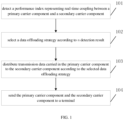
- an embodiment of the present application provides a data offloading method, including: detecting a performance index representing real-time coupling between a primary carrier component and a secondary carrier component; selecting a data offloading strategy according to a detection result; distributing transmission data carried in the primary carrier component to the secondary carrier component according to the selected data offloading strategy; and sending the primary carrier component and the secondary carrier component to a terminal.
- an embodiment of the present application further provides a data offloading apparatus, including: a detection module, configured to detect a performance index representing real-time coupling between a primary carrier component and a secondary carrier component; a selection module, configured to select a data offloading strategy according to the detection result; a distribution module, configured to distribute transmission data carried in the primary carrier component to the secondary carrier component according to the selected data offloading strategy; and a sending module, configured to send the primary carrier component and the secondary carrier component to a terminal.
- a detection module configured to detect a performance index representing real-time coupling between a primary carrier component and a secondary carrier component
- a selection module configured to select a data offloading strategy according to the detection result
- a distribution module configured to distribute transmission data carried in the primary carrier component to the secondary carrier component according to the selected data offloading strategy
- a sending module configured to send the primary carrier component and the secondary carrier component to a terminal.
- an embodiment of the present application further provides an electronic device, including: at least one processor; and a memory in communication connection with the at least one processor; wherein the memory stores instructions executable by the at least one processor, the instructions being executed by the at least one processor to enable the at least one processor to implement the above data offloading method.
- an embodiment of the present application further provides a computer-readable storage medium, storing a computer program, which implements the above data offloading method when executed by a processor.
- Embodiments of the present application relate to a data offloading method, as shown in FIG. 1 , including the following steps.
- Step 101 a performance index representing real-time coupling between a primary carrier component and a secondary carrier component is detected.
- Step 102 a data offloading strategy is selected according to a detection result.
- Step 103 transmission data carried in the primary carrier component is distributed to the secondary carrier component according to the selected data offloading strategy.
- Step 104 the primary carrier component and the secondary carrier component are sent to a terminal.
- the data offloading method in the embodiment is applied to a base station device, and the base station device uses the carrier aggregation technology for data transmission in order to meet the requirements of single-user peak rate and system capacity improvement.
- Carrier aggregation means that the base station side aggregates two or more component carriers to provide services for a User Equipment ("UE" for short), which can significantly improve the throughput of a single user.
- UE User Equipment
- the 5G NR has up to 16 CCs; the bandwidth of each CC is different (with a maximum frequency range FR1 being 100M, and a maximum frequency range FR2 being 400M); each CC can be next to each other or spaced apart in spectrum.
- the carrier that maintains RRC connection with users is called a primary carrier component or a primary cell (Pcell); the carriers other than the primary carrier component are called secondary carrier components or secondary cells (Scell).
- the CA as the key technology of 4/5G two-generation communication system, has a wide range of application scenarios. Especially in the 5G communication system, due to the complexity of channel conditions and spectrum distribution, the commercial scenarios of CA are richer.
- the CA technology can effectively aggregate multiple small frequency bands into a large frequency band, and effectively improve the peak rate of users; second, according to the strategy, some CCs with better channel quality are selected, or multiple CCs transmit the same data at the same time, so as to effectively improve the reliability of user data transmission.
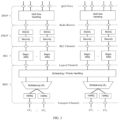
- the carrier aggregation technology belongs to the MAC sub-layer technology of the L2 layer in the NR protocol stack, and the L2 protocol stack of NR is shown in FIG. 2 .
- the NR L2 is divided into four sub-layers of Service Data Adaptation Protocol ("SDAP” for short), Packet Data Convergence Protocol (“PDCP” for short), Radio Link Control (“RLC” for short) Protocol, and MAC.
- SDAP Service Data Adaptation Protocol
- PDCP Packet Data Convergence Protocol
- RLC Radio Link Control
- the MAC sub-layer includes the functions of scheduling/sequencing (air interface resource distribution), aggregation (RLC layer data of multiple logical channels of the same UE are aggregated into one MAC packet), Hybrid Automatic Repeat reQuest ("HARQ" for short) entity management, etc., and is the sub-layer with the highest real-time requirement for the L2 layer, and needs to perform packaging with the air interface slot granularity.
- the carrier aggregation technology needs to be implemented in the MAC sub-layer.
- the carrier aggregation requires low transmission delay and large transmission bandwidth of two carriers.
- a performance index representing real-time coupling between a primary carrier component and a secondary carrier component is detected, according to the detection result, a data offloading strategy is selected, by detecting the transmission delay value and the transmission bandwidth value, the real-time coupling of the carrier of the device at the time is determined, so that the base station device can select different data offloading strategies upon different transmission delay values and transmission bandwidth values, and can select corresponding data offloading strategies even when the real-time coupling of the carriers is low.
- a more suitable data offloading strategy is selected when the real-time coupling of the carriers is fluctuating.
- the data offloading strategy can be switched.
- the transmission data carried in the primary carrier component is distributed to the secondary carrier component, and the primary carrier component and the secondary carrier component are sent to a terminal, thereby realizing the data offloading of carrier aggregation and reducing the difficulty of realizing carrier aggregation.
- the base station device detects a performance index representing real-time coupling between a primary carrier component and a secondary carrier component, such as a transmission delay value and/or a transmission bandwidth value.
- a performance index representing real-time coupling between a primary carrier component and a secondary carrier component, such as a transmission delay value and/or a transmission bandwidth value.
- the transmission delay value between the primary carrier component and the secondary carrier component refers to a delay value for data to be transmitted from the primary carrier component to the secondary carrier component
- the transmission bandwidth value refers to a transmission bandwidth value in which data is transmitted from the primary carrier component to the secondary carrier component
- the base station device may detect only a transmission delay value between the primary carrier component and the secondary carrier component, or detect only a transmission bandwidth value between the primary carrier component and the secondary carrier component, or detect both a transmission delay value and a transmission bandwidth value between the primary carrier component and the secondary carrier component.
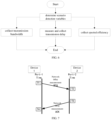
- the base station device may obtain a transmission delay value by the following mode: a sending device initiates a delay measurement request to a receiving device and carries a first time T1 at which the delay measurement request is transmitted in a request message; after the receiving device receives the request message, a second time T2 at which the request message is received is recorded; the receiving device sends a request acknowledgement to the sending device, and carries the first time, the second time and a third time T3 at which the acknowledgement message is sent in an acknowledgement message; the sending device receives the acknowledgement message returned by the receiving device, and records a fourth time T4 at which the acknowledgement message is received; the transmission delay value is equal to ((T4-T1)-(T3-T2))/2.
- each time may be a time of a MAC layer processing moment of the device, and the transmitting device and the receiving device may both be base station devices or may include user terminals.
- the transmission delay value can be obtained through the above calculation, thereby making the selection of the data offloading strategy, and reducing the implementation difficulty of carrier aggregation.
- the base station device selects a data offloading strategy according to the detection result.
- the base station device may detect a transmission delay value and/or a transmission bandwidth value for the previous data transmission from the primary carrier component to the secondary carrier component, and select the data offloading strategy based on the detection result.
- the base station device may select a data offloading strategy based on an average of transmission delay values and/or an average of transmission bandwidth values detected for previous data transmissions from the primary carrier component to the secondary carrier component.
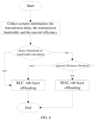
- the data offloading strategy includes: a radio link control (RLC) offloading strategy and a medium access control (MAC) offloading strategy; wherein, the RLC offloading strategy includes: the transmission data is reassembled into a RLC data packet at a RLC layer, the RLC data packet is distributed to the primary carrier component and the secondary carrier component; the MAC offloading strategy includes: the transmission data is reassembled into a MAC data packet at a MAC layer, the MAC data packet is distributed to the primary carrier component and the secondary carrier component; the step that the data offloading strategy is selected according to the detection result includes: the RLC offloading strategy is selected if the transmission delay value is greater than a delay threshold, or the transmission bandwidth value is less than a bandwidth threshold; and the MAC offloading strategy is selected if the transmission delay value is less than the delay threshold and the transmission bandwidth value is greater than the bandwidth threshold.
- the delay threshold and the bandwidth threshold may be manually set.
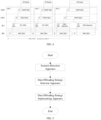
- the RLC sub-layer is responsible for the Automatic Repeat Request (ARQ) function, and the SDU of each RLC is marked with a packet header to form the PDU of RLC, then delivered to the MAC layer.
- ARQ Automatic Repeat Request
- the data packaging flow of the L2 sub-layer is shown in FIG. 4 .
- RLC entities can directly perform RLC PDU packaging without waiting for a MAC layer scheduling notification. Therefore, the MAC sub-layer and RLC sub-layer in the NR protocol are loosely coupled. Compared with LTE, the coupling between the RLC layer and the MAC layer is greatly simplified in the NR protocol. Because there is no need to couple the MAC layer, the processing of the RLC layer is greatly simplified.
- the MAC layer needs low transmission delay and large transmission bandwidth between the primary carrier component and the secondary carrier component for data offloading, when the transmission delay value is less than the delay threshold and the transmission bandwidth value is greater than the bandwidth threshold, it is considered that the carrier real-time coupling is high, and the MAC offloading strategy can be selected. Because the RLC offloading strategy reassembles the transmitted data into the RLC data packet in the RLC layer, and distributes the RLC data packet to the primary carrier component and the secondary carrier component, and the processing flow of the RLC layer requires less real-time performance.
- the base station device can select different data offloading strategies upon different transmission delay values and transmission bandwidth values, and can select corresponding data offloading strategies even when the carrier real-time coupling is low, thereby realizing the data offloading of carrier aggregation and reducing the implementation difficulty of carrier aggregation.
- the method further includes: a spectral efficiency value of the secondary carrier component is detected; before the MAC offloading strategy is selected, the method includes: it is determined that the spectral efficiency value is less than the spectral efficiency threshold. If the transmission delay value is less than or equal to the delay threshold and the transmission bandwidth value is greater than or equal to the bandwidth threshold, the method further includes: the MAC offloading strategy is selected if the secondary carrier component satisfies that the spectral efficiency value is less than a spectral efficiency threshold; and the RLC offloading strategy is selected if the secondary carrier component satisfies that the spectral efficiency value is greater than or equal to the spectral efficiency threshold.
- the step that the base station device also detects the spectral efficiency value of the secondary carrier component, and selects the data offloading strategy according to the detection result further includes: the MAC offloading strategy is selected if the spectral efficiency value is less than the spectral efficiency threshold; and the RLC offloading strategy is selected if the spectral efficiency value is greater than or equal to the spectral efficiency threshold.
- the MAC offloading strategy is selected, if the spectral efficiency value is greater than or equal to the spectral efficiency threshold, the RLC offloading strategy is selected, and the MAC offloading strategy can be selected for data offloading for carrier aggregation when the current scenario does not apply to the RLC offloading strategy.
- the base station device can obtain the spectral efficiency value by the following mode: channel state information (CSI) reported by the terminal is acquired; and the spectral efficiency value is acquired according to the CSI.
- CSI channel state information
- the base station device distributes transmission data carried in the primary carrier component to the secondary carrier component according to the selected data offloading strategy. Meanwhile, the base station device may detect a transmission delay value and/or a transmission bandwidth value for the next carrier aggregation when data is transmitted from the primary carrier component to the secondary carrier component.
- the step that the base station device also acquires the air interface transmissible data amounts of the current primary carrier component and the secondary carrier component, and distributes the MAC data packet to the primary carrier component and the secondary carrier component includes: the MAC data packet is correspondingly distributed to the primary carrier component and the secondary carrier component according to the air interface transmissible data amounts, that is, the MAC data packet is distributed to the primary carrier component according to the air interface transmissible data amount of the primary carrier component, and MAC data packet is distributed to the secondary carrier component according to the air interface transmissible data amount of the secondary carrier component.
- the primary carrier component and the secondary carrier component can be distributed with the maximum data amount that can be carried by the primary carrier component and the secondary carrier component respectively.
- the air interface transmissible data amounts of the current primary carrier component and the current secondary carrier component are obtained before the MAC data packet is distributed to the primary carrier component and the secondary carrier component, and the MAC data packet is correspondingly distributed to the primary carrier component and the secondary carrier component according to the air interface transmissible data amounts, so that the current maximum radio transmissible data amount can be configured for the secondary carrier component in real time, thereby transmitting more data amount and improving the data transmission efficiency.
- step 104 the base station device sends the primary carrier component and the secondary carrier component to a terminal.
- the data offloading method of the present application can be implemented by providing a scenario detection apparatus, a data offloading strategy selection apparatus, and a data offloading strategy implementing apparatus in a base station device, wherein, the scenario detection apparatus is configured to detect a scenario variable between a primary carrier component and a secondary carrier component as an input to the data offloading strategy selection apparatus; the data offloading strategy selection apparatus is configured to determine a scenario attribution according to the scenario variable and select a suitable data offloading strategy; the data offloading strategy implementing apparatus is configured to preset a set of data offloading strategies; and execute the corresponding offloading strategy according to strategy selection.
- the scenario detection apparatus is configured to detect a scenario variable between a primary carrier component and a secondary carrier component as an input to the data offloading strategy selection apparatus
- the data offloading strategy selection apparatus is configured to determine a scenario attribution according to the scenario variable and select a suitable data offloading strategy
- the data offloading strategy implementing apparatus is configured to preset a set of data off
- Step 1 scenario detection variables are determined (based on a specific UE perspective): a transmission delay between a primary carrier component and a secondary carrier component, a transmission bandwidth between the primary carrier component and the secondary carrier component, and an average spectral efficiency of each carrier.
- Step 2 the transmission delay is measured and collected: the transmission time between the PCC and the i-th SCC is periodically measured, and denoted as t i .
- Step 3 the transmission bandwidth is collected: the transmission bandwidth between the PCC and the i-th SCC is input according to configuration, and denoted as b i .
- Step 4 the spectral efficiency is collected: CSI reported by an UE is collected and algorithmically converted into the spectral efficiency; the spectral efficiency of the i-th SCC is denoted as s i .
- Step 5 end.
- the measurement schematic diagram of the transmission delay t i is shown in FIG. 7 , which includes the following steps.
- the software of a device 1 initiates a delay measurement request; the hardware of the device 1 adds a T1 timestamp to a message.
- the request message After being forwarded through network topology, the request message reaches a device 2; the hardware of the device 2 adds a T2 timestamp to the message and transfers it to its software.
- the software of the device 2 sends the network delay measurement ACK message to the hardware of the device 2, and the hardware fills in a timestamp T3 and sends it to the device 1.
- the ACK message After being forwarded through network topology, the ACK message arrives at the hardware of the device 1; the hardware adds a T4 timestamp.
- the data offloading strategy selection apparatus as shown in FIG. 8 , needs to perform the following steps.
- Step 1 the scenario information is acquired: the transmission delay t i , the transmission bandwidth b i , and the spectral efficiency s i of the i-th SCC.
- Step 2 the offloading scenario is determined.
- the first offloading strategy is determined, otherwise: if s i > s threshold , then the first offloading strategy is determined, else, the second offloading strategy is determined; (t threshold , b threshold and s threshold are the corresponding algorithm thresholds).
- Step 3 end.
- Step 1 a RLC sub-layer offloading strategy implementing apparatus I is provided.
- Step 2 a MAC sub-layer offloading strategy implementing apparatus II is provided.
- Step 3 end.
- Step 1 the PCC performs RLC sub-layer packet header maintenance and RLC sub-layer PDU packaging.
- Step 2 the PCC distributes a certain number of RLC PDUs to the SCC according to an algorithm strategy.
- Step 3 the RLC PDU data distributed by the PCC is delivered to the SCC.
- Step 4 after receiving the feedback from the RLC sub-layer, each CC performs independent ARQ maintenance.
- Step 5 end.
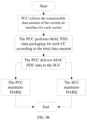
- Step 1 the amounts of data that can be transmitted by the current air interface for the PCC and SCC are collected, the primary carrier component is recorded as D p , and the i-th secondary carrier component is recorded as D i .
- Step 2 according to the transmissible data amounts of the primary carrier component and the secondary carrier component, the PCC performs MAC sub-layer PDU packaging.
- Step 3 the PCC delivers the MAC sub-layer PDU data to the corresponding SCC.
- Step 4 after receiving feedback from the MAC sub-layer, each CC performs independent HARQ maintenance, or the PCC performs HARQ maintenance uniformly.
- Step 5 end.
- Step 1 an UE accesses to a certain cell which is called a primary carrier component and is denoted as PCC.
- Step 2 the UE adds another inter-frequency cell as a SCC through RRC signaling.
- Step 3 scenario algorithm thresholds are set: transmission delay t threshold , transmission bandwidth b threshold , and spectral efficiency s threshold .
- Step 4 transmission delays t of the PCC and SCC, transmission bandwidths b configured for the PCC and SCC, and the spectral efficiency s of the SCC are collected.
- Step 5 the scenario is determined: if the scenario one is satisfied, proceed to step 6; otherwise proceed to step 8.
- Step 6 the PCC performs RLC PDU packaging.
- Step 7 the PCC performs RLC PDU distribution, for example, Mode 1 (even numbered PDUs are distributed to the SCC, odd numbered PDUs are distributed to the PCC); Mode 2 (distribution is performed according to the flow rate ratio of each CC, PCC 60%, SCC 40%).
- Step 8 the PCC collects the data amount of air interface for each carrier.
- Step 9 the PCC performs MAC PDU packaging and delivers the data to the corresponding SCC.
- the SCC receives the data and delivers the data to the UE over the air interface.
- the data offloading method of the embodiment has great benefit especially in the scenario with different multi-carrier attributes, such as when the transmission delay, transmission bandwidth and channel quality between multi-carriers are quite different.
- the adaptive selection of the carrier aggregation offloading strategy can be realized, thereby promoting the ease of use and universality of carrier aggregation and obtaining gain.
- Embodiments of the present application also relate to a data offloading apparatus, as shown in FIG. 10 , including the following modules.
- a detection module 1001 is configured to detect a performance index representing real-time coupling between a primary carrier component and a secondary carrier component.
- a selection module 1002 is configured to select a data offloading strategy according to the detection result
- a distribution module 1003 is configured to distribute transmission data carried in the primary carrier component to the secondary carrier component according to the selected data offloading strategy.
- a sending module 1004 is configured to send the primary carrier component and the secondary carrier component to a terminal.
- the data offloading strategy includes: a radio link control (RLC) offloading strategy and a medium access control (MAC) offloading strategy; wherein, the RLC offloading strategy includes: the transmission data is reassembled into a RLC data packet at a RLC layer, the RLC data packet is distributed to the primary carrier component and the secondary carrier component; the MAC offloading strategy includes: the transmission data is reassembled into a MAC data packet at a MAC layer, the MAC data packet is distributed to the primary carrier component and the secondary carrier component; the step that the data offloading strategy is selected according to the detection result includes: the RLC offloading strategy is selected if the transmission delay value is greater than a delay threshold, or the transmission bandwidth value is less than a bandwidth threshold; and the MAC offloading strategy is selected if the transmission delay value is less than the delay threshold and the transmission bandwidth value is greater than the bandwidth threshold.
- RLC radio link control
- MAC medium access control
- the method further includes: a spectral efficiency value of the secondary carrier component is detected; the step that the data offloading strategy is selected based on the detection result further includes: the MAC offloading strategy is selected if the spectral efficiency value is less than a spectral efficiency threshold; and the RLC offloading strategy is selected if the spectral efficiency value is greater than or equal to the spectral efficiency threshold.
- the method prior to selecting the data offloading strategy based on the detection result, the method further includes: the spectral efficiency value of the secondary carrier component is detected; prior to selecting the MAC offloading strategy, the method includes that the spectral efficiency value is determined to be less than a spectral efficiency threshold.
- the spectral efficiency value is obtained by the following mode: channel state information (CSI) reported by the terminal is acquired; and the spectral efficiency value is acquired according to the CSI.
- CSI channel state information
- the method prior to distributing the MAC data packet to the primary carrier component and the secondary carrier component, the method further includes: the air interface transmittable data amounts of the current primary carrier component and the secondary carrier component are acquired; the step that the MAC data packet is distributed to the primary carrier component and the secondary carrier component includes: the MAC data packet is correspondingly distributed to the primary carrier component and the secondary carrier component according to the air interface transmittable data amounts.
- Embodiments of the present application also relate to an electronic device, as shown in FIG. 11 , including: at least one processor 1101; a memory 1102 in communication connection with the at least one processor; wherein the memory 1102 stores instructions executable by the at least one processor 1101, the instructions being executed by the at least one processor 1101 to perform the data offloading method of any one of the above embodiments.
- the memory 1102 and the processor 1101 are connected by a bus, which may include any number of interconnecting buses and bridges, and the bus connects together the various circuits of the one or more processors 1101 and the memory 1102.
- the bus can also connect various other circuits, such as peripheral devices, voltage regulators and power management circuits, which are well known in the art, and therefore, will not be described any further herein.
- a bus interface provides an interface between a bus and a transceiver.
- the transceiver may be one element or multiple elements, such as multiple receivers and transmitters, that provide a unit for communicating with various other apparatuses over a transmission medium.
- the information processed by the processor 1101 is transmitted over a wireless medium through the antenna, further, the antenna receives the information and delivers the information to the processor 1101.
- the processor 1101 is responsible for managing the bus and general processing, and may also provide various functions including timing, peripheral interfaces, voltage regulation, power management and other control functions.
- the memory 1102 may be configured to store information used by the processor in performing operations.
- An embodiment of the present application relates to a computer-readable storage medium, storing a computer program.
- the computer program when executed by a processor, implements the method embodiments described above.
- a storage medium includes various media capable of storing program codes, such as a USB flash disk, a mobile hard disk, a Read-Only Memory (ROM), a Random Access Memory (RAM), a magnetic disk, or an optical disk.
- program codes such as a USB flash disk, a mobile hard disk, a Read-Only Memory (ROM), a Random Access Memory (RAM), a magnetic disk, or an optical disk.
Landscapes
- Engineering & Computer Science (AREA)
- Signal Processing (AREA)
- Computer Networks & Wireless Communication (AREA)
- Quality & Reliability (AREA)
- Mobile Radio Communication Systems (AREA)
Applications Claiming Priority (2)
| Application Number | Priority Date | Filing Date | Title |
|---|---|---|---|
| CN202111275394.8A CN116094665A (zh) | 2021-10-29 | 2021-10-29 | 数据分流方法、装置、电子设备及存储介质 |
| PCT/CN2022/127429 WO2023072092A1 (zh) | 2021-10-29 | 2022-10-25 | 数据分流方法、装置、电子设备及存储介质 |
Publications (2)
| Publication Number | Publication Date |
|---|---|
| EP4426005A1 true EP4426005A1 (de) | 2024-09-04 |
| EP4426005A4 EP4426005A4 (de) | 2025-10-08 |
Family
ID=86159053
Family Applications (1)
| Application Number | Title | Priority Date | Filing Date |
|---|---|---|---|
| EP22885969.0A Pending EP4426005A4 (de) | 2021-10-29 | 2022-10-25 | Datenabladeverfahren und -vorrichtung, elektronische vorrichtung und speichermedium |
Country Status (5)
| Country | Link |
|---|---|
| US (1) | US20250008545A1 (de) |
| EP (1) | EP4426005A4 (de) |
| CN (1) | CN116094665A (de) |
| WO (1) | WO2023072092A1 (de) |
| ZA (1) | ZA202402744B (de) |
Families Citing this family (3)
| Publication number | Priority date | Publication date | Assignee | Title |
|---|---|---|---|---|
| CN119183149A (zh) * | 2023-06-21 | 2024-12-24 | 中兴通讯股份有限公司 | 数据分流方法、设备及存储介质 |
| CN119450583A (zh) * | 2023-07-31 | 2025-02-14 | 中兴通讯股份有限公司 | 数据传输方法、设备和计算机可读存储介质 |
| CN118826989B (zh) * | 2024-01-31 | 2025-10-03 | 中国移动通信集团设计院有限公司 | 载波聚合的调度方法、装置、设备、存储介质和程序产品 |
Family Cites Families (5)
| Publication number | Priority date | Publication date | Assignee | Title |
|---|---|---|---|---|
| EP3238480A1 (de) * | 2014-12-23 | 2017-11-01 | Interdigital Patent Holdings, Inc. | Verfahren für wifi-integration in mobilfunksysteme |
| ES2735407T3 (es) * | 2015-02-09 | 2019-12-18 | Huawei Tech Co Ltd | Método de descarga de paquetes de datos RLC y estación base |
| US9585072B1 (en) * | 2015-07-22 | 2017-02-28 | Sprint Spectrum L.P. | SCell triggered handover notwithstanding good PCell condition |
| CN108075870B (zh) * | 2016-11-16 | 2020-11-10 | 电信科学技术研究院 | 站间载波聚合调度的方法和装置 |
| CN112399481B (zh) * | 2019-08-13 | 2025-07-08 | 中兴通讯股份有限公司 | 一种流量分配管理方法、装置、基站及存储介质 |
-
2021
- 2021-10-29 CN CN202111275394.8A patent/CN116094665A/zh active Pending
-
2022
- 2022-10-25 US US18/697,750 patent/US20250008545A1/en active Pending
- 2022-10-25 EP EP22885969.0A patent/EP4426005A4/de active Pending
- 2022-10-25 WO PCT/CN2022/127429 patent/WO2023072092A1/zh not_active Ceased
-
2024
- 2024-04-09 ZA ZA2024/02744A patent/ZA202402744B/en unknown
Also Published As
| Publication number | Publication date |
|---|---|
| ZA202402744B (en) | 2024-12-18 |
| EP4426005A4 (de) | 2025-10-08 |
| WO2023072092A1 (zh) | 2023-05-04 |
| CN116094665A (zh) | 2023-05-09 |
| US20250008545A1 (en) | 2025-01-02 |
Similar Documents
| Publication | Publication Date | Title |
|---|---|---|
| US9848435B2 (en) | Systems and methods to enhance radio link performance in a multi-carrier environment | |
| EP4426005A1 (de) | Datenabladeverfahren und -vorrichtung, elektronische vorrichtung und speichermedium | |
| US11843969B2 (en) | Method and device for processing buffer state report in wireless communication system using inter-eNB carrier aggregation technology | |
| RU2602385C1 (ru) | Способ, устройство, ue и базовая станция для передачи информации гибридного автоматического запроса-подтверждения на повторную передачу данных | |
| RU2564529C2 (ru) | Сообщение запаса мощности для агрегации несущих | |
| CN103081542B (zh) | 在移动通信系统中发送和接收上行链路数据的方法和装置 | |
| WO2016000368A1 (zh) | 上行控制信道的配置和发送方法、装置及基站和用户设备 | |
| US20150215957A1 (en) | System and method for channel state information transmission on lte dual connectivity | |
| US10624116B2 (en) | Method and apparatus for scheduling terminal in wireless communication system | |
| CN107979847B (zh) | 数据传输的方法、装置、用户设备和基站 | |
| US12191990B2 (en) | Wireless communication method and apparatus | |
| US12543124B2 (en) | Method and apparatus for supporting power headroom report for multiple transmission reception points in next generation mobile communication system | |
| CN110505711A (zh) | 处理调度请求的方法、设备、装置及介质 | |
| CN106171004A (zh) | 一种rlc数据包分流方法及基站 | |
| US10142253B2 (en) | Method for efficient reliable transmission | |
| WO2015070446A1 (zh) | 一种数据传输的方法及用户设备 | |
| CN103067140B (zh) | 控制信令发送方法及系统 | |
| US12574863B2 (en) | Method and apparatus for supporting power headroom report for PUSCH retransmission using multiple transmission reception points in new generation wireless communication system | |
| US11909539B2 (en) | Wireless communication method and apparatus for improving robustness of data transmission | |
| CN108401258A (zh) | 网络优化方法及装置 | |
| CN118118949A (zh) | 一种通信方法以及相关装置 |
Legal Events
| Date | Code | Title | Description |
|---|---|---|---|
| STAA | Information on the status of an ep patent application or granted ep patent |
Free format text: STATUS: THE INTERNATIONAL PUBLICATION HAS BEEN MADE |
|
| PUAI | Public reference made under article 153(3) epc to a published international application that has entered the european phase |
Free format text: ORIGINAL CODE: 0009012 |
|
| STAA | Information on the status of an ep patent application or granted ep patent |
Free format text: STATUS: REQUEST FOR EXAMINATION WAS MADE |
|
| 17P | Request for examination filed |
Effective date: 20240328 |
|
| AK | Designated contracting states |
Kind code of ref document: A1 Designated state(s): AL AT BE BG CH CY CZ DE DK EE ES FI FR GB GR HR HU IE IS IT LI LT LU LV MC ME MK MT NL NO PL PT RO RS SE SI SK SM TR |
|
| DAV | Request for validation of the european patent (deleted) | ||
| DAX | Request for extension of the european patent (deleted) | ||
| REG | Reference to a national code |
Ref country code: DE Ref legal event code: R079 Free format text: PREVIOUS MAIN CLASS: H04W0028080000 Ipc: H04W0028082000 |
|
| A4 | Supplementary search report drawn up and despatched |
Effective date: 20250904 |
|
| RIC1 | Information provided on ipc code assigned before grant |
Ipc: H04W 28/082 20230101AFI20250829BHEP Ipc: H04W 76/15 20180101ALI20250829BHEP Ipc: H04W 28/08 20230101ALI20250829BHEP Ipc: H04L 5/00 20060101ALI20250829BHEP Ipc: H04W 28/06 20090101ALN20250829BHEP |