EP4425392A1 - Carbon emission assessment system for reuse of retired batteries - Google Patents
Carbon emission assessment system for reuse of retired batteries Download PDFInfo
- Publication number
- EP4425392A1 EP4425392A1 EP22885295.0A EP22885295A EP4425392A1 EP 4425392 A1 EP4425392 A1 EP 4425392A1 EP 22885295 A EP22885295 A EP 22885295A EP 4425392 A1 EP4425392 A1 EP 4425392A1
- Authority
- EP
- European Patent Office
- Prior art keywords
- carbon emission
- module
- recycling
- carbon
- assessment system
- Prior art date
- Legal status (The legal status is an assumption and is not a legal conclusion. Google has not performed a legal analysis and makes no representation as to the accuracy of the status listed.)
- Withdrawn
Links
Images


Classifications
-
- G—PHYSICS
- G06—COMPUTING OR CALCULATING; COUNTING
- G06Q—INFORMATION AND COMMUNICATION TECHNOLOGY [ICT] SPECIALLY ADAPTED FOR ADMINISTRATIVE, COMMERCIAL, FINANCIAL, MANAGERIAL OR SUPERVISORY PURPOSES; SYSTEMS OR METHODS SPECIALLY ADAPTED FOR ADMINISTRATIVE, COMMERCIAL, FINANCIAL, MANAGERIAL OR SUPERVISORY PURPOSES, NOT OTHERWISE PROVIDED FOR
- G06Q50/00—Information and communication technology [ICT] specially adapted for implementation of business processes of specific business sectors, e.g. utilities or tourism
- G06Q50/10—Services
- G06Q50/26—Government or public services
-
- G—PHYSICS
- G06—COMPUTING OR CALCULATING; COUNTING
- G06Q—INFORMATION AND COMMUNICATION TECHNOLOGY [ICT] SPECIALLY ADAPTED FOR ADMINISTRATIVE, COMMERCIAL, FINANCIAL, MANAGERIAL OR SUPERVISORY PURPOSES; SYSTEMS OR METHODS SPECIALLY ADAPTED FOR ADMINISTRATIVE, COMMERCIAL, FINANCIAL, MANAGERIAL OR SUPERVISORY PURPOSES, NOT OTHERWISE PROVIDED FOR
- G06Q30/00—Commerce
- G06Q30/018—Certifying business or products
-
- G—PHYSICS
- G06—COMPUTING OR CALCULATING; COUNTING
- G06Q—INFORMATION AND COMMUNICATION TECHNOLOGY [ICT] SPECIALLY ADAPTED FOR ADMINISTRATIVE, COMMERCIAL, FINANCIAL, MANAGERIAL OR SUPERVISORY PURPOSES; SYSTEMS OR METHODS SPECIALLY ADAPTED FOR ADMINISTRATIVE, COMMERCIAL, FINANCIAL, MANAGERIAL OR SUPERVISORY PURPOSES, NOT OTHERWISE PROVIDED FOR
- G06Q10/00—Administration; Management
- G06Q10/04—Forecasting or optimisation specially adapted for administrative or management purposes, e.g. linear programming or "cutting stock problem"
-
- G—PHYSICS
- G06—COMPUTING OR CALCULATING; COUNTING
- G06Q—INFORMATION AND COMMUNICATION TECHNOLOGY [ICT] SPECIALLY ADAPTED FOR ADMINISTRATIVE, COMMERCIAL, FINANCIAL, MANAGERIAL OR SUPERVISORY PURPOSES; SYSTEMS OR METHODS SPECIALLY ADAPTED FOR ADMINISTRATIVE, COMMERCIAL, FINANCIAL, MANAGERIAL OR SUPERVISORY PURPOSES, NOT OTHERWISE PROVIDED FOR
- G06Q10/00—Administration; Management
- G06Q10/06—Resources, workflows, human or project management; Enterprise or organisation planning; Enterprise or organisation modelling
- G06Q10/063—Operations research, analysis or management
- G06Q10/0639—Performance analysis of employees; Performance analysis of enterprise or organisation operations
- G06Q10/06393—Score-carding, benchmarking or key performance indicator [KPI] analysis
-
- G—PHYSICS
- G06—COMPUTING OR CALCULATING; COUNTING
- G06Q—INFORMATION AND COMMUNICATION TECHNOLOGY [ICT] SPECIALLY ADAPTED FOR ADMINISTRATIVE, COMMERCIAL, FINANCIAL, MANAGERIAL OR SUPERVISORY PURPOSES; SYSTEMS OR METHODS SPECIALLY ADAPTED FOR ADMINISTRATIVE, COMMERCIAL, FINANCIAL, MANAGERIAL OR SUPERVISORY PURPOSES, NOT OTHERWISE PROVIDED FOR
- G06Q10/00—Administration; Management
- G06Q10/30—Administration of product recycling or disposal
-
- Y—GENERAL TAGGING OF NEW TECHNOLOGICAL DEVELOPMENTS; GENERAL TAGGING OF CROSS-SECTIONAL TECHNOLOGIES SPANNING OVER SEVERAL SECTIONS OF THE IPC; TECHNICAL SUBJECTS COVERED BY FORMER USPC CROSS-REFERENCE ART COLLECTIONS [XRACs] AND DIGESTS
- Y02—TECHNOLOGIES OR APPLICATIONS FOR MITIGATION OR ADAPTATION AGAINST CLIMATE CHANGE
- Y02P—CLIMATE CHANGE MITIGATION TECHNOLOGIES IN THE PRODUCTION OR PROCESSING OF GOODS
- Y02P90/00—Enabling technologies with a potential contribution to greenhouse gas [GHG] emissions mitigation
- Y02P90/80—Management or planning
- Y02P90/82—Energy audits or management systems therefor
-
- Y—GENERAL TAGGING OF NEW TECHNOLOGICAL DEVELOPMENTS; GENERAL TAGGING OF CROSS-SECTIONAL TECHNOLOGIES SPANNING OVER SEVERAL SECTIONS OF THE IPC; TECHNICAL SUBJECTS COVERED BY FORMER USPC CROSS-REFERENCE ART COLLECTIONS [XRACs] AND DIGESTS
- Y02—TECHNOLOGIES OR APPLICATIONS FOR MITIGATION OR ADAPTATION AGAINST CLIMATE CHANGE
- Y02P—CLIMATE CHANGE MITIGATION TECHNOLOGIES IN THE PRODUCTION OR PROCESSING OF GOODS
- Y02P90/00—Enabling technologies with a potential contribution to greenhouse gas [GHG] emissions mitigation
- Y02P90/80—Management or planning
- Y02P90/84—Greenhouse gas [GHG] management systems
-
- Y—GENERAL TAGGING OF NEW TECHNOLOGICAL DEVELOPMENTS; GENERAL TAGGING OF CROSS-SECTIONAL TECHNOLOGIES SPANNING OVER SEVERAL SECTIONS OF THE IPC; TECHNICAL SUBJECTS COVERED BY FORMER USPC CROSS-REFERENCE ART COLLECTIONS [XRACs] AND DIGESTS
- Y02—TECHNOLOGIES OR APPLICATIONS FOR MITIGATION OR ADAPTATION AGAINST CLIMATE CHANGE
- Y02P—CLIMATE CHANGE MITIGATION TECHNOLOGIES IN THE PRODUCTION OR PROCESSING OF GOODS
- Y02P90/00—Enabling technologies with a potential contribution to greenhouse gas [GHG] emissions mitigation
- Y02P90/80—Management or planning
- Y02P90/84—Greenhouse gas [GHG] management systems
- Y02P90/845—Inventory and reporting systems for greenhouse gases [GHG]
-
- Y—GENERAL TAGGING OF NEW TECHNOLOGICAL DEVELOPMENTS; GENERAL TAGGING OF CROSS-SECTIONAL TECHNOLOGIES SPANNING OVER SEVERAL SECTIONS OF THE IPC; TECHNICAL SUBJECTS COVERED BY FORMER USPC CROSS-REFERENCE ART COLLECTIONS [XRACs] AND DIGESTS
- Y02—TECHNOLOGIES OR APPLICATIONS FOR MITIGATION OR ADAPTATION AGAINST CLIMATE CHANGE
- Y02W—CLIMATE CHANGE MITIGATION TECHNOLOGIES RELATED TO WASTEWATER TREATMENT OR WASTE MANAGEMENT
- Y02W90/00—Enabling technologies or technologies with a potential or indirect contribution to greenhouse gas [GHG] emissions mitigation
Definitions
- the invention relates to the technical field of recycling of decommissioned battery, in particular to a carbon emission assessment system for recycling of decommissioned battery.
- batteries will play an increasingly important role in the future. Many batteries will be applied to various new energy companies or other industries. At the same time, a large number of batteries will be decommissioned according to their life cycles. Recycling batteries will also produce a complex carbon emission process, and carbon emissions are also very considerable due to the large number of batteries, which will inevitably affect the company's carbon emission indicators.
- the purpose of the present invention is to provide a carbon emission assessment system for recycling of decommissioned battery, to conduct a standardized assessment of carbon emissions during the recycling, so that enterprises can optimize carbon emissions during the recycling of decommissioned battery based on the assessment.
- the present invention provides a carbon emission assessment system for recycling of decommissioned battery, which includes an information module, an instruction module, an accounting module, and an analysis module.
- the information module is configured to obtain operation stages of the recycling of decommissioned battery and an input inventory corresponding to each of the operation stages.
- the instruction module is configured to store a carbon dioxide emission calculation formula and carbon dioxide emission factors of different substances.
- the accounting module is configured to retrieve the carbon emission calculation formula and the carbon emission factors of different substances in the instruction module, in response to the operation stages and an input inventory in the information module inputted by a user, and to obtain carbon emission results of different operation stages.
- the analysis module is configured to compare the carbon emission results obtained by the accounting module with a pre-stored standard carbon emission amount to obtain a comparison result.
- the operation stages include one or more selected from a group consisting of pretreatment, leaching extraction, precursor preparation, and cathode material preparation.
- the input inventory includes one or more selected from a group consisting of raw materials, products, by-products, waste gas, waste residue, and energy involved in each operation stages.
- the information module includes a storage unit, where the storage unit is configured to store a standard carbon emission obtained according to a carbon emission policy promulgated by a state.
- the carbon emission system further includes a first optimization module, which is configured to rank carbon emissions of the operation stages according to the carbon emission results obtained by the analysis module, and to obtain an operation stage to be optimized according to a ranking result.
- the carbon emission system further includes a second optimization module, which is configured to perform a main contribution factor analysis according to the input inventory corresponding to the operation stage to be optimized, and to determine an optimization direction of the operation stage to be optimized.
- the carbon emission system further includes a display module, which is configured to display the comparison result obtained by the analysis module, the operation stage to be optimized determined by the first optimization module and the optimization direction determined by the second optimization module to the user.
- the carbon emission assessment system for recycling of decommissioned battery in the embodiment of the present invention has the following beneficial effect: scientific and standardized carbon emission assessment can be carried out on the recycling of decommissioned battery, and the relevant company personnel can optimize the carbon emission of the recycling of decommissioned battery based on a comparison result obtained by comparing a carbon emission result with a pre-stored standard carbon emission.
- the present invention discloses a carbon emission assessment system for recycling of decommissioned battery, which includes an information module, an instruction module, an accounting module, and an analysis module.
- the information module is configured to obtain operation stages of the recycling of decommissioned battery and an input inventory corresponding to each of the operation stages.
- the instruction module is configured to store a carbon dioxide emission calculation formula and carbon dioxide emission factors of different substances.
- the accounting module is configured to retrieve the carbon emission calculation formula and the carbon emission factors of different substances in the instruction module, in response to the operation stages and an input inventory in the information module inputted by a user, and to obtain carbon emission results of different operation stages.
- the analysis module is configured to compare the carbon emission results obtained by the accounting module with a pre-stored standard carbon emission to obtain a comparison result.
- the operation stages include one or more selected from a group consisting of pretreatment, leaching extraction, precursor preparation, and cathode material preparation.
- the input inventory includes one or more selected from a group consisting of raw materials, products, by-products, waste gas, waste residue, and energy involved in each of the operation stages.
- the input inventory includes, but is not limited to, the following inputs: decommissioned battery (waste lithium ion battery, waste battery, waste ternary positive scrap, etc.), electricity power, water, fuel (diesel, gasoline, liquefied petroleum gas, heavy fuel oil, light fuel oil, natural gas, propane, etc.); valuable metals (nickel, cobalt, manganese, lithium, iron, copper, aluminum, etc.), precursors, cathode materials, lye, acid, sodium carbonate, sodium hydroxide, sodium chlorate, manganese carbonate, sponge copper, sodium sulfate, graphite, waste residue (carbon black slag, iron alum slag, calcium slag, etc.), waste water, steam, extractant, etc.
- decommissioned battery waste lithium ion battery, waste battery, waste ternary positive scrap, etc.
- electricity power water
- fuel diesel, gasoline, liquefied petroleum gas, heavy fuel oil, light fuel oil, natural gas, propane, etc.
- valuable metals nickel, cobal
- the information module includes a storage unit, where the storage unit is configured to store a standard carbon emission according to a carbon emission policy promulgated by a state.
- the carbon emission assessment system for recycling of decommissioned battery of the present invention is used to assess the carbon emission of preparing nickel cobalt manganese hydroxide and lithium nickel cobalt manganate cathode material by recycling waste lithium ion battery.
- the operation stages carried out include: pretreatment (dissembling - pyrolysis - crushing), leaching extraction (acid leaching - copper removal-iron and aluminum removal - impurities removal of extraction), and precursors preparation (mixing materials - aging with alkali-pressure filtration, washing and drying - wastewater deamination - water reuse), synthesis of cathode materials (mixing - calcination - secondary mixing - secondary calcination - packaging).
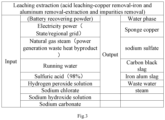
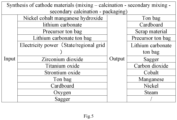
- Th input inventories corresponding to each of the operation stages includes the examples of inventories in Figs. 2-5 .
- An accounting module is applied to select a carbon emission calculation formula and carbon emission factors of different substances to perform a carbon emission accounting, in response to the above-mentioned operation stages and input inventory inputted by a user.
- the carbon emissions of the different operation stages and the overall recycling process are displayed; the carbon emissions are compared with a pre-stored standard carbon emission, to obtain a comparison result.
- the display mode of the comparison result includes, but is not limited to, a comparison table and a comparison chart.
- the carbon emission system further includes a first optimization module, which is configured to rank the carbon emissions of the operation stages according to the carbon emission results obtained by the analysis module, and to obtain an operation stage to be optimized according to a ranking result.
- the ranking can be carried out based on a carbon emission, a ratio of the carbon emission to the total weight of the inventory, and so on.
- the carbon assessment emissions of the operation stages can be ranked by multiple sorting methods and each of the sorting methods is assigned a weight respectively. Then each of the ranking result obtained by the sorting methods is given a score, thereby a comprehensive score is obtained based on the score and a corresponding weight of the sorting methods.
- the operation stage with the highest comprehensive score is regarded as an operation stage to be optimized.
- the carbon emission assessment system further includes a second optimization module, which is configured to perform a main contribution factor analysis according to an input inventory corresponding to the operation stage to be optimized, and to determine an optimization direction of the operation stage to be optimized.
- the main contribution factor analysis can be carried out by methods such as SPSS statistical analysis method, logarithmic average weight decomposition method, partial least square method and other methods, which determines a contribution of different input inventories to carbon emissions.
- the input inventory having the largest contribution is an actual optimization direction of the operation stage to be optimized.
- an optimization is carried out by strengthening technological innovation, implementing clean production, and choosing different optimized operations, such as using alternative low-carbon processes or raw materials, alternative clean energy/new energy/renewable energy, etc.
- the carbon emission system further includes a display module, which is configured to display the comparison result obtained by the analysis module, the operation stage to be optimized determined by the first optimization module and the optimization direction determined by the second optimization module to the user.
- the examples of the present invention provide a carbon emission assessment system for recycling of decommissioned battery, which has the following beneficial effects:
Landscapes
- Business, Economics & Management (AREA)
- Engineering & Computer Science (AREA)
- Human Resources & Organizations (AREA)
- Economics (AREA)
- Strategic Management (AREA)
- Tourism & Hospitality (AREA)
- Theoretical Computer Science (AREA)
- General Physics & Mathematics (AREA)
- Marketing (AREA)
- General Business, Economics & Management (AREA)
- Physics & Mathematics (AREA)
- Entrepreneurship & Innovation (AREA)
- Development Economics (AREA)
- Operations Research (AREA)
- Quality & Reliability (AREA)
- Educational Administration (AREA)
- Sustainable Development (AREA)
- Life Sciences & Earth Sciences (AREA)
- General Health & Medical Sciences (AREA)
- Health & Medical Sciences (AREA)
- Primary Health Care (AREA)
- Game Theory and Decision Science (AREA)
- Finance (AREA)
- Accounting & Taxation (AREA)
- Management, Administration, Business Operations System, And Electronic Commerce (AREA)
- Battery Electrode And Active Subsutance (AREA)
Abstract
Description
- The invention relates to the technical field of recycling of decommissioned battery, in particular to a carbon emission assessment system for recycling of decommissioned battery.
- With the introduction of policies of carbon peaking in 2030 and carbon neutrality in 2060, the carbon emission requirements for industrial enterprises, especially new energy enterprises, are on the agenda. However, since calculation and assessment of carbon emissions are a series of complicated calculation processes, it is difficult for enterprises to conduct self-assessment based on actual conditions, and therefore they cannot conduct self-supervision and timely adjustment. Many non-compliant carbon emissions will continue to affect the environment in the future.
- With the development of battery technology, batteries will play an increasingly important role in the future. Many batteries will be applied to various new energy companies or other industries. At the same time, a large number of batteries will be decommissioned according to their life cycles. Recycling batteries will also produce a complex carbon emission process, and carbon emissions are also very considerable due to the large number of batteries, which will inevitably affect the company's carbon emission indicators.
- Therefore, it is necessary to conduct a standardized assessment of carbon emissions in the process of recycling decommissioned battery, so that enterprises can optimize carbon emissions in the process of recycling decommissioned battery based on the assessment.
- The purpose of the present invention is to provide a carbon emission assessment system for recycling of decommissioned battery, to conduct a standardized assessment of carbon emissions during the recycling, so that enterprises can optimize carbon emissions during the recycling of decommissioned battery based on the assessment.
- In order to achieve the above objective, the present invention provides a carbon emission assessment system for recycling of decommissioned battery, which includes an information module, an instruction module, an accounting module, and an analysis module.
- The information module is configured to obtain operation stages of the recycling of decommissioned battery and an input inventory corresponding to each of the operation stages.
- The instruction module is configured to store a carbon dioxide emission calculation formula and carbon dioxide emission factors of different substances.
- The accounting module is configured to retrieve the carbon emission calculation formula and the carbon emission factors of different substances in the instruction module, in response to the operation stages and an input inventory in the information module inputted by a user, and to obtain carbon emission results of different operation stages.
- The analysis module is configured to compare the carbon emission results obtained by the accounting module with a pre-stored standard carbon emission amount to obtain a comparison result.
- Further, the carbon emission calculation formula is:

where, n represents different operation stages; i represents a specific substance in the input inventory; Ei represents a consumption or output of the specific substance i in the input inventory; Ci represents a carbon emission factor of the specific substance i in the input inventory. - Further, the operation stages include one or more selected from a group consisting of pretreatment, leaching extraction, precursor preparation, and cathode material preparation.
- Further, the input inventory includes one or more selected from a group consisting of raw materials, products, by-products, waste gas, waste residue, and energy involved in each operation stages.
- Further, the information module includes a storage unit, where the storage unit is configured to store a standard carbon emission obtained according to a carbon emission policy promulgated by a state.
- Further, the carbon emission system further includes a first optimization module, which is configured to rank carbon emissions of the operation stages according to the carbon emission results obtained by the analysis module, and to obtain an operation stage to be optimized according to a ranking result.
- Further, the carbon emission system further includes a second optimization module, which is configured to perform a main contribution factor analysis according to the input inventory corresponding to the operation stage to be optimized, and to determine an optimization direction of the operation stage to be optimized.
- Further, the carbon emission system further includes a display module, which is configured to display the comparison result obtained by the analysis module, the operation stage to be optimized determined by the first optimization module and the optimization direction determined by the second optimization module to the user.
- Compared with the existing technology, the carbon emission assessment system for recycling of decommissioned battery in the embodiment of the present invention has the following beneficial effect: scientific and standardized carbon emission assessment can be carried out on the recycling of decommissioned battery, and the relevant company personnel can optimize the carbon emission of the recycling of decommissioned battery based on a comparison result obtained by comparing a carbon emission result with a pre-stored standard carbon emission.
-
-
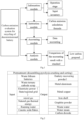
Fig. 1 is a schematic diagram of a first overall structure of a carbon emission assessment system for recycling of decommissioned battery of the present invention; -
Fig. 2 is a schematic diagram of an input inventory about operation stage of pre-treatment of the present invention; -
Fig. 3 is a schematic diagram of an input inventory about operation stage of leaching and extraction of the present invention; -
Fig. 4 is a schematic diagram of an input inventory about operation stage of precursor preparation operation stage of the present invention; -
Fig. 5 is a schematic diagram of an input inventory about operation stage of synthesizing cathode material of the present invention; -
Fig. 6 is a schematic diagram of a second overall structure of a carbon emission assessment system for recycling of decommissioned battery of the present invention - The specific embodiments of the present invention will be described in further detail below in conjunction with the accompanying drawings and examples. The following examples are used to illustrate the present invention, but not to limit the scope of the present invention.
- As shown in
Fig. 1 , the present invention discloses a carbon emission assessment system for recycling of decommissioned battery, which includes an information module, an instruction module, an accounting module, and an analysis module. - The information module is configured to obtain operation stages of the recycling of decommissioned battery and an input inventory corresponding to each of the operation stages.
- The instruction module is configured to store a carbon dioxide emission calculation formula and carbon dioxide emission factors of different substances.
- The accounting module is configured to retrieve the carbon emission calculation formula and the carbon emission factors of different substances in the instruction module, in response to the operation stages and an input inventory in the information module inputted by a user, and to obtain carbon emission results of different operation stages.
- The analysis module is configured to compare the carbon emission results obtained by the accounting module with a pre-stored standard carbon emission to obtain a comparison result.
- In this example, the carbon emission calculation formula is:

where n represents different operation stages; i represents a specific substance in the input inventory; Ei represents a consumption or output of the specific substance i in the input inventory; Ci represents a carbon emission factor of the specific substance i in the input inventory. - In this example, the operation stages include one or more selected from a group consisting of pretreatment, leaching extraction, precursor preparation, and cathode material preparation.
- In this example, the input inventory includes one or more selected from a group consisting of raw materials, products, by-products, waste gas, waste residue, and energy involved in each of the operation stages.
- In this example, the input inventory includes, but is not limited to, the following inputs: decommissioned battery (waste lithium ion battery, waste battery, waste ternary positive scrap, etc.), electricity power, water, fuel (diesel, gasoline, liquefied petroleum gas, heavy fuel oil, light fuel oil, natural gas, propane, etc.); valuable metals (nickel, cobalt, manganese, lithium, iron, copper, aluminum, etc.), precursors, cathode materials, lye, acid, sodium carbonate, sodium hydroxide, sodium chlorate, manganese carbonate, sponge copper, sodium sulfate, graphite, waste residue (carbon black slag, iron alum slag, calcium slag, etc.), waste water, steam, extractant, etc.
- In this example, the information module includes a storage unit, where the storage unit is configured to store a standard carbon emission according to a carbon emission policy promulgated by a state.
- The carbon emission assessment system for recycling of decommissioned battery of the present invention is used to assess the carbon emission of preparing nickel cobalt manganese hydroxide and lithium nickel cobalt manganate cathode material by recycling waste lithium ion battery.
- During the recycling, the operation stages carried out include: pretreatment (dissembling - pyrolysis - crushing), leaching extraction (acid leaching - copper removal-iron and aluminum removal - impurities removal of extraction), and precursors preparation (mixing materials - aging with alkali-pressure filtration, washing and drying - wastewater deamination - water reuse), synthesis of cathode materials (mixing - calcination - secondary mixing - secondary calcination - packaging). Th input inventories corresponding to each of the operation stages includes the examples of inventories in
Figs. 2-5 . - An accounting module is applied to select a carbon emission calculation formula and carbon emission factors of different substances to perform a carbon emission accounting, in response to the above-mentioned operation stages and input inventory inputted by a user.
- After the accounting is completed, the carbon emissions of the different operation stages and the overall recycling process are displayed; the carbon emissions are compared with a pre-stored standard carbon emission, to obtain a comparison result.
- In this example, the display mode of the comparison result includes, but is not limited to, a comparison table and a comparison chart.
- Referring to
Fig. 6 , on the basis of example 1, the carbon emission system further includes a first optimization module, which is configured to rank the carbon emissions of the operation stages according to the carbon emission results obtained by the analysis module, and to obtain an operation stage to be optimized according to a ranking result. - In this example, the ranking can be carried out based on a carbon emission, a ratio of the carbon emission to the total weight of the inventory, and so on.
- Further, the carbon assessment emissions of the operation stages can be ranked by multiple sorting methods and each of the sorting methods is assigned a weight respectively. Then each of the ranking result obtained by the sorting methods is given a score, thereby a comprehensive score is obtained based on the score and a corresponding weight of the sorting methods. The operation stage with the highest comprehensive score is regarded as an operation stage to be optimized.
- In this example, the carbon emission assessment system further includes a second optimization module, which is configured to perform a main contribution factor analysis according to an input inventory corresponding to the operation stage to be optimized, and to determine an optimization direction of the operation stage to be optimized.
- In this example, the main contribution factor analysis can be carried out by methods such as SPSS statistical analysis method, logarithmic average weight decomposition method, partial least square method and other methods, which determines a contribution of different input inventories to carbon emissions. The input inventory having the largest contribution is an actual optimization direction of the operation stage to be optimized.
- Further, according to the characteristics of the actual optimization direction, an optimization is carried out by strengthening technological innovation, implementing clean production, and choosing different optimized operations, such as using alternative low-carbon processes or raw materials, alternative clean energy/new energy/renewable energy, etc.
- In this example, the carbon emission system further includes a display module, which is configured to display the comparison result obtained by the analysis module, the operation stage to be optimized determined by the first optimization module and the optimization direction determined by the second optimization module to the user.
- In summary, the examples of the present invention provide a carbon emission assessment system for recycling of decommissioned battery, which has the following beneficial effects:
- (1) A scientific and standardized carbon emission assessment can be carried out on the recycling of decommissioned battery, and a comparison result can be obtained by comparing the carbon emission results with a pre-stored standard carbon emission, so that a relevant company personnel can optimize the carbon emission during the recycling process of decommissioned battery according to the comparison results.
- (2) By establishing a carbon emission assessment system for recycling of decommissioned battery, relevant companies only need to input production-related data and information, select a calculation instruction in the instruction module, and then the emission assessment system can quickly and easily obtain a carbon emission accounting data. A comparison of carbon emissions in different boundary ranges is presented through the analysis module, which can guide a research and development group to conduct energy-saving and emission-reduction low-carbon operation research for the processes with high carbon emissions, thereby gradually reducing carbon emissions, accelerating low-carbon transformation of enterprises, and contributing to achieve carbon peaking and carbon neutrality.
- (3) The present invention has strong pertinence and high accuracy. It can quickly process the energy and greenhouse gas emission data of enterprises for recycling decommissioned battery, which is helpful for the work of the carbon management personnel of companies, reduces errors. It meets the need of a further low-carbon management, which in turn provides support for the industry's energy and carbon emission planning.
- The above are only the preferred embodiments of the present invention. It should be noted that for those of ordinary skill in the art, without departing from the technical principles of the present invention, several improvements and substitutions can be made. These improvements and substitutions should also be regarded as being within the protection scope of the present invention.
Claims (8)
- A carbon emission assessment system for recycling of decommissioned battery, comprising an information module, an instruction module, an accounting module, and an analysis module,wherein the information module is configured to obtain operation stages of the recycling of decommissioned battery and an input inventory corresponding to each of the operation stages;the instruction module is configured to store a carbon dioxide emission calculation formula and carbon dioxide emission factors of different substances;the accounting module is configured to retrieve the carbon emission calculation formula and the carbon emission factors of different substances in the instruction module, in response to the operation stages and the input inventory in the information module inputted by a user, and to obtain carbon emission results for different operation stages; andthe analysis module is configured to compare the carbon emission results obtained by the accounting module with a pre-stored standard carbon emission to obtain a comparison result.
- The carbon emission assessment system for recycling of decommissioned battery according to claim 1, wherein the carbon emission calculation formula is:

- The carbon emission assessment system for recycling of decommissioned battery according to claim 1, wherein the operation stages comprise one or more selected from a group consisting of pretreatment, leaching and extraction, precursor preparation, and cathode material preparation.
- The carbon emission assessment system for recycling of decommissioned battery according to claim 1, wherein the input inventory comprises one or more selected from a group consisting of raw materials, products, by-products, exhaust gas, waste residue, and energy involved in each of the operation stages.
- The carbon emission assessment system for recycling of decommissioned battery according to claim 1, wherein the information module comprises a storage unit, and the storage unit is configured to store a standard carbon emission obtained according to a carbon emission policy promulgated by a state.
- The carbon emission assessment system for recycling of decommissioned battery according to claim 1, further comprising a first optimization module, wherein the first optimization module is configured to rank carbon emissions of the operation stages according to the carbon emission results obtained by the analysis module, and to obtain an operation stage to be optimized according to a ranking result.
- The carbon emission assessment system for recycling of decommissioned battery according to claim 6, further comprising a second optimization module, wherein the second optimization module is configured to perform a main contribution factor analysis according to the input inventory corresponding to the operation stage to be optimized, and to determine an optimization direction for the operation stage to be optimized.
- The carbon emission assessment system for recycling of decommissioned battery according to claim 7, further comprising a display module, wherein the display module is configured to display the comparison result obtained by the analysis module, the operation stage to be optimized determined by the first optimization module and the optimization direction determined by the second optimization module to the user.
Applications Claiming Priority (2)
| Application Number | Priority Date | Filing Date | Title |
|---|---|---|---|
| CN202111267063.XA CN114004376A (en) | 2021-10-28 | 2021-10-28 | Carbon emission evaluation system for recycling of ex-service batteries |
| PCT/CN2022/111808 WO2023071395A1 (en) | 2021-10-28 | 2022-08-11 | Carbon emission assessment system for reuse of retired batteries |
Publications (1)
| Publication Number | Publication Date |
|---|---|
| EP4425392A1 true EP4425392A1 (en) | 2024-09-04 |
Family
ID=79924727
Family Applications (1)
| Application Number | Title | Priority Date | Filing Date |
|---|---|---|---|
| EP22885295.0A Withdrawn EP4425392A1 (en) | 2021-10-28 | 2022-08-11 | Carbon emission assessment system for reuse of retired batteries |
Country Status (5)
| Country | Link |
|---|---|
| US (1) | US20250014047A1 (en) |
| EP (1) | EP4425392A1 (en) |
| CN (1) | CN114004376A (en) |
| MX (1) | MX2024005147A (en) |
| WO (1) | WO2023071395A1 (en) |
Families Citing this family (7)
| Publication number | Priority date | Publication date | Assignee | Title |
|---|---|---|---|---|
| CN114004376A (en) * | 2021-10-28 | 2022-02-01 | 广东邦普循环科技有限公司 | Carbon emission evaluation system for recycling of ex-service batteries |
| CN114897226A (en) * | 2022-04-25 | 2022-08-12 | 广东邦普循环科技有限公司 | Carbon emission prediction method, device, equipment and storage medium |
| CN115328050A (en) * | 2022-08-19 | 2022-11-11 | 广东邦普循环科技有限公司 | Carbon emission control method and device considering full life cycle of battery |
| CN115907449A (en) * | 2022-12-30 | 2023-04-04 | 上海睿聚环保科技有限公司 | An analysis method and analysis platform based on carbon emission process data |
| US20240257150A1 (en) * | 2023-01-30 | 2024-08-01 | Pallav Sarma | Integrated Carbon Emissions Management Platform |
| CN116664004B (en) * | 2023-06-20 | 2024-05-03 | 北京工业大学 | Ternary power battery carbon recovery and emission reduction benefit distribution method and device |
| CN117836791B (en) * | 2023-11-24 | 2025-11-14 | 广东邦普循环科技有限公司 | Methods, apparatus, equipment and storage media for RMS-based accounting and traceability of recycled materials |
Family Cites Families (9)
| Publication number | Priority date | Publication date | Assignee | Title |
|---|---|---|---|---|
| KR101184982B1 (en) * | 2011-05-02 | 2012-10-02 | 한양대학교 에리카산학협력단 | Evaluation method for optimum sustainable design of building by environmental load and economical efficiency |
| CN104537447A (en) * | 2015-01-20 | 2015-04-22 | 广州赛诺博恩低碳工程研究有限公司 | Computing system for construction carbon emission load in construction project |
| CN105320638A (en) * | 2015-02-11 | 2016-02-10 | 中山火炬职业技术学院 | Carbon emission calculation and evaluation system for packaging and printing products and a calculator using the system |
| CN109326843B (en) * | 2018-11-26 | 2021-01-15 | 荆门市格林美新材料有限公司 | A kind of recycling process of waste battery cathode material |
| FR3094121A1 (en) * | 2019-03-19 | 2020-09-25 | Luc Boisnard | Method for comparing the carbon emissions of three means of working at height |
| CN110210689A (en) * | 2019-06-18 | 2019-09-06 | 冶金工业规划研究院 | A kind of carbon emission management data platform |
| CN113240275A (en) * | 2021-05-13 | 2021-08-10 | 浙江中蓝环境科技有限公司 | Carbon emission evaluation system for industrial enterprises |
| CN113554313B (en) * | 2021-07-26 | 2024-09-06 | 江苏省环境科学研究院 | System for be used for enterprise carbon emission to calculate and check fast |
| CN114004376A (en) * | 2021-10-28 | 2022-02-01 | 广东邦普循环科技有限公司 | Carbon emission evaluation system for recycling of ex-service batteries |
-
2021
- 2021-10-28 CN CN202111267063.XA patent/CN114004376A/en active Pending
-
2022
- 2022-08-11 US US18/704,997 patent/US20250014047A1/en active Pending
- 2022-08-11 MX MX2024005147A patent/MX2024005147A/en unknown
- 2022-08-11 EP EP22885295.0A patent/EP4425392A1/en not_active Withdrawn
- 2022-08-11 WO PCT/CN2022/111808 patent/WO2023071395A1/en not_active Ceased
Also Published As
| Publication number | Publication date |
|---|---|
| CN114004376A (en) | 2022-02-01 |
| US20250014047A1 (en) | 2025-01-09 |
| WO2023071395A1 (en) | 2023-05-04 |
| MX2024005147A (en) | 2024-07-19 |
Similar Documents
| Publication | Publication Date | Title |
|---|---|---|
| US20250014047A1 (en) | Carbon emission assessment system for recycling of decommissioned battery | |
| Liu et al. | Is China's industrial policy effective? An empirical study of the new energy vehicles industry | |
| Zhou et al. | Understanding innovation of new energy industry: Observing development trend and evolution of hydrogen fuel cell based on patent mining | |
| Zuo et al. | Comparative analysis of hydrogen production methods: Environmental impact and efficiency of electrochemical and thermochemical processes | |
| Vreys et al. | Exploring the future of carbon capture and utilisation by combining an international Delphi study with local scenario development | |
| CN117670124B (en) | Enterprise carbon emission control method based on hierarchical evaluation of carbon labels | |
| Liu et al. | Low-carbon technology selection and carbon reduction potential assessment in the shipbuilding industry with dynamically changing grid emission factors | |
| Safarov et al. | Green production management in the aluminum industry: A sustainable approach towards environmental performance | |
| Kunskaja et al. | A research analysis: The implementation of innovative energy technologies and their alignment with SDG 12 | |
| He et al. | Advancing chemical hazard assessment with decision analysis: A case study on lithium-ion and redox flow batteries used for energy storage | |
| Diesing et al. | Electrification versus hydrogen: A data-driven comparison framework for energy-intensive industries | |
| WO2025108477A1 (en) | Rms-based accounting and tracing method and apparatus for proportion of recycled material, and storage medium | |
| Zhang et al. | Do CO2 emissions impact energy use? An assessment of China evidence from 1953 to 2017 | |
| Kasraee et al. | A Scientometric Review of Green Technologies in the Steel Industry | |
| Ebner | The transition to a low carbon economy in Germany’s coordinated capitalism | |
| Tege et al. | Intelligent and Sustainable Manufacturing Applications in the Automotive Industry | |
| Abdullah et al. | IMPORTANCE OF USING SOME CRITICAL MINERALS IN GREEN ENERGY TRANSITIONS IN CHINA-A REVIEW | |
| SUN et al. | Evaluation method for the maturity levels of green and low-carbon emerging industries | |
| Müller et al. | Green Hydrogen for Development? Identifying Opportunities through Economic Complexity along the Value Chain in Africa | |
| Englund et al. | The Position of Sweden in the Hydrogen Race: Current Trends and State-of-the-Art Analysis Through Patents | |
| Jiang et al. | Evaluating social impacts of lithium nickel cobalt manganese oxide batteries for electric vehicles: A life cycle perspective | |
| Yan et al. | QUANTITATIVE EVALUATION OF CHINA’S ENERGY REVOLUTION POLICIES UNDER THE DUAL CARBON TARGETS | |
| Qiu et al. | Smart Middle Platform Construction of Power Enterprises Based on Big Data Platform | |
| Cheng | Research on the relationship between GSCM and enterprise performance: a multidimensional analysis based on manufacturing industry | |
| Song | Pathways for Green Transformation in the Manufacturing Sector under the Dual-Carbon Goals: An Empirical Analysis of the Steel and Chemical Industries in Jiangsu Province |
Legal Events
| Date | Code | Title | Description |
|---|---|---|---|
| STAA | Information on the status of an ep patent application or granted ep patent |
Free format text: STATUS: THE INTERNATIONAL PUBLICATION HAS BEEN MADE |
|
| PUAI | Public reference made under article 153(3) epc to a published international application that has entered the european phase |
Free format text: ORIGINAL CODE: 0009012 |
|
| STAA | Information on the status of an ep patent application or granted ep patent |
Free format text: STATUS: REQUEST FOR EXAMINATION WAS MADE |
|
| 17P | Request for examination filed |
Effective date: 20240517 |
|
| AK | Designated contracting states |
Kind code of ref document: A1 Designated state(s): AL AT BE BG CH CY CZ DE DK EE ES FI FR GB GR HR HU IE IS IT LI LT LU LV MC MK MT NL NO PL PT RO RS SE SI SK SM TR |
|
| DAV | Request for validation of the european patent (deleted) | ||
| DAX | Request for extension of the european patent (deleted) | ||
| STAA | Information on the status of an ep patent application or granted ep patent |
Free format text: STATUS: THE APPLICATION HAS BEEN WITHDRAWN |
|
| 18W | Application withdrawn |
Effective date: 20250702 |